Queer Fire: The George Jackson Brigade, Men Against Sexism, and the Gay Struggle Against Prison
Web PDF • Imposed PDF• Raw TXT (OCR)




![A BRIEF HISTORY OF THE GEORGE JACKSON BRIGADE v TIK GeorgeJackson Brigade (GJB) wasan usban guerrilla group thatoperated in Searde from 1975 to 1978, The group was named after George Jackson, an imprisoned Black Panther who had been killed at San Quentin Prison, mploy; nes, and working class communists and anarchists. Over half of the members California, in 1971. The Brigade was composed of un were women and half of the women in the group were lesbians. The group had no leader and all decisions were made together. The group’s first actions in the spring 1975 centered around a labor strugglein Searele. A local contractor had refused to hire black people,triggering a ‘popular campaign against the contractor. There were many pickets and blockades of the coneractor’s work-sices during which many people were arrested. ‘The media also extensively covered this popular struggle Finding it opportune to incerv . the Brigade placed a bomb at the contractor’s headquarters in the midle of the night, harming no one whill comple of demonstracors tha erticized the struggle for making it center around race rather than general unemployment, Later, the Brigade saboraged construction equipmen, burned a truck, and damaged a CAT that belonged o the same racist contractor. e i the strugg] lydestroying the building. Theyalso circulated aleafletin the crowds Due to the bombing, the contractor refused o testify against the protestors who the pickets. The Brigade did not claim these actions, not wanting to detract from the seruggle or have their actions be labeled terrorism In June, Brigade members bombed the Department of Corrections had been arrested durin building in Olympia, expressing their solidarity with all of the prisoners in Walla Walla State Prison. This was the first time that the Brigade claimed an action by issuing a communiqué to the media and the public. In August,they then bombed the FBI office in Tacoma and the Burcau of Indian Affars (BIA) in Everett on the same day. This was done in recalation for the suppression of the American Indian Movement by the FBI and BIA. These bombings went unclaimed. By the end of the summer, afier three successful actions, Brigade members](queer-fire-the-george-jackson-brigade-men-against-sexism-and-the-gay-struggle-against-prison 8.png)







![has an effect more immediate than the simple killing of 2 recalciran prisoner,in that it works to communicate to other capives the high cost of being insufficiently submissive. Twas in the jail with two lfe sentences given to me by the state. The term would probably have been half that excepe for my big mouth. My trial actorney; David Allen, alked to che judge before I was sentenced and was told that he, the judge, was going to impose a single lie sentence. Armed with that knowledge and angry with the severity of even that much time, at sentencing the next day, when the court asked me if 1 had anything to say. I told him: “I have been framed and railroaded — like all poor people who appear before this courc” The judge then turned a lvid red. He was clearly Rustered as he stammered through the imposition of two consecutive lfe terms. The way T saw it was that one of the life sentences was for the assaults, and the other was for the crime of having a smart mouth. In a countery espousing free speech, no one deserves alie sentence for something they. have merely said. Especially since what I said was true. I never did have a police officerin my gun sights, I was nottrying o kill or even wound anyone. I was trapped. in the bank with no means of escape. I would have been stapid of me to try and shoot someone at that point. My gunfire was merely a means to secure a negotiated surrender; vt the murderous police know that this was not going to bea shughrer: ‘The prosecutor’s version of events was substantially different, of course He said dhat “[o]n January 23, 1976, the defendane]s] .. aempred to rob the Tukwila branch of the Pacific National Bank of Washington. They were armed with 2 9mm automatic, 238 caliber revolver, and a sawed-off shotgun. The purpose of the robbery was to take money to purchase automatic weapons and explosives to further the activities of the ‘George Jackson Brigade. Detective Joseph Mathews of the Tukwila Police Department arrived in front of the bank and the defendant and Seidel began to shoot him. Detective Mathews returned the fire and hie Seidel. Simultancously a forch robber, waiting across the steet, began to fire at Detective. Mathews. Detective Mathews returned two rounds in this dircction, and the other person lef. At this cime Officer Robere Abbote arrived and § ac him, knocking out light on the patrol car. Abbote then recurned fir with one round which struck Seidel in the chest and killed his cident that I’ve had tolive with during the subsequent course of my It has been chis offcial version of the The sentences handed down in those days were really capricious. For example, there was a guy in the jail with me who had a long history of killing and raping women. They convicted him for doing that to several women in this sae. He received a single five to life term. Whereas 1, who had never harmed anyone, or had never before been so much as arested for a crime of violence, was stuck. with two 20-to-lfe beefs running wild. Hell, Cuban exile Virgilio Paz Romero, who was convieted and sentenced in federal court for the 1976 planting of a car](queer-fire-the-george-jackson-brigade-men-against-sexism-and-the-gay-struggle-against-prison 26.png)

![presented himself as a revolutionary who was imprisoned by his ‘captors” as he perceived himself s being ‘at war’ with society’ insicutions and systems.” “The pare of this July 26, 1976, psychologieal repore that really hure me was when the interviewers said: “Mr. Mead presented himself much as he did in court where he viewed hisactions in his‘war’ as being justifed, thus his robbing ofa bank being ‘an appropriate expropriation; and his secing of bombs which destroyed the Laurelhurse Power Substation as well as the offices of the Division of Adult Corrections in the Capitol Center Building in Olympia a5 an acceptable ‘actic’ in his fighe. Mr. Mead acknowledged by intimation that his group in this area was linked with the groups that have identified themselves as being part of the George. Jackson Brigade in other arcas such as California where they were involved in a bombing in San Francisco, and banks in Santa Barbara” No group in any other part of the country, Santa Barbara or clsewhere, ever caimed to be a part of the GJB. Moreover, the Brigade never conducted any bombing actions outside of Washington State. But the parole board would subsequently use this bogas information against me, claiming that the quored material constituted a confession toall those crimes. That it was patendy false on its face and would carry no weight acall. The psychological report concluded by saying that *he does not primarily fit inco any particular category of the D&SM (a diagnosties manual used by psychologists) as he is difficult to ‘pigeon hole! as he has a grear deal of insight and is very much aware of the internal dynamics operant in his personalicy configuration, and thus definitely not a person who could be categorized as being ‘psychiatrically ill” The good lying doctors went on to finish their report with the following recommendarion: It anticipated that Mr: Mead will make a sacsfactory adjustment to confinement as long s he does no perceive himself as being singled out for discriminatory negative attention and [is] allowed to live as any other resident Prison officials a the penitentiary would have been well advised to pay special heed o the wisdom of that recommendation. But of course they would no. Anyway, 1 was shipped out to the State Penitentiary ar Walla Walla, traveling in an old prisoner transport vehicle not so affectionately referred to as the Green Goose by its unwilling passengers. The bus carried 2 maximum of 21 people. It was August of 1976 and ic was hot inside the fully loaded bus. Sweating prisoners were hand cuffed to chains looped around their waists and connected 0 the similarly restrained man next to chem. We all wore leg irons as well. The arcangement was called a chain. The trip took what scemed lke six hours. During that time ifa prisoner had to use the toilt Facilties, which consisted of an open and very smelly bucket at the back of the small bus, he got permission from a guard to. shuffl like 2 penguin back to the bucker, where, with hands chained, they did their best to urinate as the bus merrily bounced its way over the bumpy highway. ‘Asthe iringjourney came near to.an end, the passengers on the bus looked](queer-fire-the-george-jackson-brigade-men-against-sexism-and-the-gay-struggle-against-prison 28.png)







![MEN AGAINST SEXISM BY ED MEAD v atering the population for thefirst time. I moved from the segregation it into. 11 B-6 of Eight Wing, a four-man cellocated on the flats hat was “owned” by a comrade named Danny. Yes, cells were owned by individual prisoners and bought and sold much lke real estae on the streets. One had to be approved by the ownerin order to move into a cel. If the administration moved a fish [a new inmate, among those most vulnerable t sexual assault] into a cell he would generally be permitced 0 stay for two or three days while he looked for another place to live. Beyond that his suff would be thrown out on their tier and he’d have to fend for himself. In any case, [ was fortunate enough to be moving into a cel already owned by a friend. 1 Iz was the summer of 1977, and Id jusc been released from the hole and was, did not have to play the musical cage game so many ocher prisoners were subjected 0. A guy I willcall Joe was already in the cell when I moved in. He was the frst of us eleased from the hole, and shorely after 1 was turned loose, Danny and his friend Mark followed. The cel ieself was designed for two men but contained four beds, o bunk beds along cach of the dingy cobalt blue walls, Joe was the cells sound man. The noise outside the cell was a cacophony ofloud radios and blaring tlevisions,all playing on different scations and channels. On top of that, prisoners added to the general sense of pandemonium by yelling at each other between tiers; rading coffee,insults, and gosip n loud voices. What oe | with the would do s set his portable tape deck near the bars at the frone of th speakers aimed inward, and then hed crank up the volume until chere was a vircual wall of sound that drowned out all other external noise. The effect of Joc’s arcistry in this regard was awesome. The tape deck was not playing uncomforeably loud, yet there was not another sound beyond ies sensitively balanced speakers. OF course Joe’s choice of music was such that there were few silences,either becween notes or berween songs - not unlike the heavy meal of today. And while Aetosmith and the absence of any silence was stresful, it was far better than the noise it replaced. The een hundred prisoners in the population at ‘Walla Walla and only enough jobs for a portion of them. I did not have to work.](queer-fire-the-george-jackson-brigade-men-against-sexism-and-the-gay-struggle-against-prison 42.png)
![and thus was able to devote the bulk of my time to prison politics; tlking to fellow convices and trying to learn more about local concerns. T was also trying to adjust to this very different reality. Rape was clarly an issue. Prisoners were being routinely bought and sold by cach other; the young and vulnerable ones were raped and then subjected to forced prosticution. While there was general agreement that this was wrong, there was no support within the population for a group like Men Against Sexism. Straight prisoners were not going to put their prison status and personal safecy on the line for gays, and for the most part the gay population was t00 demoralized or defeated to stand up foritself. ‘While our decisions were no as conscious and straigheforward as might tend to make them sound, those of us in the cell did manage to slowly develop an agenda of sors. We were going to work with the existing Resident Government Council (RGC) toward forming an RGC-sponsored subgroup called the Prison Justice Committee (PC). The Seattle branch of the American Friends Services Commitee (AFSC), an offshoor of the Quaker Church with along and progressive radition of involvement in prison issues, agreed to support our organizing efforts. Building the Prison Justice Committee was not a very diffcult task. We were to some extent leaders of the recently victorious forty-seven-day strike. If we. believed that an arm of the RGC should be formed that called itslf the Prison Justice Committee, then influential members of the population would be more than happy to support the proposal. Most prisoners agreed that it was important 0 build upon and to consolidate the gains and promises achieved as a result of the strike, and that’s what the PJC was trying to do. The PJC was led by a former segeegation graduate named Eddwynn Jordan. He and his brothers were well- respected members of the black prison population, with long histories of struggle. wasthe group’s vice chairperson. So the PJC wasorganized and schedule of meetings established. From che very start, attendance at PJC meetings exceeded that of its parent organization, the Vichin a month the PJC was the prisoners’group ac Walls [Walla Walla]. One of the firse things we did was to break ourselves down into much smaller subcommittees, each of which was asigned the responsibilicy for monitoring specified aspects of the prison experience. On top of that, we had outside guests comingin to the prison each week to hold jint meetings with us to work with us around various prison-related issues. Justas prisoners in general became increasingly involved in the activities of the PJC. s0 too did gay prisoners and some of the other more vulnerable prisoners. They did not become PJC supporters out of a need for protection, but rather because the group took 2 firm stand not only against racism, but also against all forms of sexism and homophobia. It was an organization that relaced to the special needs of gay prisoners. It provided hope for constructive change. Before too long the PJC formed yet another subcommittee, with me as its chairperson, which [ called Men Againse Sexism (MAS). The Resident Government Council (RGC) was](queer-fire-the-george-jackson-brigade-men-against-sexism-and-the-gay-struggle-against-prison 43.png)


![three months. Now we were official. We were given a meeting space, which just happened to be the air-conditioned offices of some counselors who’d moved to another area of the prison. We thought we were in fat city. MAS was the first openly gy prisoner’ organization to be officially recognized by the prison administration. As far as T know, no such group has been so recognized since then. Our organized existence was the result of our determination as a group, the pre-AIDS era in which we existed, the strength of our community support, the good work wed done on the inside, and, of course, the exisence of the then relatively liberal prison administration. What offcial sanctioning meant to us,in addition to having a nice office to work from, was that we could once again invite our outside guests back. into the prison. And bring them in we did. We’d have good meetings in our new office, with lots ofsinging together, hugs, and general closeness. One thing we did not do, however, is have sex in the office. There was always pressure from the social gays t0 exploit what wed gained, using guests to smuggle drugs for us,or to trn tricks for the population in the club’ office. We always had to guard againse these opporunistic tendencies Prison is ahvays a errible place to be. But within the context, the degree of terriblencss can vary considerably from day to day. On some days, particularly when MAS was doing well, the relative level of pain was not too great. At times we. were almost happy. At other times the fear and tension were so heavy in the air that we never knew from one hour to the next if we’d continue to live. There would be. senseless killings, racal conflcts, and other forms of violence. It was during one of these oppressive periods that Andy raped a young kid in the Lifer’s office. Rape had all bue stopped taking place, and now here it was again, being rubbed in our faces by our old Lifer focs. I began to wonder if the sickness of this place would ever be changed. We took the rape vietim into our cell, as Mark’ bunk was scil empry: Joe, Danny, and 1 all tried to help heal him. T had a talk with Andy, who I found lounging about in front of the Lifer’s Club. When I confronted him over the rape., he lied to me, saying the incident did not happen. Now what? Id talked to the Kid and knew all the intimate details surrounding the rape; I seen the youngster’s bruises. He had no motivation to le. I was stll inadequately armed for a showdown with Andy and the growing gang of iller dope fiends who ran the Lifer’s When tension built up in seg [segregation unit], T would ery to aim or direc prisoner anger against their captors and to educate them about the nature of their real enemies. Our el wied to do the same thing with the whole population. ‘The drug dealing and murders were geteing out of hand. MAS would escort older prisoners to and from the inmate store to keep them from being robbed by these. narcotic users, but others were vietimized. It was going o take more than a finger in the dike o low this flood of predatory behavior. We organized a prisoner work surke, putting all our effore into making it a success, only to discover that Kevin and Andy had become the administration’ first line of defense. They threw a](queer-fire-the-george-jackson-brigade-men-against-sexism-and-the-gay-struggle-against-prison 51.png)
![QUEERING THE UNDERGROUND AN INTERVIEW WITH BO BROWN & ED MEAD v Daniel Burton-Rose: When did you fest encounter the idea of gay liberation? Bo Brown: /u 4 burt Where else? [Laughs] Afier Stonewall, people from the Gay Liberation Front came o the West Coast. They put up fiers in the bars: they wanted to talk to everybody. Me and some other people I hung oue with in the bars. re speaking. We didn’c understand a goddamned thing they were saying. They were speaking a foreign language, essentially; they used a lot of political language that isn’c spoken by people cvery day. What they were saying didnt catch on. Then they took it to colleges where it wasaliele more popular. wwere curious so we went over to where they Daniel Burton-Rose: When did you firs start to understand gay oppression as an integral part of capicalism? Bo Brown: Over time. Afier I paroled from federal prison in 1971, T envolled in Seatdle Central Community College. In a printing class I met a dyke who said, ‘women ain’e chicks” and started explaining sexism and homophobia to me. I wene t0an Incernational Women’s Day event at the University of Washington. There was a workshop about women prisoners. The presenters were so social workery that I ‘ot pised of and said: " You don’t know what the fuck you’e talking abowr?” Tnseead of being iritated, they drew me out, they got me talkin then they asked: “Do you want to do this workshop?” I said: “Yeah!" So I did Acthe Universicy of Washington there was a school release program where prisoners from the sate penitentiary in Walla Wallalived in a dorm on campus while ‘on parole. The prisoners - all men - had a il speakers’bureau. They visied all the colleges in the area and talked abou prison issues. I stated going around with them; Tbe prison group developed at the community college,then the women splic from the guy me the only woman that they had. Out of that I met all these other women. A who was running it and started our own group which went to the women’s prison.](queer-fire-the-george-jackson-brigade-men-against-sexism-and-the-gay-struggle-against-prison 54.png)
![Istarted readingavarieey of political material. There wasa Gay Community Center. It seemed like there were thousands of dykes living on Capitol Hill There was a circle which developed out of the Capitol Hill lesbian community which participated in the mass politics of the time Daniel Burton-Rose: What about you, Ed? Ed Mead: Id had a e homosexual experiences in the course of my life, but Lalways idenified as heterosexual. T wobbled back and forth over the spectrum becween homosexual and heterosexual. Bo’s the one who turned me out. [Laughs] On a wip down to Oregon together we had a long talk. I gor the idea from her that men in the Brigade - and men in the movement in general - needed to be looking to each other to meet their emorional and sexual needs. Only then would we stop draining women’s energies so that women could develop their own strengehs and abilities. We started implementing those changes within the Brigade, bue where it eally came to frui ngton State Penitentiary at Walla Walla in the development of Men Againse Sexism, which confronted prisoner i was at the Was n-prisoner rape, the buying and selling of prisoners by other prisoners. T identified myself as a politica figgor: someone who had sexual relationships with men, not necessarily because I lusted afier them, bue because it was the correct thing to do. At that time, I considered this something which would help my development and help the development of other people in the group. In essence, the idea was that, as a male, you could’ call yourself anti-sexist unless you had sucked a dick. Tehrew myselfinto the gay community. L wrore areicles for Gay Community News out of Boston, got my ears pierced and wore lavender star carrings insde the Penicentiary,grew my hair long and did’etake no shit. I was a istol-packin’ faggor. It was a whole new idea of what it meant on the inside o be a faggot. We can be tough. You think you can push us around? We’ll put an immediate stop to that. Daniel Burton-Rose: To what extent had you two encountered homophobia on the Left before the advent of the Brigade? Bo Brown: The Seacele Liberation Coalition, an umbrella group of Lefi-oriented organizations in the city which had come out of the anti-war movement, couldn’c say the word “lesbian.” They could o say the word “lesbian in anything that they said, and any posicion they took. They could barely say “women.” We were part of the political community, but we were always being disrespected and ignored. We were doing the prison work, we were doing the. community work. There was a big housing and welfare rights struggle which lesbians were involved in in Cascade - where a group of them lived because i was cheap. But they never got any respect, they never got acknowledgement. When one. 53](queer-fire-the-george-jackson-brigade-men-against-sexism-and-the-gay-struggle-against-prison 55.png)
![of the Attica Brothers’ was in town, we had a party for him. 1 - being the big, bad, butchy thing that I am - got to go in 2 room with him and the other big bad guys and have a very intense conversation. While I was in that room talkin’ about heavy shit,the mother fuckin’ movement lawyer was hitting on my gilfriend at the parcy! He wouldn’elsten to her tell him: *Back of We started using the basement of the Metropolican Communiey Chutch t0 have lesbian dances, we were secing more and more of us. A hundred people would come to these dances: That’s alor! Daniel Burton-Rose: The Weather Underground had a period when they dictated homosexuality to their members, but the Brigade was unique in the underground in being consticuted primarly of gay and bisexual people. How did that clement of the Brigade affect your practice? Bo Brown: The rumors which we heard about other groups active a the time was that everybody had to fuck everybody, on demand. These poor guys, you know, just couldn’ survive without getting their rocks off, so they could call up on anybody: 1Fyou want our suppor you have to get We said: “Fuck you, that ain’t happenin’ your own fucking rocks off. [Laughs] Ed Mead: Women’s liberation was seen by lot of men in that period as fee sex Another common expression of sexism in the movement were organizations in which the big male leaders transmitted the dogma line to the woman siting a the eypewriter. The Brigade wasn’ ike that Daniel Burton-Rose: What are the Brigade actions you are most proud of and the ones which you consider the most problematic? EdMead: Threeacts wereespecially good. The first one waswhen the administration at the Washington State Penitentiary in Walla Walla ended the prisoner self- government experiment, prisoners responded by taking over sections of the prison and taking hostages. That rebellion was forcibly repressed, and the leaders were placed in segregation. Whilein the segregation unit they were brutalized. The type. of brugalizacion was similar to that which occurred several years later, when guards used lead-lined gloves to beat prisoners, when they pulled one prisoner out of his cell and shoved a riot baton up his as, creating a /8" tear. In response, the Brigade broke into the headquarters of the Washington Department of Corrections and planted a pipebomb there. It went offin the middle 1 “The Atica Brothers” efer (o the men who survived the lrgestprison rebellion in United States history: Lasting from September 9-13, 1971, th revolt n upstate New York was put down in a massacre that e 34 people dead. The Attica Brothers who visited Seattle in the eary 1970s were John Hilland Frank “Big Black” Smith. 54](queer-fire-the-george-jackson-brigade-men-against-sexism-and-the-gay-struggle-against-prison 56.png)
![ofthe night and did $125,000 of damage to the building. We issued a communiqué. the next day demanding that the brutalization of the segregated prisoners in Walla ‘Walla be stopped. By drawing attention to what was happeningin that isolaced area ofthe prison we effectively put an end to it. The correctional administration didn’c want that kind of focus on their behavior. We would not have been able to affect that change in the ime that it needed to gee done in any other way. Asecond example also comes from the Washington State Peniteniary, and that i the longese prisoner srike in Washington state history. It was a forey-seven day seike. It was a major story in the newspapers, on the radio, and on television. Everyone was covering this strike, but not once was a prisoner or a former prisoner interviewed, or was there even any suggestion made that the prisoners might have a valid justification for their behavior. After more than forty days of the srike, the Brigade planted bombs in two Rainier National Banks and issued a communiqué pointing out the interlocking dircctorate berween the banks and the Seatile Times. The communiqué went on 0 say that, in the course of this major news story, not once had a prisoner been interviewed, not once had the media made a pr coverage of the story: The Brigade said: “We’re going to keep bombing your banks until you make some show of even-handedness” The reporters didn’e want to appear to be the one-sided hacks that they are so they interviewed a prisoner - one ense of even-handedness in their in minimum sccurity I believe - but even that was enough to get the nature of what was happening out. Wichin a few days the strike was over. The Director of the Deparement of Corrections was fired, the Superintendent of the prison was ousted, and the Associate Superincendent of Custody was transferred. And we who called ourselves “The Walla Walla Brothers” - myselfwas n prison atthis time, not with the Brigade - were reeased from the segregation unit. We went on to create the Prisoners Justice Committee and from that: Men Against Sexism. “Thirdly, when the FBI agents were killed at the Pine Ridge Reservation in South Dakota, there was 2 massive invasion by US. Marshals and FBI agents into both Pine Ridge and the Roscbud Reservations. A lot of brutality took place. ‘The Seardle Left prorested this. One of the protests was a march from Seatee to. Pordand. During the course of that march, in an effort to draw heat off of Pine Ridge and Rosebud and onto oursclves, we bombed the FBI offce in the federal courthouse in Tacoma and the Bureau of Indian Affiesin Everetr. There are a number of other actions that I’m parcicularly pleased with. Anotherwouldbe the bombingofan electrical transformer n the rich neighborhood of Laurelhurst in support of stiking City Light [Searcle’ public utliry] workers, which was an important struggle going on at that time. The biggest mistake we made was the Capitol Hill Safeway bombing W had not planned to bomb the Capitol Hill Safeway store a all. Then someone](queer-fire-the-george-jackson-brigade-men-against-sexism-and-the-gay-struggle-against-prison 57.png)





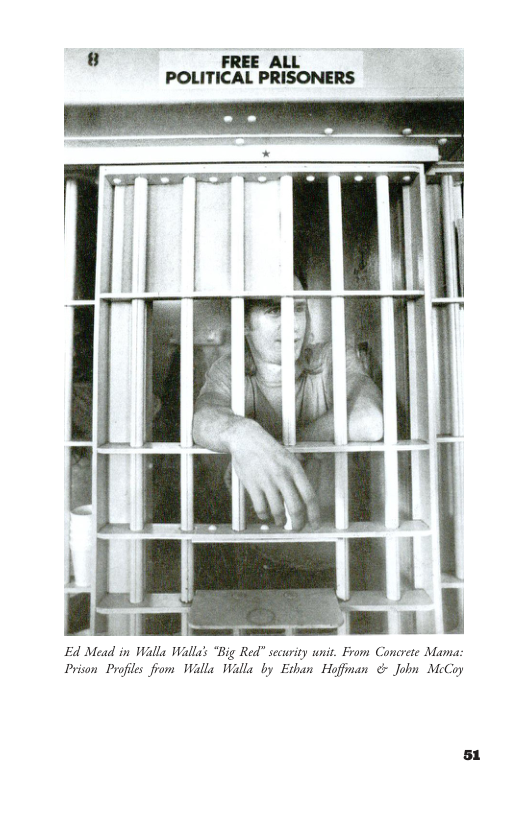
Front Cover: Men Against Sexism members Ed Mead and Danny Auteberry walk
the ter of Big Red, the Intensive Security Unic ar Walla Walla State Penitentiary.
Back Cover: Big Red in the afiermath of scruggle.
Published by Untoreli Press
Bloomingeon, 2014
UNTORELLIL
UNTORELLI@RISEUP.NET UNTORELLIPRI
TABLE OF CONTENTS
A BRIEF HISTORY OF
THE GEORGE JACKSON BRIGADE
FROM TIDES OF FLAME
6
A SHORT AUTOBIOGRAPHY
BY BO BROWN
4
SENTENCING STATEMENT
BY BO BROWN
16
A SHORT AUTOBIOGRAPHY
BY ED MEAD
20
IMPRISONED AND SEGREGATED
BY ED MEAD
22
MEN AGAINST SEXISM
BY ED MEAD
40
QUEERING THE UNDERGROUND
AN INTERVIEW WITH BO BROWN & ED MEAD
52
INTRODUCTION
v
€ may seem strange for anarchises who approach struggle from an insurrectional
Idln‘cunn to be compiling writings by and about The George Jackson
Brigade. If we understand that power is diffuse, that guerrilla warfare is a
strategy of desperation and a dead-end, and that our goal is the generalization of
uncontrollabiliy, then che urban guerrillas of the 19705 appear somewhat distant,
somewhat foreign. Sometimes admirable in their context. Sometimeshorrifyingand
authoritarian to their core. It seems, with most anarchists,here are ewo dominant
ways of viewing these groups: uncritical valorization and outright condemnation.
Both of these attitudes reck of ideologial thought, and both stifle the ntelligence
and creativity of revolt.
To make mareyes out of the urban guerrllas is o be filled with the spiritof
Christanity. Rather than understand the complexities of groups like The Weather
Underground, The Red Army Faction, The Red Brigades, ecc,the fecshist only sees
the explosion, the shell casing, the youthful lips spiting fie at the bourgeoisie: in
shore: seruggle as spectacle. By chislogic, extremity, economic damage, and milicane
language trump strategy or the ability of the act to generalize. It does not matter
that many of these groups were authoritarian in their organization, pracices, and
goals:the smoke and fire obscure the state-form lying in waic
I i also easy to romanticize these revolutionary figures, separated as we
a wuen toward diffuse informalicy
e past groups as more coherent expressions of attack. Revolt now -
whetheritis due to our strategy or our cowardice - generally takes more subtle forms.
in the US. When we constanly come up against the problem of how exacrly we are
are by time. Itis tempting, when revolt has tal
0 look to the
0 spread revole, the fury of dynamite can scem appealing (and, let us not forget,
sometimes tha fury is the best way o spread revole). But these groups, in their
e the separation between themselves and others. I we
e “heroes” of the guerrillaseruggle ended up - college
look at where so many of thes
professors, professionals, windbags who condemn any act of property destruction -
our comantic feelings take on asick pallor
3
These points - the eritique of specialization, the condemnation of
authoritarian seructure, the refusal of martyrdom - should not be confused with
the pretentious scoffing of the ideologue. Insurrectionary anarchiss, despite their
recreat from fixed ideology, sometimes harbor their own moralites. In the minds
of many insurrectionists,the guerrilla, rather than being a hero, is a fool. No matter
their goals, their ways of organizing, the content of theie writings. One need only
Lok at the hatred spewed by some anarchists for the diffuse guerrillas of the FAT
or CCE. In their slF-rightcousness, these anarchists have replaced critique of the
guersilla form - valid and necessary eritique - with a lattening of rality, a dualism
ofinsureectionist and guerrill that, in s bitterness, cannot see itsstupidiy.
Ifweavoid the raps set by both the ecishises and the opponents of uerrilla
struggle, and if we study the histories of those struggles, we may equip ourselves
with more tools - both material and analytical - for our own, insurrectional, break.
with the existent
vvv
While certainly the new diffse anarchise guerrlla differs from groups such as
the RAF o Weather Underground, one does find ceraain similarites with it and
the ELF, Canada Diree Action, UK’s Angry Brigade, and, to some extent, The
George Jackson Brigade. The anarchist clements in these laer groups were simply
not present in the vanguardism, Marxist-Leninise politics, and authoritarian
organizational forms of the former.
‘The George Jackson Brigade is an interesting case,as it contains a sort of
dual spirit The group was made up ofboth Marist-Leninist and anarchist members.
‘The Brigade's major political scatement - The Power of the Peaple s the Force of Life
-~ even contains a written dialogue berween the two groupings, exploring their
disagreements on revolutionary stategy.
“The Brigade’ diversity extended beyond the policial as well The geoup
consisted of black and white members: gay, straigh, and bisexual members; college
graduates and ex-cons. Where groups such as the Weather Underground were, by
and large, coming from the upper-middle clas, Brigade members'experiences gave
the group a more nuanced view of struggle. The struggle against prison was, from
the beginning, central to the Brigade’s actvitis,influenced, in no small part, by the
fact that members of the Brigade had been in and ou of prison their entire lives.
‘The Brigade’sdiversity, I would postulate,also contributed to itsdifferences in tone.
and content from other US guerrilla groups of the time. The abilicy toself-reflect (as
happened afier the Brigade’s botched bombing of a Safeway store) can offen take a
back seat o the revolutionary chest. thumping that one reads about in memoirs and
hiscories of groups like the Weather Underground.
Gender politis, too, played an integral rol in the Brigade’s political and
organizational orientation. Feminist analysis of gender roles and affective abor and
queer analysis of heterosexuality contributed to the group's commitment to gay and.
women's liberation. While this may seem a minor point to anarchists today, one
must look at its context to understand its importance. The other guerrilla groups
of the time pushed troubling political lines around gender: Andreas Baader’s
poisonous misogyny, Mark Rudd flagrant sexism, the Weather Undergeound's use
of *sexualliberation” to both pressure both women and gay men into heterosexual
sex..the examples are endless.
o, though one may critique the Brigade’sstrategic or organization choices,
0 outright condemn them would mean losing a valusble historical reference point
in our own seruggle against this world. In the Brigade, we find an open dialogue
about revolutionary strategy, an ethic of active and antagonistic women’s and gay
revolt, and a deep commitment to warfare against prison.
History cannot be abandoned to the cannibalistc “radicals” of the
universities, who see past revolt as a carcer opportunity. As with all things, history
can be a whetstone with which we sharpen our daggers for our present war
against the civilized order. 1 hope this publication can contribute in some way to
revolt against prison society, and to queer antagonist seruggle. The weapons are
everywheres the secret,as always, is to really begin.
A BRIEF HISTORY OF
THE GEORGE
JACKSON BRIGADE
v
TIK GeorgeJackson Brigade (GJB) wasan usban guerrilla group thatoperated
in Searde from 1975 to 1978, The group was named after George Jackson,
an imprisoned Black Panther who had been killed at San Quentin Prison,
mploy;
nes, and working class communists and anarchists. Over half of the members
California, in 1971. The Brigade was composed of un
were women and half of the women in the group were lesbians. The group had no
leader and all decisions were made together.
The group’s first actions in the spring 1975 centered around a labor
strugglein Searele. A local contractor had refused to hire black people,triggering a
‘popular campaign against the contractor. There were many pickets and blockades of
the coneractor's work-sices during which many people were arrested.
‘The media also extensively covered this popular struggle
Finding it opportune to incerv . the Brigade placed a
bomb at the contractor's headquarters in the midle of the night, harming no one
whill comple
of demonstracors tha erticized the struggle for making it center around race rather
than general unemployment, Later, the Brigade saboraged construction equipmen,
burned a truck, and damaged a CAT that belonged o the same racist contractor.
e i the strugg]
lydestroying the building. Theyalso circulated aleafletin the crowds
Due to the bombing, the contractor refused o testify against the protestors who
the pickets. The Brigade did not claim these actions, not
wanting to detract from the seruggle or have their actions be labeled terrorism
In June, Brigade members bombed the Department of Corrections
had been arrested durin
building in Olympia, expressing their solidarity with all of the prisoners in Walla
Walla State Prison. This was the first time that the Brigade claimed an action by
issuing a communiqué to the media and the public. In August,they then bombed
the FBI office in Tacoma and the Burcau of Indian Affars (BIA) in Everett on the
same day. This was done in recalation for the suppression of the American Indian
Movement by the FBI and BIA. These bombings went unclaimed.
By the end of the summer, afier three successful actions, Brigade members
were joyous and hopeful. All of their actions had been carefully planned and
executed, harming no one and resonating with the public. With the Brigade, Seale
had joined the armed international struggle against capitalism. I seemed as if the
summer of 1975 was to mark the beginning of a new offensive.
Butlife is chaotic, filled with traps, and always eager to test the bold. One
evening in September, a young man not afiliated with the Brigade auempred to
arm a bomb at the Capitol Hill Safeway. At the time, Safeway was far more corrupt
and exploitative of immigeant farm workers than it is today and had become a
target for protests, pickets, and arson across the US. That nighr, the young man
blew himself up while arming the bomb. Hearing the news of his death,the Brigade
immediately planned their revenge. Unlike their previous actions,cheir plans were
rushed. A timed bomb was placed in a bag of dog food at the Capitol Hill Safeway,
and members quickly telephoned in to the police and told them to evacuate the
store. Hoping to make the GJB out to be monsters, the police did not call Safeway.
and have them evacuate the store. The bomb went off, causing minor injuries to
several customers.
“This disaster plagued the heares of the Brigade members. The rest of the
fall and winer of 1975 was spent locked in sel.crticism. What was meant to reflect
the general distrust and anger felt by the neighborhood towards the Safeway had
inscead harmed poor people from the same neighborhood. Their hasey planning
was one factor that caused these injuries. It would no be until New Year's Day of
1976 that the Brigade would act again.
In actempting the practice self-criticism with their actions, they bombed
the Safeway regional headquarters in Bellevue, harming no one. On the same night,
the Brigade bombed a City Light substation that supplied power o the wealthy
Luelhurst neighborhood, completely destroying it. At the time, City Light
workers were on stike against the company, and they staged a picket around the
cuins, fighting off the scab workers who City Light had paid to repair . Afier the
filure of the Capitol Hill bombing, the Brigade found its actions supported and
appreciaed by working class people. The group had struck two exploiters in one
night and the reasons why could not be any clearer.
Unfortunately, one of the Brigade members was to be murdered by the
police three wecks later during a bank robbery in Tukwila. Tio others members
ofthe group were captured during the robbery, while the rest of he Brigade had to.
shoo their way ot of the ambush. In March, while one of the prisoners was being
taken t0 a doctor’s appointment, the geoup attacked his police guards and freed
him. In the process, a guard was shot and wounded. Afeer the prisoner liberation,
the group retseated into rural Oregon to regroup afer their defeat. It would not be
uncil 1977 that the group would rise again. But that is a different sory.
On March 10, 1976, members of the George Jackson Brigade liberated
their comrade John Sherman from police custody. Sherman had been arrested along
7
with Ed Mead during a bank robbery in Tokwila several weeks earler. The police
had aacked the Brigade as they lef the bank, shooting John Sherman in the jaw
and ultimately killing Bruce Siedel. As the police put their captured comeades in
the police cars,the Brigade continued to fire on the police ntil finally making their
escape.
The Brigade had nearly made off with 43,000 dollars, money that was
desperately needed in order to continue to operate clandestinely. At that time, bank.
robberies were a common method used by guerrillagroups internationally to fund
their aceivies.
John Sherman was being taken from the King County Jail o Harbourview
Medical Center for a doctor's appoinement when he was liberated by the Brigade.
During the liberation, the Brigade shot the cop guarding Sherman and escaped. To
claim this action, the Brigade mailed a bullc from the same gun used at the bank.
robbery to the Seartle Post-Intelligencer on International Women's Day. They also
sent the wiring from John Shermans wounded mouth to a local radio scation. After
this, the Brigade disappeared inco rural Oregon, taking time o heal, mourn, and
ically analyze their actions.
The Brigade had just lost o of its members. Ed Mead was in Walla Walla
State Prison and Bruce Siedel was dead. Both of these men had been lovers of other
Brigade members and had lived incensely and intimately with them for months.
‘The wound that wasin all of their heares was deep as they settled into a slow, banal
existence in the towns of rural Oregon. Many people in these towns helped them,
some knowingly. others unknowingly. Liberating their friend had drained all
o their meager resources and the Brigade was forced to lear a new level of self-
eeliance.
‘While they were in hiding, 2 Grand Jury was convened and many lefists
and militants in Seattle were called in o tesify about what they knew of the George
Jackson Brigade. While scill in hiding, the group mailed a handwriting sample to
the media in order to clear the name of a woman whom the authorities said had
signed one of the Brigades communiqués. Some lefists cooperated with the Grand
Jury,others refused and were jaled, and the entire Seatdle e was put under intense:
repression for months.
In the midst of the repression, the FBI framed and imprisoned an anti-
prison activist by paying a junky to say that the activst had participated in Brigade
action. The FBI lacer gave the junky a new identity. During this time period, Ed
Mead was sentenced to multiple e sentences for his involvement with the Brigade.
Despite the repression, the Grand Jury was eventually defeated, having come up
with nothing and being legally required to dissolve.
Knowing that they had to continue taking action, Brigade members began
0 assemble tools and equipment. Soon they launched a new robbery campaign
0 raise funds for their next offensive. After coming up with 25,000 dollars, while
also using false checks to purchase food and other necessties, the group left rural
Oregon and recurned to the Seatele area. Once there, they seceled into a clandestine
routine and began to plan for their next attack against the global capicalist system.
On May 12,1977, the Brigade placed two bombs in two Rainier National
Bank branches in Bellevue. This action was done to support the prison strike that
had recently taken place inside Walla Walla State Prison.
“The strike had arisen in response o the lengehy sentences n isolation holes
and the psychiacsic behavior modification programs that were in practice at the
prison. At the time, it was the longest prison serike in Washington State.
When the stike had ended, there had been assurances from the
Department of Corrections that the barbaric practices at the prison would stop.
Over time, many people saw that the assurances had been empry, with very lctle
changing in the prison. The Brigade bombed the Bellevue bank branches because.
of the bank’s financial ties to the Seattle Times newspaper. The paper had been
printing articles that condemned and demonized the prisoner srike.
“This is how the second offensive of the George Jackson Brigade began in
the summer of 1977. With the memories oftheir fallen and caprured comrades il
in theie hearcs,the group pressed on in their efforcs
Afier cheir bombing of two Rainier National Bank branches, the next
action of the Brigade was o acquire more money: Obviousy, living a clandestine
life did no permit them to carn money slowly, and large sums were necessary to
rent houses, build bombs, drive cars, and buy food. On May 21st, 1977, the Brigade
robbed the Newpore Hills stae liquor store near Bellevue. During the robbery, the
Brigade was forced to take the manager's wallet because it was in the same bag as the
1,300 dollars they had stolen. The next day, the Brigade mailed the wallet back to
the manager with all of her personal money (about 45 dollars)seill nside.
On June 20¢h, 1977, the brigade robbed a Rainier National Bank near
Bellevue, continuingin their pattern of stealing from where the richest people lived.
They fled the bank with 4,200 dollars. In a communiqué issued after the robbery,
the Brigade took credit for their actions and reminded the reader that Rainier
National Bank was specifically targeted because of its financial ties to the
Times. The paper had been printing misinformation about the prison struggle
taking place at the Walla Walla State Penitentiary, the place where Brigade member
Ed Mead was locked up. In the same communiqué, che Brigade told the reader that
all ofthe money would be used to carry out further actions. True to theirstatement,
the Brigade acted in less than owo weeks
Unfortunately, chaos got the best of the Brigade during the action. On
July 3rd, the night before the nationalist orgy of Independence Day, the Brigade
drove down to Olympia where they placed a triple pipe bomb near an clectrical
transformer adjacent to the Capitol Building, They called in a warning, instrucing
the authoriies o clear the areain halfan hour. When halfan hour passed and there
cartle
had been no explosion, the police searched for the bomb, found it, and evencually
diffused it. In 2 communiqué explaining the intention of the planned attack, the
Brigade said their bombing attempt had been for the prisoners in Walla Walla who
were seill being thrown into long periods of isolation. By August of that summer,the
warden had been replaced and the prisoners taken out of soltary confinemen
Fall was approaching when Rita Brown, dressed as a man, walked into an
Old National Bank, handed the teller a note indicating she had a gun, and walked
out with 1,100 dollars. Eleven days later, on September 19¢h, again dressed in
drag, she handed a note to a teller at a People’s National Bank on 76th Avenue.
‘The note read simply: THIS IS A HOLD UP. I HAVE A GUN. THE GEORGE.
JACKSON BRIGADE. She walked out of the bank with 8.200 dollars, more
money than the Brigade had ever stolen. With nearly 10,000 dollars, the Brigade
planned ics nexe campaign.
Machinists from various auto workers unions were on serike and pickering
car dealerships. Brigade members joined the picket lines, had conversations, and
decided that the rank and file unionists wouldn' disapprove of an attack on the
dealerships. Theis frst bomb didn' go off, but on October 12th, they successfully
detonated bomb at the S.L. Savidge car dealership. The Brigade made sure to.
clearly state in 2 communiqué thac they were in no way conneeted with the unions
and were acting independently. Three days later,the group bombed two vehicles at
a Dodge dealership. Three days afeerchis,over 80 cars at a Ford Dealership had thei
tiresslashed by anonymous individuals, causing over 5,000 dollars in damages. The
Brigade was not responsible for this lase action, so it is clear that the Brigade was
cortect in assuming that rank and file unionsts supported clandestine saborage.
Meanwhile, in Germany, another urban guerrilla group called the Red
Army Faction (RAF) caused an incernational scandal. In April of 1977, three
members of the RAF were found guiley of murder and imprisoned. That Sepeember,
elements of the RAF kidnapped Hanns Martin Schleyer, the president of the
Employers’ Association of the Federal Republic. Schleyer had been a member of the
Nazi Party and the §S during WWIL. Asa respected businessman in pose-war West
Germany, Schleyer represented the hypocrisy, blindness, and unbroken fascism of
German democracy: The RAF stated that they would not release Schleyer unless
their comrades were freed from prison.
‘The German government did not respond to these demands, and s0 on
October 16th, a commando of Paleseinian comrades hijacked a Lufthansa plane,
saying they would only release their hostages in exchange for the RAF prisoners
The plane eventually landed in Somalia to refuel where it was raided by German
‘Special Forces. Three of the hijackers were killed and all of the hostages were freed.
‘The next morning, the RAF prisoners were found dead their cell. The authorities
claimed chat they had killed themselves, but it was commonly understood that
the prisoners had been excuted. Seeking revenge, the RAF drove Hanns Martin
Schleyer into the woods, shot him in the head, and old the media where they could
find the dead Nazi.
To express their incernational solidaricy with the RAF, the Brigade
bombed a Phil Smart Mercedes Benz dealership in Bellevue on November 1st. The
dealership was chosen because Schleyer was formerly president of Daimler Benz,
the manufacturer of Mercedes Benz cars. Two days after this action, the Brigade
released is 40 page political statement, The Power of the People Is the Force of Life,
a text that derailsall of their exploits in their own words. Inspired by the actions of
the RAF, the Brigade’s next plan was to kidnap the dircctor of the Department of
Social and Health Services, the person who oversaw all Washington prisons. Their
plans were underway when the unthinkable happened. Rita Brown was captured,
the group fled Seattle, and fear began to dominate the geoup’s minds.
Those who truly rebel, who fight with all their heares, ahways rik the most.
They risk cheir lives, chei loves, their liberty. And so it was that the small geoup of
rebels was reduced down to three.
Janine Bertram, John Sherman, and Therese Coupez listened to a police
scanner as the authorities captured their comrade Rita Brown on November 4th,
1977. They immediately fled their saf house in Norh Seatcle and found their way
t0 2 new house on 2 hill overlooking Tacoma. In a communiqué issued afer their
comrade’scapure,the Brigade wrote, “We learn a thousand times more from defeat
than we do from a victory. This is rue, but only to the extent that we make it true
in our practice. And we will make it true because we love you, and we love freedom,
and because we are pare of the masses of people and a handful of sleazy capitalists
and their lackeys are nota match for us. So take care of yourself and hold on. Victory
Ritds lover, Janine, was devastated by the capture. In their new safe house,
Janine wrote to her lostlove in her diary. John and Therese,a suaight couple,offered
her lctle emotional suppore. “When I say I wane you, I'm told I'm sniveling. Fuck,
don't need that supporc” she wrote. The group tied to keep itself disciplined but
instead began to devour itself. Afcer a bank robbery, John mysteriously lost a large
sum oftheir stolen funds. “Wonder which of them it s that isposed of $150. John
had a gambling problem and constantly lied about what he did with the group's
Afier their robbery, the group did litle but read, go to the movies, and
abuse drugs to mask the pain of their loss. “It is hard to keep a clear view of the
necessity of this work when I am completely solated. Snivel..not a friend in the
world Janine wrote. Evencually the money dricd up, some of it spen on rent and.
food, some of it squandered on gambling and drugs. The group decided to rob
another bank on December 8th, 1977. “Am scared shitles. 1 don't think Il lose my
shic Janine wrote before the robbery: Luckily,the group was able to get away with
$3.966 from a Tacoma bank. A few days later, some trusted comrades came from
Seardle with gifs, comfort, and encouragement from the above-ground movement.
John continued to gamble money, coming back to the safchouse one night
missing $800 dollars. Janine and Therese confronted him, but Janine was passive
and could only listen as Therese and John yelled at each other. When Janine began
0 express criicism of John to Therese, she angrily defended her male lover, This
only inereased Janine’ isolation, bue luckily 2 group of women from Searcle came.
0 visic her. “Many women are sending you white light” she wrore in her diary to
Rita. Indeed, the womens community in Seattle was supporting Rita. In addition
o this, the visiing women helped Janine atcempr to learn meditation techniques
that would allow her to contact Rita psychically In her diary; Janine described her
psychic conneetions growing more powerful.
On December 23rd, the group planted a bomb ac a Puger Sound Power &
Light substation in Tukswila. They called in a warning and eweney minutes ater the
bomb exploded, harming no one. In their communiqué, the geoup said the action
wasintended to "protest the criminal and inhuman conditions a the King County.
Jail” Their captured comade Mark Cook had been kepe in isolation at the County
Jailfor ewenty one months and the communiqué encouraged everyone to do what
they could to end this eype of treatment.
The next day, a woman called KOMO TV and old the operacor that a
bomb would go off at a truck company in fiftcen minutes. The bomb exploded,
destroying one car. In a communiqué issued afier the bombing, the Brigade said
the action was in solidariy with auto workers who were still on strike. The local
machinists' union representative disowned the actacks, but the Brigade maintained
ies faith n the rank and file workers.
John continued to waste away money and the two women forbid him
from going out. He didn' lsten to them, and Janine began to dream of her and Rita
beating the erap out of him. With her group falling apare, Janine began to doubt
the armed struggle, herself, and her dreams. Afier a random bank robber began
shoorting ac police during a botched escape, was shot in leg, and yet continued to.
fire until he was captured, Janine wrote “that takes courage or insanity.” O January
10th, the Brigade robbed another bank, making off with $2.518.
On January 11ch, Ria Brown pleaded guilty to her charges. This made
Janine sad and confised.“I¢s good you said yer glad you did it,but people associate
guiley with wrong” The group continued to disintegrate, unable even to play a
board game withou fighting. On January 20th a group of above-ground comrades
visited and broughe Rita’s full statemen to the coure. I refreshed and rejuvenared
Janine o see that her lover was still defiant and strong.
One month later, Rita Brown was sentenced to tweny fve years.
Afier robbing a bank in Universicy Place for $1.899, the Brigade received
a communiqué from a group called the “Coven.” This was an above-geound group
and in their text they applauded some actions of the Brigade and criicized others.
They encouraged more dialogue becween the underground and the above-ground,
citing alack of it in the group’s actions. Both aspects of the struggle were necessary;
bue there needed to be more communicacion. The Brigade did not answer chis
communiqué immediately, bue eventually invited some comrades to the house.
0 begin to formulate 2 new strategy. Soon afier this, the group was destroyed.
Surrounded in their car, parked next to a burger joint, the three were caprured by
the FBI just asthey were to rob a bank on March 21st, 1978, The group was only as
strong as much as its members loved and trusted cach other. Love broke comrades
out of jail and propelled the group down the freeway afier a bank robbery. Trast
kept the group happy, morivated, and courageous. As soon as the geoup began to.
curn on icself,its days were numbered.
A SHORT
AUTOBIOGRAPHY
BY B0 BROWN
v
weeks. T geew up in Klamath Falls a redneck Weyerhauser town in rural
Oregon; my parents fled the poverty of the South 2 couple of years before I
was born. T have one sibling who lives in that same town, raises a family and works
for that same mill. My mom was a passive, nagging, battered wife and my dad an
uneducated, insecure alcoholic most of my lfe. They have both made huge changes
in their lives in more recent years. I started working outside the home about age 14;
my first encounter with the police was age 16 about a solen car. Luckily,the owner
dropped the charges - his daughter (my lover) was also joy riding. As far as T knew.
we were the only queers i the world and I had never heard of a cltoris. My parents.
took out 2 small loan and sent me to a small local business college. They did this
because I was good in school and it was all they could do. I transferred to th
branch where I graduated with accountingand IBM skill. Almost got kicked out o
the dorm for a hot romance with a wonderful womyn; we never made i to bed and
she had to stay there so T called them a bunch of iars and squeaked by
T moved to Seatde in 68 where a lifecime/school/neighborhood male
friend lived. He helped me learn the city and eat - no strings artached and certainly
10 sex. Got a job in a bank balancing the savings department to a computer, that
lasted nine months and then I got hired by the Post Office. I discovered he gay bars
and went through changes with my bi-sexual lover (¢he same one from high school)
uncil she finally split, then I became a working class bar butch dyke. I drank a lor, got
even tougher and went to work every day for over a year.
Eventually there was another lover; we lived closer to the hippie-dopers
and eripped out frequenty, 1 "came out” verbally a the job. There were other queers
there and we were precty strong and took care of one another even though we never
organized as such. All through this period I had several more encounters with the
police mosty around traffic violations and once for shoplifiing. Id always hear
bars and see bruises on the people who'd been in various police hassles
- mostly because they were queer. The police were scill kicking in and tearing up
Immcd 30 0n October 14th and have discovered my firs grey hairs in recent
ales
gay bars on a fairly regular basis.In 71 T got busted for stealing from my boss who.
wassill the US.P.O. Did 7 months of a one year and one day sentence in Terminal
Iiland Federal Penitentiary, Calif. Learned a whole lot about racism, queer hating,
mean police, junkies and other such facts of lfe; learned a lot from sisters there,
ke that self hate, disgust and feclings of helplessness experienced throughout
my youth could have easil led me (i Td been raised in a city where it was readily
available) to dope and gerting strung out. George Jackson was murdered - shot in
the back - and the Artica massacre happened while I was locked up.
“ame back to Seattle to find no lover, no home, only a couple of friends
and no job. So I went through a couple of government programs and a few lovers
and finally learned from another dyke that womyn are nor chicks. The first womyn's
event went to was a the U of W - an IWS conference -there was prison workshop.
going on, run by some social workers who had all their experience on the outside.
of the bars. Well I told them they didn't know what they were talking about and 1
became a public speaker and the token ex-con that very day.
‘Shordlyafeer this, I was ac SCCC where they paid (work scudy jobs) people
0 do prison work. Afier a bullshit trip with an egomaniacal man there, a womyn's
prison project was formed with a fine strong sister/lover. T was part of the politico.
Lesbian community. T worked on lots of different projects with children, womyn,
men and Third World peoples but prison work was always the most important
in my life. In a couple of years, I heard a lot of folks in lot of places talk abour
the revolution, bue nobody did anything except talk. The BLA and Assaa were
working their asses off but nobody in Seattle did a thing. Then the SLA stormed
over the ruling clas’s oes and meta iery deaths sill nobody did anything. Then the
GJB started happening right under our very noses- it made sense to me that you just
can't alk Rockefeller ct al. into giving up what they have stolen from the people.
Knew it was time for me to put my words into action.
SENTENCING
STATEMENT
BY B0 BROWN
v
Tam s enemy! I am a member of the George Jackson Brigade and I know the
answer to Bertol Brecht’s question: “Which is the biggest crn
orto found one?”
Itis to my sisters and brothers of the working class that 1 am accouneable
~ NOT to this court that harasses and searches my peers before they can enter
what is supposed to be their courtroom. NOT to this or any court whose hidden
purpose i to punish the poor and non-white in the name of the U. government.
A government which perpetuates the crimes of war and repression has NO righe
o prescribe punishment for those who resist the continuation of worldwide death
and misery. This government didn'c ask it cirizens what we thought about CIA
intervention in Chile or current U. big business holdings in South Afica.
Tam a native fighting on her homegeound: T was born and raised right
here. Allmy life hasbeen spent in Oregon and Washington. My parentsare working
‘people. My Facher a mill worker for 32 years, my mother an unskilled laborer at the
nursing home. We always had to count every penny and do without some
thing or another to make it from payday to payday. I have pumped gas, been a clerk,
amechanic, and a printer and a variety of other things. That makes me 2 common
working person as is most of the population of this world. We have nothing to.
survive by except labor - our sweat. We are slaves! Forced to give our labor and
our lives to maincain an economic system designed to serve only the rich - almose
always white male corporate owners. This ruling class has no respect for human lfe
s only concerns are private property and personal power. They manipulate us as
puppes on their stage of greed.
Right here in Oregon there are mountains of proof about how bigbusiness,
protected by the state and federal governments,rip us off daily. How much profic
did Weyerhauser make last year? How much taxes did the company pay on those
profit, if any? How come those who slave their lives away for George Weyerhauser
get none of those profits? How come Weyerhauser
Iflznd before this mockery of justice court to be condemned as its enemy - and
¢, t0 rob abank
continue o pay small
pollution fines and isn't made to install anti-pollution systems? The answers to.
these kinds of questions will teach us just who George Weyerhauser is and what he
eally cares about. Those cute commercials we sec on TV are a snow job to keep us
from sceing the truth.
There are a few people in thisstate who know that the Wah Chang plant,
just north of Albany - right there on the freeway - is killing the pure air and water
and even the earth, so highly valued by Oregonians. For years we thought it was a
smelly pulp mill bu chat was a lie! It i, in fact, the manufacturer of zirconium, a
metal vital to the government’s plan to pursue nuclear energy and warfare without
properly considering the potential death and destruction in case of the slightest
accident. Wah Chang dumps radioactive poison into ou lves every day! Their fines
are minimal, they are not seriously made to clean up and say that they shouldn'c
have to. The workers are in very real danger of serious ilness ot injury and even
death.
The university of Oregon has $3 million invested in stock in 28 South
African companies. The State Board of Education has passed the buck to the
Attorney General who has passed the buck to the State Treasurer. The State of
Oregon finances the most racist and genocidal government in the world. The
mounains of proof are everywhere
Prisons are big business too. Naionally, the annual profits reach 52
billion. Prisons promote “cerrorism” by making the denial of human and democratic
rights 2 respectable and common thing. Lok at who s i prison and why - 75% of
all adults in amerikkan prisons are Third World people. This i clear and simple
proof of systematic racism. Right now in Oregon there are three cruel and unusual
punishment suits - one at Oregon Correctional Institution, one at Oregon State.
Penicentiary,and one at MeClaren Juvenile prison. Every person in this stae should
investigate these suits in their own interest. We all know it’s the powerless working
and poor people who go to jail. The ral criminals - the rich - are pardoned by other
sich criminals or go to country club estates to do shore time. (Or, they can get
“daddy” to put up $1.2 million for bailafeer convietion.)
Tam a woman who s greatly concerned that the biggest areas of neglect in
the so called justice system are rape, wife bartering, and child abuse. The womyn of
today suffersevery day from the oppression of sexism. Everywhere she looksshe sees
sexiststereorypes thatscream: you are asex objeet - you can'e control your own body.
- men need to beat you sometimes - there is no such thing as rape, you must have
asked for it. And if she can't cope with this insanity the male-dominated medical
profession pronounces her erazy. 90% of patients in meneal hospirals are wimmin.
Tam alesbian - 2 womyn who totally loves wimmin. A womyn who loves
herself and her sisters. A womyn who is proud to say that loving wimmin s a very
beauiful and positive aspect of my life. When any womyn or man decides to be
openly gay - to “come out” - we risk social disapproval, police harassment, and the
17
very real posibiliy of being beaten in the streets. We are denied jobs, thrown out of
public places, refused housing, our children can be stolen from s and mostshrinks
sill hink we suffer from some incurable sexualllness. This blacane discrimination is
the systematic denial of our democratic and human righes. It should never be a rime
for any person to love and care about another person. The freedom to be what we
areis what weal fight for! Wimmin loving wimmin and men loving men is nothing
new. Since the beginning of humanity we have loved, fee and proud. Our culure,
though sparsely documented due to the great efforts to suppress our herstory/
hiscory, does exist. During the time of Sappho and Ise of Lesbos, our sexualicy was
open and accepted. Then the self-appoinced rulers - the proficeers - marched across
the carch and for boots they wore suppression. Suppresion to crush all those who
wouldn't conform to their ideas or recognize thei right to destroy our various ways.
oflfe. We have been mighey warsiors in many wars - Amazons and Romans. Not
even Hiter, who killed us in one of his fist experiments in annihilation, could
destroy us.Joe MeCarthy hunted us too. Today, the fear of homosesuality promored.
by the “masters of unreason” encourages Anita Bryanttypes of fascist campaigns
based on hysteria and ignorance. This kind of insticutionalized fear s repeatedly
used to keep us from building strong resistance. It will work less and lss as we leam
0 understand the tactics of psychological warfare used by the ich to keep all of us
i our places. But, we must remain alert to the very real threat of fascism and destroy
it before we find ourselves surrounded.
Tlove children. To me childen are the most beautiful, honest,sincere, and
ereative of human beings. It is for their furare as well as my own that I ighe. My
heare full oflove for all people. My heare full o rage ac the capiealist/imperialist
system that traps and destroys us from bisch. 1 am the anger of the people ike the
thunder that comes before the rain that will heal the earch.
Itis necessary to define “armed struggle” and “terrorism” since these terms
are ofien and incorrectly used interchangeable. This error is continually made by
the straight media who ofien just take orders from the FBI and other government
gestapos. The press forgets its real job is to report the facts to the people - not to.
alism merely to sell 2 particular channel or newspaper, and ot to
participate in news blackouts which keep the facts from the people. “Terrorism”
is armed action which deliberately and callously ignores the welfare of the people.
Itis the insticutionalized sick violence of the ruling class and it police forces: the
senseless bombings of Viet Nam; the Attica massacre; the Kent State massacre; the
Jackson State massacre; the individual murders of Clifford Glover, Karen Silkwood,
eorge Jackson; the continuing murders and serilzations of Naive Americans
and Puerco Ricans; the inhumane mechod of confinement suffered by Assata Shakur.
“Armed seruggle” is the use of controlled violence such as armed oceupations,
Kidnappings, prisoner escapes, armed robberies, bombings, etc. A primary factor is
that concern for the welfare of innocent peopleis afways a vital part of the planning
and exceuion of these actions. Freedom fighters around the world have consistently
made the distinetion berween revolutionary “armed struggle” against the ruling
class and the “terrorism” of random violence used by the state against the people.
T am an anti-authoritarian lesbian feminist anarcho-communist! I am
an urban guerrilla committed to give my white lfe if necessary! As our comrade
brother George Jackson said -and it just as true today as it was almost 10 years ago
when he said it - “We must come together, understand the reality of our situation,
understand that fascism is already here, that people are already dying who could be
saved, chat generations will die orlive butchered halFlives if we fail o act”
Love and Rage - Fire and Smoke,
Ria
2/21/78
A SHORT
AUTOBIOGRAPHY
BY ED MEAD
v
Fairbanks, Alaska. When [ was twelve during the mid-'50s, me and my sisers
hopped a crude road into unsurseyed land they were about to homestead. We
subsequently buile a log cabin, drilled a well, and endured a whole lot of poverry.
During the next ten years I precey much ran wild, without the social or moral
restraints imposed on most young men by parents, peers, church, school, and other
means of public information and conditioning, I was first incarcerated at the age
of thirteen, at the State Industrial School for Boys in Ogden, Utah (Alaska did not
have ajuvenile institution at the time so T was subjected to out-of-state banishment
I\m one of six children raised by a single mother who was homesteaded near
at a very young age). for burning down a large structure on school grounds. By
the time T was eighteen, [ was serving a three-year sentence in the Federal Prison
at Lompoc, California, for burglarizing a gas sttion (Alaska did not have a state
prison at the time).
T was subsequently released on parole, violated the conditions of my
supervision and was sent back to federal prison. At this poine my life became
a cliché of recidivism. I was in and out several times, mostly in, doing ife on the
inscallment plan. Then during the late “60s, while serving a ten-year auempred
escape sentence at the federal prison at MeNeil Island, Washingeon, 1 came into.
possession of some radical lierature. Unil chen I supported the war in Vietam.
Not because I believed in the justice of the US. cause, bue because I had heard some
older men say something to the effect of: *We ought to bomb that place into the
Stone Age and then pave it over and make a parking lot out of it In the absence
of an opinion of my own, I would have parroted something to that effeet. But the
anarchist and Marsist literature I was reading enabled me to intelligenely choose
sides.
Those who supported the war also advocated for longer sentences, the
elimination of parole, and favored the death penalty. Those who opposed the war
demanded an end to prison construction, ficedom for prisoners, and the lefists
opposed the death penaley. When MeNeil Island prisoners went on a work strike,
the singer Pete Seeger and actress Jane Fonda were on the docks with six hundred
people demonsterating in support of the striking prisoners. The Weathermen busted
Timothy Leary out of prison, and they were bombing the government. Choosing
sides was easy, and, having done i, 've never looked back.
Released by afederal court order n 1972, left Alaska and moved to Seaetle
0 join the revolution.” I was active in Seattle’sprogressive political communicy for
several years, untl was artested in 1975 during an unsuccessful bank expropriation
by the George Jackson Brigade. The Brigade had been conducting acts of armed
propaganda such as bombings and financed itself through bank robberics.
Convicted and sentenced to two consecutive life terms by the stae of Washington
on 6o counts of frst-degree assaule against police officers (because of a shootout
at the bank), I was sent to the Washington State Peniteniary ac Walla Walla. It was
there that I organized Men Against Sexism.
Afier serving eighteen years, was released in 1993, For nearly a decade I
have worked s a nerwork adminiserator for a nonprofitin San Francisco.
IMPRISONED AND
SEGREGATED
BY ED MEAD
v
nd twenty other prisoners to the Washington State Penitentiary at Walla
Iz was a dark and ominous day when the prison's bus pulled up to transfer me
flla? Actually, T do remember what the weather was like that day, though it
was ewenty years ago and the weather was one of the last things on my mind. As e
happens, i was beautiful summer day in early August 1976, when we lef Shelton's
Reception Unis. The Penitentiary was located in the opposite comer of the state,
as far away from Seardle as possible. Low rolling thunder clouds hovered over the
whole area as our bus drew nearer and nearer to the prison; the wind blew in carthy
smelling guses. T experienced the fecling one gets just before an electrical storm,
harged static electricity a it flled the hot afiernoon air,
as if looking for some channel though which to discharge its pent up energy. The
amosphere added a sense of dread to an already muggy day. A storm was certainly
looming,
sensing the yet-to-be-di
The relatively short amount of time 1 had o spend at the Shelion
Corrections Center’s Reception Units was delightfully uneventful. Shelcon is
where new inmates coming into the state’s prison system are iniially housed and
processed. The shore timers are weeded out and scheduled for transfer to minimum
or medium custody f while those serving long terms are sent to *The Walls”
as the Penitentiary ac Walla Walla is called. The Walls was considered to be the
roughest, toughest, highest security prison in the sate; the government’s ultimate
ind the last stop for many men. I knew it might be
that for me, not only because of my long prior record, but also because I had a new
sentence of two consecurive lfe terms.
revenge, the end of the
Thad just finished cight months of difficult confinement in Seatdle’s King
County jil. During that time I went through both the state and federal trals and
the respecrive sentencing procedures. The barbarity of the jail experience would
prove to be just a warm up for what was to come.
‘Whilein the il I was locked up in what they then called the Annex, which
was a section of the jail used as the segregarion unit. T did not stat out in the hole,
buea fellow prisoner, Mark LaRue, who was certainly well meaning but nonecheless
abit of a bumbler, decided to send me a note outining a lot to rot and escape. T
wasin the jails mess hall having a meal and minding my own business. Mark walked
by the table L was catingat, and as he passed he dropped the incriminating note on
the floor, the one outlining his grand scheme o riot, take hostags, escape,etc. The
nly problem was that the guards became avare of the note before 1 did, and they.
snacched it up before | could get to it That was the end of my say i the jils main
population. It was the death knel o any escape plans 1 may have been visualizing in
my own mind.
" In the Annex, where T was to spend the remainder of my time in the
King County Jail, the walls and ceilings of the cells were made of metal, and if an
inmate beat on them just righe,they would reverberate with a resonance that would
shake much of the building. We did not put this knowledge into practice unti
our treatment in the Annex became so bad that we that we were forced to initiate
series of protest. Fist we did do some serious banging on the walls. The noise
Soon became so bad that the judges in the cortrooms located below the ailtarted.
comphaining to the guards, demanding that they do something about it. And they.
did — by running in on us with pressurized gallon sized jugs of mace, a chemical
agent thac burns the eyes and lungs, which was supposedly designed to be used only
in open areas to disrupt steet rors and what nor.
“They must have pumped gallons of mace in on us,in an area with no air
circulation excep what litle came in through the Annex's solid seel door, which
was usually open. Afer the macing, though, the door was closed and we were lefi
o cookin the foul gascous it for nearly tweney-fou hours. They pumped the seuff
in chrough the vents a the back of our cells. As they squirted the rritating agent
through the top vent of my cell, 1 would jump up on my bunk and try to cover
the opening with 2 towel, to prevent it from entering the cell, then they would
shoo the stuff n through the borzom vent. When I dropped down to cover that
e, they would squirt the mace i to my cell from the top vent again. And while
one guard was doing that to my cel, fceless others were n the plumbing walkoway.
behind the cellsdoing the same thingto all f the other men on the ter. When they
finall Lei us alone the foors and walls of our cels were dripping with mace, and
our mateesses and bedding was sosked with the seuff. We were left o cook in the
unventiated summer heat of the Annex until nearly noon of the following day:
1 had witnessed the beating of prisoners and many other less dramatic
crimes againse prisoners at the King County Jail, conditions which apparenty
became even worse later. As ahvays seems to happen, when the beating of prisoners
fails to cause the desired behavior, guards take to killing them. Afeer left the jail
1 read that guards used the infamous choke hold to kill ome black prisoners. The
guards, lke their police counterparts on the streets, were routinely found using,
justfied” force in the murder of unarmed captives. This form legalized murder
has an effect more immediate than the simple killing of 2 recalciran prisoner,in
that it works to communicate to other capives the high cost of being insufficiently
submissive.
Twas in the jail with two lfe sentences given to me by the state. The term
would probably have been half that excepe for my big mouth. My trial actorney;
David Allen, alked to che judge before I was sentenced and was told that he, the
judge, was going to impose a single lie sentence. Armed with that knowledge and
angry with the severity of even that much time, at sentencing the next day, when
the court asked me if 1 had anything to say. I told him: “I have been framed and
railroaded — like all poor people who appear before this courc” The judge then
turned a lvid red. He was clearly Rustered as he stammered through the imposition
of two consecutive lfe terms. The way T saw it was that one of the life sentences
was for the assaults, and the other was for the crime of having a smart mouth. In a
countery espousing free speech, no one deserves alie sentence for something they.
have merely said. Especially since what I said was true. I never did have a police
officerin my gun sights, I was nottrying o kill or even wound anyone. I was trapped.
in the bank with no means of escape. I would have been stapid of me to try and
shoot someone at that point. My gunfire was merely a means to secure a negotiated
surrender; vt the murderous police know that this was not going to bea shughrer:
‘The prosecutor’s version of events was substantially different, of course
He said dhat “[o]n January 23, 1976, the defendane]s] .. aempred to rob the
Tukwila branch of the Pacific National Bank of Washington. They were armed with
2 9mm automatic, 238 caliber revolver, and a sawed-off shotgun. The purpose of
the robbery was to take money to purchase automatic weapons and explosives to
further the activities of the ‘George Jackson Brigade. Detective Joseph Mathews
of the Tukwila Police Department arrived in front of the bank and the defendant
and Seidel began to shoot him. Detective Mathews returned the fire and hie Seidel.
Simultancously a forch robber, waiting across the steet, began to fire at Detective.
Mathews. Detective Mathews returned two rounds in this dircction, and the other
person lef. At this cime Officer Robere Abbote arrived and §
ac him, knocking out light on the patrol car. Abbote then recurned fir with one
round which struck Seidel in the chest and killed his
cident that I've had tolive with during the subsequent course of my
It has been chis offcial
version of the
The sentences handed down in those days were really capricious. For
example, there was a guy in the jail with me who had a long history of killing and
raping women. They convicted him for doing that to several women in this sae.
He received a single five to life term. Whereas 1, who had never harmed anyone,
or had never before been so much as arested for a crime of violence, was stuck.
with two 20-to-lfe beefs running wild. Hell, Cuban exile Virgilio Paz Romero,
who was convieted and sentenced in federal court for the 1976 planting of a car
bomb that killed former Chilean Ambassador Orlando Letelier and his assistant,
Lonnie Mofft, in Washington, D.C. Romero received a twelve year term for these
o murders. With a third deducted for good time, the very most he would have
0 serve would be eigh years. According to the U, government’s Bureau of Justice
Statistics, more than half the convicted murderers released from state prisons in
1983 were back on the strects afier spending less than seven years behind bars.
am not saying these people ar serving too licle time, as murderers have the lowest
ecidivism rate of any other offender. What I am sayingis that my state sentence was
00 harsh.
So from the jail I went o Shelton. I don't emember much abou lfe there:
other than beinglocked up in cell much of he time. They did call me in one day to.
take a psychological est, the MMPI, which is based on the outlook of some white
middle-class farmers in Minnesoa. IF you don'e answer these questions like the
white farmers would, then you are considered abnormal. And not being “normal”
or “average” in America is nearly a crime. So there we were, a whole room full of
newly arrived prisoners and a couple of non-uniformed cops (o doubr counselors
of some sort). They passed out a copy of the test o each us, and told s to complete.
all the questions.
Timmediatel refused to take the test,eelling the guy that doing so would
be a violation of my righes to privacy. One of the cops then told me I must take it
Tagain declined. He then became even more verbally insistent. I told him that if
he wanes me to take the test, he i going to have to physically pick up my hand and
make it mark on the answer sheet, s I wonit do it on my own. He saw that I was
serious and ordered me out of the room. I had enterained a hope that some of the
other prisoners would follow suit, but none did so. Like obedient sheep they all
submitted to the invasion of their most private thoughes by the state. Guess it was.
their raining in school that condicioned them in this egard.
Some years later, in connection with pending ltigation, I was able to
obtain copies of documents seting out what the testes had to say about me. They
said: “Paychological tests were refused. He claims that tests are irrelavan (sic),
inaceurate, outdated and an invasion of his personal privacy. His attitude was
adamant refusal without compromise. He was rleased from testing”™
Actually, refusing o subject myselfto the testing was a smart move on my
parc. But followed it up with something stupid. I was called n for a psychological
intervienw by Shelcon's psychologist Felx E. Massaia and psychiatrist PB. Smith. I
don't know why I agreed to talk to them; perhaps because I had been ambushed,
racher than given the time to think about whether or not I wanted to alk to them.
They did a three page report on me that was notall that negative, but that would
Tater be misused by the state’s parole board. What the repore sad, in essence,is that
T saw myself as a revolutionary: That should not come as any surprise to people.
They said I came across “as a relaxed, affable, and articulate individual. Mr. Mead
presented himself as a revolutionary who was imprisoned by his ‘captors” as he
perceived himself s being ‘at war' with society’ insicutions and systems.”
“The pare of this July 26, 1976, psychologieal repore that really hure me
was when the interviewers said: “Mr. Mead presented himself much as he did in
court where he viewed hisactions in his‘war' as being justifed, thus his robbing ofa
bank being ‘an appropriate expropriation; and his secing of bombs which destroyed
the Laurelhurse Power Substation as well as the offices of the Division of Adult
Corrections in the Capitol Center Building in Olympia a5 an acceptable ‘actic’
in his fighe. Mr. Mead acknowledged by intimation that his group in this area was
linked with the groups that have identified themselves as being part of the George.
Jackson Brigade in other arcas such as California where they were involved in a
bombing in San Francisco, and banks in Santa Barbara”
No group in any other part of the country, Santa Barbara or clsewhere,
ever caimed to be a part of the GJB. Moreover, the Brigade never conducted
any bombing actions outside of Washington State. But the parole board would
subsequently use this bogas information against me, claiming that the quored
material constituted a confession toall those crimes. That it was patendy false on its
face and would carry no weight acall.
The psychological report concluded by saying that *he does not primarily
fit inco any particular category of the D&SM (a diagnosties manual used by
psychologists) as he is difficult to ‘pigeon hole! as he has a grear deal of insight
and is very much aware of the internal dynamics operant in his personalicy
configuration, and thus definitely not a person who could be categorized as being
‘psychiatrically ill” The good lying doctors went on to finish their report with the
following recommendarion: It anticipated that Mr: Mead will make a sacsfactory
adjustment to confinement as long s he does no perceive himself as being singled
out for discriminatory negative attention and [is] allowed to live as any other
resident Prison officials a the penitentiary would have been well advised to pay
special heed o the wisdom of that recommendation. But of course they would no.
Anyway, 1 was shipped out to the State Penitentiary ar Walla Walla,
traveling in an old prisoner transport vehicle not so affectionately referred to as
the Green Goose by its unwilling passengers. The bus carried 2 maximum of 21
people. It was August of 1976 and ic was hot inside the fully loaded bus. Sweating
prisoners were hand cuffed to chains looped around their waists and connected
0 the similarly restrained man next to chem. We all wore leg irons as well. The
arcangement was called a chain. The trip took what scemed lke six hours. During
that time ifa prisoner had to use the toilt Facilties, which consisted of an open and
very smelly bucket at the back of the small bus, he got permission from a guard to.
shuffl like 2 penguin back to the bucker, where, with hands chained, they did their
best to urinate as the bus merrily bounced its way over the bumpy highway.
‘Asthe iringjourney came near to.an end, the passengers on the bus looked
offinco the direction of the prison with a strange mixture of dread and anxiousness.
We were happy to be at the end of this unpleasane trip, yet felt considerable.
forcboding for what lies ahead. We had heard many terribl stories sbout the prison
while in the county jail. The old timers who had been to WSP before suddenly
grew in stature,for they knew the ropes. Everyone was looking for the prison, and
those who had been there were tlling the rest of us where to look. When the prison
finally came inco view, I fel like I was seeing the outside of a place I would not be
seeing the outside of again for along time. I took a meneal picture ofthe il distant
prison and the surroundingarea, justin case might be able o at some point escape.
The late afternoon sky was dark with humid clouds that appeared to wan to burst
inco thunder. The land was flat che endless wheat fields broken only by occasional
outbuildings and the fences that separated them.
We pulled up to the prison and entered the double-gated sally port.
With the first gate closed behind us, prison guards casually inspected the bus for
possible concealed weapons or other bulky forms of contraband. Then we were.
passed through the second set of gates and into the prison proper. The bus was
driven behind a large red brick building where it came to a stop. We were ordered to.
disembark. Marching two by o, the chain stepped off the bus and into the innards
ofthe prison. Greeting us was a tough-voiced sergeant who read the new prisoner’s
names from a clipboard and barked orders regarding our housing asignments. Also
greeting us was a gathering of bored Walla Walla prisoners, who used the weekly
areival of the chain as a mild diversion from the prison’s humdrum daily routine.
Some came to look for friends coming in from the county jal, and if they saw them
they would exchange greetings or instructions. Some came simply to gawk at the
new fish. And some,the predators, came to look over the meat for possible prey —
the young and more vulnerable newcomers who did not have any friends to protect
them.
Those who had partners on the inside would get shouts from their friends
like: “Hey Bob, tell em you want to move into 6-E-21; I've already put in a kite
for you.” Others,the young and far, might get embarrassing catcalls of one sore o
another. “Oh, look at that one,ain't she pretey” And so on. Those who had a place
0 go and friends were the lucky ones. The rest of us would be immediately placed
in a four-man cell with three strangers. And the cells were so small chat the three
already there generally resented the addition of the newcomer. I was one of those
who knew no one at the prison, but at 33 I was also faily old and con-wise enough
0 escape the notice of the sexual predators and their wanna be counterpars. When
my name was called I was given a cell number, had my chains and cuffs removed,
and then followed those before me into the back door of the brick building. It was
the clothing room. We were issued new clothing and some old but clean bedding,
and directed out the front door. Those who had friends were picked up and the
reunion began. Those who had been there before knew where they were going, and
27
went there cither by themselves or with a newly-made buddy from the county jail,
Tstood in front of the clothing room alone, looking out on the innards
of the prison. Inmates wandered around in small groups, not acting like they had
any place to go. What struck me was the age and Flthiness of the place. The many
huge buildings were all made of red brick.Just about everything on the ground level
looked dircy and crowded. The place impressed me as having been put together
without much planning. The buildings were designed in different styls, relecting
the age in which they were buile. The old ones you could eell from their architecrural
style were quite old, and their bricks and concrete at the lower levels were chipped
and falling away: Small switls of dust and liter blew across a big dire-filled open area
which T would lter learn was Peoples”Park.
Tsuddenly fele more insecure and insignificant than Id fele n along time.
wasalso experiencinga fear that I would never leave this terible place; that I would
be erapped in ths lcde space for alifecime.
‘With the blowing dust gricting between my dry teech, T threw my bundle
up on my shoulders and ventured out into the prison. asked a passing inmate how
o find i
Six Wingwas a huge cellblock containing stacked tiersof what should have:
been one man cells but which were crowded with four prisoners. It was like 2 bee
hive, abuzz with the sound of men secding in for the soon-to-come evening count.
“The i was bad with the smell of too many bodies,the poor ventiltion not being
able to keep up with the load. And the inadequate lighting contributed to the hive-
like acmosphere of the building. I found my way to the cell that was assigned to me
without to0 much trouble. It was occupied by 2 man who I would later learn was
ajailhouse lawyer called Doc. Doc other cell partners were kitchen workers and
would not recurn until later in the evening. We had a brief but friendly alk uncil
count time was announced over the cellblock’s loud speakers, whereupon the goon
squad suddenly appeared at the bass i front of the cell. They ordered me ou, cuffed
my hands behind my back, and then escorted me to Big Red, the name prisoners
gave to the owo-story brick building that was the institution’s segregation unic. It
appeared as if I was indeed going to be “singled out for discriminatory negative
Being processed into the hole was not much different than all of the other
forms of degradation prisoners must experience on a daily basis. As it happened
there was another prisoner being processed when I entered the unit. We cach had
0 remove all of our clothing in front of the gawking guards, then allow them to
look into our mouths and ears: lfe our scrotum and penis s0 they can examine
under them; curn around, bend over, and spread the cheeks of our assso they can
supposedly check to sce if there is any contraband hidden inside us. The other
guy being processed with me was a few years younger than me and more slightly
built. T didn'e speak to him, nor he to me, as cach of us were caught up in our own
humiliations.
‘When the guards were done with us they threw us each a pair of oversized
blue coveralls and led us to B ter, one of the four ters making up the hole. I was
assigned to cell 13, the other guy was put next door tome,in cell 14,1 looked around
the tiny cell. Tt was dank, pained barf green, and filthy. There was a more or less
round patch of brown mud-like material smeared on the wall over the bunk. It was
about three feet in diameter could ell by the smell and texture that it was human
fecal matcer — shit! It took a moment for the shock to wear off, then I yelled out
0 the guard,telling them that I wanted a different cell. Afier awhile a guard came
onto the tier and I showed him the filchy wall and demanded a move. He told me.
that there would be no cell change, as such matters were ordered by the assignment
officer and could not be changed. I then asked for cleaning materials, but was told
that would have to be obtained during the following day,as his shif did nor issue
supplics.
Temporarily resigned to my fate, I made my bunk and started cleaning
the cell as best I could without acrually touching the any of the bugger-infested,
shit-smeared walls. Supper had just been served in the segregation unit and most of
the 24 prisoners on the tier were cither taking naps or reading. It was mostly quiet,
with only an occasional snatch of conversation between the cells. No one paid any.
Tt must have been around seven iclock in the evening when they sarted
letting selected prisoners out for their one hour exercise periods. While 1 didn'c
Know it at the time, most prisoners on B tir spent 23 hours a day in their cells,
although there were about six men who served as “erustees” and spen considerably
more time ouside their cells (but scll on the tier). These were the toughest
men in the toughest prison in the state. Some of them were in the hole serving
administration segregation time or awaiting trial for murdering other prisoners. T
did not pay a whole lot of attention to what was going o outside my cell th traffic
of prisoners exercising and talking with other friends on the tier. One guy stopped
by my cell on his way to the frone ofthe ter to use the phone. He sad his name was
Danny Aucberry, and that he and a couple of others on the ter were i the hole for
participatingin the December 1974 takeover, He said he knew of me and of course.
was supportive of the work the George Jackson Brigade had been doing in their
behalf. He named the other rioters and hostage takers a Joe Green, Mark LaRue,
and, to some extent, Carl Harp. I knew most of the names of these men and was
happy to learn that there were some friends on the tir.
Acabout nine that evening events took a very ugly turn. A gang of about
six prisoners decided they wanted to rape the prisoner in the cell next to mine, the
Kid who was booked into the seg unit with me. T could not believe my cars when
the sound of their efforts to get his door opened invaded my peaceful reality. The
guard on the end to the tier was at the lockbox trying to open the door of cell 14
5o these guys could get in and rape him. I sprang from my bunk and looked out the
bars at the front of the cell at the nfolding scene. The victim was holding a book
in the bars, preventing the slding door from opening. His attackers were trying to
grab the book, he'd pull it back, the guard would actempt to open the door again,
and my neighbor would stick the baok back in the bars. The rapo gangof prisoners,
lead by a muscularly built black man awaiting rial for murder, then went to the sink
at the end of the ter and obtained a pi
man trying to defend himself. Scill he would no let them get the book or o seay far
away enough from the bars for the guard to be able to open it
Twas affaid to shout out in the other man' defense, fearful that the mob
her of hot water, which they threw on the
would tarn on me. I just stood there, wallowing in anguish for both of us, and
hating myself for not taking a more firm stand. Who knows, had it gone on much
longer or ifthey had gained entrance to the cell I may have actually done something,
like demanding that they stop. On the other hand, maybe I would have continued
0 tremble in fear. But the guard gave up and that ended all hope of the prisoners
gettinginto the younger man'scell. It isn'coften that Lam confronted with an echical
or moral ssue that also appears to be a question of life and death. It is not a good.
feling 1 didn'esleep well thar night
The next morning my cell door opened and I was released, along with the
men on each side of me, for my one hour exercise and shower period. The first thing
1did was to clean the walls of the cell. I then went to talk with Areberry, Green,
and LaRue about the events of the night before. They shared my sense of outrage
bue were unwilling to physically confront the gang of rapo killers. Only one man
said he would take a fighting stand, and that was Carl Harp. He was understandably.
reluctant and his suppor shaky, but it was a stre. 1 also talked to one of the old
timers on the ter,a respected prisoner and escape artist I will call Art. Are told me
ot to get 0o riled up about what was happening, as the *kid” was a punk anyway
and would be giving his ass away if people weren'e trying to take it. Are told me
that at Walla Walla prisoners are raped allthe time, even bought and sold by other
prisoners — tha's the way it s. I was amazed, and answered that this articude must
be altered if we ae to ever make progress at changing conditions in the hole. While
it did not appear as if I made much progress during my hour, I later learned that
Danny, Art, and the others spent their times on the tir talking to members of the
‘gang” about what is right and wrong for prisoners to be doing. The change was not
deep, bur 2 new mood nonetheless came into being on the tier. The followers had
fallen away from the rapo leader, which wasa positve development. On the negative
side, the big rapo took this turn of events as a challenge to his masculinicy, and he
clearly saw me as the cause of the change. It seemed to me that he'd decided that in
order to prove himselfa real man he must rape my neighbor. It may sound dumb.
today, but back then maleness was not something that was biologically determined.,
but racher manliness was a state of being that had to be reinforced and proven every
day, most ofien at someone else’s expense.
‘The next morning the rapo was out on the tier frst. He prompily set
up camp in fron of the bars of my cell and started his exercise routine, jumping
rope directly n front of me. His shirt was off and his massive muscles rippled with
sweat as he worked out like the professional he was. In addition to being a well-
developed weighelfter, my new friends would soon tell me that this guy had been a
professional boxer on the streets. This demonstration of the rapo’s prowess certainly.
scared me, bu when it was my time to exercise I took the jump rope down in front
ofhiscell and did my rather pathetic workout. I was skinny, and notatall tough, yet
Twanted to communicate the fact that he was not going o be able to make his move
without some resistance from me. I did not particularly like the kid in the cell next
0 me. It was not for him that I was doing this, i was for the principle that preying
‘on each other must be stopped
That afiernoon 1 found out that the rapo had his “yard period” changed so
that he would be out on the tier with me and the kid the following morning, That
nighe I gor very litle sleep. 1 was certain that come morning [ would cither dic or be
badly beaten up by this much stronger and far more vicious man. Morning finally
came, of course, and when my door pened I stepped out onto the ter determined
0 put up as good a fightas I was capable of. The rapo had never spoken to me, and
this particular morning was no exception. He went about his business of exercising
asif wasn'e there. He did talk to the kid, bue no rape took place. When it was time
tolock up again T entered the cell with a great sense of elief
‘Aday or two later the rapo put in a move slip to be transferted o another
tier, and he was gone soon after that. I subsequencly learned that the reason he
did not atcack me was that 1 had succeeded in winning over public opinion on
the tir. The George Jackson Brigade’s bombing artack on the headquarters of the
Department of Corrections and the FBI offce in Tacoma, and other actions of the
Brigade, had landed me a cerain amoun of moral authority on B ter. To have
hure or killed me would have been very bad politics on the part of the rapo. The
cost of his no having done so was also expensive. His position as the prisons top.
dogwas no longer intact. A short time later, while supposedly giving him a nose hit
from ajoint, cwo prisoners I will call Kevin and Andly, former members of his rapo
entourage who had since joined him on D tier, actacked him with knives. He was
badly stabbed but survived the assaul. In any case, he was no longer a threat to me.
Although Kevin and Andy would subsequencly prove to be serious obstaclesin the.
path of prisoner organizing. But that was in the future a this point. Right then my.
only thoughts were of trying to build something that would move things forward.
As days meleed into monehs I fell into the day-to-day routine of life on
B Tier, and, to some extent, was able to communicate with prisoners on the other
three tiers of Big Red through the vents located in the back of each of our cells. But
mostly 1 did a lot of talking with my fellow cons on the tier, particularly Danny,
Joe. Mark, and Carl,all of whom had participaed in the December 1974 takeover
‘of sections of the prison. I learned there had been long periods of spontancous
resistance to conditions in segregation, a resistance that sometimes took violent
forms. From what I could gather the bardle would run hot and cold, sore of like the
principle seasons in that remote corner of Washington state. A few months earlier
there had been tough fighting: a guard or two having been taken hostage by seg
prisoners, conviets being beaten by their captors, prisoners throwing fecal maer
on the cops as they came on to the tier, and the cops putting urine, bleach, and
soap chips in the food and drink before serving it to the locked down prisoners
Then at some point there would be a change, a few token concessions tossed out
by the warden, and the season of struggle would suddenly change again to one of
peace and cooperation. Many of those who had participated in the earlier proteses,
like Kevin and Andy, would become friends with the cops (or ac least certain of
them), and those guards, our former enemies, would in turn pull trips ke opening
the prisoner’s door for the attempred rape that took place on my fist night in the
unit. At that particular moment, the season was currently one of peace between the
Keepers and the kep in Walla Walla segregation unit. That was the time when we.
most ofien victimized cach other.
There was another young kid on B Tier, an innocent 20 year-old whose
principle crime was probably one of being more confused than those around him.
The youngster did not bother anyone else on the ter, and for the brief time he was
with us tred to mind his own business. One night two guys on the tier, 2 couple.
of the wanna-be toughs, passed themselves off as new found friends to the kid by
giving him some barbiturates. Once the young man was groggy from the drugs,the
o of them went into his open cell and raped him. Then, in an effort to conceal
their crime, they made him take a shower. Upon his return o the cell the two of
them serangled the kid to death, then tied one end of a bed sheet around the victinr’s
neck and the other end to the bars, and arranged the body so as to make it appear as
if the youngster had committed suicide. While the police did not all for the sicide
ruse, they charged and convicted only one prisoner with the kids murder. The
other one made parole a shore time later and went home. I've seen thissort of thing
happen on more than one oceasion; someone kills and/or rapes another person,
then is turned right around and released. It was not the release but the murder that
50 decply disturbed me.
Why did that happen? Why did prisoners prey on each other like that?
One possible clarification, at least one that provided me with some measure of
understanding, came from Frantz Fanon's The Wicrched of the Earth. Fanon was
an Algerian psychiarrst who was educated in France, during the period France
colonialized his homeland. He wrote about his observations of the process through
which his people developed the capacity to struggle against French imperialism. 1
will badly paraphease what M. Fanon had to say on the subject of violence among
the oppressed: The phenomena is essenially part of 2 much needed cleansing
process, one that prepares a nation for the struggle for liberation and revolution.
The Algerians in Fanon's book, not unlike Blacks in the ghettos of
America or prisoners in the nations gulags, internalized the oppression they were.
experiencing, and tended to take it out on each other i the form of what could be.
ed as aces of self hatred. This was not that unusual, considering the fact
that the wribal people of Algeria considered the French colonialists to be gods of
sorts, who could not be killed. Fanon noted that a first this violence manifested
inself through intra- family conficts; husbands beating their wives, women violenly
abusing their children, and so on. This domestic violence, according to Fanon, then
slowly transformed iselfinto intra-tribal conflct. Men within the tribe drank and
foughe with each other, resulting in many deaths and injuries. The next phase of the
process was one of incer-tribal vielence, where now more or less united tribes foughe
against each other. As the process continued to unfold the wibes, now skilled in the
application of violence, came together for the final phase. They started fighting the
French oceupiers and were evencually able to drive the foreign army from their land.
‘While I had some appreciation as to why prisoners would be preying on
each other, T was nonetheless angey a the prisoner who killed the weaker youngster
The killer could not understand why T was so pissed; why his act of murdering
someone lse, noteven a friend of mine, would bother me. Heand I did not gec along
well afier that. He was one of those people who for all his miscrable lifc had been
told he was a piece of shit, and he was treated accordingly. He ended up believing
it, and behaved like a picce of shit. He had a lot of compan in that regard, too. So
there were conflicting trends in Big Red, and the prison in general. On the one hand
there was this kind of cannibalism, with the prisoners raping and killing ach other.
Andon the other hand,just as intense periods of blind, sel-destructive resistance.
wanted to make prisoners more conscious and to lower their slf-destructiveness.
Knew it was going to be an uphill seruggle.
Not t00 long afer my placement on B tier of Big Red my dircet appeal
from the federal bank robbery conviction was pendingin the USS. Court of Appeals.
T was acting as my own attorney on the appeal (as I did ar wial) and had only a
narrow time window within which to file my opening brief. The rules of the appeals
court mandates that all briefs must be commercially printed, using an offset press
(there were no laser printers and fancy word processors in those days), but in the
case of indigent prisoners an exception was made. We could submit brief prepared
with only a ypewriter. The problems was that there were no typewiers available to
prisoners in Big Red, and my conscant requests to the administration to provide me.
with the temporary use of one were routinely denied. Accordingly, 1 was forced to.
file a motion in the US. district court in Spokane, Washington, asking the federal
judge toissue an order directing that I b given access to typewriter for the limited
purpose of perfecting my then-pending appeal
33
The judge did issue the requested order, commanding that warden B.
Rhay permit me to use an insticutional typewriter for the purpose of typing my
appellate brief. The warden ignored the coure order. I reapplied to the court and
received another order,this one providing a concrete deadline for compliance. The
deadline came and went, and sl there was no typewricer. | next filed a morion
asking that Warden Rhay be found to be in contempe of court for his refusal to
honor the coures orders. Subpoenas were issued for both of us and a contempt
hearing was held at the federal courthouse in Spokane. The judge put the warden
on the witness stand and found him to be in contempr of court. But the judge went
on o tell Rhay that he could purge himself of his contempr by merely providing
me with access to a typewriter. The warden said “Okay” and we all went back to
the joine. il didne get the typewritee! I filed yet another motion, detailing the
hiscory of this issue and emphasizing the dwindling time frame within which my
opening brief had to be filed. The court responded by rescinding all o s previous
orders, leaving me with no typewriter and no avenue for relief. The warden had
successfully worn down the judge’s resolve and in the process once again defended
the prison's tadition of being 2 law unto itself, immune to the rules that govern
other agencies
‘Wha I was not able to win in the coures I was able to achieve through
persistent policical efforc. 1 did eventually manage to get an ol state eypevrier into.
my segregation cell. Perhaps BJ. Rhay could sce furcher than the judge, as once my
appeal was done I used the machine to put out a typewriteen newsletter aimed at
my fellow prisoners there in the hole. Typing away in my cell, and making as many
carbon copies as I could, T wrote abou the terrible conditions in Big Red, what
would take to change them, and who the real enemy s. Il leave it to the reader’s
imagination to visualize the type of thecoric I used back in those days. However
clumsy my language may have been, though, it did get the message across to my.
desperate readers. The paper was surrepticiously passed from ter to tir, and then
from cell o cell Other prisoners wrote articles too, adding their voice to the cll for
afight back. A struggle soon emerged.
Tewas while I was in the segregation unic that I got the idea of sarcing an
organization aimed at ending to prisoner-on.prisoner rape. Although I had not yet
spent much time in Walla Wallss general population,the steady flow ofprisoners in
and out of the hole, along with my own experiences in segregation, convinced me
that the principle contradiction among prisoners was sexism — not white racism,
asis the case at so many other institutions. But before any formal organizing could
take place I would fisc have to get out of the holke.
My lcdle newsletter continued to slowly influence the 96 men in Big Red.
The struggle over the terrible conditions (beatings,the lack of programs, 23-hours
a day lockup, poor sanitasion, etc.) intensified; unity gre. We launched a seris of
meager work serkes in which seg porters refused to clean, we wrore victory slogans
on the walls of the unit, threw trash on the ters and then burned it iled lawsuies
in federal court, and looded the place by stopping up the toiles with sheets and
then repeatedly Aushing them. There were hunger serkes, demands submitted to
prison officials, and articles written to progeesive publications on the outside, such
as Seartles Northuest Passage.
“This trend developed uncil all four tiers of the unit were working with
what amounted o a single minded objective. We saw ourselves as being in what
could be termed a continuous sate of war with our captors. Slowly, aking one seep.
backwards for every wo steps forward, making mistakes and learningas we fought
on, enough of us came to believe that we could win. We knew that what was being
done to us was terribly wrong, and we came to the understanding that salvation
would be achieved through ongoing struggle. We called ourselves the Walla Walla
Brothers.
In each segregation cell there was a metal table that, when struck with the
fleshy part of a clenched fse, produced a deep reverberation up and down the ter
Tt was a loud noise, one that had a rich depth of substance to it. | don'e remember
whose idea it was or how it came abour, as the years have erased so many of these.
memories, but at the height of one particularly bitter and proteacted round of
surkes and proests we came o the conclusion that in order to prevail we would
have to enlist the support of the population. Saying words to them would not be
enough it was only talk. Many people in the population had read our manifesto.
and the articles we had written on the nature of our brutalizacion in the Big Red hell
hole. But what we said and wrote was just not enough to move them from a position
of understanding and sympathy to that of direct and self sacrificing suppore. We.
needed something more.
“The drums did it. We knew what time the population was released from
their cell blocks, one tier ac a time, to walk to the mess hall and eac their meals
‘While one drummer was loud, a tier of 24 of them, banging together in thythmic
unison, was both a near-deafening and an empowering experience. And with four
tiers of 24 men each doing it the awesome sound was like waves of thunder rolling
across the prison compound. Every day we did this, during each meal, untilche balls
ofourfistswere rawand painful. And still we banged on; not passvely, like survivors
trapped in the bowels of a capsized ocean liner, sending ou periodic bumps for
would-be rescuers, but rather we pounded like fighters beating out a confident call
0 comrades to join us in a most glorious struggle for justice
Our reward was pretey quick in coming. Afier some three or four days of
periodic pounding on our metal tables, days in which our captors did everything
within their power to shut us up, we received word that the entire population was
on a work strike. They had issued alist of fourteen demands; the firs item on that
Hist was the demand to recrify specified conditions in the segregation unic. The fate
was now in the fire. We in the hole were at firse ecstaric over this ltest turn of
events, and rightly so. But thejoy was quickly replaced with a dogged determination
0 win what was now a major politcal struggle. We had to redouble our efforts on
all froncs, limited as they might be. Our energy was quickly devoted to cranking
out more articles and supporting, in the small ways we could, our brothers in the
population who were on strke.
The strike lasted for 47 days — the longest in state history. We would
probably have needed to go on even longer had we not gorten some valuable armed
support from the George Jackson Brigade. On day 43 the Brigade exploded a bomb.
at night in the safecy deposit box of a branch of the Rainier bank in Seartle. The
resulting blast got the attention of the powers that be; the G.J.B accompanying
communiqué to Seadle’s radio stations gave them the message. The document
pointed ou how there was an interlocking directorship becween the Rainier
bank and the publisher of the state’s leading newspaper, the Seatrle Times. The
communiqué pointed out that on nearly every one of the 43 days the prisoners at
‘Walla Walls had been on strike,che news media carried completely one-sided stories
about the event, includinginterviews with prison officials, guards, and various other
forms of anti-prisoner propaganda. But never once during the unfolding course of
this significant news event was the prisoners'side of the sory ever told — not once
was a single word of a prisoner quoted. The communiqué promised to continue
bombing Rainier banks until Seactle Times adopted a more even handed approach
o their coverage of this story.
Well, you wouldn'e believe the sudden turn around in the mood of the
state’s population. Whereas on day 42 of the strike and on all of those before it,
there was never so much as 2 hine that the prisoners might have a legitimate set
of geipes. But on day 44 a prisoner was finall interviewed. I don'e even think he
was a part of the inside population, but one of the farm workers outside the wall,
In any case, his few words were enough to start a staewide debate and to unleash
what would soon be a flood of facts regarding the outrageous conditions of our
existence. How legitimate were our complaints? Solid enough for public opinion to.
get behind us to the point that the Secretary of the Department of Corections in
the stae eapitol was fire icentiary. The associate
warden of custody, the man i charge of Big Red, was transferred to work at the kids
aswas warden B.. Rhay at the P
joint at Shelcon, and we were all released from the hole (although notallat once).
When I tell this story it sounds like we had brave prisoners marching in
unity and brotherhood toward the greater goals of goodness and decency. I don't
want t0 idealize this period. OF course there were clements of unity in struggle,
sharing our common boredom, the occasional rush of success, and the frequent
serbacks. There were also the underlying contradictions among prisoners on the tier
that manifested themselves through acts of violence, both real and threatened.
There was a small but vocal group of prisoners who appeared to dislike
me, and who out of mere boredom were looking to kill someone. There were times
when T felt they were afier me. This fear was strong enough to cause me to keep.
a home-made knife, and to have something like a big book near the door that I
could use to prevent i from sliding open. The memory of the attempted rape of
my neighbor was always fresh in my mind. The general atmosphere of violence in
that place was totall alien and foreign to anything I had ever experienced before.
My fear of this particular group came from the way they suddenly stopped talking
as they came by my cell; the manner in which they would furtively glance into my
cellasif stalking me; on the inricacies of power politics as practiced on the ter; on
who's on what side; who wanes to kil whom; and on who had already killed whom
in the past
The small group of us calling ourselves the Walla Walla Brothers did
everything we could to communicate a sense of seruggle to other people on the.
tier. One day Danny took ketchup and, using it as paint, wrote “We Will Wint"
in big letcers on the burn-scarred back wall of the tier (this lettering can be seen on
page 147 of Hoffman & McCoy’s book Concrete Mama). We put up posters, 1 did
my newslecter, we all alked to people one-on-one, and on occasion I even tried
0 get guys on the tier to sing politically inspirational songs. Yee with all this and
much more, there were long periods in which it seemed hat nobody was listening
0 us, that nothing we were doing would have an impact on reality. Not only was
the prison administracion not giving an inch, they instead intensified their effores
0 take away from us wha lecle we had lefi. At the same time some of the prisoners
would continue to prey on cach other, in allsorts of ways.
When this would change, when people were at their best, was when our
material conditions were at their worst. Being stripped of everything but your
undershorts, enduring fires on the ier, the stench of rine on the walls mixed with
the smoke from the fires, and the beatings inflcted by the guards. The botcom line
was ofien reduced to one of total resistance; nothing between “them’” and “us”
except a near perfect hateed. T would feel good when we were together like that,
and when the situation was one of clear and undisputable injustice. T sell vividly
remember beingin the third or fourth day of a hunger srike,or all ofus raeling the
bars of our cages together and hollering a asingle voice. At those times it was clear
who the enemy was and we would feel powerful, in spite of our stark conditions of
S0 lfe for me in Big Red during those days vacillted berween fear and
despai on the one hand, versus exhilaration and hope on the other. And of course.
there were both the dull and the exciting times in becween the two extremes of chis
dualicy. Te was within this context that I sarted exploring the feminine aspect of
my nature, coming out to myself and the people around me as a homosexual, and
learning to accept that in myself. Some of these men I disliked, others of them I
loved. 1 wanted the capacity and frecdom to decpen these later felings by giving
them a sexual expression. However homosexuals and anything feminine were really
a7
looked down upon in prison. Woman-like behavior or mannerisms were considered
tobeasign of weakness, and those who displayed it were fair game for victimization.
The very worst insult one could call someone was to equate them with a womans
sexuality; abitch, cunt, ete. Women were never referted to in any complementary.
way. It was a case of the totally powerless secking some way through which they.
could obtain some semblance of control by oppressing others perceived as being less
strong than themselves. About the best most prisoners could muster would be to.
efer o a woman they knew as a “girl” Gays were objects of derision. In the prison's
hicraschy of stacus, homosexuals were just step above child molesters
My coming out was not the result of some driving sexual desire for men, or
any individual man, it was more the product of a raional intellectual and political
decision that slowly formulated itslf in my consciousness. T had just recurned to.
prison with a double life sentence and a relaively high consciousness of womens
issues. T decided tha women did not need yet another man to drain their energy
— that if my emotional and sexual needs were going to be met,they would be met
by men. Id occasionally had sex with men in the past while living on the outsde,
50 the notion of sex with men wasn'c at all abhorrent to me. At this same time, the
idea of organizing Men Against Sexism was germinatingin my head. I don'e know if
that sounds opportunist or not — adjusting my sexual arcicudes to ft the group of
people I most wanted to reach — but I wanted to stop sexual slavery in the prison.
And T would do it as 2 member of the victim geoup rather than as an outsider:
Furchermore, I genuinely loved people like Danny Arteberry, Mark LaRue, Carl
Harp, and Joe Green. loved them as inensely 2s I feared so many other people on
the tier
One of the things that fed my fear was that in most sicuations you could
deal with violence, there would be a st of rules (cven if ircational), so one could
nonetheless learn to live with the threat. Bue the violence ar Walla Walla didn'c
follow any rules; it was random, senseless, and over stupid things not worth a second
word. S0 feared that it would srike me, and I didn'efeel confident enough thar I
could effctively deal with the confrontations that even at the best of imes scemed.
toloom just near the edge of my awareness. In a word, I was insecure. I didn't know
what else to do but to throw myself and all the strengh I could gather up against
the administration. If was to go down it would be at the hands of my real encmies,
the government and the tiny class that controls it, not the confused products of
their system. When I'had doubes as to whether I survive the next day, when the
hatred, bitterness and tension on the tier became too oppressive, 1d do what I could
o intensify the struggle against our captors. My thinking was that if somebody was
going o knife me i the back, it would acleast be clearthat their having done so was.
an act of open collaboration with the pigs.
T've been trying to convey a sense of what it was like to live on the tier
during those days, and it is a hard task because a of lot things don't make all that
much sense. The boetom line s that afier nine months in the hole my friends and
Twere released to the general population. We'd survived one hell and were on the
threshold of another. We now had a freshly appointed Secretary of the Department
of Cortections in Olympia, a more liberal warden, and a new associate warden of
custody. We also had a collecive measure of respect from most prisoners because of
the successful seg struggle. But for me and some of my friends, nothing had really
changed. Just as coming from the streets to prison had merely been a change in
frones on which to fight, 50 t0o in our eyes was the move from seg o the population.
There was sill much work to be done.
MEN AGAINST
SEXISM
BY ED MEAD
v
atering the population for thefirst time. I moved from the segregation it into.
11 B-6 of Eight Wing, a four-man cellocated on the flats hat was “owned” by
a comrade named Danny. Yes, cells were owned by individual prisoners and bought
and sold much lke real estae on the streets. One had to be approved by the ownerin
order to move into a cel. If the administration moved a fish [a new inmate, among
those most vulnerable t sexual assault] into a cell he would generally be permitced
0 stay for two or three days while he looked for another place to live. Beyond that
his suff would be thrown out on their tier and he'd have to fend for himself. In any
case, [ was fortunate enough to be moving into a cel already owned by a friend. 1
Iz was the summer of 1977, and Id jusc been released from the hole and was,
did not have to play the musical cage game so many ocher prisoners were subjected
0. A guy I willcall Joe was already in the cell when I moved in. He was the frst of
us eleased from the hole, and shorely after 1 was turned loose, Danny and his friend
Mark followed. The cel ieself was designed for two men but contained four beds,
o bunk beds along cach of the dingy cobalt blue walls,
Joe was the cells sound man. The noise outside the cell was a cacophony
ofloud radios and blaring tlevisions,all playing on different scations and channels.
On top of that, prisoners added to the general sense of pandemonium by yelling at
each other between tiers; rading coffee,insults, and gosip n loud voices. What oe
| with the
would do s set his portable tape deck near the bars at the frone of th
speakers aimed inward, and then hed crank up the volume until chere was a vircual
wall of sound that drowned out all other external noise. The effect of Joc’s arcistry
in this regard was awesome. The tape deck was not playing uncomforeably loud, yet
there was not another sound beyond ies sensitively balanced speakers. OF course
Joe's choice of music was such that there were few silences,either becween notes or
berween songs - not unlike the heavy meal of today. And while Aetosmith and the
absence of any silence was stresful, it was far better than the noise it replaced.
The een hundred prisoners in the population at
‘Walla Walla and only enough jobs for a portion of them. I did not have to work.
and thus was able to devote the bulk of my time to prison politics; tlking to
fellow convices and trying to learn more about local concerns. T was also trying to
adjust to this very different reality. Rape was clarly an issue. Prisoners were being
routinely bought and sold by cach other; the young and vulnerable ones were raped
and then subjected to forced prosticution. While there was general agreement that
this was wrong, there was no support within the population for a group like Men
Against Sexism. Straight prisoners were not going to put their prison status and
personal safecy on the line for gays, and for the most part the gay population was
t00 demoralized or defeated to stand up foritself.
‘While our decisions were no as conscious and straigheforward as might
tend to make them sound, those of us in the cell did manage to slowly develop an
agenda of sors. We were going to work with the existing Resident Government
Council (RGC) toward forming an RGC-sponsored subgroup called the Prison
Justice Committee (PC). The Seattle branch of the American Friends Services
Commitee (AFSC), an offshoor of the Quaker Church with along and progressive
radition of involvement in prison issues, agreed to support our organizing efforts.
Building the Prison Justice Committee was not a very diffcult task. We
were to some extent leaders of the recently victorious forty-seven-day strike. If we.
believed that an arm of the RGC should be formed that called itslf the Prison
Justice Committee, then influential members of the population would be more
than happy to support the proposal. Most prisoners agreed that it was important
0 build upon and to consolidate the gains and promises achieved as a result of
the strike, and that’s what the PJC was trying to do. The PJC was led by a former
segeegation graduate named Eddwynn Jordan. He and his brothers were well-
respected members of the black prison population, with long histories of struggle.
wasthe group’s vice chairperson. So the PJC wasorganized and schedule of meetings
established. From che very start, attendance at PJC meetings exceeded that of its
parent organization, the Vichin a month the PJC was the prisoners’group
ac Walls [Walla Walla]. One of the firse things we did was to break ourselves down
into much smaller subcommittees, each of which was asigned the responsibilicy
for monitoring specified aspects of the prison experience. On top of that, we had
outside guests comingin to the prison each week to hold jint meetings with us to
work with us around various prison-related issues.
Justas prisoners in general became increasingly involved in the activities of
the PJC. s0 too did gay prisoners and some of the other more vulnerable prisoners.
They did not become PJC supporters out of a need for protection, but rather
because the group took 2 firm stand not only against racism, but also against all
forms of sexism and homophobia. It was an organization that relaced to the special
needs of gay prisoners. It provided hope for constructive change. Before too long
the PJC formed yet another subcommittee, with me as its chairperson, which [
called Men Againse Sexism (MAS). The Resident Government Council (RGC) was
an offically sponsored groups the PJC was an offspring of the RGC and thercfore
enjoyed some measure of respectabilicy in the eyes of our capors. Similarly, MAS,
because ofits reltionship to the PJC, while certainly not respectable, did possess a
degree of legitimacy sufficient to keep the pigs’ boot off our necks for long enough
for us to stand on our own two feer. I don' think MAS would have survived that
initial phase of development had it not been for the protective wing of the Prison
Justice Committee.
The PJC did its work well and continued to grow: before too long the
group was able to cut all of its ties with the RGC. Now formally sanctioned by
the prison adminiscration, and with the AESC as its primary source of outside
support, the PJC became an independent organization. The PJC held s weekly
meetings in a room on the second floor of the admissions building. This is where
our outside guests would come into the prison and regularly meet with us. At these.
joint gatherings each subdirector would have to give a report on the stas of the
work the subcommittee was doing. The subcommitcee on visication, for examle,
would report on the progeess being made in that area, such as problems with the
visting room staff, expanding the visiting area, the conjugal visitation proposl,
and so on. I chink there were about sx different subcommittees, cach dealing with
issues ranging from racism o legislative action. The MAS subcommittee started
outlike all the others, but then scemed to quickly develop alife all ofis own. MAS
membership soon grew o be halfthe size of the PJC, then grew some more unil
we slightly outnumbered our parent organization. The difference in growth did not
at first ercate any problems, since we were all marching in more or les the same
dircction.
MAS started having its own separate meetings in the PJCs office (in
addition to the weekly PJC gatherings), and at these smaller meetings we invited
people from Seatle’s gay community inside to talk with us. Before too long, firm
friendships had been struck becween the inside and out. At the same time we were
busily conducting MAS types of activities, which in large part centered around
building a sense of pride and community within the walls. This was accomplished
through deeds
While an oceasionally published underground paper at the penitentiary
called The Bomb usually printed only when someone in the population though it
necessary to make a sort of call-to-arms, we started a monehly newsletter and called
it The Lady Finger (a very smallfirecracker). In addition to addressing general issucs
of sexism and containing news of interest to gays and the more or less advanced
social prisoners, the newslecter was 2 broadside against the scum-bags who were.
involved in the ongoing rape and the buying and selling of prisoners. I also wrote
0 and obuained progeessive film caralogues through which I was able to obeain
documentaries with titls like “Men and Masculinity” and subjects of sexism and
Vietmam War themes. The film companies would loan us the films for free; we
merely had o pay for the postage and insurance costs. Getting room and projector
was never a problem, as we'd use the PJC name on our authorization memos.
Atypical MASaction duringthis period would be calculated to strengthen
gay unity while at the same time working to isolate and expose those powerful
elements within the population who believed it was their god-given right to rob,
rape, and otherwise pillage their peers. The process was a slow one. I we scuck our
tve neck out oo far someone would chop it off. Here is an example of the
type of action we'd do back then. There was a nationwide religious organization
that primarily ministered to the spiricual needs of gays called the Metropolitan
Communiey Church (MCC). Over a period of time we had managed to obeain
authorization from the administration for the MCC to come inside the prison and
0 hold regular services i the prison’s chapel. The Catholic pricst had no problem
with chis, although the Protestant chaplain, who happened to bea ight-wing, born-
again fundamenalist preacher,stooped o petty acts of sabotage against the MCC
minister and his congregation. One Sunday morning a prisoner came running up
0 me and said, chaplain so-and-so (1 forget his name) is going to do asermon this
morning on the evils of homosexuality, specifically targeting the MCC services. I
immediately sent runners out to spread the alarm to gays in every cell block: my
message was that all MAS members were to attend Protestant services being held
later that moring
‘W were a precty sight s about twenty of s quietly sat i the conservarive:
church that morning, waiting for services to begin. I wore shoulder-length blond
hair, with lavender stars for carrings. Others wore facial makeup o were in full
drag, including colorful dresses. Our quickly-arrived-at consensus, that our mere.
presence would be enough to restrain the preacher’ bigotry, proved to be wrong
He started in on the MCC, and homosexuals in general, preaching what a travesty
it was tha queers would defile the house of the lord with ther so-called religion.
‘That was enough for me. He no more than got a good start when I incerrupred his
Nazi diatribe with a speech on the value of religious freedom and tolerance. The
other MAS members chimed in with their suppore for what I was saying, while
his congregation of protective custody candidates and would-be child molesters
remained prudently silent, no doub intimidated by the sight of so many angry
faggors. When the isue was put in a rights contex, rather than a religious or
moral one, I managed to make the preacher at leas pretend to see that his efforts
0 prevent our chaplain from coming in and conducting services was a denial of
fous freedoms. | made ic clear that we would fight hard for that frecdom.
That confrontation scemed to take much of the wind from his sails, as we had no.
significant problems with him from then on. Afeer that incident gays seemed to alk.
around with their heads held a litle higher, with a bit more pride than usual.
As 2 communist, 1 am of course an atheist. But being a godless commic
did not prevent me from defending the rights of MAS members to religious
43
fireedom. And I exercised that right myself by personally attending each and every
MCC service that was conducted ac Walla Walla. Generally speaking, whether it
is workers striking for a farer wage or peasants struggling for land, you wil always
find communists defending the rights of the poor and working people. We will be
on the side of working-clas justice, and exploitation in any form, b i racial, sexual,
Men Against Sexism continued to build in size and grow in strength. We
found safe-cells for exploited people to move inco and, while continuing with all
of our regular political actiities, moved more and more in the direction of what
we called crisis intervention. A young pedophile had recently arrived at the priso
and was promptly snatched up by the predators. When they were done “usin
him, he was sold into a different cell for three hundred dollars. Where before our
intervention tended to come after the rape or related incident and would take the
form of hand-holding types of support, now we were moving into the area of
meddling with the behavior of the prisons tougheoisic (tough-wah-zec). Wi
combination of bluff and bluster, moral persussion and dumb luck, we extracted
the pedophile from his state of sexual bondage and moved him into one of our
safe cells, There was much outrage over thisin cercain circles. How, they wanted to.
Know, could we possibly justify standing against real convices over a sinking child
molester? We stood on our principles and in the end managed to hold firm against
the shifing tdes of prisoner opinion. We'd won another round.
But the fight was an ongoing one. For every sicuation we were able to deal
with, there seemed to be two others that were beyond our strength to esolve. There.
are wo types of contradictions in the world, antagonistic and nonantagonistic.
Antagonistic contradictions ae like the one becween us s poor and working people,
on the one hand, and the ruling class and its government on the other. This is an
antagonistic contradiction that must ultimately be resolved through the process of
class struggle and revolution. Nonantagonistic contradictions, on the other hand,
are those among the people themselves, and are resolved through nonviolent means
such as persuasion and criticism. At least thats the theory. In practice it did not
always happen that way. Our work had, over period of time, developed to the
point of confrontation with some predatory rapists; we were going to have to fight
or back off - that narrow set of choices was pretty clear to everyone
Acthe next Prison Justice Committee meeting, when MAS gave itsweekly
progress repor, I asked for PJC support in a conflct that MAS was about to have.
with a group of obstinate prisoners over the rape issue. Some other prisoners had
captured and enslaved some kid for sexual purposes. Wed talked and manipulated
until we were blue in the face, without any success at all. Violence was the next
option. It was my feeling that the more of us who confronted them, the lesslikely.
it would be that physical conflict would oceur. The PJC would not back our play,
sayingic was amacter for us to resolve on our own. In retrospect they were probably.
vight. Blacks must be their own liberators, just as gays must free themselves. We
canno rely on anyone ele to do our fighting for us. Butat the time we did no see it
that way; we were outraged that our parent organizaion would cut us loose to fend
for ourselves n the violent seas that surround us. MAS thereupon quit the PJC. The
breakup was a rather acrimonious one. The PJC’ demise was almost immediate;
within a month they were completely dead. MAS was reduced to a more or less
underground geoup. Our outside support network and inside membership were
intact; we merely needed to relocate and reorganize.
The “breezeway” was term I'd not heard of before my artival at the Walls.
There were 2 number of these roofed walkways at the penitentiary, only these,
unlike those on the sreets, had chain-link fencing from top to bottom on each sde.
Walking from block to the mess hall,for example, required one to traverse one of
these open tunnels both ways. It was on these breezeways that much of the violence
ook place. In fact, there were so many stabbings in one area of the breezeway that
it became known as “Blood Alley” by prisoners and guards alike. Because of the
overpopulation there were far more men than there were jobs, and even those who.
did the work were paid just pennies an hour. The breczeway was the place of choi
for these unemployed or underpaid hustlers to hang out. They would sll used street
clothing, drugs,and even pimp their punks from these areas. The breezeway was,in
short, a commercial and social hangout for much of the joinc riffraff. And MAS
was no exception. In the absence of an office, we met with each other and conducted
the group’s day-to-day business from the breezeway.
“The entire prison was not dircy and ugly: there was a lovely island of
beauty in the form of the Lifer’s Park. Set on two sides by huge cellblocks, Seven
‘Wing on one side and Eight Wing on the other, and a breczeway fence in front
and the Lifer’
grass and carefully cultivated flowers. There was always an inmate guard at the
clubhouse in the rear, the park was an exclusive island of manicured
gate leading to the park; no one got in unless they were a member or the escored
guest of a member. At the other end of their rectangular park was a large, two-
story brick building, This was the Lifers clubhouse. The Lifer's Club was run by a
large black man named Tommy and his ewo white lieutenants, both of whom were
young and tough. Tommy was a well-built ex-boser wholiked having sex with men.
He pitched as well as he caught, meaning he would suck or be sucked, fuck or be
fcked, although the public image he presented was one of “pitching” only. In the
prison culture it is not considered to be homosexual behavior for one to sick his
prick into another man's orifice; only the stickee was sigmatized with such labels.
Tommy fancied himself a progressive, on occasion going so far as to let
i slip that he considered himself to be another George Jackson. While I knew
better than thar, I nonetheless tended to overestimate Tommy's level of political
development. Tommy had ongoing problemswith other clements of the population,
like the Chicanos, but these were nothinghe could not handle himself should it ever
come to that. i, like any leader, he could always use additional stength. Tommy
liked having sex with men and wanted more political and military strengeh. MAS
consisted mostly of people who liked doing sex wich men it had some strength,
and it needed a home. An implicic agreement was reached. The Lifer’s Club soon
became the new MAS headaquarters.
MAS’ eventual takeover of the Lifer’s was not sudden one, nor was it
deliberate. We slowly started spending less time on the brezeway and more time.
in Lifer’s Park. Tommy made us feel welcomed. At a subsequent Lifer’s meeting it
was proposed that MAS, who had been orphaned by the mean ol’ PIC. be loaned
just a tiny corner of the big Lifer's meeting room, and this only for as long as it
took MAS to be recognized by the administration and given a space of its own.
Wich MAS present and Tommy and his goons ramrodding the motion through,
the membership was somewhat agreed. We sec up an office and from under the
protecive wing of legitimacy offered by the Lifers, started inviting our outside.
guests back into the prison to see us.
Lifer's and MAS members were also able to have sex with outsiders in a
specally prepared downstairs room. It was a soundproof room that prisoners once.
used for eading books for the blind on casserte tapes. But ac that point it was empry
and unused, with only a mattress tossed on the floor. The members of the Lifer's
would take their women friends inco the letle room; MAS would take their men
friends. I was with one guy on the inside, and Robert on the outside.
As offcers of the Lifer’s were ateitioned by release, ransfr, or dismissal,
they would most ofien be replaced by MAS members. This was not because of some
grand conspiracy or master plan, but simply because we were hard workers who did
have the interests of the Lifer’s Club ac heart. Gradually, the line between the Lifer's
and MAS blurred, in our minds s well as n the thinking of the other offcers of the
Lifer’s Club. T was the chairperson of MAS, and Danny Acteberry, Mark La Rue,
and Carl Harp were my officers. I was also the treasurer of the Lifer’, and Danny,
Mark, and Carl were all on the Lifer’s exceutive board as well. While I had all but
lostsight of the distincion becween the two groups,others - those on the outside of
our gate - had not. MAS had contributeda ot o the Lifer's Club. We implemented
a candy sales program in which all prisoners could trade prison scripe money for
our specialized candies. The candy business was highly successful. The Lifer’s Club.
was making money for the fies time in a long time. We bought a pool table for the
members and made many other improvements to the club. | put an end o Tommy's
looting of the club' reasury and made regular and aceurate financial reports to the
membership. Decisions on what to spend the profits on were demoeratially arrived
at. The Lifer’s Club was doing beter than ac any time in recent history. MAS was
doing well too. We'd obrained lots of support from Seattle’s gay community and
were in the process of pressuring the administration, both directly and indirectly,to.
recognize MAS and to provide us with a space of our own.
The lifers were being agitated by two dope fiends, who 1 will continue to
call Kevin and Andy; both of whom were in Curtiss rape pack in segregation, and
wholater stabbed that wanna-be boss rapist. Kevin and Andy agitated for the need
0 take the club back from the ‘niggers and faggors' (my inside lover and many of
my friends and MAS members were black). Kevin was going to run for the office
of Lifer president, and with Andy helping to stir things up, it did not take me long
0 see that the Lifer population was going to vote for Kevin. And it was also clear
that once elected he would kick MAS out of the Lifers Club. On the surface all
was civil and polite, but beneath the surface the struggle was waging. The day-to-
day pressure of this politeo-your-face-stab-you-in-the-back became too much for
Tommy: One night he and his two sidekicks went to the pigs and offered to hand
over our shotguns and shellsin exchange for a ransfer to what was then a kids joine
at Shelcon. The administration agreed. They were gone the next morning, as were
our guns and ammunition. So there was MAS, weaponless and, by defaule, the only.
onesleftin the Lifer’s Club.
There's an old Kenny Rogers song about gambling that has a line saying
‘you got to know when to hold ‘em, when o fold ‘em..” It was time for MAS to.
fold em, to pack our bags, and o move from the flesh comfort of the Lifer’s Club
and back to the harsh realities of existence on the breezeway: Nearly all te thirey o
50 MAS members came with me. Danny, Blue, and Mark, most of the leadership,
stayed behind. They were not going to run in the face of danger. They were not
concerned with whecher it was right or wrong for us to be there or whether it was
poliicall right for us to take a step back before advancing again. Mark and Danny.
were soon driven out of the Lifer’ Park at knifepoint, with the los of much face in
the process. Blue quit MAS and became a part of the new Lifers clique, or a least
he was tolerated by them.
MAS went back to seeking sanctioning and its own meeting space. I gave
up the position of MAS president, curning the job over to 2 more “respectable”
person, a guy more likely to win the recognition than mpy friends and T would have
been. Buying and selling of weaker prisoners had been stopped, and rape had gone
from a traditional test of manhood to an occasional incident. An unarmed MAS
would do fine, and most of us would continue to be active in the group’s meetings
and activities. What was permitted to develop waslitle more than a social club for
gays. MAS sarted working on inoffensive projects like collecting newspapers for
recycling, doing sewing and mendingjobs for the population, and generally puting
forward 2 harmless face.
Some thought we should have fought Kevin and Andy over control of
the Lifer's Club, but most of MAS's membership consisted of nonlifers who didn'c
belong there anyway: Besides, 1 did not wan to hure anyone else. And the bortom
line was that we were unarmed and without allis. Afier the Lifer’s experience, the
old MAS leadership, Danny, Mark, and I, quierly tumed our attention to other
47
matters, like rearming ourselves and getting out of prison. We also started to do
some serious work on a new escape plan.
There was always a high level of tension ac the Walls. People were
unceremoniously tossed out of their cells,for one reason or another, and no other
cells were willing to take them in. There were frequent fights; stabbings took place.
ofien; and occasionally these would lead to a death. Often the death could have
been avoided had it not been for the incompetence of the prison's medical scaff
Tl give you a brief example. On May 23, 1978, a black prisoner named Robert
Redwine was stabbed in the side by one or more of his fllows. The sabbing was
over nothing of consequence - another senseless act of violence. The vietim went
0 the prison hospital where he was given a cursory examination by a doctor who
diagnosed the wounds as “uperficial” The treaement did no include the standard
practice of x-rays or probing the depths of the wounds. Redwine was sewn up and
then locked in 2 hospital isolation room and lefi alone. Afeer a while, the vietim
started to protest by banging on the solid door a the front of his room and yelling
for help from the hospital staff. His demands actracted the attention of one of the
hospital porters, an inmate who inquired about the problem. Redwine told the
porter that he was in pain and needed to see someone on the medical saff. When
the porter delivered this information to the chief nurse, Eva Nelson, he was told to
ignore the victims cries, as he was only “playing for drugs” The vietim’ cries went
unanswered until hous laer he lay dead. He died alone and ignored, from internal
bleeding
Anyway, our collective response to the ongoing prisoner
violence was to re-arm ourselves. Although largely unspoken, there wasa clear sense.
ofagreement that if our enemies attacked any one of us,the survivors would launch
-prisoner
an immediate counteractack on the aggressors. We still had potentially deadly
problems with the new leadership of the Lifer's Club. While we were physically
out of the Lifer’, few believed our contradiction between Kevin, Andy, and their
henchmen, on the one hand, and us on the other, was even close to being resolved.
The gap between s was not measured by the mere yardstick of their tosing us out
of the club or the pulling of knives on Mark and Danny, bue by the resurgence of
rapes, heroin use, murder, drug dealing, and gangseerism that characterized thei
stewardship of the Lifer'. Not only did they loot the club treasury, use the place
for aheroin shooting gallery, and mercilessly exploit and terrorize the membership,
they ultimately lef the beautiful Lifer’ Park paved over. Thanks to theirlaer escape
attempe and getting caughe concealing weapons in the park, the administration
destroyed the only island of ranquilicy in the whole sea of violent curmail
Afier many long months of work, including the submission of numerous
proposals,revisions of those proposals, pressure from outside supporters, the dogged
persistence of MAS workers, and the passage of time, the prison administration
finally sanctioned our organization. Wed been on the breezeway for about two or
three months. Now we were official. We were given a meeting space, which just
happened to be the air-conditioned offices of some counselors who'd moved to
another area of the prison. We thought we were in fat city. MAS was the first openly
gy prisoner’ organization to be officially recognized by the prison administration.
As far as T know, no such group has been so recognized since then. Our organized
existence was the result of our determination as a group, the pre-AIDS era in
which we existed, the strength of our community support, the good work wed
done on the inside, and, of course, the exisence of the then relatively liberal prison
administration. What offcial sanctioning meant to us,in addition to having a nice
office to work from, was that we could once again invite our outside guests back.
into the prison. And bring them in we did. We'd have good meetings in our new
office, with lots ofsinging together, hugs, and general closeness. One thing we did
not do, however, is have sex in the office. There was always pressure from the social
gays t0 exploit what wed gained, using guests to smuggle drugs for us,or to trn
tricks for the population in the club’ office. We always had to guard againse these
opporunistic tendencies
Prison is ahvays a errible place to be. But within the context, the degree
of terriblencss can vary considerably from day to day. On some days, particularly
when MAS was doing well, the relative level of pain was not too great. At times we.
were almost happy. At other times the fear and tension were so heavy in the air that
we never knew from one hour to the next if we'd continue to live. There would be.
senseless killings, racal conflcts, and other forms of violence. It was during one of
these oppressive periods that Andy raped a young kid in the Lifer’s office. Rape had
all bue stopped taking place, and now here it was again, being rubbed in our faces
by our old Lifer focs. I began to wonder if the sickness of this place would ever be
changed. We took the rape vietim into our cell, as Mark’ bunk was scil empry:
Joe, Danny, and 1 all tried to help heal him. T had a talk with Andy, who I found
lounging about in front of the Lifer’s Club. When I confronted him over the rape.,
he lied to me, saying the incident did not happen. Now what? Id talked to the
Kid and knew all the intimate details surrounding the rape; I seen the youngster’s
bruises. He had no motivation to le. I was stll inadequately armed for a showdown
with Andy and the growing gang of iller dope fiends who ran the Lifer’s
When tension built up in seg [segregation unit], T would ery to aim or
direc prisoner anger against their captors and to educate them about the nature of
their real enemies. Our el wied to do the same thing with the whole population.
‘The drug dealing and murders were geteing out of hand. MAS would escort older
prisoners to and from the inmate store to keep them from being robbed by these.
narcotic users, but others were vietimized. It was going o take more than a finger
in the dike o low this flood of predatory behavior. We organized a prisoner work
surke, putting all our effore into making it a success, only to discover that Kevin
and Andy had become the administration’ first line of defense. They threw a
vested interest i the status quos their candy scam and other schemes were needed
o suppore their growing heroin addiction. Their narrow self interests led them
t0 2 consistent pattern of opportunism and collaboration with the pigs. Their old
pattern of having love-hate relationships with their capors coneinued from their
segdays.
During this time period there was an
Club made 2 move on one of the joint’s most attracive gays,a feminine appearing
homosexual I'll call Sall. Sally was not a member of MAS and was one of the few
gays who had not contributed anything toward the building of the group. The
leadership of the Chicanos, who were allied with the Lifer’s said Sally had to leave
the man she was living with by choice and move into one of cheircells. They would
not see reason. I called an emergency MAS mecting, With members assembled in
our offce, | explained the sicuation, saying we were going to fight and probably.
Kill people, but did not of course tell them we had a revolver, cighty rounds of
ammunition, and three homemade hand grenades. They probably thought we had
Knives.
ident in which the Chicano
Mark, Danny, and 1 were going to walk into the Chicano Club and starc
Killing people. We had the gun and bombs with us. The members would march
0 the Chicano Club with us and wait outsde while we took care of business on
the inside. The membership did not know the true extent of the violence we were
about to wage. We did not talk long. As we were getting ready to march, Blue said
he wanted to give the Chicanos one more chance. We told hirm to be quick. He was.
Upon his recurn he told us the sicuation was resolved. We packed up our weapons
and went home. I never asked Blue what he told them. 1 didn'c care. There was a
near certainty in my mind that we would kill several people that afeernoon. I saw it
as necessary to deliver the message that rape and savery would not be tolerate. I was
fully prepared to write that message in the blood of my fellow prisoners. We escaped
committing mass murder on that particular day, but there was always tomorrow:
During this event it was necessary to make bombs and to gather materials to
make more. We brifly stored some empty pipe casings in Sally’ cel. We would lacer
learn that she reported thisfac o the pigs. We were prepared to kill and perhaps dic for
hee right not to beforced into sexual slavery, and she rewarded us by tuming s n o the
administration. This kind of thing happened more than once. Those were the ups and
downs of organizing Men Against Sexism. I was subsequently transfered out-of state
for about five years, then served my last ten yearsat a prison complex outside Monroe,
‘Washingon. During that ten-year period there was not a single prisoner-on-prisoner.
rape at Monroe, nor did I hear of any happening at other facltis within the sate.
And Tkept an ar precry clos to the geound for tha sort of thing. I'm sure some rapes.
happened, bu f so it was nothing like the brutaly and volume that existed within the
sate prior to Men Againse Sexism.
8 FREE ALL
POLITICAL PRISONERS
Ed Mead in Walla Walld “Big Red” security unit. From: Conerete Mama:
Prison Profiles from Walla Walla by Ethan Hoffnan & Jobn McCoy
QUEERING THE
UNDERGROUND
AN INTERVIEW WITH BO BROWN & ED MEAD
v
Daniel Burton-Rose: When did you fest encounter the idea of gay liberation?
Bo Brown: /u 4 burt Where else? [Laughs] Afier Stonewall, people from the Gay
Liberation Front came o the West Coast. They put up fiers in the bars: they
wanted to talk to everybody. Me and some other people I hung oue with in the bars.
re speaking. We didn'c understand
a goddamned thing they were saying. They were speaking a foreign language,
essentially; they used a lot of political language that isn'c spoken by people cvery
day. What they were saying didnt catch on. Then they took it to colleges where it
wasaliele more popular.
wwere curious so we went over to where they
Daniel Burton-Rose: When did you firs start to understand gay oppression as an
integral part of capicalism?
Bo Brown: Over time. Afier I paroled from federal prison in 1971, T envolled in
Seatdle Central Community College. In a printing class I met a dyke who said,
‘women ain'e chicks” and started explaining sexism and homophobia to me. I wene
t0an Incernational Women's Day event at the University of Washington. There was
a workshop about women prisoners. The presenters were so social workery that I
‘ot pised of and said: " You don't know what the fuck you'e talking abowr?” Tnseead
of being iritated, they drew me out, they got me talkin then they asked: “Do you
want to do this workshop?” I said: “Yeah!" So I did
Acthe Universicy of Washington there was a school release program where
prisoners from the sate penitentiary in Walla Wallalived in a dorm on campus while
‘on parole. The prisoners - all men - had a il speakers'bureau. They visied all the
colleges in the area and talked abou prison issues. I stated going around with them;
Tbe
prison group developed at the community college,then the women splic from the guy
me the only woman that they had. Out of that I met all these other women. A
who was running it and started our own group which went to the women's prison.
Istarted readingavarieey of political material. There wasa Gay Community
Center. It seemed like there were thousands of dykes living on Capitol Hill There
was a circle which developed out of the Capitol Hill lesbian community which
participated in the mass politics of the time
Daniel Burton-Rose: What about you, Ed?
Ed Mead: Id had a e homosexual experiences in the course of my life, but Lalways
idenified as heterosexual. T wobbled back and forth over the spectrum becween
homosexual and heterosexual. Bo’s the one who turned me out. [Laughs] On a wip
down to Oregon together we had a long talk. I gor the idea from her that men in
the Brigade - and men in the movement in general - needed to be looking to each
other to meet their emorional and sexual needs. Only then would we stop draining
women's energies so that women could develop their own strengehs and abilities.
We started implementing those changes within the Brigade, bue where it
eally came to frui ngton State Penitentiary at Walla Walla in
the development of Men Againse Sexism, which confronted prisoner
i was at the Was
n-prisoner
rape, the buying and selling of prisoners by other prisoners. T identified myself as
a politica figgor: someone who had sexual relationships with men, not necessarily
because I lusted afier them, bue because it was the correct thing to do. At that
time, I considered this something which would help my development and help the
development of other people in the group. In essence, the idea was that, as a male,
you could' call yourself anti-sexist unless you had sucked a dick.
Tehrew myselfinto the gay community. L wrore areicles for Gay Community
News out of Boston, got my ears pierced and wore lavender star carrings insde the
Penicentiary,grew my hair long and did'etake no shit. I was a istol-packin’ faggor.
It was a whole new idea of what it meant on the inside o be a faggot. We can be
tough. You think you can push us around? We'll put an immediate stop to that.
Daniel Burton-Rose: To what extent had you two encountered homophobia on
the Left before the advent of the Brigade?
Bo Brown: The Seacele Liberation Coalition, an umbrella group of Lefi-oriented
organizations in the city which had come out of the anti-war movement, couldn'c
say the word “lesbian.” They could o say the word “lesbian in anything that they
said, and any posicion they took. They could barely say “women.”
We were part of the political community, but we were always being
disrespected and ignored. We were doing the prison work, we were doing the.
community work. There was a big housing and welfare rights struggle which
lesbians were involved in in Cascade - where a group of them lived because i was
cheap. But they never got any respect, they never got acknowledgement. When one.
53
of the Attica Brothers' was in town, we had a party for him. 1 - being the big, bad,
butchy thing that I am - got to go in 2 room with him and the other big bad guys
and have a very intense conversation. While I was in that room talkin’ about heavy
shit,the mother fuckin’ movement lawyer was hitting on my gilfriend at the parcy!
He wouldn'elsten to her tell him: *Back of
We started using the basement of the Metropolican Communiey Chutch
t0 have lesbian dances, we were secing more and more of us. A hundred people
would come to these dances: That's alor!
Daniel Burton-Rose: The Weather Underground had a period when they dictated
homosexuality to their members, but the Brigade was unique in the underground
in being consticuted primarly of gay and bisexual people. How did that clement of
the Brigade affect your practice?
Bo Brown: The rumors which we heard about other groups active a the time was
that everybody had to fuck everybody, on demand. These poor guys, you know, just
couldn' survive without getting their rocks off, so they could call up on anybody:
1Fyou want our suppor you have to get
We said: “Fuck you, that ain't happenin’
your own fucking rocks off. [Laughs]
Ed Mead: Women’s liberation was seen by lot of men in that period as fee sex
Another common expression of sexism in the movement were organizations in
which the big male leaders transmitted the dogma line to the woman siting a the
eypewriter. The Brigade wasn' ike that
Daniel Burton-Rose: What are the Brigade actions you are most proud of and the
ones which you consider the most problematic?
EdMead: Threeacts wereespecially good. The first one waswhen the administration
at the Washington State Penitentiary in Walla Walla ended the prisoner self-
government experiment, prisoners responded by taking over sections of the prison
and taking hostages. That rebellion was forcibly repressed, and the leaders were
placed in segregation. Whilein the segregation unit they were brutalized. The type.
of brugalizacion was similar to that which occurred several years later, when guards
used lead-lined gloves to beat prisoners, when they pulled one prisoner out of his
cell and shoved a riot baton up his as, creating a /8" tear.
In response, the Brigade broke into the headquarters of the Washington
Department of Corrections and planted a pipebomb there. It went offin the middle
1 “The Atica Brothers” efer (o the men who survived the lrgestprison rebellion
in United States history: Lasting from September 9-13, 1971, th revolt n upstate New
York was put down in a massacre that e 34 people dead. The Attica Brothers who visited
Seattle in the eary 1970s were John Hilland Frank “Big Black” Smith.
54
ofthe night and did $125,000 of damage to the building. We issued a communiqué.
the next day demanding that the brutalization of the segregated prisoners in Walla
‘Walla be stopped. By drawing attention to what was happeningin that isolaced area
ofthe prison we effectively put an end to it. The correctional administration didn'c
want that kind of focus on their behavior. We would not have been able to affect
that change in the ime that it needed to gee done in any other way.
Asecond example also comes from the Washington State Peniteniary, and
that i the longese prisoner srike in Washington state history. It was a forey-seven
day seike. It was a major story in the newspapers, on the radio, and on television.
Everyone was covering this strike, but not once was a prisoner or a former prisoner
interviewed, or was there even any suggestion made that the prisoners might have a
valid justification for their behavior.
After more than forty days of the srike, the Brigade planted bombs in two
Rainier National Banks and issued a communiqué pointing out the interlocking
dircctorate berween the banks and the Seatile Times. The communiqué went on
0 say that, in the course of this major news story, not once had a prisoner been
interviewed, not once had the media made a pr
coverage of the story: The Brigade said: “We're going to keep bombing your banks
until you make some show of even-handedness” The reporters didn'e want to
appear to be the one-sided hacks that they are so they interviewed a prisoner - one
ense of even-handedness in their
in minimum sccurity I believe - but even that was enough to get the nature of what
was happening out.
Wichin a few days the strike was over. The Director of the Deparement
of Corrections was fired, the Superintendent of the prison was ousted, and the
Associate Superincendent of Custody was transferred. And we who called ourselves
“The Walla Walla Brothers” - myselfwas n prison atthis time, not with the Brigade
- were reeased from the segregation unit. We went on to create the Prisoners Justice
Committee and from that: Men Against Sexism.
“Thirdly, when the FBI agents were killed at the Pine Ridge Reservation
in South Dakota, there was 2 massive invasion by US. Marshals and FBI agents
into both Pine Ridge and the Roscbud Reservations. A lot of brutality took place.
‘The Seardle Left prorested this. One of the protests was a march from Seatee to.
Pordand. During the course of that march, in an effort to draw heat off of Pine
Ridge and Rosebud and onto oursclves, we bombed the FBI offce in the federal
courthouse in Tacoma and the Bureau of Indian Affiesin Everetr.
There are a number of other actions that I'm parcicularly pleased with.
Anotherwouldbe the bombingofan electrical transformer n the rich neighborhood
of Laurelhurst in support of stiking City Light [Searcle’ public utliry] workers,
which was an important struggle going on at that time.
The biggest mistake we made was the Capitol Hill Safeway bombing
W had not planned to bomb the Capitol Hill Safeway store a all. Then someone
named Po from another group was killed while plancing a bomb at that Safeway.
‘Wehad allparticipated in a Safeway boycor in support of the United Farm
‘Workers - the grape boycote. We had all written articles about Safeway adulterared
foods at inflared prices and about their control of the food chain, from the field to
the outlet; so Safeway was always a arger. Once Po died we felt it was necessary to
finish the job. “Let’ finish what Po started.” It wasn' our choice; he chose it as a
target. We fele compelled to make the lesson clear that when one fals, another will
come behind.
We put this operation together quite huriedly. In the course of this, Bill
and Emily Harris and Pacrcia Hearst-all that was lef of the Symbionese Liberation
Army -were busted in San Francisco. From that point, emotion drove us more than
reason or political consciousness. That was a big mistake.
We planted the bomb inside the store, rather than around the machinery
outside, which Po was trying to do. When we called Safeway to evacuate the store.
the person who picked up the phone thought it was a joke and didn't communicate
the fact that there was a bomb there. I called the police but it was oo late. We were
very lucky not to have kiled anybody. We did pele some people with dog food - the
bomb was planted in a bag ofi - so there were some injurics.
Wecriticized ourselves both in writing and i practice. That action was the
worst thing that we did.
Bo Brown: My two favorites were the one with Walla Walla and the Rainier banks,
because of all the connections it made and the way it got those guys out of the
hole,and the fiecing of John Sherman. Afier the escape we issued our “Inernational
Womens Day” communiqué, which was printed in the daily paper.
Tt was hard to find targees that were understandable to 2 lot of people. It
was easy o find targets but not casy to find ones which make your point.
Daniel Burton-Rose: How did each of you get arrested?
EdMead: Iwas rsested in the course ofan unsuccessfol Brigade bank expropriation.
Bo Brown: I was arrested over a year and a half afer Ed. We were scouting out a
bank, and I wanted to go inside the bank and have a look around because I was the
one who had to go in there. We were gerting ready to take this whole damn bank,
instead of just one teller, 5o we didnt have to spend all of our time rying to get
fucking money. We were going to try to get out of town - to fall back - because it
was geteing kind of hor.
Twent in the bank with a hundred dollar bll to make change. We didn'c
Know that the FBI had begun a super-special GJB unit. We knew they'd doubled
the size of them, but we didn'c know that they'd quadrupled it, giving them the
personnel to.go around and talk to the people who worked in banks and show them
pictures.
1left the shopping center and went down to the beach with my dog, T
came back up the hll through the parking lot to observe the traffic. 1 came up the
driveway by a hamburger joine which these guys were siteing in. They were on me.
immediately. I looked in my rear view mirror and saw four guys crammed into a
black Ford Fairline, and I knev right away who they were. I started making turns,
going around blocks, and they did everything I did. T was trying to work my way.
back to Highway 99 so1 could go norch. T was just going to drive to Canada, because
we were living very close to where I was, and [ wanted to steer them away from the
others. I cut through a parking lot which turned out to have been blocked offsince.
Td been through it lase. I had to make a U-turn: I was trying to come out as they
were comingin. They threw down on me.
Daniel Burton-Rose: Ed, you've mentioned the organizing you did for gay rights n
prison. Bo, can you discuss your experiences a a lesbian political prisoner?
Bo Brown: 1 wasa very different person than the people in general population. Part
of it had to do with age and experience: part of it with being principled. I was very.
verbal about what I wouldnt do, how T wouldn'e reat people. I did' use people.
ups 1 hardly made any enemics. And I helped focus the local struggles
Daniel Burton-Rose: You've remained active doing prison work. Please discuss
some of the projects you've been involved in since you were released from prison.
Bo Brown: Revolting Lesbians was the irst group I became involved with afer I ot
outofprison. They were thelefiist esbian arm of the San Francisco Coalition, which
participated in the politics of the 1980s. In all the coalition meetings Revolting
Lesbians took the Revolutionary Communist Party to task for their homophobic
policies. The RCP stopped working n the coalition and wasn'eseen again until they
jumped on the Free Mumia bandwagon.
In the year I was involved, we did an educational on women in prison at
the Women's Building. We produced a play It written called “The B
attended by a broad portion of the women's community.
. whichwas.
Daniel Burton-Rose: What are the origins of Out of Control Lesbian Commitcee
to Suppore Political Pisoners?
Bo Brown: In 1986, less than a year after I had goteen out of prison, the federal
Bureau of Prisons opened up the High Security Unit in Lexingeon, Kentucky: The
Unit was designed for three women political prisoners. We started a commitee to
57
oppose it out of that came Out of Control. The lesbians who wanted to continue.
doing prison work became Out of Control.
At the time no one was doing womens prison work except for Legal
Services for Prisoners with Children. We decided that, because there were so
many of them, we had to focus on policical women prisoners; information on the
ntinue to produce a
newsletter, Out of Time: we do events in the lesbian and gay communicy; we send
conditions of women in prison would flow from them. We
in commissary money to politcal prisoners. There was no other newsletter on the
‘West Coast which covered women prisoners uncil California Coalition for Women
Prisoners started The Fire Inside n the late 1990
Amnesty Incernational just produced Stonewalled: Police Abuse and
Misconduct Against Lesbian, Gay, Bisexual and Transgender People in the US. e
documents how the police beat us up and fck us over continually. Things haven'e
changed in that arena and they're not gonna change until we make them. We have to.
pay attention to the prison-industrial comples because it impacts our community.
Ed Mead: The struggle for gay liberation can never take a backseat o anything,
but always at the forefront must be the class struggle. I power were all of a sudden
handed 0 a gay ruling class in America, the exploitacive relacionships would
continue. There would scll be racism, class oppression, women’s oppression..che
only ching that would change i there would be less homophobia
RESOURCES
v
CoNcRETE Maasta: PisoN PROFILES FRov WLt WALLA
~Echan Hoffman, John McCoy
CrEATING 4 MoOVEMENT with Tektn: A Documentary HISTORY OF THE
GrORGE JacKSON BR1GaE - Danial Burton-Rose (editor)
EaRruL 0F QUEER INTERVIEW WiTH ED MEAD
herp://earfulofqueeewordpress com/2011/04/11/ed mead-and-men-againse-ss
Eb MEAD INTERVIEW ON THE PRISON INDUSTRIAL SYSTEM
IE9LMUU3E.
heeps:/ /wwyoucube.com/watch?
e GenTLEMAN Baxk RossER: T Lirs Story oF Rira Bo BRowx
heep://gentlemanbanksobber camblr.com/
GEORGE J4CKSON BRIGADE INFORMATION PROJECT
hecp:/ /v gibip.org/
GUERRILLA USA: THE GEORGE JACKSON BRIGADE AND THE ANTICAPITALIST
UNDERGROUND OF THE 19705 - Daniel Burcon-Rose
METROPOLIS: THE GEORGE JACKSON BRIGADE
heep:/ /wwvweyoutubecom/watch2v=nxZQQAKuY 242
Tu New ABOLITIONISTS: (NEO)SLAVE NARRATIVES AND CONTEMPORARY
PRISON WRITINGS - Joy James (editor)
Taat’s REVOLTING!: QUEER STRATEGIES FOR RESISTING ASSIMILATION -
Matilda Bernseein Sycamore (edicor)
QUEER ANTI-PRISON
STRUGGLE
v
Bext Bars Projec (uK)
heep:/ /s bentbarsprojectorg/
Brack & Pink
heep:/ /s blackandpink.org/
Fre Nuara
heep:/ /freeniara wordpress.com/
GENDER ANARKY
hecp:/ /s genderanarkywordpress.com/
INDLINA QUEER PRISONER SOLIDARITY
heep:/ /indianagpsnoblogs org/
PRISONER CORRESPONDENCE PROJECT (CANADA)
hecp:/ /wwww prisonercorrespondenceproject.com/
PRISON REBELS AGAINST GENDER VIOLENCE
heep:/ /pragvnoblogs org/
Thanzu1ssioN PRISoN PRoJECT
heeps:/ /sewfacebook com/wanzmissionprisonproject
“I’ll tell youwhat, wewere
some tough faggots.”
-Ed Mead
UNTORELLI PRESS