Previous Tactics From the Fight Against Ice
Web PDF • Imposed PDF• Raw TXT (OCR)



![their treatment of children as “legalized kidnapping” with litle to no con- cem for the mental and physical well-being of the children held there.” Several of these detention centers still operate in Chicago, including in Roger’s Park Fusion Centers — CPD Surveillance Collaboration Chicago is a sanctuary city, which means the city government and CPD. are technically not supposed to collaborate with ICE ~ but there are ways. ICE gets around this. For example, federal/local data-sharing centers run by the Department of Homeland Security (of which ICE is a part), known as fusion centers “already result in cooperation between federal immi- gration authorities and sanctuary-city law enforcement.” The Chicago fusion center is known as the Chicago Crime Prevention and Information Center (CPIC). According to a Surveillance Technology Oversight Project report, “Fusion centers give ICE officers a forum through which to request data from local law enforcement databases in sanctuary cities and take advantage of regional surveillance tools, including publicly deployed face recognition systems [as well as data from license plate cameras, schools, and abortion centers], that can’t be directly used to aid deportation efforts. under sanctuary laws. STOP argues that when cops from sanctuary cities share data with ICE through fusion centers, it believes they may be vio- lating local laws, but the activity is less obviously a violation than if the sharing happened through a direct channel.”” On January 10, 2024, Alds. Raymond Lopez (15th) and Silvana Tabares (23rd) filed a notice to bring an amendment up to City Council next week to allow Chicago police “to coordinate with federal immigration officials when undocumented residents are arrested or convicted of certain gang or drug-related crimes — something that is not currently allowed under the city’s “welcoming city” ordinance.” This motion did not pass, but represents ongoing attempts to allow the police and city officials to work with ICE and other federal agents to deport undocumented people. Chicago/Gary Airport ‘The Gary Jet Center at the Chicago-Gary International Airportin Gary, In- diana, contracts with ICE to deport people from across the ICE “Chicago. Area of Responsibility.” Every Friday morning, immigrants who were arrested in the states of Wis- consin, Indiana, Kentucky, Kansas, Missouri, and llinois, including many from: Chicago, are bussed from detention facilies and deported from the Gary/Chicago International Airport. The deportation flights leaving from Gary stop in Kansas City to pick up mare sports before dropping them on the US-Mexico border. Over 19,000 people have been deported out of Gary in the past decade.” ICE uses charter plane companies to deport people. CSI Aviation is ...FROM THE FIGHT AGAINST ICE | 5](previous-tactics-from-the-fight-against-ice-lake-effect-collective 5.png)







![To Provide When the Raid Occurs: We highly recommend having one place that s the central location for ser- vice delivery. It will make life easier on families, agencies, and organizers. Itis important to keep a consistent central location for a least the first cou- ple of weeks. If possible, the location should be open for extended hours and on weekends. o Set-up a centralized intake system so people have to report their story a limited number of times. Stories should be collected at this time; this will help in your organizing and media work. Create alist of who is missing and where they are being held. This will be essential and family members will be seeking this information. Again, this info needs to be centralized. After a raid, all the key players (social services, churches, lawyers, com- munity organizations, etc.) should meet very regularly, either every day or night or every other day, at least during the first couple of weeks Create an immediate contact list, s0 everyone has everyone else’s contact Organize a group of trusted people who will check in with families to make sure they are in the loop on the humanitarian effort and getting what they need to restore some security to their lives. Food, diapers, milk, and other necessities are important to have on hand i the first few hours. ORGANIZING & MEDIA To Prepare in Adoance: Have model press releases ready in case a raid hits To Provide When the Raid Occurs: Itis likely that in the first few weeks many of the affected families will be too preoccupied with legal issues and trying to put their life back together to be deeply involved in the organizing, So community members should organize a resistance to the raid and an event to show solidarity with the families. Churches, unions, community groups, and others will be really important and will also be able to pro- vide financial support. Identify strong people, preferably documented, who are willing to tell their stories to the media if needed. The media and others will be asking for stories, and you do not want to keep going back to families repeatedly and asking them to tell their stories. L] Use technology to get the word out: Consider using a blog to keep folks updated on a very regular basis. Consider having someone create a short video (2 minute or less), posting it on YouTube, and letting the world ...FROM THE FIGHT AGAINST ICE | 23](previous-tactics-from-the-fight-against-ice-lake-effect-collective 23.png)


![This includes DHS, Homeland Security, ‘e (who usuall equipment). 1 agents’ and ‘federal offi- elong to one of those departments but wear different Also: ICE and DHS initially partnered with the DEA, AT, and other feder- al agencies to conduct the first round of deportations this year in Chicago. They formed three-person teams and went house-to-house. They tended to leave if the people who lived there didn’t open their door immediately. Other fed encies could be called on to staff ICE deportation efforts, just to increase the number of active ‘teams’ of federal agents trying to deport people. ICE & THEIR ACCOMPLICES pt3 Department of Homeland R S(ecuri;y ja—— ] DHS] PoLicE POLICE | ™ee HOUELANDSECURITY 30 | PREVIOUS TACTICS...](previous-tactics-from-the-fight-against-ice-lake-effect-collective 30.png)






PREVIOUS TACTICS
FROM THE FIGHT
AGAINST ICE
PREVIOUS TACTICS
FROM THE FIGHT
AGAINST ICE
Upadted Jan. 26, 2025
FIGHTING DETENTION & DEPORTATION
Donald Trump has threatened immigrant communities with one of the
largest mass deportations in American history, announcing his intention
to deport 1 million people. He has threatened to declare a state of emer-
gency if he has to, sending National Guard troops into sanctuary cities to
force them into compliance, and stated wanting to revoke the sensitive
location status of schools, hospitals, and places of worship, from which
ICE is supposedly not allowed to deport people. These threats are cer-
tainly exaggerated to gain the support of his followers ~ ICE does not cur-
rently have the infrastructure to detain and deport people in the numbers
Trump promises — but they do have the capacity to increase deportations,
and these threats still demand thinking through how we might respond
to them. It is important to remember that the Democrats are not mean-
ingful allies in the fight to abolish borders: Obama and Biden deported
more people than Trump, and also engaged in the inhumane practice of
separating families and detaining children. Many of the actions described
i this zine occurred during Democrat presidencies ~ the infrastructure
of detention and deportation, the violent enforcement of racist, colonial
borders that should ot exist remains consistent across political parties.
In this political moment, Chicago in particular has been singled out for
deportations by Trump. Tom Homan, who will be running Trump's de-
portation program again (he was the director of ICE from 2017-2018, and
during the Obama administration supported the policy of kidnapping
children from their families as retaliation for crossing the border), said
“We're going to start right here in Chicago, Illinois.”!
What exactly will happen, we don't yet know. But now is the time to pre-
pare, to build skills, connect with people, and remember what has been
done in the past, and is being done now to fight for a world without bor-
ders and without detention.
‘This zine will highlight some of the actions taken against ICE and the vio-
lent enforcement of borders, from ICE Watch to occupations. This is not a
how-to guide but a compilation of past tactics and efforts, with an empha-
..FROM THE FIGHT AGAINST ICE | 3
sis on direct action and community defense outside the realm of electoral
politics, as we rise to meet this new challenge. Much of this work is not
our own this zine brings together reportbacks, reflections, and informa-
tion from the past 10 years or so of direct action and solidarity efforts, and
is far from complete.
Updates since the inauguration: In the week since the inauguration,
Trump has signed several executive orders that have both increased the
power of ICE and DHS to detain and deport people at their discretion;
allowed the Drug Enforcement Administration, Bureau of Alcohol, Tobac-
o, and Firearms, the US. Marshals, and Federal Bureau of Prisons to act
as immigration officers; increased the surveillance of undocumented peo-
ple; and revoked guidance that limited ICE activity at schools, churches,
and hospitals.* More details are not included here because the legal situa-
tion is rapidly changing, and itis not yet clear what all the impacts will be.
CHICAGO
ICE in Chicago
US. Immigration and Customs Enforcement (ICE) is a federal law en-
forcement agency under the US. Department of Homeland Security,
which started its operations on March 1, 2003, under the GW Bush admin-
istration. Since its inception, DHS and ICE have terrorized communities
across the country and reinforced the United States’ criminalization of im-
migration, which has been going on for over a century.
ICE has a major office in Chicago, the “Chicago Area of Responsibility
Field Office” — located at 101 1da B. Wells Dr., Suite 4000 - which has
jurisdiction over Illinois, Indiana, Wisconsin, Missouri, Kentucky, and
Kansas.
Detention Profiteers
Trump's proposal for a massive increase in deportations also means an
increase in detention centers. This will also require huge camps in which
to hold people. The ACLU released documents on Dec. 19 from a FOIA re-
quest (“Multi-State Detention Facility Support FOIA Documents - Request
for Information”) showing responses from the companies GEO Group
and CoreCivic to ICE's request for information on “Multi-State Deten-
tion Facility Support for the Chicago Area of Responsibility” for detention
centers with 850-950 beds.’ Chicago’s Democrat mayor last winter signed
a contract with GardaWorld, the multinational security company known
for its human rights abuses, to build tent camps to house migrants in in
the winter.!
Chicago currently has detention centers for children as well, run through
the nonprofit Heartland Alliance’s “unaccompanied minors” program.
Former staff members have spoken out about these centers, describing
41 PREVIOUS TACTICS...
their treatment of children as “legalized kidnapping” with litle to no con-
cem for the mental and physical well-being of the children held there.”
Several of these detention centers still operate in Chicago, including in
Roger's Park
Fusion Centers — CPD Surveillance Collaboration
Chicago is a sanctuary city, which means the city government and CPD.
are technically not supposed to collaborate with ICE ~ but there are ways.
ICE gets around this. For example, federal/local data-sharing centers run
by the Department of Homeland Security (of which ICE is a part), known
as fusion centers “already result in cooperation between federal immi-
gration authorities and sanctuary-city law enforcement.” The Chicago
fusion center is known as the Chicago Crime Prevention and Information
Center (CPIC). According to a Surveillance Technology Oversight Project
report, “Fusion centers give ICE officers a forum through which to request
data from local law enforcement databases in sanctuary cities and take
advantage of regional surveillance tools, including publicly deployed face
recognition systems [as well as data from license plate cameras, schools,
and abortion centers], that can't be directly used to aid deportation efforts.
under sanctuary laws. STOP argues that when cops from sanctuary cities
share data with ICE through fusion centers, it believes they may be vio-
lating local laws, but the activity is less obviously a violation than if the
sharing happened through a direct channel.””
On January 10, 2024, Alds. Raymond Lopez (15th) and Silvana Tabares
(23rd) filed a notice to bring an amendment up to City Council next week
to allow Chicago police “to coordinate with federal immigration officials
when undocumented residents are arrested or convicted of certain gang
or drug-related crimes — something that is not currently allowed under
the city’s “welcoming city” ordinance.” This motion did not pass, but
represents ongoing attempts to allow the police and city officials to work
with ICE and other federal agents to deport undocumented people.
Chicago/Gary Airport
‘The Gary Jet Center at the Chicago-Gary International Airportin Gary, In-
diana, contracts with ICE to deport people from across the ICE “Chicago.
Area of Responsibility.”
Every Friday morning, immigrants who were arrested in the states of Wis-
consin, Indiana, Kentucky, Kansas, Missouri, and llinois, including many
from: Chicago, are bussed from detention facilies and deported from the
Gary/Chicago International Airport. The deportation flights leaving from
Gary stop in Kansas City to pick up mare sports before dropping them on
the US-Mexico border. Over 19,000 people have been deported out of Gary
in the past decade.”
ICE uses charter plane companies to deport people. CSI Aviation is
...FROM THE FIGHT AGAINST ICE | 5
the new contractor for ICE Air, and World Atlantic Airlines has been a
sub-contractor used by ICE for flights out of the Gary Airport. GlobalX s
anew charter company sub-contracting with ICE since previous sub-con-
tractor iAero/Swift Air went out of business."
BLOCKADE THE DEPORTATION MACHINE //
BLOQUEAR LA MAQUINA DEPORTIVA
Republished from It's Going Down.
‘The following text was distributed by comrades in Chicago on May Day
and in the intervening period.
Let's organize ourselves to disrupt the infrastructure of deportation, to
make immigration enforcement impossible!
Deportations happen at the Gary/Chicago International Airport.
Every Friday morning, immigrants who were arrested in the states of
consin, Indiana, Kentucky, Kansas, Missouri, and linois, including many
from Chicago, are bussed from detention facilities and deported from the
Gary/Chicago International Airport. The deportation flights leaving from
Gary stop in Kansas City to pick up more sports before dropping them
on the US-Mexico border. Over 19,000 people have been deported out of
Gary in the past decade. Non-confrontational and heavily controlled air-
port protests and vigils sparked by Trump's election are quickly being
absorbed into the deportation machine as part of its normal functioning,
ICE is getting more aggressive and wants more infrastructure to detain
and deport more people.
ICE has been conducting massive workplace raids across the country for
the first time since 2008, including in the Chicago region. ICE conducts
regular raids in Back of the Yards and Little Village that rarely receive
news coverage: at least five raids have been carried out in those neigh-
borhoods in the last eight months. On April 24, ICE arrested eight people
in Highland, Indiana, and another cighteen in Plainfield, Indiana. Earlier
in April, ICE agents raided a meatpacking plant in rural Tennessee and
arrested 97 people. In the mountains of western North Carolina, ICE con-
ducted a week of raids beginning on April 14, during which they arrested
20 people. On June 19, ICE arrested 146 people in one massive raid in
Ohio.
‘The existing detention and deportation infrastructure in the region is not
sufficient for ICE’s fast-increasing raids and arrests. The federal Omnibus
spending bill, signed into law in March 2018, provided $370 million more
to ICE for immigrant detention than last year to be used at ICE’s discre-
tion, and could be used to add thousands of detention beds. The funding
corresponds to a daily average of 40,520 immigrants in detention, which
is an increase of 1,196 people in detention on any given day from 2017
61 PREVIOUS TACTICS...
funding.
Despite the recent victories against immigrant detention centers in the
region, the motivation that spurred past detention center proposals re-
mains. ICE has been trying to build a detention center near Chicago since
2012, Organizers in Northern Indiana, lilinois, and Chicago have fought
off seven separate proposals for detention facilities i different locations
throughout the region, but more detention centers are being planned or
proposed, in Hopkin's Park, Illinois, Calhoun County, Michigan, and
Newton County, Indiana. Further, the struggle to stop deportations out
of the Gary-Chicago International Airport is being met with increasingly
intense policing.
ICE depends on physical infrastructure to function
‘This is a call for organizing to interrupt the operations of the deportation
machine. Appealing to legislators and politicians for reform is a dead end
that traps us in the game of fighting for an inclusion in society that re-
quires the exclusion of others. The reduction of the genocide of migrants.
to the legislative battle to save DACA ~ a policy that defines some immi-
grants as deserving of citizenship and others as undeserving ~is key to the
erasure of the daily violence done by the deportation machine.
By shifting our focus from policy to infrastructure- the child holding fa-
cilites, the parking lots where ICE houses its vehicles, the ICE training
facilities, the businesses that contract with ICE, the detention centers, the
airports- we can actually interrupt the machine. The way that these lo-
gistics have been organized is meant to hide these massive operations in
plain sight. These are not only far-away detention centers, they are also a
circuitry that is embedded in the fabric of our city.
Let's struggle in a way that directly threatens ICE’s power.
Let's organize against the physical infrastructure that ICE uses to carry
outit's terroristic state violence.
Immigration enforcement is nothing but a mechanism of exploitation and
Let's make it impossible.
COMMUNITY DEFENSE
ICE Raid Tactics
To carry out their nefarious deportation efforts, ICE uses a variety of
methods, one being raids- which are targeted enforcement operations
to apprehend undocumented immigrants. These raids are typically com-
posed of unexpected visits to residences and workplaces and have been
utilized more over the past few presidencies to meet quotas and criminal-
ize residents
...FROM THE FIGHT AGAINST ICE | 7
To expand the scope of raids and meet quotas, ICE commonly relies on
collateral arrests,
where agents conduct raids targeting a specific individual and detain oth-
ers in the vicinity as collateral. ICE has also been known to use threats.
and force during their raids. Individuals have reported armed agents en-
gaging in violent and intimidating behavior, such as breaking furniture,
shouting, and physically shaking individuals to create an atmosphere of
fear and compliance.
ICE also deceives individuals to gain entry in residences without a war-
rant. DHS has been known to surround homes with armed personnel and
deceive individuals into opening the door, viewing the act of opening the
door as implicit consent to enter, even without a warrant. This tactic has
been used to bypass legal protections and facilitate swift entry into homes
during raids. Under the Obama administration, the use of administrative
warrants also supported raids by allowing agents to conduct arrests based
on warrants signed by ICE supervisors instead of judges. This practice
enabled raids to proceed without judicial oversight, furthering the reach
and speed of enforcement actions. The use of caravans of DHS or ICE
vehicles outside homes or workplaces to create a threatening atmosphere
also pressured and intimidated individuals into turning themselves in.
ICE has also been known to use ruses to gain access to individuals, detain
and deport them. A ruse is a deceptive tactic used to trick someone into.
providing information or allowing one access to something, often by pre-
tending to be someone or something else. In law enforcement, it's used to
gain entry or apprehend a target without a warrant. Some ruses include
pretending to investigate a general crime, claiming someone is involved
in a criminal investigation, or even fabricating identity theft cases. These
ruses typically occur at a residence and lead to the ICE officer, who may
sometimes pose as the police, to ask the individual if they can come in-
side or if the individual can step outside. ICE has also used ruses through
phone calls to lure individuals to them. This might involve telling some-
one they've lost their ID or that they're being suspected of a crime. The
goal of these ruses is to manipulate individuals into letting agents into
their homes o to lure them into police stations or public spaces, where
they can be detained or arrested, often without a warrant. Through these
deceptive tactics, ICE can control the time and location of an encounter,
minimizing the risk of confrontation and making it more difficult for tar-
gets to flee or resist arrest.
Real Examples of ICE Tactics"
Identity Theft Ruse & Deception to Lure the Individual to Public Space
In March 2014, 2 to 3 ICE agents went to a home in Brooklyn, NY very ear-
Iy in the morning. The agents believed PT lived there but it was his sister's
81 PREVIOUS TACTICS...
address. She answered and told them he did not live there. Agents told
PTs sister that he had been the victim of some kind of identity or credit
fraud and they had a warrant, His sister called PT and he spoke to the of-
ficers over the phone. Since PT worked in information technology (IT), he
thought maybe his identity had been stolen, so he told officers to meet him
at the local precinct. The agents met PT outside of a precinct and arrested
him, showing an administrative immigration warrant.
Police Investigation Ruse
In February 2015, WDA's father-in-law answered the door to the home!
3 agents said they were conducting an investigation, but did ot identify
themselves as immigration. They showed a photo of a stranger and men-
tioned an unknown name at the door. WDA's father-in-law said, “I don’t
know him.” The officers then demanded to see everyone in the house.
When they saw WDA, the officers said that they needed “privacy” and
then arrested him.
Deception (Pretending to Be Police and Probation Officers)
In July 2016, ICE agents went to a home in San Jose, CA around 6:50am.
IRL's parents, ages 72 and 68, were sitting outside peeling cacti. The
agents, pretending to be police and probation officers, asked for IRL. His
mother went inside and spoke to NML, IRL's sister. NML, from inside
the apartment, pressed them to show identification and a warrant. They
did neither and lied, claiming IRL had missed a probation appointment.
NML refused them entry. IRL called his probation officer who said he had
not sent anyone from their office but guessed it might be ICE. The agents.
outside then admitted they were from ICE. Even though the family said
IRL did not want to speak with them, the agents remained outside. At
one point, an ICE officer asked NML if she was an attorney because “she
talked so much.” After 2 hours, the family thought ICE would not leave
until IRL met them. IRL was able to get his immigration lawyer to speak.
to the agents and they finally left. The family felt unsafe and anxious at the
agents’ persistence. IRL's parents feared they would be evicted because
of all the commotion and because ICE officers had initially approached
the property manager to gain permission to enter the apartment complex.
IRL's father began to feel ill due to the mounting anxiety and had to be
taken to the hospital later that afternoon
Confronting ICE: ICEWatch/Recording ICE
ICEwatch, like copwatching, is the act of documenting and monitoring
ICE activity. Documenting ICE officers is legal and consitutionally pro-
tected, and it is useful for a variety of reasons such as verifying sights
and rumors of raids. It can also serve as evidence for individual cases and
help document and expose state violence against communities and hu-
man rights abuses. Though ICEwatch is a useful tool, one must be mindful
...FROM THE FIGHT AGAINST ICE | 9
of their own risks and the risks you may be putting others in when docu-
menting people’s identity (e.g. face) and location.
Documenting ICE can take on many forms such as writing down what
ICE is doing, Interviewing witnesses on camera right after the raid, and
filming or taking photos of ICE conducting a raid. The following guide
will focus on recording ICE.
Guide to Recording ICE
I you spot ICE activity in your community, stop, watch, and document
the incident on your phone or camera.
Before you record:
Seope the situation:
« How many officers are there?
* Has the situation already escalated?
« Are there others around?
Check-in with yourself
* Whatare my risks?
« Are there any consequences if I am arrested?
Dol feel safe?
Do I want ICE to know I am recording? How close do I want to be
from the raid?
Grounding tips
As you prepare to record and approach the situation take a deep breath in
and try to stay calm (this situation can be deeply frustrating, soitis under-
standable if that is not possible). Remember you are not doing anything
wrong, and you are within your right to record.
If there are community members nearby, let them know you are here to
watch ICE and that you are recording. They may not want to be recorded
50 ask; consent is important!
If they express concerns, reaffirm your purpose: to defend them and re-
cord ICE
In the case that things escalate, try to record in ways that make people less
identifiable (from a distance, not showing their face, blurringetc.)
As you are recording make sure to:
* Gt the full scene (don't zoom in too much)
+ Say the time, date, and location on the recording
* Describe any ICE misconduct, but don't talk too much. You also want
10 | PREVIOUS TACTICS...
to get audio of what is going on (refer to the threatening and deceitful
ICE tactics mentioned above)
* Read the license plate, badge number, or name of the office (if you are
able to)
* 1f you feel comfortable (remember to consider your risks) encourage
others to join in recording.
« Itisimportant to note that if you are a target, you should not film, ask
someone else to film.
If you see community members, tell them:
* Not say anything and to walk away
* Ifthey are being detained tell them to assert their right to remain silent
1f an ICE agent approaches you calmly and assertively sa
“I'm ot obstructing you in any way. I'm only exercising my legal right to
observe and record in public.”
After recording write down the following:
ICE Information
« How many officers?
« Any identifying information, such as names, clothes, etc.
Information about the raid:
* Date and time of the incident
+ Did ICE make threats, get physical, use force?
+ Did they detain anyone? Were they searching for someone?
« How did they conduct the raid? (how did they get into the home,
workplace, etc)
* Whatdid they do?
* Did they have a warrant? Or consent?
If you are not a US citizen ~ especially if you are undocumented and/or
have a criminal record ~ practicing ICE or copwatch comes with addi-
tional risks. If you want to support, ask others who don't have the same
vulnerabilities as you to document. If you do want to document, do so dis-
cretely and from a safe distance and perhaps opt for taking notes instead
and sharing that with ICEwatch hotlines.
Responding to Raids
Princeton, 2024 - On July 10, 2024, at approximately 7:30 am, ICE entered
the Princeton, NJ community to arrest people in front of the public library.
‘The arresting ICE agents disguised themselves as police, by wearing blue
...FROM THE FIGHT AGAINST ICE | 11
polos and police vest, and refused to identify themselves. In response to
this early raid, community members swiftly mobilized to document and
monitor the raid Together they spotted roughly 4-7 cars (some unmarked)
roaming around Princeton attempting to pick up and detain more people.
Community members went up to the ICE agents to call them out on their
lies and refusal to properly identify themselves and to remind them that
Princeton was a sanctuary city. In recording and loudly calling out the
agents the community members were able to dissuade passersby from en-
‘gaging. Community members also intervened by stopping conversations
ICE agents were trying to have with residents leaving a predominately
Latin American apartment building. They told people “No le diga nada”
(transl: don't tell him nothing) and “vayase rapido! y dile que no diga
nada” (transl: go quickly! And tell him to not say anything).
‘Through their monitoring, documentation, and call to action, which asked
community members to gather where the first raid occurred, the commu-
nity was able to set up a rapid response that may have prevented the de-
tention of more of their fellow neighbors.
TWO REPORTBACKS
ON RAID RESPONSE
Detroit, 2017 - Reportback on Surrounding ICE Vans in
Detroit
In the summer of 2017, the Trump administration was ramping up its an-
ti-immigrant policies. It had already attempted to institute the “Muslim
Ban", a set of immigration restrictions focused overwhelmingly on peo-
ples from predominantly Middle East and North African countries. This
was a policy largely developed by Stephen Miller who is set to once again
be a major policy advisor in the coming Trump Administration. Several
generations of Iragi’s, including Chaldeans (Iraqi Christians), live in De-
troit. The Chaldean and Shia communities grew significantly starting in
the 1990's with mass escape from the repression and near genocide carried
out by the ruling Iraqi Baathist Party headed by Saddam Hussein. Chal-
deans settled en-masse in Detroit creating large communities. Some had
been here their entire lives or at the least from childhood. In Detroit, ICE
started a series of raids targeting these Iragi communities. It came as a
sharp shock to these communities. ICE transported Iragi peoples in buses
to the downtown Homeland Security Headquarters for further processing
and then sending off to deportation facilities in Ohio. An important issue
was during this period Iraq and Syria, both major deportation destina-
tions, were in the middle of devastating civils wars and revolutions. Chal-
deans particularly were facing sectarian attacks, kidnapping and atrocities
including rape and murder. Sending Detroit Chaldeans and others back
to these countries were seen by their communities as “death sentences”
12 | PREVIOUS TACTICS...
‘The Trump Administration could care less and was committed only to its
racist anti-immigrant policies.
Our network of direct action-based groups numbering around only a
hundred with short notice united with people, largely youth, from these
commaunities under attack. In hours we mobilized in the streets blocking
traffic, trying to stall or prevent the buses from being able to leave, and
making a ruckus to get media atiention about the unfolding situation of
raids and attempts to deport. The Detroit police were deployed to work in
conjunction with ICE. Police threated beatings and arrest of our side and
atseveral points tried to bust up our street mobilizations by driving police
cars into the crowd. Despite hours long blockades and pushing back of the
police we were eventually unable to keep the buses from rolling out with
those inside screaming for help!
We did succeed in creating a media spectacle and getting the news out
there about ICE raids. But we couldn't stop ICE from carrying out their at-
tacks. Over the next several weeks we worked to build relationships with
a number of peoples and groups in these Iraqi communities. However,
the institutionalized leaderships of these communities worked to counter
our efforts, calling us outsiders and arguing instead for legal maneuvers
and pleas to the Trump administration. This had a chilling effect on any
extra-legal or direct action approaches to fight the attacks. People in these
communities were scared and desperate for the safety of their loved ones
now facing deportation. It was a hard lesson for us. We were outsiders
and had few to no existing relationships or ability to offer real solutions
to a government using the full force of the law against these communities,
Like a lot of struggles, a lesson is to build these networks and relationship
now in preparation for the fights on the horizon.
Los Angeles, 2018 - Koreatown Popular Assembly: Shut-
ting Down ICE, Building Popular Power (BR/RN)
About 70 activists and community members surrounded and blocked an
ICE van in front of LA’s Metropolitan Detention Center in downtown Los
Angeles the evening of Thursday, February 15. The action was called for
by the Koreatown Popular Assembly 24 hours prior as an emergency re-
sponse to reports of ICE detaining over 100 individuals across the city.
‘The mass escalation of raids by ICE are seen as part of the Trump regime’s.
promised targeting of “sanctuary” cities as punishment for not cooperat-
ing with immigration authorities. This is why it is essential to organize a
popular response and resistance to targeted raids which are intended to
strike fear in and demobilize immigrant communities. Even the small act
of blocking a single van with two officers inside shows that it's possible to
disrupt ICE's activity in Los Angeles and organizers are looking to expand
this tactic.
...FROM THE FIGHT AGAINST ICE | 13
Koreatoron Popular Assembly: Popular Power in Action
We first discussed the Koreatown Popular Assembly in our piece “Ko-
reatown, LA Fights Back on 7-Eleven ICE Raid,” which reported on the
group’s Rapid Response Network that mobilized together with other
groups on January 18 to surround a neighborhood 7-Eleven and prevent
ICE from returning to the neighborhood to obtain documents from the
store manager. While the manager still met with agents elsewhere the mo-
bilization successfully prevented ICE from entering the neighborhood as
a form of community intimidation. This kind of mabilization is a form of
counter intimidation to ICE and prevents “collateral arrests,” an increas-
ingly common tactic whereby ICE will ostensibly target a specific business
orindividual but will question and detain any person they encounter. This
is how “targeted enforcement” by ICE in reality becomes broad sweeps
targeting a whole neighborhood, apartment building or workplace.
‘The response network was a formed exactly to address situations like
these as a project by the Koreatown Popular Assembly. When the na-
tion-wide ICE raids on 7-Eleven happened the week before, members of
Rapid Response Network canvassed all the stores in the neighborhood
and encountered the Bengali workers who reported the prior raid and
requested support.
‘The network canvasses in the neighborhood with flyers in Korean, Span-
ish, Tagalog, Bengali and English in the neighborhood and operates a 24-
hour hotline to monitor reports of ICE raids. With over a year of prepa-
ration and training the hotline is staffed with around 30 dispatchers who
volunteer to do two to three 4-hour shifts a week. In turn the network has
trained nearly 100 first responders who are registered based on geograph-
ic areas and dispatched with text messages via an open-source software
platform.
OCCUPATIONS, ENCAMPMENTS,
AND BLOCKADES
Previous efforts to occupy and blockade infrastructure - airports, ICE of-
fices, and detention centers ~ have been used to impede the process of
deportation itself. It is important to think about the purpose of occupa-
tions, encampments, and blockades in each particular situation, to avoid
co-optation that can drag us back into electoral politics or concerns of re-
spectability. Is the tactic for visibility? What would this visibility accom-
plish? Wil this tactic materially block the process of detaining and deport-
ing people? Deciding where and how requires research and consideration.
In 2017 and 2018, blockades and occupations in different forms spread
across the country in response to Trump's immigration policies. The 2017
“Muslim Ban,” which targeted people from several majority-Muslim
countries, led to the occupations of airports, some of which succeeded in
14 | PREVIOUS TACTICS...
preventing deportations or led to the release of those detained. The Occu-
Py lce movement in 2018 also led to the occupation and blockade of ICE
facilities across the country, stopping ICE from carrying out its duties in
several cities. More recently, in 2020, people occupied the child detention
center run by Heartland Alliance in Roger's Park (empty at the time for
renovations), slowing for a time to ability of Heartland and ICE to detain
children.
Muslim Ban Airport Protests & Occupations
During 2017 many of the protests directly at airports were able to shut
down airports or levels of airports (depending on size of airport & crowd)
for short periods of time (a day or several hours). These blockades relied
on large numbers of people being able to mobilize because they needed
numbers of people to block entrances or fill the interiors of airports to
prevent the airport from function, rather than a “hard” blockade that uses
objects to lock or block an entrance.
These protests occurred at a wide number of airports in 2017, many re-
sponding immediately to reports of people being detained by ICE at those
airports. Human chain blockades and large crowd occupations at the San
Francisco International Airport, the Seattle-Tacoma Airport, and O'Hare
forced the release of people detained from arriving planes. Successful ac-
tions relied on the ability of people to ignore the cops, peace police, and
liberal co-optation to block the airports and refuse to allow the normal
functions until people are released.
For a compilation of relevant reportbacks, check out “Don't See What
Happens, Be What Happens: Continuous Updates from the Airport Block-
ades” on crimethin.com
Occupy ICE
During the summer of 2018, occupations and encampments of ICE facil-
ities first in Portland, then in New York, Tacoma, San Francisco, Atlanta,
Philadelphia, and many other cities, succeeded in interrupting the activi-
ties of ICE at it offices, jails, and concentration camps. These occupations
were another important attempt in orienting the focus towards the infra-
structure and physical locations of ICE.
‘The Radical Education Department wrote of the pros and cons of occupa-
tions:
Occupation can be a powerfil tool. Wien done right, it can focus mass atten-
tion on ant issue and temporarily disrupt the flow of business as usual in an
affice, school, business, or town or city. It can also result in real class gains.
Students occupying of a cafeteria played a major role in saving a number of
jobs at the New School; in Philly, the anti-ICE occupation of City Hall helped
end the sharing of information between the city and ICE. And as a comrade
...FROM THE FIGHT AGAINST ICE | 15
pointed out to me recently, occupations can be important places for otherwise
separate radicals and groups to mix, sparking new ideas and possibilities. For
these reasons and others the occupations should be supported.
[However) They can be reactive rather than active. After a group or coalition
frst avertakes a space, it then must defend it against an enemy that knows
precisely where it is at all times
A long term-occupation can inereasingly drain a movement, The first general
law of occupation in the US i this: the longer it exists, the more resources
and energy it will need to continue to function. The publicity that may have
draon larger numbers to a camp fudes rapidly, along with the energy of com-
rades. All but the most conmitied tend o drift any. Police repression will
tend to gradually ramp up.®*
TWO REPORTBACKS
ON OCCUPATIONS
San Francisco, 2018 - San Francisco police raid Occupy
ICE SF on behalf of the immigrant deportation machine’™
On July 2, a Block ICE demonstration in front of the US Citizenship and
Immigration Services building in San Francisco became a round-the-clock
occupation when tents went up in front of the vehicular gate. For nearly
a week, the building was unable to physically process immigrants for de-
portation from Northern California... until SFPD raided the encampment
and arrested 39 occupiers in the dead of night on July 9.
Hearings for detained immigrants are held in the building, often via
Skype, for those locked up in Richmond, Bakersfield, and other California
jails that work in collaboration with ICE. Those set to be deported are
physically processed through the facility, with buses transporting immi-
grants through its gate.
Immigration lawyers confirmed with occupiers that San Francisco ICE fa-
cility processes all deportations in Northern California. The facility was ef-
fectively closed for processing immigrants by the occupation, meaning no
one was deported from Northern California since the occupation began.
‘That is, until San Francisco police moved in shortly after midnight on July
9, arrested occupiers, injuring many, and cleared the way for ICE to con-
tinue deporting immigrants from Northern California
Resistance to ICE in San Francisco will persist despite the raid. An al-
ready-scheduled protest was held at Salesforce this morning, and another
is planned for the San Francisco Board of Supervisors meeting on Tues-
day, July 10. More will certainly follow.
16 | PREVIOUS TACTICS...
Portland, 2018 — Occupy ICE Portland: Policing Revolu-
tion? Some Critical Reflections (crimethinc)
This reportback focused on many of the common downsides of occupations:
co-optation by NGOS, the policing peoples’ actions within the encampment
Please look up the nuch-longer reportback to read more, but it also focused on
encampments as ways to inspire ofher tactics: “Furthermore, we call for a de-
centralized approach. ICE isn'tjust a building, so don't let your actions be.
limited to . Seek out all of the appendages that keep the machine running
and strike while we have the power. The information is out there. Find
your comrades, form an affinity group, and get to work. Redecorate your
focal GEO Group building, throw a block party in front of an ICE agent’s
house, and always hold yourself and your comrades accountable. ICE is
starting to melt, but we're just warming up.”
On that note.
TWO REPORTBACKS
FROM THE CAMPAIGN
AGAINST HEARTLAND
Chicago, 2020 - Heartland Alliance Prison Vans’ Tires
Slashed (itsgoingdown.org)
“As for me, | have chosen: I will be on the side of crime. And I will help
the children, not to win back access to your houses, your factories, your
schools, your laws and sacraments, but to destroy them.” ~ Jean Genet
As the realities of school and rent vanish at our backs we find ourselves
unleashed into a world of urgency and play. The ubiquity of masks trans-
forms even delayed grocery trips into hunting expeditions guided by
howls of distress.
Itis not naive to claim that we are the one’s we have been waiting for and
emerge from quarantine to lay siege to the colony. Surviving Covid-19
and attacking at the heart of the plague-making machine calls for lots of
affinity groups, shared risk thresholds and games to sharpen our claws. It
is not enough to someday “bum a prison to the ground’ when new forms
of captivity are being engineered to rise from it's ashes as we speak, dis-
guised as clinics, hospitals, shelters.
Sojust like that, we descended on Heartland Alliance’s driveway, slashed
six tires, and disabled three vehicles.
Heartland Alliance Child Jails
In 2020, as part of the efforts to shut down the Heartland Alliance’s jails
in which they were holding migrant children hostage from their fami-
lies, people stormed the Heartland Alliance’s jail in Roger's Park. People
...FROM THE FIGHT AGAINST ICE | 17
climbed over the gates, re-decorated the building (empty at the time for
repairs), and climbed onto the roof to claim the building,
Chicago, 2020 - Vacant Migrant Child Jail Building
Stormed in Chicago on May Day
On May Ist a group of outraged neighbors, abolitionists and other rab-
ble-rousers came together to storm the gates and occupy a child detention
center run by Heartland Alliance in Chicago's Rogers Park neighborhood.
“The child prison is currently under renovations and is temporarily un-
occupied. According to the local news, “More than three dozen immi-
grant children at a Heartland Alliance shelter...have tested positive for
CovID-19
‘This torture chamber located at 1627 W Morse has been used to isolate and
punish migrant children who attempted to escape or rebel against their
captors in other facilities. The following communique was thrown across
the surrounding streets and flung from the rooftop of the facility.
‘The text of the distributed statement reads:
We are occupying this building in solidarity with all of the rebellious chil-
dren who have been detained here in the past, those who are still being.
detained elsewhere, incarcerated people everywhere, and all who contin”
e to experience violence at the hands of the state. With each passing day
of this pandemic, we realize, as some have long known, that coronavirus
i not the only thing killing us ~ it’s effects are weaponized by systems we
are told to trust and rely on but which are actively harming and disposing.
ofus,
Heartland Alliance, a non-profit organization masquerading it's sinister
program of social control as altruistic endeavor, jails migrant children in
all comers of this city, including right here at 1627 W Morse. This deten-
tion center is currently empty, not because Heartland has started releasing
kids to their families but because the brick and mortar cage is being reno-
vated and re-secured to continue detaining and traumatizing children or
to transform it into another type of carceral facility to hold our houseless
neighbors while thousands of CHA units remain vacant. Regardless, this
building's purpose will be to surveil, control, and criminalize.
‘There are currently 42 cases of COVID-19 at Heartland's facilities. Even
before these numbers were confirmed, solidarity demos have been de-
nouncing what in cages is inevitable. As a result Heartland has claimed
that singing to the children, demanding their freedom and expressing
love, both frightens and endangers them. Meanwhile, those on the outside
witness smiles, waves, hands forming the shapes of hearts, signs reading
“thank you' and ‘i love you'. At a recent demo a written plea for HELP was
launched towards the crowd standing below after which Heartland had
covered their windows with tarps to stop children from interacting with
18 | PREVIOUS TACTICS...
us. Their flustered responses reflect the intensity of our connection and
reveals an important truth: solidarity is powerful and our collective action
i starting to create some cracks across the prison walls
We are destroying the illusion that Heartland’s baby jail business is any-
thing but an insidious overlap between the non-profit and prison industri-
al complexes. The pandemic has laid bare this tortured interplay exposing.
an avalanche of contradictions. It is within these cracks that we begin to
grow new worlds. Worlds without incarceration, without domination, in
which we no longer rely on systems that seek to extinguish and extermi-
nate our autonomy and joy, and which reject separation from our greater
power: each other.
NETWORKING & DIVESTMENT
Since Obama's terms ICE has been increasingly relying on technology to
conduct its inhumane operations. The “No Tech for ICE” is a campaign
aimed at preventing the use of tech that supports ICE's operations. It pri-
marily targets technologies that use facial recognition software that scan
public databases, social media, and security cameras to identify individu-
als, data-sharing between ICE, other agencies, and private companies, and
surveillance technology such as the cameras, license plate readers, and
other technologies to track individuals’ movements or gather intelligence
on immigrant commun
‘The main demands of the campaign have been:
1. A cessation of contracts with ICE and other agencies involved in im-
migration enforcement
2. The prohibition of surveillance technologies that disproportionately
affect marginalized groups.
3. Acommitment from tech companies to not develop or sell products to.
agencies that violate human rights or contribute to harmful policies.
Not only do these technologies target and monitor individuals without
their consent, but they contribute to a system of mass surveillance that is
already disproportionately harming marginalized groups. Tech compa-
nies, like Amazon and Microsoft, Palantir, Google, Vizio, Hewlett-Pack-
ard (HP), LexisNexis, Thomson Reuters, Boeing, and many more, have all
faced pressure for their sharing data and surveillance technologies to aid
ICE in their operations.
Another important part of the fight against ICE has been tracking down
the profiteers who benefit from kidnapping and caging humans. Below
are examples of efforts taken to identify these people and corporations,
and bringing the fight to them. Different forms of protest targeting con-
tracts and subcontractors of ICE can be useful in isolating ICE and depriv-
ing them of the services they need to function.
...FROM THE FIGHT AGAINST ICE | 19
Seattle, 2019 - #DivestfromICE Protesters Shut Down
Bank of the West
On July 11th, over 30 people picketed outside the downtown Seattle
branch of Bank of the West, demanding the bank cut ties with ICE. Pro-
testers attempted to enter the bank branch but were barred by Seattle
Police Department (SPD) officers utilizing bicycles as barricades. Shortly
after, bank management informed SPD officers that the bank branch had
locked its doors. The picket continued for an hour as protesters shouted
chants, distributed leaflets to passers-by and continued to block the bank
entrance. At 5PM participants in the bank shutdown marched to the Close
the Concentration Camps rally at Westlake Center organized by EI Comite
and May lst Action Coalition.
Bank of the West is a subsidiary of BNP Paribas, a large bank that provides
funding to GEO Group, a private prison corporation contracted by Immi-
gration and Customs Enforcement (ICE) to detain migrants. GEO Group.
operates the Northwest Detention Center in Tacoma, long a site of resi
tance and migrant solidarity, both inside and outside its walls. According
to recent financial records, Bank of the West's parent company, BNP Pari-
bas, is listed as GEO Group’s “administrative agent” and is one of its lead-
ing lenders. Following activist pressure in March 2019, JPMorgan Chase
announced that it would cease further financing of the industry. Wells.
Fargo, US Bank, Bank of America, and SunTrust have also recently pulled
back. Without this access to capital, the future for CoreCivic (another large
ICE prison contractor) and GEO Group is in jeopardy.
‘The bank protest was co-hosted by Olympia Assembly, El Comite and
May lst Action Coalition and was organized in conjunction with the July
8th-12 Week of Action to Shut Down ICE Profiteers.
‘The week of action encouraged concentrated disruptive protest be direct-
ed against financial firms invested in ICE prison contractors, GEO Group.
and CoreCivic. In a number of cities, the call was heeded with shutdowns
at Bank of the West and PNC Bank branches, but also with protests at the
offices of ICE-tech collaborators, like Microsoft and Amazon.
Some people have chosen to dox ICE agents specifically, just as in the
past others have chosen to publish the names and offices of contracts and
subcontractors involved in maintaining ICE's infrastructure of detention
and deportation.
Portland 2018 - ICE Agents in Seattle Doxxed
Use this information in whatever way inspires you. Be careful, use securi-
ty precautions always and do your own research, especially with address-
es that could not be confirmed as of 2018. The address corresponds to the
name above it
“UNCONFIRMED” refers to addresses which are accurate as of 2016, but
20 | PREVIOUS TACTICS...
an additional source from 2018 could not be verified. Otherwise, all ad-
dresses have been cross-checked in at least two government databases.
Names without addresses means that addresses could not be found in
government databases, or there were too many possible addresses. The
names and job titles came from an ICE database published in 2017 and
from Linkedin
SOLIDARITY WITH
DETAINED IMMIGRANTS
Once people have been detained by ICE, they are often put into deten-
tion facilities run by private contractors to be held while awaiting court
or deportation proceedings. Any detainment or caging of people is inhu-
mane, and these privately-run facilities are known for the abuses of the
people held captive within them. Solidarity and support for the actions
of detained immigrants is an important part of resisting ICE and the en-
forcement of borders. An example of this is the ongoing efforts by La Re-
sistencia in Washington, which for years has been involved in insidefout-
side collaboration and support with the people held inside the Northwest
Detention Center in Tacoma, run by GEO Group. La Resistencia has been
particularly active in supporting hunger strikes within NWDC by publi-
cizing the protests by hunger strikers against dangerous food standards,
low amounts of food given to detainees, denial of medical care (especially
during the Covid-19 pandemic), the use of solitary confinement as pun-
ishment, and physical violence by NWDC guards.” They emphasize sup-
porting and engaging “with people detained at the Northwest Detention
Center who organize for their own survival and in protest against the
detention and deportation regime,” organizing “across the prison bar-
rier" La Resistencia has focused on building relationships with those
detained inside NWDC because these people have often already been or-
ganizing themselves.” In support of actions organized inside NWDC, La
Resistencia has engaged in blockades of NWDC, outside hunger strikes,
and continuous organizing against GEO Group’s government contracts
NWDC is also where Willem Van Spronsen took direct action against
the transportation infrastructure of the detention center, attempting to
damage buses owned by the facility. Though none of his actions threated
human life, he was murdered by police officers during his efforts to halt
the ability of GEO Group and NWDC to carry out their detainment and
deportation efforts
...FROM THE FIGHT AGAINST ICE | 21
ADDITIONAL RESOURCES
From “Lessons Learned from New Bedford, MA and Marshalltown, IA”
LEGAL
To Prepare in Adoance:
* Create an emergency lst of Lawyers that can be on-call
* General Sources
‘The National Immigration Project of the National Lawyers Guild
(NIPNLG) - phone number: 617-227-9727
Cook County legal aid in case of arrest - phone number: 844-363-1423
Legal aid, immigration questions and consultation ~ phone number:
1:672-267-2252 (free services!)
« Prepare a database of the names and numbers of individuals who can
help with translation and transportation
« Compile alist of law student volunteers who can be called after a raid
occurs to support community efforts
To Provide When the Raid Occurs:
« Identify local people in the town where the raid happened that can be
ready to brief lawyers
+ Consolidate information to help the lawyers
« Pull names from the database of community members who can help
with transportation and connect them with family member who want
to attend legal proceedings
« Mobilize a number of translators on hand for social, community, and
legal services.
SERVICES
To Prepare in Adoance:
You will need a volunteer coordinator. You will likely get a strong re-
sponse from volunteers but will need someone to match up the skills of
volunteers with the needs of the many organizations participating in the
humanitarian and the organizing efforts.
Transportation will be essential. Either have a deal set with churches o
other community organizations or have a contract ready with a transpor-
tation company to bring people together quickly.
You will likely need to create a relief fund for the families. It would be
great to have the structure for something like this set-up in advance. You
will need an online element to raise money, a community foundation to
hold the money, and a streamlined program to give out the money.
22 | PREVIOUS TACTICS...
To Provide When the Raid Occurs:
We highly recommend having one place that s the central location for ser-
vice delivery. It will make life easier on families, agencies, and organizers.
Itis important to keep a consistent central location for a least the first cou-
ple of weeks. If possible, the location should be open for extended hours
and on weekends. o Set-up a centralized intake system so people have to
report their story a limited number of times. Stories should be collected at
this time; this will help in your organizing and media work.
Create alist of who is missing and where they are being held. This will be
essential and family members will be seeking this information. Again, this
info needs to be centralized.
After a raid, all the key players (social services, churches, lawyers, com-
munity organizations, etc.) should meet very regularly, either every day
or night or every other day, at least during the first couple of weeks
Create an immediate contact list, s0 everyone has everyone else’s contact
Organize a group of trusted people who will check in with families to
make sure they are in the loop on the humanitarian effort and getting
what they need to restore some security to their lives.
Food, diapers, milk, and other necessities are important to have on hand
i the first few hours.
ORGANIZING & MEDIA
To Prepare in Adoance:
Have model press releases ready in case a raid hits
To Provide When the Raid Occurs:
Itis likely that in the first few weeks many of the affected families will be
too preoccupied with legal issues and trying to put their life back together
to be deeply involved in the organizing,
So community members should organize a resistance to the raid and an
event to show solidarity with the families. Churches, unions, community
groups, and others will be really important and will also be able to pro-
vide financial support.
Identify strong people, preferably documented, who are willing to tell
their stories to the media if needed. The media and others will be asking
for stories, and you do not want to keep going back to families repeatedly
and asking them to tell their stories.
L]
Use technology to get the word out: Consider using a blog to keep folks
updated on a very regular basis. Consider having someone create a short
video (2 minute or less), posting it on YouTube, and letting the world
...FROM THE FIGHT AGAINST ICE | 23
know about it The tag at the end of the video should include a request for
donations o a call to action.
If you succeed in getting empathetic coverage, expect a local backlash. It
will be important to give the media something new from your side every
day or the opponents willfll that space.
REAL WARRANTS
AND FAKE WARRANTS
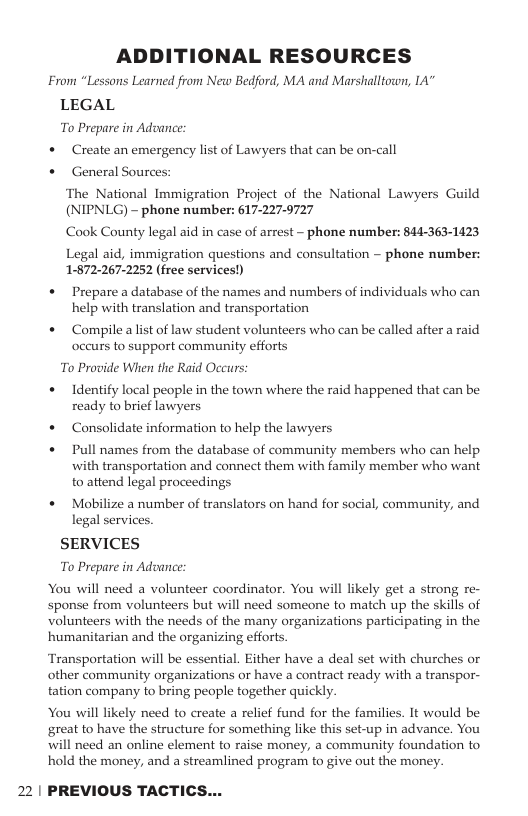
Real Warrants
Below are some features of a judicial search warrant. This document does
authorize ICE agents to enter your home. If ICE s at your door, ask them
to slide it under your door or through your mail slot so you can examine
the warrant thoroughly.
Check if the warrant is regarding you and your address or if it is for
someone else. Also, look at the date on the warrant. It will specify the
date on which this search must take place. Additionally, check to see if it
is signed by a judge.
'UNITED STATES DISTRICT COURT
e
issued by
ESTWARRANT acourt!
[ ————
YOU ARE COMMANDED s s o o Uk S g s b sy ey
[ ey
o i scusod of s o vt bt n e llwin document il it cour:
24 | PREVIOUS TACTICS...
UNITED STATES DISTRICTCOURT Issued by s COURT.
oo
s Dot f Coemis
P bt
)
TR ) cmen
oy }
oI }
i
SEARCI AND SEIZURE WARRANT
P —— 211-9-0161EF8
A oty e s i it ey B Bt s su
e b encr oy ek e+ AT Dovire e Catoa
TYACE WERETS A0 WEORFORNTED BY REFERENCE
T propery o0 et G v, b1 e e e e
[ITeTa——"
sy
Ot o 0 w101 O sy e i e
e e s, s ot ce e
sy i oy v ey o ot s 1 o ey
e s o . e e s e Aty e L 5 e B o o
e o ey e
T s et Tt e e cecsionof b v, e 1
vy e by gy o s o e U e g
1t i o oy s s v i 18U . 4278 e o e,
Clyand st SACAAMGTD CALEOBNA BB, BRESA U MAOTEATE ARG
...FROM THE FIGHT AGAINST ICE | 25
Fake Warrants (Administrative Warrants)
‘This page shows an example of an Administrative Warrant. This doc-
ument DOES NOT authorize ICE agents to enter and search your
‘homes. This is a warrant issued by the Department of Homeland Securi-
ty, not by a Court, It is also signed by an ICE officer and not a judge
Warrant for Arrest of Alien
File No.
Date:
Any immbgration offcer authorized pursuant o sections 236 and 287 of the
Tnmigration and Nationally Act and part 257 o e % Code of Federal
Repulations, 1 serae warrants of arvest for immigration volations
Qe
s 1o stabis admisibility subscquent 1 defen
0 bioemetrio onfirmtion ofthe subjects e
< subject cither
under U.S. immigration
bject cither Tacks i
U8 immigration law
St o Auhoried mmigaion Oifer)
e e Tl o A T g O
Iherchy certify that the Warrant for Arrstof Al was served by me
e Al
nticn wers read 1o i orber i the
T
and the content oftis
Wearsavies
=
e o s o e G bl
26 | PREVIOUS TACTICS.
PROCESSING CENTERS
IN CHICAGO
‘This map shows the locations of major ICE/DHS processing centers in
the city of Chicago. These are a necessary stop in the deportation pro-
cess, where detained people are taken, processed, and sent to detention
centers out of state. They are often processed through the Gary/Chicago
International Airport.
(You can find a graphic like this one on Instagram at @scuttle_chicago!)
BROADVIEW
'PROCESSING CENTER:
S LOWBAR FELD OFFCE
ARE THEY
TAKING YOUR
NEIGHBORS?
...FROM THE FIGHT AGAINST ICE | 27
WHO'S ICE
AND WHO ISNT?
‘These slides show examples of ICE uniforms and vehicles, and of uni-
forms and vehicles that arent ICE. You can find them on Instagram at
@scuttle_chicago.
ICE&THEIR ACCOMPLICES pt1l
Immigration and Customs
Enforcement (ICE)
&
Enforcement and Removal
Operations (ERO)
POLICE
ICE
— &8 ERO{
Y b
ICE and the agencies they are partnering with (the ATE, DEA, etc) will
often wear vests that say POLICE - ICE, POLICE-HSI, or other vests and
gear that makes them look like regular police, to trick folks into opening
their doors or complying with illegal door-knocks.
28 | PREVIOUS TACTICS...
ICE & THEIR ACCOMPLICES pt2
Homeland POLICE
Security
Investigators
(HSI)
POLICE
Customs and
Border
Protection
(CBP)
<='-M&
Vests and other gear that say ICE, HSI, CBP or ERO belong to federal
agencies that have conducted deportations since before the new presi-
dency
..FROM THE FIGHT AGAINST ICE | 29
This includes DHS, Homeland Security, ‘e
(who usuall
equipment).
1 agents’ and ‘federal offi-
elong to one of those departments but wear different
Also: ICE and DHS initially partnered with the DEA, AT, and other feder-
al agencies to conduct the first round of deportations this year in Chicago.
They formed three-person teams and went house-to-house. They tended
to leave if the people who lived there didn't open their door immediately.
Other fed encies could be called on to staff ICE deportation efforts,
just to increase the number of active ‘teams’ of federal agents trying to
deport people.
ICE & THEIR ACCOMPLICES pt3
Department
of Homeland R
S(ecuri;y ja—— ]
DHS] PoLicE
POLICE | ™ee
HOUELANDSECURITY
30 | PREVIOUS TACTICS...
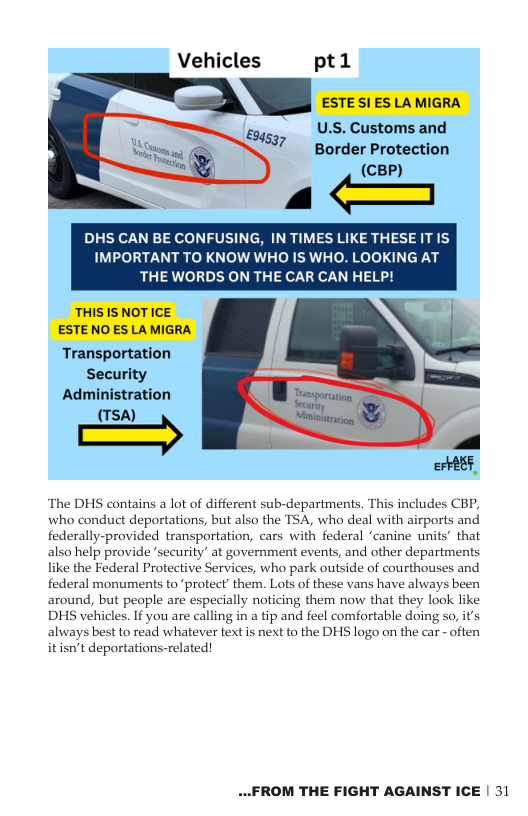
Vehicles ptl
U.S. Customs and
Border Protection
DHS CAN BE CONFUSING, IN TIMES LIKE THESE IT IS
IMPORTANT TO KNOW WHO IS WHO. LOOKING AT
THE WORDS ON THE CAR CAN HELP!
Transportation
Security
Administration
(TSA) l
‘The DHS contains a lot of different sub-departments. This includes CBP,
who conduct deportations, but also the TSA, who deal with airports and
federally-provided transportation, cars with federal ‘canine units’ that
also help provide ‘security’ at government events, and other departments
like the Federal Protective Services, who park outside of courthouses and
federal monuments toprotect’ them. Lots of these vans have always been
around, but people are especially noticing them now that they look like
DHS vehicles. If you are calling in a tip and feel comfortable doing so, it's
always best to read whatever text is next to the DHS logo on the car - often
itisn't deportations-related!
...FROM THE FIGHT AGAINST ICE | 31
All of these cars correspond to federal agencies that conduct deportations!
(Some other companies use vans with blue or green stripes, so check the
text on the vehicle. In Chicago, the great majority of deportations have
used unmarked cars.)
Vehicles pt2
32| PREVIOUS TACTICS...
Vehicles pt3
Unmarked cars
* USA brands
Ford Explorer, Dodge
Durango, Dodge Caravan,
Dodge Charger, Chevy
Impela, Chevy Silverado,
Chevy Tahoe, Ford Edge
* They have tinted windows and
sometimes you can see grates
* Often operated by pairs, one will
typically stay in the car
* Notall unmarked cars are
operated by immigration agents,
some are police
G oA =
erbBE
Deportations in Chicago have tended to use unmarked cars, likely on loan
from other agencies (DEA, ATF, etc) or rented from private vendors. Un-
marked police cars will have plates that begin with MP, and are not sup-
posed to be conducting deportations at all, 5o long as Chicago remains a
sanctuary city. (If you see CPD helping with a deportation, document it and
share it with the Chicagoland Deportation Watch signal account via the QR code
at the end of this zinel) We don't think that unmarked cars used for depor-
tations have distinctively-labeled plates
...FROM THE FIGHT AGAINST ICE | 33
Vehicles pt4
Examples of
unmarked
el
Some unmarked vans with tinted windows have been involved in false
alarms related to deportations in Chicago, most notably when the Secret
Service showed up to intimidate students and families at Hamline Ele-
mentary School. Some of these may be involved in deportations, but to
our knowledge, the Secret Service hasn't
34 | PREVIOUS TACTICS...
Vehicles that are not ICE ptl
Federal Protective Services
el
...FROM THE FIGHT AGAINST ICE | 35
Vehicles that are not ICE pt2
Chicago Police Department
The Cook County Sheriff's
Office
Lots of misleading videos have gone around on Tiktok, Insta reels, etc
that show CPD, Cook County Sherif, or Illinois State Police parked
in various spots, but tell viewers they're ICE. If you see one of these,
demand better evidence, and check the comments to see if i’s already
been debunked! They are very often old videos, from earlier years, or
just photos of regular spots where Chicago and llinos State Police often
park, like in front of the Chinatown market
36 | PREVIOUS TACTICS...
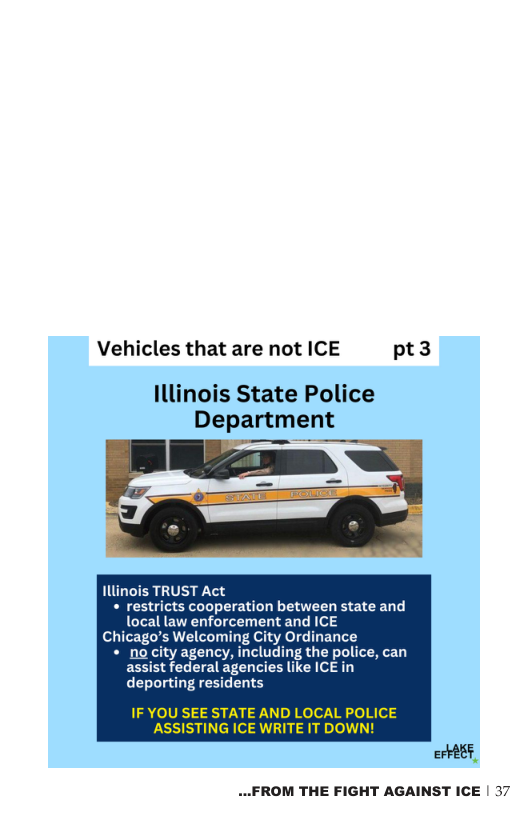
les that are not ICE pt3
IWlinois State Police
Department
Illinois TRUST Act
« restricts cooperation between state and
local law enforcems and ICE
Chicago’s Welcoming City Ordinance
« n city agency, including the police, can
assist federal agencies like ICE in
deporting residents
...FROM THE FIGHT AGAINST ICE | 37
Want to keep up-to-date with ongoing deportations,
plug in to local efforts and research groups,
report ICE/DHS deportation attempts,
or advertise your own local project?
Join the Chicagoland Deportation Watch
Signal thread via this OR code!
NOTES
1. https://www.cbsnews.com/chicago/news/tom-homan-
trump-border-czar-chicago/
2. hitps://www.nilc.orgarticles/analysis-of-trump-day-1-exec-
utive-orders-unconstitutional-illegal-and-cruel/
3. hitps://www.aclu.org/documents/multi-state-detention-fa-
cility-support-foia-documents-request-for-information
. htpsi/itsgoingdown.orgbreaking-borders-report-on-anar-
child-detention-staff-speaks-out/
6. Immigration Police Can Already Sidestep US Sanctuary City
Laws Using Data-Sharing Fusion Centers, https://www.wired.
comystory/ice-sanctuary-cities-fusion-centers/
7. https://www.wired.com/story/ice-sanctuary-cities-fu-
sion-centers/
8. hitps//blockelubchicago.org/2025/01/09/2-alds-want-to-
change-sanctuary-city-rules-allowing-cops-to-work-with-ice-
ahead-of-trump-term/
9. https://itsgoingdown.org/blockade-the-deportation-ma-
chine-bloquear-la-maquina-deportiva/
10. https://simpleflying.com/ice-air-operations-guide/
11. Selected from the Immigrant Defense Project: https://www.
immigrantdefenseproject.orgraids-toolkit/
12 From Vol. 1 of “Rebellion and Possibility: Voices in the An-
ti-ICE Struggle”, https://radicaleducationdepartment.com/zines/
13. https://www.indybay.org/newsitems/2018/07/09/18816401.
php
14. hitps//itsgoingdown. org/this-is-legal-kidnapping-former-
child-detention-staff-speaks-out/
15. hitps//itsgoingdown. org/vacant-migrant-child-jail-build-
ing-stormed-in-chicago-on-may-day/
16. https://pugetsoundanarchists.org/ice-agents-it
doxxed/
17. hitps//perilouschronicle.com/2021/06/02/over-a-decade-of-
resistance-to-the-northwest-detention-center/
18. https://laresistencianw.org/
19. https://ashevillefm.org/post/resisting-immigration-pris-
on-in-tacoma-and-fascists-in-pittsburgh/
20. hitps://itsgoingdown.org/on-williem-van-spronsen
seattle-
LAKE EFFECT
COLLECTIVE
SO-CALLED
CHICAGO, IL
NO GOOD ICE AGENT,
NO BAD MIGRANT!
FREE THE LAND,
FUCK THE LAW
LAKEEFFECT.NOBLOGS.ORG