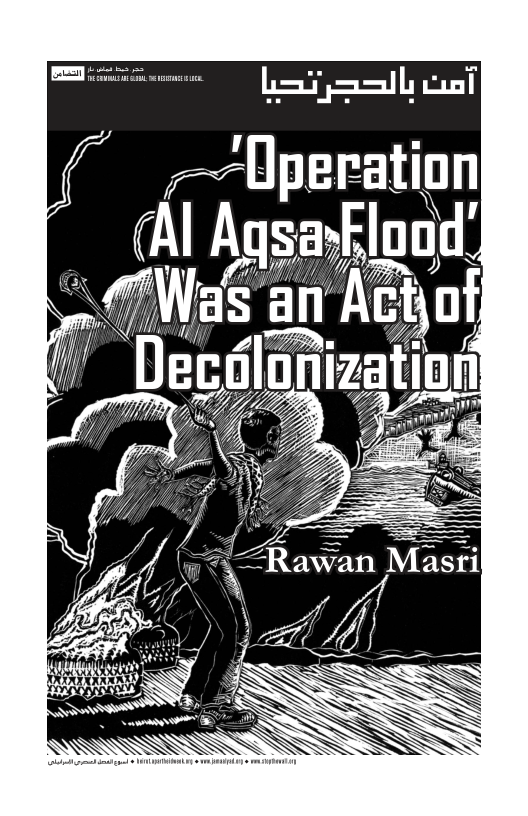
Operation Al Aqsa Flood Was an Act of Decolonization
Web PDF • Imposed PDF• Raw TXT (OCR)



T beld my gun 5o that the generations afier me could hold a sckle”
—Pulestinian song, Abd Allsh Ma Nerbal (By God We Won't Leave)
Decolonization is disruptive. It is disruption to the status quo of
the subjugation of the racialized, and thus dehumanized, Indigenous
masses for the benefit of the settler-colonial class. Itis a process that
necessarily entails upheaval, social ungest, and conflict, paving the way
for a new social and political order that reflects the aspirations and
values of the liberated people.
Algeria, Hait, and Viemam’s years of bloody struggle all came to
mind more than ever for Palestinians this weck. In all these cascs, their
peoples courageously fought juggernauts of military power. They
were told these powers were undefeatable, that they were undeserving
of ruling themselves and controlling their own destinics, and that
they would find the price (0o high to pay. Scorched carth tactics and
guerrilla warfase fipped the power dynamies on their heads, and the
very infrastructure that had been used to exploit and suppress
them was used to the revolutionaries’ advantage. In the case of the
Vietnam Tet Offensive in paticulas, the timing, scope, coordination,
media coverage, and psychological impact of their resilience eroded
public support for the war. Could we perhaps bear witness to the same.
phenomenon today? In all these cases, their peoples decimated the
physical and ideological barriers standing in the way of the new world
they knew was on the horizon.
Palestinians, too, will reach this new world.
Much of the commentary around the “Al Aqsa Flood” operation,
where Palestinian resistance fightrs from Gaza broke free from the
concentration camp we know as the Gaza Strip, dismisses ot outright
ignores two things that every Palestinian knows to be truc:
1) There is no form of violence that Isracl can hope to punish us with
for the first time now: Massacres, home demolitions, fe imprisonment
sentences where prisoners are tortured and sexually assaulted,
blockade and sicge, exccution in the streets. Over and over again, we
watch funcral after funeral, and we know that in horror we will sec
many more.
2) We do not intend to remain a population of oppressed refugees and
prisoners and denied access to the land thatis our way of lif forever.
Palestinian resistance is paving the way for the end of this violence and
denial of land that has been Isracki colonialism.
This end is the beginning of Palestinians rebuilding our villages that
were destroyed in the many massacres of 1948, It wil be reparations
to compensate for our homes that we were robbed of and cverything
stolen to bolster their libraries and museums from the Palestinians
who were ethnically cleansed and, to this day, are decmed “absentecs”
Tt will be us finally accessing our beautiful nature to farm and enjoy,
fice of the colonial bureaucratic structure in place currendy
preventing this. It will allow us to undo the political brainwashing that
our lives are less full and deserving of being lived because we are not
Jewish. This includes proving wrong the greenwashing that we don't
descrve the land because we don't know how to take care of it and
that they made the desert bloom when rcally all they did was take our
homeland and turn it into a series of heaviy surveilled ghettocs.
“This willal start with Land Back, the call to zeturn land to Indigenous
peoples. Jaskiran Dhillon, an Indigenous scholar, defines Land Back
as “a call for the return of Indigenous lands and a reimagining of
Indigenous relations to the land, centered on autonomy and consent.”
Itis essential to decolonization because of how central it i to creating
a new political and economic order for the Indigenous, rather than
at their expense. Fanon put it in concrete terms: “For a colonized
people the most essential value..is first and foremost the land: the land
which will bring them bread and, above all, dignity.”
The esistance fighters came from the Gaza Steip, where the vast
majority of the population are refugees cthnically cleansed from their
vilages, many of which have been destroyed and had scttlements
built over their remains, ike Sderot. They have since been shoved into
camps, where rather than having bread and dignity, they are denicd
access to food, vater, and medicine. They have been living a the whim
of the settlers who built their lives on the remains of theis villages and
land.
From the moment those fighters flew in on paramotors, distupting
the parallel reality that was this music festival, they accomplished
2
something profound (one must wonder what it filt like for these
Jghters 0 se a party just outsde where they have been trapped under a suffcating
bockads). They reimagined their relation to the land not as something
i the distance but as a tangible place for them to set foot on. They
entered the rest of their homeland not through a checkpoint hoping
t0 be granted a permit, but as a force to be reckoned with, They were
antonomous, enacting their will by force against this population of
heavily militarized settlers, the very vast majority of whom have
“served” or are currently in the Isracli military where careers arc
made out of Palestinian suffering and death. That moment when a
(Pakstinian! For Once) bulldozer took down the fence was
decolonization in practice: that fence, and the snipers behind it
defending the scttler-colonial order, were overcome.
The Plestinian sesistance did nothing less than lay the groundwork
for the end of violent Isracl rule over our lands. They did so by
employing a violence to end the oot cause of the oppression of
Palestinians, not do another spin of the so-called “cycle” As Paulo
Freite put it, violence had aleady begun “with the establishment of
a relationship of oppression..never in history has violence been
initiated by the oppressed. How could they be the initiatiors, if they
themselves are the result of violence?”
Or, as Palestinian author Mourid Barghouthi put it, the resistance
rejected starting the story with “Sccondly”:
“Start your story with ‘Secondly” and the arrows of the native
Americans are the original criminals and. the guns of he white men
are enirely the victim. 1 is enough 1o start with ‘Secondly” for the
anger of the Black man against he white o be barbarous, and the
burned Vietnamese will bave wounded the bumanity of the napalrm, and
Victor Jara's songs will be the shameful thing and not Pinachet’s
bullts. Tt is_enough 1o start the story with ‘Secondy” for my
grandother, Unm “Ata, 1o become the criminal and Aril Sharon her
victim.”
Stasting the story with “firstly” has made some uncomfortable; this is
a testament to the decades of hegemony-building around who has the
monopoly on violence. This same monopoly decrees who gets to be
seen as full people with lives and loved ones and who are treated as
numbers. Over and over again, in the West in paticular, Palestinians
3
have been relegated to the latter. Some of those appalled by armed
Palestinian resistance and unable to see it for the defense that it is
perhaps sce themselves reflected in the Isracli settler-soldier rather
than the Palestinian fighter. They may do so cither because of their
own ole in a settler society or because they have never had to try to
grapple with the physical and psychological existential thrcat level of
Violence Palestinians have been subjeeted to all our lives. Regardless,
someone who thought decolonization would be an act of telekinesis
o who only thinks about us when we're trending is in no position to
lecture.
Many Palestinians would have preferred to sec the walls come down
through boycotts and petitions and the other endless tricd-and-not-
truc methods we have long been undertaking. But it was not the
Palestinians who decided things had to be this way. Poetry and social
media posts have gotten us imprisoned; we have marched unarmed
and been met with tear gas and bullets; we have watched our children
be put through military court, and our people and their bodies pulled
out from under rubble, as they have ben again and again in Gaza.
Palestinians know this annihilatory violence is being inflicted on the
Palestinians of Gaza as this is being written. We also understand that
when Israclis make jokes on Tik Tok about having access to water and
electricity and about how “new real estate opening up,” it i the logical
conclusion of Zionist setler-colonialism: as much of Palestinian lind
with as few Palestinians alive left on it
But we have hope because we know, now more than ever, that these
horors in the name of upholding a racist settlr-colonial occupation
are not going to last forever. Anyone who ever thought it would vill
be astounded in hindsight.
Decolonizing movements
decimate the physical
and ideological barriers
standing in the way of the
new world the oppressed
know is on the horizon.
After the ‘Al Agsa Flood,’
Palestinians know more
than ever that they will
reach this world too.