On Trial – Repression and It’s World
Web PDF • Imposed PDF• Raw TXT (OCR)
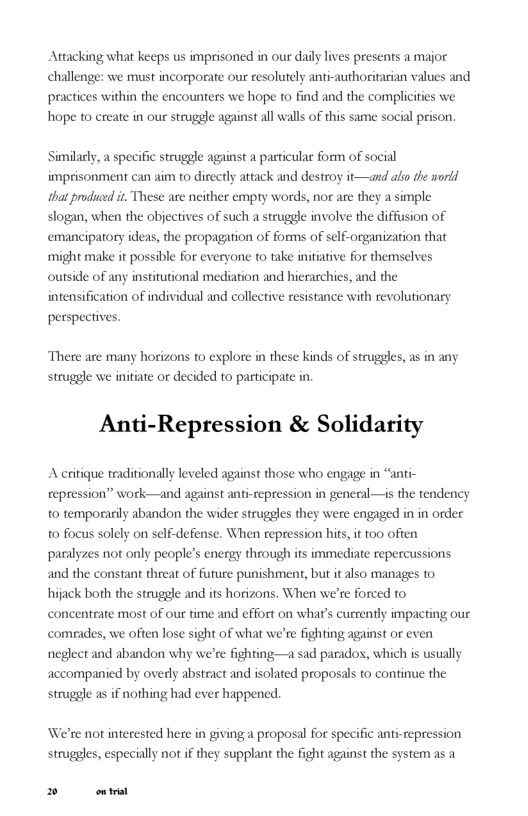
![treating workers, homeless people, undocumented immigrants [sars papien), or other “have nots” [san] as potential subjects of radical struggles or of social transformation as a whole doesn’t really correspond to how we want to be: not a disjointed patchwork of fragmented identities all Tocked up in their own, albeit porous and permeable, identities. Exen if these categories are based on real social conditions, they sill nevertheless reduce individuals solely 1o the positions they’re assigned to by society and, in any case, express nothing about who these individuals are, what they do, and who they want or don’t want to be. So, rather than reproducing these often identitarian categories ad infinitum, shouldn’t it be possible instead to come together on the basis of 2 commonality that transcends the particular conditions imposed on each individual? A commonality that certainly wouldn’t be a homogenous “whole” but instead one that could both negatively and positively be embodied in concrete acts of refusal, desires, and ideas shared and held by each? Exploring these aspects more deeply would certainly help us to move beyond the interiority /exteriority binaey inherent to any subject /identity but would also help us to move towards projects that are in line with our real hopes and aspirations such as, for example, our unwavering determination to destroy all the cages we’re confronted with (borders, prisons, wage labor, etc.) Another obstacle to challenging the forms of separation that are imposed upon us is of course the fact that from the start we conceive of our struggles as necessaily being partial. The more a struggle is defined from the outset within strict iitations, the more difficult it will be to overcome these self-imposed boundasies, both in terms of the response it may elicit from the state as well as our aim of challenging the social system as awhole. Qualitative leaps—which aren’t necessarily quantitative Teaps—will lways remain possible, but it stil an imperative for those who hope to advance towards a rupture with this world to work diligently o ensure that the struggle won’t be self-defeating and that it won’t solely focus on objectives that are rightly or wrongly thought to be the most easily or quickly attainable. According to an emancipatory perspective, why should we arbitrasily detach more or less urgent “needs,” according W et](on-trial-repression-and-its-world-translations-from-the-french-salto-and-subversions-journals 14.png)
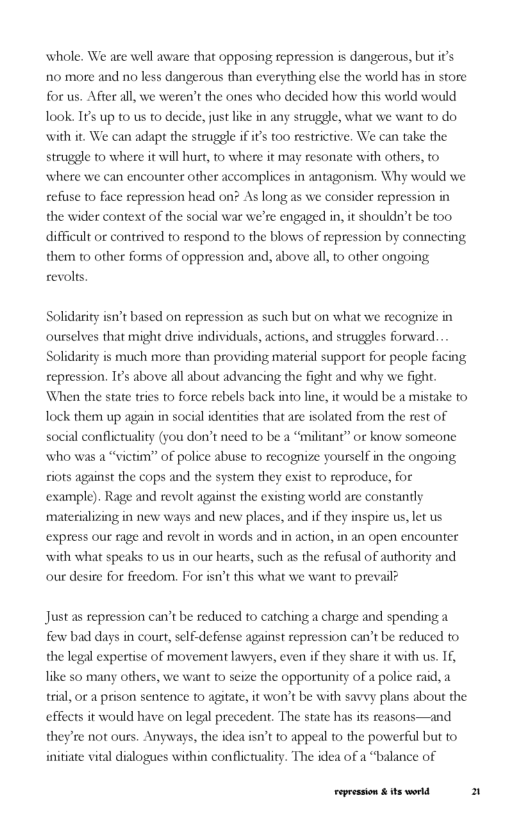
![reproduce—there’s much to be done.... To strugele against repression and what undedlies it in this sense, means nothing more and nothing less than fighting for freedom against all of the social relations of domination. Yer anti-repression isn’t generally understood in this way Though repression of course is part of everyday lfe,if’s also something that every struggle must immediately confront, particulaly when a struggle’s determination for radical transformation is not a secret. To struggle actively for the system’s destruction exposes us to its wrath, as several recent cases in France have reminded us. Whar’s widespread in other countries—the direct repression of any ideas or actions that threaten or seck o overthrow the established order—has thus become the new normal. However, in both cases—whether tepression involves the domestication of everyday life or radical struggles specifically—the way repression is analyzed in general results in how we decide to confront it collectively, with allthe peactical implications this inevitably entails. To focus solely on individual repressive tools (DNA tracing, flash grenades, yet another “anti-terrorism” law, etc) while the whole arsenal of weapons available to repression isn’t ceasing to expand often amounts to confining the struggle within the stare’s limitations. This happens when technical studies of some “innovation” or improvement in the state’s repressive apparatus replace an analysis of the contexts in which they’re used and even more so when protests are limited to demanding the abolition of individual forms of repression, which inevitably leads to reformism. Confining the struggle in advance within the state’s limitations can also happen when we adopt social categories defined by the state, if not to claim them as our own, then at least to attach ousselves to them excessively, for instance, just to haphazardly cite a few: “rioters” delnguants de bankiend), “tesrorists,” “militants,” or “members” of a particular “movement” [oanc]. Tegalism has a social dimension, and there’s no monopoly on different kinds of offensive actions. More generally, fighting repression in the narrowest way does litle to expand the scope of the wider struggle in order to ultimately challenge the law 6 et](on-trial-repression-and-its-world-translations-from-the-french-salto-and-subversions-journals 16.png)
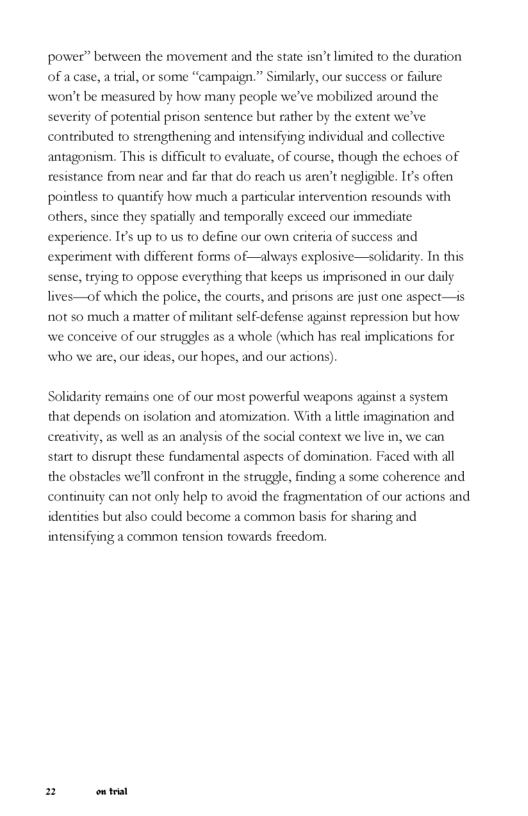
![liberal [pofitizennes], still end up neutralizing any subversive possibiliy. This is especially the case, beyond individual examples, when repression is as a separate moment of struggle, a sort of parenthesis in which all political contradiction are elided. So direct action can end up happily co- existing alongside strategjes that are directly opposed to it and can even n end up being exploited to the advantage of the ruling class (by politicians, priests, parties, or unions, i’s all the sam). This democratic logic, w tolerates radicals as long we’ and as c useful, prec y contributes to co-opting milating protest, crushing dissent, and helping the state achieve its ai s of containment. Such a reversal of what anti-repression is purported o be is particularly troubling and blatant when one of its challenging the status quo. itial aims was Repression, the State, & Social Relations We could also confront the question another way and, conversely, not consider repression as an exception to how the order of this world i maintained, even when it specificall strikes those who are determined to undermine its bases, Even if we limit our focus solely to the police, the courts, and the prisons, it’s easy to recognize all the ways they’re used to maintain and preserve the social order. Whether they’re used to protect the sacrosanct right to private property, the state’s monopoly on violence, or the dominant values and norms enshrined into law, the state has long since equipped itself with the means to control, threaten, and punish; and it’s never hesitated o use them. We can’t, therefore, attack these pillars of society without fundamentally launching a direct critique against the state as existence of wl ch, the very ch means the repression of individual desires and will in the name of some higher interest or so-called “common good.” an aspect thats al too often absent when the fight more or less voluntarily stops at the threat of the police (not just the on s in uniform), the courts (much B et](on-trial-repression-and-its-world-translations-from-the-french-salto-and-subversions-journals 18.png)

On Trial
Repression &
Its World
“Surle bane des accusés,” Tumult éditions anarchistes
Extrait de Salto, subversion & anaschie, 2,
novembre 2012 (Bruxelles)
La répression et son petit monde,” Extrait de Subversions,revue
L septembre 2012 (Paris)
On Tr1al
ll lu.b emonfl’nnnrchx
P
Repression &
Its World
ubvemam mm}u de critique sociale, n‘
ber 2
On Trial
Nevertheless, the otber morning the storekecpers of
Paris, while straightening 1 their goods, s 1o
themsclies, with their robust good sense: “There’s ot
the east chance of eror. They want to undermine he
Joundation of our centuries-old monuments. We are
confronted with a new plo.” Come, come, brare
storekecpers! You wander on the plains of the absuri.
This conspirac you speate of isn’t new. If it’s a
question o teaing down: the worm-caten edifies of the
society we hate, wel, his has been in preparation for a
longtime. This is what ne have alvays ploted,
Zo D*Axa, L'En-Dehors, 1892
What is Repression?
We live in a world in which every social construct, social process, and
social relation have a repressive function. It not difficult to show that
the amy, the courts, and the prisons)
strictly repres
are only a small part of society's oppressive whole. If we define repression
wve forces (the pol
as the force that prevents, deters, and punis for acting to undermine
and moral order, it’s casy to sec how all
the ruling economi
democratic institutions exists 1o prevent the self-organization of society,
how the oppressive ideal of love exists to discourage liberated emotional
ions, and how the economy exists to punish any attempt at
g money from our lives. Repression can’t be reduced solely to
the armed wing of domination, even when it comes knocking at the doors
of subversive militants,
. ot
‘When the “ammed wing” of domination looms over the lives of our
‘comeades with all of the weapons at its disposal—courts, prisons, and
police—the state isn't just trying to suppress the spread of subversive
ideas and actions or merely take a few troublesome elements out of action.
The state is also trying to goad the subversive current into confronting its
repressive forces on unfavorable ground, which risks trapping us in the
impasse of combatting a single obstacle (the repression of our comeades),
thus preventing us from advancing the struggle in all directions.
Confronting the specific aspect of repression—the repression of our
comeades—on ifs own ground without fighting it as a whole is suicidal.
1s the repression that strikes us so separate from the repression that
affects society as a whole? Though not everyone may discover hidden
surveillance cameras in their homes, we shouldn’t forget that video
surveillance is all-pervasive everywhere. Though not everyone may be
forced to defend themselves against terrorism charges, isn't it nevertheless
true that wide swathes of society are either put in chains by a judge or
unremittingly repressed by social, moral, and economic forces just for
trying to survive, just for trying to live? It's not hard to foresee that
repression will continue to rise in the increasingly volatle world we live in,
civen with social tensions that are increasingly more difficult for the state
to control. The rampant construction of al kinds of new prisons is just
one obvious sign of what's to come.
Social Threats
Butlet's now specifically consider repression against autonomous
struggles and individuals who are fighting for freedom. Sometimes, when
comrades are arrested, when struggles are repressed, and when barely
concealed threats of further repression against those who aren’t willing to,
surrender proliferate, we're lead to believe that we are dangerous. 1f we're a
threat to the established order, like anarchism has been classified in
Belgium for a few years now where it's deemed to be “the most significant
and widespread threat to national security,” does that mean we're being
targeted by repression because we're doing something right? Such beliefs
Fepession & ts world
belie alack of conviction and perspective in our own ideas because we
take domination at its word. Conversely, ifs unfortunately not
uncommon, even within subversive milicus, to hear rumors circulating
that certain comades, spaces, o struggles are dangerous and should be
avoided because they attract repression and other such nonsense. Tn both
cases, the same frame of reference is used—that of dominant morality and
the laws in force. Worse still i adopting a “military” frame of reference
that only considers what's subversive to be the sum total of attacks
attributable to a particular militant current or tendency, a frame of
reference that's all too frequently used both among leglists and reformists
as well as authoritarian “militants.” What does that old quote say again?
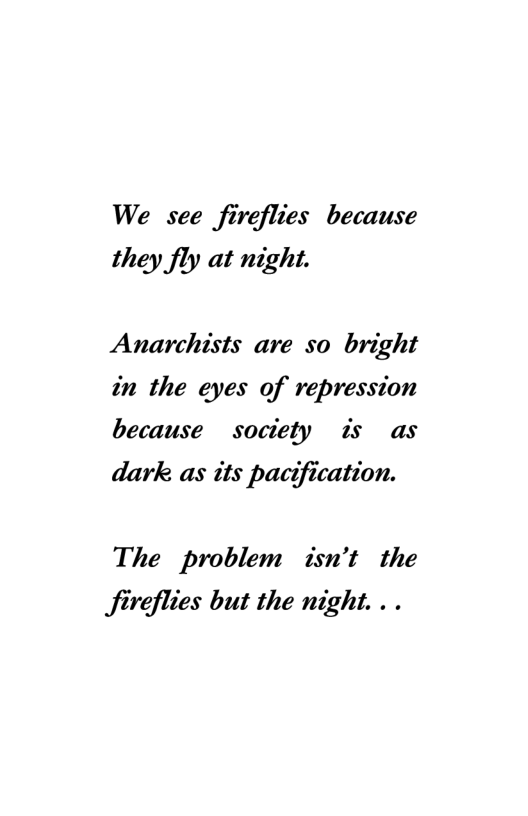
“We see fireflies because they fly at night. Anarchists are so bright in the
eyes of repression because society is as dark as its pacification. The
problem isn't the fireflies but the night.”
The real danger is elsewhere—it's the subterranean threat that has
spanned centuries and has confronted every form domination has taken
the threat of a social uprising, the foral subversion of the existing order.
1¢s both pointless and also detrimental to our dignity to hide the fact that
subversive, anti-authoritarian ideas and actions seek to encourage, defend,
and escalate a subversive rupture with this world and thus the insurrection
necessary for the inevitably violent negation of laws and morals. The state
will lways seck to repress, persecute, and crush anything that endangers
its existence. The real threat s thus not a hundred anarchists but ze forerer
possible and alwgys unpredictabie spread of subrersive ideas and actions that we
present. The real threat—what's truly dangerous—is the social contagion
that's starting to acuate, or at least still remains possible. I’ clear that the
best form of solidarity cor
s of continuing to spread subversive ideas
and actions beyond any limitation of the state or the courts. I also clear
that the best form of defense against repression is not organizing some
imaginary force to confront it (in a militaistic, hieearchical conception of
subversion with the logic of symmetrical warfare). 1¢s not simply a matter
of finding the right tactics and practical knowledge to be able to
completely circumvent t. Rather, the best kind of defense against
repression involves developing new perspectives for the strugele,
broadening our ideas, and searching for complicity in an offensive refusal
. ot
of this world. To better grasp the implications, we could put it another
way: could an insurrection (in the anarchist sense of a s
be vanquished military by the state’s repres
insurrection’s “success” depend on the number of weapons and “troops”
insurrection)
¢ forces? Does an
available to us? Or rather aren't the reasons why past insurrections have
been defeated because of their lack of anti-authoritarian perspectives,
because they didn't resolutely reject al leaders, or even because of their
fear of total freedom’s unknown? The repression of insurrections, just like
the social outburst of an uprising into an insurrection—the repression of
insurgents, just ike the teansmission of the contagion of insurgent ideas
and actions through the social fabric is always a social event, never a
‘military one. There are many significant implications that result from an
anti
uthoritarian perspective of this question, which is essentially a matter
of the revolutionary transformation of this world.
On Trial
Many people conceive of Justice (aws, courts, trials) exclusively as an
institution, ie. a pillar of state power in the social morass. Nevertheless, all
state institutions are founded equally, if not predominately, upon social
consent, They are materializations of existing social relations. Better yet,
they are social relatior
s. This means, from a subversive perspective, that
the state isn't an entity that esists outside of society. Rather, the state is
both part of society and structures society at its core. Taking over the state
thus means perpetuating the social relations that structure it and derive
from it, while destroying the state means finding another basis, another
foundation for social relations—freedom. Money, as a state institution,
only exists because all of society grants it value, while, conversely, money
also determines the social relations between individuals. A more equitable
redistribution of money wouldn't fundamentally change any of the social
relations its mere existence creates, but setting fire to money as an
institution means beginning to build a world where the economy would
0 longer determine social relations, or better yet, where economic logic
(commerce, work, accumulation, productivity) is rejected entirely. The
permeation of commodities throughout all areas of life is another useful
Fepession & ts world
example of the correspondence between repression and social relations as
they currently exist.
‘With this premise established, e take the stand. How can we argue that
nothing we do in court, at least in terms of our behavior, has any
significance without simultaneously affirming that nothing we do in any
# If court, just like the factory,
hall, or even the family home, is a repressive social institution, it’s
anc
social institution has any signi
unsustainable to claim that our actions and our ideas have no importance
there. Saying that we regret fighting for freedom before a judge is not
fundamentally any different than saying, “T love you,” to your abuser—at
least if you think that subversion is a matter of pretense, posture, or
deception. Whether in court or on the streets, renouncing your
tions because it's strategic to do so (though some underground
actions like sabotage do require discretion) amounts to negating and
conv
defusing any of their subversive potential—which is exactly what
repression wants. That being said, there are no easy rules or axioms to
follow when confronted with the courts. The ondy ting that mattes s the
aoberence betneen what we think and what we do, what we desre and how we fight for
i This coherence can only be total when our individuality is a total
demand, or in other words, when this demand is a constant tension that
beats to the thythm of our lives. Al the rest is mere polifics.
1.1¢ not a matter here of the *technical” aspects of trial but more fundamentally the
atitude or ethics (the content) that underlies a whole range of more “concrete”
actions (the forms). The content indicates a refisal to separate our subversive ideas
from our actions, which can take many forms in court, from total refusal (refusing to
appear in court), evading the courts (going underground), efising to respond to any.
question or order, or even “taking responsibility” for one's ideas before judge
(which far exceeds the courtroom and means taking responsibilty for them in the
strcets, in the web of social relations that are the foundation of justice, though this
isn'tthe same as pleading guilty for a particular charge). Lastly, there’s also the more
strictly (and necessasil) technical aspect of legal defense which can be left up 0.1
lawyer oe not. But here, t00, we don’t think that it all the same. First of ll there's a
refusal that's absolurely fundamental, the refusal 10 prove one’s own innocence by
testifying that others (known or unknown) are guity. We can also note the subtle but
just as fandamental difference between a lawyer who argues for acquittal and a lnwyer.
who responds to the question of guilt (or innocence). Citing one’s “social status,” as
s ot
Declaring that we recognize neither “guilt” nor “innocence,” that we
reject all judges and courts, because we are enemies of the law and
therefore partisans of any transgression of the law that inspires our desire
for freedom, is in no way a mere tactic but a genuine expression of this
tension towards the coherence between our thoughts and our actions.
Solidarity ceases 10 be anti-repression and becomes the possibili
‘complicity, because we're all “guilty” of our ideas and the actions that
follow.
The Friend of My Enemy
Can Never Be My Friend
By failing to consider the courts as a social relation like any other social
ing ourselves, It's pret
obvious that in most
relation we end up de
trials there are few people who seck to avoid the logic of the courts, who
cefise to surrender their dignity before the judge, o who refuse to testify
(or, in many cases, refuse to say whether or not they committed a crime).
1¢'s unfortunately not uncommon that this s also the case for self-declared
enemies of the state when they find themselves in court. (s not
uncommon for opportunistic politics to reappear in court. So we witness
principles like refusing to collaborate with institutional or authoritarian
polii mporacily” sbandoned in the name of putting pressure
on the judge, mobilizing broad forms of solidarity, or we see people
‘morally coerced into abandoning their principles just because they want to
et their comrades out at any cost (to be a lttle mean, we could point out
King one’s own freedom). Suddenly,
ardent critiques of “rights” are replaced with confused alliances with some
human rights league or another, rejections of the economy and money are
that “at all costs” never involv
dismissed in order to gain the support of a union (etemal pacifiers of
social conflct and labor), refusals of repres
ntational spectacles 2
transformed o welcome jounalists “who will help to exert pressure” or
is commonly done in trials in order (0 obtain a certain leniency from the judge,is
dlearly detrimentl to one’s integriy. Finally, beyond the ethical and subversive
tension between thoughts and actions, there’s also the particular circumstances, the
nature of the charges, and, ast but not least,individual incinations and preferences
Fepession & ts world s
o accept existing social roles (each in their place and all together now to
democratic ing, for example, an “open
lettes” in official newspapers. What more can be said? Authority cannot be
denounce abuse) by publi
fought in authoritarian ways—a simple statement that's still true,
Seeking such alliances means not only violating your own political values
and those of past and future struggles, not only foreclosing possible:
accomplices and complicities in wider social struggles (the oppressed are
10 strangers to hypocrisy, but compromising isn't conducive to forging
common struggles among rebels), it also means engaging in struggle on
basis that's to life and freedom what oil i 1o the ocean: pol
igalliances and delegations,
ning opportunism, i the polar
e strugees should be waged: in
the streets, side by side with the excluded, the exploited, and the rebels, in
Involvement in politics with all of ts nausea
its moderate “lesser evil” approach, it sic
opposite of the domain where subver
order to spread emancipatory ideas, and to inspire revolt, to envision ever
attacks against domination. Wasting your time and energy in
cussions with polificians, authoritarian imposters, unthinking
ideologues, lying leglists... How uninteresting it must be. How much
more worthwhile would it be to embark upon the adventure, carrying
subversion to the heart of society above and beyond an
representation. The first path of anti-repression inevitably ends with
demoralizing and confused ralles in front of the courthouse. The second
more inc
endless
mediation or
path seeks to transform a specific instance of the repression of our
comrades and of our struggles into yet another spark to ignite the social
finderbox.
Sooner or Later
1¢'s unavoidable: sooner or later, every individual comnitted to revolt and
every autonomous struggles will face repression, whether directly or its
threat, It crucial to always keep repression (in the broadest possible
sense) at mind, exploring possible ways of resisting it, and even logistically
preparing for it before it strikes, but we must always connect it back to
repressive social relations as a whole and their underlying tensions and
o et
conflicts. There’s no doubt that we need to organize material support for
arcested or imprisoned comeades, but this is not solely a logistical issue
Understanding repression as just an obstacle to our struggle and not an
insurmountable barsier is not an easy task. We're not just talking about
possibly spending years behind bars but also everything related to
“preventive” repression, surveillance, and prosecution in the broadest
sense. Today and probably even more 50 tomorrow, we must appeal to
our creativity and imagination to break free from repression’s
steanglehold, but this, as we've already said, s less of a logistical question
of capacity and more of a matter of perspectives, ideas, and project
forged in the strugeles we fight every day.
To conclude, let us never forget that in the last instance, our ideas, our
methods, and our desires will always remain incomprehensible to the
guard dogs of the state, because they'll never be able to recogpize that
individuals can freely organize and associate in anti-authoritarian ways
Theyll never be able to understand that every human being has the
possibility and the choic to revolt at any moment, and that it is precisely
this choice and possibility that revolutionaries must appeal to. The soc
moeass of conflictuality is not a military, tactical, and logistical matter, but
is profoundly and intrinsically a social one. To intensify this conflict,
‘which means the self-organization of refusal and an attack on al social
order and authority, ensuring that it can arm itself with subversive
consciousness and ideas, is the best way to counteract, even overcome,
repression,
And anyways... There's notbing 1o give np, it’s my life itself
that T've chosen to put at stake; my life.
Fepession & ts world
(12
To intensify this conflict, which
means the self-organization of
refusal and an attack on all
soctal order and authority,
ensuring that it can arm itself
with subversive consciousness
and ideas, is the best way to
counteract, even overcome,
repression.
Repression &
Its World
Reflections on How to Avoid
Isolating Repression
from the Struggle
The idea that we live in a world where separation is the rule is nothing
original. There’s no shortage of analyses identifying the principle of
sep:
jon, even if proponents of economism still tend 1o reduce it 10 its
simplest form. Each one of us intimately experiences the ways in which a
ganization based on separation alienates us from each
other and from ourselves, how it severs us from our immediate
surroundings, and how the division of time, space, and human activity
plays a significant role in individual and collective dispossession. It's only
logical that debates should focus on how to dismantl these existing
conditions by reflecting on potential links 1o be formed between those
who confront the n
ssity of fighting it but also by reflecting on ways to
connect all the aspects of domination togethe in non-hierarchal ways. For
is the ultimate goal not 1o bring an end to the miscry induced by
domination as a whole?
However, nothing is that simple, and it's not uncommon for self-avowed
eadical strugges 1o quickly become fragmented. This happens, for
mple, when we adop the categories inherent to the system we want to
destroy as they are in thi
stem, especially when they're used as a starting
point for the possibility of uniting struggles on a common ground, as if
repession & ts world 5
treating workers, homeless people, undocumented immigrants [sars
papien), or other “have nots” [san] as potential subjects of radical struggles
or of social transformation as a whole doesn't really correspond to how
we want to be: not a disjointed patchwork of fragmented identities all
Tocked up in their own, albeit porous and permeable, identities. Exen if
these categories are based on real social conditions, they sill nevertheless
reduce individuals solely 1o the positions they're assigned to by society
and, in any case, express nothing about who these individuals are, what
they do, and who they want or don’t want to be.
So, rather than reproducing these often identitarian categories ad
infinitum, shouldn't it be possible instead to come together on the basis of
2 commonality that transcends the particular conditions imposed on each
individual? A commonality that certainly wouldn't be a homogenous
“whole” but instead one that could both negatively and positively be
embodied in concrete acts of refusal, desires, and ideas shared and held by
each? Exploring these aspects more deeply would certainly help us to
move beyond the interiority /exteriority binaey inherent to any
subject /identity but would also help us to move towards projects that are
in line with our real hopes and aspirations such as, for example, our
unwavering determination to destroy all the cages we're confronted with
(borders, prisons, wage labor, etc.)
Another obstacle to challenging the forms of separation that are imposed
upon us is of course the fact that from the start we conceive of our
struggles as necessaily being partial. The more a struggle is defined from
the outset within strict iitations, the more difficult it will be to
overcome these self-imposed boundasies, both in terms of the response it
may elicit from the state as well as our aim of challenging the social system
as awhole. Qualitative leaps—which aren't necessarily quantitative
Teaps—will lways remain possible, but it stil an imperative for those
who hope to advance towards a rupture with this world to work diligently
o ensure that the struggle won't be self-defeating and that it won't solely
focus on objectives that are rightly or wrongly thought to be the most
easily or quickly attainable. According to an emancipatory perspective,
why should we arbitrasily detach more or less urgent “needs,” according
W et
t0 how they're defined, from the wishes and desires that accompany
them? Why should we retain any ambiguity about how the
and our ferce opposition to it Why should we demand reforms or
defend small victories instead of promoting the possibility of a
commonality in struggle, such as a disgust at exploitation and wage
slavery, a desire to destroy this world, or a hatred of urban concentration
camps and the offensive struggles that ensue from it? Why should the part
be isolated from the whole which should neither be reformed nor
humanized but destroyed as such?
tem works
OF course everyone is free to attack the leviathan of alienated social
er ways they deem most effective or important. But i’s
howattacks are carried out—which of course is connected to n#y they'te
cartied out—that determines their subversive potential, This raises a
‘whole series of questions with highly practical implications about our what
our objectives are, the adequate means of achieving them, what we hope
to develop in both the short and long terms, and our political perspectives
as a whole. These questions are necessary to our struggles to re-
appropriate our lives, and the answers that each of us gives in our
w strugges, as in any specific struggle, could well come to form a
common basis to overcome filse separations.
celations in whate
OF course, our goal isn't o try to unify what, for concrete fundamental
reasons, such as conflicting viewpoints or perspectives, proves to be
irreconcilable. Unity can only be achieved at the cost of political
conc sential saceifices. The idea i rather o seek and to forge
complicity within the struggle against authority and what it seeks to
impose on us.
ons or
Repression & Anti-Repression
Repression takes many forms, from difficulty surviving day-to-day to
unfulfilled desires to live freely. Given the vast extent of how the system
es repression through all of its inner workings and the daily
constraints of every social relation—shich we ourselves take part in and
exer
Fepession & ts world
reproduce—there’s much to be done.... To strugele against repression and
what undedlies it in this sense, means nothing more and nothing less than
fighting for freedom against all of the social relations of domination. Yer
anti-repression isn't generally understood in this way
Though repression of course is part of everyday lfe,if's also something
that every struggle must immediately confront, particulaly when a
struggle’s determination for radical transformation is not a secret. To
struggle actively for the system’s destruction exposes us to its wrath, as
several recent cases in France have reminded us. Whar's widespread in
other countries—the direct repression of any ideas or actions that threaten
or seck o overthrow the established order—has thus become the new
normal.
However, in both cases—whether tepression involves the domestication
of everyday life or radical struggles specifically—the way repression is
analyzed in general results in how we decide to confront it collectively,
with allthe peactical implications this inevitably entails.
To focus solely on individual repressive tools (DNA tracing, flash
grenades, yet another “anti-terrorism” law, etc) while the whole arsenal of
weapons available to repression isn't ceasing to expand often amounts to
confining the struggle within the stare’s limitations. This happens when
technical studies of some “innovation” or improvement in the state’s
repressive apparatus replace an analysis of the contexts in which they're
used and even more so when protests are limited to demanding the
abolition of individual forms of repression, which inevitably leads to
reformism. Confining the struggle in advance within the state’s limitations
can also happen when we adopt social categories defined by the state, if
not to claim them as our own, then at least to attach ousselves to them
excessively, for instance, just to haphazardly cite a few: “rioters”
delnguants de bankiend), “tesrorists,” “militants,” or “members” of a
particular “movement” [oanc]. Tegalism has a social dimension, and
there’s no monopoly on different kinds of offensive actions. More
generally, fighting repression in the narrowest way does litle to expand
the scope of the wider struggle in order to ultimately challenge the law
6 et
IF. Similarly, considering one particular form of repression as
unacceptable almost inevitably results in attempting to show that they're
illegal or unjust, especially by appealing to innocence or invoking some
alleged deviation from the law.
The outrage that regulaly erupts about the so-called “ctiminalization of
social movements” is one trivial example. Arrested protestors or certain
actions that face repression are deemed to be “legitimate” because of the
“militant” nature of the strugele—and recruiting a large number of new
participants through appeals to “legitimacy” would be an added incentive
to mitigate the potential for repression. Does this mean that individuals or
forms of action that don't gain widespread acceptance for their legitimacy
are illegitimate and can therefore be condemned? By insisting that a
‘movement be collective and that actions be shared, do we not ultimately
feacture conflictuality into smaller fragments that are more easily
manageable by repression, and do we not especially end up ignoring a
in widely
significant pat of the antagonism that s practiced dai
dispersed ways outside of the social movement which has its own reasons
and forms of action depending on the extent of imagination and
determinat
Another example of this way of enclosing struggles within the confines of
the state is how movements are polarized by some kinds of charges (such
as terrorism) that are seen as exceptions to the struggle, which amounts to
legitimizing, even if only implicity, the law, the courts, and the underlying
“noamal” state of things. IF's not surprising, given this logje, for traditional
institutional mediators (parties, unions, the media, etc) to be used in such
bilties, is
appeals to the state, since the state, confronted with its respon
supposed to rectify its abuses or the mistakes of its officials. Everything
proceeds as if, in the name of urgency and the “gravity of the sifuation,”
we could suddenly avoid the question of how this system works,
emphasizing the formal constitutional rights it's supposed to guarantee
and exploiting public indignation or even trying to recuperate it ourselves,
even if it means rehabilitating the idea of representative democracy.
These forms of anti-tepression, even when theit intentions aren't strictly
Fepession & ts world
liberal [pofitizennes], still end up neutralizing any subversive possibiliy. This
is especially the case, beyond individual examples, when repression is
as a separate moment of struggle, a sort of parenthesis in which all
political contradiction are elided. So direct action can end up happily co-
existing alongside strategjes that are directly opposed to it and can even
n
end up being exploited to the advantage of the ruling class (by politicians,
priests, parties, or unions, i’s all the sam). This democratic logic, w
tolerates radicals as long we’
and as
c useful, prec
y contributes to co-opting
milating protest, crushing dissent, and helping the state achieve its
ai
s of containment. Such a reversal of what anti-repression is purported
o be is particularly troubling and blatant when one of its
challenging the status quo.
itial aims was
Repression, the State,
& Social Relations
We could also confront the question another way and, conversely, not
consider repression as an exception to how the order of this world i
maintained, even when it specificall strikes those who are determined to
undermine its bases,
Even if we limit our focus solely to the police, the courts, and the prisons,
it's easy to recognize all the ways they're used to maintain and preserve the
social order. Whether they're used to protect the sacrosanct right to
private property, the state’s monopoly on violence, or the dominant values
and norms enshrined into law, the state has long since equipped itself with
the means to control, threaten, and punish; and it's never hesitated o use
them. We can't, therefore, attack these pillars of society without
fundamentally launching a direct critique against the state as
existence of wl
ch, the very
ch means the repression of individual desires and will in
the name of some higher interest or so-called “common good.” an aspect
thats al too often absent when the fight more or less voluntarily stops at
the threat of the police (not just the on
s in uniform), the courts (much
B et
fusther reaching than penal codes), and prison (which exists far beyonds
its own walls).
Similacly, the necessarily coerc
from its supposedly “social” dimension, as if the social dimension of state
coercion wasn't an integral part of how it govems, as i it didn't directly
aspect of the state cannot be separated
pervade all of society, from schools and workplaces to the very space we
live in. They are intrinsically connected.
The oppression we're subjected to and fight against is also a social
relation. Sometimes, insisting too much on the breadth of the coercive
instruments of state repression can easily exaggerate its—already
enomous—effects in relation to the possibility of confronting them, but
it also risks forgetting other social mechanisms that work extensively to
pacify dissent (especially in democratic systems) and which are based on
various forms of consent and assimilation.
In seality, i's not about refusing a prior any strugele around one pasticular
form of repression as the basis for fighting this world but rather ensuring
that all of the dimensions of repression we've posed above are present in
the strugele. Tn order to avoid isolating repression from the critique of the
state or reducing such a critique fo state apparatuses that are isolated from
social relations, we could, for example, approach the issue by posing the
question of “social prison,” which would open up vast theoretical and
practical possibilities for further intensifying the struggle.
Challenging prisons as a whole in fact involves examining all of the
systems of control and imprisonment that pervade society as a whole. By
10 longer concentrating solely on one particular aspect of the carceral
‘management of society, such as the deployment of new repressive
measures or surveillance technologies, we can grasp the social and moeal
values that constitute social forms of domination simultancously with
their very concrete materializations.... To give just a few examples, the
social relationship o the law and o conflict participates in domination, as
do people’s collaboration with domination as legally-recognized citizens—
social control s diffisse throughout every aspect of all of our lives.
Fepession & ts world
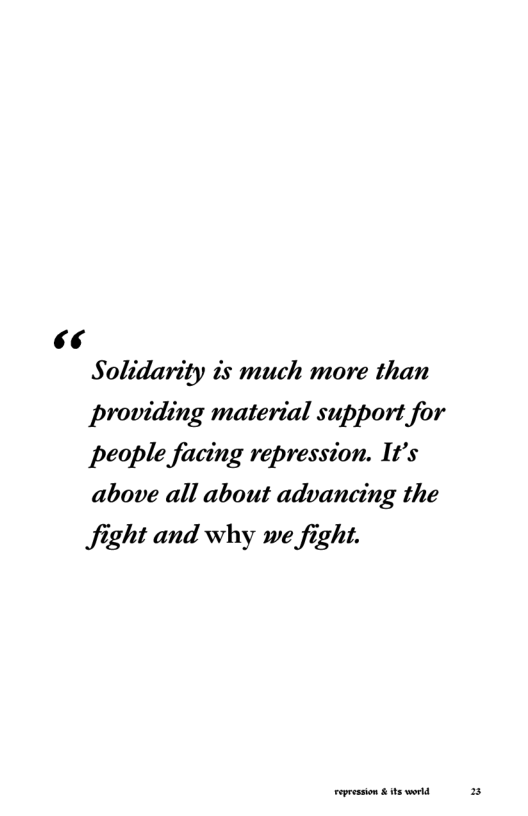
Attacking what keeps us imprisoned in our daily ives presents a major
s and
challenge: we must incorporate our resolutely anti-authoritasian val
practices wi
hope to create in our strugele agai
1 the encounters we hope to find and the compliciies we
tall walls of this same social pri
n.
Similarly, a specific struggle against a particular form of social
imprisonment can aim to directly attack and destroy it—and ali dhe norid
that produd it These ase neither empty words, nor are they a simple
slogan, when the objectives of such a struggle involve the diffusion of
emancipatory ideas, the propagation of forms of self-organization that
might make it possible for everyone to take initiative for themselves
outside of any institutional mediation and hierarchies, and the
cation of indi
inten: idual and collective resistance with revolutionary
perspectives.
There are many horizons o explore in these kinds of struggles, as in any
struggle we initiate or decided to participate in.
Anti-Repression & Solidarity
A critique traditionally leveled against those who engage in “anti-
repression” work—and against
o temporarily abandon the wider struggles they were engged in in order
o focus solely on self-defense. When repr
paralyzes not only people’s energy through its immediate reperc
and the constant threat of future punishment, but it also manages to
hijack both the struggle and its horizons. When we're forced to
concenteate most of our time and effort on what's currently impacting our
comrades, we often lose sight of what we're fighting against or even
neglect and al
accompanied by overly abstract and isolated proposals to continue the
struggle as if nothing had ever happened.
repression in general—is the tendency
n hits, it t00 often
ions.
don why we're fighting—a sad parados, which is usually
We're not interested here in giving a proposal for spec
struggles, especially not if they supplant the fight against the system as a
¢ anti-repression
PR
whole. We are well aware that opposing repression is dangerous, but it’s
0 more and no less dangerous than everything else the world has in store
for us. After all, we weren't the ones who decided how this world would
Took. TP up to us to decide, just like in any strugele, what we want to do
with it. We can adapt the struggle if it’s too restrictive, We can take the
struggle to where it will hurt, to where it may resonate with others, to
where we can encounter other accomplices in antagonism. Why would we
refuse o face repression head on? As long as we consider repression in
the wider context of the social war we're engaged in, it shouldn't be too
difficult or contrived o respond to the blows of repression by connecting
them 1o other forms of oppression and, above all 1o other ongoing
revolts.
y isn't based on repression as such but on what we recognize in
ourselves that might drive individuals, actions, and struggles forward...
Solidarity is much more than providing material support for people facing
repression. It's above all about advancing the fight and why we fight.
‘When the state tries to force rebels back into line, it would be a mistake to
Tock them up again in social identities that are isolated from the rest of
social conflictualiy (you don'’t need to be a “militant” or know someone
who was a “victim” of police abuse to recognize yourself in the ongoing
iots against the cops and the system they exist to reproduce, for
example). Rage and revolt against the existing world are constantly
materializing in new ways and new places, and if they inspire us, let us
express our rage and revolt in words and in action, in an open encounter
with what speaks to us in our hearts, such as the refusal of authority and
our desire for freedom. For isn't this what we want to prevail?
Justas repression can't be reduced to carching a charge and spendinga
few bad days in court, self-defense against repression can't be reduced to
the legal expertise of movement lawyers, even if they share it with us. Tf,
ke so many others, we want to seize the opportunity of a police raid, a
trial, o a prison sentence to agitate, it won't be with savvy plans about the
effects it would have on legl precedent. The state has ifs reasons—and
they're not ours. Anyways, the idea isn't to appeal to the powerful but to
initiate vital dialogues within conflictuality. The idea of a “balance of
Fepession & ts world
power” between the movement and the state isn’t limited to the duration
of acase, a trial, or some “campaign.” Similarly, our success o filure
won't be measured by how many people we've mobilized around the
Severity of potential prison sentence but rather by the extent we've
contributed to strengthening and intensifying individual and collective
antagonism. This is difficult to evaluate, of course, though the echoes of
resistance from near and far that do reach us aren't negligible. I¢'s often
pointless 0 quantify how much a particular intervention resounds with
others, since they spatially and temporlly exceed our immediate
experience. I¢'s up to us to define our own criteria of success and
experiment with different forms of—always explosive—solidarity. In this
sense, trying to oppose everything that keeps us imprisoned in our daily
s—of which the police, the courts, and prisons are just one aspect—is
not so much a matter of militant self-defense against repression but how
we conceive of our struggles as a whole (which has real implications for
who we are, our ideas, our hopes, and our
ctions),
Solidarity remains one of our most powerful weapons against a system
that depends on isolation and atomization. With a little imagination and
creativity, as well as an analysis of the social context we live in, we can
start to discupt these fundamental aspects of domination. Faced with all
the obstacles we'll confront in the strugele, finding a some coherence and
continuity can not only help to avoid the fragmentation of our actions and.
identities but also could become a common basis for sharing and
intensifying a common tension towards freedom.
2 ot
€
Solidarity is much more than
providing material support for
people facing repression. It's
above all about advancing the
fight and why we fight.
repession & ts world 3
We see fireflies because
they fly at night.
Anarchists are so bright
in the eyes of repression
because society is as
dark as its pactfication.
The problem isn’t the
Sireflies but the night. . .