On the Black LIberation Army
Web PDFImposed PDFRaw TXT (OCR)
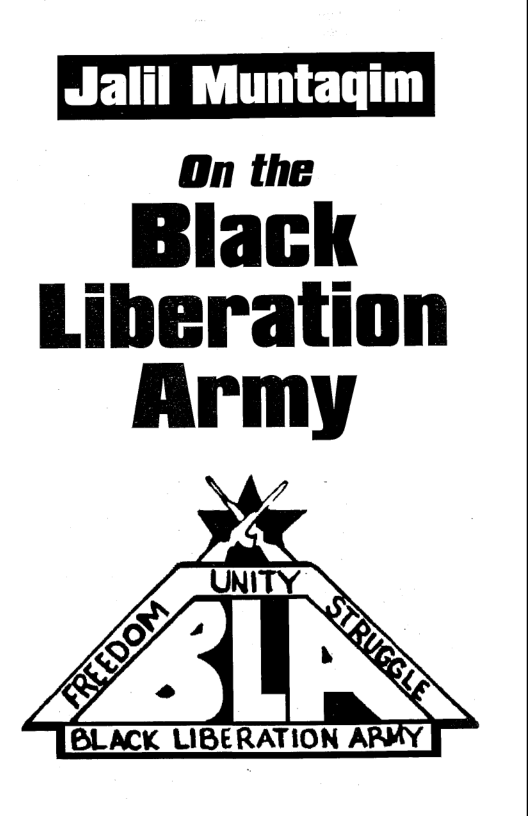
Jalil Muntagim  On the  Black Liberation Army  BLACK LIBERATION AP

Jalil Muntagim  On the  Black Liberation Army  Yrim The Spirit  FeRes
On The Black Liberation Army this edition published August 2002 by Abraham Guillen Press & Arm The Spirit  ISBN 1-894925-13-0  Abraham Guillen Press (distribution) C.P.48164  Montreal, QC  H2V 4S8, Canada  email: abrahamguillenpress@yahoo.com  Arm The Spirit PO. Box 6326, Stn. A Toronto, Ontario  MW 1P7, Canada  email: ats@etext.org  web: http:/fourn.ucsd edu/~ats  First published in pamphlet form n 1997 by the Montreal Anarchist Black Cross, a support group of the Anarchist Black Cross Federation (ABCF), with the assistance and permission of the author for distribution through the member groups of the Federation. It was republished by Solidarity in June 2001, and then by Abraham Guillen Press & Arm The Spir in August 2002. Profits from the sale of this pamphlet are sent to the author. If you copy this and sellitwithout iving some ofthe profits to the authoryou are stealing from him. Contact the author directly (subject to change) at.  Anthony Bottom (Jalil Muntagim) T1A4283 / Box 618 Auburn, NY 13024, USA
CONTENTS  Introduction, 1997 ...  On the Black Liberation Army, 1979  About the author ...  BLA prisoners of war ...  ... 20  Support Organisations
INTRODUCTION  ‘This pamphlet offers insights into the history and lessons of the Black Liberation Movement being waged in North America. Since the original writing, the struggle has declined due to U.S. political repression and political infantilism on the part of U.S. revolutionaries. What is extremely important to understand about the former Black Panther Party (BPP) s that it was basically a militant youth movement. Because the BPP was a powerful youth movement, J. Edgar Hoover, former Dircctor of the FBI, declared the BPP to be the greatest threat o, the internal secuity of the United States. The FBI launched a political and military counter-intelligence program (COINTELPRO) to destroy not only the BPP, but to also crush any possibility of a new youth movement of similar magnitude and militancy.  ‘Today, our youth are being crushed by increasing draconian laws, and the saturation of poor communities with CIA procured drugs. The music indusizy continues to produce and distribute nihilistic gangsta rap that glorifies drive-by shootings and gang bang’in. The U.S. government is lowering the age a teenager can be tried and sentenced as an adult from 16 to 14 years old. The U.S. government has consistently ‘withdrawn money from social and educational programs, while at the same time increased spending for prison building. These are direct attacks on our youth to prohibit the rebuilding of a movement that in any way resembles the militant determination of the former Black Panther Party or the Black Liberation Army (BLA).  ‘This pamphlet comprises a chapter from a soon to be published compilation of my prison writings. The book, We Are Our Own Liberators!, presents specific ideas, theoretical determinations, and ‘political positions on how we should work to rebuild and continue the struggle. The proceeds from this pamphlet will help offset the cost to produce the book. Therefore, it is anticipated all will support not only the distribution of this pamphlet, but more importanly, the rebuilding of our movement. Rest assured, our youth and the struggie for class and national liberation, having learned the lessons of the past will recover and triumph. Remember - “Truth crushed to the earth willrise again.”  Jalil A. Muntagim, August 1997
ON THE BLACK LIBERATION ARMY  ... Hide nothing from the masses of our peoples. Tell no lies. Expose lies whenever they are fold. Mask no diffculties, mistakes, failures. Claim no easy victories...” PAIGC-1965  The history of our national liberation struggle, is one of the most. important factors upon which the political pasty(s) the oppressed masses, and the liberation armed forces may understand the nature of their oppression and the task before them towards independence and freedom.  In this article, T would like to present to the masses the general history of the evolvement of the Black Liberation Army. This will be a brief historical overview not providing specific historical data in order to protect people who are either fonctioning in the BLA, or in other areas no longer associated with the BLA. The Black Liberation Army is apolitico-military organization, whose primary objective is to fight for theindependence and self-determination of Afrikan people in the United States. The political determination of the BLA evolved out of the now defunct Black Pantber Pacty.  1t was in October 1966, with the advent of the Black Panther Party for Self-Defense, that the question of armed struggle and resistance to racist oppression emerge as a plausible strategical mancuver in the developing liberation movement. It was in late 1968, carly 1969, that the forming of a Black underground first begun. From Los Angeles- California, to Texas, Louisiana, Mississippi, and Alabama, armed units were formed in rural areas, trained and caches were established. In ‘Oakland, San Francisco, Detroit, Chicago, Philadelphia, Ohio and New York, Black Panther Party offices were established to formulate a political relationship with the oppressed Black massesin these and other communities across the country. From 1969 to 1972, the BPP came under vicious attack by the State and Federal government. The ‘government employed COINTELPRO (FBI, CIA and local police departments) as the means to destroy the above-ground political apparatus that fielded the Black underground. But it wasn’t until 1970 that the BPP began its purge of many of it’s most trusted and militant ‘members, many of which eventually joined the Black underground. By 1971, contradictions perpetuated by COINTELPRO forces in the  3
On The Black Liberation Army.  leadership of the BPP caused the split between Newton and Cleaver, which eventually split the entire Black Panther Party into two major factions. It was this BPP split and factionalism that determined the fielding of the Black underground would begin to serve its primary purpose (along with conditions presented by the State armed offensive to Jiquidate the Party). This is not to say that armed action against the State did not occur by the Black underground prior to the split. On the contrary, by 1971, the Black underground was becoming rich in experience in the tactics of armed expropriations, sabotage, and ambush-assaults. It needs 1o be said that prior to the split, the Black underground was the official armed-wing of the aboveground political apparatus, and thereby had to maintain restraint in its military activity. This was very well, for the Black underground, although in many areas experienced in tactical military guerrilla warfare, was still infantle politically, and although becoming organisationally wielded as a fighting apparatus, it did not establish an infra-structure completely autonomous from the aboveground BPP cadres and Party chapters. This in turn become one of the major detriments of the Black underground after the split of the Black Panther Party.  Based upon the split and factionalism in the BPP, and heightened repression by the State, the Black underground was ordered to begin establishing the capacity to take the “defensive-offensive” in developing urban guerrilla warfare. Hence, in 1971, the name Black Liberation Army (or Afro-American Liberation Army) surfaced as the nucleus of Black guerrilla fighters across the United States. This is not 0 say that the name Black Liberation Army was fist sed in 1971, for in late 1968, during a student strike and demonstration in Mexico City, students and demonstrators were killed by Mexican police. One of those. students was reported to have had a piece of paper in his pocket upon ‘which was written the name Black Liberation Army. Whether or not there was a connection to the ielding of the Black underground with the uprising in Mexico in 1968 is unknown.  Since the split in the BPP and the call of the “defensive-offensive” commenced, the Black underground which in May of 1971 born the name Black Liberation Army, had committed many armed attacks against the state as part of the BPP (and after the split) many of which are unrecorded. Here I would like to present the Justice Department LEAA ‘Task Force report on BLA activity (it should be noted these reports were recorded by the State according to when they captured, killed, or in  4
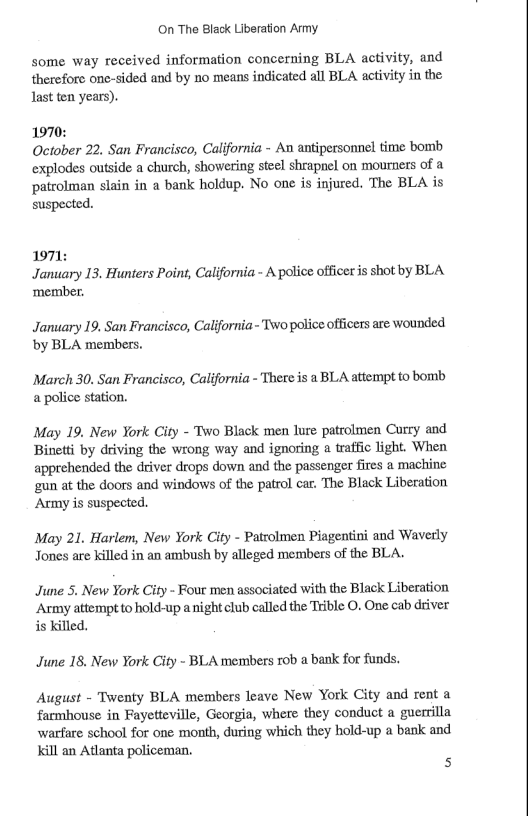
On The Black Liberation Army  some way received information concerning BLA activity, and therefore one-sided and by no means indicated all BLA activity in the last ten years).  1970:  October 22. San Francisco, California - An antipersonnel time bomb explodes outside a church, showering steel shrapnel on mourners of a patrolman slain in a bank holdup. No one is injured. The BLA is suspected.  1971: January I3. Hunters Point, California - A police officer s shot by BLA. ‘member.  January 19. San Francisco, California - Two police officers are wounded by BLA members.  March 30. San Francisco, California - Thereis a BLA attempt to bomb a police station.  May 19. New York City - Two Black men lure patrolmen Corry and Binetti by driving the wrong way and ignoring a traffic light. When apprehended the driver drops down and the passenger fires a machine gun at the doors and windows of the patrol car. The Black Liberation Army is suspected  May 21. Harlem, New York City - Patrolmen Piagentini and Waverly Jones are killed in an ambush by alleged members of the BLA.  June 5. New York City - Fout men associated with the Black Liberation “Army attempt to hold-up a night club called the Trible O. One cab driver is killed.  June 18. New York City - BLA members rob a bank for funds.  August - Twenty BLA members leave New York City and rent a farmhouse in Fayetteville, Georgia, where they conduct a guerrilla warfare school for one month, during which they hold-up a bank and  Kill an Atlanta policeman. s
On The Black Liberation Army.  August 23. Queens, New York - The Bankers Trust Company s robbed; Black Liberation Army members are identified as participants.  August 28. San Francisco, California - Two BLA members attempt to machine-gun a San Francisco police department patrol car, after an exchange of gun fire, they are apprehended. The service revolver of slain New York City patrolman Waverly Jones is found in their ‘possession.  August 29. San Francisco, California - A police sergeant s killed at his desk when two black men fire repeated blasts into the Ingelside police station. The BLA is suspected.  October 7. Atlanta, Georgia. - The Peters Street branch of Fulton National Bank is robbed, reportedly by the Black Liberation Army.  November 3. Atlanta, Ga. - Officer James Richard Greene is shot in a ‘paddywagon; the scene of the shooting is 3 miles from a residence used by the Black Liberation Army, this organization believed responsible for the shooting.  December 12. Atlanta, Ga. - Three reported Black Liberation Army ‘members and two other prisoners escape from the DeKalb County jail.  December 21. Atlanta, Ga. -New York City - Two police officers notice a suspicious car near Bankers Trust Company in Queens. When they approach the car, it speeds away, and individuals in the car roll a grenade towards the police car. The grenade explodes, causing considerable damage towards the police car, and injuring the policemen. Two suspects are identified as Black Liberation Army ‘members.  December 31. Brookiyn, New York - BLA members engage in a shoot- out with a rival group in the offices of Youth in Action.  Odessa, Florida - BLA member is killed in a shoot-out with FBL
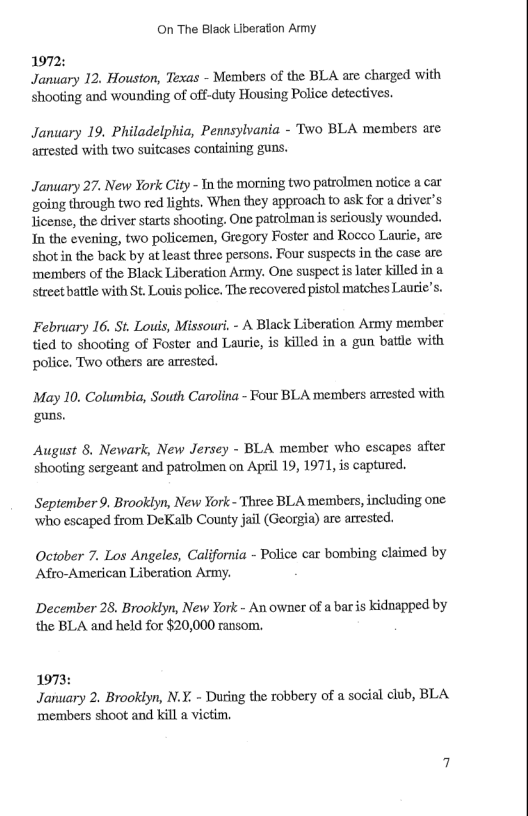
On The Black Liberation Army  1972: January 12. Houston, Texas - Members of the BLA are charged with Shooting and wounding of off-duty Housing Police detectives.  January 19. Philadelphia, Pennsylvania - Two BLA members are arrested with two suitcases containing guns.  January 27. New York City - Tn the morning two patrolmen notice a car ‘going through two red lights. When they approach to ask for a driver’s Jicense, the driver starts shooting. One patrolmanis seriously wounded. Tn the evening, two policemen, Gregory Foster and Roceo Laurie, are shotin the back by at Least three persons. Four suspects in the case are members of the Black Liberation Army. One suspect is later killed in a street battle with St. Louis police. The recovered pistol matches Laurie’  February 16. St. Louis, Missouri, - A Black Liberation Army member tied to shooting of Foster and Laurie, is killed in a gun batlle with police. Two others are arrested.  May 10. Columbia, South Carolina - Four BLA members arrested with guns.  August 8. Newark, New Jersey - BLA member who escapes after shooting sergeant and patrolmen on April 19, 1971, is captured.  September 9. Brooklyn, New York - Thtee BLA members, including one ‘who escaped from DeKalb County jail (Georgia) are arrested.  October 7. Los Angeles, California - Police car bombing claimed by Afro-American Liberation Army.  December 28. Brooklyn, New York - An owner of a bar is kidnapped by the BLA and held for $20,000 ransom.  1973: January 2. Brooklyn, N.Y. - During the robbery of a social club, BLA| ‘members shoot and kill a victim,
On The Biack Liberation Army.  January 10. Brookiyn, N.Y. - After being confronted on a subway station by patrolman a BLA member fires a shot and escapes into the tunnel.  January 12. Brooklyn, N.Y. - Two Housing detectives are shot in front of a bar after stopping two BLA members.  January 23. Brooklyn, N.¥. - Two wanted BLA members are shot and killed by members of New York City police department after they are trapped in a bar. Two detectives are wounded.  January 25. Brookiyn, N.Y. - Two patrolmen brothers assigned to same car are machine-gunned by the BLA.  January 28. Queens, .Y, - Two patrolmen on patrol are machine-gunned by BLA members, who escape.  February 9. Brons, N.Y. - Members of the Black Liberation Army robbed. abank.  February 23. Brooklyn, N.Y. - Two BLA members are arrested with a carload of exolosives.  March 2. Brookiy, N.. - A group of BLA members, stopped by officers looking for a robbery suspect, engages the officers in a gun battle.  March 6. Bronx, N.Y. - Thiee BLA members are recognized by two detectives, and engage them in a gun battle. BLA members are joined by two more and escape by stealing a car and machine-gunning a palice radio car.  March 27. Brooklyn, N.Y. - BLA members rob a supermarket,  April 10. Queens, N.Y. - BLA members rob a bank.  April 12. Brooklyn, N.J. - Two telephone company men are held at gun point by the BLA when they are suspected of being police. They are told that they would be killed if they have guns, radios o shields.  8
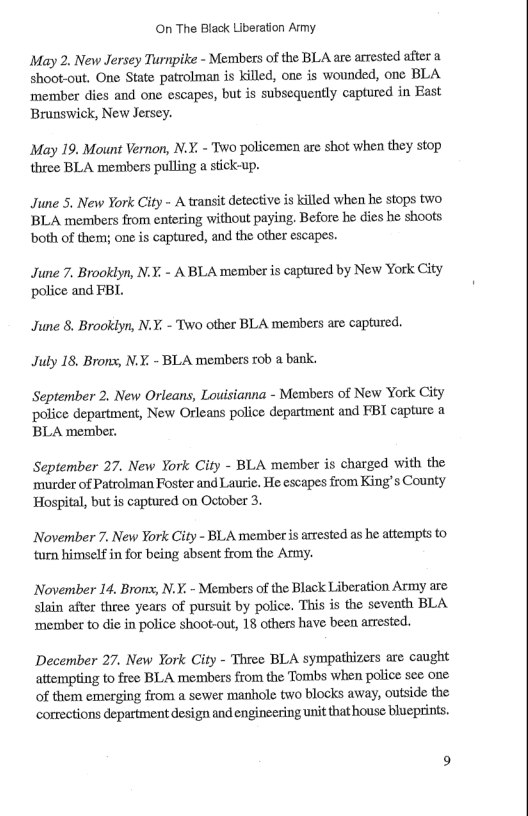
On The Black Liberation Army.  May 2. New Jersey Turnpike - Members of the BLA are arrested after a shoot-out. One State patrolman is killed, one is wounded, one BLA ‘member dies and one escapes, but is subsequently captured in East Brunswick, New Jersey.  May 19. Mount Vernon, N.Y. - Two policemen are shot when they stop three BLA members pulling a stick-up.  June 5. New York City - A transit detective is killed when he stops two BLA members from cntering without paying. Before be dies he shoots both of them; one is captured, and the other escapes.  June 7. Brooklyn, N.X, - A BLA member is captured by New York City police and FBI.  June 8. Brooklyn, N.Y. - Two otber BLA members are captured. July 18. Brons, N.Y. - BLA members rob a bank.  September 2. New Orleans, Louisianna - Members of New York City police department, New Orleans police department and FBI capture a BLA member.  September 27. New York City - BLA member is charged with the murder of Patrolman Foster and Lautie. He escapes from King’s County Hospital, but is captured on October 3.  November 7. New ¥ork City - BLA member is arrested as he attempts to turn himself in for being absent from the Army.  November 14, Brons;, N.X. - Memibers of the Black Liberation Army are slain after three years of pursuit by police. This is the seventh BLA ‘member to die in police shoot-out, 18 others have been arrested.  December 27. New York City - Three BLA sympathizers are caught attempting to free BLA members from the Tombs when police see one of them emerging from a sewer manhole two blocks away, outside the corrections department design and engineering unit that house blueprints.
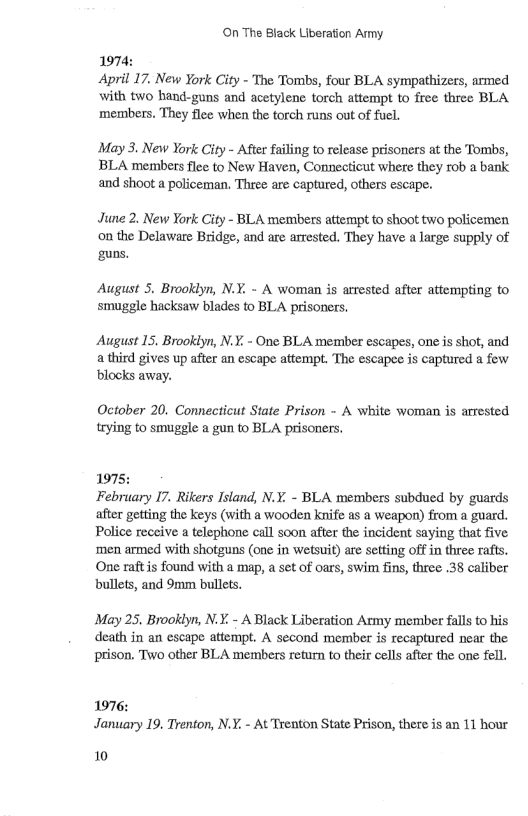
On The Black Liberation Army.  1974: April 17. New York City - The Tombs, four BLA sympathizes, armed with two hand-guns and acetylene torch attempt to free three BLA ‘members. They flee when the torch runs out of fuel.  May 3. New York City - After failing to release prisoners at the Tombs, BLA members flee to New Haven, Connecticut where they rob a bank. and shoot a policeman, Three are captured, others escape.  June 2. New York City - BLA members attempt to shoot two policemen on the Delaware Bridge, and are arrested. They have a large supply of guns.  August 5. Brooklyn, N.Y. - A woman is arrested after attempting to smuggle hacksaw blades to BLA prisoners.  August 15. Brookiyn, N.Y. - One BLA member escapes, one is shot, and a third gives up after an escape attempt. The escapee is captured a few ‘blocks away.  October 20. Connecticut State Prison - A white woman is arrested trying to smuggle a gun to BLA prisoners.  1975: February I7. Rikers Island, N.Y. - BLA members subdued by guards after getting the keys (with a wooden knife as a weapon) from a guard. Police receive a telephone call soon after the incident saying that five ‘men armed with shotguns (one in wetsuit) are setting off in three rafts. One raftis found with a map, a set of oars, swim fins, three .38 caliber bullets, and 9mm bullets.  May 25, Brooklyn, N.Y. - A Black Liberation Army member falls to his  death in an escape attempt, A second member is recaptured near the prison. Two other BLA members return to their cells after the one fell.  1976: January 19. Trenton, N.Y, - At Trenton State Prison, there is an 11 hour  10
On The Black Liberation Army  shooting rampage. An inmate was killed in the opening exchange of ‘gunfire, who was the one who began the incident by shooting a guard in an escape attempt. Another inmate who instigated the incident, was convieted of murdering a State Trooper in a shoot-out between BLA members and police on the New Jersey Turnpike. Inmates threw a ‘homemade grenade at police and guards as they rescued a wounded guard.  * Kk ok  ‘The names of Comrades mentioned in these police reports have been omitted, as some are no longer functioning in the same capacity, imprisoned or dead. Itis our policy notto reveal the names of Comrades who have acted within our organisational underground formations.  ‘The defensive-offensive launched in 1970-71 politico-military initiatives was based upon the degree of repression suffered in the Black. community due to COINTELPRO police attacks. The politico-military policy at that time was to establish a defensive (self-defense) front that would offensively protect the interest of the aboveground political apparatus’ aspiration to develop a mass movement towards national Jiberation. Again, it must be stated that in the early seventies, the Black underground was the armed-wing of the aboveground BPP, which, because of the split and factionalism prevented adequate logistics, communications between cadre(s) and focos in the Black underground in various parts of the country. It was this situation which caused the greatest problem to the advent of the Black Liberation Army, upon which the commencement of armed struggle could be said to have been ‘premature, Premature in the sense that subjectively, our capacity to wage a sustained protracted national liberation war was not possible duc to the split in the aboveground political apparatus, with the Black underground still depending on the aboveground for logistics and communications, and the Black underground comprising of militants who had not grown to political maturity, and without a politico-military structure and strategy to merge the Black underground into  national formation, employing both stable and mobile urban and rural guerrilla warfare, in conjunction with the rising militancy of the oppressed masses. In the same regards, the objective reality for armed struggle was presont, that being a historical transition evolving from the civil rights ‘movement, the riotous 19605, the creation of the BPP chapters in Black communities across the country which fought bravely against police  1
On The Black Liberation Army  attacks, the mass mobilization in support of the Vietnamese national liberation war, etc. Hence, the commencement of armed struggle by our forces was according to the development of history.  By late 1971, it was ordered for the Black underground to enter a strategic retreat, to reorganize itself and build a national structure, but the call for the strategic retreat for many cadres was too late. Many of the most mature militants were already deeply underground, separated from those functioning with the logistics provided by BPP chapters who in the split served to support armed struggle. The repression by the State continued to mount, especially now that the Black underground was hampered by internal strife with the 1oss of the aboveground political support apparatus (with virtually no support coming from existing Black community groups and organizations). Itshould be stated, amajor contradiction was developing between the Black underground and those Buro-American forces who were employing armed tactics in supportof Vietnamese liberation struggle. By 197375, this contradiction ‘became full blown, whereby specific Buro-American revolutionary armed. forces refused to give meaningful material and political support to the. Black Liberation Movement, more specifically, to the Black Liberation Army. Thereby, in 1974, the Black Liberation Army was without an aboveground political support apparatus, logistically and structurally scattered across the country without the means to unite its combat units, abandoned by Buro-American revolutionary armed forces, and being relentlessly pursued by the State reactionary forces - COINTELPRO (FBI, CIA and local police departments). Thusly, it was only a matter of time before the Black Liberation Army would be virtually decimated as a fighting clandestine organization.  By 1974-75, the fighting capacity of the Black Liberation Army had been destroyed, but the BLA as a politico-military organization had not been destroyed. Since those imprisoned continued escape attempts and fought political trials, which forged ideological and political theory concerning the building of the Black Liberation Movement and revolutionary armed struggle. The trials of Black Liberation Army ‘members sought to place the State on trial, to condemn the oppressive conditions from which Black people had to make out an existence in racist America. These trials went on for several years which the courts and police used to embellish their position as being guardians of society. The State media publications projected the Black Liberation Army trials as justice being served to protect Black people from  12
On The Black Liberation Army  terrorism, o prevent these terrorists from starting racial strife between  black and white people, and to protect the interest and lives of police who are responsible for the welfare of the oppressed communities, etc. ‘The captured and confined BLA member was deemed a terrorist, & criminal, aracist, but never arevolutionary, never a humanitarian, never a political activist. But the undaunted revolutionary fervor of captured BLA members continued to serve the revolution even while imprisoned. By placing the State on trial, the BLA was more able to expose the contradictions between the philosophy of the State to protect the rights of all people, and the actions of the State which are to only protect the rights of the capitalist-class bourgeoisic, The BLA trials sought. 10 undermine the State attempts to play-off the BLA as an insignificant group of crazies, and therefore the trials of BLA members became forums to politicize the masses of what the struggle and revolution is all about. The trials served to organize people to support those being persecuted and prosccuted by the State, as a means from which the oppressed masses would be able to protect themselves from future, persecution. Tn this manner, the trials of the Black Liberation Army voiced the discontent, dissatisfaction, and disenfranchisement of Black people in racist America.  Bylate 1975, the Black Liberation Army established a Coordinating Committee, which essentially was comprised of imprisoned members and outside supporters gained during the years of political prosecution in the courts. The first task of the Coordinating Committee was to distribute an ideological and political document depicting the theoretical foundations of the political determination of the Black Liberation Army. This document was entitled, “A MESSAGE TO THE BLACK MOVEMENT -A Political Statement from the Black ‘Underground.” The Message to the Black Movement, put forth several political premises from which the BLA should be noted as a revolutionary politico-military organization fighting for national liberation of Afrikan people in the United States.  Inlate 1975 and 1976, the Coordinating Committee distributed the first BLA newsletter, an organizational publication for the purpose of forging ideological and political clarity and unity between BLA ‘members captured and confined in various parts of the country. The BLA newsletter begun to serve as a means from which BLA members would voice their political understanding of the national liberation struggle, andin this way, for the entire organized body to share in ideas  13
On The Black Liberation Army  and strengthen our collective political determination as a fighting force. Over the years, the newsletter has served to help develop cadres inside and outside of prisons, and broaden the capacity from which the BLA could continue to serve the national liberation struggle. Also, in 1976, ‘members of the Black Liberation Army launched a national campaign to petition the United Nations concerning the plight of political prisoners of war, and conditions of the U.S. penal system, on behalf of the prison movement. The U.N. Prisoners Petition Campaign, initiated and directed by members of the BLA, virtually revitalized the prison movement across the country, and forged an impetus to the present ’Human Rights campaign to the United Nations. It was the U.N. Prisoners Peition Campaign that firstcalled for an international investigationinto the conditions of U.S. prisons, and called for the release of political ‘prisoners of war to a non-imperialist country that would accept them. (Consequently, this year another national campaign has been launched entitied “National POW Amnesty Campaign”). Lastly, in 1976-77, the Coordinating Committee distributed whathad been termed a Study Guide to captured members of the BLA as a means to consolidate the ideclogical perspectives from which the BLA would provide political leadership to the national liberation struggle.  Since 1974, to the present, the BLA have continuously provided ideological and political perspectives within the Black Liberation Movement, and in this way gave leadership to the movement, although the Black Liberation Army is still lacking principled support by progressive forces throughout the country. The primary aspect of lack of support is the fact the BLA still calls for the need of armed struggle and the building of a revolutionary armed front. The Black Liberation Army s a politico-military organization, which in the last five years has served to develop the political mass movement to merge with the political determination of the Black underground. The merger is upon the development of a national politico-military strategy in unity with the aspirations and strategic initiatives of the various progressive political organizations throughout the counry. Consistently, the Black Liberation Army has called for the development of the Black Liberation Front or Black United Front, an united front of Black revolutionary ‘nationalists, establishing the political determination of the class and national liberation struggle towards independence, and for the frecing of the land. At this stage inthe struggle, there are several areas of progress. being formulated that may serve to strengthen, consolidate, and  14
On The Black Liberation Army  ‘mobilise the national liberation struggle under the aspirations of the oppressed Black masses. The building of the Afrikan National Prisoncrs Organization is a positive step on which various progressive Black forces can develop principled working relationships, alliances, and coalitions, and further build towards the Black Liberation Front. In the same regards, the development of the National Black Human Rights Colition provides a means from which a greater number of Black organizations and groups representing oppressed Black masses can be educated, organized, and mobilized to confront racist capitalist- imperialism, in conjunction with the heightened struggles in Namibia and Azania, and human right violations here in North America. Butitis imperative that these new formations develop a struggle line that supports the need for armed struggle to be waged in the United States, and therefore support of the oldest revolutionary armed force in North America - The Black Liberation Army.  Itis practically 1980, and the Black Liberation Army (the Black underground) have been in existence for over ten years. The last ten years have been hard years of struggle, we have lost many comrades, ‘we have made many mistakes, but we have never lied nor compromised our principles in struggle. The growth and development of the BLA depends on the growth and development of the entire class and national liberation struggle. The means from which the BLA can build revolutionary armed struggle is based upon the willingness of the oppressed masses to support the BLA, to call for the BLA to act, to build areas of support in the work place, in the home, and the social places of entertainment, but most of all amongst the political organisations and groups that the oppressed masses are affiliated with. It is essential and necessary that the general mass and popular ‘movement understand the need for revolutionary armed strggle/forces 0 cxist, and that the existence of the Black Liberation Army is the criteria on which the class and national liberation struggle will be preserved, as the socio-economic conditions of U.S. monopoly- capitalism worsen, and as racist repression intensifies.  ‘As mentioned earlier, another national political campaign has been Launched, this new campaign calling for the release and/or exchange of captured members of the Black underground and other revolutionary forces across the country. But it must be understood the principal objective of this campaign s to also build support of revolutionary armed struggle, employing international law and politics (specifically: Protocols  15
On The Black Liberation Army  of the Geneva Accords) concerning the existence of political prisoners of war in the United States. Thereby, supporting the release of political prisoners of war brings understanding to how these revolutionaries came to be imprisoned, and the need for them to be released, as well as, the need for revolutionary armed struggle, This is the challenge in uniting the mass and popular movement under the auspices of building the Black Liberation Front, and can only be objectively realised by supporting the re-emergence of the Black underground, the Black Liberation Army.  SUPPORT THE BLACK LIBERATION ARMY’! BUILD THE NATIONAL POW AMNESTY CAMPAIGN! FREE ALL POLITICAL PRISONERS OF WAR!  Jalil Abdul Muntagim on behalf of the Black Liberation Army  Addendum: Since the original writing of this brief historical account of the BPP-BLA, Assata Shakur was liberated, and BLA soldiers were captured during Nyack Binks amored car expropriation.  Originally written on September 18, 1979 & printed in Arm the Spirit, the first national revolutionary prisoners newspaper:
ABOUT THE AUTHOR  Anthony Bottom/ Jalil A. Muntagim was born October 18, 1951 in Oakland, California, the first of four children . in his family. His early years were spentin San Francisco. £ In his junior high school years he obtained a summer  engincering program. During the civil rights movement, he participated in NAACP youth organising and was one of many who engaged in street riots against racism and police brutality in San Francisco. In high school, he became aleading member of the Black Student Union. Because of his ability to articulate the issues that confronted Black students, Jall often toured San Jose, California, in what was called “speakout” with the BSU Chairman of San Jose State and City College. He had become a member of the “House of Umoja, a cultural-nationalistaffliate of Ron Karenga’s United Slaves organisation. At the age of 16 1/2, on April 6, 1968, two nights after the assassination of Martin Luther King, Jr. the BSU Chair of San Jose State and Gity Callege, Jalil, and a couple of high school students were arrested ina car and charged with possession of high-powered rifles and molotov cocktails. Black high school students picketed and demonstrated in front of San Jose City Hall demanding their release from detention. After the assassination of Rev. King, Jalil begantobelieve amore  militant response to national opppression and racism was necessary, and began to look towards the Black Panther Party for Self-Defense for leadership. He became affiliated with the BPP when he was 18 years old. Having moved backto San Francisco from San Jose, Jalil was recruited into the Black ‘underground by elementary school friends whohad since become Panthers. Less than two months from his twentieth birthday, on August 28, 1971, Jalil was captured along with Albert Nub Washington n a midnight shoot- out with San Francisco police (It has been alleged that Jalil and Nuh attempted to assassinate a S.F. police sergeantin retaliation for the August 21,1971 assassination of BPP Field Marshal George Jackson). Subsequently, Jalil was charged with a host of revolutionary underground activities, including the assassination of NYC police officers for which he is curently serving a life sentence. When he was arcested in 1971, he was a high school graduate and employed as a social worker for the California State Employment Office. Having been imprisoned since 1971, Nuh and Jalil are two of the ten longest held Black political prisoners in the world.  17
On The Black Liberation Army  ‘While imprisoned in San Quentin in 197577, Jalil was able to organise the first national prison petition campaign 10 the United Nations. He established the first revolutionary prisoners national newspaper called *Armthe Spirit”, and organised the first Black August demonstrationin front of San Quentin. From his prison cell, Jalil with the support of another BLA Prisoner of War, Sundiata Acoli, organised the first march to the United Nations calling for recognition of U.S. political prisoners, as wel as the first demonstration in front of the Harlem State Office Building calling for recognition of U.S. political prisoners.  Also, since being in NY state prisons, Jalil wrote and submitted a Tegislative bill for prisoners with life sentences to receive good time off their minimum sentences. This bill was introduced to the NY State Assembly Committee on Corrections. Jail has filed numerous lawsuits on behalf of prisoners’ civil and human rights challenging the prison system’s way of doing business. In addition, he has received awards of appreciation from Jaycee’s NAACP, and Project Build prison chapters for his active participation and leadership.  After many years of being denied the opportunity to attend college because he has been designated a Central Monitoring Case (CMC) security classification, in 1994, Jalil graduated from SUNY-New Paltz witha BS in Psychology and a BA.in Sociology. He is a founding member of the New African Liberation Front (NALF), and presently working to develop a National Prisoners’ African Studies Project (NPASP). Recently, he initiated the international mobilization, "Spring Break ’98 Jericho March on the White House and U.S. Bmbassies to Demand Amnesty for U.S. ‘Political Prisoners." Over the years he has written several political booklets and essays, an unpublished novel and telcplay.  Jalil has a daughter and granddaughter. Fe states, “T came to prison an expectant father and will leave prison a grandfather.” Jalil will not appear before the parole board in NY state until the year 2002, He also states, “The United States does not recognize the existence of political prisoners. To do so would give credence to the fact of the level of repression and oppression that exists in the United States, and have to recognize the fact that people resist racist oppression in the U.S., and therefore legitimize the existence of not only the individuals who arc incarcerated or have been captured, but also legitimize those ‘movements of which they are a part.”  18
PRISONERS OF WAR  (This s only a partial lsting as of January 2002)  Abdul Majid (A. LaBorde) 83A0483 / Box 700, Wallkill, NY, 12589  Anthony Bottom (Jalil A. Muntagim) 7744283 / Box 618, Auburn, NY, 13024  Bashir Hameed (J. York) 82A6313 / Box 149, Attica, NY, 14011-0149  Herman Bell 79C0262 / CCF Main / Box 2001, Dannemora, NY, 12929-2001  Mutulu Shakur 83205-012 / Box PMB / D-Unit 105, Atlanta, GA, 30315  Robert Seth Hayes 74A2280 / Box 2001, Dannemora, NY, 12929-2001  Russel Shoats AE-3855, SCI Green, 1040 E. Roy Furman Hwy, Waynesburg, PA, 15370-8090  Sekou Cingue T.M. Kambui (William Turk # 113058), PO. Box 10 (6A-100) Clio, Alabama, 36017-0010  Sekou Odinga 05228-054, 3901 Kllen Blvd, Lompoc, CA, 93436  Sundiata Acoli (C. Squire) 39794-066 / Box 3000, White Deer, PA, 17887  19
SUPPORT ORGANISATIONS  (partal lsting)  Anarchist Black Cross Federation (ABCF) Box 350392, Jacksonville, FL, 32235  Marshall E. Conway Support Committee: P.O. Box 41144, Baltimore, Maryland, 21203-6144  National Plebiscite Education Campaign for Self-Determination P.0. Box 3585, Oakland, CA, 94609  New African Liberation Front (NALF) P.0. Box 340084, Jamaica, NY, 11434  New African Network in Defense of Political Prisoners & POWS P.O. Box 90604, Washington, DC, 20090  Sundiata Acoli Freedom Campaign PO. Box 5538, Harlem, NY, 10027  20
more on Black Liheration  Message To The Black Movement PollicalStatement From The Black Underground  This statement originally written in 1975 by the USSRl Coordinating Committee of the Black Liberation e Ok i Army. It is political analysis, statement of general political positions, and a contribution to the Black Liberation Movement specifically, and to the revolutionary movement in general. From Abraham Guillen Press & Arm The Spirit  $3.50 US/ $5 Can (+$2 postage)  All Power To The People TO THE PEOPLE  Nuh Washington Witings by and about now deceased Black Liberation Army soldier Albert Nuh Washington. “This i the single largest collection available in print. Includes interviews, essays, poetry, photos, and tributes to Nuh by political prisoners and friends. Published by Amm The Spirt-Solidarity.  [ EE Y $10US/ $15 Can (+$2 postage)
GUILLEN PRESS  Abraham Guillen Press is a revolutionary left anti-authoritarian activist publishing house. We focus on anti-mperialism, political prisoners, class struggle, movement history and much more. Send Us aletter or emailto request a recent catalog of our publications, or to join our mailing lst.  Abraham Guillen Press C.P.48164 Montreal, QC H2V 488, Canada email: abrahamguillenpress@yahoo.com  firm The Spirit  Arm The Spirit is an autonomist/anti-imperialist information collective based in Toronto, Canada. Our focus includes a wide variety of material, including politcal prisoners, national liberation struggles, ammed communist resistance, anti-fascism, the fight against patriarchy, and more. We regularly publish our writings, research, and translation materials on our listserv called ATS-L. For more information, contact:  Arm The Spirit P.O. Box 6326, Stn. A Toronto, Ontario MS5W 1P7, Canada email: ats@stext org web: hitp://bumn.ucsd.edu/~ats

"The Black Liberation Army is a politico-military organization, whose primary -objective is to fight for the independence and self-determination of Afrikan people." 3 % % % %%k % %  Jalil Abdul Muntagim (Anthony Bottom) has been held captive as a political prisoner in United States prisons since 1971, and is one of the longest held political prisoners in the world. He is a former member of the Black Panther Party and its offspring the Black Liberation Army, an urban guerrilla organisation that operated during the 1970s.  "The history of our national liberation struggle is one of the most important factors upon which the political partys, the oppressed masses, and the liberation armed forces may understand the nature of their oppression and the task before them towards independence and freedom."  fi(rm The Spirit  ISBN 1-894925-13-0

Jalil Muntagim

On the

Black
Liberation
Army

BLACK LIBERATION AP

Jalil Muntagim

On the

Black
Liberation
Army

Yrim The Spirit FeRes

On The Black Liberation Army
this edition published August 2002
by Abraham Guillen Press & Arm The Spirit

ISBN 1-894925-13-0

Abraham Guillen Press (distribution)
C.P.48164

Montreal, QC

H2V 4S8, Canada

email: abrahamguillenpress@yahoo.com

Arm The Spirit
PO. Box 6326, Stn. A
Toronto, Ontario

MW 1P7, Canada

email: ats@etext.org

web: http:/fourn.ucsd edu/~ats

First published in pamphlet form n 1997 by the Montreal Anarchist
Black Cross, a support group of the Anarchist Black Cross
Federation (ABCF), with the assistance and permission of the author
for distribution through the member groups of the Federation. It
was republished by Solidarity in June 2001, and then by Abraham
Guillen Press & Arm The Spir in August 2002. Profits from the
sale of this pamphlet are sent to the author. If you copy this and
sellitwithout iving some ofthe profits to the authoryou are stealing
from him. Contact the author directly (subject to change) at.

Anthony Bottom
(Jalil Muntagim)
T1A4283 / Box 618
Auburn, NY
13024, USA
CONTENTS

Introduction, 1997 ...

On the Black Liberation Army, 1979

About the author ...

BLA prisoners of war ...

... 20

Support Organisations

INTRODUCTION

‘This pamphlet offers insights into the history and lessons of the Black
Liberation Movement being waged in North America. Since the
original writing, the struggle has declined due to U.S. political
repression and political infantilism on the part of U.S. revolutionaries.
What is extremely important to understand about the former Black
Panther Party (BPP) s that it was basically a militant youth movement.
Because the BPP was a powerful youth movement, J. Edgar Hoover,
former Dircctor of the FBI, declared the BPP to be the greatest threat o,
the internal secuity of the United States. The FBI launched a political
and military counter-intelligence program (COINTELPRO) to destroy
not only the BPP, but to also crush any possibility of a new youth
movement of similar magnitude and militancy.

‘Today, our youth are being crushed by increasing draconian laws,
and the saturation of poor communities with CIA procured drugs. The
music indusizy continues to produce and distribute nihilistic gangsta
rap that glorifies drive-by shootings and gang bang’in. The U.S.
government is lowering the age a teenager can be tried and sentenced as
an adult from 16 to 14 years old. The U.S. government has consistently
‘withdrawn money from social and educational programs, while at the
same time increased spending for prison building. These are direct
attacks on our youth to prohibit the rebuilding of a movement that in
any way resembles the militant determination of the former Black
Panther Party or the Black Liberation Army (BLA).

‘This pamphlet comprises a chapter from a soon to be published
compilation of my prison writings. The book, We Are Our Own
Liberators!, presents specific ideas, theoretical determinations, and
‘political positions on how we should work to rebuild and continue the
struggle. The proceeds from this pamphlet will help offset the cost to
produce the book. Therefore, it is anticipated all will support not only
the distribution of this pamphlet, but more importanly, the rebuilding
of our movement. Rest assured, our youth and the struggie for class and
national liberation, having learned the lessons of the past will recover
and triumph. Remember - “Truth crushed to the earth willrise again.”

Jalil A. Muntagim, August 1997
ON THE BLACK LIBERATION ARMY

... Hide nothing from the masses of our peoples. Tell no lies. Expose
lies whenever they are fold. Mask no diffculties, mistakes, failures. Claim
no easy victories...” PAIGC-1965

The history of our national liberation struggle, is one of the most.
important factors upon which the political pasty(s) the oppressed masses,
and the liberation armed forces may understand the nature of their
oppression and the task before them towards independence and
freedom.

In this article, T would like to present to the masses the general
history of the evolvement of the Black Liberation Army. This will be a
brief historical overview not providing specific historical data in order
to protect people who are either fonctioning in the BLA, or in other
areas no longer associated with the BLA. The Black Liberation Army is
apolitico-military organization, whose primary objective is to fight for
theindependence and self-determination of Afrikan people in the United
States. The political determination of the BLA evolved out of the now
defunct Black Pantber Pacty.

1t was in October 1966, with the advent of the Black Panther Party
for Self-Defense, that the question of armed struggle and resistance to
racist oppression emerge as a plausible strategical mancuver in the
developing liberation movement. It was in late 1968, carly 1969, that
the forming of a Black underground first begun. From Los Angeles-
California, to Texas, Louisiana, Mississippi, and Alabama, armed units
were formed in rural areas, trained and caches were established. In
‘Oakland, San Francisco, Detroit, Chicago, Philadelphia, Ohio and New
York, Black Panther Party offices were established to formulate a
political relationship with the oppressed Black massesin these and other
communities across the country. From 1969 to 1972, the BPP came
under vicious attack by the State and Federal government. The
‘government employed COINTELPRO (FBI, CIA and local police
departments) as the means to destroy the above-ground political
apparatus that fielded the Black underground. But it wasn't until 1970
that the BPP began its purge of many of it's most trusted and militant
‘members, many of which eventually joined the Black underground. By
1971, contradictions perpetuated by COINTELPRO forces in the

3

On The Black Liberation Army.

leadership of the BPP caused the split between Newton and Cleaver,
which eventually split the entire Black Panther Party into two major
factions. It was this BPP split and factionalism that determined the
fielding of the Black underground would begin to serve its primary
purpose (along with conditions presented by the State armed offensive
to Jiquidate the Party). This is not to say that armed action against the
State did not occur by the Black underground prior to the split. On the
contrary, by 1971, the Black underground was becoming rich in
experience in the tactics of armed expropriations, sabotage, and
ambush-assaults. It needs 1o be said that prior to the split, the Black
underground was the official armed-wing of the aboveground political
apparatus, and thereby had to maintain restraint in its military activity.
This was very well, for the Black underground, although in many areas
experienced in tactical military guerrilla warfare, was still infantle
politically, and although becoming organisationally wielded as a
fighting apparatus, it did not establish an infra-structure completely
autonomous from the aboveground BPP cadres and Party chapters. This
in turn become one of the major detriments of the Black underground
after the split of the Black Panther Party.

Based upon the split and factionalism in the BPP, and heightened
repression by the State, the Black underground was ordered to begin
establishing the capacity to take the “defensive-offensive” in
developing urban guerrilla warfare. Hence, in 1971, the name Black
Liberation Army (or Afro-American Liberation Army) surfaced as the
nucleus of Black guerrilla fighters across the United States. This is not
0 say that the name Black Liberation Army was fist sed in 1971, for
in late 1968, during a student strike and demonstration in Mexico City,
students and demonstrators were killed by Mexican police. One of those.
students was reported to have had a piece of paper in his pocket upon
‘which was written the name Black Liberation Army. Whether or not
there was a connection to the ielding of the Black underground with the
uprising in Mexico in 1968 is unknown.

Since the split in the BPP and the call of the “defensive-offensive”
commenced, the Black underground which in May of 1971 born the
name Black Liberation Army, had committed many armed attacks against
the state as part of the BPP (and after the split) many of which are
unrecorded. Here I would like to present the Justice Department LEAA
‘Task Force report on BLA activity (it should be noted these reports were
recorded by the State according to when they captured, killed, or in

4
On The Black Liberation Army

some way received information concerning BLA activity, and
therefore one-sided and by no means indicated all BLA activity in the
last ten years).

1970:

October 22. San Francisco, California - An antipersonnel time bomb
explodes outside a church, showering steel shrapnel on mourners of a
patrolman slain in a bank holdup. No one is injured. The BLA is
suspected.

1971:
January I3. Hunters Point, California - A police officer s shot by BLA.
‘member.

January 19. San Francisco, California - Two police officers are wounded
by BLA members.

March 30. San Francisco, California - Thereis a BLA attempt to bomb
a police station.

May 19. New York City - Two Black men lure patrolmen Corry and
Binetti by driving the wrong way and ignoring a traffic light. When
apprehended the driver drops down and the passenger fires a machine
gun at the doors and windows of the patrol car. The Black Liberation
Army is suspected

May 21. Harlem, New York City - Patrolmen Piagentini and Waverly
Jones are killed in an ambush by alleged members of the BLA.

June 5. New York City - Fout men associated with the Black Liberation
“Army attempt to hold-up a night club called the Trible O. One cab driver
is killed.

June 18. New York City - BLA members rob a bank for funds.

August - Twenty BLA members leave New York City and rent a
farmhouse in Fayetteville, Georgia, where they conduct a guerrilla
warfare school for one month, during which they hold-up a bank and

Kill an Atlanta policeman.
s

On The Black Liberation Army.

August 23. Queens, New York - The Bankers Trust Company s robbed;
Black Liberation Army members are identified as participants.

August 28. San Francisco, California - Two BLA members attempt to
machine-gun a San Francisco police department patrol car, after an
exchange of gun fire, they are apprehended. The service revolver of
slain New York City patrolman Waverly Jones is found in their
‘possession.

August 29. San Francisco, California - A police sergeant s killed at his
desk when two black men fire repeated blasts into the Ingelside police
station. The BLA is suspected.

October 7. Atlanta, Georgia. - The Peters Street branch of Fulton
National Bank is robbed, reportedly by the Black Liberation Army.

November 3. Atlanta, Ga. - Officer James Richard Greene is shot in a
‘paddywagon; the scene of the shooting is 3 miles from a residence used
by the Black Liberation Army, this organization believed responsible
for the shooting.

December 12. Atlanta, Ga. - Three reported Black Liberation Army
‘members and two other prisoners escape from the DeKalb County jail.

December 21. Atlanta, Ga. -New York City - Two police officers notice
a suspicious car near Bankers Trust Company in Queens. When they
approach the car, it speeds away, and individuals in the car roll a
grenade towards the police car. The grenade explodes, causing
considerable damage towards the police car, and injuring the
policemen. Two suspects are identified as Black Liberation Army
‘members.

December 31. Brookiyn, New York - BLA members engage in a shoot-
out with a rival group in the offices of Youth in Action.

Odessa, Florida - BLA member is killed in a shoot-out with FBL
On The Black Liberation Army

1972:
January 12. Houston, Texas - Members of the BLA are charged with
Shooting and wounding of off-duty Housing Police detectives.

January 19. Philadelphia, Pennsylvania - Two BLA members are
arrested with two suitcases containing guns.

January 27. New York City - Tn the morning two patrolmen notice a car
‘going through two red lights. When they approach to ask for a driver's
Jicense, the driver starts shooting. One patrolmanis seriously wounded.
Tn the evening, two policemen, Gregory Foster and Roceo Laurie, are
shotin the back by at Least three persons. Four suspects in the case are
members of the Black Liberation Army. One suspect is later killed in a
street battle with St. Louis police. The recovered pistol matches Laurie’

February 16. St. Louis, Missouri, - A Black Liberation Army member
tied to shooting of Foster and Laurie, is killed in a gun batlle with
police. Two others are arrested.

May 10. Columbia, South Carolina - Four BLA members arrested with
guns.

August 8. Newark, New Jersey - BLA member who escapes after
shooting sergeant and patrolmen on April 19, 1971, is captured.

September 9. Brooklyn, New York - Thtee BLA members, including one
‘who escaped from DeKalb County jail (Georgia) are arrested.

October 7. Los Angeles, California - Police car bombing claimed by
Afro-American Liberation Army.

December 28. Brooklyn, New York - An owner of a bar is kidnapped by
the BLA and held for $20,000 ransom.

1973:
January 2. Brooklyn, N.Y. - During the robbery of a social club, BLA|
‘members shoot and kill a victim,

On The Biack Liberation Army.

January 10. Brookiyn, N.Y. - After being confronted on a subway
station by patrolman a BLA member fires a shot and escapes into the
tunnel.

January 12. Brooklyn, N.Y. - Two Housing detectives are shot in front
of a bar after stopping two BLA members.

January 23. Brooklyn, N.¥. - Two wanted BLA members are shot and
killed by members of New York City police department after they are
trapped in a bar. Two detectives are wounded.

January 25. Brookiyn, N.Y. - Two patrolmen brothers assigned to same
car are machine-gunned by the BLA.

January 28. Queens, .Y, - Two patrolmen on patrol are machine-gunned
by BLA members, who escape.

February 9. Brons, N.Y. - Members of the Black Liberation Army robbed.
abank.

February 23. Brooklyn, N.Y. - Two BLA members are arrested with a
carload of exolosives.

March 2. Brookiy, N.. - A group of BLA members, stopped by
officers looking for a robbery suspect, engages the officers in a gun
battle.

March 6. Bronx, N.Y. - Thiee BLA members are recognized by two
detectives, and engage them in a gun battle. BLA members are joined
by two more and escape by stealing a car and machine-gunning a palice
radio car.

March 27. Brooklyn, N.Y. - BLA members rob a supermarket,

April 10. Queens, N.Y. - BLA members rob a bank.

April 12. Brooklyn, N.J. - Two telephone company men are held at gun
point by the BLA when they are suspected of being police. They are
told that they would be killed if they have guns, radios o shields.

8
On The Black Liberation Army.

May 2. New Jersey Turnpike - Members of the BLA are arrested after a
shoot-out. One State patrolman is killed, one is wounded, one BLA
‘member dies and one escapes, but is subsequently captured in East
Brunswick, New Jersey.

May 19. Mount Vernon, N.Y. - Two policemen are shot when they stop
three BLA members pulling a stick-up.

June 5. New York City - A transit detective is killed when he stops two
BLA members from cntering without paying. Before be dies he shoots
both of them; one is captured, and the other escapes.

June 7. Brooklyn, N.X, - A BLA member is captured by New York City
police and FBI.

June 8. Brooklyn, N.Y. - Two otber BLA members are captured.
July 18. Brons, N.Y. - BLA members rob a bank.

September 2. New Orleans, Louisianna - Members of New York City
police department, New Orleans police department and FBI capture a
BLA member.

September 27. New York City - BLA member is charged with the
murder of Patrolman Foster and Lautie. He escapes from King’s County
Hospital, but is captured on October 3.

November 7. New ¥ork City - BLA member is arrested as he attempts to
turn himself in for being absent from the Army.

November 14, Brons;, N.X. - Memibers of the Black Liberation Army are
slain after three years of pursuit by police. This is the seventh BLA
‘member to die in police shoot-out, 18 others have been arrested.

December 27. New York City - Three BLA sympathizers are caught
attempting to free BLA members from the Tombs when police see one
of them emerging from a sewer manhole two blocks away, outside the
corrections department design and engineering unit that house blueprints.

On The Black Liberation Army.

1974:
April 17. New York City - The Tombs, four BLA sympathizes, armed
with two hand-guns and acetylene torch attempt to free three BLA
‘members. They flee when the torch runs out of fuel.

May 3. New York City - After failing to release prisoners at the Tombs,
BLA members flee to New Haven, Connecticut where they rob a bank.
and shoot a policeman, Three are captured, others escape.

June 2. New York City - BLA members attempt to shoot two policemen
on the Delaware Bridge, and are arrested. They have a large supply of
guns.

August 5. Brooklyn, N.Y. - A woman is arrested after attempting to
smuggle hacksaw blades to BLA prisoners.

August 15. Brookiyn, N.Y. - One BLA member escapes, one is shot, and
a third gives up after an escape attempt. The escapee is captured a few
‘blocks away.

October 20. Connecticut State Prison - A white woman is arrested
trying to smuggle a gun to BLA prisoners.

1975:
February I7. Rikers Island, N.Y. - BLA members subdued by guards
after getting the keys (with a wooden knife as a weapon) from a guard.
Police receive a telephone call soon after the incident saying that five
‘men armed with shotguns (one in wetsuit) are setting off in three rafts.
One raftis found with a map, a set of oars, swim fins, three .38 caliber
bullets, and 9mm bullets.

May 25, Brooklyn, N.Y. - A Black Liberation Army member falls to his

death in an escape attempt, A second member is recaptured near the
prison. Two other BLA members return to their cells after the one fell.

1976:
January 19. Trenton, N.Y, - At Trenton State Prison, there is an 11 hour

10
On The Black Liberation Army

shooting rampage. An inmate was killed in the opening exchange of
‘gunfire, who was the one who began the incident by shooting a guard in
an escape attempt. Another inmate who instigated the incident, was
convieted of murdering a State Trooper in a shoot-out between BLA
members and police on the New Jersey Turnpike. Inmates threw a
‘homemade grenade at police and guards as they rescued a wounded
guard.

* Kk ok

‘The names of Comrades mentioned in these police reports have been
omitted, as some are no longer functioning in the same capacity,
imprisoned or dead. Itis our policy notto reveal the names of Comrades
who have acted within our organisational underground formations.

‘The defensive-offensive launched in 1970-71 politico-military
initiatives was based upon the degree of repression suffered in the Black.
community due to COINTELPRO police attacks. The politico-military
policy at that time was to establish a defensive (self-defense) front that
would offensively protect the interest of the aboveground political
apparatus’ aspiration to develop a mass movement towards national
Jiberation. Again, it must be stated that in the early seventies, the Black
underground was the armed-wing of the aboveground BPP, which,
because of the split and factionalism prevented adequate logistics,
communications between cadre(s) and focos in the Black underground
in various parts of the country. It was this situation which caused the
greatest problem to the advent of the Black Liberation Army, upon which
the commencement of armed struggle could be said to have been
‘premature, Premature in the sense that subjectively, our capacity to wage
a sustained protracted national liberation war was not possible duc to
the split in the aboveground political apparatus, with the Black
underground still depending on the aboveground for logistics and
communications, and the Black underground comprising of militants
who had not grown to political maturity, and without a politico-military
structure and strategy to merge the Black underground into national
formation, employing both stable and mobile urban and rural guerrilla
warfare, in conjunction with the rising militancy of the oppressed masses.
In the same regards, the objective reality for armed struggle was presont,
that being a historical transition evolving from the civil rights
‘movement, the riotous 19605, the creation of the BPP chapters in Black
communities across the country which fought bravely against police

1
On The Black Liberation Army

attacks, the mass mobilization in support of the Vietnamese national
liberation war, etc. Hence, the commencement of armed struggle by our
forces was according to the development of history.

By late 1971, it was ordered for the Black underground to enter a
strategic retreat, to reorganize itself and build a national structure, but
the call for the strategic retreat for many cadres was too late. Many of
the most mature militants were already deeply underground, separated
from those functioning with the logistics provided by BPP chapters who
in the split served to support armed struggle. The repression by the
State continued to mount, especially now that the Black underground
was hampered by internal strife with the 1oss of the aboveground
political support apparatus (with virtually no support coming from
existing Black community groups and organizations). Itshould be stated,
amajor contradiction was developing between the Black underground
and those Buro-American forces who were employing armed tactics in
supportof Vietnamese liberation struggle. By 197375, this contradiction
‘became full blown, whereby specific Buro-American revolutionary armed.
forces refused to give meaningful material and political support to the.
Black Liberation Movement, more specifically, to the Black Liberation
Army. Thereby, in 1974, the Black Liberation Army was without an
aboveground political support apparatus, logistically and structurally
scattered across the country without the means to unite its combat units,
abandoned by Buro-American revolutionary armed forces, and being
relentlessly pursued by the State reactionary forces - COINTELPRO
(FBI, CIA and local police departments). Thusly, it was only a matter of
time before the Black Liberation Army would be virtually decimated as
a fighting clandestine organization.

By 1974-75, the fighting capacity of the Black Liberation Army had
been destroyed, but the BLA as a politico-military organization had not
been destroyed. Since those imprisoned continued escape attempts and
fought political trials, which forged ideological and political theory
concerning the building of the Black Liberation Movement and
revolutionary armed struggle. The trials of Black Liberation Army
‘members sought to place the State on trial, to condemn the oppressive
conditions from which Black people had to make out an existence in
racist America. These trials went on for several years which the courts
and police used to embellish their position as being guardians of
society. The State media publications projected the Black Liberation
Army trials as justice being served to protect Black people from

12
On The Black Liberation Army

terrorism, o prevent these terrorists from starting racial strife between

black and white people, and to protect the interest and lives of police
who are responsible for the welfare of the oppressed communities, etc.
‘The captured and confined BLA member was deemed a terrorist, &
criminal, aracist, but never arevolutionary, never a humanitarian, never
a political activist. But the undaunted revolutionary fervor of captured
BLA members continued to serve the revolution even while
imprisoned. By placing the State on trial, the BLA was more able to
expose the contradictions between the philosophy of the State to protect
the rights of all people, and the actions of the State which are to only
protect the rights of the capitalist-class bourgeoisic, The BLA trials sought.
10 undermine the State attempts to play-off the BLA as an insignificant
group of crazies, and therefore the trials of BLA members became
forums to politicize the masses of what the struggle and revolution is all
about. The trials served to organize people to support those being
persecuted and prosccuted by the State, as a means from which the
oppressed masses would be able to protect themselves from future,
persecution. Tn this manner, the trials of the Black Liberation Army
voiced the discontent, dissatisfaction, and disenfranchisement of Black
people in racist America.

Bylate 1975, the Black Liberation Army established a Coordinating
Committee, which essentially was comprised of imprisoned members
and outside supporters gained during the years of political prosecution
in the courts. The first task of the Coordinating Committee was to
distribute an ideological and political document depicting the
theoretical foundations of the political determination of the Black
Liberation Army. This document was entitled, “A MESSAGE TO THE
BLACK MOVEMENT -A Political Statement from the Black
‘Underground.” The Message to the Black Movement, put forth several
political premises from which the BLA should be noted as a
revolutionary politico-military organization fighting for national
liberation of Afrikan people in the United States.

Inlate 1975 and 1976, the Coordinating Committee distributed the
first BLA newsletter, an organizational publication for the purpose of
forging ideological and political clarity and unity between BLA
‘members captured and confined in various parts of the country. The
BLA newsletter begun to serve as a means from which BLA members
would voice their political understanding of the national liberation
struggle, andin this way, for the entire organized body to share in ideas

13

On The Black Liberation Army

and strengthen our collective political determination as a fighting force.
Over the years, the newsletter has served to help develop cadres inside
and outside of prisons, and broaden the capacity from which the BLA
could continue to serve the national liberation struggle. Also, in 1976,
‘members of the Black Liberation Army launched a national campaign
to petition the United Nations concerning the plight of political
prisoners of war, and conditions of the U.S. penal system, on behalf of
the prison movement. The U.N. Prisoners Petition Campaign, initiated
and directed by members of the BLA, virtually revitalized the prison
movement across the country, and forged an impetus to the present
'Human Rights campaign to the United Nations. It was the U.N. Prisoners
Peition Campaign that firstcalled for an international investigationinto
the conditions of U.S. prisons, and called for the release of political
‘prisoners of war to a non-imperialist country that would accept them.
(Consequently, this year another national campaign has been launched
entitied “National POW Amnesty Campaign”). Lastly, in 1976-77, the
Coordinating Committee distributed whathad been termed a Study Guide
to captured members of the BLA as a means to consolidate the
ideclogical perspectives from which the BLA would provide political
leadership to the national liberation struggle.

Since 1974, to the present, the BLA have continuously provided
ideological and political perspectives within the Black Liberation
Movement, and in this way gave leadership to the movement, although
the Black Liberation Army is still lacking principled support by
progressive forces throughout the country. The primary aspect of lack
of support is the fact the BLA still calls for the need of armed struggle
and the building of a revolutionary armed front. The Black Liberation
Army s a politico-military organization, which in the last five years has
served to develop the political mass movement to merge with the
political determination of the Black underground. The merger is upon
the development of a national politico-military strategy in unity with
the aspirations and strategic initiatives of the various progressive
political organizations throughout the counry. Consistently, the Black
Liberation Army has called for the development of the Black Liberation
Front or Black United Front, an united front of Black revolutionary
‘nationalists, establishing the political determination of the class and
national liberation struggle towards independence, and for the frecing
of the land. At this stage inthe struggle, there are several areas of progress.
being formulated that may serve to strengthen, consolidate, and

14
On The Black Liberation Army

‘mobilise the national liberation struggle under the aspirations of the
oppressed Black masses. The building of the Afrikan National
Prisoncrs Organization is a positive step on which various progressive
Black forces can develop principled working relationships, alliances,
and coalitions, and further build towards the Black Liberation Front. In
the same regards, the development of the National Black Human Rights
Colition provides a means from which a greater number of Black
organizations and groups representing oppressed Black masses can be
educated, organized, and mobilized to confront racist capitalist-
imperialism, in conjunction with the heightened struggles in Namibia
and Azania, and human right violations here in North America. Butitis
imperative that these new formations develop a struggle line that
supports the need for armed struggle to be waged in the United States,
and therefore support of the oldest revolutionary armed force in North
America - The Black Liberation Army.

Itis practically 1980, and the Black Liberation Army (the Black
underground) have been in existence for over ten years. The last ten
years have been hard years of struggle, we have lost many comrades,
‘we have made many mistakes, but we have never lied nor compromised
our principles in struggle. The growth and development of the BLA
depends on the growth and development of the entire class and national
liberation struggle. The means from which the BLA can build
revolutionary armed struggle is based upon the willingness of the
oppressed masses to support the BLA, to call for the BLA to act, to
build areas of support in the work place, in the home, and the social
places of entertainment, but most of all amongst the political
organisations and groups that the oppressed masses are affiliated with.
It is essential and necessary that the general mass and popular
‘movement understand the need for revolutionary armed strggle/forces
0 cxist, and that the existence of the Black Liberation Army is the
criteria on which the class and national liberation struggle will be
preserved, as the socio-economic conditions of U.S. monopoly-
capitalism worsen, and as racist repression intensifies.

‘As mentioned earlier, another national political campaign has been
Launched, this new campaign calling for the release and/or exchange of
captured members of the Black underground and other revolutionary
forces across the country. But it must be understood the principal
objective of this campaign s to also build support of revolutionary armed
struggle, employing international law and politics (specifically: Protocols

15

On The Black Liberation Army

of the Geneva Accords) concerning the existence of political prisoners
of war in the United States. Thereby, supporting the release of political
prisoners of war brings understanding to how these revolutionaries came
to be imprisoned, and the need for them to be released, as well as, the
need for revolutionary armed struggle, This is the challenge in uniting
the mass and popular movement under the auspices of building the Black
Liberation Front, and can only be objectively realised by supporting the
re-emergence of the Black underground, the Black Liberation Army.

SUPPORT THE BLACK LIBERATION ARMY'!
BUILD THE NATIONAL POW AMNESTY CAMPAIGN!
FREE ALL POLITICAL PRISONERS OF WAR!

Jalil Abdul Muntagim on behalf of the Black Liberation Army

Addendum: Since the original writing of this brief historical account of the
BPP-BLA, Assata Shakur was liberated, and BLA soldiers were captured during
Nyack Binks amored car expropriation.

Originally written on September 18, 1979 & printed in Arm the Spirit, the
first national revolutionary prisoners newspaper:

ABOUT THE AUTHOR

Anthony Bottom/ Jalil A. Muntagim was born October
18, 1951 in Oakland, California, the first of four children
. in his family. His early years were spentin San Francisco.
£ In his junior high school years he obtained a summer

engincering program. During the civil rights movement,
he participated in NAACP youth organising and was one
of many who engaged in street riots against racism and police brutality in
San Francisco. In high school, he became aleading member of the Black
Student Union. Because of his ability to articulate the issues that
confronted Black students, Jall often toured San Jose, California, in what
was called “speakout” with the BSU Chairman of San Jose State and
City College. He had become a member of the “House of Umoja, a
cultural-nationalistaffliate of Ron Karenga's United Slaves organisation.
At the age of 16 1/2, on April 6, 1968, two nights after the
assassination of Martin Luther King, Jr. the BSU Chair of San Jose State
and Gity Callege, Jalil, and a couple of high school students were arrested
ina car and charged with possession of high-powered rifles and molotov
cocktails. Black high school students picketed and demonstrated in front
of San Jose City Hall demanding their release from detention. After the
assassination of Rev. King, Jalil begantobelieve amore militant response
to national opppression and racism was necessary, and began to look
towards the Black Panther Party for Self-Defense for leadership. He
became affiliated with the BPP when he was 18 years old. Having moved
backto San Francisco from San Jose, Jalil was recruited into the Black
‘underground by elementary school friends whohad since become Panthers.
Less than two months from his twentieth birthday, on August 28, 1971,
Jalil was captured along with Albert Nub Washington n a midnight shoot-
out with San Francisco police (It has been alleged that Jalil and Nuh
attempted to assassinate a S.F. police sergeantin retaliation for the August
21,1971 assassination of BPP Field Marshal George Jackson).
Subsequently, Jalil was charged with a host of revolutionary
underground activities, including the assassination of NYC police
officers for which he is curently serving a life sentence. When he was
arcested in 1971, he was a high school graduate and employed as a social
worker for the California State Employment Office. Having been
imprisoned since 1971, Nuh and Jalil are two of the ten longest held
Black political prisoners in the world.

17

On The Black Liberation Army

‘While imprisoned in San Quentin in 197577, Jalil was able to
organise the first national prison petition campaign 10 the United
Nations. He established the first revolutionary prisoners national
newspaper called *Armthe Spirit”, and organised the first Black August
demonstrationin front of San Quentin. From his prison cell, Jalil with the
support of another BLA Prisoner of War, Sundiata Acoli, organised the
first march to the United Nations calling for recognition of U.S. political
prisoners, as wel as the first demonstration in front of the Harlem State
Office Building calling for recognition of U.S. political prisoners.

Also, since being in NY state prisons, Jalil wrote and submitted a
Tegislative bill for prisoners with life sentences to receive good time off
their minimum sentences. This bill was introduced to the NY State
Assembly Committee on Corrections. Jail has filed numerous lawsuits
on behalf of prisoners’ civil and human rights challenging the prison
system’s way of doing business. In addition, he has received awards of
appreciation from Jaycee’s NAACP, and Project Build prison chapters
for his active participation and leadership.

After many years of being denied the opportunity to attend college
because he has been designated a Central Monitoring Case (CMC) security
classification, in 1994, Jalil graduated from SUNY-New Paltz witha BS
in Psychology and a BA.in Sociology. He is a founding member of the
New African Liberation Front (NALF), and presently working to develop
a National Prisoners’ African Studies Project (NPASP). Recently, he
initiated the international mobilization, "Spring Break '98 Jericho March
on the White House and U.S. Bmbassies to Demand Amnesty for U.S.
‘Political Prisoners." Over the years he has written several political booklets
and essays, an unpublished novel and telcplay.

Jalil has a daughter and granddaughter. Fe states, “T came to prison
an expectant father and will leave prison a grandfather.” Jalil will not
appear before the parole board in NY state until the year 2002, He also
states, “The United States does not recognize the existence of political
prisoners. To do so would give credence to the fact of the level of
repression and oppression that exists in the United States, and have to
recognize the fact that people resist racist oppression in the U.S., and
therefore legitimize the existence of not only the individuals who arc
incarcerated or have been captured, but also legitimize those
‘movements of which they are a part.”

18
PRISONERS OF WAR

(This s only a partial lsting as of January 2002)

Abdul Majid (A. LaBorde)
83A0483 / Box 700, Wallkill, NY, 12589

Anthony Bottom (Jalil A. Muntagim)
7744283 / Box 618, Auburn, NY, 13024

Bashir Hameed (J. York)
82A6313 / Box 149, Attica, NY, 14011-0149

Herman Bell
79C0262 / CCF Main / Box 2001, Dannemora, NY, 12929-2001

Mutulu Shakur
83205-012 / Box PMB / D-Unit 105, Atlanta, GA, 30315

Robert Seth Hayes
74A2280 / Box 2001, Dannemora, NY, 12929-2001

Russel Shoats
AE-3855, SCI Green, 1040 E. Roy Furman Hwy,
Waynesburg, PA, 15370-8090

Sekou Cingue T.M. Kambui
(William Turk # 113058), PO. Box 10 (6A-100)
Clio, Alabama, 36017-0010

Sekou Odinga
05228-054, 3901 Kllen Blvd, Lompoc, CA, 93436

Sundiata Acoli (C. Squire)
39794-066 / Box 3000, White Deer, PA, 17887

19

SUPPORT ORGANISATIONS

(partal lsting)

Anarchist Black Cross Federation (ABCF)
Box 350392, Jacksonville, FL, 32235

Marshall E. Conway Support Committee:
P.O. Box 41144, Baltimore, Maryland, 21203-6144

National Plebiscite Education
Campaign for Self-Determination
P.0. Box 3585, Oakland, CA, 94609

New African Liberation Front (NALF)
P.0. Box 340084, Jamaica, NY, 11434

New African Network in Defense
of Political Prisoners & POWS
P.O. Box 90604, Washington, DC, 20090

Sundiata Acoli Freedom Campaign
PO. Box 5538, Harlem, NY, 10027

20
more on Black Liheration

Message To The Black Movement
PollicalStatement From The Black Underground

This statement originally written in 1975 by the
USSRl Coordinating Committee of the Black Liberation
e Ok i Army. It is political analysis, statement of
general political positions, and a contribution
to the Black Liberation Movement specifically,
and to the revolutionary movement in general.
From Abraham Guillen Press & Arm The Spirit

$3.50 US/ $5 Can (+$2 postage)

All Power To The People
TO THE PEOPLE

Nuh Washington
Witings by and about now deceased Black
Liberation Army soldier Albert Nuh Washington.
“This i the single largest collection available in
print. Includes interviews, essays, poetry,
photos, and tributes to Nuh by political
prisoners and friends. Published by Amm The
Spirt-Solidarity.

[ EE Y $10US/ $15 Can (+$2 postage)

GUILLEN
PRESS

Abraham Guillen Press is a revolutionary left anti-authoritarian
activist publishing house. We focus on anti-mperialism, political
prisoners, class struggle, movement history and much more. Send
Us aletter or emailto request a recent catalog of our publications,
or to join our mailing lst.

Abraham Guillen Press
C.P.48164
Montreal, QC
H2V 488, Canada
email: abrahamguillenpress@yahoo.com

firm The Spirit

Arm The Spirit is an autonomist/anti-imperialist information
collective based in Toronto, Canada. Our focus includes a wide
variety of material, including politcal prisoners, national liberation
struggles, ammed communist resistance, anti-fascism, the fight
against patriarchy, and more. We regularly publish our writings,
research, and translation materials on our listserv called ATS-L.
For more information, contact:

Arm The Spirit
P.O. Box 6326, Stn. A
Toronto, Ontario
MS5W 1P7, Canada
email: ats@stext org
web: hitp://bumn.ucsd.edu/~ats
"The Black Liberation Army is a
politico-military organization, whose
primary -objective is to fight for the
independence and self-determination
of Afrikan people." 3 % % % %%k % %

Jalil Abdul Muntagim (Anthony Bottom) has
been held captive as a political prisoner in
United States prisons since 1971, and is one
of the longest held political prisoners in the
world. He is a former member of the Black
Panther Party and its offspring the Black
Liberation Army, an urban guerrilla
organisation that operated during the 1970s.

"The history of our national liberation
struggle is one of the most important
factors upon which the political
partys, the oppressed masses, and
the liberation armed forces may
understand the nature of their
oppression and the task before them
towards independence and freedom."

fi(rm The Spirit

ISBN 1-894925-13-0