On Alligator Alcatraz And The Fight Against Toxic Prisons
Web PDF • Imposed PDF• Raw TXT (OCR)

![communities, self-ll erated slaves, and Indigenous communities from farther north escaping into the Everglades to survive. I can’t really picture ICE agents chasing anyone into the swamps. The experience I’ve had with Earth Tirst! actions where we were like, “Alright, now we’re going into this ‘swamp,” the cops basically stopped at the water and just watched and waited. But no, I don’t think people are going to be caten by alligators. T think that’s poltical theater. But I do think it’s possible that the legacy of people escaping into the swamp could continue. 1 mean, honestly, the facility doesn’t look that well built. They put it up in weeks. 1€’ just chain link fences. It reminds me of the junk border wall, or really any section of the border wall, where people regularly climb or cut through it with little tono diffieulty. It’s political theater. But yes, people could end uplost out there, and it’s also maybe a scenario where communities could support people in surviving escapes. ‘That’s all hypothetical, though, of course. But it makes sense to be asking hypothetical questions right now, even if they seem absurd, and to look at other countries with other experiences of migrant solidarity organizing. ‘This administration is obviously spreading itself very thin. 1’s well resourced—I mean, Congress just forked over $170 billion or more for immigration control—but its also spreading itself thin in a way that looks alot like other late-game empires grasping desperately to hold onto the ‘meaningless aspects of their culture, like whiteness, or “American” identity. It’s possible that if they continue to build mare of these chain- link facilities as symbolic gestures, to induce fear, but they don’t actually secure them that well that we’ll have a situation similar to the border wall, where what’s perceived as this high-intensity security infrastructure isreally just a bunch of, you know, floodlights that don’t actually turn on and fences that you can just cut through with an angle grinder. MG: In 2023, you wrote an essay recounting your experience with the Stop Cop City forest defense movement in Atlanta. You explain how the State of Georgia lowered the threshold for charging people with domestic terrorism—from an act that kil at least ten people to basically any protest that involves property damage. This, you wrote, mirrors a national trend: “In response to anti-pipeline, anti-police and anti-Trump protests, legislators in nearly 20 states proposed si states have considered new anti-protest laws, with 39 state and federal laws passed that attempt to weaken First Amendment rights... (and] the ‘most egregious of them, Florida Governor DeSantis’ anti-riot law, ilar bills in 2017. ince then, 45 stigtorseatras](on-alligator-alcatraz-and-the-fight-against-toxic-prisons-panagioti-tsolkas 11.png)


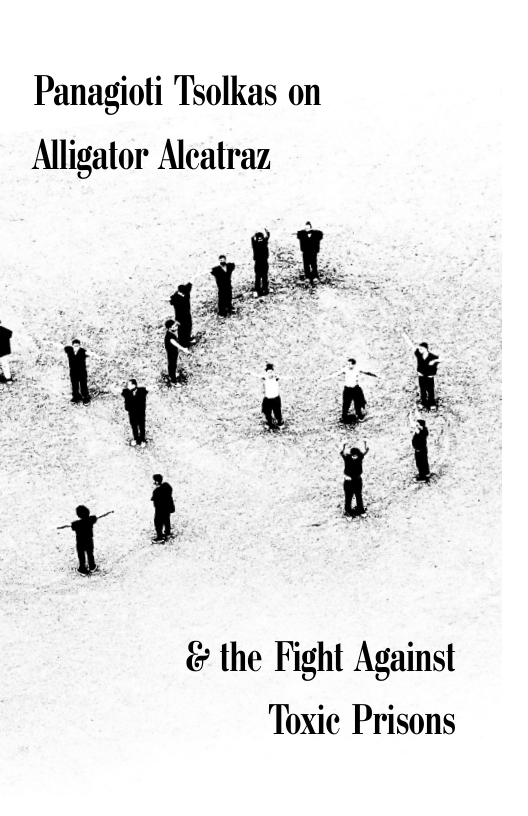
Panagioti Tsolkas on
Alligator Aleatraz
- =
& the Fight Against
Toxic Prisons
bitps:usgoingelown.org/panagio-tsolkas-on-allgator-acatraz-and.-
the-lght-againse-osic-prisons/
originally published on
hitpes/maxgranger.substack.comy/pwhat-would-osceola-do
with whatever weapons a hand
Max Granger speaks with long-time abolitionist organizer Panagioti
Tsolkas about Alligator Alcatraz, an ICE concentration camp in the Florida
Everglades. Originally posted to Writing on the Wall
By now, you've probably heard of Trump’s latest white-terror marketing
campaign: the ICE concentration camp hastily erected in Florida's
Everglades and officially dubbed Alligator Alcatraz. The s450-million ad-
‘hoc prison opened last Tuesday, flooded on Wednesday, and began
receiving detainees on Thursday. It consists of chain-link cages and FEMA
trailers surrounded by more chain-link and razor wire, and is located
about 45 miles west of downtown Miami, in the middle of a vast swamp,
According to officials, the camp's current capacity is 3,000 and will
expand t0 5,000 in the coming days.
Testimonies from detainees are already emerging, and the conditions they
deseribe are as horrifying s they are predictable:
“They only brought a meal once a day and it had
maggots. They never take off the lights for 24 hours...
We'relike rats in an experiment... I don’t know their
motive for doing this, if i’ a form of torture. Alot of
us have our residency documents and we don’t
understand why we're here” -Leamsy La Figura,
Cuban reggaeton artist and a detainee at Alligator
Aleatraz.
Afew hundred miles to the north, Florida is preparing to break ground on
a second detention center at Camp Blanding, a National Guard base, with
construction set to start this week. Meanwhile, Congress just passed a
sweeping immigration and border enforcement budget with the aim of
‘massively ramping up deportations, while Trump continues to send
‘masked ICE gestapo and their military escorts into cities across the
country (including 200 Marines just deployed to Florida) and Republican
governors compete in the reality TV show known as the news for who gets
tostage the next concentration camp Schadenfreude show.
To discuss the deeper context of this madness, the intersections of
prisons, ecology, and human health, and lessons learned from past
campaigns to stop, shut down, and improve conditions inside prisons and
r—— f
detention centers, I spoke with Panagioti Tsolkas, co-founder of Fight
Toxic Prisons and Everglades Earth First!, a former editor at Prison Legal
News and the Earth First! Journal, and a former staff organizer with the
Florida Immigrant Coalition and the Center for Biological Diversity.
The following conversation has been edited for length and clarity.
oot tstlas
Max Granger: What do you know about the new ICE concentration camp
in the Everglades and the area where it's located?
Panagioti Teolkas: In the late 19605, offcialsin Dade County envisioned a
‘massive airport in the Everglades, a the same site as the new detention
camp. The original plan included six runways, covering 39 square miles. It
would have been five times the size of JFK Airport, but in 1970, afer only
one runway was built, environmentalist and Indigenous opposition halted
further construction. That fight led to the ereation of Big Cypress National
Preserve, adjacent to Everglades National Park, which was established as
the country'sfirst national preserve in October 197,
‘The Everglades was also the first national park in the U.S. ereated
primarily to protect biodiversity. It was established in 1947 specifically to
preserve the unique subtropical ccosystem, representing a shift from
protecting places only for their scenic landscapes and tourism value. That
said, it's still epic as hell out there. If you can get a few feet off the ground,
you can see for miles, like you're standing on a mountain peak. It's a vast
\wetland, with a mix of freshwater and saltwater, including sawgrass
‘marshes, mangrove forests, and tropical hardwood hammocks. It's also
home to a vast diversity of species, including many that are endangered or
threatened, including the last big cat roaming east of the Mississippi: the
Florida panther.
Aside from that, the Everglades provides major water purification and
flood control for the surrounding region, which supports millions of
people. The area s also home to descendants of a resistance movement
famous for kicking the U.S. government's ass in the longest, costliest, and
bloodiest of all the “Indian Wars” waged by the murderous psychos
behind Manifest Destiny. That conflictis considered a precursor to the
US. Civil War, because the Florida swamps also served as a refuge for
Africans escaping slavery, who established Maroon communities there
and integrated into some of the native tri
‘millions into the war because it knew that the alternative would be to
watch a global slave revolt spread north from the Caribbean, as Hai
demonstrated was possible only a few decades earlier.
Many Seminole and Miccosukee were forcibly displaced in the Trail of
Tears and resettled in Oklahoma, but hundreds survived by staying in the
‘swamps, where soldiers were scared to go. Some of the families never
r—— s
opted into the 1957 and 1962 formation of federally recognized Tribes,
instead retaining their earlier claims to ancestral lands. This s why
such a huge deal to see native youth standing side by side with
“immigrants” (people native to other parts of the continent and islands)
and refugees descended from African slave revolts more than 200 years
ago, holding signs saying “What Would Osceola Do?"
MG: Two weeks ago, the Center for Biological Diversity and Friends of the
Everglades filed a lawsuit t0 stop construction of the facility. What is the
status of that lawsuit?
'P8: The lawsuit asks for an injunction until there are environmental
reviews of the project’s impacts, per the National Environmental Policy
Act (NEPA) requirements. This concentration camp—or internment
prison, however you want to view it—was thrown together in a matter of
weeks, using the same sort of exceptions that allowed for the
construction of walls through sensitive desert habitats and tradi
Indigenous lands along the southern border. It's reminiscent of what
‘Arizona’s governor did with the rogue junk wall of shipping containers a
few years ago (which the Center for Biological Diversity also sued over). In
that case, a combination of direct action and legal challenges forced the
federal government to uphold its own laws and take the wall down. This
time, the feds are cheering it on. And they’re promising to pop up more of
these prison camps all over the country. The court should rule on the
injunetion as carly as this week.
nal
MG: How else are people resisting efforts to turn the Everglades into a
militarized site of mass detention and deportation? What communities
are on the frontlines of this struggle?
P: We're seeing organized communities from surrounding areas showing
up in large numbers, especially youth. This includes people from
Immokalee—home to the famous Coalition of Immokalee Workers alliance
Palmdale, where residents, with
the support of groups like Earthjustice, Sierra Club, Earth First!, and other
ions, have a legacy of fighting and winning land-use battles in
ike the fight to access and protect Fisheating Creek.
—as well as folks from rural towns Il
Urban immigrant youth from Miami, Fort Lauderdale, Lake Worth, Fort
Myers, and Naples are also coming out, along with hydrologists, biologsts,
6 peagentsas
and other scientists who have worked on protecting the watershed and its
biodiversity. Notorious nature photographer (and neighbor to the site)
Clyde Butcher has been out there, and the hook-and-bullet crowd of
conservation sportsmen who want access to Big Cypress are raising hell
too. They don't want stadium lighting and traffic fucking up their hunting
and fishing spots. Obviously there are some differences in priorities, but
people on the ground are hashing them out together, working through
them. There is incredible potential in that.
MG: What is the campaign to Fight Toxic Prisons (FTP)? How are prisons,
conneeted to issues of ecology and human health?
PS: I've been researching, writing and organizing at that intersection a lot
over the past ten years. Thanks to the work of activists, academics,
prisoners and their families, we have a significant body of work drawing
these connections.
‘Prisons have the 24/7 pollution output of a small town, packed into a
factory complex. On top of that, the populations inside are vulnerable to
some of the worst impacts of climate and environmental injustice. People
are lterally trapped in cages while toxic floodwaters rise. Just to the
north, in Manatee County, a few years ago prisoners were stuck in the
flood zone of a phosphate mine-waste disaster. In Florida, prison labor is
used to clean up after red tides and the toxic aftermaths of hurricanes.
In prisons across the country, people experience mental and physical
health impacts from indoor environmental conditions unique to
incarceration, including mold outbreaks, arsenic and radon exposure,
Legionnaires discase, Valley Fever, sewage leaks... Ina case I studied, a
prisoner in Michigan documented a rare blood poisoning condition
conneeted to prolonged exposure to methane from a sewage leak near his
cell. Alot of us, I think, have either lived in houses or know people who
lived in houses with indoor pollution, like black mold. But people don’t
generally think about what it would be like to be stuck in a room full of
black mold, with nowhere to go.
Everything in prison is just ineredibly intensified. Take extreme heat.
Some people might think that not having air conditioning is, like, first
world problem. But try going without air conditioning when you can’t get
out of the building, In states like Florida and Texas, where prisons don't
r—— 3
have air conditioning, people are getting sick or dying from the heat
MG: The day after Trump opened the Everglades detention camp, it
flooded. T mean, of course it dids it’s in the middle of a swamp. This all
seems so obviously intentional. It makes me wonder to what extent these
dangerous and toxic prison conditions are a deliberate part of the
punishment. Or at best, a kind of organized abandonment.
PS: Yeah, that's the legacy of the prison system. If you can make people
terrified by the concept of prison, then social control is more effective. So
yeah, Ithink it's a reflection of the broader strategy.
In terms of ICE detention, obviously the Trump regime can’t deport all the
immigrants in this country. 1's impossible, and it would have adverse
impacts on the richest of the rich, who depend on immigrant labor. We
know the goalisn't to remove every undocumented person; it's to create a
climate of fear and terror, to make people more controllable, more seared
to speak up or act in their own interests. So making a big show out of
“Alligator Alcatraz” is part of that plan—to say, “Look at this place you
could end up.” They're bragging about the conditions, about the lethal
dangers. That's the story they want in the news. And unfortunately,
think it's really hard for us not to play into that fearmongering—they
ereate a kind of win-win situation by highlighting how fucked up the
conditions are, and then we amplify it because, well, it is fucked up. So the
sum of the discourse sends waves of fear through people, making them
want to hide, or avoid joining a movement, avoid joining protests, avoid
organizing in their community in any way that’s visible.
MG: What are some concrete ways people have organized against prisons
in recent years, and can you articulate any strategies that movements
have developed to break out of that feedback loop, where advocates and
abolitionists end up playing into these narratives of intimidation and fear?
'PS: 1 learned a lot about prison organizing during the years that I was
involved in developing the network that came out of the Prison Ecology
Project and the Fight Toxic Prisons research collaborations. At that time,
we were in touch with many family members of people in prison who had
visitation rights and would share information with us, and with jailhouse
lawyers on the inside, who were often more comfortable advocating for
themselves or on behalf of others because they do it on a professional or
5 pamaet s
semi-professional level, on the inside. T learned a lot from my experience
organizing with those inside/outside alliances that I think could be
applicable, especially around how to make organizing demands while
‘moderating how much retaliation comes down on people, who may or
‘may not even be involved.
‘That was something we saw a lot of during the prison strike organizing.
Initially, we started by surveying people about their experiences with
s in custody. And then the strike for the anniversary of the
ing was announced and we shifted to communicating
with people about the demands being made around that. From there, over
the course of two years or so, we were able to build a lot of relationships
and conneetions with people who were hungry to hear from the outside
and wanted to participate. We were able to get mail in, we were able to set
up phone calls with people, or figure out who had phones and who could
access the email, and figure out how to communicate safely. At the time, it
\wasn't as common to have tablets; now alot of prisoners do. So we had a
Lot of those contacts, but then those connections started getting severed:
visitations started getting cut off, access to mail has been drastically
limited, in part, T think, in response to that organizing,
We did see people lose their visitation status, which was really hard for
some of the folks involved in the organizing. We also saw a lot of people
sent to solitary just for being suspected of communicating with outside
organizers. But we learned that people wanted to take action, and they
wanted to take risks, when they knew they had outside suppor. I think
this has also been the case in detention center organizing. The Northwest
Detention Center in Tacoma has a lot of examples of repeat hunger
strikes, with some success having their demands met. There have also
been major lawsuit victories, although those strategies didn’t work in
other cireuit courts like they did in the Pacific Northwest. But the general
strategy and concept is still useful, of coordinating together and having,
prisoners lead the way on litigation efforts, as we did in our campaign
against the Letcher County prison in Kentucky, by using the
environmental review process to engage people directly in prison.
So those are some of the lessons off the top of my head, which mi
relevant for what comes next. But realistically, I think we're going to see a
couple years where internment or concentration camps in this country
are filled up by the thousands, tens of thousands, maybe a hundred
stigtorsetras 9
thousand people. How we communicate with and keep track of those
peaple s crucial
We should also look to the experience of organizing efforts in ICE
detention under Obama. There’s a documentary I recommend everyone
check out, called The Infiltrators. Its about an organizing effort that
people may not have heard of, or maybe haven't thought of in a while,
about young undocumented activists who intentionally got themselves
arrested with the goal of organizing inside detention centers—in this case,
the Broward Detention Center in Florida. At the time, they knew that their
low-priority cases gave them a really good shot of getting out relatively.
quickly, so the idea was to get inside and organize people, take down
names and names of family members, and create support campaigns for
as many folks as possible. This elevated the level of pressure, by
identifying people and their stories and then figuring out technical entry
points to campaign for those people to get out, based on medical
conditions or other factors.
S0 looking back at that case, and others like it, where people used those
kinds of tactics for inside/outside organizing, would be a good thing to do
in this moment, while we're watching all this infrastructure be built. We.
know it's going to be different, in that there'll ikely be a lot of turnover—
peaple won't stay in these facilities very long—but that could also shift
we might actually sce a situation where they're able to fill the camps, but
can’t get the deportation process running as efficiently as they're talking
about. So people might end up sitting in these facilities for longer than we
think, and we should be prepared for that.
MG: Listening to Republicans promoting the Everglades concentration
camp—laughing as they talk about detainees being eaten by alligators or
dying in the swamp when they attempt to escape—1 was reminded of the
southern border, where the U.S. government uses wilderness to inflicting
suffering and death under the pretext of containing the movement of
people. Do you think, in the case of the Everglades, that all this posturing
about alligators and snakes is pure political theater? Or could we really
see a situation where security at the camp is relatively lax, with
authorities relying on the wilderness to contain people, and detainees are
escaping into the swamps?
P: I mean, there is alegacy of that, as I mentioned, with Maroon
W peagetslas
communities, self-ll
erated slaves, and Indigenous communities from
farther north escaping into the Everglades to survive. I can’t really picture
ICE agents chasing anyone into the swamps. The experience I've had with
Earth Tirst! actions where we were like, “Alright, now we're going into this
‘swamp,” the cops basically stopped at the water and just watched and
waited. But no, I don't think people are going to be caten by alligators. T
think that’s poltical theater. But I do think it's possible that the legacy of
people escaping into the swamp could continue. 1 mean, honestly, the
facility doesn't look that well built. They put it up in weeks. 1€’ just chain
link fences. It reminds me of the junk border wall, or really any section of
the border wall, where people regularly climb or cut through it with little
tono diffieulty. It's political theater. But yes, people could end uplost out
there, and it’s also maybe a scenario where communities could support
people in surviving escapes.
‘That's all hypothetical, though, of course. But it makes sense to be asking
hypothetical questions right now, even if they seem absurd, and to look at
other countries with other experiences of migrant solidarity organizing.
‘This administration is obviously spreading itself very thin. 1’s well
resourced—I mean, Congress just forked over $170 billion or more for
immigration control—but its also spreading itself thin in a way that looks
alot like other late-game empires grasping desperately to hold onto the
‘meaningless aspects of their culture, like whiteness, or “American”
identity. It's possible that if they continue to build mare of these chain-
link facilities as symbolic gestures, to induce fear, but they don't actually
secure them that well that we'll have a situation similar to the border
wall, where what's perceived as this high-intensity security infrastructure
isreally just a bunch of, you know, floodlights that don't actually turn on
and fences that you can just cut through with an angle grinder.
MG: In 2023, you wrote an essay recounting your experience with the Stop
Cop City forest defense movement in Atlanta. You explain how the State
of Georgia lowered the threshold for charging people with domestic
terrorism—from an act that kil at least ten people to basically any
protest that involves property damage. This, you wrote, mirrors a national
trend: “In response to anti-pipeline, anti-police and anti-Trump protests,
legislators in nearly 20 states proposed si
states have considered new anti-protest laws, with 39 state and federal
laws passed that attempt to weaken First Amendment rights... (and] the
‘most egregious of them, Florida Governor DeSantis’ anti-riot law,
ilar bills in 2017. ince then, 45
stigtorseatras
eriminalizes anyone who participates in vaguely defined ‘violent public
disturbance involving an assembly of three or more persons.” What has
been the effect of this legi n Florida, and is the general atmosphere
of heightened repression having its desired effect and discouraging people
from fighting back?
'PS: In Florida, they didn't end up using those anti-protest laws in court.
thinka lot of it was also political theater. I got arrested right around that
time, at a solidarity protest at a prison, and there was a lot of talk about
how they were going to use the HB1 anti-protest bill that had just passed
—but they didn’t. 1 can’t think of any cases where it affected people
directly, in part, 1 think, because of all the pushback. The Cop City
example is more relevant here, and we're stil seeing the effects of that
right now. People charged in the RICO case are going to court any day
now, so we'llbe learning more about how that plays out in the coming.
weeks.
In the case of opposition to the detention center, I think the atmosphere
ofescalating repression is having the opposite effect. Getting hundreds of
peaple to show up out on Tamiami Trailin the middle of the summer is
pretty rare. I can’t think of many other examples when that's happened.
Usually, for other protests, we'll see a couple dozen people. S Twould say
it's turning people out more than it’s turning them away.
MG: How can people get involved in supporting folks in prison and
detention? What are some actions people can take, either individually, or
as an organized group?
PS: I'm part of a working group of environmental and immigeant rights
activists that's pursuing legal challenges against proposed detention
centers or expansions of existing facilities, and we've been having some
interesting conversations. The lawsuit filed against the Everglades
detention center s a template that we think could be applied to other
proposed camps. So I think people can plug into ongoing organizing and
support the groups that are filing these lawsuits. A lot of the time, i’
grassroots groups with people on the ground who have standing and they
don't have a ton of money. In the case of the Everglades, there are bi
NGOs that work in that region and have a legacy of environmental
Lawsuits, but in places like Folkston, Georgia, just north of the Florida line,
where there’s a proposed expansion, not as much. So we need to support
2 peagetslas
those efforts and the people working on the ground.
k there are about a dozen or so detention centers that are good
candidates for environmental lawsuits. One of these facilities is in
Leavenworth, Kansas. It's a federal prison located on a military base that
they want to expand into an ICE detention camp. As far as T know, no one
islitigating that. So finding those local fights and providing outside
support is a good place to direct energy.
‘The other thing that came out of the fight against ICE in the Everglades s
amodel that many of us in the Earth First! movement are familiar with:
tracking down the contractors and putting pressure on them. Often, these
companies are small outfits that don't want bad publicity; other times,
they're huge outfits and this one facility is not make-it-or-break-it for
them, so they’d rather just cut their losses and not be affliated with it.
Mapping out those companies and putting pressure on them accordingly.
isa good approach.
MG: Just the other day, I saw that some of the contractors for the
Everglades camp have been taping over the company logos on their
trucks...
PS: Yeah, people were like, “Hey, I just saw a mosquito control truck come
out to the facility. I don't know if they have a contract, but here’s their
‘phone number, let’s call and ask.” I think doing things like that can be
incredibly effective. You don’t have to know for sure: I's a fine approach
tosay, “Hey, we heard you were out there. Do you have this contract? Do
‘you know the harm that this is causing?”
‘That's something anyone can do. And it's something that’s happening. It's
hard to measure the success in the immediate term, but we saw how it can
play out just recently, with Cop City, where some companies were
basically like, “We backed out of this project because people smashed our
windows.” So occasionally you get this lttle glimpse of how protests, or
bad publicity, or relatively minor acts of damaging property or exposing
someone in the newspaper might get them to change their mind about
affiliating with a project.
10 the old SHAC model, essentially. But that was so long ago, maybe we
should call it the Stop Cop City model instead.
stigtorsatnas
10sceola was a leader of the Seminole resistance against the USS.
government’s campaign of ethnic cleansing in Florida,
2 Reeves Young Construction, Quality Glass Company, and Atlas Technical
Consultants all backed out of Cop City contracts in response to pressure.
campaigns.
W peagentslas
r——