Not an Unexpected Death: Account from the Opiod Epidemic
Web PDF • Imposed PDF• Raw TXT (OCR)








Not an Unexpected Death:
An Account from the Opioid Epidemic
Written by Angustia Celeste
llustrations by Rena Yehuda Newman
An Introduction by Crimethinc
Starting in 2021, drug overdoses have killed more than 100,000
people in the United States every year. While politicians used the
crack and heroin epidemics of the late twentieth century as a
Ppretext to introduce mass incarceration, mandatory minimum
sentencing, three-strikes laws, and racial profiling, all of which
disproportionately targeted Black and brown people, so many
white people have died of overdoses over the past decade that the
rhetoric_around the opioid epidemic has changed dramatically.
Today, even racist conservatives acknowledge the opioid epidermic
as a social crisis—but how fo address it remains an open
question.”
Anarchists fight against the conditions that give rise to drug
addiction, the ways that the authorities take advantage of addiction
{o_inflict additional damage on communities, and also against
addiction itself. In the following reflection, 'Angustia Celeste*
revisits harm reduction strategies through the lens of personal
tragedy and grief.
“hitpscrimething com/2017/1009he-opioiccrsi-how- white-despair poses-a-threatdo-pe
ople-of-color
tps:heanarchistibraryorglcatogory/author/angustia-caleste
1
When my best friend died of a fentanyl overdose seven years
ago, it was not an unexpected death. It was the statistically
probable outcome of her 17-year-long struggle with addiction,
given the increasingly fatal turn of the opioid crisis.
In our youth, she and | imagined ourselves living outside of
societal norms, but with her death, she landed solidly in the
middle of the bell curve.
The fact that | had anticipated this did not soften the grief.
There are recriminations and shortcomings that you only add
up in hindsight. Once | finished considering what actions |
might have taken to try to shift the course of events, or at least
o take advantage of our time together—something that, in our
youth, I had imagined to be infinite—I began to reflect on what
the collective “we” did and did not do. | eventually arrived at the
truth that my ‘loss was not just an individual one: it was
generational, determined by forces greater than those | initially
considered in my despair.
| have a certain familiarity with death, both personally and
professionally. Someone | care about has died every few years
since | was 13. Yet grief is something that gets harder with each
turn, not easier. This loss cuts back decades into my foundling
years, as my friend played a significant role in crafting my
worldview when we were teenagers.
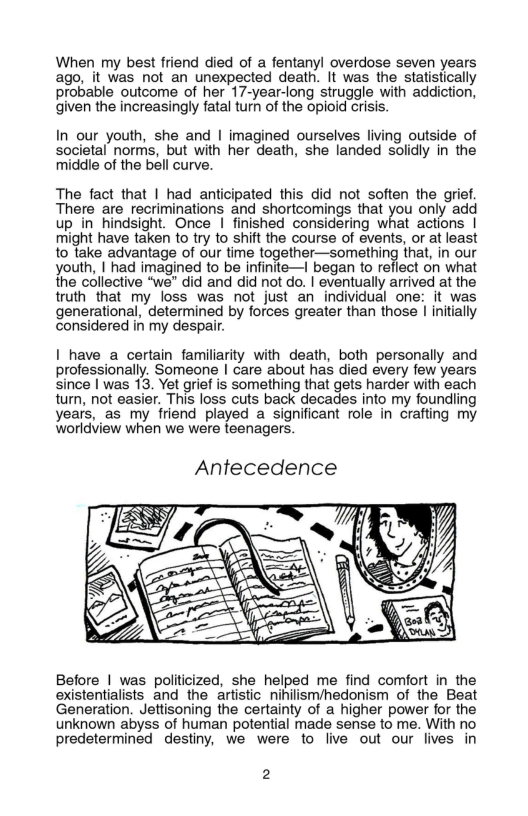
Antecedence
Before | was politicized, she helped me find comfort in the
existentialists and the artistic_nihilism/hedonism of the Beat
Generation. Jettisoning the certainty of a higher power for the
unknown abyss of human potential made sense to me. With no
predetermined destiny, we were to live out our lives in
2
trajectories of our own design. Success, failure, and how we
realized our potential were not determined by any deity, but by
the opportunities and oppression of our society. This was a
different kind of social determinism. It was freeing because of
my own privilege, and terrifying because it did not offer the
comforting certainty of any specific outcome.
At her memorial, her father put out an archival display of her
journals. With horror, | watched our friends and family read very
private things about our adolescence. The discomfort was my
own—I think she probably would have approved. Her family, to
their great credit, had been forthright and honest about” her
death. Her obituary began poetically with the words,
*Succumbed to addiction at 35
Her father, clearly still struggling with the loss, pulled me aside
and asked me for the origin story of her addiction. | told him
what | could about when we started using heroin, but | did not
touch upon why. He wanted to know aboi the “why". Why had
we felt so untouchable? Why hadnt we known it was
dangerous? There is a certain cruelty to questions asked
critically decades after the fact.
1 know that we started something that became a bleak mythos
and, eventually, a death cult. It began when | was 13, she was
15, 'and it was all theoretical: the dark literary prociivies,
romanticizing the edges of human experience, the search for
the profane and the ecstatic. It was initially a joyous endeavor,
an_ exploration of the unknown, not a doubling down on
pain—not at first.
1 was struck by two things at her father's question. First, | was
all of 19 when we began using heroin, and there were many
things I had not known about addiction. Second, | had known
that | didn't want to feel anything, and narcotics were a method
available to me to achieve episodic negation
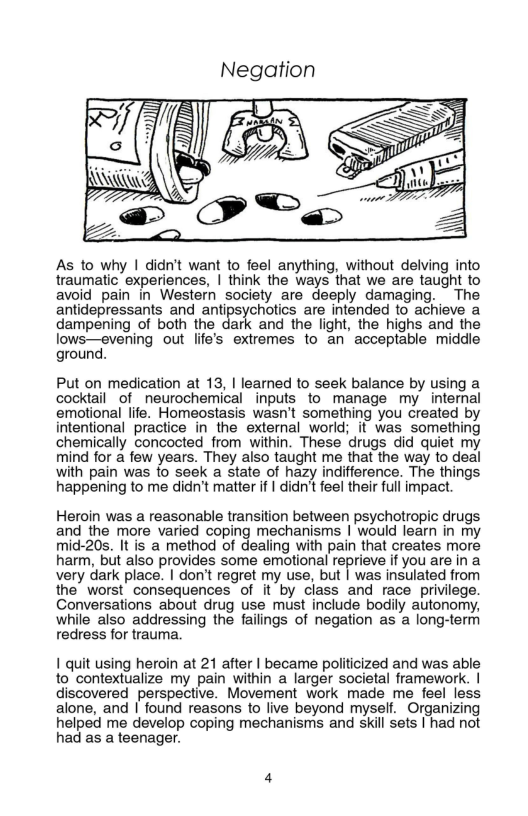
Negation
As to why | didn't want to feel anything, without delving into
traumatic experiences, | think the ways that we are taught to
avoid pain in Western society are deeply damaging. The
antidepressants and antipsychotics are intended to achieve a
dampening of both the dark and the light, the highs and the
lows—evening out life’s extremes to an acceptable midde
ground.
Put on medication at 13, | learned to seek balance by using a
cocktail of neurochemical inputs to manage my internal
emotional life. Homeostasis wasn't something you created by
intentional practice in the external world; it was something
chemically concocted_from within. These drugs did quiet my
mind for a few years. They also taught me that the way to deal
with pain was fo seek a state of hazy indifference. The things
happening to me didn't matter if | didn't feel their full impact
Heroin was a reasonable transition between psychotropic drugs
and the more varied coping mechanisms | would learn in my
mid-20s. It is a method of dealing with pain that creates more
harm, but also provides some emotional reprieve if you are in a
very dark place. | don't regret my use, but | was insulated from
the worst consequences of it by class and race privilege.
Conversations about drug use must include bodily autonomy,
while aiso addressing the failings of negation as a long-term
redress for trauma.
1 quit using heroin at 21 after | became politicized and was able
to contextualize my pain within a larger societal framework. |
discovered perspective. Movement work made me feel less
alone, and | found reasons to live beyond myself. Organizing
helped me develop coping mechanisms and skill sets | had not
had as a teenager.
Adnittedly, | drew the long straw. | was lucky. This fortune was
something that became increasingly apparent to me as | began
to work at the needle exchange. If | didn't know the dangers at
19, | had certainly discovered them by 21. When | grew tired of
being party to the extreme harm | was facilitating for the friends
Iused with, | stopped injecting.
At that same time, her father used to drive into the city to get
suboxone that | had purchased off the black market to help her
taper her use. Thus began the next period of trial and error, of
bearing witness, the next decade of harm reduction. She never
quit for very fong, but | won't say that we failed. We achieved
something together—we lengthened her life. Only she could
define the meaning of that
But | understand now, in a way | didn't before, the limitations of
our approach.
In the early 2000s, we wanted to propagate the idea that IV
drug use didn't have to be a death sentence if you used clean
needles, if someone showed you how to administer Narcan and
you kept some at hand. We thought that if you met people
Where they were at, if you provided a space to discuss
addiction that didn't require abstinence, you could provide
people with an eventual exit. If you got lucky, if your source was
pure and your practices rigorous, you might be allotted the time
You needed to really get clean one day.
It's not that people didn't overdose back then—they did. We
had friends that died, but not at anywhere near the current
rates.
Not everything had fucking fentanyl in it. Xylazine had not yet
made an appearance. It was possible to pretend that in a few
5
years, one might not need today’s crutch. Time provided us with
tentative hope that with compassionate services, understanding
friends, and a bit of breathing room it could be possible to figure
out how to move past mere survival.
1 eventually quit social work for sex work, and then, after a
decade, | left that for the medical field. These various
professions share a common labor: taking on other’s suffering. |
have been party to many confessions and come to understand
the myriad ways people try to survive our bleak consumer
culture.
To maintain trauma stewardship, you have to cultivate a certain
emotional distance, and this distance is perceptible in the
dynamics that emerge within even the most horizontal solidarity
model. Distance is all good and fine when the support you are
offering is solely material—but what happens when the support
people need is emotional? Don' get me wrong, material
support is important. Thankfully, there are still needle
exchanges, there are now fentanyl/xylazine test strips, there is
suboxone to manage your use, and if you are fortunate, you
might live somewhere where there is a monitored safe injection
site. If you are especiall lucky, you might even live somewhere
that offers legal “safer supply™. Methadone treatment is one of
the better ways to manage opioid use nowadays, though
formulary’ changes in recent years have left many who rely on
it struggling with relapse. This story is highlighted in the brilliant
podcast Crackdown®. | support all these interventions. But |
also have to say that—i the goal is living, not just
surviving—they don't really get to the heart of the matter.
Harm reduction begs a question that it often does not address.
Why do so many people feel indifferent about being alive?
Meeting people where they'e at doesn't mean you shouldn't try
to discuss and change their emotional and spiritual position, if
Jou can. Discussing the insanity of negation is not judgment,
it's honest.
psincarada alenhestt-canaduseicesiopidsespondng canadacpcdciss
salérsupphyhim
itpsmwcrackdownpod com/episades/w80s 1 1umcag2evgez7dT IhGdsit
Dipa o crackdonnpod com/about gAY
6
There is a cult of death that revolves around the hopeless cycle
of addiction—and that spiraling trajectory is not as long as it
used to be. Statistically, if you are using, even with test strips,
even with clean needles, even with Narcan, even with
management of use with suboxone, you are courting death®. It
is this drive to oblivion that | want to discuss.
In the other kinds of solidarity work | do, the desire to survive is
very strong. It compels people to cross continents, to leave
everything they know just to find a safer place to be. Itis not as
difficult to reach out in solidarity to people who desperately
want to live. However, it is difficult to do so across the river
Lethe, the river in Hades that the dead drink from to forget.
I'am the way into the city of woe
| am the way to a forsaken people
I'am the way into eternal sorrow
One of us wrote those words in a letter during a second period
class at some point in the mid-1990s when we didn't yet know
how lost we would become and the ways we would abandon
one another along the way.
1 am touched both bY how melodramatic we were, writing
derivations of Dante's *Inferno to each other, and how deeply
we felt, already, the suffering of the world. She did not dismiss
the fundamental questions and ethical qualms | felt about
human nature and the darkness of society. She was the first
person, outside of my immediate family, to take my internal
emotional life seriously and cultivate my intellectual prociivities;
“htps:/americanaddctoncenters.org boglong-term-efiects-drug-abuse
7
When | really pause to consider that, it takes my breath away.
That intimacy was hard to maintain through the years because
it is hard to reach out to those mired in addiction, the trajectory
of the iliness is ever inward. In my early thirties, | hit an
emotional wall; I could no longer meet her where she was at. |
had tried, and it hadn't worked.
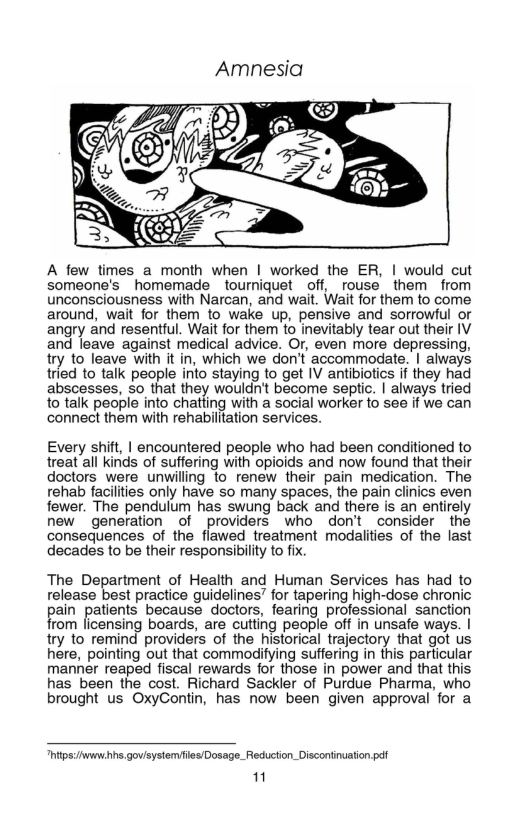
Cessation
| remember the day our friendship ended. She probably didn't
realize it at the time, or perhaps ever, but that day was our last
chance to renew that bond, to strengthen ties, to find a reason
to be in one another’s lives in a meaningful way. We were in the
same city for once and made plans to meet up for lunch. | took
time off between seeing high-end clients downtown and sat in
that diner for two and a half hours waiting. | figured she was
using again, although she didn't say. | figured she was trying to
cop, and it was taking longer than expected, but she didn't let
me know why she was running late or if she was coming at all,
1 couldn't linger any longer over coffee wondering about the
state of our friendship. As far as | could tell from our
correspondence, she didn't remember anything about my life
anymore—where | lived, how things were with my kids and
chosen family, what | was working on politically. She wasn't
present. She was wrapped up in mythos about heroin, art,
literature, and ~aestheticism, and there was a level of
self-involvement and disease that had become bleakly
narcissistic.
1 let o café, When | got o the train plaform, | saw that she
had finally texted. She had arrived three hours late. That was
my moment, my-opportuniy to forgie, reach out and make
amends for all the things we hadn't said to one another, all the
things we hadn't done. But | was angry, angry about the last
8
couple years, about the shambles of our connection, about how
selfish her addiction had made her. | was exhausted by
cumulative losses and | couldn't continue to invest in people in
my life who didn't reciprocate. | didn't text back.
1 still saw her father, mother, and brother on occasion, because
1 co-parent with her cousin. I continued to get news of her life,
but we never saw each other or spoke again. Five years later,
she died. We never talked about what had ended our
friendship. Death became the final arbiter of our conflict. | was
Ieft o argue with myself abo the correctness of the cholces |
‘ad made.
1 was being protective of my time, my energy, and my heart. But
| 'was wrong. The continuation of our friendship_probably
wouldn't have changed the outcome, but | missed those last
five years. | never got to hear her version of things. We didn't
correspond, we didn't share stories about our lovers, travels,
writing, or artistic endeavors. Knowing | would lose her and she
couldn't be present, | gave nothing more and I got even less, It
didn't soften the loss when she died—it only made the grief
worse. | couldn't say | had done everything | could have,
because | hadn't.
1 quess | imagined, until the day | got that phone call, that we
would reconnect one day when she figured out how to get clean
without me. That was the ultimate failure of my harm reduction
practice, my empathy and my earthly obligation. | took the
symptoms of her addiction personally, let them drain me dry,
estrange us. Someone | loved had been in pain, and | had
turned away.
It s said that no one gets clean until they themselves are ready.
But this saying leaves out something essential. Love, family,
friends, and social connections all provide a positive impetus
towards the desire to be present, to live life, to bear the cost of
trauma. These tendrils connected to our heart and soul make
suffering worth it. These are the things people find reasons to
live for.
She died alone, on her knees in the bathroom of her apartment
in New Orleans, kit in hand, after breaking out of the DIY
arrangements she had made to be locked alone in a client's
spartment to get sober. She died, like so many, trying to get
clean and relapsing. The drugs she got that day Wwere stronger
than her tolerance allowed for. There was no poetic gesture, no
allegorical final words. Examining the record she left behind, it
seems that her last 24 hours were scary, haggard,
hallucinatory, and dark, filed with suffering, a desire for a
reprieve, and one final go at numbness.
A few years later, her partner also fatally overdosed. When |
heard about his passing, it seemed to me that soon there would
be no one left to remember their life together. | thought | had
come to terms with the brevity of our time upon this earth, but |
hadn't.
10
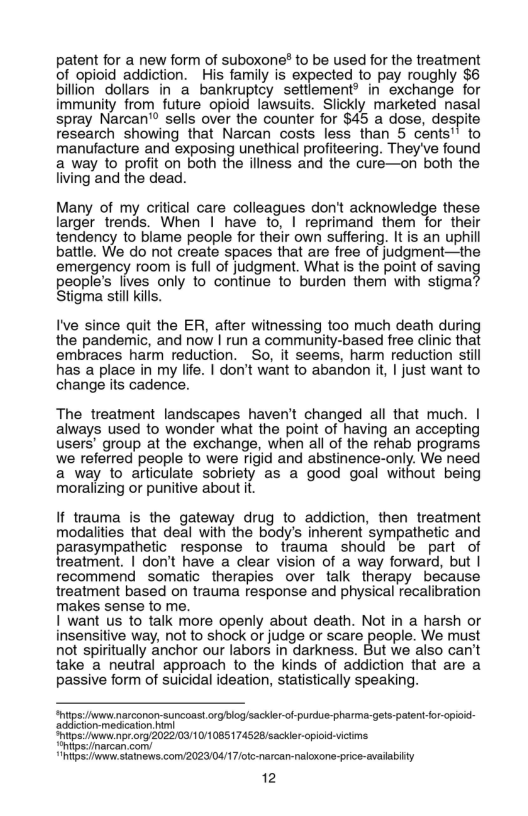
Amnesia
A few times a month when | worked the ER, | would cut
someone's _homemade tourniquet off, rouse them from
unconsciousness with Narcan, and wait. Wait for them to come
around, wait for them to wake up, pensive and sorrowful or
angry and resentful. Wait for them 10 inevitably tear out their IV
and leave against medical advice. Or, even more depressing,
try to leave with it in, which we don't accommodate. | always
tried to talk people into staying to get IV antibiotics if they had
abscesses, so that they wouldn't become septic. | always tried
to talk people into chatling with a social worker to see if we can
connect them with rehabilitation services.
Every shift, | encountered people who had been conditioned to
treat all kinds of suffering with opioids and now found that their
doctors were unwilling to renew their pain medication. The
rehab faciliies only have so many spaces, the pain clinics even
fewer. The pendulum has swung back and there is an entirely
new generation of providers who don't consider the
consequences of the flawed treatment modalities of the last
decades to be their responsibility to fix.
The Department of Health and Human Services has had to
release best practice guidelines’ for tapering high-dose chronic
ain patients because doctors, fearing professional sanction
rom licensing boards, are cutting people off in unsafe ways. |
try to remind providers of the historical trajectory that got us
here, pointing out that commodifying suffering in this particular
manner reaped fiscal rewards for those in power and that this
has been the cost. Richard Sackler of Purdue Pharma, who
brought us OxyContin, has now been given approval for a
“hitps:/www hhs.govisystemfes/Dosage_Reduction_ Discontinuation pel
11
patent for a new form of suboxone® to be used for the treatment
of opioid addiction. His family is expected to pay roughly $6
billion dollars in a bankruptcy settiement® in exchange for
immunity from future opioid lawsuits. Slickly marketed nasal
spray Narcan' sells over the counter for $45 a dose, despite
research showing that Narcan costs less than 5 cents' to
manufacture and exposing unethical profiteering. They've found
a way to profit on both the illness and the cure—on both the
living and the dead.
Many of my critical care colleagues don't acknowledge these
larger trends. When | have to, | reprimand them for their
tendency to blame people for their own suffering. It is an uphill
battle. We do not create spaces that are free of judgment—the
emergency room is full of judgment. What is the point of savin
people’s lives only to continue to burden them with stigma’
Stigma still kills.
Ive since quit the ER, after witnessing too much death during
the pandemic, and now | run a community-based free ciinic that
embraces harm reduction. So, it seems, harm reduction still
has a place in my life. | don't want to abandon it, | just want to
change its cadence.
The treatment landscapes haven't changed all that much. |
always used to wonder what the point of having an accepting
users’ group at the exchange, when all of the rehab programs
we referted peopls 0 were rigid and abstinence-onl. We need
a way to articulate sobriety as a good goal without being
moralizing or punitive about it.
If trauma is the gateway drug to addiction, then treatment
modalities that deal with the body's inherent sympathetic and
parasympathetic response to trauma should be part of
treatment. | don't have a clear vision of a way forward, but |
recommend somatic therapies over talk therapy because
treatment based on trauma response and physical recalibration
makes sense to me.
1 want us o talk more openly about death. Not in a harsh or
insensitive way, ot to shock o judge or scare people. We must
not spiritually anchor our labors in darkness. But we also can't
take @ neutral approach to the kinds of addiction that are a
passive form of suicidal ideation, statistically speaking.
T arconon-auncone rgtio sacler o purde-pharm gt ptent for pii-
scdcion medcaton
htps:wivnpr org/2022/00/10/1085174528/sach
intps:inarcan com/
e SiainEws.com202304/17/ote-narcar-naloxone-price-avaiabily
12
ploicvictims.
How do you qualify a death wish? Given the changing
molecular structure of what you can purchase on the streets
these days, can we agree that the opioids now in circulation will
generally not give their user enough time to shift course?
Expanding services for suboxone scripts is offering some hope
to buy more time, to help people safely manage their use. But |
still maintain that IV drug use is not a choice we should easily
accommodate without ofher services. The ultimate destination
for all our labors should be health—better health and a life you
can show up for. Why stigmatize the symptoms and not
address the real issues at hand? Housing, dignified work,
social connections, a relationship to the earth—these should be
the aspirations of our practice.
It is not enough to use clean needies, it is not enough to offer
fentanyl/xylazine test strips, it is not enough to help manage
use with suboxone, its not enough to provide medical
supervision for maladarnve coping. Ultimately, if we don't
address the profound alienation at the heart of the capitalist
system, we will be hard-pressed to convince those we love that
Iife is indeed worth living, and worth being present for.
1 remind myself every morning now, even on those mornings |
would rather not wake up, that we make our amends through
our actions. We reach for our highest aspirations by examining
our failures. | do not think | could have brought her more clean
needles; she knew where to get them. | do not think | could
have bought her more suboxone, suggested a beter rehab, or
coordinated a plan for intervention more clearly with those who
also struggled for her. We attempted some combination of all
those things, however imperfectly. But there were conversations
we didn't have.
Absolution
13
1 think our mistake came years before, in the way we tried to
delineate our feelings of difference. A life lived in defiance of
norms once seemed holy to me, but somewhere in the process
of jettisoning conventions and differentiating our path we
ventured so far off track that we got lost. Whatever the punk
gods of our youth told us, self-destruction isn't disruptive o the
social fabric—it has been co-opted. We've been sold. There are
many things about this carceral society worth resisting, but
numbing the pain keeps us far from that struggle. My friend
never made it to any place of social conflict because she lost
the battle with herseif years before.
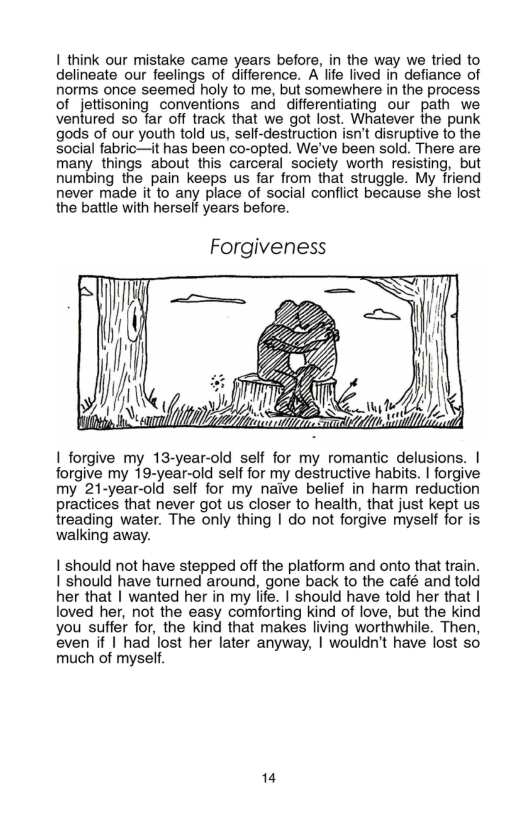
Forgiveness
1 forgive my 13-year-old self for my romantic delusions. |
forgive my 19-year-old self for my destructive habits. | forgive
my 21-year-old self for my naive belief in harm reduction
practices that never got us closer to health, that just kept us
treading water. The only thing | do not forgive myself for is
walking away.
I should not have stepped off the platform and onto that train.
I should have turned around, gone back to the café and told
her that | wanted her in my life. | should have told her that |
loved her, not the easy comforting kind of love, but the kind
you suffer for, the kind that makes living worthwhile. Then,
even if | had lost her later anyway, | wouldn't have lost so
much of myself
14
published on Crimethinc, March 14, ‘24
Contact Angustia Celeste: thebrokenteapot@riseup.net
More by the illustrator: renayehuda.com