Northwestern Insider (V2I2 Nov 2025 and older)
Web PDF • Imposed PDF• Raw TXT (OCR)


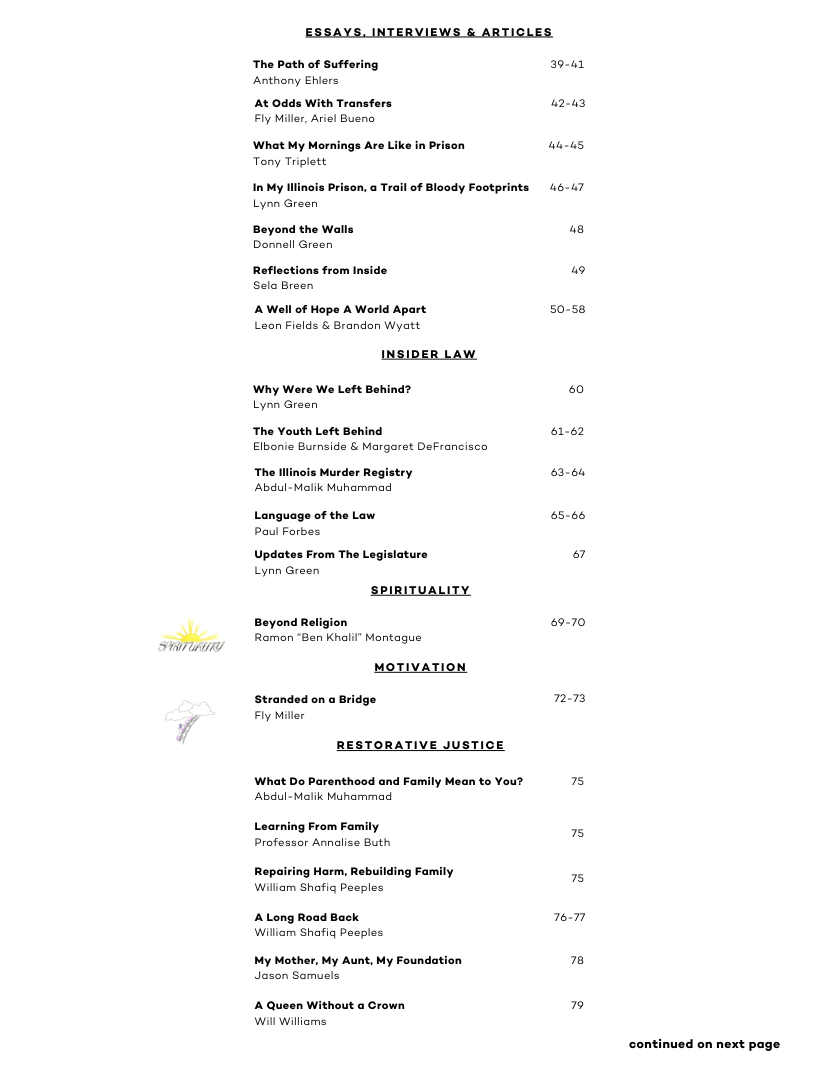


![8 INSIDE THE CLASSROOM AT oAvIs Vaphet, student A Thovsanavara A4 ARELBUENO vl s seudentin istrated severst pices nluding At itn Transers” MELINDA WARFEL Welinga, aseucent atlogan Center,wrats the Lackey Awarc winningessayon ik wosHA HOWARD Latoshs, astcknt alogan Consctonst Center,wrore 3y iy Name i JASON GORHAM, Jason, s suentin Canort, Wustrsteamany plecs ortis Istu, ncluing e Lackey Avard winnes s, NORTHWESTERN INSIDER DEANDRE ROBINSON benars,asudent i Conort, wiots the Lackey Award-winning syoneversgg tearing for sack o v NIKOLAS GACHO. s Niolas, s sudrt. o Canort, wrote | )\ co ocon Hugo astusencin Conort, lusrasea soveral plces for this Tasue, inclucing e REGINA DEFRANCISCO “Mayomase Avengers.© 1 L) micaeL JORGENSEN [ p— “Plesdng” TYPISTS A > = = 8 & JUAN GARNICA Community = ] < omNRA SAMUELS Diasporc lues.” 1](northwestern-insider-v2i2-nov-2025-and-older-northwestern-prison-education-program 8.png)










![STRATEGIES FOR STAYING PRESENT PHONE CALLS Q A simple phone call can warm your child’s heart and strengthen the parent-child bond. Aim to call your children at least once week to let them know they’re on your mind. Use these calls to ask about their day, discuss their school progress, and even help with their homework. For example, I’ve often helped my kids with math and history assignments over the phone. f didn’t know the answers, | would take the time to research and find the information to help them. These moments show your children that you’re invested in their success. Before ending the call, always remind them how much you love them. If you’re upset with them, explain why— but never let the call end without expressing your love. E WRITING LETTERS =] When phone calls aren’: possile, ltters offer another way to connet desply with your crildren. Persanalice your leters to make them meaningful. Share specific mermories, express how much you ove them, and e them know you can’t wait tses them. When my oldest son siruggled with my absence, | wrot hima eter sncouraging hir to stay strong and be good. His reply floored me: “Be good, because good things happen to good people7 This exchangs reminded me haw much simpls etor can mean. You can also include drawings, cards, or photos with your letters. My kids love receiving pictures of me, and they treasure the small, thoughtful touches | add. These gestures show them that I’m stil thinking of them, even from afar. FAMILY TIME For those fortunate enough to have contact o video visits, these moments offer unparalleled opportunities for connection. During visits, make your children feel like they’re the center of your world. Notice small details about their appearance, their mood, or their growth, and show genuine care for their well-being. When my kids visit, we take the time to study each other, talk, eat, and even play games like spades or Monopoly if they’re available. We also take photos together to capture the memaries. These visits remind my children that I’m still a part of their lives, despite the physical distance between us, O SUPPORT & GIFTS (> somportnayour cnore francaly san i amal vy, tso ke i .| ften save money from my prison Job o from famiy contrbutions t send s 1o my Kid. For cxample, dring my daughtor Bratz doll phase, | saved up < by hor 8 Btz themed pisgy bank. She wasthriled,not jus bocause of he it eelbut bscause t came fom me. portrat. These handmade gifs arry immonse sontimental value and can soe 4 angihle NORTHWESTERN INSIDER | 29](northwestern-insider-v2i2-nov-2025-and-older-northwestern-prison-education-program 29.png)









![Beyond the Walls Students like Sela Breen are using journalism to challenge stigma, elevate voices, and reimagine justice. hen Northwestern senior Sela W Breen was making a two-hour drive every week from her Ev- anston apartment to Sheridan Correctional ~Center, she wasn’t visiting family—she was attending a college class as part of the Northwestern Prison Education Program (NPEP) That class, a journalism and documentary storytelling course, brought together Northwestern University journalism undergraduates and incarcerated undergraduates from Sheridan Correctional Center to collaborate on short films. The journalism students partnered with their incarcerated classmates to help the Sheridan students tell stories that extended beyond their sentence. Breen’s introduction to the carceral system began a few years agoin 2021, when she left her hometown of Larchmont, New York, to begin her studies at Northwestern. She was always interested in NPEP but never had time in her schedule to visit the correctional center, so she jumped at the chance to write about NPEP for North by Northwestern. While writing the story, she attended an NPEP community hour, where friends and supporters of the program gathered for monthly conversations and reflection. She noted that it was “easy” to care about what happens behind prison gates and that she knew there was a story to be told. “People are human and should be treated as such,” she said. “You can try to ignoreit, but being aware is a 48| NORTHWESTERN INSIDER 8y Donnell Groen beneficial way to expand your world— view. There are people who can’t advocate for themselves, and the fact that no one really knows what’s going on behind prison walls is a sign that it’s not good.” That compassion deepened during the journalism class, where her final project was to create a documentary about carceral injustice through the experiences of two NPEP students: Tevin Louis and myself. Filming that documentary — titled It Starts With Us — took her across Chicagoland to interview family members of her incarcerated classmates at Sheridan. Weekly class focus groups helped Sela and her partner, Sandra Salib, plan how best to expose injustices in the system. After quick text exchanges with Sheridan students’ family members, they’d show up at homes with their gear and start recording. She visited Tevin Louis’s and my family members on the outside, gathering interviews and insight to help build a fuller narrative, one that pushed back against the stigma so often attached to incarceration. “You see how much it has impacted [a family’s] life,” Breen said. “Some are not able to visit. It’s not like someone is shipped off to prison and you don’t have to worry about them. To have your child, sibling, or friend there and still be burdened with all the extra stuff is so unfair.” The more she reported, the more invested she became. And the more injustice she encountered. “The justice system is flawed, which 1 already knew—but now | know more,” she said. “P’m shocked hearing about wrongful convictions o people i prison for things they didn’t even do." In March, several of the films produced in the course that Breen was apart of were selected to screen at the AMDOC Film Festival, one of the nation’s most prominent showcases for documentary work. Since becoming involved with NPEP, Breen has encouraged friends to take classes inside whenever the opportunity arises. “This is my favorite thing I’ve done at Northwestern,” she said. *I told my friends on campus that whenever they see an NPEP course, they have to sign up. I’ve even encouraged my mom to getinvolved with prison volunteer work in New York—1 know she’d love it.” Even after the course was finished, Breen continued making the weekly trip to Sheridan to help with the Northwestern Insider. The drive, she admits, “worried” her parents, but she’s committed to using her storytelling skills to uplift the voices of those inside. “As I look over my life so far, | think it’s really exciting to see how | translated my love for theatrical storytelling into a career in journalism, which is storytelling in its own right," she s Although the stage looks different— its characters less romanticized, its costumes a reluctant shade of blue— her instinct to listen and document has stayed the same. This time, she understands: the action continues long after the curtain is closed. =](northwestern-insider-v2i2-nov-2025-and-older-northwestern-prison-education-program 48.png)











![I was a drug dealer, a gang-banger, and now a murderer. After several brawls, a few stints in segregation, and a guilty verdict, | was sentenced to 53 years in prison. The reality of a half-century sentence smacked me hard, like a bridge had collapsed under my feet, splashing down into the murky waters. Before leaving the county jail, an inmate | knew, Squeak, had a revelation in a dream: “God told me that you would be found guilty of your crime, you’d do some time in prison, but that you’d go home, and be the leader of your people.” A friend of mine, from before | got arrested, heard this and laughed really hard. “You’ll lead them off a cliff,” he said. “You’re too stupid to be a leader.” His comments and actions took me aback, but they lit a fire inside of me. | vowed that when | got free, | would be a good leader. | would not lead my people off a cliff, but over a bridge of prosperity. The tragic event that took place in New Orleans made me reflect on the lives that | impacted in my neighborhood and along my journey of destructive behavior. How had I left so many of my people stranded, like President Bush did? | flew over them, leaving them on a bridge stranded ‘somewhere between hope and despair. Before | was arrested, | remember attending a neighborhood watch meeting to do reconnaissance. | listened to community members reveal aplot to stage a large-scale protest on the strests where we sold drugs. The following day, they began marching, holding anti-drug signs, chanting, “No more rocks [cocainel, no more blows Theroin], on this block no more.” The marching and chanting went on for days. The marchers were rescuing the neighborhood from the floodwaters of despair, building a bridge to a safer community. Al had to do was pick up a sign and join the construction of that bridge. But due to my own immaturity and selfish reasoning, | mocked them, laughed at their efforts openly, and chose money over saving the community. That bridge was never built, and the people of the community remained stranded. The scene on that fateful bridge in New Orleans compelled me to see all of the bridges | had burned, but most importantly, the people | had hurt. | was suddenly overcome by a moment of clarity. | needed to repair those bridges that| had once scorched. Had | known better, | could have done better for my community. | could have built recreational centers for at- risk youth. | could have gone to school for journalism or started a nonprofit. | could have become an entrepreneur and hired people from the community, giving them jobs, not drugs. | asked a question that would guide me for the years to come: How could | build a bridge of hope? Without tools, | couldn’t build anything so | knew | needed to get myself an education. 1 earned my GED in 2009. By 2015, 1 had written and completed my first novel, Savoge Beast. Soon after, | earned an associate degree in theology, then joined the Northwestern Prison Education Program (NPEP), where | completed an associate degree from Oakton College, was named a Presidential Scholar, and was inducted into the Phi Theta Kappa honor society. I recently finished my Bachelor of Science degree with a major in social sciences from Northwesterm University’s School of Professional Studies, and today | seve as a columnist for the Northwestern Insider. Becoming a motivational speaker is. one of mylife’s goals. Itis the genesis of this column that has the goal of helping people, a bridge for all people to cross. 1 did a lot of self-reflecting during those three days of horror for the New Orleanians suffering at the hands of nature and the US. government. Eventually, on the third day, help came for those hungry and dying of thirst on that bridge in southern Louisiana. But the damage was done: the government had exposed their hand and revealed it didn’t give a damn about Black folks. It also showed me that neither did | Witnessing the devastating aftermath of Hurricane Katrina and the tragedy on that bridge of hopelessness, | questioned my soul. How could | not have given a damn about the community? | had loitered on their corners, sold drugs to their relatives, and robbed them of their goods. | was a nuisance, destroying the very fabric of any bridge-worthy institution—and any notion that | gave a damn. After 19 years, I’ve kept my promise to change. ’m writing this in hopes of reaching others who have sold drugs or contributed to the harm of Black and Brown communities. We can’t wait for anyone else to fix what’s broken. If we don’t protect and rebuild our ‘communities ourselves, no one wil. American jails are full, and they are filled with Black and Brown men and women who have left their families and friends in their communities, stranded on a bridge no food or water. Stranded without any hope in sight. Stranded, waiting for the United States government to save them. The truth is, the government will not come. We must start building bridges to rescue ourselves and our loved ones. We must do this by becoming good leaders, and showing the community what good leadership looks like. ® NORTHWESTERN INSIDER | 73](northwestern-insider-v2i2-nov-2025-and-older-northwestern-prison-education-program 73.png)





![RESTORING HOUSE HARRIS By Anthony Harris What family means to me, is, “leaving an inheritance to my children’s children® (Proverbs, 13:22). Northwestern has given me this opportunity to receive a high quality education that will enable me to make a living for myself and my family. | have two children, a 28-year- old daughter named Anna and a 20-year-old son named Ashton. | am a junior to my father, Anthony S. Harris Sr. My father’s nickname, when he competed in martial arts tournaments was, Tony “Iron Fist" Harris. So, Iron Fist will be our family sign, and our family saying comes from the Greek playwright Sophocles: “Certainly thou art iron, like thy name.” My Father expects me to come home and finish restoring House Harris toits glory, to put House Haris in a position to have a dynasty that will last a thousand years. My son Ashton is the male heir after me. His full name is Ashton Saige Harris, in keeping with the tradition of the Harrises having the initials *A.S.H." Tradition is important in the Harris Family, and NPEP has afforded me the chance to continue the family tradition of receiving a bachelor’s degree. It is now my duty as the heir to House Harris to take this once in a lifetime educational opportunity to receive an elite education from a top 10 university, and to be a shining example to my father, to my daughter, and to my son of what an education can do to transform. When | graduate and when my son graduates, there will be four generations of Harrises with at least a bachelor’s degree. My grandfather Charles Harris started the tradition of bachelor’s degree graduates, and it has continued with my father, my daughter, and soon myself and my son. Education is important in my family, second only to God. My family are educators who have dedicated their lives to teaching society’s future. | want to carry on that tradition, and | believe it’s possible to make a living while also making a positive impact. “I’am the Prodigal Son, now coming to my senses” (Luke 15:17). 1 am now ready to lead House Harris, for like Alexandre Dumas’s Musketeer d’Artagnan, | have “thews [muscles] of iron and a wrist of steel It matters to me what my two kids think of me. | want my kids to be able to say, “Yes, my dad went to prison, but look at what he did while he was in prison. He graduated from Northwestern University and he has. now come home and is an asset to the family and not a liability” » 82 | NORTHWESTERN INSIDER](northwestern-insider-v2i2-nov-2025-and-older-northwestern-prison-education-program 82.png)




![ponents of SEL, teachers will have to be retrained, not only in the equitable approach to SEL, but also in the humanizing approach to building positive relationships with their_students (Legette ot al. 280). Although the concept of a positive student-teacher relationship isn’t dafined with any specificity, ideally, it should encompass open communication and warm interactions that demonstrate to the students that the teacher genuinely cares about their overall well-baing and is invested in thair future success (Bakadorva and Raufelder; Logte et al. 280). The lasting impact that the teachers can loave on the hearts and minds of their students is well known. An infamous example of this is narrated in The Autobiography of Malcolm X. It s an exchange between Malcolm and his cighth grade English teacher Mr. Ostrowski “Malcolm, you ought to be thinking about a career. Have you given it much thought?” Wl yes sir, I’ve bes thinking I’d like to be a lawyer.” Mr. Ostrowski looked surprised . .. kind of half smiled and said, “Malcolm, one o life’s first naeds is for us to be realistic W all ke you here, you know that. But you’ve got to be realistic about being a [n-gger]. A lawyer — that’s no realistic goal for a [n-gger)” (X and Haley 43). Conversations like this (substantively speaking), while representing a very dark period within American history, are emblematic of the dynamics between students and teachers. The teacher represents a source of guidance and a sounding board for dreams and aspirations of his/her students. The way in which the teacher is trained to carry out this responsibility reflects the dominant moral, cultural, political, educational, and social values of the larger society, which explains in part why Mr. Ostrowski saw nothing wrong or unprofessional with expressing such & blatantly racist sentiment to young Malcolm. The fact that the teacher felt free to say it isn’t as important as how it made Malcolm feel, and the lasting impact it had on Malcolm’s life. This incident illustrates the powerful, influential role that teachers play in the lives of students. To be clear, not all white teachers in urban schools are as blatantly racist as Mr. Ostrowski was, but their implicit racial biases may manifest through micro-aggressions in their grading practicss, disciplinary decisions, differential perceptions, and academic placement evaluations and expectations of Black students (Legette et al. 280-81). Currently, the method of teaching and training in the field of SEL varies from state to state (Legette ot al. 281); undoubtedly, most are centered around a color-blind approach to teaching the five components of SEL (Fergus and Gregory 117). As mentioned before, such an approach ignores the reality of systemic racism, and how power and privilege sustain structural inequity. Instead of using & color-blind philosophy in the training of teachers in urban schools, an antiracist, problem-posing SEL training methodology must be developed. Such a methodology should encompass training teachers to have a critical understanding of the political, structural, and social dynamics of white supremacy, and how it functions within American society. Only then will they be able to fully recognize and problematize it within themselves and their method of teaching SEL to students within urban schools (Allen 223). A number of scholars warking to create a more equitable SEL experience for Black students attending urban schools have proposed recommendations for the social-emotional training (SET) of teachers assigned to teach within urban spaces. Among them are Kamilah B. Legette, Leoandra Onnie Rogers, and Chezare A. Warren. Their recommendations, as presented in “Humanizing Student- Teacher Relationships for Black Children,” are in line with the antiracist, problem-posing training methodology men- tioned above. It’s important to note that empirical research is lacking to support the proposed SET of teachers within urban schools. That being said, their recommendations are tailored to encompass what the authors describe as an equity-informed Transformative Social and Emotional Learning (TSEL) model (Jagers et al. 3). The proposed recommendations—a total of five—are partially quoted, and briefly discussed below: 1. Social Awareness ‘Without an explicit focus on racism and oppression, training in the social awareness competency can perpstuate cultural deficit perceptions about individual students rather than an awareness of the systemic racism that affects the behavior of both Black and white students. Without this knowledge, teachers run the risk of inadvertently engaging. in racially discriminatory practices, and thus reify inequality and oppressive racial hierarchies” (262-83). A transformative, antiracist social-awareness training for teachers will equip them with insight into the entrenched racially discriminatory hardships that Black students must navigate both inside and outside of the classroom. Issues like racial profiling, criminalization of Black boys, racial stereotyping of Black girls, and discriminatory factors that impact urban communities all affect the emotional, mental, and physical health of Black students. Furthermre, if teachers aren’t trained to recognize and effectively communicate with students who may be struggling or demonstrating resistance in ways that may be perceived as rebellious or angry due to racial injustice, they run the risk of attributing these acts to some form of cultural deficit or social-emotional behavioral disorder (Lewis 259). For example, Monique Morris, founder of the National Black NORTHWESTERN INSIDER | 91](northwestern-insider-v2i2-nov-2025-and-older-northwestern-prison-education-program 91.png)










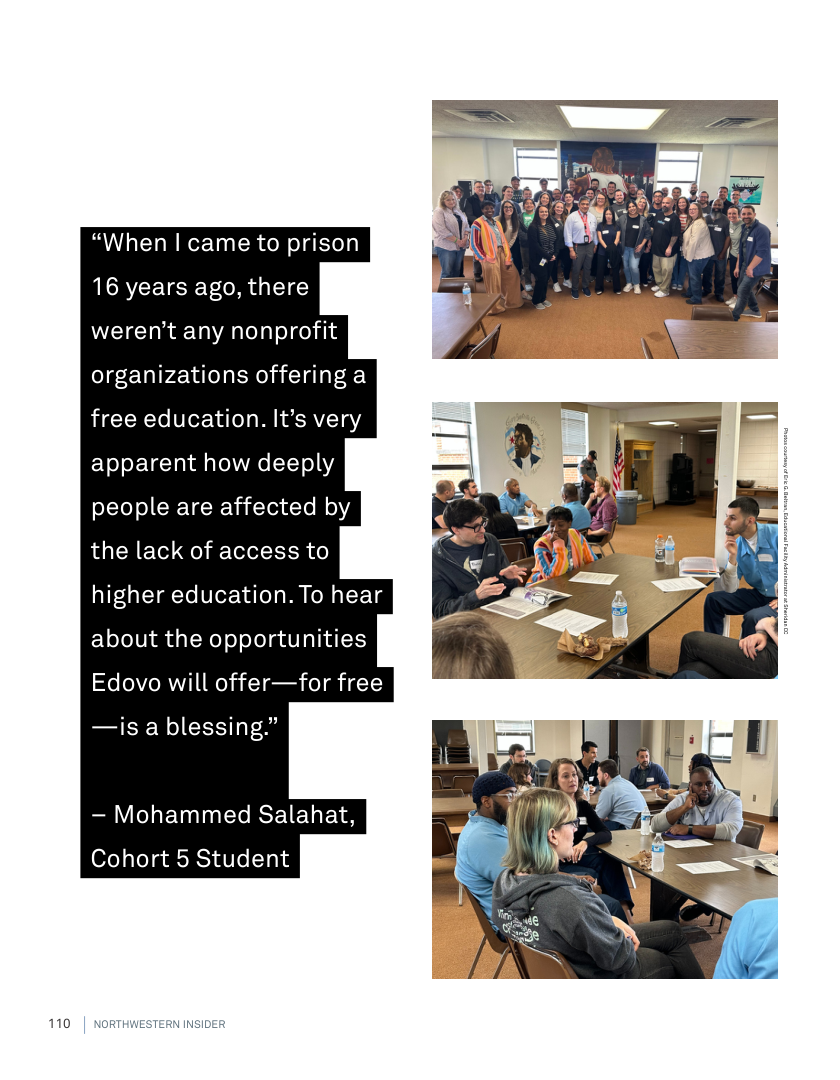
![Sheridan Debuts Edovo, a Free Learning Platform for Incarcerated Students A new digital platform aims to expand access to education in llinois prisons. n May 7, 2025 Sheridan Correctional Center hosted an educational justice event intro- ducing Edovo, a digital learning platform for incarcerated individuals that the llinois Department of Corrections (IDOC) has recently adopted. The event was organized by IDOC Assistant Director Alyssa Williams and Chief of Programs Jennifer Parrack as part of the department’s broader effort to expand access to education behind bars. Edovo is a nonprofit education platform that provides free tablet- and kiosk-based access to academic, vocational, and wellness content in correctional facilities. According to the organization, the platform is used in over 1,100 facilities nationwide and has reached roughly 900,000 incarcerated individuals, who have completed more than 50 million leaming hours. Through the ICSolutions Edovo app, users can access courses in business, the humanities, Western history, science fiction, poetry, LGBTQ+ literature, and more, including documentaries and games for enrichment and recreation. The platform’s free access model contributed to the enthusiasm expressed by Assistant Warden of Programs Portwood who noted that the service will help incarcerated By Abdul-Molik Muhammad individuals continue to learn, grow, and support one another. AWP Portwood was one of many participants in the event, which also included Edovo staff, educators, investors, and students from the Northwestern Prison Education Program (NPEP). The opening panel featured several members of the Edovo team, including Roberto, who spent 22 years incarcerated at San Quentin State Prison. During his time inside, Roberto earned a master’s degree in coding. After his release, Edovo hired him—an inspiring example of the power of education and second chances. The keynote speaker, Assistant Director Williams, described how, in 1987, the lllinois General Assembly passed legislation barring Pell Grants and state financial aid for low-income incarcerated students. She noted that, prior to thattime, every prison in llinois offered access to higher education and vocational ~ certificates. While Pell Grants for incarcerated students were reinstated at the federal level in 2023, many prisons across the state still lack consistenteducational programming. Williams emphasized that Edovo offers an additional strategy to expand access beyond what Pell and university partnerships alone can cover. In addition to in-prison programming, Edovo also offers a reentry tool, Edovo Go, which allows users to continue their education and access past transcripts after release. NPEP student Mohammed Salahat reflected on the changes he’s seen during his incarceration: “When | came to prison 16 years ago, there weren’t any nonprofit organizations offering a free education. It’s very apparent how deeply people are affected by the lack of access to higher education. To hear about the opportunities Edovo will offer —for free—is a blessing.” Following the event, Edovo shared a message of appreciation on social media: “We are so grateful to the staff and residents [at] Sheridan Correctional Center in IDOC that we had a chance to meet yesterday! We learned so much and are energized to turn those conversations into action for all of our incarcerated learners and staff that we serve!” While challenges to educational access remain widespread across the carceral system, gatherings and tools like this create space for connection, reflection, and the possibility of progress—especially when the voices of incarcerated learners are part of the conversation. TERN INSIDER | 109](northwestern-insider-v2i2-nov-2025-and-older-northwestern-prison-education-program 109.png)





NORTHWESTERN
- INSIDER
Truthin
Sentencirg
- f & /
@jmm)(‘,fil "c’ys’/iw
onwc?‘/ons W
a7 % =
Mam/afor
u/ue/ V/Jec/
Release
No Parole
e 7978
Truthin
Sentenciig
Mgty NPt
Rase
Behind The Cover
By Ariel Bueno and Hugo Ocon,
the artists behind the Vol.2, lssue 2 cover
Being incarcerated is not easy. Long bouts of loneliness are intensified by individual
struggle. Many of us behind these walls and barbed wire fences understand that we are
not alone and that the numerous injustices of the carceral system affect our loved ones
in many ways as well.
The struggle and injustice that we all endure each day was the inspiration for this
cover illustration, highlighting the injustices that occur throughout the court process
and those that continue during incarceration, holding individuals beyond their point of
rehabilitation with no meaningful opportunities for reintegration into society while
tearing families apart. These injustices include truth-in-sentencing (which requires
individuals to serve 85% or 100% of their sentence with no regard to the individuals®
rehabilitation); lack of parole (which was abolished in Illinois in 1978); and even
mandatory supervised release (which adds three more years of post-release
surveillance to an individual’s sentence).
The silhouettes represent the image of our families doing time with us and hoping for
reunification soon. The sunrise/sunset represents the light at the end of the tunnel,
when we can finally leave this dark place behind.
VOL. 2, ISSUE 2
TABLE OF CONTENTS
FOREWARD
ind the Cover
Ariel Bueno and Hugo Ocon
Contributors
To Our NPEP Gommunity
Jennifer Lackey
EAMILY
Gelebrating Family
Tony Triplett
Stepping Stones
Brandon V. Wyatt
My Dolores
Shurese Bailey.
Grieving in Prison
Cindy Shepheard
Foreign Language
Scot Miller
Damn, You Have A Daddy?!
Donnell Green
When My Father Let Me In
Todd Mandaline
Treasures
Patty Ouska
AMother's Love
Thomas Gordan
Learning From My Father
Bryan Dean
Fatherhood From Prison
Jomes Hale,
The Key to Parenthood
Oliver Crawford
AFamily's Unbreakabl
Shawn Thigpen
Are We Our Mother's Sons?
Leon Fields
For My Alexandria
Irene Romaniuk
My Dancing Butterfly
Thomas Gerdan
From Me to You
Chelsea Raker
The Power of Connection
Shawn Hardy -Hatchet, Juan Garnica
u
1213
w
15
1618
19-20
2
223
2u-25
26-27
28-20
30-31
32
ES)
£
3s
E3
£
ued on next page
ESSAYS. INTERVIEWS & ARTICLES.
The Path of Suffering
Anthony Ehlers
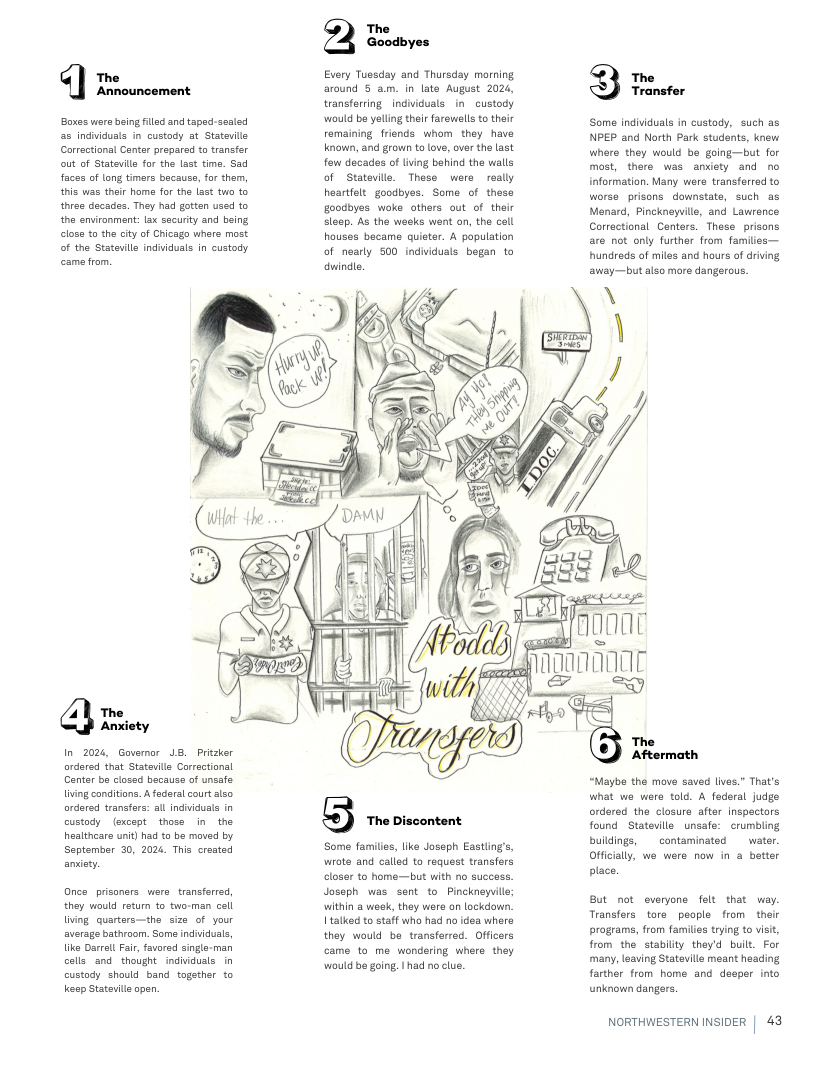
At Odds With Transfers
Fiy Miler, Ariel Bueno
What My Mors
Tony Triplett
g8 Are Like in Prison
In My 1
Lymn Green
i Prison, a Trail of Bloody Footpr
Beyond the Walls
Donnell Green
Reflections from Inside
Sela Breen
A Well of Hope A World Apart
Leon Fields & Brandon Wyatt
INSIDER LAW
Why Were We Left Behind?
Lynn Green
The Youth Left Behind
Elbonie Burnside & Margaret DeFrancisco
The lllinois Murder Registry
Abdul-Malik Muharmmad
Language of the Law
Paul Forbes
Updates From The Legislature
Lynn Green
SPIRITUALITY
Beyond Religion
Raman “Ban Khalil” Mantague
MOTIVATION
Stranded on a Bridge
Fly Miller
RESTORATIVE JUSTICE
What Do Parenthood and Family Mean to You?
Abdul-Malik Muhammad
Learr
g From Family.
Professor Annalise Buth
Repairing Harm, Rebuilding Family
William Shafiq Peeples
A Long Road Back
Williom Shafiq Peeples
My Mother, My Aunt, My Foundation
Jeson Samuels
AQueen
Will Williams,
hout a Crown
3941
42-43
hoets
ube7
us
w
s0-58
s0
s162
264
566
&
69-70
773
s
s
s
7677
7
7
ued on next page
This is What Family Looks Like 80
Margaret DeFrancisco, Ashley Malansy
Crystal Clear a1
Patrick Comi
Restoring House Har 82
Anthony Haris
House Harris Goat of Arms. 8
Anthony Harris, Oscor Gutierrez
INSIDE THE CLASSROOM.
Janice Nora Lackey Award For Academic 85-86
Excellence
Rawls on Justice As Pertaining To The 87-88
Domestic Violence Law
Melinda Warfel
Leveraging Social-Emotional Learning for °7 7
Black Students
De'Andre Robinson
Mayonnaise Avengers 9u-97
Regina DeFrancisco, with a preface by
Shelby Hatch
POETRY
Community Garden 99
Juan Garnica
A Thousand-Yard Stare 100-101
Yophet Davis
Difficulty 2.0 102
Patrick Comi
Say My Name 103
Latosha Howard
1Can See 104
Nikolas Gacho Sr.
Big Black 105
Scot Miller
Plea Deal 106
Michael Jorgensen
Diasporic Blues 107
Diandra Samuels
COMMUNITY NEWS & UPDATES
Sheridan Debuts Free Learning Platform 109-110
Abdul-Malik Muhammad
Info, Letters, & Updates w1-11s
ute, Connect, Acknowledgements 116-119
6
VOL. 2, ISSUE 2
CONTRIBUTORS
Below and on the following pages are the contributors to Vol. 2, Issue 2 of
the Northwestern Insider. They are grouped according to the section of
the magazine to which they contributed.
FAMILY
PATTY OUSKA
Paty, astudent ¢
Logan Correctional.
RENE ROMANIUK
e, astudentsx
Logan Correctional
iy Aloandra”
BRANDON V.
WAt
in Cahort2,wrore
Stepping Stones”
and - walof Hope
aworla Apart”
SHAWN THIGPEN
Famiy's Unbresiatle
CHELSEA RAKER
Cheses, astuentat
Logan Correctional
NORTHWESTERN INSIDER
SHURESE BAILEY
Shurese,a studnt
axlogan
rote iy Dolores
v
THOMAS
GoRDON
hamss, studentin
soveralpices,
nclcing
ESSAYS,
INTERVIEWS &
ARTICLES
ScoT MU
Canors2, wrote
orign Language”
and elgBlack
BRYAN DEAN
Bryan, astudentin
Canors 2, wrote
Learingfrom 1y
ANTHONY
BHiERS
antnany, 22023
NPeP graduate,
ot “Thepatn ot
Sitteng
Todo, astucentin
Conors 2, wrote
“anen y Father
il
JAMES HALE
“Fathernao From
TONY TRRLETT
Tony,a 2023 0P
aradate, wrote
~celsbrating ramiy”
ana-ust Anather
Day inthe Cel
%
oy
SHEPHEARD.
Cindy, astudentat
Logan Correctionsl.
“Grieving nPrison
ouver
cRAWFORD
e, s sucene
ey i
[
DONNELL GREEN
Oannel, s studr
Bejond theWalk:
Interested in contributing to
future issues of the
Northwestern Insider?
Refer to our
submission guidelines
v
LEON FiEIDS
Well of Hope, .
World Agart” anc
Wothers Sons?*
SPIRTUALITY
WiAw
“SHAFIQ" PEEPLES
racuace eats the
Spntuatey column
restoratie usie for
LAW
INSIDER
A4
RAMON “BEN KHAYIL®
MONTAGUE
Ramon, s studnt n
“seyona Religon
IASON SAMUELS
wrota vy
wother, by Run
Wy Foundation.
PAUL FORBES
[pr—
Canort & wrote
“Language of the
MOTIVATION
WL WiiAMs
—
A Queen winout
LN GREEN
Lyne, 22023 woep
radase, s
ncder Lo and
tote “Why were
WeLersSaning?
ana Iny lnois
|
Y
ALY MILER
Py, a 2028 PP
gradate, s he
arioge”
ANTHONY
HARRIS
sotrany, s
etucentin Cahort
“RestoringHouse
sONIE
BURNSIDE
bonie astucent st
Logan Corractional
Vouth Lef aming.
RESTORATIVE
JUSTICE
\4
oscar
GuERREZ
oscar, astucent
in Canart,drew,
Costat A
on page 117.
MARGARET
DERANCISCO
wargret, astusent
tCogan
Lerteeng
il
.4
ABDUL MALIK
MUHAMAAD
alk,a 2023 PP
aradiate, s the
column andurats
“Drhing o Parle”
PATRICK COM
parric, astudent
“crysta clear
and Dcuty
NORTHWESTERN INSIDER
8
INSIDE THE
CLASSROOM
AT
oAvIs
Vaphet, student
A Thovsanavara
A4
ARELBUENO
vl s seudentin
istrated severst
pices nluding
At itn
Transers”
MELINDA WARFEL
Welinga, aseucent
atlogan
Center,wrats the
Lackey Awarc
winningessayon
ik
wosHA
HOWARD
Latoshs, astcknt
alogan
Consctonst
Center,wrore 3y
iy Name
i
JASON GORHAM,
Jason, s suentin
Canort,
Wustrsteamany
plecs ortis
Istu, ncluing e
Lackey Avard
winnes s,
NORTHWESTERN INSIDER
DEANDRE
ROBINSON
benars,asudent i
Conort, wiots the
Lackey Award-winning
syoneversgg
tearing for sack
o
v
NIKOLAS GACHO.
s
Niolas, s sudrt. o
Canort, wrote |
)\
co ocon
Hugo astusencin
Conort, lusrasea
soveral plces for this
Tasue, inclucing e
REGINA
DEFRANCISCO
“Mayomase
Avengers.©
1 L)
micaeL
JORGENSEN
[ p—
“Plesdng”
TYPISTS
A
>
=
=
8
&
JUAN GARNICA
Community
=
]
<
omNRA
SAMUELS
Diasporc lues.”
1
To Our NPEP Community
Dear Reader,
This issue of the Northwestern Insider is devoted to family, and the pages that
follow are filled with stories that are powerful, generous, and deeply moving.
As I reflect on the many forms that family takes—biological, chosen, and forged
through the bonds of shared experience—I can’t help but think of my own family
and the role they've played in the unfolding story of the Northwestern Prison
Education Program (NPEP). My husband, Baron, and daughters, Izzy and Cat,
have been part of this journey since the very beginning as both supporters and
active participants who have been essential in shaping NPEP into what it is
today.
When NPEP launched in 2018, lzzy was a first-year student at Northwestern
herself, and she was one of our original tutors, not only showing up to provide
academic support each week to our community members but also actively
recruiting other on-campus students to get involved with NPEP. (The photo on
the right, above, is Izzy in one of the classrooms at Stateville.) Since then, she
has done everything from picking up catering orders for community hours to
driving a U-Haul up and down narrow streets from Evanston to the South Side of
Chicago to collect and deliver furniture for one of our students who returned
home after 27 years of incarceration.
continued n follwing poge
NORTHWESTERN INSIDER |
9
While Cat was originally too young to do in-person work for NPEP, she typed up
handwritten assignments from students, added content to the website, and stayed
up until all hours of the night baking cookies for holiday celebrations. After she
moved out of state for college, she became a correspondence tutor for two of our
students. When she learned that the last NPEP commencement would take place
during the review sessions for her own final exams, she didn't hesitate to drive over
12 hours in a roughly 24-hour period of time to ensure that she was present for this
monumental moment in the lives of our community members.
And Baron—known to those he’s taught in the NPEP community as Professor Reed—
has, at one time or another, filled just about every role in NPEP: website designer,
academic advisor, professor, business manager, counselor, commencement planner,
and so much more. (The photo on the previous page is of Baron, William Peeples, Cat,
Robert Cloutier, and me at NPEP’s 2023 commencement at Stateville.)
Through it all, my family has never once expressed anything but joy at sharing me
with so many other adopted family members, even when this means that | have less
time for them. Their open hearts and generous support show me over and over that
education, at its core, is a family endeavor that requires a network of commitment,
care, and shared values.
As you read the stories in this issue, | hope you're reminded of your own families—
those who walk alongside you, uplift you, and believe in your dreams, even when they
seem impossibly far away. NPEP is a reflection of many such families, woven
together by purpose, driven by enduring hope, and sustained by love.
With gratitude,
Jennifer Lackey
Director, Northwestern Prison Education Program
10 | NORTHWESTERN INSIDER
This issue of the Northwestern Insider celebrates family.
Family
When | was a child, | thought family meant the individuals who looked like me, who shared my name and my
bloodline. As | got older, | realized that the definition of family goes beyond namesake and DNA. In this issue of the
Insider, we take time to acknowledge the people we consider family, the people who love and support us. We uplift
their sacrifices and highlight their dedication. As justice-impacted individuals, we have lost much, but family is one
of the few things that can't be taken away. In the equation of incarceration, family has always been the common
denominator, and ultimately, our community.
We understand the struggle that comes with supporting a loved one behind bars, and we appreciate the dedication
to constantly remain in our corner. When your dwelling space is a carceral setting, support from the inside and
outside s essential—whether it's letters, pictures, phone calls, cards, or a simple, “Are you okay?"
These small but important gestures remind us that we matter to someone. ®
— Tony Triplott, on behalf of the Insider
Stepping Stones
Brandon V. Wyatt
My Dolores
Shurese Bailey
Grieving in Prison
Cindy Shepheard
Foreign Language
Scot Miller
Damn, You Have A Daddy?
Donnell Green
When My Father Let Me In
Todd Mandoline
Treasures
Patty Ouska
A Mother's Love
Thomas Gordon
12-13
14
15
16-18
19-20
21
22-23
24-25
Learning From My Father
Bryan Dean
Fatherhood From Prison
James Hale
The Key to Parenthood
Oliver Crowford
A Family's Unbreakable Bond
Shawn Thigpen
Are We Our Mother's Sons?
Leon Fields
For My Alexandria
Irene Romaniuk
My Dancing Butterfly
Thomas J. Gordon
From Me To You
Chelsea Raker
The Power of Connection
Shawn Hardy-Hatchett &
Juan Garnica
26-27
28-29
30-31
36
a7
Stepping Stones
On learning to walk alone, thanks to the foundation my parents laid.
By Brondon V. Wyatt
s | grow older, I'm constantly
confronted with the lessons and
guidance | received from my parents.
Even the smallest moments bring back
something profound that my mother o father
once said.
| remember when my mother caught me
cursing up a storm around the age of 8. She
gently scolded me about using profanity.
Now, if I find myself on a rant with even a
splash of vulgarity, | hear her voice reminding
me to speak with decency and dignity.
Then there's my father, who taught me
that gambling is the equivalent of trying to
gain something for nothing. That lesson
always surfaces when | think about betting
on a basketball game.
These are just a few of the smaller
messages | absorbed growing up—there are
many, many more.
As | reflect not just on my parents, but on
the essence of those lessons and the roles
they've played in my life, I've come to a
steady realization: my parents were stepping
stones. They were a point of departure
toward empowerment.
It might sound counterintuitive to call your
parents “stepping stones,” since most
people hold their parents in the highest
regard. And believe me—I think the world of
mine. | would never minimize their lives or
their impact.
But as | consider their parenting style, |
now see that their purpose was to set me on
the right path, to empower me to act freely in
alignment with universal principles like
oneness, cause and effect, and attraction.
They worked to build and shape me not
just to survive the obstacles life would throw
at me, but to transcend even the hidden
limitations, including the limitation of
depending on them.
Our parents are our first providers. They
give us food, clothing, and shelter. Ideally, we
grow to trust them to protect us and sacrifice
for us. If that goes well, we become capable
of expressing the best version of ourselves
through their influence.
But how many parents are willing to send
their children into the world with full faith
that they can find fulfillment and govern
themselves? Can our children face trials
fearing failure or immediately
reaching back for support?
I believe the deepest goal of parenthood is
to raise a child into adulthood with self-
without
determination—someone who can manifest
prosperity, abundance, and steady resolve
through all stages of life.
If parents are the master builders of our
mental, emotional, cultural, and financial
foundations, then surely their goal should be
this: to build something that stands strong,
even when they walk away.
Parenthood isn't just about raising good
children. It's about raising children who can
stand on their own, no matter what struggles
come their way. s
NORTHWESTERN INSIDER | 13
A granddaughter's tribute to the woman who gave
her reason to come home.
by Shurese Baley.
Hustration by Hugo Ocon
Deervamml&
Let me start by saying—you've
always been my heart and soul. |
never imagined I'd lose my favorite
girl s0 soon. You've been there for
me through everything, and I've
always wanted to make you proud.
When they told me you had passed
away, | wanted to drop to my knees
and ask, How can this be?
I had been anxiously waiting for
November 3 50 | could call and say,
“Happy birthday, Grammie!” Instead,
I got the worst news of my life. My
grandmother, Dolores Bailey, had
gone home to be with our Lord and
Savior, Jesus Christ. | knew |
shouldn't be sad, but | couldn’t help
it—the one person | loved most was
gone.
14 | NORTHWESTERN INSIDER
Everywhere | turn, | see your
angelic face—a face I've seen all my
life—and you will always live in my
memories.
I remember when | was a little girl
and wanted to spend the night with
you every weekend. You'd try to get
me to sleep in the other bedrooms,
but 'd pout until you pulled out the
rollaway bed or made me a pallet
right next to you. | remember us
praying together while “There’s a God
Who Knows It All" played softly in the
background.
I remember my teenage years, too,
and the dresses you'd buy that
hugged my body. You always said,
“You have a beautiful shape and a
beautiful face.” Even though | hated
wearing dresses, | loved seeing your
smile and the twinkle in your eyes.
When | got pregnant, you took me
to my appointments and stayed right
by my side. When | had my C-section,
you were there. Before | went to
prison, | made sure to visit you every
day. And while | was inside, | called
you as often as | could, just so we
could reminisce.
We'd talk about our bonding
moments, like when | gave you
pedicures. I'd sit on the floor clipping
your nails, and you'd look over your
glasses at me until | heard you shout,
“Ouch! You're making me bleed!” And
vd say, “Grammie, shhh—it's just a
little blood.” I'd laugh, and you'd
always respond, “I'm not letting you
touch me again.” But sure enough,
the next week, you'd be asking me to
do your feet again
For the past 12 years, I've been
trying to get home to you. | still yearn
for your touch and miss that beautiful
smile. | don't know how to deal with
you not being here. | catch myself
wanting to call you, but | can't
Wanting to hear your voice, but |
can't. | want to feel your loving arms
around me, to give you one last kiss
goodbye, but | can't.
You were my purpose, Grammie.
My reason to come home. And | will
keep fighting to make it back. 'm
sorry | wasn't there to say goodbye.
But you always said, “Never say
goodbye—because goodbyes are
forever.” So instead, I'll say: See you
again one day, when God calls me
home.
You will never be forgotten. | pray
that one day | will be even half the
woman you were. You'll always be the
most precious woman in the world to
me. Loving you for life.
Your granddaughter,
Rese
Grieving in Prison
What it means to mourn when no one can hold you.
By Cindy Shepheord
ow does one truly grieve while in
prison? One doesn't—not fully, not
completely.
You may be eligible for a funeral furlough,
but that only works if you anticipate the
passing well in advance, and if you can
afford the fees. The approval process takes
‘& minimum of 30 days. And if i's granted,
the individual in custody is required to pay
for mileage, gas, and the day wages of the
‘accompanying officers, allin advance. Most
applications don't get approved.
And even if you are granted a furlough,
lot's be honest: Who wants to wear
Shackles, waist chains, and cuffs for hours
just to spend 15 minutes with the
deceased? You're not allowed to speak with
other family or friends. I's just you, your
loved one, and two armed correctional
officers who may or may not have
compassion.
Forgive my cynicism. In 2016, my father
passed after a long battle with colon
cancer.
I rarely got the chance to see him because he
had been too il to travel, but he surprised me
with @ visit on my birthday. | spoke with him
the Sunday before he died. | told him how
much | loved him and assured him that if he
was tired, it was okay to get some rest. My
‘mom and | would be fine.
That was in June. My brother hanged
himself in September of the same year.
I was just numb. None of it seemed real. |
Knew they were gone, but when | called, | still
expected one of them to answer the phone.
In 2019, my mom was diagnosed with
terminal lung disease. She died five years
later, in 2024. liness, old age, and the toll of
mourning my father wore her down. She
passed away in a state-run nursing home
with a nurse sitting beside her, holding her
hand.
I have no living siblings. Al of my aunts,
uncles, and grandparents have passed. Even
my few cousins are gane.
I'm sad, angry, beside myself. | want to
scream at everyone. I'm heartbroken.
leryalot most days.
I've been sad before. I've shed tears for
other family members who passed away. But
this time, it broke me. Losing my dad, my
brother, and finally my mother. | stopped
wearing the mask of my former self.
| couldn't express this to the mental health
staff at Logan. I | did, they would classify me.
as suicidal and place me naked in a strip cell
with a heavy, velero, suicide-proof canvas
smock, with no blanket or toilet paper. This
would supposedly be for my safety, so | could
ot hurt myself. However those actions only
exacerbate the pain, loss, and humiliation.
1 am not suicidal; I'm in pain. I'm just a
small, wounded child who really wants her
mom. | want her wisdom. Her laughter. Her
understanding. Her life experience. Her silly
humor. Her storytelling, even if | already
heard the same story a hundred times. | want
her.
My mom and | became incredibly close
after | was arrested. She was one of the few.
people who truly believed me and believed in
me. She used to say, “I promise | will be there.
tobringyou home.”
So it crushed us both when she finally
said, “Honey, | don't think I'm gonna be able
to keep my promise.” But | already knew
that.
Her passing has changed the way | see
everything. | still hold onto hope—for new.
laws, for release in the next couple of years.
But | carry a sadness Ive never known
before, an emptiness that nothing seems to
Ll Will it ever be filled?
Grieving in prison is a challenge most
people will never understand. Most days, |
just want to be left alone. | don't eat much o
sleep much. Sometimes | shower at 2 a.m.
My mind races. | drift through music, TV, and
homewark, but my focus is shot, like “short
attention span theater.”
Fortunatly, | have a few people in here
who feel like family. | can truly cry with them.
Really cry: ugly, snot-nosed, red-faced,
swollen-eyes crying.
And despite my grief—or maybe because
of it—| know | will make it. I'm Ellen's
daughter. I'm Vickie's biological daughter.
Ellen Sue Collins, you are so deeply
missed. | miss you, Mom. &
NORTHWESTERN INSIDER | 15
Foreign Language
Decoding the language my father had been speaking all along.
1k
arents are difficult to
P understand even in the best of
times.
Most of my life my dad, Ron, has
seemed like he was from a different
planet and spoke a foreign language.
He never shared much of his life's
story with us, and to this day | am still
trying to piece together the puzzle
that is my father. He is an austere
man. Although he was usually
deadpan, he wasn't without a sense of
humor. When we were growing up, my
dad didn't often prank us or play
around, but occasionally he would say
some witty comment making one of us
kids the butt of the joke. He loved
watching old sitcoms, and | would
hear him laughing out loud while
watching re-runs of MA.S.H. or All in
the Family.
My dad was very affectionate when
16 | NORTHWESTERN INSIDER
By Scot Miler
we were children. | remember when
he came home from work, my brother
and | would race to the door to jump
into his arms, hugging and kissing
him. Once my sister was born he
didn't want to be separated from her.
Some of my most vivid memories
of my father were of the crazy gifts he
would give for Christmas. Every year,
he would buy us presents that none of
us wanted—or at the very least, a bad
version of a thing that we vaguely
desired.
Occasionally, one of us would
receive a gift that another sibling
actually did want. | remember that he
bought my brother a robot named
2XL. This robot played cassette tapes
with all types of scientific information
on them. The thing was, my brother
hated robots and science, whereas |
loved both. If lasked about the gift
mixup, Dad would say , “I knew one of
yall wanted it.” At the time, | thought
that his weird gifts were just one of
his idiosyncrasies.
My father gave nicknames to
everyone in the family: he called me
“Hillbilly” because | didn't like
wearing shoes. My little sister was
“Stinky-Winkey” or “Stink” for short,
because of an accident she had in the
bathtub as a toddler. My older
brother was “Gushy-Main.” | have no
idea why my father called him that.
There's no doubt that the nicknames
are terms of endearment, yet the
names add to the enigma that is my
dad. My siblings and | never used
these monikers for each other, but as
young adults we teased each other
about the bizarre nicknames that Dad
gave us. To us, the names were just
another piece of his mysterious mind.
ike most younger brothers, | looked
up to my older brother, so when he
joined the Boy Scouts | wanted to join
t00. My dad became a Scout Master so
he could spend time with his boys. We
all enjoyed camping trips, earning merit
badges, and doing things together as a
family. Things began to change in my
pre-teen years, though.
My brother became interested in
sports, which meant | became
interested in sports. Unfortunately, my
dad was never into sports. | found out
that | was not a bad athlete, so |
became more involved in football,
eventually leading to me leaving the
Scouts.
Atthe time, | didn't realize how much
leaving the Scouts might have hurt my
dad, though he never said so. Then
again, he wasn't the type to say
anything. His disappointment showed
in quiet detachment.
He wasn't as involved in what | did at
school or in my extracurricular
activities, and | couldn't understand
why. | desperately wanted him to show
Up to my games to cheer me on, but he
always had to work. | assumed. his
retreat from me was because he
thought we didn't need as much
attention as we had when we were
younger. Sometimes, however, it felt
like he didn't care as much as he once
did. It never occurred to me that my
actions may have hurt him, especially
since | saw him as unassailable.
As the years went by, the gulf
between us grew. My father and | didn't
talk much once | started high school.
Part of it was my newfound
independence as a teenager, but | also
didn't feel much effort on his part. He
still gave us crazy gifts and he attended
all the major events in my life, but the
relationship wasn't the same. The
connection seemed damaged, and as a
result, | began to feelindifferent toward
him, mostly out of hurt.
My father worked the midnight shift
which meant that he normally slept
during the day. His schedule allowed
me to cut class and hang out with my
friends at our house, provided that we
didn't wake him. At our house my
friends and | would dip into my parents*
liquor stash. | was a shy kid and |
quickly learned that | could get rid of
my shyness by getting lost in alcohol. |
soon began to drink excessively
because | liked the way alcohol made
me outgoing to the point where | was
rarely sober. Looking back, | may have
been fighting a much larger demon
than shyness: depression.
Eventually | began to abuse marijuana
as well as alcohol, though I still
managed to maintain good grades. |
started to hang out with people who
may have been considered “bad
influences” and had a couple of run-ins
the law. No doubt my father saw
his baby boy spiraling out of control. At
this time the crack epidemic hit our
neighborhood, and my family saw our
community change for the worse. Being
able to sustain good grades may have
been the only reason that my parents
didn't have a full-fledged intervention
for me.
During this time, the late '80s, many
of my friends’ parents were divorcing or
their fathers were simply leaving. My
father stayed. | don't believe my father
knew how to correct the path | was on
or the trouble | was getting into. | was
hanging out and becoming more
involved in the streets; my behavior
worked as even more of a wedge
between us.
Miraculously | was able to graduate
high school and get accepted into
Tuskegee University. The day that | left
for college, my parents drove me to the
airport. As | was unloading my luggage
from the car, my dad discreetly slipped
me some money without my mother
noticing.
It felt like a spark of our old bond had
been rekindled. | distinctly remember
sitting on the plane, reminiscing about
my childhood and the times my dad and
I would share root beer floats together.
Unfortunately, after a couple of years,
I dropped out of college and returned
home. | was embarrassed that | had let
my family and myself down. My father
never said anything to me about my
failure. He ignored it, and me. The
chasm between us returned.
For years our rift remained. There was
no hostility, but the silence between us
was more heartbreaking than any
argument could have been. My siblings
also felt my fathers emotional
departure. They grew angry, while |
became apathetic. To me, my father no
longer cared and | didn't either.
‘That changed when | was arrested for
a major crime. As soon as | was taken
into custody, my father moved heaven
and earth to secure an attorney for me.
Unbeknownst to me, shortly after my
arrest, my mother was diagnosed with
cancer. | can only imagine what my dad
was going through mentally — fighting
wars on two fronts while working the
graveyard shift. What | do know is that
my father attended every single one of
my court appearances, many of which
lasted only a few minutes. His presence
helped sustain me through the most
difficult time in my life.
Seeing him show up for brief and
insignificant court hearings forced me to
reevaluate my perception of my father's
love. My trial ended in a guilty verdict
and my father took the stand in an effort
to mitigate my prison sentence. Initially,
| was apprehensive about my father
testifying on my behalf because | felt
that | had already put my family through
50 much and | did not want to add more
tothe burden.
Approximately four years after | was
transferred from the county jail to the
state prison, my mother was placed on
NORTHWESTERN INSIDER | 17
hospice. Sadly, she passed away on
Mother's Day in 2004. Up until that
point, she had been my rock and
comforter. With her gone, | didn't know
how | was going to survive what
amounted to a life sentence. To my
surprise my father stepped in to fill the
gapinamajor way.
My father and | began speaking on
the phone weekly, which was unusual
for us. At first, our conversations were
awkward and superficial; it was like |
was getting to know a stranger. He
made sure that | was able to speak to
my son who would spend weekends
wiith him. | couldn't help but have a new
appreciation for my father.
Years later, as | was participating in
an inside-out dads class, | borrowed a
book entitled The Five Love Languages
by Gary Chapman. This book was like
the Rosetta Stone to my father's
enigmatic mind. It showed me that
people express their love in various
ways, one of them being “gifts of love.”
I read the chapter on gifts over and
over, reminiscing on the presents my
father gave.
Replaying the images of past
holidays and considering how my father
sat transfixed on watching our
reactions as we opened gifts made my
breath catch. | hadn't understood it
then, but now, with this book in my
18 | NORTHWESTERN INSIDER
“l hadn’t understood it then,
but now, with this book in my hands,
| could finally see it: the joy, the intent,
the meaning behind what he had
been saying all along.”
hands, | could finally see it: the joy, the
intent, the meaning behind what he had
been sayingallalong.
Love Languages caused me to think
back to when | was a kid and my father
would take me to the mall to pick out
presents for the family. He would
spend, what seemed to my adolescent
mind, an etemity selecting greeting
cards when all that | wanted to do was
get to the toy store. | hadn't a clue that
what he was so painstakingly searching
for was the perfect card that expressed
his love towards his family. These cards
were his way of laying his soul bare to
us. | was focused on the presents when
the true gift was the text of the cards. It
all made sense now; he had been
sharing his feslings all of my life but |
wasn't listening. | had been discarding
the cards, and thus, his feelings. |
understand now that his gift-giving was
an outward manifestation of his love
and thoughtfulness.
Another of my fathers love
languages that Chapman notes is “acts
of service,” which means that he tends
to articulate his love much more
eloquently with actions rather than
with words. His service was expressed
in multiple ways, such as by showing
up to every court hearing, His paternal
senvice became apparent to me when |
observed him navigating the predatory
financial ~practices imposed o the
families of prisoners by the Department
of Corrections. He never abandoned my
struggle in prison even when those
hardships caused him to sacrifice an
excessive amount of personal and
financial capital.
My dad has been through so much:
triple bypass heart surgery, amputation,
of one leg, a heart valve replacement, a
pacemaker installment, and dialysis
three times a week. My father’s strength
is incontrovertible. When Dad was having
heart surgery, he flatiined during the
procedure and had to be resuscitated,
When | spoke to him post-op, the only
thing he wanted to talk about was me
and how | was doing in school. His
dedication to family is mind-blowing.
My father was also instrumental in me
maintaining longstanding familial bonds,
none as notable as the bond with my son,
My dad unceasingly continued to attend
to the needs of my family and me, even
‘when going through health challenges.
After all this time | finally got it—I
leamed to speak Ron. Even now, |
attempt to teach the rest of my family to
comprehend my father's love language.
Its not easy, but he deserves to be
understood. Despite all the tribulations
my father has stared down, he always
puts his family first. It took all of my life,
but 1 am glad that | have finally become
fluentin my father's love language. ®
Promises, verbal spars, a higher
power—and an understanding
that love will conquer all.
By Donnelt Green
lustration by Aviel Bueno
amn, you have a daddy? Yeah,
I do. If I had a dollar for every
time | was asked this, | would
have enough to cover attorney fees.
My friends have heard this story: As
far back as third grade, when I'd
misbehave in class, my teacher would
make a phone call and, like a genie, my
dad appeared outside the classroom
door with a scowl that rivaled ‘905 lce
Cube. My classmates, ~surprised,
would spout “You have a daddy?!” At
the time, | wished this wasn't the case
because just the thought of him kept
me in line.
Sometimes the teacher would place
is number on my desk without saying
aword. | wanted nothing to do with an
upset dad. He was tough. He had
survived a Jim Crow issippi,
where violence against Black bodies
was a common occurrence and
prospects of economic progress had a
ceiling that was among the lowest in
the nation. For him, the Marine Corps
was a practical solution until he
succumbed to an injury, leading to
withdrawal and a move to Chicago.
There, he entered into the ‘70s-'80s
drug epidemic and remained there for
awhile, sleeping on the streets, eating
out of trash cans. He's been shot,
NORTHWESTERN INSIDER | 19
beaten, and left inches from death,
ironically experiencing the same fate
he attempted to escape in
Mississippi. During this time, his
lifestyle prevented him from
envisioning a future until he had a
dream about having another son, one
who would atone for his shortcomings
—s0 he asked my mother to have me.
The logistics of how to raise meina
healthy ~ environment was an
afterthought. Fortunately, he
escaped the '90s incarceration boom,
and he stuck around to make his
presence known to me. He credits his
resilience to a prayer whispered many
moons ago, which may've also helped
him avoid the dark abyss that seemed
to have swallowed up my friends'
dads. Truthfully, there is no abyss—
only structures that negatively
impact urban communities while
providing rooms in state-run
facilities.
Having a daddy not only made me
stand out from my classmates. It also
distinguished me from my siblings.
Out of the six siblings in my mother's
house, | was the only one with a
concerned dad. Even though he did
not live with me, | felt his presence.
My dad’s power and wisdom showed
me that | didn't have to repeat the
destructive behavior. Instead he
would tell me | was special enough to
break a generational curse, and
somewhere deep down | believed him.
I relished the weekends | spent at
his house. Seeing his white Blazer
coming up the street made me seven
feet tall. | remember the love we got
at the barbershop, our trips to the
movies, and the smell of his cologne.
Those times shaped my moral code,
20 | NORTHWESTERN INSIDER
and that's where | get my impeccable
dress style from.
Although at the time life kept us
apart, my dad’s love for me fueled his
fight for sobriety. | watched him
battle back with humility. He
promised that by the time | was 13, he
would be ready to raise me in a
functioning home. Periodically, he
would check in and let me know
things were on schedule. We even
spent time in his room at the
Salvation Army. At those moments, |
watched him intensely, and his
character never swayed despite his
circumstances. My respect for him
grew.
By the time | turned 13, he fulfilled
his promise. He rescued me from
dysfunction and provided me with the
choice to live in a healthy home. | was
torn over the decision to leave my
mother and siblings in Chicago, but in
order to grow, | had to go after the life
that my dad fought so hard for.
Ironically, though, life with my dad
was more than | could handle at the
time. As hard as my dad fought to give
me a chance at a productive life, | was
overwhelmed by the pressure to make
up for his shortcomings. The more he
pushed me to be great, the more |
shut down. | still respected his scowl
and the discipline he instilled, but |
was careful not to excel academically
or show gratitude for the life he
provided. | leamed to live in a gray
area of concentrated blase.
still, to my chagrin, he paid
attention to every second of my life.
Family members would ask, “Why
Donnell?” | wondered the same and
thought he should save it for his other
sons. But his love was relentless.
Now as | write this, sitting here as
an incarcerated son, | am choking on
tears because his love is still
relentless. | can call on him for
anything. He is my cheat code against
presentism. If | need to know what
the 70-year-old version of myself
would do, all | need is ask his
thoughts on a particular situation.
Although we've had our ups and
downs, it's year 17 of my 35-year
sentence, and he still has me
convinced that | was destined to
break a generational curse.
From my position, it’s unclear if 'm
a curse-breaker, though | do
understand the nurturing act of a dad
speaking life into his son. These
days, | am embracing the
responsibility | have to my siblings to
impact them positively and to share
knowledge.
Despite the arguing through the
years, he's my champion fighter, and
his main goal is to see me free once
again. | fought hard and rebelled
against his rules—now | put that
fight into forging our bond and
learning an oral history of our family.
Our 20-minute phone calls are not
enough, so we schedule visits to
crack jokes and take pictures that
will embarrass him. (1 tried to take a
pic g him on the cheek, but
staff said no contact is allowed.)
Our relationship is proof that love
conguers all. Recently, my name was
called for visitation. My neighbor
asked, “Who was it?" | responded,
“My old man.” He then shouted from
his cell, “Nell, you have a daddy?!” |
laughed because | understood.
Iove you, pops. =
When My Father Let Me In
After years of distance, illness and vulnerability
brought us together.
By Todd Mondoline
ince my arrest in July of 2012,
the most difficult relationship
that | had to work on was the
relationship with my father.
Strangely, at the beginning of
2024, something changed with my
father. | truly believed that God
answered the prayers that I've been
sending His way on this connection
with my father. My father's memory,
attention, and cognitive abilities
seemed to be slipping since his 75th
birthday, and it hadn't been easy to
watch. Then, in July of 2024, my
father was diagnosed with terminal
brain cancer, shaking my family to
its core and revealing a possible
reason behind his change.
Maybe the profound statements
he dropped on me as he hugged me
before leaving the Stateville visiting
room were brought on by his perso~
nal struggle trying to grapple with his
own mortality. Quite possibly, it was
the minor stroke before his cancer
diagnosis that led him to be more
open and become vulnerable with his
only child.
In January 2024, during a visit, |
told my father that | knew, without a
doubt, that he loved me. However, |
felt like he didn't like me. A week later
as we hugged at the end of our visit,
my father asked me, “Why would you
think that | hate you?” For the entire
week, this was on his mind, and
mind transformed “dislike” into
“hate.”
For my father, this interaction was
huge and cracked open an emotional
door, which had never happened
before, allowing me to slowly build on
this breakthrough moment in our
future phone calls and visits.
On Father's Day 2024, while in the
visiing room at Stateville
Correctional Center, my father
dropped another bomb on me: “I hope
that you can forgive me for all the
mistakes | made.” What? | wanted to
lay it on him, all of the things that |
felt he could have done differently. |
couldn’t do it. At age 36, with 13 of
those years being incarcerated, I've
been able to figure out things. More
importantly, | have been able to let go
of any animosity or blame.
I responded, “Dad, you don't have
to apologize for anything. | know that
every choice you made for better or
worse came out of unconditional love
for me. You did what you thought was
best, and | recognize that today. I'm
the one who needs to say sorry."
As | reflect on the progress in
communicating with my father, | have
to pause and thank God. In late 2023,
| was ready to throw in the towel and
accept defeat. It was as if | would
never get him to open up beyond the
surface of emotions, the level of
topics, and communicating as a
family.
I've told this story to a couple of
close family and friends that have
known my father for over 25 years.
None of them could believe the steps
my father has taken. For years, | have
heard “Well, that's your Dad, Todd.”
His generation didn't open up and
share emotions and feelings.
I guess we hit the emotional lottery
because it has been a miracle to have
my Dad take these steps.
I never thought I'd get this version
of my dad. And while | wouldn't wish
for the pain that brought us here, 'm
grateful for the conversations we're
having now—however late, however
fragile. =
NORTHWESTERN INSIDER | 21
0 those who have lost a sibling
while incarcerated: When |
close my eyes, memories of my
brother Joey fill my mind with
treasures. When my brother Joey died, |
suffered tremendously, alone. Siblings
are too often neglected and experience
“disenfranchised” grief, a loss that is
not openly acknowledged, publicly
mourned, or socially supported. | am
bringing sibling grief out of the
shadows.
Joey and | had a profoundly strong
attachment to one another. At 13, | had
to make a "big adult" decision. If my
brother and | stayed at home, we surely
would have been killed. My brother was
11 when the two of us left with only the
clothes on our backs and entered what
1 deem the carceral system, a system
with many interconnected liaisons:
shelters, foster homes, group homes,
juvenile detention, supervision, jail,
prisons, probation, parole, electronic
detention, mental health facilities,
immigration detention centers.
We faced many challenges together.
Our childhood was filled with abuse. We
did not choose the life that was handed
to us. We were children when we
entered the carceral system. Al we had
was each other. At 21, | was sentenced
toa term of natural life without parole
and | entered prison. My brother did
five prison terms along with me.
Throughout incarceration we
remained close. | talked to my brother
every day. In between the times he was
not incarcerated, we kept in touch by
phone calls, mail, and visits. The phone
calls were very expensive, but he made
sure | would be able to call him. My
brother was the only one who
understood me, the only one who
understood prison inside.
our
Treasures
The importance of sibling bereavement.
By Potty Ouska
Two days before my brother was about
to be released from prison for the fifth
time, the love of his life, Carol, passed
away. Now, coming home to a home that
was no more, he had to begin his life over
without her. Although he did his best to
cope, he was very depressed and turned
to heroin to numb his pain. On June 18,
2018, my brother passed away from a
heroin overdose suicide. When | received
the news about my brother, it felt like |
had received a blow to my stomach and
all the air left my body. From that point
on, | was frozen and felt like a zombie.
Incarceration on top of losing a sibling
is frightening. | had a new identity: | was
the unthinkable—a sister who had lost a
brother. | had to deal with the coroner,
the funeral home, signing a cremation
authorization form, and arranging to
have time with my brother's remains in
the chaplain's office.
1 keep thinking about what | could
have done o shouldn't have done. The
first year, | completely stopped all
communication with anyone on the
outside. | was being very selfish. | felt
that if | couldn't have all that | had with
Joey, then | would not have it with
anyone else. | lost some special people
during my grieving. In the six years since
Joey's death, | have continued on an
emotional rollercoaster of ~disbelief,
anger, frustration, and guilt.
There is a place inside that carries the
weight of my brother's ashes. | will never
gt to see him again, see him smile or
hear him laugh again. All of these
thoughts leave me with a lump in my
chest, because my brother and | made
plans. Losing my brother has given me
re-evaluation of life that | never wanted.
There is a constant ache in my heart
for all the memories we won't get to
share together.
However, there is also goodness. It has
brought me to a better understanding of
who | am as a person, to see the
preciousness of my life and those close
to me. Ithas made me stronger.
Siblings are not secondary mourners.
We share a history, common memories.
The ensuing loneliness and grief are a
heavy burden to carry especially in
prison. You have nowhere to grieve.
Sibling grief must be acknowledged and
validated.
In closing, | return back and close my
eyes. Revisiting memories are treasures.
Losing a sibling is like an ocean.
Emotions ebb and flow. Sometimes the
waves are rocky, sometimes the water is
calm. | know how to swim, but | was
drowning. The loneliness and grief are a
heavy burden to cary. To put it
differently, | experience survivor's guilt.
To those in the free world whom | hurt
during my grieving, | deeply apologize. |
was not in a good space, and | was
hurting.
Today, | am here on behalf of my
brother Joey and all of you in the carceral
system who have lost a sibling. | have
been given another “life sentence” —
one without my brother. This is my “new
life.” Who am 1 f | am not a sister? Who
are you without your sibling? I miss my
brother every day and wish | could tell
my brother all that I've been doing since
we last spoke, but | cannot.
We will not get over our grief; we will
get through our grief. The rief becomes
a part of who we are. The world may not
acknowledge sibling grief, but | see you,
hear you, | acknowledge you.
Inloving memory of all our siblings,
Patty Ouska
NORTHWESTERN INSIDER | 23
his was not going to be an easy phone
I call to make. | was calling my mother
to break her heart .. yet again.
“The difference, this time, was that it would be
for good, at least in my mind. | had just come to
jail at the age of 26 and had been dealing with
feelings of unworthiness. | felt that my mother
had raised me to be a better person. All the
things she had taught me over the years were
gone in amatter of moments. And it was for this
reason that | was about to call her. So many
things ran through my mind as | picked up the
telephone. Thoughts swirling like whirlwind Mother’s
tornado.
As| dial her number, | am not looking forward LOVe
to the conversation. In fact, | want to get it over
with quickly, which | figure will help to lessen
the pain | am about to feel, The phone is ringing,
obviously not in tune with the Jumanji-like Understanding the
thumping of my heartbeat. My mother finally strength and sacrifice
answers. | hesitate for a moment, not wanting of a mother's
to give her the dreaded news, but | finally unconditional love.
decide to sayt: | tell her that | am no longer her
son.
As I tell her this, | think back to when | was
growing up, when things were much simpler,
safer. My mother had always made sure to
provide for my brothers and me. We generally
had home-cooked meals; one of my favorites
was the meatloaf that she would make. Other
times she would declare a *fend for yourself”
night. In other words, Mom was exhausted,
which wasn't always a bad thing. It just meant |
had free rein over my dinner that night! While |
never had any complaints at the dinner table,
this just gave me an opportunity to load up on
my favorites. Every child's dream, right?
Even after a long day of work, she would still
be “working” at home, making sure her boys
had clean clothes to wear, as well as a warm
bed to snuggle into each night. This last part
always came with a routine hug and kiss
goodnight, despite having possibly made her
mad. These were just some of the things that
were hard for me to reckon with as | sat on the
phone, the silence closing in on me, waiting for
my mother's response.
By Thomas Gordon
24 | NORTHWESTERN INSIDER
When she finally spoke, all she said
was “Thomas,” but she said it softly,
slowly, almost with a sound of defeat.
Allatonce, | heard so many things being
said: 1 love you. | wish you didn't feel that
way. | wish I could fix it. Why does my
son keep doing this to me? How much
‘more can I take? What more do | say?
As difficult as it was for me to
acknowledge, | knew she was hurt again
by my selfish feelings and emotions.
| seemed to have done that a lot
throughout my childhood, hurt my
mother's feelings. It had to do with the
lack of clarity and understanding | had
at that point in my life. As a young child,
1just figured she was telling me what to
do. Sit down and do your homework.
Were running late for your doctor’s
appointment. We are going back to the
store and you are going to tell them you
stole that bubble gum. If you think | am
going to let you sit here ond enjoy
yourself after you were suspended from
school, you got another thing coming. |
heard all that and more over the years.
Of course, that's not how it always was,
but these things really began to strain
our relationship, especially when | was
being treated with her “tough love.”
I had begun to go through some
behavior and disability difficulties
during my formative years. Let me bring
You into the fold for a moment. She was
the store manager of a local gas station
and convenience store. One day, when
duty called, we had to go up there for a
bit s she could take care of a few
things. Well, I took it upon myself to
take some items off the shelf and put
them into my pockets for no other
reason than that | wanted these things
(and likely because | knew she would
sayno).
Atone point, my mom came out of her
office and her eyes lasered in on me the
way a mother's eyes can. When she
asked me what | was doing, | tried to
answer innocently, but of course, she
could see right through me—and my
pockets.
She put her hands on the counter,
looked at me, and in that firm, but
quizzical way that told me she already
knew the answer to the question she
was about to ask, she said, “Thomas,
what's in your pockets?” Busted, but
still lied, hoping not to incur the wrath
of my mother. As I said, she could see
right through me; she was hard to fool.
She told me to “come here” with a
look that said it was not the time to put
up a fight. | walked slowly up to the
counter, head down, dejected, trying
not to think about what was going to
happen. As she made me empty my
pockets of the assortment of things you
might find down a typical convenience
store candy aisle, | could see her gears
turning, getting angrier by the second.
Not only did | just steal, but I stole from
her store, while she was at work. This
story ends with my mother turning me
in to my probation officer, who then
extended my term of probation. While
that was just one example, she had to
do this on at least two other occasions,
where she turned me in to the police.
Those were tough moments in my
life. There were times where I had
chosen not to talk with her, where |
pushed her out of my life. | thought |
had all the answers, that she couldn’t
tell me anything | didn't already know.
Thinking back to that phone call, I've
realized a few things. My mother's love
at that moment in my life was bigger
than the tallest mountain and stronger
than any structure built to withstand
the worst natural disaster; it always
was.
And although we haven't always had
the best of relationships, this is only
because of my lack of insight into how
truly remarkable a mother is to her
children. Even more so, through all of
our struggles, her love has remained
constant, a true image of love.
As I am reminded of all that she has
done over the years—countless
doctor's appointments, parent-teacher
conferences, sacrificed time and energy
that she gave to me and not my
brothers—I realize that my mother was
still able to maintain a balance between
all these things. | didn't see it at the
time, but she was doing all she could to
ensure the best possible outcome for
my life. I shall call my mother the joyful,
juggling, jim-dandy, jack-of-all-trades!
Throughout all these years, she has
been the most consistent factor in my
life, her and her unwavering love. My
mother has made so many sacrifices for
me not only during the course of my
childhood, but also through my
incarceration. This has allowed me to
really appreciate the person that she is
and the relationship | now have with
her. She is more than my mother; she is
my friend! She is and always has been. |
have now understood her true value:
priceless.
I had a conversation with my mother
recently. She told me in so many words
that she was sorry for “pampering” me
all the time, trying to protect me from
getting hurt. Although that was the gist
of the conversation, | mostly disagree
with her. As a parent, she has displayed
much patience, kindness, care, and
understanding. Through these
characteristics, she has shown me
what it means to be there for your child,
through thick and thin; she has taught
me how to be a better parent. For this, |
am forever grateful. | hope that | can
pass on the same values to my
daughter, who can then pass them on to
her future children, and so on. An
eternity of love, all because of one
person’s efforts.
Mo, thank you for investing in my
well-being and showing me what it truly
means to value a person and love them
unconditionally.
ILOVEYOU! s
NORTHWESTERN INSIDER | 25
Learning From My Father
Everything | needed to know, | learned from him.
8y Bryon Doan
Mustrotion by Hugo Ocon
hat assumptions do you have
itto high school? Dumb? Per-
haps unreliable?
I know a man who never made it to
high school, and he is one of the
wisest people | know: my father.
Though he didn't go far in the
traditional ~educational ~ route, my
father has an incredible knowledge
base that has proved invaluable
throughout his life and mine. Through
the course of our many years and
interactions together, I'm fortunate to
have leared much from my father,
including how to be “handy.”
My father is a 69-year-old Black
man. Born in Georgia in the 1950s, he
personally witnessed and experienced
racism on a regular basis—on his
walks to and from school, inside the
actual schoolhouse, and later in life
‘when searching for jobs.
26 | NORTHWESTERN INSIDER
Though my father admittedly didn't
perform well in school, he found other
ways to engage his mind and show his
telligence.
When | read Mike Rose's essay “Blue-
Collar Brilliance,” | saw my father
reflected in Rose’s Uncle Joe. My father
i incredibly sawy at working with and
fixing machines, making alterations of
his own creation to strengthen their
operation (or to avoid future
breakdowns), and demonstrating his
skill in a way that allows others to learn
—assuming he has the time to teach,
and you wantto learn.
I started learning from my father in
early childhood. | was a very blessed
child. | had toys, a television, and a
Nintendo. | thought that was normal.
Everybody gets these things, right? It
wasn't until my father mentioned that
he hadn't had those luxuries in his child-
hood that | realized how lucky | was. But
of course, | had to ask: If you didn’t have
Nintendo, what did you do for fun?
My father helped me imagine.
Growing up in the hilly lands of Georgia,
my father, his brothers, and their
neighborhood friends would race
wagons and carts down long hills. When
my dad told me these stories, | pictured
hot, sunny days with vibrant grass on
either side of a long, exhilarating hill—
an idyllic scene where the kids raced in
fierce competition. When | asked how
they managed to get the wagons and
carts, he told me, “We built them.”
Can you imagine my awe at § or 6
years old hearing that? They built them?
Where? How? They were kids. Could |
build one? Never mind that we lived on
the flat streets of Chicago. | wanted to
race a cart down a hill
As far back as | can remember, my
father was always a particularly handy
individual. He was a foreman ata factory
with enormous injection molding
machines. On the occasions | went to
work with him, | learned that my dad
was the go-to person anytime a machine
malfunctioned—especially if it had
completely stopped working. I'd watch
in awe as he maneuvered around, under,
and sometimes on top of the machines,
fearlessly fixing whatever the problem
was. He was confident but careful. He
knew people had lost digits and limbs in
those machines, but he also knew what
he was doing.
The first few times | asked to help fixa
machine, of course, his response was a
stern “No.” I'd be upset, wanting to learn
and be like him. “Go stand over there,”
he'd say, directing me to a spot where |
could watch him and where he could
also keep an eye on me.
One day at the factory, we arrived
before his shift started. We walked to
the cabinet that housed his toolkit. As
he began examining his tools, he pointed
to specific ones, telling me their names.
An unexplainable excitement grew
within me.
Though | was just learning what a
flathead and Phillips head screwdriver
were, | felt like | was becoming like him.
That day he let me “help.” As he worked
on a machine, he'd tell me which
screwdriver to grab. Patiently, he'd
correct me when | brought the wrong
one. “No, that's a Phillips. The big
flathead has the green handle.” I'd
return with the correct tool, intent on
remembering that the flathead had,
well,a flat head.
‘Sometimes, when we were at home,
people from the factory would call my
dad to come in and fix something they
couldn't figure out. He'd ask if | wanted
to go with him, and 'd happily tag
along. Some of the people there were
well educated and had degrees, but
Pops knew how to solve problems that
left them stumped.
Qutside of work, his skill proved just
as valuable—around the house, for
relatives and friends, and for a video-
game-obsessed version of me. When
my Nintendo controller stopped
working one day, | asked my dad to buy
me anew one.
“What's wrong with the one you got?"
he asked.
“It broke! It won't work!”
Calmly, he walked over, put a hand
on my shoulder, and said, “We're gonna
fix it” | sat enthralled, watching
everything he did, soaking it all in. After
he put the controller back together and
checked that it worked, | opened up my
second controller—the one | reserved
for cousins and guests—and I repeated
allthe same steps mysel.
Catching on to what | was doing, my
father watched as | reassembled the
controller, plugged it into the Nintendo,
and started the game.
“It works!" | shouted.
He smiled wide, gave me a quick
“Yup,” and walked into his room while |
gotlostin the game.
Pd just leamed how to open
something, examine its components,
and put it back together correctly. That
gave me a little bit of knowledge, skil,
and confidence. Soon | was exploring
the inner workings of other things as
they broke: TV remotes, VCRs, remote
control cars, and more.
Where | learned even more was in
working on actual cars. No longer was it
just flathead or Phillps head
screwdrivers. | began to lear about
socket wrenches, various socket sizes,
spark plug gaps, and oil filter
wrenches. | leamed the difference
between a deep well socket and a
spark plug socket (the latter has a
rubber gasket inside). | helped as we
changed alternators, fixed brakes, did
tune-ups, and replaced fuel filters.
1 learned the importance of buying
the right wire harness when installing
an aftermarket stereo, the role of
power capacitors when installing an
amplifier and subwoofers, and how to
mount and hide a CD changer in a car.
Once, while changing a thermostat, |
was surprised to learn we didn't need
o own every tool. AutoZone would loan
them to you for free. We went there so
often, they knew us as soon as we
walked in.
My father had a special ingenuity
when it came to solving problems. One
day | asked, “Did you use to win your
races, Dad?"
“What?! Boy. | had some bad stufft”
We'd sit around smiling and laughing
as he retold stories to me and my
sister. He'd describe how my uncle lost
control of his wagon and tumbled down
the hill, how kids sped into curbs—or
worse, into cars—at the bottom.
He may not have excelled at math
and history in school, but my dad was
far from dumb.
“I was the first kid to put brakes on
his wagon.”
“Nuh-uht”
“Yeah | did! Then your uncle stole my
‘wagon and tore my shit up!” Again, we'd
be near tears from laughing.
That same ingenuity helped him later
in life. Pops began as a machine
operator at the factory where | later
learned what a flathead screwdriver
was. He worked his way up the ladder,
learning the machinery, solving
problems, and even improving
operations—like when he tweaked the
plastic release valves on the injection
molds to reduce excess output and
waste
He didn't learn that from a formal
education. He used experience,
observation, and creativity to become a
key part of the operation. The language
and skills he developed helped him
succeed—and he passed much of it on
tome.
Through watching, asking questions,
and emulating what he did, | learned
skills Ive used throughout my life. In
prison, | fix headphones, earbuds,
Walkmans, ~ radios, and other
possessions. When | go home, I'l use
this knowledge to help my family and my
community.
Like my father, | didn't acquire this
literacy in a classroom. | learned it
through experience, diagnosing
problems, implementing solutions, and
ig the language of the task at
. It may not be textbook math,
science, or history, but it's a form of
knowledge that keeps cars running,
factories producing, and people’s
everyday items working.
Though I'm capable, what | know only
scratches the surface of my father’s
knowledge and ability, which is
remarkable. 'm grateful for the wisdom
he's passed down, and | hope to one day
beas wise as heis. ®
NORTHWESTERN INSIDER | 27
Fatherhood from Prison
Reflections and strategies on the power of showing up—even from behind bars.
By Jomes Hale
ustration by Jason Gorham
ver 1.7 million children in the
OUnited States have an
incarcerated parent i prison,
according to a study by The Marshall
Project. For these children, the
absence of a parent can deeply affect
their emotional and developmental
well-being.
As a father of four, I've faced the
challenge of remaining present in my
children’s lives while being physically
separated. Despite these difficulties,
Ive learned that fatherhood isn't
about perfection—it's about showing
upin meaningful ways, even from afar.
Fatherhood is a responsibility that
demands love, protection, and
presence. While incarceration creates
unique challenges, it doesn't have to
mean being an absentee father. Like
military fathers on deployment, incar-
28 | NORTHWESTERN INSIDER
cerated fathers can stay connected
through visits, phone calls, and
letters.
A father's presence—whether
physical or emotional—is vital,
especially during a child’s formative
years. Fathers provide balance to the
family dynamic, teaching boys how to
treat others with respect and showing
girls how they deserve to be treated.
By modeling kindness, affirming thei
children’s worth, and offering
stability, fathers play a crucial role in
shaping their children’s lives.
Even when physically distant,
fathers can make a profound impact
by staying present through
meaningful, intentional efforts.
Being available for my children has
taught me that fatherhood isn't about
perfection—it's about being present
in the ways that count. Even the small
gestures and moments reinforce that
my children are my top priority.
Staying present, even from afar, has
helped my children feel supported,
valued, and loved.
As President Barack Obama once
said, “Our children don't need us to be
superheroes. They don't need us to be
perfect. They do need us to be
present. They need us to show up and
give it our best shot, no matter what
else is going on in our lives.”
Fatherhood from prison may not
look the same as it does outside, but
it's still possible to show up for your
children. By leaning on the tools
available to you—your phone, your
pen, your creativity, and your love—
You can remain a powerful presence in
their lives. For more practical ideas,
refer to the following page. =
STRATEGIES FOR
STAYING PRESENT
PHONE CALLS
Q
A simple phone call can warm your child's heart and strengthen the parent-child bond. Aim
to call your children at least once week to let them know they're on your mind. Use these calls
to ask about their day, discuss their school progress, and even help with their homework.
For example, I've often helped my kids with math and history assignments over the phone. f
didn't know the answers, | would take the time to research and find the information to help
them. These moments show your children that you're invested in their success. Before ending
the call, always remind them how much you love them. If you're upset with them, explain why—
but never let the call end without expressing your love.
E WRITING LETTERS
=] When phone calls aren': possile, ltters offer another way to connet desply with your
crildren. Persanalice your leters to make them meaningful. Share specific mermories, express
how much you ove them, and e them know you can't wait tses them.
When my oldest son siruggled with my absence, | wrot hima eter sncouraging hir to stay
strong and be good. His reply floored me: “Be good, because good things happen to good
people7 This exchangs reminded me haw much simpls etor can mean.
You can also include drawings, cards, or photos with your letters. My kids love receiving
pictures of me, and they treasure the small, thoughtful touches | add. These gestures show
them that I'm stil thinking of them, even from afar.
FAMILY TIME
For those fortunate enough to have contact o video visits, these moments offer unparalleled
opportunities for connection. During visits, make your children feel like they're the center of
your world. Notice small details about their appearance, their mood, or their growth, and show
genuine care for their well-being.
When my kids visit, we take the time to study each other, talk, eat, and even play games like
spades or Monopoly if they're available. We also take photos together to capture the memaries.
These visits remind my children that I'm still a part of their lives, despite the physical distance
between us,
O SUPPORT & GIFTS
(> somportnayour cnore francaly san i amal vy, tso ke i .| ften
save money from my prison Job o from famiy contrbutions t send s 1o my Kid. For
cxample, dring my daughtor Bratz doll phase, | saved up < by hor 8 Btz themed pisgy
bank. She wasthriled,not jus bocause of he it eelbut bscause t came fom me.
portrat. These handmade gifs arry immonse sontimental value and can soe 4 angihle
NORTHWESTERN INSIDER | 29
20
Love and Sacrifice:
The Key to Parenthood
My parents’ love taught me the importance of
sacrifice
By Otver Cromford
P arenthood is made up of sacrifices. Love.
and sacrifice go hand in hand.
My mother has shown that throughout my
life, especially since my incarceration. | recall
when | was first incarcerated, my mother—
who already worked five days a week—added
a shift to pay for phone calls and help me buy
commissary. However, that was just the
beginning. | only had enough money to pay for
half of my attorney fees, so my mother took
money from her annuity to pay the remainder.
It took me a long time to accept that her
sacrifices were a gift of love. | was not happy
that my mother felt she had to sacrifice so
much for me, and | tried to hide my need, but
the concealment only made the problem
worse.
One day, in 2016, | was speaking to a friend
who asked if | had funds for commissary. | told
her “no.
NORTHWESTERN INSIDER
‘The word got back to my mother. At 2:30 am.,
when she gotin her car to drive to her shift at the
U.S. Postal Service, she looked at her cellphone
and saw a message from my friend saying | didn’t
have any money on my books. My mother worried
all morning about me.
When | called the next day to see how she was
doing, my mother spoke to me with anger and
anxiety; | could hear the pain in her voice. As an
adult, | had never heard her speak to me like this,
501 listened closely.
She asked why | didn't let her know I didn't
have any money on my books. | responded, “I
never let you know when | don't have money
unless you ask. You know | don't like bothering
you or having you worry about me.”
“Seeing a message at 2:30 am. that you're in
need—that worries me,” she said. “Don’t ever do
that again. When you were home, you made sure
all your siblings were OK. It's time for us to make
sure you are OK.” | felt like a little boy again. My
mother's love changed my heart and way of
thinking because | never want her to worry.
Her actions taught me a lesson about being a
father. Being a parent takes true sacrifice. You
have to be willing to put your children first. Many
of your plans have to be put on hold to attend to
your children’s needs. And if you are not able to
provide for their needs, make them aware of your
attempts and the barriers you face.
Many times, as parents, we want to make the
biggest impact, and we overlook the power of
small sacrifices. In the beginning years of my
incarceration, money was scarce, as we were
paying attorney fees, so | would save snacks from
my lunch tray and mail them home in a manila
envelope to my children. Id write letters and
send my favorite poem, “Hey Black Child.” All
these small sacrifices told them | love them.
Yet | wasn't able to make the most important
sacrifice of all: sacrificing my desire to make
them happy by telling them the truth. | would
speak to my children on the telephone, and | can
il hear those little voices saying, “Daddy, when
are you coming home?” | would say, “l am coming
home soon.” This is where | failed, because they
took my word as truth.
We must have ongoing conversations with our
children, no matter their ages, explaining all the
possibilities, including the possibility of being
wrongfully convicted and incarcerated for a long
period of time. A parent needs to sacrifice their
own selfish desire to make their children happy in
order to achieve long-term understanding.
Otherwise, your actions can unintentionally lead
your children to be bitter and mistrustful. This is
one of the reasons | believe my son and I have an
estranged relationship today.
“You always want your children to know that despite absence
and distance, you love them, will never abandon them, and will
try your best to be available when they need you. And even
though you are incarcerated, they will need you.”
You always want your children to know that
despite absence and distance, you love them,
will never abandon them, and will try your best
to be available when they need you. And even
though you are incarcerated, they will need you.
In 2017, | received a call to attend the
counselor's office. The counselor and | would
always joke with one another, but that day,
when | walked into his office, he had a serious
look on his face and said, “Young man, have a
seat.” After questioning me about the last time
1 spoke to my mother or sisters, he said that
two women were killed the night before in the
Washington Park area in Chicago. My heart
started pounding and | was puzzled, wondering:
Who are these ladies? He told me to hold on; he
was calling my daughter.
As 500 as she answered, she said, “Daddy,
they killed my mother last night. | need you,
Daddy.” What do you say, what do you do? The
only thing | could think of was what my mother
showed and taught me: love and sacrifice. | told
her how much | love her and that | am fighting
to get home to her. She said, “Daddy, | feel
alone,” and | reminded her that | will always be
there for her until get home.
My parents have been great supporters of my
children, and | make it my business to call my
children on a regular basis just to actively
listen. In true parent fashion, no matter how |
am struggling emotionally, | have to sacrifice
my feelings in order to elevate my children’s
well-being and quality of life.
Sacrifice goes hand in hand with love when it
comes to our children. My parents continue to
exemplify this behavior, and the fruit does not
fall far from the tree. | will continue to sacrifice
for my children, who are truly the apples of my
eye.
NORTH
3
2 |
NORTHWESTERN INSIDER
A Family’s Unbreakable Bond
Family isn't about distance—it's about who shows up.
By Shawn Thigpen
The first time | met my niece Jaylona, she was 2 years old. | remember standing
in the visitation room, my heart pounding, wondering if she would see me as a
stranger.
But the moment she walked in, she locked eyes with me, yelled “Uncle Shawn,”
and ran straight into my arms—like she had known me her whole short lttle life. |
held her close, breathing in the scent of baby lotion and love, knowing that no
matter where | was, | would always be her uncle.
That moment was 20 years ago.
Today, Jaylona has children of her own, as do my other nieces and nephews.
Though prison bars separate us, love knows no walls. Letters, phone calls, and
visits keep us connected. They tell me about their struggles, their dreams, and
their victories. | remind them to be strong, to choose the right path, to never let
life’s hardships define them.
They listen—not because | demand it, but because they
know | care.
Some of my great-nieces and nephews I've never met in
person. But they know me. They know my voice, my advice, and
my love. Their parents tell them stories of their Uncle Shawn—
the man who, despite his mistakes, never stopped being family.
And when | finally do meet them, | know, just like Jaylona all
those years ago, they'll recognize me not as a stranger, but as
someone who has always been there, loving them from afar.
Family isn’t about proximity. It's about presence. Even in
here, | remain present—always. =
Are We Our Mothers’ Sons?
8y Loon Filds
There’s not a force more powerful than a
mother's love, a gift they are given by the
powers above.
Alove travelling faster than the speed
of sound, providing security when they're
not around.
Alove warm with comfort that keeps us
alive, giving us meaning as we
struggle and strive.
Alove shining so bright from the furthest
tower — we all need such light during our
darkest hour.
We must harness her love and allow it to
heal — but it takes conviction and courage to
align with her will.
They are always our mothers, but are we always
true sons? Only when that
happens will the job be well done.
NORTHWESTERN INSIDER | 33
For My Alexandria
8y Irene Romaniuk.
Since the day that | first held you
My love for you spontaneously grew
You are my sun, when my clouds are grey and blue.
When| think of you, my heart aches because | miss you,
You are a special part of me,
For without you, my ife s rly ncormplete
So many rollercoasters, twists and turns—
Oh, how | miss you Alex, oh how | yearn.
Oh, how | miss you, no words can explain
You must know that you are truly loved.
34 | NORTHWESTERN INSIDER
My Dancing Butterfly
by Thomas J. Gordon
Hustration by Hugo Ocon
Like a caterpillar,
Pregnancy was your cocoon,
Transforming you into a
Beautiful Butterfly.
My Dancing Butterfly!
My
Monarch Mother.
Migrating millions of experiences,
Traveling the miles of
Beinga
Parent.
Of times immemorial,
The struggles of regret.
No thought
Butof love —
Love of a lifetime!
NORTHWESTERN INSIDER | 35
From Me To You
by Chelsea Raker
It's hard to understand how they can separate
Me from you,
But they do.
My blood is in your veins.
You drank of my milk,
Suckled from my breast.
Iheld your hands
As you took your first steps.
I gave you your father’s name.
1am yours, you are mine.
You, your father, and | are a rainbow,
The ultimate neapolitan.
Our hearts make us the same.
We are family.
Butto so many we are different.
Iam constantly aware of the division.
It's not fair
How | can take up space.
It's not fair
How my voice is not erased.
It's not fair
That a land built off the backs of your ancestors
Has no safe place for you.
It's not fair
That | will never know how it feels
Towalkin your shoes.
It's not fair,
So Il always walk beside you.
P'm with you.
V' bel
conscious.
& to always acknowledge, be humble, and rem:
Hove you.
36 | NORTHWESTERN INSIDER
THE POWER OF CONNECTION
by Shawn Hordy-Hatchot
Hustrotion by Juan Garnica
Michael Broadway was a dear friend and companion. | was also his medical advocate and the
publisher of his book One Foot In. Qur relationship blossomed from the tender ages of 15 and 16. From
the moment we met, our bond was characterized by genuine respect and care. It was God's grace that
brought us back into each other's lives once again, for which | am eternally grateful.
Michael was a shining light in the lives of many, bringing warmth and positivity wherever he went. His
infectious smile and unwavering kindness left an indelible mark on everyone he met. His spirit of
resilience and courage, especially during his health battles, was truly inspiring and served as a beacon
of hope to many.
Our friendship transcended the ordinary; it was a testament to the power of connection and the
beauty of enduring relationships. Michael's impact on my life, both personally and professionally, is
immeasurable. His passion for life, his insightful wisdom, and his unwavering faith were qualities that |
admired deeply.
I will forever cherish the memories we created, the laughter we shared, and the profound
conversations that enriched my life. Michael's legacy will continue to live on through his book and the
countless lives he touched with his generous spirit and boundless love.
Restin peace, dear Michael. Your light will forever shine in our hearts.
Yours truly, forever 16,
Shawn
NORTHWESTERN INSIDER | 37
Essays,
Articles
& Interviews
The Path of Suffering 39-41
Anthony Ehlers
At Odds With Transfers 42-43
Fly Miller & Ariel Bueno,
What My Mornings Are Like in Prison [
Tony Triplett
in My lllinois Prison, & Trail of Bloody Footprints 464
Lynn Greer
Beyond the Walls 48
Donnell Green
Reflections From Inside 49
Selo Breen
A Well of Hope A World Apart 50-58
Leon Fields & Brandon Wyatt
The Path of Suffering
An obituary to Stateville, the prison designed to break us.
8y Anthony Ehlers
As akid in the streets, | remember
hearing about Stateville.
In the county jail, the stories—there
were thousands of them, none of them
‘good—were notorious. For many years,
Stateville was one of the most violent,
dangerous prisons in the country.
1 got off Death Row at Menard in 2001
They didn't want me there, so they sent
me to Stateville. Carved into the wall of
my cell were the words, “Here Lies Via
Crucis.” Via Crucis, also known as the
the way of sorrow, is the path Jesus
walked to his crucifixion. But when |
saw it, | didn't think about religion. |
thought about what it felt like to be in
that place. To me, it was the path of
suffering. And that's exactly what
Stateville was.
In 1996, after the Richard Speck
tapes became public—videos showing
the serial killer, already serving a life
sentence, doing drugs and having sex
in prison—IDOC launched a statewide
crackdown. Stateville had been running
onits own terms for years.
Even by the time | arrived in 2001, it
still wasn't under control. One of my
first experiences there was watching a
guy get stabbed in the chow hall
Nobody flinched. Coming from Menard,
I expected a long lockdown. But they
only locked the gallery for two days.
Then we were back out. At Stateville,
that kind of violence was just part of
the week.
Eventually, the joint tightened up. But
that brought @ different kind of
pressure. Guys couldn't handle being
stuck in their cells. A lot of them turned
to psych drugs. | had a friend named E
who couldn't take it anymore. They gave
him meds to knock him out, wake him
up, and carry him in between. One day
he stopped taking them. A week later,
he hung himself.
Then there was my cellmate Angel.
He was bipolar, like my mother. Some
weeks, you couldn't stop him. Others,
you couldn't get him out of bed. One
day, he started giving away his things. A
few days later, he jumped off 10
Gallery.
40 | NORTHWESTERN INSIDER
He found a door out, and he took it. |
only hope he found his freedom.
Suicide wasn't uncommon, and you'd
be shocked by who broke. Sometimes
they didnt even see it coming
themselves. The thing s, when you're
suffering, you don't always know t. You
just wake up and keep moving. The only.
way is forward. That's how most of us
made it through—one step, one breath
at a time. | can't tell you how many
times | wanted to give up, but | refuse to
ghve in. They want me to die, they
sentenced me to die—'ll be damned if |
give them that.
Typically, in prison, you don't share
bad news or tell other people what's
going on. Just as you can't help those
out there, no one in here can help you
either. | couldn't help Angel before he
killed himself. | would have done all |
could to help him f he shared with me
what he was going through. | didn't see
it because | was too busy trying to keep
my own head above water, trying to
make sure | didn’t drown. All any of us in
here are trying to do is to keep
swimming.
Everyone has a breaking point. E
reached his. Angel did too. A lot of guys
did. The more time went on, the more it
felt like Stateville was designed to push
you there. It didn'tjust let you suffer—it
made sure you did. And when it broke
you, there was no help coming.
Mental health was something you had
to manage on your own. You could go to
psych to get drugs but not to get real
help. Even now, there aren't enough
people working to help the men who
need it. Guys still suffer silently.
The same was true for physical health.
If you got sick at Stateville, you either
got better on your own or you died. It
was that simple. They never “found”
cancer until it was terminal. Even if they
found it, you weren't assured of getting
treatment in time. | know of several
guys who were waiting to get treatment
for cancer and died as a result of
waiting, Everything there came too late,
and it cost a lot of men their lives.
In 2010, Don Lippert, while
incarcerated at Stateville Correctional
Center, filed a lawsuit alleging
inadequate medical care, specifically
the denial of his prescribed insulin. This
case expanded into a class-action
lawsuit addressing systemic healthcare
deficiencies within the lllinois
Department of Corrections.
A consent decree was approved in
January 2019 to reform prison
healthcare, including appointing a
court-approved monitor to oversee the
implementation of these reforms. But a
2023 report by the monitor indicated
that, four years after the decree's
implementation, major deficiencies
remained unaddressed, including a
50% vacancy rate for doctors and a
46% vacancy rate for overall healthcare
positions.
When COVID hit in 2020, IDOC wasn't
prepared, and to be fair, they shouldn't
have been for such a calamity. But they
made things worse. They turned F-
house—a condemned, crumbling
building—into a quarantine zone. Those
who were COVID-positive worked in
food service and around the facility.
Some of them were still sent to work,
infecting even more.
We stayed on lockdown for the better
part of a year. No yard or gym, no visits
with our loved ones, o class sessions
for school or movement. Stuck in our
cages while men around us died—
including my best friend and cellmate,
James Scott. | lost many friends to
covip.
Over 30 men died during this time;
however, IDOC only admits to 13 actual
deaths due to COVID.*
That was the toll in our immediate
surroundings. Many guys had friends
and family members die of COVID at
home. Lynn Green lost numerous family
members to COVID. There is no worse
feeling than knowing your family is sick
and needs you, and you can't do
anything to help them. You don't get to
say goodbye or comfort your family as
they hurt. You can't go to the funeral o
be there to bury those you love.
Some people say they're surprised
we kept up with school through COVID.
But school was the only normal thing |
had. It kept me going. The quarter
James died, | still got all As. The only
way s forward, and the only way to get
there is one step ata time.
When lockdowns ended, it didn't
make the rest of the issues at Stateville
better. The state, and the federal
courts, knew about the conditions we
lived in: the crumbling structures, the
bird shit, the mold, the lack of
ventilation—all of it. And they did
nothing.
The water at Stateville was found to
be contaminated with high levels of
lead and copper, exceeding federal
safety standards. Additionally, in 2022,
Legionella bacteria were detected in
the prison's water system, leading to
water shutoffs and the distribution of
bottled water. The neglect was
palpable.
“Imagine you had an animal shelter,”
1 wrote for the Chicago Reader. “It was
full of dogs and cats. They were packed
into a building that was crumbling down
around them. It was dirty and moldy. It
was hot with no ventilation. The
animals only got dirty, poisoned water
to drink, and they never got out of their
cages for walks or to see the sun. You
would have riots in the streets. There
would be angry protestors with signs.
There would be media and news heli—
copters. It wouldn't be tolerated. Yet,
we do this very same thing to men, and
n0 one bats an eyelash. Every day we
knew that our lives were worth less
than a dog's.”
Every grievance, every death, every
day without help mightve gone
unnoticed—until our brother Michael
Broadway died. The conditions of
Stateville killed him.
He told our brother Bob and me that
if he had to be up at 9 Gallery, he would
be glad he was by us because he knew
we wouldn't et anything happen to him.
That still haunts me. | stood watching in
amirror as he took his last breaths. No
one was there to help him. | was just a
few feet from him, and I couldn't get to
him.
Mike died of neglect and
incompetence. He died in a way I'd seen
countless other men die in Stateville—
of neglect. The difference was that
Mike had lot of people who loved him
and cared about him, people who would
shine a light on what happened.
The light was so bright it finally shut
Stateville dowin.
1 got Via Crucis, the path of suffering,
tattooed on my chest because that is
what Stateville represents. Men
suffered there—Mike, James, friends
of mine. Many in silence, and many who
didn’t make it out alive.
It's closed now, but its damage lives
on.e
“1know that 30 men died during this period at Statevills because | and others kept rack and recorded ol their
names. We lived through this experiance. The llinois Criminal Justice Information Authorit's *Dsath in
Custody Reperts" o document dazens of deaths listed as “naturol causes” at Statoils during thistime—a
vogue misnomar,since many of those deaths wers, i reality,caused by COVID-19. The llnois Deportment of
Carrections, in “COVID-19 Daths Reported within IDOC from March 2020-2021" from the John Howard
Association, reported only 13 COVID-19 deaths at Stateuill, and it took lagsiotve pressure to force the
gency torlsose even thatdato. IDOC has naver been forthcoming about th trus scaleof those deaths
NORTHWESTERN INSIDER
Odds
With
Transfers
Storyby Fy Miller | llustration by Aril Bueno
A commentary on the move from Stateville Correctional Center last year.
The
Announcement
Bones e
being filed and tapact-ssalsd
s individusls i custody at Statavile
Carrectional Centar prepared to transfer
out of Statevls for the lsst time. Sad
faces of long timers becauss, fo them,
thi was their homs for the lsst tuo 5
three dscades. They had gotten used to
tha emironment: lax scurty and being
close to the city of Chicago whore most
of the Statevila indviduals in custody
came rom,
The
Anxioty
In 2026, Governor 48, Prizker
ordered that Statevils Carrectonsl
Centar be closed becauss of unsafe
tiving conditons. A federalcourtalso
ordered tranafers: il individuals in
custody (excopt those in the
althcars uni) had to bo moved by
September 30, 2024. This created
aniey.
Once prisoners wera transferred
they would return to two-man cell
iing. quarters—the size of your
average batnraom. Some indiiduals,
like Darrslt Fair, fovored singlo-man
cells and. thought individuals in
custody should band togsther to
kesp Stataile cpen.
The
Goodbyes
Every Tuesday and Thursday morning
around § am. in late August 2024,
tranferring individuals incustody
would bo yelling thei farewells to their
remaining friends whom they have
Known, and grown to love, over the last
few decades of lving bahind the valls
of Statevile. These were really
heartflt goodbyes. Some of these
goodbyes wake others out of their
sloap. As the weeks went on, the cel
houses became quister. A population
of nearly 500 individuals began to
duindle.
. like Joseph Eastling’s,
wrote and called to request transfers
closer to home—but with no success.
Joseph was sent to Pinckneywile:
within a week, they were an lockdown.
I talked o staff who had na idea where
they would be. transferred. Officers
came to me wondering where they
wauld ba going. | had no clue.
The
Transfer
Some individuals in custody, such as
NPEP and North Park students, knew
where they would be going—but for
most, there was andiety and no
information. Many were transferred to
worse prisons downstate, such as
Menard, Pinckneyvile, and Lawrence
Corractional Centers. These prisons
are not only further from families—
hundreds of milas and hours of driving
away—but also more dangerous.
“Maybe the mave saved lives.” That's
what we were told. A faderal judge
ordered the closure aftar inspectors
found Stateville unsafe: crumbling
buidings, contaminated water.
Offically, we were now in a better
place.
But not everyone felt that way.
Transfers tore psopls from _thei
programs, from familes trying to visit,
from the stabllity theyd built. For
many, loaving Stateville meant heading
farther from home and dseper into
unknown dangers.
NORTHWESTERN INSIDER | 43
What My Mornings Are Like in Prison
I wake up hoping to be in a king-sized mattress with a view of Lake
Michigan. Instead, my bed is paper thin and | see 96 rusted steel bars.
By Tony Trplett:
This story was originall publishad by Prison Journalism Project.
t's 3 am. I'm awakened by the
smell of human feces and the
sound of a flushing toilet from
my neighbor next door.
1 open my eyes, hoping to feel the
comfort of a king-sized mattress,
pearly white walls, a view of Lake
Michigan outside of my window, and
the smell of breakfast being cooked.
But my reality is a small prison cell, a
paper-thin mattress, walls with
chipping gray paint, and 96 rusted
steel bars.
Sprawled on the bottom bunk, |
take in my surroundings. I'm 18 years
into an endless debt of two natural life
sentences owed to the state of llinois.
This is my dwelling space, a human
cage.
The flushing toilet finally stops,
which allows me to breathe through
44 | NORTHWESTERN INSIDER
my nose again. | cherish the brief
silence while | struggle to keep water
out of my eyes. Blessed with the
luxury of not having a cellmate, I'm
able to cry in private, which is part of
my daily routine. With a tear-stained
face, | begin my day.
Holding a toothbrush the size of my
pinky finger, 1 hit the cold-water
button on my stainless-steel sink. |
wait for the running brown water to
tum clear, but it never does.
Frustrated, | grab a bottle of water
and attend to my daily hygiene.
Two bottles later, I'm preparing to
clean the floor and walls in my cell. |
grab a bottle of cleaning solution that
consists of Irish Spring soap, bleach,
and Axe body wash. The solution
provides a nice smell to my living
space.
I pull out my property box and
place it on the top bunk. Next I pull
two laundry bags off the floor and
also place them on the top bunk. One
bag is filled with clothes, specifically
my whites, which are socks,
underwear, and T-shirts. The other
bag is filled with food, including
packaged tuna, cereal, grits, chips,
cookies, and coffee.
Once the floor is clear, | get on my
hands and knees and wipe the floor
with the cleaning solution. The liquid
is 50 potent that roaches scurry up
the wall. | try to smash them with a
rolled-up magazine before | finish
cleaning the floor.
Exhausted and famished, | examine
the contents of my recently-delivered
breakfast tray, which holds a slice of
coffee cake, cereal, two boiled eggs,
“As | struggle to catch my breath, | realize |
have a dilemma on my hands. Stacked in a
corner are cases of bottled water. My
shower days are every other day and today
isn’t one of them. So, | have to decide if |
should use a third of my water to clean
myself or wash up with the iced tea-
colored water that comes out of my sink.”
and an apple juice box. | decide to work
outfirst.
I start with jumping jacks, then
pushups, situps, and running in place.
The plan is to go for 30 minutes, but f'm
determined to lose weight, 501 go foran
hour. Dripping in sweat, | stare at a
roach as it scurries up the wall and out
of my cell.
As | struggle to catch my breath, |
realize | have a dilemma on my hands.
Stacked in a corner are cases of bottled
water. My shower days are every other
day and today isn't one of them. So, |
have to decide if | should use a third of
my water to clean myself or wash up
with the iced tea-colored water that
comes out of my sink. Remembering
that | can buy goods from the
commissary store tomorrow, the
decision is a no-brainer. Eight bottles
later, P'm back on my bunk, allowing my
muscles to heal. Without eating
breakfast, | fall asleep.
Hours later, 'm awakened to the
sound of the band Coldplay and my two
neighbors arguing, which is a form of
entertainment for me. Since my
upstairs neighbor is playing Coldplay, |
know the time. Prison is all about
routines and his routine is to play
Coldplayat9a.m.
With school in an hour, | gather my
clothes for the day. Beneath my
mattress is a pair of navy-blue khakis
and a sky-blue button-up shirt. Once
I'm dressed, | put on my all-white Nike
Uptown sneakers and finally reach for
my breakfast tray.
I grab the tray, anticipating a subpar
meal, but it's even worse: | open up the
tray and find three roaches feasting on
my coffee cake. | throw the food in the
toilet. | reach under my bunk and pull
out my makeshift cooler, which | made
from Styrofoam trays.
I grab a carton of milk and a bag of
cereal, which| eat while listening to my
neighbors lie to one another. F'm
reminded of a Richard Pryor joke that
went something like this: *He'd tell a lie,
Id tell a lie; that's how we became
friends!” Today’s lie is about how much
drugs they had sold and their trips back
and forth to Mexico.
They are on opposite sides of me, so|
have the unfortunate pleasure of being
stuck in the middle. The toilet flusher
who typically wakes me up starts the
fight.
“My dude,” he says. “| used to make
two trips to Mexico every week."
My neighbor, the skeptic, replies:
“Man, you've never been to Mexico.
What part of Mexico were you going to?"
“The Mexican part.”
All I can do is laugh. The two keep
ying to each other for about 40 minutes
before the officer arrives at my door for
school at 10 a.m. | place my bowl in the
sink and leave my cell.a
RTHWESTERN INSIDER
In My lllinois Prison, a Trail of Bloody
Footprints
One day in the life of an incarcerated biohazard worker.
ByLynn Green
This story was originally published by Prison Journalism Project.
n 2019, before the COVID-19
pandenmic, | was hired as a full-
time health care biohazard
worker. My charge was to clean up
biohazard ~contamination. In most
instances, | only had to
decontaminate a small area of blood,
fecal matter, or sometimes both.
This began to change as the year
came to a close. | was being called in
for decontamination more frequently,
and to the same location. As it turns
out, there was a young man who had
been cutting himself over and over
again.
I can't remember the exact day, but
the hour never escapes my memory.
46 | NORTHWE:
ERN INSIDER
It was 10:35 p.m.; | had been asleep
for close to 40 minutes after working
a 15-hour shift, when an officer
roused me from my sleep. | was
needed in the health care unit.
It took a few minutes to orient
myself, but soon | was back in the
HCU. The sergeant for the graveyard
shift was briefing me. He was an ex-
military man with a stout build. He
was bald, clean-shaven and
hypermasculine, but today his dark
brown complexion appeared pallid,
his eyes weary.
Speaking softly, he placed a gallon
of bleach, a roll of large bags, and a
box of extra-large surgical gloves on
the counter. “Make it work,” he said.
As | turned to leave, he sank into
his chair and thanked me for coming
His behavior seemed a little odd for a
routine cleanup. | understood why as
soon as | opened the door to the
infirmary. Immediately | detected a
thick scent of blood — that metallic,
pungent essence. It stopped me in my
tracks.
| stepped inside the brightly
illuminated infirmary and closed my
eyes, before pressing on with my
cleaning supplies.
About 10 feet from the infirmary
door was a chain of bloody shoe
prints. My heart thundered in my ears
as | followed the trail down the hall to
acell door, which was partially open.
| peered inside. It was like something
out of a horror movie. Blood was
splattered on the walls and the
conjoined stainless-steel toilet and
sink. There was nowhere to step
without touching blood. | froze, staring
atthat pool of maroon.
Small patches of gauze lay across
the stagnant fluid, wadded into dark
red balls. They looked stuck i a trail of
motion, as if someone had hastily tried
to wipe up the fluid then abruptly
stopped. The coagulated masses
reminded me of charred meat.
Suddenly, a small hand gave my
shoulder a gentle squeeze. It was a
nurse. He said something to me, but my
mind was stil far away. Noticing my
distant look, he repeated himself in a
whisper:
“He still had a pulse when we rushed
him out of here, but hell need a
transfusion to survive this one. | think
he'llbe OK.”
“By the way,” he continued, “sorry
about the gauze and the footprints in
the hall. | know that it makes your job
much harder, but we were in a panic.”
He turned and walked a few steps
towards the nurse’s station when |
remembered something | needed.
“Do you have a bio—"
“Biohazard suit?" he said abruptly,
finishing my question. “I'm sorry, but
no
“It was like something out of a horror movie. Blood
was splattered on the walls and the conjoined
stainless-steel toilet and sink. There was nowhere
to step without touching blood. | froze, staring at
that pool of maroon.”
(When | first began the job, there
were several such suits available within
the nurse's stations throughout the
health care unit)
“What about some Scotch tape and
maybe a lttle help covering my body in
these large plastic bags?"
He answered yes before disappearing
into the nurse’s station. He returned to
the hall moments later with an arm
filled with different types of tape. He
hurried over to me, dropping several
rolls of tape and asKed, “Now what?"
1 looked at him as | detached several
large bags from the roll of bags that |
brought with me. | stuck one leg into a
large bagand pulled it taut.
The nurse proceeded to help me wrap
my body in plastic. He closed all the
openings with tape. When we were
done, the only parts of me left exposed
were my hands and head. The nurse
produced a white and red N95 mask
that was still sealed in plastic. He then
showed me how to put the mask on
properly, as well as how to take it off.
Then he was gone. | put on five pairs of
surgical gloves, opened some large
bags, and went to work.
Four hours later, | was drenched in
sweat, exhausted to the core. The room
and the hall were sanitized and | was
given the rest of the day off. | was later
told that the young man lived; he had
reportedly been placed in a new cell so
that he could be watched continuously
for his own safety.
One day the young man overheard a
few of us talking about the Chicago
Bears, and he promptly jumped right in.
The acoustics and design of the health
care unit — shaped like a big donut with
the nurse’s station in the middle,
surrounded by cells — made it so at first
I couldn't see where the voice was
coming from. But we could hear each
other. He shared that he was the young
man who had unsuccessfully tried to
take his own life by cutting himself a
week or two earlier.
Immediately, my mind went back to
that cell, the blood, the smell, the
foreboding that penetrated the air.
Then I spotted him across the donut,
his face peering out the cell door. There
was an officer seated in a chair in front,
which indicated the person in the cell
was on continuous watch for his safety.
lightly engaged him and his face it up
with excitement. He was pretty
knowledgeable about football, so our
conversation went on for hours, with my
leaving periodically to complete a work-
related task, then returning.
The officer assigned to continuously
watch the young man was shocked but
also thrilled. As long as the young man
was happy talking, the officer wouldn't
have to worry about him trying to hurt
himself, =
Beyond the Walls
Students like Sela Breen are using journalism to
challenge stigma, elevate voices, and reimagine justice.
hen Northwestern senior Sela
W Breen was making a two-hour
drive every week from her Ev-
anston apartment to Sheridan
Correctional ~Center, she wasn't
visiting family—she was attending a
college class as part of the
Northwestern Prison Education
Program (NPEP)
That class, a journalism and
documentary storytelling course,
brought together Northwestern
University journalism undergraduates
and incarcerated undergraduates from
Sheridan Correctional Center to
collaborate on short films. The
journalism students partnered with
their incarcerated classmates to help
the Sheridan students tell stories that
extended beyond their sentence.
Breen's introduction to the carceral
system began a few years agoin 2021,
when she left her hometown of
Larchmont, New York, to begin her
studies at Northwestern.
She was always interested in NPEP
but never had time in her schedule to
visit the correctional center, so she
jumped at the chance to write about
NPEP for North by Northwestern.
While writing the story, she attended
an NPEP community hour, where
friends and supporters of the program
gathered for monthly conversations
and reflection. She noted that it was
“easy” to care about what happens
behind prison gates and that she knew
there was a story to be told.
“People are human and should be
treated as such,” she said. “You can
try to ignoreit, but being aware is a
48| NORTHWESTERN INSIDER
8y Donnell Groen
beneficial way to expand your world—
view. There are people who can't
advocate for themselves, and the fact
that no one really knows what's going
on behind prison walls is a sign that it's
not good.”
That compassion deepened during
the journalism class, where her final
project was to create a documentary
about carceral injustice through the
experiences of two NPEP students:
Tevin Louis and myself. Filming that
documentary — titled It Starts With Us
— took her across Chicagoland to
interview family members of her
incarcerated classmates at Sheridan.
Weekly class focus groups helped
Sela and her partner, Sandra Salib,
plan how best to expose injustices in
the system. After quick text exchanges
with Sheridan students’ family
members, they'd show up at homes
with their gear and start recording. She
visited Tevin Louis’s and my family
members on the outside, gathering
interviews and insight to help build a
fuller narrative, one that pushed back
against the stigma so often attached to
incarceration.
“You see how much it has impacted [a
family's] life,” Breen said. “Some are
not able to visit. It's not like someone is
shipped off to prison and you don’t
have to worry about them. To have your
child, sibling, or friend there and still be
burdened with all the extra stuff is so
unfair.”
The more she reported, the more
invested she became. And the more
injustice she encountered.
“The justice system is flawed, which
1 already knew—but now | know more,”
she said. “P'm shocked hearing about
wrongful convictions o people i
prison for things they didn’t even do."
In March, several of the films
produced in the course that Breen was
apart of were selected to screen at the
AMDOC Film Festival, one of the
nation’s most prominent showcases for
documentary work.
Since becoming involved with NPEP,
Breen has encouraged friends to take
classes inside whenever the
opportunity arises.
“This is my favorite thing I've done at
Northwestern,” she said. *I told my
friends on campus that whenever they
see an NPEP course, they have to sign
up. I've even encouraged my mom to
getinvolved with prison volunteer work
in New York—1 know she'd love it.”
Even after the course was finished,
Breen continued making the weekly trip
to Sheridan to help with the
Northwestern Insider. The drive, she
admits, “worried” her parents, but
she's committed to using her
storytelling skills to uplift the voices of
those inside.
“As I look over my life so far, | think
it's really exciting to see how |
translated my love for theatrical
storytelling into a career in journalism,
which is storytelling in its own right,"
she s
Although the stage looks different—
its characters less romanticized, its
costumes a reluctant shade of blue—
her instinct to listen and document has
stayed the same.
This time, she understands: the
action continues long after the curtain
is closed. =
Reflections From Inside
By Sela Breen, Northwestorn Closs of 25
Breen it down wit Teuin Louis o5 he sharesthe impact h's had s sibling.
M{u 5/
=
rosn ooks ut the window, replaying o conversation he had about eing wilrable.
— .
rean's fother, Ly, opens upabout rising famiy whils borcing xternl forces.
I was intrigued by NPEP when | storted at
Northwestern, and admired the progrom even more
after writing a story about it for North by
Northwestern. However, | could not begin to
understand what the program truly meant until |
finally visited Sheridan for the first time as part of
Professor Brent Huffman’s Documenting Carceral
Injustice closs.
Our first visit to Sheridan was in the fall. | was a bit
apprehensive, as | expect many would be when
entering a prison for the first time, but any bit of
fear was quickly washed away s soon as | entered
the classroom. | was immediately in awe of the
kindness, passion, and intellect fostered behind
those walls.
My group consisted of me, Sandra Salib, Donnell
Green, Demetrius Cunningham, Dedric “Champ”
Moore, and Tevin Louis. We quickly connected and
began to discuss ideas for our documentary. They
were plentiful. | was amazed by how these men, who
had been stripped of so much, were so full of life
and so ready to unpack their stories. And let's be
clear, we did not get to every story in our class. The
lived experience of each of these men could filltheir
own documentary.
As the process continued, | began to look forward to
my time ot Sheridan each week, just because |
wonted to hang out with my new classmates. When |
talked about the course with my friends and family, |
explained how these were the most lively closs
discussions | had in years, or maybe ever. The
perspective these men had wos something | had
never experienced in my education, and I knew |
needed to soak up s much of it as possibe. So,
even when the class finished after the foll quarter, |
had to continue going to Sheridan.
My perspective on the carceral system is forever
changed fter seeing the incredible people being
kept in prison, some for crimes they did not commit,
and 1 will carry that with me throughout my life and
career. And the connections | made, the stories |
wos trusted with, and the conversations shared will
always be with me.
NORTHWES
RN INSIDER | 49
MICHAEL
1973 - JUNETEE!
waren
RECONSTRUCTED 8Y £
Honoring Michael
Broadway'’s legacy
through a well that
brings clean water—
and renewed life—to
Mailao, Chad.
by Leon Fields & Brandon
Wyatt
52
uneteenth is a day of
profound significance. But for
many of us who were housed
at Stateville Correctional Cen-
ter before its closure, the day carries an
additional emotional weight. On July 19,
2024, we lost one of our finest—
Northwestern alumnus Michael Broadway.
For two weeks after his passing,
Michael’s cell remained illuminated, his
belongings undisturbed. Among them
stood seven cases of bottled water—an
image seared into our memory. Those
cases spoke volumes: they reflected the
anxiety and uncertainty we all felt during
Stateville’s ongoing water crisis, where
clean water was never guaranteed and
often rationed in fear.
NoRT
RN INSIDER
In Michael’s honor, we—students of
Northwestern’s Prison Education
Program (NPEP) Cohort 2—joined
together with Yolanda Fields, one of
NPEP’s beloved mothers, to raise funds
to build a well in the village of Mailao,
Chad. Now, hundreds of families have
access to safe, reliable water for
drinking, cooking, cleaning, and growing
food. And with every drop, Michael’s
legacy lives on.
Each of these remarkable individuals
brings unique talents, gifts, and abilities
to the world. But when thirst takes hold,
nothing else can flow out. As this village
celebrates the fountain of hope and the
end of thirst, much is being restored—
opening the door to a world of possibility.
Michael Broadway, our beloved brother, was the inspiration
for this well. He lived his life discovering, creating, and caring.
He believed in the power of people to transcend circumstance,
and he treated everyone as capable and worthy.
In doing so, he transformed every space he entered—and so
shall we follow his lead. To praise him is to carry forward his
light, and to make the world better in his name.
NORTHWESTERN INSIDER | 53
Roughly 6,500 miles apart and
separated by the world’s second-
argest ocean, what could possibly
link the incarcerated men in NPEP
to the citizens of Mailao, Chad?
According to the World Health
Organization, one-third of the
global population still struggles
to access adequate amounts of
safe drinking water.
MAILAQ. CHAD
Otean
In different ways, both communities
lived that reality. But in October
2024, as the gates of Stateville
closed for good, a new chapter
opened: the inauguration of Mailao's
Fountain of Hope. With these
changes, both groups took a step
out of that one-third—and into
‘something better. Illustration by Joyce Wang.
56
NORTHWESTERN INSIDER
The men constructing
this well demonstrate
remarkable commitment,
embodying an African
principle: the land
provides for our material
needs, but the right to it is
earned through labor. The
beginning of any
endeavor is the hardest,
yet their strength and
resilience fuel their
progress. And while they
extract this precious,
finite resource— water—
one truth remains: people
are the greatest asset of
all.
While the new well brings
relief to the village of
Mailao, there is still much
work to be done.
According to UNICEF, in 8
out of 10 households
without on-site water
access, it’s women and
girls who are responsible
for collecting water.
Worldwide, women spend
an estimated 200 million
hours every day walking
long distances to gather
it.
Imagine o world where
those hours are given
back—to pursue an
education, grow food,
earn income, or simply
care for themselves. Then
ask: What can we do to
help turn that vision into
their reality?
“Happiness requires
something to
something to
and something to
hope fo
— Swahili
NORTHWESTERN INSIDER | 67
The radiant joy on this mother’s face is shared by many across
Chad. She understands the power of this moment, one that will
allow her to provide a better life for her children, and for the sons
and daughters of Mailao. With improved access to water, the
village gains more than just a material resource—the water
nurtures mental, social, and even spiritual well-being.
58 | NORTHWESTERN INSIDER
Insider
Law
Why Were We Left Behind? 60
Lynn Greer
The Youth Left Behind 61-62
Elbonie Burnside & Margaret DeFrancisco
The lllinois Murder Registry: Is It Moking 63-64
Anyone Safer?
Abdul-Malik Muhommad
Longuage of the Low 65-66
Paul Forbes
Updates From The Legisl
Lynn Greer
Why Were We Left Behind?
A preface to ‘The Youth Left Behind."
ByLynn Green
hat was the question that bounced around in my
head for a few days after reading “The Youth
Left Behind,” by Elbonie Burnside and Margaret
Defrancisco. | scoured through the masterfully
crafted piece until my eyes burned, then | scoured
some more; falling asleep with their words echoing
through my mind:
“Once again, a pathway toward redemption has been blocked
—not by our actions, but by o system still unwilling to
account for growth, change, and humanity."
But what was | looking for exactly? | am one of the
youth left behind, yet the seemingly rhetorical
question stands: Why are the youth being left behind?
Is it really because we have a system that is unwilling
to account for growth, change, and humanity? llinois
is a state run by Democrats who believe in the values
of growth, change, and humanity—right?
The Democrats have a supermajority trifecta (a
majority in the House, Senate, and a Democrat as the
Governor), so it should be a cinch to pass legislation
that is supported by years of empirical data, saves
taxpayer dollars, and makes communities safer.
Yet, criminal legal bills that have all of the
aforementioned elements continue to fail—even when
they involve the youth—if the bill is retroactive
(applying to all). My mind has been truly boggled by
this continuous denial.
I think of Sen. Robert Peters and his bill SB2256,
which would have created a process for people to
petition the courts to reevaluate their sentences after
serving ten years. And HB1241, a bill introduced by
Rep. Maurice West, that would grant judges the
authority to decide appropriate sentences for people
younger than 21 on a case-by-case basis, instead of
the mandatory minimums.
The list goes on and on—and they ALL FAILED!
60 | NORTHWESTERN INSIDER
Meanwhile, the incarcerated youth in Illinois, the
late adolescent carveouts—even the small number of
those that were under 21 when their crime was
committed—age out of crime.
Most work and educate themselves wherever the
opportunity is given to them. All of them grow old due
tothe harsh long sentences they were given, which no
longer serve the interest of justice. The great Angela
Davis, in the article “The Meaning of Freedom,” gives
us some true insight into the failed legislation
attempts. She asserts:
“The prison industrial complex has become so big and
powerful that it works to perpetuate itself. t's literally self-
perpetuating. The raw materials are immigrant youth and
Youth of color .. This is something that the United States has
basically offered to the world: a way of managing social
problems by refusing to confront them. Instead of solving
lisues, the system puts people behind bors."
When all is said, the system continues to
perpetuate itself, and marginalized communities of
color are the ones that suffer the most. Our
govenments spend more and more to house people in
prison. They spend more and more to hire, train, and
equip police officers, and less and less on education
and community investment—thus perpetuating the
prison industrial complex and keeping poor
communities poor.
So please, read the article “The Youth Left Behind”
and get active. Share the story. Write to your
legislators. Email them. Call them. Communicate with
them on social media. Use one or all of these forms of
communication and let them know your needs.
Let them know that you support pathways to
redemption, not just deterrence and retribution. Ask
them to pass legislation that acknowledges—in the
words of Bumside and DeFrancisco—“growth,
change, and humanity ... because real lives hang n the
balance.” =
The Youth Left Behind
llinois’ Youthful Parole Law offers second chances—unless you were convicted before 2019.
By Elbonie Bunside & Margoret DeFrancisco
growing body of scientific
research indicates that
adolescents, up to the age of
24, exhibit distinct developmental
differences from adults. Previously,
the courts exercised limitless
discretion when sentencing youthful
offenders convicted of violent
crimes.
In an effort to correct this
injustice, the Illinois Supreme Court
ruled in 2019 that a juvenile
convicted of first-degree murder can
claim a constitutional violation
under the Eighth Amendment if they
can demonstrate two elements:
. The original trial court at
sentencing did not consider the
mitigating factors of youth.
+ The court imposed a sentence of
more than 40 years upon the
defendant, which the lllinois
Supreme Court has determined
constitutes a de facto life
imprisonment sentence.
People v. Buffer set a new
precedent. However, those of us who
don't have sentences that exceed 40
years don't meet the standard.
In 2021, the state of Illinois
continued to be progressive by
reinstating the possibility of parole
for this vulnerable ~population
through the lllinois Youthful Parole
Law—originally established by
HBS531 in 2019 and effective as of
June 1 that year. Before this law,
parole for all convicted individuals
had been abolished in 1978; now,
individuals who committed crimes
before the age of 21 can petition the
llinois Prison Review Board for early
release.
Those not serving natural life, or
sentences for first-degree murder or
aggravated criminal sexual assault of
a child, become eligible for parole
review after 10 years of confinement.
Individuals serving a sentence for
first-degree murder become eligible
after 20 years.
The new law appeared promising.
Its very essence circulated a renewed
sense of hope among people who had
committed crimes in their youth. But
that feeling quickly faded for those of
us sentenced before June 1, 2019, We
were told that this opportunity would
not apply to us.
NORTHWESTERN INSIDER | 61
This monumental bill, which
seemed like a step in the right
direction, came with a carve-out:
Youthful offenders convicted before
2019 were not eligible. The law is not
retroactive. Once again, lawmakers
seemed to have forgotten us.
Restore Justice reports that in
linois there are 523 youthful
offenders currently incarcerated
who would have instantly become
eligible for parole consideration if the
law had been retroactive. This
wouldn't have been a mass release;
the llinois Department of
Corrections incarcerates over 25,000
people.
And, according to Injustice Watch,
“more than 167 juvenile offenders
set to serve more than 50 years as
Illinois ~prisoners .. will not be
eligible under the new bill*
Why weren't we included?
For decades, many of us have
matured behind bars — behind
layers of barbed wire fences — and
transformed our lives for the better.
We made a conscious decision to
grow. We've aged out of crime. We've
become scholars. We've mastered
trades. We've developed artistic
talents. We've done all of this despite
our circumstances. Despite having no
incentives. Despite being skipped
over for programming because of
long sentences with distant out-
dates. Despite knowing we may never
get the chance to use any of these
skills as free people.
62 | NORTHWESTERN INSIDER
redemption
has been
blocked—
not by our
action
bu a
system still
unwilling to
account for
th
change,
humanity.”
In February 2023, Sen. Seth Lewis
introduced SB 2073, which would
have made parole opportunities
retroactive. A month later, it was
shelved.
It seems lawmakers are still
hesitant to offer a second chance to
those of us who never had a first. To
the broader public, we have become
collateral damage—the ~forgotten
byproduct of a failed and flawed
system.
On Feb. 7, 2025, there was new
momentum to correct this carve-out.
State Rep. Theresa Mah sponsored
HB 3332, a bill that would make the
Youthful Parole Law retroactive.
But on April 10, that momentum
was abruptly halted. HB3332 was
brought to the House floor for a final
vote and failed, 49-51. Despite
gaining dozens of co-sponsors and
passing through committee, the bill
fell just short. A motion to reconsider
the vote was filed but later
withdrawn.
Once again, a pathway toward
redemption has been blocked—not
by our actions, but by a system still
unwilling to account for growth,
change, and humanity.
If you believe in growth, in
second chances, and in the idea that
no one should be defined solely by
their worst moment, we ask you to
carry this story forward. Write to your
legislators. Share this article. Talk to
others. Real lives hang in the balance
—and your voice can help tip the
scales toward justice. s
The lllinois Murder Registry
Is it making anyone safer?
By Abdul-Malik Muhommad.
n 2012, Illinois established the Murder and
olent Offender Against Youth Registry
(MVOAY), commonly called the “Illinois Mur-
der Registry.”
While its stated purpose is to track violent of-
fenders and protect public safety, the reality is far
more troubling. According to the Chicago Torture
Justice Center, fewer than half of those listed on
the registry have committed crimes involving
minors. Most of the crimes that require
registration are not murders at all
Rather than promoting rehabilitation and public
safety, the registry imposes severe burdens on
returning citizens, perpetuating cycles of punish-
ment and surveillance. Its impact dis-
proportionately affects marginalized communities,
particularly Black and Brown individuals, and
creates financial, social, and emotional barriers
that hinder reintegration into society.
This article will examine the Illinois Murder
Registry’s financial impact, racial disparities, and
constitutionalviolations.
In response, | issue a call to action to abolish
this punitive system and build a pathway toward
justice and equity for returning citizens.
The Creation and Impact of the Registry
The lllinois Murder Registry was modeled after
the sex offender registry, first established in 1986.
Over time, registries have expanded to include
non-sexual crimes and offenses involving minors.
Today, Illinois is one of only five states with a
registry for violent offenders, alongside Montana,
Indiana, Oklahoma, and Kansas.
In llinois, individuals on the registry must report
their vehicles, residences, and places of
employment. This information grants law
enforcement, including the Chicago ~Police
Department (CPD), expansive authority to monitor
and investigate individuals. These powers often
lead to unconstitutional ~actions, such as
unwarranted traffic stops or searches based solely
on an officer’s “gut feeling.”
NORTHWESTERN INSIDER
63
Registrants must remain on the list
for ten years and reregister annually,
with no formal notification system for
when their registration period ends.
This lack of clarity often results in
accidental noncompliance, leading to
further punishment or re-incarceration.
As Lynn Green, a graduate of the
Northwestern ~ Prison Education
Program (NPEP) and former intern for
llinois State Senator Rachel Ventura,
explains: “The Illinois Murder Registry
places an undue burden on returning
citizens. Noncompliance—whether
due to mistakes in registration or
system errors—can result in re-
incarceration, undermining the
progress made by recent criminal
justice reforms and compounding the
challenges of reintegration.”
Data reveals that most individuals
returned to prison from the registry are
not reoffending but are incarcerated for
technical violations, such as missed
deadlines or clerical errors. Rather than
supporting rehabilitation, the registry
appears designed to create additional
obstacles for those attempting to
reintegrate into society.
The Human and Social Cost of
the Registry
For returning citizens, the registry's
financial, social, and emotional
burdens are immense. An initial $20
registration fee is followed by a $10
annual renewal fee—costs that may
seem minor but are often prohibitive for
individuals released after decades in
prison with limited resources or job
prospects. Beyond the cost to register,
violations—whether ~ accidental o
warranted, or engineered by law
enforcement—incur a mandatory $500
fine and mandatory jail time. In
addition, the stigma of being listed
makes it significantly harder for return-
ing citizens to find housing, employ—
64 | NORTHWESTERN INSIDER
ment, or community support—further
perpetuating cycles of marginalization.
As it is currently implemented, the
registry also costs lllinois taxpayers
millions of dollars, stemming largely
from the fact that violations are
categorized as felonies, incurring costs
for housing the violators in jail,
conducting trials, and reincarceration.
Data from the Ilinois Sentencing Policy
Advisory Council (SPAC) reveals that
simply reclassifying the violations as
misdemeanors would save taxpayers
millions of dollars each year by
decreasing the cost to enforce the
registry, thus leaving funds that could
be reallocated. Investing those funds in
underdeveloped communities of color
would have a far greater impact on
public safety than perpetuating a
punitive system.
Systemic Bias and Violations of
Rights
The registry also raises significant
ethical and legal questions. The
registry's disproportionate impact on
Black and Brown communities is
undeniable. According to The Chicago
400 Campaign, which advocates for
repealing public conviction registries,
60% of individuals on the Ilinois
Murder Registry are Black—despite
Black residents comprising only 12.4%
of the state's population. (Similarly,
one in every 84 Black men in Iliinois is
listed on the state’s sex offender
registry)
In addition, the registry often
subjects individuals to unwarranted
searches and traffic stops, violating
their constitutional rights. Its broad
application has led to systemic
injustices, as seen in M.A. v. lllinois,
where the court ruled that the registry
violated due process and equal pro-
tection for a 13- year-old girl.
Does the registry improve public
safety?
Research by the Chicago Torture
Justice Center argues conclusively that
public registries cause more harm than
g00d. They destabilize returning citizens
and serve as obstacles to reintegration,
which s critical to prevent recidivism. As
legal scholar J.J. Prescott argues, by
eroding opportunities and keeping
people under constrant surveillance,
“Public registries tum people into
pariahs. Prison as a threat only works if
you have something to lose.”
Finally, the data shows that there is
no significant difference between the
recidivism rate of those on the registry
and those who are not. The registry
provides the illusion that the state is
improving public safety, but that is all
thatitis: anillusion.
These concerns highlight the registry’s
failre to enhance public ~safety.
Instead, it reinforces bias and creates
unnecessary hurdles for individuals
attempting to rebuild their lives.
AcCall to Action
The lllinois Murder Registry does not
protect public ~safety. Instead, it
disproportionately targets marginalized
communities, creates insurmountable
barriers for retuming citizens, and
wastes taxpayer resources.
Efforts to end the registry, led by
organizations like the Chicago Torture
Justice Center and the lllinois
Sentencing Policy Advisory Council,
represent a crucial step toward afairer,
more just system. Illinois can move
closer to a future where public safety
and rehabilitation coexist by reallocating
resources, reducing racial disparities,
and promoting effective reintegration
strategies.
It's time to end the lllinois Murder
Registry. Together, we can create a
system that prioritizes justice, equality,
and the opportunity for all individuals to
rebuild their lives. ®
Language of the Law
Facing a lifetime in prison, Paul Forbes turned to the law library to rewrite his narrative.
NORTHWESTERN INSIDER | 65
n August 24, 2015, the bars
slammed shut, and | began
pacing back and forth in the cell,
silently asking myself, What have |
done?
I replayed everything that had
transpired, realizing | was in deep
trouble. | knew | had committed a
serious crime, but | had no idea how to
help myself. | didn't understand the
law or know a good lawyer who could
take my case. That night, | lay awake
staring at the ceiling, wondering what
their investigation would prove.
Three days later, at my first court
date, | was nervous and afraid. During
the investigation, | learned that two
people had lost their lives because of
my actions. | didn't know what to
expect as | stood before the judge and
listened to the counts in my
indictment. When | heard multiple
counts of first-degree murder and
several counts of fleeing and eluding,
my jaw dropped, and my heart skipped
abeat. | was facing a sentence of 40 to
120 years, with o possibility of early
release.
At 25 years old, | would be between
65 and 145 years old upon release.
This is what you deserve, part of me
thought. But another part knew that
wasn't my intention. Hearing words and
terms 1 didn't understand, | realized
that if | wanted to breathe fresh air
again, | needed to lear the language of
the law.
The following day, | started asking
older men on the tier about the words
and terms P'd heard in court. They
directed me to the law library, and |
began my journey to understand the
judicial system. 1 recalled a childhood
memory from third grade, when my
teacher, Mrs. Washington, gave us 10
words each week to study. We had to
write each word 10 times, find its
meaning, and use it in a sentence. |
applied the same method to learning
legal terms.
That night, | submitted a request slip
to visit the law library. A week ater, |
66 | NORTHWESTERN INSIDER
was sitting in the dayroom watching the
five o'clock news when the correctional
officer came by with the mail. | received
notice that | was approved to visit the
law library and a letter from my older
brother, Calvin Merritte. In the letter,
Calvin told me | was being overcharged
and directed me to specific library
resources: the Illinois Compiled
Statutes books, West's Smith-Hurd
llinois Compiled Statutes, and Black's
Law Dictionary.
The llinois Compiled ~Statutes
explained the counts on my indictment
and related mitigated offenses. The
Smith-Hurd books contained case law
and outcomes to help prepare
arguments and anticipate the state’s
response. Black's Law Dictionary
defined the legal terms used in the
courtroom. Armed with these tools, |
gained the confidence to speak up in
court and challenge my lawyer when we
met.
For instance, when my lawyer
insisted on a jury trial, | argued for a
bench trial, understanding that my case
relied solely on legal interpretation. |
believed the average person lacked the
legal knowledge necessary to serve as a
fair juror. My decision to opt for a bench
trial would later prove beneficial.
Although | had only a beginner's
understanding of the law, | quickly
realized the State Attorney’s objective
was not justice for the victims' families
but to exact an eye-for-an-eye
punishment. This infuriated me because
I expected fairness in a court of law. |
was wrong. | knew | had to take
responsibility for my actions, but the
judicial system prepared me for &
different battle: fighting for my lfe.
As | read more cases and researched
further, | became aware of the carceral
injustices within the judicial system. |
saw police officers lie on the stand, give
false testimonies, tamper with
evidence, and submit coerced
confessions—all without facing the
consequences. This deepened my
resolve to understand the law.
Using a prison kiosk computer
system to research legal information, |
studied reckless homicide, a lesser
charge than first-degree murder. My
research led me to two key cases: Belk
and Schmidt. By “shepardizing” these
cases (using a legal citator to find
related rulings), | found precedents
where appellate reversed
decisions due to circumstances similar
to mine. These cases helped me argue
that my actions, though reckless, were
not intentional, resulting in a reduced
charge of reckless homicide.
In April 2018, my bench trial began. |
was appropriately fearful but prepared.
For four days, | watched the State's
Attorneys portray me as a lawless
monster. My lawyer, however,
acknowledged my actions and
demonstrated how the facts of the case
aligned with reckless homicide rather
than first-degree murder. The judge
agreed, and because | had chosen a
bench trial, they had the authority to
reduce my charge and sentence me
under the correct statute.
The trial ended that month, but my
case continued until June for a pre-
sentencing investigation (PSI). During
the PSI, my life was put under a
microscope. Every action I'd taken as
an adult—excluding juvenile history—
was scrutinized to assess my
rehabilitation potential.
At sentencing, | felt at peace because
1 fought for a sentence | deserved, not
the one the State's Attorneys had
sought. The judge sentenced me to 24
years, but under the law, | was only
required to serve 50% of that time if |
met certain conditions. This meant |
could be released in just a few years—a
far cry from the effective lifetime
sentence | had initially faced.
The judicial system | encountered
isn't about fairness but punishment. My
journey to understand the language of
the law taught me that knowledge is
powerful, education is transformative,
and justice is not always served—we
must sometimes fight for it. &
courts
People v. Estrada: A Ray_of Hope for the Youth Left Behind
Updates A —
sentence given to a man who committed a crime at age 23. The court
determined that the sentence violated the llinois Constitution’s
rom e Gefondantsage a thetm ofth ffenssand is ler progress
owardrhabittation Thecase-People v Esrada-—nas become
persuasiv example of how courts maybegin o apply he growing
Le g islature mmmm e
ByLymn Green
Why This Matters
Traditionally, the law drew a hard line at age 18. After
that, young people were treated as fully responsible
adults. But science—and now, increasingly, the
courts—tell a different story. Research on brain
development has shown that reasoning, impulse
control, and emotional regulation continue to mature
wellinto the mid-20s.
Who This Effects
This decision affects many members of the NPEP
community—specifically, those who were over 18 but
under 26 when they committed their offenses. While
this is not a binding legal precedent (because it was
filed under Rule 23), its stil considered persuasive
law, a case that cannot be formally cited in most legal
briefs but can influence judges' thinking and support
arguments for second chances.
The Estrada case acknowledges this science. The
defendant was 23 when he committed the offense and
received a decades-long sentence. Yet he had made
significant progress while incarcerated. The court
found that the sentencing judge misunderstood the
law, believing a lower sentence wasn't allowed, and
that the defendant’s lawyer failed to bring up case law
that might have changed the outcome. The case was
sent back for resentencing.
Overcoming Legal Barriers
Overcoming Legal Barriers This opens a new door. For those who were over 21
when their crime oceurred—but still within this
What makes this case even more important is what it “emerging adulthood” window——Estrada provides a
overcame. Mr. Estrada had previously filed multiple foothold for asking the courts to take growth, age, and
post-conviction petitions—typically a red flag for potential for rehabilitation into account.
courts to reject a case under the rule of res judicata,
which bars issues that have already been decided. But
because of a change to lllinois Supreme Court Rule
23(e)in 2021, courts can now consider
nonprecedential cases like Estrada for persuasive ANote of Caution—and Hope
value.
It's important to remember that a persuasive case
doesn't guarantee the same outcome. The Estrada
decision holds sway, but it doesn't bind the court to
act in the same way for everyone. Still, it represents a
shift—one that sees young people not as static or
irredeemable, but as capable of growth.
That means others in similar positions—those who've
matured, educated themselves, taken responsibility
—might be able to argue for a second chance even
after prior rejections.
In the state of llinois, there is hope rooted in science,
in law, and in the lived stories of people working every
day to change. For emerging adults navigating the
legal system, People v. Estrada offers more thana
case number. It offers a sign that the door to
redemption is not fully closed.
(THWESTERN INSIDER | 67
Spirituality
S Ul
ost people see spirituality
M as an extension of religion.
Idon't.
Spirituality is an individual
journey rooted in a personal
connection to the Creator. By
contrast, religion offers a communal
framework for shared worship. For
me, these two are separate and
distinct when it comes to aligning
with the Creator's plan
Spirituality ~ deals with the
unification of a person on two levels:
« The individual level: Integration
and unity within onesel, leading
to an understanding of one's
existential purpose.
«The level with the
creatio Recognizing the
essence of oneself as unified
with the essence of the Creator.
rest of
Being unified with the essence of
the Creator allows individuals to
connect with all of creation. We are
intrinsically linked to all living entities:
the trees that provide oxygen for us to
breathe, the water that sustains life,
and the very ecosystem we depend on.
All these elements are intricately
connected.
I have practiced Al-Islam and, for
the past 32 years, | have practiced
Hebraism. Neither—though most
Hebrews do not equate Hebraism with
religion—offered me the spiritual
connection | found through studying
metaphysics.
Metaphysics, a branch of philosophy,
explores the fundamental nature of
reality, being, cosmology, and often
epistemology. Through studying
metaphysics, | gained the knowledge |
needed to understand the nature of
being, my existential purpose in
cosmology, and the essence of the
Creator, which is spirit.
Once | reconciled the understanding
that the Creator is spirit and that my
Beyond
Religion
Exploring spirit, self, and
the search for harmony
beyond religious
tradition.
by Ramon “Ben Khayil” Montague.
essence is spirit, this knowledge of
interconnectedness birthed an
epiphany: a clear and profound sense
of spirituality.
Though religion has its purpose in
providing a communal framework for
worship, it did not nurture my
spirituality—that is, my sense of
interconnectedness to the Creator and
creation. Metaphysics gave me an
understanding of my purpose in
creation and connected me to the
Creator by recognizing that both share
the essence of spirit.
The ultimate goal of spirituality is to
achieve harmony, interconnectedness.
This can only be accomplished by first
becoming one with yourself (spirit),
then with the Creator, and finally with
the creation.
By understanding this inter-
connectedness, we can live in greater
harmony with the world around us. For
a deeper exploration of this idea,
please referto the following page. ®
NORTHWESTERN INSIDER | 69
S
TO DEEPEN YOUR SPIRITUALITY.
If you are seeking to deepen your spiritudlity, try this
month-long mindful journaling practice to explore your
connection to yourself, the Creator, and creation:
WEEK ONE
Spend § minutes each day reflecting on moments of connection.
Ask yourself
+ What brought me peace today?
+ How did | feel connected to the world around me?
WEEK TWO
Increase to 7 minutes, focusing on your purpose.
Consider:
+ How am | aligning with my role in creation?
+ What steps can | take to nurture harmony within myself?
WEEK THREE
Spend 10 minutes journaling about your relationship with the Creator.
Reflect on:
+ What strengthens my connection to the Creator?
+ How do| see this connection in my life?
WEEK FOUR
Dedicate 15 minutes to integrating insights.
Explore:
+ How has this practice shaped my understanding of spirituality?
+ What actions can | take to live i greater harmony?
OGO
By the ond of the month, you may feel more grounded in your
spirituality and connected to your purpose. Small steps can fead to
lasting transformation.
70 | NORTHWESTERN INSIDER
Motivation
Stranded on a Bridge
In the latest edition of “On the Rise With Fly,” how Hurricane Katrina stirred an awakening.
By Fiy Miller
descended on the city of New
Orleans, Louisiana, breaking the
levees and flooding the city. Hundreds,
if not thousands, of New Orleanians
died, and thousands more were
stranded on roofs, in cars, on top of
bridges.
This tragic phenomenon has had a
powerful impact on my life. |
remember faithfully watching the CNN
news coverage of the horrific event.
There were dead bodies floating in the
floodwaters, flowing down the strests
of New Orleans. The strangest thing is
that | only remember seeing Black
people crying for help, holding SOS
signs and trying to get someone to
rescue them from sudden death.
Iwant to direct your attention to one
scene, where hundreds of civilians
were stranded on a bridge. This event
went on for three days.
I n 2005, a massive hurricane
72 | NORTHWESTERN INSIoER
After the first day, | was hopeful that
the U.S. government would render aid.
NO SHOW! Then on day two, | knew
that aid would come. But still, NO
SHOW! Day after day, | saw the same
individuals walking back and forth on
that same bridge, and still no
assistance from the government.
Where on earth was the United
States government? In one of the
richest nations in the world, one of its
cities was underwater and looked like
a developing country. Why hasn't the
government sent aid to these people
after 48 hours without food or water?
1 observed people who looked like
me, who appeared to go through the
‘same hardships in life as | id. Most of
all, | saw what appeared to be drug
addicts and crack babies running up
and down the bridge, after two days
without a change of Pampers.
Why would these people be left to fend
for themselves? What type of
government would do this to its
citizens?
During the coverage, a news reporter
on the CNN broadcast said, “President
George W. Bush just flew over the
scene in Air Force One.” Surely the
President has now witnessed this
atrocity firsthand and aid will be
arriving swiftly. After several hours
had passed, still NO SHOW!
I felt sad for those individuals
trapped on that bridge, and although
I'd never met them, | felt like they were
my kin. | felt empathy from more than
700 miles away, in a prison cell at
Menard Correctional Center.
Five years prior, | had been arrested
and sent to the Cook County Jail. | was
young, immature, and unruly. | did not
really care about anyone, let alone
care about building bridges.
I was a drug dealer, a gang-banger, and
now a murderer. After several brawls, a
few stints in segregation, and a guilty
verdict, | was sentenced to 53 years in
prison. The reality of a half-century
sentence smacked me hard, like a
bridge had collapsed under my feet,
splashing down into the murky waters.
Before leaving the county jail, an
inmate | knew, Squeak, had a revelation
in a dream: “God told me that you
would be found guilty of your crime,
you'd do some time in prison, but that
you'd go home, and be the leader of
your people.”
A friend of mine, from before | got
arrested, heard this and laughed really
hard. “You'll lead them off a cliff,” he
said. “You're too stupid to be a leader.”
His comments and actions took me
aback, but they lit a fire inside of me. |
vowed that when | got free, | would be a
good leader. | would not lead my people
off a cliff, but over a bridge of
prosperity.
The tragic event that took place in
New Orleans made me reflect on the
lives that | impacted in my
neighborhood and along my journey of
destructive behavior. How had I left so
many of my people stranded, like
President Bush did? | flew over them,
leaving them on a bridge stranded
‘somewhere between hope and despair.
Before | was arrested, | remember
attending a neighborhood watch
meeting to do reconnaissance. |
listened to community members reveal
aplot to stage a large-scale protest on
the strests where we sold drugs. The
following day, they began marching,
holding anti-drug signs, chanting, “No
more rocks [cocainel, no more blows
Theroin], on this block no more.” The
marching and chanting went on for
days. The marchers were rescuing the
neighborhood from the floodwaters of
despair, building a bridge to a safer
community.
Al had to do was pick up a sign and
join the construction of that bridge. But
due to my own immaturity and selfish
reasoning, | mocked them, laughed at
their efforts openly, and chose money
over saving the community. That bridge
was never built, and the people of the
community remained stranded.
The scene on that fateful bridge in
New Orleans compelled me to see all of
the bridges | had burned, but most
importantly, the people | had hurt. | was
suddenly overcome by a moment of
clarity. | needed to repair those bridges
that| had once scorched.
Had | known better, | could have
done better for my community. | could
have built recreational centers for at-
risk youth. | could have gone to school
for journalism or started a nonprofit. |
could have become an entrepreneur
and hired people from the community,
giving them jobs, not drugs.
| asked a question that would guide
me for the years to come: How could |
build a bridge of hope? Without tools, |
couldn't build anything so | knew |
needed to get myself an education.
1 earned my GED in 2009. By 2015, 1
had written and completed my first
novel, Savoge Beast. Soon after, |
earned an associate degree in theology,
then joined the Northwestern Prison
Education Program (NPEP), where |
completed an associate degree from
Oakton College, was named a
Presidential Scholar, and was inducted
into the Phi Theta Kappa honor society.
I recently finished my Bachelor of
Science degree with a major in social
sciences from Northwesterm
University's School of Professional
Studies, and today | seve as a
columnist for the Northwestern Insider.
Becoming a motivational speaker is.
one of mylife's goals. Itis the genesis
of this column that has the goal of
helping people, a bridge for all people to
cross.
1 did a lot of self-reflecting during
those three days of horror for the New
Orleanians suffering at the hands of
nature and the US. government.
Eventually, on the third day, help came
for those hungry and dying of thirst on
that bridge in southern Louisiana. But
the damage was done: the government
had exposed their hand and revealed it
didn't give a damn about Black folks. It
also showed me that neither did |
Witnessing the devastating aftermath
of Hurricane Katrina and the tragedy on
that bridge of hopelessness, |
questioned my soul. How could | not
have given a damn about the
community? | had loitered on their
corners, sold drugs to their relatives,
and robbed them of their goods. | was a
nuisance, destroying the very fabric of
any bridge-worthy institution—and any
notion that | gave a damn.
After 19 years, I've kept my promise
to change. 'm writing this in hopes of
reaching others who have sold drugs or
contributed to the harm of Black and
Brown communities. We can't wait for
anyone else to fix what's broken. If we
don't protect and rebuild our
‘communities ourselves, no one wil.
American jails are full, and they are
filled with Black and Brown men and
women who have left their families and
friends in their communities, stranded
on a bridge no food or water.
Stranded without any hope in sight.
Stranded, waiting for the United States
government to save them. The truth is,
the government will not come.
We must start building bridges to
rescue ourselves and our loved ones. We
must do this by becoming good leaders,
and showing the community what good
leadership looks like. ®
NORTHWESTERN INSIDER | 73
Restorative
Justice
What Do Parenthood and Family Mean to You? 5
Abdul-Malik Muhammad
Learning from Farmily 5
Professor Annalise Buth
Repairing Harm, Rebuilding Family 5
william “Shafiq” Peeples
A Long Road Back 76-7
William “Shafiq” Peeples
My Mother, My Aunt, My Foundation 78
Jason Samuels
A Queen Without a Grown 9
will Williams
This is What Family Like 80
Margaret DeFrancisco, Ashley Maloney
Restoring House Horris 81
Anthony Harris
House Harris Coat of Arms 82
Anthony Harris, Oscar Gutierrez
Crystal Clear 83
Patrick Comi
What Do Parenthood and Family
Mean to You?
By Abdul Motk Muhammad
Following a season where we celebrate Mother's and Father's
Days, we are excited to present this issue’s Restorative Justice
prompt: What do parenthood or family mean to you? There are
many hindrances to parenthood and family in a carceral
system: 20-minute phone calls, restrictive visits, video visits,
delayed and inconsistent emails, snail mail correspondence,
and a lack of transportation to far away facilities. There are
countless more.
Given the importance of family, especially when we are
incarcerated, it is crucial that we work to overcome these
challenges and build and maintain strong relationships with
our families. Practicing restorative justice can help us focus
on repairing the harm we have caused in our families and build
relationships based on empathy and accountability.
We begin this issue's column with two perspectives on
restorative justice and family from two NPEP Restorative
Justice practitioners: Professor Annalise Buth and NPEP
alumnus William “Shafiq” Peeples. Then members of the NPEP
community share what family and parenthood mean to them. ®
Repairing Harm,
Rebuilding Family
by Witliom "Shafia” Peeples, Restorative
dustics Fellow,
Atits root, RJ is about returning folks in
conflict to right relationship with ane.
another. It a healthy, non-punitive, non-
retributive means of sattling disputes,
repairing harm, and fostering atonement
and reconciliation betwean individuals and
communities when harm occurs.
It has been said that family s the badrock
of society. If that s true, then where is RJ
more essential than in the parent-child
relationship? If we can instill RJ principles
and practices into the hearts and minds of
parents and children, we can create a new
paradigm for resolving conflict n our
homes—one that will ipple into our
schools, warkplaces, and all spheres of
s N | internersonatreations
i i As incarcerated humans who are also
Learning from Family et e ot i
grandrathors, we have a ivota role o play
Professor Annaliso Buth, Northwestern Pritzker Schoot of Law in spreading R to our familis. Our
communities are hotbeds of vilence
Familios provide one of the best apportunities for restorative ghoroham s constantand oyolal.
Justica learning and practice. Today, 1 am hom with my sick e poverty, rugs, a0 msedcatin
toddler Troi,and I'm immarsa in lossons about boundaries tndeegid the Prson Iodustrial Complax,
because | know that | nde 0 00 present forhim. Tl has OB De
Become one of my greatest teachars. e eyt e
1 am practicing making spaca for Trol to experience and o
express fealings, working an healthy communication, e
idontiying and communicating neads, and saying sorry when e e e ey
I mass up. 1 am continually roflecting on what a right v
relationship looks like in my family, not ony as a parent but T e
also a5 spouse, child, sister, and aunt. This learning is ot e T
messy in every sense-lterall and figuratively-and i's far e e e
from easy. But ts beautifu, vaices. Wo must demlish and render
inoperablo the Prison Industrial Comple
Through the years, many students have described restorative which dlsproportianataly draws its human
Justics to mo as feling held and supported. This is ono of my material from Black, Brown, and poor
doepest hops or Trl. Restorative justice within families White communities. Teaching, practicng,
makes transformation a ied, daily reaity. = and modsling RJ o our children s an act
of prison aboiton.
N J
J
NORTHWESTERN INSIDER
75
A LONG ROAD BACK
As the Restorative Justice
Fellow for Fall Quarter 2024, | was
asked by my friend and colleague
Abdul-Malik Muhammad to write
anarticle for the RJ column of the
the Northwestern Insider. Our
focus is on parenting using RJ
principles and values.
As a parent the hardest thing |
ever had to do was admit to my
only daughter that | am, in fact,
guilty of the murder that sent me
to Death Row over three decades
ago.
76 | NORTHWESTERN INSIDER
At the time. I'd not heard of RJ,
nor did | have a working
knowledge of RJ principles, but
what | did know was that our
relationship would never be
healthy or authentic as long as
she was operating from the false
premise of my innocence.
1 also recognized that the first
step in repairing the harm Id
caused my victim was that | take
full, unequivocal responsibility for
my actions.
My first few conversations with
By Wil "Shofia” Pasples
Hustration by Jason Gorhom
my daughter did not go well.
There was anger, a sense of
betrayal, horror at what I'd done
to another human being, not to
mention the fact that the victim
was also a woman, just like my
own daughter!
In that moment of coming
clean, | lost decades of trust, my
image as a loving father tarnished
by the knowledge that | could
commit such a violent act. How
could the man she loved and
idolized be a murderer? And since
I lied about that, what else had | lied about? Returning myself to right
relationship with my daughter was a long and arduous undertaking, and it
has taken over a decade for me to regain her trust, faith, respect, and
admiration.
Where we are today is the result of countless hours of open, authentic,
and honest discourse. | had to humbly take her opinion, questions, and
doubts and respond to them without recrimination or defensiveness.
For her part, my daughter had to openly listen, reserve judgment, and
empathetically receive my truth.
There were times when we'd exchange barbed emails, or stare icily at one
another during a visit. In fact, there were months where we would not
communicate o visit at all, because the wounds of betrayal, lies, and
distrust would not allow us to “see” one another with loving clarity.
still, we persevered; we held onto the hope of retrieving the father-
daughter bond that my lies had destroyed.
By God's grace and the expansiveness of my daughter’s heart, we are
close again, not like we were before, but miles away from the estrangement
that once felt like an unbridgeable chasm between us.
1 hope my story inspires, and encourages other parents, incarcerated or
not, to begin the restorative process of reconciling with their beloved
children. =
NORTHWESTERN INSIDER | 77
MY MOTHER, MY AUNT,
MY FOUNDATION
By Jason Somuels
What is family? Well, for me, family is my
mother (Annette Jackson) and my aunt
(Darlene English).
Any time | am at my lowest points, they
are there to pull me back up. In my weak
moments, they pour strength into me.
Since my birth, theyve sacrificed meals
50 I wouldn't go hungry.
They went without clothes, coats, and
boots so | could be warm. Because of my
mother's and aunt's sacrifice, support,
and unconditional love, | have been able
to overcome many of life's shortcomings.
Family is the two women responsible for
the man | am today.
78 | NORTHWESTERN INSIDER
A QUEEN WITHOUT A CROWN
By Wil wiliams
Being born December 31 was good in
theory, but in a household with a total of ten
children, it was tough. | now share stories
with my mother of how sad | was as a child
because by the time my birthday arrived,
there was no money to buy me a gift. But
she would always sit me down and prepare
the best cake | ever ate. | began to look
forward to receiving a cake more than a gift
on my birthday. | was even allowed to eat
the chocolate icing from the spoon she
used.
We have always been a very tight-knit
family who respect and love our “Queen™
(as my mother was called by most). My
mother was born in 1946 in Mississippi,
during a time when racism and hardships
were a daily struggle for Black Americans.
She married at the young age of 14 and had
six kids before migrating to Chicago in 1970,
where she gave birth to her seventh (and
most gifted) child: me. Since coming into my
knowing as a baby, | watched her make
miracles happen that seemed impossible to
accomplish. We were a family of *hand-me
downs.” yet we always had just enough to
make it until the next government paycheck.
She didn't receive any education, but she
made certain we did. She didn't eat on some
days we were low on food, but she made
certain we did. She didn't believe in seeing a
physician for health-related issues, but she
made certain we were seen. She didn't
believe that there was someone to love her
as the loving mother that she was, but she
made certain we understood the
importance of loving one another and
respecting others in the same loving
manner we first learned through her loving
us.®
NORTHWESTERN INSIDER
79
80 | nor
THIS IS WHAT FAMILY LOOKS LIKE
N
74
Margaret DeFranisco and h daughtr,Auors,
By Margaret DeFrancisco
An overwhelming sense of pride
washes over me whenever | speak
about being a parent. | am the proud
parent of the most precious soul
that's ever walked the earth. The
moment | realized | was pregnant, |
told myself my child would always
know without a doubt that they were
loved.
Ialso remember what it was like to
be a child. Everything doesn't need to
be serious. Dwight Correctional
Center had an actual sand park
equipped with slides, swings and a
set of monkey bars. When my
daughter came to visit for Saturday
camp, surrounding circumstances
disappeared into the background.
Dwight has long been closed and my
daughter is now 21 years old, but
those moments remain.
Being incarcerated has definitely
created enormous hurdles, but
nothing has broken our bond.
Mothering has given me the insight
to realize how important it is to
listen, provide guidance, and offer
suggestions.
Open communication has
strengthened trust and honesty and
helped shape the both of us.
ERN INSIDER
By Ashley Maloney, NPEP volunteer
From my mom, an elementary
school teacher, | leared that
teachers often become more than
educators. They become chosen
family. | watched her stay after
school to decorate her classroom for
birthdays and holidays, attend her
students’ plays and sports games,
and offer her time and heart well
beyond the classroom. Her example
taught me that parenting is not about
titles. It is about showing up and
being there, not just when it's easy,
but when it's needed the most.
Educators, like parents, support
and build a community where
everyone feels cared for and valued.
I saw this when coaching soccer
to children ages 3 to 8. Whether it
was cheering from the sidelines or
offering words of encouragement, |
realized that even the smallest acts
of care can have the biggest impact.
In NPEP, | found a community rooted
resilience and shared growth,
where mentorship and learning help
dividuals thrive academically and
personally.
Making someone feel safe, seen,
and heard. That is what family means.
tome.
CRYSTAL CLEAR
By Patrick Comi
Crystal, you are high quality,
The epitome of virtuosity,
Calibrated to the highest frequencies,
Capable of emitting light.
Crystal, you are the manifestation of JAH Almighty.
When you transmit your JAH mind,
JAH's enemies will take flight.
I've looked deep into your crystal clear eyes,
I'saw NO FEAR.
Isee sheer glee.
My beautiful daughter, who rejuvenates me.
Crystal, | gave you life but you've given me eternity.
Crystal, you are distinct because your thinking is Crystal clear.
L 88
o IR
- |
NORTHWESTERN INSIDER | 81
RESTORING HOUSE HARRIS
By Anthony Harris
What family means to me, is, “leaving an inheritance to my children's
children® (Proverbs, 13:22). Northwestern has given me this
opportunity to receive a high quality education that will enable me to
make a living for myself and my family. | have two children, a 28-year-
old daughter named Anna and a 20-year-old son named Ashton. | am a
junior to my father, Anthony S. Harris Sr. My father’s nickname, when
he competed in martial arts tournaments was, Tony “Iron Fist" Harris.
So, Iron Fist will be our family sign, and our family saying comes from
the Greek playwright Sophocles: “Certainly thou art iron, like thy
name.”
My Father expects me to come home and finish restoring House Harris
toits glory, to put House Haris in a position to have a dynasty that will
last a thousand years. My son Ashton is the male heir after me. His full
name is Ashton Saige Harris, in keeping with the tradition of the
Harrises having the initials *A.S.H." Tradition is important in the Harris
Family, and NPEP has afforded me the chance to continue the family
tradition of receiving a bachelor's degree.
It is now my duty as the heir to House Harris to take this once in a
lifetime educational opportunity to receive an elite education from a
top 10 university, and to be a shining example to my father, to my
daughter, and to my son of what an education can do to transform.
When | graduate and when my son graduates, there will be four
generations of Harrises with at least a bachelor’s degree. My
grandfather Charles Harris started the tradition of bachelor's degree
graduates, and it has continued with my father, my daughter, and soon
myself and my son. Education is important in my family, second only to
God. My family are educators who have dedicated their lives to
teaching society's future. | want to carry on that tradition, and | believe
it's possible to make a living while also making a positive impact.
“I'am the Prodigal Son, now coming to my senses” (Luke 15:17). 1 am
now ready to lead House Harris, for like Alexandre Dumas's Musketeer
d'Artagnan, | have “thews [muscles] of iron and a wrist of steel It
matters to me what my two kids think of me. | want my kids to be able
to say, “Yes, my dad went to prison, but look at what he did while he
was in prison. He graduated from Northwestern University and he has.
now come home and is an asset to the family and not a liability” »
82 | NORTHWESTERN INSIDER
Ay,
HOUSE HARRIS COAT OF ARMS
By Anthony Harris
ustration by Oscar Guiterrez
The two fists are modeled after the actual fists of Anthony S. Harris St., shown ina
martial arts pose. The black belt with ten white stripes signifies his rank as a tenth-
degree black belt.
Atthe top of the shield is a book, symbolizing education, a proud Harris family
tradition. In the bottom right corner are the Harris initials: A.S.H.
Lastly, the quotation on the shield — “Certainly thou art iron, like thy name” — is our
family saying. This quote reflects our pride, our strength, and our legacy. We come
from a strong man — my grandfather — and thanks to my father, iron has entered our
souls. *
NORTHWESTERN INSIDER | 83
Inside the
Classroom
Janic
Rawls on Justice As Pertaining To The
Domestic Violence Law
Melinda Warfel
Leveraging Social-Emotional Learning
Students
De'Andre Robinson
Mayonnaise Avengers
Regina DeFrancisco, with o preface by
Shelby Hatch
Nora Lackey Award For Academic
for Black
85-86
87-88
89-93
94-9.
JANICE NORA LACKEY AWARD FOR
ACADEMIC EXCELLENCE
The Northwestern Prison Education Program (NPEP) is proud to announce the winners and honorable
mentions from the second annual Janice Nora Lackey Award for Academic Excellence, named in honor of
Janice Nora Lackey (1940-2012), who was a lifelong learner, a believer in the uniquely empowering nature of
education, and the inspiration for the founding of NPEP. This annual award is supported by a donation from
Jennifer Lackey, Baron Reed, Isabella Reed, and Catherine Reed.
To be eligible for the Lackey Award, an essay must have been written for an NPEP course. NPEP received
more than 20 essay submissions for consideration. Each essay was read by two members of an anonymous,
panel of three NPEP faculty members, who provided notes and a preliminary assessment. Essays that
received two positive votes were then read by the third committee member. Al of the essays were discussed
and evaluated against the criteria identified in the award announcement: clarity of writing, creativity,
argumentative strength, and level of development. Winning essays and honorable mentions were chosen
from both Sheridan and Logan.
Winners:
De’Andre Robinson, “Leveraging Social-Emotional Learning for Black Students”
Melinda Warfel, “Rawls on Justice as Pertaining to the Domestic Violence Law"
Honorable Mentions:
Demetrius Cunningham, “Black Honor Culture: The Invisible Social Pathway to Chicago's Gang Violence”
Regina DeFrancisco, “Civil Asset Forfeiture”
Paul Modrowski, “Wonderful Adventures: Winning Over a Country”
Readers can find the two winning essays on the following pages.
Below is a drawing of Janice Nora Lackey, created by Anthony Ehlers, an NPEP
graduate. On the following page, an illustration of the award by NPEP student
Jason Gorham
NORTHWESTERN INSIDER | 85
86 | NORTHWESTERN INSIDER
A
ustice is defined in the Merriam-
Webster's dictionary as “the
administration of what is just (by
assigning merited rewards or
punishments).”
According to author John Rawls in his article
“Justice as Faimess,” there must invariably be a
justification for deviation from equal liberty, and the
burden of proof regarding this departure is on those
who divert from it. Therefore, Rawls would agree
with that assertion as it stands, that the recent
domestic violence law is unjust. “Each person
participating in the practice, or affected by it has as
equal right to the most extensive liberty compatible
with a like liberty for all” (Rawls, 1958, pg. 165).
Under the domestic violence law, the only
individuals who may utilize its rhetoric are those
serving time due to a conviction. The domestic
abuse survivors who took a plea in their case are
excluded completely. Obviously, in the assemblage
of domestic violence survivors, the above-
mentioned liberty for allis ostensibly absent.
Rawls asks readers to embrace the idea that
people have similar needs and concerns, so that
working jointly is possible. For that reason, he
would allow the argument, all domestic violence
survivors are powerless, and being similarly
situated none can dominate any other.
In accordance with Rawlsian theory, legitimate
RAWLS ON
JUSTICE AS
PERTAINING TO
THE DOMESTIC
VIOLENCE LAW
by Melinda Warfel
complaints were established and as a result the law
provided some relief for domestic violence survivors.
Unfortunately, only a select few benefited from
reform, rendering the entire process unjust.
‘Questions of justice arise when conflicting claims
are made upon the design of practice and where
each person willinsist . . . on what he considers his
rights” (Rawls, 1958, p. 172). Rawls would agree with
the contention that all those who suffer
substantiated abuse should be able to cite those
instances when being charged with a crime against
their abuser. The accused should have the right to
let mitigating circumstances be known. Ultimately,
the goal is to make the punishment less harsh,
severe, and painful. Rawls contends that the
acknowledgement of moral principles will show in
the acceptance of referencing them as reasons for
claim limitation.
He further expresses that individuals acknowledge
the burden of providing explanations when persons
act defiantly in showing shame and remorse as well
as an urge to make amends. The rationale is
domestic violence survivors, who subsequently
commit crimes against their abuser, strive to show
shame and remorse as well as an immense desire to
make amends to victims. However, they also wish to
show the explanation or excuse (the domestic
violence suffered) as indicative of why they chose to
act contrary to the rules of law.
NORTHWESTERN INSIDER
87
88
“There is, however, no reason why they (the
people) should regard this position as final; for if
there are inequalities . . . the immediate gain which
equality would allow can be considered as
intelligently invested in view of its future return”
(Rawls, 1958, p. 173). Itis the sincere hope that the
domestic violence law, as it stands, is not final.
Those impacted by violence expect the gain, which
equality would allow, to be for all in order for
everyone to reap the benefits equally. Rawls would
grant, in seeing the principal conditions unmet,
those agreements to a confined individual are
deplorable at best. It is human nature to detest
uncertainty and losing inalienable rights due to
actual or perceived violation of the law resulting in
ultimate mistrust. Already terrified and ignorant
individuals, often having little to no understanding
of the law, are manipulated into accepting an often
spurious arrangement.
g’
8
People are often offered pleas for a lesser, but
not always applicable charge, and told if they do not
agree there will be stiffer, harsher, and sometimes
irreversible detrimental consequences. Prosecutors
prey on already monumental fears and anxieties
causing concessions that would not otherwise be
made.
Then, one must also consider the postpartum
depression (PPD) law. Originally, women afflicted
with this debilitating mental illness were not
allowed to use it as a mitigating factor. Fortunately,
over the years, all women regardless of a guilty
verdict or plea bargain, were finally able to seek
relief due to a PPD diagnosis. Domestic violence
survivors are holding out for similar relief.
NORTHWESTERN
“Those impacted by violence
expect the gain, which
equality would allow, to be
for all in order for everyone
to reap the benefits equally .
.. Already terrified and
ignorant individuals, often
having little to no
understanding of the law,
are manipulated in
accepting an often spurious
arrangement,
Rawls would allow the argument that, in a
perfect world, injustice would never occur to begin
with. In a utopian society, domestic violence
wouldn't be an issue as each member would “love
thy neighbor” and never wish to harm one another.
In reality, the justice of practice does arise as
individuals blatantly press their claims on others.
When the Government decides to provide relief for
certain injustices, the entire practice is still unjust
when only a segment of the population is affected.
I recognizing the injustice the sub-section of
domestic violence survivors suffers, there are those
Wwho wish to right this wrong.
Rawls provides an outline of hope that certainly
aligns with the views of ending the above-
mentioned injustice. “The criterion for the
recognition of suffering is helping one who suffers,
acknowledging the duty of fair-play is a necessary
part of the criterion for recognizing another as a
person with similar interests and feelings as
oneself” (Rawls 1958, pg. 182). The injustice
incurred can and should be met with relief in order
tofinally point the social, legal, and moral compass
inthe right direction. *
Leveraging Social-Emotional Learning for Black Students:
The Need for an Antiracist, Problem Posing, Social-Emotional
Training Methodology for Teachers in Urban Schools
by De*Andre Robinson
or far too long, many children in urban communities have been left to navigate trauma with
little to no understanding of how to manage their emotions (i.e.,stress, shame, fear, anger,
frustration, etc.) in a healthy and productive manner. Teaching children how to process,
communicate, and regulate their emotions while simultaneously developing effective
social skills offers numerous advantages for children and teenagers from all walks of life.
This is especially true for Black and Brown children growing up exposed to poverty, criminalization, and violence in
big cities like Chicago.
Mareover, the adverse effects that social media pose to the mental health of children and teenagers compound
the need for the funding of both in-school and after-school programs where young peaple are taught early and often
how to better process their emotions.
In 2003, the llinois legislature passed the Children's Mental Health Act, which required the llinois State Board of
Education (ISBE) to develop Social and Emotional Learning (SEL) standards, which in tur required that all public-
school districts within the state file an SEL policy with the ISBE. The following year, Illinois became the first state in
the country to develop specific SEL standards for K-12 students. Two decades have passed since the development
of such standards, but questions about their effectiveness stilllinger (Hoffman). One such question is this: Can SEL
be leveraged to help students from historically marginalized communities — specifically Black students attending
urban schools — improve their academic prowess and sacial-emotional intelligence? The answer to this question is
yes, but only if SEL is taught with equity and if the relationship between teacher and child is positively reinforced
within the classroom, which will be spelled out in greater detail in the following pages. But first, a brief background
and definition of SEL is required.
NORTHWESTERN INSIDER | 89
Although many have never heard of the term SEL, and
those that have believe it to be a relatively new concept of
learning within elementary and high schools, it has actually
been around for a while. One of its founders, Dr. James P.
Comer M.D. — a Black psychiatrist at Yale School of
Medicine — first introduced the concept of SEL in New
Haven, Connecticut in the 1960s, while designing an
intervention project for impoverished Black ~students
attending clementary schools (Lohmann 12). He
hypothesized that “merely focusing on improving test scores
alone would not result in a better school or increase
‘academic achievement.” Instead, he advocated for the need
to focus on the “whole child,” which includes their social-
emotional learning capacities (Pappas). The traditional way
of thinking about the emotional learning of children has
always been understood to be the responsibility of parents
alone. But in this day and age, many parents either lack the
knowledge or time to adequately teach their children
concepts of SEL, which in turn shifts the responsibility to
teachers and schools to ensure that children receive proper
guidance in this respect,
According to Collaborative for Academic Social and
Emotional Learning (CASEL), a nationally recognized
organization leading the work in this space, SEL refers to the
ways in which children and adults obtain and effectively
apply the knowledge and skills necessary to develop healthy
identities, understand and manage emotions, show empathy
for others, establish and maintain healthy relationships, and
develop responsible decision-making skills (McCall et al. 4).
More specifically, SEL is structured around five core
competencies: 1) self-awareness, which entails the ability
to understand one's own emotions — including what
triggers them — and how they influence behavior; 2) self-
management, which includes the ability to manage one's
‘emotions, thoughts, and behavior in different situations; 3)
social-awareness, which includes the ability to understand
the perspective of and empathize with others, including
those from diverse backgrounds and cultures; 4)
relationship skills, which (as previously mentioned) include
the ability to establish and maintain healthy relationships;
and 5) responsible decision-making, which encompasses
the ability to make caring and constructive choices about
personal behavior and social interactions across diverse
situations, including the capacity to consider and evaluate
the benefits and consequences of various actions for
personal, social, and collective well-being (Jagers et al.8)
Based on the definition of SEL, most people will readily
agree that SEL has great potential to enhance both the
intellectual and emotional intelligence of children and young
adults. Where the agreement usually ends, however, is on
the way it should be taught across different racial groups
(Jones et al. 11-12). The current structuring of SEL as color-
blind is problematic because it limits the ability for SEL to
be taught in ways that validate and appreciate the trauma
and ways of knowing relevant to Black students within
urban settings (Fergus and Gregory 126). For example,
90 | NORTHWESTERN INSIDER
SEL programs such as “Strong Kids” have baen shown to be
effective for Black kids (Ryan et al; McCall et al. 6)
Moraover, the 2020 unrest from the murder of Gearge Floyd
at the hands of police compounds the need for SEL to be
taught in a manner that speaks to the realities of Black
students.
Despite the potential benefits that students stand to gain
from SEL in schools, if the curriculum and method of
teaching it don't adequately reflect the culture and lived
experiences of Black students, SEL will prove inffective at
improving their academic prowess and social-emotional
intelligence (Logette et al. 284). The history of racial
appression committed against Black people has left a egacy
of inequality within state, federal, and local administrative
systems. This is especially true within the public school
system. As a consequence, SEL s being taught and
communicated to students of color in ways that fail to
critcally address existing power differentials across the
Spectrum of race, gender, and sacio-economic status
(McCalletal.5).
Take, for example, a Black student who experiences the
trauma of racial profiling by the police in his community, and
as a result develops a dislike for the police, and is triggered
to experience fear and/or anger whenever he sces a police
officer. How would this student benafit from a lesson about
emotional regulation that focuses on how to cope with one's
emotions and discusses larger socital factors that
nogatively trigger him, if the lesson does not include how
racial profiling and the criminalization of Black males affect
behavior?
Simply put, if the curriculum dossn't include lesson plans
designed to critically analyze societal issues that Black
students are likely to face and instead continues to ignore
the racialized reality of Black people (by centering
experiences in American life through the lens of whiteness
or color-blindess), then SEL will prove ineffective at
facilitating Black ~students’ growth and emotional
development within the wider context of thair environment.
It will also hinder their ability to effectively manage their
emotions when triggered by societal ills such as racial
injustice, or other issues they will ikely encounter within
their immadiate environment and society at large. It's no
secret that inequality has hindered the potential of SEL in
urban schools. In 2018, the Governor of the State of Ilinois
assembled the Emtional Intelligence Social and Emotional
Learning Task Force, which issued their final report in March
2021. Among other things, they recommended that the
state's SEL standards be revised due to the inequities that
exist within the educational system, social injustices, and
the aconomic struggles that impact the citizens of that state
(linois State Board of Education 1),
As the issue of inequity within the SEL curriculum and the
wider educational system gots resolved, the dynamics of
student-teacher relationships and the paternalitic fixation
on student behavior within urban schools has to be
addressed accordingly. In order for students within urban
schools to adequately learn and effectively utlize the com-
ponents of SEL, teachers will have to be retrained, not
only in the equitable approach to SEL, but also in the
humanizing approach to building positive relationships
with their_students (Legette ot al. 280). Although the
concept of a positive student-teacher relationship isn't
dafined with any specificity, ideally, it should encompass
open communication and warm interactions that
demonstrate to the students that the teacher genuinely
cares about their overall well-baing and is invested in thair
future success (Bakadorva and Raufelder; Logte et al.
280). The lasting impact that the teachers can loave on the
hearts and minds of their students is well known. An
infamous example of this is narrated in The Autobiography
of Malcolm X. It s an exchange between Malcolm and his
cighth grade English teacher Mr. Ostrowski
“Malcolm, you ought to be thinking about a career. Have you
given it much thought?”
Wl yes sir, I've bes
thinking I'd like to be a lawyer.”
Mr. Ostrowski looked surprised . .. kind of half smiled and
said, “Malcolm, one o life's first naeds is for us to be realistic
W all ke you here, you know that. But you've got to be
realistic about being a [n-gger]. A lawyer — that's no realistic
goal for a [n-gger)” (X and Haley 43).
Conversations like this (substantively speaking), while
representing a very dark period within American history,
are emblematic of the dynamics between students and
teachers. The teacher represents a source of guidance and
a sounding board for dreams and aspirations of his/her
students. The way in which the teacher is trained to carry
out this responsibility reflects the dominant moral,
cultural, political, educational, and social values of the
larger society, which explains in part why Mr. Ostrowski
saw nothing wrong or unprofessional with expressing such
& blatantly racist sentiment to young Malcolm. The fact
that the teacher felt free to say it isn't as important as
how it made Malcolm feel, and the lasting impact it had on
Malcolm's life. This incident illustrates the powerful,
influential role that teachers play in the lives of students.
To be clear, not all white teachers in urban schools are as
blatantly racist as Mr. Ostrowski was, but their implicit
racial biases may manifest through micro-aggressions in
their grading practicss, disciplinary decisions, differential
perceptions, and academic placement evaluations and
expectations of Black students (Legette et al. 280-81).
Currently, the method of teaching and training in the
field of SEL varies from state to state (Legette ot al. 281);
undoubtedly, most are centered around a color-blind
approach to teaching the five components of SEL (Fergus
and Gregory 117). As mentioned before, such an approach
ignores the reality of systemic racism, and how power and
privilege sustain structural inequity. Instead of using &
color-blind philosophy in the training of teachers in urban
schools, an antiracist, problem-posing SEL training
methodology must be developed. Such a methodology
should encompass training teachers to have a critical
understanding of the political, structural, and social
dynamics of white supremacy, and how it functions within
American society. Only then will they be able to fully
recognize and problematize it within themselves and their
method of teaching SEL to students within urban schools
(Allen 223).
A number of scholars warking to create a more equitable
SEL experience for Black students attending urban schools
have proposed recommendations for the social-emotional
training (SET) of teachers assigned to teach within urban
spaces. Among them are Kamilah B. Legette, Leoandra
Onnie Rogers, and Chezare A. Warren. Their
recommendations, as presented in “Humanizing Student-
Teacher Relationships for Black Children,” are in line with
the antiracist, problem-posing training methodology men-
tioned above. It's important to note that empirical research
is lacking to support the proposed SET of teachers within
urban schools. That being said, their recommendations are
tailored to encompass what the authors describe as an
equity-informed Transformative Social and Emotional
Learning (TSEL) model (Jagers et al. 3).
The proposed recommendations—a total of five—are
partially quoted, and briefly discussed below:
1. Social Awareness
‘Without an explicit focus on racism and oppression,
training in the social awareness competency can perpstuate
cultural deficit perceptions about individual students rather
than an awareness of the systemic racism that affects the
behavior of both Black and white students. Without this
knowledge, teachers run the risk of inadvertently engaging.
in racially discriminatory practices, and thus reify inequality
and oppressive racial hierarchies” (262-83).
A transformative, antiracist social-awareness training
for teachers will equip them with insight into the entrenched
racially discriminatory hardships that Black students must
navigate both inside and outside of the classroom. Issues
like racial profiling, criminalization of Black boys, racial
stereotyping of Black girls, and
discriminatory factors that impact urban communities all
affect the emotional, mental, and physical health of Black
students.
Furthermre, if teachers aren't trained to recognize and
effectively communicate with students who may be
struggling or demonstrating resistance in ways that may be
perceived as rebellious or angry due to racial injustice, they
run the risk of attributing these acts to some form of cultural
deficit or social-emotional behavioral disorder (Lewis 259).
For example, Monique Morris, founder of the National Black
NORTHWESTERN INSIDER | 91
9
Women's Justice Institute, describes how some teachers
eriticize Black girls for being loud or having an “attitude,”
but don't understand that this may signal their desire to
be heard and seen in the context of gender and racial
oppression (Morris).
2. Self-Awareness
“Teachers’ understanding of self-awaranass must include
learning the self in relation to structural racism—
acknowledging ne's racial biases and understanding how
racial biases shape emotions and behaviors towards Black
students in the classroom” (283).
Self-awareness entails training teachers to critically
challenge their conscious and unconscious beliefs and
navigate stereotypes about Black students, which may
cause them to make snap judgments about their cultural
mannerisms—such as the way they speak, dress, and
wear their hair (McCall et al. 4). Lack of self-awareness
has proven to be a common trait among white educators
who, through racial bias or cultural incompetence, end up
unfairly scrutinizing Black students more so compared to
their white counterparts. Such scrutiny often results in
micro-aggressions, which studies show can have serious
effects on a student's mental health (Smith et al ).
NORT
NESTERN INSIDER
“When all is said and done, the social-
emotional learning of Black students in urban
schools warrants an equity-minded,
antiracist approach that tailors the
curriculum to the lived realities of their
racialized experiences.
“The paternalistic, zero-tolerance behavioral
nforcement policies that ushered in the
school-to-prison pipeline phenomenon have
only served to compound emotional
instability and trigger distrust and/or
hostility from Black students.”
3. Self-Management
“The self-management competency should include
training that focuses on teachers learning to attend to and
regulate their emotional reactions and perceptions in the
classroom, which have been shown to be racially
motivated® (283).
This competency speaks to the tendency of white
teachers to interpret the behavior of Black students as
aggressive, disruptive, or threatening in contrast to similar
behavior by white students (Henry et al), which often
results in_disproportionate disciplinary measures for
Blacks. For example, national data from 201314 show
that although only 19% of preschool children are Black
they reprasent 47% of preschool children who receive one
or more out-of-school suspensions (Fergus and Gregory
119). Such disparity speaks volumes about the need for an
antiracist problem-posing SET for teachers and
administrators, such as principals,
disproportionate suspensions of Black students.
who authorize
4. Responsible Decision-Making
“From a transformative perspective, this SEL
competency should include training that focuses on
teachers learning to recognize how their racialized
perceptions and emotions can shape their pedagogy and
their disciplinary decisions ... (283).
The manner in which teachers relay information in SEL
curriculum has a tremendous effect on the way students
learn and utilize that information (McCall et al. 7). The
same holds true for the manner in which teachers treat
students. For instance, if a student is made to feel
marginalized by their teacher due to perceived racial bias,
the student will likely disconnect from the teacher and
the curriculum altogether (Ruzek and Schenke). Often
when this happens, friction between teacher and student
results in disciplinary measures being enforced unfairly
against Black students. If teachers were trained to
identify and challenge racial biases that distort their
perceptions and emotions, they would be less Likely to
unfairly scrutinize Black students, and more able to
empathize with them and make informed decisions with
their students, rather than about their students.
“Black students need their teachers to receive (SET)
that includes how to build genuine, caring connections as.
well as how to demonstrate such care through advocacy
for Black students—standing up for racial justice inside
and outside of school..." (283).
As mentioned in the opening of the essay, for too long
to0 many children in urban communities have been left to
navigate trauma with lttle to no understanding of how to
manage their emotions. For many, schools serve as a
place of safety or temporary refuge from the violence,
criminalization, poverty, etc. that exist in thair
communities. Thus, the development of trusting and
healthy relationships between student and teacher is
paramount if they are to benefit from an equity-informed
SEL curriculum (Legette et al. 284). Equipping teachers
with the skills necessary to make their students feel safe
and seen—so they feal secure enough to open up about
their emotional struggles—will not be possible if
teachers don't sincerely care about their students' well-
being. Since their Black students are engaged in an
ongoing resistance against systemic racism, teachers
must be among their most fervent advacates and allies in
this resistance
When all is said and done, the social-emotional
tearning of Black students in urban schools warrants an
equity-minded, antiracist approach that tailors the
curriculum to the lived realities of students' racialized
experiences. The paternalistic, zero-tolerance behavioral
enforcement policies that ushered in the school-to-
prison pipeline phenomenan have only served to
compound emotional instability and trigger distrust
andor hostility from Black students. Thus, an equity-
minded, antiracist SEL curriculum will necessitate an
antiracist, problom-posing SET methodology for teachers.
Both past and current circumstances dictate that we
can't have ane without the other. .
Hinois State Board o Education, 2021
Childron,vol. 27, no. 1, Spring 2017, pp. 117-13.
and-emotional-learning
Pappas, Stephani
Pychology, vol. 53,no. 7, October 2022, p. 35
Works Cited
Ayal, 1 Carmen, and Darren Reisberg. The Emotional nteligence ond Emtional Learning Task Forcs Final Report
Fergus, Edward, and Anne Gregory. “Socil and Emtianal Leaming and Equity in Sehool Discipline.” The Futurs of
Hoffman, Dine. “Reflecting on Social Emotional Leaming: A riical Perspective on Trends inthe United States.”
Review of Educational Research, vol. 7, . 2, June 2000,
Lohman, Emily. Blask Students' Perspectiveof Soial Emtional Learning. 2023
The Schaol of Education and Heslth Scisnces o the University of Dayton, PhD dissertaton,
McCall, Chynna., Monica E. Romero,Wens Yang, and Tanya Weigand. *A Calfor Equity-Focused Socal-Emotional
Loarning " School Psychology Review; ol 52,no. 5, 2022. pp 538-607. doi-10.1080/2372966X.2022.2083125
North Caraina Department f Publc nstruction “Defning Social and Emational Learning.” ..
it/ pi.nc gov/disrictsschool/distrcts-schools-support/nc-social-amotionalearning/defning:social-
“Can Focus on SEL Help Students of Color Thrive? 4 Questions for Byron MeClura* Mritor an
X, Malcolm and Alex Haly. The Autabiography of Malcolm X. The Random Hause Publishing Group, 1964,
WESTERN INSIDER |
9
Mayonnaise Avengers
Final assignment by Regina DeFrancisco
for the course, “Chemistry of Culture and Nature”
Proface by Shalby Hateh, Associate Professor of Instrustion
inthe Department of Chomistry
In the fall of 2022, | taught “Chemistry of Nature and Culture” to the NPEP
students at Logan. This is a liberal arts chemistry course that does not
presuppose any chemistry knowledge.
I also polled the students before the class started about topics of interest to
them, one of which was food. Regina wrote this piece for her final project in the
class. The project included both a 10-minute presentation and a “paper” — no
restrictions on the format of either (except to be creative)!
The prompt asked students to consider the following questions: Why did you
choose this topic? What intrigues you about your subject? How does it work (at a
chemical level)? What is its chemical structure?-
ERN INSIDER
NOV 2025
No. 01
g
N
ACTION-PACKED!
STRIKES
AGAIN!
AN ODE TO CHEMISTRY—
AND A THRILLING ADVENTURE!
%
A CATASTROPHE HAS HAPPENE!
MAYONNAISE IS RUNNING
THE WORLD CAN'T SURVIVE
WITHOUT ITS DELICIOUS SAUCE—
THEY PUT THAT JSH ON EVERYTHING.
THE PROBLEM IS THAT THE MAIN
INGREDIENTS AREN'T GETTING ALONG.
VINEGAR AND THE EGG YOLK, BETTER
KNOWN AS “THE YOKER,” GET ALONG
QUITE NICELY. YOKER HAS A COUSIN
WHO LIVES IN GOTHAM CITY, MAYBE
YOU'VE HEARD OF ‘EM?
IT'S OIL WHO REFUSES TO PLAY NICE.
HYDROPHOBIC OIL AND
HYDROPHOBIC VINEGAR ARE
MORTAL ENEMIES SWORN TO
HATE EACH OTHER UNTIL THE END
OF TIME.
OIL AVOIDS VINEGAR AND HER
BLADES OF FURY AT ALL COSTS,
NoR
ERN
| CAN'T BELIEVE OIL IS
BEING SUCH A BUTT!
1 COULD JUST TEAR
HIM INTO PIECES!
NO YOKER!
LEAVE THAT TO ME,
YOU JUST DO WHAT
YOU DO BEST.
EMULSIEY!
DON'T FIGHT IT OIL!
THE PEOPLE NEED THEIR
MAYONNAISE!
YOU TWO HAVE WON,
FOR NOW.
BUT YOU HAVE
FORGOTTEN ABOUT MY
SECRET WEAPON —
FLOCCULATION
WA HA RA
YOKER,
1 DON'T KNOW HOW
MUCH LONGER | CAN
FEND OFF MICROBIAL
GROWTH??
TO BE CONTINUED...
NORTHIES
ERN INSIDER | 97
Poetry
Com
Juen Garnice
unity Garden 99
Difficulty 20 100-101
Patrick Com:
A Thousand-Yard Stare 102
Yaphet Dovis
Say My Name 103
Latosha Howard
| Can See 104
Nikolas Gacho Sr
Big Black 105
Scot Miller
Plea Deal 106
Michael Jorgensen
Diasporic Blues 107
Diandra Samuels
Community Garden
By.Juan Gornica
Adorned in thorns
Lot packed with weeds
Disheveled soil at my feet
Beautiful
Designed for survival
In the barren ground of captivity
Scornful glares
Forsaking my existence
Blossoming notwithstanding hostility
Enriching perennial
Yielding fruits
In the community
Made
ugly.
NORTHWESTERN INSIDER
%
A Thousand-Yard Stare
8y Yophet Davis
ustration by Jason Gorham
100 | NORTHWESTERN INSIDER
Barricaded in by the unrelenting barriers of
confinement,
In this small compartment in which | live
1 can barely extend my limbs.
Losing my complexion;
Denied my visual capacity to see beyond a few feet in
every direction.
1 question Jehovah;
Even the mirrar's reflection crowds my space, giving
me feelings of claustrophobia.
Bereft of freedom, I sitin somber and silent stillness
tike an empty body,
With my face bearing an infinite expression of
melancholy.
Staring a thousand yards into a parallel universe
Where the comforting memories of yesterday's peace
and contentment are certainly
Polarized by today's painful misfortunes and
tomorrow's uncertainties.
Staring a thousand yards into the distance
Where in an instant feel the gravity
of my circumstance pulling intensely at my sanity,
trying to divest me of my humanity,
feeling like my life's journey tl this point was all
vanity.
Staring a thousand yards into the wall right in front of
me
Isee images of friends and family carrying on
casually,
With infinite indifference to this solitary existence,
Which consists of bare subsistence and inconsistent
legal assistance;
Where friendships that were once close-knit,
Despite my persistence, are now distant.
My feeble heart tormented by my own insecurities
regarding my love interest.
Athousand yards | stare into the great nowhere,
The infamous abyss, an immense void
Staring attentively, deliberately injecting steroids into
my own misery.
My mind wanders a thousand yards yonder
Where my sight detects a familiar emerging from the
misted light.
Right before my eyes appears Lady Suicide —
The Harlot,
Adorned ina scarlet negligee.
She does not walk, she glides,
And with every stride
Her hips sway in a way that is destructively seductive.
Mysterious.
And though | never take her serious,
1 reach out to touch her.
Deliriously curious.
But she disappears...
Right there.
Her image dissipates into the air.
Dissolved into the infinite nowhere,
Along with everything else that was there...
Within my thousand-yard stare.
NORTHWESTERN INSIDER | 101
Difficulty 2.0
By Patrick Comi
ustration by Jason Gorham
Difficulty, your presence was life-changing.
You've examined me in ways that made my heart skip a beat.
Your invasive audacity has humbled me.
Truth be told, your reach is bold,
Ever present, always searching
For a victim to annihilate with hate.
You are always lurking,
Ready to disrupt my harmony,
My happiness,
My new way of living.
Difficulty, there are no more tricks to be played
Isee the cards that you've dealt.
You are always expected but no longer welcomed in my life.
102 | NORTHWESTERN INSIDER
Say My Name
By Lotesha Howord
Mustation by Arel Bueno
When we are born, the first words that come out of people’s mouths are our names. We are given a
name for a reason. My name and yours identify who we are.
When we're incarcerated, our name suddenly changes without our permission. We become an
inmate, individual in custody, criminal, convict, prisoner, boy, grl, murderer, stupid bitch, dumb
ass, felon, offender, “you,” your identification number — the prison labels go on and on. These
labels place us in a box so we're not recognized as humans. These labels dehumanize us so that
peaple are OK with the mistreatment that they force upon us.
We are not a label, a thing. We are somebody. We are people and should be recognized as people.
We do not accept prison labels. The labels need to stop.
Acknowledge that we are human beings. Call me by my name.
1 am Howard.
1am Dixon.
1 am Harris.
1 am Ford-Wright.
1am White.
1am Phoenixc.
1am Ramey.
1am Samuels.
1am Dextra.
Say my name.
NORTHWESTERN INSIDER | 103
I Can See
by Nikolas Gacho S
Hustrotion by Aviel Bueno
Politics, Traditional, leaders of the free world,
s atrick! Afree world is the objective.
Whoever wins, takes their pick, Our politics have lost sight of this perspective.
Onwho they L trick. We escaped religious persecution.
They lay it on thick. Ever present is a different persecution,
It makes me sick! And few politicians question why.
Ican't believe what they say! Itatheirdtos,
So,it's ride or die,
Right or wrong.
Loyalty to their cause
Lock their jaws,
Which | believe is one
What they let you see is the overlay
For the underplay.
It's the game they play!
Defenders of our Constitution,
Of their biggest flaws!
Need lessons on conflict resolution,
They should be consistent with our principles, Be forall peapte — creatad equall
Let go of the division
And embrace the original vision.
One nation under God, indivisible,
We're supposed to be amicable! With iberty and justice
One nation, under God, indivisible!
The division could not be more visible,
It's despicable!
Forall!
104 | NORTHWESTERN INSIDER
BIG BLACK
by Scot Miler
Iam Blacker than a million midnights.
Don't look at my skin,
my darkness lies within.
My darkness is of stolen decades,
cold concrete, and lfeless steel,
blind magistrates, deaf justice, and
immovable appeals.
The innocent should not need repentance
but there is no truth in this sentence.
Darker than the motherland on a starless night,
My Blackness survived slave ships with chains too tight.
Don't judge my Blackness on my complexion.
My light skin proves the master’s
Unwanted attention.
NORTHW
STERN
NSIDER
105
106
NORTHWESTERN INSIDER
Plea Deal
by Michael Jorgensen
Author's note: This poem is inspired by “The Red
Wheelbarrow” by William Carlos Williams
So much depends
upon
admission
of guilt
whether factual
ornot
the State exacts
its toll
Diasporic Blues
By Diondra Somusls
Welcome to Amerikkka.
Where anybody is able to ive the American Dream....
Where anybody is afforded opportunities to prosper.
Where seeds are planted and dreams will blossom...
Except for...
My ancestors,
Whose sweat enriched the soil of capitalism,
Whose dried blood paved the road of White Supremacy...
Whose tears channel centuries of oppressed pain and anger.
Welcome to Amerikkka.
Where my roots died on the rippled waves, lost
between the coast of our motherland
and the coast of our enslavement...
Where my existence lost its value except in exchange for
green ghosts in the midst of the Atlantic,
Where my whole definition of “being” has been scrambled and entangled
with a foreign nation that hates me.
Welcome to Amerikkka.
Where my people are lost in a land that others run to for happiness...
Where dreams flourish and money grows on the same tree my ancestors
were hung from...
Where our dark past has become others’ bright future...
Oh, Amerikkkat
Acountry that was never lost, s it could have never been found.
Acountry where equality is unbalanced and freedom is not free.
A country that was built by us but not for us...
These... are our Diasporic Blues.
NORTHWESTERN INSIDER | 107
Community
News &
Updates
111-115
Sheridan Debuts Edovo, a Free
Learning Platform for Incarcerated
Students
A new digital platform aims to expand access to education in llinois prisons.
n May 7, 2025 Sheridan
Correctional Center hosted an
educational justice event intro-
ducing Edovo, a digital learning
platform for incarcerated individuals
that the llinois Department of
Corrections (IDOC) has recently
adopted. The event was organized by
IDOC Assistant Director Alyssa
Williams and Chief of Programs
Jennifer Parrack as part of the
department's broader effort to expand
access to education behind bars.
Edovo is a nonprofit education
platform that provides free tablet- and
kiosk-based access to academic,
vocational, and wellness content in
correctional facilities. According to the
organization, the platform is used in
over 1,100 facilities nationwide and
has reached roughly 900,000
incarcerated individuals, who have
completed more than 50 million
leaming hours. Through the
ICSolutions Edovo app, users can
access courses in business, the
humanities, Western history, science
fiction, poetry, LGBTQ+ literature, and
more, including documentaries and
games for enrichment and recreation.
The platform's free access model
contributed to the enthusiasm
expressed by Assistant Warden of
Programs Portwood who noted that
the service will help incarcerated
By Abdul-Molik Muhammad
individuals continue to learn, grow, and
support one another.
AWP Portwood was one of many
participants in the event, which also
included Edovo staff, educators,
investors, and students from the
Northwestern Prison Education
Program (NPEP).
The opening panel featured several
members of the Edovo team, including
Roberto, who spent 22 years
incarcerated at San Quentin State
Prison. During his time inside, Roberto
earned a master's degree in coding.
After his release, Edovo hired him—an
inspiring example of the power of
education and second chances.
The keynote speaker, Assistant
Director Williams, described how, in
1987, the lllinois General Assembly
passed legislation barring Pell Grants
and state financial aid for low-income
incarcerated students. She noted that,
prior to thattime, every prison in llinois
offered access to higher education and
vocational ~ certificates. While Pell
Grants for incarcerated students were
reinstated at the federal level in 2023,
many prisons across the state still lack
consistenteducational programming.
Williams emphasized that Edovo offers
an additional strategy to expand access
beyond what Pell and university
partnerships alone can cover.
In addition to in-prison programming,
Edovo also offers a reentry tool, Edovo
Go, which allows users to continue
their education and access past
transcripts after release.
NPEP student Mohammed Salahat
reflected on the changes he's seen
during his incarceration: “When | came
to prison 16 years ago, there weren't
any nonprofit organizations offering a
free education. It's very apparent how
deeply people are affected by the lack
of access to higher education. To hear
about the opportunities Edovo will offer
—for free—is a blessing.”
Following the event, Edovo shared a
message of appreciation on social
media: “We are so grateful to the staff
and residents [at] Sheridan
Correctional Center in IDOC that we had
a chance to meet yesterday! We
learned so much and are energized to
turn those conversations into action for
all of our incarcerated learners and
staff that we serve!”
While challenges to educational
access remain widespread across the
carceral system, gatherings and tools
like this create space for connection,
reflection, and the possibility of
progress—especially when the voices
of incarcerated learners are part of the
conversation.
TERN INSIDER | 109
110
“When | came to prison
16 years ago, there
weren’t any nonprofit
organizations offering a
free education. It's very
apparent how deeply
people are affected by
the lack of access to
higher education. To hear
about the opportunities
Edovo will offer—for free
—is a blessing.”
— Mohammed Salahat,
Cohort 5 Student
NORTHWESTERN INSIDER
NEWS, LETTERS, & UPDATES
TO AND FROM OUR COMMUNITY
‘Student Film Hoy Hugo' Wins Best Documentary at CineYouth Film Festival
“Hey Huga™ — o short film about Hugo Ocon, o beloved fother ond NPEP student wrongfull convictad of a crime — won Best
Documentary at this year's CineYouth Film Festival. Shat by Medill students Annie Xia and Ysa Quiballo s port of Northwestern
Profassar Brent Huffman's Documenting Carceral Ijustice class, the film coptures Hugo's enduring spiit thraugh the eyes of his
family, who share fond memorias as he awaits o hearing to reopen hs cose.
CineYouth, part of the Chicogo International Film Festiva,celebrates filmmakers 22 and younger from oround the world.
Hugo is o member of NPEP's third cohort. His most recont day i courtto support his clomancy bid wos schaduled forearly August
Anthony Elers Wins Stillwater Award for Tribute to
Follow Student and Friend, Michael Broadway
Anthony Elers, o member of NPEP's firt cahort, has
been owarded a Stilwater Award fo his block-and-hite
ltustration harring fellow student Michael Broaday,
who passed away on Juneteenth 2026
The Stllwoter Awards, co-sponsored by the Society of
Professional Journalists and the Prison Journalism
Project, recognize excallence in prisan journalism — one
of the most difficult places to practice the croft.
Anthony's drawing was. praised by the judges as
“polished,” noting that his skil stood out aven more
because of the absence of color: “Block-ond-white
illustrations emphasize the skill and exscution of the
artist becouse there's no color o distroct the eye.”
Anthony ereated the piece while mourning. “l poured my
pain ond sadness into t,”he wrote i Vo. 1, Issue 2 of the
Northwestern Insider, the issue in which the illustrotion
wos published as cover art. “He was o beautiful person,
and that's what | wanted people to see... The gears ore
the whaols of time that keep on turning. He is gons, and
the closing of Statevill s o part of his legacy.”
Ata recogoition ceremony, Insider publisher Colin Harner
soid: “Through his art, (Anthony) is helping others seo
that environment more cloarly ... is giving us all the
opportunity to remember, roflect, and feel — to connect
with emotions we too often push aside, but which we
need deeply.”
NORTHWESTERN INSIDER
M
112
NEWS, LETTERS, & UPDATES
TO AND FROM OUR COMMUNITY
Thras NPEP Students Relaased This Spring and Summer
We're thrilled o share that thrae NPEP students have.
been relsased inrecent months:
+ Falonzo Hixsan, Cohart 5.
+ Orhon Caramagic, Cohort 5
- JaboriNicks, Cohort &
Thes students eave behind an indelble impact on the
NPEP community, and ther eloasa brings hope and
nspiration to thoso stillworking toward freedorn.
To celebrata the relsase of Falanzo Hixcan, fellow NPEP.
student Todd Mondolins (Cohort 2) wrote the trbute
below, just two days after Folanzo's release from
Sheridan Correctiona Cntar.
JabariNicks Falanzo Hixson
“Buck-WildNo Mare
by Todd Mandline
Folanzo Hixson, or 20" as we ke tocall him, firt stoppd nto the state's most dangerous maximun-security prison as o 17-year-old
ith the nckname “Buck-Wild"—an appropriate chorocterization ofhis youthful octions and temperomen.
On the morning of Apri 28, 2025, he achieved o near staistical improbabity. Afte spanding 26 (ong years behind bars, Zovictorously
wolked out of Sheridan Correctional Conter a frse man, witha commitment t ve ife to the fullest.
Foralmost three decades, his mother yearned to hug her son free from prison walls and razor wire. Well, Happy Mother's Day 2025, Mom!
Hug him ol you'd ike—your vision is now araalty. Falanzo wos able to keep the promiss he mada to her years ago: that he wais
determinadito gain hs frasdom wellbefars his 72nd birthday.
Understandably, the energy i our lving uniton the day of is release wos palpabla. It wos shot in the arm—an nfusion of hope and
optimism so desperataly nesded for those of us with ife and de facto lf sentences stl fightingfor our own freedorn.
1met 20" nearly 10 years ago when first came o Statevills Corectional Conter. We were members of the ntial 20 men accepted nto the
Northwester Prison Education Program. Due o ircumstances outside of his control, he was transferred to another prison, preventing.
him from completing his degrea with Cohort 1. Yet he persevered~—and to my surpriss, upon my transfer to Sheridan Correctional Conter
t the end of 2024, “Zo" was waiting for mé o3 a member o Cahrt 5.
Reunited, 1 was able to bond with "Zo" over the pst four months, gaining true brother who halped ma through loughtar os | navigated the
recent loss of my mother
488 0.m. on the morning he was about t leave prison fo the last time, began to clop, celebrating this momentous occasion. Soon ofter,
ourentire wing was celebrating, cousing him to yell ou, *Stop, 'l I'm about to start crying!”
Littedid heknow, | already had tears in my eyes outofpure foy and happiness for my brather.(1t's OK, Fa-LAN-20! Hah, lat them taors
flow)
Enjothe freadom you so painstakingly sarned. 1 know you will moke us ol prou. Hug your mor for me—she desarves it And got ready to
kickit with Big Frad! Your story inspires me to keep fghting and to hapefully oin you soon
NORTHWESTERN
R
INFO, LETTERS, & UPDATES
TO AND FROM OUR COMMUNITY
Student Films Center Incarcerated Voices at AmDocs Festival
NPEP students’ stories told on the big screen for festival-goers.
Inlate March, several powerful short documentaries
created by Northwestern University students were
screened at the American Documentary and Animation
Film Fostival (AmDocs) in Palm Springs — one of the
World's top-ronked festivls for independent non-
Fction flmmoking.
Produced in Northwestern University Professor Brent
Huffmon's documentary class, the films spotighted the
experiences of incarcerated and formerly incarcerated.
individuols connected to the Northwestern Prisan
Education Program,
The featured films included:
+ “Dear Hillary” - Mork Dixon and Loon Fields
chollenge the “Super Predator” myth that shoped
their teenage sentencing.
« “Defying Tho 0dds" - Benord McKinley refiects on
his 100-yeor sontence honded down for a crime he
committed when he was just 6.
+ “Hey Hugo" - Hugo Ocon ond his family's
experience ofloss and grieving during his
incorceration, as he woits for his sentence to be
overturned.
+ “Joffery, Come Home" Jeffery Compbell secks
logol relie ofter serving 24 years for o crime he
maintains he didn't commit.
+ “Until You Come Home" - Michael Ortega’s wrongful
incorceration andts devastating toll o his family.
‘Some of the student ilmmakers were in attendance, os
was Professar Huffman and Yolando Fields, the mother
of Cohort 2 student Leon Fields.
The screanings drew heartfet reactions from the.
attondoes and underscored the power of documentory
Film to bring hidden stories to lght
NORTHWESTERN INSIDER |
13
114
INFO, LETTERS, & UPDATES
TO AND FROM OUR COMMUNITY
CONGRATULATIONS,
GRADUATES!
Afirst for Northwestern University:
Formerinsido students don caps and gowns to celabrate their graduotion on the Evanston campus
SraderickHollns Shawnette Grasn Paut Modrows
0n Saturday, June 14, the Sehool of Professional Studies (SPS) held ts 2025 Convocation at the Ryon
Fieldhouso on Northwestern's Evanston compus. Forthe Northwestern Prison Education Program, the day.
marked o historic milestone: for the first time, two NPEP students—Broderick Hollins and Shawnette Green
—walked the stoge as free individuals. A third graduate, Poul ModrowsKi, was unablo o attend n porson
because he was traveling to on nternship at Yole University.
Each of these three students earned their Bochelor of Science in General Studies, adegrae years n the
making and hard-won through dedication, discipline, and resilience. Thair presence among SPS graduates.
wos not just symbolic — it was transformative, represonting what becomes possiblo when education s made
accessible to ol regardless of circumstances.
The moment was felt deeply across the NPEP community, honoring not only their acadernic achievement but
the power of persistence, solidority, ond second chancs.
NORTH
ESTERN INSIDER
INFO, LETTERS, & UPDATES
TO AND FROM OUR COMMUNITY
'NPEP Hosts Frst Annual Recognition Ceremony at Sheridan
With reporting from Fly Miller
On June 11, the gymnasium at Sheridan Correctional Center filled with
pplause and reflection as students, educotors, and supporters
gothered for the Northwestern Prison Education Program’s first
‘annual racognition ceremony. Hosted by Donnell Green ond kept on
‘schedute by Williom “Shafig” Peaplas, the event celebrated academic
chievement and the enduring strength of the community NPEP has.
ereated.
Students from all cohorts ottended, oined by NPEP Director Jennifor
Lackey, Deputy Director Michlle Paulsen, and Ariel Rothman from
the School of Professional Studies, olongsida educators, olunteers,
ond tutars.
‘Several students were inducted into Alpha Sigmo Lambdo, the
national honor society for adultlearners who demonstrote academic
excellence. Students also honared their felow students and other
membors of the NPEP community, including an aword in courage to
Professor Sheila Bed for her angoing dvocacy ond support. A
powerfultribute wos paid to Michael Broodway, a cornrstono of
'NPEP who passed away on Junateenth 2024, recognizing his losting
logoey as o witer,leader, and inspiration.
Contributors to the Northwestern Insider were celebrated os wel,
including artist Anthony Ehlers, whase aword-winning ilustration
graced th cover of the mogozine's second issue.
More than just aracognition ceremony, the day served as a reminder
of the transformative power of education, community, and mutuol
racognition — and the many woys in which NPEP students continu to
toad, create, and upift one another.
NORTHWESTERN INSIDER
15
CALL FOR SUBMISSIONS: VOL. 2, ISSUE 3
“RIGHT/WRITE TO BE KNOWN"
The themed section of the next issue of the Northwestern Insider is “Right to be Known/Write to
be Known. "You are invited to submit essays, articles, or artwark that focus on how writing and
other forms of expression have helped you tell your story to your friends, family, the courts, etc.
You are also invited to submit to any of the Insider columns. Theme-based prompts for the
columns are below. For more information on how to submit, please refer to the following page.
Spiituality Column
by Wiliom ‘Shafiq’ Pecples Jr.
The stress associated with incarceration is known to ave delaterous and dabiltating effacts on justice-impactad humans Faith and
spirtuality i oo reportad to off-set corcaral sress. nthis issue, we want tahear from members of the NPEP community how your
beliefsystem ot faith strengthens, encourages, comfrts, and sustoins you.
Plaose send your submissions o Williom ‘Shafia’ Peeples Jr., Barbara Shwom, or olin Harner. We look forward ta your submissions.
Motivational Calumn “On the Rise With Fly"
by Fiynard Miller
For the upcoming fssue o the Insider, we want o know what drives you t pursue your creative passian. Wihat motivates you to write @
poem, o book, n assay—or something elsa entirly? What sparks you todraw, paint, sing o play music? What compsls you to keep
craoting?
‘Submissions should be 250 words orless. Pleass send yours to Fynard "Fy” Miller, Barbara Shwo, or Colin Hannor.
Insider Law
bytynn Green
D0 you know of new law, proposed lgislation, o acministrative poicy that affects justice-impacted peopleor thei familis? s there
policymaker o public officol—such 05 a stote senator, reprasentative, mayor, alderperson, or IDOC odrinistrator —you'd ke to hear
from in nsider Low?
Sharing thesa stories helps uphold the right tbe known—ensuring the sxperiences and perspestives of justice-impocted commnities
are isible, understood, and part of the public record.
We also walcoms other ideas or submissions that shed lght on issues and laws shoping our lives, inside and out. Please send your deas
or submissions to Lynn Green, Barbara Shwo, or Colin Hanner.
Restorative Justice Column
by Abdul-Malik Muhammad.
Tella story of when you felt seen ar heard. Our RJ community understands how diffcul healing can be when you don't fast ssen heard, or
Supported. As Pofessor Buth has sid, “We understand tht the cycle of harm and volence results in unhealed wounds." By sharing @
story of whan you have el seen or heard, you have the chance to tll o fuler, more humanizing story—one that resists the lot narratives
00 often plased upon us
Plaose kesp your espansa to 150 words o fewer. If you would lie toexplore thistopicin more depth, you're walcame to submit a longar
written pisce for consideration. Please send your ideas or submissions to Abdul-Malik Muhammad, Borbara Shwom,or Coln Honer.
CONTRIBUTE TO THE
NORTHWESTERN INSIDER
- Submissions are open to students currently enrolled in NPEP and to NPEP alumni.
Submissions should be original and created by the submitting artist or writer.
+ All genres of written work and forms of art are welcome, including but not limited to
poetry, short stories, essays, and visual art. In addition to submissions on the theme of
the issue, we encourage a wide range of themes and topics, including personal
narratives, reflections, social issues, fiction, non-fiction, work created for and inspired
by NPEP classes, reflections on NPEP classes, tutor and professor spotlights, and
other forms of creative expression.
Submission Format/Process
+ Fillout a story or art submission form — please ask Barbara Shwom or Colin Hanner
for a blank form.
- Submissions can be given to tutors, NPEP staff members, or Northwestern Insider
Support Staff members (Barbara Shwom or Colin Hanner). Please DO NOT submit your
piece to professors or other members of the academic staff.
If you have any questions, please write to the “Northwestern Insider Support Staff,” o ask
Colin Hanner or Barbara Shwom.
CONNECT WITH US:
Stay connected with the Northwestern Insider and the broader NPEP community through
our online platforms. Explore more stories, updates, and opportunities to get involved
+ NPEP website: https://sites.northwestern.edu/npep
+ Northwestern Insider email: northwesterninsider@northwestern.edu
+ Northwestern Insider website: https://northwesterninsider.com
+ Facebook: Northwestern Prison Education Program
+ Instagram: @nuprisoneducation
Follow along for the latest from our students, upcoming events, and ways to support
NPEP’s mission.
NORTHWESTERN INSIDER | 117
Acknowledgments
A heartfelt gratitude is extended to everyone who played a part in bringing to life this issue
dedicated to family and parenthood. To the writers, editors, and artists listed in the Table of
Contents—your commitment to excellence through multiple rounds of revising and editing is
atrue reflection of the spirit of NPEP.
To the students and alumni behind the scenes who attended meetings of the magazine's
Writer's Group and who organized, typed, edited, and proofread—including Patrick Comi,
Christopher Greathouse, Donnell Green, Jamal Jones, and Michael Jorgensen—your
dedication and attention to detail have been invaluable. These efforts, though unseen, have
made a lasting impact on the quality and spirit of this publication.
We also offer thanks to the many NPEP students, volunteers, and family members who
responded to the Restorative Justice prompt, reflecting on what parenthood and family mean
to you and sharing family photos. You have made this issue a true community effort.
Equal gratitude is extended to the incredible Evanston campus student volunteers, including
Joyce Wang, Ashley Maloney, Sela Breen, Lea Levine, Ridhima Kodali, Elizabeth Lecy, and
other members of UPEP for their time and support. This issue stands as a testament to the
collective talent, hard work, and commitment of the community. Thanks are extended to each
individual and the roles played in making it a reality.
Thank you all!
Colin Hanner & Barbara Shwom, outside team for the Northwestern Insider
|
NPEF
AABOUT THE NORTHWESTERN INSIDER
Founded in 2024, the Northwestern Insider provides a platform for NPEP students to share
their voices, explore new ideas, and connect with a broad audience through essays, fiction,
pootry, art, and more. Each edition showcases the diverse experionces, creatiity, and
efloctions of students dedicated to personal and intellectual growth.
What began as a collaborative project amang passianate students, mentors, and educatars
has become a cornerstane of the NPEP community, driven by the contributions of talented
writers and artists. We are proud to build on the vision that inspired this magazine, made
possibla by the continued support of dedicatad individuals both within and beyond the
program.
The Insider reflects the evalving perspectives of students united in thelr pursuit of
meaningful expression.
Visit northwesterninsider.com or scan the OR code below with your smartphone to read
current and past issues of the Northwestern Insidor.
NORTHWESTERN INSIDER