No Regrets: Accounts and Reflections from the 2016 National Prison Strike
Web PDF • Imposed PDF• Raw TXT (OCR)





![16 as the orchestrators of it on the compound. On the 16th day in confinement they walked us all up front in shackles and cuffs, splitus up in 6 different groups, put us each on different vans and took us directly to our new camps. And now I’m at Franklin. And that’s my September 9th story. Some of us believe in what y’all are doing, so don’t give up! Account from Justin Curtis, FDOC prisoner at Gulf CI Annex My name is Justin M. Curtis. I am 35 years old and have been incarcerated in Florida for almost 14 years straight (minus a brief 2 month taste of freedom in late 2004) and the atmosphere within the FL DOC has been extremely oppressive to say the least. I’ve talked to other people who have done time in other statesand heard of the unity on the part of inmates, but here in Florida that is not the case. Down here the majority of inmates are out for self, don’t care if their fellow inmates have or have not, and the violence, manipulation, and general disregard that occurs from inmate [to] inmate is sad and frustrating. The guards and admin- istration are taught psychological warfare/divide-and-conquer tactics that they implement in plain view for us inmates to see, but due to the majority outlook and selfishness there is never any type of united effort on any front. Several of us talk about stand- ing up, but that’s it... until September 9, 2016. Like I said, the letter detailing the purpose of 9/9/16 came to be on9/8/16. It was forwarded from another institution I had been transferred from. I immediately took action, by passing the letter around, going around and speaking to other inmates who had influence and we agreed that on 9/9/16 we would all participate in a "peaceful sit-down protest” At the time I was assigned to work in food service. | was on the 2 am. wake up crew, and we were the ones who would have to start the action. When the COs came to get us up for work (we had already been up all night](no-regrets-accounts-and-reflections-from-the-2016-national-prison-strike-blackbird-publishing 18.png)


A
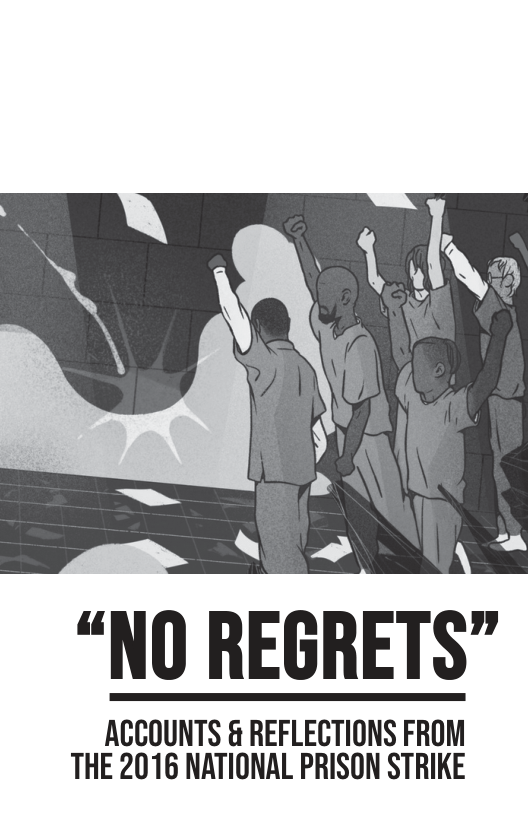
“NO REGRETS”
ACCOUNTS & REFLECTIONS FROM
THE 2016 NATIONAL PRISON STRIKE
Blackbird Publishing is a small anarchist publisher. Our catalog
primarily features works by folks who are currently or formerly
incarcerated, concerning the struggle against prisons, capital-
ism, white supremacy, and the State. We offer this free resource
as one small tool in the struggle for freedom.
In particular, we send our love and solidarity to the thousands
of prisoners across the state of Alabama, who are currently on
strike once again.
-October 2022-
A Brief Reflection on the Successes
and Failures of the 2016 Prison Strike
The 2016 prison strike took place on September 9%, the 45" anni-
versary of the Attica Uprising. According to most mainstream
media reports, an unprecedented 24,000 prisoners participated,
from between 20 to 40 different facilities. The chronology in this
text is incomplete, as reports of participation continued to reach
the outside weeks and even months later, but it gives a brief idea of
the diversity of facilities and tactics that were involved: men's and
women's facilities; black, white, brown, native; state, federal, and
immigration centers—all kinds of people and facilities worked
together to make this happen.
Initially called for by the Free Alabama Movement and Free Ohio
Movement, two organizations on the inside in their respective
states, the organizing for the strike began almost a year prior. I was
involved in this process on the outside in North Carolina. For a year
or more we coordinated with people on the inside, set up support
funds, pushed media outlets into covering the story, and made
plans for solidarity actions on the outside. “Let the Crops Rot in the
Fields," an essay and proposal for strike action written by FAM,
was a guiding document in our work. Rather than rally at state-
houses, or send petitions to politicians—activities that activists
had pushed for decades with little success—we centered our agita-
tion and organizing around the prisons themselves, where the
self-activity of the prisoners could drive the movement forward.
Groups on the outside like the Incarcerated Workers Organizing
Committee (IWOC), as well as dozens if not hundreds of smaller
radical publishing groups, books to prisoner programs, affinity
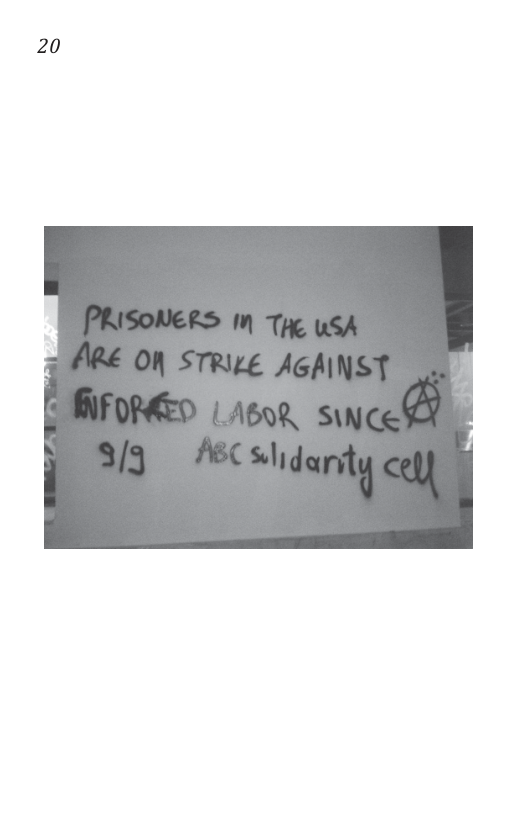
groups, Anarchist Black Cross (ABC) chapters, and abolitionist
crews formed the foundation of outside strike agitation and
solidarity. When September 9% finally arrived, thousands took to
the streets, staged noise demos outside prisons, dropped banners,
painted graffiti, sabotaged businesses that use prison labor, and
2
organized media campaigns to break through the walls of silence
that typically suffocate prisoner-led action. When the dust settled,
we spent months organizing phone zaps to discourage guards
from retaliating against strike leaders, and raised funds to help
prisoners going through periods of punitive segregation.
On the inside, rather than agree nationwide to a single central set
of demands, prisoners in their local facilities developed their own
messaging and demands based on their own experiences and
conditions, as well as their own tactical choices. Some prisoner
groups like FAM emphasized non-violence, while others rejected
this position in either ideology or practice. Rather than seeking to
centralize messaging or tactics, outside organizers encouraged
local leadership. Conditions tend to vary wildly from one facility to
the next, as do traditions of struggle—this decentralism allowed
for people respond most appropriately to their own situation,
while still acting in coordinated solidarity with the whole. Despite
the year of agitation, and some mainstream media descriptions,
most prisoners who participated were not members of formal
“political” groups like FAM, FOM, Jailhouse Lawyers Speak, ABC, or
IWOC, and thereby had to build their actions from already existent
networks of friends or gangs, or simply by spontaneous word of
mouth.
In some facilities this resulted in a high degree of ingenuity and
creative planning, and in other places prisoners expressed a regret
they hadn't prepared better. Better preparation and forward plan-
ning on the inside might also have opened more space and time for
outside groups to organize solidarity actions directly with family
members of prisoners. From my own perspective, this was also a
failure of the 2018 prison strike, which built off the 2016 strike’s
momentum but was called for and organized with far less lead-up.
time than the 2016 action. By contrast, family members seem to be
taking a leading role in the current strike under way in Alabama
prisons, which is beautiful.
A problem which was raised repeatedly in our correspondence
3
with prisoners in the year leading up to the strike was the fact that
only a small percentage of US prisoners actually have “jobs,” prop-
erly speaking. Some do work internally in prison workshops, kitch-
ens, or laundries, but in a crisis guards themselves are often able to
fill these positions, and only a small percentage perform labor
contracted by outside companies. This was a clear obstacle for an
action built initially around the idea of labor refusal.
Fortunately, the tactical diversity and organizational decentralism
of the 2016 strike allowed it to bypass this limit. Where a tradition-
al refusal to work was neither possible nor relevant, prisoners
chose other tactics that equally cost the State money or interfered
with the day-to-day management of the facility: peaceful hunger
strikes, sit-down protests in yards, the destruction of prison prop-
erty, and attacks on guards themselves. This strike both expanded
and exploded the definition of what a “labor strike” can mean.
‘This tactical flexibility is a mirror image of the anti-police riots and
occupations of the last ten years on the outside. Just as slavery was
a major theme in the George Floyd uprising, “prison slavery” was
also a central theme in the 2016 strike. In this context, the prison
came to be discussed less as a workplace than as a plantation. This
language led some to push for constitutional remedies that might
address the problem, for example by changing the language
around “involuntary servitude” in the 13* amendment. But this
was arecuperative dead-end. The logical trajectory here was not to
democratize prisons with paperwork, as some might propose for a
workplace; it was to empty and dismantle them. Certainly this
trajectory was also due in part to the strong element of anarchist
abolitionist participation in the strike.
While the strike was initially called as a one-day affair, the broad
diversity of tactics and demands meant that in some cases the
strike was short-lived, or fizzled completely, but in other places
continued to grow and evolve for weeks, with outside supporters
having no idea, given the lockdowns and mailroom censorship.
‘This was a somewhat predictable problem, perhaps with no solu-
4
tion: Communication barriers, especially in prison populations
with no cell phone access, made it difficult to know who was still
on strike, and what kind of solidarity and messaging they still
needed. Even had the initial call included a hard end-date, its likely
that individual facilities would have chosen to expand and contin-
ue their action anyway, to the ignorance of many of us on the
outside. This problem also made it difficult to utilize the click-bait
and image-driven nature of the 24-hour news cycle.
Evaluating the success of such a broad and varied day of action(s)
is difficult, and ultimately prisoners themselves must draw their
own conclusions. It can be said that in many cases prisoners’ local
demands were met, and in other cases retaliation was swift and
brutal; probably most common was some combination of the two.
As stated publically by prisoners from Jailhouse Lawyers Speak in
South Carolina, as well as anecdotally to me by many in North
Carolina and Alabama, resistance on the inside has contributed to
guard resignations and staff problems, resulting in states’ inability
to fill CO positions in the years that followed 2016, and further
heightening staff shortages later caused by Covid-19. This is not
dissimilar from the difficulties many cities have reported
post-2020 in finding personnel for their police departments.
That inability to staff prisons has at times made life worse for pris-
oners in the short term, but it has also been cited by state govern-
ments as the reason for thousands of people being released early
from their sentences, including here in NC.Itis an indirect line, but
aline nonetheless, that starts with prisoners making their facilities
ungovernable and ends with them being sent home. I believe this
approach, which centers prisoners’ own power and bases its strat-
egy off of broad, structural understandings of prisons, police,
racial capitalism, and the state, has borne far more fruit than
state-centered strategies that ignore prisoners’ own organizing
and instead narrow their focus to elections, legislation, o the
wording of the 13" amendment.
Regardless of its successes and failures, the 2016 prison strike was
5
undoubtedly the most concerted and geographically broad asser-
tion of prisoner power and “convict unity” in the last 50 years. It
raised the bar forever for what could happen when inside and
outside forces coordinate together, and for the most part the
collectives, publishing projects, and organizations that organized
solidarity on the outside continue to exist and evolve in some form
or another. Speaking personally, it was a period of struggle that
forever changed me and what I believe anarchists in North Ameri-
ca, both in and out of prison, are capable of.
As 1 type this, prisoners are once again refusing to work across
facilities in Alabama. I hope this zine finds its way through the bars
so that the courage of 2016 can inspire new waves of self-organiza-
tion and action on both sides of the walls.
Until Every Cage is Empty,
John
6
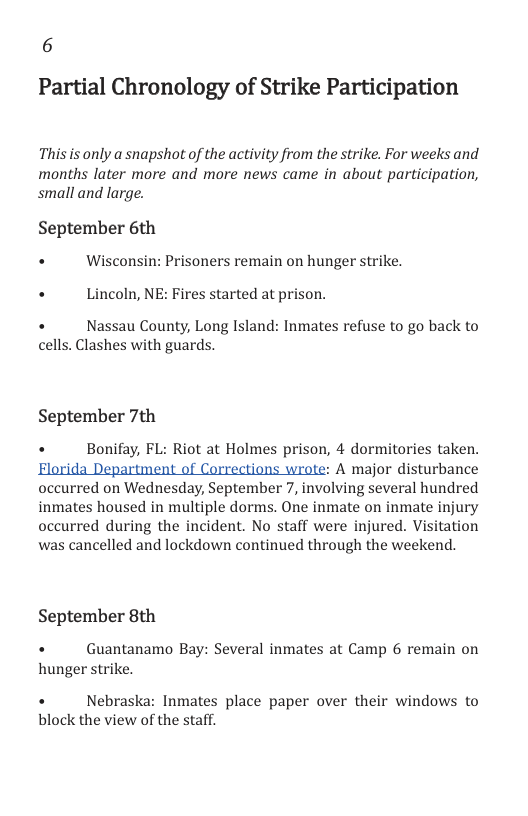
Partial Chronology of Strike Participation
This s only a snapshot of the activity from the strike. For weeks and
months later more and more news came in about participation,
small and large.
September 6th
+ Wisconsin: Prisoners remain on hunger strike.
+ Lincoln, NE: Fires started at prison.
+ Nassau County, Long Island: Inmates refuse to go back to
cells. Clashes with guards.
September 7th
. Bonifay, FL: Riot at Holmes prison, 4 dormitories taken.
Florida Department of Corrections wrote: A major disturbance
occurred on Wednesday, September 7, involving several hundred
inmates housed in multiple dorms. One inmate on inmate injury
occurred during the incident. No staff were injured. Visitation
was cancelled and lockdown continued through the weekend.
September 8th
+ Guantanamo Bay: Several inmates at Camp 6 remain on
hunger strike.
+ Nebraska: Inmates place paper over their windows to
block the view of the staff.
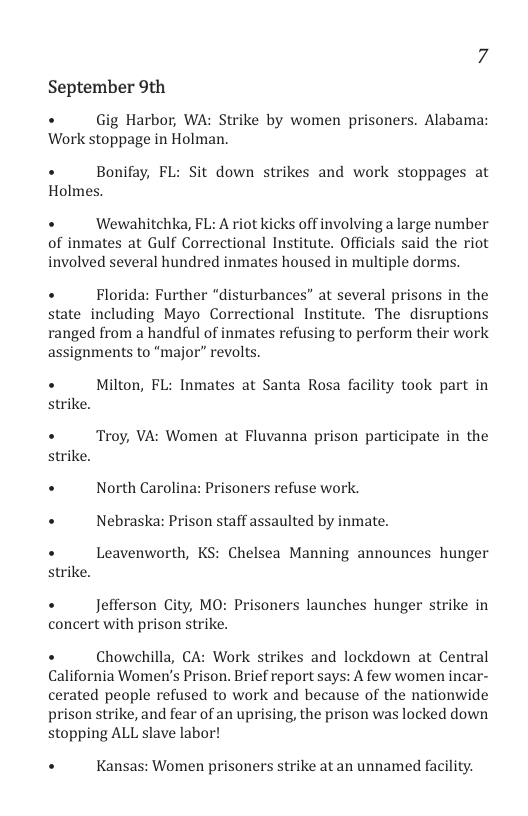
September 9th
+ Gig Harbor, WA: Strike by women prisoners. Alabama:
Work stoppage in Holman.
+ Bonifay, FL: Sit down strikes and work stoppages at
Holmes.
+ Wewahitchka, FL: A riot kicks off involving a large number
of inmates at Gulf Correctional Institute. Officials said the riot
involved several hundred inmates housed in multiple dorms.
+ Florida: Further “disturbances” at several prisons in the
state including Mayo Correctional Institute. The disruptions
ranged from a handful of inmates refusing to perform their work
assignments to “major” revolts.
+ Milton, FL: Inmates at Santa Rosa facility took part in
strike.
+ Troy, VA: Women at Fluvanna prison participate in the
strike.
+ North Carolina: Prisoners refuse work.
+ Nebraska: Prison staff assaulted by inmate.
+ Leavenworth, KS: Chelsea Manning announces hunger
strike.
+ Jefferson City, MO: Prisoners launches hunger strike in
concert with prison strike.
+ Chowchilla, CA: Work strikes and lockdown at Central
California Women's Prison. Brief report says: A few women incar-
cerated people refused to work and because of the nationwide
prison strike, and fear of an uprising, the prison was locked down
stopping ALL slave labor!
. Kansas: Women prisoners strike at an unnamed facility.
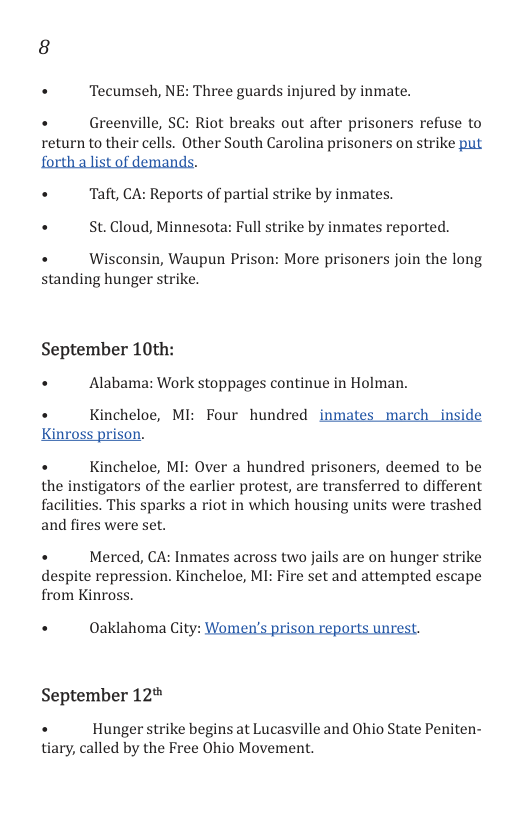
+ Tecumseh, NE: Three guards injured by inmate.
. Greenville, SC: Riot breaks out after prisoners refuse to
return to their cells. Other South Carolina prisoners on strike put
forth alist of demands.
« Taft, CA: Reports of partial strike by inmates.
+ St.Cloud, Minnesota: Full strike by inmates reported.
+ Wisconsin, Waupun Prison: More prisoners join the long
standing hunger strike.
September 10th:
+ Alabama: Work stoppages continue in Holman.
. Kincheloe, MI: Four hundred inmates march _inside
Kinross prison.
+ Kincheloe, MI: Over a hundred prisoners, deemed to be
the instigators of the earlier protest, are transferred to different
facilities. This sparks a riot in which housing units were trashed
and fires were set.
+ Merced, CA: Inmates across two jails are on hunger strike
despite repression. Kincheloe, MI: Fire set and attempted escape
from Kinross.
. ©Oaklahoma City: Women's prison reports unrest.
September 12
. Hunger strike begins at Lucasville and Ohio State Peniten-
tiary, called by the Free Ohio Movement.
9
. Columbia, SC: Confirmed strike at Broad River Correction-
alInstitution:
+ Florida: More prisoner uprisings broke out on Monday
night at Columbia Correctional, the fifth inmate uprising in less
than a week. About 40 inmates engaged in civil disobedience by
refusing officers’ orders and taking control of at least one dorm
Monday evening.
September 13th
+ Chelsea Manning ends hunger strike. Army agrees to
grand demands of gender transition surgery.
September 14th
« Support Prisoner Resistance reports prison lockdowns in
Arizona.
September 15th
. ailhouse Lawyers Speaks, a group in South Carolina facili-
ties, releases an update that declares that tensions and resistance
to guards have peaked to the point where many guards are start-
ing to quit.
September 16th
. Merced, CA: Supporters report another block joins hunger
strike.
10
Report from Inside the Kinross
Facility in Michigan
By Mangaaka Ade
A prisoner strike had been organized to take place on the morn-
ing of September 10, 2016. It was to be a peaceful demonstration
of solidarity, a statement of opposition to the oppression and the
egregious conditions we endure day and night at the Kinross
Correctional Facility in Michigan. Here, black mold creeps out
from the institutional-white, rust-proof paint intended to contain
it. It loiters around the bases of toilets, seeps from under floor
tiles and scales the walls of showers. Eight men pack cubicles
designed for six. The food tastes indigestible; some staf are
verbally abusive. These and a long list of other grievances made
the prison we call “Hiawatha” a ripe atmosphere for resistance.
There had already been several demonstrations of unity amongst
the incarcerated population. For instance, most of us prisoners
would line up together in the cellblock for 20 minutes when “yard
time” was called, in complete silence, then simultaneously
disperse when we decided we felt like going about our usual
routines. This was done three times, but the administration just
brushed it off.
When the 10th of September arrived, staff were clearly expecting
us not to show up to our work details, ready to report our
non-compliance to their bosses. It was obvious that one of their
inmate-pets had informed them of the strike.
Breakfast came and instead of hot meals, the staff handed out
brown paper bags containing a cold cheese sandwich, milk and
six duplex cookies. Clearly their way of showing displeasure in
our solidarity.
Shortly after returning from chow, I noticed out my cell window a
small assemblage of men on the common yard. Within minutes,
11
their numbers started to multiply. When they began to march
around the perimeter, I naturally felt compelled to hop off my
bunk and join them.
Out the doors I went. I stood with the crowd, applauding as more
and more men arrived. The throng grew fast, and in an hour, hun-
dreds of Hiawatha's population were out on the yard, chanting in
unison, "No justice, no peace!”
‘The Kinross facility had officially lost its treasured “control.”
Alist of demands, including better food and higher wages, was
served on the warden, who had come outside to watch, and a few
prisoners vehemently negotiated the terms with him.
‘The prison's authority had been curbed for several hours now.
Through the crowd, though, confused whispers could be heard
from men wondering what our end-game was. How long were we
going to protest? Guys were tiring and getting edgy.
‘The warden had gone back inside to consider the terms of our
negotiation. When he returned an hour later, he spread word that
he was reluctantly considering most of our demands.
Our negotiators shouted, “We won!”
‘Then we were instructed back into our units to be counted. I was
relieved to get back and relax, but my intuition warned me to stay
on my toes. I couldn't escape the question: Were they really going
to let us get away with taking control of their facility and making
demands?
Count was made, followed by an announcement that chow would
be brought to the units. When those same detestable sack meals
arrived, | sprang to my feet and frantically began packing my
property, hoping to keep it safe in the chaos to come. I told my
cubies, “Something is about to go down!" I knew the bag meals
meant the prison wasn't really ceding to us.
12
And just as | was saying it, we heard over the officers’ radios the
coded instruction, “1019! 1019!" The staff reacted like track
runners anticipating a starter pistol.
At once, they all abandoned their posts and made a dash for the
control center in the administration building. They even had
ATV's suddenly parked and available to rescue the staff who
couldn't retreat fast enough. It was comical to watch, but the situ-
ation was extremely serious.
Within minutes, we were alone without any supervision. Panic
ensued as everyone braced for the inevitable attack. Five minutes
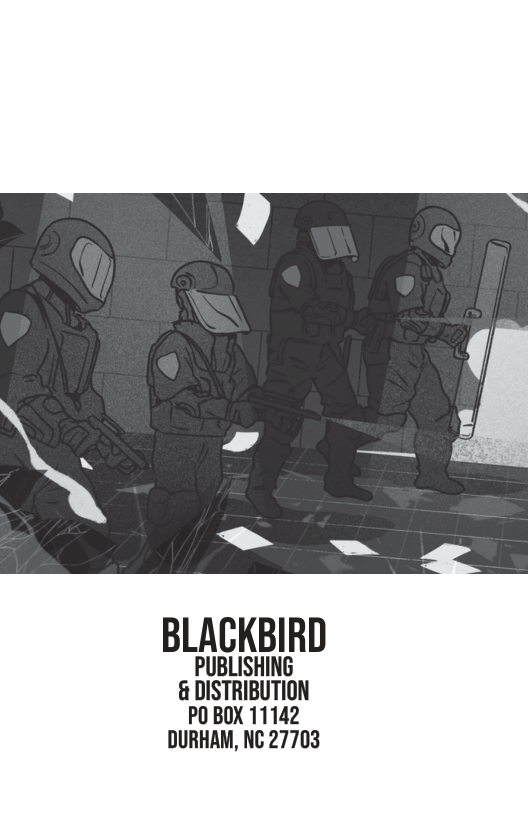
after the distress code was given, the ERT stormed the com-
pound. They formed groups of about 30 and marched toward
each unit in single-line formation.
Anyone attempting to exit got riddled with chemical rounds from
their anxious rifles. I continued packing as the spray consumed
the air. Guys started arming themselves with any material that
would cut, stab or be used as a bludgeon.
The ERT had us divided and trapped, savoring the revenge in
their grasp.
Some younger prisoners with appetites for destruction had been
rebelling, looting and demolishing as much as humanly possi-
ble—their own cells, the bathrooms, public areas, staff offices,
everything. Once the surveillance cameras were painted out or
papered over, many hold-outs gladly joined in the destruction. My
senses were overwhelmed. The smells of gas, paint, smoke and
burnt wires mingled to create noxious fumes. Then there was the
relentless din: yelling, glass shattering, sinks and urinals being
smashed to bits, music blaring, the fire alarm wailing, and steel
being rubbed against the concrete as men forged crude weapons.
Grasping the degree of chaos around me, I couldn't recognize the
place anymore. Everything that was not bolted down was in
ruins. Broken glass shimmered on the ground like precious
13
jewels. Prisoners’ files from the counselor's office were strewn
about the floor. The washing machine and dryer had been relocat-
ed through the front window and onto the yard.
The ERT entered one unit at a time, targeting specific prisoners
for immediate “ride-outs,” where they would be sent to other
prisons. Starting with A-Unit, they worked their way back to
H-Unit, where I was housed. It was 11:00 p.m. when an angry
man's voice barked through a bullhorn, “Get inside your assigned
cubes and on your bunks!”
This demand was instantly followed by two flash bangs that
caused those intending to resist to run for the safety of their
cubes. Red beams penetrated the smoke, searching for marks.
When the ERT reached the cubicles, they instructed each man to
touch the sky and walk backwards down the hallway out the back
door where a group of officers were waiting to cuff and identify
us. Men were seated on the ground and others were being
dragged away.
When I informed the officer of my name, she yelled, “This one's
riding!” Two officers promptly snatched my arms and dragged
me to the chow hall, now converted into a kind of processing
center.
There, a stubby officer wearing a sadistic-looking facial expres-
sion and holding a Taser looked me in the eye and yelled, “Strip!”
No privacy existed in this open space, and male and female staff
were everywhere. In no mood to be tased, I complied. Standing
there naked as he meticulously searched my clothing, I consid-
ered my ancestors on an American auction block.
After my personal effects were thrown in a junk pile, and Taser
Man was satisfied that I had no contraband up my ass, I was
ordered to dress, got chained, and lined up with other prisoners
waiting on the next bus out.
The restraints served as more razor wire binding me, cutting
14
deep into my ankles and wrist, and I knew it would be a long, mis-
erable ride ahead. I was sent to a maximum-security facility after
participating in the “disturbance,” and left there until they decid-
ed to relocate me again.
No regrets.
15
Accounts from Florida Facilities
To the surprise of supporters on the outside, Florida ended up being
one of the first and largest prison populations to participate in the
September prisoner-led mobilization. Starting with the massive
protest in Holmes C.1. on September 7, which left much of the prison
unusable from prisoners severely damaging the dorms, at least
nine additional prisons would report “disturbances” related to the
September events, ranging from major disturbances to smaller
sit-ins and mass work refusals. The following accounts are from
three different Florida facilities:
Account from Michael Skinner, FDOC prisoner at Taylor C.I.
I'm currently being held at Franklin C.1. because of the September
9th sit down. I was at Taylor Main Unit and have been there since
2009. We got wind of all of it pretty late but were able to pull
together at least half of the compound. Peacefully we conducted
ourselves and everyone who participated did not attend any
services, call outs, canteens, chow, or recreation - if it had some-
thing to do with the state, we didn't go. So, the Assistant Warden
Surles and Colonel Mitchell walked to every dorm and told us that
as long as we were peaceful they had no problem with what we
were doing! Good, or so we thought, a couple hiccups but nothing
major or violent. So, the cops that night in the dorm started mis-
treating everyone with verbal abuse and it progressed through
the weekend, with myself included on my way to a visit.
On Tuesday night, following Sept. 9th, the colonel had 30 extra
officers stay and work late to do a round-up of everyone involved.
Seven officers came to my house and took me to the laundry
room, cuffed me, and put 26 of us in confinement under investiga-
tion for illegal gang activity. I'm not nor have I ever been in a gang!
I'saw blacks, whites, Spanish - all kinds - but we all had one thing
in common: we were all a part of September 9th. We were viewed
16
as the orchestrators of it on the compound. On the 16th day in
confinement they walked us all up front in shackles and cuffs,
splitus up in 6 different groups, put us each on different vans and
took us directly to our new camps. And now I'm at Franklin. And
that's my September 9th story.
Some of us believe in what y'all are doing, so don't give up!
Account from Justin Curtis, FDOC prisoner at Gulf CI Annex
My name is Justin M. Curtis. I am 35 years old and have been
incarcerated in Florida for almost 14 years straight (minus a brief
2 month taste of freedom in late 2004) and the atmosphere
within the FL DOC has been extremely oppressive to say the least.
I've talked to other people who have done time in other statesand
heard of the unity on the part of inmates, but here in Florida that
is not the case. Down here the majority of inmates are out for self,
don't care if their fellow inmates have or have not, and the
violence, manipulation, and general disregard that occurs from
inmate [to] inmate is sad and frustrating. The guards and admin-
istration are taught psychological warfare/divide-and-conquer
tactics that they implement in plain view for us inmates to see,
but due to the majority outlook and selfishness there is never any
type of united effort on any front. Several of us talk about stand-
ing up, but that’s it... until September 9, 2016.
Like I said, the letter detailing the purpose of 9/9/16 came to be
on9/8/16. It was forwarded from another institution I had been
transferred from. I immediately took action, by passing the letter
around, going around and speaking to other inmates who had
influence and we agreed that on 9/9/16 we would all participate
in a "peaceful sit-down protest” At the time I was assigned to
work in food service. | was on the 2 am. wake up crew, and we
were the ones who would have to start the action. When the COs
came to get us up for work (we had already been up all night
17
anxious and excited), we refused to go.
The administration was already well aware of what was going to
happen and already had plans implemented to bring inmates
from the work camp to run the kitchen. So we were placed on
lockdown status. We watched out of our windows as they called
each dorm for chow. Not many people went, except for one dorm
where all the inmates went. That is when things got a bit more
tense. As | said, we had no time to plan o prepare, so a lot of
people weren't on the same page. Some dudes were arguing
“What are we standing up for?” and there were times of tension
within our dorm between us. But there was also a sense of unity
that I'd never seen. At a certain point the administration felt it
necessary to step down on us.
They came in, surrounded the compound with armed police
officers, came to our dorm and had us all face down on our bunks,
screaming at us through a bullhorn to “Get down!” they had guns
over usand totally took the whole thing out of hand. Overreaction
puts it very lightly...
After leaving our dorm, the Rapid Response Team (RRT) in full
riot gear headed to the “two man cell dorms;” where they rushed
in without warning, firing tear gas grenades and rubber bullets at
unsuspecting inmates. There were several people punished with
bogus Disciplinary Reports (DRs) which all said the same exact
thing, and several inmates were transferred to other facilities.
I received a DR for “Inciting a Riot” and have been on lockdown
since 9/10/16. 1 am now on Close Management (CM I) status,
where I will be on lockdown for at least 7-8 more months at
Suwannee C.I.
1 have no regrets at all besides that there wasn't any time to
prepare and have things work out different and perhaps even
effect a positive change within this corrupt, oppressive system.
But it was a learning experience and | am glad I participated and
took action regardless of the consequences...
18
Account from Christopher Reber at Franklin C.I.
I was at Franklin during the September protests and it wasn't a
complete stoppage but many did participate - much more than [
had predicted - and the prison's administration responded with a
partial lock-down of the prison and disciplinary action against
those participating. The average disciplinary action taken was a
loss of 30 days (or more) gain time and a loss of canteen access
for at least 30 days. While it was good to see prisoners come
together on an important issue, it was amazing to see people
outside of prison standing up for us. Thank you for your letter
and your support. Having support and a voice through people on
the other side of the wire is a prisoner’s most valuable asset.
Account from Julius Smith at Franklin C.1.
A good friend of mine handed me the print out he received from
you because he knew I had the drive and influence to unify and
inform inmates in my section of the prison. First it was the print
out of information about the riot in Attica’s state prison. Then he
showed me the 2nd print out informing us about the prisons
participating in the Sept 9th sit down.
Iread it to my dormitory, letting them know that we have people
on the streets who care and are fighting for our cause. Also, that
our efforts are not for nothing. The death of our movement is
inmates who think, “It won't make a difference anyway”
I explained how we had the power to make a change in mass
incarceration, ridiculous gain time percentages, and slave labor.
During the Sept. 9 protest, most of the young guys wanted to riot
and destroy the dormitories. I passionately protested. Things like
that only result in us getting hurt, shot with riot guns, pepper
sprayed, beat on and possibly facing more criminal charges... This
compound has already had 3 riots in 2016. Still the same corrupt
guards are employed. Still nothing has changed.
19
‘Those are the kinds of actions we need to steer clear of. It sends a
bad message that we are all savage animals that deserve to be
locked behind bars and segregated from our communities—a
stereotype that the media will advertise to voters and taxpayers.
‘This makes it almost impossible to get voters to petition on a bill
to kill mass incarceration. We need to make the public believe
that incarceration is a lot more negative than positive in this gen-
eration.
‘The institution had caught wind that something was brewing and
their first reaction was fear. The warden and his administration
walked through our dorms giving us constant lectures and
speeches acknowledging that he was aware of the protest. As long
as we kept it peaceful he wouldn't retaliate but i it got violent he
had a team ready for action. He stated that he felt like our protest
wouldn't affect change, that our people on the streets had to be
active for change. He believes that gain time should be lower and
that he doesn't believe we should be paid for our labor because
we get free food and housing.
1 believe you should get religious groups and gangs involved...
Muslims, Christians, Jewish, Bloods, Crips, Gangster Disciples,
Latin Kings, Aryans, Hell's Angles, etc. They are the forces of disci-
pline and unity. They have the power to make large groups of men
unite. Despite their different views and backgrounds, there's one
thing they agree on: It's us against them.
Hope for change of how they treat us is the power.
20
BLACKBIRD
PUBLISHING
& DISTRIBUTION
PO BOX 11142
DURHAM, NC 27703