No End in Sight (Life Imprisonment)
Web PDF • Imposed PDF• Raw TXT (OCR)







![AGING LIFERS In 1996 Clarence Givens was sentenced to 110 years in Wisconsin for selling less than three grams of heroin to an undercover informant. Because of prior nonviolent offenses on his record, the prosecutor was authorized to charge him under the state’s habitual offender law, which allows additional years to be added to a sentence based on prior convictions, regardless of the severity of the present offense. The sentencing judge referred to him as a “genocidal merchant of death” and cautioned him and others not to expect ... leniency from the courts if they persist in their vile behavior” He said he wished 1o send “a message to those struggling to raise their children in neighborhoods ruled by violence and drugs that the courts will deal harshly with those who drain the lifeblood of their neighborhoods.” Despite the high- blown rhetoric of the court, there is no evidence to support that sentencing Givens to 110 years in prison was necessary for either punitive or public safety reasons. Indeed, established research conducted well before Givens was sentenced, finds that as one seller is removed from the community through incarceration, a new one is frequently substituted so long as there is demand for drugs Since his arrival in prison, Givens developed prostate cancer, had two hip replacement surgeries, and, as a result of a botched second surgery, was confined to a wheelchair. During his 24 years of imprisonment, Givens remained steadily employed in various positions within the institution and routinely received the highest marks on his performance. He incurred few disciplinary records and was the quintessential model for other individuals in prison. As COVID-19 began its inevitable spread through the U.S. prison system, Givens, like thousands of others, asked for mercy in the form of release from prison to be home with his wife and family. But on November 13, 2020,Givens developed a high fever. His cellmate relayed the events of the day before his admission tothe hospital, writing: 20 The Sentencing Project *..the whole pod donated vitamins, some emergen-c vitamin tea...| love him like my own father and look out for him as best I can or would for my own... donit know what we would do if we [lost] him for he s a peacekeeper around here, he keeps the other inmates from fighting with each other and guides many of us when we are going down the wrong paths in here” Givens was admitted to the hospital the day after this note was sent and within 24 hours he was unconscious and breathing on a respirator. Clarence Givens passed away from COVID-19 on December 7, 2020. He was 68 years old In 2020, 61,417 people who are at least 55 years old were serving life sentences, part of a growing trend of elderly imprisoned Americans. In fact, the number of people in prison today who are age 55 or older has tripled since 2000. The tough-on-crime policies that expanded life sentencing, prolonged the time to review cases for possible parole releases, or abolished parole altogether, have accelerated the build-up as well# Between 1993 and 2013, the prevalence of individuals age 55-65 expanded by more than 150%. Today, people who are 55and older account for 12% of state prison populations. Even more troubling, elderly persons account for 30% of the life-sentenced population. Figure 6. Percent of Life Sentenced Population Who Are 55 and Older](no-end-in-sight-life-imprisonment-the-sentencing-project 20.png)









![APPENDIX: SURVEY INSTRUMENT Thank you for providing the following information about your state’s population of prisoners sentenced to: (1) life with the possibility of parole, (2) life without the possibility of parole, and (3) those sentenced to prison for a maximum of 50 years or more. If you have any questions as you complete this form, please be in touch with Ashley Nellis at anellis@sentencingproject.org or 202-628-0871. Your completed form can be emailed, faxed or mailed to our office at the address listed at the bottom of this form State: State Prison Population: as of SECTION 1: PERSONS SERVING LIFE WITH THE POSSIBILITY OF PAROLE A_Number of Persons 18 OR OLDER AT OFFENSE B Number of Persons UNDER 18 AT OFFENSE foTAL: foTAL: Total Currently 55 Years Old or Older: Total Currently 55 Years Old or Older: Male Male White: Afican American Hispanic Wwhite: African American: Hispanic other: other: Female Female White: Aftican American Hispanic Wwhite: Afican American Hispanic: other: other: crime of Com crime of Commitment A1 Degree Murder. A1 Degree Murder. 2 Degree Murder: 2 Degree Murder: Other Negligent Death (not lsted above): Other Negligent Death (not lsted above): Sex Offense Sex Offense hssaul/Aggravated Assault: hssautt, Aggravated Assault: Robbery/Aggravated Robbery: Robbery, Aggravated Robbery: Kidnappine; Kidnapping: Drug Offense: Drug Offense: Property Offense: Property Offense: Dther (not fisted above]: Dther (not fisted above]: No End in Sight: America’s Enduring Reliance on Life Imprisonment 39](no-end-in-sight-life-imprisonment-the-sentencing-project 39.png)
![SECTION 2: PERSONS SERVING LIFE WITHOUT THE POSSIBILITY OF PAROLE ‘A Number of Persons 18 OR OLDER AT OFFENSE foTAL: Total Currently 55 Years Old or Older: Male White: African American: Hispanic other: Female White: African American: Hispanic other: crime of Commitment A1 Degree Murder. 27 Degree Murder: Other Negligent Death (not lsted above): Kex Offense: hssaul/Aggravated Assault: Robbery/Aggravated Robbery: Kidnappine; Drug Offense: Property Offense: Dther (not fisted above) B Number of Persons UNDER 18 AT OFFENSE foTAL: Total Currently 55 Years Old or Older: Male White: Aftcan American: Hispanic other: Female White: African American: Hispanic: other: crime of Commitment A1 Degree Murder. 27 Degree Murder: Other Negligent Death (not lsted above): Kex Offense: hssautt, Aggravated Assault: Robbery, Aggravated Robbery: Kidnappine; Drug Offense: Property Offense: Dther (not fisted above]: 40 The Sentencing Project](no-end-in-sight-life-imprisonment-the-sentencing-project 40.png)

![ENDNOTES 1. This does not include those in jails, which brings the figure to two million. 2. See, for example: Vinter and Others v. United King- dom, App nos. 66069/09,130/10 and 3896/10 (July 92013) 3. Sered, D. (2019). Until we reckon: Violence, mass incarceration, and a road to repair. New York. The New Press. 4. We use the word "lifer” intermittently throughout this report to refer to individuals serving life sentences. We are cognizant and careful of the potential of “oth- ering” when it comes to applying terms to groups of people, particularly those who are incarcerated. For many people serving life sentences, the term ‘lifer" is not viewed as pejorative. Rather, itis a self-iden- tified label used with pride. Many “lifers’ groups” have emerged in prisons around the nation, named as such by the prisoners. Serving a life sentence is a point of distinction among prisoners generally, and aterm most prefer as an identity within the prison population. Indeed, these individuals have so far survived the most extreme sentence other than the death penalty and consider themselves to be “lifers" because of it 5. Gottschalk, M. (2016) Caught: The prison state and the lockdown of American politics. Trenton; Princeton University Press; Mauer, M. and Nellis, A. (2018). The meaning of lfe: The case for abolishing life sentenc- es. New York: The New Press. 6. National Institute of Justice (2016). Five things about deterrence. Washington, DC: Office of Justice Programs, U.S. Department of Justice. 7. Clear, T. (2018). The community justice ideal. New York: Routledge. 8. Mauer, M. (2003). The meaning of lfe: Long prison sentences in context. Washington, DC: The Sentenc- ing Project; Nellis, A. and King, R. (2009). No exit: The expanding use of life sentences in America. Wash- ington, DC: The Sentencing Project; Nellis, A. (2013). Life goes on: The historic rise in life sentences in America. Washington, DC: The Sentencing Project; Nellis, A. (2016). Stillife: America’s increasing use of life and long-term sentences. Washington, DC: The Sentencing Project. 9. See methodology for our operationalization of virtual life sentences. 42 The Sentencing Project 10. 1 12. 13 14, 15. 16, 17. 18 19 20 Seeds, C. (2019). "Life Without Parole Sentencing.” In Oxford Research Encyclopedia of Criminology and Criminal Justice. Oxford University Press; see also, Seeds, C. (2019). Historical modes of perpetual pe- nal confinement: Theories and practices before life without parole. Law & Social Inquiry 44(2): 305-332. Cullen, F. T, Lee, H.., Butler, L. C., and Thielo, A. J. (2020). Rehabilitation and redemption: Building a new corrections.” In, Cecelia Chouhy, Joshua C. Cochran, and Cheryl Lero Johnson, (Eds.) Criminal Justice Theory: Explanations and Effects (Advances in Criminological Theory. Vol 27: 309-335. New York: Routledge. Seeds, C. (2019). "Life Without Parole Sentencing.” In Oxford Research Encyclopedia of Criminology and Criminal Justice. Oxford University Press; see also, Seeds, C. (2019). Historical modes of perpetual pe- nal confinement: Theories and practices before life without parole. Law & Social Inquiry 44(2): 305-332. Prescott, J.J. Pyle, B. and Starr S. B. (2020). Under- standing violent-crime recidivism. Notre Dame Law Review, Vol. 95(4): 1643-98. This count does not include jails, which brings the total to two million. Ghandnoosh, N. (2014). Race and punishment: Racial perceptions of crime and support for punitive poli- cies. Washington, DC: The Sentencing Project. Van 2yl Smit, D. and Appleton, C. (2019). Life impris- onment worldwide: A global human rights analysis. Cambridge: Harvard University Press Vinter and Others v. United Kingdom, App nos. 66069/09,130/10 and 3896/10 [July 9 2013] Mauer, M. and Nellis, A. (2018). The meaning of life: The case for abolishing life sentences. New York: The New Press National Research Council (2014). The growth of incarceration in the United States: Exploring causes and consequences. Washington, DC: National Acad- emies; Spohn, 2014; Tonry, Michael (2014). Remod- eling American sentencing: A ten-step blueprint for moving past mass incarceration. Criminology & Public Policy, 13:503-533 Life with or without parole is not statutorily defined in Alaska’s criminal code, but the state allows sen- tences we identify as "virtual life” terms of 50 years or more.](no-end-in-sight-life-imprisonment-the-sentencing-project 42.png)


![74, 7s. 76. 77. 78, 79. 80. 81 82 83, 84, 85. 86. 87. 88. 89. Van 2yl Smit, D. and Appleton, C. (2019). Life impris- onment worldwide: A global human rights analysis Cambridge: Harvard University Press. Ghandnoosh, N. (2017). Delaying a second chance: The declining prospects for parole on a life sentence. Washington: DC: The Sentencing Project; McVey, C., Rhine, E, and Reynolds, C. V. (2018). Modernizing parole statutes: Guidance from evidence-based prac- tices. Minnesota: Robina Institute. Utah Office of Administrative Rules (2020). Utah Ad- ministrative Code. See, specifically, Rule R671-201-1, Original Hearing Schedule and Notice. Available: https://rules.utah gov/publicat/code/r671/r671-201 htm#TS. Utah Board of Pardons and Paroles. Decision Pro- cess Factors and Considerations. Available: https:// bop.utah.gov/index php/hearings-top-public-menu/ decision-factors. Ghandnoosh, N. (2017). Delaying a second chance: The declining prospects for parole on a life sentence. Washington: DC: The Sentencing Project; Henry, 2012 National Census of Women Who Are Incarcerated for Murdering their Batterers. https://law.stanford.edu/ projects/national-census-of-women-who-are-incar- cerated-for-murdering-their-batterers/ Nellis, A. (2013). The lives of juvenile lifers: Findings from a national survey. Washington, DC: The Sen- tencing Project; Sered, D. (2019). Until we reckon: Violence, mass incarceration, and a road to repair. New York. The New Press. Those under PL. Section 125.25(5). Author interview with Smith, November 16, 2020. Author interview with Smith, November 16, 2020. Lempert, L. B. (2016). Women doing life: Gender, punishment, and the struggle for identity. New York: New York University Press: p. 13. Seeds, C. (2017). Bifurcation nation: American penal policy in late mass incarceration. Punishment & Soci- ety 19(5): 590-610. Vinter and Others v. United Kingdom, App nos. 66069/09, 130/10 and 3896/10 [July 9 2013] Gutowski, C. (2020, May 27). Once labeled irre- deemable, long-imprisoned Chicago man relishes second chance, hopes his case paves way for others during pandemic. Chicago Tribune. Accessed January 10, 2021: https://www.chicagotribune.com/ investigations/ct-sherman-morisette-prison-pa- role-20200527-k7ub3ba3dszh75bSkauwlodadmy-sto- ry.html Author interview with Hudson on January 10,2021 Flanagan, T. (1981). Dealing with long-term confine- ment: Adaptive strategies and perspectives among long-term prisoners. Criminal Justice and Behavior 8 201-222. Dolovich, S. (2021). Mass incarceration, meet COVID-19. University of Chicago Law Review Online. UCLA School of Law, Public Law Research Paper No. 21-02. Accessed January 18, 2021. https://ssrn. com/abstract=3766415 Huebner, B and Bynum, T. S. (2008). The role of race and ethnicity in parole decisions. Criminology 46(4): 907-938 Reamer, F. G. (2017). On the parole board. Reflections on crime, punishment, redemption, and justice. New York: Columbia University Press. Reamer, F. G. (2017). On the parole board. Reflections on crime, punishment, redemption, and justice. New York: Columbia University Press. Erez, E. and Tontodonato, P. (1990). The effect of victim participation in sentencing on sentencing outcomes. Criminology Vol 28(3): 451-474; Morgan, K. and Smith, B. (2005). Victims, punishment, and parole: The effect of victim participation on parole hearings. Criminology and Public Policy 4(2): 333- 360. Morgan, K. and Smith, B. (2005). Victims, punish- ment, and parole: The effect of victim participation on parole hearings. Criminology and Public Policy 4(2): 333-360. Sered, D. (2019). Until we reckon: Violence, mass incarceration, and a road to repair. New York. The New Press. Sered, D. (2019). Until we reckon: Violence, mass incarceration, and a road to repair. New York. The New Press. Beckett, K. (2018). The politics, promise, and peril of criminal justice reform in the context of mass incar- ceration. Annual Review of Criminology 1: 235-259. Gordon, B. (2018). As prison p http://theink nyc/pris- ons-age-fight-parole-heats/. Steinberg, L. (2007). Risk taking in adolescence: New perspectives from brain and behavioral science Current Directions in Psychological Science, 16, 55-59: p. 56. 91 92 93. 94, 9. 9. 97. 98. 9. 100, No End in Sight: Americas Enduring Reliance on Life Imprisonment 45](no-end-in-sight-life-imprisonment-the-sentencing-project 45.png)
![No End in Sight: America’s Enduring Reliance on Life Imprisonment Ashley Nellis, Ph.D. February 2021 THE Related publications by The Sentencing Project: ENTENCIN! ,s,m”Ec-f S + Still Life: America’s Increasing Use of Life and Long-Term Sentences RESEARCH AND ADVOCACY FOR REFORM (2017) + Delaying a Second Chance: The Declining Prospects for Parole on Life Sentences (2017) + Long-Term Sentences: Time to Reconsider the Scale of Punishment (2018) 1705 DeSales Street NW, 8th Floor . S 5 Weshington D 20036 (r;(;g]sxt Step: Ending Excessive Punishment for Violent Crimes Tel: 202 6280871 Fax 2026281091 sentencingproject.org endiffeimprisonment org The Sentencing Project works for a fair and effective U.S. justice system by promoting reforms in sentencing policy, addressing unjust racial disparities and practices, and advocating for alternatives to incarceration](no-end-in-sight-life-imprisonment-the-sentencing-project 46.png)



AMERICA’S ENDURING
RELIANCE ON LIFE
IMPRISONMEN
THE
SENTENCING
PROJECT
RESEARCH AND ADVOCACY FOR REFORM
:‘:‘ SENTENCING
£2%9 PROJECT
RESEARCH AND ADVOCACY FOR REFORM
For more information, contact:
The Sentencing Project
1705 DeSales Street NW
8th Floor
Washington, D.C. 20036
(202) 628-0871
sentencingproject org
twitter.com/sentencingproj
facebook com/thesentencingproject
2 The Sentencing Project
This report was written by Ashley Nellis, Ph.D., Senior Research
Analyst at The Sentencing Project. Savannah En, Research Fellow,
provided significant research assistance for this report.
The Sentencing Project works for a fair and effective U.S. criminal
justice system by producing groundbreaking research to promote
reforms in sentencing policy, address unjust racial disparities and
practices, and to advocate for alternatives to incarceration
Copyright © 2021 by The Sentencing Project. Reproduction of this
document in full or in part, and in print or electronic format, only by
permission of The Sentencing Project.
Findings and Recommendations 4
1. Introduction 8
11, Life in Context 1
Il. The Facts of Life 13
A. Long-term Trends 13
B. Recent Trends 15
C. Race and Gender 18
D. Aging Lifers 20
E. Crime of Conviction 2
IV. Problems with Life Imprisonment 25
A. Aging Out: Young and Old 25
B. Redemption and Reform 27
C. Racial Prejudice 28
D. Parole Board Decisions 29
E. Intimate Partner Violence 30
V. Life Lessons: Where Do We Go From Here? 32
A. Abolish Life Without Parole 32
B. Impose a 20-Year Cap on All Life Sentences Except in Rare Circumstances 34
C. Accelerate and Broaden Release Opportunities 34
D. Reorient Victim & Community Involvement Toward True Healing 35
VI. Methodology and Notes 37
VI Appendix: Survey Instrument 39
VIl Endnotes 42
No End in Sight: America's Enduring Reliance on Life Imprisonment 3
FINDINGS AND RECOMMENDATIONS
Before America’s era of mass incarceration took hold in the early 1970s, the number
of individuals in prison was less than 200,000. Today, it's 1.4 million;' and more than
200,000 people are serving life sentences - one out of every seven in prison. More
people are sentenced to life in prison in America than there were people in prison
serving any sentence in 1970.
Nearly five times the number of people are now serving
life sentences in the United States as were in 1984, a
rate of growth that has outpaced even the sharp
expansion of the overall prison population during this
period.
The now commonplace use of life imprisonment
contradicts research on effective public safety strategies,
exacerbates already extreme racial injustices in the
criminal justice system, and exemplifies the egregious
consequences of mass incarceration.
In 2020, The Sentencing Project obtained official
corrections data from all states and the Federal Bureau
of Prisons to produce our 5th national census on life
imprisonment.
KEY FINDINGS
+ Onein 7 people in U.S. prisons is serving a life
sentence, either life without parole (LWOP), life with
parole (LWP) or virtual ife (S0 years or more), totaling
203,865 people;
+ The number of people serving life without parole
— the most extreme type oflife sentence — is higher
than ever before, a 66% increase since our first
census in 2003;
+ 29 states had more people serving life in 2020 than
just four years earlier;
+ 30%of lifers are 55 years old or more, amounting to
more than 61,417 people;
4 The Sentencing Project
+ 3972 people serving life sentences have been
convicted for a drug-related offense and 38% of
these are in the federal prison system;
+ More than two-thirds of those servingife sentences
are people of color;
+ Onein 5 Black menin prisonis serving alife sentence;
+ Latinx individuals comprise 16% of those serving
life sentences;
+ Oneof every 15 women in prison is serving lfe;
+ Women serving LWOP increased 43%, compared to
229% increase among men, between 2008 and 2020;
+ The population serving LWOP for crimes committed
as youth is down 45% from its peak in 2016;
+ 8,600 people nationwide are serving parole-eligible
life or virtual life sentences for crimes committed
as minors.
The unyielding expansion of life imprisonment i recent
decades transpired because of changes in law, policy
and practice that lengthened sentences and limited
parole. The downward trend in violence in America that
continues today was already underway when the country
adopted its most punitive policies, including the rapid
expansion of life sentences. The increase in life
imprisonment and the growing extremity of our criminal
legal system was largely driven by policies enacted in
response to public fears about crime, often rooted in
sensationalized media stories rather than the actual
prevalence of violent crime in most communities.
Yet debate around the utility of long prison sentences
often ends with the mention of violent crime, even though
‘we know thatife imprisonment does not make us safer.
The vast majority of people "age out” of criminal conduct
by adulthood. Lengthy prison terms hold people well
after their risk of committing a new offense becomes
minimal.
Inthis report, we reveal for the first time that 30% of the
life-sentenced population s 55 or older. The imprisonment
of an aging population has become a fiscal and
humanitarian crisis the country must confront. The
urgency of this crisis grows ever greater as the COVID-19
pandemic disproportionately jeopardizes the lives of
older Americans in prison. Reoffending by persons
released after serving long terms is rare, making the
need for expediting releases for older lifers the only
humane public health and public safety approach
Racial and ethnic disparities plague the entire criminal
justice system from arrest to conviction and is even
more pronounced among those serving life sentences.
One in § Black men in prison is serving a life sentence
and two thirds of all people serving lfe are people of
color. An abundance of scholarship finds evidence of
racial and ethnic disparities resulting in harsher
sentencing outcomes because of race. Elevated rates
of Black and Latinx imprisonment are partly caused by
higher levels of engagement in violent crime, but are
worsened by the racially disparate impacts of heavy-
handed policies initiated during the 1980s and 1990s.
Communities that are under-resourced and over-punished
need greater investment in evidence-based solutions
that interrupt crime at its root. Public investments for
supporting youth, ensuring access to medical and mental
health care, expanding living wage employment
opportunities and ensuring affordable housing are a
better use of public resources than lifelong imprisonment.
Lengthening prison sentences produces diminishing
returns on public safety and robs struggling communities
with necessary resources to fend off violence in the first
place.
Despite a growing awareness that ratcheting up prison
sentences, not crime trends, fueled mass incarceration,
many sentencing reform proposals fall short of
addressing this head on. Indeed, changes directed at
scaling back punishments for low-level and nonviolent
crimes are favored because they confront low-level and
nonviolent crimes; this emphasis has had the unintended
consequence of further legitimizing the utility of long-
term imprisonment.
Toreverse course on the natioris 40-year prison buildup,
we must scale back all punishments and evaluate
individuals based on their current behavior and prospects
for a crime-free life upon release. Since more than half
of the people in prison are serving sentences for a crime
of violence, we must not only reevaluate appropriate
sanctions in response to violent crime, but also how to
prevent violent crime in the first place.
Some states are beginning to address overly long prison
terms through second-look legislation. In 2018, California
passed a law to allow prosecutors to seek sentence
modifications from judges if sentences are believed to
be excessive. In 2020, the Council of the District of
Columbia passed legislation that provides people who
were under 25 at the time of their offense and sentenced
1o a long term, the chance to petition the court for
resentencing and early release after 15 years. At the
federal level, Senator Cory Booker of New Jersey
introduced the Second Look Act in 2019 which would
allow a federally incarcerated person to petition the court
for a sentence modification after 10 years.
These are important first steps. More must be done.
RECOMMENDATIONS
Abolish Life Without Parole
Sentences of life without the possibility of parole (LWOP)
are virtually unheard of in the rest of the world. They are
considered antithetical to personal transformation, the
primary goal of many other corrections systems. Even
more, they violate fundamental principles of human
dignity.? Instead of serving the interests of justice, LNOP
unnecessarily burdens systems with the heavy cost of
housing, feeding, and providing medical care for the
more than 55,000 people. This disproportionately elderly
population must ive in institutions not well designed to
care for them.
The elimination of LWOP will recalibrate all sentences
underneath it. Public perceptions of incarceration
minimize the negative impact of a 5- or 10-year sentence
No End in Sight: America's Enduring Reliance on Life Imprisonment 5
on an individual when compared to the extremes of a
life sentence. Creation of a more fair and just system
depends on ending all extreme penalties.
Limit Al Life Sentences to 20 Years Except in Rare
Circumstances
As with the country's use of LWOR, virtually unheard of
elsewhere in the world, imprisonment beyond 20 years
is a predominantly American phenomenon. Life
sentences have been part of the American criminal legal
system for decades, but only in the age of mass
incarceration have they become part of the mainstream.
In order to sensibly confront extreme sentencing, reduce
mass incarceration, and redistribute resources to
communities that would benefit from robust crime
prevention, we recommend a 20-year maximum for all
life sentences. We arrive at this recommendation after
witnessing the continued expansion of America’s zeal
for ever-harsher punishment while decades of practical
experience, data, and social science support more
restorative approaches.
If, after 20 years of imprisonment, it is clear that the
individual continues to engage in conduct that would
put the public at risk if they were released, a period of
civil confinement could be considered by a court
Individuals potentially subjected to such confinement
would be entitled to strict due process rights and legal
representation. This is similar to the practice in Norway,
often held as the gold standard in corrections. The goal
here would still be rehabilitation and reintegration, not
exclusion, and mandatory periodic review to assess
readiness for release would continue.
Accelerate and Expand Release Opportunities
America suffers from a broken parole system, orin some
jurisdictions, no parole system at all. Injurisdictions with
parole, the review process is mired in political jockeying
and often manipulates victim experiences to secure a
parole denial. A just parole system would operate
independently from the politics of the executive branch
both in the ultimate decision to release an individual, as
well as the composition of the parole board. The board
should be composed of professionals with expertise in
social work, psychology, the law, and corrections. Crime
of conviction should not be the determining factor in
the decision of the parole board. The focus of the parole
6 The Sentencing Project
board hearing should be on the person's development
while incarcerated, current public safety considerations,
and identifying what supports are needed to ensure
success after release.
States should also adopt "second look” policies that
reconsider the appropriateness of continued incarceration
given the passage of time and changed circumstances
within the individual. Beginning this review at 10 or 15
years aligns the U.S. with the intemational community
and the American Law Institute, a national nonpartisan
body of legal experts. It should not take the corrections
system more than 20 years to empower an individual
with the skills necessary to live crime-free after release.
Reorient Victim and Community Involvement
Toward True Healing
In its present orientation, the justice system — and
prosecutors specifically — employ victim testimony from
individuals at high risk of retraumatization in order to
obtain tough sanctions for the defendant. Survivors are
not provided with the tools and resources sufficient to
cope with the emotional, physical, and financial effects
of having experienced crime. A reorientation of the role
of victims requires investing in restorative and community
justice models that heal the harm caused by violence
attheir root, creating a system that is "survivor-centered,
accountability-based, safety driven, and racially
equitable”* Experts in this space know that we are all
safer when we upliftvictims, hold everyone accountable
fortheir actions, and do so with empathy and compassion;
not assume victims or communities are well-served by
long-term imprisonment.
Naomi Blount Wilson is a Commutations Specialist for the Pennsylvania Board of Pardons,
the arm of the state that hears clemency pleas. She knows what's involved in going before the
pardon board, having successfully done so in 2019 after serving 37 years of a life-without-pa-
role (LWOP) sentence for a 1982 homicide in which she played an indirect role. Blount Wilson
i one of only two women serving life whose sentences were commuted in the past two de-
cades. Pennsylvania Lieutenant Governor John Fetterman hired Blount Wilson and another
former lifer to assist as a liaison between his office and prisoners shortly after her release.
Photo Credit: Joshua Vaughn
No End in Sight: America's Enduring Reliance on Life Imprisonment
INTRODUCTION
Life sentences are the lifeblood of mass incarceration.
Pennsylvania is a good place to begin a discussion about
life sentences in America. The state is emblematic of
the political gamesmanship that has been at play in
administering justice and mercy for many decades. As
a result, the state holds the second highest number of
people serving life sentences — 8,242 individuals — both
inthe country and the world. Two thirds have no chance
for release other than by a rare commutation by the
governor. Entire prisons are devoted to housinglifers in
Pennsylvania, a sentence frequently termed “death by
incarceration.”
The commonplace use of life imprisonment i the U.S.
places it at odds with practices in other industrialized
nations. The United States incarcerates people for life
at a rate of 50 per 100,000, roughly equivalent to the
entire incarceration rates of the Scandinavian nations
of Denmark, Finland, and Sweden Fifteen percent of
people in U.S. state and federal prison are serving life
terms.
Life sentences are the lifeblood of mass incarceration,
particularly given their dramatic growth in recent decades,
and there are good reasons to eliminate the punishment
entirely. Their mainstream use in the American justice
system, having far exceeded the crimes for which they
were once intended, deprives people of their dignity and
perpetuates a system of extreme punishment across
the entire sentencing spectrum.
Despite a natural impulse to believe that applying ever-
harsher punishments will act as a deterrent, this is not
the case. Most people considering whether to commit
crime do not think they will be caught in the first place
and have little knowledge of the severity of punishment
for particular crimes. A sentence of 40 years will not
deter aperson any more so than a sentence of 20 years,
especially if the individual does not believe he or she
will even be caught. Certainty of apprehension, rather
8 The Sentencing Project
than severity of punishment, is a more powerful influence
on the decision to commit crime.® Because of the nation’s
preference for the latter, state and federal prisons now
face a crisis of managing a growing population of elderly
prisoners who are costly to house, feed, and provide
medical care for — but even more important, who pose
no serious threat to public safety. During the current
COVID-19 pandemic, the immediate release of elderly
lifers should be a priority
Beyond the current public health crisis, states and the
federal government should implement a 20-year
maximum to prison terms, except n rare circumstances.
Funds no longer directed at excessive incarceration
could be positively invested in disadvantaged
communities with lacking sufficient economic and public
health support to improve both social outcomes and
public safety. Americas misguided investmentin mass
incarceration has worsened life in the poorest
communities and made these vulnerable communities
more prone to crime, not less. The path to strengthening
communities calls for a robust reinvestment of the
dollars and ives previously wasted on massincarceration.”
Enacting a 20-year cap on life sentences in most cases
could reverse the tough-on-crime policies debunked by
years of social science. This cap would recalibrate all
sentences downward, leading to substantial reductions
inincarceration and producing a more humane, effective,
just, and merciful system.
During the COVID-19 pandemic,
the immediate release of elderly
lifers should be a priority.
In an evolved criminal legal system, far fewer people
would be in prison, and those who were imprisoned
would not stay nearly as long as they currently do. When
incarceration is required, the experience should be
devoted to preparation for release. A comprehensive
plan should be devised early on with the expectation
that individuals will be reintegrated and become
productive members of society. This is the successful
approach used by many other countries
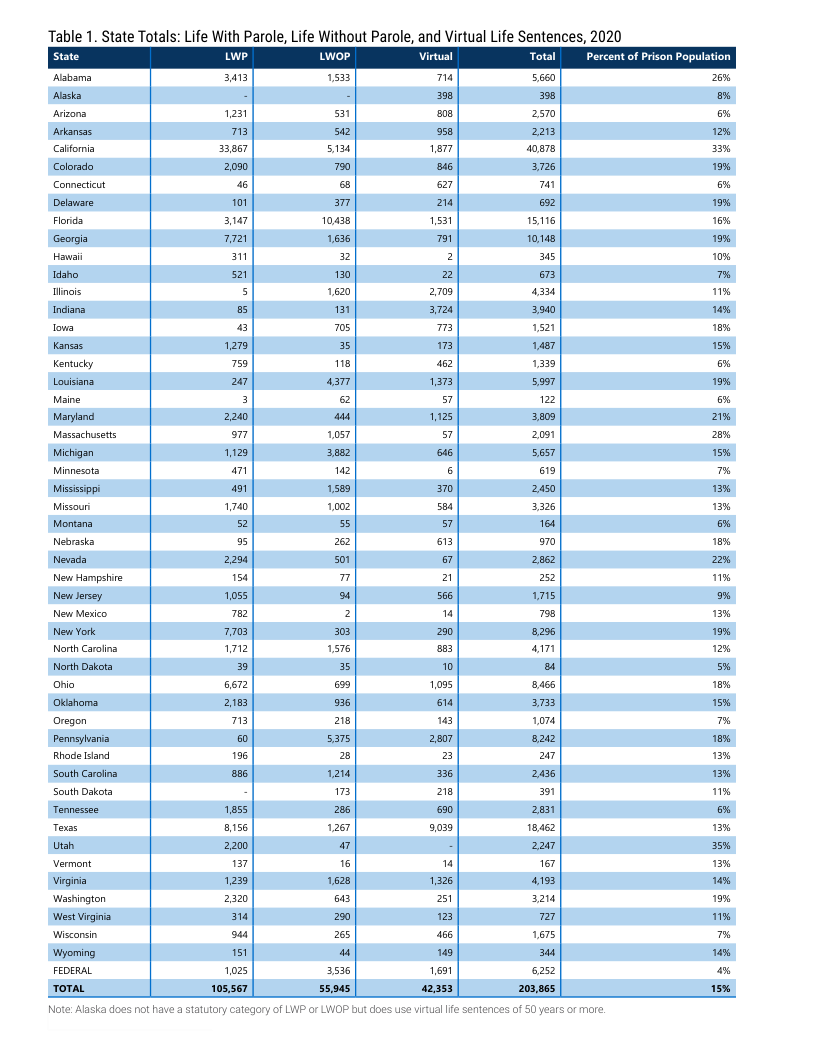
In 2020, The Sentencing Project undertook its fifth
census® of people who have been sentenced to life.
Table 1 provides state and federal counts of those serving
life without the possibility of parole (LWOP), life with a
possibility for parole (LWP), and virtual (or “de facto”)
life, sentences of 50 years or longer before an opportunity
for parole.? During the first eight months of 2020, we
obtained overall counts (as of January 1, 2020) of
persons serving time for each of these three life sentence
types. We also obtained disaggregated counts of lifers
by race, ethnicity, gender, juvenile status at the time of
the offense, and crime of conviction. For the first time,
our survey also captured counts of people serving LWP,
LWOP, and virtual life sentences who are now elderly
(age 55 or older at the time of the survey). We received
data from all jurisdictions to produce the summary
results in the following table.
No End in Sight: America's Enduring Reliance on Life Imprisonment 9
Table 1. State Totals: Life With Parole, Life Without Parole, and Virtual Life Sentences, 2020
State wp Lwop Virtual Total | Percent of Prison Population
Aabama 3413 153 71 5650 2%
Asska = > £ 3 o
Arizona 1231 s Ed 251 o
Aransas 3 e £ 201 2%
Galformia 3867 st 1877 0878 3%
Colorad 205 0 e 378 19%
Comnecticut 3 & &1 " %
Delaare 0 Bl 2 £ 9%
Florida 147 10438 1531 15116 6%
Georga 7721 163 1 10148 19%
[ am 2 2 s 10%
Idsho s 130 2 o ™
tinois s 1620 2700 a3 %
Incians 3 ) 374 330 1%
toua s 7o ™ 1521 0%
Kansas 1219 s s 1487 15%
Kentucy 759 118 w2 1339 o
Losisiana 27 a3 1373 5997 19%
Maine 3 & s 2 o
Maryland 2200 s 125 3809 2w
Massachusets o7 1057 st 2091 2%
Michigan 1129 32 sie sest 15%
Minnezots an 2 5 619 ™
Missssiopi s 1589 B 2450 %
Wissour: 1740 1002 sa 3325 %
Montana s s s 164 %
Netraska a5 % o E 8%
Nevada 225 so1 @ 2882 2%
New Hampstire 150 7 2 = e
New ersey 1055 o ses. 1715 %
New Mesico 7 2 " 758 %
New York 7703 Es 20 8205 19%
North Carolina 1712 1576 El am 2%
North Dakota = s 0 P %
ohio G672 £ 1055 sas5 0%
Okishoma 2183 o5 1 3 15%
Oregon 3 218 143 107 ™
Permnsyhania @ 5375 2807 s 0%
Rhode Isand 196 2 2 21 %
South Carolina a6 121 6 25 %
South Dakota ) 21 ) R
Tennesiee 1855 26 0 2831 o
Tes aise 1267 9039 18482 %
Uah 2200 a 2207 %
Vermant 1 16 u 16 %
Virginia 1239 1628 1326 a1 1%
Washington 230 o 1 3214 19%
West Virginia 314 20 2 El i)
Wisconsin 44 265 56 1675 ™
Wyoming 15 “ 14 u 14
FeDERAL 1025 3535 1691 6252 ax
ToraL 105567 s595 42353 203365 1%
Note: Alaska does ot have a statutory category of LW
or LWOP bt does
se virtual e sentences of 50 years or more
LIFE IN CONTEXT
The U.S. has not always relied on life sentences as
heavily as it does now. Life sentences have been a part
of our corrections systems since the start, but only in
recent decades did it become the expectation that “life
means life" The founding of our corrections system
in the early 1800 was driven by a belief that wayward
individuals could be "saved” from permanent criminality
through a functional corrections system.™
Our prisons were initially designed with a focus on
reformation, correction, and reintegration, at least
theoretically if not in practice."? Today, our system of
"correction” has redefined itself as one of exclusion with
very little emphasis on rehabilitation. There is too little
accountability for today's system to show that it is
providing effective rehabilitation programs and services
for individuals in its care. When confronted with high
reoffending rates, officials fault the formerly incarcerated
and not the lack of sufficient programming to support
rehabiltation while people are in prison and/or reentering
the community. This cycle disproportionately impacts
people and communities of color.
Just as life sentences are not what they used to be, the
parole process is not as it used to be either. Politicians
have become increasingly responsive to public fears
about crime, distorted by media portrayals, rather than
reflective of the true prevalence of crime. Inreality, violent
crime has been declining for nearly three decades and
is now half its peak from the early 1990s.
Most recipients of life sentences have committed acts
of violence, which calls for great care in determining
their readiness for release. Professionalized parole
boards, judges, and sentencing review boards can be
effective in identifying those who are prepared to return
to the community. Despite understandable concerns
about reoffending, longitudinal studies suggest that
persons convicted of violent offenses are not any more
likely to commit another violent crime than persons
convicted of nonviolent offenses. In fact, release from
alife sentence for homicide yields recommitment rates
for a new homicide that are astonishingly low and these
individuals are less likely to commit any act of violence
than other individuals released from prison.'*
Before the era of hyperincarceration took hold, the
number of individuals in prison was less than 200,000
Today it's 1.4 million," with more than 200,000 people
serving life sentences alone. One in 7 people in prison
is serving a life sentence. There has been aremarkable
shiftin our society's willingness and even eageress to
apply heavy punishments in the name of deterrence, and
this applies even more so to people of color."* Extreme
punishment for punishment's sake is now a hallmark of
the justice system with little evidence that such an
approach produces better public safety outcomes.
As states cope with the consequences of the 40-year
incarceration buildup, modest sentencing reforms are
underway to scale back prison populations. The federal
Extreme punishment for punishment's sake is now a hallmark of
the justice system with little evidence that such an approach produces
better public safety outcomes.
No End in Sight: America’s Enduring Reliance on Life Imprisonment 11
system, too, is grappling with an overly large prison
population as a result of draconian sentences imposed
mostly on people with drug convictions. The gradual
downward tick of the prison population since 2009 is
the result of successful efforts focused on releasing
and diverting those convicted of mostly low-level crimes
that exclude people convicted of violence and serving
longer prison terms. Reforms at the low end of the
punishment scale are commendable and necessary, but
they alone will not make a meaningful dent in mass
incarceration. A surgical focus on reducing sentences
for those convicted of nonviolent crimes leaves
untouched the sentences of more than half the people
in prison, including those servinglife imprisonment. Until
we mitigate the pervasive use of life and “lfe-like” terms
as a sentencing response, progress toward a
proportionate justice system will remain out of reach.
Life sentences, particularly the most extreme of these
types (LWOP), re oftentouted as the humane alternative
tothe death penalty. Yet many of the problematic aspects
of the death penalty are also applicable to ife sentences.
‘The legal scrutiny bestowed on the death penalty should
also encompass sentences so long that they cannot be
outlived. For example, legitimate doubts exist about the
accuracy of convictions that have ended with a death
sentence. As of yearend 2020, 173 people had been
exonerated. These errors raise serious questions about
the legitimacy of all sentences, but mechanisms for
legal review are not built in for life sentences as they
are for death sentences
Other industrialized nations view life sentences, like the
death penalty, as immoral and unethical.'® Consider a
key decision by the European Court of Human Rights in
2013. Inthe case of Vinter and Others v. United Kingdom,
the Court essentially barred the imposition of life without
parole sentences in member nations."” Based on the
principle that all prisoners should have the “right to hope;”
the decision requires that individuals who have
transformed themselves in prison and have atoned for
the harm they have caused should be considered for
release.
12 The Sentencing Project
The Vinter case is remarkable because of the gruesome
nature of the crimes committed by the three plaintiffs.
In Vinter's case, he had already been released twice
before from prison for serious crimes before committing
his third serious offense. Despite the severity of these
crimes, even these individuals were deemed by the court
to be capable of reform. ™ The concerns for upholding
human dignity and opportunities for transformation
prioritized by other nations, even for the most serious
crimes, contradict the unmitigated harshness of the U.S.
criminal legal system
THE FACTS OF LIFE
LONG-TERM TRENDS
We should all be relieved with the downward trajectory
of violent crime, but it isn't our tough-on-crime response
that led to it. Most experts agree that sentencing policies,
rather than crime rates, fueled mass incarceration. Life
imprisonment is a signature piece of mass incarceration,
intended to show how tough we can be on crime."
As depicted in Figure 1 below, life sentences began to
accrue even before violent crime rates rose somewhat
dramatically in the late 1980s and early 1990s, reaching
their peak in 1992. By 1995, the violent crime rate in the
United States was down 9% and has continued to drop
in the years since. But many states had just begun to
ramp up their mandatory sentencing laws.
The dramatic expansion of life imprisonment has
occurred in part because of a growing list of allowable
crimes that authorize it. Between 2012 and 2020, we
observe growing numbers of ifers convicted of homicide,
the primary offense for which someone serves a life
sentence, but also a 40% increase in the number of
people servinglife for a sex-related offense and another
9% increase in the number of people serving life
sentences for aggravated assault, robbery, or kidnapping
To place the growth of life imprisonment in perspective,
the national lifer population now exceeds the size of the
entire prison population of 197,245 people in 1970, just
prior toits unyielding climb over the next four decades.
Though the growth in life sentences in all states has
been dramatic over the decades, states with the largest
effects are in the South and West of the country.
Figure 2 provides a view of the states ranked by the
percent difference between the current number of life-
sentenced prisoners and the total prison population in
1970. Utah and Nevada are at the top of the table because
the current life-sentenced populations in these states
are more than four times each state's entire prison
population in 1970. The next two most dramatic shifts
Figure 1. Trends in Violent Crime and Life Imprisonment
200000 800
g 150000 o0 =
3 00000 s0 @
& s s 8
3 20
1984 1988 1992 199 2000 2004 2008 2012 2016 2019
= Violent Crime Rate
= Life Sentences
No End in Sight: America’s Enduring Reliance on Life Imprisonment 13
Figure 2. Percent Difference in 2020 Life-Sentenced-Population and 1970 Prison Population
Uta b 458%
Nevacia | (15%
Alaska [ 208%
Georgia IE— 198%
Colorado I 180%
Arizona I—— 1 76%
Florida N 165%
Idaho G 164%
California IEEG_— N 163%
Hawaii I 151%
Alabama [ 149%
Wyoming I 149%
Louisiana [NEE— 143%
Mississippi IEEEG_—— 142%
Arkansas I 133%
Pennsylvania I 131%
Texas I——129%
Delaware IEEGEG_—_—16%
Washington I 112%
New Mexico IEEG_—_—_—_—_—_—_——08%
New Hampshire IS 103% are greater than their total prison
Vermont I 103% population in 1970.
Oklahoma IS 103%
Massachusetts IS 102%
SouthDakota "' owooooai0% . T T T T T T T T T 77
Missouri [ 97%
Nebraska FRS——— 97%
Indiana I 95%
Ohio IE— 92%
Virginia I 90%
South Carolina M 89%
lowa [ 87%
Tennessee I 87%
Kansas " 78%
West Virginia S 78%
Maryland SRS 73%
North Carolina [ 70%
New York I 69%
lllinois W 68%
Rhode Island [ 65%
Montana SRS 63%
Michigan s 620
Oregon M 60%
North Dakota [ 57%
Wisconsin IS s6%
Connecticut I 47%
Kentucky S 7%
Minnesota N 39%
Federal [ 31%
New Jersey © 30%
Maine 50 24%
Note:Prison populaton data was not provided in 1970 for Alaska, Arkansas, and Rhode Island. For these states we use prison populaton data for 1971
States above the dotted line have
life-sentenced populations that
14 The Sentencing Project
are in Alaska™ and Georgia, where the life-sentenced
population is approximately twice the entire prison
population of 1970. Further down, we see that in Ohio
there are 92% as many lifers today as total prisoners in
1970. And in Maine at the bottom, the growth in life-
sentenced people is still notable: the number of lifers
today reflects 24% of the total prison population in 1970.
‘Among the three types of life sentences, the most
extreme, LWOP, has risen considerably faster than either
life with parole or virtual life sentences. The number of
people serving LWOP stands at 55,945. Since The
Sentencing Project first published analyses on the
prevalence of life imprisonment in 2003, the number of
people serving LWOP has increased 66% while those
serving LWP increased 12%
Figure 3. Change Over Time in Life Without Parole and
Life with Parole, 2003-2020
80%
66%
60%
40%
20%
12%
o%
Life With Parole Life Without Parole
RECENT TRENDS
The United States holds an estimated 40% of the world's
life-sentenced population, including 83% of those serving
LWOP?' In 2020, over half the states had more lifers of
anytype (LWOR, LW, or virtual life) than in 2016. Between
2016 and 2020, nationally life with parole (LWP) dropped
slightly,virtual ife imprisonment remained approximately
the same, and life without parole (LWOP) continued to
climb.
Life With the Possibility of Parole
Atotal of 105,567 people were serving parole-eligible
life sentences in 2020. Nationally, we find a 3% decline
since 2016, led by declines in Florida (down 23%),
Mississippi (down 18%), New York (down 17%), and
South Carolina (down 19%). Altogether, 28 states report
fewer people serving LWP in 2020 than 2016.
Nevertheless, LWP is still amajor segment of the prison
population in many states. As depicted in Table 2, in
Alabama, California, Nevada, New York, and Utah,
between 16% and 34% of the prison population has a
life-with-parole sentence.
A decline i the life with parole population is likely due
to afew co-occurring trends: fewer individuals are being
sentenced to LWP (although some are likely receiving
LWOP instead), more people are being released on parole,
and individuals are dying while awaiting parole.
Table 2. States With Highest Percent of Persons Serving
Life With Parole Compared to Overall Prison Population
LWP as Percent of
Prison Population
Utah 34%
California 27%
Nevada 18%
New York 17%
Alabama
No End in Sight: Americas Enduring Reliance on Life Imprisonment 15
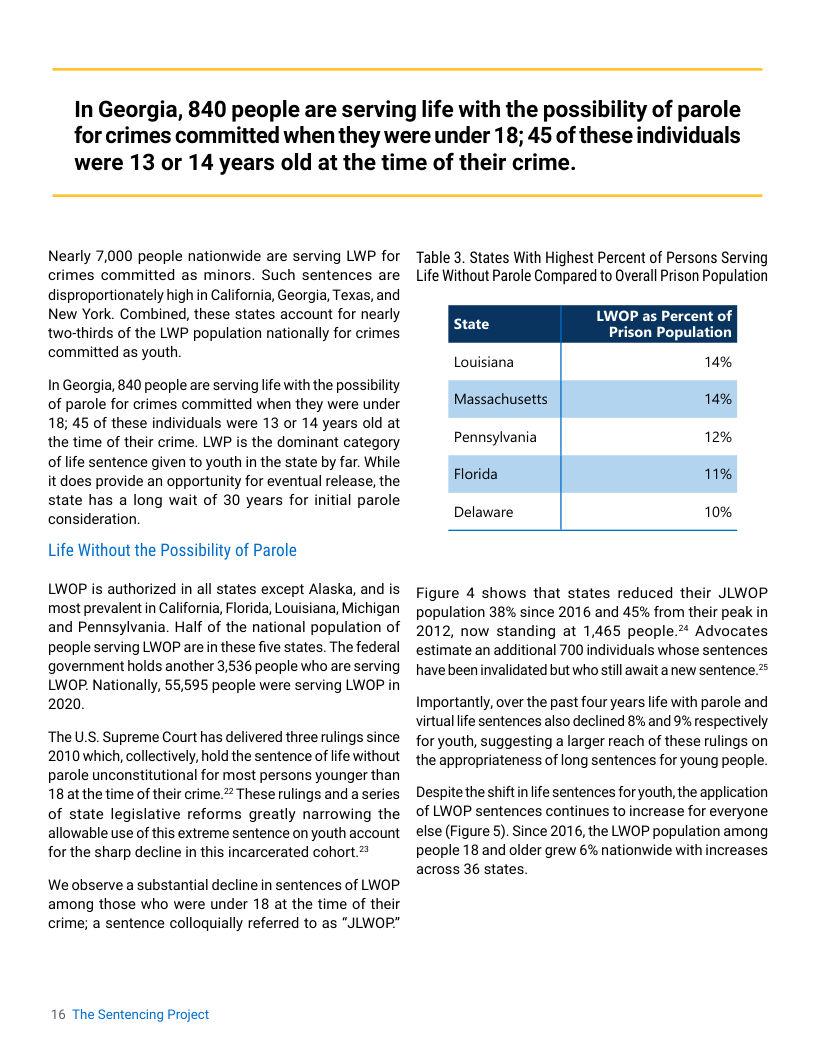
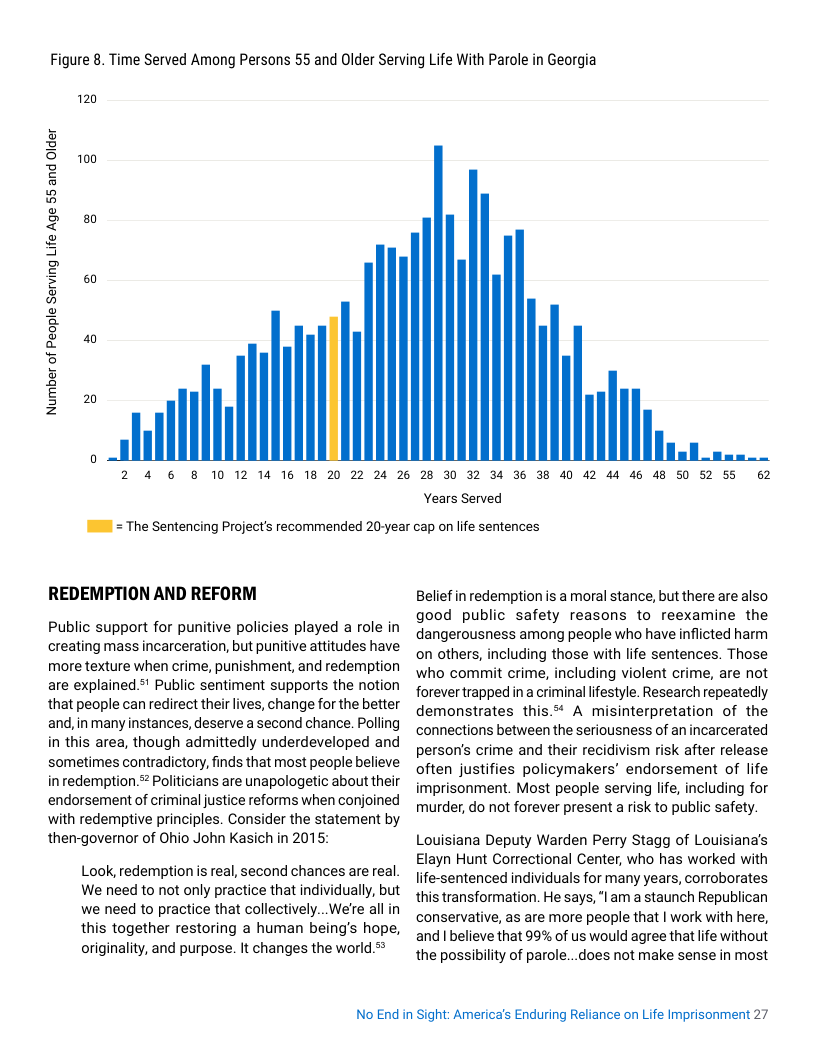
In Georgia, 840 people are serving life with the possibility of parole
for crimes committed when they were under 18; 45 of these individuals
were 13 or 14 years old at the time of their crime.
Nearly 7,000 people nationwide are serving LWP for
crimes committed as minors. Such sentences are
disproportionately high in California, Georgia, Texas, and
New York. Combined, these states account for nearly
two-thirds of the LWP population nationally for crimes
committed as youth
In Georgia, 840 people are serving lfe with the possibility
of parole for crimes committed when they were under
18; 45 of these individuals were 13 or 14 years old at
the time of their crime. LWP is the dominant category
of life sentence given to youth in the state by far. While
it does provide an opportunity for eventual release, the
state has a long wait of 30 years for initial parole
consideration.
Life Without the Possibility of Parole
LWOP is authorized in all states except Alaska, and is
most prevalent in California, Florida, Louisiana, Michigan
and Pennsylvania. Half of the national population of
people serving LWOP are in these five states. The federal
goverment holds another 3,536 people who are serving
LWOP. Nationally, 55,595 people were serving LWOP in
2020
The U.S. Supreme Court has delivered three rulings since
2010 which, collectively, hold the sentence of lfe without
parole unconstitutional for most persons younger than
18 at the time of their crime.? These rulings and a series
of state legislative reforms greatly narrowing the
allowable use of this extreme sentence on youth account
for the sharp decline in this incarcerated cohort.*
We observe a substantial decline in sentences of LWOP
among those who were under 18 at the time of their
crime; a sentence colloquially referred to as "JLWOP"
16 The Sentencing Project
Table 3. States With Highest Percent of Persons Serving
Life Without Parole Compared to Overall Prison Population
LWOP as Percent of
Prison Population
Louisiana 14%
Massachusetts 14%
Pennsylvania 2%
Florida 1%
Delaware
Figure 4 shows that states reduced their JLWOP
population 38% since 2016 and 45% from their peak in
2012, now standing at 1,465 people.** Advocates
estimate an additional 700 individuals whose sentences
have been nvalidated but who stillawait anew sentence.
Importantly, over the past four years life with parole and
virtual ife sentences also declined 8% and 9% respectively
for youth, suggesting a larger reach of these rulings on
the appropriateness of long sentences for young people.
Despite the shiftin life sentences for youth, the application
of LWOP sentences continues to increase for everyone
else (Figure 5). Since 2016, the LWOP population among
people 18 and older grew 6% nationwide with increases
across 36 states.
Figure 4. Change in Life Sentenced Population Among Those Under 18 at Time of Their Crime, 2016-2020
0%
10%
8%
20%
-30%
Life With Parole
-38%
Life Without Parole
9%
Virtual Life
Figure 5. Change in Life Sentenced Population Among Those 18 and Older at Time of Their Crime, 2016-2020
6%
6%
4%
2%
0%
4% 2%
Life With Parole
Virtual Life
In 2020, 42,833 people were serving sentences that
totaled a maximum of 50 years or longer. We refer to
this group as serving a virtual life sentence because the
term of years they must serve s so long they are unlikely
tosurvive it even though they are not statutorily sentenced
tolife.
Life Without Parole
Virtual Life
Texas dominates on this front with one i five people in
prison serving a virtual life sentence. The remaining
states with the highest proportions of the virtual life
population are Indiana (9%), Pennsylvania (7%), and
Illinois (6%). These four states account for 43% of the
individuals serving virtual life sentences nationwide.
No End in Sight: Americas Enduring Reliance on Life Imprisonment 17
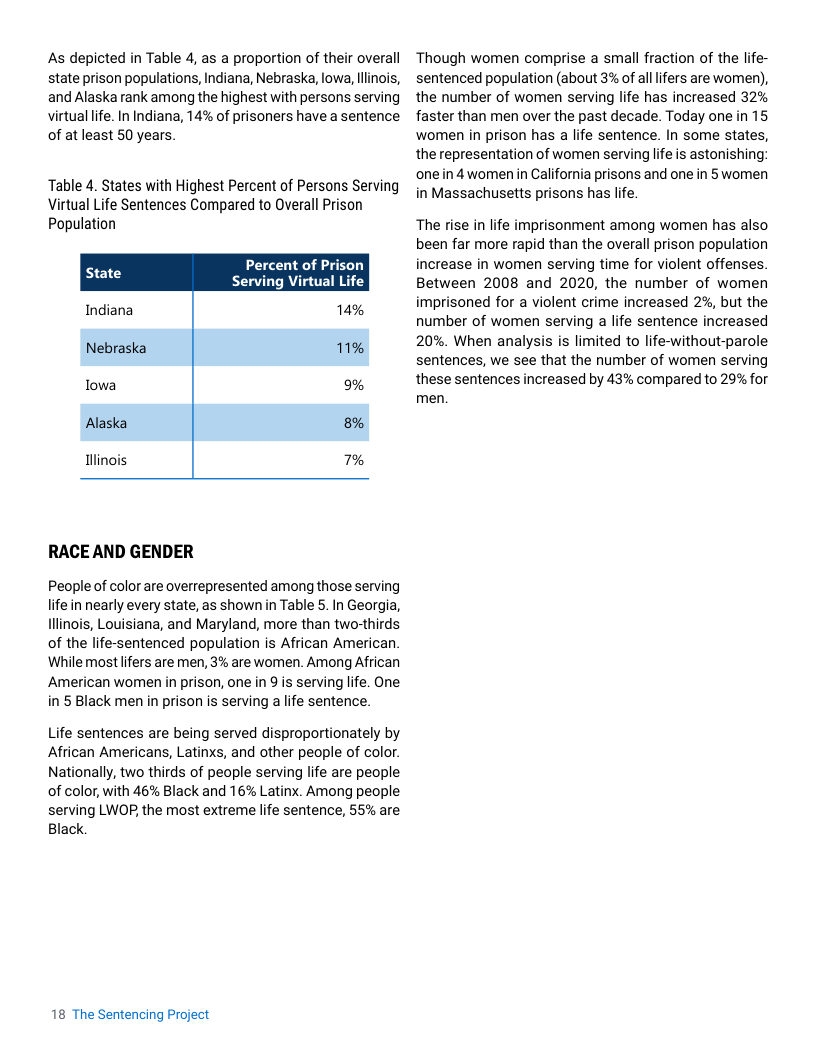
As depicted in Table 4, as a proportion of their overall
state prison populations, Indiana, Nebraska, lows,llinois,
and Alaska rank among the highest with persons serving
virtuallife. In Indiana, 14% of prisoners have a sentence
of atleast 50 years.
Table 4. States with Highest Percent of Persons Serving
Virtual Life Sentences Compared to Overall Prison
Population
Percent of Prison
Serving Virtual Life
State
Indiana 14%
Nebraska 1%
lowa 9%
Alaska 8%
Tllinois
RACE AND GENDER
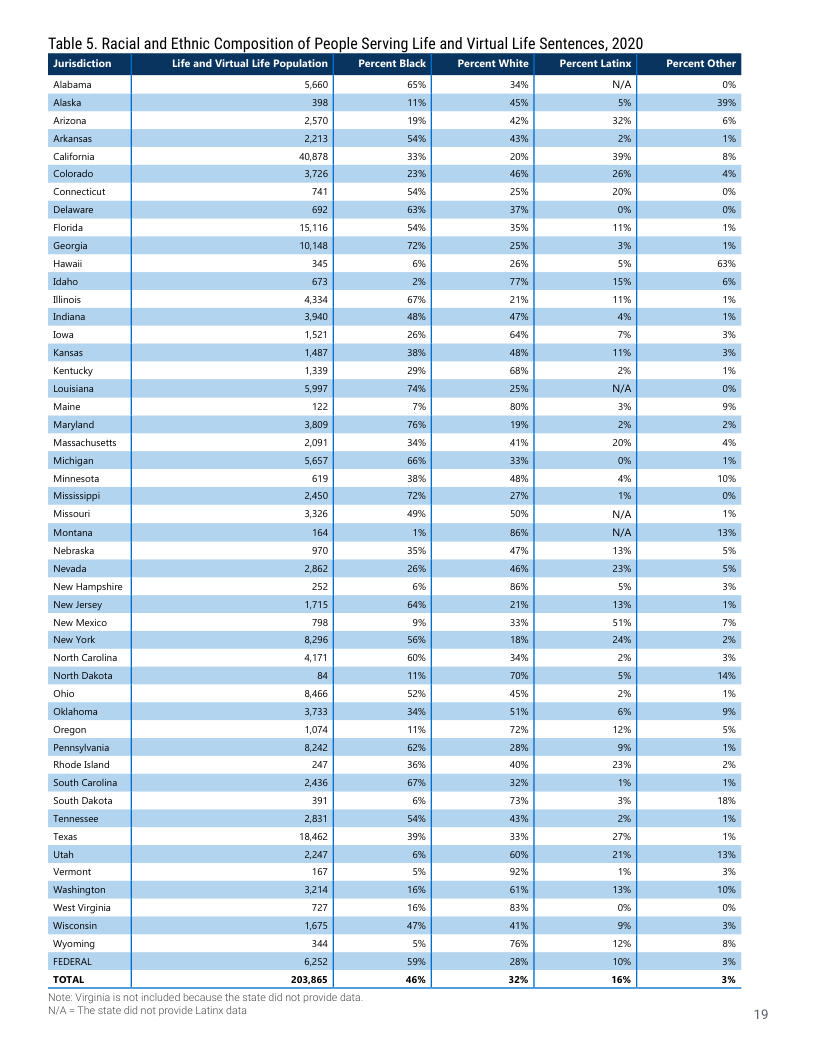
People of color are overrepresented among those serving
life in nearly every state, as shown in Table 5. In Georgia,
Hllinois, Louisiana, and Maryland, more than two-thirds
of the life-sentenced population is African American.
While mostlifers are men, 3% are women. Among African
American women in prison, one in 9 is serving life. One
in 5 Black men in prison is serving a life sentence.
Life sentences are being served disproportionately by
African Americans, Latinxs, and other people of color.
Nationally, two thirds of people serving life are people
of color, with 46% Black and 16% Latinx. Among people
serving LWOR, the most extreme life sentence, 55% are
Black.
18 The Sentencing Project
Though women comprise a small fraction of the life-
sentenced population (about 3% of alllfers are women),
the number of women serving life has increased 32%
faster than men over the past decade. Today one in 15
women in prison has a life sentence. In some states,
the representation of women servinglife s astonishing:
onein4womenin Califoria prisons and one in § women
in Massachusetts prisons has life.
“The rise in life imprisonment among women has also
been far more rapid than the overall prison population
increase in women serving time for violent offenses.
Between 2008 and 2020, the number of women
imprisoned for a violent crime increased 2%, but the
number of women serving a life sentence increased
20%. When analysis is limited to life-without-parole
sentences, we see that the number of women serving
these sentences increased by 43% compared to 29% for
men.
Table 5. Racial and Ethnic Composition of People Serving Life and Virtual Life Sentences, 2020
Life and Virtual Life Population
Arizona
Arkansas
Calforia
Colorada
Comecticut
Delaare
Flords
Georga
[
idsho.
Dinois
Incians
Iowa
Kansas
Kentucky
Louisana
Maine
Maryland
Massachusetts
Michigan
Minnesota
Missssippi
Missour.
Montana
Netraska
Nevada
New Hampstire
New ersey
New Mexico
New York
North Carolina
North Dakota
ohio
Oklshoma
Oregon
Pemnsyhania
Rhode Eind
South Carolna
South Dskota
Tennesse
Tes
Utah
Vermont
Washington
West Viginia
Wisconsin
Wyorming
FEDERAL
TorAL
5560
zqs
2570
2213
w08
26
1
o
15116
0148
s
o
434
390
1521
187
1339
sow7
122
3809
2001
sest
19
2450
3
184
E)
2852
22
s
758
a2
4
w
Bds6
am
10
a2
7
20
N
e
18452
2207
167
3214
71
1675
04
6252
203365
Percent Black
=3
%
9%
sax
3%
2%
sax
%
sax
2%
%
3
6
e
2%
%
2
3
™
%
%
%
8%
2%
e
%
5%
2%
3
o
5%
s
£
i
sox
.
1%
a2x
6%
o
%
san
%
o
3
1%
6%
am
E3
s
6%
Percent White
%
s
%
an
2%
%
2%
e
3%
2%
2%
%
2w
am
6%
%
%
2%
%
9%
am
£
%
am
s
%
e
%
%
2w
3%
8%
%
0%
asw
s
2%
%
%
%
7%
am
3%
%
2%
%
%
am
6%
2%
Percent Latin,
2%
1%
™
5%
5%
1%
%
5%
2
A
B
0%
%
"
A
A
1%
2w
E
3%
s
2%
%
%
%
%
2%
2%
%
3
=
e
a0
1%
3%
2%
0%
6%
Percent Other
%
3
%
%
=
"
i
%
o
%
i
3
S
"
9%
=
%
i
0%
1%
%
%
s
3
%
™
3
3
1
"
3
i
2
i
8%
i3
"%
%
0
0%
B
%
»
%
Note:Virgna s ot Included because the state 6d not provde data
N7A = The state dd not provde Latine data
19
AGING LIFERS
In 1996 Clarence Givens was sentenced to 110 years in
Wisconsin for selling less than three grams of heroin to
an undercover informant. Because of prior nonviolent
offenses on his record, the prosecutor was authorized
to charge him under the state’s habitual offender law,
which allows additional years to be added to a sentence
based on prior convictions, regardless of the severity of
the present offense. The sentencing judge referred to
him as a “genocidal merchant of death” and cautioned
him and others not to expect ... leniency from the courts
if they persist in their vile behavior” He said he wished
1o send “a message to those struggling to raise their
children in neighborhoods ruled by violence and drugs
that the courts will deal harshly with those who drain
the lifeblood of their neighborhoods.” Despite the high-
blown rhetoric of the court, there is no evidence to
support that sentencing Givens to 110 years in prison
was necessary for either punitive or public safety reasons.
Indeed, established research conducted well before
Givens was sentenced, finds that as one seller is removed
from the community through incarceration, a new one
is frequently substituted so long as there is demand for
drugs
Since his arrival in prison, Givens developed prostate
cancer, had two hip replacement surgeries, and, as a
result of a botched second surgery, was confined to a
wheelchair. During his 24 years of imprisonment, Givens
remained steadily employed in various positions within
the institution and routinely received the highest marks
on his performance. He incurred few disciplinary records
and was the quintessential model for other individuals
in prison.
As COVID-19 began its inevitable spread through the
U.S. prison system, Givens, like thousands of others,
asked for mercy in the form of release from prison to
be home with his wife and family. But on November 13,
2020,Givens developed a high fever. His cellmate relayed
the events of the day before his admission tothe hospital,
writing:
20 The Sentencing Project
*..the whole pod donated vitamins, some emergen-c
vitamin tea...| love him like my own father and look
out for him as best I can or would for my own...
donit know what we would do if we [lost] him for
he s a peacekeeper around here, he keeps the other
inmates from fighting with each other and guides
many of us when we are going down the wrong
paths in here”
Givens was admitted to the hospital the day after this
note was sent and within 24 hours he was unconscious
and breathing on a respirator. Clarence Givens passed
away from COVID-19 on December 7, 2020. He was 68
years old
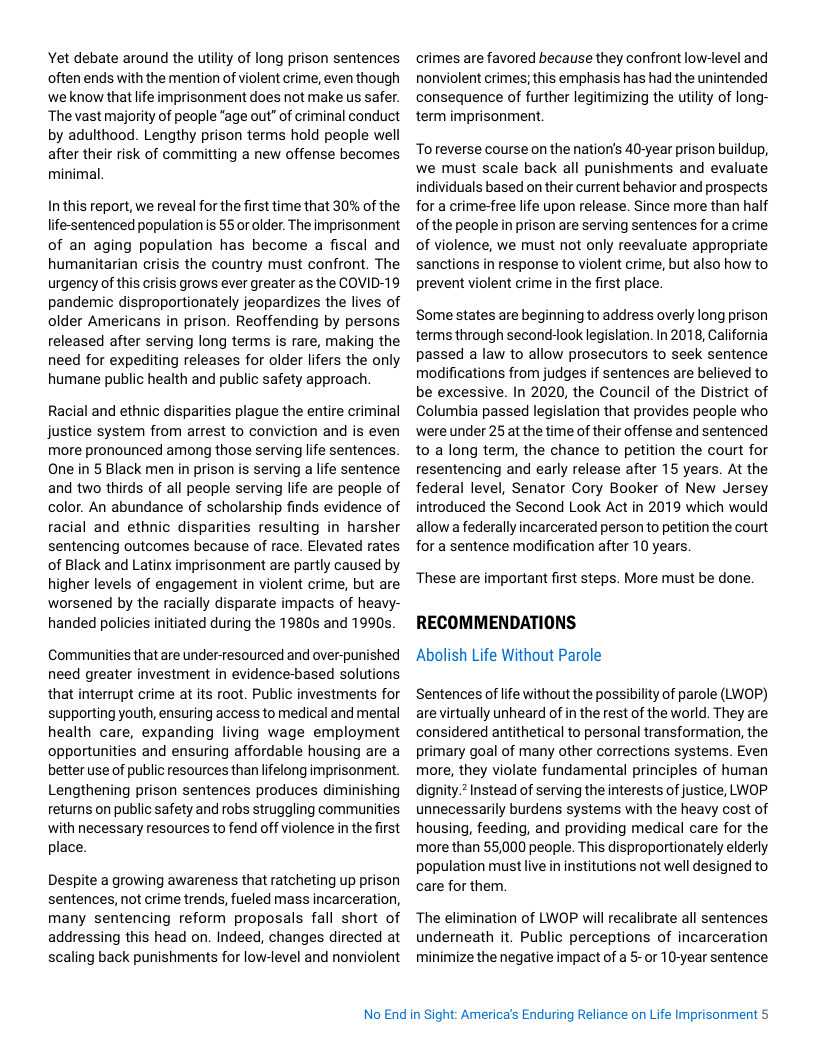
In 2020, 61,417 people who are at least 55 years old
were serving life sentences, part of a growing trend of
elderly imprisoned Americans. In fact, the number of
people in prison today who are age 55 or older has tripled
since 2000. The tough-on-crime policies that expanded
life sentencing, prolonged the time to review cases for
possible parole releases, or abolished parole altogether,
have accelerated the build-up as well# Between 1993
and 2013, the prevalence of individuals age 55-65
expanded by more than 150%. Today, people who are
55and older account for 12% of state prison populations.
Even more troubling, elderly persons account for 30%
of the life-sentenced population.
Figure 6. Percent of Life Sentenced Population Who
Are 55 and Older
CLARENCE GIVENS
Table 6. Elderly Lifers
state Percer
Mortana
Detauare
Maine
South Caraina
Massachusetts
South Dakots
Asska
New Hampshire
Maryiand
Comnecticut
Arkansas
Minnesata
Colorac
Wisconsin
Rhode Kiand
New Wexica
Washington
New York
Tennessee
Georgia
ush
Incians
Westviginia
re 55 and Older
s
s
%
a0
%
%
8%
%
6%
5%
%
%
3%
2%
2%
a1
a1
a1
0%
0%
25%
5%
2%
5
Note:Data on elderty fer population not provided from the.
Federal Bureau of Prisons, Virginia, or West Viginia
22 The Sentencing Project
The aging population of people in prison has serious
cost implications. Medical costs consume a large
proportion of prison budgets and those costs will
continue to grow as people age and confront worsening
health*
The percentage of people in prison serving all types of
life sentences who are now elderly is provided in Table
6. States with the highest percentage of life-sentenced
prisoners who are elderly include Delaware, Maine,
Michigan, New Jersey, and North Carolina. In these
states, approximately 43% of the life-sentenced
population is at least 55 years old. In some states, the
number of older persons serving LWOP is even more
staggering: more than half of the LWOP population in
Idaho, Massachusetts, and South Dakota are over 55
years old.
Finally, 675 people who are at least 55 years old are still
imprisoned on a life sentence for crimes committed in
their youth, amounting to 7% of the juvenile life-sentenced
population. For this cohort we estimate an average least
amount of time-served of 37 years, when accounting
for entering prison at 18 and reaching age 55. This
average time-served is an underestimate, however, as
there are many life-sentenced prisoners who are well
above 55 but who have been incarcerated since their
midto late teens. And in some states, such as Georgia,
children sentenced as young as 13 years old are still
serving life sentences.
CRIME OF CONVICTION
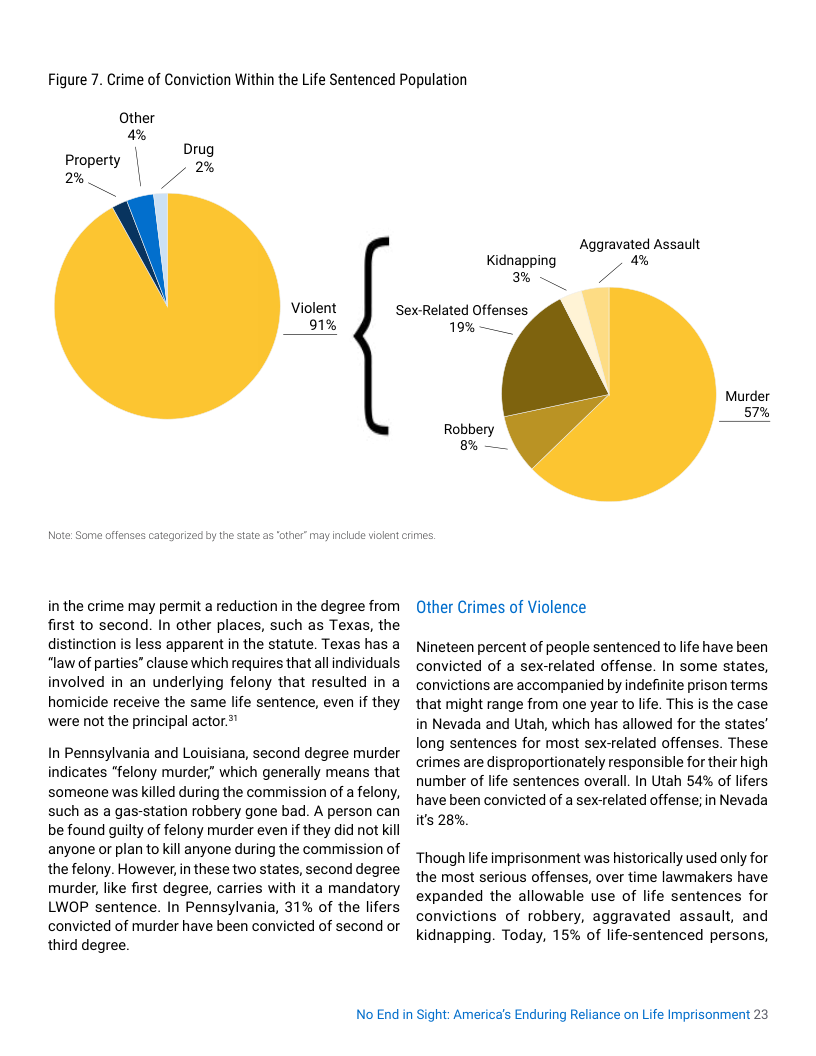
As depicted in Figure 7, most people (91%) serving life
sentences have been convicted for a violent offense.
Homicide
Fifty-seven percent of lifers have been convicted for
murder, and 72% of those convicted of murder had been
convicted of first-degree murder. While state and federal
statutes differ in their naming conventions, it is typical
that within the offense category of murder there is a
range of degrees which indicate aggravating or mitigating
factors. First-degree murder is weighted more heavily
than second-degree murder, which is weighted more
heavily than third-degree murder. In many states, the
ole of the defendant as an accessory or auxiliary actor
Figure 7. Crime of Conviction Within the Life Sentenced Population
Other
%
' Drug
/2%
Property
2%
~
Sex-Related Offenses.
Aggravated Assault
Kidnapping 2%
%
19% —
Robbery
8% —
Note: Some offenses categerized by the sate as other” may nclude violent crimes.
in the crime may permit a reduction in the degree from
first to second. In other places, such as Texas, the
distinction is less apparent in the statute. Texas has a
“law of parties” clause which requires that all individuals
involved in an underlying felony that resulted in a
homicide receive the same life sentence, even if they
were not the principal actor.*'
In Pennsylvania and Louisiana, second degree murder
indicates “felony murder which generally means that
someone was killed during the commission of a felony,
such as a gas-station robbery gone bad. A person can
be found guilty of felony murder evenif they did not kill
anyone or plan to kill anyone during the commission of
the felony. However, in these two states, second degree
murder, like first degree, carries with it a mandatory
LWOP sentence. In Pennsylvania, 31% of the lifers
convicted of murder have been convicted of second or
third degree.
Other Crimes of Violence
Nineteen percent of people sentenced toife have been
convicted of a sex-related offense. In some states,
convictions are accompanied by indefinite prison terms
that might range from one year to life. This is the case
in Nevada and Utah, which has allowed for the states’
long sentences for most sex-related offenses. These
crimes are disproportionately responsible for their high
number of life sentences overall. In Utah 54% of lifers
have been convicted of a sex-related offense; in Nevada
it's 28%
Though life imprisonment was historically used only for
the most serious offenses, over time lawmakers have
expanded the allowable use of life sentences for
convictions of robbery, aggravated assault, and
kidnapping. Today, 15% of life-sentenced persons,
No End in Sight: Americas Enduring Reliance on Life Imprisonment 23
amounting to one in 7 lifers, had a governing crime of
robbery, aggravated assault, or kidnapping. Amongthese
are 16,700 people sentenced to lfe for a robbery, 8,500
people sentenced toife for an aggravated assault, and
5,000 people sentenced to lfe for a kidnapping.
In Florida, 20% of the state's 10,000 people serving LWOP.
sentences have been convicted of a robbery and 23%
of the 1,500 individuals serving virtual life terms have
been convicted of a robbery. Virginia reports that 14%
of its life-sentenced population has been convicted of
an aggravated assault, including 50% of the virtual life
population. Like Virginia and Florida, lowa s a state that
o longer uses a parole mechanism for its life-sentenced
population; 14% of the LWOP population in this state
has been convicted of kidnapping,
Drug Crimes
The federal drug laws adopted in the late 1980s and
early 1990s dramatically reshaped the federal prison
population. The federal system also abolished parole in
1987. This means that all life sentences in the federal
system imposed since this time require that prisoners
serve their time until they die or in the unlikely event of
a presidential commutation or grant of compassionate
release. Nationally, 3974 people are serving life
sentences for a drugrelated offense, and 38% of these
people are in the federal prison system.
Forty-one states have incarcerated people on life
sentences for drug-related offense. While nationally only
2% of those serving life have been convicted of a drug
crime, some states rely on life for drug crimes much
more readily. In lowa, for instance, 18% of lifers have
been convicted of a drug crime, and in Alabama, it is
12%. Across 11 states atotal of 250 people are serving
LWOP for a drug-related crime.
24 The Sentencing Project
PROBLEMS WITH LIFE IMPRISONMENT
The tough-on-crime era beginning in the 1980s ushered
in laws that removed discretion from the federal
and state legal systems. In place of individualized
assessment that was responsive to individual needs
and allowed postconviction adjustments when
warranted, jurisdictions throughout the United States
haveimplementedahostoflaws andpoliciesthatcreate
permanent punishment through diminishing exit points
from the system. Some of the key hallmarks of this era
were the proliferation of habitual offender laws, truth-
in-sentencing schemes and other mandatory minimum
statutes, and the abolishment or politicization of parole.
Because of these extreme measures, sentences can
be arbitrary and disproportionate to the seriousness of
the crime.
Fair Wayne Bryant was sentenced to life with no chance
for parole in 1997 for attempting to steal a pair of hedge
clippers. Such a disproportionate sentence was possible
because of Louisiana’s habitual offender law which
allowed prosecutors to obtain a life sentence after a
fourth felony, only one of which must be violent. In
Bryant's case, hs qualifying “violent offense” of attempted
armed robbery occurred years earlier in 1979. He had
already served ten years "hard labor” in prison for the
offense. His remaining crimes before the incident with
the hedge clippers were nonviolent and theft-related, all
committed to fuel his untreated substance use disorder.
Louisiana's 2017 criminal justice reform package, though
limited in overall scope, modified the habitual offender
law, which allowed for a review of Bryant's case and
prompted his release in August 2020,
Extreme penalties are misaligned with what we know
about age and criminal behavior, worsen racial disparity
inthe system, and impose heavy costs to taxpayers with
diminishing returns on public safety. Informed by the
known data and outcomes of current laws and policies,
we outline the specific problems with life imprisonment
next.
AGING OUT: YOUNG AND OLD
Youth Sentenced to Life
Lengthy prison sentences ignore the fact that most
people who commit crime, even those who have
committed a series of crimes, age out of criminal
conduct. The age-crime curve is evident across dozens
of empirical studies on the topic and reflects the fact
that people are most at-risk for committing crime in the
late teenage years to their mid-twenties.* After this age,
proclivity toward committing more crime typically
declines steadily This relationship between age and
crime exists consistently regardless of race or ethnicity,
education level, community disadvantage, or income.
While those who engage in violence may take a while
longer to distance themselves from crime, the aging out
process begins its downward slope in the average case
by one's mid-20s.
Analysis of Bureau of Justice Statistics data shows the
peak age of arrest for robbery is 19, declining by more
than half by the late twenties. Likewise, the peak age for
murder is 20, a rate that is more than halved by one's
30s and s less than one quarter of its peak by one's
405" Even among the small number of people identified
as “chronic offenders” who have committed a series of
serious crimes, most no longer engage in criminal
behavior past their late 30s.* And yet, a growing segment
of prisoners sentenced when they were young have
served decades in prison beyond their point of public
safety risk. Our analysis reveals that the numbers of
youth sentenced tolife are not insignificant: in Georgia,
Maryland, and Tennessee, and Wisconsin, nearly 10%
of the people serving a life sentence were under 18 at
the time of their crime.
No End in Sight: Americas Enduring Reliance on Life Imprisonment 25
Elderly Persons with Life Sentences
The experience of aging in prison s different from aging
in free society for two main reasons. First, people who
engage n street crime are often in poorer health generally
before they arrive in prison.** Damaging lifestyle habits
that include substance abuse and other high-risk
behaviors, as well as neglect of routine medical care
and lack of access to medical care, often underlie poor
health. Second, the experience of prison itself ages
individuals more quickly. Prison is a high-stress
environment. Medical conditions develop sooner in life
among imprisoned people with disproportionately high
rates of dementia, cancer, arthritis, and hypertension,
as well as declines in mental health.* As prisoners grow
old, they also become more vulnerable to assault and
other types of mistreatment from younger prisoners.*!
Correctional institutions are obligated under law to
provide adequate health care to people in prison, as
established by two landmark Supreme Court cases,
Estelle v. Gamble, 429 U.S. 97 (1976) and Brown v. Plata,
563 U.S. 493 (2011). Prisons are ill-equipped to serve
as infirmaries or nursing homes and they do it badly at
enormous human and fiscal cost. At the federal level,
facilities spend approximatelyfive times more on medical
care for older persons than those who are younger.# At
the state level, the cost of treating an older population
is likewise increased. A recent national analysis of health
care spending on imprisoned persons 55 and older found
that the median cost per prisoner was 37% higher in the
ten states with the highest share of individuals 55 and
older
Preeminent scholars on the worldwide use of life
imprisonment, Dirk van zyl Smit and Catherine Appleton,
argue that the United States’ general acceptance of
sentencing people to die in prison contradicts international
human rights standards and practices.* Indeed, several
countries prohibit life sentences for elderly persons and
most countries place limits on elderly persons being
sentenced to prison.*s
In Russia, people 65 or older cannot receive a life
sentence because, like children, elders are “vulnerable
social groups who have an underdeveloped and weakened
26 The Sentencing Project
capacity to understand the implications of their conduct,
to control it and to foresee the consequences of their
actions. They were prone to impulsive, unconsidered
behaviour that could result in criminally reprehensible
conduct” The government further explains that
sentencing someone at age 65 to a life sentence of at
least 25 years would not provide a realistic chance of
freedom beforetheir death and s therefore unacceptable.*
Throughout Europe, all life sentences must include a
reasonable expectation of release and the details of
possible release are discussed at sentencing.”
To commit just one person to spend the rest of his or
her ife in prisonis at least a one-million-dollar investment
forthe state.* A look at parole-eligible lifers in Georgia
brings this into sharper focus. To begin, 10% of the prison
population in the state is 55 years old or older, including
2,159 parole-eligible lfers. On average, these individuals
have served 26 years of their life sentence so far, with
arange from oneto 62 years of time-served. Per prisoner
cost in Georgia is $24,070 a year.*
The yellow bar in Figure 8 indicates our recommended
20 year-cap for life sentences. After this point most
prisoners are at very low risk of offending and should
be released. If these 2,159 elderly individuals serving
LWP were released at 21 years of time-served* 19,436
prison-years would be saved and the state could avoid
spending approximately $462 million to continue to
incarcerate them. Even the release of just 25% of elderly
lifers at 21 years would lead to a savings of 4,859 prison-
years, or $116 million. This same analysis could be done
in every state reflecting billions of dollars in savings
billions of dollars that could be positively invested in
evidence-based crime prevention and intervention
strategies.
Figure 8. Time Served Among Persons 55 and Older Serving Life With Parole in Georgia
un
3
S o
2
3w
s
g o
3
1
8
e
5
E
2
24 6 8
10 12 14 16 18 20 22 24 26 28 30 32 34 36 38 40 42 44 46 48 S0 52 55 62
Years Served
[ = The Sentencing Project’s recommended 20-year cap on life sentences
REDEMPTION AND REFORM
Public support for punitive policies played a role in
creating mass incarceration, but punitive attitudes have
more texture when crime, punishment, and redemption
are explained* Public sentiment supports the notion
that people can redirect their lives, change for the better
and,inmany instances, deserve a second chance. Polling
in this area, though admittedly underdeveloped and
sometimes contradictory, finds that most people believe
in redemption. 5 Politicians are unapologetic about their
endorsement of criminal justice reforms when conjoined
with redemptive principles. Consider the statement by
then-governor of Ohio John Kasich in 2015:
Look, redemption is real, second chances are real.
We need to not only practice that individually, but
we need to practice that collectively...We'e all in
this together restoring a human beings hope,
originality, and purpose. It changes the world 5*
Belief in redemption is a moral stance, but there are also
good public safety reasons to reexamine the
dangerousness among people who have inflicted harm
on others, including those with life sentences. Those
who commit crime, including violent crime, are not
forever trapped in a criminal ifestyle. Research repeatedly
demonstrates this.* A misinterpretation of the
connections between the seriousness of an incarcerated
person's crime and their recidivism risk after release
often justifies policymakers' endorsement of life
imprisonment. Most people serving life, including for
murder, do not forever present a risk to public safety.
Louisiana Deputy Warden Perry Stagg of Louisiana's
Elayn Hunt Correctional Center, who has worked with
life-sentenced individuals for many years, corroborates
this transformation. He says, *| am a staunch Republican
conservative, as are more people that | work with here,
and I believe that 9% of us would agree that e without
the possibility of parole...does not make sense in most
No End in Sight: Americas Enduring Reliance on Life Imprisonment 27
“I am a staunch Republican conservative, as are more people that
1 work with here, and I believe that 99% of us would agree that life
without the possibility of parole...does not make sense in most
cases...these are not bad people, but people who did a bad thing,
and at some pointin their lives they deserve to tell their story...they
deserve hope.”
~ Louisi
a Deputy Warden Perry Stagg of Louisi
s Elayn Hunt Correctional Center
cases..these are not bad people, but people who did a
bad thing, and at some point in their lives they deserve
totell their story...they deserve hope .
For those previously sentenced to life imprisonment
who earn release, reengagement in violence is rare.*
Consider outcomes from a 2013 study of released
prisoners in Louisiana who served long sentences.
Edward Shihadeh and colleagues examined three and
five year “return to prison” rates among long-term
sentenced prisoners, and found that people returned to
prison at a rate of 5-8%. When analysis was limited to
those who had been convicted of first degree murder,
the recidivism rate was 5%
Similar findings are seen in recidivism studies of released
lifers in Michigan, Pennsylvania, Maryland, New York,
and California. Combined, studies of released lifers
find recidivism rates less than 5% among people who
previously committed violence and were sentenced to
life.s*
USS. Bureau of Justice Statistics data reveal that 98%
of persons released from prison after serving time for
a homicide conviction are not arrested for another
homicide. Just as encouraging, this analysis shows that
people released from prison who were originally convicted
of homicide are less likely than other released prisoners
to be rearrested for a violent crime.®
28 The Sentencing Project
Low recidivism rates among released lifers could lead
oneto believe that it was the length of the sentence that
"worked," suggesting that long sentences deter crime.
Here, the logic fails because it is frequently in spite of
the harsh prison environment that life-sentenced
individuals transform their lives, demonstrate remorse,
and mentor other prisoners.* Men and women overcome
great obstacles in the prison environment in order to
move beyond their past mistakes and traumas
RACIAL PREJUDICE
‘The racism and bias documented at every stage of the
criminal legal system breeds public distrust of the justice
system. People of color, particularly African Americans,
are disproportionately arrested and convicted. Decades
of research also demonstrate that racial differences in
sentencing often derive from race-based decision
making £
Unsurprisingly, we find evidence of sentencing differences
by race among lifers as well. Sentencing data of North
Carolina’s LWOP population reveals that while 62% of
people serving LWOP for a homicide are African American,
a remarkable 81% of those sentenced to LWOP under
the state's habitual offender law are African American.
In Mississippi, e find the same disturbing trends. Nearly
one-quarter of those serving LWOP were sentenced
under the state's habitual offender law, impacting those
convicted of their third felony offense. Notably, under
Mississippi's law, any person with two felony convictions,
including one violent, receives a mandatory sentence to
LWOP. Burglary, defined as a nonviolent offense in most
states, is defined as a violent crime in Mississippi,
whether or not the individual was armed or a person
was in the dwelling that was burgled.
In Mississippi, 75% of people whose LWOP sentence is
triggered by the habitual offender statute are Black
Moreover, two-thirds of the crimes triggered by the
habitual offender law and resulting in LWOP are non-
homicide, including 9% for property offenses and 12%
for drug-related offenses. For these, Black people are
highly overrepresented, making up 87% and 79%,
respectively.
Elevated rates of Black and Latinx imprisonment have
been recorded for many decades, partly caused by higher
levels of engagement in violent offenses among Black
people.* but greatly exacerbated by overly harsh policies
advanced in the 1980s and 1990s, including increasing
mandatory minimums, three strikes laws, and the
abandonment of parole.
Criminologists Ruth Peterson and Lauren Krivo note that
African Americans comprise a disproportionate share
of those living in poverty-stricken neighborhoods and
communities where a range of socioeconomic
vulnerabilities contribute to higher rates of crime,
particularly violent crime.’ In fact, 62% of African
Americans reside in highly segregated, inner city
neighborhoods that experience a high degree of violent
crime, while the majority of whites live in “highly
advantaged” neighborhoods that experience little violent
crime. Their work builds on earlier research focused
on the harms done to the African American community
by disparate living environments, and extends this
knowledgeto evidence that this actually produces social
problems including crime.
An abundance of recent scholarship also finds harsher
sentencing outcomes among Black and Latinx defendants
across the board, including in decisions whether to
incarcerate and the length of sentence.”” Some research
finds that sentencing guideline departures above the
recommended range are more readily applied to Black
and Latinx defendants as well# Research elsewhere
finds that white defendants in the federal system are
more likely to receive sentences below the range
recommended by the federal sentencing guidelines than
Black defendants.*
These differences could signal that judges and juries
rely on racial and ethnic cues imported from societal
stereotypes that African American and Latinx
communities are more dangerous.™ Attributional
stereotypes, applied by race and ethnicity, can lead
decisionmakers to see an individual as a greater public
safety threat.”!
PAROLE BOARD DECISIONS
Though all states maintain some form of back-end
release, such as parole or executive clemency, there are
frequently restrictions on their application that exclude
most lifers. Researcher Tina Maschi and colleagues
identify 11 states that exclude people convicted of sex-
related offenses from release on geriatric or
compassionate release grounds, and seven states deny
this opportunity to persons convicted of first or second
degree murder.” Since most people serving life have
been convicted of one of these crimes, this would result
in the exclusion of many of them from early release
consideration.
Other than the diminishing odds of being granted parole,
few backend releases are available and/or utilized for
individuals serving life.™ linois, a system that abolished
parole decades ago, also does not have either a medical
or geriatic release policy. Executive clemency authority
1o grant commutations are in place statutorily in many
jurisdictions, but even this is not universally the case.
Georgia and Wyoming, for instance, do not allow
executive clemency for persons serving LWOP except
under limited claims of innocence.™ Even when executive
authority to commute a prison sentence exists, the
decision is mired i political calculations that have little
to do with public safety.
Parole boards, too, can delay or deny a meaningful
opportunity to demonstrate readiness for release. Parole
board policies have further shifted the punishment
No End in Sight: Americas Enduring Reliance on Life Imprisonment 29
system to one that errs toward permanent exclusion for
people serving extreme sentences.’
Utah provides a useful illustration. The state relies on
an indeterminate sentencing structure except in the
cases of death and LWOP, butife with parole and virtual
life sentences allow release before one arrives at their
maximum term. In all cases that go before the parole
board, individuals receive a notice within six months of
the start of their sentence that indicates when they will
go before the board. The board has the sole authority
1o set the initial parole date, and factors it considers
include the nature of the crime, prior offenses, progress
evaluations to date, recommendations by the sentencing
judge or prosecutor, and input from the victim and family
These considerations are fairly routine across parole
boards (though not without critique). Two especially
disturbing features of Utah's parole policies are evident.
First, the board can also consider new information about
the crime that was not revealed during the tral or verified
by a court of law. Board instructions state:
[1)f the Board obtains and consider additional
information which was not available to the court
or offender prior to or at the time of sentencing,
the additional information shall be provided to the
offender, who shall be afforded a minimum of 21
days to consider and respond to the additional
information prior to the Board making a decision
that schedules an original hearing.”*
In other words, parole board members in Utah, appointed
by the Governor and confirmed by the legislature, play
ajudicial role,
“The second problematic feature of the Utah parole board
policy is that it has the authority to move an indeterminate
sentence (a sentence without a fixed end point) toa life
sentence with no opportunity for parole, though this
state already allows LWOP to be sentenced attrial. Once
a lfer goes before the parole board at his or her initial
scheduled time, the board chooses between approving
forrelease, scheduling a rehearing at the parole board's
discretion, or denying release, which means that the
individual must serve their sentence in full” Someone
who has a sentence of 10-o-ife, for example, can be
denied release by the board and the result is LWOP.
Again, Utah allows the parole board to usurp the role of
the judge and jury.
30 The Sentencing Project
Nationally, legislators have also delayed the chance for
parole by extending the initial wait time for a first parole
hearing, as well as the intervals one must wait before a
subsequent review. Parole boards are now more likely
todeny parole grants tolifers than n the past. Combined,
these factors have led to a considerable downtrend in
prison releases for lifers.™
INTIMATE PARTNER VIOLENCE
Many women are in prison today as a direct result of
defending themselves against intimate partner violence.
These women were sentenced when medical
understanding, much less societal views about domestic
violence and trauma, were not evolved. As with emerging
science on the developmental differences between
young people and mature adults, more is known now
about the impacts of trauma on people affected by
intimate partner violence, usually women, than in past
decades. Exact figures for the number of women serving
life sentences for killing their abuser are not yet
established, though national survey research of women
prisoners is underway by Stanford's Criminal Justice
Center to ascertain this much-needed information.”
Today we know more about the short- and long-term
impact of physical, sexual, and verbal abuse on criminal
conduct. We know, for instance, that almost all who
commitviolence have also experiencedit.* Yet allowance
for trauma as a mitigating factor in culpability and
punishmentis still rarely recognized in court. New York
has attempted to correct for this with the 2019 passage
of its Domestic Violence Survivors Justice Act (DVSJA),
Penal Law Section 60.12. The law allows relief for
defendants and currently incarcerated persons who have
been sentenced to at least eight years in prison for a
crime in which domestic abuse was a significant
contributing factor to the crime. Some crimes are
excluded, including first-degree murder, certain forms
of second-degree murder aggravated murder, terrorism,
or any attempt or conspiracy to commit these offenses.
People who are required to be on the state's sex offense
registry are also excluded from applying for review.
Though the law is flawed in its restrictions, it is a first
step in the legal acknowledgement that trauma and
abuse correlate with violent crime, a fact which has been
demonstrated clearly by many government and academic
reports.
Patrice Smith was the first ife-sentenced beneficiary of
New York's Domestic Violence Survivors Justice Act.
Released in September 2020, she served more than 20
years of her sentence. At 16-years-old, Smith was
convicted for murdering a 71-year-old pastor with whom
she had had an eight-month relationship. The relationship
began when she was 15 years old and homeless.
Interactions consisted principally of her perpetrator
giving her money and gifts in return for sexual favors.
Her trial and sentence were prominently highlighted in
the media. In Smith's words, “they politicized my shame."s*
During her years of imprisonment, Smith steeped herself
in academic study and earned a college degree. She
also engaged in psychotherapy to address her past
abuse and was mentored by fellow women living at the
Bedford Hills Correctional Facility who supported her
journey. In her newfound freedom, she works with local
advocacy groups to push for continued, stronger
implementation of the law because she believes that
"no one should ever wipe away a child.*
Narrative accounts from women serving life sentences
suggests that many played a supporting role in the
underlying crime but were not the primary mastermind.
Among 72 interviewed women lifers in Michigan, 60%
had been convicted of “aiding and abetting” a criminal
act, but were not principal actors. "For women convicted
as aiders and abettors, it was their connection to violent
partners, most often male, whose violent choices, directly
or indirectly, resulted in women's sentences of life
imprisonment s
No End in Sight: America’s Enduring Reliance on Life Imprisonment 31
LIFE LESSONS: WHERE DO WE GO FROM HERE?
All states use life imprisonment despite significant
evidence that the penalty does not make us any safer.
Criminality is impermanent; the pattern of aging out of
criminal conductis widely understood as criminological
fact. Long prison terms, therefore, produce diminishing
returns on public safety but rob communities of necessary
resources needed to thrive. Society can and should do
more to support those most at-risk of criminal conduct
inthe first place, responding to crime as, fundamentally,
a public health problem. Instead, the knee-jerk reaction
is often to endorse policies that put the public at ease
in order to gain political traction, often at the expense
of the most vulnerable. Lawmakers bare much
responsibility to reverse the policies that launched us
into mass incarceration, with the expansion of life
imprisonment being one of the signature policies of this
era
Toooften, sentencing reform proposals pointedy exclude
some categories of crimes or sentences. For instance,
crimes of violence are typically excluded from most
modern sentencing reform proposals, which eliminates
prospects for most lifers to ean their release. Such
exclusionary reform proposals reject the fact one's crime
of conviction does not preclude one's ability to change
for the better. The low reoffending rates among released
lifers supports the notion that even those who commit
violent crimes are capable of reform. A concentration
of reforms directed at scaling back punishments for
low-level and nonviolent crimes — because they are
low-level and nonviolent — has the unintended
consequence of further legitimizing long-term
imprisonment for offenses classified as violent. Legal
scholar Christopher Seeds refers to this as *bifurcation
nation.®
Atthe deepest end of the punishment spectrum, efforts
to eliminate the death penalty have condoned life
imprisonment as the replacement, and this has had the
effect of normalizing, justifying, and even expanding the
use of life imprisonment.
People serving lfe sentences need not be caught in this
bind, and as recently as 40 years ago, they were not. To
32 The Sentencing Project
eliminate life sentences writ large, many intermediary
steps will need to be undertaken. They include reforms
atthe front end and the back end of the criminal legal
system.
Fortunately, some jurisdictions are leading the charge.
12018, California passed a law that allows prosecutors
toseek sentence modifications from judges if sentences
are seen as excessive. And in 2020, the Council of the
District of Columbia passed the Second Look Amendment
Act, which provide people sentenced tolong terms during
their adolescence and young adulthood a second look
after 15 years. At the federal level, U. S. Senator Cory
Booker of New Jersey introduced the Second Look Act
in 2019, which would have allowed individuals in federal
prison to petition the court for a sentence modification
after 10 years.
ABOLISH LIFE WITHOUT PAROLE
Life without the possibility of parole (LWOP) is virtually
unheard of in the rest of the world. International human
rights bodies recognize the value in preserving human
dignity and view rehabilitation and transformation as
embodiments of that dignity. It is believed that LWOP
sentences foreclose this opportunity.®
The United States largely rejects that view, leaving
jurisdictions saddled with the heavy cost of housing,
feeding, and providing medical care for the more than
55,000 people serving LWOP for the remainder of their
lives,
“The elimination of LWOP will have a recalibration effect
on all other less extreme sentences as well. Indeed, the
public can minimize the impact of a five- or ten-year
sentence on an individual and his or her loved ones when
compared to extreme sentences, as this shorter period
of time pales in comparison. Creation of a more just and
proportional criminal legal system is dependent on
ending extreme penalties. In addition, it will help lead to
public acceptance of restorative justice principles and
understanding the consequences and human costs of
mass incarceration.
RENALDO HUDSON
Hllinois Governor J.8. Prtizker granted clemency to 32 lllinois prisoners serving LWOP in 2020;
nearly one third of the total clemencies granted that year” One is Renaldo Hudson, initially
sentenced to death row. Hudson was incarcerated for 37 years, through seven governors. Over
his imprisonment, he came to terms with his past deeds and experienced an internal transformation
that allowed him peace and a sense of redemption.
In a recent interview, Hudson provided a compelling analogy between the justice system’s
response compared with a car badly in need of repair: “If your car doesn't work right, you don't
take a hammer to it and start beating it; you take it to a mechanic."#* But, he noted, the justice
system does not work in the same way; instead it serves as a junkyard. This was not Hudson's
path, nor is it the path for many lifers. While imprisoned, he created the prison's “Building Block”
program to assist incarcerated peers in coming to terms with their crime and their past, finding
within themselves the resources to turn their lives around was his pathway to redemption and
healing. Today as a free man he works for the lllinois Prison Project to help others fight for a
second look.
The Sentencing Pr
IMPOSE A 20-YEAR CAP ON ALL LIFE
SENTENCES EXCEPT IN RARE
CIRCUMSTANCES
Since 2016, The Sentencing Project has recommended
a 20-year maximum for life sentences except in rare
circumstances based on individualized determination.
We arrive at this recommendation after decades of
witnessing heavy-handed punishments being added to
the criminal legal system while social science makes
clear that extreme punishment produces little public
safety benefit
A 20-year cap will provide necessary pressure on
corrections systems to work with the individuals in their
care to produce positive results. Even for persons with
chronic prior criminal histories or those who have
committed violent crime, it should not take corrections
systems more than 20 years to accomplish rehabilitation.
There may be rare exceptions. If, after 20 years of
imprisonment, it is clear that an individual remains a
substantial public safety risk, a period of civil confinement
might follow, as is done in Norway. Such civl confinement
could only be imposed on an individual by a court with
strong due process protections and legal representation.
The goal here would still be rehabilitation and
reintegration, not exclusion, and mandatory periodic
review to assess readiness for release would continue.
The move toward a 20-year cap necessitates a cultural
shift in our misplaced faith in heavy punishment. A
challenge to be sure, but a cultural shift is certainly
possible and, in our view, urgently needed. Public polling
suggests that Americans believe that punishment just
forthe sake of incapacitation should not be the principle
aim of the corrections system. Internal transformation,
redemption and victim restitution should be central to
the criminal legal response to harms done. Many people
serving life sentences are capable and eager to
demonstrate how they can contribute to society in a
positive way. Arange of research onthe lived experiences
of those serving life sentences makes it very clear that
lifers, once adjusted to prison, evolve into model
prisoners, have few disciplinary infractions, and "cope”
with prison in admirable ways.®
Our current system of life imprisonment forecloses
almost all possibilities for the over 200,000 people now
serving life imprisonment to give back to their
communities.
34 The Sentencing Project
ACCELERATE AND BROADEN RELEASE
OPPORTUNITIES
The COVID-19 pandemic offers a prime opportunity to
release thousands of people who pose ittlerisk to public
safety but who are at high isk of contracting the disease
and dying from it. The responsibility, morally, legally and
fiscally, for medical care falls on the state, which is
especially draining on resources during this era of
COVID-19.% When we apply scientific knowledge about
riskto make release calculations, the solution isrelatively
simple: a presumption of immediate release for all older
life-sentenced prisoners.
Beyond the urgency of the pandemic, parole boards and
other releasing authorities can and should still ramp up
reviews and releases for those who no longer pose a
threat to public safety. In most cases this requires a
comprehensive overhaul of the review process for
incarcerated persons with alife sentence. An effective
parole system would include several key characteristics
that are currently absent. The composition of parole
boards could be improved by removing involvement of
the executive branch from the process
In most jurisdictions, there is the option of petitioning
the governor (or President n federal cases) for release.
Too often in these deliberations, however, the focus
quickly turns to one's original crime, even if it was
committed decades ago and even if the individual has
a strong record in prison of abiding by rules and
contributing to a positive environment #' I the underlying
crime included violence (as is usually the case with
people serving life sentences) petitions for release are
usually denied. Clemency campaigns can work to
educate decision makers on the low crime risk posed
by most people serving life sentences after a period of
time.
The idea of instituting robust conviction and sentencing
review units within prosecutor offices has taken hold in
asmall number of cities and states that range the political
gamut, including Baltimore, Los Angeles, Philadelphia,
Minnesota, and Virginia. The presence of these units
represents the acknowledgement that some sentences
are the product of a previous era and convictions are
sometimes arrived at in error.
States should also adopt robust "second look” policies
that reconsider the appropriateness of continued
incarceration given the passage of time and changed
circumstances within the individual. Beginning this
review at 10 or 15 years aligns the U.S. with the
international legal community and with recommendations
of the American Law Institute, a nonpartisan body of
legal scholars. It should not take the corrections system
more than 20 years to empower an individual with the
healing and skills necessary to live crime-free after
release.
REORIENT VICTIM & COMMUNITY
INVOLVEMENT TOWARD TRUE HEALING
Major legal developments in the 1970s and 1980s
reshaped the powerful role of victims in the criminal
justice system. Beginning with a key ruling in Linda R.
S.v. Richard D,, the majority opinion acknowledged that
private citizens lack the judicial authority to compel a
criminal prosecution, but offered the remedy of
congressional enactment of laws which would entitle
victims to legal standing. A range of federal and state
statutes followed and today most states have
incorporated victims' rights provisions into their
constitution.” These rights often include a virtually
unfettered right to weigh in at important proceedings
In its present orientation, the justice system-and
prosecutors specifically-employ victim testimony at
high risk of re-traumatization to obtain tough sanctions
for the defendant. Though there is little evidence that
the testimony of victims at criminal trials actually
influences sentencing outcomes, victim satisfaction in
both the process and sentence outcome is highly
associated with sentence severity. Given the political
potency of vietims' rights groups, this is powerful: as
victim participation increases, parole denials also
increase.*
‘The face and voice of the victims' rights movement does
notaccurately reflect typical victims of crime. Moreover,
survivors are not provided with the tools and resources
sufficient to cope with the emotional, physical, and
financial effects of criminalization. The harms caused
by their victimization stay for years, often untreated by
the system aiming to help them. The corrections system
and the criminal legal system at large are simply not
designed or equipped to provide the healing to victims
that they deserve.
A reorientation of the role of victims requires investing
in restorative justice models that heal the harm caused
by violence at their root, creating a system that is
"survivor-centered, accountability-based, safety driven,
and racially equitable." Expert work is underway by
groups including Common Justice as well as the National
Black Women's Justice Institute. Both esteemed
organizations anchor their work in the belief that we are
allsafer when we upliftvictims, hold everyone accountable
fortheir actions, and do so with empathy and compassion.
‘The involvement of crime survivors in the process of
justice through healing will help to undermine the
misguided assumption that victims have been well-
served by mass incarceration.*
Similarly, rather than commit scarce public resources
toward perpetual incarceration, funds could be invested
in positive community development approaches that
improve access to housing, jobs, education and health
care. Such investments also improve public safety for
all
Since we already know where most violence and other
crimes take place, we can mitigate crime-risk by
immersing highly disadvantaged communities with early
intervention and prevention resources. Considerably
larger investments in community strengthening, such
as universal preschool education, effective parenting
initiatives, victim restitution, and treatment for substance
use and mental health disorders will no doubt provide
more justice in the end than pointlessly long prison
terms. These resources make communities more secure
by building systems that prevent the economic and social
dislocation that greatly contributes to violence and other
crime. By de-emphasizing incarceration and scaling back
punishment we can use scarce public resources to
support victims and communities to heal and thrive.
This is the path to crime prevention and true public
safety.
No End in Sight: Americas Enduring Reliance on Life Imprisonment 35
Jose Saldaita, 69, served 38 years in New York for shooting and partially blinding a police officer
in 1979. He was released in 2018. Today he is the Director of RAPP (Release Aging People in
Prison) which works toward the freedom of New York prisoners who are 50 years and older,
many of whom are serving life sentences. He argues that if the New York corrections system
truly was concerned about victims finding healing and closure from the harms done by violent
victimization, it would have been required of him to reflect and gain insight on the impact of his
crimes. But, he says, he came to these realizations on his own, having to overcome the negative
influence of the prison environment to do so.
“It wasn't until years later, during my incarceration, that | started to see the harm, the real totality
of harm that victims of crime suffer"**
36 The Sentencing Project
METHODOLOGY AND NOTES
States were contacted in January 2020 to request
completion of our survey instrument. Due to the spread
of COVID in prisons, departments of corrections took
longer than anticipated to submit their data, but by
November 30,2020 all states and the federal government
submitted completed questionnaires with the exception
of Virginia. As in all years past, Virginia refused to
participate in The Sentencing Project’s census claiming
FOIA exemptions that are particularly limiting in this
state. We estimated Virginia's use of life imprisonment
using data obtained from the Virginia Criminal Sentencing
Commission as well as through published reports on
the state’s website. We were not able to estimate gender,
race, ethnicity, or juvenile status for Virginia.
Three jurisdictions did not provide data on the number
of lifers who are 55 and older: Virginia, West Virginia
and the federal Bureau of Prisons. Indiana did not provide
elderly status among its LWOP population but did include
it for LWP and virtual life-sentenced people.
The federal BOP submitted aggregate counts for most
of the data, but did not submit a breakdown juvenile
status at the time of the crime or number of persons
currently 55 or older. We estimated race and ethnicity
for the federal life-sentenced population based on the
2016 submission but urge caution in analysis,
When we contacted states, we offered them the
opportunity to modify their previous submission.
Revisions to 2016 figures were made in Louisiana,
Montana, New Jersey, and Nebraska. The total count of
life-sentenced prisoners in 2016 has been revised to
204,191 from 206,268
Some definitional issues are also in order, beginning
with our decision to define elderly lifers as 55 or older.
Thereis no empirically determined age when imprisoned
individuals are deemed elderly; however, there are health
concerns that begin to develop at an earlier age than in
those who are not in prison. While there is not yet
consensus in the research as to the appropriate age to
classify an inmate as elderly, we frequently see 50 or
55 used as the cut-off. In an effort to be conservative,
we asked states to report ages 55 and older.
“Virtual” life imprisonment is another term without a set
definition. Though the mention of virtual life or de facto
life sentences has become a more frequent part of
scholarly and policy discussions about life in prison
generally, the term of years that should amount to virtual
life s not yet settled. Jessica Henry notes the difficulty
in setting a term of years to define virtual lfe since the
age of the individual at the time of prison admission is
acritical component of the calculation. The courts have
been even more unclear on where to draw the line.
We conservatively selected 50 years as the low point of
avirtual life sentence based on the following rationale:
life expectancy of a 33-year-old male (the typical age
for someone entering prison with a homicide conviction)
serving a long-term or life sentence was about 40
additional years. This suggests that to survive a lengthy
sentence, one must be released before the age of 73
Add to this the increased probability of a premature
death for those who are incarcerated, one can see that
aminimum sentence of 50 years or more as equivalent
to virtual life” is reasonable,
Finally, we are aware of the growing calls for an “emerging
adult” category of individuals who are not yet adults but
not juveniles either. Twenty-first century developments
in brain science and pattems of offending suggest that
the adolescent brain is not fully developed until about
age 25, later than what is typically recognized by the
law.
[Ulnlike logical reasoning abilities, which appear to
be more or less fully developed by age 15,
psychosocial capacities that improve decision
making and reduce risk taking—such as impulse
control, emotion regulation, delay of gratification,
and resistance to peer influence—continue to
mature well into young adulthood. ™
No End in Sight: Americas Enduring Reliance on Life Imprisonment 37
These are sound arguments for including those under
25 as a class protected from the harshest available
punishments. We separate ‘juvenile status” as limited
to those under 18 at the time of their crime in order to
maintain our consistency with previous reports on this
topic, and in line with state and federal jurisprudence
which generally makes the same cutoff for juvenile
versus criminal court matters. Nevertheless, The
Sentencing Project s fully supportive of advocacy efforts
to expand the definition of youth or juvenile to include
all who have ot fully matured.
38 The Sentencing Project
APPENDIX: SURVEY INSTRUMENT
Thank you for providing the following information about your state's population of prisoners sentenced to: (1) life
with the possibility of parole, (2) life without the possibility of parole, and (3) those sentenced to prison for a
maximum of 50 years or more. If you have any questions as you complete this form, please be in touch with
Ashley Nellis at anellis@sentencingproject.org or 202-628-0871. Your completed form can be emailed, faxed or
mailed to our office at the address listed at the bottom of this form
State: State Prison Population: as of
SECTION 1: PERSONS SERVING LIFE WITH THE POSSIBILITY OF PAROLE
A_Number of Persons 18 OR OLDER AT OFFENSE B Number of Persons UNDER 18 AT OFFENSE
foTAL: foTAL:
Total Currently 55 Years Old or Older: Total Currently 55 Years Old or Older:
Male Male
White: Afican American Hispanic Wwhite: African American: Hispanic
other: other:
Female Female
White: Aftican American Hispanic Wwhite: Afican American Hispanic:
other: other:
crime of Com crime of Commitment
A1 Degree Murder. A1 Degree Murder.
2 Degree Murder: 2 Degree Murder:
Other Negligent Death (not lsted above): Other Negligent Death (not lsted above):
Sex Offense Sex Offense
hssaul/Aggravated Assault: hssautt, Aggravated Assault:
Robbery/Aggravated Robbery: Robbery, Aggravated Robbery:
Kidnappine; Kidnapping:
Drug Offense: Drug Offense:
Property Offense: Property Offense:
Dther (not fisted above]: Dther (not fisted above]:
No End in Sight: America’s Enduring Reliance on Life Imprisonment 39
SECTION 2: PERSONS SERVING LIFE WITHOUT THE POSSIBILITY OF PAROLE
‘A Number of Persons 18 OR OLDER AT OFFENSE
foTAL:
Total Currently 55 Years Old or Older:
Male
White: African American: Hispanic
other:
Female
White: African American: Hispanic
other:
crime of Commitment
A1 Degree Murder.
27 Degree Murder:
Other Negligent Death (not lsted above):
Kex Offense:
hssaul/Aggravated Assault:
Robbery/Aggravated Robbery:
Kidnappine;
Drug Offense:
Property Offense:
Dther (not fisted above)
B Number of Persons UNDER 18 AT OFFENSE
foTAL:
Total Currently 55 Years Old or Older:
Male
White: Aftcan American: Hispanic
other:
Female
White: African American: Hispanic:
other:
crime of Commitment
A1 Degree Murder.
27 Degree Murder:
Other Negligent Death (not lsted above):
Kex Offense:
hssautt, Aggravated Assault:
Robbery, Aggravated Robbery:
Kidnappine;
Drug Offense:
Property Offense:
Dther (not fisted above]:
40 The Sentencing Project
SECTION 3: PERSONS SENTENCED TO 50 YEARS OR MORE BEFORE RELEASE
ood-time credits and/or parole.
EXAMPLES OF THE TYPE OF INMATE WHO SHOULD BE COUNTED:
[The rumbers provided fn ths section should include inmates who could potentiall be réleased prior to their maximum through
1. Aninmate who has been sentenced to 60 years but s parol eligible after 25 years.
2. Aninmate who has been sentenced to two separate terms of 25 years to be served consecutively.
3. Aninmate who has been sentenced to a range of years from 40 to 50 years.
‘A Nurmber of Persons 18 OR OLDER AT OFFENSE
B Number of Persons UNDER 18 AT OFFENSE
foTAL:
Total Currently 55 Years Old or Older:
Male
hite: African American: Hispanic
ther:
Female
hite: African American: Hispanic
A" Degree Murder.
2% Degree Murder:
ther Negligent Death (not lsted above):
ex Offense:
ssault/Aggravated Assault
Robbery/Aggravated Robbery:
Kidnappine;
Drug Offense:
Property Offense:
ther (not listed above):
foTAL:
Total Currently 55 Years Old or Older:
Male
hite: Aftcan American: Hispanic
ther:
Female
hite: African American: Hispanic:
ther:
e of Commitment
A" Degree Murder.
2% Degree Murder:
ther Negligent Death (not lsted above):
ex Offense:
ssault, Aggravated Assault
Robbery, Aggravated Robbery:
Kidnappine;
Drug Offense:
Property Offense:
ther (not lsted above):
No End in Sight: America’s Enduring Reliance on Life Imprisonment 41
ENDNOTES
1. This does not include those in jails, which brings the
figure to two million.
2. See, for example: Vinter and Others v. United King-
dom, App nos. 66069/09,130/10 and 3896/10 (July
92013)
3. Sered, D. (2019). Until we reckon: Violence, mass
incarceration, and a road to repair. New York. The
New Press.
4. We use the word "lifer” intermittently throughout this
report to refer to individuals serving life sentences.
We are cognizant and careful of the potential of “oth-
ering” when it comes to applying terms to groups of
people, particularly those who are incarcerated. For
many people serving life sentences, the term ‘lifer"
is not viewed as pejorative. Rather, itis a self-iden-
tified label used with pride. Many “lifers’ groups”
have emerged in prisons around the nation, named
as such by the prisoners. Serving a life sentence is a
point of distinction among prisoners generally, and
aterm most prefer as an identity within the prison
population. Indeed, these individuals have so far
survived the most extreme sentence other than the
death penalty and consider themselves to be “lifers"
because of it
5. Gottschalk, M. (2016) Caught: The prison state and
the lockdown of American politics. Trenton; Princeton
University Press; Mauer, M. and Nellis, A. (2018). The
meaning of lfe: The case for abolishing life sentenc-
es. New York: The New Press.
6. National Institute of Justice (2016). Five things
about deterrence. Washington, DC: Office of Justice
Programs, U.S. Department of Justice.
7. Clear, T. (2018). The community justice ideal. New
York: Routledge.
8. Mauer, M. (2003). The meaning of lfe: Long prison
sentences in context. Washington, DC: The Sentenc-
ing Project; Nellis, A. and King, R. (2009). No exit: The
expanding use of life sentences in America. Wash-
ington, DC: The Sentencing Project; Nellis, A. (2013).
Life goes on: The historic rise in life sentences in
America. Washington, DC: The Sentencing Project;
Nellis, A. (2016). Stillife: America’s increasing use of
life and long-term sentences. Washington, DC: The
Sentencing Project.
9. See methodology for our operationalization of virtual
life sentences.
42 The Sentencing Project
10.
1
12.
13
14,
15.
16,
17.
18
19
20
Seeds, C. (2019). "Life Without Parole Sentencing.”
In Oxford Research Encyclopedia of Criminology and
Criminal Justice. Oxford University Press; see also,
Seeds, C. (2019). Historical modes of perpetual pe-
nal confinement: Theories and practices before life
without parole. Law & Social Inquiry 44(2): 305-332.
Cullen, F. T, Lee, H.., Butler, L. C., and Thielo, A. J.
(2020). Rehabilitation and redemption: Building a
new corrections.” In, Cecelia Chouhy, Joshua C.
Cochran, and Cheryl Lero Johnson, (Eds.) Criminal
Justice Theory: Explanations and Effects (Advances
in Criminological Theory. Vol 27: 309-335. New York:
Routledge.
Seeds, C. (2019). "Life Without Parole Sentencing.”
In Oxford Research Encyclopedia of Criminology and
Criminal Justice. Oxford University Press; see also,
Seeds, C. (2019). Historical modes of perpetual pe-
nal confinement: Theories and practices before life
without parole. Law & Social Inquiry 44(2): 305-332.
Prescott, J.J. Pyle, B. and Starr S. B. (2020). Under-
standing violent-crime recidivism. Notre Dame Law
Review, Vol. 95(4): 1643-98.
This count does not include jails, which brings the
total to two million.
Ghandnoosh, N. (2014). Race and punishment: Racial
perceptions of crime and support for punitive poli-
cies. Washington, DC: The Sentencing Project.
Van 2yl Smit, D. and Appleton, C. (2019). Life impris-
onment worldwide: A global human rights analysis.
Cambridge: Harvard University Press
Vinter and Others v. United Kingdom, App nos.
66069/09,130/10 and 3896/10 [July 9 2013]
Mauer, M. and Nellis, A. (2018). The meaning of life:
The case for abolishing life sentences. New York: The
New Press
National Research Council (2014). The growth of
incarceration in the United States: Exploring causes
and consequences. Washington, DC: National Acad-
emies; Spohn, 2014; Tonry, Michael (2014). Remod-
eling American sentencing: A ten-step blueprint
for moving past mass incarceration. Criminology &
Public Policy, 13:503-533
Life with or without parole is not statutorily defined
in Alaska's criminal code, but the state allows sen-
tences we identify as "virtual life” terms of 50 years
or more.
21
22
23,
24,
25.
2.
27.
28.
29.
30.
31
2.
33,
Van Zyl Smit, D. and Appleton, C. (2019). Life impris-
‘onment worldwide: A global human rights analysis.
Cambridge: Harvard University Press.
Graham v. Florida 130 S. Ct. 2011, 2030 (2010); Miller
v. Alabama 1325 S. Ct. 2455 (2012); Montgomery v.
Louisiana 136 S. Ct. 718 (2016).
Rovner, J. (2021). Juvenile life without parole: An
overview. Washington, DC: The Sentencing Project.
Recall that our data reflect counts provided by
departments of corrections. This total does not take
into consideration the approximately 700 individu-
als who are still awaiting their sentence review as
required by recent Supreme Court rulings.
Campaign for the Fair Sentencing of Youth. (2021)
National trends in sentencing children to life without
parole.
Blumstein, A. (1995). Youth violence, guns, and the
illicit-drug industry. The Journal of Criminal Law and
Criminology, 86(1), 10-36.
Li, W. and Lewis, W. (2020, March 19). This chart
shows why the prison population is so vulnerable
10 COVID-19. The Marshall Project. Accessed Jan-
uary 20, 2020: https://www.themarshallproject.
01g/2020/03/19/this-chart-shows-why-the-prison-
population-is-so-vulnerable-to-covid-19.
Ghandnoosh, N. (2017). Delaying a second chance:
The declining prospects for parole on a life sentence.
Washington: DC: The Sentencing Project.
National Research Council (2014). The growth of
incarceration in the United States: Exploring causes
and consequences. Washington, DC: National Acad-
emies
Violent offenses included murder, sex-related of-
fense, aggravated assault, robbery, or kidnapping.
Texas Penal Code Chapter 7, Sec. 7.01. Parties to
Offenses. (a) A person is criminally responsible as
aparty to an offense if the offense is committed
by his own conduct, by the conduct of another for
which he is criminally responsible, or by both. (b)
Each party to an offense may be charged with com-
mission of the offense. (c) All raditional distinctions
between accomplices and principals are abolished
by this section, and each party to an offense may be
charged and convicted without alleging that he acted
as a principal or accomplice.
Alabama, Delaware, Florida, llinois, Louisiana, Mis-
sissippi, Missouri, Oklahoma, South Carolina, Virgin-
ia, and Washington.
Act 282, effective 2017, tailored habitual offender
penalties to the severity of the offense by lowering
the mandatory minimum sentence for second and
third offenses, differentiating cleansing periods for
violent vs. nonviolent offenses, and allowing judicial
discretion to depart from constitutionally excessive
sentences.
34,
35.
36.
37.
38.
3.
@
42,
43,
s,
46,
47,
Farrington,D., Loeber, R, and Howell, J. (2012)
Young adult offenders. Criminology and Public Policy,
11(4): 729-768
Farrington, D. (1986). “Age and crime” In Michael
Tonry and Norval Morris (eds.), Crime and Justice: An
Annual Review of Research. Viol. 7. Chicago, Il Uni-
versity of Chicago Press; Piquero, A, Jennings, W,
and Bames, J. (2012). Violence in criminal careers: A
review of the literature from a developmental lfe-
course perspective. Aggression and Violent Behavior.
Vol 17 (3): 171179,
Mofft, T. (1993). Adolescence-limited and life-
course-persistent antisocial behavior: A develop-
mental taxonomy. Psychological Review. Vol. 100(4)
674-701; Ulmer, J. T, and Steffensmeler, D. J. (2014)
The age and crime relationship: Social variation,
social explanations. In The Nurture Versus Biosocial
Debate in Criminology: On the Origins of Criminal
Behavior and Criminality (pp. 377-396). SAGE Publi-
cations, Inc.
Snyder, H. N., Cooper, A. D., and Mulako-Wangota,
J.(nd) Arrests by age in the U.S. Washington, DC:
Bureau of Justice Statistics.
Sampson, R. and Laub, J. (2003). Life course desist-
ers? Trajectories of crime among delinquent boys
followed to age 70. Criminology, 41(3): 301-339.
Leigey, M. (2015). The forgotten men: Serving a life
without parole sentence. New Brunswick: Rutgers
University Press.
Chui, T. (2010). It's about time: aging prisoners, in-
creasing costs, and geriatric release. New York: Vera
Institute of Justice.
Aday, R. (2003). Aging prisoners: Crisis in American
corrections. Westport: Praeger.
Office of the Inspector General, 2015.
Pew Charitable Trusts and John T. and Catherine T.
MacArthur Foundation (2014). State prison health
care spending: An examination. Washington, DC: Pew
Charitable Trusts.
Van Zyl Smit, D. and Appleton, C. (2019). Life impris-
‘onment worldwide: A global human rights analysis.
Cambridge: Harvard University Press.
Importantly, there is lttle mention of the appropriate-
ness of youth into their final years, and this is likely
because it is inconceivable to other governments
that such a lengthy term of imprisonment would
exist in the first place.
Van 2yl Smit, D. and Appleton, C. (2019). Life impris-
‘onment worldwide: A global human rights analyss.
Cambridge: Harvard University Press: page 119.
Van Zyl Smit, D. and Appleton, C. (2019). Life impris-
‘onment worldwide: A global human rights analyss.
Cambridge: Harvard University Press.
Mehta, S (2016). False hope: How parole systems
fail youth serving extreme sentences. Washington,
DC: American Civil Liberties Union
No End in Sight: Americas Enduring Reliance on Life Imprisonment 43
49. Georgia Department of Corrections (2018). FY2018
allocation of cost to inmates, probationers.
50. Several caveats are necessary for this hypothetical
scenario, including calculations of the cost of pro-
bation and temporary reliance on public benefits as
well as likely inputs to the economy through employ-
ment. An analysis by legislative bodies concerned
with cost-savings would be worthwhile
51. Cullen, F. T, Lee, H.,, Butler, L. C., and Thielo, A. .
(2020). Rehabilitation and redemption: Building a
new corrections.” In, Cecelia Chouhy, Joshua C.
Cochran, and Cheryl Lero Johnson, (Eds.) Criminal
Justice Theory: Explanations and Effects (Advanc-
es in Criminological Theory. Vol 27: 309-335. New
York: Routledge; Burton, A. L, Cullen, F. T, Burton, V.
s, Graham, A, Butler, L. C. and Thielo, A. J. (2020).
Belief in redeemability and punitive public opinion.
Criminal Justice and Behavior 47(6): 712-732.
52. Burton, A. L., Cullen, F. T, Burton, V. S, Graham, A,
Butler, L. C., and Thielo, A. J. (2020). Belief in re-
deemability and punitive public opinion. Criminal
Justice and Behavior 47(6): 712-732.
53. Burton, A. L., Cullen, F. T, Burton, V. S, Graham, A,
Butler, L. C., and Thielo, A. J. (2020). Belief in re-
deemability and punitive public opinion. Criminal
Justice and Behavior 47(6): 712-732.
54. Liem, M. (2013). Homicide offender recidivism: A
review of the literature. Aggression and Violent Be-
havior 18: 19-25; Prescott, J.J. and Pyle, B. and Starr,
S. B. (2020). Understanding violent-crime recidivism.
Notre Dame Law Review, Vol. 95(4): 1643-98.
55. Bergeron, M. (2018). Second place isn't good
enough: Achieving true reform through expanded
parole eligibilty. Louisiana Law Review 80: 109-162.
Page 112
56. Prescott, J.J. Pyle, B. and Starr, S. B. (2020). Under-
standing violent-crime recidivism. Notre Dame Law
Review, Vol. 95(4): 1643-98.
57. Shihadeh, E. S, Nordyke, K., and Reed, A. (2013)
Recidivism in the state of Louisiana: An analysis of
3-and S-year recidivism rates among long-serving
offenders. Working Paper Series, Crime and Policy
Evaluation Research Group.
58. Prescott, J.J., Pyle, B. and Starr, S. B. (2020). Under-
standing violent-crime recidivism. Notre Dame Law
Review, Vol. 95(4): 1643-98.
59. Mauer, M. and Nellis, A. (2018). The meaning of ife:
The case for abolishing lfe sentences. New York: The
New Press.
60. Prescott, J.J., Pyle, B. and Starr, S. B. (2020). Under-
standing violent-crime recidivism. Notre Dame Law
Review, Vol. 95(4): 1643-98.
44 The Sentencing Project
61. Leigey, M. (2015). The forgotten men: Serving a life
without parole sentence. New Brunswick: Rutgers
University Press; Liem, 2016; Mauer, M. and Nellis, A
(2018). The meaning of life: The case for abolishing
life sentences. New York: The New Press.
62. National Research Council (2014). The growth of
incarceration in the United States: Exploring causes
and consequences. Washington, DC: National Acad-
emies.
63. Ghandnoosh, N. (2014). Race and punishment
Racial perceptions of crime and support for punitive
policies. Washington, DC: The Sentencing Project;
Kutateladze, B., Andiloro, N. R,, Johnson, B. D., and
Spohn, C. C. (2014). Cumulative disadvantage:
Examining racial and ethnic disparity in prosecution
and sentencing. Criminology 52(3): 514-551; National
Research Council (2014). The growth of incarceration
in the United States: Exploring causes and conse-
quences. Washington, DC: National Academies.
64. Beck, A. (2021). Race and ethnicity of violent crime
offenders and arrestees, 2018. Washington, DC: Bu-
reau of Justice Statistics.
65. Krivo, L. & Peterson, R. (1996). Extremely disadvan-
taged neighborhoods and urban crime. Social Forces
75(2): 619-647.
66. Krivo, L, Peterson, R., & Kuhl, D. C. (2009). Segre-
gation, racial structure, and neighborhood violent
crime. American Journal of Sociology 114(6): 1765-
1802
67. Bales, W. and Piquero, A. (2012). Assessing the
impact of imprisonment on recidivism. Journal of
Experimental Criminology 8(1): 71101
68. Johnson, 2003; Kramer and Ulmer, 2002.
69. Holmes, B. and D'Amato, C. (2020). Judicial and
prosecutorial decision-making: Assessing the ef-
fects of race, gender, and age on federal downward
sentencing departures, 2013-2016. Journal of Crime
and Justice 43:4, 449-466.
70. Ghandnoosh, N. (2014). Race and punishment: Racial
perceptions of crime and support for punitive poli-
cies. Washington, DC: The Sentencing Project.
71. Bridges, G. and Steen S. (1998). Racial disparities
in official assessments of juvenile offenders: At-
tributional stereotypes as mediating mechanisms.
American Sociological Review 63(4): 554-570.
72. Maschi, T, Kalmanofsky, A, Westcott, K.and Pappa-
cena, L (2015). An analysis of United States compas-
sionate and geriatric release laws: Towards a rights-
based response for diverse elders and their families
and communities. New York: Be the Evidence Press.
73. Mauer, M. and Nellis, A. (2018). The meaning of lfe:
The case for abolishing life sentences. New York: The
New Press.
74,
7s.
76.
77.
78,
79.
80.
81
82
83,
84,
85.
86.
87.
88.
89.
Van 2yl Smit, D. and Appleton, C. (2019). Life impris-
onment worldwide: A global human rights analysis
Cambridge: Harvard University Press.
Ghandnoosh, N. (2017). Delaying a second chance:
The declining prospects for parole on a life sentence.
Washington: DC: The Sentencing Project; McVey, C.,
Rhine, E, and Reynolds, C. V. (2018). Modernizing
parole statutes: Guidance from evidence-based prac-
tices. Minnesota: Robina Institute.
Utah Office of Administrative Rules (2020). Utah Ad-
ministrative Code. See, specifically, Rule R671-201-1,
Original Hearing Schedule and Notice. Available:
https://rules.utah gov/publicat/code/r671/r671-201
htm#TS.
Utah Board of Pardons and Paroles. Decision Pro-
cess Factors and Considerations. Available: https://
bop.utah.gov/index php/hearings-top-public-menu/
decision-factors.
Ghandnoosh, N. (2017). Delaying a second chance:
The declining prospects for parole on a life sentence.
Washington: DC: The Sentencing Project; Henry,
2012
National Census of Women Who Are Incarcerated for
Murdering their Batterers. https://law.stanford.edu/
projects/national-census-of-women-who-are-incar-
cerated-for-murdering-their-batterers/
Nellis, A. (2013). The lives of juvenile lifers: Findings
from a national survey. Washington, DC: The Sen-
tencing Project; Sered, D. (2019). Until we reckon:
Violence, mass incarceration, and a road to repair.
New York. The New Press.
Those under PL. Section 125.25(5).
Author interview with Smith, November 16, 2020.
Author interview with Smith, November 16, 2020.
Lempert, L. B. (2016). Women doing life: Gender,
punishment, and the struggle for identity. New York:
New York University Press: p. 13.
Seeds, C. (2017). Bifurcation nation: American penal
policy in late mass incarceration. Punishment & Soci-
ety 19(5): 590-610.
Vinter and Others v. United Kingdom, App nos.
66069/09, 130/10 and 3896/10 [July 9 2013]
Gutowski, C. (2020, May 27). Once labeled irre-
deemable, long-imprisoned Chicago man relishes
second chance, hopes his case paves way for
others during pandemic. Chicago Tribune. Accessed
January 10, 2021: https://www.chicagotribune.com/
investigations/ct-sherman-morisette-prison-pa-
role-20200527-k7ub3ba3dszh75bSkauwlodadmy-sto-
ry.html
Author interview with Hudson on January 10,2021
Flanagan, T. (1981). Dealing with long-term confine-
ment: Adaptive strategies and perspectives among
long-term prisoners. Criminal Justice and Behavior 8
201-222.
Dolovich, S. (2021). Mass incarceration, meet
COVID-19. University of Chicago Law Review Online.
UCLA School of Law, Public Law Research Paper
No. 21-02. Accessed January 18, 2021. https://ssrn.
com/abstract=3766415
Huebner, B and Bynum, T. S. (2008). The role of race
and ethnicity in parole decisions. Criminology 46(4):
907-938
Reamer, F. G. (2017). On the parole board. Reflections
on crime, punishment, redemption, and justice. New
York: Columbia University Press.
Reamer, F. G. (2017). On the parole board. Reflections
on crime, punishment, redemption, and justice. New
York: Columbia University Press.
Erez, E. and Tontodonato, P. (1990). The effect of
victim participation in sentencing on sentencing
outcomes. Criminology Vol 28(3): 451-474; Morgan,
K. and Smith, B. (2005). Victims, punishment, and
parole: The effect of victim participation on parole
hearings. Criminology and Public Policy 4(2): 333-
360.
Morgan, K. and Smith, B. (2005). Victims, punish-
ment, and parole: The effect of victim participation
on parole hearings. Criminology and Public Policy
4(2): 333-360.
Sered, D. (2019). Until we reckon: Violence, mass
incarceration, and a road to repair. New York. The
New Press.
Sered, D. (2019). Until we reckon: Violence, mass
incarceration, and a road to repair. New York. The
New Press.
Beckett, K. (2018). The politics, promise, and peril of
criminal justice reform in the context of mass incar-
ceration. Annual Review of Criminology 1: 235-259.
Gordon, B. (2018). As prison p http://theink nyc/pris-
ons-age-fight-parole-heats/.
Steinberg, L. (2007). Risk taking in adolescence:
New perspectives from brain and behavioral science
Current Directions in Psychological Science, 16,
55-59: p. 56.
91
92
93.
94,
9.
9.
97.
98.
9.
100,
No End in Sight: Americas Enduring Reliance on Life Imprisonment 45
No End in Sight: America’s Enduring Reliance
on Life Imprisonment
Ashley Nellis, Ph.D.
February 2021
THE Related publications by The Sentencing Project:
ENTENCIN!
,s,m”Ec-f S + Still Life: America's Increasing Use of Life and Long-Term Sentences
RESEARCH AND ADVOCACY FOR REFORM (2017)
+ Delaying a Second Chance: The Declining Prospects for Parole on Life
Sentences (2017)
+ Long-Term Sentences: Time to Reconsider the Scale of Punishment
(2018)
1705 DeSales Street NW, 8th Floor . S 5
Weshington D 20036 (r;(;g]sxt Step: Ending Excessive Punishment for Violent Crimes
Tel: 202 6280871
Fax 2026281091
sentencingproject.org
endiffeimprisonment org
The Sentencing Project works for a fair and effective U.S. justice system by
promoting reforms in sentencing policy, addressing unjust racial disparities and
practices, and advocating for alternatives to incarceration