Mutual Aid and Disaster Relief: Navigating Trauma
Web PDF • Imposed PDF• Raw TXT (OCR)









MUTUAL AID
DISASTER RELIEF
Navigating Trauma
Emotionally digesting experiences as mutual aid workers
including enduring the ~sight of state brutality,
humanitarian crisis, natural and human-created disasters
can induce complex and immediate acute distress as well
s long term post-raumatic stress. Many people involved
in this work may experience these psychological effects
or experience feelings of guilt and shame once they have
left intense and traumatic environments.
Itis very difficult to do long periods of intense solidarity
work without feeling emotionally exhausted. It can be
‘emotionally damaging to witness the suffering of others
Injustice hits you in the face again with every new case -
each new personal tragedy. Since grassroots solidarity
requires a genuine emotional engagement with those
we're supporting, it also exposes us to their suffering. We
may always dismiss it as trivial in comparison, and while
its true that we may not be the ones experiencing the real
violence or loss, we are susceptible to the cumulative
effects of exposure to story after story.
We have seen time and time again in New Orleans after
Hurricane Katrina, doing human ights work in Palestine,
and refugee solidarity in Calais and in so many other
contexts, it is very common for people responding to
suffer from a complex mixture of guitt, shame and “low
level accumulative” trauma. On top of this, it is also
‘common for there to be a state of denial about people’s
own symptoms, and if they do recognize any symptoms
they do not think they should be "allowed" to have them.
So many of these people are our lovers, our friends, and
our heroes — people who inspire us - but we know we
need to do a better job integrating healing justice in our
movements
For you who have responded, we know you may be
feeling a mixture of guilt or shame for “not having done
‘enough”. You might think or say something like: *How can
I'have fun and relax when people are suffering."
The guilt and shame of not having done enough is the
bane of almost every activist’ lfe and every campaign.
This all comes into much sharper focus when the person
suffering is somebody you have met, somebody you know
and love. This might seem obvious, but it needs to be said
over and over: IT'S NOT YOUR FAULT.
As catastrophes of climate chaos, war and exploitation
will sadly continue on, as solidarity-based relef and aid
workers, we need to practice mental health awareness
‘and caring for ourselves and each other in order to be able
to navigate through the trauma that working in these
spaces can induce. We ask that even in times of crisis,
you take time to make your physical and emotional wel-
being a_priority. And please hold us accountable to
maintaining a sustainable, empowering, and supportive
organizational culture.
In movements for justice and liberation, we often talk
‘about sustainabilty in all things except ourselves. We can
clear-cut our own “emotional reserves’, or “bum the
candle at both ends" and simply expect our bodies and
minds to deal with it. But everyone has a breaking point
and if you go beyond it then it can take months or even
years to recover. Tragically, ll too often, people may drop
out of our movements atogether.
3
Some people have leamed where their limits are and try
to work within them. However, in what can be an intense
atmosphere of a post-disaster zone, people may be
tempted to go well beyond their own limits or push other
people to go beyond what they feel able to do. If this does
happen in the heat of the moment, it is essential that you
Iater take the time and/or other steps to recover.
The fight, fight or freeze defense mechanism is a very
powerful reaction that automatically kicks in during
threatening situations. In the split second of a tense
situation it controls what a person does. The part of the
brain that controls this is called the amygdala; it has to
react so quickly because such situations can be a matter
o life and death, and also because it only has to decide
from a short st of options: fight, run or freeze. Natural
chemicals are released to enable this process. While this
can be very useful in the short term, they can have
harmful effects if fired too many times; and activists put
themselves in these kinds of situations all the time. Being
in this constantly stressed state can be unhealthy and
leave you open to infection as your immune system is
often shut down during this time. The mind and body are
trying to deal with an apparently short-ter crisis
We all have unique emotional experiences and cope with
trauma differently. Our brain’s reactions to trauma play
outin many different ways. Reactions are the attempt by
the brain to regain control in the face of powerlessness.
Our lives depend on having a sense of some sort of
influence on what is happening to us. I this power is taken
‘away from us, we literally feel at the mercy of brutality and
this produces stress.
Afterwards, our brain and body systems seek to regain
control and make sense of the experience to prevent it
from happening again. The brain may replay the
experience in front of our inner eye to try and grasp it,
while at the same time we want to avoid anything
connected with it. We can become emotionally disturbed
4
because we do not feel safe and we feel bad about what
happened.
Itis true that we don't have total control over our lives, but
in understanding the way trauma works and practices for
dealing with it, we can regain a sense of power,
wholeness, and personal effectiveness. In addition, it is
also possible to help others through loss or crisis while
mitigating the risk of trauma and gain a new sense of what
is possible through the process
Understanding Vicarious Trauma
Vicarious (or bystander) trauma s the process of change
that happens because you care about other people who
have been hurt, and feel committed or responsible to help
them. Over time this process can lead to changes in your
psychological, physical, and spiritual well-being.
Vicarious trauma is cumulative. Itis what happens when
witnessing cruelty and hearing story after story of
devastation day after day, year after year. This process of
change is ongoing. Your experiences of vicarious trauma
are continuously being influenced by your life
experiences
Vicarious trauma happens because you care, you
empathize with people who are hurting. You have
empathy — the ability to relate to and understand another
person’s experiences, reactions, and feelings,
When you care about people who have endured terrible
things, you bring their grief, fear, anger, and despair into
your awareness and experience and feel it along with
them in some way.
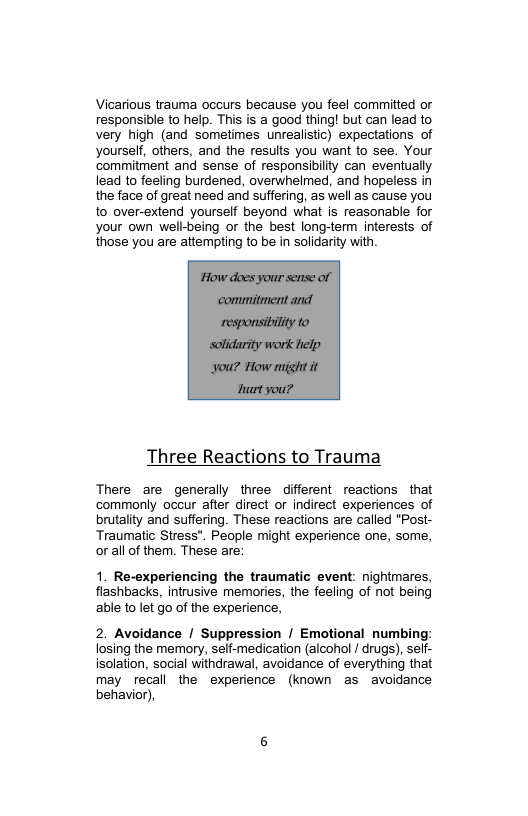
Vicarious trauma occurs because you feel committed or
responsible to help. This is a good thing! but can lead to
very high (and sometimes unrealistic) expectations of
yourself, others, and the results you want to see. Your
commitment and sense of responsibility can eventually
lead to feeling burdened, overwhelmed, and hopeless in
the face of great need and suffering, as well as cause you
to over-extend yourself beyond what is reasonable for
your own well-being or the best long-term interests of
those you are attempting to be in solidarity with.
Three Reactions to Trauma
There are generally three different reactions that
commonly occur after direct or indirect experiences of
brutality and suffering. These reactions are called "Post-
Traumatic Stress". People might experience one, some,
orall of them. These are:
1. Re-experiencing the traumatic event: nightmares,
flashbacks, intrusive memories, the feeling of not being
able to let go of the experience,
2. Avoidance / Suppression / Emotional numbing:
losing the memory, self-medication (alcohol / drugs), self-
isolation, social withdrawal, avoidance of everything that
may recall the experience (known as avoidance
behavior),
3. Increased arousal: Sleeplessness, initation, rage,
‘emotional outbursts, panic attacks, fear, hyper-vigilance,
difficulies concentrating and performing normal tasks.
Possible Reactions after a Traumatic
Experience
+ Pictures and memories of what happened
keep coming back
+ Flashbacks (the impression of reliving the
situation),
+ Nightmares or other sleep difficuties
+ Depression, not being able to enjoy life,
feeling lonely and abandoned
+ Feeling numb, switched off
+ Becoming withdrawn, avoiding social
interaction, seff-solation
+ Changes in eating, sleeping or sexual habits
- Stomach pain, nausea, muscle tension,
fatigue, or ilnesses
+ Fear, anxiety, restlessness, hyper-vigilance,
panic attacks, phobias
+ Guilt, shame, self-blame, regret
+ Inabilty to function as normal, or inabilty to
make plans or decisions
+ Feeling that there is no point i living
+ Doubting poitical activism and relationships
with friends
+ Iritability, rage, fear, emotional outbursts,
uncontrollable crying, inner pain
+ Relving previous, other traumatic
experiences
+ Loss of meaning and hope.
+ Difficulty managing your emotions, and
difficuly feeling okay about yourself
+ Problems setting boundaries and separating
work from personal lfe.
+ Problems in relationships.
+ Accidents.
+ Difficulty feeling connected to what's going
on aroundlinside you.
+ Changes in worldview or frame of reference.
such as change in spirtuality, changes in
beliefs about safety, control, trust, seff-
esteem, and intimacy.
+ Hyperarousal
+ Feeling unable to tolerate strong emotions.
+ Increased sensitivity to violence
+ Cynicism or loss of idealism/despair
+ Guilt regarding your own survival or pleasure
+ Feeling disconnected with loved ones even
when communicating with them
+ Decreased interest in activities that used to
bring enjoyment or relaxation
+ Imitabilty, agiation, impatience, or
moodiness
+ Increased dependencies or addictions
+ Impulsivity
+ Bad group dynamics, arguments and guitt-
tripping others over “not doing enough’.
THESE ARE ALL COMMON REACTIONS TO
EXTREME SITUATIONS!
Your struggles with trauma can have a serious impact on
those close to you as well. Withdrawal, overusing alcohol,
lack of sleep, diminished sexuality, over-protectiveness,
loss of compassion or hope all influence the way you
interact with those you love.
Consider asking people you
are close to-“What have you
noticed about the way T
tehave and appear to feel
when I'm under pressure?”
orasimilar question.
People react differently and in different intensities to a
traumatic experience. They also have different needs in
terms of support. You can become traumatized by your
personal experience, by witnessing, but also outside the
action by knowing the survivor or just through hearing
&
For about 70% of people, these symptoms slowly
disappear after about 4-6 weeks. But if they continue, this
condition is called "PTSD" (posttraumatic _stress
*Disorder” - we disagree with using the word “Disorder”
for something we see as a nommal reaction).
If your reactions don't settle after this time, you may wish
to' seek “professional’ help (which might be helpful
anyway if the reaction in the first weeks is strong). It may
be that Post-traumatic stress occurs months or even
years after the experience because we don't initally
process the experience. The experience is blocked, 5o it
keeps on hurting.
Why Do Some People Recover From
Trauma While Others Don't?
‘The following factors appear to make it more likely that a
person will develop Post-Traumatic Stress
+ the more severe the trauma
the longer it lasted
« the closer the person was to it
« the more dangerous it seemed
f the trauma was inflicted deliberately by other people
(eg.. police and prison officer brutality)
+ the more times the person has been traumatized
if the person gets negative reactions from friends and
relatives - which is why it's so important to support each
other more effectively
+ the longer it took to get into safe/supported
circumstances afterwards - the first minutes and hours
can make a massive difference.
Essential Components of Recovery
1. Stay in a calm place for some time, where you feel
safe and you have people around you who you can trust
‘and who can care for you
2. Work through the experience. Find words for what
happened. Tell a friend in detail. Write down what
happened. Express it in whatever way suits you
10
3. Practice good coping strategies. Good coping
strategies help you take care of yourself — especially
escape, rest, and play.
Examples include: books, films, video games, talking to
friends about things other than work, taking time off lying
on the grass, sipping tea, taking a nap, geting a
massage, being physically active, sharing jokes, being
creative.
We do ot just want to cope, however. We want to heal
and transform. Transforming trauma means identifying
ways to nurture a sense of meaning and hope.
paying attention to the “ittle things”", partaking in traditions
or rituals, reading, writing, prayer or meditation,
challenging your cynical beliefs, leaning, journaling,
being creative or artist
11
CARING FOR
MYSELF IS NOT
SELF-INDULGENCE,
IT IS SELF-
PRESERVATION
AND THAT IS
AN ACT OF
POLITICAL
WARFARE.
AUDRE LORDE
Three important themes in an effective action plan for
dealing with trauma are awareness, balance, and
connection. Understanding your responses and what
might be contributing to them can lead you o a sense of
what you need, and how to change what's happening or
manage your own responses so that things don't get
worse. Being aware of what you're doing while you're
doing it, deliberately keeping your mind and body in the
‘same piace may help prevent or manage trauma.
12
Next: balance. Balancing your personal needs with the
needs of the work you are doing. Balancing really
demanding work with less challenging work. Make sure
each work day includes breaks for mealsiphysical
activitylrest. Spend some time with people you don't have
to take care of, or better yet, who take care of you.
Understand that exhausted activists and volunteers can
do more harm than good by making mistakes.
Maintaining nurturing ~relationships and - meaningful
‘contact with others is one of the best things we can do to
address vicarious trauma. Connection also means being
connected with what nurtures and anchors you. Whether
that is nature, religion, or another source of meaning,
awe, joy, wonder, purpose, and hope. ltis very important
as well.
How you think about your work plays big role in keeping
you balanced, healthy, and able to prevent or manage
trauma.
13
= Why do you do this work?
= How does the work you do fitinto the larger
picture/mission of Mutual Aid Disaster Relief or
climate justice more broadly?
= How do you measure success in your work?
= What can you control in your work?
= What are the costs and rewards of this work and
how are you personally changing?
= In the midst of demanding situations, do you
notice any examples of determination, ingenuity,
compassion, courage, resilience, heroism, etc.?
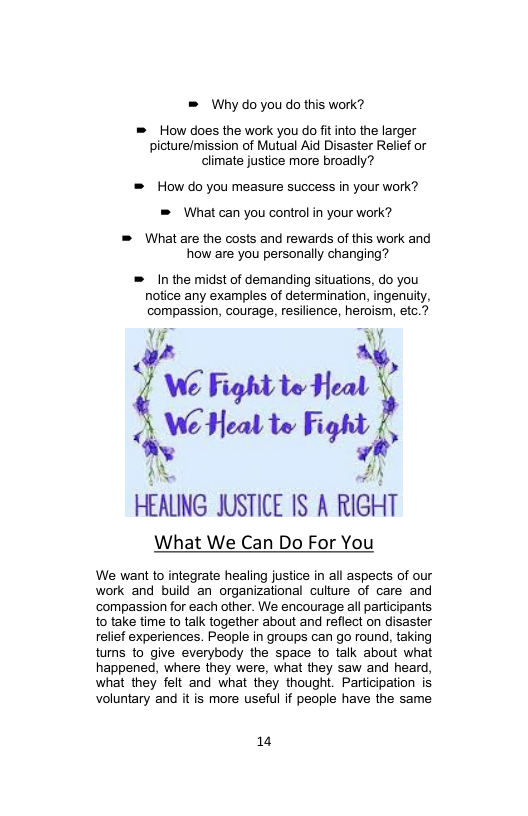
W .Y
v quflm“’
kWHmu Fight v
HEALING JUSTICE IS A RIGHT
What We Can Do For You
We want to integrate healing justice in all aspects of our
work and build an organizational culture of care and
‘compassion for each other. We encourage all participants
o take time to talk together about and refiect on disaster
relief experiences. People i groups can go round, taking
tums to give everybody the space to talk about what
happened, where they were, what they saw and heard,
what they felt and what they thought. Participation is
voluntary and it is more useful if people have the same
14
level of trauma. If you are no longer in a location with other
participants, we welcome you to use our Facebook group
page to discuss, connect, and reflect. When peer support
isn't enough, there is a 24/7, 365-day-a-year, free, and
multilingual Disaster Distress Helpline that provides
cisis counseling and support to people experiencing
emotional distress related to natural or human-caused
disasters. Call 1-800-985-5090 or text TalkWithUs to
66746 to connect with a trained crisis counselor.
What You Can Do For Yourself
Get to safety - Immediately after the experience: gettoa
place where you feel safe and take care of yourself. This
may mean allowing other peapl to take care of you. Don't
isolate yourself. Tun to your friends and tell them what
you need. Family and friends often don't know how to
help. Tell them what you need and don't need.
Act - Get rid of the adrenaline that is still stored in your
body: go for walks, cycle or run, do exercises
15
Remind yourself - You may feel guilty about what
happened and blame yourself. Remind yourself: it was not
your fault! Your reactions are normal and there is help
available; this s a difficult phase but you will get better
Find out more about trauma. The more you know, the
easier it is to see your reactions as normal reactions to
“abnormal” events.
Beware unhealthy coping mechanisms - Avoidance
and denial have damaging effects in the long run and will
restrict your life. Self-medication with alcohol and drugs
may seem to help for the moment but has negative effects
in the long run.
Explore Alternatives - Bach Flower Remedies and
acupuncture can help you deal with the emotions.
Valerian is good for sleeplessness. Massages and hot
baths are always a good idea. Also, don't be afraid to see
aprofessional if that is what you need. Good therapists o
other professionals can help. The professional should
have some experience of trauma work, otherwise it can
be pointless or counter-productive. It also helps f they are
politically sympathetic or at least neutral. You'd see a
doctor if you had a broken leg. Trauma is a very real
‘emotional wound
Acknowledge - What you have done, are doing, or intend
todo. Even if what you achieve in the short term does not
seem to be enough, it should be viewed as part of a much
longer struggle. Unfortunately, for the foreseeable future,
there will be disasters and disaster capitalists who try to
take advantage of disasters to further entrench their
power and privilege. You burning out will not change that,
neither will t help the people you are trying to assist. We
all need to look at ways to avoid bumout and blaming
ourselves.
16
“Buddy up’ - Go out there with someone you trust, or find
‘someone there that you can work, rest & play with. While
buddying does not work for everybody, many find deep
solace in knowing someone is looking out for them. Or,
better yet, come with a whole squad. We encourage the
affinity group model of organizing, and one of the benefits
of this is the microcosm of care that hopefully will come
with it
Don't judge yourself against others - Listen to your
inner-selves and be aware of your physical health. There
are very few people out there who can work incredibly
hard for many years under very stressful situations and
seem to suffer very ltle il effect from doing so. You might
feel bad if you think that others are dealing with an
experience better than you are. Remind yourself that
people are different and react in different ways. There is
no *fight’ way to react. (If you have had a previous
experience of trauma, including childhood abuse, you
may have more intense reactions.) Also, more sensitive
people often experience stronger reactions. It not a sign
of weakness to feel pain after being attacked. If you think
*I don't have the right to feel this bad - what happened to
me is nothing compared to X," remind yourself that you
have experienced something terrible and that you have
the right to feel as you do. If you feel bad, that's because
the experience was bad for you. There is no point in
comparing and contrasting brutality. If you accept your
‘condition, you will get better faster.
Get some R & R - rest AND recreation - let go, have a
laugh, dance, do some martial arts, get into the
countryside, make love, or engage in BDSM, eat well — do
whatever you need to feel good and remind yourself that
lite is worth living. And ifiwhen those littiefioud voices
creep into your thoughts allowing guilt in, acknowledge it,
17
smile at it and tel it to mind its own business. You are in
this for the long haul and need to look after yourseff, and
you will be back in the fray soon enough if you look after
yourself,
Reduce other stresses in your life - if possible. Don't
take anything else on until you have recovered from the
last escapade. For example, if you find meetings difficult,
and you don't NEED to be there, then don't go.
Sleep! - What could be more anticapitalist, carbon friendly
and nonconsumerist? And it's FREE! Get as much of the
lovely stuff as your body demands.
Be patient - Take your own time to heal, be patient with
yourself and don't condemn yourself for your feelings and
reactions. Inner wounds take time and patience to heal,
just like physical ones.
Ask - “Am | in this for the long haul?” If your answer is
Yes, then you need to be honest and think whether or not
the way your current actions are likely to help or hinder
that. Think long-term. This is a marathon, not a sprint.
18
“SOMETIAES WANTING T0 HIL YOURSELF
st e DON'T WAANT TO LVE THE IE YOU'RE HIN
10 cat CHANGE YOUR LIFEwiw ru pows. ¥
WHAT THE gfll{k e v on v LOEYOUR WHOLE L. -
NS TEAD s v
0oL, JOB, PRerests, FEARS, o=t
ADHERENCE T SOCIETY' § STANDARDS, i
o son o ur SUNIDAL EPISODES e
STRANGELY LIBERATINGn e wu
TIRDNT Y YA
How To Support Your Friend
The support of friends and families is enormously
important, and cannot be overstated. (Lack of support and
understanding, on the other hand, contributes to the
persistence of trauma.) Lack of support can worsen the
reaction. This is called "secondary traumatization” and is
to be taken very seriously. It involves “shattered
assumptions" — law enforcement and perpetrators are
known to be brutal, but if friends don't support you
afterwards, you may feel as though the whole world is
19
breaking down. This is where you come in! And here are
‘some tips to help you be there for your friend.
Be honest - Let your friend know, gently and wherever
appropriate, in private, that you have noticed some
worrying changes in their behavior. If it is affecting their
abilty to work effectively or get on with other people, tell
them. It might be useful to be specific. Make it clear its
their current behavior that you are commenting on, not
“the normal them’, and that t is because you care so
much about them that you are bringing this up. Take them
out and have a good time, if possible avoid talking shop.
Consider showing them this zine.
Be proactive - Traumatized people often find it hard to
ask for help. Be proactive but not pushy. Don't wait for
them to ask for help. Be there for them. The days
immediately after the experience are crucial. This is when
all the emotions are easily accessible. It's good to talk
then. Later on, people often close up. Often traumatized
people withdraw from social activities and isolate
themselves. You may not see your friend around
anymore. Go and find them.
Listen - The person may need to talk about the traumatic
events over and over again, and one of the best things
friends can do is to be patient and sympathetic listeners
s0the person feels less alone. Avoid talking too soon, too
long and too much. We often long to give good advice
rather than be a good listener. Put yourself n their shoes.
Try and understand how they feel, not how you might
have fet. Tellng the story in the order in which it
happened, chronologically, helps the brain process the
experience. Carefully encourage your friend to talk about
what happened, what they saw, heard, feft and thought.
Butit may be the case that your friend doesn't want to talk
about it in which case don'tforce them
2
Have realistic expectations - Itis also important to have
realistic expectations while the person is recovering and
not to expect too much or oo it from them. Don't expect
a traumatized person to recover quickly. Some wil, but
‘some won't be able to. If someone is taking a long time to
recover from a crisis, offer your support repeatedly, so
that they don'tfeel alone.
Don't take things personally - A traumatized person
may have symptoms which are very hard for those around
them to deal with, for example anger, withdrawal,
initability, ungratefuiness and being distant are al
common reactions. Bear in mind that the traumatized
person is not deliberately acting this way: itis the trauma
which makes them behave like this. Don't take it
personally, but recognize it as a symptom and s a sign
that they need your support.
Don’t minimize the trauma - People are tempted, time
and time again, to encourage the person to stop reliving
and simply forget about the trauma and get on with ife.
Unfortunately, this advice is usually not helpful in this
situation and is likely to make things worse, s it may
make the person feel even more isolated and hopeless.
Remind your friend - One of the most important things
You can o is to give the message: *You are not to blame
- and you are not alone.”
Behave normally - Pity or self-indulgent "overcare" do
not help. The most important thing s that your friend feels
safe and warm in your presence.
Educate yourself - You might feel insecure about how to
2
help. Find out more about trauma so you understand it
better. Bear in mind that many people seem all right after
traumatic experiences and that reactions may come later.
Ask what they need, don't impose your solutions.
Accompaniment - Traumatized people often struggle
with the smallest tasks. Cooking, shopping, and handiing
the chores for them can be invaluable help, as long as you
don't patronize them or undermine their independence. O
maybe go with your friend when, for example, they try to
go on demonstrations, actions or to other potentially
triggering situations again. Keep an eye on them, and
check how they feel, before, during and after. Also, when
the symptoms of post-traumatic stress are over, it is
important to help your friend to reintegrate into an active
lite.
Seek support - Remember: a supporter needs support,
too. Supporting a supporter is essential. Helping and
caring can be very hard for you, too. Take care of yoursel,
do things that make you happy. Talk to someone else
‘about how you feel. Getting support for yourself will help
You support others.
2
Going through traumatic experiences can often have
positive outcomes in the end. A lot of people have been
through these experiences and many have reported
breakdowns turning into breakihroughs and opportunities
for self-growth.
For example conscious enjoyment of life and the beauty
around us, being grateful for every day. Facing your fears
and overcoming them is very empowering. Having a
broader understanding and humility can make you a more
empathic and understanding person. And having been
through a traumatic experience can give you valuable
insight on how to help another person through traumatic
experiences as well. There is much of this world that
needs to be composted, and you have wisdom, heart-
breaking, hard earned, wisdom, that is needed in these
times of death, birth, and renewal. Never give up. The
world needs us more than it ever has before. Sometimes
we are broken, but it's the cracks that let the light come
through. These cracks just mean something is being bom
inside, something green, something new.
Sometimes, it's only through disasters that we unearth a
power within that can't be measured or defined.
Sometimes darkness is our candle.
Sometimes our wounds illuminate our path
And sometimes healing happens, in roundabout ways, all
around and deep inside us.
23
“WE NEED TO BE WEAPONS OF
MASS CONSTRUGTION,
WEAPONS OF MASS LOVE,
IT'S NOT ENOUGH JUST TO
CHANGE THE SYSTEM.
WE NEED TO CHANGE OURSELVES."
— ASSATA SHAKUR
To heal, we must resist. To resist, we must heal.
2