Muntjac #2 Anarchism Decolonized
Web PDF • Imposed PDF• Raw TXT (OCR)



![We (MUST) Keep Us Safe: An interview with a Long-Term, Anonymous Anarchist Comrade on Repression, Trauma, Security Culture, and Revolutionary Solidarity thefinalstrawradio.noblogs.org/post/2025/01/12 Bristol Auarchist Black Cross bristolabe.org In The Belly: a journal by and for people who are held captive by the Prison- Industrial Complex. bellyzine.net Mangoose Distro: material solely for the purpose of achieving breakdown of prison through disruption. mongoosedistro.com International Day of Solidarity with Marius Mason & All Long-Term Anarchist Prisoners JjuneLnoblogs.org International Weck of Solidarity with Anarchist Prisoners (23 - 30 August) bttps://olidarity.international Citations: [1] Kalasnyikov.hu/dokumentumok frank-kits [2] iwoc.iww.ong.uk/2024/11/03 [3] actfonfree.noblogs.org/2025/01/29 (4] pearnuallak.com/against-hate-crime [5] returnfire.noblogs.or post/2024/03/25 Page 49. [6] For more like this: www.notrace. how/threat-library [7] thefinalstrawradio.noblogs.org/pos2025/01/26 18] ananarchistealledmutt.noblogs.org/post/2025/03/08/the-kkke [9] archive.ph/65VHG [10] thefinalstrawradio.noblogs.org/post2025/03/30 p-gangs-countergangs pdf](muntjac-2-anarchism-decolonized-muntjac 8.png)
![Zhachev - They Who Returned to the Rock In approximately 312 BCE, a former gencral of the late Alexander the Great, King Antigonus | Monophthalmos launched an effort to conquer the Nabatacan people. The Nabatacans were a proto-Arab group, in many ways the proto-Arab group, who had for centuries inhabited the deserts of Syria and the Levant, particularly what is today southern Jordan. Known for their nomadic lifestyle, control of important trade routes, and illusive nature, they were a very significant cultural, cconomic, and political force in the region during the era. The Nabatacans were not a people who hastily conducted warfare. While it s true that they generally avoided direct confrontation, they did excel at a lethal kind of proto-guerilla warfare with cunning strategies, leveraging their knowledge of the desert terrain and the resources of their extensive trade networks to outclass and outmancuver their opponents. Their military engagements were ofien characterized as defensive in nature, reflecting a preference for avoiding open battles and instead exploiting the strategic advantages offered by their environment to gain tactical vielories. During the classical campaign of King Antigonus 1 against these desert free men, the Nabatacans, who controlled the vast flow of spice and incense throughout the whole of the ancient and elassical world, noteworthy historical figures were involved. There was Demetrius, son of Antigonus 1, the failure and war criminal Athenacus, a ‘general of Antigonus I, and Hicronymus of Cardia, a famous Hellenic historian. The chronicle of Hieronymus regarding these events was later incorporated through its surviving fragments into the writings of the Hellenic historian Diodorus of Sicily Specifically, a work by Diodorus entitled Library of World History. sec. 19.94.2- 95.2, which provides a fascinating account of Nabatacan customs. Here’s a translation by C.H. Oldfather: “For the sahe of those who do not know, it will be usefl to state in some detail the customs of these Arabs (ADBIOY. by following which, it is belicued, they preserue their liberty. They live in the open air, claiming as native land a wilderness that has neither rivers nor abundant springs from which it is possible for a hostile army to obiain water. It is their cusiom neither to plant grain, set out any Jruit-bearing tree, use wine, nor construct any house: and if anyone is found acting contrary to this, death is his penalty [author emphasis]. They follow this custom because they believe that those who possess these things are. in order to retain the use of them, easily compelled by the powerful to do their Bidding.](muntjac-2-anarchism-decolonized-muntjac 9.png)
![Some of them raise dromedaries, others sheep. pasturing them in the desert. While there are many Arabtribes who use the desert as pasture, the Nabataeans Jar surpass the others in wealth although they are not much more than ten thousand. in number; for not a few of them are accustomed to bring down 10 the sea frankincense and myrrh and the most valuable kinds of spices, which they procure from those who convey them from what is called Arabia Eudacmon. They are exceptionally fond. of freedom fauthor emphasis]: and, whenever strong force of enemies comes near, they take refuge in the desert, using this as a fortress: for it lacks water and cannot be crossed by others, but to them alone, since they have prepared. subterrancan reservoirs lined with stucco, it Jfurnishes safety. As the earth in some places is clayey and in others i of soft tone, they make great excavations in it, the mouths of which they make very small, but by constantly increasing the width as they dig decper, they finally make them of such size that cach side has length of one plethrum (30-33 meters). Afier filling these reservoirs with rain water, they close the openings, making them even with the rest of the ground, and they leave signs that are known to them-selues but are unrecognizable by others. They water their cattle: cvery other day, so that, if they flee through waterless places, they may not need a continuous supply of water: They themselves use as food flesh and milk and those of the plants that grow Jfrom the ground which are suitable for this purpose: for among them there grow the pepper and plenty of the so-called wild honey from trees, which they drink mixed with water. There are also other tribes of Arabs, some of whom even till te soil, mingling with the tribute-paying peoples, and have the same customs as the Syrians, except that they do not duell in houses. It appears that such are the customs of the Arabs. But when the time draws near for the national gathering at which those who dwell round about are accustomed to meet, some to sell goods and others to purchase things that are needful o them, they travel to this meeting, leaving on a certain rock their possessions and their old men, also their women and their children. This place is exceedingly strong but uniwalled, and it i distant two days’ journey Jrom the sttled country.” We cannot be sure if this Hellenic account and perspective is wholly accurate; whether or not they put to death fellow tribespeople who dared break their sacred codes. But the assertion that the Nabatacans were “exceptionally fond of freedom” ‘as Hieronymus of Cardia claims is fully backed up in the different historical records of many different cultures and peoples who interacted with them across the ages.](muntjac-2-anarchism-decolonized-muntjac 10.png)

![From Palang Hitam Anarkis: Sidi is an anarchist, illegalist and an individualist. On the 12th of July 2024, state authorities had arrested him for cannabis use. and possession. He often contributes to anarchist publishing and street librarics, involvement in soccer hooligan club, clashes in protests and a passion for writing poetry. Sidiq is looking at a possible 10 year prison term. His support group are taking donations via paypal at; einzine] 6@ gmail.com You can write to Sidiq: Muhammad Ilyas Sidiq Lapas (prison) Kebonwaru, Kee. Batununggal, Kota Bandung, Jawa Barat 40272 Indonesia Sidiq is part of two publishing collectives; Contemplative Editions and Talas Press who publish anarchist books. Contemplative Editions contemplative@riseup.net _contemplative [Instagram] templativepublishing.noblogs.org Talas Press @talaspress [Instagram] hitps:/flinktr.ce/talaspress For more information on anarchist anti-prison struggle in so-called Indonesia, find Palang Hitam Anarkis [Anarchist Black Cross] online at palanghitamanarkis. noblogs.org or on Instagram @ palang__hitam 7](muntjac-2-anarchism-decolonized-muntjac 19.png)

![was abolished. They kept lands, they kept ccanomic power: They kept growing through the centuries, through the next generations. So P’m oppressed by the same last names that my grandmother, my great grandmother, my great great grandmother were oppressed under. Those are the same last names, its caste. MK So, it is a class issue? RR Yes, it’s a capitalism issue. We have white peaple as allies, it is just capitalism at ts purest. The consequence is not just the food price, everything is more expensive here. Another consequence is Kepone, Chlordecane and in the US Kepone was manufactured by in the US by Allied Chemicals. MK So, Kepone s an inseticide, correct? RR Initially it was not authorised on US soil for us, it was authorised for Export. In 1974, at the warchouse of Allied Chemicals, there was an issue with AllicdChemicals. The workers were infected, the river was infected as well, it i a highly toxic pesticide. In the US, this issue was handled quickly, banana producers that were importing this pesticide in Martinique went and bought the authorization for them to bring production somewhere else. They knew of its toxicity since 1975. As of today. the use of this pesticide was stopped in France in 1990, in Martinique it was used until 1993. That lobby bought a lot of the pesticide before the ending date came in. MK So this pesticide was banned in the US for 50 years but it was allowed to be used in Martinique. Is it till being used in Martinique? RR Not officially since 1993. The reason why I’m very meticulous in what T say is because of the arguments in courts. The consequence is, a lot of our soil, our rivers and some of our seas have been poisoned for more than 500 years. Tt can poison the Chickens, the Fish, it is an environmental catastrophe. There is 2 UN report that classifies Martingiue and Guadeloupe as two of the fifly most countries polluted on carth. Why I talk about Kepone s the same peaple. the same companies that plant bananas are the same ones importing food. L] MK The protest over these conditions, in this case, high prices. What is it that people want? Do they want to be treated more equitably, do they want to be. independent of France? What is the demand of the protest? 2](muntjac-2-anarchism-decolonized-muntjac 23.png)












![This exchange of specch in a language the police know so well lasts less than a minute before the rifle disappears into the darkness of the car. The vehicle quickly turns around and speeds off from the direction it came. Alook back over the scene: An SPD patrol car riddled with bullets, one pig slumped in his seat dead, the other injured. nd when we die there ain’t no fireworks or fuckin parades” ~ Bambu, Since | Was A Youth November 6th, the armed death cult of SPD hold a public memorial ~ a procession through the city they occupy, a show of force. Around the same time out in Tukwila a snitch, a cop without a uniform, calls in a suspicious vehicle that matches the description of the vehicle that opened fire on the oceupying army. The enemy encroaches on an apartment complex, a man brandishes a OMM Glock and flees up. the stairwell. The enemy approaches, the man pops out from the comer putting the gun into the cops face and pulls the trigger — click — he forgot to chamber a round. He goes down in a hail of gunfire into his head and stomach. The encmy enters the man’s apartment. They find a small armory — A bolt action rifles and 2 semi-auto rifles, a shotgun, another 43 handgun, homemade explosives and firehombs and booby traps. Ballistic and DNA forensics identify this man — Christopher Monfort — as the arsonists and gunman. Despite all odds he survives, now paralyzed from the waist down with a bullet lodged in his spine and with brain damage. o when the system seems to break down what do we do? We march, we protest, we form groups and the police scowl at us on the sides of the road and talk about the overtime they’re getting. If you stand close enough you can hear them. They have no intent on listening 10 a thousand or ten thousand people marching for police to stop their brutality. When you see a couple police officers brutalizing or murdering someone there’s always a few, maybe half a dozen, of their friends around them. They’re not gonna tell on their buddies. They ’re not crossing the blue li ~Christopher Monfort, Final Statement to the Court (https://www.youtube.com/ watch?v=0YDPObuYVHe) Despite everything, Chris was able to speak for himself, He was sentenced to life in prison. He died in 2017 in his cell at Walla Walla State prison, allegedly from overdose. Anarchists continued to support him until his death. the always was a little radical, and she was hardeore about certain stuff. She did alot of research ... laws of the land.” Rhanda [Korryn’s Mother] said. ‘And right 52](muntjac-2-anarchism-decolonized-muntjac 54.png)














![Muntjae Collective - Protect Yourself Angone, even those not involved in militant action, would benefit from brushing up on their personal and/or operational security. We all desire privacy and in an endlessly accelerating world of technological domination the realm in which we can achieve this requires more complicated means. We are not experts but we have two recommendations, that you and your cre (if you’ve got one) should spend some time checking out: 1. No Trace Project [notrace.how] 2. AnarSee [anarsec.guide] We’ve included some statements by both of these projects. No Trace Project The No Trace Project is an international anti-repression project. Tts purpose is to help anarchists, activists, and other rebels understand and avoid State repression. If you engage in activities deemed illegal by the State, or otherwise disrupt the smooth functioning of our capitalist society, you may end up under investigation. You may even end up under investigation because of the activities of your friends. By taking security precautions commensurate with the risk level of your activities, you can thwart investigative efforts and avoid imprisonment or other negative consequences. The No Trace Project covers not only digital security. but also a wide range of surseillance-related topies, such as video surveillance, police infiltration, fingerprints and DNA, tailing, and many others. Everything is available on their website, to read online o as printable zines. AnarSec As anarchists, we must defend ourselves against police and intelligence agencies that conduct targeted digital surveillance for the purposes of incrimination and network mapping. Our goal is to obscure the State’s visibility into our lives and projects. Our recommendations are intended for all anarchists, and they are accompanied by guides to put the advice into practice. We agree with the conclusion of an overview of targeted surveillance measures in France: “So lets be clear about our responsibilities: if we knowingly bring a networked device equipped with a microphone and/or a camera (cell phone, baby monitor, computer, car GPS, networked watch, etc.) close 1o a conversation in which “private or confidential words are spoken” and must remain so, even if it’s switched off, we become a potential state informer. 84](muntjac-2-anarchism-decolonized-muntjac 86.png)





![colonialism, white supremacy and the counterinsurgency we face and relate such with the struggle for ieedom for political prisoners and Prisoners of War. - To give support and solidarity o the thousands of peaple, including prison organizers and “poliicised”prisoners, who are captives of a system built of enturies of oppression.” In 2002, the organisers of the event from the very beginning grew frustrated, one wrote that he felt a lot of the people involved were middle class POC uninterested in projects that reach out to the non politicized, impoverished POC. From the 3ud 1o the 5th of October 2003 APOC would have their first conference, this would be where the debate about organisation would begin. As part of the many workshops that were to take place during the conference, there were two different angles. One group wanted to discuss a “Network’ type structure. While the other, led by members of the Black Autonomy Network of Community Organizers advocating instead for (what 1 assume was) a more federal structure under their proposal for a “United Front” However, neither of these proposals were ever discussed as the “Network” proposers suggested that the “United Front” proposal be discussed as a workshop as most conference pre-registrants had not expressed any interest in making a_formal APOC organisation. In response the “United Front” proposers called this idea “Undemocratic” and issued a statement titled “Stop Character Assassination and Sectarianism in the APOC Movement.” which condemned the “Network’ proposers and several other people in the project. However, during the event itself, neither proposals were discussed or workshopped. While digging around online T believe T’ve actually found a zine version of the ‘Network’ proposal, or at least a zine with a similar name, that references an upcoming event in Detroit, the crux of it reads: “The organizing catalyst we envision. is a_loosely-knit network of groups and individuals, with a basic. process, organising and communications framework established as a means of working together. Membership should be based on agreement with the mission, points of unity and statement of purpose. L] Decisions should be made in a spokescouncil format, where delegates elected by local and regional groups participate in discussions and. decisions (although the audience isopen to all members). Committees and spokescouncil members should be accountable 1o the group. Committees should be based around. common work, such as process, publicity and organizing strategy; and. be coordinated by a chair elected by committee members on 105](muntjac-2-anarchism-decolonized-muntjac 107.png)
![the basis of the potential chair’s commitment to spending time in skills sharing and project completion. Committces should report back monthly to the spokescouncil.” This chairperson thing, T should add, isn’t all that strange in the context of the neo trotskyist bullshit around in the Anarchist movement in the 2000 . The history of pretty much any and all formal orgs is typically a confusing slew of acronyms and micro tendencies named after popular authors. From what T can tell this was never implemented and what APOC ended up being is aloose network of groups and individuals, based almost entirely on their position as anarchists/anti-authoritarians and as racialized (as non white) people. APOC local groups would start to pop up afier this convergence, the NYC chapter, for example, who previously had mainly existed as a study group, would put on a fundraiser show/party to help with the costs of the flights to Detroit and the coming flights to Miami for the demonstrations against the Free Trade Area of the Americas (FTAA), at which a contingent of APOC would form their own Bloc during the demonstrations. But at this fundraiser, three. plainclothes cops followed by up. to it in uniform barged in and assaulted the atiendees. At the Miami anti FTAA demonstrations, repression would force the APOC’ers to focus largely on supporting people who were amrested, including 50 arrested while doing said arrestee support outside a prison. In 2004, Gregory Lewis, member of the Black Autonomy Federation, who gave a karate workshop at the first conference propose that the network becomes an organisation and introduces a tiered form of membership ranging from supporters (which could include whites) to collectives and individual organisers which can apply for grants via funds collected from membership dues, what’s perhaps perplexing about this proposal is the idea of a *National Spokesperson’ and the idea that an organisation like this could somehow pay for Healtheare of its members Later that year, Our Culture, Our Resistance, a collection of interviews by people involved with APOC was released as two zines after being turned down by AK Press. In 2005, Roger White’s book “Post Colonial Anarchism s published, in that same year, APOC member Pedro Ribeiro pens an article, with one part really pricking my interest: “[..] APOC is more than a saf zone for people to feel good about not being in a room. without white folk, but is @ conscious project of self-determination for people of color.” So, it seems like at least some of the members of APOC had the idea that the project needed to be (or perhaps, in their eyes was) more than just a scene within a scene: 106](muntjac-2-anarchism-decolonized-muntjac 108.png)
![but somewhere to actually further their own strugeles independently of the white anarchists they found so frustrating APOC planned another conference for carly October of 2005 but the social strife caused by the effects of Hurricane Katrina led o the meeting heing postponed. APOC members shifted their focus instead to contribute to relief cfforts and supporting mutual aid projects such as the Common Ground Wellness Center in the Algiers neighbouthood of New Orleans who provided medical care and supplies. Emesto Aguilar was pushed to leave APOC after heing called ot for cheating on his partner and the website was passed on 1o Greg Jackson. About a year later, the domain was lost entirely. T have no data on 2006, no doubt partially due to the lost data from the website change. Tn 2007, they had a conference in Asheville, North Carolina. In 2008, they held a caucus at the Nashville, Ten gathering and they held an APOC caucus at the Earth First 2000 is probably their most active year and the events of it likely led to the network’s downfall. On the 7th of February, APOC in Philadlelphia held a POC-only Music and Poetry beneit for Ojore Lutalo, a Black Liberation Army prisoner and anarchist, but i’s perhaps worth noting that years later he’d recall in an interview that: “[..] Inever received a post-card from anyone who identified themselves as an ‘anarchist person of color’. Anarchist people of color today have a lot of political education to do. 1o decide who they are, where they e going, and how they re supposed to assst in the liberation of people of color.” Hopefully people did write him letters, since they did at least include his address in the event announcement but perhaps few used the term “Anarchist Person of Color” to identify themselyes. In Washington, DC APOC. did banner drops, graffit and issued a communicque in which they explicitly named him. The anonymous authors wrote: “These actions were carried out in February for the call o action of a Black Liberation. “month.” We wanted to commemorate an ofien forgotten wartior Ojore Lutalo for the actions he carried out in support of the Black Liberation Army. There were several banner drops and other actions around the D.C. Metro area to support Gjore Lutalo, Assata Shakur and the Black Liberation Army. To all radicals and revolutionaries of color the time for action is long overdue. There is no excuse. Take action now. Is Jreedom or death. We’ve chosen freedom. What will you choose?” In March, APOC in Philadelphia put on a vegan Caribbean Dinner & Film Serecning Benefit for Ojore Lutalo. March 21, 2009, a group of APOC blockaded a ANSWER Coalition demonstration, annoyingly. the footage and audio of all o this hasn’t been saved but one line in the report stuck out like a sore thumb: “Hezbollah flag waved 107](muntjac-2-anarchism-decolonized-muntjac 109.png)

![Mar - Introvert’s Guide to the Insurre Note: This guide is intended only as polite recommendation because we would not tell anyone what to do, obviously. Please use with caution. Step one: Wake up. You did it. Well done. Step two: Feed cat. Step three: Do your morning meditation and set your intention for today (insurrection). Step four: Make a cup of tea or coffee, and a big healthy breakfast. You’ll need the energy. Step five: Gather your things. Take your emotional support squishy and/or crystal which you have charged under the fall moon light and put it safely in your pocket. Step six: Don’t forge the rifle. Step seven: Make your way to the local library where you and your fellow insurrectionists are gathering. Go over the plan together. You start to feel a little anxious, but gain quiet confidence because while everyone else was out partying you have been sitting in the comfort of your own home perfecting reloading rounds in record speed. Step eight: As you reach for your phone to put it in the safe box [1], you see a notification. 10s your astrology app telling you to seek guidance from the ancestors. This is less zen than it sounds and is a little bit stressful actually because your communist grandparents who fought in the independence war back home would be so 114](muntjac-2-anarchism-decolonized-muntjac 116.png)
![disappointed in you if this fails. Use that shame as fuel. Step nine: Head over to the insurrection. Today we are seizing and commoning land “owned” by the elderly gentleman who lives in the Grade ILlisted estate down the valley, the one with the big pond with the fountain in it. You feel kind of bad hecause he’s actually nice to you when you do his gardening, plus he’s got arthritis and has heen Tooking especially sad and lonely since his pet praying mantis Pedro died. Then you remember he’s wealth-hoarding landed gentry who must be overthrown. Step ten: Of course the motherfucker calls the cops. This is okay because you are prepared. Do not talk 1o cops, which is casy because you are Gifted and Talented at not talking 1o anyone. Step eleven: Outgunned, the cops call in the army. The regiment arrives but they are paralysed. No one in living memory has experience with anarchists successfully organising anything remotely close 10 a mutual aid project without everyone falling out and never speaking to cach other again, let alone an armed insurrection [2]. They capitulate in confusion. Step twelve: We win. Darren [2b] gives you a high-five. You glance at your watch and realise it’s not even two o’elock. Join the rest of your comrades who have taken over Alastair’s [3] Kitchen and cook a massive community meal onhisour Aga. Step thirteen: Finish lunch and politely take leave s0 you can go and have your aftemoon nap. Step fourteen: Nap. Step fifteen: Wake up from nap. s,](muntjac-2-anarchism-decolonized-muntjac 117.png)
![Step sisteen: Normally you would spend the rest of the evening reading the book/pamphlet/ zine you picked up at the last Anarchist Book Fair but decide you will make an exception since it is the insurrection after all so you muster all strength to go down the pub. You are more nervous about this than about the insurrection. There, you find everyone liberated from the surrounding villages celebrating. You surprise yourself by cheering and, for two regrettable seconds, dancing. For the fourth time. in your adult life, you enjoy the presence of others. Step seventeen: Lol who are you kidding. You decide you have stayed at the insurrection party long enough to be socially acceptable and quietly weave your way out the door. Step outside. The night sky is clear and the stars are bright. Take a deep breath and smile. Step eighteen: Go home, feed Luciente [4], and get ready for bed. Step nineteen: Fall decply asleep, dreaming of more insurrections to come. [1] Never take a smartphone to an action, obviously. [2] Last time, Darren [2b] forgot the Titter password to update the event poster so everyone showed up three days late. [2b] Not his government name. [3] Sorry I forgot to tell you his name earlier but it docs’t matter anyway because he has fled never to be seen again. [4] Your cat. 16](muntjac-2-anarchism-decolonized-muntjac 118.png)








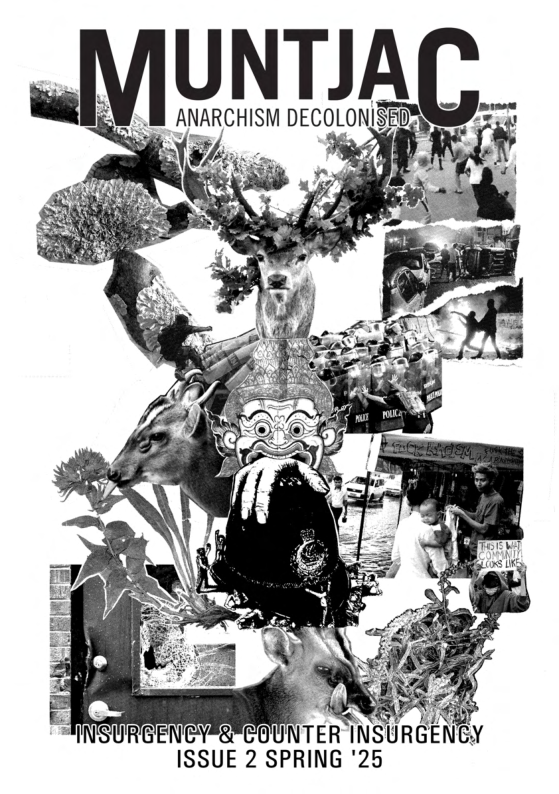
“INSURGENCY*R*C UNTER INSURGENG»V
ISSUE 2 SPRING '25
Contents
19
2
£
6
67
7
76
79
9
103
14
18
119
121
M. - Editorial
Zhachev - They Who Returned to the Rock
Mar - this poem is dedicated to uncle
Sidiq - Pengar / Hangover
Margeret Kimblerly & Roddy Rod - Martinique’s History of Resistance
Simoun Magsalin - The Anarchy of the Peripherics
Leonardo Torres Llerena - Toward an Indo-American Revolution
CharlieBanga & Semiyah - Autonomous Submersion
Anon - Our Burning Memory
Patrick Jonathan Derilus - The Immovable Black Lumpenproletariat
Fawaz Murtada - Why Would You Become an Anarchist in Sudan?
Daniel Adediran - Where is Black Anarchism in the UK?
Anon - Principles for the coming Yankee invasion
Principios para la invasion gringa que se viene
Decolonize Anarchism - May Day on Fire: Against Empire and Theoeracy
Group OF Informal Affinity - Reject the National Army la
Muntjac Collective - Protect Yourself
Anon - Alexa, take me to prison!
Haraami - Follow the Fires
Matt. - What Color Is The Smoke? (In conversation with Follow The Fires)
Mar - An Introvert’s Guide to the Insurrection
poet of da soil - untitled
Anon - Selections From Disquietude Laboratory
Anon - Seleetions from Kompilasi Puizine
Mutt. - Editorial
What motivated us to theme this second issue of the magazine around Insurgency
& Counterinsurgency s our desire 1o erystialize our dispersed experiences of
betrayal, repression and defeat into not only a critique of the left and some sections
of the anarchist scene but to present an altemative with teeth.
We also want to draw more attention to the lessons we could be leaming from the
moments of refusal that do happen here and of course lessons from movements
in Palestine, Kanaky, Martinique, Guadeloupe, Kenya, Greece, Indonesia, West
Papua, Mexico, Argentina, Chile or elsewhere.
Before we go any further, it important to define terms;
Insurgency - an insurgency is a formation of lightly armed people waging
asymmetrical warfare against a larger, centralized enemy. Typically. this enemy (1o
the insurgents) is the state which dominates the given territory or an occupying
force that has moved into an area.
The police here and elsewhere frame their study of the anarchist movement that
separates itself from the theatre that is the left wing of capital through this lens,
no matter what they call us, the state is the only terrorist. Further to this, we
should point out that we're not insurgency fetishists as we're not inspired by the
insurgencies of fascists but instead insurgencies against colonialism, capital and
the state.
Counterinsurgency - counterinsurgency is a term to define a range of tactics utilized
by an occupying force to repress insurgences that have formed against them.
There are a myriad of tactics used by oceupiers o maintain their control, most of
which are “dircet” in nature: Blockades or Checkpoints to funnel insurgent traffic
through regions the occupation has better control of. Surveillance Infrastructure,
Patrols, or Quick Reaction Forces (highly mobile units equipped with “force
multiplier” equipment, trained 1o respond to any attack on the occupations
infrastructure)
These are always complemented by tactics of a more “indireet” nature. The
use of torture or bribes to gain information, the spreading of disease, the use of
chemical weapons, psychological warfare, propaganda, byzantine regulation to
mentally exhaust the people trying to etch out a way of life under occupation,
2
the use of paramilitaries for plausible denability is often complemented with the
cxeation of counter-gangs'" (lightly armed groups trained by the occupation to both
delegitimize the initial insurgency and to actively hunt them down and kill them)
In the past few years, we've been witnesses to insurgent elements in uprisings
against the state in Belarus, Hong Kong, the Black anti-police uprising across the
so-called US in 2020, Indonesia, Kanaky, Martinique, Guadeloupe and elsewhere.
Anew stage of anti-colonial strugele in Palestine began with the Al-Agsa Flood and
despite heightened genocidal tactics by the oceupation and its allies, the resistance
has continued. In Myanmar, anti-junta insurgent groups still fight the Tatmadav. In
West Papua, Insurgent groups persist against the Indonesian armed forces. There
are others, but Tonly have so many pages to spare.
Al the same time, we've seen a burgeoning arms race in counter-insurgent tactics
to crush uprisings in their infancy or to wear them out at their heights. Here, the
horizon looks bleak for those of us who rise in anger at the British state:
In the prisons, more weapons are being introduced after an atiack on prison
guards, the punitive raid at HMP Garth still rings in the ears of prisoners once
under the illusion that the wave of early releases has signaled a coming case in the
quality of life on the inside?.
Stepping outside, you'll likely come face to lens with the British pathological
urge t0 film fucki
facial recognition technology installations 1o complement the - preexisting
everything, this will deepen as the police introduce permanent
checkpoint-style facial recognition vans. This combined with the prevalence of
apps like PimEyes” is enough to make anyone anxious.
10s (still) a police carnival, if you've had the displeasure of participating in
Babylon's various protest movements, you've seen it. The counterinsurgency has
many faces but what it tends to look like is the perpetual appeal for calm, for peace,
the prevention of de-arrests,calls for “non-violence”. Specifically,
Tt looks like the PSC’s (Palestine Solidarity Campaign) leadership taking down
an aticle by Seotland PSC talking about how the police sent armed response and
made several arests during a static demo outside of a fucking Home Bargains
supermarket. It looks like Representasians pushing for Hate Crime legislation
deceptively wrapped in the language of anti-racism. 1t looks like Black
“Security” organisations like Forever Family serving as a de facto police force at
demonstrations in Black neighbourhoods.
Fuck them, they know what side they're on.
Austerity for everyone but the police, 13.000 new cops, new drone tech,
a glimpse of which was seen last summer a drone hovered above a prearranged
antifascist counter-demonstration meeting point with it speaker blaring “REMOVE
YOUR MASKS OR YOU WILL BE ARRESTED”. In a video posted to TikTok the
Metropolitan Police illustrated their ongoing campaign of installing plainclothes
police officers inside shops frequently targeted by shoplifiers
New power granted to the police has c
spoof their tech are threats to the techno dystopian hellscape we live in. The police
are already using predictive policing algorithmic software to aid in their campaigns
of predation, speaking of which, the British Transport Police jumped with joy as
a new transphobic supreme court decision has given them the chance to further
their frequent abuses against women and children. On top of all of this, a new FBI
style police agency is on the cards and ongoing repressive projects like Operation
Adream are on our minds once again®.
minalized masks, tactics that work and
Elsewhere, the fecling scems mutual:
In Indonesia, anarchists and students who rose against new laws that would retum
the country to military rule have faced off against counter-gangs of plainclothes
cops dressed like demonstrators, the police have re-routed ambulances full of
wounded protestors o police stations, police have destroyed supplies of water and
food prepared to sustain the fight and have utilized hardware that intercepts mobile
phone data, notably, using it to try 1o access people’s Whatsapp accounts (these
protests have largely been organised via social media). The police use powdered
dye 1o mark the clothes of people gathering at pre-amanged protest sites, this is
paired with the installation of new cameras*.
In Greece, the New Democracy government has tried and failed to distract people
from its shortcomings through repression™. On top of this the communist KKE
again join the forces of the counter-insurgency calling the Koukoulofori (“hooded
ones™in Greek) cops as they pack their banners into their bags and head home
the second the molotov cocktails and tear gas start flying. This again reminds us
of their collaboration with the police in defense of the parliament and the Golden
Dawn fascist organisation in the past?.
In Nigeria, politicians can easily dip into the large numbers of unemployed young
people to form counter-gangs (0 repress protests on their behalf.
In Turkey, police use iritant chemical sprays to force protestors to remove their
masks so they can be photographed for follow-up arest.
In Turtle Iland, during a daytime direct action against parked police vehicles
YC”, police use drones to track the anarchists as they disperse. Automatic
license plate readers, Instagram captions, and fingerprints were used to_aid
in the prosecution of 3 alleged Arsonists at Tesla car dealerships”. The RICO
charges levelled against the Stop Cop City movement show a clear attempt at the
criminalization of solidarity itself'"l
Are we fucked then?
On the contrary, despite the billions of pounds poured into the apparatus of the
counter-insurgeney, opportunities for disruption, refusal and freedom through
negation exist everywhere. If you've been paying atiention, people are taking
these opportunities, the misery of everyday life is vulnerable, you just need to be
determined.
More sophisticated knowledge of the technological tools of repression can help s
stay on the outside, anarchists recognizing the fact that anti-repression is everyone’s
responsibility could help those on the inside survive the regime of isolation and
deprivation too.
T'm drawn back to the Creole proverb Sé ti bwa ka fé gwo difé
Smouldering litle branches, when grouped together, can fuel a great fire.
Mutt.
01/05/2025
Recommended Further Reading:
An Open Letter To The Tnternational Anti-Prison / Anti-Repression Gathering (2024)
returnfire.noblogs.org/post/202403/25
o the International Anarchist Movement: Three Security Proposals
notrace.how/blog/three-proposals/three-proposals
Encrypted Messaging for Anarchists
anarsec.guide/posts/eZee
We (MUST) Keep Us Safe: An interview with a Long-Term, Anonymous Anarchist
Comrade on Repression, Trauma, Security Culture, and Revolutionary Solidarity
thefinalstrawradio.noblogs.org/post/2025/01/12
Bristol Auarchist Black Cross
bristolabe.org
In The Belly: a journal by and for people who are held captive by the Prison-
Industrial Complex.
bellyzine.net
Mangoose Distro: material solely for the purpose of achieving breakdown of prison
through disruption.
mongoosedistro.com
International Day of Solidarity with Marius Mason & All Long-Term Anarchist
Prisoners
JjuneLnoblogs.org
International Weck of Solidarity with Anarchist Prisoners (23 - 30 August)
bttps://olidarity.international
Citations:
[1] Kalasnyikov.hu/dokumentumok frank-kits
[2] iwoc.iww.ong.uk/2024/11/03
[3] actfonfree.noblogs.org/2025/01/29
(4] pearnuallak.com/against-hate-crime
[5] returnfire.noblogs.or post/2024/03/25 Page 49.
[6] For more like this: www.notrace. how/threat-library
[7] thefinalstrawradio.noblogs.org/pos2025/01/26
18] ananarchistealledmutt.noblogs.org/post/2025/03/08/the-kkke
[9] archive.ph/65VHG
[10] thefinalstrawradio.noblogs.org/post2025/03/30
p-gangs-countergangs pdf
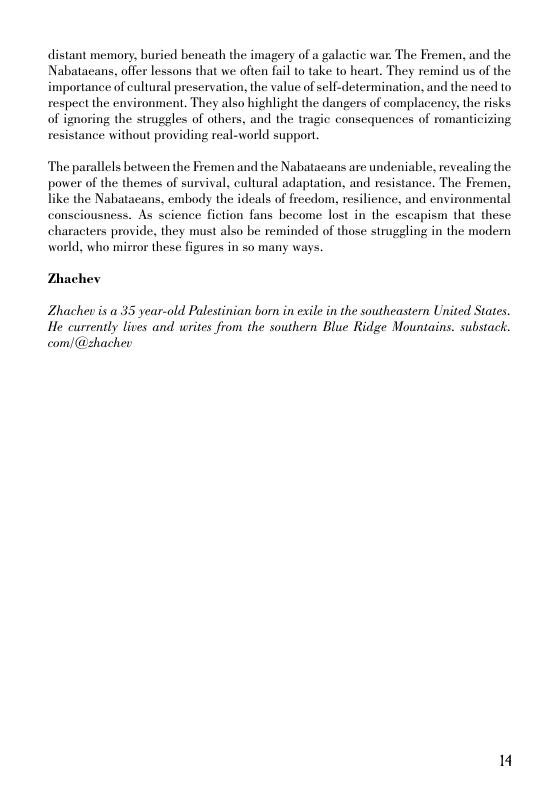
Zhachev - They Who Returned to the Rock
In approximately 312 BCE, a former gencral of the late Alexander the Great, King
Antigonus | Monophthalmos launched an effort to conquer the Nabatacan people.
The Nabatacans were a proto-Arab group, in many ways the proto-Arab group, who
had for centuries inhabited the deserts of Syria and the Levant, particularly what
is today southern Jordan. Known for their nomadic lifestyle, control of important
trade routes, and illusive nature, they were a very significant cultural, cconomic,
and political force in the region during the era.
The Nabatacans were not a people who hastily conducted warfare. While it s true
that they generally avoided direct confrontation, they did excel at a lethal kind of
proto-guerilla warfare with cunning strategies, leveraging their knowledge of the
desert terrain and the resources of their extensive trade networks to outclass and
outmancuver their opponents. Their military engagements were ofien characterized
as defensive in nature, reflecting a preference for avoiding open battles and instead
exploiting the strategic advantages offered by their environment to gain tactical
vielories.
During the classical campaign of King Antigonus 1 against these desert free men,
the Nabatacans, who controlled the vast flow of spice and incense throughout the
whole of the ancient and elassical world, noteworthy historical figures were involved.
There was Demetrius, son of Antigonus 1, the failure and war criminal Athenacus, a
‘general of Antigonus I, and Hicronymus of Cardia, a famous Hellenic historian. The
chronicle of Hieronymus regarding these events was later incorporated through its
surviving fragments into the writings of the Hellenic historian Diodorus of Sicily
Specifically, a work by Diodorus entitled Library of World History. sec. 19.94.2-
95.2, which provides a fascinating account of Nabatacan customs. Here's a
translation by C.H. Oldfather:
“For the sahe of those who do not know, it will be usefl to state in some detail
the customs of these Arabs (ADBIOY. by following which, it is belicued, they
preserue their liberty.
They live in the open air, claiming as native land a wilderness that has
neither rivers nor abundant springs from which it is possible for a hostile
army to obiain water. It is their cusiom neither to plant grain, set out any
Jruit-bearing tree, use wine, nor construct any house: and if anyone is found
acting contrary to this, death is his penalty [author emphasis]. They follow
this custom because they believe that those who possess these things are. in
order to retain the use of them, easily compelled by the powerful to do their
Bidding.
Some of them raise dromedaries, others sheep. pasturing them in the desert.
While there are many Arabtribes who use the desert as pasture, the Nabataeans
Jar surpass the others in wealth although they are not much more than ten
thousand. in number; for not a few of them are accustomed to bring down
10 the sea frankincense and myrrh and the most valuable kinds of spices,
which they procure from those who convey them from what is called Arabia
Eudacmon.
They are exceptionally fond. of freedom fauthor emphasis]: and, whenever
strong force of enemies comes near, they take refuge in the desert, using this
as a fortress: for it lacks water and cannot be crossed by others, but to them
alone, since they have prepared. subterrancan reservoirs lined with stucco, it
Jfurnishes safety. As the earth in some places is clayey and in others i of soft
tone, they make great excavations in it, the mouths of which they make very
small, but by constantly increasing the width as they dig decper, they finally
make them of such size that cach side has length of one plethrum (30-33
meters). Afier filling these reservoirs with rain water, they close the openings,
making them even with the rest of the ground, and they leave signs that are
known to them-selues but are unrecognizable by others. They water their cattle:
cvery other day, so that, if they flee through waterless places, they may not
need a continuous supply of water:
They themselves use as food flesh and milk and those of the plants that grow
Jfrom the ground which are suitable for this purpose: for among them there
grow the pepper and plenty of the so-called wild honey from trees, which they
drink mixed with water. There are also other tribes of Arabs, some of whom
even till te soil, mingling with the tribute-paying peoples, and have the same
customs as the Syrians, except that they do not duell in houses.
It appears that such are the customs of the Arabs. But when the time draws
near for the national gathering at which those who dwell round about are
accustomed to meet, some to sell goods and others to purchase things that
are needful o them, they travel to this meeting, leaving on a certain rock
their possessions and their old men, also their women and their children. This
place is exceedingly strong but uniwalled, and it i distant two days’ journey
Jrom the sttled country.”
We cannot be sure if this Hellenic account and perspective is wholly accurate;
whether or not they put to death fellow tribespeople who dared break their sacred
codes. But the assertion that the Nabatacans were “exceptionally fond of freedom”
‘as Hieronymus of Cardia claims is fully backed up in the different historical records
of many different cultures and peoples who interacted with them across the ages.
Apeople of the desert, these earlier Arab nomads epitomized a pattern of resistance
o the encroaching influence of civilization, a_ pattern that recurs throughout
history. Their story. like that of so many others, reveals a fundamental conflict
between those who embrace a lfe of independence, autonomous sovercignty, and
those who scek control and the imposition of their ways upon others. These contra-
historical peaples, as we have termed them, are those who resist the homogenizing
force of civilization, fiercely defending and asserting their autonomy and cultural
distinctiveness. The Nabatacans, through their clever use of the desert as a natural
defense, their control of trade routes, and their nomadie lifestyle, demonstrate this
pattern. They were not simply stupid barbarians; they were a complex society with
an economy, a culture, and a system of sociality. Their choice o remain in the
desert, 1o largely avoid agriculture, wine, and settled living, especially in their
carliest days, was a conscious one, a strategic decision to maintain both their
individual and cultural autonomy.
The account mentioned earlier by Hieronymus of Cardia, preserved in Diodorus of
Sicily's writings, provides a glimpse into their customs and beliefs. The Nabatacans’
rejection of the conventional trappings of civilization—the cultivation of crops, the
production of wine, the building of houses—was a deliberate act of defiance. They
recognized that these civilized practices made them vulnerable to external control
Their choice of a nomadic lifestyle, their ability o move and disappear into the
desert, was a means of self-preservation. They understood that the key to their
freedom was to remain elusive, ungraspable, and to leverage their knowledge of the
environment against their enemies.
Their construction of hidden water cisterns, their intimate. knowledge of the
desert’s resources, and their careful control of their trade routes, all exemplify their
commitment to maintaining their independence. These were not passive acts of
survival: they were active strategies of resistance. The Nabatacans were not simply
defending their territory: they were defending their way of life, their culture, and
their frecdom from exteral control. Their interactions with King Antigonus |
Monophthalmos and his generals, and the
Hellenistic world in general, represent a clash of civilizations, a struggle between a
settled, expansionist power and a peaple determined to preserve their autonomy. The
Nabatacans were not interested in conquest; they were interested in maintaining
their way of lfe, their autonomy, and their freedom to trade and live as they saw fit.
As stated, they were not necessarily warlike, but they were willing to defend their
way of life, even through warfare if necessary.
The ability of the Nabatacans to maintain their lifestyle, their ability to resist the
incursions of their neighbors throughout the many centuries, demonsirates the
effectiveness of their strategy. Their success, however, should not be understood
as merely a matter of military prowess. It was the result of a holistic approach,
9
encompassing economic, cultural, and social dimensions. They were not just
fighters: they were artists, traders, negotiators, and, above all, masters of their
environment,
This pattern of resistance is echoed throughout history. Consider the Chickamauga
Cherokee, a group of Cherokee who, following the American Revolution, chose
to continue resisting the encroachment of the United States government on their
lands and way of life. They refused to sign treaties, continued to raid American
settlements, and fought a protracted guerilla war to protect their independence
and traditions. Like the Nabatacans, the Chickamauga Cherokee understood the
threat posed by the expansion of European civilization. They saw peace treaties,
jurisprudence, and legalism as a means 1o dispossess them of their land and
culture, to force them to abandon their traditional ways of life. The Chickamauga
Cherokee, like the Nabatacans, adopted strategies of resistance tailored to their
environment. They used the forests and mountains of their homeland as a refuge,
launching surprise attacks and retreating into the
wildemess, just as the Nabatacans used the desert. The Apache, a collection of
related tribes in the American Southwest. provide another powerful example of
this pattern. Their resistance to Spanish and, later, American colonization was
legendary. They, like the Nabatacans and Chickamauga Cherokee, used their
Knowledge of the terrain, their nomadic lifestyle, and their cunning to outmaneuver
their enemies. They understood that civilization meant the loss of their freedom,
the destruction of their culture, and the dispossession of their land. Their history is
replete with acts of defiance, guerrilla warfare, and determined efforts to preserve
their independence.
The uncontacted tribes of the Amazon rainforest, still living today, represent a
contemporary example of this historical patiern. These isolated communities,
often numbering only a few hundred or even dozens of individuals, have actively
resisted contact with the outside world. Their reasons are the same as those of the
Nabatacans, the Chickamauga Cherokee, and the Apache: they understand that
contact with the outside world poses a threat 1o their way of life, their culture,
and their freedom. They have witnessed the destruction of other indigenous
communities, the loss of their land, and the forced assimilation into a hostile
imperialist culture. Their avoidance of contact is not merely a matter of isolation;
it is an act of resistance, a conscious choice to defend their way of life. Pacific
people like the Maori of New Zealand, who have continued resisting European
colonization for many years, also illustrate this recurring theme. They, too, once
fought against British and European rule and the loss of their lands, using their
knowledge of the terrain and their fighting skills to resist. They. too, understand
that contact with civilization threatene their traditional ways of life, their culture,
their autonomy, and mother nature itself.
10
Exen in the modern world, this pattern of resistance persists. The Palestinian
people, some of them perhaps direct genetic descendants of the Nabatacan
tribespeople, who have lived under oceupation for decades, almost a century,
provide a_ contemporary example. Our resistance, whether through political
activism, cultural expression, or, in some cases, armed conflict, is a strugele to
preserve our identity, ourr culture, and our right to self-determination. My steadfast
Palestinian people understand that civilization, in the form of lsracli occupation,
threatens our freedom, our culture, our spiritualism, and our very existence.
Our struggle, like that of the Nabatacans, the Chickamauga Cherokee, the Apache,
the Maori, the uncontacted Amazonian tribes, and so many others is a fight against
the homogenizing force of civilization, a strugele to preserve their ways of life.
A fight against the silencing of the differend. These contra-historical peoples
all share a common thread: a decp-seated commitment to their way of life and
a willingness to defend it against every extemal opponent. They recognize that
civilization, with its emphasis on control, standardization, and expansion, often
comes at the expense of freedom, cultural diversity, and the autonomy of those who
resist it They choose to live on their own terms, even if it means facing hardship,
conflict, and the constant threat of invasion. They understand that the price of
freedom is eternal vigilance.
The Nabatacans, with their ingenious adaptations to the harsh desert environment,
their skill in trade and negotiation, and their unwavering determination to remain
independent, serve as a brilliant example of this enduring patter. Their story
reminds us that the clash between civilization and those who resist its encroachment
is a recurring theme in human history, and that the struggle to preserve cultural
distinctiveness and autonomy remains relevant to this day. They, and all those who
have followed their example, are a testament to the enduring power of the human
spirit to resist homogenization and to choose freedom over control.
The Nabatacans, with their mastery of resource management, and their resistance
o outside forces, serve as a striking precursor to Frank Herbert's Fremen of Arrakis.
The parallels are numerous and profound, highlighting the recurring motifs of
survival, cultural adaptation, and the strugele for self-determination that resonate.
across both history and science fiction. The Fremen, just like the contra-historical
peoples we have discussed, exemplify the human capacity for resilience and the
inherent value of preserving a distinet way of life in the face of extemal pressures.
Arrakis, or Dune, is a harsh and unforgiving desert planet, much like the
environments inhabited by the Nabatacans, the Apache, and other contra-historical
groups. This environment shapes the Fremen, forcing them to adapt and evolve in
ways that define their culture and survival. Their mastery of water conservation,
their development of the stillsuit, and their knowledge of the sandworms are all
u
testaments to their ability to thrive in a scemingly inhospitable world. Similarly,
the Nabatacans, through their ingenious reservoirs and their nomadic practices,
demonstrated an exceptional understanding of their desertenvironment. The
Apache, too, possessed an intimate knowledge of their arid homeland, using this
knowledge to evade their pursuers and sustain themselves.
Both the Fremen and the Nabatacans value their freedom above all else. They resist
extemal control, whether it comes from the Tmperium in the case of the Fremen
or from the Hellenistic powers in the case of the Nabatacans. This resistance
is not merely a matter of military strength: it is a cultural imperative, a decply
ingrained belief in the right to self-determination. The Fremen’s jihad, a religious
war for control of Arakis, is the ultimate expression of this desire for freedom.
The Nabatacans, as we have scen, skillfully avoided dircct confrontation, but were
ready to fight to preserve their liberty
The cultural practices of the Fremen and the Nabatacans are also remarkably similar.
Both groups value communal living, strong social bonds, and a reverence for their
ancestors and traditions. The Fremen's rituals and religious belicfs, centered on
the importance of water and the sandworms, are deeply rooted in their environment
and history. The Nabatacans, too, appear to have had a strong sense of community
and a distinet set of customs that set them apart from their neighbors. Both cultures
prioritize survival, placing a high value on resourcefulness, resilience, and a
willingness to adapt.
Perhaps the most striking parallel is the Fremen's role as a provider of a vital
resource, melange (spice), much like the Nabatacans controlled key trade routes.
The Nabatacans, by controlling the flow of incense and spices, held a position of
cconomic power in the ancient world. They were not merely traders; they were the
gatekeepers of a valuable commodity, and thus, of a crucial element in the global
cconomy of their time. Similarly, the Fremen control the production of melange, a
substance that s essential for interstellar travel and the prolongation of life. This
control gives them immense political and cconomic leverage, allowing them to
challenge the power of the Imperium and ultimately reshape the galaxy.
Both the Nabatacans and the Fremen are scen as “other” by those outside their
cultures They are often misunderstood. feared, and viewed with suspicion. Their
customs and ways of lfe are ofien scen as strange or primitive, and their resistance
o external control is viewed as a threat. This othering is a common theme in the
history of contra-historical peoples, who are often marginalized and demonized
by those in power. The modern science fietion fan, however, often embraces these:
figures for the very reasons they are othered. The Fremen, in their alienness,
embody ideals of freedom, resistance, and environmental consciousness that many
find absent in the civilized world.
2
There is a latent irony here, however. While science fiction offers an escape into
worlds where resistance and survival are glorified, where the marginalized are
often the heroes, the real-life counterparts of these fictional characters are often
denied the same support. The Nabatacans are gone. Many of the contra-historical
groups we've discussed face an ongoing strugele, often against overwhelming odds.
The uncontacted Amazonian tribes, for example, are threatened by deforestation,
mining, and encroachment on their lands. The Palestinians face displacement,
occupation, a lack of recognition of their rights, and most recently, unrestrained
genocidal assault.
Modern science fiction fandom, often composed of young people, find themselves
captivated by these figures. Their escapism allows them to liv, vicariously, through
the stories of the Fremen. They might wear Fremen cosplay, they might engage in
online discussions about the political dimensions of the novel, and even g0 so
far as to fetishize the “otherness” the Fremen embody. But too rarely does this
translate into real-world support for those engaged in similar struggles. How often
do these fans, caught up in the drama of fictional battles, take concrete actions to
support the real-world indigenous communities or Palestinians fighting for their
survival? How often do they direct their passion toward real-world combativeness?
The detachment is ofien lamentable. The “cool” warrior in a book or movie, the
one who
can survive where others cannot, takes on a heroie cast in the imagination, but
the realities of the modern world often mean the destruction of those ideals. The
passion for the fictional quickly, it seems, burs itself out without a single match
being lit for their real-life counterparts. The science fiction fan, lost in their own
world of imaginary threats, often fails to see the real threats facing those who
resemble their heroes in the modern day.
This disconnet is not simply a matter of apathy. It is ofien a complex interplay of
factors, including a lack of awareness, a sense of powerlessness, and a tendency
to prioritize personal enjoyment over communal action. The Internet and social
media offer a platform for surrogate engagements, echo chambers, reinforcing
existing biases and most often preventing meaningful dialogue. The distractions
of modern life, from the demands of work and school to the constant bombardment
of entertainment and vice, can also make it difficult 1o focus on the struggles of
others.
This, however, is not to say that science fiction fandom is entirely divorced from
social and political concerns. Many fans are deeply engaged in things like ecology,
indigenous struggles, and animal rights. But the focus on fictional worlds often
overshadows the struggles of those who embody similar values in reality. The
Fremen's fight for Arrakis, in the minds of some, becomes more important than the
Palestinians” fight for their homeland. The Apaches’ fight for their land becomes a
B
distant memory, buried beneath the imagery of a galactic war. The Fremen, and the
Nabatacans, offer lessons that we often fail 10 take to heart. They remind us of the
importance of cultural preservation, the value of self-determination, and the need to
respeet the environment. They also highlight the dangers of complacency, the risks
of ignoring the struggles of others, and the tragic consequences of romanticizing
resistance without providing real-world support.
The parallels between the Fremen and the Nabatacans are undeniable, revealing the
power of the themes of survival, cultural adaptation, and resistance. The Fremen,
like the Nabatacans, embody the ideals of freedom, resilicnce, and environmental
consciousness. As science fiction fans become lost in the escapism that these
characters provide., they must also be reminded of those strugeling in the modem
world, who mirror these figures in so many ways.
Zhachey
Zhachev is a 35 year-old Palestinian born in exile in the southeastern United States.
He currently lives and writes from the southern Blue Ridge Mountains. substack.
com/@zhachen
4
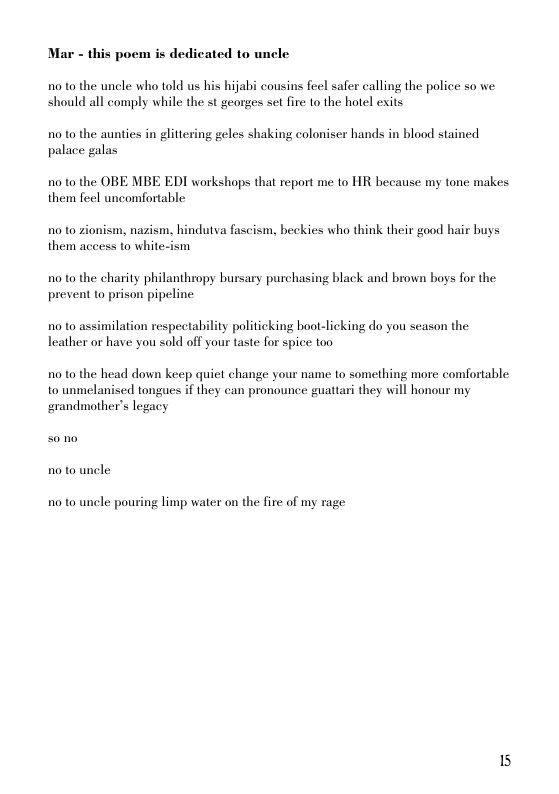
Mar - this poem is dedicated to uncle
10 to the uncle who told us his hijabi cousins feel safer calling the police so we.
should all comply while the st georges set fire to the hotel exits
10 to the aunties in glittering geles shaking coloniser hands in blood stained
palace galas
10 to the OBE MBE EDI workshops that report me to HR hecause my tone makes
them feel uncomfortable
10 to zionism, nazism, hindutva fascism, beckies who think their good hair buys
them access to white-ism
10 to the charity philanthropy bursary purchasing black and brown boys for the
present to prison pipeline
10 to assimilation respectability politicking boot-licking do you season the
leather or have you sold off your taste for spice too
10 to the head down keep quict change your name o something more comfortable
to unmelanised tongues if they can pronounce guattari they will honour my
grandmother's legacy
10 to uncle pouring limp water on the fire of my rage
15
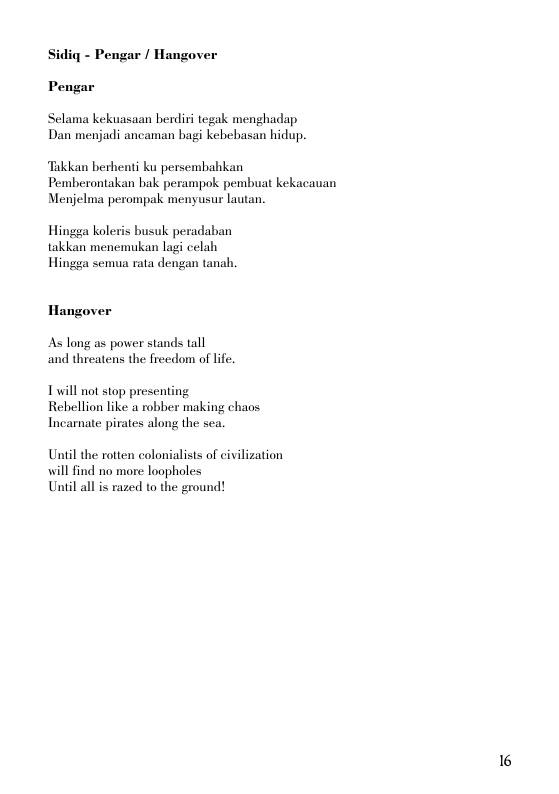
Sidiq - Pengar / Hangover
Pengar
Selama kekuasaan berdir tegak menghadap
Dan menjadi ancaman bagi kebebasan hidup.
Takkan berhenti ku persembahkan
Pemberontakan hak perampok pembuat kekacauan
Menjelma perompak menyusur lautan.
Hingga koleris busuk peradaban
takkan menemukan lagi celah
Hingga semua rata dengan tanah.
Hangover
As long as power stands tall
and threatens the frecdom of life
Tuill not stop presenting
Rehellion like a robber making chaos
Incarnate pirates along the sea.
Until the rotten colonialists of civilization
will find 1o more loopholes
Until all is razed to the ground!
16
From Palang Hitam Anarkis:
Sidi is an anarchist, illegalist and an individualist.
On the 12th of July 2024, state authorities had arrested him for cannabis use.
and possession. He often contributes to anarchist publishing and street librarics,
involvement in soccer hooligan club, clashes in protests and a passion for writing
poetry. Sidiq is looking at a possible 10 year prison term.
His support group are taking donations via paypal at; einzine] 6@ gmail.com
You can write to Sidiq:
Muhammad Ilyas Sidiq
Lapas (prison) Kebonwaru, Kee.
Batununggal, Kota Bandung, Jawa Barat
40272
Indonesia
Sidiq is part of two publishing collectives; Contemplative Editions and Talas
Press who publish anarchist books.
Contemplative Editions
contemplative@riseup.net
_contemplative [Instagram]
templativepublishing.noblogs.org
Talas Press
@talaspress [Instagram]
hitps:/flinktr.ce/talaspress
For more information on anarchist anti-prison struggle in so-called Indonesia,
find Palang Hitam Anarkis [Anarchist Black Cross] online at palanghitamanarkis.
noblogs.org or on Instagram @ palang__hitam
7
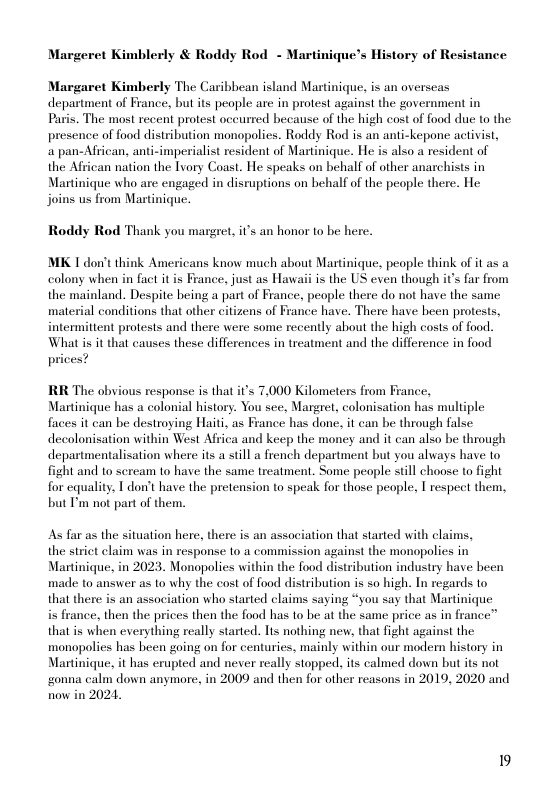
Margeret Kimblerly & Roddy Rod - Martinique’s History of Resista
Margaret Kimberly The Caribbean island Martinique, is an overseas
department of France, but s people are in protest against the government in
Paris. The most recent protest oceurred because of the high cost of food due to the
presence of food distribution monopolies. Roddy Rod is an anti-kepone activist,
a pan-African, anti-imperialist resident of Martinique. He is also a resident of
the African nation the Ivory Coast. He speaks on behalf of other anarchists in
Martinique who are engaged in disruptions on behalf of the people there. He
joins us from Martinique.
Roddy Rod Thank you margret, it an honor to be here.
MK I donit think Americans know much about Mastinique, people think of it as a
colony when in fact it is France, just as Hawaii is the US even though it’s far from
the mainland. Despite being a part of France, people there do not have the same.
material conditions that other citizens of France have. There have been protests,
intermittent protests and there were some recently about the high costs of food.
What s it that causes these differences in treatment and the difference in food
prices?
RR The obvious response s that it’s 7,000 Kilometers from France,
Martinique has a colonial history. You see, Margret, colonisation has multiple
faces it can be destroying Haiti, as France has done, it can be through false
decolonisation within West Africa and keep the money and it can also be through
departmentalisation where its a stll a french department but you always have to
fight and to sream to have the same treatment. Some people still choose to fight
for equality, T don't have the pretension to speak for those people, I respect them,
but I ot part of them.
As far as the situation here, there is an association that started with claims,
the strict claim was in response to a commission against the monopolies in
Martinique, in 2023. Monapolies within the food distribution industry have heen
made to answer as to why the cost of food distribution is so high. In regards to
that there is an association who started claims saying “you say that Martinique
i france, then the prices then the food has to be at the same price as in france”
that is when everything really started. Its nothing new, that fight against the
monopolics has heen going on for centuries, mainly within our modern history in
Martinique, it has erupted and never really stoppe. its calmed down but ts not
‘gonna calm down anymore, in 2009 and then for other reasons in 2019, 2020 and
now in 2024,
9
So. that association, their strict claim s “nothing more” they don't talk about
colonisation, they don' talk about imperialism, their claim is France has to
manage something in order for the food to be at the same price as in france. That
i the starting point in September, 2024.
MK I0s interesting, T use the example of Hawaii, heing a US state, even though
it’s far away. They also have very high food prices. It scems, there is a connection
between these places that are allegedly part of another country which prevents
them from doing what's right by their people. Tt seems that Martiqnue should
seeure food from the rest of the region, the Caribbean and other nations. Is that
not possible?
RR That's when the historical context comes in, thank you for that and yes T
believe it would be a very rich conversation with people: from Hawaii and from
Puerto Rico as well. The historical context within Martinqiue is that there is
a colonial pact that doesn't say its name anymore, that is still in place with its
cconomic function Martique, as with many countries in the Caribbean, has gone
through the genocide of Natives and then the deportation of Africans forced
through slavery to work. Then thanks to the brave people of Haiti, we have gone
through a process of abolition of slavery.
Slavery in Martingiue was abolished in 1848, What happened at that time?
Descendants of enslavers, who were enslavers the day before. They were
compensated for the loss of the forced labor, they kept much of their land and
they kept their connections with the French elites. They kept the same economic
model we have today in Martinique in which we plant an aggressive monoculture.
We plant bananas and sugar canes, some of these are for rum. These are exported
on boats as raw products. These same boats come back with products from france.
80% of what we consume in Martinique comes from the imports from France.
The individuals who are within the export and import industry are in a
community, that we call the Bekes and there are big names within the Bekes, they
are a caste, they have a racial way of functioning which is white supremacism.
They are descendants of enslavers, that’s the issue we stll have in Martinique.
MK So, the people who control Martingiues economy are white peaple,
descended from the slaveholding class?
RR Its not just white people, because even white people in France are against
this, there are a lot of French peaple who are against this way of functioning,
i’s caste, it's white supremacy, i's not white privilege. Which is a different
problem, it’s white supremacy at its purest. We have people whose ancestors have
been compensated for the loss of their workforce when slavery in Martingive
2
was abolished. They kept lands, they kept ccanomic power: They kept growing
through the centuries, through the next generations. So P'm oppressed by the
same last names that my grandmother, my great grandmother, my great great
grandmother were oppressed under. Those are the same last names, its caste.
MK So, it is a class issue?
RR Yes, it's a capitalism issue. We have white peaple as allies, it is just
capitalism at ts purest. The consequence is not just the food price, everything is
more expensive here. Another consequence is Kepone, Chlordecane and in the
US Kepone was manufactured by in the US by Allied Chemicals.
MK So, Kepone s an inseticide, correct?
RR Initially it was not authorised on US soil for us, it was authorised for
Export. In 1974, at the warchouse of Allied Chemicals, there was an issue with
AllicdChemicals. The workers were infected, the river was infected as well, it
i a highly toxic pesticide. In the US, this issue was handled quickly, banana
producers that were importing this pesticide in Martinique went and bought the
authorization for them to bring production somewhere else. They knew of its
toxicity since 1975. As of today. the use of this pesticide was stopped in France
in 1990, in Martinique it was used until 1993. That lobby bought a lot of the
pesticide before the ending date came in.
MK So this pesticide was banned in the US for 50 years but it was allowed to be
used in Martinique. Is it till being used in Martinique?
RR Not officially since 1993. The reason why I'm very meticulous in what T
say is because of the arguments in courts. The consequence is, a lot of our soil,
our rivers and some of our seas have been poisoned for more than 500 years. Tt
can poison the Chickens, the Fish, it is an environmental catastrophe. There is
2 UN report that classifies Martingiue and Guadeloupe as two of the fifly most
countries polluted on carth.
Why I talk about Kepone s the same peaple. the same companies that plant
bananas are the same ones importing food.
L]
MK The protest over these conditions, in this case, high prices. What is it that
people want? Do they want to be treated more equitably, do they want to be.
independent of France? What is the demand of the protest?
2
RR Martinique, in my opinion, is at a crossroads. There s a consensus, things
need to change. Everybody agrees, even in France. There are three camps;
- The majority of people want to fight for quality
- There are people who want o start the process of autonomy
- There are more radicals, like myself, who want to go through the fight for
independence.
The people who want to fight for autonomy and those who want independence
are allies. We don't agree on everything but we want 1o push the line forward for
emancipation, whether it has to go progressively or it has to be more radically
more drastic.
MK What is the outlook for any of those things happening? For autonomy o
independence?
RR Pl take some time to explain o you, what has happened in terms of protest
in the last 15 years. Before I say this, Martinique has a rich history of fighting
against colonialism and for independence, even through minority camps.
We have the insurrection that took place in 1870 led by Lumina Sophie. We
have many radicals throughout our history. we have Frantz Fanon, Aimé Césaire
the EOJAM (Organisation de la Jeunesse Anticolonialiste de la Martinique /
Anticolonialist Youth Organisation of Martinique) who faced répression. We had
Martiniquans joining the ARC (Alliance révolutionnaire caraibe / Caribbean
Revolutionary Alliance) after the ARC was banned and brought down, some.
people in Martindiue kept going like the Sons of Telga. Telga was one of the major
figures of the 1870 insurrcetion in Martinique.
What I'm trying to say is, even if it’s a minority, we still have members of the
independence camp who keep fighting for independence and we have a rich
history of fighting. Even if the people of Martinique continue fighting for equality.
The French didu't push forward equality in our history through kindness. People
fought, people died, for equality.
The consequences of what happened in Martinique in the past few weeks. You
have 134 small and big businesses that have either been vandalized, looted
or burned down. You have more than 560 people that have lost their jobs, you
have losses between around $70 million dollars this is all spread between 19
towns. Coming down to this, it’s very sad. Martinique is 1,128 square meters. It's
360,000 people. 200 people were arrested as France sent elite troops.
2
In Guadeloupe in 2000, the fight against the high cost of food distribution began.
It beggan there and had a domino effect in Martinique, 15 years later, nothing
has changed. Under the camp for independence you had youth that T was a part
of that had a different approach in 2019, throughout the Kepone commission.
When the state starts a commission, sometimes it is to protect some people, it
is not 10 bring people to justice. We knew where it was going. We, a small group
of radicals started disruptions against stores, against colonial statues, against
plantations. We had a different approach saying: the problem is colonial, people
have to realise it. Through reforms you reinforce the colonial power:
We have to face that colonial power, our approach was to make disruptions so
people can see that we're not scared of the police and the repression. T was highly
injured myself, T was shot in the face by the police during protests in 2020. Not
just me, Keéziah Nuissier who was almost lynched by French white police. We
were prosecuted, many others went to jail. Some for two years.
The response, then and now from the French state is to send in the French elite
police troaps called the CRS. In 1959, following a fight between a white and
black person in Martinique. following that there were protests that were repressed
by the CRS. There are three peaple who have heen assassinated by them, the
response from the Martinguian deputies was “the CRS necds to g0”
There is an association, who wanted to start negotiations with the food
distribution enterprise companies, the response from the government was to send
the CRS. That is what sparked violence, looting and insurrcetion in Martinique.
The interview has been abridged and edited for case of reading. For the full
conversation, listen to the original audio. soundeloud.comfuser-92939;
‘martinigues-history-of-resistance
Simoun Magsalin - The Anarchy of the Peripheries: Preliminary Notes
to a Study of Rebel Peripheries
In the internal peripherics of various States in the former Third World, State
power cannot fully cohere and temitorialize. Usually situated among mountainous
formations, these interal peripheries have long defied civilizational imposition.
James C. Scott described it in the Zomian highlands of mainland Southeast
Asia. In the Philippines, peoples would routinely escape the Spanish colony.
by practicing *remontar* or escaping to the mountains. Their Indigenous
descendants are known as remontados today. Across the Americas, enslaved
peoples would also flec 1o safety of the jungles and mountains to form maroon
communities, some of which reconsituted African polities and and some were
the size of some small European countrics. Across time and space, internal
peripherics acted as *refugia® by which peoples could escape and defy State
power and all the civilization that it entailed—corvée, tases, slavery, colonialism,
proletarianization, etc. This is the “anarchy of the peripherics.”
The anarchy of the peripheries has also historically been the refuge, bulwarks,
and strongholds of guerrilla movements, some of which were Marxist and
communist. These peripheries that are the refuge of guerrilla movements is what
Twould term as “rebel peripheries.” The relationship of the rebel peripheries and
the anarchy of the peripheries is marked by what T call as a “heretical” thesis, of
which has two components. The first is that many of these authoritarian guerrilla
movements survive and even thrive *as a result of the condition® of the anarchy
of the peripherics, of the failure of State power to fully cohere and termitorialize in
the intemal peripheries. This is irony: that authoritarian guerrilla persist because
of a relative condition of anarchy. The sccond component is that it is Marxists
and other authoritarians, and not libertarians, that have been able to fully take
advantage of the anarchy of the peripheries and develop rebel peripheries. This
too is irony: the very peripheries where anarchy thrives, where State power is
weakest, it is the authoritarians, and not the anarchists that are to be found. Why
i this s0?
From Infrapolitics to Rebel Peripheries
The anarchy of the peripheries is largely consituted on two componens:
‘geography and political power. These are highly interrelated. State power is
normally best constituted under specific geographical features like plains, rivers,
and valleys—places that are also casier for populations to settle. This is no
caincidence. For whatever reason, State power has difficulty imposing its rule
of law beyond easily-trayersal geographies. A notable exception is the northern
Andes mountains in Columbia and Ecuador where State power coheres stronger
in the mountains where most of the population lives, but this is due to the fact
2
that the more favorable climate of the Andes allows more people to settle there
than in the coasts of those countries. This clear exception also reveals that State
power better coheres and teritorializes in arcas of higher population density,
which itself is also conditioned by geographies that are easier to settle.
State power also seems to better cohere in some countries more than others. Tn
the former First World and Second World like in the historical revolutionary
situations in Spain and Ukraine, State power was able 1o cohere and teritorialize
and supersede whatever anarchy could have existed due to the revolutionary
situation. But it is in the former Third World where the anarchy of the peripheries
were able to shield and allow the flourishing of Marxist guerrilla movements and
other rehel peripheries.
Archacologists have a formal term for the anarchy of the peripheries during
the age of colonization: pericolonialism. Pericolonialism is the condition of
peoples and territories in the peripherics of colonial projects. In the Philippines,
pericolonial archacology (through the work of Stephen Acabado) is revealing
that the Ifugao and other Igorot peoples of the Cordilleras were not unaffected by
colonialism but rather reacted to it and even restructured their societies to defend
against colonialism.
During the colonial period of the Philippines, people would practice *remontar*,
or returning o the mountain, to escape the colonizers. It is said by Frederic
Henry Sawyer (an American colonial anthropologist) that the Pangasinense had
atendency to flee 1o the mountains to escape the colony, given the proximity of
Pangasinan to the mountains of Benguet. James C. Seolt described “infrapolitics™
orinvisible politics much like how infrared is invisible to the naked eye. For
Scot, desertion was infrapolitical compared to a mutiny, which is obviously
political. In this sense, *remontar*, and related concepts like marronage, was the
infrapolitical equivalent to anti-colonial rebellions. Fleeing the colony was less
risky that challenging colonial State power. Remontados and maroons alike would
flee to the anarchy of the peripheries where they can live without the diktats of
State power and the slavery that it entailed.
In the period of creole posteoloniality, or the transferring of control of State
power from colonial suzerains to creole bourgeoisies, T argue that pericolonialism
transforms into “peristatism.” or the condition of peoples and spaces in the
peripherics of State power and territoriality. The anarchy of the peripheries in
the contemporary age is marked by the inability of State power to cohere and
temitorialize in these peripheries. As we have seen throughout history. these
anarchic peripheries become havens for *rebel peripheries* by which guerrilla
movements set up shop. In this sense, these rebel peripheries are the visibly
political form to the infrapolitical practice of *remontar* and marronage.
2
In the Philippines, there is a colloquial term for joining the communist
insurgency led by the New People’s Army, the armed wing of the Communist
Party of the Philippines (CPP). The term is “*mamundok*” and it is a literal
translation of the Spanish “*remontar*.” both meaning to g0 up the mountain.
This *mamundok*, however, is an explicit politicization of *remontar®. While
Remontados wish to merely desert State power, those who *mamundok* explicitly
seek to *challenge* State power. Under the theory of Maoism, the protracted
people’s war aims to militarize the whole countryside and *surround the cities™
and finally contest and conquer State power.
As mentioned previously, this contention for political power is heretical in the
sense that it aims to build revolutionary State power precisely in the anarchy
of the peripheries where State power is weakest. Rebel peripheries build power
precisely in the long tradition of infrapolitical anarchy of the peripherics. It i in
the peripheries where Marsist guerrilla forces converge and wage people’s wars,
from the CPP the Communist Party of Malaya, the Communist Party of Thailand,
the Sendero Luminoso (Shining Path), the Nasalites in India, the Kurdistan
Workers" Party (PKK). and many others. OF these. it is only the PKK and the
Zapatistas (EZLN) that are libertarian in content. Crucially, the libertarianism
of the PKK is still in doubt by many, and the Zapatistas originally started out as
Maoist before embracing a unique Indigenous libertarianism afier dialogue and
collaboration with the Maya of Chiapas.
Sowe are faced with the obvious fact that most rebel peripheries are led by
authoritarians who invariably use assassinations, kangaroo courts, and violent
purges to keep power in their rebel peripheries (much has been written on the
mattex, by myself and others). Anarchist armed strugele has tended to instead be
conducted in revolutionary situations or in urban areas. A comparative analysis is
Historical and Contemporary Anarchist Armed Struggle
In concerted and generalized periods of anarchist armed strugele, the heretical
thesis has generally held true. We can consider two cases in the Ukrainian and
Spanish revolutions. (While we would like to consider a third in the Korcan
Shinmin prefecture, the structure of their armed strugele is not well documented.)
Neither Ukraine nor Spain had significant intemal peripheries where State
power was unable to cohere fully and territorialize. Ukraine is largely a vast
open plain, quite ideal for the rapid mobilization of an armed central authority
across it. Once, however, Ukraine was part of a vast periphery of empires where
Cossack peoples largely retained their autonomy from empires and States
through mobility, raids, and mercenary service. As the technologies of the State
2%
improved, State power cohered and termitorialized in Ukraine, integrating the
formerly autonomous cossacks into the Russian imperial system. By the time
of the Ukrainian revolution, State power lost its coherence and detersitorialized
in the country, allowing for a kind of anarchy. The Makhnovshchina was a
“Republic on Tachanka”—always on the move. Like the cossacks before them,
the Makhnovshchina used their mobility to their advantage to evade and assault
State power. But the specific anarchy of the Ukrainian revolution was conditioned
by the chaos of the revolutionary situation and the invasion of forcign powers, not
by the inherent anarchy of the peripherics. The anarchy of the Makhnovshchina
was not necessarily rooted in the specific geographic structure of Ukraine,
but by the political situation and the creative mobilization by Nestor Makhno
and his Black Army. Indeed, the “Republic on Tachanka” had no recognizable
temitorial bulwark—it was rather first and foremost a social movement backed
by a guerrilla army. The Makhnovshchina did not present itself as what we now
recognize as rebel peripheries today. Eventually, however, the Makhnovshchina
was erushed and Bolshevik State power did cohere and teritorialize in Ukraine.
In Spain, the situation was similar. State power had cohered and territorialized
across the Therian peninsula for hundreds, if not thousands, of years. The
collapse and detemitorialization of State power was, again, conditioned by
revolution, not by geography. Where anarchists were able o carve out spaces.
of autonomy or wage armed struggle, it was hecause they have allied with
the Republican State. However, when the political settlement between the
Republicans and the anarchists no longer became tenable. the full force of
State power was borne on the anarchists. Theria did have intenal peripheries
throughout the mountainous and forested regions, the most major of which are
the Pyrences. There the Spanish *maquis* continued the fight against F
Franco and fascism. Some of the *maquis* were anarchist like the Sabaté
brothers Quico, Pepe and Manolo. But Francoist State power did eventually
cohere completely within the Spanish internal peripheries, forcing *madqui
both anarchist and Stalinist 1o evacuate, desist, or die in the resistance. Indeed,
the three Sabaté brothers all died by the hands of the fascists. Furthermore. the
*maquis* guersilla war in post-war Spain did not have recognizable liberated
zones like with rebel peripherics.
In both Ukraine and Spain, as the State power of authoritarians matured. the
anarchy of the revolutionary situation was superseded by 1o cohering and
temitorialization of State power. In Spain, which did briefly have some anarchic
peripherics, the maturation of the Francoist dictatorship eventually superseded
whatever anarchy the forests and the mountains provided. This is not the
condition of how the anarchy of the peripherics presents itself today, which
presents itself as a persistent peristatism where State power cannot cohere or
temitorialize completely.
7
However, similar to the rebel peripherics of today, anarchists in both the Spanish
and Ukrainian revolutions had the peasantry as a major mass base. Beyond
Theria and Ukraine, classical anarchism in ltaly also won the support of the
peasantry. Much like the peasantry of the peripherics today, the desire for some
level of independence from the market and State system through small-scale land
ownership and tilling dovetails with anarchist politics. This is why, for example,
that Marxists are wont to slander anarchism as “pety bourgeois™ as in a sense
anarchism did win mass bases among independent peasants (who could be.
classified as petty bourgeois).
After the period of classical anarchism, the sunset of which is marked by a
world-historical demobilization of anarchism, there were (and are) still periods of
post-classical anarchist armed struggle. We can consider three forms, the pro-
organizational type of the Uruguayan Anarchist Federation (FAU), insurrcetionary
anarchism, and united front in Rojava.
The FAU's armed wing of OPR-33 largely operated in the cities and mostly
conducted targeted armed offensive meant to support direct action and political
efforts. The FAU made a conscious decision to put political forces at the forefront
o prevent the militarization of the political arm. Uniquely proletarian in
character; the FAU was based on the urban working class of Uruguay. The FAU
did not conduct a people’s war in the countryside or make use of peristatism or
the anarchy of the peripheries. Rather, they remained proletarian and urban in
character:
Attacks by insurrectionary anarchists are usually urban in character and do not
scem to generalize armed strugele (not for lack of trying, however). These attacks
are conducted across the contemporary world and rarely have some coherent
identity like that of a guerrilla communist party. Some names can be described,
such as the Mediterrancan-hased Informal Anarchist Federation (FAL) or the
Conspiracy of Cells of Fire (SPF). Some theorists such as the late Alfredo Maria
Bonanno have been identified with insurrectionary anarchism. Insurrectionary
anarchism scems to keep a consistent urban character with their attacks. Similar
o the FAU, we do not sec insurrcetionary anarchists make use of peristatism or
the anarchy of the peripheries to their advantage. If they build mass bases among
people in the periphery, it is not well known.
In the last case, we have seen is anarchists joining International Freedom
Battalion in Rojava—the Democratic Autonomous Administration of North and
East Syria (DAANES). Three groups are notable here, the Revolutionary Union
for Internationalist Solidarity (RUIS), the Interational Revolutionary People’s
Guerrilla Forces (IRPGF), and the Tekogina Anarsist (Anarchist Struggle, TA).
This kind of armed struggle was meant to support the existing military campaign
2
via against Dacsh and later Tiirkiye and their Syrian proxies. The war in
yria is largely conventional in character rather than guerrilla. Rojava is not
exactly a rebel periphery with the territory having relatively significant urban
areas and having (for all intents and purposes) a conventional *de facto*
‘government. While many an anarchist has celebrated the higher levels of
autonomy and democracy in DAANES, it is still a relatively conventional rebel
State apparatus, if a revolutionary one. This is not to dissuade support of Rojava,
but just to show that it is not conventionally a rebel periphery. Nor is it clear if
anarchists in North and East Syria build mass bases among peripheral peoples.
As we can see, post-classical anarchist armed struggle had not historically made
use of the anarchy of the peripheries or made mass bases among peripheral
peoples. Why is this so?
The Defeat of Anarchism
Largely, the reason why anarchists have not been able to make use of peristatism
to develop anarchist rebel peripheries is because of the world-historical defeat
of classical anarchism which saw the demobilization of anarchism worldwide
and the conversion of many anarchist and proto-anarchist milieus to Marsism-
Leninism, and later Maoism. Similarly. it was only with the collapse of the Soviet
Union and capitalist restoration in most of the former Second World where we see
libertarian alternatives like Abdullah Ocalan and the Zapatistas arise.
Where anarchism could have taken root among peripheral peoples, the
galvanization of world Leninism and generous funding of communist parties in
the wake of the vietory of the Bolsheviks crowded out altemative revolutionary
formations. The Soviet Union and other Second World states could invite
revolutionaries to learn Marxism-Leninism and train for guemilla war. Anarchist
revolutionaries simply could not compete with such resources. Many converted to
Marxism.
In the Philippines and China, this was indeed the case. The Soviet Union could
provide tutelage and resources, so revolutionaries tended to adopt Marsism-
Leninism as a guide for their own revolutionary praxis. Later on, it was Maoist
China who supported the export of Mao Zedong Thought to Third World countries.
Where Soviet Marxism-Leninism was increasingly seen as decrepit and stagnant,
arevitalization of revolutionary Marxism was done under the banner of Mao,
Zedong Thought. Revolutionaries across the Third World would challenge
“official” communist partes for the development of new people’s wars and rebel
peripherics. This was indeed the case in the Philippines where the Communist
Party of the Philippines displaced the old party, the PKP-1930.
29
Anarchisn’'s place in all this was in the sidelines. Sure, there were localized
revitalization in some places, most notably in the May-June 1068 events in
France, but anarchism remained to be largely marginal movement internationally.
Ttis only recently after world-historical decommunization in the collapse of
the Soviet Union that anarchism retumed with a vengeance. This inversely
proportional relation hetween Marsism and anarchism is well known in anarchist
emergence literature.
It is Right to Rebel
In terms of the anachy of the periphery, Marxist-Leninist revolutionary
movements built their party power on peripheral peoples, mostly peasants of
varying kinds and/or Indigenous peoples. Peristatism here is not just a condition
where State power is weak, but is also one of poverty. Peripheries are not as well
integrated into the world-capitalist system as urban, suburban, and near-urban
rural areas are. The condition of periphery also means that the welfare state is not
as strong there as in more integrated territories. This localized lack of State power
and poverty appeals to Marxisi-Leninist revolutionary movemens.
In the peripheries, the people there lack access to medicine, education, and law.
Communist parties, such as that in the Philippines, have proven their capacity
o provide where the State fails. The New People’s Army is not just a fighting
force, but a mobile clinic, school, and court rolled up into one. Anarchists do
not oppose communist parties because they do these things, however (although
we may oppose the law part). After all, in both the classical and post-classical
period, much of the social life of anarchists that did provide mutual aid and
*ateneos* in health care and education were notably urban in character.
Indeed, the underground governments of Marist-Leninist parties can and
have been quite brutal at times, which is one of the reasons anarchist oppose:
them. In the Philippines, Peru, Nepal, and India, Maoists committed all kinds
of atrocities on their own mass bases from brutal purges, retaliatory aitacks,
Kangaroo courts, and even massacres. (An accounting of which group did what
cannot be recounted here.) This is, of course, is not limited to Maists. The
Makhnovshehina conducted a pogrom against the Mennonites and the Spanish
anarchists could have been overzealous in the murder of clergy and lay Catholics.
The point, however,is not to declaim violence, but rather that violence ought have.
aspecific character, that being against the State, proletarianization, work, and all.
(An abolitionist argument on the character of violence can be read elsewhere like
in my “Why Socialists Must be Abolitionists.”)
Much of the model of Marsist-Leninist rebel peripheries is due to Yan'an model
of the Communist Party of China, that being to create a communist bulwark in a
30
periphery far from encmy State power to construct an underground revolutionary
‘government. From Yan'an, the Chinese communists were able to take the whole
of China. This bulwark would then be the temporary capital of the communist
insurgency until the Party can take State power in full.
However, anarchists declaim the building of such a government, whether in the
peripheries or in a revolutionary situation. Rather, anarchists might take point
from the Ukrainian reolution where the Makhnovshchina was able to temporarily
exadicate State power and other rivals (nationalists, imperialists, Bolsheviks)
1o allow the proletariat and peasaniry to build what they please. In this way. the
Makhnovshehina allowed the flourishing, even for a brief time, of various soviets
and communes where workers and peasants experimented in revolution. Similar
happened in the Spanish revolution, albeit the anarchist additionally had a
disastrous alliance with the Republicans.
Perhaps in the contemporary world, anarchists would point to the Zapatistas, who,
starting from a Maoist position, actually did try to serve the people and leam
from them and then found that the masses realy did want to build something
libertarian rather than yet another State—underground or otherise. So that it
i in Zapatista Chiapas that the political form favors bottom-up structures and
probably the truest political demoeracy in the world. Basing themselves in a rebel
periphery, the Zapatistas defend their autonomy from States with a combination of
exeative politics and armed force.
But despite the endurance of the Zapatista model, the general endurance of the
rebel peripheries, and the resurgence of anarchism in the past decades, why is it
that we have not yet seen an *anarchist* rebel periphery?
Towards an Anarchist Rebel Periphery
For quite a number of reasons, contemporary anarchism is still very much urban-
based with mass bases among workers, students, and other urbanites. But this is
not destiny. Quite a number of communist parties, like that in the Philippines,
started out as urban and even student movements that eventually established
mass bases in the peripheries and started people’s wars. Furthermore. history is
not destiny either. Just because anarchists have not made use of the anarchy of
the peripheries does not mean that anarchist rebel peripheries cannot exist. But
there are stll quite a number of reasons why anarchists today are not founding
rebel peripheries.
Most of the world is inercasingly urban. This is a recurring trend in all countries
and may be part of capitalist development. If more of the world’s population
i in the urban, then so is the class strugele. A lot of what rebel peripheries
3l
actually do is to funnel militancy from the urban to the rural, as is the case in the
Philippines. With the brain drain of radicals and militants, those in the urban
class struggle are left with less boots on the ground.
In some countries like the Philippines, building rival projects in rebel
peripherics will get us killed by guerillas. It is not as if the communist party
will allow some anarchists to go around establishing councils and communes that
could potentially threaten their hegemony.
Despite the authoritarianism and the far-right on the rise. conditions are not
yet forcing us to do purely underground work. We still have leeway 10 operate
i cities and mostly legally. Unlike the brutal past dictatorships in Nepal, the
Philippines, and Peru, we can still still operate mostly openly. While there is
State repression, the character is as severe as it could be.
1f conditions do worsen that forces our movements underground, then perhaps.
having an underground railroad towards a rebel periphery might be useful for
us. Perhaps then, an insurrectionary strategy grounded in the anarchy of the
peripherics would be viable.
Crucially, however, our current world is also one where State power continues to
grow stronger. State power is increasingly interfering in many spheres of lfe. Tt is
cohering and territorializing in the far corners of the world. This has been going
on since antiquity as more and more of the world is being territorialized by States.
Itis increasingly casier to travel to peripheries, making them less peripheral.
Perhaps the anarchy of the periphery is a dying breed.
In Myanmar, where liberal-democratic and socialist movements were driven
underground and to rebel peripheries in open rebellion, anarchists are rather few
and out organized by other groups like the armed liberal-democratic opposition,
ethnic armies, and even a reforged Communist Party of Burma. Efforts to found a
Black Army there have been smothered in the crib.
Most importantly perhaps, we can and should ask: What are we even building if
we build guersilla fronts and establish rebel peripheries? Ursula Le Guin wrote,
“The end justfies the means. But what if there never is an end? All we have is
means.” If all we have are means, is building a rebel periphery something that,
as Errico Malatesta urges, allows us o walk towards anarchy always? And even
if contemporary anarchism is largely urban in character, do not the people in the
peripherics also deserve autonomy and armed self-defense? Would not moving to
and organizing in the peristatal peripheries be great acts of anarchist solidarity?
After all, there are still many places in the world where State power is weak and
where the governments are brutal.
2
Ultimately, this essay is but preliminary work to understanding the question of
the anarchy of the peripheries and what rebellions could lurk there. T do not have
answers 10 the questions I ask. We cannot discount the possibility that anarchists
can and will build an anarchist rebel periphery.
Simoun Magsalin is a reader of books about social ecology. abolition, socialism,
anarchism and communism. He is a dreamer for a better world, a digital librarian,
and archivist for radical stes.
Leonardo Torres Llerena - Toward an Indo-American Revolution: José
Carlos Maridtegui’s Relevance for Decolonial Insurgencies
Introduction
José Carlos Maridtegui (1894-1930) was a Peruvian Marsist thinker, journalist,
and political activist whose ideas reverberate throughout Latin America’s leftist
movements even today. Despite his relatively brief life, Maridtegui profoundly
influenced how we understand class struggle, anti-colonialism, and especially
the role of Indigenous communities in shaping revolutionary politics. His seminal
work, Seven Interpretive Essays on Peruvian Reality (1028), stands as a watershed
text in Latin American Marxist and decolonial thought, bridging Western socialist
theory with the specificities of the Andean and broader Latin American context.
Through this essay. 1 (a Peruvian migrant living in the UK) will examine how
his emphasis on the Indigenous Question, communal forms of organisation, and
the lived realities of colonised populations provides a framework for analysing
and eritiquing both revolutionary movements and state repression. Weaving in a
decolonial lens, we wil situate Maridtegui within the broader trajectory of Latin
American anti-colonial strugeles, from Indigenous resistance to later guerilla
movements, showing why his thought remains pivotal for non-white and anti-
colonial activists, particularly within anarchist and other radical circles.
If insurgency is understood as a challenge to entrenched structures of domination
and counterinsurgency as the array of techniques used by states and elites to
maintain the status quo, Maridteguis call for an “Indo-American socialism” offers
both a conceptual and strategic blueprint. By placing Indigenous communal forms
atthe centre, Maridtegui effectively reorients socialism—traditionally perceived as
a European product—to the historically colonised geographies of Latin America.
Part I: Historical Context and Intellectual Trajectory
Maridtegui’s Early Life and Influences
Josét Carlos Mariitegui was bor in Moquegua, Peru, in 1894, Raised in relative
poverty and suffering health issues that plagued him throughout hislife, Maridtegui’s
carly experiences gave him dircet insight into the harsh realities faced by Peru’s
marginalized communities. Al a young age, he became a journalist, quickly turning
his vocation into a platform for radical critique.
Peru was grappling with the social and political aftershocks of the War of the Pacific
(1879-1884). which had lefi the country cconomically and morally destitute. The
oligarchic republic that emerged in the carly 20th century was dominated by landed
elites benefiting from resource extraction and the exploitation of Indigenous labour.
3
The Indigenous population (the majority of the country) was relegated to near-
feudal conditions in haciendas, deprived of fundamental rights, and disparaged
by official national narratives. This deeply stratified society became Maridtegui's
chief area of investigation.
Maridtegui left Peru in 1919, journeying to Europe (particularly France and
Ttaly) where the Western avant-garde, Ttalian Futurism, and nascent communist
movements influenced him. Significantly, he was exposed to Gramscian ideas in
Ty, learning about the importance of cultural hegemony and the necessity of
engaging popular culture in revolutionary struggle. However, Maridtegui was no
mere importer of European thought: upon returning to Peru, he critically adapted
Marxism to the specific realities of Andean society, including its Indigenous
communal traditions.
Encounters with Marsism and Latin American Realities
Maridtegui rejected a Eurocentric application of Marsism that failed to account for
the material and cultural specificities of Peruvian and Latin American contexts.
Far from advocating a sterile, dogmatic version of historical materialism, he saw
Marism as a living method capable of renewing itself when confronted with
different social formations. He insisted that socialism in Peru could not merely
copy European or Soviet models but had to engage intimately with Indigenous
peasant realities and the legacy of colonisation.
Simultancously, Maridtegui drew on the intellectual ferment spurred by the
Mexican Revolution (1910-1920), our region’s. first major socialist-inspired
revolution of the 20th century, and the Bolshevik Revolution (1917) in Russia
Although his exposure to the Mexican Revolution was indirect, its impact on Latin
American socialists at the time—through the idea of agrarian reform and peasant-
led insurgencies—deeply influenced how revolutionaries throughout the region
approached class strugele. Maridtegui’s eritical contribution was to bridge these
developments with a renewed focus on Indigenous communal forms, or what he
called the ayllu—the basic unit of traditional Andean society.
Decolonial Praxis in the Early 20th Century
Decolonial thought in Latin America can trace an important lineage to thinkers like:
Maridtegui, who recognised that colonisation was not a mere historical event but a
structure that continued to shape race, class, and power relations. His perspective
diverged from many Eurocentric Marxists by emphasising that the capitalist
exploitation of Peru's Indigenous population was intertwined with centuries of
colonial subjugation. Hence, the material strugele against capitalism and the
cultural-cpistemic struggle against colonial oppression could not be separated.
3
These insights are crucial to understanding how Maridtegui's writings speak
o insurgencies—uprisings aimed at_overtuming systemic injustice—and the
counterinsurgencies that state deploy to defend their power. Where state-centric
narratives in Latin America often framed Indigenous mobilisations as backward or
dangerous, Maridtegui saw these communal struggles as seeds for a new socialist
society anchored in local forms of reciprocity and mutual aid.
Part II: Maritegui’s Core Contributions to Revolutionary Theory
1. The Indigenous Question and Decolonial Socialism
Maridtegui’s most_celebrated contribution is arguably his articulation of the
“Indigenous question” as central to revolutionary politics in the Andes. In Seven
Interpretive Essays on Peruvian Reality, he devoted extensive analysis to how
race, land dispossession, and colonial continuities shaped Peru’s socio-economic
landseape. He called for a “socialist solution to the Indigenous question.” meaning
a transformation that recuperated communal landholding traditions (the ayllu) as
part of a broader socialist project.
* Reclaiming Communal Traditions: Rather than treating Indigenous
communalism as a relic of a premodern past, Maridtegui saw it as a vibrant
tradition that could inform specifically Peruvian socialism. He rejected
patemalistic and assimilationist_approaches that aimed 1o “civilise™
Tndigenous peoples through Western capitalist. paradigms. Instead, he
posited that these commaunities already embodied forms of collective labour
that were ethically and structurally akin to socialist principles.
* Indigenismo vs. Revolutionary Praxis: While the prevailing intellectual
trend of his time, indigenismo. sought lo recognise Indigenous peoples
within the national namative, Maridtegui critiqued it for seldom moving
beyond reformist advocacy or folkloric celebration. For him, the Indigenous
question was not only a cultural o racial issue but a revolutionary one.
inseparable from economic emancipation and a break with neo-colonial
power structures.
* Decolonial Marsism: Maridtegui anticipated many subsequent
critiques of Marsism's Eurocentric blind spots. By situating the Indigenous
peasantry at the heart of a revolutionary alliance, he called for an approach
that overcame the typical urban bias of Marxist movements. While he
acknowledged the importance of proletarian organising in factories and
mines, Maridtegui never lost sight of the rural, communal bedrock upon
which Peru’s social fabric was built.
36
2. Critique of Oligarchy and Colonial Legacies
Maridtegui’s analysis of Peru's oligarchy underscores a pattern of racial capitalism
rooted in the colonial era. He illustrated how the white or mestizo ruling class
enriched itself by exploiting Indigenous labour, perpetuating racial hirarchies
established by Spanish colonial administrators. This system was maintained
through violence—both the structural violence embedded in unjust land tenure
and the more explicit violence of state-led repression.
* Collusion Between the State and Landed Elites: Maridtegui examined
the Peruvian state’s complicity in protecting the privileges of landowners.
Indigenous uprisings and peasant movements were invariably crushed
under the argument of “maintaining order” Here, we find the seeds of
Latin America’s counterinsurgeney doctrines, as the state historically de-
legitimized Indigenous revolis by branding them criminal or subversive.
* A Call for Land Reform and Peasant Power: Land reform, for Maridtegui,
was not merely about redistributing territory but about decolonising social
relations. He envisaged a scenario where the Indigenous majority, organised
collectively, would reclaim the land not as individual property but as
communal spaces for production and social life. This stance challenged
the individualist model of liberal land distribution, aligning more closely
with anarchist and decolonial philosophies that emphasise collective
stewardship.
3. The Role of Culture and Myth in Revolution
Aless heralded but equally important component of Maridtegui’s thought is his
discussion of myth. He posited that revolutions are driven not just by cold economic
calculations but by mythic, imaginative forces—hope, solidarity, sacrifice, and
communal identity. By revitalising Indigenous and popular cultural traditions,
revolutionaries in Latin America could tap into a deep reservoir of collective
energies.
This cultural dimension resonates with anarchist traditions that value decentralised
networks, communal ethics, and direct action anchored in local cultural contexts.
Maridtegui diverged from orthodox Marsists who prioritised the. industrial
proletariat and rationalist lines of class analysis, stressing instead that forging a
new world required creativity, spirituality, and the forging of a new “historical
bloc” that included peasants, workers, and the broader masses.
37
Part III: Insurgency and Counterinsurgency in Latin America
1. Defining Insurgency & Counterinsurgency
Insurgency, in the Latin American context, typically entails armed or militant
opposition against_established political and cconomic structures. From the
independence strugeles of the 19th century to the rural-based guerilla movements
of the 20th century—such as Cuba’s 26th of July Movement, the FARC in Colombia,
or the Shining Path (Sendero Luminoso) in Peru—insurgency has often been a
response to intense marginalisation, poverty, and landlessness.
Counterinsurgency. conversely, includes the tactics, strategies, and ideologies
states employ 1o destroy or neutralise insurgent movements. In Latin America,
counterinsurgency often relies on a blend of military repression, propaganda,
and sometimes social reform measures meant to reduce the insurgents’ support
base. Historically, these approaches have been heavily influenced by U.S. military
doctrines (e.g., the School of the Americas) and are designed to preserve the status
quo of racial capitalism and neo-colonial control.
2. The Peruvian Experience: Shining Path and Beyond
Though Maridtegui did not live to see the rise of Peru’s Shining Path (Sendero
Luminoso) in the late 20th century. his ideas nonetheless cast a long shadow. The
Shining Path emerged in the 1970s under the leadership of Abimael Guzmin,
blending a Maoist interpretation of Marsism with a violent, doctrinaire strategy
aimed at “protracted people’s war” While the Shining Path did invoke the
Indigenous question in thetorical terms, it largely centralised authority and carried
out brutal campaigns that often victimised the very communities it claimed to
liberate.
From a Maridteguian perspective, one might argue that the Shining Path represented
a deviation from the decolonial and communal aspects of Indigenous strugele.
Although Shining Path emphasised peasant mobilisation, its rigid vanguardism
and violent tactics alienated large portions of the rural Indigenous population. The
Peruvian state’s counterinsurgeney response was equally brutal, resulting in tens of
thousands of deaths, widespread human rights violations, and atrocities primarily
inflicted upon Indigenous communities in the highlands and the Amazon.
Maridtegui’s insistence on a socialism that grew out of Indigenous communal
practices—rather than being imposed from ahove—stands in sharp contrast to the
Maoist-inspired centralism of the Shining Path. Similarly, an anarchist perspective
eritical of hierarchical party structures and authoritarian ideologies might find
Maridtegui’s communal emphasis more resonant than the top-down militarism that
charact
38
3. Counterinsurgency as Neo-colonial Continuity
Counterinsurgency in Peru (and clsewhere in Latin America) often replicated
the racial logic of colonial and neo-colonial regimes. In Peru, the worst atrocities
against suspected insurgents and entire communities—especially in the Andean
regions—mirrored centuries of colonial violence against Indigenous peoples.
Under the guise of defeating “terrorism,” the Peruvian military and associated
paramilitaries commilted acts that reaffirmed the low value assigned to Indigenous
Tives in a society still marked by colonial hierarchies.
From Maridtegui's vantage point, such state violence defends the oligarchic and
neocolonial order: The eyclical nature of insurgency and counterinsurgency in Latin
America is inextricably linked o incomplete decolonisation; so long as the agrarian
question, racial hierarchies, and cconomic exploitation remain unaddressed.
militant rebellions will continue to spring forth from subaliern communities.
Part IV: Decolonization and the Legacy of Maritegui
1. Connecting Maritegui to Decolonial Theory
Maridtegui’s thought prefigures many arguments of contemporary decolonial
theorists such as Anbal Quijano, Maria Lugones, and Walter Mignolo, who
emphasise how the_coloniality of power structures race, gender, labour, and
knowledge. While Maridtegui wrote decades before “coloniality” became an
academic term, his insistence that capitalism in Latin America cannot be properly
understood without ts colonial heritage places him firmly in this tradition.
* Coloniality and Racial Capitalism: For Maridtegui, and later decolonial
thinkers, capitalisn's global expansion was made possible through the
racial hierarchies forged under colonialism. Tn Peru, this manifested in the
oppression of Indigenous peoples and the monopolisation of land by white
and mestizo elites. Only by dismantling these racialised class structures can
true emancipation emerc.
* Epistemic Decolonization: Maridtegui was keenly aware that
colonisation extended beyond physical domination into the realm of culture:
and knowledge. This awareness undergirds his project of fusing Marsism
with Andean communal logic, representing a deliberate effort o create a
distinctly “Peruvian socialism.” He thus challenges the standard linear
narratives of modernity by placing Indigenous epistemologies at the centre
of societal transformation.
* Beyond Extractivi
crisis reached s current, catastrophi
Although he lived in an era before the enyironmental
proportions, Maridlegui’s respect
»
for communal land practices implied a more sustainable and collective
relationship with nature. In contrast to the extractivist paradigms fuclling
capital accumulation across the Global South, Maridtegui’s approach
reclaims local stewardship. This dimension has become increasingly urgent
in contemporary decolonial eritiques that link environmental devastation to
ongoing colonial plunder.
2. The Relevance for Contemporary Movements
Contemporary Latin American movements—ranging from Indigenous-led uprisings
in Ecuador, Bolivia, and Chile, to Afro-descendant commaunities resisting land
dispossession in Colombia, Brazil, and beyond—invoke principles that Mariitegui
championed nearly a_century ago. These include communal organisation,
reclamation of land and resources, and the integration of cultural revitalisation
with socio-cconomic demands.
* Anarchist Resonances: While Maridtegui was explicitly Marxist, his
valorisation of communal forms and dircet action resonates with anti-
authoritarian principles found in anarchist traditions. He opposed both top-
down state socialism and liberal markel-centric approaches, emphasising
the autonomy and leadership of Indigenous communities in shaping their
own destiny.
* Insurgeney in a Post-9/11 World: In the post-9/11 era, states worldwide,
have expanded the rhetoric and apparatuses of counterterrorism, which
often conflate insurgent movements with terrorism. This dynamic continues
to criminalise Indigenous and peasant mobilisations, labelling them
as security threats rather than legitimate social struggles. Maridtegui's
perspective would assert that these movements are not mere. criminal
phenomena but expressions of long-simmering discontent with colonial and
capitalist oppression.
* Gender and Intersectionality: Although Maridtegui did not extensively
analyse gender as a distinet axis of oppression, his decolonial stance
implicitly challenges patriarchal structures embedded within colonial
societies. Modern-day decolonial feminists, who highlight the intersection
of race, gender, and colonial oppression, can find a starting point in
Maridtegui’s insistence on combining Marsist analysis with local cultural
realities. In particular Indigenous women often spearhead community-based
insurgencies, linking land defence, cultural revival, and gender equality in
ways that extend Maridtegui’s foundational insights.
40
Part V: Decolonial Reflections on Insurgency & Counters
surgency
1. The Moral and Ethical Dimensions of Resistance
Maridtegui understood that any insurgency—even if militarised—must rest on
moral legitimacy derived from the communities it claims to represent. Insurgencies
rooted in popular aspirations for land. dignity, and cultural renewal can effectively
mobilise collective myths and identities, becoming powerful vehicles for socio-
political transformation. However, if an insurgency loses this moral core—by
adopting overly authoritarian or violent tacties—it risks alienating the same
communities whose support it relies upon.
From a decolonial anarchist perspective, the reliance on hierarchical command
structures or cults of personality can distort an insurgent movement’s original
emancipatory aims. Maridtegui’s approach implies that “people’s war” should
be led by the people themselves, anchored in communal assemblies and dircet
democratic practices. If the strugele ceases 1o be communal, it risks reproducing
the same forms of domination it ostensibly oppos
2. Counterinsurgency as Epistemic Violence
States do not merely deploy military might to crush insurgencies; they also wield
epistemic violence, controlling the narratives that define who a terrorist, who is
a criminal, and who is a legitimate political actor. Latin American ruling classes
often frame Indigenous demands as archaic, irational, or subversive to national
“unity,” thereby delegitimising communal autonomy. Decolonial critiques highlight
that such epistemic violence is a continuation of colonial atiempis to delegitimise:
Indigenons worldviews.
Maridtegui’s insistence on the legitimacy of Indigenous communal knowledge
counters this hegemonic narative. By positing that Indigenous traditions are not
obstacles to modemity but viable alternatives to capitalist exploitation, Maridtegui
challenges the standard justifications for counterinsurgency. His stance forces us
1o question how official discourses brand movements as “violent” or “illegitimate,”
often ignoring the structural violence that prompied resistance in the first place.
3. Lessons for Present and Future Movements
* Building Alliances: One of Maridtegui’s core insights—building
alliances between urban workers and rural Indigenous communities—
remains erucial. While class strugele remains at the heart of Latin American
insurgencies, an awareness of racial and colonial oppressions is vital o
forging unity. Modern movements could expand on Maridtegui's blueprint by
including Afro-descendant, LGBTQ+, and women's collectives, recognising
that multiple forms of oppression intersect and fuel insurgent discontent.
41
* Centring Indigenous Authority: Any revolutionary strategy in the Andes
(or other Indigenous-majority regions of Latin America) that fails torecognise:
the_autonomy and leadership of Indigenous communities is doomed to
replicate colonial patterns. Maridtegui’s emphasis on communal democracy
offers aguiding principle for anarchists and other anti-authoritarians
seeking to support local struggles without imposing extenal agendas.
* Resisting Militarisation: While armed struggle has been a historical
recourse against extreme exploitation, Maridtegui’s perspective encourages
caution against militarisation’s pitfalls. Movements that embrace rigid
hierarchies or vanguardist doctrines may replicate forms of patriarchy and
authoritarianism, undermining the broader goal of decolonial liberation.
Anarchists and non-white communities often experience the brunt of state
repression; hence, a carcful strategic caleulus is needed when deciding
whether 1o adopt armed methods or focus on grassroots organising, dual
power structures, and other forms of dircet action.
* Revolutionary Culture and Education: Maritegui gave considerable
weight 1o culture, art, and myth. These elements cannot be dismissed as
superfluous; instead, they are part of building a collective identity that
can sustain resistance over the long term. Education—especially popular
education—becomes a site of struggle, challenging colonial narratives and
fostering a new generation commitied to communal, anti-capitalist ethics.
Part VI: Critical Engagements and Contemporary Resonances
1. Anarel
Critiques of Maridtegui
From an anarchist point of view, Maridtegui can be critiqued on two main grounds:
1. His Commitment to the Party Form: Maridtegui did attempt to form
socialist party in Peru, the Peruvian Socialist Party (which later hecame
the Peruvian Communist Party). This orientation implies a degree of
centralisation that may clash with anarchist opposition to political parties.
However, Maridtegui’s support for a party did not necessarily translate
into authoritarian or rigid Leninism. His writings suggest a more flexible,
localised approach to political organisation.
2. Underdeveloped Analysis of Patriarchy: Like many male revolutionaries
of his time, Maridtegui did not fully articulate how patriarchal oppression
i intertwined with class and colonial domination. Anarchist feminists,
particularly women of colour, might argue that his vision remains incomplete
without a robustgender analysis. Nevertheless, his emphasis on the
2
communal and the eritique of colonial patriarchy provides an entry point for
expanding his ideas in more explicitly feminist directions.
2. Beyond the Peruvian Context: Latin American Solidarity
Maridtegui’s eritiques of land concentration, oligarchic power, and nea-colonial
intervention echo throughout Latin America, where Indigenous and Afro-descendant
communities continue to face violent dispossession. From the Mapuche strugele in
southern Chile to the Garifuna communities in Honduras defending their ancestral
temitories, the same logic of colonial capitalist expansion remains entrenched.
In a region marked by repeated coups, dictatorships, and waves of neoliberal
restructuring, Maridtegui's larion call for a socialism that arises from local realities
remains a touchstone. The Bolivian experience under Evo Morales, for instance,
attempted to integrate Indigenous leadership into state structures, revealing both
the potential and the contradictions of institutionalising Indigenous-led governance
within a capitalist framework. While the Morales government advanced certain
decolonial policies, it also succumbed 1o extractivist pressures that alienated
Indigenous and environmental movements.
3. Paths Toward Decolonial Futures
If we read Maridtegui not as a rigid dogma but as a living methodology open to
adaptation, his work provides valuable insights into how communities might
navigate the complexities of 2lst-century strugeles. Global crises—climate
change, pandemics, entrenched inequality—underscore the urgency of articulating
altemnatives to capitalist modernity.
* Horizontalism and Communal Economies: In times of erisis, local
assemblies and mutual-aid networks often spring up to fill the gaps left by
neoliberal states. Maridtegui’s championing of communal labour resonates
with these efforts, suggesting that cooperative and horizontal economic
structures have deep historical roots in Latin America’s Indigenous
communities. This can bolster anarchist arguments for self-management
and localised autonomy.
ritual and
lural Revivals: The revival of ancestral ceremonies,
languages, and spiritual practices continues to fortify communal identities
in regions such as the Andes, Mesoamerica, and the Amazon. Maridtegui
would likely see these cultural revivals as vital components of a broader
insurgent identity, one that counters the assimilationist imperatives of both
colonial and capitalist modemnity.
3
* Transnational Solidarity: Given that colonialism was always a global
phenomenon, decolonial insurgencies must likewise be international in
scope. Migrant communities, diaspora networks, and global Indigenous
alliances have begun o connect struggles across continents. Maridtegui’s
emphasis on forging new myths of solidarity could be extended 1o create
transnational bonds that defy the borders erected by colonial and neo-
colonial regimes.
Conclusion
José Carlos Maridtegui’s legacy stands as a crucial bridge between Latin America’s
Indigenous and peasant histories of resistance and the broader socialist and
anarchist imaginaries that seck to overtum capitalist modemity. In addressing
insurgency and counterinsurgency from a decolonial standpoint, Maridtegui offers
nuanced insights rather than a universalising Marxism imported wholesale from
Europe. He champions a localised, culturally embedded approach that places
Indigenous community forms at its core.
He reminds us that insurgencies must be both materially grounded and spiritually
ficlled—myth and culture are as potent as class analysis in mobilising a people for
radical change. Counterinsurgency, conversely, is not just the physical repression
of rebellion but also the epistemic violence that delegitimises subaliern worldviews
and fortifies a colonial-liberal consensus. This understanding remains painfully
relevant in contemporary Latin America, where Indigenous and Afro-descendant
movements continue to confront the militarised might of nea-colonial states and
global capital.
For today’s global majority anarchists, Maridteguis writings resonate with a shared
recognition that domination operates on multiple axes. The strugele is not confined
to class exploitation alone but extends to cultural, racial, and gendered forms of
oppression that originate in colonialism. His radical call to centre Indigenous
communal structures challenges the “one-size-fits-all” models of revolution that
have so often failed to emancipate the most exploited and marginalised.
Yet Maridtegui’s legacy is no panacea. His own Marxist commitments, potential
blind spots regarding gender, and the historical distance between his era and
our own require critical engagement. Still, his central questions remain urgent:
How can colonised people reimagine socialism so that it reflects their histories,
cosmovisions, and communal practices? How might insurgent movements avoid
reproducing the same logic of domination that they initially set out to destroy?
In grappling with these questions, Maridtegui’s work encourages us to seck
alliances beyond the confines of classical Marxism, incorporating feminist, anti-
racist, and anarchist critiques that further decolonise our political frameworks.
44
In the face of ever-evolving counterinsurgency tactics, from media disinformation
to militarised police, the lesson is clear: true liberation requires more than just
replacing who sits in the halls of power. It demands a radical redefinition of social
relations, an unearthing of colonised knowledse, and a re-centring of communal
bonds that have sustained subaltern communities through centuries of exploitation
and oppression.
By embracing Maridtegu?’s “Indo-American socialism” as a living tradition to be
reworked and expanded, contemporary movements can draw on his hope, ereativity,
and respect for the Indigenous communal spirit. In so doing, they carry forward a
vision of insurgency thal is rooted in solidarity rather than coercion and a practice
of counter-hegemony that reclaims epistemic and cultural spaces from centuries of
colonial assault. The path to decolonial futures, as Maridtegui noted, is not given—
it must be made in the erucible of struggle, collectively shaped by the people who
live its realities day after day.
In sum, José Carlos Maridtegui’s relevance for discussing insurgency and
counterinsurgency in Latin America lies in the clarity with which he anticipated
the intersection of colonialism, capitalism, and racial oppression. His thought
enriches anarchist eritiques of state power by reminding us that the root causes of
rebellion are decply historic, anchored in centuries of communal forms that refuse
to vanish. Whether on the frontlines of a land defence strugele in Latin America or
in the diaspora (over 43 million living out of our region), the Maridteguian tradition
endures as a testament to the power of local knowledge, cultural reclamation, and
revolutionary myth. It emains the task of those who beliexe in a decolonised world
to keep this tradition alive, shaping insurgencies that can genuinely dismantle
colonial and capitalist power—and 1o resist the counterinsurgencies that would
contain or obliterate them.
Leonardo Torres Llerena is a Quechua Peruvian migrant living in the UK.
45
CharlicBanga & Semiyah - Autonomous Submersion: Notes on slavery
“On slave ships, hurling
ourselies into oceans.
Slitting the throats of our captors.
We took their whips and their ships.
Blood flowed in the Alantic
and it wasn't all ours.
We carried it on.”
— Assata Shakur
“Autonomous Submersion” aterm coined by BARS members (Charlie and Semiyah)
is described as a courageous act of resistance by enslaved Afrikans that chose death
by sea or ocean, rather than enduring white involuntary captivity on slave voyages
0 the Americas. It is viewed as the ultimate act of disobedience and defiance.
This term is used in reference to the mutinies, uprisings, and self-sacrifices that
took place on ocean vessels throughout the trans-Atlantic slave trade. Autonomous
because to be defiant and disruptive gave them back their autonomy, their choice.
To rebel and go against the grain knowing they were surrounded by nothing but
whites and water was an act of the ultimate refusal. An ancestral form of dircet
action. A refusal 1o be docile, civil, o passive in the face of insurmountable
violence. The privilege of imagining new beginnings was no more. There was now
only time to take back what little autonomy they had left and choose their endings.
Submersion because the water would put an end to the endless horrors of being
subdued to someone else’s sinister whims. For our ancestors, perhaps the ocean
invoked a plethora of emotions like fear, comfort, or relief. Fear because if one
chose to engage in autonomous submersion, the ocean would cither sink them
under its dark depths or guide them to shore somewhere. Comfort because some:
believed water spirits would take them back home. Relief because when they
jumped or fought it would cause a disruption and sabotage their enslaver's scheme
to profit off their bodies.
To be black, 1o be enslaved, was 1o be stripped of your agency in a way that no
human being should ever be. The oppressor did not helieve the enslaved was
capable of choosing how they lived. when they ate, let alone who to mate. And
46
yet, after all possible forms of autonomy had been stripped, our ancestors found a
Toophole in this sinister clause. They knew they were more valuable to their caplors
able-bodied and alive. They also knew that death may be inevitable, not even a
choice at all, considering their inhumane conditions. Therefore, if your oppressor
i hellbent on choosing how the rest of your live il be lived, then the only option
Tt could be to choose how you die—autonomous submersion.
In an article titled “The Spanish Slave Ship Carlotta ‘Denounced” by a Shark,”
Afro-Brailian historian Aderivaldo Ramos de Santana discusses how it i estimated
that about 1.8 million bodies were consumed by sharks over three centuries of the
Trans-Atlantic slave trade. This transpired due to enslaved Afrikans who became ill
from the inhumane conditions and were thrown overboard, jumped after deciding
that a watery grave was betier than bondage, and many who chose insurrection.
Slave ships left behind copious amounts of blood to the point it altered the shark’s
migration patterns.
Whether through autonomous submersion or the stripping of black agency, our
ancestors throughout the Afrikan diaspora endured some of the most horrific crimes
against humanity, both on land and at sea. Enslaved afrikans did not have many
choices once they were kidnapped, shackled, and stacked upon one another. Their
options, outside of sitting in fear and wading in the grief of what was stolen from
them, were few. Many came to the dark realization that they do have a choice: they
can choose 1o perish. They need not wait for approval or confirmation from their
oppressor on how or when they died. how high they jumped from the ship's deck,
if they fought back in groups or resisted alone. This was them reckoning with death
and coming to terms with their current situation. An untimely and unfair ultimatum.
Self-immolation (sacrificing oneself by fire as protest) obviously differs from
Autonomous Submersion as it is a method more commonly practiced by modem
social justice activists to raise awareness about global injustices. Additionally, it
involves death by fire rather than by water. However, the key difference is that
unlike those bound and subjected to slavery, self-immolators are not physically
restrained or viewed as property. While moden protesters have multiple resistance
options, enslaved people on ships, had very few due to constant surveillance and
physical constrains.
Autonomous Submersion doesn't seek 1o embellish, but rather emphasize that in a
world drenched in anti-blackness, Afrikan freedom has always come with a price
and a sacrifice. The ultimate cost being one’s life as a means of frecing themselves
from the oppression they face. Our ship bound ancestors exemplified some of the
first visions of black autonomy. Their ability to reconcile with death and resist in
the midst of struggle is beyond worthy of recognition. May we all be as brave and
resilient as the original black autonomists.
47
Notes On Slavery and The Stripping Of Black Agency
Stealing away one’s right to decide for themselyes how they will live, use their
Labor, use their body is the act of stripping their agency. The enslaved experienced
what it means to no longer have ownership of themselves. The moment they were
Kidnapped, chained, and confined all autonomy ceased to exist. The black body
was now a speetacles a thing o be broken, worked, raped. paraded, and subdued.
The black womb was no longer the enslaved’s own, it was now her master’s meant
o be used for producing more “property.” The broad black body was only meant
for lynching, lfting, and lashes when it stepped out of line.
Black enslaved children had their purpose pre-determined before even coming out
of the womb. They did not need to wonder about what they would do because their
Labor and body had already heen accounted for. There s no childhood for the slave
since that would insinuate an environment where a child is free to do childlike
things. For example, girls as young as twelve and thirteen (and even younger) were
subjected to sexual exploitation. Forced reproduction was a dehumanizing act that
many young women endured. This despicable and unforgiving practice was created
to increase the plantation owner’s power and pockets. In this mass raping event,
motherhood was not a choice—it was a literal demand.
Enslaved disabled Afrikans (those who were physically disabled, blind, or deaf)
faced severe oppression because they couldn't work in the same way as able-bodied
Afrikans. Afier the American Civil War and the alleged “abolition of slavery”
during the Reconstruction period, state governments abandoned and ignored them
simply because they deemed them useless and unprofitable. Many former slaves
who were unable to work were left vulnerable and remained under the control of
former slaveholders who still held power over them. Ableism and cugenics still
persist today so imagine what it must have looked like during slavery. Some of our
ancestors were unable to participate in a rebellion, an uprising, unable to even
attempt to escape the hell they endured on stolen land. Many had no choice but to
stay with the immoral slave master who would continue to find ways to utilize their
existence. A foolish and abhorrent enslaver who would somehow consider themself
“charitable” for allowing a disabled negro to stay with them. Meanwhile the able-
bodied frec slave would struggle to find their way in a world intent on making sure
that subjugation would follow them, even after the law claimed they were allowed
tolive life on their own accord.
In Saidiya Hartman's book “Lose Your Mother” she wites: “In every slave society,
slave owners attempted to eradicate the slave’s memory, that is, 1o erase all the
evidence of an existence before slavery. This was as true in Africa as in the Americas.
Aslave without a past had no life to avenge. No time was wasted yearning for home,
1o recolleetions of a distant country slowed her down as she tilled the soil, no image
of her mother came to mind when she looked into the face of her child.”
48
This highlights how during slavery the stripping of Black agency wasn't solely
about physical domination, it was also an aitack on the human psyche as well.
Clearly, this was a form of psychological warfare. Memories were reserved for the
whites, the well-born, and the well-to-do, not for Black folks. After all, what good
is 2 book 1o a negro who isn't legally allowed to read and write? The evil brilliance
of white supremacy has always been this method of mental manipulation. The palm
coloreds knew it would be a dangerous thing if the enslaved ever realized they
were the product of centuries of genocide, rape, exploitation, forced subjugation,
Westernized religious indoctrination, and pseudo-scientific racism used to justify
anti-Blackness,
Slavery has left an immovable stain on this country. Any attempts 1o wash it are
futile as blood will forever be imbedded in this land. No amount of atonement
could ever heal the wounds colonization has left on enslaved black folks and their
descendants. For some, the ultimate sacrifice was made with their lives and for
others, freedom was deferred by disability. The history of the enslaved begs the
question: what are we willing to relinquish? And if not that, are we prepared for
what we will have to endure? The answers to these are not casy. but thankfully our
ancestors allow us the privilege of using our history as a light. A light to guide us
towards liberation from the dark plantation we currently inhibit.
Semiyahs writings, videos and music can be found on semi-yah.com. CarlieBanga
is a co-founder of BARS, you can read more of their writings on substack.con/@
charlicbanga. Follow BARS on instagram @barsnola and @blackanarchistradicals
49
Anon - Our Burning Memory: Social War & The Combatants for Black
Liberation
“I had rationalized the world and the world had rejected me on the basis of color
prejudice. Since no agreement was possible on the level of reason, threw myself back
toward unreason.”
— Frantz Fanon (Black Skin White Masks)
Our history is a history of names of the dead.
Oscar Grant, Kimani Gray, Alton Sterling, Freddy Gray, Brionna Taylor, Mike
Brown, Timothy Green, Kajeme Powell, Vonderitt Myers, Trayvon Martin, Eric
Garner, Tamir Rice, Sean Bell, Rekia Boyd, Sonya Massey, Ta'Kiya Young, and on,
and on, and on....
Since about 2015, when I first found people who were keeping track, the average
number of people killed by police every year is about 1,500 people. 1.500
unique individuals who's lived snuffed out, who's absence ripples across a whole
constellation of relations — relatives, friends, loved ones, communities, etc. That, of
course, is only explicit murders, not a variety of different forms of death in custody
that are also murders, not harassment, not brutality, not sexual assault and rape.
So great are our dead, and at every tum they should be honored and remembered.
Who remermbers them and honors them better than our fighters? But...who are out
fighters? Who makes note of and remembers them?
Our history is a history of defeat, and that defeat has us adopting the worldview of
the encmy, has us accepting the limits of our chains. The lefi wing of capital, the
self professed revolutionaries and yes even many anarchists, have adopted a stance
of self victimization. In shock from the violence of oppression, the daily blood
quota o keep a system of racial caste domination functioning, many will flee from
what is asked of us, talking about /safety; before talking of fire and gunpowder — if
they ever do. They will say “White Bodies To The Front!”, “Dismantling White
Supremacy is White People’s Work!” as if someone could ever fight in place of us.
They will tell people to stay out of the streets, o stay in line, to not come out before
ever thinking of picking up a rock and a stick. They will talk infinitely about the
strength of the police, but will never talk of their weaknesses.
When those few brave individuals, no longer accepting the daily misery and
humiliation, no longer accepting the limitations thrust upon us by the color of our
skin. strike out in displays of ferocity and courage, the activists and revolutionaries
rush in to spit upon their memory. They're adventurists. Individual action docsni't
do anything. Your actions are going to bring repression upon us. Your making us
50
Took bad. You're a fed. That was a false flag. They're not affiliated with us, we're
the good ones. We're the docile ones. We're the cowardly ones who never dare to
strike against our chains.
This tension is notable in looking at /who is worth remembering/. We talk of the
innocent, the unarmed killed by the police and vigilante. If the innocent deserve
our support, the guilty do doubly so. So much breath is wasted in trying to jusify
why s0 and so isn't a criminal, was innocent, didn't deserve to die. As though all
our other kin deserve death. All the while the dominate order continues to stack
our bodies because they see crime not in the action but in the origin — the birth in
black skin.
Tdo not identify with this mythical figure of innocence - a white figure, an appeal
to white: morality. In the figure of the shoplifter, the drug dealer, the prostitute,
the carjacker, the shooter T will always see more of myself. 1 know /what is done/
is incidental, irrelevant, an excuse 1o play out fantasies of violence against black
people, a desire to punish the Black Other to affirm the Goodness of White.
In an act of reclaiming the memory of the guilty of plifting our fighters I wish to
talk about two particular individuals — Christopher Monfort and Korryn Gaines.
Our Memory Is A Burning Fuse
“My intentions are the best for the city and the country. The things I'm accused of
are selfless acts. | didn't get anything out of them.”
~ Christopher Monfort, Seattle Times Interview (hitps://swwseattletimes.com/
seattle-news/accused-scattle-cop-killer-christopher-monfort-loner-obsessed-by-
ideology/)
October 22nd. Smoke rises from the Seattle City Maintenance Facility - multiple
cap cars have burst into flames. A note is left at the scene referencing the video of
King County Sheriff Paul Schene repeatedly punching 15 year old Malika Calhoun
who is held in custody.
The perpetrator gets away, the attack remains unsolved.
10PM on the 3151, a cold Halloween night, and a vehicle drives through the strects
of Seattle’s central district. 1t pulls up next to an SPD patrol car and the window
rolls down. The officers turm their heads to look over and from the darkness of the
vehicle they are greeted not with a face, but with a barrel of a ifle. It opens it's
mouth to speak.
KRAK KRAK KRAK.
sl
This exchange of specch in a language the police know so well lasts less than a
minute before the rifle disappears into the darkness of the car. The vehicle quickly
turns around and speeds off from the direction it came.
Alook back over the scene: An SPD patrol car riddled with bullets, one pig slumped
in his seat dead, the other injured.
nd when we die there ain't no fireworks or fuckin parades”
~ Bambu, Since | Was A Youth
November 6th, the armed death cult of SPD hold a public memorial ~ a procession
through the city they occupy, a show of force. Around the same time out in Tukwila
a snitch, a cop without a uniform, calls in a suspicious vehicle that matches the
description of the vehicle that opened fire on the oceupying army. The enemy
encroaches on an apartment complex, a man brandishes a OMM Glock and flees up.
the stairwell. The enemy approaches, the man pops out from the comer putting the
gun into the cops face and pulls the trigger — click — he forgot to chamber a round.
He goes down in a hail of gunfire into his head and stomach.
The encmy enters the man's apartment. They find a small armory — A bolt action
rifles and 2 semi-auto rifles, a shotgun, another 43 handgun, homemade explosives
and firehombs and booby traps.
Ballistic and DNA forensics identify this man — Christopher Monfort — as the
arsonists and gunman. Despite all odds he survives, now paralyzed from the waist
down with a bullet lodged in his spine and with brain damage.
o when the system seems to break down what do we do? We march, we protest,
we form groups and the police scowl at us on the sides of the road and talk about the
overtime they're getting. If you stand close enough you can hear them. They have
no intent on listening 10 a thousand or ten thousand people marching for police to
stop their brutality. When you see a couple police officers brutalizing or murdering
someone there’s always a few, maybe half a dozen, of their friends around them.
They're not gonna tell on their buddies. They 're not crossing the blue li
~Christopher Monfort, Final Statement to the Court (https://www.youtube.com/
watch?v=0YDPObuYVHe)
Despite everything, Chris was able to speak for himself, He was sentenced to life
in prison. He died in 2017 in his cell at Walla Walla State prison, allegedly from
overdose. Anarchists continued to support him until his death.
the always was a little radical, and she was hardeore about certain stuff. She did
alot of research ... laws of the land.” Rhanda [Korryn's Mother] said. ‘And right
52
after Freddie Gray got killed, it amplified because he was a neighbor to us. We used
o see him.™
—~ Interview with the Mother of Korryn Gaines (https://iruthout org/articles/twenty-
three-years-of-resisting-police-brutality-the-life-and-death-of-korryn-gaines/)
March 10th, 2016. A woman is pulled over for driving a vehicle with a picce of
cardboard where a license plate should be. She is ordered out of her vehicle as a
cap threatens to taze her. “You are not going to kidnap me, you are going to have
o kill me.”
She is arrested for disorderly conduct and resisting arrest. She s held for two days
in isolation with neither food nor water.
August 1st, police come to her door 1o serve a warrant for missed court dates. The
door is opened, the the cops are greeted with a shotgun to their face. They retreat
and call for back up and a 6 hour standoff ensues.
Initially they try to frame the situation as a kidnapping but have to roll it back as
a Facebook live stream of the stand off goes viral, with her calmly in her home and
the occasional shot of her children in the background cating and playing. She talks
about the situation while: friends and followers cheer her on and tell her to hold
strong.
In part of the video, Gaines asks her 5 year old son “Who is outside?” He answers
“The police.” She asks why: “To kill us.” He responds.
Toward the end of the standoff, the Baltimore Police — with compliance from
Facebook — gain access 10 her account, shut off the live stream and deactivate the
‘account. Within moments of the live stream going down, the cops shoot through the.
wall, killing Korryn and wounding her child.
“Officer shot through a wall and couldn't even see nothing” Rhanda said. She
describes the sentiment of the officer as, “Nerve of this little Black girl to stay in
this house when we said to come out!™
—~ Interview with the Mother of Korryn Gaines (https://iruthout org/articles/twenty-
three-years-of-resisting-police-brutality-the-life-and-death-of-korryn-gaines/)
The Black,
iberation Army Is A Living Tension
..our final consideration is whether or not these masses must centralize: their
organizing (not to be confused with the obvious need to coordinate their efforts!). To
that Lanswer with an emphatic, ‘no” and further, T contend that such centralization
53
will anly make it casier for our oppressors to identify and level repression upon us
— prolonging the crisis our generation must deal with.
~ Russell Maroon Shoatz, The Dragon and the Hydra
These two stories are a drop in the ocean — there’s a thousand stories like these.
Hidden, buried, choked out by our encmies and the cowards who enable them.
Names and acts we will never know. The point in recounting and connecting these
stories, beyond the inspiration of individual action, is to describe a living tension.
Once is an act of insanity. Twice is a lone wolf. A thousand times begins to look
like an army.
While revolutionaries waste their ink and breath talking of conditions, of “the
people” not being ready, the past two decades has been the informal spread of
practices and the development of ad hoe fighting formations. The shoolers, the
rock throwers, the looters, the arsonists, the get away drivers. A black liberation
army —a de facto informal network of fighters across the territories dominated by
the american state — has been building and fighting right before our very eyes.
Many look at this and see disorganization, a child needing the strong hand of the
Patriarch to guide them, whether in the form of the vanguard party or the leader,
1o the /real/ means of fredom that these chaotic and ungrateful negros will never
grasp on their own. But any closer look shows that we are very obviously organized
and coordinated — perhaps /the/ most organized forces in these territories and
perhaps it’s the revolutionaries who need a lesson in organization.
Or better yet, the revolutionaries need to be pushed out of our way.
Yes, the organization, the coordination, the fighting spirit is all there. What is
needed is for us to consciously recognize this — thal we aren’t fighting alone, that
to some degree or another we have buill upon the ideas, strategies and practices
of others, refined in the forge of strect combat. This consciousness has heen
developing over the past 20 years and through bitter and bloody experience will
continue to develop is greater and lesser degree, in different ways, in different
e
Tdon't have a plan or a great analysis to give you to beautifully close this out. All
Tean offer is this: T see tensions that need to be pushed, memories that need to be
reclaimed. and developing practices that need to be analyzed. Through writing,
through video, through music, performance, crime, and practice in the instances
of street combat to come | seck to spread and elarify these and be in dialogue with
the development of the black liberation army, walking along side it as an anarchist
and developing it as a participant.
54
If nothing else has been made more clear to me, 1 can clearly see that many
individuals in many different temitories sce a similar trajectory and, like me,
awkwardly stumble towards it. Just as T develop and dialogue with local and
regional tensions, | hope to dialogue with you all, sharing our ideas, sharpening
our practices.
T cannot say what the future holds, victory o defeat. AIlT can say for certain is that
no savior from on high will deliver us from the position we find ourselves in; that
our destiny is in our hands alone, so let’s make sure our hands are armed.
In Memory Of Our Fallen: Let us turn their cities into funeral pyres.
In Memory OF Our Fighters: Let us honor your names with fire and gunpowder.
Peace By Piece
@
submitted anonymously to pugetsoundanarchists.org
55
Patrick Jonathan Derilus - The Tmmovable Black Lumpenproletariat:
The Futility of White Supremacist State-Sanctioned Indictments of
Black Factions and Gangs
Though I cannot condone it, much of the violence inflicted on my gang rivals and
other blacks was an unconscious display of my frustration with poverty; racism, police
brutality and other systemic injustices routinely visited upon residents of urban black
colonies such as south central Los Angeles. I was frustrated because 1 felt trapped. I
internalized the defeatist rhetoric propagated as sireet wisdom in my hood that there
were only 3 ways out of south central, migration death or incarceration. I located
Jfourth option: incarcerated death.
— Stanley Tookie Williams, Blue Rage, Black Redemption: A Memoir
Tt should be made clear, if in any case there was no eritical observation of the
phenomena, that in our to use bell hooks’ phrase, ‘imperialist, colonial settler,
white supremacist, capitalist, cisheteropatriarchal society,’ Black people (of all
ages and gender identities) are under ceascless exploitation and violence via
surseillance, harassment, instigations and so on. With attention to Black-led
organizations, factions, collectives, and in this case particularly, Black gangs, there
is unquestionably a while supremacist outroar from racists (media or otherwise),
who deem these communities a threat to the status quo.
Fuck respectability politics and fuck civility: and this is to say that regardless of
the objective of a Black collective, be it as politically far-lef as the Black Guerilla
Family (BGF). a Black Power group that originated in San Quentin State Prison and
was founded by George Jackson in 1966 or politically center-right as the National
Association for the Advancement of Colored People (NAACP) founded by 1da B.
Wells, W.E.B. Du Bois and several other members in 1909, we're niggas at the end
of the day
While we can present arguments for what this statement means is not the point,
but rather, the sociohistorical result of change that is assuredly established when
Black people have long struggled for: Black Liberation. Black history is every day.
Black history in itself chronicles resistance, togethemess, unfettered joy, solidarity,
commonality, righteous insurgence, mutuality, love — notably the urgency for
Black self-defense against the white supremacist police state.
Letus also highlight that in spite of these clements, we recognize the settler-fascistic
entities that have been responsible for the many deaths, infightings, conspiracies,
and consistent destabilizations of Black-led movements, organizations, and to this
day, Black gangs. Prior to the Black Panthers — and what many of us know in
modern day as Crips. and Bloods, were some of their historical predecessors, The
Slausons, The Businessmen, and The Gladiators, Black-led gangs that originated
56
in Los Angeles during the 1940s. In the documentary, Bastards Of The Party,
former Blood and historian Cle Sloan outlines the history of the formation of
Black factions in California throughout the 1930s to the 1990s. The sociopolitical
function of these gangs were a direct response against white supremacist gangs
like the Spook Hunters who regularly terrorized Black people because of the
growing Black population at the time—white flight. Indeed., a significant number
of Black factions were created out of a response to white settler violence in the
late 1940s—although the formation of Black gangs in the United States can be
traced hack 1o the 1920s. In the article, “Black Sircet Gangs in Los Angeles: A
History (excerpts from Territoriality Among African American Street Gangs in Los
Angeles).” writer Alex A. Alonso states:
The first major period of black gangs in Los Angeles began in the late 19405 and
ended in 1965. There were black gangs in Los Angeles prior to this period, but they
were small in numbers; litle is known about the activity of these groups. Some of
the black groups that existed in Los Angeles in the late 19205 and 19305 were the
Boosies, Goodlows, Blogettes, Kelleys, and the Driver Brothers. Most of these groups
were family oriented, and they referred to themselves as clubs.
In the 19605 and 705, an example of this is Kwanzaa's founder, Ron Karenga,
who was not only a violent, sell-hating, misogynist responsible for kidnapping
and torturing Black women, but also, an agent of fascist J. Edgar Hoover's
COINTELPRO, who exacerbated the infighting between the Black Panthers and
the US Organization. Subsequently. this led 1o the murders of four members of the
Black Panthers, whose names went by John Huggins, Sylvester Bell, Alprentice
“Bunchy” Carter and John Savage:
According to Louis Tackwood. a former informant with the Los Angeles Police
Department’s Criminal Conspiracies Section and author of The Glass House Tapes,
Ronald Karenga was knowingly provided financial and material support by LAPD
Tackwood as a liaison for U.S. operations against the Black Panthers. On January
17,1969, a gun battle between the groups on the UCLA campus ended in the
murder of two Black Panthers: John Huggins and Alprentice “Bunchy” Carter.
This incident led to a series of retaliatory shootings that lasted for months. Later, in
1969, two other Black Panther members were killed, and one other was wounded
by “US’ members. The Panthers referred to the “US.” organization as the “United
Slave
Around the same time the Black Power movement was building momentum, the
Gangster Disciples, founded by Larry Hoover, were a Black-led faction based in
Chicago in the late 1960s and 70s. In the same way, the Black Disciples, founded
by David Barksdale, were another Black faction based in Chicago that was created
57
at the grassroots, organizing projects such as the free breakfast program for the
community and marching together with Martin Luther King, Jr.in 1966. At a time
before the Black Disciples (BDs) and Gangster Disciples (GDs) were separate
factions, they were an alliance that went by the Black Gangster Disciple Nation
(BGDN)..
Though the BGDN has been dishanded since the late 1980s, we can contextualize
this into broader discourse on how the Black lumpenproletariat has demonstrated
instances of soldarity amongst one another — although, there are elear political and
ideological inconsistencies that have been shown in the Black lumpenproletariat
that cannot go unaccounted for such as: transphobia/misia, colorism, infighting,
ableism, sanism, quecrphobia/misia — lack of thorough constructive criticism
amongst. themselves, and the betrayal of the Black masses due to capitalistic
interests
As an example, Brooklyn Drill pioneers, Sheff G and Sleepy Hallow, who whose
music and lyrics reflected warring against neighboring factions across. the
borough, exhibiting hyperbolic bravado — misogynoir — broadly expressing the
racial, cconomic plight of coming up as a Black youth in the now-ever-increasing
gentrified streets of Brooklyn — have aligned themselves with Zionist billionaire.
white supremacist and genocidaire, Donald Tramp — to whom they have exalted
— and to whom Sleepy Hallow replied subscquently after Sheff G's cosigning of
Trump using his fascistic slogan, "Make America Great Again.”
Due to intraracial conflicts between Hoover, Barksdale, and other neighboring
factions who fought and killed one another over territory and notoriety, the two
leaders met with each other to have a conference that soon led up to the unity of
the BDs and the GDs:
In June of 1969, Larry Hoover had enough of the Stones and conferenced with
David Barksdale instead. Larry Hoover's alliance with Jeff Fort as allies for a few
months had gone sour and now Hoover met with David Barksdale. The two groups
established an alliance that had a title known as the Black Gangster Disciple
nation. The Black Gangster Disciple nation consisted of the Gangster nation, which
was the Supreme Gangsters and their Gangster allies, these Gangsters were o be
led by Larry Hoover. The Disciples were now known as “Black Disciples” and this
was the alliance of all the Disciple gangs led by David Barksdale.
Stanley Tookie Williams, who co-founded the Crips alongside Raymond Washington
in 1971, established a groundwork in which Black folk would defend themselves
and their communities from neighboring adversaries in Los Angeles. Similarly,
the Bloods, created by Sylvester Scott, were later created as a dircet response in
‘ontrary to this occurrence, the remarkable moments in
58
Black history where Bloods and Crips, despite their incendiary rivalries against
cach other, have come together in solidarity to protest state-sanctioned police
violence against Black people. To ccho the sentiment of George Jackson in his
baok, Soledad Brother: The Prison Letters of George Jackson:
Settle your quarrels, come together, understand the reality of our situation,
undersiand that fuscism is already here, that people are already dying who could be
saved, that generations more will live poor butchered half-lives if you fuil to act. Do
what must be done, discover your humanity and your love in revolution.
We highlight instances of collective protest in Atlanta, the unity of rival Bloods and
Crips gangs taking place after the beating of Rodney King in Los Angeles in 1092,
unity between Bloods, Crips, and the Nation of Islam in Baltimore, who banned
together in honor and righteous vengeance against the state-sanctioned murder of
Freddie Gray, Newark, New Jersey and a March For Peace in The Brons that was
led by rival gangs inspired by the wrongful murder of Nipsey Hussle.
Bringing further attention to the history of white supremacist, State-sanctioned
violence toward Black people in the US and across the world, we understand that
surseillance and more specifically. indictment, an arbitrary charge or accusation of
a crime, is no new concept 1o us. To be Black itself s a crime in the world. In the
article, Black is Crime: Notes on Blagillegalism, writer Dubian Ade states,
What a crime it is to be Black. To have the police be called on you for sitting in a
restaurant, for grilling at a cookout, selling water, going to the pool. taking a nap,
standing on the corner; to be Black and to have the presence of one’s very own body
break the law and to know at any given moment a police officer can slam you to the.
ground and. cuff you for resisting arrest, which is to say. arrest you for absolutely
o reason at all. Blacknes carries this implication that a law is or has been broken
and is about to be broken in the future. I is the color and sign of criminal activity
under white supremacist capitalism used to justify the mass incarceration and extra-
Jjudicial murder of Black people by and large.
But what are the origins of this strenuous relationship between Blackness and the
law? In what ways is Black criminalization constituted under the state? And. if
Blackness is already criminalized in the eyes of the law, what are the features of
already existing Black illegal forms and what might the theoretical contours of
Black illegalism (Blagillegalism) that is principled and above all revolutionary look
like?
With attention to this concept of Blagillegism and Black criminality, Huey P
Newton articulates that the question of frecdom in the context of Blackness, in its
totality, is an ontological one:
59
_existence is violent; I exist, therefore T am violent in that way.
- Huey P Newton, On Revolution
The State does not spare racialized captives. To name a few, learn about Mutulu
Shakur, stepfather of Tupac Amaru Shakur and a member of the Black Liberation
Army, who was just released from prison in December of last year after serving 60
years in prison: he was informed he only has a few months to live due to terminal
cancerin April. Another is Marshall “Eddic” Conway, an elder of the Black Panther
Party, who was sentenced to serving 43 years to life in prison for self-defense.
Look 1o the instance of Tay-K. who was 19 at the time he was indicted and
sentenced 10 55 years in prison. 23-year old YNW Melly, who was indicted and is
facing the death penalty. Look at the wrongful indictments of YSL and Young Thug
and Gunna—Sheff G, Sleepy Hallow — Woos and the Choos, the YGz and Drilly
indictment and now 19-year old Kay Flock, who was just indicted with the death
penalty being listed as a possible charge.
Trepeat, the death penalty.
Where else have we heard the inhumane sentencing of young Black and Brown
children and teenagers across AmeriKKKa?
Recall the wrongful convietion of 1d-year old George Stinney in 104, who
the State put to death by electric chair for allegedly murdering two white girls.
The State—white civil society—junior partners liken themselves to-heroism
subsequently initiatingrituals via jingoistic propaganda by which they have indicted
us—whether we be part of a faction, gang or what have you—by regurgitating
white supremacist, fascist talking points spread by Western media. Consequently,
this pattern people develop and take on cannot be reductively described as a
form of so-called “racist hatred.” but as Frank B. Wilderson Il articulates in his
memoir, Afropessimism, these indictments on us—are gratuitous and thus whites
and their junior partners—nonBlacks—find nourishment in the consumption and
annihilation of our Black flesh. Wilderson states:
Why is anti- Black violence not a form of racist hatred but the genome of Human
reneual; a therapetic balm that the Human race needs to know and heal itself?
Why must the world reproduce this violence, this social death, so that social life
can regenerate Humans and prevent them from suffering the catastrophe of psychic
incoherence— absence? Why must the world find its nourishment in Black lesh?
As long as antiBlack suffering exists, which is what sutures the unethical formation
of The World. there will never be any transformative recourse for Black people until
we put an end to said apparatus.
60
By the same token, it is far too reductive (and victim-blaming) to present cases
that serve as counterarguments to the material reality in which Black children
and adults are continuously subjected to. With Maleolm X's truism, by any means
necessary in mind, often many Black folk are left with no choice to navigate this
colonial settler, white supremacist world in the best ways we can as a means of
not only defending ourselves and our communities against the white supremacist
power structure, but also surviving under it. Black feminist and scholar, bell hooks,
highlights the two-sidededness of this racial, socio-existential dilemma in her text,
We Real Cool: Black Men and Masculinity:
In today’s world, most upwardly mobile educated black males from privileged class
backgrounds share with their poor and underclass counterparts an obsession with
money as the marker of successful manhood. They are as casily corrupted as their
disenfranchised brothers, if not more so because the monetary stakes, as well as
the rewards in their mainstream work world, are higher...assimilated black males
who are “white identified” find it casier to submit to fickle arrogant white males
(and white female bosses) in the workplace. However, most black males suffer
psychologically in the world of work whether they make loads of money or low wages
Jfrom overt and covert racially based psychological terrorism.
hooks continues:
Young beautiful brilliant black power male militants were the first black letists
10 loudly call out the evils of capitalism. And during that call they unmasked
wage slavery, naming it for what it was. Yet at the end of the day a black
man needed money to live. If he was not going to get it working for the man,
it could come from hustling his own people. Black power militants, having
learned from Dr. King and Maleolm X how to call out the truth. of capitalist-
based materialism, identified it as gangsta culture. Patriarchal manhood was
the theory and gangsta culture was its ultimate practice. No wonder then that
black males of all ages living the protestant work ethic, submitting in the racist
white world, envy the lowdown hustlers in the black communities who are not
slaves to white power.
The inherent usclessness of incarceration—of imprisoning Black children—Black
people, is divesting money from state 1o state and putting the funds toward building
transformative rehabilitation centers across the country similarly to the Success
Stories Program. As stated in their mission and values statement, the primary focus
of the Success Stories progeam is this:
Our mission is to_provide an alternative 1o prisons that builds safer communities
by delivering feminist programming o people who have caused harm. We envision
@ world free of prisons and patriarchy as the dominant culture. We build a world
6
where harmfiul behavior is seen as a symptom of patriarchy to be transformed. in the
community, by our program and others like it.
What happens when the State persistently (and wrongfully) indicts Black women,
men, queer folk, and children for so-called “erimes™ will never resolve anything
— it will never curtail anything. We are looking at a generational passing down
of Black factions (of the newer generation) that will continue 1o repeat itself.
These factions, which are defined as a group o clique within a larger group,
party, government, organization, or the like, typically having different opinions
and interests than the larger group, are often born out of an aversion to episodic,
cconomic. violence, impoverishment, governmental negligence, fascistpolice
violence, —the white establishment and a yeaming—a desperation to belong
(commonly by homosocial bonding) to establish camaraderie hetween one another.
In other words, regardless of how many indictments the State puts on Black people,
the lumpenproletariat collectives that the State has destabilized will naturally be
reborn out of generational factions in our continued struggle against the deathly
whims of the US Empire.
Patrick Jonathan Derilus is an American-born Haitian independent writer and
Goodreads author who resides in Brooklyn, New York. Their pronouns are he,
him, his. or they; them, theirs. They write poetry. short stories, and essays. They
are published in RaceBaitR, Rabble Literature Magazine, Cutlines Press Magazine,
Linden Avenue Literature Magazine, and elsewhere. They are the author of their
2016 anthological work, Thriving Fire: Musings of A Poet’s Odyssey and newest
ebook, Perennial: a collection of letters.
62
Fawaz Murtada - Why Would You Become an Anarchist in Sudan?
Why Would You Become an Anarchist in Sudan?
This question has always haunted me at many moments in a country of ideological,
cultural, ethnic, tribal, and political diversity—where countless choices exist, yet
none can be freely made. The moment you are born, your identity in Sudan is
determined by religion, while your tribe plays a erucial role in shaping your culture
and even your fate.
To become an anarchist in Sudan, you must have already escaped all these imposed
identities and the suffocating constraints that push us into the furnace of the stat.
Sudan is a country where wa, crises, and discase have never ceased. Its people,
saturated with military, religious, and tribal ideologies, serve as perfect fuel to
ignite conflicts. In such a country, T have always looked at my life with amazement.
Our struggles often resemble action films—perhaps bizarre or unbelievable to
outsiders—where survival means constantly fleeing from warring factions, dodging
ahail of bullets fired directly at you. Bullets of the state, religion, tribe, sect, and
armed factions.
Choosing to be an anarchist is an expression of true awareness of the failures of
these systems. It is a consciousness that pushes you to the limits of both practical
struggle and the deeply complex human experience. And this path leads 1o only
two possible outcomes: you cither survive as a true revolutionary resister, or you
are consumed by the spiral of power. Just as authority in Sudan takes many forms,
50 does apposition. There are political resistance movements, parties, mercenary
armed groups, so-called revolutionary and liberal militias built on tribal structures,
and eultural factions engaged in deep propaganda-driven Authoritarianism.
These intertwined hicrarchies form the erises of Sudanese peoples. Sudan is, in
reality, a callection of small peoples trapped within a state that wields brutal power,
recognizing no human rights beyond its own interests.
Furthermore, the ideology of extremist Islamists has been another tool for decpening
ignorance and backwardness in Sudan.
Striving to confront all of this as a lone anarchist s like fighting as a wolf among
packs of hyenas. If they find a single weakness in you, it will mean your inevitable
destruction. The path forward begins with secking out those who share your ideas,
developing them, and offering them knowledge and education. As an anarchist, you
carry the feeling that wherever you are, and whatever your capacity, your mission
i to spread freedom. The price of that freedom may be high—it may even cost you
your lfe. Yet, all of this is just a small contribution to the scale of liberation that
people need to live a dignificd human life. Freedom is the highest state of being,
6
and anarchism shows us how 1o achieve and practice it. Freedom is not just a
poetic word to express aspirations—it is an effort, a commitment to being free with
yourself and others, and a strugele to make freedom a reality.
To be an anarchist is a blessing that cannot be monopolized or hidden.
To be free is to be an anarchist, and to be an anarchist is to be free.
Why Should Anarchists in Sudan Be Supported?
Every day, we witness global conflicts overresources, power, and ideology, with peoples
divided into camps—either supporting the existing authority in their countries or
sceking to scize control of the state. In Sudan, the struggle for resources and power
has long been the driving force behind conflicts, culminating in the catastrophe that
befell the country on April 13, 2023. These events starkly revealed the truth behind
the slogans of the December Revolution, which anarchists actively worked to clarify
When the Janjaweed were an integral part of the military state and participated in
the violent dispersal of sit-ins, comrades bravely opposed them, demanding their
popular dismantling, recognizing them as a threat to the revolution and society.
Later, the Rapid Support Forces (RSF) emerged as an independent power based
on tribal foundations, wielding their authority and weapons to impose dominance
through explicit racial supremacy. In Sudan, organized tribal conflict is visibly
fcled by the state, with ignorance serving as the primary tool for igniting division
‘among communities for the benefit of the ruling powers.
Anarchists have rejected tribal authority, which remains the primary driver of
conflict in Sudan, and are fighting to spread awareness of freedom, independent
thought, and liberation from state and tribal propaganda to prevent people
from becoming pawns in the power strugele. In a country exhausted by poverty,
underdevelopment, and wars—where resistance has become inereasingly difficult,
and comrades face unimaginable repression—Sudanese anarchists have insisted
on their presence and continued struggle. Their role extends heyond resistance;
they have become a mirror reflecting the true reality of the situation, beyond the
distortions of mainstream media, sharing their daily experiences and struggles with
anarchists worldwide.
In Africa, where anarchist ideas remain relatively scarce, Sudanese anarchists
serve as a beacon of hope for spreading emancipatory consciousness. The rise of
African peoples against the plundering of their resources and their treatment as a
dumping ground for waste and a treasure trove for global exploitation is no longer
a choice—it is a necessity. The war in Sudan is not merely an internal conflict it
is an open battleground for arms testing, as many nations sell their weapons o be
64
used against innocent civilians.
Today, Sudanese people are not fighting over religion or ideology but are engaged
in a fundamentally authoritarian struggle. With social movements against ideology
losing momentum, anarchists remain the only ones capable of offering a correct
analysis and eritique of authoritarian policics. As we give our utmost efforis—
and possibly even our lives—to maintain our existence and spread awareness, the
support of comrades worldwide is erucial.
We cannot fight this strugele alone. Just as we recognize that we are not alone
in this world, international solidarity strengthens us. That is why we call on all
comrades to support anarchists in Sudan—because supporting them is supporting
freedom and justice against tyranny in all its forms.
Support the anarchists in Sudan.... Support freedom in Sudan!
Anarchists Contributions During the War
Certainly, the war had a devastating impact on the formation of our group, as
displacement and dispersion were inevitable consequences of the violent conflict
in the country. However, thanks to intemational solidarity, we were able to rescue
comrades trapped in conflit zones, bring them o safety, and assist them in adjusting
1o their new housing situations. We also helped others find shelier. Personally,
during the war, 1 hosted more than three families of comrades, reinforcing the
principle of solidarity until they were able to stabilize their situations.
Despite our limited resources, we exceeded our capacities significantly. Most of
our comrades volunteered to serve the affected community and vulnerable groups
such as children, women, and the elderly. With humanitarian aid heing scarce and
the crisis worsening, we had no other choice but to step up.
Additionally it was essential to reflect the true causes, trajectory. and developments
of the war from our anarchist perspective to the world. We aiso sought to defuse
the tensions that warring factions aimed to escalate in order to fuel the conflict, by
raising awareness about the nature of the war.
Another crucial aspect of our efforts was educating people about the dangers of war
remnants and how to handle situations involving captivity, detention, starvation,
injuries, and war-related waste.
Despite our lack of resources, we remain committed to our liberatory duty—
spreading awareness i such complex circumstances. We hope 10 expand
participation and broaden the scope of the sruggle.
6
Daniel Adediran - Where is Black Anarchism in the UK?
“The discourses of nation and people are saturated with racial connotations.
Attempts 1o constitute the poor or working class as a class across racial lines are
thus disrupted. This problem will have to be acknouledged directly if socialists
are to move beyond puzzling over why black Britons (who as a disproportionately
underprivileged group, ought to be their stalwart supporters) remain suspicious and
distant from the political institutions of the working-class movement.”
- Gilroy.
T'd like to start off with a litle bit about what Anarchism means. This might be
preaching 1o the choir a litle, but bear with me as this was essential in getting my
thoughts down on paper and dealing with the subject matter at hand.
Anarchism is a strand of philosophy and method of social organisation that
eschews all methods of domination and exploitation in its implementation and in
its results. Means AND ends, baby. Now this definition might seem a bit unwieldy,
but that shouldn't be a problem, there are anarchists from the past who were much
better at defining it than myself. For example, everyone’s favourite Italian stallion,
Errico Malatesta defined anarchism in his 1899 article Toward Anarchism, thus:
“Anarchism is the abolition of exploitation and oppression of man by man, tha is,
the abolition of private property and government; Anarchism is the destruction of
misery, of superstitions, of hatred.
Therefore, every blow given to the institutions of private property and to the
government, every exaltation of the conscience of man, every disruption of the
present conditions, every lic unmasked, every part of human activity taken away
from the control of the authorities, every augmentation of the spirit of solidarity and
initiative, is a step towards Anarchism.” Satisfied? If not, here’s a take from the
Lithuanian-horn bad gyal, Emma Goldman from her 1910 book, Anarchism: What
It Really Stands For: “ANARCHISM:--The philosophy of a new social order based
on liberty unrestricted by man-made law: the theory that all forms of government
rest on violence, and are therefore wrong and harmful, as well as unnecessary. The
new social order rests, of course, on the materialistic basis of life; but while all
Anarchists agree that the main evil today is an cconomic one, they maintain that
the solution of that evil can be brought about only through the consideration of
every phase of lfe.-- individual, as well as the collective: the internal, as well as
the external phases.”
As we can see from the definitions listed above, those from an Ttalian, a Lithuanian
and a Brit, the ideology is distinetly European, but the modes of living and the
tactics employed to implement this philosophy is not completely alien o Africa
or the diaspora. Before the advent of the Capitalist mode of exploitation in the
6
global South, many African Societies practiced a form of egalitarian communalism,
which though not anarcho-communist outright, was distrustful of power and vested
leadership in a few, which shared resources each according to his need from each
acconding 1o his ability and which protected the minorities without deferring to
them as a coercive influence. These socicties were not perfect by any means,
including some with the treatment of women, but they were much frecr if less
ecconomically productive than the Capitalist mode of production, which force Africa
‘and the Global South into the role of resource mule, consistently exploited, with the
accompanying misery of millions.
One of the models of egalitarian society were the Tgbo people of what is now
South Eastern Nigeria. Igho social and political structure, except in the rarest of
exceptions, was mostly semi-autonomous, with no King or Priest using violence
o exert hierarchical control over the rest of the polity. Villages and towns were
ruled completely by the people who lived in them and no one else. Expertise was
prized, and this made many men famous in their village or town, but they did not
become princes in the Feudal sense and often carried out special duties bestowed
on them by all the members of the community. There were women's councils that
ruled specifically on women's issues and, in a manner common of Africans, Feudal
or Egalitarian, the land did not belong to any one person, but was held in common
and used by all according to need.
Tt was not only the Igho in West Africa that practiced communalism. Sam Mbah
and LE. Tgariwey in their necessary book African Anarchism list no less than
tenty-eight different cthnic groups across the length and breadlth of the continent
that were or are stateless societies, their population a whopping 200 million and
rowing today.
There are also instances of apen defiance to the global hegemonic capitalist order
in the histories of the African diaspora. From the Maroon socicties all across
the Caribbean from Jamaica to Martinique, 1o the Mocambos in Brazil and the
Palenques all over the Spanish-speaking Americas, even to the Dismal Swamp of
the southern United States, whether short-lived or centuries-old, existing even into
the modern day.
The modern era of black radicals, especially in the United States post 1960, also
took anarchist theory in new directions and developed a potent strand of anarchism
Largely away from their white anarchist counterparts.
A man who gets little mention amongst anarchists of all ethnic backgrounds is
Martin Sostre. A towering figure in the prisoner rights movement and an ardent
anarchist, his ire for exploitation crystallising after a stint in prison in the early
1960 and after taking up and then discarding because of their ineffectiveness,
68
ideologies as varied as Black Islam and Internationalism. Afier opening up and
Afro-Asian bookstore, it saw brief success in Buffalo, New York. Sostre was known
1o give out anarchist pamphlets to those who could not afford books and made the
place a hotbed of radical ideas. He was falsely imprisoned in a COINTELPRO
sting, a frequently used tactic by the State to crush any semblance of a black radical
upsurge. He did not let himself suceumb to despair. Sostre became a jailhouse:
Lawyer, acting as legal counsel to the worst off in our socicty, those damned poor folk
who have been caught up in the jaws of the law. And he was damn good, winning not
one, but two landmark legal cases involving prisoners rights. Inverting the ancestor
Audre Lorde’s famous maxim, Sostre had dismantled the master house, with its
tools. Withstanding the horrors of solitary confinement, he managed to continue to
seeure wins for the underclass against the state, granting them some measure of
dignity in an otherwise inhuman system. He introduced Lorenzo KoniBoa Ervin
to anarchism, and after becoming the most famous political prisoner in the world,
was released in 1976,
Lorenzo Kon'Boa Ervin, while learning about anarchism from Sostre, was not
overlooked like his predecessor was. Author of the seminal text Anarchism and
The Black Revolution, one of the best and most widely read Anarchist works. Ervin
was a Black Panther and his insane story. of hijacking a plane to Cuba to avoid
jail for the attempted killing of a Ku Klux Klan member, and his mistreatment in
Cuba, deportation to Czechoslovakia, escape from a Czechoslovakian jail, only to
be captured in East Germany, tortured in Berlin and returned to the USA to spend
the rest of his life in jail, has become stuff of legend. Spoilers: he doesn't die in
prison. As Saint Andrew says in his essay What Is Black Anarchism “While in
those so-called socialist countries, he became disillusioned with what was clearly
a dictatorship, not some “dictatorship of the proletariat.” Saint Andrew continues
“His case was adopted by the Anarchist Black Cross and a Dutch Anarchist group
called Help A Prisoner Oppose Torture Organizing Committee. They coordinated
an intemational campaign petitioning for his release. Of course, he took issue with
middle class hyperindividualism of many white American anarchists at the time,
but he still worked with anarchists around the world who continued to support
him and write to him while in prison. He began writing Anarchism and the Black
Revolution and published it in 1979, It remains one of the best and most widely
read works on anarchism today.
Linked below. His prison writings gamered him a following in Europe, Africa,
and among Australian Aboriginals. He was finally released nearly 15 years after
his sentence, in 1983. If you haven't got a copy of Anarchism and The Black
Revolution, get one this year at the bookfair, or steal one from your local bookshop/
borrow from your local library. It is a treasure trove of insights.
69
Ervin was not the only Black Panther to have tumed away from their political
program and embraced Anarchism. Kuwasi Balagoon, an openly bisexual man
(both hard and casy to be in the Black Radical Tradition, ask James Baldwin)
joined the Panthers in 1967, having been radicalised in London. Tn 1969 he was
arested and indicted for a piece of propaganda by the deed. The trial was known
as that of the Panther 21 and was at the time, the most expensive trial in New York
State history. Though the trial collapsed, the state was determined to do whatever
it could to erush this black rebel and had him sent to jail for 23 years of a bank
robbery in New Jersey. It was in prison that Balagoon, disillusioned by the in-
fighting of the Panthers and their pivot away from the people embraced anarchism
and joined the broadly anarchist Black Liberation Army.
Balagoon would escape prison twice and on the second attempt aid Assata Shakur
in her famed escape, but would ultimately die in prison from AIDS-related
pneumonia, a warrior and a revolutionary. Rest in Power. As I hope P've shown
aboxe, both Ervin, Sostre and Balaogun developed their blend of anarchism, not
with input from white anarchists who would have and should have been in their
milieu, but both from space and time away from the strugele for an egalitarian
society, in prison. All were steeped in the famed black radical tradition, Ervin
and Baloogun with the Panthers and Sostre with the Afro-Asian Bookstore, but
both found flaws in ideology that the Black Radical Tradition normally espoused,
like Islam, The Black Panthers, Marxist-Leninists, Maoists, The Democratic Party.
Both discarded those tired old ideas and grappled with a philosophy that uniil the
mid-20th century had been an overwhelmingly European one. Not only did they
srapple, they made it their own. I, for one, don't think I'm nearly as courageous as
these men. T really don't think it is necessary for black men and women to go to jail
(or die there) to realise that anarchism is the only viable solution to our Problems.
So, what is 1o be done about Black Anarchists in the UK context? As we have
shown carlier on, though the ideology may not have taken root among the diaspora
rete tems until the 60 in the US, the lived practice has long been a part
of African and Diaspora communities. Anti colonialism and anti-
statism, which makes anarchists and black radicals natural bedfellows
there o few of us? Why as my quote from earlier describes are we “puzzling over
why Black Britons..._remain distant”™?
One part of it, T assume, is ignorance of the true aims of the philosophy, that
it espouses chaos, or more likely, it's plain dismissal as ‘cool, but idealistic/
unrealistic/never gonna happen'. Another reason is that our intellectuals and
cultureheroes on' the black left only talk of some sort of Scandinavian Social
Democracy or a creeping, still undercover authoritarian leftism. This is a hangup
of global extraction. From the revolutionary Richard Wright and W.E.B. DuBois
to the Panther leadership, Marxist Leninists and Maoists made great overtures to
70
the plight of black people in the United States for most of the 20th Century. A lot
of the independence movements in Africa during the 1050 and 60s and their
support from the USSR, was responsible for cementing the image of socialism in
the minds of Africans on the continent (and possibly destroyingt, but thats a topic
for another time).
But we as anarchists and you as white anarchists need to ask, still more questions.
There’s nothing to be said, for what we could have done in the past, what are we
doingnow? Where s the black block, the sight of the black flag at The Sudanese and
Congo protests? Where are the stickers and the posters and the Zines, highlighting
the plight of Haitians dying right now? Why is the most famous political prisoner in
the UK not a young (or old) black man or woman? Especially, as Pll show later with
our over representation in the carceral system. And what can be done by comrades,
white and black alike to increase our presence in black radical movements and the
black radical tradition in the country? I believe, the answer lies in Especifismo and
its particular brand of anarchist praxis, including social insertion.
Especifismo grew out of the 19205 Platformist movement, who stressed organisation
to combat the creep of bolshevism on social movements (sound familiar?). It was
exeated by the Federacion Anarquista Uraguay in the 19505 and was instrumental
in surviving the US-backed right-wing despotism that strangled the country from
the 19705 to the 1980 1t was further developed by Brazil’s Federacao Anarquista
Gaucho and Rio De Janeiro during their countries right-wing junta in the 1980s.
It should be noted here that, Brazil has the largest African Diaspora in the world.
Forged in the erucible of right-wing reaction, Especifismo has gone on to find roots
all over Latin America, in Africa and in the United States.
Especifismo emphasizes:
1. The need for a specific anarchist organisation built around a unity of
ideas and prasis.
2. The use of said organisation, to theorize and develop political and
organising work
3. An active involvement in and building of autonomous and popular social
movemens.
Especifist anarchists understand that they cannot just work with everyone. Almost
every political movement has its own end goals and means 1o getting there. As
means and ends are of paramount importance to anarchists, Especifists believe that
a specific anarchist organisation is needed to begin using especifist strategy, one
where there is a unity on interpretation of theory, the generation and consensus-
making of ideas, as well as the implementation of praxis.
These organisations, will most likely have a unique outlook on the situations that
7
beleaguer their communities. They can be all-black, all-white, or a mixture of
both, the racial makeup of the espicifist organisation is not the point, it is a unity
of ideas. With this unity in place, the organisation must work to build their own
theories around politics and organisation in their unique context, and develop
this into practical action. All this might sound familiar to you if you're organising
alrcady. If you are and implement the third point, you may well be an Especifist
without knowing it.
The third point is called social insertion and its one I'd like to stress. Social
insertion is NOT, some kind of watered-down Left Unity, it is also NOT a one-time
single-issue anarchist tack on, to use your position as an anarchist to give liberal
or authoritarian lefiists a moral rubber stamp. It is an active, continual involvement
in movement, particularly mass movements, where different groups come together
based on shared exploitation. Shared ideology comes from the especifist group
you already represent. A great example of these mass-movements that have large
roups of black people, are local assemblies, tenant unions, prison unions and
housing co-operatives. Inside these movements especifists are able to promote,
advocate for and put into practice the anarchist principles they have taken from
their original groups and 1o do so honestly, to show that anarchist methods of
organising are effective.
Small and larger anarchist organisations will always make up a minority in the
populace, so to fight off the spectre of vanguardism, we must bring the staples of
Especifismo into the 215t Century, including social insertion. As long as we're not
working with people at cross purposes o us such as Marxist Leninists and other
Authoritarian Leftists, we should take it upon ourselves not to sel-isolate and to
hold our noses, so to speak, when coming into contact with other radical and maybe:
even liberal organisations. Remember, this should not be a recruitment tool, but
atool to find and highlight anarchist tendencies in these organisations and bring
them to the fore with hard work without compromising our own particular anarchist
organising strategies. The success of our tactics as especifist, will draw people
already organising in the Black Radical Tradition toward anarchism and away from
authoritarian leftism. And where black radicals are, you can het the rest of the
black community are not behind.
We can aid black radicals on a variety of fronts, as many of their concerns with
Society intersect with our own as anarchists. A rather glaring example is one of
prison abolition. According to the Prison Reform Trust, ethnic minorities make:
up 27% of the prison population, despite people of African heritage making up
only 4.2% of the general population. Black people are also far more likely to be
sentenced at the Crown Court and Black people receive far longer sentences on
average than their white counterparts, as well as spending longer in custody as
part of their sentence. Not only is this a glaring miscarriage of justice, this can be
7
a prime recruiting tool in the fight for prison abolition, the families, friends and
Toved ones of those incarcerated know intimately the importance of this fight. And
it’s not anly prison abolition, there are the oulcomes in psychiatry, the medical
outcomes, access o0 housing in their communities and so on. The list of potential
points of unity abounds.
So yes, share a book, reblog and repost all you can, deface that wall in the
name of Haiti, or Congo. or Sudan, but most importantly in my opinion, become
an Especifist. Join that black mass-movement with the intent to turn people to
our point of view with the strength of our ideas and the depth of your anarchist
organisations methods. Organise, organise. organise.
Thank you.
This is a script of a talk given in 2024 at the Common Press bookshop as part of
the Anarchist Bookfair In London. Daniel Adediran is a Black, disabled writer of
Speculative Fiction, poetry and essays.
73
Principles for the coming Yankee invasion / Principios para la invasion
ringa que se vi
Principles for the coming Yankee invasion
This is my prediction, as a Mexican anarchist, of what will happen in the next year
if the Trump government s not stopped.
First, it is clear that they will try to Anschluss Canada. Fox News is already
speaking of a “war” that “Canada started.” Its ridiculous, but that is how fascists
are. Tt doesn't matter if we believe them, what matters is what they can do with this
narrative, and how we can react against their actions.
‘ond, an invasion of Mexico will happen in conjunction with, or followed quickly,
o an invasion of Canada. This worries me much because here will happen what was
done to Iraq and Afghanistan. There are many questions at an international level:
will Article 5 be activated to defend Canada? Who, if anyone, will interfere in favor
of Mexico? Will the sides of WWIIT be USA and Russia vs the world (Europe, Latin
America and China)? Nobody knows. What T do know is that between anarchists
we need to clarify a few things now and fast. Because the discourse shit the bed
with Ukraine and T don't want that to happen again while my family is killed.
An aside: This essay is mainly for anarchists within the Mexican state, but T want
to make something clear: gringo anarchists need to tum their energy up o 11 if an
invasion happens. Study and learn from the Russian anarchists and other resisters
who have fought the war. Start now before i is too lat.
With that said T continue to the principles that we need to all be clear about now:
1~ We need to be against military conscription. The Mexican Army is covered
in the blood of innocents. How many students, indigenous people, strikers and
immigrants have they killed? T will not sce this violent state institution be turned
into heroes. T will also not let millions of lives be stolen to be converted in pawns
for a geopolitical game between states.
That is why we need to be in favor of desertion and flecing of the country. We need
to lie to recruiters, police and any bureaucrat that tries to steal our comrades,
brothers, cousins, sons, fathers and uncles. And we need to defend trans women
who the state will call “men” who “need to serve the fatherland.” This fucking
fatherland has done nothing o help me, why do I need to serve it? We need to
hide, transport and help all deserters and people who flee the counry. Ifjobs are:
ereated that let men (and “men”) not be recruited we need to help our comrades
rip onto these jobs to guarantee their lives. If cults of the state (like the white
feather of the first world war) are ercated where peaple try to shame and force
74
men to enlist we need to resist these societies actively and force them out of
public space.
2~ We need to be against “anarchists” who join the army. We need to have a fim
line that any “anarchisi” who joins the army must be treated like a pariah. 1 don't
care if it’s your best friend or “the best anarchist 1 ever knew.” If they enlist they
1o longer are. As anarchists we need to have principles and enlisting in an army,
any army, has to be a line that is not crossed. It is the enemy, and it always will be.
1f you are an anarchist don'tjoin an army!
For this reason we need to have clear support for all sabotage against the enemy.
And clearly hopefully the majority of sabotage is against the Yankee invader; but
there is no reason to forget that the Mexican army is also an invading force against
the indigenous peoples. We need to help and hide any comrades brave enough to
Launch themselves against the army, whether in individual action or collective. We
need to speak positively of these actions and not let the state or the press win the
narrative. Especially in the oceupied territories of the north and the coasts we need
to differentiate between anarchist sabotage and actions taken by paramilitaries.
And that brings me to my third point.
3~ We need to be against paramilitaries and state forces. This obviously includes
guerrillas and commandos under command of the Mexican army, but italso includes
narco groups that will, without a doubt, see a moment 10 legitimize themselyes as
“Mexican patriots.” All of these forces need to be resisted, as we have been doing
for decades. And we also need to separate our insurgent actions, of anarchists and
libertarians, from the actions of patriotic resistance. We cannot let ourselves be co-
opted by the state system that will use a war to reinforce its state power.
4~ Finally we need to be prepared for how confusing and paralyzing a war is.
The Yankee state, the Mexican state, various narcos and gangs, insurgent fascists,
anarchists, indigenous peoples and the EZLN and more will all be competing.
There will exist many sides and many alliances. They will be broken and created
day 1o day. Though I have proposed hard lines and serious repercussions in this
text things will be complicated and T will not be surprised if there are anarchist-
narco alliances or even stranger things. We will all ry and survive, and will maybe
do little ethical things to do it. But we need to try and have these ethics and
principles, because without them are we even anarchists?
1 said that the invasion will result in atrocities like in Iraq, and T believe it. But
the political situation that resuls could be more like Syria. Maybe the army and
federal government don't last against an invasion. And if the democratic state
falls the narcos and fascists will have their opportunity to create something worse.
Maybe and hopefully our war will be much shorter. Maybe we will have a similar
75
victory to Syria and all the cages will be emptied.
What is clear is that a war is coming. We will need to resist the forcigner and the
state forces we know. iNo se va a caer, o vamos a tumbar!
Principios para la invasion gringa que se viene
Esta es mi prediceion de que va a pasar en el proximo afo
de Trump.
10 se para al gobierno
Primero, esti claro que a Canadsi le van a intentar meter un Anschluss. Fox News
yaestd hablando de una “guerra” que “Canadi empezs”. Es ridiculo, pero asi son
fos fachas. No importa si les creemos o no, lo que importa es 1o que ellos pueden
hacer con esta narrativa, y como podemos reaceionar contra sus acciones.
Segundo, la invasidn de México se llevara acabo en conjunto con, o seguird
ripidamente a, la invasion a Canadi. Esto me preocupa a mi mucho ya que acd
van a hacer lo que se hizo en Irak y Afianistin. Hay muchas preguntas a nivel
intemacional: ise activard el Articulo 5 en el caso de Canadd? quién, si alguien,
interferird a favor de México? serdn los bandos de la tercera guerra mundial
EEUU y Rusia contra el mundo (Europa, Latinoamérica y China)? Nadie sabe. Lo
que yo'si 56 es que entre anarquistas se tiene que clarificar algunas cosas ahora
y rpido. Porque el discurso la cagd con Uerania y no quiero que pase otra ve
mientras me matan a mis familiares.
Un apartado: Este escrito es principalmente para anarquistas en el estado mexicano,
pero quiero tener algo claros: Ixs anarquistas gringxs necesitaran subir su encrgia al
miiximo si pasa una invasidn. Estudien y aprendan de Ixs anarquistas rusos y otrs
que han resistido a la guerra. Empiczen ahora antes de que sea demasiado tarde.
Con eso dicho, continuo a los principios en los que debemos estar clarss ahora:
1~ Debemos estar en contra de la conseripeidn militar, El ejéreito Mexicano estd
cubierto de la sangre de los inocentes. ¢Cudintos estudiantes, indigenas, personas
en huelga ¢ inmigeantes han matado? No voy a ver a esa institucidn de violencia
estatal convertida en héroes. Y tampoco voy a dejar que millones de vidas sean
arebatadas para ser convertidas en peanes en un juego geopolitico entre estados.
Por eso debemos estar en favor de la desercion y de la huida del pais. Debemos
mentirle a los reclutadores, los policias y a cualquier buréerata que intente
robamos & nuestros compas, hermanos, primos, hijos, padres y tios. Y debemos
defender a las mujeres trans que el estado lamard “hombres” que “tienen que
servir a la patria”. La pinche patria no ha hecho nada para ayudarme, iporqué la
76
tengo que servit? Debemos esconder, transportar y ayudar a todos los desertores
y personas que huyen del pais. Si se crean trabajos que dejan que los hombres
{y “hombres") no sean reclutados debemos ayudar a nuesirxs compas aferrarse a
508 puesios para garantizar sus vidas. Si se crean cultos del estado (como el de la
pluma blanca de la primera guerra mundial) donde personas intentan avergonzar
y forzar a hombres que se alisten debemos resistir estas sociedades activamente y
forzarles fuera del espacio piblico.
2 Debemos estar en contra de los “anarquistas” que se unen al ejéreito. Debemos
tener una linea firme que cualquier “anarquista” que se une al ejército debe ser
tratado como un paria. No me importa si es tu mejor compa o “el mejor anarquista
que has conocido”. Si se alista ya no 1o es. Como anarquistas tencmos que tener
principios y alistarse a un ejéreito, cualquier cjéreito, tiene que ser una linea que
1o cruzamos. Es el bando enemigo, y siempre lo serd. 1Si eres anarquista no te unas
aun ejéreito!
Por estas razones tenemos que estar en elaro apoyo de todo sabotaje contra el
enemigo. Y claro ojald la mayoria del sabotaje es contra los invasores gringos,
pero no hay que olvidar que el cjéreit mexicano también es un ejéreito invasor
en contra de los pucblos indigenas y originarios. Tenemos que ayudar y esconder
alxs compas valientes que se arrojan contra el jército, en la accin individual y
colectiva. Tenemos que hablar positivamente de estas aceiones y no dejar que ol
estadoy la prensa ganen la narrativa. Especialmente en los teritorios ocupadlos en
elnorte y las costas tenemos que diferenciar entre acciones de sabotaje anarquistas
y acciones llevadas por paramilitares. Y eso me lleva a mi tercer punto.
3= Debemos estar en contra de paramilitares y fuerzas estatales. Esto obviamente.
incluye a grupos guerrilleros y comandos al mando del ejercito mexicano, pero
también incluye a grupos narcos que, sin duda, algunos verdn su momento para
legitimarse como “pairiotas mexicanos”. Todas estas fuerzas tienen que ser
resistidas, como ya lo vamos haciendo hace décadas. Y también necesitaremos
separar nuesras acciones insurgentes, las de anarquistas y libertarixs, de las
acciones de la resistencia patriota. No nos podemos dejar ser cooptadss por el
sistema estatal que usard una guerra para reforzar su poder.
4~ Finalmente, tenemos que estar preparadxs para que tan confusa y paralizante
serd una guerra. El estado eringo, el estado mesicano, varios narcos y pandillas,
los fachas insurgentes, lxs anarquistas, los pueblos indigenas y el EZLN y mis
estardn compitiendo para ver quien sale encima. Van a existir varios handos
varias alianzas. Se van a romper y crear de dia a dia. Aunque he propuesto lincas
firmes y acciones represalias fuertes en este texto la cosa si va a ser complicada y
10 me sorprenderé si existen alianzas anarquista-narco o cosas aun s exirafias.
Todxs vamos a intentar sobrevivi, y tal vez haremos cosas poco éticas para lograrlo.
7
Pero tenemos que intentar mantener esas élicas y principios, porque sin ellas
ésomos anarquistas?
Dije que la invasion gringa resultaria en atrocidades como en Trak, y 1o creo. Pero
la situacin politica que resultard podriaser mis como Siria. Puede ser que el
ejéreito y gobierno federal no durardn contra una invasion. Y si se derrumba el
estado democritico los narcos y fachas tendrin su oportunidad para crear algo ain
peor. Tl vez y ojalii nuestra guerra serd mucho mis corta. Tal vez tendremos una
Vicloria similar a Siria y todas las jaulas se vaciarin.
Lo que queda claro es que se viene una guerra. Tendremos que resistir al extranjero
y a las fuerzas estatales que conocemos. iNo se va a caer, lo vamos a tumbar!
Anonymous Communigue
78
Decolonize Anarchism - May Day on Fire: Against Empire and Theoeracy
The Western left will march on May 1st under red banners, chanting slogans of
intemationalism and workers’ power. But we must ask - is there room for Iranian
workers in your May Day?
On April 26, 2025, a massive explosion rocked the Shahid Rajace port near Bandar
Abbas, Tran's largest commercial port. The blast resulted in at least 70 deaths
and over 1,200 injuries, according 1o official reports. The explosion originated
from improperly stored chemicals used in missile fuel. The responsible company
operates under the umbrella of Bonyad Mostazafan, is part of a network of Islamic
charitable foundations tied dircctly 1o the Supreme Leader and the IRGC. These
foundations are exempt from labor law, exempt from accountability, and sustained
through the direct appropriation of social surplus. They represent a fusion of state
capital and clerical authority, animated not by market efficiency but by ideological
legitimacy and paramilitary discipline.
This catastrophe, like countless others before it oceurred not in a vacuum but within
the structural context of disposability, abandonment, and class warfare from above.
Bandar Abbas's portis staffed largely by contract workers from impoverished ethnic
minorities, particularly Baloch, Arab and Afro-lranian commaunities. Many of them
are undocumented, excluded from the most basic forms of legal protection. Some
are refugees. Most are hired on short-term contracts with no benefits, no health
coverage, and no recourse o independent union representation. These workers
were engaged in highly dangerous work-chemical handling, container loading -
without adequate safety equipment or emergency protocols. The explosion was the
consequence of precisely this neglect, compounded by systemic corruption and a
Tack of regulatory oversight.
This s not an isolated event. Between May 2024 and April 2025, over 2,081 Iranian
workers died due to unsafe working conditions. Children as young as 12 labor in
mines, waste disposal and textile workshops. In the informal cconomy - which
comprises up 10 one-third of Iran’s workforce - accidents, injuries, and deaths
&0 unreported. The state, which should enforce labor laws and safety standards,
it instead the largest perpetrator of labor exploitation. Some 90% of workers in
Iran are employed under temporary contracts, and over a third are uninsured. In
practice, this means no job sceurily, no severance, and no healtheare, even for
those engaged in the most hazardous work.
The repression of labor activism is systemic and ferocious. At least 19 labor activists
remain in prison as of this writing. Among them are Sharifeh Mohammadi,
Pakhshan Azizi, and Verisheh Moradi, three Kurdish labor and women's
rights activists sentenced to death. Like many Kurdish militants, they were held in
79
prolonged solitary confinement, denied legal access, and tortured into a confession
in a sham trial that violates every basic principle of justice. They are not alone. The
fact that these women are Kurdish, secular, and radically committed to collective
self-organization makes them dangerous in the eyes of a regime that depends
on ethnic division, patriarchal control and submission to centralized power. The
rope around their necks is not just the regime’s - it is the hangman’s knot of all
counterrexolution: nationalism, authoritarianism, and the mystification of captial.
The racialization of labor and repression is stark: in Kurdistan, kulbars
(cross-border porters) are routinely killed by border guards in Tran's southeast,
Baloch workers, often undocumented, face daily exploitation and militarized
violence. In April 2025, cight Pakistani Baloch workers were gunned down in
Mehrestan. Killed not for politics, not for protest, but for being poor, racialized
and disposable. Al least 50% of exceutions in recent years have targeted Baloch
individuals, who make up only 5% of the population. This racialized proletariat -
mobile, informal, and excluded - represents one of the most vulnerable yet most
radical sectors of the Iranian working class.
The plight of Iranian workers must also be read through the lens of gender. Women
workers in Iran face. the double burden of labor exploitation and patriarchal
repression. They are pushed into the most invisible and least protected forms of
labor. In unregulated sectors like domestic work and agricultural labor, they are
routinely exposed to sexual violence and economic coercion. Female labor activists,
such as Sosan Razani and Sepideh Qoliyan, have faced imprisonment, flogging
and exile. At Bandar Abbas, many of the injured were women subcontracted into
logisties and custodial roles, paid far less than their male counterparts, and denied
matemity or medical leave.
Against_this backdrop, the regime continues to perform an anti-imperialist
seript. Its leaders claim to defy US. hegemony while simultancously engaging in
back-channel negotiations with Washingion. These diplomatic maneuvers serve
only to reinforce elite power. They do nothing to alleviate the conditions of mass
unemployment, unlivable wages and state termor faced by Tran's workers. The
regime uses anti-imperialist thetoric to justify militarism abroad and pression at
home, criminalizing dissent and blaming sanctions for domestic failures, while
continuing o implement neoliberal austerity policies dictated by the IMF blueprint:
privatization, deregulation, and the dismantling of public services.
This hypocrisy- where the Tranian state denounces imperialism while exploiting
and repressing its own people-is too often mirrored by segments of the Western
Teft. Trapped in a Cold War binary mindset. they reduce Iran to a simple victim of
US. aggression, ignoring the reality that the regime crushes labor movements, jails
teachers and retirces, and exceutes minority workers. By framing these atracities as
unfortunate but inevitable responses to sanctions, they erase the agency of Iranian
workers and revolutionaries who resist both imperialism and the authoritarian
regime. True anti-imperialism must center the strugeles of the oppressed - not
their oppressors in anti-American clothing.
The labormovementin Iran today is fragmented but persistent, Between January and
April 2025 alone, there were 44 labor protests across 26 cities, from petrochemical
workers in Mahshahr to rural health workers in Manab. These protests are not
1 wages: they are about the right to live, the right to organize,
ight to dignity. In Kurdistan, Balochistan, Khuzestan, and Hormogan
- regions of ethnic oppression and economic dispossession - workers are rising up
not only against economic exploitation but against the very structure of the state
that maintains it.
The Western left will march on May 1st under red banners, chanting slogans
of internationalism and workers’ power. But we must ask - is there room for
Iranian workers in your May Day?
When you denounce U, imperialism and condemn neoliberalism, do you name
the 2,000 Tranian workers killed last year in preventable workplace “acidents™?
Do you speak of the Baloch laborers criminalized and executed, or the Kurdish
Kilbars shot on mountain paths? Or are these lives too messy, too resistant to your
binary frameworks - too inconvenient to your alignment with whichever state you
feel obliged to defend or oppose? You claim solidarity. But when labor organizers in
Tran are imprisoned, tortured, even sentenced to death, too many of you look away.
You do not need to echo the lies of Washington or Tel Aviv to name the crimes of
Tehran.
1f your anti-imperialism does not include those fighting from below - against both
Tocal despotism and global capital - then it is not solidarity. It is shadow diplomacy.
Intemational solidarity must refuse false choices. To support the working class
of Iran i to support their right to organize autonomously, to resist both domestic
repression and forcign domination and to imagine a future beyond theocratic
capitalism and imperial violence.
May Day is not about choosing your favorite regime. It is about the
power of a class that has no regime, no flag, no master.
Stolen from instagram.com(p/DIF7luPnS find more from the authors at linkir.ce/
decolonizeanarchism.
sl
Group OF Informal Affinity - “Reject the National Army law”, “No
Rules, Just Chaos”, and “Burn World Bank”
We are responsible for the burning of Two Hana Bank ATM machines, the Hana
Bank office building, a capitalist-owned advertising videotron, and a motor
vehicle belonging to the Indonesian National Army. The arson occurred after a
space oceupation carried out by demonstrators in the aftermath of a demonstration
against the passage of the Indonesian National Army Law (TNI law), the arson
occurred in Bandung, West Java on Friday night 21/03/2025.
The action carried out by the demonstrators in front of the Regional House of
Representatives (DPRD) was not ignored at all by anticriot police, despite the
throwing of molotov cocktails, propane, stones and fireerackers into the veranda of
the building. Until in the end, we chose direct action by burning at several points
above.
We are completely beyond the authority of the language of the state and capitalism,
we are irsationality, we are a form of the illogicality of the authority of the language
itself. We are one of the informal organizations of the end of the world who do not
believe in the coming of enlightenment for tomorrow, because for us the future is
a new form of suffering. We are a fire that devours entire city buildings at night
We do not believe in the revolution of the left and other social anarchists. We are
writers and poets, insurreetion is poetry, poetry is insurrection.
Death to The State!
Death to The National Army!
Death to an Entire Civilization!
Burn The World Bank!
Long Live The Conspiracy of Cells of Fire!
Long Live The Free Association of Autonomous Fire!
Long Live FAVIRF Long Live Anarchy!
The aforementioned National Army Law allows members of the Army to participate in
civilian political life, a large protest campaign against this called #ndonesiaGelap
(Darkening Indonesia) has been met with sexere political repression from the
authorities.
Stolen from:
darknights.noblogs.orglpost/2025/03/22/bandung-west-java-indonesia-reject-the-
national-army-lat-no-rules-just-chaos-and-burn-world-bank-wrote-by-a-group-
of-informal-affinity/
82
Muntjae Collective - Protect Yourself
Angone, even those not involved in militant action, would benefit from brushing
up on their personal and/or operational security. We all desire privacy and in an
endlessly accelerating world of technological domination the realm in which we
can achieve this requires more complicated means.
We are not experts but we have two recommendations, that you and your cre (if
you've got one) should spend some time checking out:
1. No Trace Project [notrace.how]
2. AnarSee [anarsec.guide]
We've included some statements by both of these projects.
No Trace Project
The No Trace Project is an international anti-repression project. Tts purpose is to
help anarchists, activists, and other rebels understand and avoid State repression.
If you engage in activities deemed illegal by the State, or otherwise disrupt the
smooth functioning of our capitalist society, you may end up under investigation.
You may even end up under investigation because of the activities of your friends.
By taking security precautions commensurate with the risk level of your activities,
you can thwart investigative efforts and avoid imprisonment or other negative
consequences.
The No Trace Project covers not only digital security. but also a wide range of
surseillance-related topies, such as video surveillance, police infiltration,
fingerprints and DNA, tailing, and many others. Everything is available on their
website, to read online o as printable zines.
AnarSec
As anarchists, we must defend ourselves against police and intelligence agencies
that conduct targeted digital surveillance for the purposes of incrimination and
network mapping. Our goal is to obscure the State’s visibility into our lives and
projects. Our recommendations are intended for all anarchists, and they are
accompanied by guides to put the advice into practice.
We agree with the conclusion of an overview of targeted surveillance measures
in France: “So lets be clear about our responsibilities: if we knowingly bring a
networked device equipped with a microphone and/or a camera (cell phone, baby
monitor, computer, car GPS, networked watch, etc.) close 1o a conversation in
which “private or confidential words are spoken” and must remain so, even if it's
switched off, we become a potential state informer.
84
Anon - Alexa, take me to Prison!
We are under assault by an apparatus of technological counterinsurgency - it fecls
like the space in which we arent subject to an array of surveillance technology is
shrinking out of existence. But you didhit need me o tell you that. Especially since,
outside state surveillance infrastructure, it’s the personal devices we deploy ourselves
which are driving the expansion forward. We don't even crack jokes about our phones
listening any more, for the observation has become trite. The constant warfare against
our privacy, our minds, our time, is just yet more background noise in the cacophony
of sensory overload. That isn't to say we've been completely helpless: anarchists
and others are well versed in deploying countermeasures such as encryption or even
cutting out our devices entirely at choice moments. Nevertheless, every day it seems.
another inch of our lives falls under observation, another ‘smart” device appears on
the market managing to pander the police even better than the last one. This assault
cannot be allowed to continue with the apparent ease it has enjoyed so far - i’s long
past time we found a wrench (0 throw into the machine.
“Perhaps taking the example of architecture can better llustrate something as complex
s technology: let’s tahe an empty and disused prison, what should be done with this
structure except to tear it down? s very architecture, its walls, its watchtowers, s
cells, already contain the purpose of this building: to imprison people and destroy them
psychologically. It would be impossible for me to lve there, simply because the building
is oppressive.
- Against the Smartphone
The technology that surrounds us grows increasingly comples, inereasingly out of
our understanding and ability 1o control. Driven by the interseeting interests of the
surveillance capitalist entities that manufacture and control these devices, and the
counterinsurgent state, we- find ourselves within a landscape of technology that is
actively hostile toward us. It should be noted L am writing from a perspective situated
in the Global North. The discussion regarding the danger of hostle technology might
be more universal, but the exploration of countermeasures is especially rooted in the
Kinds of environments | am familiar with.
Many of our methods for resisting digital counterinsurgency are reliant upon hostile
technologics. T'm sure a lot of us are familiar with the long lists of settings to tweak,
the “secure’ software to use, and the often complex best practices which all reduce
the chances that our technology use will tum back to bite us. While these can be
critical in their potential o provide protection and increase the costs of repression,
we remain stuck with the fundamental issue that none of these methods are capable
of resolving: hostle technology is encm territory. We have built a house upon sand,
and the foundations have been sinking for a while. Our devices are becoming so
extractive that we can't even trust our phone keyboards not to snitch. Even if we
8
choose open-source software, the hardware is closed, controlled by corporations who
are only too happy to stand aside to any counterinsurgency efforts, or even throw their
own weight behind them and assist. Software is vulnerable to being forcibly removed,
neutered of its value, as demonstrated by the removal of iCloud encryption for UK
residents at the behest of the government. We might imagine utlising workarounds
1o access subversive software that finds itself banned in our regions, but it's no
Tonger difficult to imagine systems being locked down enough to make unauthorised
applications a practical impossibilty. not to mention the damage that could be done
even with partal censorship.
The ability to utilise technology toward any of our own ends is heing slowly removed
by the manufacturers. In these synthetic environments, autonomy is a thing granted
o us, and it can and will be taken away. The growing hostlity of technology alongside
the over-reliance upon it that we have fostered is a recipe for absolute disaster. The
skills we need to get by without these devices have been dulled. We must develop
methods of defence and resistance outside this tightening grip, before the rug is
snatched out from under us.
4 safety minded carpenter might when presented with a board with exposed nails
refuse utterly the reasoning that as they are both skillful and aware of the nails
they may safely avoid an accident, rather by assuming they will be harmed and by
hammering the nails lat they render that assumed harm impossible.”
- AlLife of Lies
Despite our decpening dependency, anarchists have nevertheless long understood
the dangers of hostile technology. engaging in some countermeasures independent of
it from the beginning. Many of us still follow a sound strategy of compartmentalising
any such devices from the activities they might expose, with common practices such
as conducting meeting on walks without phones or any other such devices. While
this compartmentalisation has undoubtedly provided a strong measure of immediate
defence, it has not seemed to offer much of an impediment to the mass adoption and
expansion of hostle technology. We leave our phones at home when we believe the
situation recuires it, but pay no mind to picking them back up again before every other
Kind of social encounter or routine activity. Some of us may make more permanent
adjustments (or remain stalwart in our original ways) but the impact scems more and
more akin to that of a small bucket bailing water from a foundering ship. We remain
in a defensive posture, constantly losing ground outside the momentary and fragile
shelter dug out by compartmentalisation.
Compartmentalisation as we currently employ it is a half measure, There is an
unresolvable tension between what s deemed ‘risky’ and what is not. As ‘normal’
becomes characterised by near constant use of hostile technology, any interruptions
stand out as glaring aberrations to surveillance actors. Compartmentalisation cannot
86
protect us when we pick our phones back up, so what defence are we left with when
under the eyes of surveillance? Are we to be actors, removing polities and resistance
out of everyday life and into specialised moments? We play a dangerous game
deciding when to employ countermeasures, attempting o differentiate the ‘malignant”
activities from the benign - does such a distinction even exist? With falling costs to
processing and abstracting large amounts of information, how might our enemies be
able to map our networks, to render us legible given enough information? I s often
said one should assess their own threat model in the context of deciding whether to
use common hostile technology like mobile phones, but in practice this can be overly
individualising in the face of a what is ultimately a collective threat - it leaves those:
at high-risk 1o stand out as abemations like a lone protestor in black bloc attire,
and people currently tend to underestimate the threat surveillance may pose outside
moments of characterised as political action.
Perhaps one reason we have strugeled tofind a better course of action is the collective
incapacity that can result from attempting to understand and protect against a threat
of an increasingly insurmountable complexity. This effect, which has been dubbed
“Opsec fatigue’, conditions our behaviour in ways we may not even be conscious of
—a constant awareness of the potential our ever-present devices have to surveil us,
coupled with a lack of understanding of what to do about it, can frecze our capacity
engage in action. Yet anarchists often escape this incapacity, finding empowerment in
the rejection of security measures, throwing caution to the wind to remain unburdened
against the perception of a scemingly indomitable adsersary. This ‘sceurity nihilisni’
is liberating in the short term, but disastrous in the long run — =0 how do we break
out of it? As long as the ubiquity of hostile technology continues unbarred, we will
be suffocated under any attempts to manage the threat. There is only one realistic
option, we must collectively attack and destroy this ubiquity.
“Uniil recently, the anarchist subculture was one of those pockets, where you could
refuse to carry a smartphone and stil socially exist. Now I'm less sure, and that’s
Jfucking depressing.”
— Signal Fails
Tt seems to me that we are developing a desperate awareness of just how deep the
claws of hostile technology have sunk into our flesh, and are now searching for a
way 1o pry them out without also ripping ourselves to shreds. We're quite good at
Lamenting the replacement of face-to-face organising with the signal group chat, our
addiction to social media, our unceasing obsession with the glowing rectangles. But
though technology is the medium through which this assault s being carried out,
id be a mistake to see it solely as a technical issue with a technical soluti
we must adequately address those driving forces which are social and cultural. We
have become prey to the attention cconomy, our relations have been hijacked by now
indispensable mediator platforms which have set themselyes up in between our social
87
exchanges. In order to successfully halt and reverse the encroachment of hostile
technology into our space, we must make it possible to break our dependency with
solutions that have the potential to enrich and energise us, instead of solely inducing
more costs and draining us. We must reach an understanding that a movement for
sceurity against digital counterinsurgency, and a movement against the atention
hijacking, anxiety inducing, social hollowing of surveillance capitalism, are one and
the same.
Our world has become comprised of non-places, dead liminal corridors to transport
us between school, work, home, or commercial activities. Our compulsive retreat
into the digital realm serves as sanctuary against those emply exterior suroundings,
areplacementfor a lack of public space and agency over our surroundings. For many
of us, cutting out hostile technology would mean throwing ourselves out into a cold
isolation. We could make a collective abandonment of it more viable by remaking
our spaces 1o provide what we currently supplement with our digital activitis.
Spaces which would provide opportunities for open and equal social encounter,
capable of delivering the deep texture of reality that our senses erave, contrasing
the low-bandvidth flatness of a digital simulation. I is these spaces in which we
might re-nurture the skills that have been dulled by our technological dependence,
communicating with others face-to-face, finding our way around, even tolerating
momentary boredom. We can prefigure lives independent of hostile technology.
We might recognise any radical space as a powerful site to engage in this action
against_ hostile technology, forming a_ practice of conscious intervention into our
dependence. Though I cannot imagine the full multitude of forms such action might
take, the starting points could be simple, such as commitment to match any social
media posts about an event with posters up on the side of the building, or pasted
around the town. While it s ofien a strugele to sustain and breathe life into the fex
brick and mortar spaces we do have in the anarchist movement, we might also engage:
in more transient spaces, perhaps organising walks, or holding outdoor events and
mectings, while explicitly excluding hostile technology. Strugeles which engage with
our relation to space., such as the anti-tresspass movement could be fertile ground to
explore ways o agitate against hosile technology, and form connections between our
alienation from our surroundings and our digital dependence.
Perhaps it must ultimately be acknowledged that those of us who wield these devices
are collaborators in counterinsurgency. allowing policing lo project itself decper into
our personal space much like a neighbourhood wateh committee. We must bring the.
hidden tension of hostile technology to the surface, no longer maintaining silence in
the face of this total warfare upon our safety. As it stands, i is too casy to view the
benefits of, for example. bringing phones along to protests, as far more tangible and
immediate than the risks, which are largely invisible and delayed. s no wonder
people do not take the threat seriously. We need to visibilise the dangers through
88
education and communication, from stickers, to zines, to conversations, o workshaps.
Ultimately we need to empower people to properly weigh up the risks of collective:
repression against the challenges that might arise without a phone.
If we are 1o bring the hidden tension of hostile technology into the forefront, we
will need to treat surveillance devices as the counterinsurgent invasion that they are
and strike back against them. We might more consistently denounce the presence of
phones at protests or in our spaces. We might engage in physical intervention when
certain lines are crossed, as per ‘In Defense of Smashing Streamer’s Cameras': *if
streamers and photographers are willing to put their egos above the movement. This
i a call for people to smash their cameras and phones. Smash them, paint them, put
umbrellas in their way. use make and distribute privacy shields, throw their phones/
cameras in the fucking river”
Whatwill it take to build a capacity tostrike against hostile technology with the ferocity
it deserves? The campaign against Tesla is in part an attack against a surveillance
device. Aside from mechanical sabotage, we also see a disincentive effect and a
denormalisation of owning these cars where it went largely without question before.
Might we bring the same disincentive and denomalising effeet agains the totality
of citizen surveillance tech that have become background in our lives? We might
imagine spaces without an unbroken doorbell camera in sight. Take out your phone,
o drive a Tesla through it, and you'll think better of it fast. The posters, stickers, and
Tooks you get are warning, the rocks against your windsereen are consummation.
When the new CCTV camera goes up to replace those painted and broken, it stands
out as a shiny new target. The local store using facial recognition has inereasingly
ich window fitters.
“We will be safest from the right hand of repression and the left hand of recuperation.
when everyone is thoroughly confissed s to whether we are frightening or loveable.”
- Signals of Disorder
We will be perceived as awkward, paranoid, obstinate. Despite any efforts 1o create
refuge against mandatory technology use, we will need to make sacrifices. Friendships
will be lost, and some of that isolation and loneliness threatened by cutting out
hostle technology will take effect. But we also need to shake the assumption that no
one wants an altemative to this mess we have all found ourselves in. As everything
becomes increasingly “enshittified”, and the mental health impact of these platforms
gets worse, people do want out. We need to be the refuge for those willing to unplug
from it all.
While T have found great value in the anti-tech theory expression by texts such as
“Beyond the Sereens, the Stars’ essential in formulating my perspectives against
hostle technology. I would present the question of aliernative technology as an open
89
one which we are largely yet to explore. 1 think i's important we push towards the
possibilities, and decide for ourslves through carcful and eritical experimentation
what such ventures might be capable of. Can we nurture a traly material international
solidarity through communications technology? Sharing techniques, learning and
forming bonds between people and struggles. Will we find ways to develop our own
tools and technologies that are truly under our control with developments in open
hardware and manufacturing?
But we need to deeply interrogate the design of our tools and how they might
influence us for better or worse. As well as determine if they can be resourced
without perpetuating extractive colonialism. Finding open-sourcealternatives
to the current paradigm is not enough, we need a radical approach that critically
evaluates tools all the way to their roots. As pointed out in Signal Fails’: “just as ‘the
medium is the message’ Signal is having profound effects on how anarchists relate
and organize together that are oo often overlooked.” I cannot say what the results
of such experiments will be, we must ensure we also leam o operate without digital
technology and build an independent capability of communication and collaboration.
The internet has often been a place of free expression, encounter and experimentation
especially for those who hae been locked out of such opportunities in the physical
realm. T want 1o see the elements of the intemet which I value protected from being
threatencd and stamped out by big tech and capitalism. As a black anarchist my
experience of anarchism has been dependent on encountering ot her black anarchisms,
and other black anarchists. The intemet facilitated the process of encounter that
raised my consciousness and gave me the power to conceptualise and articulate my
own black anarchism. My primary experience with so-called anarchist and radical
spaces has been one of dissatisfaction, and an alienating anti-blackness. So although
T'stress the importance: of truly diverse and radical physical space, it has been an
exercise of the imagination for me personally, while the internet has been a lived
experience. This perspective s why 1 find the exploration of altemnate technologies to
be an important element of the strugele.
In any discussion of technological reliance, we must recognise the benefits
that technology, hostle or otherwise, has brought 1o disabled people, and how it
has augmented the ability for many engage in resistance. This includes safer
communications and meetings in the face of pandemics. There is a line to walk
between the power of technology to expand the possibilities of resistance, and it's
power to curtail them. We should never totally replace the face-to-face with poor
substitutes, but we might supplement where necessary, and even just expand our
capabilities altogether: If we seck frecdom from the from hostle technology without
alternatives to put in ts place, we will leave disabled comrades behind if the benefits
briefly granted by hostle technology are removed. 1 do not mean to suggest disabled
people have no ability for resistance without digital technology. and of course ableism
90
in physical spaces has had a massive effect on the ability for disabled people to
participate in radical milieus. But even if better accessibility in physical space is
achieed, it will not be able to grant those same benefits which are unique to digital
technologies.
“How do we want to connect with the people we care about? With strangers? What type
of relationships do we want to nurture? These considerations are paved right over with
Jfear and threats — you'll lose all connection, you'l lose touch with what's going on.
you'l become irrelevant — a parasitic and relational blackmail.”
= Beyond the Sereens, The Stars
We must build a strong security culture capable of not only shiclding us from the
dangers of hostile technology. but also intercepting its spread. To make cffective
challenge we need 1o adapt on two fronts. One is severing our dependency on
technology, nurturing skills outside of it, and striving for ts total destruction. The
time of its free rein over our lives and communities must come to an end. We wor't
take down the surveillance state overnight, but its smooth march must end before the
‘smart-prison constructed around us finishes completion.
The other front involves exploring altemative technology. This does mean continuing
1o be diligent in using secure open-source application for communication and other
tasks, and keeping an eye out for future developments. It also means ensuring our
alternatives are actually viable and valuable by making regular use of them, posting
on the Fediverse and a multitude of counter-info sites, even if we start out with low.
traffic. We must undermine reliance on hostile social media platforms.
My hope is 1o re-frame some of the ways in which we consider the issue of hostile:
technology so that we can make progress and experimentation in the right direction.
Our current understanding is rootec! in “common sense” such as the sentiment “don't
put anything online you wouldn' like to hear repeated in court”. But generations are:
being raised within an environment of technological ubiquity which challenges any
notion of “common sense”’ that might have seemed obvious to those hefore, some of us
held phones and tablets before we could talk. The youth are not ignoran, in fact the
millennial optimism for the liberating potential of the intemet and technology is o its
deathbed. But the cynicism that has supplanted that optimism is often exteralised in
defeatism, paired with a declining technical aptitude and control as devices become
increasingly abstracted and locked-down. We might move away from a vague basis
“common sense” toward a clearer rationale that we cannot trust technology which
we cannot understand and control, which currently applies to nearly every complex
digital technology we currently interact with. This ensures a solid ground to stand on
when we are thinking through measures for protection against technological threats,
while also not excluding any opportunities to carcfully engage with alternative non-
hostle technologies.
9l
Thope this text invites further exploration and thought. This is an issue that touches
every single one of us, T think we should all begin to deselop our own positions on it,
considering how it affects us personally. How do you wish to relate to these devices?
How are you affected by other peoples use of them? How does your use affect other
people? What interventions can you make to undermine hostile technology?
There are so many areas left under-explored or unaddressed in this text. One major
shortcoming is a failure to analyse our dependence on hostile technology in relation
the colonial resource extraction that sustains it, something that has heen severcly
overlooked by the majority of anarchists in the global north. This is something that
needs o be reckoned with, especially in the context of anarchist involvement in any
future development of alternative technologies. Another problem to address is that
while dependence of hostile technology is a social reality we can make or unmake,
we might need to.a way 10 check our emails before we manage 1o unmake work. We
need to develop ways navigate those required usages and how to prevent them taking
over our lives. This is where technical solutions can shine, the zine “Kill the Cop
in Your Pocket” makes a great starting point. Also, there is a lot more to say about
anarchists explorations of altemative technology and the black experience online.
Questions of safety tools and moderation, of the legibility/opacity of our lives online:
and how we have been exploited, and of black agency in the traditionally white and
male dominated environment of the free and open-source software space.
Asecurity culture is a collective inter-supportive effort o establish norms, leveraging
social dynamics to our advantage. Tt may be important to clarify that this is not a
replacement for more specific operational sccurity for particular endeavors, though it
can strike against collective threats where individual strategies and responses might
strugele. We need both specific practice (operational security, personal seurity,
whatever you'd like 1o call it), and collective practice. Individuals may make
informed decisions as to when the costs may outweigh the benefits for the use of a
digital device for risky activity, developing operational security to reduce that risk,
and compartmentalising as well as possible to contain the risk. As long as any such
stralegies never assume a level of control over technology that only ever existed in
our imaginations.
Further Reading:
Signal Fails
Beyond the Seren, the Stars
What the Corona Virus Pandemic Can Teach Us About Security Culture
Mobile Phone Security: For Activists and Agitators
Kill the Cop In Your Pocket (anarsec)
In Defense of Smashing Streamer's Cameras
Some Thoughts on The Limits of Surveillance
92
Haraami - Follow the Fires: Insurgency Against Identity
“Unlearn the identity and ally politics you leamed at colleges and non-
profits, or from people who work at colleges and nonprofits. They are tools of
counterinsurgency and make you really fucking annoying. ™
—Wendy Trevino
1
BIPOC radicalism is an imprecise name for a number of slippery dynamics and
tendencies that foster repressive: habits, discourses, and patierns of acting in our
movements. It does not name a coherent political identity or bloc, some exteral
force or conspiracy to be countered, but is an clement of the social landseape
of counterinsurgency that can flow through all of us in different forms and
combinations across time and place. Where it emerges, it suffocates and snuffs out
the fires that sustain militant culture.
BIPOC radicalism is not synonymous with any non-white radicalism, radicalisms
that take seriously the question of race at_political, strategic, personal, and
communal levels, or radicalisms drawing on non-Western ways of being and
lineages of resistance. It names a particular mix of elements of identitarian politics-
~essentialism, a rhetoric of safety and vulnerability, and a politics of deference--
with tendencies of more rigid radicalisms--moralism, destructive eritique, intemal
policing, and the formation of enclosed milicus bound by an insular shared
language. BIPOC radicalism shares many characteristics with previous waves of
radicalism emerging out of queer and feminist subeultures, and often overlaps
with them, though the specificity of racial identity fosters unique dynamics and
obstacles. While it is most ofien concerned and speaks for the category of “BIPOC,”
it can also speak for any related subcategory at any given moment--Black, Brown,
Indigenous, Palestinian, immigrant, and <o on.
It might otherwise be recognized as “BIPOC radical liberalism,” “identitarian
or racial authoritarianism,” “radical racial essentialism,” or “racial identitarian
counterinsurgency” (even when enacted by genuine participants of a movement).
While each name emphasizes different aspects of this tendency, and each has its
own limitations, T use “BIPOC radicalism” to emphasize two things: first, how
this politics coalesces around a particular set of identities under the umbrella of
“BIPOC” and the taxonomic view of racial identity this relies on. Second, how it
claims to represent genuine radical politics, perhaps even the most radical, in ways.
that make it harder to confront than its more ideologically liberal counterparts. At
the intersection of “BIPOC” and “radicalism” emerges a set of ideas that claims
o represent the most radical faction of non-white political actors, and thus to
represent anti-colonial insurgency itsell
9%
Whether these tendencies manifest as intemalized policing of other participants in
a movement or our self-cannibalizing impulses towards confliet and critique, they
act as force multipliers for the actively repressive maneuvers of our enemies in the
state and ruling classes. In the name of liberation they smuggle back in the very
framework of racial identity, one of the originary moves of counterinsurgeney that
inaugurated the modem/colonial world, that tumed life-worlds and relations into
populations and bodies, subjects or objects of power and violence. Disguised in
the mask of radicalism, these tendencies exploit real contradictions and fault lines
in our movements in sell-repressive ways. Most importantly, BIPOC radicalism is
repressive of those of us named as “BIPOC.” locking us in a cycle of impotence
that stifles the growth of autonomous anti-colonial insurgency.
2.
BIPOC radicalism has not overcome the fatal limitations of (white) radicalisms,
and often intensifies or replays the same dramas. It is not a movement connected
1o the autonomous self organization of the colonized, but a scene within a scene.
Itis defined by impotent rage against the existing scene and resentment of others
for things that we do not fecl capable of ourselves. Limited 10 a critique of others,
BIPOC radicalism avoids the task of tracing a positive vision of what a revolutionary
process looks like, of how to overcome the limits that cach eycle of strugeles and
uprisings hit
This tendency implicitly or explicitly adopts language—*directly impacted,”
» safety,” “allyship”—coming from university and nonprofit
lincages, from politics meant to protect the middle class (including the BIPOC
middle class or class-aspirational). BIPOC radicalism has inherited a political
language that is a product of the limits and defeats of the revolutionary
possibilities of the twenticth century—the counterinsurgency doctrines that
dismembered revolutionary movements globally and the diversion of the
revolutionary sell-organization of the colonized into the designs of national
bourgeoisies that built the current era of multi-national capital and authoritarian
states. While these political frameworks previously belonged more exclusively
to liberals, the post-2020 explosion of the Instagram-Infographic-Industrial-
Complex has produced a new wave of BIPOC radicals who mix this more liberal
identitarian framework with more anarchistic political positions on non-profits,
the state, and mutual aid.
“centering,
Just like other radical scenes, this scene produces an insular language and
framework for acceptable activity that actually closes it off to the unruly messiness
of autonomy and self-organization. The foreclosure of a revolutionary horizon, the
erasure of the real insurgent practices animating previous cycles of strugele, and
an inability to overcome the limits faced by these struggles, have led to a retreat
94
to the interpersonal at the expense of all else. Anti-racism becomes a self-help
politics for trauma-obsessed BIPOC and guilty white people alike.
Individual people of color conflate their own desires, opinions, and fears with those:
of all BIPOC. They then conflate those assumptions with political positions, with
the milieu giving the false impression that these feclings are generally felt. Conflicts
which are fundamentally about the cthics by which we relate to cach other or the
strategies we pursue in our conspiracies are mistepresented as simple identitarian
divides. BIPOC radicals become absolved of their own complicity or missieps in
these dynamics and weaponize authenticity politics to erase or undermine other
“BIPOC” who take contradicting positions that undermine their representational
claims. Tn its most destructive forms, the strongest proponents of such politics
canse the sell-destruction of the movements they engage in through the imposition
of their rigid political doctrine and their habits of conflict and call-out, smothering
any of the possibilities that they overlooked in their narrow analysis.
3.
BIPOC radicalism produces a shared unhappy community of critique that is
ultimately unsustainable. It erases and represses the inherent heterogeneity and
dissent that lurk within each political identity, which eventually resurface as fault
lines and sources of further disappointment.
Many BIPOC spaces are defined almost in their entirety by critiquing or
distinguishing themselves from white people, white leftists, white anarchists. This
shared eritique produces a false sense of shared politics and safety. While BIPOC
cancuses present themselves as representing some shared experience or identity,
their framing already self-sclects who shows up—those who already align with an
identitarian frame show up, and those of us interested in something different stay
ata distance, stay quiet, or are acting elsewhere.
Defining oneself by critique is an casy cop-out, because eritique is an casy muscle.
We are trained in it by a spectacular and social network-mediated society that
teaches us to experience our agency through the very fact of expressing correct
ideas-the practice of critique itself as power in a world where we are separated
from our collective agency. Critique is easy because it reinforces our distance from
the messiness of a situation where we are challenged to experiment within a set
of practical limits. Critique enables us to casily judge and categorize people and
events in a moral framework of good or bad.
The cruelest irony is that, once the easy target of the white person is removed from
the picture, these spaces usually devour themselves in vicious cycles of critique
and conflict. The conflicts range in content: fights over classifying if someone is
9%
white or “white-passing” frequently rehash the logics of race science. with BIPOC
reaching for their calipers to guard entrance 1o their safe spaces fragmentation
on intracidentity lines of class and class-aspirations, gender, sexuality, disability,
ereate even more insular scenes in an identitarian fractal; conflicts over politics
and strategy in the context of specific, real struggles reveal our lack of affinity.
Exen the framework of BIPOC anarchist is limiting, as even the anarchist identity
i full of its own internal fragmentations on personal, theoretical, and strategic
questions—social anarchist, insurrectionary, nihilist, autonomous communist.
When the dust settles, the “BIPOC” spaces collapse and the “white anarchist™
spaces remain, and we are left with the choice between bumout or finding
possibility amidst complexity
BIPOC radicalism converts racial identity into a moralistic category rather than a
political one. This identitarian moralism offers a simplistic framework for judging
events and organizations on the basis of what they are believed 1o be and the
identities they are composed of rather than what they are doing. The reflexive
eritique of “this space/tactic/action/ideology is white” in actuality tells us litlle
about the object of its eritique. Describing what a body or collection of bodies is,
particularly in terms of the social identities inscribed onto it, tells us litlle about
what we desire, what we can do, what we can build or destroy as part of the strugele
against the colonial world. Animated by a search for the perfect space with an
idealized racial composition, where the “real BIPOC revolutionary subject” will
supposedly be present, we are driven away from the messiness of reality: that we
make revolution in the conditions we find ourselves in, with the people who show
up. not the conditions we wish we had.
This identitarian moralism locks in identity as a statie positionality which one
can never engage, destabilize, or escape, trapping white people and BIPOC
alike. Judgment of spaces and actions on the basis of the real or perceived racial
composition of a space, or assumptions about the “privileged” nature of militancy,
closes us off to the possibilities and agency to be found in such spaces—whether
mass actions, convergences. infrastructure projects, or militant networks. Hand-
wringing about the supposedly privileged nature of militancy does not negate the
necessity of militant activity such as blockades, occupations, riots, sabotage, and
more. The self-righteousness of this position participates in the real erasure of
principled anti-colonial militants of color who engage in these spaces or actions.
Identitarian moralism threatens o restrain the promiscuous and powerful affinitics
that flow across positionalities and replace them with a rigidly boxe-in identitarian
non-affinity. Expectations around “centering” betray an investment in the logic of
96
visibility, which cannot comprehend something as insurgent if the right identities
are not represented in positions believe to be authoritative. This expectation, on
the one hand, exposes those precisely misunderstood as “the most vulnerable” to
higher risks of visibility and the higher labors of leadership. On the other, it lncks
us in to speak first as and for the identities scripted on to us, rather than to speak
as and for our desires and capabilities. The obsession with our being, with who we
are presently in this world, with listing identities and privileges. suppresses our
imagination and experimentation with what we can become beyond this world, what
we can become in the strugele against this world. Atiempts to capture a snapshot
of our position misses our movement, our constant motion towards something else.
We hecome so focused on sceing and naming the walls of the cage we are in that we
reinforee i, losing focus of the ways we escape, fight, shake, and break the cage.
5.
BIPOC radicalism defines identity through victimization and vulnerability instead
of agency and action and remains trapped in a negative cycle of powerlessness.
When “BIPOC” are invoked it is usually to name some sort of injury or risk:
“BIPOC are at higher risk of arrest and face worse repression,” “BIPOC don't feel
centered or heard in this space.” This framing is especially potent in activating the
guilt of well-meaning white radicals, who then self-authorize to fight on behalf of
their “BIPOC” allies and wreck other spaces they are in in the name of the White
Guili Crusade,
When the category of “BIPOC” is invoked, it is overwhelmingly demobilizing.
Fears of vulnerability lead to risk aversion, peace policing, and restricting our
activities 1o purely non-confrontational activities—romanticized community
and mutual aid events without teeth, spectacularized rallies, and the occasional
heavily planned non-violent direct action. Anything that breaks out of this rigid
mold—spontancous revolt, autonomous actions at a large march, decentralized
activity, unplanned or breakaway marches, the emergent chaos of insurgency—are
stigmatized for “putting others at risk.” The realities of repression are reduced
to simplistic, decontestualized, immaterialist check-hoxes of power and privilege
mapping onto pre-defined racial identities, regardless of the actual amount of
repression. experienced—surveillance, door knocks, interrogation, financial
instability, incarceration. Sirategic conversations about risk, courage, and
repression are replaced with blanket statements about safety that smother the fires
of resistance: we become afraid of other people exercising an agency and autonomy
that we deny ourselves.
BIPOC radicalism declaws its resistance under the framework of victimization and
vulnerability. yet offers impotent critique when their organizing is inevitably co-
opted by non-profits. The cooptation is no accident, but is built into the limitations
97
of BIPOC radicalism. The milicus steeped in this polities inherit much of their
organizing framework not from an anarchic ethos of self-organization, nor the
lessons leamed in the chaotic mess of the mass revolts of the past decades, but
from an Activist™ ( milieu rooted in specialized frameworks of heavily planned
protests, visibility and spectacle, and an abstract notion of community building
or mutual aid. All of these forms of activity are casily adopted by non-profits,
which often can simply out-organize the BIPOC radicals with their well-resourced
networks and media capacities. By exorcising the spectre of unregulated resistance,
BIPOC radicalism leaves itself completely open to an endless cycle of cooptation
and impotent critique.
Once demobilized, declawed, and co-opted, all BIPOC radicalism has left is a
politics of complaint that is perversely dependent upon the white radical milieu
it eritiques. Critiques of actions, convergences, and events for not meeting the
milieu's political standards mask an underlying powerlessness and dependence;
BIPOC radicals have given up the the autonomous self-organization that would give
them the power 1o fight and build on their own terms and are reduced to making
demands and registering grievances of the white radicals. The white radical milieu
ultimately maintains its central position and power as the BIPOC radicals have
given up their own power entirely in their expectation that white radical allies
Serve them and cater to their needs. Rather than recognizing the unique resources
and opportunities at their disposal and forming strategies to actualize their own
visions, the BIPOC radicals are reduced to a position of impotent dissatisfaction
with what others are doing.
6.
BIPOC radicalism’s politics of deference runs counter to the necessity of principled
comstruggle, critical reflection, and internationalism. The invocations to “center
BIPOC.” and to *follow BIPOC leadership” are constant in these milicus. In
practice, this usually means to take whichever BIPOC are present in the room,
are vocalizing a particular critique, as unquestionable authorities. To politically
disagree is to invalidate the “lived experience” of others.
Undoubtedly, political spaces must be responsive to the feelings. desires, and needs
of the people in them. But this responsivencss should be guided by principles,
strategy, and polities in a spirit of collective struggle and mutual eritique. It cannot
be led by the purely interpersonal response of people-pleasing and uncritically
following charismatic leaders—and there are many such charismatic anarcho-
influencers and petty identitarian narcissists among the BIPOC radicals and their
associated army of white allies.
For the guilt-ridden (whites and BIPOC alike). this response is an casy palliative—
98
it requires one 1o not develop one’s own politics and principles, to not study and
experiment with insurgent practices, 1o not be at risk of political conflict with
others. Often “listen to BIPOC™ ends up being a shorthand for listening to those
who already agree with you or validate your own liberalism, risk aversion, and
comfortable activism. Best case, you end up with a sea of passive activists who are
unable to take initiative or develop their own strategies for pushing the horizon of
revolution. Worst case, you drive masses of new activists into manipulation by self-
appointed and sell-interested leaders who are practiced at weaponizing this guilt
to silence critique, pushing people through an activist meat grinder that leaves
people burned out and disillusione.
If we understand race as a modality of governance that imposes social roles,
distributions of labor, and categories of being and non-heing, then BIPOC
radicalism is a managerial inverse of this form of goverance. Using uilt, control
and suppression of unruly affinities, and the purging of dissident desires, it
manipulates the terrain of a movement. That this gesture is a response {0 a sense of
powerlessness in the face of the colonial world does not make it liberatory.
The unfortunate truth is: the BIPOC radical who is in the room may not have good
ideas about strategy and tactics, and should not necessarily be listened to. They
may be projecting their own fears and anxieties onto a situation. Perhaps they dorit
actually have the same “lived experience” of exploitation or repression as others in
the room. Most importantly, they are not the only peaple we should be developing
our politics from. If we only listen to the BIPOC radicals in these insular ooms, we.
will ignore the actually existing forces of anti-colonial insurrection we can leam
the most from.
Do you listen to the anxious BIPOC radical telling people to not act autonomously,
or 10 the Black rioters smashing cars and shooting fireworks at the police? Do
you listen to the middle class diasporic protest organizers whose solidarity is
restrained by their own class position and ansieties? Do you listen 1o the anti-
colonial militants who may not be in the room who have advocated more insurgent
strategies—ineluding those in the global south calling for escalating, militant
solidarity? Do you notice when there actually isn't a unified BIPOC voice, a BIPOC
leadership, in the room you're in? Who is in most need of your solidarity? How will
you choose?
Dis-Orienting Ourselves
BIPOC radicalism does not have a true hegemony over the identities it claims to
represent. Throughout previous strains of radicalism and waves of insurgency, we
find currents that actually undermine this identitarianism with a politics of affinity.
complicity, and autonomous militant action at the strategic levels necessary to end
9
the colonial world. We must
the limits we currently face.
ind our ways back into these currents to push past
ome preliminary proposals on how we might do so:
Follow the horizon of insurgent anti-colonialism, not identities and leaders. Anti-
colonialism is a loose, imperfect term, but one I want to salvage from the wreckage
of the twentieth century. Tearing away the baggage of representation, nationalism,
and leadership that steered the anti-colonial movements into authoritarian post-
colonial capitalism, we can sce the living thread of anti-colonialism in the actual
self-organization of the colonized and globally oppressed. This thread runs hack
through the aborted, partial revolutions of national liberation, tapping into the
legacies of masses of colonized and oppressed people remaking their lives and
transforming themselves in the process. The growing sequence of insurreetions
against the state and capital, the toppling of elites local and transnational, is where
this force continues to live.
This insurgency appears as hydras, as Acephale, as masses and crowds, camps and
riots, assemblies and networks. Everywhere there appears a leader, a spokesperson,
4 representative, a center, we can see the ereep of counterinsurgency. Those
dedicated to this insurgency must participate in its self-defense from these forces
and frustrate the attempts of those who would recapture the insurgency in the
tersain of identity, legibility, visibility.
b.
Insurgent anti-colonialism must hollow out and de-center the center, and decenter
ourseles. It is a process that is not about us and our individual selves, but a total
remaking of the world and our subjectivity. Anti-colonialism will require us to
think, feel, desire, and be differently. We should not confuse our current selves for
the selves that revolutionary processes make possible. Each step we take in this
process will be terrifyingly exhilarating and painfully transformative. Moving in
a mass crowd, clashing with the police, destroying property, deliberating in mass
assemblies, growing and preparing food at scale, distributing guerrilla medicine—
after every experience that pushes s closer towards this horizon, we will find our
ideas, passions, and habits fundamentally aliered.
This process requires us 1o step into our own power—the power which we fear
and resent in others and ourselves. We cannot know what we will become at the
outset. We must embrace this radical uncertainty, this risk, to dive headfirst into
the unknown without the comfortable guarantees that the Activists™ would offer
us. We do so because we know that what we will find is far more joful, powerful,
survivable than anything this world and the milicus parasitically dependent upon
100
it have t0 offer If we are serious about this, we could make white people irrelevant
to what we are doing.
We feel new capacities growing in ourselves, and the growth of these capa
conneet us o friends and co-conspirators the world over. By rediscovering our own
resources, traditions, and skills 0 bring 0 the war against this world, we escape the
pits of our resentment of what the white radicals have. We become a force capable
of organizing our own needs, building our own material base, no longer dependent
on athers. We lose ourselves in the swell of the mass and rediscover other ways of
being. Echoing Assata—echoing Mars—we have nothing o lose but our chains.
“To follow this horizon will blow apart the identities we have inherited, enabling
new forms of elation, affinity, and communal life unbound by the violent fictions of
identity we have inherited from the colonial world. Abolishing not just our identities,
but a world that could produce such identities, would mean the communization
of all things, the seizure of the means of our collective life, and the reforging of
the social relations we will need to animate them. This process proceeds in slow,
molecular forms in daily lfe and explodes rapily during ruptures and crises. We
must tum our attention away from the question of identity and leadership towards
the question of our practices, infrastructures, movements, and how they can further
the insurreetions against the global reign of racial capitalism.
This s a doing, not a being—or a doing being totally out of control. We cannot stop
thinking about the composition of our movements and how to bring new seetors of
society into this insurgent process—of how to generalize insurgency particularly
‘among the colonized. But we cannot be solely obsessed with wha s doing something
atthe exclusion of what they are doing. Such an insurgent process will not reinforce
the identitarian lines we have inherited, but will blow them apart and enable new.
unimagined forms of relation, affinity, and communal life unbound by the violent
fictions of identity we have inherited from the colonial world. Tn this crumbling
world there are siill possibilities to be found wherever people are experimenting
with this process, regardless of their particular identities.
There is not now, and perhaps has never been, a BIPOC experience or a BIPOC
community. Many will continue to inhabit_communities defined by cthnic,
linguistic, and cultural lines in the wake of Race. Many others already live in
far more promiscuous relationships, in non-normatie communities that defy casy
classifications of identity. Regardless of where we find ourselves, we will need a
shared ethics of conviviality and conspiracy: of how to live well with each other
and how to fight together
101
Exerywhere people are building fires—fires for buming down the infrastructures
of this world and the identities ascribed to them, fires for gathering around in
new forms of communal life with shared sustenance, story, and song. To follow the
horizon of insurgent anti-colonialism, follow the fires.
Readings, Inspirations, Influences
Athena. “Addicted to Losing.” Il Will, 2024.
Tiiwb, Olifémi 0. “Being-in-the-Room Privilege: Elite Capture and Epistemic
Deference.” The Philosopher vol. 108, no. 4. 2020
“The Fantasy and Fate of Ethnic Studies in an Age of Uprisings: An Interview with
Nick Mitchell.” Undercommoning, July 2016.
Shemon. “Fanon, Floyd, and Me.” Harderackers, May 2021.
Robinson, Idris. “How it Might Should Be Done.” 11l Will, August 2020,
Bey, Marqui
2023,
Tmpossible Life: A Meditation on Paraontology.” 1l Will, April
Bey. Marquis. Black Trans Feminism. (Duke University Press: 2022).
CROATAN. "Who Is Oakland: Anti-Oppression Activism, the Politics of Safety,
and State Co-optation.” Escalating dentity, April 2012.
Wang, Jackie.
Journal, Vol. 1.
gainst Innocence: Race, Gender, and the Politics of Safety.” LIES
022.
Moten, Fred and Stefano Harney. The Undercommons: Fugitive Planning and Black
Study. (Minor Compositions: 2013)
Bergman, Carla and Nick Montgomery. Joyful Militancy: Building Thriving
Resistance in Toxic Times. (AK Press/Institute for Anarchist Studies: 2017).
This essay was adapted from a talk that has been given in slightly different forms at
three gatherings in three different regions of the U.S. in the last six months.
livingandfighting net/Follow-the-Fires
102
Mutt. - What Color Is The Smoke? (In conversation with Follow The
Fires)
First of all, T should stress that I'm from England and as such my experiences are
going to be very different from anyone involved in radical (anti)politics in another
continent, however lots of this article had me fecling like Haraami has shed further
light on something that isr't new, per say, but stll isn't talked about enough
Follow The Fires assertion that “BIPOC radicalism” doesn't exist and has likely never
existed is correct. Further to this, many (if not all attempts at fostering any kind of
“BIPOC Radicalism” force together people from several tendencies with their own
histories, tradjectories, intellectual traditions and tactics in a way that sadly doesn't
dexelop into new strategies and new clashes with the forces of capital but instead
exists almost solely to critique the other parts of the movement they're in and once
they'se taken their chunks out of the rest of the movement they've sadly tended to
turn on themselves.
Follow The Fires is however a frustrating read in with how it never names any project,
person or event that does this bullshit, illustrating our positions against the unhappy
community of critique, in my opinion would require we take aim at an actual target.
Follow The Fires also fails to name a group, project or movement who exist or have
existed in the opposite manner, in the aforementioned promiseuous relationships
with a shared cthics of cony and conspiracy. One example which is glaring
at e is the Maroons, who were a galaxy of Black, Mulatto, and Indigenous anti-
colonial movements in the western colonies who wrought havoc on their oppressors
while also forming cultures of their own. Another could be the uprising in Moss side
in which white kids from Wittenshawe and Black kids from Moss side linked up and
rioted outside Moss side police station. Another could be the tandem revolts in the
temitories claimed by the french state last year: first Kanaky, then Martingiue, then
Guadeloupe.
Unhappy Communities Of Critique: Three Examples.
“To Wustrate what I think Follow The Fires is getting at, T want to provide sketches of 3
projects that at various points failed to crystallise into something dangerous. Namely
RACE. APOC and Anarkatas of the UK. The former two will be unfamiliar o most
readers outside the so-called US and the last one s hardly heard of a all unless you
were really online during the early stages of the COVID-19 lockdown. While, they
are all different in the specific instances that brought them down, they are all the
same in that they put the positionality of “POC” or “Black” before everything else.
103
RACE (Revolutionary Anti-authoritarians of Color)
RACE was a short-lived organisation (2001-037) who produced a one issue of a
Journal also called RACE (Which I've sadly not been able to track down a copy of)
‘and they put on Hip Hop and spoken word shows in the Bay Area. The culture behind
their shows developed out of their own frustrations with both the Punk and Hip Hop
They pointed out how on one hand, distributing anarchist zines at Punk shows was
often preaching to the converted, despite the anarchistic ethics and message of most
punk music, the shows themselves were also almost always crowds of middle class
white people the how macho jock hardcore dancing Americans love so much killed
the vibe. While on the other hand, the Hip Hop shows were more expensive, often
promoted in a misogynist way “shortest skirt gets a free drink” and when distributing
zines at these shows, they'd be competing with Trotskyist and Marist Leninist groups.
who were out on recruiting drives.
With this in mind, the altemative they put on was a series of Spoken Word/Open Mic
style Slam Poetry and Hip Hop shows which they say helped blur the lines between
audience and performer. RACE also penned a zine about Critical Race Theory, in
which they (alongside a huge glossary of terms) write how CRT informs their anarchist
politics and is the basis of what they hoped would be a broader anarchist theory of
race. However, further theory from them never came to be as the groups very public
beef with Lorenzo Konrboa Ervin appeared to be their very last post anywhere before
disappearing off the radar in 2003.
The APOC Network
APOC (Autonomous/Anarchist Peaple: of Color) was a network that started in 2001,
founded by Emesto Aguilar, a social anarchist and member of Black Fist, a multi-
tenaney anarchist joumal and collective
He took the first steps towands the network’s growth by creating a caucus within the
emerging Anarchist Black Cross Federation. He, in the initial proposal, writes that
the objectives of the caucus were to:
“ T give a place for peaple of color in the anarchist movement and revolutionaries of
color generally to strategize, network and organize solutions relating to their history,
experiences and communitie.
- To strive for and build principled unity among all our comrades in the struggle for
Jreedom, autonomy. self determination and revolution.
- To address the issues faced by people of color, such as criminalization, incarceration,
104
colonialism, white supremacy and the counterinsurgency we face and relate such with
the struggle for ieedom for political prisoners and Prisoners of War.
- To give support and solidarity o the thousands of peaple, including prison organizers
and “poliicised”prisoners, who are captives of a system built of enturies of oppression.”
In 2002, the organisers of the event from the very beginning grew frustrated, one
wrote that he felt a lot of the people involved were middle class POC uninterested in
projects that reach out to the non politicized, impoverished POC.
From the 3ud 1o the 5th of October 2003 APOC would have their first conference,
this would be where the debate about organisation would begin. As part of the many
workshops that were to take place during the conference, there were two different
angles. One group wanted to discuss a “Network’ type structure. While the other, led
by members of the Black Autonomy Network of Community Organizers advocating
instead for (what 1 assume was) a more federal structure under their proposal for a
“United Front”
However, neither of these proposals were ever discussed as the “Network” proposers
suggested that the “United Front” proposal be discussed as a workshop as most
conference pre-registrants had not expressed any interest in making a_formal
APOC organisation. In response the “United Front” proposers called this idea
“Undemocratic” and issued a statement titled “Stop Character Assassination and
Sectarianism in the APOC Movement.” which condemned the “Network’ proposers
and several other people in the project. However, during the event itself, neither
proposals were discussed or workshopped. While digging around online T believe
T've actually found a zine version of the ‘Network’ proposal, or at least a zine with a
similar name, that references an upcoming event in Detroit, the crux of it reads:
“The organizing catalyst we envision. is a_loosely-knit network of groups and
individuals, with a basic. process, organising and communications framework
established as a means of working together. Membership should be based on agreement
with the mission, points of unity and statement of purpose.
L]
Decisions should be made in a spokescouncil format, where delegates elected by local
and regional groups participate in discussions and. decisions (although the audience
isopen to all members). Committees and spokescouncil members should be accountable
1o the group.
Committees should be based around. common work, such as process, publicity and
organizing strategy; and. be coordinated by a chair elected by committee members on
105
the basis of the potential chair's commitment to spending time in skills sharing and
project completion. Committces should report back monthly to the spokescouncil.”
This chairperson thing, T should add, isn't all that strange in the context of the neo
trotskyist bullshit around in the Anarchist movement in the 2000 . The history of
pretty much any and all formal orgs is typically a confusing slew of acronyms and
micro tendencies named after popular authors.
From what T can tell this was never implemented and what APOC ended up being is
aloose network of groups and individuals, based almost entirely on their position as
anarchists/anti-authoritarians and as racialized (as non white) people.
APOC local groups would start to pop up afier this convergence, the NYC chapter,
for example, who previously had mainly existed as a study group, would put
on a fundraiser show/party to help with the costs of the flights to Detroit and the
coming flights to Miami for the demonstrations against the Free Trade Area of the
Americas (FTAA), at which a contingent of APOC would form their own Bloc during
the demonstrations. But at this fundraiser, three. plainclothes cops followed by up.
to it in uniform barged in and assaulted the atiendees. At the Miami anti FTAA
demonstrations, repression would force the APOC'ers to focus largely on supporting
people who were amrested, including 50 arrested while doing said arrestee support
outside a prison.
In 2004, Gregory Lewis, member of the Black Autonomy Federation, who gave a karate
workshop at the first conference propose that the network becomes an organisation
and introduces a tiered form of membership ranging from supporters (which could
include whites) to collectives and individual organisers which can apply for grants
via funds collected from membership dues, what's perhaps perplexing about this
proposal is the idea of a *National Spokesperson’ and the idea that an organisation
like this could somehow pay for Healtheare of its members
Later that year, Our Culture, Our Resistance, a collection of interviews by people
involved with APOC was released as two zines after being turned down by AK Press.
In 2005, Roger White’s book “Post Colonial Anarchism s published, in that same
year, APOC member Pedro Ribeiro pens an article, with one part really pricking my
interest:
“[..] APOC is more than a saf zone for people to feel good about not being in a room.
without white folk, but is @ conscious project of self-determination for people of color.”
So, it seems like at least some of the members of APOC had the idea that the project
needed to be (or perhaps, in their eyes was) more than just a scene within a scene:
106
but somewhere to actually further their own strugeles independently of the white
anarchists they found so frustrating
APOC planned another conference for carly October of 2005 but the social strife
caused by the effects of Hurricane Katrina led o the meeting heing postponed. APOC
members shifted their focus instead to contribute to relief cfforts and supporting
mutual aid projects such as the Common Ground Wellness Center in the Algiers
neighbouthood of New Orleans who provided medical care and supplies.
Emesto Aguilar was pushed to leave APOC after heing called ot for cheating on
his partner and the website was passed on 1o Greg Jackson. About a year later, the
domain was lost entirely. T have no data on 2006, no doubt partially due to the lost
data from the website change. Tn 2007, they had a conference in Asheville, North
Carolina. In 2008, they held a caucus at the Nashville, Ten
gathering and they held an APOC caucus at the Earth First
2000 is probably their most active year and the events of it likely led to the network’s
downfall. On the 7th of February, APOC in Philadlelphia held a POC-only Music and
Poetry beneit for Ojore Lutalo, a Black Liberation Army prisoner and anarchist, but
i’s perhaps worth noting that years later he'd recall in an interview that:
“[..] Inever received a post-card from anyone who identified themselves as an ‘anarchist
person of color’. Anarchist people of color today have a lot of political education to do.
1o decide who they are, where they e going, and how they re supposed to assst in the
liberation of people of color.”
Hopefully people did write him letters, since they did at least include his address in
the event announcement but perhaps few used the term “Anarchist Person of Color” to
identify themselyes. In Washington, DC APOC. did banner drops, graffit and issued
a communicque in which they explicitly named him. The anonymous authors wrote:
“These actions were carried out in February for the call o action of a Black Liberation.
“month.” We wanted to commemorate an ofien forgotten wartior Ojore Lutalo for the
actions he carried out in support of the Black Liberation Army. There were several
banner drops and other actions around the D.C. Metro area to support Gjore Lutalo,
Assata Shakur and the Black Liberation Army. To all radicals and revolutionaries
of color the time for action is long overdue. There is no excuse. Take action now. Is
Jreedom or death. We've chosen freedom. What will you choose?”
In March, APOC in Philadelphia put on a vegan Caribbean Dinner & Film Serecning
Benefit for Ojore Lutalo. March 21, 2009, a group of APOC blockaded a ANSWER
Coalition demonstration, annoyingly. the footage and audio of all o this hasn't been
saved but one line in the report stuck out like a sore thumb: “Hezbollah flag waved
107
high!?” Now, P'm probably clutching at straws here but the idea that anarchists would
wave flags of a political party kinda helps guide me towards a common problem in
groups like this where people, sometimes, aren't anarchist enough. Even anarchists
in fuckin’ Lebanon don't meatride a political party responsible for the represssion of
any semblance of autonomous political self organisation in the couniry.
Where things get really deppressing is the Crimethine conference in July of 200
One report about it written by members of APOC who attended reads:
“What seemed like an axcesome, performative disruption—a reclamation of space, an
expression of anger, an opening up of dialogue—shified quickly into something else
entirely. At the end of a night of Cabaret at the Crimethinc. Convergence in late July,
about half a dozen anarchistfautonomist people of color—some who had participated
in the convergence all week and some who came into town just for this “action”—
stormed into a hall full of people, reading a statement about zentrification and white
supremacy. while screaming slogans.
People watched in silence, uncertain of how to respond o suck intense aggression
Jfrom this small group of friends. With no provocation, the disrupters started grabbing
people’s backpacks and sleeping bags and throwing them out into the halluay, under
a rallying cry of; “Get the fuck out of here! Get the firck out of Pittsburgh! We're not
Jfucking kidding!” They cleared people’s bags from the shelves, from of the ground:
they grabbed lamps, chairs, anything they could get their hands on. Tossing everything.
out of the room, people’s belongings were dumped into jumbled piles everywhere.
The disrupters screamed that white people were gentrifying the neighborhood the
Convergence was in—neighborhoods everywhere—and that they wouldn't stop what
they were doing uniil all of the white people from the convergence were out of the.
building, out of Pittsburgh. It was the middle of the night, and almost everyone had
been staying in that building. With nowhere to go. many people started to leave.
The disrupters became increasingly aggressive with the peaple in the room. They got up
in people’ fuces, and yelled at them to leave, “Go back to Europe! I'm sick of looking.
at your white fucking face!” Provoked into fear and panic, many people lefi the room.
tears streaming down their fuces. Others responded with variety of racist comments
demonstrating just how far a lot of people have 1o g0 in terms of understanding white
supremacy and privilege. The disrupters used thinly veiled intimidation and threats,
like sereaming, “Get the iuck out of here! I am not a pacifist!” while pulling bags out
of people’s hands; they muscled past the people who tried 1o block the flow of backpacks
and purses out into the hallway, thrusting the belongings into people’s heads, backs,
and other parts of their bodies.
In an attempt 1o deescalate the situation, people eventually started encouraging
everyone to leave. Convergence attendees poured out onto the sidewalks, and started
108
organizing alternate housing and carpools. Many people’s belongings were sill lost
and strewn all.over the convergence space, but with the police arriving to investigate.
the scene, everyone had to go somewhere. By nearly 2 am, all of the people who did
not identify as people of color—and all those too traumatized. by the aggression of
the disrupters—uwere out of the upstairs, yet the disrupters sill refused to leave. Some.
people of color from the convergence called a caucus with the disrupters, but afier an
unproductive attempt at dialogue, finally, the disrupters lefi.
Apparently, a few friends of the disrupters had known about the planned disruption
beforehand, but afierwards, everyone apologetically explained that they had expected
the disruption 1o have a radically different character. Some people mentioned the
feminist disruption of an anarchist gathering in the UK where women hijacked a
‘meeting to screen a movie about feminism when describing what they had imagined.
We certainly hope people would have intervened if they had forescen the aggression
and violence the disrupters chose to employ.”
Several attendees made their own personal accounts, an interesting fragment reads:
“In 2005, not more than 250 miles away; over 600 black and. brown folks rioted in
Toledo to intervene in a National Socialist Movement/uhite power demonsiration and
ended up setting fire o the bar frequented by local politicians and police. If the kind
of anger and resentment the disruptors fet was really shared by the neighborhood. it
seems likely that Crimethine. would have been targeted similarly. It is disgusting that
the disruptors tokenized the Gasfield community the way it did.”
This is all rather contrasting with the “Smack a White Boy Round To” reportback
issued by the disrupters, its worth noting that T'm no huge fan of Crimethine. But
the eritique put forward by the Disrupters ist't too hot, especially considering that
Crimethlne’s politics are nothing but a product of the people inside the project, some:
of whom are or at least were, also members of APOC.
The report is long and vague but I want to concentrate a litle on the language they
use and some of the specifics of what they say. At the very start they rightfully go for
the whites with dreads, but then right after they have a crack at “crusties with their
scabies friends” they then go into the methodology of the disruption, as they moved
backpacks around unopposed in the dark, before yelling at people and having the
scuffle. As the cops turned up the mood died down and they had the aforementioned
failed dialogue with the other peaple of color at the event, they then packed up and
lefi.
The “Why was the Crimethlnc. Convergence specifically targeted?” section
reveals that this whole disruption was the conclusion of a failed boyeott effort of the
conference. Also, alarmingly.in this section they point out how two Abusers were at
109
the conference, if this is the case, why didt the disrupters target them specifically,
instead? The energy expended into other APOC members in an action that did litle:
more: than doom the network over the next years could’ve been targeted at a real
targel.
Part of the The “Why CrimethIne.?” section reads:
“Crimethlne has beenfis the breeding ground for white anarchists. They encourage the
culture of dropping out of society; which makes the assumption that the reader/attendee.
has that privilege and therefore their words speak onl to those that hae it.”
T can't help but think: Do we not have several examples of Black and Indigenous
“oogles” who've dropped out, hopped trains, stolen and couchsurfed their way
around for years?
In the “Why the White “Anarchist” Movement?” the authors correetly point out
how “The anarchist scene reproduces the same oppressive social relationships we
face throughout society, and fusthers the notion that oppression docs not exist within
the movement. This silences many.” and how *Euro-centric anarchism that also
fetishizes people of colors struggles” and further compare this to the whiteness in the
Feminist movement, the Gay Rights movement and so on.
The article then ends with a long list of rather funny quotes. Where you can se a
hint at more reflections from APOCers is in the comment section, the comments
themselves really show how half baked 20005 anarchism was, makes me almost feel
beter about today’s nonsense. Overall It's about 70/30 on positive and negative
feclings on what happened that night. One rather interesting comment by someone
called in the burgh reads.
This was found on the table after the action:
Saturday, July 25, 2009
Acrimethine ex-worker communigué
The police will not respect your social views, sexual preferences, race or place
of origin.
You are not here to hook up, you are here to organise.
If you are unprepared for a raid of ANY KIND, then you will put everyone
around you in jeopardy.
This is not a joke, anarchy and activism is not a safe and cozy place.
Itis tear gas, mace and barbed wire, people die for these causes.
Whatever was said last night, 100 people were caught by surprise,
100 peaple eho will now be more effective activists.
10
Props tothose members of APOC for shaking this convenion.
Props to everyone herefor not ruiing and hiding,forsaying t0 confront these
For crimethine organisers, a simulated raid should be part of every crimethinc
convergence.
The consensus i this room is that this was an act of love and grouth.
Rela, The future is not written.
Acrimethine communique.”
In that same year, interestingly, Bash Back! A insurrectionary queer anarchist
tendency/project/movement_referenced in the Smack a white Boy round two
reporthack, were the hosts of a communique called “Smack a White Boy Part Three:
This one’s for Silvia” which reads:
“In September 2009, Madison APOC made its grand entrance into the world with an
action against David Carter, a self-proclaimed historian who denies any significant
participation of trans folk and people of color in Stonewall. He also frames the queer
liberation movement in. the US as a gay white man's movement, not to mention he
shit-talks Sylbia and Marsha to no end. (feel free to Google his name and read the
transeripts of his specches). The University of Wisconsin-Madison had inuited Carter
10 speak on campus, and as the room started to fill with white intellectuals and college
students, madAPOC got into position and.
“Trans, women, POC- you can’t write us out of history!”
Copies of a communique were thrown into the air and scattered across the lecture room.
It read:
We are a group of autonomous individuals collectively known as APOC (Anarchisi/
Autonomous!Anti-Authoritarian Peaple of Color). We are not affiliated with any other
local groups or organizations. We strive to smash cvery form of oppression. including
white supremacy, - patriarchy. ableism, —heterosexism, _speciesism, - ransphobia,
queerphobia environmental racism. ageism, classism and authoritarianism. This is
our response to this fuke historian’s “interpretation” of history.
The Stonewall uprising was a series of actions by queer and transfolk, both whites and
people of color. The queer and trans population of Greenwich Village acted boldly to
defend themselues against police brutality in their own neighborhood.
We are disgusted by David Carter’s blatan racism and transphobia. Transfolk, women,
and people of color have been crucial to not only the Stonewall uprising, but also to
m
the bigger struggle for queer and trans liberation. With his interpretation, Carter has
attempted 0 write s out of our own history: If he takes it upon himself o talk about
‘movement, he should be held accountable for geting that shit right. Queer insurrection
is not only for white males, and we are here to make sure he doesn'tforget it
Davi Carter, we hope you get what you deserve.
Love, APOC.
Smack ‘em all let’s spread the Madness.
WE'LL SEE YOU IN MILWAUKEE!"
After all of this, on the 16th and 17th of October there’s a summit in Philadelphia,
hosted by some of the disrupters from the Crimethlne conference. then there’s a 3
year gap where I could find no info on what the network was up to. Then in 2012 they
held a convergence in New Orleans and the New York chapter held a film screcning
and dance party. After this point the trail kinda goes cold, what remains of APOC’s
digital footprint is two Facehook pages, one of which is now posting artiles from PSL
(Puty For Socialism and Liberation, a Marist Leninist Party/Cull).
Anarkatas of the UK
During the 2020 COVID-19 lackdown in the UK. a friend of mine nudged me online
to check out Anarkatas of the UK. A Facebook page, with a poster advertising a study
group for Black Anarchists. 1 was excited thinking Id soon have something to look
forward to since my schedule at the time pretty much only looked like going o work
and doom scrolling
So attending the first meeting, we read a piece by Malatesta, chatted and then
disappeared. the 2nd piece was a longer one by Angela Davis and most hadn't done
the required reading, so T offered the others a chance to get a TL:DR before the
meeting would start. 1 was told off for this, it then got weirder, we were told that the
next (mandatory) reading would be a section from the Quran, which, as you can
imagine, no one tumned up to.
This is around the time 1 dipped, that summer, as we were squabbling amongst
ourselves. Black teenagers resisted the evietion of an “illegal” house party in Brixton
by overpowering the police. Some then brought a table to the frontline and snapped
its legs off, using them as batons to smack the sides of the retreating police van with
acreative and destructive methodology that negation is made of.
Years later T was made aware that the whole project only existed because a Black
2
person decided to kick off with all the white Anarchists in a mutual aid project,
demanding everyone else leave and then using the shell of that group to create the
Anarkatas of the UK project and after it eventually collapse this person went on to
use a similar tactic 1o mess with a local queer group, embarrassing.
The smoke is jet fucking Black!
For me, studying projects like Race and APOC along with my own experiences both
in projects that put positionality as peaple who are racialized as non-white before any
actual (Anti-Jpolities and being tokenized to in the white anarchist scene has taught
me alot and 've come away with 3 conclusions.
1. Open projects, no matter their racial o cultural makeup, should be viewed as a
way to meet people, look who's joining you in the colleetive eye-rolls at the bullshit
and move with them instead. Get your crew of disgruntled ones together and start
trouble at the liberal demos, use crowds as distractions, go tagging as practice, steal
shit as prefiguration, be brave, be dangerous, take care of eachother. By acting, we'll
find both what we're capable of and hopefully run into more people who are ready to
act alongside s, ook for the people at these pointless parades who throw flares at the
police, look at exactly who the police are trying to grab and back them up.
2. Our challenge as anarchists is both supporting these ruptures where they do
appear, 0 help push them from just being a feature of a beautiful night into a new
way of living. Setting the ROE (Rules of Engagement) for ourselves is, in my view, a
way out of the often perceived helplessness when we face the reality that most “social
movements” only serve to suck the lfe out of the peaple involved in them.
3.1 anything happens here that is going to disrupt the flow of daily life, likely i’s
‘gonna be fronted by the people who are under double or triple oppression, weather
that's the young Black woman who started it all in 2011 by throwing rocks at the
police, the Chinese teenagers in France in 2017, or the Romani families in Harchills
last year.
When the next outrage has us boil over, let’s not allow it to end at nightfall when
the protest stewards hand their jackets in and clock out, let’s give these pigs, their
defenders and their false crities the reckoning they deserve, none shall escape!
Fill Notes and more by Mutt. are available on his website:
ananarchistcalledmutt.noblogs.org pos/2025/04/30/smoke
3
Mar - Introvert’s Guide to the Insurre
Note: This guide is intended only as polite recommendation because we would not
tell anyone what to do, obviously. Please use with caution.
Step one:
Wake up. You did it. Well done.
Step two:
Feed cat.
Step three:
Do your morning meditation and set your intention for today (insurrection).
Step four:
Make a cup of tea or coffee, and a big healthy breakfast. You'll need the energy.
Step five:
Gather your things. Take your emotional support squishy and/or crystal which you
have charged under the fall moon light and put it safely in your pocket.
Step six:
Don't forge the rifle.
Step seven:
Make your way to the local library where you and your fellow insurrectionists are
gathering. Go over the plan together. You start to feel a little anxious, but gain quiet
confidence because while everyone else was out partying you have been sitting in
the comfort of your own home perfecting reloading rounds in record speed.
Step eight:
As you reach for your phone to put it in the safe box [1], you see a notification.
10s your astrology app telling you to seek guidance from the ancestors. This is less
zen than it sounds and is a little bit stressful actually because your communist
grandparents who fought in the independence war back home would be so
114
disappointed in you if this fails. Use that shame as fuel.
Step nine:
Head over to the insurrection. Today we are seizing and commoning land “owned”
by the elderly gentleman who lives in the Grade ILlisted estate down the valley,
the one with the big pond with the fountain in it. You feel kind of bad hecause he's
actually nice to you when you do his gardening, plus he’s got arthritis and has heen
Tooking especially sad and lonely since his pet praying mantis Pedro died. Then
you remember he's wealth-hoarding landed gentry who must be overthrown.
Step ten:
Of course the motherfucker calls the cops. This is okay because you are prepared.
Do not talk 1o cops, which is casy because you are Gifted and Talented at not
talking 1o anyone.
Step eleven:
Outgunned, the cops call in the army. The regiment arrives but they are paralysed.
No one in living memory has experience with anarchists successfully organising
anything remotely close 10 a mutual aid project without everyone falling out and
never speaking to cach other again, let alone an armed insurrection [2]. They
capitulate in confusion.
Step twelve:
We win. Darren [2b] gives you a high-five. You glance at your watch and realise it's
not even two o'elock. Join the rest of your comrades who have taken over Alastair's
[3] Kitchen and cook a massive community meal onhisour Aga.
Step thirteen:
Finish lunch and politely take leave s0 you can go and have your aftemoon nap.
Step fourteen:
Nap.
Step fifteen:
Wake up from nap.
s,
Step sisteen:
Normally you would spend the rest of the evening reading the book/pamphlet/
zine you picked up at the last Anarchist Book Fair but decide you will make an
exception since it is the insurrection after all so you muster all strength to go down
the pub. You are more nervous about this than about the insurrection. There, you
find everyone liberated from the surrounding villages celebrating. You surprise
yourself by cheering and, for two regrettable seconds, dancing. For the fourth time.
in your adult life, you enjoy the presence of others.
Step seventeen:
Lol who are you kidding. You decide you have stayed at the insurrection party long
enough to be socially acceptable and quietly weave your way out the door. Step
outside. The night sky is clear and the stars are bright. Take a deep breath and
smile.
Step eighteen:
Go home, feed Luciente [4], and get ready for bed.
Step nineteen:
Fall decply asleep, dreaming of more insurrections to come.
[1] Never take a smartphone to an action, obviously.
[2] Last time, Darren [2b] forgot the Titter password to update the event poster so
everyone showed up three days late.
[2b] Not his government name.
[3] Sorry I forgot to tell you his name earlier but it docs't matter anyway because
he has fled never to be seen again.
[4] Your cat.
16
7
poet of da soil - untitled
intermatonalise tha basque space program
turm dat christmas rebellion in2
caster rebellion
halloween rebellion
18th of june
february
and november rehellion
every single day rebellion
bring walls of jericho down
and bum babylon 2 tha ground
slavery never ends
just metamorphosizes
while killing off butterflies
caterpillars
and tha flora they call home
so it your teeth and mash up tha conerete
grab a lighter
grab a bottle/brick/shoe/fist/tecth
and get 2 work
or should eye say fuck work and get 2 living
poctofiasoil.substack.com
s
Anon - Selections From Disquietude Laboratory (2023)
Translated from “Disquictude Laboratory’ (‘Laboratorium Kegundahan') poetry
collection published by Der Einzege, 2023.
MARHABAN
Botol kaca, bahan bakar
Kacamala, sarung tangan
Ku keluarkan semuanya
Kau perhatikan percikannya.
Kita kan bermain
Aku dimensi yang lain.
GREETINGS|
Glass bottle, fuel
Goggles, gloves.
Ttake them out
You watch the sparks.
We shall play
Tam another dimension.
MAINTEXT
Bagiku kolekiif hanyalah kesadaran anarkis
pada titk paling berandal.
MAINTEXT
To me the collective is anarchist consciousness
atits most rebellious
19
KONTRA ARKAIS
Mula-mula mempersenjatai kita
Dengan takiik, granat, tanpa harap.
Kemudian semua melupa
Pada gejala tiap amarah yang dipunya.
Diri lepas dai semuanya.
COUNTER-ARCHAIC
First arming us
With tacties, grenades, without hope.
Then we forget
at first symptom of anger
The self lets go of all.
Translated by Mar; you can downloadjread the entire zine in Indonesian here:
archive.orgldetails/sensil-der-cincige-folder
You can follow it ereators here: instagram.com|_dereinzige & linkir.eeldereinzige
120
VIA - Selections from KOMPILASI PUIZINE (2025)
INSUREKSI ADALAH PUISI! - Anon
Puisi saja_ takkan cukup, anarkisme juga takkan cukup. Kita perlu keduanya,
serangan-serangan indah, hahasa-bahasa yang tak dimengerti: berada di luar logika
kekuasaan. Kita perlu banyak penyair yang siap melempar batu dan peledak. Kita
juga perlu anarkis-anarkis yang memiliki puisi di dalam dirinyal Ketidaklogisan
puisi, senjata yang masuk akal untuk menghancurkan dominasi!
Hidup kita penuh akan penderitaan, maka jalan satu-satunya adalah
pemberontakan yang takkan pernah usai. Sampai semua bebas, sampai negara dan
seisinga lulublantak rata dengan tanah. Pertarungan kit tidak berhenti di sini,
tidak berhenti di setiap puisi yang kita tulis. Pertarungan kita melampaui sctiap
tanggal, melampaui masyarakat, melampaui negara dan kapitalisme. Pertarungan
Kita berpencar ke segala Arah!
Puisi-puisi kita tidak berhenti di setiap lembaran kertas, di beranda sosial media,
di setiap komunitas sasira serta di museum kesenian yang dijaga satpam-satpam
Kesenian yang tua, banyak omong dan menjengkelkan. Puisi-puisi kita jelek,
Kurus, onar dan tak bisa diatur. Keindahan-keindahan puisi kita adalah teror:
molotox, bom rakitan, petasan dan batu yang
menyerang titik-titik vital negara dan kapitalisme. Puisi-puisi kita adalah api,
menjalar serentak membakar matahari!
PUISI ADALAH INSUREKSI!
INSURRECTION IS POETRY! - Anon
Pactry alone is not enough, anarchism is not enough either. We need both, beautiful
attacks, languages that are not understood: beyond the logic of power. We need
many pacts who are ready to throw stones and explosives. We also need anarchists
who have poctry in them! The illogicality of poetry, a reasonable weapon to destroy
domination!
Our lives are full of suffering, so the only way is a rebellion that will never end.
Uniil all are free, until the country and everything in it is destroyed to the ground.
Our fight does not stop here, it does not stop in every poem we write. Our fight
goes beyond every date, beyond society. beyond the state and capitalism. Our fight
spreads in all dircetions!
2
Our poems do not stop on every sheet of paper; on social media homepages, in exery
literary commaunity and in art museums guarded by old, talkative and annoying art
guards. Our poems are ugly, thin, troublemaking and unruly. The heauties of our
poems are terror: molotoy cocktails, homemade bombs, firecrackers and stones
that attack vital points of the state and capitalism. Our poems are fire, spreading
and buming the sun!
POETRY IS INSURRECTION!
SIALNYA, ORANG TUAKU POLISI - Oleh G Kribo, anak dari penjual motor
antik dan buruh setrika, bukan anak polisi
Papa Mama bolehkah aku durhaka
Saban hari serupa neraka
Aku anggap malapetaka
Aku percaya hidup ini
hanya menjalankan takdir
Tapi aku percaya ditakdirkan untuk melawan tirani
Karena negara tak pernah beri hidup kita sebuah arti
Kita hanya mencari diksi dan berjuang lalu mati
Tapi kobaran api tak penah bethenti
Tuhan, jika kau ada, kaulah yang pertama kubunuh
Terlahir dari rahim mesin pembunuh
Aku muak diasuh oleh penyembah peluru
UNFORTUNATELY, MY PARENTS ARE POLICE - By G Kribo, son of an
antique motorbike seller and an ironing worker, not the son of a policeman
Papa Mama, can T be disobedient
Every day is like hell
Tconsider it a disaster
Thelieve this lfe is
only carrying out destiny
But Tbelieve Tam destined to fight tyranny
Because the state never gives our lives a meaning
We only seek diction and fight then die
But the flames never stop
God,if you exist, you are the first T will kill
Born from the womb of a killing machine:
Tam sick of being raised by a bullet worshiper
22
BERINGAS - Oleh R A
Ruai takdir begitu jalang
sama muka kita terpendam dengan pelik
nyata terang habis dibakar—dilupakan
apa yang kau ambil dari semua siasat busuk itu?
Jiwa dan hati manusia dihapuskan
dengan nyata kulihat tipu daya ini benar adanya
rentang waktu bergalir menuju akhir
semakin jelas kudengar tawa lepasmu sialan!
Tiap-tiap makna dilucuti
memperkosa ruang pikir
agar semua orang berkata
ini benar dan aku adalah aku!
Rayakanlah kemenanganmu
ambil dan kulai tiap makna yang kau berangus
tapi nyalaku akan selalu menerjang
membakar tiap mimpi buruk yang kau wujudkan
VIOLENT - By R A
Ruai fate is so bitchy
with our faces buried with complicated
clearly clear bumed out—forgotien
what did you take from all those rotten tricks?
The soul and heart of man are erased
Telearly see this trickery is true
the span of time rolls towards the end
Thear your damn free laughter more clearly!
Every meaning is stripped away
raping the space of thought
so that everyone says
this is true and | am me!
Celebrate your victory
take and conquer every meaning that you have destroed
but my flame will always strike
burn every nightmare that you have made come true
123
BOTOL- Oleh AN
Hari ke hari
Pekan ke pekan
Kondisi negara
Makin gak karuan.
Pelan-pelan
Kita harus
Nyiapin bekal
Buat ngehantam
Aparat sialan.
“Puter dulu botolnya kawan”
Orang kecil
Kayak kita
Juga bisa
Kalo cuman
Ncbakar gedung
Tempat ngumpulnya
Aparat bajingan.
“Tuang bensinnya kawan”
Jangan kebelah
Apalagi ngebuka
Celah.
Paling penting
Jaga kanan-kiri
Biar gak gampang
Diprovokasi.
Karena
Musuh kita
Sebenernya cuman
Satu.
Yaitu, negara
Beserta
Kroni-kroninya.
“Nyalakan dan lempar kawan™
24
BOTTLE -By AN
Day by day
Week by week
The condition of the country
s getting worse.
Slowly
We have to
Prepare supplies
To hit
The damn authorities.
“Spin the bottle first comrade™
Little people
Like us
Canalso
IFi's just
Burning down buildings
Where the bastard authorities gather.
“Pour the gasoline, friend”
Dont split
Let alone open
Gaps.
Most importantly
Guard the right and left
So that you won't be casily
Provoked.
Because
Our enemy
Is actually only
One.
Namely. the state.
Along with
its cronies.
“Light it up and throw it friend”
Taken from a pair ofinespublishedin Indonesia i 2025. Machinetranslted, you can download
both zins here: ananarchistcalledmuatnoblogs.org st/ 2025/ 0407 hompilasipuizine
25
linktr.ee/muntjac