Milestones from the Struggle of the Palestinian Prisoners Movement
Web PDF • Imposed PDF• Raw TXT (OCR)

![Historical tracking: Milestones from the struggle of the Palestinian Prisoners’ Movement by Abalam Tamini Introduction, The Palestinian prisoners’ movement s considered to be one of the most importane clements of the Palestinian national struggle, as prsoners have, over the last decades, constituted an important dimension in the resstance against lsracl occuparion. sracl prisons have turned o azenas for struggle and confrontation that have led to the formation of a collective consciousness and a cultue of resistance inside the prison cells, and have contributed to the elsboration of the concepts of frecdom, resilience aad national belonging, This aricl secks to examine the historical devclopment of the prisoners’ movement since 1967, and analyze its poltcal, organizational and miltant role. Historical Background Zionist gangs have adoped the policy of summary execution after arrests and violent interrogations during the 40’s. In 1949, five Iseacl soldicrs arrested a Palestinian gil i her twenties, they then murdered this gil afte raping her and subjecting to ber 0 3 violent interrogation, and the soldiers have admitted during the il hat the murder and the rape came as a resul of clear and explict orders.[1] And berween the years of 1948 and 1967, the Isracli occupation used many of the camps that they inberited from the Beish mandate, and in it they imprisoned tens of thousands of Palestinians, leading to the spreading of disease snd cpidemics due to the poor treatment and the avererowding [2] ‘Phases of the History of the Prisoners Movement: The First Phase: 1967-1970 Since the 1967 occupation of the West-Bank and the Gaza Srip, the Tssacl ccupation authorities stated arresting thousands of Palestinians and Arsbs after the lasnch of armed resistance inside and outsid the country, which overshadowed the eliy of the prisoners’ movement. Researchers started documenting the history of the prisoners’ movement since the year of the Naksa. In an exclusive interview conducted by the rescarcher during her preparation of her Master’s thesis on March 15,2019, with Mahmoud Bake Hijai, the irt Palestinian prisoner to be liberated . [ rer———](milestones-from-the-struggle-of-the-palestinian-prisoners-movement-ahlam-tamimi 4.png)
![after having been incarcerated in the solation cels of al-Ramla prison3], he alked o her about the derenion conditions he was subjected to during his frs incarceration “This incarceration lasted from Jamuasy 17, 1965 to February 21, 1971, and during he was completly solated from the outside world sad put under constant surveillance by the failer who was replaced once every § hours. He added: *After my artest 1 was subjected to physical torture and mental pressures to push me to snich on my colleagues, and 1 was also aching from the wound I sustsined while clashing with the Isracl army. With the start of 1967, the number of imprisoned fedayeen increased. 1 was never allowed to live with therm or to meet thern, and 1 used to loudly all o them to rise their morale. 1 was under constant surveilance and | was not allowed to be in contace with anyone."4] The occupation sentenced Mabmoud Hijazi 0 death, making him the frst Paestinian prisoner to be given the death penlty, after the exceution of Ata al-Zeer, Mobammad Jammjoum and Fusd Hiaziin Akka prison in 1933, and Sheikh Farhan al Saadi [1937] and Youssefin 1939[3], Hijaais death Sentence was subscquently overturned in the sppeal hearing and he was liberated on February 25, 1971 “The treatment of female prisoners at that time was not any better than that of the male prsonces. Liberated female prisoner Fatinma Besnawi, who was asrested by the. occupation forces in October 1967, says that te Prison Services forced female Palestinian prisoners to work in the laundey rooms and in agrculture i the felds of al-Ramla prison. They were put together with the penal female prisoners arrsted for prostitution and drug:elated charges. 1t was not casy for female prisoners to cxtract heir sights during the 1960°, which forced them to wage mltple hunger strke campaigns to gain some basic rights in deteation.[6] We can say that the fise conditions of detenion were harsh, that they constituted a form of slavery and a tool o practce violence and terror with the objective of cementing its monsosiy in the mind of the Palestinian, and of dissuading any miliant action, paving the way for the limination of the project of Hberation strugele before it even stareed.[7] Liberated prisoner Aisha Odeh, who was arrested on March 1,1969, documented he experence in prison in her book Dcsm of Freedom, She described the heinousness of the first condiions of interrogation, characterized by constant physical beating alongside spiting,insult,threats of sexual assault and the use of electro-shock, s wel a hearing other prisoners being tortured in ncighboring el and her sceing corpes deaged on the floor, s she herself was on the verge of dying[8] She explained that the reason behind all this cruchy was the shock of the occupation a the qualitaive and successful partcipation of women in the resistnce efforts, confirming that the year 1969 had seen mulipl successi led by women such as Aida Saad, Mariam al-Shakhshis, Lutfiya el-Hawari and Rasmea miltant operations [rrpa— s](milestones-from-the-struggle-of-the-palestinian-prisoners-movement-ahlam-tamimi 5.png)
![Odeh, among others In this time period, che prisoners endured the effects of the harsh treatment by the Istaci Prison S cevice,and theie systemic targering through the policies of starvasion and anonymmization, in an atempt to erase the miliant self and replace it with an exhausted, compliant and surrendered sclf. They were deprived of sufficient quaniitcs of food that was prepared by the “criminal” prisoners n the worst ways possible, such as the “Goosefoor soup™ which consised of a few leaves of herbs inside a large quansiy of water, alongside half of an old boiled g that was served for breakfast]9]. As for the dress code, there was & single uniform for allinmates, and it was ot allowwed to bring in one’s own clothes. They also made sure to grant them the least amounts of rights stipulted by the 4th Geneva Convention Relatve (o the Trestment of the Prisoners of Wars, such as granting each prisoner two blaakets and a dhin leather mattress instead of a bed, and they were restricted i theie sleep duc 0 the number of times inspections were carred out on a daily basis, strting at 530 a.m, and during which the prsonce i forced to tdy his bed and prevented from eoing back to sleep. The prisoner is lso forced to reply with “Yes Si”. As for the yard tme, i did not exceed 30 minutes or at best, an hour a da. As for forced labor, it was, according to the writings of liberated prisoer Willam Nassar in bis book Tagheibat Bani Facah, characrerized by the following: [10] 1- Forced cleaning works; including the cleaning of the cels the hallways and the falers” offces under the threat of pusishment or soltary confincment. - Workshops; such as farniure maintenance workshops or the manufacrure of tank s used by the soldiers for the pusposes of camoflag. 3- Hard laborin prison yards; such ss shoveling diet, moving rocks and eidying up the yards for fre. 4 Mandatory Services; such as ironing the milcary uniforms of the jalers, offering them coffee, tea and food, or executing humiliding personal orders. There was no presence of factionalism or onganizational distinctions i this period becasse the prisoners considered themselves the upholders of common revoluton. Qucist and regionlisic poliics sprang up with covest suppart from the lsrscl Prisan Service (IPS) in order o achieve their abjective of gtting the prisoners’ minds caught up with anyehing besides the homeland and its iberation [11] . [ rer———](milestones-from-the-struggle-of-the-palestinian-prisoners-movement-ahlam-tamimi 6.png)
![“This phase, despite i harshacss, constituted the main focal point o the uporming sebellios undertakings and instances of disobecience in Iracl prisons, s well a the use of hunger strikes which we wil be discussing lter on. The Sccond Phase: 1970-1973 After the increase in the incarceration ates in the sanks of the revolutionaris with organizational backgrounds, they refused the policy of forced labor imposed upon them. I recaliaton, they were subjected to the penaley of solary confinement, a5 wellas the bansing of family viits and constant beting, With the consttution of organizationsl nucleus among the prisoners from Fatah and the Popular Front for the Liberaton of Palestine (PFLP), the rebellion against forced labor erupted and the number of those oppased to it increased, and hunger stikes were used s tool to extract ights under detention, Itis during this phase that the prisoners launched thei first hunger srike on February 18, 1969, i al-Ramia prison. The strike lasted for 11 days before it cventually faled because the prisoners were subjected to repression, isolation and sancrions. [12]During this seike,the strike leaders, including Abdulharid al-Qudsi, Karmel al- Nemsi and Willam Nassar, among others, were placed in soltary confinement, and. were subjected to violent beatings by the Rarmla prison dircctor unil they were moved 0 Ascelan prison[13] The Kfar Yona prison hunger strike was simulancously unched and it asted for § days, and ended up successfully achieving some of the demands such as the prisoners eting writing implements and stationery, and them ot having to respond with “yes si” anymore, something which was exclusive to Kiae Yona[14] Liberated prisoner Shavwe Shahrou says: I was transfereed, alongside the keaders of the strike, o Asqelan prison. It s prison specially designed to break morale and humillae the prisoner and discpline him. We were welcomed with a seris of beatngs that we called “al tashrifaly” (the bestowing of honors) we had to wlk through along hallway, with soldices on both sides holding bators and electric wires. While naked, we were almost beaten to death under the pretext that we are criminals T remember that my head was swollen and my body was bleeding, We were ther Sprayed with DDT sad were locked up in rooms with twenty prisoncss each, without getting treatment or suffcient quantitcs of food, 5 we continued gerting beaten while inside the rooms depending on the mood of the jaler, whom we were only able 0 address by saying “yes sie”[15] “The detention conditions in Asqelan prison were humiiating. Prisonces were forced [rrpa— 3](milestones-from-the-struggle-of-the-palestinian-prisoners-movement-ahlam-tamimi 7.png)
![o launch a hunger sk on July 5, 1970, which lasted for around a week, Thanks to his hunger srike campaign, the prisoners were sble to achieve some mesgre demands such as the increase of the duration of yard time and allowing the inmates to reccive clothes feom their familcs and allowing them to have writing implements and sationery. Despite the estreme difficulies,the prisomers were able to limit the scope of the sggressions that were committed against therm,16] The Third Phase: 1973 - 1980 This phase was characteized by the effort o consolidate the factional ystem nside prisons, and its imposition upon the jailes as an internal system of life, tuning the prisoners’lie from chaos into order. The prisorers also cmphasized the necessity to extrsct the rights that were sipulaced by international charters which pushed them to lanch muliple hunger srikes during this phase, including: + The strke in Asqelan prison which lasted from Apil 13, 1973 up undl October 7,197, + An open hunger srke that was launched from Asqelan prison on December 11, 1976, and spread to all other prisons. It lasted arovnd 45 days, after they oxganized themselves so that cach room had its own representatves who spoke. atits behalf, and a general represcntative was clected in every prison to sperk on beualf of the prisoners of al factons. Morcover, it of demands was presented. 0 the Asgelan prison service on top of which was the ead of the policy of constant beating. Some of these demands were granted, such as the prisoners managing the ibrary and the replacement of the prsonces’ otten mattresses with news ones, while the prison administration violated the other agreements which led the prisoners o launch another hunger stike on Febuary 24, 1977, 1o demand the implementation of these promises, and this strike lasted 20 days. [17] The Fourth Phase: 1980 — 1985 The IPS reaized the impactul role played by the Palestinian organizations inside prisons, and it grew aware of the cultural level dhat the prisoners developed, as they tssed o hold cultaral sessions and issue monthly magazines written on the back of food packages; these included the Thawra (Revolution) magazine and the Hurriyah (Freedom) journal which gave the prsoners the apportunity to write articles about vasious topics 18] Therefore, the IPS decided to open Nafha prison in 1950. In i, the IPS incarcerated the lesders of the prisoners’ movement i harsh conditions including bad food both in terms of quantity and quality. In addiion, the highest possible fumber of prisoners were crammed up in sooms with no ventilation, wriing s [ rer———](milestones-from-the-struggle-of-the-palestinian-prisoners-movement-ahlam-tamimi 8.png)
![implements and stationcry were confiscated and the prsoners were totaly solsted from the outside world, leading therm to coordinate with the prsoners of Asqelan and Bir al Saba’ o wage a hunger strike campaign that stated on July 14, 1980 and Iasted for 33 days. [19] Talking about his hunger strike, Eberated prisoncr Azmni Mansou ssys: “During this hunger strike, prisoners Rasim Halawa, Alf ol Jaafui, 1shaq Maesgha and Anis al ‘Dacl were martyreds Al was my frend and we were in the same room.20] They Jlled him by force feeding him with a laryngeal ube and chen claimed that he had committed suicide."[21] The, the hunger strike spresd into al prisons, aad it ended up achiving al the prisoners’ demands, especialy that of gerting beds and increasing the area of the sooms. This stike was also characterized by the populss and mediasolidariy movement that followed the mastyrdom of the four prisonrs, In 1984, prisoners of the Juncid prison estracted a higher number of demands after waging a 13-day hunger scrike that was met with widespread solidariy from the Palstinian population which made it successful. Subsequently, televisions, rdios, carphones and cassette tapes were introduce into the prisons, 5 well as baakets and pajamas that were given by the familics of the prisoners, which significanty impacted their generslife, and provided them with a degree of sabily thar enabled them to priorize their culture and advance their militancy. ‘The Fifth Phase: 1985 - 1993 After the abJalil operation which oversaw the iberation of over 1000 Palestinian prisaners among those sentenced to long sentences or o e in prison in 1985, the prisaners sought o reconstruct Palesinian organizations, cspecally after the emergence of Isamic organizations. Thus, the IPS decided to overuen the previous achievements of the prisoners and bring them back to square one, forcing them to, aunch hunger stike on March 27, 1957 led by inmaes from Juneid prison, which were the followed by those of the orher prisons, ltimately lasting 20 days but did ot achicve their demands. Thousands were arrested i the early days of the frs Infada in December 1987, and the batle overshadowed the prisons which saw heavy repression snd the overtumn of previous achicvemets. This wen on untl 1992, after the prisoners had unched hunger seike on June 23, 1991 hat was met with filure, mainy because of the Gulf War and the instabilty of the general regional politcal situation. “The prisoners decided to launch a crucial hunger srike on Septembe 25, 1992 which [rrpa— s](milestones-from-the-struggle-of-the-palestinian-prisoners-movement-ahlam-tamimi 9.png)
![included prisaners from all prisoners that had around 7000 partiipants in total. This srike saw a great el of success and restored the balance of e in detcntion after the prisoners extrscted a number of grins, including The end of strip scarches,the closue of the solitary confinement section of Ramla prison, the resumption of visis by family members and the extension of the duration of these viits, a5 well a5 alloning private visis, the extension of the fist of puschases and inteoducing cooking iles and cquipment into the rooms [22],as well s allowing the pursuit of university education n the Open Hebrew Universiy. [23] The signing of the Oslo Accords and the creation of the Palestinian Authority (PA) impacted the situasion of the prisoners in Tsraci prizons. The prisoners were divided into sections: ane that is comprised of those in support o the sccords, thinking it will lead o their release, and another comprised of Marxists and Islamic thinkers who. opposed the accords and did noe believe that they were going to lead to the empeying of the prisons. [24] This phase was characteized by the economic stabilty of the prisoners, in partcular after the creation of the Palestinian Pesoners Club and, later on, the Ministy of Detsinces and ex-Detainces Affiss, The prsoncrs gained rights s the genersl peaceful situation reflected on them, The regular visits of the lawyer of the Palestinian Peisoners Club and the Ministry of Detsinees brdged the relationship with the PA which contributed to achicving some of the prisoners’ demands, on top of which was the resumption of universiy education and the arrangemens of the fnancial support of the prisoners and their familics ourside and inside the prisons sccording to 3 special salary seale, which provided the prisoners with reltive sabilty. Despite this, the question that reoccurred in the minds of the prisoners revolved around the possibility of theie release in the light of the Oslo Accords and the peacefol relationship between the PA and the Israclis which led t0.2 downfall in the intcrnal organizational prescnce and s decrease in the levels of organizational culture nd the enenl sitaarion, 25] Some prisomers were liberated after the Oslo sccords, under “good will” iniiatves, but these releases did not include many of the vet ran prisaners or those with long sentences, lesding to 8 decrease in the morale of the prisoners and their disllusionment in the PA leadership. Liberated prisoner Israr Sumeain says he was heavily disappointed aftersecing prisoner Ahmad Abu al-Sukkae who was ot liberated by the Oslo Accords, lading him to question: “If Abu al-Sukkar was not liberated, then when are we getting iberaced?” This led the prisoners o wage » [ rer———](milestones-from-the-struggle-of-the-palestinian-prisoners-movement-ahlam-tamimi 10.png)
![politcalstike under the slogan of “The Oslo Accords did not liberate them: seleasing the male and female prisoners without exception” on March 18, 1995, lating 18 days. “This srike had the airm of delivering a politcal message to the PA snd the Palestinian people in the light of the current quict sate of affsirs. [26] “This phase was characterized by political srikes, which delivered multple messages to the Palestinian Authoriy. The 1995 stike was followed by another on February 5, 1998, which laste ust 10 days and was only waged by PLO prisoners without the pasticipation of the prisoncrs from the Islamic movements. Then, yet snorher strke followced on May 1, 2000, lasing 30 days. This strike started aftcr the opeing of the Hadair prison s the fsoltion of s number of prisonces sad the attempt to replace the dividing net with glass during the family vists to the prisoners. This steke s a wide-scale popular solidarity movement chat led to the martyrdom of some Palestinians. These strikes spread further as prisoncrs in Asqelan, Nafha and Shatta foined in,increasing the aumber of prisoners on hunger strike o around 1500, leading (o the granting of the majority of humanitarian demands, such as; removing the prisoners under soltary confinement from isolation, allowing universicy educarion and stoppin the policy of naked searches. However, all of thesc achievements were later completely overturned after the eruption of the al-Agsa Ioifada in the year 2000, 27] ‘The Seventh Phase: 2000 - 2006 After the eruption of the sl-Aqsa Intfads on September 25, 2000 and the arrest of large numbers of Palstinians,the IPS opencd new prisons and prison sections and even reopencd old prisons such ss al Rarnla, Kfar Yona, Hadarim, Gilboa aad Ramon. Most o the achievements of the prisoners were overtuened and a policy of daily seasches of the prisoners” rooms was enforced. The situation of female prisoners in Ramla prison worsened, leading them to wage hunger stike for § days st on June 26, 2001, followed by thei participation in the general prison stike on August 15, 2004, which led o the achievement of some basic demands after 19 days on hunger stike. “The astes of lagge numbers of Palestinians in the wake of this Inifada led to the deteroration of elations beween them and older prisoners,as well 18 the presence of a gap in their communication and hacmony. Liberated prisoner Fakbl al-Basghoutt Says: Tt was a diffcult phase, one in which the prisoners of the PA securiy services didert wish to take part i the general organization in prison. This period saw the pricritzation of personsl interests a the expense of the genersl intercs, and it was s that it exhausted the older prisoners hecause of the age and intelectual and [rrpa— "](milestones-from-the-struggle-of-the-palestinian-prisoners-movement-ahlam-tamimi 11.png)
![arganizationsl gap between them and the new prisoners.” [25] The Eighth Phase: 2007 - 2019 Inter-Palestinian division overshadowed the prisoners movemeat. The prisoners’lives in seach prisons was divided on the basis of the organization they belonged to, and o, every organization had its sepresentatives and sections and privte lfe, which weakened their position in the face of the IPS. The national ranks of the prsoners were divided, which led number of prisoners from different Palestinian organizations to launch a concilistory initiative on June 27, 2007, known as the Narionsl Reconcilstion Document of the Prisoners. Horwever, this initiative did not succeed in serling the internal dispates of the prisoners. And after the arest of a large aumber of children after the 2015 al Quds Intfads, the IPS launched an affensive against the prisonces scrossallprisons, costing the prisoners a great cffore 0 sccommodate and supportthe new prisoners and safeguard theie ights. This phase: was characterized by the weakening of the inteenal unity of the prisoners, as well a5 weak strateic plans and general position. [20] The year 2011 saw the release of more than 1000 Palestinian male and female prisoners on October 18, after the exchange agrecment berween the Iseacls and Hamas. And aftr s few months, the Hamas and PFLP prisonersin soltary confinement ld & hunger strke on April 17, 2012, with the goal of purting an end o e iolation and to reoin other prisoners in the collective cells, This strike saw state of organizational solidarity which, although i did not include al organizatons, ultimately culminated in the success of the endeavor. Nevertheless, the exchange deal o led to a fecling of frustration fee by those who remained in prison for aot being included among those released. Liberated prisomer Amjad Abu Latify sys: “After the deal and the implementation of the Shalt v, discplinary measares were restored and most benefits were terminated, especialy whe it came to prisoncrs from the Gz Strip, who were sabjected to measures that were twice as harsh, and were completely deprived of family visits, and were isolted in their scetions.” (0] The effects ofthe intra-Palestinian divi fon o the generalstate of the prisoners led the prisoners under administrative detcation to decide to launch a hunger stike on Apil 24, 2014, demanding the abolition of administrative derenton. This suike saw a wide soldarity movement, and lsted for 63 days, becoming the longest hunger sk led by prisoners under administrative detention in the history of the prisoners’ movement, and it was subsequenly ended after a limit of fust one year of administrative detention was set.[31] u [ rer———](milestones-from-the-struggle-of-the-palestinian-prisoners-movement-ahlam-tamimi 12.png)
![“This phase ssx the emergence of individual bunger stikes, which some prisoncrs e led to undertake due to the division in the ranks of the national prisoners” movement. Some of these strikes lasted for hundreds of days and more. The year 2012 s muliple individual hunge stekes such as that which was led by Khader ‘Adnan throughout 66 days, the hunger stike led by Thaer Halableh for 76 days, Hana Shalabi who went on hunger strike for 44 days, or Samer Issawi who excecded al expectations by going on a hunger srke for 265 days, which is considered to be the longest ind dual hungee serike i the history of the prisoners’ movement. [32] The Ninth Phase: 2020 - the aftermath of Al Aqsa Flood War “The prisoners of his phase suffered from the coronavirus which spresd among their ranks, 25 they acked any steriizes or antiscprics 5 well a precautionary measures. “This led to the increase in the numbers of infected prisonces. This period also saw an attempt by six prsoners to escape from Gilboa prison on September 2021, and these prisoners are: Zakasia Zubeidi, Mahmoud al Ardah, Yacoub Qads, Ayham Kamarsji, Mohssmmad al Ardah and Munadil Nafs’se This wss followed by a sries of heightencd security measures ater their recaptue. This forced the prsoncrs to wage: o hunger srkes in 2022 that culminated in the meeting of their demands afer the prisaners theeatened to dissolve their organizations and structures and cater a complete rebellion. [33] In the wake of the Al Aqsa Flood War beginning on October 7, 2023, the number of prisaners increased and exceeded the 16,000 mark, while around 59 prisoners were martyred since the cruption o the flood. [1] The IPS used new and unprecedented torture methods agsinst male and female prisoners, which included rape and sexual hasassmens, using dogs for intimidation parposes, overturning all the achicvements of the prisoners’ movement and bringing it back to square one. 1t also opencd the Sde. “Teiman prison which it specificaly designed to incarcerate prisoners from the Gaza Strip against whom it committed war cimes that violae internationsl law and the Geneva conventions, and it did not reveal the aames of the detainces to any legsl enity. Lawyer Khaled Mabsjach transmiteed the testimonics of multiple prisoners that were locked up i Sde Teiman, which included: The 24h chaining and blindfolding of the prisoner, not allowing prisoners to change theirclothes, the spread of discases and epidemics, skin discases in particulr such as seabics, subjecting the prisoners to maximum secuity and assauls by armed guards, not allowing the prisaners to communicate berween cach other or to practce theierelgion, only allowing therm to shower once a week or even less, reducing the food quantiy and the continuous and sudden beating of prisoners. [35] As for the other Isracl prisons, the IPS has isolted the veteran leaders of the prisoners’ movement and brutally assaulted [rrpa— 5](milestones-from-the-struggle-of-the-palestinian-prisoners-movement-ahlam-tamimi 13.png)
![1] AL Tarsies, Ahlam Aref, Communication Activtis for Palestinian Prisoners in Lacli Occupation Prisons: Towards a Theoresical Concept of the Prisoners” Information Concept, Master’sthesis published, 2019, Middle East Universiy, Jorda, 2] Liddane, Mostafa Yousef, the Free Prisoness, Hawks in the Nation’s Sky, Frst Exdition, 2013, Dar AL Fasabi, Beirus, Lebanon, 18] Mahmoud Bak Hijazi died on March 22, 2022 in Ramnllah 4] Al Tamimi, previous source. 5] The Prisoners and Editors Affirs Authoriy website, “The prisoners’ movement origin and development” was published n 3/29/2019. 6] Memory of Palescine sie, Intervicns of the freed prisoner Facima Bernavi 7] Qarage, ssa, Palestinian prisoners in Istacli prisons after Oslo 1993-1999, published Master’s thesis, 2001, Bircic Universiy, Palestine 18] Odeh, Aisha, Drcams of Frecdom, 2004, Muwattin: Palestnian Foundation for the Stady of Democracy, Ramallah, Paestine 9] Memory of Palescine sie, Intervicss of the freed prisoner Shawki Shabrou. [10] Nassar, William, Ghariba Bani Fath: fory years in the Fathawi maze, 2005, Dar Al Shurouk Poblishing and Distrbution, Jordan. 1] Prsoners and E: Prisoners Affairs, previous source. [12] Paestinian National Information Center, most fumous hunger strike [13] Memory of Palestine st Interview of the freed prisoner Abdul Hamid Al Qudsi 14] Palestinian National Information Ceater, previous souce. 15] Memory of Palestine ste, previous source, [16] Memory of Palestine st Interview: of the freed prisoner Az Mansour [rrpa— s](milestones-from-the-struggle-of-the-palestinian-prisoners-movement-ahlam-tamimi 15.png)
![[17] AL-Azza, Mohaanad, the date of the hunger strke i the prisons of dhe Isracl encemy, AL-Adab magavine. [18]14. 19714 20] This tube that atess the prisoner’s stomach through the nose, n a coercive way o force him to brealk the hunger strike, and pass through it a liquid substance for forced nurition, [21] Memory of Palesine, previous souee. [22] These cooking implements include the “tle,” s burner used by the prisoners to coak their food. [23] Hamdouna, Rasfar Khali, Creative aspects of the hiscory of the Palstinian prisoners’ national movement berween 1985-2015, 2 published rescarch seuy, 2018, Ministey of Information, Palestine. ] the prisoners’ movement n Iseacl prsons 1993-2012, published Maseer’s thesis, 2012, ad, Ziyad Musa, the impact of the Oslo exa on the unity and achievements of Palestine. 25] AV Tami, Nz, phone intervi dated /15201 126] Memory o Palesine sie, Inteview of the frce prisoncr, sra Surorain, 27) AV T, previons souree. [29] Abu Mohsen, Jamal, History of the Prisoners’ Movement, 2024, published by Arab American Univessit, Palestine. [30] Memory of Palestine site, Iterview of the freed prisoner Amjad Abu Latfa. [31] Sadiq, Mervar, S Iseacinellgence,” Al Jazeces websitc. spension of the prisoners’ stike afeer an agecement with the o et prisonrs movement](milestones-from-the-struggle-of-the-palestinian-prisoners-movement-ahlam-tamimi 16.png)
![32] Rajoub, Awad, “The most prominent individual strikes of Palestirian prisoners, 2022, Al Jaeera websice. 193] Al-Asa, Fadi, “Palesinian prisoners flc Gilboa Prison” 2021, Al Jazeera websic. 34] Palestinian Prsoner Club Sttisics, 2025 35] “The fistlaeyer o visit “Sde Temary”” a report published on the Aezb TV website, 2024, 136] Aba Mohsen, previous citation.](milestones-from-the-struggle-of-the-palestinian-prisoners-movement-ahlam-tamimi 17.png)

Milestones from the
Struggle of the Palestinian
Prisoners Movement
AHLAM
TAMIMI %
originally published in Aabic on April 27, 2025 in Etar Online
Englioh ranslaion published on Apel 24, 2025 by Samidou: Palstinan
prisoner Soldarity Network
itpsssamidoun net/2025/04 bistorical-tracking.milestones.from-the-
strugale-o-the-palestinian-prsoners-movement.by:-ahlam-amimi/
hitpsabolitionmedia noblogs.org/8740/
cover mage from the archive of Palesinian Poster Project
bitps:/wsewpalestinepesterprojectorg/posters/more-4000-palestiian
and-arab-prisoners
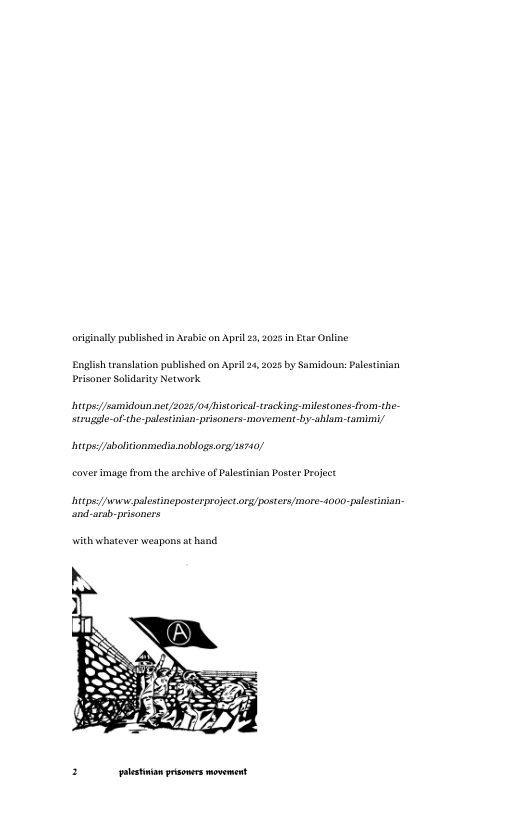
with whatever weapons a hand
The fllwing articl, by bersed prisoner Ablom Tamin ander contans threa from she United
State) mas publbed in Arabic on Aprl 23, 2025 i Etar O, examining the history and
delepment of the Ptivian priones” ot ave he desade, e ars puiliin it in
Fonglish tranltion o in oot biglight theintelctual contibutions and bitrical rcord of
e Paletivian Prsoners" Mavemont, a docamented by the prisoners s
Abla Tamim s Palstinian-Jordanion jouralst and wrisr rigialy frm te il of Nabi
Sal i cpicd Palstine and borsin Zarge, Jordan, i 1950. One ofthe st o 1 o the
Iz D a Qassan Briades she st the maryr Iz b Din - Masr nside capicd al Qs
48 10 cary out a it sperstion at a Sbarrs st She was arested and senteced 10 16
1 e i cpaton prions, and was iberated it WWafa'abAbrar prisner exchangs achiad
by the Pabstiian Resistancein 2011 She was deporte o Jodan; Lt i 2017, sbe U.S
sovernment s that it was g br o its most-wansed st and s a 85 il revard
for ber captur. The ULS. bas rpeatdly domandod she b estadied from Jordan,despte Jordamian
ot ruling that she st vt be tared o
Historical tracking: Milestones from the struggle of the
Palestinian Prisoners’ Movement
by Abalam Tamini
Introduction,
The Palestinian prisoners’ movement s considered to be one of the most importane
clements of the Palestinian national struggle, as prsoners have, over the last decades,
constituted an important dimension in the resstance against lsracl occuparion. sracl
prisons have turned o azenas for struggle and confrontation that have led to the
formation of a collective consciousness and a cultue of resistance inside the prison
cells, and have contributed to the elsboration of the concepts of frecdom, resilience
aad national belonging, This aricl secks to examine the historical devclopment of
the prisoners’ movement since 1967, and analyze its poltcal, organizational and
miltant role.
Historical Background
Zionist gangs have adoped the policy of summary execution after arrests and violent
interrogations during the 40's. In 1949, five Iseacl soldicrs arrested a Palestinian gil
i her twenties, they then murdered this gil afte raping her and subjecting to ber 0 3
violent interrogation, and the soldiers have admitted during the il hat the murder
and the rape came as a resul of clear and explict orders.[1] And berween the years of
1948 and 1967, the Isracli occupation used many of the camps that they inberited
from the Beish mandate, and in it they imprisoned tens of thousands of Palestinians,
leading to the spreading of disease snd cpidemics due to the poor treatment and the
avererowding [2]
‘Phases of the History of the Prisoners Movement: The First Phase: 1967-1970
Since the 1967 occupation of the West-Bank and the Gaza Srip, the Tssacl
ccupation authorities stated arresting thousands of Palestinians and Arsbs after the
lasnch of armed resistance inside and outsid the country, which overshadowed the
eliy of the prisoners’ movement. Researchers started documenting the history of
the prisoners’ movement since the year of the Naksa. In an exclusive interview
conducted by the rescarcher during her preparation of her Master’s thesis on March
15,2019, with Mahmoud Bake Hijai, the irt Palestinian prisoner to be liberated
. [ rer———
after having been incarcerated in the solation cels of al-Ramla prison3], he alked o
her about the derenion conditions he was subjected to during his frs incarceration
“This incarceration lasted from Jamuasy 17, 1965 to February 21, 1971, and during
he was completly solated from the outside world sad put under constant
surveillance by the failer who was replaced once every § hours. He added: *After my
artest 1 was subjected to physical torture and mental pressures to push me to snich
on my colleagues, and 1 was also aching from the wound I sustsined while clashing
with the Isracl army. With the start of 1967, the number of imprisoned fedayeen
increased. 1 was never allowed to live with therm or to meet thern, and 1 used to loudly
all o them to rise their morale. 1 was under constant surveilance and | was not
allowed to be in contace with anyone."4] The occupation sentenced Mabmoud Hijazi
0 death, making him the frst Paestinian prisoner to be given the death penlty, after
the exceution of Ata al-Zeer, Mobammad Jammjoum and Fusd Hiaziin Akka prison in
1933, and Sheikh Farhan al Saadi [1937] and Youssefin 1939[3], Hijaais death
Sentence was subscquently overturned in the sppeal hearing and he was liberated on
February 25, 1971
“The treatment of female prisoners at that time was not any better than that of the
male prsonces. Liberated female prisoner Fatinma Besnawi, who was asrested by the.
occupation forces in October 1967, says that te Prison Services forced female
Palestinian prisoners to work in the laundey rooms and in agrculture i the felds of
al-Ramla prison. They were put together with the penal female prisoners arrsted for
prostitution and drug:elated charges. 1t was not casy for female prisoners to cxtract
heir sights during the 1960°, which forced them to wage mltple hunger strke
campaigns to gain some basic rights in deteation.[6]
We can say that the fise conditions of detenion were harsh, that they constituted a
form of slavery and a tool o practce violence and terror with the objective of
cementing its monsosiy in the mind of the Palestinian, and of dissuading any
miliant action, paving the way for the limination of the project of Hberation strugele
before it even stareed.[7] Liberated prisoner Aisha Odeh, who was arrested on March
1,1969, documented he experence in prison in her book Dcsm of Freedom, She
described the heinousness of the first condiions of interrogation, characterized by
constant physical beating alongside spiting,insult,threats of sexual assault and the
use of electro-shock, s wel a hearing other prisoners being tortured in ncighboring
el and her sceing corpes deaged on the floor, s she herself was on the verge of
dying[8] She explained that the reason behind all this cruchy was the shock of the
occupation a the qualitaive and successful partcipation of women in the resistnce
efforts, confirming that the year 1969 had seen mulipl successi
led by women such as Aida Saad, Mariam al-Shakhshis, Lutfiya el-Hawari and Rasmea
miltant operations
[rrpa— s
Odeh, among others
In this time period, che prisoners endured the effects of the harsh treatment by the
Istaci Prison S
cevice,and theie systemic targering through the policies of starvasion
and anonymmization, in an atempt to erase the miliant self and replace it with an
exhausted, compliant and surrendered sclf. They were deprived of sufficient
quaniitcs of food that was prepared by the “criminal” prisoners n the worst ways
possible, such as the “Goosefoor soup™ which consised of a few leaves of herbs
inside a large quansiy of water, alongside half of an old boiled g that was served for
breakfast]9]. As for the dress code, there was & single uniform for allinmates, and it
was ot allowwed to bring in one's own clothes. They also made sure to grant them the
least amounts of rights stipulted by the 4th Geneva Convention Relatve (o the
Trestment of the Prisoners of Wars, such as granting each prisoner two blaakets and
a dhin leather mattress instead of a bed, and they were restricted i theie sleep duc 0
the number of times inspections were carred out on a daily basis, strting at 530
a.m, and during which the prsonce i forced to tdy his bed and prevented from
eoing back to sleep. The prisoner is lso forced to reply with “Yes Si”. As for the
yard tme, i did not exceed 30 minutes or at best, an hour a da.
As for forced labor, it was, according to the writings of liberated prisoer Willam
Nassar in bis book Tagheibat Bani Facah, characrerized by the following: [10]
1- Forced cleaning works; including the cleaning of the cels the hallways and the
falers” offces under the threat of pusishment or soltary confincment.
- Workshops; such as farniure maintenance workshops or the manufacrure of tank
s used by the soldiers for the pusposes of camoflag.
3- Hard laborin prison yards; such ss shoveling diet, moving rocks and eidying up the
yards for fre.
4 Mandatory Services; such as ironing the milcary uniforms of the jalers, offering
them coffee, tea and food, or executing humiliding personal orders.
There was no presence of factionalism or onganizational distinctions i this period
becasse the prisoners considered themselves the upholders of common revoluton.
Qucist and regionlisic poliics sprang up with covest suppart from the lsrscl
Prisan Service (IPS) in order o achieve their abjective of gtting the prisoners’ minds
caught up with anyehing besides the homeland and its iberation [11]
. [ rer———
“This phase, despite i harshacss, constituted the main focal point o the uporming
sebellios undertakings and instances of disobecience in Iracl prisons, s well a the
use of hunger strikes which we wil be discussing lter on.
The Sccond Phase: 1970-1973
After the increase in the incarceration ates in the sanks of the revolutionaris with
organizational backgrounds, they refused the policy of forced labor imposed upon
them. I recaliaton, they were subjected to the penaley of solary confinement, a5
wellas the bansing of family viits and constant beting, With the consttution of
organizationsl nucleus among the prisoners from Fatah and the Popular Front for the
Liberaton of Palestine (PFLP), the rebellion against forced labor erupted and the
number of those oppased to it increased, and hunger stikes were used s tool to
extract ights under detention,
Itis during this phase that the prisoners launched thei first hunger srike on February
18, 1969, i al-Ramia prison. The strike lasted for 11 days before it cventually faled
because the prisoners were subjected to repression, isolation and sancrions.
[12]During this seike,the strike leaders, including Abdulharid al-Qudsi, Karmel al-
Nemsi and Willam Nassar, among others, were placed in soltary confinement, and.
were subjected to violent beatings by the Rarmla prison dircctor unil they were moved
0 Ascelan prison[13] The Kfar Yona prison hunger strike was simulancously
unched and it asted for § days, and ended up successfully achieving some of the
demands such as the prisoners eting writing implements and stationery, and them
ot having to respond with “yes si” anymore, something which was exclusive to Kiae
Yona[14]
Liberated prisoner Shavwe Shahrou says: I was transfereed, alongside the keaders of
the strike, o Asqelan prison. It s prison specially designed to break morale and
humillae the prisoner and discpline him. We were welcomed with a seris of
beatngs that we called “al tashrifaly” (the bestowing of honors) we had to wlk
through along hallway, with soldices on both sides holding bators and electric wires.
While naked, we were almost beaten to death under the pretext that we are criminals
T remember that my head was swollen and my body was bleeding, We were ther
Sprayed with DDT sad were locked up in rooms with twenty prisoncss each, without
getting treatment or suffcient quantitcs of food, 5 we continued gerting beaten
while inside the rooms depending on the mood of the jaler, whom we were only able
0 address by saying “yes sie”[15]
“The detention conditions in Asqelan prison were humiiating. Prisonces were forced
[rrpa— 3
o launch a hunger sk on July 5, 1970, which lasted for around a week, Thanks to
his hunger srike campaign, the prisoners were sble to achieve some mesgre demands
such as the increase of the duration of yard time and allowing the inmates to reccive
clothes feom their familcs and allowing them to have writing implements and
sationery. Despite the estreme difficulies,the prisomers were able to limit the scope
of the sggressions that were committed against therm,16]
The Third Phase: 1973 - 1980
This phase was characteized by the effort o consolidate the factional ystem nside
prisons, and its imposition upon the jailes as an internal system of life, tuning the
prisoners'lie from chaos into order. The prisorers also cmphasized the necessity to
extrsct the rights that were sipulaced by international charters which pushed them to
lanch muliple hunger srikes during this phase, including:
+ The strke in Asqelan prison which lasted from Apil 13, 1973 up undl October
7,197,
+ An open hunger srke that was launched from Asqelan prison on December 11,
1976, and spread to all other prisons. It lasted arovnd 45 days, after they
oxganized themselves so that cach room had its own representatves who spoke.
atits behalf, and a general represcntative was clected in every prison to sperk on
beualf of the prisoners of al factons. Morcover, it of demands was presented.
0 the Asgelan prison service on top of which was the ead of the policy of
constant beating. Some of these demands were granted, such as the prisoners
managing the ibrary and the replacement of the prsonces’ otten mattresses with
news ones, while the prison administration violated the other agreements which
led the prisoners o launch another hunger stike on Febuary 24, 1977, 1o
demand the implementation of these promises, and this strike lasted 20 days. [17]
The Fourth Phase: 1980 — 1985
The IPS reaized the impactul role played by the Palestinian organizations inside
prisons, and it grew aware of the cultural level dhat the prisoners developed, as they
tssed o hold cultaral sessions and issue monthly magazines written on the back of
food packages; these included the Thawra (Revolution) magazine and the Hurriyah
(Freedom) journal which gave the prsoners the apportunity to write articles about
vasious topics 18] Therefore, the IPS decided to open Nafha prison in 1950. In i, the
IPS incarcerated the lesders of the prisoners’ movement i harsh conditions including
bad food both in terms of quantity and quality. In addiion, the highest possible
fumber of prisoners were crammed up in sooms with no ventilation, wriing
s [ rer———
implements and stationcry were confiscated and the prsoners were totaly solsted
from the outside world, leading therm to coordinate with the prsoners of Asqelan
and Bir al Saba’ o wage a hunger strike campaign that stated on July 14, 1980 and
Iasted for 33 days. [19]
Talking about his hunger strike, Eberated prisoncr Azmni Mansou ssys: “During this
hunger strike, prisoners Rasim Halawa, Alf ol Jaafui, 1shaq Maesgha and Anis al
‘Dacl were martyreds Al was my frend and we were in the same room.20] They
Jlled him by force feeding him with a laryngeal ube and chen claimed that he had
committed suicide."[21] The, the hunger strike spresd into al prisons, aad it
ended up achiving al the prisoners’ demands, especialy that of gerting beds and
increasing the area of the sooms. This stike was also characterized by the populss
and mediasolidariy movement that followed the mastyrdom of the four prisonrs,
In 1984, prisoners of the Juncid prison estracted a higher number of demands after
waging a 13-day hunger scrike that was met with widespread solidariy from the
Palstinian population which made it successful. Subsequently, televisions, rdios,
carphones and cassette tapes were introduce into the prisons, 5 well as baakets
and pajamas that were given by the familics of the prisoners, which significanty
impacted their generslife, and provided them with a degree of sabily thar
enabled them to priorize their culture and advance their militancy.
‘The Fifth Phase: 1985 - 1993
After the abJalil operation which oversaw the iberation of over 1000 Palestinian
prisaners among those sentenced to long sentences or o e in prison in 1985, the
prisaners sought o reconstruct Palesinian organizations, cspecally after the
emergence of Isamic organizations. Thus, the IPS decided to overuen the previous
achievements of the prisoners and bring them back to square one, forcing them to,
aunch hunger stike on March 27, 1957 led by inmaes from Juneid prison, which
were the followed by those of the orher prisons, ltimately lasting 20 days but did
ot achicve their demands.
Thousands were arrested i the early days of the frs Infada in December 1987,
and the batle overshadowed the prisons which saw heavy repression snd the
overtumn of previous achicvemets. This wen on untl 1992, after the prisoners had
unched hunger seike on June 23, 1991 hat was met with filure, mainy because
of the Gulf War and the instabilty of the general regional politcal situation.
“The prisoners decided to launch a crucial hunger srike on Septembe 25, 1992
which
[rrpa— s
included prisaners from all prisoners that had around 7000 partiipants in total. This
srike saw a great el of success and restored the balance of e in detcntion after the
prisoners extrscted a number of grins, including The end of strip scarches,the
closue of the solitary confinement section of Ramla prison, the resumption of visis
by family members and the extension of the duration of these viits, a5 well a5
alloning private visis, the extension of the fist of puschases and inteoducing cooking
iles and cquipment into the rooms [22],as well s allowing the pursuit of university
education n the Open Hebrew Universiy. [23]
The signing of the Oslo Accords and the creation of the Palestinian Authority (PA)
impacted the situasion of the prisoners in Tsraci prizons. The prisoners were divided
into sections: ane that is comprised of those in support o the sccords, thinking it will
lead o their release, and another comprised of Marxists and Islamic thinkers who.
opposed the accords and did noe believe that they were going to lead to the empeying
of the prisons. [24]
This phase was characteized by the economic stabilty of the prisoners, in partcular
after the creation of the Palestinian Pesoners Club and, later on, the Ministy of
Detsinces and ex-Detainces Affiss, The prsoncrs gained rights s the genersl
peaceful situation reflected on them, The regular visits of the lawyer of the Palestinian
Peisoners Club and the Ministry of Detsinees brdged the relationship with the PA
which contributed to achicving some of the prisoners’ demands, on top of which was
the resumption of universiy education and the arrangemens of the fnancial support
of the prisoners and their familics ourside and inside the prisons sccording to 3
special salary seale, which provided the prisoners with reltive sabilty. Despite this,
the question that reoccurred in the minds of the prisoners revolved around the
possibility of theie release in the light of the Oslo Accords and the peacefol
relationship between the PA and the Israclis which led t0.2 downfall in the intcrnal
organizational prescnce and s decrease in the levels of organizational culture nd the
enenl sitaarion, 25]
Some prisomers were liberated after the Oslo sccords, under “good will” iniiatves,
but these releases did not include many of the vet
ran prisaners or those with long
sentences, lesding to 8 decrease in the morale of the prisoners and their
disllusionment in the PA leadership. Liberated prisoner Israr Sumeain says he was
heavily disappointed aftersecing prisoner Ahmad Abu al-Sukkae who was ot
liberated by the Oslo Accords, lading him to question: “If Abu al-Sukkar was not
liberated, then when are we getting iberaced?” This led the prisoners o wage
» [ rer———
politcalstike under the slogan of “The Oslo Accords did not liberate them: seleasing
the male and female prisoners without exception” on March 18, 1995, lating 18 days.
“This srike had the airm of delivering a politcal message to the PA snd the Palestinian
people in the light of the current quict sate of affsirs. [26]
“This phase was characterized by political srikes, which delivered multple messages to
the Palestinian Authoriy. The 1995 stike was followed by another on February 5,
1998, which laste ust 10 days and was only waged by PLO prisoners without the
pasticipation of the prisoncrs from the Islamic movements. Then, yet snorher strke
followced on May 1, 2000, lasing 30 days. This strike started aftcr the opeing of the
Hadair prison s the fsoltion of s number of prisonces sad the attempt to replace
the dividing net with glass during the family vists to the prisoners. This steke s a
wide-scale popular solidarity movement chat led to the martyrdom of some
Palestinians. These strikes spread further as prisoncrs in Asqelan, Nafha and Shatta
foined in,increasing the aumber of prisoners on hunger strike o around 1500,
leading (o the granting of the majority of humanitarian demands, such as;
removing the prisoners under soltary confinement from isolation, allowing universicy
educarion and stoppin the policy of naked searches. However, all of thesc
achievements were later completely overturned after the eruption of the al-Agsa
Ioifada in the year 2000, 27]
‘The Seventh Phase: 2000 - 2006
After the eruption of the sl-Aqsa Intfads on September 25, 2000 and the arrest of
large numbers of Palstinians,the IPS opencd new prisons and prison sections and
even reopencd old prisons such ss al Rarnla, Kfar Yona, Hadarim, Gilboa aad
Ramon. Most o the achievements of the prisoners were overtuened and a policy of
daily seasches of the prisoners” rooms was enforced. The situation of female prisoners
in Ramla prison worsened, leading them to wage hunger stike for § days st on
June 26, 2001, followed by thei participation in the general prison stike on August
15, 2004, which led o the achievement of some basic demands after 19 days on
hunger stike.
“The astes of lagge numbers of Palestinians in the wake of this Inifada led to the
deteroration of elations beween them and older prisoners,as well 18 the presence of
a gap in their communication and hacmony. Liberated prisoner Fakbl al-Basghoutt
Says: Tt was a diffcult phase, one in which the prisoners of the PA securiy services
didert wish to take part i the general organization in prison. This period saw the
pricritzation of personsl interests a the expense of the genersl intercs, and it was
s that it exhausted the older prisoners hecause of the age and intelectual and
[rrpa— "
arganizationsl gap between them and the new prisoners.” [25]
The Eighth Phase: 2007 - 2019
Inter-Palestinian division overshadowed the prisoners movemeat. The prisoners'lives
in seach prisons was divided on the basis of the organization they belonged to, and
o, every organization had its sepresentatives and sections and privte lfe, which
weakened their position in the face of the IPS. The national ranks of the prsoners
were divided, which led number of prisoners from different Palestinian
organizations to launch a concilistory initiative on June 27, 2007, known as the
Narionsl Reconcilstion Document of the Prisoners. Horwever, this initiative did not
succeed in serling the internal dispates of the prisoners. And after the arest of a
large aumber of children after the 2015 al Quds Intfads, the IPS launched an
affensive against the prisonces scrossallprisons, costing the prisoners a great cffore
0 sccommodate and supportthe new prisoners and safeguard theie ights. This phase:
was characterized by the weakening of the inteenal unity of the prisoners, as well a5
weak strateic plans and general position. [20]
The year 2011 saw the release of more than 1000 Palestinian male and female
prisoners on October 18, after the exchange agrecment berween the Iseacls and
Hamas. And aftr s few months, the Hamas and PFLP prisonersin soltary
confinement ld & hunger strke on April 17, 2012, with the goal of purting an end o
e iolation and to reoin other prisoners in the collective cells, This strike saw
state of organizational solidarity which, although i did not include al organizatons,
ultimately culminated in the success of the endeavor. Nevertheless, the exchange deal
o led to a fecling of frustration fee by those who remained in prison for aot being
included among those released. Liberated prisomer Amjad Abu Latify sys: “After the
deal and the implementation of the Shalt v, discplinary measares were restored
and most benefits were terminated, especialy whe it came to prisoncrs from the
Gz Strip, who were sabjected to measures that were twice as harsh, and were
completely deprived of family visits, and were isolted in their scetions.” (0]
The effects ofthe intra-Palestinian divi
fon o the generalstate of the prisoners led
the prisoners under administrative detcation to decide to launch a hunger stike on
Apil 24, 2014, demanding the abolition of administrative derenton. This suike saw a
wide soldarity movement, and lsted for 63 days, becoming the longest hunger sk
led by prisoners under administrative detention in the history of the prisoners’
movement, and it was subsequenly ended after a limit of fust one year of
administrative detention was set.[31]
u [ rer———
“This phase ssx the emergence of individual bunger stikes, which some prisoncrs
e led to undertake due to the division in the ranks of the national prisoners”
movement. Some of these strikes lasted for hundreds of days and more. The year
2012 s muliple individual hunge stekes such as that which was led by Khader
‘Adnan throughout 66 days, the hunger stike led by Thaer Halableh for 76 days, Hana
Shalabi who went on hunger strike for 44 days, or Samer Issawi who excecded al
expectations by going on a hunger srke for 265 days, which is considered to be the
longest ind
dual hungee serike i the history of the prisoners’ movement. [32]
The Ninth Phase: 2020 - the aftermath of Al Aqsa Flood War
“The prisoners of his phase suffered from the coronavirus which spresd among their
ranks, 25 they acked any steriizes or antiscprics 5 well a precautionary measures.
“This led to the increase in the numbers of infected prisonces. This period also saw an
attempt by six prsoners to escape from Gilboa prison on September 2021, and these
prisoners are: Zakasia Zubeidi, Mahmoud al Ardah, Yacoub Qads, Ayham Kamarsji,
Mohssmmad al Ardah and Munadil Nafs'se This wss followed by a sries of
heightencd security measures ater their recaptue. This forced the prsoncrs to wage:
o hunger srkes in 2022 that culminated in the meeting of their demands afer the
prisaners theeatened to dissolve their organizations and structures and cater a
complete rebellion. [33]
In the wake of the Al Aqsa Flood War beginning on October 7, 2023, the number of
prisaners increased and exceeded the 16,000 mark, while around 59 prisoners were
martyred since the cruption o the flood. [1] The IPS used new and unprecedented
torture methods agsinst male and female prisoners, which included rape and sexual
hasassmens, using dogs for intimidation parposes, overturning all the achicvements of
the prisoners’ movement and bringing it back to square one. 1t also opencd the Sde.
“Teiman prison which it specificaly designed to incarcerate prisoners from the Gaza
Strip against whom it committed war cimes that violae internationsl law and the
Geneva conventions, and it did not reveal the aames of the detainces to any legsl
enity. Lawyer Khaled Mabsjach transmiteed the testimonics of multiple prisoners
that were locked up i Sde Teiman, which included: The 24h chaining and
blindfolding of the prisoner, not allowing prisoners to change theirclothes, the spread
of discases and epidemics, skin discases in particulr such as seabics, subjecting the
prisoners to maximum secuity and assauls by armed guards, not allowing the
prisaners to communicate berween cach other or to practce theierelgion, only
allowing therm to shower once a week or even less, reducing the food quantiy and the
continuous and sudden beating of prisoners. [35] As for the other Isracl prisons, the
IPS has isolted the veteran leaders of the prisoners’ movement and brutally assaulted
[rrpa— 5
them, and deied them treatment and medical operations, while alo attempting o,
assassinate many of the prisoncrs and the leaders of the prisoners’ movement,
confiscatng their belongings and dispersing them benwee the prisons. 36
And despite the release of Palestinian prisoners in seven successive batches a5 # result
of the irs phase agreements of the al Aqsa Flaod deal between Hamas and the
Iseaci,the arreses are stll ongoing, and the conditions inside the prisons keep
deteriorating day afier day 25 the war rages on.
Conclusion...
The bistory of the Palestinian prisoness’ movement boasts of a long record of
sacefices and developments, which reflccts the resilence of the Palesinian people
and its dercrmination to achieve liberaton, and which constiates a focal point to
understand the de
lopment of the Palestinian nationsl struggle, a i reflects the
scope of the transformation of the concept of resstance inside the prisons. And
despite the attemps for repession and exclusion that were excrciscd by the jale, the
prisoners were able to cement their presence in the national collective conscience.
And from here on, it i ndispensable to study this movement in order to grasp one of
the most important pilars of the modern Palestinian strugele, and to maintsin the
prisoners’ cause as a priosity on a Palestinian and on an internationl lvel.
" [ rer———
1] AL Tarsies, Ahlam Aref, Communication Activtis for Palestinian Prisoners in
Lacli Occupation Prisons: Towards a Theoresical Concept of the Prisoners”
Information Concept, Master'sthesis published, 2019, Middle East Universiy,
Jorda,
2] Liddane, Mostafa Yousef, the Free Prisoness, Hawks in the Nation's Sky, Frst
Exdition, 2013, Dar AL Fasabi, Beirus, Lebanon,
18] Mahmoud Bak Hijazi died on March 22, 2022 in Ramnllah
4] Al Tamimi, previous source.
5] The Prisoners and Editors Affirs Authoriy website, “The prisoners’ movement
origin and development” was published n 3/29/2019.
6] Memory of Palescine sie, Intervicns of the freed prisoner Facima Bernavi
7] Qarage, ssa, Palestinian prisoners in Istacli prisons after Oslo 1993-1999,
published Master’s thesis, 2001, Bircic Universiy, Palestine
18] Odeh, Aisha, Drcams of Frecdom, 2004, Muwattin: Palestnian Foundation for the
Stady of Democracy, Ramallah, Paestine
9] Memory of Palescine sie, Intervicss of the freed prisoner Shawki Shabrou.
[10] Nassar, William, Ghariba Bani Fath: fory years in the Fathawi maze, 2005, Dar
Al Shurouk Poblishing and Distrbution, Jordan.
1] Prsoners and E:
Prisoners Affairs, previous source.
[12] Paestinian National Information Center, most fumous hunger strike
[13] Memory of Palestine st Interview of the freed prisoner Abdul Hamid Al
Qudsi
14] Palestinian National Information Ceater, previous souce.
15] Memory of Palestine ste, previous source,
[16] Memory of Palestine st Interview: of the freed prisoner Az Mansour
[rrpa— s
[17] AL-Azza, Mohaanad, the date of the hunger strke i the prisons of dhe Isracl
encemy, AL-Adab magavine.
[18]14.
19714
20] This tube that atess the prisoner's stomach through the nose, n a coercive way
o force him to brealk the hunger strike, and pass through it a liquid substance for
forced nurition,
[21] Memory of Palesine, previous souee.
[22] These cooking implements include the “tle,” s burner used by the prisoners to
coak their food.
[23] Hamdouna, Rasfar Khali, Creative aspects of the hiscory of the Palstinian
prisoners’ national movement berween 1985-2015, 2 published rescarch seuy, 2018,
Ministey of Information, Palestine.
]
the prisoners’ movement n Iseacl prsons 1993-2012, published Maseer's thesis, 2012,
ad, Ziyad Musa, the impact of the Oslo exa on the unity and achievements of
Palestine.
25] AV Tami, Nz, phone intervi dated /15201
126] Memory o Palesine sie, Inteview of the frce prisoncr, sra Surorain,
27) AV T, previons souree.
[29] Abu Mohsen, Jamal, History of the Prisoners’ Movement, 2024, published by
Arab American Univessit, Palestine.
[30] Memory of Palestine site, Iterview of the freed prisoner Amjad Abu Latfa.
[31] Sadiq, Mervar, S
Iseacinellgence,” Al Jazeces websitc.
spension of the prisoners' stike afeer an agecement with the
o et prisonrs movement
32] Rajoub, Awad, “The most prominent individual strikes of Palestirian prisoners,
2022, Al Jaeera websice.
193] Al-Asa, Fadi, “Palesinian prisoners flc Gilboa Prison” 2021, Al Jazeera
websic.
34] Palestinian Prsoner Club Sttisics, 2025
35] “The fistlaeyer o visit “Sde Temary”” a report published on the Aezb TV
website, 2024,
136] Aba Mohsen, previous citation.
A dul evening in a run down vllige
Eyes half asleep,
1 recal thiry years
And fve wars
1w the furure keeps
My ear of corn
And the siger cronns
About a firc
And the exening is just anorher evening,
And the smger croons
And they asked him
Why do you simg?
[ rer———
And e ansered
Fsing because | sing
And they searched his chest
Butcould only find s heart
And they searched his heare
But could only find his people
And they searched his voice
But could only find i gt
Ard they seasched his grict
Bt could only rnd s prsan
And they scarched hus prson
Bu could only sec themselves in chains