Lessons from the Third Wave of the North American Anarchist Black Cross Movement
Web PDF • Imposed PDF• Raw TXT (OCR)




![Anarchist vs. Marxist-Leninist Thought on the Organization of Society Lorenzo Kom’boa Ervin 1979 Historically, there have been three major forms of socialism: Libertarian Socialism (Anarchism), Authoritarian Socialism (Marxist Communism), and Democratic Socialism (electoral social democracy). The non-Anarchist eft has echoed the bourgeoisie’s portrayal of Anarchism as an ideology of chaos and lunacy. But Anarchism and especially Anarchist-Communism has nothing in common with this image. It i false and made up by its ideological opponents, the Manxist-Leninists. Itis very difficult for the Marxist-Leninists to make an objective criticism of Anarchism as such, because by its nature it undermines all the suppositions basic to Manxism. 1f Marxism and Leninism—its variant which emerged during the Russian revolution—is held out to be a working class philosophy, and believes that the proletariat cannot owe its emancipation to anyone but itself it is hard to go back on it and say that the working class is not yet readl to dispense with authority over it Lenin came up with the idea of a transitional tate, which would “wither away” over time, to go along with Manx’s “dictatorship of the proletariat.” The Anarchists expose this line as counter- revolutionary and sheer power-grabbing, Over 75 years of Mansist-Leninist practice has proven us right. These so-called “socialit states” produced by Manst-Leninist doctrine have only produced Staliist police states where workers have no rights, a new ruling class of technocrats and party politcians have emerged, and the class differential between those the sate favored over those it didn’t created widespread deprivation among the masses and another class struggle. But instead of meeting such criticisms head-on, [the Marxist-Leninists] have concentrated their attacks not on the doctrine of Anarchism, but on particular Anarchist historical figures, especially Bakunin, an ideological opponent of Manx n the First International of socialist movements i the last century. Anarchists are socialis revolutionaries who seck a stateless, classless, Voluntary, cooperative federation of decentralized communes based upon social ownership, individual liberty and autonomous self-management of social and economic life. The Anarchists differ from the Marxists-Leninists in many areas, but especially in organization-building. They differ from the authoritarian socialists in primarily three ways: they reject the Mansist-Leninist notions of the “vanguard 7](lessons-from-the-third-wave-of-the-north-american-anarchist-black-cross-movement-true-leap-press 7.png)







![here and there, there are none of the recognizable signs of a racist conspiracy that we would expect. The state’s strategy in response appears to be to offer just enough support to the southern Black clergy to be able to set the terms of debate, then use that position to keep ahead of any radical grassroots mabilization against the real bases of white supremacist organizing, Stil, i’s not hard at all to imagine a radical Black or mixed movement rising to defend the ‘communities under attack, and when that happens, sooner or later it will have 10 confront the state. Are we going o be in a position to be there when it happens? What kind of support can we offer in that kind of situation, and how. prepared are we? This is an especially clear example because of our relationship ‘with the Anti-Racist Action (ARA) network and other similar work being done on the issue. If and when political conflict — whatever issue it surfaces around — again reaches the point where large numbers of people are beginning to think seriously about armed struggle, there will definitely be an even greater need for alot of people to take up political prisoner defense work. But that doesn’t have 1o be in the form of ABC, it probably won’t be using the same tactics we’re focusing on today, and we might not necessarily be the people best situated to doit. II: The first thing to look at is the state of the anarchist movement, which for most of us is both our roots and our base. There have been plenty of criticisms made of the arrogance of the movement and white chauvinism, middle-class ‘dominance and pacifist lifestylism. The strongest of these have come from Black comrades, but similar struggles have come up [internally] as well. Much less clear have been the criticisms of the movement’s patriarchy, though its obvious that in most places, the scene s pretty thoroughly male-dominated. Much of the recent anarchist women’s developments that contain at least an implicit critique of the male-oriented movement have happened in the specifically cultural realm, without any representation in the form of organizations or position papers — hence its been that much easier to dismiss them. We would mark the rise of our tendency in the generation of youth, many of them punks, who were inspired by the commitment to direct action and the image of a multi-faceted “dual power’ movement — both community-building and offensive militance against the state — they saw in the European autonomen and squatter movements and tried to reproduce those scenes here. They distinguished themselves, first of all, from the pacifist anarchists that were active in the anti- nuclear struggles, as well as the pacifism of the Central America solidarity movement in which they were active. However, by the end of the ‘805, the context in which anarchist direct action had been carried out — the mass. actions in solidarity with Central American and South African liberation struggles — had evaporated. Likewise, the punk scene as the dominant social 2](lessons-from-the-third-wave-of-the-north-american-anarchist-black-cross-movement-true-leap-press 24.png)









Lessons from the
Third Wave of the
Nerth-American
Anarchist Black Cross
Movement
)
ant-copyright, 2025
True Leap Press,
with whatever weapons at hand
Contents
Continuity of Struggle
5
Anarchist vs. Manxist-Leninist Thought on the Organization
of Society (1979)
7
A Draft Proposal for an Anarchist Black Cross Network (1993)
13
“Prison Abolition’ in a Neo-colonial Ice Age (1997)
2
Statement Concerning the Newly Formed Anarchist Black Cross
Network (2002)
37
Further Readings
a2
Continuity of Struggle
“Any moverent which does not support ts political internees is a sham movement”
—Ojore Lutalo, co-founder of the Anarchist Black Cross Federation
“The following four texts are compiled in pamphlet form to provide the reader
with a historical grounding for present.day discussions on organized support for
political prisoners and prisoners of war from social movements against U.S.
setler-colonial land occupation, population displacement and (domestic and
international) warfare.
“The first text is an excerpt from the book Anarchism and the Black
Revolution, first published in 1979 by Lorenzo Kom'boa Ervin in prison. This
excerpt outlines some key differences in organizational perspective befween
anarchists and the Marsist-Leninist-Maoist radition, offering concrete.
alternatives to centralized and hierarchical models of prisoner support.
“The second text, also written by Ervin while in prison, was crucial for
inspiring the creation of a third wave of the Anarchist Black Cross (ABC) in the
US. context during the arly 1990, including both the ABC Federation in 1995
and the ABC Network in 2002. In it Ervin proposes a wide range of principles
and initiatives which have never fully been realized to this day. Notably, he
envisions a network that engages in both defensive and offensive functions,
prediguring contemporary discussions around strategies of anti-repression vs.
counter-repression.
“The third piece is written by the Claustrophobia Collective, a Baltimore:
chapter that broke from the ABC Federation in the mid-1990s. The critiques it
raises regarding the power dynamics of the ABC and anarchist prisoner support
more broadly are as relevant today as they were then. In particular, we want o
highlight their distinction between material and technical support and political
support of prisoners, and the way that focusing on the former at the expense of
the late can lead to what they call a “parasitic” elationship between outside
prisoner support groups and prison revolutionaries on the inside.
“The last text i a statement delivered by Ervin to the Anarchist Black Cross
Network in 2002 that directly calls on us to generalize prisoner support nto a
mass movement rooted in a multiracial, grassroots base—in other words, to turn
the prisoner “support” movement into a genuinely revolutionary movement. We
think there is much that North American anarchists can learn from Ervin's as-yet
unrealized vision, especially when considered alongside the Palestinian national
liberation movement, whose success has largely hinged on coordinated struggle
between prisoners and ouside millants.
One of our main purposes in presenting these texts together is to show the
often-overlooked continuities between the Black Radical Tradition and the
contemporary abolitionist and anarchist prisoner support movements—a
continuity we feel has been obscured for a variety of reasons, including the
emergence of the nonprolit industrial complex and professionalized activism
‘While Anarchist Black Cross formations have gone through many different
iterations over the decades, each attempt to reframe their purpose and
organizing principles has been galvanized by internal critiques from Black
radical movements.
The importance of seeing the Black Radical Tradition as the basis of
contemporary abolitionism is its framing of prisons as tools of domestic warfare,
interal colonialism, and Black genocide. Keeping this perspective front and
center is important in our contemporary moment, where prisoner support work
too often becomes siloed into the model of “single issue” activism, instead of a
broad-based movement that highlights how all struggles against social power in
the U.S. intersect at the site of the prison regime.
Anarchist vs. Marxist-Leninist Thought
on the Organization of Society
Lorenzo Kom'boa Ervin
1979
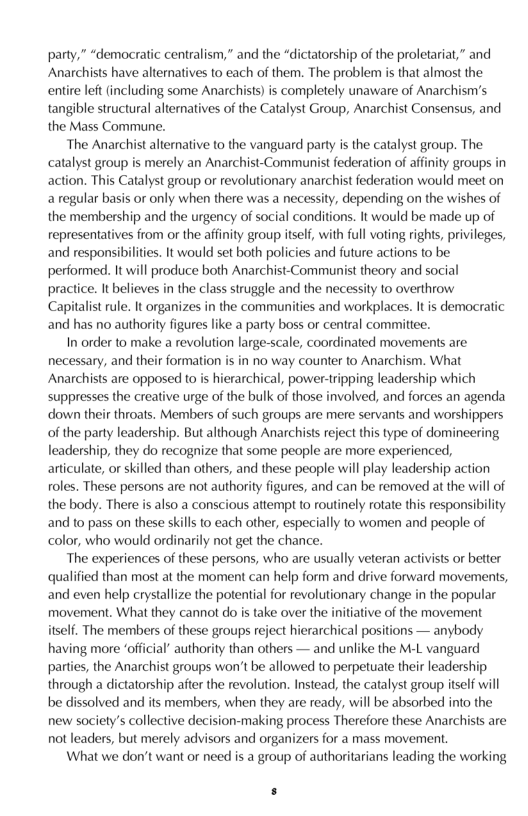
Historically, there have been three major forms of socialism: Libertarian
Socialism (Anarchism), Authoritarian Socialism (Marxist Communism), and
Democratic Socialism (electoral social democracy). The non-Anarchist eft has
echoed the bourgeoisie’s portrayal of Anarchism as an ideology of chaos and
lunacy. But Anarchism and especially Anarchist-Communism has nothing in
common with this image. It i false and made up by its ideological opponents,
the Manxist-Leninists.
Itis very difficult for the Marxist-Leninists to make an objective criticism of
Anarchism as such, because by its nature it undermines all the suppositions
basic to Manxism. 1f Marxism and Leninism—its variant which emerged during
the Russian revolution—is held out to be a working class philosophy, and
believes that the proletariat cannot owe its emancipation to anyone but itself it
is hard to go back on it and say that the working class is not yet readl to
dispense with authority over it
Lenin came up with the idea of a transitional tate, which would “wither
away” over time, to go along with Manx's “dictatorship of the proletariat.” The
Anarchists expose this line as counter- revolutionary and sheer power-grabbing,
Over 75 years of Mansist-Leninist practice has proven us right. These so-called
“socialit states” produced by Manst-Leninist doctrine have only produced
Staliist police states where workers have no rights, a new ruling class of
technocrats and party politcians have emerged, and the class differential
between those the sate favored over those it didn't created widespread
deprivation among the masses and another class struggle.
But instead of meeting such criticisms head-on, [the Marxist-Leninists] have
concentrated their attacks not on the doctrine of Anarchism, but on particular
Anarchist historical figures, especially Bakunin, an ideological opponent of
Manx n the First International of socialist movements i the last century.
Anarchists are socialis revolutionaries who seck a stateless, classless,
Voluntary, cooperative federation of decentralized communes based upon social
ownership, individual liberty and autonomous self-management of social and
economic life.
The Anarchists differ from the Marxists-Leninists in many areas, but
especially in organization-building. They differ from the authoritarian socialists
in primarily three ways: they reject the Mansist-Leninist notions of the “vanguard
7
party,” “democratic centralism,” and the “dictatorship of the proletariat,” and
Anarchists have alternatives to each of them. The problem s that almost the
entire left (including some Anarchists) is completely unaware of Anarchism’s
tangible structural alternatives of the Catalyst Group, Anarchist Consensus, and
the Mass Commune.
The Anarchist alterative o the vanguard party s the catalyst group. The
catalyst group is merely an Anarchist-Communist federation of affnity groups in
action. This Catalyst group or revolutionary anarchist federation would meet on
a regular basis or only when there was a necessity, depending on the wishes of
the membership and the urgency of social conditions. It would be made up of
representatives from or the affinity group itsef, with full voting rights, privileges,
and responsibilities. It would set both policies and future actions to be
performed. It will produce both Anarchist-Communist theory and social
practice. It befieves in the class struggle and the necessity to overthrow
Capitalist rule. It organizes in the communities and workplaces. It is democratic
and has no authority figures like a party boss or central commiltee.
In order to make a revolution large-scale, coordinated movements are
necessary, and their formation is in no way counter to Anarchism. What
Anarchists are opposed to i hierarchical, power-tripping leadership which
suppresses the creative urge of the bulk of those involved, and forces an agenda
down their throats. Members of such groups are mere servants and worshippers
of the party leadership. But although Anarchists reject this type of domineering
leadership, they do recognize that some people are more experienced,
articulate, or skilled than others, and these people will play leadership action
oles. These persons are not authority figures, and can be removed at the will of
the body. There is also a conscious attempt o routinely rotate this responsibility
and to pass on these skill to each other, especially 1o women and people of
color, who would ordinarily not get the chance.
The experiences of these persons, who are usually veteran activists or better
qualified than most at the moment can help form and drive forward movements,
and even help crystallize the potential for revolutionary change in the popular
movement. What they cannot do is take over the initiative of the movement
itself. The members of these groups reject hierarchical positions — anybody
having more ‘official” authority than others — and unlike the M-L vanguard
parties, the Anarchist groups won't be allowed to perpetuate their leadership
through a dictatorship after the revolution. Instead, the catalyst group tself will
be dissolved and its members, when they are ready, will be absorbed into the
new society’s collective decision-making process Therefore these Anarchists are
not leaders, but merely advisors and organizers for a mass movement
What we don't want or need is a group of authoritarians leading the working
class, and then establishing themselves as a centralized decision-making
command, instead of “withering away"; Marxist-Leninist states have perpetuated!
authoritarian insiitutions (the secret police, labor bosses, and the communist
party) to maintain their power. The apparent effectiveness of such organizations
(we re just as efficient as the Capitalists) masks the way that “revolutionaries”
who pattern themselves after Capitalist institutions become absorbed by
bourgeois values, and completely isolated from the real needs and desires of
ordinary people.
The reluctance of Marxist-Leninsts to accept revolutionary social change is,
however, above all seen in Lenin's conception of the party. It s a prescription to
nakedly seize power and put it in the hands of the Communist Party. The party
that Leninists create today, they believe, should become the (only) “Party of the
Proletariat” in which that class could organize and seize power. In practice,
however, this meant personal and party dictatorship, which they felt gave them
the right and duty to wipe out all other parties and political ideologies. Both
Lenin and Stalin killed millions of workers and peasants, their left-wing
ideological opponents, and even members of the Bolshevik party. This bloody
and treacherous history is why there is so much rivalry and hostility between
parties today, and it is why the “workers’ states,”
whether in Cuba, China, Vietnam, or Korea, are such oppressive bureaucracies
over their people. It is also why most of the Eastern European Stalinist countries
had their governments overthrown by the petty bourgeois and ordinary citizens
in the 1980s. Maybe we are witnessing the eclipse of State communism entirely,
since they have nothing new to say and will never get those governments back
again.
‘While Anarchist groups reach decisions through Anarchist consensus, the
Marxist-Leninists organize through so-called democratic centralism. Democratic
centralism poses as a form of inner party democracy, but is really just a
hierarchy by which each member of a party — ultimately of a society — is
subordinate to a *higher” member until one reaches the all-powerful party
central commitiee and its Chairman. This s a totally undemocratic procedure,
which puts the leadership above criicism, even if it isn't above reproach. Itis a
banksupt, corrupt method of internal operations for a political organization. You
have no voice in such a party, and must be afraid 1o say any unflattering
comments to or about the leaders.
In Anarchist groups, proposals are talked out by members (none of whom has
authority over another), dissenting minorities are respected, and each
individual’s partcipation is voluntary. Everyone has the right to agree or
disagree over policy and actions, and everyone’s ideas are given equal weight
and consideration. No decision may be made until each individual member or
affliated group that will be affected by that decision has had a chance to
express their opinion on the issue. Individual members and afiliated groups
shall retain the option to reiuse support o specific federation activities, but may
not actively obstruct such activities. In true democratic fashion, decisions for the
federation as a whole must be made by a majority of its members.
In most cases, there is no real need for formal meetings for the making of
decisions. What is needed s coordination of the actions of the group. Of course,
there are times when a decision has to be made, and sometimes very quickly.
“This will be rare, but sometimes it is unavoidable. The consensus, in that case,
would then have to be among a much smaller circle than the general
membership of hundreds or thousands. But ordinarily all that is needed is an
exchange of information and trust among parties, and a decision reaffirming the
original decision will be reached, if an emergency decision had to be made. Of
course, during the discussion, there will be an endeavor to clarify any major
differences and explore alternative courses of action. And there wil be an
attempt to arrive at a mutually agreed upon consensus between conflcting
views. As always, if there should be an impasse or dissatisfaction with the
consensus, a vote would be taken and with a 2/3 majority, the matter would be
accepted, rejected or rescinded.
“This s alltotally contrary to the practice of Manist-Leninist parties where the
Central Committee unilaterally sets policy for the entire organization, and
arbitrary authority reigns. Anarchists reject centralization of authority and the
concept of a Central Committee. All groups are free associations formed out of
‘committees not revolutionaries disciplined by fear of authority. When the size of
the work-groups (which could be framed around Labor, fundraising, anti-racism,
‘women's rights, food and housing, et) becomes cumbersome, the organizations
can be decentralized into two or several more autonomous organizations, sill
united in one large federation. This enables the group to expand limitlessly
‘while maintaining its anarchic form of decentralized self-management. It is sort
of like the scientifc theory of a biological cell, dividing and redividing, butin a
political sense.
However, Anarchist groups aren't even necessarily organized loosely.
Anarchism s flexible and structure can be practically nonexistent or very tight,
depending upon the type of organization demanded by the social conditions
being faced. For instance, organization would tighten during military operations
or heightened political repression.
Anarchist-Communists refect the Marxist-Leninist concept of the
“dictatorship of the proletariat” and a so-called “workers' state” in favor of the
mass commune. Unlike members of Leninist parties, whose daily lives are
generally similar to present bourgeois liestyles, Anarchist organizational
structures and lfestyles, through communal living arrangements, urban tribes,
affnity groups, squatting, etc., attempt to reflect the liberated society of the
future. Anarchists built all kinds of communes and collectives during the
Spanish Revolution of the 1930, but were crushed by the fascists and the
Communists. Since the Marxist-Leninists don't build cooperative structures, the
nucleus of the new society, they can only see the world in bourgeois political
terms. They just want to seize State power and institute their own dictatorship
over the people and the workers, instead of crushing State power and replacing
it with a free, cooperative society.
Of course, the party, they insist, represents the proletariat, and there is no
need for them to organize themselves outside of the party. Ye even in the
former Soviet Union, the Communist Party membership only represented five.
percent of the population. This s elitism of the worst sort and even makes the
Capitalist partes look democratic by comparison. What the Communist Party
was intended to represent in terms of workers” power is never made clear, but in
true 1984 “doublethink” fashion, the results are 75 years of political repression
and State slavery, instead of an era of “glorious Communist rule.” They must be
held accountable politically for these crimes against the people, and
revolutionary political theory and practice. They have slandered the names of
Socialism and Communism.
We reject the dictatorship of the proletariat. It is unbridled oppression, and
the Manxist- Leninists and Stalinists must be made to answer for it. Millions have
been murdered by Stalin in the name of fighting an internal class war, and
millions more were murdered in China, Poland, Afghanistan, Cambodia, and
other countries by Communist movements which followed Stalin's prescription
for revolutionary terror. We reject State communism as the worst aberration and
tyranny. We can do better than this with the mass commune.
“The Anarchist mass commune (sometimes also called a Workers’ Council,
although there are some differences) s a national continental or transnational
federation of economic and political cooperatives and regional communal
formations. Anarchists look to a world and a society in which real decision-
making involves everyone who lives in it — a mass commune — not a few
discipline freaks pulling the strings in a so-called “proletarian dictatorship.” Any
and all dictatorship is bad, it has no redeeming social features, yet that is what
the Leninists tell us will protect us from counter-revolution.
‘While Marxist-Leninists claim that this dictatorship is necessary in order to
crush any bourgeois counter-revolutions led by the Capitalist class or right- wing
reactionaries, Anarchists feel that this is itself part of the Stalinist school of
falsification. A centralized apparatus, such as a state, is a much easier target for
opponents of the revolution than is an array of decentralized communes. And
these communes would remain armed and prepared to defend the revolution
against anyone who militarily moves against it. The key is to mobilize the
people into defense guards, militias and other military preparedness units
This position by the Leninists of the necessity for a dictatorship to protect the
revolution was not proven in the Civil War which followed the Russian
revolution; in fact without support of the Anarchists and other left-wing forces,
along with the Russian people, the Bolshevik government would have been
defeated. And then, in true dictatorship form, it turned around and wiped out
the Russian and Ukrainian Anarchist movements, along with their left-wing
opponents like the Mensheviks and Social revolutionaries. Even ideological
opponents in the Bolshevik party were imprisoned and put to death. Lenin and
Trotsky killed millions of Russian citizens right after the Civil War, when they
were consolidating State power, which preceded Stalin's bloody rule. The lesson
is that we should not be tricked into surrendering the grassroots people’s power
to dictators who pose as our friends or leaders.
We don't need the Marxist-Leninists’ solutions. They are dangerous and
deluding. There is another way, but, to much of the left and to many ordinary
people, the choice has appeared to be Anarchic “chaos” or the Maoist
“Communist” parties, however dogmatic and dictatorial. This s primarily the
result of misunderstanding and propaganda. But Anarchism as an ideology
provides feasible organizational structures, as well as valid alternative
revolutionary theory, which, if utilized, could be the basis for organizations that
are just s solid as the Marxist-Leninists’ (or even more so). Only these
organizations will be egalitarian and really for the benefit of people, rather than
for the Communist leaders.
Anarchism is not confined 1o the ideas of a single theoretician, and it allows
individual creativity to develop in collective groupings, instead of the
characteristic dogmatism of the Marist-Leninists. Therefore, not being cults, it
encourages a great deal of innovation and experimentation, prompting its
adherents to respond realisically to contemporary conditions. Itis the concept
of making ideology fit the demands of lie, rather than trying to make lfe fit the
demands of ideology.
Therefore, Anarchists build organizations in order to build a new world, not
10 perpetuate our domination over the masses of people. We must build an
organized, coordinated international movement aimed at transforming the globe
into a mass commune. Such would really be a great leap in human evolution
and a gigantic revolutionary stride. It would change the world as we know it and
end the special problems long plaguing humankind. It would be a new era of
reedom and fulfillment.
Lets get on with it, we've got a world to win!
u
A Draft Proposal for an Anarchist Black Cross Network
Lorenzo Kom'boa Ervin
1993
Preface to the Second Edition
“This pamphlet is dedicated to allthose suffering in the dungeons of North
America and all those revolutionaries who have lost their lives in prison
anywhere in the world. first wrote it in 1979 in hopes that it would raise the
issue of political prisoners and lead to the building of a prison support
‘movement which could save those prisoners who followed me into the prisons
of North America from a fate of living death like | suffered (15 years in jail), or
from a violent death like comrade George Jackson, the Attica prisoners, scores
of whom were murdered by State pigs a the orders of billionaire Governor John
D. Rockefeller during the revolt at that camp in 1971; Black revolutionary
Andaliwa Clark who was killed in New Jersey during an escape attempt; or the
brutal assassination of Anarchist political prisoner Carl Harp, founder of the
Anarchist Black Dragon Collective in Washington State prison, who was killed
in1981.
Ojore N. Lutalo, who describes himself as a New African Anarchist political
prisoner, and is confined at the New Jersey State penitentiary in Trenton, has
been quoted as saying that “any movement that does not support is political
internees is a sham movement.” | obviously agree with this, and it i clear that
we must turn the Anarchist Black Cross into a united mass movement, instead of
just a number of isolated collectives who want 1o help particular prisoners. As
one who went through this process myself, as a political prisoner (1969-1983), 1
Know first hand that this piecemeal support structure will not work. What also
will not work is sectarian support, and by that I mean not working with others
because of ideology or refusing to support prisoners because of deology. This is
the antithesis of class war defense, and is eally sellout opportunism. We must
work with al those who believe in the democratic principle of class war
defense, regardless of political disagreement.
Our objective i to build a mass movement sirong enough to free all political
prisoners, and 1o raze the prisons to the ground. Prisoners like Ojore rate as our
highest priority. We can and must free these prisoners, those imprisoned or
tortured because of political beliefs or revolutionary actvity. And if we had a
sirong movement we could free them today! This was proven in the case of the
Anarchist prisoner Martin Sostre. He was framed and imprisoned in the 19605,
and was freed because of a mass movement made up of all kinds of radicals,
©
prison supporters and others persons of conscience.
Not all can be freed by mass movements, but most can. We must also
recognize that some will have to be freed through military action. The state
simply has sworn not to release some persons while they stil live because they
represent such a threat to state security. George Jackson was obviously one such
person, but there are others sil alive and in the dungeon. The Anarchist and
other radical movements in North America must build an underground struggle
capable of taking action like the freeing of Assata Shakur in the late 19705, and
getting those persons to safe haven. It is not easy to do this, but it must be done.
Prisoners must appreciate the difficulty involved in taking such military actions,
while the comrades outside must appreciate the dire threat to lfe of those still
left inside. This is not an easy issue; it a matter of life and death on both ends of
the spectrum. Such a movement cannot be built overnight, but the problem is
that we are no closer to it now than when | was in prison, asking the same
question this group of internees have asked themselves many times: have they
forgotten about me? Must | fight this batle alone? This should not be the case,
butitis. Here is the deal for allto see: if our revolutionary movements outside
are weak, then we cannot build a movement capable enough to free prisoners
o fight for social change.
An Introduction
‘The Anarchist Black Cross is an international network of autonomous groups
of anarchists who work to ensure that Anarchist, class war, and other prisoners
aren't forgotten.
The Anarchist Red Cross was started in Tsarist Russia to organize aid for
political prisoners captured by the police, and to organize self-defense against
political raids by the Cossack Army. During the Russian civil war, they changed
the name to the Black Cross in order to avoid confusion with the Red Cross who
were organizing relief in the country. After the Bolsheviks seized power, the
Anarchist movement moved the ABC ofices to Berlin and continued to aid
prisoners of the new regime, as well as victims of lalian fascism and others. The
Black Cross fell apart during the 1930s depression due to the incredible demand
for its services and a decline in financial aid. But in the late 1960s, the
organization resurfaced in Britain, where it first worked to aid prisoners of the
Spanish resistance, which had not in fact died after the Civil War and were
fighting the dictator Franco’s police. Now it has expanded and works in several
areas, with contacts and other Black Cross groups in many countries around the
world. The North American section started in the early 1980s.
The ABC hopes to bring attention to the plight of all prisoners including
"
psychiatric prisoners, with an emphasis on Anarchist and class war prisoners;
and, through contact with and information about Anarchist prisoners, inspire an
Anarchist resistance and support movement on the outside. Although we aren't
able (except with a few exceptions) o send regular financial aid to our
comrades in prison, we do keep in regular contact with as many prisoners as
possible, make visits and do whatever we can to prevent prisoners from
becoming isolated. We fundraise on behalf of prisoners or defense committees.
in need of funds for legal cases or otherwise, and organize demonstrations of
solidarity with imprisoned Anarchists and other prisoners.
'We believe, as most Anarchists do, that prisons serve no useful function
(except for the benefit of the ruling classes) and should be abolished along with
the State. We differ from liberal prison reformists and groups
International in two main ways: firstly, we believe in the abolition of both the
prison system and the society which creates it, and we initiate all our actions
‘with that in mind; secondly, we believe in direct resistance to achieve a stateless
and classless society. Groups like Amnesty International balk at supporting
anyone accused of so-called violent acts, thus insinuating that anyone who
resists oppression and takes up arms in self-defense, or during a revolutionary
insurrection, is not worthy of support. The message is clear: do not resist. Our
‘message is exactly the opposite, and this is what we work to support. We share
a commitment 1o revolutionary Anarchism as opposed o liberalism and
individualism or legalism.
Outside of prison work, the ABC's are committed to the wider resistance in
which many of these prisoners are engaged. We see a real need for Anarchists to
be militantly organized if we are o effectively meet the organized repression of
the State and avoid defeat. What is also needed is commitment to revolutionary
politics. We see the setting up of Anarchist defense organizations, such as the
ABC, as a necessary part of the growth and development of an Anarchist
fesistance movement, not divorcing ourselves from the revolutionary struggle
and then just fighting for prison reform.
As Anarchists we believe in the promotion of direct action and collective
organization in the workplace, the schools, the community and the streets, as a
means of regaining power over our own lives and creating a society based on
mutual aid and cooperation.
Raze the prisons, free the prisoners!
Purpose of the Movement
The stated purpose of the Anarchist Black Cross Network s to actively assist
prisoners in their fight to obtain their civil and human rights, and to aid them in
their struggle against the State/ Class penal and judicial system. The prison
system is the armed fist of the State, and is a system for State slavery. It is not
really for “criminals” or other “social deviants,” and it does not exist for the
“protection of society.”
It for State social control and political repression. Thus it must be opposed
at every turn and ultimately destroyed altogether. The abolition of prisons, the
system of Laws, and the Capitalist State is the ultimate objective of every true
Anarchis, yet there seems to be no clear agreement by the Anarchist movement
to putactive effort into that anti-authoritarian desire. We must organize our
resources to support all political/class war prisoners if we truly wish to be their
ally, and we must give something more than lip service.
Organizing against the enemy legal and penal system is both offensive and
defensive. Itis carried on with individuals, groups, and among the masses in the
‘community. We must inform the people on a large scale of the atrocities and
inhumanity of the prisons, the righteousness of our struggle, and the necessity of
their full and support. We must organize our communities to attack the prison
system as a moral and social abomination, and we must fight to free all
politicaliclass war prisoners,
Defensive work involves meeting the needs of the prisoners, whether those:
needs stem from the daily oppression of the prisons, police, courts, or the
intensive repression by State/Class authorities of prison organizers. The prison
support group meets these needs in two primary ways:
By educating the community about the class/racist nature of the prisons
and the legal system and how to fight against it
By forming outside support groups on a local and national basis in
order to ensure prisoners’ defense and survival from enemy attack and
from inhuman prison conditions. There should be Anarchist Black
Cross Groups all over the continent.
Offensive work means directly challenging the existence of prisons and this,
work also involves actively campaigning against prison conditions, and
propagandizing the actual cases of political/ class war prisoners i.e. prisoners
jailed for specific political reasons and those who have become politically
aware of the reasons for their oppression while in prison, as well as victims of
frame- ups) to the largest possible audience. We must do this in order to expose,
embarrass, isolate, confuse and demoralize the enemy’s legal and penal system,
and also to win community people over to support prisoners’ struggles.
Some of our protest actvities include this 15-point program:
%
Organizing Political Prisoner Defense Committees on behalf of prisoners
framed o railroaded through the Capitalist courts or their political and
social beliefs or prison organizing. For a prisoner in the hands of the
State on political frame-up charges, the Defense Committee s the most
effective instrument to fight for their freedom!
Holding protest rallies, marches and street demonstrations in support of
prisoners’ rights and against the repressive actions of State/Class
authorites. Such protests can be held in and around prisons,
Departments of “Corrections,” Courthouses (where political prisoners’
cases are being tried or prisoners’ rights lawsuits are being heard), at the
White House, US Congress, State Legislatures, Governors’ Mansions and
other symbols of class rule and prisoner oppression.
Writing press releases and holding news conferences for the Black,
altemative and radical news media (and sometimes the Capitalist news
media) appearing on television and radio news and/or talk shows to
discuss prisons. Priority should also be given to starting a Prisoners’
newsletter or newspaper with an Anarchist focus. In fact, the old Black
Flag, formerly the organ of the anarchist Black Cross Group in London,
England (which has stopped publishing), should be started up again. (I
remember what the HAPOTOC newsletter and the Black Flag did to
publicize and politicize my case when | was in prison.)
Securing Anarchist and other revolutionary materials for prisoners to
read, and fight for their right to receive this lterature if prison offcials
try to ban or prohibit such literature for any reason.
Sending the prison officials and other State/Class authorities all over the
continent a flood of telegrams, letters and petitions about the
‘mistreatment of prisoners, and especially political prisoners and prison
activists (who are ‘dangerous’ in the eyes of the prison offcials). Let
them know that there is someone who is watching their every move and
that the prisoners are not alone!
Organize a telephone brigadle to continually call “corrections” and other
authorities about the treatment of prisoners. This is especially important
if there is an enemy attack upon a political prisoner or an ongoing
prison protest.
10.
1.
12.
Organize a Legal Defense Fund to raise funds for legal fees and to
secure the services of an attorney, where necessary, to assist prisoners
with criminal or disciplinary cases growing out of their prison
organizing or the harassment by prison officials.
Organizing andlor participating in coalitions with poor people’s
movements, prison support, Black, Women's rights, Gay, Church, Left-
wing, and other diverse groups, s0 as 1o win them over and to integrate
the prison struggle into the general movement for social change in North
America.
Assist prisoners in getting parole, probation or a pardon by securing
them a place to stay, a job, some references or names on a petition
demanding their freedom when they become eligible for parole or are
seeking executive clemency. It may be necessary to hold demonstrations
and other protest actions to compel the release of certain prisoners
whom officials are continuing to hold even though they should have
been legally released.
Organize a Correspondence Committee of people to wiite to prisoners
and find out about prison conditions and to show their solidarity and
human concern. Also (o write protest letters o prison officials,
politicians, the news media, prison support groups, professional or legal
organizations and other persons, about prison conditions. Also have the
ABC’s to function as an Observer Committee to go into the prisons, vsit
the prisoners, investigate their complaints, question the offcials and
monitor the prison for violation of prisoners’ rights.
Work against the death penalty and expose it as an instrument of racial
genocide and class and political repression. Never forget the Haymarket
martyrs, Sacco and Vanzeti, and so many others put to death “legally”
by the State, as well as those like Mumia Abu-Jamal, who have been
sentenced to death.
Expose the fallacy of the Capitalist system of cops, laws and prisons
being for the protection of society or as a social necessity. We should
hold community forums on crime, the prison system, racism and
Capitalism, to expose the system itself as the crime, and to show that
there is another way to social peace and harmony: the Anarchist way.
13. Set up Black Cross Amnesty Comittees all over the Continent to
demand the freedom and amnesty of political/class war prisoners, and
the abolition of prisons. Especially demand the immediate release of
prisoners who have served unnecessarily lengthy sentences.
14. Demand the immediate closing of all Control Units in federal and state
prisons. We should have mass marches at the prisons, in front of
politicians offices, and at the “corrections” offices. We should make the
issue of Control Units in North American prisons an international
human rights issue, and in addition work to try to free all such prisoners
on a srict timetable.
15. Those outside the prison support movement (and especially in
underground units) must be willing to engage in armed support actions.
Where the lives of political/class war prisoners are in immediate
jeopardy, they must be forcibly liberated. This is an extreme measure for
extreme conditions of repression. It cannot be taken lightly and without
full understanding of the consequences. But because of the State's
bloody war against innocent victims, it must be considered and done.
Policy
We have to be non-sectarian when it comes to fighting for the rights and
freedom of the victims of prison state slavery. Our policy must be that we will
work with and for any prisoner and prison support group, i they will work in
sincerity and unity with us. We do this 50 as 1o obtain the widest possible:
‘mabilization on the part of the people in support of the prison movement and
the cases of politicaliclass war prisoners. However, we will not subordinate our
ideals and identity as anti-authoritarians and Anarchists to any other struggle or
group. And we will not sustain attacks or make apologies for our beliefs in a
Libertarian world, rather than a State Socialist or Western Imperialist one. We.
won't moderate our struggle or still our tongues concerning any injustice we see
anywhere, in order to accommodate anyone, friend or foe.
Conclusion
The American State in the past has murdered and imprisoned far too many of
our Anarchist comrades: Alexander Berkman, the Haymarket martyrs, IWW.
members (such as Joe Hill, Sacco and Vanzetti, Martin Sostre, Carl Harp and so
‘many others. Also many Anarchist prisoners are in prison today such as Ojore
N. Lutalo, Shaka Shakur, along with other political prisoners like those in the
Black Liberation Army or formerly with Black Panther Party, like Herman Bell,
Sundiata Acoli, and Marshal Eddie Conway. We must organize o ensure that
these comrades (and others now in prison) are freed and that further repression
of our movement by State/Class rulers is prevented.
Therefore, we must talk about making the Anarchist Black Cross into a mass
movement against State repression, one which can counter the drive of the State
Capitalists towards a police state, along with our work in the anti-prison
struggle. We cannot free any of the prisoners without building a mass movement
which links up with all those in favor of democratic rights. That is why I said we
cannot engage in sectarian politics. The case of Martin Sostre in the 19705, who
although an Anarchist, did not refuse the aid of Liberals, Communists,
Christians, Muslims or anyone else who believed in the injustice of hs frame-up
conviction, should be a perfect example. The only reason he was freed was,
because of a mass ferment and agitation by a large sector of the population
demanding his release. The governor of New York granted his pardon. It is
political suicide for a political prisoner, and the movement which supports him
or her, 10 take a sectarian position and refuse to work with others, even though
we may vehemently disagree with them on a whole host o other issues. This is
a matter of life and death, where the usual rules do not apply. The only issue
here i the freedom of the prisoner. We have to work with all other political
prisoner committees who will work with us.
This is not 1979, the time when | first wrote this pamphlet. There was no real
ABC movement in North America like there is now. There may be fifty ABC
units now worldwide. We must unite them into a powerful tendency, with its
own press, political orientation and agenda. I hope we can formalize the group,
while not necessarily centralizing the movement. We need to build an ABC
Federation of groups so that we can raze the prisons and free al class war
prisoners. We can build a powerful international revolutionary prison
movement, since we now have activists in many countries which agree with the
ABC. Many others would join with us,if they can find out what we are doing.
The ABC Network must strike out on its own at this stage, since there is no
consensus among Anarchists about prisoner support generally, and
revolutionary political prisoners specifically. No one else will take up this fight
in either the Leit or the Anarchist movements, and the inside prison movement
‘cannot be effective without the outside active support. The ABC’s must join with
the Black Cat Collective of the Black Panther movement, and with other
political prisoner movements to make a mass coalition. | propose the convening
of an ABC conference to unite the ABC's and discuss the building of a mass
political prisoner defense movement. It will have to be a large conference to
»
gather the forces needed to make this a real thing. This conference also should
include the other movements as both observers and participants. Some of these
groups are political prisoner defense committees and have been working on the
cases of political prisoners for many years, such as those for Geronimo Prat,
Sundiata Acoli and other political prisoners. They have been very isolated and
with feww resources. But there are also groups like the Communist party-
dominated National Alliance Against Racist and Political Repression, which for
years has had a questionable reputation in its dealings and with its tepid support
of political prisoners, though it has tremendous resources to bear, legal and
financial. Either they must support the liberation of prisoners in a real way or be
exposed in the most ruthless fashion. We can no longer harbor sell- out or
opportunist groups in this struggle.
‘We can build this revolutionary ABC movement if we will but commit
ourselves 1o both prisoners and the movement outside. There is much to do,
This s no cakewalk and is very serious. But the alternative of doing nothing is
even more dangerous: more willsuffer and die. Let us make a difference with a
powerful Anarchist Black Cross Network.
We shall have our freedom, or we will level the Earth in our attempts to gain it!!
“Prison Abolition’ in a Neo-colonial Ice Age
Claustrophobia Collective
1997
Introduction
With the publication of our Discussion Bulletin, we had hoped to draw out
some real strategic discussion regarding the position that allof us who make up
the anarchist prison solidarity tendency find ourselves in. So fa, very ltle of
that has happened, and as a result, our politics and work have sufered. We've
been able to do some good work in building up an Emergency Response
Network and various local campaigns, but ABC stll lacks the political clarity
we'll need to figure out how to relate to anything broader than oursclves. This
paper will atiemp to congeal the discussions that we, and other groups in
similar positions, have been trying to deal with into a solid form that can be.
discussed and responded to, and that we hope will move our dialogue in a more.
productive and sirategically useful direction. Many of the issues which we've
dealt with extensively in the past — the essentially thetorical disagreements over
prison abolition are a good example — seem to be limiting, unnecessarily
divisive, and unable to provide us with any real sirategic orientation. Those
issues may prove to be important at some point, but we're not going to try to
address them here. On the other hand, the definition of our oricntation between
solely PPIPOW support and solidarity with the broader prison movement is an
important question that will have to be answered through our experience and
praciice. To the extent we've articulated a postion — either dividing the two
conceptions or combining them — it's been done very mechanically, and
without a clear orientation of how the question fits into the process of building
revolutionary movements. Comments from political prisoners on this point
(especially Bill Dunne’s and Shaka Shakur's leters, which have been printed in
past issues of this Bulletin) have been extremely helpful as a starting point. We'll
ry 10 add some comments (o that discussion, while keeping in mind that the
only answers possible are those that flow directly from experience and form part
of our overall analysis and strategy.
The bulk of this essay s a direct analysis and self-criticism drawn from our
histories in Claustrophobia ABC and Baltimore ABC. However, the analysis we
want to make can't be worked out in a vacuum without discussing the broader
currents, movements, and cultures we exist in. Specifically, we feel that a clear
assessment of the current state of the anarchist and radical movements we're a
partof, an analysis of the recent history of north american anti-imperiaist and
2
solidarity movements, and an overall sketch of the economic and political
situation of the country today are necessary in order to inform our work. Each of
these is much larger than the scope of this essay, yet on some points we can't
avoid dealing with these questions. When we've had to offer our perspective on
situations external to us, we've tried to do so as clearly and minimally as
possible. However, much of this history has never been given a satistactory
treatment, and of course we don't expect to be able to do this. We apologize in
advance to anyone whose positions we may misrepresent and hope that errors
will be pointed out to us.
1: Revolution is the expression of communities, classes, and nations which
understand they can live without patriarchy, capitalism, and in our case,
parasitic dependency, and who build up the power to overthrow the state in
order to make that lie real. We need to evaluate our own practice relative to
this understanding. Too often we've shown that we just don't get it. When we
carry out politics without our self-defined social base in motion, but instead as
individual actvists fighting for some cause or another, we imitate the liberals
and will only ever be reformist. There’s a real difference between doing issue-
based activism and acting as a conscious organized force within 2 mass
‘movement. If we don't organize ourselves, the anarchist movement, into a new
class force, where our movement becomes the expression, the life of a class in
revolt, then we will be without consequence. But it must be clear we don't look
for the class in revolt, we look for the revolts in our class and that way build
movement among our people. We must become that class in revolt. No matter
how important it may seem sometimes to debate by-laws, federation structures,
etc., we don't feel that structures and organizations are the crucial questions
tight now. We're far enough from a revolutionary situation in this country right
now tha basically we have to understand all of our organizations and networks
i provisional; that the main purpose of being organized today is to be
building solid relationships, to be developing our political understanding and
creating new philosophies of resistance, and to be learning skills and habits
which we'll need to carry out revolutionary struggle — everything from running
successiul counter-institutions to self-defense training and security precautions
1o living non-authoritarian and non-parasitic relationships in our everyday lives.
What that means i that the way we organize today doesn't have to be the way
we organize ten or ffteen years from now: the nature of oppression is changing
radically, the nature of resistance is and will have to change to counter it, and
we need continually to reposition ourselves based on all those factors.
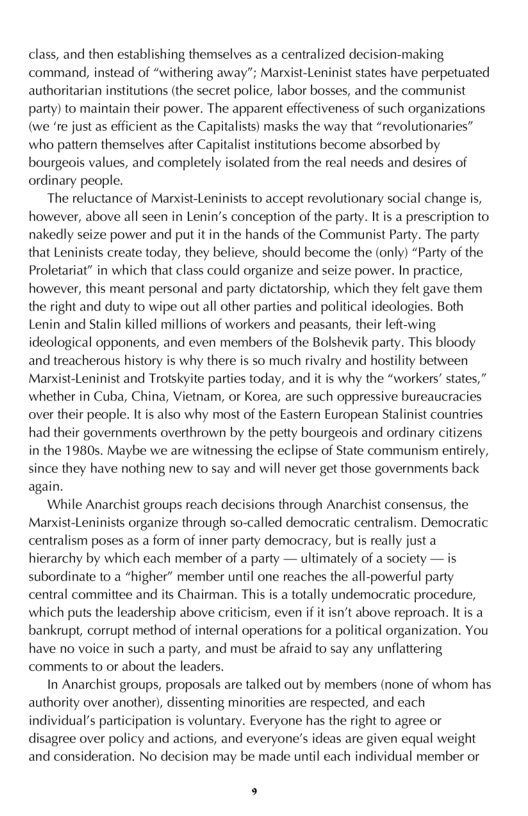
Look for example at the churches burning across the country, which have
everyone coniused, because its obviously a full-scale assault on a major
institution in the Black community, and yet except for a few Klansmen involved
P
here and there, there are none of the recognizable signs of a racist conspiracy
that we would expect. The state’s strategy in response appears to be to offer just
enough support to the southern Black clergy to be able to set the terms of
debate, then use that position to keep ahead of any radical grassroots
mabilization against the real bases of white supremacist organizing, Stil, i’s not
hard at all to imagine a radical Black or mixed movement rising to defend the
‘communities under attack, and when that happens, sooner or later it will have
10 confront the state. Are we going o be in a position to be there when it
happens? What kind of support can we offer in that kind of situation, and how.
prepared are we? This is an especially clear example because of our relationship
‘with the Anti-Racist Action (ARA) network and other similar work being done on
the issue. If and when political conflict — whatever issue it surfaces around —
again reaches the point where large numbers of people are beginning to think
seriously about armed struggle, there will definitely be an even greater need for
alot of people to take up political prisoner defense work. But that doesn't have
1o be in the form of ABC, it probably won't be using the same tactics we're
focusing on today, and we might not necessarily be the people best situated to
doit.
II: The first thing to look at is the state of the anarchist movement, which for
most of us is both our roots and our base. There have been plenty of criticisms
made of the arrogance of the movement and white chauvinism, middle-class
‘dominance and pacifist lifestylism. The strongest of these have come from Black
comrades, but similar struggles have come up [internally] as well. Much less
clear have been the criticisms of the movement’s patriarchy, though its obvious
that in most places, the scene s pretty thoroughly male-dominated. Much of the
recent anarchist women’s developments that contain at least an implicit critique
of the male-oriented movement have happened in the specifically cultural
realm, without any representation in the form of organizations or position papers
— hence its been that much easier to dismiss them. We would mark the rise of
our tendency in the generation of youth, many of them punks, who were
inspired by the commitment to direct action and the image of a multi-faceted
“dual power’ movement — both community-building and offensive militance
against the state — they saw in the European autonomen and squatter
movements and tried to reproduce those scenes here. They distinguished
themselves, first of all, from the pacifist anarchists that were active in the anti-
nuclear struggles, as well as the pacifism of the Central America solidarity
movement in which they were active. However, by the end of the ‘805, the
context in which anarchist direct action had been carried out — the mass.
actions in solidarity with Central American and South African liberation
struggles — had evaporated. Likewise, the punk scene as the dominant social
2
base for this new youth movement was changing, taking on a less antagonistic,
less rebellious ethic. Of course, both these changes have their roos in deeper
transformations that were reshaping the whole world.
A number of people who'd done a few years in this period retired when it
became clear that new ideas needed to be developed, that the old ones could
o longer succeed. But the younger comrades stuck around, having built a
network around the Love and Rage newspaper, and a general political unity
L&R was important in that period because it developed connections between
those who wanted a revolutionary anarchism that fought against racism, sexism,
and homophobia and was in solidarity with anti-imperial struggles around the
world. The split which came at the winter 1993 conference in San Diego broke
down the unity of this tendency. A number of important issues were the source
of the split, each of these influencing the forms taken up next. These issues
included charges of internal hierarchies and male-dominance, being directed at
those who wanted to remake L&R into a cadre-type group. From activity
generated around the Gulf War and the splintering of L&R, a new terrain
emerged. Two of the first ABC groups in the new period — Nightcrawlers and
New Jersey — were in L&R at this time. Nightcrawlers went with the spliters,
while N stayed and has maintained a pretty marginal position in the new L&R
Federation. Since then, other ABCs (with the exception of Minneapolis and
BCAC) have had litle interaction with L&R. Thus ABC has created its own
independent pole of activty in the diffused and disconnected anarchist
movement. A series of infoshops, another tactic taken from the European
experience, have defined much of this new period in which the current ABC
also arose. Within a few years there were infoshops/autonomous zones in
almost any city with some anarchist scene. Starting with a gathering at the
Detroit Trumbullplex in May 1994, another pole was developed around the
infoshop scene, with (Dis\connection as its medium for discussion. Similarly, an
independent pole has developed around Ani-Racist Action groups. This aspect
of the current movement — where work is carried on around individual issues,
without connection to a broader dialogue in the revolutionary anarchist
movement, needs to be changed. The solationist style we have taken in our
issue politics, including the creation of organizational structures, has led to a
lack of revolutionary sirategy and orientation in our work. Discussions have
been developing around several poles recently; we see the dialogue going on
among ABC collectives as a parallel, rather than oppositional, development to,
for example, L&R or the Network of Anarchist Collectives
1l It was out of the apparent vacuum of strategy in the early ‘905, and
motivated by contact with anarchist and other comrades who were sill
imprisoned for their involvement in the amed struggle of the ‘70s and ‘80, that
the current Anarchist Black Cross network began to take shape. We hoped to
learn some lessons from connecting our struggle with the revolutionary
movements of the recent past and the political prisoners who took part in those:
movements. We did learn a lot which we can begin to pass on to other people
i our stuation. We also found ourselves falling into a lot of neocolonial traps
through the alliances we thought we could make, and we isolated ourselves to a
degree from the people we most needed to reach by failing to keep our focus on
organizing ourselves into a revolutionary force. This paper is an attempt to draw
out the important lessons from our experience, and to provide a constructive
criticism of our mistakes: 10 lay out some additional groundwork for north
american anti-authoritarians like ourselves who are active in the anti.
movement, so that we can begin to shift our weight off the backs of the people
who are holding us now and onto a foundation of our own.
“The main impetus for most of the collectives that came together over the last
few years within the anarchist prison solidarity movement can be traced to
Lorenzo Kom'boa Ervin: his speaking tours, his book, and his Draft Proposal for
an Anarchist Black Cross Network were what immediately led us to take the
ation of political prisoners seriously as a strategic issue to focus on. The
Claustrophobia collective, as one example, came together after setting up a
speaking date for Kon'boa three years ago and discussing the Drait Proposal
with each other afterward. We saw ABC and prison work as a chance to get
involved with serious work. In this sense, it was a positive step — a conscious
break with a largely hopeless subcultural scene — though of course it had
within it several serious contradictions as well It was definitely Kom'boa's
involvement, as much as our own political understanding, that motivated us at
the time. Firs of all, he was a Black revolutionary with an intense history of
struggle and a wealth of energy and knowledge who (irom our perspective at the
time) consciously sought out our movement .. the mostly white and seriously
flawed anarchist scene we were a part of) and dealt with us with a lot more
patience than someone from his position could have been expected 1o show.
Secondly, his involvement legitimized us for a while in that we could appear
that much more serious in our political difference with other white leftsts. Both
of these facts were important to us at the time, given our general lack of political
development. This is where we should make clear that the way we chose to
struggle against our racism and classism — by turning our backs on the only.
‘communities in which we had real roots and using our relationship to Black
‘comradles to give us political legitimacy — contained plenty of obvious
contradictions that were expressed from the beginning. However, it wasn't until
we had overcome at least some of our lack of political development that we
became fully aware of more complex contradictions we were promulgating.
P
As the ABC began building various relationships in support of political prisoners
whose movements we had no clear relationship to, and as we took up activism
in the broader prison movement following the principles and programs of the
Draft Proposal, we worked ourselves into a confused and unworkable position.
For the most part, we had not developed a political analysis or strategic
orientation of our own concerning PPIPOW work o any of the specific struggles
which made up the prison movement. This was a natural outcome of coming
from the anarchist movement, which is fragmented, has a limited social base,
and has an underdeveloped political-strategic dialogue. What these facts added
up 10 was the development of a politically dependent and parasitic relationship
o the New Afrikan/Black movement, which s the core of and the driving force
behind the prison movement. This parasitism can be characterized as a buyer-
seller relationship in which we take the news, understanding, and terminology
which legitimate us from the New Afrikan prison revolutionaries we're in
contact with, and offer material and technical — rather than political — support
in return. This amounts to buying politics rather than struggling them out. It also
has to be understood as an ultimately useless and even harmful form of
internationalism. There are a number of examples from the past few years which
can help clarify this. All of those issues are pretty evident just from looking at an
issue of Claustrophobia. The frst thing you notice is that it has adopted much of
the language of the New Aitikan struggle. Our readership among prisoners was
almost completely New Afrikan/Black radicals. A not insignificant number of
people wrote 1o us assuming that we were Black ourselves and actively working
in Black communities outside prison. Of course there was nothing in
Claustrophobia to contradict such a conclusion. While in some ways the journal
is moving in a lot of positive directions, there stillis no unified analysis of the
role prisons play in the state’sstrategies for control, repression, and genocide,
barely even any mention of the relationship of the state to gender struggles now,
and not even a word — although we have been starting o think about this —
about what role a young, inexperienced movement without clear politics can
play in opposing the genocide going on around us.
Histories and Snapshots
Free Mumia! Coalition
The campaign to free Mumia has been a major part of anarchist prison work
since at least early 1995. In DC, Claustrophobia did more towards Mumia’s
defense than we did for any other project we have been involved with. Because
it has been similarly central to many other collectives, and because it is a major
7
part (probably the most visible part) of the current prison movement, we will
share our perspective on our experience in this struggle. Early in 1995, a group
of activists who had been involved in Mumia’s defense campaign started to get
together to plan for what was then clearly an impending death warrant. This all-
white group of activists came from a variety of left groups in DC. The group
solidified as the DC Coalition to Free Mumia Abu-Jamal shortly before the death
warrant was signed on June 2. Though the membership of the group shifted
around a ltle bit, its basic character remained the same. It had its base in the
maostly white and well confined leftst groups in the city. This was the case:
despite the committed and constant participation of the several Black/New
Afrikan members of the coalition. Due o the looming execution date, the basic
tactic at this time was frequent broadly directed public actions such as marches,
street flyering and postering, car caravans and public forums. These actions
were done as broadcast calls for solidarity, directed more or less at anyone we.
thought might listen. We spoke from an undefined place, or rather from no
place at all; we did not speak as middle class white liberals, nor as communist
cadre, nor as a working class community group, nor as New Afikan or Black
nationalists, nor as anti-racist white feminists nor as a coalition of any of these
Voices; and thus it was hard for anyone to know how to hear us. Most of our
actions were directed at the working class Black neighborhoods where we lived
o close by. In a pretty anonymous and ghostly way we traversed the streets
posting flyers for our next demonstration. We wanted masses of people out to
terrify the state. Some of us wanted to propagate the principle that if Mumia
dies, there will be fie in the skies!, secing this as perhaps the only real power
that could intercede. So we put this out as well.
‘The reality of it was, however, that only the network of people connected to
various small left groups came out, and our marches passed through the streets
inthe middle of the day with an equally phantasmic presence, never really
touching the ground, or at least not the same ground that everyone else was
walking on. The most obscene example of the coalition’s impossible presence
was our “car caravan” which consisted of driving a bunch of cars decked out
with signs and a van with a loudspeaker through a dozen neighborhoods on a
Saturday morning. As the caravan passed slowly down the street or stopped at a
busy spot, someone on the mic would put out the word on Mumia, usually by
way of slogans, and other people would walk nearby passing out flyers.
Whether or not this could be done without giving the impression that we were a
strange cult about 10 take over the city is not our issue here. I any case we
proved we were not the ones to do it when we drove down the street in a Latino
neighborhood invoking the name of a man whose shooting by the police had
brought rios a few years before. People definitely took notice as a group of
‘mostly white non-Latinos blared across a loudspeaker “in the name of Daniel
Gomez, Free Mumia Abu-Jamal!” What did we know about the situation, and
why was it o easy for us to opportunistically invoke someone else’s struggle?
The same tactic, different names was used in other neighborhoods recalling well
known Black victims of police brutality. Of course it is important and totally
necessary to make links to local situations, but then how come it idn't work?
Cause no one bought it from us. And no one bought it rom us because we were
phantoms who had no real relation to those we spoke to, and were not clear
about who we were.
“This was not primarily a question of the “racial” make-up of the coalition,
but how we organized. During this period leading up to the execution date and
stay, we were aware of some of the problems with our strategy, and afterwards
we atiempted 10 address them. Starting that fall, we attempted to orient to
various segments of the population that were already constituted in some type of
organization: unions, churches, schools, etc. and to connect with people who
would carry out work within their different communities or scenes. This idea
made better sense, but was coupled with previous “rouse the masses” strategies,
and did not arise out of much of a strategic dialogue. As a result, it never got
implemented. More recently, a New Afrikan member of the coalition made the
suggestion that white folks in the coalition would do better to figure out how we
could get whites to support Mumia's freedom, while Blacks/New Afrikans
worked in their own community. This principle was never discussed among the
whole coalition because of the group’s chronic inability o struggle over politics
and srategy. However, it was de facto put into practice in ambiguous form
through an alliance with the Malcolm X Grassroots Movement. In the ‘White
Quarter;” this strategy might have led to the development of a base among
groups of whites around politics associated with Muria's struggle. The
particulars of this would need o be worked out in the process. On the other
hand, the strategy could also lead white members of the coalition back into the
familiar teritory of middle class left activism that is the white left’s substitute for
struggle. What choice white members of the coalition made is unknown o us,
since we moved out of town in the middle of these changes and have not been
in close contact since. At the time that this change was going on,
Claustrophobia was becoming somewhat more aware of the former possibility at
the same time that we were totally frustrated with the group and uncertain about
how to participate in it
Friends of the Marshall Eddie Conway Support Committee
During the winter of ‘96, a campaign was built in support of wrongly
»
convicted Baltimore Black Panther veteran Marshall Eddie Conway, which we
involved ourselves in on an individual level (by that point splits in the Baltimore:
ABC collective were already solidly maniesting themselves and work as a
collective was basically impossible). The campaign was basically built around a
core support committee consisting of fellow BPP veterans and other radicals in
the local Black community, with a broader coalition which, despite some honest
efforts to get beyond sectarianism, never managed o escape the “white left
ghetto” which swallowed it almost immediately, and within a few months, the
coalition fell apart as weightlessly and quietly as it was built up. This experience
should force us 10 take a deeper look at the role we expected to play in this type
of coalition and ask what went wrong...The timing of the campaign was based
on a chance to gain a commutation of sentence from the governor, and the
fertile ground shown by the “Free Mumia” campaign for organizing college and
high-school students — of all colors and nationalities — behind support for a
radical political prisoner, and especially one afiliated with the BPP. At some
point it became obvious that our generation was starting to identify with the
Panthers to the degree that thousands of people could be mobilized real asily
for a demonstration, and a number of Black radicals here decided to try and
mobilize that sentiment into sympathy with Eddie Conway's case, with the goal
of maintaining some sireet-level awareness and outreach to accompany a
proposal to the governor's office for parole or commutation of Eddie’s sentence.
For our part, we welcomed the campaign as a chance to bring some of the
issues raised by support work for Mumia down 1o a local level and teach our
‘generation of radicals that the resistance of the 60/70s was something
happening everywhere, here, and not something which can be abstracted to one
hero. Also, we had watched all efforts to build a support coalition for Mumia in
Baltimore fall apart due to the sectarianism and incompetence of all the
essentially white left groups involved (ourselves not excepted), and we hoped
that a support campaign which was Black-led and directly and locally in touch
with the prisoner it focused on could avoid all these problems.
Starting out into this campaign, we came from a position that our focus
should always be on using this case to deal with the role of prisons in society.
today, and to raise the issues that building a movement entails: security, defense
of comrades, strategy for dealing with state repression, etc. This might not have
ever been consciously stated, but it was pretty much implicit i the directions
we were starting to move. We knew that the Panthers were long dead as a
political force, however much inspiration their example may sill provide. There
was no revolutionary organization for Eddie to join and build if he was released),
and we didn't see supporting him as necessarily being supporting the Black
revolutionary movement. What we were hoping to do was to get a bunch of
Younger activists to sart talking with each other about the analysis of prisons as
a central part of the state’s strategy for repression and genocide in the 90s, and
1o start looking seriously at the lessons of the 605/70s movements and what they
mean for us if we're serious about building a comparable movement in our
generation. Of course, we felt a moral obligation to support Eddie and all the
other political prisoners who have basically been left to rot in prison as the
movement died, but we never wanted that to be our primary attitude in
organizing. You can't get very far trying to organize if you're always looking.
backward.
The politics of the coalition were somewhat vague as far as the alliances it
‘made. Due primarily to Eddie’s input, there was a strong link to a prisoners’
initiative against recent legislation denying parole for lifers. At the same time,
since the overall strategy was always a petition to the governor, the coalition
always shrank from the prospect of taking too militant a stand on issues which
‘might have won it broader grassroots support. Demonstrations were arranged
with the police and the coalition never took any kind of anti-cop stand. The
group always stayed comfortably within the liberalleft scene and never reached
out to more militant Black groups. This position seemed to be a source of
conflict within the core support committee, although the positions were never
clarified to the coalition. A similar criticism was made at one point that Eddie
had played only minor roles in the most important and militant prison struggles
since his incarceration, and that holding him up as a political prisoner and a
symbol of the prison movement was in effect taking an unprincipled stand in
relation to the people who had fought and suffered for those struggles, especially
the group of Sunni Muslims who had been the core of a number of struggles
over the years. For most of us in the coalition, there was really no way to work
out all the facts behind criticisms like this, so what should have been important
was to keep clear politics at the forefront of who we were and what our
relationship to Eddie’s freedom campaign should be. Unfortunately, no one in
the coalition had taken the time to work those issues out from the start, since all
the groups involved were essentially operating from a dishonest viewpoint:
thinking that we could simply follow the support committee’s line and be
absolved of the responsibility of figuring shit out for ourselves. What we should
have done in this coalition was to put all of our energy into building solid
relationships based on politics with the other people from our generation in the
coalition. Since that was never done, there was never anything we could do
productively in the group and we ended up essentially as observers the whole
time. And now out of 3040 people who were attending meetings at first,
basically nothing remains as far as regular activity.
The Split in the ABC Federation
When groups were frst discussing the idea of getting together in the
federation to coordinate political prisoner support work better,there were all
along two conceptions of what this would mean. On one hand, there was the
strtegy of building a new movement around the PP/ POWS of the last wave,
expressed by the program of making financial support to PPPOWs central and
using the education of ther histories as outreach to lay the groundwork for
building a new movement. And on our side, we saw ourselves as part of a new.
emerging movement that was going ( have to define itself on its own terms,
independent of both the 70s/80s left and the orthodox anarchist tradiition alike.
S0 we saw our primary responsibliy as being toward that movement, to
partcipate i it and help it shape itself. Our work with political prisoners was
Seen in the context of (1) making links between “outside” and “inside”
revolutionary movements, (2) using the experiences of longtime revolutionaries
10 help us critique our current work, and (3) finally, fulfilling a moral duty that
very movement has towards its PPPOWs. This issill essentially how we define
our politics, and we're sill searching for solutions to put that into practice. The
wation after the federation splt, with two or more separate networks doing
similar and interconnected! work with little cooperation and less poliical
dialogue, doesn't bode well. We need to work out the political basis for unity we
have, then act on that..
Strategic Suggestions
“Revolution is about finding a way, or making one”
Gregory Hunt
Towards Political Solidarity
One of the issues raised in the last section that we need to clarify is what we
mean by political support rather than support which is just technical and
material. At the end, we raised some questions that are important for us to
investigate. As well there are many others: we haven't seen much analysis of
“crime” in white communitics; of different setler class relations to law and order
hystera; of the mechanism by which law and order politics get spread. These
and many other questions are important for us if we are to comba the genocide
and neoliberalism of prisons. Helping to decpen the analysis of the prison
movement as well as other revolutionary struggles, and contributing to an
understanding of how to win is what we mean by politcal support. Developing
politics with strategy and tactics that arise from our own analysis of the situation
P
and an understanding of our place in that situation, s both more difficult and
more useful than the reproduction and propagation of politics, no matter how
advanced, which are not our own. Of course, the theory of the New
Afrikan/Black movement which we borrow comes out of the struggles of New
Aftikan/Black revolutionaries to understand the reality they are moving in. We
need o do this for ourselves. We also need to move our analysis into srategic
ideas of intervention from which an even more profound struggle can occur.
From here, we go into some ideas for a sirategic reorientation. There are a
number of questions for research which could point us in this direction. One
obvious ane is a more thorough analysis of patriarchy and how the struggle
against it can be effectively tied into our work. Within the context of the new
patriarchal attacks on women, such as cuts in welfare, what is the meaning of
the rapid rise in imprisonment of women? How does it fit in to everything else?
What part does it play in genocide against Blacks/New Africans? What s the
demographics i terms of nation? Where are “white” women in relation to this?
How does a male-focused prison movement deal with this? And as always, more
work in “cultural” circles would help us out a lot. It always seems like people’s
problems and frustrations get expressed through their lifestyles, their music, &
everyday rebellion long before the so-called “left” picks up on them, and much
‘more honestly than the left deals with them.
Neoliberalism/Neocolonialism: Understanding the World We
Struggle
In order to develop politics relating to prison we need to have a better
understanding of the whole deal. We need to be watching the whole world.
That needs to be the basis for how we take action. We are not going to ry to
begin that analysis here but we want that to become a bigger part of how we
understand what we are doing We are interested in the politics that the EZLN
has been advancing and the possibility of an intemational coming up around
them. The idea of a new international (“against neoliberalism and for humanity’)
was first put out this summer at the intercontinental encounter held in Chiapas.
The idea excites us as well because it breaks from the model of solidarity groups
that have been generated world wide in support of the Zapatistas, or at least it
could and we hope it does. The Zapatistas have started from an analysis that is
in part new but more importantly they are part of a world liberation struggle that
has acknowledged the new terrain (known as neoliberalism or neo-colonialism)
and is attempting to find a way out. We are not trying to argue that the EZLN
have made the most advanced analysis or the strongest blow against ths revised
capitalist system which rules the world, and so everyone needs to fall in behind
P
their lead. In fact, there are a number of questions and criticisms that we have.
So we are not so much interested in a Zapatista international so much as an
international in which new and anti-authoritarian forms of struggle can be
carried out (including that of the Zapatistas), that these struggles be linked and
that they be self-conscious of the new possibilities they embody. What we need
in order to participate in this “network without hierarchies” which is still only an
idea, is a much clearer idea of our own politics and perspective/analysis. Of
course there is also a question of how we would participate: representing prison
struggles or as a political tendency or whatever we might come to be by next
fall. That is all up in the air.
Anti-Racist Action
Having taken a trip this fall out to the midwest (Chicago, Milwaukee, and
Minneapolis), we got to check out the Anti-Racist Action movement which is
‘growing prety fast, especially compared to anything else with anti-authoritarian
politics. Mostly we hung out with the ARA crew in Minneapolis, which is the
basis for our perspective. We want 10 propose ARA's methods of struggle s a
model in many ways for our own activiies. So first let us describe briefly what
interests us about ARA. It s interesting, first o all, that ARA which started in
Toronto and Minneapolis grew out of a radical or leftist type skinhead scene. In
the first years of ARA, all members were anti-racist skinheads (and not “pro-
american” either) whose practice consisted of beating up nazi skins in those
cities. It was a totally principled and sensible response to anti-racist ideas to
fight those racists who were in your own scene, who were atiempting to take
over your own identity for nazi organizing. For this reason we disagree with
Komboa's characterization and dismissal of the ARA groups as “vanguards
fighting vanguards”. ARA has placed itself within the currents of white youth
culture in an efort to fight nazi organizers who are trying to organize in the
same place. At the same time, ARA groups in many places have taken on
struggles against institutional racism by taking action against police. The original
skinhead ARA groups have since fallen apart with only a few of the original
people still involved. Sexism and macho-man style broke up the group as well
as alienating others from it. Now ARA has litle connection to skinhead culture,
but it continues to build anti-racist (and revolutionary anti-sexist, anti-
authoritarian) politics within a number of mostly white youth scenes.
While we were in Mpls a lot of work was being done in the metal scene,
largely in response to a shift by nazi boneheads towards that scene. Within a
pretty short period of time a lot of contact had been made within the metal
scene where a number of bands formed a bloc identifying themselves as anti-
5
facist and were planning to start a label for anti-racist bands. At the same time.
other bands were moving more clearly into the nazi camp (orchestrated by the
St Paul bonehead band Bound for Glory). The polarization of a pretty apolitical
scene around politics of anti-racism i a eally positive development. It causes a
fracture of white solidarity, and promotes a unity based on radical politics. In a
less developed part of their work, ARA has begun to organize white kids against
the police. This has almost completely taken the form of copwatch actions,
which are street patrols in a neighborhood where cop actions are scrutinized by
a big group of people. The aim i o get cops o let people go by making
everything they do a big hassle for them and more importantly to develop an
attitude, among white youth and within whatever neighborhood ARA patrols in,
that s critical and hostile to the police. What interests us in all of this s the
possibility that is latent in ARA work of developing an (antijwhite youth culture
that is anti-racist and against the police, and that these politics are given active
and practical expression through the culture that they create. We haven't
mentioned the anti-pariarchal work that ARA has begun to do (a queer kiss-in
outside the house of two gay-bashers). This work has been even less developed
than the anti-cop activity though it is growing fast and, due to women's strong
presence in the Mpls ARA, it serious part of the ARA scene there. All of these:
ransformations, i built into a way of lfe (a culture), constitute a base for
revolutionary struggle which hasn't existed among too many white kids for
several decades.
1f ABC s to concern iself with the issue of prison as an increasingly powerful
tool of social control in the context of global capitalist restructuring, then we
must find a strategy and tactics which can meaningully intervene. As we see it
the most profound development we could affect would be to find a path that
could take masses of (antijwhite youth into rebellion against law and prisons.
Andif this does become our strategy then much of our work would cross paths
with that of at least the more radical and anarchist ARA groups. It would
definitely be more difficult to apply with the same success ARA methods to ABC
work. For example, the proximity of racists in skinhead and metal scenes is not
paralleled by any white youth connection to prisons. There s nothing like the
everyday threat of getting stomped by nazis cause you are anti-racist or
anarchist. Prison is even more distant (and abstract) than the police as something
1o fight against. There are white kids in prison, of course, and maybe that's a
place to start, but it seems so much more distant culturally. The reality of prisons
are not so easily injected into the everyday terrain of white youth (that s, short
of mass imprisonment of white youth). What we need to do is figure out at least
the beginning of an “anti-prison practice” that people could take up.
Race Treason and White Prisoners
Speaking of nazis, we all know that one of the places they do their most
serious organizing is in the prisons. The recent string of killings at Lewisburg
federal pen got sarted by some boncheads murdering an anti-racist white:
prisoner who got involved with a group of Sunni Muslims. This s a case where
all of our beliefs about “race treason” get seriously put to the test This is a man
who was killed by white supremacists for just that — daring to break with the lie
of “whiteness”. One major responsibilty we have as “free world” whites is to
make contacts with people ke that and figure out how we can support and
defend them. We can't afford any more dead anti-racists..
I an artcle called “Back from Hell: Black Power and Treason to Whiteness
Inside Prison Walls” (printed in Race Traitor #3), Lorenzo Kom'boa Ervin
described the prisoners’ struggle at Terre Haute federal penitentiary in 1970 in
which “even whites who had been following the Klan line for many years rose
up with the blacks against the prison officials”. He described a situation where a
number of radical white prisoners were able to orient a large number of whites
o identifying with, and allying themselves with, the work that the revolutionary
Black prisoners were doing at the fime. *... it created a new sense of unity
among the prisoners as a class. The white prisoners began to check out books
from the Black Culture library, to attend joint political study groups, and to try to
understand in theoretical terms how racism was a way of enslaving us all —
blacks and other non-whites as inferiors, whites as oppressors. Fascist politics
became not only unpopular, but unsaie.” (We recommend that everyone should
find and read this article for the inspiration and history it provides.)
The unity Kom'boa talks about is a model for a irst step towards building a
revolutionary prison movement. But of course this isn't 1970. The revolutionary
Black movement has been decimated by state repression and reforms, and is just
now seriously consolidating and rebuilding itself; and from our experience,
radical white prisoners scem alone and isolated most places.
Obviously as outside activists, we can't do much real organizing in prisons,
butit’s important to identify whats going on, and where and who we should be.
focusing on supporting. Our ree literature project is a good program; it helps
basically anyone trying o organize inside the walls. But figuring out a way to
specifically work to encourage/support/defend race treason inside prisons is on
us
Statement Concerning the Newly Formed
Anarchist Black Cross Network
Written for the 2002 Anarchist Black Cross Network Conference in Texas
Lorenzo Kom'boa Ervin
2002
Comrades, Brothers & sisters (and Everyone):
Recently, the Anarchist Black Cross Network held its founding conference in
Austin, Texas (July 27-29, 2002.) 1 was in attendance, was a keynote speaker,
and spoke to many of the 150 or so delegates at workshops, and diferent stages.
of the conference, when it recessed.
Sothat there is no misunderstanding by anyone, | want to clarify my status in
relation to the ABCN. | canno function as a member of the group at this time,
but | do want to service as an organization Mentor, because that s the best way
1 can help the group. It is also important that | maintain my neutralty around the.
internal politics of ABC movements generally, and cannot do that as a formal
ABCN member. | do not want to see sectarianism become any worse in our
movement, or serve as a distraction by folks wanting me to join this or that ABC
tendency. The situation in Spain a few years ago let me know just how serious a
problem this can become.
Coming in, | made it clear that | was only interested in the creation of a
broader based Anarchist Black Cross as a viable movement in the United States,
and saw the ABCN as a large part of that. | pointed out that | still supported the.
entire international ABC movement, even tendencies like the ABC Federation,
that the leadership of this ABCN group might be opposed to. In fact, | would like
o see a United Prison Front of both ABCN, ABCF, Critical Resistance, and all of
the contemporary groups supporting prisoners and fighting racism, as well as
Black/POC, women, Queer and other liberation groups, but of course that has to
be your decision.
My sentiments have not changed, so only part of the reasons for his letter s
to clarify my status. | support the ABC movement now the same as | always.
have, from back in the day when | was a prisoner myself serving life
imprisonment during the 1970s-1980s; but | am interested in ABCN only so far
that it carres out its mission in dealing with racism, the mass imprisonment of
the poor and peoples of color, as well as supporting prisoners inside generally,
with material aic and political suppor. 1 believe that s the way to advance
Anarchist politics and the prison siruggle i this period. This is not the 1970
when there was sill revolutionary movement n this country on the ouside,
and a mass prison support movement already existed in the prisons and in the
steets.
In fact, | remember the original Black Panther Party not only had a Prisoner
Commissary Program, but also had buses for transportation in many states to
transport family members to the prisons, ree legal aid for prisoners, and a prison
survival program for those released on parole. So, the ABC-F's War-chest or the
proposed Revolutonary Prisoners’ Fund are nothing new, but the Panthers
understood that the material aid campaign had to be just a part of a political
‘campaign against he prisons and the capitalis sate. When George Jackson
became Panther Field Marshall, he understood tha there had o be a United
Front for political Prisoners, and the prison siruggle had to be part of a broad
front for social change allied with the then unfolding revolutionary strugle of
women, Blacks, Xicanos and other groups oppressed by this capitalist society.
So material and campaigns themselves are nothing new, and cannot be the
reason of the existence of an ABC movement. It must connect with the masses of
people.
During the conference, | openly expressed my point of view that since the
majority of prisoners in the U.S. prison system are now Black, Brown, Asian or
Native American, then this new movement must eflect that fact in both ts
membership and mission, i it i to have any credibiliy as something more than
yet another white Leit tendency running away from these issues. The idea of a
movement made up of white radicals on the outside just charitably helping
peoples of color on the inside has always been a source of controversy. The
question for me is whether real atiempts will be made by this newly formed
ABCN 1o connect with the families and communities of these prisoners of color,
as well as poor working class communities generally, and make them a part of
the ABC campaign. That will tell me how serious this group is
For me, | realized that this would require drastic and serious commitment by
any ABC movement at the outset o ensure that the organization adops a new.
focus. | was disturbed that during the deliberative stage of the conference,
nobody even saw the necessity of raising the issuc, that is nobody but myself. |
expected someone to talk about a People of Color committee to recruit and
organize. But no mater, it has been raised, now it must be implemented!
But 1o be effective: the newly formed People of Color Organizing Committee
(2) needs to know where it is going, before it can then give guidance to the
entire organization. Therefore, | want to make these points:
1. The POC body must be on par with every other deliberative body, and
POC must be given a strong voice in all ABCN policies, and not be a
mere token effort. The ABCN leadership must be challenged by this
1
POC body to live up to its mission and to make the movement inclusive
102all. As for the POC committee itself, it should have a majority of
members who actually are POC, but there is no requirement of an
absolute majority.
‘The communities of color for the ABCN leadership and membership
could be a major base of support. The POC body of ABCN should be a
pole of atraction to not only bring peoples of color into the
organization, but to insure that they have an equal voice in all matters of
substance in the organization. This body should be consulted and made
part of any leadership. This recruitment has to be absolutely supported
by the entire groups, and not be minimized in importance.
Working with the leadership and mass membership of ABCN, which
can develop out of the work o the conference, can connect them with a
number of oppressed communities in Texas and other states. Clearly the
ABCN must not just repeat the work of the ABCF, and its mistakes in
ignoring these matters, even if it is critical of other ABCF policies. It
must deal with racism and the right-wing offensive of this period itsef.
“The trans of political imprisonment of mass of people, based on race,
class, and genocidal terror should be the basis of a new mass
movement, not just traditional Anarchist politis.
The POC committee is the one body that has to raise the issues of
shaping the ABCN organization as an anti-racist movement to challenge
the government over its drug war and its mass imprisonment of youth of
color. Again, this cannot be minimized or emphasized enough. Frankly,
1 have always believed that it is a minimal program just to provide for
the material needs of prisoners alone, while huge numbers of people are
forced into prison and the death chambers. We must deal with the
political reasons they are i prison in the first place, and oppose a racist
death penalty. Mumia Abu Jamal is just a symbol of the racist death
penalty. We must call for an immediate national moratorium on the
death penalty. Shaka Sankofa’s recent legal murder in Texas should tell
us that we must organize in the streets o build a mass movement of
poor and working class peoples, or Mumia is ultimately doomed. A
movement of white radicals alone is neither desirable nor sustainable.
Two million people are in the U.S. prison system today, with a huge
number coming from communities of color (50% or more.) The state of
»
Texas incarcerates Blacks at a rate 7 times that of whites and has
Chicanos/Mexicanos jailed as high as 20% of the state prison
population. Similarly, 40% of the entire Black male and youth
population in California is in prison; also 55% of the prison population
of Pennsylvania is Black, though only constituting 10% of that state’s
population. Similar statistics are to be found all over the country
showing that racial minoriies are incarcerated at a rate of 10-15 times
that of whites This i clearly a new racism and a result o fascist social
control, but we don't have any evidence that the Anarchist Black Cross
‘movement understands this or is responding in any way to such a
reality. It continues to see itself as a support group which has a limited
role of sending $20 a month, even though millions are now being
incarcerated at an unprecedented rate. We cannot send aid to such a
huge number, s0 we must tackle the oot causes.
To have any relevance at al, the POC committee must be sure that
ABCN leadership raises issues of fighting police brutality, police racial
profiling, racist vigilantism, poverty, and other evils, and that they fight
this in a revolutionary movement, not as a reformist group afraid to
challenge the state on such maters.
I think that each on of the ABC chapters should have someone who
handles the work of outreach to communities of color, and helps design
policies for that chapter. Ifthere is no one working on the local level,
then this critical work simply will not be done.
The ABCN must fight for prison abolition as a goal, even while t fights
for a moratorium on further prison construction and for redistribution of
the money stolen from the school systems, hospitals, and other social
sectors which have been de-funded to pay for prisons. We must oppose
this mass incarceration and theit of money for social spending into
prison construction.
1 think that the ABCN must be willing to become part of mass coalitions
around these issues, even while building its own politics and movement.
For years, anarchists and their movements have been too white, middle
class and self-absorbed, only willing to give lip service about racial
justice, class-based unity, and a truly liberatory movement inclusive of
all and their demands. Anarchism has been a white rights movement,
and this must change. 1 believe that what we want the ABCN and the
©
entie Anarchist movement to be s a grassroots, multiracial movement
for justice. So, for the ABCN, this is both an opportunity as well as a
challenge.
Inmy opinion, it is a good thing that the ABCN has had its founding
conference, but that it must now be serious and committed enough to break
new ground for the ABC movement. We must popularize Anarchist politics and
organizing on a mass scale, so that poor and working class people can relate to
it, not just middle class, college trained whites
I have made constructive criticisms here, but offered them in good faith. In
skeleton form, there is also a plan which others can build on. | am not sure if the
ABCN leadership or the membership wants me to continue to work with this
POC body, if | am not a full member or in response to my critical support. 1 offer
my services nonetheless. you will have to decide what you want to do. | am not
personally seeking to lead this movement. | am available for help, but | want to
see things done right, and it is not a “given” that they will be. | wish you great
success from hereon out, but you must make it real!
Sincerely,
Lorenzo Komboa Ervin
Further Readings
Abdallah, Stephanie Latte. A History of Confinement in Palestine: The Prison Web, .
Melissa Thackway. (London: Palgrave Macmillan, 2022)
Berger, Dan and Toussaint Losier. Rethinking the American Prison Movement. (London:
Routledge, 2017)
Burton, Orisanmi. Tip of the Spear: Black Radicalism, Prison Repression, and the Long
Atica Revot. (Oakland: University o Calfornia Press, 2023)
Ervin, Lorenzo Komfboa. Anarchism and the Black Revolution. (London: Pluto Press,
2021)
— “The Progressive Plantation: Racism Inside White Radical Social Change Groups.”
Libcom.org. July 18, 2016 htps:/libcom.orgarticle/progressive-plantation-racism-
inside-white-radical-social-change-groups
‘Goonan, Casey. To Weave Together the Many and Increasing Strands: Forms of
Abolitionism in the Movement Against the Prison Industrial Complex. Ph.D.
Dissertation (2022)
Hackett, Colleen and Ben Turk. “Dare to Struggle, Dare to Win: U.S. Prisoners
Collectively Resisting Against Systems of Death’ in Routledge International Handbook
of Penal Aboliton, ed. Michael | Coyle and David Scott. (London: Routledge, 2021)
Hackett, Colleen. “Justice Through Deflance: Political Prisoner Support Work and
Infrastructures of Resistance.” Contermporary Justice Review: Issues in Criminal, Social
and Restorative fustice, Vol. 18 Qanuary 2015): 66-75.
INCITE! Women of Color Against Violence, The Revolution Will Not B Funded:
Beyond the Non- Proiit Industrial Complex. (Durham: Duke University Press, 2017)
James, Joy. In Pursuit of Revolutionary Love: Precarity, Power, Communites. (London:
Divided Publishing, 2023)
Meyer, Mt Let Freedom Ring: A Collection of Documents from the Movements to
Free U.S. oliical Prisoners. (Binghamion; PM Press, 2008),
Rodriguez, Dylan. Forced Passages: Imprisoned Radical Intellectuals and the ULS.
Prison Regime. (Minneapolis: University of Minnesota Press, 2006)
Yelensky, Boris. Shadows In the Struggle for Equality: The History of the Anarchist Red
Cross, ed. Matthew Hart. (Binghamton: PM Press, 2025).
“