Legacy of an Uprising
Web PDF • Imposed PDF• Raw TXT (OCR)


![F:bfvar», Is+, 1985: A white supremacist gang of prison guards (The Sons of Light) at the Indiana Reformatory (now Pendleton Correctional Facility) sparked a prisoner rebellion with their brutal beating of defenseless inmate Lincoln Love aka Comrade Lokmar Abdul-Wadood. According to a lawsuit filed at the time, the white supremacist prison guards, armed with illegal billy clubs and tear gas, “maliciously held him [Lincoln Love] down and unmercifully stomped and kicked the inmate all over his body and hit the inmate upon and about his upper body and head with nightsticks.” In a successful attempt to save his life, a politicized group of prisoners — led by John C Cole, aka Balagoon and Christopher “Naeem” Trotter — demanded to be allowed inside the captain’s office where Lokmar was being beaten unconscious and in chains, after having been terrorized by a cell extraction squad (prison SWAT) on the Maximum Restraint Unit. Upon being attacked by the white supremacist guards for their request to see Lokmar, the prisoners were forced to seek refuge as now’ the white supremacist guards were following explicit orders to kill them. As a result, they took several hostages including guards and a politician and occupied a cell block in the Indiana State Prison for 15 hours. Despite how the story has been spun by the Indiana Department of Corrections and their complimentary bourgeois media, this was a demand for humane conditions and respect. Inmates demanded “an end to censorship of letters and media, the ability to be politically active without reprisal, the establishment of a](legacy-of-an-uprising 3.png)


![Had it ot been for the heroic actions of the uprising leaders, especially John “Balagoon” Cole and Christopher “Nacem” Trotter, Lokmar would have beaten to death by the guards, and others on the Maximum Restraint Unit would likely have been brutalized, if not killed, as well. In court proceedings and investigations following the uprising, it was revealed that the cell extraction team that attacked Lokmar had explicit orders to kill him. After confronting guards and attempting to get through to the Captain’s office in order to rescue Lokmar, Balagoon & Naeem were forced to take other guards hostage and take refuge inacellhouse in order to survive, asall the guards at the prison were now coming after them to kill them. They ended up leading the take-over of ] cellhouse, which lasted for 16 hours and ended in negotiations ater the State Police, DOC administrators, National Guard, and local & Indianapolis media had gotten involved and come to the prison. During the take-over prisoners stood together in solidarity, due to the fact that they had already been organizing in collective self-defense against the guards brutality, through an organization they called the Black Dragons, which the guards mischaracterized as criminal gang. The prisoners issued a list of demands during the cellhouse takeover pertaining to the guards’ systematic racism, overcrowding, and lack of recreation. The DOC commissioner was fired as a result of the uprising, and some of the guards involved in the beating of Lokmar were sentenced to federal prison. John “Balagoon” Cole and Christopher “Naeem” Trotter remain in prison to this day, having been sentenced to 88 years and 142 years, respectively, for their leadership of the rebellion. They have served 33 and 20 years in solitary confinement, also respectively, in retaliation and as extra punishment for their leadership of prisoner resistance. At the time of the uprising, they both had less than two years remaining to serve in prison.](legacy-of-an-uprising 9.png)






![ComPassionn+¢ Release in Indiana By Natalie Medley, currently incarcerated at Indiana Womens Prison Compassionate release is the reduction of a sentence for circumstances needing humane intervention in incarcerated individuals’ experiences; whereby the morality of continual imprisonment changes. Imminent death, significant illness, or old age are circumstances that may alter the public interest in the continual imprisonment of impacted individuals. Federally, the passage of The First Step Act expanded incentives to reward compliance in the Federal Bureau of Prisons (FBOP)’s use of compassionate release for those in its jurisdictions. Procedurally, the FBOP makes recommendation to the sentencing court when a request is approved [1]. However, the compassionate release amendment in the First Step Act allows clients to bring their own motions to a federal judge after exhaustion of FBOP procedures [2]. Indiana would benefit from committed compliance and review of its compassionate release procedures as well as removing the process from the political domain and making it a legal one 8}](legacy-of-an-uprising 25.png)
![Contrasting Federal law, Indiana law does not detail criteria for compassionate release. Instead, Indiana law qualifies the Indiana Parole Board as a division of the Indiana Department of Correction (IDOC) [4]. Concerning compassionate release applications, the Parole Board acts as an intermediary between those seeking relief and the Governor [5]. It is the IDOC that outlines criteria and the petitioning process for compassionate release applications. IDOC Administrative Policy, “Adult Offender Releases”, describes procedures to request appearances with the Parole Board, either clemency or medical clemency requests [6]. Each option has differing qualifying criteria with the final decision resting with the Governor [7]. Prior to 1979, or the “Old Code”, Indiana bestowed final authority in early release decisions with the Parole Board and not the Governor [8]. This made determinations for such releases apolitical, providing the appearance of an impartial and unbiased decision maker. Since the change issuing final authority for such decisions to the Governor, no single woman has been granted clemency, and minimal women have been granted medical clemency, only for imminent death cases [9). The political ramifications for the Governor are equivalent to political death, making decision-making much too risky for impartiality. The process must be placed in a legal sphere if itis to have fair and honest application in the justice system. Two options are available in Indiana for compassionate release requests: clemency or medical clemency [10). Medical clemency is extremely burdensome and requires many approvals for the continuation of the request. According to policy, it is permitted in cases of terminal illness or if an incarcerated individual would be better served at another institution [11]. To gain relief, the facility’s Health Services Administrator (HSA) meets with the case management, health services staff, and the incarcerated person if possible. The HSA initiates the application and forwards it to Classification](legacy-of-an-uprising 26.png)
![who forwards it to the Medical Director. Next, it returns to the HSA who sends it to the Warden for approval or denial. After that, the request goes to Central Office’s Chief-of-Staff, Chief Medical Officer, Executive Director of Re-Entry, Legal Services, Deputy Commissioners, and the Commissioner, whose denial may result in the Parole Board declining consideration of the petition. It is the Parole Board that must make the recommendation to the Governor for final approval [12]. Without a terminal condition or in need of institutional care, clemency is the only other option for those requesting compassionate release. It requires mandatory completion of 1/3ofatotalimposed sentence, but the sentence must be longer than 10 years. Additional considerations must also be met. The incarcerated person initiates clemency by contacting staff and submitting a form. The Warden provides a recommendation to the Parole Board who investigates, contacts all parties, and holds both a public and private hearing. The Parole Board ‘makes its recommendation to the Governor for approval [13]. The federal criminal system’s compassionate release procedures are found in federal code [14]. They delineate medical and non-medical circumstances for compassionate release considerations [15]. Medical considerations include terminal medical conditions, debilitating medical conditions, elderly persons with medical conditions, and elderly inmates over 65 years of age, having served the greater of 10 years or 75% of their sentence [16]. Non-medical circumstances include incapacitation of a spouse or registered partner. The Families Against Mandatory Minimums (FAMM) coalition ran a compassionate release campaign, issuing summaries of compassionate release policies and the need for these policies in systems across the US. [17). FAMM provided findings on individual state’s compassionate release processes in 2018. For Indiana, FAMM reported: “There is no](legacy-of-an-uprising 27.png)
![publicly available information as to how many clemency or special medical clemency petitions the Governor of Indiana has granted”. While this may be true, publicly available information of the Parole Board’s “official actions” are accessible, and maintaining statistical information concerning its services and decisions is outlined in Indiana Code [18]. Since making clemency recommendations to the Governor under Indiana Code 11-9-2 is an official action of the Parole Board, it is misleading to claim publicly available information concerning clemency and medical clemency petitions is unavailable. In fact, the Parole Board keeps information concerning the Governor’s decisions on compassionate release decisions [19]. Transparency was denied to FAMM, a watchdog organization, due to the exceptionally poor track record of compassionate release cases in Indiana. For 20 years, I have been incarcerated inside of Indiana’s female prisons. T have known of no woman ever having been granted clemency under new law scenarios. I have been aware of a few terminal medical conditions whose requests were granted, albeit in the 11th hour. Most relevant are the ‘many requests that are denied and the women I have watched die inside of prison with no family and poor medical care, sometimes in extremely inhumane conditions. The aging population can barely get around the prison. Many elderly women and sick women require 24-hour care. These people must depend on other inmates to shower, get dressed, use the restroom, eat, transport, etc. Inmates are not certified or trained in these ways, and the elderly and sick are the most vulnerable of our populations. They suffer humiliation with strangers to care for them. Women are forced to suffer oppressive restrictions and lack of medical care and most deaths. Angie Elliott is a 51 year old confined to a wheelchair. She has major compression of the spinal cord, neuropathy, acquired](legacy-of-an-uprising 28.png)
![1. Remove clemency and medical clemency requests from political realms, and restore the process to the legal domain. Provide the processan impartial and non-partisan decision-maker. 2. Usestatistical accountingasameasureof thecompassionate release processes. Make this incentive for the use of compassionate release for those who pose little risk to the public safety. 3. Seek statistical information from IDOC: + Percentage or numbers of inmate populations over 50 years old + Number of inmates with high level medical care, restricted to wheelchairs, or assigned other inmate medical assistants * Number of inmates in need of an organ transplant or who are undergoing dialysis + Number of inmates having served 30 plus years 4. Require an online death registry for IDOC and jail deaths dating back to 1990. Require prisons and jails to display memorial sights for the deceased in its care. Return humanity in Indiana. In loving memory of: Pam Brown, Glenda Robinette, Karen Carter, Princolla Shields, Tammy Aver, Janet Burtrand, Donna Stites, Gilda Swmith, Janet Atherton, Jan Chin, Carolyn Hampton, and the many more not sentenced to death but having died in prison... [1] Kansas Federal Public Defender: The First Step Actand Compassionate Release, 1-10-19, Federico, Rich, AFPD. hitps:/ / kansasfpd. blogspot.com/ 2019/01/the-first-step-act-compassionate- relcase.html, p. 1 [2) Sentencing Law and Policy: Compassionate Release After First Step, 2-18-19, Blog: Berman, Douglas A. https://sentencingtypepad.com/sentencing law._ and_policy/2019/02/compassionate-release, p. 1 3] Compassionate release in Indiana must find approval from the Governor, a politcall clected official. Removing the process, restoring it back (o the 5 person Parole Board who all have to agree, or submitting petitions to the sentencing](legacy-of-an-uprising 30.png)
![courts instead of the Governor, restores the lega process to the legal realm. [4]1C11911 (o) 5]1C 11-9:1:2 ()3) and IC 11.9-2:1 6] A.P. 01-04-105 pages VIIL-I - VIlI-§ 7] Clemency requires a sentence greater than 10 years with 1/3 of the sentence ‘completed and a clear institutional record for one year. Medical clemency requires 2 terminal medical condition or one that would be mare effectively treated in another type o facilty. [8] A.P. 01-04-105 pages VIlL-I - VIII-13 9] This is based upon the knowledge I have as a prisoncr. 10] This contradicts the report FAMM put out saying any medical condition will qualify under “Special Medical Clemency". Also, no option for temporary leaves has been used in the maximum security prisons, contradicting FAMM’s reporting that is an option for the terminally ill (FAMM: Compassionate Release Indiana June 2018). [11] AP.01.04-105 p. VLS [12]1d. p. VIILS, [13]1d. p. ViIl4 [14]18 USC. 3582()(1)(A) & 4205(g) [15] Policy Statement USS6 181.13 [16]1d [17] FAMM, June 2018, Everywhere and Nowhere: Compassionate Relcase in the States. [18]1C 11:9-1-2(a)(5) and (4) [191A.P. 01-104-105 p. VIII-4(12) and VIII-8(23)](legacy-of-an-uprising 31.png)



![on behalf of GG. Unfortunately, IDOC refused to train adequate law clerks and did not provide alternative legal assistance (a policy continuing today). Due to the lack of training and experience, each attempt to file a transfer was. rejected by the Supreme Court for technical reasons. Her need of help in asserting the inequity she experienced by the criminal system was more than enough to motivate me. I took GG’s paperwork, her “for publication” appeal decision and the denial checksheets returned to her for the denial of her filings, in order to prepare a petition. At the time, I had caught the attention of a few corrupt correctional officers who shook me down to confiscate GG’s paperwork. They scared GG telling her she was not allowed to ask me for help and if she did it would be misconduct. I was simultaneously written up for misconduct, transferred housing units, and transferred institutions. GG never filed a Petition to Transfer nor received any further review of her criminal case. Later in her prison sentence, GG’s kidneys began to fail her. She transferred to the Indiana Women’s Prison for medical reasons, where I was located. GG was often restricted to the prison’s infirmary where [ was allowed to sit with her as an infirmary companion. GG’s health deteriorated while at the Women’s Prison. Before the pandemic began, GG and I began discussing legal options for her. Due to her worsening health it seemed a compassionate release would be necessary to ensure her freedom to receive life saving health care or before her death. GG wanted to petition her sentencing court and I suggested medical clemency as an option if that didn’t work. The pandemic hit IWP in March 2020. I was unable to see GG until almost Christmas. GG’s condition worsened considerably and she became infected with the coronavirus multiple times. By the time I had confirmation from her to pursue preparing paperwork to petition IDOC for medical clemency I had no access to her. I requested approval from IWP administrators. | was transferred facilities with[in] 45](legacy-of-an-uprising 39.png)






Legacy of an
Uprising
John "Balagoon” Cole,
Cheis ‘Noecem”
Trot+ter,
& Compass-‘omm‘m
Release in Indiana
F:bfvar», Is+, 1985:
A white supremacist gang of prison guards (The Sons of Light)
at the Indiana Reformatory (now Pendleton Correctional
Facility) sparked a prisoner rebellion with their brutal beating
of defenseless inmate Lincoln Love aka Comrade Lokmar
Abdul-Wadood. According to a lawsuit filed at the time, the
white supremacist prison guards, armed with illegal billy clubs
and tear gas, “maliciously held him [Lincoln Love] down and
unmercifully stomped and kicked the inmate all over his body
and hit the inmate upon and about his upper body and head with
nightsticks.” In a successful attempt to save his life, a politicized
group of prisoners — led by John C Cole, aka Balagoon and
Christopher “Naeem” Trotter — demanded to be allowed inside
the captain’s office where Lokmar was being beaten unconscious
and in chains, after having been terrorized by a cell extraction
squad (prison SWAT) on the Maximum Restraint Unit. Upon
being attacked by the white supremacist guards for their request
to see Lokmar, the prisoners were forced to seek refuge as now’
the white supremacist guards were following explicit orders
to kill them. As a result, they took several hostages including
guards and a politician and occupied a cell block in the Indiana
State Prison for 15 hours.
Despite how the story has been spun by the Indiana Department
of Corrections and their complimentary bourgeois media, this
was a demand for humane conditions and respect. Inmates
demanded “an end to censorship of letters and media, the ability
to be politically active without reprisal, the establishment of a
Christpher
\ 4 Trotter
minimum wage for inmates, and the establishment of a
grievance committee for prisoners to safely bring forward
issues to the DOC without fear of intimidation, threats,
beatings, or any other punishment by guards” The
rebellion ended in negotiations after the State Police, DOC
administrators, National Guard, and media showed up to the
prison but the persecution did not stop.
Of course, the beating that inspired this incident was no
anomaly. Previousiterations of similar brutalitieshad occurred
inside the prison including physical and psychological torture,
medical neglect to the brink of death, and the targetting
of Black inmates for their political organizing with fellow
prisoners. It was the culmination of these prior inhumanities
that set the stage for rebellion.
The occupying force governing over each atrocity was the
Sons of Light — a white supremacist gang of prison guards
with ties to the Ku Klux Klan sanctioned by the IDOC. The
white supremacist Sons of Light regularly targeted Black
inmates for their political beliefs. As Balagoon described the
prison, “it was like going to Mississippi because they didn’t
have no qualms about calling you ‘nigger.” Indiana State
Reformatory guard, Michael Richardson, who was stabbed
in the rebellion, attempted to expose the Sons of Light in a
150 page deposition but the juciges and prosecutors involved
in the case of Balagoon and Trotter denied his testimony at
every turn.
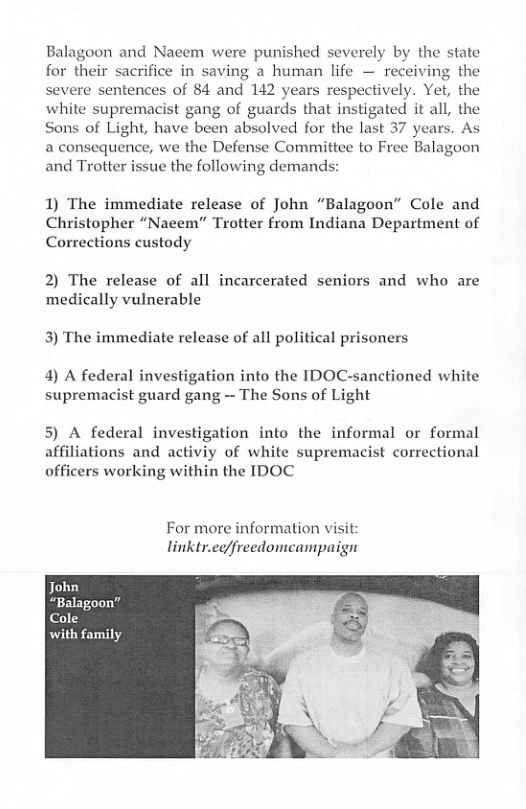
Balagoon and Nacem were punished severely by the state
for their sacrifice in saving a human life — receiving the
severe sentences of 84 and 142 years respectively. Yet, the
white supremacist gang of guards that instigated it all, the
Sons of Light, have been absolved for the last 37 years. As
a consequence, we the Defense Committee to Free Balagoon
and Trotter issue the following demands:
1) The immediate release of John “Balagoon” Cole and
Christopher “Nacem” Trotter from Indiana Department of
Corrections custody
2) The release of all incarcerated seniors and who are
medically vulnerable
3) The immediate release of all political prisoners
4) A federal investigation into the IDOC-sanctioned white
supremacist guard gang - The Sons of Light
5) A federal investigation into the informal or formal
affiliations and activiy of white supremacist correctional
officers working within the IDOC
For more information visit
linktr.eq/freedomeampaign
with family
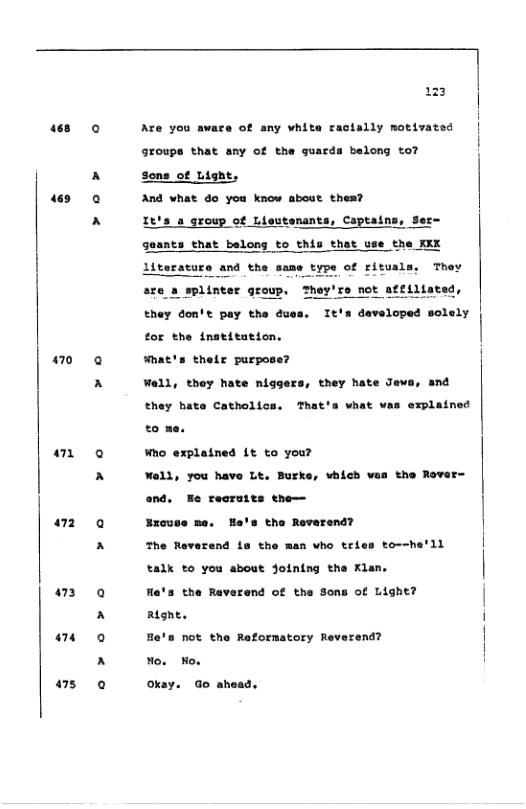
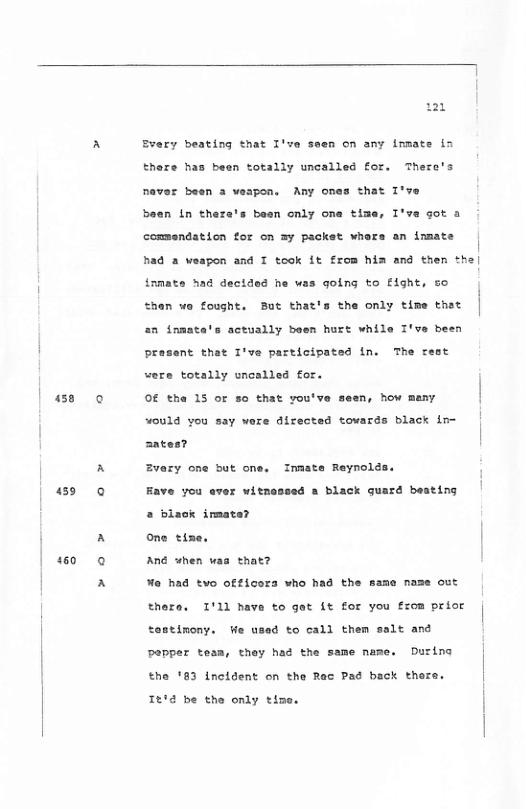
The Sons of Lijln-l-
1DOC Watcl has obtained a copy of the deposition of ISR guard Michael
Richardson, given to the defense attorneys prior to the 1987 trial of the
leaders of the 85 uprising. Richardson, who had been stabbed during
the uprising, attempted to shed light on the existence of the Sons of
Light white supremacist guard organization and their practices in his
deposition. He had tried to expose the Sons of Light by giving information
o the Indiana State Police and the FBI prior o the uprising.
Richardson’s testiviony during the trial was intentionally curtailed by
the prosecution and judge every time he tried to speak on the Sons of
Light, which e describes in the deposition as a Ku Klux Klan “splinter
group” organized specifically for ISR guards, and the pattern of brutal
beatings of Black prisoners at ISR that had provoked the rebellion. The
most relevant section of the document, describing the Sons of Light, is
excerpted and linked in he fist image below.
ISR guard Michael Richardson’s testimony has never reached the media
or the general public, until this day.
58
169
420
n
mn
a3
g
a3,
>
o >0 >0
Ate you awace of any white ractally motivated
groups that any of the g
balong to?
sons of Light,
And what do you know about thes?
1t's a group of Lisut
Gaants that belong to this that use the KKK
nants, Captains, Sec-
Iiterature and the same type of rituals, Thev
aze_a splinter group.
're not ateiliated,
they don't pay the dues. It's daveloped solely
for the inatitation,
hat's thele purposs?
Well, they hate niggers, they hate Jews, and
they bato Catholica. That's vhat vas explained
o
o explained 1t to you?
Woll, you have Lt. Burks
ona.
vhich vas the Rover-
recruits the—
Bxcuse me. He's the Revarend?
The Revarend s the man who tries to--ha'll
talk to you about joining the Klan.
Ha's the Raverend of the Sons of Light?
Right.
Ho's not the Reformatory Reverend?
No. Wo.
Okay. Go ahead.
38
150
m
Every beating that I've seen on any immate in
there has been totally uncalled for. There's
never been a weapon, Any ones that I've
been in thera's been only one time, I*
a0t a
commandation for on =y packet whers an inmate
had 2 veapon and T took it from him and then the|
{rmate had dectded he was going to flght, so
Shan wo fought. But that's the only time that
2n inmate
actually been hurt while I've been
rasent that I've participated in. The cest
were totally uncalled for.
Of the 15 or =0 that you've
an, how meny,
“ould vou say ware directed towards black in-
antes?
Zvary one but one. Inaste Reynolds
508 & Black quard beating
Fave you aver wits
2 blaok imatar
one tize. |
Ané when waa that?
o had tvo ofticora who had the same nase out
thera. 1111 have to gac it for you from prior |
tostinony. ¥e used to call them salt and
Dapper tesm, they had the same name. During
Ehe 183 Lncldent on the Rac Pad back thera.
1604 be the only time.
Had it ot been for the heroic actions of the uprising leaders,
especially John “Balagoon” Cole and Christopher “Nacem”
Trotter, Lokmar would have beaten to death by the guards,
and others on the Maximum Restraint Unit would likely have
been brutalized, if not killed, as well. In court proceedings
and investigations following the uprising, it was revealed
that the cell extraction team that attacked Lokmar had explicit
orders to kill him.
After confronting guards and attempting to get through to
the Captain's office in order to rescue Lokmar, Balagoon &
Naeem were forced to take other guards hostage and take
refuge inacellhouse in order to survive, asall the guards at the
prison were now coming after them to kill them. They ended
up leading the take-over of ] cellhouse, which lasted for 16
hours and ended in negotiations ater the State Police, DOC
administrators, National Guard, and local & Indianapolis
media had gotten involved and come to the prison. During
the take-over prisoners stood together in solidarity, due to
the fact that they had already been organizing in collective
self-defense against the guards brutality, through an
organization they called the Black Dragons, which the guards
mischaracterized as criminal gang. The prisoners issued a
list of demands during the cellhouse takeover pertaining to
the guards’ systematic racism, overcrowding, and lack of
recreation. The DOC commissioner was fired as a result of the
uprising, and some of the guards involved in the beating of
Lokmar were sentenced to federal prison.
John “Balagoon” Cole and Christopher “Naeem” Trotter
remain in prison to this day, having been sentenced to 88
years and 142 years, respectively, for their leadership of
the rebellion. They have served 33 and 20 years in solitary
confinement, also respectively, in retaliation and as extra
punishment for their leadership of prisoner resistance. At
the time of the uprising, they both had less than two years
remaining to serve in prison.
fl
i Mmfl Mm T
“_mmm %_ .w MM% 3 MW&
mrmmmammm mmmmm .mmmurw mmm
oy
(e
n% 51,5
Jou1 (g, ut pofi.nzq;) a01eSnsur poFopy
Interviews with Balagoon and
N“.M
The following interviews were conducted in early 2022 by Too
Black on the Black Myths Podcast on the Black Power Media
network
Listen to the full interviews at HoodCommunist.org/author/
TooBlack
We begin the conversation with Balagoon. In his own words he describes
vividly the environment during the early 80s leading up to the rebellion,
the events that inspired it, and the aftermath.
Too Black: “Hello? How you doing, Balagoon?”
Balagoon: “I'm alright man, maintaining, keeping it real.”
Too Bla
: “That's good to hear, man.”
Balagoon: “What's your name?”
‘Too Black: “I go by the name ‘Too Black. I'm a poet and journalist. I
just heard about your story recently and I wanted to get it on record
the best I could so we can get that out there and hopefully get you
out of there.”
Balagoon: “I appreciate it.”
Too Black: “Ijust want to say that I appreciate what you're doing, I
appreciate you staying strong in there.”
Balagoon: “Where you from
Too Black: “Initially, I'm from Muncie, Indiana but I'm in India-
napolis.”
Balagoon: “You never been inside have you?”
Too Black: “No, but my brother was incarcerated though.”
Balagoon: “You heard about the plight but never been inside, that's
a good thing”
Too Blac
with him.
‘Yeah, he's out now but I definitely lived through that
Balagoon: “Aye bro, feel free to ask me anything, I'll answer to the
best of my knowledge.”
Too Black: “T know we don't have much time but could you please
give us an idea of what the environment was like before the prison
rebellion of ‘85 and also give us a bit of context of who you are?”
Balagoon: “Let's start with who I am first. I was born in Indianap-
olis, Indiana in 1959 November the 17th. Born and raised there. I
started getting in trouble when I was about 9, kind of like got ad-
dicted to that lifestyle and went from juvenile to boy school, from
boy school to jail, and from jail to prison. I met a lot of people
that influenced my life negatively and you know, positively. When
I was about 18, I began a robbery and got shot and captured, an
attempted robbery and that's what sent me to Michigan City. I ar-
rived in the Michigan City prison, an Indiana State prison, | arrived
there in December of 1979 and when I got to Michigan City, it was
a lot better than the Indiana Reformatory, you really didn't have
to go to the reformatory, the city was different in a sense that it
was wide open and brothers speaking a lot of consciousness. When
T first got there, I was a knucklehead, and a lot of the older cats
were reaching for me trying to get me to educate myself. To change
my way of thinking and seeing the world and eventually they did
get me there. Look at it in a different light, but it took a while. [
was messing around with, doing dumb shit for 5 and half years,
and then after 5 and half years there, I embarked upon self-educa-
tion, self-discovery and political resistance. We got politicized, we
started educating ourselves, reading about our history and culture
and all the “isms.” And it was in that context, after I developed
that mindset that I got transferred to Pendleton in'84. When I went
down to Pendleton in ‘84, we got down there, it was whole differ-
ent environment.”
Too Black: “You said it was worse than Michigan?”
Balagoon: “Yeah, Pendleton was worse than Michigan in terms of
how the police were related to the prisoners. It was like a plantation
mentality down there. When we got down there it was like going
to Mississippi because they didn’t have no qualms about calling
you ‘nigger.” Out of all the staff and correctional and prison officers
down there, there were about four Black officers. Everybody else
was white. They had been there for 20-30 years, so the mindset they
had towards us was straight from the 40s, 50s, and 60s, right?”
Too Black: “Right, right,”
Balagoon: “But we were a new breed of prisoners. We had been
politicized. We understood colonialism. We just had a whole dif-
ferent mindset than what everybody else was going for, we wasn't
going for. And that probably led to them sending my brother out,
Lincoln Love, and beating them like they did. Now, the incident
about the beating happened in the lockup unit known as the Max-
imum Strength Unit, at the Indiana reformatory on February the
first, 1985. It was more about the conditions, and recreation.”
Too Black: “To my understanding there were beatings before this
day, right?”
Balagoon: “Yeah, yeah... it was a common practice for them to beat
prisoners down, in particular Black prisoners. Every now and then
it would be a white prisoner if he showed too much solidarity with
us. For the most part, it was always the Black prisoner or the New
African prisoner who was preaching consciousness. As a result of
preaching consciousness, we were also filing a lot of petitions, fil-
ing a lot of (law) suits, and we were still in chains, so we were re-
silient. For those of us who caught under that every time they gota
chance, they would single us out. And this is the backdrop in which
they singled out my guy (Lincoln Love) on that particular morning.
He was outspoken, he was a brilliant brother, and he couldn't be in-
timidated. So, they made an example out of him to make the rest of
us getin line. Unfortunately, all it did was stir up a lot. As a result,
we ended up taking over the prison.”
Too Black: “What did they do to your comrade? What did the
guards do to your comrade?”
Balagoon: “It was early in the morning. For two days, they didn't
pass out cleaning supplies and the dudes wanted to clean them-
selves up. They refused to pass out cleaning supplies so one thing,
led to another. So, because an individual was protesting about not
getting clean supplies, they took away an individual’s rec (recre-
ational time). And when they took away an individual’s rec, they
started shaking their bars, throwing in their cells, stuff like that,
creating a ruckus on the unit. So, you know... they were securing
themselves. They wasn't a threat to nobody. Everybody was locked
in their cell, so the COs came on the unit and they locked the unit
down and they decided that they were going to specifically target
Lincoln Love on that particular day, aka Lokmar Abdul-Wadood.
After they subdued him, handcuffed him and shackled him, they
beat him damn near to a pulp with a solid oak club. Once they beat
him, they drug him out of the cell then they drug up down the
range for all the other prisoners to see.”
Too Black: “Oh wow!”
Balagoon: “They thought he was dead. They thought he was dead!
At the same time, as they are dragging him down the range, in
front of all these prisoners’ cells, they were telling them, ‘when
we get through killing him, you nextSo, brothers was hollering
and screaming out the window for help, right? Go get Balagoon,
g0 get.... ‘they killing us in here, they killing us in here That was
the context in which I came to their aid. I wasn't on lock up at this
particular time. I had been in population maybe two months and
every now and them I come up to the lockup unit as their advocate.
‘That was to represent cats who had to go in front of disciplinary
hearing board. On that particular morning when I tried to go to
that unit because I was supposed to been representing somebody, I
couldn't get through they had the curtain pulled. When they pulled
the curtain, the curtain symbolizes that they back there beating
somebody.”
Too Black: “Ohhh...”
Balagoon: “... So I left, but as I was leaving, I hear the brothers
screaming out the window “go get Balagoon.” So, another little
brother named Kevin Murphy ran and got me and told me what
had happened. So, when he came and got me, I turned around and
came back. I tried to get to the captain office but they drug him out
of his cell and put in the captain'’s office in this room which they
call the “Annie Room.” But they wouldn't let me see him. So, at
that particular time, it was me by my lonesome. So, once some oth-
er brothers heard about it, we all amassed out there in front of the
captain’s office and once we got together, we tried for force entry
into that office. They confronted us, you know, a melee broke out.
They was macing us and trying to beat us with them clubs and we
‘was force to stab them.”
Too Black: “Right.”
Balagoon: “In the process of stabbing them, we was asking about
this brother. So, now we turned away and we are out there assem-
bling with the other prisoners. Unbeknown to me then, they had
‘moved him out of the captain’s office to the infirmary. So, I didn't
see that. I thought he was stil in the captain'’s office. So, the melee
asked him where he s, they tell me that he was in the infirmary.
So, we break off and we start running towards the infirmary. Once
we get to the infirmary, the other COs there tried to stop us from
coming in there, and Unfortunately, we had to injure them. So, we
get there unbeknown to me, the superintendent that made his way
to the infirmary and he is in room that Lincoln at, at this partic-
ular time, treafing him. They got x-rays and administering treat-
ment. [ don't know it, so, I'm trying to open this door but the door
won't open. Seriously, the door wasn't locked. It was open but it
just wouldn't open for me. It was a good thing that it didn’t open
because unbeknown to me and my co-defendant, Naeem Trotter,
the warden was there with a guard and was armed with a shotgun.
So, had we opened that door and gained entry to that room where
they had Lo Mar, they would have probably blew us away.”
Too Black: “Right, yeah.”
Balagoon: “It was by the grace of God the door wouldn't open.
Because the door wouldn't open, COs (correctional officers) were
coming for us everywhere. They kind of like, corralled us in the in-
firmary. Where they came through the back entrance and the front
entrance. Now we are forced to fight our way up out of there and
we decided to go out the same way we came in. In the process of
going out, we ran into some more COs on our way out. Some of
them, ya dig, didn't necessarily want to confront us so they kinda
of like just backed up but then there were some others who tried
to tackle us. The ones who tried to tackle me, you know, I had save
him so it was best to get away because had they captured me, they
were definitely going to kill me.”
‘Too Black: “Right.”
Balagoon: “So, everything that I did after we went to the infirmary,
was...”
Too Black: “Survival.”
Balagoon: “Was done out of love, out of self-defense, right.”
‘Too Black: “Right, right.”
Balagoon: “So, you know, we get away then we run through the
prison, and we make it the guard hall. And when we get to the
guard hall, Naeem got there first and once he ges in they close the
door and I get locked out. At this particular time, there are a lot
of angry COs chasing us. They got their trucks and they got their
shovels...”
Too Black: “Wow.”
Balagoon: ... hammers and stuff like that and right before they got
to me, Naeem took a knife and put it on one of the guards’ neck and
forced him to open the door to let me in. So, they let me in. We get
to gate cellhouse, once we get to the gate cellhouse, that's once we
call the news media and let everybody know there’s been a distur-
bance at the informatory, because they were violating our civil and
‘human rights down there.”
Too Black: “And you had a series of demands too, right?”
Balagoon: “We had everything that going on that was negatively
impacting us and prisoners in general, we brought them up in our
grievances and demands. We had everything that you can think of;
pay raise increase, more recreation, better food, they were serving
us pork practically every day. We wanted to have beets, turkey,
and stuff like that. We brought up all of that. They pretty much
agreed to give us all of that.”
Too Black: “You told that to the news media too, right?’
Balagoon: “We told the news media why the riot had occurred and
why we resolved that part, the riot, the FBI and stuff like that, got
involved and started investigating our civil rights abuses. While
investigating our civil rights abuses, they discovered that it was a
lot of impropriety going on with the commissioner himself. He was
guilty of supporting it and he ended up getting fired, the deputy
commissioner got fired and in the aftermath of them getting fired,
me and Naeem got persecuted. I did 32 years and five months in
lockup as a result of that.
Continuing the focus on the Indiana prisoner rebellion in 1985 at the In-
diana Reformatory (now Pendleton Correctional Facility), this interview
spotlights Christopher “Naeem” Trotter.
Black: I know we don't have that much time, so if you could just
give me a quick breakdown of your background, who you are, and
also an idea of kinda what the environment was like in ‘85, before
the rebellion. 1 talked to Brotha Balagoon earlier today, soI do have
some information. My goal is to have a transcription of both your
interviews and put it in an article together.
Trotter: I'm Naeem Trotter, a prisoner of the state, a former Unit-
ed States Army military with an honorable discharge. I served my
country, but my country didn'’t serve me. I came to prison for the
crime of petty theft to serve a four-year sentence. They sent me
straight to a maximum-security prison that was designed as the
warehouse for most violent criminals. And when I got to the Indi-
ana state reformatory, one thing I realized was that the racism was
50 entrenched amongst the DOC, that it forced prisoners to come
together to defend themselves. There was a clandestine organiza-
tion called the Sons of Light, which was the offspring of the KKK,
and these were prison officials who openly displayed their hatred
towards Black prisoners. The environment was hectic and crowd-
ed, the conditions were deplorable. On top of the brutalizing of
Black prisoners.
February the 1st, 1985, my co-defendant John Cole (Balagoon) and
1 were where we were supposed to be on that lock-up unit at that
time, going to a CAV hearing and there was a disturbance on the
lock-up unit. The first thing we noticed was the smell of mace. And
being that I had already served time on the lockup unit before, 1
knew what that meant; especially when I saw the curtain pulled.
1 knew there was some form of terrorism going on, like prison
guards vs prisoners. As we sat there for a few minutes, listening
to disturbance, prisoners started to holler, “they’re killing Lin-
coln Love, they're killing him, they killin’ him"”. Now our first act
wasn't to commit violence, it was to try to go to the administration
to say “hey, y'all need to stop this"”. Once we got there, they took
on a defensive position, made it seem like we didn't have a right to
be there, even though we had a right to be there because we were
where we were supposed to be. We tried to talk to them and they
made the first move. They pulled out the weapons they had, their
billy clubs, mace, and what have you, and at that particular time,
they still had the inmate handcuffed and shackled Lincoln Love in
a back room. And they were beating him with a baseball bat. And
people say, how do we know what was going on? We know, be-
cause we been subjected to it, I had been subjected to it. I had five
guards come in my cell while I was shackled and handcuffed. And
one of ‘em choked me out and said, “nigger we can kill you”. You
can't never forget that.
Too Black: No, never. And, and this is the ‘Sons of Light?’
Trotter: Yeah. These were guards that were all part of the Sons of
Light, the Sons of Light were so entrenched that the Indiana state
reformatory that, THAT was their literature, that was the orienta-
tion for new recruits, new guards. If they wasn't a part of the Sons
of Light, they were basically ostracized, which was testified to by
one guard that was involved in the beating of Lincoln Love - Mi-
chael Richard.
He was actually ostracized, you know, and he testified, actually go-
ing into the FBI, trying to expose them. The DOC tried to pay a lot
of hush money to keep him quiet. You know? So this is not a made-
up story. This is the reality of February 1st, 1985. And my sentence
with just three months left before my time was up to return back
to society. I was put in the position of either going home in three
months or save the life of a fellow human being, I chose to save the
life of a fellow human being because it was morally the right thing
todo.
Too Black: Right.
Trotter: I couldn't turn right back on it. And as a result, I was
charged with a multitude of crimes from attempted murder, crim-
inal refinement sobriety, take it to a trial, which was nothing more
than a political linking, where the jury was all white, where the jury
‘wasn't able to hear the whole truth. I was convicted. And then giv-
ena sentence of 142 years, which is a de facto lfe sentence.
And please let me remind everybody. We didn't go into this as a
riot. At the same time, we were convicted of charges, we were ac-
quitted of charges. We were acquitted of every charge of attempted
murder that involved any officer at the beating of Lincoln Love.
Why was that? Its only because our actions were actually justified.
We had the right to defend ourselves.
Too Black: And is it correct- to clarify, that some of those officers
involved, actually went to prison for their involvement?
Trotter: Yes, I have had the police state investigator, which is the
state investigator that reports the sentence report before you are
actually sentenced, stated specifically and I will quote exactly the
state investigator's words. And I will quote the State saying this,
“The Indiana State Reformatory is an artificial environment that
usually brings out the worst in a person place. Therein, the over-
crowding conditions that have captured federal court’s attention
are responsible for the stress attitudes of personnel; guards atti-
tudes towards inmates tend to be abrasive, either extreme. One of
the officers involved in the beating that set off the riot, in this case,
is now in federal prison for that beating. The Indiana State Refor-
matory is sometimes likened to a jungle. And with reason.” This
is the State’s pre-sentencing investigator. These are not even my
words.
Too Black: What year was this? What year was this statement?
Trotter: This was after we were convicted in 1987. The state has
to do a pre-sentence investigation before they sentence you, and
this investigation is done by an employee of the state, not for our
benefit, but for theirs. For the simple fact that this same person that
wrote this statement recommended that I received 142 years.
Too Black: Wow.
Trotter: But in this statement, he simply stated that one of the of-
ficers involved in the beating that set off the riot, in this case, is
now in federal prison. They literally, openly admitted that they (the
guards) caused this riot.
Too Black: Right? Which therefore wouldn't make any sense why
you should get 142 years
Trotter: For the simple fact that it was a political issue, the jury nev-
er was able to hear evidence of officer Richard. And this was one
of the officers involved in the being of Lincoln Love. And one of
the things that the jury was never able to hear was when officer
Richardson said, after beating Lincoln Love once, they said, “what
do you want us to do with the inmate?” The officer talking to their
superior, their security said, “kill the son of a bitch”.
Too Black: Wowww.
Trotter: These are court documents. When we look, these are facts.
There s testimony by officer Richards. One of the officers that were
not involved in the beating, but he was also stabbed- we were
acquitted of the stabbing. They said, “kill the son of the bitch”. At
that point, they took Lincoln Love, handcuffed, shackled into a
back room, and committed to beating him with a baseball bat until
they broke his back
Too Black: Wow, they also threatened to do that to the rest of y'all,
correct?
Trotter: Exactly. Exactly. This, this, this was that environment at
that particular time, that at this point, when we come to the beating
of Lincoln Love, this is just me talking about the third person. Now
we're hunted, now we're worried about our survival. You know?
Too Black: Right.
Trotter: They asked guards to shoot us, to kill us one by one, and
even asked the guard in the tower, who refused to shoot us. Ulti-
mately they fired that officer. The taking of the cell house wasn't
‘cause we wanted to take over the cell house, it was to seek refuge.
Had they caught us right then and there, they would"ve killed us.
Too Black: Right. So it wasn't, that you wanted to do it, it sounds
like it was a logical choice. Like you had to do this outta survival.
Trotter: Yes, We had to do this outta survival. And, even when we
had one guard hostage, we just let him go. He walked out freely
and other, and the other guards were held hostage. We treated him
humanely. We didn't treat them like they treated us!
Trotter: We treated him humanely and one thing we did that they
didn't do for us was protect their lives. Even if we didn’t want to.
And even though some of the officers were also part of Sons of
Light. We had to protect their lives in order to stay alive.
Too Black: If we have a lttle more time, | know Balagoon said y'all
were involved with certain political activity and that's why you
were targeted. Can you give a lttle bit more specifics on what that
activity was and then how it relates back to how you managed this
takeover?
Trotter: The activity that we were involved in was that we had
to create an organization in order to combat the infrastructure of
white supremacy inside the reformatory and the organization con-
sisted of raising the consciousness of prisoners, organizing, educat-
ing prisoners in order to form a self-defense committee- because
that was the only defense we had. It wasn't an exclusive organi-
zation that we formed. It was actually an inclusive organization of
prisoners, Black, white, brown, you name it.
Too Black: Does the organization have a name?
Trotter: Yes. It did have a name.
Too Black: What, what was the name?
Trotter: It was Black Dragons. And we didn't publicize the Black
Dragons, we were a clandestine organization, we were under-
ground just like they (News Media) said, the Black Panther were,
but they were able to publicize us in a revolutionary organization,
but they didn't wanna talk about the DOC (Department of Correc-
tions) being 2 white supremacy organization.
Too Black: Right. Quite literally. Yeah.
Trotter: Literally they would, they, they talked about the Black
Dragons, but they didn't talk about the Sons of Light. Wouldn't let
us talk about the Sons of Light. And this was another reason the
jury never got to see or hear the whole story of what happened on
February 1st, 1985. No one would allow us to actually speak the
truth. So, this organization was built outta necessity.
It wasn'ta gang, we weren'tinvolved in criminal activity. We were
trying to bring about liberty amongst prisoners to bring about
awareness, to challenge the conditions, the inhumane conditions
that existed at the Indiana state reformatory at that particular time.
And that's why when we had to seek shelter in the cell house, that's
why all the prisoners came together.
‘There wasn't no prisoner on prisoner violence. And one negro at
the time had claimed that he seen people being thrown off the top
rail. But that wasn't true. There was unity amongst all prisoners to
challenge the conditions, demanding that they do away with the
inhumane treatment of prisoners; that they provide healthcare,
that they provide sensitivity training, and that they hire more Black
staff. There was also a negotiation.
The Need for
-4 Compassionate Release
for the Elderly and the
Medically Vulnerable in
5 Indiana
ComPassionn+¢ Release in
Indiana
By Natalie Medley,
currently incarcerated at Indiana Womens Prison
Compassionate release is the reduction of a sentence for
circumstances needing humane intervention in incarcerated
individuals’ experiences; whereby the morality of continual
imprisonment changes. Imminent death, significant illness, or
old age are circumstances that may alter the public interest
in the continual imprisonment of impacted individuals.
Federally, the passage of The First Step Act expanded
incentives to reward compliance in the Federal Bureau of
Prisons (FBOP)'s use of compassionate release for those in its
jurisdictions. Procedurally, the FBOP makes recommendation
to the sentencing court when a request is approved [1].
However, the compassionate release amendment in the First
Step Act allows clients to bring their own motions to a federal
judge after exhaustion of FBOP procedures [2]. Indiana
would benefit from committed compliance and review of its
compassionate release procedures as well as removing the
process from the political domain and making it a legal one
8}
Contrasting Federal law, Indiana law does not detail criteria
for compassionate release. Instead, Indiana law qualifies the
Indiana Parole Board as a division of the Indiana Department
of Correction (IDOC) [4]. Concerning compassionate release
applications, the Parole Board acts as an intermediary
between those seeking relief and the Governor [5]. It is the
IDOC that outlines criteria and the petitioning process for
compassionate release applications. IDOC Administrative
Policy, “Adult Offender Releases”, describes procedures to
request appearances with the Parole Board, either clemency
or medical clemency requests [6]. Each option has differing
qualifying criteria with the final decision resting with the
Governor [7].
Prior to 1979, or the “Old Code”, Indiana bestowed final
authority in early release decisions with the Parole Board
and not the Governor [8]. This made determinations for such
releases apolitical, providing the appearance of an impartial
and unbiased decision maker. Since the change issuing final
authority for such decisions to the Governor, no single woman
has been granted clemency, and minimal women have been
granted medical clemency, only for imminent death cases [9).
The political ramifications for the Governor are equivalent to
political death, making decision-making much too risky for
impartiality. The process must be placed in a legal sphere if
itis to have fair and honest application in the justice system.
Two options are available in Indiana for compassionate
release requests: clemency or medical clemency [10). Medical
clemency is extremely burdensome and requires many
approvals for the continuation of the request. According
to policy, it is permitted in cases of terminal illness or if an
incarcerated individual would be better served at another
institution [11]. To gain relief, the facility’s Health Services
Administrator (HSA) meets with the case management, health
services staff, and the incarcerated person if possible. The
HSA initiates the application and forwards it to Classification
who forwards it to the Medical Director. Next, it returns to
the HSA who sends it to the Warden for approval or denial.
After that, the request goes to Central Office’s Chief-of-Staff,
Chief Medical Officer, Executive Director of Re-Entry, Legal
Services, Deputy Commissioners, and the Commissioner,
whose denial may result in the Parole Board declining
consideration of the petition. It is the Parole Board that must
make the recommendation to the Governor for final approval
[12].
Without a terminal condition or in need of institutional
care, clemency is the only other option for those requesting
compassionate release. It requires mandatory completion of
1/3ofatotalimposed sentence, but the sentence must be longer
than 10 years. Additional considerations must also be met. The
incarcerated person initiates clemency by contacting staff and
submitting a form. The Warden provides a recommendation
to the Parole Board who investigates, contacts all parties, and
holds both a public and private hearing. The Parole Board
‘makes its recommendation to the Governor for approval [13].
The federal criminal system’s compassionate release
procedures are found in federal code [14]. They delineate
medical and non-medical circumstances for compassionate
release considerations [15]. Medical considerations include
terminal medical conditions, debilitating medical conditions,
elderly persons with medical conditions, and elderly inmates
over 65 years of age, having served the greater of 10 years
or 75% of their sentence [16]. Non-medical circumstances
include incapacitation of a spouse or registered partner.
The Families Against Mandatory Minimums (FAMM)
coalition ran a compassionate release campaign, issuing
summaries of compassionate release policies and the need
for these policies in systems across the US. [17). FAMM
provided findings on individual state’s compassionate release
processes in 2018. For Indiana, FAMM reported: “There is no
publicly available information as to how many clemency or
special medical clemency petitions the Governor of Indiana
has granted”. While this may be true, publicly available
information of the Parole Board's “official actions” are
accessible, and maintaining statistical information concerning
its services and decisions is outlined in Indiana Code [18].
Since making clemency recommendations to the Governor
under Indiana Code 11-9-2 is an official action of the Parole
Board, it is misleading to claim publicly available information
concerning clemency and medical clemency petitions is
unavailable. In fact, the Parole Board keeps information
concerning the Governor's decisions on compassionate
release decisions [19]. Transparency was denied to FAMM,
a watchdog organization, due to the exceptionally poor track
record of compassionate release cases in Indiana.
For 20 years, I have been incarcerated inside of Indiana’s
female prisons. T have known of no woman ever having been
granted clemency under new law scenarios. I have been
aware of a few terminal medical conditions whose requests
were granted, albeit in the 11th hour. Most relevant are the
‘many requests that are denied and the women I have watched
die inside of prison with no family and poor medical care,
sometimes in extremely inhumane conditions.
The aging population can barely get around the prison. Many
elderly women and sick women require 24-hour care. These
people must depend on other inmates to shower, get dressed,
use the restroom, eat, transport, etc. Inmates are not certified
or trained in these ways, and the elderly and sick are the
most vulnerable of our populations. They suffer humiliation
with strangers to care for them. Women are forced to suffer
oppressive restrictions and lack of medical care and most
deaths.
Angie Elliott is a 51 year old confined to a wheelchair. She has
major compression of the spinal cord, neuropathy, acquired
deformity of the hip, polyneuropathy, and many more
diagnoses. She has no physical therapy. She must be cared for
by other inmates. The housing conditions are not conducive
to her medical needs, with extremely heavy doors that are
locked every time she enters or exits her room. The sidewalks
are not wheelchair friendly, yet Angie must be pushed in
a wheelchair every day to pick up her medication, causing
immense pain. Her condition is chronic and debilitating,
yet she could get better with proper medical care. She was
sentenced to 40 years and has completed 9 years, not enough
to request clemency.
RonicaStarks has been on dialysis for 8 years. Herincarceration
prevents her from being on a state donor list. Her mother and
sister had kidneys for donation, but because IDOC will not pay
for organ transplants, Ronica missed the opportunity, having
lost both of her family members to death. The ineffective care
of her dialysis port caused the lack of circulation to her fingers,
requiring one finger to be amputated. She was not given
2 death sentence, yet her life is gambled in the restrictions
upon her life possibilities. Her prosecutor will not consent to
a modification which is required under Indiana law. Yet her
prosecutor suggests that IDOC can initiate an administrative
procedure. IDOC will not permit a medical clemency petition
without a terminal illness. Ronica’s will be if she is not cared
for. She has done 20 years.
Linda Chesei has been in prison for 30 years. She is 70 years
old. Her co-defendants have all been released from prison.
She filed for clemency in 2014. She received a copy of the fax
from the Governor (at the time Mike Pence) stating society
was better without her in it.
Compassionate release is necessary for morality. Promote
compassionate release in Indiana by demanding humane
action in these ways:
1. Remove clemency and medical clemency requests from
political realms, and restore the process to the legal
domain. Provide the processan impartial and non-partisan
decision-maker.
2. Usestatistical accountingasameasureof thecompassionate
release processes. Make this incentive for the use of
compassionate release for those who pose little risk to the
public safety.
3. Seek statistical information from IDOC:
+ Percentage or numbers of inmate populations over 50
years old
+ Number of inmates with high level medical care,
restricted to wheelchairs, or assigned other inmate
medical assistants
* Number of inmates in need of an organ transplant or
who are undergoing dialysis
+ Number of inmates having served 30 plus years
4. Require an online death registry for IDOC and jail deaths
dating back to 1990. Require prisons and jails to display
memorial sights for the deceased in its care.
Return humanity in Indiana.
In loving memory of:
Pam Brown, Glenda Robinette, Karen Carter, Princolla
Shields, Tammy Aver, Janet Burtrand, Donna Stites, Gilda
Swmith, Janet Atherton, Jan Chin, Carolyn Hampton, and the
many more not sentenced to death but having died in prison...
[1] Kansas Federal Public Defender: The First Step Actand Compassionate Release,
1-10-19, Federico, Rich, AFPD.
hitps:/ / kansasfpd. blogspot.com/ 2019/01/the-first-step-act-compassionate-
relcase.html, p. 1
[2) Sentencing Law and Policy: Compassionate Release After First Step, 2-18-19,
Blog: Berman, Douglas A. https://sentencingtypepad.com/sentencing law._
and_policy/2019/02/compassionate-release, p. 1
3] Compassionate release in Indiana must find approval from the Governor, a
politcall clected official. Removing the process, restoring it back (o the 5 person
Parole Board who all have to agree, or submitting petitions to the sentencing
courts instead of the Governor, restores the lega process to the legal realm.
[4]1C11911 (o)
5]1C 11-9:1:2 ()3) and IC 11.9-2:1
6] A.P. 01-04-105 pages VIIL-I - VIlI-§
7] Clemency requires a sentence greater than 10 years with 1/3 of the sentence
‘completed and a clear institutional record for one year. Medical clemency requires
2 terminal medical condition or one that would be mare effectively treated in
another type o facilty.
[8] A.P. 01-04-105 pages VIlL-I - VIII-13
9] This is based upon the knowledge I have as a prisoncr.
10] This contradicts the report FAMM put out saying any medical condition will
qualify under “Special Medical Clemency". Also, no option for temporary leaves
has been used in the maximum security prisons, contradicting FAMM's reporting
that is an option for the terminally ill (FAMM: Compassionate Release Indiana
June 2018).
[11] AP.01.04-105 p. VLS
[12]1d. p. VIILS,
[13]1d. p. ViIl4
[14]18 USC. 3582()(1)(A) & 4205(g)
[15] Policy Statement USS6 181.13
[16]1d
[17] FAMM, June 2018, Everywhere and Nowhere: Compassionate Relcase in the
States.
[18]1C 11:9-1-2(a)(5) and (4)
[191A.P. 01-104-105 p. VIII-4(12) and VIII-8(23)
3.’»3 on on Medical Neglect
C— 'nJ‘+L‘|‘ n“? }:f )
Compnss-onn-‘-c Release
By John “Balagoon” Cole
In regards to your organization’s efforts to get compassionate
release for prisoners who have aged and suffer from under-
lying health conditions that are exceptionally vulnerable to
the coronavirus and possibly even death . . . Your words or
suggestions did not fall upon deaf ears. T heard you.
Tapologize for taking so long to respond to your message, but
if the truth be told I was preoccupied with some very press-
ing legal obligations that required my undivided attention. In
addition to this, I have a lawsuit pending against the commis-
sioner of Indiana Department of Corrections, for holding me
in solitary confinement for 31 years and 5 months consecu-
tively without being afforded a meaningful 30 and 90 day pe-
riodic reviews while being housed on Indiana control units.
1stay pretty busy as a jailhouse lawyer aiding other priso
ers legally. In regards to my health over the years of my im-
prisonment I began to experience serious health problems in
2009. The record shows that I was treated for hypertension
and a enlarged prostate in 2007 while being housed at West-
ville Control Unit, however I stopped taking my blood pre:
sure medication because I did not like how it made me feel (1
did not know that to stop abruptly taking Hydrochlorothia-
zide (HCTZ) tablets would cause the arteries in my heart to
narrow thereby causing heart arrhythmias). In July of 2008, I
was transferred to Wabash Valley CF where I was immediate-
ly placed on the Secure Housing Unit upon my arrival. After
being on the SHU for approximately 7 months (in January), |
begin to experience heart arrhythmia while working out (at
the time my heart was racing I did not know what was wrong
with me), the Doctors at Wabash Valley CF failed to diagnose
my condition and consequently neglected to properly treat
me. The only reason I survived was because in October of
20101 was transferred back to the Westville Control Unit.
Once I was transferred back to Westville my condition was
properly diagnosed as heart arrhythmia and [ was prescribed
metoprolol tart 50 mg tablets (Lopressor) and placed back on
Hydrochlorothiazide 25 mg tablets. I was told by the Doctor
that the arrhythmias I suffer were as a result of me stopping
taking my HCTZ tablets. According to him the narrowing of
heart arteries is a side effect of the abrupt usage of HCTZ tab-
lets.
‘The point I hope to make is that my health has been in decline
ever since. 1 have been imprisoned now for over 42 now, I am
still fighting my convictions because in reality I was convict-
ed of a crime that I was never charged with. I am working on
going back to court for a modification of my sentence in the
future (The statute changed in 2015 allowing defendants who
have non-violent crimes or crimes considered to be non-vio-
lent to petition the court 3 times without secking permission
from the prosecutor office. My convictions for criminal con-
finement are not considered as violence.
1 will be 61 years old on 11/17/20 because I am an old man
whose health is fragile and is no longer considered a physical
threat, the State of Indiana just might consider giving me a
compassionate release! Therefore, I am definitely interested
in any efforts you and your organization put forth in an at-
tempt to get me released. Right now I am back on the SHU
because I dared to complain about an infection in the back of
my throat, as a result | was given a coronavirus test and sub-
sequently quarantine, which is ridiculous!
I understand that the virus should be taken seriously but
there is no standard of procedure at this camp. Everything
is done arbitrarily. I was transferred to the SHU on 11/10/20
and was told I would be here for 3 to 14 days depending on
whether my test results are negative or positive. This one of
those situations that I cannot complain about because it's a
no-win situation, they can easily argue that they were just be-
ing cautious and careful.
In Memor
ol Yol i 5, Shetical
Ntakc-v" ot WP
Written by an incarcerated woman who knew the three
people commemorated here
The commemoration of three women is needed because of
their recent deaths while in state custody. None of the women
were sentenced to death as punishment nor to natural life
behind bars. Each was given excessive sentences to serve
which contributed to their early deaths. The substandard
level of health care and living conditions at the Indiana
Women's Prison, combined with IDOC objectives and state
policies devaluing human incarcerated lives has necessitated
this commemoration. I love my friends and fellow women in
this struggle and appreciate recalling and remembering them;
I despise the system which contributed to their failing health
and disempowered their autonomy, leaving them to die in
prison.
A right to life is what we as human beings believe we are
entitled to, yet this is taken away in incarceration. Legally,
incarceration does not require provisions for those inits throes
to pursue a right to life. Instead, the legal conundrum only
requires a mirage reflected to civilized society, which eases
the conscience justifying the punishment levied upon those
deemed criminal. However, that logic is flawed because no
matter how long the sentences are, nor how many people are
imprisoned, the causes of crime (and therefore crime itself)
will ot be alleviated until addressed. Incarceration is what
is done because of the lack of imagination and responsibility
to each other. The system of criminal punishment is not
accomplishing its purported objectives and demands to be
rethought. It is inhumane.
Furthermore, the dying deserve dignity and the dead deserve
respect. Incarceration neglects and intentionally avoids health
care needs by refusing preventative care, refusing treatment
options given non-incarcerated people, and excessive delay
in care. The stigma of incarcerated people as lazy, unworking,
poor, undeserving of life, and without health coverage
contributes to a complete breakdown of pain management,
communication to incarcerated patients concerning treatment
or prescription options, drug interactions, or end-of-life
procedures. Incarcerated lives mean so little that upon the
knowledge of a terminal medical condition, or when health
care is needed which is not available to incarcerated people,
Indiana’s sentencing courts are not empowered through law
to provide people release. They unilaterally deny all requests
by unrepresented or poor people inside prison who petition
courts under pauper status for compassionate release. For a
violent criminal early release is virtually impossible under
any circumstance, and only those with money or lawyers may
find consideration.
My three deceased comrades were all identified as high-risk
at the onset of the coronavirus pandemic. Yet, despite the
calls by prison advocates for the early releases or furloughs
of medically high-risk incarcerated people, the Governor
and IDOC Commissioner refused to extend consideration.
At the beginning of 2020, each refuted their abilities in law
to release people. Almost two years into a pandemic which
affects the prison system at much higher rates than singular
living situations, the two male rulers released three male
incarcerated people asserting medical reasons. All three of
the women I am seeking to commemorate, Ronica, Dellia,
and Cynthia, contracted covid-19 in the past two years;
even multiple times. The numbers of coronavirus cases,
coronavirus deaths and contributory affects on the health of
the incarcerated in Indiana is egregiously underreported by
IDOC and intentionally falsified. No female has been released
through IDOC medical clemency procedures throughout the
pandemic or past decades.
Official reports recording incarcerated deaths made by the
coroner or state police cannot be considered dependable due
to the association of these agencies with IDOC, its private
for-profit health care provider in addition with the lack of an
incarcerated person’s witnessing advocate. The incarcerated
person’s failing condition is not witnessed or recorded by a
family member, friend, advocate, or outside ally. People in
prisons die alone and in unmanaged and excessive pain. Other
incarcerated people are not even questioned in incidents of
a woman's death. Once an incarcerated person has passed
away it is only community ties and resources which provide
funerals and memorial services. These actions are oftentimes
taken by a community of past incarcerated people or prison
volunteers. Obituaries do not report those who die in state
custody. In death, the life of an incarcerated person is
unwitnessed, un-honored and disregarded; the stigma of
incarceration extending even to the expiration of life. I intend
to transform this reality.
A Commemoration of Cynthia Powell
Ms. Cynthia Powell’s most usual disposition was a cheerful
one. Anytime | would see her in the hallways of the prison,
she would be smiling. Even after having spent many years
behind prison walls, the time did not get the better of her. She
was often volunteering to do extra work. I usually would see
her filling up her unit's ice cooler walking the entire prison
block to get the ice. I would see her in the mornings dropping
off old mop heads for exchange. She seemed to have a good
balance between personal time and staying busy.
On special occasions, like a holiday meal in chow hall or a
visit, Cynthia would prepare herself wearing her signature
red lipstick and a stylish doo. It was obvious Cynthia retained
her youthful beauty even as she grew older. Cynthia was a
survivor of the prison’s punitive special needs unit and
negligent mental health care system. She was down-to-earth
and approachable, remaining open to those around her still in
thestrugglesof the unitof mental healthissues. Sheappeared to
become more and more optimistic as her outdate approached.
Although I was not close to Cynthia, her struggles made hera
woman of wisdom, and it was obvious in her demeanor. May
she find peace and release as she transitions from life to death.
A Commemoration of Dellia Castile
Ms. Dellia Castile was known by mostas “GG.” A no-nonsense
tell-it-how-it-is motherly-type of woman, GG was short in
stature, but large in love. She adopted other incarcerated
women taking on roles of pseudo-family, assisting with
emotional and spiritual matters. GG had an extreme love
for her son, of whom she referenced frequently. GG's entire
demeanor revealed how extremely important family was to
her. Although GG’s kidneys began to fail her, she welcomed
dialysis because she would see her son at the prisons’ dialysis
center.
I met GG in 2013 at Rockville Correctional Facility. GG had
recently enrolled in the P.L.U.S. unit, a unit I lived on due to
my work assignment. GG's criminal appeal had been handed
down from the Indiana Court of Appeals and decided against
her. Three times, the prison'’s law library had attempted to
prepare a Petition to Transfer to the Indiana Supreme Court
on behalf of GG. Unfortunately, IDOC refused to train
adequate law clerks and did not provide alternative legal
assistance (a policy continuing today). Due to the lack of
training and experience, each attempt to file a transfer was.
rejected by the Supreme Court for technical reasons. Her
need of help in asserting the inequity she experienced by
the criminal system was more than enough to motivate me. I
took GG's paperwork, her “for publication” appeal decision
and the denial checksheets returned to her for the denial of
her filings, in order to prepare a petition. At the time, I had
caught the attention of a few corrupt correctional officers who
shook me down to confiscate GG's paperwork. They scared
GG telling her she was not allowed to ask me for help and if
she did it would be misconduct. I was simultaneously written
up for misconduct, transferred housing units, and transferred
institutions. GG never filed a Petition to Transfer nor received
any further review of her criminal case.
Later in her prison sentence, GG's kidneys began to fail her.
She transferred to the Indiana Women's Prison for medical
reasons, where I was located. GG was often restricted to the
prison’s infirmary where [ was allowed to sit with her as an
infirmary companion. GG's health deteriorated while at the
Women's Prison. Before the pandemic began, GG and I began
discussing legal options for her. Due to her worsening health
it seemed a compassionate release would be necessary to
ensure her freedom to receive life saving health care or before
her death. GG wanted to petition her sentencing court and I
suggested medical clemency as an option if that didn’t work.
The pandemic hit IWP in March 2020. I was unable to see
GG until almost Christmas. GG's condition worsened
considerably and she became infected with the coronavirus
multiple times. By the time I had confirmation from her to
pursue preparing paperwork to petition IDOC for medical
clemency I had no access to her. I requested approval from
IWP administrators. | was transferred facilities with[in] 45
days of seeking permission to help GG prepare a medical
clemency petition. The day before Ileft, while at the infirmary,
GG lightly walked out to where I was and sat down beside
me. She was smiling and the happiest I had seen her in a
long time. GG was filled with a supernatural grace that day,
hugged me, and eased my concerns. Unselfishly, GG came to
me that day to comfort me.
The more I reflect on GG’s imprisonment-the totality of the
carceral system'’s affects on her- I see racialized and gendered
criminalization. GG was treated harsher in her legal battle
because of her pauper status with the court. Her bail hearings,
trial, lack of appeal, representation, and subsequent treatment
inside prison were all impacted by disparate application
of discretion, undeniably influenced by racial and gender
stigmatization. The lack of relief afforded to her in her failing
health was solely because she was poor, black, female, and
incarcerated. The underlying criminal convictions for neglect
inherently and disproportionally criminalized her role as
mother, grandmother, and caretaker. GG's excessive sentence
for crimes she did not commit were unevenly issued to her
because of racialized and gendered tropes which infect the
criminal system with unfairness and discrimination. GG's
personhood was devalued in this system and reflects a norm.
GG never felt sorry for herself and did not view herself as a
victim. To the contrary, GG was a fighter for her autonomy
and for justice. She was loving to those in pain around her.
May your spirit inspire me GG, and may you rest in eternal
freedom, love, and peace. May her son and family know how
much she was in love with them.
A Commemoration of Ronica Starks AKA Roe-Roe
Imet Roe-Roearound 2005 inside the Indiana Women's Prison.
Her first words to me revealed her acceptance of alternative
lifestyle choices, other races and women more generally.
As time moved on, I began to see her mindset as in direct
opposition to the prison apparatus, a quality I valued and
looked up to. Roe-Roe was fearless living how she wanted to
and for the most part, doing what she wanted to do. 1 gained
Roe-Roe’s more focused attention at Rockville Correctional
Facility around 2009 when she asked me to review some of
her legal paperwork. From that point forward Roe-Roe and
T often had conversations concerning her legal intentions for
relief.
When 1 first met Roe-Roe, and for years after, she was an
able-bodied, gender non-conforming woman. Roe-Roe was
amazing to me in her fierce womanhood, all the while one of
the coolest cats in the prison. Roe-Roe was not confined by
stigma or prejudice, and brilliantly understood other people’s
motivations. She was unapologetically herself, and a woman |
came to love and respect.
Roe-Roe’s health began to deteriorate within the first decade
of her imprisonment. Having entered prison with a plethora
of health issues, she was continuously given numerous
medications, and most often overmedicated. Her kidneys
eventually began to fail her. She was transferred to the
Indiana Women's Prison to begin dialysis. Throughout her
imprisonment multiple people would have given Roe-Roe a
donor kidney. Furthermore, she lost family members during
her incarceration including her beloved mother and sister;
both had kidneys available for transplant. Yet, due to Roe-
Roes’ commitment to IDOC, transplanting a kidney was not
feasible because the private for-profit health care system for
incarcerated people would not cover costs. Adding moreinsult
to her pursuit of life, she was not placed on the donor registry
list. This action against her incarcerated status irreversibly
denied her even post-release life saving measures.
Roe-Roe’s last decade in prison resulted in severe pain and
discomfort due to health complications, undiagnosed health
issues, and delayed or insufficient treatments. While always
strong through numerous surgeries, recoveries, physical
limitations, infections, and amputations, her suffering
was severe. The criminal carceral system only imputed
callousness and heartlessness in her treatment, care and lack
of consideration. Nonetheless, people inside prison loved
Roe-Roe and it was those closest to her who gave her the
medical aid she required most days. Roe-Roe’s personality
elicited love and care from others around her. She never lost
her identity even as she transitioned in and out of debilitating
disabilities.
The Indiana Women's Prison’s punitive and repressive
administration and policies hyper-surveilled Roe-Roe. Roe-
Roe's behaviors were over-exaggerated as misconduct by
prison investigators who had little to attend to. Multiple
times she was placed in punitive segregation and isolation
even with her failing health which needed therapy, proper
nutrition, electronic monitoring or assistance and human
assistance for daily activity. Roe-Roe’s placement in seg and
on behavioral units undeniably progressed her worsening
health. Her last amputation recommendation was cemented
when prison officials left her in cold isolation with extremely
restricted access to physical movement, no therapy, lack of
nutrition, lack of caloric intake requirements, and severe
restriction on needed health care.
Regardless of the prison authorities' oppression upon
my friend, she continued to exhibit her larger-than-life
personality. She had love from and held love for most people
including some c/o'sand every female prison people. Perhaps
her biggest legacy, Roe-Roe loved the children. She became
involved in many children’s lives of those she loved. Roe-
Roe would find ways to see the children when they visited
their mothers in prison. She called them, wrote them and
kept incarcerated crafters in business buying artwork and
crocheted items for the children. Roe-Roe also took care of
her own, sending care packages to new arrivals, making sure
people didn’t go hungry, and extending conversation to even
the most misunderstood person.
‘The system refused to extend Roe-Roe compassionate release.
Her prosecutor placed the responsibility for a possible early
release on IDOC in a 2018 letter. The IDOC would not even
allow Ronica Starks to prepare and file a petition for medical
clemency. Instead, its racist policies refused to allow Roe-Roe’s
requests to be formally submitted, denying her at the first
level of review, the Health Services Administrator for IDOC's
health care contractor. Roe-Roe was treated and regarded as
super-human by officials who denied her compassion. Due
to her pauper status Roe-Roe lost her life committed to IDOC
‘mere months before her release date.
May my big homie look down on all of those who love and
miss her and smile. May she enjoy those she lost in life and
kick it with the ancestors. May those hurting in her loss find
comfort and celebrate Roe-Roe's life as she would have us to
do. Rest in peace friend.
In Mzmor of Lokmar Yazid
Abdul W.Jooé
This article was written by Balagoon about his long-time friend and
comrade Lokmar, when Balagoon was informed that Lokmar had suffered
front two strokes in 2019. On December 4, 2020, Lokmar passed away
front Covid-19 that he contracted while i prison. Lokmar was an excellent
Jailhouse Lawyer, a long-term prison rebel, and a mentor to many younger
prisoners. His death in prison, as a medically vulnerable elder who spent
decades in solitary confinement, is a great tragedy that will not beforgotten
or forgiven!
Have you ever heard/read that statement that the people
make revolutions? Well that statement is not the truth that
many claim. The people are subjects in any system, whether
itis for or against them. Revolution is made by revolutionary
leaders, but it is the strength, numbers, consciousness, and
determination of people in society who have been influenced
to support revolution that determines whether or not the
ideology of revolutionary leaders will become the dominant
force in society. On the other end it is the imperialists who
make reactionary war, but their success too depends on the
strength, number, political ignorance, and blind patriotism
of the people. People have always fought according to the
dictates of revolutionary or reactionary leadership, whichever
is most influential under certain social conditions.
If you study and understand dialectics then you will
ultimately come to the realization that liberation in itself
is only a qualitative state of social existence, not an end or
permanent condition. Oppression is and has been a universal
social problem. In short; recognize that our struggle for
human rights, decolonization, self-determination, land and
independence, is at a very low-tide. But eventually the tide
will rise and people will be mobilized to act in their best
interest and interests of our planet. As of right now they do
the opposite.
These are dangerous and trying times, a kin to those my
ancestors faced hundreds of years ago. Times when all but
a few have been demoralized, terrorized, and forced to their
knees!
In regards to my beloved brother and Comrade Lokmar, [
want to thank you for taking the time out to write and inform
me about his unfortunate health ordeal. You did not have to
do that! The very fact you did says a lot about you as a human
being,
1 had written a letter to him in February or March of 2019,
however, the prisoncrats sent it back to him and refused to
deliver to him in his Muslim name (Lokmar Yazid Abdul
Wadood).
As a result, I sent the letter back to him in his slave name
(Lincoln Love) and received a response.
There is a good probability that Lokmar may not recover
from these strokes, and if by some miracle he does, chances
are he’ll never be the same. Therefore, I thought I should take
advantage of this opportunity and tell you and the world who
he was and what he meant to me.
Lokmar is from East Chicago, Indiana. In 1975, he was tried
and convicted for a murder and robbery of a Lake County
bartender. Ultimately he was sentenced to a life sentence for
the murder and robbery. In addition to his life sentence, he
was serving a 30 year prison term for kidnapping of a guard
at Indiana State Prison (Michigan City). Lokmar was among
9 prisoners charged in connection with the April 27, 1980
takeover at ISP, in which 7 guards and staff personnel were
held hostage. They were released and unharmed after 16
hours. In July of 1982, Lokmar was convicted of kidnapping
in the eriminal court of LaPorte County.
1 first met Lokmar in 1979, shortly after my arrival at Indiana
State Prison in December of 1978, When I first arrived at ISP 1
had no institutional job, so I was on idle status in C-Cellhouse.
Which meant I was locked in my cell most of the morning.
To get out of my cell I begin attending Islamic services on
Fridays. It was at these Islamic services that I met Lokmar for
the first time. A year later in 1950 we got to know each other
on NSB (new services building) which was a lock-up unit at
ISP. There was a riot that occurred on April 27, 1980 that he
and [ were both participants in. The riot in which guards were
ed as a result of a brutal beating of one
of our friends and comrades (Mike Hinkle) by prison guards.
The beating occurred in B-Cellhouse. Once we heard about
it, we took keys from guards , came off the lock-up unit, and
seized C-Cellhouse. In the aftermath, Lokmar and several
others were charged, tried and convicted of kidnapping. I was
initially charged but charges against me were later dropped.
held as hostages oce
On Feburary 1, 1985 while being confined at Indiana State
Reformatory (now known as Pendleton Correctional Facility)
Lokmar was brutally beaten by some racist and sadistic guards
while he was locked-up on MRU (maximum restraint unit).
At the time this beating occurred I was in general population.
Twas a lay advocate assigned to represent prisoners at C.A.B.
for disciplinary write-ups. To make a long story short, I heard
prisoners yelling out their cell windows for help and I came to
their rescue. As a result, 4 guards were stabbed and 4 others
were seized and held as hostages in J-Cellhouse for close to 17
hours. They were eventually released unharmed.
In the aftermath, I was charged with 4 counts of criminal
confinement and rioting. 1 was prosecuted in Madison
County, Indiana. I was tried and convicted. In July of 1987, I
was sentenced to an additional 84 years.
My point is this; our relationship to each other has been
forged in struggle against prisoncrats and their agents. The
only reason why the prisoncrats tolerated us so long was
because of the brotherhood we forged behind these walls or
fences. Our relationship to each other over the past 4 decades
has endured as a result of our love for each other.
In terms of his character, personality, and mental makeup;
Lokmar loved people. He had a deep special love for
African people. Lokmar was an extraordinary teacher, who
read, studied, researched whatever he could get his hands
on; he shared generously with others. He was also a good
listener who showed sensitivity to both political arguments
and personal problems. His eagerness to know what was
happening in the real world encouraged him to inquire about
everything effecting people negatively and positively. He
never saw anything in isolation but in relation to one another.
His breadth, depth, and scope was unbounded.
Lokmar was/is a great human being. However, he will reccive
no Nobel prize for peace, he will receive no freedom award:
Nevertheless, I can testify about how much blood, sweat and
tears he shed in our struggle for liberation.
It takes a lot of fortitude, to endure what Lokmar has over the
past 4 decades. The miserable conditions of prison life (this
is to say its warped harshness, lonely isolation -that gnaws
into the human psyche) could not break his spirit; despite the
savagery of this system he never lost his sense of humor, had
fun under the most unpleasant environmental conditions!
Once Lokmar stepped upon the revolutionary path he
remained true to the struggle for the rest of his life, fighting
the good fight, filing lawsuits, getting prisoners convictions
overturned with his legal assistance, and helping other
prisoners or comrades at a moment’s notice, never stopping
to count the cost.
In Solidarity,
One Love - Balagoon
Continued
Support for
P Balagoon and
3 Naeem
Clcmvm, Lor Nacem
In 1987 Christopher “Naeem” Trotter was sentenced to 142
years for charges stemming from the 1985 uprising against
white supremacist guard brutality at Pendleton CF (then
known as the the Indiana State Reformatory). At the time of
the uprising, Trotter had nearly completed a 4 year sentence
for petty theft. He had been placed in the maximum security
Pendleton prison because of his history as a combat veteran
with the US Special Forces.
In 2018, after a long legal ordeal and 20 years in solitary
confinement, that sentence was vacated and a Madison
County, IN court ordered that a new sentencing hearing
be held, on the basis that the prosecution had seriously
misrepresented Trotter’s motivations for his actions in the
uprising as well as his personal background. The prosecution
had presented Trotter as the “Black sheep” of a middle class
family who simply decided to act violently for no real reason.
In fact, he was raised in poverty with a violently abusive
father who used to beat his mother and little brother, and
Chris grew up protecting them from his father’s abuse. As
such, he was responding to a conditioned protective instinct
when he heard calls for help and learned that guards were
beating a well-loved jailhouse lawyer, Lokmar, to death with
his hands cuffed behind his back on the Maximum Restraint
Unit. It was because of his history of protecting people more
vulnerable than him from abuse that he leapt into action and
helped set off the rebellion that saved Lokmar and possibly
others on that unit from being beaten to death by white
supremacist guards in tactical gear. Those guards had already
come through the unit and shaken everyone down multiple
times that day, to the point that all théy had left was their
underwear, before they began bludgeoning Lokmar in the
head. In the trials related to the uprising, it was revealed that
the guards were specifically targeting Lokmar, and intended
to kill him. At least one of the guards involved was convicted
and sentenced to federal prison for provoking the uprising.
Trotter'striallawyerin1987failedtochallengethe prosecution’s
representation of his motives for the crimes he was convicted
of, and because of that fact in 2018 a judge ruled that Trotter
had a valid claim of ineffective assistance of counsel in his
post-conviction relief case, and that a new sentence should
be issued in accordance with the recommendations of a new
pre-sentencing investigation. You can read the judge’s order
to vacate the 1987 sentence in the documents below.
A new sentencing hearing was held in January 2019, but in a
move that clearly illustrates the blatant corruption involved
in Chris’s case, the Madison County judge who had vacated
his original sentence was taken off the case. The new judge on
the case, Judge Carroll, re-sentenced Christopher Trotter to
122 years in prison, saying in court that the guards expected
him to have their backs.
Sentence Modification for
Bn'njoon
John C Cole, aka Balagoon, has been locked up in the corrupt
Indiana Department of ~Corrections since the 70's, where
he became a_political mentor to many other prisoners. In
1985, he was a leader in the 1985 Pendleton Uprising whe
prisoners, in response to racist guards viciously bea
another inmate, took over a cellblock and held four guards
hostage. They presented a list of demands to the media which
included an end to censorship of letters and media, the ability
to be politically active without reprisal, the establishment
of a minimum wage for inmates, and the establishment of
a grievance committee for prisoners to safely bring forward
issues to the DOC without fear of intimidation, threats,
beatings, or any other punishment by guards.
Balagoon was eventually tried and wrongfully convicted
n retaliation for his leadership role in the uprising and
sentenced to 84 more years in prison. During the trial, the
judge and prosecution refused to allow testimony about the
systematic brutality against Black prisoners at the institution,
and the existence of a formally organized white supremacist
group among the guards called the Sons of Light, to be heard
by thejury. Heis currently seeking a sentence modification to
reduce the amount of time he’s forced to be confined behind
bars, controlled andmonitored every step of the way by the
very same injustice system he has been fighting for decadles.
He was originally sentenced to serve his four counts from the
Pendleton Uprising consecutively but is arguing that they
should have been done concurrently, which would get him
outon time served over the past 43 years. He needs every bit
of help he can_get to increase the chances of him getting out
sooner, to see freedom for the first time in many years, and
to bring his dedication to the struggle for liberation to the
outside world.
Theneedto get Balagoon freciseven more pressing considering
his physical condition. He has been illegally held in solitary
confinement for 31 years, and the neglect and horrific
treatment during that fime has left him with medical issues
that the IDOC refuses totreator sometimes evenacknowledge.
With the COVID-19 pandemic still raging, Balagoon's
health and 61 years of age are an even more dangerous
combination than even in normal circumstances behind bars.
“The Immediato Release of John "Balagoon” Cole and
Christopher "Nacen" Trotter from IDOC (indiana
Dopartmentof Correction) Custody|
‘The Immediate Roleaso of All Incarcoratod Sonlors and
Al the Medically Vulnerable
‘Tho Immadiato Release of Al Poiltical Prisonors
‘AFodoralInvestigation into the IDOC Sa
‘Supremacist Guard Gang — the Sons
b
e
For More Information, Scan the QR Code or
g0 tohttpsi/flinktree/froedomcampaign