John Brown and the Raid on Harper’s Ferry: Speeches, Testimony, and Letters
Web PDF • Imposed PDF• Raw TXT (OCR)
![A Voice From Harper’s Ferry Osbarne P. Anderson, 1861 Seventeen wiites and fve blacks partiipated in Jobw Brown’s raid on larper’s Frry. Osborne Anderzan was the ony black person who survied to writ abont the experience. Here i an excerpt from bis narrative of he raid. OF the various contradictory reports made by slaveholders and theis satelltes about the time of the Harper’s Ferry conflict, none were more untruthful than those relating to the slaves. There was scemingly & studied attempt to enforce the belief that the slaves were cowardly, and that they were really more in favor of Vieginia masters and slavery, than of thei freedom. As a party who had an intimate knowledge of the conduct of the colored men engaged, | am prepared to make an emphatic denial of the gross imputation against them. They were charged specially with being unreliable, with deserting Captain Brown [ae] the first opportunity, and going back to their masters; and with being s0 indifferent to the work of their salvation from the yoke, a5 to have to be forced into service by the Captain, contrary to their will On the Sunday evening of the outbreak, when we visited the plantations and acquainted the slaves with our purpose to effect their liberation, the greatest enthusiasm was manifested by them-—joy and hilasity beamed from every countenance. One old mother, white- haired from age, and borne down with the labors of many bonds, when told of the work in hand, replied: “God bless you! God bless youl” She then kissed the party at her house, and requested all to kneel, which we did, and she offered prayer to God for His blessing on the enterprise, and our success. At the slaves’ quarters, there was apparently a general jubilee, and they stepped forward manfull, without impressing or coasing. In one case, only, was there any hesitation. A dark-compleioned free-born man refused t0 take up arms. He showed the only want of confidence in the movement, and far less courage than any slave consulted about the plan. In fact, so far as | could learn, the free blacks [of the] South are much less reliable than the slaves, and infinitely more fearful. In Washington City, a party of free colored pessons offered their services to the](john-brown-and-the-raid-on-harpers-ferry-speeches-testimony-and-letters 6.png)
![Mayor, to xid in suppressing our movement. OF the slaves who followed us to the Ferry, some were sent to help remove stores, and the others were draw up in a circle around the engine-house, at one time, where they were, by Captain Brown’s order, furnished by me with pikes, mostly, and acted as a guard to the prisoners to prevent their escape, which they did As in the war of the American Revolution, the first blood shed was a black man’s, Crispus Attucks’s so at Harper’s Ferry, the fiest blood shed by our party, after the arsival of the United States troops, was that of a slave. In the beginning of the encounter, and before the troops had faiely emerged from the bridge, a slave was shot. 1 saw bin fall. .. OF the men shot on the racks, when [John Henry] Kagi’s party were compelled t0 take to the river, some were slaves, and they suffered death before they would desert their companions, and their bodis fell into the waves bencath, Captain Brown, who was surprised and pleased by the promptitude with which they volunteered, and with their manly bearing a the scene of violence, remarked to me, on that Monday morning, that he was agreeably disappointed in the behavior of the slaves; for he did not expect one out of ten to be willing to fight. The truth of the Harper’s Ferry “raid,” as it has been called, in regard to the part taken by the slaves, and the aid given by colored men generally, demonstrates clearly: firs, that the conduct of the slaves is a strong guarantee of the weakness of the institution, should s favorable opportunity occus; and, secondly, that the colored people, as a body, were well represented by numbers, both in the fight, and in the number who suffercd martyrdom afterward, The first report of the number of “insurrectionists” killed was were only ten of the men that belonged (o the Kennedy Farm who lost their lives ac the Ferry, namely: John Henri Kagi, Jerry Anderson, Watson Brown, Oliver Brown, Stewast Taylor, Adolphus Thompson, Willam Thompson, William Leeman, all cight whites, and Dangerfield Newby and Sherrard Leuwis Leary, both colored. The rest reported dead, according to their own showing, were colored Captain Brown had but seventeen with him, belonging to the Farm, and when all was over, there were four besides himself taken to teen, which showed that several slaves were killeds for there Charlestown, prisoners, viz: A. D. Stevens, Edwin Coppic, white; John A. Copeland and Shiclds Green, colored. It is plain to be scen from this, that there was a proper percentage of colored men killed](john-brown-and-the-raid-on-harpers-ferry-speeches-testimony-and-letters 7.png)
![at the Ferry, and exccuted at Charlestown. OF those that escaped from the fangs of the human bloodhounds of slavery, there were four whites, and one colored man, myself being the sole colored man of those at the Farm. That hundseds of slaves were ready, and would have joined in the work, had Captain Brown’s sympathies not been aroused in favor of the families of his prisoners, and that a very different result would have been scen, in consequence, there is no question. There was abundant opportunity for him and the paty to leave a place in which they held entire sway and possession, before the arrival of the troops. And so cowardly were the slaveholders, proper, that from Colonel Lewis Washington, the descendant of the Father of his Country, General George Washington, they were easily taken prisoners. They had not pluck enough to fight, nor to use the well-loaded asms in their possession, but were concerned rather in keeping a whole skin by parleying, or in spilling covardly tears, to excite pity, as did Colonel Washington, and that way escape merited punishment. No, the conduct of the slaves was beyond all praise; and could our brave old Captain have sceeled his heart against the entreaties of his captives, or shut up the fountain of his sympathics against their families—could he, for the moment, have forgotten them, in the selfish thought of his own friends and kindred, or, by adhering to the original plan, have left the place, and thus looked forward to the prospective freedom of the slave-hundreds ready and waiting would have been armed before twenty-four hours had elapsed. As it was, even the noble old man’s mistakes were productive of great o0d, the fact of which the future historian will record, without the embarrassment attending its preseat narration. John Brown did not only capture and hold Harper’s Fesry for twenty hours, but he held the whole South. He captured President [James] Buchanan and his Cabiner, convulsed the whole country, killed Governor [Henry] Wise, and dug the mine and laid the train which will eventually dissolve the union between Freedom and Slavery. The rebound reveals the truth, Soletit bel](john-brown-and-the-raid-on-harpers-ferry-speeches-testimony-and-letters 8.png)




Jonn BrowN AND THE RAID
ON HARPER’S FERRY
Testimony, Speeches, and Letters
Layout by Chicago Anarchist Black Cross, 2018.
To request a catalog, write us ac
Chicago ABC
1321 N Milwaukee Ave.
PMB 460
Chicago, IL 60622
To download electronic copies of our zines, visit us at
chiabe.tumblr.com
“John Brown’s Last Speech” and “AVoice From Harper’s Ferry”
taken from Voices of a Peaple’s History of the United States, Second
Edition, a collection of original source material compiled by
Howard Zinn and Anthony Arnove. Thoreau’s Pla... and the
prison letters come from Edboes of Harper’s Ferry.
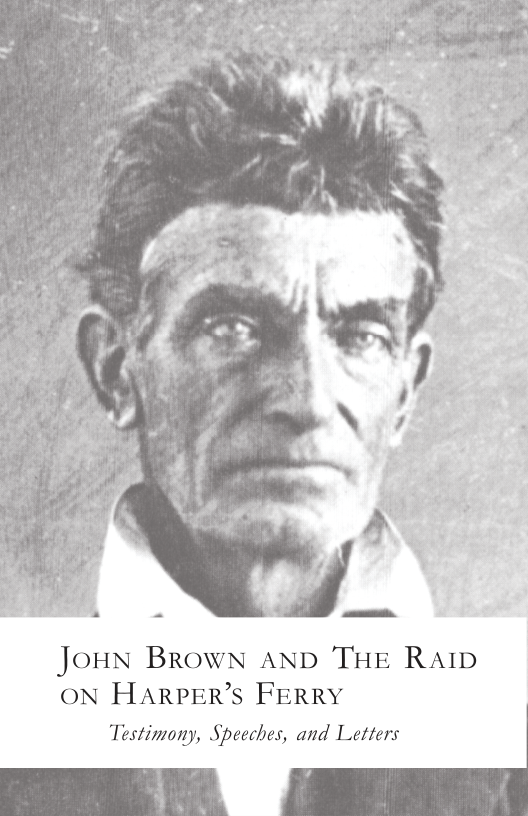
Front cover: an 1856 daguerrotype of Brown, three years before
his death.
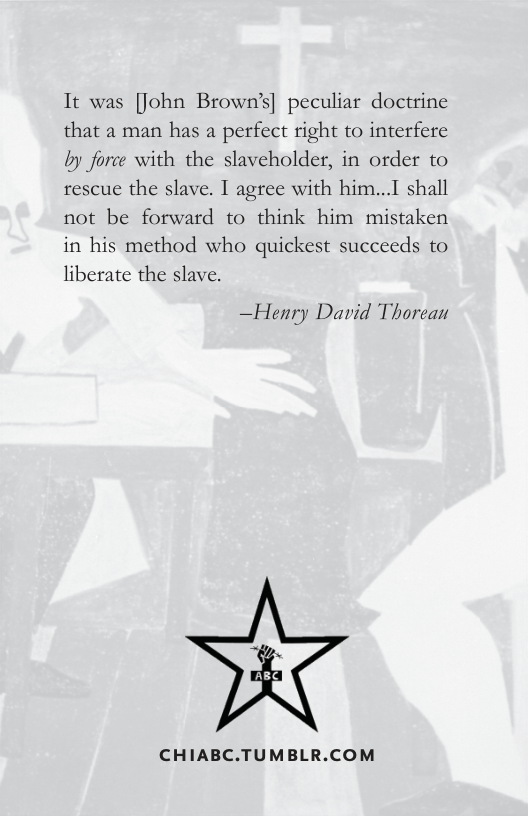
Back cover: Frederick Donglass argued against John Broun's plan ta
attack the arsenal at Harpers Ferry. Painting by Jacob Lawrence.
chicagoanarchistblackcross @riseup.net
CONTENTS
John Brown's Last Speech 4
Jobn Brown
A Voice From Harpers Ferry 6
Osbarne P. Anderson
A Plea For Captain John Brown 9
Henry David Thorean
Letters to John Brown 30
Various
John Brown's Last Speech
Noverber 2, 1859
I have, may it please the Court, a few words to say.
In the first place, 1 deny every thing bue what I have all along
admitied-the design on my part 10 free the saves. Lintended certainly
to have made a clear thing of that matter, as | did last winter, when |
went into Missouri, and there took slaves without the snapping of a
gun on either side, moved them through the country, and finally left
them in Canada. | designed to have done the same thing sgain, on
a larger seale. That was all | intended. I never did intend murder, or
treason, o the destruction of property, or 1o excite or incite slaves
to rebellion, or to make insurection,
1 have another objection: and that i, it is unjust that 1 should suffer
such a penalty. Had | interfered in the manner which | admit, and
which I admit has been fairly proved-(for | admire the truthfulness
and candor of the greater portion of the witnesses who have testified
in this case)-had | so interfered in behalf of the sich, the powerful,
the intelligent, the so-called great, or in behalf of any of their friends,
cither father, mother, brother, sister, wife, or children, or any of that
elass, and suffered and sacrificed what | have in this interference, it
would have been all right, and every man in this Court would have
deemed it an act worthy of reward rather than punishment.
This Court acknowledges, as | suppose, the validity of the Law of
God. Isee a book kissed here which | suppose to be the Bible, or, at
least, the New Testament. That teaches me that ll things “whatsoever
Iwould that men should do unto me, | should do even o to them.” It
teaches me, further, to “remember them that are in bonds as bound
with them.” 1 endeavored to act up 1o that instruction. I say, 1 am
yet 100 young to understand that God is any respecter of persons.
1 believe that to have inrerfered as | have done, as | have avays
freely admitted | have done, in behalf of His despised poor, was not
wrong, but right. Now, if it is deemed necessary that 1 should forfeic
my life for the furtherance of the ends of justice, and mingle my
blood further with the blood of my children, and with the blood of
millions in this slave country whose rights are disregarded by wicked,
eruel, and unjust enactments, | submit: so let it be done!
Let me say one word further.
1 fecl entirely satisfied with the treatment [ have received on my trial
Considering all the circumstances, it has been more generous than
Lespected. But | fecl no consciousness of guil. 1 have stated from
the first what was my intention and what was not. I never had any
design against the life of any person, nor any disposition to commic
treason, or excite slaves 10 rebel, or make any general insurrection. |
never encoutaged any man to do so, but always discouraged any idea
of that kind.
Let me say, also, a word in regard to the statements made by some of
those conneeted with me. I hear i has been stated by some of them
that I have induced them to join me. But the contrary is true. I do
ot say this to injure them, but as regretting their weakness. There is
not one of them but joined me of his own accord, and the greater
part of them at their own expense. A number of them | never sz,
and never had a word of conversation with, il the day they came to
e, and that was for the purpose | have stated,
Now I have done.
A Voice From Harper's Ferry
Osbarne P. Anderson, 1861
Seventeen wiites and fve blacks partiipated in Jobw Brown's raid on larper's
Frry. Osborne Anderzan was the ony black person who survied to writ abont
the experience. Here i an excerpt from bis narrative of he raid.
OF the various contradictory reports made by slaveholders and
theis satelltes about the time of the Harper’s Ferry conflict, none
were more untruthful than those relating to the slaves. There was
scemingly & studied attempt to enforce the belief that the slaves
were cowardly, and that they were really more in favor of Vieginia
masters and slavery, than of thei freedom. As a party who had an
intimate knowledge of the conduct of the colored men engaged, |
am prepared to make an emphatic denial of the gross imputation
against them. They were charged specially with being unreliable, with
deserting Captain Brown [ae] the first opportunity, and going back
to their masters; and with being s0 indifferent to the work of their
salvation from the yoke, a5 to have to be forced into service by the
Captain, contrary to their will
On the Sunday evening of the outbreak, when we visited the
plantations and acquainted the slaves with our purpose to effect their
liberation, the greatest enthusiasm was manifested by them-—joy and
hilasity beamed from every countenance. One old mother, white-
haired from age, and borne down with the labors of many
bonds, when told of the work in hand, replied: “God bless you! God
bless youl” She then kissed the party at her house, and requested
all to kneel, which we did, and she offered prayer to God for His
blessing on the enterprise, and our success. At the slaves' quarters,
there was apparently a general jubilee, and they stepped forward
manfull, without impressing or coasing. In one case, only, was there
any hesitation. A dark-compleioned free-born man refused t0 take
up arms. He showed the only want of confidence in the movement,
and far less courage than any slave consulted about the plan. In fact,
so far as | could learn, the free blacks [of the] South are much less
reliable than the slaves, and infinitely more fearful. In Washington
City, a party of free colored pessons offered their services to the
Mayor, to xid in suppressing our movement. OF the slaves who
followed us to the Ferry, some were sent to help remove stores, and
the others were draw up in a circle around the engine-house, at one
time, where they were, by Captain Brown's order, furnished by me
with pikes, mostly, and acted as a guard to the prisoners to prevent
their escape, which they did
As in the war of the American Revolution, the first blood shed was
a black man’s, Crispus Attucks’s so at Harper’s Ferry, the fiest blood
shed by our party, after the arsival of the United States troops, was
that of a slave. In the beginning of the encounter, and before the
troops had faiely emerged from the bridge, a slave was shot. 1 saw
bin fall. .. OF the men shot on the racks, when [John Henry] Kagi's
party were compelled t0 take to the river, some were slaves, and they
suffered death before they would desert their companions, and their
bodis fell into the waves bencath, Captain Brown, who was surprised
and pleased by the promptitude with which they volunteered, and
with their manly bearing a the scene of violence, remarked to me,
on that Monday morning, that he was agreeably disappointed in the
behavior of the slaves; for he did not expect one out of ten to be
willing to fight. The truth of the Harper’s Ferry “raid,” as it has been
called, in regard to the part taken by the slaves, and the aid given by
colored men generally, demonstrates clearly: firs, that the conduct
of the slaves is a strong guarantee of the weakness of the institution,
should s favorable opportunity occus; and, secondly, that the colored
people, as a body, were well represented by numbers, both in the
fight, and in the number who suffercd martyrdom afterward,
The first report of the number of “insurrectionists” killed was
were only ten of the men that belonged (o the Kennedy Farm
who lost their lives ac the Ferry, namely: John Henri Kagi, Jerry
Anderson, Watson Brown, Oliver Brown, Stewast Taylor, Adolphus
Thompson, Willam Thompson, William Leeman, all cight whites,
and Dangerfield Newby and Sherrard Leuwis Leary, both colored. The
rest reported dead, according to their own showing, were colored
Captain Brown had but seventeen with him, belonging to the Farm,
and when all was over, there were four besides himself taken to
teen, which showed that several slaves were killeds for there
Charlestown, prisoners, viz: A. D. Stevens, Edwin Coppic, white;
John A. Copeland and Shiclds Green, colored. It is plain to be scen
from this, that there was a proper percentage of colored men killed
at the Ferry, and exccuted at Charlestown. OF those that escaped
from the fangs of the human bloodhounds of slavery, there were
four whites, and one colored man, myself being the sole colored man
of those at the Farm.
That hundseds of slaves were ready, and would have joined in the
work, had Captain Brown’s sympathies not been aroused in favor of
the families of his prisoners, and that a very different result would
have been scen, in consequence, there is no question. There was
abundant opportunity for him and the paty to leave a place in which
they held entire sway and possession, before the arrival of the troops.
And so cowardly were the slaveholders, proper, that from Colonel
Lewis Washington, the descendant of the Father of his Country,
General George Washington, they were easily taken prisoners. They
had not pluck enough to fight, nor to use the well-loaded asms in
their possession, but were concerned rather in keeping a whole
skin by parleying, or in spilling covardly tears, to excite pity, as
did Colonel Washington, and that way escape merited punishment.
No, the conduct of the slaves was beyond all praise; and could our
brave old Captain have sceeled his heart against the entreaties of
his captives, or shut up the fountain of his sympathics against their
families—could he, for the moment, have forgotten them, in the
selfish thought of his own friends and kindred, or, by adhering to
the original plan, have left the place, and thus looked forward to
the prospective freedom of the slave-hundreds ready and waiting
would have been armed before twenty-four hours had elapsed. As
it was, even the noble old man's mistakes were productive of great
o0d, the fact of which the future historian will record, without the
embarrassment attending its preseat narration. John Brown did not
only capture and hold Harper’s Fesry for twenty hours, but he held
the whole South. He captured President [James] Buchanan and his
Cabiner, convulsed the whole country, killed Governor [Henry] Wise,
and dug the mine and laid the train which will eventually dissolve the
union between Freedom and Slavery. The rebound reveals the truth,
Soletit bel
A Plea For Captain John Brown
Henry David Thorean
Read ta the citisensof Concord, Masz, Sunday Evening, Octaber 30, 1859
w0 wecks afir the raid on Harper’s Ferr. Thorean delvered his spech
publicy merons simes beore Brown was exccutd on Dacomber 2, 1859,
Terust that you will pardon me for being here. 1 do not wish to force
my thoughts upon you, but | feel forced myself. Litele as | know
of Captain Brown, I would fain do my part t0 correct the tone and
the statements of the newspapers, and of my counteymen generally,
respeeting his character and actions. It costs us nothing o be just.
an at least express our sympathy with, and admiration of, him
and his companions, and that is what [ now propose to do.
First, as t0 his history. [ will endeavor to omit, as much as possible,
what you have already read. I need not describe his person o you,
for probably most of you have seen and will not soon forget him,
1 am told tha bis grandfather, John Brown, was an officer in the
Revolutions that he himsclf was born in Connecticut about the
beginning of this century, but carly went with his father to Ohio. |
heard him say that his father was a contractor who furnished beef
to the army there, in the war of 1812; that he accompanied him
to the camp, and assisted him in that employment, sceing a good
deal of military life,—more, perhaps, than if he had been a soldier;
for he was often present at the councils of the officers. Especially,
he learned by experience how armies are supplied and maintained
in the field—a work which, he observed, requires at least as much
experience and skill s to lead them in batle. He said that few persons
had any conception of the cost, even the pecuniary cost, of firing a
single bullet in war. He saw cnough, at any rate, to disgust him with a
military ife; indeed, 10 excite in his a great abhorrence of it; 5o much
50, that though he was tempted by the offer of some petty office in
the army, when he was about eighteen, he not only declined that,
but he also refused to train when warned, and was fined for it. He
then resolved that he would never have anything to do with any ar,
unless it were a war for liberty
When the troubles in Kansas began, he sent several of his sons
thither to strengthen the party of the Free State men, fitting them
out with such weapons as he hads telling them that if the troubles
should increase, and there should be need of his, he would follow, to
assist them with his hand and counsel. This, as you all know, he soon
after did; and it was through his agency, far more than any other's,
that Kansas was made free.
For a part of bis life he was a surveyor, and at one time he was
engaged in wool-growing, and he went to Europe as an agent about
that business. There, as everywhere, he had his eyes about him, and
made many original observations. He said, for instance, that he saw
why the soil of England was so rich, and that of Germany (1 think
it was) so poor, and he thought of writing to some of the crowned
heads about it. It was because in England the peasantry live on the
soil which they cultivate, but in Germany they are gathered into
villages, at night. It is a pity that he did not make a book of his
observations
1 should say that he was an old-fashioned man in respect for the
Constitution, and his faith in the permanence of this Union. Slavery
he deemed to be wholly opposed to these, and he was its determined
foe.
He was by descent and birth a New England farmer, a man of great
comman-sense, deliberate and practical as that class is, and tenfold
more so. He was like the best of those who stood at Concord Bridge
once, on Lexington Common, and on Bunker Hill, only he was
firmer and higher principled than any that 1 have chanced to hear
of as there. It was no abolition lectarer that converted him. Ethan
Allen and Stark, with whom he may in some respects be compared,
were rangers in a lower and less important field. They could bravely
face thei country’s foes, but he had the courage to face his country
herself, when she was in the wrong, A Western writer says, to account
for his escape from so many perils, that he was concealed under a
“eural exterioe”; as if, in that prairie land, 4 hero should, by good
rights, wear a citizen's dress only
He did not go to the college called Harvard, good old Alma Mater
as she is. He was not fed on the pap that is there furnished. As he
pheased it, “I know no more of grammar than one of your calves”
But he went to the great university of the West, where he sedulously
pursued the study of Liberty, for which he had early betrayed a
fondness, and having taken many degrecs, he finally commenced the
public practice of Humanity in Kansas, as you all know. Such were
his humanities and not any study of grammar. He would have left a
Greek accent slanting the wrong way, and righted up a falling man.
He was one of that class of whom we hear a great deal, bur, for the
most past, see nothing at all—the Puritans. Lt would be in vain to
kil him. He died lately in the dme of Cromwell, but he reappeared
here. Why should he not? Some of the Puritan stock are said to have
come over and settled in New England. They were a class that did
something clsc than celebrate their forefathers’ day, and cat pazched
corn in semembrance of that time. They were neither Democrats nor
Republicans, but men of simple habits, straightforard, prayerful;
not thinking much of rulers who did not fear God, not making many
compromises, nor seeking after available candidates.
“In his camp,” as one has recendly writien, and as | have myself heard
him state, “he permitted no profanity; no man of loose morals was
suffered to remain there, unless,indeed, as a prisoner of war. 1 would
rather, said he, ‘have the smallpos, yellow-fever, and cholera, all
together in my camp, than & man without principle.... It s a mistake,
sir, that our peaple make, when they think that bullies are the best
fighters, or that they are the fit men to oppose these Southerners.
Give me men of good principles,—God-fearing men,—men who
respect themselves, and with a dozen of them 1 will oppose any
hundred such men as these Buford ruffans™ He said that if one
offered himself to be a soldier under him, who was forward to tell
what he could o would do, if he could only get sight of the enemy,
he had but little confidence in him.
He was never able to find more than a score or so of recruits whom
he would accept, and only about a dozen, amang them his sons, in
whom he had perfect faith. When he wa 55 ago, he
showed 0 a few a little manuscript book—his “orderly book” |
think he called it,—containing the names of his company in Kansas,
and the rules by which they bound themselves; and he stated that
several of them had already sealed the contract with their blood
When some one remarked that, with the addition of & chaplain, it
would have been a perfect Cromwellian troop, he obscrved that he
here, some
n
would have been glad to add a chaplain to the list, if he could have
found one who could fill that office worthily. It is easy enough to
find one for the United States army. | believe that he had prayers in
his camp morning and evening, neverheless.
He was a man of Spartan habits, and ac sisty was scrupulous about
his diet at your table, excusing himself by saying that he must eat
sparingly and fare hard, as became 2 soldier, o one who was fitting
himself for difficult enterprises, a life of exposure.
Aman of rare commaon-sense and directness of speech, s of action;
4 transcendentalist above all, a man of ideas and principles,—that
was what distinguished him. Not yielding to a whim or transient
impulse, but carrying out the purpose of a life. | noticed that he
did not overstate anything, but spoke within bounds. | remember,
particularly, how, in his speech here, he referred o what his family
had suffered in Kansas, without ever giving the least vent to his
pentup fire. It was a volcano with an ordinary chimncy-fluc. Also
referring to the deeds of certain Border Ruffians, he said, rapidly
paring away his speech, like an experienced soldier, keeping a reserve
of force and meaning, “They had a perfect right 1o be hung” He
was not in the least a thetorician, was not talking to Buncombe or
his constituents anywhere, had no need to invent anything but to
tell the simple truth, and communicate his own resolution; thercfore
he appeared incomparably strong, and eloquence in Congress and
elsewhere seemed to me at a discount. It was like the speeches of
Cromuell compared with those of an ordinary king.
As for his tact and prudence, | will merely say, tha at a time when
scarcely a man from the Free States was able 10 reach Kansas by any
dircet route, at least without having his arms taken from him, he,
carrying what imperfect guns and other weapons he could collect,
openly and slowly drove an ox-cart through Missouri, appareatly in
the capacity of 4 surveyor, with his surveying compass exposed in it
and so passed unsuspected, and had ample opportunity to learn the
designs of the encmy. For some time after his arrival he still followed
ton. When, for instance, he saw a knot of the
discussing, of course, the single topic which
then accupied their minds, he would, perhaps, take his compass and
one of his sons, and proceed to run an imaginary line right through
the very spot on which that conclave had assembled. and when he
came up to them, he would naturally pause and have some talk with
them, learning their news, and, a last, al their plans perfectly; and
having thus completed his real survey he would resume his imaginary
one, and run on his line dl he was out of sigh.
When I expressed surprise that he could live in Kansas at all, with
4 price st upon his head, and so large a number, including the
authorities, exasperated against him, he accounted for it by saying,
“Itis perfectly well understood that 1 will not be taken.” Much of
the time for some years he has had to skalk in swamps, suffering
from poverty and from sickness, which was the consequence of
exposure, befriended only by Indians and a few whites. But though
it might be known that he was lurking in a particular swamp, bis foes
commonly did not care 10 go in afier him. He could e
into a town where there were more Border Ruffians than Free State
men, and transact some business, without delaying long, and et not
be molested; for, said he, “No litle handful of men were willing to
undertake it, and a large body could not be got together in season.”
As for his recent failure, we do not know the facts abou it. It was
evidently far from being a wild and desperate atempt. His enemy,
Ms. Vallandigharm, is compelled t0 say, that *it was among the best
planned exceuted conspiracies that ever failed.” Not to mention
his other successcs, was it a failure, or did it show a want of good
mansgement, to deliver from bondage & dozen human beings, and
walk off with them by broad daylight, for weeks if not months, at a
leisurely pace, through one State after another, for half the length of
the North, conspicuous to all parties, with a price set upon his head,
going ino & court-room on his way and telling what he had done,
thus convincing Missouri that it was not profitable to try to hold
slaves in his neighborhood2—and this, not because the government
menials were lenient, but because they were aftaid of him.
et he did not atribute his success, foolishly, to “his star” or to
any magic. He said, truly, that the reason why such greadly superior
numbers quailed before him was, as ane of his prisoners confessed,
because they lacked a cause,—a kind of armor which he and his
party never lacked. When the time came, few men were found willing
t0 lay down their lives in defence of what they knew 1o be wrong;
they did not like that this should be their last act in this world.
13
But to make haste to his last act, and its effects.
‘The newspapers seem to ignore, or perhaps are really ignorant of the
fact, that there are at least as many as two or three individuals t0 2
town throughout the North who think much as the present speaker
does about him and his enterprise. | do not hesitate o say that they
are an important and growing party. We aspire o be something more
than stupid and timid chattels, pretending to read history and our
Bibles, but descerating every house and every day we breathe in
Peshaps ansious policicians may prove that only seventeen white
men and five negroes were concerned in the late enterprise; but their
very ansiety to prove this might suggest to themselves that al is not
told. Why do they still dodge the truth? They are so anxious because
of a dim consciousness of the fact, which they do not distinctly
face, tha at least a million of the free inhabitants of the United
States would have rejoiced if it had succeeded. They at most only
<. Though we wear no crape, the thought of that
man’s posicion and probable fate is spoiling many a man's day here
at the North for other thinking. If any one who has scen him here
can pursue successfully any other train of thought, | do not kaow
what he is made of. If there is any such who gets his usual allowance
of sleep, 1 will wareant him to facten easily under any circumstances
which do not touch his body or purse. | put a picce of paper and a
pencil under my pillow, and when 1 could not slecp, | wrote in the
dark.
eriticise the tacti
On the whole, my respect for my fellow-men, except 25 one may
outweigh a million, is not being increased these days. 1 have noticed
the cold-blooded way in which newspaper writers and men generally
speak of this event, as if an ordinary malefactor, though one of
unusual “pluck”—as the Governor of Virginia is reported to have
said, using the language of the cock-pit, “the gamest man he ever
saw”—had been caught, and were about to be hung. He was not
dreaming of his foes when the governor thought he looked so brave,
It urns what sweetness | have to gall,to hear, or hear of, the remarks
of some of my neighbors. When we heard at frst that he was dead,
one of my townsmen observed that “he died as the fool dicth”;
which, pardon me, for an instant suggested a likeness in him dying to
my neighbor living, Others, craven-heared, said disparagingly, that
“he theew his life away,” because he resisted the government. Which
ch as would praise a man
way have they thrown theis lives, pray?—s
for attacking singly an ordinary band of thieves or murderers. I hear
another ask, Yankee-like, “What will he gain by it?" as if he expected
to fill his pockets by this enterprise. Such a one has 0 idea of gain
butin this worldly sense. IF it does not lead t0 a “surprise” party, if
he does not get a new pair of boots, or a vote of thanks, it must be a
falure. “But he won't gain anything by it Well, no, I don't suppose
he could gt four-and-sispence a day for being hung, take the
round; but then he stands a chance to save a considerable part of his
soul,—and such a soull—when you do not. No doubt you can get
more in your market for a quart of milk than for a quart of blood,
but that is not the market that heroes carey their blood to.
Such do not know that like the seed is the fruit, and that, in the moral
world, when good seed is planted, good fruit is inevitable, and does
not depend on our watering and cultivating; that when you plant, or
bury, 4 hero in his field, crop of hesoes i sure to spring up. This
is 4 seed of such force and vitalit, chat it does not ask our leave to
erminate.
The momentary charge at Balaclava, in obedience 10 2 blundering
command, proving what a perfect machine the soldier s, has,
properly enough, been celebrated by a poet laureate; but the steady,
and for the most part successfl, charge of this man, for some years,
against the legions of Slavery, in obedience to an infinitely higher
command, is as much more memorable than that, as an intelligent
and conscientious man is superior to a machine. Do you think that
that will go unsung?
him right”—"A dangerous man”—"He is undoubtedly
insane.” So they proceed to live their sane, and wise, and altogether
admirable lives, reading their Plutarch a little, but chicfly pausing at
€ down into a wolf's den; and in this
wise they nourish themselves for brave and patriotic deeds some
time o other. The Tract Society could afford to print that story of
Putnam. You might open the district schools with the reading of
i, for there is nothing about Slavery or the Church in if; unless it
occurs to the reader that some pastors are wolves in sheep's clothing:
“The American Board of Commissioners for Foreign Missions”
even, might dare to protest against that wolf. | have heard of boards,
and of American boards, but it chances that | never heard of this
particular lumber tll lately. And yet | hear of Northern men, and
that feat of Putnam, who v
15
women, and childeen, by families, buying a “life membership” in
such societies as these. A lfe-membership in the gravel You can get
buricd cheaper than that.
Our foes are in our midst and all about us. There is hardly a house but
i divided sgainstisclf, for our foe is the all but universal woodenness.
of both head and heart, the wane of vitaley in man, which is the
effect of our vice; and hence are begorten fear, superstition, bigotry,
persecution, and slavery of all kinds. We are mere figureheads upon
4 hulk, with livers in the place of hearts. The curse is the worship
of idols, which at length changes the worshipper into a stone image
himself; and the New-Englander is juse as much an idolater as the
Hindoo. This man was an exception, for he did not set up even
political graven image between him and his God.
A church that can never have done with excommunicating Chist
while ie exists! Away with your broad and flat churches, and your
narrow and tall churches! Take a step forward, and invent & new
style of out-houses. Invent & salt that will save you, and defend our
nostrils.
The modern Christian is & man who has consented to say all the
praers in the liturgy, provided you will et him go straight to bed
and sleep quierly aftervard. All his prayers begin with “Now I lay
me down to sleep,” and he is forever looking forvard to the time
when he shall go to his “long sest.” He has consented to perform
certain old-established charitis, tao, after a fashion, but he does not
b t0 hear of any new-fangled ones; he doesa’t wish to have any
supplementary articles added to the conteact, to fit it to the present
bbath, and the blacks
astagnation of blood,
but a stagaation of spirit. Many, no doub, are well disposed, but
sluggish by constitution and by habit, and they canniot conceive of
2 man who is actuated by higher motives than they are. Accordingly
they pronounce this man insane, for they know that they could never
act as he does, as long as they are themselves.
time. He shows the whites of his eyes on th
allthe rest of the week. The evil i niot mer
We dream of foreign countries, of other times and races of men,
placing them ata distance in history or spacs but let some significant
event like the present occur in our mids, and we discaver, often,
this distance and this strangeness between us and our nearest
neighbors. They are our Austrias, and Chinas, and South Sea Islands.
Our crowded society becomes well spaced all at once, clean and
handsome (o the eye,—a city of magnificent distances. We discover
why it was that we never got beyond compliments and susfaces with
them before; we become aware of as many versts between us and
them as there are between a wandering Tartar and a Chinese town,
The thoughtful man becomes a hermit in the thoroughfares of the
masket place. Impassable seas suddenly find thei level between us,
or dumb steppes stretch themselves out there. It is the difference
of constitution, of intelligence, and faith, and not streams and
mountains, that make the true and impassable boundaries between
individuals and between states. None but the like-minded can come
plenipotentiary to our court.
1 read all the newspapers | could get within a week after this event,
and 1o not semember in them a single expression of sympathy for
these men. | have since seen one noble statement, in a Boston paper,
not cditorial. Some voluminous sheets decided not to print the full
report of Brown's words to the exclusion of other matter, It was as
if a publisher should reject the manuseript of the New Testament,
and print Wilson's last speech. The same journal which contained
this pregnant news, was chiefly filled, in parallel columns, wich the
reports of the political conventions that were being held. But the
descent 10 them was 100 steep. They should have been spared this
contrast—been printed in an extra, at least. To turn from the voices
and deeds of earnest men to the cackling of political conventions!
Offce-seckers and speech-makers, who do not so much as lay an
honest cgg, but wear their breasts bare upon an egg of chalk! Their
oreat game is the game of straws, or rather that universal aboriginal
game of the platter, at which the Indians cried hub, bub! Exclude the
reports of religious and political conventions, and publish the words
of a living man.
Bue 1 object not so much to what they have omitted, as to what
they have inserted. Even the Liberator called it “a misguided, wild,
and apparently insane—cffort.” As for the herd of newspapers and
magazines, 1 do ot chance 1o know an editor in the country who
will deliberately print anything which he knows will ultimately and
permanendy reduce the number of his subscribers. They do not
believe that it would be expedient. How then can they print truth? 1€
we do not say pleasant things, chey argue, nobody will atcend to us.
17
And 5o they do like some travelling auctioneers, who sing an obscene
song, in order to draw a crowd around them. Republican cditors,
obliged o get their sentences ready for the morning cdition, and
accustomed 10 look at everything by the twilight of politics, express.
i, but call these men “deluded
fo admiration, nor true sorrow
fanatics,"—"mistaken men,"—insane,” or “crazed.” It suggests
what a sane set of editors we are blessed with, not “mistaken men”;
who know very well on which side their bread is buttered, at least.
A man does a brave and humane decd, and at once, on all
hear people and parties declaring, “I didn't do ir, nor countenance
able way. It can't be faicly inferred from
You define your
was, or ever shall be. | think it is
bin to do it, in any conc.
my past carcer” 1, for one, am not interested to he
position. 1 don't know that |
mere egotism, or impertinent at this time. Ye needn't take so much
pains 10 wash your skiets of him. No intelligent man will ever be
convinced that he was any creature of yours, He went and came,
as he himself informs us, “under the auspices of John Brown and
nobody else.” The Republican party does not perceive how many his
falure will make t0 vote more correctly than they would have them.
They have counted the votes of Pennsylvania & Co., but they have
not corsectly counted Captain Brown's vore. He has taken the wind
out of their sails,—the litele wind they had,—and they may as well
lic to and repair.
What though he did not belong to your cliguel Though you may not
approve of his method or his principles, recognize his magaanimity
Would you not like to claim kindredship with him in that, though
in 00 other thing he is like, or likely, t0 you? Do you think that you
would lose your reputation s0? What you lost at the spile, you would
ain at the bung.
If they do not mean allthis, then they do not speak the truth, and say
what they mean. They are simply at their old tricks still
“Ie was abways conceded to him,” says one who calls him erazy, “that
he was a conscientious man, very modest in his demeanor, apparently
inoffensive, uncil the subject of Slavery was introduced, when he
would exhibit a fecling of indignation unparalleled.”
The slave-ship is on her ay, crowded with its dying vietims; new
cargoes are being added in mid-ocean; a small crew of slaveholders,
countenanced by a large body of passengers, is smothering four
millions under the hatches, and et the politician asserts that the only
proper way by which deliverance is to be obtained, is by “the quiet
diffusion of the sentiments of humanity” without any “outbreak.”
As if the sentiments of humanity were ever found unaccompanied
by its deeds, and you could disperse them, all finished to order, the
pure article, as casily as water with a watering-pot, and so lay the
dust. What is that that | hear cast overboard? The bodics of the
dead that have found deliverance. That is the way we are “diffusing”
bumanity, and its sentiments with it
Prominent and influcatial editors, aceustomed to deal with poliicians,
men of an infinitely lower grade, say, in theis ignorance, that he acted
“on the principle of revenge” They do not kaow the man. They
must enlarge themselves to conceive of him. 1 have no doubt that
the time will come when they will begin t0 see him as he was. They
have got to conceive of a man of faith and of religious principle, and
not a politician or an Indian; of a man who did not wait tll he was
personally interfered with o thwarted in some harmless business
before he gave bis life to the cause of the oppressed.
16 Walker may be considered the representative of the South, I wish
T could say that Brown was the representative of the North. He was a
superior man. He did not value his bodily life in comparison with ideal
things. He did not recognize unjust buman laws, but resisted them as
he was bid. For once we are lifted out of the trivialness and dust of
politics into the region of truth and manhood. No man in America
has ever sto0d up so persistently and effectively for the dignity of
human nature, knowing himself for a man, and the equal of any and
all governments. In that sense he was the most American of us all
He needed no babbling lawyer, making false issues, to defend him.
He was more than a match for all the judges that American voters, or
office-holders of whatever grade, can create. He could not have been
tried by a jury of his peers, because his peers did not eist. When a
man stands up serencly against the condemaation and vengeance of
mankind, rising above them literally by 2 whole body,—even though
he were of late the vilest murderer, who has settled that mater with
himsel,
the spectacle is a sublime one,—didut ye know i, ye
19
Liberators, ye Tribunes, ye Republicansi—and we become criminal
in comparison. Do yousselves the honor t0 recognize him. He needs
none of your respect.
As for the Democratic journals, they are not human enough to affect
me atall. 1 do not feel indignation ac anything they may say.
1 am awase thar | anticipate a litle,—that he was sill, at the last
accounts, alive in the hands of his foes; but that being the case,
1 have all along found myself thinking and speaking of him as
physically dead.
Ido not believe in erceting statues to those who stllive in ous hearts,
whose bones have not yet crumbled in the earth around us, but 1
would sather sce the statue of Captain Brown in the Massachusets
State-House yard, than that of any other man whom | know I rejoice
that Live in this age, that T am his contemporary
What a contrast, when we ten to that politieal party which is so
ansiously shuffing him and his plot out of its way, and looking
around for some available slave holder, perhaps, to be its candidate,
atleast for one who will execute the Fugtive Slay
other unjust laws which he took up arms to annul!
¢ Law, and all those
Insancl A father and six sons, and one son-in-law; and seversl more
men besides,—as many at least as twelve disciples,—all struck with
insanity at once; while the same tyrant holds with a firmer gripe
than ever his four millions of slaves, and a thousand sane cditors,
his abettors, are saving their country and their bacon! Just as insane
were his efforts in Kansas. Ask the tyrant who s his most dangerous
foc, the sane man or the insanc? Do the thousands who know him
best, who have rejoiced at his deeds in Kansas, and have afforded
himn material aid there, think him insanc? Such a use of this word is
a mere trope with most who persist in using it, and [ have no doubt
that many of the rest have already in silence retracted their words.
ad his admirable answers to Mason and oth
dwarfed and defeated by the conteast! On the one side, hal-brutish,
half-timid questioning; on the ather, trath, clear as lightning, crashing
into their obscene temples. They are made 1o stand with Pilate, and
Gesler, and the Inquisition. How ineffectual their speech and action!
<. How they are
0
and what a void their silence! They are but helpless tools in this
reat work. It was no human power that gathered them about this
preacher.
What have Massachusetts and the North sent a few sanc
representatives o Congress for, of late years—to declare with
effect what kind of sentiments? Al their speeches put together and
boiled down,—and probably they themselves will confess it,—do not
match for manly directness and force, and for simple truth, the few
casual remarks of crazy John Brown, on the floor of the Harper's
Ferry engine-house,—that man whom you are about to hang, to send
to the other world, though not t represent you there. No, he was not
our representative in any sense. He was too fair a specimen of 4 man
t0 represent the like of us. Who, then, were his constituents? If you
read his words understandingly you will find out. In his case there
is 0 idle eloguence, no made, nor maiden speech, no compliments
to the oppressor. Truth is his inspirer, and carnestness the polisher
of his sentences. He could afford to lose his Sharp’s rifles, while he
retained his faculty of specch,—a Sharp's sifle of infinitely surer and
longer range.
And the New York Herald reports the conversation verbatim! It does
not know of what undying words it is made the vehicle.
T have no respect for the penctration of any man who can read the
report of that conversation, and stll call the principal in it insane. It
has the sing of a saner sanity than an ordinary discipline and habits of
life,than an ordinary organization, secure. Take any sentence of it,—
“Any questions that 1 can honorably answer, 1 will; not otherwise.
So far as 1 am myself concerned, 1 have told everything truthfull.
I value my word, sie” The few who talk about his vindicrive spirir,
while they really admise his heroism, have no ese by which to detect
4 noble man, no amalgam to combine with his pure gold. They mix.
their own dross with it
Itis a relif to turn from these slanders to the testimony of his more
truthful, but frightencd jailers and hangmen. Governor Wise speaks
far more justly and appreciatingly of him than any Northern editor,
o politician, or public persanage, that I chance to have heard from.
1 know that you can afford to hear him again on this subject. He
says: “They are themselves mistaken who take him to be madman.
2
He is cool, collected, and indomitable, and it is but just to him to
say, chat he was humane 1o his prisoners.... And he inspired me with
reat trust in his integrity as a man of truth. He i a fanatic, vain
‘and garrulous,” (1 leave that pact to Mz. Wise,) “but firm, truthful,
and intelligent. His men, to0, who survive, are like him.... Colonel
Washington says that he was the coolest and fiemest man he ever
savwin defying danger and deach. With one son dead by his side, and
another shot through, he felt the pulse of his dying son with one
hand, and held his rifle with the other, and commanded his men
with the utmost composure, encouraging them to be firm, and to scll
their lives as dear as they could. OF the three white prisoners, Brown,
Stephens, and Coppie, it was hard to say which was most firm.”
Almost the first Northern men whom the slaveholder bas learned
o respect!
The testimony of Mr. Vallandigham, though less valuable, is of the
same purport, that “it is vain to underrate cither the man or his
conspiracy... He is the farthest possible removed from the ordinary
ruffian, fanatic, or madman,
“Allis quict at Harper's Ferry,” say the journals, What is the character
of that calm which follows when the law and the slaveholder prevail?
I regard this event as a touchstone designed to bring out, with glaring
distinetness, the character of this government. We needed to be thus
assisted to sce it by the light of history. It needed to sce itself. When
4 government puts forth its strength on the side of injustice, a5 ours
to maintain slavery and kill the liberators of the slave, i reveals itself
2 merely brate force, or worse, a demoniacal force. Itis the head of
the Plug Uglies. It s more manifest than ever that tyranny rules. I see
this government to be effectually allied with France and Austria in
oppressing mankind. There sits a tyrant holding fettered four millions
of slaves; here comes their heroic liberator. This most hypocritical
and disbalical government looks up from its seat on the gasps
millions, and inquires with an assumption of innocence: “What do
you assaule me for? Am I not an honest man? Cease agitation on this
four
subject, or L will make a slave of you, 100, or else hang you.”
We talk about a representative govesnment; but what a monster of a
overnment is that where the noblest faculties of the mind, and the
whole heart, are not represented. A semi-human tiger ot ox, stalking
2
over the earth, with its heart taken out and the top of its brain shot
away: Heroes have fought well on their stumps when their legs were
shot off, but I never heard of any good done by such a government
as tha.
The only government that I recognize,—and it matters not how few
are at the head of it, or how small its army,—is that power that
establishes justice in the lind, never that which cstablishes injustice.
What shall we think of 4 goverament to which all the truly brave
and just men in the land are enemies, standing between it and those
whom it appresses? A government that pretends to be Christian and
crucifies a million Christs every day!
Treason! Where does such treason take its sise? | cannot help
thinking of you as you deserve, ye governments. Can you dry up the
fountains of thought? High treason, when it is resistance to tyranny
here below, has its origin in, and is frst committed by, the power
that makes and forever recreates man. When you have caught and
hung all these human rebels, you have accomplished nothing but
your own guilt, for you have not struck at the fountain-head. You
presume to contend with a foe sgainst whom West Point cadets and
fifled cannon point not. Can all the art of the cannon-founder tempt
matter to turn against its maker? Is the form in which the founder
thinks he casts it more essential than the constitution of it and of
himself?
The United States have a coffle of four millions of slaves. They arc
determined to keep them in this condition; and Massachusetts is one
of the confederated overseers to prevent their escape.
all e inhabitants of Massachusetts, but such are they who rule and
are obeyed here. It was Massachusetss, as well as Virginia, that pue
down this insurrection at Harper's Ferry. She sent the marines there,
and she will have to pay the penaley of her sin.
uch are not
Suppose that there s a society in this State that out of its own
purse and magnanimity saves all the fugitive slaves that run 1 us,
and protects our colored fellow-citizens, and leaves the other work
to the government, so-called. 1s not that government fast losing its
oceupation, and becoming contemptible to mankind? If private men
are abliged to perform the offices of government, to protect the
weak and dispense justice, then the government becomes only a hired
B
man, or clerk, to perform menial or indifferent services. OF course,
thatis but the shadow of 4 government whose existence nc
4 Vigilant Committce. What should we think of the Oricntal Cadi
en, behind whom worked in sceret & vigilant committee? But such
i the character of our Northern States generally; cach has is Vigilant
Committee. And, 10 a cerain extent, these crazy governments
recognize and accept this relation. They say, virtually, “We'll be glad
to work for you on these terms, only don't make a noise about it
And thus the government, its salary being insured, withdsaws into
the back shop, taking the Constitution with it, and bestows most of
its labor on repairing that. When | hear it at work sometimes, as | go
by it reminds me, at best, of those farmers who in winter contrive
to twrn & penny by following the coopering business. And what kind
of spirit is their barrel made to hold? They speculate in stocks, and
bore holes in mountains, but they ase not competent to lay out even
a decent highway. The only free road, the Underground Railroad, is
and managed by the Vigilant Committee. They have tunnelled
under the whole breadth of the land. Such a government i losing its
power and respectability as surely as water runs out of a leaky vessel,
and s held by one that can contain it
Ih
were the good and the brave ever in a majority? Would you have had
£ to him? The
fact that he had no rabble or troop of hirelings about him would
small
i many condemn these men because they were o few. When
bian wait il that time came?—eill you and | came o
alone distinguish bim from ordinary heroes. His company wa
indeed, because few could be found worthy to pass muster. Fach one
who there laid dovn his life for the poor and oppressed was a picked
man, culled out of many thousands, if not millions; apparently a
man of principle, of rare courage, and devored humanity; ready to
sacrifice his life at any moment for the benefit of his fellow-man.
It may be doubted if there were as many more their equals in these
respects in all the countey—I speak of his followers only—for their
leader, no doubt, scoured the land far and wide, secking to swell bis
traop. These alone were ready to step between the oppressor and the
oppressed. Surely they were the very best men you could select o
be hung. That was the greatest compliment which this country could
pay them. They were ripe for her gallows. S ed a long time,
she has hung 2 good many, but never found the right one before.
e has
u
When 1 think of him, and his six sons, and his son-in-lav, not to
enumerate the others, enlisted for this fight, proceeding coolly,
reverently, humanely to work, for months if not years, sleeping
and waking upon ir, summering and wintering the thoughr, without
expecting any reward buta good conscience, while almost all America
stood ranked on the other side—1 say sgain that it affects me as a
sublime spectacle. If he had any journal advocating ‘his cause,” any
organ, as the phrase is, monotonously and wearisomely playing the
same old tune, and then passing round the hat, it would have been
facal 1o his efficiency. If he had acted in any way o as to be let
alone by the government, he might have been suspected. It was the
face that the tyrant must give place to him, or he to the tyrant, that
distinguished him from all the reformers of the day that I know:
It was his peculiar doctrine that a man has a perfect right to interfere
by force with the slaveholder, in order to rescue the slave. | agree
with him. They who are continually shocked by slavery have some
right 0 be shocked by the violent death of the slaveholder, but no
others. Such will be mose shocked by his life than by his death. I shall
not be forward to think him mistaken in his method who quickest
succeeds to liberate the slave. 1 speak for the slave when I say that
1 prefer the philanthropy of Capeain Brown to that philanchropy
which neither shoots me noe iberates me. At any rate, 1 do not think
it is quite sane for one to spend his whole life in talking or writing
about this matter, unless he is continuously inspired, and | have not
done so. A man may have other affaies t0 attend t0. 1 do not wish to
Kill nor to be killed, but 1 can foresee circumstances in which both
these things would be by me unavoidable. We preserve the so-called
peace of our community by decds of petty violence every day. Look
at the policeman's billy and handeuffs! Look at the jaill Look at the
gallows! Look at the chaplain of the regiment We are hoping only
o live safely on the outskirts of this provisional army. So we defend
ourselves and our hen-roosts, and maintain slavery. | know that the
mass of my counteymen think that the only righteous use that can be
made of Sharp's rifles and revolvers s to fight ducls with them, when
we are insulted by other nations, or to hun Indians, or shoot fugitive
s with them, or the like. | think that for once the Sharp's rifles
and the revolvers were employed in a righteous cause. The tools were
in the hands of one who could use them.
sy
5
The same indignation that is said to have cleared the temple once
will clear it again. The question is not about the weapon, but the
spirit in which you use it. No man has appeared in America, as yet,
who loved his fellow-man so well, and treated him so tenderly. He
lived for him. He took up his life and he laid it down for him. What
sort of violence is that which is encouraged, not by soldiers, but by
peaceable citizens, not so much by laymen as by ministers of the
Gospel, not so much by the fighting sects as by the Quakers, and not
50 much by Quaker men as by Quaker women?
This event advertises me that there is such a fact as death,—the
possibility of & mans dying, It seems as if no man had ever died in
America before; for in order to die you must first have lived. 1 don't
believein the hearses, and palls, and funceals that they have had. There
was no death in the case, because there had been no life; they merely
roteed o sloughed off, pretty much as they had rotted or sloughed
along No temple's veil was rent, only a hole dug somewhere. Let the
dead bury their dead. The best of them faidly ran down like clock
Franklin,—Washington,—they were let off without dying; they were
merely missing one day: | hear a good many pretend that they are
going to die; or that they have dicd, for aught that | know. Nonsensel
Tl defy them 0 do it. They haven't got life enough in them. They'll
deliquesce like fung, and keep a hundred eulogists mopping the spot
where they left off. Only half a dozen or so have died since the
world began. Do you hink that you are going to die, sir? No! there’s
10 hope of you. You haven't got your lesson yet. You've got to stay
after school. We make a needless ado about capital punishment,—
taking lives, when there is no life to take. Memento moril We don't
understand that sublime sentence which some worthy got sculptured
on his gravestone once. We've interpreted it in a grovelling and
saivelling sense; we've wholly forgotten how 1o dic.
But be sure you do die nevertheless. Do your work, and finish it. 1€
you know how to begin, you will know when to end. These men,
in teaching us how to die, have at the same time taught us how to
live. 1£ this man's acts and words do not create a revival, it will be
the severest possible satire on the acts and words that do. It is the
best news that America has ever heard. It has already quickened the
fecble pulse of the North, and infused more and more generous
blood into her veins and heart, than any number of years of what is
%
called commereial and political prosperity could. How many a man
who was lately contemplating suicide has now something to live for!
One writer sas that Brown's peculiar monomania
“dreaded by the Missourians as a supernatural being” Sure enough,
hero in the midst of us cowards is always so dreaded. He is juse
that thing. He shows himself superior to nature. He has a spark of
diviniey in bim.
“Unless above himself he can
Erect himself, how poor a thing is man!”
Newspaper editors arguc also that it s a proof of his insanity that he
thought he was appointed to do this work which he did,—that he did
not suspect himself for a moment! They talk as if it were impossible
that man could be “divinely appointed” in these days 10 do any
work whatever; as if vows and religion were out of dat
with any man's daily work; as if the agent to abolish slavery could
only be somebody appointed by the President, or by some political
party. They talk as if a man's death were a failure, and his continued
life, be it of whate:
s connected
£ character, were a success.
When I reflect to what a cause this man devoted himsclf, and how
religiously, and then reflect to what cause his judges and all who
candema him so angrily and fluently devote themselves, | sce that
they are as far apart as the heavens and earth are asunder.
The amount of it is, our “leading men” are a harmless kind of folk,
and they know well enough that they were not divinely appointed,
but elected by the votes of theis pasty.
Who is it whose safey requires that Captain Brown be hung? Is it
indispensable to any Northern man? Is there no resource but to cast
this man also to the Minotaur? IF you do not wish ir, say so distinctly
While these things are being done, beauty stands veiled and music
is a serecching lie. Think of him,—of his rare qualities!—such a
man as it takes ages to make, and ages to understand; no mock hero,
nor the representative of any party. A man such as the sun may not
ise upon again in this benighted land. To whose making went the
castliest material, the finest adamant; sent o be the redeemer of
those in captivity; and the oaly use to which you can put him is to
B
hang him at the end of a rope! You who pretend to care for Christ
erucified, consider what you are about 10 do to him who offered
himself to be the savior of four millions of men.
Any man knows when he is justified, and all the wits in the world
cannot enlighten him on chat point. The murderer always knows
that he is justly punished; but when o government takes the life
of 2 man without the consent of his conscience, it is an audacious
overnment, and is taking a step towasds its own dissolution. Is
it not possible that an individual may be right and 2 government
wrong? Ase laws to be enforced simply because they were made? or
declared by any number of men to be good, if they are not good?
1Is ehere any necessity for a man's being a t00l o perform 2 deed
of which his better nature disapproves? I it the intention of law-
makers that good men shall be hung ever? Are judges to interpret
the law according to the letter, and not the spirit? What right have
you o enter into 4 compact with yourself that you will do thus or so,
against the light within you? Ls i for you to make up your mind,—to
form any resolution whatever,—and not accept the convictions that
are forced upon you, and which ever pass your understanding? 1 do
not believe in lawyers, in that mode of attacking or defending a man,
because you descend to meet the judge on his own ground, and, in
cases of the highest importance, it is of no consequence whether
2 man breaks a human law or not. Let lawyers decide trivial cases.
Business men may arrange that among themselves. If they were the
interpreters of the everlasting laws which rightfully bind man, that
would be another thing, A counterfeiting law-factory, standing halé
in a slave land and half in frec! What kind of laws for free men can
you expect from that?
1 am here 10 plead his cause with you. 1 plead not for his lfe, but
for his character,—his immortal life; and 5o it becomes your cause
wholly, and is not his in the least. Some cighteen hundred years ago
Christ was erucified; this morning, perchance, Captain Brown was
hung, These are the two ends of 4 chain which is not without its
links. He is not Old Brown any longer; he is an angel of light
Isee now that it was necessary that the bravest and humanest man in
all the county should be hung. Peshaps he saw it himsclf. | almost
fear that 1 may yet hear of his deliverance, doubting if a prolonged
life, if any lfe, can do as much good as his death.
%
“Misguided”! “Garrulous”! “Insane™ “Vindictive’l So ye wite in
your easy-chairs, and thus he wounded responds from the floor of
the Armory, clear a5 a cloudless sk, rue as the voice of nature is
“No man sent me here; it was my own prompting and that of my
Maker. | acknowledge no master in human form.”
And in what 2 sweet and noble strain he proceeds, addressing his
captors, who stand over him: “1 think, my friends, you are guiliy of
a great wrong against God and humanity, and it would be perfectly
sight for any one o interfere with you so far a5 to free those you
willfully and wickedly hold in bondage.”
And, referring to his movement: “It i, in my opinion, the greatest
service s man can render to God.”
“I pity the poor in bondage that have none 10 help them; thatis why 1
am here; not to graiify any personal animosity, revenge, or vindictive
spirit. It is my sympathy with the oppressed and the wronged, that
are as good as you, and as precious in the sight of God.”
You don't know your testament when you see it
“I vant you o understand that 1 respect the rights of the poorest
and weakest of colored people, oppressed by the slave power, just as
much as 1 do those of the most wealthy and powerful”
“I wish to say, furthermore, that you had beteer, all you people ac
the South, prepare yourselves for a scttlement of that question, that
muse come up for setdlement sooner than you are prepared for it
The sooner you are prepared the better. You may dispose of me
ey disposed of now; but this question is stll to
this negeo question, I mean; the end of that is not yet”
1 foresce the time when the painter will paint that scene, no longer
going to Rome for a subject; the poct wil sing it; the historian
record it; and, with the Landing of the Pilgrims and the Declaration
of Independence, it will be the ornament of some future national
gallery, when at least the present form of slavery shall be no more
here. We shall then be at liberty 1o weep for Captain Brown. Then,
and not till then, we will take our revenge.
2
Letters to John Brown
Jobn Brown rciesed hundieds of ters betveen e date of i caputre on
Octr 182h and bis execution by the state of Virginia on Decomber 20, 1
b chesen o inclucds a small bandfl of etrs from pesple with cither zero
o distant acquantainge with Brown. This s mainky du 1o the fct that, in my
participation in Chicagos Anarcist Blck Cross and i prisner ter wriing
v, Ive found that wescomers often find temseles at a los about wiat
they should write 1 my bupe that th dep bonesty and smplicty of these
ltes provide some inspiation. But secondby Tve included thom becans they
shaw how e part of mntualaid i sirit of st Wiethe i’ the money
St o she familisof Brown and bis coconspiratos or onspanrings o sivtl
ond cotional support from strangrs, s sss bow the raid on Harper's Forry
was no anly an attack an whit supromacy, but matsrislized it o wrld of
conmctions, words, and gestures through matual i
LETTER FROM THE BLACK PEOPLE OF CHICAGO
Chicago, November 17.
Dear Friend: We cerainly have great reasons, as well as intense
desires, 10 assure you that we deeply sympathize with you and your
beloved family. Not only do we sympathize in tears and prayers
with you and them but we will do 5o in 2 more tangible form, by
contributing material aid to help those of your family of whom you
have spoken to our mutual friend, Mrs. L. Maria Child. How could
we be so ungrateful as to do less for one who has suffered, bled, and
now ready 10 die for the cause? “Greater love can no man have, than
t0 lay down his life for the poor, despised, and lowly”
Your friends,
H.ON, and others
“GOOD-BY'S" L
November 2.
My Dear Ms Brown i have been Goeing 1o send you a few lines for
this lase three weeks but Owing to my work i could not find the time
as i am a Poor Man and have to work very hard but i colld not rest
TTER
without writting as a litle Comfort 0 you as a young Convert o
30
my way 10 heaven i have felt & shed tears for you from the botiom
of my heart i have thought of you often in the dead hours of Night
God bless you as been my Prayers and he will bless you for i expect
you will ware a bright crown in heaven yes Glory be to God thae is
Place Prepared for you in that better & happy land whare we will
meet to part o more God bless you GOOD BYE,
FROM AN OLD FRIEND
Youngsville, Warren Co., Pennsylvania, November 26
1 have always held you in grateful remembrance, as the best friead
T ever had, and o whom 1 owe ever thing for whatever [ am or may
be; for which 1 s ¢ you in mind; and anything [ can do
for any of your family hereafier, will be most cheerfully done... My
wife sends her best respects 0 you and yours; believing that your
mind s fully made up to put your trust in God, who works al things
after the counsel of his own will, and for the best possible good.
1l alwags b
Yours truly,
James Foreman
LETTER FROM A BLACK WOMAN
Kendallville, Indiana, November 25.
Dear: Friend: Although the hands of Slavery throw a barrier between
you and me, and it may not be my privlege to see you in your prison-
house, Virginia has no bolss or bars through which [ dread to send
you my sympachy. In the name of the young girl sold from the
“warm clasp of a mother's arms to the clurches of a libertine or a
profligate,-in the the name of the slave mother, her heart rocked to
and fro by the agony of her mournful separations,—I thank you, that
you have been brave enough to reach out your hands to the crushed
‘and blighted of my race. You have rocked the bloody Bastie; and 1
hope that from your sad fate great good may arise (o0 the cause of
freedom. Already from your prison has come a shout of triumph
against the great sin of our country. The hemlock is distlled with
victory when it is pressed to the lips of Socrates. The Cross hecomes
4 plorious ensign when Calvary’s pale-browed sufferer yields up his
life upon it. And, if Universal Freedom is ever to be the dominant
power of the land, your bodies may be only her first stepping stones.
to dominion. | would prefer 10 see Slavery go down peacably by
31
men breaking off their sins by rightcousness and their iniquities by
showing justice and mercy to the poor; but we cannot tell what the
Future may bring forth. God writes national judgments upon national
sins; and what may be slumbering in the storehouse of divine justice
we do not know. We may carnestly hope that your fate will not a
vain lesson, that it will intensify our hatred of Slavery and love of
freedom, and that your martyr grave will be a sacred altar upon
which men will record their vows of undying hatred to that system
which tramples on man and bids defiance to God. | have written to
your dear wife, and sent her a few dollars, and 1 pledge myself 1o you
that Lwill continue to asist her. May the ever-blessed God shield you
and your fellow-prisoners; tell them to be of good courages to seck a
refuge in the Eternal God, and lean upon His everlasting arms for a
sure suppore. 1 any of them, like you, have a wife or childsen that [
can help, let them send me word.
Yours in the cause of frecdom,
EE.
2
It was [John Brown’s| peculiar doctrine
that a2 man has a perfect right to interfere
by force with the slaveholder, in order to
rescue the slave. I agree with him...I shall
not be forward to think him mistaken
in his method who quickest succeeds to
liberate the slave.
—Henry David Thorean
CHIABC.TUMBLR.COM