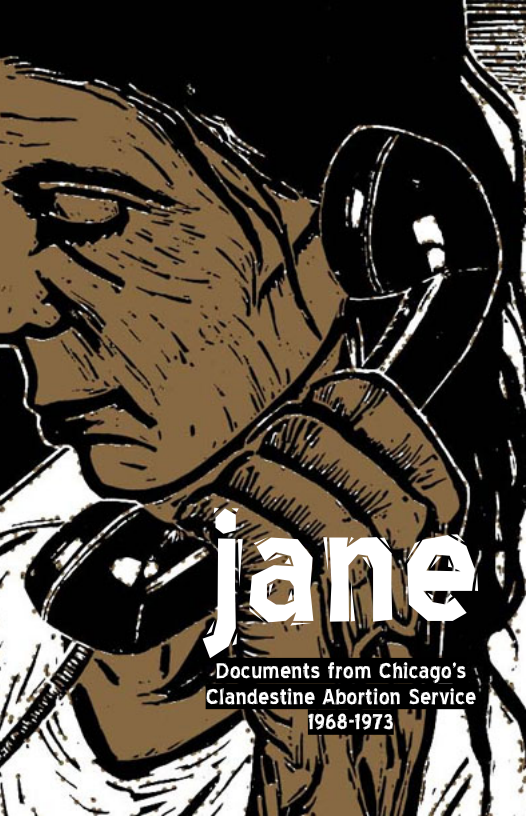
JANE: Documents from Chicago’s Clandestine Abortion Service 1968-1973
Web PDF • Imposed PDF• Raw TXT (OCR)
![was, I mean people were helpful 1o cach other by and large. Not necessarily in really big ways. One person would have an abortion and then the next person would, just ike when you go to the dentist, fand say things lke] oh you know it wasn’t that bad. People were pretty good. But not ahways... I think because we set it up in such a comfortable way, and we tried so hard to be respecful I think that that kind of attitude of respect and egaliarian or equality or whatever the word is, helps people be togeer, and bonds people. You know, I think mostly people recognized real support, you know, and the kind of warmth and acceptance, whatever it is that comes from that sorta approach and @ way of— I suppose people have different styles, I made myself so presens, that was my way of doing i, that I, you know, to make people comfortable Id make myself present in a, at least this is what I think I did, in a way that was strong and vulherable af the same time. Jane tried to find places for volunteers based on their skills and abilites. Surgal herself did not feel confident enough to perform the actual abortion procedure: I think in the beginning I was curious about the process. But because I am so strongly a helping person there was somebody whose hand had 10 be held and there I was to do it. Then actually helping a ltle bi, or actually trying to do abortions, 1 really had a lot of trouble with that. I could do the fist part. I could dilate the cerviy, I could give the shot, but I couldn’ do that aborton. 1 could do it now. But I couldn’ do it then. And now I could do it because I trust my hands. And then I didn. And I trust them now because of doing potery. Like I couldn’ make piecrusts before and now I can. I was ofiaid T would hurt somebody. If I couldn’t see what my hands were doing, how did I know? As long as I could see what I was doing I was okay, but once I’had to o inside and I couldnt see anymore, I had no confidence that I would do it right Surgal decided that her talents would better serve the group as “Big Jane,” the term that was used to describe the person who 16](jane-documents-from-chicagos-clandestine-abortion-service-19681973-firestarter-press 16.png)

![Feminist Politics and Abortion in the USA A Discussion with Judith Arcana Organised by the Birkbeck College Sociology and Poliics Society and Pro-Choice Forum, this discussion was chaired by Amanda Callaghan, Pablic Affirs Manager, BPAS at Bickbeck College of the University of London. It took place in October 1999, Pl begin by talking about what those of us who were Janes’ called ‘the Service’— though it was formally named The Abortion Counseling Service of The Chicago Women’s Liberation Union. There has been a remarkable pendulum swing since the US Supreme Courts Roe v. Wade decision in January of 1973. The social and political climate around abortion in the US is now actually worse than it was before that ruling, when the Janes were operating. This situation is what made me decide that, as a writer, I should be writing about abortion, including my work i the Service, 1o bring that part of women’s health history to people’s attention, 10 be of use, 10 stand as a witness. In this collection-in- progress [ed. note: a book called Maternal Instinct, now secking a publisher], I will also deal with abortion now, not just as memory, and not as nostalgia for what some of us did in the past. My perspective is, naturally, different from when I was a Jane. Then we were doing clinical and counseling work, providing illegal abortions, working for women’s liberation. Now, 30 vears later, T think T have a stronger focus on the ethics, morality and experience of abortion, though surely this focus is fostered and developed through my earlier clinical work, and is still strongly anchored in feninist politics. 40](jane-documents-from-chicagos-clandestine-abortion-service-19681973-firestarter-press 40.png)
![the anti-feminist mother-blamers and woman-haters have always said. In my view— obviously— that is not what is going on in abortion. If we ignore or avoid discussing the reality of abortion, then when women and girls want to think about what it means, we— the ‘good guys— have no vocabulary to do so. We are told if’s just an operation, a simple procedure, but there is no emotional content o the conversation. In the clinics and counseling offices, having an abortion s sometimes compared 10 going o a dentist. “This is a big mistake. There is no diseussion of, and no acceptance of, what is actually being done when the choice is made, when the responsibiliy to abort is accepted. Floor Do you think that is why groups like Project Rachel, which aims to counsel women afer abortion about the impact it has on their minds have been set up? Maybe they are the only people out there who are tackling this issue. J; Yes, T agree with that. T don’t know about that particular group. 1 believe that the pathologising of abortion, the creation of a Post- Abortion Syndrome— even by well-meaning psychologists— is one result of this. I think abortion belongs in the same context as assisted suicide, euthanasia, even war and domestic self-defense— all situations that require the taking of life with moral, ethical knowledge and acceptance of responsibility. Floor Post-Abortion Syndrome originated as part of an anti-abortion strategy where the movement tries to present itself as concerned with women’s health. Project Rachel is a Catholic organisation that exists 0 do that, There are a number of different counseling organisations that exist to counsel women who, they suggest, are suffering from this [so-called] Syndrome. In England we have similar organisations, which base their activities on those set up in the US— for example British Victims of Abortion, which is 54](jane-documents-from-chicagos-clandestine-abortion-service-19681973-firestarter-press 54.png)


_ -Documents from Chicago’s | ,
Clandestine Abortion Service
“11968-1973 h !
Jane was the abortion counseling service
affilisted with the Chicago Women's Liberation
Union (CWLU). Before abortion was legalized in
197: Jane members, none of whom were
physicians, performed over 11000 illegal abortions.
Their philosophy was that women had the right to
safe humane abortions and that if that wasn't
legally possible, then it was up to the women's
liberation movement to take up the slack
Jane took its medical and social responsibilities
seriously. So careful training and a humane
relationship with the women who needed abortions
were an important part of the Jane experience.
Known officially as the Abortion Counseling Service
of the Chicago Women's Liberation Union, “Jane”
was the name people would ask for when they first
made contact.
Cover design by Merrydeath Stern
Originally part of the Celebrate Peaple’s Histary poster project:
www.justseeds.org/posters/cph
o
J’ -~
Documents from Chicago’s
Clandestine Abortion Service
1968-1973
Compiled and Published 2004
by firestarter press
firestarter press
PO Box 50217
Baltimore, MD 21211
usa
firestarterpresseziplip.com
Special thanks to Judith Arcana, Jeanne Galatzer-Levy, Ruth Surgal,
the CWLU (Chicago Women’s Liberation Union) Herstary Project,
Merrydeath Stern, and justseeds.
Contents
5
Introduction
by firestarter press
Abortion: A Woman's
Decision, A Woman's Right
by the Abortion Counseling Service
Organizing a Clandestine
Abortion Service
by Ruth Surgal and the CWLU Herstory
Ccommittee
She said
- before 1973
by Judith Arcana
On the Job with Jane
by Jeanne Galatzer-Levy and the CWLU
Herstory Committee
Feminist Politics and
Abortion in the USA
A Discussion with Judith Arcana
Introduction
The following is a collection of various first-hand accounts and
documents from the underground abortion service known as Jane.
Jane operated from 1968 unil the Roe vs Wade Supreme Court
decision (the legalization of abortion) in 1973. Despite one police
bust, the group performed approximately 11,000 abortions in the
Chicago area,
While most of the writing herein documents the fabulous
history of Jane in the context of the early 19705, the final piece is a
refreshingly candid talk by Jane member, Judith Arcana, given in
1999. She places Jane in context for today’s “abortion debate” here
in the U.S and speaks 1o the present realites surrounding abortion
and right-wing resistance 1o it, while gently, but importantly,
attacking the dogmatism and rhetoric surrounding much of today’s
pro-choice movement: “We should never disregard the fact that
being pregnant means there is a baby growing inside of a woman,
a baby whose ife s ended. We ought not 1o pretend this s not
happening.”
“This pamphlet is not intended 1o be a comprehensive history of
Jane. (Such a history can be found in Laura Kapln's fantastic
book, The Story of Jane: The Legendary Underground Feminist
Abortion Service and Kate Kirtz and Nell Lundy’s documentary
film, “Jane: An Abortion Service”) This collection contains several
first-hand accounts chosen to convey the electric story of Jane. Most
importantly, Jane provides us with a taste of what is possible in
counterattacking techno-industrial society’s psychological, and, in
this case, physical, assault. The group is nor only worth uncovering
because of its (non-existent) role in the Roe vs. Wade decision. Jane
is more importantly worth examining today because of its
5
impressive display of effective self-organization and self-activity, ts
disregard for Western medicine and morals, and s indifference
toward legalization with an implict class struggle politcs.
Regardless of what historians’ analyses say, the fact is that a
group of women came together to meet the needs of other women
when the sate failed to provide any support or doctors.
Furthermore, Jane’ services intentionally did not reflect the faceless
bureaucracy of the state’s programs. It cannot be stressed enough
that instead of demanding that the state do something (legalizc),
Jane forged ahead and took what the state did not give them.
Perhaps the most wonderful thing about this self-activity was its
perpetuation of self-activity. Afier knowing nothing of the abortion
procedure, this ever-growing group of women eventually learned
the skills (of the operation and of support) and taught each other
when 1o one else would teach them. From no abortion knowledge
to multiple women performing the procedures, it was a learning
process that spread like wildfire in a climate of mutual aid.
Some liberals might say that it is not the activity of these women
that should be applauded, but it is the efforts of the women (and
men) who fought in the courts, lobbied Congress, and uliimately
swayed the Roe vs. Wade decision. But such an argument would
only support the sickening progress that follows legalization: the
further regimentation, mechanization, dehumanization, and
cooptation of women’s health. Jane functioned in direct opposition
to modern, Western medical traditions by providing abortions
outside the confines of sterile medical centers (and their patient-as-
consumer mentalty) and making the women who needed abortions
feel as much a part of the process as the members, thercby
demystifying the abortion procedure so everyone could make
intelligent decisions. “Throughout their dealings with Jane, the
women who needed abortions and their families and lovers were
supported materially, emotionally, and informationally by members
of Jane.
Jane’s implicit centrality of class stood in firm opposition t0
much of the bourgeois women’s rights movement. These women
operated (and were highly successful) in direct defiance of the state
6
and in cooperation and solidarity with those on the frontlines
absorbing its blows. By their actions, they confronted the dogmatic
liberalism of the women’s liberation movement of the time. Eleven
thousand abortions in three years. They provided their service, from
the stark details of the procedure to the nurturing support system,
to women from all walks of life. Most importantly, perhaps, were
the abortions (and support) they gave working-class women who
lacked the money to pay private doctors or mafia abortionists, or
lacked the protection and support of wealthy families. Women were
indeed on the frontlines of the class war in capitalist America,
facing both the daily exploitation of capitalist life and the daily hell
of the violence of the men around them, who lashed out aimlessly
against this same daily, capitalist exploitation.
“This incredible fragment of history is also quite timely in light
of todays gradual right-wing imposition of restriction after
restriction on abortion. The story of Jane begs us to ask: Should we
really wait for abortion to be outlawed before we take matters into
our own hands? We have seen what legalization can accomplish
(namely cooptation, leading to Westernization), so what use is it to
bat around various laws when what needs to be done is something
we can do ourselves?*
firestarter press
April 2004
*0r perhaps where work needs to be done is in the pushing towards a self-
‘managing society that renders useless this eshaustive “choice” of state-sanctioned
or dlandestne actvity.
7
Abortion: A Woman'’s Decision, A
Woman'’s Right
by the Abortion Counseling Service
This was the orginal informational brochure passed out by the ACS.
What is the Abortion Counseling Service?
We are women whose ultimate goal is the liberation of women
in society. One important way we are working toward that goal is
by helping any woman who wants an abortion to get one as safely
and cheaply as possible under existing conditions
Abortion is a safe, simple, relatively painless operation when
performed by a trained person in clean conditions. In fact, is less
complicated than a tonsillectomy. People hear about its horrors
because desperate women turn to incompetent people or resort o
unsafe methods. Much of our time is spent finding reliable and
sympathetic doctors who will perform safe abortions for as ltdle
money as possible. You will receive the best medical care we know
of
Although abortions are illegal in Illinois, the state has not
brought charges against any woman who has had an abortion.
Only those who perform abortions have been prosecuted.
Any information you give your counselor is kept confidential
She will not give your name to anyone or discuss anything you tell
her without your permission. It is vitally important that you are
completely honest about your medical history with your counselor
and the doctor.
Loan find
Because abortions are illegal and in such demand, they are
exorbitantly expensive. In fact, an abortion frequently costs as much
as the combined doctor and hospital bills for having a baby. The
ACS believes that no woman should be denied an abortion because
she is unable to pay for it. We have a small and constantly depleted
non-interest loan fund for women who would otherwise be unable
to have an abortion. It is non-profit and non-discriminatory.
“Twenty-five dollars of what you pay for an abortion goes toward
maintaining this service. If you receive money from this fund,
please repay it as promptly as you can so that the money may be
used 10 help other women. An unpaid loan may mean that we
cannot lend money to someone else who needs it desperately.
About the operation
BEFOREHAND: Confirm your pregnancy by a pregnancy test
at a medical laboratory. Try to figure out as accurately as possible
how many weeks pregnant you are. If you have any special
physical condition (like allergies or heart trouble) which would call
for special precautions, tell your counselor and the doctor about it
before the operation.
When you keep your appointment with the doctor you should
take with you a sanitary napkin and belt, not a tampax or tampon.
You may want a friend or relative to go along to go home with
you. Notify us beforehand that someone will be with you. The day
of the abortion, eat lightly and stay away from heavily spiced foods.
THE OPERATION ITSELF: An abortion is simple and takes
only a few minutes. You'll probably be given a local anesthetic.
‘The injections are relatively painless. Afier the anesthetic has taken
effect, the neck of the uterus is opened and the lining of the uterus
is scraped out with a loop-shaped instrument called a curette. The
operation s called a dilation and curettage, or a D&C.
9
Afer the operation is over the doctor may give you a shot or
plls to prevent infection and bleeding. Lie down and rest for half-
an-hour or till you feel normal. Before you leave, the doctor may
give you antibiotics or other pills and will explain their function
and use. One of the pills may be ergotrate to help the uterus
contract and prevent excessive bleeding. Feel free to ask the doctor
or us any question you may have.
AFTERWARD: If the doctor asks you to check back, it is very
important that you do so as instructed. Also call us so we know
how you are feeling and whether you are perfectly satisfied with
the doctor we sent you to. You should be examined by a
gynecologist within a few weeks after your abortion. If you like, we
can recommend a gynecologist for the post-operative examination.
You may bleed or cramp mildly for a few days or feel other
slight effects for a few weeks. On the other hand; you may have no
after-effects except slight bleeding. Physical response varies from
woman to woman. If you bleed for longer than three weeks or
pass big blood clots, call us or go to a gynecologist. Again, if you
have questions or need reassurance, please call us. Don't engage in
strenuous exercise or take tub baths for about ten days, and make
sure you move your bowels regularly. Hold off on intercourse for
at least ten days to a month, or tll you're fully healed.
You may have some emotional “blues” after your abortion.
Pardy this is because of the way we're brought up, party it is
because of hormonal changes in your body. If you want to talk this
over with someone, call us.
If you have not been using any contraceptive and would like to
start now (it beats an abortion), ask the gynecologist about it when
you go in for your check-up. Women who have been using birth
control pills should not start taking them again until afier their first
normal period has started. The pills are frequently not fool-proof
during the first month of their use. A diaphragm may no longer fit
you after you have had an abortion. If you use one, you should be
re-measured by a gynecologist to see if you need a new size.
10
Abortion as a social problem
We are giving our time not only because we want to make
abortions safer, cheaper and more accessible for the individual
women who come to us, but because we see the whole abortion
issue as a problem of society. The current abortion laws are a
symbol of the sometimes subtle, but often blatant, oppression of
women in our society
Women should have the right to control their own bodies and
lives. Only a woman who is pregnant can determine whether she
has enough resources— economic, physical and emotional— at a
given time to bear and rear a child. Yet at present the decision to
bear the child or have an abortion is taken out of her hands by
governmental bodies which can have only the slightest notion of
the problems involved.
Cultural, moral and religious feclings are largely against
abortion, and saciety does all it can to make a woman feel guilty
and degraded if she has one.
The same society that denies a woman the decision not to have
a child refuses to provide humane alternatives for women who do
have children, such as child care facilties to permit the mother 0
work, or role flexibility so that men can share in the raising of
children. ‘The same society that insists that women should and do
find their basic fulfillment in motherhood will condemn the unwed
mother and her fatherless child.
The same society that glamorizes women as sex objects and
teaches them from early childhood to please and satisfy men views
pregnancy and childbirth as punishment for “immoral® or
“careless” sexual activity, especially if the woman is uneducated,
poor or black. The same morality that says “that's what she ges for
fooling around” also fais to recognize society’s responsibility to the
often unwelcome child that results. Punitive welfare laws reflect this
view, and churches reinforce it
Our society’s version of equal opportunity means that lower-
class women bear unwanted children or face expensive, illegal and
1
often unsafe abortions, while well-connected middle-class women
can frequently get safe and hush-hush “D and Cs” in hospitals.
Only women can bring about their own liberation. It is time for
women to get together to change the male-made laws and to aid
their sisters caught in the bind of legal restrictions and social
stigma. Women must fight together t0 change the attitudes of
society about abortion and to make the state provide free abortions
as a human right
There are currently many groups lobbying for population
control, legal abortion and selective sterilization. Some are actually
attempting 1o control some populations, prevent some births— for
instance those of black people or poor people. We are opposed to
these or any form of genocide. We are for every woman having
exactly as many children as she wants, when she wants, if she
wants. I¢s time the Bill of Rights applied to women. Tis time
women got together and started really fighting for their rights.
Governments have to be made to realize that abortions are part of
the health care they must provide for the people who support
them.
If you are interested in giving your energy and time 1o help
bring about a better life for yourself and your daughters and sons,
getin touch with Jane.
(What followed were addresses and phone numbers to contact Jane.)
12
Organizing a Clandestine
Abortion Service
by Ruth Surgal and the CWLU Herstory Committee
This ardicle was developed from a 1999 interview conducted by Becky Kluchin
Soon afier her first puzzled encounter with feminist ideas, Ruth
Surgal had one of those “Ah” or “Click” experiences, when
suddenly, women’s liberation made perfect sense. Many women
had such experiences in the 1960s and 1970s. For Ruth it was
listening t0 a 1969 radio inerview with Marlene Dixon, a
University of Chicago professor who had been fired because of her
outspoken support of the women’s liberation movement.
Active in the anti-war movement, Surgal felt the need to do
something different,
I was looking for something to do because I was not willing to get
arrested in the anti-war movement. It wasn't that I dida't care about
but for whatever reason it wasn't my personal fight And I knew that
the women's movement was my personal fight and that I would be
willing 10 go o the wall for it or whatever, get arrested— not that I
did, but... T went to this house and there were different activiies, you
know, differen things that were being organized
There was the Women's Union, there probably was daycare, there
might have been some sports, a newsleter, and an abortion counseling
service. And since I was a social worker, and I knew crisis
intervention, that was of course what I would do. So it didn't come
out of a particular inerest in abortion. It came out of my work
experience
13
Jane began as a referral service, but for Surgal and the others,
dealing with the actual male abortionists was a very frustrating
experience. There were blindfolds, high prices, secret motel rooms
and the nagging feeling that women needed to be in control over
the process. Finally the Service setled on one abortionist who
seemed more flexible than the rest. Chiming to be a physician, he
became known as “Mike> Although no one questioned his
technical expertise as an abortionist, it was eventually learned that
Mike really wasn't a doctor.
When Surgal and Jody Parsons first negotiated with him:
We both went down to talk to him, because he wouldn't talk to
both of us at the same time because three made a conspiracy. So first I
went o tak to him, and I— whatever we talked about, and then Jody
went o tak to him and she got him to come down in money and she
was much tougher then I was. But they got o be really, really close
friends and they were friends for years afierwards
According to Ruth, Mike was a very complicated person:
He was a con man. I mean he truly, truly, tuly was a con man,
Back in the days of the counseling service I thought he was the sexiest
man I ever met. It was ke I could hardly stand i, I thought he was—
it was just impossible. You know, that's how I fel I just thought the
sexiest person. He was just esuding it .. He was this very odd
combination, and I think he had just never met anybody quite like
Jody certainly, there just aren't many people quite like Jody, and fike
the group as a whol.
He grew up in a very tough neighborhood where most of his
fiiends were in prison or dead. So, his expectation was that you had to
take care of yoursef because if you dida't someone would knock you
out, and you had to watch your back allthe time.
But he thought I was a traior s to speak, a stool pigeon because
1 was the person who insisted that we had 1o kt everybody know that
he wasn't a real doctor. And he was furious and he yelled and
screamed and was just beside himself and I felt bad. Then he went
back to Calfornia and called me long distance and apologized. He
was very sorry. He was a very complicated person. Very complicated.
14
While working for Jane, Mike taught people his abortion
techniques. As people learned what he knew, the blindfolds began
coming off and the prices dropped. The people he trained, trained
others, so that afier his departure Jane became an allwoman
service.
Jane’s medical techniques were very good, but Jane always felt
that technical knowledge wasn't enough. The women seeking the
abortions needed to feel that they were part of the process.
Although the modern term “empowerment” has become something
of a threadbare politician’s cliché, Jane actually took the idea
seriously
Counselors and intake personnel learned 1o listen to Jane's
clients carefully, as what was NOT said was ofien as important as
what WAS said. Women were encouraged to talk about themselves
and their lives. Peaple talked about womer’s liberation, about how
women were expected to be sexy and desirable, but then were
punished for becoming pregnant. Women were encouraged to talk
about their personal experiences with children, pregnancy and
abortion. Jane wanted to demystify the abortion experience so that
people could make intelligent decisions about what to do.
Surgal explains
It was one of the things we talked about a lot that we were not
doing something TO this woman, we were doing something WITH
this woman and she was as much a part of i, and part of the process
as we were. So that we would talk about how we relied on them if we
got busted. You know we would explain that they were not doing
anything illegal We were doing something illegal. But we need their
help, and you know don't talk about i, and we have to be quiet, and
it might be a terrible way o do things but this is what we have to do.
And people were pretty good.
Jane was a diverse group of people and styls varied:
Some people were much more poliical and could get really good
poliical discussions going. Others would just kinda sit, and there'd be
friendly conversations. You know it just really depended on who it
15
was, I mean people were helpful 1o cach other by and large. Not
necessarily in really big ways. One person would have an abortion
and then the next person would, just ike when you go to the dentist,
fand say things lke] oh you know it wasn't that bad. People were
pretty good. But not ahways... I think because we set it up in such a
comfortable way, and we tried so hard to be respecful
I think that that kind of attitude of respect and egaliarian or
equality or whatever the word is, helps people be togeer, and bonds
people. You know, I think mostly people recognized real support, you
know, and the kind of warmth and acceptance, whatever it is that
comes from that sorta approach and @ way of— I suppose people
have different styles, I made myself so presens, that was my way of
doing i, that I, you know, to make people comfortable Id make
myself present in a, at least this is what I think I did, in a way that
was strong and vulherable af the same time.
Jane tried to find places for volunteers based on their skills and
abilites. Surgal herself did not feel confident enough to perform the
actual abortion procedure:
I think in the beginning I was curious about the process. But
because I am so strongly a helping person there was somebody whose
hand had 10 be held and there I was to do it.
Then actually helping a ltle bi, or actually trying to do abortions,
1 really had a lot of trouble with that. I could do the fist part. I could
dilate the cerviy, I could give the shot, but I couldn' do that aborton.
1 could do it now. But I couldn’ do it then. And now I could do it
because I trust my hands. And then I didn. And I trust them now
because of doing potery. Like I couldn' make piecrusts before and
now I can.
I was ofiaid T would hurt somebody. If I couldn't see what my
hands were doing, how did I know? As long as I could see what I
was doing I was okay, but once I'had to o inside and I couldnt see
anymore, I had no confidence that I would do it right
Surgal decided that her talents would better serve the group as
“Big Jane,” the term that was used to describe the person who
16
actually assigned abortion counselors, scheduled abortions, and
was the members’ main source of information. She explains:
I 1ok the job of Big Jane, that was the only other seriously
powerful position. And I did it. And now, I was fortunate, or I should
say the group was fortunate. There was a person who was doing Big
Jane and she was not doing a very good job, and she was very good
at doing abortions. So I said all right we're switching, I'm going do
this and you'e going do that, and T could do that because I had the
power in the group to do it Ahough everybody was angry, but they
woulds't tell me about it because I'had the power and I could do it
You know how that goes,
Decision making within Jane could be difficult. Conditions were
stressful because of the life and death nature of the work they were
doing, the necessity for secrecy, and the knowledge that they had to
focus on the work because so many desperate women depended on
them. People had a tendency to suppress open disagreement 1o
keep the group united and task oriented. Naturally, this created its
own problems, but when 7 Jane members were unespectedly
arrested and the very existence of the group was threatened, people
continued performing abortions, even as disagreements about
strategy intensified.
Surgal especially remembers one struggle:
I remember there was this one woman who was fierce, and
extremely powerful She just was' in the leadership group. I dont
remember what we had this fight abous, but it was certainly during the
arrest. She and I had a terrible argument right about something we
were going to do. But I won. And I knew I would because I can be
5o fierce when I have to be. And so I out fierced her.
Jane soon figured out the arrests were not part of an overall
plan 1o shut down the Abortion Counseling Service, but rather the
actions of an individual police commander. Tronically, some of
Jane’s clients came from police families and the overall attitude of
the usually repressive and controlling Mayor Richard J. Daley city
administration was to unofficially ignore Jane’s activites
17
Not long after the Roe vs. Wade decision legalized abortion in
January of 1973, the case against the “Abortion 7” was quietly
dropped. Some Jane members wanted to go on, believing that
legalization did not address the issues of cost and the quality of
care. Others were burned out, or feared that because abortion was
now legally profitable, the medical establishment would have them
prosecuted for practicing medicine without a license.
Ruth Surgal hoped that Jane’s extensive experience in
performing abortions would become a model:
I was naive, I thought we had learned in the counseling service
how to deliver services in a very respecul way that made it so much
casicr on everybody, and particularly for the woman. We could go out
into the world and the medical world would take it and everybody
would then practice medicine differenty. Well, you know, of course
wasn't going o happen. I mean even in aborton clincs it didnt
‘happen, so, I was naive.
Jane closed its doors in the spring of 1973. The Abortion
Counseling Service existed in tumultuous times and no one who
went through Jane was unaffected by the intensity of the
experience
For the people who I know it was the single most intense period
of our Iife and when it stopped there was something missing. And you
couldn' find anything to do that carried quite that energy for long
time. I mean, how offen 10 get a chance to actually do something
that’s not enormously complicated and is trly helpful, you know. You
can be helpful in lots of ways, but this was really helpful because
without us they would've been in serious trouble. These were people
who couldn' offord 10 go to all the regular places, you know, for
abortion. O the places they went to they would get hurt. So what we
did was really important. Doesn't happen very ofien in a lfetime. Or
hardly at all, you know, that one gets a chance to do that
It would be all t00 easy to romanticize Jane, and make its
members hrger than life. Ruth Surgal cautions against
18
“overvaluing” the Jane experience because, “It makes it outside of
normal experience, and it isn't outside of normal experience.”
Jane members decided they had a job to do and they did it
When the job was over, Jane members moved on with their
diverse lives,
Today Ruth Surgal is sill involved with social work and is an
accomplished potter. The hands that she feared were not steady
enough to perform actual abortions, today shape clay into
exquisitely subtle forms
She is an active member of the Herstory Website Project and
patiently continues to give interviews about her participation in
Jane, exphining how she feels about it now:
Itk only ofierwards that you think about it You know, thinking
about it now I think about that, how ucky I was to have had that
experience, But at the time it was just something you did, because you
wanted to. It wasn't a big deal It didn't fecl like, oh I'm doing this
really important thing. It didn'tfeel ke that at all. It just was another
jobr to do. Afierwards it fel important... you know, and even though it
was just this litle tiny world importan, sl it had this number of
women and it was a helpful thing to do.
19
She said
- before 1973
by Judith Arcana
On the phone she said, 1 have a friend who's got a problem, but she
couldn't get 10 a phone so I'm calling for her. Do you know what
T mean? Is this the right place?
When she lay down, she said, Are you a doctor?
Then she said, Arent you afraid you'll get caught?
When we were puting in the speculum, she said, Oh, T had breakfast
before T came. T know I wasn't supposed to but I was so hungry I
just ate everything in sight, is that ok?
Later she said, 1 think I have to throw up.
Or, T have to g to the bathroom right now. Stop. T just have to go
0 the bathroom, and then I'll come right back.
O, on a diferent day, T don'tfeel s0 good, should I do it anyway?
The net week she said, Infection? T don't have any infection. Oh,
that. Thar's not really an infection. That infection’s nothing, I've
had it before, it nothing, go on, go ahead and take that baby out
Sometimes she said, Can I see it before you throw it away?
20
But another time she said, 1 don’t want to look at it, ok? When it
comes out, Tl just close my eyes, and you take it away, ok?
Once she said, What do you do with it all at the end of the day?
Boy, you people are gonna get in trouble sometime, this’s against
the law.
And when we were done she said, What if it happens again? You
know— this. Would you do me again?
She stood on the back steps outide the counselor’s apartment and said,
“This s mi prima, my cousin, from Mexico. Can you talk Spanish
t0 her? Habla un poco? Un poquito? Si, gringa! We will do this.
No, Il keep it on, 'm not hot, it's ok, Pm fine. She was wearing
her boyfiiend's basebal jacket in the kitchen. She said, Just tell me what
I have to know.
“This is my husband, Ed. He's going to sit here with me. She leaned
over, touched his arm, and said, Ed, honey, this is Julie, she’s my
counselor, the one that got assigned to me when we called the
number.
When we told her she should pay whatever she could afford, she was
quiet a minute and then said, 1 think T can get nine dollars
My father brought me here today. He's paying for this but he's
really mad at me for it. She took a hundred dollar bill out of her pocket
and said, He thinks if everybody got liberated, like with civil rights,
that thered be a lot of trouble, and he says I prove his point,
because look what happens when you just do what you want. He
says thats why we have 1o have so many laws on everybody,
because if you let peaple be free and do what they want they'l just
do evil things
21
When the sister--law was asked why she called the police, she said, I¢'s
a sin, she can't o this. She has to have it, we all have to. Jesus
doesn’t want her to get rid of this baby, thats why I did it
He doesn't like me 10 talk to my mother. Him and his mother,
they don't let me go home to visit. She put the tiny baby in her
mother’s arms and said, We sneaked 1o come for this appointment
He doesnit know I'm pregnant again. My baby is so new, I can't
have another one right away. He wouldn't even want it really, he
thinks this one makes too much noise. He doesn't like me to do
anything without his permission.
Holding her purse, wearing her gloves, the gitl clinging to her coat sleeve,
she said, You take good care of her, she don't know no better, she’s
just a baby her own self, she don't even know how this happened.
She don't know what it all about, this whole thing.
My mother told me I couldn’t keep i, she told me she'd get the
baby taken away from me right away if I had it She cried, loud
arying with snot and choking. She wiped her nose and said, She knows
I want to have it T could be a good mother, I've taken care of
babies and I know what to do. But I'm only fifteen so she'll get
them 1o take it away from me, I know she will. Thas why I'm
doing this! 'd rather not even see it!
Aeer the cervical injection, she said, How did you learn all this? Did
you read a book? Is there a book?
Every now and then, she said, How come you let us bring our
boyfriends over to your house to wait? Aren't you afraid theyll
tell? And, Jeez, who are all these little kids? Whatre you guys
doing, running a kindergarten on the side? Are those doughnuts
for us?
When we finished talking and gave her our phone numbers, she said,
22
What if it comes out alive? What should T do then? I can't have it
be alive. Should I, you know, should L..? Can I do it by myself? It
could be alive, right?
Now and then she said, Oh P'm so sick, what a mess, oh Pm so
sorry, 1 really feel fine but this just happened oh oh here it comes
again. Oh god P'm so sorry, I can't help it, 'm such a mess, oh
thank you.
She rang the bell, and when we buzzed her in she said, My girlfriends
are downstairs. They brought me over when I called you about the
cramps. Should they come back for me or can you give me a ride
home? How long will it take for it to, you know, all come out?
Another time, waiting to miscarry, she said, 'm sorry its taking so
long. P'm sure you've got other things to do, I know a lot of
women are waiting. But thank you so much, thank you for letting
me come to your house. I couldn't have done this at my house, for
sure. My parents think P at my girlfriend’s house, I just hope
they don't call to check on me, cause my girlfriend’s mother could
say something wrong and then I'd really be in trouble.
Ok, ifll take me about an hour and a half to drive home - I live
over the line in Indiana - and here’s what I'm going to do, she said
one winter weekend. My father’s a heavy sleeper, so if the cramps
come in the night while he’s sleeping he'll never hear me; Tl just
g0 in the bathroom and lock the door. Tl do it all in there. He
won't even hear the toilet flush, he never does, even when it’s just
ordinary, you know, flushing for regular reasons.
She looked at the clear plasic sheet on the mattess, the speculum and the
syringe. Then she laughed and said, You ladies somethin, doin this up
in here; you somethin, all right
Why do you do this? She looked around the small bedroom and said,
You're not rich. With what you charge, you cant be doing this for
23
the money. What's it all about? Are you a bunch of women's
libbers? Is that it?
P'm not nervous. T think you are good women. I never nervous,
maybe cuz Pm always tired. She was so tied that when the woman
beside the bed rocked her shoulder sofily to wake her up, she said, I¢s
over? P sorry, T just closed my eyes after the shot you gave me
down there. P'm sorry, but I was real tired, I had to work a double
shift and din have no time between work and here
Ohmygod, does this happen all the time? This bleeding? She
gasped and said, The blood is so dark. OOh! Iee?! Ay! Make it stop!
“This ice tray is t00 cold! Ohmygod! You better not be scared, I'm
the one scared, not you. Orange juice, are you kidding? Ay, what
if 1 faint? I know people faint when they lose blood. Can you still
do me? Did you finish?
She leaned over to the woman driving and quietly said, My daughter’s
in Children’s Memorial, she’s only two, she’s having an operation
on her stomach valve today - it doesn’t work right, since she was
born. My husband’s over there, with her, for that, while P here,
for this. Could I leave right afier Pm done? Could you take me
back right away, so I don't wait til everybody is done? Would that
be ok? Would the other women mind, do you think?
She gulped some water in the kitchen and said, Oh thank you, you'll
never know what this means to me, thank you so much. T can't
thank you enough, P'm sure. T know some people say its wrong,
abortion, that you shouldn’t take a life. And maybe you did take a
life. But ifs all give and take, st it? My mother always said that
everything always comes down to give and take. So the baby,
today, that was the taking - and me, me, my own lfe, T think that
was the giving,
First published in CALYY, Witer, 1998, 17:3
© Judith Arcana. Do not copy or reproduce without permission.
24
On the Job with Jane
by Jeanne Galatzer-Levy and the CWLU Herstory Committee
This ardicle was developed from a 1999 interview conducted by Becky Kluchin
“ was really adrifi, but I wanted to do
something, and it seemed to me that if you
were going pick something in terms of women
and politis the front lines was abortion
because women were dying and that was real”
~Former Jane volunteer Jeanne Galatzer-Levy
Jeanne Galatzer-Levy joins Jane
Twenty-year-old Jeannne Galatzer-Levy’s introduction o the
Abortion Counseling Service came at a meeting in Hyde Park. It
was a rocky start. She had brought a friend named Sheila with her,
which unbeknownst 10 her, violated Jane’s security protocol
because Sheila had not been specificaly invited. Afier some pointed
discussion, Sheila was allowed 1o stay, but the incident illustrated
the everyday stresses of working in a clandestine abortion network.
Jeanne’s first meeting was especially tense, because a young
woman who had come 1o Jane had recently died. She had wanted
an abortion, but had such a dangerous infection that she had been
urged to check into a hospital immediately. Jane attempted to
follow up her case, but it took several days to determine that she
had died in the hospital
25
‘There had been a police investigation. Although the detectives
were sympathetic to Jane and did not think that the Service was
responsible for the woman’s death, some members had left the
group over the incident. It was a difficult soul searching fime for
those who remained.
By the time Jeanne Galatzer-Levy joined up, Jane members
were performing the actual abortions themselves, based on the
techniques they had learned from “Mike,” the male abortionist with
whom they had formed an ofien contradictory, but very close
relationship.
Jeanne remembers her first orientation,
It was a very large meeting, there must have been 30-35 people, all
in the living room that was probably the size of my dining room, you
know a big living room, a big old Hyde Park apartment, but sil,
lot of women and we'e allsiting on the floor and a few in the chairs
i the back that had been pushed to the wall. Then we were kinda told
what the Service was. And you know it was pretty straight forward, I
think. They pretty much told us everything except they were doing it
themschyes
They told us they weren't using doctors anymore, and the history
of that My fiiend Sheila who was so much more perceptive than me,
figured out immediately that they were doing it themselves and who it
was that was doing it Sheilas very sharp. But I was compleely
oblivious. And we joined
And that was how we started. And I was paired— we got big
sisters— and what we did then was, at the end of a meeting they
actually brought out the cards and passed them around and people
took cards, but not us, we didn'ttake cards. Then I met with Benita in
her apartment a couple of times and just went through what we were
gonna do and what not, and then she set up a counseling session and
T actually satin on it
The cards that Jeanne Galatzer-Levy is referring to were the
index cards Jane used to assign abortion clients to the Jane
volunteers. Cards were passed around at meetings. People tended
1o want the “easy” cases and the “difficule” cards usually ended up
26
being dealt last. Short-term abortions were usually easier cases, so
volunteers would start out on them. Long term abortions were
more complicated and so demanded more counseling experience.
Galatzer explains,
The cards would go around, and everyone would grab you know,
the one who lived in Hyde Park and was twenty years old and was
three weeks since the lust period, because, it was obviously gonna be
better. And then there would be the woman in Long Grove who it
had taken two months for her to find us, and she would go around
and finally someone would say, we've gotta get rid of this woman,
and someone would volunteer and take i, and I think some people
learned long term counseling by saying I've never done one but I'l do
it if you help me.
Jane always tried to do follow up afier an abortion was
performed, but the results varied considerably:
I mean some people you really got o know and you really had
these wonderful relationships with, and some people you just felt there
were these huge walls around them and there were walls around you
You just touched at this one point and you helped them and you know
that was it, and you knew that you were never gonna sce them again.
“That the one thing in the world they wanted 1o do was 10 forget that
this had ever happened.
According to Galatzer, the people who had shortterm abortions
were most likely to disappear, as the procedure was less prone o
complications. With long-term abortions, follow-up was a necessity:
The long-terms, you induced an abortion, you induced a
miscarriage. You had to follow up. It was very important to find out
what happened because what we did originall, there was a period
when we had Leunbach paste and all these other things, but originally
what we did was we broke the bag of water, and they pushed out a
much of the amiotic fluid as they could, and the fetus would die, and
then they would go into a miscarriage. But things can go wrong with
that
27
One, you compromise the integrity of the uterus, so there’s a real
‘possibilty of infection, which there is with any natural miscarriage too.
You could've missed and the baby could live, it could stil live, and
then you'd have o do it again. The body might not go into a
‘miscarriage, and then there'd be dead mater in the uterus— mostly it
worked very well, but there were a lot of things that could go wrong,
and 5o it was very important to find ou, to follow them, 10 find out
whether they'd gone into a miscarriage, and then find out what
happened
Once they were in a miscarriage they were urged 10 go 1o the
hospital or emergency room and then say they were in a miscarriage
and deny having done anything. If they did it on their own, which
some people did, they needed to have a follow up D and C, to do that
because you can' leave anything hanging around in there, nothing. So
you did have o really follow them. It was a very diferent kind of
thing. And you had to, it was kinda hard because you really had to
establish that relatonship. You couldn' et them slide because you
couldnt pretend that it wasn't happening the way you could let
somebody get away with that who was eight weeks pregnant and it
was gonna be something they'd deal with a lot later. It was a diferent
situation,
New volunteers usually started out working at the “Front”
which is what Jane called the apartment they used as a reception
area. The abortions were performed at another apartment called,
“The Place.” Women were encouraged to bring along people for
emotional support, so the “Fronts” became a gathering place where
men, women and children could all be found.
Jane volunteers who worked the “Front,” kept everything on
schedule, gave out information and reassurance, - inventoried
supplies and served food and drinks. One Jane volunteer
remembers that food was one of the few things that Jane ever really
splurged on. Drivers would take a few women at a time from the
“Front” to the “Place” and then back again when the abortions
were done.
Jeanne Galatzer-Levy describes starting out at the “Front
28
Everybody was expected to work the Front, and it was a really long
day, and it was hard. People would come and their significant others
of some sort or another, their sisers or aunts or cousins or boyfriends
or whatever would come, and we were very woman centered. We had
all this food at the Front. We aways had all this food and tea and
soda and things like that. And we gave out— we started them on a
dose of tetracycline. And gave them a box of pill that included
ergotrate and tetracycline. They took these afierwards, to contract the
uterus and help them get back into shape.
You would talk to people. They'd be nervous and then the people
who were going for the abortons would be driven off and their
significant cousins, brothers, sistrs, children whatever would dhen be
sittng there. And so you would have to kinda entertain them. And you
know, I was a fairly shy person and it was hard, you know it’s kinda
hard to be conducive o strangers in this very peculiar circumstance. I
was very young, and you were giving a kind of tea party all day long,
and you really were kinda out of the loop, you really dida't know
exactly what was going on. So first you did that. And I did that for a
while: And then there was the driver and I moved very quickly into
driving because I was one of the few people who had a driver’s
license. Lots of people didn't have their license. Well U of C at the
time was full of New Yorkers and New Yorkers don' drive, ke I was
one of the people who helped teach Sheila how to drive.
Afier abortion became legal in New York, women with more
money could hop on a plane and have the procedure done legally,
s0 Jane’s clientele became poorer. Jeanne Galatzer-Levy was
treasurer at that point and describes Jane’s finances,
Our population became much poorer and we charged, at that
point one hundred dollars and we took anything— we lierally took
nothing. We asked that they give us something. But ofen they did',
you know. We were averaging about fiy bucks. I was by then the
treasurer and we were averaging about fifty bucks which we figured
we could do, we had figured out that whatever we charged we ended
up with about half that
29
I think carlier on, when we were using Mike’ we had to actually
have the money and then he'd give us a few free ones. People have
wonderful stories about getting people’s coin jars. I never got that as a
driver, but I did get a lot of singles. And 1, the driver would pick
people up, drive around a lide bif then go off onto a side street, park
the car and ask for the money. People would hand me the money and
1 would take it and then I would shove it into my pocket. I never
counted it. And I don't think anybody ever counted it
S0 you know, I didn't know what people handed me and I didn’t
care. And sometimes they would say when they handed me, I dont
have all this, and I would say it doesn't matter. S0 we did have some
really broke women, and for some of them, 1 mean they'd been lied to
by their boyriends, they'd been lied to by everybody and they had
never really asserted themselves in any way, shape or form, and this
was their decision not to be in this position, not o have a baby, not to
get stuck again. And they were really flving. They would be really
excited you know? We were real sunny and happy; so you know, they
allowed themselves to be.
On May 3, 1972 Jeanne Galawzer was working the “Front,>
caring for three children that had been left by one of the women
who was getting her abortion at the “Place.” What Jeanne didn't
know was that the police were already raiding the South Shore
apartment that was serving as the “Place.” Ruth Surgal had just
dropped off some snacks at the “Front” and when Galatzer heard a
knock on the door, she assumed Ruth had forgotten something. It
was't Surgal, but a large beefy Chicago detective. Jane was being
busted at both locations,
The Abortion 7 Bust
“We were terrified. We were looking at like one hundred ten years,
one to ten each count. Tt was very impressive.”
Jeanne Galatzer-Levy
30
Jeanne recalls what happened when she heard the knock at the
door:
I was at the Front which was an apartment in Hyde Park. It was a
nice apartment. It was a ground floor, and it had this long, long
halhway; and we were way at the back of this buiding. Ruth had been
over, dropping off food or something, and there were a bunch of
people there, and I had been talking to them. It turns out that I had o
long, very sincere talk with the woman who had turned us in, which
really pissed me of later. I didnt know, I mean of course I didn’t
know: But she was having ambivalent feelings about it so I was really
very helpful. Later I wanted to kil her T was so pissed off
T opened the door and there were the tallet men I had ever seen in
my By, in these suits, and you knew immediately what this was. I
don't know if I said anything or if they said anything.
I think they announced they were the police, and I turned around
and walked in front of them and said, “These are the police. You don't
have 1o tell therm anything” And they were really irrtated. That was
how they decided to arrest me, because I'd opened the door, and you
know it was perfecly obvious to me— I'm a control fieak you kniow,
and I think I took charge the way people do.
They were really tall Really weird. I developed this whoe theory. I
love crackpot theories. 1 intend to be a crackpot when I grow up. My
theory is that you had 1o be really tall o be a homicide cop. These
were homicide cops, because abortion was a homicide. And they were
homicide cops who hated being there. You know it not easy to make
homicide detective. You really have to be good. It’ not even poliical
ke taking the sergeants exam. You really have o do something, and
they do it because they want to. And by and large what do is they
track down people who kill other people. And they think of themselves
as good guys and they hated being there. This was not their kind of
crime. So they were very ambivalent about it They were very funny.
So we were taken, I was taken, the whole group of us were taken
down to the station. I wasn' handcufed, I don't think. I was treated
very nicel, except that I was in a state of perfect terror
They took everybody. We were dealing with a very poor
‘population, 50 if a woman was on her second pregnancy and she had
31
a two year old, she had nobody o leave that two year old with, We
would beg peopl, if you're gonna bring your two year old, bring
your sister o watch the two year old But we had children running
around, aunts, cousins, uncles, fiiends, a random bunch of people.
There were men at the Front and they took them t0o. I don't think
there were a lot of men, but there were a couple. You know I think
they were teenagers, very young men. And they tried to sort us all ou,
and then they interviewed cach of us. They asked us questions, and we
said— you know we were really middle class sawy people, and we all
said, “T don't have to answer that.” And basicall, at the end of the
day I think that they picked who they arrested on the basis of the ones
who said, “I don have to answer that” You know, because
everybody else was talking
Actually some of the women just wouldn't say anything. But when
we hired Joanne, the attorney who defended us and she got the
paperwork, she said, “You're the best cients I ever had, people talk to
the police all the time and you quys didn's I love you.” We knew we
didn't have to talk to the police and we didn’.
They asked us, “How much do you charge?” We said, “Well how
much do they say we charged?” And they would go crazy because
they'd ask the women, “Well what did you pay?” And somebody'd say
twenty bucks and somebody'd say one hundred bucks, and it didnt
make any sense at all There was usually this huge wad of cash in
illegal abortion busts and the women would come in and say, “I paid
five hundred dollars.” When we got busted, there was a wad of cash,
but it was all singles, and these women were saying, "Oh, I paid ten
dollrs."
We were very self-aware I think, and there were all kinds of class
and race things going on with the police. They fet more like us then
ke the women they were supposedly protecting fiom us, and they
kinda wanted that rlationship. So that was bizarre,just bizarre.
Martha was in the middle of her period, and she needed a tampon,
she'd been asking everybody and was getting nowhere, and a woman
policemen walked by and Martha just spontancously jumped out and
called 10 her. Perps can't act like that. It was really scary because it
made us realize, you know, who were the arrested. What was a very
32
natural act for her, was really inappropriate i that stuation. It was very
scar
We weren't questioned at the 1ith and State lockup, we were
questioned at wherever the hell it is, the local. And then we were put
in paddy wagons— which are really unpleasani— and driven to 11th
and State, and the drive in the paddy wagon was a riot. It was all
women and of course everybody else who was arrested was a hooker,
because that's al they artested women for then. And one woman w
Jjust giving hilarious storics, regaling us with stories of the street. It was
really quite funny: And then we were in the women's lockup at 1ith
and State.
We were a big group. People said to me afierwards, “Weren' you
scared?” But once we were together as a group I wasn' scared again.
But it was very unpleasant, a very unpleasant experience. You just
don't have choices. It very strange; it just not the way Ife is. Very
unpleasant, But we were together, and we were a group, and we
figured something would happen. One of the women who w
artested had a husband who was @ lawyer. And he had managed to
communicate 10 her. People were calling for us. We'd each made a
phone call I guess. We knew that things were happening, and that
they were going 10 pay the bail, and then there was the question of
whether they could get us out that night or whether we'd have to wait
until the morning
Later into the evening, they put us into double cell, but we were
in a row so we could talk t0 cach other. I was put into a cell with
Judy who was nursing at the time and they managed to get her out
because she was nursing. She really wanted t0 get ou, she really did
Her son really needed her 10 get out and her husband really needed
her to get out too. If she got out on her own recognizance, that would
lower the bail on all of us.
S0 they got her out on her own recognizance that night, a night
court, so then I spent the actual night alone. But it was next door 1o
other people. It was very unpleasant. In the morning, they gave us
bologna sandwiches, which I couldn' eat, and coffe. It was awfil,
but that was breakfust at Cook County Jail Then they loaded us
again, and we went to 25th and Calfornia, and we went into the
33
women's lockup there, I guess it couldve have gotten much worse
because women now are much more commonly arrested for al sorts
of wondeful things. But at the time, many, many fewer women were
arrested. The men’s lockup was horrible at 25th and Calfornia, I'm
told, but the women's lock up was prety small and we were a pretty
large group. Then we were called in fiont of the judge who was very
nasty, but who ket us out on bail o the arms of our waiting whatevers.
I called my mom and told her that my name was going 1o be in
the paper, and she hadn't seen it I don't think it had occurred to her
0 scroll down and look for my name. And she was very upset. She
wanted me to promise that Id “never do anything like that again,”
and it was very nice but, I understand that you believe in this but
you'l never do this again will you? You have to be careful” and all
the things that mothers say.
I now appreciate that more than I did then She was very
frightened, and she didn't like it, and we had a conversation about
that. But I wasn't living at home and that was that. And honestly my
closest friends were in Jane, so the question of how I dealt with it was
really in the context of those people, not in any other context
Afer the Bust
Eventually the “Abortion 7” as they came to be called, were
charged with eleven counts of abortion and conspiracy to commit
abortion. According 1o Galatzer, the remaining members of the
Service who had not been arrested distanced themselves from the
Abortion 7. Galatzer herself is unsure why this happened.
According to Laura Kaplan, who wrote The Story of Jane, part
of the reason was the fear that since the police would be watching
the “Abortion 7” people, their continued association could
endanger the work of the Service. Some members wanted to shut
down the Service, but the leadership insisted on continuing. There
were desperate women out there and they needed abortions.
Whatever the reasons, Jeanne Galatzer-Levy found the distancing
painful and upsetting,
Jeanne recalls:
34
We were terrifid. We were looking at like one hundred en years,
one 1o ten each count. It was very impressive. We were terified and
we all quit the Service, in fuct the group withdrew fiom us and
reconstinuted and did their own thing. It was ke they really didn’t
want to be contaminated, which was abso very; very upseting for us.
Though luckil for me, my friends were in the group who got arrested.
We became a group, and the firs thing we had o do was meet
together and ry to deal with the fact that we were in big trouble. We
really tred to talk 1o each other, and that was difficult. We were a very
disparate group. You could not have done a better job of getting us
swiped across the demographics. You really couldn't have. We went
fiom Abby who's really, extraordinarily bourgeois. She and her
husband were living out in Downers Grove, which is an affuent
suburb of Chicago and she was o New York intelectual poliical
person who had sought us out as a politcal thing and was reall very,
sorta old eft kinda thing, but very bourgeois.
And then there was me at the other end— and Diane, Diane and I
were both dropouts so that was the demographics. It went from one
end 1o the other. Sheila was gonna start her senior year. Martha and
then Madeline were housewives with children,-voung children. Judy
had just had her first child: she had been a high school teacher. I think
she had just retired, or taken a year off
Madeline who was very involved with NOW, and very involved
with much more mainstream kinds of things, had also been very
involved in La Leche League. Martha and Madeline had both been
involved in La Leche League carly on because they'd nursed. They
nursed when nobody did, you know, a million years ago. I don' think
we were endorsed by La Leche League, but you know, they're great
people. And in some ways, we had trouble becoming a group, and in
some ways we never did. But we did have a common interest, and the
first thing we did was we interviewed lawyers, and that was really fin
1 mean, everything we did was fun, we just had a good time because,
we're just who we are.
We'd go downtown we'd all get qussied up, and it really was a
matter of qussving up because frankly we all looked like that scene
from The Snapper. Its an Irish movie, one of the rowdy “down home
35
on the soil” movies. The teenage daughter becomes pregnant, o i’s this
whole thing of who did it to his daughter you know. She’s the oldest
child of this large family. In the end, she has the baby and they all go
0 sce her and the whole family dresses up right, meaning the father
puts on a suit and the mother puts on a kind of a nice dress, and the
litle girl puts on her baton twirling oufit because that’s the nicest
thing she’s got and the ltl boy’s gor a superman shirt. And I thought
that’s exactly the way my family always gets dressed up. I loved it
because it looked like my family:
Well, when we went to interview the lawyers, we looked the same
way... we'd all get gussied up. But except for Abby, we were clueless
as to how 10 do that. We didn't have those kinds of clothes anyways,
except for Abby of course. So we'd get all gussied up and we'd go
down and we'd interview somebody. It was a very high profie case,
and defense lawyers really like big high profile cases because they get
their names in the newspaper and any publiciy’s good publicit,
believe me.
Defense lawyers as a group, and I say this knowing one of my
closest friends is a defense lawyer and is actually very, very good, are a
slimy bunch. There’s a lot of money in it, and you deal with some
prety sick people, and some of these people are really pretty crecpy.
So wed meet people who were really creepy:
One guy, I can' remember his name, a very big guy at the time,
had this office, this huge room with a huge desk in the corner of his
offce, and it was a gleaming mahogany desk, and you know he's got
this couch area. The frst thing out of his mouth was, “You know you
could be in trouble with the taxes.” Because you know it was clear we
carned money. But this had not occurred to us at all, you know, boy
that was the st hing we were worried abou. e said, “Not him. No
way.”
So we'd interview various people then we'd all go out to funch,
And that was all I was doing at the time. And it was pretty much all
Sheila was doing at the time. She was rying to finish school, which
she did, stretching through that summer. And she wasn' sure what she
was gonna do or— it was very up in the air. Some of us had things
that don' go away ke Martha's kids— they didn' disappear for the
36
event. So she'd get up every morning and take care of the kids while all
this was going on.
S0 we interviewed people and we ended up with Joanne who was
a gasp. She was just a gasp. She really had this sorta hard as nails
persona, and she was just a riot. She had been an elephant girl in the
cireus. She was great. She'd run off and joined the circus you know, a
really neresting person. And she really wanted the case, because she
was a woman and she thought a woman should handle the case, and
we always thought that too. There were a lot fewer women lawyers
then, it was a lot bigger deal And we liked her. She was the only one
who really spoke to us poliically.
Well actuall, we did tak to a law classics guy, who, I think, was
from Northwestern’s legal department. He was very political And he
scared the shit out of us because he was much more interested in the
poliical aspect of it than what happened to us. And the last thing any
of us wanted t0 do was to spend any more time in jal ever, and be
martyrs. And we did run into people who had weird ideas about what
we could mean to them. That was very strange. We just all quickly
agreed that we had no interest i that. We had 1o interest in i being @
poliical statement, we just wanted it to go away. What we were doing
was a polical statement, but going to jail was not one we wanted and
it wouldn't help anybod:
Through most of the first three or four months nobody in the
Seven went back to work for the Service. And then Diane came in to a
meeting and said, “I'm going back to work... this is really what I
want to do, I really care about i, I was just on the verge of being
trained and I really wanna do that, and I'm going back” And then
Martha went back and I went back, and then Madeline went back
Abby did not, and hated it that we did Sheila didn because she
wanted to get on with her If; she was going back to school and
thinking about what she wanted t0 do. I don't think Judy went back to
work, and I don' remember why.
Why did I make that choice? Well its very interesting. I was
twenty-one when we got arrested, and quite frankly it had never
occurred to me that we could get arrested. And probably, it had never
ocaurred 10 me that choices had consequences, that actons have
37
consequences. There’s nothing like a night in Cook Country Jail to make
you realize that actions have consequences. It was an enormous
growth experience for me. In a way I was really sorta shaken out of
my litle cocoon of being a kid. I really realized that what I did made
a difference, and could have real consequences and I had to really
think through this decision. When I talked through why I was doing
this, I wanted to be doing it stll Which made me feel real good about
having done it in the first place, and I decided wel if this is what I
want do then I should do it Its sorta a civil disobedience argument.
The level of scriousness changed enormously. I was blithe about i
clearly I thought it was importan, and I wanted to do i, and I was
really having a lot of fun doing it, it was really rewarding. But
dfierwards I realized that I had made a very serious choice and if
was going to do this, I could get into really serious trouble. And I was
gonna do it anyway.
The End of Jane
Joanne, the Abortion 7s lawyer, pursued a strategy of delay.
She knew the Supreme Court was going to rule on the Roe vs.
Wade case, a major abortion test case. If the Court ruled in favor
of abortion rights, then it would be easier to get the defendans off,
or at least cut a better deal.
Jeanne Galatzer-Levy explains how it all ended:
Once we had hired Joanne, basically what she said was, “All wee
going to do now, from now on, is delay this until the Roe vs. Wade
decision comes down because nobody wants to. prosecute you
knowing that this s happening. They don't wanna waste the moncy;
5o they're gonna allow us to wait” So we just ditled around. We had
periodic court appearances, in which again we'd get al gussied up and
we'd go down and have lunch afir the court thing. And we just were
waiting, and we knew it was coming.
Some of us had gone back to work, some of us hadn't and we
were just waiting. Then the decision came down and I don' remember
where I was standing when I heard this decided, I just remember that
we all called cach other and people called me. We got together and
38
you know we were thrilled of course, we were real excited and happy;
and you know, it was like everything else, you know you get into the
court system and everything up, the arret is so dramatic and exciting,
horrifiing and all those things, and then everything past that is so
boring, and slow and very different kind of time frame and very
different emotional thing. It very surreal. And disconnected i @ way
that the arrest is so immediate. So basically she said we'll all go in and
we'l see, and Il talk 1o the prosecutor and sce what theyl do
Obviously they're not gonna prosecute youat this point, but there are
isues involved. So she went in and they cut a deal, They dismissed
everything, and they didn' hit us with pracicing medicine without a
license which they couldve, in exchange for us not asking for our
instruments back. We said oka, sure
The Abortion Counseling Service sort of ground 10 a hal I think
we did two more weeks. Then we had a party and it was all over.
39
Feminist Politics and Abortion in
the USA
A Discussion with Judith Arcana
Organised by the Birkbeck College Sociology and Poliics Society and Pro-Choice
Forum, this discussion was chaired by Amanda Callaghan, Pablic Affirs Manager,
BPAS at Bickbeck College of the University of London. It took place in October 1999,
Pl begin by talking about what those of us who were Janes’
called ‘the Service'— though it was formally named The Abortion
Counseling Service of The Chicago Women’s Liberation Union.
There has been a remarkable pendulum swing since the US
Supreme Courts Roe v. Wade decision in January of 1973. The
social and political climate around abortion in the US is now
actually worse than it was before that ruling, when the Janes were
operating. This situation is what made me decide that, as a writer, I
should be writing about abortion, including my work i the
Service, 1o bring that part of women’s health history to people’s
attention, 10 be of use, 10 stand as a witness. In this collection-in-
progress [ed. note: a book called Maternal Instinct, now secking a
publisher], I will also deal with abortion now, not just as memory,
and not as nostalgia for what some of us did in the past. My
perspective is, naturally, different from when I was a Jane. Then we
were doing clinical and counseling work, providing illegal
abortions, working for women’s liberation. Now, 30 vears later, T
think T have a stronger focus on the ethics, morality and experience
of abortion, though surely this focus is fostered and developed
through my earlier clinical work, and is still strongly anchored in
feninist politics.
40
I was in my late 205 when I joined The Service. Its history is
four or five years long, depending on when you start telling the
story; 1 was a member for two years. In the mid 60s in the US, the
UK and Europe as you no doubt know, there was a great deal of
ferment within and among liberation movements; in particular in
the States, there was a burgeoning anti-war movement and the
beginnings of women’s movement, the relatively more-established
civil rights movement, and organizing/action starting to appear
among students. Out of that polifical context, as well as through the
social/medical history of abortion and the history of medical
practice(s), the work of the Janes was generated.
In 1968, a college student in Chicago, a young woman who
had gone South for ‘Mississippi Summer’ 1o work on voter
registration and in Freedom Schools, got a phone call from a
friend, who said that his sister was pregnant, frantic, and didn't
know what o do. This young woman was able to find someone
who would do the abortion, despite the fact that it was illegal.
Once word got around that she knew how/where to find an
abortionist, peaple kept on calling her. Using the pseudonym Jane,
short for Jane Doe, she began to keep a list of abortionists and
reports on their practice; she gave out the phone numbers of those
who were reported to be competent
The number of people calling her grew and grew, and she
reached a point where she could not deal with demand on her
own. So she called a meeting, and a small group of women came
together. First, the group just had a list of those in the city who
performed abortions. As far as they knew, these people were
reliable. As far as they knew, no one on the list had ‘botched
abortions, they did not ‘come on’ 1o the women they saw, and
some of them could be bargained with about money (abortion was
very expensive, with prices ranging between $500 and $2000).
Soon the referral service evolved into a counseling service and,
eventually, into a traveling underground clinic— and this, you
understand, was criminal activity. Women joined the Service
through periodic orientation meetings, and learned the necessary
tasks from those who had come before them. Once their
41
counseling skills had been developed in new recruits, and the
group had come 1o trust them, they could learn more— doing
everything from basic record keeping to becoming a medic, one
who performed abortions.
Ultimately, we learned to do abortions in all three trimesters.
Although we did only a handful in the third, as you may imagine,
there were many in the second, no doubt because illegality forced
women and girls to take so much time searching for abortionists
and saving up money. The methods that we learned, we primarily
learned from one man. He was not a doctor, but he was the best
Once we understood that many of the people doing abortions at
that time were not doctors, we realized that we could do it too.
‘This would mean women would not have to be charged a lot of
money, could even come through the Service free.
S0 we pressed this man to teach us, as he had been taught. He
was an estraordinary man in many ways, had been doing this
work, and maybe other illegal work, virtually all of his life. Its
important 1o note that anything illegal will ultimately generate
payments o the mob, so almost all the city abortionists were giving
them a cut, as well as paying off the police. Our man, because he
didn't live in Chicago, was always ‘on the run,’ avoiding both the
police and the mob. He liked us because we would pick him up at
the airport, take him to one of our houses, and bring him work.
You could say he was our ‘kept abortionist— and we were his
main source of work!
We would bargain at the beginning, maybe urging him to do
six abortions for the price he usually charged, and then two or
three for free. Abortionists were charging between $500 and $2000
over 30 years ago. Hardly anyone had that kind of money; the rich
have always been able to get abortions of course, but certainly not
most people. So we tried 10 get the price down as much as we
could. “Our’ abortionist liked us, thought we were cool (which we
werel), and we liked him, so it was a good arrangement all around.
He eventually taught one of us, and then let others watch.
Eventually, the one he had taught then taught others. We did
not have 1o send women to anyone else anymore, unless there was
42
a situation we felt we could not handle. (For example, some of
the people who came to us had already tried to abort in various
ways, and we could not take on people with the resultant
complications.) We were operating out of various apartments. We
packed up our equipment and used different places around the city.
S0 we could not deal with difficult cases. But all the other abortions
women needed, we did ourselves.
1 first heard about the Service when in 1970 T thought I was
pregnant. As it turned out, that time I was not, but I had made the
phone calls, had been given the number and told to call and ask for
Jane. When I realized T was not pregnant, I called to say I could be
taken off the list. The woman I had spoken to— at some length,
both times— said she thought 1 sounded interested in what the
Janes were doing, and would I like to join up? In the Fall of 1970
1 did that, and remained a member unl the fall of 1972
In those two years, 1 had two unusual experiences for a Jane
First, T had a baby— on purpose— as did another Jane. Our
pregnancies led to major policy discussions about whether pregnant
women should keep working with the Service. Other pregnant
women previously had decided not to, but we wanted to stay, and
the group decided this was a good idea. We essentially subscribed
10 the idea that women should have babies when they want them
and abortions when they need them. We conceptualized this as a
sort of motherhood continuum.
Second, I was one of the people arrested when we were busted.
It is very important to understand that the political climate in those
days was incredibly positive, both in the country at large and in
Chicago. T do not mean everywhere and everyone, but there was a
general climate which supported positive change: hence Roe v
Wade and other landmark events of that period. Chicago was (still
is) a heavily Catholic city, but even in that circumstance, nobody
messed with us! Everybody seemed to know what we were doing;
Police department employees came to us, police officers’ wives,
daughters and mistresses came to us. Politcians’ wives, daughters
and mistresses came 1o us (no local politcians were women in
those days, and virtually no police officers cither).
43
Our abortion service was an open secret. In those days, like
smoking dope, prostitution and many other illegal activites,
abortion was known about and accepted. The bust, therefore, may
have been something of an accident. It is also true that in that
period, the anti-abortion movement (much, much smaller than it is
now of course) was aware that a case would be coming soon in
the US Supreme Court— the tide was moving, nationally,
inexorably, in that direction, so it is not impossible that our arrest
was part of the atempt to stop abortion from becoming legal.
We generally operated in neighborhoods where many local folks
knew us. But a sister-in-law of 2 woman who was coming through
the Service, who knew the address for that one day (in carly May
of 1972), was a devout Catholic; she called the police in her own
neighborhood— which was not a district where we generally
worked. Abortion was classified a5 homicide, so they sent the
Homicide Squad. Those men apparently didn’t know anything
about us. Seven women were working that day, including me. We
were all taken down to the station, as were all the women waiting,
the men waiting with them, and the children too. There were about
45 people in all, from two apartments, the front’ where people first
came, and the ‘place,” where we did the abortions. Eventually the
police arrested the seven of us. Uliimately the case was dropped,
however, since none of the women who were there that day
wanted t0 testify against us, and the case stalled on untl the
Supreme Courts Roe decision in January of 1973,
T understand that you are interested in current abortion events in
the United States, so Il talk a bit about that now. Almost
immediately after the Courts decision, more anti-abortion groups
sprang up and organising increased almost exponentially. They
were very clever in their approach, having learned a lot from
progressive movements, especially the Civil Rights movement.
Their tactics were drawn directly from mostly lefist, radical
movement groups, and those tactics worked just as well for this
few, reactionary movement. Their carliest successes were with State
legislatures. Within 6-8 years after 1973, several states passed laws,
which disallowed abortion for various reasons, or were on their
44
way to doing so. Examples of negation or stalling tactics include
requiring parental consent for minors, or gestational limits on
abortion, or waiting periods once pregnancy has been verified and
the decision has been made to abort
How did this change come about, and why did the political
climate change so fast? There are four points to note: The first is
what I call the rise of ‘the bad guys.’ This is the anti-abortion
movement, both those who are overtly religious, and those who
are not. The majority in that movement are religion-driven. Both
the Roman Catholic Church and the Mormon Church are
significant in the ongoing structure and action of that movement,
and both appear to be possessed of virtually unlimited funds. So
the anti-abortion movement has major league money, some might
say enough to buy whole state legislatures, as well as 1o be effective
in ways other than simply buying votes and lobbying— like
mobilizing its proponents 1o inundate merchants or media. that
appear to support women’s reproductive rights.
Second, there is the power of the media. Primarily this is
television, and to a lesser extent radio, and to a much lesser extent
film. For reasons we can only speculate about, the ant-abortion
movement has been perceived, and continues to be perceived in the
US, as news. Everything they do is news, and because of the
power of their organizing and money, they have had an enormous
effect, editorially, on the media over the past two decades.
“Third, there is science, the technology of pregnancy. People can
now make fetuses live, keep them alive outside of a woman’s body,
from far earlier in pregnancy than was ever imagined by us, thirty
years ago. Rapid changes in medical technology have changed
pregnancy utterly. We can now watch babies growing, virtually
from the beginning of pregnancy, throughout their development;
one result of this is that women relate to their fetuses quite
differently, even in the carly weeks of fetal development (which is,
ideally, when abortions should be performed).
Fourth, there is the important central fact that abortion is a
woman’s issue: its all about the lives of women and children; its
clearly related 1o female sexuality and women’s autonomy; its an
45
issue that was brought forward by feminist movement in the
USA. The anti-abortion movement is part of the powerful backlash
against women’s liberation.
These four factors have combined to make the majority of
political elections at any level in the USA be decided (really, in
great numbers) according to the candidates’ views on abortion—
this is true in elections ranging from school boards and lbrary
boards 1o the federal government. The abortion vote is ofien
measured by the media and the pundits before military spending,
even before taxes. The question asked of candidates is: Where do
you stand on abortion? (sometimes coded as “a woman’s right 0
choose” or “choice”),
Moving from the situation in electoral politics 1o the
sociopolitical effect of anti-abortion ~activists, i’ enormously
important that you know the following: many clinics in the US
have been strenuously picketed for 15 to 20 years; virtually all
clinics where abortions are performed have been picketed at least
sporadically in that time. The picketers are people who carry
pictures of dismembered fetuses, who thrust crucifixes into the faces
of people attempting to enter the clinics, thrust bibles in their faces
and pray at them. There is a lot of screaming, there've been scuffles
over the years and, on several occasions, terrorist violence. Clinics
have been bombed— resulting in serious injuries and deaths, clinic
personnel have been shot at, and abortion providers have been
assassinated.
In the past, prior to the Roe decision, most doctors in the US
would not touch abortion. They were not moved by the needs of
women and children, nor were they interested in taking risks for
moral and poliical reasons. Now, a lot of doctors won't touch
abortion because, though their licenses are not at risk, their lives
are. And who can blame them? The most recent murder was in the
autumn of 1998, when DR Barnet Slepian was assassinated in a
suburb of Buffalo, New York. He was the only doctor performing
abortions in the Buffalo metropolitan area. That's a big community,
equivalent perhaps to Birmingham or Liverpool.
46
Comments and Questions
Floor
‘The picture you paint of the current situation the US looks grim.
Do you see any area where things could improve?
Judith: Yes and no. The extreme violence of the most dangerous
members of the anti-abortion movement has, I think, finally begun
to affect media. representations of anti-abortion sentiment and
action, and public opinion as well. Most peaple don’t like the idea
of doctors being gunned down by high-powered rifles in their own
homes. The screaming on the sidewalk, the waving of the bloody
fetus pictures did not have the same effect on the public. But the
extreme violence has made a difference. 1 think there is some
turning of the tide because of that
Politically however, there is more power on this issue wiclded
by the right than by the left or even the centrists in the US at
present. The man who may well be our next President, George
Dubya as we call him, is strongly anti-abortion. The public is
ignored on this issue by legislators, who get a lot of money and
support from the anti-abortion movement. Moreover, there has
been, as you may know, a heavily rightwing House of
Representatives for the past several years, and most of those folks
have been anti-abortion from the jump— they didn’t need
campaign contributions o urge them to go that way
Floor
How do young women get abortions? Are there illegal services?
J 1 don't think there are as many underground abortionists now as
there were before Roe, though of course there are some— there
are always some to serve or exploit the very poor. But women,
doing what we did— I don't think so. Some women are saying
that we need to learn again, and soon, because abortion will be
totally against the law very shortly.
47
If laws and court decisions come to counteract Roe vs. Wade
completely, as has happened in some states, then I suppose that
could happen. But I don’t think it has happened yet. What has
happened is this sort of thing: clinics and other organizations
arranging for young women, who feel they cannot tell their parents
but live in a state where parental consent is required, to be taken
across state lines to procure abortions. Some state laws are now
being drafied to make this illegal, but it is happening at present
However, for very many young women this is impossible— mostly
because even finding out about such services is difficult, and there
are so few of them
For women who are older, there is great expense, and ofien the
grief of going through the pickets. There is fear and shame, and a
great emotional burden. Now people are talking about abortion
pathologically, in terms of the psychology of women. Even those
women who do get abortions carry an onus that had been lessened
enormously by 1973 in the States, and is now back in a giant wave,
a cultural backlash of huge proportions
In an interesting— and to my mind related— corollary, there
has been a rise in the numbers of women having babies in the
States, a ‘mommy boom. In part, this is happening because the
medical industry, eager 0 play with its new technology, is
encouraging women who might not have conceived without
chemical interference to have babies, and touting the ‘right” of
others, even women in their 60s, certainly women in their 40s and
505, to become pregnant. Lots of people who did not choose o
have babies in the 19605, 70s and early 805, are now doing so.
Women in the States have bought this new mumsy package in
great numbers, almost as great as those in the post WWII “baby
boom.” Some women are having babies because they are afraid of
seeming sclfish, unfeminine, unnatural, or think they are missing a
core experience that they are somehow “meant” to have— yes, just
as if twentieth century women'’s political movement hadn't
happened. We had the three steps forward, now we're having the
two steps back. This cultural wave also makes abortion somewhat
less likely than it has been for three, maybe even four, decades.
48
Floor
Are there areas where it is not like that?
J: In the big cities, in areas where people have more education and
more money, things may be a bit different— and ifs ofien a
question of class. But, generally, this s what's happening. Even
urban/urbane, single, financially successful, women are having
babies in their late thirties and forties. Even women with wealth are
now going to extreme measres o get babies, buying babies from
Eastern Europe, Asia or Latin America, employing a surrogate, or
subjecting themselves 1o the chemical and surgical vagaries of
IVE— which is stil essentially experimental. Ifs scary! I¢s a bad
time for women, in terms of the reality of motherhood issues—
and P speaking as a mother here, not only as an abortion rights
advocate. Of course there are stll many women seeking abortions,
but abortion resources are so much scarcer that, ironically, in the
face of all this rush to get pregnant and get babies, there are sill
many women who also have babies by default, or deliver and give
their babies away, or have late-stage abortions, procedures that
have greater potential for being difficult, even dreadful, experiences.
Think about this: 86 per cent of the counties in the US have no
abortion providers right now. This means women seeking abortion
services have 1o travel, pay more, and lose days of work. Abortion
is, in theory, available, because it degal,” but hard to get, even to
find. One of the first backlash decisions following Roe was that the
federal government does not have to pay for Medicare abortion, so
poor women have to scramble for the money or bear a child they
cn't afford to raise in good health. The insurance of federal
employees will not pay for abortion; this includes military
personnel, of course, and all of their dependents who are female.
And many states have other laws restricting abortion. Individual
clinics also tend not to take chances, so even where there are not
very restrictive laws, where perhaps a law is just suggested or
lobbied for, clinics will be cautious, and fewer will offer abortion
services.
49
Floor
“There are a lot of techniques the anti-abortionists have for attacking
clinics. Not just bombs, but suing for negligence against clinics, 10
try to bankrupt the doctor through legal means.
J; There are many, many tactis, and they are using all of them.
Floor
Who are the women who ask you to teach them? What resources
are there to do this?
J Usually college students. You don't need much (in the way of
resources) 10 do what we did. T don't know how many women
would be prepared in these times to do what the Janes did. There
weren't exactly droves even then, afier all, when we were not
tisking our lives. T think they may be motivated by what I call the
romance of the Janes. 1 would prefer to quash that. We were
risking a great deal, and sometimes thought about going to jail, but
this, now, is a totally different situation. T want them to understand
that they would be practicing medicine without a license and would
be taking terrible risks with the fanatics— all without the unspoken
positive sanctions that we had. We operated in a supportive
climate, one far more like the climate here in Briuin, around
abortion. If the law is overturned, however, there may be women
who will do it. You may be sure Il wish them well
“The only other group I have heard of who did what the Janes
did was in Rome in the 1970s. It is surprisingly easy, however. If
you take abortion out of the social, political and legal contextual
conversation, the actual doing of it is simple. You really do not
niced much, as long as you have someone skilled t0 teach you.
Floor
What is the state of the law in the US at present?
J Tt is different in every state, and sometimes within states. There
50
are very few abortion providers, few medical schools teach it, and
most doctors are afraid to do it anyway, or say they disapprove.
Beyond that, in terms of the law, it depends on which state you
live in. In my state, Oregon, you'd be in luck, despite the fact that
we have a periodically resurgent anti-abortion movement. They
move back and forth between attempting to bring forward and pass
referenda against gay people and against abortion rights; at the
moment they've not been successful in either endeavor, but they
sometimes come close, and fighting them is a lot of work. But if
you lived in Missouri, or Florida, you would be entirely out of
uck
No sate can outlaw aborfion altogether, because of the
Supreme Court ruling, but they try o get as close as they can by
finding ways to restrict access, like a requirement for a waiting time
of one, two or three days between a positive pregnancy test and
initial contact with the clinic, and the operation itself. For women
who need to travel significant distances 1o a clinic or private
practitioner (and thats a lot of women because there are so few
providers), the time and money of that waiting period is a
significant barrier to abortion access. Say you live in Western
Montana and have two children and a job and the closest
abortionist is a whole day’s travel— both for the initial visit and
then for the operation after the waiting period. You have to get
time off from work, you have to get childeare, you have to have
the money to cover both of those, and you have to do it all twice.
Floor
165 very hard 1o imagine the situation you describe living in
Britain. One factor that makes the situations quite different is the
existence of the National Health Service in Briwain, and the
protection it offers to those who practice abortion here. If you
practice as part of a service in obstetrics and gynecology, not just
abortion, and in a hospital that provides a whole range of services,
you are much less exposed than in the US. Where an individual
doctor has to make a decision 1o set up his or her own practice as
an abortion doctor, the challenge and exposure is much greater.
51
You single yourself out in a way gynecologists don’t have to here.
It therefore perhaps is no surprise that most abortion doctors in the
US are over the age of 65. Few young doctors want 1o take the
risk. There is a similar trend here, where younger doctors are also
not opting enthusiastically for abortion work. The reasons may be
different though. It perhaps is not because of the level of risk
involved, but because abortion work is perceived as boring,
unchallenging and also unglamorous, compared say to working in
inferdlity, providing IVE.
That also is why in the past not many doctors in the US got
involved in abortion work, even in the first few years after Roe
when it was not so dangerous. Abortion - who wants to do tha?
1¢s ot disliked simply for moral and ethical reasons, it's because
if's simple, and ifs about women. It is not like brain surgery, or
anything like the high-tech reproductive medicine that can be done
now.
J: Yes, yes and yes.
Floor
‘The other point about Britain is the response to attempts by
extreme anti-abortion activists like Operation Rescue. When they
tried 10 come 1o the UK they were kept out, under order from the
Home Secretary, and refused admission.
Floor
‘There are other approaches taken by the anti-abortion movement
here however. T used 1o live near to a Marie Stopes clinic in
Brixton, and close to it a board was put up which said ‘Pregnant?
Worried? Come in and talk’ This gave directions to an anti-
abortion centre.
Floor
‘That is a tactic imported from the US
Chair
52
There are some antiabortion counseling centres set up with
American money, where women are misinformed particularly
about the health risks of abortion. T wanted to ask a question about
the ethics of abortion. You said you had become interested in this
aspect, but what do you think has most changed in this area in the
last 30 years?
J 1 think there is a need for s 1o talk more about what it is we are
doing, when we carry out or support abortion. We— in the
States— have dealt heavily, up to now, in euphemism. I think one
of the reasons why the ‘good guys— the people in favor of
abortion rights— lost a [0t of ground is that we have been
unvilling 1o talk to women about what it means to abort a baby.
We don't ever talk about babies, we don't ever talk about what is
being decided in abortion. We never talk about responsibility. The
word ‘choice’ is the biggest euphemism. Some use the phrases
‘products of conception’ and “contents of the uterus,” or exchange
the word ‘pregnancy’ for the word ‘fetus” T think this is a mistake
tactically and strategically, and I think it wrong. And indeed, it has
not worked— we have lost the high ground we had when Roe was
decided.
My objection here is not only that we have lost ground, but
also that our tactics are not good ones; they may even constitute
bad faith. It is morally and ethically wrong to do abortions without
acknowledging what it means to o them. I performed abortions, 1
have had an abortion and I am in favor of women having
abortions when we choose to do so. But we should never disregard
the fact that being pregnant means there is a baby growing inside
of a woman, a baby whose life is ended. We ought not to pretend
this is not happening, That pretense has allowed the ant-abortion
people o hold the high ground only because we never talk about
it When they talk about the life of the baby, we talk about the life
of the woman. This is a big mistake, not a useful or even accurate
way to frame the situation. In this scenario, the decision is a
contest: a woman'’s ife against a baby’s life. And when she aborts,
then of course she can be seen as a heartless, selfish bitch— just as
53
the anti-feminist mother-blamers and woman-haters have always
said.
In my view— obviously— that is not what is going on in
abortion. If we ignore or avoid discussing the reality of abortion,
then when women and girls want to think about what it means,
we— the ‘good guys— have no vocabulary to do so. We are told
if's just an operation, a simple procedure, but there is no emotional
content o the conversation. In the clinics and counseling offices,
having an abortion s sometimes compared 10 going o a dentist.
“This is a big mistake. There is no diseussion of, and no acceptance
of, what is actually being done when the choice is made, when the
responsibiliy to abort is accepted.
Floor
Do you think that is why groups like Project Rachel, which aims
to counsel women afer abortion about the impact it has on their
minds have been set up? Maybe they are the only people out there
who are tackling this issue.
J; Yes, T agree with that. T don’t know about that particular group.
1 believe that the pathologising of abortion, the creation of a Post-
Abortion Syndrome— even by well-meaning psychologists— is
one result of this. I think abortion belongs in the same context as
assisted suicide, euthanasia, even war and domestic self-defense—
all situations that require the taking of life with moral, ethical
knowledge and acceptance of responsibility.
Floor
Post-Abortion Syndrome originated as part of an anti-abortion
strategy where the movement tries to present itself as concerned
with women’s health. Project Rachel is a Catholic organisation that
exists 0 do that, There are a number of different counseling
organisations that exist to counsel women who, they suggest, are
suffering from this [so-called] Syndrome. In England we have
similar organisations, which base their activities on those set up in
the US— for example British Victims of Abortion, which is
54
modeled on American Victims of Abortion, and LIFE counseling
centres
My difficulty with the issue s not a disagreement with your
representation of what has changed. With regard to women's
experience of abortion, I think a shift has taken place where in the
mid-1970s, abortion for a significant section of women was
thought of through the prism of women’s rights, and a positive
assertion of independence and freedom. Now that that context has
gone, women are likely 1o experience aborton as an individual
dilemma, shaped by the ethical and moral arguments around
abortion. These focus on the ‘unborn child,’ a phrase which was
not popularised until the late 1960s in Britain
J: They have created the language, so we have to strugge against it
Floor
“The difficuly is that while on the one hand we can understand that
abortion is experienced differenty than in the past, and is difficult
for many women who choose to abort However, what
conclusions do we draw from this? First, this does not, o my
mind, change the ethical issues that are at stake. The fetus is no
more of a person than it was in 1970, just because it may be
perceived that way. The issue rather is how we explain that to
people, in a convincing way. Second, does the fact that women can
find abortion difficult to decide on, and dwell on their decision
afterwards, mean that we should respond to this in some way, by
for example providing more counseling for women? I don't believe
that it does
J; Neither do L. T don’t think we should be talking about trauma or
psychological risk. However 1 do think we should be asking
women, “What does this mean for you?” This attitude comes out
of the counseling I learned in 1970. “Have you thought about why
you want to do this? Do you take responsibility for this?> We—
the Janes— could be clear about responsibiliy, partly because we
were deliberately committing a crime. We could say, you are in this
55
with us; we are commiting this criminal act together. You, your
mother who brought you to us, your boyfriend who is sitting here
with you— ifs you and us, together. That was excellent
education— giving women a sense of collaborating with and being
supported by others and acting with the knowledge, the
understanding, that this action, this decision, is their right.
We donit have that context now, but we can stil talk about
what we are all doing. When it was made legal, the women who
came to abortionists became clents, as opposed to women who
needed abortions coming to other women who could help them.
We need to talk about how to change how we represent, offer, and
perform abortion and pay atention to what now dominates
women's experiences with the medical industry, particularly the
technology around pregnancy, like ultrasound. We have to accept
that women are relating to fetuses differently. The relationship we
all have to fetuses is in rapid transition these days
Floor
I was thinking about how to make the strongest argument for
abortion. I think using images of starving children might be the
best. Abortion will always be necessary, but how do we make this
more acceptable?
Floor
Surely the outcome of that approach is to make the case less
woman-centred. Surely the child is really irrelevant to the ssue. We
have services for children, to look after when once born. This is
about abortion services, and what women need.
Floor
It is tempting to talk about wanted children, but T think the focus
should be because that is what women want, rather than to move
the emphasis entirely over to the needs of the child.
Floor
56
Then you almost inevitably end up with a polarised debate
between women's rights and children.
Floor
In terms of public opinion, we should note that the vast majority of
Americans are happy with what the law says at present. Polls in
America, regardless of the merits of the pro-life or pro-choice
positions, show that the vast majority are happy with the situation
that exists. That is to say, Roe v. Wade stll stands, but states are
allowed to introduce their own legislation. It is 10 per cent of
people who are pro-life, and 10 percent who are pro-choice who
are on the extremes. What you are arguing for is either a change in
the American political system or for different Americans!
Chair
My own view, talking as someone who works for an abortion
provider, would certainly be to separate any future problems a
child might encounter from the abortion request. Most women
who come for abortion do not want to be pregnant, and that s the
issue. The argument should be that women should be able to enjoy
sex without the consequences of unwanted pregnancy. We should
be able to just talk about abortion as a practical, medical issue.
Floor
‘That would be to suggest that having an abortion doesnt have
consequences
J: 1 think that we can talk about abortion and the lives of children
at the same time. We can talk about the lfe of a woman who is
deciding whether she wants to make a new person and raise that
person. We do not have 1o split those questions or their answers
off from each other. T definitely do want o talk about the fact that
when you are pregnant, there is a baby growing inside of you. I
think the quality of ife of children is important, more important
than the dubious value of simply being alive. We can say women
need to decide, once pregnant inadvertently, whether to have the
57
child; and one of the issues that they need to consider is whether
they want t0 make a person, raise it for 18 years, and throughout
that time be emotionally, financially, spiritually responsible for it
“That is the situation, the question, which is raised for a woman by
pregnancy. Do 1 want a baby? A woman thinks: what would
happen if I had this baby? What would happen if I didn't have this
baby, if I aborted it? What would happen if I gave it away?
Floor
But if we use the image of the starving child, the implication is that
abortion can be used to prevent women having children in certain
circumstances, and this is about population control
J 1 absolutely agree that we should be careful with our language,
our meaning, even our graphics. It is a complex issue. The young
American women I have encountered, and those asked in surveys,
are now starting to say something they never used to say in the 60s
and 70s. Now they say ‘I think abortion should be legal, but I
could never have one.’ This reminds me of when women used o
say of rape, ‘How could she let that happen 0 her? T would never
let that happen to me. We learned fairly quickly, once we began to
study rape, that that response is not only unkind, but deeply
ignorant of the reality of rape. But with abortion, something has
changed the other way, gone backwards, so to speak. A US
generation has grown up in a context where abortion is a negative
word. Granted, abortion was never a jolly subject, but simply
thinking and talking about abortion is once again something people
do not want to0 do, something fraught with guilt and fear and
shame. This is because they have learned to think simply about
abortion— they think only that abortion is ‘a bad thing. They do
not identify with the struggle for it, or with the need for it. That
has all been minimized in these past three decades, proving (vet
again) that what Ida B. Wells-Barnett said to the American public
about lynching just about a hundred years ago, is sill true, and
broadly applicable: “Eternal vigilance is the price of liberty.”
58
Need help paying for an abortion?
Abortion funds are community-based organizations, ofien run by
volunteers, who help women and girls who want to terminate a
pregnancy but cannot afford the cost of a safe, legal abortion.
National Network of Abortion Funds
Website: www.nnaforg,
(Their website contains a useful U.S. map to see if there s a fund
in your area.)
‘The National Abortion Federation
Hotline: 1-800-772-9100
Website: www.prochoice.org,
This collection may not only to be viewed
in terms of abortion rights, or even strictly in
terms of the quest for women to have contral
over their bodies, but aiso in terms of any
group of peaple face-up against the onslaught
of modern-day slavery (in all its forms) taking
cantrol over their fives. Jane is an inspiration—
a beautiful example that battles can be won
without begging. Taday they can be seen as a
bold display of an effective underground
organization operating with utter disregard for
the letter of the law— women taking their
lives into their own hands and taking
responsibility for their actions, il the while
‘without asking for anyone’s permission.
1 e
firestarter press
PO Box 50217
Baltimore, MD 21211
UsA i