It’s Like Living in a Black Hole: Women o f Color and Solitary Confinement
Web PDF • Imposed PDF• Raw TXT (OCR)
![19 It’s Like Living in a Black Hole- Cassandra Shaylor majority of them are people of color. For women of color this expulsion con- pounds a pre-existing invisibility. Not only are they absent in discourses about race, gender, and prison, but their very bodies are hidden by the state thus ren- dering them completely invisible. The invisibility of women of color is exacer- bated by prison walls and their humanity is lost within them. Conclusion Angela Tucker’s analogy to the black hole with which this article began is an apt description of the control unit and, as such, serves as a structur- ing metaphor for my discussion of women of color in solitary confinement. In scientific discourse, a black hole s defined as: a region of space, created by the total gravitational collapse of matter, whose attractive gravitational force s so intense that no matter, light, or com- munication of any kind can escape. [It is] difficult to observe for two reasons. First, [it is] *black’ - no light from inside can escape to make it visible. Sec- ond, [itis] a very small object. Thus, it can be “observed” only by deducing its presence from the effects that its gravitational field has on matter lying outside the black hole . .. Time and space are warped:; time is slowed down and space stretched out near a black hole ... [The pressure in a black hole is so great that] a person [encountering itwould be ripped to shreds . .. Black holes are predict- ed to oceur at the endpoint of the evolution of sufficiently massive stars. n227 Qr Tn terms of the SHU, this analogy to the black hole is multilayered: the “blackness” of the SHU is reflected in both its racialized nature and the dark- ness of the cells themselves; the degree of force within the SHU is experienced by the women through physical brutality and sexual violence; the space of the SHU is oppressively small; n228 mental stability is warped:; the experience of passage of time i transformed; and communication flowing both into and out of the SHU is severely restricted. n229 There is also a connection between the massive expansion of the prison industrial complex and the SHU. The prison industrial complex is now so comprehensive and far-reaching that it distorts everything around it. It creates a political system which thrives on the imple- mentation of “tough on crime” measures and an economic system which relies on demonizing and terrorizing entire communities of people. As a result, our society is increasingly a “carceral” one: a high level of surveillance is present in all of our lives. The “endpoint of the evolution of a sufficiently massive” project such as the prison industrial complex is the imprisonment of entire communities](its-like-living-in-a-black-hole-women-o-f-color-and-solitary-confinement-cassandra-shaylor 20.png)
![It’s Like Living in a Black Hole- Cassandra Shaylor 20 and the isolation and dehumanization practices of the SHU. As concerned members of the national community, we must interrogate the stereotypes we receive from our government and through the media about criminals and demand information about the status of prisoners in our nations prisons. We must recognize the importance of women in prison and commit our- selves to organizing against their increasing incarceration. The silence around this issue and the increasing invisibility of women in prison will allow for the vast expansion of the prison industrial complex and the infliction of re- pression on greater numbers of women. As scholars, lawyers, activists, and researchers, it is necessary to develop new directions for critical analyses of women’s imprisonment. This article s a contribution to that process. As the argument has outlined, the prison industrial complex affects women in unique ways. As advocates for prisoners, we must develop new ways of thinking about the gendered and racialized dimensions of imprisonment. If we fail to address the boom in the imprisonment rates of women and the increasingly repressive character of prisons, the devastating effects on women and their families and communities will be impossible to overcome. FOOTNOTES: nl Interview with Angela Tucker, Valley State Prison for Women, in Chowchill 6. 1998). 12 Mostof the factual statements in this artile are based on information gathered by the author during interviews with women incarcerated at the Valley State Prison for Women, in Chowchilla, Cal. The names of interviewees and the dates of interviews have been altered 1o protect the privacy and safety of the women. Specific information has been included only with the ‘permission of the women interviewed. 3 See Bureau of Justice Statistics, U.S. Dep’tof Justice, Sourcebook of Criminal Justice Statistics--1996 516 ig 6.2, 533 tb15.6.35, 6.36. (1997) [hereinafter Sourcebook]: see also John Iwin & James Austin, I’s About Time: America’s Imprisonment Binge (2d. ed. 1997) 4 See generally Katherine Beckett, Making Crime Pay: Law and Order in Contemporary American Politis (1997) (discussing the ascendance of the get-tough approach to crime); see generally Katheryn K. Russell, The Color of Crime (1998). 05 See supra note 2. 16 See supra note 2. 7 See supra note 2. 8 See supra note 2. 19 See supra note 2. 110 See supra note 2. nl1 See supra note 2. . Cal. (Feb.](its-like-living-in-a-black-hole-women-o-f-color-and-solitary-confinement-cassandra-shaylor 21.png)
![It’s Like Living in a Black Hole- Cassandra Shaylor 24 ‘Though Crenshaw speaks about Black women only, I extend this argument for purposes of my analysis to include Latinas and Native American women. 72 A more complex analysis, which incorporates and critiques heteronormative notions of sexuality, s also warranted here. Homophobis plays a significant ole in guards’ expectations of and reactions to women prisoners. Unfortunately, there s not enough space in this paper 10 include this analysis in sufficient detal 73 See generally Juanita Diaz-Cotto, Gender, Ethnicity, and the State: Latina and Latino. Prison Politcs (1996) (discussing Latino/Latina prisoner politics). 174 Luana Ross, Healing While Imprisoned, Address Before the “Unfinished Liberation: Policing, Detention and Prisons” Conference atthe University of Colorado at Boulder (Mar. 15, 1998), 175 See supra note 2. 176 See supra note 2. 177 See supra note 2. W78 See supra note 2. 179 See supra note 2. 180 See Valley State Prison for Women, Administrative Segregation/Security Housing Units, Inmate Orientation Pamphlet (n.d.) (on file with author) [hereinafier Inmate Orientation Pamphlet] n81 See supra note 2. 182 See supra note 2. 184 See Inmate Orientation Pamphiet, supra note 80. n85 Interview with Denise Jones, Valley State Prison for Women, in Chowchills, Cal. (Dec. 5. 1997, 186 See generally Patrcia J. Williams, The Alchemy of Race and Rights 216-36 (1991). 187 See Fay Dowker & Glenn Good, From Alcatraz to Marion to Florence: Control Unit Prisons in the United States, in Cages of Steel: The Politcs of Imprisonment in the United. States, supra note 25, at 131, 142 188 See Erica Thompson & Jan Susler, Supermax Prisons: HighTech Dungeons and Mod- em-Day Torture, in Criminal Injustice: Confronting the Prison Crisis 303, (Elihu Rosenblatt ed., 1996) (citing Oversight Hearing Before the Subcomm. on Courts, Civil Liberties and the Administration of Justice, 99th Cong. 33-39 (1985)). 189 See Russel P. Dobash et al., The Imprisonment of Women 147 (1986). 190 See supra note 2. 101 Interview with Regina Morris, Valley State Prison for Women, in Chowehilla, Cal. (Oct. 30, 1997). 192 Interview with Teresa Brown, Valley State Prison for Women, in Chowehilla, Cal. (Feb. 13, 1998), 193 See supra note 2. 104 See supra note 2. 195 See supra note 2. 196 See Immarigeon, supra note 12, at 23 197 See Dan Morain, California’s Prison Budget: Why is it so voracious?, LA. Times, Oct. 19,1994, at AL AIS. 198 See id](its-like-living-in-a-black-hole-women-o-f-color-and-solitary-confinement-cassandra-shaylor 25.png)

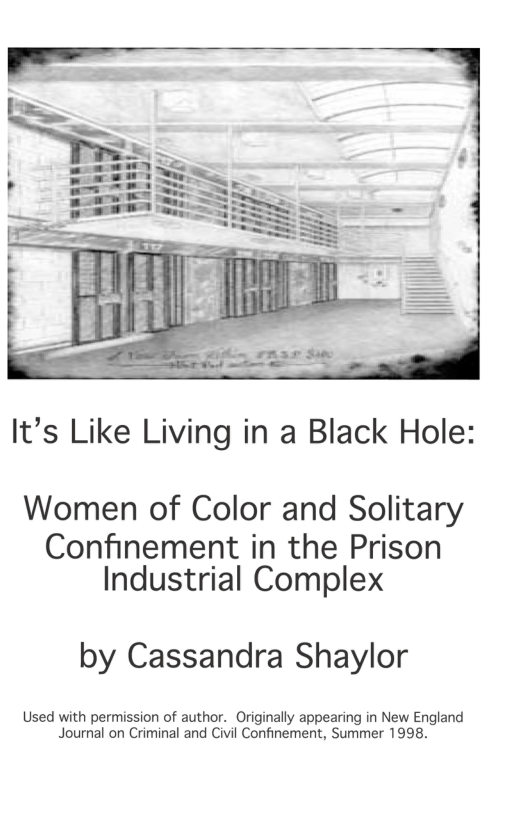
It’s Like Living in a Black Hole:
Women of Color and Solitary
Confinement in the Prison
Industrial Complex
by Cassandra Shaylor
Used with permission of author. Originally appearing in New England
Journal on Criminal and Civil Confinement, Summer 1998.
1 It's Like Living in a Black Hole- Cassandra Shaylor
Angela Tucker awoke at six a.m. cowering in the comer of her cell,
shaking uncontrollably. unable tobreathe. A fifty-four year old African-Ameri-
can woman, Tucker suffers from hypertension, diabetes, and asthma.Though
she was confined alone in this cold, dark cell for six months, she finally had
reached her limit. She repeatedly called for guards to help her, but they refused
to respond. A few hours later, she was subjected to a strip-search and taken out
of her cell to the shower. When she returned from the shower, she refused to re-
enter the cell. She begged to be placed in a larger space, to be put in a cell with
another prisoner. She explained that she was claustrophobic, and that since she
had been placed in solitary confinement both her blood pressure and her blood
sugar had risen to dangerous levels. Her pleas were ignored. Instead she was
confronted by a cadre of fourteen guards who threatened to use physical
force against her, including shooting her with rubber bullets, if she refused to
enter her cell. She chose to comply, but insisted that she be placed on the medi-
cal doctor’s visiting list. A couple of days later a psychiatric doctor came to
her cell and prescribed a combination of Prozac and Buspar, two psychotropic
medications, to cure her “anxiety problems.” She remains in solitary confine-
ment and has received no medical attention for her serious medical conditions.
As someone who has been in and out of the prison systems for fifteen years, she
says, “I thought T had seen most of what they can dish out. But this here is the
worst. I never seen anything like it. Living in here is like nothin’ you could ever
begin to imagine. It like living in a black hole.” nl
Introduction
Angela Tucker’s experience in solitary confinement in a women’s
prison is not unique. 2 It reflects the increasing brutality in prisons, particularly
in prisons for women. This paper examines the emerging use of the control unit,
the prison within the prison, as the ultimate expression of the regulation of the
female body, often a racialized female body.
‘This paper is a challenge to the masculinist manner in which control units are
generally discussed. The analysis specifically addresses the gendered and racial-
ized use of the control unit and its effect on female bodies.
‘This analysis explores the implications of state regulatory practices
that have resulted in an almost 400% increase in the rates of incarceration for
women since 1980, a large number of whom are women of color and who are
imprisoned for nonviolent, economic offenses. n3 This rise in incarceration is
tied to several interrelated factors: (1) a political economy that creates expend-
able populations and relies on sustained societal fear of crime and of certain
It's Like Living in a Black Hole- Cassandra Shaylor 2
classes of individuals as criminals; (2) inflammatory media and cultural repre-
sentations of criminality; and (3) legislative and judicial systems that consis-
tently deploy a model of total punishment when dealing with citizens who fail
to live up to prescribed behavioral norms. nd
One of the largest women's prisons in the world is Valley State Prison
for Women (VSPW) in Chowchilla, California. n5 This article draws upon the
author's experiences as an attorney working for women imprisoned at VSPW
and focuses in particular on women housed in the control unit, the Security
Housing Unit (SHU). As a staff attomey for a non-profit organization that pro-
vides legal services for women prisoners, this author regularly conducts inter-
views with women in California state prisons. Though this analysis is limited to
interviews of women prisoners in California, California’s prison system is the
largest in the country and contains the two largest women's prisons in the world.
16 As such, it provides a blueprint for the nation; thus, this analysis of control
units is applicable to other prison systems as well
‘This analysis of the prison is grounded in and shaped by the experi-
ences of women prisoners. This is especially important given the almost com-
plete silence around contemporary prisoners” perspectives. Although this article
looks at racialization practices and solitary confinement conditions for women
prisoners, the analysis also draws connections between their experiences and the
political economy of the prison industrial complex as well as the larger history
of solitary confinement practices.
Control Units
Control units represent the penultimate synthesis of technology and
space in the service of social control and dehumanization within the prison.
For women at VSPW, this punishment regime consists of twenty-three hours a
day of isolation in cramped, cold, dark cells, sometimes involving total sensory
deprivation. n7 These cells are approximately eight feet by six feet, the size of
an average bathroom. n8 Women in the SHU are allowed nine hours outside a
‘week. n9 This is the only opportunity they have to interact with other women.
10 Although the cells originally were designed with small windows, the insti-
tution recently blacked out these windows, n11 removing any sense of a world
outside.
Control units are also referred to as security housing units (SHUS), vio-
lence control units (VCUS), or maxi-maxi facilities. n12 There is a frightening
trend in prison construction toward building separate “supermax” prisons, that
is. entire institutions modeled on the control unit. n13 Forty states, the
3 It’s Like Living in a Black Hole- Cassandra Shaylor
federal system, and the District of Columbia all have at least one control unit.
n14 Women have generally been confined in control nits within already exist-
ing women’s prisons, but the increasing brutality in those institutions indicates
that female supermax facilities are likely in the not-so-distant future. Whether
firee-standing units within an existing institution, or prisons built specifically
for housing prisoners in solitary confinement, conditions in these spaces and
the effects on the individuals housed within them are strikingly similar. The
expanding use of control units reflects the increasingly repressive character of
prisons. It is important to note that isolation and sensory deprivation are now
used to some degree in most penal institutions, including many county jails. n15
Control units are specifically designed for these purposes, n16 but many prisons
do not require a separate unit to employ these tactics. n17
‘This trend has been called the “Marionization’ of American prisons,
referring to the increasing brutality in prisons in general, many of which use the
control unit strategy and the repression at USP Marion as a model for policies
and practices. n18 The legal system periodically has determined that such con-
finement amounts to cruel and unusual punishment. n19 In the current political
climate of increasing state surveillance and punishment of women, however,
such violations of human rights are more systematic and routine. n20 Although
courts often find certain aspects of solitary confinement unconstitutional, such
decisions are made institution by institution; therefore, each new prison requires
anew legal challenge. n21 Due to the recent passage of the prison Litigation
Reform Act (PLRA), n22 it is increasingly more difficult for prisoners’ lawyers
to bring lawsuits on their behalf. n23 This is part of a trend by national policy
makers to limit the rights of prisoners. In light of recent repressive Congressio-
nal legislation against poor people in the United States, including the passage of
the Personal Responsibility and Work Opportunity Reconciliation Act of 1996,
also known as the “welfare reform act.” n24 it is not melodramatic to view the
PLRA as a caleulated first step toward dismantling civil rights in arenas outside
of prison as well. Given the common national disdain for prisoners, such an as-
sault on civil rights can begin there.
Women in Control Units
Prisoners and advocates for prisoners see the increasing use of control
units as instruments of gender domination and torture. n25 As the provided
examples will illustrate, this is clearly the case at VSPW. Women prisoners are
political subjects and consequently do become aware of themselves, in this case
their actual physical bodies, as sites of political struggle and resistance. Women
It's Like Living in a Black Hole- Cassandra Shaylor 4
do resist: they speak up; fight back: or participate in individual and class action
lawsuits, which represent individual and collective challenges to the conditions
of their confinement. Such challenges, however, are viewed harshly and often
result in confinement in the SHU. the sole objective of which seems to be to
break women. Little else explains such oppressive structures within women's
prisons.
According to the women interviewed by this author at VSPW, women
in the SHU are under constant surveillance and denied any privacy. n26 The
cell doors are designed to allow guards to se in at all times. n27 This makes
the women extremely vulnerable to sexual harassment and abuse. Male guards
watch women in the showers, often turning off the water if the women com-
plain. n28 The toilets are located in the cells, within view of the guards, who
often harass women while they are on the toilet. 129 When guards conduct pat
searches they are supposed to act in a professional manner and avoid embarrass-
ing inmates, n30 however, women prisoners report that male guards regularly
‘rope them with the palms of their hands. n31
‘Though male guards are not permitted to conduct stripsearches, they
are often present when such searches occur. n32 The presence of this level of
sexual harassment creates an environment which inevitably leads to even more
serious sexual assault and abuse. A story was recently reported to this author
by three women in the institution about a woman who is housed in the SHU,
who was allegedly raped by a guard while living in general population. n33 The
rape resulted in pregnancy and because she refuses to have an abortion, she has
been sent to the SHU. n34 Due to their relative lack of power, women prisoners
are vulnerable to such attacks by guards. This is especially true when they are
isolated from other women. The sense of entitlement male guards feel as a result
of their status in a masculinist institution within a patriarchal culture, coupled
with the subordinated status of female prisoners as wormen and as “property of
the state,” promotes such abuse. The cult of silence preserved by the masculinist
‘uard culture protects guards from anything but the lightest disciplinary sanc-
tions. 035
Any time a women leaves her cell in the SHU to take a shower, see
alegal visitor, or to 20 1o court -she is handcuffed and strip-searched. n36
‘The women describe this process as unbearably humiliating and unnecessary
Yvonne Smith, a twenty-one year old African-American prisoner confined to the
SHU because of a suicide attempt, said:
‘They don’t do this because of “safety and security of the institution.
5 It’s Like Living in a Black Hole- Cassandra Shaylor
they do it for humiliation. Some of them really like it. There is nothing we can
do between our cells and the shower, no way we can pick anything up. They're
with us, watching us, the whole time. They are just tryin’ to break us down. n37
Claudia Johnson, a ifty-two year old white woman in the SHU, stated
that she refuses to be stripped out. n38 The institution sends in an “extraction
team” to force the strip-search on her when she has to g0 to court. n39 This
team consists of eight men in riot gear who enter her cell and hold her down
while a female guard rips off her clothes and conducts the search in their pres-
ence. 140 Claudia Johnson reported that during the searches male guards make
vulgar comments and threats, and they videotape each incident. nd 1
‘The use of extraction teams is a routine practice in supermax facili-
ties: women are not exempt from it. n42 For women, however, this treatment
iis uniquely traumatic because male guards usually perform the extraction. The
incidents are highly sexualized: women are rendered immobile, placed in a po-
sition of extreme vulnerability, stripped of all of their clothing, and then subject-
ed to a full body search. n43 Because about sixty percent of women in prison
are survivors of some form of physical or sexual abuse, nd4 cell extractions for
many of them are not only traumatic in the moment, but result in a re-experienc-
ing of past trauma. n45 Claudia Johnson said, “It is about humiliation and total
loss of dignity, and I don’t care what they call it. T call it rape.” nd6
Johnson reported that when she first began to refuse to strip out, the
male guards locked her in the cold shower for two days without food, water or
ablanket. nd7 They periodically passed by the shower and yelled that when she
decided to comply with the stripsearch, they would give her food and water and
let her return to her cell. n48 Several other women who overheard the incident
corroborated her story. n49 After two days, the guards finally released her. n50
They now use the extraction team to force strip searches on her. n51
Control units are built without any concern for the detrimental effects
they have on the women within them. Solitary confinement has a particularly
devastating effect on mentally ill women, many of whor are sent to the SHU
because they “act out” in general population as a result of their mental illness
052 Many women are prescribed psychotropic medications, but most receive
no meaningful psychiatric treatment. n53 Within penal institutions, the medical-
ization model is widely used against women. n54 This author has interviewed
women who can barely speak because they are so heavily drugged and has
been told about others who rarely move from their bunks because the medica-
tion virtually immobilizes them. n55 Some women talk to themselves or yell
incessantly at their cell doors, while others experience paranoid delusions and
It's Like Living in a Black Hole- Cassandra Shaylor 6
hallucinations. n56 Many cover themselves in urine and feces. nS7 These
behaviors represent stages of psychological breakdown that have been ob-
served in prisoners of war. n58 For these women, their own bodies become their
primary sites of resistance. Unfortunately, this behavior perpetuates the guards
perceptions of them as violent and legitimizes longer sentences in the SHU.
Such (mis)treatment is tied to commitment of women to mental institu-
tions as a form of social control, as well as the diagnosis of mental illness in
women who have rational, sane responses to injustices in their lives. n59 This
has historically been a tactic used more often against women than men. n60 For
those women who do need mental health treatment, appropriate mental health
institutions and programs are increasingly non-existent, especially for poor
women. n61 Prisons become the spaces in which to warehouse these women.
Control Units for Women as Racialized Spaces
‘The prison is a site for social control of all women, but solitary confine-
ment is a space reserved for particular women. Of the fifty-two women in the
SHU at VSPW, 61.4 percent of them are women of color. n62 Over 40 percent
of the women are “Black.” 21 percent are “Hispanic/Mexican.” n63 and 5.9 per-
cent are categorized as other. n64 Though the dehumanization processes in the
SHU replicate that which happens in the larger prison, the purpose of which is
to produce docile bodies, n6S these processes are more extreme and have more
detrimental effects on women housed in the SHU.
In general, discipline for women in prison is extremely harsh, especially
in comparison o discipline for men. n66 Women are far more likely than men
to be sentenced to the SHU for minor infractions. n67 While men are confined
to control units for allegedly attacking guards, participating in gangs or selling
drugs in the institution, women are placed in the SHU for spitting at guards, for
fighting with other women, or for attempting suicide. n68 A central function
of prisons in general is to punish women who fail to subscribe to a model of
femininity that historically has been (re)produced in discourse as white, pure,
passive, heterosexual, and located in motherhood. n69 When women operate.
outside of this model, even slightly, they are disciplined harshly for doing o
70
‘Women of color in prison face a double bind in this regard. As Kim-
berle Crenshaw points out, black women have never been perceived to ft this
description of patriarchal notions about femininity, because racism denies them
access to these norms. n71 Black women are prefigured as aggressive
7 It’s Like Living in a Black Hole- Cassandra Shaylor
and recalcitrant; guards, therefore, are predisposed to view them this way and
discipline them accordingly. n72 This analysis can be extended to Latinas and
Native American women in prison. Latinas are perceived to be loud and bel-
ligerent, sexually aggressive, or immigrants who are unable to speak English.
073 Native American women are perceived as backward, savage and/or primi-
tive, especially when they seek to preserve religious rights while imprisoned.
174 These views of women of color rely on stereotypes of white femininity as a
model against which to judge “other” women.
Beyond the racist politics of the SHU, as represented by the dispro-
portionate confinement of women of color there, the dehumanization practices
that take place within it in can also be read as racialized. Women are degraded,
sexually humiliated, and denied minimal medical care and any meaningful hu-
man contact. n75 Women are often denied basic necessities, such as food and
hygiene supplies. 176 They are made to beg for sanitary napkins and toilet pa-
per and are often told during the last week of the month that the prison has “run
out.” n77 Such practices resonate with larger histories of racism that dehuman-
ize people of color.
‘The institution consistently deploys racially coded discourses when in-
teracting with the women in the SHU. Guards regularly accuse women of being
dangerous, manipulative, or malingering, especially when women seek medical
treatment. n78 Guards speak to and about the women as though they are sub-
human. n79 A pamphlet, produced by the Warden's office, is given to women
when they enter the SHU and lists times for daily “feedings.” n80 Guards con-
stantly use racial epithets, many of which are gendered, to refer to the women.
They call the prisoners “dogs,” “niggers,” “bitches,” “whores” and “black
bitches:” women refer to their cells as “cages.” n81 When women are denied
privileges, they are put on what guards refer to as “dog status.” n82 “Privileges™
in the SHU amount to very little, but include: showers three times a week; pos-
session of property, like writing implements and paper; time spent outside; and
permission to purchase hygiene supplies from the commissary. n$3 All of these
are rights accorded to women by law, n84 but the institution often withholds
them as punishment, transforming them into “privileges.” Denise Jones stated:
“They treat us like animals. No, you wouldn’t treat an animal the way they do
us here. Tam sure they don't treat their dogs the way they treat us.” n85
‘The consistent relegation of women prisoners to a subhuman status
reflects the intertwined histories of the subjugation of women and the dehu-
manization of people of color. Control units are designed to remove agency and
humanity from people they target. The fostering of a perception of prisoners as
less than human allows state employees to deny the women any semblance of
It's Like Living in a Black Hole- Cassandra Shaylor 8
dignity and to abuse them without compunction. This discourse of subhumanity
evokes connections to slavery and the manner in which slaves were dehuman-
ized in order for slave owners to treat them like chattel. The economy of the
prison is fueled by such notions, as women bodies can be more easily reduced
to the mere property of the state. 86
Purposes of the Control Unit
One purpose offered by the state for control units is the reduction of
violence within the prison. n87 The reality is that in 1985 a Congressional
Oversight Committee found that eighty percent of people housed in the Marion
Control Unit did not require such a high level of security. n88 Research indi-
cates that women are more prone to violent behavior as a result of confinement
in solitary units, but violence against themselves. n$9 Many women in solitary
confinement release their frustration and anger by engaging in self-harming
behavior, including suicide attempts and selfmutilation. n90 Regina Morris, an
African-American woman housed in the SHU, has multiple scars on her wrists
and arms from this selfabuse. n91 Teresa Brown, another African-American
woman in solitary confinement, explained why she had recently slit her wrist
“Thave asthma, and 1 just couldn’t take it bein’ locked up like that. They wasn’t
listenin’ to me when I couldn’t breathe. T couldn’t take it anymore. I needed
some relief.” n92 Confinement in the SHU has devastating psychological ef-
fects on most women housed there. n93 Extended periods of idleness and social
isolation result in vicious mood swings, erying spells, and intense feelings of
paranoia. n94 Many women express fear that their confinement will make it
more difficult for them to adjust to placement in general prison population or to
life outside of prison. n95 The effect of rendering women unable to function in
the world outside of prison increases the likelihood of recidivism, which in turn
provides a constant source of revenue for the prison system. The fact that prison
authorities expect women to commit crimes when they leave prison can be used
to justify the maintenance of prisons as harsh and brutal places.
A second professed reason for control units is to reduce expenses -isola-
tion means fewer people allowed access to vocational and educational programs
and to rehabilitative, religious and recreational services. n96 Diminished access
to these programs in control units is linked to the trend of dismantling programs
in the prison system in general. n97 This move away from rehabilitation and
toward punishment is now the prevailing trend in prison administration. n98
Control units are one part of this move toward repression and brutality. The
reality is that expenses are not reduced as a result of the introduction of control
units. Tt
9 It’s Like Living in a Black Hole- Cassandra Shaylor
is actually much more expensive to maintain control units than those units that
house the general population, because of the level of security involved and the
increase in health-related expenses. n99 Tllinois and Wisconsin have recently
begun constructing their first “Supermax” facilities at a cost of sixty million and
ninety million dollars respectively. n100 Each control unit cell costs $ 74.000 to
build. n101
A deeper look reveals other, more disturbing and probably more accu-
rate, readings of the purpose of control units. Former Warden of USP Marion,
Ralph Arons has stated: *The purpose of the Marion Control Unit is to control
revolutionary attitudes in the prison system and in the society at large." n102
There i an interesting connection between Arons’ statement and history -the
first control unit opened at Marion in 1972, one year after the Attica uprising in
New York. n103
A 1989 Prison Discipline Study found that the most common disciplin-
ing strategy used against jailhouse lawyers was solitary confinement. n104 This
study found that jailhouse lawyers were found to be by far the largest number
of those in control units. n105 Other categories of prisoners who were found
to be placed in solitary confinement in disproportionate numbers were: blacks,
mentally disabled individuals, gang members, political prisoners, Latinos, gays
and lesbians, and people with AIDS. n106
Many prisoners are sent to control units for filing grievances or organiz-
ing other prisoners to respond to prison conditions. n107 Patricia Smith reported
that she was sent to the SHU for retaliating against a guard who had repeatedly
forced her to have sex with him. n108 She filed an inmate grievance against
him; he responded with a *115,” which is a serious disciplinary write-up, claim-
ing that she attacked him. n109 That *115” resulted in a SHU sentence. n110
Denise Jones is a thirty-three year old African-American woman at
VSPW who came to prison as an eighteen year old and has been incarcerated
for fifteen years. n111 In 1996, she was brutally beaten by a male guard while
his superior officer watched. n112 She filed a civil rights lawsuit against the
‘guards involved. n113 She has repeatedly received threats and harassment as a
result. nl14 She recently organized an HIV peer education group in the prison.
0115 These were women who were committed to educating themselves, leading
workshops and producing theater pieces about HIV prevention and treatment
onall four of the prison yards. n116 According to Jones, several of the guards
told her they did not like the level of freedom she now had in the facility. n117
She explained that on the night before her peer education theater group began
rehearsals for their performance, she was taken to administrative segregation
It's Like Living in a Black Hole- Cassandra Shaylor 10
pending an investigation into her alleged drug trafficking apparently a trumped
up charge. n118 In her administrative hearing before the Institutional Classifica-
tion Comittee, Jones had no right to an attorney and no right to have witnesses
testify on her behalf. n119 She was allowed to collect witness statements, but
the presiding officer did not have to take those statements into account. n120
‘There was no evidence presented against her, and another woman who actually
confessed to the “crime” was released to general population. n121 Prison of-
ficials sentence people to serve time in the SHU, not courts of law. n122 Denise
is now serving one year in the SHU, n123 clearly as a result of her organizing
activities and her willingness to fight back against guards who brutalized her.
‘The History of the SHU
‘These cases are only two of many that illustrate the importance of
uncovering the increasing and hidden use of the control unit as a disciplining
strategy of the prison, particularly against women of color. In order to under-
stand the growing trend toward repression in women’s prisons, it is important to
discuss the history out of which the SHU at VSPW arose. Solitary confinement
was introduced in 1829 by Quakers, who believed isolation and self-reflection
would promote penitence and reform. 124 It quickly became apparent that
instead, such isolation often led to mental breakdown. n125 As a result, solitary
confinement was abandoned as a general practice; however, it remains a method
of social control against specific prisoners. n126 In the 19505 and 19605, Dr.
Edgar Schein of Massachusetts Institute of Technology conducted research on
the Chinese model of “reeducation” deployed by Koreans against U.S. Prison-
ers of War. n127 From interviews with American servicemen repatriated to the
U.S.. he distilled a model of mind control that he then presented to key repre-
sentatives from the Bureau of Prisons at a conference in 1962. n128
Transcripts from his speech and the discussion following reveal interest on the
part of prison officials in using the research to suppress the beliefs and organiz-
ing efforts of Black Muslims and conscientious objectors. n129 In 1970, Dr.
James V. McConnell published an article entitled “Criminals Can Be Brain-
washed Now,” in which he argued for the application of sensory and perceptual
deprivation and social isolation o prisoners. n130 During the 19705, numerous
behavior modification programs were instituted in US prisons which imple-
mented these strategies, sometimes combined with use of psychotropic medica-
tions. n131
‘The first control unit prison emerged in 1983 at USP Marion, a federal
11 It’s Like Living in a Black Hole- Cassandra Shaylor
prison for men in llinois. n132 USP Marion became the model for the cur-
rent wave of control units and solitary confinement strategies throughout the
country. n133 Ostensibly in response to a violent incident, the entire prison was
Tocked down. n134 That lockdown has never been lifted, effectively transform-
ing the entire prison into a control nit. n135 The tactics developed at Marion
have been applied at prisons all over the country. These tactics were instru-
mental in the design of the hightech federal control unit at Florence, Colorado.
which houses 550 people in permanently locked down cells. n136
‘The only control unit specifically designed for women political prison-
s was opened at Lexington Federal Prison in Kentucky in 1986. n137 The unit
employed multiple tactics to destroy the women’s senses of self and to break
down their political convictions through sensory deprivation and small-group
isolation. 138 The unit housed three political prisoners: Alejandrina Torres,
Puerto Rican independentista; Susan Rosenberg, North American
anti-imperialist; and Silvia Baraldini, Italian national and anti-imperialist. n139
‘The structure was built underground and the interior was entirely white, n140
which resulted in reports from the women of hallucinations of black spots and
strings on the walls and floors. n141 The women were made to wear large,
shapeless clothing and were forbidden to hang anything on the white walls.
1142 What lttle contact they had with their jailers was often in the form of
disembodied voices addressing them through loud speakers. n143 They had
only occasional contact with the outside, mostly with their lawyers. n144 After
an intense campaign waged by a broad coalition of concerned people, the unit
was shut down in 1988. 145 The legal decision was based on the political
nature of the placements -the court determined that the women were housed
there as a result of their political beliefs and that such placement was uncon-
stitutional. n146 Although the courts came close to admitting that there are
political prisoners in the United States, the decision did not declare that such
treatment rises to the level of cruel and unusual punishment. n147 The decision
was undermined when the U.S. Court of Appeals ruled that prisons are free to
use political associations and beliefs to justify different and harsher treatment
n148 Since Lexington closed, other units, modeled on Lexington, have opened
in other parts of the country. n149 Women in the federal prison at Marianna,
Florida, for example, and other prisons across the country, are reporting increas-
ingly brutal, similar conditions. n150 Where once such units housed mostly po-
litical prisoners, now all prisoners are potentially subject to this level of social
control. ni51
It's Like Living in a Black Hole- Cassandra Shaylor 2
Current Trends in Prison Construction
VSPW is the newest and most repressive women's prison, representing
the current model in prison construction and the increasingly brutal conditions
in prisons. The design incorporates some of the most disturbing examples of
modern prison technology. despite the fact that women are rarely violent in
prison. The vast majority of women (approximately eighty percent) are impris.
oned for non-violent offenses. n152 Approximately sixty percent of the women
are serving time for drug-related offenses, most often for the mere possession of
drugs. 153 There have been no recent escape attempts by wormen prisoners in
California and no organized sustained violent uprisings. Valley State is
surrounded on all sides by two thirty foot-high barbed wire fences topped with
huge coils of razor wire. n154 Despite the presence of a guard in the watchtow-
er with a high-powered rifle and the reality that these fences would be physical-
ly impossible for an escaping prisoner to cross without being slashed to bits, the
institution erected an electric fence that stands between them. n155 The fence
has enough electricity coursing through it to kill small animals. n156 Sometimes
women prisoners are forced to clean dead birds out of the fence. n157 Women
have described this chore as a form of psychological torture because they know
that the guards regard them with utter disdain, and they fear the guards might be
inclined to “forget” to tum off the electric current. n158 These technologies and
the ways in which they are deployed against the women are not designed for the
safety of the institution, but instead are used mainly to
induce fear in women.
Prisoners are often used as human tials for new technologies prior to
adequate testing. New “beanbag” bullets were recently introduced in California
prisons. n159 Maria Hernandez, a woman imprisoned at VSPW, was the test
case for these bullets. n160 In direct violation of protocols concerning the use of
these weapons, n161 a guard fired directly into her back. The bullets exploded
on impact, bore into and burned her skin, leaving large and permanent scars
on her back. n162 In the first week that these bullets were used at VSPW, five
women were shot with them. n163
In addition to using prisoners as human trials, new security systems are
being tested on those who visit the prison. There are plans to place x-ray ma-
chines in the visitor centers in all California prisons within the next year. n164
No lead vests are provided, despite the fact that these machines commonly are
understood to be carcinogenic and can cause birth defects and genetic damage.
0165 Unlike x-rays performed during a dental examination, which is a localized
Tow dose of radiation, these devices require the visitor to pass through
13 It’s Like Living in a Black Hole- Cassandra Shaylor
three times in order to check the entire body. n166 This exposes the visitor to
an excessive amount of radiation. Such technology contributes to the climate
of fear around prisoners; the public is made to believe that such measures are
necessary. These devices serve to erect yet another barrier to visitors from the
outside, contributing both to the isolation of prisoners and the secrecy around
the brutality of prison life
There i currently a state enforced media ban against face-toface inter-
views of prisoners by journalists. n167 This ban is part of a growing national
trend to prevent representatives of the media from interviewing prisoners. 168
‘This insures that only prisoners and their supporters are witness to the brutality
of prisons, thus denying the larger public information about the reality of prison
conditions. This lack of information makes it much easier for people to believe
in stereotypes about criminals and to see themselves as separate from them.
Because of the current state of secrecy around prisons, it is necessary to have
personal communications with prisoners in order to uncover at least some
of what is happening inside.
‘The Emerging Prison Industrial Complex
‘The growing isolation of prisoners through the use of the control unit
and the isolation of knowledge about prison life facilitated by state sponsored
actions like the media ban, are reinforced by strategies of isolation deployed
outside of prison. In City of Quartz, Mike Davis identifies a new “fortress”
mentality that informs urban spaces and planning practices. n169 As a result of
this mentality, poor communities of color are increasingly isolated from wealthy
white neighborhoods, through planned “gated communities” with high-tech se-
curity systems. n170 Repressive policing tactics in poor neighborhoods result in
the cordoning off of people of color into areas of extreme poverty and isolation.
nl71
The level of repression in the emerging isolationist model both within
and outside of the prison is tied to the economic and political effects of the
national investment in the military industrial complex. This investment in
militarism increasingly informs policing and imprisonment practices. The US
‘government is currently selling surplus surveillance equipment and weapons,
including tanks, to police departments in cities in the U.S. n172 In 1997, law
enforcement agencies purchased 1.2 million pieces of military hardware from
the Department of Defense. n173 Communities as small as 75,000 people are
policed by officers in full riot gear riding in armored personnel carriers. n174
Black urban neighborhoods are the most frequently targeted areas for this para-
military activity. n175
It’s Like Living in a Black Hole- Cassandra Shaylor 4
‘Though military bases in California have closed in the last ten years
almost at the same rate that prisons opened, n176 the illusion of the demilitar-
ization of the defense industry disguises the reality of a continuous military
buildup. The military budget still enjoys a privileged position in United States
‘government spending; President Clinton’s 1998 proposed discretionary budget
includes § 265 billion for the military. n177 The distant second in allocation
of funds is education: approximately thirty-one billion dollars. n178 In this
post-Cold War era, the military buildup now stretches to domains outside of
the traditional military purview, like prisons. High-tech weaponry and military
hardware are modified for use in the prison industry. n179 Along with smaller
companies, former defense contractors like Westinghouse and General Dynam-
ics are now designing prison technology in the service of expanding the military
industrial complex through the development of a prison industrial complex.
nl80
Corrections officials and guards now take a wholly combative stance to-
ward prisoners, rather than a rehabilitative or even a custodial one. They receive
training in military combat techniques and the use of high tech weapons.
One recent example of this growing militarism is the videotape of the “training”™
ina private prison in Texas which showed guards brutalizing prisoners. n1§1
Every aspect of guard culture is modeled on the military. Guards dress in
fatigues and combat boots and subscribe to a military hierarchy. At VSPW,
‘guards force women to march in single file lines around the prison. n182 In the
administration building at VSPW, a trophy case in the lobby contains memora-
bilia of the Special Emergency Response Unit (SERT), a cadre of guards who
are trained in special military techniques to be used in crisis situations at VSPW.
n183 A photograph of this unit shows twelve men in camouflage fatigues and
grey berets. n184 In place of the patch that usually reads “Army,” is a patch
which says “VSPW. n185 The trophy case also contains a plaque, with a bullet
casing attached to it, inscribed with the name of the “Top Gun,” the most skilled
“sharpshooter” in the unit. n186
‘The growing militarism in prison does not result from an actual need
for such excessive punishment -after all, as already stated, eighty percent of
women are in prison for non-violent offenses and a vast majority of them are.
never violent within the prison. n187 Prisons on the whole do not reduce vio-
lence. n188 Despite the imprisonment binge, the rate of violent crime has in fact
remained steady. n189 Prisons do perpetuate violence, however, in the form of
destruction of families, and in the wholesale destruction of economic and politi-
cal power in the communities in which those families live. Prisons also provide
economic opportunities for corporate and government systems, which thrive on
15 It’s Like Living in a Black Hole- Cassandra Shaylor
the violence they perpetuate against those communities.
A central example of corporate involvement in the prison industrial
complex is the Corrections Corporation of America. It is currently the most
profitable company in the privately-run prison industry. n190 American Ex-
press and General Electric have contributed to private prison construction.
0191 Financial powerhouses, such as Merrill Lynch & Co., Inc., Smith Barney
Shearson, Inc., and Goldman Sachs & Co. are currently underwriting prison
construction through the sale of private, tax-free bonds which require no voter
approval. n192 Furthermore, the construction industry is not the only private
interest profiting from prisons. Everything from Dial Soap to AT&T is marketed
to corrections officials. n193 Health care companies and food service providers
compete for lucrative prison contracts. n194
Annual expositions provide a forum for companies to market products
ranging from stun guns to razor wire. A startling example of such technology is
a computer tracking system designed by QueTel Corp., which would require
institutions to issue scanners to guards and attach bar codes to prisoners. n195
‘The introduction of a device such as a bar code i the ultimate material semiotic
manifestation of the marriage of economy and technology in the prison--the
prisoner’s body symbolically inscribed as commodity. n196
Perhaps most disturbing about this political economy is the growing
exploitation of prison labor. As growing numbers of women are arrested and
imprisoned, they increasingly become a part of this exploited class of laborers,
Prisoners work to produce shrink wrap packages for Microsoft and handle reser-
vations for TWA. n197 California voters passed Proposition 139, the Inmate
Labor Initiative of 1990, n198 which paved the way for inmates to
be leased out to private industry, reinstating slavery through the explicit repeal
of the principle that prison work would be voluntary. The initiative states in
part: “The people of the State of California find and declare that inmates who
are confined in state prison or county jails should work as hard as taxpayers
for their upkeep, and that those inmates may be required to perform work and
services.” n199
In California, a semi-autonomous state agency called the Prison Indus-
try Authority (PIA) was created to make industries within the prison self-s
taining and profitable. n200 The PIA mission statement no longer refers to
rehabilitation or training; it focuses only on maximizing profits. n201 Ultimate-
ly. prisoners find that they do not learn marketable skills in prison and are rarely
able to find jobs similar to the ones they performed inside (or any job at all, for
that matter). A gendered division of labor exists within prison industries;
women have generally worked in laundry, pholstery, fabric production and data
It's Like Living in a Black Hole- Cassandra Shaylor 16
entry, while men have worked in metal and wood production, automotive shops,
dairies and slaughterhouses. n202 At VSPW, women prisoners produce eye-
glasses for LensCrafters through PIA-Optical. n203 These women are paid less
than one dollar an hour, are forced to work overtime or risk losing their
jobs, and are prevented from organizing against dangerous and exploitative
work conditions. n204
Prison labor practices in the United States are analogous to neo-imperi-
alist, transnational corporate practices in the world outside. The hypermobility
of capital creates large populations of unemployed free people in the United
States. Corporations can seek out low-cost laborers: prisoners provide such
cheap, local labor power. The result is the commadification of prisoners; not
only is their labor commodified, but their very bodies now represent profits.
‘These bodies, most often racialized and increasingly female, are bought and
sold on the stock market, as the prison industry requires a steady supply to
maintain profits. This demand for prisoners is met through public policy deci-
sions which encourage the incarceration of greater numbers of people. Prison
labor represents the ultimate alienated labor; for prisoners there is no longer
even the illusion of choice. The disregard for the humanity of imprisoned
women and men, and the unadulterated joy in the possibility of profiting at their
expense is summed up in a brochure for a conference on private prisons. n205
‘This conference was organized by the World Research Group, a New York-
based investment firm, whose marketing motto was: “While arrests and convic-
tions are steadily on the rise, profits are to be made profits from crime. Get in on
the ground floor of this booming industry now!” n206
Race, Gender and the Prison Boom
‘The material reality of this “booming industry” is the proliferation of
prisons. In the last ten years, twenty prisons have been built in California. n207
Three were prisons for women. n208 This expansion is part of a national
historical trend. Though only two or three women’s prisons were built per de-
cade between 1930 and 1950, there were seven built in the 19605, seventeen in
the 19705, and thirty-four in the 1980s. 1209 Scholars and activists who address
issues of imprisonment seldom acknowledge the expanding population of wor-
en prisoners and the proliferation of women’s prisons. This expansion is not
insignificant: while the number of men in prison has doubled in the last decade,
the number of women has more than tripled. n210 Thus, women play an ever-
‘rowing role in the increasingly profitable punishment industry, an industry in
which the financial stakes are incredibly high
‘The United States now incarcerates approximately two million people,
17 It’s Like Living in a Black Hole- Cassandra Shaylor
‘a number equivalent to the population of a large city and more than any other
industrialized country in the world. n211 Though women comprise only about
7.37 percent of those incarcerated, or about 113,000 people, they are the fastest
‘rowing population in prison. n212 Prisons today constitute elaborate ware-
housing systems into which members of the expendable classes, such as the
poor, unemployed, homeless, mentally ill, and drug-dependent, are dumped.
‘The defunding of social services and the effects of global capitalism
contribute to the impoverishment of greater numbers of people, n213 an in-
creasing number of whom ate women of color and poor women of all ethnic
backgrounds. n214 Racist notions about women are discursively produced
outside of, as well as within, the prison system, contributing to a damaging
environment, specifically for women of color. Consistently, women of color
are stereotyped as hyper-sexualized females, excessively reproductive welfare
recipients and/or crack addicts. n215 As a consequence, they are targeted for
surveillance and monitoring by the police and child protective services. They
are disproportionately arrested, convicted, and incarcerated for crimes such as
prostitution, petty theft, embezzlement, and drug possession and sales. n216
Prevailing political investments in “tough on crime” measures result in
Tonger, harsher sentences that discriminately affect communities of color. n217
As a result, the prison itself is increasingly a racialized space, thus, affecting
women in unique ways. Approximately thirty-five percent of women in prison
are African-American and twenty-four percent Latina, numbers significantly
larger than their respective representation in national demographics. n218 About
eighty-percent of these women have at least two children. n219 Thus, there is
also a largely unexamined impact on communities of color, especially children
in those communities, who are also effected by the “imprisonment binge”
Historically, fear has played an important role in the perpetuation of
racism, and remains vital to the anti-crime rhetoric now circulating in the na-
tional imaginary. n220 Media and cultural representations of criminality pander
to racial stereotypes of criminals and perpetuate the false notion that crime s
everywhere at all times. Despite the fact that violent crime constitutes only
twelve percent of all crime, it is repeatedly headlined in mainstream, corporate-
sponsored print media and nightly news programs. n221 Research indicates
that individuals who are least likely to be affected by crime are those who are
most afiaid of it. n222 Reality-based television programs like Cops and Amer-
ica’s Most Wanted conflate news and entertainment and contribute to national
paranoia about the omnipresence of crime. n223 These media practices, which
create and sustain fear of crime, are closely tied to the creation of public policy
and government funding decisions, like the passage of the 1995 Crime Bill or
It's Like Living in a Black Hole- Cassandra Shaylor 18
the California Three Strikes Initiative. n224 Ideas about the ease of prison life
are cultivated in order to legitimize increasingly brutal prison conditions and
punishment practices. Misperceptions about the availability of rehabilitation
in prison belie the reality that a regime of punishment has completely replaced
even the slightest gesture toward rehabilitation. As Angela Davis has argued. the
prevailing racist logic allows for the assumed criminality of black and brown
people, rather than the recognition that the inordinately high number of incar-
cerated people of color is evidence of structural racism. 225
Imprisoning America
‘The rise in incarceration and the increasing repression in prisons is
connected to the economic and political restructuring of America. In order to
understand what that political project entails, it is necessary to unmask the ways
in which the prison remains excluded from the rest of society because it is a
racialized space. As police chief of Atlanta, Eldrin Bell ask
If we started to put white America in jail at the same rate that we’re
putting black America in jail, 1 wonder whether our collective feelings would be
the same, or would we be putting pressure on the President and our elected
officials not to lock up America, but to save America? n226
‘Though Bell's statement reinscribes a black/white dichotomy that fails
to fully address the racial constitution of the prison, the sentiment it expresses is
extremely important. He describes two Americas, black and
white, This author would argue that what is also relevant in his statement is the
division between two other notions of America -one inside and one outside.
Through the space of the prison, there is a contest over what it means to be
American. Racism is a constitutive piece of this construction.
‘When individuals are imprisoned, they are no longer considered nation-
al subjects; they lose most of their rights as citizens and are thus perceived to be
outside of the national body. This is especially true if, in addition to transgress-
ing prescribed societal norms through activity that is deemed criminal, they are
racialized subjects. Many people express no opposition to the diminishing civil
rights of prisoners, in large part because they believe that individuals forfeit
those rights when they commit criminal acts. Individuals outside of prison
define themselves as “good” citizens in contrast to those inside. They fail to
acknowledge the heavy hand that racism plays in determining which citizens are
targeted by the state for arrest and conviction
Prisoners thus represent the abject of the nation, in large part because a
19 It's Like Living in a Black Hole- Cassandra Shaylor
majority of them are people of color. For women of color this expulsion con-
pounds a pre-existing invisibility. Not only are they absent in discourses about
race, gender, and prison, but their very bodies are hidden by the state thus ren-
dering them completely invisible. The invisibility of women of color is exacer-
bated by prison walls and their humanity is lost within them.
Conclusion
Angela Tucker’s analogy to the black hole with which this article
began is an apt description of the control unit and, as such, serves as a structur-
ing metaphor for my discussion of women of color in solitary confinement. In
scientific discourse, a black hole s defined as:
a region of space, created by the total gravitational collapse of matter,
whose attractive gravitational force s so intense that no matter, light, or com-
munication of any kind can escape. [It is] difficult to observe for two reasons.
First, [it is] *black’ - no light from inside can escape to make it visible. Sec-
ond, [itis] a very small object. Thus, it can be “observed” only by deducing its
presence from the effects that its gravitational field has on matter lying outside
the black hole . .. Time and space are warped:; time is slowed down and space
stretched out near a black hole ... [The pressure in a black hole is so great that]
a person [encountering itwould be ripped to shreds . .. Black holes are predict-
ed to oceur at the endpoint of the evolution of sufficiently massive stars. n227
Qr
Tn terms of the SHU, this analogy to the black hole is multilayered: the
“blackness” of the SHU is reflected in both its racialized nature and the dark-
ness of the cells themselves; the degree of force within the SHU is experienced
by the women through physical brutality and sexual violence; the space of the
SHU is oppressively small; n228 mental stability is warped:; the experience of
passage of time i transformed; and communication flowing both into and out
of the SHU is severely restricted. n229 There is also a connection between the
massive expansion of the prison industrial complex and the SHU. The prison
industrial complex is now so comprehensive and far-reaching that it distorts
everything around it. It creates a political system which thrives on the imple-
mentation of “tough on crime” measures and an economic system which relies
on demonizing and terrorizing entire communities of people. As a result, our
society is increasingly a “carceral” one: a high level of surveillance is present in
all of our lives. The “endpoint of the evolution of a sufficiently massive” project
such as the prison industrial complex is the imprisonment of entire communities
It's Like Living in a Black Hole- Cassandra Shaylor 20
and the isolation and dehumanization practices of the SHU.
As concerned members of the national community, we must interrogate
the stereotypes we receive from our government and through the media about
criminals and demand information about the status of prisoners in our nations
prisons. We must recognize the importance of women in prison and commit our-
selves to organizing against their increasing incarceration. The silence around
this issue and the increasing invisibility of women in prison will allow for
the vast expansion of the prison industrial complex and the infliction of re-
pression on greater numbers of women. As scholars, lawyers, activists, and
researchers, it is necessary to develop new directions for critical analyses of
women’s imprisonment. This article s a contribution to that process. As the
argument has outlined, the prison industrial complex affects women in unique
ways. As advocates for prisoners, we must develop new ways of thinking about
the gendered and racialized dimensions of imprisonment. If we fail to address
the boom in the imprisonment rates of women and the increasingly repressive
character of prisons, the devastating effects on women and their families and
communities will be impossible to overcome.
FOOTNOTES:
nl Interview with Angela Tucker, Valley State Prison for Women, in Chowchill
6. 1998).
12 Mostof the factual statements in this artile are based on information gathered by the
author during interviews with women incarcerated
at the Valley State Prison for Women, in Chowchilla, Cal. The names of interviewees and the
dates of interviews have been altered 1o protect
the privacy and safety of the women. Specific information has been included only with the
‘permission of the women interviewed.
3 See Bureau of Justice Statistics, U.S. Dep'tof Justice, Sourcebook of Criminal Justice
Statistics--1996 516 ig 6.2, 533 tb15.6.35, 6.36.
(1997) [hereinafter Sourcebook]: see also John Iwin & James Austin, I’s About Time:
America’s Imprisonment Binge (2d. ed. 1997)
4 See generally Katherine Beckett, Making Crime Pay: Law and Order in Contemporary
American Politis (1997) (discussing the
ascendance of the get-tough approach to crime); see generally Katheryn K. Russell, The
Color of Crime (1998).
05 See supra note 2.
16 See supra note 2.
7 See supra note 2.
8 See supra note 2.
19 See supra note 2.
110 See supra note 2.
nl1 See supra note 2.
. Cal. (Feb.
21 It’s Like Living in a Black Hole- Cassandra Shaylor
n12 See Russ Immari
Fall 1992, a1, 1
013 See id
n14 See Daniel Burton-Rose, Buried Alive: New control units put prisoners in extreme isola-
tion, Boulder Wkly, Jan. 6, 1997, at 8
015 See Immarigeon, supra note 12, at |
016 See generally Immarigeon, supra note 12, at 1
017 See id. 2.
018 See Immarigeon, supra note 12, at 1-2 (discussing The Human Rights Watch report
on Prison Conditions in the United States). The history of USP Marion will be covered in
‘reater detail in a later portion of this paper. See infra text accompanying notes 133-37.
019 See generally Maria A. Luise, Note, Solitary Confinement: Legal and Psychological
Considerations, 15 New Engl.J.on Crim. & Civ. Confinement 301 (1989) (discussing the
‘application of the Eighth Amendment to solitary confinement). Generally, courts focus on
whether prisoners are denied basic necessities when making a determination as o whether
‘acondition amounts to cruel and unusual punishment. See id. a 304. Psychological consid-
erations are rarely taken into account. See id. at 302. Contrast this with the courts opinion
over one hundred years ago, in In Re Medley, 134 U.S. 160 (1890),in which the court wrote.
about the Walnut Street Jail: A considersble number of the prisoners fell after even a short
confinement, into a semi-fatuous condition, from which it was next o impossible to arouse
them, and others became violently insane; others, sil, committed suicide; while those who
stood the ordeal better were not generally reformed, and in most cases did not recover suf-
ficient mental activity to be of any subsequent service .. .. I s within the memory of many
persons interested in prison discipline . .- and its main feature of solitary confinement was
found to be too severe. Id. at 168,
120 See Immarigeon, supra note 12, at 3: Burton-Rose, supra note 14, at .
n21 See, e.g., Madrid v. Gomez, 889 F. Supp. 1146 (N.D.Cal. 1995). Chief Judge Thelton
Henderson ruled that solitary confinement of certain subgroups, including mentally illpris-
oners, violates the prohibition against cruel and unusual punishment of the Eighth Amend-
ment to the ULS. Constitution. See id. a 1279-80. This lawsuit was fled on behalf of male
prisoners at Pelican Bay State Prison in California. See id.at 115. A substantial portion of
the lawsuit concerned conditions in the SHU. See id. at 1227. One of the most disturbing
examples of the brutal conditions in the Pelican Bay SHU concerned a mentally il African-
‘American man named Vaughn Dortch. See id. at 116. Dorteh was removed from his cell by
‘uards and placed in a bath of scalding hot water. See id. Guards serubbed his burning body
with a wire brush while making racist comments. See id. As a resultof this treatment, he sus-
tained third degree burns over eighty percent of his body. See id.at 1167. Opened in 1959,
Pelican Bay was designed as a state-of-the-art facility. See id. at 1155; see also Sally Mann
Ramano, If the SHU Fits: Cruel and Unusual Punishment at California’s Pelican Bay State
Prison, 45 Emory L.J. 1089 (1996). Though conditions in the SHU at
Pelican Bay are similar o those in the SHU at Valley State, Pelican Bay SHU is operated
almost completely by use of remote control. See id. This means that risoners never interact
with other human beings, including guards, except when meals are brought o them. See id
at 1102. Each prisoner exercises alone on 4 cement enclosed yard the size of a dog run at a
kennel. See id. at 110203,
-on, The Marionization of American Prisons, Nat. Prison Project J.,
It's Like Living in a Black Hole- Cassandra Shaylor 2
22 See 18 US.CA. § 3626 (West 1997).
123 The Prison Litigation Reform Act (PLRA) was passed as rider (0.2 1996 Appropria-
tions Bll. See 18 U.S.C.A. § 3626 (West 1997). s provisions include: a two-year time limit
on consent decrees; a limitation on the power of Special Masters; and a cap on attorneys™
fees, reducing them to one third of what plaintiffs lawyers usually receive. See id. These
provisions make it virtually impossible for legal advocates to bring class action lawsuits on
behalf of prisoners.
n24 Pub. L. No. 104-193, 110 Stat. 2105 (1996).
125 See supra note 2; see also Mary O"Melveny, Portrit of a U.S. Politcal Prison - The
Lexington High Security Unit for Women, in Cages of Steel: The Politics of Imprisonment
in the United States 112, 112-22 (Ward Churchill & J.J. Vander Wall eds., 1992); Susan
Rosenberg, Reflections on Being Buried Alive, in Cages of Steel: The Politics of Imprison-
ment in the United States 128, 128-30 (Ward Churchill & 1. Vander Wall eds., 1992).
126 See supra note 2.
127 See supra note 2.
128 See supra note 2.
129 See supra note 2.
130 See Cal. Code Regs. tit. 15, § 3287(a)(b) (1997).
n31 See supra note 2.
132 See supra note 2.
033 Interview with Jean Davis, Valley State Prison for Women, in Chowchilla, Cal. (Mar. 6,
1998): Interview with Melva Daniels, Valley State Prison for Women, in Chowchilla, Cal
(Mar 6, 1998): Interview with Bessie Reynolds, Valley State Prison for Women, in Chow-
chilla, Cal. (Mar 6, 1998).
n34 See id
135 When guards are caught engaging in “inappropriste behavior” with female inmates, they
are usually “walked off the yard." This means they are relieved of ther post at the prison.
ofien only 1o be transferred o another institution. See supra note 2. In many instances, this
transfer i to another women's instiution. See supra note 2. This information is also based
on the author's communication with the personnel office of the California Department of
Corrections.
136 See supra note 2.
037 Interview with Yvonne Smith, Valley State Prison for Women, in Chowehilla, Cal. (Dec.
5. 1997).
038 Interview with Claudia Johnson, Valley State Prison for Women, in Chowchilla, Cal.
(Oct. 30, 1997).
039 See id
40 See id
41 See id
142 See Human Rights Watch, Cold Storage: Super Maximum Security Confinement in
Indiana 52-56 (1997); see supra note 2.
143 See supra note 2.
44 See Sushma . Taylor, Women Offenders and Reentry Issues, J. Psychoactive Drugs.
Jan-Mar. 1996, a 85, 86.
145 See supra note 2.
23 It’s Like Living in a Black Hole- Cassandra Shaylor
46 Interview with Claudia Johnson, Valley State Prison for Women, in Chowchilla, Cal.
(Oct. 30, 1997).
47 See id
48 See id
149 Interview with Denise Jones, Valley State Prison for Women, in Chowehilla, Cal. (Oct.
30, 1997); Interview with Julia Shaw, Valley State Prison for Women, in Chowehills, Cal
(Oct. 30, 1997); Inerview with Jean Davs, Valley State Prison for Women, in Chowchilla,
Cal. (Oct. 30, 1997); Interview with Robin Litle, Valley State Prison for Women, in Chow-
chilla, Cal. (Oct. 30, 1997).
050 Interview with Claudia Johnson, Valley State Prison for Women, in Chowchilla, Cal.
(Oct. 30, 1997).
01 See id
052 See supra note 2.
053 See supra note 2.
054 See generally Pat Carlen & Chis Tehaikovsky, Women in Prison, in Criminal Women
182, 182 (Pat Carlen ed., 1985) (discussing the
regimes in women’s prisons).
05 See supra note 2.
056 See supra note 2.
057 See supra note 2.
058 See Stuart Grassian, The Psychopathological Effects of Solitary Confinemen, 140 Am.
3. Psychiatry 1450, 1450 (1993).
159 See generally Phyllis Chesler, Women and Madness 164 (1989) (discussing the history
of patriarchal social construction of women's mental llnesses).
060 See id
061 See 2,000 Protest Mental Health Budget Cuts, L.A. Times, May 19, 1992 at 14,
162 See California Department of Corrections Data Analysis Unit, Monthly Report of Eth-
nicity (visited Apr. 15, 1998) <hitp:www.cde.state.ca.us>.
163 See id
064 See id
165 See Michel Foucault, Discipline and Punish: The Birth of the Prison (Alan Sheridan
trans., Vintage Books 1979) (discussing theories of punishment across the early modern and
moden periads).
166 See Dorothy MeClellan, Disparity in the Discipline of Male and Female Inmates in
Texas Prisons, Women & Crim. Just. ., June 27,1994, at 71-97.
067 See supra note 2.
068 See supra note 2.
169 See generally Estelle B. Freedman, Their Sisters’ Keepers: Women’s Prison Reform
in America, 1830-1930 (1981) (discussing Victorian ideology around the purity of white
women and the function of prisons to develop and maintain ).
170 See supra note 2.
W71 See generally Kimberle Crenshaw, Demarginalizing the Intersection of Race and Sex:
A Black Feminist Critique of Antdiscrimination Doctrine, Feminist Theory and Aniracist
Politics, in 1 Feminist Legal Theory 443 (Frances E. Olsen ed., 1995) (discussing the ten-
dency to treat ace and gender as mutully exclusive categories of experience and analysis).
It's Like Living in a Black Hole- Cassandra Shaylor 24
‘Though Crenshaw speaks about Black women only, I extend this argument for purposes of
my analysis to include Latinas and Native American women.
72 A more complex analysis, which incorporates and critiques heteronormative notions of
sexuality, s also warranted here. Homophobis plays a significant ole in guards’ expectations
of and reactions to women prisoners. Unfortunately, there s not enough space in this paper
10 include this analysis in sufficient detal
73 See generally Juanita Diaz-Cotto, Gender, Ethnicity, and the State: Latina and Latino.
Prison Politcs (1996) (discussing Latino/Latina prisoner politics).
174 Luana Ross, Healing While Imprisoned, Address Before the “Unfinished Liberation:
Policing, Detention and Prisons” Conference atthe University of Colorado at Boulder (Mar.
15, 1998),
175 See supra note 2.
176 See supra note 2.
177 See supra note 2.
W78 See supra note 2.
179 See supra note 2.
180 See Valley State Prison for Women, Administrative Segregation/Security Housing Units,
Inmate Orientation Pamphlet (n.d.) (on file with author) [hereinafier Inmate Orientation
Pamphlet]
n81 See supra note 2.
182 See supra note 2.
184 See Inmate Orientation Pamphiet, supra note 80.
n85 Interview with Denise Jones, Valley State Prison for Women, in Chowchills, Cal. (Dec.
5. 1997,
186 See generally Patrcia J. Williams, The Alchemy of Race and Rights 216-36 (1991).
187 See Fay Dowker & Glenn Good, From Alcatraz to Marion to Florence: Control Unit
Prisons in the United States, in Cages of Steel: The Politcs of Imprisonment in the United.
States, supra note 25, at 131, 142
188 See Erica Thompson & Jan Susler, Supermax Prisons: HighTech Dungeons and Mod-
em-Day Torture, in Criminal Injustice: Confronting the Prison Crisis 303, (Elihu Rosenblatt
ed., 1996) (citing Oversight Hearing Before the Subcomm. on Courts, Civil Liberties and the
Administration of Justice, 99th Cong. 33-39 (1985)).
189 See Russel P. Dobash et al., The Imprisonment of Women 147 (1986).
190 See supra note 2.
101 Interview with Regina Morris, Valley State Prison for Women, in Chowehilla, Cal. (Oct.
30, 1997).
192 Interview with Teresa Brown, Valley State Prison for Women, in Chowehilla, Cal. (Feb.
13, 1998),
193 See supra note 2.
104 See supra note 2.
195 See supra note 2.
196 See Immarigeon, supra note 12, at 23
197 See Dan Morain, California’s Prison Budget: Why is it so voracious?, LA. Times, Oct.
19,1994, at AL AIS.
198 See id
25 It’s Like Living in a Black Hole- Cassandra Shaylor
199 See Immarigeon, supra note 12, at 3.
100 See Burton-Rose, supra note 14, at 8.
0101 See Immarigeon, supra note 12, a2
0102 See Dowker & Good, supra note 87, at 131, 143 (quoting Steven Whitman, The Mari-
on Penitentiary -1t Should be Opened Up, Not Locked Down, S. llinoisian, Aug. 7, 1988, at
25).Itis ineresting to note that Arons does not refer 0 acts, but (o atitudes. See id.
103 See Robert Perkinson, Shackled Justice, in Criminal Injustice: Confronting the Prison
Crisis, supra note 88, at 334, 335
1104 See The Prison Discipline Study: Exposing the Myth of Humane Imprisonment in
the United States, in Criminal Injustce: Confronting the Prison Criis, supra note 88, at 92,
92.97. “Jailhouse lawyers help other prisoners, many of whom are illterate, to partcipate in
formal grievance and appeal procedures both within the prison and in the courts.” 1. a1 2.
0105 See id.at 96 tbLS, 97 tbl.
106 See id. at 96 thL. This report was based on responses to 4 questionnaire distributed
nationally to prisoners, prison administrators, guards, and to prisoners’ family members and
siors. Se d. at 92
1107 See supra note 2.
0108 Interview with Patricia Smith, Valley State Prison for Women, in Chowehills, Cal
(Apr.15,1997).
0109 See id.
n110 See d.
ni11 Interview with Denise Jones, Valley State Prison for Women, in Chowehilla, Cal. (June.
5. 1997).
0112 See id.
113 See id. The parties in this lawsuit are being kept anonymous to protect the prisoner's
safety.
nl14 See id.
115 See id. There i no other such progra at this nstitution.
0116 See id.
0117 Interview with Denise Jones, Valley State Prison for Women, in Chowchilla, Cal. (June
5. 1997,
D118 See id.
n119 See Cal. Code Regs. . 15, § 3320 (1997).
0120 See id.
0121 Interview with Denise Jones, Valley State Prison for Women, in Chowchilla, Cal. (June
5. 1997).
0122 See Cal. Code Regs. i, 15, § 3335 (1997).
1123 See supra note 2.
124 See generally Foucault supra note 63, at 23536 (discussing “complete and austere
institutions”).
0125 See generally id.; see also In re Medley, 134 US. 160, 171 (1890) (describing solitary
confinement as “punishment of the most important and painful character”).
126 See generally Mike Ryan, Solitude as Counterinsurgency - The U.S. Isolation Model
of Political Incarceration, in Cages of Steel: The Politics of Imprisonment i the United
States, supra note 25, at 83 (discussing prison isolation).
It's Like Living in a Black Hole- Cassandra Shaylor 26
0127 See id. at 84.85,
128 See id. at 92
1129 See id. at 92.94.
130 See id.at 94 (citing James V. McConnell, Criminals can be Brainwashed Now, Psy-
chol. Today, Apr. 1970, at 18, 74).
nI31 See id. at 96.98,
0132 See Bill Dunne, The U.S. Prison at Marion, Ilinois: An Instrument of Oppression, in
Cages of Steel: The Politics of Imprisonment in the United States, supra note 25, at 38; see
also Immarigeon, supra note 12, at 1-2.
0133 See Immarigeon, supra note 12, at 1.2,
134 See Dunne, supra note 132, 2t 38. A lockdown means that the prisoners are confined to
their cells 24 hours a day without human contact. See id. at 52; see also Immarigeon, supra
note 12, at 1.
0135 See Dunne, supra note 132, at 78,
136 See Ray luc Levasseur & Daniel Burton-Rose, From USP Marion to ADX Florence
(And Back Again), in The Celling of America: An Inside Lok a the U.S. Prison Industry
200,205 (Daniel Burton-Rose et al. eds., 1998).
0137 See O"Melveny, supra note 25, at 112.
D138 See id. at 114-16.
0139 See id.at 113-14,
0140 See Rosenberg, supra note 25, at 128
ni41 See Dr. Richard Kom, Excerpts from - Report on the Effects of Confinement n the
Lexington High Securiy Ui, in Cages of Steel: The Poliics of Imprisonment in the Uited
States, supra note 25, at 123, 123
n142 See Rosenberg, supra note 25, at 128
n143 See id
nl44 See id
0145 See O*Melveny, supra note 25, at 117-19.
0146 See id.at 118 (citing Baraldini v. Meese, 691 F. Supp. 432 (D.D.C. 1988).
n147 See id
0148 See Baraldini v. Thoraburgh, 884 F2d 615 (US. App. D.C. 1989).
0149 See O°Melveny, supra note 25, at 119.
0150 See id.
RIS See id; see also supra note 2.
152 See Sourcebook, supra note 3, at 533 tb1.6.36; see also Barbara Bloom et al., Center on.
Juvenile and Criminal Justice, Women in California Prisons: Hidden Victims of the War on
Drugs 3 (May 1994).
N153 See Sourcebook, supra note 3, at 456 thl.5.34.
154 This s based on the author's own observations while visiting Valley State Prison for
Women in Chowchilla, Cal.
0155 See id
0156 Interview with Luz Rodriquez, Valley State Prison for Women, in Chowchilla, Cal.
(June 28, 1997); Interview with Denise Jones, Valley State Prison for Women, in Chow-
chilla, Cal. (June 28, 1997); Interview with Harriet Lewis, Valley State Prison for Women, in
Chowchilla, Cal. (June 28, 1997)
27 It’s Like Living in a Black Hole- Cassandra Shaylor
0157 See id.
D158 See id
1159 See supra note 2.
0160 Interview with Maria Hernandez, Valley State Prison for Women, in Chowehills, Cal
Ouly 8,1997).
n161 A guard mustissue a verbal waning first. See Cal. Code Regs. it 15,
§3276 (1997).
0162 Interview with Maria Hernandez, Valley State Prison for Women, in Chowehills, Cal.
Ouly 8, 1997)
0163 See id.
164 Telephone Interview with Dr. Corey Weinstein, California Prison Focus (Apt. 2, 1998).
0165 See id.
166 This author’s experience as a vsitor at CCWF.
0167 See Michael Taylor, Many States Curtailing Media Interviews of Prisoners, .-
Chron., Jan. 10, 1996, at A12; Michael Taylor, Stste Inmates Barred from Media Interviews,
S.E Chron., Dec. 28, 1995, at 1.
0168 See Taylor, Many States Curtailing Media Interviews of Prisoners, supra note 167
0169 See Mike Davis, City of Quartz: Excavating the Future in Los Angeles 223 (1992).
n170 See id. at 226.28.
n171 See id. a 22831
0172 See Peter Cassidy, Police take a military tum, Boston Globe, Jan. 11, 1998, at C1,C2.
0173 See id
0174 See id.
0175 See id
0176 See David Theo Goldberg, Surplus Populations: The Political Economy of Prisons,
Paper presented to the “Uniinished Liberation: Policing, Detention and Prisons” Conference
at the University of Colorado at Boulder (Mar. 15, 1998) (on fle with author).
0177 See Edward S. Herman, Privileged Dependency and Waste: The military budget and.
our weapons culture, Z Magazine, Nov., 1997, at
41,41
D178 See id
0179 See Paulette Thomas, Making Crime Pay: Triangle of Interests Creates Infrastructure
10 Fight Lawlessness, Wall St.J., May 12, 1994, at AL AS.
180 See id. The phrase “prison industrial complex” was coined by Mike Davis. See Mike
Davis, Hell factories inthe fild: a prison-industrial comples, Nation, Feb. 20, 1995, at 229.
‘Angela Davis has recently developed an expanded definition: The concept of the prison
industrial complex . . attemps to capture not only the phenomenal expansion of prisons and
jails and the enormous increase in the numbers of people of color subject o the surveillance
‘and supervision of the criminal justice system, but also the increasingly symbiotic relation.-
ship between the corporate structure and the prison industry,the relationship between correc-
tions and economic vitality in many communities, and the mounting politica influence of the
cortectional community. See Angela Y. Davis, Encyclopedia of Violence, Peace and Conflct,
Crime and Punishment, Changing Atitudes Toward (forthcoming n.d.). This author would
add to this the economic impact of militarization in the United States and the transformation
of high-tech weaponry and military hardware for use in the prison indusry.
It's Like Living in a Black Hole- Cassandra Shaylor 28
n181 See Sam Howe Verhovek, Texas Jail Video Puts Transfers Programs in Doubt, N.Y.
Times, Aug. 22, 1997, st Al
n182 See supra note 2.
183 This s based on this authors own observations while visiting Valley State Prison for
Women in Chowchilla, Cal.
0184 See id. Guards wear camouflage despite the fact that VSPW is located in the arid, dusty
Central Valley of California.
nI8S See id
186 See id. Eight guards at Corcoran State Prison were recently indicted for violations of
civil rights in a lawsuit brought on behalf of the family of a prisoner who was shot to death
by one of the guards. See Robert B. Gunnison, 8 Guards at Corcoran Indicted: Civilrights
charges in slaying of inmiate, S.F. Chron., Feb. 27, 1998, at 1. The guards were accused of
setting up a series of “cockfights” between tival prisoners, betting on who would win, and
then shooting one of the two prisoners involved. See id.
nI87 See supra notes 3, 153-54 and accompanying text.
188 See Irwin & Austin, supra note 3, at 139-52.
0189 See id.
190 See Ken Silverstein & Alexander Cockburn, America’s Private Gulag, CounterPunch,
Jan. 1-15, 1997, at 1, 1. Corrections Corporation of America is also involved in global
expansion of its operation; the company currently operates prisons in Britain and Australia.
Seeid. 2.
n191 See id. at 8
0192 See Thomas, supra note 179, at Al
193 See Kevin Helliker, Expanding Prison Population Captivates Marketers, Wall St 1.,
Jan. 19, 1995, 2t B1
0194 See id.
0195 See id
196 This image is now circulating in popular cultural representations of criminals, though
in a counter-hegemonic way. See, e.g., Joe Davidson, Caged Cargo, Emerge, Oct. 1997, at
36,39, While most images of criminals appear in popular culture as menacing black (male)
bodies or usurious black or latina (female) bodies, the image of a prisoner as property of
the state also circulates as & mode of radical critique. Emerge recently published an article
about prison labor illustrated with a full-page image of a black male body behind a barcode,
representing confinement behind prison bars, but also alluding to the commodification of
prisoners and their labor. See id.
1197 See supra note 2.
0198 See Julie Browne, The Labor of Doing Time, in Criminal Injustice: Confronting the
Prison Criss, supra note 88, at 61, 68,
n1991d
1200 See id. at 66,
1201 See id.at 67.
1202 See supra note 2.
1203 See supra note 2.
1204 See supra note 2.
1205 See Silverstein & Cockburn, supea note 190, at |
29 It’s Like Living in a Black Hole- Cassandra Shaylor
1206 See id.
1207 See Goldberg, supra note 176, It is significant to note that in the same period, only one.
university campus was constructed. See id. In 1995, the state budget for the Department of
Corrections exceeded the budget for higher education in California. See Fox Butterfeld,
New Prisons Cast Shadow Over Higher Education, N.Y. Times, Apr. 12, 1995, at 21 In
1980, 2% of the state budget was dedicated to corrections in California; in 1994 that percent-
age rose 10 9% See G. Pascal Zachary, Economist Say Prison Boom Will Take Toll, Wall St
J.Sept. 29, 1995, at BI. The Rand Corp. estimates that corrections will consume 185 of the
budget in 2002 if imprisonment continues at this pace. See id.
208 California now maintains four prisons for women. See Monthly Report of Ethnicity,
supra note 62. California Institution for Women (CIW) in Frontera opened in 1952. See C:
fornia Institation for Women, Institution Profile (1997). It is designed to hold 1026 women;
it now holds 1706, See id. Thirty-five years later, in 1987, Northern California Women's
Facility (NCWF) in Stockion opened. See Northen California Women’s Faciliy, Insitation
Profile (1997). It was designed for 400 and holds 721. See id. This was quickly followed by
Central California Women's Facility (CCWE) in Chowchilla in 1990 and Valley State Prison
for Women (VSPW) in Chowchilla in 1995. See Central California Women's Facility, Insti-
tion Profile (1997): Valley State Prison for Women, Chowchilla, Istitution Profile (1997).
CCWE was designed for 2,004 women, but holds 3,148 and VSPW was designed for 1,950,
but holds 2.960. See id. These prisons are located across the street from each other in the
Central Valley and are the two largest women’s prisons in the world. See Prisons: Pressure,
LA Times, Oct. 17, 1994, at AL A21. CCWE proudly advertises his fact. Materials issued
by the prison announce it as “The Nation's Largest Female Prison.” See supra note 2. The
trend toward decreasing the emphasis on rehabiliation and increasing repression in prisons
reflected in the names of these insttutions, which have changed from “instiution’ to *facil-
ity” to “prison” over a period of 40 years. It is important to note that these prisons are all
located in isolated, rural areas, which makes visits from children, other family members and
friends difficult, especially for those who are poor. See supra note 2.
1209 See Meda Chesney-Lind, Sentencing Women to Prison: Equality Without Justice, Pa-
per presented at the Seventh National Roundtable on Women in Prison, American University,
Washington, D.C. (June 17-20, 1993)
1210 See Sourcebook, supra note 3, at, 516 fig 6.2
n211 See Sourcebook, supra note 3, at 510 tbL6.11; see also, Marc Maver, Americans
Behind Bars --A Comparison of Intemational Rates of Incarceration, in Cages of Steel: The
Politics of Imprisonment in the United States, supra note 25, at 22, 25 b 3.
1212 See Women in Society: Statistics on the Condition of Women, in Criminal Injustce:
Conronting the Prison Crisis 130, 132 (Elihu Rosenblatt ed., 1996). In 1980, there were
‘approximately 13,000 women in federal and state prisons. See id. By the end of 1992, that
number had risen by almost 300%. See id. This ise is largely attributable to the “war on
drugs” in the 19805 and concomitant mandatory-minimum sentences and “three srikes”
laws. See Angela Y. Davis, supra note 150.
n213 See generally Women, the State, and Welfare (Linda Greene ed., 1990) (discussing the
“Feminization of Poverty").
n214 See id
It's Like Living in a Black Hole- Cassandra Shaylor 30
n215 See Patricia Williams, The Rooster’s Ega 185 (1995)
1216 See Nancy Kurshan, Behind the Walls: The History and Current Reality of Women's
Imprisonment,in Criminal Injustice: Confronting the Prison Crisis, supra note 88, at 136,
15153,
n217 See generally Katheryn K. Russell, The Color of Crime 26-46 (1998) (discussing
“whether racial bias affects the informal stages of the criminal justce system and thereby
infects the formal stages'
n218 See supra note 62 and accompanying text; see also Bloom et al., supra note 152, at 3.
Black women comprise about 35% of the California population and Latinas comprise about
16.6%. See id
1219 See Bloom et al., supra note 152, a1 5.6
1220 See generally Angela Davis, Race and Criminalization: Black Americans and the Pun-
ishment Industry, in The House that Race Built
264 (Wahneema Lubiano ed., 1997) (discussing racism in the prison industrial complex).
221 See generally Irwin & Austin, supra note 3, at 4-7 (discussing perceptions of crime
circulating in American political and popular
culure).
1222 The increase in incarceration has not had any significant impact on crime rates.
‘Though violent crime did increase in the 1980s and
905, this was the same period in which imprisonment rates were at their highest levels.
See Irwin & Austin, supra note 3, at 12-13. The
reliance on inflammatory and unnecessary hype about violent erime creates a demand
for greater state surveillance and imprisonment for
non-violent offenders.
0223 See generally Margaret DeRosia, The Court of Last Resort: The Raci
Bodies in America’s Most Wanted, Mediation
(forthcoming n.d.).
0224 See Hallye Jordan, 3 Strikes Jamming Justice System, Jails, S.F. Daily J., Jan.
9,195, at 1; Elliot Currie, What's Wrong with the Crime Bill, Nation, Jan. 31, 1994, at
it
1225 See generally Davis. supra note 230 (discussing racism in the emerging prison
industrial complex).
1226 See Robin Anderson, Consumer Culture and TV Programming 196 (1995) (quot-
ing Ron Harris, Blacks Take Brunt of Drug War, L.A. Times, April 22, 1990, at Al, A1),
1227 See generally 4 The Encyclopedia Americana International Edition 33-34 (1992):
4 Collier’s Encyclopedia 238-39 (1997).
1228 The prisoners often refer o it as “the hole.” See supra note 2.
1229 See supra note 2.
ization of
‘The Boston Anarchist Black Cross functions as the defensive arm of
Tocal anarchist struggles. We work to forge an organized support network
for local activists in need and for folks behind bars. We seck the total
abolition of prisons and work on projects in support of this cause.
Boston ABC
‘myspace.com/abeboston