Invisibility of Women Prisoner Resistance
Web PDF • Imposed PDF• Raw TXT (OCR)
![Inioduciion Within the scant esrch published bost acivism and mstancs of esisance, women are nealy Invsible Altxough women n prson comprise under six pecentof the maions prson ppultion, e umbers arc: ncressing more radly than those of thie il counerparts: between 1990 1d 2000, the e f female ncarcation increased 108% Howeve, the nterest 1 women prsoners rugles agans th priso ndusirial complx remainsmuch Tower than tht of male prsoners “Tnis mvsibility 1 ot new. T he arly 19705, recogniing that prisoners src one of the most marginized and Voiceles popiaon in Ameria, aciiss expanded heir interests 1 include those o prisoners and i ghts: new., crical aalyses of prisonsemesged, prisonrs” ights organizationsand unons were creaed,and there were new comimunicaions among prisoners, academics and communiy Sctivists. Duringthis e, prisoners wrings became reqited e in numerous niversy cowsesand some wivesies began eaching courses inside prisons. Haweve,in 1970, researche and ctivs Karene Faih discovered i, o the mal nmates of Soledad. “female prisoners wee s ivisite 0 hem 35 thy e o the broader publc Faith agues hat his overlooking of women prisonrsoccured because ot oy i they fewer i nmber bat “thy {lso] wee not 5 politcized 1 th men (prisoer] and hey didno g i e kinds o potest actions that oused mediaaenion. Wamen’s concens,f ecognizeda al by e prisoncs righs movements. were dismised s persoal, sl cemred and apolical. Simlaly. i was not at women did ot cogage i prtest acions bu hat teseacions were ignocd by outside movements, who chose 10 focus o the et known names of male prisoners. Thus,while male prisoers gaind polical <onsciousnessand enjoyed support from outsde groups and indivduas, many women n prson wereneglecied by thse same groups. Wihexcepuons of well known women imates such 5 Angela Davisand Assat Shakur, the prsoners ights movement overooked the female prison population. These same observatons hokd e sy Mae prsoners seldom know abousthei femle counterpars il the broader public Al ot s, s o men? Juanta Diaz Coto, on ofthe ew scholars 1o omen prisoners’acvis, s sted hat he sience arnd women prisoners’ esistance from outside prsoncr ghts and service groupssiems fom a elciance 0 upport actvim within women’s prisons.* S 0 te esurgence of nerest i prisons and pisone sses which gnores prisoner sctivisn, he e erature on women in prson focues o the causs,conditions ndefects of imprsonment. but doesno delv i what he ‘women hemselvesdo o change or prtet tese ircumsances Fah, who had coordinsied the Santa Cruz Wome’s rson Projet i the 1970, cies viualy o cxampiesof women’sindivdualorcolective acts of essance nherbook Unrdy Women . In I the Mis Sruegleand 3 Survivalin @ Women’s Prison, Professor Basbara Owen admts 8t she developed 3 visible appert withprison staff at the Cenral California Women’s Facility to facliate her intrviews with the inmates. This obvious rapport may have led (o distrust by prisoners engaged in acts of reisance, resuling n eiher ilence about thie actons or tots decline o b nterviewed Sumlacly. prison staff may have stcered her away from “problem’ iamates 50 3s ot 0 expose any gr0ss violatios o abuse occuring within the isutuion. Even Darvel Burton: Rose’s Th Celling of Ameria, which ncludes ances of prsoner organizing, omits instances of female resistance refecting the continued lack o ouiide recognition for women prisoners who ct as their own agens for socal change. Why the cloak of silence? One more prominent woran prisoser, Barilee Baniste,offerd this explanation: “A ot of women beleve themselves (0 be helpless, due 1 how they were raised. or perhaps abused as 3 child. | see a o of women with very low sef-csim/worth > A study by the U.S. [Deparimentof Justce found that over forty.three percent of ‘women prisoners, as opposed 1o twelve percent of male prsoners, bad been physically orsexually abused prior 0 their admission o pison * I als affirmed thal womes’s arler socialzaton “had limted their independence and occupational choices." While this study was not directed owards the lack of acuvism among women prisoners, il findings did affirm Bannster’s observaton. While mierviewing woren inmates for her ook Inthe Mis, Owen ws tod, " s easie for women o get bulied s hee. If an officer rases hs or er Soice (0 yos, some women ae peiifed. The fear rom past abuse comes back and they ae scared. Very scared ™ A 1999 Depariment of Justce study confims these observations, Gindiog that lmosthalf of women in jas and prisons had been physically orsexually abused prio o hei incarcerator much higher rae than reported or the overal population Thus, women prisoners have to contend notonly with the apathy o inestia ofther fellow inmates andth fesr of Sdminstative tealiaton, bo lso the ssues of past abuse 3nd sociaization of obedience and subservience (ha affect wormen. As 2 woman incarerated n Uinoss put it - “Do you think ‘women wh are conditioned o be subserviest o teir men (and e warld) are going 0 come o prison nd suddenly just grow abackbone. Another explanstion might be that wormen are perceived 35 passive. Faith counters the argument that women prisoners lack selfesicem as a ‘blarming or condescending projection by clas-bissed people who can’ imagine that women with so many problems could think well of themselves...Given that mostincarcerated women have had o hustle in some way (o survive many of these women migh wel have a greater sense. of thei resoutcefulness than s the norm among women, even ‘when ther means of survival appearsself-desiruciive (0 others ™" Thisperception leads to the dismissal of the notion that women can and do contribute o srvggles or change. Just a5 thecivilrights movement o the 1960 and 19705 ownplayed the role of women in favor o highlighting male](invisibility-of-women-prisoner-resistance-victoria-law 3.png)
![spokesmen and leaders, the prisoners’rights movement focuses ‘on men to speak for the masses. Such neglect leads 0 the efinition of prison issues as masculine and male-dominated, ismussing prison ssues which ae distincly feminine i the Scarciy of aniary hygiene products, the lack o medical care Specifcaly for women,especialy prenatal care, thieas of Sxual abuse by guseds, e ) and thes any actions which omen take to address ad overcome these concerns. Thas, researchers and scholars do not search out acts of defance ‘among the growing female prison population.” For instance, on 28 August 1974, inmaes at Bedford Hils protesed the besting of a fellow inmate by holding seven staf members hostage for wo-and-a-hall hours. However,“the August Rebellion* is virually unknown today despte th fac tha male state troopers and (male) guards from men’s prisons were Called 1 suppeess th upasing,injoring twenty-five women and that twenty-four women were wansferted o Matteawan ‘Complex fo the Crminally Insane without the required commitment bearings.™ Because i lasted only (wo-and ours, no one was klled and the story was relegated 0 2 paragraph buried i the back pages of The New York Times, the “August Rebellon” s seen as less dramatic than the Atica Rebellion. The women at Bedford Hills also did no have the opportunity o contact media, big-name suppories and polticians as the men at Atica did. Thus,the “August Rebellion” i easly overlooked by those seekiag information on prisoner protests and disruptions Similary, women in a Califomia prison held “Chistmas iot n 1975 Protestng the cancellation of family holiday visits and boliday packages, inmates gathered in the yard, broke windows, made noise and burmed Christmas trees ina *solidariy” boafire* Even more recently, following the 1995 rebellionsat Talladega, Allenwood and oer federal male prisons, the Federal Corrctional Insitute at Dublin, y. was placed there had been no " under lockdown. Despte the fact disturbances i theprison, FCI Dublin remained under Tockudown al weekend axd women were forced 0 g0 10 work that Monday under lockdown conditions. To voice their protest, women began saying away from meals and, tha et simulancous trash can fires in all o the unts. Approximatcly seventy women were sen 0 adminisuative Segregation and charged with rson and “engaging in 3 group demonstraion. ™ However, because no one had hreaiened Violence, these actsof disruption is ven more easly overlooked by those researchiog prison disturbances. Juanita Diaz Cotostated tha she was moved o record post-Attica prisoner activism among Latieas in New York State after volunteering ata women’s prison: “Just as women in the outside community sruggle daily 1o change conditons we perceive 0 be oppressive, thee have always been groups of ‘women who have organized wihin prson walls o Iy 1o change condiions " However, just s much o the research ‘on women’sisues downplays th role of wormen themselves in challenging f ot changing, oppressive social olicy and practice, most research on women prisoners and theis concemns Y do ot share Diaz-Couo’ concern for docamenting women a5 actve agents of social change. Dz Coto argues that social sientists studying women prisoners “hghlight the role played by women’s prison (amily Broups and Kinship networks, almost 0 the complet exclusion of other types of prisoner organization.” The emphasis on prison families not nly substituts fo research nto inmale esistance but sl reinforces th sieotype tha womer’s sole ‘ concern is to maintain ther tradtional gender roles.” Diaz- ‘ (Couo hasalso observed tht, ate the 1971 Atica Rebellion, ‘ he prevalence and importance of prison familes declined 35 prsoner groups and social servies for female inmaes. emerged.* Simila o the overlooking of pisoner acivsm in favorof utside prisoner ights’ movemens,research on women prsoners overwhelmingly f3vors detals of pison family and Kinship networks over the more painsaking (ask of searching out nd documenting the less visible instances of fesisance. This becomes 8 sel-perpetuating cycle: by ighlighing the various family and kinship networks o the exclusion of other forms of organization, scholrs give the impression thatthis i th only form of oganizing witin ‘women’s prisons, not only slencing the voice o women prisoner acivits but also paving the way for others t do the same.Such emphasis also overestimates the prevalence and influence of prison families. While Barrile Bannister confiems hat these “familis” sl xis,she states that there Very few here in Orcgon” and that “others kind of frown on it—being [that] everyone sees them stab one another in the back alot of tmes,or they fal out. "™ ‘Bannister also acknowledges that th lack of numbers is als0 3 obstacl to orming 2 women’s movement befind bars M prisoners, on te other hand, have mare than suficient nize inmte.led movements withi ther facilies. Women prisoners not only lack a visible moverment, but they e often neglected by their male counterparts: Despite s lage membership,the Missouri rison Labor Union, five thousand member organization of Missour male prisoners and outside supporters which advocaies minimum. wage and decent working conditons for al prisoner workers, s o women inmates as members. Only in 2001, fouryears afer s formation, have its organizers attempted o outreach them and address thir issues ‘Woen prisonersaiso lack a comimon history of esistance. While male prisoners have the example of George Jackson,the Attica uprising and other well-publicized cases of prisoner activism, women remain unaware of precedents reevant 1o them. Both Dawn Amos, imprisoned in Canon City. Colorado, and woman incarcerated in iiois have remarked tha llieracy also plays a ol in women’slack of protest and esistance. Amos noted that mosi o the women around hes“are very llicrate, they don’t even have education 10 take a pre.GED tes, et alone read 3 law book or even a ewsleter sboutother prisoners and what they have been subjected 0. They can hardly comprehend the ruls that we have 1o live under It alone a way of comprehending a way to stand up forthe rights." Amos’s observaiion echoes tha of](invisibility-of-women-prisoner-resistance-victoria-law 4.png)
![an earlie leer fom a prisoner in Wlinois | “1 know illeracy 5 one of the hindrances to pursuing any relet.” she wrote. "We need o educaied women how 10 write grievances and we need Lo have available peopie o help (the] lecate and (the] ety pep rvaces g e Added 0 this s the adminisiative harassmen, dissuading possible participans. One woman staed that the level of harassment i s great that most of your fellow prisoners think that you must be crazy for even atempuing to challenge the prson system wrong doings in anyways > Kebby Warner,a prisonerin Michigan, has encounterd simila rsistance from her fellow inmats: once she started 0 become aware tht her Plght was shared with thousands of other women, she tied to organize and educate those around her sbout the prison- industia complex: -1 was laughed at and they went s0 far a5 accusing me of being a Kian member because of the way Amerikkka was spelled in th zines | passed out. They wouldit even read them.* A woman released from a Texas prison offered this cxplanation s 0 why she chose sience: T once ied (0 gt my morm (@ know that thre was abuse. happeningin the unit. Bt when my leter was proread, it was tumied) in 0 the warden, which in o called me in the offce and saidif wanted 1 remain in population 1 bettr keep my opimons to mysell. And 1did not want 10 be in soltary confinement...so | closed up ™" Similarly, Barilee Banaister, Dawn Amos and a Californa inmate who wished o remain an0nymous have saied tha thy are reluctan t write about certan aspects and instances because thei leter can be and, 5t leastin Bannister’s case, ae read by prison offcials. Ths, even for those oteested in women prisoners”organizing and 2t o resistanc, he prison’s monitoring of mail makes vinually impossibe o delve decply Even supposcdly non-threaening idess, such a5 iftroducing new medbods of teching eracy, i met with cesistance, suspicion and refusal by prison administrations. As Kathy Boadin, a ormer member of the Weather Underground and prisoner st Bediord Hills. poinied out, "l like many other prisoners, wanied o be productive and o do something. meaningful with my time in prison...Yet prison administrators usually limit the amount of esponsibilty and independence 3 prisoner can have.* The premise of prisons lis i obedience a0d control. Inmate-generated programs, projecs and groups challenge tha premise. Thas, even ore liberal prison ‘administrators, such 2 the ones at Bedford Hills, are suspicious. f o hstle, 0 the educational and group work of theirinmates. Women prisoners also fce diffrent circumstances. during theit incarcration and thus have different priortes and iferent ways o challenging theirconditions than their male counterparts ™ Prevaleat ideas of pisoners are masculne. the term “pritoser” usually connores 3 young black man convicted of a vilent crime such as rape or murder. Politicians seeking votes and medi seeking saes play on this reprsenttion, whippiag the public ino hystria o ge tougher on crime snd build mor prisons. However, the imag of the young. black s male felon omits th growing number of women imprisoned under the various mandatory senicncing laws passed within the past few decades ™ Because women do no it the media siereotype, the public chooses 0 overlook then ather than Erapple with e seeming paradoxes isheren in women prisoners, who, by virue ofteir incaceration, have somehow defied the societal norm of femininity * Ths is compounded by theseeming contradiction of pisoners as mothers, a5 eproductive righs or even the ability (0 teproduce), and as women in general. Women prisoners and theie dieing needs and concerns complicae the public perception of prisons and prsoners. However, pson authoruies have been sow o recogniae these diferences and thos accord them the same. if o worse, reament as their male counterpars Mdical Cace ‘One pressing issue for women prisoners i the lack of or oo medicalcare they receive. While sl prisoners face poor medicalcar, prison administrtions often ignore or eglect the paricula heaith care needs of women prisoners. Thit the majority of awsuisfiled by o on behallof women in prison are for madequate medical services tesifies o the importance placed on heakh care and treatment” A 1990 study by the American Conectonal Association ndicated tht ix percent of women eiered rison while pregnant* Even prison wardens agree thatseveral of the particula needs of pregnant women “have yet 1o be dealt with in any of the acilies.” including adequat resources to deal with fase labors, premature births and miscariages, ack of matcnity clothing. he requirement that pregnan inmes wear belly chains whes ransporid (0 the bospita, nd th lack.of a separate area for mather and baby.” Pregaant women are als0 ao provided with the proper dies or vitamin supplements, given the opportunity 10 exercise o ught breathing and birthing techniques. The director of Legal Services for Prisoners with Childen, Ellen Barry, accused th prison sysiem of “shocking disegard of basic humanity that [ saw reflected n the type of treatmest 0 ‘which pregnast women were subjeced.” One homiying. | xample is tha o a wenty-year-old woman who was almost ive months pregrant when incarceraed. Soon after, she began expericncing vagiral bleeding. cramping and severe pain. She requested medica assistance numerous imes over 4 hee. week perod, but there was 1o obstetician on coniract wih the prison. She was fnaly seen by thechief medical offcer, an orthopedis, who diagnosed her without examining ber physically o running any laboratoy tests, and given Flagyl 3 drug thatcan induce labor. The next day, the woman went nio Tabor. Her son ived approximately two hours * Dr. Patica Garcia, an obsttrcian and gynecologist at Northwesier University’s Preatice Women’s Hospial, has stied that shackling a laboring mother “compromises the abilty 1o manipulae her legs int the proper position for ecessarytreatment. The mother and baby’s health could be compromised i there were complications during delvery such a5 haemorhage or decrease in et](invisibility-of-women-prisoner-resistance-victoria-law 5.png)
![Despite these dangers. women coatinue 0 be shackied in the name of securty. In an interview with Arnesty Intermational, one woman descrbed giving birth whic an inmate in Chicago. Her legs were shackled together during Iabor and, when she was ready to bisth, “he doctor called for the office, but the offcer had gone down the hall. No on clse could unlock the shackles, and my baby was coming but | Couldn’t open my legs In addtion 10 medical ignorance/neglect by suff, women who have given birth are not oly immediaely Separated rom theienewborns,but, i the name o secur Sometimes subjecied t vaginal exams despte th risk of infection” Pregnancy is ot the oly specifically female medical concen ignored by prison offcials_Prevention, screeniog. disgosis.care, pai aleviation and rehabltation for breast cancer ar virually non-existent i pisons. In 1998, a stady 3t ‘n unnamed Southenm prison found tha seventy percent of the omen who should have had mammograms under siandard medical protocol had not been ested. Alhough many of the women were t igh isk because of family hstoies, they wese ot provided with a clnica breast exam, information or basic education on sell-examination upon admitance " Not only are the paticalar bealthcare needs of women gnored or dismissed, but health care in gneral is ofien nadequate or lfe-treatening * Dalene Dixon recalled her visit 0 8 privte clinic contraced by the prison: “There was b0 disposable paper o th table 0 create sanitay barri between my body and the examigaton tble. The room basicaly in dsarry, there were spilled liquids on the counter 10ps as well s debrs on the floor.” In the estroom was a sink iled with "soiled and bloody ubes,lds and btles. Even more distrbing were the clean ones locaed o8 (0p of the toilet tank beside i. 1t rapidly became apparen (0 me that these items were bing washed and reused In Februsry 2000, Wisconsin prisoner Michelle Gre ffered an asthma atack and asked 0 g0 0 the Health Services Unit (HSU). When the guard and captain on duty contacted the nurse in charge. he d o ook at Greer’s medical file, simply instrcting hs t use her iohaler (which was not working). Hlf a hour lter, Greer’s second request 1o 8010 HSU was lio ignored. Afir another haf hour, Greer was told to walk to HSU butcollapsed en oute. When the nurse in charge amved, it was without a medical emergeacy box or oxygen. A second nurse amived with the needed emergency box, but again with o oxygen. Fony.five minutes aiee hr collapse (and ess than two hoursafec her niial plea for medical hep), Greer died In addsion. literacy and poor lracy can be an obstacle to obianing medical care. As Ellen Richardson, an inmate at Valley Ssi Prison for Women (VSPW) in Californa,tesfied: “The medicalstaff riage is]based on how the patent sties her sympioms on paper ~ This procedure ignores the facttha the average leracy level 3t VSPW isless (han ninih grade, tht over seven hundred women have less than a sixth-grade readinglevel and tha approximaely one. hundred are ileraie orspeak English s second language. ‘A woman may have extreme stomach pai and crampig, bet only have the ierscy level to wrt, L have a mmy ache.” “That i not enough for medical staff 1 et her see a docir * However, women have been actve about ying to change their sometimes life hecatening medical neglect. The most Successful and well-known pisoner niiated projet organized around healthcare is the AIDS Counscling aad Education Project (ACE) at Bedford Hills. AIDS i the leadng cause of desth among, U.S. prisoners,being fve 10 ten imes o prevalent inprison than in the owtside socity ”_In 1999, the New York Stte Department of Health ound that the rate of HIV infection among wormen entering the New York State Cormectonal Faclies was nearly twice that ofthix male counterpats ™ In 1987, women atthe maximur-securty Bedford Hills Comectional Facility in New York, motivaed by watching thei rieads die of AIDS and by the socul osiacism and fea of people with AIDS, sared ACE " "ACE founders hoped to educate and counsel theit fellow inmates sbout HIV/AIDS 25 well as help t care for women with AIDS in the prison infirmary. While the prison Superimendent, Elsine Lord, gave the group permission (or the project, ACE continualy faced staf harassment snd Sdminssrative nteference. For nstance, because both Kathy Boudin and Juith Clark, aeged members of the Weather + Underground, were active ACE members, the group was consantly moniored and sometimes prevented from offcally ‘nceing. The fea that the one-to-one peer counseling sessions. ould lead 0 inmate organizing and the saffs own ignorance and fear of HIVIAIDS led o taff harassmest and nteriercoce. ‘Educatorsfrom the Montefiore Hospital holding raining Sessions were baned from the acility for suggestng thal the Depariment of Corectional Services lft s ban on denial s and condoms ’ A year afer it formation, ACE members were rohibied from meeting at s regular e, 1 use s meeting Toom, give cducationsl peseatations o o ffer o themseives s ~counselors."" ‘Despue these setbacks, the mermbers of ACE oot only managed 0 implement and continuc theit program, but also received agrant fo & quarter millon dollars rom the AIDS Insitute and wrote and published a book detailing the gr0uy’s history and s positive impact on women with AIDS 3 a guide for other prison AIDS programs. One interesting aspect s hat despite ACE success, male prisoners llempting 0 5 up Simlar programs at theie facilies conunue o meet with sdminsiratve resistance and ttalation. “Other women palitica prsoners have also focused on the AIDS crisis behind bars. Marilyn Buck. for example. sarted sn AIDS education and prevetion program in Califormia ™ In 1994, three HIV-posiive inmates a Cental Califoria Women’s Facility began a per-ducation program comgassing not only HIV and AIDS, but also oher sexualy namited discases, whercalosis and Hepatis C* However, ‘with the exception of ACE at Bedford Hils esearchers and Seholars havecithr largly ignored these programs ox overlooked the diffculies and adminisirative harassment faced by those organizing around HIV/AIDS issues i prson. ‘Woen have also worked individually and without the](invisibility-of-women-prisoner-resistance-victoria-law 6.png)
![suspies of admiistcauve approva o change their heallh cre I October 2000, women at VSPW tstfed sbout the inadequacy o the (acidy’s medicalcare s leglative heinngs ® Unil hr recentceah, Charse Shomate worked it he ellow emates withsckie-cell anemi 0 undersand {he diseaseand he necesary esments St also dvocaicd e rightlo compassonat release or any prisoner wib ess han +year o live and was th lead plai in the clas-acton Iawsi Shomate v. Wison Unfortuntely. Shumat herell. éied 3t COWF, away from family and friends,because the Bosrdof Prson Terms ecommended clemency ather than compassionat relesse. Govemor Gray Davs refused o Spprove the Board recommendation. Four yearsbefore b eaih. Shumate wioe " look n e bule] knowing the sk could mesn my e n more ways than one...And yes. | would o’t all over agun, 11 an save one life fom the medical nighmare of CCWE Medica Deparumens hen ’ well worth 45 Her work did ot cesse with et desth. Women who had \worked with hr continse the sk of teaching hers how 1> nderstand thei ibwork and how o charthei resuls, keep a medical sy, ho bese peopl” sccountable 10 what they 5oy 40 oo hemn " Sherie Chapma, one of the twenty-six omtes who estied in Shumatc v Wilson, became the primary plantf . clas-acion st over medical condiions 2 wel 35 iling civi it chargin the CDC with cruel and unuaal panishmcat afe waiing over a decade fo cancer ueamen* o 33 scholasand researchers have ignored women’s orgaizing sound HIV/AIDS snd hr healih conceas n he outde, they have aisosgnored the sirgglesof individual women for sdequate health sevics and support. The works of ’ACE. Marilyn Buck, Chrisse Shumate 0d otber women may ot b 35 dramaic 2 2 wrk srke or 3 boyco, but they Roneeles addrescrocial s (cing women in prson and Contadic the noton tht women 6o ot and canaot nework nd rganie 10 change tei conditions. Childeen Sepacation rom chiden is snoher major isue for ‘women inmates. In 1998, more than quarte milion childien nder the age of cighteen had s motber behind bars’ Wher 1990 Amercan Comectional Assocaion survey asked womea pisoners o ame “he most imporiant persons) i your e fify.two perent dentfed thee chidren.” These numbers Should warrant that ll women’s prisens have family and purcntng progras available Howeve,suc i ot e case Inmate moters, many of hom weresngle heads of Bousehold o o ncarceraton ar e on their own 1 navigte the rocky path of maitainin conact and cusody of b chldrn. Fash argaes tht i ack s due 1 he ea hat a0 woman who has uieddrus, worked 8 3 prostinie o olherwise shown deviant or crminal tendencicscan be 4 006 mother Women pisones e viewed 5 incapabe of eing good mothersand thus donot awtomatically deserve e sme espec and restmen acorded 1o mothersonthe oubide Whi this may b he cas i ome msances,sichas g 7 addiced mashers.such s sweeping generalzation ignores the fact that many inmate mothers were single heads of household, th sole provider for their children and may have been forced 1o rely on llgal means to supporttheir amily. The view of the inmate mother as somehow unfi and caworthy has been used 0 egitmate prison and social services policies egarding e chikdren of mprisoned parents. A 1978 dtctive of the Depariment of Social Services specified that it can rfuse imprisoned parents isits with theirchildren placed 1 fostr careif it believes that visits will hurs the children.* In 1997, the Federal Adoption and Safe Families Act (AFSA) was enacied, educing the time in which children may remain in foser care before pareotal rights are terminated. Under this act if an incarceraed parent does not have contact with his o her child for six monihs, he o she can be charged with “abandonment” and lose parcatalrights. 1 the child i in foste care for fficen of the last twenty-two months, th state an terminate parents! nghts. Once these rights are termnated, parents have no legal elatioship with ther children and ae not permitied to have any contact with them ” Mainiaining family tes, however, is ot an issue. ‘ddressed by many of the male prisoner activists I i1 pison and is inmates reflectthe ouiside world and expectaions. women are expected tobe the eepers o a0d home and, whea a mother i incarcerated,the burden (c maintan ties 0 herchildren falls upon her. In 1998, over two- thirds of all wome prisosers had children under the age of cightcen, and, among them, only twensy-five percent saxdthat heirchidren were iing with th fathr. In contrast, ninety percent of male prisoners with children under the age of eighteen said that thir children were lving with their mathers * Ten percentof inmate motbers in contrast (0 two. percent of nmate fchersstated tht hei children were iving 1 4 fosir home, an agency o an nstution.” Thus, mothers in prson are forced to navigae the legal maze of family law more ofien inorder (0 maintain contact with and reain legal custody of thei children. A 1993 survey of women prisoners n eight sates and Washingion, DC, found tha iftyfour percent of the inmate mothers interviewed were never visited by theirchildren One major factor i thislack of visiation i distance: More than sinty percent of inmate mothers wete incarcerated more than ‘one hundred miles from their child’s home. Less than nine. percent were within twenty milesof their child” However,the Counts have reflectd the opinion that inmate mothers have fofeied their ights o see their children. In 1987, it v. Meese determined that prisoners have 1o ight to b in any paricular facity and may be wansferred both within and out of sate according (0 the nstution’s needs.® Such a decision gives prison authortes the power o efectvely sever 3 ‘woman’sabiliy 10 see her child. Not only the distance, but the ravel tme and expenses make frequent visis lss likely. For instance, while Barriec Bannister i imprisoned in Pendieton, Oregon, her eight.year-old daughte lves with Banaisir’s relatives in Gloversville, New York " ~Tm lucky 10 see them every six or cight months,” wries Banaiser In almost every](invisibility-of-women-prisoner-resistance-victoria-law 7.png)
![leter, she expresses he longing forher daughir: “When | was artested, she was four months shy of becoming thce yearsold. Tve missed the bes years of her life. She’ll b thireen and a. half when 1 get out " However, Bannistersull etins [l custody of her daughier a rarity among inmate mthers ‘Another inmat t Eastern Oregon Corrctional Instittion ost custody of hr four children 1o thei sbusive father i Virg She’s notseen them i over ive years. She doesn’t know what Distncing women from thei familes s ively weakening, ifnot sevenng, s woman’s s from her oved ones. Visiation becomes even more important when children are in foster care. One of the exceptions o AFSA’s trngent gudelins i that a fosercare Sgency may delay filing fortermisation of parentalrights if there 1t a st parent <hild bond—as demonstraied during visitsand by other conact* Maintaining parenta s has ot been won through prisone boycots, wark sioppages or hunger Steikes, ool traditonally used by male iomates (0 challenge their conditions " Rather, those women who wani faily mainienance programs must work with ther pison ‘dministrstions. a far less glamorous path for researchers 3nd Sctivistacadermics ‘One cxample o such a program s the Children’s Center at the Bediord Hills Conectonal Facily in New York. “The Center houses a ursery where inmates a0d theirbabies are allowed t live ogether or the child’s frst year as well 153 program belping the new inmate parents“lear 0 be mothrs.” ‘Although it s staffd by inmats, the Center s adminsered by the Brooklyn Diocese of Cathlic Charites and unded by the Siate’s Depantment of Comectionl Secvices.* However, under the Center’s auspices,inmaes,reaizing he necd for supportive programs for mothers, organized two parnting courses for Bedfords inmates-one on infancy for new mothers and pregoant pisoners and the ther ten-week course called “Parening Through Films.” with each week devoted 10 new subject on growth and care for children.” These wer the prison’sfrs courses both organized and taught exclusively by Inmates. Out o the Children’s Cener also came moe far- reaching change. Unil 1983, children of prisoners laced in the New York Stae foste cae sysiem did nothave the legal I 10 visit thei paents inprison. Inmates a Bedford Hils who had been unable to have thei children vii them because of this formed the Foster Care Commitiee which, wih the help of outside advocaies, led o new legislation notonly gving. prisoners with chidren in fostercare the same rights and esponsibilis a3 parents who are not incarcerated but also the ight 1o monthly visits provided that the prison was ot 00 far away ™ In addition, smates involved i the Chldren’s e publshed a foste care handbook for women pisoners whose children had been placed in the foser cae sysim “The success of the Chidren’s Center did not go unnoticed by the more reform-oriened penal authorites: Modeled on the ‘Chidren’s Centr,a simila nursery at the Taconic Correctonal Facility opened in 1990 with tweniy-three inmate mthess.* That prisoners sirive to maintin contact with thir chikdren and other amily members can also be a feason not (0 do anything, that would label them a5 “troublemakers” or“rabblerousers “They [t prison stff and admisrain] would stack peopl [docatin for reform] through thei emoions tated one inmate st Bedford Hils. “Like the family would come in 0 it somebocyand they woulda’ i the amale’schat and el he farly they werent there and um he family away 3 th gae." Another inmae clamed hat prsoners who. publcy<ricize the BedfordHils ersonnel wereofen denicd Enuy o he facilnys Family Reunion Program * Women nmaies impregrated by prison salf may alsobe denicd parcipation i he nuriery program solely because of the {aters starus. Haman Rights Waich found that two o the women thy interiewed who had been sexually assaulted 350 Impregnate by prison saff were enied eniy * Thas,an nmaies st 1 speod (me) e with her chilen)caa s be used o dissuade her rom organizin (o change. ‘Women wha give birth whic incarcered nt only (e he trauma of mmediate separaionfrom et ewborms but S50 admisirative and soca serice ressur o rliquish heir new il The cae of Kebby Wamer,apegnant woman mprsoned or s bad ceck,lutaes the nsuttonal belel tht somates cannot and shoold o reain custody. o even contct, with thes childen “Warmer,ate havingbeen misdiagnosed as having 3 Stmach s durng her st monh n prsen,was nformed hat She waspregnant Luckily, Wamer paent ageed o ake Car of the baby while she was incarcerted. Afe the bt of Helee, Wamne efusd t passively accep th prison fequrement tha separses mother and newbom i nly one Gay. sh refused o et and thus won (wo more ays i he hospial withherchild. When the gurds finally masaged o Separai them and bring he back (0 prson,she was fld that i ShEbad wasted 1 have children,she showld have sayed st of prison. Thisane remak sums up the prevailing view of inmatc mathers. “Atbough her parnis had custoy of berdaughter, he pain and ses f separation sl weighed upon et i, Teading t0 nger and fghs with iber smates, discplinary ickes and th repuation of defiance,” which resoid in 3 enial of parole. Withthe deah o hr faths,however, came ancther lss: er motber, unwilling o care for 3 balf black by lone gave Helen o thefose care sysen. “The L allows orthe termination f parenal rights after twoyears. In Warnr’ case, this was cenaily truc When her daughie was v years old, udge terminated Warner’s parenal ights o e grounds ha sh " neglecied and e my <hld due o e lenglh of my incarceration.~ Whea she saned 0 appeal tis decision. her casewarker and he Family Independence Ageacy thieacoed 0 place Helen \with 2 new fosts famly who would adopt her mmediaely. o permanenly seslmg her il and preventing Warmc fom everbein abi o find her. Under ths press, Wamer fially Sned an aifdavit relinquishing hes rights 38 st Howeves,this os inspired Warne 0 acton aganst the priso-indusiialcomple’splcy of beaking up familes she 1 curenlyforming a support organizaio [o ncaceraied parnt. The organizaon e envsions “willsiand a the Counbhouse nd potest the kidnapping of 3 child tht deserves](invisibility-of-women-prisoner-resistance-victoria-law 8.png)
![10 know who her motherfather is ™ Thus, alihough the prison-industaal complex negatively impacts famles and severs family ties i an atempt 10 brak the individual inmate. ‘women both collecuvely and individualy resist such efforts. Seaual Abuse A fa grete probiemfo wornen prsoners han male pisoners s te sexual aggression of male coneetons ofcers. 1o 1996, imermationl huran rghs group Hurman Righs Watch relessed All Too Famila,a rort documening susl sbuse o women prisoncrs roughout e Unied Stes. The epon, reflecng two-and -l years of rsearch. found that el sesuls, abuse 3 ape f women prisoners by male cortctionsl employees wer common and that women who complained incurred wite-op, o of “good ime” accrved ovead an eary prole ndior prlonged peiods n discplnary Seegaton’ In 1994, he U’S Deparumens o Jusice lunched i vstigation of two wome’s rsons in Michigan and found it "ncaly every woman - mervewed reponied various Sexually aggresive acts o guards @ These stances included o only rape snd sexual asaul, but the misteatment of prsoners impregaed by guads,abusive pat fisks and ther ady ssichesand vilations of privacy,inchuing seaihes of ihe Lt and shower aressand surveilance dring medical Sppointments. One pregnant inmte was scored by two male officrs whie in labo. The two men handeufied ber 10 e bed nthe delivery room and then posioned themsclves where hey could view he genalaea and ke derogaory comments theoughou her delivery” “The caseof Heather Wells, an inmate 3 Washingion Comectons Centr for Women, llstrses ot onlythe prevalence of sxual asaultbut also theprison sysem’s eamestof mothers. In December 1996, Wellswis raped and mpregaated by guad n e pson aundry room. She charged he gurd wih rape b, cven afer patcnty st proved her claum,the st of Wsshingion dd o e chares. Tnsead, the gaard was llowed 0 qui bis job and move ot of stste. Gnly weeks afer the baby was bo,she was taken from Wells and placed i foster home * Th callousness in scparating 8 mothr andher newborn infant s commonplce i s women’s prisons. rflecing the atutude tha ncacered omen have oreted thei s (and fecings) s mathers Unike the sexul predation n mal pisons,he perpettors in female fcilies areusally thos n posiion of auihoriy, such s guards and oer prson saff, This makes i impossble for women prisoers o form protecive goups ke theismle counterparts. Guards hold the key o tei cels and arc horied 0 waich amales, condact fll body rsks andsip searches. and et cllsat any time. Ths,te direct Sppronches of mal groups sach & the Angola Thce o Gy Nien Against Sexism. male nmae groups that bypas the adminsicaion by physcally proictng weakerprisoners from Sexulpredatos do oo work for vamen who wis 0 10p e Sexual Rcasment and rap i he facily Inthe case of Bariee Basaister, sentenced under + Oregon’s mandatory seniencing ., she and sevenly-<ight other women were sen (0 a privatized,all-male prison i Avitons un by the Carections Corporation of America (CCA). Notoly were theyseparated from family and frends, butls from any ouside suppor hat could have revented ihei sexual suse. Only weeks i the women’s il some wee visied by captain, who shred marjuana with then. He el with e and he retrmed withoter ofcers who announced hat they wee searching the il forconraband However,they promised tha i h women perfomed s stip ease they would no esech the cll T ofthe girs started strpping and the et of usgot puledino . Bannisier recaled. “From that day o, e offcrs would bing mariana in. or cthr tfl we were ot suppose(d] 1o have, and he prisoners would perfon () dnces - From there, he gaards became more aggressve. rping sveral o the women. Bannisir reported that she was o iven food for four daysuel she areed topeform orl sex 1 guard Once out of sepregaion, Bt caled autside rends nd {oldthem ber story. They, intum informed he media. The media aenton Ied 1 he retumof ome of the women to Otcgon, where they e feders s, resuing i pt apology. a promise o sncer roles concering sexual abuse. 30d e reimbursementof atomey’s fecs” The negatne publciy alo d 10 he suspension and dsissl o thee dozen CCA stff members ‘Bannistcrssory i unusualonly n hat the wormen hermselves wee able o organiae andobuan suficentouside support o stop thie abuse. Women inmtes wha have been saulcd by prisonsflusally Ik the ovtsid s0ppor Services which mal prisonersmay tun o For nstance, male inmaics aped by ot imates ca uh 1 outsde g1oups s 25 Stop Prisoner Rape (staied by an ex e who was himslf rapedinprison). Women raped by prson stff on the aher hand. fce ot only admsiratve harassmentand Tetaliion for complaining but lso 3 lck of suppor ervices utide e eachof he prson adminisration Down Ao, Rerself hving xperienced sexual msconduct, sted tha when w0 women were physically and sexually abused.they were wanstered 03 fcilty in Denver whilc he offnding officer {emained,uneprimanded o h job. 1 her own e, he ‘ Disirct Attomey has yet 1 pesschargs againt ihe offending olficer. F’m sl in the midle of g o fnd a atomey to ke my case,” she stted” Thisabseoce of support network, ot s and ou, vt only mirors bt magnifis the gencral ack of suppor fo rape vieims. Educaion ‘While women prisoners face issues not pertnent 10 male risoners, they aso share issues. However, these similaites ar often neglected. One issue commonly overlooked when defning the ssues of women prisoners is education. Sudis of the impact of education have radiionaly focused on male nmates. While cducation on any level is ot » paniclarly masculine concem, the omission of ‘women inthese studies indicates tha researchers do not perceive his 25 an important ssue or women. However, such i no the case.Inthe 19705, inmates participating n the Santa Cruz Womes’s Prison Projec, the](invisibility-of-women-prisoner-resistance-victoria-law 9.png)
![first program (0 ever offer university courses in a women’s prison, demonsirated their eagerness for higher education. In 1972, when Karkene Faith, ne of s eachers and coordinors, was temporarily banned ffom the prison, inmates organized a work sirike and asit-in before the warden’s office. Similarly, when the project was barred in 1973, the students cirulated petiions, held work stikes and met with the administration to protest he project’s removal ’ In the 1980, after Oregon prisoners organized a sitdown demonsirston, en women werc. llowed o paricpate in the college courses offered st the male Oregon Suate Prison.” In 1981, e adminisiation at Bedford Hills inaly agreed 0 observe Powell v. Ward snd set up a 125,000 “setlement fund" 0 be spent by the prisoners for improvements i the prison.” Inmates spent allof this und on educational tools: expansion of the library collection. books on ‘African- American history, the hiing of an educational consultant, compurs for business classes, and Spanish Vocarionalclasses * Thatthe inmtes chose to spend ‘exclusively on books and other ducational materials shows that women, ike men, are oten eager 1 lean. More than s decade lte, when the cus in federal and state funding eaded prison college programs, the inmates at Bedford Hills worked with the prison adminisiration and epresenaives from various colleges and universites throughout New York State (0 restor higher education programs. In 1996, they succeeded in implementing College Bound, an undergraduse college program aimed toward Bachelor of Ars in Sociology. Neasly thinythiee percent of Bedford’s inmales pay the quivalent of one months wages 1o participae n ither the college orpre-college program’ This fact alone should disprov the unspoken hotion that education is no an issue for Incarcerated women. Professor Michelle Fine, with the aid of ight Bedford inmates, conducted inerviews wih College Bound participans,thirchildren and correctional staff. While her study focused mainly on the effcct of education o recidivse, she also observed tha gradutes have gone on (o develop, facilitate and evaluate prison programs addessing isues such a6 anger management, substance abuse, HIV/AIDS, domestic violeace, sexual abus, parenting support and prenatal care ‘They have also gone on o helpthei ellow inmates with theic education. Martina Leonard, the executive asisant to the president of Marymoun: Mashatian Colege, one of the colleges offering courses o the College Bound program, recounted that former students translerred to another New York State prison becam “leaders...They ¢ twiors and meators o other sudents and ey fecl that Jut having tht college program at Bedford Hils has really allowed them to begin to...help other people." Thus, the impact of higher education ransforms womea’ssel-perception ffom passive objects and victims nto active sgents o both sef-and social change. Tromically, Fine obsrves that for many women, “prison has become a place for ineliectual, emationsl and social growth..A space fe of male-violence, drugs and overwhelming responsibiltes, collge-in-prison carves out 3 space which nurures a kind of growth and maturiy that would pechaps not have been reslized on the outside " While Fine . does o delve decply ntoths ssue, i does Suggest that ‘women often are unabl to ocus on learing with he myriad of esponsibilies and disiractons of the outside world. Most of the women who attended the College Bosnd program from 1997 10 2000 came with past histries of acadernic ailure Upon entering Bedford Hils, forty-theee percent had neither a high school diploma or GED ; twenty-one percent had a GED. and twenty-two percent high school diploma ; and only fourteen percent had some colege credit” ‘Other women have found ways 0 cicumvest the 1994 ‘Violent Crime Control and Law Enforcemest Acts prohibition offedera financing of prisoners education. Dawn Amos, for cxample, applied for and was awarded scholarships (or college courses despie her staus 1 a prisoner.* “The value of ducation isnot limited (0 higher education. In 1987, inmate Kathy Boudin transformed the process o an Adull Basic Education (ABE) class at Bedford Hills Corectional Fcilty. Instead of having women answer multple choice questions abou unrelaied paragraphs, Boudin uilzed women’s concerns about AIDS (0 etroduce criveal thinking into Iiteracy class. When the new teacher was hired and reinroduced the basi sills model,th studerts complained to both the tescher and the administraion and * asked for " retum 1o teaching in which thei ideas and issucs mattered " Boudin observes that this actve inteest i their education was unprecedented by ABE students at Bedford Hills* The women’s equests led o he prison allowing Boudin o develop 3 problem-posing educational cuiculum. However, midway through the panning process, the administration withdrew s support” "At the Ohio Reformatory for Women in Masys Ohio, a woman who had partcipated in the faciit’s Tapes Therapeatic Community. a residenial drug and alcohol eatment program withinthe prison,recogized the need for education. “Many o the women here have not had a chance o et their cducation due o their drug addicton.”she wroe i fac,some of us can burley [ic] read.” She proposed the idea of & book club "o instill the importance of Educalion, and the oy of reading. and sharing with otbers” o the Tapestry saff and, once her dea was approved, solicied book donations from various books-o-prisoners programs.** The books she requested from Books Thiough Bars in New York City were surprising choices - feminist stdies.radical poitcal analyses of the IsracUPalesine conflct, a poiccal biography and The Canterbary Tales® Thus, women find ways o furherthei education despite the lack of governmental and intiutional funding. ‘With the explosion of critical iteraure abou the pson-industral complex i the mid- 19905 came a rising owtery about the use of prisoner labor. Women prsoners. were once again overlooked by both acadenmics and s debate](invisibility-of-women-prisoner-resistance-victoria-law 10.png)
![‘When asked, women i prison sae that there are very few job opportunies available (o the 20d tha almost none of these jobs ae for utside corporatons. They beleve that male prisoners have access to betie jobs and btter wages, n some. cates actully receiving munimum wage for thei effors. ‘While inreality. male inmates oftenreceiveltte, i any. pay for e weck, hey oftes have greer vty o jobs o One of the common threads among woren prisoners s that ifthey do wark, the o 50 at jobs consdered “feminine,” such a5 Cooking, cleaning, clerking o teaching. Male prisoners alsodo his type of work but,for the most part men’s prisons have more job choice. In Oregon, where Measure Seventezn mandates that all prisoners work, mal inmates have access 0 Jobs which provide ther with sills such as smal engine repai, cabinety, welding, furmiture making. plumbing and computer programming." They also have the opportunity of ‘working for theclothing manufacturer Prison Blues, which, although cighty percent of an inmate’s eamings ac witbheld for incarceraton cost, victim estitution, fmily support and axes. pays staing wage of $6.60 per hour. These jobs are 50 destrable among the (male) prisoner populaton st Essern Oregon Corectional Insttution that thee i 3 thce year ing s for an nterview.” However, Barrlee Basniser observes that “most of these]jobs are ot avalabe to wormen prisoners - The women who do have jobs do kichen work, cleaning and being orderles * They ae paid eight o cighty-four dolarsper month for their work, bt the prces in commissary do sot refcc these wages. For instance, less than a month’s supply of oothpast, soap,sharmpoo and deodorant costs en dollars.* Thus, those making the minimarm salcy often cannot afford to buy all of thes tems. In thewomen’s sction of Canon City, Colorado,” inmates far e better Allpisoners ae required to exher work or attend school. Until February 2002, the daily pay raes ranged rom sixty-three cents 1 52.53 for jobs such.as Kitche. 1aundry. housekeeping. mainienance, libray, secretary and. ‘GED teaches * Dawn Amos esmed sity-thee cents for cach of the four days she worked scrubbing and bufing the floors However, the prison administration lowered inmate wages in March 2002. °I guess we were over budgetor something. Amos speculates. I’m sure tha’s e 10 cause the cops did’tget a pay cut™" As in Eastern Oregon Correctional Instituton, he prices in Canon City’s canteen do no reflct the ‘women’s income and purchasing power. One generic Tylenol costs fory cents; ik of generic deodorant costs incty-six cents;the cheapest soap avilable can e the equivalent of a day’s carmings—siaty-three cents. Specifc eminin ftems, such a5 tampons, cost 360 and mast be saved for, even by those withthe highest wage. There ae no e items: -[They] don’t give indigent peopie things cavse techniallythee aren’t any indigent inmats that’s wh they pay us -+ nlike women on th outsde, the women st Canon Ciy have vinwally no job mobilty. Amos states that “if you want o leave b for anothr one, i doesn’t mean you can, i al depends on f your boss wants o let you go or ot Thas, 1l efficiency on one job can work againstthe abiliy 1o ranste to another Most women however,are unable (0 et 4 job. Kebby ‘Wasner in Michigan waited four-and-a half years for 3 work assignment. Although thee ae niety-six women o8 het uni, thre areonly ifieen jobs availabie o them. And, despit the ack of jobs atScott Corretional Facilty.the parol board holds lack of employment agains spplcants. Once an inmate s placed on a job,she must work at leas ninety days. Ifshe is fired or quits before then, she s forced o stay i her cellfor hiry days and risks being ticketed for “Disobeying a Direct Order” or “Out of Place. ™ The hourly pay scae on her unit ranges from seventy-four cens to 208 Thase who work food service eam even les. severieen and a half cents o {hiny-two and a half cents per hours." Uslike Amos and ‘Bannister, Warmer received no money from family on the outside. Thus, to mail a leter,she roned other inmates” clothes in exchange {orstamp(s). Other women who lack both jobs and oviside support ae given seven dollars each month, which the prison akes out of any future funds they. mightreceive.” O o anly do women hve Fowe ob oprruntiessad Tt pay.they alsorsk injury. At Dwight Corectional Center i Hlinos,the average monihly pay is ffien to twenty dollrs for forty hours of work per week * Women working as seamstsses are paid “Ieraly pensies by the pecework Because they ae paid by the piece and the supervsing s is paidin proportion o their workers” output, “women rushing (0 make the cu.off day have injurcd themselves on sewing machines—sewing their fingers ~* Althe Cenral California Women’s Facilty. an inmate from Los Angeles was assigoed 1o work on tsfam. She received s aining for bt job. despite the fact that she had never been on a farm. Shortly alter she began, he head was run over by a tractor by anaber inmate, who had also v received any raining. Whil she survived, both women were isciplined.* Similar (0 th plight of undocumented (female) workersin sweaishops, the inbmane condiions of women prisons “indusiry” have gamered no ateation o ouicy from outside groups and organizations ‘Women ae seldom offered what they perceive s the beter, corporaton-un jobs. The Cenral Cllfornia Womes’s Facilty (COWP) i one of the few excepuions. Inmaes work sssembly-line job for Joint Venture Electronics. They are paid $5.75 an hour for putting togethr clectronics. However, afer the CDCs deduciionsfor taxes, room and board, icum restitution, savings or release and family support, tey are credied only $1.15 0 5230 o thei inmate account. Sull, compared t0.adaly sixy.three ceais or mortly eight 10 cighty-four dollrs, thei paycheck s considered high. One worker saied tha her electronics job was “a very good work opportuniy.” The other workers aso praise the program " The women were interviewed. however, 3t the assembly lne, presumably within earshot of he prison guards. What they Wwould have said about the program withou fes of writ.ups. ay docks orbeing fired may have been diferent](invisibility-of-women-prisoner-resistance-victoria-law 11.png)
![assistance and then bungled their eventual response, eaving herto die. The aticl aiso prompied the sate’s Assembly’s Corections and Courts Committe to hok investigative hearings intothe incideat” “This one story led (0 the paper’s own invesiigaion 3510 ‘whether the neglect causing Greer s death was a isolaied ncident. Forthe following,eight months, Zahn and a fellow journalst Jessica McBride investigated every prsoner death Since 1994, revealing " dysfunctional health cae system in ‘which gravely il prisoners, often while eraly begging for medical reatmen, are ignored—and sometimes even discplinedfor being ‘aggressive’ or disruptive.~ Their Findings led 0. seiesof rticles about the nadequaie and often mes fe-theeatening medicalcar ia Wisconsin prisons, prompting the saie’s lawmakers 1 itroduce legilation fequiting better-trsined medical sl improved medical ecord-keeping, and the creation f a independent panel of outside medical experts o review prison deaths” Had that one phone cal not been made. the deaths of Greerand other Wisconsin inmates. both male and femal. ‘would hve remained swept nder the rug. This anonymous ‘woman prisoner protesed the condiions of the pison- dustrial complex i & similar way a5 male inmats ke Shesrwood and Fleming, inmate workers who biew the whisle on corporation CMT Blues’s explotation o prison Iahor—by. gaining media exposure o the issue.* However, because she refusedto idenify hrsel, her contibution to th sirugge Sgainst the pison-indusisial complex remains peglecied by Seholars in favor of the mre vocal nd visble forms of reistance. ‘Although prisoners an file grievances against abuse and neglect by the prison adminisiration, many have become isilusioned andior fesrful of this process. One worman prsoner interviewed by Human Rights Watch saied tha the Correctionsoffcers “wil tar it up and theow it i the garbage...or lhey] will ay, ‘Go ahead and 602 (fle 3a offcial Complant] me because | know i woa’t go nowhere.* Most 6025 et thrown i the garbage before you g0 away. s ajoke. tothem.” In Calfornia and many other siates, any prisoner filing 3 grievance for sexul abuse must first speak (o he perpetrator” Who knows how many women have been lovimidated int inacton by tis outageous requiement? 1 the inmate does face the perpetrator and if hes grievance docs ot g0 nto the garbage. she also foces lrgely unsympathetic eview board tha vaes the word of 2 staff member more than tht of aprisoner. According 10 a former ‘ounselor at Georgia prison. offcals expect impundy for theisactons because of the pervading belief that “inmates e crimisals _their credibility is goin 1 be n question from the very beginning, " A prisoner also has 1o contend with the belief tha she does not merit humane wreatmentsimply becsuse she s incarcerated. When Paula Suothers a risone at & federal prison in Florids, was escorted naked through her housing unit she told the (male) offcer, “Fuck you and kiss my 255" For her outburst,she was writln a discplinary tcket for“Insolence Towards a Staff Member.” When she sppesied 13 he ticke, the administration denied that her Crcumstances Justifed her outburs. ™ This administrative acude refects the Targer public dehumanization of wornen i pison Strothrs’ueatment is an indication ofthe hostbty towards wormen prisoners who complain. As laie s 1995, the Michigan Departmen of Comections policy allowed an employee lo partcipae i investigatng a grievance against him or her. The accused employee often made the response (0 the complaint 35 well * Although paicy changes i 1995 removed the accused employee’s partcipaon in the {nvestigation. the employe is stll nformed of the Complainants name and identifcation number a he oise of he mvestigaton.” In Canon City, Colorado,the accused. employee is sl the one 0 addressthe inmate’s form: erievances, making it inevitabl tht the grievance will be Genied. Dawn Amos observed thatduring et (wo years ncarceration.she has “never, ever scen anyone win a | grievance.™* One woman in linos tated that “most women Know the grievance process i fute, unfair and not comphed with s0 they won’tuse it* She, however, s grevances ordr o exhaut he grevance sysem before moving on 0 seck “Those whofile awsuits are also subject o dministrative realiaion. An iamate who paricipated n o recentclass-acton lawsuit in Canon City received two. iscipimry tickets and was ransferred 103 prson in Denver. “That may not seem harsh (0 you o cthers.”cxplains Dawn Amos, "ot the women in hese over ime fiod security and Stabiliy, with frends, lovers, o thei jobs and the fear of being uprooied and moved 1o anothercity really scares them Barie Bamisicr and the other women tassfered t Florence are now viewed 1 “roublesome prisoners” and have “Security Threat Group” staas “The most horifyng i the prison’s willingoess to jeopardize an inmate’ heathinreabiationfor ng alawsuit Because she was the lead plani in Shumte . Wilson. Charisse Shumae only eceived the blood wansfusions ecessay for those with sickle-cll anemia once every thee months™ That such practics ae allowed o contnue signifes ettt puson s have et publ sty od | thus outage, from their wals and can therefore conduct daily operaions they see it In Caiformia, fo example, prson policy bans the media from talking 10 specifc nmates ™ Tris prevents pisoners from drawing moe widespread alenion (o h sbuse and neglct behind bas, enforcing the invisibility of prisoners and any struggles o challenge and changs the condutions. In 2002, the Calfornia Deparment of Corections proposed testricing legal visis © atoreys, icensed Ivestigators and profssionsl paralegals thus preventing many prsones HgMS groups, who tly on nterns, voluncers and law Studenss, from assisting inmates with thirlegal work. Anoher proposed change bas atomeys rom inquiring sbout o Imvestigating prison condiions. The amended role would equire that he visitng atomey be the nmate’s lawyer of ecord, be fulfling a judicial equest, be epresentng the iamatein lgal procecding o be consulung or possibie foture representaion](invisibility-of-women-prisoner-resistance-victoria-law 13.png)

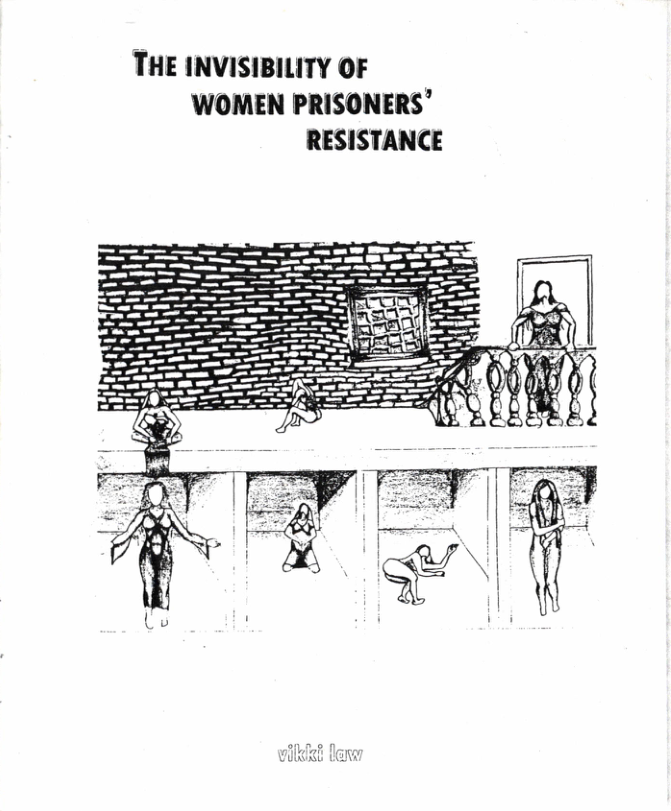
THE INVISIBILITY OF
WOMEN PRISONERS’
RESISTANCE
“This is 3 work-in-progress. Contact me with
feedback and suggestions
Vikki Law
PO Box 20388, Tompkias Square Sation
New York, NY 10009
vitkim|@yahoo com
RESISTERS
Both inside and ost, women are tausht
That chey ace heipless and inable to
Change their circumstasces. Wosen in
'+ hiaden history of
nd organiing wrich
hallenges this presusption. Oat
oal 15'to sncourage snd sipport their
pouerment, Tesistance and organizing.
Ourvision
s visibility of women prisone
prisen
Cpur out “Temacious,” a quarterly zine
¢ uritings and azt by vomen in prisan
“provide. resouce 1ists to incarces
fora smarguncy response metwork for
omen prisonecs, thei Lssues and their
cover b Krsten “Hoops” Marihal Coe ek
Comecionl Faiey, Ovegon.
Inioduciion
Within the scant esrch published bost
acivism and mstancs of esisance, women are nealy
Invsible Altxough women n prson comprise under six
pecentof the maions prson ppultion, e umbers arc:
ncressing more radly than those of thie il counerparts:
between 1990 1d 2000, the e f female ncarcation
increased 108% Howeve, the nterest 1 women prsoners
rugles agans th priso ndusirial complx remainsmuch
Tower than tht of male prsoners
“Tnis mvsibility 1 ot new. T he arly 19705,
recogniing that prisoners src one of the most marginized and
Voiceles popiaon in Ameria, aciiss expanded heir
interests 1 include those o prisoners and i ghts: new.,
crical aalyses of prisonsemesged, prisonrs” ights
organizationsand unons were creaed,and there were new
comimunicaions among prisoners, academics and communiy
Sctivists. Duringthis e, prisoners wrings became reqited
e in numerous niversy cowsesand some wivesies
began eaching courses inside prisons. Haweve,in 1970,
researche and ctivs Karene Faih discovered i, o the
mal nmates of Soledad. “female prisoners wee s ivisite 0
hem 35 thy e o the broader publc Faith agues hat his
overlooking of women prisonrsoccured because ot oy
i they fewer i nmber bat “thy {lso] wee not 5
politcized 1 th men (prisoer] and hey didno g i
e kinds o potest actions that oused mediaaenion.
Wamen's concens,f ecognizeda al by e prisoncs righs
movements. were dismised s persoal, sl cemred and
apolical. Simlaly. i was not at women did ot cogage i
prtest acions bu hat teseacions were ignocd by outside
movements, who chose 10 focus o the et known names of
male prisoners. Thus,while male prisoers gaind polical
<onsciousnessand enjoyed support from outsde groups and
indivduas, many women n prson wereneglecied by thse
same groups. Wihexcepuons of well known women imates
such 5 Angela Davisand Assat Shakur, the prsoners ights
movement overooked the female prison population. These
same observatons hokd e sy Mae prsoners seldom
know abousthei femle counterpars il the broader public
Al ot s, s o
men? Juanta Diaz Coto, on ofthe ew scholars 1o
omen prisoners’acvis, s sted hat he sience arnd
women prisoners’ esistance from outside prsoncr ghts and
service groupssiems fom a elciance 0 upport actvim
within women's prisons.*
S 0 te esurgence of nerest i prisons and
pisone sses which gnores prisoner sctivisn, he e
erature on women in prson focues o the causs,conditions
ndefects of imprsonment. but doesno delv i what he
‘women hemselvesdo o change or prtet tese
ircumsances Fah, who had coordinsied the Santa Cruz
Wome's rson Projet i the 1970, cies viualy o
cxampiesof women'sindivdualorcolective acts of essance
nherbook Unrdy Women . In I the Mis Sruegleand
3
Survivalin @ Women's Prison, Professor Basbara Owen admts
8t she developed 3 visible appert withprison staff at the
Cenral California Women's Facility to facliate her intrviews
with the inmates. This obvious rapport may have led (o distrust
by prisoners engaged in acts of reisance, resuling n eiher
ilence about thie actons or tots decline o b nterviewed
Sumlacly. prison staff may have stcered her away from
“problem’ iamates 50 3s ot 0 expose any gr0ss violatios o
abuse occuring within the isutuion. Even Darvel Burton:
Rose's Th Celling of Ameria, which ncludes ances of
prsoner organizing, omits instances of female resistance
refecting the continued lack o ouiide recognition for women
prisoners who ct as their own agens for socal change.
Why the cloak of silence? One more prominent woran
prisoser, Barilee Baniste,offerd this explanation: “A ot
of women beleve themselves (0 be helpless, due 1 how they
were raised. or perhaps abused as 3 child. | see a o of women
with very low sef-csim/worth > A study by the U.S.
[Deparimentof Justce found that over forty.three percent of
‘women prisoners, as opposed 1o twelve percent of male
prsoners, bad been physically orsexually abused prior 0 their
admission o pison * I als affirmed thal womes's arler
socialzaton “had limted their independence and occupational
choices." While this study was not directed owards the lack
of acuvism among women prisoners, il findings did affirm
Bannster's observaton. While mierviewing woren inmates
for her ook Inthe Mis, Owen ws tod, " s easie for
women o get bulied s hee. If an officer rases hs or er
Soice (0 yos, some women ae peiifed. The fear rom past
abuse comes back and they ae scared. Very scared ™ A 1999
Depariment of Justce study confims these observations,
Gindiog that lmosthalf of women in jas and prisons had been
physically orsexually abused prio o hei incarcerator
much higher rae than reported or the overal population
Thus, women prisoners have to contend notonly with the
apathy o inestia ofther fellow inmates andth fesr of
Sdminstative tealiaton, bo lso the ssues of past abuse 3nd
sociaization of obedience and subservience (ha affect wormen.
As 2 woman incarerated n Uinoss put it - “Do you think
‘women wh are conditioned o be subserviest o teir men (and
e warld) are going 0 come o prison nd suddenly just grow
abackbone.
Another explanstion might be that wormen are perceived 35
passive. Faith counters the argument that women prisoners
lack selfesicem as a ‘blarming or condescending projection by
clas-bissed people who can' imagine that women with so
many problems could think well of themselves...Given that
mostincarcerated women have had o hustle in some way (o
survive many of these women migh wel have a greater sense.
of thei resoutcefulness than s the norm among women, even
‘when ther means of survival appearsself-desiruciive (0
others ™" Thisperception leads to the dismissal of the notion
that women can and do contribute o srvggles or change. Just
a5 thecivilrights movement o the 1960 and 19705
ownplayed the role of women in favor o highlighting male
spokesmen and leaders, the prisoners’rights movement focuses
‘on men to speak for the masses. Such neglect leads 0 the
efinition of prison issues as masculine and male-dominated,
ismussing prison ssues which ae distincly feminine i the
Scarciy of aniary hygiene products, the lack o medical care
Specifcaly for women,especialy prenatal care, thieas of
Sxual abuse by guseds, e ) and thes any actions which
omen take to address ad overcome these concerns. Thas,
researchers and scholars do not search out acts of defance
‘among the growing female prison population.” For instance,
on 28 August 1974, inmaes at Bedford Hils protesed the
besting of a fellow inmate by holding seven staf members
hostage for wo-and-a-hall hours. However,“the August
Rebellion* is virually unknown today despte th fac tha
male state troopers and (male) guards from men's prisons were
Called 1 suppeess th upasing,injoring twenty-five women
and that twenty-four women were wansferted o Matteawan
‘Complex fo the Crminally Insane without the required
commitment bearings.™ Because i lasted only (wo-and
ours, no one was klled and the story was relegated 0 2
paragraph buried i the back pages of The New York Times,
the “August Rebellon” s seen as less dramatic than the Atica
Rebellion. The women at Bedford Hills also did no have the
opportunity o contact media, big-name suppories and
polticians as the men at Atica did. Thus,the “August
Rebellion” i easly overlooked by those seekiag information
on prisoner protests and disruptions
Similary, women in a Califomia prison held
“Chistmas iot n 1975 Protestng the cancellation of family
holiday visits and boliday packages, inmates gathered in the
yard, broke windows, made noise and burmed Christmas trees
ina *solidariy” boafire* Even more recently, following the
1995 rebellionsat Talladega, Allenwood and oer federal
male prisons, the Federal Corrctional Insitute at Dublin,
y. was placed
there had been no
"
under lockdown. Despte the fact
disturbances i theprison, FCI Dublin remained under
Tockudown al weekend axd women were forced 0 g0 10 work
that Monday under lockdown conditions. To voice their
protest, women began saying away from meals and, tha
et simulancous trash can fires in all o the unts.
Approximatcly seventy women were sen 0 adminisuative
Segregation and charged with rson and “engaging in 3 group
demonstraion. ™ However, because no one had hreaiened
Violence, these actsof disruption is ven more easly
overlooked by those researchiog prison disturbances.
Juanita Diaz Cotostated tha she was moved o record
post-Attica prisoner activism among Latieas in New York State
after volunteering ata women's prison: “Just as women in the
outside community sruggle daily 1o change conditons we
perceive 0 be oppressive, thee have always been groups of
‘women who have organized wihin prson walls o Iy 1o
change condiions " However, just s much o the research
‘on women'sisues downplays th role of wormen themselves in
challenging f ot changing, oppressive social olicy and
practice, most research on women prisoners and theis concemns
Y
do ot share Diaz-Couo' concern for docamenting women a5
actve agents of social change.
Dz Coto argues that social sientists studying women
prisoners “hghlight the role played by women's prison (amily
Broups and Kinship networks, almost 0 the complet exclusion
of other types of prisoner organization.” The emphasis on
prison families not nly substituts fo research nto inmale
esistance but sl reinforces th sieotype tha womer's sole ‘
concern is to maintain ther tradtional gender roles.” Diaz- ‘
(Couo hasalso observed tht, ate the 1971 Atica Rebellion, ‘
he prevalence and importance of prison familes declined 35
prsoner groups and social servies for female inmaes.
emerged.* Simila o the overlooking of pisoner acivsm in
favorof utside prisoner ights' movemens,research on
women prsoners overwhelmingly f3vors detals of pison
family and Kinship networks over the more painsaking (ask of
searching out nd documenting the less visible instances of
fesisance. This becomes 8 sel-perpetuating cycle: by
ighlighing the various family and kinship networks o the
exclusion of other forms of organization, scholrs give the
impression thatthis i th only form of oganizing witin
‘women's prisons, not only slencing the voice o women
prisoner acivits but also paving the way for others t do the
same.Such emphasis also overestimates the prevalence and
influence of prison families. While Barrile Bannister
confiems hat these “familis” sl xis,she states that there
Very few here in Orcgon” and that “others kind of frown
on it—being [that] everyone sees them stab one another in the
back alot of tmes,or they fal out. "™
‘Bannister also acknowledges that th lack of numbers is
als0 3 obstacl to orming 2 women's movement befind bars
M prisoners, on te other hand, have mare than suficient
nize inmte.led movements withi ther
facilies. Women prisoners not only lack a visible moverment,
but they e often neglected by their male counterparts:
Despite s lage membership,the Missouri rison Labor
Union, five thousand member organization of Missour male
prisoners and outside supporters which advocaies minimum.
wage and decent working conditons for al prisoner workers,
s o women inmates as members. Only in 2001, fouryears
afer s formation, have its organizers attempted o outreach
them and address thir issues
‘Woen prisonersaiso lack a comimon history of
esistance. While male prisoners have the example of George
Jackson,the Attica uprising and other well-publicized cases of
prisoner activism, women remain unaware of precedents
reevant 1o them. Both Dawn Amos, imprisoned in Canon
City. Colorado, and woman incarcerated in iiois have
remarked tha llieracy also plays a ol in women'slack of
protest and esistance. Amos noted that mosi o the women
around hes“are very llicrate, they don't even have education
10 take a pre.GED tes, et alone read 3 law book or even a
ewsleter sboutother prisoners and what they have been
subjected 0. They can hardly comprehend the ruls that we
have 1o live under It alone a way of comprehending a way to
stand up forthe rights." Amos's observaiion echoes tha of
an earlie leer fom a prisoner in Wlinois | “1 know illeracy
5 one of the hindrances to pursuing any relet.” she wrote.
"We need o educaied women how 10 write grievances and we
need Lo have available peopie o help (the] lecate and (the]
ety pep rvaces g e
Added 0 this s the adminisiative harassmen, dissuading
possible participans. One woman staed that the level of
harassment i s great that most of your fellow prisoners think
that you must be crazy for even atempuing to challenge the
prson system wrong doings in anyways > Kebby Warner,a
prisonerin Michigan, has encounterd simila rsistance from
her fellow inmats: once she started 0 become aware tht her
Plght was shared with thousands of other women, she tied to
organize and educate those around her sbout the prison-
industia complex: -1 was laughed at and they went s0 far a5
accusing me of being a Kian member because of the way
Amerikkka was spelled in th zines | passed out. They
wouldit even read them.* A woman released from a Texas
prison offered this cxplanation s 0 why she chose sience: T
once ied (0 gt my morm (@ know that thre was abuse.
happeningin the unit. Bt when my leter was proread, it was
tumied) in 0 the warden, which in o called me in the offce
and saidif wanted 1 remain in population 1 bettr keep my
opimons to mysell. And 1did not want 10 be in soltary
confinement...so | closed up ™" Similarly, Barilee Banaister,
Dawn Amos and a Californa inmate who wished o remain
an0nymous have saied tha thy are reluctan t write about
certan aspects and instances because thei leter can be and, 5t
leastin Bannister's case, ae read by prison offcials. Ths,
even for those oteested in women prisoners”organizing and
2t o resistanc, he prison's monitoring of mail makes
vinually impossibe o delve decply
Even supposcdly non-threaening idess, such a5
iftroducing new medbods of teching eracy, i met with
cesistance, suspicion and refusal by prison administrations. As
Kathy Boadin, a ormer member of the Weather Underground
and prisoner st Bediord Hills. poinied out, "l like many other
prisoners, wanied o be productive and o do something.
meaningful with my time in prison...Yet prison administrators
usually limit the amount of esponsibilty and independence 3
prisoner can have.* The premise of prisons lis i obedience
a0d control. Inmate-generated programs, projecs and groups
challenge tha premise. Thas, even ore liberal prison
‘administrators, such 2 the ones at Bedford Hills, are
suspicious. f o hstle, 0 the educational and group work of
theirinmates.
Women prisoners also fce diffrent circumstances.
during theit incarcration and thus have different priortes and
iferent ways o challenging theirconditions than their male
counterparts ™ Prevaleat ideas of pisoners are masculne. the
term “pritoser” usually connores 3 young black man convicted
of a vilent crime such as rape or murder. Politicians seeking
votes and medi seeking saes play on this reprsenttion,
whippiag the public ino hystria o ge tougher on crime snd
build mor prisons. However, the imag of the young. black
s
male felon omits th growing number of women imprisoned
under the various mandatory senicncing laws passed within the
past few decades ™ Because women do no it the media
siereotype, the public chooses 0 overlook then ather than
Erapple with e seeming paradoxes isheren in women
prisoners, who, by virue ofteir incaceration, have somehow
defied the societal norm of femininity * Ths is compounded
by theseeming contradiction of pisoners as mothers, a5
eproductive righs or even the ability (0
teproduce), and as women in general. Women prisoners and
theie dieing needs and concerns complicae the public
perception of prisons and prsoners. However, pson
authoruies have been sow o recogniae these diferences and
thos accord them the same. if o worse, reament as their
male counterpars
Mdical Cace
‘One pressing issue for women prisoners i the lack of or
oo medicalcare they receive. While sl prisoners face poor
medicalcar, prison administrtions often ignore or eglect the
paricula heaith care needs of women prisoners. Thit the
majority of awsuisfiled by o on behallof women in prison
are for madequate medical services tesifies o the importance
placed on heakh care and treatment” A 1990 study by the
American Conectonal Association ndicated tht ix percent
of women eiered rison while pregnant* Even prison
wardens agree thatseveral of the particula needs of pregnant
women “have yet 1o be dealt with in any of the acilies.”
including adequat resources to deal with fase labors,
premature births and miscariages, ack of matcnity clothing.
he requirement that pregnan inmes wear belly chains whes
ransporid (0 the bospita, nd th lack.of a separate area for
mather and baby.” Pregaant women are als0 ao provided with
the proper dies or vitamin supplements, given the opportunity
10 exercise o ught breathing and birthing techniques. The
director of Legal Services for Prisoners with Childen, Ellen
Barry, accused th prison sysiem of “shocking disegard of
basic humanity that [ saw reflected n the type of treatmest 0
‘which pregnast women were subjeced.” One homiying. |
xample is tha o a wenty-year-old woman who was almost
ive months pregrant when incarceraed. Soon after, she began
expericncing vagiral bleeding. cramping and severe pain. She
requested medica assistance numerous imes over 4 hee.
week perod, but there was 1o obstetician on coniract wih the
prison. She was fnaly seen by thechief medical offcer, an
orthopedis, who diagnosed her without examining ber
physically o running any laboratoy tests, and given Flagyl 3
drug thatcan induce labor. The next day, the woman went nio
Tabor. Her son ived approximately two hours *
Dr. Patica Garcia, an obsttrcian and gynecologist at
Northwesier University's Preatice Women's Hospial, has
stied that shackling a laboring mother “compromises the
abilty 1o manipulae her legs int the proper position for
ecessarytreatment. The mother and baby's health could be
compromised i there were complications during delvery such
a5 haemorhage or decrease in et
Despite these dangers. women coatinue 0 be shackied
in the name of securty. In an interview with Arnesty
Intermational, one woman descrbed giving birth whic an
inmate in Chicago. Her legs were shackled together during
Iabor and, when she was ready to bisth, “he doctor called for
the office, but the offcer had gone down the hall. No on clse
could unlock the shackles, and my baby was coming but |
Couldn't open my legs
In addtion 10 medical ignorance/neglect by suff,
women who have given birth are not oly immediaely
Separated rom theienewborns,but, i the name o secur
Sometimes subjecied t vaginal exams despte th risk of
infection”
Pregnancy is ot the oly specifically female medical
concen ignored by prison offcials_Prevention, screeniog.
disgosis.care, pai aleviation and rehabltation for breast
cancer ar virually non-existent i pisons. In 1998, a stady 3t
‘n unnamed Southenm prison found tha seventy percent of the
omen who should have had mammograms under siandard
medical protocol had not been ested. Alhough many of the
women were t igh isk because of family hstoies, they wese
ot provided with a clnica breast exam, information or basic
education on sell-examination upon admitance "
Not only are the paticalar bealthcare needs of women
gnored or dismissed, but health care in gneral is ofien
nadequate or lfe-treatening * Dalene Dixon recalled her
visit 0 8 privte clinic contraced by the prison: “There was b0
disposable paper o th table 0 create sanitay barri
between my body and the examigaton tble. The room
basicaly in dsarry, there were spilled liquids on the counter
10ps as well s debrs on the floor.” In the estroom was a sink
iled with "soiled and bloody ubes,lds and btles. Even
more distrbing were the clean ones locaed o8 (0p of the toilet
tank beside i. 1t rapidly became apparen (0 me that these
items were bing washed and reused
In Februsry 2000, Wisconsin prisoner Michelle Gre
ffered an asthma atack and asked 0 g0 0 the Health
Services Unit (HSU). When the guard and captain on duty
contacted the nurse in charge. he d o ook at Greer's
medical file, simply instrcting hs t use her iohaler (which
was not working). Hlf a hour lter, Greer's second request 1o
8010 HSU was lio ignored. Afir another haf hour, Greer
was told to walk to HSU butcollapsed en oute. When the
nurse in charge amved, it was without a medical emergeacy
box or oxygen. A second nurse amived with the needed
emergency box, but again with o oxygen. Fony.five minutes
aiee hr collapse (and ess than two hoursafec her niial plea
for medical hep), Greer died
In addsion. literacy and poor lracy can be an
obstacle to obianing medical care. As Ellen Richardson, an
inmate at Valley Ssi Prison for Women (VSPW) in
Californa,tesfied: “The medicalstaff riage is]based on
how the patent sties her sympioms on paper ~ This procedure
ignores the facttha the average leracy level 3t VSPW isless
(han ninih grade, tht over seven hundred women have less
than a sixth-grade readinglevel and tha approximaely one.
hundred are ileraie orspeak English s second language.
‘A woman may have extreme stomach pai and crampig, bet
only have the ierscy level to wrt, L have a mmy ache.”
“That i not enough for medical staff 1 et her see a docir *
However, women have been actve about ying to
change their sometimes life hecatening medical neglect. The
most Successful and well-known pisoner niiated projet
organized around healthcare is the AIDS Counscling aad
Education Project (ACE) at Bedford Hills. AIDS i the leadng
cause of desth among, U.S. prisoners,being fve 10 ten imes
o prevalent inprison than in the owtside socity ”_In 1999,
the New York Stte Department of Health ound that the rate
of HIV infection among wormen entering the New York State
Cormectonal Faclies was nearly twice that ofthix male
counterpats ™ In 1987, women atthe maximur-securty
Bedford Hills Comectional Facility in New York, motivaed by
watching thei rieads die of AIDS and by the socul osiacism
and fea of people with AIDS, sared ACE "
"ACE founders hoped to educate and counsel theit
fellow inmates sbout HIV/AIDS 25 well as help t care for
women with AIDS in the prison infirmary. While the prison
Superimendent, Elsine Lord, gave the group permission (or the
project, ACE continualy faced staf harassment snd
Sdminssrative nteference. For nstance, because both Kathy
Boudin and Juith Clark, aeged members of the Weather
+ Underground, were active ACE members, the group was
consantly moniored and sometimes prevented from offcally
‘nceing. The fea that the one-to-one peer counseling sessions.
ould lead 0 inmate organizing and the saffs own ignorance
and fear of HIVIAIDS led o taff harassmest and nteriercoce.
‘Educatorsfrom the Montefiore Hospital holding raining
Sessions were baned from the acility for suggestng thal the
Depariment of Corectional Services lft s ban on denial s
and condoms ' A year afer it formation, ACE members were
rohibied from meeting at s regular e, 1 use s meeting
Toom, give cducationsl peseatations o o ffer o themseives
s ~counselors.""
‘Despue these setbacks, the mermbers of ACE oot only
managed 0 implement and continuc theit program, but also
received agrant fo & quarter millon dollars rom the AIDS
Insitute and wrote and published a book detailing the gr0uy's
history and s positive impact on women with AIDS 3 a guide
for other prison AIDS programs. One interesting aspect s hat
despite ACE success, male prisoners llempting 0 5 up
Simlar programs at theie facilies conunue o meet with
sdminsiratve resistance and ttalation.
“Other women palitica prsoners have also focused on
the AIDS crisis behind bars. Marilyn Buck. for example.
sarted sn AIDS education and prevetion program in
Califormia ™ In 1994, three HIV-posiive inmates a Cental
Califoria Women's Facility began a per-ducation program
comgassing not only HIV and AIDS, but also oher sexualy
namited discases, whercalosis and Hepatis C* However,
‘with the exception of ACE at Bedford Hils esearchers and
Seholars havecithr largly ignored these programs ox
overlooked the diffculies and adminisirative harassment faced
by those organizing around HIV/AIDS issues i prson.
‘Woen have also worked individually and without the
suspies of admiistcauve approva o change their heallh cre
I October 2000, women at VSPW tstfed sbout the
inadequacy o the (acidy's medicalcare s leglative
heinngs ® Unil hr recentceah, Charse Shomate worked
it he ellow emates withsckie-cell anemi 0 undersand
{he diseaseand he necesary esments St also dvocaicd
e rightlo compassonat release or any prisoner wib ess
han +year o live and was th lead plai in the clas-acton
Iawsi Shomate v. Wison Unfortuntely. Shumat herell.
éied 3t COWF, away from family and friends,because the
Bosrdof Prson Terms ecommended clemency ather than
compassionat relesse. Govemor Gray Davs refused o
Spprove the Board recommendation. Four yearsbefore b
eaih. Shumate wioe " look n e bule] knowing the sk
could mesn my e n more ways than one...And yes. | would
o't all over agun, 11 an save one life fom the medical
nighmare of CCWE Medica Deparumens hen ' well worth
45 Her work did ot cesse with et desth. Women who had
\worked with hr continse the sk of teaching hers how 1>
nderstand thei ibwork and how o charthei resuls, keep a
medical sy, ho bese peopl” sccountable 10 what they 5oy
40 oo hemn " Sherie Chapma, one of the twenty-six
omtes who estied in Shumatc v Wilson, became the
primary plantf . clas-acion st over medical condiions
2 wel 35 iling civi it chargin the CDC with cruel and
unuaal panishmcat afe waiing over a decade fo cancer
ueamen*
o 33 scholasand researchers have ignored women's
orgaizing sound HIV/AIDS snd hr healih conceas n he
outde, they have aisosgnored the sirgglesof individual
women for sdequate health sevics and support. The works of
'ACE. Marilyn Buck, Chrisse Shumate 0d otber women may
ot b 35 dramaic 2 2 wrk srke or 3 boyco, but they
Roneeles addrescrocial s (cing women in prson and
Contadic the noton tht women 6o ot and canaot nework
nd rganie 10 change tei conditions.
Childeen
Sepacation rom chiden is snoher major isue for
‘women inmates. In 1998, more than quarte milion childien
nder the age of cighteen had s motber behind bars' Wher
1990 Amercan Comectional Assocaion survey asked womea
pisoners o ame “he most imporiant persons) i your e
fify.two perent dentfed thee chidren.” These numbers
Should warrant that ll women's prisens have family and
purcntng progras available Howeve,suc i ot e case
Inmate moters, many of hom weresngle heads of
Bousehold o o ncarceraton ar e on their own 1
navigte the rocky path of maitainin conact and cusody of
b chldrn. Fash argaes tht i ack s due 1 he ea hat
a0 woman who has uieddrus, worked 8 3 prostinie o
olherwise shown deviant or crminal tendencicscan be 4
006 mother Women pisones e viewed 5 incapabe of
eing good mothersand thus donot awtomatically deserve e
sme espec and restmen acorded 1o mothersonthe oubide
Whi this may b he cas i ome msances,sichas g
7
addiced mashers.such s sweeping generalzation ignores the
fact that many inmate mothers were single heads of household,
th sole provider for their children and may have been forced
1o rely on llgal means to supporttheir amily. The view of
the inmate mother as somehow unfi and caworthy has been
used 0 egitmate prison and social services policies egarding
e chikdren of mprisoned parents. A 1978 dtctive of the
Depariment of Social Services specified that it can rfuse
imprisoned parents isits with theirchildren placed 1 fostr
careif it believes that visits will hurs the children.* In 1997, the
Federal Adoption and Safe Families Act (AFSA) was enacied,
educing the time in which children may remain in foser care
before pareotal rights are terminated. Under this act if an
incarceraed parent does not have contact with his o her child
for six monihs, he o she can be charged with “abandonment”
and lose parcatalrights. 1 the child i in foste care for fficen
of the last twenty-two months, th state an terminate parents!
nghts. Once these rights are termnated, parents have no legal
elatioship with ther children and ae not permitied to have
any contact with them ”
Mainiaining family tes, however, is ot an issue.
‘ddressed by many of the male prisoner activists I i1
pison and is inmates reflectthe ouiside world and
expectaions. women are expected tobe the eepers o
a0d home and, whea a mother i incarcerated,the burden (c
maintan ties 0 herchildren falls upon her. In 1998, over two-
thirds of all wome prisosers had children under the age of
cightcen, and, among them, only twensy-five percent saxdthat
heirchidren were iing with th fathr. In contrast, ninety
percent of male prisoners with children under the age of
eighteen said that thir children were lving with their
mathers * Ten percentof inmate motbers in contrast (0 two.
percent of nmate fchersstated tht hei children were iving
1 4 fosir home, an agency o an nstution.” Thus, mothers in
prson are forced to navigae the legal maze of family law more
ofien inorder (0 maintain contact with and reain legal custody
of thei children.
A 1993 survey of women prisoners n eight sates and
Washingion, DC, found tha iftyfour percent of the inmate
mothers interviewed were never visited by theirchildren One
major factor i thislack of visiation i distance: More than
sinty percent of inmate mothers wete incarcerated more than
‘one hundred miles from their child's home. Less than nine.
percent were within twenty milesof their child” However,the
Counts have reflectd the opinion that inmate mothers have
fofeied their ights o see their children. In 1987, it v.
Meese determined that prisoners have 1o ight to b in any
paricular facity and may be wansferred both within and out of
sate according (0 the nstution’s needs.® Such a decision
gives prison authortes the power o efectvely sever 3
‘woman'sabiliy 10 see her child. Not only the distance, but the
ravel tme and expenses make frequent visis lss likely. For
instance, while Barriec Bannister i imprisoned in Pendieton,
Oregon, her eight.year-old daughte lves with Banaisir's
relatives in Gloversville, New York " ~Tm lucky 10 see them
every six or cight months,” wries Banaiser In almost every
leter, she expresses he longing forher daughir: “When | was
artested, she was four months shy of becoming thce yearsold.
Tve missed the bes years of her life. She'll b thireen and a.
half when 1 get out " However, Bannistersull etins [l
custody of her daughier a rarity among inmate mthers
‘Another inmat t Eastern Oregon Corrctional Instittion ost
custody of hr four children 1o thei sbusive father i Virg
She's notseen them i over ive years. She doesn't know what
Distncing women from thei familes s
ively weakening, ifnot sevenng, s woman's
s from her oved ones. Visiation becomes even more
important when children are in foster care. One of the
exceptions o AFSA's trngent gudelins i that a fosercare
Sgency may delay filing fortermisation of parentalrights if
there 1t a st parent <hild bond—as demonstraied during
visitsand by other conact* Maintaining parenta s has ot
been won through prisone boycots, wark sioppages or hunger
Steikes, ool traditonally used by male iomates (0 challenge
their conditions " Rather, those women who wani faily
mainienance programs must work with ther pison
‘dministrstions. a far less glamorous path for researchers 3nd
Sctivistacadermics
‘One cxample o such a program s the Children’s
Center at the Bediord Hills Conectonal Facily in New York.
“The Center houses a ursery where inmates a0d theirbabies are
allowed t live ogether or the child's frst year as well 153
program belping the new inmate parents“lear 0 be mothrs.”
‘Although it s staffd by inmats, the Center s adminsered by
the Brooklyn Diocese of Cathlic Charites and unded by the
Siate’s Depantment of Comectionl Secvices.* However, under
the Center’s auspices,inmaes,reaizing he necd for supportive
programs for mothers, organized two parnting courses for
Bedfords inmates-one on infancy for new mothers and
pregoant pisoners and the ther ten-week course called
“Parening Through Films.” with each week devoted 10 new
subject on growth and care for children.” These wer the
prison’sfrs courses both organized and taught exclusively by
Inmates. Out o the Children's Cener also came moe far-
reaching change. Unil 1983, children of prisoners laced in
the New York Stae foste cae sysiem did nothave the legal
I 10 visit thei paents inprison. Inmates a Bedford Hils
who had been unable to have thei children vii them because
of this formed the Foster Care Commitiee which, wih the help
of outside advocaies, led o new legislation notonly gving.
prisoners with chidren in fostercare the same rights and
esponsibilis a3 parents who are not incarcerated but also the
ight 1o monthly visits provided that the prison was ot 00 far
away ™ In addition, smates involved i the Chldren's e
publshed a foste care handbook for women pisoners whose
children had been placed in the foser cae sysim
“The success of the Chidren's Center did not go unnoticed by
the more reform-oriened penal authorites: Modeled on the
‘Chidren's Centr,a simila nursery at the Taconic Correctonal
Facility opened in 1990 with tweniy-three inmate mthess.*
That prisoners sirive to maintin contact with thir chikdren and
other amily members can also be a feason not (0 do anything,
that would label them a5 “troublemakers” or“rabblerousers
“They [t prison stff and admisrain] would stack
peopl [docatin for reform] through thei emoions tated
one inmate st Bedford Hils. “Like the family would come in
0 it somebocyand they woulda' i the amale’schat and
el he farly they werent there and um he family away 3
th gae." Another inmae clamed hat prsoners who.
publcy<ricize the BedfordHils ersonnel wereofen denicd
Enuy o he facilnys Family Reunion Program * Women
nmaies impregrated by prison salf may alsobe denicd
parcipation i he nuriery program solely because of the
{aters starus. Haman Rights Waich found that two o the
women thy interiewed who had been sexually assaulted 350
Impregnate by prison saff were enied eniy * Thas,an
nmaies st 1 speod (me) e with her chilen)caa
s be used o dissuade her rom organizin (o change.
‘Women wha give birth whic incarcered nt only (e
he trauma of mmediate separaionfrom et ewborms but
S50 admisirative and soca serice ressur o rliquish
heir new il The cae of Kebby Wamer,apegnant woman
mprsoned or s bad ceck,lutaes the nsuttonal belel
tht somates cannot and shoold o reain custody. o even
contct, with thes childen
“Warmer,ate havingbeen misdiagnosed as having 3
Stmach s durng her st monh n prsen,was nformed hat
She waspregnant Luckily, Wamer paent ageed o ake
Car of the baby while she was incarcerted. Afe the bt of
Helee, Wamne efusd t passively accep th prison
fequrement tha separses mother and newbom i nly one
Gay. sh refused o et and thus won (wo more ays i he
hospial withherchild. When the gurds finally masaged o
Separai them and bring he back (0 prson,she was fld that i
ShEbad wasted 1 have children,she showld have sayed st of
prison. Thisane remak sums up the prevailing view of inmatc
mathers.
“Atbough her parnis had custoy of berdaughter, he
pain and ses f separation sl weighed upon et i,
Teading t0 nger and fghs with iber smates, discplinary
ickes and th repuation of defiance,” which resoid in 3
enial of parole. Withthe deah o hr faths,however, came
ancther lss: er motber, unwilling o care for 3 balf black
by lone gave Helen o thefose care sysen.
“The L allows orthe termination f parenal rights
after twoyears. In Warnr' case, this was cenaily truc
When her daughie was v years old, udge terminated
Warner's parenal ights o e grounds ha sh " neglecied
and e my <hld due o e lenglh of my incarceration.~
Whea she saned 0 appeal tis decision. her casewarker and
he Family Independence Ageacy thieacoed 0 place Helen
\with 2 new fosts famly who would adopt her mmediaely.
o permanenly seslmg her il and preventing Warmc fom
everbein abi o find her. Under ths press, Wamer fially
Sned an aifdavit relinquishing hes rights 38 st
Howeves,this os inspired Warne 0 acton aganst the
priso-indusiialcomple'splcy of beaking up familes she
1 curenlyforming a support organizaio [o ncaceraied
parnt. The organizaon e envsions “willsiand a the
Counbhouse nd potest the kidnapping of 3 child tht deserves
10 know who her motherfather is ™ Thus, alihough the
prison-industaal complex negatively impacts famles and
severs family ties i an atempt 10 brak the individual inmate.
‘women both collecuvely and individualy resist such efforts.
Seaual Abuse
A fa grete probiemfo wornen prsoners han male
pisoners s te sexual aggression of male coneetons ofcers.
1o 1996, imermationl huran rghs group Hurman Righs
Watch relessed All Too Famila,a rort documening susl
sbuse o women prisoncrs roughout e Unied Stes. The
epon, reflecng two-and -l years of rsearch. found that
el sesuls, abuse 3 ape f women prisoners by male
cortctionsl employees wer common and that women who
complained incurred wite-op, o of “good ime” accrved
ovead an eary prole ndior prlonged peiods n discplnary
Seegaton’ In 1994, he U'S Deparumens o Jusice lunched
i vstigation of two wome's rsons in Michigan and found
it "ncaly every woman - mervewed reponied various
Sexually aggresive acts o guards @ These stances included
o only rape snd sexual asaul, but the misteatment of
prsoners impregaed by guads,abusive pat fisks and ther
ady ssichesand vilations of privacy,inchuing seaihes of
ihe Lt and shower aressand surveilance dring medical
Sppointments. One pregnant inmte was scored by two male
officrs whie in labo. The two men handeufied ber 10 e bed
nthe delivery room and then posioned themsclves where
hey could view he genalaea and ke derogaory
comments theoughou her delivery”
“The caseof Heather Wells, an inmate 3 Washingion
Comectons Centr for Women, llstrses ot onlythe
prevalence of sxual asaultbut also theprison sysem's
eamestof mothers. In December 1996, Wellswis raped and
mpregaated by guad n e pson aundry room. She
charged he gurd wih rape b, cven afer patcnty st
proved her claum,the st of Wsshingion dd o e chares.
Tnsead, the gaard was llowed 0 qui bis job and move ot of
stste. Gnly weeks afer the baby was bo,she was taken from
Wells and placed i foster home * Th callousness in
scparating 8 mothr andher newborn infant s commonplce i
s women's prisons. rflecing the atutude tha ncacered
omen have oreted thei s (and fecings) s mathers
Unike the sexul predation n mal pisons,he perpettors in
female fcilies areusally thos n posiion of auihoriy,
such s guards and oer prson saff, This makes i impossble
for women prisoers o form protecive goups ke theismle
counterparts. Guards hold the key o tei cels and arc
horied 0 waich amales, condact fll body rsks andsip
searches. and et cllsat any time. Ths,te direct
Sppronches of mal groups sach & the Angola Thce o Gy
Nien Against Sexism. male nmae groups that bypas the
adminsicaion by physcally proictng weakerprisoners from
Sexulpredatos do oo work for vamen who wis 0 10p e
Sexual Rcasment and rap i he facily
Inthe case of Bariee Basaister, sentenced under +
Oregon's mandatory seniencing ., she and sevenly-<ight
other women were sen (0 a privatized,all-male prison i
Avitons un by the Carections Corporation of America
(CCA). Notoly were theyseparated from family and frends,
butls from any ouside suppor hat could have revented
ihei sexual suse. Only weeks i the women's il some
wee visied by captain, who shred marjuana with then. He
el with e and he retrmed withoter ofcers who
announced hat they wee searching the il forconraband
However,they promised tha i h women perfomed s stip
ease they would no esech the cll T ofthe girs started
strpping and the et of usgot puledino . Bannisier
recaled. “From that day o, e offcrs would bing
mariana in. or cthr tfl we were ot suppose(d] 1o have,
and he prisoners would perfon () dnces - From there,
he gaards became more aggressve. rping sveral o the
women. Bannisir reported that she was o iven food for
four daysuel she areed topeform orl sex 1 guard
Once out of sepregaion, Bt caled autside rends nd
{oldthem ber story. They, intum informed he media. The
media aenton Ied 1 he retumof ome of the women to
Otcgon, where they e feders s, resuing i pt
apology. a promise o sncer roles concering sexual abuse.
30d e reimbursementof atomey's fecs” The negatne
publciy alo d 10 he suspension and dsissl o thee
dozen CCA stff members
‘Bannistcrssory i unusualonly n hat the wormen
hermselves wee able o organiae andobuan suficentouside
support o stop thie abuse. Women inmtes wha have been
saulcd by prisonsflusally Ik the ovtsid s0ppor
Services which mal prisonersmay tun o For nstance, male
inmaics aped by ot imates ca uh 1 outsde g1oups s
25 Stop Prisoner Rape (staied by an ex e who was
himslf rapedinprison). Women raped by prson stff on the
aher hand. fce ot only admsiratve harassmentand
Tetaliion for complaining but lso 3 lck of suppor ervices
utide e eachof he prson adminisration Down Ao,
Rerself hving xperienced sexual msconduct, sted tha when
w0 women were physically and sexually abused.they were
wanstered 03 fcilty in Denver whilc he offnding officer
{emained,uneprimanded o h job. 1 her own e, he ‘
Disirct Attomey has yet 1 pesschargs againt ihe offending
olficer. F'm sl in the midle of g o fnd a atomey to
ke my case,” she stted” Thisabseoce of support network,
ot s and ou, vt only mirors bt magnifis the gencral
ack of suppor fo rape vieims.
Educaion
‘While women prisoners face issues not pertnent 10
male risoners, they aso share issues. However, these
similaites ar often neglected. One issue commonly
overlooked when defning the ssues of women prisoners is
education. Sudis of the impact of education have
radiionaly focused on male nmates. While cducation on any
level is ot » paniclarly masculine concem, the omission of
‘women inthese studies indicates tha researchers do not
perceive his 25 an important ssue or women.
However, such i no the case.Inthe 19705, inmates
participating n the Santa Cruz Womes's Prison Projec, the
first program (0 ever offer university courses in a women's
prison, demonsirated their eagerness for higher education. In
1972, when Karkene Faith, ne of s eachers and coordinors,
was temporarily banned ffom the prison, inmates organized a
work sirike and asit-in before the warden's office. Similarly,
when the project was barred in 1973, the students cirulated
petiions, held work stikes and met with the administration to
protest he project’s removal ' In the 1980, after Oregon
prisoners organized a sitdown demonsirston, en women werc.
llowed o paricpate in the college courses offered st the male
Oregon Suate Prison.”
In 1981, e adminisiation at Bedford Hills inaly
agreed 0 observe Powell v. Ward snd set up a 125,000
“setlement fund" 0 be spent by the prisoners for
improvements i the prison.” Inmates spent allof this und on
educational tools: expansion of the library collection. books on
‘African- American history, the hiing of an educational
consultant, compurs for business classes, and Spanish
Vocarionalclasses * Thatthe inmtes chose to spend
‘exclusively on books and other ducational materials shows
that women, ike men, are oten eager 1 lean.
More than s decade lte, when the cus in federal and state
funding eaded prison college programs, the inmates at Bedford
Hills worked with the prison adminisiration and epresenaives
from various colleges and universites throughout New York
State (0 restor higher education programs. In 1996, they
succeeded in implementing College Bound, an undergraduse
college program aimed toward Bachelor of Ars in Sociology.
Neasly thinythiee percent of Bedford's inmales pay the
quivalent of one months wages 1o participae n ither the
college orpre-college program’ This fact alone should
disprov the unspoken hotion that education is no an issue for
Incarcerated women.
Professor Michelle Fine, with the aid of ight Bedford
inmates, conducted inerviews wih College Bound
participans,thirchildren and correctional staff. While her
study focused mainly on the effcct of education o recidivse,
she also observed tha gradutes have gone on (o develop,
facilitate and evaluate prison programs addessing isues such
a6 anger management, substance abuse, HIV/AIDS, domestic
violeace, sexual abus, parenting support and prenatal care
‘They have also gone on o helpthei ellow inmates with theic
education. Martina Leonard, the executive asisant to the
president of Marymoun: Mashatian Colege, one of the
colleges offering courses o the College Bound program,
recounted that former students translerred to another New York
State prison becam “leaders...They ¢ twiors and meators o
other sudents and ey fecl that Jut having tht college
program at Bedford Hils has really allowed them to begin
to...help other people." Thus, the impact of higher education
ransforms womea'ssel-perception ffom passive objects and
victims nto active sgents o both sef-and social change.
Tromically, Fine obsrves that for many women, “prison has
become a place for ineliectual, emationsl and social
growth..A space fe of male-violence, drugs and
overwhelming responsibiltes, collge-in-prison carves out 3
space which nurures a kind of growth and maturiy that would
pechaps not have been reslized on the outside " While Fine
. does o delve decply ntoths ssue, i does Suggest that
‘women often are unabl to ocus on learing with he myriad
of esponsibilies and disiractons of the outside world. Most
of the women who attended the College Bosnd program from
1997 10 2000 came with past histries of acadernic ailure
Upon entering Bedford Hils, forty-theee percent had neither a
high school diploma or GED ; twenty-one percent had a GED.
and twenty-two percent high school diploma ; and only
fourteen percent had some colege credit”
‘Other women have found ways 0 cicumvest the 1994
‘Violent Crime Control and Law Enforcemest Acts prohibition
offedera financing of prisoners education. Dawn Amos, for
cxample, applied for and was awarded scholarships (or college
courses despie her staus 1 a prisoner.*
“The value of ducation isnot limited (0 higher
education. In 1987, inmate Kathy Boudin transformed the
process o an Adull Basic Education (ABE) class at Bedford
Hills Corectional Fcilty. Instead of having women answer
multple choice questions abou unrelaied paragraphs, Boudin
uilzed women's concerns about AIDS (0 etroduce criveal
thinking into Iiteracy class. When the new teacher was hired
and reinroduced the basi sills model,th studerts
complained to both the tescher and the administraion and
* asked for " retum 1o teaching in which thei ideas and issucs
mattered " Boudin observes that this actve inteest i their
education was unprecedented by ABE students at Bedford
Hills* The women's equests led o he prison allowing
Boudin o develop 3 problem-posing educational cuiculum.
However, midway through the panning process, the
administration withdrew s support”
"At the Ohio Reformatory for Women in Masys
Ohio, a woman who had partcipated in the faciit’s Tapes
Therapeatic Community. a residenial drug and alcohol
eatment program withinthe prison,recogized the need for
education. “Many o the women here have not had a chance o
et their cducation due o their drug addicton.”she wroe
i fac,some of us can burley [ic] read.” She proposed the
idea of & book club "o instill the importance of Educalion, and
the oy of reading. and sharing with otbers” o the Tapestry
saff and, once her dea was approved, solicied book donations
from various books-o-prisoners programs.** The books she
requested from Books Thiough Bars in New York City were
surprising choices - feminist stdies.radical poitcal analyses
of the IsracUPalesine conflct, a poiccal biography and The
Canterbary Tales® Thus, women find ways o furherthei
education despite the lack of governmental and intiutional
funding.
‘With the explosion of critical iteraure abou the
pson-industral complex i the mid- 19905 came a rising
owtery about the use of prisoner labor. Women prsoners.
were once again overlooked by both acadenmics and
s debate
‘When asked, women i prison sae that there are very
few job opportunies available (o the 20d tha almost none of
these jobs ae for utside corporatons. They beleve that male
prisoners have access to betie jobs and btter wages, n some.
cates actully receiving munimum wage for thei effors.
‘While inreality. male inmates oftenreceiveltte, i any. pay
for e weck, hey oftes have greer vty o jobs o
One of the common threads among woren prisoners s
that ifthey do wark, the o 50 at jobs consdered “feminine,”
such a5 Cooking, cleaning, clerking o teaching. Male prisoners
alsodo his type of work but,for the most part men's prisons
have more job choice. In Oregon, where Measure Seventezn
mandates that all prisoners work, mal inmates have access 0
Jobs which provide ther with sills such as smal engine
repai, cabinety, welding, furmiture making. plumbing and
computer programming." They also have the opportunity of
‘working for theclothing manufacturer Prison Blues, which,
although cighty percent of an inmate’s eamings ac witbheld
for incarceraton cost, victim estitution, fmily support and
axes. pays staing wage of $6.60 per hour. These jobs are
50 destrable among the (male) prisoner populaton st Essern
Oregon Corectional Insttution that thee i 3 thce year
ing s for an nterview.”
However, Barrlee Basniser observes that “most of
these]jobs are ot avalabe to wormen prisoners - The women
who do have jobs do kichen work, cleaning and being
orderles * They ae paid eight o cighty-four dolarsper
month for their work, bt the prces in commissary do sot
refcc these wages. For instance, less than a month's supply of
oothpast, soap,sharmpoo and deodorant costs en dollars.*
Thus, those making the minimarm salcy often cannot afford to
buy all of thes tems.
In thewomen’s sction of Canon City, Colorado,”
inmates far e better Allpisoners ae required to exher
work or attend school. Until February 2002, the daily pay raes
ranged rom sixty-three cents 1 52.53 for jobs such.as Kitche.
1aundry. housekeeping. mainienance, libray, secretary and.
‘GED teaches * Dawn Amos esmed sity-thee cents for cach
of the four days she worked scrubbing and bufing the floors
However, the prison administration lowered inmate wages in
March 2002. °I guess we were over budgetor something.
Amos speculates. I'm sure tha's e 10 cause the cops
did'tget a pay cut™" As in Eastern Oregon Correctional
Instituton, he prices in Canon City's canteen do no reflct the
‘women's income and purchasing power. One generic Tylenol
costs fory cents; ik of generic deodorant costs incty-six
cents;the cheapest soap avilable can e the equivalent of a
day's carmings—siaty-three cents. Specifc eminin ftems,
such a5 tampons, cost 360 and mast be saved for, even by
those withthe highest wage. There ae no e items: -[They]
don't give indigent peopie things cavse techniallythee aren't
any indigent inmats that's wh they pay us -+
nlike women on th outsde, the women st Canon Ciy
have vinwally no job mobilty. Amos states that “if you want
o leave b for anothr one, i doesn't mean you can, i al
depends on f your boss wants o let you go or ot Thas,
1l
efficiency on one job can work againstthe abiliy 1o ranste to
another
Most women however,are unable (0 et 4 job. Kebby
‘Wasner in Michigan waited four-and-a half years for 3 work
assignment. Although thee ae niety-six women o8 het uni,
thre areonly ifieen jobs availabie o them. And, despit the
ack of jobs atScott Corretional Facilty.the parol board
holds lack of employment agains spplcants. Once an inmate
s placed on a job,she must work at leas ninety days. Ifshe is
fired or quits before then, she s forced o stay i her cellfor
hiry days and risks being ticketed for “Disobeying a Direct
Order” or “Out of Place. ™ The hourly pay scae on her unit
ranges from seventy-four cens to 208 Thase who work
food service eam even les. severieen and a half cents o
{hiny-two and a half cents per hours." Uslike Amos and
‘Bannister, Warmer received no money from family on the
outside. Thus, to mail a leter,she roned other inmates”
clothes in exchange {orstamp(s). Other women who lack
both jobs and oviside support ae given seven dollars each
month, which the prison akes out of any future funds they.
mightreceive.”
O o anly do women hve Fowe ob oprruntiessad
Tt pay.they alsorsk injury. At Dwight Corectional Center
i Hlinos,the average monihly pay is ffien to twenty dollrs
for forty hours of work per week * Women working as
seamstsses are paid “Ieraly pensies by the pecework
Because they ae paid by the piece and the supervsing s is
paidin proportion o their workers” output, “women rushing (0
make the cu.off day have injurcd themselves on sewing
machines—sewing their fingers ~* Althe Cenral California
Women's Facilty. an inmate from Los Angeles was assigoed
1o work on tsfam. She received s aining for bt job.
despite the fact that she had never been on a farm. Shortly
alter she began, he head was run over by a tractor by anaber
inmate, who had also v received any raining. Whil she
survived, both women were isciplined.* Similar (0 th plight
of undocumented (female) workersin sweaishops, the
inbmane condiions of women prisons “indusiry” have
gamered no ateation o ouicy from outside groups and
organizations
‘Women ae seldom offered what they perceive s the
beter, corporaton-un jobs. The Cenral Cllfornia Womes's
Facilty (COWP) i one of the few excepuions. Inmaes work
sssembly-line job for Joint Venture Electronics. They are
paid $5.75 an hour for putting togethr clectronics. However,
afer the CDCs deduciionsfor taxes, room and board, icum
restitution, savings or release and family support, tey are
credied only $1.15 0 5230 o thei inmate account. Sull,
compared t0.adaly sixy.three ceais or mortly eight 10
cighty-four dollrs, thei paycheck s considered high. One
worker saied tha her electronics job was “a very good work
opportuniy.” The other workers aso praise the program "
The women were interviewed. however, 3t the assembly lne,
presumably within earshot of he prison guards. What they
Wwould have said about the program withou fes of writ.ups.
ay docks orbeing fired may have been diferent
Wark programs for wamen such s ot Ve
Elccironics ae sl relaiely few. Because i i he best
Favig 105 o CCWE, Jon Ventre haste ability o rfuse 10
e o withdsabilies * These programs nt ool garer
Froin fo corporation who save money on oveshead, axes.
Vicauon,sck leae, woker's compeasation and
Unemployment, bt hey also keep pisones fom othe,ess
desuable scvies, such s rganizing agaest andor
arpung b dayio-dy operations o he prson.
1975, thors Beryamin Barer observed tht “for s
fewer wormen, wak has accasionally been a sou of meaning
and creativey. Bt for most of the race emais even bow
forced drogery " Thi has ceainly remaine e of womea
in prson. Thote founat craugh o get payng job rcely
Haveth apporiuty 1o engae n flflin or meaningfol
ke Wheress ol psons offer beterpayig and more
{ullling jobs, there are few ncaningful obs open (0 women
A Cenral Clforia Women's Faciity.of 3139 nmats, hre
S ony fourpud positions at the prson'speee health
Sducaton programs. The educators gave culy presetations
hout ham eduction, rnsmision snd prevention a he
Varous nmate b s, DESpie s imporance, per
educuors e pad an bourly wage o hiy-two cens *
Likeplacement i family programs.jobs aealsoused
1 keep women imaiesfrom complaiing ot g grievances.
Shorly after (iag 8 grevance gaes male ofcer, Kebby
Warmee wasasaued by anober famaic a he b i the
Vibrary. ARhough Warr was he vicu o the assaul she
was trminsted rom her positon for the safty and secuity of
e nstitaion™ Simialy, Barlee Banaister was fired from
e o st reponing 3 mai offce's sxval harssmea
Despe rceiving prase from oficers with whornshe had had
proicms i he s, he job waschanged from fll-me 10
par e and the erminaied altogiher ™
Why hav hos studyin and organizing sround pison
abor neglcted e emale prison populaon? Pechaps 13
becauie women pasoners themseivs do ot s work 554
prionty. According (o Jeanita Diaz-Cotto nd Chino Hardi,
Tormerprsoner umed ctivs, womer' s priony 1 leas:
from prison™ Seaual abuse, nadequat medica cae,
education s sepaatonfrom chidren ar also fa more
presing sses thanthe ack of job opparunties o minimum
Wage. Thisis not o sy tha women have ever protesed
prisonlabor—in 1975, iamaics i e Norh Caroina
Conectional Cesierfor Women saged a five day
demonsteaion. specifclly cing “oppresive working
smospheres” 55 oo o eir conceras * More eently.
worman in Texas, sat which reqires al prisoners (0 work
without pay:staied, 1 rfuse 1o work. 1 have sa down and qit
oing prison altogether And, st a5 owsde workers have
used sabotage 10 xpres ther disatsfacion wihlabor
Condiions. women prisoners can sometimes e e 0610
ety heir aptors. When Bamice Bannisicr was ook i he
ichen of Oregon Women's Conteciona e, he ot oy
spitinhe offces food bt aso showed ber oniempt o
hose incarcerted forcrmes against chlden by plac g b
nther fooa™
12
Justas teadiional women's work hasbeen devalued and
ignored by abor groups and acivsts on the autside. when
hese same jobs are hidden behind prison wals, they are even
more easly overlooked and dismassed
Guesances. Lwsuis and e Possi ol the Madia
Women'ssirvggles 0 chinge thex condionsofe i in
Frevancesand lawsat e than physically challeni
confrotng prso offcas In 1995, women x Cenial
Calformi Women's Faciity & Chowchil ad i te
CalfornaInstuton or Wormen t Frontera fled Shamatc .
Wion, clssacion suitagamst the sae demandig an
immedine improverment o the e threaening medical cae
given 031l women prsonersof e staie On 27 March 1996,
Seven women prisoners in Michigan ied a class-acion lowsii
on behulf of il woren incarcersed in Michigan,chaging he
Sta's Deparment of Conections with sexualassaul. sexual
Raasument violations of prvacy. and physical heats and
asauls” ON'8 Novermber 1998, six women ia New York
St prsons iisied »class.action s challengin the rostine
oy earches by male guards Tha borh suss ncluded
women prisoner throughau het fspectve siats e
charges and demands dismises he assumpiion thal ther i 0
Sene o soldaity among the reatvly few women pisoners.
Ganing med atenion goes hand n hand wih
Tnwsuits Barnice Banaisteran the oter 77 women
transfeed 10 Florence wer emoved from heabusive all-
e prson oy after tei plght caught the media's i
Prior o hat, those who complained about the guards’ sexial
sl wer iaced i seregation unt, had good e ke
Seays0d wer sometimes moncualy incd whi theic
Suackerssffered no consequences* In Washngion, what
Sppear o be -comsensual 61 between 1 inmale a4 4 prson
cmployee i ot explcily oulawed. Only aftr Wellscase
e e fon-page news did e sae's egisators ropose
Sasing i priso se. However, trceyears lar, o such aw
s gone nt ffect In Michiga,lawmakers began 0
contde harser penaliessgins Conections Deparmeat
orker who have “sexul Cotact” with an inmaie only afer
prsone lawsuts drew embarrasing publicty o the sae. The
ower of the medi becameevidem when, n 1999, national
eevision oumalist Geraldo Rivra's rport o oficial sexual
misconduet i prson was cied severa mes duing Howse
Gebat aboutpson relatedlegisaion* But whie prison
Sbuse remain bhind closed doors and out of the publc €3
pobcymakers,legisatos and the court remainrlucant 1
ertre i the daily operaion and condtionsof prisons.
“Anothes example of the pover of the medisoccured
b past year An anonymous femalepisoner eephoned he
Miaukes Journal Setinel 1 report e medical neglct
lexting o Michelle reer death, Thisone phone call
romped Seninelrepotr Mary Zahn 0 begin investgaig
T wecks aftr Greer' uenccessary death, she no only
publicized hestory. bt aso wrred the deaih o a“minor
Senstion” The publiciy led the Wisconsin Department of
Comections 0 mvesigate 0 incdentandsuspend the two
s who iially ignord Gree’sfequests fo medical
assistance and then bungled their eventual response, eaving
herto die. The aticl aiso prompied the sate’s Assembly’s
Corections and Courts Committe to hok investigative
hearings intothe incideat”
“This one story led (0 the paper’s own invesiigaion 3510
‘whether the neglect causing Greer s death was a isolaied
ncident. Forthe following,eight months, Zahn and a fellow
journalst Jessica McBride investigated every prsoner death
Since 1994, revealing " dysfunctional health cae system in
‘which gravely il prisoners, often while eraly begging for
medical reatmen, are ignored—and sometimes even
discplinedfor being ‘aggressive’ or disruptive.~ Their
Findings led 0. seiesof rticles about the nadequaie and
often mes fe-theeatening medicalcar ia Wisconsin prisons,
prompting the saie’s lawmakers 1 itroduce legilation
fequiting better-trsined medical sl improved medical
ecord-keeping, and the creation f a independent panel of
outside medical experts o review prison deaths”
Had that one phone cal not been made. the deaths of
Greerand other Wisconsin inmates. both male and femal.
‘would hve remained swept nder the rug. This anonymous
‘woman prisoner protesed the condiions of the pison-
dustrial complex i & similar way a5 male inmats ke
Shesrwood and Fleming, inmate workers who biew the whisle
on corporation CMT Blues's explotation o prison Iahor—by.
gaining media exposure o the issue.* However, because she
refusedto idenify hrsel, her contibution to th sirugge
Sgainst the pison-indusisial complex remains peglecied by
Seholars in favor of the mre vocal nd visble forms of
reistance.
‘Although prisoners an file grievances against abuse
and neglect by the prison adminisiration, many have become
isilusioned andior fesrful of this process. One worman
prsoner interviewed by Human Rights Watch saied tha the
Correctionsoffcers “wil tar it up and theow it i the
garbage...or lhey] will ay, ‘Go ahead and 602 (fle 3a offcial
Complant] me because | know i woa't go nowhere.* Most
6025 et thrown i the garbage before you g0 away. s ajoke.
tothem.” In Calfornia and many other siates, any prisoner
filing 3 grievance for sexul abuse must first speak (o he
perpetrator” Who knows how many women have been
lovimidated int inacton by tis outageous requiement?
1 the inmate does face the perpetrator and if hes grievance
docs ot g0 nto the garbage. she also foces lrgely
unsympathetic eview board tha vaes the word of 2 staff
member more than tht of aprisoner. According 10 a former
‘ounselor at Georgia prison. offcals expect impundy for
theisactons because of the pervading belief that “inmates e
crimisals _their credibility is goin 1 be n question from the
very beginning, " A prisoner also has 1o contend with the
belief tha she does not merit humane wreatmentsimply becsuse
she s incarcerated. When Paula Suothers a risone at &
federal prison in Florids, was escorted naked through her
housing unit she told the (male) offcer, “Fuck you and kiss
my 255" For her outburst,she was writln a discplinary tcket
for“Insolence Towards a Staff Member.” When she sppesied
13
he ticke, the administration denied that her Crcumstances
Justifed her outburs. ™ This administrative acude refects the
Targer public dehumanization of wornen i pison
Strothrs'ueatment is an indication ofthe hostbty
towards wormen prisoners who complain. As laie s 1995, the
Michigan Departmen of Comections policy allowed an
employee lo partcipae i investigatng a grievance against
him or her. The accused employee often made the response (0
the complaint 35 well * Although paicy changes i 1995
removed the accused employee's partcipaon in the
{nvestigation. the employe is stll nformed of the
Complainants name and identifcation number a he oise of
he mvestigaton.” In Canon City, Colorado,the accused.
employee is sl the one 0 addressthe inmate’s form:
erievances, making it inevitabl tht the grievance will be
Genied. Dawn Amos observed thatduring et (wo years
ncarceration.she has “never, ever scen anyone win a |
grievance.™* One woman in linos tated that “most women
Know the grievance process i fute, unfair and not comphed
with s0 they won'tuse it* She, however, s grevances
ordr o exhaut he grevance sysem before moving on 0 seck
“Those whofile awsuits are also subject o
dministrative realiaion. An iamate who paricipated n o
recentclass-acton lawsuit in Canon City received two.
iscipimry tickets and was ransferred 103 prson in Denver.
“That may not seem harsh (0 you o cthers.”cxplains Dawn
Amos, "ot the women in hese over ime fiod security and
Stabiliy, with frends, lovers, o thei jobs and the fear of being
uprooied and moved 1o anothercity really scares them
Barie Bamisicr and the other women tassfered t Florence
are now viewed 1 “roublesome prisoners” and have “Security
Threat Group” staas
“The most horifyng i the prison's willingoess to
jeopardize an inmate’ heathinreabiationfor ng alawsuit
Because she was the lead plani in Shumte . Wilson.
Charisse Shumae only eceived the blood wansfusions
ecessay for those with sickle-cll anemia once every thee
months™ That such practics ae allowed o contnue signifes
ettt puson s have et publ sty od |
thus outage, from their wals and can therefore conduct daily
operaions they see it In Caiformia, fo example, prson
policy bans the media from talking 10 specifc nmates ™ Tris
prevents pisoners from drawing moe widespread alenion (o
h sbuse and neglct behind bas, enforcing the invisibility
of prisoners and any struggles o challenge and changs the
condutions. In 2002, the Calfornia Deparment of Corections
proposed testricing legal visis © atoreys, icensed
Ivestigators and profssionsl paralegals thus preventing many
prsones HgMS groups, who tly on nterns, voluncers and law
Studenss, from assisting inmates with thirlegal work. Anoher
proposed change bas atomeys rom inquiring sbout o
Imvestigating prison condiions. The amended role would
equire that he visitng atomey be the nmate's lawyer of
ecord, be fulfling a judicial equest, be epresentng the
iamatein lgal procecding o be consulung or possibie
foture representaion
"Despitethelack of public atention and the threst of
administrativ reralation, women comaue o fle grievances
and lawsuits. As one one woman who fls grevances and
vl suis in anatempi 10 improve her suroundings saied “If
Igive upl may as welllay down and die
Concluson
Women prisoners are seen through the same lens 3 the
feminists of the 1960s and 19705 were: both groups are sen a5
violting the accepted societal bounds of feminiity and ae
thes subjct o dismissal,if ot ridicule, punishment and
mistepresentation. Women pisoners ae furher marginalized
and overlooked by mainsueam society because of tei elative
invisibility and the pervading assumption o all rsoners as
dangerous criminals. While the feminists of the 9605 and
19705 were able (0 gain some atention to thee dermands
thiough demonstrations and rallies, women prisoners must rely
o sympathetic outsde supporters o draw visbility 0 heir
issues. With the curent hysteria about crime and panishment,
his is o easy sk or the elatively few outsde groups with
both the desire and te resources o support women n prison
However, this docs not mean that women i prison 5
passivly accept thei conditons. Women inmates have both
incividually and collectively stuggled to improve their health
care, abolish sexual sbuse, maintain contact with therrchildren
and furher thei education. And_t seems that more and more.
yomen e ndin thecouage 1o dmad i nd bare
estment. At the new women's puson, Coffee Ceek
Conectional Facilty,the administration holds monthly “town
all” meetings i which it promises that no woman will be
harassed o retalsid agains fo her complains. A th frst
one. Banniser observe, °| was suprised t how many women
have fnaly fousd their voices.* The overwhelming response
f1om the inmates causd the adimmisraton t cancel plans for
any foture meetings.’ And there are ther women whose
oultage outweighs the
anicipat repercussions for speaking out—but | have (0 speak
Theshsed e i s the s s o Sueh s
are oftenignored or dismissed by those studying the prso-
industial complex, prsones rights activiss and outside
femimists, making documentation asd research allthe more
imporiant n giving women inmates 3 voice in th discourse.
Notes
Introduction
! Beck, Alen ). 3ad Harison, Paige M. “Prisoners in 2000
U5, Depanment of Jusce. Bureau of Justice Staistics:
Augast 2000. 1. This icrease s due, for the most par, o the
mandatory sentencng laws. Fist-me offenses, which would
have been eated as misdemeanors, mandaled teatment or
dismissed aogether now warmant hash sentences. New
ork's Rockeleler Drug Laws stpulaes a sentence of fficen
Y1 10 e for anyone convicted of selling 1wo ources or
possessing four cunces of a narcote. No regard s made (o
reumsinces o (ack o prir b Th sk 101973 19
when the Drug Laws were enacted, fout husdred womes were
. imprisoned in New York Sute. As of anuary 1, 2001, tere
were 3,133, Over fify percent had been convicted of 4 drug
offense aad one in five were convicted solely of possession.
(Women in Prison Projct of the Correctional Association of
New York. “The Effcts of Imprisonmen on Families.” Cites
New York State Depanmentof Cortctional Services” The Hub
Sytem Profies of Inmates Undercusiody on January I.
2001.) Accordin to the Sentencing Project. the number of
omen imprisoned naonwide fordrug offenses rose 881
percent from 1986 t 1996. (*Drug Laws Putting Too Many
Women in Pison, Reform Group Says ™
<htp e com2000US/D129/women prison'>)
* Faith, Kaslene. “The Sania Croz Women's Prison Pojec,
1972.1976 Schooling in a TotalInsiation.” 174. For
‘example, bevween 1969 and 1973, here were four
“dusurbances” t & women's prison in Milledgevile, Georgi
In 1973, inety percers ofth prisonersa th California
Insitution for Women in Clnton, New Jersey,organized a.
thre.day work stoppage to protst the faciliy's poor mail
distbution,food and medical car. In 1974, inmaes a the
Norh Carolina Womes's Prison in Raleigh held five days of
protest about the faclity’s poor medical and counselng
services and demanded th closingof the prison laundry. (Sec
Jusauta Diaz Coto's Gender, Ethicity, and he Site. Laiina
and Latino Prison Poliics. Albany, NY- Stte Univrsiy of
New York Press. 1996, 318) Despte the fact that these
wormen employed actics simila o thoseof their male
Cousterpans,these acts of rganizing and resistance are
relegated o the footnoses.
> When I began this research, | asked the former presideat of a
male prisoner rganization, a member of the Missour Prison
Labor Union and an anarchist prisoner what they new about
women prsoners. Ther responses confirmed tha male
prisoners,even those siruggling against the prison-industrial
comple, remain vinually unaware of thei female counterpars
and the 1ssues confronting them.
* Diz-Coto, Jusnits, ‘Re/Consiructing Inimacy and
Sexualty.” WithOut Walls. CUNY Graduate School snd
University Cenie, 12 April 2002
* Leser from Barilee Bannister, postmarked 2 February 2001
* Morash, Merr. Bynum, Timathy S, Koons, Barbara A. ‘
“Women Offenders: Programining Needs and Promsing
Approaches.” U.S. Degariment of Jusice National Insitate
of ustice: Research n Brief. August 1998, 1
* 1o 10
¥ Ouen, Barbara “In he Mis”: Siruggle and Survivalina
Women's Prson. Albany: State Universiy of New York
Press. 1998164
* Richie, Beth E. Tseain, Kay. Widom, Cathy Spatz. “Female
Offenders, Pornogsaphy snd Prosituton, Child Abuse and
Neglct" US. Depanment o Jusice Rescarch Foru:
Research on Women and Girls in the Juste System. Volume:
31999
@ Lt from Dwight Cormectional Center. Dated 20 March
2002
Faith, Karlen. “The Politcsof Confinement and
Resisance. The Imprisonment of Women” Criminal
Injusice. Confronting the Prisen Crsis. E4. Eliu Rosentiat
South End Press, 1998. 168,
5 Radicalscholar Nancy Kurshan, i acknowledging th lack
of decumentation around women prsoners actvism, ATgUES,
“We do mot believe tha i because rsisance docs 0ot 0ty
bt rather becasse those n charge of documenting hisory have
2 stake in burying this herstory. Such hertory would
allenge the patiarchal sdcology that nsss that women ae,
by mare, pasiive and docile” She then s nstances of
Tesisance and rebellon in women's prisoas from the Civil War
period o the 19705
' Disa-Coto, Juaits. Gender, Ethnicity. andthe Sate
Lating and Latino Prison Politcs. Albany. NY. St
University of New York Prss, 1996.324:5
4 The New York Times” coverage of the “Augast Rebellon”
was all o one paragraph on page 33 on 30 Augast 1974 and
Another short paragrsph on page 51 on 10 October 1974, That
the Timesalsn characerized the cause of the uprising 5 3 ight
berween twojamates dismisses the noion that the women
Involved wéne rotesing the safl’s ueatment of thean.
5 Baith, Karieoe, Unraly Women: The Politics and.
Confinement of Resistance. Vancouer. Press Gang
Publishers, 1993. 235
' Puson Law Project, National Lawyers Guild. “re
Alet—-Intervetion and Aid for Women at FCI Dublin in
Catifornia~ E-mai o Prson Activist Resource Cenler lisiserv
1 November 1995.
Diaz Coto, xiv.
" id. 5.
% For more nformation on pison family groups aONE
women,see Angela Davis's sutobiography. oycelyn Polock
Byrme's Women, Prison and Crime, and Diaa-Coto. Howeves.
‘Sccording (o Duaz-Cotto, the exstence of such prison family
roups 6, in some insances,faciliae imate Organizing
Wik indvidual pisoners might ot cae mach about
organicing 1 eform prson conditons, when requesicd 1o do
Soby other amily mermbers,they typed petivons, tansiaied
revances, calecied evidence of gard abuses, and pased
Is
messages o prisoners in other housing areas” (Diaz-Coto,
02
* Diaz-Cotto. “Re/Construcing Isimacy and Sexuality ™
Lettr from Barmiee Bannister. Dated 20 April 2002
# Leter from Jerome White-Bey
e 4 Novermber 2000
Leterfrom Dawn Amos. Dated 15 March 2002
* Letter from Duwight Correctiona Center. Dated 2 January
2000
# Lete from Oregon Women's Correcional Center.
Leter from Kebby Warer. Dated 29 April 2001 In many
radical and prison abolton wiings, especaly tose found in
zines (underground publcation).“Ameria” is spelt
*Amerikkka® o signiy the county’ nsuutional s,
D e Women Prisoners’ Resiance. E-mail 0 the
autbor. 2May 2002
# Boudin, Kathy. “Panicipsioy Literacy Education Behind
Bars: AIDS Opens the Door.* Harsard Educational Review
63,2 Samer 1993, 209,
One issve particular o emale nmates i the distributon of
santary naphins. For instance, in New York Stte priscn,
ach inmle is alocated set nurber of apkins per Yt
Becaute of the scarce supply. many women s forced o reuse
and share them,_(Human Rights Watch Women's Projec. All
Too Familiar. Sexual Abuse of Women n USS. Stee Praons.
Washington, DC: Human Rights Wac, 1996. Cies inkrview
with Rhea S Mallet, The Conectional Asociation of New.
York. 30 Jansary 1996)
* Both Barrce Banniser and Dawn Amos, white women,
were senteaced under thei fespeciv sues' mandaiory
mimimum s for vioket cimes, and e only two o many
omen who conradic the siereofype ofthe young. black, male
predtor. However,in Banniser'scase. ber neligBilty of
entence edction or “good behavior”gives her e (0 lose
Torspesking out - “They realy caa't do much to me othe than
Keep witing me up—keep me n seg longer and fining me.
Thcy can'tbreak my sarit o freedom ofspeech. (Leter from
Bartlee Banaistcr Postmarked 7 January 2002). I
Caforia, ifty-four percent of the woren in prisen were
Sentenced fordru offenses in comparison o thirty-cight
percent of the sl wal populaton. In Minnesasa, twenty.
Seven percent of women in prison were seninced fo drvg
offerses incomparison to fve percent ofthe sate’s ol
‘population. (The Seniencing Proct. “EXccutive Summary.
‘Gender and ustice : Women, Drugs and Seniencing Policy.
htp e SenleTcingproject orgnews/executive 20summa
oy himl>)
" Diaz-Colto detals he seeming parado of women prisoners
and the Deparument of Corections teaction o their
ransgression of societal expectations in er ection on Bedford
Hills Conectional Facily n Gender, Eshniciyand the Siate
Mesical Care
* Belknap. Joannc. “Programming and Health Care
Accessibily for Incarceraed Women, States of
Confinemen: Policing. Detention and Prisons. Joy James, &
New York: St Marun's Pres. 2000. 112
" Boudours, ames. PhD Parents in Prison: Addressing the
Needs of Familie. Lanham, MD: American Correctionsl
Associaton, 1996, 11
* Greenfeld, Lawrence. Snel, Tracy. “Women Offenders ™
Bureau of Jusice Special Report. U.S. Depanmen of usice
December 19995
™
* “Inside the Women's Prisons of Calfornia~ Revalutionary
Worker 9911, 1S June 1997.
<htpwws s org/a/V19/910-19/9 Uprison tm>. Cikes
Ellen Bary' papes “Women Prisoners and Health Care
Locked Up and Locked Out,
* Amnesty Iterational. “Not Pat of My Seatence’
‘Violaions of the Human Rights of Women i Custody.”
March 1999, 11
" Ibid. 10
* Pollock-Byre. Joycelyn Women, Prison and Crime.
Pacific Grove, CA: Brooks/Cole Publishing Co. 1990, 147-
152
* Cooper, Cyniha. “A Cancer Grows.” The Nation. 6 May
2002 <hip/www shenstion com>
* Staement by Dr. William F. Schulz, Executve Directorof
Amnesty Inematonal USA. National JeffDicks Medical
Colition newsleer. October 2002. 8
‘Deficicnt Disgnosis * Tenacious: Writngs from Women in
Prison.Isue 2. Fll 2002, 13
** In 1976, in Extelle v Gamble, the Supreme Court rled tha
deliberate indiffrence 10 serious medscal needs volates the
Eighth Amendmest. Despit this ruling, prson healthcare
continues o eglect and eves jeopardize the heath of both s
male and female imats,
" Dikon, Dariene. “Private Health Care in risons: Take I Or
Leave 1" Sojourer: The Women’s Forum, 21,7, March
200215
2
* “Deficient Diagnosis™ 13,
« " Pens.Dan “Bagm, Tagm and Burym: Wisconsin
Prisoncrs Dying for Health Care.” Prison Legal News, volume.
12.02. February 2001, 1.2,
** Richardson Elles, "Medical Condtions t Valley Stse
Priso for Women * The Fire nside. (Newsleter of the
Californ Coaluion for Women Prsoners) #17. March 2001
s
" The Women o the ACE Program of the Bedford Hill
Conectonal Facilny. Breaking the Walls of Slence: AIDS
and Women in.a New York State Mazimam-Securiy Prison
‘Woodstock, NY: The Overlook Press, 1998, 33
! Womenin Prison Project of the Correctonal Associaton of
New York. “Women Prisoners and HIV.- Cites Laura
Manuschak's HIV in Prisons and Jails, 1999. Bureau of
Justce Sutstics. July 2001, revised 25 October 2001
ACE, 4144
= ACE. 54
" ACE, 66567
Resisance in Brooklyn. Enemies of he Site. A Jrank
discussion o past polical movemens, victories and errors,
and ihe current politcal climate for revoltionary siraggle
withinthe 5.2 with ewropean.american polincal prisoners
Marilyn Buck. David Gilbert and Lasra Whitchorn, 1998
Marilyn Buck i imprisoned for conspiracy 10 free Assata
‘Shakur and amed bank robbery to support the New Afrikan
Independence Struggle. She iscurrenly at FCI Dubln in
Calfomia.
*® Lete from Beverly Henry. Dated 21 May 2002
* The Fire Inside. 417, Match 2001 4 (see issoe 16)
# The Fire Inside. #4. May 1997
* Shumae v Wilion was the class.action Iawsuit filed by
iamaies at the Central California Woren's Facily and the
Calforia nsitation for Women againt thestte, lleging that
those withcancer. heart disease and othr seious lncsscs
were being denied medical care and that th prisons’ medical
saff filed o protect the confdentialiy of ismaes with HIV
a0d AIDS. In August 1997, the California Depariment of
(Cortections ageed (0. settemeat in which untained prison
‘employees would be bured from making judgments about
inmates” medica care, the prisons would ensure medicines
withoutundue apses o delays, and medical stff would offer
preventve cae, including pelvic and breat exams. pap smears
and mammograms. See “Califormia Agrees to St Imatcs
HIV Privacy Clsias ™ AIDS Policy and Lav . Prsons, Vol
12.#17.10 Sepiember 1997. On 31 July 2000, in ight o
evidence of ampering with medical files in preparation forthe
Sssessors visis, the Department of Heali Services’reports
Ciing COWF's Failue to comply with regulations, and the
CDC's aiure toreest prisoners who had received fraudulent
1ab esuls, the plainifs”attorneys submitied 3 molion 1o
reopen discovery i the case. The motion was denied by Jadge
Shubb snd the case was dismised in Augast 2000, (See
“Suategies for Change : Ltigation* __*
<chp i pisonerswiichildren org/liigation hum>)
Pierson, Cassie M. Memorialfor Charissc Shumae. First
Unitarian Church, San Francisco, Calfornia. 23 September
201
™ Shumate, Charisse. “The Pros and Cons of Being a Lesd
Plastifl~ The Fire nside. December 1997
Leter from Central California Women's Facility. Dated 3
March 2002
* Thompson, A, Clay. “Cancr inhe Cells” San Fancisco
Bay Guardin, 24 Febrary 1999 <woww sbg com>
% “Women Prisoners Have the Right (o Fght Medical Neglect
Stop the Retalation Against Dee Garcia, Prisoner Organizer.
National Jef Dicks Medical Coaliton newsleser. Octobes
2002 89,
hildren
" Greeafeld, Lawtence A. Snell, Taacy L. “Women
Offenders.” U'S. Depariment o Jusice. Bureau of Justce
Statisits: Special Report December 1999. 8.
? Owen 120 Cites American Corretional Association's The
Female Offender. Wht Docs the Future Hold”” Washingion.
DC: St Mary's Press, 1990
? Faith. 204. Cites Serapio R Zalba's Women Prisoners and
Their Families. Sacramento: Depantment of Socal Welfue
and Comections, 1964
* Henriques, Zelma Weston. Imprisoned Mothers and Their
Children: A Descritive And Analyical Sudy. Laskam, MD:
Universiy Press of America. 1982. 132
> Women i Prison Projectofthe Correctonsl Assaciation of
New York. “The Efectsof Imprisonment on Familes.” 3. In
New York Stae,for instance, female prisoners serve an
aversge minmum senience of fifty-four monts, thas making.
'AFSA's impact profound. See Julie Kowit's “Prison Moms
Have s Hard Time Secing Their Kids * Newsday. 21 May
202
* Morah etal. |
17
" Soell Tracy L. "Women in Prson - Survy of Stte Prison
lomates, 1991~ U5, Department of Justce. Bureau of Justce
Staustics. 6
* Homan Rights Waich 18, Ctes Barbara Bloom and David
Steisharts Why Pusish the Children? A Reappraialof the
Chikdren of Incarcerated Mothers in America. San Francisco
CA: National Courcil on Crime and Delinquency. 1993
Table 29
* id. Ctes Bloom and Stcinbar. Table 2-10.
Pollock-Byme. 173 Cies Pits v. Meese, 64 Supp. 303
(©DC 1987).
1 Leter from Bariee Bnnister. Postmarked 26 January
2001 |
¥ Lettr from Barrilee Baanister. Dated 2 March 2001
ves from Barrlec Bannister. Dated 8 March 2002
* Lettr from Barrle Bannistr. Dated 2 March 2001
¥ Lettr from Barriee Banniser
“ Kowitz
7 This s o 0 say that women prisoners do no employ
tacics of disrption. In 1971, women at Alderson Prson
Staged a four-cay work stoppage i soldarty with te upasig.
at Atica. Thel975 demonsiration a the North Carolina
Corectional Center for Women proested ook only “oppressive
Wworking stmospheres, bu aso “inaccessible and inadequate
medicl faclites ad reatment, and many oher condiions
(Kurshan, Nascy. “Wormen and Imprisonment i he Unied
Stais: History and Current Realit.” Moskeywiench Press.
25
|
H
" Morssh et sl 8 1
Harris, Jesn. Siranger in Two Worlds. NY: MacMilln |
Publshing Company. 1986, 286. !
* Boudin, Kathy. “The Children's Center Programs of |
Bedord Hils Corrctiona Facilty” in Matenal Ties A |
Selectionof Programs for Female Offenders. Cyhia L '
Blin, cd Lanham, MD: American Correctional Association,
1997. 6.
1 The success o the programs t Bedford Hill is documented
by books, aricles and manuals writen by is inmate
parucipants. Unlike the wiitings and publications o most
prsoner activists, these documents are more widely accepted
and acknowledged by general sciety.
* Boudin, B4, The American Corectional Associaion has
published several books on moihers n prison. gving the
misleading impression hatthere are more than enough
programs and faclies which encourage family contact
¥ Diaz Coto, 347 Cies anonymess nterview, New York
Cty. 15 Aprl 1989
* 19id, 3667, Cites anonymous inerview, New York Ciy. 22
March 1989,
* Homan Rights Waich, 298
* Lette from Kebby Watner, Dated 29 April 2001
Seaual Abuse
* Human Rights Waich Women's Project. All Too Familiar
Seual Abuse of Women in U.S Stae Prisons. Washingion,
DC: Human Righis Waich, 1996,
* 1id. 2367, Cits leter from Deval Patick,asistant
attomey general, US. Department of Justee, t John Engle,
governor, Michigan. 27 March 1995,
i
29,
¢ Cook. Christopher D. Pareni, Chrsian. “Rape Camp USA'
‘The Epidemic of Sexual Assaslt in Women's Prsons
Disbarred: The Joural o the Rational Lawyers Guld Prison
Law Project,#16. 1
* This atitude s refiected i th 1977 Los Angeles County
Depariment of Aduptions vs. Hutchinson decision. The court
terminated a womar's parentalcighs six months before her
release from prison onthe limsy reasoning that she was not
o 1o be released immediaely. (See Joycelya Pollock-
Byme's Women, Prison, and Crime. Pacfic Grove, CA
Brooks/Cole Publishing Co., 1990. 177 Cies Los Angeles
County Department o Adoptions vs. Hutchinson, No. 2 Ciil
48729)
© Leter from Barilee Banniser. Dated 21 June 2001
" mid
* Thaxton, Rob. “Red, White and Blue Fascism.* Chain
Reaction #5.6.1
* Letter from Dawn Amos. Dated 28 Sepiember 2001
Edusation
* For a deaied account ofthe Sania Cruz Women's Prison
Project, see Fai's Unruly Women,
* Leter rom Getchen Schumacher. Datet 26 Jly 202 )@
? Powel v Ward affrmed an inmae's right to due process
during disciphnary hesrings.
* Diaz.Coto, 3512,
* Fine, Michelle Torre, Mari Elens. “The Impactof College
Education on Iamaes i the New York State Region.~
Testimony tothe New York State Demcratic Task Force on
‘Couminal Justice Reform. Publc Hearings. Stat Offce
Building Brooklyn, New York. 4 December 2000, 2
* Fine, Michele et al. “Changing Minds The Impctof
College in a Maxima Security Prson.* Graduate Centerof
the City Univesity of New York. September 2001
chup v changingminds ws/O4_tesuls07 himl>
" mid 20
* Fine. Micheli et a1
<hitp i changingminds w02
>
‘Changing Minds ~
recuivessmmary/04 him
* Fine, Michelle et al. “Changing Minds ~
<hu i changingmiods w/02_exccutivesummary/0l hum
" Letier from Dawn Amos. Dated 7 April 2001
" Boudin, Kathy. “Panticipatory Licracy Educstion Behind
Bars225.
" mig,
" I 228,
Letter from Ohio Reformatory for Women to Books
‘Through Bars—New York City. Undated. Altbough there are:
various programs which send fee books (0 prisoners
throughout the United tates and Canada,only one exiss
speciically for women. The other programs receive requests
moily from men, lending o the blie that women prisoners
neithr organize nor network
* Leter from Ohio Reformatory for Wornen to Books
‘Through Bars—New York City. Daied 17 January 2002
Brison Labor
* Letter from Barrlee Banaister Postmarked 4 April 2002
* Prison Blues. <www prisonbiues com>
* Letter from Barriles Bansister. Undated
* Letter from Barrilee Bannistr. Undated,
* Letter from Barilee Bannister Dated 12 May 2001
© Lt from Dawn Amos. Dated 15 July 2001
? Letter from Dawn Amos. Dated 15 March 2002
g
* o
Leter from Kebby Wamer Dated 29 Apri 2002
" Atachment A o Policy Directive 05 02 110. Michigan
Depanment of Conections. 16 July 2001
¥ Letter from Kebby Warmer to Asthony Rayson. Daied 7
March 2002
" Letier from Kebiby Wamer. Dated 29 April 2002
* Letterfrom Duwight Conectional Center Dated 2 Januacy
2002
* Leter from Duight Conec
2002
nal Center. Daied 20 March
4 Eduoral. The Fire nside. Issue 20, Wnter-Speing 2002. 1
Tnsice Jobs.~
<hupliwww newsportsfss edus00prisons/corections | himl>
Letis from CCWE. Dated 22 Apil 2002
¥ books,bell. Feminist Theoryfrom Marginto Cenier
Cambrdge, MA: South End Press. 1984.96. Ces Benjamin -
Barber's Liberaring Feminism. New York, NY.: Dell, 1971
* Statstics taken from
< cde state causeports/WeekPop_Weds him>
* Leter from Kebby Warmer. Dated 24 July 2002
" Letes from Bariee Banniser. Dated 12 September 2002
“Fighiing Homophobia i he PrisonIndustial Comple.”
From Cell Blacks o Ciy Blocks: Buikdmg a Movement i
Search of Freedom. Conference 3 SUNY Bingharion.
‘Workshop presened 17 Match 2002. Jusnita Diaz Cotto
Chino Hardin
Kurshan, Nanicy. "Women and Imprisonment inthe Usited
Stats: History and Current Reality.” Monkeywrench Pres
2
B LaTronica, Meryl_“Prisoners Talk About Labor on the
Inside.” Sojourner- The Women's Forum. May 2002.15. Cites
anonyrmous nmate in Marlin, Texas. .
* Leter from Barrilee Bannister. Postmarked May 2002
9
Gievances, Lawsuins and the Powe of he Media
" “Defend th Lives of Women in Prison * Prison News
Service, #51. Mayllune 1995.2
+ Human Rights Waich 232. As o 199, the suit ws still.
unresolved. However, the Michigan legisiaure approved
Tegislation that year that would remove all of s prsoners
1rom the stte’s ivil ghts and isabilites aws. The
egisation would spply etroacavely, thus elimisatig the
et bought nder the Civil Rights Act See “Attacking.
Prsoners’ Rights” The New York Times. 21 December 1999
A%
Civil Rights Clinc. Washingion Square Legal Servics.
“Women Prisoners Sue Over Body Searches* Press Relese.
1998,
* Thaxion, Rob, "Red, White and Blue Fascism.” Chain
Reaction 45,61
+ Cook and Parens. 3.
* Healein, Gary. “Prison Sex Could Draw Prison Term” The |
Detroit News. 11 October 1999.
? Pens,Dan. “Bagin, Tagmand Burym” 2
*
* o, 2
1 Light, Juie "Look for That Prison Label.* The
Progressive, June 2000
<l prisonwal org/lsboc him>
" Sisters Behind Bars: Insid the Womea's Prsons of
Calforna." Cies All Too
Faniliar: Sexual Abuse of Women in USS Prisons. Human
Rights Watch Women's Rights Poject, Deceinber 1996
= Unrly Women. 250-251
" Paula Strothrs Regional Administrative Remedy Appeal
Novermber 1997, (Reprnied n *An From Inside: Out.”
January 1998 ABC NoRio)
1+ Human Rights Watch 2567
1id. 259
Lt from Dawn Amos. Datcd 14 May 2001
" Lette from Dwight Corectional Center, Dated 20 March
2002 In many stses, »prsoner must go through and exhaust
ihe prison's bureaucriic grievance sysiem before going 0 the
couns for inervention
* Leter from Dawn Ames. Daed 14 May 2001
Lete from Barilee Bannister. Daed 21 June 2001
® The Fire Inside, 4 May 1997
Thompson, “Cancer i the Cells.~
¥ Warten, Jennifer. “Attomeys Crticize Proposed Limits on
Legal Visits t Iomates.” Los Angeles Times. 25 July 2002
# Lettr from Dwight Conectional Center. Dated § May
2002
Conclusion
! Leter fiom Bariee Bannistr. Postmarked May 2002
* Leterfrom Barmilee Basniste. Postmarked 29 May 2002
? Lete fiom Coffee Creek Conectional Faciliy. Dated 5
May 2002