Introduction to Decolonial Action and Thought through Frantz Fanon
Web PDF • Imposed PDF• Raw TXT (OCR)

![struggle between the two protagonists. gg] protag “The settler’s work s to make even the dreams of liberty impossible for the native. The native’s work is to imagine all possible methods for destroying the settler.” Settler-Colonial Violence is the Source from which our Rage Originates “The violence which has ruled over the ordering of the colonial world, which has ceaselessly drummed the rhythm for the destruction of native social forms and broken up without reserve the systems of reference of the economy, the customs of dress and external life, that same violence will be claimed and taken over by the native at the moment when, deciding to embody history in his own person, he surges into the forbidden quarters. To wreck the colonial world is henceforth a mental picture of action which is clear, very easy to understand and which may be assumed by each one of the individuals which constitute the colonized people.” “The native’s challenge to the colonial world is not rational confrontation of points of view... It is not enough for the settler to delimit physically, that is to say with the help of the army and the police force, the place of the native. As if to show the totalitarian character of colonial exploitation the settler paints the native as a sort of quintessence of evil. Native society is not simply described as a society lacking in values. It not enough of the colonist to affirm that those values have disappeared from, or still better never existed in, the colonial world. The native s declared insensible to ethics; the native represents not only the absence of values, but also the negation of values. The native i, let us dare to admit, the enemy of values, and in this sense the native is absolute evil. The native is the Intsndctonto Decolnil Action 2 Thoug trovgs FrntzFaren 08](introduction-to-decolonial-action-and-thought-through-frantz-fanon-la-selva 10.png)
![corrosive element, destroying all that comes near them; the native is the deforming element, disfiguring all that has to do with beauty or morality; the native is the depository of maleficent powers, the unconscious and irretrievable instrument of blind forces.” “In all armed struggles, there exists what we might call the point of no return. Almost always it is marked off by a huge and all-inclusive repression which engulfs all sectors of the colonized people. “The repressions [from colonial state violence], far from calling a halt to the forward rush of national consciousness, urge it on. Mass slaughter in the colonies at a certain state of the embryonic development of consciousness increases that consciousness, for the hecatombs are an indication that between oppressors and oppressed everything can be solved by force. It must be remarked here that the political parties have not called for armed insurrection, and have made no preparations for such an insurrection. All these repressive measures, all those actions which are a result of fear are not within the leader’s intentions: they are overtaken by events.” (72) “We have seen that it is the intuition of the colonized masses that their liberation must, and can only, be achieved by force. “The existence of an armed struggle shows that the people are decided to trust to violent methods only. The native of whom they have never stopped saying that the only language the native understands is that of force, decides to give utterance by force. In fact, as always, the settler has shown him the way he should take if he is to become free. The argument the native chooses has been furnished by the settler, and by an ironic turning of the tables it is the native who now affirms that the colonialist understands nothing but force. The colonial regime owes its legitimacy to force and at no time s to hide this aspect of things. 09 *The Wetched of the Eart”](introduction-to-decolonial-action-and-thought-through-frantz-fanon-la-selva 11.png)
![Authoritarians and Recuperators Desire Order during Revolutionary Instability— let’s invoke a Non- compromising Insurrection from Below “The elite will attach fundamental importance to organization, so much so that the fetish of organization will often take precedence over a reasoned study of colonial society. The notion of the party is a notion imported from the [colonial] country. This instrument of modern political warfare is thrown down just as it s, without the slightest modification, upon real life with all its infinite variations and lack of balance, where slavery, serfdom, barter, a skilled working class, and high finance exist side by side.” “The peasantry is systematically disregarded for the most part by the propaganda put out by the nationalist parties. And it is clear that in the colonial countries the peasants alone are revolutionary, for they have nothing to lose and everything to gain. The starving peasant, outside the class system, is the first among the exploited to discover that only violence pays. For them there is no compromise, no possible coming to terms; colonization and decolonization are simply a question of relative strength. The exploited person sees that their liberation implies the use of all means, and that of force first and foremost. When in 1956, after the capitulation of Monsieur Guy Mollet o the settlers in Algeria, the Front de Liberation Nationale, in a famous leaflet, stated that colonialism only loosens its hold when the knife is at its throat, no Algerian really found these terms too violent. The leaflet only expressed what every Algerian felt at heart: colonialism is not a thinking machine, nor a body endowed with reasoning faculties. It is violence in its natural state, and it will only yield when confronted with greater violence. Intadctonto Decolonil Acton 3 Thoug trovgh itz Faen 10](introduction-to-decolonial-action-and-thought-through-frantz-fanon-la-selva 12.png)
![At the decisive moment, the colonialist bourgeoisie, which up till then has remained inactive, comes into the field. It introduces that new idea which is in proper parlance a creation of the colonial situation: non-violence. In its simplest form this non-violence signifies to the intellectual and economiceliteof the olonized country that the bourgeoisie has the sameinterestsas they and thatitis therefore urgentand indispensable to come to terms for the public good.” “This idea of compromise is very important in the phenomenon of colonization, for it is very far from being a simple one. Compromise involves the colonial system and the young nationalist bourgeoisie at one and the same time. The partisans of the colonial system discover that the masses may destroy everything. Blow-up bridges, ravaged farms, repressions, and fighting harshly [to] disrupt the economy. Compromise is equally attractive to the nationalist bourgeoisie, who since they are not clearly aware of the possible consequences of the rising storm, are genuinely afraid of being swept away by this huge hurricane... “In certain circumstances, the political party political machine may remain intact. But as a result of the colonialist repression and of the spontaneous reaction of the people, the parties find themselves out- distanced by their militants. The violence of the masses is vigorously pitted against the military forces of the occupying power, and the situation deteriorates and comes to a head. Those leaders who are free remain, therefore, on the touchline. They have suddenly become useless, with their bureaucracy and their reasonable demands; yet we see them, far removed from events, attempting the crowing imposture—that of ‘speaking in the name of the silenced nation’. As a general rule, colonialism welcomes this godsend with open arms, transforms these ‘blind mouths into spokesmen, and in two minutes endows them with independence, on condition that they restore order.” 11 “The Wreted o the Earti”](introduction-to-decolonial-action-and-thought-through-frantz-fanon-la-selva 13.png)
![have better things to do than to follow that same Europe? That same Europe where they were never done talking of Man, and where theynever stopped proclaiming that they were only anxious for the welfare of Man: today we know with what sufferings humanity has paid for every one of their triumphs of the mind. Come, then, comrades, the European game has finally ended; we must find something different. We today can do everything, so long as we do not imitate Europe, so long as we are not obsessed by the desire to catch up with Europe. Europe now lives at such a mad, reckless pace that she has shaken off all guidance and all reason, and she is running headlong into the abyss; we would do well to avoid it with all possible speed. Yet it is very true that we need a model, and that we want blueprints and examples. For many among us the European model is the most inspiring. We have therefore seen in the preceding pages to what mortifying setbacks such an imitation has led us. European achievements, European techniques, and the European style ought no longer to tempt us and to throw us off our balance. When Isearch for Man in the techniqueand thestyle of Europe, Isee only asuccession of negations of man, and an avalanche of murders. Let us decide not to imitate Europe; let us combine our muscles and our brains in a new direction. Let us try to create the whole man, ‘whom Europe has been incapable of bringing to triumphant birth. Two centuries ago, @ former European colony decided to catch up with Europe. It succeeded so well that the United States of America became a monster, in which the taints, the sickness, and the inhumanity of Europe have grown to appalling dimensions. . [we] will also not forget Europe’s crimes... and finally, on the Intadctonto Decolovil Acton 2 Though trovgh Frntz Faen 14](introduction-to-decolonial-action-and-thought-through-frantz-fanon-la-selva 16.png)
![vi. Closing Scene *And suddenly, shouts lit up the silence; We had attacked, we the slaves; we, the dung underfoot, we the animals with patient hooves, We were running like madmen; shots rang out ... We were striking. Blood and sweat cooled and refreshed us. We were striking ‘where the shout came from, and the shouts became more strident and a great clamor rose from the east: it was the outhouses burning and the flames flickered sweetly on our cheeks. Then was the assault made on the master’s house. They were firing from the windows. We broke in the doors. ‘The master’s room was wide open. The master’s room was brilliantly lighted, and the master was there, very calm ... and our peaple stopped dead ... it was the master ... I went in. ‘I’ you,” he said, very calm. It was I, even I, and I told him so, the good slave, the faithful slave, the slave of slaves, and suddenly his eyes were like two cockroaches, frightened in the rainy season ... Istruck, and the blood spurted; that is the only baptism that [ remember today.” - From Aime Cesaire’s Les Armes Miraculecuses (Et leschiens s aisaent]. Intadctonto Decolovil Acton 3 Thoug trovgh itz Faren 16](introduction-to-decolonial-action-and-thought-through-frantz-fanon-la-selva 18.png)



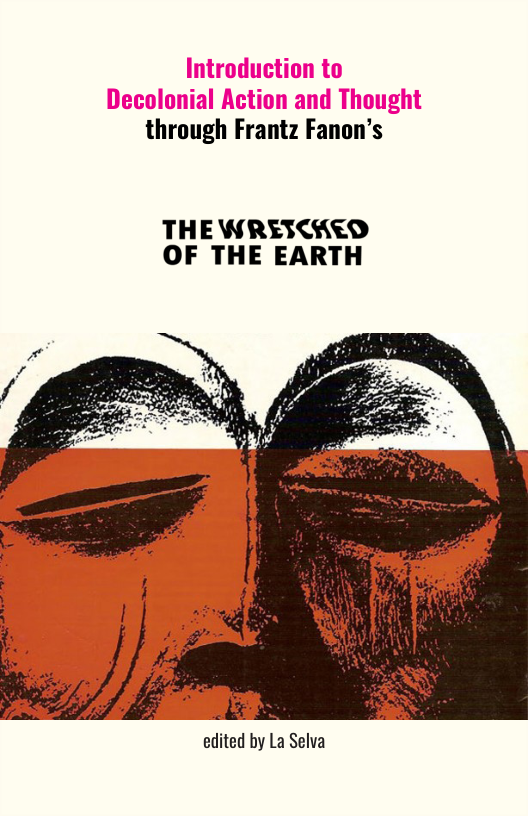
through Frantz Fanon’s
THE WREICHED
OF THE EARTH
edited by La Selva
CONTENTS
x. Preface by La Selva
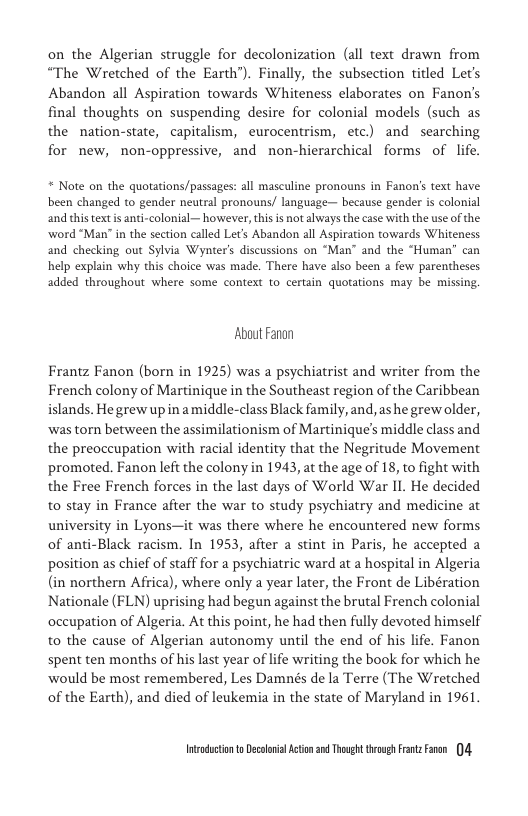
xi.‘Why We Use Violence’ Fanon
i. What is Decolonization?
i, Settler-Colonial Violence is the Source from which
aur Anger Originates
i Authoritaians and Recuperators during
Revolutionary Instability vs. Non-compromising
Insurrection from Below
iv. Recovering our Dignity and Humanity through
Decolonial Action
v. Let's Abandon All Apsiration Towards Whiteness
Vi, Closing Scene
02
05
07
08
10
n
12
16
X. Preface by La Selva
“Each generation must, out of relative obscurity, discover
its mission, fulfill it, or betray it.”
Why we Put this Zine Together
We put together these collections of quotations, writings, and speech
from thinkerand writer FrantzFanon becauseof hisvaluableinsightson
decolonization and revolutionary insurrection. Fanon's sharp insights
into how we secure liberation from all oppression provides us lessons
that till esonate with and apply to our current times—after more than
60 years of their initial writing. This zine is meant to be a resource and
introduction to be read and discussed with your friends and loved ones,
and we hope that holding space for Fanon's insights with others will
help to multiply the desires for decolonization that Fanon—and many
before him—have given their lives n trying to secure our total freedom.
Why read Fanon?
Frantz Fanon’s context in the Algerian Revolution provides us
with ways to think about how new forms of decolonial movements
and autonomous organizing can transform struggles to un-
settle colonized lands. In the so-called Americas, modernity has
shaped the forms of oppression experienced in these occupied
territories, but the lineage of lessons from decolonial struggles
that Fanon wrote and thought about can inform and shape
resistance to American colonialism, especially since he wrote from
an intersecting position of both black and indigenous struggles.
Intudctonto Decolnil Acton 2 Thoug trovgh s Fren 2
In particular, by reading Fanon, we can point to the ways in which his
analysis of decolonization is analogous to autonomous and anarchist
tendencies. In Fanon's texts, we can see the themes of insurrection
(defined as non-compromising and permanent conflictuality
against all authority), the centrality of creating dignity through
community self-defense in the face of colonial violence, and the
intimate connection between affinity and action. Fanon teaches us
that, while decolonization requires violence and violence is the only
tool available for the dispossessed, the emphasis on violence is not a
fetishization of violence itself. Fanon understood his experiences in
colonial society through analogy via his psychiatric and therapeutic
understandings: ~anti-colonial violence was (at the individual
psychic level) like a necessary form of transformative shock, whilst
anti-colonial struggle (and the new collective form of life that it
prompted) formed the basis of a social reconstructive therapy. Thus,
at bottom, we can see that anti-colonial self-defense functions as the
affirmation of direct action as blueprint for liberation, while liberatory
decolonial actions are made possible in the first place through the
intentional cultivation of relationships and affinities, all of which
concurrently uphold our autonomous lives and dignity in the process.
What you willfind in this zine
In this collection of insights that Fanon offers to us, we drew
primarily from his book “The Wretched of the Earth” (written in
1963), and specifically from a section in the book titled ‘Concerning
Violence, as well as the conclusion from this book. The first
subsection in this zine that you will find—"Why We Use Violence—
is taken from a speech that Fanon gave to the Accra Positive
Action Conference in April 1960 that provides a clear guidance
for beginning to think about the central questions of “why” and
“how” we fight to get free. The four sections after “Why We Use
Violence' provide an elaboration of the processes and dynamic of
decolonization that Fanon derived from his experiences and thoughts
03 *The Wetched of theEart”
on the Algerian struggle for decolonization (all text drawn from
“The Wretched of the Earth’). Finally, the subsection titled Let’s
Abandon all Aspiration towards Whiteness elaborates on Fanon's
final thoughts on suspending desire for colonial models (such as
the nation-state, capitalism, eurocentrism, etc) and searching
for new, non-oppressive, and non-hierarchical forms of life.
* Note on the quotations/passages: all masculine pronouns in Fanon's text have
been changed to gender neutral pronouns/ language- because gender is colonial
and this textis anti-colonial— however, this is not ahvays the case with the use of the.
word “Man” in the section called Let's Abandon all Aspiration towards Whiteness
and checking out Sylvia Wynter’s discussions on “Man” and the “Human” can
help explain why this choice was made. There have also been a few parentheses
added throughout where some context to certain quotations may be missing.
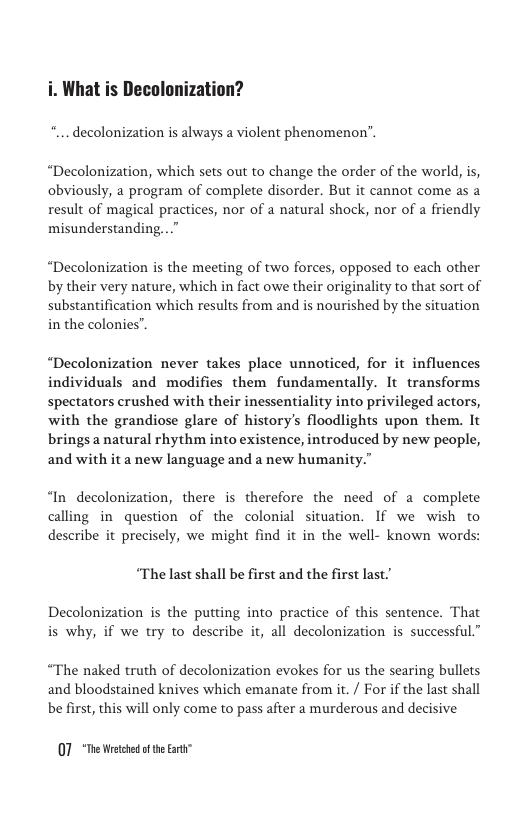
About Fanon
Frantz Fanon (born in 1925) was a psychiatrist and writer from the
French colony of Martinique in the Southeast region of the Caribbean
islands. He grew upin amiddle-class Black family, and, s he grew older,
was torn between the assimilationism of Martinique's middle class and
the preoceupation with racial identity that the Negritude Movement
promoted. Fanon left the colony in 1943, at the age of 18, to fight with
the Free French forces in the last days of World War I1. He decided
to stay in France after the war to study psychiatry and medicine at
university in Lyons—it was there where he encountered new forms
of anti-Black racism. In 1953, after a stint in Paris, he accepted a
position as chief of staff for a psychiatric ward at a hospital in Algeria
(in northern Africa), where only a year later, the Front de Libération
Nationale (FLN) uprising had begun against the brutal French colonial
occupation of Algeria. At this point, he had then fully devoted himself
to the cause of Algerian autonomy until the end of his life. Fanon
spent ten months of his last year of lfe writing the book for which he
‘would be most remembered, Les Damnés de la Terre (The Wretched
of the Earth), and died of leukemia in the state of Maryland in 1961.
Intndctonto Decolnil Action 2 Thoug trovg FrnzFaren )4
‘Why We Use Violence’ Accra, April 1960
“When we revolt it's not for a particular culture. We
revolt simply because, for many reasons, we can no
Tonger breathe.”
“Ido not want, you may well understand, to proceed today to a critique
ofthe colonial system. I do notintend asa colonized person, speaking to
colonized people, to demonstrate that the colonial state is an abnormal,
inhuman and reprehensible state. It would be grotesque on my part to
‘want to convince you of the unacceptable nature of olonial oppression.
However, I would like to focus my reflections on the violence integral
to colonial oppression. The colonial regime is a regime instituted by
violence. It is always by force that the colonial regime is established. It
is against the will of the people that other peoples more advancedin the
techniquesof destruction or numericallymore powerful haveprevailed.
1 say that such a system established by violence can logically only be
faithful to el and its duration in time depends on the continuation of
violence... Colonialism, however, s not satisfied by this violenceagainst
thepresent. The colonized peoplearepresentedideologicallyasapeople
arrested in their evolution, impervious to reason, incapable of directing,
their own affairs, requiring the permanent presence of an external
ruling power. The history of the colonized peoples is transformed into
meaningless unrest, and as a result, one has the impression that for
these people humanity began with the arrival of those brave settlers.
Violence in everyday behaviour, violence against the past that is
emptied of all substance, violence against the future, for the colonial
regime presents itself as necessarily eternal. We see, therefore, that
the colonized people, caught in a web of a three-dimensional violence,
05 *The Wetched of the Eart”
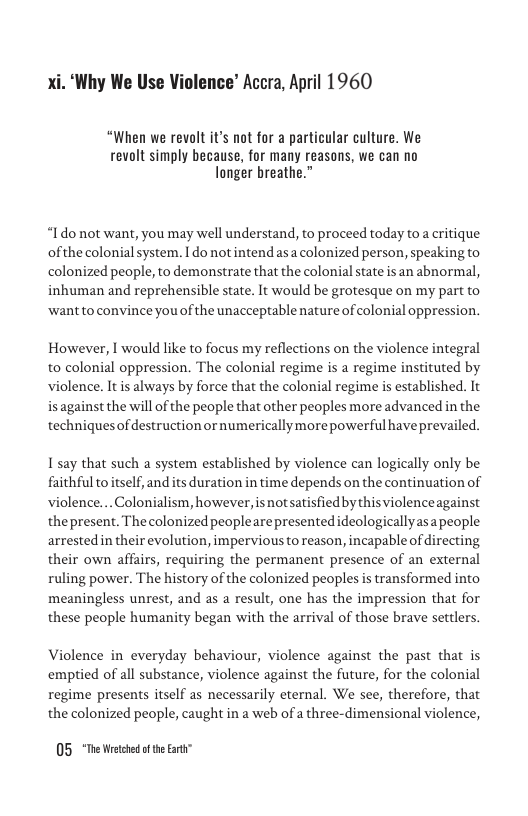
a meeting point of multiple, diverse, repeated, cumulative
violences, are soon logically confronted by the problem
of ending the colonial regime by any means necessary.
“This violence of the colonial regime is not just lived on the level of
the soul, but also that of the muscles, of the blood. This violence that
wills itself to be violent, which becomes more and more boundless,
irreparably provokes the birth of an internal violence in the
colonized people and a just anger is born that seeks to express itself.
The role of the political party that takes the destinies of this
people into its hands is to curtail this violence and to channel it by
providing it with a peaceful platform and a constructive basis, since
for the human spirit which contemplates the unfolding of history
and which tries to stay on the ground of the universal, violence
must first be fought with the language of truth and of reason.
the achievement of the Algerian revolution is precisely
to have culminated in a grandiose way and to have caused a
mutation of the instinct of self-preservation into value and truth.
In certain colonies, the violence of the colonized is the last gesture
of the hunted person.. In 1954, the Algerian people took up arms
because at that point the colonial prison became so oppressive
that it was no longer tolerable, because the hunt was definitely on
for Algerians in the streets and in the countryside and because,
finally, it was no longer a question for the Algerian of giving
a meaning to their life but rather of giving one to their death.
No, the violence of the Algerian people is neither a hatred of
peace nor a rejection of human relations, nor a conviction
that only war can put an end to the colonial regime in Algeria.
‘The Algerian people have chosen the unique solution that was left to
them and this choice will hold firm for us.”
Intsndctonto Decolnil Action 2 Thoug trovgs rnzFaren 0
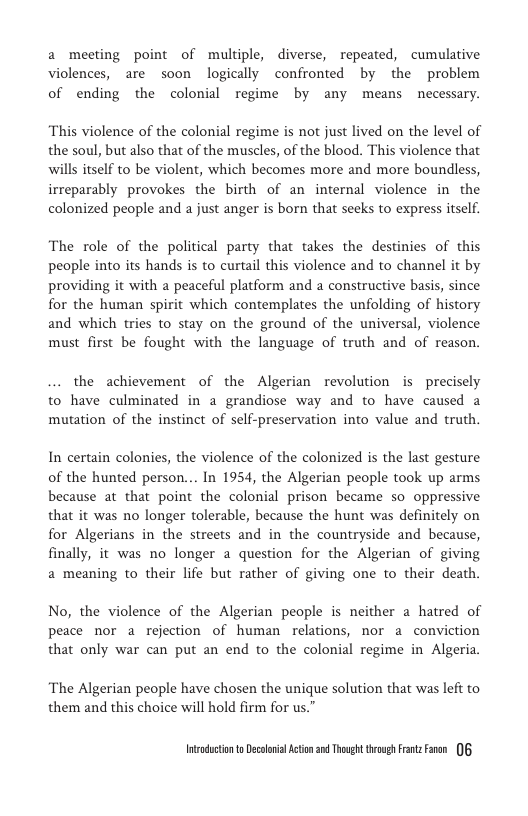
. What is Decolonization?
decolonization is always a violent phenomenon’.
“Decolonization, which sets out to change the order of the world, is,
obviously, a program of complete disorder. But it cannot come as a
result of magical practices, nor of a natural shock, nor of a friendly
misunderstanding..”
“Decolonization is the meeting of two forces, opposed to each other
by their very nature, which in fact owe their originality to that sort of
substantification which results from and is nourished by the situation
in the colonies”.
“Decolonization never takes place unnoticed, for it influences
individuals and modifies them fundamentally. It transforms
spectators crushed with their inessentiality into privileged actors,
with the grandiose glare of history’s floodlights upon them. It
brings a natural rhythm into existence, introduced by new people,
and with it a new language and a new humanity.”
“In decolonization, there is therefore the need of a complete
calling in question of the colonial situation. If we wish to
describe it precisely, we might find it in the well- known words:
“The last shall be first and the first last.”
Decolonization is the putting into practice of this sentence. That
is why, if we try to describe it, all decolonization is successful.”
“The naked truth of decolonization evokes for us the searing bullets
and bloodstained knives which emanate from it. / For if the last shall
be first, this will only come to pass after a murderous and decisive
07 *The Wetchd oftheEart”
struggle between the two protagonists.
gg] protag
“The settler’s work s to make even the dreams of liberty impossible
for the native. The native's work is to imagine all possible methods
for destroying the settler.”
Settler-Colonial Violence is the Source from which our
Rage Originates
“The violence which has ruled over the ordering of the colonial
world, which has ceaselessly drummed the rhythm for the
destruction of native social forms and broken up without reserve
the systems of reference of the economy, the customs of dress and
external life, that same violence will be claimed and taken over by the
native at the moment when, deciding to embody history in his own
person, he surges into the forbidden quarters. To wreck the colonial
world is henceforth a mental picture of action which is clear, very
easy to understand and which may be assumed by each one of the
individuals which constitute the colonized people.”
“The native’s challenge to the colonial world is not rational
confrontation of points of view... It is not enough for the settler to
delimit physically, that is to say with the help of the army and the
police force, the place of the native. As if to show the totalitarian
character of colonial exploitation the settler paints the native as a
sort of quintessence of evil. Native society is not simply described as
a society lacking in values. It not enough of the colonist to affirm
that those values have disappeared from, or still better never existed
in, the colonial world. The native s declared insensible to ethics;
the native represents not only the absence of values, but also the
negation of values. The native i, let us dare to admit, the enemy of
values, and in this sense the native is absolute evil. The native is the
Intsndctonto Decolnil Action 2 Thoug trovgs FrntzFaren 08
corrosive element, destroying all that comes near them; the native
is the deforming element, disfiguring all that has to do with beauty
or morality; the native is the depository of maleficent powers, the
unconscious and irretrievable instrument of blind forces.”
“In all armed struggles, there exists what we might call the
point of no return. Almost always it is marked off by a huge and
all-inclusive repression which engulfs all sectors of the colonized
people.
“The repressions [from colonial state violence], far from calling
a halt to the forward rush of national consciousness, urge it on.
Mass slaughter in the colonies at a certain state of the embryonic
development of consciousness increases that consciousness, for the
hecatombs are an indication that between oppressors and oppressed
everything can be solved by force. It must be remarked here that the
political parties have not called for armed insurrection, and have
made no preparations for such an insurrection. All these repressive
measures, all those actions which are a result of fear are not within
the leader's intentions: they are overtaken by events.” (72)
“We have seen that it is the intuition of the colonized masses that
their liberation must, and can only, be achieved by force.
“The existence of an armed struggle shows that the people are
decided to trust to violent methods only. The native of whom they
have never stopped saying that the only language the native
understands is that of force, decides to give utterance by force. In
fact, as always, the settler has shown him the way he should take
if he is to become free. The argument the native chooses has been
furnished by the settler, and by an ironic turning of the tables it
is the native who now affirms that the colonialist understands
nothing but force. The colonial regime owes its legitimacy to force
and at no time s to hide this aspect of things.
09 *The Wetched of the Eart”
Authoritarians and Recuperators Desire Order
during Revolutionary Instability— let’s invoke a Non-
compromising Insurrection from Below
“The elite will attach fundamental importance to organization, so
much so that the fetish of organization will often take precedence
over a reasoned study of colonial society. The notion of the party
is a notion imported from the [colonial] country. This instrument
of modern political warfare is thrown down just as it s, without the
slightest modification, upon real life with all its infinite variations
and lack of balance, where slavery, serfdom, barter, a skilled working
class, and high finance exist side by side.”
“The peasantry is systematically disregarded for the most part
by the propaganda put out by the nationalist parties. And it is
clear that in the colonial countries the peasants alone are
revolutionary, for they have nothing to lose and everything
to gain. The starving peasant, outside the class system, is the
first among the exploited to discover that only violence pays.
For them there is no compromise, no possible coming to terms;
colonization and decolonization are simply a question of relative
strength. The exploited person sees that their liberation implies the
use of all means, and that of force first and foremost.
When in 1956, after the capitulation of Monsieur Guy Mollet o the
settlers in Algeria, the Front de Liberation Nationale, in a famous
leaflet, stated that colonialism only loosens its hold when the
knife is at its throat, no Algerian really found these terms too
violent. The leaflet only expressed what every Algerian felt at heart:
colonialism is not a thinking machine, nor a body endowed with
reasoning faculties. It is violence in its natural state, and it will only
yield when confronted with greater violence.
Intadctonto Decolonil Acton 3 Thoug trovgh itz Faen 10
At the decisive moment, the colonialist bourgeoisie, which up till
then has remained inactive, comes into the field. It introduces that
new idea which is in proper parlance a creation of the colonial
situation: non-violence.
In its simplest form this non-violence signifies to the
intellectual and economiceliteof the olonized country that the
bourgeoisie has the sameinterestsas they and thatitis therefore
urgentand indispensable to come to terms for the public good.”
“This idea of compromise is very important in the phenomenon of
colonization, for it is very far from being a simple one. Compromise
involves the colonial system and the young nationalist bourgeoisie
at one and the same time. The partisans of the colonial system
discover that the masses may destroy everything. Blow-up bridges,
ravaged farms, repressions, and fighting harshly [to] disrupt the
economy. Compromise is equally attractive to the nationalist
bourgeoisie, who since they are not clearly aware of the
possible consequences of the rising storm, are genuinely
afraid of being swept away by this huge hurricane...
“In certain circumstances, the political party political machine may
remain intact. But as a result of the colonialist repression and of the
spontaneous reaction of the people, the parties find themselves out-
distanced by their militants. The violence of the masses is vigorously
pitted against the military forces of the occupying power, and the
situation deteriorates and comes to a head. Those leaders who are
free remain, therefore, on the touchline. They have suddenly become
useless, with their bureaucracy and their reasonable demands; yet
we see them, far removed from events, attempting the crowing
imposture—that of ‘speaking in the name of the silenced nation’.
As a general rule, colonialism welcomes this godsend with open
arms, transforms these ‘blind mouths into spokesmen, and in two
minutes endows them with independence, on condition that they
restore order.”
11 “The Wreted o the Earti”
iv. Recovering our Dignity through Decolonial Action
“For a calonized people the most essential value, because the most
concrete, i first and foremost the land: the land which will bring them
bread and, above all, dignity.”
“Decolonization is the veritable creation of new people. But this
creation owes nothing of its legitimacy to any supernatural power;
the ‘thing which has been colonized becomes a person during the
same process by which they free them-self
“But it so happens that for the colonized people this violence, because
it constitutes their only work, invests their characters with positive
and ereative qualities. The practice of violence binds them together
asa whole, since each individual forms a violent link in the great
chain, a part of the great organism of violence which has surged
upward in reaction to the settler’s violence in the beginning... The
armed struggle mobilizes the people; that is to say, it throws them
in one way and in one direction.”
“At the level of individuals, violence is a cleansing force. It
frees the native from their inferiority complex and from their
despair and inaction; it makes them fearless and restores their
self-respect. Even if the armed struggle has been symbolic and the
nation is demobilized through a rapid movement of decolonization,
the people have the time to see that the liberation has been
the business of each and all and that the leader has no special
merit. From thence comes that type of aggressive reticence with
regard to the machinery of protocol which young governments
quickly show. When the people have taken violent part in the
national liberation they will allow no one to set thesmelves upas
‘liberators’. They show themselves to be jealous of the results of their
Intadctonto Decolonial Acton 3 Though rovgh Frntz Fanen 12
action and take good care not to place their future, their destiny,
or the fate of their country in the hands of a living god. Yesterday
they were completely irresponsible; today they mean to understand
everything and make all decisions. Illuminated by violence, the
consciousness of the people rebels against any pacification. From
now on the demagogues, the opportunists, and the magicians have
a difficult task. The action which has thrown them into a hand-
to-hand struggle confers upon the masses a voracious taste for the
conerete. The attempt at mystification becomes, in the long run,
practically impossible.” (94-95)
“The appearance of the settler has meant in the terms of syncretism
the death of the aboriginal society, cultural lethargy, and the
perrification of individuals. For the native, life can only spring up
again out of the rotting corpse of the settler.”
v. Let’s Abandon All Aspiraf
“Come, then, comrades; it would be as well to decide ar once
to change our ways. We must shake off the heavy darkness in
which we were plunged, and leave it behind. The new day which
is already at hand must find us firm, prudent, and resolute.
We must leave our dreams and abandon our old beliefs and
friendships from the time before life began. Let us waste no time in
sterile litanies and nauseating mimicry. Leave this Europe where they
are never done talking of Man, yet murder people everywhere they
find them, at the comer of every one of their own streets, in all the
corners of the globe. For centuries they have stifled almost the whole
of humanity in the name of a so-called spiritual experience. Look
at them today swaying between atomic and spiritual disintegration.
So, my brother, how is it that we do not understand that we
13 *The Wetched oftheEart”
have better things to do than to follow that same Europe? That
same Europe where they were never done talking of Man, and
where theynever stopped proclaiming that they were only anxious
for the welfare of Man: today we know with what sufferings
humanity has paid for every one of their triumphs of the mind.
Come, then, comrades, the European game has finally
ended; we must find something different. We today can do
everything, so long as we do not imitate Europe, so long as
we are not obsessed by the desire to catch up with Europe.
Europe now lives at such a mad, reckless pace that she has shaken
off all guidance and all reason, and she is running headlong into
the abyss; we would do well to avoid it with all possible speed.
Yet it is very true that we need a model, and that we want
blueprints and examples. For many among us the European model
is the most inspiring. We have therefore seen in the preceding
pages to what mortifying setbacks such an imitation has led us.
European achievements, European techniques, and the European
style ought no longer to tempt us and to throw us off our balance.
When Isearch for Man in the techniqueand thestyle of Europe, Isee
only asuccession of negations of man, and an avalanche of murders.
Let us decide not to imitate Europe; let us combine our muscles and
our brains in a new direction. Let us try to create the whole man,
‘whom Europe has been incapable of bringing to triumphant birth.
Two centuries ago, @ former European colony decided to catch
up with Europe. It succeeded so well that the United States of
America became a monster, in which the taints, the sickness, and
the inhumanity of Europe have grown to appalling dimensions.
. [we] will also not forget Europe’s crimes... and finally, on the
Intadctonto Decolovil Acton 2 Though trovgh Frntz Faen 14
immense scale of humanity, there were racial hatreds, slavery,
exploitation, and above all the bloodless genocide which consisted in
the setting aside of fifieen thousand millions of people.
So, comrades, let us not pay tribute to Europe by creating states,
institutions, and societies which draw their inspiration from her.
Humanity s waiting for something from us other than such an
imitation, which would be almost an obscene caricature.
If we want to turn Africa into a new Europe, and America into
a new Europe, then let us leave the destiny of our countries to
Europeans. They will know how to do it better than the most
gifted among us.
Butif we want humanity to advance a step further, if we want to bring,
itup toa different level than that which Europe has shown it, then we.
must invent and we must make discoveries.
For Europe, for ourselves, and for humanity, comrades,
we must turn over a new leaf,
we must work out new concepts,
and try to set afoot a new people.”
15
he Wrelchd of the Eart”
vi. Closing Scene
*And suddenly, shouts lit up the silence;
We had attacked, we the slaves; we, the dung underfoot, we
the animals with patient hooves,
We were running like madmen; shots rang out ... We were
striking. Blood and sweat cooled and refreshed us. We were striking
‘where the shout came from, and the shouts became more strident
and a great clamor rose from the east: it was the outhouses burning
and the flames flickered sweetly on our cheeks.
Then was the assault made on the master’s house.
They were firing from the windows.
We broke in the doors.
‘The master's room was wide open. The master's room was
brilliantly lighted, and the master was there, very calm ... and our
peaple stopped dead ... it was the master ... I went in. ‘I’ you,” he
said, very calm.
It was I, even I, and I told him so, the good slave, the faithful
slave, the slave of slaves, and suddenly his eyes were like two
cockroaches, frightened in the rainy season ...
Istruck, and the blood spurted; that is the only baptism that [
remember today.”
- From Aime Cesaire’s Les Armes Miraculecuses (Et leschiens s aisaent].
Intadctonto Decolovil Acton 3 Thoug trovgh itz Faren 16
laselva blackblogs.org