In Their Own Tongue
Web PDF • Imposed PDF• Raw TXT (OCR)





![Hufoart @onjé oS pelentilly Guid) "mdmwmg is in our haarts) - Eoma, wumben. of the outenomaus- Council, autionomous, MunCIpality. Ricardo Heres Magen, Crracef TIL Lo Garucha In Bats’’ Kop the heart is the origin of everything. Instead of esking ’how are you? and receiving a superficial response, it is common in Tsotsil and Tzeltal communities to ask “how is your heart?” ) P When someone asks this, it is understood that their intention comes from their heart, meaning that it 35 completely genuine, and the Tesponse, in kind, mustcome from the heart. When asked how your heart is in Bats’s’ kop, you can not lie. Tun Kot (23 jun Koo O o Y fjwn Koon] N [chiat Koon] e SRS Umg sty If you respond T count my heart), then the person who asked you the question helps you to identify the pieces and gathers the community to resolve the issue, making the heart whole again. The state of the heart is not individual, but collective. It s not](in-their-own-tongue 13.png)

![- That whith all wirting beings shae is” Chwiel . From this unblersbmting of the Chulel in everything, the Tue Ml ewng estaglishus Aedations- with a1l that_exists, i cther wo- roa, the hUNan peing (ntemcts with thir envirinatt sne Hhe pAvirenment QNA The <uVi ronmoite the hunan in’a mat and (vithiate plane. Fon s péant 01 ur Oh’ulel is fundamentally relational and interdependent. A11 beings on earth are subjects R 37, with heerts that contain \ potentiality that can only be realized through the potentiality of the hearts of others. ( Slajesel chu’ulel= matar el ch’ulelglll G e e is bewt ond Lves- in %\L]SW](in-their-own-tongue 16.png)
![In Bats’i’ K’op there are no objects, only subjects. “Vie see colonization as the objectification of our world.” ALL beings are subjects with hearts that relate to one another and allow for the mutual realization of their ch’uleletik. There is no concept of one being possessing another. There is no verb for “to have’, or way of saying ‘ny house, ‘my land’..etc. A11 statements are expressions of currently existing relationships between subjects. Instead of ‘my dog) you would express something Like ‘the dog that I have arelationship with and this relationship is understood as one that exists in this moment without any expectation or claim that it always has or always will. Zapatista language promoters use the possessive forms to translate this expression of relationships between subjects— T TIK TNA = MY KOUSE Ny KTk TANA= YOUR HOUSE ( singular) BoNAT I sNA HisheR roise S 40s) ™ 1y INATIK= OUR HOUSE (gencral)” (prefuy) (uffi) JNAKUTIK: OVR HOUSE (specific)” JANAN T S@E pre; between Mm{;}lj Q) Q‘ém reans the hoigs, Lhix 1L “’"fif‘l‘;;f‘*a il 10 e =~ 55, %0 a7 pesple. FOT 2xay, g 2, If,,ytdc‘cr,,‘ruflm mspM/,]y,%I,,cm " i W Uy SOmeiping n ’t la% RSN o 1 I e 2 e 1 refer &SIl corp T gengrg, ing, S Hiid DA e s _TviduaL Cory gy i goneral and the spect Pl gl e S Ve mr =t e oot a0 complomentary cenar SN e e exampi, in ou assemily, omeae could o onketiRow heart) to refer £oner specific coma i part o G Larger collectiVitu. Th Genert! W Kb ‘ondiik (our heart) afso necessartly implies the evistance of Hheimany CoLUCHVLITES, the otbar collctive beGrt wWithin Lt (Budan]](in-their-own-tongue 18.png)
![Instead of constantly expressing subject-object possession, speakers of Bats’i’ Kopsimply refer to the relationship between subjects in space and time: OY KATANTAK TA INA = here s corn in muy house Therei\ Corn fuara) in g hese e e Tt \ o™ ) in R (rg: T e corm 0 on) ‘Y Lixg the Spanish ’lnay’ expresses existance. S0 this phrase could be more % ly translated as ‘theve eyists corn in my house.’ - SSAKIL NA’IK TA SLUMAL IK = their white hovse Fhgre omne - havat L Ngmnity 7 gxists intheil ammd (re:they have o white Vaws tn Eei Commanits) QXK?.; INATAKUTIK = Trore are many of our houses 5 sl (re: we have many heuses) e OYUN TA OVENTIK XCHIUK JCHI’ ILTAK= my comrade 5 @It in BVRRER with vy Y comrades @ Who~ yours TE & mine S itete this is not really saying. NRELETY s is nling] it’s saying that in Hhis moment; T hate 3 re latonship With this book. (Fuama)](in-their-own-tongue 19.png)


![The other demands (housing, food, healthcare, education) are similarly unquantifiable when understood in Bats’i’ k’op. & _- 57 2 . A Lot of gutsiders come here and "0 talk dlaowt their privilege’ of having. c) Ydecess to heatthcare or educgtion, but /0 us that is not privilege. nt your medicine that poisons ye yeour education 4 rsinwashes yeu CUT mansions. ous €] i 220 RS e The clarity with which this education promoter differentiated between what is ‘your’s’ and ‘ours’ can be understood with the words ‘batsi’ and ‘kaxlan’, Batsi, Like inBats’i’ k’op- the true word- refers to that which is true, traditional or, in the sense that the compa used the term, ‘ours’. Kaxlan translates as ‘from the city’ and can be understood as the relative ‘your’s’. In one lesson, an education promoter took us through the various linguistic distinctions commonly made in the communities to indicate colonial impositions. Forexample: Y0’m=ytsic bats’t’ vom=true music Kaxlen Yaj=bread bats’ivaj= tortills ey bats’i veeit= ra relil= pro s Vel = trad tional ° Food that nurtires](in-their-own-tongue 30.png)


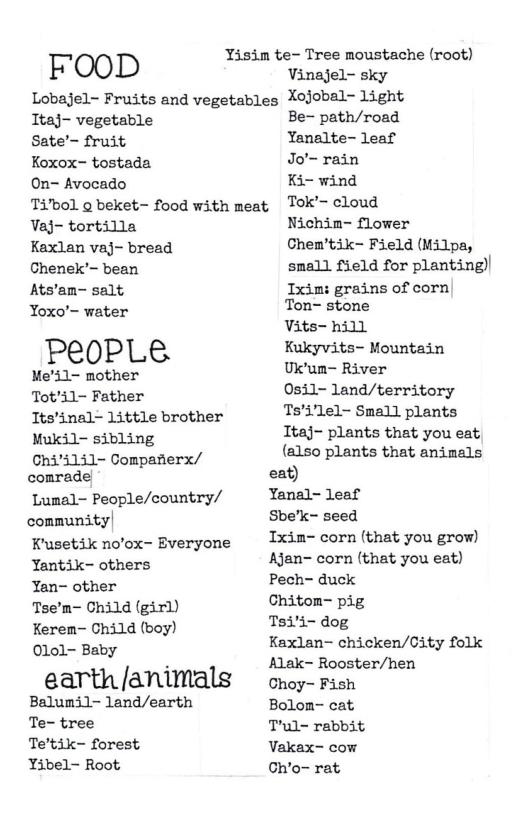
![Patix- venomous newt (The heads of which are used as a cure for snoring) Vexal- pants Kuil- clothing Bu- Where Bax’in- When Smak jolil- hat Kgoe=Howda Mak- the top of a thing bhuedioh Snail- House of K’alal- when Yuns book Kucha’sl- ¥hy Tak’el- money Yu’un— Because, it’s that JOLODil- weaving/fbric Bush’u- Who ;.s usfloma’lv;]imbmmery o ere is e ::_;__’;hveryme Kmtejebaletik- tools T Hare Vayebal- bed A4 But Mexa- table Xchi’uk~ and/with Verops Sventa- for/in order to/about ~ Kuxel~ torest Ao~ above Kopojel- to speak Olon- below Plitel- to jump Atinel- to shower Quantity/size TEiTEageiits wtbs B Ay Batel- to go Toj ech’en~ too much o i Raks g Lok’el- to write deyiinr Powmany Lok’el~ to Leave Toj: much (quantity of concepts/ oo to cone feelings (toj siks much cold, o] Jali Xanavel- to walk much time) ehatad Jutuk: there is Little (quantity) fiep:b Kb Bik’it: small (size) s Ja’xano’ox: There only remains Atolajel- to count nouns KapiJel- to confuse Xinobil- shoes Lo’ilajel- to chat, converse Kaep- trash Tiinel- to be angry, to have rage](in-their-own-tongue 38.png)
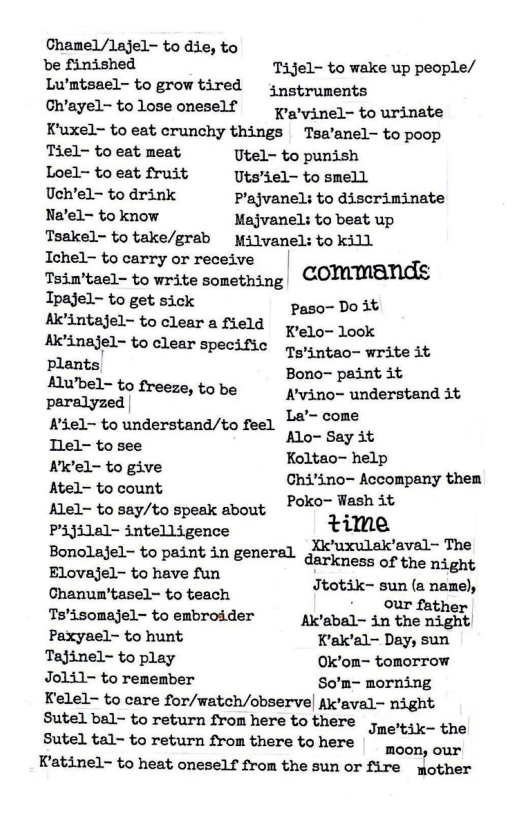

![yes Oy: There is (Hay, third person of the verb ‘to be’) Tana: Yes to an offering, proposal..etc. Jas 3t 35, yes it is Jech: that’s correct, certain Ja’ jechs It’s ike that pasic greetings e wmi o] m,,..xiw % (P\umt) u" = w)" Yo Wi ) g |8 § Imowell) GearCptural) o L jun Ko’on chuaf K’g’_Dfl ra wy vieare s my heart](in-their-own-tongue 41.png)
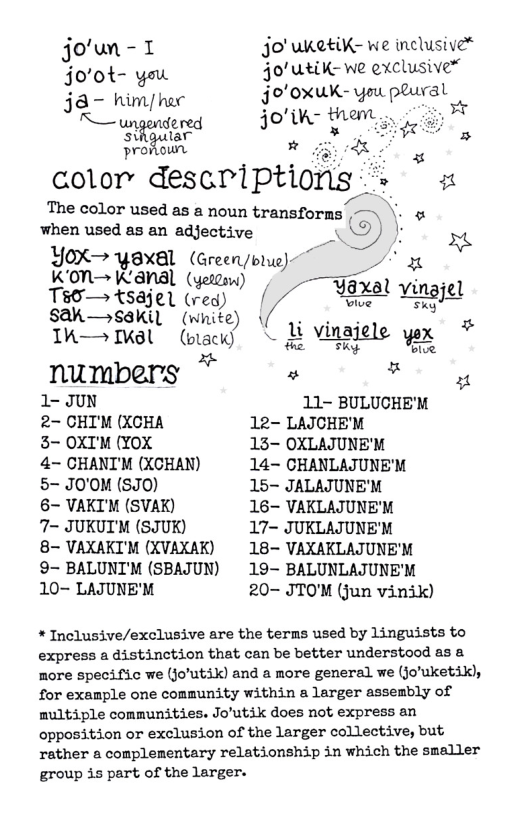
![Numbers are in units of twenty (because we each have twenty). Twenty is one man (jun vinik). Larger numbers require borrowing from more men. 43-0XI’M YOX VINlK Pree ,, wird o) 2 men (20420) plus 3 from the third man=43 XCHAN VI S 7o oxATuNEM e il 32-LAJCHE’M )gg_fiA VINIK TRwerve (o i) A5-JALATUNE’™M §,‘_8 VI"l:flK FEE T feram v (anti)-POSSeS iV 10 NAVEe (this verb does not exist) other Subject with whom I anm velating L Hm the J alL nouns must be embedd, 5 K Wl«mn a relationship. H < VAR +eak =houses § Hn«:z) £ prefix+ noun(,;umx] INA my house TNATIK=0uR heuse (exclusive) TANA- s house INAKUTIKS0UR hause (inclusive) SNA=is/her house JANAIK= YouR house (plural) SNATK= thair house (,;u.;ra() vowe.ls s ANTSE Wik VAN e JA\I K VANTS JAVI! (woman) YANTSIK oy ka, mtak XE ornd e i \‘?..—«}/ % ep jnatakutik y have o whive house in ,M,,% g Rgevie 3 ?"fi) Oyun ta Oventik xchi’uk jchi’iltak webavemanypases TAM in Ovensik | Wth g commde S](in-their-own-tongue 43.png)
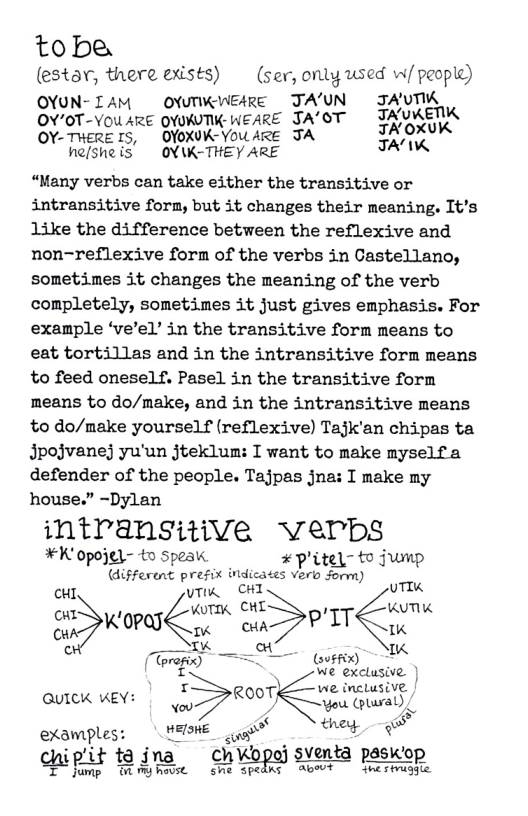

![- X’ kit an . B: B [2chan xohihk joujietik. Q’x,j (commard) ) Yes you can. Come Lo with US| A: Kolayal hani ol more sample Sentences try Copying them out and translating them yowrself using he vocap List/notes. nysi i i ! ejal i L oy ol R fprare wWhatdo yeu want ¢o do in yeur lLives? #When yeu have two consecutive Verbs in a sentcnce, ot must be conjugated (chakanik. chapasik) iR i 5pifil Kk’ P o to] Kan wichan Jpll Wuchaal bats: inil il j il Xchiuk 2 tajts e 1 T want to Leam wisdom Like the traqitional elders From across the world and leant. how to continue the struggle ¢ jva’e xchi) 80 Kan &2 @ian katkalal xonfux. T accomgasny. i Fhas enta tai dowutic ol A sionta” e el oplpat BT want % bt Family and learn how to accompany. my- Compunity. in the stniggle to change the world. . these phrases ave way WSS cheesy in bats’ Kop, I swear| 3 ichi‘in 4 1K fjoan Kk taichiin Jluma), 12 ps .](in-their-own-tongue 47.png)




in their own tongue:
bats'i' k'op zapatista
JaNuky 171604
SAN CRISTORAL DE LAS CASAS, CHIAPAS
daybreal
Thousands of indigenous people descend from their
communities in the mountains and take over seven
city centers of Chiapas, Mexico. They carry a black
flag embroidered with a single star and the letters
EZLN: Zapatista Army of National
3
Foop WORK =\
LAND HOUSING ~/
HERLTHOARE pore oy EDUCATION
JUSTICE Pepce DEMOCRREY
They declared that they would not stop fighting
until these demands were met. That day and the next,
the Zapatistas took over more than 500 ranches and
freed more than 230 prisoners from four state
prisons.
Many of us are more or less familiar with this story.
The Zapatistas themselves have released thousands of
commpuniqués explaining each step of their now
nearly“24 years of above-ground struggle. It is
natural to take these words and judge them according
to our own frameworks of guerrilla warfare and
national revolutions; to read words Like Justice' and
‘peace) and think that they are saying the same thing
that couptless revolutionaries have said before
them. ‘HowWever, when we read the words of the
Zapatistas, we are receiving a translation of a
language with fundamentally different precepts than
our own (whether Spanish or English).
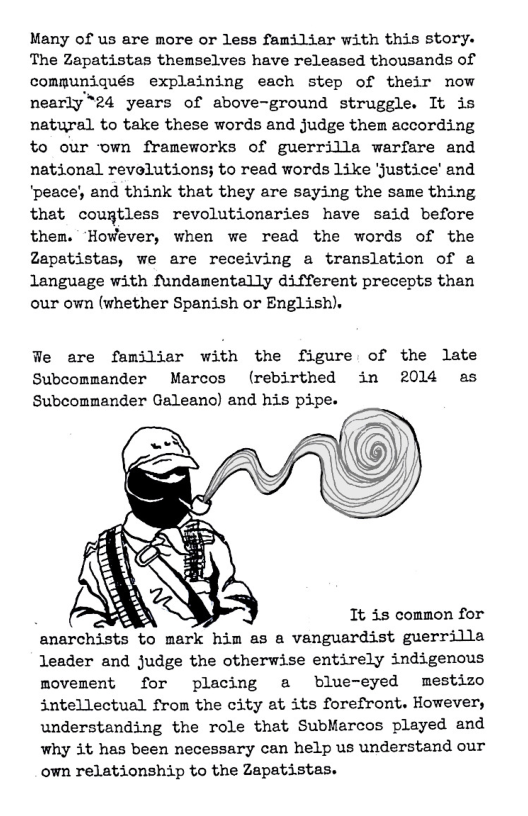
We are familiar with the figure of the late
Subcommander Marcos (rebirthed in 2014 as
Subcommander Geleano) and his pipe.
% It 35 common for
anarchists to mark him as a vanguardist guerrilla
leader and judge the otherwise entirely indigenous
movement for placing a blue-eyed mestizo
intellectual from the city at its forefront. However,
understanding the role that SubMarcos played and
Why it has been necessary can help us understand our
own relationship to the Zapatistas.
Originally inhabiting the fertile lowlands, the
Mayan peoples were pushed up intd the rocky
highlands by colonial powers and wealthy
landowners. As the settler population increased, the
landovmers encroached on the highlands, displacing
indigenous campesinos from their collectively held
efido land and forcing them into debt-slavery on
massive ranches and plantations. In the 1950s,
displaced and landless campesinos were forced by the
government into the previously sparsely inhabited
Lacandon Jungle. Tens of thousands of starving
indigenous peoples created new communities deep in
the jungle, carving out lives on the thin, infertile
so0il.
AN ¢
ALL of this is to illustrate a distinct strategy
of government repression and attempted
externination of indigenous peoples. In contrast to
most Native American peoples in the so-called USA,
who were forced off of their ancestral lands and onto
reservations where they could be surveilled and
controlled by the colonial government as if in open
air prisons, the indigenous peoples of Chiapas were
pushed further and further outside the margins of
civilization in an attempt to push them out of
existence entirely. Rather than forcing
essimilation in order to disappear cultures, the
Mexican government made assimilation impossible in
an attempt to also make survival impossible.
Obviously, they wére unsuccessful.
Instead of dying out as was intended, the indigenous
people displaced to the jungle began to organize,
culminating in the 1994 Zapatista uprising. Of the
mostly young people who moved to the jungle in the
decades prior, all spoke a Mayan language and very
few spoke any Spanish at all. Speakers of Tsotsil,
Tzeltal, Zoque, Chol, Tojolobal, and Mam,
particularly women, built new conmunities together,
learning how to survive in the jungle and relating
their experiences across different cultures and
language barriers. All of these languages, though
now very different, have the same origin- Bats'y’ k'op
the true word, a language where all beings are
subjects who mutually relate to one another, where
the earth is our mother and where everything is
understood in relation to the heart. This is where
the Zapatista movement comes from.
Many enarchists and leftists alike, whether
critically or favourably, attempt to reduce the
Zapatistas to the Marxist origins of its mestizo
founders, members of the FLN (National Liberation
Front), a political-military organization which was
largely extinguished by the state during the 1970s.
However, when these same Marxists came to the jungle
of Chiapas to organize the indigenous people into a
peasant wing of the FLN for their armed national
uprising, they were quickly humbled: “You speak the
hard word,” their recruits told them. “Fe dom't
understand. You have to find other words.” What the
university-educated revolutionaries first saw as an
issue of translation, they soon came to realize was
the Limitation of their understanding of revolution.
or the expropriston of the means of
production,” M3reos Says, “the vevelution
> begon to be the possibility for g hwman
being to nave @ space fordigmiy.” <
N
R
fi'w[m than the vedistribution of wealth
PN
We, as comrades, need to do the same. Before
professing to understand the Zapatista movement or
placing it in historical schemas in which it does not
belong, to comprehend what they are really fighting
for and why their steps have followed the path that
they have, we must attempt to see the movement on its
own terms, in its own world. As insurrectionary
anarchists who believe in the generalization of
uncontrollebility, we often talk sbout the
importance of making ourselves incomprehensible to
the state, We reject their gender markers, their
social contracts and family units. Our leaderless
struggles based on true affinity and joy are beyond
the understanding of the state, as well as the parties
and the unions of the Left. Yet it is difficult for us
to believe that a struggle could be incomprehensible
not only to them, but to us.
When they formed the caracoles in 2003, the
Zapatistas also closed their autonomous territory to
outsiders. Non-Zapatistas can now only enter if
invited. However, they also formed a Language Center
in Caracol II Oventic. Outsiders can come learn
Bats'i’ k'opfrom a collective of Zapatista support
bases whose role in the movement is that of Linguists
and educators. They teach students the particularly
ZapatistaBats'i’ k'op that is spoken in the caracoles,
meaning that they use the language center es an
opportunity to analyse how their language has been
transformed by their struggle and share this
analysis with comrades from all over the world. I
have had the opportunity to study in Oventic on
three separate occasions, for a few weeks at a time.
Obviously, I do not speak Bats'i’ kK'op. However, the
extremely brief time that I have spent learning the
language has given me insight into the world of the
Zapatistas that has transformed my understanding of
the movenent, and that is what I will attenpt to share
here. This is not an effort to construct a
romanticized vision of, or attribute an inherently
political meaning to, the language itself. Rather, I
hope simply to share language lessons as they were
shared with me by my Zapatista teachers along with
personal reflections and analysis of Zapatista
reality, as well as excerpts from an incredible book
written by a close friend and comrade Dylan. The
words, of the Zapatista education promoters are
direct quotes from either my or Dylan’s notebooks.
— everythi .
that s “handwritten in-this font (s
A dlirect quote from a Zgpatistd language
Promotor, condensed into the ficticnal char-
Acter of ‘Juans’ to maintail Snonymity
_ . _ - 5
wanted to make this zine because I had so many notes
of my own and thought it would be useful to have a
briefer and easily reproducible introduction to
Bats'i’ k'op Zapatista, but everyone should get their
hands on Dylan’s incredible book ‘Autonomy is in Our
Hearts' when 3t 3s published by PM Press.}i
These lessons should not influence readers to
stop being critical of certain aspects of the
Zapatista movement, such as their engagement with
the Mexican Left, or of other indigenous movements
that are often cast as sbove critique merely for being
indigenous. Tt is not the objective of the Zapatistas,
including the education promoters at Oventic, to
mystify or shield their movement from judgement.
Actually, they have continuously made space for
anyone who fights against ocapitalism and
neoliberalism to share their opinions and proposals
for forms of struggle, no matter how painfully
oblivious. However, if we continue to cling to and
engage from our colonial subjectivities and
cosmologies, we will remein incapable of learning
from, teaching, and walking with the Zapatistas.
Their prolific and readily availsble communiqués
alone present us with the rare opportunity of
stepping into their world and being shaped by their
struggle. But this step is not an easy one for with it
a world trembles at its core and, if struck with
enough force, ruptures.
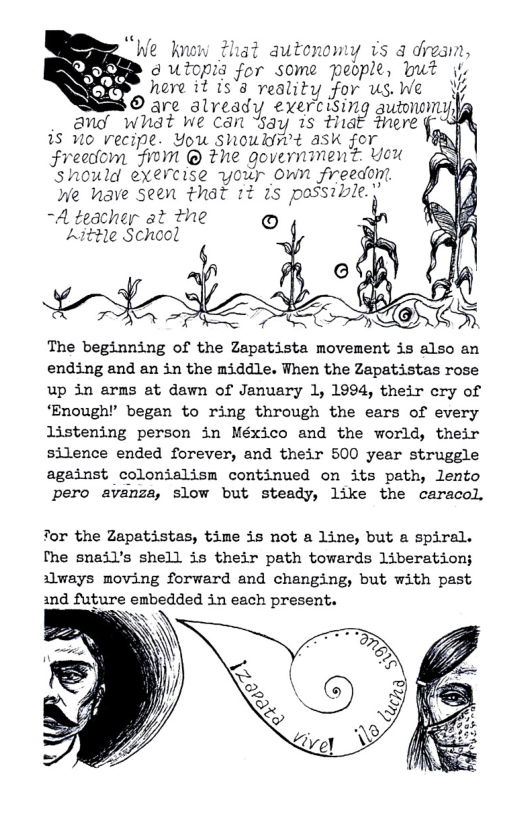
We know hat autonomy ts 4 drgam,
d wiopia for some people, but i,
here it is'a reslity for us.We W
© are already exercising gutonon
and whdt We can say 1s that #here {
1S Mo vecipe. You shoukin’t ask for é
Freedom fom @ the governiment. You
Should exercise your Own freedon.
e have seen that 1t is possible.
-A teacher ot the ©
Aittle School
The beginning of the Zapatista movement is also an
ending and an in the middle. When the Zapatistas rose
up in arms at dawn of January 1, 1994, their cry of
‘Enough!’ began to ring through the ears of every
listening person in México and the world, their
silence ended forever, and their 500 year struggle
against colonialism continued on its path, lento
pero avanza, slow but steady, like the caracol
for the Zapatistas, time is not a line, but & spiral.
The snail's shell is their path towards liberation;
1lways moving forward and changing, but with past
ind future embedded in each present.
N )
\
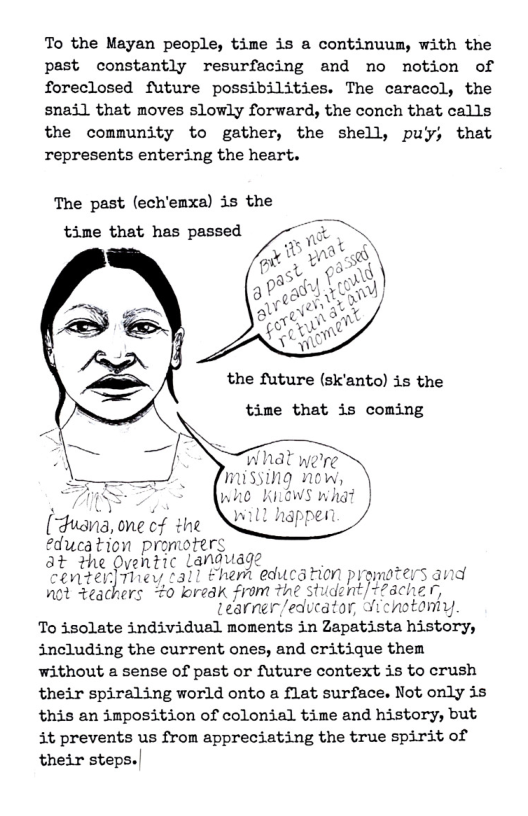
To the Mayan people, time is a continuum, with the
past constantly resurfacing and no notion of
foreclosed future possibilities. The caracol, the
snail that moves slowly forward, the conch that calls
the community to gather, the shell, puly; that
represents entering the heart.
The past (ech'emxa) is the
time that has passed
the future (sk'anto) is the
time that is coming
(Fuana, one of +he
education promoters
3t the Oyentic Lanauage - .
nteyThey call £hert eucstion prom and
1 teachers 70 boreak from the student/
Learner/edveator, I iy
To isolate individual moments in Zapatista history,
including the current ones, and critique them
without a sense of past or future context is to crush
their spiraling world onto a flat surface. Not only is
this an imposition of colonial time and history, but
it prevents us from appreciating the true spirit of
their steps.|
For exanmple, when the EZLN first rose up in arms in
1994, their plan as stated in the First Declaration of
the Lacandon Jungle was to “Advance to the capitol of
the country defeating the Mexican Federal Arny,
protecting the civilian population in their
1iberating advance and permitting the peoples to
elect their own administrative authorities freely
and democratically.”
If, through the lens of a
classical armed revolution, this were viewed as the
totality of the movement, it would be easy to say that
they failed entirely. However, if we conceptualize of
their plan to take Mexico pueblo by pueblo by force
of arms as a present objective without any attachment
to what followed, we can better appreciate the
unanticipated achievements of the initial uprising,
namely the reclamation of over 250,000 hectares of
land and the silent formation of 38 autonomous
municipalities.
K\nde ta vuone Yeu can vetum T
he 1F)) ) (oeford
I pay t ina /g:;& W
Kuzlejal ta ehye Wu 'm‘;i,m
(Fhe like) «m “(comes)
naxs——NOW— —taa,
Goefore iow) (after W)
When we recognize their path as an infinitely
adaptable continuum, it becomes unnecessary to judge
the failure or success of each individual step and we
can instead appreciate the application of lessons
from the past for the movement of the present and
future.
Hufoart @onjé oS pelentilly Guid)
"mdmwmg is in our haarts)
- Eoma, wumben. of the outenomaus-
Council, autionomous, MunCIpality.
Ricardo Heres Magen, Crracef TIL
Lo Garucha
In Bats'’ Kop the heart is the origin of everything.
Instead of esking 'how are you? and receiving a
superficial response, it is common in Tsotsil and
Tzeltal communities to ask “how is your heart?”
)
P When someone asks this, it is
understood that their intention
comes from their heart, meaning that
it 35 completely genuine, and the
Tesponse, in kind, mustcome from the
heart. When asked how your heart is in Bats's’ kop,
you can not lie.
Tun Kot (23
jun Koo O o
Y fjwn Koon] N [chiat Koon]
e SRS
Umg sty
If you respond T count my heart), then the person who
asked you the question helps you to identify the
pieces and gathers the community to resolve the
issue, making the heart whole again. The state of the
heart is not individual, but collective. It s not
normal to respond ‘Jun k'o'on' when others in the
community are having problems, even if they do not
impact you personally.
e o o
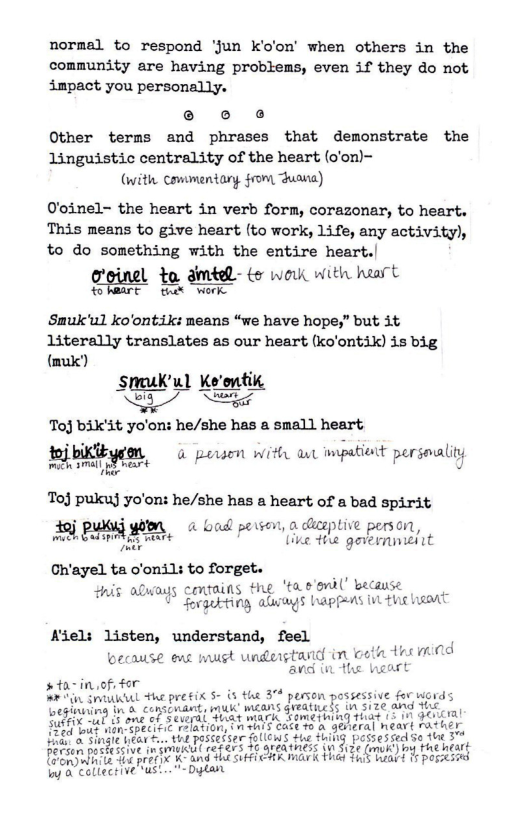
Other terms and phrases that demonstrate the
linguistic centrality of the heart (o'on)-
(with Commentary from Juasa)
O'oinel~ the heart in verb form, corazonar, to heart.
This means to give heart (to work, life, any activity),
to do something with the entire heart.|
o'oinel to dmted- ts wok wWith haart
n‘Efl%" tn%l Twerk
Smuk'ul ko'ontik: means “we have hope,” but it
literally translates as our heart (ko'ontik) is big
(k) )
Sruk'ul Ke'ontik
& S
Toj bik'it yo'on: he/she has a small heart
%%fi* & porsen with aw impatisnt persealiyy
Toj pukuj yo'on: he/she has a heart of a bad spirit
j pusg 4 bad persen, o diceptive person,
A0l P g, e e genbrmtmigint
Ch'ayel ta o'onils to forget.
his always contains the ‘tae’omil’ becau B
1 Srgebting alrags happeas in thic hasat
Aiel: listen, understand, feel
because ews must understand i oot tesimi0d
o i e heart
#ta-in of, for
Iy 0 collective ust.. - Dytan
4 person possessive for words
L1 of these phenomena, or ‘thoughts/feelings’ as they
are understood in Bats'i’ k'op, emanate from the
inherent potentiality of the heart known as ‘ch'ulel’
Often translated as ‘soul’ or ‘spirit) ch'ulel is the
sacred potentiality that resides in each of our
hearts.
- That whith all wirting beings shae
is” Chwiel . From this unblersbmting
of the Chulel in everything, the Tue
Ml ewng estaglishus Aedations-
with a1l that_exists, i cther wo-
roa, the hUNan peing (ntemcts
with thir envirinatt sne Hhe
pAvirenment QNA The <uVi ronmoite
the hunan in'a mat
and (vithiate plane. Fon
s péant 01 ur
Oh'ulel is fundamentally
relational and interdependent.
A11 beings on earth are subjects R 37,
with heerts that contain \
potentiality that can only be
realized through the
potentiality of the
hearts of others.
( Slajesel chu'ulel= matar el ch'ulelglll
G e e is bewt ond Lves- in %\L]SW
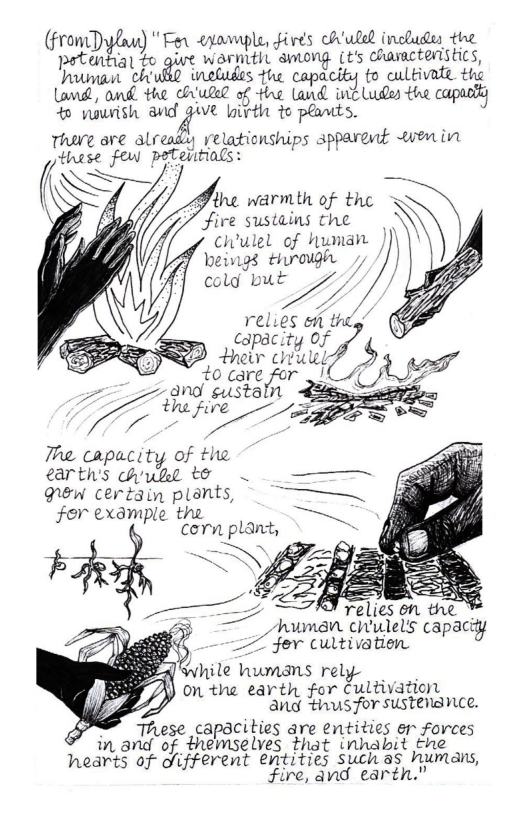
(FronDylau) " Fen vxamuple, dives chulel includes the
potenhial o give wormtiL smong. (t's chavactenistics,
el natadss fie u(;?u‘bj to cultivate the
lomd, omd the c'ulel of He land intludes the EM
0 wawish and Give bivth o plants.
Tharg are already yelationships apparent wem in
Hese few pelential : )
Fthe warmth of the
fire sustains the
7 Chulel of human |
7 bengs throgh
cold but
7
relies on thiy’
capacity Of
D, s il 4 o
= - ang wsiailff _—
/{h&/tr@ g e
The capacity of the
earth's e o . ———
Qew certain ploants, T
for example the
Ternplant, ~
/’/ _ ==
‘human cr'ulel’s capacy
— for cwltivation
B while humans rely-
/b on the earth for Cultivatiot
= ang fiIMSfOYflLStEDHH.CE.
These capacities are entities er forces
wm and of themselves that inhabit the
earts of ofifferent entities such as humans,
fire, and earth.”
In Bats'i’ K'op there are no objects, only subjects. “Vie
see colonization as the objectification of our
world.” ALL beings are subjects with hearts that
relate to one another and allow for the mutual
realization of their ch’uleletik. There is no concept
of one being possessing another. There is no verb for
“to have’, or way of saying ‘ny house, ‘my land'..etc.
A11 statements are expressions of currently existing
relationships between subjects. Instead of ‘my dog)
you would express something Like ‘the dog that I have
arelationship with and this relationship is
understood as one that exists in this moment without
any expectation or claim that it always has or always
will.
Zapatista language promoters use the possessive
forms to translate this expression of relationships
between subjects—
T TIK TNA = MY KOUSE
Ny KTk TANA= YOUR HOUSE ( singular)
BoNAT I sNA HisheR roise
S 40s) ™ 1y INATIK= OUR HOUSE (gencral)”
(prefuy) (uffi) JNAKUTIK: OVR HOUSE (specific)”
JANAN
T S@E pre;
between Mm{;}lj Q) Q‘ém
reans the hoigs,
Lhix 1L “’"fif‘l‘;;f‘*a il 10 e
=~ 55, %0 a7 pesple. FOT 2xay, g
2, If,,ytdc‘cr,,‘ruflm mspM/,]y,%I,,cm
" i W Uy SOmeiping n 't la%
RSN o 1 I e 2 e 1
refer &SIl corp T gengrg, ing, S Hiid
DA e s _TviduaL Cory gy i
goneral and the spect Pl
gl e S Ve mr =t
e oot a0 complomentary cenar SN
e e exampi, in ou assemily, omeae
could o onketiRow heart) to refer £oner specific coma
i part o G Larger collectiVitu. Th Genert! W Kb ‘ondiik (our heart)
afso necessartly implies the evistance of Hheimany CoLUCHVLITES, the
otbar collctive beGrt wWithin Lt (Budan]
Instead of constantly expressing subject-object
possession, speakers of Bats'i’ Kopsimply refer to the
relationship between subjects in space and time:
OY KATANTAK TA INA = here s corn in muy house
Therei\ Corn fuara) in g hese e e
Tt \ o™ ) in R (rg: T e corm 0 on)
‘Y Lixg the Spanish 'lnay’ expresses existance.
S0 this phrase could be more % ly translated as
‘theve eyists corn in my house.' -
SSAKIL NA'IK TA SLUMAL IK = their white hovse
Fhgre omne - havat L Ngmnity 7 gxists intheil ammd
(re:they have o white
Vaws tn Eei Commanits)
QXK?.; INATAKUTIK = Trore are many of our houses
5 sl (re: we have many heuses)
e
OYUN TA OVENTIK XCHIUK JCHI' ILTAK=
my comrade 5
@It in BVRRER with vy Y comrades @
Who~ yours TE & mine
S
itete this is not really saying.
NRELETY s is nling] it's saying that in
Hhis moment; T hate 3 re latonship
With this book. (Fuama)
demanding the impossible:
the struggle (pas2'op)
The word for ‘Lucha’ or ‘struggle’ is ‘pask’op’ (pasel=
to make+ K'op= the word). Whereas in English, the
word ‘struggle’ implies a confrontation between two
opposing sides with an endpoint of either success or
failure determined by the methods of struggle
employed, pask’op is a creative process that is built
over the spiraling continuum of time. The word is
born in our hearts and realized through action. What
began as words in 1883 has been transformed into the
concrete forms of organization and self goveérnance
that exist in the autonomous territory today.
The purpose of Q\:tonomous governance is to gather
the word of the various Zapatista communities into a
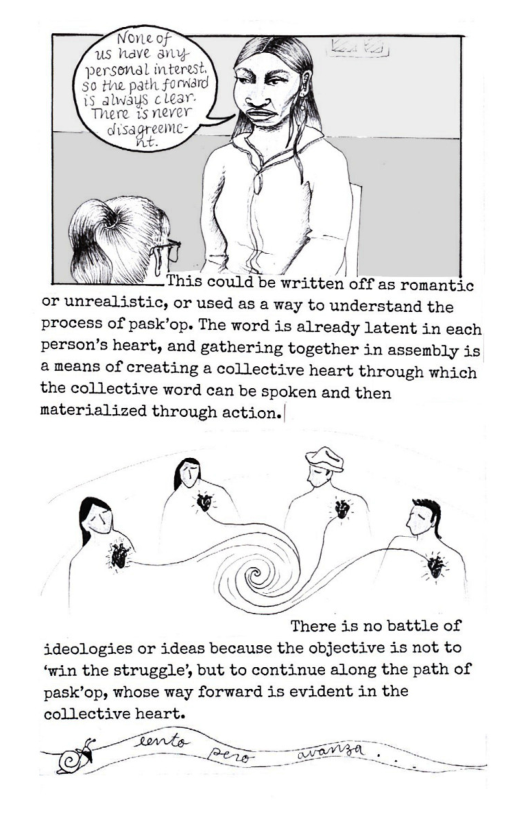
collective word that can then be made. This implies a
very different process of assembly and consensus
than we are familiar with.
Voreof
us have 3y
personal interest,
50 the path fordrd
s always clear:
There 1s never
or unrealistic, or used as a way to understand the
process of pask’op. The word is already latent in each
person’s heart, and gathering together in assembly is
ameans of creating a collective heart through which
the collective word can be spoken and then
materialized through action.|
There is no battle of
ideologies or ideas because the objective is not to
“win the struggle’, but to continue along the path of
pask’op, whose way forward is evident in the
The construction of the collective heart, however, is
by no means anti-individual. When Juana says that
none of the Zapatistas have any personal interest,
she is not asserting the submission of the
individual to the collective, but rather expressing
the mutual necessity of personal and collective
autonomy. No one has personal interests that are
counter to the collective interests because the
collective interest is based only in the personal.
Being a compa means acting from Slekil o’onil: the
dignified side of the heart.
I'm geing te give
_#he oot of my hgart
to the Struggle
net for money
thinkung of the conmon
And this excsts very
Said, ‘Hat’s alright,
if you have yaur |
Slekil o'onil
ng.t
it happens from the
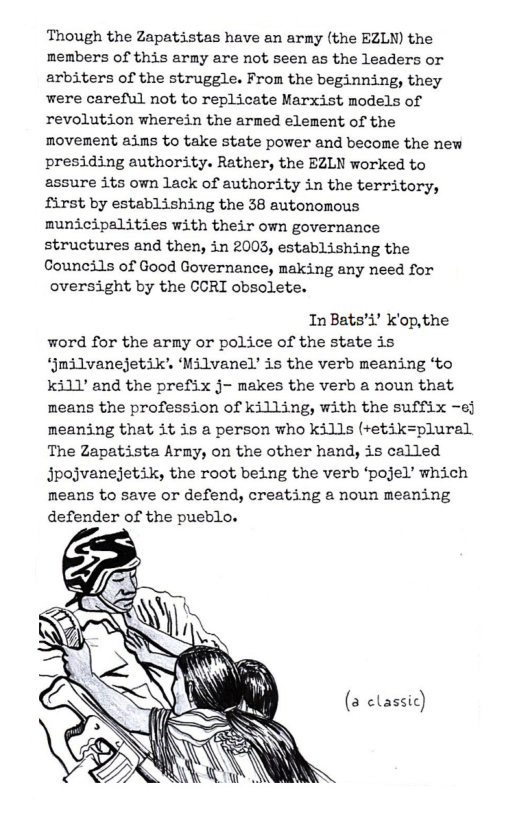
Though the Zapatistas have an army (the EZLN) the
members of this army are not seen as the leaders or
arbiters of the struggle. From the beginning, they
were careful not to replicate Marxist models of
revolution wherein the armed element of the
movement ains to take state power and become the new
presiding authority. Rather, the EZLN worked to
assure its own lack of authority in the territory,
first by establishing the 38 autonomous
municipalities with their own governance
structures and then, in 2003, establishing the
Councils of Good Governance, making any need for
oversight by the CORT obsolete.
InBats'i’ Kop,the
word for the army or police of the state is
‘jmilvanejetik’ ‘Milvanel’ is the verb meaning ‘to
ki1’ and the prefix j- makes the verb a noun that
means the profession of killing, with the suffix -ef
meaning that it is a person who kills (+etik=plural
The Zapatista Army, on the other hand, is called
Jpojvanejetik, the root being the verb ‘pojel’ which
means to save or defend, creating a noun meaning
defender of the pueblo.
(a classic)
SGETTIE
L >ruxour
D2, 0F HEREL
<X
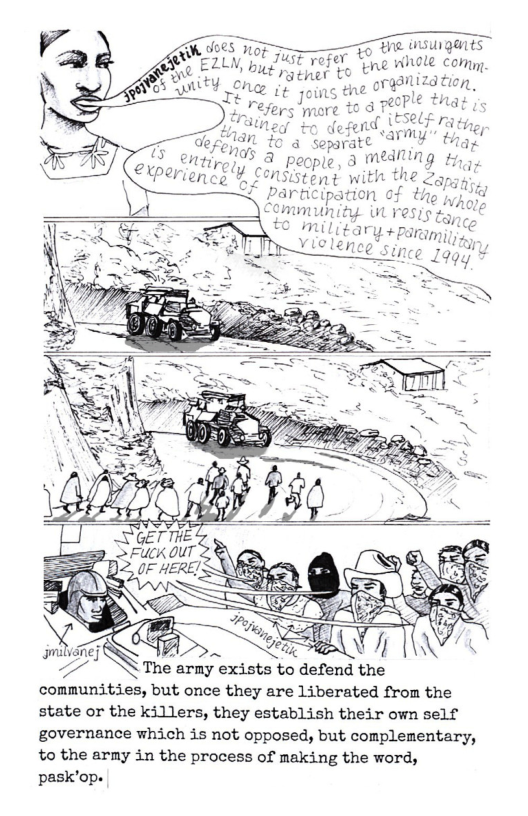
P The army exists to defend the
communities, but once they are Liberated from the
state or the killers, they establish their own self
governance which is not opposed, but complementary,
to the army in the process of making the word,
pask’op.
What are the Zapatistas struggling for? What are the
objectives of pask’op? ALl struggles, after all, must
have objectives or it would be impossible for them to
succeed. Looking at the EZLN's initial demands—
work, land, housing, food, healtheare, education,
independence, freedom, democracy, justice, and
peace- it might seem that these are demands that the
state could comply with, signifying the success of
their struggle, However, when explored in Batsi'k'op,
this becomes less clear.
(7O
RPN
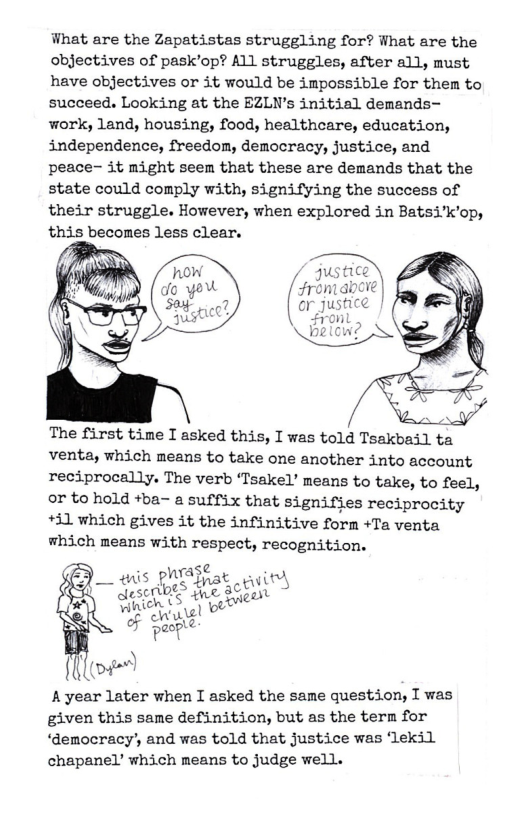
The first time I asked this, I was told Tsakbail ta
venta, which means to take one another into account
reciprocally. The verb ‘Tsakel’ means to take, to feel,
or to hold +ba- a suffix that signifies reciprocity
+i1 which gives it the infinitive forn +Ta venta
which means with respect, recognition.
se
s PRt it
Sescrtoes SE 300
SR el o
SN F Sespte
4 e
T roge)
[{ls
Ayear later when I asked the same question, I was
given this same definition, but as the tern for
‘democracy’, and was told that justice was Lekil
chapanel’ which means to judge well.
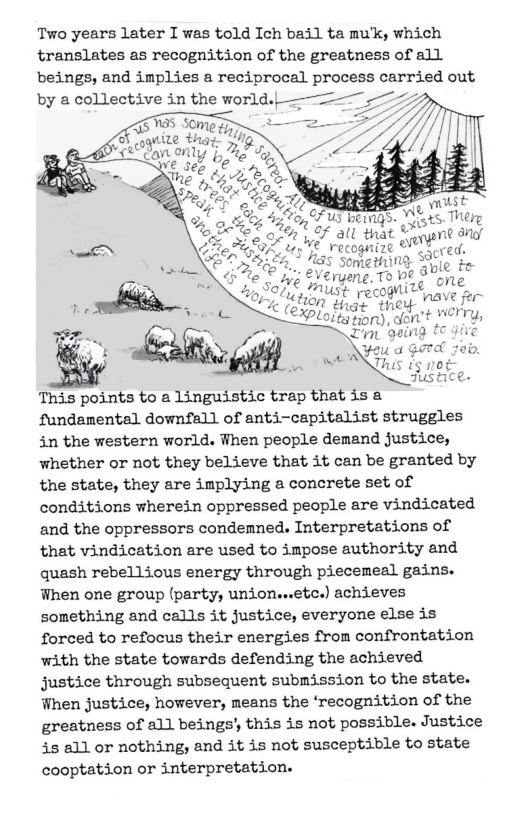
Two years later I was told Ich bail ta mu'k, which
translates as recognition of the greatness of all
beings, and implies a reciprocal process carried out
by & collective in the world————",—~
Va5 Some g7 e =
= »
& quize they Ly
) s 2,8
¥ st
o
bengs. Vists. Ter
oF all gt Shomar ang
recognize O
Sonmehing. 53
eryane.
recoghi
oy
This points to a linguistic trap that isa
fundamental downfall of anti-capitalist struggles
in the western world. When people demand Justice,
whether or not they believe that it can be granted by
the state, they are implying a concrete set of
conditions wherein oppressed people are vindicated
and the oppressors condenned. Interpretations of
that vindication are used to impose authority and
quash rebellious energy through piecemeal gains.
When one group (party, union..etc.) achieves
something and calls it justice, everyone else is
forced to refocus their energies from confrontation
with the state towards defending the achieved
justice through subsequent submission to the state.
When justice, however, means the ‘recognition of the
greatness of all beings' this is not possible. Justice
4s all or nothing, and it is not susceptible to state
cooptation or interpretation.
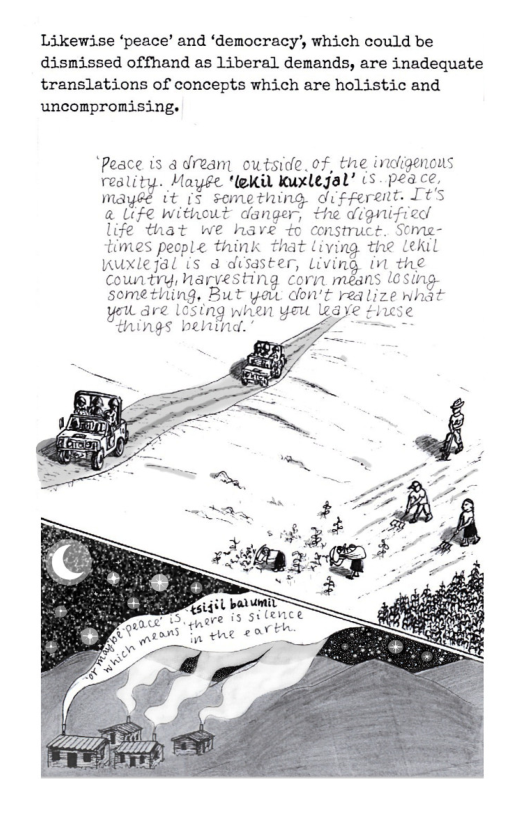
Likewise ‘peace’ and ‘democracy’, which could be
dismissed offhand as liberal demands, are inadequate
translations of concepts which are holistic and
uncompronising.
‘Peace is & dream outside. of, the indie
reslity. Mayfe ‘lekil kuxlejal’ s peace.
mayéé it (s semething different. It's
@ Life without danger, the dignified
life that we have +o construce. Some-
times people think that living the Lekil
Kuxlejal (s @ disdster, Living (M the
Country, haryesting corn méans l0Sing-
semething, But yaw don't realize what
U dre 10sing when yeu leaye thcse
things behind. -
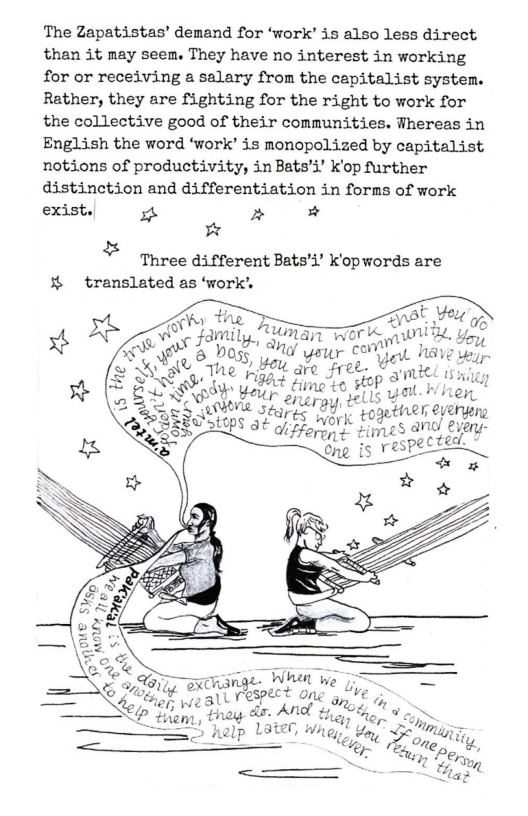
The Zapatistas’ demand for ‘work’ is also less direct
than it may seem. They have no interest in working
for or receiving a salary from the capitalist system.
Rather, they are fighting for the right to work for
the collective good of their communities. Whereas in
English the word ‘work’ is monopolized by capitalist
notions of productivity, inBats'i’ Kop further
distinction and differentiation in forms of work
exist. »
= ®
¥ Thnree aifferent Bate's’ Kopwords are
% translated as ‘work’
Fodeener evenyn,
b ff< and/ every-
T —aRCangL e
gy T Eeect ong o, bive
g el WedL, Andl %04 A & N
£ thom, tha &5 O the
@
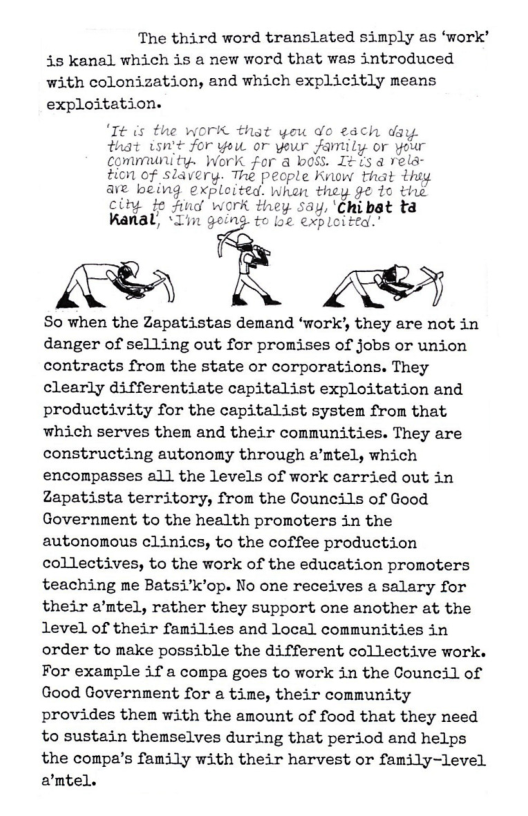
The third word translated simply as ‘work’
is kanal which is a new word that was introduced
with colonization, and which explicitly means
exploitation.
‘Tt (s the wWork thet yeu do each day
that isn't For yow or yeur family. or your
PNty Work for a boss. It (s a rela-
£icn of Slavery. The people Know that thiy
aiz being exploited. When they ge 10 the
city fe find work they say, cmut ta
e exploited.’
%Y
S0 when the Zapatistas demand ‘work’ they are not in
danger of selling out for promises of jobs or union
contracts from the state or corporations. They
clearly differentiate capitalist exploitation and
productivity for the capitalist system from that
which serves them and their communities. They are
constructing autonomy through a'mtel, which
encompasses all the levels of work carried out in
Zapatista territory, from the Councils of Good
Government to the health promoters in the
autonomous clinics, to the coffee production
collectives, to the work of the education promoters
teaching me Batsi’k’op. No one receives a salary for
their a’mtel, rather they support one another at the
level of their families and local communities in
order to make possible the different collective work.
For example if a compa goes to work in the Council of
Good Government for a time, their community
provides them with the amount of food that they need
to sustain themselves during that period and helps
the compa’s family with their harvest or family-level
a'mtel.
The other demands (housing, food, healthcare,
education) are similarly unquantifiable when
understood in Bats'i’ k'op.
& _- 57 2 .
A Lot of gutsiders come here and
"0 talk dlaowt their privilege’ of having.
c) Ydecess to heatthcare or educgtion, but
/0 us that is not privilege.
nt your medicine that poisons ye
yeour education 4 rsinwashes yeu
CUT mansions.
ous
€]
i 220 RS e
The clarity with which this education promoter
differentiated between what is ‘your’s’ and ‘ours’ can
be understood with the words ‘batsi’ and ‘kaxlan’,
Batsi, Like inBats'i’ k'op- the true word- refers to
that which is true, traditional or, in the sense that
the compa used the term, ‘ours’. Kaxlan translates as
‘from the city’ and can be understood as the relative
‘your’s’. In one lesson, an education promoter took us
through the various linguistic distinctions
commonly made in the communities to indicate
colonial impositions.
Forexample:
Y0'm=ytsic bats't' vom=true music
Kaxlen Yaj=bread bats'ivaj= tortills
ey bats'i veeit= ra
relil= pro s Vel = trad tional
° Food that nurtires
5 B A RS, e
PRy ns by rom ,
2 UM\C{LD eCoy eSSy
GSEincer it Oniginales with th SRR
P2 that O11gtn _/_w{
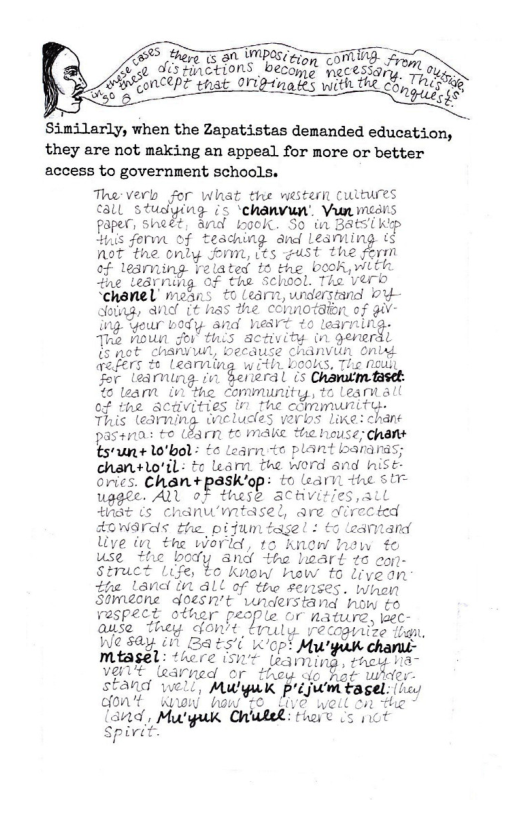
Similarly, when the Zapatistas demanded education,
they are not making an appeal. for more or better
access to government schools.
Tha:verls for what the western ultures
€all study fying is ‘chanvun’ Y e
paper, sheét, and kool So in BatSTKp
s fervaof teaching and leamting is
not ‘the only form, its ust the form
of leamming related to the book,with
e tedrning of the school, The verb
‘chanel means 0 Learn, widerstand Y-
dotng, Snd it / notGion
Sgour vody. o
Thi nown gor
i5 pot chaniw ¢
reders & Learniin w ith bools,
Tor leaming. %(r bral is
1 tear iy ‘hc Community, to Leariall
of the acdvities in the clmmuniity.
This (earning. ticludles vav han
pasHna to (Barn e MAke the house: chans
tsun+ W0'bol: £o Learn <0 plant bararas;
chan+lo'il: to leamn the word and hise.
orics. Chan+paskiop: to learil the i
uggle. ALl of these aCHVit/
st (s chanw'mtasel, are oirected
AOWArels the, pifum tage! : to eamand
live in the world, 1 knew hew fo
use the body snd tha leart ta eon-
struct Life, to Know hew to livean
tfe Land 1 alL of the senses. When
Stmesne doesn’t wnderstand how ¢o
vespect other pesple or nature, laec-
fitflsfmymy %gm"‘ Cruly recoginize fh
o4 BAES o Murgk chant-
miasel: ‘hore 50T (eainiy wp\;u 1
vaLe learned or thoy do Kot whe
stand well, Mu'guk pruumnu[
dont know haw Nt
3 s there s ot
The work of the Councils, which in traditional
Marxist fornations of revolution could be perceived
as specialized administration or nanagement of the
movement, is another forn of a'mtel, known as a'mtel
Jpatan (the work of our community) no different from
that of the collectives or the primary school
education promoters, in the sense that they are doing
work to ensure the collective survival of the
Zapatista communities.
Rathur, both ave different forms of
?flm 1, ene_that s pore focused on
v n s particular t1absjo colectiVo. )
5
and the othur that s more focused \ |
01 C0oVUinating amng_tabajos colectives |
and watching 1 wake Sire thos hore &
UPFEIE +hey need to function.
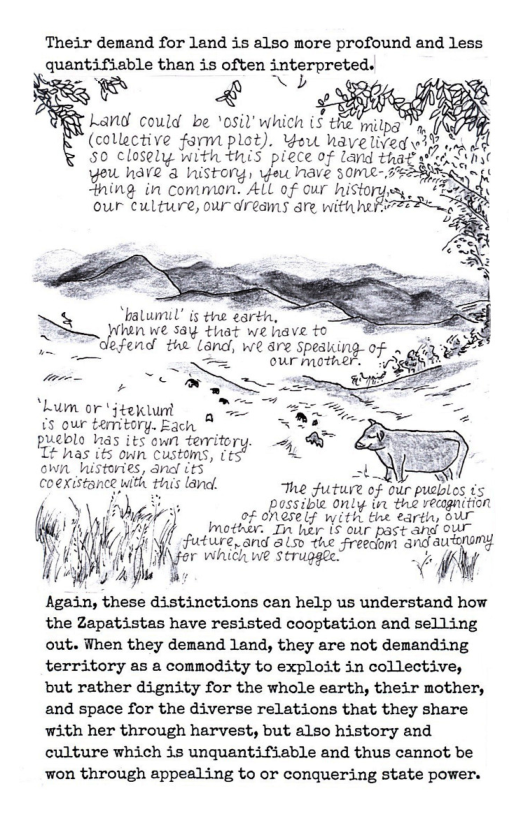
Their demand for land is also more profound and less
quantifiable than is often i.ntirpreted-
- Y
® £ B
Lang could be 'osit' which (5 ti milpa s,
(collective foym plot). WYou have lwede o
S0 closely wWith this piece of land thy
Yo have 3 history, ieu have $0me-5%
Hing in commeon. ALL of our histo
our culture, owr dreams are with e
g, “batumul’ is the earth,
Z plhen we say that we have to
. defend the (and, we are Speaking- o &
= ourmother.
— e ,,,‘\\ -
hum or gt o W T
(s our teritory. Fach
pueblo s its own teitory
Tt has (5 i Customs, (15
oW histories, andl its
coexistance with this land. The future of pwpw)al;s is
pussibie only in the yecgniticn
of 0neself with the earth, o
mother. In her (s our past and DW‘
[l future, snd aise the jf!eu’om and su
y ¥ Whith we 3 eruggie:
w;h " Ot ak @(
Again, these distinctions can help us understand how
the Zapatistas have resisted cooptation and selling
out. When they demand land, they are not demanding
territory as a conmodity to exploit in collective,
but rather dignity for the whole earth, their mother,
and space for the diverse relations that they share
with her through harvest, but also history and
culture which i5 unquantifiable and thus cannot be
won through appealing to or conquering state power.
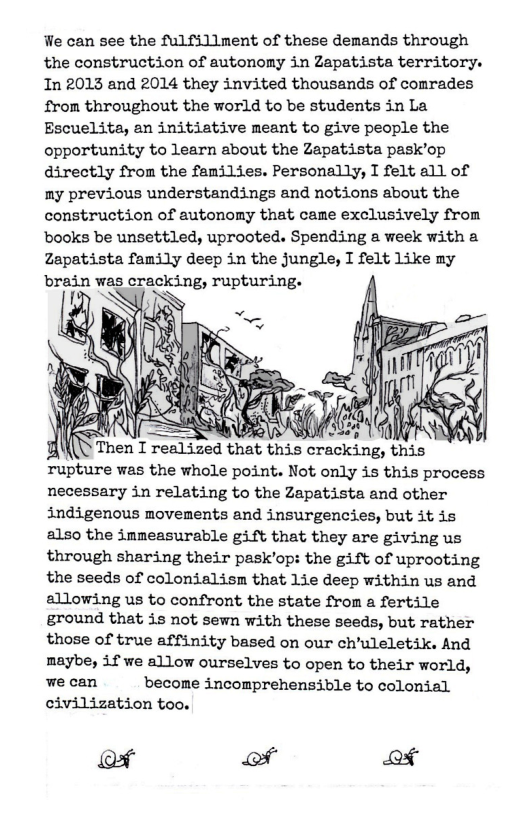
We can see the fulfillment of these demands through
the construction of autonomy in Zapatista territory.
In 2013 and 2014 they invited thousands of comrades
from throughout the world to be students in La
Escuelita, an initiative meant to give people the
opportunity to learn about the Zapatista pask'op
directly from the families. Personally, I felt all of
my previous understandings and notions about the
construction of autonomy that cane exclusively from
books be unsettled, uprooted. Spending a week with a
Zapatista family deep in the jungle, I felt Like my
brain was cracking, rupturing.
Tupture was the whole point. Not only is this process
necessary in relating to the Zapatista and other
indigenous movements and insurgencies, but it is
also the immeasurable gift that they are giving us
through sharing their pask'op: the gift of uprooting
the seeds of colonialism that Lie deep within us and
allowing us to confront the state from a fertile
ground that is not sewn with these seeds, but rather
those of true affinity based on our ch'uleletik. And
maybe, if we allow ourselves to open to their world,
wecan become incomprehensible to colonial
civilization too.
of of of
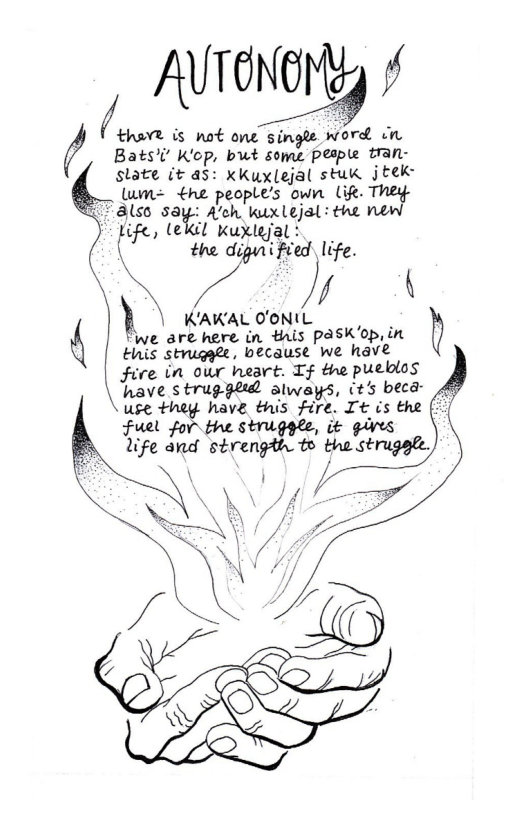
AUTONGLY /
/('lufl is not one single word Jn
Bats’’ K'op, bwt some pesple tran-
state it as: xKux(ejal stuk jtek:
= €he people’s own Lig. They
3lso “t A'ch, kuxlejal: the new
- Life, lekil Kuxlejal :
{ the diguni fied. life.
N (\D
} KAKAL O'ONIL L
6 we are here in this paskop, in
Einis strugale, because we have
Fire in our heart. If thhe pueblos
have struggld slwasys, (t’s beca
\use they have this fire. It is the
Fuel for the strigele, it gives
life and strength to the strugsle,
MiNT MANTAT,
A note on PRONUNCIATION:
Since Bats'i’ k'opwas not written using the
alphabet, its spelling is phonetic
to the Castellano (Spanish) language (7 is pronounced
Like H in English, X is pronounced ‘SHetc.). The
glottals, words with apostrophes like k'ak’al,
represent a hard stop in the word where the letter
before the apostrophe is emphesized in the back of
the throat before proceeding to the next syllable.
It’s difficult to do without practicing with a native
speaker, and even then takes a lot of practice and
constant correction. But you never know, there could
be Tsotsil speakers Living right in your
neighborhood! Maybe someone would want to trade for
English lessons. And if you can make it down to
Oventic with a working knowledge of the language
mechanics, the Zapatistas will definitely correct
(and 1augh at) your pronunciation.
vocab bod ¥
colors Satil- Eye
Tsotsil jolil- hair
Soon- Color peantion
- Motsobil- eyebrow
XGii- yEllow, tats X'ik satil- eyelashes
Tao-ired N4’41- nose
D wnin Ikalil- mole
& 3 4
Tk black, the wind goddess DUt MO
FO0D Tsin
Lobajel~ Fruits and vegetable:
Ttaj- vegetable
Sate’- fruit
Koxox- tostada
On- Avocado
Ti'bol g beket— food with meat
Vaj- tortilla
Kaxlan vaj- bread
Chenek’- bean
Ats’am- salt
Yoxo'- water
PeoPLe
Me'il- mother
Tot'il- Father
Its'inal- little brother
Mukil- sibling
Chi’31i1~ Companierx/
comrade
Lunal- People/country/
community|
Kusetik no'ox- Everyone
Yantik- others
Yan- other
Tse'm- Child (girl)
Kerem~ Child (boy)
Olol- Baby
earth /animals
Balumil- land/earth
Te- tree
Te'tik- forest
Yibel- Root
te- Tree moustache (root)
Vinajel- sky
Xojobal- 1ight
Be- path/road
Yanalte- leaf
Jo'- rain
Ki- wind
Tok’- cloud
Nichin- flower
Chem'tik- Field (Milps,
small field for planting)
Ixim: grains of corn|
Ton- stone
Vits- hill
Kukyvits- Mountain
Uk'um- River
0sil- land/territory
Ts'i’lel- Small plants
Itaj- plants that you eat,
(also plants that aninals
eat)
Yanal- leaf
Sbe'k- seed
Ixim- corn (that you grow)
Ajan- corn (that you eat)
Pech- duck
Chitom- pig
Tsi’i- dog
Kaxlan- chicken/City folk
Alak- Rooster/hen
Choy- Fish
Bolon- cat,
T'ul- rebbit
Vakax~ cow
Ci'o- rat
Patix- venomous newt (The heads of which are used as
a cure for snoring)
Vexal- pants
Kuil- clothing
Bu- Where
Bax'in- When Smak jolil- hat
Kgoe=Howda Mak- the top of a thing
bhuedioh Snail- House of
K'alal- when Yuns book
Kucha’sl- ¥hy Tak’el- money
Yu'un— Because, it's that JOLODil- weaving/fbric
Bush'u- Who ;.s usfloma'lv;]imbmmery
o ere is e
::_;__';hveryme Kmtejebaletik- tools
T Hare Vayebal- bed
A4 But Mexa- table
Xchi'uk~ and/with Verops
Sventa- for/in order to/about ~ Kuxel~ torest
Ao~ above Kopojel- to speak
Olon- below Plitel- to jump
Atinel- to shower
Quantity/size TEiTEageiits wtbs
B Ay Batel- to go
Toj ech’en~ too much o i
Raks g Lok’el- to write
deyiinr Powmany Lok'el~ to Leave
Toj: much (quantity of concepts/ oo to cone
feelings (toj siks much cold, o] Jali Xanavel- to walk
much time) ehatad
Jutuk: there is Little (quantity) fiep:b Kb
Bik'it: small (size) s
Ja'xano'ox: There only remains Atolajel- to count
nouns KapiJel- to confuse
Xinobil- shoes Lo'ilajel- to chat, converse
Kaep- trash Tiinel- to be angry, to have rage
Chamel/lajel- to die, to
e finished Tijel- to wake up people/
Lwmtsael- to grow tired jpotruments
On'ayel-tolose oneself pogvinel- to urinate
Kuxel- to eat crunchy things Tsa'anel- to poop
Tiel- to eat meat. Utel~ to punish
Loel- to eat fruit Utsiel- to smell
Uch'el- to drink P'ajvanel: to discriminate
Na‘el- to know Majvanel: to beat up
Tsakel- to take/grab Milvanel: to kill
Ichel~ to carry or receive | e,
Toimtael- to write something COMMBNAE
Ipajel- to get sick
Paso- Do it
Al'intajel- to clear a fleld 1o o0k
Ak'inajel~ to clear Specific o tao- write it
plants Bono- paint it
Mubel- to freeze, to be Nvino- understand it
paralyzed | La'- come
Kiel- tounderstand/to feel 10 OFF,
Tlel- to see Koltao- help
Niel- to give Chi'ino- Accompany them
Atel- to count Poko- Wash it
Alel- to say/to speak about % s
ime
P'ijilal- intelligence .
Bonolajel- to paint in general gl uxulak’aval-The
Elovajel- to have fun
st i o Jtotik- sun (a name),
- our father
Tsisomajel- to embroider A'abal- in the night
Paxyael- to hunt K'ak'al~ Day, sun
Tajinel- to play Ok'om~ tomorrow
Joli1- to remember So'm- morning
Kelel- to care for/watch/observe| Ak’aval- night
Sutel bal- to return from here to there ;.
Sutel tall- to return from there tohere | poon our
Katinel- to heat oneself from the sun or fire mother
'tik- the
Avi- today, now, the present
Volje- yesterday etc
011l k’ak’al- noon Vo'm- music
Bat k'ak’al- afternoon Keoj- song
Sa'p'at- twilight K'eojetik- songs
0ol ak'ak’al- midnight K'op- word
Sakil osil- dawn Ip- pain
Ja'bil- year (twelve months, P'ijilal- intelligence
vaxkuyune'n u) P'3)- intelligent
U- nonth Smelol- option
TYotol K'ak'al- calendar ~ (aich/T “Yci‘liyl; -
< Sjelelal- difference
expressions O
Kolaval- Thank you (singular)
Kolavalik- Thank you (plurel)
Kolavaltajek- Thank you very much
Mu'yuk k'usi- Yow're welcome
Xke'i- T understand
Muxka'’i- I don’t understand
To- still
Xa- already (ya)
Taj K’an- She wants
Ja vokuluk- please
Jmeletik ti- T hope that
Melel xaval- Are you sure?
Sk'an- Tt is needed (we need)
NO
Muyuk: there isn't, doesn't exist
Mo'oJ: Rejection of an offering, proposal...etc.
Mu: negation that is used with a verb (Mu taj k'an: T
don’t want)
yes
Oy: There is (Hay, third person of the verb ‘to be’)
Tana: Yes to an offering, proposal..etc.
Jas 3t 35, yes it is
Jech: that’s correct, certain
Ja' jechs It's ike that
pasic greetings
e wmi o] m,,..xiw %
(P\umt)
u"
= w)"
Yo Wi )
g
|8
§ Imowell)
GearCptural) o
L jun Ko'on chuaf K'g’_Dfl
ra wy vieare s my heart
jo'un -1 JO' uKetiK- we inclusive®
jorot- yau io:u.u'Vr we exclusive”
ja- him/her joroxuK- you peural
R— ungendered jo'th them,, o
SHouiar IR »
e o
colorr desgriptions = «
The color used as a noun cmnsromsff\ N«
when used as an adjective ) e
Ed%}vtl—’ x%xa% (Green/blue) a
— KaNAL (yeromw) —_— T
Ts0— tsajel (req) | Yaxal vingjel
sak—sakil (white) (. . ™
TW— Kl (oiacy - M vinadele yox
2 £
numbers ® Fou
1- JUN 11- BULUCHE'M
2- CHI'M (XCHA 12- LAJCHEM
3- OXI'M (YOX 15~ OXLAJUNE'M
4- CHANI'M (XCHAN) 14~ CHANLAJUNEM
5- JO'OM (SJ0) 15- JALAJUNE'M
6~ VAKI'M (SVAK) 16~ VAKLAJUNE'M
7- JUKUT'M (SJUK) 17- JUKLAJUNE'M
8- VAXAKI'M (XVAXAK) 18~ VAXAKLAJUNE'M
9- BALUNI'M (SBAJUN) 19~ BALUNLAJUNE'M
10- LAJUNE'M 20~ JTO'M (jun vinik)
* Inclusive/exclusive are the terms used by linguists to
express a distinction that can be better understood as a
more specific we (Jo'utik) and a more general we (jo'uketikly
for example one community within a larger assembly of
multiple conmunities. Jo'utik does not express an
opposition or exclusion of the larger collective, but
rather a complementary relationship in which the smaller
group is part of the larger.
Numbers are in units of twenty (because we each
have twenty). Twenty is one man (jun vinik).
Larger numbers require borrowing from more
men.
43-0XI'M YOX VINlK
Pree ,, wird
o)
2 men (20420) plus 3 from
the third man=43
XCHAN VI
S 7o oxATuNEM e il
32-LAJCHE'M )gg_fiA VINIK
TRwerve (o i)
A5-JALATUNE'™M §,‘_8 VI"l:flK
FEE T feram v
(anti)-POSSeS iV
10 NAVEe (this verb does not exist)
other Subject with whom I anm velating
L Hm the J alL nouns must be embedd,
5 K Wl«mn a relationship.
H < VAR +eak =houses
§ Hn«:z) £ prefix+ noun(,;umx]
INA my house TNATIK=0uR heuse (exclusive)
TANA- s house INAKUTIKS0UR hause (inclusive)
SNA=is/her house JANAIK= YouR house (plural)
SNATK= thair house (,;u.;ra()
vowe.ls s
ANTSE Wik VAN e
JA\I K VANTS JAVI!
(woman) YANTSIK
oy ka, mtak XE
ornd e i \‘?..—«}/
% ep jnatakutik y have o whive house in ,M,,%
g Rgevie 3
?"fi) Oyun ta Oventik xchi'uk jchi'iltak
webavemanypases TAM in Ovensik | Wth g commde S
tobe
(estax; there exists) (ser, only used w/ people)
OYUN-IAM OYUTIKWEARE TA'UN JAVTIK
OY/OT-YOUARE OYOKUTIK- WEARE JA'OT JAUKETIK
OY-THERE IS, OYOXUK-YOU ARE TA ;f:/ ?éUK
hefsheis’ OY\K-THEY ARE
“Many verbs can take either the transitive or
intransitive form, but it changes their meaning. It's
like the difference between the reflexive and
non-reflexive form of the verbs in Castellano,
sometimes it changes the meaning of the verb
completely, sometimes it just gives emphasis. For
example ‘ve’el’ in the transitive form means to
eat tortillas and in the intransitive form means
to feed oneself. Pasel in the transitive form
means to do/make, and in the intransitive means
to do/make yourself (reflexive) Tajk'an chipas ta
Jpojvanej yu'un jteklum: I want to make myselfa
defender of the people. Tajpas jna: I make my
house.” ~Dylan
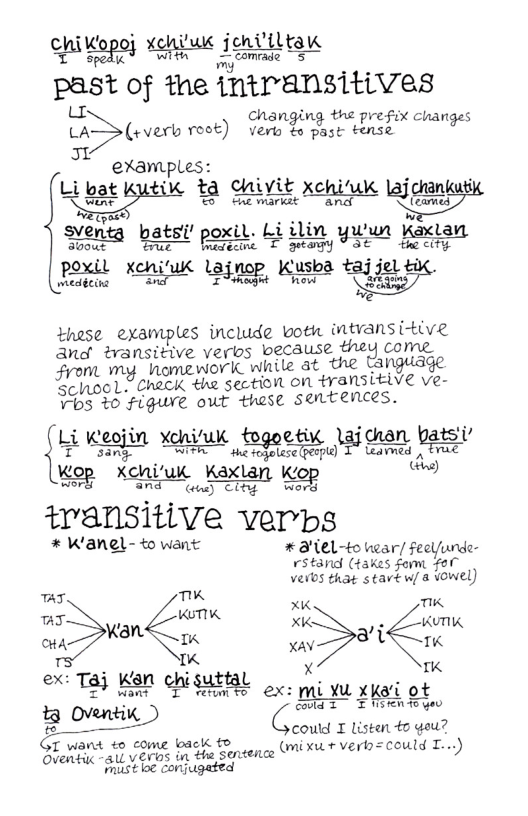
intransitive verbs
#K opojel- to Speak #P'itel to jump
(different prefix indicates verb Jorm)
vTiK CHI VTIK
°“t>l( 0PaJ: uum« c:i P IT<KUT\K
CuAr
"P"fix) = ()
wWe exclusive. )
inclusive |
QUICK KEY: R°°T<V\'; "fm:,‘.\
examples: Mrms o o they Q\»S
V,\Qfm sventa pask’o
chipit 8 dna ChKopo p
T jump 00 hovse Aot e shugge
%h"fi%f%‘ 1%%’3,5 jeni'iltak
~ Corr
oy comrAde 5
past of tne intransitives
LI
changing the prefix chai
LA (sverb root) vors o s thea” hanees
examples:
Li bat ik td daivit xchi'uk lajchankut
s B Gcwnarat . and (eamed
svent atsi’ . Li ili ) ey
Xi‘_.\%% xu:xi:ux lajnop Kusba w
3
e | ow
these examples include both MAVans itive
and tvansitive verbs because they come
From my homework while at the tanguage
‘Schocl. CheCk the sectick ol Hransitive ve-
vbs 10 fLgure out these sentences.
Li Keojin Xchi'uk togoeti jchan batsi’
T m{,fl T«rwwum‘%m@mw%A S
Kop XCWi'uk Kaxlan kop )
Snd Gy Clty | word
transitive verbps
* K'anel- to want # 3'(el-to hear/ feel/unde-
rstand (+akes formt for
verbs that stavé w/ a vowel)
ha % XK TIK
- . K XK . Lk
KNS /i
oA v ®
K
X K
ex: Taj Kan chi
t?”m %‘% ex: mi YU XKa'i ot
i3 One > M xkeiot,
&)77/&0 et could I listen 4o gou?
GEonors fo SOt LG B (i verb <ol 1)
st oe corjugated
rast of transitives
#majel-tonit/fignt ¥ atolajel-+o tella story/
w LA ecount
LAT- MAT KUT\'«\ LATHR=O\ KUTIK
v B AT
A Loy ™®
+reflexives (things that you do to yewrself
£g: Wash @eWrsel, heal yourself... etc)
*poxtael - o heal onesels
LAT TBA —TK Hhe ‘ba’ makes
LAT: TBA ——KUTIK 4y verb reflexive.
POXTAé.YAEA —K 5
LATA
LAT 584 —IK
o LiPflmfiba K 43 pus xehiuk
eihlezcat 9
K. Eduk.‘
u,‘ =
g U:t Iye Fransinve
intransitive 5 . '
*batel-to g +#na'el- tom &s/me
™ TA5>NA r‘\mk
wm\«
TAX
when my heart finishes
LAI<TA>O o+t + infinitive
ex
Laj Koon ta a/miel, taxi atl ta
b %8R, %
SR k) e
i
\’_/Gaftzr work, we'll ge to our community.
- X’ kit an .
B: B [2chan xohihk joujietik.
Q’x,j (commard) )
Yes you can. Come Lo with US|
A: Kolayal
hani ol
more sample Sentences
try Copying them out and translating them
yowrself using he vocap List/notes.
nysi i i ! ejal i
L oy ol R fprare
wWhatdo yeu want ¢o do in yeur lLives?
#When yeu have two consecutive Verbs in a sentcnce,
ot must be conjugated (chakanik. chapasik)
iR i 5pifil Kk’ P o
to] Kan wichan Jpll Wuchaal bats:
inil il j il Xchiuk
2 tajts e 1
T want to Leam wisdom Like the traqitional
elders From across the world and leant. how
to continue the struggle
¢ jva’e xchi)
80 Kan &2 @ian katkalal xonfux.
T accomgasny. i Fhas
enta tai dowutic ol A
sionta” e el oplpat
BT want % bt Family and learn how to
accompany. my- Compunity. in the stniggle to
change the world. .
these phrases ave way WSS cheesy in bats' Kop, I swear|
3 ichi‘in 4 1K
fjoan Kk taichiin Jluma), 12 ps
.
CU'-to be sble to
intransitives:
mixw <xs> verb + 3 +noun.
ex:
oo
uflK
mi ><v.'< > verb <M.> ta..
/! Xi K0poj Kutik td s pask/op Ispatisa
sl = “ipesll
could we
1Bl bout the Zapatista struggle?
(8L nouns must include the velationship. T this
case, T was speaking to a Zapatista, so T used
He third pexson singular form to express her
relationship o the struggle Bpaskiop) which can
be translated as ‘yeur struggee)
transitives:
mi xu <~>vefim noun~ta..
o KUtk
mi xw <§B>verb<m
8 K
A small dislogue:
A v_m._xu‘ Xi tal ta jlumal sventa Zapatista
e
5 community €0 be
our
B: mMoxXW. Sutan t3 islumal, sventa
vetun to
chava’an
TSR 3 e @ opcop
A gl mixw XU wuum_tas f.ubmk
“can
Sm@ @JE_!I;P_Q}J%%E iy
Team. Team %o 4o ie2)
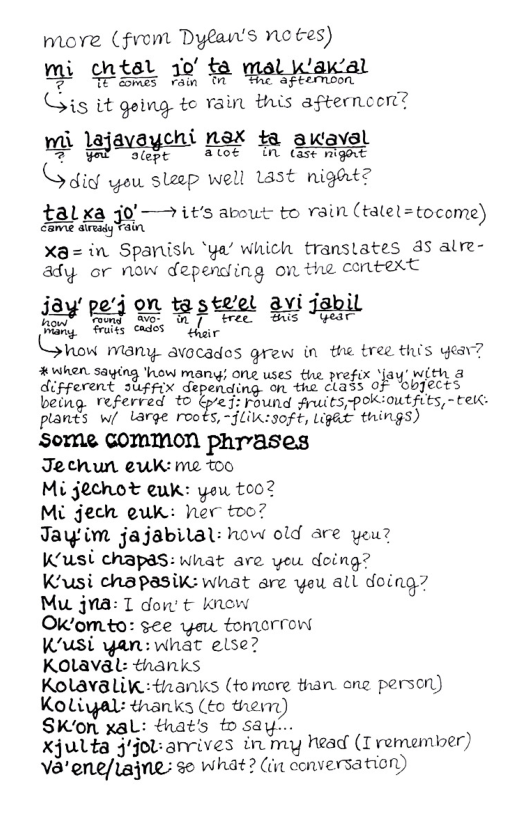
more (frent Dylan's 1o ces)
i 0’ ’ .
mi gatsl a0 da galjcaical
Gis it gelng to vain this afterncert?
i Lghja_vggc_hi naxX ta awaval
i §
TSt atot DN (35 night
Gy you sleep well 135t night?
talxa jo'—it's about to vein (hi(el:tmccme)
Game atradg Fain,
X3 =in Spanish ‘ya’ which transtates as alre-
ady or now depending on the context
ia " P
jay'pe on tgstziel 3vidgbll
By s oass e
Gonow many. avocades grew in the tree this ya?
being. referred 0 Gre und Aults,Poioutsits,-tew:
plants w/ large roots,~jLik:soft, LFat things)
Some commMon phrases
Jechun euk: me o
Mi jechot euk: you too?
Ml jech euk: hex too?
Jay'im jajabilal: how old are yeu?
Kusl chapas: what ave yeu doing?
Kousi chapasik: what are yeu all doing?
Mu jna: T dow t know
Owomto: see yeu tonerrons
Kusi yan:what else?
Kolaval: thanks
KolavaLik: thanks (tomere than one persen)
Koliyal: thanks (to thery)
SK'on xal: that's tosay.. .
Xjulta j'jol:anrives tnmy head (I rememicer)
Va'ene/lajne s What? (it conversatio n)
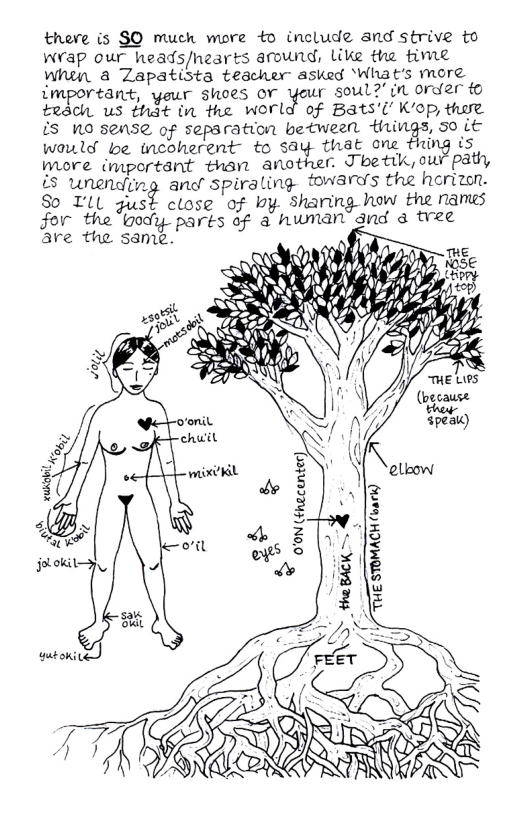
theve is SO muck wore o include and strive to
Wrap owr heads/nearts around, like the Hme
Wi a Zapatista teacher asked ‘What's more
IMportant, yewr shoes or yeur Soul?’(n order fo
+RAC us that tn the world of Bats'(’ K'op, thae
iS 1O sense of sepsration between Hiings, 5o (€
would be incoherent to say that one thing (s
wore (mpertant than another. Jbetik,ow path,
S unending and spiraling tonards the harizon.
S0 Tl zust close of by Sharing how the names
for the “gody parts of a hwman gnd ¢ tvee
are the same.
IMPRIMIDO EN
BLOOD FRUIT LIBRARY & PRINTWORKS
CHICAGO, IL
Favor de copiar y difundir este
fanzine lo mas posible.
Versio en linea:
https://
intheirowntongue.blogspot.com/