In Defense of Fire and Smoke
Web PDF • Imposed PDF• Raw TXT (OCR)



“INDEFENSE OF |
. FIRE& SMOKE
o S
fm
Originally published in WItDFIRE no. 4, an anarchist pris-
on solidarity newsletter. This essay is part of an ongoing
conversation between anarchist prisoners on tactics.
wildfire.noblogs.org.
Sean Swain is an anarchist held captive in the Ohio prison
system. For more information, check out his support site.
seanswain.org
IN DEFENSE OF
FIRE & SMOKE
ANOTHER RESPONSE IN THE
ONGOING DEBATE ON WHAT
CONSTITUTES REFORMIST TACTIC
UNTIL ISSUE NO. 3 OF WILDFIRE CAME OUT,
T intended to write on a new topic, expecting the
debate over reformism versus revolutionary action to
have run its course. But from the lively debate in the
last issue, I think would be remiss not to address the
topic one more time, in light of all the responses.
As Thave used the terms, “revolutionary action” secks
to topple the existing system rather than change the
way it operates. “Reformist action” on the other hand
does not seck to topple the system but is geared to
modifying or “reforming” the way the existing power
operates
To make an analogy, a hammer is a tool that pounds
nails. A screwdriver is a tool that installs screws.
Hammers and screwdrivers are not interchangeable
but perform different jobs. Same with revolutionary
and reformist actions,
So the question regarding hungerstrikes is: Does the
act of hungerstriking seek to topple power or does it
seck to establish new terms as to how power operates?
However I may feel about hungerstrikes, and however
anyone else may feel about them, hungerstrikes seek
to leverage the existing powers to exercise authority
differently, to give concessions. With a hungerstrike,
no matter how many of us o it, and no matter how
long we do it, a hungerstrike will never bring down
the power structure.
If your goal is to topple power, a hungerstrike is
never the tool you can use to accomplish that job, any
more than you can effectively use a hammer to insert
screws. The hungerstrike is a tool from the reformist
toolbox.
Now, I have had to alter my position on work
stoppages a bit. Michael Kimble has presented a
scenario where work stoppages could be used for
a revolutionary outcome—that is, that rebels who
seck no compromise with the power structure could
employ a work stoppage, not with the goal of making
demands or gaining concessions, but with the goal of
never going back to work, with the goal of shutting
down the system all together. Such a scenario is clearly
revolutionary. But, having said that, every work
stoppage in history has devolved into reformism. This
is due to the fact that not every single rebel is deadset
to bring the system down, and will instead return to
work for the promise of concessions, for a handful of
rewards.
Sad, but true.
It occurs to me that particularly in a prison setting,
for practical reasons, it would probably make sense
not to begin any rebellion by proposing a statewide
work stoppage, one designed to continue forever until
the system collapses and we all go home. I don't see
that working. Probably, that would be something to
build up to, through other actions that develop the
practice of rebellion.
That's why I maintain that hungerstrikes are a tool in
the reformist toolbox and work stoppages, until they
prove to be used for a revolutionary outcome, are also,
unfortunately, a reformist tool. Now, having said
all of that, others have made points that employing
reformist tools like hungerstrikes serve to (1) raise
consciousness, (2) broaden participation in struggle,
and (3) build solidarity. All of these points are true.
But, engaging in reformist tactics will only lead to
raising reformist consciousness, broaden participation
in reformist struggle, and build solidarity with
reformists who are only secking to alter the way the
system works, not destroy it
Back to the analogy, teaching someone to use a
screwdriver does not make them proficient with a
‘hammer.
Practicing reformist ftactics “raises consciousness”
that we can struggle and get the system to change
and accommodate us. Someone under that false
consciousness can never be motivated to topple the
system that they falsely believe to be responsive (if
only enough of us sign a petition to vote or march or
hungerstrike). So, building “reformist consciousness”
arrests “revolutionary consciousness” and detracts
from the potential for revolution.
Employing reformist tactics also broadens participation
in the struggle—in the reformist struggle. It creates
greater numbers of folks who believe that they can
devote their energies to getting the existing system to
work for them. It does not, however, pull more people
into the revolutionary struggle of attempting to topple
the system.
Also, let’s keep in mind that no revolution in history
ever secured more than 5% of the population’s
participation. In every revolution in history, 95% of
the population sat on the sidelines and watched. So,
that being the case, attempting to broaden participation
is a reformist approach in itself. I would gladly trade
a million committed reformists for just a dozen die-
hard revolutionaries dedicated to bringing the system
down. The numbers argument is a reformist red
herring.
Lastly, reformist action increases solidarity with other
reformists and gets more folks intellectually oriented
into running on that same hamster wheel, increasing
the number of people who are deluded into thinking
that the answer is not to topple the system but to
strive to fix it, to achieve a kinder, gentler slavery
complex.
Let’s not pretend reformism corners the market on
consciousness-raising or on broadening the movement
or on increasing solidarity. Direct action strategies do
that too, only direct action strategies inspire others
to direct action. Tactics like sabotage and rioting
and insurrection do not result in concessions or
improvement in conditions. Revolutionary tactics are
not geared for such outcomes, just as hammers are not
geared for installing screws.
Inthecaseof the 12 Monkey rebellion, the 12 Monkeys
promoted sabotage like clogging drains and jamming
locks, and the rebellion began with an incredibly
small number of rebels. It grew quickly and escalated
to smashing windows and lighting fires—which are
tactics the 12 Monkeys never promoted. That is,
with mass participation in direct action rebellion,
the action quickly went beyond the designs of those
who had issued the initial invitation. So, direct action
can promote revolutionary consciousness, broaden
participation, and strengthen solidarity.
Prisoners can employ tactics that throw the prison
complex into a constant state of con ict and crisis that
builds and spreads. And contrary to the criticism that
prison rebellion alone cannot fake down the larger
system of control, the fact is that no state can exist for
long without the power to punish, and if the prisons
are taken away from the state, the state cannot remain
the state for long. But, the point is immaterial because
widespread prison rebellion would spread and would
consume so much of the state’s energy and resources
and personnel that nobody would be guarding the
proverbial henhouse. Then rebels beyond the fences
would have an open invitation to get just as rowdy.
The death of the hierarch program will not come about
as a consequence of reformist actions or a series of
reformist actions, not even a million reformist actions
involving a million participants. The system will
only be toppled by rebels who dedicate themselves
to actions that are designed to topple the system. We.
are not excused from participation just because we're
locked in cages. at does not absolve us, but provides us
an even greater incentive, a stronger motive, a deeper
resolve.
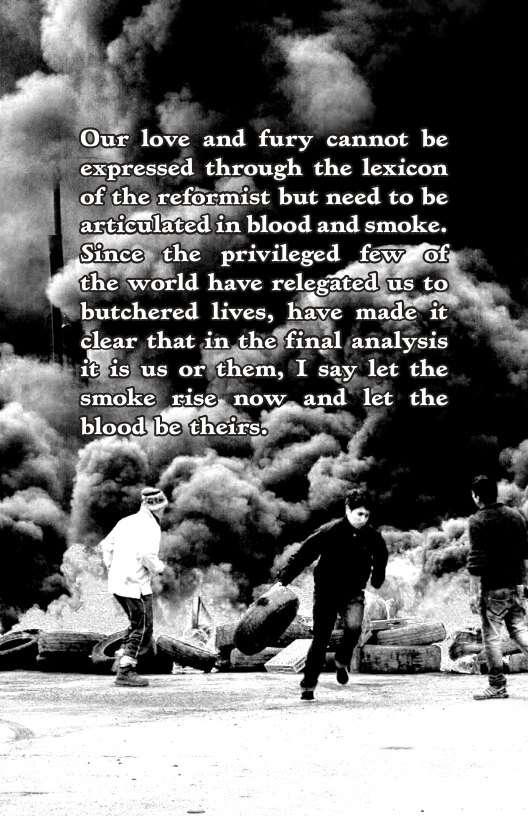
Our love and fury cannot be expressed
through the lexicon of the reformist but need
to be articulated in blood and smoke. Since
the privileged few of the world have relegated
us to butchered lives, have made it clear that
in the final analysis it is us or them, I say
let the smoke rise now and let the blood be
theirs.