I Will Not Crawl (Black self defense in NC)
Web PDF • Imposed PDF• Raw TXT (OCR)


![immediately pased an ordinance banning KKK motorcades, a measure they had refused to consider prior to the gun batle Anevenmoreremarkablelocaldramadragged Robert Williamsontothestage of nternational poitics on Ocober 28, 1958. Two Affican American boys, “Fuzzy” Simpson and Hanover Thompson, ages cight and ten, met some white chideen in a vacantlor. Akissinggameensuedinwhichtheten-year-old Thompsonandancightyear- old white girl named Sissy Suton kissed one another. The worldwide controversy that stemmed from the “kissing case” underlined the power of sexual questions in racal politics and demonstrated both the promise and the problems of cold war politiesfor the African American freedom struggle Afterthekissingincident, Sissy Suttonsmotherreported that“Iwasfurious [ would have killed Hanover myselfif Thad the chance.” Sissy’ facher took a shotgun and went laoking fr the two boys. Neighbors reported that a white mob had roared up 10 the Thompson home and threatened not only to ill the boys butalso to ynch their mothers. Later that afternoon, police officers spotted Hanover Thompson and apson pullingaed wagon loaded with sofedrink botcls. Both cops jumped out with their guns drawn,” Thompson recalled. “They snatched us up and handeuffed us and theew us in the car. When we got o che jail, they drug us out of the car and started beating us” The local juvenile court judge reported to Governor Luther H. Hodges that the police had detained the boys for thir own good, due to local feelng in the case. Authorities held the two boys for six days without permitting them o sce parents, friends, or atorneys. Passing gunmen fired dozens of shots into the Thompson home. Klan terrorists torched crosses on the lawn. Hanovers sister found his dog shot dead in the yard. For many white citizens, the case seemed to resonate with the sexual fears that accompanied their vision of where school desegregarion would lead. If black children] get into our rural schools and ride the buseswith ourswhite children;” onelocal woman wrote, ‘the Monroe kissing!incident is only a start of what we will have” On November 4, Judge J. Hampton Price convened what he termed *separate but equal” hearings or the white parents and the black boys and sentenced the pair to Morrison Training School For Negroes. If they behaved well, Judge Price told the black boys, it might be that they could be released before they were twenty-one. Robere Williamssaw the “kissing case”as more than local expression of the irrational sexual ynchpin of white supremacy; the bizaree clarity of the case and the strange politiesof the cold war suggested a larger straegy. Like Martin Luther King Jr- and the Southern Christian Leadership Conference (SCLC) would do in Birmingham four years ater, Williams and his friends in Monroe set out 1 use international polites o the cold war as a fulerum to push the U.S. government o intervene. Determined to make the“kissing case” global metaphor for the American racial dilemma, they fired off pres release, pestered reporters, hounded the wire services, and puc in motion what Time maguzine called “a rolling snowball” of worldvwide publiciy. Fuzzy’](i-will-not-crawl-black-self-defense-in-nc-robert-f-williams 7.png)
![tried out on Medlin before his trial 1 ol them that this matter would be handled through the lawand the NAACP would help.” Williams rcalled, “that we would beas bad as the white people if we resorted to violence” “The proceedings against the two white men compelled Williams t recon- sider his assessment. The judge dropped the charges againse Shaw in spite of the face that he file o appear or court, Dusing the brief rial of Medlin, his attorney argued that he had been “drunk and havinga ltle fun” at the time of the assaul. Furdher, Medlin was married, his lawyer told the jury; “to a lovely white woman...che pure fower ofife..do you think he would have lefe this pure flower for that?” He gestured toward Reid, who began to cry uncontrollably. Medlin was acquitted in minues. Robert Williams recalled that “the [black] women in the courtroom made such an outery,the judge had to send Medlin out the rear door” The women then turned on Williams and bicerly shamed him for filing to see to their protection. A his burning moment of an- g and bumilistion, Willams wemed w0 wire seri reporters and declared that it was time to “meet violence with violence.” Afii American ctizens unable t enlis the support ofthe courts must defend themselves. *“Since the federal government will not stop lynching, and since the so-called courts lynch our people legally” he declared, "if its necessary to stop lynching with lynching, then we must resort o that method * The next day Williams disavowed the eference tolynching, 1 do not mean that Negroes should go out and atcempt o get revenge for mistreatments or injustce,” he said, “but it s clear that there is no Fourtcenthor Fifteenth Amendment nor court protection of Negroes rights here, and Negroes have to defend themselves on the spot when they are artacked by whites.” Banner headlines flagged these words as symbols of “a new milicancy among young Negroes of the South.” Encnies of the NAACP blamed this “blooddhirsty remark” squarely on the national ofice. That very morning, when he read the words “meet violence with violence” in 2 United Press International dispatch, Roy Wilkins telephoned Robere Williams o nform him that he had been removed from hispostas president of the Monroe NAACE. “The fiftiech anniversary convention of the NAACP that summer of 1959 became a highly public show trial whose central issue was whether or not the na- tional organization would ratify Wilkinss suspension of Robert Williams. The national office printed up a pamphlet, “The Single Isue in the Robert Williams Case,”and distributed it 1o all delegates. As part of the coordinated effort o crush ‘Williams, Thurgood Marshall visited the New York offces of the FBI on June 4, 1959, and urged agents to investigate Williams *in connection with [Marshalls] e forts to combat communist attemprs o infiltrate the NAACE” Wilkins wised ev- ery available arm. Daisy Bates,the pistol-packing heroine of Little Rock, agreed o denounce Williams for advocaring self-defense—afier the national offce consented 0 buy $600 a month in “advereising” from he newspaper. “The national of Louis Lomax wrore, “subjected the Williams forces to a heavy bombardment from the NAACPs big guns” Forty speakers, including Bates, King, Jackie Robinson, 7](i-will-not-crawl-black-self-defense-in-nc-robert-f-williams 10.png)
![liams noed. “Nowhere in the annals of history does the record show a people delivered from bondage by patience slone.” Kingconceded that white violence and white intransigence had brought the movement 1o “a stage of profound crisis” African Americans were frustrated, he sid, and the “current calls or violence” reflected “a confused, anger-motivated drive ostrike back violently.” The Supreme Coures 1954 mandate and even the wiumphat Montgomery had yielded small tokens, elaborate evasions, and widespread terror. Only three responses presented themselves. One could practice “pure nonviolence, King said, but this path “could not readily anrace large masses, for it requires extraondinary discipline and courage.” A position that encompassed legitimate self- defense was more practical. King pointed out thae “all societics, from the most primitive o the most cultured and civilized, accepr [self-defense] s moral and legal “The principle of selfdefense, even involving weapons and bloodshed, has never been condemned, even by Gandhi” Here was where King the politician sensed his constituency. “When the Negro uses force in self-defense.” he continued, “he docs o forfet support—he may even win it, by the courage and sel-respect it reflecs. “This widely acceped position was,of course, precisely Williams’s view—which was Kings problem. “Thechirdand mostunaccepuable position, Kingargued,was “theadvocacy of violence as 2 tol of advancement, organized as in warkure, deliberately and consciously” Here, then, was the pale beyond which King sought 1o cast his adversary. “Mr. Robere Williams would have us believe that there i no collectve or practical alternative,” King insisted. “He argues that we must be cringing and submissve or take up arms.” Essentially, King had invented his own Robert Williams,akindofblack Geronimo plottingmilitarysrikesagainsethewhiteman, and thenrespondedothat Robert Williams. Lackingtheologicaltrainingandcombativein hismanner, Williams made himselfvulnerabletothiscaricature. Butthephilosophical position from which Kingcentered his own argument—preferring nonviolence, but endorsing “the principle of slf-defense, even involving weapons and bloodshed”— was preciely the place where Willams had taken his stand. Afier the debate appeared in Lierationand began to esonate throughout he movement, W. E. B, Du Bois weighed in with a commentary, also entitled *Crusader Without Violence,” in which he discouraged applause for King’s critique of Williams. In Montgomery, he wrote, King had “stood firm without sureender,” but Du Bois considered it “a very grave question as to whether or not the slavery and degradation of Negroes in America has not been unnecessarily prolonged by the submission o evil More than the persuasive sill of their lders, the bold actions of African American college studentsset these philosophical debates aside and gave the barcal- ions of nonviolence their brief but compelling historical moment. On February 1, 1960, four students from North Carolina Agricultural and Techical College walked into Woolworths in Greensboro, sat down at a segregated lu and asked 1o be served. Within tvo months, the sicins had spread o fify. communities across nine staes of the old Conlfederacy,infusing the freedom move- b counter, 0](i-will-not-crawl-black-self-defense-in-nc-robert-f-williams 13.png)
![community for reasons that are unclear and drove staight into an angey black mobs milling near Williamss house. “There was hundreds of niggers chere,” the white woman stated, “and they were armed, they were ready for war” Black residents under the impression that the demonstrators downtown were being beaten an pethaps slaughtered, threatened to kill the white couple. Williams, though busy preparing o defend his home, rescued the two whites from the mob and led them into his house, where they remained for about two hours. White authoritiesater charged Williamsandseveralother peoplewith kidnapping, althoughthe white couple met two police officrs on their way home and did not report their alleged abduction. The woman later conceded that “at the time, 1 wasnit even thinking sbout being kidnapped... [ Tlhe papers,the publicity and all that seuf was what brought n that kidnapping mess.” Duringa long night of acial error, Williams slung a machine gun over his shoulder and walked several miles with his wife and two small sons o where Julian Mayfeld waited with a car. The Williams family fled first to New York Gity, then to Canada, then on 1o Cuba to escape the hordes of FBI agents who combed the countryside in scarch of them. One of the agents assigned to search locally for Williams reported. his frustrations to FBI Director J. Edgar Hoover: “Subject has become something of a ‘John Brown’ to Negtoes around Monroe and they wil do anyehing for him.” “The FBI dragnet never snared Williams, but it did not take Hoover long o hear from him. Every Friday night from 11:00 to midnight on Radio Havana, Wil- liams hosted *Radio Free Diie,” a program that could be heard from 1961 to 1964 as far away as New York and Los Angeles. From Cuba, Williams continued o edic The Crusader for circulation that eventually grew to forey thousand. In 1962, his ook Negroes With Guns, published from Cuba, became the single most important intellectual influence on Huey I Newton, soon to found the Black Panther Party in Oakdand. Copies of The Crusader raveled down the Mississippi back roads with SNCC organizers: “this leaflet i being distributed by SNCCand COFO [ Council o Federated Organizations] workers among US. Negroes,” the Mississippi State Sovercignty Commission complained in the spring of 1964. Later that year, when SNCC began o veeraway from nonviolence, members cited Williams approvinglyin the fierce nternal debates. Asblackactivistsbegantorejecteven the tacicalpretenscofnonviolence, the influence of Robert Williams continued to spread. “Armed self.defense s fact of fe in black communities—north and south—despite the pronouncements of the leadership.” a Norch Carolina accivist wrote to Williams. Long before Stokely ‘Carmichal and Wille Ricks led the chants of “Black Power” that riveted national media attention in the summer of 1966, most elements of that ambiguous slogan already were in place. “Your doctrine of self-defense set the stage for the acceptance of the Deacons For Defense and Justice,” Lawrence Henry told Williams in the spring of 1966, “As quiet as t i being kepr, the Black man is swinging away from King and adopting your titfor-tat philosophy. mssinflucncewasnotlimitedtotheSouth. “Aslamcertainyourealize, 2](i-will-not-crawl-black-self-defense-in-nc-robert-f-williams 15.png)
![Richard Gibson, editor of Now magazine in New York, wrote to Williams in 1965, “Malcolms removal from the scene makes you the senior spokesman for Afro- American milicants” Life magazine reported in 1966 that Williams’ “picture is prominently displayed in extremist hauntsin the bigeity ghettos.” Clayborne Carson names Williams asone ofwocentralinfluences—theother being Malcolm X—onthe 1966 formation of the Black Panther Party For Self-Defense in Oakland, “the mose widely known black militant politcal organization of the lare 1960s.” The Central Incelligence Agency (CIA) exaggerated considerably in 1969 when it reported that ‘Williams *has long been the deologicalleader of the Black Panther Party” Itis closer 0 say that the Panthers were *a logical development” from the philosophy of Williams, as Reginald Major asserted in his 1971 book, A Panther Iy Black Car According to Williams, he “alked to Bobby Seale and Ms. [Kathicen] Cleaver by elephone when | was in Affica” in 1968 and the leadership “asked me 10 become Forcign Ministerofthe Panthers At that momene, Williamshad alreadybeen named president.in-exileof two ofthe most influcial revolutionary nationalist groups: the Revolutionary Action Movement, which the CIA belived t be ‘the most dangerous ofall the Black Power organizations,” and the Detroit-based Republic of New Africa. “Despite hisoverseas activiies”the CIA reported in 1969, “Williams has managed to becoming an outstanding figure, possibly the oustanding figure, in the black extremist movement in the United Staes.” Even though he becamefriends with Che Guevaraand Fidel Castro himself, ‘Williams grew uncasy in Cuba: he yearned to recurn home. As the Sovietsrings on the Cuban revolution shortened, Williams resisted pressue to make his own poli conform to the Soviet line. T am under constant attack by the [Communist Party of the United Staes],” Williams wrote o a frend in the mid-1960s. “They are trying to cut off my faciltes here in Cuba. One would chink T am Hidler and Wall Strcee combined.” An FBIinformantas early as 1962 stated that Williams *has scubbed his oes” with Cuban Communists through his ervicsm of [the] Communist Paty for barring Negroes from leadership’” and that he ‘may not b able to regain his footing” “The Stalinists were “getting worse than the crackers in Montoe,” Williams com- plained in 1964. “Things are sbout to the stage when I had to leave Monroe in a hurey” Williams persuaded Castro to let him travel to North Viewam in 1964, where he met Ho Chi Minh and wrote antiwar propaganda aimed at African Americ can soldier. In 1965, the Williams family relocated to Beijing, where Wiliams was *lonized and feted by top Pekingleaders,” according to CIA intelligence repores. The ‘Williams family dined with Mao Toe-tung and moved in the highest circles of the Chinese governmen for three years. Like the Black Power movement iself, as ‘Williams got farther away from his roots in the South he sometimes drified into apocalypric nonsense. His 1967 essay, “The Potential ofa Minority Revolution,” for example, depicted a scenario in which black saboteurs and guerrilla enclaves could bring down the U.S. government. Though Williams had been one of the best organizers in the black freedom movement,hisisolation from any I made him vulnerable o the same frusrations and delusions that plagued the restof al constiten 5](i-will-not-crawl-black-self-defense-in-nc-robert-f-williams 16.png)




![who’slost in the woods.” He said, I donit give a damn who he is. You asked for violence and now you’ee geting it see; you’e geuting juse what you deserved” So | told him, “Do you know one thing .. you ae the biggest foolin the whole world!” [Ellpsis in original] He became infuriated and strted raging on the telephone and told me o shut up. 1 old him that he may be the Governors asistant but he couldsit tell me to shue up. He said, “If you donit stop talking to me like that Il hang up.” And he finally hung up. No protection came. Each time the Freedom Riders would get ready to go on the picket line they would call the FBI in Charlotte and ask for protection. The FBI would say; “Were on our way.” But they would never be there when anything happened. On Saturday when the Freedom Riders were picketing in town and the taxicabs that had been transporting them 1o the line had started out 1 pick them up, the local white raciss gathered together and blocked the road. This meant the Freedom Riders had to walk back to the colored community which was almost a mile away: “The mob followed the Freedom Riders along the strets, throwing stones a them and threatening to kill them. When they came into the colored community; the colored peaple who were not participating in the pcket line became very upset that our community had been invaded by a mob chasing Freedom Riders. Many of the colored people sarted sconing cars and beating back the white racises. Chapter 5 Self Defense Prevents a Pogrom: Racists Engineer a Kidnapping Frameup Sunday morning the chief of police and his men drove through the coun- ty urging whites to come 10 town to fight the Freedom Riders. In addition, people wete coming in from other counties and from South Carolina. An organization called che Minute Men had brought people in. By aftemnoon thousands of white racists had gathered in town, concen- trating ac the courthouse square. At 4 o’clock James Forman, one of the picket captains,called my home requesting four taicabs within the hour. He said that the racists were thrcatening to assaul the line and complained of police indiffeence. Forman was to end up in jail with a splic head one hou later. At 430 the Negro cab company called to report that they couldafe get through to the picketers because every entrance into town was blocked off. Mi uteslatera couple of cars driven by our people came racing into the neighborhood. “They had just made it in from town to report that the mob had started 0 avtack the picketline, shots had been fired and the town was in the grip of a fullsc When the self-defense guard, which up o now had staed away from the courthouse square, heard that thelives of the Feedom Riders and local non-violent youth were in danger, they jumped into their cars and rode into town, breaking through the mobs blockade 1o rescue the picketers. Julian Mayfield went with %](i-will-not-crawl-black-self-defense-in-nc-robert-f-williams 29.png)


![groes are not pacifss just et them slap one. Pick any Negeo on any street comer in the US.A. and theyl ind out how much he beleves in turning the other check. All those who dare to aack are going to learn the hard way that the Afro-American is not pacifst; that he cannor forever be counted on ot o defend himself. Those who attack him brutally and ruthlesdly can no longer expect to at- tack him with unity. “The Afro-American cannot forget that his enslavement in this country did not pass because of pacifst moral force or noble appeals to the Christan ience of the slave-holders Henry David Thoreau is idealized as an aposde of non-violence, the wiiter who influenced Gandhi, and through Gandhi, Martin Luther King, . Buc Thoreau was not dogmatics his eyes were open and he saw clearly. 1 keep with me a copy of Thoreau’s Plea For Captain John Brown. There are truchs that ae just as evident in 1962 as they were in 1859 when he wrote: Tewas his (John Brownis] peculiar doctine that a man has a perfect sight 1o interfere by force with the slaveholder,in order to rescue the slave. T agree with him. They who are continually shocked by slavery. have some right to be shocked by the violent death of the slaveholder, but such will be more shocked by his life than by his death. 1 shall not be forward to think him mistaken in his method who quickest succeeds o liberate the save, T speak for the slave when I say, that T prefer che philanthropy of Captain Brown to tha philanthropy which neither shoots me nor ib- erates me.... 1 do not wish 1o kill nor to be killed, but I can foresce. circumstances in which both these things would be by me unavoidable We preserve the so-caled peace of our community by deeds of petty violence every day. Look at the policemanis billy and handeuff! Look at the jail... We e hoping only to live safely on the outskirts of this pro- visional army: So we defend ourselves and our henroosts, slavery. T know that the mass of my countrymen think that the only sighteous use that can be made of Sharpe’ ifles and revolvers s o ight duels with them, when we are insulted by other nations, or to hunt Indians, or shoot fugicive slaves with them o the like. I think that for once the Sharpe’s rifle and the revolvers were employed in a rightcous cause. The tools were in the hands of one who could use them. “The same indignation that s said to have cleared the temple once will clear it again. The question s not about the weapon, but the spirt which you s it. No man has appeared in America,asyet, who loved his fellowman so well, and ereated him so tenderly. He [John Brown] lived for him. He took up his life and he lad ic down for him. What sore o violence is that which is encouraged, not by soldiers, but by peaceable ciizens, not so much by laymen s by minsers of the ind maintain »](i-will-not-crawl-black-self-defense-in-nc-robert-f-williams 42.png)

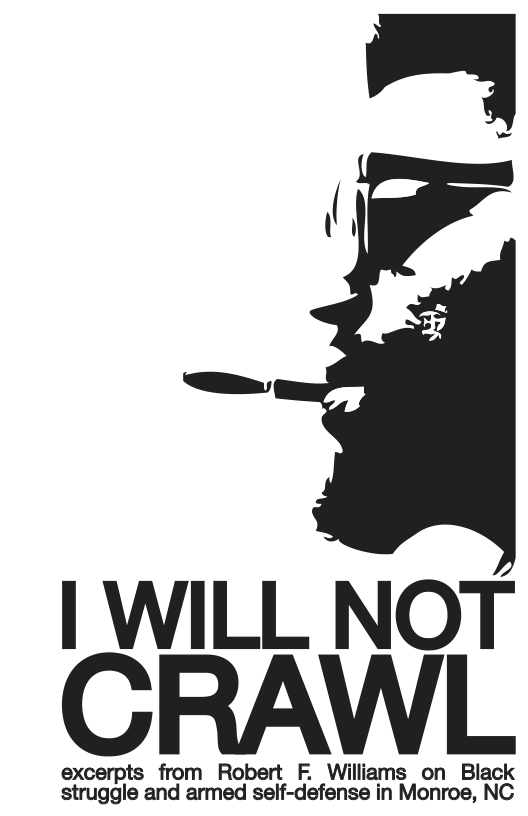
| WILL NOT
CRAWL
excerpts from Robert Williams on Black
struggle and armed self- defense in Monroe, NC
The following is a brif biographical sketch of an incredible man named.
Robert Williams, along with several chapters excerpted from is fimons
1962 book Negroes with Guns. Though lsswellbnown than more urban
groups ke the Black Panshers, te words and. actions of Monroe, NC: mil-
itant NAACP chapter weresremendovsly influenial on laterorganizations
that advacated self determination, autonomy. equality and self defense.
This publication was made possble by public documents of the Na-
sional Humanisis Center and the Afio-American Stdies Department of
the Univerity of Wisconsin-Madson. Though Robert Wliams was not
an anarchis perse, we hope that this publicarion can nevertheles further
dialoguets) around the themes of southern bistory, race, slf-defense, and
i love and rage
the North Carolina Picce Corps
| WILL NOT
CRAWL
Excerpts from Robert F. Wiliams on Black
struggle and armed self-defense in Monroe, NC
‘www.NCpiececorps wordpress.com | NCpiececorps@gmail.com
On Robert F. Williams
by Timothy B. Tyson
Associate Profesor of Afro-American Sudies
University of Wiconsin-Madison
Robert Williams, born in Montoe, North Carolina, became one of the most
influential African American radicals ofhis time, primarily for his advocacy of what
he called “armed self-reliance” during the late 1950s and the 1960s. He engaged ina
widely published written debate with Martin Luther King . in 1960 and, though his
leadership abiliies were no match for Kings, he wielded n enduring influence. His
life in the freedom struggles revealed the deep influence of black nationalism and
armed self-defense. His influence might have been even greater had he not been
forced to flee the United States in 1961 with his wife and two smal childen,
machine gun slung over one shoulder, foilinga Federal Bureau of Investigation (FBI)
dragnet. In Cuba and the People’s Republic of China, Williams shared podiums with
Fidel Castro, Ho Chi Minh, and Mao Tee-tung. “Radio Free Disie,” his regular
programon Radio Havana from 19620 1965, blasted rump-Jicking Uncle Toms”and
“Ku Klu Klan savages” from Seatel to New York City. His 1962 book, Negroes with
Guns, decisive influence on the Black Panthers and a generation of young Affican
American radicals, became a classic document of the Black Power movement. Juse
before his death on October 15, 1996, Williams completed a draf of his autobiog-
caphy, While God Lay Sleping. In s pages, in his i, we find a distillation of the
bier history that shaped not only one of the South's most dynaic race rebels but
thousands of other black insurgents whose milicant resistance helped end the racial
caste system in the United States
Robert Williams was born in 1925 o Emma C. and John L. Williams
His father was a ralroad boiler washer in Monroe, North Carolina, a town of six
thousand in the North Carolina piedmont. His grandfather, Sikes Williams, born
a slave in Union County, had auended Biddle Insitute in nearby Charlove afier
Emancipation and became a Republican Party activist during the lae nineceenth
century. Sikes Williams also published a small newspaper called “The Peoples
Voice” and denounced the white supremacy campaign, which took the vote from
black citizens a the turn of the ewentieth century:
Roberts grandmother, Ellen Williams, also born a lave, was a daily pres-
ence in his childhood: Williams remembered her as “my greatest friend.” He re-
called that “she read everything” and that she “specialized in history.” She would
point to the old printing press n the shed and tell the young boy stories of the cru-
sading editor’s policical explois. Before she died, Ellen Williams gave young Robert
a gift that symbolized much that slavery and the struggle for liberty had tught her:
the ancient rifle that his grandfather had wielded against white terrorsts
During World War II, Williams moved to Detroit, where he worked at
the Ford Motor Company, joined a militant labor union, and bacled white mobs
'
in the Detroit race riot of 1943, Drafted in 1944, Williams endured the ironies of
marching for frecdom in a scgregated army. Though the racial discrimi
the army angered Wiliams, military taining gave him and a generation of African
American veterans “some fecling of security and self-assurance,” he recalled. “The
Army indoctrination instilled in us what a virtue it was to ight for democracy and
that we were fighting for democracy and upholding the Constitution. But most of
all they taught us o use arms.” Like thousands of other African American veterans,
Williams came home unwiling to accep the Souths racial case system.
Another recurning Alfican American veteran, a friend of Williams's named
Bennie Montgomery,killed hiswhite landlord n a disputeover wagesin 1946. The Ku
KluKlan (KKK) wanted tolynch the black sharceropper, butinsteadstateauthorities
whisked Montgomeryoutoftown, iedand convicted himof murder and enmonths
ater executed him in the gas chamber ac Cenera Prison in Raleigh. Robbed of their
Iynching, the local Kavern of “the invisible empire” lt i be known that Bennic
Montgomery body belonged t the Klan. “They was gonna come and take Ben
body out and drag it up and down the sercers” J. W, MeDow, another African
American veteran, recalled. “I ather die and go to hell before sce that happen.” A
group of former soldiers met at Booker T Prry's barbershop and made a bardle plan.
When the Klanmototcade pulled upin front of Harris Funeral Home. orey black men
leveled cheir ifles, aking aim ac the line of cars. Not ashot was fired; the Klansmen
simply weighed their chances and drove away: Former U.S. Army Private First
Class Robert F. Williams cradled a carbine that night. So did three of the men who
would become key lieutenants in the “black miliia” that Williams organized ten years
acer.“That was one of the st incidents.” Williams recalled, “that realy started us o
underseanding that we had 1o resist, and that resistance could be effective i we
resised in groups, and if we resisted with guns”
Williams soonlef he South foralmostadecade, working brieflyat Cadillac
Motor Companyin Decroitbefore using his G. 1. Bill bencfits towrie poetry andstudy
pychology at three different historically black colleges: West Virginia Stae College,
Johnson C. Smith College, and North Carolina Central College for Negroes
e vowed in a 1949 articl fo the Detroit edition of the Daily Worker, ‘I
would eturn seasoned from the fightin the norch and moreeficient n the ight forthe
liberation of my people” In 1952, Williams wrote an essay for Paul Robeson's
newspaper, Freedom, in which he predicted that African American college students
would soon become ‘the most militant agitacors for democracy in America today:
“They have nothing to lose and all o gain.” In 1953, Williams ran out of money for
college and reenlised in the armed force, this time in the United States Marine
Corps.
“Whereverhehasgone,"an FBlobservernoted duringthisperiod,“Williams
has constandly complained, both i the Army and a previous places of employment,
that he has been discriminated againse” The Marine Corps was no. different.
Objecting biterly to racal discrimination, Willams clashed with his offcer, spent
much of his sixteen months in the Marine Corps in the brig, and received an
2
undesirable discharge in 19535, His one bright moment asa marine came on May 17,
1954, when he heard that the U.S. Supreme Court had struck down school
segregation. “Aclast I feltthat I was a part of America and thar [ belonged.” he wrote.
“T was sure hat this was the beginning of a new era of American democracy”
Upon his return to Monroe in 1955, Williams joined both the local branch of the:
Nasional Association for the Advancement of Colored People (NAACF) and a mastly
white Unitarian fellowship. In a Sunday sermon delivered to his fellow Unitarians in
1956, Williams hailed the Montgomery bus boycott and celebrated what he called
“the patrotsof pasive evolution.” His biter collision with the Marine Corps had not
dampened his commitment to equal rights forall under he U.S. Constitution and o
those clements in the American politica tadition that he believed undergirded black
liberation. Invoking “the spirc of Concord, Lesington and Valley Forge,” Williams
declared from the pulpt that, as he pu t, “the iberty bell peals once more and the
Stars and Stripes shall wave forever”
Theatmosphereatthe Monroe NAACP waslessexuberan. Inthewakeofthe
Brown decision and the triumph at Montgomery. KK rallis near Monroe began to
draw erowds aslarge s ifieen thousand. Dynamite avacks on black acivises in the
area were common and lesser acts of terror routine. “The echo of shots and
dynamiteblasts”theeditors of The Southern Patriot wrote in 1057, “has been almost
continuous throughout the South.” The Monroe NAACP diwindled to six members
who then contemplated disbanding. When the newest member objected 10
dissolution, the departing membership chose him to lead the chaper. “They elected
me president,” Williams recalled, “and then they all lef”
Findinghimselvirwually a one-man NAACP chapter, Williams turned
first o the African American veterans with whom he had sood against the Klan
that night back in 1946, Another veteran, Albert E. Perry, M.D., became vice presi-
dent. Finding it “necessary to visit homes and appeal directly to individuals,” as
‘Williams informed the national ofice, he painstakingly recruited from the beauty
parlors, pool halls, and street corners, building a cadre of roughly owo hundred
members by 1959. The Monroe branch of the NAACP became “the only one ofits
Kind in existence,” Julian Mayfield wrote in Commentary in 1961, “lis members
and supporters, who are mosdly workers and displaced
armed and disciplined fighting unit
“The branch became “unique in the whole NAACP because of a working
class composition and aleadership that was ot middle class,” Williams wrote. “Most
important, we had a strong representation of black veterans who didt scar easly
In response to the drownings of several local African American children whom
segregation had forced o swim i solated farm ponds,the Monroe NAACP launched
2 campaign to desegregate the local tax-supported swimming pool in 1957. Not
surprisingly,the KKK blamed the affuent Dr. Perryfor the resurgent ba
and a lrge, heavily armed Klan motorcade attacked Perry’s house on
summer. African American vecerans greeted the night riders with sandbag
fortifications and hail of disciplined gunfire. The Monroe Board of Aldermen
rmers, consttute a well-
3
immediately pased an ordinance banning KKK motorcades, a measure they had
refused to consider prior to the gun batle
Anevenmoreremarkablelocaldramadragged Robert Williamsontothestage
of nternational poitics on Ocober 28, 1958. Two Affican American boys, “Fuzzy”
Simpson and Hanover Thompson, ages cight and ten, met some white chideen in a
vacantlor. Akissinggameensuedinwhichtheten-year-old Thompsonandancightyear-
old white girl named Sissy Suton kissed one another. The worldwide
controversy that stemmed from the “kissing case” underlined the power of sexual
questions in racal politics and demonstrated both the promise and the problems of
cold war politiesfor the African American freedom struggle
Afterthekissingincident, Sissy Suttonsmotherreported that“Iwasfurious [
would have killed Hanover myselfif Thad the chance.” Sissy' facher took a shotgun
and went laoking fr the two boys. Neighbors reported that a white mob had roared
up 10 the Thompson home and threatened not only to ill the boys butalso to ynch
their mothers. Later that afternoon, police officers spotted Hanover Thompson and
apson pullingaed wagon loaded with sofedrink botcls. Both cops jumped
out with their guns drawn,” Thompson recalled. “They snatched us up and
handeuffed us and theew us in the car. When we got o che jail, they drug us out of
the car and started beating us” The local juvenile court judge reported to Governor
Luther H. Hodges that the police had detained the boys for thir own good, due to
local feelng in the case.
Authorities held the two boys for six days without permitting them o sce
parents, friends, or atorneys. Passing gunmen fired dozens of shots into the
Thompson home. Klan terrorists torched crosses on the lawn. Hanovers sister
found his dog shot dead in the yard. For many white citizens, the case seemed to
resonate with the sexual fears that accompanied their vision of where school
desegregarion would lead. If black children] get into our rural schools and ride the
buseswith ourswhite children;” onelocal woman wrote, ‘the Monroe kissing!incident
is only a start of what we will have” On November 4, Judge J. Hampton Price
convened what he termed *separate but equal” hearings or the white parents and the
black boys and sentenced the pair to Morrison Training School For Negroes. If they
behaved well, Judge Price told the black boys, it might be that they could be
released before they were twenty-one.
Robere Williamssaw the “kissing case”as more than local expression of the
irrational sexual ynchpin of white supremacy; the bizaree clarity of the case and the
strange politiesof the cold war suggested a larger straegy. Like Martin Luther King
Jr- and the Southern Christian Leadership Conference (SCLC) would do in
Birmingham four years ater, Williams and his friends in Monroe set out 1 use
international polites o the cold war as a fulerum to push the U.S. government o
intervene. Determined to make the“kissing case” global metaphor for the American
racial dilemma, they fired off pres release, pestered reporters, hounded the wire
services, and puc in motion what Time maguzine called “a rolling snowball” of
worldvwide publiciy.
Fuzzy’
“This publicity campaign quickly ateracted the suppor of the Socialise
Workers Parey (SWP), 2 Trotskyite groupattempting to beak with the American lef’s
endency to subordinate race to class. Efforts for socialism and black liberation must
meet as equal partners, C. L. R_ James and Claude DeBruce had persuaded their
SWP comrades. DeBruce, an African American member, saw the need for an
independent black political leadership, preferably with tis o the NAACE, chat could
“project a program in the interest of the mass of Negroes” Thus when Robere
Williams emerged from the black South in 1958, the SWP stood poiscd to assis him
on his own terms. Beginning in 1958, The Milisant, the SWP's newspaper, carried
dozens of articles about Williams and Montoc—uwenty-five on the “kissing case”
alone—coverage that overshadowied their reports on the Cuban revolution, the
anticolonial uprising in the Belgian Congo, and all the other developments in the
African American frcedom struggle combined. “They knew I asn' going o join any
party.” he recaled, “because [ had made that plain. [ wasn' incerested in them.” The
reverse, however, was not true. Robere Williams has some audacious plans which |
think are feasible,” SWP organizer George Weissman wrote. “Indeed, the more I sce:
of him the more 1 think he has the possibility of becoming a real Negro leader.”
With logistical assistance from the SWP, Williams addressed audiences at labor
hall, iberal churches, and college auditoriums across the country. Soon the “kising
case” emblazoned front pages around the globe. John Shure, head of the United
States Information Agency at the Hague, eported that he himself had received over
ewelve thousand levers “even though the response does not appear to have been
organized.” While the White House and the State Department expressed aarmat the
damage 1o U.S. forcign reltions, Williams had a ready answer. I s asinine for
colored people to even think of sparing the LS. State Department embarrassment
abroad,” he replied. “Ifthe .S, government i so concerned about is image abroad.,
then let i create a society that will sand up under world scrutiny:” Three and a half
months after Hanover and Sisy had kissed cach other, Governor Hodges
announced, under enormous political pressue, that the boys would be released.
“Thekissingease,"activist awyer Conrad Lynn observed years later, “wasthe
case that got [Williams in national and intemational atention.” The case furnished
‘Williams not only with a newwork of seasoned activistsin the American lefi but also
with a growing number of supporters among black nationalists in Harlem. Audley
*QueenMother” Moore, an importantfigurein both communistandblacknationalist
cls in Harlem from the 19205 o the 19705, organized support for Williams. He
becamea regularvisitor o Louis Michaus National Memorial African Bookstoreon
Seventh Avenue off 125th Street, where Michaux welcomed Williams tothe podium
the store provided for the legendary Harlem stret speakers of the day. The most
important of Williams's contacts among the Harlem nationalists was Malcolm X,
minister at the Nation of slam’s Temple Number 7. “Every time [ used to go to New
York he would invite me to speak,” Williams recalled. Malcolm would cell his
congregaion “that‘our brotheris here from Norh Carolina, and heis theaonly fighting
man that we have gor, and we have gor to help him so he can stay down there,”
5
Williams recounted. Williams found ready support among Harlem intellectuals,
includingJulian Mayfield, John Heneik Clarke, ohn O. Killens, andotherliteraryand
political figures. “They all saw something in Monroe that did not actually exise—an
immediatelyrevolutionary situation,” Harold Cruse observed. Julian Mayfeld ater
wrote an unpublished autobiography in which he disclosed that “a famous black
writer made contact with gangsters in New Jersey and bought me two sub-machine
guns which I ok to Monroe.” Williams was not the best known black leader in the
United States, but he may have been the best armed.
“The“kissingease” recruited newallie for Williams, but i launched himon a
collsion course with the NAACP hierarchy: Since the Scottsboro tial of the 19305,
the NAACP had steadfastly shunned so-called “sex cases” and political alliances
that might leave the organization open to ted-baiting. Should the NAACP “ever get
identifiedwithcommunism,” Kelly Alexander, headofthe North Carolina Conference
of Branches, told a reporte; “the Ku Klux Klan and the White Councils will pick up
the charge that we are ‘reds’ and use it s a club to beat us to death.” Differences
overstrategy becamebitter: Alexandercomplained tothe national officethar Williams
“has compltely turned his back on the one organization thatis responsible for him
beinginthesporlighttoday."while Williams griped that Alesander “sounds more likea
“Tom than ever.” Roy Wilkins, exccutive secrtary of the national organization, began
1o refer to Williams in private as *Lancelot of Monroe.”
Justasthe kissing case” headlines faded in the spring of 1959, two news
stores from other partsof the South gripped black America. One was th lynching of
Mack Charles Parker, accused of raping a white woman in Missisippi. When
Missisippi NAACP field secretary Medgar Evers heard that Parker had been
dragged from his cell and murdered by a mob, he told his wife, “Id lke to geta gun
and stareshooting.” The other was the terifing ordeal of four young black college
students at Florida ABM, Their double dateaftr a college dance was interrupted by
four white men wich guns and knives. The drunken assailants, who had vowed, as
one of them testifed in court later, o go out and get some nigger pussy.” orced the
o cightcen-year-old black men o kncel a gunpoint while they undressed the two.
women and decided aloud which one they would kidnap and then gang-rape. I the
wake of these highly publicized outrages, Roy Wilkins conceded in a lewer marked
“NOTFORPUBLICATION” that“Tknowthe thoughtofviolence hasbeen muchin
the minds of Negroes.” By early May, Wilkins admiteed that the NAACP found it
“harder and harder to keep feclings from boiling over in some of our branches.”
ight on the heels ofthe Parker lynching and the terrors in Tallahassee, two
pressing local marters brought Robert Williams and a crowd of black women to the
Union County courthouse. B. E Shaw, a white ailroad engineer, was charged with
atcacking an Aftican American maid a¢ the Hotel Monroe. Slated for ial the same
day, Lewis Medlin, a white mechanic, was accused of having beaten and sexually
assaulted Mary Ruth Reid, a pregnant African American woman, n the presence of
her five children. According to Williams, Reid’ brothers and several of the African
American women of the Monroe NAACP had urged that the new machine guns be
3
tried out on Medlin before his trial 1 ol them that this matter would be handled
through the lawand the NAACP would help.” Williams rcalled, “that we would beas
bad as the white people if we resorted to violence”
“The proceedings against the two white men compelled Williams t recon-
sider his assessment. The judge dropped the charges againse Shaw in spite of the face
that he file o appear or court, Dusing the brief rial of Medlin, his attorney argued
that he had been “drunk and havinga ltle fun” at the time of the assaul. Furdher,
Medlin was married, his lawyer told the jury; “to a lovely white woman...che pure
fower ofife..do you think he would have lefe this pure flower for that?” He gestured
toward Reid, who began to cry uncontrollably. Medlin was acquitted in minues.
Robert Williams recalled that “the [black] women in the courtroom made such an
outery,the judge had to send Medlin out the rear door” The women then turned on
Williams and bicerly shamed him for filing to see to their protection.
A his burning moment of an-
g and bumilistion, Willams wemed w0 wire seri
reporters and declared that it was time to “meet violence with violence.” Afii
American ctizens unable t enlis the support ofthe courts must defend themselves.
*“Since the federal government will not stop lynching, and since the so-called courts
lynch our people legally” he declared, "if its necessary to stop lynching with
lynching, then we must resort o that method * The next day Williams disavowed the
eference tolynching, 1 do not mean that Negroes should go out and atcempt o get
revenge for mistreatments or injustce,” he said, “but it s clear that there is no
Fourtcenthor Fifteenth Amendment nor court protection of Negroes rights here, and
Negroes have to defend themselves on the spot when they are artacked by whites.”
Banner headlines flagged these words as symbols of “a new milicancy among
young Negroes of the South.” Encnies of the NAACP blamed this “blooddhirsty
remark” squarely on the national ofice. That very morning, when he read the words
“meet violence with violence” in 2 United Press International dispatch, Roy Wilkins
telephoned Robere Williams o nform him that he had been removed from hispostas
president of the Monroe NAACE.
“The fiftiech anniversary convention of the NAACP that summer of 1959
became a highly public show trial whose central issue was whether or not the na-
tional organization would ratify Wilkinss suspension of Robert Williams. The
national office printed up a pamphlet, “The Single Isue in the Robert Williams
Case,”and distributed it 1o all delegates. As part of the coordinated effort o crush
‘Williams, Thurgood Marshall visited the New York offces of the FBI on June 4,
1959, and urged agents to investigate Williams *in connection with [Marshalls] e
forts to combat communist attemprs o infiltrate the NAACE” Wilkins wised ev-
ery available arm. Daisy Bates,the pistol-packing heroine of Little Rock, agreed o
denounce Williams for advocaring self-defense—afier the national offce consented
0 buy $600 a month in “advereising” from he newspaper. “The national of
Louis Lomax wrore, “subjected the Williams forces to a heavy bombardment from
the NAACPs big guns” Forty speakers, including Bates, King, Jackie Robinson,
7
and dozens of distinguished lawyers, rose one afer the other to denounce Williams,
But when the burly ex-marine from Montoe finally strode down the sisle o speak,
he was neither intimidated nor penitent.
“There is no Fourteenth Amendment in this social jungle called Dixie;
Williams declared. “There is no equal protection under the law.” He had been an-
gy they all knew, rials had besec him, but never had he intended to advocate acts
o war. Suly no one believed that. But f te black men of Poplarvile, Mississipp,
had banded togecher to guard the jil the night that Mack Parker was lynched, he
s, that would not have hure the cause of justice. If the young black men who es-
corted the coed who was raped in Tallshassee had been able o defend her, Williams
reminded them, such action would have been legal and justified ‘even if it meant
that they themselves or the white rapists were killed”“Please,” he besceched the
assembly, I ask you not to come crawling to these whites on your hands and knees
and make me a sacrificial lamb.
And there the pleading stopped. “We as men should stand up as men and
protect our women and children,” Williams declared. *T am 2 man and 1 will walk
upright asa man should. I WILL NOT CRAWL Ina controversy thatthe Carolina
“Times called *the biggest civl ightsstory oftheyear,” the NAACP convention vored
0 uphold the suspension of Robert Willims. The day afier Daisy Bates had urged
the assembly to censure Williams for his vow to defend his home and family, she
wited the attorney general of the United States to complain about dynamite actacks
onher homein Litle Rock. “We have been compelled to employ private guards,”she
said, Williams wrote to Bates soon afterward, I am sorry to hear that the white
racists have decided 1o step up their campaign againse you. It is obvious that if you
areto remainin Litle Rock you will ave t resort to the method I was suspended for
adv
Against this backdrop of white lawlessness and policical salemate in 1959
and early 1960, Robert Williams moved to strengthen the local movement in Mon-
roe and toreach out o national audience. Though Wlliams underlined the factthat
“both sdesin the freedom movement are bi-racia,” his emerging philosophy reinvig-
orated many elements o the black nationalis tradition whose forceful reemergence
in the mid-1960s would become known as “Black Power.” His militant message was
neicher racially separatist nor rigidly ideological. Williams stressd black economic
advancement, black pride, black culture, independent black politcalaction, and what
he referted t0 as “armed self-rliance” He connected the southern freedom struggle
with theanticolonialism oftheemerging hird world, especialy African nations. Inthe
late 19505, when other integrationists focused on lunch counters and vorer
registration, Williams insisted on addressng persistent black poverty: “We must
consider that in Montgomery, where Negrocs are riding in the front of buses” he
siid, “there are also Negroes who are starving” His approach was pr
eclectic, and improvisational. There must be “Hexibiliy in the freedom suuggle,”he
argued, and tactics must emerge from the confrontaion itself. At the core of his
appeal, however,stood his cals for absolute racial equality under a fully enforced
fl
USS. Constitution, backed by an unyielding resistance 1o white supremacy.
In pursuit of this uncompromising vision of interracial democracy, Williams
became an editor and publisher like his grandfacher before him. Tiwo weeks afier the
1959 NAACP convention, FBIagents reported o). Edgar Hoover thatblack children
were “slling a newslettr known as The Crusader on the sreets of Monroe.” I title
honored the late Cyril V. Briggs, Harlem organizer of the lefi-wing African Bla
Brotherhood in the caly twentieth century. The Crusader’ self-prochimed mission
was "ADVANCING THE CAUSE OF RACE PRIDE AND FREEDOM.” Sample
mailings yielded several thousand subscribers across the country. Williams's
newsletter fed lively and importanc debate within the freedom movement about the
meaning of nonviolence.
“The greac debate n the integration movement in recent months,” Anne
Braden of the Southern Conference Educational Fund wrote n lae 1959, “has been
the questionof violence vs. nonviolence as instruments of change.” Harry Boyte, soon
o be Marcin Luther King J1's first white aide, observed that “the idea of sriking
back..meets 2 steady response among the downtrodden, grass roots of the south-
e Negro population.” For several years, Boyee argued, Robere Williams “has suc-
ceeded in reaching these grass oots,” exrcising “great influence in Union County
and beyond because of his milicant position and refusal o submit to intimidation.”
‘Williams “poses a real threat to more peaceful and non-violent methods of solving
‘our problems.” The FBI, too, remained uncasy about Wiliams's expanding range of
contacts. Hoover’s fle, agents reported, “rflect numerous instances where groups
in various sections of the country have proclaimed and demonstrated their sym-
pathies with Williams and have sent him money.” Not merely the FBI but also the
most influential advocates of nonviolence flt compelled to deal with Williams's
growing reputation. In a series of public debates in New York City, Williams faced
A.J. Muste, Bayard Rustin, David Dellinger, and others. “Nonviolence i a pover-
ful weapon in the struggle against social evil,” Williams conceded. “It represents
the ultimate step in revolution against incolerable oppression, a type of struggle
wherein man may make war without debasing himself” The problem, according
to Williams, was that the success of nonviolence depended somewhat upon the
adversary; rautlesnakes, he noted, were immune to moral appeals, as were white
terrorists in the South. “When Hitler's tyranny threatened the world,” he argued,
“we did not hear much about how immoral it is to meet violence with violence.”
‘Williams “drew a arge audience to his debate wih the pacifises,” George Weissman
of the SWP wrote to Carl Braden in Louisville, “and handled himself quite well”
In 2 widely reprinted debate first published in Liberation magazine, Wil
Hiams faced Martin Luther King . Agtin careful o endorse King’s methods wher-
ever they proved feasible, Williams advocated “armed self-reliance” explaining
that among well-armed white vigilante, “there s open defiance to law and order
throughout the South today.” Where law has broken down, he sad, it was neces-
sary and right o defend home and family. “Nonviolence is a very potent weapon
when the opponent is civilzed, but nonviolence s no repellent for a sadis,” Wil-
9
liams noed. “Nowhere in the annals of history does the record show a people
delivered from bondage by patience slone.”
Kingconceded that white violence and white intransigence had brought the
movement 1o “a stage of profound crisis” African Americans were frustrated, he
sid, and the “current calls or violence” reflected “a confused, anger-motivated drive
ostrike back violently.” The Supreme Coures 1954 mandate and even the wiumphat
Montgomery had yielded small tokens, elaborate evasions, and widespread terror.
Only three responses presented themselves. One could practice “pure nonviolence,
King said, but this path “could not readily anrace large masses, for it requires
extraondinary discipline and courage.” A position that encompassed legitimate self-
defense was more practical. King pointed out thae “all societics, from the most
primitive o the most cultured and civilized, accepr [self-defense] s moral and legal
“The principle of selfdefense, even involving weapons and bloodshed, has never
been condemned, even by Gandhi” Here was where King the politician sensed his
constituency. “When the Negro uses force in self-defense.” he continued, “he docs
o forfet support—he may even win it, by the courage and sel-respect it reflecs.
“This widely acceped position was,of course, precisely Williams's view—which was
Kings problem.
“Thechirdand mostunaccepuable position, Kingargued,was “theadvocacy of
violence as 2 tol of advancement, organized as in warkure, deliberately and
consciously” Here, then, was the pale beyond which King sought 1o cast his
adversary. “Mr. Robere Williams would have us believe that there i no collectve or
practical alternative,” King insisted. “He argues that we must be cringing and
submissve or take up arms.” Essentially, King had invented his own Robert
Williams,akindofblack Geronimo plottingmilitarysrikesagainsethewhiteman, and
thenrespondedothat Robert Williams. Lackingtheologicaltrainingandcombativein
hismanner, Williams made himselfvulnerabletothiscaricature. Butthephilosophical
position from which Kingcentered his own argument—preferring nonviolence, but
endorsing “the principle of slf-defense, even involving weapons and bloodshed”—
was preciely the place where Willams had taken his stand. Afier the debate
appeared in Lierationand began to esonate throughout he movement, W. E. B, Du
Bois weighed in with a commentary, also entitled *Crusader Without Violence,” in
which he discouraged applause for King’s critique of Williams. In Montgomery, he
wrote, King had “stood firm without sureender,” but Du Bois considered it “a very
grave question as to whether or not the slavery and degradation of Negroes in
America has not been unnecessarily prolonged by the submission o evil
More than the persuasive sill of their lders, the bold actions of African
American college studentsset these philosophical debates aside and gave the barcal-
ions of nonviolence their brief but compelling historical moment. On February 1,
1960, four students from North Carolina Agricultural and Techical College
walked into Woolworths in Greensboro, sat down at a segregated lu
and asked 1o be served. Within tvo months, the sicins had spread o fify.
communities across nine staes of the old Conlfederacy,infusing the freedom move-
b counter,
0
ment with fresh troops and new tace
Soon after the siins began, Robert Williams followed a dozen bla
youths into Gamble's Drug Store in downtown Monroe and was the only person
rested. Marched down the sreet in handeufs, a shotgun-toring guard on cicher sde
of him, Williams spoofed himself as “the dangerous stoolsiter bandi” and vowed
that he had “never fel prouder in my lfe” Young insurgents in Monroe mounted an
aggressive campaign of si-ins that displayed its own unique style. “The Negroes
remained in each sore only a shore time.” the Charlorte Observer reported, “usually
until management closed the counters” Under court orders t abide by the law or
face imprisonment, Williams defied the judge and marched with his young roops.
“Wete using hit-and-run tactcs,” Williams told reporters. “They never know when
wete coming or when we'e going o leave. That way we hope to wear them down,”
he said, managing to sound like platoon leader even while participating in passive:
resistance campaign. “They were always doing something,” the manager of Jones
Drug Store recalled. “I's a wonder somebody didsie kil him.” It was no mystery to
‘Williams; the main diffrence becween the sitins in Monroe and elsewhere was thac
“not a single demonstrator was even spat upon during our sitins.” Williams
claimed.
“The uncasy peace in Monroe would soon be broken, in large measure by
followersof King In 1961, Reverend Paul Brooks of SCLC and James Forman, soon
o become president of the Student Nonviolent Coordinating Committee (SNCC),
came to Montoe in the company of seventeen Frecdom Riders fresh out of jail in
Jackson, Mississpp. The young insurgens aivedin Moroe to lunch a nonviolent
campaignin Robert Williams'sbackyard, though Forman later denicd any intention to
undermine Williams. One of the Freedom Riders announced that he had come to
Montoe because he considered “Mr. Robere F: Williams to be the most dangerous
person in America.” Another proclaimed: *If the fight for civil rights is o remain
nonviolent, we must be successful in Montoe. What happens here il determine the
course aken in many other communitis throughout the South.”
‘Williams welcomed the Freedom Riders warmly but had a similar under-
scanding of the stakes. “Lsaw it firs as 2 challenge,” he recalled, “buc I alo saw ie
s an opportunity to show that what King and them were preaching was bullshic”
Tiwo weeks of icketing at the Union County Courthouse grew progessively more
perilous for the Freedom Riders. Crowds of hoseile white onlaokers grew larger and
larger. Finally, on Sunday afiemoon, August 28, a mob of several thousand furious
white people atacked the approximately thirey demonstrators, badly injuring many
of them. Local police arrested the bleeding protestors. In his classic memoir, The
Making of Black Revolutionaries, Forman lxer called this iot his “moment of death”
‘and“a nightmare Ishall never forger” To the consternation of SCLC, the nonviolent
erusade swifly deteriorated into mob violence. Throughout the community, white
vigilantes attacked black citzens and even fired fficen shots into the home of former
mayor J. Ray Shute, white moderate who had befriended Williams.
Authe height of hisviolent chaos, a white married couple entered the black
u
community for reasons that are unclear and drove staight into an angey black mobs
milling near Williamss house. “There was hundreds of niggers chere,” the white
woman stated, “and they were armed, they were ready for war” Black residents
under the impression that the demonstrators downtown were being beaten an
pethaps slaughtered, threatened to kill the white couple. Williams, though busy
preparing o defend his home, rescued the two whites from the mob and led them into
his house, where they remained for about two hours. White authoritiesater charged
Williamsandseveralother peoplewith kidnapping, althoughthe white couple met two
police officrs on their way home and did not report their alleged abduction. The
woman later conceded that “at the time, 1 wasnit even thinking sbout being
kidnapped... [ Tlhe papers,the publicity and all that seuf was what brought n that
kidnapping mess.” Duringa long night of acial error, Williams slung a machine gun
over his shoulder and walked several miles with his wife and two small sons o
where Julian Mayfeld waited with a car. The Williams family fled first to New York
Gity, then to Canada, then on 1o Cuba to escape the hordes of FBI agents who
combed the countryside in scarch of them. One of the agents assigned to search
locally for Williams reported. his frustrations to FBI Director J. Edgar Hoover:
“Subject has become something of a ‘John Brown' to Negtoes around Monroe and
they wil do anyehing for him.”
“The FBI dragnet never snared Williams, but it did not take Hoover long o
hear from him. Every Friday night from 11:00 to midnight on Radio Havana, Wil-
liams hosted *Radio Free Diie,” a program that could be heard from 1961 to 1964
as far away as New York and Los Angeles. From Cuba, Williams continued o edic
The Crusader for circulation that eventually grew to forey thousand. In 1962, his
ook Negroes With Guns, published from Cuba, became the single most important
intellectual influence on Huey I Newton, soon to found the Black Panther Party
in Oakdand. Copies of The Crusader raveled down the Mississippi back roads with
SNCC organizers: “this leaflet i being distributed by SNCCand COFO [ Council o
Federated Organizations] workers among US. Negroes,” the Mississippi State
Sovercignty Commission complained in the spring of 1964. Later that year, when
SNCC began o veeraway from nonviolence, members cited Williams approvinglyin
the fierce nternal debates.
Asblackactivistsbegantorejecteven the tacicalpretenscofnonviolence, the
influence of Robert Williams continued to spread. “Armed self.defense s fact of fe
in black communities—north and south—despite the pronouncements of the
leadership.” a Norch Carolina accivist wrote to Williams. Long before Stokely
‘Carmichal and Wille Ricks led the chants of “Black Power” that riveted national
media attention in the summer of 1966, most elements of that ambiguous slogan
already were in place. “Your doctrine of self-defense set the stage for the
acceptance of the Deacons For Defense and Justice,” Lawrence Henry told Williams
in the spring of 1966, “As quiet as t i being kepr, the Black man is swinging away
from King and adopting your titfor-tat philosophy.
mssinflucncewasnotlimitedtotheSouth. “Aslamcertainyourealize,
2
Richard Gibson, editor of Now magazine in New York, wrote to Williams in 1965,
“Malcolms removal from the scene makes you the senior spokesman for Afro-
American milicants” Life magazine reported in 1966 that Williams' “picture is
prominently displayed in extremist hauntsin the bigeity ghettos.” Clayborne Carson
names Williams asone ofwocentralinfluences—theother being Malcolm X—onthe
1966 formation of the Black Panther Party For Self-Defense in Oakland, “the mose
widely known black militant politcal organization of the lare 1960s.” The Central
Incelligence Agency (CIA) exaggerated considerably in 1969 when it reported that
‘Williams *has long been the deologicalleader of the Black Panther Party” Itis closer
0 say that the Panthers were *a logical development” from the philosophy of
Williams, as Reginald Major asserted in his 1971 book, A Panther Iy Black Car
According to Williams, he “alked to Bobby Seale and Ms. [Kathicen] Cleaver by
elephone when | was in Affica” in 1968 and the leadership “asked me 10 become
Forcign Ministerofthe Panthers At that momene, Williamshad alreadybeen named
president.in-exileof two ofthe most influcial revolutionary nationalist groups: the
Revolutionary Action Movement, which the CIA belived t be ‘the most dangerous
ofall the Black Power organizations,” and the Detroit-based Republic of New Africa.
“Despite hisoverseas activiies”the CIA reported in 1969, “Williams has managed to
becoming an outstanding figure, possibly the oustanding figure, in the black
extremist movement in the United Staes.”
Even though he becamefriends with Che Guevaraand Fidel Castro himself,
‘Williams grew uncasy in Cuba: he yearned to recurn home. As the Sovietsrings on
the Cuban revolution shortened, Williams resisted pressue to make his own poli
conform to the Soviet line. T am under constant attack by the [Communist Party of
the United Staes],” Williams wrote o a frend in the mid-1960s. “They are trying to
cut off my faciltes here in Cuba. One would chink T am Hidler and Wall Strcee
combined.” An FBIinformantas early as 1962 stated that Williams *has scubbed his
oes” with Cuban Communists through his ervicsm of [the] Communist Paty for
barring Negroes from leadership’” and that he ‘may not b able to regain his footing”
“The Stalinists were “getting worse than the crackers in Montoe,” Williams com-
plained in 1964. “Things are sbout to the stage when I had to leave Monroe in a
hurey” Williams persuaded Castro to let him travel to North Viewam in 1964,
where he met Ho Chi Minh and wrote antiwar propaganda aimed at African Americ
can soldier. In 1965, the Williams family relocated to Beijing, where Wiliams was
*lonized and feted by top Pekingleaders,” according to CIA intelligence repores. The
‘Williams family dined with Mao Toe-tung and moved in the highest circles of the
Chinese governmen for three years. Like the Black Power movement iself, as
‘Williams got farther away from his roots in the South he sometimes drified into
apocalypric nonsense. His 1967 essay, “The Potential ofa Minority Revolution,” for
example, depicted a scenario in which black saboteurs and guerrilla enclaves could
bring down the U.S. government. Though Williams had been one of the best
organizers in the black freedom movement,hisisolation from any I
made him vulnerable o the same frusrations and delusions that plagued the restof
al constiten
5
the movement in the last half of he 19605
T the late 19605, when the Nixon administration moved toward opening
diplomaticrelations with China, Williams barteredhisalmost exclusive knowledge of
the Chinese government for safe passage home and a Ford Foundation-sponsored
post a the Center for Chinese Studies a the University of Michigan. Not that the
entire federal apparatus was happy to welcome him home: the Internal Security
Division of the Deparument of Justice observed that “Williams could be the person to
il the role of national leader of the black extremists. We should offet atcempus by
him to assume such a position.” Williams, however, wrote to a riend that * lot of
peopleare going to b surprised afer my arrival not o find me ighting for leadership
the way many othersare doing” Returning o family tes and local activism, Wiliams
spent the last twenty-seven years of his life in the small, troutfishing village of
Baldwin in western Michigan and died on October 15, 1996,
Aweek afier his death, Rosa Parks climbed slowly into a church pulpic in
Monroe, North Carolina. Beneath her la the body of Robert E Williams,clad in a
gray suic given to him by Mao Tse-tung and draped with a black, red, and green Pa
African flag. Parks cold te congregation that she and those who marched with Mardin
Luther KingJr in Alabama had always admired Williams *for his courage and his
commitmenttofreedom. The work that he id should go downin historyand never be
forgotten.” Her presencein that pulpit, nearly inexplicable when viewed through the
waditional narrative of “the civl rights movement,” demonstrates in almost poctic
fashion that historians should reexamine the relationship bewween civil ights” and
“Black Power.” Our vision of the postwar African American freedom movemen prior
101965 as one charactrized solely and inevitably by nonviolent “ivi ights” protest
obscures the full complexity of racial politics. It idealizes black history, downplays
the oppression of jim crow society, and even understaes the achievements of
Aftican American resistance. Worse stll, our cinematic “cvil rights movement” blurs
the racial dilemmas that follow us into the venty-frs century.
“The lfe of Robert Williams underlines many aspects of the ongoing black
freedom struggle—the decisive racial significance of World War I the impact of the
cold war on the black freedom struggle, the centrality of questions of sexuality and
genderinracialpolitics and the historical presence ofa evolutionary Caribbean. But
foremostitestifies o the extent o which, throughout World War I and the posowar
years,there existed among African Americans a cureent of militancy—a curren that
included the willingness to defend home and commanity by force. This facet of
African American life lived in tension and in tandem with the compelling moral
example of nonviolent direct action. No doub those who began to chant “Black
Power” n the mid-1960s felt thatslogan with an ugency specifc to theirimmediate
circumstances. But then, as now, many aspects of its meaning endure as legacies
from carlier African American struggles. Above the desk where Williams completed
his memoirs just before his death, there sl hangs an ancient rifle—a gift, he said,
from his grandmother.
Negroes With Guns: excerpts
Chapter 3
The Struggle for Militancy in the NAACP
Uncil my statement hit the national newspapers the national office of the
NAACP had paid litle attention to us. We had received lide help from them in
our struggles and our hour of need. Now they lost no time. The very next morn-
ing I received a long distance telephone call from the nacional office wanting to
Know if 1 had been quoted coreely. told them that I had. They said the NAACP
Wwas ot an organization of violence. I explained that I knew that it was not an
organizaion of violence. They said that T had made violent statements. I replied
that T made these statements as Robere Williams, not as the National Association
he Advancement of Colored People. They said that because I was an offical
of the organization anything that T said would be considered NAACP policy, thac
e were 100 close together. 1 asked them why if we were so close together they
hadsit come to my rescue all this time when I had been the unemployed vietm of
the Klan's cconomic pressure and when | had had all of my insurance canceled as
poor insurance risk. 1 asked them why they didit then consider our closeness
Suspension, Distortion and Re-clection
In the nest few hours Roy Wilkins of the NAACP suspended me from of-
fice. 1 didiclearn about it from the national offce. 1 first heard of it when Southern
radio stations announced and kept repeating every thirty minutes that the NAACP
had suspended me for advocaring violence because this was not a means for the so-
lution of the race problem and that the NAACP was against Negroes using violence
a5 2 means of self-defense
Our Union County NAACP was one of the few interracial branches in
the South. We had some white pacifst members, and when I was suspended they
senta telegeam to the national office sating that they were white Southerners and
that they were pacifiss, but they protested my suspension on the geound that they
understood the problems in the community and that the national offce did nor.
“This telegram was never made public by the NAACE. And nor a single paper ever
printed the face that ours was an intereacial branch and that even Southern white
pacifises supported my postion.
Nevertheles, this all developed into a national debate. We found out
that there was o provision in the NAACP constitution to justify or authorize this
hypocritical action by Roy Wilkins. I demanded some sort of hearing. Wilkins
turned the marter over to the NAACP’ paternalistic Committce on Branches, and
in New York City on June 3, 1959, they conducted what tumed out to be a ial
where [ fought the suspension. The commirtee ruled that I was to be suspended for
5
six months time, after which I would automarically be reinstated
L didn' think of doing anything more about the suspensions there was a
more important matter at hand. As a resul of the tral I was more convinced than
ever that one of our greatest and most immediate needs was better communication
within the race. The real Afro-American struggle was merely a disjointed network
of pockes of resistance and the shameful thing about it was that Negroes were rly-
ing upon the white mans inaceurate reports as their sources of information about
these isolated seruggls. 1 went home and concentrated all of my ffores into devel-
oping a newsleter that would in accurate and no uncertzin terms inform both Ne-
groes and whites of Afro-American liberation scruggles taking place in the United
States and about the parcicularstruggle we were constandy ighting in Monroe. The
firs Lsue of The Crusader came off the mimeograph machine June 26, 1950.
“Then at the las minue I decided to appeal the committee’s decision to
the NAACP’s 50ch National Convention which was meeting in New York that
July. The national offce found it necessary t issue a special convention pamphlet
avcacking me. This pamphlet tried to confuse my demand that Negroes meet vio-
lence with violence as a means of self-defense with the advocacy of ynch lav: In its
own way the national office contributed to the erroncous impression played up by
the racst pres that [ was agicating for race war and the indiscriminate slaughter of
white people.
My suspension was upheld by the convention delegates, many of whom
cicher fet o were pressured into seeing the vote a5 a question of publicly sup-
porting or disavowing the NAACP national leadership. But on the real issue at
hand, delegate sentiment forced the nacional leadership to support the concept of
selfdefense. The preamble to the resolutions passed by that convention read, *
we do not deny but reafirm the right of an individual and collective self-defense
againse unlawful assauls”
While I was suspended, the people in my branch voted to make my wie
president to serve in my place. And at the end of the six monchs, instead of going
back into office automatically, T held an elction because I didt want the NAACP
national office to think that they were doing me any special favor. We had the elec-
tion and I was re-elected unanimously
“The nacional office of the NAACP was determined o keep within the
good graces of a lot of the influential Northern whites who were disturbed by our
milicancy. They mainaained an indifferent aticude to our branch. We had a char-
ter and that was all. We were unable to secue asistance from them in any of our
school integration cases and our sit-in cases.
In 1960 we sarted a stin campaign. We became the thirteenth town in
North Carolina to stae sit-in demonstrations. Though the NAACP wasn't aking
norice, ou sitins proved that self-defense and non-violence could be successfully
combined. There was les violence in the Montoe st-ins than in any other sitins
in the South. In other communities there were Negroes who had their skulls frac-
tured, but not a single demonstrator was even spa upon during our scins. We
%
had less violence because we had shown the willingness and readiness to fight and
defend ourselves. We didt appear on the sreets of Monroe s beggars depending
upon the charity and generosity of white supremacists. We appeared as people with
serengeh, and it was to the mutual advantage of all parties concerned that peaceful
relations be maintained.
While the demonstrations were taking place [ was arrested and fnally sen-
tenced to serve thirey days on the chain gang. The NAACP was supposed to handle
my case. They handled it up to the State Supreme Court, but then they dropped
my case from appeal without teling me and with only few days left in which to
file an appeal. | discovered this through the newspapers because my case had been
consolidated with that of seven students from Chapel Hill, N.C. The newspapers
listed the names of the defendants whose NAACP lawyers had filed appeals and 1
was the only one in the group whose name did not appear. 1 appealed to the
Emergency Civil Liberties Committee. They took my case up and filed an appeal
0 the U.S. Supreme Court
“A Letter from De Boss”
All this did not mean that the NAACP national offce was shore on ad-
vice, Whill they did not feelresponsible enough to take the appeal 1 higher courts,
they did feel responsible enough to send me a leteer upon my rewurn from Cuba in
the summer of 1960. I subscquently made owo trips to Cuba
My experiences in Monroe and with the NAACP which had resulted
in launching The Crusader were also sharpening my awaeness of the suruggles of
Negroes in every part of the world, how they were treated, their victories and their
defears. Tt was clear from the frsc days that Afro-Cubans were part of the Cuban
revolution on basis of complete equality and my tips confirmed this fact. A
Negro, for example, was head of the Cuban armed forces and no one could hide
that fact from us here in America. To me this revolution was real thing, not one
of those phony South American palace revolutions. There was a real drive o bring
social justice to all the Cubans, including the black ones. Beginning late in 1959
1 had begun to run facrual articles about Cuba in The Crusader, pointing up the
racial equality that existed there. The artiles scem to have sirred up the national
office for they sent me a leter which included statements such as these:
.- T wonder, however, whether you are fully aware of the dangers and
disadvantages of the course of action you seem to favor. | have followed closcly
the evens in Cuba in recent months and in particular, Dr. Castr’s visit to the
United Nations this all. Regardless of the merits of the Cuban cause I was grearly
disturbed by the frequent show of insincerity which, 1 believe, should give you
food for thought before you find yourself used as just another pawn in the present
unfortunate feud bevween Cuba and our country
*... Iuis a callous interference in a native American problem and should
be recognized as such by anyone in a responsible position of leadership in the
.
American Negro movement
.. the present Cuban attempts to endear themselves to American Ne-
groes are obviously caused by ulrerior morives. (Let me just ask you how the Ameri-
an Negro tourist would feel in Cuba at the constant chant of ‘Caba s, Yanqui
not)
.. Are you willing to forsake the important support of that section of
the people who are equally opposed to suppression of Negro rights in our country?
“.". Does not the unforaunate example of the grear American Negro
singer Paul Robeson' show you the dangers and mistakes of the road which you
seem to be choosing? What has Paul Robeson with all his greatness done for the
American Negro in his present struggle for equality: The answer, regrettable s it s,
must be: Nothing
“These excerps were reprinted in The Crusader and replcd to in this way:
“Only a fool o a mercenary hypocrite could muster the gall to call a
nation and its great leader insincere in dealing with the caprive blacks of North
America when in the course of heir daily lives they display the greatest measue of
racial equality and social jusice in the world today. It s cerainly a firse magnivude
ruism that social justice sarts at home and spreads abroad. In past months I have
twice been o Cuba and there is nothing insincere about my being made to feel that
Twas a member of the human race for the frst time in my lie. If hisis America's
idea of insincerity then heaven help this nation to become insincere like Fidel Cas-
0 and Free Cuba in granting persons of African descent entrance inco the human
“As for my being ‘used as a pawn in the struggle of Cuba against imperi-
alist and racist North America, I prefer to be on the side of right than on the side
of Jim Crow and oppression. T prefer to be used as an instrumen to convey the
truth of a people who tespect the ights of man, rather than to be used as an Uncle
“Tom whitewasher of black oppression and injustice and an apologis for Americ
hypocrisy. Cubas aversion for Americds inhumanity to man is not an interference
ina native American problem.” I is common knowledge that the master ace of the:
“free world"is out to export North American manufactured racism. Racism in the
USA. is as much a world problem as was Nazism. IF the U.S.A. is to be the only
nation exempt from the Human Rights Charter of the United Nations, then that
august body is a party to the great tansgressions against America's captive people.
1, for one, refus to remain sient and cooperate with the very force that is secking
after my destruction.
“The racists in America are the most brutal people on eardh. It is fool-
hardy for an oppressed Afro-American to take the auitude that we should keep
this life-death struggle a family affir. We are the oppressed, it is only natural for us
1o air our grievances at home and abroad. This race fight in the US.A. is no more
a fight to be fought just by Americans than is the fight for black liberacion o be
conducted by colored only. Any struggle for freedom in the world today affects the
stability of the whole society of man. Why would you make our struggle an excep-
N
“Iam notafraid of alienacing white friends of our liberation movemen. If
they really belive in fecdom they will not resent deviation from the old worn path
that has led s in fruitlesscircles. 1fchey are insincere they are no more than Trojan
horses inflrating our ranks to strike us a treacherous, nefarious blow on behalf
of those and that which they pretend to detest. For if they resent our becoming
ruly liberated, they will detest us for not following their misguidance and skillful
subterfuge designed to prevent our arival to the promised land. They speak much
of tolerance, but they display unlimited intolerance toward those Afro-Americans
who efuse to become their puppets and yes-man Uncle Toms
It suange thae | am asked how a Negro American tourist would feel
in Cuba hearing the constant chan of ‘Cuba Si, Yanqui No!” No one has bothered
0 ask how it fecls o constanly face “White Only’ signs. These signs mean ‘White
yes, Colored no!” No one has acked me how it feels 0 be marched under guard wich
felons along a public steeet <o jail for siting on a ‘white only’ stool. On hearing,
“Cuba Si, Yanqui No’ and having lived all of my lfe under American oppression,
was emotionally moved t join the iberation chorus. T knew it didsit apply o me
because the white Christians of the free world” have excluded me from everything
‘yanqui”
“You make 2 cardinal mistake when you fil o give the great Paul Robe-
son credit for making a great contribution to the American ‘Negto' struggle. Paul
Robeson is lving proof that the Afro-American need not look upon the United
States as Nigger heaven' and the last stop for us on this carth. Paul s living proof
that other civilized societies honor and respect black people for the things that
“Free America curses, oppresses and starves for. Paul has proven that all black men
are no for sale for chiry picces of silvr. He has lit a candle that many of the new
generation will follow
“Yes, wherever there is oppression in the world today, it is the concern
of the entie race. My cause is the same as the Asians against the imperialis. It is
the same as the African against the white savage. I is the same as Cuba against the
white supremacist imperialst. When I become a part of the mainstream of Americ
life, based on universal justice, then and then only can I see a possible murual
cause for unity against outside interference.
T don't wan to leave the impression that | am against the NAACP; on
the contrary I chink ics an imporcant weapon in the freedom struggle and I wane
o suengehen it. T donst think they should be worrying about Cuba when there i
plenty to worry about in our country. They know, as | know, the extent to which
the state governments and the Federal government ignored our appeals for help
and protection.
Hypocrisy and Run-around
After we closed the pool, as Ive alrady described, the racists in Moneoe
1
went wild. On that same day, afer we had gone home, mob dragged a colored
man from his car and took him out into the woods whete they beat him, stood
him up against a tree and threatened to shoot him. 1 had called the Associated Press
and the UPT and reported that this man had been kidnapped and I also called the
Justice Deparement. Apparently just when this manis artackers were getting ready
1o shoo him, the chi of police came out and rescued him. How did the chief of
police know where to find him in the woods? Later on this Negro was unable o
indict anyone who had attacked him even though he recognized some of the men
bers of the would-be lynch mob. The FBI refused to demand any
kidnapping.
“The racists would come through the colored community at night and fire
guns and we had an exchange of gunfire on a number of occasions. One night an
armed attack was led on my house by a sergeant of the State National Guard. He
was recogized, but no action was taken against him. And the chief of police de-
nied that an arack had taken place. We kept appealing to the Federal government
Tt was necessary to keep a guard of about twenty volunteers going every night 8
men who volunteered t0 sleep at my house and o walk guard. This was the only
way that we could ward offattacks by the racists. The telephone would ring around
the clock, sometimes evry fifteen minutes, with threatening call
“Then through my newsleceer, The Crusader, | sarted appeling to readers
everywhere to protest o the U.S. government, to the U.S. Justice Department; to
protest the factthat the 14th Amendment did nor exist in Monroe and that the ciry
officials, the local bureau of the FBI in Charlorte, and the Governor of the stae of
North Carolina were in a conspiracy to deny Monroe Negroes their Consticutional
righs.
ictments for
One of the readers of The Crusader wrote to Congressman Kowalski of
Connecticut, who in trn wrote a letter to the Attorney General, Robere Kennedy:
He sid that he had been appalled to learn about the lawlessness in Monroe, and
how this was damaging o our county at 2 dme when the United States was clin
ing to be a champion of democracy in the world. The Congressman asked for an
investigacion. But despite all those leters and telegrams to the U.S. Justice Depart-
ment, no investigation was made. The only investigation they made was to ask our
chief of police if these things were true. The chief of police assured them that they
Finally [ went to the Charlotte bureau of the FBI and filed a long report
calling for a Federal indict-ment of the chief of police for denying citizens their
vights guaranteed by the 14th Amendment. This report was filed, but never heard
from the FBI. Later a newspaperman told me that he had heard from the Justice
Department and that they claimed they could find no evidence of any violation of
the 1dth Amendment in Monroe. They never did bother to answer me.
Yet it was at this ime that I received a leter from the United States De-
parement of Stace In his leter they denied my family and me the right to travel 1o
‘Cuba, where we had been invited for the 26th of July celebrarion. The grounds for
2
their refsal were: “because of the break i diplomatic elations beween the United
States and Cuba, the government of the United States cannor extend normal pro-
ective servies to s citizens visicing Cuba.
“This fale pretense of being interested in protecting me was a farce of
the frse magnicude and clasic hypocrisy. Numerous threats and four attempts of
murder had been made on my lfe in the preceding three weeks and the would-be
assasins, aided and abeed by local oficial, were offered immunity from law by
the deliberate sience of Federal offcials to whom 1 had continuously appealed for
“normal protective services” The Federal government couldric possibly have been
interested in protection for me and my family; for they pased up many opportuni-
ties to protect us here at home.
“This all happened 2 month before I was forced to leave Monror.
Chapter 4
Non-Violence Emboldens
the Racists: A Week of Terror
In our branch of the NAACP there was a general feeling that we were in
a deep and bitter suruggle against racists and that we needed to involve s many
Negroes as possible and 10 make the sruggle as meaningful as possible. We fele
that the single issue of the swimming pool was too narrow for our needs, that what
we needed was a broad program with special atntion to jobs, welfare, and other
economic needs.
1 think this was an imporcant step forward. The struggles of the Freedom
Riders and the Sitin Movements have concentrated on a single goal: the ight to
eat ata lunch counter, che right o si anywhere on a bus. These are important rights
because their denial is a dircct personal assaul on a Negro's dignity. It i important
for the racists to maincain these peripheral forms of segregarion. They establish an
aumosphere that supports a system. By debasing and demoralizing the bla
sl personal matters, the system eats away the sense of dignity and pride which
are necessary to challenge a racist system. But the fundamentl cor of r
more than atmosphere—it can be measured in dollas and cents and un
ment percentages. We therefore decided to present a program that ranged from the
swimming pool to jobs.
‘The Monroc Program
On Aug, 15, 1961, on behalf of our Chapter I presented to the Monroe Board of
Aldermen a en poin progeam that read as follows:
We, the undersigned citizens of Monroe, petition the City Board of
Aldermen t use its influence 1o endeavor 1o
1. Induce factorie in this county to hire without discrimination.
2. Induce the local employment agency to grant non-whites the same
privilges given 0 whices.
3. Instruct the Welfare Agency that non-whites are entited to the same
privilges, courtesies and consideration given to whites.
4. Construct a swimming pool in the Winchester Avenue area of Mon-
5. Remove all signs in the city of Monroe designating one area for col-
ored and another for whites
6. Instruet e Superintendent of Schools that he must prepare to de-
segregate the city school no later than 1962
7. Provide adequate transportation for all school children.
8. Formally request the State Medical Board to permic Dr. Albert E.
Perry,Jt., to practice medicine in Monroe and Union County:
9. Employ Negroes in skilled or supervisory capacitis i the City Gov-
10. ACT IMMEDIATELY on all of these proposls and inform the
committee and the public of your actions
Cigned)
Robert F. Williams
Albert E. Derry, Je., M.D.
Joha W McDow
Our demands for equal employment ights were the most important of
the ten points. Many plants were moving in from the North--runaway industry
from the North moving to avoid labor unions, secking low-priced workers in the
South. They received considerable tax-supported concessions from the local In-
dustrial Development Commission and they didrit hire any Negroes. In fact, lo-
cal bigoted officials had done everything in their power to prevent Negroes from
obuaining employment. They had even gone so far as to stipulate that the new
industries could o hire Afro-Americans if they expected the special concessions
made possible through the taxation of us all. This amounted to wxation without
representation and it was one of our biggest complaints
As a resul of this racist polic; out of approximately 3,000 Afio-Ameri-
cans in Montoe, there are 1,000 unemployed--persons unable to obtain jobs even
as janitors, maids and porters. And maids and porters, when employed, carn at
most $15 for a six-day week. One of the few kinds of work availabl, corton pick-
ing, pays all o $2.50 for 100 pounds of picked cotton; a breakneck speed it takes
along day, much more than cight hours, to pick 150 pounds. Virtually every Negro
high school and college graduate in Monroe has to leave to find employment. This
is not tue of the white graduates. Negroes are even lid off in the summer so white
college youth can work at home. Meanwhile, each summer our strcet corners are
2
crowded with colored youths just out of school. They have no means of gainful
employment or wholesome recreation.
For reasons such as these we believe that the basic llis an economic ill,
our being denied the right to have a decen standard of living,
The Freedom Riders Come to Monroe
We had planned o put picket lines around the county courthouse
draw autention o our program and to apply pressure for s achievement. At this
time seventeen Freedom Riders came to our suppore, perhaps the frs dme that
they engaged in a struggle over such fundamental demands as our progeam pre-
sented. Hitherto, as v suid, the goals were peripheral and while important, ame-
nable to small compromises. For example, we had won integration in the public
library. On these peripheral matters, leaders of the §
with city and state officals and win concessions. T believe this is an important parc
of the overall Negro struggle. But when these concessions are used for propaganda
by negro “leaders” as examples of the marvelous progress the Afro-American is
supposedly making, thereby shifing attention from the basic evils, such vietories
cease to be even peripheral and become self-defeating. When we tackle basic evils,
however, the racists wonit give an inch. This, T think, is why the Freedom Riders
who came to Monroe met with such naked violence and brutlity. That and the
pledge of non-violence.
“The Freedom Riders reflcted an auticude of certain Negro leaders who
s that T had mishandled the situation and that they would show us how 1o gee
victory without violence. With them came the Reverend Paul Brooks, sent by the
Reverend Martin Luther King, Jr., o act as 2 “uouble-shooter” for the Freedom
Riders, should the need aris, and to work with the community, helping it o de-
velop non-violence techniques and tactic. | disagreed with their postion but was
more than willing to cooperate. The community rented a house for them which
was chistened “Freedom House” in their honor. They were joined by some of our
miliane youth who had parcicipated i the pcket ines around the swimming pool
the previous month. Together they formed the Monroe Non-Violent Action Com-
Movements can meet
Although T myself would not take the non-violent oath, T asked the peo-
ple of the community to support them and their non-violent campaign. Monroe
students took the non-violent oath, promising to adhere to the non-violent disci-
pline, which, along with other principles, proibited self-defense. I also scated that
if they could show me any gains won from the racists by non-violent methods, |
00 would become a pacifist
At the same time, several abservers were in Monroe to see for themselves
what so-called democracy was like in Union County. We knew that people living
in other sections of the country and other countries of the world would find i hard
o believe that such vicious racist conditions, such brutality and rurhlessness, ex-
3
isted i the United States especially in such a “progessive” Southern state as North
Carolina was supposed to be. So we encouraged these visits. Julian Mayfied, the
young Afro-American novelist and an old friend of Monroe, was there. A young
exchange suudent, Constance Lever of Ducham, England, was a guest at our hous
along with Mrs. Mac Mallory, who had been active in the movement for rue inte-
gration in her own city, New York.
When the Monroe Non-Violent Action Committee set up its pcket ine
on the fist day, the Freedom Riders seemed convinced they were making real prog-
ress. One Fieedom Rider even returned from the line overjoyed. He said, “You
know a policeman smiled ac me in town today while I was on the line” 1 laughed
and told him ot o pay that any atention because the policeman was probably
smiling at the thought of how best to kill him. Constance, the English exchange
student, had joined the picket line. She said, “Oh, I don' think these people are so
bad. 1 just think you don't know how to approach them. I noticed that they looked
at me in a friendly way in town today. 1 tried 10 explain to her that these people
wete trying o win her and the others over in the hope that they would leave Mon-
roe. T day that these people realized that they couldit win the Freedom Riders
over, they would show their true nature. A few days later, Constance Lever was
arrested by the Monroe police and charged with “incitemen t rior”
‘The Racists Act by Violence
T was on the third day that the cownspeople sarted insulting the pickets
and their politeness turned to viciousness. A policeman knocked one picket to the
ground and threatened to break his camera. Another was arrested and all the time
the white crowd heckled. When one of the white Freedom Riders smiled back at
the hecklers, two of Monroe' “pure white flowers” spit in his face. Tensions co
ued to mount.
On the fourdh day a white Freedom Rider was attacked on the suret in
town and beaten by three whites. The police broke this up and promised to arrest
the white people who had avtacked this Freedom Rider. So the Freedom Riders
kept on thinking there was a possibiliy that the law would be on thei side be-
cause they had publicly proclaimed themselves to be non-violent. T told them it
was all ight for them to be pacifiss but they shouldn' proclaim this to the world
because they were just inviting full-scale violent attack. In the past we hadn' had
any victims of the type of violence they were beginning to experience because we
had shown a willingness o fight. We had had picket lines and sitins and nobody
had successully atacked our lines. But they said they were struggling from a moral
point of view
“Ain't You Dead Yet?”
“That wight the Freedom Riders wen fora ride inco Mecklenburg County
2
acros the line and stopped a a restauran. There they were recognized and attacked
by white racits. In the scramble one of the Freedom Riders could escape only by
running into the woods; the others had to fle in the car, leaving him behind. We
norified the Montoe city police, ou county police, the Charlote police, and the
Mecklenburg County police that a Freedom Rider was in the woods, missing, and
the racists were trying t catch him. We were afaid he would be lynched. We asked
them to intercede. The Monroe police refused. The Union County police refused.
Rev. Brooks called the Governors offce. Governor Terry Sanford was out, they
said. But Rev. Brooks got an opportunity o speak to the Governor's chief aide,
Hugh B. Cannon, and complained to him about the lack of police protection
for the Freedom Riders. The Governor’ aide kepr talking about Robers Wiliams.
Rev. Brooks said he was nor calling about Roberc Williams; he was calling sbout a.
missing Freedom Rider. He said that they were pacifiscs, non-violent people, and
wanted police protection. The Governors aide, Hugh B. Cannon, eplied, I you're
a eal pacifstyou had better get the hell out of Monroe, man, because there going
0 be plenty of violence there.”
Rev. Brooks kept trying to appeal to him for police protection bue fnally
gave up. He said, *Since youre alking about Robert Williams so much, he’s right
here. Do you want to alk to him?” The Governor' aide said, Yes
‘Cannon and T had talked about two weeks before when 1 had asked for
state police protection. Instead the Governor had sent an Uncle Tom representa-
tive named Dr. Larkins, who is supposed to be the Governors roubleshoorer. He
came and held a sccret meeting with me to find out what it would take t quiec
things down. T gave him the ten-point program and it shocked him. He said that it
was 00 much, thar the demands were too high, but he would take it up with the
‘Governor anyway. And he sad that, well, he understood I had been undergoing
economic pressure and that this was wrong and that maybe I could get a job, that
maybe the state could help me f we just didrtstae any trouble around here.
When I called back the Governor’ offce and told Hugh B. Car
about this bribe attempt, he replied, “You mean 1o ell me that you'te not dead
yee2” And I told him, “No, I'm not dead, not yet, but when I die a lot of people
may die with me.” So he said, “Well, you may not be dead, but you're going to get
Killed.” T kep teling him that we wanted protection, rying to avoid bloodshed. He
said, “IF you'e trying to avoid bloodshed you shouldrt be agiating,
The Governor and the FBI
So chis Friday night, when Rev: Paul Brooks finished talking to Hugh B.
‘Cannon and he said he wanted to talk to me, | got on the phone and told him what
had happened. He said, “Well you're geuting just what you deserve down there.
Youve been asking for violence, now youre geting it” I old him that [ wasn't ap-
pealing to him for myself. T was appealing to him for a pacifist. And 1 told him,
“Besides, T'm not appealing 1o you for a Negro: this happens to be a white boy
i
who'slost in the woods.” He said, I donit give a damn who he is. You asked for
violence and now you'ee geting it see; you'e geuting juse what you deserved” So |
told him, “Do you know one thing .. you ae the biggest foolin the whole world!”
[Ellpsis in original] He became infuriated and strted raging on the telephone
and told me o shut up. 1 old him that he may be the Governors asistant but he
couldsit tell me to shue up. He said, “If you donit stop talking to me like that Il
hang up.” And he finally hung up. No protection came.
Each time the Freedom Riders would get ready to go on the picket line
they would call the FBI in Charlotte and ask for protection. The FBI would say;
“Were on our way.” But they would never be there when anything happened. On
Saturday when the Freedom Riders were picketing in town and the taxicabs that
had been transporting them 1o the line had started out 1 pick them up, the local
white raciss gathered together and blocked the road. This meant the Freedom
Riders had to walk back to the colored community which was almost a mile away:
“The mob followed the Freedom Riders along the strets, throwing stones a them
and threatening to kill them. When they came into the colored community; the
colored peaple who were not participating in the pcket line became very upset that
our community had been invaded by a mob chasing Freedom Riders. Many of the
colored people sarted sconing cars and beating back the white racises.
Chapter 5
Self Defense Prevents a Pogrom:
Racists Engineer a Kidnapping Frameup
Sunday morning the chief of police and his men drove through the coun-
ty urging whites to come 10 town to fight the Freedom Riders. In addition, people
wete coming in from other counties and from South Carolina. An organization
called che Minute Men had brought people in.
By aftemnoon thousands of white racists had gathered in town, concen-
trating ac the courthouse square. At 4 o'clock James Forman, one of the picket
captains,called my home requesting four taicabs within the hour. He said that the
racists were thrcatening to assaul the line and complained of police indiffeence.
Forman was to end up in jail with a splic head one hou later.
At 430 the Negro cab company called to report that they couldafe get
through to the picketers because every entrance into town was blocked off. Mi
uteslatera couple of cars driven by our people came racing into the neighborhood.
“They had just made it in from town to report that the mob had started 0 avtack the
picketline, shots had been fired and the town was in the grip of a fullsc
When the self-defense guard, which up o now had staed away from the
courthouse square, heard that thelives of the Feedom Riders and local non-violent
youth were in danger, they jumped into their cars and rode into town, breaking
through the mobs blockade 1o rescue the picketers. Julian Mayfield went with
%
them,
“The white mob was already armed. The police disarmed some of the men
attempring t rescue the Freedom Riders and wened these additional weapons over
o the mob, Firing broke out atthe picket line when the police and the mob tried
o prevent the English exchange student from getting into one of the rescue cars
driven by three armed Negroes. The police held Negroes while white raciss beat
them up. At fise the victims were al Freedom Riders and the local non-violent
studens, but soon Negeoes were attacked indiscriminately as the mob fanned oue
all over town. They were massing for an artack against our community:
We Aim for Self-Defense
So many Freedom Riders and Negroes vere arrested that many prisoners
with legitimate charges against them were reeased from jail to make room. Mas
of these people who came out of ail reported to me that students were bleeding
o death there without any medical atcention. I called the chief of police and told
him that | had reports that the students were not geting medical attention and that
thei lives were in danger. T told him T would give him just thirty minutes o gec
medical atention for them and that if they didn' receive medical aid within thirty
minutes, we would march on the jail. About fficen minutes later James Forman
calld from the hospital to et me know that they were receiving medical care. Juse
after thar, Julian Mayfeld returned and reported that members of the white mob,
which now included some uniformed police, were near the ralroad tracks and fir-
ing down ac Negroes who had fled town. At the approach of darkness, white people
started driving through our community, shouting and screaming. Some fred out
of theircars and threw objects at people on the strcets. Many of the colored people
started arming, exchanging guns, bortowing ammunition and forming guards for
the night to defend the community from the mob massing in town. On the block
where @ live there were about 300 people milling around the scrcr.
About 6 o'lock in the evening a white couple, Mr. And Mrs. Bruce
Stegall, came riding through our neighborhood. They were recognized as people
who had driven through town the day before with a banner on their car announc-
ing an “Open Season On Coons.” It meant that his was killing time.
People have asked why a racst would take his wi into & riot-torn com-
munity like ours on that Sunday. But this i nothing new to those who know the
nawure of Klan raiding, Many Southern racists consider white women a form of
insulation because of the old tradition that a Negro is supposed to be intimidated
by a white woman and will ot dare to offend her. White women are taken along
on Klan raids so that if anyehing develops into a fight it will appear that the Negro
avacked a woman and the Klansman will of course be her protector. Mes. Stegall
was brought along as insulation by her husband. They were trying to sce what de-
fenses we were preparing for that ight
“The Negroes out on the stret were raging. Some of them had been beat-
»
enin town. Some of their children were missing and some children were in jail
As soon as the Stegall”car entered our street it was recognized and stopped at
‘gunpoint less chan 2 block away from my house. I was in the house at the time
receiving telephone calls from all over town: calls from parents crying about their
children who had participated in this demonstrations calls from Negroes reporting
that they were beaten and asking what should be done, what action to take; calls
from Negroes volunteering to fight, Negtoes offering to join in armed groups so
they defend the community: When I wasn't on the phone I was out n the back of
my house setting up a defense line before nightfall.
When the Stegalls were stopped, they were taken out of their car and
brought into my yard. Someone called me out of the house and I came out and saw
all these people milling around the Stegall. T realized how angry these people were
and I saw the circle closing in around the Stegalls. knew that if just one person
Tost control of himself the Stegalls would be killed. T stated driving the crowd away
from them, forcing the crowd out of reach.
“Then Mirs. Stegall sad, “We've been kidnapped!” She kep repeating this
Tsaid, “Lady, you'e not kidnapped. You can leave when you get ready but you got
1o go through this crowd and people are angry.” She stood up and looked at the
crowd and she said, “You should take us out of here. You could take us out. If you
ook us out of here they wouldnt bother us” [ said, “Lady, I didnc bring you here
and I'm not going to take you away: You knev chat allthese people would be here;
you know howw roting has been going on in the town and you should have known
better than to come into a place like this where the people are angry and upset
like this. We are too busy now trying to defend our homes. Tim trying to set up a
defense line and I don't have time to bother with you. That’s your problem.”
While we were standing there talking, an airplane flew over us. The air-
plane probably was either from the Klan or the Sheriffs Deparcment. They use
plenty of light planes and we were constanly getting calls theeatening to bombs
us from the air since my house was t0o well guarded to get us from the ground.
So when this plane swooped over the house about fificen men armed with high-
powered 30-caliber rifes opened fire. Mrs. Stegall had been very indignanc and
arrogant, butas soon as she saw this she ralized how serious the siuation was, that
these people were angry and really meant business. She started shaking all over and
almost became hysterical Then a car with white men drove by, firing, and about
wenty fellows fred back and you could see flames where the bullets sruck the car,
Mrs. Stegallcould see chis
T stared into the house and the crowd began screaming that the Seegalls
should be killed. When I stated walking up the frone steps Mrs. Stegall was right
up againse mewalking right up againse my body
againse her. They followed me on into the house while all these people were sill
screaming that they should be killed. One man was begging for somebody to give
him a gun and let him, pleas, lec him kill chem.
Some of the people in this crowd 1 had never seen before. Negroes were
2
coming from out of the county, they were coming from other towns or calling
longdistance on the telephone ofering to join in the defense group that was being
formed. But all the people who had been regularly aflated with me and in the
guard were in the back of my house because that was where we were assembling
and checking out our weapons and ammunition for the night. The street crowd
consisted of Negroes who had become angry and involved. They didsie belong to
any organization, to any one group. They were just armed private ctizens who were
fed up with oppression.
Twent o the telephone and my wife gave the Stegals a seat. When I came
back the woman kept repeating, “If you'l take us out of here we'l be all right”
And T told her again that | did have time to take her oue T told her thac if I had
been caught in her community under similar conditions I would already be dead.
Tsaid, “You see, we are not halfas cruel as your people.” And she admited that I
was right. She told me that she was a church-going Christian and that she wanted
0 help us and she wished there was something she could do. And I told her that
her husband could help us. And he said he didn't know what he could do since he
wasn't well known around Monroe, that they lived in Marshville She kept saying,
“You'te Robert Williams!” and I told her, “Yes” She said, “Well I never met you
before, but I heard a lot of talk about you And I said, “It was all bad.” And she
said, "Yes, | must admit that it was all bad, but you're o the type of fellow they
say you are. You seem to be a good fellow: Youre much better than 1 chought.”
“The telephone rang again. It was the chief of police, A. A. Mauney. He
said, “Robert, youive caused a lot of ace trouble in this town, bu state troopers are
coming, In thirey minutes you'll be hanging in the courthouse square.”
He hung up. Someone els called and said there was 2 news flsh on tele-
vision that troops were being sent to surround the town. Another woman called
and said that she saw troops moving in and that the highway patrol was parking
itscars behind the jailhouse. This was confirmed by a radio flsh. Then one of our
fellows called me to the door. I went out into the stret and looked around. Both
ends were being blocked off by police cars. I realized they were wying to trap me
ineo waiting undilthe sate roopers got there. 1 told Mabel, my wife, that we had to
leave. 1 said she didn't have time t take anything, just to get the chideen. I called
Julian Mayfeld who had lef just after the Stegalls followed me in, and told him
‘about the state troopers moving in around my area, advising him to leave Monroe
immediately so that if something happened to me, someone would be fre to tell
the world the story. Then we lefe
In Flight But Not a Fugitive
Most people think that we lef because we were flcing an indictment.
But the possibilty of an indictment had't even occurted to me at that time. Re-
member, 1 left Montoe knowing I had saved the lves of the Segalls, We were fle-
ing because of the aiude of the state, because of the avcitude of the hief of plice,
»
because of the lack of law. We didntlearn abou the indictment unel we were in
New York and heard it ashed on radio and television. When we lef North Caro-
lina we headed direcely for New York. In the beginning I thoughe that we would
stay there: thac we would stop over in Harlem and from there we would immedi-
ately start 2 campaign totel the world abou the ruthiess racist oppression that was
taking place in Monroe. It was for this reason that [ had lefe Norch Carolina. Only
from outside the state could T organize a publicity campaign that would bring help
o the Negroes and Freedom Riders so hopelessly outnumbered in Monoc. T had
et Noreh Carolina only afier the chief of police had called me and told me that
the state troopers were coming and that in thirty minutes [ would be hanging in
the court house square. T remembered the words of Hugh B. Cannon when I had
appealed to him for protection under lw for the missing Freedom Rider. The Gov-
ernor’saide told me that he didiegive a damn about anyone, that we had asked for
violence and now we were going to get it. He wanted to know then “why I wasnic
dead yed” I didt hink then that anything legal was involved
“The fiest Tknew of the indictment was in New York when [ heard over the
radio that there was an all-poines alarm out for me and that [ had been indicted for
kidnapping the Stegalls by the Union County Grand Jury.
“The FBI claims that it entered the case because I was an indicted fugi-
tive from justce in interstate light to avoid prosecution. But technically the FBI
is wrong, because I lefe Monroe carly that night about 9 o'clock. When the grand
jury indicted me sometime lace the next day; I was already in New Yok T cerainly
didn't cross the North Carolina sate line as an indicted fugiive
But chis technical ertor in the Federal charge that was made against me so
that [ might be “legally” hounded throughout the whole United States is not acal
surprising when one thinks of the complete falsity of the state kidnapping charge
I i very important to note what happened immediately afer I left Monroe. 1
was indicted on the testimony of two policemen (there is no coure record that the
Stegalls ever appeared before the grand jury). Then, with the warrant issued, my
house was raided by about a hundred offcials of the sate, the Federal government,
and the ol police armed with machine guns, rifls, riot-guns and tear gas. They
didn't know that T had alrady lef. They couldit believe that I had got away.
When I read about the grand jury indicment in the New York papers, it
was accompanied by interviews of reporters with Mrs. Stegall. I don' know what
Mrs. Stegall finally cold the grand jury, if she ever did appear before them. Bu I do
know she couldsit keep her story straight for the reporters and she never told the
T read stories in The New York Post and The New York Times the follow-
ing day reporting that when they had questioned Mes. Stegall she said-that I had
chided the crowd for kidnapping her and her husband. Yet she urned around in
the next paragraph and said that T was responsible because I was the ringleader of
these people. Next 1 read that she claimed that they had been tid up in my house
and held at gunpoint and that when Ilef the house they were sill there. But afer
0
saying that they were tied up then she turned around and said that they were re-
leased by me unharmed and lefe an hour and half lacr.
Meanwhile, she was claiming various reasons for being in the colored
community in the firs place. In one paper she said they were taking a short cut
For another paper she said that they were lost, that they didn't know where they
were going. But no highway runs through our communisy. This was a dead-end
sercet almost a mile from the highway that the Stegalls would use to get back 1o
Marshville Any person who knew the county could not possibly get lost there. The
Stegall woman also told one reporter tha the house [ lived in, the house that T was
born in, had been sold to my father by her facher and chat she had once lived there
herself In all these stories it was always Mrs. Stegall doing the talking and Mrs.
Stegall’s pictue that you saw. They never had M. Stegall, who was a known Klans-
man, saying anything,
Talso read a report where Mrs. Stegall was quoted by the Charlotte Ob-
Server as saying “chat Williams only precended that he was trying to help us” Well
how would she know? One of the best proofs that T was helping them is the fact
that they were unharmed and sl alive. And they know dhis
Chapter 7
Self Defense: An American Tradition
“The stranglehold of oppression cannat b oosened by aplea to the oppressor'scon-
science. Social change in something as fundament
violence. You ca
as racit oppression involves
ot have progess here without violence and upheaval, because its
seruggle for survival for one and a struggle for liberation for the other. Always the
powers in command are ruthless and unmerciful in defending their position and
their privileges. This is not an abstract rule to be meditated upon by Americans.
“This s & truth that was revealed at the birth of America, and has continued to be
revealed many times in our history. The principle of self-defense is an American
tradiion that began at Lexington and Concord
ds Warped By Racism
‘We have come to comprehend the nature of racism. It is a mass psychosis
When T've described racial conditions in the United States to audiences of forcign
newsmen, Cubans and other Latin Americans, they have been shocked to learn
of the depths of American race hatred. When I have cited as illustrations such
extreme situations as the segregation of telephone party-lines in Union County, or
the segregated pet-animal cemetery in Washington, D.C., where an Afro-American
i bury his dog, they find such things comic as well as pathetic
Such extreme examples of the racist mentality only appear comic when
looked upon as isolated phenomena. Tn truth they are perfectly logical applica-
5
tions of the premises that make up the racist mentality. Lok at the phenomena
this way and they are the logical inventions of a thoroughly discased mind. The
razed by hysteria ac the idea of coming into cqual human contact
with Negoes. And this mass menal llness calld racism is very much a part o the
“American Way of Life.” When Afro-American liberation i finally achieved in the
USA., one of the many new developments in such a society will be some sort of
institution that will coreect those Americans whose minds are thoroughly warped
by racism. Somehow a way wil be found s0 that these insane people will be made
whole, will be made well again
“We Must Create A Black
“This is the time for the Afro-American to act. Our sense of national con-
sciousness and militancy is growing, 1 speak of the masses of people, the masses of
Afto-Americans that 1 know and have visited; in Jacksonville, lorida; in Atant
in Savannah, and in Macon, Georgia; in Columbis, in Charkeston, and in Gree:
ville, South Carolina. The oppressed and exploited black men that I've met on the
steets of Harlem, on the streets of Detroit, and in Chicago. And I speak of the
people in Monroe where five years ago, when I started alking about self-defense, |
would walk through the streets and many of my black neighbors would walk away
0 avoid me. Today, despite the FBI manhunt and my exile despice the frame-up
arrests and the shootings since, despite the intimidation campaign like the one o
drive Mis_ Johnson of The Crusader staf from Monroe, despite all of his, black
Monroe continues itsstruggle
As editor of The Crusader, 1 went south in the fill of 1960, deep in Jim
Crowland, to observe the freedom strugle. T was confronted with this new won-
derful spiri rising throughout Dixie—this determination to break the chains of
bondage and the spirit of valor of a people who just a few years ago were submis-
sive peons in civilization's no-manfs-land. Daily, 1 saw the old myth about Afro-
Americans being incapable of unity and action exploded.
In Savannah an NAACP leader had contributed $30,000 to the local
branch. The branch has a full-time worker and a suite of offce space. Pickets and
sitciners have been beaten, and jobs have been lost, but the suruggle goes on. The
leader is ot afraid of violence o himself because the people are with him. In that
city an Afro-American union leader said that it had come o pass that the masses
of Affo-Americans can sce that “We must defend ourselves against violence with
violence.” That many of them now say that the American white racist needs a good
“whipping” to bring him down to earth and to break his white supremacy mania
Tlearned in Adlanta that M. Eljah Muhammad had made quite an in
pression and that many Afro-Americans ar learning, to the consternation and en
barrassment of the black respectable leadership, that he has more t offer than weak
prayers of deliverance. A prominent minister in South Carolina said, “Our biggest
stumbling block is the Uncle Tom minister—the people must stop paying these
»
waitors” In Atlanea, a university professor, energetic about the new spiri on the
part of the Negroes, was very hopeful that new milicant leadership would replace
the old Uncle Toms, whose days, he was confident, were numbered.
There are excepions among us. The Uncle Toms, the Judases, and the
Quislings of the black “elite” would deny this rising consciousness. They do every-
thing possible to make white Americans think that i is not tue, while apologizing
0 us o the very people who oppress us. Some of these “responsible” Negroes are
afraid that milicant action damages “amiable race relations” They complain thae
race relations may deteriorate to 2 point that many Negtoes may lose jobs. What
they mean is that they may lose their jobs. For the black workers, who are the firsc
o be fired, and las, if ever, 1o be hired, the situation is so bad it can'e deteriorate.
‘We realize that there must b astruggle within our own ranks to take the
leadership away from the black Quislings who betray us. Then the white liberals
who are dumping hundseds of thousands of dollars into our struggle in the South
o convert us to pacifism will have to accept our understanding of th situation or
drop theis liberal precensions.
Why do the white liberals ask us to be non-violent? We are not the ag-
gressors; we have been vietimized for over 300 years! Yet nobody spends money
0 go into the South and ask the racists to be mareyrs or pacifists. But they always
come to the downtrodden Negroes, who are already oppressed and o0 submissive
a2 group, and they ask them not 1o fight back. There seems to be a pattern of
some sort of strange coincidence of interest when whites preach a special doctrine
o Negroes. Like the choice of theology when the plantation-owners saw to the
Christanization of the slaves. Instead of the doctrines which produced the rugged
aggressively independent and justice-secking spirit that we associae with Colonial
America as the New England Conscience, the slaves were indoctrinated in the mose
submissive “trust-your-master” pic-in-the-sky afer-you-die form of Christianicy.
s because our militancy is growing that they spend hundreds of thou-
sands of dollars to convert us into pacifists. Because our milicancy is growing they
come to us out of fear.
OF course, the respectable Negro leadership are the most outspoken ex-
ponents of non-violence. But if these people, especially the ministes, are such pure
pacifises, why is it that so few, if any, criicize the war preparations of this country?
Why i i that so few speak out against the Bomb? Lt that the sort of preaching
one expects and hears from sincere pacifists The responsible Negro leadership is
pacifistin so far as ics one interet s that we do not fight the white racses that we
do not “provoke” or enrage them. They constandy ell s that i we resort o violent
self-defiense we will be exterminated. They are notstopping violence—they are only
stopping defensive violence against white racists out of a fea of extermination.
“This fear of extermination is a myth which we've exposed in Monroe. We
did this because we came to have an active understanding of the racistsystem and
we grasped the reationship between violence and racism. The existence of violence
is ar the very heart of a racist system. The Afto-American milicant is “militant”
5
because he defends himsel, his family his home, and his dignity. He does not in-
toduce violence into a racist social system—the violence is already there, and has
always been there. It precisely dhis unchallenged violence that allows a acist so-
cial system to perpetuate itslf. When people say that they are opposed to Negroes
“resorting to violence” what they really mean is that tey are opposed to Negroes
defending themselves and challenging the exclusive monopoly of violence practiced
by white racits. We have shown in Montoe that with violence working both ways
constituted law will be more inclined to keep the peace.
‘When Afro-Americans resist and struggle for thei rights they also possess
a power greater than that generated by their will and their hands. With the world
sivuation as it is today, the most racist and fascist United States government con-
ceivable could o suceeed in exterminating 20,000,000 people. We know there
is a great power struggle going on in the world today, and the colored peoples
control the true balance of power. We also know, from the satstcs of the Detroit
race siots, that production in this country would fal in forty-cight hours. People
everywhere in the world would be ready to support our struggle
Nor should we forget that these same deceiving pacifist-preaching well-
to-do southern blacks profic from the struggle, living lives of huxury whill most
Afto-Americans continue to suffer. Are they any beuter than the Negro Quisling
in neighboring Charleston, North Carolina—a black man who rode around in 2
nenw pink Cadillac with anti-NAACP and anti-integration literature, a huge roll of
money; and an expense account, all the blessings of the White Citizens' Council I
sign that black Judases are becoming more expensive as the white racist
becomes desperate—chough it is a smal consolation 1o those of us who suffer from
his betrayals
In Monroe, where we fought the Klan, we were being penalized. There
are chidren there growing up without any education, children without shoes, chil-
dren without food. Old people without medical attention. For the Monroe Negro,
there is no works there is no welfare. From all the money raised in the Nordh by
the offcal black eadership, no one would send a penny to Monroe, because white
liberals who gave this money considered us o be outlaws and thugs. They preferted
1o let us sufer rather than to dentify themselves with our position. They sent truck
convoys into other places in the South, but penalized us because we took a militant
stand.
But our children who are growing up without shoes are also growing up
with a sense of direction they cannot obtin in the Jim Crow schools. There once
was a threar, in Monroe, of Negro teen-age gang war. It bated as the teen-agers re-
solved their difficulties by coming to understand the problem. It is only natural to
expect the black youth to be infected with a desire to do something, Frusuated by
s acive adules, his desiee may be projected in the wrong direction. The vigor of
the youth can be channeled into constructive militant actions. It s simply a matter
of common sense to have these young Negroes constructively fight racial injustice
rather than fight among themselves. Danger is nor a respecter of color lines; it s
4
better o bleed for just cause than to bleed just for the thrill of the sight of blood.
Rebellon fermens in modern yourh. i beteer that it expend iself against it rue
even explain the reasons for
enemies than against teen-age schoolmates who
their dangerous skirmishes
“The Montgomery bus boycott was perhaps the most successful example
of completely pacifist action. But we must remember that in Montgomery, where
Negroes are iding in the front of buses, there are also Negroes who are starving,
‘The Montgomery bus boycott was a victory—but it was limiced. Ie did not raise
the Negro standard of livingi it did not mean better education for Negro childen,
it did not mean cconomic advances.
Juse what was the issue at hand for the white racists? What sacrifice? Re-
member chat in Montgomery most of the white Americans have automobiles and
are not dependent on the buses. 1¢sjust like our own experience in Montoe when
we integrated the library. | just called the chairman of the board in my county. I
told him that T represented the NAACE, that we wanted to integrace the library,
and that our own library had burned down. And he said, “Well, 1 don' sec any
reason why you canic use the same library that our people use. It worit make any
difference. And afier all 1 donie read anyway.” Now, this is the aitude of 2 loc
of white Southerners about the Montgomery bus boycore. The white people who
control the ciy didn't rde the buses anyways they had their own private cars, so it
didnit make any difference o them.
But when Afro-Americans get into the struggle for the right o live as hu-
man beings and the righ to earn the same amount of money; then theyll meet the
greatest amount of resistance, and out of it will come police-condoned or -inspired
violence. When that happens,the racist must be made to realze that in atiacking
us he risks his own lfe. After all, his lfe is a white i, and he considers the white
life o be superior; so why should he risk a superior life o take an inferior one?
Now I beleve, and a lot of other Negroes do too, that we must create 2
black milicancy of our own. We must direct our own struggle, achieve our own
destiny. We must realize that many Afro-Americans have become skeprical
extremely suspicious of the so-called white liberals who have dominated “Negro™
freedom movements. They juse feel that no white person can understand what
it lke to be a suppressed Negro. The tradiional white liberal leadership in civil
rights organizations, and even white radicals, generally cannot understand what
our struggle is and how we feel about i. They have always made our suruggle sec-
ondary and afer all tese years we really never got any place
“They have 2 patienc sense for good public reations. But we'e not interest-
edin a good press. We'e interested in becoming fiee. We wan o be liberated. To
me, oppression s harmiful I i painful. | would wake up in the morningasa Negro
who was oppressed. At lunchtime, I would eat as 2 Negro who was oppresed. At
night, T would go to bed as a Negro who was oppressed. And if 1 could have been
fiee in thirty seconds, it would not have been t00 soon.
“Too long have others spoken for us” began the st editorial in the frst
5
Afto-American newspaper, which began publication in 1827. The truth of these
words has no dimmed in the century and a halfsince they fist appeared in Free-
domis Journal. They are more appropriate than ever.
“There are white people who are willing to give us aid without srings
avtached. They are willing to let us dircct our own struggles they are genuinely
interested in the liberation of the Negroes. T wouldn't have been able to remain in
the South as long as 1 did i it had not been for the suppor that I got from some
whit people in the Norch. And I might never have succceded in escaping the legal-
Iynching manhunt fomented by the FBI nor have reached Cuban sanctuary but
for the help of whites. They will be willing to continue helping us for the sake of
justice, for the sake of human decency:
“Every Freedom Movement in the U.S.A. is Labeled
“‘Communist’
Tim not a member and [ never been a member of the Communist Party:
But most decent-minded Americans should realize by now that every movement
for frecdom that i initiated in the United Staes; every movement for human dig-
iy, for decencys every movement that secks fairness and social justice every move-
ment for human rights,is branded as *Communistic.” Whenever a white person
paricipates in a movement for Black liberation, the movement is automatically
branded as “under the domination of Moscow:” I can't expec to be an exception.
“This Communist-thing s becoming an old standard. An old standard
accusation now. Anyone who uncompromisingly opposes the racists, anyone
who scorns the relgious fanatics and the super-duper American conservatives
is considered a Communist.
“This sorcof thing gives the Communists a lot of credit, because ceraainly
many people in my movement in the Souch don't know what a Communist is.
Most of our people have never even heard of Marx. When you say Mars some of
the people would think that maybe you were talking about a fountain pen or a New
York City cab driver. O the movie comedians.
But people aspire to be fiee. People want to be liberated when they are
oppressed. No matter where the leadership comes from. The enslavement and sup-
pression of Negroes in the American South were going on before Karl Mars was
born, and Negroes have been rebelling against their oppression before Marsism
as the 16th century, and the beginning of the 17¢h
century, Negroes were even rebelling on the slave ships. The history of American
Negeo shavery was marked by very many conspiracies and revoles on the part of
Negoes
Certinly the Marvists have participated in the human rights struggle of
Negeoes, but Negroes need not be old by any philosophy or by any political party
that racial oppression is wrong. Racial oppression itself inspies the Negro t re-
bellion. And it s on this ground that the people of Monroe refused to conform
came into existence. As far ba
%
o the standard of Jim Crow lfe in a Jim Crow society. It s on this basis chat they
have sruck out against the insanity of racial prejudice. We know that the Southern
bigor, the Southern racist is mentally il that he is sick. The face that Jim Crow
discrimination and racial segregarion may very well be based on economic exploita-
tion is beside the point.
‘We are oppressed and no matter what the original cause or purpose of
this oppression, the mind and personality of the racit doing the oppression have
been warped for so long that he is a mental case. Even if the economic situation
is changed ic will take quite a while, and it will requite quite a shock, to cure this
menal discase. Tve read that one of the best treatmens for some forms of mental
illness s the shock teatment. And the shock treatment must come primarily from
the Afto-American people themselves in conjunction with their white allies; in
conjunction with the white youth.
“This movement that T led was nor a political organization. It had no po-
livical affiliations whatsoever, It was a movement of people who resented oppres-
. But I would say one thing about our movement. What happened in Norch
roling, had better become a lesson to the oppresors and the racists of America
Because it s symbolic of a new autitude, symbolic of a new era. It means that the
Negro people are becoming restless. It means that there will be many more racial
explosionsin the days to come. Monroe was just the beginning. I dare predict thac
Montoe will become the symbol of the new Afro-American; a symbol of the Afro-
American determined to rid himself of the stigma of race prejudice and the pain
and torture of race hate and oppression at any cost.
Black Nationalism; Another Label
“The label Black Nationalist is as meaningless as the Communist label
“The Afio-American resents being set aside and oppressed, resents not being al-
lowed to enter the mainstream of American society. These people who form their
own groups, because they have been rejected, and start rying to create favorable
societies of their own are called “Black Nationalists” This is a misleading tite.
Because the first thing you must remember isthat [ am an Afro-American and I've
ben denied the right to enter the mainstream ofsociety in the United States. As an
Afro-American I am rejected and discriminated against. We are the most excluded,
the mast discriminated-againse group in the United States; the most discriminated-
against class. So it is only normal that I direct most of my energy toward the libera-
tion of my people, who are the most oppressed class
As for being a “Black Nationalist” this is a word thar’s hard 1o define.
No, I'm not a “Black Nationalist” to the point that I would exclude whites or that
T would discriminate againse whites or that T would be prejudiced toward whites.
Twould prefer to think of myself as an Incer-Nationalit. That i, I'm interested in
the problems of all mankind. I'm interested in the problems of Africa, of Asia, and
of Latin America. I beleve that we all have the same struggle; a stuggle for libera-
.
tion. Discrimination and race hatred are undesirable, and 'm juse as much against
vacial discrimination, i all forms, evry place in the world, s T am against it in the
United States.
What do we mean by “nationalisni”? When you consider the present
white American society it can be classified as nothing but a nationalistic society
based on race. Yet as soon as an Afto-American speaks out for his people, and
is conscious and proud of his people’s hisorical roots and culure, he becomes a
tionalise” T donit mind these labels. I don care what they call me. 1 believe in
jusece for all people. And because the Afio-American is the most exploited, the
most oppressed in our society, T believe in working foremost for his liberation
Non-Violence and Self-Defense
“The tactics of non-violence will continue and should continue. We too
believed in n
all acties. But we also believe that any struggle for liberation should be flesible
struggle. We shouldn' ake the attitude that one method alone i the way to ibera-
tion. This i to become dogmatic. This is o fall into the same sore of dogmatism
practced by some of the relgious fanaties. We canit afford to develop this type of
awitude.
violent tactics in Montoc. We've used these tactics; we've used
We must use non-violence as a means as long as this is feasible, but the
day vill come when conditions become so pronounced that non-violence will be
suicidal in itself, The day is surely coming when we will see more violence on the
same American scene. The day is surely coming when some of the sume Negroes
who have denounced our using weapons for self-defense will be arming themselves
“There are those who pretend to be horrified by the idea that a black veteran who
shouldered arms for the United States would willingly take up weapons to defend
his wife, his children, his home, and his lfe. These same people will one day be
the loud advocates of self-defense. When violent racism and fascism strike a their
families and cheir homes, not in a token way but in an all-out bloody campaign,
then they will be the first to advocare self-defense. They will jusify their position
a5 2 question of survival. When it is no longer some distant Negro who's no more
than a saistic, no more than an artcle in a news papers when it is no longer their
neighbors, but it means them and it becomes a matter of personal salvation, then
wil their atitude change.
Asa tactic, we use and approve non-violent resistance. But we also believe
that a man cannot have human digaity if he allows himself to be abused; to be
kicked and beaten to the ground, to allow his wife and children to be atcacked, re-
fusing to defend them and himself on the basis that hesso pious, so slfrightcous,
that it would demean his personality if he fough back.
We know that the average Afio-American is not a pacifist. He's not a
pacifistand he has never been a pacifst and he's not made of the type of material
that would make 2 good pacifst. Those who doubr that the great majority of Ne-
5
groes are not pacifss just et them slap one. Pick any Negeo on any street comer in
the US.A. and theyl ind out how much he beleves in turning the other check.
All those who dare to aack are going to learn the hard way that the
Afro-American is not pacifst; that he cannor forever be counted on ot o defend
himself. Those who attack him brutally and ruthlesdly can no longer expect to at-
tack him with unity.
“The Afro-American cannot forget that his enslavement in this country
did not pass because of pacifst moral force or noble appeals to the Christan
ience of the slave-holders
Henry David Thoreau is idealized as an aposde of non-violence, the
wiiter who influenced Gandhi, and through Gandhi, Martin Luther King, . Buc
Thoreau was not dogmatics his eyes were open and he saw clearly. 1 keep with me
a copy of Thoreau's Plea For Captain John Brown. There are truchs that ae just as
evident in 1962 as they were in 1859 when he wrote:
Tewas his (John Brownis] peculiar doctine that a man has a perfect
sight 1o interfere by force with the slaveholder,in order to rescue the
slave. T agree with him. They who are continually shocked by slavery.
have some right to be shocked by the violent death of the slaveholder,
but such will be more shocked by his life than by his death. 1 shall not
be forward to think him mistaken in his method who quickest succeeds
o liberate the save,
T speak for the slave when I say, that T prefer che philanthropy of
Captain Brown to tha philanthropy which neither shoots me nor ib-
erates me.... 1 do not wish 1o kill nor to be killed, but I can foresce.
circumstances in which both these things would be by me unavoidable
We preserve the so-caled peace of our community by deeds of petty
violence every day. Look at the policemanis billy and handeuff! Look at
the jail... We e hoping only to live safely on the outskirts of this pro-
visional army: So we defend ourselves and our henroosts,
slavery. T know that the mass of my countrymen think that the only
sighteous use that can be made of Sharpe' ifles and revolvers s o ight
duels with them, when we are insulted by other nations, or to hunt
Indians, or shoot fugicive slaves with them o the like. I think that for
once the Sharpe's rifle and the revolvers were employed in a rightcous
cause. The tools were in the hands of one who could use them.
“The same indignation that s said to have cleared the temple once
will clear it again. The question s not about the weapon, but the spirt
which you s it. No man has appeared in America,asyet, who loved
his fellowman so well, and ereated him so tenderly. He [John Brown]
lived for him. He took up his life and he lad ic down for him.
What sore o violence is that which is encouraged, not by soldiers,
but by peaceable ciizens, not so much by laymen s by minsers of the
ind maintain
»
Gospel, not o much by the fighting sects as by the Quakers, and not so
much by Quaker men as by Quaker women?
“This event adverises me that there s such a fat as death; the pos-
sibiliy of a man's dying, Tt seems as if no man had ever died in America
before; forin order o dic you must first have lived.
s in the nature of the American Negro, the sume as all ovher men, o ight and try
1o desteoy those things that block his path to a greater happiness in lf.
‘The Future Belongs to Today's Oppressed
Whenever Ispeak on the English-language radio station in Havana (which
broadcasts for an audince in the United Staes) [ hope in some way to penetrate
the meneal barriers and introduce new disturbing elements into the consciousness
of white America. I hope to make them aware of the monstrous evil that they are
party to by, oppressing the Negro. Somehow, I must manage to clearly reflect the
image of evl that is inherent i a acist society so that white America will be able
o honesty and fully see themselves as they reall are. To see themselves with the
same clarity s foreigners s them and to recogize that they are not champions of
democracy. To understand that today they do not rally even beleve in democracy:
“To understand that the world is changing regardless of whether they think they like
For I know that f they had a limpse of their own reality the shock would
be of grear therapeutic value. There would be many decent Americans who would
then understand that this society must mend its ways if it s o survive; that there
is no place in the world now for a racst nation. As an individual, I'm not inclined
toward “politics” The only thing I care about s justice and liberation. I dorit be-
long to any political party. But T think that as long as the present politcs prevails
the Negro is not going to be integrated into American society. There will have to be
great political changes before that can come about
“Those Americans who most deny the logic of the furure are the ones who
have driven me into exile. Those people have been cruel, et cruel as it may be, this
exile was not the end those people had planned for me. But it is not in the hands
of today’s oppressors 1o determine my end. Their role in history denes to them
an underscanding of this, just as their role il not allow them o0 understand that
every wue narionalist lader in Africa has been imprisoned or exiled, and that the
fucure leaders of Latin American and Asian national liberation today are experienc-
ing imprisonment, exile, or worse
“The furure belongs o today’s oppressed and 1 shall be witness to that
fucure in the liberaion of the Afro-American.
W
“Somebody in the crowd fied a pistol and the people again started to
scream hystericall, ‘Kil the niggers! Kil the niggers! Pour gasoline on the
niggers!’ The mob started to throw stones on top of my car. So | opened
the door of the car and | put one foot on the ground and stood up in the.
door holding an Itafian carbine.
Al this time three policeman had been standing about fity feet
away from us whike we kept waiting in the car for them to come and rescue
us. Then when they saw that we were armed and the mob couldn't take us,
two of the policemen started running. One ran straight to me, grabbed me.
on the shoulder, and said, ‘Surrender your weapon! Surender your
weapon!’ | struck him in the face and knocked him back away from the car
and put my carbine in his face, and told him that we did't intend to be
lynched. The other policeman who had run around the side of the car
started to craw his revolver out of the holster. He was hoping to shoot me
i the back. They didin't know that we had more than one gun. One of the
students (who was seventeen years oid) put a .45 in the policeman’s face
and told him that if he pulled out his pistol he would kil him. The policeman
started putting his gun back into the holster and backing away from the car
and he fel into the ditch.
There was a very old man, an old white man out in the crowd, and
he started screaming and crying like a baby, and he kept crying, and he
said, ‘God damn, God damn, what is this God damn country coming to
that the niggers have ot guns, the niggers are amed and the police can't
even arrest them!’ He kept crying and somebody led him away through the
crowd.
from Negroes with Guns, documenting a 1961 NAAGP.
‘campaign to integrate a pubiic swimming pool
wunw NCpiececorps.wordpress.com | NCpiececorps@gmail.com