I Was a J20 Street Medic and Defendant
Web PDF • Imposed PDF• Raw TXT (OCR)


![we were living in. The election was a spark, a call o action, an opportunity to connect with others who were already fed up with the oppressive conditions imposed by capitalism and who now had one more reason to stand up and resist. It was really the only thing we could do. Large-scale planning for the inauguration was already underway. A website went up and a call went out inviting people to Washington DC to disrupr the inauguration on January 20, 2017—]20 for short. Comrades across the coun- try were holding autonomous assemblics, organizing locally, and preparing fora day of action to oppose and disrupt the symbolic transfer of power in the White. House and the unapologetic emboldenment of white nationalist identity: Tknew in my heart that I needed to go. There was nothing holding me back Twas at a point in my life where I didn’t have any long-term commitments, I wasnttied down, nobody was depending on me, and I found myself not feeling concered about what the consequences could be. I just knew it was where 1 wanted to be. I decided I would travel to DC not only o participate in demon- strations, but to provide care for my comrades in the streets as a medic. Prior to my departure from Colorado, a friend and I flew to Pordand, Oregon to attend a 20-hour street medic training with the Roschip Medic Collective. T want to express deep gratitude to the Rosehips for putting to- gether several medic trainings that winter in preparation for the inauguration. This training provided me with the skills I needed o fecl confident about providing medical care at a mass mobilization bigger than anything I had ever been to before. At the beginning of January 2017, 1 drove out to the East Coast to meet up with friends who were also planning to go to DC. I assembled a medic kit and attended direct action trainings and planning meetings in the days leading up to January 20. When I artived in DC, I attended a “medic mixer”™ where I found someone to work alongside as my medic buddy and a group. of three other medics interested in attending the same protest. We formed a team and discussed how best we would track and tend to the needs of several hundred people We had a practice run the night before the inauguration during the pro- tests outside the Deploraball, at which we had our first opportunity o per- form eye lushes with LAW (liquid antacid and water) to treat the effects of pepper spray. We discussed ways to keep each other safe in the streets and familiarized ourselves with the layout of the city and the metro system. We planned o meet up the following morning near the protest route. T hardly slept that night. My adrenaline was pumping as I imagined what the following day might hold. T knew this day was going to be big. But as I would soon find out, T truly had no idea what was to come. 3](i-was-a-j20-street-medic-and-defendant-crimethinc 5.png)

![Early on in the organizing process, we established regional networks to help defendants find each other and build support locally. There were regional ]20. groups in most major cities along the East Coast including DC, Baltimore, Richmond, Philadelphia, Pittsburgh, and New York City, and then there was a group for North Carolina at large. Having had no home base prior t0 ]20, T was fortunate to land in a place with many other defendants nearby. We got together to participate in the spokes calls, traveled across the state to visit each other, held in-person support group meerings, coordinated rides to and from DC, shared dinners, threw benefit shows, made fundraiser T-shirts, tabled at events, and even organized a black masquerade party (*Black Masker Aid”) to raise money for our regional fund and spend quality time together. The North Carolina ]20 defendants became family to me. They were my core support system during that time. We continue to stay in touch to this day. 1 hold each of them dear to my heart. Spokes calls were hard. They were tedious. | don’t think anyone liked them. But they were important. Every Sunday at 7 pm, I would log into join.me 0 participate in hours-long conference calls with defendants and supporters from cach region, discussing everything from legal strategy to finances to the most recent media articles that had come out about the case. Since every defendant couldnt possibly be on each call, we would compile the most im- portant notes and give report-backs to our respective regions in an attempt to keep everyone up to date. The creation of weekly news bulletins summarizing notable developments in the case helped streamline our communication, and the development of working groups helped to shorten the weekly spokes calls by adding several more meetings to the schedule—for better or for worse. We established several groups: the “PR” media team, the legal strategy working group, the political campaign committee, finances and fundraising, a medic working group, and wellness support Once the court system announced the groups that would face trial to- gether, there were calls to discuss trial strategy and logistics specific to each group and calls to coordinate between trial groups. Not everyone was inclined t0 participate in conference calls, so we created countless signal threads and iseup pads to provide even more avenues for staying connected. Nobody was obligated to participate, but those of us most inclined to engage with orga- nizing efforts sometimes found ourselves on thee or more calls each weck in addition to the calls all of us were making to our lawyers on a regular basis. Like I said, J20 was my fil-time job. Face-to-face meetings after each hearing in DC were crucial for connecting with co-defendants who were more or less absent from the larger organizing efforts and for depening our connections with those we had been working 9](i-was-a-j20-street-medic-and-defendant-crimethinc 11.png)
![with online. We held meetings at a co-working space near the courthouse to decompress and discuss the case in person. For many defendants, this was the only opportunity to discuss what was going on. Some of our most memorable meetings took place around the hearings for ial date selection in June. Nearly every defendant had appearances sched- uled that week, and we took advantage of this to faciliate several huge col- lecive defense mectings—followed by kickball games and support groups in Malcolm X Park, outings to Nu Vegan, and adventures in Rock Creek Park. Spending so much time in DC was emotionally draining, so we did whatever we could to boost morale and help each other take much-needed space from the tense environment of Superior Court There were at least six medics arrested in the kettle on ]20. We came to- gether to strategize about using the medic role as part of our legal defense in months that followed our arrest. We formed a working group that included medics from across the country wanting to help support us in the case. We came up with agreements about how we would present our legal defenses in solidarity with all of our co-defendants and in line with overarching street medic principles. We represented an ongoing struggle for stree medics to be recognized—and not targeted—for providing care where care is needed. Motivated to use the strength of our medic defense to help in the larger col- lecive defense, a few of of us decided to go to trial in November as part of the first rial block. THE J20 LEGAL DEFENSE STRATEGY PRIOR TO TRIAL DATE SELECTIONS, THE GOVERNMENT HAD COME OUT WITH A proposed set of groupings, placing cach defendant in one of four categories based on alleged conduct and supposed affinity group affliations. The gov- ernment was intent on taking those designated as Group 1 o tral firs, those. in Group 2 next, and so on. The majority of defendants were lumped into groups 3 and 4, scemingly without thyme or reason. Regardless of their mo- tives for choosing these groupings and this order of operations, we were aware tha the ones that the government was secking to prosecute first were some of our most vulnerable comrades In order to undermine their plan, we devised an carly trial straregy. This strategy involved defendants in Groups 1 and 2 asking their lawyers to push for ther trials to occur later than the government wanted, thereby enabling individuals from Groups 3 and 4 who felt they had strong cases and good 10](i-was-a-j20-street-medic-and-defendant-crimethinc 12.png)

![courtroom regretting it. My lawyers were not excited about this, but they respected my wishes. We selected the November 20 trial date, which was later moved to November 15, or NI5. Seven other defendants made the same choice. After court, we all met to start discussing how to prepare for the trial These seven people became my second ]20 family: Ultimately, only six of us would go to trial due to last-minute legal complications down the road, but for all intents and purposes, this core group stuck together from that mo- ment on—through weekly conference calls, frequent court appearances and defendantled meetings with all our lawyers, and living together during the six weeks of trial, all the way through to the long-awaited day of our verdict. THE THIAL GOING TO TRIAL WAS ITS OWN CHAPTER IN THE ] 20 5AGA. TIME STOOD STILL for six weeks as Oliver, Jen, Christina, Brit, Alexci, and I sac at a able in our finest court fashion with our team of lawyers in Courtroom 203 in the Superior Court of DC. To our lef sat two Federal Prosecutors: Assistant US Actorney Jennifer Kerkhoff, one of the vilest human beings I have ever had the displeasure of sharing space with, and the slightly more palatable yet equally 12](i-was-a-j20-street-medic-and-defendant-crimethinc 14.png)
![10 ach and every Defendant? THE JURY FOREPERSON: Yes. T was up first. HE GO On Count 1, how do you find [Micl] on the charge of engaging in @ riot? THE JURY FoRereRsoN: Nor guilty. THE COURT. On Count 2, on the charge of conspiracy to engage in a riot? THE JURY FoRereRsoN: Nor guilty. THE COURT- On Count 3, destruction of property? THE JURY FoRereRsoN: Nor guilty. THE CORT- On Count 4, destruction of property? THE JURY FoRereRsoN: Nor guilty. THE CORT- On Count 5, destruction of property? THE JURY FoRereRsoN: Nor guilty. THE COURT- On Count 6, destruction of property? THE JURY FoRereRsoN: Nor guilty. HE CORT- And Count 7, destruction of property? THE JURY FoRereRsoN: Nor guilty. Tears came to my eyes. I could barcly contain myself a I waited to hear the verdicts for my co-defendants. I lstened intently as one by one, Jen, Christina, Alexei, Oliver, and Brit were all found not guilty on cach and every one of their charges too. The jury returned not guily verdicts on all 42 counts. We had successfully secured six complete and resounding acquittals. What a victory! 16](i-was-a-j20-street-medic-and-defendant-crimethinc 18.png)
![The energy of the courtroom lifted us up and carried us all the way out of the building, Everyone hugged and congratulated us. Reporters swarmed us for statements and phorographs; our phones were ringing off the hook. We had won! The battle of ]20 was far from over, but this triumph was something 0 celebrate. And celebrate we did. For a detailed account of our trial proceedings, check out the #Drop]20 Podcast Update on itsgoingdown.org. They produced seven episodes alto- gether, four during this trial and three more over the following six months. You can also listen to an interview I did after my trial ended on the Ex- Worker podeast, #62: Suppor, Healing, and Redefining Resistance—2017 in Review, Part Il (cimestamp 1:10:16) One month after our trial recurned full acquittals, 129 cases were dis- missed without explanation, leaving 59 defendants still facing charges. A few of those cases went to tral in the spring of 2018, resulting in acquittals and two mistrials. There was not single jury conviction during the entire J20 prosecution. On July 6, 2018, every remaining case was finally dismissed Ttwas all over. We had won Our efforts for collective defense and the carly trial strategy were a success. 234 people arrested, 217 indicted on a minimum of 8 felonies cach, and 7](i-was-a-j20-street-medic-and-defendant-crimethinc 19.png)
![ZERO convictions at trial. Only 21 plea deals were taken, and only one of those was for a felony. While there were other aspects of the case that con- tributed to the inevitable downfall of the prosecution, i fecls safe to say that the carly trial strategy played a big role in destabilizing the government’s case and acted as catalyst for that sequence of events to unfold. This victory illus- trates the power of collective defense and the potential that we have together. Tt wasn’t casy: It took a lot of hard work from a lot of people to make this all possible. In the end, it was all worth it IF 19U AHE FACIIG AN ORDEAL LIHE THE J20 CASE FIRST, CHECK OUT THE ARTICLE THAT CAME OUT SOON AFTER OUR ARREST, “Making the Best of Mass Arrests: 12 Lessons from the Kerele During the ]20 Protests”. T would especially highlight #5, “Don’ bring your real phone™— even if you bring a burner phone, wipe the data and destroy the sim card rath- ex than handing it over to the cops)— #6, “Seize the chance to pass on skill”; and #7, “Care for each other.” I cannot emphasize that last point enough. Also, as a general rule of thumb, don’t make things easy for the cops, don’t talk to them or believe anything they say. Ever. Here are some other suggestions. TAHE MEDIA INTO YOUR OWN HANDS. The narratives presented in the media do a lot to shape public opinion; they ‘can make a big difference in influencing the outcome of a case. Working with sympathetic journalists can be a great way to avoid some of the risks of speak- ing in the media while facing charges. Especially when you are dealing with a policical case, you have to consider the risk of being doxxed or harmed by those on the other side of the political spectrum as well as the legal risk that something you say could be used against you in court. Working with journal- ists who are willing to speak off the record or conduct interview anonymously or with pseudonyms can be a great way to keep yourself safe while gerting the information out there in the ways that you want it to be understood. 18](i-was-a-j20-street-medic-and-defendant-crimethinc 20.png)
![FRIENDS MAHE THE BEST MEDICINE T met some of my best friends through the ]20 ordeal; they gave me the strengeh to keep fighting and inspired me to give it my all. Not only was I fighting for mysclf, I was fighting for all the comrades who were in this batdle with me; and together with our communities, we were fighting for the future of dissent and resistance in the United States. Working in solidarity with comrades toward a common goal can evoke a sense of belonging, a sense of purpose; it makes the whole experience feel much more meaningful. SELF-ISOLATING IS NOT THE BEST WAY TO DEAL WITH AN EXPERIENCE LIKE THIS How traumatic an experience is has a lot to do with the support we reccive during it and in the aftermath. One thing that really helped me get through this was the relacionships I built with the people who were in it with me and those doing support who had been through something similar themselves. Times were heavy for all of us, and knowing there were other people going through it assured me I was never alone. Holding space with these people 0 talk about how it has affected our lives and process our feelings about it enabled me to feel seen and validated my experience of being in 2 low-level crisis for months on end. So many people have o face the legal injustice system on their own. My heart truly goes out to them. I was fortunate to have co-defendants to share the experience with and seasoned comrades to provide insight into the legal system, suggest how to engage with the process, and offer tools for confront- ing the many challenges of being a defendant. For example, I recommend A Tilted Guide to Being a Defendant by the Tilted Scales Collective. Working together can also do a lot o dissipate the anxiety and paranoia that someone might snitch or cooperate with the state. It was reported by the court that there were no snitches and no cooperation with the government on the ]20 case. IN AN EXPERIENCE LIHE THIS, THE PUNISHMENT IS IN THE PROCESS The period of time between being arrested and the end of trial involves con- stant stress. During this time, it is especially important to prioritize self-care. 19](i-was-a-j20-street-medic-and-defendant-crimethinc 21.png)
![REMEMBER TO TAHE CARE IN THE AFTERMATH, T00 The stress and grief experienced in the afermath of 2 traumatic event or period of time can leave a person feeling out of control and having a fore- shortened sense of future. The state was attempting to tzke away our ability. to choose how the rest of our lives would unfold. They were threatening t0 take away our entire lives, to murder us slowly. At twenty-seven, facing seventy-five years in a cage meant | might not sce life on the other side. And. though there i lfe behind bars, and there does exist a chance of making it to sixty or seventy years old and getting out whole and having joyous, beautiful years on the outside, this was not their intention. They were trying to sifle and kill us. We had to come to terms with this anticipatory grief while fight- ing like hell to keep it from happening. Our lives depended on it Tn a lot of ways, the year after my trial was more difficult for me than the year I spent facing life in prison. When trial ended, T didn’t know what to do with myself. I had spent so much time solely focused on my defense and preparing for an endpoint to life as I knev it. Regardless of how implausible the charges scemed, that very real threat had been hanging over my head, preventing me from making any long-term plans or imagining what the rest of my life might look like if I didn’ spend it behind bars. Once I had my life back in my own hands, I found myself scrambling for something to do to il the empty space that had been occupied for so long with organizing |20 defense. I went through intense periods of depression and ansiety: Twanted 1o do nothing and everything all at once. I experienced oversleeping and Sleeplessness, and I wavered from being highly sensitive to dissociated and numb. as the feclings and emortions of the past year finally had space to surface. 2018 arrived with a strange sense of loss, a lack of direction, a lot of con- templation, and a great deal of confusion. I was not facing decades in prison anymore, but I was facing the reality that life was rough before 20 and it would continue to be rough after ]20. T had spent the four years prior to my arrest traveling, untethered to any one physical location, unattached to where my journey would lead me, searching for a way to find meaning in this life I rejected societal norms that encourage us to stay in one place, work a full-time job, get married, start a family, grow old and eventually die. I longed for something more meaningful than this generic cookie-cutter existence that accepts and upholds the condi- tions of a capitalist society: sought to find a better place for myselfin a world designed to isolate and alienate every single one of us Yet 1 lacked a sense of what “home” meant or what it might look like for me. 1 had both found and lost “community” numerous times, and had 21](i-was-a-j20-street-medic-and-defendant-crimethinc 23.png)
![experienced trauma and grief in a variety of forms. At the end of the day; 1 didn’t feellike T belonged anywhere. T hadnt lived in any single place for more. than six months; 1 fet inhibited in my attempts at fostering meaningful con- nections in anarchist communities due to the fact that I was seen as a tran- sient newcomer, and people tend to be skeptical of folks who come around. scemingly out of nowhere. There were people I cared decply for, scattered in various cities across the country and around the world—and while oppor- tunities to connect with them motivated me to keep traveling, I continually struggled to carve out space t setele and establish myself as a part of a radical ‘community. This was one of the primary reasons that I felt compelled to go o DCin the frst place. I knew where my heart was, I was certain of my politics and the struggles I wished to engage with, but I didn’t have an apparent way o translate my yearnings inco action. ]20 was a way in. Tt was also a way out. I had been worn down, repeatedly fighting an uphill battle for belonging with opposition coming from the very side I wished to fighting be on. 1 continually felt like an outcast with nowhere to go. I was tired of leaving one place just to land somewhere else and have the same story repeat itself over and over again; but I also found no good reason compelling me to stay anywhere. It was time to break this cycle. T had no idea what t expect with my decision to go to DC, but at least 1 knew it would be something different. It took me out of the normaley of struggling for a meager day-to-day existence and into an environment of direct confrontation and resistance. It was a chance to feel alive. It was an op- portunity to engage with people from across the country and from all walks of life who shared my discontent and my yearnings for something more, something better. Even if this experience didn’t help me achieve my larger goal of finding a place to call home, it would at least provide me with a mo- mentary glimpse of what it feelslike to truly exist in solidarity with comrades and allow me o recharge my drained and depleted life-force energy. That solidarity provided me with a temporary home. I kindled a fire blaz- ing with passion, a flaming limousine that warmed my heart and nourished the deepest part of my being. The fire burned fiercely as its flame provided light through the darkness, growing in size and intensity as one day of ac- tion became a year-and-a-half.long battle against state repression. We came together around that fire for a shared purpose: to hold cach other up, to work together and fight against a common enemy, to foster relationships of support despite the government’s best efforts at tearing us apart. We kept that fire burning; we fed it with our commitment to one another and watched it grow within us and beyond as solidarity actions amplified the collective heat around the world. 2](i-was-a-j20-street-medic-and-defendant-crimethinc 24.png)

![one year ago today, i found some of the bravest people i know: one year ago today, i found strength amongst people whom i truly admire. one year ago today, i found over 200 of my new best friends. my greatest comrades. one year ago today, we found each other. and one year later, we have not lost one another. while many of us are no longer facing charges, many of us seill are. and as we go into the next year of this battle we remain standing, side-by-side. we are all in this together. and we are not going anywhere wntil all of us are fiee. 0 the remaining ]20 defendants, i want you all to know— you are not in this alone. you will not be forgotten. you are seen. and you are loved. and you are important. and we will get through chis, together, o matter what happens nest. with endles ove and rage, Xx 30](i-was-a-j20-street-medic-and-defendant-crimethinc 32.png)
![This is part of a series looking back on the events of J20 and the legal struggle that followed it. Check out the rest of the series: * Anarchist Resistance to the Trump Inauguration * We’ve Got Your Back: The Story of the ]20 Defense * Between the Sun and the Sea: lcarus at 12¢h and L—A Voice from the J20 Black Bloc and Ketrle on the Practice of Anarchy * 120 Protest Simulator—Choose Your Own Adventure in the Strects and Courts of Washington, DC For additional perspective on how to survive the turbulent aftermath of social movements, consult our four-part series from 2013, “After the Crest.”](i-was-a-j20-street-medic-and-defendant-crimethinc 33.png)




| WAS f
Hflw WE SURVIVED THE FIRST JEfl TRIAL
J20 STREET MEDIC
N
T [ EF"NJ:\N'
AND WHAT WE LEARNED ALONG THE WAY
DURING THE INAUGURATION OF DONALD TRUMP ON JANUARY
20,2017, DC police arrested over 200 people and indiscrim-
inately charged all of them with cight or more felonies apiece,
hoping to set a precedent that would suppress street protest
once and for all. In this narrative, a defendant who partici-
pated in the first 20 trial block recounts the legal strategy by
which they defeated the state and passes on lessons to anyone
facing a similar ordeal. The author is a street medic who was
arrested in the kettle on January 20, participated in the legal
support organizing throughout the 20 cases, and continues
o fight for a better world, undaunted by the intimidation of
the police and cours.
January 20, 2017 was one of the mt significant days of my life
Tt was thefirst day of a long and trying battle for my frcedom,
and the freedom of over 200 comrades
whose urures became intricately ted with mine
the moment we stpped into the strets of Washington DC
on that cold January morning.
WHAT IT MEANS TU B2 A STHEET MEDIC
STREET MEDICS PROVIDE FIRST AID AND EMERGENCY CARE AT SITES OF RESIS-
tance and struggle. Strong networks of mutual support and care are essen-
tial to building a sustainable, long-term movement for collective liberation.
Being a medic is about being carcful with cach other so we can be dangerous
together. Providing this type of wellness support can be as much about long-
term care as it is about being there in the moment. It is an ongoing process
of assessing needs, offering resources, and uplifting those with whom we en-
gaged in struggle
Health care is political. Medics are activists who seck to democratize
health care knowledge and skills, subvert our communities' dependence on
corporate medicine, and help create the infrastructure we see as necessary to
build another world. Street medics are EMTs, nurses, therapists, herbalists,
teachers, comrades, and friends.
Give Care, Take Care.
Spread Calom and Do No Harm.
T became a street medic in December 2016, not long after Trump was
elected President. I was morivated to do this as a way of bridging my political
convictions and my personal calling to help people recover from trauma.
Earlier in 2016, I had attended massage therapy school in Florida and stud-
ied herbal medicine online. Practicing healing arts as a trade is incomplete
without an analysis of the privileges and oppressions that intimately impact
a person's wellness and experiences of trauma. 1 left Florida secking opportu-
nities to plug into communities of resistance and offer what I had learned in
accessible ways, while continuing to learn different approaches to providing
Twas working as a Lyt driver in Colorado during the clection in November.
T remember vividly the interactions I had with people I gave rides to that day
and the progression of sentiments expressed to me from hopeful to concerned
t0 shocked and terrified. Everyone I picked up was upse, angry, scared, furi-
ous, confused, disappointed, and desperate for a way our of this nightmare.
Unfortunately, we weren't dreaming—this was real and this was our life now.
The question was—what would we do about it?
Hundreds of us took the strects of Denver that night, as occurred in cities
all around the country; we came together for support and o collectively ex-
press our rage and grief as we confronted the reality that this was the world
2
we were living in. The election was a spark, a call o action, an opportunity to
connect with others who were already fed up with the oppressive conditions
imposed by capitalism and who now had one more reason to stand up and
resist. It was really the only thing we could do.
Large-scale planning for the inauguration was already underway. A website
went up and a call went out inviting people to Washington DC to disrupr the
inauguration on January 20, 2017—]20 for short. Comrades across the coun-
try were holding autonomous assemblics, organizing locally, and preparing fora
day of action to oppose and disrupt the symbolic transfer of power in the White.
House and the unapologetic emboldenment of white nationalist identity:
Tknew in my heart that I needed to go. There was nothing holding me back
Twas at a point in my life where I didn't have any long-term commitments, I
wasnttied down, nobody was depending on me, and I found myself not feeling
concered about what the consequences could be. I just knew it was where 1
wanted to be. I decided I would travel to DC not only o participate in demon-
strations, but to provide care for my comrades in the streets as a medic.
Prior to my departure from Colorado, a friend and I flew to Pordand,
Oregon to attend a 20-hour street medic training with the Roschip Medic
Collective. T want to express deep gratitude to the Rosehips for putting to-
gether several medic trainings that winter in preparation for the inauguration.
This training provided me with the skills I needed o fecl confident about
providing medical care at a mass mobilization bigger than anything I had ever
been to before.
At the beginning of January 2017, 1 drove out to the East Coast to meet
up with friends who were also planning to go to DC. I assembled a medic
kit and attended direct action trainings and planning meetings in the days
leading up to January 20. When I artived in DC, I attended a “medic mixer”™
where I found someone to work alongside as my medic buddy and a group.
of three other medics interested in attending the same protest. We formed a
team and discussed how best we would track and tend to the needs of several
hundred people
We had a practice run the night before the inauguration during the pro-
tests outside the Deploraball, at which we had our first opportunity o per-
form eye lushes with LAW (liquid antacid and water) to treat the effects of
pepper spray. We discussed ways to keep each other safe in the streets and
familiarized ourselves with the layout of the city and the metro system. We
planned o meet up the following morning near the protest route.
T hardly slept that night. My adrenaline was pumping as I imagined what
the following day might hold. T knew this day was going to be big. But as I
would soon find out, T truly had no idea what was to come.
3
WHAT | EXPEHIZNCED 0N JANUART 20
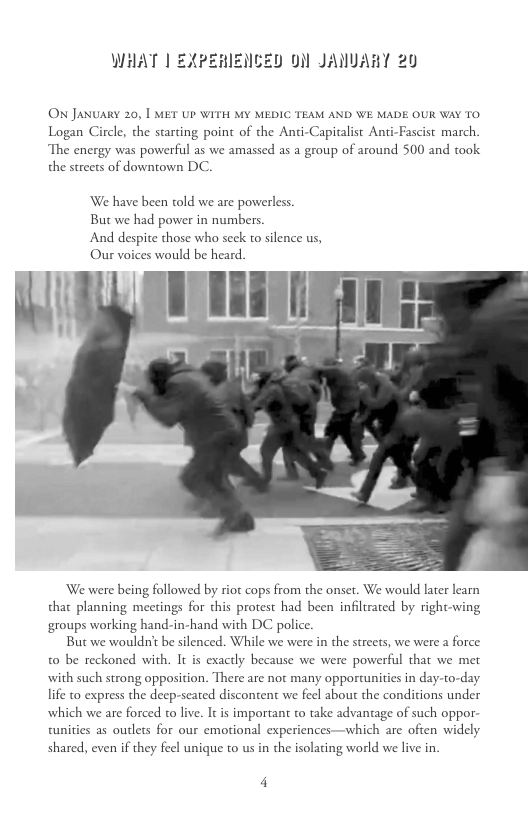
ON JANUARY 20, | MET UP WITH MY MEDIC TEAM AND WE MADE OUR WAY TO
Logan Circle, the starting point of the Anti-Capitalist Anti-Fascist march.
The energy was powerful as we amassed as a group of around 500 and took
the streets of downtown DC.
We have been told we are powerless.
But we had power in numbers
And despite those who seck to silence us,
Our voices would be heard.
We were being followed by riot cops from the onset. We would later learn
that planning meetings for this protest had been infltrated by right-wing
groups working hand-in-hand with DC polic.
But we wouldnt be silenced. While we were in the streets, we were a force
t0 be reckoned with. It is exactly because we were powerful that we met
with such strong opposition. There are not many opportunities in day-to-day.
life to express the deep-seated discontent we feel about the conditions under
which we are forced o live. It is important to take advantage of such oppor-
tunities as outlets for our emotional experiences—which are ofien widely
shared, even if they feel unique to us in the isolating world we live in
Taking the streets with our comrades reminds us that we are not alone.
That we are not crazy for feling this way. That we are not the ones who are sick,
it s the ystem that i broken beyond repair. Without these moments to provide
a release, 0 uplift and inspire us and remind us why we continue to get up
every morning and keep struggling to survive, we are left with not much more
than a bleak and depressing reality day after day after day.
We were constantly on the move; there wasn't much time to provide med-
ical care before the cops surrounded and contained us in the kettle. T do re-
member stopping to flush pepper spray from many eyes during the half hour
berween the time we stepped off the curb at Logan Circle and our eventual
‘caprure at the corner of 12th & L, but it was in the kettle that most of the
medicking happened. Over 200 of us spent upwards of cight hours trapped
on a street corer with no access to water, food, bathrooms, or anything el
beyond what we collectively had on our persons.
Being a street medic that day taught me how to show up for others. 1
learned how to manage my own emotional state in a way that enabled me to
hold space for and tend to the needs of those around me. While we were in
the kettle, the rior cops attacked onlookers who had been standing across the
strcet from us. They chased people down the street and deployed pepper spray
and sting-ball grenades that made loud explosions—we could hear them but
could not see the effects. With the sound of a loud “bang” a person standing
beside me shricked and began hyperventilating. They were having a panic
attack. T consciously held my own emotional response to what was going on
at a distance as 1 offered them support and care. It was empowering to find
myself feeling capable of staying present and helping spread calm despite the
scene that was unfolding around us.
As the cops began arresting people, I noticed that they were grabbing peo-
ple closest to the perimeter, zip-tying their hands behind their backs, and put-
ting them into police vans. I stayed toward the center of the group to avoid
being taken in so I could continue to care for people on the outside, knowing
that once I was cuffed and thrown in the police van there wouldn't be much
more I could do. At this point, we had no idea what was going to happen to
us or where they were going to take us once we were taken in.
Most of my time in the ketele was spent circulating through the group,
checking in with people about how they were doing, connecting with people
T already knew and making new friends, offering snacks and water, flushing
eyes, treating shrapnel wounds, and advocating for people who needed fur-
ther medical care. We even made soft blockades for people to go to the bath-
r00m and resorted to using bottles and plastic bags to contain our waste. We
kept morale up by singing well-known songs like Baby Iin an Anarchist and
5
Bohemian Rhapsody (though admictedly, yall, we could really use some new
songs) and using the human microphone to share communiques “from the
ungovernables at 12th and L
Fuck Trump
Fuck all politicians
With a country buile on white supremacy and patriarchy
No politician can serve anything elie
That goes for his police pawns, too
We may be arvested here today
But we will not be slenced
We call on communities theatened by Trump to defend them-
selves against fascists and racists
We won' back down and we will only grow stronger
Ifyoure hearing this, we call on you 10 become ungovernable
And build a new world in the ashes of the old.
Well, weve going to jail
But we aren': going silently
As wele seeing today, Trump indicates a new level of repression
But the tide of repression has been rising for some time
2 million in prison, a new Jim Crow
Surveillance on your email, surveillance on your phone, surveil-
lance in your home
All governments imprison and police
Cops love Trump, but to et rid of both, we have to ge rid of the
government
From the threat of white supremacists to the threat of police
Our safery lis in building bonds with each other, outsde o state
control
For fieedom, for anarchy!
The action continued around DC while we were in the kettle. We watched
as smoke rose above buildings in the distance and learned that a limo had
been set on fire a few blocks away. Checkpoints around the city were being
blockaded and shut down, the Festival of Resistance was in full swing, and
more and more people were assembling across the street from the kettle of-
fering solidarity and encouragement as we awaited our arrest. The fierce resis-
tance that continued elsewhere on the streets was a sweet reminder that while
some of us had been stopped, the collective “we” would not been defeated.
3
When I was finally taken in around 6 pm, the cops zip-
gether behind my back, removed my shoelaces, and took all of my belongings
ed my wrists to-
from me. Ispent four hours in a police van packed with seven others. We sang
songs and played games to pass the time. Every one of us was severely dehy-
drated at this point; after much pleading, we were finally given some water
o drink. The cops told us to tilt our heads as they poured small quantities of
water into our mouths using tiny paper cups as you might find at a dentist’s
office. They became visibly irritated when we asked for more than a few cups-
full. We were transported to a precinct where our fingerprints were taken and
we were finally allowed t use a toilet, our hands no longer bound.
They put us on a short bus to await yet another relocation to an overnight
holding cell. I continued to play the medic role, advocating for someone on
the bus who needed medication that the police were withholding. I reminded
everyone not to talk to the cops unless absolutely necessary and gave hand
and wrist massages t help ease the pain caused by zip-ties, some of which
were so tight that they caused long-term nerve damage. After we continued to.
demand water, they gave us a red sugary drink, definitely not water, and told
us we should be grateful for it. We spent what was left of the night cuddled
together for warmth and comfort on a cold hard floor under bright luores-
cent lights with only our pepper-spray-coated clothing to slecp on.
We spent most of the following day in an even smaller cllat the courthouse.
There was a sink in our cel; it was above toilet and the stream slowly dribbled
out. We would have had to put our mouths on the metal sink in order to drink
from it. We passed. A few hours before we were released, we were finall given
some food, if you could call it that. Bologna and pepper spray sandwiches,
washed down with absoluely nothing. Yum. I gave my rations to my cellmates
and ate two mustard packers before passing out from exhaustion.
When we were called to appear in front of the judge, they put real hand-
cuffs on us and attached them to ankle cuffs with a chain. We were referred
t0 25 “bodies” and assigned numbers which then became what we were called
by. The dehumanizing clement was hard to ignore. We stood in front of Judge
Leibovitz as she charged each of us with one count of felony rioting. We were
assigned counsel and released on our own recognisance: we didn't have to post
bail but were required to return for court
We were welcomed back into the world by a huge crowd of people cheer-
ing for us. A friend ran up to me exclaiming, “You have to sce this!” and
showed me the viral video of someone in black bloc punching white na-
tionalist Richard Spencer in the face. That was exactly what I needed in that
moment. There were food and drinks waiting for us and so many hugs. We
were given rides to the precinct where our property was being held. We spent
7
the next several hours trying to get our property back and documenting what
had been taken as evidence. Some medics who had not been arrested were
there to help; they assisted me in documenting all the items that the police
had stolen. We soon learned that anyone who was arrested with a phone that
day did not receive it back
T was eventually given 2 ride to my housing and spent the rest of the
night watching videos from that day and catching up on everything that had
happened in DC while I was detained. I drove down to North Carolina the
following day. Some friends, who were now also co-defendants, were holding
a debrief dinner and invited me to attend. T would spend the next several
months living there, in a house with three co-defendants and some very sup-
portive friends, working around the clock on the J20 case.
In April, a superseding indictment increased our charges to a total of eight
felony charges cach, including conspiracy to rior, engaging in and inciting a
ior, and five counts of property damage. Some people were given additional
charges such as assault on an officer and individualized counts of property
damage. And just like that, we were each looking at up to seventy-five years
in prison if convicted on all charges. This was a blatant attempt to criminalize
dissent using prosecutorial overreach. Obviously, 200 people did not break
the same five windows. The idea was to use an “aiding and abetring” theory
ofliability to prosecute everyone who was present in the streets that day fora
few instances of damaged property. They hoped to scare us into taking pleas,
intimidate us and others into inaction, and use us as an example of what
could happen if you stand up to those in pover.
ORGANZING J20 LEGAL SUPPORT AND SOLIDARITY
ORGANIZING A COLLECTIVE DEFENSE FOR J20 TOOK A LOT OF HARD WORK
from alot of dedicated people, defendants and supporters alike. For many of
us, it became a full-time job. It was no small undertaking to coordinate over
200 people across the country. A listsery and weekly conference calls were our
best means of keeping everyone in the loop: sharing updates and motions,
communicating about legal matters, making sure everyone had housing and
transportation to and from DC for court appearances, coordinating in-per-
son defendant meetings after hearings, asking questions, offering resources,
and checking in with people about whether their lawyers were being respon-
sive. Trwas up to each defendant whether to engage with the infrastructure we
established, and we did our best to reach out to those we hadn' heard from.
8
Early on in the organizing process, we established regional networks to help
defendants find each other and build support locally. There were regional ]20.
groups in most major cities along the East Coast including DC, Baltimore,
Richmond, Philadelphia, Pittsburgh, and New York City, and then there was
a group for North Carolina at large. Having had no home base prior t0 ]20,
T was fortunate to land in a place with many other defendants nearby. We got
together to participate in the spokes calls, traveled across the state to visit each
other, held in-person support group meerings, coordinated rides to and from
DC, shared dinners, threw benefit shows, made fundraiser T-shirts, tabled at
events, and even organized a black masquerade party (*Black Masker Aid”) to
raise money for our regional fund and spend quality time together. The North
Carolina ]20 defendants became family to me. They were my core support
system during that time. We continue to stay in touch to this day. 1 hold each
of them dear to my heart.
Spokes calls were hard. They were tedious. | don't think anyone liked them.
But they were important. Every Sunday at 7 pm, I would log into join.me
0 participate in hours-long conference calls with defendants and supporters
from cach region, discussing everything from legal strategy to finances to
the most recent media articles that had come out about the case. Since every
defendant couldnt possibly be on each call, we would compile the most im-
portant notes and give report-backs to our respective regions in an attempt to
keep everyone up to date. The creation of weekly news bulletins summarizing
notable developments in the case helped streamline our communication, and
the development of working groups helped to shorten the weekly spokes calls
by adding several more meetings to the schedule—for better or for worse. We
established several groups: the “PR” media team, the legal strategy working
group, the political campaign committee, finances and fundraising, a medic
working group, and wellness support
Once the court system announced the groups that would face trial to-
gether, there were calls to discuss trial strategy and logistics specific to each
group and calls to coordinate between trial groups. Not everyone was inclined
t0 participate in conference calls, so we created countless signal threads and
iseup pads to provide even more avenues for staying connected. Nobody was
obligated to participate, but those of us most inclined to engage with orga-
nizing efforts sometimes found ourselves on thee or more calls each weck in
addition to the calls all of us were making to our lawyers on a regular basis.
Like I said, J20 was my fil-time job.
Face-to-face meetings after each hearing in DC were crucial for connecting
with co-defendants who were more or less absent from the larger organizing
efforts and for depening our connections with those we had been working
9
with online. We held meetings at a co-working space near the courthouse to
decompress and discuss the case in person. For many defendants, this was the
only opportunity to discuss what was going on.
Some of our most memorable meetings took place around the hearings for
ial date selection in June. Nearly every defendant had appearances sched-
uled that week, and we took advantage of this to faciliate several huge col-
lecive defense mectings—followed by kickball games and support groups in
Malcolm X Park, outings to Nu Vegan, and adventures in Rock Creek Park.
Spending so much time in DC was emotionally draining, so we did whatever
we could to boost morale and help each other take much-needed space from
the tense environment of Superior Court
There were at least six medics arrested in the kettle on ]20. We came to-
gether to strategize about using the medic role as part of our legal defense in
months that followed our arrest. We formed a working group that included
medics from across the country wanting to help support us in the case. We
came up with agreements about how we would present our legal defenses in
solidarity with all of our co-defendants and in line with overarching street
medic principles. We represented an ongoing struggle for stree medics to
be recognized—and not targeted—for providing care where care is needed.
Motivated to use the strength of our medic defense to help in the larger col-
lecive defense, a few of of us decided to go to trial in November as part of
the first rial block.
THE J20 LEGAL DEFENSE STRATEGY
PRIOR TO TRIAL DATE SELECTIONS, THE GOVERNMENT HAD COME OUT WITH A
proposed set of groupings, placing cach defendant in one of four categories
based on alleged conduct and supposed affinity group affliations. The gov-
ernment was intent on taking those designated as Group 1 o tral firs, those.
in Group 2 next, and so on. The majority of defendants were lumped into
groups 3 and 4, scemingly without thyme or reason. Regardless of their mo-
tives for choosing these groupings and this order of operations, we were aware
tha the ones that the government was secking to prosecute first were some of
our most vulnerable comrades
In order to undermine their plan, we devised an carly trial straregy. This
strategy involved defendants in Groups 1 and 2 asking their lawyers to push
for ther trials to occur later than the government wanted, thereby enabling
individuals from Groups 3 and 4 who felt they had strong cases and good
10
lawyers t0 elect to go first. No one was pressured to make this choice. We
held numerous conference calls discussing this strategy and considering the
implications. This seemed like one of the best ways we could help protect
each other while also turning up the heat on the prosccuion. If the govern-
ment aimed o strengthen its case against everyone by taking certain people
o trial irst i hopes of scoring easy convictions, our strategy was intended to
disrupe their agenda
We were successful in securing the first part of the strategy: in the first
round of trial selection, Groups 1 and 2 were granted trials in March and
April 2018 despite the government’s wish to try them at the end of 2017.
Next came the hard part: figuring out who would take one for the team and
g0 to bat first. The seed had been planted, everyone knew about the carly trial
strategy; and all we could do was wait to see who would step up to the plate.
for collective defense.
Thave vivid memories of the day I chose my trial date. I was sitting in the
courtroom filled with dozens of co-defendants and their counsel, my lawyers
on cither side of me, contemplating what to do. We had several options of
ial blocks to choose from, including the very first trial set for November,
the second one in December, and several others that were almost a year away.
Judge Leibovitz was going around the room asking counsel to choose what
ial dates their clients wanted. I quierly raised the possibilicy with my lawyers
that I could be part of the first trial. My lawyers were apprehensive. They were
there to defend me, not to look out for my co-defendants; they would have
preferred to watch the first trial proceedings, allowing others to take that risk
so I didn't have to. But they were working for me, and it was ultimately up o
me to decide what I wanted to do.
My decision to be on the first trial felt instincrual. T was there as a medic. I
wasnit being accused of any particular acts beyond what everyone else was fac-
ing—and the court had randomly appointed a very solid legal team to represent
me. This was high-profile case and one of the biggest law firms in the coun-
try chose to take on a client pro-bono. It was by pure chance that I ended up
with them. Some defendants had been assigned run-of-the-mill CJA (Criminal
Justice Act) lawyers, who often represented dozens of other clients simultane-
‘ously; some of them were largely unresponsive o calls and emails. Here I was
with a full team of not just one but four lawyers and at least three paralegals
working around the clock on my case. It almos felt irresponsible not to go first.
Plus, some of my closest friends were in Groups 1 and 2. If there was any-
thing in my power I could do t help them, T was going to do i
There wasn' a doubr in my mind that I was making the right decision. T
knew that if I had made any other decision, I would have walked out of that
11
courtroom regretting it. My lawyers were not excited about this, but they
respected my wishes. We selected the November 20 trial date, which was later
moved to November 15, or NI5. Seven other defendants made the same
choice. After court, we all met to start discussing how to prepare for the trial
These seven people became my second ]20 family: Ultimately, only six of us
would go to trial due to last-minute legal complications down the road, but
for all intents and purposes, this core group stuck together from that mo-
ment on—through weekly conference calls, frequent court appearances and
defendantled meetings with all our lawyers, and living together during the
six weeks of trial, all the way through to the long-awaited day of our verdict.
THE THIAL
GOING TO TRIAL WAS ITS OWN CHAPTER IN THE ] 20 5AGA. TIME STOOD STILL
for six weeks as Oliver, Jen, Christina, Brit, Alexci, and I sac at a able in
our finest court fashion with our team of lawyers in Courtroom 203 in the
Superior Court of DC. To our lef sat two Federal Prosecutors: Assistant US
Actorney Jennifer Kerkhoff, one of the vilest human beings I have ever had the
displeasure of sharing space with, and the slightly more palatable yet equally
12
reprehensible Rizwan Qureshi. In the jury box sat sixteen people from across
the city who had been chosen to decide our fate via a several-day jury selec-
tion process at the onset of trial; and at the bench was Judge Lynn Leibovitz,
known by many as “the toughest judge in DC." Behind us, the gallery was full
0 the brim with co-defendants and supporters. They literally had our backs.
They assured us that we wouldn' be going through this process on our own.
Trial was an emotional rollercoaster. All of us had to put our lives on an
indefinite hold, tying up loose ends and making arrangements in case we were
sent to prison. We were uprooted from our homes, many of us still paying
rent on houses with no certainty whether or when we would return to them.
In DC, we lived in Airbnbs together with our closest support people. We had
10 idea how long trial would take. It wouldn't be clear unil the moment it
was all finally over.
Day afier long and grucling day was spent waking up carly, putting on the
nicest outfits we could assemble, grabbing something to eat, and taking the
metro, riding bikes, or walking down to the courthouse from our Airbnbs in
Columbia Heights. We would meet with our lawyers and hold litle confer-
ences in the hallway while waiting for the other cases to be called. Then we
would spend the rest of the day wearing our best poker faces as we sat in that
grim, windowless courtroom witnessing the proceedings of our trial unfold.
We sat there and watched as Kerkhoff and Qureshi presented their case,
stating from the beginning that none of us was being accused of actually.
breaking anything. They called numerous officers and witnesses to the stand
and showed video after triggering video of police body cams and arial sur-
veillance footage from that day. They put our hacked phone data contents on
the bi screen, pulled our belongings out of cardboard boxes wearing plastic
gloves and held them up as though they were contaminated, and presented
big foam display boards with screenshots of our alleged persons at various
points during the march—a series of pixclated black clad blobs that appeared
just to be walking. We worked closely with our lawyers, taking extensive
notes, brainstorming counter-arguments, and digging up dirt on the bom-
bastic lead detective, Gregg Pemberton.
Judge Leibovitz made it clear whose side she was on. After the jury had
been dismissed one day, she made a ruling on probable cause in which she
adamantly described us as a “swarm of bees, insects, or some kind of animal
that coalesced and moved together as though pulled by a gravitational force.™
She also compared the case to examples of “wilding™ in which a few people
beat someone up and all present parties are held responsible for it regardless
of who threw the punches. This follows the distorted belief that violence
against a person can be equated with property damage. She ruled that there
13
was individualized probable cause to arrest cach of us based on the movement
of the “group” across sixteen blocks i thirty-three minutes, and the behavior
of the “group” during that time. Although none of us were alleged t have
personally caused any of the damage, nor was there evidence of our pre-ex-
isting knowledge that it would happen, she ruled that we were complicit
in enabling the “rioc” by not immediately leaving the protest as soon as the
first windows were broken. For the six of us and many others, we were being
charged on account of our presence alone.
AU T can say i, if was a good thing this was a jury trial.
Our only opportunity to sce daylight in those winter months was an hour-
long lunch break that we sometimes spent decompressing and socializing
with comrades on the lawn across the street, but more often in the courthouse.
cafereria discussing the morning’s proceedings with our lawyers
After a full day in court, I would head directly to my lawyers office in
Chinatown, where we would spend countless hours looking through discov-
ery footage, documenting notable scenes in highly-organized spreadsheets,
talking strategy; rescarching the government's witnesses, and planning lines of
questioning for cross-examinations the following day. Sometimes we would
be there uniil cleven o'clock at night, doing everything we could possibly
think of and then some to aid in our defense. I always looked forward to the
shot of whiskey my lawyer would share with me to take the edge off afier a
long day's work.
My lawyers had me practice being questioned by them and cross-exam-
ined by a strong prosecutor in their law firm to prepare me for the possibilicy
of testifying. This was a very helpful opportunity to understand just how.
nerve-wracking and difficult testifying can be. From this practice session, [
concluded that unless it seemed absolutely necessary; tesifying would not be
in my best interest. They also prepared one of my best friends to testify as a
character witness on my behalf. When the prosecution rested its case, we felt
strongly that the government hadn't met its burden of proof and decided not
t0 have anyone testify in my defense. Putting anyone on the stand gives the
prosecution an extra opportunity to ask presumptuous and leading questions
in their cross-examination that could be detrimental to the overall case no
matter how you answer. It is a strategic decision that really depends on the
individual case at hand. It is a decision that should not be taken lightly:
While some of my trial co-defendants chose to bring in character witness-
es to testify, none of us on trial ook the stand. This was a collective decision
that involved many conversations about the implications and risks that tes-
tifying posed for the group; it was also a personal decision on each of our
parts to hear and respect the concerns of our co-defendants. T am proud to
14
say that in the face of so much stress during that time, we cach did our best
to communicate compassionately with one another, to consider each others'
concerns, and to make choices that reflected a commitment to cach other
above everything clse.
THE VERDICT
ONCE THE CLOSING ARGUMENTS CONCLUDED AND THE JUDGE GAVE THE JURY
instructions, the jurors spent several days in deliberation. Although we did
not have to be present in the courtroom during this time, we were required
t0 be within fificen minutes of the courthouse so we could get there quickly
once a verdict was reached.
All we could do was wait. We went for walks, checked out the nearby
museums, read books, and took naps in the family court lounge. We had no
idea how long it could be before we heard something, It was mid-December
and we just about lost hope that we would receive a verdict before the court
went on break for the holidays, which would mean returning in January o
continue deliberations.
And then, exactly eleven months afier our initial release from jail, on the
Winter Solstice, December 21, 2017, when the earth reached its furthest
point from the sun and began to move closer again, we received norice that
the jury had come to a unanimous decision for every charge against cach of
the defendants on trial. We rushed to the courtroom and waited in anticipa-
tion as the jurors filed in one by one.
Al six of us were facing seven charges—six felonies and one misdemeanor
each. The inciting charge had been deemed multiplicitous and thrown out by
the judge during the Motion for Judgment of Acquittal prior to deliberations.
The transcript reads:
HE COUAT: God morning, ladics and gentlemen — or good aféernoon, I gues
I received a note from you at 11:20. It signed by Juror No. 11. And it says,
“We have reached a verdict on all counts.™
Ul ask you, Juror 11, 1o please stan.
Si, are you the foreperson?
THE JURY FOREPERSON: Yes.
HE CORT: Has the jury reached a wnanimous verdict on each and every count as
15
10 ach and every Defendant?
THE JURY FOREPERSON: Yes.
T was up first.
HE GO On Count 1, how do you find [Micl] on the charge of engaging in @
riot?
THE JURY FoRereRsoN: Nor guilty.
THE COURT. On Count 2, on the charge of conspiracy to engage in a riot?
THE JURY FoRereRsoN: Nor guilty.
THE COURT- On Count 3, destruction of property?
THE JURY FoRereRsoN: Nor guilty.
THE CORT- On Count 4, destruction of property?
THE JURY FoRereRsoN: Nor guilty.
THE CORT- On Count 5, destruction of property?
THE JURY FoRereRsoN: Nor guilty.
THE COURT- On Count 6, destruction of property?
THE JURY FoRereRsoN: Nor guilty.
HE CORT- And Count 7, destruction of property?
THE JURY FoRereRsoN: Nor guilty.
Tears came to my eyes. I could barcly contain myself a I waited to hear the
verdicts for my co-defendants. I lstened intently as one by one, Jen, Christina,
Alexei, Oliver, and Brit were all found not guilty on cach and every one of their
charges too. The jury returned not guily verdicts on all 42 counts. We had
successfully secured six complete and resounding acquittals. What a victory!
16
The energy of the courtroom lifted us up and carried us all the way out of
the building, Everyone hugged and congratulated us. Reporters swarmed us
for statements and phorographs; our phones were ringing off the hook. We
had won! The battle of ]20 was far from over, but this triumph was something
0 celebrate. And celebrate we did.
For a detailed account of our trial proceedings, check out the #Drop]20
Podcast Update on itsgoingdown.org. They produced seven episodes alto-
gether, four during this trial and three more over the following six months.
You can also listen to an interview I did after my trial ended on the Ex-
Worker podeast, #62: Suppor, Healing, and Redefining Resistance—2017
in Review, Part Il (cimestamp 1:10:16)
One month after our trial recurned full acquittals, 129 cases were dis-
missed without explanation, leaving 59 defendants still facing charges. A few
of those cases went to tral in the spring of 2018, resulting in acquittals and
two mistrials. There was not single jury conviction during the entire J20
prosecution. On July 6, 2018, every remaining case was finally dismissed
Ttwas all over. We had won
Our efforts for collective defense and the carly trial strategy were a success.
234 people arrested, 217 indicted on a minimum of 8 felonies cach, and
7
ZERO convictions at trial. Only 21 plea deals were taken, and only one of
those was for a felony. While there were other aspects of the case that con-
tributed to the inevitable downfall of the prosecution, i fecls safe to say that
the carly trial strategy played a big role in destabilizing the government's case
and acted as catalyst for that sequence of events to unfold. This victory illus-
trates the power of collective defense and the potential that we have together.
Tt wasn't casy: It took a lot of hard work from a lot of people to make this all
possible. In the end, it was all worth it
IF 19U AHE FACIIG AN ORDEAL LIHE THE J20 CASE
FIRST, CHECK OUT THE ARTICLE THAT CAME OUT SOON AFTER OUR ARREST,
“Making the Best of Mass Arrests: 12 Lessons from the Kerele During the ]20
Protests”. T would especially highlight #5, “Don' bring your real phone™—
even if you bring a burner phone, wipe the data and destroy the sim card rath-
ex than handing it over to the cops)— #6, “Seize the chance to pass on skill”;
and #7, “Care for each other.” I cannot emphasize that last point enough.
Also, as a general rule of thumb, don't make things easy for the cops, don't
talk to them or believe anything they say. Ever.
Here are some other suggestions.
TAHE MEDIA INTO YOUR OWN HANDS.
The narratives presented in the media do a lot to shape public opinion; they
‘can make a big difference in influencing the outcome of a case. Working with
sympathetic journalists can be a great way to avoid some of the risks of speak-
ing in the media while facing charges. Especially when you are dealing with
a policical case, you have to consider the risk of being doxxed or harmed by
those on the other side of the political spectrum as well as the legal risk that
something you say could be used against you in court. Working with journal-
ists who are willing to speak off the record or conduct interview anonymously
or with pseudonyms can be a great way to keep yourself safe while gerting the
information out there in the ways that you want it to be understood.
18
FRIENDS MAHE THE BEST MEDICINE
T met some of my best friends through the ]20 ordeal; they gave me the
strengeh to keep fighting and inspired me to give it my all. Not only was I
fighting for mysclf, I was fighting for all the comrades who were in this batdle
with me; and together with our communities, we were fighting for the future
of dissent and resistance in the United States. Working in solidarity with
comrades toward a common goal can evoke a sense of belonging, a sense of
purpose; it makes the whole experience feel much more meaningful.
SELF-ISOLATING IS NOT THE BEST WAY TO DEAL WITH AN EXPERIENCE
LIKE THIS
How traumatic an experience is has a lot to do with the support we reccive
during it and in the aftermath. One thing that really helped me get through
this was the relacionships I built with the people who were in it with me and
those doing support who had been through something similar themselves.
Times were heavy for all of us, and knowing there were other people going
through it assured me I was never alone. Holding space with these people
0 talk about how it has affected our lives and process our feelings about it
enabled me to feel seen and validated my experience of being in 2 low-level
crisis for months on end.
So many people have o face the legal injustice system on their own. My
heart truly goes out to them. I was fortunate to have co-defendants to share
the experience with and seasoned comrades to provide insight into the legal
system, suggest how to engage with the process, and offer tools for confront-
ing the many challenges of being a defendant. For example, I recommend A
Tilted Guide to Being a Defendant by the Tilted Scales Collective.
Working together can also do a lot o dissipate the anxiety and paranoia
that someone might snitch or cooperate with the state. It was reported by the
court that there were no snitches and no cooperation with the government
on the ]20 case.
IN AN EXPERIENCE LIHE THIS, THE PUNISHMENT IS IN THE PROCESS
The period of time between being arrested and the end of trial involves con-
stant stress. During this time, it is especially important to prioritize self-care.
19
and reach out for help. Regulating the nervous system is key to staying well
Take baths, go for walks,ride bike, drink tea and read a book in a warm cozy
place that fecls safe. Remember to breathe. Get out in nature! Find a therapist
ora support group or both. Start your own support group. Eat your favorite
foods. Move your body! Hike up a mountain. Call an old friend. Let people
know what you're going through. Ask for support. Do something fun to re.
ward yourself for dealing with all the bullshit. Do yoga. Find any activity that
puts you more in your body than in your head and allows you to discharge
some of the activation energy that builds up from continual stress. Without
aelease, this energy can become stored in the body, causing discomfort, ten
sion, and even chronic pain.
COMIC RELIEF IS A GREAT WAY TO DISCHARGE BUILT-UP STRESS
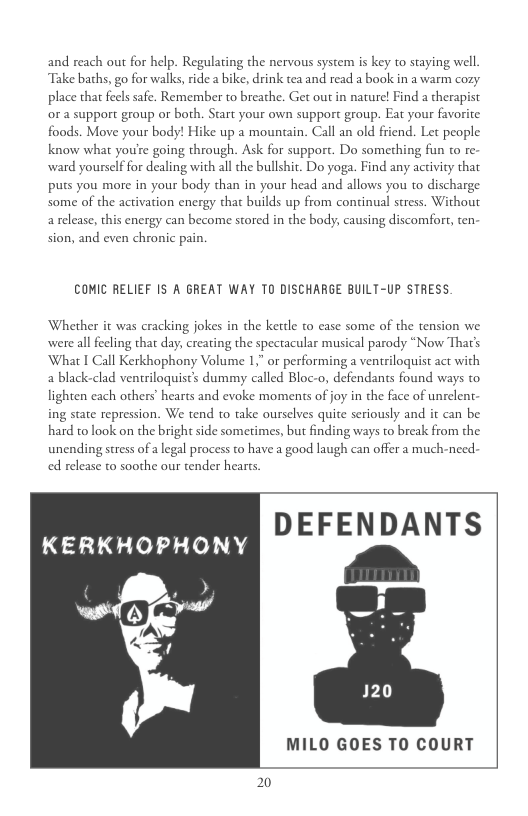
Whether it was cracking jokes in the kettle to case some of the ension we
were all fecling that day, creating the spectacular musical parody “Now Thar's
‘What I Call Kerkhophony Volume 1" or performing a ventriloquist act with
a black-clad ventriloquist’s dummy called Bloc-o, defendants found ways to
lighten each others' hearts and evoke moments of joy in the face of unrelent.
ing state repression. We tend to take ourselves quite seriously and it can be
hard to look on the bright side sometimes, but finding ways to break from the
unendingstress of a legal process to have a good laugh can offer a much-need:
ed release to soothe our tender hearts
DEFENDANTS
KERKHOPHONY
MILO GOES TO COURT
20
REMEMBER TO TAHE CARE IN THE AFTERMATH, T00
The stress and grief experienced in the afermath of 2 traumatic event or
period of time can leave a person feeling out of control and having a fore-
shortened sense of future. The state was attempting to tzke away our ability.
to choose how the rest of our lives would unfold. They were threatening
t0 take away our entire lives, to murder us slowly. At twenty-seven, facing
seventy-five years in a cage meant | might not sce life on the other side. And.
though there i lfe behind bars, and there does exist a chance of making it to
sixty or seventy years old and getting out whole and having joyous, beautiful
years on the outside, this was not their intention. They were trying to sifle
and kill us. We had to come to terms with this anticipatory grief while fight-
ing like hell to keep it from happening. Our lives depended on it
Tn a lot of ways, the year after my trial was more difficult for me than the
year I spent facing life in prison. When trial ended, T didn't know what to
do with myself. I had spent so much time solely focused on my defense and
preparing for an endpoint to life as I knev it. Regardless of how implausible
the charges scemed, that very real threat had been hanging over my head,
preventing me from making any long-term plans or imagining what the rest
of my life might look like if I didn' spend it behind bars.
Once I had my life back in my own hands, I found myself scrambling for
something to do to il the empty space that had been occupied for so long with
organizing |20 defense. I went through intense periods of depression and ansiety:
Twanted 1o do nothing and everything all at once. I experienced oversleeping and
Sleeplessness, and I wavered from being highly sensitive to dissociated and numb.
as the feclings and emortions of the past year finally had space to surface.
2018 arrived with a strange sense of loss, a lack of direction, a lot of con-
templation, and a great deal of confusion. I was not facing decades in prison
anymore, but I was facing the reality that life was rough before 20 and it
would continue to be rough after ]20.
T had spent the four years prior to my arrest traveling, untethered to
any one physical location, unattached to where my journey would lead me,
searching for a way to find meaning in this life I rejected societal norms that
encourage us to stay in one place, work a full-time job, get married, start a
family, grow old and eventually die. I longed for something more meaningful
than this generic cookie-cutter existence that accepts and upholds the condi-
tions of a capitalist society: sought to find a better place for myselfin a world
designed to isolate and alienate every single one of us
Yet 1 lacked a sense of what “home” meant or what it might look like
for me. 1 had both found and lost “community” numerous times, and had
21
experienced trauma and grief in a variety of forms. At the end of the day; 1
didn't feellike T belonged anywhere. T hadnt lived in any single place for more.
than six months; 1 fet inhibited in my attempts at fostering meaningful con-
nections in anarchist communities due to the fact that I was seen as a tran-
sient newcomer, and people tend to be skeptical of folks who come around.
scemingly out of nowhere. There were people I cared decply for, scattered in
various cities across the country and around the world—and while oppor-
tunities to connect with them motivated me to keep traveling, I continually
struggled to carve out space t setele and establish myself as a part of a radical
‘community. This was one of the primary reasons that I felt compelled to go o
DCin the frst place. I knew where my heart was, I was certain of my politics
and the struggles I wished to engage with, but I didn't have an apparent way
o translate my yearnings inco action. ]20 was a way in.
Tt was also a way out. I had been worn down, repeatedly fighting an uphill
battle for belonging with opposition coming from the very side I wished to
fighting be on. 1 continually felt like an outcast with nowhere to go. I was
tired of leaving one place just to land somewhere else and have the same story
repeat itself over and over again; but I also found no good reason compelling
me to stay anywhere. It was time to break this cycle.
T had no idea what t expect with my decision to go to DC, but at least
1 knew it would be something different. It took me out of the normaley
of struggling for a meager day-to-day existence and into an environment of
direct confrontation and resistance. It was a chance to feel alive. It was an op-
portunity to engage with people from across the country and from all walks
of life who shared my discontent and my yearnings for something more,
something better. Even if this experience didn't help me achieve my larger
goal of finding a place to call home, it would at least provide me with a mo-
mentary glimpse of what it feelslike to truly exist in solidarity with comrades
and allow me o recharge my drained and depleted life-force energy.
That solidarity provided me with a temporary home. I kindled a fire blaz-
ing with passion, a flaming limousine that warmed my heart and nourished
the deepest part of my being. The fire burned fiercely as its flame provided
light through the darkness, growing in size and intensity as one day of ac-
tion became a year-and-a-half.long battle against state repression. We came
together around that fire for a shared purpose: to hold cach other up, to
work together and fight against a common enemy, to foster relationships of
support despite the government's best efforts at tearing us apart. We kept that
fire burning; we fed it with our commitment to one another and watched it
grow within us and beyond as solidarity actions amplified the collective heat
around the world.
2
The thing about fir is that while it can be a source of power and strengrh,
it also has the potential to burn us and everything else inits path. If we aren't
carcful, it can destroy us, incinerating our spirit and consuming everything
we have worked toward all the way down o the very foundations we stand.
upon. Internal conflicts, unequal power dynamics, the hoarding of informa-
tion or access to resources, and ego-driven attempts at gaining social capital
are among the factors that contributed to the gradual extinguishment of all
that we had created and the quenching of any potential for continuing to
carty the torch into the next field of bartle
The flame has been smothered as this particular fight has come to an end,
and with it, the dissipation of solidarity and support that up uncil this point
had prevailed. It seems we have learned how to make fires—whether the fire
of revolt or of immediate solidarity—but we haven' yet made hearths, homes
for the fires and for ourselves, where the heat can linger a while longer, offer-
ing us solace and space to heal; nor do we have circles of hearths, the basic
shape of so many human communities.
The immediate plumme of support in the aftermath was one of the hardest
aspect of this whole experience. The community I had come to feel supported
by dissipated as the time came to pick myself up and reconstruct a life for my-
selffrom the pile of ashes that remained. I knew that many of the people engag-
ing with 20 organizing and support were doing so because we were directly in
the line of fire, facing the barrel of the gun head-on; but part of e also believed
we had cultivated something decper than that. Once everything was over, the
fallout hit hard and I found myself, yet again, fecling alone and like I didn' be-
long anywhere. I spent more time in 2018 just rying to stabilize myself enough
0 get out of bed each day than actually recovering from the year prior.
Tam sill coming to terms with the loss of this collecrive cohesion that in
many ways defined my identity for a period of time. The complexities of gricf
reflect disintegration on a community level, the erosion of a number of per-
sonal relationships formed through the experience, and the disappearance of
some of my primary support from that time. This all added another dimen-
sion to the rauma I was recovering from and made it nearly impossible to
have the capacity to take on even the most familiar stressors of day-to-day life,
let alone develop healthy relationships or engage in any type of organizing or
activism. The world quickly became a cold and lonely place as I came to fecl
more and more invisible in the absence of a conspicuous crisis to avert, and
without a home community o sustain me.
“We grow powerful, we interrupt normalicy, we rise up, even
sparking insurvections, and in most cases we also survive the
23
24
histories? How can we find ways to establish ongoing long-term support for
ourselves and each other while we continue to come face-to-face with a nev-
er-ending influx of crises? How can we build our capacity and our resilience
knowing there will never be an end to the struggle? What can we learn from
this and how can we do things differently in the furure to mitigate the fallout
from circumstances such as these? How can we keep that fire burning from
one bartle to the next, allowing it to continue to nourish us, so we might
cultivate the strength to stick together and build upon our greatest potential?
T hope to always carry with me the memory of warmth provided by the
ephemeral lame of resistance sparked on that unforgettable day and the year
that followed, so I might be fortunate enough to feel it again someday.
Let's remember to be gentle with oursclves and with one another as we ac-
knowledge that lfe under capitalism is an ongoing and inescapably traumatic
experience; that we are all doing the best we can; that we all have a basic need
for care and compassion on an ongoing basis; and that we really do need cach
other.
WE CAN'T PREVENT TRAUMATIC EXPERIENCES FROM HAPPENING TO US, BUT
WE CAN BUILD OUR CAPACITY TO KEEP GOING.
The conditions in which we are forced to exist are hostile to our survivl,
adverse to our natural inclinations, and detrimental to our overall individual
and collective well-being, This is exactly why must we seck to disrupt and
abolish the foundations and infrastructures that perpetuate these condicions
and work to create a new world in the shell of the old.
Itis my wholchearted desire that we will find more ways to provide each
other with long-term care and wellness support in the face of state repression
and in the aftermath, when we attempt to put the pieces of our lives back to-
gether so we can get up to fight another day. Supporting and sustaining long-
term movements of resistance takes an understanding of the diverse ways
we are affected by the situations we find ourselves in and finding tools and
approaches to care that help us maintain resilience in the face of perpetual
lass war and ongoing opposition.
The totality of this experience motivated me to continue deepening
my exploration of healing practices and expanding my knowledge of
medicine. It inspired me to dedicate myself to studying the psychological
impacts of trauma, stress, and gricf on the nervous system and overall
well-being that are so deeply tied to our identities and our experiences of
privilege and oppression in this world. It is my goal to acquire the skills
23
necessary to offer accessible health care to those who need it most while
continuing to focus on building long-term resiliency in the communities
Tinhabit.
On behalf of all the N15 trial defendants, I want to give a huge shout out
t0 everyone who was there for us during trial. Our hearts are illed with love
and appreciation for all our co-defendants and supporters, our friends, fam-
ilies, partners, housemates, and comrades who traveled to DC, who showed
up day in and day out to sit in that courtroom in dashing court attire, who
showed us unwavering support during those six long and challenging weeks
of trial. Thank you for being there for us and for reminding us that we were
not alone. We couldn't have done it without all of you. Thanks to everyone
who took or transcribed court notes, brought us snacks and gave us hugs
during breaks, took us out for drinks, bought us massages, and made sure we
had fun whenever possible. Thank you to the Brighter Days Collective for
walking my dog for me every day while I was in court; to everyone who sent
us letters of encouragement and care packages filled with sweet gifis, herbs,
tinctures, zines, and more; to those who were willing to testify on our behalf
as character witnesses; and to those who hosted us on breaks and helped us
carve out time away from DC to take care of ourselves. A very special thanks
t0 the amazing humans of the Pors and Pans Kitchen Collective for providing
us with three meals per day; every day, giving us one less thing to worry about;
and for bringing lunches to the courthouse and making it casier for support-
ers to continue to show up for us by feeding them as well. Thanks, too, o
anyone who helped Pots and Pans by participating in meal trains, and to any-
one else we may have forgotten. We also want to extend the utmost gratitude
t0 our incredibly dedicated and hard-working team of lawyers; without them
none of us would be here to tell the story of our success. We deeply appreciate
each and every one of you!
In closing, | want to share a poem I wrote on the one-year anniversary of
J20. This poem was written to all of my co-defendants and specifically to the
59 defendants who were stil facing charges after the majority of the cases
were dismissed. At the two-year anniversary, I am so relieved to say we no
longer have anyone facing charges from that day, none of us are in prison, and
T still feel as decp a connection to these comrades as 1 did when I originally
wrote this.
2
DIE TEAR AU TODAY
A LOVE POEM TO MY CO-DEFENDANTS
one year ago today,
all of s were in washingron dc.
we took to the streets to disrupt the inauguration of donald trump.
we stood together in solidarity with each other and every
person who is oppressed,
every person who is faced with living in a world where profic
and hate dominate.
we came together,
from every comer of these so-called united states
t0 oppose this neo-fascist regime,
t0 oppose this president,
and all presidents,
t0 oppose all forms of hierarchy and manipulations of power.
t0 show our strength,
o stand up,
alongside one another, fogerher:
t0 show our resistance,
our commitment to the struggle for our lives,
for all life.
o fight for a world worth living in
one year ago today,
many of us met each other for the first time.
we didn't know each others names,
yet we knew we were on the same team.
black clad warriors
standing together
engaged in a class war,
in a social war,
we swarmed the city with our hears as our compass
we made our messages known.
we embraced a diversity of tactics
guided by the same principles
of unity,
27
of solidarity;
of resistance.
one year ago today,
we set the city ablaze.
we disrupted the inauguration,
we disrupted the flow of capital,
we disrupted the illusion of normalcy.
we fought back against corruption, greed, and violence.
we fought back against the coercive power structures
that attempt to dictate how we live our lives
we showed the world that we were a threat to the status quo.
we showed the world that we would not back down.
d.
we showed the world that we are ungovernable.
we showed the world that we are not afr
one year ago today,
we were met with force.
the powers that be attempted to stifle our dissent.
they attempred to shut us down,
o silence us.
because they knew we were a threat.
they knew we had the potential to make change.
so they attacked us with their weapons,
they brutalized us,
they surrounded us, and
they trapped us.
they arrested us,
and they threw us in cages,
because they didn' know what else to do with us.
they may have stopped us, slowed us down,
but they did not break us.
they did not defeat us
one year ago today,
and in the days and months that followed,
we were all charged with felonies.
felonies that threatened us
with more time behind bars
than any of us has spent living.
28
felonies that put our lives on hold,
that were held over our heads,
and altered our ability to have control
over how we spend our time.
we spent the next 365 days
enduring the punishment,
the punishment in the process
of the criminal injustice system.
we also spent those 365 days
investing our time and our energy
in each other.
we committed ourselves to the ongoing bartle
for freedom,
for everyone,
we committed ourselves to supporting one another,
t0 sharing information and resources,
0 building our networks,
t0 expanding our communities,
o strengthening our convictions,
0 continuing to struggle
against the state,
against state repression,
against all forms of oppression;
against the silencing of our voices,
against the weakening of our movement.
we committed ourselves
to continuing to struggle
against that which sceks to destroy all that is worth living for.
one year ago today,
and in the days and months that followed,
we created somerhing beautiful
we formed a collective of strong, resilient people
dedicated to resistance,
dedicated to fighting these charges tooth and nail.
dedicated to each other.
2
one year ago today,
i found some of the bravest people i know:
one year ago today,
i found strength amongst people whom i truly admire.
one year ago today,
i found over 200 of my new best friends.
my greatest comrades.
one year ago today,
we found each other.
and one year later,
we have not lost one another.
while many of us are no longer facing charges,
many of us seill are.
and as we go into the next year of this battle
we remain standing, side-by-side.
we are all in this together.
and we are not going anywhere
wntil all of us are fiee.
0 the remaining ]20 defendants,
i want you all to know—
you are not in this alone.
you will not be forgotten. you are seen.
and you are loved.
and you are important.
and we will get through chis,
together,
o matter what happens nest.
with endles ove and rage,
Xx
30
This is part of a series looking back on the events of J20 and the legal struggle
that followed it. Check out the rest of the series:
* Anarchist Resistance to the Trump Inauguration
* We've Got Your Back: The Story of the ]20 Defense
* Between the Sun and the Sea: lcarus at 12¢h and L—A Voice from the
J20 Black Bloc and Ketrle on the Practice of Anarchy
* 120 Protest Simulator—Choose Your Own Adventure in the Strects
and Courts of Washington, DC
For additional perspective on how to survive the turbulent aftermath of social
movements, consult our four-part series from 2013, “After the Crest.”
Crimethinc.