History of the Animal Liberation Front
Web PDF • Imposed PDF• Raw TXT (OCR)



![restocking process but increases costs, possibly o the point of making animal research prohibitively expensive An ALF activist involved in an arson atiack on the University of Arizona told No Compromise in 1996: “[1]t is much the same thing as the abolitionists who fought against slavery going in and burning down the quarters or tearing down the auction block ... Sometimes when you just take animals and do nothing else, perhaps that is not as strong a message.” “The provision against violence in the ALF code has triggered divisions within the movement and allegations of hypocrisy from the ALF’s critics. In 1998, terrorism expert Paul Wilkinson called the ALF and its splinter groups "the most Serious domestic terrorist threat within the United Kingdom.” In 1993, ALF was listed as an organization that has “claimed to have perpetrated acts of extremism in the United States" in the Report to Congress on the Extent and Effects of Domestic and International Terrorism on Animal Enterprises. It was named as a terrorist threat by the U.S. Department of Homeland Security in January 2005. In March 2005, a speech from the Counterterrorism Division of the FBI stated that: *The eco-terrorist movement has given rise and notoriety to groups such as the Animal Liberation Front, or ALF, and the Earth Liberation Front (ELF) ‘These groups exist to commit serious acts of vandalism, and to harass and intimidate owners and employees of the business sector.” In hearings held on 18 May 2005, before a Senate panel, officials of the FBI and the Bureau of Alcohol, Tobacco, Firearms, and Explosives (ATF) stated that “violent animal rights extremists and eco-terrorists now pose one of the most serious terrorism threats to the nation." The use of the terrorist label has been criticized, however; the Southern Poverty Law Center, which tracks U.S. domestic extremism, writes that *for all the property damage they have wreaked, eco-radicals have killed no one." Philosopher and animal rights activist Steven Best writes that “given the enormity and magnitude of animal suffering ... one should notice that the ALF has demonstrated remarkable restraint in their war of liberation.” Best and trauma surgeon Jerry Vlasak, both of whom have volunteered for the North American press office, were banned from entering the UK in 2004 and 2005 after making statements that appeared to support violence against people. Vlasak told an animal rights conferences in 2003: *1 don’t think you’d have to kill —assassinate—loo many vivisectors before you would see a marked decrease in the amount of vivisection going on. And I think for five lives, 10 lives, 15 human lives, we could save a million, two million, 10 million non- human animals." Best coined the term “extensional self-defence" to describe actions carried out in defense of animals by human beings acting as proxies. He argues that activists have the moral right to engage in acts of sabotage or even violence because animals are unable to fight back themselves. Best argues that the principle of extensional self-defense mirrors the penal code statues known as the necessity defense, which can be invoked when a defendant believes the illegal act was necessary 1o avoid imminent and great harm. Best argues that “extensional self defense is not just a theory, but put into practice in some 6](history-of-the-animal-liberation-front-warzone-distro 7.png)







/. Liberation
Front
‘The Animal Liberation Front (ALF) is reference to individuals or leaderless
groups who carry out various attacks against speciesism and human supremacy,
including but not limted 1o property destruction and liberating animals from
captivity. The Animal Liberation Front made its first public appearance in
Britain in the 19705, having evolved from a similar animal liberation group
called the Bands of Mercy. The Bands of Mercy were formal, locally led
organizations in the 19th and 20th centuries that brought people—especially
children and_ adolescents—together 1o leam about kindness to non-human
animals, in hopes of preventing cruelty toward non-human animals in their area.
Actions carried out by the Animal Liberation Front include liberating animals
from laboratories and farms, damaging facilities, providing veterinary care, and
establishing sanctuaries for the rescued animals.
Active in over 40 countries, the ALF operates through clandestine cells, often
consisting of small groups or individuals. This decentralized and covert
structure makes it challenging for authorities to monitor or infiltrate the
organization. According to Robin Webb of the Animal Liberation Press Office,
this structure is a key reason for the ALF's resistance, stating "That is why the
ALF cannot be smashed; it cannot be effectively infiliated, it cannot be
stopped. You, each and every one of you: you are the ALE."
Participants of the ALF describe what they do as non-violent. According to the
ALF's guidelines, actions that promote animal liberation and take all reasonable
precautions to avoid harm to both human and nonhuman life can be attributed to
the ALF, including acts of vandalism that may cause economic damage.
“There has nevertheless been widespread criticism for its alleged involvement in
acts of violence and for the failure of some spokespersons and activists to
condemn such actions. This criticism has led to dissent within the broader
animal rights movement regarding the use of violence and has atiracted
increased attention from law enforcement and intelligence agencies. In 2002, the
Southern Poverty Law Center (SPLC), an organization that monitors extremism
in the United States, highlighted ALF's involvement in the Stop Huntingdon
Animal Cruelty campaign, which the SPLC identified as employing terrorist
tactics, although the SPLC later noted that the ALF had not caused any fatalities.
In 2005, the ALF was listed in a United States Department of Homeland
Security planning document as a domestic terrorist threat, prompting the
allocation of resources to monitor the group. That same year, FBI deputy
assistant director John Lewis described “ecoterrorism" and the "animal rights
movement” as the number one domestic terorism threat. In the United
Kingdom, ALF activities are classified as examples of domestic extremism and
were monitored by the National Extremism Tactical Coordination Unit, which
1
was established in 2004 to oversee illegal animal rights activiy.
Origins
Band of Mercy
‘The origins of the ALF can be traced back to December 1963 when British
journalist John Prestige attended a Devon and Somerset Staghounds event.
During the event, Prestige witnessed the hunting and killing of pregnant deer,
an experience that prompted him to form the Hunt Saboteurs Association (HSA)
in protest. The HSA initially consisted of volunteers who were trained to disrupt
hunts by blowing homs and laying false scents to mislead the hounds. This early
activism laid the groundwork for the development of more radical animal rights
movements, eventually leading to the formation of the ALF.
According to animal rights writer Noel Molland, one of the groups within the
HSA was established in 1971 by Ronnie Lee, a law student from Luton. In 1972,
Lee, along with fellow activist Cliff Goodman, concluded that more militant
tactics were necessary to further their cause. They decided to revive the name of
a 19th-century RSPCA youth group, The Bands of Mercy, and formed a small
group of about half a dozen activists known as the Band of Mercy. This group
began targeting hunters' vehicles by slashing tires and breaking windows,
aiming to prevent hunts from starting rather than disrupting them once
undervay.
In 1973, the Band of Mercy became aware that Hoechst Pharmaceuticals was
constructing a research laboratory in Milton Keynes. On 10 November 1973,
two members of the group set fire to the building, resulting in £26,000 worth of
damage. The activists returned six days later 1o ignite the remains of the
structure. This incident marked the first known act of arson within the animal
liberation movement. In June 1974, two members of the Band set fire to boats
involved in the annual seal cull off the coast of Norfolk; according to Molland,
this incident contributed to the cessation of the cull. Between June and August
1974, the Band carried out eight raids targeting animal-testing laboratories, as
‘well as other actions against chicken breeders and gun shops, causing damage to
buildings and vehicles. The group's first recorded act of "animal liberation”
occurred during this period when activists removed half a dozen guinea pigs
from a guinea pig farm in Wiltshire, leading the owner to close the business out
of concem for further incidens.
“The use of property damage as a tactic created a rift within the emerging animal
rights movement. In July 1974, the Hunt Saboteurs Association publicly
distanced itself from the Band of Mercy, offering a £250 reward for information
leading to the identification of its members. The Association stated, "We
2
approve of their ideals but are opposed to their methods,” signaling disapproval
of the Band's approach.
ALF formed
In August 1974, Ronnie Lee and Cliff Goodman were arrested for their
involvement in a raid on the Oxford Laboratory Animal Colonies in Bicester, a
case that earned them the moniker "Bicester Two". During their trial, daily
demonstrations took place outside the court, with supporters including Lee's
local Labour MP, Ivor Clemitson. Both Lee and Goodman were sentenced to
three years in prison. While incarcerated, Lee initiated the movement’ first
hunger strike to secure access to vegan food and clothing. After serving 12
months, Lee was released on parole in the spring of 1976, emerging more
militant than ever. He regrouped with the remaining Band of Mercy activists and
recruited around two dozen new members, forming a group of approximately 30
individuals
According 1o Molland, Lee felt that the name "Band of Mercy" no longer
accurately reflected what he envisioned as a revolutionary movement. Seeking a
name that would instill fear in those who exploited animals, Lee founded the
Animal Liberation Front.
Structure and aims
Underground and above-ground
“The Animal Liberation Front operates with both underground and above-ground
components and s entirely decentralized with no formal hierarchy. This
decentralized nature helps limit legal responsibility. Volunteers are expected to
adhere to the ALF's stated objectives:
* To inflict economic damage on those who profit from the
misery and exploitation of animals.
* To liberate animals from places of abuse, i.e. laboratories,
factory farms, fur farms etc., and place them in good
homes where they may live out their natural lives, free
from suffering.
* To reveal the horror and atrocities committed against
animals behind locked doors, by performing nonviolent
direct actions and liberations,
* To wke all necessary precautions against harming any
animal, human and non-human
« Any group of people who are vegetarians or vegans and
who carry out actions according to ALF guidelines have
the right (o regard themselves as part of the ALF.
Several above-ground organizations support the movement's covert activities.
‘The Animal Liberation Front Supporters Group (ALF SG) provides support to
activists in prison, who are recognized as prisoners of conscience, and allows
membership through a monthly fee. The Vegan Prisoners Support Group,
established in 1994, works with UK prison authorities to ensure that ALD
prisoners have access to vegan supplies. The Animal Liberation Press Office
collects and disseminates anonymous communiqués from volunteers; it operates
as an ostensibly independent group funded by public donations, though the High
Court in London ruled in 2006 that ts press officer in the UK, Robin Webb, was
apivotal figure in the ALF.
‘There are three publications associated with the ALF. Arkangel was a British bi-
annual magazine founded by Ronnie Lee. Bite Back was a website where
activists leave claims of responsibility; it published a "Direct Action Report” in
2005 stating that, in 2004 alone, ALF activists had removed 17,262 animals
from facilities and had claimed 554 acts of vandalism and arson. No
Compromise is a US-based website that also reports on ALF actions.
Unoffensive Animal is a website that currently publishes ALF communiques and
prisoner support information.
“Unoffensive Animal was born out of the necessity to inspire
activists. Afer complaining about how the radical left has an
incline to_disregard veganism and qualify it as classist and
colonialist, and after feeling completely disheartened by animal
rights activists disregarding human issues, we decided to create a
media outlet able to bring both sides and to help radicalise
activsts.
Unoffensive Animal is an anarchist collective. We are non-profit
and strongly anti-capitalist. We are queer and/or queer allies. We
are antifascists. We are vegan, animal liberationists and we have
even been called forest “jihadis”. We stand against animal
exploitation and against human exploitation. We oppose racism,
bigotry and nationalism. We believe in direct action, but we also
believe in diversity of tactics. We know that human liberation is
animal liberation and that animal liberation will never happen
under capitalism.
We are a media outlet. We want to empower activists and o show
4
the world what activists are doing. For that reason, we sometimes
publish news about actions that are considered illegal under many
countries” law. Even though we condemn the repressive nature of
laws, we would like to make clear that Unoffensive Animal does
not promote, seek to_incite or partake on illegal actions. Our
purpose when publishing said actions is merely to inform the
overall public about what people are up to.
We have seen many protests and actions over the years. From
placard waving to lengthy occupations, we have attempted to get
involved with as much as possible. For that reason, we have tried
10 collect as much information and knowledge as we could. We are
able to share our knowledge through organising and hosting
workshops. If any groups or individuls feel the need to contact us
to help them organise anything, please email us through our
“Contact Us” tab.
We are obviously against prisons. We constantly advocate for
prisoner support and letter writing. If you're an activist seeking
economic support after an action, please contact us to see what we
can do.
- Unoffensive Animal “About” section on their website
Philosophy of direct action
Individuals who carry out ALF actions argue that animals should not be viewed
as property and that scientists and industry have no right to assume ownership of
living beings who are the *subjects-of-a-life,” in the words of philosopher Tom
Regan. In the view of the ALF, failing to recognize this is an example of
speciesism—the ascription of different values to beings on the basis of their
species membership alone, which they argue is s ethically flawed as racism or
sexism. They reject the animal welfare position that more humane treatment is
needed for animals; they say their aim is empty cages, not bigger ones. ALF
operatives argue that the animals they remove from laboratories or farms are
“liberated", not *stolen", because they were never rightfully owned in the first
place.
Although many individuals who carry out ALF actions reject violence against
people, property destruction is celebrated. The destruction of animal laboratories.
and other facilities can be compared 1o resistance fighters blowing up gas
chambers in Nazi Germany. Their argument for property sabotage is that the
removal of animals from a laboratory simply means they will be quickly
replaced, but if the laboratory itself is destroyed, it not only slows down the
restocking process but increases costs, possibly o the point of making animal
research prohibitively expensive An ALF activist involved in an arson atiack on
the University of Arizona told No Compromise in 1996: “[1]t is much the same
thing as the abolitionists who fought against slavery going in and burning down
the quarters or tearing down the auction block ... Sometimes when you just take
animals and do nothing else, perhaps that is not as strong a message.”
“The provision against violence in the ALF code has triggered divisions within
the movement and allegations of hypocrisy from the ALF's critics. In 1998,
terrorism expert Paul Wilkinson called the ALF and its splinter groups "the most
Serious domestic terrorist threat within the United Kingdom.” In 1993, ALF was
listed as an organization that has “claimed to have perpetrated acts of extremism
in the United States" in the Report to Congress on the Extent and Effects of
Domestic and International Terrorism on Animal Enterprises. It was named as a
terrorist threat by the U.S. Department of Homeland Security in January 2005.
In March 2005, a speech from the Counterterrorism Division of the FBI stated
that: *The eco-terrorist movement has given rise and notoriety to groups such as
the Animal Liberation Front, or ALF, and the Earth Liberation Front (ELF)
‘These groups exist to commit serious acts of vandalism, and to harass and
intimidate owners and employees of the business sector.” In hearings held on 18
May 2005, before a Senate panel, officials of the FBI and the Bureau of
Alcohol, Tobacco, Firearms, and Explosives (ATF) stated that “violent animal
rights extremists and eco-terrorists now pose one of the most serious terrorism
threats to the nation." The use of the terrorist label has been criticized, however;
the Southern Poverty Law Center, which tracks U.S. domestic extremism, writes
that *for all the property damage they have wreaked, eco-radicals have killed no
one." Philosopher and animal rights activist Steven Best writes that “given the
enormity and magnitude of animal suffering ... one should notice that the ALF
has demonstrated remarkable restraint in their war of liberation.”
Best and trauma surgeon Jerry Vlasak, both of whom have volunteered for the
North American press office, were banned from entering the UK in 2004 and
2005 after making statements that appeared to support violence against people.
Vlasak told an animal rights conferences in 2003: *1 don't think you'd have to
kill —assassinate—loo many vivisectors before you would see a marked
decrease in the amount of vivisection going on. And I think for five lives, 10
lives, 15 human lives, we could save a million, two million, 10 million non-
human animals." Best coined the term “extensional self-defence" to describe
actions carried out in defense of animals by human beings acting as proxies. He
argues that activists have the moral right to engage in acts of sabotage or even
violence because animals are unable to fight back themselves. Best argues that
the principle of extensional self-defense mirrors the penal code statues known as
the necessity defense, which can be invoked when a defendant believes the
illegal act was necessary 1o avoid imminent and great harm. Best argues that
“extensional self defense is not just a theory, but put into practice in some
6
African countries, where hired armed soldiers occasionally use lethal force
against poachers who would kill rhinos, elephants and other endangered animals
for their body parts to be sold in international markets.
‘The nature of the ALF as a leaderless resistance means support for Vlasak and
Bestis hard to measure. An anonymous volunteer interviewed in 2005 for CBS's
60 Minutes said of Vlasak: "[Hle doesn't operate with our endorsement or our
Support or our appreciation, the support of the ALE. We have a strict code of
non-violence ... I don't know who put Dr. Vlasak in the position he's in. It wasn't
us, the ALE"
Philosopher Peter Singer of Princeton University has argued that ALF direct
action can only be regarded as a just cause if it is non-violent, and that the ALF
is at its most effective when uncovering evidence of animal abuse that other
tactics could not expose. He cites 1984's "Unnecessary Fuss” campaign, when
ALF raided the University of Pennsylvania's head-injury research clinic and
removed footage showing researchers laughing at the brain damage of conscious
baboons, as an example. The university responded that the treatment of the
animals conformed to National Institutes of Health (NIH) guidelines, but as a
result of the publicity, the lab was closed down, the chief veterinarian fired, and
the university placed on probation. Barbara Orlans, a former animal researcher
with the NIH, now with the Kennedy Institute of Ethics, writes that the case
stunned the biomedical community, and is today considered one of the most
significant cases in the ethics of using animals in research. Singer argues that if
the ALF would focus on this kind of direct action, instead of sabotage, it would
appeal to the minds of reasonable people. Against this, Steven Best writes that
industries and governments have 100 much instittional and financial bias for
reason to prevail
Peter Hughes of the University of Sunderland cites a 1988 raid in the UK led by
ALF activist Barry Horne as an example of positive ALF direct action. Home
and four other activists decided 10 free Rocky, a dolphin who had lived in a
small concrete pool in Marineland in Morecambe for 20 years, by moving him
180 metres (590 f1) from his pool to the sea. The police spotted them carrying a
homemade dolphin stretcher, and they were convicted of conspiracy (o steal, but
they continued to campaign for Rocky's release. Marineland eventally agreed
1o sell him for £120,000, money that was raised with the help of the Born Free
Foundation and the Mail on Sunday, and in 1991 Rocky was transferred to an
80-acre (320,000 m?) lagoon reserve in the Turks and Caicos Islands, then
released. Hughes writes that the ALF action helped to create a paradigm shift in
the UK toward seeing dolphins as "individual actors”, as a result of which, he
writes, there are now no captive dolphins in the UK.
Europe's largest animal-testing laboratory. The Southern Poverty Law Center,
7
Early tactics and ideology
Rachel Monaghan of the University of Ulster writes that, in their first year of
operation alone, ALF actions accounted for £250,000 worth of damage,
targeting butcher shops, furriers, circuses, slaughterhouses, breeders, and fast-
food restaurants. She wites that the ALF philosophy was that violence can only
ke place against sentient life forms, and therefore focusing on property
destruction and the removal of animals from laboratories and farms was
consistent with a philosophy of non-violence, despite the damage they were
causing. In 1974, Ronnie Lee insisted that direct action be "limited only by
reverence of life and hatred of violence", and in 1979, he wrote that many ALF
raids had been called off because of the risk to life
Kim Stallwood, a national organiser for the British Union for the Abolition of
Vivisection (BUAV) in the 1980s, writes that the public’s response to early ALF
raids that removed animals was very positive, in large measure because of the
non-violence policy. When Mike Huskisson removed three beagles from a
tobacco study at ICI in June 1975, the media portrayed him as a hero. Robin
‘Webb writes that ALF volunteers were viewed as the "Robin Hoods of the
animal welfare world"
Stallwood writes that they saw ALF activism as part of their opposition to the
state, rather than as an end-in-itself, and did not want to adhere to non-violence.
In the early 19805, the BUAV, an anti-vivisection group founded by Frances
Power Cobbe in 1898, was among the ALF's supporters. Stallwood writes that it
donated part of its office space rent-free to the ALF Supporters Group, and gave
ALF actions uncritical support in its newspaper, The Liberator. In 1982, a group
of ALF activists, including Roger Yates, now a sociologist at University
College, Dublin, and Dave McColl, a director of Sea Shepherd Conservation
Society, became members of the BUAV's executive committee, and used their
position to radicalize the organization. Stallwood writes that the new executive
believed all political action o be a waste of time and wanted the BUAV to
devote its resources exclusively to direct action. Whereas the earliest activists
had been committed to rescuing animals and destroyed property only where it
contributed to the former, by the mid-1980s, Stallwood believed the ALF had
lost its ethical foundation, and had become an opportunity *for misfits and
misanthropes 1o seek personal revenge for some perceived social injustice". He
writes: “Where was the intelligent debate about tactics and strategies that went
beyond the mindless rhetoric and emotional elitism pervading much of the self-
produced direct action literature? In short, what had happened to the animals'
interests?" In 1984, the BUAV board reluctantly voted to expel the ALF SG
from its premises and withdraw its political support, after which, Stallwood
writes, the ALF became increasingly isolated.
Development of the ALF in the United States
There are conflicting accounts of when the ALF first emerged in the United
States. The FBI writes that animal rights activists had a history of committing
low-level criminal activity in the U.S. dating back to the 1970s. Freeman
‘Wicklund and Kim Stallwood say that the first ALF action in the U.S. was on 29
May 1977, when researchers Ken LeVasseur and Steve Sipman released two
dolphins, Puka and Kea, into the ocean from the University of Hawail's Marine
Mammal Laboratory. The North American Animal Liberation Press Office
atributes the dolphin release o a group called Undersea Railroad, and says the
first ALF action in the U.S. was, in fact, a raid on the New York University
Medical Center on 14 March 1979, when activists removed one cat, two dogs,
and two guinea pigs.
Kathy Snow Guillermo wites in Monkey Business that the first U.S. ALF action
was the removal, on 22 September 1981, of the Silver Spring monkeys, 17 lab,
monkeys in the legal custody of People for the Ethical Treatment of Animals
(PETA), after a researcher who had been experimenting on them was arrested
for alleged violations of cruelty legislation. When the court ruled that the
monkeys be returned to the researcher, they mysteriously disappeared, only to
reappear five days later when PETA leamed that legal action against the
researcher could not proceed without the monkeys as evidence. Ingrid Newkirk,
the president of PETA, writes that the first ALF cell was set up in late 1982,
after a police officer she calls "Valerie" responded to the publicity triggered by
the Silver Spring monkeys case, and flew o England to be trained by the ALF.
Posing as a reporter, Valerie was put in touch with Ronnie Lee by Kim
Stallwood, who at the time was working for the BUAV. Lee directed her o a
training camp, where she was taught how 1o break into laboratories. Newkirk
writes that Valerie returned to Maryland and set up an ALF cell, with the first
raid taking place on 24 December 1982 against Howard University, where 24
cats were removed, some of whose back legs had been crippled. Jo Shoesmith,
an American attorney and animal rights activist, says Newkirk's account of
“Valerie" is not only fictionalized, but totally ficttious.
Two early ALF raids led to the closure of several niversity studies. A 28 May
1984 raid on the University of Pennsylvania's head injury clinic caused $60,000
‘worth of damage and saw the removal of 60 hours of tapes, which showed the
researchers laughing as they used a hydraulic device to cause brain damage to
baboons. The tapes were turned over to PETA, who produced a 26-minute video
called Unnecessary Fuss. The head injury clinic was closed, the university's
chief veterinarian was fired, and the university was put on probation.
On 20 April 1985, acting on a tip-off from a student, the ALF raided a
laboratory in the University of California, Riverside, causing $700,000 in
9
damages and removing 468 animals. These included Britches, a five-week-old
macaque, who had been separated from his mother at birth and left alone with
his eyes sewn shut and a sonar device on his head as part of a stdy into
blindness. The raid, which was taped by the ALF, caused eight of the
laboratory's seventeen active research projects to be shut down, and the
university said years of medical research were lost. The raid prompted National
Institutes of Health director James Wyngaarden to argue that the raids should be
regarded as acts of terrorism.
Animal Rights Militia and Justice Department
Sometime around 1982, there was a noticeable shift in many animal
liberationists view of the ALF’s non-violent position. Some activists began to
make personal threats against individuals and companies engaged in animal
cruelty, followed by letter bombs and threats to contaminate food.
In 1982, letter bombs were sent o all four major party leaders in the UK,
including Prime Minister Margaret Thatcher. The first major food scare
happened in November 1984, with the ALF claiming to the media that it had
‘contaminated Mars Bars s part of a campaign to force the Mars company to
stop conducting tooth decay tests on monkeys. On 17 November, the Sunday
Mirror received a call from the ALF saying it had injected Mars Bars in stores
throughout the country with rat poison. The call was followed by a letter
containing a Mars Bar, presumed to be contaminated, and the claim that these
were on sale in London, Leeds, York, Southampton, and Coventry. Millions of
bars were removed from shelves and Mars halted production, at a cost to the
‘company of $4.5 million. The ALF admitted the claims had been a hoax. Similar
‘contamination claims were later made against L'Oréal and Lucozade.
An early example of shifting responsibility from one banner to another
depending on the nature of the act, was letter bombs that were claimed by the
Animal Rights Militia (ARM), although the initial statement in November 1984
by David Mellor, then a Home Office minister, stated that it was the Animal
Liberation Front who had claimed responsibility. Ronnie Lee, who had earlier
insisted on the importance of the ALF's non-violence policy, seemed to support
the idea. An article signed by RL—presumed to be Ronnie Lee—in the October
1984 ALF Supporters Group newsletter, suggested that activists set up "fresh
groups ... under new names whose policies do not preclude the use of violence
toward animal abusers".
No activist is known to have conducted operations under both the ALF and
ARM banners, but overlap is assumed. Terrorism expert Paul Wilkinson has
written that the ALF, the Justice Department, and the ARM are essentially the
same thing, and Robert Garer of the University of Leicester writes that it
10
‘would be pointless to argue otherwise, given the nature of the movement as a
leaderless resistance. Robin Webb of the British Animal Liberation Press Office
has acknowledged that the activists may be the same people: "I someone
‘wishes to act as the Animal Rights Militia or the Justice Department, simply put,
the ... policy of the Animal Liberation Front, to take all reasonable precautions
not to endanger life, no longer applies.”
From 1983 onwards, a series of fire bombs exploded in department stores that
sold fur, with the intention of triggering the sprinkler systems in order to cause
damage, although several stores were partly or completely destroyed. In
September 1985, incendiary devices were placed under the cars of Sharat
Gangoli and Stuart Walker, both animal researchers with the British Industrial
Biological Research Association (BIBRA), wrecking both vehicles but with no
injuries, and the ARM claimed responsibility. In January 1986, the ARM said it
had placed devices under the cars of four employees of Huntingdon Life
Sciences, timed to explode an hour apart from each other. A further device was
placed under the car of Andor Sebesteny, a researcher for the Imperial Cancer
Research Fund, which he spotted before it exploded. The next major attacks on
individual researchers took place in 1990, when the cars of two veterinary
researchers were destroyed by sophisticated explosive devices in two separate
explosions. In February 1989, an explosion damaged the Senate House bar in
Bristol University, an attack claimed by the unknown "Animal Abused Society".
In June 1990, two days apart, bombs exploded in the cars of Margaret
Baskerville, a veterinary surgeon working at Porton Down, a chemical research
defence establishment, and Patrick Max Headley, a physiologist at Bristol
University. Baskerville escaped without injury by jumping through the window
of her minijeep when a bomb using a mercury-tlt device exploded next to the
fuel tank. A wave of letter bombs followed in 1993, one of which was opened by
the head of the Hereford site of GlaxoSmithKline, causing burns to his hands
and face. Eleven similar devices were intercepted in postal sorting offices.
1996-present
Property destruction began to increase substantially after several high-profile
campaigns closed down facilities that abused animals. Consort Kennels, a
facility breeding beagles for animal testing; Hillgrove Farm, which bred cats;
and Newchurch Farm, which bred guinea pigs, were all closed after being
targeted by animal rights campaigns that appeared to involve the ALE. In the
UK, the financial year 1991-1992 saw around 100 refrigerated meat trucks
destroyed by incendiary devices at a cost of around €5 million. Butchers' locks
were superglued, shrink-wrapped meats were pierced in supermarkets,
slaughterhouses and refrigerated meat trucks were set on fire.
In 1999, ALF activists became involved in the international Stop Huntingdon
Animal Cruelty (SHAC) campaign to close Huntingdon Life Sciences (HLS),
1
which monitors U.S. domestic extremism, has described SHAC's modus
operandi as “frankly terroristic tactics similar to those of anti-abortion
extremists". ALF operative Donald Curtie was jailed for 12 years and placed on
probation for life in December 2006 after being found guilty of planting
homemade bombs on the doorsteps of businessmen with links to HLS. HLS
director Brian Cass was attacked by men wielding pick-axe handles in February
2001. David Blenkinsop was one of those convicted of the attack, someone who
i the past had conducted actions in the name of the ALF.
Also in 1999, a freelance reporter, Graham Hal, said he had been attacked after
producing a documentary critical of the ALF, which was aired on Channel 4.
“The documentary showed ALF press officer Robin Webb appearing to give Hall
—who was filming undercover while purporting to be an activist—advice about
how to make an improvised explosive device, though Webb said his comments
had been used out of context. Hall said that, as a result of the documentary, he
was abducted, tied to a chair, and had the letters "ALF" branded on his back,
before being released 12 hours later with a warning not to tell the police.
In June 2006, members of the ALF claimed responsibility for a firebomb attack
on UCLA researcher Lynn Fairbanks, after a firebomb was placed on the
doorstep of a house occupied by her 70-year-old tenant; according to the FBI, it
was powerful enough to have killed the occupants, but failed to ignite. The
attack was credited by the acting chancellor of UCLA as helping to shape the
Animal Enterprise Terrorism Act. Animal liberation press officer Jerry Viasak
said of the attack: "force is a poor second choice, but if that's the only thing that
will work ... there's certainly moral justfication for that” As of 2008, activists
were increasingly taking protests to the homes of researchers, staging “home
demonstrations”, which can involve making noise during the night, writing
slogans on the researchers' property, smashing windows and spreading rumours
0 neighbous.
Collaborations between the Animal Liberation Front and the
Earth Liberation Front
Operation Backfire
On 20 January 2006, as part of Operation Backfire, the U.S. Department of
Justice announced charges against nine Americans and two Canadian activists
calling themselves the "family". At least 9 of the 11 pleaded guilty to conspiracy
and arson for their parts in a string of 20 arsons from 1996 through 2001,
damage totalled $40 million. The Department of Justice called the acts examples
of domestic terrorism. The incidents included arson attacks against meat-
processing plants, lumber companies, a high-tension power line, and a ski
2
centre, in Oregon, Wyoming, Washington, California and Colorado between
1996 and 2001.
‘The name "Animal & Earth Liberation Front” or “Earth & Animal Liberation
Front” (ALF and ELF, respectively) is commonly used when undertaking an
animal liberation action, that s inclusively an environmental issue. Or
alternatively an ELF action that includes in some way liberating or rescuing
animals; for example actions to protect the forests. Both names have been used
by anarchists who engage in both direct action to liberate animals and defend
the earth by using property destruction.
Radical environmentalists consider the ELF to be the environmental wing of the
Animal Liberation Fron, effectively acting as the Eco-ALF. Evidence of this
include names used such as the "Westcountry Wildlife Cell” and then later “ALF:
Eco-Animal Defense Unit'.
“The ELF is also considered to be the Animal Liberation Front’s younger sister,
forming 16 years later and due to the fact that the guidelines, as well as the
name itself, were derived from the ALF.
During the mid-1990s, the Western Wildlife Unit, an ELF branch in Britain, was
responsible for various acts of animal rights themed violence. The vandalism
included spiking trees as well as targeting anglers. However, it wasn't until
Sometime later, in the United States, that a joint claim of responsibility was
made.
Molland also writes that the first ALF and ELF co-action was established on
March 14, 1997, when the * Animal Liberation Front — Eco-Animal Defense
Unit" claimed the spiking of 47 trees in a clearcut area, Oregon. This was only a
few months after the fur farm had been raided by the Great Lakes ELF, which
also highlighted the overlap in direct action for animal rights and
environmentalism. The group intended to state that the farm they had raided was
a joint effort between members of the Animal and Earth Liberation Front.
Five days later, the "Bay Area Cell of the Earth and Animal Liberation Front'
claimed the firebombing of the University of California, an animal research
laboratory that was stll under construction at the time. Also later that year, on
November 29, there was another joint ALF & ELF claim, this time releasing 500
wild horses and torching the Bureau of Land Management in Burns, OR in
protest of BLMs intention to round up the wild horses and process them for the
13
sale of horsemeat.
However, this claim contradicts the Southern Poverty Law Center, which states
that the first incident of cooperation between the two movements was 6 months
before these events on October 27, 1996, when the ALF & ELF were both
responsible for firebombing a Forest Service truck in Detroit, Oregon. Then
three days later both groups claimed the arson at the U.S. Forest Service
Oakridge Ranger Station, a the cost of $5.3 million.
It was then reported that a week before the Bay Area cells fur farm raid, on
March 11, 1997, four trucks were torched, at the Agricultural Fur Breeders Co-
Op. The damage totaled S1 million and the action was again claimed by the ALF
&ELF.
As the ELF was becoming well established through its actions, on 21 June 1998,
the United States Forest Service wildiife research center near Olympia,
‘Washington was set on fire with *Eco-Defense” and “Earth Liberation” spray-
painted on construction machinery, which had received extensive damage in
New Jersey on the 2nd Feb. Both the actions were claimed jointly by the ALF &
ELF and were estimated to have caused one of the worst damages yet, estimated
at$1.9 million. The same claim was made when 310 animals were taken from a
fur farm involved in experimental research based in Madison, Wisconsin, which
were stolen on the 3rd of July.
Actions claimed by both the ALF and ELF jointly have appeared across the
globe, nearly as much as the ELF has, causing more activists from the ALF and
other movements to become involved; believing in "No Compromise in Defence
of Mother Earth" a popular Earth First! slogan used and populated in the 1980s.
Despite this, in comparison to the ALF, there have been few communiques in
recent years that have been released to the media or ELF Press Offices. This is
largely due to the style of the ELF, who are much less likely to report their
actions, or even leave a message to notify their targets regarding why they have
been atacked
Although ALF and ELF combined actions have continued, one of the latest
strings of jointly claimed arsons was publicised in November 2002, when
activists sent a communique o Bite Back and also the ELF Press Office,
claiming responsibility for the arson at Mindek Brothers Fur Farm. In a press
release, the groups stated the reason for their action:
14
Working together, cells from the ALF and ELF demolished this
feed facility due to its role in the systematic torture and Killing of
thousands of innocent creatures yearly ~ animals which possess
the same complex emotional physiological traits as loved
household pets, yet are denied all reasonable consideration and
confined to a miserable "existence” in tiny wire cages hardly large
enough to trn around in.
What gains has the ALF brought about?
“Throughout the years the Animal Liberation Front has grown to inspire cells all
over the world. Globally the ALF is not only responsible for millions of animals
of all
sizes liberated from captivity, but aiso responsible for dozens of raided
mink farms that never re-opened, the Oregon horse slaughterhouse that burned
1o the ground and then went out of business, vivisectors whose laboratories were
shut down after their heinous experiments were exposed and so on. Hundreds of
businesses have incurred increased costs for security and insurance, making it
that much more expensive to abuse animals, and making them perhaps use
fewer animals and look for other, cheaper ways to do business. In the words of
those who abuse animals:
Susan Paris, president of vivisection front group Americans For
Medical Progress (AMP), admits the Animal Liberation Front has had a
large impact on vivisectionists. She writes, “Because of terrorist acts by
animal activists like Coronado, crucial research projects have been
delayed or scrapped. More and more of the scarce dollars available to
research are spent on heightened security and higher insurance rates
Promising young scientists are rejecting careers in research. Top-notch
researchers are getting out of the field.”
‘The August 1993 Report to Congress on Animal Enterprise Terrorism
describes the ALFs effectiveness as, “Where the direct, collateral, and
indirect effects of incidents such as this are factored together, ALFs
professed tactic of economic sabotage can be considered successful, and
its objectives, at least towards the victimized facility, fulfilled.”
IN MEMORY OF ALF WARRIORS
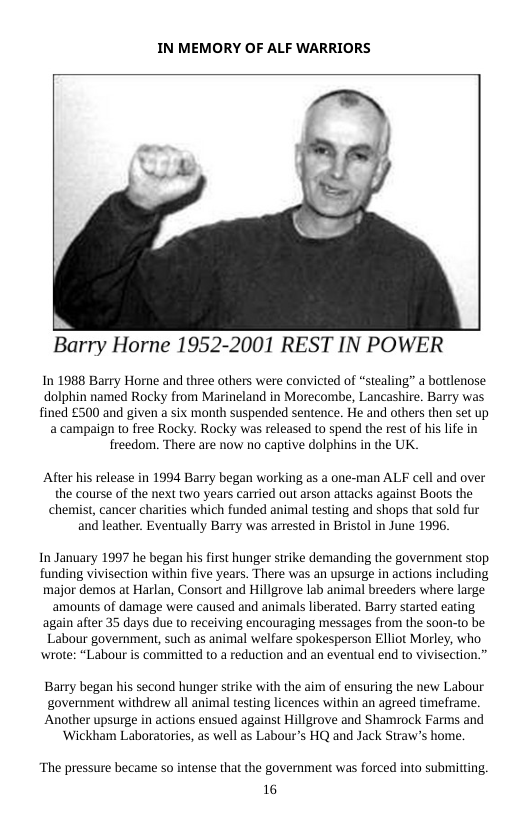
Barry Horne 1952-2001 REST IN POWER
In 1988 Barry Horne and three others were convicted of “stealing” a bottlenose
dolphin named Rocky from Marineland in Morecombe, Lancashire. Barry was
fined £500 and given a six month suspended sentence. He and others then set up
a campaign o free Rocky. Rocky was released to spend the rest of his lfe in
freedom. There are now no captive dolphins in the UK.
After his release in 1994 Barry began working as a one-man ALF cell and over
the course of the next two years carried out arson attacks against Boots the
chemist, cancer charities which funded animal testing and shops that sold fur
and leather. Eventually Barry was arrested in Bristol in June 1996.
In January 1997 he began his first hunger strike demanding the government stop
funding vivisection within five years. There was an upsurge in actions including
major demos at Harlan, Consort and Hillgrove lab animal breeders where large
amounts of damage were caused and animals liberated. Barry started eating,
again after 35 days due to receiving encouraging messages from the soon-to be
Labour government, such as animal welfare spokesperson Elliot Morley, who
wrote: “Labour is committed to a reduction and an eventual end to vivisection.”
Barry began his second hunger strike with the aim of ensuring the new Labour
‘government withdrew all animal testing licences within an agreed timeframe.
Another upsurge in actions ensued against Hillgrove and Shamrock Farms and
‘Wickham Laboratories, as well as Labour’s HQ and Jack Straw’s home.
“The pressure became so intense that the government was forced into submitting.
16
On 26 September, he called off his hunger strike after 46 days.
In November 1997 Barry stood trial for arson related to attacks on the Isle of
‘Wight and was convicted on all charges and sentenced to 18 years.
Barry never fully recovered from a third hunger strike. His final fast began on
21 October 2001 and he died 15 days later of liver failure, after signing a
directive refusing medical treatment
Karl Garside 1966-2025 REST IN POWER
Karl Garside, an Animal Liberation Front (ALF) militant, hunt saboteur, and
investigator passed away at 59. For more than four decades on the front lines of
the fight for animal liberation, Karl fearlessly took direct action o end animal
abuse. Across those years of action, he was involved in more actions claimed by
the ALF than any other individual, which would make him Britain’s most
prolific ALF activist.
Karl was bom in Birkenhead in March 1966. In the mid-1970s, his family
settled in Altrincham, Greater Manchester. In 1983, aged 17, he threw himself
into the fight for animal liberation, going vegan and skipping classes at Trafford
College to disrupt the Grand National horse race by invading the course. That
same year saw him carry out his first ALF action at Mister Monty Furs,
smashing windows and cycling home in a balaclava. He became a member of
the Northern Animal Liberation League (NALL), quickly rising to prominence.
17
‘The following year, Karl conducted undercover reconnaissance at the
Imperial Chemical Industries (ICI) laboratories in Alderley Edge, dressing in
asuit and pretending to attend a job interview ahead of a major raid. That
April, he was part of a mass raid by NALL, when around 300 activists
stormed and occupied the ICI labs.
“That year also saw Karl become an active member of Manchester Hunt
Saboteurs, primarily targeting the Holcombe Hunt. Opposing fox hunting
became one of Karls greatest passions and he dedicated much of his life to
confronting hunts directly. He was integral to establishing the Hunt Retribution
Squad (HRS), which wamed the frequently violent Holcombe Hunt that any
harm done to saboteurs would provoke direct retaliation.
In August 1984, he was one of 200 activists who took part in the Eastern Animal
Liberation League’s raid on the Unilever research laboratories in Bedford,
where animal experimentation took place, while a demonstration took place at
the front. Karl was among 25 people convicted of conspiracy to burgle, with
combined sentences totaling 41 years. He served eight months in prison for his
part in the raid, but this didn’t deter him.
‘While awaiting trial, Karl participated in coordinated ALF attacks on the House
of Fraser store in Altrincham, smashing 22 plate-glass windows overnight with
ball-peen hammers to highlight and disrupt the chain’s sale of fur. Karl and his
then-partner were released from prison just after Christmas in 1986. They
celebrated the end of their parole the following year by helping dismantle a
‘monument local hunt saboteurs had stolen from Wemmergill Moor, a notorious
grouse-shooting estate. After carving “Hunt Retribution Squad” into the
monument, they delivered it directly to the British Association of Shooting and
Conservation headquarters, locking the gates shut with bicycle locks. Karl
insisted the statue be prominently re-erected outside their entrance in protest
against grouse shooting
From the late eighties onwards, Karl became a key figure in ALF campaigns,
working closely with a small circle of trusted activists to carry out direct action
against a wide range of targets involved in animal exploitation. These included
companies that supplied laboratory staff, farms involved in egg and dairy
production, slaughterhouses, meat wholesalers, and businesses linked to hunting
and bloodsports. At its peak in the 1980s and *90s, the rolling waves of
economic sabotage that the ALF unleashed on vehicles and buildings caused
damage running into many tens of millions of pounds.
‘While the ALF is best known for liberating animals, Karl specialized in property
damage. He acted both to stop animal abuse and to deter those responsible from
continuing their harm.
18
On April 15" 1987, two years and two weeks after
500 animals were liberated from the University of
California, an arson carried out by the Animal
Liberation Front against the Animal Diagnostics
Laboratory caused around $5.1 million in
damages. The letters “ALF” were found painted
inside the burned laboratory.
No one was ever prosecuted for the fire.
‘Warzone Distro
'WARZONEDISTRO.NOBLOGS.ORG
2025