Haters Cafe Issue 1 Anarchist Journal from North Texas
Web PDF • Imposed PDF• Raw TXT (OCR)
![22 HGTERS HTERS HBTERS HETERS HGTERS HETERS HETERS HETERS HGTERS HETERS HETERS HETERS HGTERS HETERS HBTERS HETERS HGTERS HTERS HBTERS [..]¥et all these disastrous re- sults of the twentieth-century fetich have taught woman noth- ing. But, then, woman will purify politics, we are assured. Needless to say, 1 am not opposed to woman suffrage on the con- ventional ground that she is not equal to it. I see neither physi- cal, psychological, nor mental reasons why woman should not have the equal right to vore with man. [.] Since woman’s great- est misfortune has been that she was looked upon as cither angel or devil, her true salvation lies in being placed on carth; namely, in being considered human, and therefore subject to all human follies and mistakes. Are we, then, to believe that two errors will make a right? Are we to assume that the poison already inherent in politics will be de- creased, if women were to enter the political arena? Tdeas of representation within the current status quo go_hand-in- hand with ideas about “progress,” because we’re told that an increase in representation is a positive side effect of this progress. But this is based on assimilationist ideas— representation is the reward for assimilation, and assimilation is predicated_on subjugation. The “minorities” must always com- promise—you must not seem too threatening to the establishment to be rewarded with representa- tion. You must be the right kind of Black, “hardworking” if you’re disabled, an unwaveringly patriot- ic immigrant, a white-picket-fence gay, a trans person who “tries.” Progress as assimilation is not a forward march; it’s cyclical, a dog chasing its own tail. Tt based on compromise after compromise un- il you’ve been chewed up, re-di- gested and shat out enough times to be acceptable. In Foting is Not Harm Reduction, the author or 2u- thors discuss the ties between as- similation and the “Native vote™: In 1887, US. Congress passed the General Allotment Act, more commonly known as the Dawes Act, which was designed to expedite colonial invasion, fa- cilitate resource extraction, and to frther assimilate Indigenous Peoples into the colonial social order. The Dawes Act marked a shift from a military strategy to an cconomic and poliical one where reservations were sepa- rated into individual lots, with only male *heads of households™ to receive 160 acres with any re- ‘maining lands put up for sale to white invaders who flocked in droves to inherit_their “Mani- fest Destiny.” Indigenous Peo- ples who accepted allotments could receive ULS. citizenship, and although this was the first congressional act to provide the status, it came at the expense of sacrificing Indigenous People’s cultural and political identities in many ways, particularly by further fracturing the integrity of Indigenous matriarchal so- cieties. Under the Dawes Act, Indigenous lands were reduced from 138 million to 52 million acres. In 1890, the overall Indig-](haters-cafe-issue-1-anarchist-journal-from-north-texas-haters-cafe 22.png)
![enous population was reduced to about 250,000 from tens of millions at the time of initial European invasion. In contrast, the colonizer’s U.S. population had increased to 62,622,250 the same year. [-] US. citizenship was imposed to destroy Indigenous sovereignty and facilitate mass-scale land theft. To this day, the “Native vote” is bound to assimilationist conditions that serve colonial interests. Genocide, like slavery, is ongo- ing and bipartisan. The Standing Rock protests happened under the ‘Obama administration, which was also able to stymie “progressive” movements like Occupy and then for a time Black Lives Matter Electoralism does not propel us gradually towards 2 freer state of being. You cannot tweak the sys- tem or adjust the course to some idyllic perfect democracy because the system is functioning as in- tended; why would wealthy white racists of the eighteenth century care to conceptualize a system that could be used to put them on the same level as even poor whites, let alone the slaves that many of them “owned”? 5/ VOTING IS NOT DIRECT ACTION This is going to be brief, since the answer to this claim is: no. No, it’s not “Direct_action” means different things in different circles. The TWW, Industrial Workers of the World, used the term for gild- ed age strikes. Anarchists, com- munists, leftists, activists, et al will talk about “propaganda of the deed,” sabotage, varying lev- els of violence and nonviolence, terrorism. And it can be nebu- lous at times, especially when the more useful conversation revolves around “What works?” rather than semantics. But one thing is clear for sure: voring is not direct action. In Direct Action: An Ethnography, David Gracber gives insight into some difference between direct action and civil disobedience, both terms often abused by liberals: Typically, one practicing civil disobedience is also willing to accept the legal consequenc- es of his actions. Direct action takes matters a step fusther. The direct actionist does not just refuse to pay taxes to support a militarized school system, she combines with others to try to create a new school system that operates on different principles. She proceeds as she would if the state did not exist and leaves it to the state’ representatives to decide whether to try to send armed men to stop her. Direct action is about asserting yourself. That can mean making demands via strike; it can mean throwing Molotovs. The former may be demanding better work- ing conditions; the latter may be trying to set 2 building on fire There is a goal in mind to dircctly achieve. Electoralism is indirect by ‘SHL8H SILSH SUTLEH SILEH SUTLEH SILSH SUTLEH SHILSH SUILEH SHILSH SUILEH SHILGH SUILEH SHILGH SUILGH SHILGH SUILGH SHIBH SUILGH 3](haters-cafe-issue-1-anarchist-journal-from-north-texas-haters-cafe 23.png)
![24 HGTERS HETERS HETERS HETERS HGTERS HETERS HETERS HETERS HGTERS HETERS HETERS HETERS HGTERS HETERS HBTERS HETERS HGTERS HTERS HBTERS nature. There are no demands to voting—just, again, vague prom- ises. Direct action doesn’t necessi- tate demands, but if the end goal is getting a candidate elected and nothing more (than vague promis- es) then what’s the point in calling it direct action? There’s no direc- tion and there’s no action. Calling voting “direct action” doesn’t make sense. That’s like saying voring is “mutual 2id” because some social services may or may not be allot- ted to your area by the candidate you voted for. Voting is begging for scraps—that’s an antithesis to direct action. Gracber often de- fines “direct action” as some iter- ation of how it “means insisting on acting as if one is already free.” Emma Goldman discusses direct action in Anarchisn: What It Really Stands For (1910); Even were the workers able to have their own representatives, for which our good Socialist politicians are clamoring, what chances are there for their hon- esty and good faith? One has but to bear in mind the process of poliics to realize that its path of good intentions is full of pitfalls wire-pulling, intriguing, ~flat- tering, lying, cheating; in fact, chicanery of every description, whereby the political aspirant can achieve success. [..] Time and time again the people were foolish enough to trust, believe, and support with their last far- thing aspiring politicians, only to find themselves betrayed and cheated. [ The political superstition is still holding sway over the hearts and minds of the masses, but the true lovers of iberty will have no more to do with it. Instead, they believe with Stirner that man has as much liberty as he is will- ing to take. Anarchism therefore stands for direct action, the open defiance of, and resistance to, all laws and restrictions, economic, socil, and moral. But defiance and resistance are illegal. Therein lies the salvation of man. Every- thing illegal necessitates integri- ty, self-reliance, and courage. 1f you’re into lobbying and politics and electoralism, if descriptions and_ depictions of actual direct action make you angry or scared because people are being inconve- nienced or hurt or even killed or property is being damaged, then you need to stop playing radical dress-up and stop using “direct ac- tion” as an excuse for your elector- al fetish or go call your senator or something you approve of. 6/ VOTING IS NOT HARM RE- DUCTION Voting is not harm reduction. For electoralists making the “voting is harm reduction” argument, this seems like a case of, *I saw this term and assumed that T knew what it meant.” In the essay Paring It Harm Reduction, An Tndige- nous Perspective, published on In- digenous Action’s website, the au- thor or authors actually spend less time discussing the issue of harm reduction, instead using this myth to transition into a discussion on](haters-cafe-issue-1-anarchist-journal-from-north-texas-haters-cafe 24.png)
![how voting has and continues to be a tool of colonialism via the co- erced assimilation of Indigenous peoples in the “United States” (al- though this is true elsewhere too). Still, in the beginning of the essay they point this out: We don’t dismiss the reality that, on the scale of U.S, settler colo- nial violence, even the slightest degree of harm can mean life or death for those most vulnerable. What we assert here is that the entire notion of “voting as harm reduction” obscures and perpet- uates settler-colonial - violence, there is nothing “less harmful” about it, and there are more ef- fective ways to intervene in its violences [-] [V Joting can never be a survival strategy under colonial rule. Ie’s a strategy of defeat and victim- hood that protracts the suffering and historical harm induced by ongoing settler colonialism. And while the harm reduction senti- ment may be sincere, even hard won marginal reforms gained through popular support can be just as easily reversed by the stroke of apolitician’s pen. 1 voting is the democratic partic- ipation in our own oppression, voting as harm reduction is a politics that keeps us at the mer- ey of our oppressors. “Harm reduction” was actually 2 term coined by—and subsequent- Iy stolen from—drug abuse advo- cates. Harm reduction is about not punishing addicts for their addic- tions, and allowing people to en- gage with substances on their own terms rather than taking a prohi- bitionist or carceral approach. Its about acknowledging that some folks may not desire to live a “so- ber” lifestyle, allowing them to seck help on their own terms if they desire it. It neither glorifies nor shames substance use. Giv- ing intravenous drug users clean syringes to cut down on disease transmission and giving naloxone to opioid users to prevent death from overdose are harm reduction initiatives. Consider how this applies to vot- ing. Does it? Would it be helpful to concepru- alize participation in Politics as an addiction? Probably not. You might be able to make a case for that sort of thinking, but I won’t; personally T think Goldman’s de- seription of it being akin 1o a fe- tish (in the anthropological sense) is more apt. But what would harm reduction look like in this case? Would it look like coercing people into voting and participating in politics, or—following the spirit of the harm reduction coinage— would *harm reduction” in politics not mean attempting to minimize political participation—mean- ing, minimize reliance on system that stands against the proletari- at, against any real climate action, against any real change? Is repli- cating these patterns of coercion “harm reduction,” even if you want to filter harm reduction through a_political lens? This framing is flawed, but it seems like a more ‘SHL8H SILSH SUTLEH SILEH SUTLEH SILSH SUTLEH SHILSH SUILEH SHILSH SUILEH SHILGH SUILEH SHILGH SUILGH SHILGH SUILGH SHIBH SUILGH «](haters-cafe-issue-1-anarchist-journal-from-north-texas-haters-cafe 25.png)


![CONTRIBUTORS Authors of Original Texts growan mek (@gypsyyrm on ig) lives in virginia where they sew clothes, make zines, and hate on acoustic instruments. she does fake research on music and the geographies of neoliberal capitalism, always interested in how the spaces around us construct our lives, perpetuate ideologies, and how people navigate and weaponize spatial nightmares. s a strong pro- ponent of the powers of autotune on the subconscious, you can find her listening to music with stray cats in “abandoned” locations. Luciis a psyop created to make communists ook bad. [ditor’s ate tis is an obvious joke.] Tanze/Vattis a fungus that grows in boreal forests Authors of Re-Published Texts El Chavo l promised more info about mysel, but I led. Abolish the UC Skip class. Cause ruckaus. | A fan for the flames. | inquiries: abolishtheUC (at) protonmail | disorientation guide Monsieur Dupont is the collective name of the authors responsible for Nibilist Communisns and other works. Assatta Shakur is a former member of the Black Liberation Army (BLA), a target of COINTELPRO, and a fugitive currently living in Cuba, ‘We Still Outside Collective is a group of Black friends in New York City Noche s a pissed-off chicano prole with a keyboard in the Los Angeles Eastside. His personal blog is puraacracia.club Cireulo de Comunistas Esotéricos is a group of esoteric communists ‘We want to also thank Fire fo the Prisons for inspiring this project! ‘SHL8H SILSH SUTLEH SILEH SUTLEH SILSH SUTLEH SHILSH SUILEH SHILSH SUILEH SHILGH SUILEH SHILGH SUILGH SHILGH SUILGH SHIBH SUILGH w](haters-cafe-issue-1-anarchist-journal-from-north-texas-haters-cafe 47.png)


the irredeemable
university
seven reasons to hate
(election) season
on the poverty
of chicanx artists this is the definition
of class hatred
powerlines and the
suspension of time and more!
ISSUE 1 - FALL 2020
an anarchist journal from north texas
Editor's Note
w
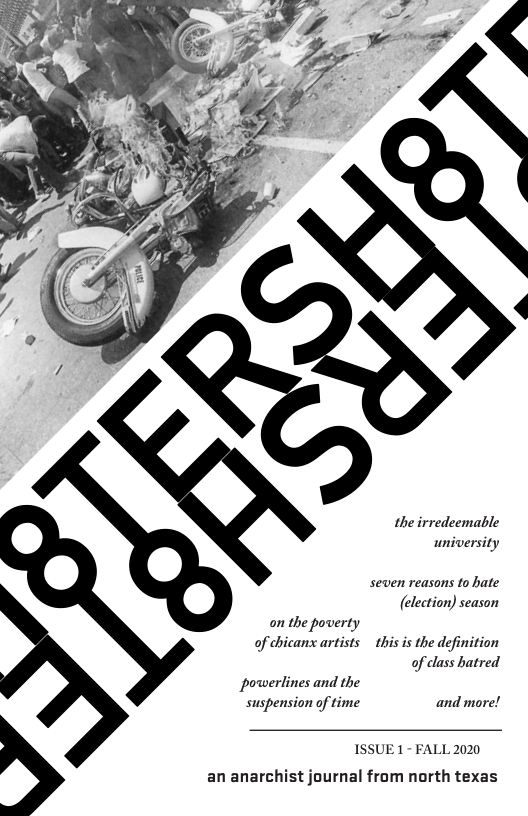
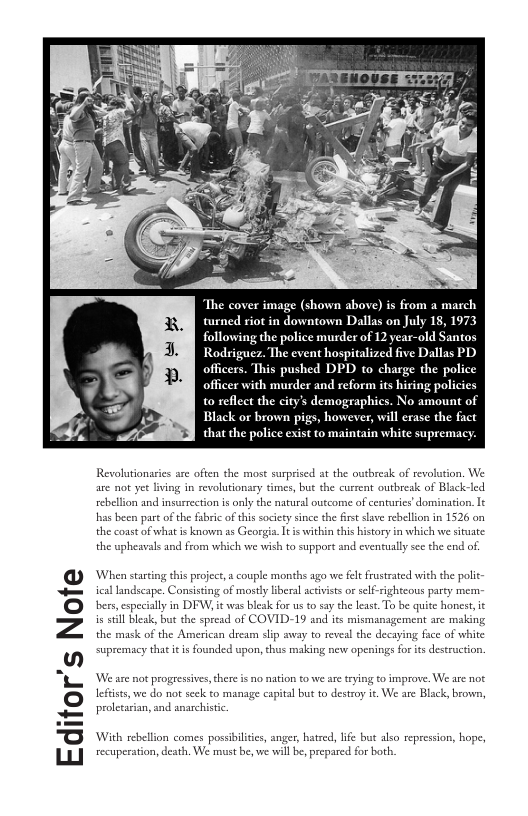
following the police murder of 12y
Rodriguez. The event hospitalized five Dallas PD
officers. This pushed DPD to charge the police
officer with murder and refo
o reflect the city's demog:
Black or brown pigs, howe,
that the police exist to maintain white suprem;
Revolutionaries ace often the most surprised st the outbreak of revolution. We
sre not et living in revolutionsry times, but the current outbresk of Blackled
bellion and insurrection is only the natural outcome of centuries domination. It
s been part of the fibric of this socicty snce the firs slve rebellion in 1526 on
the coast of what s known s Georgia. i within this hisory in which we situate
the upheavals and from which e wish to support and eventually sec the end of.
‘When sartn this projec, couple months ago we felt frustrsted with the polic-
ical landscape. Consisting of mosty liberal sceviss or self-rightcous party mem-
bers,especially in DFW, it was blesk for us to say the lesst. To be quite honest, it
is still blesk, bt the spread of COVID-19 and its mismansgement are making
the mask of the American dream sl sy to revesl the decaying face of white
supremacy that it is founded upon, thus making new openings for its destruction.
‘W e not progressves, ther i no nation o e are rying to improve. We are not
lefists, we do not seck fo manage capital but to destroy it. W are Black, brown,
proletarian, and anarchistic
With rebellion comes possibiltics, anger, hatrd, lfe but also repression, hope,
recuperation,desth, We must be, we will be, prepared for both.
on the poverty of chicanx artists
the irredeemable university
this is the definition of class hatred
the most american president
seven reasons to hate the season
anti-politcs and the police
‘powerlines & the suspension of time:
reflections on temporal perceptions
to my people
on the black leadership and other
white myths
sanitary crisis or crisis of civilization?
reading suggestions
Note: Underlined titles are words that
originally appeared in HSTERS
HSTERS is a project that
aims to introduce and
encourage.
To introduce a way of
thinking that arises from,
butis not tied to, our
social positionings within
this world.
We believe that the
bestintroduction s to
immediately include
those interested
to contemporary
conversations and
conundrums.
To that end, we
encourage those we
troduced to engage
with these works in a
social manner, o share
and discuss with those
around them in whatever
manner they deem fit,
whether it's a group chat,
areading group, ora late
night talk around the
dinner table.
Arevolution is a social
event. Whatever comes
outof these groups and
conversations may, o
may not, help with the
revolution, but it will
help us feel slightly less
isolated.
May a thousand reading
groups bloom!
RIAH MILTON - DRAYA MCCARTY
TONY MCDADE - MERCI MACK
BRAYLA STONE - SHAKI PETERS
We want to take a moment to
mourn the loss of our Black
queer and trans siblings,
whether it is from anti-queer
carry you in our hearts, we
mourn, we heal, and we fight
for you. We will destroy this
world that destroyed you.
MONIKA DIAMOND - BREE BLACK
TATIANA HALL - REM'MIE FELLS
OLUWATOYIN SALAU - NINA POP
..AND ALL THOSE WHOSE NAMES WE
UNFORTUNATELY DO NOT KNOW
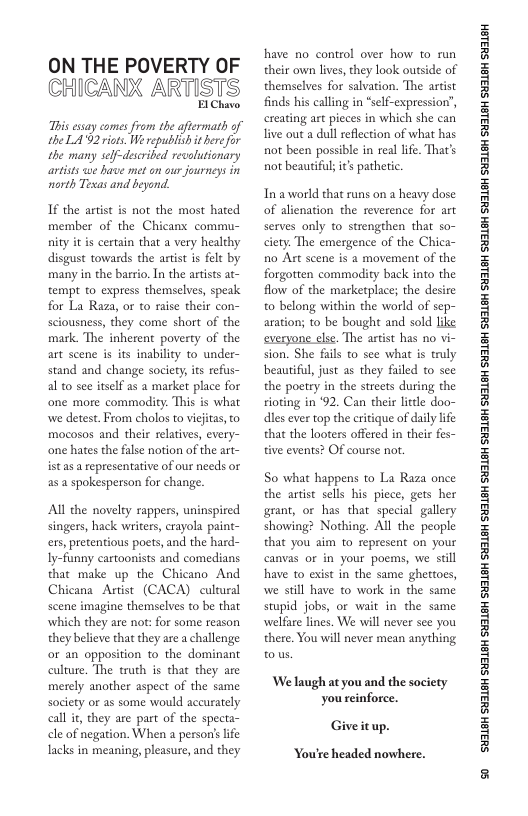
ON THE POVERTY OF
CHICANX ARTISTS
I Chavo
s essay comes from the aftermath of
the LA02 riots. We republish it bere for
the many self-described revolutionary
artists we have met on our journeys in
‘north Tesas and beyond.
If the artist is not the most hated
member of the Chicanx commu-
nity it is certain that a very healthy
disgust towards the artit is felt by
many in the barrio, In the artists at-
tempt to express themselves, speak
for La Raza, or to raise their con-
sciousness, they come short of the
mark. The inherent poverty of the
art scene is its inability to under-
stand and change society its refus-
al to see itself as a market place for
one more commodity: This is what
we detest. From cholos to vicfitas, to
mocosos and their relarives, every-
one hates the false notion of the art-
ist as a representative of our needs or
as 2 spokesperson for change.
Al the novelty rappers, uninspired
singers, hack writers, crayola paint-
ers, pretentious poets, and the hard-
Iy-funny cartoonists and comedians
that make up the Chicano And
Chicana Artist (CACA) cultural
scene imagine themselves to be that
which they are not: for some reason
they believe that they are a challenge
or an opposition to the dominant
culture. The truth is that they are
merely another aspect of the same
society or as some would accurately
call i, they are part of the specta-
cle of negation. When a person’ life
lacks in meaning, pleasure, and they
have no conirol over how to run
their own lives, they look outside of
themselves for salvation. The artist
finds his calling in “self-expression’,
creating art pieces in which she can
live outa dull reflection of what has
not been possible in real life. That's
not beautiful s pathetic.
Ina world that runs on a heavy dose
of alienation the reverence for art
serves only to strengthen that so-
ciety. The emergence of the Chica-
no Art scene is 2 movement of the
forgotten commodity back into the
flow of the marketplace; the desire
to belong within the world of sep-
aration; to be bought and sold like
everyone clse. The artist has no vi-
sion. She fils to see what is truly
beautifl, just as they failed to see
the poetry in the streets during the
ioting in ‘92, Can their lttle d
dles ever top the critique of daily I
that the looters offered in their fes-
tive events? OF course not.
So what happens to La Raza once
the artst sells his piece, gets her
grant, or has that special gallery
showing? Nothing. All the people
that you aim to represent on your
canvas or in your poems, we still
have to exist in the same ghettoes,
we still have to work in the same
stupid jobs, or wait in the same
welfare lines. We will never sce you
there. You will never mean anything
tous
We laugh at you and the society
you einforce.
Giveitup.
You're headed nowhere.
‘SHL8H SILSH SUTLEH SILEH SUTLEH SILSH SUTLEH SHILSH SUILEH SHILSH SUILEH SHILGH SUILEH SHILGH SUILGH SHILGH SUILGH SHIBH SUILGH
Reflections |
'A PBS PRESENTATION
o
A £
= ?fww?
Sl
0w
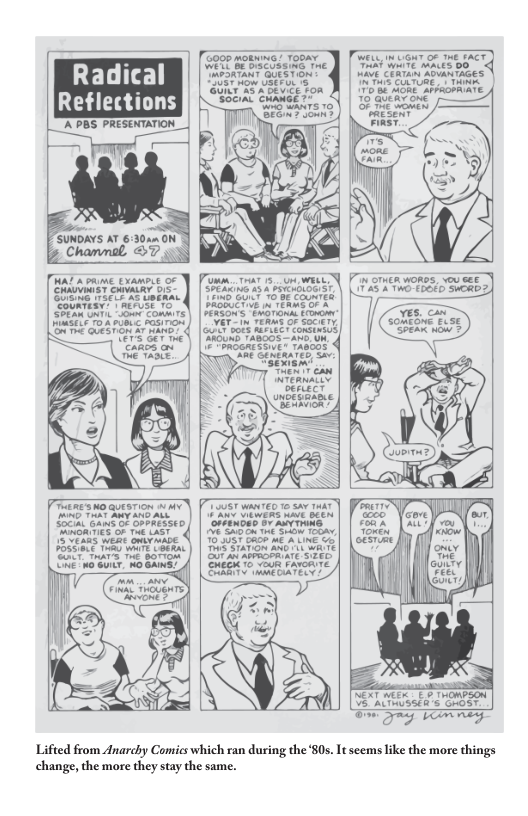
Lifted from Anarchy Comics which ran during the ‘80s. It seems like the more things
change, the more they stay the same.
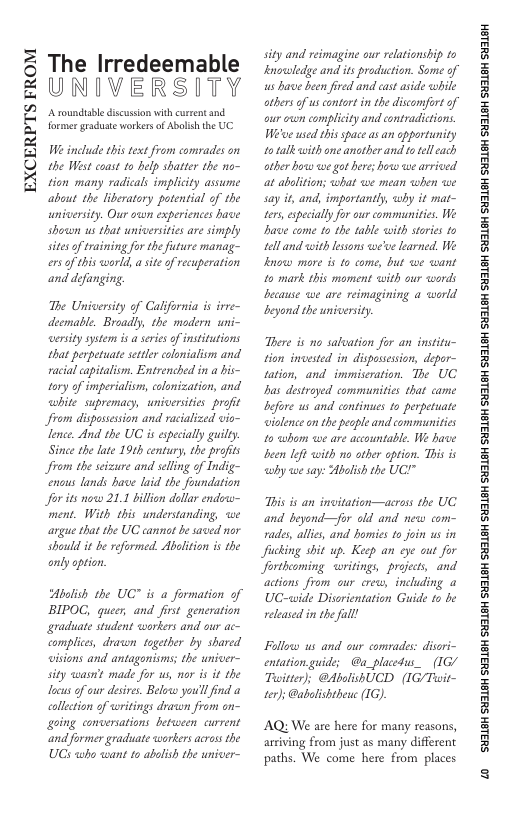
EXCERPTS FROM
The Irredeemable
UNIVERSITY
A rounduabe discussion with cureent and
former graduste workersof Abolis the UC
W include ths text from compades on
the West coast 1o help shatrer the no-
tion many radicals implicity assume
about the liberatary potential of the
university. Our own experiences have
shown us that universities are simply
sites o training for the future manag-
ers o this world, a site of recuperation
and defunging.
The Unicersity of California is irve-
deemabe. Broadly, the modern uni-
ersity system i a series of insitutions
that perpetuate settler colonialism and
racial capitaliom. Entrenched in a bis-
tory of imperialism, colonization, and
white supremacy, universities profit
from dispassession and racialized vio-
lence. And the UC is epecially guiley.
Since the late 19th centry, the profits
from the seizure and selling of Indig-
enous lands have laid the foundation
for its now 21.1 billon dellar endoo-
ment. With this understanding, e
argue that the UC cannat be saved nor
should it be reformed. Abalition i the
only option.
Abolish the UC™ is a formation of
BIPOC, queer, and first generation
graduate student workers and our ac-
complices, dravwn together by shared
wisions and antagonisms; the univer-
sity wasn't made for us, nor i it the
locus of our desires. Below you'lfind a
collction of writings dracin from n-
going conversations between current
‘and former graduate warkers crass the
UGS who want to abolish the univer-
sity and reimagine our relationship to
Inowsledge and it production. Some of
s have been fired and cast aside while
others of us contort in the discomfort of
our own complicity and contradictions.
Weve wsed this space as an opportunity
10 talk with one another and to el each
other how we got here; how we arrived
at abalition; what we mean when we
say it, and, importantly, why it mat-
ters specially for our communities. We
Bave come to the table with stories 1o
tell and with lessons we've learned. We
lnoww mare is to come, but we want
10 mark this moment with our words
because we are reimagining a world
beyond the universiy.
There is no salvation for an institu-
tion invested in dispossesion, depor-
tation, and immiscration. The UC
bas destroyed communities that came
before us and continues to perpetuate
wislence o the people and commnities
10 <wbom we are accountable. W have
been Ieft with nio other option. This is
why we say: Abslish the UC!"
This is an invitation—across the UC
and beyond—for old and new com-
rades, allies, and bomies to join s in
fucking shit up. Keep an eye out for
Jortheoming writings, projects, and
actions from our erew, including a
UC-wide Disorientation Guide 1o be
released in the fall!
Fallow us and our comrades: disori-
entation guide; @a_placedus_ (1G/
Tusitter); @AbolishUCD (IG/Tuit-
ter)s @abalishtheuc (1G).
AQ: We are here for many reasons,
arriving from just as many different
paths. We come here from places
‘SHL8H SILSH SUTLEH SILEH SUTLEH SILSH SUTLEH SHILSH SUILEH SHILSH SUILEH SHILGH SUILEH SHILGH SUILGH SHILGH SUILGH SHIBH SUILGH
©
08 HGTERS HETERS HBTERS HETERS HGTERS HETERS HETERS HETERS HGTERS HETERS HETERS HETERS HGTERS HETERS HBTERS HETERS HGTERS HTERS HBTERS
of frustration, despair, hope, love,
and inspiration. Exhausted by the
patronizing language of so-called
allis, the tokenization of our iden-
tities and struggles, we've found
refuge among comraderie and com-
munity.
For first gen and poor students of
color i particulas, the universi
conjures up feclings of cognitive di
sonance. Commonly viewed as a site
of refuge for those on the underside
of capitalist society; the university
banks (literally) on its myth of er-
udition and progress. Yet, once they
arrive, students are forced to con-
form to the folly of professionalism.
Our feelings of uneasiness and amx-
icty are dismissed as maladjustment,
0 be remedied by more acclamation
and conformity. This is our sentip-
ensar, our holistic way of thinking
with feelings bestowed on us by our
ancestors. It is our way of recogniz-
ing that something is wrong. So we
are conflicted. Caught between the
hopes and dreams of our commu-
nity and the violent nature of the
university that we encounter once
As we build towards strong and vi-
able alternatives, we will count on
those on the inside, the saboteurs
and subversives. Until we have our
alternatives, we will rely on accom-
plices and guides in the undercom-
mons, while we conspire and protect
one another
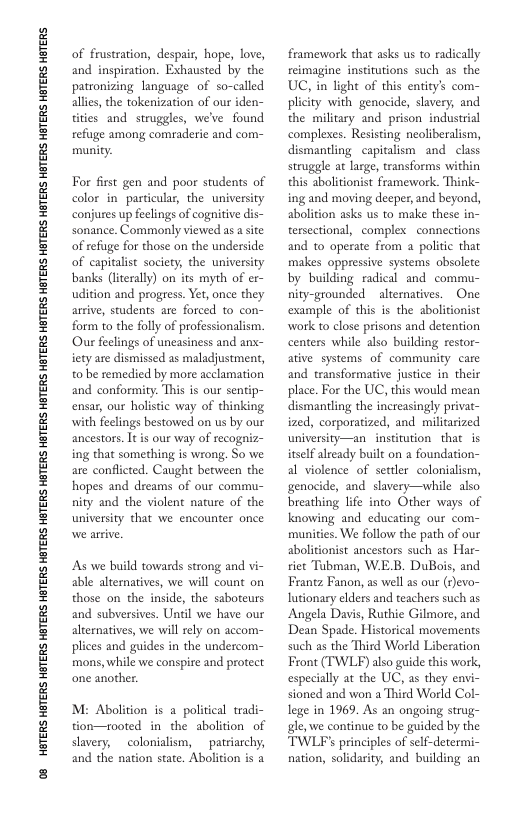
M: Abolition is a_political tradi-
tion—rooted in the abolition of
slavery, colonialism, patriarchy,
and the nation state. Abolition is a
framework that asks us to radically
reimagine institutions such as the
UC, in light of this entity’s com-
plicity with genocide, slavery; and
the military and prison industrial
complexes. Resisting neoliberalism,
dismantling capitalism and class
struggle at large, transforms within
this abolitionist framework. Think-
ing and moving deeper, and beyond,
abolition asks us to make these in-
tersectional, complex connections
and to operate from a politic that
makes oppressive systems obsolete
by building radical and commu-
nity-grounded _alternatives. One
example of this is the abolitionist
work to close prisons and detention
centers while also building restor-
ative systems of community care
and transformative justice in their
place. For the UC, this would mean
dismantling the increasingly privat-
ized, corporatized, and militarized
university—an institution that is
itself already built on a foundation-
al violence of settlr colonialism,
genocide, and slavery—while also
breathing lfe into Other ways of
knowing and educating our com-
munities. We follow the path of our
abolitionist ancestors such as Har-
riet Tubman, W.EB. DuBois, and
Frantz Fanon, as well 2 our (evo-
lutionary elders and teachers such as
Angela Davis, Ruthie Gilmore, and
Dean Spade. Historical movements
such as the Third World Liberation
Front (TWLF) also guide this work,
especially at the UC, as they envi-
sioned and won a Third World Col-
lege in 1969. As an ongoing strug-
gle, we continue to be guided by the
TWLF’ principles of self-determi-
nation, solidarity, and building an
education thatis directly relevant to
the needs of Black and Indigenous
communities, and communities of
color:
J: 1 am writing to my past slf. T am
writing for every Black girl on difi-
cult path. T am writing against a cost
of living adjustment in an inherently
unlivable situation. The money that
T make as a geaduate student is more
than 've ever made at any other job.
My participation in the UC system
Kills people. Like so much else in
our capitalist system, T am kept alive
by others’death. When I say I am
writing to myself, | mean to remind
myself that I came to the UC with a
spark We are each carrying a spark
and we each have the tools to tum
this into 2 true (metaphorical) fire.
So, would T recommend younger
siblings or family to attend this in-
stitution? Not unless they are being
paid well; ask for more money! 1
don' know if had much ofa choice
whether or ot to attend a violent
and colonial institution. When 1
was a kid 1 was labeled as “college
bound,” which sounded great to my
parents who never had that oppor-
tunity. As T got older, I was expliccly
told that T could *do better” than a
state school: that if 1 didn' go to a
name brand school, T would never
make anything of myself. So 1 did
what T thought I was supposed to
do and went to a private, fancy; out-
of-state school. The unfathomable
expense was supposed to pay offlat-
er. Instead, it almost killed me and T
dropped out. It did kill some of my
peers; the school had a high suicide
rate and a suspicious amount of
cidental deaths. T did end up finsh-
ing my BA at a state school and T
was lucky enough to have wonderful
intellectual experiences there. But 1
will probably die with student loan
debr. Hopeully, my cosigners will
die first. If there is an answer to
what path 1 could have taken, I still
don't know it. Go the cheapest path.
Steal whatever you can. Higher ed-
ucation wants o extract everything
out of you. Hold on to yourself and
grab what you can.
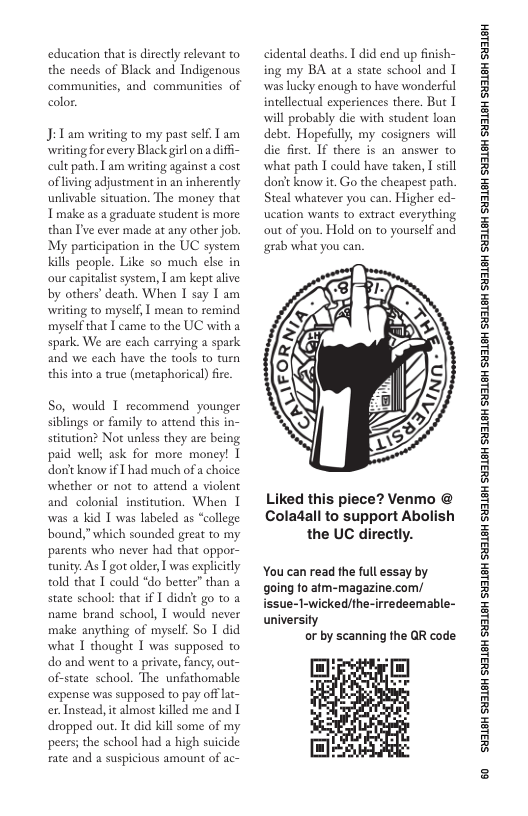
Liked this piece? Venmo @
Coladall to support Abolish
the UC directly.
You can read the full essay by
going fo atm-magazine.com/
issue-1-wicked/the-irredeemable-
university
or by scanning the QR code
‘SHL8H SILSH SUTLEH SILEH SUTLEH SILSH SUTLEH SHILSH SUILEH SHILSH SUILEH SHILGH SUILEH SHILGH SUILGH SHILGH SUILGH SHIBH SUILGH
&
10 HGTERS HBTERS HGTERS HOTERS HETERS HOTERS HBTERS HBTERS HBTERS HBTERS HETERS HATERS HETERS HATERS HETERS HETERS HETERS HETERS HETERS
THIS IS THE DEFINITION
OF CLASS HATRED
Monsieur Dugant
This selection comes from thepreambe
of the book Nibilist_Communism,
The infuence of the text can be felt
throughout this publication and our
(anti-Jpalitics. We include it to help
you understand our positions.
Death appears as the harsh vic-
tory of the law of our ancestors
over the dimension of our becom-
ing. Tt is a fact that, as produc-
tivity increases, each succeeding
generation becomes smaller. The
defeat of our fathers is revisited
upon us as the limits of our world.
Yes, structure is human, it is the
monumentalisation of congealed
sweat, sweat squeezed from old
exploitation and represented as
nature, the world we inhabit, the
objective ground. We do not, in
our busy insect-like comings and
goings, make the immediate world
in which we live, we do not make
a contribution, on the contrary we
are set in motion by if; a genera-
tion will pass before what we have
done as an exploited class will seep
through as an effect of objectivity.
(Our wealth is laid down in heav-
en.) The structure of the world was
built by the dead, they were paid
in wages, and when the wages were
spent and they were dead in the
ground, what they had made con-
tinued o exist, these cities, roads
and factories are their calcified
bones.
They had nothing but their wages
to show for what they had done
and after their deaths what they
did and who they were has been
cancelled out. But what they made
has continued into our present,
their burial and decay is our pres-
ent.
This s the definition of class ha-
tred. We are no closer now to
rest, to freedom, to communism
than they were, their sacrifice has
boughe us nothing, what they did
counted for nothing, we have in-
herited nothing, we work as they
worked, we make as they made, we
are paid as they were paid. We do
not possess either our acts or the
world that conditions us, just as
they owned nothing of their lives.
Yes they produced value, they
made the world in which we now
live. The world that now weighs
down upon us is constructed from
the wealth they made, wealth that
was taken from them as soon as
they were paid their wage, tak-
en and owned by someone else,
owned and used to define the na-
ture of ownership and the class
domination that preserves it
We to0 must work, and the val-
ue we produce leaks away from
us, from each only a trickle but
in'all a sea of it and that, for the
next generation, will thicken into
wealth for others to own and as a
congealed structure it will be used
as a vantage point for the bour-
geoisie to direct new enterprises
in new and different directions but
demanding always the same work
The class war begins in the dese-
cration of our s ec crure that
of peaple a e. As our
truly that
nothing, that
thrown down
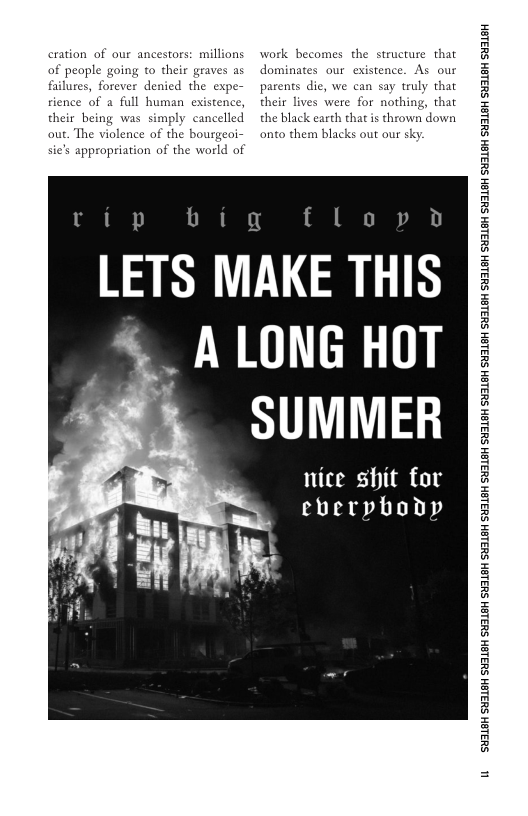
LETS MAKE THIS
A LONG HOT
SUMMER
nice ghit for
eberpbody
U SHIL6H SHALBH SHIL6H SHSLEH SY3L6H SHSLEH S3L6H SUILEH SY3LGH SUALEH SYILGH SUALEH SYILGH SUILEH SYILGH SHALEH SHILSH SHALEH SHILSH
12 HGTERS HBTERS HGTERS HOTERS HETERS HATERS HETERS HBTERS HBTERS HBTERS HSTERS HATERS HETERS HATERS HETERS HOTERS HETERS HETERS HETERS
THE MOST AMERICAN
PRESIDE \f\ T
On Saturday, June 21, president
Donald Trump held one of his be-
loved rallies in Tulsa, Oklahoma,
the first in many months. This ral-
ly served to prepare his re-clection
campaign and to boost morale for
both his wavering supporters - and
for himself. The rally, which was
expected to attract more than one
million, suffered from poor turn-
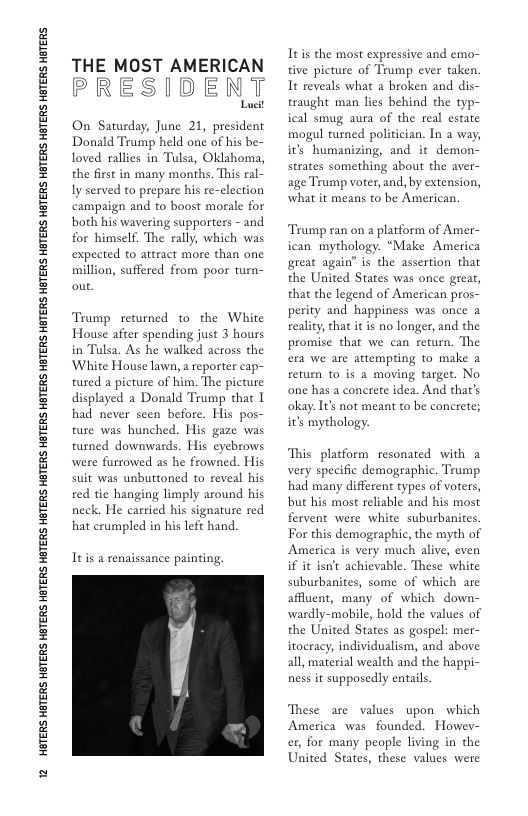
Tramp returned to the White
House after spending just 3 hours
in Tulsa. As he walked across the
White House lawn, a reporter cap-
tured a picture of him. The picture
displayed a Donald Trump that T
had never scen before. His pos-
ture was hunched. His gaze was
turned downwards. His cyebrows
were furrowed as he frowned. His
suit was unbuttoned to reveal his
red tie hanging limply around his
neck. He carried his signature red
hat crumpled in his left hand
It s a renaissance painting,
Itis the most expressive and emo-
tive picture of Trump ever taken.
It reveals what 2 broken and dis-
traught man lies behind the typ-
ical smug aura of the real estate
mogul turned politician. In a way,
its humanizing, and it demon-
strates something about the aver-
age Trump voter, and, by extension,
what it means to be American.
Tramp ran on a platform of Amer-
ican mythology. “Make America
great again” is the assertion that
the United States was once great,
that the legend of American pros-
perity and happiness was once a
eality; that it is no longer, and the
promise that we can return. The
era we are attempting to make 2
return to is 2 moving target. No
one has a conerete idea. And that's
okay.It’s not meant to be concrete;
it's mythology.
This platform resonated with a
very specific demographic. Trump
had many different types of voters,
but his most reliable and his most
fervent were white suburbanites.
For this demographic, the myth of
America s very much alive, even
if it isn't achievable. These white
suburbanites, some of which are
affluent, many of which down-
wardly-mobile, hold the values of
the United States as gospel: mer-
itocracy, individualism, and above
all, material wealth and the happi-
ness it supposedly entails.
These are values upon_ which
America was founded. Howev-
er, for many people living in the
United States, these values were
not as heavily internalized. Among
black, native, and other people of
color, support for the philosophies
of Americanism is limited, as the
country was built to exclude them
from the prosperity it created. As
the country shifted to assimilate
these groups by giving them rights
previously only enjoyed by white
Americans, the foundational ideals
were diffused into their communi-
ties, but never fully adopted.
White Americans, the people for
whom America was created, the
people with more generational
wealth than any other racial group
in the United States, the people
who sell hold supermajorities
of federal political positions and
corporate CEO seats, also believe
more firmly in American values
than anyone else. America remains
a country built for their own ben-
efit. It is made up of others whom
they have tried to assimilate, but
it remains for the white American.
To be an American in the twen-
ty-first century is to be a white
person of the professional or capi-
tal owning class. For all others, the
United States was never built to
accommodate.
This creates a problem when the
United States cannot deliver on
the promises made to its constit-
uents. The belief in the values of
America creates a sort of cognitive
dissonance. Many of these subur-
banites are unhappy, as ither they
do not have the wealth their hard
work was meant to create or do not
have the happiness their wealth
was meant to create. As economic
crises and opioids destroy what's
lLeft of the so-called middle class,
this fecling intensifics
Donald Trump is the embodi-
ment of the American dream, both
of its material success and of its
profound lack of fulfillment. In
journalist Michael D'Antonio’s
interviews for his 2014 book ‘The
Trath About Trump, the billion-
e states that his favorite song is
Peggy Lee’s “Is That All There 152"
He explains that he finds the Iyrics
relatable in his own life.
“I’s a great song because I've had
thesetremendous successes and
then I'm off to the next one. Be-
cause, it like, ‘Oh, s that all there
He went from rich to richer, liv-
ing in opulence and luxury most
cannot imagine, and yet he seems
perpetually unsatisfied. He went
from being an ultra-wealthy clite
to becoming the most famous man
in the world in the office of the
president, but only expressed joy
at proving his detractors wrong
rather than being proud of his
accomplishment for its own sake.
His affinity for petty arguments
and name-calling does not exude
the energy of someone who is
confident, but rather of someone
who is deeply insecure. Trump
identifies and shares many of the
same ansieties as his voters, and
this endears himself to them. The
American dream has failed him in
much the same way it has failed
his supporters.
‘SHL8H SILSH SUTLEH SILEH SUTLEH SILSH SUTLEH SHILSH SUILEH SHILSH SUILEH SHILGH SUILEH SHILGH SUILGH SHILGH SUILGH SHIBH SUILGH
a
U4 HGTERS HOTERS HOTERS HOTERS HBTERS HOTERS HBTERS HOTERS HBTERS HBTERS HETERS HATERS HETERS HATERS HETERS HOTERS HETERS HETERS HETERS
When capitalism enters stages of
precarity it tends to coincide with
an increase of support for nation-
alism, authoritarianism, and even
fascism among the more affluent
o privileged classes, in hopes that
the status quo will be restored.
This is repeated time and time
again throughout the world.
In his first un for office, his
rhetoric and campaign promises
sparked the ire of the democrat-
ic establishment and media class.
They feared that he would become
the first truly fascist president if
elected. His platform of right-
wing populism drew comparisons
to the rise of authoritarianism in
other countrics.
After four years of his administra-
tion, there s no indication that we
have significantly accelerated the
decline towards fascism. Certain-
Iy not when we consider policies
and actions that would have been
taken under a Clinton or Cruz
presidency. The United States has
been in 2 steady downward spiral
towards fascism for decades, from
the destruction of labor unions to
the militarization of the police to
the creation and expansion of the
surveillance state and institutions
such as the DHS and ICE. This
downward slope remains constant
throughout both Republican and
Democratic presidencies. Trump
is 2 continuation of this trend. He
expresses sympathies for fascistic
policies, but does not seek to enact
them with the fervor one might
expect, because he s not ideologi-
cally driven towards fascism.
One of Trump’s most repeated
selling points is that “he is not a
politician’. He's a New York real
estate mogul whose search for at-
tention and approval landed him
almost by accident into the White
House. He is fundamentally dif-
ferent than many who take the
political fast-track from either
Ivy League school or military of-
ficer to senator or congressperson,
and as such does not share the
same motivations or goals. Trump
is more motivated by good-old-
fashioned personal gain than by a
burning inner desire to perpetuate
capitalism or American empire.
When he expresses sympathies for
fascism, they do not necessarily
entail a desire to actually do the
work of enacting them.
Tramp, like his voters, is discon-
tent and wants the world to return
to the idyllic ‘Leave It to Beaver
world of yesteryear that never
actually existed. Fascism is char-
acterized by an intriguing lack of
ereativity coupled with cowardice
The fascist would say instead of
adapting to the changing world,
lets retain the structure and hier-
archies of the existing world, and
force others to either fit into that
structure o be removed entirely,
because the uncertainty of creat-
ing a new system is more terrifying
than the atrocities we will commit
upholding the skeleton of the old
system. They are impatient and
want the world to return to a sense
of stability by any means - but
many of them do not have a desire
to do the work of achieving that.
In this regard,
ump is 2 non-politi-
cian who achieved political office
ump is exactly as
his voters.
but retained his general disintere:
for ideologically driven_ politics
He is a man of the people in that
he is just as discontent and ins
cure s the white suburbanites
who put him in office. His wealth
and privilege has allowed him no
comfort. He i alienated, searching
endlessly for anything to keep him
accupied and distracted
After the 2016 pre
tion, liberals across the media
dential o
landscape indignantly cried “this
is not us. This is not who we are
They held the idea that the e
tion of Donald
erration,
[rump was an ab-
from tradition.
a brea
Un-American. 1 posit a count-
er-argument: this is who we have
always been.
ds
and
We each grasp at the loose thr
hoping to find our happine:
unravels. What could be more
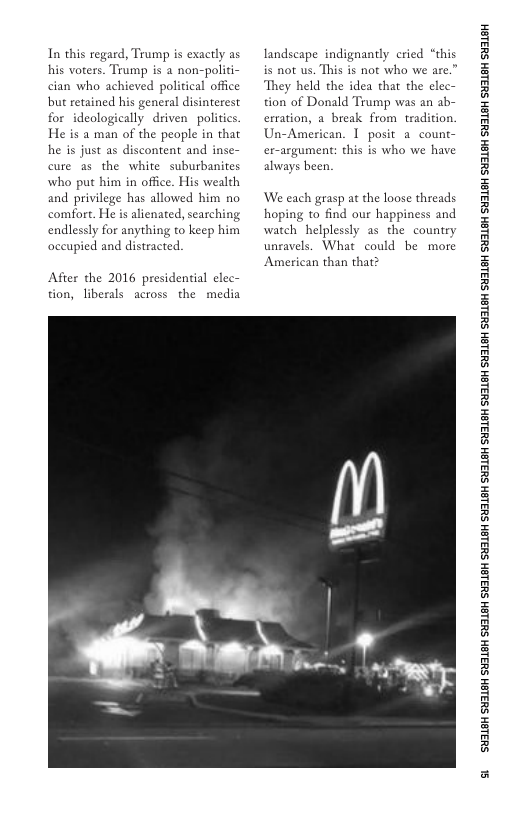
American than that?
ch helplessly as the country
‘SHL8H SILSH SUTLEH SILEH SUTLEH SILSH SUTLEH SHILSH SUILEH SHILSH SUILEH SHILGH SUILEH SHILGH SUILGH SHILGH SUILGH SHIBH SUILGH
Y
HETERS HATERS HETERS HOTERS HETERS HOTERS HETERS HOTERS HETERS HOTERS HSTERS HOTERS HETERS HOTERS HETERS HOTERS HETERS HOTERS HETERS
i
7 REASONS TO
HATE THE SEASON
1¢'s 2020, and it's that time again.
Election season—and hate s n the
ai. Finally, many leftists in favor of
voting are beginning to slide away
from this bias, hopefully ready to
Iay down the last vestiges of liber-
alism, or even move past the left
‘What's morelikely; however, s that
a shiny new candidate—a Bernie
2—will come along and, provided
elections continue, they'll fall back
into their old campaign-obsessed
ways. This isn't addressed to them
alone. The following essay is also
for those who ask, “Why wouldn't
you vote?”; who say it’s harmless;
who say it a *strategy.”
Voting: ic’s the reason for the sea-
son (election season). And we hate
every second of it
Y/IT'S ALL JUST A GAME
1¢s unclear whether the political
game erodes empathy or shows
how lttle there was to begin with
Maybe both. Either way, clection
season is a great time to find out
who has their head all the way up
their own ass—it’s interesting that
electoralists will use often throw
accusations of moral superiority
complexes at those who don't vote,
and then go on to be ethically
bankrupt while acting as the actual
holier-than-thou party.
With the USPS in danger of being
dismantled, many people worry
that their medications, including
time-sensitive meds, rely on the
USPS. Many people who live in
rural areas, including reservations,
are at risk of not getting mail ser-
vice at all. But the electoralists
don't think of the people—they
think of the game. So it imme-
diately became a question of vot-
ing—who cares if you cant get your
insulin? What matters more is that
you won't be able to vote. Tt all
about the Republicans attacking
voter rights so that not as many
people can vote Democrat in No-
vember.
Here's an excerpt from an article
in the Rapid City Journal, out of
Rapid City, South Dakota, that
details some impacts that closing
USPS offices in rural communi-
ties, particularly those on reserva-
tions, has:
Reservation residents depend
upon their local post offices to
keep their mailed medicines and
Social Security, veterans’ benefit
and other checks safe. They do
their business at the post office,
buying money orders to pay
their monthly expenses. Cus-
tomers of the Allen, Manderson
and Wounded Knee post offices
frequently walk long distances
or wait days to use precious gas
to collect their mail.
Now, those same people are
staggered by the news that the
US. Postal Service has placed
the three post offices on a list
of almost 3,700 post offices un-
der review for possible closings.
Eighty small post offices across
South Dakota are on the list,
including 11 on or near reserva-
tions.!
This may sound like a coordinated
attack on the part of the Trump
administration to. restrict voting
access. Except the article, entitled
Post Offices Vital to Reservation
Communitics, was published in
2011, during Obama's first term
in office, and is one of hundreds of
similar articles from its time. The
Obama Administration also made
attempts to gut the postal service,
soiits a litle bit bizarre for liberals
0 use this as a reason to vote blue.
More than that, it comes across as
callous towards those impacted by
post offce closings and mail box
removals in both 2011 and 2020.
1¢s too bad that your lfe or live-
lihood might suffer—what's worse
is that my team might lose.
This type of thinking can be seen
elsewhere. What was once con-
sidered “extreme” weather is now
the norm. In August, 2 massive
derecho—a large line of storms—
swept through lowa, causing wide-
spread destruction that included
flooding, power outages, and crop
damage. In the following week,
too many liberals took o social
media to lament how this would
impact lowa voters'ability to go to
the polls. Something similar hap-
pened as the west coast burned, as
if Trump caused the wildfires that
have been intensifying for similar
reasons. Frenzied liberals again
implored everyone to vore—but
voting doesn't put out fires. And
T Cook, Andrea Post Offcs Vil To
Reservaton Commuitis”. Rapid ity
Journal, 2001
its worth noting that the west
coast is all blue. More important-
Iy, Indigenous people and envi-
ronmentalists have pointed out
again and again that wildfires are
intensified by settler governments
banning of traditional controlled
burns, which leads to a buildup of
detritus that, once inevitably ignit-
ed, grows out of control. This will,
like ecological collapse, happen
regardless of political leadership
as long as the land remains under
colonial occupation.
OF course it’s possible to be con-
cerned over how these events are
affecting people and also about
voting, i the latter is what you care
about. But to jump first to how any
decision or crisis will impact your
candidate and last to how actual
humans are faring—and how vot-
ing will have any real impact on
any of this? It fecls asinine. Both
parties invest heavily in fossil fu-
els. The democrats dropped ending
fossil fuel dependence from their
platform as usual, choosing to
continue subsidizing disty energy.
2 Tfan, Unnar Dermocrus Have Made A
Pussling Decision To Duop Thei Demand
To Ead Fossl Pucl Subsicies. Vo, 2020,
s of Seprenber 2020, the Democsats
Have wavered o whether or ot o nclude
climinating osl el subsidic s partof
thei platfor, This kind ofindecison i st
oftheproblem of lctoralpoliis exher
thanan argument in fvor o public apinion
changing the ide. Also,the time 10 end.
fossl fue ubsidies—a bare. minmum ap-
proach—vas decades ago. Assated, e do
ot have e for the spinees inaction and
‘meaningless tllc rovided by this pary The
canastrophic collpss prdicted—again—
decades'ago ae aleady lling into plce
This incudes the “naturaldsstes”men-
tioned in the it part of this ssays e shold.
‘SHL8H SILSH SUTLEH SILEH SUTLEH SILSH SUTLEH SHILSH SUILEH SHILSH SUILEH SHILGH SUILEH SHILGH SUILGH SHILGH SUILGH SHIBH SUILGH
a
18 HGTERS HOTERS HOTERS HOTERS HBTERS HOTERS HBTERS HBTERS HBTERS HBTERS HETERS HATERS HETERS HATERS HETERS HETERS HETERS HETERS HETERS
The Paris Agreement was an infa-
mous failure.* And the severity of
storms like the recent lowa dere-
chos is directly linked to climate
change. Something that both par-
ties—all political parties, consid-
ering that even the Greens' plans
tend to be vague since they won't
win anyway—refuse to address in
any real, material capacity. Its a
game, and its a game of worth-
less platitudes and empty promises
that the politicians will renege or
dither on once in offce
Electoral obsession is the game
of treating people like pawns and
then yelling at those very same
people for being upset at this
treatment. It big talk about ‘mar-
ginalized folk” and accusations of
privilege that are more often than
not thrown right back in the fac-
es of marginalized folks. In fact,
if you are from any marginalized
demographic and have expressed a
disdain for political theater, there's
a high likelihood that some liber-
al has insinuated that you actually
don't know what's best for yourself
P p—————ry
discing esousces o preparstion and 2id,
a5 the supposed puspose ofpoliics. The
‘Grcen New Deal would hve done vry e
in termsof desing climatechange, ind
the fc thtthe Democrat o aggressivly
abotage their dightly e and overll
more popula membership should ks seve
3¢ 3n indictment aguins reformisn,
3 Leahy Stcphen. "Most Countis Avest
Hiting 2030 Climate Gouls, And Everyone
WillPay The Price”.nassnalesgaphiccom,
2020; Ak, il “Dingerous lncemenalse
OF The Pais Agreement” Gbal Enviren-
mentl Pl Vil 19N 1. MIT Pres, 2019,
Splush, Clv.“This Changes Nothng: The
Purs Agreemens To Tgnore Reslity” Tl
& Francs 2016
if you abstain from voting, There's
an assumption that if you're
against voting then you either ha-
ven't thought it through o are too
privileged to care.
2/ REPRESENTATION IS RE-
PRESSION
An accusation often thrown by the
pro-voters at anyone who immedi-
ately doesn't put all their oppres-
sion cards on the table is one of
“privilege.” One darkly funny side
effect of this tendency crops up oc-
casionally: the person making the
accusation will be more privileged
than whoever theyre whining at
(the idea that privilege is a game
of points to be added up is a gross
oversimplification that T'm not
trying to imply here). White lib-
erals calling certain anti-electoral
Black people “privileged” for not
voting is a bizarre cognitive leap,
but it happens, especially on the
internet. But this is all ancedot-
al, so let’s pretend that everyone
who doesnit vote does so because
they're too privileged to care or
be harmed in any significant way.
Here are two of the roads we can
take here
First, why should they? If someone
doesnit vote out of privlege, then
wouldat you want them to abstain
anyway?
Because, second, why would they
have any motivation to vote in
your favor—provided you're all
concerned with human rights and
equality and whatever other En-
lightenment buzzwords you think
have meaningful value? Those
with privilege will tend to vote
with their own interests in mind;
all historical precedent points to
this. You can try and obfuscate
this by, for example, acting like
rural whites voted for Trump be-
cause they're rural and not because
they're white. Whiteness has ev-
erything to do with the way they;
like their counterpars in the cit-
ies and suburbs, voted. Wouldn't
the vote of the less privileged have
more sway if the privileged ab-
stained from voting?
Often the next line of argument is
that many “underprivileged” folks,
such as many immigeants and in
particular undocumented immi-
grants, can't vote, and so the “priv-
ileged” must wield their electoral
power in the favor of those who
can't vote. There are problems with
this idea. The policical philanthro-
py idea is patronizing to the point
of insult. There’s no such thing as
being a voice for the voiceless—
people are “voiceless” because
they're being talked over. And
that’s what our electoral system is.
Acting like anyone’s interchange-
able is dehumanizing, and even
pretending that some shared iden-
tities equals common goals, es-
pecially considering the fact that
many of these groupings ~such as
the “LGBT community” or *Lat-
in Americans” or *Asian Ameri-
cans™are not coherent enough
to be meaningful. You can even
belong to the same “communi-
" s someone else...while also
not, really, belonging to the same
community because of this lack
of coherence and nebulousness of
terminology as it relates to “com-
munity”
OF course, most arguments in the
direction of representation are also
predicated on the idea that the US.
system is truly representational. “If
we only had this group represent-
ed in congress, then they could
empower their community!” s the
same argument that supporters
of capitalism make; “If only this
group could own more businesses,
the revenue will go back into their
communities.” Exploitation is not
empowerment. Politicians exploit
“their” constituency like capital-
ists exploit “their” community.
When someone is elected into of-
fice, their relationship to whatever
community they claim changes—
they now have power. ziq put it
succinetly: “Giving a person power
and expecting them to not use it
to cement even more power for
themselves is as foolish as Charlie
Brown trying to kick the football
while Lucy holds it."*
A politician makes sacrifices to
get into office, and those sacrific-
es are invariably at the expense of
the most vulnerable among “their”
constituency to appeal to the vot-
ers with the most capital—this
only becomes more egregious as
one moves up the ladder from
local to federal. As Lucy Parsons
pointed out over a century ago
in The Ballot Humbug, its *mon-
ey and not votes” that “rules the
people. Capitalists no longer care
3 9D o Anaschss Vot I Stae Elec-
tions 2015, Oriinaly posted on raddle .
‘SHL8H SILSH SUTLEH SILEH SUTLEH SILSH SUTLEH SHILSH SUILEH SHILSH SUILEH SHILGH SUILEH SHILGH SUILGH SHILGH SUILGH SHIBH SUILGH
3
20 HGTERS HETERS HETERS HETERS HGTERS HETERS HETERS HETERS HGTERS HETERS HETERS HETERS HGTERS HETERS HBTERS HETERS HGTERS HTERS HBTERS
to buy the voters, they simply buy
the ‘servants’ after they have been
elected to ‘serve. The idea that the
poor mans vote amounts to any-
thing is the veriest delusion. The
ballot is only the paper veil that
hides the tricks.”
Your vote does't matter.
3/CITIZENSHIP IS AN INSULT
Citizenship, like representation,
like progress, is also predicat-
ed on assimilation and coercion.
16 a “Join, or Die” system. Why
clamor for recognition from the
state? For services like healtheare
and infrastructure? Why is a state
even necessary in instances like
this? Infrastructure projects are
put in place in service to colonial
interests and/or in service to cap-
ital; see the railroad and highway
systems as examples. Even free
healtheare under capitalism is only
in place to ensure a more produc-
tive proletariat
10 insulting to tell someone priv-
ileged with citizenship that they
must vote for the good of the
noncitizen who cannot vote. The
ICE concentration camps will not
be voted away. The citizen cannot
exist without the noncitizen—the
exploiter cannot exist without the
exploited. This means that suffer-
ing on a grand scale will happen
as long as the empire is in place.
Even if the USS. could be voted
into a functional social democracy
or welfare state, this all comes at
the expense of someone. Do the
lives of the poor in Afghanistan,
Tran, Palestine, Yemen, Nigeria,
Pakistan, and all the other places
the US. destabilizes and reigns
terror upon not matter as long as
you can share in the spoils of war?
You cannot harbor a desire for a
piece of the wealth with no regard
for where that wealth comes from.
Participation in this system legiti-
mizes this. But this is the part of
the argument that electoralists are
often calling moralisic and theo-
retical—and if Not America exists
only in the realm of theoretical,
then sure. It pure theory. A lot
of arguments center_themselves
on how electoralism doesn't help,
butin many ways it’s an active dis-
service to the communities that
liberals and leftists always wanna
pretend to care so much about.
4/ PROGRESS IS A MYTH
In The Ballot Humbug, Passons
also said: “We know there never
was alaw passed that ever prevent-
ed one single crime from being
committed.” Likewise, there isn't
a single social ssue or societal ill
or injustice or policy of depravity
that has been voted into oblivion.
Maybe the earliest progressives
and communists who ran for of-
fice in vain can be forgiven, a lit-
tle; there wasn't yet a precedent for
progressives in office, or failing to
be placed in office. It should, how-
ever, be noted that many of their
contemporaries were already of-
fering criticisms of the electoral
system. The idea that everything
will naturally “get better”if we can
put the right people in power as
today's progressives seem to think
isn't supported by any historical
evidence.
Slavery didnt end. They work on
plantations in the South, fight fires
in California, and work in facto-
ries New York. The slaves of today
may be given air conditioning and
§3 an hour for their more stren-
uous labor (minimum wage for
prisoners s eighty-six cents)—is
that progress?® Itk no coincidence
that that the U.S. prison popula-
tion s heavily racialized—most
statistics put the percentage of
Black inmates at around 40%,
even though Black Americans
make up less than 15% of the total
US. population.* Lovisiana State
Penitentiary is built on the site
of a former plantation, a majori-
ty of its population is Black, and
many of them get assigned to till
the same plot of soil worked by
slaves less than two centuries ago.”
Is this kind of progress significant
enough to warrant a continuation
of this system, so that maybe, in an
alternate universe where climate
change doesn' kill us all by then,
maybe our great grandchildren can
live to see the day where prisoners
are paid $8 an hour? The evils of
the American empire don't wither
away under electoral or legislative
pressure—concessions granted
have always taken protests (usually
fess-than-peaceful), riots, and, in
the case of officially” ending chat-
5 Savyer, Wendy.“How Much Do
Incarcerated People Eam In Esch Stte?.
prianpoliyorg, 2017
s “BOP Statcs: Tnste Race” Federst
Buca of Prsons. b gev. 2020
7 “Angola Sat Prison: A Short Hisory |
Vs Behind Bas: Ntional Public Radio
‘And Angola Stat Prison. Caumbia Univer-
sty conmtlolambin.cd
tel slavery, a whole civil war. And
even then they had to put a provi-
sion in the 13 amendment—that
infamous line: exccpt as punishment
Joracrime
This may seem counter intuitive
considering suffrage was one of
the *rights” allegedly fought for by
activists of the past. But that ar-
gument—that “people fought for
ylour right to vote so you should
show ylour gratitude by voting’—
flattens “activists” of the past into
one single-minded Movement
That's not how anything _ever
works. Anarchists like Emma
Goldman and Lucy Parsons crit-
icized their contemporancous
women's suffrage movement. Par-
sons referred to electoralism as a
“modern delusion” in 1905; Gold-
man, in her 1911 essay Woman
Suffrage, called it “fetich worship.”
In the essay, Goldman points out
some of contradictions that were
clear even at the time
The poor, stupid, free American
citizen! Free to starve, free to
tramp the highways of this great
country, he enjoys universal suf-
frage, and, by that right, he has
forged chains about his limbs.
The reward that he receives is
stringent labor laws prohibiting
the right of boycott,of picketing,
in fact, of everything, except the
right o be robbed of the fruits
of his labor.
Following that, Woman Suffrage
also acts as an early criticism of
the empty representation-based
politics so prevalent in today’s pro-
gressive circles:
‘SHL8H SILSH SUTLEH SILEH SUTLEH SILSH SUTLEH SHILSH SUILEH SHILSH SUILEH SHILGH SUILEH SHILGH SUILGH SHILGH SUILGH SHIBH SUILGH
i3
22 HGTERS HTERS HBTERS HETERS HGTERS HETERS HETERS HETERS HGTERS HETERS HETERS HETERS HGTERS HETERS HBTERS HETERS HGTERS HTERS HBTERS
[..]¥et all these disastrous re-
sults of the twentieth-century
fetich have taught woman noth-
ing. But, then, woman will purify
politics, we are assured.
Needless to say, 1 am not opposed
to woman suffrage on the con-
ventional ground that she is not
equal to it. I see neither physi-
cal, psychological, nor mental
reasons why woman should not
have the equal right to vore with
man. [.] Since woman’s great-
est misfortune has been that she
was looked upon as cither angel
or devil, her true salvation lies in
being placed on carth; namely,
in being considered human, and
therefore subject to all human
follies and mistakes. Are we,
then, to believe that two errors
will make a right? Are we to
assume that the poison already
inherent in politics will be de-
creased, if women were to enter
the political arena?
Tdeas of representation within the
current status quo go_hand-in-
hand with ideas about “progress,”
because we're told that an increase
in representation is a positive side
effect of this progress. But this is
based on assimilationist ideas—
representation is the reward for
assimilation, and assimilation is
predicated_on subjugation. The
“minorities” must always com-
promise—you must not seem too
threatening to the establishment
to be rewarded with representa-
tion. You must be the right kind
of Black, “hardworking” if you're
disabled, an unwaveringly patriot-
ic immigrant, a white-picket-fence
gay, a trans person who “tries.”
Progress as assimilation is not a
forward march; it’s cyclical, a dog
chasing its own tail. Tt based on
compromise after compromise un-
il you've been chewed up, re-di-
gested and shat out enough times
to be acceptable. In Foting is Not
Harm Reduction, the author or 2u-
thors discuss the ties between as-
similation and the “Native vote™:
In 1887, US. Congress passed
the General Allotment Act,
more commonly known as the
Dawes Act, which was designed
to expedite colonial invasion, fa-
cilitate resource extraction, and
to frther assimilate Indigenous
Peoples into the colonial social
order. The Dawes Act marked a
shift from a military strategy to
an cconomic and poliical one
where reservations were sepa-
rated into individual lots, with
only male *heads of households™
to receive 160 acres with any re-
‘maining lands put up for sale to
white invaders who flocked in
droves to inherit_their “Mani-
fest Destiny.” Indigenous Peo-
ples who accepted allotments
could receive ULS. citizenship,
and although this was the first
congressional act to provide the
status, it came at the expense of
sacrificing Indigenous People’s
cultural and political identities
in many ways, particularly by
further fracturing the integrity
of Indigenous matriarchal so-
cieties. Under the Dawes Act,
Indigenous lands were reduced
from 138 million to 52 million
acres. In 1890, the overall Indig-
enous population was reduced
to about 250,000 from tens of
millions at the time of initial
European invasion. In contrast,
the colonizer's U.S. population
had increased to 62,622,250 the
same year.
[-]
US. citizenship was imposed to
destroy Indigenous sovereignty
and facilitate mass-scale land
theft. To this day, the “Native
vote” is bound to assimilationist
conditions that serve colonial
interests.
Genocide, like slavery, is ongo-
ing and bipartisan. The Standing
Rock protests happened under the
‘Obama administration, which was
also able to stymie “progressive”
movements like Occupy and then
for a time Black Lives Matter
Electoralism does not propel us
gradually towards 2 freer state of
being. You cannot tweak the sys-
tem or adjust the course to some
idyllic perfect democracy because
the system is functioning as in-
tended; why would wealthy white
racists of the eighteenth century
care to conceptualize a system that
could be used to put them on the
same level as even poor whites, let
alone the slaves that many of them
“owned”?
5/ VOTING IS NOT DIRECT
ACTION
This is going to be brief, since the
answer to this claim is: no. No, it’s
not
“Direct_action” means different
things in different circles. The
TWW, Industrial Workers of the
World, used the term for gild-
ed age strikes. Anarchists, com-
munists, leftists, activists, et al
will talk about “propaganda of
the deed,” sabotage, varying lev-
els of violence and nonviolence,
terrorism. And it can be nebu-
lous at times, especially when the
more useful conversation revolves
around “What works?” rather than
semantics. But one thing is clear
for sure: voring is not direct action.
In Direct Action: An Ethnography,
David Gracber gives insight into
some difference between direct
action and civil disobedience, both
terms often abused by liberals:
Typically, one practicing civil
disobedience is also willing to
accept the legal consequenc-
es of his actions. Direct action
takes matters a step fusther. The
direct actionist does not just
refuse to pay taxes to support a
militarized school system, she
combines with others to try to
create a new school system that
operates on different principles.
She proceeds as she would if the
state did not exist and leaves it
to the state’ representatives to
decide whether to try to send
armed men to stop her.
Direct action is about asserting
yourself. That can mean making
demands via strike; it can mean
throwing Molotovs. The former
may be demanding better work-
ing conditions; the latter may be
trying to set 2 building on fire
There is a goal in mind to dircctly
achieve. Electoralism is indirect by
‘SHL8H SILSH SUTLEH SILEH SUTLEH SILSH SUTLEH SHILSH SUILEH SHILSH SUILEH SHILGH SUILEH SHILGH SUILGH SHILGH SUILGH SHIBH SUILGH
3
24 HGTERS HETERS HETERS HETERS HGTERS HETERS HETERS HETERS HGTERS HETERS HETERS HETERS HGTERS HETERS HBTERS HETERS HGTERS HTERS HBTERS
nature. There are no demands to
voting—just, again, vague prom-
ises. Direct action doesn't necessi-
tate demands, but if the end goal
is getting a candidate elected and
nothing more (than vague promis-
es) then what’s the point in calling
it direct action? There's no direc-
tion and there’s no action. Calling
voting “direct action” doesn't make
sense. That's like saying voring is
“mutual 2id” because some social
services may or may not be allot-
ted to your area by the candidate
you voted for. Voting is begging
for scraps—that's an antithesis to
direct action. Gracber often de-
fines “direct action” as some iter-
ation of how it “means insisting
on acting as if one is already free.”
Emma Goldman discusses direct
action in Anarchisn: What It Really
Stands For (1910);
Even were the workers able to
have their own representatives,
for which our good Socialist
politicians are clamoring, what
chances are there for their hon-
esty and good faith? One has but
to bear in mind the process of
poliics to realize that its path of
good intentions is full of pitfalls
wire-pulling, intriguing, ~flat-
tering, lying, cheating; in fact,
chicanery of every description,
whereby the political aspirant
can achieve success. [..] Time
and time again the people were
foolish enough to trust, believe,
and support with their last far-
thing aspiring politicians, only
to find themselves betrayed and
cheated.
[
The political superstition is still
holding sway over the hearts
and minds of the masses, but the
true lovers of iberty will have no
more to do with it. Instead, they
believe with Stirner that man
has as much liberty as he is will-
ing to take. Anarchism therefore
stands for direct action, the open
defiance of, and resistance to, all
laws and restrictions, economic,
socil, and moral. But defiance
and resistance are illegal. Therein
lies the salvation of man. Every-
thing illegal necessitates integri-
ty, self-reliance, and courage.
1f you're into lobbying and politics
and electoralism, if descriptions
and_ depictions of actual direct
action make you angry or scared
because people are being inconve-
nienced or hurt or even killed or
property is being damaged, then
you need to stop playing radical
dress-up and stop using “direct ac-
tion” as an excuse for your elector-
al fetish or go call your senator or
something you approve of.
6/ VOTING IS NOT HARM RE-
DUCTION
Voting is not harm reduction. For
electoralists making the “voting
is harm reduction” argument, this
seems like a case of, *I saw this
term and assumed that T knew
what it meant.” In the essay Paring
It Harm Reduction, An Tndige-
nous Perspective, published on In-
digenous Action's website, the au-
thor or authors actually spend less
time discussing the issue of harm
reduction, instead using this myth
to transition into a discussion on
how voting has and continues to
be a tool of colonialism via the co-
erced assimilation of Indigenous
peoples in the “United States” (al-
though this is true elsewhere too).
Still, in the beginning of the essay
they point this out:
We don't dismiss the reality that,
on the scale of U.S, settler colo-
nial violence, even the slightest
degree of harm can mean life or
death for those most vulnerable.
What we assert here is that the
entire notion of “voting as harm
reduction” obscures and perpet-
uates settler-colonial - violence,
there is nothing “less harmful”
about it, and there are more ef-
fective ways to intervene in its
violences
[-]
[V Joting can never be a survival
strategy under colonial rule. Ie's
a strategy of defeat and victim-
hood that protracts the suffering
and historical harm induced by
ongoing settler colonialism. And
while the harm reduction senti-
ment may be sincere, even hard
won marginal reforms gained
through popular support can
be just as easily reversed by the
stroke of apolitician’s pen. 1
voting is the democratic partic-
ipation in our own oppression,
voting as harm reduction is a
politics that keeps us at the mer-
ey of our oppressors.
“Harm reduction” was actually 2
term coined by—and subsequent-
Iy stolen from—drug abuse advo-
cates. Harm reduction is about not
punishing addicts for their addic-
tions, and allowing people to en-
gage with substances on their own
terms rather than taking a prohi-
bitionist or carceral approach. Its
about acknowledging that some
folks may not desire to live a “so-
ber” lifestyle, allowing them to
seck help on their own terms if
they desire it. It neither glorifies
nor shames substance use. Giv-
ing intravenous drug users clean
syringes to cut down on disease
transmission and giving naloxone
to opioid users to prevent death
from overdose are harm reduction
initiatives.
Consider how this applies to vot-
ing. Does it?
Would it be helpful to concepru-
alize participation in Politics as
an addiction? Probably not. You
might be able to make a case for
that sort of thinking, but I won't;
personally T think Goldman's de-
seription of it being akin 1o a fe-
tish (in the anthropological sense)
is more apt. But what would harm
reduction look like in this case?
Would it look like coercing people
into voting and participating in
politics, or—following the spirit
of the harm reduction coinage—
would *harm reduction” in politics
not mean attempting to minimize
political participation—mean-
ing, minimize reliance on system
that stands against the proletari-
at, against any real climate action,
against any real change? Is repli-
cating these patterns of coercion
“harm reduction,” even if you want
to filter harm reduction through
a_political lens? This framing is
flawed, but it seems like a more
‘SHL8H SILSH SUTLEH SILEH SUTLEH SILSH SUTLEH SHILSH SUILEH SHILSH SUILEH SHILGH SUILEH SHILGH SUILGH SHILGH SUILGH SHIBH SUILGH
«
26 HGTERS HETERS HBTERS HETERS HGTERS HETERS HETERS HETERS HGTERS HETERS HETERS HETERS HGTERS HETERS HGTERS HETERS HGTERS HTERS HBTERS
apt conclusion to be drawn from
it would lead towards an approach
of mutual aid instead of diverting
resources that could provide direct
aid to those in need to campaign-
ing. Would you not rather distrib-
ute food than campaign stickers?
7/ WE CAN DO BETTER, AND
MORE
But can't we do both?
They say to vote to make it better
in the “short term;” but the “short
term”is also the “long term”if any-
one ever points out that we could
be making things better in the
here and now instead of dumping
all the effort and resources into
campaigning. The meanings of
short term and long term are con-
stantly shifting in their meanings
Voting is a necessary evil because
it “helps” people in the short term
by providing them with social ser-
vices once Your Candidate is in
office. But we need to donate to
campaigns and put all this money
into campaigning costs and adver-
tising and shit like that instead of
giving the money and resources
directly to the people who need
them because we gotta think about
the *long term.” The goalposts are
always changing here.
You'e asking people to gamble
with their lives
The gamble s this: throw your
current resourees into a campaign
hoping for a bigger return—a re-
turn that will ahways include com-
promise—ally yourself with dirty
money if you want to win, beget-
ting even more compromise, and
if Your Candidate wins, then you
might get some services or infra-
structure or what you asked for
You might also get nothing be-
cause the candidate gets bought
out by those with capital. If Your
Candidate does not get elect-
ed, all that time and money has
been thrown away completely and
you, again, get nothing. Less than
nothing--all the money put into
paying campaigners and advertis-
ing is lost, and that's money and
time that could have directly fed
and clothed families, gotten peo-
ple housed, filled in potholes, or
worked towards whatever else it is
you wanted fixed. Why is it such
blasphemy to point out that the
winning move might just be to
avoid the game altogether? Your
Candidate needs you, but you need
them less than you think.
And so you may think that, well
we can focus on both local proj-
ects and campaigning. But so
much gets shoved to the side when
election season comes in favor of
getting people out and voting It's
like a sick sporting event. (To be
honest I'm afraid of DSA's current
mutual aid projects in a way—
will these projects be abandoned
as soon as the next Bernie comes
along and they feel the need to
devote all the energy they could
be giving to actual people to an-
other doomed campaign instead?
How many times does this have
to happen before hop off the ham-
ster wheel? ) Notice how in these
conversations too how the “short
term?is always shifting. Why pro-
vide people with resources now
when we might get shot at more
later? But the “more” might nev-
e come. And we don't have time
to wait. Climate collapse does not
loom over us—it’s already begun.
We must eschew Politics in favor
of ourselves if we want to survive.
The state knows that it's not need-
ed—watch how mutual aid proj-
ects are targeted by authorities as
so0n as they begin to build some-
thing real. You may be inclined to
argue that voring is sifled, so does
it not also pose a threat to the es-
tablishment> Not really. Within
the establishment, there’s a push
and pull between assimilation and
direct genocide. As Indigenous
Action Media put i
Historic acts of voter suppres-
sion appear to contradict the
strategy of assimilation, after
all, if white settler_politicians
desired so much for Indigenous
Peoples to become citizens, why
then would they actively dis-
enfranchise them at the same
time? This is the underlying con-
tradiction of colonialism in the
USS. that has been articulated as
the “Indian Problem,” or more
blunly, the question of annihi-
ation or assimilation?
Overinvestment in Politics s
learned helplessness. “We need
better leadership.” Sigh and go
to doing nothing. Instead, think
about where the resources allotted
by politicians come from, and real-
iz that these resources are provid-
ed by people, not lines on paper. We
can do better—and it starts with
divestment from politics.
Further Reading:
‘This essay was meant to be a suc-
cinet and basic summary on some
anti-electoral stances. Two of the
essays mentioned here are from
Anarchism and Other Essays
by Emma Goldman (very easily
found s a .pdf or audiobook; in-
dividual essays are hosted on both
Marxists.org and the Anarchist
Library (theanarchistlibrary.org)),
a good introduction to anarchism
to the unacquainted. All of the fol-
lowing should be available online:
Anachists Do Not Vote, They
Fight! Black Phoenix Anarchist
Union
Do Anarchists Vote In State
Elections? 7iq
The Ballot Humbug Lucy
Parsons
The Ballot or The Buller?
Lorenzo Konvboa Ervin
The Party’s Over Crimethlnc
Voting Is Not Harm
Reduction, which can be found
on Indigenous Action Media's
website (wwww indigenousaction.
org)
‘SHL8H SILSH SUTLEH SILEH SUTLEH SILSH SUTLEH SHILSH SUILEH SHILSH SUILEH SHILGH SUILEH SHILGH SUILGH SHILGH SUILGH SHIBH SUILGH
z
28 HGTERS HETERS HBTERS HETERS HGTERS HETERS HETERS HETERS HGTERS HETERS HETERS HETERS HGTERS HETERS HGTERS HETERS HGTERS HTERS HBTERS
ANTI-POLITICS
AND THE POLICE
Polities itslf s the policing of free-
dom & unfrcedom. Freedom, as we
are taught in American schools, is
no freedo itslf.
Itis a doctored variation sold to us.
It helps maingainthe assumpeion
that the perpetuation of American
politics is itself tied to perpetuation
of frecdom. (“Vote o don't com-
plaint”)
Nothing could be further from the
.
“This is why those of us with an an-
ti-political position say we are for
anarchy: freedom s a word with too
much American paiotic baggage.
For the purposes of this piece, T will
refer 10 the condition of terriorial
statelessness (which is akin to free-
dom) as anarchy.
Buc then what is anti-policics? Is
it the inversion of politics? (Many
radicals see radical politics as a
grand inversion of bourgeois poli-
tics: now the people are in power. A
formulation I disagree with, which
Pl get o later)
Antipolitics is the active negation
and consequent abolition of poli-
Buc what i polities? With the de-
velopment of ancient Greck democ-
racy, the polis (where the term pol-
itics emerges from) denoted a body
of citizens who have a direct say in
local governance. Politics is that
which concerns the polis. And what
is citizenship? Adherence to and
recognition by the State. A dividing
of the population.
Buc not all citizens under the cur-
rent racial regime of Capital are
equals.
In Black Marcism, Robinson shows
this is by hisworical design. Black
people have been held outside the
realm of the State’s formal equality
since the inception of capitalism
and continue to be so even after the
supposed end of chateel slavery.
lackness and
1 stand against an
the marker of race, which always
also means standing against po-
licing. The State is the wing of di-
rect anti-black dominacion and the
police its foot soldiers. Thus I am
against the State even in its demo-
eratic forms.
Politics is that which is used to me-
diate benween contentious bodies
A perpecuation of antagonistic con-
tradictions, rarely their resolution:
to form a social peace to ensure
the perpecuation of the current ra-
cial regime of Capital. To keep the
money flowing,
The perfection of politics can be
found in democracy: class-collal
oration at its finest. As the writers
of Dixie Be Damned put it, “White
supremacy’s greatest ally in chis
country has been democracy, not
fascism.” But the anti-blackness of
the racial regime of Capital is more
than just a formalized White su-
premacy.
To be an anarchist then s to not
only be against the State but also
against politics.
Because as @nkoyenkoyenkoye puts
“Politics is police.”
“The police as protectors of the po-
litical order physically embody the
law: the bureaucratic wing of the
State. The formalizacion of domi-
“The latest wave of Black revolt and
the riots it has sparked have had an
explicit target: the police and their
power deployed to protect property
against Black life. Bue some bristle
at this target.
T recall back in 2014 a white com-
munist asking in a reading group,
“when will people rise up against
indirect.dominacion and not jusc
dirct domination?” Which is Eu-
ro-Maristspeech for, “why are
Black people fighting the police and
‘SHL8H SILSH SUTLEH SILEH SUTLEH SILSH SUTLEH SHILSH SUILEH SHILSH SUILEH SHILGH SUILEH SHILGH SUILGH SHILGH SUILGH SHIBH SUILGH
&
30 HETERS HETERS HETERS HETERS HGTERS HETERS HETERS HETERS HGTERS HETERS HETERS HETERS HGTERS HETERS HGTERS HETERS HGTERS HTERS HBTERS
not the wage-telation?” As though
the two are not linked.
A now c
amon refrain by the rad-
ical milieu is that the recent riots
worked. “That they have produced
resules tha would have ot oc-
curred otherwise. This is true. The
history of revole in the so-called
United States of America is 2 testi-
mony to this
Buc the instrumencalizacion of the
ot as a thing that ‘works’ misun-
derstands the rior. This is projected
onto the riot after the fact. It is an
attempt o make the riot political.
To make it legible to State power.
Though the riot, as expressed by
racialized proles, is essentially an-
ti-political. The white racist siot is
fascism in s extra-legal sueet mode
(see the Tulsa Race Riot & the Zoot
Suit Riots)
Rioters are indeed ofien the disen-
franchised, but the riot is not an
ace for integration into the racial
regime but an act against it. Riot-
ers ae not trying to communicate
a program 1o be fulfilled by the
State as much as acting dircerly and
openly against the present state of
things. Otherwise a peaceful march
ending with a sage and a list of
speakers s in order.
“Thus the conclusion of an anti-po-
lice (as well as anti-carceral) posi-
tion is anti-politics
Some say we need another politics.
say the world of polities has had its
day and those against it are the ones
who will carry the day to freedom.
For anarchy & communism.
powerlines&hesuspensionoftime:
G.ROWAN MCK
Driving on the interstate through
the mountains of rural Virginia, 1
always end up looking at the pow-
erlines that cut their way across
the landscape — paths clear cut
through the trees, making way for
a the progression of the long sus-
pended overhead lines, funncling
energy into the variety of plac-
es where the settler presence has
been condensed. I search for them,
mentally cataloguing their vari-
ety of shapes. The powerline, as 2
physical structure, might attract
the attention of many “different”
types of people ~ from “environ-
mental activists,” architects, and
engineers, to “spatial theorists” and
“anti-civ” anarchists. Its presence is
uncanny. s structure automatical-
Iy prompts interrogation. The elec-
tric buzz you hear overhead as you
stand beneath the suspended lines,
amongst the plants that common-
Iy grow in “wasteland” clear cut
areas, is unsettling and intriguing
Tt is my hope for this article to in-
terrogate these feelings of unease
and to complicate some common-
Iy accepted understandings of time
and its spatial manifestations. This
article is not in any way the most
well researched argument you will
encounter, however I hope to illu-
minate some of my own reflections
on the broader world, through the
structure of the powerline, in the
hopes that whoever reads this may
find it useful
The current state of the world ~ 2
state of extraction and exploitation
maintained through state-sanc-
tioned violence and a variety of
subconscious, internalized tactics
and beliefs ~ relies upon physical
infrastructure to continue ts exis-
tence (like how the powerline pro-
vides the transmission of energy
for the continuance of this world’s
activities that are fundamentally
high-energy consumption). How-
ever this very “practical” and eas-
ily traceable “maintenance of exis-
tence” that happens in the physical
landscape also involves maintain-
ing the existence of the ways in
which we move through the world,
the ways that we conceive of the
world, space, and time, and the
maintenance of restrictions placed
upon imagining what is possible.
To talk about time and its spa-
tial manifestations in the way
that T want to, [ will include an
excerpt from Erin Huang's 2020
book Urban Horror: Neoliberal
Post-Socialism and the Limits of
Visibility: In this book, Huang in-
terrogates the temporal logics that
show up in cinema in a “post-so-
cialist” world, and also highlights
the logic of lincar development
that both socialism and capitalism
have operated under in their tan-
gible historical realities. She also
discusses how if we look close-
Iy, the current “age” of neoliberal
capitalism did not emerge strict-
Iy from capitalism, but from the
historical geopolitical relationship
between capitalism and socialism.
‘SHL8H SILSH SUTLEH SILEH SUTLEH SILSH SUTLEH SHILSH SUILEH SHILSH SUILEH SHILGH SUILEH SHILGH SUILGH SHILGH SUILGH SHIBH SUILGH
e
32 HETERS HETERS HETERS HETERS HGTERS HETERS HETERS HETERS HETERS HETERS HETERS HETERS HETERS HETERS HBTERS HETERS HGTERS HTERS HBTERS
Here s her quote where she ques-
tions the logic of the word “post”
inself:
“Although the post- is com-
monly associated with a mode
of anticipation that evokes a dif-
ferent future path, the temporal
logic embedded in the rhetoric
of post-socialism is paradoxical-
Iy hyphenated and reverts back
to socialism. The anticipation is
built upon a mode of regression,
where the future is conceptual-
ized through indeterminable re-
lations with a former system that
is neither alive nor dead. Rath-
er than describing a new era to
come, the post- conjoins a sus-
pended furure with a reimagined
past. The result is a new mode
of temporality characterized as
a perpetually extended present
that renders the traditional cat-
egories of past, present, and fu-
ture obsolete” (pages 14-15)
Apologies to my old teachers for
the extremely long block quote
that they would probably tell me
to cut up or paraphrase. But let’s
pick apart what Huang is saying
here regarding the structures of
time, while relating it specifically
to the spatiality of powerlines.
1 would like to remind you all of
some recurring themes from the
past few months you may be aware
of. For example, the idea that
#2020 is the end of the world.” Or
“Trump is making America de-
scend into fascism — here's an out-
line of why that is!” Or “coronavi-
rus is the end.” Or “they're taking
people away in vans this is where it
all starts.” To go back to a classic,
Desert, these all mirror the way
in which the ecological crisis has
been talked about: “chis generation
is the one to deal with the crisis
of the planet,” or “chis is the be-
ginning of the end.” Within all of
these statements, we see a continu-
ing logic of postponing the future
~itis always the *beginning of the
end.” Events currently happening
around people are constanly con-
ceptualized through referencing an
“imagined past,” much as Huang
talked abou. “Trumps fascism’ is
outlined through referencing the
historical development of fascism
in other locations — which, while
being a useful approach to an ex-
tent, simply reimagines America's
past and reifies dominantly ac-
cepted logics of time.
The present moment is ever sus-
pended, much like the lines be-
tween the transmission towers that
cut across Virginias mountains
The future has a definable feature,
cither dystopian or hopeful, but
the wreckage or the rebuilding
is pushed to the future in many
common perceptions. The idea of
“chis is where the end begins is
constantly strengthened, to no real
tangible effect. To believe that this
present moment is “the beginning
of the end” i to disregard the fact
thatit can only be viewed as such if
you accept the start of this current
world as the “beginning point” of
significant history. “THIS is where
it starts” ~ whether that be Ameri-
can fascism, ecological erisis, etc. is
the logic of suspension, a logic that
reveals a subconscious acceptance
that “the end times” did not in fact
begin with colonization, but must
begin now, because “history;” as
dominant ideology assumes, be-
gan with colonization. The linear
progression-centered ~ conception
of time is embedded within these
ideas, as is their refusal to accept
that rather than polities and con-
texts being suspended “moments”
in time, they are locations of prac-
tices, tactics, and technologies. If
“antifascism” s a set of tactics and
not a temporal moment, “fascism”
cannot be conceived of as a *mo-
ment” that s ever-present on the
horizon.
In her book, Huang also talks a lot
about the concept of “horror,*un-
ease,”and the *uncanny.”“Horror,”
as an umbrella term for these feel-
ings, is socially produced. Capi-
talism produces specific types of
fears — ever-present ones, existen-
tial ones, and inexplicable ones. At
the beginning, 1 mentioned how
the structure of the powerline —
its presence, its location, its effect,
the sounds it produces — produces
these feclings, at least in myself.
The powerline reveals the faults in
commonly accepted temporal nar-
atives — ones of “future,” and ones
of “past.” The powerline reveals the
spatial destruction that has been
incredibly normalized in an oceu-
pied landscape, its presence being
commonplace — and the fact that
this spatial destruction is constant-
Iy causing harm primarily towards
Black and Indigenous communi-
ties, through industrial infrastruc-
ture, energy projects,and the other
spatial patterns that these infra-
structures produce. The powerl
reveals that the “post” in “post
dustrial” does not herald a bright
future, it simply refers back to the
industrial ~ a deepening continua-
tion of the patterns caused by col-
onization and racial capitalism. It
reveals that the postponed “future”
moment of dystopia is in fact both
the present and the past, and that
the lines between them are not
straightforward, but constantly re-
fer back to one another.
However the powerline reveals an
extremely obvious, et surprisingly
subtle reminder: that the struc-
tures of oppression in this world,
and the structure of time itself, al-
ways possess a physical form. And
if something has a tangible face,
it can be attacked. If there is no
“real” concept of future, what can
be done immediately?
Shout out to the pesple whase writ-
ing, concersation, or teaching has in-
luenced the formation of ideas that
led to me writing this and everyrhing
Twrite or think: Adela Amaral, Sibel
Zandi-Sayek, Estele Ellison, Mads
FE, Negar Razavi, Erin Huang,
and of course all my haters for al-
ways motivating me to keep trying
10 think more critically.
‘SHL8H SILSH SUTLEH SILEH SUTLEH SILSH SUTLEH SHILSH SUILEH SHILSH SUILEH SHILGH SUILEH SHILGH SUILGH SHILGH SUILGH SHIBH SUILGH
&
TREASON TO THE US
IS
LOYALTY TO LIBERATION
T O MY
PEOPLE
Ascara Shakur
Black brothers, Black sisters, I want
you to know that 1 love you and I
‘hope that somewhere in your hearts
you have love for me. My name is
‘Assata Shakur (slave name Joanne
Chesimard), and I am a revolution-
ary. A Black revolutionary. By that
T mean that I have declared war on
all forces that have raped our wom-
en, castrated our men, and kept our
babies empty-bellied.
Thave declared war on the rich who
prosper on our poverty, the politi-
cians who lie to us with smiling
faces, and all the mindless, heart-
ess roborts who protect them and
their property:
Tam a Black revolutionary, and, as
such, T am a victim of all the wrath,
hatred, and slander that amerikkka
is capable of. Like all other Black
revolutionaries, amerikkka is trying
to lynch me.
1 am a Black revolutionary wom-
an, and because of this 1 have been
charged with and accused of every
alleged crime in which a woman
was believed to have participated.
The alleged crimes in which only
men were supposedly involved,
1 have been accused of planning
They have plastered pictures al-
leged to be me in post offices, air-
ports, hotels, police cars, subways,
banks, television, and newspapers.
They have offered over fifty thou-
sand dollars in rewards for my cap-
ture and they have issued orders to
shoot on sight and shoot to kil
T am a Black revolutionary; and, by
definition, that makes me a part of
the Black Liberation Army: The
pigs have used their newspapers
and TV to paint the Black Liber-
ation Army as vicious, brutal, mad-
dog criminals. They have called us
gangsters and gun molls and have
compared us to such characters as
john dillinger and ma_barker. It
should be clear, it must be clear to
anyone who can think, see, or hear,
that we are the vietims. The victims
and not the criminals
Tt should also be clear to us by now
who the real criminals are. Nixon
and his crime partners have mur-
dered hundreds of Third World
brothers and sisters in Vietnam,
Cambodia, Mozambique, Angola,
and South Africa. As was proved
by Watergate, the top law enforce-
ment officials in this country are a
Iying bunch of eriminals. The pres-
ident, two attorney generals, the
head of the fbi, the head of the cia,
and half the white house staff have
been implicated in the Watergate
They call us murderers, but we did
not murder over two hundred fifty
unarmed Black men, women, and
children, or wound thousands of
others in the riots they provoked
during the sixties. The rulers of this
country have always considered
their property more important than
our lives. They call us murderers,
but we were not responsible for the
twenty-eight brother inmates and
‘SHL8H SILSH SUTLEH SILEH SUTLEH SILSH SUTLEH SHILSH SUILEH SHILSH SUILEH SHILGH SUILEH SHILGH SUILGH SHILGH SUILGH SHIBH SUILGH
s
36 HGTERS HETERS HBTERS HETERS HGTERS HETERS HETERS HETERS HGTERS HETERS HETERS HETERS HETERS HETERS HBTERS HETERS HGTERS HTERS HBTERS
nine hostages murdered at attica
They call us murderers, but we did
not murder and wound over thirty
unarmed Black students at Jackson
State—or Southern State, ither.
They call us murderers, but we did
not murder Martin Luther King,
Jr, Emmere Till, Medgar Evers,
Malcolm X, George Jackson, Nat
Turner, James Chaney, and count-
ess others. We did not murder, by
shooting in the back, sixteen-year-
old Rita Lloyd, eleven-year-old
Rickie Bodden, or ten-year-old
Clifford Glover. They call us mur-
derers, but we do not control or
enforce a system of racism and op-
pression that systematically mur-
ders Black and Third World people
Although Black people supposedly
comprise about fifteen percent of
the total amerikkkan population,
at least sixty percent of murder vic-
tims are Black. For every pig that is
Killed in the so-called line of duty,
there are at least ffty Black people
murdered by the police.
Black lfe expectancy is much low-
er than white and they do their
best to kill us before we are even
born. We are burned alive in fire-
trap tenements. Our brothers and
sisters OD daily from heroin and
methadone. Our babies die from
lead poisoning. Millions of Black
people have died as a result of in-
decent medical care. This is murder.
But they have got the gall o call us
murderers.
They call us kidnappers, yet Broth-
er Clark Squires (who is accused,
along with me, of murdering a new
jersey state trooper) was kidnapped
on Apil 2, 1969, from our Black
community and held on one mil-
lion dollars’ ransom in the New
York Panther 21 conspiracy case.
He was acquitted on May 13,1971,
along with all the others, of 156
counts of conspiracy by a jury that
took less than two hours to delib-
erate. Brother Squires was inno-
cent. Yet he was kidnapped from
his community and family. Over
two years of his lfe was stolen, but
they call us kidnappers. We did not
kidnap the thousands of Brothers
and Sisters held captive in amerik-
khka's concentration camps. Ninety
percent of the prison_population
in this country are Black and Third
World people who can afford nei-
ther bail nor lawyers.
They call us thieves and bandits.
They say we steal. But it was not we
who stole millions of Black people
from the continent of Africa. We
were robbed of our language, of our
Gods, of our culture, of our human
dignity, of our labor, and of our
lives. They call us thieves, yet it is
not we who rip off billions of dol-
ars every year through tax evasions,
illegal price fixing, embezzlement,
consumer fraud, bribes, kickbacks,
and swindles. They call us bandits,
yet every time most Black people
pick up our paychecks we are being
robbed. Every time we walk into a
store in our neighborhood we are
being held up. And every time we
pay our rent the landlord sticks 2
gun into our ribs
They call us thieves, but we did not
rob and murder millions of Indi-
ans by ripping off their homeland,
then call ourselves pioncers. They
call us bandits,but it is not we who
are robbing Africa, Asia, and Latin
America of their natural resourc-
es and freedom while the people
who live there are sick and starving
‘The rulers of this country and their
flunkies have commitied some of
the most brutal, vicious crimes in
history. They are the bandits. They
are the murderers. And they should
be treated as such. These maniacs
are not fit to judge me, Clark, or
any other Black person on trial in
amerikkka. Black people should
and, inevitably, must determine our
destinies.
Every revolution in history has
been’accomplished by actions, al-
though words are necessary. We
must create shields that protect us
and spears that penetrate our ene-
mies. Black people must learn how
o struggle by struggling. We must
Learn by our mistakes,
1 want to apologize to you, my
Black brothers and sisters, for being
on the new jersey turnpike. I should
have known better. The turnpike is
a checkpoint where Black people
are stopped, searched, harassed, and
assaulted. Revolutionaries —must
never be in too much of a hurry or
make careless decisions. He who
runs when the sun is slecping will
stumble many times.
Every time a Black Freedom Fight-
er is murdered or captured, the pigs
try to create the impression that
they have quashed the movement,
destroyed our forces, and put down
the Black Revolution. The pigs also
try to give the impression that five
o ten guerrillas are responsible for
every revolutionary action carried
out in amerika. That is nonsensc.
That is absurd. Black revolution-
aries do not drop from the moon.
We are created by our conditions
Shaped by our oppression. We are
being manufactured in droves in
the ghetto streets, places like atti-
ca, san quentin, bedford hills, leav-
enworth, and sing sing. They are
turning out thousands of us. Many
jobless Black veterans and wel-
fare mothers are joining our ranks
Brothers and sisters from all walks
of life, who are tired of suffering
passively, make up the BLA.
There is, and always will be, until
every Black man, woman, and child
is free, a Black Liberation Army.
The main function of the Black
Liberation Army at this time is to
create good examples, to struggle
for Black freedom, and to prepare
for the future. We must defend
ourselves and let no one disrespect
us. We must gain our liberation by
any means necessary:
Itis our duty to fight for our
freedom.
Ttis our duty to win.
We must love each other and
support each other.
We have nothing to lose but our
chains.
‘SHL8H SILSH SUTLEH SILEH SUTLEH SILSH SUTLEH SHILSH SUILEH SHILSH SUILEH SHILGH SUILEH SHILGH SUILGH SHILGH SUILGH SHIBH SUILGH
©
38 HGTERS HETERS HBTERS HETERS HGTERS HETERS HETERS HETERS HETERS HETERS HETERS HETERS HETERS HETERS HBTERS HETERS HGTERS HTERS HBTERS
ONTHE BLACK LEADERSHIP
AND OTHER WHITEMYTHS
We Sl Quside Collective
We republish this esiay from 1l Will
Editions. ‘Tl Will received this
communiqué from some black friends
in New York. We have republished it
exactly as received. -TWE”
What they call, “the black leader-
ship,” does not exist. Let’s be se-
rious: what they are talking about
is nothing more than a figment of
the white liberal imagination. That
is, if these so-called black leaders
even exist at all, then they can only
be found shucking and jiving 2
“woke” white person's head.
Tsnit interesting how progressive
whites seem to have a direct line
of communication with black
leaders, while everyone else in the
street fals to suffer from the same
delusional schizophrenia? What's
all the more odd is that the voices
that they hear from these magical
negroes always manage say the
same_things: “Everyone should
peacefully protest on the side-
walk, because unmediated black
rage makes others uncomfortable.”
“Don't strike back at that cop even
if he wants to kill you and every-
one you love.” “I know the man-
ager follows black kids from aisle
o aisle, but seill his store shouldn't
be looted” In other words, the
message relayed from the sounds
on repeat in a white liberal’s head
is to end the black revolt and con-
duct civil disobedience in a man-
ner that is appropriate for Karen
and Ethan, not Jamal and Keisha.
Ttis worthwhile to note that black
people, themselves, never refer to
any mythical black leadership. This
is because we know, full and well,
that all of our leaders, since Mar-
tin and Malcolm, have been killed.
Even our potential leaders, like
Trayvon and Tamir, are gunned
down before they can share with us
their vision. What's more, if they
are not brutally murdered, then
they are locked away forever with
Sundiata, Mutulu, and Mumia
That is, we know that if you speak
with truth and move against op-
pression, then the only way to
avoid the pig’s bullet or peniten-
tiary, the modern-day cracker’s
whip or plantation, i to go on the
run like Assata Olugbala Shakur!
In fact, any black person that says
otherwise should be exposed for
what he or she is: a poverty-pimp!
After half of century without 2
figurehead in the front, the black
youth has shown the whole coun-
try that they are more than capa-
ble of setting their own path and
directing their own iniatives. They
have demonstrated to us a dyna-
mism that can never be reduced
to a homogenous mass following
any one authoritative voice. Para-
doxically, it is the entire spectrum
of the black revolt in the strects
that can be identified as leaderless
“leaders,” since they have shown
everyone else what it means to free
yourself.
To paraphase James Baldwir's sell
apt abservation, we black people
are more aware of the inner work-
ings of our pale-face antagonists
than they are of themselves. Con-
sequently, the diagnosis of woke
whitey’s psychological condition is
quite simple: this James Earl Jones,
Carl Winslow, or Rafiki from the
Lion King voice, which bellows off
the walls of their sk, is a defense
mechanism against their inability
to completely repress their own
white superiority complex. What's
also abundantly clear is that the
only way to fully work through
this hang up is to gain even a small
percent of the courage of a black
adolescent and overcome their
white guilt with a fist, a stone, and
aMolotoy cocktail
- We Still Outside
Collective
June 4,2020
PS. Fuck 12!
‘SHL8H SILSH SUTLEH SILEH SUTLEH SILSH SUTLEH SHILSH SUILEH SHILSH SUILEH SHILGH SUILEH SHILGH SUILGH SHILGH SUILGH SHIBH SUILGH
o
40 HGTERS HTERS HBTERS HETERS HGTERS HETERS HETERS HETERS HGTERS HETERS HETERS HETERS HGTERS HETERS HBTERS HETERS HGTERS HTERS HBTERS
SANITARY CRISIS OR
CRISIS OF CIVILIZATION?
'BRIEF POINTS ON COVID-19 AND.
CAPITALISM
e of Evaeric Commanists
(i bypos )
This was translated during the
beginning of the pandemic. It was
never publicly shared but here we share
it 0, hopefully, foster a connection with
anarchists in so-called Latin America
and to make ther insights available on
this side of the burder.
“It is well-known that the Jews
were forbidden to look into the
future. The Torah and the prayers
instructed them, by contrast, in
remembrance. This disenchanted
those who fell prey to the future,
who sought _advice from the
saothsayers. For that reason the
future did not, however, turn into
a homogenous and empty time for
the Jews. For in it every second
was’ the narrow gate, through
which the Messiab could enter.”
— Walter Benjamin, “On
the Concept of History”
The film universe has bombarded
us to death with its disaster mov-
ies: zombies, aliens, nuclear mon-
sters, sharknados, meteors, viruses,
atomic bombs, and and everything
else you can think of that can af-
fect and compromise existence to
the point of nullifying it or dimin-
ishing it to a minimum. Humani-
a5 2 condition of the human as
well as of the animal, has prepared,
at least symbolically,for its disap-
pearance since time immemorial
The appearance of Covid-19
during the beginning of 2020 is
the materialization of the entire
project that's been created in fie-
tion. O at least s its transition to
the material world from an imag-
inative project. However, no mea-
sure adopted by the various states
on 2 global scale come even close
to what fiction had us used to.
The fictional space that is cinema
had us lying in the distance, bor
real and imaginary, to enter a di
ferent symbolic world. Distance
that we also understand as a pro-
ductive division 5o 2s not to con-
fuse what happens on the screen
with what happens on this side,
avoiding falling into the paranoia
of what happens there is true, but
at least has an index of veracity.
Now this distance is cancelled out
by the anticipation that cinema
gives to realiy.
The spectacular tone that the ca-
tastrophe takes from its media
background ends up generating
the idea that every catastrophe
must be traced back to what the
cultural industries have generated
and that, therefore, any disaster
must be spectacularly narrated and
represented. If Frederic Jameson
stated that “it s easier to imagine
the end of the world than the end
of capitalisn’ the current situa-
tion that opens with the Covid-19
pandemic requires a reformulation
of the sentence. With all the pub-
lic commentaries in digital and an-
alog spaces, as well as media cov-
erage, and on the other hand the
deficient preventative - measures
that have been taken throughout
the globe, it is evident that if the
current crisis of capitalism is of
a level never seen before, the end
of the world imagined form such
apotheosized.
But it is not by chance that this
desired end of the world is s0 apo-
theosized or that it is exclusively
the product of the culture industry.
In psychoanalytical terms, fanta-
sies about the end of the world are
projections of the individual’s own
collapse, due to a splitting of the
self, the result of schizoid process-
es that find in the modern capital-
ist mode of production a breeding
ground capable of projecting and
introjecting both self-repressive
and nascissistic overflow measures.
The game of double positions, op-
posed and contradictory, around
the same issue is the constitutive
logic of our impoverished subjec-
tivity.
Returning to the distance between
cinematic representation and what
we could call “everyday life", it is
that there is a particular feature
that is possible to detect in this
distance between fiction and reali-
ty - in the case of the specific exis-
tence of the latter in a uniform and
totalizing way - and that is that in
the films there is an clement that
acts as a factor that is not weight-
ed: the productivity of human la-
bor with its contradictions on the
material plane within the modern
capitalist world.
In a world devoted to productivi-
;o the self-valorization of value
and to the devaluation of human
Iabor, a health crisis is never exclu-
sively of these characteristics be-
cause what is revealed is precisely
the conditions and contradictions
of the mode of production, s so-
cial administration, and the forms
of socialization that result from it
In this sense, the global circulation
of the Covid-19 comes to express
simultancously the circulation of
goods that precedes it. There is
plenty of historical background:
the bubonic plague from Asia to
Europe, the flu and smallpox from
the *Old World” o the “New
World®, the Spanish flu at the be-
ginning of the 20th century are the
epidemiological corollary of the
global expansion of capitalism. A
microorganism is more lethal than
a device, but this does not fallinto
a health issue but into the dimen-
sion of political economy and its
forms of administration and man-
agement.
The qualitative leap of the mod-
em era is to have transformed the
concept of war from a military
perspective to a_socio-economic
operation. “War is the continua-
tion of politics by other means,”
noted Karl von Clausewitz in the
19th century, which is manifest-
ed in states of catastrophe such
as the one we are currently expe-
riencing. Furthermore, we must
consider that a good part of this
author’s theoretical intervention
took place when there was, in fact,
a distinction between militias and
civil society, a division that has si-
multancously been pulverized to
‘SHL8H SILSH SUTLEH SILEH SUTLEH SILSH SUTLEH SHILSH SUILEH SHILSH SUILEH SHILGH SUILEH SHILGH SUILGH SHILGH SUILGH SHIBH SUILGH
W
42 HETERS HTERS HETERS HETERS HGTERS HETERS HETERS HETERS HGTERS HETERS HETERS HETERS HETERS HETERS HGTERS HETERS HGTERS HTERS HBTERS
the point of homogenizing society
with a permanent war.
Society is increasingly seen as a
war machine, which unleashes a
series of forces that are expressed
in the idea of the internal enemy,
whose settlement in the territories
usually coincides with the system-
atic expansion of the logic of capi-
tal into every sphere of life that has
been called “neoliberalism’”. In this
way, all poliical conflict is imme-
diately played out in the economic
field, which becomes the real con-
tinuation of the war, beyond the
spectacle of so-called internation-
al politics. The economy would be
nothing but the continuation of
politics by other means
This state of permanent economic
warfare, since it cannot be resolved
externally as an armed conflict, is
resolved internally by each body as
a state of internal warfare against
everything that hinders the re-
production of capital. This is not
limited to the measures of surveil-
lance and control - in which Ag-
amben emphasizes for example -,
but extends to each individual in
particular, o an internalization of
the conflict in each individual not
only as a productive agent/con-
sumer/citizen, but fundamental-
Iy in his experience of the world,
which passes to live as something
immediately hostile, something
that can only be resolved through
the split,as much of itself as of its
own experience
We are in the presence of a terror
that is not imposed through di-
rect physical repression, but rather
through the introduction of terror
into the psyche of each individu-
al, which through the exploitation
of fears that ultimately originate
in childish fantasies, allows the
configration of a schizoid subjec-
tivity, which in its ambivalence is
that which is most apt to receive
and transmit_ orders while at the
same time rejecting them for not
allowing their own subjectivity to
be built up and unleashed.
Self-confinement to private space
is the internalization of financial
speculation, with its global stock
market collapse and . gradual
collapse of neoliberal econom-
ic policies. The social distancing
propagated these days as a precau-
tionary measure is the internalized
expression of subjective-economic
eification. The policy of self-care
is the consummation of the nar-
cissistic policy of the commodity
society because it is carried out
individually and not collecively,
unleashing individual forces that
at no point intersect with com-
munity forces. Social narcissism is
propagated but not an alternative
way of life that opposes what this
type of narcissism makes possible.
What is expressed and sought in
private space is the capacity of each
individual not to become bored.
Series, films, books, online activi-
ties, videoconferences, ., end up
becoming a pallative to the possi-
bility of boredom. In other words,
in the face of a health crisis, what
is important is not to fall into the
void of boredom. What an empry,
alienated, impoverished humanity
we have been touched by!
An entirely new poverty has fall-
en upon us as the enormous de-
velopment of productive forces
and technology encourages, and
imagines, travel in time and space
to remote parts of the universe.
And the reverse of that poverty
is the suffocating wealth of ideas
that came about among the peo-
ple - or rather that came about - as
astrology and the wisdom of yoga,
Christian Science and chiroman-
ey, vegetarianism and Gnosticism,
scholasticism and spiritism were
revived. Since the material con-
tradictionbetween real scarcity
and artificial scarcity has not been
resolved, the remaining solution
is “spiritual enrichment”, which
makes this contradiction more tol-
erable.
‘This poverty can nolonger be char-
acterized from the point of view
of material resources or from the
point of view of income distribu-
tion, because the impoverishment
of experience i of a qualitative or-
der. The poverty of our experience
is but a part of the great poverty
that has taken on a new face, as
exact and profled as that of the
beggars in the Middle Ages. What
is the value of the goods of educa-
tion if experience does not unite us
to them? And where does it lead
to simulate or overlap it, is some-
thing that the dreadful hybrid
mesh of styles and worldviews of
the last century has shown us so
clearly that we should consider it
honorable to confess our poverty.
Yes, let us conflss it:the poverty of
our experience is not only poor in
private experiences, but in those of
humanity in general. It is a kind of
new barbarism.
There will be no shortage of those
who profess that the Covid-19
pandemic was spread by inter-
national tourism. They are partly
right in thinking so. The problem
that stands out in this formulation
is that tourism itself and the way
it has developed in the last seventy
years is a product of the systemic
‘poverty in which we find ourselves
Why is tourism being developed?
Mainly to escape from the dai-
Iy life of the world. Nobody goes
as a tourist 1o a world they know
because everything is familiar to
them. To be a tourist is to expose
oneself in a mediated way to other
worlds, looking for the experience
of what is already known to be
reinforced by checking that what
one is looking for as a novelty is
what was promised beforehand.
In this sense, tourism is the op-
posite of adventure, an experience
anticipated and closed by the cir-
culation of goods on a global scale.
Where novelty is sought, there is
only the same mercantile world
from which one tries to escape,
reinforcing the condition of a
fractured individuality, crumbled
but not liquidated, which can only
express itself as niilism hostile
to the world. The fact that many
infected people have not isolated
themselves from the rest of the
population is a symptom of a gen-
eralized death drive and is in no
‘SHL8H SILSH SUTLEH SILEH SUTLEH SILSH SUTLEH SHILSH SUILEH SHILSH SUILEH SHILGH SUILEH SHILGH SUILGH SHILGH SUILGH SHIBH SUILGH
o
4 HETERS HETERS HBTERS HETERS HGTERS HETERS HETERS HETERS HGTERS HETERS HETERS HETERS HGTERS HETERS HGTERS HETERS HGTERS HTERS HBTERS
way an individual but a collective
expression.
There will also be those who end
up raising the flag of the “human
virus” or *virus capitalism?, which
turn out to be as irrational as what
provokes this reaction. In_this
sense, it s possible to establish a
standardization _between “every
man for himself” that some states
have developed to the hygienic
machinery of the totalitarianisms
of the 20th century, which point-
ed to a forced disappearance of 2
good part of the population. The
only response that has been taken
as effective against the health cri-
sis of the Covid-19 is the repres-
sion and control of the population,
social techniques widely known
and spread for decades.
In spite of this, the productive/
consuming reserve army keeps
moving because production cannot
be stopped and someone - always
Another, never I - must be sacri-
ficed. Al states have preferred to
save the economy rather than save
the people. This is valid for both
the present and the future, because
although there are already clear
signs of the economic erisis drag-
ging on at least since 2008, as the
days or months go by it will be-
come more acute if it is not saved
from now on. It will be a tomor-
row of people in unemployment
or in growing debt to the banks,
which will be enriched again by
the poverty of the masses and by
the bailouts that all the states have
given them.
There are those on the left today
who are calling for an old-fash-
ioned protective state, even in
their tactics of the classic labor
movement with certain calls for a
General Strike against Covid-19.
Calls for a stronger state “to pro-
tect us” have also reappeared,
something we have seen in Chile
since the October revolt and its
prolongation as a continuing social
outbreak. Here the General Strike
cannot be a voluntary call for the
simple fact that, given the pan-
orama, it is articulated as a health
measure and that it falls, whether
we like it or not, into a measure
of control. Had we thought about
this regressive possibility?
Tt is incredible to know that the
limits of the modern capitalist
civilizing process have led us once
again to think that the state is the
only possible salvation in a world
in growing decomposition. We
believe that what is crumbling in
some parts of the Western world is
the neo-liberal state. It is a matter
of seeing how people have reacted
to Covid-19 in Spain, Italy, and
Chile, three countries that are geo-
graphically distant but have insti-
tutional structures that are close to
each other. Since there are health
systems that are very close to each
other, what remains s repression
and control. Nothing has been
preventive but only repressive.
The decomposing neo-liberal state,
with all the nuances that may ex-
ist between the different particular
states, makes it clear that there is
no possibility of salvation in the
face of an emergency such as the
one we are experiencing today if
it s not throu
control and
pression. This principle is basic b
cause where the market has been
unleashed as a second power of the
first order in terms of managing
saciety,it tends to act through the
exponential deployment of the au-
tomatic subject so well known and
which now reaches a point where,
with all its power and arrogan:
decides more than ever on peopl
lives.
It is not surprising, therefore, that
the
e of each an
every one of us
is worth less than the production
that must be saved at all costs. The
ate was not put in cri-
action or by a microor-
nism, but by itself by privileging
its administrative role in market
life. The guardian punched him-
selfin the face, leaving himself out
of the picture. But he will return
strengthened and prepared to
another, to return to being him
The only way out of the health
risis is to question the limits and
projections of the civilizing proj-
ect in which we are de
and which manif
rampant way with thousands, and
th all over
loping
s its crisis in o
possibly millions, of d
the planer from a spe
episode
‘This humanity s condemned to
death and to a pseudo-life, so it is
ssary that a new type be
tated that learns and incorporates
in the negative what modern-capi-
talist civilization gave it Itis not a
matter of finding the true meaning
of humanity b
sse it does not
exist as such but only as a specific
historical articulation. There is no
essential humanity,but there is the
possibiity of transformir
history shows. There is nowhere to
of “the human®
we call “communis’”
Circle of Esoteric Communists
Santiago, Chile, March 2020
16H SH3LOH SH3LOH SH3LOH SHALOH SHZLOM SHILOH SHZLEN SULLGH SULLGH SULLEH
Sl
46 HGTERS HETERS HETERS HETERS HGTERS HETERS HETERS HETERS HGTERS HETERS HETERS HETERS HGTERS HETERS HGTERS HETERS HGTERS HTERS HBTERS
READING
SUGGESTIONS
What follows is a list of books, es-
says, and other projects that helps
sharpen our analysis and reminds us
on the need to not just act, but to re-
flect and think. We hope that some
of these will help you t00 and that
you can talk to your homies about i
Links to many of these works and
groups are available on our website.
Books
Afro-Pessimism: An Introduction
Multiple Authors
I the Wike: On Blackness and Being.
Christina Sharpe
Carceral Capitalism
Jackic Wang
Dark Matters: On the Surceillance of
Blackness
Simone Brown
Blessed i the Flame.
Sersfnski
Let’ Destroy Work, Lets Destroy the
Economy
Alfredo M. Bonanno.
Ediciones Ineditas Anthology
Noche and friends
Anarchy Comics
Essays
The Anarchy of Calored Girls
Assembled in a Riotous Manner
Suidiya Hartman
We Demand Nothing
Johann Kaspar
Notes From the Rockford Rebellion
True Lesp Press
The Divided God: A Letter to Hong
Kong
Chuang
Social Contagion: Microbiological
Clas War in China
Chuang
Hastis: A Short Introduction to the
Politcs of Cruclty
Projects
Afro-Abolitionists of the Americas
Anarchy in the Burbs.
Abolish the UC
Confrontaciones
Cuadernos de Negacion
Indigenous Action
True Leap Press
Lausan
Chuang
Black Seed
Warrior Up
Pocheando Distro
Podeasts
Indigenous Action
Working Class History
Films
Born in Flames (1983)
The Thick-Walled Room (1956)
Night of the Living Dead (1968)
A Page of Madness (1926)
Macario (1960)
CONTRIBUTORS
Authors of Original Texts
growan mek (@gypsyyrm on ig) lives in virginia where they sew clothes,
make zines, and hate on acoustic instruments. she does fake research on
music and the geographies of neoliberal capitalism, always interested in
how the spaces around us construct our lives, perpetuate ideologies, and
how people navigate and weaponize spatial nightmares. s a strong pro-
ponent of the powers of autotune on the subconscious, you can find her
listening to music with stray cats in “abandoned” locations.
Luciis a psyop created to make communists ook bad. [ditor’s ate tis
is an obvious joke.]
Tanze/Vattis a fungus that grows in boreal forests
Authors of Re-Published Texts
El Chavo l promised more info about mysel, but I led.
Abolish the UC Skip class. Cause ruckaus. | A fan for the flames. |
inquiries: abolishtheUC (at) protonmail | disorientation guide
Monsieur Dupont is the collective name of the authors responsible for
Nibilist Communisns and other works.
Assatta Shakur is a former member of the Black Liberation Army
(BLA), a target of COINTELPRO, and a fugitive currently living in
Cuba,
‘We Still Outside Collective is a group of Black friends in New York
City
Noche s a pissed-off chicano prole with a keyboard in the Los Angeles
Eastside. His personal blog is puraacracia.club
Cireulo de Comunistas Esotéricos is a group of esoteric communists
‘We want to also thank Fire fo the Prisons for inspiring this project!
‘SHL8H SILSH SUTLEH SILEH SUTLEH SILSH SUTLEH SHILSH SUILEH SHILSH SUILEH SHILGH SUILEH SHILGH SUILGH SHILGH SUILGH SHIBH SUILGH
w