Guerrilla Gardening
Web PDF • Imposed PDF• Raw TXT (OCR)
![FROM SOYIRES 15 ENJUGH ‘ THE SE J INTEE] FU INTRODUCTION Kevin Danaher s World War Il raged across Europe and Asia,the leaders of England and the United States realized that,in order 0 ensure a liberal, capitalist world economy after the war, they would need multilateral institutions that could enforce rules favoring the free: ‘movement of capital intemationally. In July 1944 the two govemments convened a conference at Bretion Woods, New Hampshire. There they developed the plans for two institutions that would shape the world economy for the next S0 years. The Intermational Monetary Fund (IMF) was established to smooth world commerce bj reducing foreign exchange restrictions. ltalso ce- ated a reserve of funds to be tapped by countries expencrcing tempo- rary balance of payments problems 5o they could continue trading with- out interruption. This pump-priming of the world market would ben- efitall trading countris, especially the biggest traders,the United Sates and Britain. Also founded at :ctton Woods was the Intemational Bank for Reconstruction and Development (World Bank). The World Bank was given the task of making post-war development loans for infrastruc- ture projects (roads, utilties), which, because they were unprofitable, ‘were not likely o be initiated by private capital. The Bank was also mandated to promote private foreign investment by means of gusran- tees or perticipation in loans and other investments made by private investors. The founders of these institutions hoped that by establishing ground- fules before the end of the war,they could gird themselves against the twin threats of state-managed economies under a socialist model and intenational anarchy brought on by cutthroat varietes of ationalistic capitalism. They saw that if the major powers did not ensure some access to big capital for the elites of less prosperous countries, those elites could adopt policies with the potential or unravelling the world capitalist economy. “The unwritten goal of the World Bank and the IMF -- one that has](guerrilla-gardening 8.png)
![the many damaging/effects of the neoliberal economic strategy im- posed on them by “experts” from Washington. As Martin Khor, Direc- {or of the Third World Network in Malaysia, sums it up: “Structural adjustment is a policy to continue colo- nial trade and economic pattems developed during the colonial period, but which the Northern powers wan to continue n the post-colonial period. Economically speak- ing, we [countries in the South] are more depeadeat on the ex-colonial countries than we ever were. The World Bank and IMF are playing the role that our ex-colonial ‘masters used to play. : Freedom from Debt Coalition in the Philippines explains that: “The very logic and framework of structural adjust. ment policies require the repression of democrati rights. ‘This s because these policies demand drastic iscal, mon- etary and economic measures that cannot help but raise. very strong reactions from the public. And such reactions have to be repressed. I is not surprising that many struc- tural adjustment programs are successfully implemented in counties like my own, under “The Bank staff, living and working comfortably in the Washington area and venturing forth in luxury, with first-class flights and hotels, are out of touch with both the realities and the causes of poverty in the Third World. World Bank staff, who deal almost exclusively with min- isters and senior civil servants on their ‘missions,” are simply bureaucrats talking confidentially with autocrats, ‘getting only information that the borrower govemments want the Bank to have.” dictatorship.” W A central problem with the stroctural adjustment policies s that they are developed and imposed in an undemocratic manner. Unelected elites from the North and South get together and devise these policics without any input from the poor majority who will be on the receiving end. Itis hardly surprising that the poor end up being hurt by policies they have no say in devising or implementing. Leonor Briones of the W](guerrilla-gardening 12.png)
![Sugo cone bmestrs i oo Eqypi—Loend of groving fod b, f oy i tationsa aemens curap o cuni oot mor nd e merscol (1. o o) of ey dows, suh o s v Jo ai, ol i damatic pice o ey o commedilis,For Jo s cam dreped 3 pct. e bclppulatin, b g plcs and bl e s Tl sy s o e rdection bic, ombnation e wtobe Bl i 1998, te e b 1o meny i coni AGRICULTURE, FOOD, AND PUBLIC HEALTH AUTHOUCH TRADIE I ACHICULTURAL g0ods has becn soin on for cennries malacl, famiy farmers e prnvded foo for themslves snd hei comerites for mllnnia. Even oy, sbout hafofthe words peeole Sl ve o the land, growing ood fo theie s and commanies. Homeve, hings e changiog apidy “The sl relant sysem that mphasaes ksl pocucion for local consuaeon i being tken over by 3 ne, slobally ndustraized e system that s el izcd and comtrolled by gant syribusinss cororaions. Farmers are being driven off tei tradiional lands ommaniesare being decimated, and bunger on the re. Inthe South,a global corportons operse cver rger e, thes repace stale food production vith monculnwes of lxary ems ot xport markets, And, al around the globe, they replce peuse o the a0 with machines and chemicaks, eoving onc s ulfcem farmers lndis,jbless d e horneess The clminsion ofself-sffcins, small sale arming i sualy explined sway 330 unconrolble cvolutionany step toward ‘rogren” This s no 10 th slobalzation ofsedusrl ariculure has e deliberne and conscous, Claal nstiasions sch o5 the WTO havecreated e that xplcly fovr rge cale, heavly indostrilized sport.orinted ysems of production. As Eugene Whela, lormer Canadian lederal agriulewe miniser, observed, These deals vt bout e trade. They’e sbout the right of these guys[corponte sgibainesies] 1o do buiness the way they want, whereer they wans”](guerrilla-gardening 18.png)
![THE GLOBALIZATION oF THE T ADMINISTERS s0d enforcs severl s men ffecng o, All of theey seve the - ook o lobal agrbusncses. Blore the WTO, ineratons| rde sgrecments ssch 3 CATT hmsed et rele i agscubre moinly s setting cvotssand ol Bt 35 g agniasineses became mere mient on Capeing lrges market, the ndusey began 1 s ard for forther iberalization m agrculore thegh international uade instraments. Then, he Uruguay Round of CATT produced greemenis the s cxpanded s e over moresspectsof sl while fimitin the sower of nsonal goveraments o protect heic o farmer, conmmers, and st esources Globally ndisralized sgriculue ot only dives el e off he and. o s crestes erble e e nd dependencie o those that ermain, rstesd ofdesting with local s armers e ow subyect to ket frcesgenersted by gant verially inegrated bl corporsions powerkl enough o nflunce both supplies and pices ¢ every levelofagricitura aciv- . The reslt s enormous pice volaliy, Famers are- ellng 1 an icreasingly centrized monogely o ood corsorsions that canply boththe domestc snd world makeis uing one group of famers aginst anothr i iemaional rcing games Since WTO pofices have enteed he ieur, sloba pricesfo the worlds major crop,sch s cor,toybesns, whent, <otton, snd e v resched ther gt and lowes eves n the st 20 . The years o low rics have ined millons of farmers. The yearsof high prices have hrt poarer, developing countes tht have become relznt on food import;causing malnuttion snd survation. Even relavely sophaticaed family armers in developed coutries i that they caneot compete wth the huge capial outays agrbusinss can make, no do they receive the pefernces snd sbsidies that v sbusncss underglobal rade rles. s el record mambers o famers e being dven of f lands tht ave been marured and maintined by familes and commu- i fo gencrations. n outbern countries,millons o armers have b dislace, resuling i mssve igraons nt alesdy overcrowded cites. According 10 USDA, over 0000 family farms bave dsappenced over the ot e yers Throughoot the cenanes, aadiions amers have developed 1nd poteced s treary ofseeds and plants dapted 10 loalconditons. n ndi, frmers developed more han 300,000 vaieticsof rce, Chle Bobts hun- dredsof vanctesof otatoes, n Zimeabwe there arc umerous vaneis of maize, Th wealth of agncural biodiversy it being ot i the converion to mono culure, o sngl, crops. Scentists fear hat fusre sdsptaion (o both naural and manmade dsters such ¢ cimate change, Tooding, desetfcation, ind the slobal cransport of pest speces i greaty threatened 35 the gene poolfo crops becomes sriously depleted. The new sriculure sysem s sho connbutiog 1o nutrson] deicencies among many populations Because industal rculure s dominated by western corparatons romotes 3 western e, Bt pecrie in developing countrs often cannot sford the full range o westen de, specially meat The western food they can sford i no shesye s tctous ol wnlly desable 1 the vaned trditonal food crops developed over time I Icha or example, traditonsl rains such 3¢ orghum, g mle,and barnyard il have hghes protein content chan the varey of wheat grain uied i the Norh, yet these ancient rans ofInd re i danger of being wiped out 33 et o WTO polces tht vor agibusiness frms. and indstria monoculture. I sdditon o causing malutrition, hunger s exacerbatd by thisglbl ood production system. Around the world, over 800 millon people g0 gy cvery day. Athnigh food production ha incresied n the Exst Autn counriesthat partcionted in induscril sgmcultral polcis ncouraged by nstiucions such a5 the World ank, hunger has amatically ncressed Countristhae were formery food sel-suifcent re o grcwing expor srops—many o them high-alve Taury ems such 2 ot planesand flowers, cotons, exorc it 10d vegetabies for xport t wealthy countre. A e, food production for localcon: emption decines The envirenmentl conseauences o Irgescile sl sgncsiture re cxtreme because it requies esvy chemicl nd pesticide e, deplets he si, ncreses st sage, and ues large foel-consuming machiney,scding o emisions f climate-changing](guerrilla-gardening 19.png)
![information and Jmagination Books to Check Out: The thing about all this stuff s that it’s a lot more information and \agination intensive than capital or energy intensive - we rely on each other, our observations, and the thousands of years of accumulated knowledge from peoples experience, ideas, and experimentation. ‘There are some really good books out there that cover a lot of the basics of food cultivation and sustainable agriculture. Here are a couple good ones. I’ve induded the ISBN numbers because ] used to work ata bookstore and I know how much easier it s to look shit up that way if you have a computer. Intreduction to Permaculture by Bill Mollison with Reny Mia Slay 1991 Tagari Publications 0-908228-08-2 Everything I’ve just been rambling on to you about is all covered in detail in this book. It’s changed my life. Nuf said. Check it out. Start With the Soil by Grace Gershuny 1993 Rodale Books 0-67596- 567-9 Very eloquently lays out the basics of building soil: humus and compost and moisture and nutrients and basic chemistry. Beautiful tables and diagrams of indicator weeds, cover crops, organic amendments, acid and alkaliné tolerant plants, otc. Really good chapter on dealing with fucked up city soil. Robert Kourik 1986 Metamorphic Press 0-9615848-0-7 Incredibly thorough manual on creating gardens and orchards step by step next to your house. Great chapters on tree crops and reclaiming the suburbs with vegetable gardens. Full of useful photos, drawings, and charts. by John Jeavons 1974/19% Ten Speed Press All you need to get started learning how to feed yourself and your community. This book has been translated into a bunch of different languages and is used all over the world in successful sustainable agriculture projects. Really good sowing charts and illustrations. ‘Seed To Seed by Susan Ashworth 1991 Seed Savers Exchange 0- 9613977.7-2 ‘The definitive guide for anyone who wants to learn seed saving techniques. Includes 130 vegetables. Describes botanical classifications, pollination, isolation, caging, secd harvest, drying, cleaning, and storage. Really important stuff. And please don’t complain about books being expensive - get a library card for fucks sake. And if there’s twice as many cops in your town as there used to be but they’ve cut the library funding in half - make some noise about it - educate and articulate your bad self. 27](guerrilla-gardening 30.png)

Guerrilla Gardening — Beneath the Concrete
THBLE OF ONYeNTS — /11
H—The Seeds of the Futufe — bysascha Scatter
5-6—The World-Bank Turned Upside Down (Digger’s Song)
“Ht-Introduction (from 50 Years is Enough-The (e
@ Against
the World Bank and the IMF) — By Kevin Danaher
\2.~ World Bank, IMF, and Agriculture — Christing Cotp
316~ The New Economy: Theory and Resalt .
H«?Z Agriculture, Food, and Public Healh -
Primer by the International Forum on Globalization
Can't Hang With the Monocult — by Sascha Seate
3\?;This Land Should Be Our Land —
34 Willic Says (song) — by Dana Lyoy
NE OUR SGSD
by Andreatel Moral
ns
GUERRILLA GARDENING
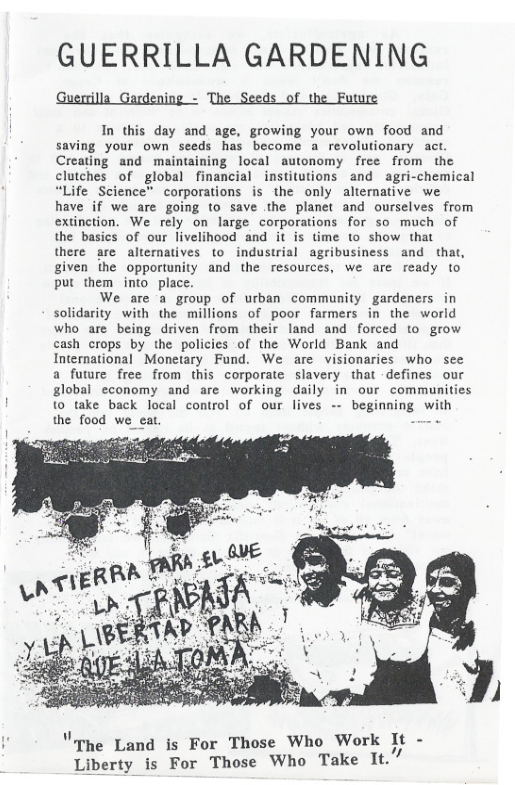
Guerrilla Gardening - The Seeds of the Future
In this day and age, growing your own food and
g your own sceds has become a revolutionary act
Creating and maintaining local autonomy free from the
clutches of global financial institutions and agri-chemical
“Life Science” corporations is the only alternative we
have if we are going to save the planet and ourselves from
extinction. We rely on large corporations for so much of
the basics of our livelihood and it is time to show that
there are alternatives to industrial agribusiness and that,
given the opportunity and the resources, we are ready to
put them into place.
We are a group of urban community gardeners in
solidarity with the millions of poor farmers in the world
who are being driven from their land and forced to grow
cash crops by the policies of the World Bank and
International Monetary Fund. We are visionaries who see
a future free from this corporate slavery that -defines our
global economy and are working daily in our communities
to take back local control of our lives - beginning with
the food we_eat. Gl
The Land is For Those Who Work Il -
Liberty is For Those Who Take It.”
As agriculturists, we recognize that the
reasons we don’t want monocultures of chemical
industrial agriculture on our land are the same
reasons_we don’t want a monoculture of Coca-
Cola, Starbucks, and McDonalds in our cities.
Global commodities cannot afford to be different and local
communities and businesses are unable to survive in a
world of chain stores, sweatshops, and plantations.
Diversity gets in the way of profits and control. The will to
dominate and_conirol nature sees. diversity as a disease and
deficiency. But diversity in our lands and in our cultures
is what keeps us alive and makes our lives rich. As we
stand our ground we must remember that we are fighting
to keep the bankers from turning the planet into a big
strip mall.
It is up to us to take the future into our own hands.
If we leave the responsibility of healing this world up to
institutions like the World Bank and the International
Monetary Fund, we are dooming ourselves to a future of
corporate feudalism and ecological catastrophe. For more
than, fifty years the record is plain and <imple: the people
who design the policies at these institutions are not
interested in alleviating poverty and creating an
equitable distribution of wealth: they are only interested
in integrating people from all over the world into the
market_economy without regard to its impact on peoplel
lives. Their skewed development policies kill
people everyday day. The World Bank and the IMF
have created a system of modern day colonialism that
make the people in the developing world poorer and the
multinational corporations richer and take the power
away from all of us. It is time to take a stand and say “no
more!" This week, as Guerrilla Gardeners, we are creating
our vision of the future as we want to see it, and we
welcome you to join us.
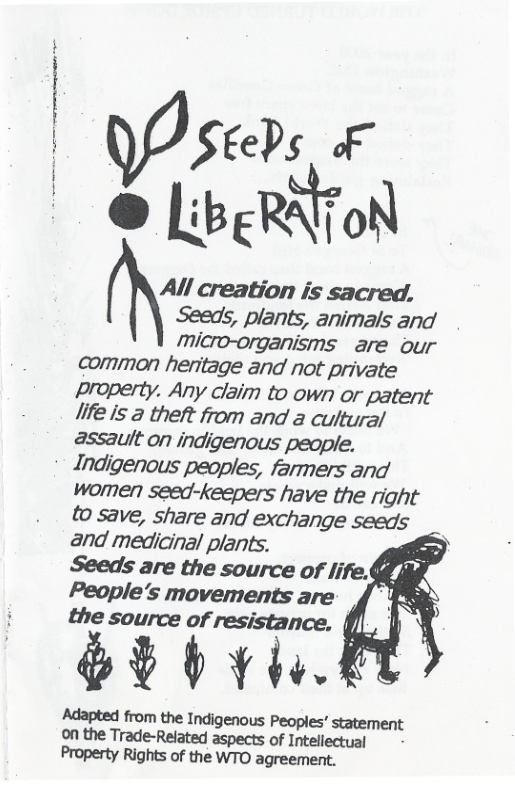
All creation is sacred.
Seeds, plants, animals and
micro-organisms are our
common heritage and not private
property. Any claim to own or patent
life is a theft from and a cultural
assault on indigenous people.
Indjgenous peoples, farmers and
women seed-keepers have the right
to save, share and exchange seeds
and medicinal plants.
Seeds are the source of life.§§
People’s movements are
the source of resistance,
b hviif
Adapted from the Indigenous Peoples' statement
on the Trade-Related aspects of Intellectual
Property Rights of the WTO agreement.
THE WORLD TURNED UPSIDE DOWN
In the year 2000
Washington D.C. .
A ragged band of Green Guerillas
Came to set the lawn space free
They defied the World Bank
They defied the cops
They were the dispossessed
Reclaiming garden plots....
ne In 1649 p
QAR To 5t George's Hill
A ragged band they called the Diggers
Came to show the people’s will
They defied the landlords
They defied the laws.
They were the dispossessed
Reclaiming what was theirs
We come in peace, they said
To dig and sow
We come to work the land in common
And to make the waste land grow
This earth divided
We will make whole
S0t can be
A common treasury for all.
The sin of property
We do discain
No one has any right to buy and sell
The earth for private gain
By theft and murder
They took the land
Now everywhere the walls
Rise up at their command.
They make the laws s
To chain us well
The clergy dazzle us with heaven f
Or they damn us into hell
We will not worship
The God they serve
The God of greed who feeds the rich
While poor men starve
We work, we eat together
We need no swords
We will not bow to masters
Or pay rent to the lords
‘We are free men
Though we are poor
You Diggers all stand up for glory
Stand up now
From the men of property
The orders came
They sent the hired men and troopers
To wipe out the Diggers' claim
Tear down their cottages
Destroy their com
They were dispersed -
Only the vision lingers on
You poor take courage
You rich take care
The earth was made a common treasury
For everyone to share
All things in common
All people one
We come in peace
The order came to cut them down
FROM SOYIRES 15 ENJUGH ‘ THE SE
J INTEE]
FU
INTRODUCTION
Kevin Danaher
s World War Il raged across Europe and Asia,the leaders of
England and the United States realized that,in order 0 ensure
a liberal, capitalist world economy after the war, they would
need multilateral institutions that could enforce rules favoring the free:
‘movement of capital intemationally. In July 1944 the two govemments
convened a conference at Bretion Woods, New Hampshire. There they
developed the plans for two institutions that would shape the world
economy for the next S0 years.
The Intermational Monetary Fund (IMF) was established to smooth
world commerce bj reducing foreign exchange restrictions. ltalso ce-
ated a reserve of funds to be tapped by countries expencrcing tempo-
rary balance of payments problems 5o they could continue trading with-
out interruption. This pump-priming of the world market would ben-
efitall trading countris, especially the biggest traders,the United Sates
and Britain.
Also founded at :ctton Woods was the Intemational Bank for
Reconstruction and Development (World Bank). The World Bank was
given the task of making post-war development loans for infrastruc-
ture projects (roads, utilties), which, because they were unprofitable,
‘were not likely o be initiated by private capital. The Bank was also
mandated to promote private foreign investment by means of gusran-
tees or perticipation in loans and other investments made by private
investors.
The founders of these institutions hoped that by establishing ground-
fules before the end of the war,they could gird themselves against the
twin threats of state-managed economies under a socialist model and
intenational anarchy brought on by cutthroat varietes of ationalistic
capitalism. They saw that if the major powers did not ensure some
access to big capital for the elites of less prosperous countries, those
elites could adopt policies with the potential or unravelling the world
capitalist economy.
“The unwritten goal of the World Bank and the IMF -- one that has
bggenforced with & vengeance - has beea 1o ntegrate countries into
capitalist world economy. Despite all the rhetoric about develop-
‘ment and the alleviation of poverty,the central function of these mul-
tilatetal leading instiutions has been (0 draw the rulers and govern-
ments of weaker staes more tightly into 4 world economy dominated
by large, transnational corporations.
Over the past five decades, the World Bank and the IMF have
steadily gained power and influence, becoming the key arbiters deler-
mining which countries will receive intermational loans. This status
gives the Bretton Woods institutions the power to enforce economic
policies written in Washingion, where both the Bank and the Fund are
based. For many in the Third World,tis harkens back to colonial times.
‘The policies imposed by the World Bank and the IMF are designed
o faciltatethe repayment of bt thatis, th steady transfer of wealth
ut o Third World countries o the bankers of the industrial countries.
‘This transfer of wealth has had devastating consequences for the poor
majority. Money that could have been invested in health, education
and housing has instead been transferred o wealthy bankers. Accord-
ingly, Third World countries under IMF/World Bank tatslage have seen
infant moriaity ratesincrease, schools and housing deteriorate, unem-
ployment skyrocket and the general health of the people decline.
This is why author Sussn George uses the term “financial low-
inteasity conflict” 1o depict the war being waged between rich and
poor. Itis no simply a war between “North and South,” as it is 50
often portrayed inthe mainstream press and academic lierature. Rather,
itis a collaborative effort between southem elites and their northern
counterpats. The Third World rulers get new infusions of cash and
remain unaffected by the austeriy policies imposed by the technocrats
from the IMF and the World Bank. Northern clites get loan payments
and can sleep well at night knowing that their allies in the South will
Keep a tight grip on the workers and keep the money flowing.
Notice that, despite alltheir pressure (o cut back the size of Third
World governments, the IMF and World Bank do not pressure Third
‘World leaders to reduce military spending. Without a strong repres-
sive apparatus, it would be impossible o enforce the harsh policies
dictated from Washington.
‘The Record Speaks for Itself
‘There is a parable about a villager who goes o a local wise man
and asks to borrow the wise man's donkey. The wise man lics, saying
the donkey is not there. Just then, the donkey brays. The wise man
ey
$
wise man?”
Despite the steady decline of Third World economies-under the
tutelage of economists from the World Bank and the International Mon-
etary Fund (IMP), these insttutions keep insisting that their wise men
and their “free market" policies will eventually foster development,
“Third World leaders are told that, in ordet to get more loans to pay off
the old loans, they must implement “structural adjustment” reforms.
These include:
« selling state enterprises (o the private sector in order to make gov-
emments more efficient
« raising producer prices for agricultural goods so farmers.
the incentive to grow and market more food
« devaluing local currencies (in line with their world market value)
to make exports more competitive in foreign markets
« reducing govemment budget deficits by cutting consumer subsi-
dies and charging user fees for social services such as health care
and education
*+ encouraging free trade by dropping protectionist measures and by
reducing regulation of the private sector
« creating incentives to attract foreign capital
‘Yet the central question that s consistently avoided by the enforc-
exs of these policies i, do they work?
Look at the case of Africa. Thirty of the 47 governments in sub-
Saharan Africa have been pressured into implementing structural ad-
justment reforms. The effects have been devastating to the poor. As
carly as 1988, the United Nations concluded: “The most vulnecable
‘population groups, in particular women, youth, the disabled and the
aged, have been severely and adversely affected.”
‘Though-western economists claimed that these policies would re-
duce debt burdens, by 1992, Africa’s external debt had reached $290
billion, about 2.5 times greater than it was in 1980. The record of the
IMF/World Bank gurusis also dismal in Latin America and Asian debtor
countries such as the Philippincs.
Asian countries such as Japan, China and South Korea that have
experienced high growth rates have done 50 not through a dogmatic:
“free market” strategy as espoused by the Bank and the Fund, but
theough highly state-directed economies. =
Usually, we are exposed to analyses from people in the top 2 per-
‘emt o the world's income pyramid. In contras,the book you are hold-
ing includes strong represeatation of Third World voices cxplaining
pauses, then says: “Well, who are you going to b¥lieve, a donkey or a a
have
3
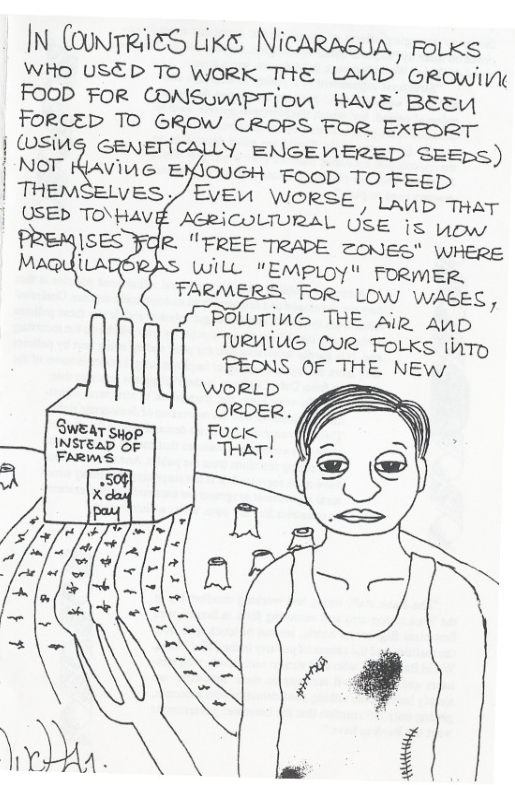
IN (oNTRIES LiKE NicARAGUA | FoLxs
WHO USED To WoRK THE LAND GROWIV
FOOD FOR CONSUMPTIon HAVE B&Ey
FORCED TO GROW CrOPS For EXFORT
| LSUG CENEMCALLY eNeENERED SEEpS)
| NoT iavive EioueH Foop To FEED
| THEMSELVES ,/EvEn WORSE | Lanp maT
AGRICOLTURAL USE is pow
R 'FREE TRADE zoNER' WHERE
WILL “EMPLOY" FORMER.
TARMI FoR. LOW waAeks,
POLLTING THE AR AUD
TURMIUG CUR FoLks inTp
TEONS OF THE NEw
WORLD
the many damaging/effects of the neoliberal economic strategy im-
posed on them by “experts” from Washington. As Martin Khor, Direc-
{or of the Third World Network in Malaysia, sums it up:
“Structural adjustment is a policy to continue colo-
nial trade and economic pattems developed during the
colonial period, but which the Northern powers wan to
continue n the post-colonial period. Economically speak-
ing, we [countries in the South] are more depeadeat on
the ex-colonial countries than we ever were. The World
Bank and IMF are playing the role that our ex-colonial
‘masters used to play.
:
Freedom from Debt Coalition in the Philippines explains that:
“The very logic and framework of structural adjust.
ment policies require the repression of democrati rights.
‘This s because these policies demand drastic iscal, mon-
etary and economic measures that cannot help but raise.
very strong reactions from the public. And such reactions
have to be repressed. I is not surprising that many struc-
tural adjustment programs are successfully implemented
in counties like my own, under
“The Bank staff, living and working comfortably in
the Washington area and venturing forth in luxury, with
first-class flights and hotels, are out of touch with both
the realities and the causes of poverty in the Third World.
World Bank staff, who deal almost exclusively with min-
isters and senior civil servants on their ‘missions,” are
simply bureaucrats talking confidentially with autocrats,
‘getting only information that the borrower govemments
want the Bank to have.”
dictatorship.”
W
A central problem with the stroctural adjustment policies s that
they are developed and imposed in an undemocratic manner. Unelected
elites from the North and South get together and devise these policics
without any input from the poor majority who will be on the receiving
end. Itis hardly surprising that the poor end up being hurt by policies
they have no say in devising or implementing. Leonor Briones of the
W
World Bank, IMF, and Agriculture: Chnchine. Cobb-
s Frae avericr
First it was the chemical-dependent mirace of the so-called "green
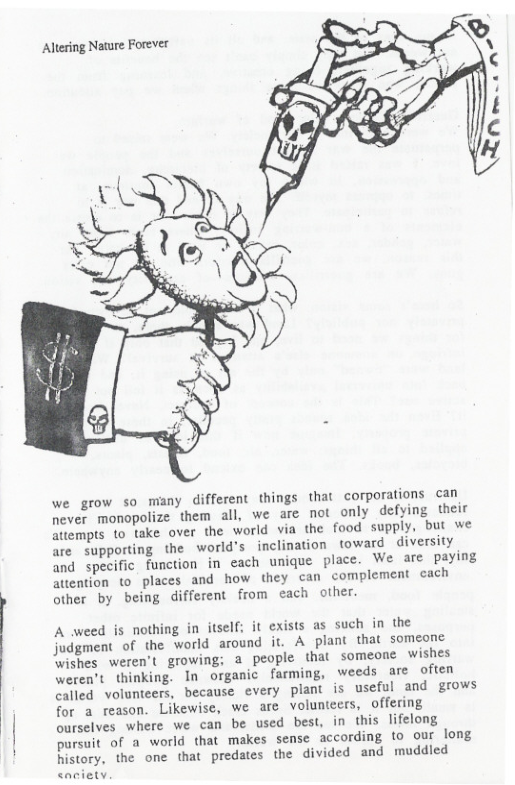
revolution”; now the claim is biotechnology willfeed the world.
The World Bank played a leading role in converting global
agricultural practices to chemical dependent, nutnient depleting,
and polluting system of food production.
It has consistently invested in industrial agricultural projects that
drive small farmers off their land and force large-scale single crops
10 be grown for the export market. Many nations that used to be self-
sufficient are now obligated to import basic food staples because the
majority of fertile land is dedicated to growing a few cash crops for
export. '
Meanwhile, chemical fertilizers, pesticides and herbicides are
wreaking environmental havoc. The only real beneficiaries in this
scenario are the companies who sell the chemical inputs and hybrid
sceds, and their investors. Now that those same companies are
investing massive dollars to develop biotechnology producs, they
are looking to market genetically engineered (GE) seeds and.
chemicals designed to treat the crops. Not only do GE crops
continue the unsustainable trends of industrial agriculture, they also
pose a whole new set of hazards to biodiversity, the environment,
and human health.
+ GEcropsare being commercialized that have pesticides built into
them that are o strong, the plants are actually registered as pesticides
with the EPA. GE traifs can and have spread to other plants through
cross-pollination. Beneficial insects such as lacewings and lady bugs
have been harmed by exposure to these toxic plants. On the human
health front, the concern s that there may be unforeseen allergy-
causing o toxi efecsfrom the novel protens produced by the
combining of DNA from different species. GE foods aren’t required
10 be tested before being commercialized, so we are all essentially
participants in a mass experiment.
‘The World Bank s investing in the *gene revolution,” still promoting
short-term gains for corporations and an agricultural system that
dissempowers developing world farmers instead of supporting
sustainable agricultural practices, like organic farming or integrated
e pamagement A major "structural adjustment” of the World
Bank tself is needed if it is ever o meet the real food security needs
of the developing world.
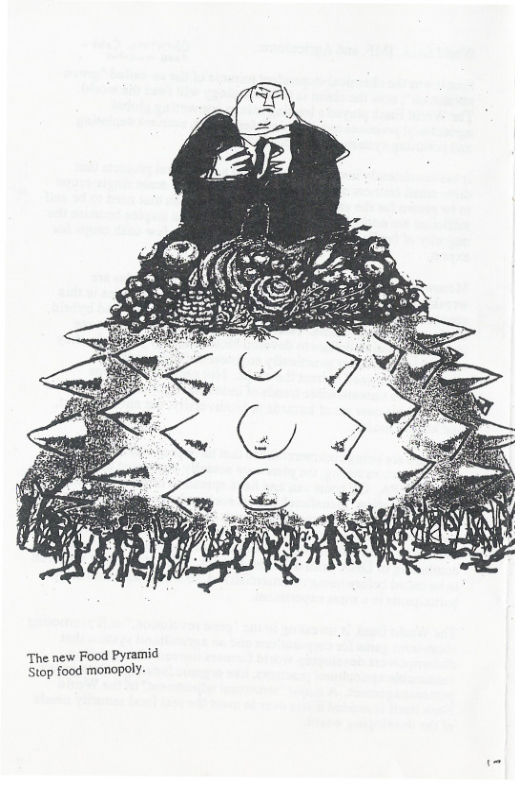
The new Food Pyramid
Stop food monopoly-
THE NEW ECONOMY: THEORY AND RESULT
CONOMIC CLOMLIZATION SEEKS o niege and
merp th economic aciviy o ll countre on the
plane withi » sinle, homogenized model o devel
pment, Countrie withculuresand ndiions s vared
2 those ofIndin, Sweden, Thailand, Bz, France,or
Bhuan reall means 0 dop the same cscs, vals,
and Mestles, 1 0 b served by th same global cor.
poracions, st food resayrans,clohing chais, el
vison,and lms. The homogenous model serves the
ey neds o the st corporans,lowing them
0 duplcte thei fors on 1 evercxpsnding teran.
The goblization process has soe key character-
itcs. e ek, dmgelaen, and pstzaton of 35 much
cconomic aciviy 2 possble, and the rpid omodfaion
of every remaining aspetof e, These incluce the
few remining prsine lements of“the commons.*
clements of e ht have 50 fa been utside the rad-
g sysiem: e, fesh watr eeds, 0d the genet-
1< stmacures of e Allre being privatized and com-
modifd 2 par of the lobalzaion proect.
The desloicl hese of this mode i e rade.
o ot clled v brlzsion’) which demancs
the ciminston of nstions regulaios, s, o s
hat sow down corporations nd thl rvestments 5
they move seoss mavionl borders The goa sobal
otegrtion in oéer to schiev gresicr snd chesper
sccen 10 e rsaurce, e markets, nd chetn
abor, wherever they are. More recently, e ade s
st begun 399y cptal el 1., curency, ks
), which s now traced st 3 hgher voiume than
Sobalmade n oo nd s Modera mformaion
echnslogy has made i possble it unimaginably
rge s o maney estamancout.scross
anywhere i the word, ¢ th snke o compurr key
This b already had il desablting et o tome
Countre conomes sed was 3 pec sty cause of
e 15571598 losal mancilcos. Caen e rde
model defy ackuonifree tade souoms s expoused
v hents cconomic urus Adam S and D
Riardo,whose names e ofen invokea by free race
sdvocates, Newher S nor Ricard bebeved that
rortions howd be mabil. o that capite shovld
FROH » 213
Pty
The il Foem on
‘The anly exception o the present wend toward
the clminaton of conomic borders applie t abor,
which s sl mosy not legaly fee o mave st il
A mbile Ibor force would seriousy complicate mat.
1ers forcorporaions secking th lowest posie wages
a0d wage compesiion among countrie. As it s, mamy
countiesofthe world, he Unied Kinadom among
hem, have begun 1 aéverice that they have the lowes:
wages inthe regan. =
Asother key ingrecientof the fres tade medel s
exportoriented producion, based on the theares of
sxciaization. Several huneired yearsof colonia ule
had aceady creaed dependence on few export
commodites in many countrics. S, unc the 1950-
many small countres of the world allowed polcics
hat soughtgreater natonsl and egionsl sl elnce,
especialy i ccl arss Ik food production. Some.
schieved consderabl sucess and long.term sablc/
by emphasizing a diverse local economy with bos.
iodustraland agriclura bae. it vas parcily
important fo food producton and securiy. Trade
ctivicy remained lively, but mainly in economic -
hat could ot casly be sised loclly,
Local o regonal sefrelance, however, s subver
v 1 ree tade and economic globalizasion, which
epend upon hyper-actmated sconomic acivity n
every dimenon. 1t a e sconomically rewarding
Jor global corporacons when local sconomiescare for
e eed inemseives than t s have ach caurio ship-
Ping maive volme of commodites across oceans
{expor) and ecering ethersGmpors) on sips that
sus cachother i he nighe. So, dung the 19805 306
19901, emendou pesres were apped 104 cunrie,
suriculrly by the Workd Bank and the Inernasional
Mancuay Fund, 1o sbandon the e ofsell-rlance—
15 €ame 0 be synomymeus with soltionim” and
“protctionsn’and to nsiead specalze i producing
+ much smalies number of commodie fo expor,
“Thvens of boycort snd excusion from the ncr.
nasional communicy wer fnaly clictive, nd many
smal counires drogped thei bamiers to foeign v
Tt
‘i by ou,and oiherwise
‘domnate many seciors o the
local o aronsl cconomy,
inching lood production. In
riclure, diveriy offood
producion snd n emphass
o saple foods 1 fed locs
peopk wer seced for sngle:
cr0p monoculnesproducing
Koy crop for export makes,using massiveinpuss
ofchemicl n machines. Inthe en.selrlan
cconomiesand communites, amall businescs, nd
small s were undermined by syt that snds
mass roduced manufctured snd sl goods
seaming aound he planet s saggerog rmionmentl
‘coss i the orm of ocean and i polluon,enrgy con-
‘ampion, and devsating ifrasnucnae developments
(e rods,pors. pielnes, s, and sepors).
Mach o the presue o change cume packaged n
18 form of e aftmnt program hat he World
Bank nd the Iicmaional Manctary Fnd forced upon
smal countrs. These programs inched comditonstic
for receiving the louns hat would theereicaly help.
them make the sramiion 1o an expor semed, fee
irade cconomy. In dditon t demanding i redc
tions and openingup o foreen corpoae vesiment
the loan condtions eaured shrs reductors in
spending on socil progrms ich ¢ educion helh
care,smal usinessassance. wage supporn, and
othr ocial services. Withous thes apport. o
Seope sre sdenty much sooer.Insddiion. curmercy
deoshun 140 14 10 make he e s
e producion mare sppes
Alof these asues, combined i the presures
sratze ntional indusires. e sconomies tha hac
been elatively sellrelans wtrly dependent on i
masively indebted 10 banks 3 glbalbureacracis
sitntion om whichthey re v g t fnd sl
forexpor markes
“The raonae for il o these fre rade and e
masket theores was sht hey would produce accier.
e cconomic owth becuse they e corporaiam
arely cxpanded cces o resaurces and mrketsand
frecd them from pesky environmencl s and socal
sandards. Fre wade teoriss clamed e the ‘g
idewill ol bowes* providing Srod cconomic
benehts o allevelsof sctery. The vidence o e
{
Foe rade thorsts claimed tht tbe
“riing de il ol s, ” providng
broad iconomic b o al s of
secety. The codoce 30 Jar clarly
showstht i s oty yachs.
clearly shows that i s
only yachis
Al recen research confne
that oy s small umber of
peopie t the 109 of the glot |
corporate pyramid—CEOs o/
sloba corperations and a small
menbecin bpper mampement
—experence sgnificand ben.
s from e growh xpansion, meryer,an consol
datcns created by globalizaion. The gaps berween
the wealthies and poorest people in sotety, and
erween management and worker, have never been
50 rca 35 they are today. This comes fllowing s
periodofthe most apid sccleraion of lobal co.
nomc ity in hiry.
Atecent reson fom the s for Polcy Sudes
shows that American CEO# ar now paid, on sveege,
9 umes mre than ine workers. The Economic
Polic st 1999 rport shows that median hosely
<aues. when adusted ot llauan, re down by 10
percent n he e 25 years. The LLS. Federal Reserve
s that he 109 30 percent of the LS. populaion
15 84,6 sercent ofall the weslth i the county
And he wealt of the workds 475 billonaies » equal
@ the snnual icomes of more han 50 percent o the
<opic on earh O the 100 arestccamomies i the
orid, 52 e corporauons. only 48 e countnes As
o 14’ The 10p 200 lobal corporaians of the
uid—crvoying the elfciencic ol sale and coml
percent ofthe
somal work force. Litm all boats e
Neanwiile, according (@ s UN suudy. the gap
sctween rich natons ad poor nes i alo cxpancing.
Secaute of incauies i the global rading sysem
Thd World are beginming 10 flly undersiand that
e ruley of globalzation are meant 1o beneht ot
ihem. bt ony sreless lobal corporarions.
I sddion, environmensa havoc creaed from this
e has reached an unprecedemed lvel Glaoal
desructon of hubar
ol aid climate change, an other resuls revious-
Iy s ar il damaccaly xacerbated by 2 sywem
esaned and comuruced 10 place economc vaues
and corparae sel-nieres sbove allothe vahts
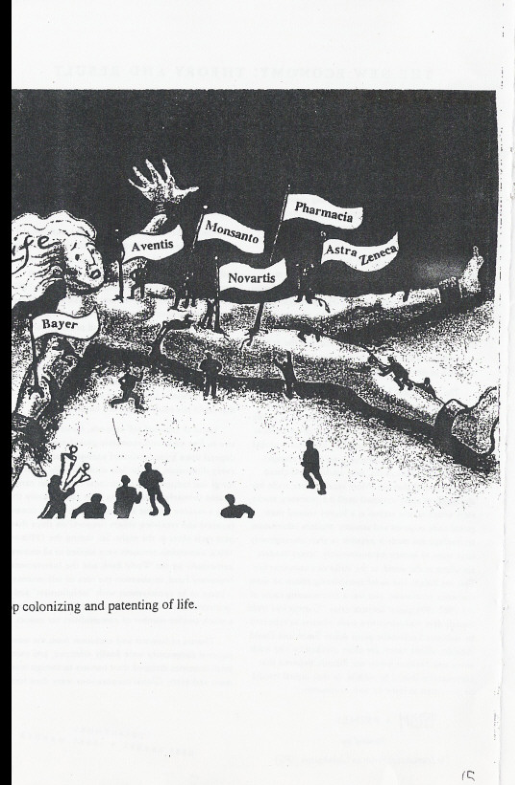
Sugo cone bmestrs i oo Eqypi—Loend of groving fod b,
f oy i tationsa aemens curap o cuni oot mor nd e merscol (1. o o)
of ey dows, suh o s v Jo
ai, ol i damatic pice o ey o commedilis,For
Jo s cam dreped 3 pct.
e bclppulatin, b g plcs and bl e s
Tl sy s o e rdection bic, ombnation e wtobe
Bl i 1998, te e b 1o meny i coni
AGRICULTURE, FOOD, AND PUBLIC HEALTH
AUTHOUCH TRADIE I ACHICULTURAL g0ods has becn
soin on for cennries malacl, famiy farmers e
prnvded foo for themslves snd hei comerites for
mllnnia. Even oy, sbout hafofthe words peeole
Sl ve o the land, growing ood fo theie s
and commanies. Homeve, hings e changiog apidy
“The sl relant sysem that mphasaes ksl pocucion
for local consuaeon i being tken over by 3 ne,
slobally ndustraized e system that s el
izcd and comtrolled by gant syribusinss cororaions.
Farmers are being driven off tei tradiional lands
ommaniesare being decimated, and bunger on
the re. Inthe South,a global corportons operse
cver rger e, thes repace stale food production
vith monculnwes of lxary ems ot xport markets,
And, al around the globe, they replce peuse o the
a0 with machines and chemicaks, eoving onc s
ulfcem farmers lndis,jbless d e horneess
The clminsion ofself-sffcins, small sale
arming i sualy explined sway 330 unconrolble
cvolutionany step toward ‘rogren” This s no 10
th slobalzation ofsedusrl ariculure has e
deliberne and conscous, Claal nstiasions sch o5
the WTO havecreated e that xplcly fovr rge
cale, heavly indostrilized sport.orinted ysems
of production. As Eugene Whela, lormer Canadian
lederal agriulewe miniser, observed, These deals
vt bout e trade. They'e sbout the right of
these guys[corponte sgibainesies] 1o do buiness
the way they want, whereer they wans”
THE GLOBALIZATION oF
THE T ADMINISTERS s0d enforcs severl s
men ffecng o, All of theey seve the -
ook o lobal agrbusncses. Blore the WTO,
ineratons| rde sgrecments ssch 3 CATT hmsed
et rele i agscubre moinly s setting cvotssand
ol Bt 35 g agniasineses became mere mient
on Capeing lrges market, the ndusey began 1 s
ard for forther iberalization m agrculore thegh
international uade instraments. Then, he Uruguay
Round of CATT produced greemenis the s
cxpanded s e over moresspectsof sl while
fimitin the sower of nsonal goveraments o protect
heic o farmer, conmmers, and st esources
Globally ndisralized sgriculue ot only dives
el e off he and. o s crestes erble e
e nd dependencie o those that ermain, rstesd
ofdesting with local s armers e ow subyect to
ket frcesgenersted by gant verially inegrated
bl corporsions powerkl enough o nflunce both
supplies and pices ¢ every levelofagricitura aciv-
. The reslt s enormous pice volaliy, Famers are-
ellng 1 an icreasingly centrized monogely o ood
corsorsions that canply boththe domestc snd world
makeis uing one group of famers aginst anothr i
iemaional rcing games Since WTO pofices have
enteed he ieur, sloba pricesfo the worlds major
crop,sch s cor,toybesns, whent, <otton, snd e
v resched ther gt and lowes eves n the st
20 . The years o low rics have ined millons
of farmers. The yearsof high prices have hrt poarer,
developing countes tht have become relznt on food
import;causing malnuttion snd survation.
Even relavely sophaticaed family armers in
developed coutries i that they caneot compete wth
the huge capial outays agrbusinss can make, no do
they receive the pefernces snd sbsidies that v
sbusncss underglobal rade rles. s el record
mambers o famers e being dven of f lands tht ave
been marured and maintined by familes and commu-
i fo gencrations. n outbern countries,millons
o armers have b dislace, resuling i mssve
igraons nt alesdy overcrowded cites. According
10 USDA, over 0000 family farms bave dsappenced
over the ot e yers
Throughoot the cenanes, aadiions amers have
developed 1nd poteced s treary ofseeds and plants
dapted 10 loalconditons. n ndi, frmers developed
more han 300,000 vaieticsof rce, Chle Bobts hun-
dredsof vanctesof otatoes, n Zimeabwe there arc
umerous vaneis of maize, Th wealth of agncural
biodiversy it being ot i the converion to mono
culure, o sngl, crops. Scentists fear hat fusre
sdsptaion (o both naural and manmade dsters such
¢ cimate change, Tooding, desetfcation, ind the
slobal cransport of pest speces i greaty threatened
35 the gene poolfo crops becomes sriously depleted.
The new sriculure sysem s sho connbutiog
1o nutrson] deicencies among many populations
Because industal rculure s dominated by western
corparatons romotes 3 western e, Bt pecrie in
developing countrs often cannot sford the full
range o westen de, specially meat The western
food they can sford i no shesye s tctous ol
wnlly desable 1 the vaned trditonal food crops
developed over time I Icha or example, traditonsl
rains such 3¢ orghum, g mle,and barnyard
il have hghes protein content chan the varey
of wheat grain uied i the Norh, yet these ancient
rans ofInd re i danger of being wiped out 33
et o WTO polces tht vor agibusiness frms.
and indstria monoculture.
I sdditon o causing malutrition, hunger s
exacerbatd by thisglbl ood production system.
Around the world, over 800 millon people g0 gy
cvery day. Athnigh food production ha incresied n
the Exst Autn counriesthat partcionted in induscril
sgmcultral polcis ncouraged by nstiucions such
a5 the World ank, hunger has amatically ncressed
Countristhae were formery food sel-suifcent re
o grcwing expor srops—many o them high-alve
Taury ems such 2 ot planesand flowers, cotons,
exorc it 10d vegetabies for xport t wealthy
countre. A e, food production for localcon:
emption decines
The envirenmentl conseauences o Irgescile
sl sgncsiture re cxtreme because it requies
esvy chemicl nd pesticide e, deplets he si,
ncreses st sage, and ues large foel-consuming
machiney,scding o emisions f climate-changing
o BoTect OMIMIE
R ey
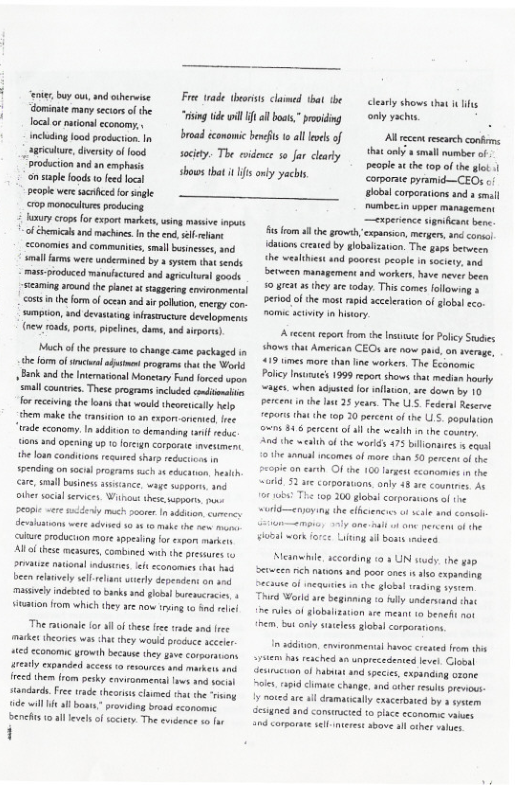
Puim il poweionm Sabah, Brwo—The 1957l P WTo AppICTION.
ol Sutes A . cloud of sk bl ¢ e of
I e waily caed by lansioncompanics, obic -
sty e et b s St o b oy o e o ot
iows WTO grculalpsisions oo b e oo
oo ad xcouage xpoionof pettions Sl
formers i Indoncsia, bowees, b b decmstd b WTO
[ ————— S
1 the b ofthe process. The inernasionsl trsnsport
eauied by 3 obakzed el system dramacaly
increses the need for ew infrastracture—more rouds,
pioeins, and iports—uhich s ually desncine
0 the crronmens, 8 well 1 rearing 3 reser e
o foss s The remendcos growth i ocean shin
g increases ocean polluticn and briva wave aher
v of nvae species— bactera, paasices s,
wects nd st hich s o rucks,
lanes, o hips hesded for new locals
Another environmenia comseqence of the new
sysem is 3 icreaed dependence on borechnology
senctically modiedosganisms). This notonly
nninks the o9 yene po furher, but thre . growing
dence ths geneticlly modifed crops new
1 ol e poltion s the geneically modibed
s sprsd 1 neighboning cros and weecy reuives
wough crosspollastion. I the case f ians alered
2 be petresatant his ew kind of pouion has
ready been shown o ull umargeed isects This
iy ead o ieversbe changes inplant and il
enetic sucrure and n cologicl balnces
; ; 85
Can'tHang with the Monocult - Lessons in the Forest
Kickin it on the Farm - Month Seven lb\
I'm sitting under a huge cedar tree on a thick cushion of moss and
needles and decompusing wood, its early Saturday afternoon, and I'm in the
middle of the forest across the lake from the farm. I've been working clearing
trails in the park here for the past bunch of hours, cutting back sollal roots
and pulling up ferns; now I'm watching the squirrels run across the upper story
of the tres and resting my sore arms in the shade, feeling sweat beading
down my neck, listening Lo the sound of my breath and the birds chirping and
the wind blowing across the Lake. I'm about at fern level, looking straight up
into the crisscrossing network of spirals and whirls of trve branches, light
fickering through the patterns of needles and swirls, Tho soil under the
cedar needles I'm resting on is thick and black, held logether with
decomposing organic matter - constantly in flux and full of life. 1t's all
mulched under a carpet of the tree’s energy - breakings down and building up
“and breaking back down again - slowly getting taller and deeper - holding
the energy in and letting it go little by little over time. Life in this forest is
an endles flow of producing, consuming, and decomposing. The tree I'm sitting
under sheds it's weight and builds the sol it stands in. The old growth fir
trees stumps everywhere that were hand-logged back in the 1920's have
giant new hemlocks growing out of them - the new trees taking advantage of
the old root system carved through the soil and rock.
Here in the forest, everything is connected up and down and
underground - from the smallest microbe fixing nitrogen in the soil to the
cougar catching a deer for its dinner on the edge of the bluff, There are a lot of
important lessons to learn out here. 3
‘The Backdrop:
S0 while most of my friends are back in the city somewhere
cultivating their stress and balancing activism and computer temp jobs or
scamming their way along the trainlines and supermarket dumpsters of
America, this urban kid has been learning how to grow food and living at a
farm near the edge of the forest on a tiny island in British Columbia for the
past half a year.
Herv's my routine: | wake up in the morning with the sun and write
down my arazy dreams, slip out of the house and feed the pigs, water the
greenhouse full of tmaloes and peppers, tend Lo my litlle broceuli transplants
which are just starting to make heads for Fall, maybe jump in the lake if it's
not to chilly. Usually after breakfast, me and the rest of the crew head out to
the production garden and harvest com and beans and squash and carrots and
eggplants and leeks and beets and lettuce and tomaloes and zucchini and
basil. We work un building compast or building fences or slowing down erosion
in the creck that feeds into the lake by our house. A couple times a week we'll
have a discussion group kind of class on soil chemistry or composting toilets or
land trusting. A couple of us are building a seed bank and networking wilh a
bunch of local farmers and seed companies and exchanges.
1 my housematee are Feally busy with projects: canning fomatoss,
um,mummx?mmmndwmmuhmA@mm‘Lm“m 0
esto and tending 1o the berry wine. Our eight month sustainable agriculturs
Drogram ends in six weeks and we're all planning our futures, heading offin
{ifferent directions ready 1o take on the world with all thiy knowledge in our '
ands and arms and minds.
My days are really mwmmwm around food - o ing
, tending to i, talking about it, studying it, i, processing it
Lting . 've been t-bud graftng, frut trees and rooting semi-hardwood
utings of shrub and trees in tins of wet sand, saving tons of different kinds of
agelable and flower and herb voed, staying up late at night reading drip
+gation and biofurtilizer and plant propagation textbooks. I swear it's so
magical - like casting spells - gelting the liming down and mixing up the
it amiunty of soil and seeds and water and sun and - pool - it all tarts
srowing.
Reclaiming Lost Knowledge
‘What's incredible is that people aren’t learning these skills anymore
food cultivation and land stewardship are rapidly becoming lost arts. Not
o many generations back most of our families were providing Uheir own food
in one way or another. Our randmothers had fruit trees in their backyards,
wur grampas would catch their own fish, people would save their own seed
2nd grow the same tomatoes their gramparents had grown. We lived in
tighter communities with more localized economies and had a doser
connection to the land we lived on and the people around us.
‘Now a couple multinational chemical companies own most of the crvp
seeds in the world and genelically alter our food t be dependent on their
fertlizers and herbicides. We grow our food on huge tracks of monocropy
Jand and transport it all over the place in monster Irucks and buy it wrapped
up in plastic from nightmarish superstores. We've sprawled out of our lies
i strangleholds of highway and covered up our best agricultural voil with
cancerous growths of suburban development and indusirial paris. Our ecoomy
s based on an infinite growth model that doesn't factor in our limited natural
cesources or peoples’ livelihvods and happinvss. The rivers are full of toxic
\aste and there's a law against fruit treey in my home town because the fruit
might fall on peoples’ cars. Kids like me grow up in big apartment buildings
totally alienated and clucless and never knowing where our food really comes
from or how anything really works.
Whaen [ listen to the news on the radio ful of war and cat
ind stock market bullshit, 1 take comfort in the fact that the ukills 'm
carning will never become outdated. No matter what I end up doing I will
never be downsized and replaced by a machine. I'm going to spend the rest of
ny life helping to clean up the mess the corporations have created inall * |
their greed and shortsightocness. And just like the rest of the people [ work |
with everyday, I'm just going 1 get better at al of this stuff as the years go
on. Anyone can learn how 10 grow food and take care of themselves and the
\world around them. What follows are some rough notes about some of the - @)
7+ ¢ been leaming out here.
+Straight Up Permaculture i
Everything we do on the farm is somehow mimicking things that
. happen out in nature. The principles and forces at play out i the forest are
3 the same ones we use W design our fields and gardens and homes and lives.
Where I've been living is like a big experiment in organic development and
sustainability. Instead of acres of tractor illed monocrops full of pesticides
and herbicides and fungicides and factory buildings pumping out mutated
cows and chickens, we have an onganic vegetable gardens and happy animals
and what we cll itle patches of permaculture scattered throughout the
Energy Cycling
In the forest water fally from the sky, soaks into the soil, moves
through the soil and across the land, rises up in the stems of trees, and returns
10 the atmosphere. The same way the trees in the forest hold onto waler, use
it, then et t back out - we try to turn flows of nutrients and eneegy (sun,
waler, wind, organic wastes) through oue farm into cycles.
We have a pipe which runs from our water source (a spring) up in the
hills and intercepts the flow before it runs down the creek and into our lake.
Our pipe connects down 10 a big ferrocement tank at the top of a bluff which
connects toa rumber of other pipes which carry water down to our houses and
fiold. The idea s to catck, store, and ue all of our resources before they run
ff the property. Recydling kitchen waste into compust, channeling household
greywater into the garden, raking leaves up around treey as mulch - those are
all differvrtt ways of energy cycling. Rather than using expensive, complex
‘machinery which need petroleum and random parts from the other vide of the
world, we use hand tools like scythes, wheelbarrows, forks, and spades, The
energy we expend out in the fields goes into our food cultivation, then we vat
the food and the cycle starts all over
The idea is to create a closed cirdle where we feed ourselves and don't
have to be dependent on the global market for our survival. Thé idea of
localized economy is based on the same prindiple - supporting your friends and
regional commaunity and keeping the trade flowing in a circle. Buying from
the neighborhood family market rather than the megamall - supporting
local businesses rather than giving it to people who aready have plenty of
‘money and live really far away from you in fancy houses somewhere.
Accelerated succession - pioneers and dimax speces.
. The forest develops and changes over time, always giving rise to a
new succession of different species. Each stage creates the right conditions for
the next stage. When the trees get cut down on this land, the first thing that
happens is the alders grow. There are patches of alder all over this forest
from where the 0ld trees have been clearcut. Alder i a pioneer species. Their
roots fix nitrogen in the ground and build up the soil for the next generation to
come along. As the rest of the flora and fauna deveiop around them in layers
of vines and shrubs and ground cover, the cedar and fir slowly begin growing
agin. Eventually the alder fall and break back down into soil, shaded out by
the climax spedies cedar and fir. )
‘The same thing happens in abandoned rubble lots and pastures and
anywhers elsa where the fand has been discusbed, Arvas wiil be colonized by
2 new weed and herb layer which might hold the il against erosion, bring
walur t0 the topsoil with their roots, break up compaction, fix nitrogen,
ruduce valts, or bring up nutrients from the subucil which will end up in the
topsail as they die back and decompose. Blackberry bushey with big old
thoms will invade an area and keep everything else away while the land
heals itself, Eventually, just like with the alder, trees will grow up through
the blackberry vines and shade them out.
‘We can do the same thing by building up the soil and substituting our
own herb, pionevr, and dimax species. Depending upon the type of sol you-
start with (which might be eroded, salted, swampy, worn out, acid, alkaline,
clayay, or vandy) - it’s passiblo to introduce plants that will easily survive
and might by more useful than the existing Vegetation. We can grow cover
cropw of clover or alfalfa or peas or beans which fix nitrogen in the soil and
then turn them in o build up the fertiity. We can grow buckwheat which is a
! phosphorus accumulator or winter rye which suppresses weed growth. We can_
introduce animals into a system and have them do our work for us while they
happily live their lives. 1 we play our card right, in 20 years we can end up
with forusts of hazelnuty and peaches and blueberries. That's the plan - a
permannt agriculture.
Sheet Mulching
Theres al these subtle little sheet mulching projects all over the
farm - i's a really basic, cool idea. The grass is full of nutrients cause it's so
good at pulling minerals up from down in the subsoi. It becomes obvious
pretly quick that it's a wasto of time and resources to try and pull it out of the
ground and clear beds for growing stuff. IV's much easier o just throw a thick
Iayor of wet cardboard or an old carpet over an arva - wait a year - and when
the Lop layer of woeds is dead and rotted back into the woil from all the heat
and lack of air, then it's time (0 sow the vegetables. Periodically | stumble
‘wpon one of Brent's mulch spots - sets of bamboo poles or alder branches with
niteogen fixing beans trelising up from the cardboard, getting the soil ready
for next year,
Pigs and Junkus
The pigs | feed everyday are fenced off in an area full of this thick
weed called junkus that's scatterod throvighout the pasture land. Is really
hazdi o get rid of with farm machinery, but pigs love to dig with their snouts
1 and root up whatever they can. The longer they hany out thare, the clearer
that soil gets and eventually the farm crew is going to plant another fruit and
nut orchard. We get 1o fevd them our gacbage, they get to play around all day
and be really cute, and a bunch of puople (nol me) are going to be eating a lot
of meat in the Wintertime.
Cous and_ Bamboo
‘The cow bam is cluse the lake. There's a huge dump of bamboo that's
been planted at the edge of the barn which absorbs the excess nitrogen from
the cow manure which would otherwise run down into the lake. The clump
gets periodically harvested for polus. Evarything works out.
Plant Stacking and Time Stacking and Swales
In the forest there are a series of interconnected levels - from the
understorey of ferns and bushes o the upper canopy of the mature trees.
Lnstead of planting a flat fild of one crop which needs ton of attention and
water, the idea is 10 intercrop taller and shorter species, climbing plants and
hecbs and different kinds of troes - everything placed according to their
shade tolerance, heights, and water X
o o e i I S rrmen o s 0 St
10 rnall dngma poad which cey it dws o the boom o the lope
At the bottom of the slope thery's a bunch of raised beds made of sticks and
mud whero all the garlic i planted. Swales are just thse long Jevel
excavations that are dug to store water in the underlying soils or sediments.
‘They're different than ditches because instead of just diverting water so it can
drain somewhere clse, swales work to intercept the water flow, hold it for a
few hours or days, and let it slowly infiltrate the ground wator,
soill and troe root systum. The site was a big swamp full of alder trees 2
‘couple years ago and slowly the permaculture crew has been rerouting the
water to make the wet areas nicer and the surrounding areas more fertil for
growing ground crops, carcfully romoving the alders and replacing them with
fruit and nut trees. Trees are totally important parts of swale
systems. Our teacher Brunt shows us how he cuts the alder trees to harvest
their wood but doos it in'such a way that the younger trees can take
" advantago of the old root systems and exposed sunlight from removing the
‘canopies. Justlike everything eloe around here, the idea s to set up the
system 80 that it doesn't need any inputs from the outside and can totally
function as a self-contained ecosystemn.
Guilds
‘The fir trees in the forest have like 26 different of fungi and
scrubs and insects that somehow pay a role in their ‘m:iylrn\d Iu‘-‘;a the
Mlh-mhup,hidmwfinqndhflu-flybu&u-flm
together to create an interconnected web. Sometimes, rather than
about organisms individually, its useful to think of them in chusiers or
groups. When the individuals are clustered around a central eloment we call 7
Hheseg0ups gid. I th foret we cun tlk about i i re gl !
ere are a le of fruit orchards spread around the mo
apple and plum trees. mdm.mumanmpwmh:‘n{u
srass down in the orchards by grazing, They also eat up any fruit which fally
and rots on the ground, preventing diseases in the trecs. Evety week or 80 the
sheep are moved from one orchard to another so that they don't graze the
grass tov low. To keep the trees healthy and not competing with invasive
grassies, we grow yarrow and dover and borage and nettles and comiry around ‘
the them. The shevp also eat these and like themm oo, We can say that the ©
sheep and hecby we o i the orchard and th trees ar allpar of th it
guild.
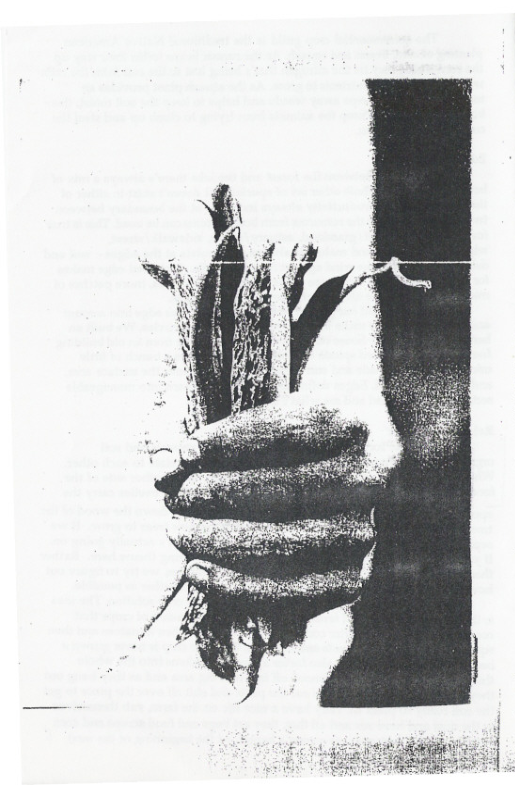
The quintessential crop guild is the traditional Native American
planting of corn, beans, and squash. As the runner beans lrells their way up
the com stalks, they fix the ifrogen that's being lost to the soll from Lhe co
‘which needs & lot of nutrients to grow. As the squash plant provides an
understorey which keeps away weeds and helps to keep the eoil maist, their
big spiny leaves also keep the animals from trying to climb up and steal the
‘con ears as they ripen.
Edge
At the edge between the forest and the lake there's always a mix of
both eclogies and whole other set of species that doesn't exist ir: <ither of
the two. Ecological productvity always increases at the boundary between
two ecologies because the resources from both systems can be used. This is true
for land/ water, forest/ grassland, estuary/ocean, sidewalk,/street,
‘wherever.) Energies and materials always accumulate at the edges - soil and
é"'alnx...-m.w«..hy-u.,.wim-g;---u..\_nm.n. Increased edge makes
2 more productive landscape - creates more surface area, more patches of
sicrodimates. People always want to live on the edges. 4
‘When we build our garden beds or ponds, we take edge into account
‘and dor'tjust always make them normal rectangles or circles. We built an
herb spirai next to vor house out of smashed up concrete from an old building
foundation. The raised spirals condenses space, creates a bunch of little
‘microclimates for shade and sun tolerant herbs, increases the surface area,
and looks really cvol. Edges define areas and break them into manageable
‘sections - look around and see what I'm talking about.
Relative Location =
» Out in the forest the individual plants and animals and soil
arer( nearly as important as how they ail relate to each other.
mmwa-mba{‘gmmmmqml?ymnummmm
forest and plant new trees by shitting out the seeds. Bark bectles carry the
*wndwmrulmmndwwhlpmammwmd.mhe
irees back into soil which provide the materials for new trees to grow. If we
te out each 's hard to appreciate what's actually going on.
1 you haven't already figured it out, this is a reoccurring theme here. Rather
than viewing everything on our farm as separate entities, we try to figure out
how as many of the elements in our system can work togethe as possible,
i our production garden we have a five year rop rotation. The idea
s that we keep up the soil ferilty by growing a succesion of crops that
complement each other: after corn we grow beans and then tomatoes and then
scquash. To throw off the pests and diseases; the same crop is never grown a
bed two years in a row. We also factor a slew of chickens into the whole
thing: We keep the chickens fenced offin a nice big area and as they hang out
they scratch up the ground and eat the pests and sit al over the place to get
in. They have a nice life on the farm, rub themselves
the soil ready to plant
in the dust and have sex and all that, they eat bugs and food scrape and com
scratch, we eat their eggy, everyone’s happy. At the beginning of the next
‘growing season, we move the chickens Lo the where the com was growing the
year before and keep rebuilding the fertility. Just fike in the forest, we're in
the process of creating a long term self-sustaining cycle filled with different
interconnected elfements.
Diversity
By growing tons of different kinds of things, we're guaranteed (o be
eating well year round. When onion season s over, leck season is just
beginning. When the kale is starting to all go to seed, the finst heads of
lettuce are ready to harvest. In our orchard there are eardy, mid, and late
season apples trevs all dight next to each other. With all our canning and
drying and freezing, there’s no problem eating jar and pesto sauce all sorts of
other goodies all year round. No one ever gues hungry around here. If this
was an ind cstrial monocrup farm, we'd have to ship in tons of food or things
would get really boring, Diversity in all about stability and living large - the
important stuff.
Urban Guersilla Gardening - Growing Food in the City
We need to start growing food where we live and reclaiming all this
Knowledge for ourselves and future generations. We can't keep importing and
trucking all of our food all over the globe and let big corporations contro the
mast basic aspect of our lives for us. There is so much polential for growing
food in the cities and suburbs. Taking over abandoned rubble lots and roof tops
and lawns and starting community gardenw. Bulding compost with all the
onganic wastes from supermarkets and restaurants and our kitchens. Catching
‘water before it rans off into the sewers - building ponds and attracting birdy
and insects, Creating urban woodlots of fire and timber wood grown around
industrial zones can filter pollution from the air, produce oxygen, create
habitat for birds and small animals, and not make all the buildings so damn
appressive. Lucals parks could be full of fruit trees and berries. We could
graft scion wood of good fruit trees to crab apples in alleyways or non-fruiting
cherries and peaches and plums in parks, come back later for the harvest. We
‘can dumpster to:s of bathtubs and tires and milk crate and refrigerators and
other good stuff to grow things out of. There's more edge and vertical growing
opuce han 7 can shake & sk at i e iy The possibilities are rich. Iy
Tike sculpture and art - dealing with living systems that change over
time. IVs so important to bring this stuff into the city, bridge connections
between people of different generations and cultures, teach the kids that
there's more to life than concrete and hate and fear. s
Everyone around here knows me as the aggro city kid, the one who's
somelimes {0 impatient and loud and talks faster than everyone eise and
goes out smmashing up concrete slabs with a sledgehammer and builds raised
Jegetable beds out of sticks and blackberries just to prove we can grow food
even in really crappy soil. As I've lived on this farm for almost an enlire
growing season, ['ve learned a lttle bit of patience and calm and a whole
bunch of skills that I'm looking foward to bringing home. 7
information and Jmagination Books to Check Out:
The thing about all this stuff s that it's a lot more information and
\agination intensive than capital or energy intensive - we rely on
each other, our observations, and the thousands of years of
accumulated knowledge from peoples experience, ideas, and
experimentation.
‘There are some really good books out there that cover a lot of
the basics of food cultivation and sustainable agriculture. Here are a
couple good ones. I've induded the ISBN numbers because ] used to work
ata bookstore and I know how much easier it s to look shit up that
way if you have a computer.
Intreduction to Permaculture by Bill Mollison with Reny Mia Slay 1991
Tagari Publications 0-908228-08-2
Everything I've just been rambling on to you about is all covered in
detail in this book. It's changed my life. Nuf said. Check it out.
Start With the Soil by Grace Gershuny 1993 Rodale Books 0-67596-
567-9
Very eloquently lays out the basics of building soil: humus and compost
and moisture and nutrients and basic chemistry. Beautiful tables and
diagrams of indicator weeds, cover crops, organic amendments, acid and
alkaliné tolerant plants, otc. Really good chapter on dealing with
fucked up city soil.
Robert Kourik 1986 Metamorphic Press 0-9615848-0-7
Incredibly thorough manual on creating gardens and orchards step by
step next to your house. Great chapters on tree crops and reclaiming the
suburbs with vegetable gardens. Full of useful photos, drawings, and
charts.
by John Jeavons 1974/19% Ten Speed Press
All you need to get started learning how to feed yourself and your
community. This book has been translated into a bunch of different
languages and is used all over the world in successful sustainable
agriculture projects. Really good sowing charts and illustrations.
‘Seed To Seed by Susan Ashworth 1991 Seed Savers Exchange 0-
9613977.7-2
‘The definitive guide for anyone who wants to learn seed saving
techniques. Includes 130 vegetables. Describes botanical classifications,
pollination, isolation, caging, secd harvest, drying, cleaning, and
storage. Really important stuff.
And please don't complain about books being expensive - get a library
card for fucks sake. And if there’s twice as many cops in your town as
there used to be but they've cut the library funding in half - make some
noise about it - educate and articulate your bad self. 27
Further Resources
il is an international
network of farms that rely on volunteers to help out in the fields. In
exchange for a hard days work you get 3 meals and accommodation and
a8 much practical experience as you want learning about farming.
Usually how it works is that if you're over 16 you can pay like $20 for a
Jisting of hundreds of farms and an ID number. Then you call up or write
to specific places to find out more details. | know a slew of people
who've worked their way around the country acquiring skills, getting
strong, and living well from hooking into the WWOOFing network. Its
an incredible resource and working on a farm sure beats hanging out on
the street drinking with your smelly friends and talking about how
much it sucks in the city.
‘The Permaculture Adtivist PO Box 1209 Black Mountain, NC 28711
UsA
Published 3 times a year and always full of good articles and contacts.
The classifieds always have ineresting offers for work and trade. The
latest issue s about patterns in nature and has been keeping me up at
night spellbound.
camhip D
Northeastem Organic Farming Assodiation (NOFA)-Mass 411 Sheldon
Rd. Barre, MA USA 01005 - found this ad in the back of the
Permaculture Activist
Wite to Eric Toensmeier and ask for their Directory of Organic
Farming Apprenticeship programs for farms all over North America
and internationally.
ATIRA (Appropriate Technology Transfer for Rural Areas)
“This group s based out of Fayetteville, Arkansas and they put out a 23
page list describing intemships and apprenticeships for organic and
sustainable farms across the United States. You can order a free copy by
calling 1-800-346-9140.
‘That should get you started, punk. Get out there and grow some food.
1f you're interested in this sustainable agriculture program I keep
talking about, address your queries to David Buckner at the same
‘address. The farm accepts 5 to 10 students every year and they need
hard working, dedicated people. Good luck out there.
Linnaea Farm
PO Box 98 Manson's
Cortes Island B.C. VOPIK) Canada
This land should be our land. =
This land ain’t your land, this land ain’t my land,
Could be.a rich land, but it's a poor land flfi
Cuz it is private property for profit gain
A weapon of the Bank to cause great pain
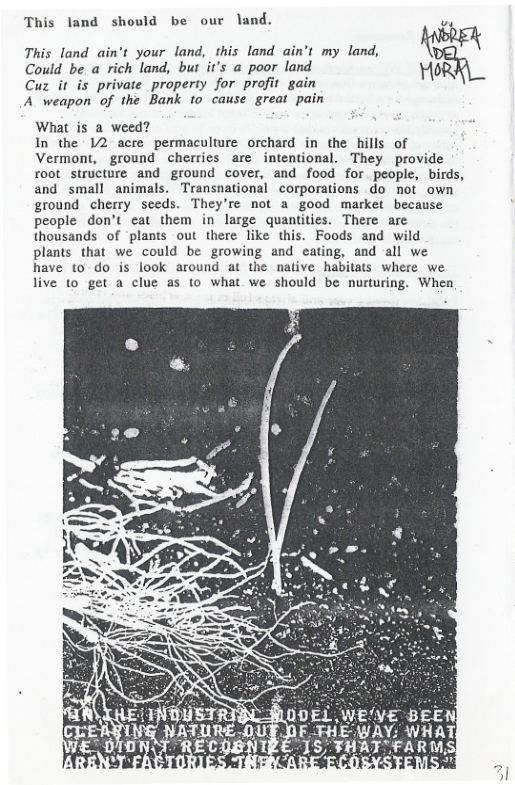
What is a weed?
In the 12 acre permaculture orchard in the hills of
Vermont, ground cherries are intentional. They provide
root structure and ground cover, and food for people, birds,
and small animals. Transnational corporations do not own
ground cherry seeds. They're not a good market because
people don't cat them in large quantities. There are
thousands of ‘plants out there like this. Foods and wild
plants that we could be growing and eating, and all we
have t0-do is look around at the native habitats where we
live to get a clue as to what we should be nurturing. When
|
Altering Nature Forever
we grow so many different things that corporations can
never monopolize them all, we arc not only defying their
attempts o take over the world via the food supply, but we
are supporting the world's _inclination toward diversity
and specific function in each unique place. We are paying
attention to places and how they can complement cach
other by being different from each other.
A weed is nothing in itself; it exists as such in the
judgment of the world around it. A plant that someonc
\ishes weren't growing; a people that someone wishes
weren't thinking, In organic farming, weeds are often
called volunteers, because every plant is useful and grows
for a rcason. Likewise, we are volunteers, offering
ourselves where we can be used best, in this lifelong
pursuit of a world that makes sense according to our long
Bistory, the one that predates the divided and muddied
enciety
in tne ayes of #e chate, and all its unfortunate lackeys, we
are weeds. But they simply can't see the benefits of
working together, being creative, and learning from the
plants, “who teach us many things when we pay attention.
Guerrilla Gardens: Our kind of warfare,
We were bom into a war society. We were raised to
perpetuate the war against ourselves and the people we
love. T was raised in a society of hicrarchy, domination,
and oppression, in which my own habits continue, at
times, to oppress myself. The way to end this war is to
refuse to participate. They way to cease war is to create the
clements of a non-warring society, where land, food, air,
water, gender, sex, color, cannot be used to do harm. For
this reason, we are guerrilla warriors who do not carry
guns. We are guerrillas—warriors—of creativity and vision
So here’s some vision: what if land could not be owned, not
privately nor publicly? Land was simply there, to be used
for things we need (o live, and beyond that only if it didn't
infringe on_someone clse’s attempts at survival? What, if
land were “owned” only by the act of using it, and slipped
back into universal availability as soon as it fell out of
active use? This is the concept of usufruct. Never heard 'of
it? Even the idea sounds pretty peculiar, in these days of
private property. Imagine now if this idea of usufruct
applied o all things: water, air, food, forests, plants,
bicycles, books. The idea can extend to nearly anywhere;
Usufruct is not just another way to own things; it is a
fundamentally different way of viewing the world. It
challenges us (o look around us in a revolutionary way. We
can look at the lawn of any pompous building in D.C. and
say, this lawn is not only useless, it is robbing. this
environment of the diversity of survival, it is denying
people food, medicine, and a healthy surrounding. Tt is
stealing water that the world needs for infinite. other
purposes, and soaking a sickly amount of chemicals down
o the earth. By transforming this manifestation of the
warring society, by removing it and replacing it with
holistic, liberatory relationships between people, plants,
and the land, we ‘are raising a victory for the free world, It
is small, but it is fertile. Seeds crack concrete and bust up
through lawns. We oo are seeds, and we're busting out,
scattering (o sprout in the world.
Willie Says by Dana Lyons
Wilie says.
Here's a story that you may not comprehend
but the parking lots will crack and bloom again.
There's a world beneath the pavement that will never end,
seeds are lying dormant and will never end.
Willie says.
If you listen you can here the sound of birds
hear their song above the chaos hear their words.
Listen to their love songs it will never end.
If you listen you can hear.
And the old one sits with me above the city
while we eatch the madness of the world below.
And she laughs and tells me that it's temporary,
underneath the wild garden waits to grow.
Willie say:
1€ you listen to this tree you'll hear its song
it's the story that my people pass along
It's a dream that keeps returning and will never end.
Seeds are lying dormant they will never-end.
Willie says.....
If you say you are afraid I understand.
In'a place where one can rarely smell the land,
but the ocean breeze still blows here,
it WI“ never end.
lGUERRILLA GARDENING';
xe b Gre
", |
A
Q