Grieving is Healing: Reflections and Practices for Politicized Grief
Web PDF • Imposed PDF• Raw TXT (OCR)
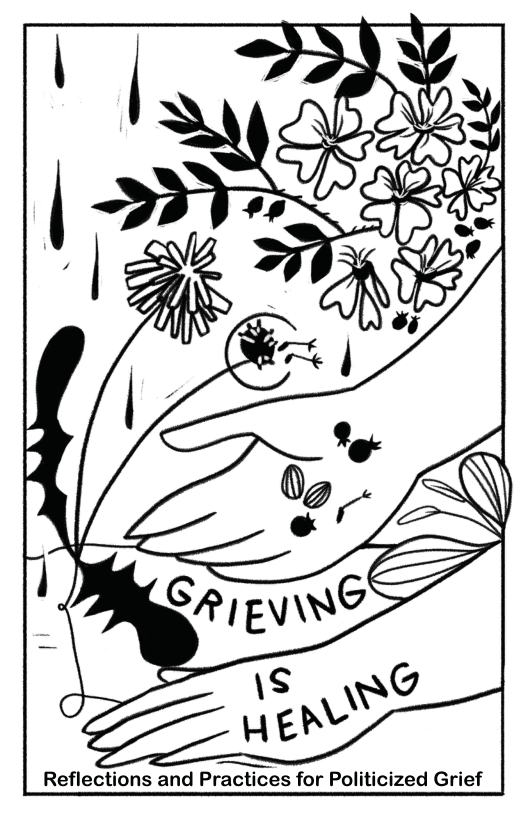


![SECTION 2 Framing: Grief in the Context of Politicized Healing “In a time when so many lives are considered ungrievable (as coined by Judith Butler), grieving is a politically necessary act. [...] Vulnerability and tenderness for each other and public grievability for life itself are some of the most profound acts of community resistance.” — Harsha Walia —~](grieving-is-healing-reflections-and-practices-for-politicized-grief-chicago-torture-justice-center 4.png)








Reflections and Practices for Politicized Grief
TABLE OF CONTENTS
Introduction to this Zine
Framing: Grief in the Context of Politicized Healing
What is Politicized Healing?
How Does Politicized Healing Work?
What is Politicized Grief?
Practices for Politicized Grief Healing
Body Movement Practice
Journaling Reflection Practice
Ritual Practice
Closing Blessing for Grief Healing
SECTION 1
Introduction to the Politicized
Grief Healing Zine
During the summer and fall of 2020, the Chicago
Torture Justice Center (CTJC) began a series of
Politicized Grief communal practices for the healing
and justice demands of this time. Our commitment to
heal coalesced in the heat of unrest and uprising,
pandemic and pandemonium. Now as ever, we are
awash with loss and longing. We are swimming in rage
and pain. We are generating love and power amidst
constant upheaval.
Building on CTJC's innovative Politicized Healing
framework, our healing practices help us move through
grief in a variety of ways — including through boxing,
spoken word, song, gardening, and ritual. We recognize
that we process grief, pain and loss in ways unique to
each of us.
As an extension of our Politicized Grief Healing series,
this zine highlights some of CTJC's communal healing
practices and collective wisdom.
While intended for people who have experienced
loss and violence of all kinds, this zine is written
especially for incarcerated survivors of police
torture.
We hope that this zine can support you in your
resilience and healing.
SECTION 2
Framing: Grief in the Context
of Politicized Healing
“In a time when so many lives are considered ungrievable (as coined
by Judith Butler), grieving is a politically necessary act. [...]
Vulnerability and tenderness for each other and public grievability for
life itself are some of the most profound acts of community
resistance.”
— Harsha Walia —~
How does Politicized Healing take shape in this era of
uprising and protest, pandemic, and pandemonium? What is
needed?
What does radical, politicized care invite, as we seek to heal
ourselves and our communities?
What is Politicized Healing? '
Politicized Healing addresses the harm — felt by individuals
and communities — caused by historic and evolving
systems of oppression. From our Politicized Healing lens, we
heal not just to feel better but for the sake of
transformation, liberation, and justice. We heal from the
traumas of centuries of systemic oppression and violence.
We name, challenge, and dismantle these systems. We work
to create new systems of care and accountability.
How does Politicized Healing work?
Through the practice of Politicized Healing, we can:
engage in a self-determined process of restoring
H EA L ourselves and connecting to others and what we
care about.
D ISMA N T L E unapologetically expose and
deconstruct systems of harm.
build reparative power towards new
c R EATE paradigms that we collectively imagine
for our communities.
1 CTJC's definition of Politicized Healing as well as the “Heal, Dismantle,
Create" framework were co-created as part of a two-day workshop in
October 2019 facilitated by Resilient Strategies.
What is Politicized Grief? N
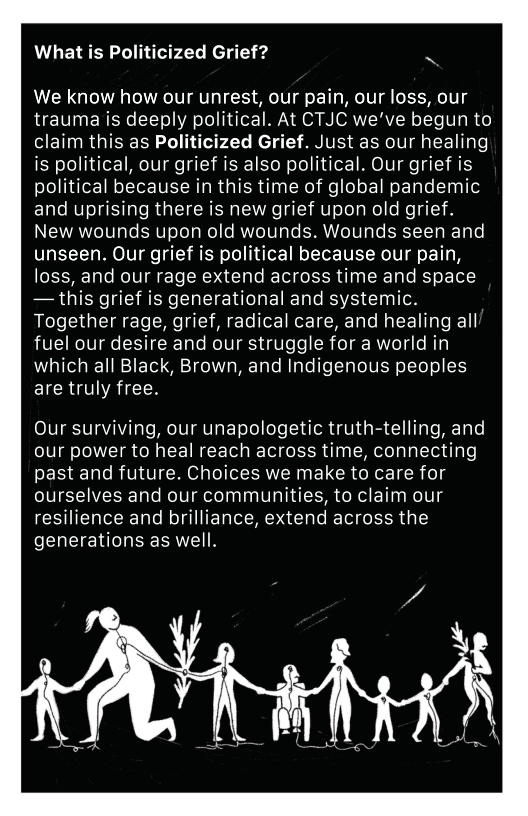
We know how our unrest, our pain, our loss, our
trauma is deeply political. At CTJC we've begun to
claim this as Politicized Grief. Just as our healing
is political, our grief is also political. Our grief is
political because in this time of global pandemic
and uprising there is new grief upon old grief.
New wounds upon old wounds. Wounds seen and
unseen. Our grief is political because our pain,
loss, and our rage extend across time and space
— this grief is generational and systemic.
Together rage, grief, radical care, and healing all
fuel our desire and our struggle for a world in
which all Black, Brown, and Indigenous peoples
are truly free.
Our surviving, our unapologetic truth-telling, and
our power to heal reach across time, connecting
past and future. Choices we make to care for
ourselves and our communities, to claim our
resilience and brilliance, extend across the
generations as well.
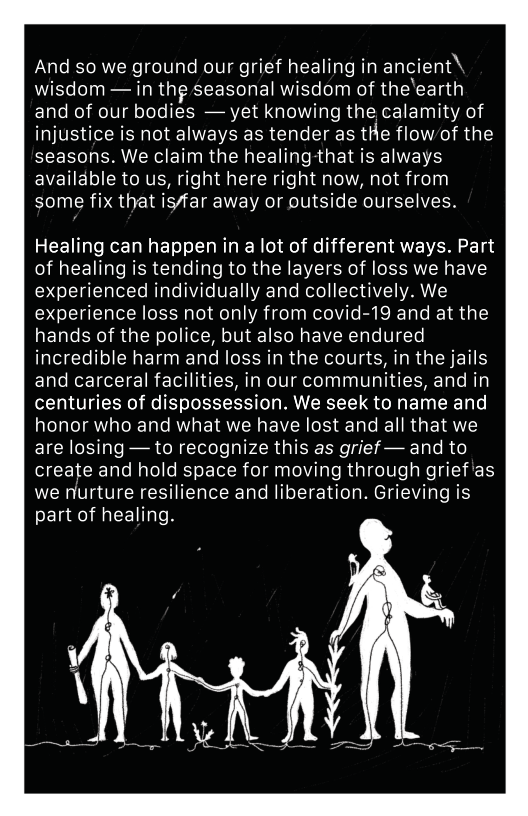
And so we ground our grief healing in ancient\
wisdom — in thg seasonal wisdom of the'earth
and of our bodies — yet knowing the calamity of
injustice is not always as tender as tHe flow/of the
seasons. We claim the healingthat is always
availdble to us, right here right now, not from
some fix that is/far away or outside ourselves.
Healing can happen in a lot of different ways. Part
of healing is tending to the layers of loss we have
experienced individually and collectively. We
experience loss not only from covid-19 and at the
hands of the police, but also have endured
incredible harm and loss in the courts, in the jails
and carceral facilities, in our communities, and in
centuries of dispossession. We seek to name and
honor who and what we have lost and all that we
are losing — to recognize this as grief — and to
create and hold space for moving through grief'as
we nurture resilience and liberation. Grieving is
part of healing.
SECTION 3
Practices for Moving Through
Politicized Grief and Loss
“Grief can express itself through thoughts and feelings that seem
utter contradictions.
Love that sounds like fear,
pain that sounds like joy,
doubt that sounds like faith,
arguments that sound like prayers,
prayers that sound like earthquakes,
yes that sounds like no,
and stories and dreams and dramas and songs and poems, and, and,
and...
In the face of this, a listener can simply be overwhelmed in the way
that both a breaking wave and a slow surge can flood us out.”
— W. Dow Edgerton
We hope the following practices will support you in moving
through grief and loss in whatever ways are unique and right for
you.
Remember that grief is not linear, nor is it one single thing.
Grief can be accumulative, building up over time; and grief can be
anticipatory, such as fear or anxiety for what is about to happen.
Grief can be disenfranchised — the grief that hasn’t been
permitted or safe to express.
Grief can come out as anger and rage, laughter and relief — felt
both individually and collectively.
Grief can reflect how deeply we care, a form of praise for that
which we deeply love.
Body Movement Practice
“Protest is rage embodied: stomping feet, pain, and grief wrapped
up and catapulted towards a belief in something better. More just.
More free.”
— Whitney Richards-Calathes
Living under current (and historic) conditions of
oppression, repression, and violence can
disconnect us from our feelings of aliveness. That
may manifest for some folks as numbing,
disassociating, overriding our emotions and
sensations, a sense of sadness, or detachment
from who/what we care about.
We are also constantly having to react and respond
to huge amounts of incoming pressure and crisis as
we navigate these various systems of harm —
resulting in a feeling of loss of power or agency.
Activating our bodies is one way we can concretely
feel our aliveness and generate our power.
Generating power and aliveness in your body can
look like many things: moving your torso, arms
and/or legs while standing or sitting; walking,
running, doing push-ups, stretching, practicing
yoga (option on the following page). If it is difficult
to move your body at all, you can invite movement
simply by deepening the flow of breath through
your body. Find a way to move and generate energy
in whatever way is right for your body and in your
setting.
Sun Salutation (modified)
The Sun Salutation is a series of postures from Yoga traditions in
ancient India. There are many variations. This salutation is
modified, and can be done sitting or standing.
Breathing in, raise your arms above your head and look up to the
sky.
Breathing out, bend at your hips and lower your arms in front of
you into a forward fold. Bend your legs slightly, gazing toward
your ankles, shins or knees.
Breathing in, slide your hands up your shins and lift your chest
halfway.
Breathing out, hinge at your hips and fold toward the ground.
As you repeat this cycle, try expanding your breath on each
inhale. What feels alive in your body?
As you exhale and bend, try pushing all of the air out, forcefully
from your gut, even making a grunt as the breath comes out. What
s your body releasing?
Journaling Reflection Practice
Here are a few tools that can support deeper reflection, building
upon your physical movement. What are you feeling in your body?
You may be feeling grief, rage, sadness, longing, hurt, despair,
dissociation, joy, hope, connection, peace, frustration,
overwhelm. Whatever you are feeling is okay.
You can use these prompts to continue processing your feelings.
You may wish to respond by writing in the blank space or in a
journal, drawing, singing, or making art.
Each of the three reflection prompts, written by Valerie Papilion,
are themed around CTJC's Politicized Healing principles of: hea,
dismantle, create. Each theme offers a poem by writer and poet
Nayyirah Waheed.
/
R
in our own ways
we all break.
it is okay
to hold your heart outside of your body
for
days.
months.
years.
at a time.
— heal
Healing is difficult work. It is lifelong work. Systems of
oppression like racism, policing, and prisons create additional
barriers to healing for Black folks and folks of color. So, we affirm
that we deserve to heal. We are worthy of healing. Though healing
feels impossible at times, we affirm healing is possible for
ourselves and our communities.
Fortunately, we can begin or deepen the process of healing by
simply giving ourselves space to heal. A little can go a long way.
1. Think of a small example of healing you've experienced in your
life. What does it feel like to remember that you can heal?
2. So often, healing can feel impossible because we beat
ourselves up mentally for not being where we believe we “should"
be. Think about your healing journey. How might it be different if
you give yourself permission to ‘break’ as Nayyirah Waheed says in
the poem above?
3. What are one or two things you are healing from?
when you remove them from your
nucleus.
your being is then
allowed
to
focus
its power
on
\ turning your life.
into.
your soul’s work.
Yyou become yours.
again.
—decolonization | center
1. What thoughts came up for you as you read the poem? Did it
resonate with you at all?
2. How would your life be different without oppression? What does
your “soul work” ook like to you?
3. Think about Nayyirah Waheed's phrase “you become yours".
What does this mean to you? Do you feel like you are yours? Why or
why not?
Vi
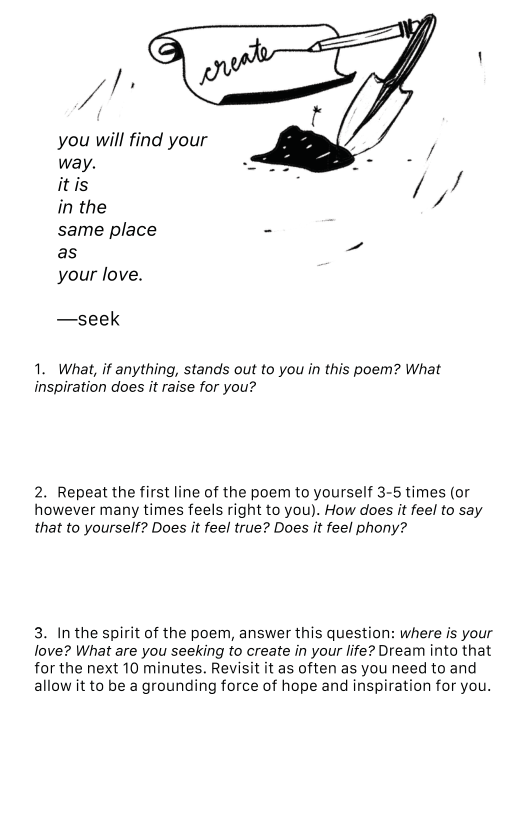
you will find your
way. 4
itis / /
in the /
same place -
as
your love.
—seek
1. What, if anything, stands out to you in this poem? What
inspiration does it raise for you?
2. Repeat the first line of the poem to yourself 3-5 times (or
however many times feels right to you). How does it feel to say
that to yourself? Does it feel true? Does it feel phony?
3. In the spirit of the poem, answer this question: where is your
love? What are you seeking to create in your life? Dream into that
for the next 10 minutes. Revisit it as often as you need to and
allow it to be a grounding force of hope and inspiration for you.
Ritual Practice for Mourning and Remembering
"It is not merely OK to grieve. It is wholly necessary if we are to
remain connected to our collective power, truly invested in our
liberation, and whole enough to sustain ourselves in struggle.
We need to grieve for those we have lost, for ourselves, for our
bodies, for the land, for our families and our ancestors.
Let grief be part of the movement-building process for which
we allow hallowed space, and let it build within us the
compassion, wisdom, and rage that propel us into new battles.
— Benji Hart
Too often we do not have space, time, or permission to
mourn. We may get messages that to grieve and to mourn is
to be weak, or that it is a distraction from the things that we
are fighting for. But allowing ourselves really to feel and
name grief and loss helps us build “compassion, wisdom
and rage that propel us into new battles." Grief can be like
fuel, sustenance for our ongoing resilience and survival.
Many cultures throughout time and history have had distinct
practices for public mourning and memorial. Our ancestors
and spiritual teachers knew the importance of creating and
holding sacred space for honoring what has been lost —
those whose lives have gone before us, lands and homes
taken from us, ways of life disappeared, control imposed
upon us.
Through ritual and remembrance, we continue relationships
with people, places, and cultures, even when they are
physically gone. We help the memory of who and what we
have loved to continue living.
You can use the following ritual to honor someone(s) you
have lost. They may or may not be someone you knew
personally. Or instead of a person, you may wish to honor
something else that you have lost — a sense of freedom, a
way of life, a job, a place that was special, home, etc.
As well, this can be a ritual to help hold the collective sense
of grief and loss that many of us carry, even if we do not
have specific words to name it.
Identify an object that symbolizes grief or loss in your life.
This could be a photo or drawing of someone, some place, or
something you love; a book or special memento from
someone who is gone or separated from you; a poem or even
a few words you write on a piece of paper.
Spend some time with your special object.
What is your relationship with the person, place or thing it
represents?
How has that relationship changed?
Holding your object, take a breath and offer gratitude for the
love it represents.
1 am grateful for May the memory of
continue living.
You can do this as many times as you want.
Holding your object, take a breath and name any loss or
longing it represents.
I honor the loss of . I honor the pain of this loss.
May the memory of continue living.
You can do this as many times as you want.
Think of an ancestor you love who has gone before you. It
can be the person represented by your special object, or
someone else meaningful to you, or a public figure you
admire.
Call on this ancestor to be with you in this time of
remembrance. Thank them for witnessing you in the sacred
act of grieving. Ask them for what you need next as you go
forward. Thank yourself for bearing witness to the power of
remembering.
“Ancestors Watching" chant from BYP100:
Ancestors watching / | know they're watching / Ancestors
watching, | know, I know
(repeat)
Closing Blessing for Grief Healing
Grief and healing are not a one and done. Grief Healing is ongoing
and unfolding.
Grief can continue to find expression throughout our lives in new
and unexpected ways. Healing is something we can continue to
practice, to build, and to live into,
There may be wounds that never completely heal, just as are
losses we never forget.
Healing can be the acts — big or small — that we do to remember
and fight for life alongside pain and loss.
I hear —_
- the love of those N
who have loved me \
echo in me.
Al the notes of my song -
sing over theirs,
the only kind of beauty.
The song does not die. ~
May I live
with love and mercy
P for it will echo
long after. C o~
— Steve Garnaas-Holmes
However these practices feel for you today, may
you be comforted and empowered in your grief
healing journey.
May the pain, loss, unrest, and rage be fuel for you
in the struggle for a more just and liberated world.
Know that you are worthy of healing. You are
worthy of grieving. You are not alone.
Written & Curated by Annabeth Roeschley
Designed & lllustrated by Peregrine Bermas
Chicago Torture Justice Center
For more info, contact:
info@chicagotorturejustice.org