Green Scared? Lessons from the FBI Crackdown on Eco-Activists
Web PDFImposed PDFRaw TXT (OCR)
GREEN SCARED? SOME LESSONS FROM THE FBI CRACKDOWN ON ECO-ACTIVISTS  CRIMETHINC.COM
new y&?rk city anarchist black cross  ost office box 110034 rooklyn, new york 11211
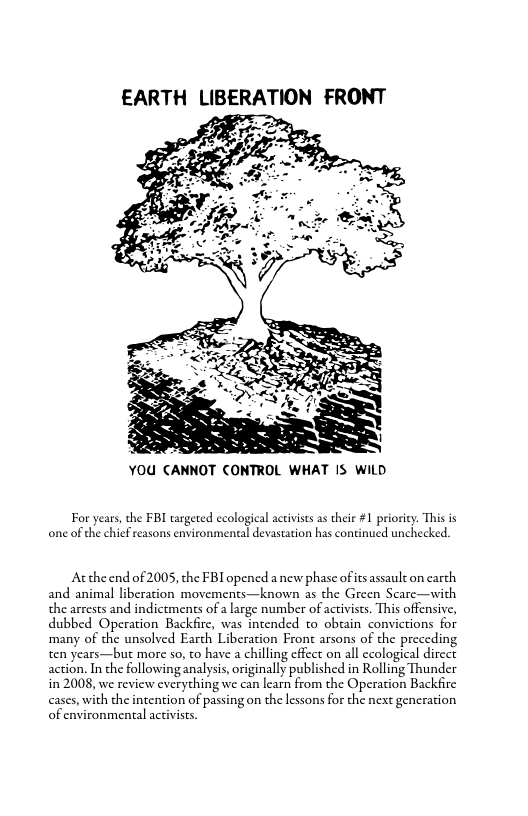
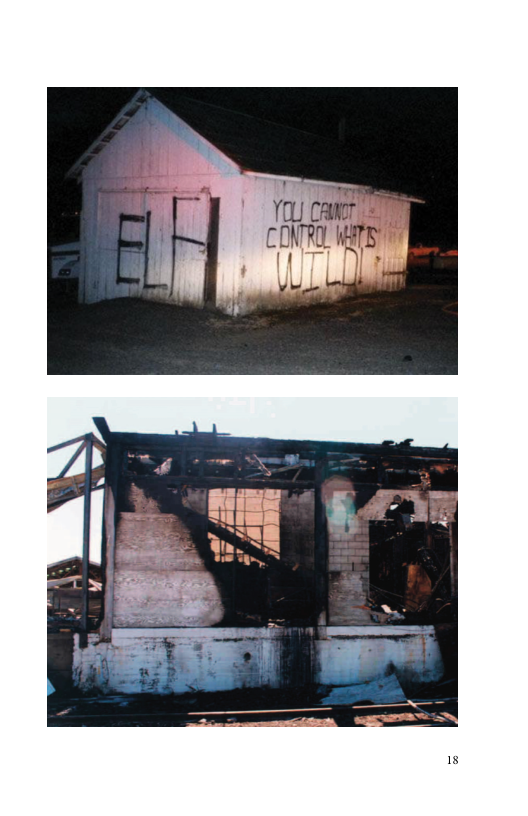
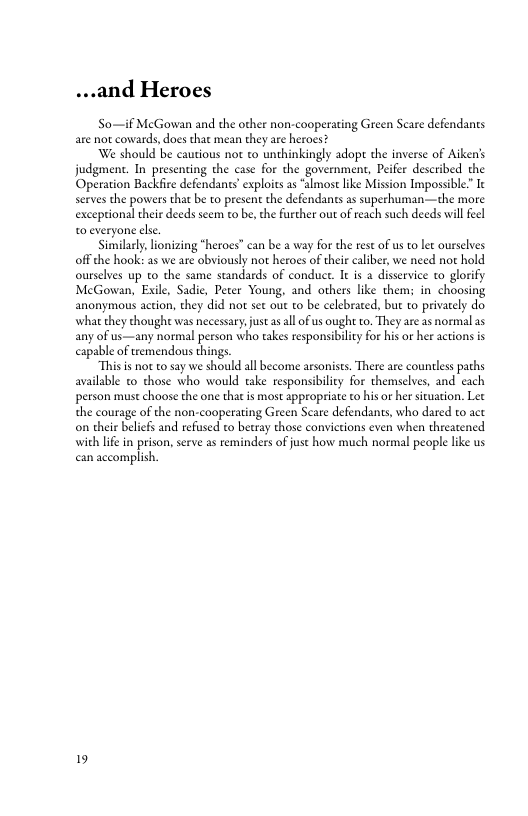
EARTH LIBERATION FRONT D s  YOU CANNOT CONTROL WHAT IS WILD  For years, the FBI targeted ecological activiss as their #1 priority. This is one of the chief reasons environmental devastation has continued unchecked.  Acthe end of 2005, the FBI opened a new phase of s assault on carch and animal liberation movements—known as the Green Scare—with the arrests and indictments of a arge number of activises. This offensive, dubbed Operation Backfirc, was intended to obtain convictions for ‘many of the unsolved Earch Liberation Fron arsons of the preceding ten years—but more so, to have a chilling cficct on all ccological dircct action. In the following analysis,originally published in Rolling Thunder in 2008, we review cverything we can leam from the Operation Backfirc  th the intention of passing on the lessons for the next gencration ironmental acevises.
For Those Who Came in Late...  Of those charged in Operation Backfire, nine ultimately cooperated with the government and informed on others in hopes of reduced sentences: Stanislas Meyerhoff, Kevin Tubbs, Chelsea Dawn Gerlach, Suzanne Savoie, Kendall Tankersley, Jennifer Kolar, Lacey Phillabaum, Darren Thurston, and, much lacer, Briana Waters. Four held out through 2 cerrifying year, during which it scemed cerain they would end up serving decades in prison, until they were able to broker plea dealsin which they could claim responsibilicy for their actions without providing information about others: Daniel McGowan, Jonathan Paul, Exile (aka Nachan Block), and Sadie (aka Joyanna Zacher)’ ‘Another defendant, William Rodgers (aka Avalon), tragically passed away in an alleged suicide while in custody shorly afte his arrest. Fugitive Justin Solondz was captured in China in 2009 and completed his sentence in January 2017; Rebecca Rubin turned herselfin in 2012, afier many years on the run, and was sentenced to five years n prison. Joseph Dibee was extradited from Cuba to the US in August 2018 to face charges. One more defendant has been charged but not found  ‘The months following the launch of Operation Backfire saw an unprecedented increase in government repression of anarchist environmental activiss, which came to be known as the Green Scare. Longeime animal liberation activist Rod Coronado was charged with a felony for answering a question during  speaking appearance, and faced potentially decades in prison. Six animal rights activists associated with SHAC, the campaign against animal testing corporation Huntingdon Life Sciences, were sentenced to several years in prison, essentially for running a websice. Animal liberationist Peter Young, who had spent seven years on the run from the FBI, was finally capured and threatened with double jeopardy;. Tre Asrow; famous for surviving a 100-foor £all when police and loggers forced him out of a forest occupation, was fighting extradition from Canada to the United States to face arson charges. Innumerable people were subpocnacd to grand jurics. and some did jail time for refusing to cooperate. Perhaps most ominously ofall, three young people were set up by an agent provocateur and arrested on conspiracy charges without having actually done anything at all. Too of them, Zachary Jenson and Lauren Weiner, pled  T Afer this wrting, i came o lght thar Sadic and il hold borh racis and wsnsphobic views. The anarchise communicy has pated vays wich chemn.  2 In theory,th sk ofagrand juryi 0 examine the vlidicy ofan sccusacon befoe il In pracic,grand juricsae used o forc iformation out of people: by graning an individual immunin regading  specific s, grand jury can compel him o he to answer quesions or e go toprson forcontemp of court
guilty and became governmen informanes; the third, Eric McDavid, served ine years in prison before his conviction was overcurned when it was finally acknowledged that the FBI had withheld exculpatory evidence.  “To this day, Marius Mason remains in prison.  It important to derive lessons from this campaign of government repression, in order to equip the next generation that will ake the frone lines in the seruggle to defend life on carth.  Distinguishing between Perceived and Real Threats  In some anarchistcircls,the inicial onset of the Green Scare was met with 2 panic that ivaled the response to the September 11 atcacks. This, of course, was exactly what the government wanted: quite apart from bringing individual activiss to “juseice;” they hoped to intimidate all who see direct action as the most efective means of social change. Rather than aiding the government by ‘making exaggerated assumptions about how dangerous i s to be an anarchist today, we must sort out what these cases show about the current capabilities and. limits of government repression.  “The purposeofthisinquiry is not to advocate or sensationalize any particular tactc or approach. We should be careful not to glorify illegal activity—ic’s important to note that most of even the staunchest non-cooperating defendants have expressed regrets about their choices, though this must be understood in the context of their court cases. At the same time, federal repression affects everyone involved in esistance, not just those who participate i illegal dircct action; the Green Seare offers case studies of the situation we are all in,like it  Case Study in Repression: Eugene, Oregon  Operation Backfire took place againse 2 backdrop of government investigation, harassment, and profiling of presumed anarchists in the Pacific Northwest. It is no coincidence tha Eugene, Oregon was a major focus of the Operation Backfire cases,asit has been @ hotbed of dissent and radicalism over the past deeade and a half—although repression and other problems have taken atollin recent years. We can’ offer a defnitive analysis of the internal dynamics of the Eugene anarchist community, but we can look at how the authorities wene about repressingit.
One useful resource for chis inquiry is “Anarchist Direce Actions: A Challenge for Law Enforcement an article that appeared in Studies in Conflict & Terrorism in 2005, authored by Randy Borum of the Universicy of South Florida and Chuck Tilby of the Eugene Police Department. According o Jeff (“Free") Luers, Tilby was one of the cops who surveilled Free and his co- defendane Criteer on the night of their arrest in June 2000. Tilby has given presentations on the “criminal anarchist” movement to law enforcement groups, and was incimately involved in the Operation Backfire cases, even making statements to the media and providing a quote to the FBI press release at the end ofthe Oregon federal prosccution.  Surprisingly, the article does not expliciy reference Eugene, Oregon at al, Besides Tilby’ byline at the beginning, there’ no indication that the paper was conwritten from Eugene. All the same, the article provides several imporeant clues about how the government procecded against the Oregon defendants and those who were perceived to support them.  “The authors centralze the importance of intelligence and informants for repressing criminal “anarchists” while acknowledging the difficulty of obtaining them. In the case of geand jury subpoenas, anarchists regularly fail to comply, and suppore groups are often set up for those targeted; one of the more recent examples of this was Jeff Hogg, who received a grand jury subpoena while the Backfire prosecutions were underway and was jiled for nearly six months in 2006 as  resule. The authors warn tha “investigators and law enforcement officers should be cautious during questioning not o divulge more to the subject about the case (via questions), than is earned through their testimony:” Indeed, questions asked by geand juries turned up more than once in the pages of the Earch Firse! Journal, which was edited from Eugene for a time. It is extremely important o suppore those under investigation and keep abreast of investigators effores. Some believe that the Backfire investigation only arrived at a position of realstrengeh once such support sarted to weaken in Oregon.  Regarding ifilration, “Anarchist Direct Actions” advises that  What we know of the early Backfire investigation points to a strategy of generalized monitoring and infiluation. While investigators used increasingly Tocused tools and strategies as the investigation gained steam—for example, sending “cooperating witnesses" wearing body wires to talk to specific targets— they started out by sifting through a whole demographic of counter-cultural cypes. Activis and punk houses as well as gathering spots such as bars were placed under surveillance—anarchists who drink should be careful about the way alcohol can loosen lips. Infiltracors and informants targeted not only the most visibly committed anarchists, but also bohemians who inhabited similar cultural and social spheres. Police accumulated tremendous amounts of background information even while faling to penetrate the circles in which

direct action was organized. The approximately 30,000 pages of discovery in the Oregon cases contain a vast amount of gossip and background information on quite afew from the Eugene communicy:  A similar profiling methodology appears to have been used in nearby Pordand, Oregon. In March 2001, for example, a large-scale police raid was carried out on a house party attended by Pordand punk rockers. The attendees were photographed and questioned aboue the Earth and Animal Liberation Fronts. Some were arrested and charged with kidnapping and assaule on an officer—a standard over-charging which evenually led to plea deals. The defendans from the raid were videotaped at theis court appearances by officers later identified as Gang Enforcement Unit members. In the afiermath of this raid, cops routinely harassed punks on the sreet, demandingto be told whether they were anarchists  In remospect, it seems likely that such efforts were not meant simply. o intimidate Pordand’ punks, but o uncover information relevant o the anarchistand ALF/ELF casesof the time. This may have been  wrongstepin the Backfir investigation; right now there’s no way to know. We do know; however, tha “wide net” approaches by the sate can be efective a sifing socially aware subculeures,even when they uncover no real links t radical action. Fortunately, in Portland those affected by the raid came together in response, aiding each other, limiting the damage done, and taking advantage of the situation to draw attention to police activiry:  Another poinc of speculation is the degeee to which authorities fostered division and infighting within radical circles in Eugene. This was a common COINTELPRO tactic and s probably scilln use. Borum and Tilby hineat chis in the final section of their paper, “Law Enforcement Strategies/ Implications’s  For those familiar with Eugene radical circles, this brings to mind the heated conflcts over gender and feminism within that community. There is no conerete evidence that government operatives were involved in escalating such debates, and we should be careful not to jump to conclusions; such speculation  5 The FBIs Counter Intellgence Progeam (COINTELPRO) exised afcally fom 1956t 1971 and probably contnues 0 this day insome form. Aiming o “spase, distup,misdi- et discredi, o otherwis neutrlze”the atviies of groups ke the Black Paher Pary the Program urilzed a wide varcy of i documentsstoln withou any warranes having becn isueds rumors were spread in rder o  rcks. Houses and offces were satched and  foster miscrust nd even vilence between different organizatons o fctons within the group members were harasid through the cours o even whally framed for crimes they id nox comni infilcators and agent provocstcurs were disibuted wishin targesconsie encies: no aceof piychologial warfiee o blaant iolence was ruld out. The progam wasfinally exposed when radicls broke nto an FBI Offic and sized documents rlating o the scte program, circlring them o varioussources undet th name of the "Citzens Commission to Investigae the FBL"
can only assist the state by propagating paranoia. However, law enforcement from local 10 federal levels must have been aware of the valnerabiliies that opened up when real debates turned to groupehink and factionalism in Eugene. “Tilby and his cohores must have used such insights to their advantage as they devised andi-anarchist suategies. By the time Operation Backfire grand jurics began following up on real leads in Eugene, many who could have come together o oppose them were no longer on speaking terms. While this does nor justify the lack ofintegricy shown by those who assisted grand juries e does offer some. context for why the grand juris weren’ resisced more effectively.  Borum and Tilby close their paper by urging investigaors to display “patience and persistence”—and indeed, patience and persistence ultimately paid offin Operation Backfire. This s not to lend credibiliy to the notion that “The FBI always get their man.” The investigation was riddled with errors and missceps: plenty of other actions will never be prosccuted, as the authorities got neither lucky breaks nor useful cooperation. But we must understand that repression, and resistance to i, are both long-term projects, strcching across years and decades.  According to some accounts, one of the most significant leads in Operation Backfire came from a naive request for police reportsat a Eugene police station. Accordingo his version, the police deduced from this reques that they should pay auention to Jacob Ferguson: Ferguson later became the major informant in these cases. I is less frequently mentioned that the police were accusing Ferguson of an arson he did not participate in! Wih Ferguson, the unlikely happened and it paid offfor the authorities to be wrong, Later on, when agents ‘made their firsc arrests and presented grand jury subpoenas on December 7, 2005, 6o of those subpoenaed were wrongly assumed to have been involved in attacks. Their subpocnas were eventually dropped, a the authorities gained the cooperation of more informants and evencually made moves t arrest Exile and Sadic instead  “The investigation was not as unstoppable and dynamic as the government would ke us to think, although the prosecution gathered force as more individuals rolled on others. The authorities spent years stumbling around, and they continued to falter even when prosccution efforts were underway—but they were tenacious and kept a heir efforts. Meanwhile, radical momencum was less consiseent  Let’s review the are of radical activity in Eugene over the past decade. The anticapicalist ior of June 18, 1999 in Eugene led to jubilation on the part of anarchises, even if one participant spent seven years in prison as 2 resule. The participans in the June 18 Day of Action had put up  ight and fucked up some symbols of misery in the town, catching the police unprepared. The pitched bartles on the sreets of Seattle L that year a the WTO meeting only reinforced the fecling hat the whole world was up for grabs. Most of the active anarchises in Eugene had never lived through such a period before. Despite the
paltry demands and muddled analysis of much of the offcial “antiglobalization” movement, there was a sense that deeper change could be fought for and won. Being an anarchist seemed like the coolest thing you could be, and this perception was magnified by the media atcention that followed. The ELF was secting fires all over the region a the time.  Aseries of reversals followed. In June 2001, Fre received hisnitial sentence 0f22 years and ight months. The following month, Carlo Giuliani was murdered on the streets of Genoa daring protests against the G8 summit in ltaly. While both of these wagedies lluserated the risks of confronting the capitalistsystem, Free’ sentence hit home especially hard in Eugene. In the changed atmosphere, some began dropping away and “getting on with their lives’—not necessaily betraying their carlier principles, but shifiing their focus and priorities. This aueition intensified when American flags appeared everywhere in the aftermath of September 11, 2001. Anarchist efforts did no cease, but 2 period of relative disorientation followed. A year and a half later, the invasion of Iraq provided another opportunity for radicals to mobilize, but some consistency had been ostin the Eugene area. And all the while, FBI employees and police kep theie regular hours, day in and day o  Law enforcement received its most significant breakehrough in the Backfire cases—even though it started as an incorreet hypothesis—just before Free’ sentencing, in the period between anarchist jubilaion and the shif to the defensive. The same fires that were incorrectly linked to Ferguson were used to justify Free’s stiff sentence, which intimidated some anarchists out of action. There was not enough revaluation, learning, and sharpening of skills nor enough effores a conflct resolution; the retreat oceurred by defaule. What would have happened f he Backfire inveseigation had continued under differenc circumstances, while radicals mainained their momentum? Tha would be another story.Its conclusion is unknown.  Putting up a Fight  Repression will exist as long as there are states and people who oppose them. Complete invulnerabilicy s impossible, for governments zs well as theie opponents. All the infitrators and informants of the Traist sectet police were powerless to preven the Russian revolution of 1917, just as the East German Stasi were unable to prevent the fall o the Berlin Wall even though they had files on six million people. Revolutionary struggles can succeed even in the face of massive repression; for our part, we can minimize the effects of that repression by preparing in advance.  For many years now anarchists have focused on developing securicy culture, but security consciousness alone is not enough. There are some poins one can never emphasize too much—don’t gossip about sensitive macters, share delicate
information on a need-to-know basis.*don’t surrender your rightsif detained or arrested, don’t cooperate with grand juries,don’esll other people ou. But one can abide by al these dictums and stll make crucial mistakes. I anti-repression serategies center only on what we should not talk about, we lose sight of the necessity of lear communication for commaunitis in struggle.  State disruption of radical movements can be interpreted s a kind of “armed critique; in the way that someone throwinga brick through a Starbucks window is  crtique in action. That s o say,a successful use of force against s demonstrates that we had pre-existing vulnceabilcies. This i not to argue that we should blame the vietim in situations of repression, but we need to learn how and why effors to destabilze our actvities succeed. Our response should ot stare with jal support once someone has been arrested. OF course this is important, along with longer-term suppore of those serving sentences—but our effores must begin long before, countering the small vlnerabilites that our enemy can exploit. Open discussion of problems—for example, gender roles being imposed in nominally radical spaces—can protect against unhealthy resentments and schisms. This is not to say that every split is unwarranted— sometimes the best thing s for people to go their separate ways; but that even i that is necessary, they should try to maincain murual respect or at least a willingness to communicace when it couns.  Risk s reltive. In some cases, it may indeed be a good idea to lay low in other cases, maineaining public visibiliey i viewed as to0 risky, when in fact nothing could be more dangerous than withdrawing from the public eye and letting momentum die. When we think about rik, we often picture security cameras and prison cell, but there are many more insidious threats. The Operation Backfire defendants ended up with much shorter sentences than expected: as it turned ou, the most serious risk they faced was not prison time, afte al, but recantation and betrayal—a risk that proved all oo real. Likewise, we can imagine Eric McDavid, who currently awaits sentencing on conspiracy charges,idly discussing the isk Factor of a hypothetical action with his supposed friends—who tumed out to be two potential informants and a federal agent provocateur. Unfortunately, the reall risky thing was having those discussions with those people in the first place.  & I dacs appear thar Operaton Backfre defendants could have done bertr st limting the flow of informarion inside hei circe. Rather than organsing in closed, consistent clls, the defendants scem to hav worked in mor uid rrangements, with cnough crosover that ance a few ey particpancs urned informant he government had information sbout everyone.

Preparing for the Worst  nvencional activist wisdom dictates that one must not mix public and clandestine activicy, bue Daniel McGowan’s case seems to contradict this MeGowan was notbrought o rial asaresultof investigations based on his public organizing, but rather because he had worked with Jacob Ferguson, who turned snitch under police pressure. Though the government was especially cager to conviet him on account of his extensive prisoner support work and organizing against the Republican National Convention, McGowan received tremendous ‘public suppor precisely because he had been so visible. Had he simply hidden in obscuricy, he might have ended up in the same stuation without the support that enabled him to weather it s successfully s he did—and without makingas ‘many important contributions to the anarchist movement. nsidering how many years it took the FBI to put together Operation  Backfire and the prominent role of informants in so many Green Scar case, it seems like it s possible to get away with alot,provided you are careful and make incelligent decisions about who to trust. MeGowan’s direct action résume, as it appears in the government arguments at his sentencing, reads like something out of an adventure novel. One can’ help but think—juse seven years, for all thatt  “The other side of this coin is that, despite all cheir precautions,he Green Secare defendants did get caught. No matter how careful and intelligent you are,it docsn’ pay to count on nor gerting caught; you have to be prepared for the worst. Those who are considering risky direct action should stae from the assumprion that they will be caught and prosecuted:; before doing anyching, before even talking about it they should ask themselves whether they could accep the worst possible consequences. At the same time, as the government ‘may target anyone at any time regardless of what they have acually done, icis important for even the most aw-abiding ativists—not to mention their fiends and relatives—to think through how to handle being investigated. subpoenacd, or charged.  5 Ths i o asay chae all visbliy i good visibil: Media scention wasasgnificane ucor in the conflcsthae wracked Eugenc. uch visibilsy can divide comm by crcaring the appearance that pokespeople have more powes chan cvryone clic, which provokes jelousy and sokes cgo~driven confcts wherher or nor wht on the scrcen eflects realiy on the ground. Those who fill prey 1o beleving the media hype sbour themsevesbecome dependent upon this atention, pursuing it rcherchan che unmediseed connecrions and healhy relaionships ssential for longterm tvolutionary seruggls the most valuabl sl ¢ anchred in nduring communities, nor medi specaces. There st essonablearguments for usingehe medi artimes, buc ane st be ware ofthe danger ofbeing used by .  des fom wihin  10
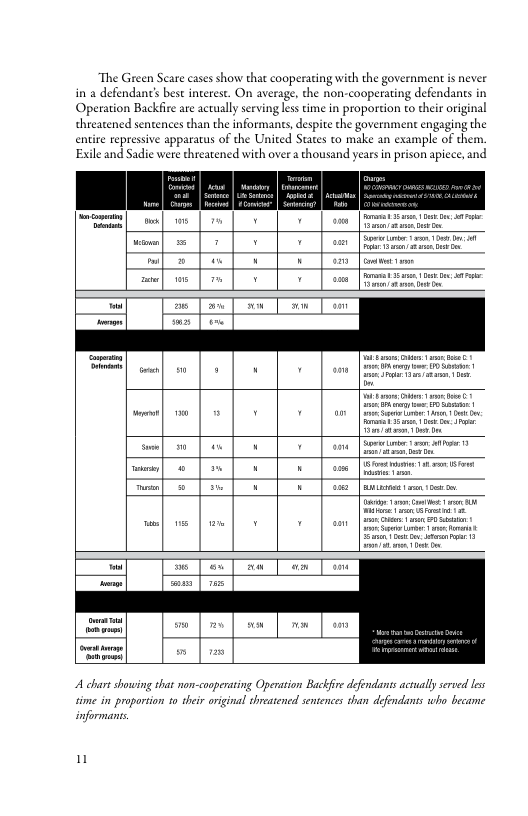
‘The Green Scare cases show that cooperating with the government is never in a defendant’ best interest. On average, the non-cooperating defendants in Operation Backfie are actually serving les time in proportion to their original threatened sentences than the informanes, despite the government engaging the entire repressive apparatus of the United States to make an example of them. Exile and Sadie were threatened with over a thousand years in prison apiece, and  A chart showing that non-cooperating Operation Backfve dfendianss actually served lese time in proportion to their original threstened sentences than defendants who became informants
are serving less than eight; if every arrestee understood the difference between what the state threatens and what it can actually do, far fewer would give up. without a fight  In the United States legal system, a court case i essentially a game of chicken. The state starts by threatening the worst penalcies it possibly can, in hope of intimidating the defendant into pleading guiley and informing. It s casier if the defendant pleads guilty immediately: his saves the state immense quantities of dme and money, not o mention the potential embarrassment of losing a well-publicized trial. Defendants should not be intimidated by the inicial charges brought againse thems it ofien turns out that many of these will ot hold up, and are only being pressed to give the state more bargaining power. Evenif a defendant fears he won’t have 2 leg to sand on in court, he can obtain some bargaining power of his own by threatening to put the state through a costly,challenging, and unpredictable trial —to that end, i is essential o acquire the bese possibl legal representation. When a defendant agrees to cooperate, he losesallthat leverage, chrowing himselfat the merey of forces that don’t have an ounce of mercy to offer  As grim as things looked for Sadie, Exile, McGowan, and Jonathan Paul through most of 2006, they looked up when McGowan’s lawyer demanded information about whether prosecutors had used illegal National Security Agency wiretaps to gather evidence against the defendants. The government was Ioath o answer this question, and for good reason: there had just been a public scandal sbout NSA wietaps, and if the court found that witetaps had been used. unconsticutionally,the entire Operation Backfire case would have been thrown out. Thas exacely why so many members of the Weather Underground are professors today rather than convicts: the FBI botched that case so badly the courts had to let them go free  No matter how hopeless things look, never underestimate the power of fightingi out. Uncil Sanislas Meyerhoff and ohers capitulated,he linchpin of the federal case in Operation Backfire was Jacob Ferguson, a heroin addict and serial arsonist. Had all besides Ferguson refased to cooperate and instead fought the charges together, Operation Backfire would surely have ended differently  On Informants  IFbecoming an informant is always a bad idea, why do so many people do it2 At least eleven high profile defendants in Green Scare cases have chosen to cooperate with the government against their former comrades, not including Peter Young’ partner, who informed on him back in 1999. These were all experienced activiss who presumably had spent years considering how they  12
would handle the pressure of interrogation and trial, who must have been Familiar with all the teasons i doesn’e pay to cooperate with the seate! What,if anyching, can we conclude from how many of them became informants?  “There has been quite a bit of opporcunist speculation on this subject by pundits with letle knowledge of the circumstances and even less personal experience. We are to take it for granted that arrestees became informants because they were privileged middle class kids: in fact, both the cooperating and non-cooperaring defendants are split along class and gender lines. We are told thar defendants snitched because they hadn’t been fighting for their own interests; what exactly are one’s “own interests. if not to liv in a world without slaughterhouses and global warming? Cheaper hamburgers and air conditioning, perhaps? It has even been suggested that ics inevitable some will curn informant under pressure, o we must not blame those who o, and instead should avoid using tacties that provoke investigations and interrogations. This st aspersion is not worth dignifying with a response, except to point out that o crime need be commirted for the government to iniciate investigations and interrogations. Whether or not you support direct action of any kind. it is never acceprable to equip the state o do harm to other human beings.  Experienced radicals who have been snitched on themselves will ell you that there is no surefire formula for decermining who will curn informant and who won’. There have been informants in almost every resistance movement in living memory, including the Black Panther Parey, the Black Liberation Army, the American Indian Movement, and the Puerto Rican independence movement; the Green Scare cases are not particularly nusual in this regard, though some of the defendants seem to have caved in more swifly than their antecedents. It may be that the hullabaloo about how many eco-activsts have curned informant i parcly due to commentators’ ignorance of pas struggles.  If anyching discourages people from informing on each other, i is blood ties. Historically, che movements with the least snitching have been the ones mose firmly grounded in longstanding communities. Arrestees in the national liberation movements of yesteryear didn’t cooperate because they wouldn’t be able to face their parents or childen again f they did; likewise, when gangsters involved in illegal capivalist activity refuse to inform, it is because doing so would afect the entirety of their ives, from their prospects in their chosen carcers to their social standing in prison as well as their neighborhoods. The stronger the ties that ind an individual to a communicy, theles likely i is he o she will inform against it. North American radicals from predominantly white demographics have always faced a diffcult challenge in this regard. 2s most of the participants are involved in defiance of their families and socialcitles rather than because of them. When an ex-activist i facing potentially decadesin prison for something that was essentially a hobby, with his parenes begging him not to  3
throw his lfe away and the system he fough against apparently dominating the ooy ofbi preen and e, e ke  poveral e o ghe and wong o resis selling out.  T this light, it isne surprising that the one common thread that links the non-cooperating defendants i that pracricallyall of them were seill involved in either anarchistor a least countercultural communities. Daniel McGowan was ceaseleslyactivein many kindsoforganizingright upto hisarrest; Exile and Sadie were still committed o life against the grain, if not policical aciviey—a witness who attended their sentencing described their supporters a5 an otherworldly troop of lack metal fans with braided beards and facial piercings. Here we see again the necesity of forging powerful, long.term communities with a shared calture of resistance; dropouts must do this from scratch, swimming against the tide, bu it is not imposible.  Healthy relationshipsare the backbone of such communities, not to mention secure direct action organizing. Again—unaddressed conflicts and resentments, unbalanced power dynamics, and lack of trust have been the Achilles heel of countless groups. The FBI keeps psychological profiles on s argets, with which 0 prey on their weaknesses and exploit potential interpersonal fissures. The oldest ik in the book is to tell arestees that their comrades already snitched ‘on them; to weather this intimidation, people must have no doubes about their comrades’eeliabilcy.  “Snitches get stitches” posters notwithstanding, anarchists aren’t sicuated 0 enforce a no-informing code by violent means. Its doubeful that we could do such a thing without compromising our principles, anyway—when it comes to coercion and fear, the state can always outdo us, and we shouldn’ aspire to compete with it. Instead, we should focus on demystifying snitching and building up the collective trust and power that discourage ic. If being a part of the anarchist community is rewarding enough, no one will wish to exile themselves from it by turning informan. For this to work, of course, those who do inform on others must be excluded from our communities with absolute finality: in betraying others for personal advantage, they join the ranks of the police officers, prison guards, and exccuioners they asis.  “Those who may participate in direct action together should first ake time 0 get to know each other well,including each other’ families and friends, and o talk over their expectations, needs, and goals. You should know someone long. enough to know what you like least about him or her before committing o secure activity together; you have to be certain you’l be able to work through the most diffcult confices and erust them in the most frightening siuations up 02 full decade later  Judging from the lessons of the 19705, drug addiction is another factor that tends to correlate with snitching, as it can be linked to deep-rooted personal problems. Indeed, Jacob Ferguson, the first informant in Operation Backfire, was a longeime heroin addict. Just as the Operation Backfir cases would have.  14
been a great deal more diffcule for the government f no one besides Jake had cooperated, the FBI might never have been able to iniciate the cases at all if others had not trusted Jake in the first place  Prompe prisoner support i as important as public support for those facing grand jurics. As one Green Scare defendant has pointed out, defendants ofien curn informant soon after arrest when they are off balance and uncertain what lies ahead. Jail is notorious for being a harsher environment than prison; recent arrestees may be asking themselves whether they can handle years of incarceration without a realistc sense of what that would encail. Supporcers should bail defendants out of jail as quickly a possibl, so they can be informed and level-headed as they make decisions about their defense strategy. To this end, it is ideal if funds are carmarked for legal suppore long before any arrests  It cannot be emphasized enough that informing is always a serious marter, whether it is a question of a high profile defendane snitching on his comrades or an acquaintance of law-abiding activists answering scemingly harmless questions. The primary goal of the government in any political case is not to put any one defendant in prison but to obeain information with which to map radical commanities, with the ultimate goal of repressing and controlling those communities. The firs deal the government offered Peter Young was for him 0 reurn to animal righes circles to report to them from within: not just on illegal activiey, but on all activity. The most minor piece of trivia may serve to jeopardize a person’s lfe, whether or not they have ever broken any law. It is never acceptable to give information about any other person without his or her express consent.  Regaining the Initiative  W muse not concepualize our response to government represion in purely reacive tera, It tkes ot ofresoures for the government o maune £ masive operarion lke the Green Scae cases, and in dolng 0 thy create unforeseen siuations and open up new valnerabllies. Like n Judo, when che scae makes a move, we can strke back with 2 countermove thr eatches them offbalance. To rake an examle from mass mobilzations, che povwers that be were eventually able o cripple the so-called anchglobalzaton movement by throwing tremendous numbers of police at i but i the wake of Lvsuits subscquently brought against them, the policein places ke Washington, D. now have their hands ied when it comes tocrowd control,as demnstrated by ther extreme estraint a the IMF/World Bank protestsin October 2007, We’re in’a long war with hieratchical povwr that cannoe be won or los i any single  is
engagement; the question s always how to make the best of each development, seizing the initiaive whenever we can and passing whatever gains we make on to those who will fight afier us.  “There must be a way to turn the legacy of the Green Scare to our advantage One sartingplace s o use itas an opportunity tolearn how the state investigates underground activity and make sure those lessons are shared with he next generation. Another s to find common cause with other targeced commanities; 2 promising example of his i the recent connection between animal liberation activiss in the Bay Area and supporters of the San Francisco Eight, ex-Black Panthers whoare now being charged with the 1971 murder of a police offcer  Postscript: Cowards...  In reflcting on Judge Aken’s sentencing, lec us pu aside, for the time being, the question of whether execuives who profit from logging, animal exploitation, and genetic engincering are “doing what they need to do to survive” Let’s allow to pass, 2 well, the suggestion that those who run these industres are morelikely to enter into a “real dialogue” with environmentalists i lacee limit themselvs to purely legal actvity. Let’s even reserve judgment on Aiken’sattempt o draw parallels between domestic violence and sarcastically worded communiqués—which parallelsthe prosecutors’assertion that the ELF, despite having never injured a single human being, is no different from the Ku Klux Klan.  “There is but one question we cannot help bue ask, in reference to Judge Aiken’s thetoric about cowardic: ifshe found herselfin a situation that called for action to be taken outside the established channels of the legal system, would she be capable of ie? Or would she stllnsist on due process of lw, urging. others to be patient as human beings were sold inco slavery or the Nacis carted people off o Dachau? Is i fair for a person whose complicity in the status quo i rewarded with financial suability and social stacus to accuse someone who hasrisked everything to abide by his conscience... of cowardice? Perhaps Aiken would also feel entied to inform John Brown that he was a coward, or the Germans who attempted to assassinate Hitler?  Once this question is asked, another question inexorably follows: what qualifies as a sicuation that call for action to be taken outside the established channels of the legal system, if not the curren ecological crisis? Species are going extinct all ovr the planet, climate change is beginning to wreak serious havoc on human beings aswell, and scientists are giving us a very short window of time to turn our act around—while the US government and its corporate puppeteers refuse to make even the insuficient changes caled for by liberals. I  16
the dystopian nightmare those scientists redict comes to pass, will the refugees of the future look back a this encounter between McGowan and Aiken and judge McGowan the coward?  We live ina democracy, Aiken and her kind insise: bypassing the established channels and breaking the law is akin to attacking frecdom, community, and dialogue themselves. That’ the same thing they said in 1859  “Those who consider obeying the law more imporcant than abiding by ones conscience always try o frame themselves as the responsible ones, but the essence of that awitude is the desire to evade responsibilicy. Society, as represented—however badly—by its entrenched institutions, is responsible for decreeing right and wrong; all one must do is brainlessly comply, arguing for a change when the resules are no to one’ taste but never stepping out of line. That is the creed of cowards, if anything is. At the hearing to determine whether the defendants should be sentenced as terrorists, Aiken acknowledged with fruseration that she had no control over what the Bureau of Prisons would do with them regardless of her recommendations—but washed her hands of the matter and gave McGowan and others terrorism enhancements anyway. Doubtless, Aiken fecls thac whatever shortcomings the system has are not her oesponstlln venfshe parelptes i foxclog e an o, She’s o doing  s the Nuremberg defense. Regaedessofwhatsh thinks of McGowris actions orthe Bureau of Prisons, Aken i personally responsible forsending him 0 prison. She is responsible for separating him from his wife, for preventing him from continuing his work supporting survivors of domestic violence. IF he is beaten or raped while in prison, it s the same as if Aiken beat or raped him. And not just McGowan, or Paul,or Sadie or Exile,but every single person Aiken has ever sent o prison.  Buc Aiken and her kind are responsible for a lot more than dhis. As the polar iccaps melt, rainforests are reduced to pulp, and climate change inficts more and more terrible catastrophes around the plant, they are responsible for stopping all who would take dircct action to avert these tragedies. They are responsible, in short, for forcing the wholesale destruction of the nacural environment upon everyone else on carch,  Aiken might counter that the so-called democratic system s the most effecive way to go about halting that destruction. It sure has worked so far, hasn’t ! On the contrary, i scems more lkely that she canno bring herself to honestly consider whether there could be a higher good than the maintenance oflaw and order. For people like her, obedience to the law is more precious than polaricecaps,rainforests, and cities ke New Orleans. Any price s worth paying 0 avoid caking responsibility for their part in determining the fate of the planer. “Talk about cowardic.  7

...and Heroes  So—if MeGowan and the other non-cooperating G are not cowards, docs that mean they are heroes?  We should be cautious not to unthinkingly adopt the inverse of Aiken’s judgment. In presenting the case for the governmen, Peifee described the Operation Backfire defendants’ exploits a ‘almost ike Mision Impossible” Ie serves the powers that be to present the defendants s superhuman-—the more exceptionl their deeds seem to be, the further out of each such deeds wil fecl 0 everyone el  Similarly, lionizing *heroes” can be a way for the rest of us to let ourselves offthe hook: as we are obviousy not heroes of their caliber, we need not hold ourselves up to the same stundards of conduce. It s a disservice to glorify MecGowan, Exile, Sadie, Peter Young, and others like thems in choosing anonymous action, they did not set out to be celebrated, but to privarely do what they thoughe was necessary, just s al o us ought to. They are as normal as any of us—any normal person who takes responsibility for his or her actionsis capable of remendous things  “This i no t0 say we should all become arsonists. There are countless paths available to those who would take responsibiliey for themselves, and cach peson must choose the one that is most sppropriate o his o her situation. Let the courage of the non-cooperating Green Scare defendants, who dared to act o their belicfs and refused to betray those convictions even when threatened with life in prison, serve as reminders of just how much normal people like us canaccomplish.  19
new y&?rk city anarchist black cross  ost office box 110034 rooklyn, new york 11211
THE SOLDIERS WITH THEIR SPECIALISTS AND THE PIGS WITH  THEIR GUNS  CANNOT STOP THE LOST ONES AND THE DESPARATE ONES AND THE DRIVEN ONES  COME ON, FRIENDS TO THE BARRICADES AGAIN

GREEN
SCARED?
SOME LESSONS
FROM THE FBI
CRACKDOWN ON
ECO-ACTIVISTS

CRIMETHINC.COM
new y&?rk city anarchist black cross

ost office box 110034
rooklyn, new york 11211

EARTH LIBERATION FRONT
D s

YOU CANNOT CONTROL WHAT IS WILD

For years, the FBI targeted ecological activiss as their #1 priority. This is
one of the chief reasons environmental devastation has continued unchecked.

Acthe end of 2005, the FBI opened a new phase of s assault on carch
and animal liberation movements—known as the Green Scare—with
the arrests and indictments of a arge number of activises. This offensive,
dubbed Operation Backfirc, was intended to obtain convictions for
‘many of the unsolved Earch Liberation Fron arsons of the preceding
ten years—but more so, to have a chilling cficct on all ccological dircct
action. In the following analysis,originally published in Rolling Thunder
in 2008, we review cverything we can leam from the Operation Backfirc

th the intention of passing on the lessons for the next gencration
ironmental acevises.

For Those Who Came in Late...

Of those charged in Operation Backfire, nine ultimately cooperated
with the government and informed on others in hopes of reduced sentences:
Stanislas Meyerhoff, Kevin Tubbs, Chelsea Dawn Gerlach, Suzanne Savoie,
Kendall Tankersley, Jennifer Kolar, Lacey Phillabaum, Darren Thurston, and,
much lacer, Briana Waters. Four held out through 2 cerrifying year, during
which it scemed cerain they would end up serving decades in prison, until
they were able to broker plea dealsin which they could claim responsibilicy for
their actions without providing information about others: Daniel McGowan,
Jonathan Paul, Exile (aka Nachan Block), and Sadie (aka Joyanna Zacher)’
‘Another defendant, William Rodgers (aka Avalon), tragically passed away in an
alleged suicide while in custody shorly afte his arrest. Fugitive Justin Solondz
was captured in China in 2009 and completed his sentence in January 2017;
Rebecca Rubin turned herselfin in 2012, afier many years on the run, and was
sentenced to five years n prison. Joseph Dibee was extradited from Cuba to the
US in August 2018 to face charges. One more defendant has been charged but
not found

‘The months following the launch of Operation Backfire saw an
unprecedented increase in government repression of anarchist environmental
activiss, which came to be known as the Green Scare. Longeime animal
liberation activist Rod Coronado was charged with a felony for answering a
question during speaking appearance, and faced potentially decades in prison.
Six animal rights activists associated with SHAC, the campaign against animal
testing corporation Huntingdon Life Sciences, were sentenced to several years
in prison, essentially for running a websice. Animal liberationist Peter Young,
who had spent seven years on the run from the FBI, was finally capured and
threatened with double jeopardy;. Tre Asrow; famous for surviving a 100-foor
£all when police and loggers forced him out of a forest occupation, was fighting
extradition from Canada to the United States to face arson charges. Innumerable
people were subpocnacd to grand jurics. and some did jail time for refusing to
cooperate. Perhaps most ominously ofall, three young people were set up by an
agent provocateur and arrested on conspiracy charges without having actually
done anything at all. Too of them, Zachary Jenson and Lauren Weiner, pled

T Afer this wrting, i came o lght thar Sadic and il hold borh racis and wsnsphobic
views. The anarchise communicy has pated vays wich chemn.

2 In theory,th sk ofagrand juryi 0 examine the vlidicy ofan sccusacon befoe il In
pracic,grand juricsae used o forc iformation out of people: by graning an individual
immunin regading specific s, grand jury can compel him o he to answer quesions
or e go toprson forcontemp of court
guilty and became governmen informanes; the third, Eric McDavid, served
ine years in prison before his conviction was overcurned when it was finally
acknowledged that the FBI had withheld exculpatory evidence.

“To this day, Marius Mason remains in prison.

It important to derive lessons from this campaign of government
repression, in order to equip the next generation that will ake the frone lines in
the seruggle to defend life on carth.

Distinguishing between
Perceived and Real Threats

In some anarchistcircls,the inicial onset of the Green Scare was met with
2 panic that ivaled the response to the September 11 atcacks. This, of course,
was exactly what the government wanted: quite apart from bringing individual
activiss to “juseice;” they hoped to intimidate all who see direct action as the
most efective means of social change. Rather than aiding the government by
‘making exaggerated assumptions about how dangerous i s to be an anarchist
today, we must sort out what these cases show about the current capabilities and.
limits of government repression.

“The purposeofthisinquiry is not to advocate or sensationalize any particular
tactc or approach. We should be careful not to glorify illegal activity—ic’s
important to note that most of even the staunchest non-cooperating defendants
have expressed regrets about their choices, though this must be understood in
the context of their court cases. At the same time, federal repression affects
everyone involved in esistance, not just those who participate i illegal dircct
action; the Green Seare offers case studies of the situation we are all in,like it

Case Study in Repression:
Eugene, Oregon

Operation Backfire took place againse 2 backdrop of government
investigation, harassment, and profiling of presumed anarchists in the Pacific
Northwest. It is no coincidence tha Eugene, Oregon was a major focus of the
Operation Backfire cases,asit has been @ hotbed of dissent and radicalism over
the past deeade and a half—although repression and other problems have taken
atollin recent years. We can' offer a defnitive analysis of the internal dynamics
of the Eugene anarchist community, but we can look at how the authorities
wene about repressingit.
One useful resource for chis inquiry is “Anarchist Direce Actions: A
Challenge for Law Enforcement an article that appeared in Studies in Conflict
& Terrorism in 2005, authored by Randy Borum of the Universicy of South
Florida and Chuck Tilby of the Eugene Police Department. According o
Jeff (“Free") Luers, Tilby was one of the cops who surveilled Free and his co-
defendane Criteer on the night of their arrest in June 2000. Tilby has given
presentations on the “criminal anarchist” movement to law enforcement groups,
and was incimately involved in the Operation Backfire cases, even making
statements to the media and providing a quote to the FBI press release at the
end ofthe Oregon federal prosccution.

Surprisingly, the article does not expliciy reference Eugene, Oregon at al,
Besides Tilby’ byline at the beginning, there’ no indication that the paper was
conwritten from Eugene. All the same, the article provides several imporeant
clues about how the government procecded against the Oregon defendants and
those who were perceived to support them.

“The authors centralze the importance of intelligence and informants for
repressing criminal “anarchists” while acknowledging the difficulty of obtaining
them. In the case of geand jury subpoenas, anarchists regularly fail to comply,
and suppore groups are often set up for those targeted; one of the more recent
examples of this was Jeff Hogg, who received a grand jury subpoena while the
Backfire prosecutions were underway and was jiled for nearly six months in
2006 as resule. The authors warn tha “investigators and law enforcement
officers should be cautious during questioning not o divulge more to the subject
about the case (via questions), than is earned through their testimony:” Indeed,
questions asked by geand juries turned up more than once in the pages of the
Earch Firse! Journal, which was edited from Eugene for a time. It is extremely
important o suppore those under investigation and keep abreast of investigators
effores. Some believe that the Backfire investigation only arrived at a position of
realstrengeh once such support sarted to weaken in Oregon.

Regarding ifilration, “Anarchist Direct Actions” advises that

What we know of the early Backfire investigation points to a strategy of
generalized monitoring and infiluation. While investigators used increasingly
Tocused tools and strategies as the investigation gained steam—for example,
sending “cooperating witnesses" wearing body wires to talk to specific targets—
they started out by sifting through a whole demographic of counter-cultural
cypes. Activis and punk houses as well as gathering spots such as bars were
placed under surveillance—anarchists who drink should be careful about
the way alcohol can loosen lips. Infiltracors and informants targeted not only
the most visibly committed anarchists, but also bohemians who inhabited
similar cultural and social spheres. Police accumulated tremendous amounts
of background information even while faling to penetrate the circles in which

direct action was organized. The approximately 30,000 pages of discovery in the
Oregon cases contain a vast amount of gossip and background information on
quite afew from the Eugene communicy:

A similar profiling methodology appears to have been used in nearby
Pordand, Oregon. In March 2001, for example, a large-scale police raid was
carried out on a house party attended by Pordand punk rockers. The attendees
were photographed and questioned aboue the Earth and Animal Liberation
Fronts. Some were arrested and charged with kidnapping and assaule on an
officer—a standard over-charging which evenually led to plea deals. The
defendans from the raid were videotaped at theis court appearances by officers
later identified as Gang Enforcement Unit members. In the afiermath of this
raid, cops routinely harassed punks on the sreet, demandingto be told whether
they were anarchists

In remospect, it seems likely that such efforts were not meant simply.
o intimidate Pordand’ punks, but o uncover information relevant o the
anarchistand ALF/ELF casesof the time. This may have been wrongstepin the
Backfir investigation; right now there’s no way to know. We do know; however,
tha “wide net” approaches by the sate can be efective a sifing socially aware
subculeures,even when they uncover no real links t radical action. Fortunately,
in Portland those affected by the raid came together in response, aiding each
other, limiting the damage done, and taking advantage of the situation to draw
attention to police activiry:

Another poinc of speculation is the degeee to which authorities fostered
division and infighting within radical circles in Eugene. This was a common
COINTELPRO tactic and s probably scilln use. Borum and Tilby hineat chis
in the final section of their paper, “Law Enforcement Strategies/ Implications’s

For those familiar with Eugene radical circles, this brings to mind the
heated conflcts over gender and feminism within that community. There is no
conerete evidence that government operatives were involved in escalating such
debates, and we should be careful not to jump to conclusions; such speculation

5 The FBIs Counter Intellgence Progeam (COINTELPRO) exised afcally fom 1956t
1971 and probably contnues 0 this day insome form. Aiming o “spase, distup,misdi-
et discredi, o otherwis neutrlze”the atviies of groups ke the Black Paher Pary
the Program urilzed a wide varcy of i
documentsstoln withou any warranes having becn isueds rumors were spread in rder o

rcks. Houses and offces were satched and

foster miscrust nd even vilence between different organizatons o fctons within the
group members were harasid through the cours o even whally framed for crimes they
id nox comni infilcators and agent provocstcurs were disibuted wishin targesconsie
encies: no aceof piychologial warfiee o blaant iolence was ruld out. The progam
wasfinally exposed when radicls broke nto an FBI Offic and sized documents rlating
o the scte program, circlring them o varioussources undet th name of the "Citzens
Commission to Investigae the FBL"
can only assist the state by propagating paranoia. However, law enforcement
from local 10 federal levels must have been aware of the valnerabiliies that
opened up when real debates turned to groupehink and factionalism in Eugene.
“Tilby and his cohores must have used such insights to their advantage as they
devised andi-anarchist suategies. By the time Operation Backfire grand jurics
began following up on real leads in Eugene, many who could have come together
o oppose them were no longer on speaking terms. While this does nor justify
the lack ofintegricy shown by those who assisted grand juries e does offer some.
context for why the grand juris weren' resisced more effectively.

Borum and Tilby close their paper by urging investigaors to display
“patience and persistence”—and indeed, patience and persistence ultimately
paid offin Operation Backfire. This s not to lend credibiliy to the notion that
“The FBI always get their man.” The investigation was riddled with errors and
missceps: plenty of other actions will never be prosccuted, as the authorities
got neither lucky breaks nor useful cooperation. But we must understand that
repression, and resistance to i, are both long-term projects, strcching across
years and decades.

According to some accounts, one of the most significant leads in Operation
Backfire came from a naive request for police reportsat a Eugene police station.
Accordingo his version, the police deduced from this reques that they should
pay auention to Jacob Ferguson: Ferguson later became the major informant
in these cases. I is less frequently mentioned that the police were accusing
Ferguson of an arson he did not participate in! Wih Ferguson, the unlikely
happened and it paid offfor the authorities to be wrong, Later on, when agents
‘made their firsc arrests and presented grand jury subpoenas on December 7,
2005, 6o of those subpoenaed were wrongly assumed to have been involved in
attacks. Their subpocnas were eventually dropped, a the authorities gained the
cooperation of more informants and evencually made moves t arrest Exile and
Sadic instead

“The investigation was not as unstoppable and dynamic as the government
would ke us to think, although the prosecution gathered force as more
individuals rolled on others. The authorities spent years stumbling around, and
they continued to falter even when prosccution efforts were underway—but
they were tenacious and kept a heir efforts. Meanwhile, radical momencum
was less consiseent

Let’s review the are of radical activity in Eugene over the past decade. The
anticapicalist ior of June 18, 1999 in Eugene led to jubilation on the part of
anarchises, even if one participant spent seven years in prison as 2 resule. The
participans in the June 18 Day of Action had put up ight and fucked up
some symbols of misery in the town, catching the police unprepared. The
pitched bartles on the sreets of Seattle L that year a the WTO meeting only
reinforced the fecling hat the whole world was up for grabs. Most of the active
anarchises in Eugene had never lived through such a period before. Despite the
paltry demands and muddled analysis of much of the offcial “antiglobalization”
movement, there was a sense that deeper change could be fought for and
won. Being an anarchist seemed like the coolest thing you could be, and this
perception was magnified by the media atcention that followed. The ELF was
secting fires all over the region a the time.

Aseries of reversals followed. In June 2001, Fre received hisnitial sentence
0f22 years and ight months. The following month, Carlo Giuliani was murdered
on the streets of Genoa daring protests against the G8 summit in ltaly. While
both of these wagedies lluserated the risks of confronting the capitalistsystem,
Free’ sentence hit home especially hard in Eugene. In the changed atmosphere,
some began dropping away and “getting on with their lives’—not necessaily
betraying their carlier principles, but shifiing their focus and priorities. This
aueition intensified when American flags appeared everywhere in the aftermath
of September 11, 2001. Anarchist efforts did no cease, but 2 period of relative
disorientation followed. A year and a half later, the invasion of Iraq provided
another opportunity for radicals to mobilize, but some consistency had been
ostin the Eugene area. And all the while, FBI employees and police kep theie
regular hours, day in and day o

Law enforcement received its most significant breakehrough in the
Backfire cases—even though it started as an incorreet hypothesis—just before
Free’ sentencing, in the period between anarchist jubilaion and the shif to
the defensive. The same fires that were incorrectly linked to Ferguson were
used to justify Free’s stiff sentence, which intimidated some anarchists out of
action. There was not enough revaluation, learning, and sharpening of skills
nor enough effores a conflct resolution; the retreat oceurred by defaule. What
would have happened f he Backfire inveseigation had continued under differenc
circumstances, while radicals mainained their momentum? Tha would be
another story.Its conclusion is unknown.

Putting up a Fight

Repression will exist as long as there are states and people who oppose
them. Complete invulnerabilicy s impossible, for governments zs well as theie
opponents. All the infitrators and informants of the Traist sectet police were
powerless to preven the Russian revolution of 1917, just as the East German
Stasi were unable to prevent the fall o the Berlin Wall even though they had files
on six million people. Revolutionary struggles can succeed even in the face of
massive repression; for our part, we can minimize the effects of that repression
by preparing in advance.

For many years now anarchists have focused on developing securicy culture,
but security consciousness alone is not enough. There are some poins one can
never emphasize too much—don't gossip about sensitive macters, share delicate

information on a need-to-know basis.*don't surrender your rightsif detained or
arrested, don't cooperate with grand juries,don'esll other people ou. But one
can abide by al these dictums and stll make crucial mistakes. I anti-repression
serategies center only on what we should not talk about, we lose sight of the
necessity of lear communication for commaunitis in struggle.

State disruption of radical movements can be interpreted s a kind of
“armed critique; in the way that someone throwinga brick through a Starbucks
window is crtique in action. That s o say,a successful use of force against s
demonstrates that we had pre-existing vulnceabilcies. This i not to argue that
we should blame the vietim in situations of repression, but we need to learn
how and why effors to destabilze our actvities succeed. Our response should
ot stare with jal support once someone has been arrested. OF course this is
important, along with longer-term suppore of those serving sentences—but
our effores must begin long before, countering the small vlnerabilites that our
enemy can exploit. Open discussion of problems—for example, gender roles
being imposed in nominally radical spaces—can protect against unhealthy
resentments and schisms. This is not to say that every split is unwarranted—
sometimes the best thing s for people to go their separate ways; but that even
i that is necessary, they should try to maincain murual respect or at least a
willingness to communicace when it couns.

Risk s reltive. In some cases, it may indeed be a good idea to lay low in
other cases, maineaining public visibiliey i viewed as to0 risky, when in fact
nothing could be more dangerous than withdrawing from the public eye and
letting momentum die. When we think about rik, we often picture security
cameras and prison cell, but there are many more insidious threats. The
Operation Backfire defendants ended up with much shorter sentences than
expected: as it turned ou, the most serious risk they faced was not prison time,
afte al, but recantation and betrayal—a risk that proved all oo real. Likewise,
we can imagine Eric McDavid, who currently awaits sentencing on conspiracy
charges,idly discussing the isk Factor of a hypothetical action with his supposed
friends—who tumed out to be two potential informants and a federal agent
provocateur. Unfortunately, the reall risky thing was having those discussions
with those people in the first place.

& I dacs appear thar Operaton Backfre defendants could have done bertr st limting the
flow of informarion inside hei circe. Rather than organsing in closed, consistent clls,
the defendants scem to hav worked in mor uid rrangements, with cnough crosover
that ance a few ey particpancs urned informant he government had information sbout
everyone.

Preparing for the Worst

nvencional activist wisdom dictates that one must not mix public and
clandestine activicy, bue Daniel McGowan's case seems to contradict this
MeGowan was notbrought o rial asaresultof investigations based on his public
organizing, but rather because he had worked with Jacob Ferguson, who turned
snitch under police pressure. Though the government was especially cager to
conviet him on account of his extensive prisoner support work and organizing
against the Republican National Convention, McGowan received tremendous
‘public suppor precisely because he had been so visible. Had he simply hidden
in obscuricy, he might have ended up in the same stuation without the support
that enabled him to weather it s successfully s he did—and without makingas
‘many important contributions to the anarchist movement.
nsidering how many years it took the FBI to put together Operation

Backfire and the prominent role of informants in so many Green Scar case, it
seems like it s possible to get away with alot,provided you are careful and make
incelligent decisions about who to trust. MeGowan's direct action résume, as it
appears in the government arguments at his sentencing, reads like something
out of an adventure novel. One can' help but think—juse seven years, for all
thatt

“The other side of this coin is that, despite all cheir precautions,he Green
Secare defendants did get caught. No matter how careful and intelligent you
are,it docsn' pay to count on nor gerting caught; you have to be prepared for
the worst. Those who are considering risky direct action should stae from the
assumprion that they will be caught and prosecuted:; before doing anyching,
before even talking about it they should ask themselves whether they could
accep the worst possible consequences. At the same time, as the government
‘may target anyone at any time regardless of what they have acually done, icis
important for even the most aw-abiding ativists—not to mention their fiends
and relatives—to think through how to handle being investigated. subpoenacd,
or charged.

5 Ths i o asay chae all visbliy i good visibil: Media scention wasasgnificane ucor
in the conflcsthae wracked Eugenc. uch visibilsy can divide comm
by crcaring the appearance that pokespeople have more powes chan cvryone clic, which
provokes jelousy and sokes cgo~driven confcts wherher or nor wht on the scrcen
eflects realiy on the ground. Those who fill prey 1o beleving the media hype sbour
themsevesbecome dependent upon this atention, pursuing it rcherchan che unmediseed
connecrions and healhy relaionships ssential for longterm tvolutionary seruggls the
most valuabl sl ¢ anchred in nduring communities, nor medi specaces. There
st essonablearguments for usingehe medi artimes, buc ane st be ware ofthe danger
ofbeing used by .

des fom wihin

10
‘The Green Scare cases show that cooperating with the government is never
in a defendant’ best interest. On average, the non-cooperating defendants in
Operation Backfie are actually serving les time in proportion to their original
threatened sentences than the informanes, despite the government engaging the
entire repressive apparatus of the United States to make an example of them.
Exile and Sadie were threatened with over a thousand years in prison apiece, and

A chart showing that non-cooperating Operation Backfve dfendianss actually served lese
time in proportion to their original threstened sentences than defendants who became
informants
are serving less than eight; if every arrestee understood the difference between
what the state threatens and what it can actually do, far fewer would give up.
without a fight

In the United States legal system, a court case i essentially a game of
chicken. The state starts by threatening the worst penalcies it possibly can, in
hope of intimidating the defendant into pleading guiley and informing. It s
casier if the defendant pleads guilty immediately: his saves the state immense
quantities of dme and money, not o mention the potential embarrassment
of losing a well-publicized trial. Defendants should not be intimidated by the
inicial charges brought againse thems it ofien turns out that many of these will
ot hold up, and are only being pressed to give the state more bargaining power.
Evenif a defendant fears he won't have 2 leg to sand on in court, he can obtain
some bargaining power of his own by threatening to put the state through a
costly,challenging, and unpredictable trial —to that end, i is essential o acquire
the bese possibl legal representation. When a defendant agrees to cooperate, he
losesallthat leverage, chrowing himselfat the merey of forces that don't have an
ounce of mercy to offer

As grim as things looked for Sadie, Exile, McGowan, and Jonathan Paul
through most of 2006, they looked up when McGowan's lawyer demanded
information about whether prosecutors had used illegal National Security
Agency wiretaps to gather evidence against the defendants. The government was
Ioath o answer this question, and for good reason: there had just been a public
scandal sbout NSA wietaps, and if the court found that witetaps had been used.
unconsticutionally,the entire Operation Backfire case would have been thrown
out. Thas exacely why so many members of the Weather Underground are
professors today rather than convicts: the FBI botched that case so badly the
courts had to let them go free

No matter how hopeless things look, never underestimate the power of
fightingi out. Uncil Sanislas Meyerhoff and ohers capitulated,he linchpin of
the federal case in Operation Backfire was Jacob Ferguson, a heroin addict and
serial arsonist. Had all besides Ferguson refased to cooperate and instead fought
the charges together, Operation Backfire would surely have ended differently

On Informants

IFbecoming an informant is always a bad idea, why do so many people do
it2 At least eleven high profile defendants in Green Scare cases have chosen to
cooperate with the government against their former comrades, not including
Peter Young’ partner, who informed on him back in 1999. These were all
experienced activiss who presumably had spent years considering how they

12
would handle the pressure of interrogation and trial, who must have been
Familiar with all the teasons i doesn'e pay to cooperate with the seate! What,if
anyching, can we conclude from how many of them became informants?

“There has been quite a bit of opporcunist speculation on this subject by
pundits with letle knowledge of the circumstances and even less personal
experience. We are to take it for granted that arrestees became informants
because they were privileged middle class kids: in fact, both the cooperating
and non-cooperaring defendants are split along class and gender lines. We
are told thar defendants snitched because they hadn't been fighting for their
own interests; what exactly are one’s “own interests. if not to liv in a world
without slaughterhouses and global warming? Cheaper hamburgers and air
conditioning, perhaps? It has even been suggested that ics inevitable some will
curn informant under pressure, o we must not blame those who o, and instead
should avoid using tacties that provoke investigations and interrogations. This
st aspersion is not worth dignifying with a response, except to point out that
o crime need be commirted for the government to iniciate investigations and
interrogations. Whether or not you support direct action of any kind. it is never
acceprable to equip the state o do harm to other human beings.

Experienced radicals who have been snitched on themselves will ell you
that there is no surefire formula for decermining who will curn informant and
who won'. There have been informants in almost every resistance movement
in living memory, including the Black Panther Parey, the Black Liberation
Army, the American Indian Movement, and the Puerto Rican independence
movement; the Green Scare cases are not particularly nusual in this regard,
though some of the defendants seem to have caved in more swifly than their
antecedents. It may be that the hullabaloo about how many eco-activsts have
curned informant i parcly due to commentators' ignorance of pas struggles.

If anyching discourages people from informing on each other, i is blood
ties. Historically, che movements with the least snitching have been the ones
mose firmly grounded in longstanding communities. Arrestees in the national
liberation movements of yesteryear didn't cooperate because they wouldn't be
able to face their parents or childen again f they did; likewise, when gangsters
involved in illegal capivalist activity refuse to inform, it is because doing so
would afect the entirety of their ives, from their prospects in their chosen
carcers to their social standing in prison as well as their neighborhoods. The
stronger the ties that ind an individual to a communicy, theles likely i is he o
she will inform against it. North American radicals from predominantly white
demographics have always faced a diffcult challenge in this regard. 2s most of
the participants are involved in defiance of their families and socialcitles rather
than because of them. When an ex-activist i facing potentially decadesin prison
for something that was essentially a hobby, with his parenes begging him not to

3
throw his lfe away and the system he fough against apparently dominating the
ooy ofbi preen and e, e ke poveral e o ghe and wong
o resis selling out.

T this light, it isne surprising that the one common thread that links the
non-cooperating defendants i that pracricallyall of them were seill involved in
either anarchistor a least countercultural communities. Daniel McGowan was
ceaseleslyactivein many kindsoforganizingright upto hisarrest; Exile and Sadie
were still committed o life against the grain, if not policical aciviey—a witness
who attended their sentencing described their supporters a5 an otherworldly
troop of lack metal fans with braided beards and facial piercings. Here we see
again the necesity of forging powerful, long.term communities with a shared
calture of resistance; dropouts must do this from scratch, swimming against the
tide, bu it is not imposible.

Healthy relationshipsare the backbone of such communities, not to mention
secure direct action organizing. Again—unaddressed conflicts and resentments,
unbalanced power dynamics, and lack of trust have been the Achilles heel of
countless groups. The FBI keeps psychological profiles on s argets, with which
0 prey on their weaknesses and exploit potential interpersonal fissures. The
oldest ik in the book is to tell arestees that their comrades already snitched
‘on them; to weather this intimidation, people must have no doubes about their
comrades'eeliabilcy.

“Snitches get stitches” posters notwithstanding, anarchists aren't sicuated
0 enforce a no-informing code by violent means. Its doubeful that we could
do such a thing without compromising our principles, anyway—when it comes
to coercion and fear, the state can always outdo us, and we shouldn’ aspire
to compete with it. Instead, we should focus on demystifying snitching and
building up the collective trust and power that discourage ic. If being a part
of the anarchist community is rewarding enough, no one will wish to exile
themselves from it by turning informan. For this to work, of course, those who
do inform on others must be excluded from our communities with absolute
finality: in betraying others for personal advantage, they join the ranks of the
police officers, prison guards, and exccuioners they asis.

“Those who may participate in direct action together should first ake time
0 get to know each other well,including each other’ families and friends, and
o talk over their expectations, needs, and goals. You should know someone long.
enough to know what you like least about him or her before committing o
secure activity together; you have to be certain you'l be able to work through
the most diffcult confices and erust them in the most frightening siuations up
02 full decade later

Judging from the lessons of the 19705, drug addiction is another factor that
tends to correlate with snitching, as it can be linked to deep-rooted personal
problems. Indeed, Jacob Ferguson, the first informant in Operation Backfire,
was a longeime heroin addict. Just as the Operation Backfir cases would have.

14
been a great deal more diffcule for the government f no one besides Jake had
cooperated, the FBI might never have been able to iniciate the cases at all if
others had not trusted Jake in the first place

Prompe prisoner support i as important as public support for those facing
grand jurics. As one Green Scare defendant has pointed out, defendants ofien
curn informant soon after arrest when they are off balance and uncertain
what lies ahead. Jail is notorious for being a harsher environment than prison;
recent arrestees may be asking themselves whether they can handle years of
incarceration without a realistc sense of what that would encail. Supporcers
should bail defendants out of jail as quickly a possibl, so they can be informed
and level-headed as they make decisions about their defense strategy. To this
end, it is ideal if funds are carmarked for legal suppore long before any arrests

It cannot be emphasized enough that informing is always a serious marter,
whether it is a question of a high profile defendane snitching on his comrades
or an acquaintance of law-abiding activists answering scemingly harmless
questions. The primary goal of the government in any political case is not to
put any one defendant in prison but to obeain information with which to map
radical commanities, with the ultimate goal of repressing and controlling those
communities. The firs deal the government offered Peter Young was for him
0 reurn to animal righes circles to report to them from within: not just on
illegal activiey, but on all activity. The most minor piece of trivia may serve to
jeopardize a person's lfe, whether or not they have ever broken any law. It is
never acceptable to give information about any other person without his or her
express consent.

Regaining the Initiative

W muse not concepualize our response to government represion in
purely reacive tera, It tkes ot ofresoures for the government o maune
£ masive operarion lke the Green Scae cases, and in dolng 0 thy create
unforeseen siuations and open up new valnerabllies. Like n Judo, when
che scae makes a move, we can strke back with 2 countermove thr eatches
them offbalance. To rake an examle from mass mobilzations, che povwers that
be were eventually able o cripple the so-called anchglobalzaton movement
by throwing tremendous numbers of police at i but i the wake of Lvsuits
subscquently brought against them, the policein places ke Washington, D.
now have their hands ied when it comes tocrowd control,as demnstrated by
ther extreme estraint a the IMF/World Bank protestsin October 2007, We're
in'a long war with hieratchical povwr that cannoe be won or los i any single

is
engagement; the question s always how to make the best of each development,
seizing the initiaive whenever we can and passing whatever gains we make on
to those who will fight afier us.

“There must be a way to turn the legacy of the Green Scare to our advantage
One sartingplace s o use itas an opportunity tolearn how the state investigates
underground activity and make sure those lessons are shared with he next
generation. Another s to find common cause with other targeced commanities;
2 promising example of his i the recent connection between animal liberation
activiss in the Bay Area and supporters of the San Francisco Eight, ex-Black
Panthers whoare now being charged with the 1971 murder of a police offcer

Postscript: Cowards...

In reflcting on Judge Aken's sentencing, lec us pu aside, for the time
being, the question of whether execuives who profit from logging, animal
exploitation, and genetic engincering are “doing what they need to do to
survive” Let’s allow to pass, 2 well, the suggestion that those who run these
industres are morelikely to enter into a “real dialogue” with environmentalists
i lacee limit themselvs to purely legal actvity. Let's even reserve judgment
on Aiken'sattempt o draw parallels between domestic violence and sarcastically
worded communiqués—which parallelsthe prosecutors'assertion that the ELF,
despite having never injured a single human being, is no different from the Ku
Klux Klan.

“There is but one question we cannot help bue ask, in reference to Judge
Aiken's thetoric about cowardic: ifshe found herselfin a situation that called
for action to be taken outside the established channels of the legal system,
would she be capable of ie? Or would she stllnsist on due process of lw, urging.
others to be patient as human beings were sold inco slavery or the Nacis carted
people off o Dachau? Is i fair for a person whose complicity in the status quo
i rewarded with financial suability and social stacus to accuse someone who
hasrisked everything to abide by his conscience... of cowardice? Perhaps Aiken
would also feel entied to inform John Brown that he was a coward, or the
Germans who attempted to assassinate Hitler?

Once this question is asked, another question inexorably follows: what
qualifies as a sicuation that call for action to be taken outside the established
channels of the legal system, if not the curren ecological crisis? Species are
going extinct all ovr the planet, climate change is beginning to wreak serious
havoc on human beings aswell, and scientists are giving us a very short window
of time to turn our act around—while the US government and its corporate
puppeteers refuse to make even the insuficient changes caled for by liberals. I

16
the dystopian nightmare those scientists redict comes to pass, will the refugees
of the future look back a this encounter between McGowan and Aiken and
judge McGowan the coward?

We live ina democracy, Aiken and her kind insise: bypassing the established
channels and breaking the law is akin to attacking frecdom, community, and
dialogue themselves. That' the same thing they said in 1859

“Those who consider obeying the law more imporcant than abiding by
ones conscience always try o frame themselves as the responsible ones, but
the essence of that awitude is the desire to evade responsibilicy. Society, as
represented—however badly—by its entrenched institutions, is responsible
for decreeing right and wrong; all one must do is brainlessly comply, arguing
for a change when the resules are no to one’ taste but never stepping out of
line. That is the creed of cowards, if anything is. At the hearing to determine
whether the defendants should be sentenced as terrorists, Aiken acknowledged
with fruseration that she had no control over what the Bureau of Prisons would
do with them regardless of her recommendations—but washed her hands of
the matter and gave McGowan and others terrorism enhancements anyway.
Doubtless, Aiken fecls thac whatever shortcomings the system has are not her
oesponstlln venfshe parelptes i foxclog e an o, She's o doing

s the Nuremberg defense. Regaedessofwhatsh thinks of McGowris
actions orthe Bureau of Prisons, Aken i personally responsible forsending him
0 prison. She is responsible for separating him from his wife, for preventing
him from continuing his work supporting survivors of domestic violence. IF
he is beaten or raped while in prison, it s the same as if Aiken beat or raped
him. And not just McGowan, or Paul,or Sadie or Exile,but every single person
Aiken has ever sent o prison.

Buc Aiken and her kind are responsible for a lot more than dhis. As the
polar iccaps melt, rainforests are reduced to pulp, and climate change inficts
more and more terrible catastrophes around the plant, they are responsible
for stopping all who would take dircct action to avert these tragedies. They
are responsible, in short, for forcing the wholesale destruction of the nacural
environment upon everyone else on carch,

Aiken might counter that the so-called democratic system s the most
effecive way to go about halting that destruction. It sure has worked so far,
hasn't ! On the contrary, i scems more lkely that she canno bring herself to
honestly consider whether there could be a higher good than the maintenance
oflaw and order. For people like her, obedience to the law is more precious than
polaricecaps,rainforests, and cities ke New Orleans. Any price s worth paying
0 avoid caking responsibility for their part in determining the fate of the planer.
“Talk about cowardic.

7
...and Heroes

So—if MeGowan and the other non-cooperating G
are not cowards, docs that mean they are heroes?

We should be cautious not to unthinkingly adopt the inverse of Aiken’s
judgment. In presenting the case for the governmen, Peifee described the
Operation Backfire defendants’ exploits a ‘almost ike Mision Impossible” Ie
serves the powers that be to present the defendants s superhuman-—the more
exceptionl their deeds seem to be, the further out of each such deeds wil fecl
0 everyone el

Similarly, lionizing *heroes” can be a way for the rest of us to let ourselves
offthe hook: as we are obviousy not heroes of their caliber, we need not hold
ourselves up to the same stundards of conduce. It s a disservice to glorify
MecGowan, Exile, Sadie, Peter Young, and others like thems in choosing
anonymous action, they did not set out to be celebrated, but to privarely do
what they thoughe was necessary, just s al o us ought to. They are as normal as
any of us—any normal person who takes responsibility for his or her actionsis
capable of remendous things

“This i no t0 say we should all become arsonists. There are countless paths
available to those who would take responsibiliey for themselves, and cach
peson must choose the one that is most sppropriate o his o her situation. Let
the courage of the non-cooperating Green Scare defendants, who dared to act
o their belicfs and refused to betray those convictions even when threatened
with life in prison, serve as reminders of just how much normal people like us
canaccomplish.

19
new y&?rk city anarchist black cross

ost office box 110034
rooklyn, new york 11211

THE SOLDIERS
WITH THEIR
SPECIALISTS AND
THE PIGS WITH

THEIR GUNS

CANNOT STOP
THE LOST ONES
AND THE
DESPARATE ONES
AND THE
DRIVEN ONES

COME ON, FRIENDS
TO THE BARRICADES AGAIN