From Redwood Trees the View of a New World Being Born
Web PDF • Imposed PDF• Raw TXT (OCR)
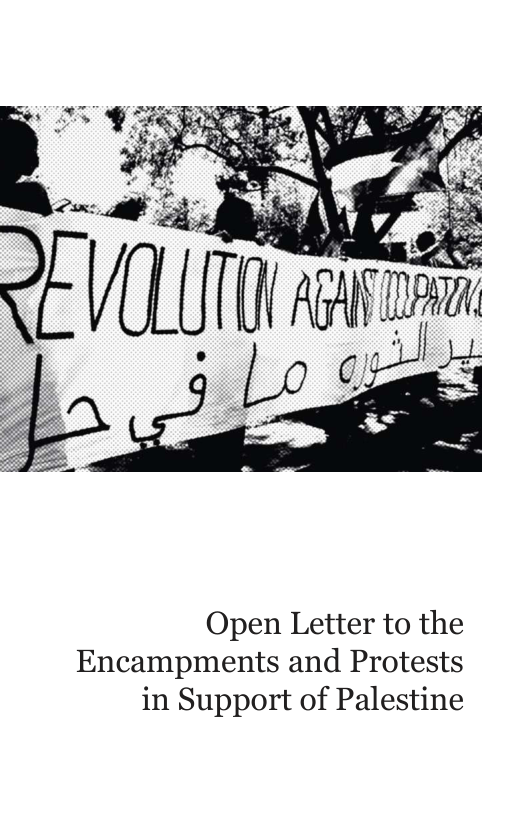




Open Letter to the
Encampments and Protests
in Support of Palestine
Published May 16, 2024
Online article can be found at:
https://itsgoingdown.org/open-letter-to-the-encamp-
ments-and-protests-in-support-of-palestine/
An open letter offering
acritical analysis of the campus based
movement in solidarity with Palestine.
As the summer sets in and most of the encampments pack up, the geno-
cide will surely continue. Nothing we have done collectively seems to have
slowed it down in any measurable way: everyone in Gaza at this point has
been made homeless all over again, they are facing acute food insecurity,
half are facing catastrophic levels of famine; Israel is stil intentionally
targeting children, the elderly, aid workers, family members of combat-
ants, and journalists; attacks by settler paramilitaries in the West Bank are
increasing, and now the Israeli government are revealing that their cease-
fire negotiations were just a lie to buy more time as they begin their
invasion of Rafah. We need to be able to face these facts. This is an invita-
tion to recognize our failures and shortcomings and to move forward with
this recognition. Palestine and Palestinians—specifically Gazans—need
more effective solidarity.
For months here in northeast Ohio, we have watched the emer-
gence of pro-Palestine “leadership” who have been catering to the wrong.
interests. Their approach has not been informed by the history of the
struggle for Palestinian liberation, the struggle against segregation and
police here in the US, or relevant movements like the decades-long
campaign for divestment from apartheid South Africa, a racist regime that
was an explicit source of inspiration for the Israeli government.
This self-appointed leadership has pacified the movement and
given all the advantages to those who demonstrably care nothing for Pales-
tinians (the university administration, city council the police, etc.). It has
stripped us of our greatest sources of strength.
f
« Putting our faith in negotiations with the administration is just
following the playbook that universities use to weaken student
movements. Their method is to wait out the protests, knowing the
end of the semester will arrive soon enough. If a university invests in
Israeli genocide, do we think they care about the rights of either
students or Palestinians?
Letting the police into encampments puts many people—particularly
people of color, houseless people, undocumented people, and
people who are not neuronarmative—at far greater risk of harm.
Accepting the dominance of top-down and would-be vanguardist
organizations hurts movements. Silencing crticisms of such groups
in the name of “unity” is no excuse. We have seen time and again
how these organizations ultimately prioritize their own organiza-
tional interests, which means recruiting, capturing the spotlight,
spreading their party line, not dirtying their hands with real, long
term organizing, not dedicating time to the labor of care o prisoner
support, and sending others to carry out risky actions without
informing them of the risks, without supporting them when they are
arrested, and without taking risks themselves.
Reducing the entire range of tactics to the hypocritical distinction
between “peaceful” and “not peaceful” is just a coded way of saying
what forms of resistance deserve to be repressed. It's playing
respectability politics, which has never worked for the movements
of the oppressed.
What i our greatest source of strength? Solidarity. But if students consent
to the administration or self-appointed leaders aiding the police as they ID,
expel, or arrest non-students from an encampment, they are breaking
solidarity. If people at the encampments are engaging in “peace policing,”
telling other people what tactics they are “allowed” to use, they are break-
ing solidarity." If they are punishing dissent, denouncing people brave
enoughto push back against police control by taking their pictures, filming
1. Clealy, people should be able to speak riclly bout any indof tacic or action they.
disagrea with, or that puts them 3 risk, and is importat for movements to work
through tis ficfon, understanding there willnever be complete consensus. In 3
pacifed ociey,we need o work hard {0 expand our toolbox of availsbe actics,and in
Reterogeneaus mavements, we need to find ways for multpe spaces with diferent
hythms, kil ets, nd ris evelsto coexist. What we ae cricising hre s th aritrary
impsition of pacifam, hepingthe plice docrow control, enabling e 910 pecpl,
n iming people snd puting ther faces anine fo yeing st the cops or pushin the
envelope a it
them and putting it on social media, snitching or aiding in arrests, they are
breaking solidarity. f they are organizing every event and protest at a
breakneck rhythm, exclusively focused on a superficial urgency, only
communicating over social media, or using other practices that exclude the
elderly or people with disabilities or chronic liness, they are breaking
solidarity. Urgency is real in our struggles, but it needs to be balanced by a
rhythm that shows we are in this for the long haul, that we take care of us
This is especially important because many of the people who are being
excluded have the experiences, skills, and bravery this movement needs to
break out of all the enclosures so that the dominant institutions can't keep
ignoring us, silencing us, or arresting us as they profit off genocide.
o their credit, many of the groups and people who make up this
movement agree with the concept of diversity of tactics. We believe that,
with a handful of exceptions (the politicians and police who come from
inside the movement and from the outside) the people who are showing
up are doing so from a real desire to enact solidarity, and they are coming
from a place of sincerity. What we are trying to say, sincerely, is that in the
face of genocide, we need to do better.
It has been inspiring to experience and participate in the rapidly.
growing network of encampments. In particular, working class universities
like Cal Poly Humboldt and CUNY should be commended for their creativi-
ty, bravery, and clear understanding of the intersections of struggle. This
should be studied by communities, or anyone, who is seriously committed
to resisting state repression and fighting for a free Palestine. These
students, activists, and community members did not wat around for the
administration to invite them to a seat at the table; they did not wait for a
body of leadership to swoop in and save them. They simply understood
what needed to be done in response to genocide.
As one student from Humboldt said, *I think of it as an honor to have been
suspended fighting this.”
We, tao, feel honored to fight alongside you,
I solidarity, and for an end to al sttler states and apartheid regimes from
Turtle lsland to Australia, and Aotearoa to Palestine,
A Palestinian anarchist who grew up in Northeast Ohio,
with family in the West 8ank and loved ones in Gaza
A settler-descended formerly incarcerated anarchist based in Cleveland
Postscript: On the difficulties of cri
in a leftist and nonprofit scene
In response to our open letter, published at the beginning of this week, we
received a great deal of gratitude from people who have had similar experi-
ences. We also received a significant amount of push back. We believe
most of the resistance came from a sincere place, but it demonstrated a
complicated mix
« Sympathy with the criticisms, but fear that other people would take
them the wrong way.
« Apprehension that they “weren't experienced enough” to be making
criticisms (sadly but unsurprisingly, this was voiced most often by
women, especially women of color).
« Concern that they couldn't sgn the letter because they “weren't
Palestinians” (just like being Palestinian doesn't automatically give
You a good take, not being Palestinian doesn't mean you don't have
a valid perspective — the most important thing, maybe, is to be
aware and honest of what your perspective actually is, and what
experience you actually speak from).
Wellintentioned condescension.
« Tone policing, whereby offending movement allies who think we
might be indirectly throwing shade their way is considered a worse
crime than excluding people with jobs (not counting tenured profes-
sors), people who aren't a part of the pre-established club of
important activsts, or peaple with chronic ilinesses.
« The belief that airing criticisms violates solidarity o will lead to
infighting.
« The belief that criticism should only be shared between individuals
or groups that already have a strong basis of trust.
« Attempts to silence the open letter or ghost people circulating it
One of the main takeaways here is extremely worrying: people in our
movement are scared of criticism and are not used to giving or receiving
constructive criticism, resulting in an atmosphere of avoidance. From our
experience over the prior decades and from movement history, we know
that movements that cannot engage with constructive criticism are
doomed to perpetuate harmful and self-defeating dynamics.
We also know that the current movement, at least in our
geographic region, has gatekeepers, certain ideas of rhythm and urgency,
minimums for being able to participate, rampant tokenism, unspoken
beliefs about who matters and wh does not, awareness of certain forms
of oppression or exclusion and no awareness of others, a tendency to
dismiss unpopular or radical ideas as “sectarian” while constantly rehabili-
tating and giving a pass to clearly sectarian groups that have harmed us in
the past... above all it is a movement with very little memory of its own
history.
These shortcomings made it difficult for many people to partici-
pate in the encampments in a meaningful way and it insulated those with
the most power and the least accountable uses of power from any
feedback or criticism. These forms of exclusion, many unintentional but
some intentional, had a disproportionate impact on disabled people, older
people, working people, racialized people, people more vuinerable to
police violence, and peaple who do not hold a position of power in the
established NGOs and Left organizations. We know this from our own
experience and the experiences expressed by multiple other people in the
movement space. In fact, we only wrote this open letter because of the
way meaningful participation was so limited and in some cases policed.
It was clear to us that a small but significant amount of the push
back to the open letter was coming from an insincere and selF-interested
place. One of the clearest indicators of this were the multiple people
wringing their hands about how the open letter might harm the solidarity
movement, without at all addressing the ongoing forms of harm that we
named are being perpetuated in the movement, and withaut voicing any
empathy with one of the letter co-authors, who has family members and
loved ones currently in the West Bank and Gaza.
We would like to describe an entrenched dynamic here in north-
east Ohio, that also predominates in many other parts of the country:
self-appointed leaders and organizers who mistake themselves for the
movement, who are not always honest with themselves about how much
relevance and presence their organizations actually have, and who talk
about coalition-building to refer to a process that seems to center more on
protecting egos, claiming turf, and building complicity and social power
among a small number of established activists who are more ikely inhibit
and even drain movements than they are to enable and empower them.
We know that this description is only a small part of a big picture.
‘There are also many groups and individuals that participate in these larger
coalitions, that may be legally constituted as NGOS, or that constrain them-
selves to a single-issue focus, but that are sincerely doing the best they can
in a difficult situation with severely limited resources. We appreciate you.
We are also looking for the best ways to act in a situation in which our
enemies hold nearly all the weapons.
We offer this feedback so that we can all develop a collective
consciousness of authoritarian dynamics that drain our movements and
protect institutions of power from effective resistance, and so that any
sincere people caught up in this framework have another opportunity to
see t, acknowledge it, and change how they engage.
We encourage everyone who supports this letter
or considers it useful for ongoing conversations
to share it, repost it, and send it to pertinent
organizations and individuals involved in the
solidarity movement.
The authors of this letter are organizing a con-
versation about next steps for strengthening our
movements, amongst the communities we orga-
nize in.
We encourage people who receive this letter
who are a part of other networks to also con-
vene open conversations for reflection, learning,
and strategizing.
0
It has been inspiring to experience and
participate in the rapidly growing
network of encampments. In particular,
working class universities like Cal Poly
Humboldt and CUNY should be
commended for their creativity, bravery,
and clear understanding of the intersec-
tions of struggle. This should be studied
by communities, or anyone, who is
seriously committed to resisting state
repression and fighting for a free Pales-
tine. These students, activists, and
community members did not wait
around for the administration to invite
them to a seat at the table; they did not
wait for a body of leadership to swoop in
and save them. They simply understood
what needed to be done in response to
genocide.
It's Going Down
itsgoingdown.org