Free the Mississippi 5! – Lisa Crevitt
Web PDF • Imposed PDF• Raw TXT (OCR)





![Lisa was sentenced in 1985 during an unprecedented rise in womens’ incarceration. Between 1980 and 2021, the number of incarcerated women increased by over 525%. Women’s imprisonment has outpaced men’s twofold during that time. The majority of those in state prisons have been convicted of what are considered violent crimes. 40 20- 1955 165 (175 1 (a95 2005 015 {Image based on graphic from Wendy Sawyer, “The Gender Divide: Tracking Women’s State Growth,” Prison Policy Initiative, January 9, 2018, https:// ‘www.prisonpolicy.org/reports/women_overtime.html; data also gathered from Niki Monazzam and Kristen M. Budd, PhD, “Fact Sheet: Incarcerated Women and Girls,” The Sentencing Project, April 3, 2023, httpsy//www. sentencingproject.org/fact sheet/incarcerated-women-and-girls/]](free-the-mississippi-5-lisa-crevitt-campaign-to-free-the-mississippi-5 11.png)
![Lisa understood that she wouldn’t receive parole immediately. “In doing that 10 years, you leam that nobody would ever get paroled the first time. So when | went for parole the first time [in 1995] | got a 3 year setoff. Yeah, it hurt, but | expected it. But then after that, you expect to make parole at some point. And then you never do.” 12](free-the-mississippi-5-lisa-crevitt-campaign-to-free-the-mississippi-5 12.png)
![“Every time you go up and you get slammed to the ground, it is S0 hard to get back up. And | haven’t totally gotten back up from this last one [in 2023] yet. There have been 9 parole denials for me and 30 some odd years worth of set offs. | try not to even count them up. I’try not to remember that number.”](free-the-mississippi-5-lisa-crevitt-campaign-to-free-the-mississippi-5 13.png)
![Every time she i denied parole, the Board provides suggestions as to how Lisa might improve her chances. But their recommendations seem like they are talking about a different person “They wanted me to get a GED. Excuse me, but | graduated [high school] with honors and if they looked at my file they would know that. This last time they even marked ‘history of violence.’ | have no history of violence. I’ve got the one charge and that is all. I have been in prison over 38 years with no disciplinaries. | sang in the choir for years. | have certificates in Celebrate Recovery, Business Technology, Experiencing God, Advanced Business Technology, and Anger Management. | have done everything. I have done everything positive that can be done here.” 14](free-the-mississippi-5-lisa-crevitt-campaign-to-free-the-mississippi-5 14.png)






FREE THE
MISSISSIPR
cover portrait by phan
illustrations by sunmi
text by the MS5 zine team
The “Mississippi Five” originally described five women -
Lisa Crevitt, Anita Krecic, Loretta Pierre, Evelyn Smith,
and Linda Ross - sentenced to life with the possibility of
parole in the late 1980s and early 1990s. Despite their
achievements, personal growth, the loss of loved ones
outside, and even recantations of key witnesses, they have
been denied parole Irrespective of their actions and the
people they have become.
After Jacqueline Barnes was denied parole a second time
on Christmas eve in 2024, we added her to our campaign.
These six women are now between the ages of 60 and 83
years old. They have collectively been imprisoned over 200
yearsand denied parole 50 times. In the words of committee
member and organizer Pauline Rogers, the parole board
continues to act as “judge, jury, and executioner.”
It is time to Free the Five and Free Them All!
This zine is part of a six-part series in the campaign to Free
the Five-an effort to bring home the women while raising
awareness about parole as a repressive political tool.
It is based on an oral history interview with Lisa Crevitt
recorded on October 27th, 2023.
Want to get involved? Join us:
www.studyandstruggle.com/ms5
Lisa Crevitt isn't the same woman she was almost
forty years ago.
What do you remember?
I really didn't have a lot of time
to do much because | was 20
when | got locked up.
“I was born October 4, 1964 in Vicksburg, Mississippi.
My mom and my stepdad raised me. | spent weekends with my
dad and stepmom. It was just typical. | came home. I just did
homework.”
Lisa didn’t just do homework;
she was accomplished in sports and academics.
“I graduated high school with honors, played basketball, was
a cheerleader, played softball, took ballet and tap when | was
younger. My dad and my stepmom are extremely supportive of
me and always have been, always will be. 'm a daddy’s girl. And
my stepmom and | are really close.”
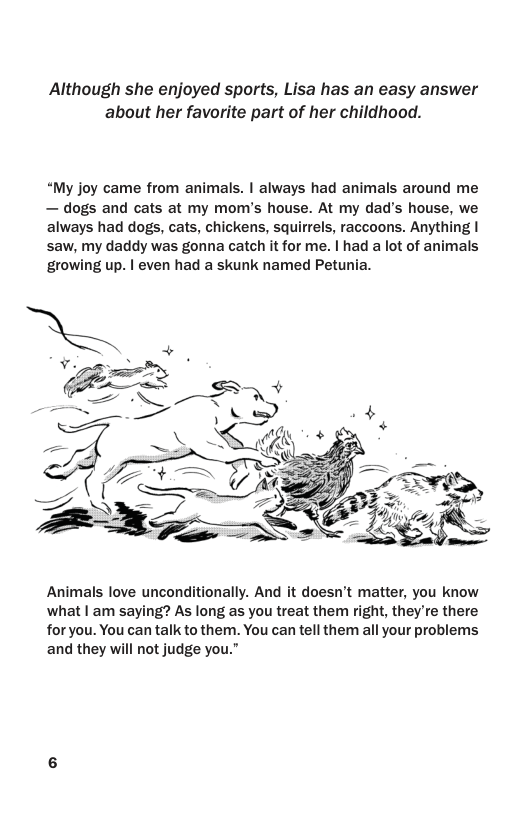
Although she enjoyed sports, Lisa has an easy answer
about her favorite part of her childhood.
“My joy came from animals. | always had animals around me
— dogs and cats at my mom’s house. At my dad’s house, we
always had dogs, cats, chickens, squirrels, raccoons. Anything |
saw, my daddy was gonna catch it for me. | had a lot of animals
growing up. | even had a skunk named Petunia.
Animals love unconditionally. And it doesn't matter, you know
what | am saying? As long as you treat them right, they're there
for you. You can talk to them. You can tell them all your problems
and they will not judge you.”
Lisa got married at age 17, one month after graduating
high school. She had her first daughter, Nikki, that fall.
Her second daughter Amanda was born two years later.
She had gotten a divorce and was pregnant with her third
child when tragedy struck.
“Amanda was the second child; she died of congestive heart
failure when she was three months old. That was the beginning
of the end for me.
Amanda passed away on December 31, 1984. And then | just
couldn't deal with things. | started doing drugs...and | was on
some hard stuff, like LSD type stuff— hallucinogens.
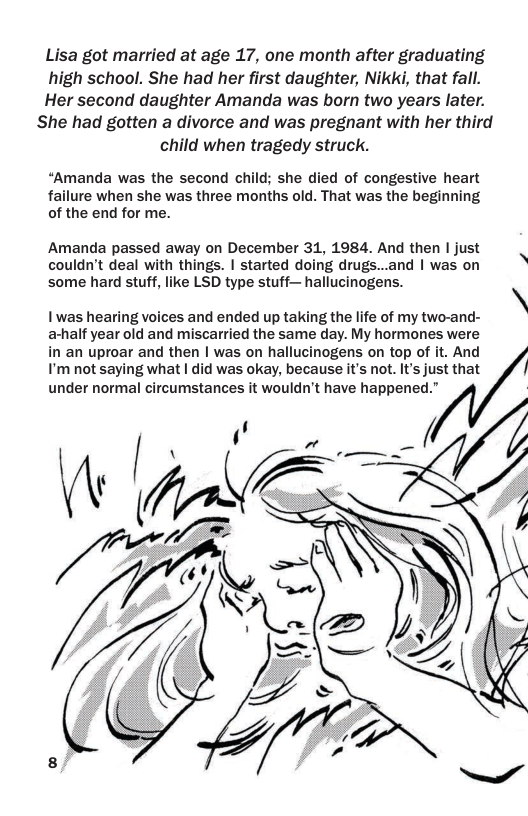
I was hearing voices and ended up taking the life of my two-and-
a-half year old and miscarried the same day. My hormones were
in an uproar and then | was on hallucinogens on top of it. And
I'mnot saying what | did was okay, because it's not. It's just that //
under normal circumstances it wouldn't have happened.”
Like the rest of the Five, and many other people
on trial, Lisa didn’t understand the ins and outs of the
criminal legal system. Her mother encouraged her to
take a plea deal, so she did.
“When | took the deal, | was under the impression that it was a
manslaughter charge.
But when | went into the courtroom, it was a murder charge.
When they gave me life...| just about threw up.
But my judge said that | would be eligible for parole after
10 years.”
10
Lisa was sentenced in 1985 during an unprecedented
rise in womens’ incarceration. Between 1980 and
2021, the number of incarcerated women increased
by over 525%. Women's imprisonment has outpaced
men's twofold during that time. The majority of those
in state prisons have been convicted of what are
considered violent crimes.
40
20-
1955 165 (175 1 (a95 2005 015
{Image based on graphic from Wendy Sawyer, “The Gender Divide: Tracking
Women’s State Growth,” Prison Policy Initiative, January 9, 2018, https://
‘www.prisonpolicy.org/reports/women_overtime.html; data also gathered
from Niki Monazzam and Kristen M. Budd, PhD, “Fact Sheet: Incarcerated
Women and Girls,” The Sentencing Project, April 3, 2023, httpsy//www.
sentencingproject.org/fact sheet/incarcerated-women-and-girls/]
Lisa understood that she wouldn’t
receive parole immediately.
“In doing that 10 years, you leam that nobody would ever get
paroled the first time. So when | went for parole the first time
[in 1995] | got a 3 year setoff. Yeah, it hurt, but | expected it. But
then after that, you expect to make parole at some point.
And then you never do.”
12
“Every time you go up and you get slammed to the ground, it is
S0 hard to get back up. And | haven't totally gotten back up from
this last one [in 2023] yet.
There have been 9 parole denials for me and 30 some odd years
worth of set offs. | try not to even count them up.
I'try not to remember that number.”
Every time she i denied parole, the Board provides
suggestions as to how Lisa might improve her chances.
But their recommendations seem like they are talking
about a different person
“They wanted me to get a GED. Excuse me, but | graduated [high
school] with honors and if they looked at my file they would
know that.
This last time they even marked ‘history of violence.’ | have no
history of violence. I've got the one charge and that is all.
I have been in prison over 38 years with no disciplinaries. | sang
in the choir for years. | have certificates in Celebrate Recovery,
Business Technology, Experiencing God, Advanced Business
Technology, and Anger Management. | have done everything.
I have done everything positive that can be done here.”
14
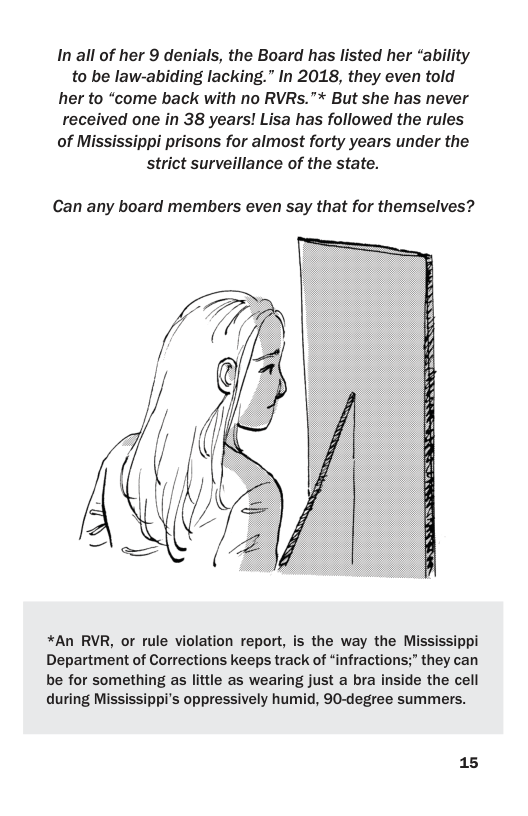
In all of her 9 denials, the Board has listed her “ability
to be law-abiding lacking.” In 2018, they even told
her to “come back with no RVRs.”* But she has never
received one in 38 years! Lisa has followed the rules
of Mississippi prisons for almost forty years under the
strict surveillance of the state.
Can any board members even say that for themselves?
*An RVR, or rule violation report, is the way the Mississippi
Department of Corrections keeps track of “infractions;” they can
be for something as little as wearing just a bra inside the cell
during Mississippi's oppressively humid, 90-degree summers.
15
Despite all the other reasons the Board has provided,
including the new *history of violence” they'd never
claimed before, Lisa knows exactly why she’s being
denied parole—it's one she has no control over.
“My ex-hushand was a deputy and then a narcotics detective.
Now he is a municipal court judge. He does all this social
media or whatever when | go for parole. You know, | guess
down South it s the ‘Good ‘ol boy system. It's like, you scratch
my back, Il scratch yours. If he don't want me to get out then
I'm never getting out.”
Child murderer Lisa
Crevitt up for parole
the reason many people are denied parole, but which
community gets to be heard? It is rarely those calling
“Opposition from the community” is regularly cited as \d
for their loved ones to come home. :
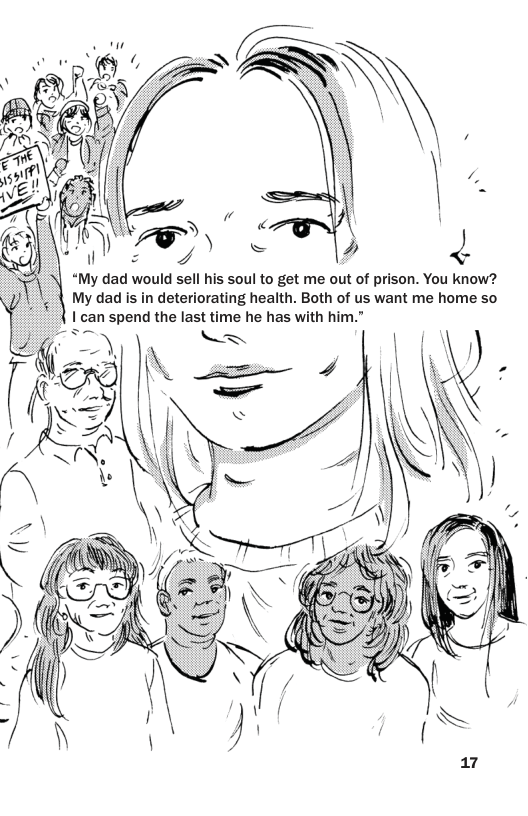
“am not going back to Vicksburg. | am going to be with my
dad. My dad sold his house and moved so that | wouldn't have
to go back there. | am going to a whole new place where | have
never been.”
i
16
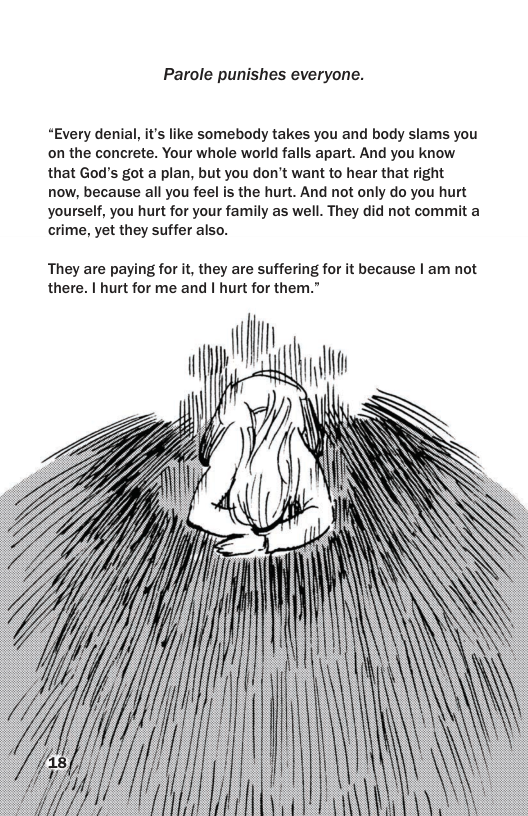
Parole punishes everyone.
“Every denial, it's like somebody takes you and body slams you
on the concrete. Your whole world falls apart. And you know
that God’s got a plan, but you don't want to hear that right
now, because all you feel is the hurt. And not only do you hurt
yourself, you hurt for your family as well. They did not commit a
crime, yet they suffer also.
They are paying for it, they are suffering for it because | am not
there. | hurt for me and | hurt for them.”
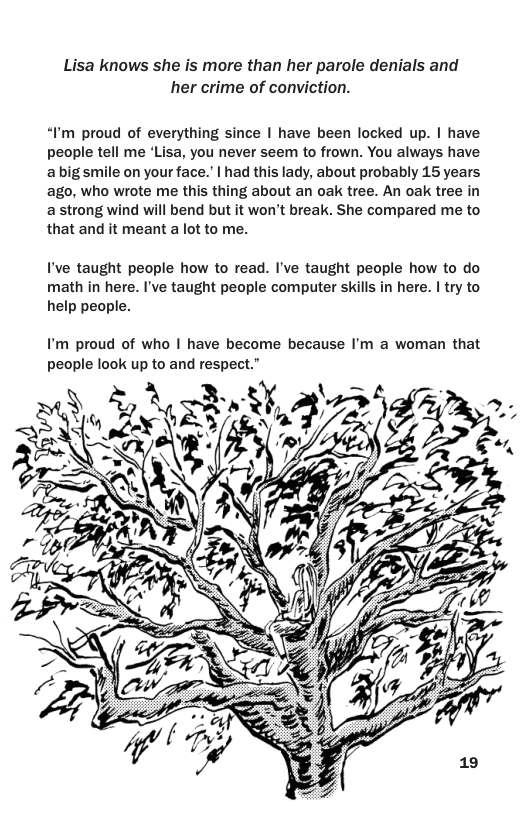
Lisa knows she is more than her parole denials and
her crime of conviction.
“Pm proud of everything since | have been locked up. | have
people tell me ‘Lisa, you never seem to frown. You always have
abig smile on your face. | had this lady, about probably 15 years
ago, who wrote me this thing about an oak tree. An oak tree in
a strong wind will bend but it won't break. She compared me to
that and it meant a lot to me.
I've taught people how to read. I've taught people how to do
math in here. I've taught people computer skills in here. | try to
help people.
I'm proud of who | have become because I'm a woman that
people look up to and respect.”
Lisa also knows she’s not alone-
she has the rest of the Five.
“We have each other's back. There’s not one of them that |
could not go to for help, and they feel the same way about me.
We are close and we try to help each other, whether it be
financially or emotionally, spiritually—whatever. If one of them
is going through something, we are all going through it and if |
am going through something, they are going through it
with me.
When | got my last setoff, we all fell. They may not have fallen
as hard as | did, but we all fell and then when they got a setoff
I fell with them. Because it's just something that we have that
connection, that bond. We've been living together for so long.”
But even with the Five supporting her, Lisa wants
connection with more people—a thing that prison is
designed to deny her.
“I have my mom, step-dad, dad, step-mom, my sister, and my
daughter. But you need a connection to the community, you
know? You need that connection to the real world or you feel
disconnected.
1 will get out one day and | want to have people that | can talk
to that | can count on to have my back as far as emotionally,
because it is gonna be hard for me when | gt out. | have been
locked up for all of my life. | need people | can connect with
now, so that when | get out, | will already have that. ll have
somebody to talk to if | need to.”
Outside support can be life-saving for incarcerated people.
Visit the Mississippi Five website to learn more about how you
can connect with Lisa. You can also write to her at the address
on the back of this zine.
https;//www.studyandstruggle.com/ms5
21
She’s grown in the last
forty years, far beyond
what she could even
imagine at twenty.
“ am a completely different person than | was at 20.
Just as parole board members are not the same people they
were 38 years ago. No one today is the same person that they
were 38 years ago.
Because you grow and you have life experiences and you
change and you mature and you know, you bend with life.
Whatever life throws at you, you bend to accommodate and
You try not to break. You have to learn and grow from the
mistakes.
That's what people do.”
22
“I had a child while | was locked up and she is 34 years old and
I have grandchildren. My daughter looks up to me, you know?
She goes through a lot but she still looks up to me and she
respects me.
I'm not the same person | was in 1985.
I don't know anybody that is.”
23
Lisa Crevitt isn't the same woman she was almost forty
years ago, but one thing has remained constant:
her love of animals.
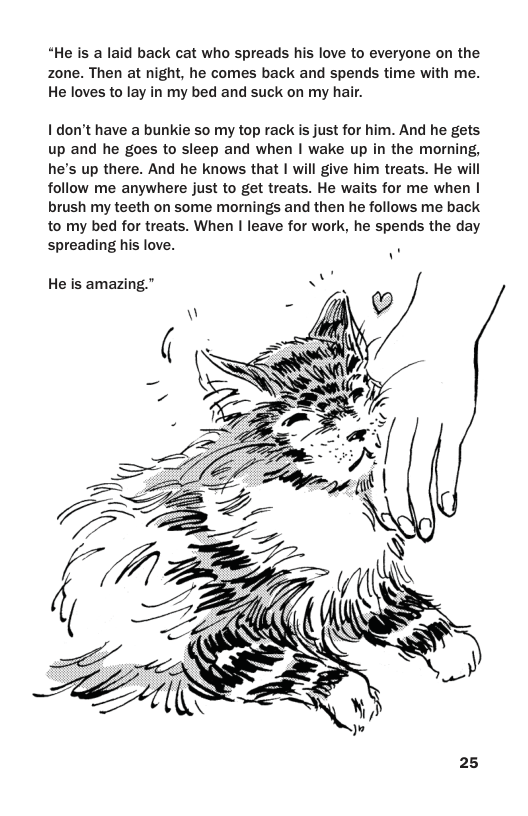
Through a cat program at the prison, Lisa has been able
to find her forever cat, Cosmo.
“I got him when he was 6 weeks old and just a little tiny thing.
He's my support system right now. He gets me through
everything—he’s a long haired tabby. He is brown and black and
he’s got green, goldish green eyes.”
24
“He is a laid back cat who spreads his love to everyone on the
zone. Then at night, he comes back and spends time with me.
He loves to lay in my bed and suck on my hair.
I don't have a bunkie so my top rack is just for him. And he gets
up and he goes to sleep and when | wake up in the morning,
he’s up there. And he knows that | will give him treats. He will
follow me anywhere just to get treats. He waits for me when |
brush my teeth on some mornings and then he follows me back
to my bed for treats. When | leave for work, he spends the day
spreading his love. .
He is amazing.” NN (7
25
Lisa Crevitt does not see herself the way
the parole board does.
CREVITT #5651/
LACEING
Ve AL, mENTAL, OR
EDVMW‘ENJL RESOURCES LA
a "CoME BACK WITH N RVRS®
26
Neither do her friends, family, and community.
o ANIMAL LOVER
°© MENTOR
s MOTHER
o TEALHER
Ty
Sonborr
o FRIEMD
27
WHAT CAN
YOU DO?
Learn more about how you can get involved in the
campaign to Free the Mississippi Five:
https://www.studyandstruggle.com/ms5
Write to Lisa:
Lisa Crevitt #56511
MCIW/A-1-A/Bed #12
P.0. Box 88550
Pearl, MS 39288