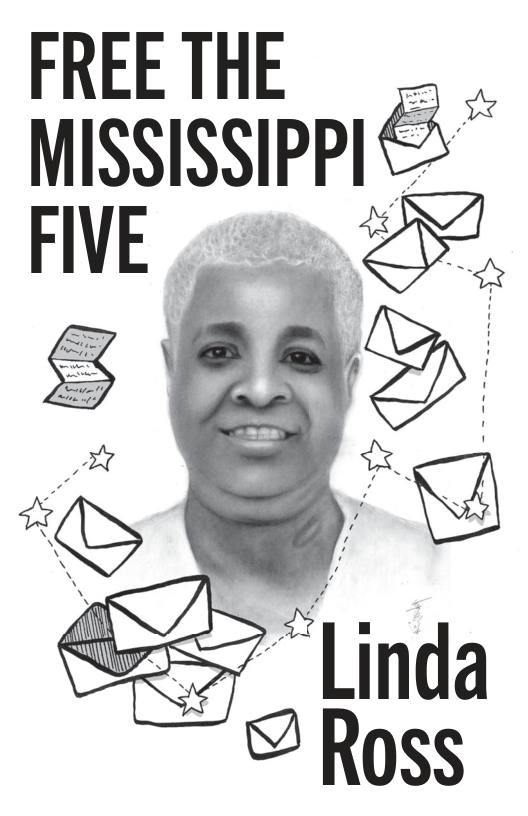
Free the Mississippi 5! – Linda Ross
Web PDF • Imposed PDF• Raw TXT (OCR)


![Linda was convicted in 1990 as part of an unprecedented rise in women’s incarceration. Between 1980 and 2021, the number of incarcerated women in the United States increased by over 525%. Women’s imprisonment has outpaced men’s twofold during that time. The majority of those in state prisons have been convicted of what are considered violent crimes. 175 1495 2005 105 s dmes 175 {Image based on graphic from Wendy Sawyer, “The Gender Divide: Tracking Women’s State Growth,” Prison Policy Initiative, January 9, 2018, https:// ‘www.prisonpolicy.org/reports/women_overtime.html; data also gathered from Niki Monazzam and Kristen M. Budd, PhD, “Fact Sheet: Incarcerated Women and Girls,” The Sentencing Project, April 3, 2023, httpsy//www. sentencingproject.org/fact sheet/incarcerated-women-and-girls/]](free-the-mississippi-5-linda-ross-campaign-to-free-the-mississippi-5 5.png)
![“Then Leo convinced my mom to reconcile with him. So we moved back to New Jersey when | was about 13. My mom left New Jersey for the last time and moved to Rochester. 1 left there and moved to Chicago where my [biological] dad stayed. Was bouncing around, came down here. Stayed here but ended up moving around between 17 and 18. 1 was crying and howling and hiding and being moved and over in all different locations.”](free-the-mississippi-5-linda-ross-campaign-to-free-the-mississippi-5 8.png)
![Now she has a room waiting for her. “My [nieces and nephews] all live in Rochester, New York right now with my mom and Wendy. My oldest sister, who’s named Eloise, lives in Jamestown, Pennsylvania. That’s where | would like to get out. She has my room fixed up. She bred pups and she sold them and made enough money to buy land in Pennsylvania, built a house from the ground up.”](free-the-mississippi-5-linda-ross-campaign-to-free-the-mississippi-5 9.png)
![Linda’s movements throughout her childhood were driven by physical and sexual abuse, which impacted every part of her life. “I couldn’t say no S words. | remember like squirrel and square. Just different words | didn’t pronounce right. My mind was staying in fear and stuff all of the time. | always stayed in fear of something.” = “I grew up in a very abusive household. | think | peed in the bed until | was like 11. | was scared to sleep and | was also scared to g0 to school because | felt that one day I’d go back home with my mother laid out in a pool of blood. And that was the violence that went on in the household. It was just bad.” \ ~ Unaddressed trauma has been found to affect children’s —, emotional and mental health as well as their academic success. ,/**/ As one paper points out, “neurobiological, epigenetic, and biosocial studies have shown that traumatic experiences and conditions in childhood can diminish comprehension, memory, trust, language abilities, and the ability to self-regulate.” [Micah E. Johnson, “The Effects of Traumatic Experiences on Academic Relationshi i ‘and Expectations in Justice-Involved Children,” Psychology in the Schools, 55, v (March 2018): 240-249.] 12 fifi](free-the-mississippi-5-linda-ross-campaign-to-free-the-mississippi-5 12.png)
![“I got molested when | was three. | think until | was 11, | was being molested. 1 did the things | had to do and went to school and listened to my mom and tried to do what | could but growing up in that household, it was horrible. You never knew what was gonna go down next. And my step-father was a policeman. He took care , of us, but he was very abusive to my mama.” Studies have found that police perpetrate violence in the home at rates nearly double the general population, a figure which is likely underestimated. Even the International Association of Chiefs of Police identified domestic violence by police as a %pmblem that “exists at some serious level.” [Philip Stinson and John Liederback, “Fox in the Henhouse: A Study of Police Officers Arested for Crimes Associated with Domestic and/or Famly Violence,” Criminal Justice Faculty Publications (2013) and Lindsey Blumenstein, “Domestic Vilence Within Law Enforcement Families: The Link Between Traditional Police Subculture and Domestic Violence Among Police;” Master’s Thesis, University of South Florida, (2009)]](free-the-mississippi-5-linda-ross-campaign-to-free-the-mississippi-5 13.png)
!["/ nd you know they thought | was mentally retarded because 1 didn’t start talking until | was five. | got taken out of a regular public school and put in a special ed school. Peeing my pants, | smelled like urine, and so the kids teased me all the time. They picked on me. | was bullied pretty much every Accordingto one study, womenin prison have significant histories of trauma, poor mental health, and high rates of substance use disorders. In what some have termed the “abuse to prison ’ pipeline,” the vast majority of people in women’s prisons were survivors before their incarceration. [Layla Edwards et . °A systematic review of postrelease programs for women exiting prison with substance-use disorders: assessing current programs and weighing the. evidence,” Hoalth & Justice 10:1.(2022)] Py 14](free-the-mississippi-5-linda-ross-campaign-to-free-the-mississippi-5 14.png)


FREETHE _ .
MISSISSIPPI
)
cover portrait by phan
illustrations by david tarafa
text by the MS5 zine team
The “Mississippi Five” originally described five women -
Lisa Crevitt, Anita Krecic, Loretta Pierre, Evelyn Smith,
and Linda Ross - sentenced to life with the possibility of
parole in the late 1980s and early 1990s. Despite their
achievements, personal growth, the loss of loved ones
outside, and even recantations of key witnesses, they have
been denied parole Irrespective of their actions and the
people they have become.
After Jacqueline Barnes was denied parole a second time
on Christmas eve in 2024, we added her to our campaign.
These six women are now between the ages of 60 and 83
years old. They have collectively been imprisoned over 200
yearsand denied parole 50 times. In the words of committee
member and organizer Pauline Rogers, the parole board
continues to act as “judge, jury, and executioner.”
It is time to Free the Five and Free Them All!
This zine is part of a six-part series in the campaign to Free
the Five-an effort to bring home the women while raising
awareness about parole as a repressive political tool.
It is based on an oral history interview with Anita Krecic
recorded on September 4, 2023.
Want to get involved? Join us:
www.studyandstruggle.com/ms5
Linda was convicted in 1990 as part of an
unprecedented rise in women’s incarceration.
Between 1980 and 2021, the number of incarcerated women
in the United States increased by over 525%. Women's
imprisonment has outpaced men's twofold during that time.
The majority of those in state prisons have been convicted of
what are considered violent crimes.
175 1495 2005 105
s dmes 175
{Image based on graphic from Wendy Sawyer, “The Gender Divide: Tracking
Women’s State Growth,” Prison Policy Initiative, January 9, 2018, https://
‘www.prisonpolicy.org/reports/women_overtime.html; data also gathered
from Niki Monazzam and Kristen M. Budd, PhD, “Fact Sheet: Incarcerated
Women and Girls,” The Sentencing Project, April 3, 2023, httpsy//www.
sentencingproject.org/fact sheet/incarcerated-women-and-girls/]
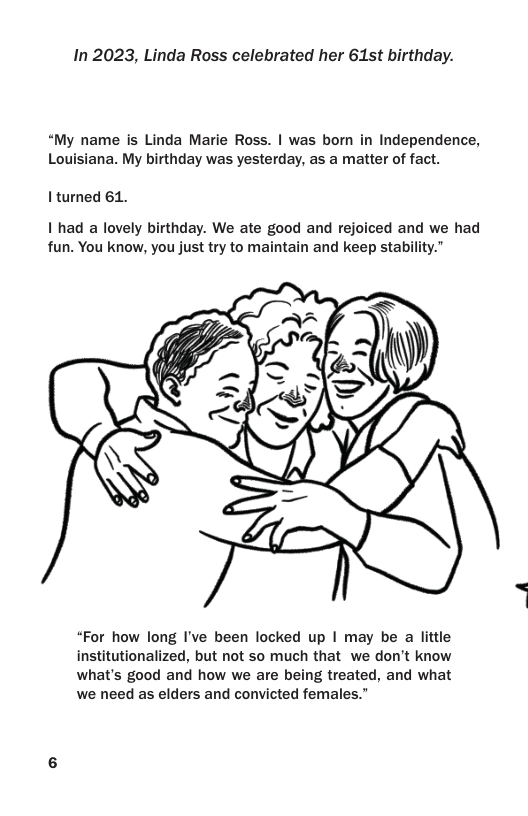
In 2023, Linda Ross celebrated her 61st birthday.
“My name is Linda Marie Ross. | was born in Independence,
Louisiana. My birthday was yesterday, as a matter of fact.
I'turned 61.
1 had a lovely birthday. We ate good and rejoiced and we had
fun. You know, you just try to maintain and keep stability."
“For how long I've been locked up | may be a lttle
institutionalized, but not so much that we don't know
what's good and how we are being treated, and what
we need as elders and convicted females.”
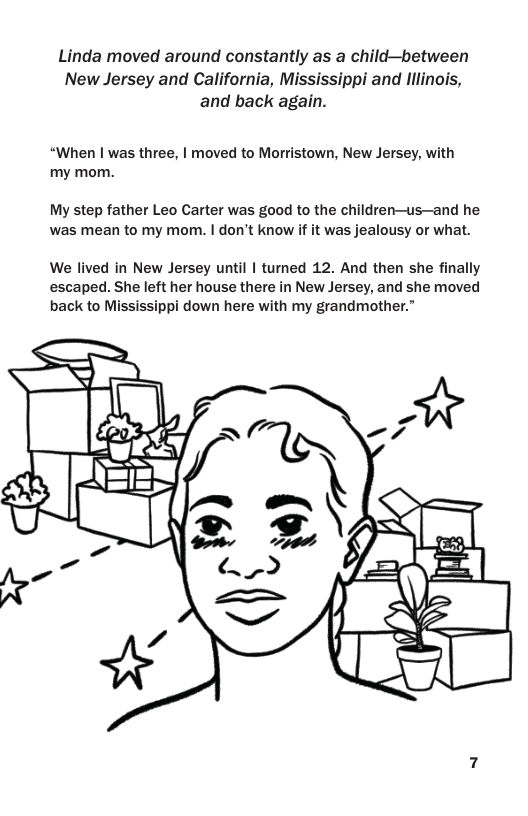
Linda moved around constantly as a child—between
New Jersey and California, Mississippi and lllinois,
and back again.
“When | was three, | moved to Morristown, New Jersey, with
my mom.
My step father Leo Carter was good to the children—us—and he
was mean to my mom. | don’t know if it was jealousy or what.
We lived in New Jersey until | turned 12. And then she finally
escaped. She left her house there in New Jersey, and she moved
back to Mississippi down here with my grandmother.”
“Then Leo convinced my mom to reconcile with him.
So we moved back to New Jersey when | was about 13.
My mom left New Jersey for the last time and moved
to Rochester.
1 left there and moved to Chicago where my [biological] dad
stayed. Was bouncing around, came down here. Stayed here but
ended up moving around between 17 and 18.
1 was crying and howling and hiding and being moved and over
in all different locations.”
Now she has a room waiting for her.
“My [nieces and nephews] all live in Rochester, New York right
now with my mom and Wendy. My oldest sister, who's named
Eloise, lives in Jamestown, Pennsylvania.
That's where | would like to get out. She has my room fixed up.
She bred pups and she sold them and made enough money to
buy land in Pennsylvania, built a house from the ground up.”
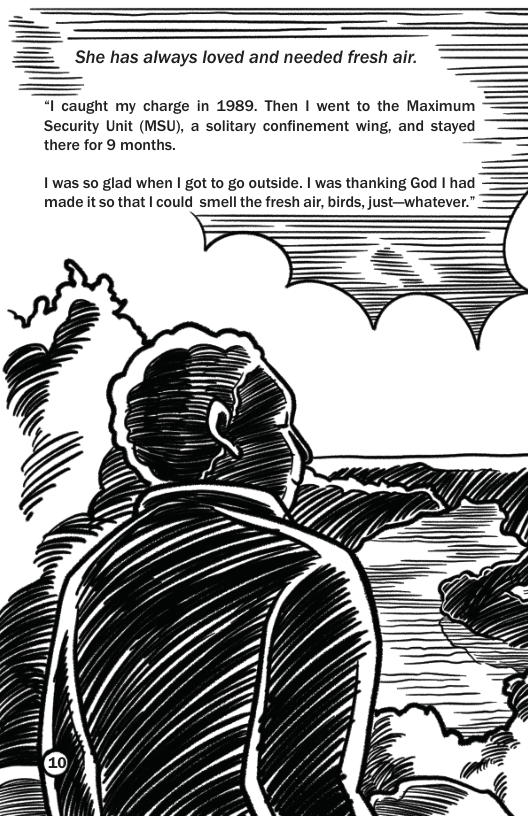
She has always loved and needed fresh air.
“I caught my charge in 1989. Then | went to the Maximum
Security Unit (MSU), a solitary confinement wing, and stayed
there for 9 months.
I was so glad when | got to go outside. | was thanking God | had
made it so that | could smell the fresh air, birds, just—whatever.” g
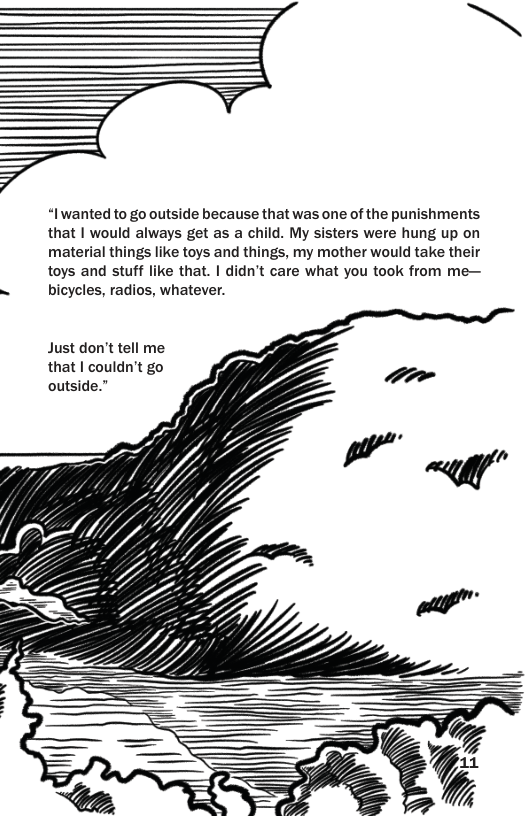
“Iwanted to o outside because that was one of the punishments.
that | would always get s a child. My sisters were hung up on
material things like toys and things, my mother would take their
toys and stuff like that. | didn't care what you took from me—
bicycles, radios, whatever.
Just don't tell me
that | couldn't go
outside.”
Linda’s movements throughout her childhood were
driven by physical and sexual abuse, which impacted
every part of her life.
“I couldn't say no S words. | remember like squirrel and square.
Just different words | didn't pronounce right. My mind was
staying in fear and stuff all of the time. | always stayed in fear
of something.” =
“I grew up in a very abusive household. | think | peed in the bed
until | was like 11. | was scared to sleep and | was also scared to
g0 to school because | felt that one day I'd go back home with
my mother laid out in a pool of blood. And that was the violence
that went on in the household. It was just bad.” \
~
Unaddressed trauma has been found to affect children’s —,
emotional and mental health as well as their academic success. ,/**/
As one paper points out, “neurobiological, epigenetic, and
biosocial studies have shown that traumatic experiences and
conditions in childhood can diminish comprehension, memory,
trust, language abilities, and the ability to self-regulate.”
[Micah E. Johnson, “The Effects of Traumatic Experiences on Academic Relationshi i
‘and Expectations in Justice-Involved Children,” Psychology in the Schools, 55, v
(March 2018): 240-249.]
12 fifi
“I got molested when | was three. | think until | was 11, | was
being molested.
1 did the things | had to do and went to school and listened to
my mom and tried to do what | could but growing up in that
household, it was horrible. You never knew what was gonna go
down next. And my step-father was a policeman. He took care
, of us, but he was very abusive to my mama.”
Studies have found that police perpetrate violence in the home
at rates nearly double the general population, a figure which
is likely underestimated. Even the International Association
of Chiefs of Police identified domestic violence by police as a
%pmblem that “exists at some serious level.”
[Philip Stinson and John Liederback, “Fox in the Henhouse: A Study of Police Officers
Arested for Crimes Associated with Domestic and/or Famly Violence,” Criminal
Justice Faculty Publications (2013) and Lindsey Blumenstein, “Domestic Vilence
Within Law Enforcement Families: The Link Between Traditional Police Subculture
and Domestic Violence Among Police;” Master's Thesis, University of South Florida,
(2009)]
"/
nd you know they thought | was mentally retarded because
1 didn't start talking until | was five. | got taken out of a regular
public school and put in a special ed school.
Peeing my pants, | smelled like urine, and so the kids teased me
all the time. They picked on me. | was bullied pretty much every
Accordingto one study, womenin prison have significant histories
of trauma, poor mental health, and high rates of substance
use disorders. In what some have termed the “abuse to prison '
pipeline,” the vast majority of people in women’s prisons were
survivors before their incarceration.
[Layla Edwards et . °A systematic review of postrelease programs for women exiting
prison with substance-use disorders: assessing current programs and weighing the.
evidence,” Hoalth & Justice 10:1.(2022)]
Py
14
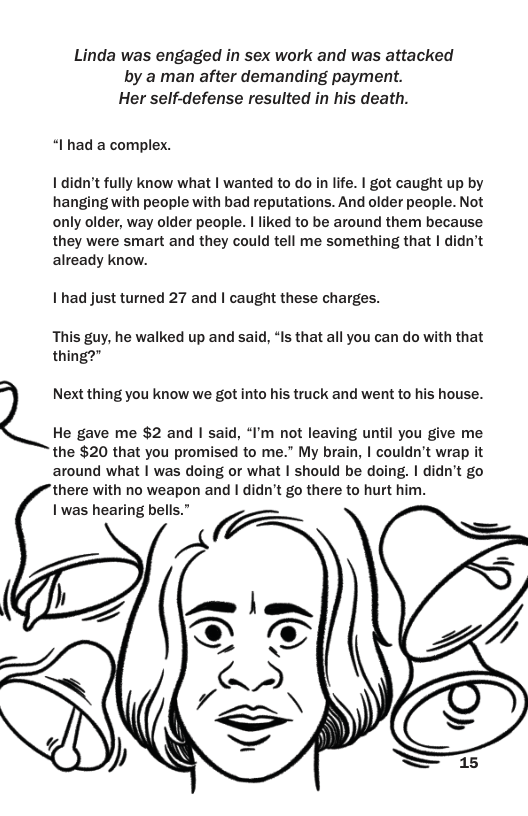
Linda was engaged in sex work and was attacked
by @ man after demanding payment.
Her self-defense resulted in his death.
“I had a complex.
I didn’t fully know what | wanted to do in life. | got caught up by
hanging with people with bad reputations. And older people. Not
only older, way older people. | liked to be around them because
they were smart and they could tell me something that | didn’t
already know.
I had just turned 27 and | caught these charges.
This guy, he walked up and said, “Is that all you can do with that
thing?”
Next thing you know we got into his truck and went to his house.
He gave me $2 and | said, “'m not leaving until you give me
the $20 that you promised to me.” My brain, | couldn't wrap it
around what | was doing or what | should be doing. | didn't go
there with no weapon and | didn't go there to hurt him.
| was hearing bells.”
7~
ot
Linda was sentenced to life in prison with the possibility
of parole. She accepted a plea deal based on what her
attorney and the DA told her. It was her understanding
that she would make parole once eligible.
“Ijust wanted to get started on my sentence and just wanted to
get going and do my 13 years, go for parole and get out.
And that didn't happen.”
Linda has earned her high school equivalency and
completed more than 25 educational, vocational,
religious, and therapeutic programs. She enrolled
in college classes and is working on her Associate’s
Degree. Yet, she has been set off 7 times by the parole
board, for a total of 27 years.
“Iwas 27 years old and misdiagnosed as being mentally retarded
and psychotic. | have overcome many challenges by choosing not
to accept that evaluation as final. | am now 61 years old, have
been refused treatment for HEP C since 2003, am in need of a
double hip replacement, as well as shoulder and knee surgery.
I have used my prison time wisely and achieved my GED.
I'm proud of the things that | am doing now, you know, and |
had to do it in prison. If the parole board don't acknowledge
that, they don't care about a rehabilitated good citizen going
into society. They set me off and set me off and set me off.
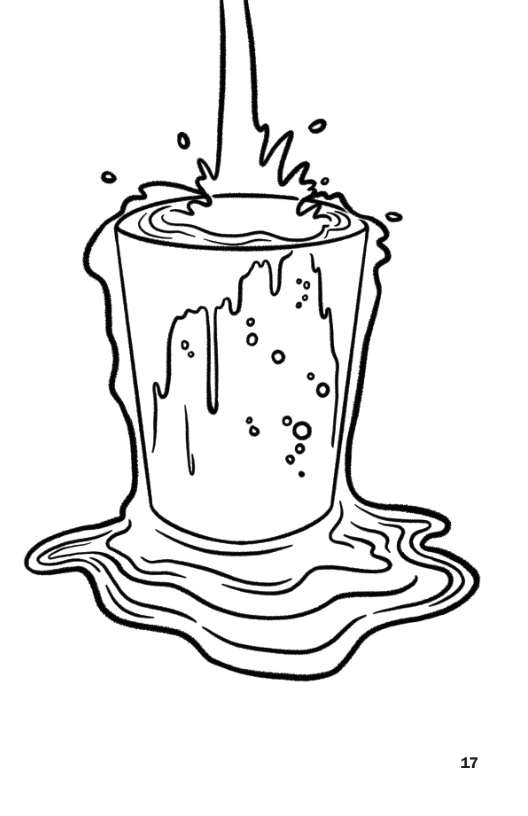
That's whyitis so overcrowded. If you keep filling a glass of water
and you don’t pour none out, the drink is going to overflow.”
16
17
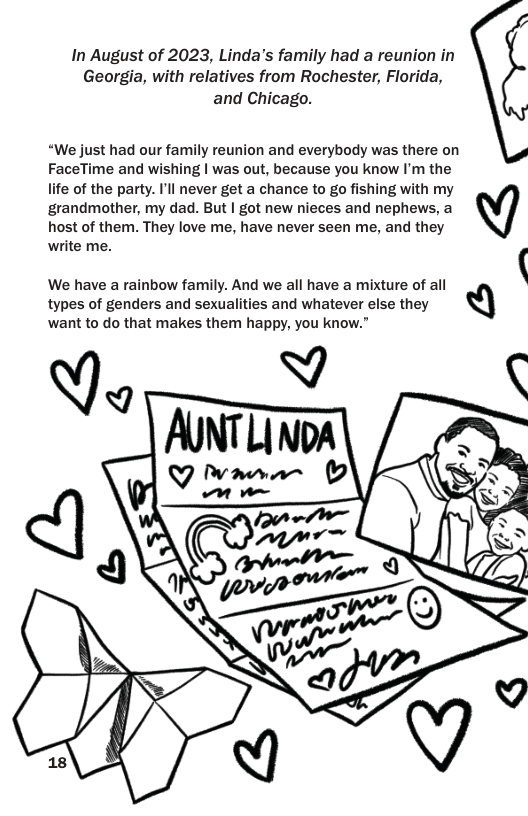
In August of 2023, Linda’s family had a reunion in
Georgia, with relatives from Rochester, Florida,
and Chicago.
“We just had our family reunion and everybody was there on
FaceTime and wishing | was out, because you know I'm the
life of the party. I'll never get a chance to go fishing with my
grandmother, my dad. But | got new nieces and nephews, a
host of them. They love me, have never seen me, and they
write me. ‘
types of genders and sexualities and whatever else they
We have a rainbow family. And we all have a mixture of all Q
want to do that makes them happy, you know.”
“I hadn't seen my mom because she has a bad heart. She’s 83
and | wouldn't have my mom traveling down here. She said,
‘I wouldn't be able to leave you out of that place, leave you
behind, | would probably have a heart attack or a stroke.” It's
just, you know, it's horrible when you have family that love and
care about you.
y My mom’s holding on. She says I'm going, I'm waiting, I'm
trying to live and staying strong and | want to see you out.
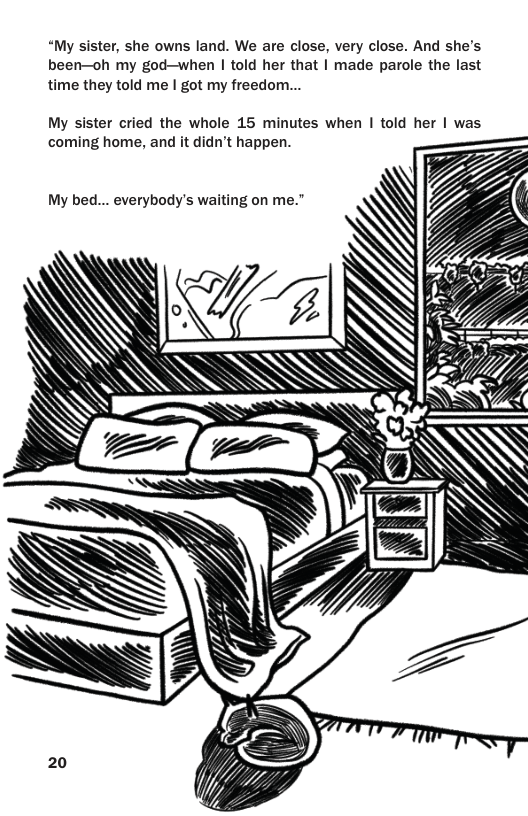
“My sister, she owns land. We are close, very close. And she’s
been—oh my god—when | told her that | made parole the last
time they told me | got my freedom...
My sister cried the whole 15 minutes when | told her | was
coming home, and it didn’t happen.
My bed... everybody's waiting on me.”
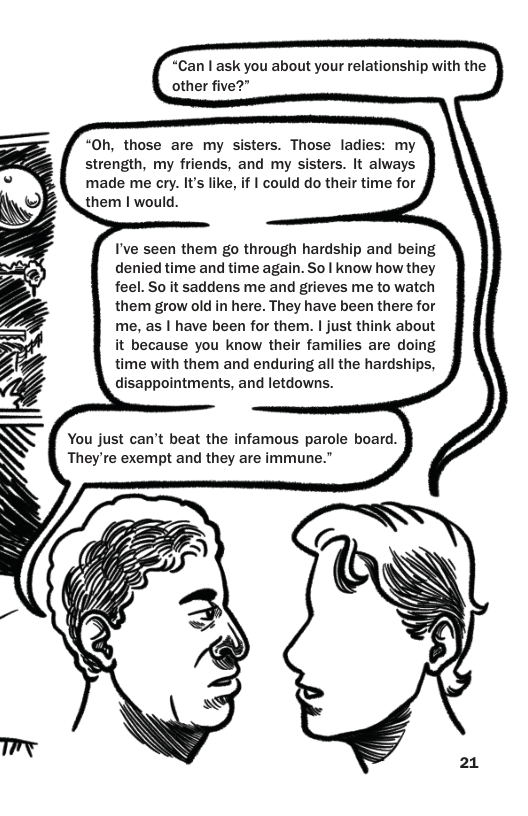
“Can | ask you about your relationship with the
other five?”
“Oh, those are my sisters. Those ladies: my
strength, my friends, and my sisters. It always
made me cry. It's like, if | could do their time for
I've seen them go through hardship and being
denied time and time again. So | know how they
feel. So it saddens me and grieves me to watch
them grow old in here. They have been there for
me, as | have been for them. | just think about
it because you know their families are doing
time with them and enduring all the hardships,
disappointments, and letdowns.
You just can’t beat the infamous parole board.
They're exempt and they are immune.”
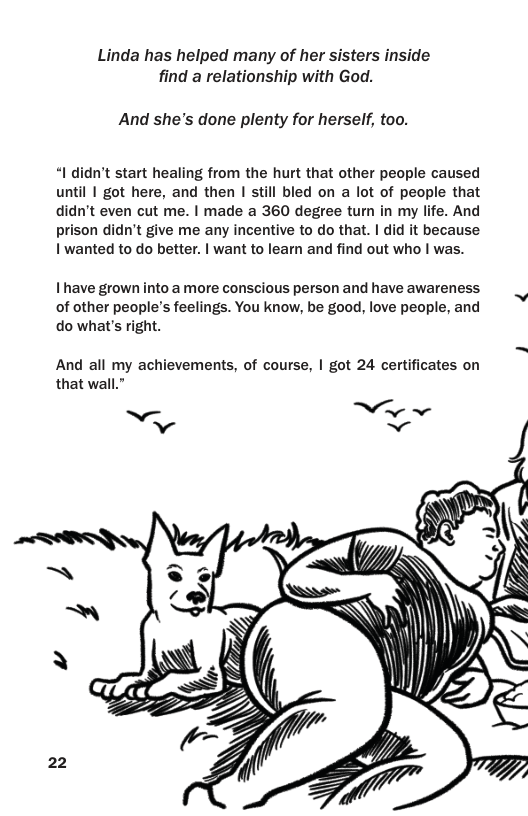
Linda has helped many of her sisters inside
find a relationship with God.
And she’s done plenty for herself, too.
“I didn’t start healing from the hurt that other people caused
until | got here, and then | still bled on a lot of people that
didn't even cut me. | made a 360 degree turn in my life. And
prison didn't give me any incentive to do that. | did it because
I wanted to do better. | want to learn and find out who | was.
Ihave grown into a more conscious person and have awareness
of other people’s feelings. You know, be good, love people, and
do what's right.
And all my achievements, of course, | got 24 certificates on
that wall.”
4 v
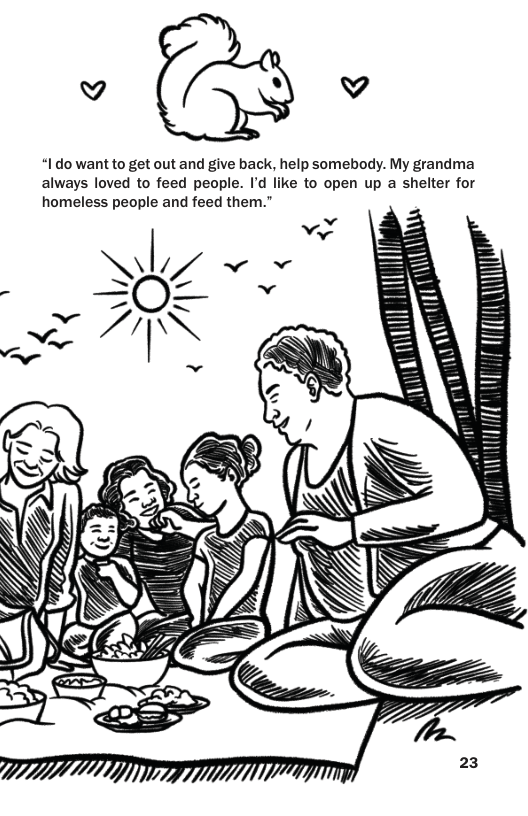
“I do want to get out and give back, help somebody. My grandma
always loved to feed people. I'd like to open up a shelter for
homeless people and feed them.”
WHAT CAN
YOU DO?
Write to Linda:
Linda Ross, #23967
CMCF 720
PO Box 88550
Pearl, MS 39288
Learn more about the campaign to
Free the Mississippi Five:
https://www.studyandstruggle.com/MS5