Free the Mississippi 5! – Anita Krecic
Web PDF • Imposed PDF• Raw TXT (OCR)


![[Phone recording: This is now being recorded.] Okay, can you hear me? I can, yeah. I typically start by asking your name, date of birth, and place of birth. Okay, my name is Anita Krecic. K, R, E, C, 1, C on the last name, date of birth, 5/26/59. Name, date of birth, and what? Place of birth. Place of birth? Elyria. Ohio](free-the-mississippi-5-anita-krecic-campaign-to-free-the-mississippi-5 4.png)
![Anita’s drug use continued; she didn’t tell her family about the drug use or sexual abuse she’d experienced until after she was arrested for her involvement in the death of a state trooper. “I was a working girl. | worked my whole life. But | went along with him (Tracy-who was my boyfriend at the time.) He punched me, kicked me, and cursed me out because I wouldn’t do what he told me to do. He always called the shots like when we got pulled over before the. shooting. He said, If he takes us to jail, Il hide [the gun] in the cruiser on the way to jail.” 10 He was trying to get me to rob this lady at an ATM and | said | can’t do that. So we argued up and down about it. He was telling me: ‘Hide the gun in your purse.” So he had mé believing that he was going to hide the gun in the patroh, | car. | believed him like | always did.”](free-the-mississippi-5-anita-krecic-campaign-to-free-the-mississippi-5 10.png)



![Anita’s conviction was part of an unprecedented rise in women’s incarceration. Between 1980 and 2021, the number of incarcerated women increased by over 525%. Women’s imprisonment has outpaced men’s twofold during that time. The majority of those in state prisons have been convicted of what are considered violent crimes. s s 1415 1995 1995 2005 2015 [Image based on graphic from Wendy Sawyer, “The Gender Divide: Tracking Women’s State Growth,” Prison Policy Initiative, January 9, 2018, https:// ‘www.prisonpolicy.org/reports/women_overtime.htmi; data also gathered from Niki Monazzam and Kristen M. Budd, PhD, “Fact Sheet: Incarcerated Women and Girls," The Sentencing Project, April 3, 2023, https://www. sentencingproject.org/fact-sheet/Incarcerated-women-and-girls/] 17](free-the-mississippi-5-anita-krecic-campaign-to-free-the-mississippi-5 17.png)


![In 2017, a key witness in the state’s case against Anita admitted she had fabricated her testimony for leniency in her sentence. Even though Anita has been denied the possibility of repairing the harm she’s done, she herself has reconciled with the woman who lied at her original trial. She’s a living example of responses to harm, and ways toward repair, that don’t include incarceration. “[During the parole hearing] they interrogated me on things that | supposedly said to my co-defendant about the shooting, because they had a girl testify against me in my trial. She made false statements. They were still relying on these false statements from 1987 at my ‘07 parole hearing—and the statement she made was so vicious...she said | told him to shoot the officer. And then she said that | told him to “kill the M.F. She made two more statements saying that | said to ‘take him out’ or ‘finish him off’ when he was shooting him, and | never did that. | would never do such a thing. But the same lady that made all these statements recanted her testimony in 2018 and apologized to me when she came to prison. So she gave my attorney an affidavit saying that she did it. She made it all up to get a lenient sentence to get out of her charges. So anyhow, it was never even true, but the parole board was still relying on these false statements from my trial.” “She did make it right” 22](free-the-mississippi-5-anita-krecic-campaign-to-free-the-mississippi-5 22.png)




FREE THE #-
MISSISSIPPI
cover portrait by phan
illustrations by jaime d.
text by the MS5 zine team
The “Mississippi Five” originally described five women -
Lisa Crevitt, Anita Krecic, Loretta Pierre, Evelyn Smith,
and Linda Ross - sentenced to life with the possibility of
parole in the late 1980s and early 1990s. Despite their
achievements, personal growth, the loss of loved ones
outside, and even recantations of key witnesses, they have
been denied parole irrespective of their actions and the
people they have become.
After Jacqueline Bames was denied parole a second time
on Christmas eve in 2024, we added her to our campaign.
These six women are now between the ages of 60 and 83
years old. They have collectively been imprisoned over 200
yearsand denied parole 50times. In the words of committee
member and organizer Pauline Rogers, the parole board
continues to act as “judge, jury, and executioner.”
It s time to Free the Five and Free Them All!
This zine is part of a six-part series in the campaign to Free
the Five-an effort to bring home the women while raising
awareness about parole as a repressive political tool.
It is based on an oral history interview with Anita Krecic
recorded on September 4, 2023.
Want to get involved? Join us:
www.studyandstruggle.com/ms5
[Phone recording: This is now being recorded.]
Okay, can you hear me?
I can, yeah.
I typically start by
asking your name, date of birth,
and place of birth.
Okay, my name is Anita Krecic.
K, R, E, C, 1, C on the last name,
date of birth, 5/26/59. Name,
date of birth, and what?
Place of birth.
Place of birth? Elyria. Ohio
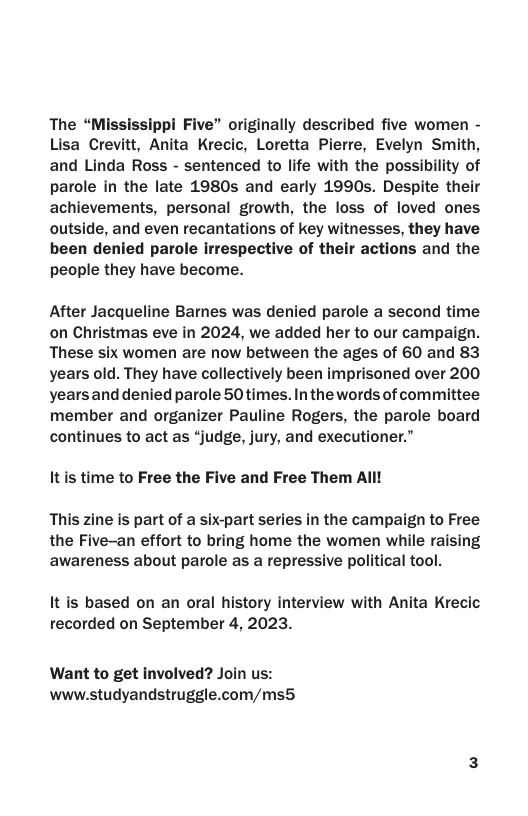
Anita Krecic is a quilter.
These are just a few of the
many quilts she has made
to bless others.
Flower Appliqued Quilt
Hip Hop Quilt
“Oh, | started quilting a lot
after I first got released from
maximum security. The lady
that worked in the Chaplain
Department with us taught
me how to quilt.”
Bow Tie Quilt
E@ahin Quilt
5
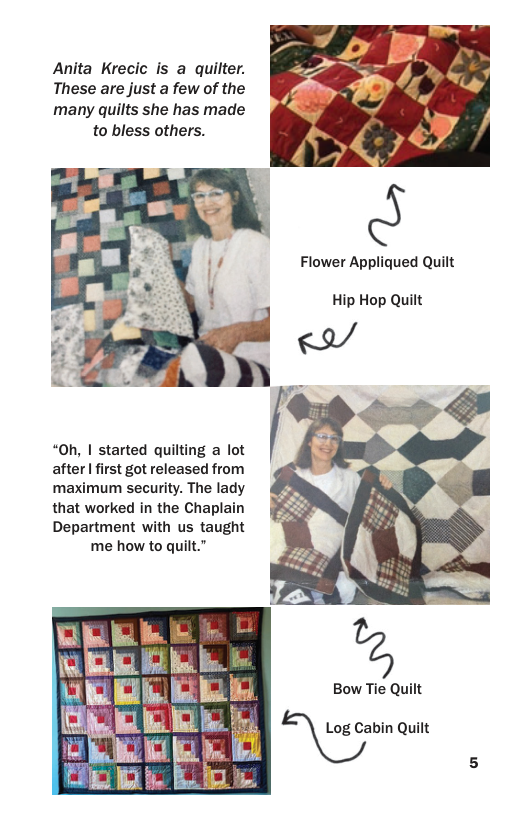
Anita was the fourth youngest of nine children.
She loved horses and ice skating.
“Iwasreally good at ice skating. | could do so many different
things the first year | took lessons, and if | could have just
kept going on and on and on, perhaps | could have been a
champion ice skater.”
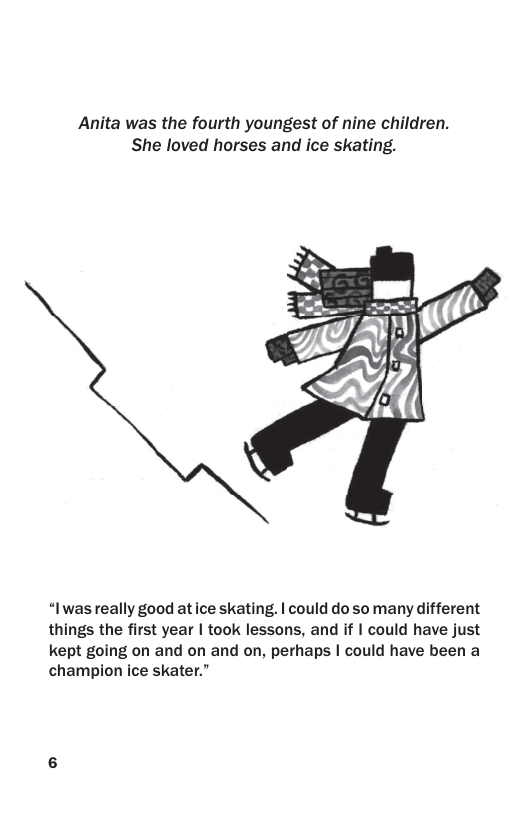
Family photo, Anita is wearing a New Year's hat.
“Because my mom had so many other kids, | feel like |
didn't really have the guidance that | needed, or somebody
to cheer me on. And because my mom was always so
preoccupied with raising nine kids, we were actually left to
fend for ourselves in a lot of ways.”
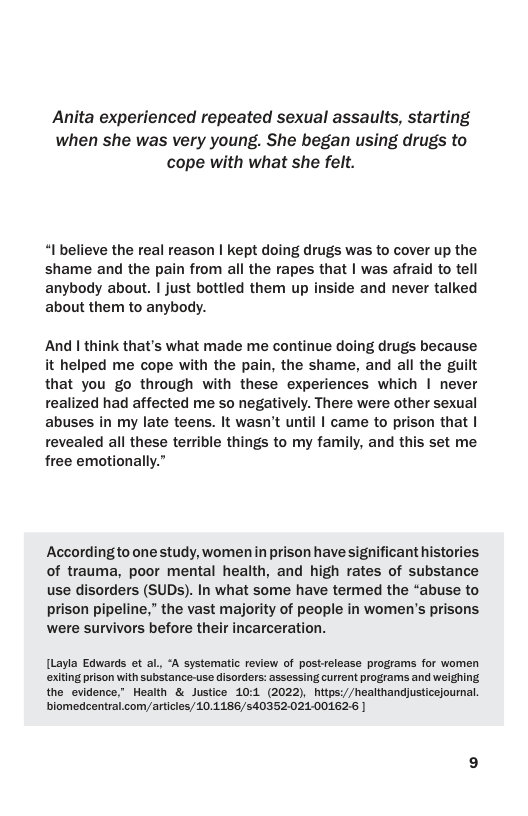
Anita experienced repeated sexual assaults, starting
when she was very young. She began using drugs to
cope with what she felt.
“I believe the real reason | kept doing drugs was to cover up the
shame and the pain from all the rapes that | was afraid to tell
anybody about. | just bottled them up inside and never talked
about them to anybody.
And | think that's what made me continue doing drugs because
it helped me cope with the pain, the shame, and all the guilt
that you go through with these experiences which | never
realized had affected me so negatively. There were other sexual
abuses in my late teens. It wasn’t until | came to prison that |
revealed all these terrible things to my family, and this set me
free emotionally.”
Accordingto one study, womenin prison have significant histories
of trauma, poor mental health, and high rates of substance
use disorders (SUDs). In what some have termed the “abuse to
prison pipeline,” the vast majority of people in women's prisons.
were survivors before their incarceration.
[Layla Edwards ot al, “A systematic review of postrelease programs for women
exiting prison with substance-use disordors: assessing current programs and weighing
the evidence,” Health & Justice 10:1 (2022), hitps://healthandjusticejournal.
blomedcentral.com/articles/10.1186/540352.021-001626 |
Anita’s drug use continued; she didn’t tell her
family about the drug use or sexual abuse she’d
experienced until after she was arrested for her
involvement in the death of a state trooper.
“I was a working girl. |
worked my whole life.
But | went along with
him (Tracy-who was my
boyfriend at the time.)
He punched me, kicked me,
and cursed me out because
I wouldn't do what he told
me to do. He always called
the shots like when we
got pulled over before the.
shooting.
He said, If he takes us to
jail, Il hide [the gun] in
the cruiser on the way to
jail.”
10
He was trying to get me
to rob this lady at an ATM
and | said | can't do that.
So we argued up and down
about it.
He was telling me: ‘Hide the
gun in your purse.”
So he had mé believing
that he was going to hide
the gun in the patroh, |
car. | believed him like |
always did.”
“So when he was searching
the vehicle, | passed the But when the patrolman
gun off to him. asked what was in the box,
1 told him: *Just my photo
and check stubs.’ But Tracy
knew once he opened that
box it would reveal my true
identity.
So that is what made Tracy
panic and order the trooper
to ‘Hold it right there!’ Then
the officer dove around the
carto reach for his own
b oo B dRTacTENot He shot him three times
him first. and 1 just buried my head
in my hands not wanting to
believe what | was hearing.
It was just so horrible.
1 couldn't believe it had 1am still haunted by the
come to that. memory of watching the
officer hobble away after
Tracy shot him and him
yelling at me: ‘Come on,
let's get the hell
out of here!”
“I want people to know that I'm immensely sorry.
I'm not that same person.”
11
In jail she found a spiritual connection she felt
had been missing her whole life.
“After learning the officer died, | was so devastated that |
poured my heart out to God; | was so sorry. | asked God to
forgive me, help me, and save me, but | didn't even know
what it meant to be saved. | had grown up in a Catholic
church and was taught to pray to the saints, so | never
knew Jesus personally.
But, my mom sent a bible to the jail and He revealed
himself to me. | came to know him personally in a way
I never did. It was life-changing for me. But since Jesus
had delivered me from smoking and drugs, | gravitated
towards positive things.
1 only regret it took a death to wake me up spiritually
because | was so hard headed and stubborn. It was truly
a transformational experience for me. | disconnected
from anything negative and became interested in many
hobbies like making cards, painting tshirts, learning
Spanish, making jewelry, and making quilts.”
Anita learned to quilt very shortly after being
transferred into general population. She was
fascinated with quilts and enjoyed making them for
family members.
But, in 1998, the prison banned crafting, so she
was no longer able to work hobby crafts or quilt.
However, she began taking the available vocational
courses, completing Buisness Technology, Industrial
Sewing, and Computer Repair.
“After repeatedly being denied parole, | decided to try
my hand at secondary school by pursuing a bachelor's
in Interdisciplinary Studies with an emphasis on Legal
Studies. Halfway through | switched to the New Orleans
Baptist Theological Seminary program through Leavell
College to become a practical field minister, which | am
currently enrolled in today.”
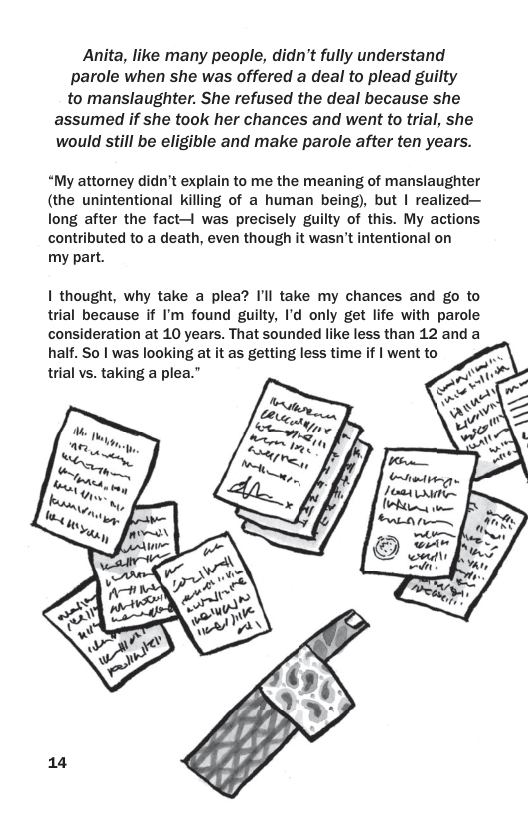
Anita, like many people, didn’t fully understand
parole when she was offered a deal to plead guilty
to manslaughter. She refused the deal because she
assumed if she took her chances and went to trial, she
would still be eligible and make parole after ten years.
“My attorney didn't explain to me the meaning of manslaughter
(the unintentional Killing of a human being), but | realized—
long after the fact— was precisely guilty of this. My actions
contributed to a death, even though it wasn't intentional on
my part.
1 thought, why take a plea? I'l take my chances and go to
trial because if I'm found guilty, 'd only get life with parole
consideration at 10 years. That sounded like less than 12 and a
half. So | was looking at it as getting less time if | went to
trial vs. taking a plea.”
“But because | was ignorant of the law,
I didn't understand that | was guilty of
manslaughter so | refused the plea. And
I never knew parole was not guaranteed
or that in Mississippi you don't have a
right to it."*
If Anita had pled guilty to manslaughter, she would
have been released in 1999, having served 50% of
a 25-year sentence.
*Here, Krecic is referring to a ‘liberty interest.’ Although some
state constitutions include a liberty interest which gives people
aright to parole, Mississippi’s does not.
15
Anita was convicted in 1988 and
sent to the Maximum Security Unit
16
(MSU) at CMCF.
“When I first got to prison, | was placed in
MSU. It was mandatory that lifers spend
one whole year there before transitioning
to general population. At one point | had
contemplated suicide because | felt | had
nothing to live for and didn’t know how |
could go on.”
Anita’s conviction was part of an unprecedented rise in
women's incarceration.
Between 1980 and 2021, the number of incarcerated
women increased by over 525%. Women's imprisonment
has outpaced men's twofold during that time. The majority
of those in state prisons have been convicted of what are
considered violent crimes.
s s 1415 1995 1995 2005 2015
[Image based on graphic from Wendy Sawyer, “The Gender Divide: Tracking
Women's State Growth,” Prison Policy Initiative, January 9, 2018, https://
‘www.prisonpolicy.org/reports/women_overtime.htmi; data also gathered
from Niki Monazzam and Kristen M. Budd, PhD, “Fact Sheet: Incarcerated
Women and Girls," The Sentencing Project, April 3, 2023, https://www.
sentencingproject.org/fact-sheet/Incarcerated-women-and-girls/]
17
Anita has been denied parole ten times by the parole
board. In all her years of incarceration she has never
had a single physical altercation with anyone. Her
conviction was her first, and she has been free from
drug usage and rule violation reports for decades. She
has successfully completed virtually every program the
prison has offered.
2007 denial
2 year set-off
1988 2000 denial
Her sentence begins 5 year set-off
1997 denial
4 year set-off
2005 denial
2 year set-off
18
Anita’s judge and jury could have sentenced her to life
without parole. But they didn't. Yet, the parole board
has acted arbitrarily and relentlessly, giving her an
additional 34 set-off years. Her last set off was the
longest. She is not set to reappear until she is
70 years old.
2022 denial
2011 denial 8 year set-off
2 year set-off
2018 denial
1.5 year set-off
2009 denial 2019 denial 2030
2 year set-off 3 year set-off The next time Anita
is up for parole
2013 denial
5 year set-off
19
In the last 30 years, 70 women sentenced to life in
prison have been paroled in Mississippi, serving an
average of 15 years.
Why are the Mississippl Five not being paroled?
Atall ten parole hearings,
the parole board has cited
the same reason for denial. %
‘Serious nature of offense.’
“Serious nature of offense.”
“Serious nature of offense.”
“Serious nature of offense.”
“Serious nature of offense.”
“Serious nature of offense.”
“Serious nature of offense.”
“Serious nature of offense.”
“Serioys AgiY'SaRL AL S Srense.”
“Serigyn BRI UPBEnse.”
“Serious nature of offense.”
“Serious nature of offense.”
“Serious nature of offense.”
“Serious nature of offense.”
20 “Sey
nat a
‘Serious nature of offense.
“Their aim is to
punish you for the crime
over and over again.”
In 2017, a key witness in the state’s case against Anita
admitted she had fabricated her testimony for leniency
in her sentence. Even though Anita has been denied the
possibility of repairing the harm she’s done, she herself
has reconciled with the woman who lied at her original
trial. She's a living example of responses to harm, and ways
toward repair, that don't include incarceration.
“[During the parole hearing] they interrogated me on things that |
supposedly said to my co-defendant about the shooting, because
they had a girl testify against me in my trial. She made false
statements. They were still relying on these false statements
from 1987 at my ‘07 parole hearing—and the statement she
made was so vicious...she said | told him to shoot the officer.
And then she said that | told him to “kill the M.F. She made two
more statements saying that | said to ‘take him out’ or ‘finish
him off' when he was shooting him, and | never did that. | would
never do such a thing.
But the same lady that made all these statements recanted
her testimony in 2018 and apologized to me when she came to
prison. So she gave my attorney an affidavit saying that she did
it. She made it all up to get a lenient sentence to get out of her
charges. So anyhow, it was never even true, but the parole board
was still relying on these false statements from my trial.”
“She did make it right”
22
oo 320V O0UOMTWARA Document 1.1 Fed 0327720 Page 240146
e SICILIS LRSI Dociment 411 Fld: 10232019 Page 133
AFFIDAYITOF MILORED MARI PERRY
L by sae s Mt b Pery. 1 v he g o 18, 3
oty e o el o7
B by &
& S e 1980w rered o B, Mg o e
Hn_n.....,mm ok o wn s g
o s 5 et e o S g Bt i
ethoned e e s
B e st s K it s s s or o
e Ty a0 b O Lot e e At
ool owene Anks Kol e 14 st o i o 4 ey 3
Sk o sconng bt et o ok bt RN ettt 4
S e o oy ) et ol g e b o 2 120
o e d e b St ot 10 M O
et o oy e ity s
T ey ey s s rcc n hpes of s
Iemene o el | e e e s e o s b ok
ey 168 e it o 3 i
57 1 am oty st st he o Misisipp Comecsios
om0 O L e 0 A o ko .
[rSpr——
U Py
SUBSCRIBED AND SWORNT0 e e s Py o Oarier 3017
htecl=
v comssion exemes: UL 2. 3050
EXHIBIT
23
Anita knows she's not the only one experiencing the
torment of parole denials over and over and over again.
She and the Five look out for each other and consider
themselves a part of each other.
“I have bonded with the others in a
‘way where | would not have had we
not all been denied parole. | have
always supported them and tried to
fight the parole injustice dealt to each
of us. | once filed a class action and
other general complaints over the
parole debacle, to no avail.
I never stopped writing articles, letters
to lawmakers and prison advocates.
I have watched each of my co-lifers
grow and have admired their hidden
talents and gifts. I've always loved
and respected them because they are
one of me.”
24
Oh, wonderful. Yeah. Oh, gosh.
Well, can I say a prayer for you
before we get the hang up?
Yeah, of course.
“Lord, | want to thank you for these prisoner
advocates who you have given to the Mississippi
Five to help fight against this parole injustice. You
know our hearts and know that we are sorry for
the mistakes we made that led to someone losing
their life. Though we can never bring back the lives
that were taken, we have worked hard to correct
our lives and warn others not to follow the paths
we took. Rather, we urge others to look to You,
Jesus, who will lead them down the narrow road
leading to heaven.
I thank you for forgiving me and for providing this
advocacy team to see the changed people we have
become and to believe in us. | continue to pray daily
that | will be forgiven for the murder committed
by my co-defendant and I, and that you will bring
healing and restoration to all who were struck by this.
unforeseen tragedy.”
advocacy team who has gone out of their way to
present ourstories so that others can know the truth.
These advocates have poured their lives into ours,
50 | humbly ask that you could bless them in every
imaginable way, physically, emotionally, materially,
and spiritually.
May your Spirit and grace be poured out upon the
Leaders of Mississippi to be able to forgive those of
uswho are remorseful, repentant, and rehabilitated
0 that Your people may be given a second chance.
You, Lord, had the best resolution for offense:
“If you forgive other people when they sin against
you, your heavenly Father will forgive you. But if you
do not forgive others their sins, your Father will not
forgive you your sins.’ Mt. 6:14,15.
Thank you, Lord, for this courageous team, who has
sacrificed their time and resources in helping to
restore the lives of many people. Bless them Lord
in countless ways, | pray, in Jesus name. Amen."
27
WHAT CAN
YOU DO?
Learn more about how you can get involved in the
campaign to Free the Mississippi Five:
https://www.studyandstruggle.com/ms5
Write to Anita:
Anita Krecic, #44712
CMCF 720
PO Box 88550
Pearl, MS 39288