Fox Designing the Henhouse: Indiana Jail Expansion Vigo and Terre Haute
Web PDF • Imposed PDF• Raw TXT (OCR)
![Vigo County’s public schools, which were last renovated in the 19705, are ina state: of disrepair. Kevin Christ, an economics professor at the Rose-Hulman Institute of Technology in Tere Haute, told Vera that the 2017 tax proposal presented “a classic choice under constraints problem”—was the community going to spend its limited resources on a new jail or new schools? Vigo is not the only county in Indiana to have adopted local income taxes to fund jail maintenance and construction in recent years. As of November 20, 2020, 26 ‘counties had adopted a “county jail tax”—a portion of local income tax revenue that must go toward correctional or rehabilitation facilities, and 22 counties had adopted a separate “special purpose tax,” primarily to fund jail construction or, toa Tesser extent,juvenile detention centers.’ Statewide, revenues from these two taxes represented more than $190 million spent on jails in 2020. Indiana justifes the use: of income taxes—rather than property taxes—o fund jail in terms of a specific sortof development strategy that aims to keep taxes low for businesses and home- ‘owners and to shift the tax burden onto working people. Th language in Indiana Iaw for establishing a special purpose tax reads “Maintaining low property tax rates s essential to economic development, and the use of a tax nder this section ... . rather than the use of property taxes, promotes these purposes.” Christ has studied the local economic situation for nearly a decade. He explained that for low-income areas like Vigo County, a higher tax burden on residents can affect the county’s growth rates and opportunities for development—depending on where the tax is speat. “Nobody considers relocating to an arca because it has a great jail” e told Vera. “People want good schools.™ proposal process in Vigo County, county commissioners main- tained the position that adding jal beds was the only option to reduce overcrowding and resolve the ongoing lawsaits. Judge Michael Rader of the Vigo County Supe- rior Court disagreed. Rader told reporters in 2017 that “60 percent of the county’s population [were] noa-violent offenders,” with many held on charges relating to substance use disorders or mental health issues. Rader advocated for a less cost- ly community corrections model that would prioritze treatment for these issues. “[W]e have to face the fact that we are housing the mentally il in very expensive housing,” he said. According to Judge Rader, a larger jail would be a band-aid solution—the county would quickly fil it f the underlying problems remained.](fox-designing-the-henhouse-indiana-jail-expansion-vigo-and-terre-haute-jessica-zhang-and-bea-halbachsingh-vera 5.png)
![Types of charges for people in Vigo County Jail on October 1, 2020 = Drug and other charges = Drug charges only Dr. Ray started RIS Justice Services after a 30-year carcer in law enforcement and cormections, during which he worked as a police officer, deputy sheriff, and jail adminisirator. When Vera spoke with him, e deseribed himself as a reformer fighting against “overuse [of] incarceration under the illusion that it is administering justice” n the United States Ray explained that finms such as DLZ use flawed rescarch methods when determining whether a jurisdiction needs jail expansion, including the assumption that the current rate of carceral growth will remain unchanged. These methods flate projections for capacity needs and unfailingly lead to calls for bigger jails. According to Ray’s observations. most counties facing jail overcrowd Tawsuits hire @ comrectional design fim like DLZ before considering an independent consultant “because their goal i to build big.” In contrast, Ray aims to incorporate reforms in his projections that would decrease the rate of incarceration and lower jail capacity needs in the long term. Ray submitted an evaluation in mid-2018 that necommended a new jail with fewer beds than the original DLZ proposal, a recom- ‘mendation that faced immediate public oppositon from local law enforcement. Steve Lockard, a detective sergeant at the Terre Haute Police Department, deseribed Ray’s preliminary recommendation that the jail have a maximum of 462 beds to Tocal media as “conceming.](fox-designing-the-henhouse-indiana-jail-expansion-vigo-and-terre-haute-jessica-zhang-and-bea-halbachsingh-vera 7.png)
![In August 2018, the County Council convened o finally vote on the tax proposal it had previously tabled—for a jail that would end up costing more than twice as ‘much as the original estimate. Christ told the Vra team about testifying against the measure: “It was a four-hour long meeti ¢ spoke against the jail project and two peopl 3 According to Christ, supporters of the jail presented the facility as beneficial to the county’s economic development. Law enforcement officers announced that it would lead o the ereation of jobs such as sherifls deputies and jail administra- tors. “The chair of the County Council [ .] at the time,” Christ recalled, “was a ‘policeman ... and at the end of all of tht, the [Council] decided to pass a new tax 10 build a big jail ... It was very frustrating to watch.” The final vote was 5-2 in favor of the tx. “This was not the first time that political actors and law enforcement in the county had linked carceral expansion o job opportunities and economic growth. Vigo first approved the construction of the Terre Haute federal penitentiary—now part of the FCI Terre Haute complex—in 1940 with promises of high-paying jobs for county residents. Since then, community members have continued to advocate for expan- sions of the federal complex as a response to economic decline. Yet federal correc- tions employees only account for 1.7 percent of otal employment in Vigo County. Ttis well-documented that carceral expansion does not lead to long-term job growth despite the political narratives that surround it. For example, a 2010 study of all existing and new U.S. prisons from 1960 to 2004 showed that prisons bring few, if any, employment gains to rural counties. Many towns with new prisons actually experienced lower growth in employment, houschold wages, and home values than comparable towns without prisons. In Vigo County,local econommists have pointed out in economie forecasts developed for statewide business media that “the lik lihood of significant new employment opportunities at the prison seems limited.” If carceral expansion does not benefit the general community, the planning process behind the new Vigo County jail showcases how it does benefita subset of actors—local law enforcement, jail consultants, and correctional companies—by positioning incarceration as the only funded response for people struggling with a range of social problems including substance use, mental iliness, and povety.](fox-designing-the-henhouse-indiana-jail-expansion-vigo-and-terre-haute-jessica-zhang-and-bea-halbachsingh-vera 9.png)
![‘These groups often advocate for jail expansion in the name of public safety while disregarding public input on other community prioriies and placing the long-term financial burden on people who pay income taxes in the county. DLZ and two other architecture firms—Elevatus and RQAW—account for 90 percent of Indiana’s jail infrastructure projects. Closer examination of these major players reveals a network of political influence that extends across all levels of government in Indiana. Within the last two decades, DLZ has contributed at least $185,200—and RQAW at least $131,487—to Indiana offcials—including ‘county commissioners,taterepresentatives, and governors. The founderof Elevatus, Michael Gouloff, has alone contributed at least $116,898 to political campaigns across Indiana. These figures likely under represent the full scale of financial influence of these three companies, as they do not include individual contributions from the entiety of their s@ff and leadership. ‘These scenarios illustrate how ties between private interests and public officials— such as members of law enforcement and county govemment—re part of a political infrastructure that _underlies Indiana’s jail construction boom. Coordination between jil architects, consultants, and govemment offcials allows them to push proposals for bigger jails forward with litle democratic input— determining, to a large extent, local govermments* reactions to the jail incarceration crisis in Indiana. In 2019, nearly two-thirds of Indiana’s jails were overcrowded, ‘and almost 40 percent were at more than 100 percent of their capacity. The number ofjail sentences in the state has increased by 368 percent since 2015. As of 2020, the ACLU of Indiana had filed civil rights lawsuits targeting over a dozen county jails Vera’s analysis of local news coverage showed that in 2020, approximately 40 per- cent of Indiana’s counties were planning or building jails. As Lisa Spence put it, “It seemed like attomey(s] [were] going around basically initating lawsuits with various and sundry counties about the conditions and the size of theirjails and then immediately afterward, DLZ would rush in, offe to doa jail study, and then build a bigger jail. And it seemed like that was happening over and over again.”](fox-designing-the-henhouse-indiana-jail-expansion-vigo-and-terre-haute-jessica-zhang-and-bea-halbachsingh-vera 10.png)
![Vigo County Jal neari compleion. Today, on an old golf course just south of Terre Haute, lics the concrete and steel bulk of the new Vigo County Jail—one of many new o expanded jails in Indiana. Although many of the local officials who pushed for the fuciliy’s original approval have since left office, their decision will have lasting effects. Having only just paid offthe debi from it last ail expansion a month into the construction of the. nenw fucility, Vigo County will now be saddled with the financial burden of this jil for decades (o come. Last December, a year afte the county broke ground on the construction site, local news outlet WTHI-TV interviewed Vigo County Sherifl John Plasse on the status of the project. Plasse expressed his excitement for the jail o be finished so “the commnity can benefit” According 10 reporters, he also described how, “when the building is finished and they do start to move [people] in, theyll already be at 80 percent Endnores Scelnd Code 6:36:6:27for more information abost the orrectonslhabilstion fclies 00195 6.3.6.7-7 throogh 63,6723 frcountes that hve adoptedspecal purpose tases o und il 2 i exchudsth poton f ol incometx revenues ht have b allocated fo puble sfety d can o be sod towerd i 5 SeeInd Code §6.63.6:77 through 636723](fox-designing-the-henhouse-indiana-jail-expansion-vigo-and-terre-haute-jessica-zhang-and-bea-halbachsingh-vera 11.png)
![“It seemed like attorney([s] [were] going around basically initiating lawsuits with various and sundry counties about the conditions and the size of their jails and thenimmediately afterward, DLZ would rush in, offer to do a jail study,andthenbuildabiggerjail. And it seemed like that was happening over and over again.” et involved in Monroe County’s fight agalnst carceral expansion! hitps://carenotcages-monroecounty.org/ @CareNotCages.moco on Insiagram](fox-designing-the-henhouse-indiana-jail-expansion-vigo-and-terre-haute-jessica-zhang-and-bea-halbachsingh-vera 12.png)

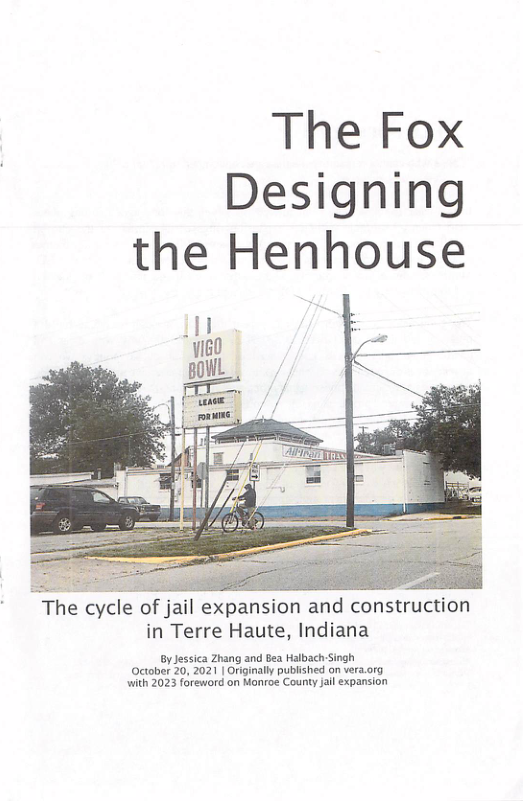
The Fox
Designing
the Henhouse
The cycle of jail expansion and construction
in Terre Haute, Indiana
By Jessica hang and Bea Halbach Singh
October 20, i vera.
with 2023 fore
2023 Foreword
“Those who cannot remember the past are condemned to repeat it”
~George Santayana
In this case, the past to be remembered isn't even that long ago. Reading about
Vigo County's struggle with jail expansion rings ecrily similar o the current
situation in Monroe County. Thereare of course some differences, but the key themes
temain the same. Monroe County has also entered into settlement with the ACLU.
Monroc Countyalso s atemping o build anewer and biggerjail. And you gucssed
i, Monroe County also has hired DLZ to design their new “justice campus.
The good news is, we don't have to repeat the past. We don't have to build &
bigger jail, and we don't need 1o let DLZ, a private company with clear and
unambiguous bias towards jail expansion, dictate our public policy. We can
instead focus ourattentions on what we know works: non-coercive mental health and
substance use treatment, housing thatis actuallyaffordable, food security, and more.
These things aren’t ipe dreams, they aren’t unattainable - they are within our reach.
Allwemustdois stand upand demanda county that ares for its community instead of
ocking them in cages.
There arc many ways we can all do our part. It can be as simple as talking to your
neighbors or co-workers about these issues. You can send an email to the
County government and speak your mind. You are also invited to
attend Care Not Cages meetings at The Overlook (611 W 12th Sireet) - email
us at carenotcages.monroccounty@gmail.com 1o learn when. Or anything else
that feels right to you.
Together we can stop jail expansion in our community. We can leam from Vigo
County and rather than repeat the past, we can build a better future.
“Tis e vas orginaly publihed o versarg o
g fvrs.orgin-our-bckyands sore e ox-designing the-heshouse.
Acessed on Apel 2023
A, exceping foreword, by Jesic Zhang and Bea Halbch-Singh All photos by Morica i
Thanks 1 Vra Jssia Zhang. B Halbach-Singh.and Monics Sith for tei cxceptionalrportn.
‘The Fox Designing the Henhouse
Vigo County is a deindustrialized, mostly white county on the westem edge of
Indiana. For more than 20 years, the county has been the subject of a spate of
federal civil rights lawsauits regarding overcrowding at the local jai, located in the
county seat in Terre Haute.
In August of 2002, the Vigo County Sheriff and Commissioners entered into an
agreement with the American Civil Liberties Union (ACLU) of Indiana capping
the jail population at 268 except in the case of “short-term emergency situations.”
Butin 2013, with jail populations nearing 300 people on a daily basis, the ACLU
sued again to enforce the terms of the agreement. In response, the Vigo County
Board of Commissioners convened in Terre Haute to discuss a long-term solution
for the jail.
Although the litigation presented Vigo County with an opportunity to reduce jail
incarceration, a subset of political actors stepped in to influence local govemment
to build a new and expanded jai instead. While many in the community favored
decreasing the jail population to address overcrowding, county offcials were
ultimately swayed by law enforcement officers such as Greg Ewing, the
then-county sheriff who insisted that additional jail beds were “inevitable.”
In January of 2015, Vigo's county commission paid jail architecture firm DLZ—an
‘Ohio-based company with offices throughout Indiana—S14,500 to study options
for the jails future, of constructing a new jail. DLZ, which
billstself as “one of the top design firms in the Midwest” for correctional,judicial,
and law enforcement design services, is the largest of the three jail architectural
firms that account for 90 percent of Indiana’s jail construction. As of 2019, the
company had provided consultations for jail and courthouse projects in 59 of the
state’s 92 counties. In October, DLZ presented a recommendation for a new securi-
ty center that would cost Vigo County at least 528 million—while almost doubling
itsjail capacity from 268 to more than 500.
‘While the commission debated its options, the jail population continued to climb.
In 2017, facing yet another lawsuit i federal court, Vigo County awarded an ad-
ditional $2.25 million contract to DLZ—for the design of the mult-million dollar
facility the firm had recommended two years prior.
County residents came out in opposition to the new jail. They were also concemed
about the confict of interest inherent in hiring DLZ again, which allowed the same
firm that dictated the size and cost of the il to profit from its construction. As one
man told reporters from Indiana Public Media, *That seems a litle like the fox
designing the henhouse, and then teling you how many hens to stock it with
Lisa Spence—a member of the watchdog group Citizens for Better Government
in Vigo County, who would later g0 on 10 serve on the Vigo County Cou
described for Vera how residents” concems about the jail plan were met with
hostiliy. She characterized the county commission’s decision to hire DLZ as “made
behind the scenes,” with few opportunities for public input. “It was casy to think
that something was going on because of the way that things were handled,” Spence
said.
Debate over the new jail occupied the community for the latter half of 2017, but
the Board of Commissioners had already moved forward in July with a funding
proposal: an income tax increase. At public hearings, opponents of the new tax
for better uses of public resources and distributed pamphiets adorned with
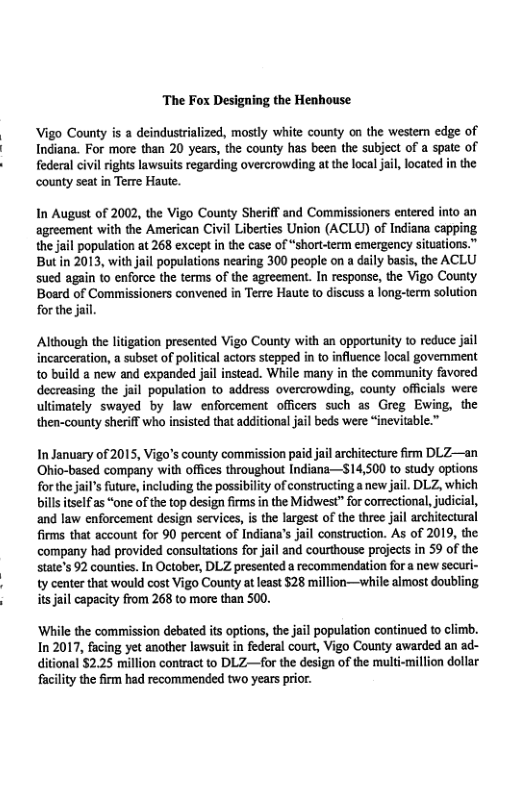
Vigo County's public schools, which were last renovated in the 19705, are ina state:
of disrepair. Kevin Christ, an economics professor at the Rose-Hulman Institute
of Technology in Tere Haute, told Vera that the 2017 tax proposal presented “a
classic choice under constraints problem”—was the community going to spend its
limited resources on a new jail or new schools?
Vigo is not the only county in Indiana to have adopted local income taxes to fund
jail maintenance and construction in recent years. As of November 20, 2020, 26
‘counties had adopted a “county jail tax”—a portion of local income tax revenue
that must go toward correctional or rehabilitation facilities, and 22 counties had
adopted a separate “special purpose tax,” primarily to fund jail construction or, toa
Tesser extent,juvenile detention centers.' Statewide, revenues from these two taxes
represented more than $190 million spent on jails in 2020. Indiana justifes the use:
of income taxes—rather than property taxes—o fund jail in terms of a specific
sortof development strategy that aims to keep taxes low for businesses and home-
‘owners and to shift the tax burden onto working people. Th language in Indiana
Iaw for establishing a special purpose tax reads “Maintaining low property tax rates
s essential to economic development, and the use of a tax nder this section ... .
rather than the use of property taxes, promotes these purposes.”
Christ has studied the local economic situation for nearly a decade. He explained
that for low-income areas like Vigo County, a higher tax burden on residents can
affect the county's growth rates and opportunities for development—depending on
where the tax is speat. “Nobody considers relocating to an arca because it has a
great jail” e told Vera. “People want good schools.™
proposal process in Vigo County, county commissioners main-
tained the position that adding jal beds was the only option to reduce overcrowding
and resolve the ongoing lawsaits. Judge Michael Rader of the Vigo County Supe-
rior Court disagreed. Rader told reporters in 2017 that “60 percent of the county's
population [were] noa-violent offenders,” with many held on charges relating
to substance use disorders or mental health issues. Rader advocated for a less cost-
ly community corrections model that would prioritze treatment for these issues.
“[W]e have to face the fact that we are housing the mentally il in very expensive
housing,” he said. According to Judge Rader, a larger jail would be a band-aid
solution—the county would quickly fil it f the underlying problems remained.
But Rader's calls for reform went unanswered, and by 2019 the number of people
incarcerated at the jail would be even higher, ranging from 323 10 359 occupied
beds in a faciliy still “capped” at 268 people—with another 30 people on any
iven day incarcerated in rented jail beds in neighboring Knox County.
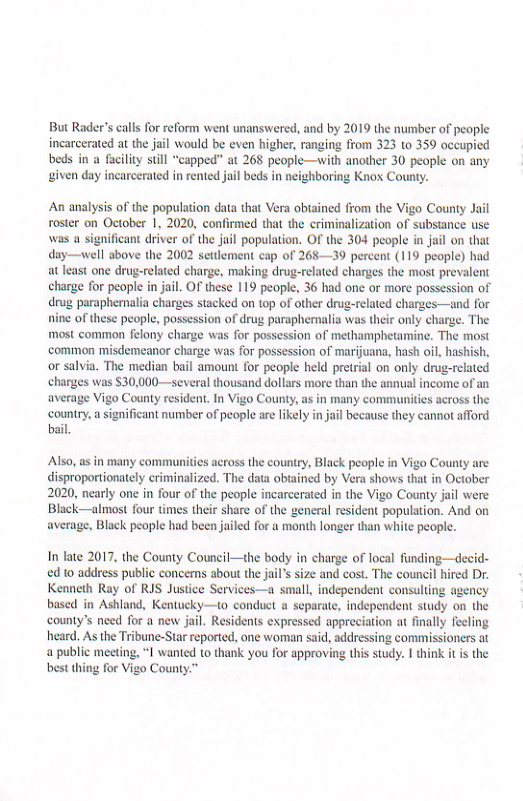
An analysis of the population data that Vera obtained from the Vigo County Jil
roster on October 1, 2020, confirmed that the criminalization of subsiance use
was a significant driver of the juil population. O the 304 people in jail on that
day—well sbove the 2002 setdlement cap of 268—39 percent (119 people) had
atleast one drug-related charge, making drug-related charges the most prevalent
charge for people n jail. O these 119 people, 36 had one or more possession of
drug paraphernalia charges stacked on 10p of other drug-related charges—and for
ine of thesc people, possession of drug paraphernalia was their only charge. The
most common felony charge was for possession of methamphetamine. The most
common misdemeanor charge was for possession of marijuana, hash oil, hashish,
or salvia, The median bail amount for people held pretrial on only drug-related
harges was $30,000—several thousand dollars more than the annual income of an
average Vigo County resident, In Vigo County, as in many commaunities across the
country, a significant number of people are likely in jail because they cannot afford
bail.
Ao, as in many communities across the couniry, Black people in Vigo County are
disproportionately criminalized. The data obtained by Vera shows that in
2020, nearly one in four of the people incarcerated in the Vigo County jail were
Black—almost four times their share of the general resident population. And on
average, Black people had been jailed for a month longer than white people.
In late 2017, the County Council—the body in charge of local funding—decid-
d 0 address public concerns about the jail’s size and cost. The council hired Dr.
Kenneth Ray of RIS Justice Services—a small, independent consulting agency
based in Ashland, Kentucky—to conduct a separate, independent study on the
county’s need for a new jail. Residents expressed appreciation at finally feeling
heard. As the Tribune-Star reported, one woman said, addressing commissioners at
4 public meeting, “I wanted to thank you for approving this study. | think it is the
best thing for Vigo County.™
Types of charges for people in Vigo County Jail on October 1, 2020
= Drug and other charges = Drug charges only
Dr. Ray started RIS Justice Services after a 30-year carcer in law enforcement and
cormections, during which he worked as a police officer, deputy sheriff, and jail
adminisirator. When Vera spoke with him, e deseribed himself as a reformer
fighting against “overuse [of] incarceration under the illusion that it is
administering justice” n the United States
Ray explained that finms such as DLZ use flawed rescarch methods when
determining whether a jurisdiction needs jail expansion, including the assumption
that the current rate of carceral growth will remain unchanged. These methods
flate projections for capacity needs and unfailingly lead to calls for bigger
jails. According to Ray's observations. most counties facing jail overcrowd
Tawsuits hire @ comrectional design fim like DLZ before considering an independent
consultant “because their goal i to build big.” In contrast, Ray aims to incorporate
reforms in his projections that would decrease the rate of incarceration and lower
jail capacity needs in the long term. Ray submitted an evaluation in mid-2018 that
necommended a new jail with fewer beds than the original DLZ proposal, a recom-
‘mendation that faced immediate public oppositon from local law enforcement.
Steve Lockard, a detective sergeant at the Terre Haute Police Department, deseribed
Ray's preliminary recommendation that the jail have a maximum of 462 beds to
Tocal media as “conceming.
Lockard took it upon himself to conduct his own one-day “study” of Vigo’s jail
population to make projections of future needs and concluded thatthe county need-
ed at least as many jail beds as had been recommended by DLZ two years prior.
Lockard also publicly questioned the effectiveness of the county's altematives to
detention program, implying tha the program’s participanis—including people
held on drug charges—should be incarcerated in the jai instead, because some
of them continued to struggle with substance use disorders while in alternative
detention, resulting in new charges. “What s the point?” he told the council. “Why
are we funding a catch and release progra. It does us no g00d. We are wasting law
enforcement resources getting the same people over and over again.”
After hearing from Lockard, the County Council asked Ray to confer again with
ocal law enforcement and to reevaluate his recommendation. In late 2018, Ray
amended his original findings and issued a final recommendation for a 527-bed
jail—even larger than DLZs original design.
Although opponens of the expanded jail had hoped that Ray would check the
‘county commission’s power i the jail approval process, the final recommendation
uliimately validated local law enforcement's calls to build a bigger jal, rather than
decreasing the size of the jail while incarcerating fewer people for low-level offens-
es, expanding altematives to detention, and reating people with substance use and
‘mental health issues outside of the.
‘When Vera asked Lisa Spence about Dr. Ray's role in the decision-making process,
she seemed to view him as being caught between a rock and a hard place. Ray's
final report called for a larger jail while also emphasizing the potential for a signif-
icant reduction in the jail population—econtradictory recommendations that Spence
felt were a product of Ray's desire to appease both the officials who were set on
jail expansion and the residents who were fighting for alternatives. Spence fel that
county officials were more than happy to use Ray's report as justfication to move.
forward with the new larger jail, while ignoring his proposals for decarceration.
Vigo County residents and council members who opposed jail expansion suddenly
found themselves in the exact same position they had been in a year carlier—with
more limited recourse.
In August 2018, the County Council convened o finally vote on the tax proposal
it had previously tabled—for a jail that would end up costing more than twice as
‘much as the original estimate. Christ told the Vra team about testifying against the
measure: “It was a four-hour long meeti ¢ spoke against the jail
project and two peopl 3
According to Christ, supporters of the jail presented the facility as beneficial to
the county's economic development. Law enforcement officers announced that it
would lead o the ereation of jobs such as sherifls deputies and jail administra-
tors. “The chair of the County Council [ .] at the time,” Christ recalled, “was a
‘policeman ... and at the end of all of tht, the [Council] decided to pass a new tax
10 build a big jail ... It was very frustrating to watch.” The final vote was 5-2 in
favor of the tx.
“This was not the first time that political actors and law enforcement in the county
had linked carceral expansion o job opportunities and economic growth. Vigo first
approved the construction of the Terre Haute federal penitentiary—now part of the
FCI Terre Haute complex—in 1940 with promises of high-paying jobs for county
residents. Since then, community members have continued to advocate for expan-
sions of the federal complex as a response to economic decline. Yet federal correc-
tions employees only account for 1.7 percent of otal employment in Vigo County.
Ttis well-documented that carceral expansion does not lead to long-term job growth
despite the political narratives that surround it. For example, a 2010 study of all
existing and new U.S. prisons from 1960 to 2004 showed that prisons bring few,
if any, employment gains to rural counties. Many towns with new prisons actually
experienced lower growth in employment, houschold wages, and home values than
comparable towns without prisons. In Vigo County,local econommists have pointed
out in economie forecasts developed for statewide business media that “the lik
lihood of significant new employment opportunities at the prison seems limited.”
If carceral expansion does not benefit the general community, the planning
process behind the new Vigo County jail showcases how it does benefita subset of
actors—local law enforcement, jail consultants, and correctional companies—by
positioning incarceration as the only funded response for people struggling with a
range of social problems including substance use, mental iliness, and povety.
‘These groups often advocate for jail expansion in the name of public safety while
disregarding public input on other community prioriies and placing the long-term
financial burden on people who pay income taxes in the county.
DLZ and two other architecture firms—Elevatus and RQAW—account for 90
percent of Indiana’s jail infrastructure projects. Closer examination of these
major players reveals a network of political influence that extends across all
levels of government in Indiana. Within the last two decades, DLZ has contributed
at least $185,200—and RQAW at least $131,487—to Indiana offcials—including
‘county commissioners,taterepresentatives, and governors. The founderof Elevatus,
Michael Gouloff, has alone contributed at least $116,898 to political campaigns
across Indiana. These figures likely under represent the full scale of financial
influence of these three companies, as they do not include individual contributions
from the entiety of their s@ff and leadership.
‘These scenarios illustrate how ties between private interests and public officials—
such as members of law enforcement and county govemment—re part of a
political infrastructure that _underlies Indiana’s jail construction boom.
Coordination between jil architects, consultants, and govemment offcials allows
them to push proposals for bigger jails forward with litle democratic input—
determining, to a large extent, local govermments* reactions to the jail incarceration
crisis in Indiana. In 2019, nearly two-thirds of Indiana’s jails were overcrowded,
‘and almost 40 percent were at more than 100 percent of their capacity. The number
ofjail sentences in the state has increased by 368 percent since 2015. As of 2020,
the ACLU of Indiana had filed civil rights lawsuits targeting over a dozen county
jails
Vera's analysis of local news coverage showed that in 2020, approximately 40 per-
cent of Indiana’s counties were planning or building jails. As Lisa Spence put it,
“It seemed like attomey(s] [were] going around basically initating lawsuits with
various and sundry counties about the conditions and the size of theirjails and then
immediately afterward, DLZ would rush in, offe to doa jail study, and then build
a bigger jail. And it seemed like that was happening over and over again.”
Vigo County Jal neari
compleion.
Today, on an old golf course just south of Terre Haute, lics the concrete and
steel bulk of the new Vigo County Jail—one of many new o expanded jails in
Indiana. Although many of the local officials who pushed for the fuciliy’s original
approval have since left office, their decision will have lasting effects. Having only
just paid offthe debi from it last ail expansion a month into the construction of the.
nenw fucility, Vigo County will now be saddled with the financial burden of this jil
for decades (o come. Last December, a year afte the county broke ground on the
construction site, local news outlet WTHI-TV interviewed Vigo County Sherifl
John Plasse on the status of the project. Plasse expressed his excitement for the
jail o be finished so “the commnity can benefit” According 10 reporters, he also
described how, “when the building is finished and they do start to move [people] in,
theyll already be at 80 percent
Endnores
Scelnd Code 6:36:6:27for more information abost the orrectonslhabilstion fclies
00195 6.3.6.7-7 throogh 63,6723 frcountes that hve adoptedspecal purpose tases o und il
2 i exchudsth poton f ol incometx revenues ht have b allocated fo puble sfety d
can o be sod towerd i
5 SeeInd Code §6.63.6:77 through 636723
“It seemed like attorney([s] [were]
going around basically initiating
lawsuits with various and sundry
counties about the conditions
and the size of their jails and
thenimmediately afterward, DLZ
would rush in, offer to do a jail
study,andthenbuildabiggerjail.
And it seemed like
that was happening
over and over again.”
et involved in Monroe County's fight agalnst carceral expansion!
hitps://carenotcages-monroecounty.org/
@CareNotCages.moco on Insiagram