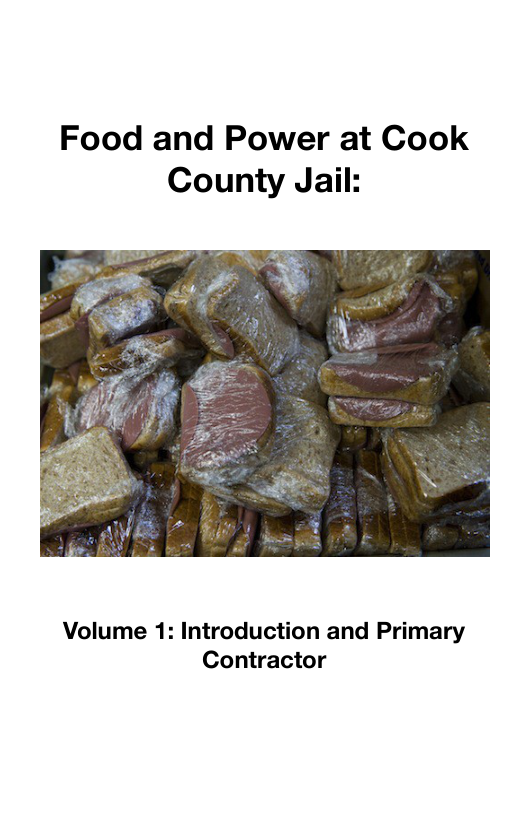
Food and Power at Cook County Jail
Web PDF • Imposed PDF• Raw TXT (OCR)
![“The spectacle of security [...] must produce-above all else- the state’s most precious and necessary political resource, and must advance what may likewise be its most politically valuable end; namely heightened insecurity.” -Nicholas De Genova “At Gounty, food becomes a weapon,” -Former Cook County Jail Prisoner](food-and-power-at-cook-county-jail 2.png)
![address and promoting the catholic sainthood of Rev. Augustus Tolton. Rand has helped finance the Chicago Football Classic, an annual game held between Atlanta’s Morehouse College and the Central State University of Wilberforce, two prominent black colleges. As Everett Rand, Timothy Rand’s brother and business partner describes the significance of the yearly game; “Most of the families who attend have never been to a Bears game [...] we want kids to see themselves in another setting.” Therefore, in the post- modern world of capitalism and hyper-incarceration, a service economy capitalist pays for the Chicago Football Classic, as well as political influence, with the controlled consumption of prisoners. Timothy Rand, President of Arport Restaurant Management nc and co-manager of CMB Premier Management LLC poses for the Chicago Sun Times. But the largest power-holder within CBM Premier Management LLC is Marlin Sejnoha. Mr. Sejnoha is the CEO of CBM Managed Services, a national carceral food service provider headquartered in South Dakota. CBM Managed Services represents the true biopolitical nature of the prison- industrial complex. It is a large corporation, concentrated on the specific task of winning large public and private contracts to systematically regulate the daily consumption of bodies interpolated by different ideological subjectivizations of life. Through food and commissary management services, CBM controls the lives of thousands of people confined in jails and prisons across the country by organizing what prisoners eat.](food-and-power-at-cook-county-jail 10.png)
![capitalism born from over thirty years of growing incarceration rates. Beyond their coordination of prisoner consumption, in general the company specializes in establishing and maintaining computerized disciplinary regimes of consumption for human bodies in a variety of institutional contexts, including public schools, universities, hospitals and nursing homes. The company itself recognizes its extra-economic functions as an institution of socio- political behavioral control, stating that, “At CBM Managed Services, we realize we are dishing up morale as well as food. Our employees understand that we are not in the food business, but in the business of people, serving food.” Nutriloa, the al in one “disciplinary meal” served to prisoners at Cook oty Jail as punishment for @ varity of nfractions;image from GMB Managed Services’ wabsto. While on the topic, it is private employment that CBM advertises as a key component of its successful business model, offering a privatized labor force to eliminate the need for public carceral employees: “We offer food service management and other essential services without the hassles, expenses, or commitment of hiring full-time or even part-time employees [...] by working with companies as a contractor, rather than an employee, clients are spared employee expenses such as overhead, benefits, and income taxes."(3] The cost-efficiency argument used here is common throughout CBM’s promotional material, once again showing us the abstraction of confinement through econometric analysis.](food-and-power-at-cook-county-jail 11.png)
![broader process of controlling prisoners. Thus, the organization of jail food is a contemporary form of bio-power. For people confined at CCJ, the diet is just one mechanism within, “an entire series of interventions and regulatory controls: a biopolitics of the population.” But we should be careful not to cling too tightly to Foucault’s conceptualization of the term. According to him, contemporary bio-power stands in contrast to the older form of sovereign power, and the right to inflict death commanded by absolute monarchies in the previous era. In his view, sovereign power claimed public authority through a right over death and the power to kill when necessary, whereas secular Democracies rely on an authority to manage life through migration, population movements, political districting, housing developments etc. In the contemporary era of bio-power, command over death appears in extreme, atavistic situations. The sovereign form of power, according to Foucault, “Must be referred to a historical type of society in which power was exercised mainly as a means of deduction, a subtraction mechanism [...] since the classical age the West has undergone a very profound transformation of these mechanisms of power. “Deduction” has tended to be no longer the major form of power but merely one element among others.” In contrast to Foucault, it is our view that the management of prisoner’s food at Cook County Jail reveals to us a radically advanced subtraction mechanism, essential to the broader management of flexible post-modern capitalism and its devaluation of deskilled labor power. It is a subtraction mechanism that physiologically and psychologically deteriorates the body and mind of the prisoner through ongoing and enforced consumption of minimum cost diets, fluctuating sugar levels and low-intensity anti-depressant chemicals. GCJ is an institution practicing a very violent bio- power of deduction, in which the political-financial definition of how much and what kind of food the life of a prisoner](food-and-power-at-cook-county-jail 17.png)
![which was then reinvested in the perpetually expanding land exploitation process. Large populations of people were forced off land that was historically held in common, and were concentrated in large urbanized districts or capitalist agricultural plantations. One crucial element of this market generating process was the criminalization of poverty. As, “great masses of men [..were...] suddenly and forcibly torn from their means of subsistence,” through the creation of a market-based land control system, the great transformation required population management of the newly displaced precarious classes. To do this, their new instability was made illegal, as, “They were turned in massive quantities into beggars, robbers, and vagabonds, partly from inclination, in the most cases, under the force of circumstances [...] legislation treated them as ‘voluntary’ criminals, and assumed that it was entirely within their powers to go on working under the old conditions which in fact no longer existed.” The rapid encroachment of privatization coalesced with criminal punishment meted out by the courts, as the law stepped in to regulate the displacement caused by the new economic system, in which large tracts of land were owned by a small fraction of the population. And the outcome of the entire process was the production of insecurity for the new proletarians, caught in between the wage-labor of mass-agriculture and textile manufacturing, now hanging over their heads as the only form of survival allowed by the state. The serfs, exposed to the radical development of the market experienced major volatility becoming workers in the new wage-economy system. The precarious, “these newly freed men became sellers of themselves only after they [...had...] been robbed of all their own means of production, and all the guarantees of existence afforded by the old feudal arrangements.”](food-and-power-at-cook-county-jail 19.png)



Food and Power at Cook
County Jail:
Volume 1: Introduction and Primary
Contractor
“The spectacle of security [...] must produce-above all else-
the state’s most precious and necessary political resource,
and must advance what may likewise be its most politically
valuable end; namely heightened insecurity.”
-Nicholas De Genova
“At Gounty, food becomes a weapon,”
-Former Cook County Jail Prisoner
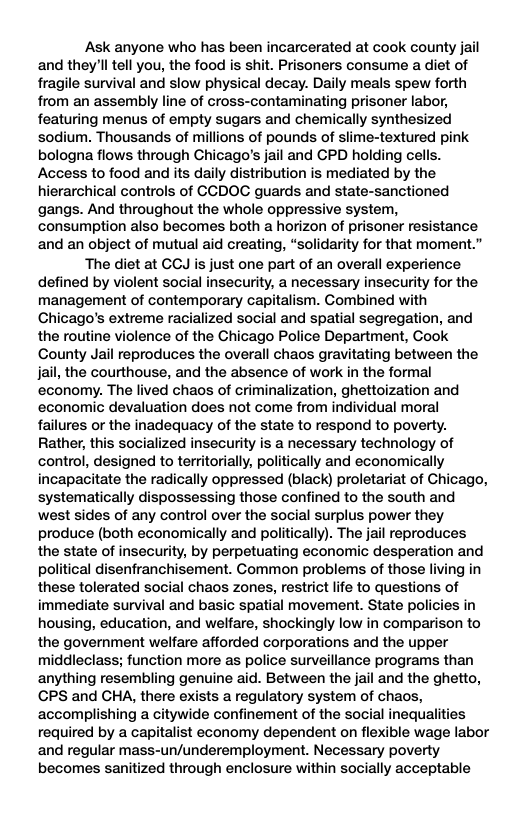
Ask anyone who has been incarcerated at cook county jail
and they'll tell you, the food is shit. Prisoners consume a diet of
fragile survival and slow physical decay. Daily meals spew forth
from an assembly line of cross-contaminating prisoner labor,
featuring menus of empty sugars and chemically synthesized
sodium. Thousands of millions of pounds of siime-textured pink
bologna flows through Chicago’s jail and CPD holding cells.
Access to food and its daily distribution is mediated by the
hierarchical controls of CCDOC guards and state-sanctioned
gangs. And throughout the whole oppressive system,
consumption also becomes both a horizon of prisoner resistance
and an object of mutual aid creating, “solidarity for that moment.”
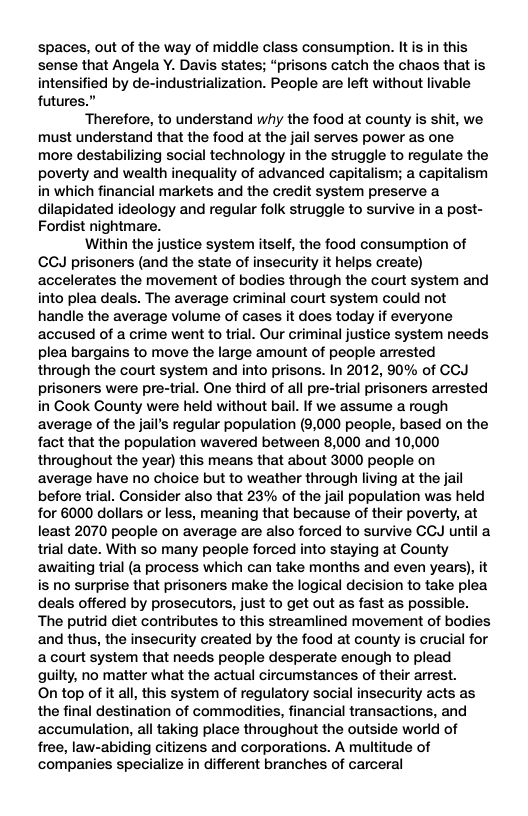
The diet at CCJ is just one part of an overall experience
defined by violent social insecurity, a necessary insecurity for the
management of contemporary capitalism. Combined with
Chicago's extreme racialized social and spatial segregation, and
the routine violence of the Chicago Police Department, Cook
County Jail reproduces the overall chaos gravitating between the
jail, the courthouse, and the absence of work i the formal
economy. The lived chaos of criminalization, ghettoization and
economic devaluation does not come from individual moral
failures or the inadequacy of the state to respond to poverty.
Rather, this socialized insecurity is a necessary technology of
control, designed to territorially, politically and economically
incapacitate the radically oppressed (black) proletariat of Chicago,
systematically dispossessing those confined to the south and
west sides of any control over the social surplus power they
produce (both economically and politically). The jail reproduces
the state of insecurity, by perpetuating economic desperation and
political disenfranchisement. Common problems of those living in
these tolerated social chaos zones, restrict life to questions of
immediate survival and basic spatial movement. State policies in
housing, education, and welfare, shockingly low in comparison to
the government welfare afforded corporations and the upper
middleclass; function more as police surveillance programs than
anything resembling genuine aid. Between the jail and the ghetto,
CPS and CHA, there exists a regulatory system of chaos,
accomplishing a citywide confinement of the social inequalities
required by a capitalist economy dependent on flexible wage labor
and regular mass-un/underemployment. Necessary poverty
becomes sanitized through enclosure within socially acceptable
spaces, out of the way of middle class consumption. It is in this
sense that Angela Y. Davis states; “prisons catch the chaos that is
intensified by de-industrialization. People are left without livable
futures.”
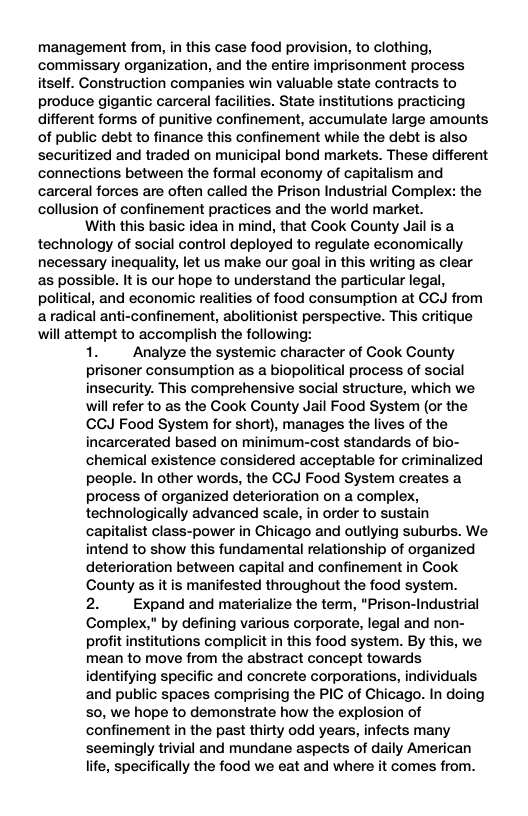
Therefore, to understand why the food at county is shit, we
must understand that the food at the jail serves power as one
more destabilizing social technology in the struggle to regulate the
poverty and wealth inequality of advanced capitalism; a capitalism
in which financial markets and the credit system preserve a
dilapidated ideology and regular folk struggle to survive in a post-
Fordist nightmare.
Within the justice system itself, the food consumption of
CCJ prisoners (and the state of insecurity it helps create)
accelerates the movement of bodies through the court system and
into plea deals. The average criminal court system could not
handle the average volume of cases it does today if everyone
accused of a crime went to trial. Our criminal justice system needs
plea bargains to move the large amount of people arrested
through the court system and into prisons. In 2012, 90% of CCJ
prisoners were pre-trial. One third of all pre-trial prisoners arrested
in Cook County were held without bail. If we assume a rough
average of the jail's regular population (9,000 people, based on the
fact that the population wavered between 8,000 and 10,000
throughout the year) this means that about 3000 people on
average have no choice but to weather through living at the jail
before trial. Consider also that 239% of the jail population was held
for 6000 dollars or less, meaning that because of their poverty, at
least 2070 people on average are also forced to survive CCJ until a
trial date. With so many people forced into staying at County
awaiting trial (a process which can take months and even years), it
is no surprise that prisoners make the logical decision to take plea
deals offered by prosecutors, just to get out as fast as possible.
The putrid diet contributes to this streamlined movement of bodies
and thus, the insecurity created by the food at county is crucial for
acourt system that needs people desperate enough to plead
guilty, no matter what the actual circumstances of their arrest.
On top of it all, this system of regulatory social insecurity acts as
the final destination of commodities, financial transactions, and
accumulation, all taking place throughout the outside world of
free, law-abiding citizens and corporations. A multitude of
companies specialize in different branches of carceral
management from, in this case food provision, to clothing,
commissary organization, and the entire imprisonment process
itself. Construction companies win valuable state contracts to
produce gigantic carceral facilities. State institutions practicing
different forms of punitive confinement, accumulate large amounts
of public debt to finance this confinement while the debt is also
securitized and traded on municipal bond markets. These different
connections between the formal economy of capitalism and
carceral forces are often called the Prison Industrial Complex: the
collusion of confinement practices and the world market.
With this basic idea in mind, that Cook County Jail is a
technology of social control deployed to regulate economically
necessary inequality, let us make our goal in this writing as clear
as possible. Itis our hope to understand the particular legal,
political, and economic realities of food consumption at CCJ from
aradical anti-confinement, abolitionist perspective. This critique
will attempt to accomplish the following:
1. Analyze the systemic character of Cook County
prisoner consumption as a biopolitical process of social
insecurity. This comprehensive social structure, which we
will refer to as the Cook County Jail Food System (or the
CCJ Food System for short), manages the lives of the
incarcerated based on minimum-cost standards of bio-
chemical existence considered acceptable for criminalized
people. In other words, the CCJ Food System creates a
process of organized deterioration on a complex,
technologically advanced scale, in order to sustain
capitalist class-power in Chicago and outlying suburbs. We
intend to show this fundamental relationship of organized
deterioration between capital and confinement in Cook
County as it is manifested throughout the food system.
2. Expand and materialize the term, "Prison-Industrial
Complex," by defining various corporate, legal and non-
profit institutions complicit in this food system. By this, we
mean to move from the abstract concept towards
identifying specific and concrete corporations, individuals
and public spaces comprising the PIC of Chicago. In doing
50, we hope to demonstrate how the explosion of
confinement in the past thirty odd years, infects many
seemingly trivial and mundane aspects of daily American
life, specifically the food we eat and where it comes from.
What is the CCJ Food System?
When viewed in its complete form, the CCJ Food
System is a process of organized consumption, designed to
reproduce a socially recognized minimum of life for
prisoners. A multitude of public and private forces
coordinate the legal-political standards of nutritional
subsistence for criminalized bodies. The entire movement of
food from producers to cells and the financial exchanges
sewing these movements together, are premised on
standards developed by security personnel from the Cook
County DOG and the Cook Gounty Board of Commissioners
(mainly through its Financial Committee). Far from being a
trivial scientifically objective set of standards, this
budgetary-security definition of what the life of a prisoner is
worth in food and what that definition of life requires to be
maintained, is a social relation. There is no objective
minimum of what constitutes life. The question of life and its
management in ‘acceptable’ conditions is a political question
of social power and control. How the state defines prisoner-
life and how it should be managed, is therefore crucial both
to the daily control of the jail as well as the functionality of
the Cook County Criminal Courts.
As of this writing, the CCJ Food System contains 6
major levels or different sets of assembled market powers,
state powers, and confined proletarians themselves. These
different centers of social power are all involved in organizing
the consumption regimen of instability. The six levels are:
CCDOC Administrative staff (the Sheriff's Department
overseen by Tom Dart as well as various other Cook Gounty
officials), the Cook County Board of Commissioners
(overseen by Board President Toni Preckwinkle), rank and
file Sheriff's office jail security, primary food service
contractors, private food vendors, and prisoners.
Furthermore, it is important to realize that the system is both
material and metaphysical. Throughout the process, remains
the old tension between production and exchange. Two
worlds operate simultaneously with many inconsistencies,
yet with a shared dependency: the world of abstract
economic values and the world of concrete lived
environments. As such, the hardboiled egg eaten by the
prisoner for breakfast is also an object of budgetary analysis,
municipal debt, and privatization. In other words, there are
always two sides to the system-the side of produced and
consumed food passing through the violent confines of the
jailitself and the side of abstract financial equivalents in
office buildings and conference rooms far away from the
brutality of incarceration.
By discussing the organized consumption of CCJ
inmates in systematic terms, we do not mean to imply that
this branch of carceral organization is by any means wholly
functional or static. Instead, we hope to capture the
elemental conflict and violence at the heart of feeding
prisoners that is ultimately a form of class warfare, and thus
dynanmic, to say the least. Prisoner’s bodies become terrains
of struggle and inmates themselves constantly invent new
tactics and strategies to resist their dietary oppression.
However, we do think it is essential to understand that,
despite its tensions and internal conflicts, there is a self-
reproducing system of consumption, a system that sustains
broader structures of criminalization and economic
apartheid.
The following analysis is concerned with one of these
six levels of power. We will be detailing the private contractor
behind organizing the movement of food from private
vendors to the labor and consumption of CCJ prisoners. This
is not to suggest that this level or any one level of the system
plays a deterministic role, directing the actions of any other
level. Rather, we see the system relationally, meaning that all
power-levels play a crucial role in the self-reproduction of the
system. In the future, it is our hope to produce works
detailing other levels, but for now we have chosen to
highlight the first tier of market forces; GBM Premier
Management LLC.
Part 1: Primary Contractor
In Cook County, the state pays a private contractor 38
million dollars yearly to supply food to jail inmates. As of
2013, that private contractor is CBM Premier Management
LLC. For almost ten years before last March, the contract
was held by Aramark Correctional Services LLC and cost the
county only 36 million dollars annually. But in a corporate-
political coup, local politicians and food service capitalists
dethroned the Aramark Corporation, giving the CBM LLC a
three-year contract set to expire in 2016. This power struggle
between different members of Chicago's ruling class begs
the question...
Who or what is CBM Premier Management LLG?
If we look at the listed managers of GBM, we start to see
what corporations, investors and operators are really
involved as the primary contractors in the CCJ Food System.
What is quickly made clear is that a diversity of different
businesses, political powers, and non-profit activities are
connected to these LLC managers, and are thus linked to the
sustained existence of Cook County Jail and its high
population levels. According to the lllinois Secretary of State
LLC File Detail Report, the managers of the CBM Premier
Management LLC are Carlo Buonavolanto, Timothy Rand,
and Marlin Sejnoha. Starting with these three LLC Managers,
we can see the invisible intimacy between American lives,
market privatization, and confinement. What we find are
dominant financial connections between different facets of
everyday life in the Chicagoland area and the nation's largest
single-site jailing facility.
For example, Carlo Buonavolanto is also acting
CEO/President of The Buona Companies LLC. Buona
Companies privately operates Buona Restaurants, “a chain
of about a dozen Buona fast-casual eateries known for their
Italian beef sandwiches". Buonavolanto controls the
company that he privately owns. Buona fast-food locations
can be found throughout Chicago and the greater
Chicagoland area. Additionally, the company operates a Joey
Buona's Pizzeria Grille in Wisconsin as well as Beyond Events
Catering: "BUONA's full-service Event Division." Beyond Events
specializes in high-end corporate event planning, offering catering
and management services for picnics, weddings and other
expensive gatherings for the neoliberal bourgeoisie. Thus, for Mr.
Buonavolanto, wealth is
accumulated both through organizing the consumption of elite
corporate clients as well as organizing the consumption of county
prisoners.
BUONA
Timothy Rand, another local LLC Manager, has built his
personal fortune on organizing concessions at Midway Airport as
well as providing food services for major convention centers. He
represents his company Airport Restaurant Management Inc. that
is the larger corporation behind the jail contract. Before he entered
the CCJ Food System, Rand founded and is still majority owner of
Midway Airport Concessionaires serving as the company's
president. Airport Restaurant Management Inc. acts as a.
managing partner of Chicago Restaurant Partners along with Levy
Restaurants, and Phil Stefani Signature Restaurants. From 2007 to
2011, Chicago Restaurant Partners held the public contract for the
McCormick Center's food service. Levy Restaurant Partners
operates food service and high-end restaurants across the city
and the United States
Rand is also an influential figure amongst the Chicago Democratic
Party and other prominent liberal-centrist organizations. He is a
financial contributor and public supporter of Cook County Board
President Toni Preckwinkle, one political official in charge of
issuing the food service contract. In the tradition of Rockefeller
and Carnegie, Rand is a true philanthropic capitalist, bankrolling
programs led by both Rainbow Push Coalition and the Urban
League. He has also donated money to such noble causes as
sending the south shore drill team to the president's inaugural
address and promoting the catholic sainthood of Rev. Augustus
Tolton. Rand has helped finance the Chicago Football Classic, an
annual game held between Atlanta's Morehouse College and the
Central State University of Wilberforce, two prominent black
colleges. As Everett Rand, Timothy Rand's brother and business
partner describes the significance of the yearly game; “Most of the
families who attend have never been to a Bears game [...] we want
kids to see themselves in another setting.” Therefore, in the post-
modern world of capitalism and hyper-incarceration, a service
economy capitalist pays for the Chicago Football Classic, as well
as political influence, with the controlled consumption of
prisoners.
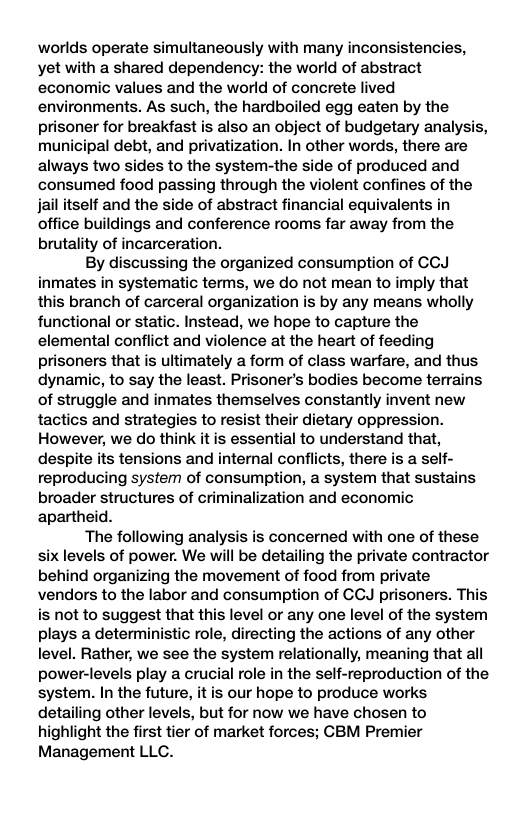
Timothy Rand, President of Arport Restaurant Management nc
and co-manager of CMB Premier Management LLC poses for the
Chicago Sun Times.
But the largest power-holder within CBM Premier
Management LLC is Marlin Sejnoha. Mr. Sejnoha is the CEO of
CBM Managed Services, a national carceral food service provider
headquartered in South Dakota. CBM Managed
Services represents the true biopolitical nature of the prison-
industrial complex. It is a large corporation, concentrated on the
specific task of winning large public and private contracts to
systematically regulate the daily consumption of bodies
interpolated by different ideological subjectivizations of life.
Through food and commissary management services, CBM
controls the lives of thousands of people confined in jails and
prisons across the country by organizing what prisoners eat.
capitalism born from over thirty years of growing
incarceration rates. Beyond their coordination of prisoner
consumption, in general the company specializes in
establishing and maintaining computerized disciplinary
regimes of consumption for human bodies in a variety of
institutional contexts, including public schools, universities,
hospitals and nursing homes. The company itself recognizes
its extra-economic functions as an institution of socio-
political behavioral control, stating that, “At CBM Managed
Services, we realize we are dishing up morale as well as
food. Our employees understand that we are not in the food
business, but in the business of people, serving food.”
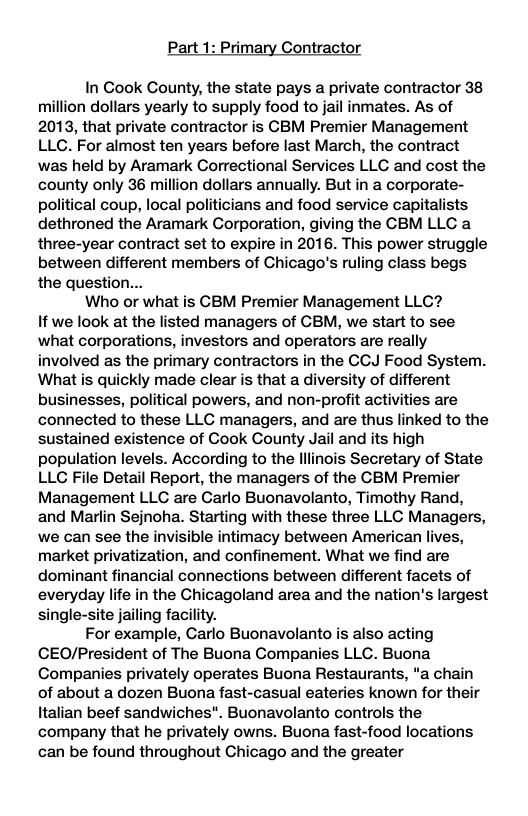
Nutriloa, the al in one “disciplinary meal” served to prisoners at Cook
oty Jail as punishment for @ varity of nfractions;image from
GMB Managed Services' wabsto.
While on the topic, it is private employment that CBM
advertises as a key component of its successful business model,
offering a privatized labor force to eliminate the need for public
carceral employees:
“We offer food service management and other essential
services without the hassles, expenses, or commitment of
hiring full-time or even part-time employees [...] by working
with companies as a contractor, rather than an employee,
clients are spared employee expenses such as overhead,
benefits, and income taxes."(3]
The cost-efficiency argument used here is common throughout
CBM's promotional material, once again showing us the
abstraction of confinement through econometric analysis.
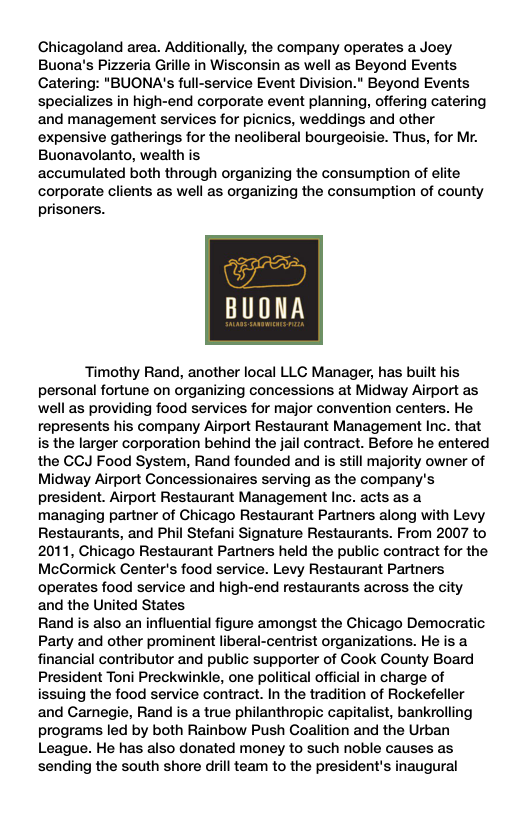
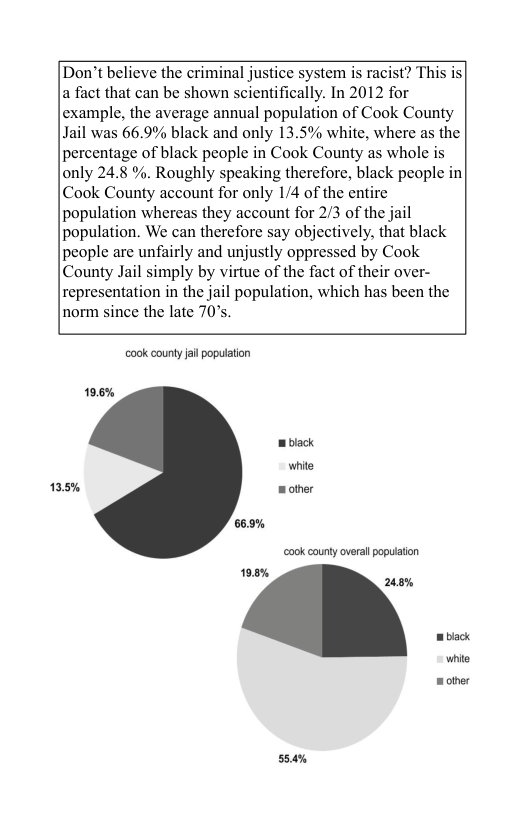
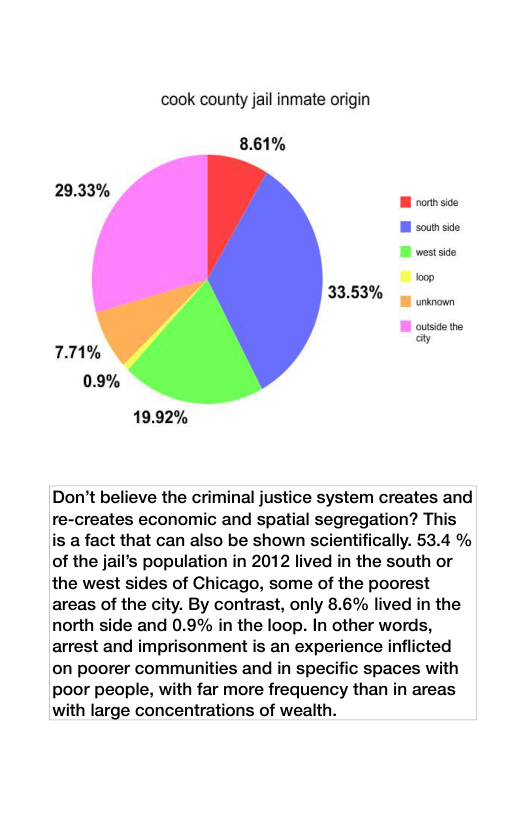
Don’t believe the criminal justice system s racist? This is
a fact that can be shown scientifically. In 2012 for
example, the average annual population of Cook County
Jail was 66.9% black and only 13.5% white, where as the
percentage of black people in Cook County as whole is
only 24.8 %. Roughly speaking therefore, black people in
Cook County account for only 1/4 of the entire
population whereas they account for 2/3 of the jail
population. We can therefore say objectively, that black
people are unfairly and unjustly oppressed by Cook
County Jail simply by virtue of the fact of their over-
represcntation in the jail population, which has been the
norm since the late 70’s.
cook countyjail population
135%
o0k county overall population
208%
black
whie
wother
5%
cook county jail inmate origin
8.61%
M noch side.
W soutn s
9 westside
oo
33.53%
1 uknown
W ousigethe
aiy
19.92%
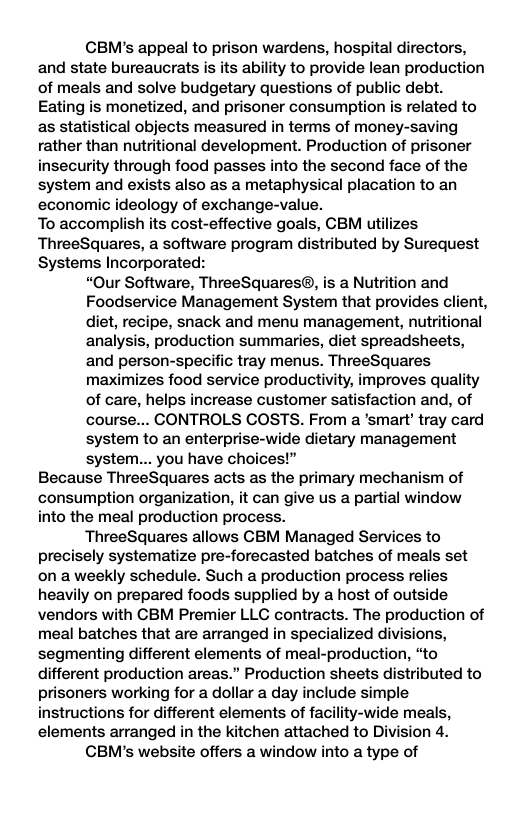
Don't believe the criminal justice system creates and
re-creates economic and spatial segregation? This
is a fact that can also be shown scientifically. 53.4 %
of the jail's population in 2012 lived in the south or
the west sides of Chicago, some of the poorest
areas of the city. By contrast, only 8.6% lived in the
north side and 0.9% in the loop. In other words,
arrest and imprisonment is an experience inflicted
on poorer communities and in specific spaces with
poor people, with far more frequency than in areas
with large concentrations of wealth.
CBM's appeal to prison wardens, hospital directors,
and state bureaucrats is its ability to provide lean production
of meals and solve budgetary questions of public debt.
Eating is monetized, and prisoner consumption is related to
as statistical objects measured in terms of money-saving
rather than nutritional development. Production of prisoner
insecurity through food passes into the second face of the
system and exists also as a metaphysical placation to an
economic ideology of exchange-value.
To accomplish its cost-effective goals, CBM utilizes
ThreeSquares, a software program distributed by Surequest
Systems Incorporated:
“Our Software, ThreeSquares®, is a Nutrition and
Foodservice Management System that provides client,
diet, recipe, snack and menu management, nutritional
analysis, production summaries, diet spreadsheets,
and person-specific tray menus. ThreeSquares
maximizes food service productivity, improves quality
of care, helps increase customer satisfaction and, of
course... CONTROLS COSTS. From a 'smart’ tray card
system to an enterprise-wide dietary management
system... you have choices!”
Because ThreeSquares acts as the primary mechanism of
consumption organization, it can give us a partial window
into the meal production process.
ThreeSquares allows CBM Managed Services to
precisely systematize pre-forecasted batches of meals set
on a weekly schedule. Such a production process relies
heavily on prepared foods supplied by a host of outside
vendors with CBM Premier LLG contracts. The production of
meal batches that are arranged in specialized divisions,
segmenting different elements of meal-production, “to
different production areas.” Production sheets distributed to
prisoners working for a dollar a day include simple
instructions for different elements of facility-wide meals,
elements arranged in the kitchen attached to Division 4.
CBM's website offers a window into a type of
The production of meal-batches is done in advance,
temporarily storing elements of meals for future consumption
and reheating them when necessary. CBM also utilizes meal
production forecasting based on an, “estimated census,” of
the jail population. This means that the meal production
process at CCJ relies on a projection of sustained rates of
confinement at the facility in order to reduce food waste. The
institutionalized meal service at the jail assumes a continued
population level, basing future food levels on this
assumption.
Of course, another reason ThreeSquares is S0
essential to CBM’s meal service is because it allows its users
to view the consumption system in precise financial values
and thus calculate the cost of food, problematized as a
budgetary dilemma. CBM advertises itself as a company that
can provide cheap on-site catering for different branches of
the state it is contracted with. The Financial Option that can
be used with the ThreeSquares software, allows CBM to
interpret the consumption of 8,000 to 10,000 prisoners in
terms of money generated by public debt. CBM can review
the, “menu cost selection screen,” which shows the user the
amount of money calculated per each individual meal
distributed at the jail. The, “Menu Cost Summary,” page
expands this cost-per-meal view to longer production
schedules. Inventory, vendor product costs, and necessary
stock items can all be tracked as costs. Allin all, the
Financial Option transforms the daily violence of torturous
prisoner diets into an abstract question of budgets, surplus,
and debt. The desperation of the jail population, achieved in
part through consumption, is precisely organized in terms of
financial cost controls. Food insecurity is produced through
the best digital technology the western world has to offer.
Where in the judicial system did CBM Managed Services
come from? What part of a law-based society necessitates
the existence of CBM Managed Services? How did we come
to live in a world in which the creation of such a corporation
is possible?
There is no way we can answer these questions with
any certainty in such a short writing. Instead we have
decided to create a loose patchwork of theoretical
reflections to help us critically digest the existence of GBM.
We seek to briefly consider the political implications of
CBM's activities and how Democracy and Capitalism
necessitate the existence of institutions such as CBM
Managed Services. To do this we will pick and chose from
different theoretical sources to think through these
complicated questions in a quick and dirty fashion.
Firstly, as we have made clear from the beginning, we see
the organization of prisoner consumption as a form of bio-
power. The social theorist Michel Foucault developed this
concept to describe new modes of political power in
Democratic societies after the fall of monarchical
governance. Bio-power is the social management of an
epistemologically validated truth of, “life,” and what, “life,” is.
Knowledge, unavoidably attached to political power,
produces a sense of truth about living and this knowledge is
employed in controlling life. The truth of “iife” as an abstract
essence recognized by corporations, governments, non-
profits and other secular institutions, drive the organizational
controls these institutions have over large concentrations of
human bodies. Bio-power is, “what brought life and its
mechanisms into the realm of explicit calculations and made
knowledge-power an agent of transformation of human life.”
Life’s emergence into the political world of statecraft meant
the development of, “a power to foster life or disallow it to the
point of death.”. The CCJ Food System manages the lives of
the incarcerated. The state defines the consumption
standards and prisoner-life itself epistemologically in a
legislative and bureaucratic context, forming part of the
broader process of controlling prisoners.
Thus, the organization of jail food is a contemporary form of
bio-power. For people confined at CCJ, the diet is just one
mechanism within, “an entire series of interventions and
regulatory controls: a biopolitics of the population.”
But we should be careful not to cling too tightly to Foucault's
conceptualization of the term. According to him,
contemporary bio-power stands in contrast to the older form
of sovereign power, and the right to inflict death commanded
by absolute monarchies in the previous era. In his view,
sovereign power claimed public authority through a right
over death and the power to kill when necessary, whereas
secular Democracies rely on an authority to manage life
through migration, population movements, political
districting, housing developments etc. In the contemporary
era of bio-power, command over death appears in extreme,
atavistic situations. The sovereign form of power, according
to Foucault,
“Must be referred to a historical type of society in
which power was exercised mainly as a means of
deduction, a subtraction mechanism [...] since the
classical age the West has undergone a very profound
transformation of these mechanisms of power.
“Deduction” has tended to be no longer the major form
of power but merely one element among others.”
In contrast to Foucault, it is our view that the management of
prisoner’s food at Cook County Jail reveals to us a radically
advanced subtraction mechanism, essential to the broader
management of flexible post-modern capitalism and its
devaluation of deskilled labor power. It is a subtraction
mechanism that physiologically and psychologically
deteriorates the body and mind of the prisoner through
ongoing and enforced consumption of minimum cost diets,
fluctuating sugar levels and low-intensity anti-depressant
chemicals. GCJ is an institution practicing a very violent bio-
power of deduction, in which the political-financial definition
of how much and what kind of food the life of a prisoner
requires and deserves (a bio-politics of the jail population)
reduces the prisoner to an increasingly desperate situation of
pain and anxiety. Far from employing, “a positive influence
on life,” this bio-power of deduction uses life to destabilize
life. The need for food to survive becomes a mechanism
causing health problems, weight loss, intensified social
aggression, and general indignity-all crucial components of
CCJ's regulatory social effect on the inequality it helps
socially quarantine. We must recognize that sovereign power
continues to underwrite the state’s basic authority to govern
its subjects: a monopoly on violence. Prisoner food
consumption is a demonstration of this monopoly, this basic
state sovereignty practiced by all representatives of the law.
Itis a violent blending of life and death, a punitive living
death in which bio-power unites with the sovereign drive to
subtract and deduct from economically devalued and
politically criminalized peoples.
We are also struck with a strong sense that Marx's
concept of primitive accumulation can help us come to a
better understanding of CBM's existence, as well as this
entire branch of the GCJ food system. At the climax of
Capital Volume One, Marx describes the historical invention
of capitalism: a violent and protracted process of
expropriation and social transformation. Markets were
created through the systematic coercion of governmental
forces altering the social structure through brute force and
legal repression. The entire process was premised on, “two
transformations, whereby the social means of subsistence
and production are turned into capital, and the immediate
producers are turned into wage-laborers.” The sovereignty of
the judicial system, parliamentary legislation, and politically
influential property owners acted as a capitalism-generating
machine, producing a society where the market governs all
forms of existence. This was originally accomplished by
bringing the organization of land under the authority of a new
social class that sought to exploit it by producing agricultural
goods, traded on international markets for monetary gain,
which was then reinvested in the perpetually expanding land
exploitation process. Large populations of people were
forced off land that was historically held in common, and
were concentrated in large urbanized districts or capitalist
agricultural plantations.
One crucial element of this market generating process
was the criminalization of poverty. As, “great masses of men
[..were...] suddenly and forcibly torn from their means of
subsistence,” through the creation of a market-based land
control system, the great transformation required population
management of the newly displaced precarious classes. To
do this, their new instability was made illegal, as,
“They were turned in massive quantities into beggars,
robbers, and vagabonds, partly from inclination, in the
most cases, under the force of circumstances [...]
legislation treated them as ‘voluntary’ criminals, and
assumed that it was entirely within their powers to go
on working under the old conditions which in fact no
longer existed.”
The rapid encroachment of privatization coalesced
with criminal punishment meted out by the courts, as the law
stepped in to regulate the displacement caused by the new
economic system, in which large tracts of land were owned
by a small fraction of the population.
And the outcome of the entire process was the
production of insecurity for the new proletarians, caught in
between the wage-labor of mass-agriculture and textile
manufacturing, now hanging over their heads as the only
form of survival allowed by the state. The serfs, exposed to
the radical development of the market experienced major
volatility becoming workers in the new wage-economy
system. The precarious, “these newly freed men became
sellers of themselves only after they [...had...] been robbed
of all their own means of production, and all the guarantees
of existence afforded by the old feudal arrangements.”
In other words, the freedom of workers under capitalism is a
complete freedom from any expectation of care or service
without the performance of wage-labor. Survival could only
be temporarily achieved through wage-work. This new social
relationship to survival was forged through the creation of
generalized social instability for the working class, partly
from economic dispossession and partly from political
criminalization.
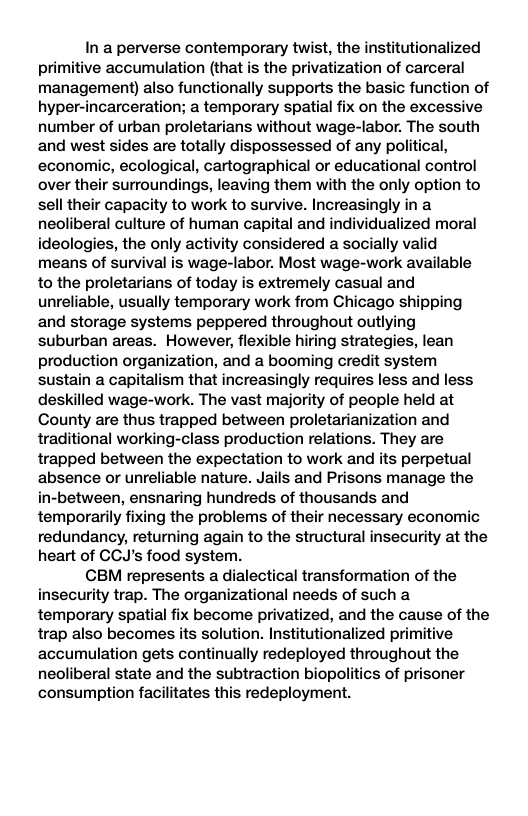
Consumption at county shows us a contemporary
version of primitive accumulation. The mixture of destructive
sovereign power and the technology of bio-power enters a
new dimension as creator of a privatized, surplus-producing
market process. The segregation and marginalization of the
socially and economically devalued, itself largely caused by
the virtual disappearance of traditional wage-labor, opens a
new frontier of Chicago Capitalism. Advanced capitalism
requires an institutionalized form of market (reJproduction, in
which the violence of criminalization and confinement, so
embedded in the social practices of Democratic nation-
states today, forms a perpetual source of capital, even the
bodily requirements of the prisoners themselves serve this
function. A living death of bologna and sugar-fueled violence
means an annual 38.4 million dollars for CBM Managed
Services.
In a perverse contemporary twist, the institutionalized
primitive accumulation (that is the privatization of carceral
management) also functionally supports the basic function of
hyper-incarceration; a temporary spatial fix on the excessive
number of urban proletarians without wage-labor. The south
and west sides are totally dispossessed of any political,
economic, ecological, cartographical or educational control
over their surroundings, leaving them with the only option to
sell their capacity to work to survive. Increasingly in a
neoliberal culture of human capital and individualized moral
ideologies, the only activity considered a socially valid
means of survival is wage-labor. Most wage-work available
to the proletarians of today is extremely casual and
unreliable, usually temporary work from Chicago shipping
and storage systems peppered throughout outlying
suburban areas. However, flexible hiring strategies, lean
production organization, and a booming credit system
sustain a capitalism that increasingly requires less and less
deskilled wage-work. The vast majority of people held at
County are thus trapped between proletarianization and
traditional working-class production relations. They are
trapped between the expectation to work and its perpetual
absence or unreliable nature. Jails and Prisons manage the
in-between, ensnaring hundreds of thousands and
temporarily fixing the problems of their necessary economic
redundancy, returning again to the structural insecurity at the
heart of CCJ's food system.
CBM represents a dialectical transformation of the
insecurity trap. The organizational needs of such a
temporary spatial fix become privatized, and the cause of the
trap also becomes its solution. Institutionalized primitive
accumulation gets continually redeployed throughout the
neoliberal state and the subtraction biopolitics of prisoner
consumption facilitates this redeployment.
The picture of the GCJ Food System we have painted
thus far is terribly incomplete. We have not examined the
legislative-political standards of biopolitical deduction
generated by the Cook County Board of Gommissioners and
the Sheriff's Department. We have not discussed the
complex network of private food vendors stretched across
the formal economy. We have not described the intricate
coordinates of guard and gang hierarchies that structure
access to food and transform it into a symbolic vehicle of
influence, surveillance and punishment. And, we have failed
thus far to show how prisoners as a collective force are not
passive victims of their confinement but actively engaged in
overcoming hyper-incarceration on a daily basis,
participating in solidarities and resistances expressed
through food and hunger. These different windows into the
CCJ Food System will have to wait for future research and
struggle.
For now, we can say that the private contractor, CBM
Premier Management LLC, constitutes a merger of
biopolitical subtraction and institutionalized primitive
accumulation through the continued dispossession of
contemporary proletarians in the city of Chicago. This
formation of the prison-industrial complex shows us how this
social structure both relies on and produces techniques of
neoliberal capitalism, while sustaining the broader
disciplining-effect of social insecurity. We have also shown
how Buona fast food chains, airports, schools, nursing
homes, private hospitals, elite corporate catering services,
the Rainbow Push Coalition, The Urban League, and the
Chicago football Classic are all connected to the larger
political economy of hyper-incarceration in Chicago. Until the
next volume, we can all reflect on the deep internalization of
confinement invisible yet present in all these seemingly trivial
practices of daily life in these United States.
Pilsenfoodnotbombs.wordpress.com