Every Crook Can Govern: Prison Rebellions as a Window to a New World)
Web PDF • Imposed PDF• Raw TXT (OCR)

![4 / P4 4 Ve ol6e26ss @ ®e 0y 04 "0, [ ] ° [ ] ° [ LIMPSING THE NEW ~ * ORLD. ’ If Du Bols mphasized the economic centrality of siave labor.he nevertheless insisted that*the true significance: of siavery” fo the United States had more fo do with the abolition of race as a structure of inequality: an aboltion o which the working classes hoid the key. A *strafegic” class is thus not merely the class located clossst fo production. but also that which has an infrinsic knowledge—gleaned from everyday activify— of the inner functioning of the system as a fotality (o knowlecige which Du Bois showed fo be military as well as social). It was precisely in an effort fo celebrate this very same sort of informal, everyday knowledge andl tne political sef-activity of the masses It generates. that C.LR. James famausly wrote in 1956 that *Every Cook Can Govern!](every-crook-can-govern-prison-rebellions-as-a-window-to-a-new-world-george-ciccariellomaher-jeff-st-andrews 12.png)

Prison Rebellions as a Window
1o the New World
George Ciccariello-Maher & Jeft St. Andrews
This plece, written ot the height of the
Pelican Bay hunger strike, analyzes the
strafegic importance of prison struggles in
the confext of confemporary capitalism.
Aswewritethis.thousandsofinmatesacrossCalfomic—
spearheaded by an organized biac in the Pelican
Bay secure housing unit (SHU)—are refusing meols
and risking their bodies and lives in the struggle fo
reform the atrocious condifions prevalent across the
stale penitentiary system. But this struggle is about
more than reforming incarceration and improving
conditions: the hunger strike speaks 1o the struggle for
revolutionary change across society as a whole an
offers a preliminary glimpse of the new workd gestating
in the helish bowels of the old.
T ENIZATION & °
NEMPLOYABILITY
In Block Reconstruction. WEB. Du Bois emphoszed
the “strafegic” position of the Black slave, one which
made possible the *general strike” of deserting siaves
that would both fransform the Civil War info @ war for
aboliion and ensure a Northern victory. Black workers.
*the ulfimate exploiied” represented the ‘founding stone
of a new economic system”: on them it stood and by
their autonomous cetion it would come crashing down.
A century later, this picture had changed, and Black
Panther founder Huey Newton took the ssemingly
contradictory position that Blacks were both central fo
andincreasinglyunnecessaryforeconomic production
in the Unifed Stafes. In 1967, he had written of Biack
Americans as both the "oll* without which fhe U.S. war
machine “cannot funcfion” and as the *driving shoft®
of that same machinery: *we are In such a strategic
position in this machinery that, once we become
dislocated, the functioning of the remainder of the
machinery brecks down.” he insisted. Black Americans,
in short, “can, because of their intimacy with the
mechanism, destroy the engine that is ensiaving the
world” But justfour years iater, Newton would document
a growing distance between these former sioves and
the *machinery” of the U.S. economy: *blacks and third
worid people.” he argued, had become displaced from
their central economic function, and were increasingly
rendered what he called *the unemployables.”
But for Newton, this declining economic position of the
8lack population did ot correspond fo a deciining
polfical Importance. Instead. these “unemployables*-
~which he used as synonymous with the controversial
concept of the lumpen-would become. by virtue of
sheer numbers, a new revolutionary agent capably of
overthrowing US. capitalism:
he [revolutionary) thrust wil come from
he growing number of what we call the
*unemployables* in this society...The proleforion
will become the lumpen proleariar, I s this fuure
change-the Increose of the lumpen proletariat ond
the decrease of the proleforiot-which makes us say
hatthe kumpen proletarit s the majorty and carres
the revolutionary banner (*infercommanaiism”).
Were these two crguments In contradiction with
cne ancther, or was this shift simply a refiection
of momentous econemic transiormation and the
increasing *unemployability” of many poor Americans,
specifically people of color and even mare specifically
the Black population? Hove communities of color been
increasingly “lumpenized” as Huey predicted?
Since he wiofe these words. much hos changed.
Poificall. the Biock Power movement was decapitated
ond slaughtered through COINTELPRO orchestrated
repression, only fo be replaced with the sponfaneously
emerging seftdefense units later known as “gangs”
Economically. de-ndustrialzation accelerated and in
search of low wages and an unprofected labor force,
capifal began fo fiee en masse fo both the Global
South and the South of the North (the U.S. South)
Increasingly *unemployable” but stil needing fo eat,
poor and especially Black communities took the only
work avallable: what Mike Davis has called the *South
American re-employment plan. Steel was fraded for
heroin, later Chrysler for crack, and more generally,
4ne point of production was displaced. in the words of
Elcricge Cleaver, by “the streets:
This broad trendoward theincreasing “unempioyabiliy”
of the Black population Is visible not so much in the
officialunemploymentdatawithwhichwearebaraged
on the daily, but in what lies behind and is obscured
by that data. Offcially. the Block unemployment rate
foday Is 16% (23% if underempioyment Is Included).
which is calastrophic enough, were it not for the fact
that this number massively underestimates the reclity
of the present crisis and the historic fendency toward
unemployability.This is because official unemployment
figures only include those looking for work, and @ “frue”
unemployment rafe is offen double what the official
data shows.
The medic foday is rife with both sob stories of those
who have “given up looking® and the obligatory
(ideological) suecess story of those who had once
"given up* but have now made @ triumphant return fo
the work force. Butis there reason fo think that Black folks
have *given up® more than their white counterparts?
Is the current spike in counted and uncounted Black
unemployment simply @ product of the cisis, or does It
represent the deeper tendency Huey Newton identified
40years ogo?
(which count 2.8 milion unempioyed Biacks). And
even when released, if's damn near impossibie fo gel
work, especially for fefons and pardlees (according fo
Demico Boolh, auihor of Why Are So Many Biack Men in
Prison?, 1.5 milion Black men alone are n prison with 3.5
millon eifher currently or formerly onparole). AsMichelle:
Aexander, aufhor of The New Jim Crow recently put i
“More Affican-American men are in prison of jai. an
probation or parole than were ensiaved in 1850, before
the Cvil Wor began. This is no coincidence: it was
precisely as aresut of ihe Black Power movements and
the fhreat of unified poliical action that it represented
that mass incarceration emerges as a replacement for
savery and Jim Crow, with fegal lynching replacing ifs
previous exira-eqal forms.
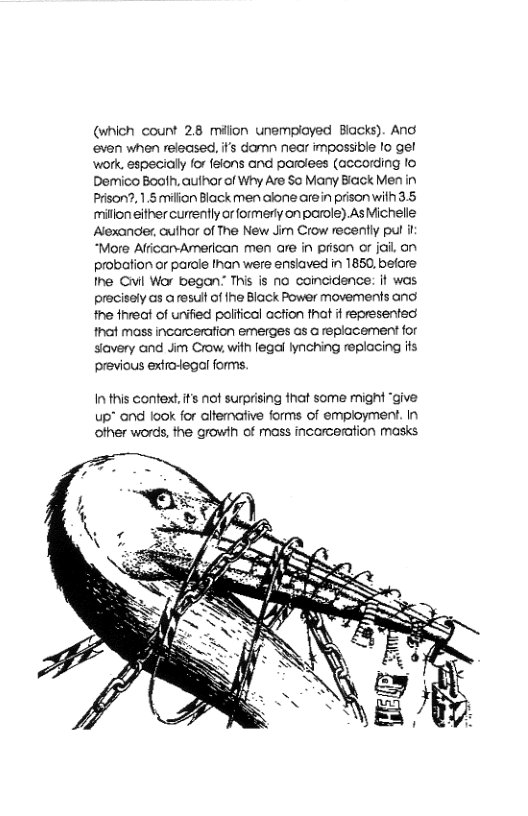
I this context it's nof surprising ihat some might “give
up” and look for alfemaiive forms of employmen. In
ofher words, the growih of mass incarceration masks
a very recl fendency foward “unempioyabllty” and
prisons have become warehouses for conaining fhis
rebelious class. And not just confaining: with their
‘coercedandunderpoldiaborand foroed consumplion
‘of overpriced goods and services (commissary. jacked
up phone rales), these warehouses clso provide the
bass for @ new fom of what Man called *primitive
accumulation; in which capitalists make a Kiling.
literally. Anci all the while, evan official unemployment
rates skyrocket, Informal labor-from everycay husting
1o the drug trade-become increasingly the nom. and
fhis process of lumpenization extends fo the very heart
of the economy fseif: the massive influx of migrant
‘workers-which capitalsts prefer o keep ilegal (and
therefore cheaper and unprofected)-is but the fip-
side of this procoss
What does this mean for resistance? If Huey Newlon.
Bunchy Carter. ond the Black Panthers placed
an emphasis on organizing among the lumpen
“unemployables.’ then this organizing must now
transcend prison walls. And if Bidridge Cleaver located
these*unemployables® and their action primarily in the
sfrest s opposed o the factory. then we must focay-
inthe e of mass Incarceration-add another location
for resistance: the pen.
"fictomr OR DEATHY"
Despite ifs laid-bpekimage and uneamed reputation for
social consciousness. Califomia has long represented a
spearhead of this process of mass incarceration (as has
Georgla. site of @ prison sfrike last December). Holding
nearly 150,000 (in only the state faciities), condifions
in the severely overcrowded Califomia prisons have
reached the point that the United Stafes Supreme Court
recently upheld o lowercourt ruling that even being
sentenced to prisonin Califomia constitutes a”crusi and
unusual punishment” and is thus unconstitutional (in his
dissent, Antonin Scalia called the decision *perhaps the
most radical injunction issued by @ court in our nation's
history") Years ago, courts at difierent levels ordered the
state to release nearly 60,000 inmates, leading then-
govemorAmold Schwarzenegger fo shipsome 10,0010
other states. This is the immediate context of the Pelican
Bay hunger strike. but its implications are far broader.
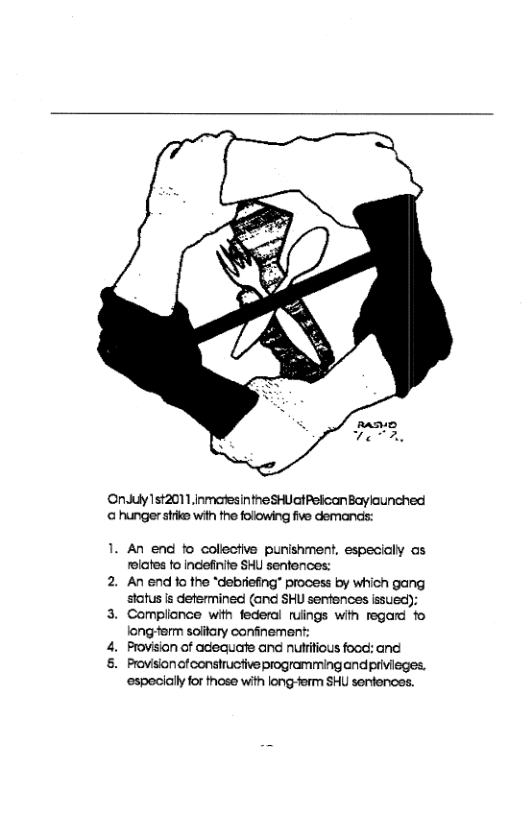
On.uly1st2011.inmates ntheSHUGtPeicanBaylaunched
@ hunger stike wih the following five demands:
1. An end fo collestive punishment, especially as
rolates fo Indefinite SHU sentences:
2. An end o the “debriefing’ process by which gang
status s defermined (and SHU serences issued):
3. Complionce with federal ruings with regard fo
long-ferm solitary confinement:
4. Provision of adequate and nutitious food: and
&. Provisonofconstructive programming andprivieges.
‘especially for those with long-form SHU sortencos.
Ater inifilly denying mass participation In the hunger
sirke, Calfornia Prison offcials admited that somo 6,600
inmares ccross the siate were refusing meals. A smal
numbex, like Chad Landrum of the Pelican Bay SHU-who
wos already suffering from liver disease and diabetes—
have chose o st “indefinifly... victory or deathl”
Inan inferview, Manuel La Fontaine of Allof Us or None
describes fo us the immediate motivation of the strike
‘and the inhuman conditicns of the SHU:
““* 'he purpose of the SHU is o control people
hat are beyond control. Dignity Is the lost
thing that a person has in prison and the SHU is
designed o foke that oway from them. It may not be
‘considered ortue youto put i the holo o 3010
60 doys,but 2010 40 years 1 @ iy room with o
‘contact with anyone, no ane fo fouch you, no one fo
‘speak fo- s forfure.
*Against liberals who would see fhis forture as a sign
thatthe system of massincarceration ismaifunctioning.
LaFontaine insists:
#44qTe don't have a broien system in America.
I works very well and has been very
effctie for pecple tat have propery ndithet make
money from the prisor-industril complex Yet eople
ot have been expendable are paying the price:”
4 / P4 4 Ve
ol6e26ss
@ ®e
0y 04 "0,
[ ] ° [ ] ° [
LIMPSING THE NEW ~ *
ORLD. '
If Du Bols mphasized the economic centrality of siave
labor.he nevertheless insisted that*the true significance:
of siavery” fo the United States had more fo do with
the abolition of race as a structure of inequality: an
aboltion o which the working classes hoid the key. A
*strafegic” class is thus not merely the class located
clossst fo production. but also that which has an
infrinsic knowledge—gleaned from everyday activify—
of the inner functioning of the system as a fotality (o
knowlecige which Du Bois showed fo be military as well
as social). It was precisely in an effort fo celebrate this
very same sort of informal, everyday knowledge andl
tne political sef-activity of the masses It generates. that
C.LR. James famausly wrote in 1956 that *Every Cook
Can Govern!
In this doy and age. when the economy is increasingly
Ilumpenized, when an increasing proportion of Biack
Americans, not fo mentien Latinos, immigrants, and
poor, are relegated fo husting fo survive at the margin
of the law-who couid deny fhat it is these very same
“unemployables” who are best able fo grasp the fotality
of copiialism in the United Siafes? And who among
this sector understands the reality of the system betfer
than foday's “ulimate expicited.” those deemed so
uncontroliable and so expendable as fo be locked away
for 22 % hours a day in windowless 8 by 10 foot cells?
Butihis Is notfo say that those involved In the California
hungersfrikes donotembody somedeepand troubling
contradictions. that some of them might be white
supremacist, sexist, homophobic. egolstic, and prone
fo violent behavior. The socalled "lumpent has been.
since Manx, denigrated as deviant, violent, corrupt, and
as embodying all that is negative about the world we
are attempting fo bury. But while Marx was cttempting
1o protect the working class from any association with
the lumpen "mob:’ later Mansts ke C.L R James rightly
argued that this duality this contradiction between the
old world and the new, is something which cuts right
10 the heart of the working class as well, expiaining s
potential fo be elther revolutionary or recctionary. and
itIs this contradiiction that-in @ more acute form-cuts
1o the heart of the caged "unemployables* as well
Central among these contracictions in the United
Stafes is white supremacy. and here the concrete
demands of the hunger sfrikers shouid not canceal
the foct that their very actions call info question the
racistlogic of imprisonment.In fact, as Dylan Rodriguez
recently argued. ihe very same gang cerfification and
debriefing procedures that land inmates in the SHU,
and which the stiking inmotes are profesting, exist fo
uphoid fhe “logic of segregation” that underpins our
society as @ whole (*For the Hunger Strikers at Pelican
Bay..” July 13th 2011). In other words, the “debriefing"
process is o process of control fhat, under the guise
of gang prevention, serves fo uphold segregation
and prevent joint struggles among white, Black, and
Latino inmates. For Lo Fontaine, "It behooves the
prison industial compiex 1o keep the system going
by maintaining divisions.” and the guards often justy
formal segregation by themselves planting rumors
and sioking racial confict: “They also tell whie, biack.
brown people that others are up fo something. Then
when things get out of control, they create the SHU fo
control people”
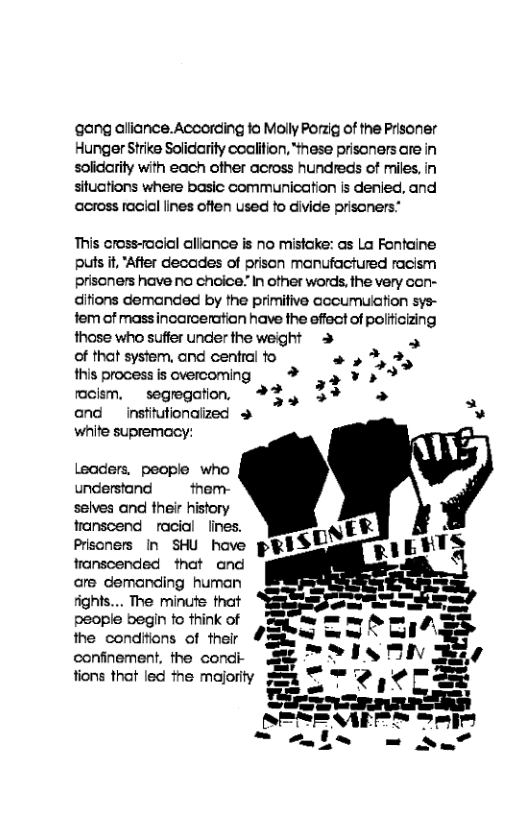
In their selforganization, the hunger strikers have
cleady begun fo rupture these shuctures of
segregation. As Marilyn McMahon of the American
Friends Services Commitiee, who hos served fo
mediiate betwsen prisoners and stafe officials, has
revealed. the 11-member leadership feam heading up
the srike comprises 4 major racial groups and a cross-
‘gang aliance. According fo Molly Porzig of the Prisoner
Hunger Strike Solidarity coalifion, “ihese prisoners are in
solidrity with each ofher across hundreds of miles, in
situctions where basic communication is denied, and
across racial lines offen used to divide prisoners:
This cross-facial allance is no mistake: as La Fontaine
puts t, "After decades of prison manufachured racism
priscners have no choice.” In other words, the very con-
ditions demanded by the primitive cccumuiation sys-
fem of massincarceration have the effect of politicizing
those who suffer under the weight > »
of that system, and central to L)
LI
this process s overcoming ¥y ¥ 572
rmoism, segregation. *%3, 3% N
and institutionaized »
white supremacy:
Leaders. people who
understand them-
seives and their history
transcend racial lines.
are demanding hurnan
ights.... The minute that
people begin to think of
the condifions of their
confinement, the condi-
of people o be in prisan. they become revolutionary.
they become leaders.
While nofing that the racial unity within the Pelican
Bay hunger strike is curently factical, and that simoly
working fogether doesnt mean that those involved
have necessarlly abandoned their white supremacy.
Ed Mead-a former polifical prisoner and currently
edifor of Prison Focus-nevertheless notes ihat “the
level of oppression reaches a cerfain point in which
pecple must work fogether. The prison is @ microcosm
of sociely but far more infense: This pressure and this
need fo work fogether under more infense* conditions
has the potential o speed personal fransformations.in
otherwords, while the process of organzing for change
in prison requires what are inftially factical allances.
such aliances have the potential fo quickly become
much more than merely factical.
AsLa Fortaine puts if:
that ore aleno in prison, hat have oy
bocks o ead and fime 0 think become more n
e wih who ey are. they stop playing Crip, Bood.
eyon Broherood and instead say | am on Alfoan
King. my heroge i that o Iish workers: when they
feoogrize that. e minute they cognize thot. hey
become revoltionary. The guards corft recognize thot
endsaywhat he fuck you crea prisanes The priscners
talkio others,oferpriscness may o b ke them.but
theysayreodthisbook studyihis ond people ransom
nd thenthe guords see them cs a treat.
Their uniform freatment by prison offcicls can
provide the pressure necessary o generate uniied
‘consciousness.In the confext of the Algerian Revolution,
Frantz Fanon wrota of how active participation in the
struggle could aliow the lumpen fo be “renabllfoted
in their own eyes and in the eyes of history” shedding
their reactionary ideclogical refics while embracing a
new humanity. and while the jury remains out on the
Pelican Bay hunger shrike. this of course is the hope.
@
“CONVICT'RACE"? *
1 Ris reflections on the 1993 Lucaswille prison uprising.
which successiully cratted infer-acial unity to o degree
seldom seen before, a unity embodied in groffti
refering fo the *Convict Race:” Staughton Lynd asks
a crucial question: *How. if ot il, can this experience
of prisners overcoming facism be extrapolated?
What Is the relationship of prison resistance fo the
wider movement for social change?” But while Lynd
correctly rejects the idea that white workers wil simply
volunfeer fo abandon thelr privieges, and while
he tecognizes the differences that separate prison
experience from broader workingclass experience.
we feel that he nevertheless falls back foo easiy on
the claim tnat “Workers become socialisfs in action.
through experience True, but the entire history of the
U, working class s a festament fo the fact that simply
bringing workers fogether under the oid siogan *Black
and white, unite and fight* will not tiseif eradicate the
wages of whiteness, wages which Du Bois snows fo be
both material and psychological.
How far and how hard do white workers (or lumpens)
need fo be pushed in order fo cbandon white
supremacy? Despite efforts by prison offcials fo stoke
racial resentment. these risking their ives in the Pelican
Bay SHU and elsewhere show us that imprisonment
already provides a hard push, much harder than
anything that white workers wil experience on the
outside (afthough Huey Newlon hoped that the
expansion of the condition of unemployability would
force white workers o join their Black brefhren in the
struggle). We need fo be careful then, not fo overstate
the implications of race relations In prison strikes for
working-class relations outside the walls. Of course.
white workers will abandon white supremacy if their
lives absolutely depend on it but what ¥ their lives
don't depend on it?
8ut more Imporlanty than this, we belleve that Lynd has
the question backwards fo begin with: fhe question is
not what prison rebelions can teach us about fighting
white supremacy outsice (1. in the ‘real” worid of the
working class). but how these insurrections within the
prison system fhemseives constifute a leading secfor.a
spearhead stiking at the very heart of late capitaiism
inthe US.
p—
[C
‘Geae Ceretooter s Asisont Profeso of Pl Sonce
of Dl Unhers
Jofl 5t At i o poskce shogepbe:. covaimotein
Lojout & Poge Cesr Dol ks Ecelomentcom
o imoge:Ceser s randesgncom
(oo o e At Prisn Rebation Sepkember 1971)
Poge 7.4ty P s, ingesnad at Boh Pron, O, Cnada
Poge 10,41 by Roshi onrson, ngrisoed of e O Prcn
Vipina I supp of A hunger siers
Page 15 G ison S by Gk o Mo nghsem.co