Don't Stop Continuing the Fight against Cop City
Web PDF • Imposed PDF• Raw TXT (OCR)
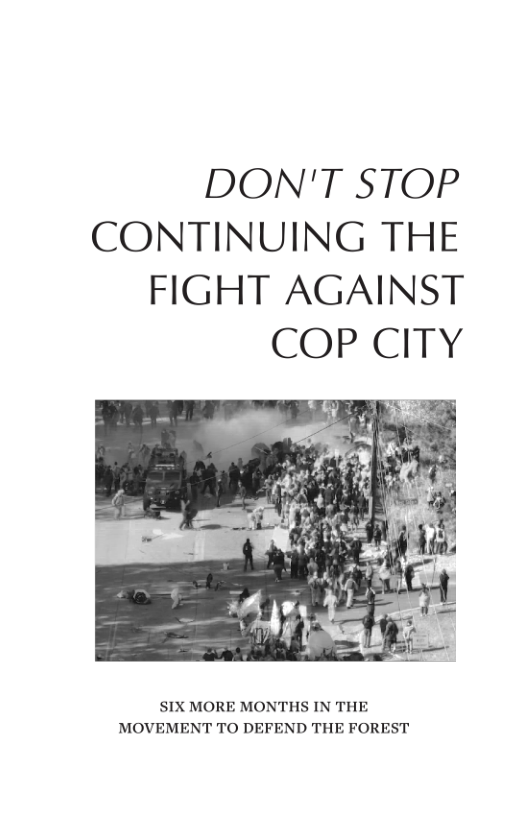






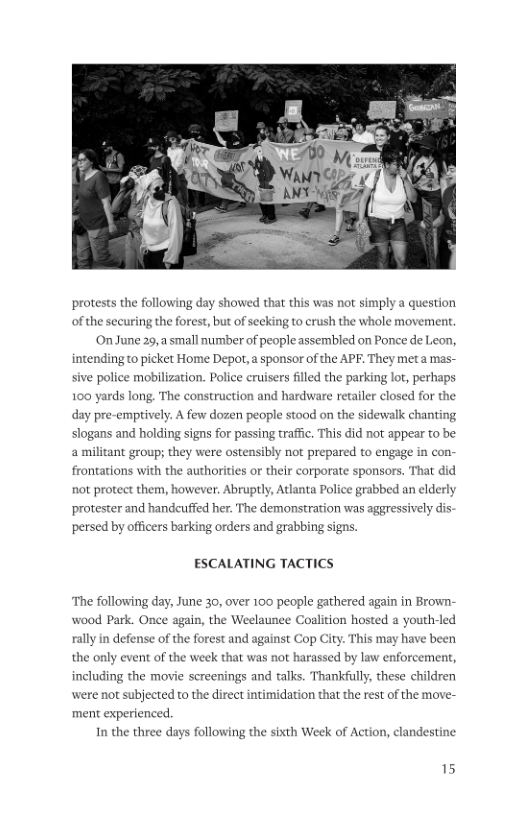









![Tknew that we stood no chance of making it into the con- struction site when 1 saw the crowd at the meet-up point. 1 was worried that all of these people would have come to ‘Atlanta for nothing. The lines of police showed me my con- cerns were unfounded. While many people prefer to evade the clash, to move around the danger, t0 stick to the shad- ows, I have always preferred the front lines, the exploding canisters, the sour smell of the tear gas, the wild crush of the crowd. Real knowledge lives in the body, not the mind. The experience of the mob howling in unison, linking arms, rush- ing headlong nto lines of police,is worth years of speculation and theorizing, If we were more numerous, we would have doublessly split into multiple corridors to spread the police response thin. [..] To my leftand right, my friends were shov- ing umbrellas upward, pushing ahead in the dense throng. For a few moments, it was dark and almost silent. The veil of the umbrellas, the silent heaving, and incredible pressure of the comrades packed together behind the banners is an experience you can’t describe easily for those who have never felt . Eventually, I couldn’t breathe anymore and I grabbed someone as I retreated. Thankfully we didn’t make it past the fourth line of officers. We would have all been arrested. RE-GROUPING After afew minutes, Indigenous activists within the Purple cluster con- vened a drum circle in the middle of the road. This had a calming effect. Protesters took time to check in with their affinity groups and anyone else in distress. The crowd chanted “All of us or none of us,” expressing the determination to defend each another from police snatch squads and the targeting of vulnerable or risk-tolerant protesters. In the final spokescouncil meeting the day before, the assembly had agreed that risk-takers from Blue cluster or other clusters would be welcomed into the other sections of the crowd and that nobody would feel “used” by this kind of tactical retreat. Over a loudspeaker, police began issuing dispersal orders. Slowly, the crowd made their way back down Consti- 39](dont-stop-continuing-the-fight-against-cop-city-crimethinc 39.png)










DON'T STOP
CONTINUING THE
FIGHT AGAINST
COP CITY
SIX MORE MONTHS IN THE
MOVEMENT TO DEFEND THE FOREST
This text was originally published on 12.12:2023.
Find it online with links and citations at
crimethinc.comStopCapCity2023
This text follows “The Forest in the City” published on 02.22.2023.
Find it online at crimethinc.com{ForestintheCity
Copy and distribute freely.
INTRODUCTION
THE HOUR IS DRAWING LATE
Three and a half years ago, twenty million people rose up to fight police:
and the structural white supremacy that they exist to impose. For a
short time, it appeared that police abolition could become a realistic
possibility in the United States; but politicians, universally dependent
‘upon the police, ultimately blocked any attempts to so much as defund
or reform police departments. Afterwards, people in Atlanta, Georgia
set out to use direct action to block the flow of public resources to po-
Tice by preventing the construction of Cop City.
Agreat deal has changed in those three and a half years.
On September 27, a Philadelphia judge dismissed all charges
against the police officers who murdered Eddie Irizarry. In response,
‘people organizing via social media began vandalizing businesses, loot-
ing stores, and setting fires in various part of the ciy. This mobilization
built on social tensions that have been percolating since the protests in
response to the murder of Walter Wallace by local police in 2020 Yet
this time, the activist left largely stayed home. Those who are already
on the receiving end of most of the violence of the police were left to
goitalone, as they were in the days before the George Floyd rebellion.
The following month, protesters returned to the streets in re-
sponse to the ethnic cleansing of Gaza, blockading transportation in-
frastructure and stopping work at arms manufacturers like Raytheon.
As early as October 19, a poll showed that most US voters (including
5% from the Republican party and 80% of Democrats) supported a
ceasefire.
Undeterred, the United States government is sending tens of bil-
Tions of dollars of military aid to the Isracli military. This s essentiallya
gift card, in that most of the aid must be spent on weapons supplied by
US-based firms. This war stimulus to the US economy enables Wash-
ington to channel a secret budget into the pockets of arms manufactur-
ers such as Elbit Systems, Raytheon, and Lockheed Martin that is not
included in the annual Congressional llocation. War is making a small
‘number of people extremely wealthy.
‘Some large firms, including Wells Fargo, worry that the war is cre-
ating an atmosphere of “deglobalization” that could hurt their profits
inthe long run. But this has not shifted US foreign policy any more than
the mass murder of thousands of Palestinian children has. It appears
that some elements of the ruling class anticipate a future in which it
will be more profitable to bank on war than on peace.
“This has serious implications for us all If we don't organize ac-
cordingly now, our future may be bleak indeed.
Fall of 2023 was the first time since the beginning of the movement to
stop Cop City that large numbers of protesters mobilized around any
issue in the United States. The movement in Adlanta emerged after the
2020 George Floyd rebellion, during the period of social peace and po-
litical disorganization that typically follows large protest movements.
I the echoes of the 2020 uprising were never entirely suppressed, we
owe that to the initiative of the movement in Atlanta and those who
acted in solidarity with it elsewhere, as well as the persistence of young
Black and Brown people who continue to resist state terror in places
Tike Philadelphi
To overcome the obstacles confronting the movement in Atlanta
will require long:term, large-scale mobilization. The actions of indi
uals and small dedicated groups have created a context in which a mass
outbreak of revolt could have the most radical content currently imag-
inable, possibly paving the way for a more serious movement against
carceral infrastructure all over the country. But such an outcome is by
1o means guaranteed. The movement has already experienced sever-
al flashpoints, including the murder of Tortuguita; these have given it
greater visiblity without mobilizing massive numbers of new partici-
pants.
Nonetheless, the story is not over, and the stakes are high. Now is
not the time for backing down.
4
THEY DON'T CARE ABOUT YOU
On June 6, 2023, the Atlanta Gity Council voted to approve an addi-
tional $67 million for Cop Gity after more than thirteen hours of public
‘comment against the project—the largest participation in a City Hall
‘meeting in Atlanta history. After the vote, the names and addresses of
the councilmembers who voted “yes” appeared online. Various local
outlets subsequently published articles platforming the councilmem-
bers. Councilmembers Bakhiari and Westmoreland, the former who
voted “no” and the latter who vored “yes,” met at a local restaurant
‘and posed for pictures together, reasserting their alliance as gay coun-
cilmembers, denouncing radical politics, and calling for “calm” in the
face of angry responses to the charade that the City Council had cho-
reographed on June s and 6. The next day, June 7, Mayor Andre Dickens
was dosxed.
These doxxings appear to have been conducted by the same group
that had published the names and addresses of the Atlanta Police Foun-
dation and the Buckhead Goalition. The documents were signed by a
‘group calling itself the “Free & Rowdy Party,”a reference to one of the
early political organizations in Atlanta history, colloguially known as
the “party of militant disorder.” The Rowdies frequently clashed with
the other major party, known s the Moral Party.
The following Monday, on July 8,a group of protesters associated
with the Stop Cop City Coalition announced the formation of a new
organizing group called Cop City Vote. The idea was to collect signa-
tures for a petition demanding a referendum, If successful, this would
compel the City to place the land-lease contract between the ity of
Atlanta and the Atlanta Police Foundation on a popular ballot, enabling
Adlanta voters to decide the future of the project.
THE REFERENDUM
The new group got to work with great haste, establishing online plat-
forms, writing statements, and building an organizational model that
would enable a large number of peaple to volunteer to canvass the pub-
lic. The referendum process only allows for registered City of Atlanta
voters to participate—excluding most of those who live closest to the
forest, which is just outside city limits. The participants had to cover a
large area in short time: according to Georgia law, from the day a peti-
tion isfiled, the peritioner has only 60 days to turn in signatures in or-
der to nitiate a referendum. In this case, the petitioners would have to
submit 70,330 signatures (15% of the city population), collected in less
tha
ipated in the 2021 mayoral lection. Collecting so many signatures was
abold ambition, and it faced illegal obstruction from the beginning.
On June 7, Cop City Vote delivered a referendum petition to City
of Alanta Clerk Vannessa Waldron. This legal document initiates the
process of signature collection upon approval, thus starting the 60-
day countdown. In order to place Cop City on the November ballor,
organizers would have to submit the signatures they collected by no
later than August 15. If the signatures were turned in after that date,
the referendum would go on the March ballot. Clerk Waldron denied
the petition, citing obscure legal technicalites. A week later, on July 14,
‘Waldron denied the second petition, again on obscure clerical premis-
two months. By comparison, only 97,000 voters altogether parti
es. This second denial prompted popular outcry.
By denying the petition on July 14, the city government hoped to
‘make it impossible for the organizers to deliver the signatures by the
August 15 deadline. This was a pre-emptive attack on the referendum—
the first stage of a long campaign targeting the initiative. Its worth
noting that while in times of social peace, the authorities would pre-
‘sumably have welcomed the opportunity to channel a combative move-
ment into electoral reformism, in this case, they were not prepared to
make any compromises, not even permitting citizens to utilize their
legal rights.
In response, organizers filed a lawsuit against the Clerk. Public fig-
ures such as Senator Raphael Warnock called on the city government to
‘permit the process to move forward. On July 21, Waldron approved the
petition. Signature collection could finally begin.
On July 27, a US District Court ruled in favor of the canvassers.
This was one of the first legal rulings in favor of the movement since it
began in April 2021, The court ruled that the illegal restrictions placed
on the petition-collection process, specifically the clause that disqus
ifies non-residents from so much as knocking on doors to collect si
natures, violates the First Amendment. Consequently, the judge gave
organizers an additional 60 days to collect signatures.
WHAT MASS ORGANIZING MAKES POSSIBLE
Organizing efforts around the City Hall protests and the referendum
enabled the movement to overcome a few barriers. Nearly 800 people
volunteered to collect signatures for the referendum process. Dozens
of abolitionists and radical organizers composed a curriculum to train
those volunteers and strategized about how to best distribute their
energies across the city. From mid-June to mid-September, these vol-
unteers could be seen everywhere, Posters, stickers, signs, and mem-
orabilia filled coffee shops, bars, local grocery stores, tattoo parlors,
‘bookshops, farmers markets, and art galleries. On busy avenues, volun-
teers walked up and down the sidewalks, speaking with all passersby.
In just a few months, hundreds of thousands of residents spoke with
canvassers; this gave them a chance to ask them questions, learn about
Cop Gity, and discuss the resistance to it, generating a new level of
‘mass sympathy with the movemer.
In the canvasser trainings, aspiring canvassers were explicitl in-
structed not to denounce sabotage, vandalism, or clashes with law en-
forcement.If they did not feel comfortable explaining those phenome-
na, they could simply change the subject, or they could humbly listen,
then find a way to reassert the purpose of the petition. The referendum
organizers themselves asserted continuously that the strength of the
‘movement derived in no small part from sabotage, vandalism, and oth-
er combative tactics. They published written statements affirming the
validity of “all tactics.” Contrary to the anxieties of some internet com-
‘mentators, the referendum campaign was not intended to suppress
or compete with direct action. Most participants in the effort simply
wanted to establish a path for the movement that could involve a large:
‘number of metro Atlanta residents.
The movement has had many strengths, but mass participation
has never been among them. Despite continuous attempts to foster
a creative and contagious movement, despite robust media coverage
Tocally, nationally, and globally, no more than 2000 people have ever
participated in any one event opposing Cop ity. Despite the accessible:
action framework demonstrated by the groups targeting contractors
and funders, only ideologically driven and risk-tolerant groups have
participated in those actions, usually using a clandestine approach. The
Targest evernt by far was the South River Music Festival, which drew in
a couple thousand people over two days in March 2023, Most protests,
rallies, and marches have drawn between ten and two hundred people.
‘When Tortuguita was killed, only 300 people showed up downtown in
response, two thirds of them hooded militants in black masks. This has
consequences for what those who do participate can actually o, be-
cause some kinds of action are only possible in large crowds.
The movement has made considerable headway nonetheless. It
has found ways to turn its small size o its advantage. Centeringa small,
dedicated core has enabled the participants to advance revolutionary
discourse throughout the movement and to conduct militant actions
with greater tactical aglity.
et countless historical examples suggest that this pattern cannot
be maintained forever, If frontline fighters cannot keep supply lines
open, take breaks, receive new assistance, and rely on the resources
and security provided by sympathizers and newly radicalized people,
they will eventually lose. This concern is not derived from abstract po-
litical conceps or folded-and-stapled booklets; it has been proven time
‘and again across centuries and continents. For example, the legendary
focoista campaigns of the 20th century drew together some of the most
dedicated, audacious, and extreme sectors of the Latin American rev-
olutionary left in clashes with the armies and paramilitaries of various
Cla-backed dictatorships. Aside from exceptions in Cuba, Nicaragua,
‘Colombia, and El Salvador, these campaigns resulted in the near-com-
plete decimation of an entire generation of revolutionaries. An isolated
vanguard—however dedicated or secretive—is doomed to defeat.
‘Counterinsurgency strategy explicitly seeks o create a gulf be-
tween dedicated militants and the rest of society in order to target the
former and immobilize the latter. Acknowledging this does not oblige
‘committed militants to pursue populist strategies to appeal to an imag-
ined mass of people, but it does open the question of what the alterna-
tives might be.
‘Some participants in the movement insist that ll strategies orient-
ed towards “society” in general are naive and “liberal” A few go further,
asserting without any measurable criteria that only clandestine sabo-
tage “works.” But without widespread participation, even the fiercest
vanguard cannot move beyond hit-and-run actions. They will never be
able to advance to open confrontations (which the historic proponents
of guerrilla warfare understood as a necessary step in their strategies).
‘Without more participants, actions such as the march in downtown
Atlanta on January 21 or the march to the construction site on March §
will remain the high points of combativity from the movement. Those:
actions did not succeed in bringing about the cancellation of Cop City.
In order to move from clandestine attacks to winnable confrontations,
the movement needs a more robust way of understanding the relation-
ship between the actions of anonymous saboteurs and more accessible,
participatory forms of widespread self-organized activity.
Ifa few thousand more people dedicated themselves to the fight,
that would increase the capacity of the fighters by an order of magni
10
tude. There are worthwhile and necessary tasks to conduct in clandes-
tinity, in public organizing, and in fundraising. The relatively small size
and ferocity of the movement so far has contributed to a kind of my-
thologizing of the protagonists, so that the most dedicated participants
are seen as heroes (or demons, depending on who you ask) while most
of the supporters and public remain passive spectators. When a move-
ment s structured as a small, sharp, edge passively observed by spec-
tators, thelatter,as a consequence of their inactivity, will tend to oscil-
late wildly between sympathy and skepticism. To succeed, movements
‘must inspire the self-organized activity, theoretical development, and
participation of as many people as possible. Real militancy is not show-
ing people bold actions; it is enabling them to act for themselves.
Those who are skeptical of the value of mobilizing people to speak
at Gity Hall or organizing people to petition for a referendum must
accept that they will remain a marginal force in the movement unless
they themselves take on the burden of organizing alternative strategies
10 engage large numbers of people. So far, the proponents of no other
strategy have succeeded in doing so, and few have even tried.
"
‘THE SIXTH WEEK OF ACTION
Not everyone pursued the referendu strategy, although everyone was
affected by the shifting landscape of repression. On June 23, Dekalb
‘County District Attorney Sherri Boston announced that her office
would no longer participate in the terrorism cases against the move-
ment. In a televised press conference, she referred to the “fundamen-
tally different” philosophies of prosecution that distinguished her of-
fice from the office of Chris Carr, Attorney General of Georgia. She also
cited pressure applied against her by the public in the form of incessant
phone calls and letters as a factor in her decision. This shifted all le-
gl responsibilities and initiative into the hands of the most reaction-
ary forces in the state, signaling that the Dekalb County Government
hoped to wash its hands of the ongoing public relations disaster that
they have helped to create by participating in the lethal raid on Janu-
ary 18 and closing Intrenchment Creek Park (a part of the Weelaunee
Forest).
The following day, June 24, the sixth Week of Action began. It
shared almost no common features with the previous four, though
it was somewhat reminiscent of the first such week, held in October
2021, Rather than Weelaunee Forest, workshops and talks took place
in Brownwood Park, located in East Atlanta Village. Rather than cen-
tering the capacities of the movement to leverage nationwide support
with concentrated militancy, the sixth Week of Action involved very
few protests, no mass encampment, and few cultural events. It was so
different from previous Weeks that it was as if an altogether different
constellation of groups had organized it.
Onthe first day, over 100 people gathered in Brownwood Park. By
late afternoon, they were surrounded by police vehicles and surveilled
by drones and helicopters. At 8:30 pm, Belkis Teran, the mother of Tor-
tuguita, gathered people in the park to host a vigil and ceremony for
her deceased child. At that point, dozens of officers entered the area,
barking orders and pointing t people, instructing those assembled that
if they were not gone when the park closed (three hours later), they
would be subject to arrest. The crowd did not hesitate to confront the
12
officers, yelling at them and telling them to leave the premises. When
a few people with tactical experience began encircling police and call-
ing for others to do the same, the officers quickly withdrew. This brief
confrontation was cathartic for participants, but nonetheless had the
intended chilling effect. After the vigl, everyone left the park. Later in
the evening, deep in the Weelaunee Forest, hundreds of people gath-
ered for an illegal dance party. Music blared late into the night as forest
defenders and ravers shared the comforting embrace of the trees. How-
ever, this was not the section of the forest slated for demolition. No
encampment was established there, nor in the park, nor anywhere else.
The following day, June 25, over 100 people re-assembled in the
park. The atmosphere was jubilant and friendly. Participants shared
food and assembled beneath a gazebo for a presentation on the lim-
its of referendum strategies, conducted in a comradely and good-faith
tone. Elsewhere in town, activists passed out fliers for forthcoming
events. For the most part, the day was uneventul—with one exception.
‘That night, anonymous activists ventured onto the headguarters
of the Brent Scarborough Company. Brent Scarborough, located almost
an hour south of Atlanta in the suburb of Newnan, i the subcontractor
that Brasfield & Gorrie hired to cut down trees and grade the land at
the Prison Farm,. Their facility is surrounded by trees and barbed wire
fencing, They hired on-site security to park overnight at the office. This
did not stop a few dedicated people from sabotaging their machines.
According to an online communiqué, the activists hiked through the
woods and scaled the fences using a cut-out square of carpet, as seen in
the Hollywood film Fight Club. Sneaking past the security guards, they
‘poured muriatic acid into the engines of multiple trucks and machines
before escaping into the night.
Aside from a few movie screenings and workshops, no events were:
‘planned for the following days. Several were planned for June 28,
THE NEW BALANCE OF FORCES
At midday, a small crowd gathered outside of Cadence Bank in down-
town Adlanta. The bank was slated to offer a multimillion-dollar loan
to the Adlanta Police Foundation; activists wanted to give them cause
13
to reconsider, After a few minutes, police chased and dispersed the
crowd. In the skirmish, a few people were pulled free of the police, but
two were arrested. One person was ultimately charged with Felony Ob-
struction. Between harassing the vigil for Tortuguita and this, police
sought to establish a new balance of force in which they could control
the streets, 5o that activists would be reduced to knocking on doors.
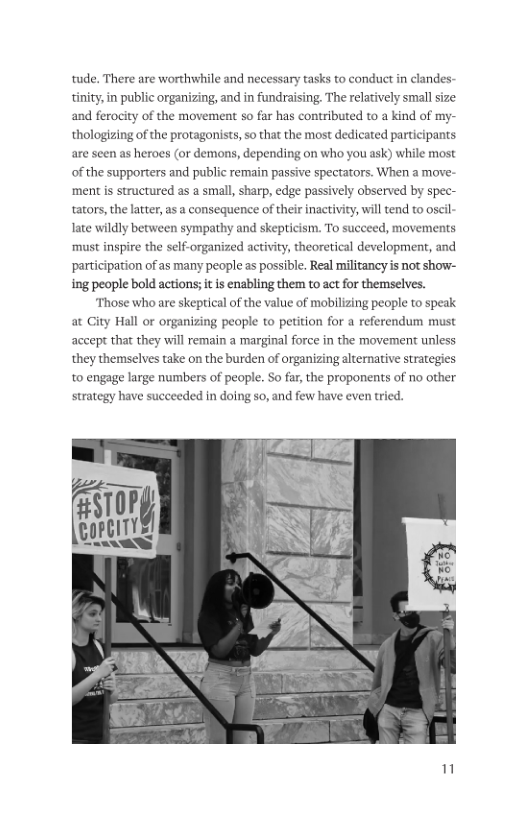
A few hours later, around 4 pm, two hundred people githered in
Gresham Park. Belkis Teran joined them. The crowd held reinforced
‘banners. Scouts observed several dozen police vehicles in the parking
ot of Intrenchment Creek Park and dozens of officersin riot gear. The
crowd marched down the same bicycle path that another crowd had
during the fifth Week of Action in order to re-occupy the park on March
42023 Morale was high.
Approaching the wooden bridge passing over Snow Creek just east
of Intrenchment Greek Park, the crowd encountered multiple police
cruisers stationed next to the path, near Cottonwood Drive. Helicop-
ters circled overhead. At the tunnel beneath Bouldercrest Road, which
marks the true entrance to Intrenchment Creck Park, police had erect-
ed cement barriers and formed a skirmish line. The crowd stopped be-
fore encountering any of this directly. Belkis took a megaphone and
delivered an impassioned speech to the rowd. Others spoke as well,
including demonstrators wearing balaclavas and gloves. Had the crowd
been a few hundred more, this demonstration might have confronted
the police and retaken the fores.
“The crowd turned back, without losing morale, soberly assessing
the situation. There were nearly as many police as protesters, and it was
better to only fight when success was plausible. Any further advance
would likely have provoked a dramatic clash in which police would have:
had the upper hand. If the movement had been in a phase in which it
was necessary to assert its militancy, tis might have been worthwhile.
‘Onthe contrary, however, the movement had already demonstrated its
militancy; what was necessary at this point was to show that it could
win confrontations while minimizing losses.
Atthat point, the preparedness of the police could still be ascribed
to the proximity to the forest. The authorities were clearly committed
to preventing new encampments from being established there. But the
14
protests the following day showed that this was not simply a question
of the securing the forest, but of secking to crush the whole movem
On June 29, small number of people assembled on Ponce de Leon,
intending to picket Home Depot, a sponsor of the APF. They meta mas-
sive police mobilization. Police cruisers flled the parking lot, perhaps
100 yards long. The construction and hardware retailer closed for the
day pre-empiv
y. A few dozen people stood on the sidewalk chanting
slogans and holding signs for passing traffc. This did not appear to be
amilitant group; they were ostensibly not prepared to engage in con-
frontations with the authorities or their corporate sponsors. That did
not proteet them, however. Abruptly, Atlanta Police grabbed an elderly
protester and handeuffed her. The demonstration was aggressively dis:
persed by officers barking orders and grabbing signs.
ESCALATING TACTICS
‘The following day, June 30, over 100 people gathered again in Brown-
wood Park. Once again, the Weelaunee Coalition hosted a youth-led
rally in defense of the forest and against Cop City. This may have been
the only event of the week that was not harassed by law enforcem
ankfully, these children
were not subjected to the direct intimidation that the rest of the move-
ment experienced.
including the movie screenings and talks. 1
In the three days following the sixth Week of Action, clandestine
15
groups claimed responsibilty for several attacks against Cop Gity.
The first took place in California. Activists released a statement
claiming credit for smashing the windows of four banks and the screens
of three ATMs in San Francisco, Oakland, and Concord. Over the pre-
ceding two and a half years, several dozen offices and institutions had
suffered broken windows due to their support for the Atlanta Police
Foundation, but this was the largest number of locations targeted si-
multaneously—implying that the saboteurs were scaling up their num-
bers and coordination.
Anonymous saboteurs struck multiple targets in Atlanta on July 1
as well. A clandestine group calling itself the March sth Movement—a
reference to the March 5, 2023 attack on the Cop City construction
site—vandalized police infrastructure in two locations. Tagging “Ms!
‘on the hood of a police cruiser, they smashed the windows out of three
cop cars on Memorial Drive and unsuccessfully attempred to set them
on fire. Simultaneously, improvised incendiary devices appeared in the
parking garage beneath the current Atlanta Police training facility lo-
cated in an industrial area at the southern boundary of Atlanta. This
second action resulted in the burning of eight police motoreycles. Ac-
cording to government press conferences, an additional improvised de-
vice failed to detonate. Police claim that i it had, it would have assured
the burning of 40 additional vehicles. The Chief of Police and the Atlan-
ta Journal Constitution published photographs of the device. Offcials
claim that the entire facilty could have been destroyed if an off-duty
officer had not been randomly driving by at the time. Apparently, no
‘one was inside the building at the time of the action.
On July 2, protesters visited the residence of Cop City architect
Anthony Kenny, vandalizing it with paint and slashing the tires of his
car. Ambrish Baisiwala, who sits on the Atlanta Police Foundation
Board of Trustees, received the same treatment that night.
ATLAS TECHNICAL CONSULTANTS DROPS OUT
The same day, July 2, protesters gathered outside the suburban home
of a regional manager for Atlas Technical Consultants in Minnesota,
chanting slogans and banging on drums in his yard. The regional man-
16
ager stormed out his front door screaming and cursing at the demon-
strators. He told those assembled that Adlas had already dropped the
contract. When someone in the crowd asked him why, he answered
“Because you guys are a fucking nightmare” and “You broke all of our
fucking windows.”
After this news spread online, some people in Williston, Vermont
visited the offices of Atkas on July 9, painting slogans on the work trucks
and front doors of the facility. The next day, Atlas Technical confirmed
with an independent journalist that they had backed out of the project.
The following week, asked about Atlas” decision at a press conference
about Cop City, Atlanta Police chief Darin Shierbaum said “Well, i peo-
ple were coming to your home, what would you do?”
Later, documents released on November 30 indicated that Atlas
had apparently withdrawn from the project the preceding March. The
company expressed the desire to withdraw from the project on March
4 By the 7, they were already off the contract. The document reveals
‘much about the internal status of the project and its investigations into
the movement, including the potentiall illegal collusion of various
agencies with Magnus Miller Gorrie over encrypted Signal chats. It also
catalogues a number of actions for which no public claim of respon-
sibiity was ever made, such as February 21, 2023 burning of an Atlas
Technical office and vehicle in Brecksville, Ohio.
The departure of Atlas represented a significant victory for the
‘movement. In the winter of 2021, as detailed in The City in the For-
est, 50 forest defenders had marched to the prison farm to resist the
soil-boring and sampling conducted by Long Engineering, a subsidiary
of Atlas Technical Consultants. Finally, after over two years of home
visits, call-ins,letter writing, marches, ralies, vandalism, and clashes, a
‘major Brasfield & Gorrie subcontractor had backed out of the project.
Despite this success, the news did not catalyze a significant uptick in
the pressure campaign against other subcontractors of Brasfield & Gor-
ie,other clients of the Adlanta Police Foundation, or the project itself
Tt did not give people the sense that greater resistance to Cop Gity was
possible.
In view of thi
that below.
, it is worth reevaluating that campaign. More on
17
SCOOPING THE MID-RANGE:
REPRESSING PUBLIC RESISTANCE
In audio engineering, “equalization” (EQ) means adjusting the fre-
quencies to produce the ideal sound and tone. Broadly speaking, these:
frequencies are divided into bass, mid-range, and treble. Insofar as
taste is completely subjective, there is no “correct” way to EQ & song.
In general, however, it is agreed that any EQ that completely obscures
afrequency is undesirable, because that means that a given instrument
or sound will be covered up by other sounds. For instance, there are
‘many high-end frequencies in the snare drum and cymbals; without
proper equalization, high-end frequencies in vocals, guitar, or keyboard
can be completely covered up by the drum sounds, or al of them can
bleed together in an unintelligible cacophony.
In music parlance, to “scoop the mids” is to turn down the mid-
range frequencies below the bass or treble frequencies. In heavy metal,
people often “scoop the mids” to produce an aggressive guitar tone,
imitating the recordings of Metallica or Pantera, Unfortunately, if the
‘mid-range of the guitars is “scooped” too much, a live audience will
not be able to hear them over the drums and bass. Experienced bands
Know that to deliver a crisp, hard-hitting, intelligible sound, you need
toinclude a certain amount of mid-range frequencies in the guitar EQ.
Imagine that civic efforts such as canvassing for the referendum
and speaking at Gity Hall represent the “treble” of resistance, while
nocturnal sabotage, vandalism, fire-secting, and clandestine attacks
represent the “bass.” In this metaphor, the “mid-range” s comprised of
public demonstrations, marches, forest encampments, walk-outs, and
riotous protests—actions that are both combative and participatory.
‘The police strategy since December 13, 2022 has been to “scoop” the
mid-range of the movement, pushing down the middle frequency as
much as possible.
This has created a situation that intensifies the contrast becween
‘underground and civic actions. Those who imagine that some forms of
resistance are more intrinsically worthy than others welcome this sit-
uation, because it makes it casier to center their preferred approaches
18
while deriding the others. The forcible suppression of space for partic-
ipatory action protects participants from testing the viability of their
concepts in open dialogue with alternative viewpoints. Prosecutors and
police like this situation for the same reason: it makes the line very
clear between those engaging in legal protest activity and those engag-
ing in clandestine direct action.
But s precisely the middle frequencies of a movement that give
itits punch—making its thythms infectious, enabling it to move people:
and draw them into a process of transformation. Without these fre-
quencies, the results will be muddy and indistinct.
If activists cannot re-assert their right to gather publicly for “mid-
range” activities, nocturnal sabotage and civic actions will drift further
and further apart, becoming mutually unintelligible and incapable of
reaching those outside the movement. Regardless of individual prefer-
ences, everyone must recognize the importance of participatory, con-
frontational activity.
THE STORM BEFORE THE STORM
On July 2, Governor Kemp released a statement describing the March
sth Movement attacks as “the tactics of organized criminals,” while
avolding using the name of the group. On July 3, activists visited the
private residence of Keith Johnson, the pre-construction regional di-
rector for Brasfield & Gorrie. Protesters had visited his house repeated-
Iy over the preceding two and a half years. As a result, his multi-house:
estate had hired full-time security to park in his driveway. This did not
stop activists from climbing over the fence into his yard.
According to an online statement, saboteurs entered the Johnson
estate and dumped paint on the main house, spray-painted slogans on
his cars, and painted messages on his driveway next to the vehicle of
the security guard. They also dumped motor ofl into his swimming
pool. Finally, they unloaded buckets of rotten fish into the pool and
backyard. This may be among the most serious actions targeting an ex-
ecutive in recent US history.
The next day, on the Fourth of July, anonymous forest defend-
ers torched two machines belonging to Brent Scarborough Company
19
in broad daylight. This action took place at the same site where other
machines belonging to the Brasfield & Gorrie subcontractor had been
sabotaged after the fifth Week of Action in spring 2023. Since the ac-
tion in the spring, the site had been guarded nearly around the clock by
private security. Activists targeted the location on the holiday, correctly
predicting a lapse in security coverage.
These actions sent the Alanta and Georgia administrations into
apanc.
A month later, on August 2, Atlanta Police, Georgia Bureau of In-
vestigations, Department of Homeland Security, the Alcohol, Tobacco,
Firearms (ATF) department, and the Fire Marshal held a joint press
conference in which they publicized technical details of the previous
months’ actions, including how and why they took place. The Police
Chief announced an increase in the cash reward for the parties behind
these actions; this suggests that the authorities did not have adequate
information to go on. That did not stop them from baselessly claiming
that the saboteurs did not represent the broader movement opposed to
Cop City or committed to the defense of Weelaunee, alleging that they
were a “very small” group. More likely, the anonymous saboteurs were
not a “group” acal,
As the actions in Atlanta slowed and canvassers continued fanning
out to talk with residents and acquire signatures, bold actions contin:
ued elsewhere, including the burning of multiple Ashevill police cruis-
ers just after Atlanta police announced they would host recruitment
P RESPONDS TO VANDALISM
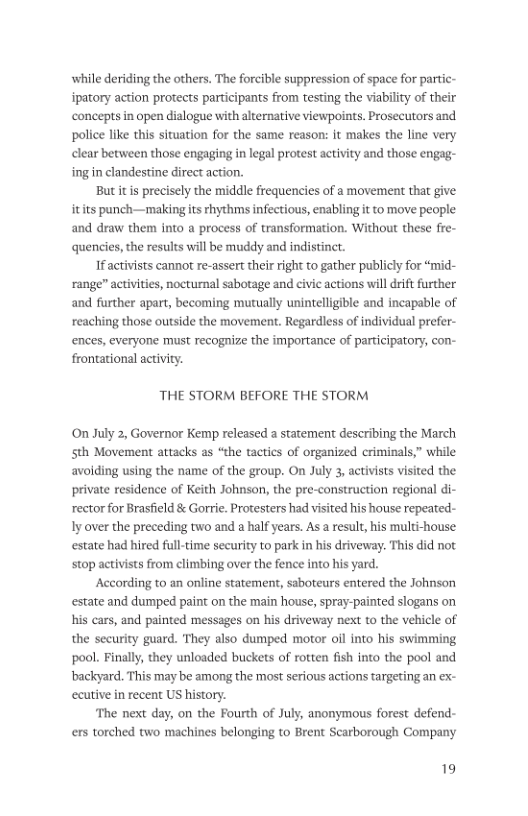
GOV. KEMI
Those are the tactics of
organized eriminals, not
protestors, and their supporters
should ask themselves if they
truly want to be associated with
such radical and violent people.”
events in that city. A week and a half later, a raucous crowd disrupted
another Atlanta police recruitment event in New York City, blocking
the doors of the event despite the efforts of the NYPD. At the end of
the month, on August 30, the March sth Movement claimed credit for
placing an incendiary device on the truck of Vertiv Corporation in Mil-
waukie, Oregon. Vertivis a logistics and technology company providing
technical aid to the Atlanta Police Department.
ESCALATING REPRESSION:
RICO AND THE FURTHERANCE OF THE CONSPIRACY
With the benefit of hindsight, it is clear that the “tactics of organized
criminals” language Governor Kemp used on July 2 was not ust boiler-
plate copy drafted by an intern, nor was the August 2 press conference
simply propaganda to assure backers that the state could stil protect
their investments, These phrases and statements were shaping opera-
tions, carefully crafted interventions designed to position the govern-
‘ment for their next operation: the blanket criminalization of the entire:
‘movement.
On August 29, the Attorey General of Georgia, Christopher M.
Carr, filed an indictment with the Fulton County Superior Court, bring-
ing charges against 61 people under Georgia's version of the Rackee-
ter-Influenced Corrupt Organizations (RICO) Act O.C.GA. § 16-14-4.
‘The indictment became public on Seprember 5. The document, which
is over 100 pages long and very poorly written, claims that the “con-
spiracy” (which it names “Defend the Atlanta Forest”) was “founded”
on May 25, 2020—the day that Minneapolis Police officers murdered
George Floyd, precipitating a nationwide uprising.
“This was a serious escalation. It did not catch everyone by surprise:
the Atlanta Solidarity Fund has been braced for such charges since
February. The authorities and their extreme-right proxies had been
demanding a full-scale crackdown on the movement for over a year,
spreading a conspiracy theory that the movement was a mafia con-
trolled bya shadowy and well-connected group (a narrative some activ-
st also reproduced, apparently with no sense of irony). According to
one version of this conspiracy theory, circulated by far-right trolls, the
7n
Network for Stronger Communities (a Georgia-based nonprofit orga-
nization) operates a number of financial enterprises, including the At-
lanta Solidarity Fund, that coordinate acts of terrorism in order to ac-
cumulate wealth and influence. Of the 61 accused, three were members
of the Adlanta Solidarity Fund. The 42 people already facing Domestic
Terrorism charges were also indicted, as well asa number of other peo-
ple whose connection to the movement was unclear. The indictment
alleged that some people had committed acts in “overt furtherance of
the conspiracy” such as buying glue sticks for sign-making.
The RICO indictment was not a legal procedure but a political act.
It was not a judicial intervention to suppress criminal activity but a
government measure to erush what the text describes as “anarchism,”
“collectivism,” “social solidarity,” “murual aid.”
Itis not simply 61 people who are on trial. By dating the case to
the murder of George Floy, the prosecution showed that their real
target was the entire population of millions that participated in the
‘consequent revolt. Thisis not an unusual court case, but a new chapter
in the fight between those who seek to preserve the hierarchies of a
structurally white supremacist society and those fighting to destroy it
root and branch. The indictment does not present a lst of crimes. It
describes the contours and values of a rival society emerging within the
‘movement to stop Cop City, aspiring to reinvent the world according
toa different logic.
The Fulton County Judge assigned to the RICO case immediately
recused himself. Until then, judges had not recused themselves from
cases related to the movement even when they possessed obvious
to the Atlanta Police Foundation.
RICO IN GEORGIA
RICO cases are becoming a generic strategy of prosecution in Georgia.
The local statutes are conveniently vague, allowing the government to
bring conspiracy charges against people who do not even know one
another, as in the case against the movement. Fulton County District
Atorney Fani Wills uses RICO charges for a wide range of purposes,
including sending teachers to prison for doctoring test answers in a
2
Tow-income area.
In May 2022, Atlanta-based rapper Young Thug was indicted along-
side 27 others under the Georgia RICO statute. In August 2023, former
US President Donald Trump was indicted alongside 18 others on the
same charges. Although the RICO cases currently in progress represent
rival factions of the political class, the same grand jury that indicted
Donald Trump s responsible for indicting those accused of “racketeer-
ing” for protesting Cop City.
The court system s the central infrastructure for directing state
violence. Though naive Democrats may imagine it o be a check on the
aspirations of autocrats, it naturally lends itself toall forms of repres-
sion targeting the oppressed, and thatis the chief role that it will always
play.
YOU CAN'T BREAK US
‘The movement swiftly responded to the charges. The language of the
indictment was specifically phrased to imply that any protest or action
inthe forest by nature of being i the forest constitutes an act of error-
ism in “overt furtherance of the conspiracy;” i.e., racketeering, To chal-
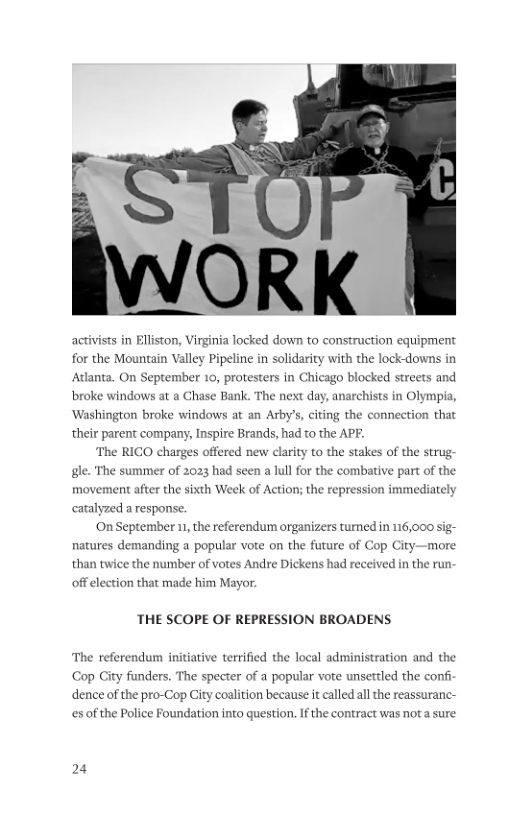
lenge this framing, on September 8, clergy associated with the “Faith
Coalition” rushed the construction site at the Old Atlanta Prison Farm
and chained themselves to heavy machinery, stopping work for the day.
Officers eventually arrived to arrest them, but only charged them with
simple misdemeanors. Journalists captured this courageous action on
video. In only three days, the movement had broken the state of shock
that the charges had created. Nothing was finished.
In the following days, over 100 people marched to the Georgia
State Capitol building, denouncing the charges. Sunrise Movement
Ann Arbor marched in Michigan, demanding that Accident Fund drop
its insurance coverage for the Police Foundation. In Kingston, New
York, people held a vigil for those killed by state terrorism or charged
with RICO. A crowd ralied outside the local “Safety Center” in Car-
‘bondale, Ilinois. Graffiti denouncing the charges appeared throughout
Minneapolis. In Phoenix, activists the blocked entrances to the offices
of Nationwide Insurance, which provides coverage for the APF. Two
23
ORK
activists in Elliston, Virginia locked down to construction equipment
for the Mountain Valley Pipeline in solidarity with the lock-downs in
Adlanta. On September 10, protesters in Chicago blocked streets and
broke windows at a Chase Bank. The next day, anarchists in Olympia,
‘Washington broke windows at an Arby’s, citing the connection that
their parent company, Inspire Brands, had to the APF.
The RICO charges offered new clarity to the stakes of the strug
gl. The summer of 2023 had seen a lul for the combative part of the
movement after the sixth Week of Action; the repression immediately
catalyzed a response.
On September 1, the referendum organizers turned in 116,000 sig-
natures demanding a popular vote on the future of C
than twice the number of votes Andre Dickens had received in the run
p City—more
off election that made him Mayor.
THE SCOPE OF REPRESSION BROADENS.
The referendum initiative terrified the local administration and the
Cop City funders. The specter of a popular vote unsertled the confi
dence of the pro-Cop City coalition because it called allthe reassuranc-
esof the Police Foundation into question. If the contract was not a sure
24
thing, what kind of institution would lend or donate millions of dollars
toit? This question surely haunted the offices of the Police Foundation
and Mayor's office. They must have fel they needed to do something
definitive to slence internal skepticism.
On September 29, 2023, Interim Municipal Clerk Vanessa Waldon
‘published the full legal names, phone numbers, and home addresses of
the 116,000 Atlanta residents who had signed the petition for a referen-
dum, posting them on the website of the Atlanta government. Taking
her cue, fascist groups began sharing this list online. Many on the list
feared that stalkers and abusers would hunt them down.
In response, within 24 hours, the Free & Rowdy Party doxxed the
‘members of the Atlanta Committee for Progress, using Vanessa Wal-
don's act of repression as an opportunity to catalyze further actions
against Cop City. The Atlanta Committee for Progress is a coalition of
‘powerful industrial and bourgeois delegates who collude to maintain
the clientelist system known as the Atlanta Way, described in The City
in the Forest. These delegates include the CEOs of many internation-
al corporations, universities, and institutions. No previous doxxes had
targeted figures of such stature and influence,
A few days later, on October 1, an excavator belonging to Brent
Scarborough Company caught fire. This was the third attack against the
company at the location of Sawtell and McDonough, near the Federal
Penitentiary. While this action did not address the 116,000 people who
had been doxxed by the government, perhaps missing a chance to com-
‘municate with a huge number of people, it did demonstrate that the
fighting spiri of the movement had not been & shed by the RICO
charges, nor the repression of the referendum petitioning process.
THIS IS NOT A LOCAL REPRESSION STRATEGY
On October 3, a Georgia Open Records Act (GORA) request revealed
that the office of Adanta Mayor Andre Dickens had been speaking
with the White House since at least June 2023. City offcials had been
communicating with White House Office of Intergovernmental Affairs
representative Julie Rodriguez. Rodriguez believes, according to these:
notes, that Cop City is “exemplary” of what President Biden “would
25
ke to see other municipalities emulate.” Finally, the White House of-
fered to send “an official of your choice” to visit the site.
Another document made available through the GORA request re-
vealed that the Department of Homeland Security published an over-
view analysis of the movement on January 3, 2023, two weeks before
the killing of Tortuguita. Their report included a map of specifically de-
structive actions across the country, arguing that the movement would
continue to inspire acts of “domestic violent extremism” if it was able
to persist.
The picture s becoming clearer. Local authorities, unable to miti-
gate the effects of the movement against their project, have been draw-
ing in greater and greater forces to assist them. This began with the
coordination of interdepartmental raids (“security sweeps,” in the of-
ficial doublespeak) on the forest in May 2022, This interdepartmental
coordination slowly pulled in more agencies from across the metropol-
itan area, eventually culminating n a statewide raid on the forest in De-
cember followed by the infamous lethal raid led by Georgia State Patrol
in January 2023. In March, the Georgia Bureau of Investigation coop-
erated with the Federal Bureau of Investigation and the Department of
Homeland Security in interrogating music festival attendees detained
in or near Intrenchment Creek Park. Statements from the Governor's
office have become increasingly common, while Congresspeople like
Marjorie Taylor Green have denounced the movement and demanded
aclampdown.
Itis now clear that some attention s beinggiven to the fight to stop
Cop City from the highest echelons of official government. In order to
defeat the awkward coalition being buit against it,the movement will
have to combine at least as many forces and strategies.
ATTRITION AND CONFLICT
In the six months that have passed since the previous chapter of this
story appeared, some of the forces described therein have disappeared.
For instance, the “South River Forest Public Safety Training Center
Task Force,” established by the Mayor's office to rubberstamp Cop City
26
blueprints and reforms, has either moved to illegal encrypted channels
or vanished completely. The movement has paid no attention to Mi-
chael Thurmond, the CEO of Dekalb County, despite his decision to
shut down Intrenchment Creek Park. Ryan Millsap, one of the move-
‘ments chief antagonists in 2022, has also receded from view.
After the RICO charges became public, many participants stepped
back from the movement, as well. As of October 2023, 108 people ac-
cused of participating in the struggle to stop Cop City faced charges
of some kind. Presumably, the stress of awaiting trial and dealing with
‘bond conditions has negatively impacted both the defendants and their
various supporters. Hundreds of people were living with the stress of
looming court cases and possible incarceration, not to mention those:
who did not know anyone facing charges but were emotionally im-
pacted nonetheless. The challenges of constantly fighting, organizing,
attending meetings, conducting research, deliberating, and thinking
about the movement must have worn on the resolve of all participants.
‘One way toavoid burnout s to find a specific, concrete role to play,
then change that role over time, taking breaks or periodically moving
into less intensive roles before fatigue can take too much of toll.
Not everyone who withdrew from the movement did so because of
burnout. Some stepped back for other reasons. Some simply vanished,
abandoning others in their time of need-neither engaging in public or-
ganizing, nor conducting clandestine activity, nor securing materials,
resources, or funds for the movement or those facing charges.
At the same time, a small number of people strained the solidar-
ity of the movement by launching public denunciations and political
attacks on other participants, violating the movement's longstanding
principles of discretion and private debate. It’s interesting to note that
the timeline of these denunciations roughly matches the timeline of
police escalation. Public denunciations appeared online in January, in
March, and then again shortly after the announcement of the RICO
case.
“This i not all that unusual. Internal conflict often emerges as a
consequence of repression. Those who study counterinsurgency un-
derstand that the chief effect of repression is usually not the direct im-
pact of the blow, but the fault lines it opens up.
27
‘Some of those who have published denunciations may have sought
togive themselves political cover for withdrawing from the movement,
falling back on a narrative of “betrayal,” the only persussive justifica-
tion for leaving the movement in what otherwise might itself be under-
stood asa betrayal. Inthe end, it was neither berals norpacifists—nei-
ther ecologsts nor lawyers, sudents, canvassers, academics, soci
abolitionists, Black nationalists, Marsists, or musicians—who drafted
public condemnations of other participants in the movement to stop
Cop City. It was anarchists targeting other anarchists.
Some of the other critics were apparently never involved in the
‘movement to defend the forest at all or only peripherally connected
toit. Some do not even live in the United States. Conflict among par-
ticipants in the movement is one thing, but it s sheer opportunism
for those who only experience the movement as a distant projection
screen for their own fixations to seek to capitalize on friction within i
‘When analyzing the end of the forest encampments and the heart-
breaking death of Tortuguita, we could well blame the billions of peaple:
who were not living n the forest in the winter of 2022—including most
of the people making public denunciations in the first place. We would
also have cause to criticize those in the forest who drove others out
with their polarizing attitudes, behavior, and words. But apportioning
blame and name-calling are for those who have given up on changing
the world. The rest of us have to find ways to resolve our differences if
we are to continue fighting our chief adversaries.
Despite the tensions among a few anarchists and their friends,
many people have continued to push ahead courageously. What comes
next will be determined by those who persevere.
FROM ATLANTA TO GAZA, NO COP CITY ANYWHERE
On October 6, District Attorney George R. Christian of the Stone
Mountain Judicial Gircuit ruled that it was “objectively reasonable”
for police to kill Tortuguita. While discurbing, this news did not shock
‘many people. Perhaps because of the widespread cynicism around the
investigation, which many considered a mockery from the outset, no-
body mobilized in response to the ruling. At the same time, students
28
and organizers on Emory University Campus were hosting meetings
about Cop ity and the attacks on the Gaza strip that the Israeli mili-
tary was preparing.
After threats and intimidation on Morehouse, Spelman, Carter,
Georgi
of campus resistance to Cop City had receded. On October 26, around
150 students and faculty rallied on campus. The group listened to
pecches and chanted slogans. After an hour, the crowd began march
ing toward the Quad, where Atlanta police had forcibly dispersed an
encampment in April 2023, Outside the administration building, the
group stopped and organizers read out a list of demands. Those de-
mands included the renunciation of Cop City by the Emory adminis-
tration, the cessation of membership in the Atlanta Police Foundation
and Atlanta Committec for Progress, and a number of specific demands
relevant to the student body and their ability to organize on campus.
After reading the demands aloud, the larger part of the assembled
erowd marched into the administration building to deliver them to
ate, and Georg
a Tech campuses,it seemed that the prospect
the campus authorites directly. As they filled the atrium and stairwell
administration staff locked the doors to the office and hid from view.
Eventually, a representative of the university came out to meet the stu-
dents. Having accomplished their goals, the crowd dispersed onto the
Quad and established a temporary information point there, distribut-
ing t-shirts and iterature about the moveme
s well a free food and
conversation.
In the days following this action, Zionists doxxed campus organiz-
STOP LAND THEF
FROM ATIANTA TGHZA
1 SAVE WEELAUNEE
_'J’REE PALESTINE
ers. Across the country, academics, journalists, and workers in many
industries have faced reprisals for objecting to the bombing and ethnic
cleansing targeting the Gaza strip. Emory University has been no dif-
ferent. The administration released a statement denouncing student
action, likening it to “anti-Semitism.” Jewish activists have not been
spared this slander or the accompanying harassment.
BLACK SELF-ORGANIZATION
In this context, a group of Black activists and organizers announced a
‘Week of Action. Ostensibly, this was the first time an all-Black group
had organized a series of events like this during the movement. Black
activists felt that this was an important moment to mobilize Black res-
idents and bring more into the struggle. Toward this end, they promot-
edacalendar of events.
Throughout this Week of Action, activists conducted workshops
and presentations on a range of topics. Classes on herbalism and so-
matic care drew local participants. Students attended talks on Pales-
tine solidarity and the colonial capitalism. Some of these events were
ethnically mixed; many were intended to be majority-Black.
Canvassing took place every day of the week across the city. Out-
side of grocery stores and libraries, at shopping malls and low-income
housing developments canvassers met up and passed out flers, started
conversations, and collected phone numbers, After months of canvass-
ing for the referendum petition, some may have felt that it was urgent
to continue reaching out to people, or that some communities had not
been adequately canvassed. The results of this approach are seldom
visible i the short term and require more durable and far-looking orga-
nizational structures to make use of the feedback and contacts arising
from door-knocking and walking around with a clipboard. Some of the
‘groups spearheading the Black Week of Action are organized into struc-
tures that are well-equipped to do this kind of outreach.
On November 9, a crowd assembled on Georgia State campus, Af-
ter speeches denouncing the Israeli military and its US sponsors for the
‘ongoing assault on civilians in the Gaza strip, the crowd marched to
the location of the Georgia International Law Enforcement Exchange
30
(GILEE) program. The banners and signs of the procession connected
the struggle against Cop City with the fight to end Israli aparcheid.
The GILEE program, which is funded by GSU tuition, enables Georgia
police to cross-train with military personnel in Tel Aviv, and to host
them for counterinsurgency trainings in the United States as well. A
delegation of Atlanta police was supposed to go to Tel Aviv on the week
of October 10 t0 receive training from the apartheid regime, but the
training was cancelled as a result of the unfolding crisis. This did not
stop officers from conducting a “mock” raid on an abandoned hotel in
downtown Atlanta, role-playing the invasion of a “Hamas stronghold,”
according to police radio communications.
‘The next day, November 10, dozens of people gathered on Met-
ropolitan Parkway, Just southwest of downtown, for a “Black Fam-
ily March.” The group included Black residents and activists as well
as some whose family members had been killed by police. Protesters
chanted slogans and listened to speeches. Police officers on motorcy-
cles gathered on the road with their lights on, hoping to intimidate the
assembly. It appeared that the authorities were still strongly invested
in preserving the balance of forces that they had worked so hard to es-
tablish over the summer, denying crowds the ability to take the streets.
‘During the Black week of action, activists marched to the Georgia
International Law Enforcement Exchange (GILEE) office on Georgia
State campus. If Cop City is completed, Israeli soldiers wil use it to
train police from the United States. Activists left shoes at the doorstep
of GILEE, representing the thousands of Palestinian children that sol-
diers in Gaza have murdered.
BLOCK COP CITY
The Black Week of Action ended just before another mobilization:
Block Cop City.
Over the preceding summer, some participants in the movement
had concluded that in order to prevent the forces of repression from
reducing the movement to the segments focused on the referendum or
clandestine sabotage, it was necessary to try a new approach. In hopes
of reassuring those who were not prepared for the level of confronta-
3
tion that the movement had engaged in on March § and building bridg-
es with organizations that had remained aloof from the movement,
they decided to employ a model of “nonviolent tactics,” a framework
that had the movement had never previously utilized for mass actions.
A website was ready by early September. Across the following two
‘months, organizers across the country conducted nearly 80 public
speaking events promoting the mobilization and seeking feedback on
the proposal. A total of thousands of people attended these talks.
‘The basic idea—coming out of the RICO case, the stagnation of the
referendum process, and the sharp downturn in clandestine actions fol-
Towing the fifth Week of Action—was to bring together a large enough
group to march onto the construction site to stop work. The larger goal
was to carve out space for public demonstrations and challenge the
state’s serategy of openly criminalizing out-of-state protesters.
‘Some opposed this proposal. The most vocal antagonists were in
the City Government and police department. They claimed loudly and
frequently that the event would not really be nonviolent, suggesting
that a secretive group aimed to use the public mobilization to create
chaos and violence.
‘Some activists agreed with them. We can divide these into two
broad categories. On one side, there were people who did not believe:
in combative protests in the first place; some of them did not trust the
anarchist and anti-authoritarian organizers behind Block Cop City. On
the other side, there were people who did not believe in mass protests
and did not trust the radical credentials of the Block Cop City orga-
nizers. The two forms of grassroots consensus with the government
worked in tandem to obscure the details of the proposal. At some pre-
sentations, people passed out fiers attempting to dissuade others from
attending the event, arguing that it was dangerous, ineffective, and dis-
ingenuous—the same arguments that the city government was making.
They also challenged the right of groups to forms agreements about
what kinds of actions they wanted to o, claiming that doing so would
inhibit the freedom of individuals and was thus a form of “policing”
Block Cop City organizers felt that with scores of people facing
RICO charges, publicly coordinating large event necessitated pul
Iy arriving at a shared vision of the action. While critics claimed that
32
it was “authoritarian” to propose action agreements, the organizers
countered that it was specifically their anti-authoritarian politics that
‘motivated them to take this approach. Below, we'll return to the ques-
tion of whether the framework of “nonviolence” served to achieve their
objectives.
BUILDING A COMMON UNDERSTANDING
Hundreds of people arrived in Atlanta on November 10, gathering at
parks and a local Quaker community center. They were received with
food, lterature, and sign-up sheets. On the first night, more than 500
people attended a kick-off party at a warchouse in East Point. Some
peaple set up tables to distribute schedules and pamphlets about the
coming days. Others distributed zines and posters on the history of
the movement, instructional guides on direct action, and reflections
drawn from various struggles around the world. Hardcore punk bands
and rappers shared the stage while attendees crashed into one another
and danced late into the night.
Such events play a role in cultivating the most fundamental factor
in all movements and struggles: the wil to fight. As long as movement
protagonists feel that fighting Cop City is worthwhile, they stand a
chance of winning. The more they can engender despair in their antag-
onists, the better off they will be.
The Kick-off events prepared activists for the meetings sched-
uled for the next two days. Aside from direct action trainings, medic
workshops, and legal aid assemblies, more than 400 people intended
to gather two days in a row for a spokescouncil meeting involving rep-
resentatives of affinity groups from around the country. The goal was
o reconcile the concerns, aspirations, and capacities of the different
participants in order that they could cooperate harmoniously during
the march. Thanks to the venue hosts, the cooks, the dishwashers, the
welcome tables, the facilicators, the drivers, those who cleaned up after,
and everyone who provided emotional support for ll o the aforemen-
tioned, the meetings were fairly focused and efficient.
At the beginning of the spokescouncil, facilitators reminded at-
tendees that the movement began with a series of public meetings and
33
the burning of machinery in the forest. The assembly cheered; many
chanted “If you build it, we will burn it” It was important to the orga-
nizers to emphasize that the nonviolence proposal for the Block Cop
City action was intended to complement the other forms of action as-
sociated with the movement,including sabotage and combative protest
tactics.
ANATOMY OF A MARCH
In the course of two days of deliberation, the spokescouncil agreed to
form three “clusters” in the march. The clusters arranged themselves
by color. Those colors were not intended to denote risk level, but to
indicate relative position within the march; this was clearer than refer-
ring to “front, middle, and back,” since it was possible that the crowd
would be compelled to change direction without being able to rear-
range the locations of groups within the mass. The colors also repre-
sented different responsibilites.
The Blue cluster was to lead the march at the beginning. It would
be responsible for setting the pace and direction. After much deliber-
ation, the spokescouncil also agreed that the Blue cluster was respon-
sible for maneuvering around or through the police and any other bar-
riers to the site, concluding that the notion of nonviolence developed
by the spokescouncil did not prevent the Blue cluster from attempting
to push through lines ofriot police using banners or inanimate objects.
They also agreed that the nonviolence agreement did not prohibit the
Blue cluster from cutting the perimeter fencing to the construction site,
should the crowd gt that far, provided that they did not throw objects
or set things on fire. Item by item, the blue cluster reached consensus
that they would not fiee in response to non-lethal munitions includ-
ing tear gas, lashbang grenades, pepper balls, rubber bullets, beanbag
rounds, water cannons, long:range acoustic devices, mace, police dogs,
‘and baton charges. They would only stop moving forward if it became
physically impossible.
The Purple cluster would start in the middle of the march. This
was the largest cluster. The Purple cluster was responsible for filling
whatever space the Blue cluster opened up. Some of them would carry
34
saplings with the intention of planting them; others would bear pup-
pets or musical instruments. A marching band chose to participate in
this cluster. Many people joined this group because they were hesitant
10 be in the front or back, believing that the middle would be safest.
The Orange cluster was to begin at the back of the march. If re-
treat was called for, it would lead the march away, Towards this end, the
Orange cluster was responsible for maintaining a strong rear section
‘and making sure that the crowd was not caught unawares from behind.
1f the crowd was attacked or forced to turn around, the Orange clus-
ter would bear responsiblity for leading the march out of harm's way.
‘Many medics were in this cluster, prepared to treat injuries.
In all of the clusters, there were people prepared to push sound
systems. Communications teams would also move between the clus-
ters.
Participants in the mobilization distributed loose-fitting white
coveralls dotted with paint. The idea was to enable protesters to blend
in with one another, protecting vulnerable people and risk-takers from
police harassment while fostering a sense of togetherness between the
different sections. The front and back of the crowd were to be protect-
ed with banners framed with PVC pipe.
For the benefit of future demonstrators, it's important to know
that PV pipe can break under the blows of police batons If it is not
reinforced with spray insulation. Green bamboo can be both lighter and
‘more resilient. Reinforced banners should have handles on the back,
S0 that protesters don't have to hold the edge of the frame, as this can
result in broken hands and fingers if the police decide to hit them. To
our knowledge, nobody suffered injuries of this nature during the Block
Cop City march.
FORWARD, ARM IN ARM
At8am on Monday, November 13, nearly 500 people gathered at Gresh-
am Park. Helicopters and police drones were already circling overhead.
Many of the assembled were journalists or support personnel who did
not themselves intend to participate in the march. Cooks delivered
‘hundreds of burritos, Organizers from different groups in the move-
35
‘ment gave impassioned speeches and led chants. Speakers emphasized
the intentions of the march and reiterated the action framework agree-
‘ments. Nearly everyone present had attended the spokescouncil meet-
ings at some point.
Neither the massive numbers nor the formal organizations that
some had hoped would participate in the march had turned out. Few
Alanta residents were in attendance, and many participants in the pre-
vious two years of local activity did not attend. Much of the crowd was
‘comprised of anarchists and radicals from around the country. Despite
the dismayingly low numbers, the beautiful puppetry and marching
band gave the gathering a festive appearance.
At10 am, the crowd began marching down the bike path in the
direction of Intrenchment Creek Park. This was the same route taken
bya slightly larger crowd on March 4,at the beginning of the ffth Week
of Action, and by a smaller crowd on June 28, during the sixth Week of
Action.
People in the Blue cluster carried reinforced banners and a large
number of umbrellas. Many of them wore balaclavas, gloves, helmets,
respirators, goggles, or masks.
About ffteen minutes into the march, scouts reported a consider-
able number of riot police positioned at the tunnel beneath Boulder-
crest Road, in the entrance to Intrenchment Creek Park. Lines of cops
were assembled behind concrete barriers erected inside of the tunnel.
They had taken the bait.
Reaching Cherry Valley Road, about halfway down the bicycle path,
the crowd unexpectedly turned lef taking a route intended to outma-
neuver the police checkpoints on the busy roads surrounding the for-
est. Every 500 meters o so, communications teams in the different
clusters arranged for the procession to stop for two or three minutes in
order to keep the march together. At the top of Cherry Valley Road, the
‘crowd turned left onto Bouldercrest and then right onto Constitution
Road. Finally, police vehicles appeared behind the march, blasting their
sirens and attempting to intimidate the participants.
The crowd was now approaching the construction site. In the
months leading up to the mobilization, some locals with experience
in the forest and previous clashes with police had correctly predicted
36
that aline of rot police would position themselves at the intersection
of West Park Place and Constitution, just outside of the Fire station.
As the crowd approached West Park Place, police cruisers rushed
ahead around the march. An armored vehicle was parked next to the
fire station. Further ahead, multiple armored vehicles and a water can-
‘non were parked inside the barbed-wire fencing of the construction site
itself. hen the Blue cluster was about 60 yards from the fire station,
officers parked their vehicles in the middle of the road. They formed a
solid line, wearing helmets and carrying shields.
‘The Blue cluster had already resolved to keep moving in the face
of obstacles. If police blocked the path, they would advance through
or around them. If they were physically incapable of moving forward,
they would shift direction. As they drew within 20 yards of the police
line, participants in the Blue cluster reminded themselves that they had
already decided together what to do—they didn't have to worry about
improvising an individual response to the line of armored cops ahead.
When the Blue cluster drew within ten yards of the first row of
police, they picked up their pace. Without pausing, the front of the
‘march charged directly into the shields of the skirmish line, forming
aV-shaped wedge with their reinforced banners and moving their um-
brelas forward to block the view of the police as well as their pepper
spray and other munitions. The firstline of cops fell back and was re-
inforced by a second line. This line was also pushed back. Cops began
striking protesters with their shields, and then with batons, They began
shooting pepper balls and pepper spray at the front of the crowd.
As a third line of police formed, officers threw tear gas over the
heads of the Blue cluster towards the Purple group, who were lagging
alittle behand. Most of the front of the Purple group withdrew down
‘West Park Place and into the tree line. A bicyclist wearing heat-resis-
tant gloves nonchalantly picked up a tear gas canister and lobbed it out
of the crowd.
While the Purple and Orange groups drew back, the Blue cluster
continued to rush ahead, now facing officers shooting tear gas, pepper
balls, beanbag rounds, and rubber bullets directly at them. The police:
were apparently employing a graduated response, rapidly escalating
their tactics as the Blue cluster pressed forward, However, the officers
37
in the front were not wearing gas masks or goggles, 5o they were not
prepared for the officers behind them to deploy tear gas. Consequently,
the tear gas impacted them as badly as it affected the activists who were
charging them. Abruptly,the two groups backed apart as protesters and
police alike fell back coughing, vomiting, and calling for help.
Video footage shows the majority of police retreating with their
backs to the crowd. This illustrates the extent to which order broke
down on their side during the clash.
The demonstrators fell back several yards down Constitution
Road. Police fired a few flashbang grenades at them to preserve the gap
between the two forces. Someone threw another tear gas canister back
toward the riot police whence it had come. Technically, this was out-
side the agreed parameters of the action framework, but no one object-
ed, then or afterwards,
The people from the front of the Purple cluster who had with-
drawn down West Park Place and towards the tree line rejoined the rest
of the march. Medics in the Orange cluster provided medical treatment
to militants from Blue while other steadfast Orange participants held
their ground.
‘The unity of the Blue cluster had provided the cool-headed cour-
age they needed to defend and de-arrest each other throughout the
clash, As a result, no one had been grievously harmed or arrested.
For a more detailed account of the events of the morning, we rec-
‘ommend “Don't Panic, Stay Tight: Frontline Reflections on Block Cop
City.” One account offers a lucid enough appraisal of the prospects of
the march, given its numbers:
38
Tknew that we stood no chance of making it into the con-
struction site when 1 saw the crowd at the meet-up point.
1 was worried that all of these people would have come to
‘Atlanta for nothing. The lines of police showed me my con-
cerns were unfounded. While many people prefer to evade
the clash, to move around the danger, t0 stick to the shad-
ows, I have always preferred the front lines, the exploding
canisters, the sour smell of the tear gas, the wild crush of the
crowd. Real knowledge lives in the body, not the mind. The
experience of the mob howling in unison, linking arms, rush-
ing headlong nto lines of police,is worth years of speculation
and theorizing, If we were more numerous, we would have
doublessly split into multiple corridors to spread the police
response thin. [..] To my leftand right, my friends were shov-
ing umbrellas upward, pushing ahead in the dense throng.
For a few moments, it was dark and almost silent. The veil
of the umbrellas, the silent heaving, and incredible pressure
of the comrades packed together behind the banners is an
experience you can't describe easily for those who have never
felt . Eventually, I couldn't breathe anymore and I grabbed
someone as I retreated. Thankfully we didn’t make it past the
fourth line of officers. We would have all been arrested.
RE-GROUPING
After afew minutes, Indigenous activists within the Purple cluster con-
vened a drum circle in the middle of the road. This had a calming effect.
Protesters took time to check in with their affinity groups and anyone
else in distress. The crowd chanted “All of us or none of us,” expressing
the determination to defend each another from police snatch squads
and the targeting of vulnerable or risk-tolerant protesters. In the final
spokescouncil meeting the day before, the assembly had agreed that
risk-takers from Blue cluster or other clusters would be welcomed into
the other sections of the crowd and that nobody would feel “used” by
this kind of tactical retreat. Over a loudspeaker, police began issuing
dispersal orders. Slowly, the crowd made their way back down Consti-
39
tution, the way they had come.
After a long, slow procession, the group retumned to the bicycle
‘path near Gresham Park,far from the construction site and the lines of
police. Helicopters and police drones continued to circle overhead. Still
several hundred strong, the demonstrators broke into smaller breakout
groups to process and deliberate. Medics set up a check-in station for
anyone in need of assistance.
Eventually, people recurned to the park and dispersed. That night,
a vigil took place at Dekalb County Jail during which inmates broke
windows and lowered plastic bags to ground level, which protesters
filled with cigarettes, lighters, and pizza.
A SUPPORTER OF THE POLICE?
At the very moment that the blue cluster was driving back the police
line, one individual wearing a black hooded sweatshirt and reflective
orange ski goggles physically assaulted the person who was pushing the
sound system immediately behind the front of the march, As the in
vidualin the orange ski goggles did so, they yelled epithets referencing
‘an online post criticizing the mobilization. Then they ran away towards
the back of the crowd, feeing from the confrontation with police.
“This individual may not have been working on police payroll, but
by timing their attack to coincide with the clash, they were engaging
in joint action with law enforcement. They could have performed this
stuntat any time, but they timed it to maximize the effectiveness of the
police attack.
Itis very difficult to imagine that this was an earnest participant
who suddenly panicked and, recalling an obscure online post, sponta-
neously threw a tantrum. Likewise, it seems unlikely that they were
simply a police agent seeking to stoke internal tensions—for such a
stunt would discredit critics of the mobilization, not the mobilization
itself, Either they were carrying out the wishes of the authors of the
screed, and their action turned out to be so contemptible that even the
authors disclaimed it, or they hoped to impress the authors but failed.
The fact that no one has claimed credit for the assault online—when
the critics of the Block Cop City movement have been nothing if not
40
extremely online—shows that the responsible party or parties under-
stand how shamefully they behaved.
‘Whatever the case, both the authors of the aforementioned screed
and those who have circulated it bear some responsibilty for this farci-
cal episode. It i the material consequence of their efforts; it expresses
the spirit of their project. In the final analysis, they have not sought to
contribute to the fight against the police so much as to hinder at least
some of those in open struggle against Cop City.
GAUGING SUCCESS AND FAILURE
‘The march did not reach the construction site. It was not 2 “mass mo-
bilization,” either, in that it didn't bring together a larger number of
people than had gathered for earlier mobilizations to defend the for-
est. Nor did it succeed in connecting the more radical sections of the
‘movement with less risk-tolerant groups, formal organizations, or large:
‘numbers of locals.
It did shut down construction for the day, and for several days af-
terwards. It also brought together hundreds of people for a bold action
in a context of unprecedented repression, including many who had
never participated in protests and many more who had never faced tear
gs or riot police. It took months of considerable effort to accomplish
this, however.
But that effort may not have been wasted. In a debrief meeting
afterwards, activists who had come from around the country to par-
ticipate in the mobilization unanimously agreed that they would leave
feeling more prepared to act boldly in their home communities. That, if
nothing else, counts as a victory. In that regard, we can credit the Block
‘Cop City organizers with giving the movement another lease on life.
1 two thousand people had showed up to the departure point on
November 13, multiple marches could have departed for the construc-
tion site, stretching police thinner and opening spac for a wider array
of tactics, Then, there might have been an open horizon of possibility.
Rather than looking for minor technical improvements in what the par-
icipants could have done differently, it makes more sense to consider
why more people did not come,
41
Did the nonviolence framework fulfil its express purpose of en-
abling more people to participate in the action? Again, let’s consult the
‘authors of “Don't Panic, Stay Tight”:
In general, we disagree with the setting of nonviolent parameters
Frankly, we disagree with tactical parameters in general and with the
‘minutely “organized” coordination of events, although we recognize
that this type of attention to detail makes some people feel more con-
fident and brave. We believe that the march would have been more
successful at breaking through police lines and potentially breaching
the site had it been able to use projectiles. We also recognize that it is
impossible to know if this crowd could have even materialized without
the parameters. We do not believe that it is possible to know if the
“nonviolence” language in the promotion helped or hindered atten-
dance without conducting a thorough interview with attendees before
the action occurred. It is our unprovable suspicion that it did no i
crease participation much, and that it only shifted it from one segment
of the population to another.
It seems plausible that, remembering how “nonviolent” actions
used to draw more participants than confrontational actions many
years ago, the organizers hoped that defining the mobilization as “non-
violent” would serve as a shortcut to draw mass participation. Indeed,
“nonviolent direct action” does seem to occupy an intermediate zone:
between canvassing and open confrontation. But a lot has changed
since the tur of the century. Following the George Floyd rebellion,
‘millions of people have participated in confrontational street activity
that did not involve action agreements; likewise, millions have expe-
rienced frsthand that police tactics are not necessarily determined by
how “violent” a demonstration is.
Hundreds of people undoubtedly showed up for the Block Cop
City mobilization who would not have showed up without the months
of touring and promotion that preceded . But it may not have been
the action agreements that drew them so much as the care that was
put into outreach and hospitality, spelling out to activists around the
country that there were concrete roles they could fill evenif ey lacked
experience in autonomous organizing models. In retrospect, it was a
missed opportunity not to do this kind of outreach more systematically
2
in 2022, when the movement had a foothold in the forest.
Likewise, imagining that a nonviolence agreement would enable
formal organizations to participate, finally drawing out massive num-
bers, may get the causality backwards. More often, an initiative draws
massive numbers and then formal orga
vantage of them. If the action agreement had succeeded in creating a
situation in which dozens of student organizations, religious groups,
and environmentalist groups had participated in the mobilization with
out trying to curtail its ambitions, that would have been a good thing,
tions show up o take ad
ken con-
but from this vantage point, it is clear that that would ha
siderably more than an action agreement to make that possible.
It is possible that more people might have turned out for Block
Cop City if demonstrations in solidarity with Palestinians had not
been taking place ll around the country at the same time. On the oth:
er hand, these demonstrations may have galvanized some people who
‘would otherwise have stayed home. The absent are the most difficult
demographic to understand.
Arguably, if drawing massive numbers of people to the Block Cop
City action had been the top priority, the most efi
would have been to broadcast the time and place of the demonstration
far and wide—rather than publicizing the spokescouncil meetings, as
oceurred, and only announcing the location and time of the action that
weekend. The march was scheduled early in the morning on a work day
ctive way to do so
3
inalocation that was not otherwise thickly populated. This made sense
ifthe mobilization was understood asa direct action determined above
all by the necessities of interrupting work at the construction site, but
not i the goal was to involve as many people as possible. The largest
number of people have participated in the social and cultural events
that the movement has hosted, such as the South River Music Festival.
Did the action agreement keep some people from attending the
action? It definitely generated distracting controversy. But it's not clear
how many of those who criticized the nonviolence protocol stayed
home only on account of it The number of people in that category is
probably dozens, not hundreds.
At best, action agreements can be understood as a way for people
toget on the same page about what to expect from each other. Ideally,
such agreements should be co-created on a horizontal basis, but there
are always uneven dynamics around power, leverage, and initiative in
group decision-making. The same goes for spontancous crowd deci-
sion-making, in which there is less opportunity for group deliberation.
Of course, different formats lend themselves to certain outcomes: a
‘mobilization coordinated by a visible organizing group or planned in
‘open public meetings is more likely to adopt conservative mutual ex-
pectations, whereas planning on an invitational basis or acting sponta-
neously can lend itself to.a wider tactical repertoire.
As the authors of “Don't Panic, Stay Tight” put it, “the organi-
zation of the weekend was gratuitously, painfully, democratic.” One
way to interpret this quality of the mobilization is as a response to the
events of March 5, 2023, when—without any formal decision-making
‘whatsoever—hundreds of people marched to the construction site and
engaged in confrontational action that had significant repercussions.
By contrast, the Block Cop ity mobilization centered two days of
‘hours-long faciltated decision-making processes and a march that was
almost performatively inclusive. Each of these approaches involves a
vantages and disadvantages.
‘We all have a responsibilty to push back against agreements that
we consider unacceptable, even if doing so could precipitate conflic.
Itis also our responsibilty to deliver our critiques in a way that could
change others’ minds, rather than simply establishing cliques. The ac-
4
tion agreements for Block Cop City in themselves provide no justifica-
tion for stepping away from the fight against Cop City, nor for sitting
out the events of November 13. Hopefully, those who were eritical of
the mobilization simply focused their efforts elsewhere.
Surely all the repression in Atlanta played a central role in limit-
ing attendance. Many participants were afraid to be close to the front
of the march, and many potential participants surely stayed home on
account of similar fears. But the old adage proved true once again: its
safer in the front, The sole arrest on November 13 was of a person who
opted for a support role; they were arrested in a vehicle in the vicinity
of Gresham Park. When the police deployed tear gas canisters, they
threw them over the front line, targeting the people in the middle of
the march. Those in the front line could count on the comrades at their
sides to act boldly to defend them, whereas those behind them scat-
tered when the clashes ensued. Counterintuitive as it seems, it can be
saferin the front.
The same goes for the Block Cop Gity mobilization itself. Although
organizing any kind of confrontational protest was a risky propos
with scores of people already facing RICO charges, it was actually saf-
er than doing nothing would have been. Permitting the state to crush
the movement would have set a precedent that would threaten other
‘movements, emboldening the authorities to use the same tactics clse-
where. It would also have left over a hundred defendants facing charges
in @ movement without a public face. One way to ensure that there is
energy for defendant and prisoner support is to keep a movement vi-
brant, drawing in new people and new energy.
As it turned out, the authorities had their own reasons not to esca-
Iate on November 13. Ifthey had arrested more people, they would have:
had to decide whether to dole out even more RICO charges, stretching
prosecutor resources even thinner, or to put prosecutors in the posi-
tion of having to explain why some accused Stop Cop City protesters
deserved RICO charges while others did not. Video footage shows offi-
cers brandishing zp ties with which to carry out arrests, but either they
had their hands full dealing with the charge of the Blue cluster, o they
preferred not to try to in the first place.
jon
45
VICTORY AND DEFEAT: A CHIMERA
Victory and defeat always arrive together, mixed up in the same vessel,
tis not pos
ible to taste one without the other, even f on a given day it
i the bitterness that overpowers the sweetness or vice versa,
“This does not mean that there is no difference between the two. If
you have clearly defined goals, it is possible to determine whether or
not you have achicved them.
Some of the Block Cop City organizers feel that they achieved their
goals of organizing a convergence to shut down construction in a con-
text of unprecedented repression, and that it was a vietory that they
were able to do so without any arrests, They are correct about that,
The Atlanta Police Foundation and its supporters presumably consider
it a victory that they were able to stop the crowd from reaching the
construction site and from damaging property. They, too, are correct
in this regard. Some commentators who watched from the sidelines are
pleased to declare that the march was a failure because it did not reach
the job.
Ifall of these groups believe that their expectations have been con-
firmed and their decisions vindicated, what does tht tell us? Probably,
that they are all electiv
the mobilization, sclectively interpreting the events of the day, and
Ina sense, they are also correct.
y recalling what their ambitions were before
misunderstanding crucial elements of each other’s strategies. Partici
pantsin the movement should set concrete goals, in order to be able to
evaluate their efforts critially. They should also think eritically about
what their adversaries unstated goals might be and how to thwart the.
No single set of tactics can be judged in isolation. The movement
46
involves a diverse array of participants; debate about the alleged ef-
fectiveness of one strategy versus another is often just a coded form
of sectarian competition for approval. The most important question is
‘not which participants in the movement are right and which are wrong,
but how the different participants can ensure that their combined ef-
forts wil inspire others to participate and expand the number of fronts
on which the struggle takes place. Certainly, the proponents of Cop
City already perceive every effort to stop them—be it legal or autono-
‘mous, violent or nonviolent, symbolic or direct, defensive or offensive,
Tocal or international—as part of a combined assault.
‘Mutual suspicion, destructive competition, scarcity thinking, para-
noia, conformity, nostalgia—these are al pitfalls.
FIGHTING WITHOUT ASSURANCES
Soon after the Block Cop City march, an anonymous group burned six-
teen large work trucks belonging to Ernst Concrete. This took place
Lawrenceville, Georgia, roughly half an hour northeast of Atanta. Inan
online statement, the participants claimed to have placed incendiary
devices and kindling beneath the hoods of the vehicles.
Emst Conerete was seen in the Old Atlanta Prison Farm on No-
vember 3, They were contracted to pour concrete and to build sidewalks
and roads inside of the perimeter fence, In the first week of November,
activists from across the country launched a call-in campaign to their
offices, urging them to boycott the Atlanta Police Foundation. After the
stoppage of work for the Block Cop City action and the subsequent
torching of their machinery, they dropped from the project. This was
confirmed by dozens of people who called the company the days after
the action, and was confirmed by the company itselfin a statement sent
to local news. Eventually, Erst took down their website. The state-
‘ment they released to the news was framed in the most confusing way
imaginable, claiming that Emst “is not involved in Cop City” in the
headline, while clarifying that they had in fact been contracted for it,
and were no longer going to continue working on i
This was the quickest victory against a contractor the movement
had sustained yet. Erst Concrete s a large company that does far
47
‘more than simple sidewalk paving. They also appeared to have very few
previous contracts with Brasfild & Gorrie in Georgia, suggesting that
Brasfield & Gorrie might be having difficulty securing the contractors
they prefer to work with.
CONTINUING FORWARD
An array of injunction hearings and court cases continue to play out in
the background. The South River Watershed Alliance and others are in
court against the Dekalb County Government for the illegal closure of
Intrenchment Creek Park, and the contamination of the South River,
which is occurring in quantities that violate the Clean Water Act. Law-
yers assisting the Cop City Vote initiative to launch a referendum con-
tinue to file motions and lawsuits against the undemocratic denial of
the process by the city government and the clerk's office. Appearances
and hearings will continue to drag the 100+ defendants of the move-
ment into courtrooms for months or years to come.
But despite the proliferation of court cases, lawyers are not the
only protagonists in this struggle. Here, we wil spell out some of the
‘paths that remain open to the movement.
TARGETING THE INSURERS
Anew campaign called Uncover Cop Gity aims to draw attention to the
insurance providers of the Atlanta Police Foundation: Accident Fund
and Nationwide. This represents a refinement of a familiar strategy.
Instead of targeting contractors and subcontractors, as previous cam-
‘paigns have done, this effort takes aim at institutions with hundreds
of offices across the country—institutions that represent a legal bot-
tleneck for the project. Without coverage of their assets, the Atlanta
Police Foundation is legally forbidden from maintaining contracts or
holding assets in the state of Georgia.
Because of the effectiveness of campaigns like Stop Reeves Young,
the Cop City project has been reduced to a hardcore group of contrac-
tors, nearly all of whom sit on the Board of Trustees for the Atlanta
Police Foundation. This makes it more difficult to exert pressure on
48
them, because they have an existential stake in the project. Some sub-
contractors, such as Emst, remain vulnerable to direct pressure. But
pressuring insurance providers could provide the movement with a set
of achievable goals even as the stakes of the conflict escalate.
Uncover Cop City has already announced a “nationwide summit”
in Arizona from February 23-26. This will be the first time that such an
event has taken place outside of Georgia. Considering how much force:
has been brought to bear inside Atlanta itself, expanding the zone of
conflict and experimenting with the strategy of convergence clsewhere
in the country seems promising.
COMBATTING REPRESSION
The struggle against repression will also continue to provide opportu-
nities to put action in a context in which it can be powerful. A number
of acts of sabotage, including the coordinated vandalism of police cars
and motoreycles over the summer, were ostensibly carried out in re-
sponse to police attacks on protesters. The doxxing of the Atlanta City
Council and the Atlanta Committee for Progress both occurred in re-
taliation for repression targeting the movement. With over a hundred
‘people facing charges, there will be many chances to take action against
the local authorities, to conduct fundraisers, to host rallics.
Ifanti-repression efforts continue to precipitate action rather than
panic and paranoia, the movement could redirect the momentum of
the prosecution to generate its own momentum.
EVOLVING PROTEST TACTICS.
The Block Cop City event showed that some activists are learning to
respond to police aggression. Moving forward, protesters will need to
innovate technical and creative methods of dealing with police snatch
squads, munitions, and intimidation. Reinforced banners and shields,
‘masks, goggles, helmets, umbrellas, linking arms, carrying laser poin-
ers, deployingbicycle scouts, car caravans, flash mobs, communications
teams, and other yet-to-be developed innovations could enable crowds
to assemble once again. With renewed confidence, these crowds could
49
‘march in the streets, gather outside press conferences and fundrais-
ers,and mobilize against insurance providers, construction companies,
corporate executives, and their supporters.
WINNING BY ATTRITION
S0 far, the movement has not been able to reestablish an advantageous
balance of force with law enforcement since the murder of Torty
‘and the destruction of the forest encampments. It s lost the element
of surprise, while state and federal institutions have increasingly fo-
cused resources on attacking it.
At the same time, these institutions are gamibling with their own
legitimacy. As they pull out the stops to go after the movement, their
thin veneer of democratic credibility s peeling away. In the long run,
this could have consequences for them, provided that those who lose:
faith in them encounter practical options for how to enter into resis-
tance against them.
In general, the offensive capacity of a movement tends to plateau
or diminish over time, while defense becomes the principle method of
fighting. At firs, it might appear that the movement to defend Wee-
launee and stop Cop City has ended up in a bind in which it has to
invert this trend if it hopes to win. This is probably the wrong way to
think about the situation. In fact, it is impressive that the movement
has persisted this long already. Rather than pursuing “decisive” battles
with authorities, which could result in incapacitating defeats, it may be:
wiser to seek sustainable levels of conflict on the existing fronts while
attempting to open up new theaters of conflict where the authorities
are not yet prepared.
If the movement can Keep going, it will encounter new opportuni-
ties. Morale s essential to struggle; grassroots movements must main-
tain momentum while demoralizing their adversaries and eroding their
will to fight. There are a few ways to do this.
1) Preserving a positive image of the movement. Any event, post-
ex,sticker, ilm, aticle, coverage, or intervention that uplifcs and cele-
brates the movement will hurt the morale of the Atlanta Police Founda-
tion, the contractors, the Mayor's office, and police officers. Sometimes
50
this can take the form of justifying bold actions by putting them in
their proper context. Even well-designed graphics can play a part; the
‘movement has been very skilled in this regard already, but it can do
‘more. Posters, graffiti, and stickers celebrating the movement should
be everywhere, especially in areas highly trafficked by the proponents
of Cop City.
2) Sowing doubt, confusion, anxiety. By continuously frustrating
the progress of construction, disrupting public events, monopolizing
the phone lines to offices, highlighting and exacerbating tensions be-
tween agencies, undermining state narratives, doxxing hostile forces,
and inducing paranoia and uncertainty in the firms and agencies re-
sponsible for the project, activists undermine their wil to fight. Civil
disobedience, clandestine action, noise demonstrations, flering cam-
‘paigns, pranks, and creatively-timed actions can exhaust the resources
of the insetutions that support Gop City.
3) Diverting hostility. Wherever the authorities seek to direct their
hostilicy—whether against a perceived group, a place, an institution,
or an individual—they are compelled to build up morale and internal
consensus in order to do so. If the movement can continuously redirect
this frustration away from the stated targets of repression or control,
this will compel the Atlanta Police Foundation to change discourses
and strategies over and over again, disrupting their focus and unity.
This strategy necessitates remaining flexible and creative while pull-
ing in as many forces and discourses as possible. Everyone who s not
‘mobilized by the movement will be tokenized by the state. The govern-
‘ment should not know who they are fighting, why, where, when, or by
what means. In compelling officials to drum up paranoia about “out-
side agitators,” the movement has already achieved a victory, in that
this opens up space for locals to act with comparative legitimacy.
Over the coming months, the situation will continue changing. In
the wake of the Black Week of Action and Block Cop City it remains an
open question how to continue to create participatory spaces for the
struggle. Organization derives from action, not vice versa. Keep push-
ing.
51
APPENDIX: TIMELINE OF EVENTS
ASSEMBLED FROM PUBLICLY AVAILABLE REPORTS.
June 7: Mayor Andre Dickens is doxxed. At the same time, people file
a petition to initiate a popular referendum on the land-lease contract
between City of Atlanta and the Atlanta Police Foundation, effectively
placing Cop City on the ballot.
June 8: The Executive Board of Atlas Technical Consultants, a subcon-
tractor for Brasfield & Gorrie, is doxxed. A group of activists announce
a public campaign to collect signatures for a popular referendum.
June g: A March § arrestee presses charges against Charlotte NC Po-
Tice Major Brad Koch for defamation of character in response to pub-
lic statements alleging that the accused would “one million percent”
‘commit another crime if given bail. Dekalb County Judge Anna Davis,
spouse of an APF accountant, had denied the defendant bail afer those
statements.
June 10: An anonymous statement appears calling for more digital ac-
tions against Cop City.
June 14: City of Atlanta Clerk Vanessa Waldron refuses to approve the
petition to referendum on legal technicality.
June 19: Graffit appears in
ment.
inneapolis in solidarity with the move-
June 20: City Clerk Waldron once again refuses to approve the petition
fora referendum, prompting outrage.
June 21: Organizers sue City Clerk Waldron, forcing her to approve the
petition.
June 22: The signature collection begins demanding a referendum,
52
June 23: Dekalb County District Attorey Sherri Boston announces that
she is withdrawing her office and all of their resources from the 42 ter-
rorism cases against the movement that are being pressed in Dekalb
‘County (out of a total of 43 such cases associated with the movement).
Boston cites “fundamentally different prosecution philosophies” with
Georgia Attorney General Chris Carr in her statement. She also hints
that pressure from the movement has influenced her decision.
June 24; The sixth Week of Action begins.
June 25: Protesters and community groups assemble at Brownwood
Park. Police drones and helicopters circle overhead. Law enforcement
drive around the area continuously. Belkis Terin, mother of Tortuguita,
hosts a vigilfor their slain child in the park around 8:30 pm. Dozens of
‘Atlanta Police officers enter the park and threaten to arrest everyone if
they aren't gone by 1. Protesters yell at the cops and surround them.
Elsewhere, hundreds of people gather deep in Weelaunee for an under-
ground party. Meamwhile, an APD lieutenant who has been active in re-
pressing the movement of forest encampments is doxxed. At the same
time, the initiative Cop City Vote declares solidarity with the Week of
Action, explicitly recognizing the value of “all tactics on this road to
collective liberation.”
June 26; Over 100 people gather in Brownwood park to host presenta-
tions,talks, and community outreach events. Elsewhere, multiple ma-
chines belonging to Brent Scarborough Company are sabotaged with
‘muriatic acid, apparently despite security protection.
June 27: Film sereenings and cultural events continue daly in Brown-
wood Park, usually under police surveillance. At Intrenchment Creek
Park and the OId Atlanta Prison Farm, dozens of police vehicles are
stationed at every known entrance and exit
June 28: Around 200 people gather in Gresham Park with a mobile al-
tar. Many don masks. They march most of the way to Intrenchment
53
Creek Park. Scouts report a massive police mobilization further ahead
in the tunnel beneath Bouldercrest Road, possibly as many officers
as demonstrators. The crowd holds a short ceremony for Tortuguita
led by Belkis Terdn, before returning to Gresham Park and dispersing
without incident. Downtown, outside of Cadence Bank (which funds
the Atlanta Police Foundation), a crowd gathers in an unannounced
demonstration. After 20 minutes, protesters throw bacon at the facility
‘and disperse. Cops attack people in the vicinity and arrest two people,
charging one with Felony Obstruction.
June 29: Protesters assemble near a Home Depot on Ponce de Leon
in Midtown; Home Depot has donated to the APF. The establishment
closes earlyfor the day as a consequence. A nearby Starbucks also clos-
s because of the small protest. Several dozen Atlanta Police officers
assemble in the strip mall parking lot. An elderly woman—a member
of the National Lawyers Guild previously involved in the Gay liberation
organization Act Up!—is arrested for holding a sign on the sidewalk.
At the same time, in Columbus, Ohio, protesters storm the headquar-
ters of Nationwide Insurance, demanding that they cut their contract
with the Atlanta Police Foundation. That same day, protesters confront
Mayor Andre Dickens as he attempts to hold a press conference at Fire
Station 10 in Grant Park City Councilman Matt Westmoreland refuses
to tell Belkis Terfin that he condemns the Killing of her child, Tortugui-
.
Protesters confront Mayor Andre Dickens as he attempts to hold a
press conference at Fire Station 10 in Grant Park.
June 30: The Weelaunee Goalition hosts a Youth Rally in Brownwood
Park, bringing over 100 people together to participate in events and to
chant for the forest and against Cop City. Four Bank of America offices
have windows broken in the Bay Area, and four ATMs are vandalized.
Three ATMs in Goncord, California are broken. A single statement
claims responsibilty for these actions.
July 1: The windows of three Atlanta police cruisers on Memorial Drive.
54
are smashed and a time-delayed incendiary device burns eight APD
‘motorcycles in the parking garage beneath the current police training
center. A group calling itself the March sth Movement takes responsi-
bility for the actions and claims that they are in retaliation for violent
suppression of peaceful protests at Cadence Bank and elsewhere.
July 2 Atlanta police officer Andrew Strutt is doxxed in retaliation for
his actions at protest outside of Cadence Bank during the sixth Week
of Action. The private homes of Gop City architect Anthony Kenney
and APF Board of Trustees member Ambrish Baisiwala are vandalized
with paint and their car tires are slashed. Elsewhere, protesters gath-
ex outside the Minnesota home of the Atlas Technical Project Manag-
ex. He yells at the protesters to leave his property, claiming that Atlas
has dropped the project. Asked why, he answers “you guys are fucking
nightmares” and “you broke all of our fucking windows.” Apparently,
w0 years of actions against that contract have had an effect.
July 3: A golf course in New Orleans is vandalized in solidarity with
the movement against Cop City. The home of Keith Johnson, Brasfield
& Gorrie Director of Preconstruction,is also vandalized. His driveway
and house are painted, fake blood is dumped around his back door, and
‘motor ofl and fish heads are poured into his pool. On-site security ap-
parently does not notice the saboteurs.
July 4: Two machines belonging to Brent Scarborough are bumed in
broad daylight at a location where machines have already been sabo-
taged before. A Chase Bank in southeast Michigan is vandalized.
July 5: Three Bank of America ATMs are smashed in Berkeley, Califor-
nia. At the same time, another group throws a brick through the front
window of a UPS office. In Willston, Vermont, work trucks and an of-
fice of Atlas Technical Consultants are vandalized. Although the Proj-
ect Manager had told activists that they had dropped the contract, no
officil statement had yet appeared. After this action, Atlas confirmed
1o an independent journalist that they were no longer involved in the
project.
55
July 27: The July 14th injunction succeeds, giving the referendum orga-
nizers an additional 60 days to collect signatures on the premise that
Clerk Waldron had llegally violated their first amendment rights.
July 28: Mongo Holdings LLC is exposed as an APF event sponsor for
2023, The Chief Investment Officer is doxxed.
July 29: A complete list of Atlanta Police Department officers as of July
21,2023 s posted online, including their full names, social media ac-
counts, wages, and positions.
August 3: The GBI, APD, ATF, and Mayor Dickens hold a joint press
conference about the July 4th attacks. They post images of the alleged
incendiary devices online and in televised statements.
August g: Dr. Bernice King, the daughter of Dr. Martin Luther King, Jr,
denounces Cop City.
August 15: Days after the Ashevlle Police Department advertises a re-
cruiting event on behalf of the Atlanta Police Department, two Ashe-
ville PD eruisers are burned outside of a precinet.
August 26: In New York City, several dozen people march to the Hilton
Hotel in midrown, where the Atlanta Police Department is hosting a
police recruitment event. Protesters chant slogans and hold banners,
blockading the event. New York Police push and shove protesters but
fail to evict the crowd. Someone smuggles rotten shrimp into the build-
ing, filling the atrium with a putrid stench.
August 30: A time-delayed incendiary device burns a machine belong-
ing to Vertiv Corporation in Milwaukie, Oregon. Vertiv is a technical
supplier for the Atlanta Police Department, The “March sth Move-
‘ment” claims the action.
September ;61 people are indicted under the Racketeering influenced
Criminal Organization (RICO) Act of Georgia. The indictment includes
56
dozens of pages on the history and theory of anarchism, mutual ai
and solidarity. It paints a broad and speculative picture of the ideology
of the movement, referencing Kurdish and Zapatista liberation move-
‘ments. According to the indictment, the “conspiracy” began on May
25, 2020—the day that Minneapolis Police murdered George Floyd.
Meanwhile, the City of Atlanta hires a company called the Great Lakes
Project Solution to begin counting signatures for the referendum.
September 6: In Savannah, Georgia, dozens of protesters visit the office:
of the Cop City architecture firm LS3P, dumping rotten food into their
elevator.
September 8: This has been announced as a Day of Solidarity against
the RICO charges. Local religious leaders and others invade the Cop
City construction site and lock themselves to equipment, halting work
and compelling the police to arrest them. They are not charged with
terrorism. Other actions take place at the Georgia State Capitol and the
University of Michigan, as well s in Kingston, New York; Carbondale,
linois; Minneapolis, Minnesota; Phoenix, Arizona; and Ellston, Vi
ginia. An anonymous group claims responsibility for sabotaging muli-
ple signal boxes belonging to Norfolk Southern during the sixth Week
of Action.
September 10: In Chicago, sreets are blocked and windows are broken
ata Chase Bank. Elsewhere, a group ralies outside a Bank of America in
Charlotte, North Carolina to denounce the RICO charges and demand
that Bank of America drop their contract with APF.
September 11: The Inspire Brands subsidiary Arby's is vandalized in
‘Olympia, Washington. The Inspire Brands CEO sits on the board of the
APE. Meanwhile, the referendum organizers present 116,000 signatures
10 the Clerk's office.
September 12: A new organization named Block Cop City announces a
‘mass demonstration in November targeting the Cop City construction
site. Organizers visit over 70 cities and towns in a nationwide speaking
tour to promote the event.
57
September 25: The Weclaunee Defense Society of New York City dis-
rupts an event by the Korea Society honoring Georgia Governor Brian
Kemp. The Korea Society was founded by former United States General
James Van Fleet, who helped to coordinate US ground troops in the Ko-
rean War, He worked alongside the fascist “Republic of Korea” dictator
‘Syngman Rhee before forming the Korean Society in the US to assist in
‘ongoing support for the Rhee administration globally.
September 29: The Atlanta City Clerk uploads 116,000 signed petitions
demanding a referendum to the Atlanta Government Website. Despite
alegal order from the City Council to redact the names of the signato-
ries, the City legal department argues they do not have to, and the gov-
emment doxxes 116,000 civilians. Fascists immediately begin sharing
the information online. In response, the board of the Adlanta Commit-
tee for Progress s dowxed.
October 1: For the third time, machines belonging to Brent Scarbor-
ough Company are burned at a construction site located at the corner
of Sawtell and McDonough near the Federal Penitentiary.
October 2: Over 200 people gather at Atlanta City Hall to demand that
the government release body camera footage showing the extrajudi-
cial killing of Johnny Hollman during a traffic stop in late August. The
government asserts its supposed “right” to not release the footage by
citingits decision to withhold aerial footage of the January 18 killing of
Tortuguita as precedent.
October 3: An Open Records Request reveals that Mayor Dickens has
been communicating with the White House about Cop City.
October 6 District Attorey George R. Christian of the Stone Moun-
tain Judicial Circuit rules that it was “objectively reasonable” for the
Georgia State Patrol to kill Tortuguita on January 18. No charges wil
be brought against officers for the killing. The names of the killers have:
still not been released by the government, although the movement has
already published them: Bryland Myers, Jerry Parrish, Jonathan Salce-
58
do, Mark Jonathan Lamb, Ronaldo Kegel, and Royce Zah. A new Open
Records Request reveals extensive commentary about the movement
from the Department of Homeland Security in the two weeks leading
up to the murder of Tortugita.
‘October 10: The Malaya Movement of Georgia denounces the repres-
sion of activists, likening it to state terrorism in the Phillipines. An
army recruitment center in Daly City, California loses nine windows in
an act of solidarity with Palestinian resistance, anti
in Haiti, and Weelaunee forest defenders.
olonial resistance
October 26: Approximately 150 Emory University students gather on
campus to denounce administration support for Cop City, membership
in the Atlanta Police Foundation, and the Adlanta Committee for Prog-
ress. The students chant slogans connecting Gop ity to the ongoing
airstrikes and war crimes that the Israeli military is committing against
Palestinians in the Gaza Strip. The crowd marches into the administra-
tion building chanting to deliver a demand letter.
October 27: A dozen protesters gather for a “People’s Stop Work Or-
der” on Constitution Road outside of the Prison Farm.
October 31: Vandalism at LS3P, Cadence Bank, and Nationwide Insur-
ance in Savannah, Georgia.
‘November 3: Another group gathers outside of the
et construction.
n Farm to pick-
November 4 A group called the “Bay Rage Brigade” breaks windows at
'HSBC bank, Starbucks, and a US military recruiting office and dumps
paint on vehicles belonging to a subsidiary of General Motors. The
action calls attention to each institution’s connection to the Isracli
apartheid system. The saboteurs dedicate their action to the memory
of Tortuguita. Elsewhere, 25 pounds of rotten fish viscera is dumped
into the rootop HVAC access panel of the Buckhead Theater the night
before the venue planned to host the annual Atlanta Police Foundation
59
fundraiser. The home of Wendy Stewart, a member of the Buckhead
‘Coalition, is vandalized with messages opposing Cop City.
November 6: A Week of Action begins, organized by Black Atlanta res-
idents for the purpose of connecting with other Black Atlantans. Many
ofthe events draw crowds of a variety of ethnicities, but the organizers
are unambiguous about their aim of coordinating with and mobilizing
Black people.
November : 57 of the 61 RICO defendants tum themselves in for ar-
raignment while nearly 200 supporters gather outside the courthouse.
Most of the defendants are quickly released from jailafter booking.
‘November g: As a part of the Week of Action, students march to the of-
fice of the Georgia International Law Enforcement Exchange (GILEE)
program on Georgia State University campus. They demand an end to
the bombing of Gaza and the suspension of the GILEE program, which
could be expanded with the construction of Cop City.
November 10: The Black Family March brings together activists with
the families of Black people who have been killed by police. Shamefully,
at least a dozen Atlanta police officers riding motorcycles intimidate
the march. At the same time, several hundred people are gathering
across Alanta for the Block Cop City weekend, meetingat Brownwood
Park and at a warehouse in East Point where hardcore punk bands and
rappers share the stage for a kick-off party.
November 11: An open letter entitled “Anarchism Must Not be Crimi-
‘nalized” appears online. It is said to come from an anonymous group of
12 of the 61 RICO defendants.
November 12: An herbalist clinic and workshop occurs in the context
of the Week of Action.
November 13: Under the banner of “Block Cop City,” 400 people march
from Gresham Park toward the Cop City construction site on Cons
60
tution Road. Carrying puppets, marching band instruments, reinforced
banners, and umbrellas, the demonstrators push through three lines
of riot police before police standing in the back tear gas their own offi-
cers as well as the demonstrators. In the confrontation, Dekalb Police:
employ tear gas, pepper spray, flashbang grenades, pepper balls, rubber
bullets, beanbag rounds, and body-length shields against self-described
‘nonviolent protesters. No one is arrested during the action. Construc-
tion is halted, but the group does not make it onto the site. Afterwards,
150 people gather outside the Dekalb County Jail o support those in-
side, including one person who was arrested carler in the day during a
traffc stop, accused of being connected to the protest. Inmates break
five windows of the jail and throw debrisat the police below; they also
dropalineandabagtothe ground level, which protesters on the ground
ll with cigarettes, slices of pizza, and bottles of water. Twice, bags of
goods are pulled into the jail this way from the street below. Mean-
while,in Ypsilanti and Ann Arbor, Michigan, activists drop banners on
campuses in solidarity with the protesters. Sixteen trucks belonging to
Emst Concrete are burned in Lawrenceville, Georgia, allegedly with the
use of “incendiary devices and kindling.” Activists claim to have burned
six, but authorities report that the fire spread to ten more vehicles.
November 17: Emst Concrete confirms that they have dropped out of
the project.
November 18: During a demonstration in New York City in solidarity
with Palestine, someone adds grafft reading “Chase funds Cop City”
10 Chase bank and locks its doors shut.
November 19: Windows are smashed and trucks vandalized at Thomas
Conerete work site in Raleigh, North Carolina. Thomas Conerete is a
frequent subcontractor of Brasfield & Gorrie.
November 22: Seven windows are broken at a Nationwide Insurance
subsidiary, PCF Insurance Services office in Walnut Creek, California.
Back in Georgia, local news claims that 23 machines belonging to an
unnamed Cop City contractor were vandalized somehow “just before
61
Thanksgiving.” Some speculate that this was Brent Scarborough Com-
‘pany. The method of sabotage, the specific date, and the exact target of
the action are allleft out of the report.
‘November 27: Georgia deputy attorney general John Fowler files a mo-
tion to include Tortuguita's 150-page personal diary as evidence in the
RICO case. The motion is rejected, but not before right-wing outlets
‘publish false and exaggerated narratives about the contents.
November 30: Communications between the Chief of Atlanta police,
Brasfield & Gorrie executives, Department of Homeland Security,
Georgia Bureau of Investigations, and police forces across the country
are made public thanks to a Freedom of Information Act request on
the movement. The document proves that authorities are colluding on
Tegal matters with corporate backers in encrypted chats.
December 7: Another Nationwide subsidiary is vandalized. At the San
Francisco office, “every window” is smashed. This communiqué refer-
ences the November 22 Walnut Creek action as inspiration. Both state-
‘ments drive attention to uncovercopcity:blackblogs.org, where Nation-
wide and Accident Fund locations are listed.
62
CRIMETHINC. EXWORKERS COLLECTIVE
Crimethinc. i a rebel alliance—a decentralized network pledged
to anonymous collective action—a breakout from the prisons of our
age. We strive to reinvent our lives and our world according to the
principles of self-determination and mutual aid.
crimethine.com
DON'T STOP
CONTINUING THE
FIGHT AGAINST
COP CITY
Comparing the movement that began in 2021 to the struggle as it exists
at the close of 2023 feels nearly impossible. Many of the horizons that
were open to the movement when it began have been definitively
blocked. It has become impossible to defend the forest by occupying it;
construction of the facility is underway, though it has been repeatedly
delayed. Yet the movement to stop Cop City and defend the Weelaunee
Forest has continued to evolve despite the attacks of the Attomey
General, federal agencies, and local police. In this chapter, we will
explore how the movement has managed to maintain a participatory
‘and confrontational character, even under tremendous pressure.
At the time of publishing, more information about the movement can
be found at defendéheatlantaforestcom or on social media under the
‘names “Defend the Atlanta Forest” and “Stop Cop City.”