Don’t Be Careful, Be Quick! Reflections on Repression
Web PDF • Imposed PDF• Raw TXT (OCR)
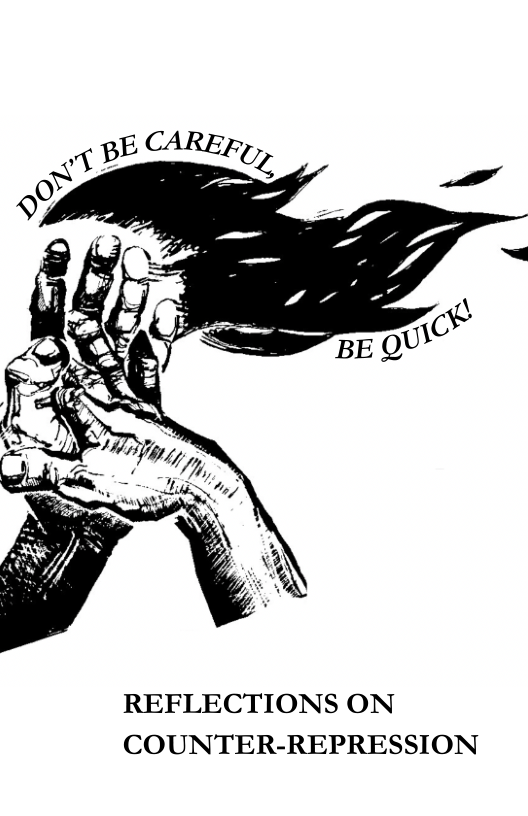

REFLECTIONS ON
COUNTER-REPRESSION
Cover image: Tricontinental Institute for Socil Research,
“Culture as a Weapon of Struggle: The Medu Art Ensemble and
Southern African Liberation”
thetricontinentalorg/dossier 71-medu.-art-ensemble
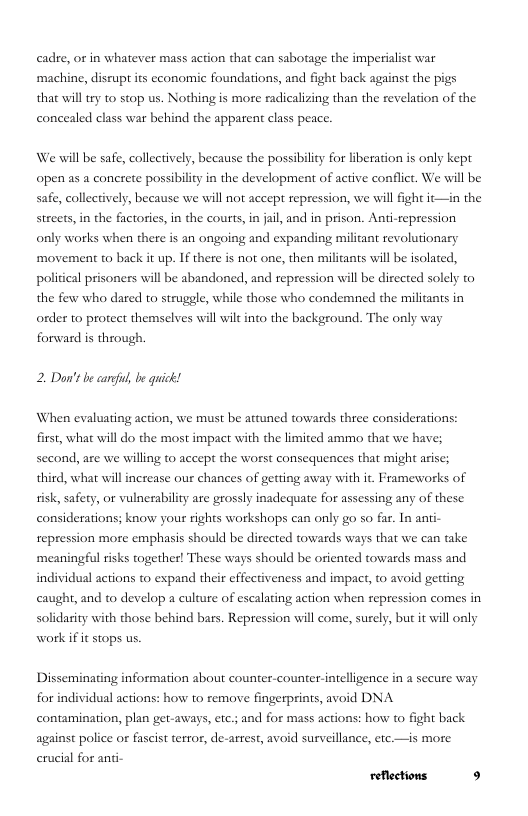
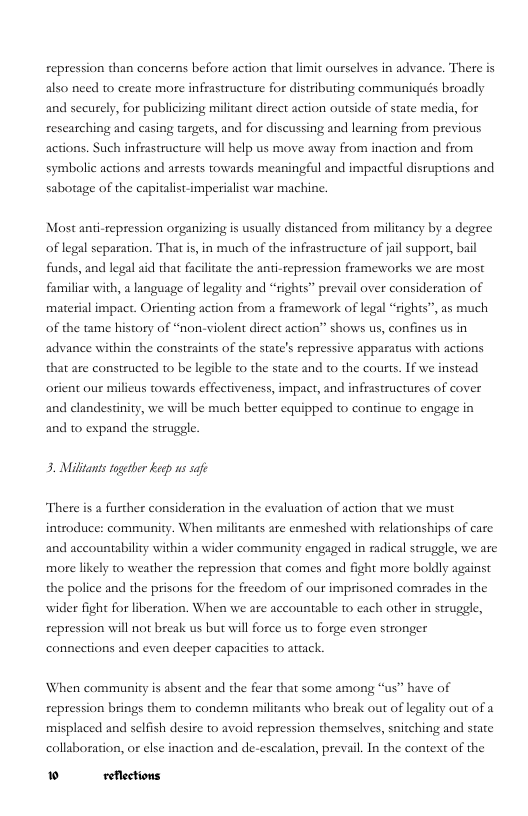
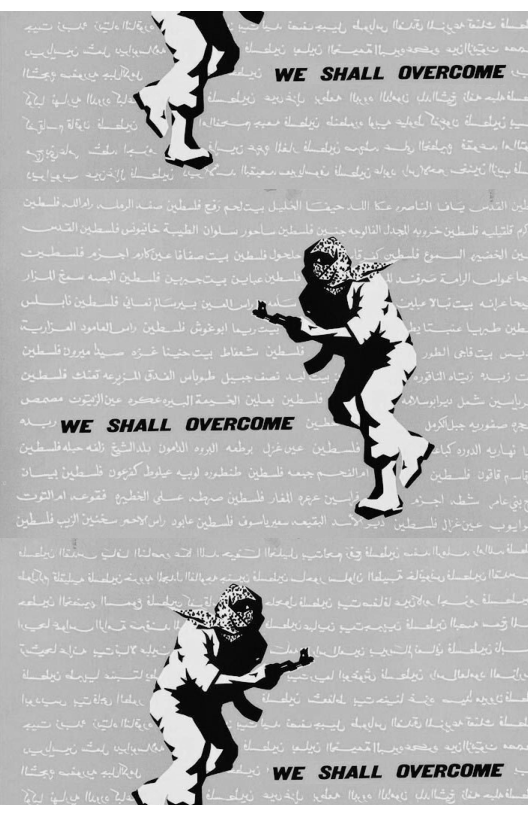
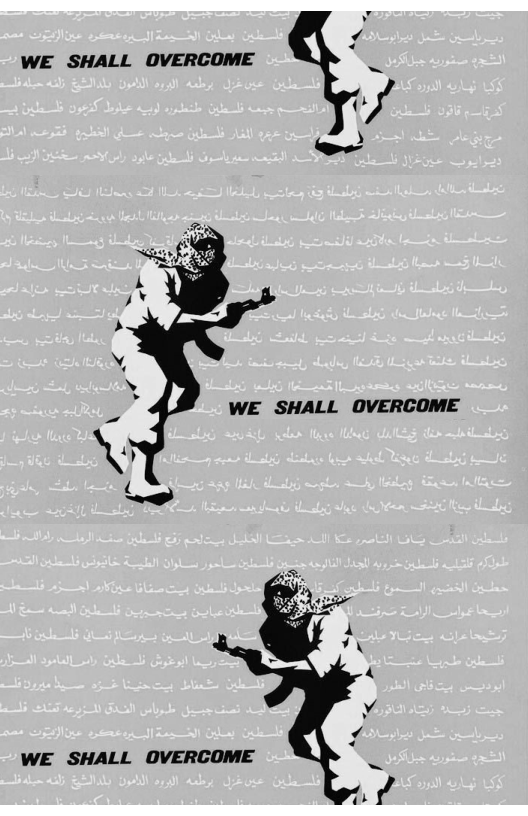
Inside image: lomail Shammout
poster for the Palestinian Liberation Organization, 1970
(note: the white Arabie text in the green background lststhe names
of villages, towns and ciies in Palestne)
sewwspalestineposterprojectorg/poster/overcome
in dialogue with counter-repression proposals from Uity of the
Filds and scenes dot nobloga dot org
Typosetin
GARMMOND
CELANDINE
il latese
Don't Be Carefid, Be Quick!
Reflections on Anti-Repression
Sertle your quareels, come togethes, understand the selity of u scuation, understand that
fascism s already here,tha people are alecay dying who could be saved, tha geneations more
will dic o live poor butchered hal-lives if you il 0 act. Do what must be done, discover your
bumanity and your love in revoluton. Pass on the torch. Join us, give up you ife o the people
— George Jackson
So there were only o diecctions for me 0 go. One was over the wll.. And the ocher was up
sgainst my aprors.
— EdMead
What prevents us from engaging in action? In moments where revolutionary,
teansformative, and miliant direct action is required—no, demanded—of us by
our complicty in genocide, what prevents us from taking the leap from
intention into act? What prevents us from joining the struggle where it ought o
be waged—in the bely of the beast? The reasons for our apparent helplessness
have, of course, material conditions. The possibiliy for something different—
for an end to genocide, an end to imperialism and colonialism, an end to
capitalism, and for actions that contribute to the real movement of their
abolition—is a concrete possibility, and al the pigs in the world are lined up at
the horizon of this world to ensure its closure or enclosure, to limit the
possibiliy for otherwise, to limit the possibility for action.
When we interrogate material conditions that limit possibilty, we unravel and
reveal the centuries-long history of the defeats of revolutionary movements
more determined and equipped than we who inherit the wake of the world that
defeated them, which is rushing headlong into imperialist terror and apocalypse.
We are faced now, in this moment, with our current lack of organization due to
these historical defeats. We are faced with the state’s
violent repressive apparatus grown stronger from them. We are faced with the
state's recuperative and co-optive mechanisms for rerouting militancy back into.
the constraints of the possible. We are faced, 100, with our subjective
internalization of the repression of the possibiliy for action—the cops in our
head.
If we examine these subjective impediments to action we confront the
innermost structures of fear, narcissism, and “self-preservation. Witnessing
endless suffering, we witness, t00, the marks of our complicity and passivity,
which, instead of elciting an invigorating sympathy that compels us into action,
more often induce guilt, shame, evasion—induce a desire t0 look away. Fear is
the edifice of our false consciousness—our wrong lfe in a wrong world.
Deeper than the fear of losing lfe or limb, the fear of being relcgated o the
inhuman conditions of jail or prison, or the fear of losing the ephemeral
comforts our complicity or passivity may afford, there is at the root of our
inaction the fear of surrendering what structures our self and our world:
aur scparation fron and levation above abject teror, that s, our immunity from the
prssion ofotbers 50 ong as we fil to actand join them, 50 ong as we confine and restrict
aurseles now by aring future onfinement.
Every revolutionary has had to face the constraints of what is possible—the
point s to break out of them. We are disorganized, we lack unity, we are
unready—at some point, so were they, if they were anyone. We live in a police
and prison state, our friends have been to jail, to prison, or are facing charges—
they outnumber the stars, our imprisoned comrades of the past. We have a
future o lose, carcers, familie, lfe plans—what future? These are our vain
capitulations to an ongoing terror; our betrayal of those who have no future;
our postponement to faraway of facing our shared fate—strugele or nothing;
our submission to the prospet of there being no future at all that can be called
worthy of life; and, anyways, if we fight, i it not from a deep sense of devotion
o the ones we love dispersed to every suffering being, past, present, and
future?
By repression we mean anything that limits or contains the possibiliies of
revolutionary action. This includes the violent repressive arms of the state:
police, jails, prisons, courts, etc. This includes the political, economical, and
ideologieal consistency of day-to-day reproduction that subjects us to belonging
S0 long a5 we do not rebel. But this also includes the recuperative and co-optive
forces of the state or that aid the state, or recuperative and co-optive tendencies
within them: “progressive” non-profits & NGO's, “yellow” or business unions
& union leadership, the dominant right-wing party lines of political
organizations like the DSA, PSL, CPUS
ourselves when we orient our analyses of possible action towards the fear of
, ete. Repression also includes
consequences rather than the effectiveness and expediency of action.
Repression also includes ourselves when we fail o act according to what the
‘moment requires of us.
When we limit what is possible for ourselves, this is no different than if our
enemies and oppressors do it for us—the outcome is the same ... action
becomes inaction, the present continues in its violent inertia of terror, people
are dying who could otherwise have been saved.
Most often we are acquainted with “anti-repression” as the framework of
activist tools for avoiding repression or dealing with it when it comes. These are
the ubiquitous and extremely helpful tools of jail support (bail funds, legal aid,
collective defense, ete.), political prisoner support (commissary funds, letter
witing, noise demos, etc), security culture (internet sccurity, interpersonal
security like “vetting’ or ‘need-to-know, community bulwarks against snitching
or collaboration, etc), and anything that helps to keep us safe when repression
comes or helps to limit the exposure to repression when engaging in action.
Oftentimes, however, in our experiences in different radical milieus, these
frameworks, though containing indispensable means of protecting each other,
have obverse effects that contribute to the limiting of possibility and
inadvertently repress what action emerges despite it
The risk caleulus we 00 often use centers individual concerns of "safety,"
“vulnerability,” or “arrestability” as a means of avoiding repression rather than
the effectivencss and impact of the action against capitalism, imperialism, ctc.,
reflections. s
that is, the means with which to engage in the action with the utmost militancy
and get away with it or of considering if we would be willing to accept what
comes if we do not. There is no logic of “safety’” or “vulnerability” that will
span the chasm between the perceived safety of inaction and the revolutionary's
acceptance of the possibility of repression. This is not to glorify sacrifice, just
0 note that all of us will have to or have already answered for ourselves the
question of the importance 0 us of liberation's possibility. Once again, this is
not to glorify sacrifice, just to note that engaging in revolutionary action means
that prison or death are real possibilites, but the real aliernative to action is less
inviting than a fight. This is and is not a moral question, it is more of a question
of necessity
Further, these logies do not keep people safe, let alone the most vulnerable. IVe
are ot safe her and now: 16 we think we are safe we are either lying to ourselves or
separating ourselves, elevating ourselves above, and passively accepting the day-
to-day violence that maintains capitalist imperialism. If we feel safe, that is
because we have exempted ourselves from action. By projecting a false sense of
safety or security that encourages inaction and de-escalation, these logies of risk
endanger everyone—both those who remain inactive and the militant bold. By
discouraging autonomy, people who seck escalation are told they're
endangering others, while people who are alienated from any risk, instead of
staying out of action, hold others back or are caught up non-consensually in
repression when it comes. The most militant revolutionarics, anyways, have
always been the most vulnerable—because revolutions, if they are revolutions,
are revolutions of the oppressed.
‘When repression is presented both as a possibility that can be avoided by
inaction and also as a disastrous or unintended inevitability of action that
catches us unprepared, as it quite often s, those who arc oriented from fear
revert to admonishing those who fight against the constraints of what is
possible, indeed to presenting such militant action as undesirable or harmful, or
even worse, 10 unconditionally accepting those same constraints as the only
thing that is possible. Our task as potential revolutionaries, potential comrades
0 the fighting dead and the living fighters, is, contrariwise, to reject any and all
consrains to action, o open possibiliy, 1o expand conflict, as we fight with the
6 reflections
past for the future. Anti-repression, in this framework, we understand to mean
something that can only be accomplished through an active engagement in
revolutionary struggle.
The most important thesis for us in this proposal for a militant anti-repression
framework is that action, escalation, and the development of miltancy keeps us
safe, not inaction, fear, capitulation to the constraints of the present, or the
repression of ourselves and our possibiliies of action on behalf of the state.
Theee theses on repression:
1. Represion i incvitable
However we aim to protect ourselves against repression, it is false to think that
by de-escalating action or not acting at all, we will be safe from it. Repression is
an inevitable part of the revolutionary process; it is, as George Jackson says,
“the always-to-he-expected defense-attack reflex of the beleaguered, toothless
tiger.” Can the state seriously be challenged without a response? The state,
responds to al threats: with repression, whether in the form of violence,
recuperation, or the fear it inflicts upon those it discourages from action o
deputizes into the repressive apparatus themselves. Whatever we do, if we are
or are not a threat, they will repress us—so let us be a threat!
2. Repression s aleady bere
Whether we argue that fascism is the terror and violence of settler-colonialism
and imperialism come home or is the maintenance of internal colonies
stratfied through racial capitalism and reform—both of which are true—, if we
think repression is merely a possibility of action and not a present actuality
then we have not yet joined the oppressed in this country and in this world,
who experience the worst of it in their day-to-day lives and in their fight for
liberation—in fact we maintain our separation from and elevation above them
Hear George Jackson: “I've lived with repression every moment of my life, a
repression so formidable that any movement on my part can only bring relicf,
the respite of a small victory or the release of death.”
reflections. 7
3. Repression exposes
In the concrete stage that we find ourselves in now, where underground artacks
are proliferating and a growing contingent of the above-ground mass
movements are tocing the line against legality and their recuperative and co-
opive leadership, we cannor let the militants who breach the constraints of
possibility into a horizon of liberation be isolated. In the opening stages of
revolutionary activity when the disorganized left postpones conflict because it
deems itself or the "masses” uneady (neither will ever be ready), it ignores the
fact that revolutionary conditions do not make revolutions, revolutionaries
make revolutionary conditions, and the conditions have never ceased to be
present. There wil always be those who seck to do what the historical moment
requires of them. Let us not repress them or ourselves, and instead, as George
Jackson says, “draw violence from the beast ... demonstrating for the world to
examine just exactly what terms their rule is predicated on—their power to
organize violence, our acquiescence.”
Theee theses on anti-repression
1. Milltangy kecps s safe
Whatever we do, we will face repression. Here and now, the oppressed in the
internal and external colonies, along with militants and freedom fighters from
both, are facing repression. Repression exposes the violence capitalist
imperialism / settler-colonialism is founded upon and that maintain it. As long,
as we exist in a state of class peace, where this violence is postponed (we're not
ready to face i), displaced (i's nor for us, but for them), or suppressed (they
deserved i, it's justified), that violence will expand and intensify to annihilate
any revolutionary threat as a warning to all who may consider resistance.
Class war, class conflict—it is our task o intensify conflict, to develop the
terrain of conflicuality, and to expand and intensiffy it as a call o all who may
resist that resistance is possible. We cannot wait for a vanguard party, for a
general strike, for a spontancous insurrection—ywe have to attack now with
whatever weapons we have in hand, whether individully or in clandestine
s reflections
cadre, or in whatever mass action that can sabotage the imperialist war
‘machine, disrupt its economic foundations, and fight back against the pigs
that will ry to stop us. Nothing is more radicalizing than the revelation of the
concealed class war behind the apparent class peace.
‘e will be safe, collectively, because the possibilit for liberation is only kept
open as a concrete possibiliy in the development of active conflict. We will be
safe, collectively, because we will not aceept repression, we will fight it—in the
streets, in the factories, in the courts, in jail, and in prison. Anti-repression
only works when there is an ongoing and expanding militant revolutionary
movement to back it up. If there is not one, then militants will be isolated,
political prisoners will be abandoned, and repression will be directed solely to
the few who dared to struggle, while those who condemned the militants in
order to protect themselves will wilt into the background. The only way
forward is through.
2. Don't be careid, be quick!
When evaluating action, we must be attuned towards three considerations:
first, what will do the most impact with the limited ammo that we have;
second, are we willing to accept the worst consequences that might arise;
third, what willincrease our chances of getting away with it. Frameworks of
sisk, safety, or vulnerability are grossly inadequate for assessing any of these
considerations; know your rights workshops can only go so far. In ani-
repression more emphasis should be directed towards ways that we can take
‘meaningful risks together! These ways should be oriented towards mass and
individual actions to expand their effectiveness and impact, to avoid gerting
caught, and to develop a culture of escalating action when repression comes in
solidasity with those behind bars. Repression will come, surely, but it will only
work ifit stops us.
Disseminating information about counter-counter-intelligence in a secure way
for individual actions: how to remove fingerprints, avoid DNA
contamination, plan get-aways, etc.; and for mass actions: how to fight back
against police or fascist terror, de-arrest, avoid surveillance, ete.—is more
erucial for and-
reflections. 9
repression than concerns before action that limit ourselves in advance. There is
also need to ereate more infrastructure for distributing communiqués broadly
and securely, for publicizing militant direct action outside of state media, for
researching and casing targets, and for discussing and learning from previous
actions. Such infiastructure will help s move away from inaction and from
symbolic actions and arrests towards meaningful and impactful disruptions and
sabotage of the capitalist-imperialist war machine.
Most anti-repression organizing is usually distanced from militancy by a degree
of legal separation. That is, in much of the infrastructure of ail support, bail
funds, and legal aid that faciliate the anti-repression frameworks we are most
familiar with, a language of legality and “rights” prevail over consideration of
material impact. Orienting action from a framework of legal “sights”, as much
of the tame history of “non-violent direct action” shows us, confines us in
advance within the constraints of the state's repressive apparatus with actions
that are constructed to be legible to the state and to the courts. If we instead
orient our milieus towards effectiveness, impact, and infrastructures of cover
and clandestinity, we will be much better equipped to continue to engage in
and to expand the struggle.
3. Milltants toetber keep us safe
There is a fusther consideration in the evaluation of action that we must
introduce: community. When militants are enmeshed with relationships of care
and accountability within a wider community engaged in radical struggle, we are
more likely to weather the repression that comes and fight more boldly against
the police and the prisons for the freedom of our imprisoned comrades in the
wider fight for liberation. When we are accountable to each other in struggle,
repression will not break us but will force us to forge even sironger
connections and even deeper capacities to attack.
When community s absent and the fear that some among “us” have of
repression brings them to condemn militants who break out of legality out of a
misplaced and selfish desire 0 avoid repression themselves, snitching and state
collaboration, or else inaction and de-escalation, prevail. In the context of the
» reflections
s, -
3
> WE SHALL OVERCOME
\‘ )
WE SHALL OVERCOME
WE SHALL OVERCOME
WE SHALL OVERCOME
v
WE SHALL OVERCOME A
4
WE SHALL OVERCOME
Green Scare, a CIA-sponsored counter-insurgency initiative against cco-
saboteurs in the Pacific Northwest, where a majority of the Earth Liberation
Front (ELF) defendants collaborated with the state against their erstwhile
comades, an absence of community accountabiliy in struggle, a prioritization
of peit-bourgeois personal lives above a struggle that most had previously left
behind, and a lack of personal commitment to liberation can explain the
inordinate beteayal that lfi a radical communi
y fractured for generations in its
wake,
“Taking genuine care of and with one another is a primary means of resisting
repression—developing in the cracks of this burning world some fledgling form
of what we desire and which we can defend at all costs. Developing trust,
accountability, and daring is something that can only developed together but is
also something that can only be developed in struggle—together! We must
resist the urge to isolate ourselves and stay in the struggle, demonstrating to
ourselves and to others that resistance is possible! Isolation from a community
in struggle is inaction. As George Jackson says, “Discovering ways of meeting
and overcoming resistance, demonstrating to ourselves that ‘we can,'is
fundamental antecedent to the growth of revolutionary consciousness because
we'll be under attack every step of the way.” And certainly we will attack every
step of the way
Loving learuing laboring with a few conrades ob worr't you harbor me?
We are cogy, cuddy, armed and dangerons,
and we willraz the fucking prisons 10 the grownd,
PNW, June 2024
* George Jackson, Bied ir My Eye.“The cnly cffective challenge to powes i one thatis broad
enough to make isoltion impossible, and intcnsive cnough to cause represson o affct the
ommal lfe syl of as many members of the socicy as possble. By compromising and playing 2t
class war, we lose IF some effective means of thrcatening to wield power s not wsed in the
opening sages of evolutionary aciviy, represson will concenteate isef on the vanguard
clements nly, when the ideal siuation is forthe people 0 fel the raw essence of pover.
Nothing can bead consciousness more cffecively than a flse aeeest, 2 no-keock invasion,
carcles, panic-sricken gunfte. These will fighten some, anger ohers. Common sense slone tels
me whom the people will e thei anger against. Perhaps for a short tme they willbe angry at
s, but since th pig s a pig, it won'tbe long before tis anger is channeled inthe sight
direction.”
* George Jackson, Bied ir My Eye. “Born to a premarare death, menial, subsistence-wage.
worker, odd- job man, the cleanes, the caugh, the man under hatches, without bail—thar's me,
the colonial victim. Anyone who can pas the civil service examination oday can kil me
tomorron:. Anyone who passed the civilservice examinaton yesterday can kil me today with
complec immunity. e lived with repression eveey momest of my I, repression so
formidable that any moxement on my parecan only bring relc,the espit of # small victory or
the release of death, In every sense ofthe teem, in ey sense that'steal, ['m a slave t0, and of,
propery”
* George Jackson, Bied ir My Eye.“Have you grasped thesignificance of the backlash? It has
stung the fascise. The people are in foment, ll of then, of sl persusson. They don'edig.
midnigh o davwn raiding parties, bules with scee ackess, cowardly pigs perched upon thei
foofs,the same pases manufscrured for use gainst the Victamese iberators bowing back into
their fuces: Repression. D you se the ffect it bas an the uncommited? Comade, Reprcssion
exposes. By draving violence from the beas, he vanguard pary is desonstratng for the world
1o examine jus exacly wha teems theie sul s predicaed on— ther povie to orgaeize violeace,
our acquiescence.”
*from s pocenin which a bulet was enclosed sutheicaring communiqué from the George
Jackson Beigade on laternational Women's Day, March, 1976 announcing theisuccessiul
bk of a comeade from police custody. . Craring o Masvons wit Tath: A Documentory
Histoyofthe oo Jackson Brigade
There are many different forms of direct action, some more effective
than others at different points in history, but in conjunction with other
forms of protest, direct action can make the movement for change more
effective by opening avenues of resistance that are not easily co-opted or
controlled by the state. Unfortunately, people within the movement
weaken their own actions by failing to understand and support the
diverse tactics available. Instead of forming a united front, some
activists see the sabotage of destructive property by protestors as being
on the same level as the violence of the state and corporations. This
equation is no more accurate than saying that the peace of a
concentration camp is the same kind of peace that one finds in a
healthy society. If we accept that all violence is the same, then we have
agreed to limit our resistance to whatever the state and corporations
find acceptable. We have become pacified. Remaining passive in the face
of today’s global human and environmental destruction will create
deeper scars than those resulting from the mistakes we will inevitably
make by taking action.
Auwn Hansen
“Settle your quarrels, come together,
understand the reality of our situation,
understand that fascism is already here,
that people are already dying who could
be saved, that generations more will die
or live poor butchered half-lives i you
fail to act. Do what must be done,
discover.your humanity and your love
in revolution. Pass on the torch. Join
us, give up your life for the people.”
— George Jackson