Desirable Undesirables
Web PDF • Imposed PDF• Raw TXT (OCR)



Desirable
Undesirables
Zé Garcia Puga
Introduction
“Desirable Undesirables” was first presented at a conference
entitled Rethinking the War on Drugs, which took place at
Northwestern University in late February, 2014, and was or-
ganized by the Seventh Circuit Bar Association. The latter
described its participants as “an all-star faculty of judges,
prosecutors, medical personnel, professors, government of-
feials (including Senator Richard Durbin), economists and
journalists”” The author, Zé Garcia Puga, was asked to speak
on a panel entitled “Journalists Interview People Whose
Lives Have Been Impacted by Drug Use.”
Garcia Puga displays an uncompromising hostility towards
thiselite ‘star-system’ of jailers, judges, lawmakers,and would-
be managers of a ‘reformed’ carceral apparatus. We find this
hostility inspiring. Like the author, we have nothing but con-
tempt for the so-called progressive immigration and drug re-
forms, whose only function is o codify and deepen an artificial
division between ‘productive’ and ‘unproductive’ groups of
criminalized persons. The lucky among us are funneled into
the indirect coercion of what lttle waged labor still remains;
for the remainder there awaits only the direct force relations
of border guards, police predation, and prison walls. Rejecting
this domesticating reformist blackmail, where one person's
chains are slackened only provided someone else’s are tight-
ened, this text calls on the criminalized to discover in their
illegality a point of maximal tension from out of which to
position oneself against the bourgeois legal order as a
totality. From this perspective, which is that of an affirmed
social criminality, the aim is not to close but rather to widen
the antagonism between the undesirables and the society
2
which abjects them. Henceforth, the only ‘rethinking of war’
worthy of our attention is one in which we avail ourselves of
the means to deepen the civil war objectively thrust upon
us, until that day when the prisons and all of their attendant
apparatuses of control are reduced to rubble.
11l Will Editions
March 2014
Desirable
Undesirables
Of all the specific liberties which
may come into our minds when we
hear the word ‘freedon, freedom
of movement is historically the
oldest and also the most elemen-
tary. Being able to depart for where
we will is the prototypal gesture of
being free, as limitation of freedom
of movement has from time imme-
morial been the precondition for
enslavement.
-Hannah Arendt, “On Humanity
in Dark Times”
HELLO, MY NAME IS ZE; I
am preparing a more exten-
siveresearch paperonthein-
tersectionality of the war on
drugs and immigration pol-
icy. I would like to introduce
myself as someone who has
been criminalized by the war
on drugs and also rendered
expendable under current
immigration policy. During
my youth, I was convicted of
two separate cannabis pos-
session charges. Coming
home from a visit to Mexico
over the Summer of 2011 I
was apprehended by immi-
gration officials at O’'Hare
International Airport.
1WAS INTERVIEWED AND HELD IN CUSTODY
for over two hours, paroled into the country, and given
what is known as a Notice to Appear which meant [ was
to submit my criminal dispositions to the Department of
Homeland Security to determine whether I was going to be
readmitted into the United States of America permanent-
ly or put under deportation proceedings. I am now in the
midst of my deportation case and my next and final court
date will be in 2017. Over the last ten years, three quarters
of undocumented migrants who were convicted of non-
violent offenses served prison sentences and were subse-
quently deported. Among legal permanent residents—like
myseli—who were deported, 77 percent had been convicted
for non-violent crimes such as possession of a controlled
substance. I would like to add to the discussion that drug
related convictions can also have devastating consequenc-
es for people like myself, immigrants, for whom a single
drug related conviction can have a devastating effect—that
of permanent banishment—from our homes, our families,
and loved ones.
There is a growing number of voices concerned for those
being held in captivity by the state for drug related charges.
One argument that seems to have gamered particular atten-
tion s that drug related penalties for non violent offenders
should be met with more leniency from the courts. I will not
be joining the chorus of liberal prison apologists for whom
the caging and disposability of mostly black and brown
bodies with less digestible narratives remains permissible.
L will not be complicit in pleading to the Masters, “afford
the palatable derelicts the right to a more fair negotiation
DESIRABLE UNDESIRABLES | 7
over their movement. As if saying, the militarized policing
of the hood has become too obviously racist and perhaps
the time is now to cosmetically redesign the stipulations of
their ransom. This is reform, negotiating the release of some
captives, especially when the narratives of those hostages
can more easily fall in line with the prototypical citizen, yet
never fully challenging the plurality and proliferation of
power and its mechanisms, its obsession with controlling
human movement and its economic necessity of funnel-
ing certain populations into the respective industries that
can exploit their convenient undesirability. But mercy for
non-violent “criminals” is not the masim of those who de-
sire total liberation. As if the state itself wasn’t guilty of the
utmost psychopathic violence against the people it holds
hostage, by restricting violently and quantifying clinically
the very thing that makes us wild, free, and purposeful - our
movement.
My aim is not to acquire sympathy because the petty of-
fenses | committed in my youth will be met by such bru-
tality from the state. My aim is not to allow power—its in-
stitutions and mechanisms—to cosmetically redesign its
practices of banishment and capture, to perennially ensure
the subservience of people to the state. My aim is to con-
tribute to ongoing struggles that seek to destroy the condi-
tions that allow the social category of criminal to be subject
tothe entirety of state terror and exploitation. If one is black,
one can be born illegal in this country, as we are shown
time and time again how anti-blackness manifests itself in
this society. Or one can become illegal on arrival if we are
migrants fleeing the conditions set forth by capital in our
8 | ZEGARCIAPUGA
homelands. The liberal cacophony of the day points to the
obvious, that which we know, the incarceration rates of the
largest prison population in the world are highest amongst
peaple of color. We see the state agents in our neighbor-
hoods every day, mostly white, caging mostly peaple of
color behinds bars, beginning the process of deportation
proceedings against us. We have been illegalized by our
masters, and now, in attack mode, our point of tension with
the established order, our brand as pernicious and profit-
able desirable undesirables, we declare, our illegality is our
power. We must not allow ourselves to be domesticated by
their qualifications, limitations, or restrictions upon our
bodies. We understand that politicians will not defend our
identities as social criminals. We also won't be defended by
the liberal, reformist, profiteers of the non-profit industrial
complex (whose scope of justice is limited to citizenship).
Our bodies and the stigma thrust upon us—as illegals and
or criminals—are desirable and convenient because the im-
migrant military-prison-industrial detention complex can
profit from us. Senator Dick Durbin who was also invited to
speak at this Symposium, and other members of congress
can profit, economically and politically. DREAM Activists,
and the non for profit industrial complex—the supposed
allies of the immigrant community—also benefit economi-
cally and politically from our fabricated undesirability as
we have seen, specifically in regards to the current immi-
gration reform bill (of which Senator Dick Durbin has been
a main architect of), how eager they are to promote the to-
tal militarization of the US-Mexico border, the proliferation
of the security and surveillance apparatus of the state, the
latest expansion since 1996 of what determines new quali-
DESIRABLE UNDESIRABLES | g
fications of criminality, under the context of immigration
policy (poverty, employment history, gang affliation). All
this, in exchange for the documentation of some catego-
ries of immigrants, and surely, in the case of the NGO, an
increase in the federal funding of such organizations who
can demonstrate a willingness to work alongside the state
in managing immigrant populations and funneling them
into the prison detention industrial complex. It seems in-
teresting to point out that conversations taking place at the
highest levels of government about the decriminalization
of certain drugs and even a certain self reflection about the
explosion of the prison population and what social groups
are targeted, mostly black and Latino, are happening as
the economic opportunities of immigration detention cen-
ters become more evident to the players like GEO Group
and Corrections Corporation of America. In fact, the im-
migration reform bill would afford millions of dollars to
companies like GEO Group and Corrections Corporation
of America to build the for profit detention centers that will
house current and future manufactured criminals.
10 | ZE GARCIA PUGA
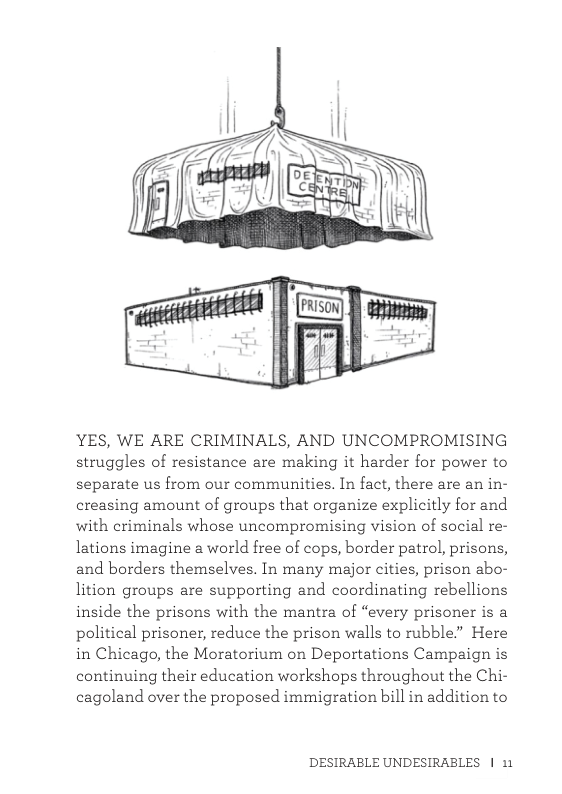
YES, WE ARE CRIMINALS, AND UNCOMPROMISING
struggles of resistance are making it harder for power to
separate us from our communities. In fact, there are an in-
creasing amount of groups that organize explicitly for and
with criminals whose uncompromising vision of social re-
lations imagine a world free of cops, border patrol, prisons,
and borders themselves. In many major cities, prison abo-
lition groups are supporting and coordinating rebellions
inside the prisons with the mantra of “every prisoner is a
political prisoner, reduce the prison walls to rubble” Here
in Chicago, the Moratorium on Deportations Campaign is
continuing their education workshops throughout the Chi-
cagoland over the proposed immigration bill in addition to
DESIRABLE UNDESIRABLES | 11
their successful campaign to stop the construction of an
immigrant detention center in Crete, Illinois, all done in
the name of dismantling the immigration detention sys-
tem. Groups around the continent are building solidarity
with the struggles of indigenous nations along the border,
whose way of life and claim to the territory known as the
United States spans thousands of years. A flame is burning
that will not be domesticated and cannot be coopted by
the Left or its state actors. We can continue being a threat
to the social order that is holding all of us hostage. One
anthem of autonomous resistance states: “We are and will
always be illegal because we don't obey their laws of mis-
exy, exploitation, hate and separatism, their laws that make
sure we are always poor, their laws that kill us slowly” We
should be clear that our paramount desire is not for family
friendly detention facilities, or better food, or to decrimi-
nalize certain drugs, for less harsh prison sentences, or to
abolish the death penalty, or to make solitary confinement
a thing of the past. We should be clear that a reformed pris-
on industrial complex is still antithetical to the premise of
human liberty, of total liberation. From the brutality of lo-
cal turned transnational oligarchies of the countries many
immigrants flee, to the cities and counties in the US who
receive federal money to house, (read cage) undesirable
populations, at every stage of the so called “immigration
crisis” or the “war on drugs” the capital state is culpable in
engineering the horrors along the border and in the hood.
It was the capital state that engineered the economic poli-
cy and social conditions people flee from, it is the state and
its agents who flooded our communities with crack and
heroin and continue to support the global drug war, with
12 | ZE GARCIA PUGA
logistics and impunity, as we have seen with the Sinaloa
Cartel in Mexico.
Perhaps it is the belief of some that “the system” needs an
overhaul that is less punitive, more transparent, and less
obviously racist. To this we say, fire to every cage, under
any name, be it reform, correctional center or immigrant
detention center. No piece of legislation to reform the
immigrant military prison industrial detention complex
would suffice in ultimately answering the question of the
“mmigration crisis” or “mass incarceration.” One, because
these crises are manufactured and created by economic
players and their paid for legislators. We cannot trust the
capital-state to alleviate the crises unfolding in our neigh-
borhoods, because they have created the ultimate crisis,
their ideal prison; the very notion of the nation-state and
the power relations that ensure its dominion over our bod-
ies. We know that drug addiction is a disease that deserves
compassion and treatment, not incarceration, We must no
longer forsake justice to a third party, namely the state or
its courts. Justice, is something we can only give ourselves
and each other, through a brutal understanding of our
common enemy, and a clear and uncompromising vision
that will make no concessions, no contracts with our clear
enemies, or the sirens of liberalism.
Iend now, with a quotation from an Eritrean migrant being
held in a detention center in Greece: “clean rooms, clean
beds, warm showers - none of that will change anything.
Don't help us if that's all you're going to ask for. What we
need is freedom.”
DESIRABLE UNDESIRABLES | 13
1%
‘Typeset in Archer Pro Book and Mrs Eaves Roman.
ill-will-editions.tumblr.com
illwill@riseup.net
“"We should be clear that
our paramount desire
is not for family friendly
detention facilities, or
better food, or to decrimi-
nalize certain drugs, for
less harsh prison sentenc-
es, or to abolish the death
penalty, or to make soli-
tary confinement a thing
of the past. We should be
clear that a reformed prison
industrial complex is still
antithetical to the premise
of human liberty, of total
liberation.”
ILL WILL EDITIONS e ill-will-editions.tumblr.com