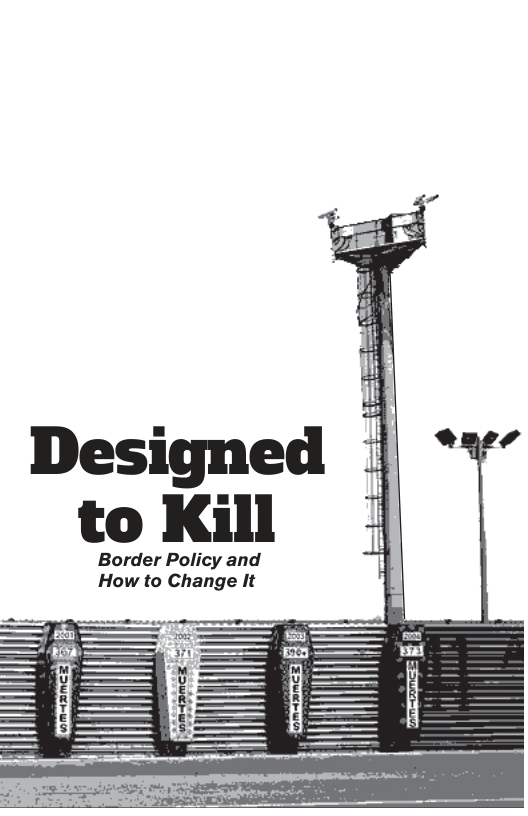
Designed to Kill: Border Policy and How to Change It
Web PDF • Imposed PDF• Raw TXT (OCR)







![contacted them. He had been missing for nine days. The last time anybody had seen him he was somewhere near a small body of water with a fractured rib. They thought that he was in our area somewhere. For about a week we searched and searched, but we never found him. His brother had papers. He came up, with a horse. He combed the desert on horseback for another week, and eventually found his brother’s body. Two weeks later a man came walking into camp. He was carrying an almost empty gallon jug of water with our markings on it in one hand, and a white shirttied to along stick in the other. He stuck the jug under my nose: “This water saved my lfe! | was praying to Jesus for water! | was sure | was going to die, and | found this water in the desert! | think Border Patrol leaves it on the trails for peopl “No, man; | said, “Border Patrol couldn’t give a shit if people live or die. We left that water” “Those bastards; he said. “I’ve been waving this flag at their heli- copters for three days. They just fly on. When you want them they’re nowhere to be seen, and when you don’t-there they are” | checked the markings on the bottle. It had been dropped two weeks earlier, at an unusual location we had only gone to because we were looking for the man who died. One day my colleague and | drove way out into the middle of nowhere to drop water in the desert. Four days later it was time to check on it On our way out to the spot we saw a man sitting by the side of the little dirt road. He had a ripped up piece of blanket tied around one knee. “How are you doing?" | asked him. “Badly; he answered. “Look at this" He pulled up his pant leg to reveal a black, swollen, thoroughly broken ankle. “That’s bad] | said. “You need to go to the hospital” “Yes!" he said. “Look at this! He pulled his shirt aside. “OH SHITI" my colleague and | shouted in unison. He had a large open chest wound, bloody, half scabbed over and oozing pus. *You need to go to the hospital right NOW! What happened?” “Four nights ago | was walking with three other men through those mountains over there. | took a blind fall, ten or twelve feet over a clif Ibroke my ankle and sliced my chest open on a rock. They carried me down from there all through the night. In the morning we saw you drive by, but we were still too high, we couldn’t get to the road in time. When we got here they left and said they were going to find help. | haven’t seen them or anybody else since ther](designed-to-kill-border-policy-and-how-to-change-it-crimethinc 26.png)





Border Policy and
How to Change It
for everyone who
didn’t make it,
and for everyone
who did
For a number of years now I've worked in the desert on the Mesican-
American border with a group that provides humanitarian aid to
migrants who are attempting to enter the United States—a journey that
claims hundreds of lives every year. We've spent years mapping the
trails that cross this desert. We walk the trails, find places to leave food
and water along them, look for people in distress, and provide medical
care when we run into someone who needs it. If the situation is bad
enough, we can get an ambulance or helicopter to bring people to the
hospital. We strive to act in accordance with the migrants' wishes at all
times, and we never call the Border Patrol on people who don't want
to turn themselves in.
During this time I've been a part of many extraordinary situations
and I've heard about many more. Some of the things I've seen have
been truly heartwarming, and some of them have been deeply sad and
wrong. I've seen people who were too weak to stand, too sick to hold
down water, hurt too badly to continue, too scared to sleep, too sad
for words, hopelessly lost, desperately hungry, literally dying of thirst,
never going to be able to see their children again, vomiting blood,
penniless in torn shoes two thousand miles from home, suffering from
heat stroke, kidney damage, terrible blisters, wounds, hypothermia,
post-traumatic stress, and just about every other tribulation you could
possibly think of. I've been to places where people were robbed and
raped and murdered; my friends have found bodies. In addition to bea-
fing witness to others' suffering, | myself have fallen off of cliffs, tom
my face open on barbed wire, run out of water, had guns pointed at
me, been charged by bulls and circled by vultures, jumped over rattles-
nakes, pulled pieces of cactus out of many different parts of my body
with pliers, had to tear off my pants because they were full of fire ants,
gotten gray hairs, and in general poured no small amount of my own
sweat, blood, and tears into the thirsty desert.
There is nowhere on earth like the place where we work. It s beautiful
beyond telling: harsh, vast, mountainous, remote, rugged, unforgiving,
every cliché you can think of and more. | have been humbled count-
) less times by the
“Answer the question of Who incredible selfless-
benefits or profits most directly ness and courage
from an action, event, or outcome ©°f the people that
and you always have the starting ' "¢ met there,
. . and | have been
Ppoint for your analysis or - iven nearly out of
investigation, and sometimes it will my head with rage
also give you the end point.” at the utterly heart-
-Sir Arthur Conan Doyle 'ess economic and
political system
that drives people to such lengths in order to provide for their families.
Doing this work has given me a great deal of opportunity to observe
how the border is managed on a day-to-day basis, and hopefully some
insight into the functions that it performs within global capitalism~the
real objectives that it serves. | offer this essay as ammunition to anyone
‘who still cares enough about anything to intervene when people around
them are being treated like pieces of meat.
The first thing that | want to make clear is that the atrocious suffe-
ting that happens on the border every day is not an accident. It is
not a mistake and it is not the result of a misunderstanding. It is the
predictable and intentional result of policies implemented at every
level of government on both sides of the border. These policies have
rational objectives and directly benefit identifiable sectors of the
population of both countries. It may be evil, but it's not stupid. If this
sounds a lttle shrill, let me tell you how I've seen this play out on the
ground.
When | started working in the desert | began to notice some very
peculiar things about the Border Patrol's operations there. They would
do a lot of enforcement in some areas and very little in others, and
this would not necessarily correspond to which areas were busy and
which areas were slow. In fact, very often the enforcement would
clearly be done in such a way that it would push traffic into rather than
out of the busiest areas, where Border Patrol would keep a low profile
until the very northern end of the route. At that point there would be a
moderate amount of enforcement again, but not really what you would
expect given the numbers of people that were moving through.
Then they started building lots of surveilance towers. But once
again, the towers were not really built in the places where the traffic
was heaviest-they were built on the edges of them. If anything, they
seemed to be intent on forcing traffic into the busiest routes rather
than out of them. What was happening?
Meanwhile, | was constantly meeting migrants whose groups had
been split up by helicopters. The Border Patrol would fly over them a
few feet off the ground, everybody would run in different directions, and
so0n there would be thirty people wandering lost across the desert in
groups of two or three. What seemed particularly odd was that the
Border Patrol often made no effort to actually apprehend these groups
after breaking them up~—they just flew away. Why?
And then there's this. Over the last few years, the organization | work
for has developed a pretty comprehensive understanding of the area.
we cover, which at times has been one of the most heavily traveled
sections of the entire border. We've formed a fairly clear picture of
where traffic starts, where it goes, how it gets there, where it's busy
and where it's slow at any given time, where the pinch points are, and
50 on. | honestly believe that if | worked for the Border Patrol | could
basically point at a map and tell them how to shut down the whole
sector. I's really not rocket science. Keep in mind that all of our work
has been done by untrained civilian volunteers, armed with low-end
GPS units, a few old trucks, run-of-the-mill mapping software, cheap
cell phones with spotty service, and a very limited budget. Does it
seem logical that we could figure this stuff out while the government
of the United States of America cannot, despite access to helicopters,
unmanned drones, electronic sensors, fleets of well-maintained trucks,
night vision systems, state-of-the-art communications and surveillance
and mapping technology, tens of thousands of paid employees, and
a limitless supply of money to shovel down the hole at every possible
opportunity? | don't think it does. So what's going on?
It you accept the stated objectives of the border at face value,
then none of this makes any sense at all. If you accept that the actual
objectives may not be the stated ones, things start to come together
fast. The task of the Border Patrol-and the actual objective of the.
policies it is there to enforce~is not in any sense to STOP ILLEGAL
IMMIGRATION. It is to manage and control that migration. Trust me
on this.
But to what end? To whose benefit? Settle in, because it's
complicated.
First ofall it's as plain as day that the economy of the United States of
Americais dependent in no small part on the hyper-exploitation of undo-
cumented labor. You know it's true, | know it's true, the Guatemalans
that shovel the shit out of Lou Dobbs' horses' barn know it's true, but
itis considered extremely taboo to mention this fact in public. Excuse
me, but anyone with a modicum of common sense should be able to
see that if the government were to actually build a two-thousand-mile-
long Berlin Wall tonight and then somehow round up and deport every
undocumented person in the country tomorrow, there would be mas-
sive and immediate disruption in the agriculture and animal exploitation
industries, not to mention in everything related to construction—quite
possibly leading to a serious breakdown i the national food distribu-
tion network and conceivably even famine. I'm not exaggerating. The
people that write border policies are not fools. They understand this
perfectly, even if your racist co-workers evidently do not. Regardless
of what any politician or pundit says, | don't believe anyone is going
to put a stop to illegal immigration as long as undocumented labor is.
needed to maintain the stability of the economic system. But this isn't
good news to those of you who dislike seeing people treated ke shit
and then discarded like diapers, because what's more important is that
this migration will continue to be managed and controlled.
The border is a sick farce with a deadly conclusion. The goal is to
make entering the country without papers extremely dangerous, trau-
matizing, and expensive, but possible. The point isn't to deter people
from coming~far from it. It is to ensure that when they do come, the
threat of deportation will mean something very serious. It means spen-
ding a ton of money. It means risking your lfe to return. It means that
you may never see your family again. This is supposed to provide
American employers with a vast and disposable pool of labor that is.
kept vulnerable and therefore easy to exploit-and this in tun drives
down wages for workers with American citizenship, which is why the
old saw about the “illegals coming to our country and taking our jobs”
is s0 convincing. Like many good lies, it's powerful because it omits
the most important part of the truth.
‘Those who believe that immigration and border enforcement protect
the jobs or wages of American workers are seriously misinterpreting
the situation. Even if you limit the scope of your analysis to market-ba-
sed behavior, it seems clear that if undocumented workers were not
subjected to such extraordinary risks and pressures they would act
like anybody else and obtain the highest price for their labor that the
market would bear. In fact, these same workers have proven them-
selves able time and again to struggle successfuly for higher wages,
despite having to overcome obstacles other workers do ot face. But
border and immigration enforcement drives down wages across the
board-that's the point of it
Here's another lead that is easy to follow: the recent wave of anti-im-
migrant hysteria sounded very similar to the anti-Muslim fear-mongering
of five to ten years ago. Its easy to trace this to the mid-term elections.
With the war in Iraq winding down, and in lieu of any recent successful
domestic Al Qaeda attacks, the so-called immigration debate became
the de facto national security issue for politicians to talk about.
The Republican strategy was pretty straightforward. They hoped
to regain power by appealing to white fear, anxiety, guilt, and racism.
The Democratic strategy was more nuanced. First, they blamed
Republicans for lack of progress on immigration issues. They hoped
that this would maintain the support of voters from immigrant com-
munities. Second, they did not actually try to push any pro-immigrant
measures. They hoped that this would avoid alienating anti-immigrant
voters. Third, they ramped up deportations. The Obama administration
deported almost 400,000 people in 2010, the most in a single year
ever. Now they can use those numbers to emphasize their toughness
on immigration. With these law and order credentials, the Democrats
hoped to woo conservative voters before the last elections and in the
next ones. Expect to see some version of this charade play out again
in 2012, unless i's trumped by another war or major terrorist attack.
Here's one last clue: much of the legislation that becomes govern-
ment policy is written by the corporations that stand to profit from it.
Arizona's State Bill 1070, which among other things would require
police to lock up anyone they stop who cannot show proof of having
entered the country legally, was drafted in December 2009 at the
Grand Hyatt hotel in Washington D.C. by officials of the billion-dollar
Corrections Corporation of America (CCA), the largest private prison
company in the country. This took place at a meeting of the American
Legislative Exchange Council (ALEC), a membership organization of
state legislators and powerful corporations. The law, which was partia-
lly overturned but may still o into effect, could send hundreds of thou-
sands of immigrants to prison, which would mean hundreds of millions
of dollars in profits for the companies such as CCA that would be
7
responsible for housing them. It almost goes without saying that it is
not in this industry's interest to completely stop illegal immigration from
happening; it is in their interest to let in enough people to fill their jails.
So who benefits from the death in the desert? In a broad sense, the
entire ruling class does. That's pretty ugly. But that's not the whole story,
not by any means. To tell that story we're going to need to back up a bit
To start with, permit me to subject you to an extremely abbreviated
history lesson, beginning with some very inconvenient truths. Like the
rest of the Western Hemisphere, the land that is currently called the
United States of America was stolen from its rightful inhabitants by
European colonists through a well-documented orgy of bloodshed,
massacre, treachery, and genocide of proportions so epic that they are
arguably unprecedented in the thousands of often gruesome years of
human history preceding them and unsurpassed in the hardly tranquil
ones that followed. This monstrous crime has been in progress for over
five hundred years, has never been atoned for in any meaningful way,
and continues to be perpetrated to this day.
Everybody knows this, but nobody really likes to think too much
about what it means. What it means is this: unless you're honest
enough to admit that you think that might makes right as long as you're
on the winning side, you have to acknowledge that the federal, local,
and state governments of the United States of America, along with
all of the agencies such as the Border Patrol and Immigration and
Customs Enforcement contained therein, are illegitimate institutions
with no claim to legitimate authority whatsoever over the territory they
currently govern. If anyone can show me an ethically, logically, or even
legally sound way to disprove this statement, they're welcome to let
me know, but 'm not going to lose any sleep waiting for this to happen.
It's important to start by framing the matter this way. Who are these
people that claim to have jurisdiction over native land? What right do
they have to be telling anybody where to go and when? If anyone
has a right to decide who can and cannot pass through the territory
that currently constitutes the Mexican-American border, it's the people
whose ancestors have inhabited that land since time immemorial, not
the descendants or institutions of the ones who colonized it. Most
so-called illegal immigrants are closer to having a defensible claim to
the continent they're traversing than most of the hypocrites who con-
demn and pursue them.
Now fast forward, for the sake of brevity, to January 1, 1994,
the day that the North American Free Trade Agreement went into
effect, and thousands of indigenous people in southeastern Mexico
famously rose up in arms in response. Calling themselves Zapatistas.
after the Mexican revolutionary, these people predicted that this
agreement would mark a final deathblow to their way of life if they
failed to resist. Their analysis of the situation quickly proved excee-
dingly cogent, their ensuing project of indigenous autonomy has yet
to be defeated, and their actions sparked an entire generation of
resistance to global capitalism: a whole different story that is thank-
fully not over yet.
In addition to its ruinous effects on American industrial communi-
ties, NAFTA's aftermath in Mexican agricultural communities was truly
catastrophic. As part of its preparation for the agreement, the Mexican
government amended Article 27 of its own constitution to allow for
the privatization of communally-held campesino and indigenous land.
NAFTA then permitted heavily-subsidized American agribusiness
giants like Cargill and Archer Daniels Midland to flood the Mexican
market with cheap imports of com and other agricultural products,
undercutting nearly all small-scale Mexican farmers. Exactly as the
Zapatistas predicted, this drove millions of rural Mexicans, many of
‘whom were already living in desperate poverty, off the land and strai-
ght into the abyss. This in turn set off a massive wave of migration as
millions and millions of people left their homes to find work in Mexican
cities, in sweatshops primarily owned by American corporations in nor-
thern Mexico, and in the United States.
Within the year, the Clinton administration launched Operation
Gatekeeper, a program that massively increased funding for Border
Patrol operations in the San Diego sector of the border in California.
The federal govermment greatly stepped up enforcement in this.
sector and buit a fourteen-mile wall between San Diego and Tijuana.
Operation Gatekeeper roughly marks the beginning of a two-deca-
de-running process of ever-increasing border militarization that has.
continued steadily throughout the Clinton, Bush, and Obama adminis-
trations. This has meant that every year there are more Border Patrol
agents, National Guardsmen, helicopters, fences, towers, checkpoints,
sensors, guns, and dogs along the border. Understanding the nature
of this militarization will go a long way towards clarifying what's actua-
lly happening and why.
By all accounts I've ever heard, it used to be much easier to cross
the border than it is now. Most people crossed into relatively safer
urbanized areas such as San Diego, El Paso, or the Lower Rio Grande
Valley in Texas. Starting with Operation Gatekeeper, the Border Patrol
made it much more difficult to enter the country in these places; over
the years, it has methodically pushed the traffic into the increasingly
remote mountains and deserts beyond. Many thousands of people
have died from heat, cold, sickness, injuries, hunger, and thirst as a
direct result. At this point, | think, the game is reaching a bit of an
endpoint. The government has pushed the traffic into the very dee-
pest and deadiest pockets of the entire border, which is where they
want it. This does not mean that the situation is completely static—the
Border Patrol will clamp down on some of these pockets sometimes
and ease up on others—but on the large scale, | think that it is more or
less stable.
There have been several interesting byproducts of these changes.
Many people used to come to work for a season, go back home, and
return the next year. That's much less common now that getting into
the country is such an ordeal. People come and generally stay as long
as they can. Also, most people who crossed used to be men with
families south of the border. There are many more women and children
crossing now that it's no longer possible for many men in this posi-
tion to work in the north without leaving their families behind for good.
Finally, with the increase in intemal deportations, there are many more
people crossing now who have lived here for long periods of time and
are returning to their homes in the United States. This latter group
faces a particularly fiendish dilemma if they run into trouble on the way.
1 have often heard people whose chidren live south of the border say
things like *I thought | was going to die and all | could think about was
my babies. I's better for me to go back home than to risk dying again”
1 have often heard people whose children live north of the border say
things like ‘I | have to risk dying to get home to my babies, then | will"
As | hope | have made clear, a policy of pushing migrant traffic into
extremely dangerous areas does not at all imply an actual intention
to stop or even deter people from entering the country llegally. This
complex and slightly perverse strategy has numerous compelling
advantages. It allows politicians to look tough for the cameras while
stil providing the American economy with the farmworkers and mea-
tpackers it depends on. It provides ample opportunities to swing huge
government contracts to giant corporations: for example, to Wackenhut
to transport migrants, to Corrections Corporation of America to detain
them, to Boeing to build surveillance infrastructure. It justifies the hefty
salaries of the 20,000 people who work for the Border Patrol. And it
has other beneficiaries, who | will get to momentarily. On the whole,
border militarization is best seen as a massive government pork and
corporate welfare project that is possibly only surpassed in the last
twenty years by the war in Irag,
The outcome of this policy of has been most educational. Just as it
used to be easier to cross the border, it also sed to be a lot cheaper.
This won't be surprising to anyone familiar with the laws of supply
and demand. Any service will become more expensive if it becomes.
more difficult to provide, and the service of being smuggled across the
border has certainly been a case study i this law. Prices rose and rose
as the Border Patrol pushed people further and further from the cities.
and established more and more checkpoints that made the journey
longer and longer, until at a certain point there was as much money
to be made in moving people as there was in moving drugs. At that
point, the cartels that already controlled the drug trade recognized an
excellent business opportunity, muscled out the competition, and took
over the game entirely. This dramatically transformed what had been a
relatively low-key affair into a lucrative, highly centralized, and increa-
singly brutal industry with tens of billions of dollars at stake. There is
no doubt that these cartels are among the primary beneficiaries of
American and Mexican drug, trade, and immigration policies since the
end of the Cold War.
The rise of the cartels to a position of absolute dominance within a
booming industry led, unsurprisingly, to a mass-based approach and
an extraordinarily inhumane methodology. | have commonly heard them
referred to as pollero networks, which means something like “meat
herders” since pollo is the word for a dead chicken rather than a live
one. This should offer some indication of the degree of care that these
organizations tend to invest in each individual human lfe throughout
the process of bringing people into the United States. | have seen
groups of as many as fifty people-and heard about groups as large
as a hundred-being driven quite literally like cattle across the desert,
with the sick and wounded straggling behind and trying desperately to
keep up. | have met people who were told that what is always at best
an extremely demanding four to five day journey would take as little as.
twelve hours on foot, and countless more who were left behind to die
by their guides without hesitation when they were for any reason no
longer able to keep up.
As a result of border militarization, prices have risen now to the
point that it costs around five thousand dollars for a Guatemalan to
un
be brought into the United States through the networks, and about six
thousand for Salvadorans. Fees for Mexicans vary widely, but they are
far from cheap. You won't be surprised to hear that many people who
wish to migrate do not actually have six thousand dollars lying around.
The cartels have developed a variety of inventive solutions to this pro-
blem, often involving kidnapping and indentured senvitude. I've met
people who spent years working in the United States simply to pay off
their initial fee, some while held in conditions of outright bonded labor.
I've met others who made it through the desert and were immediately
held for ransom by the same groups that brought them in. The ones
who were able to raise a few thousand dollars more were allowed
to go. The ones who weren't able to were beaten for days and then
driven back out to be left in the desert, where within minutes they
were picked up for deportation by Border Patrol agents who clearly
had some sort of working arrangement with the kidnappers. I'm not
kidding. It's scandalous.
As bad as all this is, it still doesn't fully convey the depth of the
cruelty that has characterized this era of government-sponsored cartel
control. Rape and sexual assault of female migrants is absolutely ende-
mic at every step of the process of migration. This has been greatly
exacerbated by the actions of the government: by pushing the traffic
outinto the middle of nowhere, they have basically guaranteed that in
order to enter the country women have to place themselves in situa-
tions where rape and sexual assault are extremely likely. In addition, the
trails are frequented by groups of armed bandits who make their living
targeting migrants. | believe that some of the bandits are employed by
the cartels themselves, who are simply robbing their own clients, while
others are freelancers taking advantage of an easy opportunity to prey
on defenseless people who are often carrying their life savings in their
pockets. Again, it is primarily because the government has pushed the
traffic into the ends of the earth that these fuckers have been blessed
with such favorable circumstances in which to ply their trade.
To be fair, I've also heard stories of low-level cartel members acting
decently, compassionately, and even occasionally heroically. It's worth
pointing out that the guias~the people who actually walk the groups
through the desert to the other side of the checkpoints—are at the very
bottom of the pecking order within the networks. Their lives are consi-
dered nearly as expendable as those of the migrants. Working in the
desert has given me some appreciation for the fact that being a guia
would be very stressful. They're supposed to bring large groups of
people through harsh terrain where there is no potable water, usually
either in the dark or in brutal heat, while being hunted by military types
with guns and helicopters. Their bosses are probably not the kind of
people you want to piss off. It's hardly surprising that guias are often
unwilling to risk losing their whole group because one or two people
can't keep up. The whole situation is just guaranteed to bring out the
worst in someone. This is not to make excuses for them, or to absolve
relatively powerless people of their personal responsibility for doing
indefensible things. It is simply to say that most of the guilt has to
be assigned to the powerful people whose actions have created this
;E':U‘Eare and who profit most directly “You haven’t heard
Toward that end, it's important to our thunder yet!!”
understand the relationship beween _ glogan at a protest
the govemments and the cartels.
Basicallyitis this: they need each other. @g@iNst SB1070
They share simiar interests. Perhaps it
is most precise to say that in the United States the Gartels need the
goverment, while the government makes great use of the cartels. The
Gartels rely on the US government to keep the prices of their goods
and services atiicially high. The government uses the cartels o justily
funneling billions of dollars to the corporations whose interests they
represent. On the Mesxican side, meanwhie, it isn't realistc to talk
about the government and the cartels s f they are separate entites.
There, the goverment and the various cartels are fighting for control of
the mult-billion ollar American drug and migration market. This ten-si-
ded bloodbath has gotten progressively uglier since the Mexican fede-
ral government got involved in December of 2008, ending what had
been a longstanding policy of non-engagement in intra-cartel violence
and leading to tens of thousands of deaths.
Analysts sometime use term *Colombianization” to point out that the
state of affairs in Mexico is starting to look a lot ke that in Colombis.
Perhaps the most strking similaity is in the increasingly sophisticated
collusion between elements of the goverment and the cartels with
which they are nominally at war. These connections run deep, and the
influence runs in both directions. Los Zetas, arguably the most vio-
lent cartel in the country, was founded by members of the Airmobile
Special Forces Group (GAFE), an elite division of the Mexican miltary
established in 1994 to combat Zapatista rebels in Chiapas. Around
that time, about 500 GAFE personnel received training by the United
13
States Army's 7th Special Forces Group in Fort Bragg, NC for this
purpose. Somewhere between 30 and 200 of these operatives then
defected from the Mexican military to become hired guns, went on to
provide security for the Guif cartel-a well-established trafficking orga-
nization—and eventually split to form a cartel in their own right.
On a local and state level, bribery of police, mayors, judges, and
other government offcials by the cartels is extremely widespread. On
the national level, there is strong evidence to suggest that the Mexican
Amy and federal government are favoring the Sinaloa cartel-the lar-
gest and richest in the nation—in hopes that they will eventually defeat
their rivals and enter into a stable agreement with the government such
as the ones enjoyed by their counterparts in Colombia.
So there is indeed a great deal of cartel infiltration of the Mexican
security forces. This is common, although less widespread, on the
American side as well. For instance, a large percentage of the drugs
that are brought into the United States are driven into the ports of
entry where they are waved through by corrupt Customs and Border
Protection agents who know what vehicles to look for. In general,
however, the arrangement on both sides of the border is not so crude
that there always or even usually has to be direct personnel overlap
between, say, the Corrections Corporation of America, the Border
Patrol, the Gulf Cartel, and the Mexican Amy. What's most impor-
tantis that all of these organizations have interlocking interests, benefit
from each other's activities, and generally act in a way that keeps the
others in business. This unholy trinity of government, corporations, and
organized crime~three ways of saying the same thing-is a formidable
opponent to anyone who hopes to see the death in the desert end any
time soon,
The corporate, governmental, and criminal elites that benefit from
the suffering on the border are ruthless and powerful, but they are not
gods. They aren't the only actors in this drama, and they don't have the
situation completely under control. People make it through the desert
because they are brave and resourceful, not just because the Border
Patrol lets them. The trails themselves are extraordinary testaments to
human ingenuity, weaving gracefully through canyons and over moun-
tains with an unerring eye for direction and cover.
There are somewhere around twelve million undocumented people
in this country. One thing that working in the desert has shown me
is that they are not all the same. The migrants are not all angels, or
devils, or victims. They are not passive objects that are acted upon
14
by the world without acting in return. They are complex individuals
who have chosen to take their lives into their own hands, and | have.
chosen to take their side as best | can. Sometimes it works out and
sometimes it doesn't. Sometimes you beat the man and sometimes
the man beats you.
The border doesn't end at the border, and the hardships that undo-
cumented people face don't stop there either. The border cuts through
every city and state; it cuts through many of own our bodies. The line
in the sand is neither the first twist nor the last of the meat grinder
that global capitalism has prepared for people without papers. After
making it across the border undocumented people enter a world in
which they cannot legally earn money; they have compelling reasons.
not to call the ambulance, go to the hospital, get health or auto insu-
rance, drive a vehicle, open a bank account, use a credit card, apply
for a mortgage, sign a lease, or rely on any number of other options.
that people with citizenship can fall back on. I for any reason you have.
made it a practice to live a portion of your life off the books, you might
be able to appreciate how hard itis to do this ful-time in this society.
lllegal immigration is a legitimate form of resistance to the iniquities
of global capitalism for milions of people worldwide. It may be indirect
resistance, but it gets the goods. This functions in two principal ways.
First, remittances from immigrant workers in the United States—-many
of them undocumented-—to their families in Mexico totaled more than
21 billon dollars in 2010 alone. If you add up all the remittances from
immigrant workers in the entire global north to all of their families in
the entire global south, the total starts to look pretty significant. Even
though it's filtered through a fine screen of work and exploitation, this.
money probably represents one of the largest redistributions of wealth
from the rich to the poor in the entire course of human history. Second,
south-to-north immigration, much of it illegal, is bringing about real
demographic shifts in parts of the global north and particularly in the
United States. This shift may eventually lead to meaningful social chan-
ges within this country, which could contribute to a somewhat more
equitable restructuring of the global economic system, which would
mitigate the tremendous disparity in wealth between the global north
and south, which is what drives the migration in the first place.
It's certainly not a given that this latter hope will pan out. Generations
of immigrants have moved from the margins into the mainstream of
American society without radically changing its course. In fact this is.
exactly how settlers took control of the land to begin with. Nonetheless,
adistinctive feature of American history is that this pathway has gene-
rally been reserved for immigrants of European ancestry. It has not yet
been proven that this country can assimilate o segregate the current
infiux of non-European immigrants without eventually undermining the
foundation of white supremacy upon which it has been built.
This impending demographic change is a cause of real anxiety for
some powerful Americans, as well as many less powerful ones who
have not managed to think all the way through its ramifications. My
opinion is the sooner the better-because | believe that even a partial
erosion of white supremacy in the United States is actually in the long-
term self-interest of most “white” Americans such as myself. You can
build a throne out of bayonets, but you can't sit on it long. Aside from
the fact that subjugating other people is a rotten thing to do, it's not a
very safe way to live. I extraordinarily impressive that black people
in the United States managed to break free from both slavery and Jim
Grow without resorting to indiscriminate slaughter of white people on
a grand scale. It certainly would have been understandable to do so,
and it arguably would have been justified. | suspect that things would
have been much uglier it there had not been at least a few white people
who were willing to do the right thing. | don't know if | want to bet that
the billions of people that are being pushed around the world today will
be 50 restrained when it comes time to pay the piper on a global level.
It seems better to get on the winning side while there still may be time.
In any case, the wheels are coming off the bus. We live on the same
small planet as everybody else. The way of fe we inherited has proven
disastrous for the biosphere and for the long-term prospects of human
survival within it. As others have pointed out before me, my generation
is perhaps the first group of white Americans that not only have an ethi-
cal mandate to turn away from this path but also an urgent self-interest
in doing so. Left unchecked the current arrangement is guaranteed to
cannibalize what i left of our land base within our lifetimes and leave
our children with nothing but the bones.
Admittedly, this is complicated. Groups of humans have subjugated
other groups of humans and destroyed their own land bases since
long before the social construct of whiteness ever existed, and it is
clearly not only people of European ancestry who are capable of doing
either of these things. White supremacy is not the only lynchpin hol-
ding this all together, but itis a significant one. At this point in time, |
don't think we can hope to stop the devastation of our planet without
contesting the structures of white supremacy—or vice versa.
So the answer s not for white Americans to continue to defend the
indefensible at the price of our souls, or to crawl into a hole and die. It
is for those of us who fit that description to think carefully about where
our allegiance really lies, and to find ways to act on it in materially mea-
ningful ways. Believe it or not, there are examples throughout history of
people who did just this-members of oppressor and colonizer groups
who decided to throw in their lot with the colonized and oppressed.
You can point to white people involved in the Underground Railroad
during slavery, gentiles who sheltered Jews during the Holocaust,
white Americans who took part in the civil rights movement, white
South Africans who resisted Apartheid, Americans involved in the
Sanctuary movement during the wars in Central Americain the 1980s,
and Israelis resisting the occupation of Palestine today, among others.
It's a good story to be part of. Those of us who are positioned to do so
should embrace it and be proud of it
Our opponents will call us traitors, as if we support another gover-
nment. In fact we have pledged our allegiance to something older
and wiser than anything that any nation-state has to offer, and it s the
apologists for the current order who have tured their backs and lost
their way.
Working on the border has shown me time and again that you can't
really extricate one part of the equation from all the other parts. Once
you start untangling one thread you start to see how it's tied into the
est of the noose. The killings in Juarez will not end without structural
change throughout Mexico, which will not happen without structural
change in Colombia and the other cocaine-producing countries, which
will not happen without structural change in the United States, and so
on. You can reverse the order of these statements or add others and
they will till be true. Fighting internal deportations and fighting border
militarization are not two different things. This ultimately has global
implications, but it is especially true in the case of Mexico, the United
States, and their devil-child The Border. Nothing will get better on the
border without things changing in both countries, and the problems in
one country will not be solved without addressing the problems in the
other.
Once, | asked this Oaxacan guy what he thought it would take to
end the death in the desert. “Una revolucion binacional! he answe-
red without hesitating. We laughed and laughed, because of course
that is impossible. It was probably impossible for the Egyptians and
Tunisians, also.
17
New volunteers sometimes ask me what | think a just border policy
would look like. | tell them that there is no such thing; it is a contra-
diction in terms. | am not interested in helping the authorities figure
out how to fix the mess they've created. Ultimately the only hope for a
solution to the border crisis lies in bringing about worldwide systemic
change that ensures freedom of movement for all people, rejects the
practice of state control over territory, honors indigenous autonomy
and sovereignty, addresses the legacies of slavery and colonization,
equalizes access to resources between the global north and the global
south, and fundamentally changes human beings' relationship to the
planet and all of the other forms of lfe that inhabit t. That's a tall order!
Where to start?
The desert is not the only place, but it is one. The strength of our
work is that there is no doubt we are having a tangible effect on the.
lives of individual people who find our water, our food, or us. | know
a number of people | am certain would have died were it not for the.
resources that we had to offer, and a number more who made it back
to their families that never would have been able to do so without mee-
ting us. | don't say this to pat myself on the back, but to say that it is.
possible to start somewhere.
People sometimes lament the fact that it can feel like we are just
serving s a band-aid. This word always aggravates me, because the
stakes are too high and the metaphor is not strong enough. One life
means a lot to the person that lives it. “Tourniquet; | tell them, “you
mean you don't want us to just serve as a toumiquet” Nevertheless,
the weakness of our work s that we are always dealing with the symp-
toms and never the cause. I'm not certain that anything we're doing
is having much of an effect on the larger factors that cause so many
people to end up in the desert in the first place. It can feel like we're
always cleaning up a mess we didn't create, ke we're always mending
the damage the abusive drunken stepfather has done to the rest of the
family. Its better than nothing, but what really needs to happen is for
the abuse to be stopped.
Many of the most effective types of direct action can end up looking
like some version of damage control. The problem is that it's easier to
make attainable goals and quantify success when dealing with indivi-
duals than when dealing with a system. | can visualize the steps from
A'to Z of how to drop twenty-five gallons of water on a trail. When |
wake up in the morning there is something that | can do that will move
me towards that goal. | have a much harder time visualizing how to get
Border Patrol out of the desert, and a harder time still imagining how
to effectuate structural economic change on a global scale. It can be
tempting to say that it's better to succeed at what we can do than fail
at what we can't, but that's just defeatism. | really don’t want to be
doing these same water drops twenty-five years from now. So what
should we do?
Thankiully, none of us have to do everything. It's not my job to
act like Moses and set the people free. That's not how meaningful
social change happens. | can do my best to help, but if the people
are going to get free they are going to do it themselves. | not only
don't have to—I simply can't call .,
e shots notve peoples g “Walls turned sideways
gles for liberation. | trust that the are bridges.”
millions of people who are most _ vt
directly affected by immigration graffiti on the south
and border enforcement will keep Sid€@ Of the BorderWall,
finding ways to combat it. There Nogales, Sonora
wil almost certainly be things that
white American citizens can do if we keep our ears to the ground. If
my efforts in the desert are in any way contributing to 21 billon dollars
moving from the rich to the poor, I'm happy.
With that caveat, dear reader, please allow me to address you
directly. The death in the desert is not the only messed up thing in the
world. But it is pretty bad, and it s very close to my heart. | wouid really
lie to see it end. I encourage you to find a way to get involved. | can't
tell you exactly how to do this. Coming to work in the desert is one
way. There are many others. There are communities of undocumented
people in nearly every part of the country. What is the situation in your
area, and what might you have o offer? There are corporations that
benefit rom this whole catastrophe in nearly every part of the country,
as well. What might you be able to do?
It has been suggested that in order to link systemic change with tan-
gible goals we must ind points of ntervention in the system where we
Gan apply power to leverage transformation. These points of nterven-
tion have been described as the point of production, the point of des-
truction, the point of consumption, the point of decision, and the point
of assumption. I's not perfect, but it's as good a framework as any to
use when thinking about how to intervene in this particular situation.
What might direct action at the point of production look lke? Stalling
the construction of new CCA faciities? What about at the point of
destruction? Finding ways to interfere with BP/ICE operations or
intervene in deportations? What about the point of consumption?
Pressuring businesses to commit to non-compliance with anti-mmi-
grant laws and organizing boycotts of ones that refuse? The point
of decision? Interrupting meetings or legislative processes? What
might direct action at the point of assumption look like? What lies and
‘assumptions are used to justify dehumanizing immigrants? How might
You be able to counter them? Do you have other ideas?
Direct action in the context of humanitarian aid in the desert is a
relatively new field, all things considered. There are many tactics yet to
be developed, and many others that have yet to exhaust their effective-
ness. There is still much to leam and much that new people can offer.
Most promisingly, the bi-national, cross-cultural, and inter-generational
alliances that have been forged in the crucible of the border have yet
to approach their full potential. Our ability to realize this potential will
determine the extent of the success of our campaign to end migrant
deaths in the desert, as well as whether that campaign ever develops
into a deeper resistance to the systems at the root of the problem.
They haven't heard our thunder yet.
‘The desertis full of places that are sacred to me. There s the last place
1saw Esteban, the place | found Alberto, the places where Claudia and
Jose and Susana and Roberto died, Jamie’s rock, Yolanda's hill and
Alfredo's tree. It is overwhelming for me to think that as many of the.
stories as | know-as many as anyone will ever know-it is just a drop
in the bucket of all that has happened there. The objects that people
leave behind are a constant reminder of this to me, a physical manifes-
tation of all of the best and worst that human beings have to offer. | am
not a particularly spiritual person, but the weight of these remnants is
immense and often oppressive. | love the desert. It breaks my heart that
it has played host to such terrible suffering. It gives me some solace to
know that somedayeven fitis only because there are no more human
beings left on the planet-there will be no more United States, no more
Mexico, no more helicopters, no more walls, no Border Patrol and no
border. The plastic will break down, the memory of these things will
fade, and the land willfinally have a chance to heal under the blue sky
and the merciless sun.
Appendix 1:
The Border Patrol
Allow me to add a couple of words about the Border Patrol. There is
no goverment job that can be attained without a high school diploma
that pays more than that of a Border Patrol agent. They are generally
paid about $45,000 a year their first year, $55,000 their next two, and
$70,000 and up after that. They are not going around hungry.
Idon't know how to convey the extent of the abuse that | have heard
migrants report at the hands of these jokers. | have heard of agents
beating, sexually abusing, and shooting people as well as throwing
them into cactus, stealing their money, denying detainees food and
water, deporting unaccompanied minors, driving around wildly with
migrants chained in the back of trucks that look unmistakably like dog-
catchers, and on and on. I've also heard numerous reports of Border
Patrol seizing fifty pound bales of marjuana from drug smugglers and
then either letting them go or processing them as regular migrants.
without drugs. What happened to the weed? Who knows!
Border Patrol is a lucrative business in and of itself, and part of that
business entails exaggerating the danger of the job in order to milk tax-
payers for more money. In my experience law enforcement personnel
generally think that their workis really perilous, and that the world owes
them a sincere debt of gratitude and a fat paycheck. It's interesting to
note that since the organization's inception in 1904 there have been
111 Border Patrol agents who died in action, of which 40 were due
to homicides. In 2010, out of 20,000 agents, two were killed and one
died in a car accident. Itis impossible to know how many migrants die
crossing the border every year, but somewhere from the mid hundreds
to the low thousands s probably a good bet. I you actually crunch the
numbers you will find that Border Patrol agents are also much safer
than roofers, sanitation workers, truck drivers, sex workers, and any
number of other people whose jobs are actually dangerous.
The other thing that any self-respecting Border Patrol agent will tell
youis that they are protecting us from terrorists. This begs the question
of who “us” is. More human beings have lost their lives in the desert as
a direct result of Border Patrol activity than in every A-Qaeda attack
on American soil combined-quite possibly more than would have died
if every attack that the Border Patrol has had a hand in thwarting had
been successful. The more important point is that as long as there is
such outrageous global inequality Americans are never really going to
be safe.
Many Border Patrol agents come from working class backgrounds
and many are Hispanic. To be fair | wil say that | have met some who
treated migrants with respect. | will also say that in fact they do find
people sometimes, that some of those people would surely have died
otherwise, and that some agents can be nice enough people. The fact
of the matter, though, is that it is rank-and-file Border Patrol agents that
enforce the policies that cause all of the problems that | have wasted
50 many words trying to diagnose. No matter what they do individually,
they will never be a part of the solution as long as they wear a uniform
and carry a gun. They could put the cartels out of business and end the
death in the desert tomorrow by simply going home.
I've heard too many apologies for the Border Patrol-that they are not
the enemy and that they are subject to the same economic forces as.
the migrants and s on. | don't buy it. History is replete with examples.
of people who were willing to sell out their own people to save them-
selves. There were black slave drivers on the plantations, Jewish police
in the ghetto, native scouts leading the Army after Crazy Horse, and
now there are Hispanic Border Patrol agents in the desert. I'm sorry
but I'm not impressed. | think that when people become willing accom-
plices in atrocities, they just don't deserve much sympathy.
Recently a friend of mine found the body of a woman who died of
some combination of dehydration, sickness, exposure, and exhaus-
tion within a quarter of a mile of reaching one of our largest supply
drops-a place that | have personally serviced several hundred times
in my life. She had passed through an area where for months a few
particularly hostile Border Patrol agents have consistently slashed
our water bottles, popped the tops off our cans of beans so that
they go rancid, and removed the blankets that we leave on the trails.
As a result of these activities, we have had to move these drops.
around constantly, and stop dropping at what would otherwise be
excellent locations because the supplies will almost surely be van-
dalized. | believe that more likely than not, before this woman died
she either passed a drop that had been vandalized or a place where
there would have been a drop if it were not for the actions of these
agents. | believe that it is very likely that had she found our supplies.
she would have survived long enough for us to find her. As far as | am
21
concerned, the pieces of shit who are doing this are murderers and
her blood is on their hands.
Border Patrol agents really are scared, even if right now they
don't actually have much to worry about. You can see it in them.
1 guess fucking over other people every day of your life must do
that to you. Personally it gives me great pleasure to be able to go
unarmed daily to places that people with automatic weapons and
body armor are terified to set foot in. | have not made myself an
enemy of the people—and in the long run that is going to keep me
safer than them.
Appendix 2:
Four Stories from the Border
We were walking up a small canyon. One of my companions
was doing very loud and rather florid call outs: “ICOMPANERAS!
ICOMPANEROS! iINO TENGAN MIEDO! ITENEMOS AGUA,
COMIDA, Y MEDICAMIENTOS! iSOMOS AMIGOS! iNO SOMOS
LA MIGRA! [ESTAMOS AQUI PARA AYUDARLES! iSI NECESITAN
CUALQUIER COSA: GRITENOS!" The great majority of the time no
one is there to hear these call outs.
We tumed a comer in the canyon, and there were about thirty five
people: men, women, children, and teenagers, dressed in all blacks,
browns, and desert tans, dead silent and taking up a very small amount
of space. “Holy shit, um, did you hear us coming?”
“Yes, we heard you coming! It was very hot. We gave them lots of
‘water, food, socks, and treated a number of blisters and sprained ankles.
They were all from Guatemala. They said they had been together every
step of the way. As we prepared to part ways, one of them handed us a
large sack of money~pesos and dollars.
“Um, no, you don't understand, you don't have to give us any money,
this is why we are here!’
“No, you don't understand he said. “We found this money at a shrine
in the desert. We decided that it was not doing anybody any good there,
50 we took it If the migra catches us they will take it from us, and it wil
never do anybody any good. We want you to take this money, and to use
itto help other migrants! We carried out their wishes.
We got a call from the Mexican consulate. A man's family had
contacted them. He had been missing for nine days. The last time
anybody had seen him he was somewhere near a small body of water
with a fractured rib. They thought that he was in our area somewhere.
For about a week we searched and searched, but we never found
him. His brother had papers. He came up, with a horse. He combed
the desert on horseback for another week, and eventually found his
brother's body.
Two weeks later a man came walking into camp. He was carrying an
almost empty gallon jug of water with our markings on it in one hand,
and a white shirttied to along stick in the other. He stuck the jug under
my nose: “This water saved my lfe! | was praying to Jesus for water! |
was sure | was going to die, and | found this water in the desert! | think
Border Patrol leaves it on the trails for peopl
“No, man; | said, “Border Patrol couldn't give a shit if people live or
die. We left that water”
“Those bastards; he said. “I've been waving this flag at their heli-
copters for three days. They just fly on. When you want them they're
nowhere to be seen, and when you don't-there they are” | checked
the markings on the bottle. It had been dropped two weeks earlier, at
an unusual location we had only gone to because we were looking for
the man who died.
One day my colleague and | drove way out into the middle of nowhere
to drop water in the desert. Four days later it was time to check on it
On our way out to the spot we saw a man sitting by the side of the little
dirt road. He had a ripped up piece of blanket tied around one knee.
“How are you doing?" | asked him.
“Badly; he answered. “Look at this" He pulled up his pant leg to
reveal a black, swollen, thoroughly broken ankle.
“That's bad] | said. “You need to go to the hospital”
“Yes!" he said. “Look at this! He pulled his shirt aside.
“OH SHITI" my colleague and | shouted in unison. He had a large
open chest wound, bloody, half scabbed over and oozing pus. *You
need to go to the hospital right NOW! What happened?”
“Four nights ago | was walking with three other men through those
mountains over there. | took a blind fall, ten or twelve feet over a clif
Ibroke my ankle and sliced my chest open on a rock. They carried me
down from there all through the night. In the morning we saw you drive
by, but we were still too high, we couldn't get to the road in time. When
we got here they left and said they were going to find help. | haven't
seen them or anybody else since ther
“You've been here four days?" It had been well over a hundred
degrees every day. “Have you had any food or water?"
“Food, no. A couple times a day | crawled over to that pond. | didn't
want to get very far from the road in case someone drove by’
A hundred yards from the road there was a dried up cattle pond,
at best an inch deep, mostly manure and sludge. There were about a
dozen sets of drag marks where he had crawled between the pond
and the road. We drove him to the ambulance. He was remarkably
stoic about everything. | asked him if the bumpy road was hurting his
ankle. “No?'
“Your chest?"
“No?
“You didn't get sick from the bad water?" | was sure that he would
have died i he had.
“No! The ambulance took him to the hospital and | never heard from
him again.
We got a call from our neighbors. A man had crawled up to their
door. He was in terrible shape. He could barely stand or talk. He had
not eaten or drunk water for three days, and he hadn't urinated for a
day and a half. It had been deadly hot. We tried to give him fluids, but
he would vomit immediately every time.
“This is really bad" I told him. “You need an IV. We don't have one
here. You may have kidney damage. We can't treat that. You need to
go to the hospital. They will deport you after they treat you, but if you
don't 1 am really afraid that you might die”
“No; he said. “Don't call them”’
“Please, | understand, but-"
“No. Don't call them”
“But-
“No! We laid him down. After several hours he managed to keep
‘down a tiny amount of water. We nursed him through the night as best
we could, giving him water every hour or so. By the morning he was
able to hold it down without vomiting, and he finally urinated a litle bit.
He could barely sit up, but he was able to talk again.
“I've never seen anyone so sick refuse to go to the hospital; | said.
“What happened to you?"
“I've lived in the states for eighteen years! he told us. “Ive never
been in any trouble. I've never even gotten a parking ticket. My wife
and | finally paid off our house. All my children are here. So are my
grandchildren. For work | take care of elderly people. Six months ago
I had an accident and I broke my back. | was in bed for nearly four
months. | was working again, and | got pulled over. The policeman
said that | didn't use my tum signal. I've been here eighteen years and
I'never got pulled over once. I've always been very careful. They sent
me to a detention facilty. They kept me there for fifteen days, with
chains on my hands and feet. They fed us peanut butter and crac-
kers three times a day. | was shackled the whole time. They dropped
me off across the border with nothing. | had nowhere to go. | hadn't
been there in so long. | left with a group that night. They drove us way
out into the desert. We walked for three days. | couldn't keep up any
longer. I'm not a young man any more. They left me out there with no
food or water. | was by myself for three more days. | had no idea where.
I was. | drank dirty water from a cattle pond, and it made me even
sicker. | was hearing voices and seeing things. When | saw that house
up there | didn't know if it was real or not. | kept walking towards it. |
thought that | might have already died. | can't do this again. My whole.
lite is here. There is nothing for me in this world if | can't make it back.
If1 die | die. This is my only chance. | have to keep trying”
He recovered slowly. He called us a week after he left, from his
house. A month later he and his wife sent down a huge package
of shoes and food and clothing to give to other migrants. *l almost
always stay inside! he said. *| can't afford to risk being sent back
again. | suffered so much out there. I'm still healing. | know that |
could never make it another time!
wwwikaosenlared.net
wwwelenemigocomun.net
www.narconews.com
www.upsidedownworld.org
oodhamsolidarity.blogspot.com
chaparralrespectsnoborders.blogspot.com
firesneverextinguished.blogspot.com
www.solidarity-project.org
www.blackmesais.org
www.nomoredeaths.org