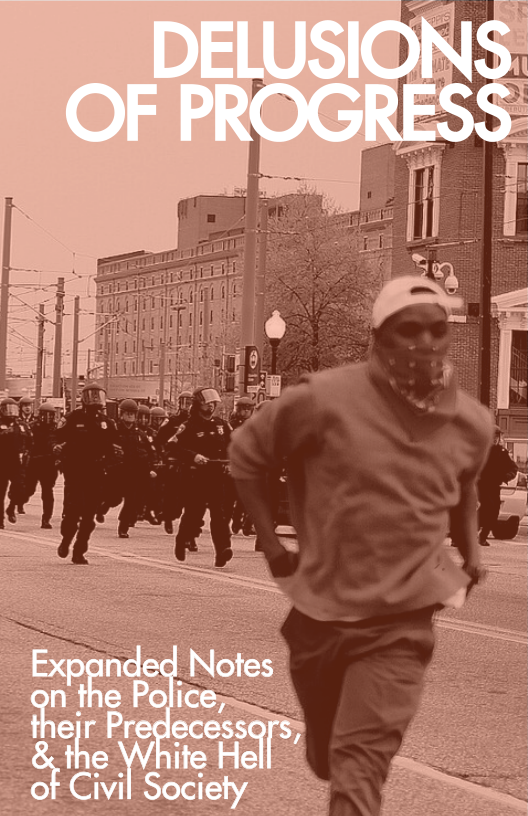
Delusions of Progress
Web PDFImposed PDFRaw TXT (OCR)


The firat vervion of this article was originally publisked in Scalawag, o magazine of southern culture and politics, with the aim of contributing to ongoing discussions of where the institution of police comes from and bow it might b etrope. Wl many bae  geneal avarenca that Americn  olicing bas it origin in olave patrols, we found some of the specifics of how {;nfl when that tranaition oc uwfiflz 1o be dlluminating and .wfby of looking at in greater detail, We ve since expanded some of the concluding notes io Jurther discuss bow this bistory is relevant to civil aociety and its attendant ‘mechanismo of repreasion and control,
Delusions of Progress: Expanded Notes on the Police, their Predecessors,  & the White Hell of Civil Society  “Bany peaple find it astonisbing that the police bave predecesaors. They e to imagine that the cop bas aluays been there, in sometbing like bis precent capacity, aubject only 10 the periodic change of wniform or the accasional technological advance.”  Kristian Williams, Our Enemes in Blue  U i ot my intention 10 argue that the differences between slavery and Jrvedom were negligble certainly auch an awertion would be ridiculous. Ratber, it is to examine the whifting and transformed relations of power that brought about the reaubordination of the emancipated, the control and domination of the free black population, and the pervistent production of blacknews as abject, threatening, vervile, dangerous, dependent, érrational, and infections.”  Hartman, Seenes of Subjection: Terror; Slavery, and Self-Making in Nineteenth-Century America  Late in the evening on May 27th, 1821, Joe Forest and two accomplices canoed down the Santee River to South Island, nestled between the major port cities of Charleston and Georgetown in South Carolina.’ The three fugitive slaves arrived on George Fords plantation to steal some cattle for provisions for their camp Further up river; such raids were commonplace for maroons who chose not to flec the South and instead made a life for themselves in the swamps and wilderness surrounding plantations.* While the men were slaughtering a cow and preparing it for  1 Alloriginal rscarch sbout Joe Forest and the maroon serugele of South Carolina in his scction can be found in Timothy Lockley Mazoon Communiie in South Caroln: A documenary record (Columbis: Universicy of South Carolina Press, 2009, 93120  As well 35 Timothy Lockly and David Doddington “Maroon and Slave Communitcs in South Carolina Before 1865." The South Carolina Hisorical Magazine Volume 113, No. 2 (April 2012). The sequence of cvents s evidenced by original court and newspaper ocumentarion can all be found i those sources. The framing and sylzing of this  2 “Masoonis aterm that criginated from the Spanish “cimarson” meaning “wild, o tame” typically referring to domeste ivcstock that wandered into the woods, cscaping. theie pastures. Howeer, this word morphed over time oo 2 slf dendfed term by more permancaly cscaped slaves who led save tevols from the Caribbean to Brazil o the
the journey, George Ford was alerted to their presence and came out to pursue the men. Rather than face capture or death at the hands of the planter, the maroons shot at George Ford, who died almost instantly. On that night there began a three year search for Joe and his maroon gang by the white citizenry of coastal South Carolina, resulting in the first official police association in the area where Joe’s camp was hidden.  Fast forward to 2016, a year when police in the United States killed at least 1,151 people’ and a time in which young Black men are five times more likely to be killed by the police than white men of their same age. Simultancously, the police are under perhaps the greatest serutiny they have ever faced as an institution in this country. The riots in Ferguson, Baltimore, Oakland and Baton rouge, the oceupation of a police: in Minneapolis, and the waves of solidarity marches, blockades, highway and bridge takeovers, and cconomic disruption that followed, have all brought tremendous attention to police training, their technologies, their structure, and their individual members. Some of this attention is the managed product of media outlets and politicians during an election season, almost totally divorced from the lived elements of unrest of the past three years. However, there are also many people asking real questions about the history and role of the cops, about what it will take to fight them and what it could be like to live without them.  The histories contained in this piece are brought back to life when we dircetly attend to these questions. In reviving these historics, we rely on knowledge that has been generated by generations of mostly Black scholars and researchers, but also lives in the bodies and minds of rioters, rebels, grandparents, storytellers, healers, artists, and lovers.  We argue that policing evolved as a method of control to enforce and protect slavery, an inseparable economic foundation in the development of American, and global, capitalism. Policing also functioned to produce a society grounded in the “social death” of Black people.* Modern policing  American South. Lockley, Marsan Comnanitis i  5 “This igure i from iledbypolice.net, an online database that rscks deaths at the bands of US. cops (hup:/ /s killedbypolice.nce/Kbp2016 heel).  4 Weuse the concepe of “socialdeath” i the tradiion of historians of savery such as Orlando Parterson and Sadiya. Harcman. Implicd i not jus physica, viokeat dispossession but a dispossession of and from both place and sclf, whezcby one is Separated ot nly from their past b ako from possible fuure generatons. In such & context, one s ot simply made to b for others, but in fact ntirly xcluded from
continued to evolve afier chattel slavery to maintain the racialized division of labor and social divisions that slavery created, but which now (in a post-Emancipation society) had to be reproduced by other forms. The demacratization of white supremacy that defined the 20th century attempted to make racialized control of capital and bodies harder to confront. This was done in part by justifying the progress that had been made “since slavery times,” or by deploying the gratuitous violence of white mob law in the South to exceptionalize the rational, humane courtrooms of the North.*  In the downtimes between national  s around unarmed police killings, all but the tiniest sliver of our society’s discourse around the police solates that institution as a “natural” arm of that other great “natural” phenomenon, the law—as a phenomenon without  history.* We can read this discourse in part as a st of creation myths, meant tojustify the unique power the police have over lfe and death. And so it is not surprising that the logics of reform and progress, which scek to fetter but not freak with Society, rest on an assumption of the inevitabiliy of the police, prison, and the law. But we show here that the police have a beginning, and so may also have an end. We present this picce not as a work of original rescarch, but as our own collected notes and understanding of these inextricable links between slavery, capitalism, police, and civil society.  the catcgory of Human. The rlationship berween policing and “social death” s furcher anticulated in our concluding notes  5 To condema slavery, cconomic abolidonists used slavery’s supposed backvardsness to point o that Progress (wage labor) would ulimately, nevitably cvolve: ot of stavery because i was,they argued, not 2a effcient merhod of extracing iboe nd producing commodirics. These claims prove highly dubious if not donworight ke ‘cconomic historians like Edveasd Baprist have conclusivly demonstrted that vy var o iy poftabeand it st that ade America wht it was onthe world tage, and v i ecwed vite of grs rater tha deie ¢ th iene of the Ciil Wa. Accordingly, the politcal movement of sboliionism never developed # vision o ststegy that broke with police, wage savery o the ule of aw It did not scek to abolish bondage—it sought o desmocratze i  6 Hartman writes on the insidious way in which the Law attempred to construct el as neuteal 0 the segeegarion of socil e in the Jim Crow South while also crearing  it verylegliyin Plesy vs Ferguson, the Supreme Cout ruling that egalzed “scpacte bt qual” segregation in the South: “Therefore, although, it appeased tht the siate refused 0 fnervene o privae by declaring it 3 law-fee and voluntary sphere, the state was alecady there and actively governing the conduct of individuals... The innocence of the lave it did not create preudice and thus could not change i) and the stte (i mercly protected the public safet, healeh, and morals and promoted the generl prosperity)  cd by denying the public character of acism and atcibuting it o individusl  (Scencs of Subjecton, 201,  prerogatives”
We write this not simply to “set the record straight” on the history of police, as many have already done that work more completely elsewhere, but to understand how that might speak to our ongoing cfforts to destroy the world that has been imposed upon us.  One Beginning Among Many  Within days of slaveowner George Ford’s death, the Governor of South Carolina delivered a_proclamation, including physical descriptions of Joe and his accomplic ck,” as well as a $200 state reward for their apprehension. Georgetown citizens volunteered their own $300 towards the maroons capture. Four days after the Governor’s Proclamation a local militia, the “Columbian Greens” apprehended Jack and brought him to Georgetown to be tried for the murder of George Ford. Meanwhile, Joe managed to escape the multiple militias and remained frec for the rest of the summer.  Georgetown’s Court of Magistrates and Frecholders —white, propertied men, and the formal predecessors of today’s citizen jurors —found “the evidence conclusive” that Jack was culpable for George Ford’s death. He was found guilty and sentenced to be hanged on June 8th. On June 12th, the Captain of the Columbian Greens petitioned the Governor for his reward, claiming personal responsibility for apprehending the maroon. Captain Carnes received the $200 state rew: after his son H.L. Carnes Jr. served as one of the men who condemned Jack to his death. This type of nepotism, wherein the Captain of a militia receives funds for the capture of an escaped slave while his son serves as a juror in the defendant’s “trial’, was simply business and law as usual for the Southern aristocracy.”  For the next two years, Joe remained at large, his legacy and band growing all the while.  Joe and other maroons, with whom he communed and conspired, survived in a well fortified camp at the headwaters of the Santee River in  the densest swamp between Georgetown and Columbia—impenctrable
5  10 outsiders. While the general location was well known and advertised by the militias, patrols, and posses whose job it was to hunt escaped slaves in the area, the Camp’ position allowed the maroons to see the confluence of three rivers and all who passaged in them without being scen themselves. They were well armed, trained in weaponry, and passed down an incredible knowledge of coastal and swamp geography. But most importantly, they rarely turned on one another. Many of the maroon men were deseribed in the press not by their names but by their battle multancously identifying them to white society and indulging the zed hysteria surrounding them.  Maroons posed more than an economic loss to the plantation economy — they threatened both the legitimacy of is existence and its secure future. by navigating the wilderness surrounding plantation and town borders, living alife (temporally) free of both enslavement and, largely, of waged work. Alliances formed in these swamps that betrayed the white supremacist pact of planter economics. Poor whites who were marginalized from  Maroons were proof that it was possible to subvert white contr  proper society would trade with and assist maroons, though less is documented about these alliances. Shamefully, more is known about the frequency with which non-slaveowning, poor whites aligned themselves with the planter class by volunteering in the militias and patrols who hunted down escaped slaves. Their collusion with the planter class, with whom they shared litle besides whiteness, was absolutely crucial during times like the 1820s when generalized slave insurrections were not a paranoid imaginary, but active armed conspiracy.  However, in the summer of 1822, not all whites were voluntarily hunting down maroons like Joe Forrest. Denmark Vesey, a free Black man in Charleston, conspired alongside hundreds of enslaved and free Blacks, as wellas four (known) white men in coastal South Carolina to overthrow the white planter class of the coast, free slaves, and sail to Haiti. Purposefully the four white men who were tried and ted of "inciting slaves to insurrection” refused mandat  buried in the bowels of history  service in the state’s slave patrols and condemned white planter society while actively aiding an armed insurrection against whites in the South.  8 There s nly one scholady investgarion nto the white conspirators of Vesey’s Insusrecton: Philip Rubio, “Though He Had A White Face He Was a Nego At Heart,” The South Caralina Hisoical Revin, 2012. Rubio poies out how: the whice me’s court documents were fled 15 separate sppendix from the engthy and infamovs Offial Rert tha detailedthe il of the 131 Blacks who were acrsted
William Allen, (who arrogantly thought he would lead the insurrection) nonetheless is remembered as telling black conspirators who were stful of him because he was white, that though he “had a white face, he was a Negro in heart.” While John Igneshias, a Spanish sailor, declared to the courts that he “disliked everything in Charleston but the Negroes and Sailors.” In an act of distancing himself from white society t0 gain trust from Black conspirators, Igneshias indignantly proclaimed, “Damn the whites, 1 would kill them all.” Little was shared by all four men except their status as outsiders-- as sailors, criminals, vagabonds, or non-Anglo whites (some had not assimilated to Anglo-southern accent and customs) and so in a way were only tenuously included in whiteness.  These men, who fraternized and conspired with Black insurrectionarics, exposed the fault lines and contradictions within the supposed white consensus of southern society. Similar to the way in which the white aristocrat viewed the threat of slave insurrections, at all times in the court proceedings the magistrates and judge attempted to control a double- edged myth: white men could be conspiring everywhere with slaves to overthrow our society, and simultancously they refuted any credible evidence of such activity. As Rubio observes, “The appendix refers to four unimportant ‘degencrate white men’ that had nothing to do with the insurreetion, yet they were a danger to the established order.” In the iew, white outsiders fad to be responsible for inciting slaves to ction, since the idea of slaves rebelling of their own will perverted the narrative of a class of people providentially ordained to servitude. Yet, to desire to destroy the slave cconomy, aid in liberating slaves, and start a new society would be to refuse the very power that whiteness was constructed on, and who in their right minds would voluntarily destroy that privilege?  state’s  Judge Bay, who presided over the Vesey trials condemned 35 Black conspirators to death and 32 to exile, while begrudgingly sentencing the four white men to a host of fines and short jail time. Bay was outspoken that he believed the laws should change for white men aiding insurrection against slavery, and that any person, regardless of race, should be condemned to death. Yet, simultancously, he spared them gallows on a fine technicality, convicting them of “inciting” insurrection, rather than materially aiding it. The trial in and of itself, similar to Jack’s wrial in Georgetown, was not exemplary; it is only noteworthy for its ordinariness, for how normal the gratuitous and impunitive relationship
of the law manifested on black bodies—how the white frecholder or white spectator in court secured civility through the condemnation and consumption of black death.  Meanwhile, during the Vesey trials, forces north of Charleston struggled to control the threat that Joe and his gang posed on the Georgetown planter class. The two governing districts ended up collaborating to apprehend Joe. This collaboration between Georgetown and Charleston poins to the evolving geopolitics of southern capitalisms the control of slaves, and especially escaped slaves, became less of a picate matter of the dual slave-owner and more a public responsibility of white society and  he citizens of Pineville looked toward a hybrid Solution between the militia and the posse —the Police. Instituting an claborate system of rewards, including manumission (the buying of a loyal slave’s frecdom camp formed their own Pineville Py 1823, “specifically to deal with the threat posed by Joe and his gang.” Their strategy was to force the collaboration of enslaved people against maroons. Within a few days, an enslaved river-boat driver named Royal, who had been dealing with Joc and the maroons in that area for years, volunteered to lure Joe out of the Camp with promise to trade.” When Joe and three other maroons emerged from their encampment, they were fatally shot by 23 members of the Pineville Police Association. Joe’s head was stuck on a pole at the mouth of the river, “as a solemn warning to vicious slaves.” One year later, 81 planters from central South Carolina petitioned the Governor to free Royal for “bringing to merited punishment an offender, against the laws of the land and against the laws of God.” The state agreed to pay Royal’s owner seven-hundred dollars,  9 In reacton 0 the Vesey Conspiracy of 1822, fce blacks were subscquendy banned from entcring the stat of South Carolin, while private manumission had been el or some years. This meaat that the chances of sccuring frecdom 35 3 slave n South Carolins in 1823, y giimate moa, s  pracica impossibley. In exploring ‘potential moives for Royal o collsborae, Lockley ako poiots out that the longer maroon gangs had to surviv in the swamps a¢ the perphery of plantaton soccty and geography, the more teasions came o 2 head with neighboring Acld slaves du 1o the i that they frequently made on planttions and fems, some of wehich impacted the food supply and resources for those ensaved. Similar o slaves who were marinrs (aposition outwed after Denmark Vesey’s conspieacy), ver boat divers had & et amount of autonomy in moveanent beyond many ficld shves and wodld have more inceative to prorect that
declaring that it was “‘the policy of this state to reward those slaves who thus distinguish themselves by way of inducement to others to do so.”  The hanging of Jack in 1821, of Denmark Vesey in 1822, and the shooting of Joe in 1823 did not mean defeat for fugitive slaves in South Carolina, and both maroonage and northward escape would continue 10 pose viable threats to slavery up through the Civil War. Meanwhile, , the Constitution of the Pincville Police Association clearly purpose as “the enforcement of a rigid system of police and the with slaves.” The documents left behind from the courts, the newspapers, and the small town police in the wake of Joe Forest’s capture and death foreshadow a world 200 years later—a world where the FBI s sill issuing rewards for self-identified fugitive slaves. Assata Shakur, an invaluable part of the black liberation movement of the seventics, lives in political exile in Cuba where she identifies as a “20% century escaped slave.” Shakur fled the U.S. prison system after enduring an unfair trial in which she stood accused of killing a New Jersey cop during a traffic incident on May 2+, 1973. Thirty years after the shooting, on May 2+, 2013 the FBI renewed their investment to hunt down and capture Assata and now offer two million dollars for her extradition to the United States.’"  A Broader View of Early Policing Forces in the Antebellum South  The example of Joe Forest’s rebellion and the emergence of Pineville’s original Police Association offers one poignant snapshot of the origins of the police in the South. A broader picture, including the roles and development of policing bodics in both rural and urban arcas, offers dally designated by authorities as “slave searchers,” and nicknamed “paddyrollers” or " by those they policed, these emerging institutions changed during the 18" and 19° centuries in ways that directly foreshadowed the institutional and structural character of modern police forces.!!  10 Tor more on Assats Shakurs sory read ber own words in “An Open Leter from Assata Shakur” herpe// repositories iaexas.cdu, bitsream /handle/ 2152/ 6046/ Open LetterFeom+ Assata-+ Shakue pafsequence=1  11 Mostof the rescarc for his secton can be found i the new editon of Kiistan  Willams’ exhaustive hiscory of the police in, Our Eneic n Bsc: Pl and Paver in Anerica (Oakdaad: AK Press, 2015)
The first slave patrols that emerged not only depended upon but often coercively required the help of white people in policing slaves, whether they were slaveowners or not. A 1690 law in South Carolina, for instance, demanded “all persons under penalty of forty shillings to arrest and chastise any slave outside of his home plantation without a proper pass.” These white people were volunteers, in the sense that they were unpaid and held other jobs, but they sometimes faced real punishment, such as fines or jail time, if they refused their duties. In this way, these slave patrols not only provided for the security of this highly profitable mode of production, but directly enforced and reproduced carly racial  designations. Whiteness meant not only a structurally reinforced privilege, but implicd a duty and obligation toward wtate and economy that was both consituted through slavery, and needed it to thrive.  Patrols of this kind were empowered to capture runaways and beat slaves caught travelling without a pass. As concerns of active revolt took hold, they would preemptively break up slaves’ gatherings, search their homes, and seize their possessions. The distinction is important; the patrols performed their activities not simply as hastily assembled bands  Sent out to catch a group of runaways or put down an ongoing revolt, but as a preventative hody of racial, social and labor control. In many places, these patrols were also tasked with governing disorderly whites, particular vagrants, outsiders, and those who would trade with fugitives and maroons.  The authority of slave patrols typically lied with the militia at first, though this came to change. In Mississippi, for example, the patrols were  first performed by federal troops, then by militiamen, then finally by  groups of white men appointed by the county. Many rural patrols started off as temporary or part-time, and eventually transitioned to full-time policing bodics. Accompanying those changes was the specialization of the police themselves. Though it varied across the South, in many places these patrols evolved from groups of able-bodied, white, male volunteers to paid employees, sworn in by the state and thus indemnified against lawsuits.  Policing bodies in the city evolved along similar lines, following the evolution of the slave patrols. In 1783 the city of Charleston formed a City Guard that patrolled as a company, wore muskets and swords, and was tasked with breaking up slave gatherings and cutting down on urban
erime. Tn her book on slave patrols, historian Sally Hadden quotes an Englishman who visited Charleston in the 1850s: “It was a stirring scene when the drums beat at the Guard house in the public square...to witness the negroes scouring the streets in all directions, to gt to their places of abode, many of them in great trepidation, uttering cjaculations of terror as they ran.”  In cities like Charleston it was not uncommon for slaves to live in one part of the city while their owners lived in another, making difficult the more private system of discipline of the plantations. It was also common for owners slaves, for a fee, to carly urban manufacturing firms. Municipal and state governments recognized the threat to labor control represented by these developments—South Carolina banned the practice for 90 years—but the system of hiring out slaves was immensely profitable, and regulations against it went largely ignored. In this sense, urban police emerged and modernized during the historical and spatial of industrialized labor and slavery. Industrialization and urbanization forced changes in and additions to the private, informal methods of discipline charact to the classical plantation system, but not with the intent to lessen wl control over Black bodies diminish an enormously profitable system of agrarian capitalism.  hire out” th  intersecti  to  Though they varied in pace by city and region, these developments in social control —the slave patrols’ preventative function; their apecialization as a paid, permanent force; the establishment of cidian rather than military control over the patrols, ultimately by municipal authoritics; and the patrols” role in policing racialized neighbarhood teritories of carly industrial workers —all point directly towards modern policing.”* These forces were already a modern (and modernizing) apparatus of social control long before the Civil War.  The Same by Another Name:  Transitions in Policing during Reconstruction  Tt might be comforting to demonstrate that the crises of the Civil War, Emancipation, and the subsequent project of Reconstruction offered a fundamental political-ethical break from the previously established patterns of white supremacist policing in the South. Unfortunately, the  2 We owe some of ou taxonomics of polie functions to Kristian Willams’ ciera that distinguish “modern” policing from s casie forms. Thid., 53-54,
very opposite was true: the modernity; industry, and racial “reconciliation” of the post-war period, imposed in part by Northern liberators, directly  relied on and enhanced the role and structure of police.  The Reconstruction period resulted in a power vacuum in much of the South, whereby experiments in freedom and self-determination could be undertaken with newfound brazenness. Maroons in places like North Carolina’s Great Dismal Swamp and the Sea Islands continued their efforts at communal lfe, while former slaves in places like the Ogeechee Neck of lowcountry Georgia armed themselves, raided rice plantations, and occupied the(ir) land, declaring, “Nowhites between the Ogeechees!” In Robeson County, North Carolina, a band of Lumbee Indians, former slaves, and disaflected whites called the Lowry Gang exacted revenge on the plantation aristocracy by assassinating former Confederate offcials, expropriating and redistributing crops, and refusing to work in the industrializing sectors of the cconom:  I’s important to remember that “emancipation” was a program that many Black people had already interpreted on their own terms and had been carrying out before and during the Civil War. In that context, and that of the post-war period where open, armed rebellion by laboring people was a serious threat, the project of northern institutions like that of the Freedmen’s Burcau often had more to do with ensuring labor discipline in the newly emerging wage-labor economy than ensuring any kind of meaningful racial “justice.” That institution revealed itself to be the enforcer of the old cconomy in new terms:  The “two evils” against which the Bureau had to contend, an army officer observed in July 1865, were “cruelty on the part of the employer and shirking on the part of the negrocs.” Yet the Burcau, like the army, scemed to consider the Black reluctance to labor the greater threat to its cconomic mission. In some areas, agents continued the military’s urban pass systems and vagrancy patrols, as well as the practice of rounding up unemployed laborers for shipments to plantations. Burcau courts in Memphis dispatched impoverished Blacks convicted of crimes to labor for whites who would pay their fines.  It was not uncommon for northern white “liberators” to force former slaves to labor for their former masters at the point of a bayonet, often
making use of the very same systems of identifying people and controlling their movement developed under slavery. Those systems of policing were indispensable to disciplining former slaves into the new exploitation of the wage, and thus crucial to the project of industrializing the South afier the war. Militia patrols, rewards, bounty hunte court structures, for example, were used both by former Confederates in Robeson County as well as northerners and Republicans in an attempt to stem the Lowry Gang’s rebellion.  informants, and  Ultimately, there evolved in the post-war period a “hybrid” system of discipline and social control in the South. This system integrated private forms of discipline consistent with the plantation, the publicly authorized rural and urban patrols alongside Northern judicial practices, institutions of social work and management like the Freedmen’s Burcau, and industrialized modes of work and the wage. This meant that although there were already modernizing police forces in the South before the end of the war, those forces had to adapt to the post-war realities of controlling wage labor, unemployment, urbanization, and social codes of segregation all without the "help” of a legalized system of slavery.  Some Closing Notes on Policing, Whiteness, and Civil Society  1t beyond the scope of this piece to further elaborate on the continuity of anti-Blackness and white supremacy endemic to policing and the law afier the period of Reconstruction. Suffice to say, white supremacy in America remained both literally and figuratively business as usual on into the 20’ century, during the periods defined by convict leasing, Jim Crow segregation, and the country’s massive prison boom —the “afterlife of slavery” as author Saidiya Hartman has put it  Plenty of folks will consider the painting of 21" century police as modern- day “slave catchers” as nothing more than metaphor and hyperbole. But as we (and many others) have already demonstrated, modernized police actually emerged in the South during slavery—they literally were slave catchers. We would ask those who desire an “accountable” or “just” police force: At what point in this history, in what period, did the police become sitution that intended anything other than the reproduction of capital and the enforced social death of Black people? When has there ever been a break, either social or cconomic, political
or existental, with this coniguous march towards dispossession and i point of policing, but also its continse) ontological force and psyehological foundation. Howw could there ever be “accountability” with such an institution, and why would it be desirable even if it were achieved? What sense does it make to speak of accountability between a master and a slave? Between a state and the dispossessed?  Slavery is not just the historical  Slavery itself can be defined by and considered from any number of theoretical viewpoints, of which we can only seratch the surface in this space. Two perspectives do scem necessary to mention here. First is a materialist perspective, which primarily defines slavery as an economic condition of bondage and forced labor: The other, suggested by historians like Orlando Patterson, defines slavery not so much by forced labor as by ocial death,” the systematic rupture of familial ties and gencalogical continuity, and gratuitous violence.  athreefold condition of dishonor or  Our interest here lies in considering how 21" century policing in fact fulflls the conditions of hotk perspectives. The police undeniably coerce labor participation in the capitalist cconomy and thereby reproduce patt ed labor, for example by securing unpaid labor for prison facilities, or by preventing acts of collective expropriation, criminalizing lifestyles that resist wage work, and policing the boundaries between the legal/llegal cconomies, all of which forces those without capital to sell our labor for a wage. Likewise, it’s just as possible to sce how police continue to fulfill the conditions of slavery identified by Patterson, for example by breaking up familial connections via the mass removal of Black bodies from their communities into the prison system, destroying Black social organization with programs like COINTELPRO, or enacting limitless violence against young Black people in poorer neighborhoods across the  of foy  country. By no coincidence, prisoncrs (black, brown, and white) across the country echoed this observation when announcing a historic national strike last year, with their call to “End Prison Slavery in America.”  The other aspect to this role of police in reproducing conditions of slavery ole in the reproduction of whiteness, not just as a set of assumed, idual privileges but also as a structurally reinforced civil duty to the  is theis  indi  13 COINTELPRO was  covert government program designed to undermine, solt, and destroy lberarion movernears during the 1960’ and 70’ in partcula the Black fiberation movement,
state via inclusion in the social body, citizenship, and Humanity itself. The genesis of this duty is clear in the use of white, non-slave-owning volunteers in the early slave patrols and in the deputizing of white people for the posse comitatus, among many other possible cxamples. Civil society took root in the hrizontal authority assembled to suppress  Black rage. To return to Saidiya Hartman, “The slave is the object or the ground that makes possible the existence of the bourgeois subject and, by negation or contradistinction, defines liberty, citizenship, and the enclosures of the social body.” It follows that the brutally violent policing of Black people implies, again by contradistinction, a white inclusion in the social body that indicates a specific relationship to the state.  The whiteness we di consequence of individual privilege. Whiteness is an organizing principle of social relations, a material, historical, psychic, ontological, and collective We believe it is necessary to understand the development of whiteness critical and distinet from pri understanding and in social movements has come to correspond with the specialized, destroy or as we know it, including the university, the non-profi, local city councils,  uss here is not an individual identity or a mere  nd white exceptionalism while remaining lege theory, which deemphasizes structural  rofessional, and often reactionary role of white allies. To  mantle” whiteness will take the dismantling of the world  and many other formal and informal insitutions that the white ally calls home.  This also has real consequences in its challenge to the traditional sphere of activism we call civil society. The fledgling anti-police insurgencies that have sprung up around American cities in the last several years have been expressions of power, autonomy, and divine violence” against the forces of oppression and social control. But inside this movement there are many who are confused and threatencd, if not absolutely terrified by these gestures towards power. They contrast the peaceful protesters the “bad ones,” they try to rip the masks off of youth, they don  " Likewise, exery car that passes by on the highway with a “thin blu line” stickee i 2 modeen-day reminder of this, best understood not ust 25 3 symbolic polical supportof law enforcement but as the cxpression of 4 conscious social contract benwveen ‘whit cizens and the police  15 Contrasted with law-preserving and law-making anshic i, csitcal theorist Walter Benjamin prescnted a diin ridns which cortesponds with  proletarian stske thae of Eapton, rans.  “lies sbsalutely ‘outsid’ and beyond! the L Kevin Awel, Chicago; London: Univesicy of Chi
neon vests to “keep you safe” and then spend their time policing the boundaries of legitimate protest and discourse. Echoing the words of Martin Luther King, Sr. after Atlanta’s Summerhill neighborhood riot in 1966, they say of those who fight, “Those are not my people.” Terrified of experiencing even a fraction of the unceasing violence the state imposes on other bodics, white people bail out for the higher, safer ground of ally politcs, sceking shelter in the nearest credentialed leader of color who advocates a more “responsible” politics than the rioters they secretly fear. ‘We imitate the state in our resistance, either because we secretly desire its version of power, or because we don’t trust or love ourselves enough  t0 believe that another world is possible.  Civil saciety —that sphere of the capitalist world, outside of government but beyond “private” lfe, that supposedly makes living in a democracy so special — is the discursive and structural territory of this (white) fear of black and proletarian rage. Not coincidentally, it is this civil society that policing was designed to reproduce and protect. Look at the many words and phrases that are evoked in any discussion of policing: citizen, peaceful protester, the Public, order, property, good conduct, public safety. The police exist to protect these things as legitimate spheres of Social life and custom; they also produce them.  Critical theorist Frank Wilderson writes, “There is something organic to the black positionality that makes it essential to the destruction of civil Society.” This can be thought of through the lens of one’s relation to the cconomy and work:  The worker demands that productivity be fair and democratic  (Gramsci’s new hegemony, Lenin’s dictatorship of the proletariat, in a word, socialism). In contrast, the slave demands that production stop, to its ultimate democratization." Work s not an organic principle for the slave...Whereas the  without recour  16 We’re reminded of a Worker’s World Pacy sign at an ani-polic protest in our toun several years a0 In  sca of Latino familcs and black, brown, and whie youth careying skatcboaeds and screaming “Fuck the Police!”, some very oot of touch Stlinist demanded with theie milquecoast cardboad, “Communiey Conteol of the Police Now:” In secking o democratize ather than destroy the sic or sructure of oppression—the workplace,the police department,the courtroom, Congress, the bourgeois il whatever—he lefist is ahways teying 10 ferurn moments of rehelion 0 a place tht is at once sadical but il 0 th forces of order and good governance. The anarchis, the prison-slave, and the insurgent must find other ways out of this mess.
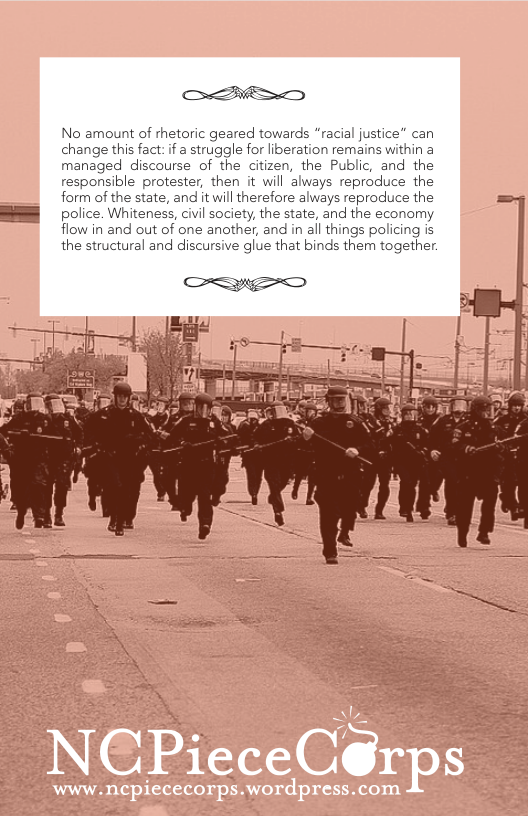
positionality of the worker (whether a factory worker demanding a monetary wage, an immigrant, or a white woman demanding a social wage)  gestures toward the reconfiguration of civil society, the positionality of the Black subject (whether a prison- slave or a prison-slave-in-waiting) gestures toward the disconfiguration of civil society."”  Regardless of the post-racial period we supposedly inhabit, and regardless of which hands pull the levers, civil society must always, like policing, be an anti-black apparatus. It is characterized by the power and promise of whiteness, historically defined as the relationship of both privilege and responsibility to structures of power and the discourses that help 1o reproduce those structures. No amount of rhetoric geared towards justice” can change this fact: if a struggle for liberation remains in a managed discourse of the citizen, the Public, and the responsible proteser, then it will ahvays reproduce the form of the state, and it will therefore ahways reproduce the police. Whiteness, civil society, the state, and the economy flow in and out of one another, and in allthings policing. is the structural and discursive glue that binds them together.  All of this raises practical questions for those of us who wish to not just understand policing but actively undermine and destroy do certain forms of activism reinforce a civil relation to the state as a prerequisite for “change”? If the terrain of civil society is inherently and permanently marked by slavery, what forms of organizing against the police (and organizing ourselves!) are less limited by this terrain?" Is  t. How  17 While we ageee with this criique, we would argue tha the current “workers” movement;” which took as i aim the (capitals) democratzation of the workplace e than s destruction and)/or comimunization,only really ok shape afte vioently Suppressing (o acquisseing t the suppression of) more legal antindusrial, sad communistic expressions of caslic proletaian rag. The cxamples of this arc myrad, from the Ludies of England to Sea [<and maroons who refused to farm cash crops forthe Union. We dont belicve this frct pariculary challenges Wiklerson’ main premisc here, but it does give us some hope that, jus as some cary “workers™ revols resised the formation of a civi society,in 4 e where the workplace o longer feaures promineatly in prolecarian insurgencics, many workers will gain find & home n movements that seck ¢ civl sociey saher than eprocuce i,  o disconfigure”  15 Moch of the lase thrce years ioing in response to police muders of Black youth fecls ke at et  partial answer t these questions,as these momets have pointed Cowards notjust cereain forms of atack but also of “orpanization’” that eject the cespectabiliy of civilsociey: the sharing of looted goods, ncighborhood block patics and impromprs assemblies n busncd out parking lots, gang euces, iter promored
it possible for poor whites to participate in rebellion against the police in ways that begin to disconfigure our own whiteness, or is this just an insurrectionary pipe dream?  In the current political moment we are witnessing the transition from a failed experiment in post-racial discourse during eight years of Obama to the stark reality of Bannon and Breitbart. How does Trump’s regime change affect the way in which we discuss policing, race, class, and civil Society? What fundamentally changes about policing from neo-liberalism to the proliferating alt-right agenda, if anything? What will it look like for “community policing” to co-exist with an open white supremaci charge of the border and leading the National Security Counci  The  Obama cra sought to pacify protest and achieve conciliatory, hollow  reforms of some of the most foundational ins  utions to white supremacy, and failed miserably in even these superficial endeavors. Now those platitudes or delusions of progress are exposed for what they are. As the editors at Crimethine have consistently observed, every strugele, every campaign will also be a struggle against the police. Those who have tried to reckon with policing will now be forced to take a side as our country boils over —as the tensions that have always been brewing, and at moments are barely beneath the surface, are lefi exposed.  These are just some of the questions attending to the history of slavery and policing, as those forces continue to haunt both normal, daily life as well as the increasingly common moments where that normality is ruptured in some way. But slavery doesn’t just hover in the background like a specter from another century; it actively tells us who we are and where our loyalties lie, it distinguishes the dead from the living, it holds the keys to prison cells and patrols our streets.  ash mobs,the transformarion of crews of fcads and ncighbors into ghting units,che  buiding of relatonships trough both shortterm (scjcomplicityin he stect and longer.  tecm support throvgh trial and prison. Thisis only a padal picture, of course. There  are also ample other kinds of organizing and acivsm that have reverberated around the From official accvist chapters 0 popular hashtags,thit have chosen a varery  of different sracics, some amplifying or atlast pasively supporting this strcer-level  insurgency, and others invisibilzing or outtight condemning such modes of struggle.

For a full works cited, check out “Delusions of Progress: Expanded Notes on the Police, their Predecessors, and the White Hell of Civil Society” at itsgo- ingdown.org.  References & Suggested Reading  Anonymous. “Between Strangers and Friends: Reading Baldwin and Gener,” Bacden:  Jousnal of Queer Time Trawel VoL 3 (2015): 55-114. Eric Foner. A Short History of Reonstruction, New York, NY: Harper & Rovw, 1990.  Frank Wilderson. “We’re Trying to Destroy the World:’ Anti-Blackness and Police Violence afer Ferguson.” Chicagos 1l Wil Editions, 2014  Frank Wilderson. “The Prison Slave As Hegemony’s (Silent) Scandal.” Chicago: Il Will Editions, 2014, Originally published in 2005  K. Aarons. “No Selves to Abolish: Afropessimism, Anti-Poliics, and the End of the ‘World.”Chicago: Il Will Edicons, 2016.  Kristan Williams. Our Encmic in Blue: Ploeand Posee in Ameri (Thivd Edlition). Oukland, California: AK Press, 2015.  of Insaowction in te  Neal Shirley and Saralee Stafford. Disie Be Daned: 500 Vs American South. Oakland, California: AK Press, 2015.  ‘Orlando Patterson, Slasery and Soial Death: A Comparative Study (Cambridge: Harvard University Press, 1952).  Phillp Rubio. "Though He Had a White Face He Was a Negro At Heart’ Examining the White Men Convicted of Supporting the 1822 Denmark Vesey Slave Insurrection. The South Carolina Historisal Magasine Vol 115 No. 1 (Jansary 2012)  Saidiva Hartman. Seons of Subjction: Terno, Slaery, and Amerien. Oxford: Oxford University Press, 1997.  Af-Making in Nincteonth-Century  Sally E. Hadden. Slawe Patrobs: Law and Vilence in Vi and the Carolinse. Canmbridge, Massachussetts: Harvard University Press, 2003.  Tim Lockley and David Doddington. “Maroon and Slave Communicies in South ‘Carolina Tefore 1865." The South Carvling Historical Magazine Volume 115, No.2 (April 2012)  Timothy James Lockley. Marven Commaundtiss in South Carolina: A Dovumentary Recod. Columbia, South Carolina: University of South Carolina Press, 2009.  WE Dubois. Black Reconstuction in Ameri. Oxford: Oxford University Press, 2007.

[  No amount of rhetoric geared towards “racial justice” can change this fact: if a struggle for iberation remains within a managed discourse of the citizen, the Public, and the responsible protester, then it will always reproduce the form of the state, and it will therefore always reproduce the police. Whiteness, civil society, the state, and the economy flow in and out of one another, and in all things policing is the structural and discursive glue that binds them together.

The firat vervion of this article was originally publisked in Scalawag, o
magazine of southern culture and politics, with the aim of contributing to
ongoing discussions of where the institution of police comes from and bow it
might b etrope. Wl many bae geneal avarenca that Americn

olicing bas it origin in olave patrols, we found some of the specifics of how
{;nfl when that tranaition oc uwfiflz 1o be dlluminating and .wfby of looking
at in greater detail, We ve since expanded some of the concluding notes io
Jurther discuss bow this bistory is relevant to civil aociety and its attendant
‘mechanismo of repreasion and control,
Delusions of Progress: Expanded
Notes on the Police, their Predecessors,

& the White Hell of Civil Society

“Bany peaple find it astonisbing that the police bave predecesaors. They e to
imagine that the cop bas aluays been there, in sometbing like bis precent capacity,
aubject only 10 the periodic change of wniform or the accasional technological
advance.”

Kristian Williams, Our Enemes in Blue

U i ot my intention 10 argue that the differences between slavery and
Jrvedom were negligble certainly auch an awertion would be ridiculous.
Ratber, it is to examine the whifting and transformed relations of power
that brought about the reaubordination of the emancipated, the control and
domination of the free black population, and the pervistent production of
blacknews as abject, threatening, vervile, dangerous, dependent, érrational,
and infections.”

Hartman, Seenes of Subjection: Terror; Slavery, and Self-Making in
Nineteenth-Century America

Late in the evening on May 27th, 1821, Joe Forest and two accomplices
canoed down the Santee River to South Island, nestled between the
major port cities of Charleston and Georgetown in South Carolina.' The
three fugitive slaves arrived on George Fords plantation to steal some
cattle for provisions for their camp Further up river; such raids were
commonplace for maroons who chose not to flec the South and instead
made a life for themselves in the swamps and wilderness surrounding
plantations.* While the men were slaughtering a cow and preparing it for

1 Alloriginal rscarch sbout Joe Forest and the maroon serugele of South Carolina
in his scction can be found in Timothy Lockley Mazoon Communiie in South Caroln:
A documenary record (Columbis: Universicy of South Carolina Press, 2009, 93120

As well 35 Timothy Lockly and David Doddington “Maroon and Slave Communitcs in
South Carolina Before 1865." The South Carolina Hisorical Magazine Volume 113, No.
2 (April 2012). The sequence of cvents s evidenced by original court and newspaper
ocumentarion can all be found i those sources. The framing and sylzing of this

2 “Masoonis aterm that criginated from the Spanish “cimarson” meaning “wild,
o tame” typically referring to domeste ivcstock that wandered into the woods, cscaping.
theie pastures. Howeer, this word morphed over time oo 2 slf dendfed term by more
permancaly cscaped slaves who led save tevols from the Caribbean to Brazil o the
the journey, George Ford was alerted to their presence and came out to
pursue the men. Rather than face capture or death at the hands of the
planter, the maroons shot at George Ford, who died almost instantly. On
that night there began a three year search for Joe and his maroon gang
by the white citizenry of coastal South Carolina, resulting in the first
official police association in the area where Joe's camp was hidden.

Fast forward to 2016, a year when police in the United States killed at
least 1,151 people’ and a time in which young Black men are five times
more likely to be killed by the police than white men of their same age.
Simultancously, the police are under perhaps the greatest serutiny they
have ever faced as an institution in this country. The riots in Ferguson,
Baltimore, Oakland and Baton rouge, the oceupation of a police:
in Minneapolis, and the waves of solidarity marches, blockades, highway
and bridge takeovers, and cconomic disruption that followed, have all
brought tremendous attention to police training, their technologies, their
structure, and their individual members. Some of this attention is the
managed product of media outlets and politicians during an election
season, almost totally divorced from the lived elements of unrest of
the past three years. However, there are also many people asking real
questions about the history and role of the cops, about what it will take
to fight them and what it could be like to live without them.

The histories contained in this piece are brought back to life when we
dircetly attend to these questions. In reviving these historics, we rely
on knowledge that has been generated by generations of mostly Black
scholars and researchers, but also lives in the bodies and minds of rioters,
rebels, grandparents, storytellers, healers, artists, and lovers.

We argue that policing evolved as a method of control to enforce and
protect slavery, an inseparable economic foundation in the development
of American, and global, capitalism. Policing also functioned to produce a
society grounded in the “social death” of Black people.* Modern policing

American South. Lockley, Marsan Comnanitis i

5 “This igure i from iledbypolice.net, an online database that rscks deaths at the
bands of US. cops (hup:/ /s killedbypolice.nce/Kbp2016 heel).

4 Weuse the concepe of “socialdeath” i the tradiion of historians of savery
such as Orlando Parterson and Sadiya. Harcman. Implicd i not jus physica, viokeat
dispossession but a dispossession of and from both place and sclf, whezcby one is
Separated ot nly from their past b ako from possible fuure generatons. In such &
context, one s ot simply made to b for others, but in fact ntirly xcluded from

continued to evolve afier chattel slavery to maintain the racialized
division of labor and social divisions that slavery created, but which now
(in a post-Emancipation society) had to be reproduced by other forms.
The demacratization of white supremacy that defined the 20th century
attempted to make racialized control of capital and bodies harder to
confront. This was done in part by justifying the progress that had been
made “since slavery times,” or by deploying the gratuitous violence
of white mob law in the South to exceptionalize the rational, humane
courtrooms of the North.*

In the downtimes between national

s around unarmed police killings,
all but the tiniest sliver of our society’s discourse around the police
solates that institution as a “natural” arm of that other great “natural”
phenomenon, the law—as a phenomenon without history.* We can read
this discourse in part as a st of creation myths, meant tojustify the unique
power the police have over lfe and death. And so it is not surprising that
the logics of reform and progress, which scek to fetter but not freak with
Society, rest on an assumption of the inevitabiliy of the police, prison,
and the law. But we show here that the police have a beginning, and so
may also have an end. We present this picce not as a work of original
rescarch, but as our own collected notes and understanding of these
inextricable links between slavery, capitalism, police, and civil society.

the catcgory of Human. The rlationship berween policing and “social death” s furcher
anticulated in our concluding notes

5 To condema slavery, cconomic abolidonists used slavery's supposed
backvardsness to point o that Progress (wage labor) would ulimately, nevitably cvolve:
ot of stavery because i was,they argued, not 2a effcient merhod of extracing iboe
nd producing commodirics. These claims prove highly dubious if not donworight ke
‘cconomic historians like Edveasd Baprist have conclusivly demonstrted that vy var o
iy poftabeand it st that ade America wht it was onthe world tage, and v
i ecwed vite of grs rater tha deie ¢ th iene of the Ciil Wa. Accordingly,
the politcal movement of sboliionism never developed # vision o ststegy that broke
with police, wage savery o the ule of aw It did not scek to abolish bondage—it sought
o desmocratze i

6 Hartman writes on the insidious way in which the Law attempred to construct
el as neuteal 0 the segeegarion of socil e in the Jim Crow South while also crearing

it verylegliyin Plesy vs Ferguson, the Supreme Cout ruling that egalzed “scpacte
bt qual” segregation in the South: “Therefore, although, it appeased tht the siate
refused 0 fnervene o privae by declaring it 3 law-fee and voluntary sphere, the state
was alecady there and actively governing the conduct of individuals... The innocence of
the lave it did not create preudice and thus could not change i) and the stte (i mercly
protected the public safet, healeh, and morals and promoted the generl prosperity)

cd by denying the public character of acism and atcibuting it o individusl

(Scencs of Subjecton, 201,

prerogatives”
We write this not simply to “set the record straight” on the history of
police, as many have already done that work more completely elsewhere,
but to understand how that might speak to our ongoing cfforts to destroy
the world that has been imposed upon us.

One Beginning Among Many

Within days of slaveowner George Ford's death, the Governor of South
Carolina delivered a_proclamation, including physical descriptions of
Joe and his accomplic ck,” as well as a $200 state reward for their
apprehension. Georgetown citizens volunteered their own $300 towards
the maroons capture. Four days after the Governor's Proclamation a local
militia, the “Columbian Greens” apprehended Jack and brought him to
Georgetown to be tried for the murder of George Ford. Meanwhile, Joe
managed to escape the multiple militias and remained frec for the rest of
the summer.

Georgetown's Court of Magistrates and Frecholders —white, propertied
men, and the formal predecessors of today's citizen jurors —found “the
evidence conclusive” that Jack was culpable for George Ford’s death.
He was found guilty and sentenced to be hanged on June 8th. On June
12th, the Captain of the Columbian Greens petitioned the Governor
for his reward, claiming personal responsibility for apprehending the
maroon. Captain Carnes received the $200 state rew: after his son
H.L. Carnes Jr. served as one of the men who condemned Jack to his
death. This type of nepotism, wherein the Captain of a militia receives
funds for the capture of an escaped slave while his son serves as a juror
in the defendant’s “trial’, was simply business and law as usual for the
Southern aristocracy.”

For the next two years, Joe remained at large, his legacy and band
growing all the while.

Joe and other maroons, with whom he communed and conspired,
survived in a well fortified camp at the headwaters of the Santee River in

the densest swamp between Georgetown and Columbia—impenctrable
5

10 outsiders. While the general location was well known and advertised
by the militias, patrols, and posses whose job it was to hunt escaped
slaves in the area, the Camp’ position allowed the maroons to see the
confluence of three rivers and all who passaged in them without being
scen themselves. They were well armed, trained in weaponry, and passed
down an incredible knowledge of coastal and swamp geography. But
most importantly, they rarely turned on one another. Many of the maroon
men were deseribed in the press not by their names but by their battle
multancously identifying them to white society and indulging the
zed hysteria surrounding them.

Maroons posed more than an economic loss to the plantation economy —
they threatened both the legitimacy of is existence and its secure future.
by
navigating the wilderness surrounding plantation and town borders, living
alife (temporally) free of both enslavement and, largely, of waged work.
Alliances formed in these swamps that betrayed the white supremacist
pact of planter economics. Poor whites who were marginalized from

Maroons were proof that it was possible to subvert white contr

proper society would trade with and assist maroons, though less is
documented about these alliances. Shamefully, more is known about the
frequency with which non-slaveowning, poor whites aligned themselves
with the planter class by volunteering in the militias and patrols who
hunted down escaped slaves. Their collusion with the planter class, with
whom they shared litle besides whiteness, was absolutely crucial during
times like the 1820s when generalized slave insurrections were not a
paranoid imaginary, but active armed conspiracy.

However, in the summer of 1822, not all whites were voluntarily hunting
down maroons like Joe Forrest. Denmark Vesey, a free Black man in
Charleston, conspired alongside hundreds of enslaved and free Blacks, as
wellas four (known) white men in coastal South Carolina to overthrow the
white planter class of the coast, free slaves, and sail to Haiti. Purposefully
the four white men who were tried and
ted of "inciting slaves to insurrection” refused mandat

buried in the bowels of history

service in the state’s slave patrols and condemned white planter society
while actively aiding an armed insurrection against whites in the South.

8 There s nly one scholady investgarion nto the white conspirators of Vesey’s
Insusrecton: Philip Rubio, “Though He Had A White Face He Was a Nego At Heart,”
The South Caralina Hisoical Revin, 2012. Rubio poies out how: the whice me's court
documents were fled 15 separate sppendix from the engthy and infamovs Offial Rert
tha detailedthe il of the 131 Blacks who were acrsted
William Allen, (who arrogantly thought he would lead the insurrection)
nonetheless is remembered as telling black conspirators who were
stful of him because he was white, that though he “had a white
face, he was a Negro in heart.” While John Igneshias, a Spanish sailor,
declared to the courts that he “disliked everything in Charleston but the
Negroes and Sailors.” In an act of distancing himself from white society
t0 gain trust from Black conspirators, Igneshias indignantly proclaimed,
“Damn the whites, 1 would kill them all.” Little was shared by all four
men except their status as outsiders-- as sailors, criminals, vagabonds, or
non-Anglo whites (some had not assimilated to Anglo-southern accent
and customs) and so in a way were only tenuously included in whiteness.

These men, who fraternized and conspired with Black insurrectionarics,
exposed the fault lines and contradictions within the supposed white
consensus of southern society. Similar to the way in which the white
aristocrat viewed the threat of slave insurrections, at all times in the court
proceedings the magistrates and judge attempted to control a double-
edged myth: white men could be conspiring everywhere with slaves to
overthrow our society, and simultancously they refuted any credible
evidence of such activity. As Rubio observes, “The appendix refers to
four unimportant ‘degencrate white men’ that had nothing to do with
the insurreetion, yet they were a danger to the established order.” In the
iew, white outsiders fad to be responsible for inciting slaves to
ction, since the idea of slaves rebelling of their own will perverted
the narrative of a class of people providentially ordained to servitude.
Yet, to desire to destroy the slave cconomy, aid in liberating slaves, and
start a new society would be to refuse the very power that whiteness was
constructed on, and who in their right minds would voluntarily destroy
that privilege?

state’s

Judge Bay, who presided over the Vesey trials condemned 35 Black
conspirators to death and 32 to exile, while begrudgingly sentencing
the four white men to a host of fines and short jail time. Bay was
outspoken that he believed the laws should change for white men aiding
insurrection against slavery, and that any person, regardless of race,
should be condemned to death. Yet, simultancously, he spared them
gallows on a fine technicality, convicting them of “inciting” insurrection,
rather than materially aiding it. The trial in and of itself, similar to Jack’s
wrial in Georgetown, was not exemplary; it is only noteworthy for its
ordinariness, for how normal the gratuitous and impunitive relationship

of the law manifested on black bodies—how the white frecholder or
white spectator in court secured civility through the condemnation and
consumption of black death.

Meanwhile, during the Vesey trials, forces north of Charleston struggled
to control the threat that Joe and his gang posed on the Georgetown
planter class. The two governing districts ended up collaborating to
apprehend Joe. This collaboration between Georgetown and Charleston
poins to the evolving geopolitics of southern capitalisms the control of
slaves, and especially escaped slaves, became less of a picate matter of the
dual slave-owner and more a public responsibility of white society and

he citizens of Pineville looked toward a hybrid
Solution between the militia and the posse —the Police.
Instituting an claborate system of rewards, including manumission
(the buying of a loyal slave’s frecdom
camp formed their own Pineville Py
1823, “specifically to deal with the threat posed by Joe and his gang.”
Their strategy was to force the collaboration of enslaved people against
maroons. Within a few days, an enslaved river-boat driver named Royal,
who had been dealing with Joc and the maroons in that area for years,
volunteered to lure Joe out of the Camp with promise to trade.” When
Joe and three other maroons emerged from their encampment, they
were fatally shot by 23 members of the Pineville Police Association.
Joe's head was stuck on a pole at the mouth of the river, “as a solemn
warning to vicious slaves.” One year later, 81 planters from central South
Carolina petitioned the Governor to free Royal for “bringing to merited
punishment an offender, against the laws of the land and against the laws
of God.” The state agreed to pay Royal’s owner seven-hundred dollars,

9 In reacton 0 the Vesey Conspiracy of 1822, fce blacks were subscquendy
banned from entcring the stat of South Carolin, while private manumission had been
el or some years. This meaat that the chances of sccuring frecdom 35 3 slave n
South Carolins in 1823, y giimate moa, s pracica impossibley. In exploring
‘potential moives for Royal o collsborae, Lockley ako poiots out that the longer maroon
gangs had to surviv in the swamps a¢ the perphery of plantaton soccty and geography,
the more teasions came o 2 head with neighboring Acld slaves du 1o the i that they
frequently made on planttions and fems, some of wehich impacted the food supply and
resources for those ensaved. Similar o slaves who were marinrs (aposition outwed
after Denmark Vesey’s conspieacy), ver boat divers had & et amount of autonomy
in moveanent beyond many ficld shves and wodld have more inceative to prorect that

declaring that it was “‘the policy of this state to reward those slaves who
thus distinguish themselves by way of inducement to others to do so.”

The hanging of Jack in 1821, of Denmark Vesey in 1822, and the
shooting of Joe in 1823 did not mean defeat for fugitive slaves in South
Carolina, and both maroonage and northward escape would continue
10 pose viable threats to slavery up through the Civil War. Meanwhile,
, the Constitution of the Pincville Police Association clearly
purpose as “the enforcement of a rigid system of police and the
with slaves.” The documents left behind from
the courts, the newspapers, and the small town police in the wake of Joe
Forest’s capture and death foreshadow a world 200 years later—a world
where the FBI s sill issuing rewards for self-identified fugitive slaves.
Assata Shakur, an invaluable part of the black liberation movement of
the seventics, lives in political exile in Cuba where she identifies as a
“20% century escaped slave.” Shakur fled the U.S. prison system after
enduring an unfair trial in which she stood accused of killing a New
Jersey cop during a traffic incident on May 2+, 1973. Thirty years after
the shooting, on May 2+, 2013 the FBI renewed their investment to
hunt down and capture Assata and now offer two million dollars for her
extradition to the United States.'"

A Broader View of Early Policing
Forces in the Antebellum South

The example of Joe Forest's rebellion and the emergence of Pineville's
original Police Association offers one poignant snapshot of the origins
of the police in the South. A broader picture, including the roles and
development of policing bodics in both rural and urban arcas, offers
dally designated by authorities as “slave
searchers,” and nicknamed “paddyrollers” or
" by those they policed, these emerging institutions changed
during the 18" and 19° centuries in ways that directly foreshadowed the
institutional and structural character of modern police forces.!!

10 Tor more on Assats Shakurs sory read ber own words in “An Open Leter
from Assata Shakur” herpe// repositories iaexas.cdu, bitsream /handle/ 2152/ 6046/
Open LetterFeom+ Assata-+ Shakue pafsequence=1

11 Mostof the rescarc for his secton can be found i the new editon of Kiistan

Willams’ exhaustive hiscory of the police in, Our Eneic n Bsc: Pl and Paver in Anerica
(Oakdaad: AK Press, 2015)
The first slave patrols that emerged not only depended upon but often
coercively required the help of white people in policing slaves, whether
they were slaveowners or not. A 1690 law in South Carolina, for
instance, demanded “all persons under penalty of forty shillings to arrest
and chastise any slave outside of his home plantation without a proper
pass.” These white people were volunteers, in the sense that they were
unpaid and held other jobs, but they sometimes faced real punishment,
such as fines or jail time, if they refused their duties. In this way, these
slave patrols not only provided for the security of this highly profitable
mode of production, but directly enforced and reproduced carly racial

designations. Whiteness meant not only a structurally reinforced
privilege, but implicd a duty and obligation toward wtate and economy that
was both consituted through slavery, and needed it to thrive.

Patrols of this kind were empowered to capture runaways and beat
slaves caught travelling without a pass. As concerns of active revolt took
hold, they would preemptively break up slaves’ gatherings, search their
homes, and seize their possessions. The distinction is important; the
patrols performed their activities not simply as hastily assembled bands

Sent out to catch a group of runaways or put down an ongoing revolt, but
as a preventative hody of racial, social and labor control. In many places,
these patrols were also tasked with governing disorderly whites,
particular vagrants, outsiders, and those who would trade with fugitives
and maroons.

The authority of slave patrols typically lied with the militia at first,
though this came to change. In Mississippi, for example, the patrols were

first performed by federal troops, then by militiamen, then finally by

groups of white men appointed by the county. Many rural patrols started
off as temporary or part-time, and eventually transitioned to full-time
policing bodics. Accompanying those changes was the specialization of
the police themselves. Though it varied across the South, in many places
these patrols evolved from groups of able-bodied, white, male volunteers
to paid employees, sworn in by the state and thus indemnified against
lawsuits.

Policing bodies in the city evolved along similar lines, following the
evolution of the slave patrols. In 1783 the city of Charleston formed a
City Guard that patrolled as a company, wore muskets and swords, and
was tasked with breaking up slave gatherings and cutting down on urban
erime. Tn her book on slave patrols, historian Sally Hadden quotes an
Englishman who visited Charleston in the 1850s: “It was a stirring scene
when the drums beat at the Guard house in the public square...to witness
the negroes scouring the streets in all directions, to gt to their places of
abode, many of them in great trepidation, uttering cjaculations of terror
as they ran.”

In cities like Charleston it was not uncommon for slaves to live in one part
of the city while their owners lived in another, making difficult the more
private system of discipline of the plantations. It was also common for
owners slaves, for a fee, to carly urban manufacturing
firms. Municipal and state governments recognized the threat to labor
control represented by these developments—South Carolina banned the
practice for 90 years—but the system of hiring out slaves was immensely
profitable, and regulations against it went largely ignored. In this sense,
urban police emerged and modernized during the historical and spatial
of industrialized labor and slavery. Industrialization and
urbanization forced changes in and additions to the private, informal
methods of discipline charact to the classical plantation system,
but not with the intent to lessen wl control over Black bodies
diminish an enormously profitable system of agrarian capitalism.

hire out” th

intersecti

to

Though they varied in pace by city and region, these developments in
social control —the slave patrols’ preventative function; their apecialization as
a paid, permanent force; the establishment of cidian rather than military
control over the patrols, ultimately by municipal authoritics; and the
patrols” role in policing racialized neighbarhood teritories of carly industrial
workers —all point directly towards modern policing.”* These forces
were already a modern (and modernizing) apparatus of social control
long before the Civil War.

The Same by Another Name:

Transitions in Policing during Reconstruction

Tt might be comforting to demonstrate that the crises of the Civil War,
Emancipation, and the subsequent project of Reconstruction offered
a fundamental political-ethical break from the previously established
patterns of white supremacist policing in the South. Unfortunately, the

2 We owe some of ou taxonomics of polie functions to Kristian
Willams’ ciera that distinguish “modern” policing from s casie forms. Thid., 53-54,
very opposite was true: the modernity; industry, and racial “reconciliation”
of the post-war period, imposed in part by Northern liberators, directly

relied on and enhanced the role and structure of police.

The Reconstruction period resulted in a power vacuum in much of the
South, whereby experiments in freedom and self-determination could be
undertaken with newfound brazenness. Maroons in places like North
Carolina’s Great Dismal Swamp and the Sea Islands continued their
efforts at communal lfe, while former slaves in places like the Ogeechee
Neck of lowcountry Georgia armed themselves, raided rice plantations,
and occupied the(ir) land, declaring, “Nowhites between the Ogeechees!”
In Robeson County, North Carolina, a band of Lumbee Indians, former
slaves, and disaflected whites called the Lowry Gang exacted revenge on
the plantation aristocracy by assassinating former Confederate offcials,
expropriating and redistributing crops, and refusing to work in the
industrializing sectors of the cconom:

I’s important to remember that “emancipation” was a program that many
Black people had already interpreted on their own terms and had been
carrying out before and during the Civil War. In that context, and that
of the post-war period where open, armed rebellion by laboring people
was a serious threat, the project of northern institutions like that of the
Freedmen’s Burcau often had more to do with ensuring labor discipline
in the newly emerging wage-labor economy than ensuring any kind
of meaningful racial “justice.” That institution revealed itself to be the
enforcer of the old cconomy in new terms:

The “two evils” against which the Bureau had to contend, an army
officer observed in July 1865, were “cruelty on the part of the
employer and shirking on the part of the negrocs.” Yet the Burcau,
like the army, scemed to consider the Black reluctance to labor
the greater threat to its cconomic mission. In some areas, agents
continued the military's urban pass systems and vagrancy patrols,
as well as the practice of rounding up unemployed laborers for
shipments to plantations. Burcau courts in Memphis dispatched
impoverished Blacks convicted of crimes to labor for whites who
would pay their fines.

It was not uncommon for northern white “liberators” to force former
slaves to labor for their former masters at the point of a bayonet, often
making use of the very same systems of identifying people and controlling
their movement developed under slavery. Those systems of policing were
indispensable to disciplining former slaves into the new exploitation of
the wage, and thus crucial to the project of industrializing the South
afier the war. Militia patrols, rewards, bounty hunte
court structures, for example, were used both by former Confederates in
Robeson County as well as northerners and Republicans in an attempt to
stem the Lowry Gang’s rebellion.

informants, and

Ultimately, there evolved in the post-war period a “hybrid” system
of discipline and social control in the South. This system integrated
private forms of discipline consistent with the plantation, the publicly
authorized rural and urban patrols alongside Northern judicial practices,
institutions of social work and management like the Freedmen’s Burcau,
and industrialized modes of work and the wage. This meant that although
there were already modernizing police forces in the South before the
end of the war, those forces had to adapt to the post-war realities of
controlling wage labor, unemployment, urbanization, and social codes of
segregation all without the "help” of a legalized system of slavery.

Some Closing Notes on Policing,
Whiteness, and Civil Society

1t beyond the scope of this piece to further elaborate on the continuity
of anti-Blackness and white supremacy endemic to policing and the law
afier the period of Reconstruction. Suffice to say, white supremacy in
America remained both literally and figuratively business as usual on
into the 20' century, during the periods defined by convict leasing, Jim
Crow segregation, and the country’s massive prison boom —the “afterlife
of slavery” as author Saidiya Hartman has put it

Plenty of folks will consider the painting of 21" century police as modern-
day “slave catchers” as nothing more than metaphor and hyperbole.
But as we (and many others) have already demonstrated, modernized
police actually emerged in the South during slavery—they literally
were slave catchers. We would ask those who desire an “accountable”
or “just” police force: At what point in this history, in what period, did
the police become sitution that intended anything other than the
reproduction of capital and the enforced social death of Black people?
When has there ever been a break, either social or cconomic, political

or existental, with this coniguous march towards dispossession and
i point of policing, but also
its continse) ontological force and psyehological foundation. Howw could
there ever be “accountability” with such an institution, and why would it
be desirable even if it were achieved? What sense does it make to speak
of accountability between a master and a slave? Between a state and the
dispossessed?

Slavery is not just the historical

Slavery itself can be defined by and considered from any number of
theoretical viewpoints, of which we can only seratch the surface in this
space. Two perspectives do scem necessary to mention here. First is a
materialist perspective, which primarily defines slavery as an economic
condition of bondage and forced labor: The other, suggested by historians
like Orlando Patterson, defines slavery not so much by forced labor as by
ocial death,” the systematic rupture
of familial ties and gencalogical continuity, and gratuitous violence.

athreefold condition of dishonor or

Our interest here lies in considering how 21" century policing in fact
fulflls the conditions of hotk perspectives. The police undeniably coerce
labor participation in the capitalist cconomy and thereby reproduce
patt ed labor, for example by securing unpaid labor for prison
facilities, or by preventing acts of collective expropriation, criminalizing
lifestyles that resist wage work, and policing the boundaries between the
legal/llegal cconomies, all of which forces those without capital to sell our
labor for a wage. Likewise, it’s just as possible to sce how police continue
to fulfill the conditions of slavery identified by Patterson, for example by
breaking up familial connections via the mass removal of Black bodies
from their communities into the prison system, destroying Black social
organization with programs like COINTELPRO, or enacting limitless
violence against young Black people in poorer neighborhoods across the

of foy

country. By no coincidence, prisoncrs (black, brown, and white) across
the country echoed this observation when announcing a historic national
strike last year, with their call to “End Prison Slavery in America.”

The other aspect to this role of police in reproducing conditions of slavery
ole in the reproduction of whiteness, not just as a set of assumed,
idual privileges but also as a structurally reinforced civil duty to the

is theis

indi

13 COINTELPRO was covert government program designed to undermine, solt,
and destroy lberarion movernears during the 1960' and 70' in partcula the Black
fiberation movement,
state via inclusion in the social body, citizenship, and Humanity itself.
The genesis of this duty is clear in the use of white, non-slave-owning
volunteers in the early slave patrols and in the deputizing of white
people for the posse comitatus, among many other possible cxamples.
Civil society took root in the hrizontal authority assembled to suppress

Black rage. To return to Saidiya Hartman, “The slave is the object or
the ground that makes possible the existence of the bourgeois subject
and, by negation or contradistinction, defines liberty, citizenship, and the
enclosures of the social body.” It follows that the brutally violent policing
of Black people implies, again by contradistinction, a white inclusion in
the social body that indicates a specific relationship to the state.

The whiteness we di
consequence of individual privilege. Whiteness is an organizing
principle of social relations, a material, historical, psychic, ontological,
and collective We believe it is necessary to understand the
development of whiteness
critical and distinet from pri
understanding and in social movements has come to correspond with the
specialized,
destroy or
as we know it, including the university, the non-profi, local city councils,

uss here is not an individual identity or a mere

nd white exceptionalism while remaining
lege theory, which deemphasizes structural

rofessional, and often reactionary role of white allies. To

mantle” whiteness will take the dismantling of the world

and many other formal and informal insitutions that the white ally calls
home.

This also has real consequences in its challenge to the traditional sphere
of activism we call civil society. The fledgling anti-police insurgencies
that have sprung up around American cities in the last several years have
been expressions of power, autonomy, and divine violence” against the
forces of oppression and social control. But inside this movement there
are many who are confused and threatencd, if not absolutely terrified
by these gestures towards power. They contrast the peaceful protesters
the “bad ones,” they try to rip the masks off of youth, they don

" Likewise, exery car that passes by on the highway with a “thin blu line”
stickee i 2 modeen-day reminder of this, best understood not ust 25 3 symbolic polical
supportof law enforcement but as the cxpression of 4 conscious social contract benwveen
‘whit cizens and the police

15 Contrasted with law-preserving and law-making anshic i, csitcal theorist
Walter Benjamin prescnted a diin ridns which cortesponds with proletarian stske thae
of Eapton, rans.

“lies sbsalutely ‘outsid’ and beyond! the L
Kevin Awel, Chicago; London: Univesicy of Chi

neon vests to “keep you safe” and then spend their time policing the
boundaries of legitimate protest and discourse. Echoing the words of
Martin Luther King, Sr. after Atlanta’s Summerhill neighborhood riot in
1966, they say of those who fight, “Those are not my people.” Terrified of
experiencing even a fraction of the unceasing violence the state imposes
on other bodics, white people bail out for the higher, safer ground of ally
politcs, sceking shelter in the nearest credentialed leader of color who
advocates a more “responsible” politics than the rioters they secretly fear.
‘We imitate the state in our resistance, either because we secretly desire
its version of power, or because we don't trust or love ourselves enough

t0 believe that another world is possible.

Civil saciety —that sphere of the capitalist world, outside of government
but beyond “private” lfe, that supposedly makes living in a democracy
so special — is the discursive and structural territory of this (white) fear
of black and proletarian rage. Not coincidentally, it is this civil society
that policing was designed to reproduce and protect. Look at the many
words and phrases that are evoked in any discussion of policing: citizen,
peaceful protester, the Public, order, property, good conduct, public
safety. The police exist to protect these things as legitimate spheres of
Social life and custom; they also produce them.

Critical theorist Frank Wilderson writes, “There is something organic to
the black positionality that makes it essential to the destruction of civil
Society.” This can be thought of through the lens of one’s relation to the
cconomy and work:

The worker demands that productivity be fair and
democratic (Gramsci’s new hegemony, Lenin’s
dictatorship of the proletariat, in a word, socialism).
In contrast, the slave demands that production stop,
to its ultimate democratization." Work
s not an organic principle for the slave...Whereas the

without recour

16 We're reminded of a Worker's World Pacy sign at an ani-polic protest in our
toun several years a0 In sca of Latino familcs and black, brown, and whie youth
careying skatcboaeds and screaming “Fuck the Police!”, some very oot of touch Stlinist
demanded with theie milquecoast cardboad, “Communiey Conteol of the Police Now:”
In secking o democratize ather than destroy the sic or sructure of oppression—the
workplace,the police department,the courtroom, Congress, the bourgeois il
whatever—he lefist is ahways teying 10 ferurn moments of rehelion 0 a place tht is
at once sadical but il 0 th forces of order and good governance. The anarchis, the
prison-slave, and the insurgent must find other ways out of this mess.
positionality of the worker (whether a factory worker
demanding a monetary wage, an immigrant, or a white
woman demanding a social wage)

gestures toward the reconfiguration of civil society, the
positionality of the Black subject (whether a prison-
slave or a prison-slave-in-waiting) gestures toward the
disconfiguration of civil society."”

Regardless of the post-racial period we supposedly inhabit, and regardless
of which hands pull the levers, civil society must always, like policing, be
an anti-black apparatus. It is characterized by the power and promise
of whiteness, historically defined as the relationship of both privilege
and responsibility to structures of power and the discourses that help
1o reproduce those structures. No amount of rhetoric geared towards
justice” can change this fact: if a struggle for liberation remains
in a managed discourse of the citizen, the Public, and the responsible
proteser, then it will ahvays reproduce the form of the state, and it will
therefore ahways reproduce the police. Whiteness, civil society, the state,
and the economy flow in and out of one another, and in allthings policing.
is the structural and discursive glue that binds them together.

All of this raises practical questions for those of us who wish to not
just understand policing but actively undermine and destroy
do certain forms of activism reinforce a civil relation to the state as a
prerequisite for “change”? If the terrain of civil society is inherently and
permanently marked by slavery, what forms of organizing against the
police (and organizing ourselves!) are less limited by this terrain?" Is

t. How

17 While we ageee with this criique, we would argue tha the current “workers”
movement;” which took as i aim the (capitals) democratzation of the workplace
e than s destruction and)/or comimunization,only really ok shape afte vioently
Suppressing (o acquisseing t the suppression of) more legal antindusrial, sad
communistic expressions of caslic proletaian rag. The cxamples of this arc myrad,
from the Ludies of England to Sea [<and maroons who refused to farm cash crops
forthe Union. We dont belicve this frct pariculary challenges Wiklerson' main premisc
here, but it does give us some hope that, jus as some cary “workers™ revols resised the
formation of a civi society,in 4 e where the workplace o longer feaures promineatly
in prolecarian insurgencics, many workers will gain find & home n movements that seck
¢ civl sociey saher than eprocuce i,

o disconfigure”

15 Moch of the lase thrce years ioing in response to police muders of Black youth
fecls ke at et partial answer t these questions,as these momets have pointed
Cowards notjust cereain forms of atack but also of “orpanization’” that eject the
cespectabiliy of civilsociey: the sharing of looted goods, ncighborhood block patics
and impromprs assemblies n busncd out parking lots, gang euces, iter promored
it possible for poor whites to participate in rebellion against the police
in ways that begin to disconfigure our own whiteness, or is this just an
insurrectionary pipe dream?

In the current political moment we are witnessing the transition from a
failed experiment in post-racial discourse during eight years of Obama
to the stark reality of Bannon and Breitbart. How does Trump’s regime
change affect the way in which we discuss policing, race, class, and civil
Society? What fundamentally changes about policing from neo-liberalism
to the proliferating alt-right agenda, if anything? What will it look like
for “community policing” to co-exist with an open white supremaci
charge of the border and leading the National Security Counci

The

Obama cra sought to pacify protest and achieve conciliatory, hollow

reforms of some of the most foundational ins

utions to white supremacy,
and failed miserably in even these superficial endeavors. Now those
platitudes or delusions of progress are exposed for what they are. As
the editors at Crimethine have consistently observed, every strugele,
every campaign will also be a struggle against the police. Those who
have tried to reckon with policing will now be forced to take a side as our
country boils over —as the tensions that have always been brewing, and
at moments are barely beneath the surface, are lefi exposed.

These are just some of the questions attending to the history of slavery
and policing, as those forces continue to haunt both normal, daily life
as well as the increasingly common moments where that normality is
ruptured in some way. But slavery doesn't just hover in the background
like a specter from another century; it actively tells us who we are and
where our loyalties lie, it distinguishes the dead from the living, it holds
the keys to prison cells and patrols our streets.

ash mobs,the transformarion of crews of fcads and ncighbors into ghting units,che

buiding of relatonships trough both shortterm (scjcomplicityin he stect and longer.

tecm support throvgh trial and prison. Thisis only a padal picture, of course. There

are also ample other kinds of organizing and acivsm that have reverberated around the
From official accvist chapters 0 popular hashtags,thit have chosen a varery

of different sracics, some amplifying or atlast pasively supporting this strcer-level

insurgency, and others invisibilzing or outtight condemning such modes of struggle.

For a full works cited, check out “Delusions of Progress: Expanded Notes on
the Police, their Predecessors, and the White Hell of Civil Society” at itsgo-
ingdown.org.

References & Suggested Reading

Anonymous. “Between Strangers and Friends: Reading Baldwin and Gener,” Bacden:

Jousnal of Queer Time Trawel VoL 3 (2015): 55-114.
Eric Foner. A Short History of Reonstruction, New York, NY: Harper & Rovw, 1990.

Frank Wilderson. “We're Trying to Destroy the World:’ Anti-Blackness and Police
Violence afer Ferguson.” Chicagos 1l Wil Editions, 2014

Frank Wilderson. “The Prison Slave As Hegemony's (Silent) Scandal.” Chicago: Il
Will Editions, 2014, Originally published in 2005

K. Aarons. “No Selves to Abolish: Afropessimism, Anti-Poliics, and the End of the
‘World.”Chicago: Il Will Edicons, 2016.

Kristan Williams. Our Encmic in Blue: Ploeand Posee in Ameri (Thivd Edlition).
Oukland, California: AK Press, 2015.

of Insaowction in te

Neal Shirley and Saralee Stafford. Disie Be Daned: 500 Vs
American South. Oakland, California: AK Press, 2015.

‘Orlando Patterson, Slasery and Soial Death: A Comparative Study (Cambridge: Harvard
University Press, 1952).

Phillp Rubio. "Though He Had a White Face He Was a Negro At Heart’ Examining
the White Men Convicted of Supporting the 1822 Denmark Vesey Slave Insurrection.
The South Carolina Historisal Magasine Vol 115 No. 1 (Jansary 2012)

Saidiva Hartman. Seons of Subjction: Terno, Slaery, and
Amerien. Oxford: Oxford University Press, 1997.

Af-Making in Nincteonth-Century

Sally E. Hadden. Slawe Patrobs: Law and Vilence in Vi and the Carolinse. Canmbridge,
Massachussetts: Harvard University Press, 2003.

Tim Lockley and David Doddington. “Maroon and Slave Communicies in South
‘Carolina Tefore 1865." The South Carvling Historical Magazine Volume 115, No.2 (April
2012)

Timothy James Lockley. Marven Commaundtiss in South Carolina: A Dovumentary Recod.
Columbia, South Carolina: University of South Carolina Press, 2009.

WE Dubois. Black Reconstuction in Ameri. Oxford: Oxford University Press, 2007.
[

No amount of rhetoric geared towards “racial justice” can
change this fact: if a struggle for iberation remains within a
managed discourse of the citizen, the Public, and the
responsible protester, then it will always reproduce the
form of the state, and it will therefore always reproduce the
police. Whiteness, civil society, the state, and the economy
flow in and out of one another, and in all things policing is
the structural and discursive glue that binds them together.