Defending the Camp: Report from UIUC
Web PDF • Imposed PDF• Raw TXT (OCR)
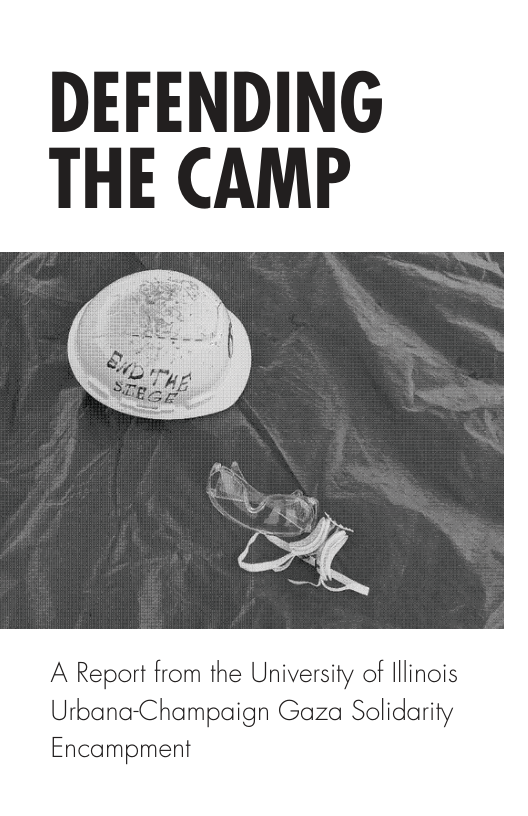




DEFENDING
THE CAMP
A Report from the University of lllinois
Urbana-Champaign Gaza Solidarity
Encampment
Day 1: Friday, April 26
AcS am on April 26, approximaely thirey students at the University of Il
nois Urbana-Champaign occupied Alma Mater, the well-known statue at the
center of campus. Inless than half an hour, the protesters set up a welcome.
table, 2 medical tent,a food tent, half a dozen camping tents, and a makeshifi
yure constructed from les than $400 worth of materias. Within 20 minutes,
half a dozen cops and about ten Facilties and Services (FES) workers rolled
up with a box truck. They sad that the protestors were breaking university
policy by putting up strucures and would be subjec o ares for trespassing
if they did not comply with an order to tear down the structures by §:25 am.
The idea spread that we would buy time or renforcements toarrive by fign-
ing compliance and slowly taking down the tents. This was a bad idea. I e.
sulted froma lack of consensus on whether o hold our ground, and also from
fear. Students began disassembling the yure first,easoning that only thirty
people would not e enough to defend i. Students formed 4 ring around the
yurt s few people began slowly deconstructing it. Aferwards,the crclere
assembled around the main encampment. Due to fears of araid and 2 break
down in communication, another crew of campers began taking down tents.
Several protesters advocated for holding our ground, chanting “We keep us
safel” and counting o 12. At the 8:25 am deadline, police moved in to make
artests, violently assaulting the students at the front of the circle. A few brave
campers broke formation to mobilize behind their comrades, de-arrsting se-
eralof their peers. Fora brief moment, the campers pushed back and encircled.
the cops, who visibly panicked, yelling “Do not surround us” However, the
cops managed to surge forward, seealing the materials for the yust and the few
entsfi on the ground. In the end, they made one arest from the side of the
it that was not supported by reinforcements, then lft the sit.
Between chirty and forty folks remained at Alma over the ne few hours
through heavy rain—eating, playing music, pasing around a soccer ball, and
resting, Organizers put out a callfor 2 mass mobilization a¢ 3 pm in time for
the Jummah prayer and the end of Friday classes. Between two hundred and
three hundsed students and community members responded. During the
prayer, some people put the tents back up.
A dozen campus cops and a handful of F&S quickly returned, forming a line
about 50 feet away 1o try to enter the camp and take down the tents. The
protesters assembled ina crcle once again, with a lrger group of about forty
o fifty people focused at the front where the cops aimed to make their incur.
sion. This group had reinforced banners and umbrellas, and mose of them
were prepared to push and de-arrest s needed.
Acfirst, the police were able to shove their way through the fiseine, but they
quickly found themselves ketrled within the crowd. Some pulled out batons,
but many seemed hesicant about employing them. Other oficers attacked
protestery necks,collarbones, and chests, inflcting one concussion and many
minor injuries. In the end, the police were only able to tear down one tent
before another surge from the demonstrators drove them out of the camp for
the est of the night.
Aftr the scuffle,people recovered a body eam anda lip of lethal ammunition
from the ground.
For the rest of the afternoon, cops and FES garhered in the parking lot in
fron of the camp, never totaling more than twenty. They shut down Green
Street,the main road along the encampment,as well s the Union and Teansit
Plaza busstops, and brought in four ity busses and a horse tailer for mass r.
rests Fire trucks were parked two blocks away, prepared to turn thir hoses on
students. Offcers from four different polie agenciesincluding the University
of Hlinois, Champaign County, Utbana, and Mahomet amassed in iot gear,
with pepper spray and tear gas at the ready: Eventually, however, the union
representing FECS filed a cease-and-desst order, afiming that F&S workers
did not ned to comply with orders o take down the camp.
Despite the threat, the crowd of campers geew in size, sprit,and knowledge
over the course of the afternoon. Partiipants expressed approval of the .
forced banners that some people brought o the front; others distributed gog
gls, gloves, and additional protective equipment. Several comrades offered 2
brief presentation deseribing how to perform de-arrests and keep each other
safe dusing confrontations. The group agreed o block the buses if the po-
lie arrested anyone. Nonetheless, police snatched one camper who lefe camp
alone wering a neon vest they were arrested out of the camp’ ine of sight
Police empricd and closed the Union building carly, at 615 pm. Then the
police line moved towards the encampment, interrupting the evening praer.
Moments before the attempred incursion, protsters sprang back into thir
s to defend the encampment. The police rteeated to ther original
asiF nothing had happened at all. The protesters hld theie positons,
chanting and snging louder.
At some point in the midst of this chaos, student leadership entered into.
negotiation with a university employee who went back and forth between
the students and chancellor Robert J. Jones; the chancellor communicat.
ed by phone, considering it unsafe o unimportant to be present in person.
While the negoriations dragged on for hours, rain began to pour down on
the encampment. Despite this,the energy of the encampment swelled. People:
were ightcously angry. Some suggested rushing the policeline and eicher sur.
rounding or occupying the Union during the negotiations.
By chis poine, much of the front ine had been there since 5 am that morning,
running on as il 2s two hours of sleep. They were recovering from two
clashes with the police that day; not to mention standing for hours, and were.
now soaked through their clothes to the bone. Most of the protestors had no
previous experience with facing police in this way
By 10 pm, even che front line began discussing how to best safely disperse.
The crowd gotsmalkr through the evening, dropping down to just below two.
hundred. The bystanders, counter-protesters, and reporters who had been
standing between the encampment and the riot cops had cleared out. The au-
thorities had erected giant spotlights around the area, directed a the few tents
leftstanding, Student leadership lft the negorations with a compromise: the
crowd could disperse with no arrests on the condition that the camp would be.
moved to asanctioned protest zone fa from the center of campus. According
o the agreement, it would be allowed to remain uniil the following Mon.
day—after which the police would carry out mass areests
The camp was disassembled and we dispersed. The fllowing morning, a fow
tents were set up at the sanctioned site as a diversion; but some organizers
planned to come back.
Day 2: Sunday, April 28
Under the cover of two diversions—the encampment at the sancioned site
and aleaked message that protesters would diseupt sporting event in a diffr.
ent part of campus—protesters moved into the main quad at 1 pm on April
28, Now knowing the necessity of maintaining mass, organizers waited until
students and community members had responded to a public cal for mass
mobilization before they set up tents. Over the course of the day, the com
munity engaged in making banners and posters, dearrest trainings, and meals
provided by faculty and community members.
The campers staed informed of police and counter-protester activiry through
a robust scouting and communicarions system. Comades with more on-the.
ground experience organized into a security team, sharing knowledge gained
from the Emory encampment and the Stop Cop City/Defend the Forest
movements. More personal protective equipment was made availzble to pro-
testers and frontliners,including heat-esistant loves, gas masks, helmets, and
goggles;this fucled a sense of collective power and raised morale.Several times,
when the camp received information on police activity, the crowd was able
to mobilize within seconds into a protective formation that was both strong
and dynamic. These were the same people who had no experience mobilizing
against police only two days prior
We made it through the night with no police raid and minimal interaction
with counter-protesters.
Day 3: Monday, April 29
We woke to pouring rain at 5 am, but the crowd of thirey campers arose in
good spiries. Throughout the day, the camp grevw again in size—firs to ifiy
and then o one hundred by the evening. More tents were erected and various
forms of programming ook place including banner making and additional
de-arrst wainings. While F&eS was seen out on the quad working, there was
ultimately no visible presence of cops allday. The night ended with a sereen.
ing of The Batle of Algier. It seems more are camping out tonight. In con.
versations, campers expressed motivation, pride, and surprise at our success
Many expressed they had never though it possible to sand their ground like:
they did on Friday:
s we begin the last acadeic week before fnals, time will show whether the
encampment shrinks, clings to s claimed trtitory,or expands—whether we.
wither and divide until we are destroyed, or lourish unil we win.
Strategic Reflections
Asof now—dawn on May Day—our encampment persists. Here are some of
our thoughts on the basis of our experience so far
1. Defend each other, not the fents!
The long thin arm-linked line is insuficient. We must be like water: dynamic
and willing to meet the cops where they ae at; moving around obstacles with
ease; mobilizing to proteet our comrades wherever nceded. During the first
clash with cops and FA&S, i all hirty campers had mobbed up and begun
pushing back, the situation would have played out differently. The people,
tents, and yurt would have been safe and de-arrsts easier. The circle line is
effective only as 2 way of obscuring actvity inside the camp from police line
ofsight. The encampmentis s, the people, and we must defend each other
Our presence s the core of the occupation—not the tents, the food, or the
supplies. We keep ussfe.
2. Encampment is escalation.
Putting tents up on campus is against almost every campus policy. Refusing
o take them down means refusing tolsten to 2 “lawful command.” The basic
premise of the encampment i alrady an escalation that the cops will meet
it force;they have done so or tried to do so on almost every campus with
an encampment. So organizers should not concern themselves with de-escal
tion or “remaining peaceful” Neither remaining on the defensive nor being
compliant will protect us, but being dynamic and meeting the cops head-on
might
3. We do ot wait for the right conditions o act—we
create those conditions.
Several rganizers who had paricipated in previous symbolic actions efused.
o support the encampment because they fet that the conditions were not
tight to do so. This vague and counterproductive stance fil o take into ac.
count the people’s power to share knowledge, build solidariy, and create 2
culture of disruption. The Cal Poly occupation taught us:if you build i, they
will come. Day 1 of the UIUC encampment taugh us: if you build i, they
will defend i, they willearn from t,they will rovw from i
4. Reinforced banners can win the day and the
crowd's trust.
s we saw at Emory and UIUC, reinforced baners will be bestat defending
and pushing. Some piricipants regarded the miliants with unesse and mis
trust until they used the banner o prov that they realy could “keep ussafe”
like the chant says. Plywood, insulation board, lumber, scrap wood, metal
sheeting, garbage cans, and water barrels can all be used a5 raw mateials, and
Some can even b sourced from campus dumpstes. Becreatve and be brave.
5. Resist “divide and conquer.”
Participants in the UIUC encampment have not wasted any time hunting
for “outside sgitators” or draving lines difieentiating students and norsu.
dents. Allre welcome here,So ar, the university isel has not used thistactic
Hopefully, the encampment will be rady to handle it whenever ey deploy
icagainseus.
6. Negotiations are a double-edged sword.
Negotiations delayed the police raid —and diminished our ability to fend off
the raid. The adminiseration is negotiating in bad fith they i to wste our
time, so we should only engage with them when rinforcements are on the
way and buying tme is advantageous to us.
7. Build more yurts and ofher structures. Seize cam-
pus infrastructure and use it as barricades.
need to find activities that make the most of our time and improve our de.
fenses.
8. Escalate for Gaza. Impose a cost on complicity in
genocide.
The administration, s scen during Day 2 of the encampment, may choose
ignore the protst. Be prepared to escalate your actons in order to continue
making it more expensive—whether materialy, financiall,or socially—to e
mai complicit than to divest.
9. Do ot reproduce the regime inside the encamp-
ment.
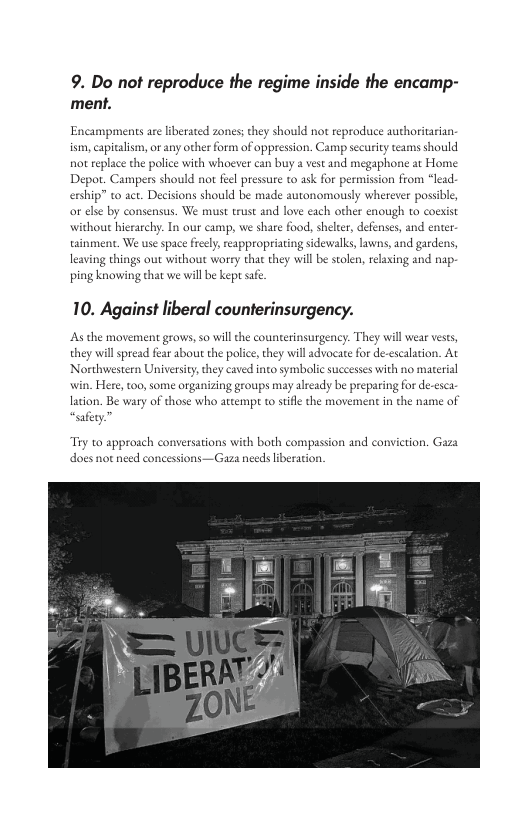
Encampments are iberated zones; they should not reproduce authoritarian
s, capitalism, or any other form of appression. Camp security teams should
not replace the police with whoever can buy a vest and megaphone at Home
Depor. Campers should not feel pressue to ask for permission from “lead.
ership” to act. Decisions should be made autonomously wherever possible
o lse by consensus. We must trust and love each other enough to coexist
withou hierarchy. In our camp, we share food, shelter, defenses, and enter
tainment, We use space freely, reappropriating sidewalks, lawns, and gardens,
leaving things out without worry that they wil be stolen, relaxing and nap-
ping knowing that we will be kep sae
10. Against liberal counterinsurgency.
As the movement grows, so will the counterinsurgency. They will wear vests,
they will spread fear about the police, they wil advocate for de-escalation. At
Northwestern University, they caved ino symbolic successes with no material
win. Here, too, some organizing groups may aleady be preparing for de-esca-
lation. Be wary of those who attempt to stiflethe movement i the name of
Tiy to approach conversations with both compassion and conviction. Gaza
does no need concessions—Gaza needs liberation.
Allaround the United Statesand now in Canada, Ausralia, and
seteral European citics, students bave establisbed encampments
protesting the bloodshed taking place in Gaza. Over the pas fewo
days, more than a thousand pesple have been arrested in police
raids tangeting these encampments. Yet despie the bigh-profile
assaults on Columbia Unisersity and other occupations, many
encampments have managed to stand their ground cven in the
Jface of repeated police attacks. I this repors, participants in the
‘Gaza solidarity protest encampment at the University of Hinois
Urbana-Champaign (UIUC) recount their experiences learning
0 bold sheirground.
Published by
crimetbinc.com/uine