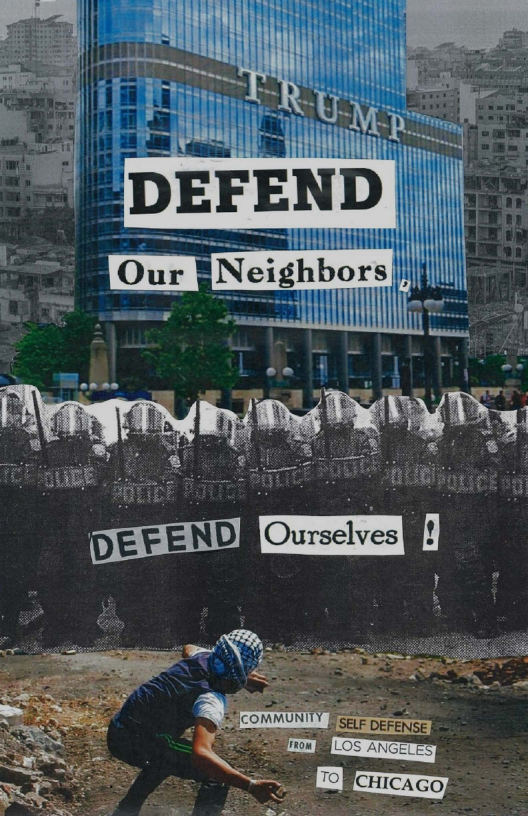
Defend Our Neighbors – Defend Ourselves!
Web PDF • Imposed PDF• Raw TXT (OCR)

![5. What supplies do laborers bring, and what might they need? (Ask theml) 6. When and where has ICE been preparing for raids What are the main ways they’ve been conducting raids? How might people impede those tactics? How do locals want to fight back? While exploring the area, ask folks who live or work nearby about in the arca? recent ICE activity. Learning what has happened in recent weeks and months will help you understand how the area works and how you might fit into it Second, meet people in the area. To set up an effective defense hub, you will need the participation of other people in the area. Many infor- mal networks have emerged that support local day laborers, interfere with raids, protect targeted people, and keep the area moving despite constant state terror. Its essential to engage with locals as collaborator prised by the tactics and prioities people bring to this project, and as a defense hub, your role is to support and facilitate them as much as pos- sible. No single group or organization, no matter their funding or professional presentation, should dictate what autonomous self-defense looks like. Pay attention to the people in the area with reason to know how and the police operate: day laborers, people who sleep on the street, vendors, gas station employees, etc. These people are often at the front lines of neighborhood self-defense, and they’ll have insights into rele- vant tacties and considerations that you don’t yet. Third, start getting organized. If people are comfortable with it, consider adding them to a group chat on WhatsApp or Signal to co- ordinate patrols and resources, and share verified sightings of IC] Socialize best practices to limit unnecessary messages in these chats and create space for everyone. Some of this infrastructure may already exist, especially for patrols. That’s good for you! Reach out to other local groups whose structure might benefit the project. In Los Angeles, the defense hubs sprang up widely because Of the Los Angeles Tenants’ Union’s pre-existing infrastructure: lo- cal chapters, expected regular meetings, and experience strategizing to meet their goals. Whoever is brought into the project should agree to 6 | defend our neighbors.](defend-our-neighbors-defend-ourselves-lake-effect-collective 6.png)




DEFENDN Ourselves Y
People of conscience across the so-called United States are outraged
by the cruel spectacle of ICE kidnappings and racist terror. They want
to do something about it. But what works?
We believe we need more proactive tactics, offensive and defensive,
that empower people to take intervention in and prevention of abduc-
tions as a serious and achievable goal. One way forward is a communi-
ty defense hub, or centro.
A centro is a place where anti-deportation activists can gather, build-
ing connections with the surrounding community and establishing a
hub for anti-deportation activity. It draws on the existing strengths
of working-class immigrant communities and solidifies connections
with formal and informal anti-deportation networks in the area. By
putting us in places we know ICE will appear, a centro allows us to join
immediate proactive responses to prevent kidnappings, taking action
with rather than for our neighbors. This situated political work, unlike
spectacular protests or clandestine activities, builds relationships of
trust and obligation that continue beyond individual confrontations.
A centro may be as simple as a folding table and a bucket of whistles
t0 alert people when ICE shows up. But it could become a great deal
more: the basis of community outside and against the law, capable of
al unrest and explosion.
coordinating our cfforts in moments of §
2| defend our neighbors.
I. no one is coming
to save us
The neoliberal order was not built to last. It was one get-rich-quick
scheme after another, delaying the day of reckoning until the last of
the postwar order could be sold for scrap. Whatever “consensus” ex-
isted was purchased by the dismantling of the social safety net, the
hothouse expansion of mass incarceration, and monetary shell games
of a finance sector conjuring lost profits out of numerical alchemy
This gilded age has now given way to the open anti-social violence,
racist state terror, and dissolution of civil society that churned away
underneath it. And today, not even the heads of state are urging calm.
Masked agents in unmarked vans kidnap our neighbors off the streets,
as JB Pritzker, the self-styled anti-Trump, sends state police to beat
protesters outside the ICE kidnapping center in Broadview. We know
what our conscience dictates: we have to run every federal agent out
of our city, and so long as they're here, they need to be afraid to do
their jobs. But the people in power who told us they'd stand in the way
don't do much more than talk. Raids in our neighborhoods don't pro-
voke anything more than consternation from local Democrats, when
they're discussed by the city and state government at all. The police
form lines to shield the feds, and people who resist are brutalized.
Local politicians who object to deportations are themselves detained,
as the agents responsible act with total legal impunity. The Trump ad-
ministration’s lawless paramilitaries have received incredible amounts
of funding, regular legal processes have failed to check the regime’s
expansion, and its detention centers are shielded from public scruti-
ny. Fascist terror is here for entire stretches of Chicago, occupied by
agents in military fatigues, carrying long guns and ambushing street
vendors from unmarked vans. And since nobody is coming to save us,
we'll have to do it ourselves.
In crisis moments like these, when state, local, and federal govern-
ments abandon and terrorize whole populations, people have histor-
ically taken the conditions of their lives into their own hands. In the
early sixti
mous mili
in Lowndes County, Alabama, people organized autono-
s and an independent political party, the Lowndes County
defend ourselves | 3
Freedom Organization, to protect Black farmers from state and vigi-
lante violence that they called "white terror.” Inspired by their exam-
ple, a few years later, Huey P, Newton and Bobby Seale founded the
Black Panther Party for Self-Defense to protect poor Black people
from police terror. These organizations responded to unchecked racist
violence by empowering people to defend themselves: the Black Pan-
ther Party taught people their rights, but it also encouraged them to
protect themselves however was necessary
Our own erisis has produced similar forms of autonomous self-de-
fense, pursued independent of whatever politicians and major
non-profits have promised. Earlicr this year, after the raids in Los
Angeles intensified and began targeting workplaces and day laborers,
locals created defense hubs, or "centros." These established a steady
presence at key locations intended to disrupt ICE operations, orga-
nized at the neighborhood level. Unlike previous anti-deportation tac-
tics (rapid response, public protests, and even autonomous blockades
of ICE infrastructurc), these became a means of proactive interven-
tion, deterring and preventing deportations instead of attending to
them after the fact.
Instead of establishing control over an area and dictating what its in-
habitants are allowed to do, defense hubs support what popular resis-
tance already exists, moving forward from what people targeted and
harassed by the police and feds want.
This allows us our limited resources more effectively, and gives
us spaces to encounter each other as part of a movement broader than
our political affinities or working lives: in Los Angeles, defense hubs.
have provided infrastructure for mutual aid and area patrols, spaces for
politicized people to meet each other, and crucially, offered outraged
people local, place-based relationships that give their anger direction.
0 us
Instead of parachuting into ongoing confrontations, developing rela-
tionships of trust and becoming a known presence have been crucial
for effectively battling the feds with, not for, the people who live in any
given arca. And, crucially, during and after an attempted raid or abduc-
tion, having somewhere to refer others back to can help people plug in
to the immediate needs of the centro, to potential future needs in the
fight against the border regime, and to future struggles beyond it. In
4| defend our neighbors.
Los Angeles, this infrastructure was initially established by mutual aid
networks distributing PPE after the Palisades fire; likewise, the centros
could persist and become mature pieces of autonomous pro-social
infrastructure against capitalis crises.
Experiences in Chicago show that even a handful of peopl
at the feds or alerting neighbors with whistles or megaphones can stop
ICE from taking someone or kidnapping more people. Significantly,
they provide a platform to strengthen and support people’s immediate
response to ICE activity
II. setting up a
defense hub
Fist, pick a spot. This should be somewhere federal agents repeat-
outing
edly target for deportations. Test out a few locations if you can't find
asuitable onel In Los Angeles and Chicago, ICE has made a habit of
targeting day laborer corners outside of Home Depots, but anywhere
that migrant laborers congregate regularly is promising, including spots
where gig workers rest between deliveries, gas stations, swap meets,
other big-box stores, and certain major intersections. Ask around!
While looking at various spots, ask these questions:
1. Whatis the flow of people and traffic around the site? Walk a few
blocks around the area, and pay attention to local busine
vendors, schools, and residential areas.
reet
2. What is local security's relationship to the day laborers? (We have
found, for example, that every Home Depot where day labore
congregate is very hostile to them, especially when they're visibly
poor)
3. What are the relationships between local businesses and the day
laborers or gig workers at the site? Are there any supportive busi-
nesses nearby, and are there any especially hostile ones? Who at
the latter actually wants the day laborers gone, and who is being
intimidated into compliance?
4. Whatkind of ICE
they need? Are they affiliated with any groups?
atch presence is already there, if any? What do
defend ourselves | 5
5. What supplies do laborers bring, and what might they need? (Ask
theml)
6. When and where has ICE been preparing for raids
What are the main ways they've been conducting raids? How might
people impede those tactics? How do locals want to fight back?
While exploring the area, ask folks who live or work nearby about
in the arca?
recent ICE activity. Learning what has happened in recent weeks
and months will help you understand how the area works and how
you might fit into it
Second, meet people in the area. To set up an effective defense hub,
you will need the participation of other people in the area. Many infor-
mal networks have emerged that support local day laborers, interfere
with raids, protect targeted people, and keep the area moving despite
constant state terror.
Its essential to engage with locals as collaborator
prised by the tactics and prioities people bring to this project, and as a
defense hub, your role is to support and facilitate them as much as pos-
sible. No single group or organization, no matter their funding
or professional presentation, should dictate what autonomous
self-defense looks like.
Pay attention to the people in the area with reason to know how
and the police operate: day laborers, people who sleep on the street,
vendors, gas station employees, etc. These people are often at the front
lines of neighborhood self-defense, and they'll have insights into rele-
vant tacties and considerations that you don't yet.
Third, start getting organized. If people are comfortable with it,
consider adding them to a group chat on WhatsApp or Signal to co-
ordinate patrols and resources, and share verified sightings of IC]
Socialize best practices to limit unnecessary messages in these chats
and create space for everyone. Some of this infrastructure may already
exist, especially for patrols. That's good for you!
Reach out to other local groups whose structure might benefit the
project. In Los Angeles, the defense hubs sprang up widely because
Of the Los Angeles Tenants' Union's pre-existing infrastructure: lo-
cal chapters, expected regular meetings, and experience strategizing to
meet their goals. Whoever is brought into the project should agree to
6 | defend our neighbors.
explicit, written codes of conduct that guarantee its autonomy from
any one of these local organizations, and keep power firmly in the
hands of people who work on the project together.
Fourth, gather supplies. The physical defense hub will look like 2
table or two under a canopy, where you'lldistribute relevant informa-
tion, answer questions, give people a spot to rest between patrols, and
distribute whatever els
you've brought. You can also decorate it with
signs or banners to make it more obvious to passers-by and locals why
you're there, and possibly invite them to approach and help out.
Try to integeate the defense hub with the area's needs. This will include
chairs, food and water, but since if's gotten cold outside, coffee, hand
warmers, coats for people who might not have any and portable heat-
ers are also appreciated.
Whistles have become crucial for community-level raid-response
in Chicago. Being able to provide them to whoever's interest-
ed in helping out will go a long way to impeding ICE raids in
the area. The accepted whistle code is: brief sequential bursts if
you've seen ICE in the area, and long, continuous noise if you're
witnessing an ongoing raid or abduction.
Other pieces of equipment that activists in LA have found useful
include megaphones and umbrellas. Print out relevant information:
“Know Your Rights” info, information about how to identify ICE v
hicles (and which vehicles are not ICE), and legal resources. You will
want to make signup sheets publicly available if possible: for patrols,
grocery distribution, ride-sharing, and shifts at the defense hub.
Where you set up your defense hub depends on local businesses' rela-
tionship with the ongoing raids. For example, your local Home Depot
might not let you stay directly on their property; therefore, you might
set up on the sidewalk on the other side of the property line, or on the
side of the nearby street.
IIL. what can people do?
Now that you have the
supplies you'll need to launch your defense
hub, you'll need to help fill the gaps in anti-ICE work at your intend-
ed location. Below are some examples of things people can do from
defend ourselves | 7
experiments in Los Angeles and Chicago, but they're by no means ex-
haustive. As you help run the defense hub, reflect regularly on whether
what you're doing is working, and what new innovations might make
it work better. (And share those innovations with your friends at other
hubsl)
* Bike Patrols: folks on bikes can patrol several blocks around the
site, keeping an eye out for ICE vehicles or masked agents. Relay-
ing that information back to the rest of the group can help people
prepare, give others time to flec, and facilitate more effective rapid
response capable of interrupting raids and abductions.
* Foot Patrols: groups of two or three can walk the block directly
around the site, looking for the same things as the bike patrols, and
blowing on their whistles if they see anyone who is confirmed to
be ICE. In Los Angeles people have started wearing identifiers, like
armbands or colored hats, to be more identifiable as ICE watch
and not plainclothes agents themselves. These groups should fo-
cus on particularly at-risk areas around the defense hub, and within
25-10 minute walking distance of the table.
* Car Patrols: ICE watchers in cars can keep an eye out for agents.
and follow them when they're spotted, if the driver is comfort-
able doing so. ICE has recently begun retaliating against cars fol-
lowing them, shooting one woman and tear gassing several rapid
responders. People who follow ICE vans should be aware of this
additional risk.
* Flyering Teams: small groups can go door-to-door in the neigh-
borhood sharing information on how to report ICE activity to the
defense hub, explain the goals of the project in plain language,
and add people to the local group chats on WhatsApp or Signal.
Flyering groups can also advertise the location of the center itself,
encouraging locals to come check it out and help out if they'd like.
* Standing Lookouts: individuals can stand at street corners in busy
or particularly at-risk areas with whistles to alert locals of sightings,
and phones or walkie talkies to relay information back to the hub.
* Tabling: volunteers can help staff the main location, kecping
watch at the site itself, sharing resources with passers-by, moni-
toring social media and chats for updates, and helping produce
8 | defend our neighbors.
yers, stickers and zines for the flyering teams. These volunteers at
the main center can also handle onboarding for the various parts
of the project. Some roles require less vetting than others, and it's
important to avoid letting security concerns stifle the project itself.
I¢'s smart to give these more sensitive tasks to more experienced
volunteers, but to make their practices changeable at any moment
if the broader group finds them stifling Good leadership is direct-
Iy recallablel
IV. plan from there
Fach location will have its own local particularities. Some businesses
will be more or less hostile to targeted migrants, some residential areas
will offer more shelter than others, and people wi
at varying speeds depending on whether they trust you. Defense hubs
work best when they are proactive and plan for eventualities: do people
involve themselves
have exit plans during raids? Can groups or individuals provide shelter
if it's needed? And among volunteers, having a set, basic course of
action during a raid o abduction can help mitigate nerves and frantic,
overwhelming feelings of urgency when raids and abductions do oc-
cur.
Shifts might be planned based on which days of the week and which
times most day laborers congregate at the site; they might also be
planned around the frequency and locations of abductions in the area.
Right now, Chicago Home Depots see most of their raids occur be-
tween 7:00 AM and 5:00 PM. ICE has repeatedly appeared when
there are fewer or no people on shift at a location, which suggests
they watch for when there are fewer people around to raid with
less resistance.
Some best practices we've learned: frst and most importantly, these
centers will succeed or fail ba
ed on whether you are attentive to the
needs of the surrounding area. Just as important s that no one collab-
orates with the police. Under no circumstances should someone call
in the police, whether to report ICE misconduct (which the cops rou-
tinely ignore, and often even facilitate) or to resolve some street-level
dispute which could otherwise be de-escalated without subjecting all
its participants o state violence and potential death. This extends to
defend ourselves | 9
hostile management and security, who may treat you well while simul-
taneously harassing people sleeping on the street or the day laborers
you're trying to work with.
This is not a short-term fight, and these pieces of infrastructure
should outlast the present moment. Finding ways to coordinate
resources and make defense hubs sustainable as initial floods of
volunteers decline and raids continue unabated will be crucial in
the coming months. We can address this on the front end by present-
ing volunteers with set expectations for their participation: at least one
shift a week for recent volunteers, and multiple weekly shifts for peo-
ple taking on more sensitive and consistent logistical tasks. Recurring
trainings to onboard people to the centro every few months can help
boost presence as numbers on shift decre
V. coordinate with
other hubs
At the time of writing, several community defense hubs are slowly
forming around the city. Regular communication between these proj-
after each initial influx.
ects will be crucial to overcome their specific limits in Chicago, many
of which might not be shared with Los Angeles.
For example, the heavily segregated neighborhoods on the South and
Southwest sides of Chicago — with their wide streets, fast traffic, and
innumerable parking lots — allow ICE to move very
much more difficult for patrols to find ICE, barring a large caravan
of agents. But this can also make it easier for people at centros to
drive to rai nall groups of
following, surrounding, and shouting at ICE agents, and
stopping abductions. In the historic neighborhoods
the North and Far North sides, closer to the lake and much whiter, the
making it
nces of
s; there have been several i
on
narrower streets and denser sprawl can create more opportunities to
block ICE, making bike patrols a much more effective tactic. But com-
pared to the Home Depots and laundromats repeatedly targeted in
Los Angeles, or the Home Depots and intersections regularly targeted
here, hotspots in the neighborhoods being most rapidly gentrified on
Chicago's Northwest side are substantially less obvious.
10 | defend our neighbors
15 ICE mostly targeting day laborers? Restaurant workers? Something
2 In a predominanty Latino neighbothood with substantial com-
munity support, where people are being targeted out and about, and
while waiting for work by a particular hotspot, the centro’s setup and
responses will look different than a place where the locals are more
hostile, or a wealthier and whiter area where people are being targeted
while on the job. Coordination and communication between neighbor-
hoods, across the city, and between cities will help us adapt our tactics
to each particular area.
els
Over time, these local projects will make space for other place-based
experiments to emerge, which will only benefit from broad connec-
tions with like-minded people across the city.
Nothing other than bold, ceaseless experimentation will get us
through this moment.
defend ourselves | 11