Decomposition: For Insurrection Without Vanguards
Web PDF • Imposed PDF• Raw TXT (OCR)
![be conceptualized as bases for experimentation, as a tension. ‘They are already here: “Every wildcat strike is a commune; every building occupied collectively and on a clear basis is a commune.” (pg-102) Morcover, this question is so blurred for the Committce that they admit: “We can no longer even sce how an insurrection might begin.” (pg. 95) By riots, one would be tempted to answer. Or by a revolt which, although initially of a minority, generalizes socially. But no, that’s already too committed for them. Itis better to leave the question unresolved, to appeal to as many curious people as possible, better to avoid subjects on which there are heated divisions. Better to continue to simplify the reality of antagonism by presenting an Everything that can only be attacked from a hypothetical elsewhere, by “secession,” by “surreptitiously overtakfing]" (pg. 109) or by constituting “a serics of centersof desertion” (The Call, Proposition V). By failing to see insurrection as 2 particular process informed by everything that precedes it, they avoid any reflection on how to fight for the destruction of this system, within and from this system, while also already carrying the projectuality of another world with us in the way we fight. That would require starting from the opposite hypothesis to that of the authors. A revolutionary hypothesis that is neither alternativist (we can build niches within the existent, and already “a neww idea of communism is to be elaborated” in capitalism’) nor messianic (the inevitability of the collapse of civilization for which we must prepare). In rcality, there is no outside that could escape the social relations of domination and thus constitute the basis for building a force towards insurrection. Itis only in moments of rupture that these social relations can be subverted. As an old text alzeady said: “No role, no matter how much it puts one at risk in terms of the law, can take the place of the real changing of relations. There is no short-cut, no immediate leap into the elsewhere. The revolution is not a war.™ Another question that usually arises with insurrection is that of relationships and affimity (the sharing of general perspectives and ideas), which is not the same as affectivity (a momentary](decomposition-for-insurrection-without-vanguards-ungrateful-hyenas 10.png)
![sophisticated claborations, unpalatable for today’s narrow tastes. He also gave his instructions for taking up arms. Blanqui did not elaborate decp reflections, because reflexes prepared in advance were enough for him. He is the perfect revolutionary icon for today’s market, now that no one wants to debate complex systems anymore. Today, we want intense emotions to consume. ‘And Blangu doesnt bore us with abstract speeches; he’s 1 practical guy. Dircct. Someone to listen to, from whorm we all have to learn, and whom we can therefore trust. That’s why he was exhumed. That’s why, among the many incamations of the revolutionary dictatorship, he is the only one who can pass for a fascinating adventurer rather than immediately revealing himself as a petty man of power. A century and a half late, Blanqui captures them all. If he had a Facebook account, he would be drowning in “likes.” His revaluation is made even more appealing by his choice of tactics. Recently, has the working class been terrorizing the bourgeoisic, or has a smile rather blossomed on Marchionne’s face [CEO of Fiat since 2004]7 Has the proletariat been fighting for its cmancipation, or snitching on the wildest demonstrators? Have you been hearing the streets rumble with masses of insurgents heading for the presidential palace or rather masses of fans going to the stadium? Have you noticed how the cxploited are more passionate about radical social criticism than the latcst seality show? In his memoirs, Bartolomeo Vanzetti remembers his nightly hours spent poring over books, detcrminedly snatched from the restorative slecp of work fatigue. He was a worker, but he spent his free time studying: to understand, to know, to refuse to remain raw material trapped by the gears of capital (or by the dialectic of some intellectual). Today, the shadows under the eyes of workers have other causes. Those who want to participate in the ongoing social war must thercfore take into account this obvious fact: the masses don’t care about revolution. Butit’s not a problem anymore, really and you know why? Because Blanqui didntcarc about the masses. He didt need them. A lucid, capable, bold elie, ready to unleash a well- 1](decomposition-for-insurrection-without-vanguards-ungrateful-hyenas 19.png)
![passions,” Blanqui prescribed that “no military movement should take place except by order of the commander-in-chicf, barricades should be erected only on the sites designated by him” (the sclf- appointed commander,if goes without saying, was him). Bakunin was looking for somcone among the conspirators who was ully comvinced that the advent of freedom is incompatible with the existence of states. He must want for the destruction of all States at the same time as that of all the religious, political and socal institutions, which includes: the offcial Churches, the permanent armies, the ministries, the unicersities, the banls, the aristocratic and baurgeois ‘monapolis. This s so that on their ruins a free socicty may finally emerge, no longer organized as it i today from the top dosun and from the center to the periphery through unity and forced consolidation, but rather starting from the free indicidual, free asseciation and the autonomous commine, from the bottom up and from the periphery to the center, through free federation.” Blangui was looking for someone whose answer the question “just after the revolution, willthe people be able to govern themselves?” would be: “the social state being gangrenous, heroic remedics are necessary to pass to a healthy state. For some time, the people will need a revolutionary power.” This power would put immediate provisions into action like the “substitution of a [State] monopoly in the place of any expelled boss... Transfer to the State domain of all the movable and immovable goods of the churches, communitics and congregations of both sexes, as wel as their nominces... Reorganization of the personnel of the burcaucracy... Replacement of all dircct or indircct contributions by a direet, progressive tax on inheritance and on income.. government: Parisian dictatorship.” If during the 19¢h century, Bakunin and Blanqui were not just two revolutionarics among many others, if their names acquired such a reputation, it is because they were the incarnation of two different and opposed ideas, because they represented the two possible faces of the insurrection for the whole world: the anarchist one against the State, and the authoritarian one in favor of a new State (frst republican, then socialist, and finally 2](decomposition-for-insurrection-without-vanguards-ungrateful-hyenas 21.png)

![well as the correspondence about it. These are the risks of the Commune and sharing tools: you never know who might peck at a computer left on and unattended! Whether this rumor is truc or not, a few days ago we were given the gift of the Invisible Committee’s new book, fresh off the press, published in France at the end of last month. Its called 75 Our Friends (political ones, it goes without saying) and its imminent and simultancous publication in seven other languages is in the works to promote its diffusion on the four continents. Italy will be one of the lucky countries, so we might as well wait to read the full translation. But then, you may ask, why arc we talking about it here and now? Because thanks to the lessons of the Invisible Committee, we finally understand that advertising is not only the soul of business, but also the soul of subversion (well, the busincss of subversion). Morcover, we would risk being mistaken for state burcaucrats if we didut hurry up and share at least a few excerpts from this new masterpicce with our readers. Anyway, here’s 1 preview, a scoop of sorts Choosing which part to share i asy, too casy even. These geandchildren of Blangui devote some thoughts to ltaly, more preciscly to the struggle against the TAV in the Susa Valley and its miraculous effects. Here is what they write: “Among the miracles of the Susa Valley struggle, one has to include the way it succeeded in tearing a good number of radicals away from their painfully constructed identity: It brought them back. down to carth. In contact again with a real situation, they were able to shed most of their idcological spacesuit—not without incurring the inexhaustible resentment of those still confined in their interstellar radicality where breathing is such a problem. [...]. Alternating family-style demonstrations with attacks on the TAV construction site, esorting to sabotage at one moment and partnership with the valley’s mayors the next, associating anarchists and Catholic grandmas, this struggle is revolutionary 3](decomposition-for-insurrection-without-vanguards-ungrateful-hyenas 30.png)



![to work out. You walk cach other home. You share cach other’s cars. You go camping and learn Aow 1o start a fir together. You pool moncy for a collective rainy day. A repurposed storefront hosts weekly dinners that turn into planning sessions. A collectively-run cafe sets aside profits to incubate other spaces, like a wood shop where carpenters work together to build more than just bookshelves. a gourmet meal of stolen foods a few graffiti kids racking paint, sharing the loot, and hitting the town together for a single night; a conspiracy of baristas stealing coffee from the back [of the cafe - Editor’s note] to share with their friends at home Live together. Share meals. Share money: Get everyone on food stamps, build farms, share techniques for theft and resource misallocation. Learn how to cook for two, then fou, then twenty, then a thousand Herbal remedies, auto-repair, home construction, business accounting, permaculture, programming, and legal work plagiarism, mail, scandal, or a fist ight Every block has a garden and a tool library. Houses are fixed up and owned through use and care. Contracts are for people who hate cach other, and they still get written up from time to time, but shelter is not something you deprive even someone you hate. In the garden, the neighborhood watch meets twice a week to practice de-escalation techniques and nonviolent communication, and trains for situations when those don’t work. The strip is dotted with cvery varicty of catery, collectively run with Tocally grown food and some specialty items acquired through autonomous trade routes. A group of designers and engincers who hate their jobs team up to ereate an app that coordinates a flexible supply chain among the farms and distribution points. These efforts lead to 56](decomposition-for-insurrection-without-vanguards-ungrateful-hyenas 56.png)

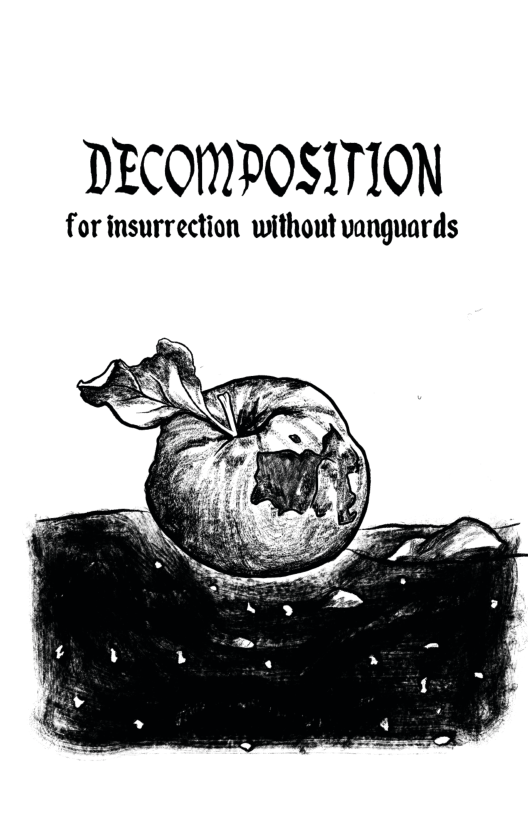
DECOMPOSITION
for insurrection without vanguards
Contents
Going in Circles: A Critique of “The Coming Insurrection”
A Corps Perdu #3, international anarchist review, 2010
Blangui or the Statist Insurrection
Finimondo, 2011
Blanqui in Venaus
Finimondo, 2014
‘The Death of Rémi and Confrontations:
‘The Radical Recuperators Come Out of the Woodhwork
Anonymous
Decisions, Compositions, Negotiations
Hourriya #6, 2021
Here Lies a Corpse
Avis de Tempétes (Storm Warnings) #3, 2018
A Composition
Julien Coupat, Adrian Wohllcben, Hugh Farrell, and sther
Imaginary Friends
Ungrateful Hyenas Editions
ungratefulbyenas.noblogs.org
THE WRITINGS OF TIQQUN and the Invisible Committee have
given risc to the emergence of an authoritarian insurrcctionalist
tendency that has been recruiting and building its ranks for about
the past decade and a half. Although one of the trademarks of
tigqunism is its approach to “invisibility”, or not being legible
as a distinct tendency, after so many years and some significant
betrayals, tiqqunists have thoroughly revealed who they are and
what they want, which is at dircet odds with any struggle against
authority.
‘While tigqunism has crossed the pond from France and taken
oot across turtle island to some extent, the anarchist critique
of tigqunism has not. This reflects a gencral commitment to
tolerance in the anarchist space, an unfortunate reaction against
the ideological dogmatism that silos people in insular and
stale subeultural enclosures, Thinking through the lens of this
false dilemma comes at the expense of uncompromising clarity
around how we relate to power, eformism, sepresentation, and
the mechanisms of politics. In shor, this tolerance, even when
motivated by a desire for openness and connection, blurs the
lines which lic at the very foundation of autonomy and self-
organization.
Tiqqunism pretends to offer an escape from idcological camps,
transcending the confines of identities that no longer serve
us and inviting us to be partisans in their insurrectionary
composition. Not only is this an cmpty promisc, as the
subcultural niche they have formed is highly exclusive,
insular, oppressive, and frankly unpleasant, itis also a way of
manipulating readers into uncritically adopting, or at least
tolerating, their proposals.
This collection aims to shed light on the authoritarian ambitions
woven throughout tiqqunist ideas in order to encourage
5
anarchists to abandon tolerance and move towards principled and
necessary conflct. Ideas are not neutral,they are not incidental
acsthetic preferences or personality quirks, they form the basis
of who we are, how we move through the world, and how we
struggle. As the authors of Blangui or the Statist Insurrection
remind us,the ideas we fecl close to arc “nat irrelevant, and
constitute choosing an unmistakable side.”
Going In Circlesis still relevant over a decade later, s it shows
how the practices of tiqqunists are entirely predictable from
their magnum opus, “The Coming Insurrection.” Blangui or the
Statist Insurrection traces authoritarian insurectionalism to its
source. Blanqui in Vinaus gives a brief note on the proposals for
recuperation within “To Our Friends.” The Death of Rémi and
Confrontations fusthers the theme of recuperation, commenting
on the tiqqunist mobilization of the State murdering a
demonstrator in order to dialogue with it. Decisions, Compositions,
Negotiations hones in on their logic of “composition” in the
context of land defense struggles, and Zere Lics a Corpe speaks
o their use of composition to pacify the ZAD. We close with
our own “composition,”intended to lay bare the essence of the
tiqqunist project in the very words of those not-so-invisible men
who love to put their names on things.
‘While tigqunism inevitably plays out differently across contexts,
we value the insights and experiences of comrades from other
territorics in recognizing and attacking authority in all its
guises. 111 Will Editions recently published a text championing
“composition” as the strategy that sccured “victory”at the ZAD
in Notre-Dame-des-Landes and proposes the same strategy
be used in the No Cop City struggle. In bringing these texts
together, we hope to spread hostility to this vision of victory
and to tiqqunist involvement in the No Cop City struggle, or
anywhere clsc they rear their managerial heads.
For insurrcction without vanguards,
Ungrateful Hyenas
Going in Circles:
A Critique of “The Coming Insurrection”
Translated excerp from A Corps Perdu #3,
international anarchist review, 2010
Common-laces
“This book is composed of seven circles, four chapters and a
preface. In the first part, the Invisible Committce takes us
through the hell of present-day society in Dantesque fashion.
In the second part, we arc finally introduced to the paradisc of
insurrection, which we could reach by way of the proliferation
of communes. f the first part casly wins the reader's approval
through its description of a world strewn with permanent
disasters, the second is much emptier. Both, however, sharc a
common theme: a certain vagueness, well concealed by a dry and
authoritative style. Perhaps this is not cven a flaw, but rather a
basic ingredient in the appeal of this little book.
To make its point, the Committce does not nced analyses. It
prefers statements. Enough of these critiques and heady debates,
make way for the obvious and concrete objectivity that is
immediately self-evident! With contrived humility, the authors
even specify from the start that they aim only to “introduce a
litle order into the common-places of our time, callecting some of the
murmurings around barroom tables and behind closed bedroom doors",
that is to say that they are satisfied to “lay down a fixw necessary
traths” (p. 12). Besides, they are not the authors of this book, but
“made themselves scribes of th situation,” because “i’s the privileged
feature of radical circumstances that a rigorous application of logic
leads o recalution.” It was necessary to think it throughs the
common-places are the necessary truths that must be transcribed
in order to awaken the sense of rigor, which will logically lead to
revolution! Obvious, isn't it?
You willfind very few ideas upon which to reflect in the seven
circles that make up the contemporary social hell, and many
states of mind in which to partake. The authors avoid basing their
discourse on any explicit theory at all costs. To avoid running
the risk of being outdated or questioned, they prefer to record
the very banality of life, where everything is transformed into
something familiar - as an array of ‘common-places' where the
imaginary figure of “the Frenchman” surfaces at every turn, They
might as well pepper in any platitude whatsoever while they're at
it, cven to the point of portraying realiy as the exclusive product
of totalitarian domination, rather than the fruit of a dialectic at
the heart of the social war. It is true that this would require them
to o a bit further than just generalized feclings. The propaganda
of power is treated as a significant and, above all, credible source:
to describe their imaginary world without classes or individuals:
common knowledge (pg. 19), the HR manager of Daimler-Benz
(pg. 47), an Israeli officer (pg. 58), jokes among executives (pg.
64) or the first opinion poll that comes along (pg. 65) do the
trick. In The Coming Insurrection, everything is leveled, crushed by
control and repression. Itis not the world that is described, but
the desert that power dreams of, how it represents itself. This near
absence of dialectic between the dominant and the dominated,
the exploiters and the exploited, is no accident: the reader should
find themselves in this vision of the totalitarian nightmare, they
should be frightened by it. It is not a matter of convincing them,
nor of pointing out the mechanisms of adherence or voluntary
participation in our own servitude. The reader must share in this
pseudo-universal hell in order to then be saved in one foul swoop,
if they only join the big We and its subjective intensities.
By taking note of the imminent end of the world in an
apocalyptic tone, and going over the various social spheres being
consumed by the flames, the Invisible Committee dwells on
the most immediately perccivable effects of the disaster, while
keeping silent about its possible causes. They inform us, for
3
example, that “total misery becomes intolerable the moment i is
showwn for what it is: without cause or reason’” (pg. 65). Without
cause o reason? These are not the sharpest analyses of the
existent, neither those of a more communist varicty against
capitalism nor those of a more anarchist varicty against the State,
that would not be vague enough, and there are other texts for
that, like those reserved for a small milieu (the two issues of the
magazine Tiggun, disbanded in 2001, o The Call,a 2003 book,
an excerpt of which forms the 4 edition cover of The Coming
Insurrection). In this book, political powerlessness or cconomic
bankruptey never lead to the development of a radical eriticism
of politics or needs, because these themes are only pretext to
a nauseating description meant to valorize what follows. The
Coming Insurreetion, born as a commodity, was simply designed
and written to reach the “general public.” As this “general public”
is composed of spectators eager for emotions to consume in the
moment, as they are resistant to any idea that could give meaning
to their entire existence, let’s give them casy images to latch onto
that worit be too tiring.
In order to more effectively hold the reader’s hand, the authors
must include them in the construction of a great collective
“We," which is justified in contrast to the vile individual “I". The
individual, which everyone knows only exists as a Recbok motto
(“ am what I am"),is quickly disposed of as a synonym for
“identity’ (p. 14) or “straitjackef’ (p. 90). Itis in fact, the famous
gangs that are supposed to embody “all possible joy” (p. 23).
Gangs are no longer the complex product of resourcefulness and
incarceration, of mutual aid (which is different from solidarity) in
survival and competition, but rather the form of self-organization
par excellence that must be emulated. In another book, this
sentiment is pronounced even more explicitly: “We are not afraid
of forming gangs; and can only laugh at those who will decry us
as 2 mafia.” (The Call, Proposition V).
As others have noted, the authors of The Coming Insurrection
“..sec the decomposition of all social forms as an ‘pportunity” just
like Lenin, for whom the foctory tesined the army of proletarians, for
these strategists who are betting on the reconstitution of unconditional
solidarity of the dlan wariety, the modern “imperial” chaos is training
the gangs, fundamental cell o their imaginary party that will
combine into “ommunes” in order to join the insurrection.™
Aspiring shepherds savor only the smell of the flock, “the
gathering of many groups, committees and gangs” (p. 107),
verything with a suffciently herd-like mentality in order to
exercise control. Uniqueness must be rejected, it interferes with
the formation of a sufficient mass workforce.
‘The book also repeats over and over again that this socicty
has become unlivable, but mainly because it has not kept its
promises. And if it had? If “zhe peaple”had not been pushed out
of “their fields," “their streets,“their neighborhoods,”“the hallways
of their buildings (p. 97), if we had not been robbed of “our own
language by education,” of “our songs by reality TV contests,” of “our
city by the police” (p. 20)... perhaps we could still live happily in
curworld? As if it had previously been ours, this world, and these
neighborhoods or these cities were not precisely an example
of our dispossession, something to destroy. As if the poor
reappropriating the carceral architecture of these neighborhoods
were not preciscly one of the ultimate signs of alienation. No one
can “eny these neighborboods” (p. 20), and certainly not because
they have an “informal cconomy.” We gladly leave the hypocritical
distinctions between the mafia and the state to the Committee,
o those made between the different expressions of market
domination, that s to say, the litele game of tactical preferences
between the different faces of the master. We prefer to fight
against authority and the economy, as such.
As they proceed to deny the existence of a multifaceted social
war thatis not the exclusive domain of one subject (the rcbellious
youth of the banlieuc), one sometimes wonders whether the
scribes of the little green book might be coming from a place
of ignorance. Perhaps they simply reflect the readers who are
being addressed, those who look at lie in the projects and only
sce policemen and young rioters, those who settle the score with
their families by maintaining ties to subsidize social subversion
(p- 26), those who can “circulate freely from one end of the continent
o the other, and even across the world without too much trouble” (p.
99), or even participate in the electoral spectacle as if they were
performing some subversive gesture (“We're beginning o suspect
that i’ only against voting itself that peaple continue to vote," p. 7).
Insurrection as a Proliferation of Communes
Where are we meant to arrive after having this modern hell
recounted to us? What dawn might we be led to by the end of
this civilization in decline that has nothing more to offer us?
Acivilization that, no less, alleged to produce, like a well-oiled
machine, “he means o s gwn destruction” (this is not a reference
to the ongoing nuclear catastrophe, but to... “The proliferation of
mobile phones and Internet access points™) (p. 46))?
Upon close inspection, the insurrection secms to come in this
book with no aim other than hastening the great collapse,
without moving beyond it to orient, for cxample, towards
anarchy (or communism, for others). It i its own goal, and
would be sufficient in and of itslf. The tiqqunists already noted,
though not without ridicule: “We are working to build up
such a collective force, that a statement like “Death to Bloom!”
or “Down with the Young-Girll”is enough to cause days and
days of rioting” More than nihilism—beyond this world there
is nothing but this world, without future or possibility—it
is a revisited millenarianism where the apocalypic future is
already hidden in the present, making it scem totally detached
from our present and deliberate (or unintentional) actions. We
should simply be capable of embracing this agony in order to
make it 2 moment of liberation and purification, to take pat in
the great destructive insurrection by establishing oursclves as a
force. Not only does the realist catastrophism of such position
scem doubtfil, but in the event of such situation, it also scems
like this insurrection would only bring about a restructuring of
power, and not necessarily a real transformation of the world,
undermining all domination. The “communes” never appear to
be conceptualized as bases for experimentation, as a tension.
‘They are already here: “Every wildcat strike is a commune; every
building occupied collectively and on a clear basis is a commune.”
(pg-102)
Morcover, this question is so blurred for the Committce that
they admit: “We can no longer even sce how an insurrection
might begin.” (pg. 95) By riots, one would be tempted to
answer. Or by a revolt which, although initially of a minority,
generalizes socially. But no, that's already too committed for
them. Itis better to leave the question unresolved, to appeal to
as many curious people as possible, better to avoid subjects on
which there are heated divisions. Better to continue to simplify
the reality of antagonism by presenting an Everything that can
only be attacked from a hypothetical elsewhere, by “secession,” by
“surreptitiously overtakfing]" (pg. 109) or by constituting “a serics
of centersof desertion” (The Call, Proposition V). By failing to
see insurrection as 2 particular process informed by everything
that precedes it, they avoid any reflection on how to fight for the
destruction of this system, within and from this system, while
also already carrying the projectuality of another world with us in
the way we fight. That would require starting from the opposite
hypothesis to that of the authors. A revolutionary hypothesis
that is neither alternativist (we can build niches within the
existent, and already “a neww idea of communism is to be elaborated”
in capitalism’) nor messianic (the inevitability of the collapse
of civilization for which we must prepare). In rcality, there is no
outside that could escape the social relations of domination and
thus constitute the basis for building a force towards insurrection.
Itis only in moments of rupture that these social relations can
be subverted. As an old text alzeady said: “No role, no matter
how much it puts one at risk in terms of the law, can take the
place of the real changing of relations. There is no short-cut, no
immediate leap into the elsewhere. The revolution is not a war.™
Another question that usually arises with insurrection is that
of relationships and affimity (the sharing of general perspectives
and ideas), which is not the same as affectivity (a momentary
sharing of particular situations and feelings, such as rage). Again,
don't worry about getting an answer, because the Committee
gets away with an acrobatic leap: “All affinity is affinity wirhin a
common truth.” (pg. 98) The trick is simple. Rather than starting
from individual desires, desires that are inherently varied and
divergent, it is enough to start from social situations which can
be casily perceived as common and named “truths.” Because the
Committee is not interested in the ideas we possess, it prefers
the truths that possess us. “A truth isn't a view on the world but
what binds us to it in an irreducible way. A truth isn't something.
we hold but something that carries us.” (pg. 97) The truth is
messianic, external and objective, unequivocal, beyond discussion.
Itis enough to share the feeling of this truth to find oursclves
agrecing on banalitics such as “we have to get organized.”To
avoid breaking the spell, we must swallow the truth that the dead
end of the current social order is transformed into a highway
towards insurrection, and the possibility that, for example, this
agony could be prolonged is impossible. And since all this is
inescapable, everyone can pleasantly avoid asking questions like
“organize how,”“to do what,”“with whom,” “why”?
And so disappears the old debate as well - between concciving
of the destruction of the old world as an inevitable prerequisite
to any authentic social transformation, or belicving that the
emergence of new forms of lfe will succeed in doing away
with the old authoritarian modcls by themsclves, making any
generalized dircct confrontation with power superfluous. The
Invisible Committee is in fact able to reconcile these tensions
which have always stood in opposition to one another without
any problem. On the one hand, they hope for “a multiplicity of
communes that will displace the institutions of socicty: family,
school, union, sports club, ete.” (pg. 102) And on the other hand,
they advocate: “Not making ourselves visible, but instead turning
the anonymity to which we've been relegated to our advantage,
and through conspiracy, nocturnal or faceless actions, creating
an invulnerable position of attack.” (pg. 113) Here again, there
is something for everyone - for the back-to-the-landers who
try out the experience of settling quietly in the countryside (for
n
whom the Commune is the oasis of happiness in the desert of
capitalism) and for the enemies of this world (for whom the
Communc is synonymous with the insurgent Paris of 1871).
Like today’s advocates of the “non-state public sphere” (from the
most boisterous anarchist militants to the slickest “disobedient”
Negrist),the Invisible Committee argues that “local self-
organization superimposes its own geography over the state
cartogeaphy, scrambling and blurring it: it produces its own
secession.” (pg. 108) But while the Negrists understand the
progeessive spread of experiences of self-organization as an
alternative to the insurrectionary hypothesis, the Committee
proposes a strategic integration of paths until then considered
incompatible. It is no longer sabotage or the small business, but
sabotage and the small business. Planting potatoes by day and
knocking down pylons by night. Daytime activity s justified
by the need for independence from services cursently provided
by the market or the state and to guarantee oneself a certain
material autonomy (“Howw will we feed ourseloes once everything is
paralyzed? Looting stores, asin Argentina, has ts lmits” pg. 125).
Nocturnal activity is posited as a requirement for interrupting
the flows of power (“In order for something to rise up in the midst
of the metropalis and apen up ather possiilities, the first act must be
fointerrupt is perpetuum mobile” pg. 61). The scribes then ask
themselves, *IWhy shouldn’ communes proliferate everywhere? In
cxery factory, every street, ecery village, every schaol. At long last,
the reign o the base committees!” (pg. 101). Why, indeed, should
it not be possible to achieve the old 1970s illusion of “armed
communes”, that not only defend their own liberated space but
also go on to attack the spaces that remain in the clutches of
power?
“The answer lies in the contradiction that the authors claim to
overcome: outside of an insurrectionary context, a commune
exists only in the cracks left empty by power. Its survival remains
linked to its innocuousness. As long as it is a question of growing
carrots in organic gardens with no gods o masters , of offering
cheap (or frec) meals in popular cantecns, of treating the sick in
sclf-managed clnics, it all gocs well. Basically having someone
il in the gaps of social services can be useful, and it provides a
convenient place to park the marginalized, fa from the windows
of the metropolis. But as soon as one gocs out in scarch of the
nemy, things start to go awry. At some point the police come
knocking, and the commune is finished, or at lcast resized. The
sccond reason why any attempt to generalize “armed communes”
outside of an insurgency is ftle is duc to the material
difficulics in which such experiments founder, with a myriad
of problems accompanied by chronic lack of resources. Since
only a privileged few are able to resolve any difficulty as fast as
they can write a check, participants of the commune are almost
always forced to dedicate all their time and cnergy to its internal
“functioning.”
In short, sticking with the metaphor, on the one hand, the needs
of the daytime activity tend to absorb all strength at the expense
of the nighttime activity; on the other hand, the consequences
of the nighttime activity tend to endanger the daytime activity
Sooner o later this tension explodes. This docs not mean that we
should deny the importance and the value of such experiences,
but it docs mean that we cannot overburden them with a content
and scope that they cannot have: that of alrcady being the
moment of ruptur itself, which, if it cxpanded, would form the
insurrection. As Nella Giacomelli already noted in 1907 after the
experience of Aiglemont: A colony founded by the men of today
and obliged to exist in the margins of the current society so as
to draw in its resources i fatally destined to remain nothing else
than a grotesque imitation of bourgeos socicty. It cannot give us
the formula of tomorrow, because it itself reflects too much of the
old formula of the present, which unconsciously permeates us all
to the point of disfigurement.™
Extending the concept of “commune” to all manifestations of
rebellion or revolt and equating the sum of these moments
with Insurrection is another of the Committee’s instrumental
gimmicks, which goes in circles without resolving the question.
If the totality of subversive practices is the insurrection, then
5
itis not coming: it is alrcady here. Haven't you realized? This
tendency towards confision allows them to pander to both those
who aim to satisfy their daily needs as well as those who aim to
realize their utopian desires, to entertain both those who dedicate
themselves to “understanding plankton biology’ (pg. 107) and
those who ask themsclves questions such as “Jow can a TGV line
or an clectrical netcaortebe rendered usless?” (pg. 112). While The
Committee can establish in the absolute a kind of self-interested
complementarity between all the practices, they do not advance
one inch on what these forms develop, on the question of why
which is the only thing that really gives them meaning, positing
that a collection of against is suffcient. Perhaps one of the aims
of this argument for forms of hostility without speaking to their
substance resides in the Committec's explicit desire to draw lines
“of battle on a global scale” (pg. 99). That s to say, not to deepen
the passion for an existence free of any form of domination, but
to realize all kinds of alliances that only this absence of a shared
positive substance would make possible.
Finally,one last point piqued our curiosity: if this book does not
define a why of the insurrection, could it at least face the question
of the Aow? Here again, avoidance is dressed up in style: “As
for deciding on actions, the principle could be as follows: each
person should do their own reconnaissance, the information
would then be put together, and the decision will occur to us
rather than being made by us.” (pg. 124) It useless, therefore,
to waste time in tedious debates on what method to adopt and
which goals to pursue, the disagreements these debates provoke
are too inconvenient. Let’ go fishing for information, and the
decision will come by itself, beautiful, brilliant and valid for all
Do you need some more details? Take a look at the historical
references of The Call and The Coming Insurrection, and use your
imagination. I “the firs of November 2005 offer a model” (pg.
113), it is in words only, for the action that the scribes have
in mind better resemble a Black Panther Party led by Blanqui
(i.e., perhaps the construction of the “party of insurrection”
or of “permancnt callctive organization™). This authoritarian
mishmash of concepts, supplemented by such elusive notions as
relational “density” or communitarian “spiric” (pg. 102), rounds out
the confusing quality of the book, which, a already noted, is not
its flaw but its major attraction. The Coming Insurrection i in step
with the times, perfectly fashionable. It possesses the qualities
of the moment, a flesibilty and clasticity that can adapt to all
circumstances in a rebellious environment. It is well presented,
has style, and ends up being liked by everyone because it makes
everyone right without rocking the boat.
Let us return now to the starting point of this review, and
take this book whose authors decided to put out through a
Ieftist commercial publisher and to distribute in the temples
of consumption at face value for once. If it is clear that “the
task of cultural circlesis 1o spot nascent intensities and to explain
asuay the sense of whatever it is you're doing” (pg. 100), let's
Ieave the hypocrisy of passing off simple collaborationism as a.
daring incursion into enemy territory, as sound tactics, to the
opportunists. What a strange idea it i to sccede or become
autonomous from institutions which they advise to participate in
without hesitation!
A revolutionary movement driven by the desire to reach a rupture
with the existent does not need the validation of the social order
that it criticizes. The Coming Insurrection in all the bookshop
windows is nothing but a caricature and commodification of an
insurrection that might shatter ther all
Insurgents without blindfolds
1. Exclusive interview with Julien Coupat in Le Mande, May 25, 2009
2. Agamben, Badiou, Bensaid, Ranciére, Nancy and other true
democrats: “No to the new order”, Le Mond:, November 28, 2008
3. Translator’s Note: The Frontist Party also known as the Common
Front or Social Front, was a political party in France founded in 1936
15
by Gaston Bergery and Georges Izard. It was a founding member of the
Popular Front.
4. Comité Invisible, 4 point of clarifcation,January 22,2009, p. 4
5. René Riesel and Jaime Semprun, Catastrophism, disaster management
and sustainable submision, Encyclopédie des nuisances, June 2008, p.
ar-a2
6. Tiqqun, afterword of March 2004 to the ltalian edition of Bloors
Theary, Bollati Boringhieri, November 2004, p. 136, One may also
note the little game of correspondences between the twins of Tiggu,
The Calland The Coming Insurrection:in this afterword, Tigqun
recommends to the “ltalian public”seads The Call, while The Insurrection
has made it onto its back cover. Finally,the second text of the Comité
Tnvisible, A point of clarification, discreetly included at the bottom of
its third page a website that brings together these different writings,
and others to which they are relaed (such as those of the Commiltee of
the Sorbonne in exil).
7. Comité nvisible, 4 point of clarification, January 22,2009, p. 3
8. At Daggers Drawn with the Existent its Defenders and its Fale Critics
9.Treos, Una colonia comunista, Biblioteca de la Protesta Umana
(Milan), 1907
10. Proposition 14 of the Occupation Committe of the Sorbonne in eile,
June 2006 & proposition of Jardin sembrase, Les mawcoements sont faits
pour monrir, Tabin Party (Lyon), August 2007, p. 114
Blanqui or the Statist Insurrection
Translated from Finimonds, 2011
At best, Louis Auguste Blanqui (1805-1881) leaves us with a
slogan and a book. The slogan is No Gods, No Masters, which was
the title of the newspaper he founded in November 1880,a few
months before his death. The book is the fascinating Erernity
by the Stars, meditation on the existence of parallel worlds
and eternal return. A battle cry and a philosophical work of
astronomy: that is all that’s worth retaining from Blanqui. The
rest, we gladly leave to the dustbin of history, whether it be his
other newspapers (such as La patric en danger) or his vanguardist
and authoritarian politics.
However, not everyone shares this view, to the point that
some have cven been trying to vencrate this name that scemed
given up for lost. This rediscovery has been driven by the most
energetic and least rigid authoritarian subversives, killed in
the art of sniffing out the mood of the moment. In light of
the ever more imminent disintegration of this socicty,of the
constantly spreading flames of the riots, they realized that a
coming insurecction, hidden just around the corner, was more
likely (and also more desirable) than an electoral victory of the
extreme left (which would be made responsible for managing
a situation from which no outcome would be painless).
Otherwise, they would have risked leaving the terrain open
o those anarchist loudmouths, the only ones who had never
abandoned insurrectionary perspectives, even during the graycst
years of social pacification. These authoritarians also realized
that the sinister ancestors of social criticism, their so-called
“classics”,could be of no help to them, secing as they had lost
their luster long ago. After having erected alars to them for
more than a century, after having made their thoughts luminous
beacons in the midst of a revolutionary squall that ended in
.
the most shameful of shipwrecks, their names no longer offer
any guarantee. On the contrary, they provoke genuine allergic
rejections. On the other hand, Blanqui, the forgotten one, this
great representative of authoritarian insurrectionalism, presents
all the characteristics needed to serve as an alternative historical
reference: original, charismatic, up to the challenge of the coming
Let’s be honest, Mars, who warmed the armehairs of the British
Museum by teaching surplus value or the subsumption of
capital, and Lenin, working in a central committee to preparc
the triumph of the party burcaucracy, are no longer very cnticing.
But Blanqui, my God, what a man! First of all there is his life—
responsible for numerous insurrectionary attempts, nicknamed
“Enferme”for having spent 33 years behind the walls of the
French imperial prisons—which arouses an unconditional
respect capable of silencing, or at least cushioning, any possible
criticism. And then there’s also his explosive militant action, his
incessant agitation, his ardent activism, combined with a simple
and immediate language which expresses commaunist thought
while resisting the cold Marxist cconomic tonc. This is where his
current force of attraction lics. With an absence of hindsight in
an era where everyone had to stay alert, if only to find alliances,
Blanqui can be appreciated by cveryone: by anti-authoritarians
who are thirsty for action, as well as by authoritarians in necd
of discipline. 1fin his time he was somewhat snubbed by
the scholars of scientific socialism (who recognized his good
intentions but basically reproached him for having the same
defects as Bakunin), and firmly opposed by the enemics of all
authority, then today—as all good sensc s eclipsed—he has all he
needs to take revenge.
Blanqui was not only a persistent and fiery agitator (the
anarchists faint with emotion), he was also a persistent and
calculating leader (the orphans of state communism erupt in
applause). He joined the courage of the barricades and fell to
the martyrdom of imprisonment, his cyc lost while scanning
the firmament. He did not formulate great theorctical plans,
sophisticated claborations, unpalatable for today's narrow tastes.
He also gave his instructions for taking up arms. Blanqui did not
elaborate decp reflections, because reflexes prepared in advance
were enough for him. He is the perfect revolutionary icon
for today’s market, now that no one wants to debate complex
systems anymore. Today, we want intense emotions to consume.
‘And Blangu doesnt bore us with abstract speeches; he's 1
practical guy. Dircct. Someone to listen to, from whorm we all
have to learn, and whom we can therefore trust. That's why he
was exhumed. That's why, among the many incamations of the
revolutionary dictatorship, he is the only one who can pass for a
fascinating adventurer rather than immediately revealing himself
as a petty man of power. A century and a half late, Blanqui
captures them all. If he had a Facebook account, he would be
drowning in “likes.”
His revaluation is made even more appealing by his choice of
tactics. Recently, has the working class been terrorizing the
bourgeoisic, or has a smile rather blossomed on Marchionne’s
face [CEO of Fiat since 2004]7 Has the proletariat been fighting
for its cmancipation, or snitching on the wildest demonstrators?
Have you been hearing the streets rumble with masses of
insurgents heading for the presidential palace or rather masses of
fans going to the stadium? Have you noticed how the cxploited
are more passionate about radical social criticism than the latcst
seality show? In his memoirs, Bartolomeo Vanzetti remembers
his nightly hours spent poring over books, detcrminedly snatched
from the restorative slecp of work fatigue. He was a worker, but
he spent his free time studying: to understand, to know, to refuse
to remain raw material trapped by the gears of capital (or by
the dialectic of some intellectual). Today, the shadows under the
eyes of workers have other causes. Those who want to participate
in the ongoing social war must thercfore take into account this
obvious fact: the masses don't care about revolution.
Butit’s not a problem anymore, really and you know why?
Because Blanqui didntcarc about the masses. He didt need
them. A lucid, capable, bold elie, ready to unleash a well-
1
calibrated blow at the opportune moment was enough for him.
‘The masses, as usual, would have adapted to the fait accompli.In
short, even in the midst of the current capitalist alicnation, some
people give us hope. The Leninists arc outdated, not realizing
that building a great party capable of guiding the exploited is
0 longer uscful. The anarchists are also outdated, too stupid to
sealize that there is no longer enough consciousness to awaken
the exploited and keep them from ending up in the hands of the
partics. What we need is a handful of subversive conspirators
capable of claborating and applying the correct stratcgy. Then,
in one stroke, the social question is solved! We must admit it -
Blanqui i the right man, rediscovered at the right time by people
who can only be right.
So right, in fact, that they arc carcful not to take Blanqui’s
essential ideas, detestable in many aspets,into consideration.
And they know it. His imaginary friends are so aware of it that
they limit themselves to praising its power, its style, its fecling, its
determination (all admirable qualities, no doubr, but they do not
tell us much about the person who possesses them; Napolcon,
Mussolini or bin Laden could also have boasted those same
traits). As for his real friends, such as the communard Casimir
Bouis, incidentally also his publisher,they had no doubts about
the reason for Blanqui's prestige: “He is the most accomplished
man of State that the revolution possesscs.” Yes, Blanquist power,
Blanquist style, Blanguist fecling, Blanguist determination—all
putin the service of a very specific political project: the conquest
of power. Even his surprising treatisc on astronomy, even his
most accurate slogan, will never succeed in making us forget it
Who knows why, among all the good people who want to
praise a conspirator of the past, a barricader, a persceuted
person influential in the movement, no one thinks of Bakunin?
Because if one remembers Bakunin as a demon of revolt,
synonymous with absolute freedom, then Blanqui would be
rather synonymous with dictatorship. Bakunin wished for
“anarchy,” Blanqui proclaimed “regular anarchy’ Gsnit that
adjective adorable?). Bakunin invoked the “unleashing of bad
2
passions,” Blanqui prescribed that “no military movement should
take place except by order of the commander-in-chicf, barricades
should be erected only on the sites designated by him” (the sclf-
appointed commander,if goes without saying, was him). Bakunin
was looking for somcone among the conspirators who was
ully comvinced that the advent of freedom is incompatible with the
existence of states. He must want for the destruction of all States at the
same time as that of all the religious, political and socal institutions,
which includes: the offcial Churches, the permanent armies, the
ministries, the unicersities, the banls, the aristocratic and baurgeois
‘monapolis. This s so that on their ruins a free socicty may finally
emerge, no longer organized as it i today from the top dosun and from
the center to the periphery through unity and forced consolidation,
but rather starting from the free indicidual, free asseciation and the
autonomous commine, from the bottom up and from the periphery to
the center, through free federation.”
Blangui was looking for someone whose answer the question
“just after the revolution, willthe people be able to govern
themselves?” would be: “the social state being gangrenous, heroic
remedics are necessary to pass to a healthy state. For some time,
the people will need a revolutionary power.” This power would
put immediate provisions into action like the “substitution of a
[State] monopoly in the place of any expelled boss... Transfer
to the State domain of all the movable and immovable goods of
the churches, communitics and congregations of both sexes, as
wel as their nominces... Reorganization of the personnel of the
burcaucracy... Replacement of all dircct or indircct contributions
by a direet, progressive tax on inheritance and on income..
government: Parisian dictatorship.”
If during the 19¢h century, Bakunin and Blanqui were not just
two revolutionarics among many others, if their names acquired
such a reputation, it is because they were the incarnation of
two different and opposed ideas, because they represented the
two possible faces of the insurrection for the whole world: the
anarchist one against the State, and the authoritarian one in
favor of a new State (frst republican, then socialist, and finally
2
commaunist). To feel close to one or the other in itself, it/
unmistakably constitutes choosing a side.
For Blanqui, the State was the driving force of social
transformation, since “the people can only emerge from serfdom
with the impetus of the great society of the State, and it takes
great courage to defend the contrary. Indeed, the State has no
other legitimate mission.” Criticizing Proudhonian ideas, he
argued that any theory that chimed to emancipate the proletariat
without relying on the authority of the State scemed to him
a chimera; worse, it was “perhaps”a betrayal. He was not so
ingenuous as to make false impressions. He simply argued that
“although all power is by nature oppressive, to try to do without
it or to opposc it would be like “convincing the prolctarians that
it would be casy to walk with hand and foot bound.” Those who
try to claim their attempts to revalorize “Enferme are based only
in their interest in the practice of insurrection, only a technical
necessity that transcends any shared perspective, arc deliberately
Iying (with the exception, of course, of any action fetishizing
anarchists, who are barely even worth mentioning). f Blanqui
was indecd looking for agreement “on the question of capital,
Imean the practical means which, in the end, are the whole
revolution,” he did not hide the link that unites action with
thought: “The practical means are deduced from the principles
and also depend on the evaluation of men and things.”
One of his best-known texts, Tnstructions for Taking Up Arms,
which continued to fascinate the many young intellectuals who
were aspiring generals of a new Red Army after the Situationists,
is not just a manual for insurgents. The journal Critigue sociale
had already published it in 1931 for a reason - not for its *strictly
military and anachronistic side,” but to emphasize “the value of
this important contribution to the eritique of anarchic uprisings.”
Indecd, these Instructions continually justify the need for an
authority capable of putting an end to frecdom that is considered
counterproductive. It s the disgusted cry of a man of order at the
sight of so much disorder: “small groups are disarming the corps
de garde or scizing gunpowder and weapons from the armorics.
Al this is done without coordination or dircction, at the mercy
of individual imagination.” This text is an indictment against “the
shortcomings of the people’s tactics ~ the undoubted cause of our
disasters. There was neither leadership nor any form of general
command; there was not cven unity amongst the combatants...
the soldiers only do as they please.”
In short,if the insurrection is defeated despite the courage
and enthusiasm of those who take part in it it is because
“organization is missing. Without organization, there is no
possibility of success.” This scems obvious, but how does one
obtain this organization, this coordination, this agrecment
between the insurgents? Through the horizontal, pre-emptive
and widespread diffusion of an awareness, of understanding,
of an intelligence of the necessitics of the moment (anarchist
hypothesis), or through the vertical establishment of a single
command that demands the obedience of all, who arc kept
in ignorance until the necessary moment (authoritarian
hypothesis?). OF course, Blanqui has his practical instructions
to give in this matter: “A military organization, especially when
it must be improvised on the battlefild, i no small matter for
our pasty. It presupposes a command-in-chief and, to a certain
extent, the usual series of officers of all ranks.”
In order to put an end to “these tumultuous uprisings, with
ten thousand isolated individuals, acting randomly,in disorder,
without any overall thought, cach onc in his comer and according
o his fancy,” Blanqui does not cease to provide his recipe: “Again,
it must be repeated: organization, unity,order and discipline
are the sine gua non conditions of victory, Troops are unlikely
o resist an insurrection that is organized and acting by means
of the whole apparatus characteristic of the government's own
forces for long.” This is the Blanquist practice of insurrection:
an organization without pity for the cncmy, but which knows
how to impose internal order and discipline, on the model of the
apparatus of a government force.
2
For us, this stench of the barracks provokes only horror and
disgust. Even if a red or red and black flag were to fly over
it it would still be a place of repression and stupefaction. An
insurrection that, instead of developing in frecdom at fll throttle
stands at attention before an authority, would be lost in advance.
It would become the mere vestibule of a coup diétat. Against
this gloomy possibiliy, one can fortunately always trust the
intoxicating pleasure of revolt which, once it explodes, is able to
send all the caleulations of these strategists into disarray.
Maurice Dommanget, who dedicated a lfetime of devotion to
Blanqui, recounts the atmosphere in Paris during the attempted
insurrcction of May 12,1839: “Blanqui was trying to give
orders, o prevent the desertions that were beginning, to “want
to organize the crowd,”a difficult task, given that almost no
one knew him. All shouted. All wanted to command. And
nobody obeyed. It was then that a rather lively and symptomatic
argument oceurred between Barbés and Blanqui, which no one
has reported until now. Barbés accused Blanqui of having let
them all down, Blanqui accused Barbés of having discouraged
everyone with his slowness, and provoked the departure of
the faint-hearted and the traitors.” When insurrection breaks
out, when normality unexpectedly ceases to restrain human
‘possibilitics, when all want to command because none want to obey
anymare, the so-called leaders lose all authority, rush usclessly fo
give orders, and fall to arguing among themsclves. The disorder of
passions has been and will always be the best and most cffective
antidote to political order.
Perhaps the best way to understand the abyss that separates
the authoritarian conception of insurrectionary action from
the anti-authoritarian one is to put them face to face in the
same period, within the same historical context. Nothing is
more instructive in this regard than a comparison between
Blanqui and Joseph Déjacque, the French anarchist banished
after having participated in the days of 1848. What is Blanqui’s
famous organizational model? A pyramidal structure, rigidly
2%
hierarchical, like his Society of Seasons which preceded the
insurrectionary attempt of May 1839: its base component was
the weck (composed of six members and subject to a Sunday);
four weeks formed a month (at the orders of a July); three months
formed a season (directed by a spring); four scasons formed a year
(commanded by a revolutionary agent). And these revolutionary
agents together constituted a secret exccutive committee, unknown
to the other affiliates, whose general could only be Blanqui.
At the crucial moment, when the insurrection was finally
decreed, the committee of the Sacicty of the Seasons broadcast a
call to the people, in which it communicated that “the provisional
government has chosen military leaders to lead the struggle:
these leaders come from your ranks; follow them, they willlead
you to victory. They are named: Auguste Blanqui, commander in
chief...” The experiences that followed did not make him change
his mind, as demonstrated by the publication of the Instructions
for Tuking Up Arms in 1868, the Central Republican Socicty of
1848 or the Phalange and its clandestine groups of struggle in
1870. All his life, Blanqui never stopped plotting against the
government in power, but always in a militaristic, hierarchical
and centralizing way, always with the aim of establishing a public
safety committee at the head of the State.
In contrast, Défacque evoked in his notes to the Revolutionary
Question (1854) the possibiity and the urgency of going on
the attack with secret societics,inciting the creation of small
autonomous groups: “that cvery revolutionary choose, among
those whom he belicves he can best count on, one or two other
proletarians like himself. And that all of them—in groups of
three or four, not linked to cach other and operating in isolation,
s0 that the discovery of onc of the groups does not lead to the
arrest of the others—act with the shared goal of destroying the
old socicty”. In the same way,in the pages of his newspaper Le
Libertaire (1858), he recalled how, thanks to the meeting between
the subversives and the dangerous classes, “the social war takes
on daily and universal proportions... We, the plebeians of the
2
workshops, complete oursclves with a new clement, the plebeians
of the prisons...Each onc of us will be able to continue to make
rebellion according to his aptitudes.”
Where Blanqui “invited” the people to remain a mass to
mancuver, manage, discipline and keep obedicnt to the orders of
its self-proclaimed leaders, Déjacque addressed himself to cach
proletarian to push them to liberating action, on the basis of their
own capacities and aptitudes and with their closest accomplices
the same Déjacque underscored
Blanquis dictatorial aspirations: “Governmental authority, the
Itis therefore not surprising tha
dictatorship, whether itis called empire or republic, throne or
armchai, savior of order or committee of public safety; whether
it cxists today under the name of Bonaparte or tomorrow under
the name of Blanqui; whether it comes out of Ham or Belle-
e whether it has in it insignia an eagle or a stuffed lion...
the dictatorship is nothing but the rape of liberty by corrupted
syphiliic virility.
Here again, to fecl close to one or the other s ot irrelevant, and
constitutes choosing an unmistakable side.
Finally,there is one last aspeet of Blanqui that,to the keen
eye, may have sccmed worth dusting off - his opportunism.
Displaying a certain disinterest in theoretical questions and
a strong attachment to the exclusively material problems of
insurrection, Blanqui pioncered a trend that is now rather
fashionable in subversive circles: tacticalism (the unscrupulous
use of mancuvers or expedients to obtain from others what
one desires) in the name of tactics (the technique of using and
maneuvering military means). Blanqui admirers generally use
the term ecleticiom to describe his skillul and self-intercsted
changes of position. His conception of insurrcction as the result
of a strategic movement and not as a social cvent led him to
conelude that the end justified any means. For him, it was not the
method that counted, but the resul,that i, the effective conquest
of politial power. That is why, despite his taste for conspiracies,
in 1848 he tried to lead a democratic movement to participate
%
in clections. As his comrade Edouard Vaillant, his spokesman at
the congress of the First International in London in September
1871, recalled: “The work of the revolution was the destruction of
the obstacles that obstructed the way: its first duty was t
the bourgeoisic, to arm the prolctariat,” to arm the proletariat
‘disarm
with all the forces of the political power conquered, taken from
the enemy: In order to achieve this goal, the revolutionarics
had to attack the power, to march against it on all the paths:
agitation, action, parliament, etc. They did not lock themselves in
the “model prison” of any dogmatism. They have no prejudices.”
“This absence of “prejudices’—which at the time, beyond any
ethical coherence, were at last intuitions guided by a minimum
of intelligence—led Blanqui to sometimes embarrassing results.
In 1879, few years after having thundered that “the disastrous
influence of the deliberating assemblies must end,” he tried,
without succeeding, to be elected deputy of Lyon. To realize this
laudable insurrcctionary project, he asked for help from his friend
Georges Clémenceau, then a radical deputy, to whom he wrote:
“Become in the House the man of the future, the leader of the
revolution. It has not been able to find one since 1830. Fortune
gives it one, do not take it away.” As everyone knows
Clémenceau did indeed go on to have a great carcer, becoming
first asenator, then Minister of the Interior, and twice President
of the Council. He camed the nickname of “France’s top cop”
through bloody repression of strikes and revolts that culminated
in several massacres of proletarians, through merciless hunting
of subversives of all stripes, not to mention his interventionism
during the First World War, One cannot say that Blanqui was
very clear-sighted when he asked the future leader of the reaction
to become the leader of the revolution! But ultimatcly, it isn't so
strange. He had seen in Clémenceau the makings of a political
Leader, of a condotticre. He could not understand that power is
the tomb of the revolution.
“That s why we have no reason to pay homage to the corpse of
this aspiring dictator. Beyond perhaps a slogan and a book, his
memory continues to reck. Stinking like his general staff, his
military style, his barrack spirit (“his friends were convinced that
the dominant personality in him was that of a general,” wrote the
good Dommanget). Let his admirers, old or new leaders of the
party of Statist insurrection, go and dig in his grave, emotionally
breathe the stench. With the recent earthquakes, who knows,
maybe they will end up buried by their Master’s side—an eternity
in the mud.
2
Blanqui in Venaus
Translated from Finimonds, 2014
“Politics i the art of recuperation. The most cffective way
o discourage all rebellion, all desire for real change, is to
present a man or woman of state as subversive, or—better
yet—to transform a subversive into a man or woman of state.
Not all people of statc are paid by the government. There are
functionaries who are not found in parliament or cven in the
neighboring rooms. Rather, they frequent the social centers
and sufficiently know the principle revolutionary theorics
‘They debate over the liberatory potential of technology; they
theorize about non-state public spheres and the surpassing
of the subject. Reality—they know it well—is always morc
complex than any action.”
- Ten Blows Against Politics, 1996
For some time, a rumor has been circulating among some
anachists in Europe about the latest publication of the Invisible
Committee, the authors of the 2007 international bestseller
The Coming Insurrection. It is rumored that the Committec’s
members shared the draft of the text with their political friends
around the world, to gauge their reactions and to solicit useful
feedback. The first draft contained a harsh attack on anarchists,
guilty of not properly prostrating themsclves before them (and
of having scoffed at the farce of Tarnac, where, when the police
came knocking, the alleged authors of the book rushed into the
protective arms of the lcft they had been at war with the day
carlier). But some of their friendly correspondents—from our
beautiful country, it is said—suggested that they cut the overly
vehement parts, soften the tone, because ultimately, with some
reflection, there are still many services that these anarchist idiots
can render. This rumor originated with a mischievous anarchist
who apparently may have read the original draft of the text as
2
well as the correspondence about it. These are the risks of the
Commune and sharing tools: you never know who might peck at
a computer left on and unattended!
Whether this rumor is truc or not, a few days ago we were given
the gift of the Invisible Committee’s new book, fresh off the
press, published in France at the end of last month. Its called 75
Our Friends (political ones, it goes without saying) and its imminent
and simultancous publication in seven other languages is in the
works to promote its diffusion on the four continents. Italy will
be one of the lucky countries, so we might as well wait to read
the full translation.
But then, you may ask, why arc we talking about it here and
now? Because thanks to the lessons of the Invisible Committee,
we finally understand that advertising is not only the soul of
business, but also the soul of subversion (well, the busincss of
subversion). Morcover, we would risk being mistaken for state
burcaucrats if we didut hurry up and share at least a few excerpts
from this new masterpicce with our readers. Anyway, here’s 1
preview, a scoop of sorts
Choosing which part to share i asy, too casy even. These
geandchildren of Blangui devote some thoughts to ltaly, more
preciscly to the struggle against the TAV in the Susa Valley
and its miraculous effects. Here is what they write: “Among
the miracles of the Susa Valley struggle, one has to include the
way it succeeded in tearing a good number of radicals away
from their painfully constructed identity: It brought them back.
down to carth. In contact again with a real situation, they were
able to shed most of their idcological spacesuit—not without
incurring the inexhaustible resentment of those still confined in
their interstellar radicality where breathing is such a problem.
[...]. Alternating family-style demonstrations with attacks on
the TAV construction site, esorting to sabotage at one moment
and partnership with the valley’s mayors the next, associating
anarchists and Catholic grandmas, this struggle is revolutionary
3
at least insofar as it has been able to deactivate the infernal
coupling of pacifism and radicalism.”
Absolutely! As nice political animals, Blanqui's grandchildren
think that the most natural and spontancous environment to
live in s the zoo. Those who do not enter the zoo or stay far
away condemn themselves to isolation, that s, to breathing the
stale air of a spacesuit, demonstrating an untiring resentment
against those who casily breathe the same air as mayors and
parliamentarians (and perhaps even as snitches and various
dissociati). The Invisible Committec's admiration of their Italian
anachist apprentices is almost touching, these Victor Serge’s of
ours who have finally understood the strategic usefulness of an
alternating current of conflictuality, dear to authoritarians since
time immemorial. What a pity that “a fraction of the anarchists
who declare themseles “nibilists™ and that in reality “are only
powwerless”also pollutes this coveted air. Anarchists who identify
the enemy, give themselves means and attack... brrr what 2
horror, they arc nothing but powerless, obviously. On the other
hand, those who get involved with mayors, priests and stalinists,
those who get elected to the city council like Tarnac superfans of
the Invisible Committee, of course, those people have....
Those people have what? They have understood how things
work! “There is no Esperanto of revalt. I’ mot up to the rebels to
learn to speak anarchist; if's up to the anarchists o become polyglot.”
Esperanto is a foolish utopia, this new language which contains
elements of all languages, encompassing them without preference
and putting them in communication while respecting their
diversity. The most practical, immediate, strategic way to
commaunicate is to speak the language of others. English especially,
in business. Authoritarian only, in politics.
Anarchists, be polyglot! Stop meowing al alone in a ghost town,
bark and growlin the company of dogs and pigs! On Monday
speak humanitarian, on Tuesday democratic, on Wednesday
journalist,on Thursday syndicalist, on Friday legalist,on Saturday
5
communist, on Sunday—amen—liturgical. And occasionally,
speak rebel if you want. As for the anarchist language, i s better
to forget it entirely.
Inany case, let’s be honest, what use i it to you?
The Death of Rémi and Confrontations:
The Radical Recuperators Come
Out of the Woodwork
Translated from the Internct, 2014
“Our strength won't come from our naming of the enemy, but
from the cffort made to enter one another’s geography.”
- T Our Friends, Invisible Committee
Mathieu Burnel, co-defendant in the Tarnac affa, was in good
company on October 31 on the set of “Ce sofr ou jamais"a
program broadeast by one of the official spokespersons for state
terrorism, the France 2 channel. At a time when clashes had been
taking place daily in several cities for nearly a week following the
gle against the Sivens
representative of
thorities was finally
police killing of a demonstrator in the strug
dam, the beginning of a dialogue between
the radicals” and representatives of the
possible. Blessed, then, arc all those citizens who continuc to
conscientiously pay their dues so that the public service channcl
can accomplish its sacred duty of maintaining order (of which
dialogue between the dominated and the dominant is an integral
part) when the situation s at its most dire. Because without
representatives, there are no more represented, and without the
represented, there is anarchy! In order to stock the shelves of the
great supermarket of televiscd opinions, Mathicu Burnel used his
best tricks to compete with Julictte Meadel, national sceretary
of the Socialist Party for industrial policy, Corinne Lepage,
European deputy of the Democrat Movement party, and Pascal
Bruckner, a reactionary philosopher.
5
On the theme of “Ecalagy, the new battlefeld?” he once again
demonstrated the practical consequences of the words “fo make
cur power grow” o “not to designate the enemy but to compose with
him.” Faced with potentially uncontrollable situations, power
regularly needs interlocutors, even aggressive ones, as we are
reminded by Danicl Cohn-Bendit’s appearance on the ORTF on
May 16,1968, after the beginning of the general strike. And if, as
an old bearded man dear to the authoritarians remarked, history
often repeats tsclf in the form of farce, it is because power only
gets the buffoons it deserves. October 2014 is obviously not
May 1968 (*Fuck May 68, Fight now!” said a tag on the walls of
Athens in 2009), but not everyone has the lucidity to wait for an
uprising before rushing onto TV to try to take the lead. Unless
the insurrection has already come, of course!
Speaking for cach and every one of us - for “aur generation,”for
Reimi Frassc (who would have been part of ‘o peaple who
i1y o take seriously at least the question o ther existenc”) and fox
ung pesple oday” - the recuperator on duty claims to embody
this rage of a thousand faces. After radio and TV appearances
with his colleagues Benjamin Rosoux (the city councilor of
Tarnac since March 2014) or Julien Coupat (who invited nine
journalists to interview him over the course of four hours in
November 2012), this time he was not there to defend himself
against the accusations of the police, but o sell his party of the
“insurrection that has come”!
“The idea of using the media niches that power concedes
to revolutionaries to our advantage is not only illusory: It is
frankly dangerous. Their mere presence on the stage is not
enough to break the straitjacket of ideology in the heads of
the audience. Unless one confuses the power of expression
with the power of transformation, and believes that the
‘meaning of what onc expresscs, with the word, with the pen,
with the image, ctc.,is given a priori, without having to worry
about knowing who has the power to do it. There would be
content which could exist there in diverse forms without
3
being affected by it. This is the old illusion of the rcified
world in which activitics appear as things in themselves
detached from society. But just like other forms of expression,
the subversive form that language takes is the guarantee of
the incorruptibility of its meaning. It is not immune to the
dangers of communication, Using subversive language on
the terrain of domination i sufficient to undermine, or cven
reverse, the meaning of it.”
- “The mirror of illusions, notes of discussions from
the side of La Bonne Descente” (Paris), 1996
Intervening in the media with the old Leninist argument (sbout
Parliament) of using it as a platform not only reinforces the
legitimacy of these tools of domination, but also endorses the
democratic game that cstablishes a basis of dialogue rather than
confrontation. “You don't argue with the cnemy, you fight himis
an adage from the revolutionary cxpericnce, but it only applics to
those who really intend to abolish all authority. For the others -
starting with the politicians of the “movement” - it is certain that
sooner or later one must show tact, know how to compromise in
improbable “aliances”
is,” which s to say, o adapt to the cxistent rather than to subvert
it. Accepting the rules of the game rather than messing up the
game itself. This dynamic, which we have scen in recent years in
Val Susa, Valognes and Notre-Dame-des-Landes, for example,
after the confrontations that pushed the cops back,is not new.
‘We have known for a long time that not all politicians sit in
Parliament but also emerge from struggles, and that the conquest
of power (or of hegemony) sometimes takes side roads.
“to compose with what exists where one
Refusing the mechanisms of politics—of which recuperation and
representation arc an integral part—is not a matter of principle,
but one of the conditions for truly experiencing autonomy and
sclf-organization. Only the dialogue of those in revolt will be
able to overcome the organized confusion, among themsclves
in a space of anti-authoritarian struggle where words and their
meaning are not mutilated by the needs of control and the
35
consensus of power. It is there, far from any representation, that
ideas with ncither masters nor owners, ideas that animate us, can
at last belong to anyone who recognizes themselves in them.
The enemies of order
1. An illastration of this logic can be found in *E¢ maintenant quisn
faie? (Indy Nantes, October 28), where anarchism and pacifism are
0 longer ideas with practical extensions, a elationship to the world,
but stupid divisions to be overcome in order to “énsw how (o create a
force” and “moce towwards vitarie.” For ous lttle post-Blanquist generals,
in fact, why bother with ideas nd coherence (between means and
ends, for example),since everything i reduced to tactical *situations”
that simply need to fitinto their miserable litle calculations: “Sunday
night,we heard that Rémi <was a pacifit that the people who participated.
i theclashes were anarchists, Such statements are unbearable. T say that
is o maintain old divisions and 1 play into the hands of th police. The
strength of movements and struggles like the No~Tav in Itay, the ZAD
of Natre-Dame or athers,is precisey to have knowon how to gather within
them practices which, instead of opposing each other, complement cach other
and can assriate with one anather to move towards sensible and material
ictaries. The intelligence of the struggleis 1 transform what 103 often
appearsas rigid divisions and divergences it revisable tensions that allow
s o grow together. Knowing b to create a fore out of the multitude of
practies.”
‘We find, of course, the same proposal in *T Our Fricnds”by the
“Invisible Committee” (p. 149) about the struggle against the TAV in
Tealy: ... resorting to sabotage at one moment and partnership with the
alley’s mayors the next,assciating anarchists and Catbolic grandmas, this
struggle i revolutionary at least insofur as it has been able to deactivate the
infernal coupling of pacifiom and radicalism.”
36
Decisions, Compositions, Negotiations
Translated from a chapter of Hourriya #6: The War of the
Underground, The Batrleficld of Raw Materials, 2021
“There are many ways to envision and carry out a struggle against
a devastating project,
Some struggles that are motivated by an anarchist perspective
are informed by the clear proposal of attempting to pre
the construction of a specific infrastructure through sc
organization, dircct action and permanent conflct. This
method, which concretly implies the refusal of political and
media representation, of mechanisms of delegation, and of any
dialogue with institutions, clearly connects means and ends: a
project of domination cannot be fought with the instruments
of domination. From these foundations and by unambiguously
establishing an offensive and destructive approach, the proposal
of strugele s addressed to all those who recognize themsclves in
it and wish to take it on, in their own way, obviously at the site
but also wherever clse it makes sensc.
nt
“The wager on hostilitics spreading is also a wager on the
multiplication of points of encounter and self-organization,
enabling the weaving of complicity and the development
of solidarity in the heat of the struggle. The potential that
coordination offers exists thanks to the free association of diverse
initiatives and individual intentions.
Of course, informal organization is not a magic formula that
guarantees decision-making frce of issues, power dynamics, and
questions of legitimacy: Nevertheless, the autonomy of cach
individual or group, none of which can claim to represent the
struggle, let alone take the lead, can at least make it possible to
confront these problems in a direct and decentralized way.
Itis quite different when a struggle builds itself around a single
territorial focal point, for cxample, an occupation linked to the
contested project, and this becomes the main point of reference.
“This raises the question of the centralization of decision-making
and activitics. Indecd, long-term occupations often involve the
mobilization of a large number of people, to keep the occupation
alive and to ensure its defense. This often has the consequence
that these occupations become the starting points of “large
moments” or actions, if not for a mass, at least relying greatly on a
quantitative dimension.
In such situations, when it is out of the question to defer to the
Ieadership of some central committee, collective organization
usually takes place through assemblics. Even if care i taken to
distinguish between assemblies concerned with the organization
of the site and assemblies concerned with the struggle, the fact
that the two aspects are intertwined does not fail to bring up
questions of legitimacy tied to the dynamic of territory and the
occupation as a whole (the moment of arrival, one’s longevity and
“degrees” of involvement on the site, the potential repercussions
of certain activities on others and on the site itself ctc.).
When they are for decision-making, assemblies share the
trait that they are supposed to both represent and engage
all participants. Without going into detail about the various
mechanisms that can quickly be set in motion, in the name of
efficiency, to obtain a more or less forced majority or a consensus,
we will say that the decisions that emerge from these spaces
clearly take on a particular weight. Participants, then, expect the
weight of these decisions to be applied even to people in the
struggle who do not agee with them. It is not uncommon for the
centrality of the assembly of an occupation site to put itself in the
position of the representative or spokesperson of the struggle as
awhole. For example, when self-organized media claims to give
an account of the multiform reality of the struggle but essentially
3
reflects the perspectives or the activities decided on by the
assembly, and remains silent about other manifestations because
they do not fit into this framework.
None of these questions are abstract, and their implications are
all the more striking in the case of struggles strictly tied to a
territorial base which bring together motivations, methods and
perspectives that are sometimes very heterogencous. This brings
us back to the old theory of “common fronts,” even if high-flying
strategists, perhaps considering this concept to be out of fashion,
too obviously tainted with reformism or tarnished with the bitter
Stalinist associations of revolutionary history, have decided to
replace it with the term “composition.”
“The theory nevertheless remains the same: in the classic
elationship of “force against force, it is well known that “it
is unity that creates force.” The question, then, is how to make
opposing logics coexist in the name of a common objcetive, in
this case stopping the construction of an infrastructure project
at a given location. Behind the lengthy cuphemism of the
“diversity of tactics of the different components of the struggle”
hide politcian-like alliances and tactical mancuvers intended
to mask and dilute fundamental disagreements on questions as
crucial as relationship to legality and institutions (parties, unions,
media,etc.), the use of violence and willingness to negotiate, the
reformist approach o positions that completely break with the
existent.
It goes without saying that this “strategic” coexistence is based on
both sides’desire for instrumentalization. For example, legalists
rely on the radical workforce to cstablish a balance of power
likely to open up negotiations, while others imagine that they
can count on the left to “give cover” to certain actions or to rally
so-called “civil society”. In reality, this vast program generally
results in the citizens' movement condemning actions that are
too offensive for their taste. Or, in a mirror effect,actions with
a radical appearance are actually deprived of this substance by
being put at the service of reformist aims.
»
Inany case, the supporters of composition make a point of
maintaining this facade of unity, whether in common activitics
(such as unitary demonstrations including a part of the political
spectrum, for cxample) or in the wider panorama of the struggle.
Beyond the deliberate blurring this entails, it means controlling
the forms of struggle in order to hold it all together at any
cost, determining what is opportunc to bring forward, what
should and shouldrt be done. So “respecting the timing of the
movement”is an argument-bludgeon wiclded by authoritarians
to enforce the lines that they scc fit o define in the name of “the
common interest,” from the height of their position of power.
‘These are the authoritarians who, with their intermediasics,
have smothered the possibilities opencd up on the ZAD of
Notre-Dame-des-Landes and beyond, in the struggle against
the airport and its world!, not hesitating to try to take the course
of certain demonstrations into their own hands, to label certain
attacks (against journalists, sccurity guards, certain political
partics) as “counterproductive,”to suffocate the subversive
content and offensive perspectives that were aimed at those who
actually participate in the development of domination, beyond
the airport.
Other texts explain in detail and much better than this one,
the mechanisms that have all too often cnabled this so-called
“all together” logic to impose itself over time by crushing
those who arc undesirable and unmanageable to this world.
“The famous label of “victory” at the ZAD, brandished by the
promoters of composition and the co-management of land-use
and the struggle, was achieved by the CMDO? and co, taking
charge (through intimidation and beatings). This resulted in
the disastrous outcome we know: forced legalization and the
compliance of almost the entire zone to the requircd standards.
Far from defending “counter-worlds” and other “fiberated zones,”
ik their predecessors on Larzac, the “victorious” arc bogged
down in negotiations on the price to be paid for the land, with
everything under state control from top to bottom.
Q0
Though they hide their game under radical clothes, the
composers and their friends unfortunately do not have a
monopoly on negotiations, and one of the strategies of Power
in our latitudes consists of recuperating and integrating any
opposition by conceding a few crumbs or niches. Of course,
reformism is certainly not the exclusive domain of struggles
against profoundly toxic projects, but it is without question that
amyriad of alternatives has developed around the environmental
question.
Ecological criss, global warming, saving the planct, are in the
spirit of the times and on the agenda. No longer able to deny
the devastating effects of industrial and technological society,
which s never referred to as such since the concern is mainly
ensuring its perpetuation and expansion, the powerful are trying
to make the most of the situation at the greatest profit. So, the
States and their experts continue to scll their technical, scientific
and profitable solutions to the problems they keep creating. Gas
and seawater desalination plants, CO2 collectors, geothermal
energy, bio-mass, bio-fuls and so on are all new niches for the
sustainable development of green-tinted capitalism. And the lie
of the energy “transition’ encompasses the conversion of huge
industrial sectors and investments into the renewable energy
market in parallel to energy industrics that already exist.
However, ccological deception has also flourished on the inability
of struggles against harmful, authoritarian developments to bring
other ideas and perspectives to the fore. In the 1980s, in parallel
with repression in all its crudeness—the army was regularly sent
in to try to quell anti-nuclear protest movements—the French
state set up another tool to neutralize dissent. This apparatus
has greatly contributed to channeling and defusing the struggle,
against a background of faith in the promises of the left
Citizen and environmental associations have since invaded the
Tandscape to propose their services as credible interlocutors with
Power, as well as alternatives that do not question the existing
@
framework, which s de facto perceived and positioned as
insurmountable.
‘The logic of negotiation also takes more diffuse forms.
Pragmatists may seck to take advantage of the balance of
power established by the struggle to get money in exchange for
implementing a project, for example by receiving compensation
for environmental harm (additional income for the district,
compensation for the inhabitants,ctc.). In another style the
land manager may take up the principle of zoning to claim the
preservation of a place as a wetland “zonc” with “remarkable
biodiversity” etc. or even “offset” zones as if everything were
interchangeable.
According to the realisic logic of the “lesser evil,”others find
themselves cither demanding that those responsible for the
devastation mitigate or control is effcets (for example, by
promiscs to reduce polluting emissions), or proposing, through
and within the struggle itself, alternative projects deemed more
acceptable: another highway or high-speed train line route, the
burial of high-voltage lines, other waste storage sites,ctc.
“The refusal to accept plans for the burial of radioactive waste
at the end of the 1980s led to the 1990 moratorium. However,
the problem was only postponed by the suggestion of storing
radioactive waste on the site where it was produced as a last
resort,since the current aceumulation of waste allows them to
play up the urgent need to find a solution, especially at Burc’.
To avoid leaving room for any alternative solution and to
avoid entering the domain of managing existing waste, there
is obviously no other choice than to reject what produces it cn
masse: nuclear power in allits forms and the society that necds
it. Even if it means being called irresponsible in the face of the
State,its dictates, and its regime of reason
Likewisc, to thwart the pacification and recuperation of conflcts,
itis essential to make clarifications and lines of rupture that
P
constantly restate the question of means and ends. The strugele
against the destructive aims of the State cannot be carricd out by
co-management, by legal battles, or by any recourse to a supposed
“public opinion” that is a spectator or arbitrator. Control over
spaces and livs is not fought by creating more norms and
regulations, any more than the projects and infrastructure of
domination are challenged by convincing decision-makers.
Opposing the established order leads to confronting its repressive.
forces but also its logic, and fighting the system also means
exacerbating its instability.
1. Translator’ note: “Against the airport and the world that needs it”
became a slogan of the ZAD.
2. Translator’s note: For more about the CMDO, see The "Movement” s
Dead; Long Live... Reform: A Critigue of *Composition”and it Elites
3. Translator’s note: Sce bureburebure.info
5
Here Lies a Corpse
Translated from dvis de Temptes (Storm Warnings) #3, 2018
After years of struggle, on January 17, 2018 the French state
officially announced that they were abandoning their project to
build a new airport on the site of Notre-Dame-des-Landes, in
favor of expanding the existing one on the outskirts of Nantes.
We were finally going to see the full scope of the famous “and its
<world," which had been brandished as a reassuring and almost
self-fulfilling totem within the struggle, an idea meant to prevent
the struggle from being reduced to simple territorial defense,
instead nourishing a critique against everything that would allow
2 nuisance such as the proposed airport to exist in the first place.
Would the occupiers continue their fight by extending it to the
new designated site, in the name of Neither Here Nor Elsewhere?
Would they extend it to other large-scale nuisances, such as those
linked to Nantes and its suburbs (Technocampus Alimentation,
“zone to construct’of Pirmil-Les Isles, a new prison being built
in Bouguenais, 95 video surveillance cameras being installed with
the creation of an Urban Supervision Center linking Nantes, Rezé
and Vertou....), or the mega-project of 80 offshore wind turbines
near Saint-Nazaire? It is certainly stilltoo carly to imagine what
new horizons of struggle will be cmbraced, so vast is the “and
its world,"but what we do already know is how the victory was
celebrated on the ground.
From January 22 to 25, at the express request of the State,
which had established this as a prerequisite for continuing
negotiations on the future of the occupied land, the citizenist
and authoritarian ‘composition'of the ZAD began to clear the
road that crosses the zonc of ts protective barriers, but also
forcibly removed the two collective shacks that were encroaching
onto the road a lttle too much. Having done their dirty work of
“
maintaining order against the inhabitants who had settled there
or were using the shacks, they returned control of the D281 to
the authorities -
“liberated territory’ - so that the latter could clear the ditches and
drain the field entrances under protection of their escort, and also
curious practice of self-management for a
parade the prefect politician in front of the cameras.
“The support committees, on permancnt watch since Operation
Cacsar in 2012, had sworn, spat and cven planted symbolic
sticks in the ground so that if the shacks were forcibly evicted or
the cops arrived on the ZAD, the fight would be on. Sure, but
for the existence of a lttle clause in body 6 at the very bottom
of the collective road map, which stipulated that the alarm
would only sound if the uniforms were bluc, not yellow or black
windbreakers. For it is indeed a collection of philo-statist groups,
of Leninist troops and adherents of a (not so) imaginary party
who cleared the way for a new police occupation that has been
going on for six weeks now (up to 30 mobile police vans), with
video recording, identity controls, harassment and surveillance
via drone, searches of vehicles and living spaces,all in the heart of
the ZAD.
When authorities on dorh sides of the barricade attempted to
co-manage the zone, a price had to be paid: the destruction of
the shacks of those zadists who were too rebellious against the
State dictates and the injunctions of the small entrepreneurs of
the strugele. This was not a banal episode of internal conflict,
but instead calls for a few reflections on the question of self-
organization and its perspectives.
One of the classic problems that arises in any occupation struggle
is that of s very project; the tension between an ephemeral
occupation intended to sclf-organize attacks on the surrounding
world in the midst of a thousand other decentralized initiatives,
and a permanent installation that ends up concentrating forces
that arc ordinarily incompatible, by projecting itsclf as an
experimental iskand of more o less radical alternatives. Sooner or
later, this untenable contradiction between alternative within and
s
offensive against the existent ends up bursting open, cither when
the police pressure increases (with the traditional mediatization
of some distancing themselves from attacks and denouncing
radicals),or conversely under the weight of the negotiated
possibility of normalization (with the traditional clearing out of
uncontrolled elements).
‘What is remarkable about recent events in the struggle at
Notre-Dame-des-Landes is not so much that the citizenists did
not even wait a week to literally toast with the prefect and the
army general director of the entire gendarmeric, but that it was
precisely the staunch partisans of composition with everyone
who just the day before zealously partook in destroying one of
the two shacks and evicting its occupants from the roof. When
composition means negotiating with the state alongside trade
unions and elected offcials, when compasition means choosing
the side of order at a crucial moment of the struggle when those
in the minority resistant any legalization, this only reveals the
true meaning of this clastic word: collaboration with the power
in charge. This kind of de facto convergence between power and
counter-power, between constituents and destituents,is not
the simple result of an emergency or panic situation, but the
consequence of a logic present in the very concept of compasition.
Allowing authoritarians of all stripes to arrange things among.
themselves when necessary,it naturally also works at the expense
of anti-authoritarians whose qualms are too demanding and not
realpolitik enough
Structurally, the concept of composition is in fact nothing more
than the internal application of the military principle of alliance
with the outside. If the latter applies between enemies who were
irreconcilable yesterday and who will be at war again tomorrow,
the former concerns adversaries within the same camp, capable of
cohabiting without destroying or excluding each other by putting
aside their opposing visions in order to temporarily concentrate
their forces in the face of a common enemy. In both cases, this
presupposes a remarkable capacity to eradicate the uniqueness of
each individual and the singularity of their ideas, as well as the
4
multiplicity of their possible associations, in order to train varied
troops so that they march in lockstep in the service of a superior
entity (the party; the assembly; the collective, the people, the
movement of strugele)
Beyond the question of whether so-and-so i likable or not,
composition is a logic that fundamentally banishes all erbics
in favor of the caleulations of palitics. It s an alternative
management technique of order and the organization of
confusion that attempts to neutralize the irreducible antagonisms
which can smolder within struggles: between the adjustment
of the existent or its destruction, between negotiation with
power or direct action against it, between scientific counter-
expertisc or refusal of specialization such as delegation, between
acceptance of parties and trade unions or sclf-organization
without mediation, between the presence of journalists or the
refusal of any representation, between authority or freedom. It is
therefore probably no coincidence that the mode of compasition
suits authoritarians particularly well, with their quantitative
notion of a concentrated and more mancuverable force rather
than a disseminated and more autonomous one, with their
tactical sense of keeping up with changing winds, and above all
with their obscssion with decoupling means from ends (which
explains, for example, their lack of scruples concerning using.
professionals of mass lying to deliver their message; their case
in declaring one thing in front of the courts and its oppasice in
front of their supporters; or their competence at making contact
with the institutional left). In this logic of accountants it is no
longer a question of defending autonomous perspectives and
subversive ideas here and now by incarnating them in onc’s own
ife,but only of strategi situations to be organized and managed,
indeed to be disciplined and made governable,in the name of the
efficiency of the struggle, to which a few necessarily enlightened
beings hold the keys. In this logic of majority decisions, tactical
compromises and superior commons,there is, of course, ven less
thought of vast constellations of affnity groups self-organized
in an informal way, giving force a gualitative and dissonant
dimension. This dimension is capable of fully cxpressing the
famous “and its world from an anarchist perspective, with, on
the one hand, revolutionary critique that trics to encompass
everything that allows the project being fought against to exist,
and, on the other hand, a methodology that nourishes hostilities
s0 that from the initial framework of the struggle—a particular
project of power—insurrectionary moments can explode that go
beyond it
Despite the influs of victorious communiqués promising the
entry of the occupied lands into the straightjacket of the law, no
one can forget that from the offensive beginnings of the struggle,
many attacks and acts of sabotage have flourished against the
world of the airport (not to mention the dozens of solidarity
actions elsewhere or the periods of confrontation with the
police).
This was the case with the opposition to the preliminary works
(staking and geotechnical drilling, construction of access roads)
and the bailiffs as carly as 2010; with the oceupation-ransack
of part of the current Nantes Atlantique airport in Bouguenais
in July 2011; with the sabotage of the construction site for the
extension of the Sautron/Vignewx-de-Bretagne dual highway
in May 2012; with the burning of train equipment in Nort-sur-
Exdre in November 2012; with the arson of the Vinci security
guards car in Fay-de-Bretagne in November 2012; with the
sabotage of seven electric poles with a sledgehammer on the
route of the future road corridor in March 2013; with the
sabotage of the mobile telephone relay station in Vigneux-de-
Bretagne on three occasions in July, September and October
2014;and with the ransacking of the Total station in Temple-
de-Bretagne in February 2016, More recently,these possibilities
have also spread their wings to attack biologists (who came to
study the marbled newt in Vigneux-de-Bretagne, in April 2015),
local collaborators (the shed and straw storage of a hostile farmer
burned down in Vigneux-de-Bretagne in November 2012, the
family house of the Lamisse couple which was ransacked in
January 2016 at Notre-Dame-des-Landes), journacops (cars
‘of France 3 smashed with iron bars in October 2016), and
4
politicians (cars of France Bleu Loire Océan and Mélenchon
soiled with shit in March 2017).
Reformism is undoubedly the best option for arranging niches
within the existent, and the partisans of alternate conflictuality
have a historical head start in terms of the integration and
recuperation of struggles. As for the others, there is still a
whole world to be attacked, in which autonomous and affnity-
based possibilities remain alive, experimented with to the great
displeasure of the leaders of composition and their allies in the
struggle against this airport.
At Notre-Dame-des-Landes lies a corpse: that of a proper
composition that has definitively made clear, once it has been
put up against the wall both wirh whom (the State) and against
whons (the uncontrolled) it wishes to build its opportunisic little
world. Also, we know what the price is for letting the more or
ess visibly organized authoritarians do their politicking in peace.
This is good news, because the increasingly unbearable smell of
this corpse opens up a thousand other paths. Towards freedom in
action, this time.
W
A Composition
By Julien Coupat, Adrian Wohlleben, Hugh Farrell
and other Imaginary Friends
10 OME CAW DENY
‘The Arctic is melting, Japanese tecnagers refise to have sex, a
private company wants to build a colony on Mars, Europe is
being looted by hooded protestors, and humans may be extinct
by the end of the century
Meanwhile, glaciers mele, wildfires rage, Hurricane Whatever
drowns another city. Ancient plagues reemerge from thawing
permafrost
A government that declares a state of emergency against fificcn-
year-old kids. A country that takes refuge in the arms of a
football team. A cop in a hospital bed, complaining about being
the victim of “violence.” A city councilwoman issuing a decree
against the building of tree houses. Two ten year olds, in Chelles,
charged with burning down a video game arcade.
the Tunisia of Ben Al the busy Turkey of Erdogan, social-
democratic Sweden, Batathist Syria, Quebec on tranquilizers,
or the Brazil of beaches, the Bolsa Familia,and peace-keeping
police units
Every oil spill, every sterile plain, every species extinction
‘With every destructive earthquake, every cconomic crash and
every “terrorist attack”
the sphere of “cconomy,” of domestic management, “survival,”
“reproduction,”daily routine,”and “labor”
Witing, accounting, History, royal justice, parliament, integrated
farming, science, measurement, political rligion, palace intrigues
and pastoral power
‘The digitized voices making announcements, tramways with
such a 21t century whistle, bluish streetlamps shaped like giant
matchsticks, pedestrians done up like failed fashion models, the
silent rotation of a video surveillance camera, the hucid clicking of
the subway turnstiles supermarket checkouts, offce time clocks,
the clectronic ambiance of the cyber café, the profusion of plasma
screens, express lanes and latex.
Tunisia, Egypt, Spain, Greece, Ital; the United States, Libya,
Syria, France, Chile,Japan, Canada, Brazil, Turkey, Bosnia,
Taiwan, Ukraine, and beyond
the occupation of plazas and buildings, flaming barricades, the
reappropriation and automatic communization of food and
clothing, masked demonstrations, molotov cockils,street
51
clinics,information hacking and leaks, highway blockades, and
strikes
Popular kitchens, supplies,street medicine, illegal takeovers, the
construction of emergency housing
the whole seamy mass of lay-abouts, liars, witches, madmen,
scoundsels and all the other vagrant poor,
terrorists, migrants, endocrine disruptors, fascism,
unemployment.
anarchist, environmentalist, Marsist, socialist
FIND EACH OTHER
‘hacker collectives, urban farmers, DIY art spaces, crisis cults, and.
everyday hustlers
thousands of activsts, dog walkers, punk rockers, parents,
dancers, scientists, students, doctors, campers, schoolchildren,
ecologists, tree-sitters, saboteurs, lowyers, documentarians, and
neighbors
birdwatchers, avers, academics, activiss, history buffs, punks,
tenderqueers, carpenters
engincers, farmers, computer scientists, permaculture experts,
listeners,singers, thieves, nurses, historians, visionarics,
carpenters, plumbers, and a thousand other people
teamsters, sharp-shooters, translators, look-outs, saloons, hostels,
churches, farms, rumors, and slaves
Somewhere between the Olympics and the countereulture,
between Autonomia and Bauhaus, between quantum physics and
Sun Ra, between the great Apache warrior Lozen and Audre
Lorde.
in building hallways,at the coffee machine,in the back of kebab
houses, at parties, in love affairs, in prisons
Bistros, print shops, sports faciliies, wastelands, second-hand
book stalls, building rooftops, improvised strect markets, kebab
shops and garages
a dealing territory,or a hunting teritory; a territory of childs
play, of lovers, of a riot; a territory of farmers, ornithologists, or
flancurs
In the shadows of bar rooms, in print shops, squats, farms,
occupied gymnasiums
the woods, at punk shows, at the beach, in dance partics, in the
black bloc
From pickling workshops and biointensive farms to hack spaces
and reoccupied native tersitorics,
5
BUILD THE COMMUNE
knowing how to fight, to pick locks, to st broken bones and treat
sicknesses; how to build a pirate radio transmitter; how to sct
up street kitchens; how to aim straight; how to gather together
scattered knowledge and set up wartime agronomics; understand
plankton biology; sol composition; study the way plants
eract; get to know possible uses for and connections with our
mediate environment as well as the limits we carit go beyond
without exhausting it.
Get property: Pirate radio. Build stoves. Learn to cook, Learn
Languages. Get arms. Open street carts and businesses. Occupy
buildings. Set up cafes. Diners. Restaurants. Pizza shops.
Book storcs. Permaculture. Mend wounds. Lathes. Giant pos.
Orchards. Build friendships. Acquirc film equipment and
make documentaries. Talk to old comrades. Learn martial
arts, Read. Travel. Learn from cach other, Write newspapess.
Weather the hard times. Loot. Hold regional gatherings. Wite
crnal journals. Refine the art of sabotage. Distribute counter-
formation. Offsct presscs. Raw materials and the means of
production. Three thousand camping bowls. Survival packs.
Organic seeds. Share thoughts, feclings, and practice. Learn
history and leam from history. Build tables. Make art. Go to the
woods. Summer retreats. Dance partics. Get cars. Steal moncy.
56
Move close to each other. Start uncontrollable riots.
Learn to make fire. Build structures. Cultivate plants. Raise
animals. Cook. Cook for a thousand. Jailbreak phones. Jailbreak
friends. Infect networks. Build networks. Sing. Drum. War
Songs. Read tracks. Fix cars. Fix bikes. Design print. Design
furniture. Design circuits. Spin metal. Weld. Smithing, Bees.
Train. Learn to fight. To think. To love. To heal wounds. To heal
the world.
Work-based, neighborhood-based collectives, collectives of
citizens, of activists, of associations, of artists, etc., collectives of
every sort
the theater troupe, the seminar, the rock group, the rugby team
In urban centers, designers experiment with signal blocking,
counter-surveillance clothing and stealth apps to take us on and
off the communications grid. In Missouri, Open Source Ecology
maniacally builds a civilization starter kit'of the most essential
tools and machines for a relocalized, self-organized way of lfe.
On the Great Plains, the Ponca plant ceremonial corn alongside
their former enemies both in opposition to the KeystoneXL.
singing “Baby Shark” to an ansious toddler, jumping subway
turnstiles, or carrying an umbrella in Hong Kong
high schools, punk shows, art scenes, cafes, bars
Cafes, restaurants, bars, gyms, universities, community
gardens, book stores, reading circles, art gallerics, parks, hacker
conferences, farmers markets, salons
a cafe, a restaurant, a pizza shop, a book store, a gym, a bar.
You wander through your neighborhood, stopping by friends’
houses on your way to the cafe. You meet up nightly at the park
55
to work out. You walk cach other home. You share cach other's
cars. You go camping and learn Aow 1o start a fir together. You
pool moncy for a collective rainy day.
A repurposed storefront hosts weekly dinners that turn into
planning sessions. A collectively-run cafe sets aside profits to
incubate other spaces, like a wood shop where carpenters work
together to build more than just bookshelves.
a gourmet meal of stolen foods a few graffiti kids racking paint,
sharing the loot, and hitting the town together for a single night;
a conspiracy of baristas stealing coffee from the back [of the cafe
- Editor’s note] to share with their friends at home
Live together. Share meals. Share money: Get everyone on food
stamps, build farms, share techniques for theft and resource
misallocation. Learn how to cook for two, then fou, then twenty,
then a thousand
Herbal remedies, auto-repair, home construction, business
accounting, permaculture, programming, and legal work
plagiarism, mail, scandal, or a fist ight
Every block has a garden and a tool library. Houses are fixed up
and owned through use and care. Contracts are for people who
hate cach other, and they still get written up from time to time,
but shelter is not something you deprive even someone you hate.
In the garden, the neighborhood watch meets twice a week to
practice de-escalation techniques and nonviolent communication,
and trains for situations when those don't work. The strip
is dotted with cvery varicty of catery, collectively run with
Tocally grown food and some specialty items acquired through
autonomous trade routes.
A group of designers and engincers who hate their jobs team
up to ereate an app that coordinates a flexible supply chain
among the farms and distribution points. These efforts lead to
56
an autonomous trade corridor springing up. The growth of the
networks force and the utter disregard for regulations leaves the
authorities helpless, as food and people circulate freely along with
the spirit of rebellion.
Occupy deadening spaces—ity halls, schools shopping malls—
and breathe new life into them,. Anticipate and intensify stratcgic
fracturcs. Redirect communications systems. Commandeer
supply lines. Seize power without governing
THE ISURRECTION
In the subway, there’s no longer any trace of the screen of
embarrassment that normally impedes the gestures of the
passengers. Strangers make conversation without making passes.
Aband of comrades conferring on a street corner. Much larger
assemblies on the boulevards, absorbed in discussions. Surprise
attacks mounted in city after city,day after day. A new military
barracks has been sacked and burned to the ground. The evicted
residents of a building have stopped negotiating with the mayor's
office; they settle in. A company manager is inspired to blow
away a handfil of his colleagues in the middlc of a mecting.
“There’s been a leak of files containing the personal addresscs of
all the cops, together with those of prison offcias, causing an
unprecedented wave of sudden relocations. We carry our surplus
goods into the old village bar and grocery store, and take what
we lack. Some of us stay long cnough to discuss the general
situation and figure out the hardware we necd for the machine
shop. The radio keeps the insurgents informed of the retreat of
the government forces. A rocket has just breached a wall of the
Chairvaus prison. Impossible to say if it has been months or years
since the “events” began. And the prime minister scems very
alonc in his appeals for calm.
Farmers and gardeners experiment with organic agriculture
while makers and hackers reconfigure machines. Models escape
the vacant limelight and break bread with Kurdish radicals and
military veterans taking a stand for communal life. Those with no
use for politics find cach other at a dinner table in Zuccotti Park,
Oscar Grant Plaza, or Tahrir Square, and the barista who can
barcly feed himself alone learns to cook for thousand together.
An Instagram star whosc anxicty usually confines them to their
apartment meets a battle-scarred elder in Ferguson, where they
are baptized in tear gas and collective strength, and begin to fecl
the weight lifted from their soul
In the suburbs, a Walmart is now a hub for frec goods and
getting organized. Truckers and first responders meet to
coordinate aid to a flooded territory: In the West, technologists
outfit weather balloons with transceivers to amplify the
autonomous internet. Labor freed from the economy increases
the yield of autonomous farms.
A network of fightclubs conneets every major city. Experienced
members teach grappling and striking alongside basic fitness
and stretching. Each club finds its space and builds ties with
their commanity, especially those being cast off from this world.
One chapterin the Midwest mobilizes with truckers to resist
automation. Together they paralyze 1-70 with the help of a
5
geotracking app, block the self-driving trucks, and break open
their cargo holds. What is useful is expropriated and the rest
turned to ashes. Smoke blinds police cruisers already lost amidst
makeshift barricades. The cargo yields a batch of mini-drones,
which are sent into defensive flight patterns via a reconfigured
app. The hacked drones infiltrate incoming police drones to
transmit a virus that freezes their propellers, dropping them
harmlessly to the ground. Acting with the chaos, the belligerent
truckers and fightclubbers take the offensive and make their
escape.
Different groups of people cycle through the farms in
ncighborhoods outside downtown, ready to provide food for
thousands of people occupying Woodruff Park. A warchouse on
the west side has trucks and teams to drive to abandoned hotels
and industrial waste faciliics, gathering “raw” material — metal,
lumber, kitchen equipment — that can be used to build brick
ovens and fix up the new building, A partisan cafe downtown
functions as an cntry point for visitors and newcomers, as well as
a drop-in point for insurgents from around the state, the region,
the country, and even the world. The dance elub lets people in to
blend with the crowd after a rowdy demo while giving them a
way to blow off some steam,. Pirate radio transmitters broadcast
from secret locations outside of the city to spread sedition and
heresy into the heart of a great metropolis. University copy
machines arc hacked for frce prints for this weekend assembly
— the print shop is alrcady running overtime. A friend walks out
of the store with a backpack full of goods and a knowing wink.
Doctors and herbalists arc at hand, equipped to deal with any
injurics that might ensuc from tonight’s riot, well trained from
treating common ailments and injuries. The family lake house is
repurposed to sleep a hundsed for a summer strategy mecting,
Slowly, something is growing,
Sourced from The Coming Insurrection, To Our Friends, Now,
Inhabit, How to Start a Fire, The Vitalist International,
Clarifications, The Strategy of Composition, Nomss of the Earth,
Memes Without End, The Next Edlipse
5
“Reformism is undoubtedly the best option for arranging niches
within the existent, and the partisans of alternate conflictuality
have a historical head start in terms of the integration and
recuperation of struggles. As for the others, there is till a whole
world to be attacked, in which autonomous and affinity-based
possibilities remain alive, experimented with to the great
displeasure of the leaders of composition and their allies in the
struggle against this airport.
At Hotre-Dame-des-Landes lies a corpse: that of a proper
‘composition that has definitively made clear, once it has been
put up against the wall, both with whom (the State) and against
whom (the uncontrolled) it wishes to build its opportunistic
Tittle world. Also, we know what the price is for letting the more
o less visibly organized authoritarians do their politicking in
peace. This is good news, hecause the increasingly unbearable
smell of this corpse opens up a thousand other paths. Towards
freedom in action, this time.”