Damage Control (Counter-infiltration)
Web PDF • Imposed PDF• Raw TXT (OCR)
![Towards the end of 2014 we started to suspect that two mermbers of the Mining Injustice Solidarity Network (MISN)—the mining justice group we are a part of—were not who they said they were. In the beginning of 2015, we kicked them out of our group, quite certain they were undercover police. In the summer of 2015, an article about our experiences was published in a mainstream Toronto newspaper. This is that same story, but this time around we are using our own words and political analysis rather PN CCLE NIl | NOT COPS, THEN WHO? palatable to mainstream media. details of our story it’s I 4 important tointroduce bilties of who our shady new members ourselves, our reasons for iave_been. One option s privately PN R Rl hired comorate infitrators, who we. know [T Y have gotten involved with MISN before. For write this as four people RN of the multitudes who IR R R e USRI 1< (o inftrate MISN through a private ptiauteyodill company contracted by a major mining company that’s been protested by MIS] NI IEC N 2nd others for its human rights record. AN LUl Ve are also overtly surveilled by mining because we know that [RSSSRSMSSNTgINA nstant 50 often, for a variety of [ESCCANERS reasons, many people [RTATCIETETEICE can’t tak about what RN they’ve been through ognize us and address us by name. with undercover police nf it were the case that our iniltrators © paid for by a mining company, RS . now that the lines are increasingly fuzzy of state surveillance. state and _corporate _infiration WWa feel that we are In 2 In the mining-imp: position to take the risk ork with around the LI OIS there is a long history of overt coliaboration PTETERRYRERN on intelligence-gathering between rmining writing this as advice; it RSSO is a very particular story [ PR e M) that won’t necessarily apply to other people or organizations. ‘The reasons we’re writing this are both emotional and political (which isn’t to say that emotions can’t be political). For example, when we](damage-control-counterinfiltration-mining-injustice-solidarity-network 8.png)
![16 KATE: ALEX: KATE: ALEX: KATE: ALEX: KAT: ALEX: KAT: ALEX: KAT: KATE: ALEX: KATE: RACH KATE: MERLE: KATE: 1 just wanted to give you a heads obated a up. 1 know that there was some, like, confusion around Sam, and | wanted to just warn you that they’re going to be n we confront waiting here at the café for me because wanted a we’re going somewhere after this. And 1 didn’t want you to be, like, thrown off before we got that resclved or whatever. That... sarry? Who’s going to be waiting? freak out when they My partner Sam this was our way of Oh, okay. Fair enough. Yeah, just so you know. ©h, okay. No, no. It was just weird... right? Like, it was just one of those things — [interrupts] They spoke at a Christmas party, and then it was like... came and. Like, 1 went to go say hi and then they just... ran Ran, Like, 1 thought... at first | was like, did offend them? Or, like, were they... are they upset? And then | was like... is it because I’m.. is it because [Alex’s] with me now? Like. 1 honestly have no idea— linterrupts] 1 just— Maybe we can talk about it afterwards or something. We have a lot to kind of like....chug through [Unintelligible] before nine. That’s okay, things happen You guys are going out tonight? Yeah, I just have plans with friends Iater.](damage-control-counterinfiltration-mining-injustice-solidarity-network 22.png)
![[Coffes arrives, mors small talk, real talk starts again in a bit.] KATE: ALEX: KATE: ALEX: KATE: ALEX: KATE: ALEX: KATE: ALEX: KATE: ALEX: RACH S0, yean— [interrupts] ‘Cause you said... it sounds like we’re.__ you’re gearing up... based on the emall, so— Yeah, we’rs definitely excited to have the chance to, ke, start moving forward. And yeah, Iike, actually a pretty important agenda item today Is we were hoping to ask you guys some questions. sure. Because we’re, like, moving into actually wanting to get things done and we just realized we don’t actually really like, know you very well. sure. So, i that’s okay with you Absolutely. And.__it’s, like, kind of awkward, but like, W know you guys are, like, in a relationship and your lives aro super intertwined. but I’m hoping that you can Kind of answer on behalf of yourselves? s really important —like, rather than answering for each other. Bacause it’s just, like, important o us that we get the chance to, like, know and trust you as individuals as we move forward. sure. And, like, as individual members of the aroup. Mmhmm. It’s something that’s come up for us with couples before, where we’ve realized that we don’t know— ke, If you’re not on different committees, we don’t know each person as an individual MISN member. But, like, there’s 2 whole history to that 17 mail initiating ting,” 1 had action plan. like the membership ur committee changing, hould bly check in ut how work is being divided ause Alex had a where they ver for eac other—wh thought that uld make](damage-control-counterinfiltration-mining-injustice-solidarity-network 23.png)
![KATE: ALEX: KAT: KATE: KAT: KATE: KAT: KATE: ALEX: KATE: ALEX: KATE: ALEX: KAT: ALEX: KAT: ALEX: KATE: ALEX: KATE: ALEX: Oxay. Mmhmm. That’s what it s, Cool. I’m wondering —did you go to the Anarchist Bookfair? Did I go to what? The Anarchist Bookafr Yeah Okay, and [interrupts] Which one? The Anarchist Bookafr The Anarchist Bookfair [mispronounces i]7 The one at... the one on Gould? Anarchist Bookfair There was the one on Gould... no Like, U of Yaah, it was at Ryerson. Yoah Yeah, last year. Yean, yeah Okay. And I just know... | know both of you are, like... you’ve said before that you’re, like, pretty new to all of this stuff, 50 I’m just wondering how you found out about it? About I you’re, like, new to social justice issues, fow you found out about the Anarchist Bookfair? It’s apen source. It’s open, right? Facebook, and... you look at... I—it’s funny, | even have one of my— one of my followars is, like, the Socialist Party in ltaly. Why? Because I’m just interested in that kind of stuff 19 profiles showed that they attended the Toranto Anarchist playing ignorant remembers the 4 stroot that the fair was on Kate: Of all of the things that they said during this interaction, this tance for they’re cops (or something similar). During th conversation | didn’t know what Source” meant in the conte cing and was confused about what the Anarehi it feals Iik deal that he said And he immediately corracts himself t talking about, b](damage-control-counterinfiltration-mining-injustice-solidarity-network 25.png)
![20 KATE: ALEX: KATE: ALEX: KATE: ALEX: KATE: ALEX: KATE: ALEX: KATE: ALEX: KATE: ALEX: KATE: ALEX: RACH That’s— That’s really it So you knew to just search for the Anarchist Bookfalr, then? That’s how you found out about it? No, I-it comes up. Do I keep track of how I...7 No. Okay. Okay? Alex, ’m wondering how you know [name of friend from No Ona Is llegal]? [Name]... yeah, he’s with No One Is llegal How did you meet him? 1 didn’t_ He accepted—when | asked to join No One Is lilegal, he was the one who accepted me as a member, or whatever you want to call it So then.... you joined the group, and then you added him as a friend? No. He accepted... he just accepts it as a... No One... [name] as No One Is lllegal, or something. Okay. It wasn’t... it wasn’t a friendship. It came through No One Is lllegal. But you’re friends with him on Facebook. Okay. Then... it wasn’t a friendship request. It must have been via... through No One Is lilegal. We’ve just never seen people with so few Facebook friends. Like, it’s really confusing to us... we’re just trying to get to know you guys, and just want to Know why you have so fow Facebook friends. that our friend automatically became his Fa friend when Alex requested to join the NOII group](damage-control-counterinfiltration-mining-injustice-solidarity-network 26.png)
![KAT: ALEX: KATE: RACH KAT: ALEX: KAT: ALEX: KATE: ALEX: RACH KAT: RACH KAT: RACH KAT: RACH 1 don’t know what to tell you, like... I’m barely ever on it 1 follow some of the Italian things... you can tall that soma of mine are Italian. and... that’s It. Really 1 have a, like, similar question as o how you know Interrupts] Would you be open to using it, like, for MISN purposes? I’m just thinking, like. . with MISN. like, we organize a lot on Facebook Yeah Yeah For sure. Other than reading some things there’s no—I’m usually not on there Really. And you know that | don’t post much. | just— it’s a form of some communication, it’s a form of searching things, but that’s really It Sure, okay. 1 got notices from my Italian newspaper. It a quick way to read some of the. some More Intorrupts] But who are the people you guys hang out with in Toronto? Like, why don’t you have them on Facebcok? Like, | just have never met anyone who has, like, 0 fow Facebook friends. Well, I came to Toronto from Waterloo right? And like I said, | left that whole life in the background, like Where’d you live in Waterloo? Do you know whers the university is? Yeah The apartments on [street name]. O, okay. The way ne ke saying stuff like this s really It folt like they day a Okay, you role a bit at this point (from my perspective). | remember feoling I getting as trying to do and fel really upset that she interrupted me to start asking questions that hadn’t talk ut asking. hel: In retr I’se6 why Kate folt this way. At the time, | think we had & different understanding what my the felt that | was doing s moant](damage-control-counterinfiltration-mining-injustice-solidarity-network 27.png)
![22 KAT: ALEX: KAT: ALEX: RACH KAT: ALEX: KAT: ALEX: KAT: KATE: RACH KAT: KATE: So....and I bounced around a lot there, t00, 50 there were... like... some people that wondered where I’d gone, or wondered, like, what | was doing when I moved, but I’m just not ready to face that part of my life. And 1o be honest. like, | feel like a lof of these questions are kind of. [interrupts] Personal. Personal. They really are. Yeah, they’re totally personal, but like. You know? And, like, the fact that... | don’t know, | ust feel really awkward. Itis. Itis fooling a little— Like, it took a long time— [interrupts] —of an inquisition, It really ~for me o be okay to, like, come out to things like this, and now I just feel like we’re kind of being attacked We’re definitely not attacking you. is is like... it’s really important 10 us to know the people that we’re organizing with and like... we all gt asked really similar questions when we started organizing. All activist groups in the city are the same way, right? Like, once you get into really organizing with peaple, like... we wish we didn’t have o, like, feel this way, but Its just sort of a fact of — But, like, what does Facebook have to do with— [Interrupts] You have to... | mean, I’m going to be blunt about it. Let’s be honest. is came up after they walked away from us [points at Sam]. Sorry, what came up? started acting really d and was get us to K off by making 1 bad for asking This was Alex’s panic button It folt Ik r offort shift the](damage-control-counterinfiltration-mining-injustice-solidarity-network 28.png)
![RACH ALEX: KATE: ALEX: KATE: MERLE: ALEX: KATE: ALEX: KATE: ALEX: KATE: ALEX: KATE: ALEX: KAT: KATE: MERLE: KATE: ALEX: What came up? This desire to ask us all... we’ve been together many times. For sure, and— [interrupts] Right? And— But we haven’t really done very much organizing togather, to be honest But we’ve been in your home. And this This is just... It’s an important next step. Fair enough, Like... | think that we can all speak to the place that we’re in right now— Absolutely. ~we can speak to where we’re at with Pan Am, and it’s just important that we can move forward trusting you guys. Absolutely. Yeah. And building trust is a crucial part of community organizing. Absolutely. | agree. That’s cool But what don’t— don’t understand why you don’t trust us. Like, what— Oht That’s not what we’re saying. We’re not saying we don’t trust you. It’s just that we don’t know enough about you to trust you yet. And that’s a thing— Yeah, we want to build trust, basically. Yean Fair enough, 23 Kate: It still make me angry ¢ this. “But w being used as a way of legitimizing himself Rachel: I kind of shivered when he said this. Its clear that the imp! he was going for was and therefore you seomed o trust u before,” but it felt like an underhand threat to m They calmed down at this point. | think heard us ortunity f they 1 with e questions d loarn things didn’t hay before](damage-control-counterinfiltration-mining-injustice-solidarity-network 29.png)
![24 KATE: ALEX: KATE: ALEX: KATE: ALEX: KATE: ALEX: KATE: ALEX: KATE: For sure. So one question that | have is... it’s been a thing that’s kind of come up many times in the meetings that wa’ve had, where you’ve pretty persistently asked us about MISN’s tactics, and I’m just wondering why you’ve asked that. In In mestings I’ve... I’ve never been... I don’t think I’ve been specific to it I’ve asked you more as in... if I’m going to bring ideas to the tabla, | have to know what you Quys... righ{? I’m not... never asked specifics. | haven’t I... what are... and | admit it there are... | put mysef out there saying 1 don’t know, and I’m here to help. But... it was like... what do you guys. 1 know what you do, Iike I mean, as far as, you know, the Barrick stuff, and. butit’s one of those things... how. 1 just wanted to know... evarybody’s ot different ways, and it was nothing specific. So. Realistically, | didn’t realize | was speaking out of turn, but Okay, cool. And why have you consistently asked us for minutes and documentation from meatings you weren’t invited to? No. Thee ane time | asked, and Merle replied, was—remember our meeting? We had our subcommittee meeting— [interrupts] | do remember. And then—it was on a Tuesday. You were gonna go to the committee and you said... you put it out yourself. at you wers gonna give them sure. He said this as though he had caught al fallacy nething. Kate hat she was going to send the minutes out, but that d any le he kept going out of ’t make i weird 1 for ent](damage-control-counterinfiltration-mining-injustice-solidarity-network 30.png)
![26 KATE: ALEX: KATE: ALEX: KAT: ALEX: KATE: KAT: ALEX: KAT: ALEX: KATE: ALEX: KAT: KATE: ALEX: KAT: You didn’t go into Christie station? Christie? Yeah, we went to Christie. You went to Christie station. Went over to Bloor and Dufferin— Dufferin and Bloor. To the walk-in To go to that walk-in, it was closed, we went into the pharmacy, and we went. uh.... then we went home. And 0 when you wers in Christie station, did you call the police? No. No. 1 told you, aiter that | had thought about it, because | was freaked out about what had happened. And quite frankly, I’m not that comfortable with [gestures back to Sam] The part that was. . is that we were standing at the stairs waiting for the subway... and when I walked towards the stairs 1 didn’t know who they were. Until they came down to the platform and she recognized them. But | could seo that they tucked in behind the wall 1 didn’t make anything of it until she told me who they were, and that’s when we knew something was up But you didn’t call the police? No. No. And so my question is, if you didn’t call the police, why did they show up very quickly? 1 have no idea No idea. Fo ¢ those unfamiliar with the area, this raphically VERY confusing Pay for da k nic button, trying make us feel b her, treating m like they’re inge that the pol re in the station, suggesting they re thems 1 aware that they came in. Despite ab ng down on the rm whers olutely nothing < happening](damage-control-counterinfiltration-mining-injustice-solidarity-network 32.png)
![ALEX: KAT: ALEX: KAT: KATE: ALEX: RACH ALEX: KAT: ALEX: KAT: RACH KAT: ALEX: KAT: 27 We were on the subway. We were on the subay. In hindsight, | should have. Right? Like, 1 was not feeling safe, and if | had been by myself | probably would’ve. Right? as definitely But we got on the subway, there’s no ramping up way of calling on the subway. And we K8 n didn’t do it while we were there. mongering here Yeah, right. There’s no raception on the subway anyway. And if | had called the police, like. we wouldn’t be here. Like... fight? You told me that everything was fine, and saw him talking on I’m trusting that, and I don’t know why (Kl that happened, but it happened and it made me extramely uncomfortable. And 1’think that the reason that | didn’t call the police Is because you told me that everything was fine, and | trusted that Right? Okay. Al right, that’s what | have. [To Rachel] You’re... you look puzzled. Yeah. It dossn’t make sense to me that you would see someone you’d mt before, and your instinct would be *I should have called the police.” Because they ran. Because they ran! They ran away from her! 1 went to go say hi and they ook off! And then Alex said “That’s the same person that was ducking in, like, halfway up the stairs.” me me on the ached me. And your instinct is to call the cops? Bocause they were watching us from the stairs! They were watching us from the stairs. And then when we ot to the top of the Stairs... we were coming up the stairs— [interrupts] They ran down.](damage-control-counterinfiltration-mining-injustice-solidarity-network 33.png)
![28 ALEX: RACH ALEX: RACH KAT: RACH KAT: ALEX: RACH KAT: ALEX: KAT: ALEX: RACH KAT: RACH KAT: KATE: KAT: RACH KAT: They ran down— [Interrupts] Do you understand why— linterrupts] No. — it does not make any sense— linterrupts] No, | don’t —for us to be... feel comfortable organizing with people who | think are oing to call the cops on my friends? Your friend followed me. Iws— | don’t know what happened, but— [Interrupts] I’m telling you. I’m telling you what happened We were standing on the— [Interrupts] Would you like to ask them? They’re right there. I’m explaining why | looked skeptical. Why don’t you invite them over here and ask them? How about—they’re videotaping us right now. 1 think this is what’s going on— [Interrupts] 1 don’t feel comfortable with this, because they’re videotaping us right now. Why would you say that? Bacause they’re holding up their cellphone, videotaping us. Videotaping? Like, this s the sort of thing that we are having trouble having trust around with you. Like, that you say these kind of things.Like, this is why we’re having this conversation It’s freaking us out too. This was the most intansely I’ve ever heard her spoak to us. He turns around and points at Sam at this point. m: | was attempting to—record the intera my cell ph](damage-control-counterinfiltration-mining-injustice-solidarity-network 34.png)
![29 ALEX: | think... think it’s time to go? KAT: Yeah. ALEX: 1 think it’s time. MERLE: | just have one final question for you. Are you cops, o are you with CSIS? ALEX: No. KAT: What? ALEX: | don’t— RACH: Are you cops, or are you with CSIS? Rachel: For a brief ALEX: [Gets up in Rachel’s face] NO. NO second, | thought he was going to grab me KAT: No! Like. while yelling at me ALEX: 1 think we’re done. RACH: Yeah. Okay, well you’re no longer MISN members, and we do not want to have any contact with you in the future. ALEX: Great KAT: Okay, your friend followed us. And | didn’t call the police. RACH: And we don’t want to hear from you, and you’ll no longer have any association with MISN, KAT: That’s fine ALEX: Okay. Grab your stu. [Silence. They gather their things and get ready to go.] KAT: As fomales, | would have thougnt that you guys would understand a little bit batter. ate: | will remember nis moment for the f my lifo KATE: Thanks. KAT: Like, a person follows us into the. subway? Whatever. [More silence, sounds of them leaving.]](damage-control-counterinfiltration-mining-injustice-solidarity-network 35.png)


Damage Control
the story of how one activist group
kept ourselves safe and strong in
the face of movement infiltration
Mining Injustice Solidarity Network
Design and layout: DEEVE
Summer 2018
Available online: www.infiltration.fail
The cover illustration depicts a Gerapterus pilipennis, or
Ant Nest Beetle. These beetles use a variety of methods
to infiltrate ant nests, where they live among the colony,
prey on its members, and trick the ants into raising
their young.
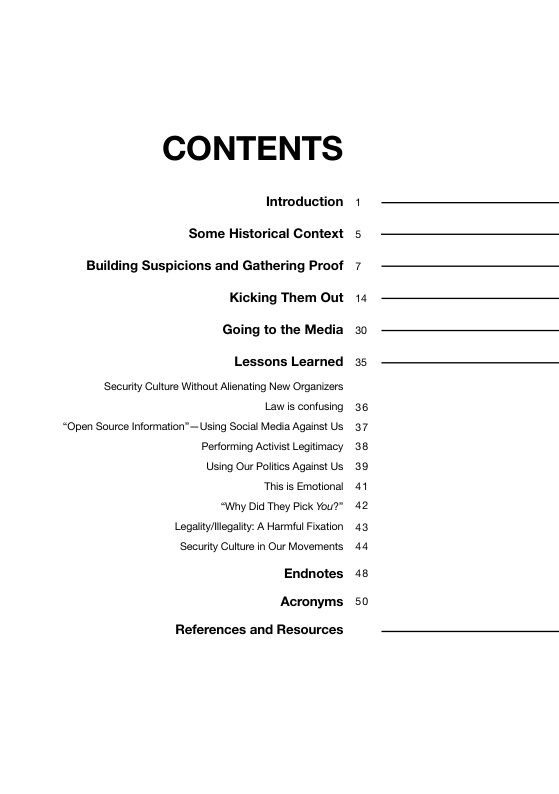
CONTENTS
Introduction 1
Some Historical Context s
ling Suspicions and Gathering Proof 7
ing Them Out 14
Going to the Media 30
Lessons Learned 35
Securly Culture Without Alienating New Organizers
Lawis confusing 36
“Open Source Information” ~Using Socia Media Against Us 37
Performing Activist Legiimacy 38
Using Our Poltcs Against Us 39
Thisis Emotional 41
“Wny Did They Pick You?" 42
Logalty/legaity: A Harmful Fixation 43
Securty Culture in Our Movements 44
Endnotes 48
Acronyms 50
References and Resources
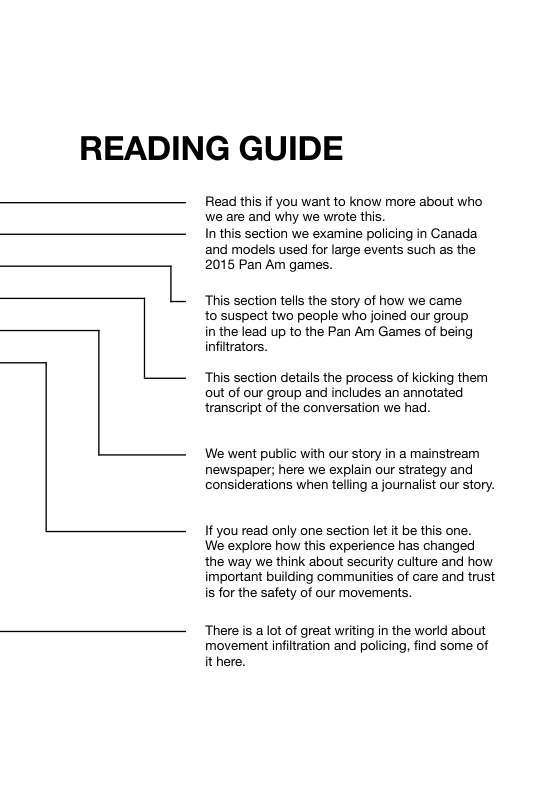
READING GUIDE
Read this if you want to know more about who
we are and why we wrote this
In this section we examine policing in Ganada
and models used for large events such as the
2015 Pan Am games.
This section tells the story of how we came
to suspect two people who joined our group
in the lead up to the Pan Am Games of being
infitrators.
L This section details the process of kicking them
out of our group and includes an annotated
transcript of the conversation we had.
We went public with our story in a mainstream
newspaper; here we explain our strategy and
considerations when telling a journalist our story.
If you read only one section let it be this one.
We explore how this experience has changed
the way we think about security culture and how
important building communities of care and trust
is for the safety of our movements,
There is a lot of great writing in the world about
movement infitration and policing, find some of
it here.
Towards the end of
2014 we started to
suspect that two
members of the
Mining Injustice
Solidarity Network
were not who they
said they were.
Introduction
We are in a moment of unprecedented visibility and
public concer on the matter of police brutality and
police profiling in communities across North America.
While recent movements lie Black Lives Matter and Idle
No More have made an incredible impact on the level of
mainstream attention to issues that had previously been
marginalized and ignored—namely, the criminalization,
harassment, and sometimes deadly targeting of Black
and Indigenous communities by police in the US and
Ganada—these groups havealsofaced vitriolic backlash
on many fronts. At the time of writing this zine—summer
2017—we are seeing a rapid surge in vocal, confident
white supremacy in the city of Toronto, which has made
the public conversation on race and policing even more
volatile. Nonetheless, we seem to be experiencing a
sea change in public discourse around the role that
police play in upholding the status quo of capitalism,
colonialism, and white supremacy.
While more and more people know about certain
aspects of the “police problem” in North America, the
issue of undercover policing—though it too is highly
racialized, widely experienced in activist circles, and
increasingly targets Muslim communities—remains
mostly discussed behind closed doors and around
Kitchen tables. This phenomenon is the focus of our
writing here.
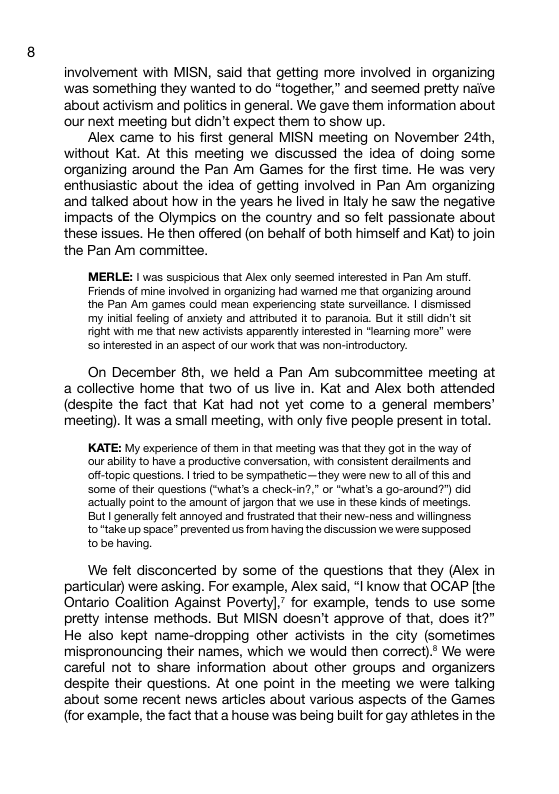
Towards the end of 2014 we started to suspect that two mermbers
of the Mining Injustice Solidarity Network (MISN)—the mining justice
group we are a part of—were not who they said they were. In the
beginning of 2015, we kicked them out of our group, quite certain they
were undercover police. In the summer of 2015, an article about our
experiences was published in a mainstream Toronto newspaper. This is
that same story, but this time around we are using our own words and
political analysis rather
PN CCLE NIl | NOT COPS, THEN WHO?
palatable to mainstream
media.
details of our story it's I 4
important tointroduce bilties of who our shady new members
ourselves, our reasons for iave_been. One option s privately
PN R Rl hired comorate infitrators, who we. know
[T Y have gotten involved with MISN before. For
write this as four people RN
of the multitudes who IR R R e
USRI 1< (o inftrate MISN through a private
ptiauteyodill company contracted by a major mining
company that's been protested by MIS]
NI IEC N 2nd others for its human rights record.
AN LUl Ve are also overtly surveilled by mining
because we know that [RSSSRSMSSNTgINA nstant
50 often, for a variety of [ESCCANERS
reasons, many people [RTATCIETETEICE
can't tak about what RN
they've been through ognize us and address us by name.
with undercover police nf it were the case that our iniltrators
© paid for by a mining company,
RS . now that the lines are increasingly fuzzy
of state surveillance.
state and _corporate _infiration
WWa feel that we are In 2 In the mining-imp:
position to take the risk ork with around the
LI OIS there is a long history of overt coliaboration
PTETERRYRERN on intelligence-gathering between rmining
writing this as advice; it RSSO
is a very particular story [ PR e M)
that won't necessarily
apply to other people or organizations.
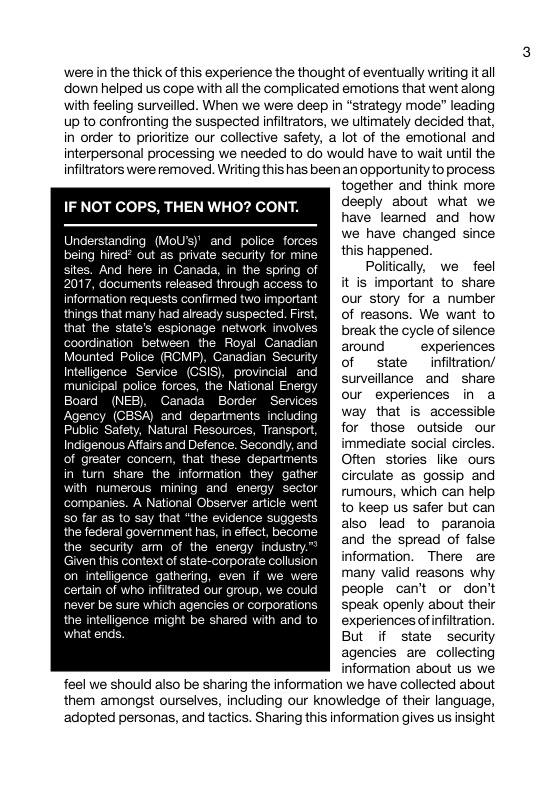
‘The reasons we're writing this are both emotional and political (which
isn't to say that emotions can't be political). For example, when we
‘were in the thick of this experience the thought of eventually writing it all
down helped us cope with all the complicated emotions that went along
with feeling surveilled. When we were deep in “strategy mode” leading
up to confronting the suspected infiltrators, we ultimately decided that,
in order to prioritize our collective safety, a lot of the emotional and
interpersonal processing we needed to do would have to wait until the
infiltrators were removed. Writing this has been an opportunity to process
together and think more
IF NOT COPS, THEN WHO? CONT. deeply about what we
have leamed and how
O IRy e have changed since
I g "' happened
sites. And here in Canada, in the spring of Poltically, we feel
17, documents released fhrough access to [ICEEINEUEICEY
information requests confirmed two important RSV RIS
things that many had aleady suspected. First, RS IR IARNE TS
that the state’s espionage network involves [RSIRITRGINS TS
T U oound experiences
Mounted Police (RCMP), Canadian Security [RNSSRSL Y
Intelligence Service (CSIS), provincial and
municipal police forces, the National Encrgy [kt
our experiences in a
Board (NEB), Ganada Border Services
Agency (CBSA) and departments including [N ke
[T L Ayl for those outside our
LTy e el immediate social circles.
R I ATl Often stories like ours
in tum share the information they gather [RSUSIINIRPSREIENERERN)
I Al umours, which can help
mpanies. A National Observer article went - [RUiSSsAIRYSY
So far as to say that “the evidence suggests NI EFUtoEeA
Given this context of state-corporate information. There are
on intelligence gathering, n if many valid reasons why
certain of who infitrated our group, people can't or don't
never be sure which agencies or corporations [IRSSRARSS VNIRRT
the inteligence might be shared experiences of nfitration.
1at end But if state security
agencies are collecting
information about us we
feel we should also be sharing the information we have collected about
them amongst ourselves, including our knowledge of their language,
adopted personas, and tactics. Sharing this information gives us insight
into their infiltration strategies, which builds our power and keeps us
safer. We also hope that our story adds an element of lived experience
to current research and writings on contemporary trends in policing.
In particular, we hope this story can act as both a broad critique and
a very specific cautionary tale, ilustrating what organizing looks like
‘when state surveilance in the name of “risk assessment” increasingly
penetrates our personal-political lives.
We are all white, university-educated people with Canadian
citizenship and relative economic security, which means that we are in
many ways safer from state violence than others. However, as activists
we have varied experiences with state surveilance that gave us certain
practical and perceptual skills in this situation. Sam's experience
studying, and also being criminalized by, the legal system was an asset
to us, as was Rachel's experience supporting human rights defenders
facing state criminalization in Guatemala.
There were other factors that allowed this to play out as it did.
For example, our emotional skills played a major role; we got through
this relatively unscathed because we took the emotional aspects of
this very seriously and prioritized remaining a collective. We also all
knew each other somewhat before this happened (Rachel and Kate live
together, Sam and Kate were in a relationship, and Merle and Rachel
had been organizing together for more than a year prior) and had to
‘quickly decide to trust each other. Lastly, other members of MISN (the
group that Kate, Merle, and Rachel all organize with) trusted us to deal
with this autonomously, believing that we would share what was “need-
to-know.”
There is also important cultural context about our activist “scene”
to consider. We experienced this as activists in Toronto, an organizing
scene with scars from being surveilled in the lead-up to the 2010 G20
summit. Part of our impetus for writing this was to respond to feelings
of disempowerment that many experienced post-G20. Many of those
who were active in Toronto around the G20 have understandably
come to find it difficult to trust others in organizing contexts; this has
impacted the ways that organizing is done here. We write this to re-
open and broaden discussions of security culture and trust in Toronto,
and to recognize that our ability to “catch” these infiltrators was in great
part due to G20 lessons and legacies that have shaped the culture of
Toronto organizing. We also want to share the skills we've learned about
security culture and trust in our movements.
Putting these words to paper comes with some inherent risks—
there are many forces at play keeping state surveillance techniques a
secret—but we have decided that the potential impact of breaking the
silence around infiltration is worth this risk. We have not seen other
resources like what we have written here (and there are probably
many reasons for this). We likely will never have absolute confirmation
that these two people were cops or private investigators for a mining
company, but we feel absolutely confident that we made the right
choice in kicking them out, and hope that the story of how we did it is
instructive to others.
Some Historical Context
Some historical context is needed to properly understand this story.
Some of this context is about the ways in which Canadian policing
has changed and adapted over the years in response to the increasing
corporatization and privatization of public services, shifting internal
policing cultures, and changing activist tactics. In Lesley Wood's book
Crisis and Control: The Miltarization of Protest Policing, she articulates:
Wrile police leadrs are now more kel to make formal, sxplicit declarations
‘about civiliberties and the importance of human rights in a democratic society,
an increasingy intsgrated and privatized feld of policing pre-emts and lmits
those same cii iberties and human rights. Ths transfommation is a result of
the way that the logics of public policing are blending with the logics of miltary
control and iteligence ... Polce increasingly evaluate protest actiiy through
the lens of theat assessment, grouping it nto a larger category that includes
terroism, war, and vilent crime. (2014, p. 126)
As Wood explains, a relatively new change in Ganadian policing
and intelligence-gathering has been an increase of “integration,” or
communication and_collaboration between security agencies (e.g.
between GSIS, the RGMP, municipal police forces, etc.). Ever since
the 2010 Winter Olympics in Vancouver, the Integrated Security Unit
(ISU) has seemingly become the dominant organizational model for
“securing” large-scale events in Canada. ISUs essentially operate as
the *head” of large-scale security operations for major events; they
are a multi-agency coordinating body that is formed for each mega-
event and ensures that police, miltary, and intelligence agencies are
working in concert with one another, sharing information, and dividing
roles among the participating agencies. In terrorism investigations,
similarly collaborative taskforces, called Integrated National Security
Enforcement Teams (INSETS), are used. After the Vancouver Olympics,
this organizational form was also used to structure security operations
for the G20 Summit in Toronto in June 2010 and the Pan Am Games
in 2015. The ISU for the Pan Am Games began the planning phase of
security provision for the Games in October 2010 (notably, just months
after the Toronto G20 Summit)
‘The Joint Intelligence Group (JIG), typically a branch of the ISU, is
concerned particularly with gathering and assessing intelligence about
potential threats to event security. It is usually composed of GSIS, the
RGMP, and whatever police agencies are involved in securing the event.
The JIG coordinates intelligence gathering among these agencies and
ensures that each agency tasked with securing major events is aware
of the potential threats that this inteligence “uncovers.” Undercover
operations are typically coordinated within the JIG and carried about
by a particular policing agency. Its public knowledge* that this model of
intelligence-gathering was used to securitize the 2015 Pan Am Games.
Since the formation of the Pan Am Games' JIG in September 2014,
“threat assessments” (to determine the likelihood of phenomena such
s terrorism and protests deemed to be threatening or undermining the
Games) were conducted weekly unti the Games began.
As we mentioned In the introduction, three us are members of
the Toronto-based activist group MISN, a small group that has been
active for almost 10 years and that agtates against the violent and
negligent practices of Canadian mining companies in solidarity with
the communities impacted by their operations both in Canada and
abroad. As the Pan Am Games approached, it was impossible for us
toignore the role of the Games' medal supplier, Toronto-based mining
company Barrick Gold. Barrick's involvement in providing the gold,
silver, and copper was announced in September 2014, and the medals
were unveiled in March 2015 at a media event at the Royal Ontario
Museum. We had already been talking about trying to leverage the
general media biitz surrounding the Pan Am Games to intervene into
nationalist sentiments about Canada as a *benevolent” country, but
when Barrick's involvement was announced we could hardly believe
how much of the story was being left out. Press releases about the
unveiling stated that the design of the medals was “meant to highlight
unity across the Americas,” and was inspired by the unifying force of
“land and water and the environment.” Even the Royal Canadian Mint's
construction of the medals used a special technique called “mokume
gane” that “unifies” disparate materials into one final product. But as
mining justice group with ties to mining-impacted communities in
vocal opposition to Barrick Gold's practices of perpetrating violence,
contaminating water supplies, causing illnesses, and bringing about a
loss of livelihood in their communities, it was obvious to us that Barrick
was using this as a propaganda toof* to get some good press. Mining
reproduces the colonial relationships at the root of Pan-American
inequality and injustice; it was deeply ironic that this company could
pretend to have anything to do with “unity.”
Meanwhile, TO2015 (the organization tasked with planning the
Pan Am Games) announced in November 2014 that it was going to
be significantly increasing its security budget to $247.4 millon, more
than doubling® the amount that it had initally proposed in its bid for the
Games. The Joint Inteligence Group for the Toronto Pan Am Games
had met for the first time in September 2014 to determine a security
strategy for the Games, and it was around this time that we first met
Kat and Alex.
Building Suspicions and Gathering Proof
We first met one of the people that infiltrated our group at a memorial
held in late September in 2014 to mark the 5-year anniversary of the
death of Adolfo Ich Chaman, a community leader murdered by a
Ganadian mining company in Guatemala. “Kat” approached one of
the organizers, introduced herself, and expressed interest in getting
involved. We shared that we had a new members’ orientation coming
Up in the next few months.
Abouta month later we received an email from a member of another
activist group in the city asking us if we'd be interested in attending an
“allies meeting” of groups who were planning on organizing around the
upcoming Pan Am Games in Toronto. It had been recently announced
that Barrick Gold was a major sponsor of the Games, supplying the
materials for the medals. After talking about it as a group, we agreed
that attending this allies meeting would be a good opportunity for us and
struck an internal MISN subcommittee to prepare for our attendance.
On November 3rd, 2014 we held a new members’ orientation for
MISN, where people who were interested in joining the group could
learn more about what we do and how we do it. A couple of us organized
and faciltated the event and each took responsibility for facilitating
small group discussions to leam more about prospective members and
answer any specific questions they might have. In one of these small
group discussions, we met Kat and “Alex,” who said they were a couple
that was relatively new to the Toronto activist community and to social
justice issues in general. They spoke in “we language about their
involvement with MISN, said that getting more involved in organizing
was something they wanted to do “together,” and seemed pretty naive
‘about activism and politics in general. We gave them information about
our next meeting but didn't expect them to show up.
Alex came to his first general MISN meeting on November 24th,
without Kat. At this meeting we discussed the idea of doing some
organizing around the Pan Am Games for the first time. He was very
enthusiastic about the idea of getting involved in Pan Am organizing
and talked about how in the years he lived in Italy he saw the negative
impacts of the Olympics on the country and so felt passionate about
these issues. He then offered (on behalf of both himself and Kat to join
the Pan Am committee.
MERLE: | was suspicious that Alex only seemed iterested in Pan Am stuff
Frisnds of mine involved i organizing had wamed me that organizing around
the Pan Am games could mean experiencing state surveilance. | ismissed
my inital fesiing of anxiety and attibuted It o paranoia. But 1 sl didn' sit
right with me that new activists apparently nterested in “learing more” were
o interested i an aspect of our work that was non-introductory:
On December 8th, we held a Pan Am subcommittee meeting at
a collective home that two of us live in. Kat and Alex both attended
(despite the fact that Kat had not yet come to a general members’
meeting). It was a small meeting, with only five people present i total,
KATE: My experience of them in that meeting was that they got n the way of
our abilty to have a productive conversation, with consistent deraiiments and
off-topic questions. | tried to be sympathetic —they were new {0 al of this and
Soma of their questions (wha's a check-in?," or "what's a go-around?”) did
actually poin to the amount of argon that we usa in these kinds of mestings.
But | generaly fet annoyed and frusirated that their new-ness and willngness.
to"take up space” prevented us from having th iscussion we were supposed
to b having.
We feit disconcerted by some of the questions that they (Alex in
particular) were asking. For example, Alex said, “I know that OGAP [the
Ontario Coalition Against Poverty).” for example, tends to use some
pretty intense methods. But MISN doesn't approve of that, does it?"
He also kept name-dropping other activists in the city (sometimes
mispronouncing their names, which we would then correct).* We were
careful not to share information about other groups and organizers
despite their questions. At one point in the meeting we were talking
‘about some recent news articles about various aspects of the Games
(for example, the fact that a house was being built for gay athletes in the
athletes’ village) and during this conversation Kat suggested that we
start a Facebook thread to communicate about different places where
we could have protests during the Games. The suggestion was out of
the blue, and we were already communicating via email, so we said
0 to that pretty quickly. They also kept speaking as though they were
invited to the Pan Am allies meeting that we were preparing for, even
though we'd only ever talked about a couple of long-standing MISN
members going. They only backed down once we said very clearly that
only two of us would be going.
In these introductory discussions we had with them, we were
told that they both worked freelance (he “worked for a buddy” as a
landscaper, she was seff-employed as a dog walker). He told us that
he had two Kids from a past marriage who stayed with him sometimes.
She lived with her sister in north Toronto. They were both very vocal
about wanting to help in whatever ways were possible and about
wanting to follow our lead. They kept offering unsolicited information
‘about themselves and apologizing for things out of the blue.
After that meeting we debriefed quickly and discovered through
this conversation that there were alarm bells going off in all of our heads
throughout the meeting. Given our suspicions—that Kat and Alex were
perhaps not who they said they were—we thought we should talk to
others to get extra insight. After the meeting, some of us talked to Sam,
someone we knew who had experience with undercover infitration
tactics during the Toronto G20. After hearing all the details they felt
pretty strongly that our suspicions were warranted. They were able to
confirm that many of Kat and Alex’s characteristics and behaviours
‘were remarkably similar to those displayed by undercover cops tasked
with gathering information about G20 activists.
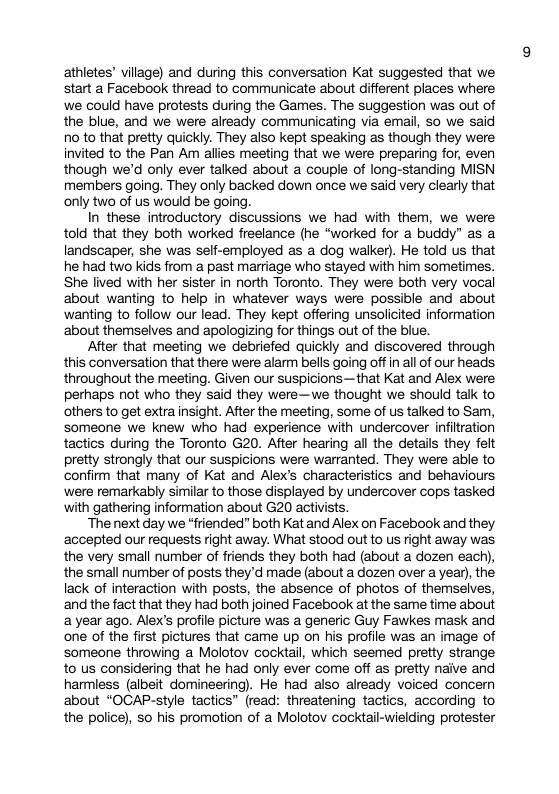
‘The next day we “friended” both Kat and Alex on Facebook and they
‘accepted our requests right away. What stood out to us right away was
the very small number of friends they both had (about a dozen each),
the small number of posts they'd made (about a dozen over a year), the
lack of interaction with posts, the absence of photos of themselves,
and the fact that they had both joined Facebook at the same time about
a year ago. Alex's profile picture was a generic Guy Fawkes mask and
one of the first pictures that came up on his profile was an image of
someone throwing a Molotov cocktail, which seemed pretty strange
to us considering that he had only ever come off as pretty naive and
harmless (albeit domineering). He had also already voiced concern
about *OGAP-style tactics™ (read: threatening tactics, according to
the police), so his promotion of a Molotov cocktail-wielding protester
10
seemed strange. Kat's profile picture was a wordmap with generic
‘words like “freedom,” “humanity,” “equality,” “love,” and “fairness.”
Despite the fact that they said they were both new to social justice
issues, the only Facebook events that Kat had attended all pertained to
activist issues that have been historically targeted by Canadian policing
and surveillance—explicitly anarchist events, events about black bloc
organizing, resisting police violence, land defense, and a panel about
the Pan Am Games. Her “likes” were mostly animal rights groups, land
defense groups, a group related to Occupy, and MISN.
They each had one Facebook friend who at least one of us knew.
We spoke to these friends and it turned out that neither one knew Kat
and Alex at all. Before we even told one of them what was going on,
they said: “The profile looks fake.”
MERLE: Taking to these fiends made me realize how serious it would be
if Alex and Kat really were survedling us. | et simultaneously unsure of who.
1 could trust and a strong sense of worry about what others might akso be
experiencing.
We continued to pay attention to their behaviour but didn't
immediately kick them out of the group. At this point it was December.
MISN decided to have a holiday party on December 20th, since we
usually only saw each other in meetings. Kat RSVP'd but Alex said he
couldn't come because he had to take care of his kids.
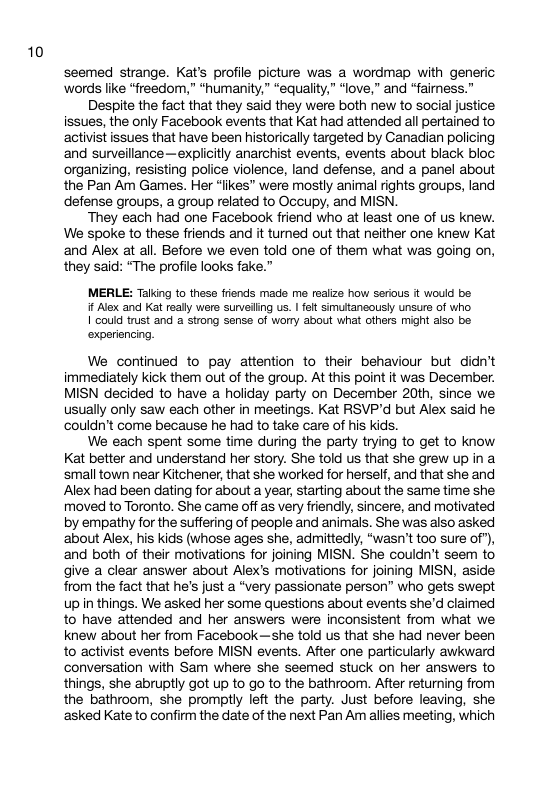
We each spent some time during the party trying to get to know
Kat better and understand her story. She told us that she grew up in a
small town near Kitchener, that she worked for herself, and that she and
Alex had been dating for about a year, starting about the same time she
moved to Toronto. She came off as very friendly, sincere, and motivated
by empathy for the suffering of people and animals. She was also asked
‘about Alex, his kids (whose ages she, admittedly, “wasn't too sure of’),
and both of their motivations for joining MISN. She couldn't seem to
give a clear answer about Alex's motivations for joining MISN, aside
from the fact that he's just a *very passionate person” who gets swept
up in things. We asked her some questions about events she'd claimed
to have attended and her answers were inconsistent from what we
knew about her from Facebook—she told us that she had never been
to activist events before MISN events. After one particularly awkward
conversation with Sam where she seemed stuck on her answers to
things, she abruptly got up to o to the bathroom. After returning from
the bathroom, she promptly left the party. Just before leaving, she
‘asked Kate to confim the date of the next Pan Am allies meeting, which
she seemed to know off the top of her head even though she wasn't
eveninvited to it. This, along with her seeming so freaked out by herlast
‘conversation at the party and her not seeming to know much about her
partner, definitely threw up red flags for many of us. When the party was
over we jotted down some information about what she had said (and
were really glad to have these notes later).
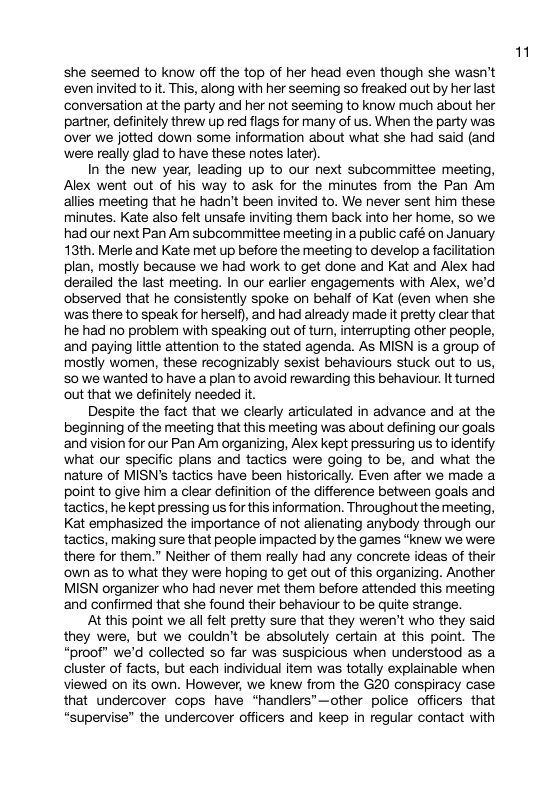
In the new year, leading up to our next subcommittee meting,
Alex went out of his way to ask for the minutes from the Pan Am
allies meeting that he hadn't been invited to. We never sent him these
minutes. Kate also felt unsafe inviting them back into her home, so we
had our next Pan Am subcommittee meeting in a public café on January
13th. Merle and Kate met up before the meeting to develop a faciltation
plan, mostly because we had work to get done and Kat and Alex had
deraled the last meeting. In our earlier engagements with Alex, we'd
observed that he consistently spoke on behalf of Kat (even when she
‘was there to speak for herself, and had already made it pretty clear that
he had no problem with speaking out of turn, interrupting other people,
and paying litle attention to the stated agenda. As MISN is a group of
mostly women, these recognizably sexist behaviours stuck out 1o us,
50 we wanted to have a plan to avoid rewarding this behaviour. It turned
out that we definitely needed it.
Despite the fact that we clearly articulated in advance and at the
beginning of the meeting that this meeting was about defining our goals
and vision for our Pan Am organizing, Alex kept pressuring us to identify
what our specific plans and tactics were going to be, and what the
nature of MISN's tactics have been historically. Even after we made a
point to give him a clear definition of the difference between goals and
tactics, he kept pressing us for this information. Throughout the meeting,
Kat emphasized the importance of not alienating anybody through our
tactics, making sure that people impacted by the games “knew we were
there for them.” Neither of them really had any concrete ideas of their
own as to what they were hoping to get out of this organizing. Another
MISN organizer who had never met them before attended this meeting
‘and confirmed that she found their behaviour to be quite strange.
At this point we all felt pretty sure that they weren't who they said
they were, but we couldn't be absolutely certain at this point. The
“proof” we'd collected so far was suspicious when understood as a
cluster of facts, but each individual item was totally explainable when
viewed on its own. However, we knew from the G20 conspiracy case
that undercover cops have “handlers”—other police officers that
“supervise” the undercover officers and keep in regular contact with
11
12
them while they are in the field. Undercover officers typically meet up
with their handiers atter every meeting or social event they attended in
an undercover role. It became clear that if the handler somehow made
themselves known to us, then we would have definitive proof that Kat
and Alex were, in fact, cops.
On January 18th, about a week later, we had a general MISN
visioning meeting that Alex and Kat both attended. At the beginning
of the meeting, Kat mentioned that her neck was really hurting her. As
we started a visioning activity, Rachel began taking photos of people
engaging n the activity to post on social medialater. Directly after Rachel
did this, Kat said that her neck was hurting too much, and she and
Alex left immediately mid-way through the mesting. Kate texted Sam
(who was nearby) to let them know that Kat and Alex were suddenly
and conspicuously leaving and Sam was able to watch them as they
entered a nearby subway station. Sam looked through the glass walls
of the station as Kat and Alex went through the turnstile. As Alex went
through, he turned around and seemed to notice Sam standing outside,
‘even though the two had never met before and Sam was standing in a
small crowd of people. Sam watched Kat and Alex pay their fare and
go down onto a platform. Just before the train arrived, Alex doubled
back up the stairs from the platform, coming face to face with Sam.
Sam retreated to a farther part of the station and saw that, when the
train came, Kat and Alex did not get on it. Alex then pulled out his
cell phone, even though he was underground (this was before there
was widespread cell service in the subway system). At this point Sam
decided toleave the subway station and, as they exited the station and
got only a few metres from the entrance, two police cars came zooming
Up to the station with their lights on. Three or four police officers ran out
of the cars and into the station. Sam continued to walk away to a safe
place.
KATE: Though we felt certain that Sam wasn't doing anything legal by
following them, we knew that lgalfty wasn't a necessary condition for getting
anested or messed with by police. | was really nervous. | eventualy got 2
phone call from Sam letting me know that they were safe at a fiend's house
‘and that they were going to stay thero for a while unt they felt more confident
that they weren't being folowed.
For Sam and Kate, this was the confirming evidence they needed in
order to believe with conclusiveness that Kat and Alex were undercover
cops. The two felt that the likelinood was siim to none that two police
cars could happen to be responding to an emergency at Christie Station
atthe exact same time that this was happening.
‘SAM: I had just left the station, which was othenwise faily empy and there
was no emergency happening at the fime that the police could have been
responding to. It seemed much more ikely that the two cars were on-call as
Kat and Alex's handiers or backup, in cass there was an emergency situation
with Kat and Alex that they might need to respond to.
‘The whole situation felt suspicious; even if Kat and Alex were just
spooked by seeing Sam and called the police, there were so many facts
that didn't line up. Why would the sight of Sam have alarmed them so
much? How did Alex even recognize Sam, when they had never met
before (while Sam was already known to police for their organizing work
and as a target of the G20 police infiltration)? How could they have
placed a phone call to the police when they were underground? How
and why would two cop cars show up with their lights and sirens on
‘within seconds in response to a call from a civilian?
What had happened really freaked us out and it became evident to
us how important it was for our safety to keep a strong commitment
to clear communication and relationship maintenance throughout this
process.
A few days later, Kat contacted Merle over Facebook. She asked
Merle if she couid call her; Merle's initial reaction was to call the others
and try and figure out what to do.
MERLE: | had a feeiing she warted to talk about what happened and | felt
very torn up about whether to respond and how. After speaking with ofhers
it seemed inilally that a response wasn't worth the trouble, as a phone call
‘could potentially open me up to more survellance (they did't have our phone
numibers yet). Later | responded because at that point a small part of me stil
worried that pehaps they weren'tinfitrators and were actuall just some naive
new activsts we had really aienated
Merle responded via Facebook message saying she was busy
and asked what Kat wanted to talk about. Kat again asked to talk on
the phone and Merle, still questioning whether it was wise, held off on
responding until the 20th, apologizing for her absence and asking to
keep the discussion on Facebook Messenger. Kat responded with a
long message telling Merie that she thought Sam was following her
and ended by asking: *l just wanted to see what you know about Sam
or how well you know them.” It was clear to all of us that her central
objective in messaging Merle was to gather information on Sam.
MERLE: | ol very alone throughout this experience. | was able 1o talk with
Kate, Rachel, and Sam about my feslings but our communication had broken
doun 2 bit at tis poin. | was afraid of my family and frends experiencing
13
14
sunvellance if they knew what was going on. Despite this fear | broke down
and told my mom what was happening and dealt with a lot of guit around
whether | had exposed her to state surveilance.
1am somean who’s fairy open abowit my own experiences with gendered
viclence and at the time was volunteering at a sexual assaut criis ine. |
thought that was possibly why Kat reached out to me. | was very uncertain
‘about whether that was because she legtimately wanted a listening ear or
bacause she perceived that it would be easier to manipuiate me.
RACHEL: At this point, 1 had a lot of conficting feelings. Now that | was
‘convinced that Kat and Alex were defnitely not who they were pretending to
be, and were fikely cops, | elt a huge amourt of guit that by having them over
o our house a few times | had pu my housemates at isk. | also had no clue
whather | shouid be worried about our house being bugged in some way, or
whether this was me being excessively paranoic.
1aiso et ke anumber of my concerns were really diferent rom the restof
ourgroup', and was nervous abot our group process and how we would igure
ot what 10 do next. My background in witnessing/experiencing surveilance
‘came from some realy different contexts from the rest of our group; while
Iving and working with land defenders and environmental justice organizations.
in Guatemala, | had seen many different forms of sunvellance and violence
by Gops and other groups hiding their denites. The types of precautions |
had learned to take in this context of soidarity work were primarly geared
towards protecting people who wiers at risk of being kidnapped, assassinated,
or facing other threats to their bodies or thei familes. In comparison, the isks
we and others in MISN faced feft smaler, so 1 think | had trouble fecling lke
1 was on the same page as my friends and co-organizers, and was defintely
‘assessing risk diferenty. | had also witnessed situations (both abroad and In
‘Ganada) where the process of accusing someone of being an infitrator had
devastating effects on group cohesion and function and had put people in real
danger. | hink this meant that | as at tmes mora worried about this possibilty
than about whether or not Kat and Alex actually were infilvators. | was deeply
wortied that in the process of sussing out Kat and Alex (and in any future
actions we might take concerming that) that we might cause lasting hamn to
MISN.
Kicking Them Out
At this point we were as convinced as we could be that Kat and Alex
‘were undercover cops (or some other sort of infilrators) and we also
felt that we were subjecting ourselves, our fellow organizers, and allies
to unnecessary threat by continuing to associate with them. So, we
decided it would be best to confront them and kick them out of MISN.
We debated pretty extensively about the best way to kick them out
of our group in a way that both minimized risk and maximized the
likelihood of finding out what was really going on. We decided to initiate:
aPan Am committee meeting at a café where Kate, Merle, and Rachel
‘would confront them and ask a number of questions.
To prepare for this, we met a bunch of times to plan out what roles
each of us would play and compiled a list of questions (constituting
a loose script) for us to ask them. We wanted to maintain the tightest
control possible over the interaction and we felt that creating roles would
help us stay calm under pressure and ot freak them out to the extent
that they wouldn't answer our questions. Kate was designated as the
“question-asker” and general driver of the conversation, Rachel was
designated as the person to step in to smooth things over if anything
got tricky and the person to formally ick them out of the group, and
Merle was to hang back so she could keep a cool head in order to ask
the tough question: “Are you cops?” We agreed that no matter how
the conversation went, we would make sure not to let it end before
directly asking Alex and Kat whether they were cops or with CSIS (the
Ganadian Security Intelligence Service, Canada's spy agency), and
informing them that they would have no further association with MISN.
We were genuinely worried that we might be arrested if our
“confrontation” was perceived as aggressive and Kat and Alex panicked.
As a safety measure, we arranged for a friend of ours who worked in
movement legal defense to sit quietly nearby so they could observe
the interaction. Sam was also sitting in the café at another table. As an
‘added precaution we also asked a friend of ours with no affiiation to
our activism to sit nearby, uninvolved in the interaction, so she could
‘contact friends and family in the unlikely worst-case-scenario that all of
us were arrested. It turned out that, besides the owner, we were alone
in the café; just Merle, Kate, and Rachel and our three friends who were
all sitting at other tables minding their own business.
Kat and Alex eventually showed up to the “meeting,” but they were
half an hour late. We audio-recorded this conversation using our cell
phones and ultimately made a transcript of the entire interaction. What
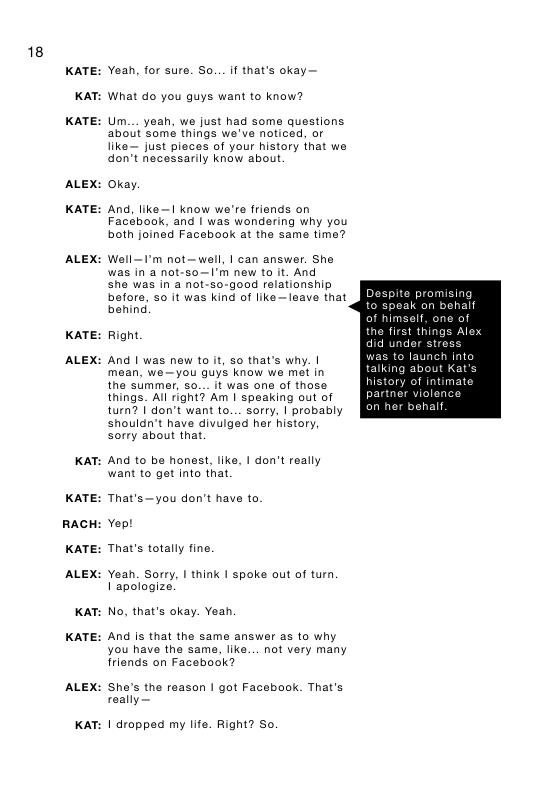
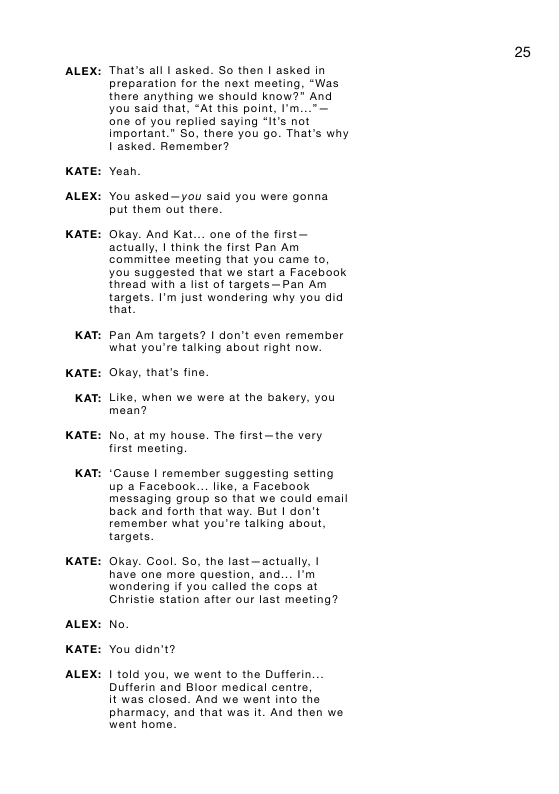
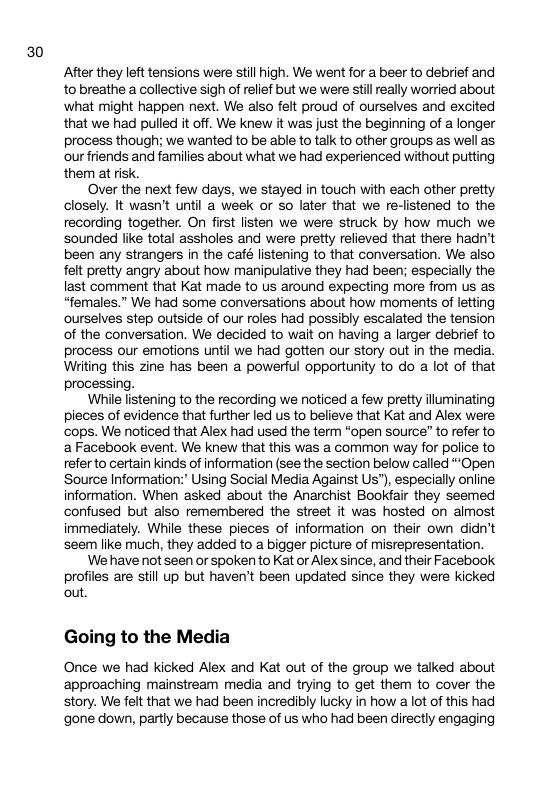
follows is an exact record of our conversation that evening, annotated
with some of our observations.
15
16
KATE:
ALEX:
KATE:
ALEX:
KATE:
ALEX:
KAT:
ALEX:
KAT:
ALEX:
KAT:
KATE:
ALEX:
KATE:
RACH
KATE:
MERLE:
KATE:
1 just wanted to give you a heads obated a
up. 1 know that there was some, like,
confusion around Sam, and | wanted to
just warn you that they're going to be n we confront
waiting here at the café for me because wanted a
we're going somewhere after this. And
1 didn't want you to be, like, thrown off
before we got that resclved or whatever.
That... sarry? Who's going to be
waiting? freak out when they
My partner Sam this was our way of
Oh, okay. Fair enough.
Yeah, just so you know.
©h, okay. No, no.
It was just weird... right? Like, it was
just one of those things —
[interrupts] They spoke at a Christmas
party, and then it was like... came and.
Like, 1 went to go say hi and then they
just... ran
Ran,
Like, 1 thought... at first | was like, did
offend them? Or, like, were they... are
they upset? And then | was like... is it
because I'm.. is it because [Alex's] with
me now? Like.
1 honestly have no idea—
linterrupts] 1 just—
Maybe we can talk about it afterwards
or something. We have a lot to kind of
like....chug through
[Unintelligible] before nine.
That's okay, things happen
You guys are going out tonight?
Yeah, I just have plans with friends
Iater.
[Coffes arrives, mors small talk, real talk
starts again in a bit.]
KATE:
ALEX:
KATE:
ALEX:
KATE:
ALEX:
KATE:
ALEX:
KATE:
ALEX:
KATE:
ALEX:
RACH
S0, yean—
[interrupts] ‘Cause you said... it sounds
like we're.__ you're gearing up... based
on the emall, so—
Yeah, we'rs definitely excited to have
the chance to, ke, start moving
forward. And yeah, Iike, actually a pretty
important agenda item today Is we were
hoping to ask you guys some questions.
sure.
Because we're, like, moving into
actually wanting to get things done and
we just realized we don't actually really
like, know you very well.
sure.
So, i that’s okay with you
Absolutely.
And.__it's, like, kind of awkward, but
like, W know you guys are, like, in a
relationship and your lives aro super
intertwined. but I'm hoping that you can
Kind of answer
on behalf of yourselves? s really
important —like, rather than answering
for each other. Bacause it's just,
like, important o us that we get the
chance to, like, know and trust you as
individuals as we move forward.
sure.
And, like, as individual members of the
aroup.
Mmhmm.
It's something that's come up for us
with couples before, where we've
realized that we don't know— ke, If
you're not on different committees, we
don't know each person as an individual
MISN member. But, like, there’s 2 whole
history to that
17
mail initiating
ting,” 1 had
action plan.
like the membership
ur committee
changing,
hould
bly check in
ut how work is
being divided
ause Alex had a
where they
ver for eac
other—wh
thought that
uld make
18
KATE:
KAT:
KATE:
ALEX:
KATE:
ALEX:
KATE:
ALEX:
KAT:
KATE:
RACH
KATE:
ALEX:
KAT:
KATE:
ALEX:
KAT:
Yeah, for sure. So.. if that's okay—
What o you guys want to know?
Um._. yeah, we just had some questions.
about some things we've noticed, or
like~ just pleces of your history that we
don't necessarily know about
Okay.
And, like—1 know we'r friends on
Facebook, and | was wondering why you
both joined Facebook at the same time?
Well—F'm not—well, | can answer. She
was in a not-so—I'm new to it. And
she was in a not-s0-good relationship
before, so it was kind of like —leave that
behind
Right.
And 1 was new to it, so that's why. |
mean, we—you quys know we met in
the sUmmer, so... it was one of those
things. All right? Am | speaking out of
turn? | don’t want to... sorry, | probably
shouldn't have divuiged her history,
sorry about that
And to be honest, liks, I don't really
want to get into that.
That's—you don't have to
Yept
That's totally fine.
Yeah. Sorry, I think I spoke aut of turn,
I apologize.
No, that's okay. Yeah
And is that the same answer as to why
you have the same, like... not very many
friends on Facebook?
She's the reason | got Facebook. That's
really—
1| dropped my life. Right? So.
Despite promisi
ak on behall
olf, one of
things Ale;
did under stress
o launch into
talking about Kat
history of intimate
partner
KATE:
ALEX:
KAT:
KATE:
KAT:
KATE:
KAT:
KATE:
ALEX:
KATE:
ALEX:
KATE:
ALEX:
KAT:
ALEX:
KAT:
ALEX:
KATE:
ALEX:
KATE:
ALEX:
Oxay.
Mmhmm.
That's what it s,
Cool. I'm wondering —did you go to the
Anarchist Bookfair?
Did I go to what?
The Anarchist Bookafr
Yeah
Okay, and
[interrupts] Which one?
The Anarchist Bookafr
The Anarchist Bookfair [mispronounces
i]7 The one at... the one on Gould?
Anarchist Bookfair
There was the one on Gould... no
Like, U of
Yaah, it was at Ryerson.
Yoah
Yeah, last year. Yean, yeah
Okay. And I just know... | know both of
you are, like... you've said before that
you're, like, pretty new to all of this
stuff, 50 I'm just wondering how you
found out about it?
About
I you're, like, new to social justice
issues, fow you found out about the
Anarchist Bookfair?
It's apen source. It's open, right?
Facebook, and... you look at... I—it's
funny, | even have one of my— one of my
followars is, like, the Socialist Party in
ltaly. Why? Because I'm just interested
in that kind of stuff
19
profiles showed that
they attended the
Toranto Anarchist
playing ignorant
remembers the
4 stroot that
the fair was on
Kate: Of all of the
things that they
said during this
interaction, this
tance for
they're
cops (or something
similar). During th
conversation | didn't
know what
Source” meant in the
conte cing
and was confused
about what the
Anarehi
it feals Iik
deal that he said
And he immediately
corracts himself t
talking about, b
20
KATE:
ALEX:
KATE:
ALEX:
KATE:
ALEX:
KATE:
ALEX:
KATE:
ALEX:
KATE:
ALEX:
KATE:
ALEX:
KATE:
ALEX:
RACH
That's—
That's really it
So you knew to just search for the
Anarchist Bookfalr, then? That's how
you found out about it?
No, I-it comes up. Do I keep track of
how I...7 No.
Okay.
Okay?
Alex, 'm wondering how you know
[name of friend from No Ona Is llegal]?
[Name]... yeah, he’s with No One Is
llegal
How did you meet him?
1 didn't_ He accepted—when | asked
to join No One Is lilegal, he was the
one who accepted me as a member, or
whatever you want to call it
So then.... you joined the group, and
then you added him as a friend?
No. He accepted... he just accepts it
as a... No One... [name] as No One Is
lllegal, or something.
Okay.
It wasn't... it wasn't a friendship. It
came through No One Is lllegal.
But you're friends with him on
Facebook.
Okay. Then... it wasn't a friendship
request. It must have been via... through
No One Is lilegal.
We've just never seen people with so
few Facebook friends. Like, it’s really
confusing to us... we're just trying to
get to know you guys, and just want to
Know why you have so fow Facebook
friends.
that our friend
automatically
became his Fa
friend when Alex
requested to join
the NOII group
KAT:
ALEX:
KATE:
RACH
KAT:
ALEX:
KAT:
ALEX:
KATE:
ALEX:
RACH
KAT:
RACH
KAT:
RACH
KAT:
RACH
1 don’t know what to tell you, like... I'm
barely ever on it
1 follow some of the Italian things... you
can tall that soma of mine are Italian.
and... that's It. Really
1 have a, like, similar question as o how
you know
Interrupts] Would you be open to using
it, like, for MISN purposes? I'm just
thinking, like. . with MISN. like, we
organize a lot on Facebook
Yeah
Yeah
For sure.
Other than reading some things
there’s no—I'm usually not on there
Really. And you know that | don't post
much. | just— it's a form of some
communication, it’s a form of searching
things, but that's really It
Sure, okay.
1 got notices from my Italian newspaper.
It a quick way to read some of the.
some More
Intorrupts] But who are the people you
guys hang out with in Toronto? Like,
why don’t you have them on Facebcok?
Like, | just have never met anyone who
has, like, 0 fow Facebook friends.
Well, I came to Toronto from Waterloo
right? And like I said, | left that whole
life in the background, like
Where'd you live in Waterloo?
Do you know whers the university is?
Yeah
The apartments on [street name].
O, okay.
The way ne ke
saying stuff like this
s really It
folt like they
day a
Okay, you
role a bit
at this point (from
my perspective). |
remember feoling I
getting
as trying to do
and fel really upset
that she interrupted
me to start asking
questions that
hadn't talk
ut asking.
hel: In retr
I'se6 why Kate
folt this way. At
the time, | think
we had & different
understanding
what my
the
felt that | was doing
s moant
22
KAT:
ALEX:
KAT:
ALEX:
RACH
KAT:
ALEX:
KAT:
ALEX:
KAT:
KATE:
RACH
KAT:
KATE:
So....and I bounced around a lot there,
t00, 50 there were... like... some people
that wondered where I'd gone, or
wondered, like, what | was doing when
I moved, but I'm just not ready to face
that part of my life. And 1o be honest.
like, | feel like a lof of these questions
are kind of.
[interrupts] Personal.
Personal.
They really are.
Yeah, they're totally personal, but like.
You know? And, like, the fact that... |
don't know, | ust feel really awkward.
Itis. Itis fooling a little—
Like, it took a long time—
[interrupts] —of an inquisition, It really
~for me o be okay to, like, come out to
things like this, and now I just feel like
we're kind of being attacked
We're definitely not attacking you. is is
like... it’s really important 10 us to know
the people that we're organizing with
and like... we all gt asked really similar
questions when we started organizing.
All activist groups in the city are the
same way, right? Like, once you get into
really organizing with peaple, like... we
wish we didn’t have o, like, feel this
way, but Its just sort of a fact of —
But, like, what does Facebook have to
do with—
[Interrupts] You have to... | mean, I'm
going to be blunt about it. Let's be
honest. is came up after they walked
away from us [points at Sam].
Sorry, what came up?
started acting really
d and was
get us to
K off by making
1 bad for asking
This was Alex's
panic button
It folt Ik
r offort
shift the
RACH
ALEX:
KATE:
ALEX:
KATE:
MERLE:
ALEX:
KATE:
ALEX:
KATE:
ALEX:
KATE:
ALEX:
KATE:
ALEX:
KAT:
KATE:
MERLE:
KATE:
ALEX:
What came up?
This desire to ask us all... we've been
together many times.
For sure, and—
[interrupts] Right?
And—
But we haven't really done very much
organizing togather, to be honest
But we've been in your home. And this
This is just... It's an important next
step.
Fair enough,
Like... | think that we can all speak to
the place that we're in right now—
Absolutely.
~we can speak to where we're at with
Pan Am, and it's just important that we
can move forward trusting you guys.
Absolutely.
Yeah. And building trust is a crucial part
of community organizing.
Absolutely. | agree. That's cool
But what don’t— don’t understand why
you don't trust us. Like, what—
Oht That's not what we're saying. We're
not saying we don't trust you. It's just
that we don't know enough about you to
trust you yet. And that’s a thing—
Yeah, we want to build trust, basically.
Yean
Fair enough,
23
Kate: It still make
me angry ¢
this. “But w
being used as a way
of legitimizing himself
Rachel: I kind of
shivered when he
said this. Its clear
that the imp!
he was going for was
and therefore you
seomed o trust u
before,” but it felt
like an underhand
threat to m
They calmed down
at this point. | think
heard us
ortunity
f they
1 with
e questions
d loarn things
didn't hay
before
24
KATE:
ALEX:
KATE:
ALEX:
KATE:
ALEX:
KATE:
ALEX:
KATE:
ALEX:
KATE:
For sure. So one question that | have
is... it's been a thing that's kind of
come up many times in the meetings
that wa've had, where you've pretty
persistently asked us about MISN's
tactics, and I'm just wondering why
you've asked that.
In
In mestings
I've... I've never been... I don't think
I've been specific to it I've asked you
more as in... if I'm going to bring ideas
to the tabla, | have to know what you
Quys... righ{? I'm not... never asked
specifics.
| haven't I... what are... and | admit it
there are... | put mysef out there saying
1 don't know, and I'm here to help.
But... it was like... what do you guys.
1 know what you do, Iike I mean, as far
as, you know, the Barrick stuff, and.
butit's one of those things... how.
1 just wanted to know... evarybody's
ot different ways, and it was nothing
specific. So. Realistically, | didn't
realize | was speaking out of turn, but
Okay, cool. And why have you
consistently asked us for minutes and
documentation from meatings you
weren't invited to?
No. Thee ane time | asked, and Merle
replied, was—remember our meeting?
We had our subcommittee meeting—
[interrupts] | do remember.
And then—it was on a Tuesday. You
were gonna go to the committee and
you said... you put it out yourself. at
you wers gonna give them
sure.
He said this as
though he had caught
al fallacy
nething. Kate
hat she
was going to send
the minutes out, but
that d
any le
he kept going out of
't make i
weird 1
for
ent
ALE:
KATE:
KAT!
KAT:
KAT!
ALEX:
KAT!
ALEX:
25
: That's all | asked. So then | asked In
preparation for the next meating, “Was
thers anything we should know?" And
you said that, “At this point, I'm..."~
one of you replied saying “It’s not
important.” So, there you go. That's why
| asked. Remember?
: Veah.
You asked —you said you were gonna
put them out there.
: Okay. And Kat... one of the first—
actually, | think the first Pan Am
committee mesting that you came to,
you suggested that we start a Facebook,
thread with a list of targets—Pan Am
targets. I'm just wondering why you did
that.
: Pan Am targets? | don’t even remember
what you're talking about right now.
Okay, that's fine
Like, when we were at the bakery, you
: No, at my house. The first—the very
first mesting
“Cause | remember suggesting setting
up a Facebook... like, a Facebook
messaging group 5o that we could email
back and forth that way. But | don't
remember what you're talking about,
targets
: Okay. Cool. So, the last—actually, |
have one more question, and... I'm
wondering if you called the cops at
Christie station after our last mesting?
No.
You didn't?
1 t01d you, we went to the Dufferin.
Dufferin and Bloor medical cantre,
it was closed. And we went into the
pharmacy, and that was it. And then we
went home.
26
KATE:
ALEX:
KATE:
ALEX:
KAT:
ALEX:
KATE:
KAT:
ALEX:
KAT:
ALEX:
KATE:
ALEX:
KAT:
KATE:
ALEX:
KAT:
You didn’t go into Christie station?
Christie? Yeah, we went to Christie.
You went to Christie station.
Went over to Bloor and Dufferin—
Dufferin and Bloor.
To the walk-in
To go to that walk-in, it was closed, we
went into the pharmacy, and we went.
uh.... then we went home.
And 0 when you wers in Christie
station, did you call the police?
No.
No.
1 told you, aiter that | had thought
about it, because | was freaked out
about what had happened. And quite
frankly, I'm not that comfortable with
[gestures back to Sam]
The part that was. . is that we were
standing at the stairs waiting for the
subway... and when I walked towards
the stairs 1 didn't know who they were.
Until they came down to the platform
and she recognized them. But | could
seo that they tucked in behind the wall
1 didn't make anything of it until she
told me who they were, and that's when
we knew something was up
But you didn't call the police?
No.
No.
And so my question is, if you didn’t call
the police, why did they show up very
quickly?
1 have no idea
No idea.
Fo
¢ those unfamiliar
with the area, this
raphically
VERY confusing
Pay
for
da
k
nic button, trying
make us feel b
her, treating
m like they're
inge
that the pol
re in the station,
suggesting they
re thems
1 aware that they
came in. Despite
ab
ng down on the
rm whers
olutely nothing
< happening
ALEX:
KAT:
ALEX:
KAT:
KATE:
ALEX:
RACH
ALEX:
KAT:
ALEX:
KAT:
RACH
KAT:
ALEX:
KAT:
27
We were on the subway. We were on the
subay.
In hindsight, | should have. Right? Like,
1 was not feeling safe, and if | had been
by myself | probably would've. Right? as definitely
But we got on the subway, there’s no ramping up
way of calling on the subway. And we K8 n
didn’t do it while we were there. mongering here
Yeah, right. There's no raception on the
subway anyway.
And if | had called the police, like.
we wouldn't be here. Like... fight? You
told me that everything was fine, and saw him talking on
I'm trusting that, and I don’t know why (Kl
that happened, but it happened and it
made me extramely uncomfortable. And
1'think that the reason that | didn’t call
the police Is because you told me that
everything was fine, and | trusted that
Right?
Okay. Al right, that's what | have.
[To Rachel] You're... you look puzzled.
Yeah. It dossn't make sense to me that
you would see someone you'd mt
before, and your instinct would be *I
should have called the police.”
Because they ran.
Because they ran!
They ran away from her!
1 went to go say hi and they ook off!
And then Alex said “That's the same
person that was ducking in, like,
halfway up the stairs.” me
me on the
ached me.
And your instinct is to call the cops?
Bocause they were watching us from the
stairs!
They were watching us from the stairs.
And then when we ot to the top of the
Stairs... we were coming up the stairs—
[interrupts] They ran down.
28
ALEX:
RACH
ALEX:
RACH
KAT:
RACH
KAT:
ALEX:
RACH
KAT:
ALEX:
KAT:
ALEX:
RACH
KAT:
RACH
KAT:
KATE:
KAT:
RACH
KAT:
They ran down—
[Interrupts] Do you understand why—
linterrupts] No.
— it does not make any sense—
linterrupts] No, | don't
—for us to be... feel comfortable
organizing with people who | think are
oing to call the cops on my friends?
Your friend followed me.
Iws—
| don’t know what happened, but—
[Interrupts] I'm telling you.
I'm telling you what happened
We were standing on the—
[Interrupts] Would you like to ask them?
They're right there.
I'm explaining why | looked skeptical.
Why don’t you invite them over here
and ask them? How about—they're
videotaping us right now.
1 think this is what's going on—
[Interrupts] 1 don't feel comfortable with
this, because they're videotaping us
right now.
Why would you say that?
Bacause they're holding up their
cellphone, videotaping us.
Videotaping? Like, this s the sort of
thing that we are having trouble having
trust around with you. Like, that you say
these kind of things.Like, this is why
we're having this conversation
It's freaking us out too.
This was the most
intansely I've
ever heard her
spoak to us.
He turns around
and points at Sam
at this point.
m: | was
attempting to—record
the intera
my cell ph
29
ALEX: | think... think it's time to go?
KAT: Yeah.
ALEX: 1 think it's time.
MERLE: | just have one final question for you.
Are you cops, o are you with CSIS?
ALEX: No.
KAT: What?
ALEX: | don't—
RACH: Are you cops, or are you with CSIS?
Rachel: For a brief
ALEX: [Gets up in Rachel's face] NO. NO second, | thought he
was going to grab me
KAT: No! Like. while yelling at me
ALEX: 1 think we're done.
RACH: Yeah. Okay, well you're no longer MISN
members, and we do not want to have
any contact with you in the future.
ALEX: Great
KAT: Okay, your friend followed us. And |
didn’t call the police.
RACH: And we don't want to hear from
you, and you'll no longer have any
association with MISN,
KAT: That's fine
ALEX: Okay. Grab your stu.
[Silence. They gather their things and get
ready to go.]
KAT: As fomales, | would have thougnt that
you guys would understand a little bit
batter.
ate: | will remember
nis moment for the
f my lifo
KATE: Thanks.
KAT: Like, a person follows us into the.
subway? Whatever.
[More silence, sounds of them leaving.]
30
After they left tensions were still high. We went for a beer to debrief and
to breathe a collective sigh of relief but we were still really worried about
‘what might happen next. We also felt proud of ourselves and excited
that we had pulled it off. We knew it was just the beginning of a longer
process though; we wanted to be able to talk to other groups as well as
our friends and families about what we had experienced without putting
them at risk.
Over the next few days, we stayed in touch with each other pretty
closely. It wasn't until a week or so later that we re-listened to the
recording together. On first listen we were struck by how much we
sounded like total assholes and were pretty relieved that there hadn't
been any strangers in the café listening to that conversation. We also
felt pretty angry about how manipulative they had been; especially the
last comment that Kat made to us around expecting more from us as
“females.” We had some conversations about how moments of letting
ourselves step outside of our roles had possibly escalated the tension
of the conversation. We decided to wait on having a larger debrief to
process our emotions until we had gotten our story out in the media.
Writing this zine has been a powerful opportunity to do a lot of that
processing.
While fistening to the recording we noticed a few pretty illuminating
pieces of evidence that further led us to believe that Kat and Alex were
‘cops. We noticed that Alex had used the term “open source” to refer to
a Facebook event. We knew that this was a common way for police to
refer o certain kinds of information (see the section below called **Open
Source Information:” Using Social Media Against Us”), especially oniine
information. When asked about the Anarchist Bookfair they seemed
confused but also remembered the street it was hosted on amost
immediately. While these pieces of information on their own didn't
seem lie much, they added to a bigger picture of misrepresentation.
We have not seen or spoken to Kat or Alex since, and their Facebook
profiles are still up but haven't been updated since they were Kicked
out.
Going to the Media
Once we had Kicked Alex and Kat out of the group we talked about
‘approaching mainstream media and trying to get them to cover the
story. We felt that we had been incredibly lucky in how a lot of this had
‘gone down, partly because those of us who had been directly engaging
with them were white, with Canadian citizenship and other privileges,
partly because of what bad actors they were, and partly because of
how minimal their involvement in Toronto organizing was before being
Kicked out. We know that there are so many stories of infiltration that
can never be shared publicly and felt that we were in a better position
to do so. We also still weren't fully sure that they were misrepresenting
themselves and hoped that a reporter could use their resources to
provide us with more certainty.
‘The timing also felt important to us. As we were in the process of
planning to kick Kat and Alex out of our group, a terrifying and dystopian
new surveillance law, Bl G-51,% ™° was making its way through the
parliamentary process of becoming law.™ It seemed like perfect timing
to publicly demonstrate and denounce the spying and surveiliance
powers the state was already using and explain that what happened to
Us is something that would only become more common under this new
legislation.
We also guessed that we were far from the only group being
infiltrated/surveilled in the lead-up to the Pan Am Games (which were
four months away at that point). We were hoping that a public article
could raise awareness about the possbility of surveillance, as well
as highlight the dark side of these Games that were already being
celebrated across Toronto and in the media.
We talked as a small group, and also checked in with MISN's larger
collective, to think through how we hoped the story would be presented
‘and decide how to go about reaching out to reporters. We decided that
we all wanted to be present to chat with the reporter, in part to prevent
this from being a profile-type story that focused on one person’s “tragic-
heroic story.” While some of us were stricken with anxiety at the thought
of being placed under a media spotiight, we were all really looking
forward to the possibility of being able to talk publicly about what had
been going on with our friends and allies. While we were skeptical that
mainstream media would frame the issues how we wanted, we did
hope that some of our core messaging would get across.
Since we were concerned about problematic ways that the media
might choose to spin the story, we developed a brief lst for ourselves
outlining our core points to help us stick to the messages that drove us to
take this to the media in the first place. What we didn't want included in
the story wasjust asimportant to us s our core messaging. For example,
we didn't want the article to reify the arbitrary divisions between violent
‘and non-violent protest groups™ (e.g. “Why are they surveilling this non-
violent group when we know the real bad guys are over there?’). We
31
32
didn't want the story to be about the state “going too far” by surveiling
a group of nice white ladies (whether or ot this characterization of our
group is true), as though police surveillance of Black and Indigenous
groups isn't also “too far” We also struggled with how to tell the
story in such a way that
didn't imply that we
were “effectively halted”
from doing Pan Am
organizing —although
we had certainly felt a
lot of frustration with
the energy we ended
up putting into_ Kicking
them out and keeping
ourselves safe rather
than organizing, we
actually ended up doing
some mobilizing we are
really proud of and didn't
want cops to feel like
they'd won! Lastly, we
especially didn't want the
story to erase or distract
from the constant and
pervasive criminalization
of racialized people, sex
workers, drug users, and
homeless/under-housed
people, for whom
surveillance is the norm
and not the exception,
and who always face
increased criminalization
in the face of mega-
sporting events like the
Pan Am Games.
THE CORE MESSAGING WE
LANDED ON IS AS FOLLOWS:
Policing and survelllance is spreading into
ry nook and cranny of our lives.
- Bill G-51 is taking a practice that's
common and long-standing and
enshrining it in Canadian lay
olated, but that could
y worse if Bil C
e careful to make sure
that they weren't entrapping us, but
h Bill C-51 they would have more
to do this.
- Imagine a police officer sitting in your
living room, watching everything you
do and pretending to be your friend.
Mega-projects are used as launching pads
to justily and elicit this spread of policing
sunveilance (eg. Pan Am. Olympic
mine/giant industrial projects) and are justified
sing language of “economic development”
and “revitalization.” Giant state investments.
bring giant security investments, which don't
end once the games/mines o, but rather
broaden and intensify
As afirst step, we developed a list of mainstream journalists who
had already been writing about Bill G-51 and sent out emails to them
soliciting their interest, one at a time. The plan was to write to a broader
list of journalists if we didn't hear back from the.
We didn't hear back from either paper for a little while and then
suddenly both were very interested and one reporter in particular was
very upset that we were speaking with a competing paper, wanting to
be the first to break the story as part of her ongoing coverage of Bill
CORE MESSAGING CONT.
- This is a staple of the policing of
particular communities, including
the mining-impacted communitie
that we've been supporting fo
Connecting this experience to po
repression in the communite:
support—we've been working for
many years with communities who
have been murdered/assaulted/
in many ways violated by the police,
but this has never happened directly
tous
know this happened to u
happening at Jane and Finch?
happening in the downtown east? et
- These are just the beginnings
of what ilbea
great deal of violence, heightened
securitization and displacement
throughout the Pan Am games, and
poor, Black, Indigenous, s
working and othenwise
criminalized people are going
to face the brunt of this.
- We don't know the scope of this
investigation. What else could th
have done/could they be doing?
GC-51. It was a bit of a
mess.
Ultimately, we met
with a reporter from
one Toronto newspaper
who seemed interested
in getting the full story,
doing some actual
investigation into who
Alex and Kat were, and
listening to our concerns.
We met with him as a
group and individually
over the following month.
We shared photos,
audio recordings, and
other documentation
we had put together.
We requested a
commitment on his part
not to_publish anything
from the materials we
provided and to use
them only to further his
own investigation. We
wanted to make sure
that other people who
were involved in the
periphery of these events
didn't have their personal
information shared without their consent—and we also wanted to
protect the ultimate identities of Kat and Alex in the very unlikely event
that they were not in fact lying to us about who they were. When we
met with him individually, we committed to only speaking from our own
experiences, saying “you'll have to talk to ___ about that” when he
asked questions about things beyond our direct experiences, o things
33
34
that we did not personally witness. We each had a particular kernel of
core messaging that we focused on trying to communicate.
We all came into these media interactions from really different
places. Some of us had a lot of media experience but also had been
disappointed or disillusioned with how media had spun stories we were
involved with in the past. Others had less media experience and were
‘worried about saying something they didn't mean under the pressure,
potentially letting everyone else down. Some of us had been burned
in the past by pockets of activist cuiture in our city that can be harsh
and unforgiving. We had some concerns that we would be misquoted,
or that the article would frame the story very differently from how
we would, and that we might then be publicly called out for saying
something problematic
Uttimately Merle ended up getting interviewed (and quoted) the
most even though she was the least excited about doing media stuff.
Sam was interviewed specifically about connections between this
‘experience and the G20. It quickly became clear that the reporter was
not going to publish the story soon enough to be part of the discourse
on Bill C-51 as we had hoped, but was planning on waiting until much
closer to the Pan Am Games. We also realized that the writer didn't
have as much control as we thought about what ended up in the final
article—a lot came down to what the editorial team would approve.
Uttimately, the article ended up being published just before the Pan
Am Games started. We (including the journalist we were working with)
didn't know for sure that it was getting published until the day before it
came out
The best part of working with such a big newspaper is that the
journalist was able to do quite bit more investigative research into
finding Kat and Alex than we were ever able to. He was required to do
this because the newspaper was understandably very concerned about
the risk of publishing an article accusing civilians of being undercover
police. The journalist's assistants searched public legal records
extensively (including birth records, marriage records, etc), visited
dog parks and talian soccer clubs with photos of Kat and Alex asking
people if they knew them (they ultimately spoke with over two dozen
very confused dog walkers), knocked on doors in the neighbourhood
Kat supposedy lived in in Waterloo, to no avail. They also contacted
Kat and Alex directly via email to get their side of the story, with no
response. This was very relieving to us, as this was further proof that we
‘weren'tjust being paranoid. We were clear, however, that we didn't want
the newspaper to publish their photos or their last names, on the now
infinitesimal chance that this had all been a horrible misunderstanding.
Once the article was finally published, we had pretty mixed feelings.
On the one hand we were relieved—now the story was out and it felt
easier for us to discuss it with others. We also got some really nice
‘and supportive messages from family members, fellow organizers, etc.,
and were glad to see it getting shared around. On the other hand, we
‘were concerned about how our families or workplaces would respond,
and the framing of the article also made us feel a litie silly (Verle, in
particular, will never be able to bake “chocolate chip cookies with
rosemary sprigs” ever again, and Kate will never live down the photo of
her in the online article looking like she's telling a story about a very big
sandwich she once ate).
We had a whole series of follow-up plans but it became quickly
obvious to us how burnt out we all were. We needed a break, and
despite promising each other we would follow up in some way as soon
as possble, we ended up taking several months to get our shit back
together, both personally and in terms of our activism (including actually
planning Pan Am resistance), before we ended up reconvening to talk
‘about and write what would eventually become this zine.
Lessons Learned
We learned a ton from the experience and this knowledge has had a
major impact on our organizing practices. We explore below some of
these lessons leamed with the hopes that they might also be useful
to others doing any sort of activism related to challenging capitalism,
‘colonialism, and/or state authority.
Security Culture without Alienating New Organizers?
Our initial suspicions of the supposed couple that infiltrated MISN
formed because these people didn't fit into the norms of our very
particular activist crowd. We really worried at first that we thought they
‘were infilrators simply because they weren't “cool” and didn't know our
activist lingo. We want to emphasize that “seeming out of place” is not a
solid reason to exclude or ostracize people. Uttimately, we moved from
these initial suspicions to finally kicking them out only after collecting
a significant amount of evidence that they were misrepresenting
themselves. Lots of people who are new to organizing may not have
35
36
knowledge of our jargon and norms; others (including some of us
writing this) may be a litte bit socially awkward. Many MISN mermbers
in particular come to s without any prior experience organizing and
we take pride in supporting people in learning about how to confront
injustice effectively (which is something we are all constantly learning).
Uttimately, this experience has crystallized the lesson that sharing
information that potentially puts you at risk should only be done with
people you trust. We got to the point where the risk of having these
people continue on in our group was simply too large.
Law is Confusing
This section should not be interpreted as legal advice.
After seeking a number of legal opinions on this matter, this is our
understanding of the legal parameters of what happened. Under
section 129(a) of the Criminal Code, it is an offence to “resist or willully
obstruct a public officer or peace officer in the execution of his duty or
any person lawfully acting in aid of such an officer.” It can be charged
as either a summary or indictable offence, with a maximum sentence of
two years. In Ganada there has not been very much legal precedent on
the question of calling out undercover police. The closest case seems
tobe that of R. v. Westle, a 1971 decision of the British Golumbia Court
of Appeal. In that case, a person was convicted for repeatedly warning
others of two undercover police officers doing a panhandiing sweep
on a street in Vancouver despite the officers warning him that doing so
‘amounted to obstructing police. We have come to believe that because
Kat and Alex weren't investigating any actual ilegal activity—their role
‘was more Intelligence gathering than criminal investigation—R. v. Westie
is easiy distinguishable from the situation we had found ourselves
in. For Kat and Alex's work to count as criminal investigation, they
would need to believe that a particular criminal law had been broken.
Intelligence gathering isn't about investigating actual crimes but about
exploring the potentiality of crimes (or, realistically in the world we live in,
manufacturing crimes). In the context of Bill G-51 and the entrapment
of John Nuttall and Amanda Korody in British Golumbia (R. v. Nuttall),
concerns about the state fabricating criminal conspiracies and plots
are increasingly warranted. The other important distinction between R.
v. Westie and our situation is that that case was decided before the
Canadian Charter of Rights and Freedoms came into being, and so
was not considered alongside the fundamental freedom of expression
contained in section 2(b) of the Charter.
We also knew of several cases'™ after the G20 in Toronto in 2010
‘where activists were criminalized for publishing and broadcasting the
names of Brenda Garey and Bindo Showan, the undercover officers
in the G20 investigations. However, neither activist was ultimately
charged with obstructing police. One was charged with Disobeying a
Gourt Order because a publication ban on the real or fake names of the
undercover officers was stillin effect as the G20 Main Gonspiracy Gase
made its way through court. The other was charged with counseling
assautt, harassment, intimidation, and defamation.
There seems to be more incidents in the United States of people
being charged for outing undercover police. This is likely the origin of
the common caution, often given in legal rights workshops, that outing
undercover police is illegal. Often ideas float up from the US context
that aren't actually legally applicable in Ganada, and this seems to be
the case here.
“Open Source Information”—Using Social Media Against Us
One of our biggest takeaways from this experience was a commitment
to taking a second look at our personal social media use from a
surveillance perspective. il Bair, the former chief of the Toronto Police:
Service, has toured around the world giving presentations bragging
‘about Toronto's “gold standard” of social media monitoring'* as atool for
defusing protest. In Toronto and elsewhere, this kind of “open source”
intelligence gathering (that is, grounded in the collection of overt and
publicly available, as opposed to covert and clandestine, information) is
becoming increasingly central to the repression of radical organizing.'®
It is easy to believe that just because you're not sharing “secret”
or "high-risk” information that you are not contributing to intelligence
gathering efforts. The thing is, a lot of undercover intelligence gathering
these days isn't just about tracking and inciting illegal activity—it's
working from a broader “risk management” framework that relies on
mapping social networks, figuring out who's connected to whom,
learning about how we talk, getting information about demos that will
help police/intelligence agencies “assess threats” and respond with
“appropriate” policing strategies. Social media platforms like Facebook
are an ideal way of accessing this kind of information because cops
don'tneed awarrant to access it. If they 're looking to your group's public
Facebook page for information, then this is “open source” information
37
38
for them. Even your private Facebook page is a fount of open source
information once you unknowingly add an undercover cop to your list of
“friends.” Paying attention to who we're adding and what we're saying
on social media is one way of having (some) control over whether/how
much our information is being used and collected.
It's tricky to know where to go with this, because so much of our
‘organizing these days is really reliant on social media; some of us walked
away from this experience with a strict “no more adding strangers to
Facebook” policy, while others of us who use their Facebook pages
for outreach saw the idea of a “real-friends-only” policy as a more
major loss. While making choices about “friend-adding practices” will
ultimately be a personal one, it might be worth reconsidering adding
strangers to Facebook.
Looking back on our experiences, some things that stood out for
us in Kat and Alex's profiles that were early signs of misrepresentation
included:
- They had very few fiends;
- Any mutual riends they had either dicn't know them or used Facebook for
promotional purposes and was thus likely to accept any friend request;
- They had no pictures of themselves;
- They had few posts and very it ineraction by others with thefr posts (¢.g.
few likes on anything, only one person wishing them a happy birthday, no
one posting anything to them)
Obviously none of these things means anything definitive about
someone—they were just some things that planted the seeds of
suspicion.
Performing Activist Legitimacy
Becoming choosier about who has access to one's information on
Facebook helps reduce surveillance and also reduces the social
legitimization of undercovers’ sketchy Facebook accounts. Looking
at some of the strategies that we used to determine whether these
people were infiltrators, a lot of it was rooted in some pretty common
assumptions that most of us make on social media. For example, if
Kat and Alex had managed to get more firmly rooted in the Toronto
activist community and had 32 mutual friends with us instead of one
each, would we have doubted them so strongly? It is likely that this
information would have been used as an argument that they were
“cool” (that is, safe), despite knowing that people sometimes accept
friend requests from people they don't know.
There are other ways that undercover police find legitimization in
activist communities. For example, early on in our process of figuring
these guys out, one reason why we didn't immediately eject them from
the group was because some of us felt that there was safety in knowing
‘what they were up to and that MISN was a relatively harmiess space
for them to be in. When we described this logic to a fellow activist,
however, he pointed out that by continuing to be “MISN members,”
Kat and Alex maintained their ability to say that they “organized with
MISN” as a way of gaining trust and legitimacy with other groups in the
city. This could have increased their access to activist networks and ran
the risk of making them seem more trustworthy and less like they were
“coming out of nowhere.”
Using Our Politics Against Us
We have some big fears about including this section, largely because we
do not ive in a perfect world and we worry about how this wil be used
tojustify oppressive behaviour in our communities. But it's important to
talk about the implications of the ways in which the woman cop in this
situation used a supposed history of intimate partner violence as a way
of explaining why she had no personal history to tel of and as a way of
deflecting criticism when we called her motivations into question.
At the MISN holiday party, Kat started making allusions to having
been in a “bad” relationship when she lived in Waterloo and before
she started dating Alex and this story came out in full force when we
confronted them at the café. Her story was thatin the course of escaping
this relationship she had had to cut off al ties with her former lite. This
‘was why she had virtually no friends. This was why she had no history
to speak of. This was why we were meant to stay away from asking
any “personal questions” of her. This was why “as females,” we should
have known better than to ask her to account for her weird behaviour.
Let's be honest: it feels terrible writing about this. Despite all the
proof we've gathered, it may never be possible to shake the tiny voice
in our heads suggesting that we were wrong about everything, that not
only have we been weird and hostile towards two real people, but that
we've also dismissed the story of an abuse survivor. We don't think that
this is true, but the worry remains.
Knowing that undercover cops use stories like this as a way of
securing unquestioning entrance into activist communities makes us
pissed, as a group of both abuse survivors and people in relationship
with survivors. We also know that in the Toronto G20 in 2010, one of the
39
40
undercovers made accusations of racism as a way of creating rifts in
groups and deflecting criticism. Another used the same story of fleeing
an abusive relationship to explain her reluctance to speak of her past.
It's obvious that even though having an awareness of and sensitivity to
the impacts of systemic and interpersonal violence is one of our biggest
strengths in radical communities—we're told “believe survivors® and
50 many of us do, in dedicated and passionate ways—cops see this
commitment as a weakness to exploit. It's also obvious that when there
are patterns of oppression in our activist communities, this weakness
is exploited as well.
We have s0 many questions about finding ways to incorporate
an understanding of this infiltration tactic into our practice of security
culture without being giant assholes by dismissing claims of violence.
We fear that this writing will be taken up in ways that really devate from
our intended goals in sharing it, but we also fear what can be produced
in a social context where many people know about this phenomenon
but nobody talks about it.
We know a few things for sure. One of them is: when somebody
tells you that they have experienced intimate partner violence, this
is NOT a valid reason to suspect them of being an undercover cop.
Let's say it again, for good measure: somebody telling you that they
have experienced intimate partner violence is NOT a valid reason to
suspect them of being an undercover cop. Despite everything that has
happened, we stil feel that it would have been shitty of us to continue
to press for details about Kat's past or act suspicious of her story. We
are not detectives and itis not our job to make sure that people’s stories
of violence “add up.” That said, we feel that it is important to speak
‘openly about this infiltration strategy so that others are prepared. It is
not the first time it's been used, and it likely won't be the last. It is
very powerful—for some of us almost irresistible—to be called on to
protect or advocate for a person claiming to be victimized. When Kat
messaged Merle saying that she felt scared of Sam after the incident
in the subway, it was hard not to feel pulled into an emotional response
even though we knew what had actually transpired. We were lucky
to have personal knowledge of how this strategy was used in almost
exactly the same ways by a woman undercover cop during the G20
‘when activist groups were infiltrated then. Knowing to expect this as
a tactic that Kat might use i the confrontation helped us to prepare
better, which really helped us stay on track and avoid getting thrown
off when it was ultimately deployed. Through this (mostly emotional)
preparation we found ways to resist her manipulation without entirely
sacrificing our feminist politics.
There are things we can do to be proactive about protecting our
groups and communities against the use of this tactic. We discuss
these further in the “Security Gulture in Our Movements” section below.
“Believing survivors” as a politic doesn't mean that all of your
security culture practices have to go out the window. If somebody's
‘experiences of intimate partner violence have meant that they feel they
‘cannot tell you a single thing about their entire past (honestly, we have
many survivors in our lives and have never met somebody for whom
this is the case), then that is absolutely their prerogative. It could also
possibly mean that you decide to be choosier about what you organize
with them—just like you would with anybody you don't know much
‘about. Or maybe it means that you build trust with this person in other
ways. It's possible to ask questions about somebody's life experiences
without pressing them for details about their abusive relationships.
Fostering a security culture that respects the lives of survivors means
finding many different Kinds of ways to build trust and get to know
somebody, while also keeping in mind that our reactive responses to
disclosures of abuse and violence make s vulnerable to police using
our experiences of oppression against us.
This i Emotional
This process wasn't easy, at all, nor was it purely about detached,
strategic decision-making. The months between our nitial suspicions
and our final act of kicking them out of our group involved a lot of
difficult, often tense conversations where we disagreed with each
other a lot, felt unsafe, felt abandoned, felt betrayed, and felt scared
and confused, in both big and small ways. At the same time, MISN
also emerged from this experience still strong and in good relations
with each other. We feel that working to maintain good relationships
with your friends/co-organizers while grappling with this situation is
incredibly important. This is true because our personal well-being and
the well-being of our social connections matter a ton, but also because
infiltrators benefit tactically when they plant rifts in our relationships,
when “risk” is neutralized because activist groups have gotten so
mired in infighting that they cease to be effective. Cops also have been
known to purposefully cause conflict as a way of building trust with one
organizer by eroding their relationships with other organizers through
4
42
gossip and shit-talk. Prioritizing the creation of space for complicated
emotions and the strength of relationships is therefore both personally
and strategically important
Knowing that there’s a cop in your midst can be incredibly stressful
and can make you feel paranoid and unsafe. In our case this played
out in a bunch of ways. Many of us felt like we needed to put aside our
feelings in order to be “productive” and take action. We worried a lot
‘about fucking up, about whether we could ever trust new people, and
‘about both being too paranoid and/or not being paranoid enough.
‘SAM: Watching undercover cops come around and buddy up with my friends
again five years after the G20 infitations rekindled some of the terrble,
intense fesiings of fear and trepidation that staring down the barrl of the G20
prosscutions engendered. It mads ma confront the factof police surveilance
baing an ever-present part of Ife for actvist-ypes who seek 1o impeds
business as usual. This happening et again has made me accept that this
is the terain of struggle—that these ars the risks and this is the new normal.
That's a tough realization to realy come to terms with. With that sad, the vast
maiority of people in actvst communities are not going to be the targets of ths
Sort of surveilance and infitration. Thesa tactics are too resource-Intenive for
the police to use on a large-scale. They are used sparingly, but they are to be
‘expected for major securty events.
Finding out too late that there has been a cop in your midst can be
even worse—there are legacies of trauma in our activist communities
stemming from this experience of trusting Someone who turns out to
be a cop. We need to find ways to balance "being strategic” with taking
care of each other and understanding the emotionality of all of this. We
did this well in some ways, and failed in others. Our strategy for kicking
these cops out of our group prioritized a number of different goals, but
‘one example of an important emotional priority was making decisions
that allowed us to be able to talk about what was happening with at
least some trusted friends as early as possible. If this ever happens to
you, it's good and okay for your strategy to include emotional/relational
strategy.
“Why Did They Pick You?”
We've had a lot of people ask us why we think we were the ones who
were infiltrated if we generally use non-violent tactics and weren't
planning anything illegal. We have a couple of (not-mutually-exclusive)
ideas.
The Pan Am Games had a giant security budget. They didn't
necessarlly have to be very selective about where they put their
resources. We believe strongly that we most definitely were not the only
group that was infiltrated, or that was targeted for infiltration; we were
just the only one (that we've heard of) that managed to catch them red-
handed, mostly because they were terrible at their jobs.
Timing could be a factor. The Joint Inteligence Group for the Pan
Am Games was formed in September 2014, about one month before
we had a new members’ orlentation that was open to anybody. We
were probably just the first “easy in” that came up as they began their
process of risk assessment
Historically, undercover cops don't usually start by getting in with the
“big guys” (.. groups that they feel pose strong risks to public security).
Since groups who use direct action tactics that push boundaries of
legality tend to have more exacting processes for bringing in new
members, groups like us with open, public processes for bringing in
new members and a general orientation to trying to be accessible to
new activists, are an easy “in.” We have seen this happen in a number
of different settings, including in the lead-up to the G20 in Southern
Ontario. Once undercover cops have established themselves in easier-
to-join groups (who are almost inevitably connected to other groups
through friendship and/or organizing networks), this legitimizes them
in ways that can sometimes grant them access to groups who they
perceive as more confrontational and who may pay closer attention to
who joins their ranks.
Legality/llegality: A Harmiul Fixation
In discussions of our eroding national standards of privacy, people
and groups who understand themselves as *law-abiding” can often be
heard saying things like “well, I'm not doing anything ilegal, so | don't
care if they're watching me.” After this experience, we feel even more
strongly opposed to this sentiment than ever before.
First and foremost, it is important to remind ourselves that the
distinction between illegal/legal is a framework of morality that is
developed by the state—not by communities—in order to uphold the
unjust power relations of capitalism, colonialism, patriarchy, and white
supremacy. There are many things that are illegal that shouldn't be, and
many things that are legal that are violent and morally reprehensible.
There are entire communities who have been defined as either “illegal”
by the state (e.g. undocumented folks), or who are criminalized for
43
44
getting their basic needs met (e.g. HIV-positive people, drug users,
people experiencing homelessness, etc). When we applaud ourselves
for being law-abiding activists (even if we are), we limit ourselves
to superficial framings of morality that actively harm a number of
marginalized communities, and we uphold the very power relations
we are resisting. We also throw potential comrades who are asserting
alternative visions of morality (outside of the state-enforced definitions of
legality/morality noted above) under the bus and destroy opportunities
to build our collective power in support of those alternative visions.
Are you part of an activist group who generally sticks to legal tactics?
Do you feel in any way committed to being in solidarity with groups who
use direct action/civil disobedience tactics? Or to groups who have a
history of being criminalized no matter what tactics they use? Then
it Is important for you to start paying close attention to the issue of
undercover surveilance and develop some security culture practices
for yourself and your group. Groups like you/us are infiltrators’ *in” to
our networks, as diverse and decentralized as they may be. While our
different activist groups may use varying tactics, we are often working
towards a similar vision of the world. In order to keep ourselves safe
and strong against movement infitration, all activist groups must resist
getting lazy out of a false sense that “we” aren't the *kinds” of activists
who are surveilled. We are allin this together.
Security Culture in Our Movements
This experience definitely taught us some things about “security
culture” practices that we'd like to share here. A lot of what we'll say
in this section isn't new; this stuff has been written about a lot (see the
refence list for some awesome resources on security culture that we've
drawn on quite a bit in this section).
“Security culture” describes the practices and norms that we build
into our ways of communicating, organizing, making decisions, and
relating to each other in activist (and otherwise surveilled) communities
that account for and anticipate the ways in which organizing and protest
is targeted by government surveillance and often criminalized no matter
the actual nature of the activities.
At their worst, security culture practices in activist communities can
make groups paranoid, insular, ineffective, and self-destructive. But we
feelthat, attheir best, security culture practices are a conduit for usto get
better at living our social justice values. Important principles of security
culture—e.g. getting to know each other and having real relationships,
building trust, not gossiping/shit-talking, staying away from macho
posturing and grandstanding, being strategic, being thoughtful, etc.—
can actually help us to foster qualities in our movements that are good
anyway.
A really useful example of how this can apply brings us back to the
‘concern we raised earlier of cops using “intimate partner violence” as an
infiltration strategy. There are lots of proactive qualities and capacities we
can develop to protect ourselves from this tactic that help keep us safe
and that are also good anyway. The better our groups are at supporting
people with experiences of violence who aren't cops, the better able
‘we will be to respond to cops when they try to use our compassion for
people’s experiences of oppression against us. This infuriating tactic
‘works because it exploits the ways in which many people panic in the
face of community members' disclosures of violence. If we freak out
‘when somebody tells us they 've been assaulted or abused, then we will
definitely freak out when a cop does the same. But if, as a community,
we collectively have the emotional and relational skills to calmly and
confidently support survivors and hear their stories, we are creating
an interpersonal terrain that is much more difficult to exploit. If a cop
‘accuses your group of endemic racism and you all panic and collapse
into a pile of conflict, gossip, and guit, they win. If a cop does the same
and you handle it with maturity, commitment, and accountability, you
win.
When its relevant to them, police are paying close attention to
our language, our social networks, our values, and our priorities. This
means that when there are weaknesses in our social movements like
‘endemic racism or sexism, these weaknesses can and will be exploited.
We should be fixing these problems in our radical communities
because these problems are harmful, but an added motivation is that
having good relationships, solid conflict resolution practices, and
strong mechanisms for accountability can serve to protect us against
infiltration. If a single cop dedicated to causing conflict can throw an
entire group into interpersonal crisis with just a little shit-talk and a few
accusations, we need to try and strengthen ourselves against this.
Thus, transformative justice and accountability can be security culture
practices.
While this experience has changed a lot of our organizing practices,
it was reassuring to us to see that many aspects about MISN's existing
culture really protected us from getting even more fucked over than
we were. Even though we weren't necessarily looking at these things
s “security culture practices,” and even though there were a lot of
a5
46
things about security culture that we needed to learn fast and on the
fly because we didn't understand ourselves as very at-isk before, we
saw in practice that some of the key ways that we operate helped us
deal with this much more painlessly than if we held different values. As
an explicitly feminist group that grounds itself in an ethic of care and
good relationships, we know that misogynists make great informants'”
and that trust can't be buitt on a foundation of interpersonal violence.
The trust that we had cultivated in our group also meant that when we
said to the MISN collective, “listen, this thing is happening and we don't
know how much talking about it will put you all at risk,” others believed
that we would handle it well and let us take the lead on coming up with
a solution without micromanaging.
There are two other concrete ideas that this experience has really
shifted and crystallized for us: one is thinking about *knowns” and
“unknowns” when bringing new members into a group, and the other is
‘about entitlement to information.
It was really important to us that this experience not make us
paranoid monsters when it came to bringing new members into MISN
in the future. Even though sometimes we stil feel a bit paranoid, it helps
us to understand the difference between “automatically suspecting that
somebody is misrepresenting themselves” and *not knowing enough
‘about somebody (yet) to confirm that they are who they say they are.”
Rather than building toxic “in-groups” and *out-groups” in our activist
collective and being suspicious of all new members, we now orient
ourselves towards really getting to know new members and seeking
out information that will help us shift them out of the “not enough
information to confirm that they are who they say they are” category
and into the *almost certainly they are who they say they are” category
in our minds. What information is relevant enough to warrant that shift
will probably be different for everybody, but some examples of things
we tend to look out for are: Are they the childhood friend of someone
you know? Have you met their mom (or a similar figure)? Have you
met their kid? Do they exist on the public record already (e.g. have
they been interviewed by the media, have they published a book, do
they have a high school yearbook photo, etc.)? Have you seen proof of
the jobs they have? Can somebody in the city they come from vouch
for them? etc. Obviously none of these things can be understood as
“absolute confirmations” (there are horror stories of well-respected
‘anarchist authors being found out to be white supremacist infitrators
‘and undercover cops having Kids with activist women), but they can be
understood as useful points of data. These things also won't help to
establish whether somebody is a paid informant, which is a whole other
story we don't have many answers for here.
This sort of careful inquiry has come to be a pretty calm mental
process for us; it's not lie we're super stressed out being around
people when we don't know that they are not cops. We're friends and
‘co-organizers with lots of people who we don't know for sure are not
cops—we just might not organize certain kinds of things with them or
share everything with them. Having good security culture practices
doesn't have to feel weird and scary all the time. As the Crimethinc.
collective says in their zine about security culture:
Having a security culure n place saves averyons the trouble of having fo work
ot safety measures over and over from scratch, and can help offset parancia
‘and panic instressful situations—hel, it might keep you oLt of prson, 0o. The
difference between protocol and culture is that culture becomes unconscious,
instinctive, and thus sfforess; once the safest possible behavior has becoms.
habitual fo everyons n the circes in which you travel, you can spend s time
‘and energy emphasizing the need for i, or suffering the consequences of not
having t, or worrying about how much danger you's n, as you'l Know you're
already doing everything you can to be careful. (0., 1)
Another good way to support security culture s to get comfortable
with the feeling of not being automatically trusted, to try and shake any
sense of entitlement to others' information, and to actively see the value
of slow processes of trust-building. In short: we need to leam to be
‘okay with people wondering if we're cops. If you join a new group and
people aren't immediately forthcoming with all sensitive information,
that's actually a good sign s long as the group has a dynamic rather
than static understanding of trustworthiness. It can be really difficult
not to take it personally when people don't automatically assume the
best of you, and not to wonder “what is it about me that makes them
not trust me!?” Common ideas about democratic decision-making
dictate that everybody should be a part of every decision ever, and it
can feel really good to be brought into “in-group” conversations. But if
‘good security culture with a dynamic understanding of trustworthiness
entails a constant process of gathering information that will help you
decide that somebody is probably not misrepresenting themselves, it's
important to give that process time and to invest in your own process
of being trustworthy. In an ideal world, if Kat and Alex weren't infitrators
and were asked if they were, they would not have reacted defensively
‘with “Nol No!” They would have expected us to wonder this, understood
the importance of our wondering, and either worked to help us find the
a7
48
information we needed to believe otherwise or just given the process
more time.
Alot of these things are difficult to shift because it's all about safety
and trust, which we tend to be reactive around out of a sense of self-
protection. But when we pay close attention to the decisions we're
making around these things and try to be more thoughtful, intentional,
and proactive, we can create the Kinds of strong communities that are
safe(r) from infiltration and surveillance.
Endnotes
1 Yves Engler. 2017. “Despite abuse, Canada shows uncondtional
fove for mining company.” Rabble, August 2. http3/rabble.
carblogs/bloggers/yves-englers-blog/2017/08/despite-
‘abuse-canada-shows-unconditional-love-mining
2 Rael Mora. 2015. “Foreign mining companies hire Peru's police as private
security.” Telesur, May 7. http:/fwww.telesurtvnet/english/news/Perus-
Police-Critcizedtfor-Prvate-Financing-from-Business-20150507-0028 htmi
3 Bruce Livesey. 2017. “Canada's spies collude with the energy
sector.” National Observer, May 18. hitp://www.nationalobserver.
com/2017/05/18/news/canadas-spies-collude-energy-sector
4 Office of the Auditor General of Ontario. 2014. “Special Report: 2015
Pan Am/Parapan Am Games Security.” November. http://www.auditor.
on.calen/content/specialreports/specialreports/panam_en.pdf
5 Barrick Gold. "Gold, silver, and copper for the TORONTO 2015
Pan Am & Parapan Am games from Barrick Gold." March 2.
hitps://www.youtube com/watchv=Khv-7m61pqE
6 The Canadian Press. 2014, “Pan Am Games securlty budget now
more than double original estimate.” CBC, November 26. hitp:/
‘wunw.cbe.calnews/canadaltoronto/pan-am-games-security-
budget-now-more-than-double-orginal-estimate1.2850886
7 Ontario police have had a weird fixation on OCAP ever since what
s commonly called the Queen's Park Riot in 2000. There is some.
record of Waterloo Regional Polics officers training to become part of
10
"
12
13
14
15
16
17
49
the 2010 G20 Integrated Security Unit and using the lessons learned
from policing failures surounding this 2000 protest as a cas study.
for how to communicate wel, take good notes, and tell the difference
between “protesters” and “anarchists” (Wood, 2014, p. 157).
These kinds of questions are as much about gathering information
about social networks as they are about gathering information
about risk. Correcting them on the pronunciation of people’s
names showed that we knew these people, or at least “of"
them. Kat and Alex seemed to know a lot of activists' names for
two people who were supposedly new to the movement.
Contributor. 2015, “Troubled times ahead with new anti-terror
legisiation.” Two Row Times, February 18. hitps://tworowtimes.
com/opinioniroubledt-times-ahead-new-anti-terror-legislation/
Craig Forcese. 2015. “Bil C-51 (Anti-Terrorism Act 2015): Short
Primer on Key Aspects.” Vimeo. https://vimeo.com/120103590
Syed Hussan. 2015, “A few more words about Bil C-51—A
discussion blog for organizers and activists.” Rabble, March 13.
hitp:/rabble.calblogs/bloggers/hussan/2015/03/few-more-words-
about-bil-c-51—discussion-blog-organizers-and-activi
Peter Gelderloos. 2007. How Nonviolence Protects
the State. https//theanarchistibrary org/lbrary/peter-
gelderioos-how-nonviolence-protects-the-state
‘Alyshah Hasham. 2013, “Activst ights charges for violating pub ban on
G20 undercover officer identity." Toronto Star, September 30. hitps//
i thestar.com/news/crime/2013/08/30/activist_fights_charges._
for_violating_pub_ban_on_g20_undercover_officer_identiy.htmi
Tim Groves. 2011. “Blogger arrested after post on G20
“infitrator’" Media Co-op, August 30. http/toronto.mediacoop.
calstory/blogger-arrested-naming-inffrator/8047
Patrick McGuire. 2015, “Toronto Police Chief bragged about
monitoring protestors and Anonymous is pissed.” Vice, March
19, http:/Awww.vice.com/en_calread/watch-torontos-police-
chief-brag-about-spying-on-poltical-protesters-263
Lesley Wood. 2014. Crisis and Contro: The milarization of protest policing.
(Toronto, Between the Lines). https://btibooks.com/book/crisis-and-control
Courtney Desiree Morts. 2010, “Why misogynists make great nformants:
How gender violence on the left enables state violence in radical
movements.” make/shift magazine, Summer/Spring. https:/inciteblog.
wordpress.com/2010/07/15/why-misogynists-make-great-informants-how-
gender-violence-on-the-left-enables-state-violence-n-raical-movements/
50
Acronyms
CSIS Canadian Security Intelligence Service
G20 The G-20, or Group of Twenty, is an
international forum for the governments
‘and central bank governors from 20
major economies. We are referring to
the G-20 meeting in Toronto in 2010
INSETs Integrated National Security
Enforcement Teams
1SU Integrated Security Unit
JIG Joint Intelligence Group
MISN Mining Injustice Solidarity Network
MoU Memorandum of Understanding
NEB National Energy Board
OCAP Ontario Goalition Against Poverty
PanAw Pan American Games, also referred
toin the zine as the Games
RCMP Royal Ganadian Mounted Police
T02015 The committee facilitating Toronto's
2015 Pan Am Games
References and Resources
The following publications are readings that we found really useful in
learning more about this stuff. Maybe you willfind them useful too.
Anonymous. (2012). Toronto G20 main conspiracy group: The charges
and how they came to be (2nd edition). Retrieved from: http://toronto.
mediacoop.ca/fr/blog/awkdrj-rfydt/15097.
Grimethinc. Ex-Workers' Collective. (n.d.). What is security culture?
Retrieved from http://www.crimethinc. com/texts/atoz/security.php.
Kitchen, V., & Rygiel, K. (2015). “Integrated security networks: Less, not
more, accountability.” In M.E. Beare, N. Des Rosiers, & A.C. Deshman
(Eds.), Putting the state on trial: The policing of protest during the G20
‘Summit. Vancouver, BG: University of British Golumbia Press.
Lamb, N. (2012). The pacification of radical dissent: An anti-security
analysis of the Toronto G20 JIG (Master's thesis). Retrieved from
https://curve.carleton.ca/system/files/etd/5ff4321b-1edd-48d6-b19c-
8bdb20183b02/etd_pdf/83f7902554856de701614196dcefr13/lamb-th
epacificationofradicaldissentanantisecurity.pdf.
Milberry, K., & A. Clement (2015). “Policing as spectacle and the politics
of surveillance at the Toronto G20.” In M.E. Beare, N. Des Rosiers, &
AC. Deshman (Eds), Putting the state on trial: The policing of protest
during the G20 Summit. Vancouver, BG: University of British Columbia
Press.
Monaghan, J., & K. Walby (2012a). “Making up ‘terror identities:
Security intelligence, Canada's Integrated Threat Assessment Centre
‘and social movement suppression.” Policing & Society: An International
Journal of Research and Policy, 22, 133-151.
Monaghan, J., & K. Walby (2012b). “They attacked the city': Security
intelligence, the sociology of protest policing and the anarchist threat at
the 2010 Toronto G20 Summit.” Current Sociology, 60, 653-671.
Moris, G.D. (2010). *Why misogynists make great informants: How
‘gender violence on the left enables state violence i radical movements.”
make/shift magazine, Summer/Spring.
The Ruckus Society. Security culture for activists. Retrieved from: htp://
ruckus.org/downloads/RuckusSecurityGultureForActivists.pdf.
Wood, L. (2014). Crisis and control: The miltarization of protest policing.
Toronto, ON: Between the Lines.
Wood, L. (2007) “Breaking the Wave: Repression, Identity, and Seattle
Tactics.” Mobilization. (12)4: 377-388. Retrieved from: http:/citeseerx.ist.
psu.edu/viewdoc/download?doi=10.1.1.463.9947&rep=rep18type=pdf
51
Thank You!
Thanks so much for taking the time to read through all of this! We hope
it was as helpful for you to read as it was for us to write, and that it
will prompt further conversations in your organizing community. This
is hard stuff, but t's not impossible to navigate if we remain thoughtful
‘and committed to our values and each other.
We also owe a big thanks to the many pals who supported us
through the experience of dealing with infiltrators, who talked out
various sections of this document with us, who read over and edited
this, and who helped out in a bunch of other ways. Thank you!
About MISN
The Mining Injustice Solidarity Network (MISN) is a Toronto-based
activist group that organizes to draw attention to and resist the negligent
practices of Ganadian mining companies, who comprise over 75% of
mining businesses worldwide. In solidarity with affected communities
and in response to their calls for support, we:
Educate.... the Canadian public on mining injustices in Canada and
‘around the world.
Advocate... for stronger community control of mining practices,
and in support of self-determination in mining-affected areas.
Agitate... against corporate impunity and in support of substantive
regulatory change.
Learn more about MISN at www.mininginjustice.org
Copyright:
This writing is free to share and reference for non-commercial
purposes, so long as you credit it and provide a link to
wwuwinfiltration.fail. RCMP, CSIS, municipal, provincial, and other
policing bodies, as well as extractive sector corporations are not
permittedto use, copy, reprint, share, or publish this document. Gontact
info@mininginjustice.org to request permission for further uses.
lga\ MINING
INJUSTICE
I SOLIDARITY
“i@m® NETWORK
this zine is available at www.infiltration.fail