Cop City Is Everywhere
Web PDF • Imposed PDF• Raw TXT (OCR)



















![disarray. Coinciding with moments of intense repression, spiteful statements and semi-coherent allegations flooded the internet, contributing to an atmosphere of fear and tension. This underscores the need for well-delivered, constructive criticism—whether in public venues or private face-to-face exchanges. Fromthe earliest days of the movement, some grassroots organizers sought to smear it. Through whisper campaigns, gossip, and private conversations, they tried to prevent it from gaining momentum. They Iabeled it “all white,” or claimed that organizers hadn’t “consulted the community” before launching actions, echoing the “outside agitators” narrative pushed by the police chief and Mayor Dickens. On a podcast, one person shamelessly declared the movement “more disappointing than Cop City itself”—a pro-repression stance thinly disguised as progressive poliics. Until the struggle became too large to ignore, some local activists derided it. On Signal groups, they sowed doubr, division, and para- noia—particularly targeting out-of towners and newcomers—w] technically adhering to the movement’s commitment to discretion. As large non-profit organizations began to support the movement, some activists discouraged them from allocating resources to the partici- pants who were taking significant risks. Ironically, many of those who attempted to undermine the move- ‘ment also sought to benefit from its momentum. NGO staffers and ca- reerists continue to cash in, earning accolades and grants on behalf of ‘movement for which they risked very little. Meanwhile, many of those facing felony charges and living under surveillance continue to struggle below the federal poverty line. Critique is essential. Aspiring revolutionaries should actively seek eritical input, s the cost of error can be extremely high. Criticism helps refine strategies and fosters humility in the face of immense obstacles and uncertainty. Anyone serious about dismantling the carceral state, overthrowing capitalism, and transforming the world must first admit that they don’t know everything and that it will be necessary to refine their theories and strategies on an ongoing basis. Unfortunately, petty and self-serving forms of criticism remain all too common. Real critique uplifts, educates, and transforms the a5](cop-city-is-everywhere-crimethinc 47.png)








Cop City
s
Everywhere
Learning from the Movement to
Defend the Forest
This text was originally published on 03.14.2025.
Findit online with links and citations at
crimethine.com|CopCitylsEverywhere
Forbackground on the events that are analyzed below, consult
The City in the Forest, which chronicles the first year of the.
movement,and The Forest in the City, which chronicles the
second year ofthe movement. Beneath the Concrete, the Forest
collects first-person accounts from the occupation of Weelaunee
forest through the first halfof 2022, Balance Sheetexplores and
evaluates the strategies that different currents in the movement
have employed. Living in an Earthquake chronicles February
through June of 2023, including the ifth week of action, the re-
pression that followed, and the City Hall mobilizations.
Dow't Stop: Continuing the Fight against Cop City chronicles
the movement’s fortunes through the second halfof 2023, includ-
ingthe Block Cop City mobilization.
Copyand distribute freely.
IN THE WAKE OF THE GEORGE FLOYD REBELLION OF 2020,
politicians and profiteers in Atlanta set out to create a compound in
which to train police to use militarized force to suppress protest ac-
tivity. In response, a movement emerged to defend Weelaunee Forest,
the forest slated for destruction to make way for the training facility
known as Cop City. This movement picked up where the George Floyd
rebellion left off, seeking to channel widespread anger against police
violence into a campaign mobilizing a wide range of people and tactics
against a concrete targer.
Over the following three and a half years, this movement gave rise
o one of the fiercest struggles of the Biden era. Opponents of Cop City
repeatedly destroyed equipment and forced contractors o withdraw
from the construction project. In response, the authorities killed one
forest defender and distributed outlandish terrorism and racketeering
charges charges at random. While the movement became so broadly
popular that the government of Atlanta was forced to use a variety of
strategies to prevent voters from participating in a referendum on Cop
City, politicians across the political spectrum unified in favor of pour-
ing a virtually unlimited quantity of public funds into the coffers of the
police and their alies
‘The arrival of the second Trump era has vindicated the decision
<o focus on resisting police militarization. Every repressive policy that
Trump decrees will be imposed by police and other state mercenaries.
‘The opposition that emerged in Arlanta sets the template for the social
struggles that will play out under the second Trump administration.
On one side, a political class unified in favor of repression unhampered
olving
by precedent or law; on the other side, a popular movemen
‘many different elements of the population using a wide array of tactics
and strategies.
This makes the lessons of the fight to stop Cop City essential
reading for al
‘The movement to Stop Cop City was exemplary in several ways,
First, the movement began from the premise that victory might
be within reach. Although they were taking on powerful adversaries,
the participants in the movement did not take it for granted that they
would lose. Rather than simply setting out to make a gesture, they be-
gan from the premise that it was possible to achieve a concrete change
in society—or at least, that they had a responsibility to discover wheth-
er it was possible through ambitious action. They set conerete goals
and experimented with a variety of strategies to achieve them.
Second, the participants did not water down their politics or tac-
ties out of a misguided desire to appeal to a broad range of peaple. The
George Floyd uprising, which began with the burning of a police pre-
cinet, demonstrated that boldness and a radical analysis can be at least
as galvanizing as a timid approach calculated to appeal to the lowest
common denominator.
Finally, the participants set out to create a movement that was
both popular and combative. Rather than accepting a role on the mar-
gins, they asserted direct action and the aim of abolishing the police as
core to the movement. They made a point of articulating their inten-
tions clearly and accessibly, making them known far and wide, with the
goal of welcoming as many people as possible into a movement aiming
<o enact profound change.
If every movement began from these points of departure, it seems
likely that many of them would succeed.
In the United States today, the wealthiest members of the ruling class
control hundreds of bi
s of dollars apiece, while tens of millions of
people struggle to put food on the table. The impossible task of impos-
ing this state of affairs on an increasingly restless population is left to
the police. Without police, politicians and executives would not be safe
for an instant, as recent events have demonstrated.
In this contest, it is not surprising that the authorities threw ev-
ery resource at their disposal into imposing Cop City on Atlanta, freely
2
shedding blood and violating their own laws in the process. I the Biden
era, this sufficed to overcome resistance to the project, because a large
part of the population remained aloof from the movement, retaining
faith in democracy and the rule of law, As we enter the second Trump
era, however—which s already characterized by the abandonment of
all compromise and the erosion of whatever perceived legitimacy state
institutions still possessed—no one will be able to stand aside from
social struggles for long.
In view of this, the most important question is not whether the
‘movement achieved its express goals, but how its legacy will equip peo-
ple for the next round of struggles. At the minimun, it has helped to
clarify the complicity of the entire political class in the violence of the
police while setting important precedents for movement solidarity and
diversity of tactics.
Already, the confrontations between those who seek to militarize the
police and those who aspire to create a world without domination have
spread from Atlanta all around the country.
In 2022, the Michigan Department of Natural Resources an-
nounced that the National Guard training center at Camp Grayling
sought to take over an additional 162,000 acres of publicly-owned land,
‘more than doubling the area under its control. Inspired by the example
of the movement to Stop Cop City, protesters mobilized against this
expansion. In the end, the Michigan Department of Natural Resources
was compelled to reject the original request, instead offering 52,000
acres to the military via short-term use permits.
In the Bay Area, anarchists launched a movement to oppose “Cop
Campus” in San Pablo, California. In Charlotte, North Carolina, locals
initiated a campaign targeting the construction of a local Cop City
project. Even where resistance does not immediately emerge, building
these facilities could prove difficult in a climate of widespread oppo-
sition: in East Somerville, South Carolina, developers scrapped their
contract to build a new police training center in favor of building con-
dos on the valusble real estate slated for development.
As the US government increasingly emulates carceral states like EI
3
Salvador, stopping these facilties may be among the principle respon
sibilities of revolutionary movements. But whether it s a question of
opposing police militarization, standing up for housing and the envi-
ronment, or preserving public health, the same dynamics that emerged
in the fight over Cop City will come to characterize more and more
social conflicts
Cop City is everywhere. Our resistance must be, as well
TO PICK UP WHERE WE LEFT OFF
THE DAY OF THE FOREST DEFENDER
On January 2, 2024, anonymous authors published a statement titled
“The Day of the Forest Defender,” which circulated widely online and
in prin. The statement briefly described the January 18, 2023 killing
of Tortuguita by Georgia State Patrol and proposed a permanent com-
‘memoration of that day through resistance. The authors drew parallels
<o global commemorations, including Black August (honoring George
and Jonathan Jackson), The Day of the Young Combatant (March 29,
remembering Rafacl and Eduardo Vergara Toledo's deaths fighting the
Pinochet regime in Chile), November 17th (commemorating the 1973
Polytechnic University revolt in Greece), and December 6th (marking
the 2008 police killing of Alexis Grigoropoulos and the subsequent in-
surrection in Greece).
‘The statement called for January 18 to be recognized as a day for
actions, workshops, vigils, and other events honoring Tortuguita and
all those who have died defending the Earth. It emphasized that move-
‘ments in the United States must confront the repression targeting the
Stop Cop City movement and respond with ongoing acts of esistance
beyond just supporting those facing charges.
As the anniversary approached, it became clear the government
sought to assassinate Tortuguita’s character, as Tortuguita had be-
come a martyr for the mavement. Attorney General John Fowlr filed
a cynical motion to include excerpts from Tort’s journal in the RICO
discovery, claiming it contained evidence relevant to the case against
other activists. Filing this motion made the private journal a public re-
cord, and right-wing commentators spread what they considered to be
shocking quotations across the internet and television
In the end, the court denied that motion, but the journal's con-
tents had already been digitized and published. The public saw notes
from Food Not Bombs meetings, fragmentary thoughts, jokes, scat-
tered remarks, abbreviated lists, dates, and drawings. Among these
were instances of hyperbole, ant-police humor, and iconography, the
Kind of thoughts shared by millions of young people across the country.
None of the leaked material scandalized the movement. We may never
know how the television-viewing public perceived the coverage at that
time, as many simply adopt the most recent perspective they hear. In
any case, the news outlets and their audiences did not have the final
word on the killing of a 26-year-old anarchist.
On January 16, two days before the Day of the Forest Defender,
a feller-buncher was set on fire in Weelaunce Forest. This machinery
was burned at the forest's edge near Interstate 20, on a parcel of land
owned by Shadowbor Studios. The online communiqué reafirmed the
‘movement's commitment to this section of the forest and highlighted
the continued vulnerability of the developers to sabotage, despite the
$41,500-per-day security budet allocated by the Atlanta city govern-
ment to protect the construction site. In acting carl, the saboteurs
presumably hoped to set the tone for the days to follow.
After the action, the government announced it had spent $20 mil-
lion on security for the project,bringing the total cost to $110 million.
‘This figure excluded the damages incurred by private contractors but
included increases in insurance premiums.
On January 18, Day of the Forest Defender events drew a total
of over 1000 participants across approximately fifty locations. Vigils,
6
rallies, movie sereenings, and marches took place in cities including
Seattle, Portland, Corvallis, Boise, Arcata, San Francisco, Berkeley,
Oakland, San Pablo, Stanford, Sacramento, Long Beach, Los Angeles,
Tucson, Lincoln, Denver, Austin, Dallas, Houston, San Antonio,
Columbus, Akron, Cincinnati, St. Louis, Chicago, Carbondale,
Minneapolis, Lansing, Pontiac, Richmond, New Orleans, Chattanooga,
Knosville, Savannah, Tallahassee, Miami, Asheville, Chapel Hill, DC,
Boston, Baltimore, Pittsburgh, Philadelphia, Binghamton, Bridgeport,
New York, London, Berlin, and Atlanta, There was an event in Rojava,
as well
‘That nigh, anonymous groups carried out acts of vandalism and
sabotage. In Atlanta, anarchists broke windows at two Nationwide
Insurance subsidiaries. In San Francisco, activists smashed eighteen
lows at the Police Credit Union. In Novi, Michigan, caltrops were
placed at the driveway of MTU Solutions. Elsewhere, windows were
etched with corrosive chemicals.
Anarchists overseas also conducted invite-only actions, reflect-
ing global sympathy for the movement and its sacrifices. In Hanover,
Germany, anarchists burned an Autobahn GmbH. In Amsterdam, sab-
oteurs slashed the tires of UPS trucks, a Police Foundation funder. In
northern England, activists raided a chicken farm and liberated the an-
imals. The communiques for all of these actions referenced Tortuguita,
s tragedies pile up, movements for liberation must focus on rigor-
ous, ongoing education. Without ir,they will remain trapped in cycles of
short ived outrage, unable to build lasting movements, organizations, or
projects. The Day of the Forest Defender could serve as an opportunity for
education, clarifying important lessons for years to come. If i succeeds,
future activists will be able to learn from our struggles and mistakes, just
as the movement against Cop City draws inspiration from past struggles.
THE STAKES KEEP GOING UP
‘The Day of the Forest Defender reinvigorated networks in Atlanta and
beyond. On January 25, activists burned four machines owned by Brent
Scarborough Company at a construction site on Boulevard Drive, near
Custer Avenue.
Four days later, on January 29, activists rushed onto a Brasfield &
Gorrie jobsite in Midown (at 12th and Juniper) and locked themselves
to construction equipment. Dozens of supporters gathered at ground
Two people were arrest.
Could this method be-
level, halting construction for several hour
ed and charged with misdemeanor trespassing.
come anew approach for forest defenders fighting Cop City? It seemed
to spark enthusiasm among a new layer of activists who were commit
ted to resisting Cop City even after the clearing of the forest.
Before this approach could be tested further, events took a drastic
turn with severe consequences for the movement—and perhaps for all
‘movements in the near future,
FEBRUARY 8: COORDINATED RAIDS ACROSS
SOUTHEAST ATLANTA
At 6am on February 8, hundreds of police offcers, federal agents, and state
patrolmen raided three houses simultaneously This was not the first time
they had worked together to raid a home. But it was the first time they had
targeted multiple houses at once within context of the movement.
Two homes in Lakewood Heights were near recent acts of arson
and sabotage targeting Brent Scarborough Company. The third, in Star-
light Heights, was a few hundred feet from the Cop City construction
site. The raids followed a joint investigation by the Atlanta Police, FEI,
and ATF. The APEX Unit led the raid at one Lakewood home, the ATF
atanother, and the FBI at the Starlight Heights residence, with support
from the Georgia State Patrol and Bureau of Investigati
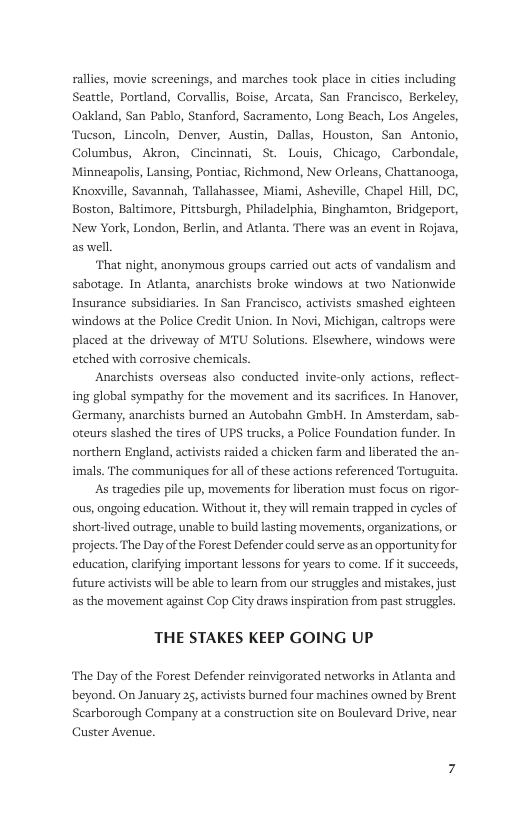
At the house raided by the APEX Unit, a helicopter hovered over-
head as officers arrived in armored vehicles. Wearing balaclavas, bran-
dishing long guns, and obscuring their name tags, they pounded on the
door. One resident, hands raised, opened the door before it was bro-
ken, possibly avoiding gunfire. Another resident, topless, was dragged
asking for a shirt. Masked plainclothes officers photo-
graphed detainees on their phones. Neighbors filmed and shouted at
the officers. Inside, police overturned furniture, punched holes in walls,
and ransacked the house. They seized t-shirts, laptops, a camera, and
phones. One resident was detained for eight hours at police headquar-
ters; agents photographed his tattoos but did not interrogate him be-
outside des
fore releasing him without charges.
At the house that the FEI raided, dozens of agents arrived and
loudly announced themselves. Those inside were permitted to it while
agents searched through the shelves, cabinets, books, and cushions.
‘The intruders seized some phones, but made no arrests. The agents
combed through belongings with meticulous care, avoiding errors or
oversights.
At the ATF raid, agents surrounded the house, shining flashlights
and barking orders. They detained the residents of a backyard unit and
broke down the front door of the main house, throwing fash-bang.
grenades inside. The agents abused residents and destroyed belongings,
dragging one person down the porch stairs by their hair and staging
intimate photographs in order to humiliate the residents. They arrested
one person on charges of First-Degree Arson, later accusing them of
involvement in the June 2023 attack on a police training facility in which
eight police motoreycles were burned using time-delayed devices.
Unlike the 2023 raid on the Atlanta Solidarity Fund, the targets of
this massive operation were not public figures. They were not known
<o the media, did not face RICO charges, and could not easily express
what connected their situation to the broader movement. Setting aside
concerns about why the police decided to target these individuals, the
‘movements ability to rally support was uncertain, When the police
raided the Solidarity Fund, activists, journalists, and even politicians
spoke out in their defense. Who would come to the aid of accused
terrorists and arsonists?
“BLESS THEM”
Before the end of February 8, the movement responded boldly. The
Stop Cop City Vote Coalition (the group organizing the referendum
campaign), Emory Stop Cop City, and others called an emergency
press conference at the Atlanta Police Foundation headquarters. As
a result, the Police Foundation—which had been vandalized during
the first Week of Action in 2021 and again after Tortuguita’s killing in
2023—sent all staff home early.
During the press conference, public figures associated with the
‘movement spoke out, condemning the repression and asserting that
it was not just an attack on the fight to stop Cop City, but an assault
on everyone's right to organize and resist social injustices. This would
have sufficed to counter the media narrative that the police chief had
attempted to craft with his self assured, misguided statements earlier
that day. But the organizers went furcher. When a journalist asked if the
pro-referendum coalition condemned the burning of police motorcy-
cles—the act the police cited as justification for the raids—a prominent
local activist associated with the Movement for Black Lives answered:
10
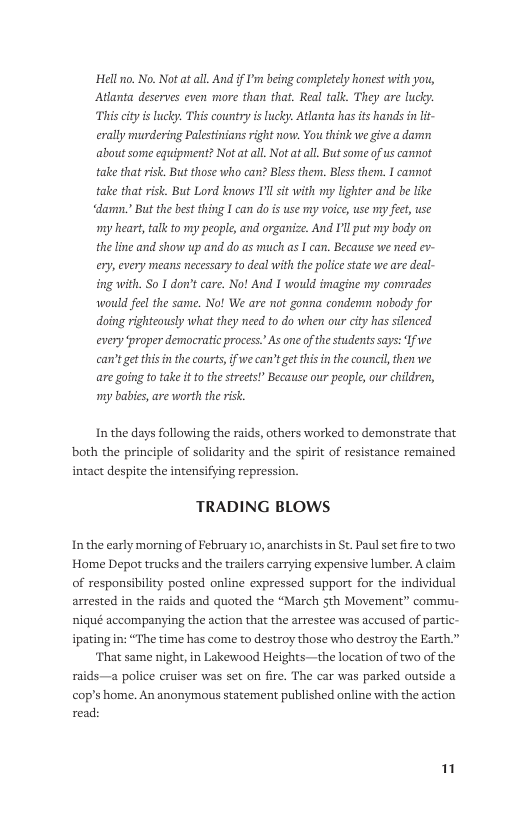
Hell no. No. Not atall. And if Pm being completely honest with you,
Atlanta deserves even more than that. Real talk. They are lucky.
This city islucky:. This country is lucky. Atlanta has its hands in lit-
erally murdering Palestinians right now. You think we give a damn
about some equipment? Not at all. Not a all. But some of us cannot
take that risk. But those who can? Bless them. Blss them. I cannot
take that risk. But Lord knows Il sit with my lighter and be like
damn.” But the best thing I can do s use my voice, use my feet, use
my heart, talk to my people, and onganize. And I'll put my body on
the line and show up and do as much as I can. Because we need ev-
ery, every means necessary to deal with the police tate we are deal-
ing with. So I don’t care. No! And I would imagine my comrades
would feel the same. No! We are not gonna condemn nobody for
doing righteously what they need to do when our city has silenced
every ‘proper democratic process.” s one ofthe students says: If we
can'tget this in the courts,ifwe can’tget thisin the council then we
are going to take it to he streets?” Because our people, our children,
my babies, are worth the risk
In the days following the raids, others worked to demonstrate that
both the principle of solidarity and the spirit of resistance remained
intact despite the intensifying repression.
TRADING BLOWS
In the early morning of February 10, anarchists in St. Paul set fire to two
Home Depot trucks and the trailers carrying expensive lumber. A claim
of responsibility posted online expressed support for the individual
arrested in the raids and quoted the “March 5th Movement” commu-
niqué accompanying the action that the arrestee was accused of partic-
ipating in: “The time has come to destroy those who destroy the Earth.”
‘That same night, in Lakewood Heights—the location of two of the
raids—a police cruiser was set on fire. The car was parked outside a
cop's home. An anonymous statement published online with the action
read:
i
We wish to dispel any notion that people willtake this latest wave
of repression lying dowwn..\We all have something to lose it i simply
@ matter of lving out our belies or submitting to the police state.
Inaction is a choice ust as much as action, and we all have to live
with the choices we mae.
‘This act targeting a police officer at home, shortly after a major opera-
tion, sent author
six months.
By mid-morning on February 10, Lakewood Heights was effectively
under oceupation. Local, state, and federal agencies kaid siege to the area.
s into a spiral they wouldn't recaver from for nearly
Police cruisers lined highway off-ramps, intersections, and major streets.
An armored vehicle was stationed on Jonesboro Road, a key street in the
neighborhood. A helicopter circled overhead for days. Unmarked cruis-
ers sped through the area, parking outside the homes of suspected “mil-
itant anarchists” (in the words of Chief Shierbaum), taiing individuals,
photographing them, pulling over motorists, and asking pointless ques-
tions. The GBI, FBI, and ATF canvassed door-to-door, dug through trash
cans, and paraded K-9 units through the community.
Around 4 pm, dozens of police vehicles gathered at Kipp Vision
Elementary on McWilliams Street, marking the southern border of the
Lakewood neighborhood. They drove north several blocks, shut down
roads, and established a perimeter around a single-family home. After
Kicking in the front and back doors and finding no one inside, they ran-
sacked the place—flipping over chairs and tables, pulling posters off
walls, and breaking furniture. Finding nothing of interest, they left as
quickly as they had come.
Outside, Chief Shierbaum addressed the media. With nothing to
show for the raid, he focused on the burned police cruiser, absurdly
claiming that “someone could have died.” Though he admitted no one
was home at the time, he claimed that police had targeted the house
based on a “preliminary investigation” suggesting the arsonists might
have returned there after setting the cruiser on fire. He ended his press
conference ominously: “The person we were looking for knows who he
is” and that the police would like to speak with him.
12
[ e sTeis
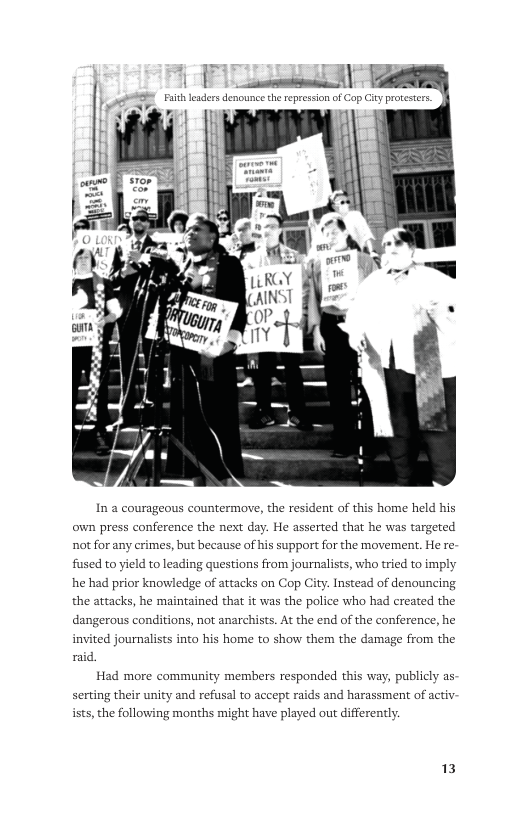
Fuith leadersdenounce the repression of Cop City protstes.
In a courageous
own press conference the next day. He asserted that he was targeted
not for any crimes, but because of his support for the movement. He re-
fused to yield to leading questions from journalists, who tried to imply
he had prior knowledge of attacks on Cop City. Instead of denouncing
the attacks, he maintained that it was the police who had created the
dangerous conditions, not anarchists. At the end of the conference, he
invited journalists into his home to show them the damage from the
raid,
Had more community members responded this way, publicly as-
Serting their unity and refusal to accept raids and harassment of activ-
ists, the following months might have played out differently.
13
FROM A DISTANCE
If there had been no militant response to the raids, the government
‘might well have carried out more raids and arrests, something they had
explicitly stated was in the works. Politicians and police often fail to
make good on their promises. Possibly, the authorities thought they
would find evidence in the course of their raids that they did not find.
Perhaps they expended too much political favor kicking in so many
doors for so few arrests. Both could be true. The courage of the re-
sponses from the movement probably impacted the situation as well.
‘Movements that fai to respond swiftly o attacks often lose morale.
It is a significant weakness only to be able to advance with the consent
of one's adversary. At the same time, movements should resist the temp-
tation to get caught in high-risk grudge matches, boxing themselves in
ever shrinking fields of action that involve fewer and fewer participants.
This applies to everyone, not just those who burn police eruisers.
In the weeks following the raids, the movement stalled. There was
1o systematic canvassing of the besieged area, nor were large demonstra-
tions organized to denounce the raids. Local engagement was missing.
precisely when it was crucial. While many recognized the need to mo-
bilize in such a way, many key figures in the movement were in retreat—
intimidated by police drones, unmarked vans, or stll out on bond from
their felony RICO charges. To have been able to seize this missed oppor-
cunity, the movement would have required broader participation, more
people prepared to take initiative, and greater support from the wider
community. Perhaps this was a “chicken and egg” dilemma.
One advantage the movement had long held over the Atlanta Po-
lice Foundation was the ability to stage interventions outside of the for-
est, outside the city, outside the state of Georgia. Convergences allow
‘movements to remain focused and precise, drawing together many of
the movement's most dedicated participants and supporters. Decen-
tralized action makes the movement more agile, resilient, and capable
of replenishing its ranks, since organizers can i
pants to the movement far from the epicenter of repression.
What if these two strengths could be combined, converging far
from the center of surveillance and intimidation?
roduce new partici-
14
NATIONWIDE SUMMIT AGAINST COP CITY
By the second week of February, police cruisers began parking outside
the homes of more than a dozen Atlanta residents, day and night. Ac-
cording to local media reports and The Guardian, officers parked their
cars, shined fioodlights, and generally created an air of menace in Lake-
wood Heights and southeast Atlanta, Between mid-February and early
September 2024, officers parked outside these homes up to ten times a
day. This amounted to well over a thousand instances of overt surveil-
lance against alleged participants in the movement and their neighbors.
Even before the February raids and subsequent harassment,
opponents of Cop City began organizing a nationwide convergence in
Tucson, Arizona. This marked the first large-scale attempt to mobilize
forest defenders and anti-Cop City activists outside of Atlanta in
the three years of resistance to the project. After the inconclusive
events the previous November, this was a creative innovation worth
pursuing. If the movement could catalyze participation on a larger
scale by cultivating centers of participation further from the epicenter
of repression, it might give itself a new lease on life and continue
deploying both confrontational and participatory means.
On February 23, just weeks after the raids in Atlanta, hundreds
of people converged in Tucson. They gathered at Mansfield Park, ex-
changing food, pamphlets, schedules, and embraces. For those who had
participated in previous weeks of action in the Weelaunee Forest, this
scene was familiar—though this time, without helicopters overhead.
In the late afternoon, 150 forest defenders marched from the park
toanearby lot that had been abandoned by developers and authorities;
they transformed it into a temporary autonomus zone. Participants
redecorated the lot with graffit, tents, and folding tables. Workshops,
presentations, and skill-shares drew several hundred more people over
the next few days. For those who had traveled from afar, the warm
Arizona night was likely a pleasant surprise.
That evening, away from the rechimed plaza, an anonymous group
smashed windows at three Nationwide Insurance locations. The weckend had
offcially egun. Around one hundred people siept beneath the Tucson sky.
15
GENERATIONS OF RESISTANCE
On Saturday, February 24, local residents and seasoned anarchists in-
termingled all day longin strategy sessions, workshops, and assemblies
about the movement and the challenges it faced.
‘That afternoon, Ben Morea, of the legendary New York City anar-
chist groups Black Mask and Up Against the Wall Motherfucker (UAW)
M), addressed 75 people in a corner of Mansfield Park, sharing the les-
sons he had learned as a lifelong rebel against all authority, domination,
and closed-mindedness. Young participants asked him questions and
received heartfelt responses.
‘The movement against Cop City and to defend Weelaunee Forest
has benefitted from its continuous cross-pollination with autonomous
and unruly youth subeultures. It has also benefitted from the
participation of elders, movement veterans, and seniors who offer their
own perspective and insights on the world, with the wisdom of many
decades of hard-carned lessons and experiences.
‘That night, a few hundred people gathered at a nearby community
arts space for a hardcore punk show organized within the context of
the convergence. Anarchists distributed pamphlets and posters about
the movement, while punk bands played fast and angry music into the
late hours of the night.
In Santa Cruz, California, a Nationwide subsidiary was vandalized
spray paint, its locks glued shu.
NEW AMBITIONS, OLD TEMPLATES
On Sunday, February 25, 80 people gathered in downtown Tucson,
dressed in black clothing and masks. The crowd had apparently assem-
bled on an invitation-only basis. They marched toward the Presidio
Plaza, down Stone Street; some began smashing windows. The sound
of hammers and stones colliding with glass rang through the night
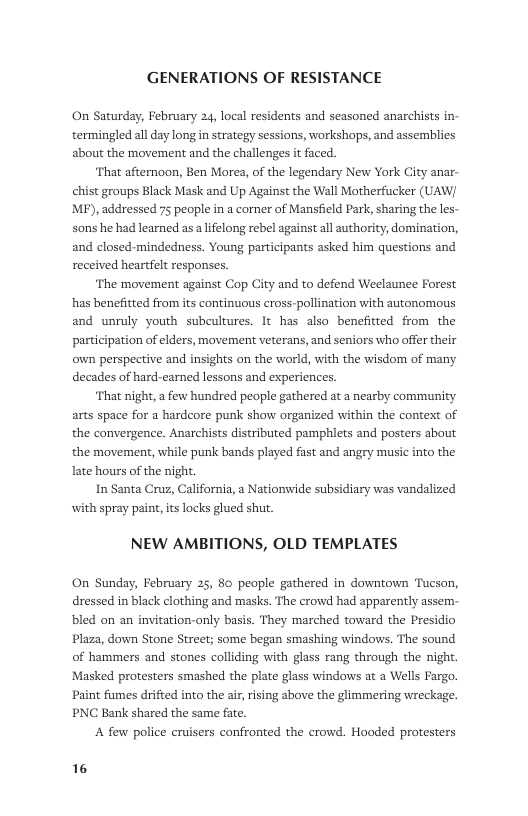
Masked protesters smashed the plate glass windows at a Wells Fargo.
Paint fumes drifted into the air,rising above the glimmering wreckage.
PNC Bank shared the same fate.
A few police cruisers confronted the crowd. Hooded protesters
16
responded, lobbing stones and fireworks, sending the officers into re-
treat. The erowd circled back to Presidio Plaza before dispersing. Pairs
of protesters sprinted in different directions. Sirens wailed in the dis-
tance. Within minutes, the crowd vanished, just as police flooded the
area. Three pedestrians were arrested and charged with felonies. Later
the charges were dropped.
This demonstration echoed the march on the APF headquarters in
Athanta during the first Week of Action, when the movement stil lacked
‘mass sympathy but possessed the element of surprise. It also recalled a
specific type of protest undertaken by US anarchists between 2007 and
17
2011—small affinty group actions that exploited the element of surprise
and mimicked the energy of a iot,albeit on a smaller scale. The most
infamous example was the May 1, 2010 vandalism of a gentriying shop-
ping area in Asheville, North Caroling, ollowed by the arrests of leven
People, facing felony charges and bond amounts of $65,000 each.
Such demonstrations are risky. The crowds involved are often too
small to effectively repel police incursions, leaving stragglers and pass-
ersby vulnerable to snatch squads. Moreover, these actions are often
ignored or misrepresented by the media, and because they're not de-
structive enough to warrant widespread attention, their broader po-
litcal or social impact s negligible—at least, in terms of public per-
ception. However, the February 25 demonstration was accompanied by
a press release, which ensured extensive media coverage. Though the
worst consequences were avoider
it appeared that this demonstration
neither galvanized nor demoralized the movement. In that regard, its
impact on the movement was more similar to Block Cop City than to
the January 21, 2023 black bloe or the March 5, 2023 raid on Cop City.
One might wonder if the risk was worth i, given the lack of tangible
results. If nothing else, considering the context, it was remarkable that
so many people were willing to take part in such actions just weeks
after the recent raids in Atlanta. Arguably, the virtues and courage that
‘movement participants are able to embody for one another are more
important than what they communicate to their adversaries. Perhaps
the networks that enable these actions are more durable than those
that rely solely on other tactics. In that case, it is the relationships
and organization of those networks that gives them strength, not risk
tolerance or bravado alone.
FROM SCOTTSDALE TO NEW YORK CITY
The next day, as media outlets published dramatic images of broken
glass from the night before, dozens of protesters gathered at the Na-
tionwide Insurance headquarters in Scottsdale, two hours from Tuc-
son. Armed with poster-board signs and whistles, they faced offagainst
‘hundreds of police officers. The office was closed, the entire area under
heavy police surveillance. Law enforcement clearly expected a militant
18
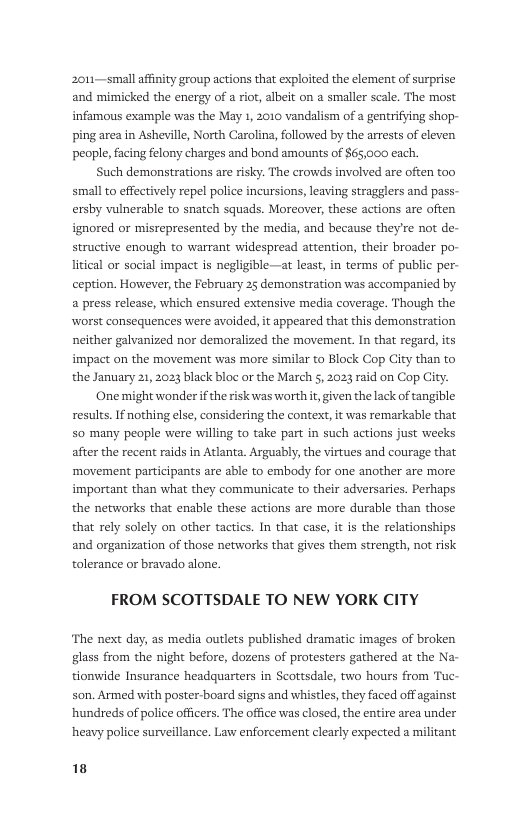
confrontation at the office building, but the office itself was tucked
away in an office park far from the city center, easily policed. The few
protesters who gathered there, undeterred, courageously faced down
the absurd overreaction of the police.
1 Nationwide
ppmmmnan INN NSNNEN W g
i ————— R
5N
>
Meanwhile, in Forest Hil
, Arizona,six activists locked themselves
into conerete-filled barrels blocking the entrance to gated community
housing a regional executive of Nationwide Insurance. With only a few
ssfully shut down access
t0 the wealthy community for hours. During that time, they explained
journalists and medics for support, they suct
their actions to the neighbors of the Nationwide exccutive,
At the same time, in New York City, over two hundred people
‘marched to AXA XL and Nationwide offices. AXA XL insures Brasfield
& Gorrie, the contractor behind Cop City, while Nationwide insures the
Athanta Police Foundation. The crowd surged into the building, pushing
past police and security. They flooded the atrium and stairwells, dropping
‘banners from the second-floor balconies as their chants echoed through
1o take place
outside Atlanta. The next day, several Nationwide offices in New York
the halls It was the largest demonstration against Cop
19
Citywere vandalized. The dayafter that, someone slashed thetires of ten
NYPD cruisers in an expression of solidarity with the movement.
‘These actions in Arizona and New York illustrated the relationship
between participatory and clandestine tactics, as the Weeks of Action in
Atlanta often led to greater sabotage agai
those destroying the forst.
SPRING INTO RESISTANCE
By March 2024, a new round of actions against Cop City were in full
swing. The weekly picket at the construction site, established over the
winter, continued to grow as temperatures rose. On March 5, the anni-
versary of the historic raid on the Cop City site, around 20 Black wom-
en gathered at Mayor Andre Dickens’ private residence at 6 a.m. They
held banners, chanted slogans, and del
repression of the movement and demanding the city unblock the ref-
rered speeches condemning the
erendum process in order to permit residents to vote on the land-lease
ordinance.
‘Two days later, on March 7, another activist locked down to con-
struction equipment at a Brasfield & Gorrie worksite in Midtown. A
crowd gathered outside with megaphones and banners, just as they
had during the January lockdown at a nearby construction site. After
several hours, the forest defender was removed by police and cited for
‘misdemeanor “trespassing”
Atthe same time, authori
harassment in Lakewood and southeast Atlanta.
continued extensive surveillance and
On March 11, 2 crowd of Austin residents confronted Mayor Dick-
ens while he was participating in a panel at the South by Southwest
music event. As Dickens began his speech, protesters unfurled ban-
ners, hurled insults at him, and chanted “Viva, Viva, Tortuguita” while
throwing fliers into the air. The event was ruined. In a desperate at-
tempt to shield himself, Dickens called out, “Look at who is doing this,”
eynically using identity politics to deflect from his responsibility for
the harm occurring in Atlanta. The disruption continued, and Dickens
was heckled all the way out of the building.
‘Three days later, on March 14, eight machines owned by Brent
Searborough were set ablaze in a suburb south of Atlanta. Anonymous
20
saboteurs issued a statement online, highlighting the lack of coverage
surrounding the attack. They argued that while actions in the city often
prompted police statements and media coverage, news of attacks in
the suburbs was generally suppressed. This may have been the most
destructive act against Brent Scarborough yet.
WHAT GOES UP...
As the movement regained its footing after the February raids, new ac-
eivists flocked to meetings, fundraisers, and direct action trainings. This
led to more daring actions. Two activists climbed a 250-foot crane at a
Brasfield & Gorrie construction site in Midtown Atlanta. Unlike pre-
vious lockdowns, which involved small groups stalling work for a few
‘hours, this action was riskier and posed a serious challenge to sect
After several hours, police scaled the crane and used an angle grinder
<o capture the activists, who had locked their arms inside a steel pipe.
‘The courts reacted harshly, charging the two with “False Imprison-
‘ment,”a felony kidnapping charge. The police claimed the crane opera-
tor,on the ground, was “unable to leave” due to the activists suspended
nearly 20 stories above him.
This absurd charge gave pause to many. If camping in a forest,
passing out fliers, civil disobedience, breaking windows, and rioting
were all punished with the same severity, what actions remained for
those unwilling to risk imprisonment? What would it take to stop the
construction?
FROM WEELAUNEE TO GAZA
At the same time, across the Arlantic, the Israeli invasion of Gaza
continued. Graphic images and reports arrived daily showing the brutal
toll on Palestinian civilians. Horrific footage recorded and broadcast by
Palestinians depicted scenes of unimaginable violence. Soldiers decapi-
tated children. Fighter jets vaporized hospital wards. Aid workers shov-
eled human remains into trash bags to turn them over to loved ones.
For six months, protesters in the United States blocked highways,
disrupted speaking events, shut down ports. While often small, these
2
A Stop Cop ity protesterlocked dovin o B
onstructon equipment in Midkown Adana in ¥
actions were passionate and contributed to growing momentum. On
April 1
coordinated highway blockades took place around the coun.
try. Two days later, a group at Columbia University in New York es
tablished a protest camp. When the administration brought the NYPD
in to attack students and faculty, outrage spread across the country.
By the third week of April, protesters had established or attempted to
establish “Gaza Solidarity Encampments” at over a hundred campuses.
Atlanta was no different. On April 22, an anonymous group wheat
pasted slogans around Emory University, linking the institution with
Cop City and the Israeli oceupation.
On April 25, dozens of protesters rushed onto Emory's Quad at
7:30 am, erecting tents and banners that read “No Cop City,” “No
Genocide,” and “Defend the Forest.” Protesters were able to assemble
tents, but not much else. At 10:15, protesters attempted to march but
were blocked by officers who fired pepper balls. Riot police used rubber
2
bullets and batons. In the chaos, medics were tackled, journlists
‘maced, and professors arrested,
While the police reasserted control of the Quad, students rushed
from classrooms, eager to witness—and join—the unfolding conflic.
By 11:30 am, nearly 500 people had gathered around Emory’s Quad.
Agroup surrounded the Atlanta Polic
the earlier chaos. The crowd chanted,
cruisers holding detainees from
very city is Cop City.” Tensions
flared as the eruisers tried to leave and protesters rushed into the road
to block their exit. Police fired pepper balls into the crowd and tac
led another student. Peaple poured out of nearby classrooms, pushing
closer to the police lines while chanting, “Shame on you.” In the stand
off, snatch squads arrested several more protesters. The crowd then
swarmed to de-arrest them, hitting and shoving officers, successfully
freeing at least one person. Some began throwing botles. The cruisers
left and the crowd marched toward Convocation Hall
DIVEST FROK _
mm DEATH [
ide.” A banne
2
Students, community members, faculty, clergy, and activists then
reconvened in the Quad. Supporters brought food to the protesters,
who gathered in small groups to discuss their next steps. At least 28
people had been arrested and many others were injured. Though the
police were absent, those assembled were uncertain how to proceed.
Word spread that students at the Candler Theology School had ac-
cupied the atrium and were calling for supporters to join them. Around
300 people headed to the school. By the time they arrived, police had
blocked the doors to prevent an occupation. Masked protesters with
reinforced banners pressed into the police lines, throwing bottles and
signs in an attempt to break through. For the third time, police fired
pepper balls at the crowd, sending many running or retreating from
the building.
Despite the efforts of a few dozen who tried to push through, the
larger crowd lacked the will to confront the police directly. Had they
been more unified and prepared, they likely could have seized the
building. Instead, exhausted and underprepared, the crowd—sti
eral hundred strong—retreated to the Quad.
Around 9:15 pm, most protesters dispersed, anticipating the 11 pm
campus curfew.
NO CONFIDENCE
‘The next day, 500 people reconvened in Emory's Quad following an au-
tonomous call to action circulated anonymously online. The fler out-
lined two demands: divest from Isracl and the Atlanta Police Founda-
tion, and drop all charges against those arrested in the previous day’s
protests. As the crowd gathered, students and activists delivered impas-
sioned speeches on a megaphone, connecting the fight against Cop City
<o broader issues like US imperialism in Palestine and systemic racism.
After an hour of speeches, the crowd marched toward Cox Hall. A
few protesters forced open the doors and hundreds poured inside, chant-
ing “Free, free Palestine” and “Stop Cop City.” The atmosphere was up-
beat but cautious—there was no immediate threat of arrest, but most
ipants quickly retreated to the Quad after the brief transgres
Representatives from the “Open Expression” committee—the
24
Onwellian name of the group that the university established to monitor
protests under the guise of “protecting rights”—warned the crowd
that if protesters set up camp or took over a building, the police
would be called. They climed that, because someone had painted
“Escalate 4 Gaza” on a bathroom mirror, the entire event was at risk
of forced dispersal. These mediators exerted significant influence over
the movement; on April 26, they effectively neutralized momentum,
discouraging further action,
s the hours passed, hundreds lingered in the Quad, blasting music
and socializing, before dispersing by the 11 pm curfer.
GO WHERE THEY GO
Amid nationwide protests, on April 27, the Atlanta Police Department
hosted a recruitment event in New York City. In August 2023, forest
defenders had disrupted a similar event, blocking the doors and throw-
ing buckets of shrimp into the convention center atrium, Protesters
sought to disrupt this event as well. The evening before, someone
poured fast-drying cement into the Marriott Hotels toilets, repeatedly
flushing them to mix it with the water This presumably caused exten-
sive damage to the plumbing, Activists also covered the courtyard with
posters of Tortuguita and graffiti denouncing Cop City. The next day,
anonymous activists released 300 crickets into the building and pulled
the fire alarm, The event was ruined once again.
Meanwhile, in Atlanta, Emory President Greg Fenves sent an email
warning students and faculty about dangerous “outsiders” supposedly
spreading violence and vandalism at protests. His rhetoric aimed to
divide campus affliates from the broader Atlanta community to better
control dissent. When someone spray-painted the word “genocide” on
acampus building, Fenves condemned it as “hateful.”
While the Atlanta Journal-Constitution published opinion pieces
claiming that Palestine solidarity protests were at risk of being “co-opt-
ed” by activists seeking to stop Cop City, activists from Arcata, Los
Angeles, New York City, Tucson, Richmond, and New Orleans drew
explicit connections between the two struggles, emphasizing the link
between US military operations and domestic policing.
2
Despite the attempts to undermine the protests, including the out-
rageous ruling from the internal conduct board that found protesters
had “violated” the rights of Open Expressions the previous fall public
sentiment remained firmly opposed to the repression. Nearly all of the
28 arrestees from April 25 were Emory students, faculty, or alumni, un-
dermining allegations about outside agitators.
On April 28, hundreds gathered again in the Quad. Faculty and
students announced their intention to hold a “No Confidence” vote
against President Fenves for summoning the Atlanta Police Depart-
‘ment to arrest and abuse protesters. The vote resulted in a 75% super-
‘majority against Fenves and the administration.
BREAKING AND EXITING
Protests across the country escalated, with dramatic confrontations
between protesters and police. Scenes of police beating and gassing
students, alongside moments of protesters linking arms and overpow-
ering police encirclement tactics, inspired many. On May Day, around
300 people gathered once again at Emory, carrying reinforced banners.
For the third time that week, protesters flooded into a building,
this time filling the atrium of the Undergraduate Admission Bookstore.
To hold the building, participants would have had to broadcast their
intentions to stay; some people would have needed to barricade doors
ith tables, chairs, and other obstacles. However, the crowd lacked uni-
tyand tactical direction. Representatives from Open Expressions again
informed protesters that they would call the police if the action con-
tinued. With no clear plan to withstand a police response, the crowd
dispersed, leaving the building unoccupied.
‘The Gaza Solidarity protests at Emory Universicy had ended for
the time being.
PROTEST AT GILEE
Since April 2021, activists have focused on the Georgia International
Law Enforcement Exchange (GILEE) program at Georgia State Univer-
sity. The program facilitates exchanges between metro Atlanta officers
2
and Israli police, sharing tactics for controlling marginalized commu-
nities. Some argue that GILEE' training of US police in Isracli military
tactics may have inspired the concep of Cop City.
On May 4, around one hundred people gathered at Hurt Park near
Georgia State University and marched to the GILEE office at the An-
drew Young School of Policy Studies. Upon arrival, protesters faced off
with police at the front doors. Using reinforced banners as shields, they
charged the police lines, hoping to enter the building. Police respond-
ed with batons and mace, but the protesters held their ground. After
several minutes, recognizing that they couldn't enter, and anticipating
police reinforcements, they left together without arrests, showing the
power of direct confrontation in the Gaza solidarity movement.
‘The next day, sixty protesters returned to Hurt Park. Surrounded
by riot police, they held a meeting to discuss next steps before leaving.
iout marching. Law enforcement, hoping for a confrontation, was
left frustrated.
On May 6, Emory University moved its commencement ceremony
off campus to Gwinnett County in hopes of avoiding disruption from
Cop City/Gaza solidarity protests
Yet as the semester ended, campus-based protests subsided na-
tionwide. In Adlanta, eight months later, protests had ot returned.
IT’S ALREADY TOO LATE
When movements lose the ability to innovate and set their own time-
lines, participants often convince themselves the pause is not politi-
cally risky. “Once the semester starts..,” they tell themselves. “After
2 or perhaps “After the election..” This mindset can signal
May Day.
movement’s collapse. Patience and strategy are vital, but waiting on
things to develop “organically” or on others’ timelines is generally a
sign of stagnation. Bold action, audacity, and collective organization
are essential to the pursuit of change.
Asartention shifted from the forest to the city, the opportunities to
take action expanded, in theory, even as the ability to take advantage of
them contracted. The will to act had spread, but the vulnerabilities of
the Cop City project were shrinking. Construction continued day and
30
night, funded by contractors with deep personal and professional stakes
in the Police Foundation. It began to appear that only a serious revolt
could halt the project—if even that could. Across the country, mayors
and local governments announced their own Cop City projects—in
New York, Oakland, Nashville, Charlotte, and beyond.
In early June, autonomous groups within the Cop City and Gaza
solidarity movements called for a joint action to disrupt the first Biden-
Trump debate, which was scheduled to take place in Arlanta. The call
encouraged people of all tendencies to act. If unrest could unfold
outside electoral events, as it had in Costa Mesa, Albuquerque, and
elsewhere in 2016, the fight against Cop City might expand its purchase
upon the public imagination. Failing to do would mean consigning
millions to passivity and spectatorship as the US power structure
sought to monopolize their attention, narrowing the spectrum of
political possibility to two elderly candidates who both sought to
increase police funding and continue sending billions to lsrael to fund
the genocide in Gaza.
But catalyzing confrontations at a national security event was a
call order.
RISING TENSION
‘The weeks leading up to the Presidential debate were eventful. Police
‘harassmentin Lakewood reached new heights. On May 29, The Guardian
reported officers shining lights into residents’ homes, running sirens at
random. In one instance, someone placed a lit traffic flare in @ bush
outside an activists’ home, sparking a fire.
Around this time, cameras appeared on the streetlights outside the
‘houses that APEX and the ATF had raided. The camera outside the for-
‘mer was concealed in a metal box with black duct tape, peering through
a tinted window at the home’s entrance. The box containing the other
camera wasn't covered in black duct tape, but simply labeled “High
Voltage.” It resembled the devices placed outside the homes of several
‘Memphis Black Lives Matter activists in 2015.
At the end of May, several water mains burst in Atlanta, cutting
water access to large parts of the city, especially Black neighborhoods
3
south of 1-20 and west of the 1-75/85 connector. The morning that the
system failed, Mayor Dickens flew to Nashville for a fundraiser with
wealthy elites and lobbyists. For nearly a week, tens of thousands of
residents had only brown or murky water, and some in the southeast-
ern parts of the city had no water whatsoever. On social media, many
linked the water erisis to funding for Cop City.
s the geopolitical influence of the United States wanes and
climate disasters worsen, such breakdowns will likely become more
common. Unless we reclaim our resources from warmongers and
police, social chaos will merge with catastrophe. It's casy to anticipate
the consequences, as desperate people are already experiencing the
equivalent in many parts of the world.
New fronts of repression were opening furcher afield. In Charles-
ton, South Carolin, federal agents surrounded a sedan on the inter-
state and forced it to pull over. The driver, a 20-year-old anarchist, was
served with a subpoena for a federal grand jury investigation into the
December 31, 2023, arrest of a person accused of painting anti-Cop City
slogans on multiple Thomas Conerete trucks and setting them on fire.
On June 25, the legal team representing the Adanta Solidarity
Fund in the RICO case targeting the movement filed a motion in court.
It revealed that local and federal law enforcement had mishandled
confidential client-attorney communications, primarily emails. These
were supposed to be processed by a third-party “flter team” to
protect the rights of the accused, a process the defense had warned
the prosecution about three times. As the trial approaches—dates still
pending—more such violations are expected, as the charges against the
‘movement are largely political rather than legal.
THE PRESIDENTIAL DEBATE
OnJune 27,several activists locked themselvesto the entrance of Hudson
Technologies in Smyrna, an Atlanta suburb within the 1285 perimeter
highway. Hudson Technologies works with the Isracli Defense Forces;
the activists were drawing attention to is role in the violence in Gaza.
They also emphasized the right of Adlanta residents to participate in the
popular referendum against Cop City. This was the third time that anti-
32
war protesters had targeted Hudson. Earlier, on February 14, activists
had glued the locks and spray-painted the building. On June 3, all the
windows were broken in retaliation for the US-backed Isracli invasion of
Rafah, a Gaza Strip area designated a “safe zone” for refiigees.
Later that afternoon, protesters gathered in west Midtown, between
Spring Street, the 17th Street bridge, Northside Drive, and south toward
Home Park and Georgia Tech University. Advocates for affirmative action
and Diversity, Equity, and Inclusion programs stood on the 17th Street
bridge. Nearly a hundred protesters, most of them Black, were surrounded
by police separating them from a pro-Trump rally just fifty feet away. At
the Isracli consulate on Spring Street, around a hundred socialsts and ani-
war activists gathered at § pm, chanting slogans and listening to speeches.
‘Another demonstration was assembling in a small park in Home Park.
‘This group stood apart from the others. On Hemphill 10th Street,
and surrounding streets, helmeted police squads stood watch with bi-
eyeles in hand, their heads swiveling. Undercaver vehicles crept down
side streets, likely carrying federal agents. Atlanta Police vehicles and
‘motorcycles blocked roads and shone their lights on sidewalks and
intersections. Meanwhile, ninety people in black hoodies, face masks,
Keffiyehs, and helmets assembled near 10th and State in a green space.
‘The sound system nearly drowned out the noise of helicopters over-
head. As the sun began o set, many waited for others to arrive to begin
the march. In the end, no one else came.
A few speakers delivered fiery speeches, grounding the crowd in
the gravity of the moment and the need for militant action. Forty cops
stood watch on the adjacent street, many just out of sight.
‘What could be done? With overa hundred people facing charges—61
of them under RICO—i's easy to see why the crowd was small. With-
ot the prospect of confronting a Cop City contractor, it was hard to
grasp the stakes of the event, especially for those stil focused on direct
action rather than mass disorder. One could blame other groups for
scheduling “competing” events at the same time, but would two hun-
dred people have done what the boldest one hundred could not? Would
one hundred people taking confrontational action elsewhere provide a
real boost to resistance against the electoral farce or against Cop City?
Probably not—unless they had breached the fortified construction site
33
‘The movement, like society at large, was being squeezed by immense
forces it had yet to take the measure of.
After some deliberation, many of the brave individuals present de-
termined that the demonstration they had hoped for was not feasible.
‘They made the decision to march out of the park together and disperse.
Following a brief standoff with police, the crowd managed to leave the
controlled zone and exit the area without any arrests.
Perhaps unknowingly, the participants had arrived at the end of a
‘movement trajectory.
At that very moment, as the debate reached living rooms around
the country, everyone could see® that by permitting the bureaucracy
‘behind Joe Biden to maintain its ossified grip on power and siding with
the forces of repression at every step, the Democrats had ceded the
2024 election to Trump and the future of America to a new breed of
autocracy:
‘Suddenly, in the midst of Biden's debate with Trump on June 27, it
became inescapably obvious that their pragmatism was about to
ose them the 2024 eection, their only alibi for allthe atrocites they
had endorsed up to that point.
Aneweyele was opening, even darker than the Biden era. The fight against
Cop City had represented the best hope ta continue the social movements
of the first Trump era and the best chance to address the challenges they
had confronted. The struggle reached an impasse at the same moment
that the contours of the second Trump era came into focus':
“Every time we lose a battle, we are forced fo fight it once more, but
on worse terms.”
HOW WAS THE MOVEMENT UNDERMINED?
s of March 2025, it appears that the movement to defend Weelaunee
Forest and stop Cop City has been effectively neutralized. The pace of
actions has stalled, and the kind of qualitative interventions that might
spark new forms of resistance or mobilize additional communities have
34
come to a halt. The petition for a referendum against the land lease
remains mired in legal battles. Much of the forest has already been
destroyed. Key support structures, including the Atlanta Solidarity
Fund, are entangled in high-stakes litigation. Long-term participants
have faced harassment, intimidation, and collective punishment. Direct
action to isolate Brasfield & Gorrie subeontractors from the Atlanta
Police Foundation no longer appears feasible.
Unless something unexpected were to happen to the heavily forti-
fied facility itself, which is now nearing completion, the only remaining.
hope for the movement would be a mass prising capable of shifting
the balance of power from the police to the population at large. But
there s currently no sign of such an uprising on the horizon.
HOW DID WE GET HEREZ
ing the repression of the movement, we must be careful not
<o attribute more insight, strategy, or strength to our adversaries than
they actually possess. At the same time, we owe it to ourselves and to
those who will come after us to honestly assess the limits and challeng-
es the movement faced so that future movements can anticipate similar
obstacles and overcome them.
This process can feel like studying a voleanic eruption: those with
the clearest view risk perishing in the flames.
ISOLATION
From its inception in April 2021 until the murder of Tortuguita in Jan-
uary 2023, the movement remained remarkably small. While it's dif-
ficult, if not impossible, to quantify the movement's size, we can say
that during this early period, all public marches, rallies, and demon-
strations drew fewer than 175 participants. Concerts, raves, and other
social events occasionally drew up to five hundred people to the for-
including a generator party along the banks of Intrenchment Creek
during the first week of action in late summer 2021, At any given time,
only a few dozen people maintained the encampments in the forest.
Why is this? The United States had just emerged from the most
35
powerful social movement in living memory, involving millions of
protesting against police violence,
Non-participants are notoriously difficult to understand. Analyzing
the Stop Cop City movement, itis hard to attribute its shortcomings to
a lack of outreach, media coverage, or information sharing, For years,
anarchists, abolitionists, and radicals implemented a comprehensive
media strategy—conducting interviews, drafting press releases, and
g articles for a range of outlets from anonymous anarchist blogs
to international media platforms. Organizers also directly contacted
‘hundreds of thousands of people through face-to-face canvassing.
‘The anarchists at the core of the movement were aware of the
risks involved in conducting a militant but isolated campaign. Signifi-
cant strategizing went into addressing this challenge from the earliest
weeks. Within the direct action wing of the movement, countless hours
were devoted to developing frameworks that were both confrontation-
al and accessible to those new to radical politics. The theory of esca-
lation that the organizers shared held that only a mass uprising could
pose a serious challenge to the police; the direct action campaign was
intended to ignite this.
Why, in the wake of the 2020 revolt, did so many fail to rally to
the struggle against a new police facility? How could so few engage in
the fight to save a vital urban greenspace during an era of cataclysmic
environmental collapse? This is difficult to grasp. But perhaps those
aren't the right questions. Maybe its not just a mater of awareness or
political consistency.
URBAN SPRAWL
As of 2023, Atlanta’s population stands at just 520,000. Adding in the
populations of its largest suburbs—DeKalb, Clayton, Cobb, and Gwin-
nett—the total rises to about 33 million, spread across 1300 square
5. That's roughly 2500 people per square mile. The broader “Met-
ropolitan Atlanta Area,” with its six million residents across 39 counties,
spans a vast, mostly semi-rural expanse in a deeply conservative state.
Most of these people live an hour or more from the city's core. During.
rush hour (roughly 3 to 8 pm), some areas are nearly three hours away
36
from the city limits. Consequently, we can't realistically count al these
‘millions as potential participants in a movement centered in Atlanta.
o grasp the functional population distribution of Atlanta's “inner
‘metro” area, it's useful to compare it to cities like Tampa (2300 peaple
per square mile), Indianapolis (2400, and Charlotte (3000). These cit
ies are more similar in terms of urban density. When considering out
reach programs, local participation in protest movements, and atten
dance at rallies, marches, or encampments, the most important factor
i the will and enthusiasm of the public. That wil s shaped by several
factors including the difficulty of getting around, the city’s notorious
traffic, its underdeveloped public transit, and the sprawling neighbor-
hoods that keep people isolated within their specific quadrant of the
ity or the surrounding suburbs.
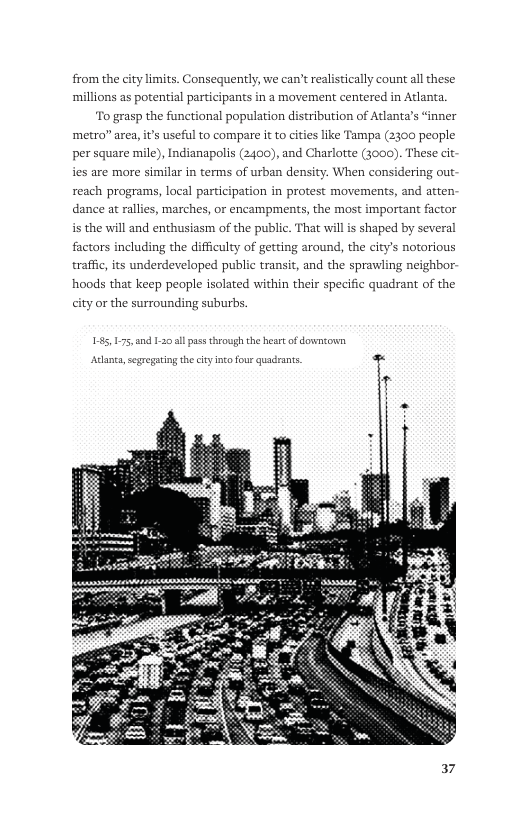
e
Arlana,sggegating the cityino four quadrants -
37
Consider the 2020 George Floyd protests. At their peak in late May
and early June, only two or three protests drew more than five thousand
people. Most barely exceeded one thousand. When residents clashed
with police and burned down the Wendy's on Universi
Rayshard Brooks was murdered that summer, the crowd likely did not
exceed six or seven hundred. This is important when we consider the
prospects for a mass protest movement in Atlanta and whether it could
be driven by local residents. The same is true for many other cities
across the United States, as most are not significantly denser than
Atlanta,
Avenue after
“SPATIAL DE-CONCENTRATION”
‘These conditions are neither neutal nor accidental. Atlanta vas once a far
denser city In the carly 20th century, streetcars carried workers and visi-
tors through neighborhoods lled with bric townhomes, comer tores, and
thriving industry. The first challenges to this dense, “walkable” wrban core
emerged in the 19205 and '30s, when General Motors began dismantling
stretcar lines and promoting cheap automobile. Hovwever,aftr the sum-
mer of 1967,2 year marked by open confrontations between Black youthand
police across the US, the federal government took a specia inteest i this
process. The National Advisory Commission on Civil Disorders, convened
by the FBI, examined the causes and protagoniss behind over thrce hun-
dred rebellions against police across the country,especially in Newark and
Detroit. At the end of ther report, they recommended a drastic restructur-
ing ofcities, emphasizing “spatial deconcentration” —the deliberate disper-
sal ofurban popultions, partcularly the Black working class.
Inthe 19705 and 803, this concept became a government mandate
The federal government poured billions of dollars into infrastructure,
promoting the construction of interstate highways that cut through
the heart of Black communities i cities like Atlanta, Detroit, Newark,
Cleveland, Los Angeles, and Washington, DC. Meanwhile, the Reagan
administration’s deregulatory policies gave a massive boost to the
automabile and construction industries, enabling them to widen roads
and expand freeways, while also outsourcing production overseas to
regions with lower wages. These highways were not bullt in vacant
38
lots—they ran straight through low-income, predominantly Black
neighborhoods, shattering communities and displacing families.
Black communities were gutted. Industry and jobs moved to the
suburbs (or averseas), and white fight followed, leaving Black workers
behind. As factories relocated and middle-class white families moved
<o the outskirts, the policy of “last hired, first fired” ensured that Black
workers, already facing systemic discrimination, were the first to lose their
jobs,
‘This was not simply poor urban planning. It was a deliberate reor-
ganization of cities intended to decimate the urban core and reshape
the economic landscape. The scars of that era continue to mark cities
across America today.
‘The decision to build a movement that could draw in activists from
outside Atlanta—indeed, from outside Georgia—was surely made with
these considerations in mind, and for good reason. Stil, the partici-
pation of out-of towners was neither consistent nor decisive enough
<o halt the project. Local participants lacked the tactical leverage they
needed; without the resources of national support, they were at a dis-
advantage. The authorities could concentrate local, state, and federal
forces against the movement; only outside support could even the odds.
‘The government understood this. That's why Allison Clark of the
Community Stakeholders Advisory Committee, Michal Julian Bond of
the Atlanta City Council, Police Chief Darin Schierbaum, Mayor Andre
ickens, and countless other proponents of Cop City sought to nor-
‘malize a simple, devastating, repressive formula, encapsulated in one
of their oft-repeated mantras:
“Traveling out of tate fo protest s form of domestic terrorism.”
THE SPIRAL OF REPRESSION
As repression intensified, the movement lost its flexibility and capacity
for innovation. After the City Council appraved the project in fall 2021,
one faction of the movement adopted a simple framework: defend the
forest, pressure contractors to withdraw, and evade or repel police
operations. But as police violence escalated and prosecutors leveled
39
increasingly outrageous charges, the once vibrant and audacious move-
‘ment faltered. It struggled to match the force of the state, especially
after the killing of Tortuguita,
This was also evident in the difficulty of planning the next steps.
There was no unifying strategy capable of addressing both the inten-
sifying attacks of the state and the passive spectatorship of the wider
public. The principle of “decentralization”
chis prablem.
‘Thousands considered themselves to be on the movement's “front
lines.” Between the first and ifth weeks of action, this perception was
an asset, regardless of whether it was accurate. During those early
‘months, generating widespread sympathy and engagement was a key
priority. Organizing cultural events, mushroom walks, bike rides, and
similar activities in the forest or across town played an important role
not suffice to resolve.
in maintaining visibility and involvement.
After the police lost control of the forest following the July 2022
‘burning of Boyette Brothers equipment and the music festival during
the Fourth Week of Action, the balance of forces shifted definitively
in favor of the movement. For a brief period, it seemed theoretically
possible that the movement could pursue more conventional tactics,
such as mobilizing hundreds for a direct assault on the site—which at
that time was stilllttle more than a police staging area—or launching.
a mass encampment at the Prison Farm. However, what was theoreti-
cally viable was not always politically realistic. Who would have carried
out such a raid at that time? How would they have been organized?
Here, we see how tactical questions are always political questions.
Some well-intentioned commentators —many of them participants
in the movement —have suggested that the movement contracted after
Tortuguita was killed on January 18, 2023. On closer examination, this
is simply not true. The movement grew significantly after Tortuguita’s
death. The number of participants increased; the frequency, scale, and
intensity of actions increased. These grew even more after the March
5, 2023 raid on the Cop City construction site. It is true that they did
not increase enough to counterbalance the extent to which the state
t the movement, It s also true that the
was concentrating force ags
tactics that had made the movement feel powerful for a small dedicated
a0
core became impossible after Tortuguita was killed. But the movement
should not be reducible to the tactics of any specific group or tendency.
Therefore, it cannot be argued categorically that the potential of or
participation in the movement receded after the killing, The movement
arguably reached its peak of participation in the summer of 2023,
during the City Hall mobilizations. The period of lowest participation
With this context in mind, we can see that the domestic terrorism
arrests and the killing of Tortuguita were, in part, a consequence of low
participation, not a cause of it. Tragically, fall 2022 was the moment
when the movement had gained the greatest leverage against Cop Ci
as it had created a stalemate between forest defenders and police. To
break that stalemate, city officials and law enforcement began spread-
ing lies about protesters, abeling them “terrorists” and falsely claiming
they had fired guns at contractors. In this way, they gradually bult the
political will to employ deadly force against the movement, as well as
persuading state and federal authorities to get involved.
Some participants recognized this danger at the time. To maimize
the leverage that the movement had gained against Cop City, many
people concluded that they needed to expand the struggle as rapidly
as possible. Their goal was to involve a large number of people in
viable tacties that had the potential to halt the project. For some,
this meant organizing community meals and concerts in the forest.
Others focused on building infrastructure, such as cabins and warming
stations, to encourage mass participation. These “place-makers,” if
you will organized around the idea of making the forest a place where
people would want to spend time.
‘The grassroots left had largely abandoned the movement, leaving
it to anarchists to organize against Cop City. Punks, ravers, and artists
contributed what they could, but their involvement was mostly periph-
eral. Some activists worked tirelessly to draw these communities deep-
erinto the struggle, seeing them as potential key players who could fll
in where the traditional left had fallen short.
Organizers of the weeks of action sought to mitigate the participa-
tion problem by drawing in large numbers of people for short periods
of time.
a1
By fal 2022, the actions that were needed were far beyond what the
available forces could mobilize. While ity officials and law enforcement
sought to prepare the ground for lethal violence, the only ways for the
‘movement to break the stalemate in its own favor would have been to
‘mobilize massive numbers of people or deal aseries of blows so devastat-
ing that they eroded the political wil of those behind the project.
et only a handful of people were still circulating through the
forest, mostly in the context of parties, plays, or concerts. Even fewer
were focused on leveraging force against Cop City outside of the forest
through demonstrations, blockades, or occupations. Those commit-
ted to direct action were not able to compensate for the absence of
large numbers of people, as their tactics remained largely confined to
hit-and-run acts of destruction, presumably necessitated by their own
small numbers.
Those who lived in the forest faced difficult challenges. At times,
some individuals behaved in ways that made it more difficult to solve
problems, reconcile differences, and pursue shared goals. This also
contributed to the isolation of the encampments
The efforts of those involved in direct action outside the forest,
those working on “place-making” efforts within the woods, and those
curating cultural experiences that connected the forest with surround-
ing communities all plateaued.
Instead, as the pressure increased, the movement's capaci
creative, sustained resistance dwindled. Early on, aby
that some environmentalists were less concerned with the police
than with protecting “nature.” This tension was compounded by the
fact that some of those temporarily living in the forest framed their
interests as opposed to others, claiming parts of the forest as their
“homes” and suggesting that weeks of actions, fundraisers, or protests
were violating their personal space. In turn, some anarchists criticized
others for lacking a sufficiently militant vision, accusing them of
pushing for mere policy changes. Meanwhile, many working groups
ithin the movement failed to prioritize the forest's physical integr
not realizing that once the trees were gone, it would be considerably
‘more difficult to resist the construction of Cop City.
In the end, not enough participants pushed beyond their comfort
a2
zones. When their preferred tactics became too difficult, many stopped
participating entirely, regardless of their stated objectives.
WHAT IF?
How could this story have turned out differently?
Let's return to summer 2022, when the movement showed that it
was too powerful for the local authorities to control. What if, at that
‘moment, people around the country had organized a massive outreach
campaign calling people to converge on Atlanta for a range of broadly
confrontational and participatory actions?
Al of this did in fact oceur a full year later, in fall 2023, when sev-
eral speaking tours erisscrossed the United States promoting the Block
Cop City mobilizationt and hundreds of people gathered in Atlanta for
a weekend of action. Perhaps if something similar had taken place in
2022—when the movement was up and coming rather than embattled,
when the state had not et used spurious charges of terrorism and rack-
eteering to intimidate potential participants, when supporters were
ot yet busy trying to respond to the genocide in Gaza—it might have
drawn much larger numbers, which might in turn have made it more
difficult for the government to regain the
For that to have taken place at the end of summer 2022, however,
a critical mass of people outside of Atlanta would have had to real-
ize how pivotal the movement was and immediately invest energy in
organizing to support it. They would have needed to recognize—long
before the police murdered anyone o charged anyone with terrorism—
that the movement's apparent success introduced new perils. Had they
succeeded in bringing new forces to bear against Cop City, this would
likely have contributed to tensions with established local organizers
in Arlanta and with those who were already occupying the forest. They
would have needed to accept those tensions as necessary growing pains.
‘The outcome of the struggle over Cop City has had profound im-
plications for movements around the United States and, consequently,
for people all around the world. If nothing else, we can learn the impor-
tance of recognizing the stakes of a fight while there s still time.
ative.
a3
FIGHTING
Every movement that undergoes severe repression experiences inter-
nal confict, and the movement to stop Cop City was no exception. As
has been said before, the function of repression is not simply to strike
the immediate targets, but to send shockwaves through a movement in
a way that opens up fault ines.
The movement endured three years of intense struggle, in part, by
adhering to one fundamental principle: members refrained from pub-
licly denouncing each other. Disagreements or critiques were handled
internally whenever possible. Groups that could not reconcile their
differences simply avoided each other. Saboteurs, tree-sitters, rioers
and others took action against Cop City, secure in the knowledge that
they would not be labeled “crazy” on prime-time news—at least, not
by other activists. Canvassers, community organizers, fundraisers, and
event coordinators could rest assured that, for the most part, social
media would not be fiooded with rage-fiseled rants denouncing their
strategies as hopeless or naive.
Anonymous internet users violated this principle repeatedly. Each
time, it threw the radical segments of the movement into temporary
st
One ofthe struccures bui by the moverment in Weclaunee
4
disarray. Coinciding with moments of intense repression, spiteful
statements and semi-coherent allegations flooded the internet,
contributing to an atmosphere of fear and tension. This underscores
the need for well-delivered, constructive criticism—whether in public
venues or private face-to-face exchanges.
Fromthe earliest days of the movement, some grassroots organizers
sought to smear it. Through whisper campaigns, gossip, and private
conversations, they tried to prevent it from gaining momentum. They
Iabeled it “all white,” or claimed that organizers hadn't “consulted the
community” before launching actions, echoing the “outside agitators”
narrative pushed by the police chief and Mayor Dickens. On a podcast,
one person shamelessly declared the movement “more disappointing
than Cop City itself”—a pro-repression stance thinly disguised as
progressive poliics.
Until the struggle became too large to ignore, some local activists
derided it. On Signal groups, they sowed doubr, division, and para-
noia—particularly targeting out-of towners and newcomers—w]
technically adhering to the movement's commitment to discretion. As
large non-profit organizations began to support the movement, some
activists discouraged them from allocating resources to the partici-
pants who were taking significant risks.
Ironically, many of those who attempted to undermine the move-
‘ment also sought to benefit from its momentum. NGO staffers and ca-
reerists continue to cash in, earning accolades and grants on behalf of
‘movement for which they risked very little. Meanwhile, many of those
facing felony charges and living under surveillance continue to struggle
below the federal poverty line.
Critique is essential. Aspiring revolutionaries should actively seek
eritical input, s the cost of error can be extremely high. Criticism helps
refine strategies and fosters humility in the face of immense obstacles
and uncertainty. Anyone serious about dismantling the carceral state,
overthrowing capitalism, and transforming the world must first admit
that they don't know everything and that it will be necessary to refine
their theories and strategies on an ongoing basis.
Unfortunately, petty and self-serving forms of criticism remain
all too common. Real critique uplifts, educates, and transforms the
a5
participants. When people engage in denunciatory attacks and gossip,
chis can obscure the true cost of political errors, burying self-reflection
under an avalanche of invective and rumor. This fosters defensiveness,
stubbornness, ego trips, and factionalism, ultimately leading to the
propagation of dogmas that remain untested. This isn't just a problem
for collectives, crews, and organizing groups—it can stunt entire
‘movements. It'sa challenge that all humanity has a stake in overcoming.
MOVING AHEAD IN A COP NATION
Those who have fought to oppose the construction of Cop City
in Weelaunee Forest were correct to identify the project as marking
the dawn of a new era of police militarization in the United States.
fes plan to build at least eighty additional police training
facilites across the United States; every state except for Wyoming is
planning at least one.
Despite courageous efforts, they did not manage to save the forest
from destruction or prevent the completion of the project. Only two
options remain for closing down Cop City: pressuring policymakers to
defund it after it opens or directly destroying the site. Only a mass
revolt or carefully planned acts of sabotage unlike any that have
occurred thus far could achieve either of those outcomes. During the
‘movement, thousands repeatedly chanted, “If you build it, we will burn
it It remains to be seen whether they were serious or bluffing.
‘The police are a central pillar of the state. Appearances aside, the
government is not primarily composed of bureaucracies, libraries, clin-
s, or universities. At its core, it is made up of armies, borders, prisons,
and police. Societies embroiled in destabilizing conflicts often see so-
cial services, welfare, and even parliamentary systems collapse, but the
repressive functions of the state never collapse on their own—they can
only be dismantled by powerful revolutionary movements.
The power of the police will not simply fade away. Those who rule
depend upon it it is essential to preserving the inequalities that are the
foundation of their authority. All evidence indicates that the power of
the police will continue to expand until the social order that requires it
is destroyed. If that oceurs, it will not simply be the consequence of a
Local auth
a6
eal actions
change in public opinion; it will involve real people taking
against real infrastructure. Because the concentration of armed force
is inevitable in all unequal societies, doing away with the police will re-
quire abolishing artificial scarcity and war between classes, castes, and
nations.
We did not fight to stop Cop City
would take t0 reform capitalism and the state would be a few con-
certs and a litle vandalism. We fought because we hoped that th
because we believed that all it
pan it could clarify the stakes of the struggle that s taking
place at this critical juncture in history, drawing more peaple into
action and decpening our joint effort to change the world
ar fig
And that s something we stll beieve in
47
a8
NOTES
crimethine.com/BidenDoomed
crimethine.com/2024interview
Re-litigating the past can be tempting for those who have expe-
rienced traumatic failures and setbacks, as it allows us to take
responsibiliy for the past by eriticizing ourselves and others. It
is important to approach such questions with humility and to
resist the temptation to shift the goalposts in response to set-
backs. From the outset, participants in the movement boldly
‘maintained that they intended to win. Some of them criticized
discourses that trivialized the concept of victory or made apol-
oies for failure. “The real stopping Cop City is the friends we
‘made along the way"—it might be casy to say something like this
today, but it would not represent the spirit of the movement.
‘Speaking tours promoting the movement to defend the forest did
take place in 2022, but on a smaller scale than the speaking tours
in the lead-up to the Block Cop City mobilization.
In contexts where the power of the police i subcontracted out to
third parties or paramilitaries, we could say that the state itself
has already transformed into a corporate or factional enterprise.
49
APPENDIX
TIMELINE: DECEMBER 2023 TO JANUARY 2025
December27: A Chase Bank in NYC is vandalized with “Stop Cop City”
and “Free Gaza” painted on its veneer and its doors locked. A demon-
stration takes place outside the home of Jonna Hamilton, the senior
legal counsel of Nationwide Insurance, which provides coverage for the
Atlanta Police Foundation.
December31: Charleston Police and FBI arrest a 21-year-old in Charles-
ton, South Carolina. Police allege the accused is responsible for burning.
‘wo trucks belonging to Thomas Conerete, and for painting “You build
i, we burn it” on the trucks, as well a slogans about Weelaunee Forest.
January : A car s burned outside of Portland City Commissioner Rene
Gonzalez's house. The action is dedicated to fallen revolutionaries, in-
cluding Tortuguita, as well as two unhoused people in Portland who
died as a consequence of police enforcement tactics advocated by Gon-
zalez,
January 2: A proposal appears online inviting people to conduct sol-
idarity actions and events on January 18, the day of Tortuguita was
killed. Manuel’s Tavern is vandalized in advance of an appearance by
Mayor Dickens; its doors are glued shut, its walls painted. The sched-
uled visit is canceled,
January 16: A feller buncher belonging to Shadowbox Studios is burned
in the forest.
January 17: The news comes out that the cost of the Cop City project
has increased from $90 million to $109 million. The authorities blame
security costs, damage from protests, and increased insurance costs.
January 18: On the “Day of the Forest Defender,” around the country,
‘hundreds of people participate in events commemorating the death of
Tortuguita. Nearly fifty events take place for the occasion, including
50
vigils, teach-ins, rallies, film screenings, and fundraisers. In ad
18 windows are broken at the San Francisco Credit Union; in Hanover,
Germany, a car belonging to Autobahn GmbH is burne
broken at two different Nationwide subsidiaries in Atlanta; MTU Solu-
tions is vandalized in Novi, Michigan; UPS tires are slashed in Amster-
dam, Netherlands.
windows are
January 19: Someone liberates ten chickens in the Northern UK in
‘memory of Tortuguita,
January 25: Four machines belonging to Brent Scarborough are burned
on Boulevard Drive near the Federal Penitentiary in southeast Atlanta,
No communiqué appears online, but local police stage a press confer-
ence nonetheless.
January 27: A bank in Chicago is redecorated with posters in memory
of Tortuguita.
January 29: Protesters lock down at a Brasfield & Gorrie job site in
Mideown.
January 30: A cybersecurity incident cripples the municipal govern-
‘ment in Athanta.
February: Someane sabotages 11 ATMS belonging to Truist Bank with
glue and glues the doors shut.
February 8: Atlanta Police, the ATF, and the FI raid three homes in
southeast Atlanta in a joint operation, each targeting one house. They
arrest one person, charging him with first-degree arson, and detain an-
other for several hours. Police attempt to violently humiliate the resi-
dents of the house they raid, forcing one resident outside without her
clothes on to be photographed by masked thugs; at another house, offi-
cers drag a resident down the stairs by his hair.
February 10: In Lakewood, Atlanta, just blocks from two of the houses
51
raided on the 8th, a police car catches fire in front of the home of an
APD officer. The accompanying statement reads, in part: “We wish to
dispel any notion that people will take this latest wave of repression
ying down, or that arresting alleged arsonists will deter future arsons.”
In St Paul, Minnesota, two trucks and trailers loaded with timber are
burned at a Home Depot in solidarity with Jack and those affected by
the raids. “It is time to destroy those who destroy the earth,” the state-
‘ment reads.
February 1: Police raid another home in Lakewood, in broad daylight,
following the burning of the police cruiser the day before. Nabody is ar-
rested or detained, and nobody is home. FBI, GBI, ATF, the bomb squad,
helicopters, armored vehicles, and undercover police vehicles establish
a presence in the area for days. In San Francisco, Waymo self-driving
cars are vandalized “with hammers and knives” in solidarity with those
in Adlanta facing police harassment.
February 12: The owner of the home raided on February 11 holds a
press conference denouncing the police action at his home. Elsewhere,
the Davinei Development website is vandalized by hackers.
February 23: The Nationwide Summit to Stop Cop City in Tucson,
Arizona brings together a few hundred activists from the Southwest.
Three Nationwi aries lose their windows in Tucson, Arizona.
subi
February 24: A Nationwide subsidiary in Santa Cruz has its locks filled
with glue and its walls covered in spray paint.
February 25: During the Nationwide Summit, 80 people gather in a
black bloc in Tucson. They march several blocks and smash all of the
windows of Wells Fargo and PNC Bank in Presidio Plaza. Some deco-
rate the walls with Tortuguitas name.
February 26: Dozens protest at the Nationwide Headquarters in Scott-
sdale, AZ. Hundreds of police are deployed. At the same time, six ac-
eivists lock themselves down to concrete barrels in entrance to a gated
52
community in Fountain Hills, Arizona, where a regional executive of
Nationwide lives. In New York City, over 200 protesters march into
the offices of Nationwide and AXA XL—insurers of the Atlanta Police
Foundation and Brasfield & Gorrie, respectively. Thisis the largest pro-
test connected to the movement to take place outside of Georgia.
February 27: A video release shows multiple Nationwide locations van-
dalized in New York City.
February 28: Ten New York Police Department vehicles are splashed
with paint and have their tires slashed.
March s: About twenty Black women protest outside the home of May-
or Dickens in the early hours, demanding the city government drop the
court appeal blocking the referendum to stop Cop City. In the United
Kingdom, a dairy farm in Leistershire is extensively vandalized in soli-
darity with Jack and others facing repres
nin Atlanta.
March7: One person locks down to construction equipment at a Bras-
field & Gorrie site in Midtown as a crowd gathers below. After several
‘hours, he is removed and charged with misdemeanor trespassing.
March 11: Protesters disrupt a Mayoral panel featuring Andre Dickens
in Austin, Texas. The event is canceled and Dickens is chased offsite
In Oregon, a butcher shop in Portland is vandalized in solidarity with
Jack.
March 14: Eight machines belonging to Brent Scarborough are burned
in Henry County, GA.
March 27: Two activists climb up a 250-foot crane at a Brasfield & Gor-
tie job site in Midtown Atlanta to disrupt work. This time, the activists
are charged with felonies. Elsewhere, an I-5 highway sign is redecorated.
March 28: Anarchists
the northern United Kingdom liberate 41
ducks from a farm in memory of Tortuguita and in solidarity with Jack
53
Also, at some point in March, someone tampered with the tables of the
Atlanta Police Department, temporarily freeing the horses.
April 16: Several pieces of machinery belonging to Brasfield & Gorrie
are burned in Fayetteville, Georgia. No communiqué accompanies the
action, but police publicly speculate that it s related to Cop City.
April 22: Peaple wheat-paste posters and paint slogans all aver Emo-
1y University campus denouncing the insticution for ties to Isracl and
the Atlanta Police Foundation. Six surveillance cameras are disabled by
various methods,
April 25: Students and others set up an encampment in solidarity with
Gaza at Emory University in the context of a national mobilization
against US support for the Israeli genocide in Palestine. Protesters con-
nect Isral to Cop City. Emory Police and Georgia State Patrol attack
the crowd, firing pepper balls at protesters, tasing medics, and slam-
‘ming professors to the ground. As the day passes, crowds descend from
classes onto the quad to confront police and block prisoner transport
vehicles. Police shoot rubber bullets at students. In the early evening,
faculty and students aceupy Candler School of Theology atrium. As po-
licearrive, protesters use reinforced banners to clash with police and to
protect each other from rubber bullets and pepper balls.
April 26: More than 500 people reconverge on the Emory quad after a
day of clashes with police on campus. Protesters flood Cox Hall, tem-
porarily occupying the building. During an emergency faculty meeting
on campus, staff move to hold a “no-confidence” vote on President
Fenves. Fenves sends an email to thousands of students, alleging that
“outsiders” were converging on campus in buses. Despite his allega-
tions, corporate news platforms report that over 9o% of the previous
day's arrestees were students or faculty. In New York City, during an
Atlanta Police recruitment event, someone pulls the fire alarm of the
Marriott hotel and 300 erickets are released inside the building. Graffiti
decorates the courtyard.
54
April 27: To further disrupt the Atlanta Police recruitment event, ce-
‘ment is poured into the plumbing system of the hotel
April 28: Faculty and staff walk out on Emory campus, denouncing
President Greg Fenves for calling the police on student protesters.
April 29: Three OMNY machines and three MTA machines on the New
York subway are smashed in memory of Tortuguita. At Cal Poly Hum-
boldt, a Gaza solidarity protester builds a tree-sit beside occupied Sie-
‘mens Hall in memory of Tortuguita.
April 30: During the eviction of Hamilton Hall and the West Lawn at
Columbia University, the crowd begins chanting “Stop Cop City."
May 1: Hundreds march on Emory Campus with reinforced banners,
temporarily seizing control of the Oxford/Undergraduate Admissions
building. Police drag George State University students wearing keffiye-
hs at the graduation ceremony off stage.
May 3: Some 75% of Emory faculty vote “no confidence” in President
Fenves. Protesters march to the headquarters of the Georgia Interna-
tional Law Enforcement Exchange program on Georgia State Universi-
ty campus, long the target of the stop Cop City movement and now of
the Gaza solidarity protests as well. Protesters clash with police whil
erying to enter the building, using shields, reinforced banners, and um-
brellas to protect each other. The crowd disperses with no arrests.
May 4: About 60 protesters gather near the GILEE headquarters again;
several dozen it police stage nearby. The crowd decides not to march
and assembles in deliberation instead.
May 6: Morehouse students issue a public letter to the Board of Trust-
ees, reiterating their call to sever ties with Cop City and the Atlanta
Committee for Progress and to cut ties with Isracl,
May 7: The Atlanta Journal Constitution attempts to split Stop Cop
55
City and Gaza solidarity protests by urging anti-war activists not to
be “co-opted” by activists fighting police militarization in “southeast
Atlanta,” just a few miles from Emory campus. Spelman students issue
an open letter to the Board of Trustees urging them to cut ties with
Isracl and Cop City.
May 10: Columbia University Hamilton Hall arrestees issue a state-
‘ment directly connecting the genocide in Gaza to the GILEE program
and the construction of Cop City and similar projects around the Unit-
ed States.
May 11: Thirteen Emory arrestees issue a public statement demand-
ing that Emory cut ties with Israel and Cop City and drop all charges
against protesters on campus.
May20: The Atlanta Police Foundation pays twelve temp workers hired
by “Our America” to attend a City Council session in order to read
statements in support of Cop City.
May 21: An NYPD bus is burned in Brooklyn in memory of Tortuguita
and in retaliation for police brutality at a Palestine solidarity protestin
Bay Ridge, NYC.
May 29: The Guardian publishes an article exposing constant surveil-
lance and harassment of southeast Atlanta residents. The harassment
includes hundreds of visits by police at homes day and night; during
these visits, officers sometimes park outside of the houses for a few
‘minutes without approaching. Other times, they shine lights into win-
dows and blare their sirens outside the homes of activists with suspect-
ed ties to the Defend the Forest/Stop Cop City movement. In one in-
stance, a it road flare s placed in the bushes directly outside a window
May31: Multiple water mains explode across Atlanta, leaving a majority
of residents without clean running water for a week. Many people con-
nect the collapse of cty infrastructure to the channeling of tremendous
amounts of funding to police.
56
June 3: Groups involved in the movement join Palestine solidarity ac-
tivists in calling for disruptions at the first US Presidential debate on
June 27.
June §: A 20-year-old anarchist named Cyprus is subpoenaed in
Charleston, South Carolina and summoned to a Federal Grand Jury in-
ing alleged acts of arson against Cop City subcontractors.
June 20: In NYC, people disrupt a budget session at City Hall. NYC
Mayor Eric Adams wants to cut the public ibrary budget in order to
build a Cop City-inspired facilty in Queens. Local New Yorkers begin
organizing against the project.
June 25: A lawyer representing the Atlanta Solidarity Fund files a mo-
tion to dismiss the case against them after it is learned that the Attor-
ney General's office failed to hire a “flter team” to redact client-attor-
ney emails subpoenaed by the State. Those emails were read by law
enforcement and included in evidence.
June 27: Using reinforced pipes, activists lock down in the driveway
of Hudson Technologies in Smyrna, Georgia. Hudson produces arms
for the Isracli army. Activists denounce the war on Gaza and demand a
right to vote via referendum on Cop City. That night, two demonstra-
tions take place in the vicinity of the Presidential debate. Several hun-
dred police officers swarm the area, both in uniforms and undercover.
Around one hundred protesters gather for a black bloc but decide not
toinitiate a combative demonstration. They march a few blocks before
dispersing without arrests,
July 4: Cyprus publicly declares their intention to resist the Federal
Grand Jury targeting the Stop Cop City movement. They call for others
to resist the hearings without compromise. Six Flock cameras are de-
stroyed in Savannsh, Georgia.
57
July10: In Okemos, Michigan, protesters visit the home of Paul Kearney,
Chief Claims Officer for Accident Fund Insurance.
July31: A grand jury subpoena targeting Cyprus s withdrawn, likely as
a consequence of their commitment to resist the hearing.
August 13: A machine belonging to the Brent Scarborough Company is
burned on Memorial Drive. Unknown saboteurs use “improvised in
cendiary devices” to destroy the machines of the Cop City contractor
LS g
August 22: A industrial railroad bridge burns near Milwaukie, Oregon.
The saboteurs connect the shipping company to the Isracli war in Pal-
estine and to Cop City.
January 18, 202
“Festivals of Resistance” against the incoming Trump-Vance-Musk
ay of the Forest Defender events coinciding with
administration take place in over twenty locations. Five hundred
people gather in Richmond. In Olympia, a thousand people march
The mother of Tortuguita joins local musicians at an event in Atlanta.
Somewhere in Northern California, anonymous saboteurs disable
a dozen truc)
belonging to Green Diamond Resource Company in
‘memory of Tortuguita,
58
WORKERS COLLECTIVE
IMETHIN
Crimethlnc.is a rebel alliance —a decentralized network pledged
toanonymous collective action—a breakout from the prisons of our
age. Westrive to reinvent our lives and our world according to the
principles of self-determination and mutual aid.
crimethinc.com
Cop City
Is Everywhere
The movement to stop Cop and
defend Weelaunee Forest was one of
the most important social struggles of
the Biden era. Its trajectory tells us a
Tot about the challenges we confront
todayunder Donald Trump. Inthefinal
chapter of our chronology, we trace
the movement’s concluding phase,
beginning in 2023 and ending with
‘Trump’s arrival in power, and explore
what we canlearn fromit.