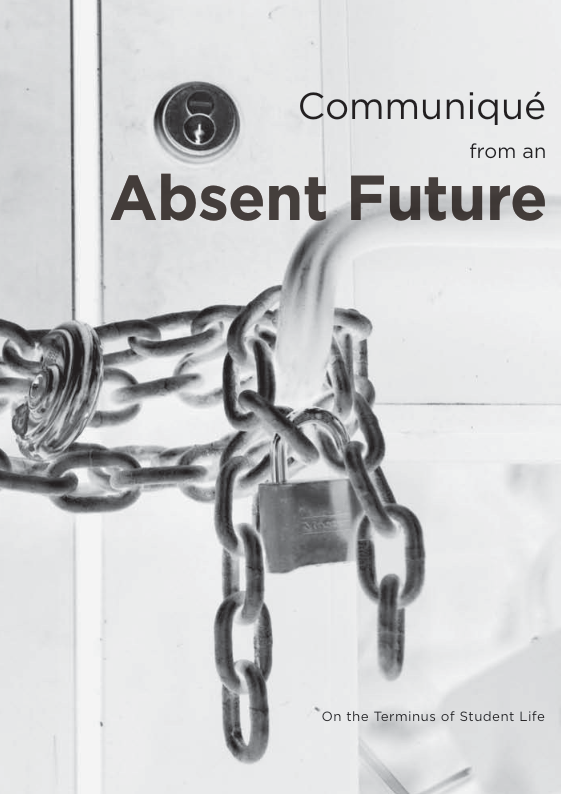
Communiqué from an Absent Future
Web PDFImposed PDFRaw TXT (OCR)
Communiqué  from an  Absen Future  nnnnnnnnnnnnnnnnnnnnnnnnnn
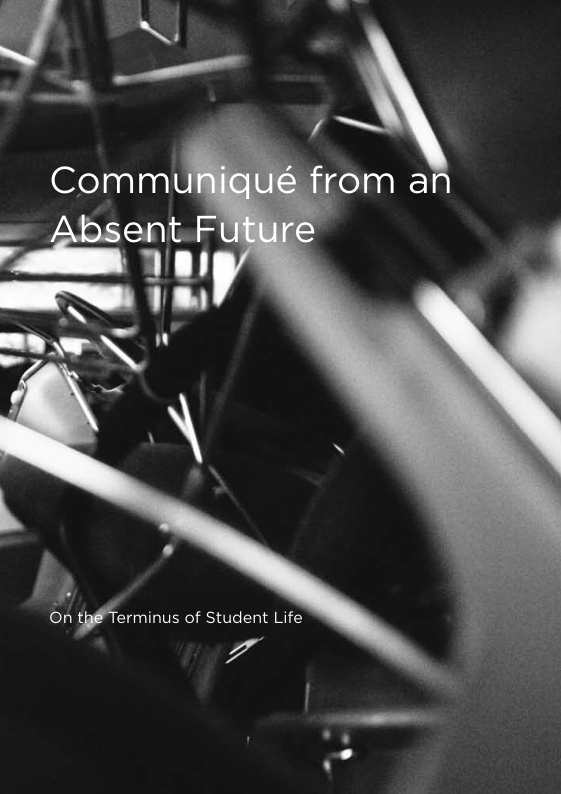
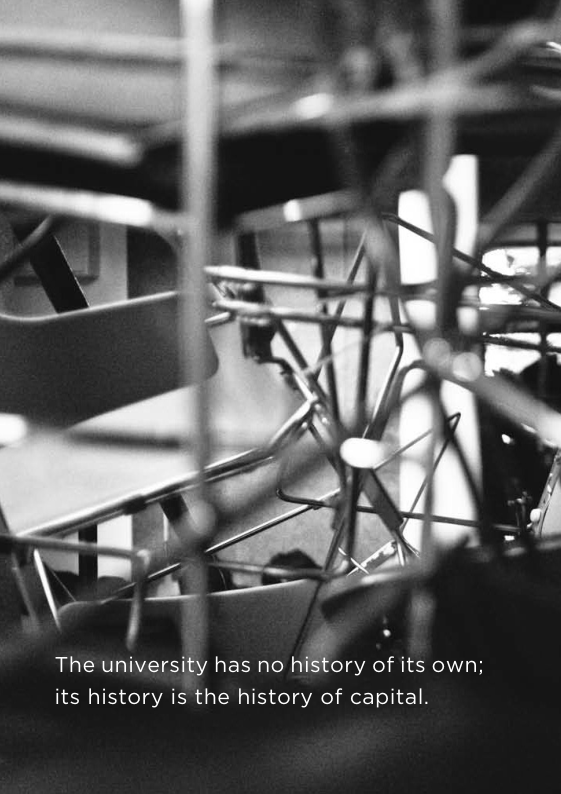
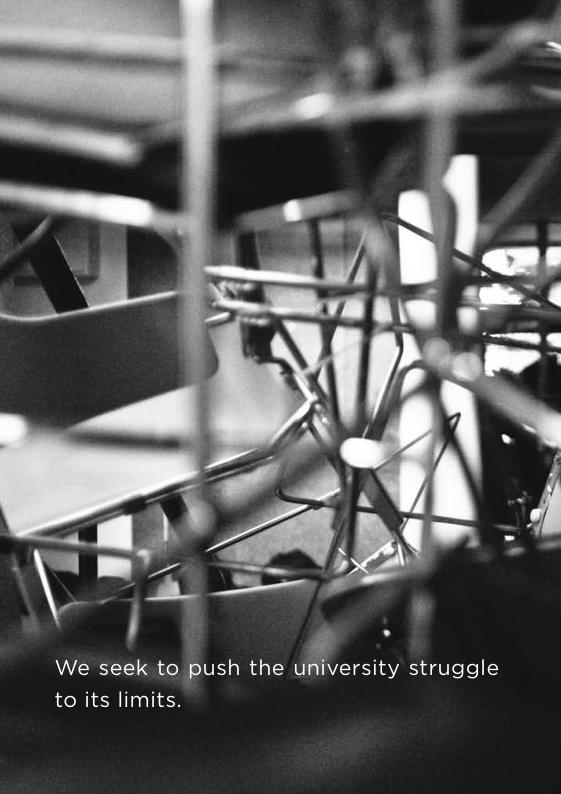
This communiqué was written during the occupation of University of California at Santa Cruz in 2009.  Inside photo: barricade architecture at San Francisco State University, December 2009. Taken from the collection “After the Fall - Commu- niqués from Occupied California”, which we recommend checking out.  Layout by Il Will Editions, Fall 2015. Typeset in Gotham Book, Gill Sans MT, and Bembo.  ll-will-editions.cumblr.com illwill@riseup.nec

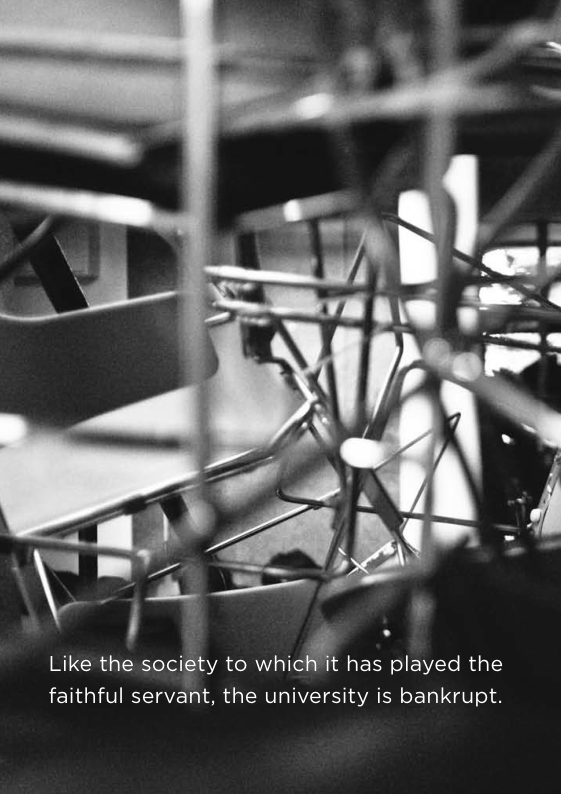
- -  Like the society to which’it has played the faithful servant, the university is bankrupt.
1  LIKE THE SOCIETY TO WHICH IT HAS PLAYED THE FAITHFUL SERVANT, THE UNIVERSITY IS BANKRUPT. This bankeuptcy is not only financial. It is the index of a more funda-  mentl insolvency, one both political and economic, which has been  a long time in the making. No one knows what the university is for anymore. We feel this intuitively. Gone is the old project of creating a cultured and educated citizenry; gone, too, the special advantage the degree-holder once held on the job market. These are now fanasies, specteal residues that cling to the poorly mainained halls  Incongruous architecture, the ghosts of vanished ideals, the vista of a dead future: these are the remains of the university. Among these re-  s, most of us are litdle more than a collection of querulous habits and duties. We go through the motions of our tests and assigments with a kind of thoughtless and immutable obedience propped up by sub- vocalized resentments. Nothing is interesting, nothing can make itself fele. The world-historical with its pageant of catastrophe is no more real than the windows in which it appears.  For those whose adolescence was poisoned by the nationalist bysteria following September 11th, public speech is nothing but a series of lies and public spa do). Afflicted by the vague desire for something to happen—without  2 place where things might explode (though they never
ever imagining we could make it happen ourselves—we were rescued by the bland homogencity of the internet, finding refiuge among friends we never see, whose entire existence s 2 series of exclmations and silly pictures, whose only discourse s the gossip of commodities.  Safety, then, and comfort have been our watchwords. We slide through the flesh warld without being touched or moved. We shepherd our emp- tiness from place to place.  But we can be grateful for our destitution: demystification is now a condition, not a project. University ife finally appears as just what it has always been: a machine for producing compliant producers and con- sumers. Even leisure is a form of job training. The idiot crew of the frat houses drink themselves into 3 stupor with all the dedication of lawyers working late at the office. Kids who smoked weed and cut clas in high- schaol now pop Adderall and get to work. We power the diploma fic— tory on the treadmills in the gym. We run tirelesily in elliptical circles  It makes lidle sense, ther in Arcadia, as either idyllic or idle. “Work hard, play hard” has been the over-  to think of the university as an ivory tower  ager motto of 3 generation in training for...what’ —drawing hearts in cappuccino foum or plugging names and numbers into data- bases. The gleaming techno-future of American capitalism was long ago. packed up and sold to China for a few more years of borrowed junk. A university diploma is now worth no more than a share in General Motors.  We work and we borrow in order to work and to borrow. And the jobs we work toward are the jobs we already have. Close to three quarters of students work while in school, many full-tme; for most, the level of employment we obtain while students is the same that awaits after graduation. Meanwhile, what we acquire isn’t education; it’s debe. We work to make money we have already spent, and our future labor has already been sold on the worst market around.  Average student loan debt rose 20 percent in the first five years of the twenty-fint centu- £y—80-100 percent for seudents of color. Student loan volume—a fig- ure inversely proportional to state funding for education—rose by nearly 800 percent from 1977 ta 2003, What our borrowed tuition buys is the privilege of making monthly payments for the rest of our lives. What we learn is the choreography of eredit: you can’t walk to class without
being offered another piece of plastic charging 20 percent interest. Yes- terday’s finance majors buy their summer homes with the bleak futures of today’s humanities majors.  This is the prospect for which we have been preparing since grade- school. Those of us who came here to have our privilege notarized surrendered our youth ta a barsage of tutors, a battery of psychological tests, obligatory public service opi—the cynical compilation of half- truths toward 2 well-rounded application profile. No wonder we set about destroying ourselves the second we escape the cattle prod of pa- rental admonition. On the other hand, those of us who transcend the economic and social disadvantages of our families know that for every one of us who “makes it,” ten more take our place—that  me here to  the logic here is zero-sum. And anyway, socioeconomic status remains the best predictor of student achievement. Those of us the demograph- ics call “immigeants,” “minorities,” and “people of color” have been told to believe in the aristocracy of merit. But we know we are hated not despite our achievements, but precisely because of them. And we Know that the circuits through which we migh free ourselves from the violence of our origins only reproduce the misery of the past in the present for others, elsewhere.  If the university teaches us primarily how to be in debt, how to waste our labor power, how to il prey o petty anxieties, it thereby teaches s how to be consumers. Education is a commodity like everything clsc that we want without caring for. 1t is a thing, and it makes its purchasers  into things. One’s future position in the system, one’s relation to others, is purchased frst with money and then with the demonstration of obe- dience. First we pay, then we “work hard.” And there is the split: one is both the commander and the commanded, consumer and consumed. It is the system itself which one obeys, the cold buildings that enforce subservience. Those who teach are treated with all the respect of an automated messaging system.  Only the logic of customer satisfaction obtains here: was the course easy? Was the teacher hot? Could any stupid asshole get an A? What’s the point of acquiring knowledge when it can be called up with a few keystokes? Who needs memory when we have the internet? A training in thought? You can’t be serious. A moral preparation? There are anti-depressants for tha.
Meanwhile the graduate students, supposedly the most politically en- lightened among us, are also the most obedient. The “vocation” for which they labor is nothing other than a fintasy of falling off the grid, or out of the libor market. Every grad student is a would be Robinson Crusoe, dreas of the market. But this fantasy is itself sustained through an unremitting submission to the market. There is no longer the least felt contradiction in teaching a totalizing critique of capitalism by day and polishing one’s  g of an island economy subtracted from the exigencies  job talk by night. That our pleasure is our libor only makes our symp- toms more manageable. Aesthetics and polities collspse courtesy of the substitution of ideology for history: booze and beaux arts and another seminar on the question of being, the steady blur of typeface, each pixel paid for by somebody somewhere, some not-me, not-here, where all that appears is good and all goods appear attainable by eredit.  Graduate school i simply the fided remnant of a feudsl system adapted to the logic of capitalism—from the commanding heights of the star professors to the serried ranks of teaching assistants and adjuncts paid mosdy in bad fich. A kind of monasticism predominates here, with al the Gothic ritusls of 3 Benedictine abbey, and all the strange thea- logical claims for the nobility of this work, its essential aliruism. The underlings are only too happy to play apprentice to the masters, unable to do the math indicating that nine-tenths of us will teach 4 courses every semester to pad the paychecks of the one-tenth who sustain the fiction that we can all be the one. OF course I will be the star, 1 will get the tenure-track job in a large city and move into a newly gentrified ncighborhood.  We end up interpreting Marx’s 11th thesis on Feuerbach: “The philos- ophers have only interpreted the world in various ways: the point is to change it” At best, we learn the phoenix-like skill of coming o the very limits of critique and perishing there, only to begin again at the ble root. We admire the first part of this perfor- mance: it lights our way. But we want the tools to brexk through that  scemingly ineradi  point of suicidal thought, its hinge in practice.  The same people who practice “critique”  e also the most susceptible to cynicism. But if cynicism s simply the inverted form of enthusiasm, then beneath every frustrated leftist academic is a latent radical. The
shoulder shrug, the dulled face, the squirm of embarrassment when dis- cussing the fact that the US murdered a million lragis between 2003 and 2006, that every last dime squeezed from America’s poorest citizens is fed to the banking industry, that the seas wil rise, billions will die and there’s nothing we can do about it—this discomfited posture comes from fecling oneself pulled between the i and the ought of current left thought. One feels that dhere is no alternative, and yet, on the other hand, that another world is possible.  We will not be so petulant. The synthesis of these positions i right in front of us: another world s not possible: it is necessary. The ought and the is are one. The collapse of the global economy is here and now.
The university has no history of its own; its history is the history of capital.
u  THE UNIVERSITY HAS NO HISTORY OF ITS OWN; ITS HISTORY IS THE HISTORY OF CAPITAL. ls cssential func- ad labor. Though not a proper corporation that can be bought and sold, that pays  tion is the reproduction of the relationship between capital  revenue to s investors, the public university nonetheless carries out this  function as efficiently as possible by approximating ever more closely the carporate form of its bedfellows. What we are witnessing now is the endgame of this process, whereby the fiade of the educational institu-  tion gives way altogether to corporate streamlining.  Even in the golden age of capitalism that followed after World War 11 and lasted until the late 19605, the liberal university was already subor- dinated to capital. At the apex of public funding for higher education, in dhe 19505, the university was already being redesigned to produce technocrats with the skillsets necessary to defeat “communism” and sustain US hegemony. Iis role during the Cold War was to legitimate liberal democs  acy and to seproduce an imaginary society of free and equal citizens—precisely because no one was free and no one was equal.  But if this ideological function of the public university was at least well-funded after the Second World War, that situation changed irre- versibly in the 19605, and no amount of social-democratic heel-clicking will bring back the dead world of the post-war boom. ~ Between 1965  1
and 1980 profit rates began to fll, first in che US, chen in the rest of the industrializing world. Capitalism, it turned out, could not sustain the good lfe it made possible. For capital, abundance appears 15 over- production, freedom from work s unemployment. Beginning in the 19705, capitalism entered into  terminal downturn in which permanent work was casualized and working-class wages stagnated, while those at the top were temporarily rewarded for their obscure financial necro- mancy, which has itself proved unsustainable.  For public education, the long downturn meant the decline of tax rev- enues due to both declining rates of economic growth and the priori- tization of tax-breaks for beleaguered corporations. The raiding of the public pusse struck California and the rest of the nation in the 1970s. 1t has continued to strike with each downward declension of the business eyele. Though it is not directly beholden to the market, the universi and its corollaries are subject to the same cost-cutting logic as other in- dustries: declining tax revenues have made inevitable the casualization of work. Retiring professors make way not for tenure-track jobs but for precariously employed teaching assistants, adjunces, and lecturers who do the same work for much less pay. Tuition increases compensate for cuts while the jobs students pay to be trained for evaporate.  In the midsc of the current erisis, which will be long and protracted, many on the left want to return to the golden age of public education. ‘They naively imagine that the crisis of the present is an opportunity to demand the return of the past. But social programs that depended upon high profit rates and vigorous economic growth are gone. We cannot be tempted to make futile grabs at the irretrievable while ignoring the obvious fact that there can be no autonomous “public university” in 2 capitalist society.  The university is subject to the real criis of capital- 1, and capital does not require liberal education programs. The func- tion of the university has always been to reproduce the working class  by training future workers according to the changing needs of capital ‘The crisis of the university today s the crisis of the reproduction of the working class, the crisis of 2 period in which capital no longer needs us a5 warkers. We cannot free the university from the exigencies of the market by calling for the return of the public education system. We live out the terminus of the very market logic upon which that system was founded. The only autonomy we can hope to atain exists beyond capitalism.  12
What this means for our struggle is that we can’t go backward. The old student struggles are the relics of a vanished world.  In the 19605, as the post-war boom was just begi  g to unravel, radicals within the canfines of the university understood that another world was possible. Fed up with technocratic management, wanting to break the chains of a conformist society, and rejecting alienated work as unnecessary in an age of abundance, students tried to align themselves with radical sections of the working class. But their mode of radicalization, too tenuously connected to the economic logic of capitalism, prevented that alignment from taking hold. Because their resis eritique upon capitals   to the Vietnam war focalized  2 35 a colonial war-machine, but insufficiently upon s exploitation of domestic labor, students were easily split off from a working class facing different problems. In the twilight era of the posto  var boom, the university was not subsumed by capital to the de- gree that it is now, and students were not as intensively proletarianized by debt and a devastated labor market,  That is why our struggle is fundamentally different. The poverty of stu- dent lfe has become terminal: there is no promised exit. If the economic erisis of the 19705 emerged to break the back of the politic the 19605, the fict that today the economic crisis precedes the coming  erisis of  political uprising means we may finally supersede the cooptation and neutralization of those past struggles. There will be no return to normal.  13

t  WE SEEK TO PUSH THE UNIVERSITY STRUGGLE TO ITS LIMITS.  Though we denounce the privatization of the university and its author- itarian system of governance, we do not seek structural reforms. We demand not a free university but a free society. A free university in the midst of a capitalist society is like a reading room in a prison; it serves only as a distraction from the misery of daily life. Instead we seck to channel the anger of the dispossessed students and workers into a dec- laration of war.  We must begin by preventing the university from functioning. We st interrupt the normal flow of bodies and things and bring work and class to 2 hale. We will blockade, oceupy, and ke what’s ours. Rather than viewing such disruptions as obstacles to dizlogue and mutual un- derstanding, we see them a5 what we have (o say, as how we are to be understood. This is the only meaningful position to take when crises lay  bare the opposing interests at the foundation of saciety. Calls for unity are fundsmentally empty. There is no common ground between those  who uphold the status quo and those who seek to destroy it  The university struggle i one among many, one sector where 3 new eyele of refusal and insurrection has begun — in workplaces, neighbor- hoods, and dums. All of our futures are linked, and so our movement will have to join with these others, breeching the walls of the university  15
compounds and spilling into the streets. In recent weeks Bay Area pub- lic school teachers, BART employees, and unemployed have threatened demonstrations and strikes. Each of these movements responds to a dif- ferent facet of capitalism’s reinvigorated attack on the working class in 2 moment of criss. Viewed separately, each appears small, near-sighted, without hope of success. Taken together, however, they suggest the possibility of widespread refusal and resistance. Our task is to make plain the common conditions that, like a hidden water tible, feed each seruggle.  We have scen this kind of upsurge in the recent past, a rebellion that starts in the classrooms and radiates outward to encompass the whole of society. Just two years ago the anti-CPE movement in France, combat- ing 2 new law that enabled employers to fire young workers without cause, brought huge numbers into the streets. High school and uni- versity students, teachers, parents, rank and file union members, and unemployed youth from the banlicues found themselves together on the same side of the barricades. (This solidarity was often fragile, however. ‘The riots of immigrant youth in the suburbs and university students in the city centers never merged, and at times tensions flared between the two groups.) French students saw through the illusion of the university a5 place of refiage and enlightenment and acknowledged that they were merely being trained to work. They took to the streets as warkers, pro- testing their precarious futures. Their position tore down the partitions between the schools and the workplaces and immediately elicited the support of many wage workers and unemployed people in a mass gesture of proletarian refusal.  As the movement developed it manifested a growing tension between revolution and reform. Its form was more radi While the thetoric of the student leaders focused merely on 1 return to the status quo, the actions of the youth — the riots, the cars overturned and set on fire, the blockades of roads and railways, and the waves of  occupations that shut down high schools and universities - announced  I than its content.  the extent of the new generation’s disillusionment and rage. Despite all of this, however, the movement quickly disintegrated when the CPE. law was eventually dropped. While the most radical segment of the movement sought to expand the rebellion into a general revolt against capitalism, they could not secuse significant support and the demonstra-  16
tions, occupations, and blockades dwindled and soon died. Uldmately the movement was unable to transcend the limitations of reformism.  The Greek uprising of December 2008 broke through many of these limitations and marked the beginning of a new cycle of clas struggle. Initiated by students in response to the murder of an Athens youth by  police, the uprising consisted of weeks of rioting, looting, and occupa-  tions of universities, union offices, and television stations. Entire finas cial and shopping districts burned, and what the movement lacked in numbers it made up in its geographical breadth, spreading from city to city to encompass the whole of Greece. As in France it was an uprising  of youth, for whom the economic erisis represented 1 total negation of  the future. Students, precarious workers, and immigeants were the pro- tagonists, and they were able to achieve 1 level of unity that far surpassed the fragile solidarities of the anti-CPE movement.  Just as significantly, they made almost no demands. While of course some demonstrators sought to reform the police system or to eritique specific government policies, in general they asked for nothing at all from the government, the university, the workplaces, or the police. Not because they considered this a better strategy, but because they wanted nothing that any of these institutions could offer. Here content aligned with form; whereas the optimistic slogans that appeared every- where in French demonstrations jarred with the images of burning cars and broken glass, in Greece the rioting was the obvious means to begin to enact the destruction of an entire political and economic system.  Ultimately the dynamics that created the uprising also established its limit. It was made possible by the existence of a sizeable radical in- frastructure in urban areas, in pasticular the Exarchia neighborhood in Athens. The squats, bars, cafes, and social centers, frequented by stu- dents and immigrant youth, created the milieu out of which the uprising emerged. However, this milieu was alien to most middle-aged wage workers, who did not sce the struggle as their own. Though many expressed solidarity with the rioting youth, they perceived it as a move- ment of entrants — that i, of that portion of the proletariat that sought entrance to the libor market but was not formally employed in full-time jobs. The uprising, strong in the schools and the immigrant subusbs, did ot spread to the workplaces  17
Our task in the current struggle will be to make clear the conteadiction between form and content and to create the conditions for the transcen- dence of reformist demands and the implementation of 1 truly commu- nist content. As the unions and student and fculty groups push their various “isues,” we must increase the tension unal it is clear that we. want something elie entirely. We must constanty expose the incoher- ence of demands for democratization and transparency. What good is it t0 have the right (0 see how intolerable things are, or to elect those who. will screw us over? We must leave behind the culture of student activ-  s, with its moralistic mantras of non-violence and its fixation on sin-  gle-issue causes. The only success with which we can be content is the abolition of the capitalist mode of production and the certain immisera- tion and death which it promsises for the 21st century. All of our actions st push us towards communization; that is, the reorganization of soci- ety according to 3 logic of free giving and receiving, and the immediate abolition of the wage, the value-form, compulsory labor, and exchange. Oceupation will be a eritical tactic in our struggle, but we must resist the tendency to use it in a reformise way. The different strategic uses of aceupation became clear this past January when students occupied a building at the New School in New York. A group of friends, mostly graduate students, decided to take over the Student Center and claim it a5 a liberated space for students and the public. Soon others joined in, but many of them preferred to use the action as leverage to win reforms, in particular to oust the school’s president. These differences came to a head as the oceupation unfolded. While the student reformers were focused on leaving the building with a tangible concession from the ad- ministration, others shunned demands entirely. They saw the point of occupation as the creation of a momentary opening in capitalist time and space, a rearrangement that sketched the contours of a new society. We. side with this anti-reformist position. While we know these free zones will be partial and transitory, the tensions they expose between the real and the possible can push the struggle in a more ra  1 direction.  We intend to employ this tactic until it becomes generalized. In 2001 the first Argentine piqueteros suggested the form the people’s struggle there should take: road blockades which brought to a halt the circulation of goods from place to place. Within months this tactic spread across the country without any formal coordination between groups. In the same  way repetition can establish occupation as an instinctive and immediate  18
method of revolt taken up both inside and outside the university. We have seen 2 new wave of tkeovers in the U.S. over the last year, both at universities and workplaces: New School and NYU, as well as the workers at Republic Windows Factory in Chicago, who fought the clo- sure of their factory by taking it over. Now it is our turn.  To accomplish our gosls we cannot rely on those groups which position themselves as our representatives. We are willing to work with unions and student assaciations when we find it useful, but we do not recognize their authority. We must ac on our own behalf direcdy, without me- diation. We must break with any groups that seck to limit the struggle by telling us to go back to work or class, to negotiate, to reconcile. This was also the case in France. The original calls for protest were made by the national bigh school and university student sssociations and by some of the trade unions. Evencually, as the representative groups urged cali, others forged shead. And in Greece the unions revealed their count- er-revolutionary character by cancelling strikes and calling for restrain.  As an alternative to being herded by representatives, we call on students and workers to organize themselves across trade lines. We urge under- graduates, teaching assistants, lecturers, faculty, service workers, and staff to begin meeting together to discuss their situation. The more we be- gin talking to one another and finding our common interests, the more difficult it becomes for the administration to pit us against each other in 2 hopeless competition for dwindling resources. The recent struggles at NYU and the New School suffered from the absence of these decp bonds, and if there is a lesson o be learned from them it is that we st build dense networks of solidarity based upon the recognition of  a shared en These networks not only make us resis  but also allow us to establish new kinds of  peration and neutralizat collective bonds. These bonds are the real basis of our struggle.  We’ll see you at the barricades. Research and Destroy  2009  19
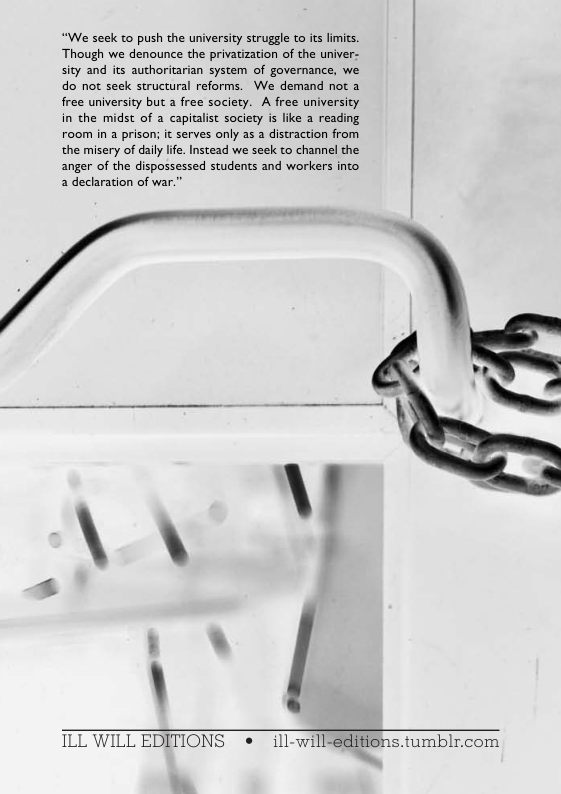
“We seck to push the university struggle to its limits. Though we denounce the privatization of the univer- sity and its authoritarian system of governance, we do not seek structural reforms. We demand not a free university but a free society. A free university in the midst of a capitalist society is like a reading room in a prison; it serves only as a distraction from the misery of daily ife. Instead we seek to channel the anger of the dispossessed students and workers into 2 decharation of war.” |  \  ILL WILL EDITIONS e ill-will-gdifions.

Communiqué

from an

Absen Future

nnnnnnnnnnnnnnnnnnnnnnnnnn
This communiqué was written during the occupation of University of
California at Santa Cruz in 2009.

Inside photo: barricade architecture at San Francisco State University,
December 2009. Taken from the collection “After the Fall - Commu-
niqués from Occupied California”, which we recommend checking
out.

Layout by Il Will Editions, Fall 2015. Typeset in Gotham Book, Gill
Sans MT, and Bembo.

ll-will-editions.cumblr.com
illwill@riseup.nec
-
-

Like the society to which'it has played the
faithful servant, the university is bankrupt.
1

LIKE THE SOCIETY TO WHICH IT HAS PLAYED THE
FAITHFUL SERVANT, THE UNIVERSITY IS BANKRUPT.
This bankeuptcy is not only financial. It is the index of a more funda-

mentl insolvency, one both political and economic, which has been

a long time in the making. No one knows what the university is for
anymore. We feel this intuitively. Gone is the old project of creating
a cultured and educated citizenry; gone, too, the special advantage the
degree-holder once held on the job market. These are now fanasies,
specteal residues that cling to the poorly mainained halls

Incongruous architecture, the ghosts of vanished ideals, the vista of a
dead future: these are the remains of the university. Among these re-

s, most of us are litdle more than a collection of querulous habits
and duties. We go through the motions of our tests and assigments
with a kind of thoughtless and immutable obedience propped up by sub-
vocalized resentments. Nothing is interesting, nothing can make itself
fele. The world-historical with its pageant of catastrophe is no more real
than the windows in which it appears.

For those whose adolescence was poisoned by the nationalist bysteria
following September 11th, public speech is nothing but a series of lies
and public spa
do). Afflicted by the vague desire for something to happen—without

2 place where things might explode (though they never

ever imagining we could make it happen ourselves—we were rescued
by the bland homogencity of the internet, finding refiuge among friends
we never see, whose entire existence s 2 series of exclmations and silly
pictures, whose only discourse s the gossip of commodities. Safety,
then, and comfort have been our watchwords. We slide through the
flesh warld without being touched or moved. We shepherd our emp-
tiness from place to place.

But we can be grateful for our destitution: demystification is now a
condition, not a project. University ife finally appears as just what it
has always been: a machine for producing compliant producers and con-
sumers. Even leisure is a form of job training. The idiot crew of the frat
houses drink themselves into 3 stupor with all the dedication of lawyers
working late at the office. Kids who smoked weed and cut clas in high-
schaol now pop Adderall and get to work. We power the diploma fic—
tory on the treadmills in the gym. We run tirelesily in elliptical circles

It makes lidle sense, ther
in Arcadia, as either idyllic or idle. “Work hard, play hard” has been
the over-

to think of the university as an ivory tower

ager motto of 3 generation in training for...what’ —drawing
hearts in cappuccino foum or plugging names and numbers into data-
bases. The gleaming techno-future of American capitalism was long ago.
packed up and sold to China for a few more years of borrowed junk.
A university diploma is now worth no more than a share in General
Motors.

We work and we borrow in order to work and to borrow. And the jobs
we work toward are the jobs we already have. Close to three quarters
of students work while in school, many full-tme; for most, the level
of employment we obtain while students is the same that awaits after
graduation. Meanwhile, what we acquire isn't education; it's debe. We
work to make money we have already spent, and our future labor has
already been sold on the worst market around. Average student loan
debt rose 20 percent in the first five years of the twenty-fint centu-
£y—80-100 percent for seudents of color. Student loan volume—a fig-
ure inversely proportional to state funding for education—rose by nearly
800 percent from 1977 ta 2003, What our borrowed tuition buys is the
privilege of making monthly payments for the rest of our lives. What
we learn is the choreography of eredit: you can’t walk to class without
being offered another piece of plastic charging 20 percent interest. Yes-
terday’s finance majors buy their summer homes with the bleak futures
of today’s humanities majors.

This is the prospect for which we have been preparing since grade-
school. Those of us who came here to have our privilege notarized
surrendered our youth ta a barsage of tutors, a battery of psychological
tests, obligatory public service opi—the cynical compilation of half-
truths toward 2 well-rounded application profile. No wonder we set
about destroying ourselves the second we escape the cattle prod of pa-
rental admonition. On the other hand, those of us who
transcend the economic and social disadvantages of our families know
that for every one of us who “makes it,” ten more take our place—that

me here to

the logic here is zero-sum. And anyway, socioeconomic status remains
the best predictor of student achievement. Those of us the demograph-
ics call “immigeants,” “minorities,” and “people of color” have been
told to believe in the aristocracy of merit. But we know we are hated
not despite our achievements, but precisely because of them. And we
Know that the circuits through which we migh free ourselves from the
violence of our origins only reproduce the misery of the past in the
present for others, elsewhere.

If the university teaches us primarily how to be in debt, how to waste
our labor power, how to il prey o petty anxieties, it thereby teaches
s how to be consumers. Education is a commodity like everything clsc
that we want without caring for. 1t is a thing, and it makes its purchasers

into things. One’s future position in the system, one’s relation to others,
is purchased frst with money and then with the demonstration of obe-
dience. First we pay, then we “work hard.” And there is the split: one
is both the commander and the commanded, consumer and consumed.
It is the system itself which one obeys, the cold buildings that enforce
subservience. Those who teach are treated with all the respect of an
automated messaging system. Only the logic of customer satisfaction
obtains here: was the course easy? Was the teacher hot? Could any
stupid asshole get an A? What's the point of acquiring knowledge when
it can be called up with a few keystokes? Who needs memory when
we have the internet? A training in thought? You can’t be serious. A
moral preparation? There are anti-depressants for tha.
Meanwhile the graduate students, supposedly the most politically en-
lightened among us, are also the most obedient. The “vocation” for
which they labor is nothing other than a fintasy of falling off the grid,
or out of the libor market. Every grad student is a would be Robinson
Crusoe, dreas
of the market. But this fantasy is itself sustained through an unremitting
submission to the market. There is no longer the least felt contradiction
in teaching a totalizing critique of capitalism by day and polishing one’s

g of an island economy subtracted from the exigencies

job talk by night. That our pleasure is our libor only makes our symp-
toms more manageable. Aesthetics and polities collspse courtesy of the
substitution of ideology for history: booze and beaux arts and another
seminar on the question of being, the steady blur of typeface, each pixel
paid for by somebody somewhere, some not-me, not-here, where all
that appears is good and all goods appear attainable by eredit.

Graduate school i simply the fided remnant of a feudsl system adapted
to the logic of capitalism—from the commanding heights of the star
professors to the serried ranks of teaching assistants and adjuncts paid
mosdy in bad fich. A kind of monasticism predominates here, with
al the Gothic ritusls of 3 Benedictine abbey, and all the strange thea-
logical claims for the nobility of this work, its essential aliruism. The
underlings are only too happy to play apprentice to the masters, unable
to do the math indicating that nine-tenths of us will teach 4 courses
every semester to pad the paychecks of the one-tenth who sustain the
fiction that we can all be the one. OF course I will be the star, 1 will
get the tenure-track job in a large city and move into a newly gentrified
ncighborhood.

We end up interpreting Marx's 11th thesis on Feuerbach: “The philos-
ophers have only interpreted the world in various ways: the point is to
change it” At best, we learn the phoenix-like skill of coming o the
very limits of critique and perishing there, only to begin again at the
ble root. We admire the first part of this perfor-
mance: it lights our way. But we want the tools to brexk through that

scemingly ineradi

point of suicidal thought, its hinge in practice.

The same people who practice “critique”

e also the most susceptible
to cynicism. But if cynicism s simply the inverted form of enthusiasm,
then beneath every frustrated leftist academic is a latent radical. The

shoulder shrug, the dulled face, the squirm of embarrassment when dis-
cussing the fact that the US murdered a million lragis between 2003 and
2006, that every last dime squeezed from America’s poorest citizens is
fed to the banking industry, that the seas wil rise, billions will die and
there’s nothing we can do about it—this discomfited posture comes
from fecling oneself pulled between the i and the ought of current left
thought. One feels that dhere is no alternative, and yet, on the other
hand, that another world is possible.

We will not be so petulant. The synthesis of these positions i right in
front of us: another world s not possible: it is necessary. The ought and
the is are one. The collapse of the global economy is here and now.
The university has no history of its own;
its history is the history of capital.
u

THE UNIVERSITY HAS NO HISTORY OF ITS OWN; ITS
HISTORY IS THE HISTORY OF CAPITAL. ls cssential func-
ad labor.
Though not a proper corporation that can be bought and sold, that pays

tion is the reproduction of the relationship between capital

revenue to s investors, the public university nonetheless carries out this

function as efficiently as possible by approximating ever more closely the
carporate form of its bedfellows. What we are witnessing now is the
endgame of this process, whereby the fiade of the educational institu-

tion gives way altogether to corporate streamlining.

Even in the golden age of capitalism that followed after World War 11
and lasted until the late 19605, the liberal university was already subor-
dinated to capital. At the apex of public funding for higher education,
in dhe 19505, the university was already being redesigned to produce
technocrats with the skillsets necessary to defeat “communism” and
sustain US hegemony. Iis role during the Cold War was to legitimate
liberal democs

acy and to seproduce an imaginary society of free and
equal citizens—precisely because no one was free and no one was equal.

But if this ideological function of the public university was at least
well-funded after the Second World War, that situation changed irre-
versibly in the 19605, and no amount of social-democratic heel-clicking
will bring back the dead world of the post-war boom. ~ Between 1965

1
and 1980 profit rates began to fll, first in che US, chen in the rest of
the industrializing world. Capitalism, it turned out, could not sustain
the good lfe it made possible. For capital, abundance appears 15 over-
production, freedom from work s unemployment. Beginning in the
19705, capitalism entered into terminal downturn in which permanent
work was casualized and working-class wages stagnated, while those at
the top were temporarily rewarded for their obscure financial necro-
mancy, which has itself proved unsustainable.

For public education, the long downturn meant the decline of tax rev-
enues due to both declining rates of economic growth and the priori-
tization of tax-breaks for beleaguered corporations. The raiding of the
public pusse struck California and the rest of the nation in the 1970s. 1t
has continued to strike with each downward declension of the business
eyele. Though it is not directly beholden to the market, the universi
and its corollaries are subject to the same cost-cutting logic as other in-
dustries: declining tax revenues have made inevitable the casualization
of work. Retiring professors make way not for tenure-track jobs but for
precariously employed teaching assistants, adjunces, and lecturers who
do the same work for much less pay. Tuition increases compensate for
cuts while the jobs students pay to be trained for evaporate.

In the midsc of the current erisis, which will be long and protracted,
many on the left want to return to the golden age of public education.
‘They naively imagine that the crisis of the present is an opportunity to
demand the return of the past. But social programs that depended upon
high profit rates and vigorous economic growth are gone. We cannot
be tempted to make futile grabs at the irretrievable while ignoring the
obvious fact that there can be no autonomous “public university” in 2
capitalist society. The university is subject to the real criis of capital-
1, and capital does not require liberal education programs. The func-
tion of the university has always been to reproduce the working class

by training future workers according to the changing needs of capital
‘The crisis of the university today s the crisis of the reproduction of the
working class, the crisis of 2 period in which capital no longer needs us
a5 warkers. We cannot free the university from the exigencies of the
market by calling for the return of the public education system. We live
out the terminus of the very market logic upon which that system was
founded. The only autonomy we can hope to atain exists beyond capitalism.

12
What this means for our struggle is that we can't go backward. The
old student struggles are the relics of a vanished world. In the 19605,
as the post-war boom was just begi

g to unravel, radicals within the
canfines of the university understood that another world was possible.
Fed up with technocratic management, wanting to break the chains of
a conformist society, and rejecting alienated work as unnecessary in an
age of abundance, students tried to align themselves with radical sections
of the working class. But their mode of radicalization, too tenuously
connected to the economic logic of capitalism, prevented that alignment
from taking hold. Because their resis
eritique upon capitals

to the Vietnam war focalized

2 35 a colonial war-machine, but insufficiently
upon s exploitation of domestic labor, students were easily split off
from a working class facing different problems. In the twilight era of the
posto

var boom, the university was not subsumed by capital to the de-
gree that it is now, and students were not as intensively proletarianized
by debt and a devastated labor market,

That is why our struggle is fundamentally different. The poverty of stu-
dent lfe has become terminal: there is no promised exit. If the economic
erisis of the 19705 emerged to break the back of the politic
the 19605, the fict that today the economic crisis precedes the coming

erisis of

political uprising means we may finally supersede the cooptation and
neutralization of those past struggles. There will be no return to normal.

13
t

WE SEEK TO PUSH THE UNIVERSITY STRUGGLE TO ITS
LIMITS.

Though we denounce the privatization of the university and its author-
itarian system of governance, we do not seek structural reforms. We
demand not a free university but a free society. A free university in the
midst of a capitalist society is like a reading room in a prison; it serves
only as a distraction from the misery of daily life. Instead we seck to
channel the anger of the dispossessed students and workers into a dec-
laration of war.

We must begin by preventing the university from functioning. We
st interrupt the normal flow of bodies and things and bring work and
class to 2 hale. We will blockade, oceupy, and ke what's ours. Rather
than viewing such disruptions as obstacles to dizlogue and mutual un-
derstanding, we see them a5 what we have (o say, as how we are to be
understood. This is the only meaningful position to take when crises lay

bare the opposing interests at the foundation of saciety. Calls for unity
are fundsmentally empty. There is no common ground between those

who uphold the status quo and those who seek to destroy it

The university struggle i one among many, one sector where 3 new
eyele of refusal and insurrection has begun — in workplaces, neighbor-
hoods, and dums. All of our futures are linked, and so our movement
will have to join with these others, breeching the walls of the university

15
compounds and spilling into the streets. In recent weeks Bay Area pub-
lic school teachers, BART employees, and unemployed have threatened
demonstrations and strikes. Each of these movements responds to a dif-
ferent facet of capitalism’s reinvigorated attack on the working class in 2
moment of criss. Viewed separately, each appears small, near-sighted,
without hope of success. Taken together, however, they suggest the
possibility of widespread refusal and resistance. Our task is to make
plain the common conditions that, like a hidden water tible, feed each
seruggle.

We have scen this kind of upsurge in the recent past, a rebellion that
starts in the classrooms and radiates outward to encompass the whole of
society. Just two years ago the anti-CPE movement in France, combat-
ing 2 new law that enabled employers to fire young workers without
cause, brought huge numbers into the streets. High school and uni-
versity students, teachers, parents, rank and file union members, and
unemployed youth from the banlicues found themselves together on the
same side of the barricades. (This solidarity was often fragile, however.
‘The riots of immigrant youth in the suburbs and university students in
the city centers never merged, and at times tensions flared between the
two groups.) French students saw through the illusion of the university
a5 place of refiage and enlightenment and acknowledged that they were
merely being trained to work. They took to the streets as warkers, pro-
testing their precarious futures. Their position tore down the partitions
between the schools and the workplaces and immediately elicited the
support of many wage workers and unemployed people in a mass gesture
of proletarian refusal.

As the movement developed it manifested a growing tension between
revolution and reform. Its form was more radi
While the thetoric of the student leaders focused merely on 1 return to
the status quo, the actions of the youth — the riots, the cars overturned
and set on fire, the blockades of roads and railways, and the waves of

occupations that shut down high schools and universities - announced

I than its content.

the extent of the new generation’s disillusionment and rage. Despite all
of this, however, the movement quickly disintegrated when the CPE.
law was eventually dropped. While the most radical segment of the
movement sought to expand the rebellion into a general revolt against
capitalism, they could not secuse significant support and the demonstra-

16
tions, occupations, and blockades dwindled and soon died. Uldmately
the movement was unable to transcend the limitations of reformism.

The Greek uprising of December 2008 broke through many of these
limitations and marked the beginning of a new cycle of clas struggle.
Initiated by students in response to the murder of an Athens youth by

police, the uprising consisted of weeks of rioting, looting, and occupa-

tions of universities, union offices, and television stations. Entire finas
cial and shopping districts burned, and what the movement lacked in
numbers it made up in its geographical breadth, spreading from city to
city to encompass the whole of Greece. As in France it was an uprising

of youth, for whom the economic erisis represented 1 total negation of

the future. Students, precarious workers, and immigeants were the pro-
tagonists, and they were able to achieve 1 level of unity that far surpassed
the fragile solidarities of the anti-CPE movement.

Just as significantly, they made almost no demands. While of course
some demonstrators sought to reform the police system or to eritique
specific government policies, in general they asked for nothing at all
from the government, the university, the workplaces, or the police.
Not because they considered this a better strategy, but because they
wanted nothing that any of these institutions could offer. Here content
aligned with form; whereas the optimistic slogans that appeared every-
where in French demonstrations jarred with the images of burning cars
and broken glass, in Greece the rioting was the obvious means to begin
to enact the destruction of an entire political and economic system.

Ultimately the dynamics that created the uprising also established its
limit. It was made possible by the existence of a sizeable radical in-
frastructure in urban areas, in pasticular the Exarchia neighborhood in
Athens. The squats, bars, cafes, and social centers, frequented by stu-
dents and immigrant youth, created the milieu out of which the uprising
emerged. However, this milieu was alien to most middle-aged wage
workers, who did not sce the struggle as their own. Though many
expressed solidarity with the rioting youth, they perceived it as a move-
ment of entrants — that i, of that portion of the proletariat that sought
entrance to the libor market but was not formally employed in full-time
jobs. The uprising, strong in the schools and the immigrant subusbs, did
ot spread to the workplaces

17
Our task in the current struggle will be to make clear the conteadiction
between form and content and to create the conditions for the transcen-
dence of reformist demands and the implementation of 1 truly commu-
nist content. As the unions and student and fculty groups push their
various “isues,” we must increase the tension unal it is clear that we.
want something elie entirely. We must constanty expose the incoher-
ence of demands for democratization and transparency. What good is it
t0 have the right (0 see how intolerable things are, or to elect those who.
will screw us over? We must leave behind the culture of student activ-

s, with its moralistic mantras of non-violence and its fixation on sin-

gle-issue causes. The only success with which we can be content is the
abolition of the capitalist mode of production and the certain immisera-
tion and death which it promsises for the 21st century. All of our actions
st push us towards communization; that is, the reorganization of soci-
ety according to 3 logic of free giving and receiving, and the immediate
abolition of the wage, the value-form, compulsory labor, and exchange.
Oceupation will be a eritical tactic in our struggle, but we must resist
the tendency to use it in a reformise way. The different strategic uses
of aceupation became clear this past January when students occupied a
building at the New School in New York. A group of friends, mostly
graduate students, decided to take over the Student Center and claim it
a5 a liberated space for students and the public. Soon others joined in,
but many of them preferred to use the action as leverage to win reforms,
in particular to oust the school's president. These differences came to
a head as the oceupation unfolded. While the student reformers were
focused on leaving the building with a tangible concession from the ad-
ministration, others shunned demands entirely. They saw the point of
occupation as the creation of a momentary opening in capitalist time and
space, a rearrangement that sketched the contours of a new society. We.
side with this anti-reformist position. While we know these free zones
will be partial and transitory, the tensions they expose between the real
and the possible can push the struggle in a more ra

1 direction.

We intend to employ this tactic until it becomes generalized. In 2001
the first Argentine piqueteros suggested the form the people’s struggle
there should take: road blockades which brought to a halt the circulation
of goods from place to place. Within months this tactic spread across the
country without any formal coordination between groups. In the same

way repetition can establish occupation as an instinctive and immediate

18
method of revolt taken up both inside and outside the university. We
have seen 2 new wave of tkeovers in the U.S. over the last year, both
at universities and workplaces: New School and NYU, as well as the
workers at Republic Windows Factory in Chicago, who fought the clo-
sure of their factory by taking it over. Now it is our turn.

To accomplish our gosls we cannot rely on those groups which position
themselves as our representatives. We are willing to work with unions
and student assaciations when we find it useful, but we do not recognize
their authority. We must ac on our own behalf direcdy, without me-
diation. We must break with any groups that seck to limit the struggle
by telling us to go back to work or class, to negotiate, to reconcile. This
was also the case in France. The original calls for protest were made by
the national bigh school and university student sssociations and by some
of the trade unions. Evencually, as the representative groups urged cali,
others forged shead. And in Greece the unions revealed their count-
er-revolutionary character by cancelling strikes and calling for restrain.

As an alternative to being herded by representatives, we call on students
and workers to organize themselves across trade lines. We urge under-
graduates, teaching assistants, lecturers, faculty, service workers, and staff
to begin meeting together to discuss their situation. The more we be-
gin talking to one another and finding our common interests, the more
difficult it becomes for the administration to pit us against each other
in 2 hopeless competition for dwindling resources. The recent struggles
at NYU and the New School suffered from the absence of these decp
bonds, and if there is a lesson o be learned from them it is that we
st build dense networks of solidarity based upon the recognition of

a shared en These networks not only make us resis

but also allow us to establish new kinds of

peration and neutralizat
collective bonds. These bonds are the real basis of our struggle.

We'll see you at the barricades.
Research and Destroy

2009

19
“We seck to push the university struggle to its limits.
Though we denounce the privatization of the univer-
sity and its authoritarian system of governance, we
do not seek structural reforms. We demand not a
free university but a free society. A free university
in the midst of a capitalist society is like a reading
room in a prison; it serves only as a distraction from
the misery of daily ife. Instead we seek to channel the
anger of the dispossessed students and workers into
2 decharation of war.” |

\

ILL WILL EDITIONS e ill-will-gdifions.