Communiques from Chicagoiguala
Web PDF • Imposed PDF• Raw TXT (OCR)
![Chicagoiguala is where we live and struggle against the forces of assimilation and mental colonization. From here we can see how it is constructed, an integrated global supply-chain linking captive labor, extraction, assembly plants, finished commodities, planning processes and financial flows. It is how logistics firms and consultants “restructure” the state, channeling public moneys and migrant remittances into infrastructure projects that open up new territories for transnational extraction. It is how Mexican economic and political elites are organized in the US under the name of Latino politics, whose function is to de- indigenize and manage the mass migration Chicagoiguala is a counterinsurgency corridor. It is how our struggles for liberation are disarticulated by “immigration reform” politics and the electoral spectacle. “Black & Brown People Rise Up! Against police violence, la Migra and Latino political establishment.” (December, 2015f In Chicago, 26th Street is second only to Michigan Avenue in terms of financial power. But the economic significance of 26th Street isn’t measured in Louis Vuitton bags. This is an important street for US-Mexico Narcocapitalist relations. [..] We ask our Brown communities in #LaVilita #Pilsen #LittleGuerrero #Cicero #BackoftheYards #BrigthonPark #HumboldtPark and beyond to organize in the streets and stand shoulder to shoulder with our Black Compafierss. Our struggles for liberation are connected across the "Americas.” The silence must end in our Brown communities. We must clarify that the {Blck & Brown People Rise Up! Agsinst polic iolnce, s Migrs and Lt plicsl cstalishimen™ Call o prvesaction e, December 2015 Onlie: hip: e semillsautonornas orgblck-and b peope ise !](communiques-from-chicagoiguala-semillas-autonomas 12.png)

;i Ménarfi}asf
Nlumno desaparecido de
Avotzinapa. Gro.
Comunicados desde Chicagol
Communiqués from Chicagoig
B &
rohE
*
Semillas Auténomas
>
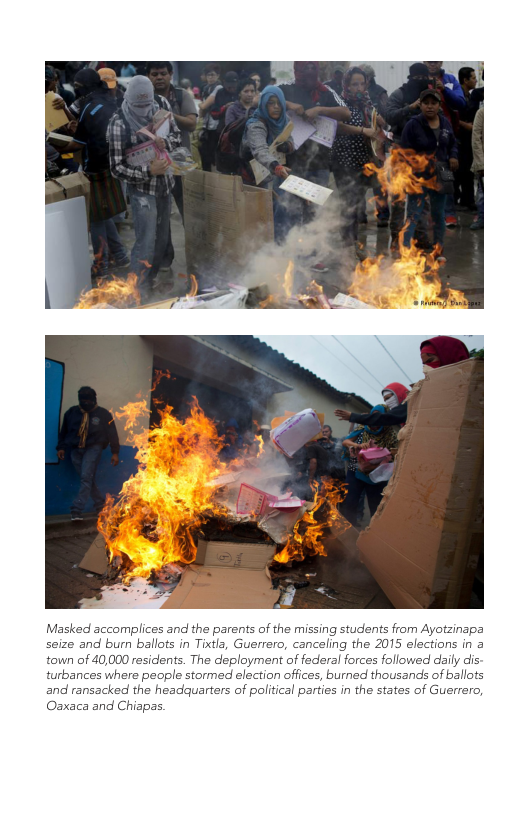
Masked accomplices and the parents of the missing students from Ayotzinapa
seize and burn ballots in Tixtls, Guerrero, canceling the 2015 elections in a
town of 40,000 residents. The deployment of federal forces followed daily dis:
turbances where people stormed election offices, burnad thousands of ballots
and ransacked the headquarters of political parties in the states of Guerrero,
Osxaca and Chiapas
Introduction
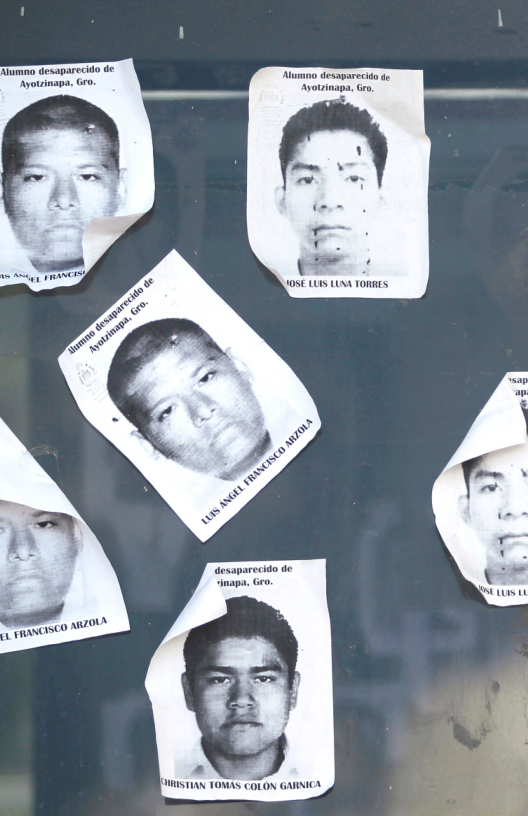
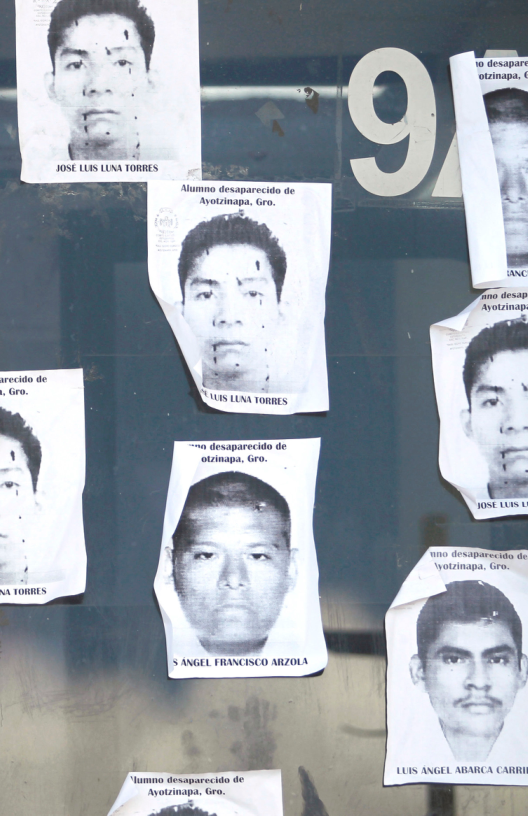
The movement sparked by the forced disappearance of 43
students from Ayotzinapa is part of an ongoing struggle of
indigenous people, campesinxs and students against state
sanctioned violence and capitalist expansion. The Popular
Assemblies in Mexico have been setting a course for actions to
blockade and disrupt the workings of transnational capital, to
create forms of self-organization and self-governance from
below.
Autonomous groups of migrants in Chicago have tried to
develop pathways for spreading the rebellion on the outside.
They responded with protests, assemblies, teach-ins, public
fora, and gatherings. Over the course of several years, they
targeted both the so-called War on Drugs and the making of
“Latino" politics in the United States as different fronts of a
counterinsurgency war. They also organized a series of
occupations and blockades of the Mexican Consulate. These
direct actions faced repression from a layered security apparatus
of transnational private security firms, US State Department
agents, and Chicago Police. They forced into visibilty the
collusion between political/economic elites on both sides of the
border in the repression of the rebellions and the active
suppression of their spreading in the diaspora. The actions also
provoked emotional and intimate exchanges, as some people
distanced themselves from what they saw as “violent" tactics,
while others joined as participants or witnesses. The occupations
of the Consulate opened up a collective exploration of struggle
politics, the nature of political viclence, and the ethics of
confict.
There are ongoing pressures on autonomous groups to
make their existence legible to the academic/nonprofit/liberal
sphere, to deliver themselves to mainstream, social or
independent media - without acknowledging the asymmetry of
these power relations, or the ways these asymmetries require
violence for their reproduction. This drive towards legibility we
experience as a form of dispossession, a way of mining a social
capacity for possibilities of profit extraction. Instead of a
narrative or a presentation about who is doing what, with whom
and how/where/why, this contribution compiles a series of
excerpts from written and audio communiqués, event flyers or
calls to action released by Semillas Auténomas between 2014
and 2017." The form of this contribution follows from existing
commitments and ways of working
“Who Disappeared the 43 students from
Ayotzinapa?” (December 2014)
The Mexican Embassy in the United States has instructed
consulates to “minimize the impact” of the protests taking place
in solidarity with Ayotzinapa. The story they are selling us is this:
the federal government is fighting crime and making great
progress towards justice. Uprisings destabilize the promise of
justice and prosperity; stay calm and return to “normal.”
The text that fllows sre extracts from comuniqués relessed Semilss Autgnomas
in cfferent formats between 2014 and 2017. Same were fyers announcing or
caling for speciic actions, cthers were fyers we distibuted atactons, and cthers
were oniine onl. Most were both n some form, excapt for some anorymous.
Ayersbanners etc. The audio comuniqués were anine and republishec by many
independent medi autlets across the border. One statement ws writen to be
e at the Asambles Populr to be held inside, once the consulate s breached,
which was on was only circulated by video recording. More information s
avaisble at:semilasautanomss.org
2 "Who Dissppeared the 43 studsnts from Ayotzinsps?” protest/actin fiyer,
eleased December 2014.
At the same time, President Obama has announced
“administrative relief” for immigrants, the latest show in a long
series of reform spectacles. We are promised probation for
categories of desirable immigrants in exchange for expanding
the conditions that cast us as disposable lives. The message is
this: you should be grateful and cooperate. Uprisings destabilize
the promise of status and prosperity; stay calm and retum to
normal.
The United States and Mexico are enforcing a social peace
that is a social death. They call it the War on Drugs. This is not
about fighting organized crime and the narco cartels, whose
operations are intimately linked with both governments and
transnational finance. Instead, the War on Drugs is a way to
goven through deathmaking, disappearance, and terror, to
govern not in the interests of living beings but in the interests of
capital. This war is not just against the students from Ayotzinapa,
but against the consciousness and lifeways they represent
The true “organized crime” is created and maintained by
the state and by corporate interests who seek to expand their
control over the people, lands, and resources of the Americas.
In the kilings and disappearances, the state is the author and
executor at the service of capital
The state disappears those who arm themselves in self-
defense against the narcos, mining companies, and government
occupation. The state disappears the Yaquis who fight in
defense of ancestral waters and the right to exist. The state
disappears those defending the lands from resource extraction,
those who refuse to acquiesce to their own destruction. The
state disappears the women it has displaced to the maquilas.
The state disappears all who stand in the way of the neoliberal
restructuring of life, those who create autonomy and threaten
the interests of multinational corporations. The state disappears
red, black, and brown peoples into prisons and detention
centers, into borders, into graveyards, into the living death of
senvitude and assimilation
This War on Drugs has displaced us and millions of others,
but crossing the border did not make us free. The organized
crime cartels of political parties, banks, big business, and Poli-
Migra continue this war here in the US. The deaths continue at
the borderlands. The disappearances continue into detention
centers and deportations, with over two million men, women
and children migrants kidnapped by Homeland Security forces
in the United States under the Obama administration. The rest
of us are bribed with offers of “relief* that only increase the
oppression, sunveillance, and enforcement against us. We are
shackled into a classification system of permits and papers, of
degrees of unfreedom, to keep us afraid and to keep us silent,
to keep the rebellion from crossing the border into the United
States.
From “Comunicado Sobre la Toma del Consulado
General de Mexico en Chicago* (October 2014)*
If we do nothing, if we say nothing, if we remain passive
and well-behaved as is the expectation, they will continue to kill
and disappear us. We are poor. We are the people that the
middle class, the class that has money, regards as a nuisance, as
garbage, as vandals, as useless and without worth, people
without education, ignorant people. We are the social class that
has been impoverished, where there is no land, where there is
* “Camunicado Sobe 1a Tor del Consulado Geners d Mexico en Chicago” sudio
communiqué relessed o ndependent e, Octber 2014, Onling: hips soundelod con
morsoriumondeportatons communique?
no education, where there is not water even, because they are
stealing it all, where we are dispossessed and disappeared and
murdered for thinking, existing, surviving.
To the US and Mexican narco-capitalists, to those who
govern from above, we are the waste of society, we are better
off dead or brought to nonlife as servants to their papers,
permits and ID's. They want to convince us that this form of
government and rule s the only way to organize our
communities, our lives,
We will no longer stand in line. We refuse to be converted
to numbers, to become obedient, lifeless things. We occupy
today to affirm our humanity, our survival, our rage and
defiance, to face and confront this space that should belong to
“What is the War on Drugs?" (January 2015)*
The Mexican government claims to be fighting a war
against narco traffickers. But the government has always been in
the drug business, and cartels now control government officials
and institutions across the country. The narco-state is indeed
waging a war - but itis a war in the interest of the big players of
global capitalism. It is part of continuing and enforcing trade
agreements such as NAFTA, which force open all of Mexico to
the unhindered extraction of profit. The function of the war is to
impose a political and economic restructuring of Mexico in the
interests of transnational capital. This war is good for big
business.
* What i he War on Drugs?” ransason from protest Ay *Qué by dewis de gerra
contr s drogas?” anuary 2015, onlin: i semillasutononnas o/
5 war_on_drugs. spanish verieal oy
This is what social movements call narco-capitalism: a form
of globalization in which national governments are key players in
the global drug trade, and the drug trade plays a key role in
expanding the control of transnational corporations over land,
resources, and people. Meanwhile, these same governments
adopt an official policy of “War on Drugs* as a pretext for
increased militarization and for subjugating their people.
The US-sponsored War on Drugs in Mexico since 2006
100,000+ people murdered and 30,000+ disappeared; mass
graves in Guerrero, Tamaulipas, Chihuahua, and other states; a
fise in attacks against transmigrants; increase in torture and
executions; expansion of the drug trade and of extraction
industries; mass economic displacement, land and water
dispossession of indigenous peoples and campesinxs; neoliberal
“reforming” of education, labor, judiciary, energy and finance.
The United States has been funding this war through the
Merida Initiative and other “anti-narcotics” programs. About $3
billion has gone to transnational logistics and consulting firms
that “restructure” Mexican society to make it friendly to foreign
investment, or to buying weapons from US manufacturers and
paying private miltary companies. The same thing happens with
the $11.3 billion that Mexico has spent. This is public money,
money stolen from people on both sides of the border - and it
is going directly to Boeing, Raytheon, Blackwater, Haliburton,
and others. The US private sector and government also facilitate
the transfer of military-grade weaponry into the hands of the
drug cartels - over 90% of the weapons used in narco killings
originate in the United States. The US sponsors the slaughter,
thus justifying an increase of military intervention. As in the case
of Colombia, an increase in US-backed (paramilitarization
correlates with high levels of displacement and dispossession of
people, especially indigenous people, living in areas of strategic
economic importance, and these displacements serve the
interests of mining companies and other transnationals. As the
war on drugs expands, transnational corporate control over
entire regions expands, and exploitation of the people and the
resources deepens.
The United States has a history of training military and
paramilitary forces in the use of terror. The governments tell us
that terror is the product of cartel violence and that state
military+police forces are the only possible solution. But
government forces also strategically use disappearance,
execution, torture, and mutilation against specific populations.
They target students, workers, campesinxs, indigenous peoples,
activists, all those who resist or who could resit,
ncluding
communities organizing armed self-defense. The goal of terror
is political: it is not only about killing people, but also about
silencing, intimidation, eliminating political resistance, and
destroying lifeways. The United States has perfected the use of
terror over decades of experimentation in Central America and
the Middle East: it called counter-insurgency.
“#Chicagoiguala” (September 2015)°
How is Chicago connected to Iguala and the attack on the
Ayotzinapa students that took place there? One of the buses the
young students tried to commandeer had a stash of narcotics
destined for Chicago's La Villita, a major hub in the cross border
drug trade. The students, so the official story goes, accidentally
interfered with the shipment and were thus punished by the
narcos. But Chicagoiguala is not just a drug corridor.
* “HChicagoigul,” ierventions o scia media pltoms, compiled Sepiaber 2015
Chicagoiguala is where we live and struggle against the forces
of assimilation and mental colonization. From here we can see
how it is constructed, an integrated global supply-chain linking
captive labor, extraction, assembly plants, finished commodities,
planning processes and financial flows. It is how logistics firms
and consultants “restructure” the state, channeling public
moneys and migrant remittances into infrastructure projects that
open up new territories for transnational extraction. It is how
Mexican economic and political elites are organized in the US
under the name of Latino politics, whose function is to de-
indigenize and manage the mass migration
Chicagoiguala is a counterinsurgency corridor. It is how our
struggles for liberation are disarticulated by “immigration
reform” politics and the electoral spectacle.
“Black & Brown People Rise Up! Against police violence,
la Migra and Latino political establishment.”
(December, 2015f
In Chicago, 26th Street is second only to Michigan Avenue
in terms of financial power. But the economic significance of
26th Street isn't measured in Louis Vuitton bags. This is an
important street for US-Mexico Narcocapitalist relations. [..] We
ask our Brown communities in #LaVilita #Pilsen #LittleGuerrero
#Cicero #BackoftheYards #BrigthonPark #HumboldtPark and
beyond to organize in the streets and stand shoulder to
shoulder with our Black Compafierss. Our struggles for
liberation are connected across the "Americas.” The silence
must end in our Brown communities. We must clarify that the
{Blck & Brown People Rise Up! Agsinst polic iolnce, s Migrs and Lt plicsl
cstalishimen™ Call o prvesaction e, December 2015 Onlie: hip:
e semillsautonornas orgblck-and b peope ise !
“Hispanic / Latino” political leadership of Chicago does not
represent s — they police us, they sell us out, they try to
control and extinguish our struggles for liberation
We are not Anita “Serial Killer Accomplice” Alvarez. We are
not killer cop George Hernandez. We are not Chuy *1,000 More
Cops” Garcia. We are not Danny “Gentrification Champion”
Solis. We are not Luis “Border Militarization” Gutierrez. We are
not Carlos “We Call The Cops” Ramirez-Rosa.
“{Nestora Libret* (July 2015)"
Nestora Salgado is a Comandanta in the indigenous
community self-defense force of Olinald, Guerrero, and a leader
in the CRAC-PC (Regional Coordinating Committee of
Community Authorities). Nestora Salgado was extrajudicially
captured by Mexican federal forces in August 2013. Last year a
federal judge in Mexico ordered Nestora's release; nevertheless,
state authorities refused without judicial cause. We have been
informed that they are attempting to manufacture more charges
which can result in a 1,000 year prison sentence! After a 24 day
hunger strike, Nestora Salgado was transferred to Tepepan,
Mexico City. Support is urgently needed for her defense and
liberation
Nestora Salgado migrated to the US from Guerrero,
Mexico. Even though she became a naturalized US citizen, she
defied the pressures to assimilate into the “American Dream”
and instead retumed to Guerrero to join her people’s armed
struggle for liberation. As a Comandanta, Nestora confronted
the narcotraffickers, transnational mining companies as well the
state violence unleashed in Mexico under the guise of the US-
“Nestoa Libee” fyer fr Free Nestora Campaign, leasd Jly 2015, updaed August
201s.
backed “War on Drugs.” Through her work against patriarchy
and genderbased violence, womyn have become central
participants in the political process of self-determination and
self.defense in Olinald
Nestora's resistance is part of a larger continuum of African
and Indigenous people’s struggles for self determination.
Specifically, the CRAC emerged along the coast of Guerrero
(Costa Chica) as a struggle for self-defense linking Afro-Mexican
and Indigenous communities. The CRAC is a legally constituted
entity, but its purpose and demands exceed and subvert the
framework of the law. Guerrero’s constitution allows for the
formation of indigenous ‘community police’ under State Law
701 which recognizes original people’s right to self-
determination. However, CRAC is not an attempt by indigenous
people to police themselves or to collaborate with established
police forces, but rather represents an effort to build counter-
power, foment ungovernability, and build networks of defense
against the encroachment of organized crime, the state, and
transnational corporations. This collective project has found
itself in a relative deadlock with neoliberal plans of extraction
and development. As a result Mexico, the U.S. and Canada have
worked together to strengthen, arm and paramilitarize
organized crime networks with the intent of displacing
indigenous people from their traditional lands and securing their
economic interests in the region
The imprisonment of Nestora Salgado, as well as many
other fighters such as Gonzalo Molina and Arturo Campos, is a
direct result of this same politics of economic and miltary
intervention, which seeks to disarticulate the process of
indigenous autonomy and self-determination.
0
“On the violent eviction of beloved okupa Chanti Ollin i
Mexico City" (November 2016)*
Chanti Ollin grows autonomy as a system of integrity and
interaction, a system of roots, and of attachments to our roots.
Chanti Ollin is a menace to mechanisms of social control and to
the forces of death-aslife. The danger is regaining our
mindfulness, finding ourselves beyond the arm of freedom that
schools in the depths of the screen, the arm that self tied our
binds, the knots that stilled our movements and gave ourselves
up 50 willingly. The caution s that we who are hungry can feed
ourselves, we who are desplazadxs can shelter each other. The
harm towards the state s constructing bodies that heal and find
each other moving towards wholeness. Legs that march, bodies
that fill, and backs that do not break, this architecture is
invincible.
“Migrant Resistance in the Time of
Apocalypse" (February 2017)"
Liberal panic at the election of Donald Trump is fueling new
opportunities for social movement managers. We are now told
that we can resist the reign of Trump by rallying — in an orderly
fashion — behind the familiar immigrant rights nonprofiteers.
But the liberalism of the ‘immigrant rights left’ does not offer a
way out; it can not even explain what the fuck is going on. And
that s because these same nonprofiteers have historically sold
out migrant and indigenous communities to produce eligibles’
convenient to empire, a small caste of worthy ‘potentia citizens.
They have attached themselves to the Democratic Party to
£+ e violnt eicion af beloved okupa Chanti Ol in Mexico iy pevate
comespondence, Novermber 2016,
? “Nigran Ressancein he Tme of Apocalypse” yricommuniqué, February 2017
champion a politics of increased deportation, criminalization and
the expropriation of indigenous lands in exchange for merit-
based legalization. More recently they have fearmongered our
communities into applying for Deferred Action for Childhood
Arivals (DACA), arguing that identification from/with the State
was the same as protection from violence. The have stolen our
bodies, energies and struggles and tumed them into social and
political capitel for themselves. And they have gambled this
capital on a neoliberal consensus that, despite the hype and
bullshit, was never meant to dispel the specter of white settler
nationalism. The immigrant rights left have been operating as
the foot-soldiers of a counter-insurgency that needed them as
intermediaries
For us, Trump's rise to power flows directly from this
context
Now we have people like David Spencer, the infamous
punched-in-face Nazi, spewing forth what would previously have
been hidden from the cameras: “America was, until this past
generation, a white country, designed for ourselves and our
posterity. Itis our creation, it is our inheritance, and it belongs to
Us." This ‘primal scream’ pushes back on codes of multicultural
nealiberal civility to confront a crisis of white-settler coherence
brought about by the disorientations of globalized economies.
Trump and his many Spencers are part of a process of validating
and managing the resentments of white-settlers ~ and this
requires the unabashed celebration of the making and
maintaining of settler-colonialism. At the heart of Trump's
promise to build a wall on the ‘US-Mexico border' is not the
deterrence of immigrant bodies or the making of punishable,
exploitable people - which liberals rightly argue is better
accomplished through less spectacular and more subtle
2
sunveillance and apprehension mechanisms - but the material
consecration of the symbolic power of the white State in
response to its perceived erosion
Trump's tirades about ‘criminals’ and ‘bad hombres’
coupled with near ecstatic invocations of ‘law and order’, are
meant to unleash a politics of violence that rejoices in
dismenmbering and capture. But this rejection of neoliberal
management and civiity is not a move away from globalization.
Instead, it is its crowning achievement, This approach represents
a change in a strategy towards perception management rather
than a departure from the quest for a productive, globally
integrated capitalism. It does not retreat but rather evolves the
current constellation of power, and it is causally intertwined with
the fruits of neoliberal policies.
Resistance to the future-colony requires a move away from
liberal and reform-centered politics that wil only betray us in the
end. The connection between white-settler nationalism and anti-
colonialism is that neither are interested in obscuring the violent
nature of settler-coloniality.
“Ni vencidxs, ni vendidxs.” (March 2017)°®
We should clarify that as migrants we are not helpless. Nor
are we harmless. Despite our thick criminal dockets and
deportable statuses, we do not seek to be well-behaved citizens
who are productive for capitalism
Instead, we conspire alongside some of the most
dangerous elements of the encampment at Standing Rock. But
this is ot the only terrain from which to kill a black snake. Or a
hydra. In a colony known as Mexico, Indigenous Zapatistas have
N vencidss, i vendides,” pivatscomespondence March 2017
B
managed to create & hold spaces where ancestral autonomy has
flourished in the face of a self cannibalizing social form. We work
10 support the CRAC-PC and the armed indigenous self-defense
struggles in Olinalé, Guerrero. We find instruction and an
affiming affinity with the anti colonial struggles unfolding in
O'odham lands along the so-called US-Mexico border. It is these
struggles that create the conditions from which we can envision
a future that is not the United States of America. Here, we
witness the artificial and arbitrary nature of colonial laws,
treaties, boundaries, and borders that transmogrify as quickly as
corporate interests dictate and as terribly as state armies
enforce. As migrants, as settlers, as newcomers, we are guided
to develop collective sabotage and refusal anchored in an
absolute negation of colonial rule. We see that we must learn/
remember ways of feeding ourselves and our rebellions, of
holding prayer, materially and spiritually. For many in Standing
Rock, attacking the nodes of colonial infrastructure was part of
this prayer, dissolving myths of indigenus people as non-
violent, eternal victims of a perennial process of life- and land-
taking.
Colonialism s layered, textured by trauma, and made all
the more constant by the sauganash or sellouts as our Lakota
friends from the Chi-Nations Youth Council have taught us.
u
N Tomnes
desaparecido de
otrinapa, Gro.
ino desapareetde de
S ANGEL FRANCISCO ARZOLA