Coming of Age: A New Afrikan Revolutionary
Web PDF • Imposed PDF• Raw TXT (OCR)

![RECOMMENDED READING Settlers, Mythology of the White Proletariat, by]. Sakai. Few Mandst-Leninist-Maoist books written in the 1980s have had such an effect beyond the ranks of the communist left, with the analysis being taken up by anarchists, feminists, nationalists, and anti-racists... but then again, few books of whatever political persuasion do what Settlers did - tuming a spotlight onto the sordid history of the white nation in North America, “throwing the light of historical materialism on Babylon itself.” An excruciating examination of 500 years of genocide, slavery and exploitation, this is the classic exposé of the parasitism and ‘pretension that is Amerika. available for $16.00 US from Kersplebedab or Spear & Shield MONEY & POWER: ook 98 caook Money & Power: Hook or Crook, by Zolo Agona Azania. The author is a New Afrikan political prisoner who has spent 23 years on death row, and this despite having forced the State to ‘admit to racist improprieties in his trial and and. having his sentence overturned not once but twice! These introductory essays deal with the psychological and moral distortions of capitalism, and the need for 2 moral socialst alternatlve, from aworking class New Afrikan perspective. available for $3.50 US from Kersplebedeb or Spear & Shicld Publications! | ""’zos& Harper](coming-of-age-a-new-afrikan-revolutionary-safiya-bukhari 21.png)



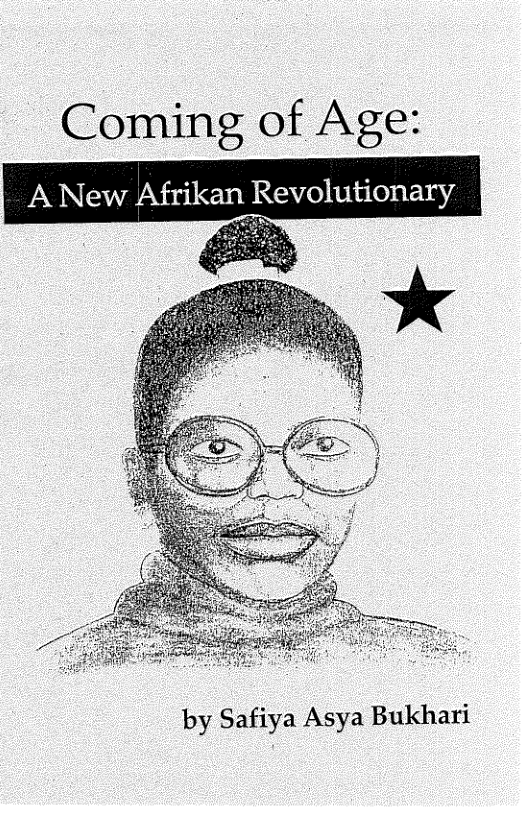
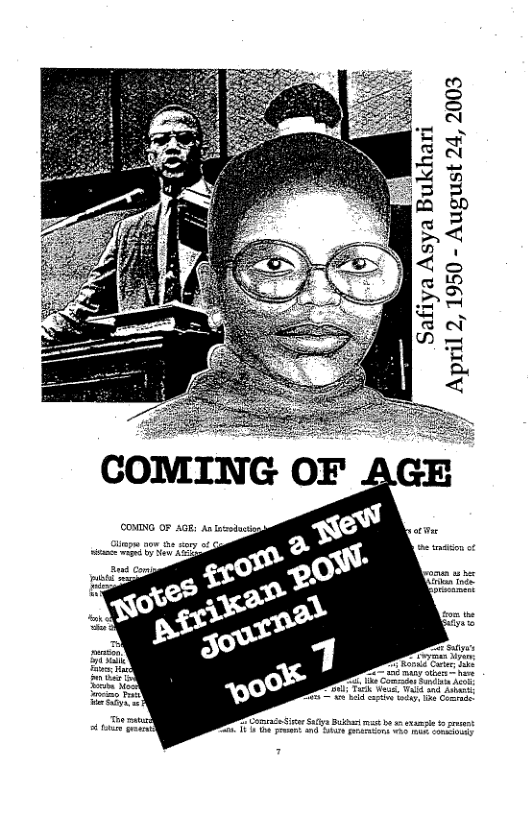
Coming of Age:
A New Afrikan Revolutionary
by Safiya Asya Bukhari
Ajoint Spear and Shield-Kersplebedeb publication
1st printing, 1st edition, March 2005
ISBN 1-894946-18-9
With the exception of Sally O'Brien’s statement “We Moum the Loss of
Producer Safiya Bukhari", all contents of this pamphiet are reprinted from
Notes from a Nes Affikan PO Joumal #7 (Spear & Shield 1979).
Sally O'Brien’s statement is reprinted from Crossoad Vol. 12, #1 Oct.-
Dec. 2003,
Sinoe ts founding 25 years ago by a prison colleciive of former Black Panther
Party members and other revolutionaries, Spear & Shield Publications has
been an active partof the New Afrikan independence movement. “We call
our nation New Afrika, and it exists in both actuality and potentiality; the
nation exists, but t's not yet independent.”
Spear & Shield Publications
5206S. Harper
Chicago, IL 60615
e-mail: crsn@aol.com
Also distributed by:
Kersplebedeb Distribution
CP 63560, CCCP Van Homne
Montreal, Quebec
Canada
H3W3H8
email: info@kersplebedeb.com
b hitp:/fwww kersplebedeb.com
An Introduction by
the Committee for
Political/Prisoners of War (1979)
Glimpsenow the story of Comrade-Sister Safiya Asya Bukhari, and
‘glimpse also the tradition of resistance waged by New Afrikan people
‘against amerikkkan domination.
Read Coming of Age and become aware of the path taken by one
New Afrikan woman as her youthful search for the “amerikkkan dream”
led her to conscious participation in the New Afikan Independence
Movement:tothe Black Panther Party; the Black Liberation Army: to
capture and imprisonment as a New Afriken Prisoner of War.
‘Thestory which describes the coming of age of Comrade.-Sister Safiya
isbut one page from the book of New Afikan life. This page describes
the conditions which have led others before Sister Safiya to realize that
decisions must be made, 5o that We become part of the solution to our
problem.
‘The page reflects the conditions confronted, and the choices made,
by others of Sister Safiya’s generation. Some of these Comrades contine
toserve the people. Some, like Comrades Twyman Myers; Zayd Malik
Shakur; Fred Hampton and Mark Clark; George and Jonathan Jackson;
Ronald Carter; Jake Winters; Harold Russell and Andaliwa Clark;
Changa, Rema and Kimu Olugbala— and many others— have given
their lives serving the people and making revolution. And others sil, ke
Comrades Sundiata Acoli; Dhoruba Moore; Jalil Muntagim; Nuh
‘Washington and Herman Bell; Tarik Weusi, Walid and Ashanti; Geronimo
Prattand Ruchell Magee — and many, many others—are held captive
today, like Comrade-Sister Safiy, as Prisoners of War.
‘The maturation process We witness in Comrade-Sister Safiya Bukbari
‘mustbe an example to present and future generations of New Afrikans.
Itis the present and future generations who must consciously make the
decisionto follow the example set by all those now active inthe Movement
who, along with Sister Safiya and all other Political/Prisoners of War,
are totally committed to carrying on the New Afrikan tradition of
resistance, and who stand as beacons on the hill, shining ight on the path
that the New Afrikan nation must take as it comes of age, and makes
revolution.
From one generation to the next,
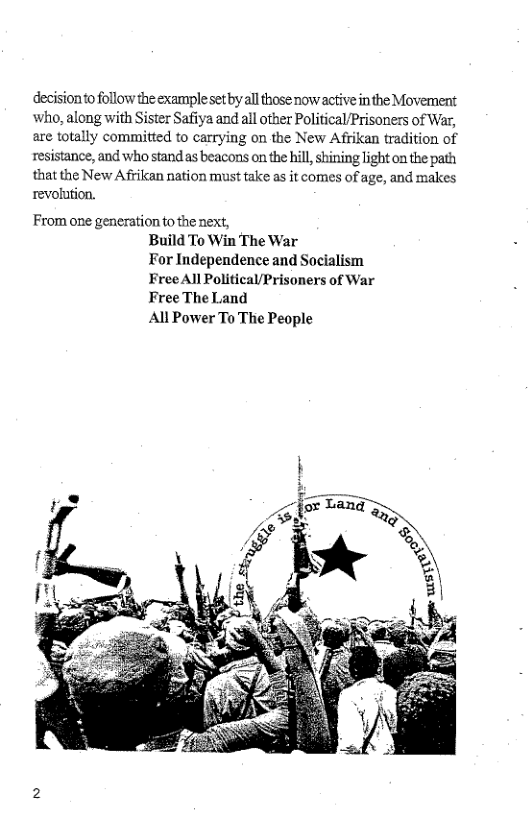
Build To Win The War
For Independence and Socialism
Free All Political/Prisoners of War
Free The Land
All Power To The People
COMING OF AGE: A NEW
AFRIKAN REVOLUTIONARY
by Safiya Asya Bukhari
Greek mythology tels the story of Minos, ruler of the city of Knossus.
Minos has a great labyrinth (maze) in which he keeps the Minotaur, a
monster halfman and half bull, whose victims were boys and girls who
wouldmake itto the center of the maze and be killed when they came
face to face with the Minotaur: Ifan intended victim chanced to survive
the encounter with the Minotaur, they perished trying to find their way
outof the many intricate passages. Finally, Theseus of Athens, with the
help of Ariadne, Minos’ daughter, enters the labyrinth, slays the beast,
and finds his way out by following the thread he had unwound as he
entered.
‘The maturation process i fll of obstacles and entanglements for
anyone, but for a New Afrikan woman in amerikika, it has all the
‘merkings of the Minotaur's Maze. i had tosay that, even though rothing
as spectacular takes place in the maturation process of the average New
Afrikan woman — it didn’t ever happen to me — but the day-to-day
struggle for survival and growth reaps the same reviardin the end in ten
thousend different ways. The trick is to learn from each defeat, and
become stronger and more determined. . think and begin to develop
the necessary strategies to insure the annihilation of the beast. ..
iam one of a family of 10 children. My parents were strict and religious,
but proud and independent. One of the strongest influences of my
childhood was my mother constantlytelling us to hold our heads up and
be proud because We were just as good or better than everyone else,
and tostand up and fight for what you believe to be right.
“This essay first appeared in Notes from a New Afrikan PO. . Journal,
Bool 7 (Spear & Shield Publications, 1979).
There was ot of competition in my faily; hadito be, with 10 children.
(alltwo years apart) growingup, each trying to live up to the other or be:
better, We were determined not to be caught up in the rut of the gheto,
‘We were going o get out.... 50 each ofus worked on our separate goals
— ten individuals — one family, in our separate world.
‘We believed that with the right education We could “make it” — so
that’s the route We took searching for the “emerildkcan dream.”§ was
goingtobeadoctor.
In my second year of college i pledged for a sorority — it was here
that the rose-colored glasses were cracked and rays of reality were
allowed o filterin.
‘The sorority had decided to help “disadvantaged” children as one of
our projects for the year and were trying to decide what country to work
with, when one of te Sisters suggested that We work in the ghettos of
New York. Personally, i'd never even thought of people in the united
states being disadvantaged, but only too lazy to work and “make it.” i
was in for one of the biggest rude awakenings of my life.
Afew of us weresentto Harlem to investigate the situation. We talked
to people on the street, in the welfare centers, from door to door, and
watched them work and play, loter on the comers and in the bars. What
‘We came away with wasa story of humiliation, degradation, deprivation
and waste, that started in infancy and lasted until death... in oo many
cases, atan early age.
Evenatthis poin, i didn't see this as affecting me personally, only as
asorority project... sort of a tourist who takes pity on the less fortunate,
‘The sorority decided to do what We could to help the children. The
Black Panther Party had a Free Breakfast Program to feed the children
going on. i had a daughter of my own at this point, and decided thati
would put my energies into this.
icouldn’t get into the politics of the Black Panther Party, but i could
volunteerto feed some hungry children; you see, children deservea tart
and youhave to feed them for them o live to leam. 1's hard to think of
reading and arithmetic when your stomach’s growling.
i'mnot rying to tell the logic of why a Free Breakfast Program for
children, butto showhow had to be slowly awakened into the reality of
life and shown the inter-connection of things.
Every momning at 5:00 my daughter and i would get ready and goto
the Center where i was working on the Brealcast Program — cook and
serve breakfast, sometimes talk to the children about problems they
were encountering and sometimes help them with their homework.
Everything was going along smoothly until the number of children coming
began to fall off. Finally, began to question the children and found out
that the police had been telling the parents i the neighborhood notto
send their children to the Program because We were feeding them
poisoned food.
1¢'s one thing to hear about underhanded things the police do —you
canignore it then— but s totaly different when you experience it for
yourself—youeither li to yourselfor face it i chose to face itand find
outwhy the police felt it was so important to keep New Afikan children
from being fed that they told lies. i went back to the Black Panther Party
and started attending some of their Community Political Education
Classes.
Itwasn’tlong after that when i was forced to make a decision about
what direction i was going in politically, i was on 42nd street with a
friend when wenoticed a crowd gathered on the comer. In the center of
the crowd was a Panther with some newspapers under his arm. Two
police officers were also there, i listened to see what was going on. The
police were telling the Panther he couldn't sell newspapers on the comer
and he was insisting that he could. Withouta thought, i told the police
thatthe Brother bada“constitutionalright”to disseminate political literature:
anywhere, at which point the police asked for my identification and
arrested the Sister and myself, along with the Brother who was selling
the papers.
First Encounter With The Police
ihad never been arrested before, and i was naive enough o believe
thatall you had to do was be honest and everything would work outall
right. i was wrong again. As soon as the police gotus into the back-seat
oftheir car and pulled away from the crowd, the beastiality began to
show. My friend went to say something and one of the police officers
threatened to ram his nightstick up her if she opened her mouth again,
andran on in amonologue about New Afrikan (black) people. i listened
and gotangry. .
At the 14th Precinct they separated us to search us. After the
policewoman had searched me, | remember one of the male officers
telling her to make sure she washed her hand so she wouldn't catch
anything.
That night, i went to see my mother, explained to her about the bust
andabouta decision i*d made. Momma and Daddy were in the kitchen
when got there — Daddy sitting at the table and Momma cooking.
remember telling them about the bust and them saying nothing, Theni
told them about how the police had acted dnd them stillsaying nothing,
‘Theniitold them that i couldn’tsitsill and allow the police to getaway
with that. i had to stand up for my rights as a ruman being. i remember
‘my mother saying, “...if you think it’s right, then do it.” i went back to
Harlem and joined the Black Panther Party.
i spent the next year working with welfare mothers. Liberation
Schools, talking to students, leaming the reality of life in the ghettos of
amerikidka and re-evaluating a ot of the things i had been taught about
the “land of the free and home of the brave.”
Tt was about this time that i quit school and went to look for a full-
time job. i had education and skills but there was always something
wrong, It didn't dawn on me what it was untili went to ITT and applied
forajob as a receptionist-clerk, and they told me i was over qualified,
i ended up working for my friend’s mother in her beauty parlor and
spent all my spare time with the Party.
By the summer of 1970 i was a full-time Party member and my
daughter was staying with my mothet i was teaching some of the Political
Bducation classes at the Party office, and had established a Liberation
School in my Section of the community. i had listened to the elderly
while they told me how they couldn’t survive off their miserly Social
Security checks — not pay rent and eat, oo — so they pay their rent
and eat from the dog food section of the supermarket or the garbage
cans. had listened to the middle-aged motheras she told of being evicted
from her home and sleeping on a subway with her children because the
welfare refusedto give her help unless she signed overall the property
she had, and out of desperation, fraudulently received welfare. i had
‘watched while amother prostituted her body to put food in the mouth of
her child and another mother, mentally broken under the pressure,
prostituted her eight year old child. i had seen enough of the ravages of
dope, alcohol, and despair to know thata change had to be made so the
world could be a better place for my child to live in.
My mother had successfully kept me ignoranit o the reality of the
plight of New Afrikan (black) people in amerikkka— now had learned
it for myself—but was still o leam a harsher lesson: the plight of the
slave who dares to ebel.
“Turbulent Times
‘The year 1971 saw many turbulent times in the Black Panther Party,
andchangesinmy life. i metand worked with many people who were to
teach me and guide me: Michael (Cetewayo) Tabor of the Panther 21;
‘Albert (Nub) Washington, and “Lost One,” who was responsible for my
initial policalecucation; Robert Webb. Cet taught me to deal principledly;
Nub taught me compassion; and Robert taught me to be firm in my
convictions.
‘When the split went down in the Black Panther Party, was leftina
position of Communications and Information Officer for the East Coast
Party. It wasn’tuntil much later that wasto find out how vuinerable that
position was.
Many of the members of the Party went underground to work with
the Black Liberation Army (BLA). i was among those who elected to
remain aboveground and supply necessary support. The murders of
‘youths such as Clifford Glover, Tyrone Guyton, etc., by the police, and
retaliation by the BLA with the assassination of pigs Piagentini and Jones
and Rocco and Laurie, made the powers that be frantic, and they pulled
outthe stops in their campaign to rid the streets of rebellious slaves.
By the spring of 1973, Comrades Assata Shakur and Sundiata Acoli
were captured, along with Nuh and Jalil (Anthony Bottoms), and Tyman
Myers was on the £5.1.’s 10 Most Wanted list, and i was stil raveling
back and forth across the kountry trying to build necessary support
‘mechanisms.
Tn 1972 recognized the need for something other than myselfto
epend on. You see, in less than two years i"d aged fo the point where
realized that nothing s permanent or secure in a world where it's who
‘youknow and what you have that counts. 'd seen friends and loved
ones either killed or thrown in prison, and associates that i'd once thought
would never go back, tur states or go back into the woodswork. Nuh.
fumned me on to slam, which gave me a new securiy, sense of purpose,
and dignity.
By 1973 i°d begun to receive a lot of lak from the police becausc of
‘what they “suspected” i might be doing. Actually it was because i didn't
havea record; they couldn’tcatch me doing anything, andi continued to
actively and vocally support the BLA members... alsomy homework
hadbeen done so well in the community, that the community’s support
‘was there, also.
Following the receipt of subpoenas to appear before a special grand
jury investigating the BLA that was seated in New York in the spring of
1974, i went underground along with some other people, to function
withthe BLA.
On January 25, 1975, myselfand some otber members of the Amistad
Collective of the BLA, went into the country in Virginia to practice night
firing, We were to leave Virginia that night on our way to Jackson,
8
Mississippi, cause i wanted to be there on Sunday to see someone. We
decided to stop by a store before We went back to the crib We were
staying at, so We could pick up some cold cuts to make sandwiches
with so We wouldn’t have to stop at any restaurants. We drove around
looking for an open store. When We came on to one i told the Brothers
to wait in the car and i"d go and be right back.
i entered the store, went past the registers, down an aisle to the meat
counter and started checking them for all-beef products, i heard a door
opening and looked up to see two of the Brothers coming in— idn’t
give ita thought — went back to what i was doing when out of the
corner of my left eye i saw arifle pointed toward the door in the manager’s
hand. quickly gotinto anaisle justas the firing started. Up to this poiat
i had heard no words spoken. With the first lull n shooting, Kombozi
came down the aisle toward me. He was wearing a full-length army
coat. It was completely unbuttoned. As he came toward me he told me
e was shot. i didn’t believe him at first because i saw no blood and his
‘weapon wasn’t drawn. Then he insisted he was again, so 1 told him to lie
down on the floor and il take care of t.
Masai had apparently made it back out the door whea the firing
started, because just then he came back to the door and tried to draw
thefire so We could get out. i saw him get shot in the face and stumble
backwards out the door. i looked around for a way out, and realized
there was none, and elected to play it low-keyed in-order to try and get
help for Kombozi as soonas possible. was to leam that the effort was
‘wasted. The manager of the store and his son, Paul-Green Sr. and Jr,
stomped Kombozi to death in front of my eyes.
Later, when i attempted to press counter-charges of murder against
them, the Commonwealth Attorney called it *justifiable” homicide.
Five minutes after the shoot-out went down, the £.i. was on the
scone and the next morning they helda press conference, saying i was
notorious, dangerous, etc., and known to law enforcement agencies
nationwide —and my bail was set at one million dollars on each count.
‘Trialand Imprisonment
OnApril 16, 1975, aftera trial thatlasted one day, We were sentenced.
1040 years, and on April 17, arrived here at the Virginia Correctional
Center for Women at Goochland.
Directly following my arival i was placedin the Max Security Building
and there i stayed, until after being threatened with kourt action, they
released me to general population. The day after my release to general
‘population was told that the firstiota of trouble that caused i would be
placed back in the Max Security Building and there i'd stay.
‘Atthat pointand for the next two years, my emphasis was on getting
some medical care formyself and the other women here and educational
‘programs and activities; the priority being on medical care for myself.
Tnside the prison i was denied it (the general feeling was they couldn’t
chance hospitalization for fear i°d escape; so rather than chancing my
escape, they preferred to take a chance on my life). In the kourts they
said they saw no evidence of inadequate medical care, but rather a
difference of opinion on treatment between mie and the prison doctor.
‘The “medical treatment” for worhen prisoners here in Virginia has got
to be an ll-time low, when you got o put your life in the hands of a
“doctor” who examines a woman who has her right ovary removedand
tells her there’s tendemess in her right ovary; or when this same “doctor”
‘examines a woman who has be¢n in prison for six months and tells her
she’s six weeks pregnant, and there’s nothing wrong with her, and she
Tater finds her baby has died and mortified inside her; or when he ells
You you'renot pregnant and three months later you give birth to seven
pound baby boy; notto mention prescribing Maalox for a sore throat
and diagnosinga sore throat that turns out o be cencer.
InDecember of 19761 started hemorrhaging and went to the clinic
for help. No help of any consequence was given, 5o i escaped. Two
months later i was recaptured. While on escape i was told by a doctor
thati could either endure the situation, take pain killers,or have surgery.
i decided o use the lack of medical care as my defense for the escape
and by doing 5o do two things: (1) expose the level of medical care at
the prison and (2) put pressure on them to give me the care i needed.
10
ifinally got to the hospital in June of 1978. By that time it was too
late. i was so messed up inside that everything butone ovary had to go,
because of the negligence of the “doctor” and lack of feeling of the
prison officials (they didn’t give a damn), i was forced to have
hysterectomy.
‘When they brought me back to this prisori in March of 1977 because
of the escape, they placed me in Cell 5 on the segregation end of the
Maximum Security Building — the same room they placed me in on
April 17, 1975. To date, i'm sfill in that cell, allegedly because of my
escape, butin actuality because of my politics.
How doi know? Because since my being refumed o this institution
onMarch 24, 1977, other women have escaped and been brought back
and have been released to general population — and yesterday my co-
defendant on the escape charge was okayed for release to general
‘population, i was denied.
Despite all of the emotional and physical setbacks i've experienced,
i've leamed.a lot.i've watched the oppressor play that same old game
onblack people theyve been playing for centuries— divide and conquer.
Black women break under the pressure and sell their men down the
tiverand then separate them from their children. In two strokes they do
‘more damage than 30 years in prison could have done if the women had
supported their men.
‘And now, more than ever before, black women — New Afrikan
‘women — have developed a mercenary outlook on life. They are not
about Family, Community, and us as 2 People anymore. They re about
looking good, having fun and “makingit” Women's liberation is what
they're about, failing to grasp the realization that true women’s liberation
forblack women will only come about with the liberation ofblack people
asawhole, Sothat for the firsttime since our forefathers were snatched
from the Afrikan continent and brought to amerikicka as slave labor, We
can'havea Family, and from that Family build a Community anda Nation.
‘The powers that be were totally disconcerted when black mothers,
‘wives, daughters and black women in general, stood by and ina lot of
cases, fought beside their men, when they were captured, shot or
11
victimized by the police and other agents of the government. They were
frightened of the potential to wreak havoc that black women represented.
‘when black women began to enter into the prisons and jails in efforts to
liberate their men. They were spurred into action when they were
confronted with the fact that black women were educating their children
from the cradle up, who the real enemies of black people are, and what
must be done to eliminate this ever-present threat o the lives of black
people.
‘Duringthe lastfour years of my incarceration've watched and didn’t
speak becausei didn't want to chance alienating the “lef;” es black men
and black women have fooled themselves into believing that We were
“making progress” because (1) Patricia Harris, a black woman, is part
oftheus. president’s cabinet, and (2) Andrew Young s the ambassador
tothe UN— failing torealize that it's all politics— amerikkkan style.
And, twenty women of all races are working together for Women’s
Liberation. There is no real progress being made. As a matter of fact,
one of Casters best friends, Vernon Jordan, had to concede in his anmual
economicreview, the State of Black Amerikkka, 1979, that “the income
gap between blacks and whites i actually widening ™
The sacrifices black women have made in scarch of black
‘womanhood, like the sacrifices made by the people of Knossus inits
efforts to slay the Minotaus, have been many, harsh and cruel —but We
100 can slay the beast (in our case, amerikkkan racism, capitalism, and.
sexism), and out of the ashes build a free and independent Black Nation
in which We can take our rightful place as Wormen, Wives, and Mothers,
knowing our children wil live to be men and womnen, and our men will
be allowed to recognize their manhood — support and defend their
families with dignity.
TOGETHER BUILDING A FUTURE FOR OURSELVES!
Build To Win!
12
Coming of Age:
An Update (1981)
1t's two years since i wrote the original article.. lots of
things have bappened ... Assata Shakur was liberated; Imari
Obadele was released. . the Ku Klux Klan regrouped and
revamped; 16 black children are missing and presumed to be
dead in Atlanta; 8 black men murdered in Buffalo; pregnant
black women shiot in Chattanooga; Ronald Reagan will take
officein2 days.
1¢'s two months since i was released from the Maximum
Security Building... had 0 go to kourt 0 Qo .. it too was an
eye opening experience... they said the reason they were
keepingme housed in that building was because i was “threat
to the security of the free world.”
‘Whatcanisay? tseems that the political scene in amerikkda
has come full circle, and black people are once again the
scapegoats for everything that goes wrongin white amerikica
They nolonger feelthe need to pacify us with poverty programs
and token jobs.
SittinginaMaximum Security cell for 3 years and 7 months
afforded me an opportunity to refllect upon my life and the
lessons i was forced toleam. . butnow the leaming processis
over... it time to put what i've learmed info practice... freedom
will only be won by the sweat of our brows.
3
We Mourn the Loss of
Dedicated, nationally known Black liberation
fighter and longtime WBAI producer Safiya Bukhari
(Where We Live, Thursdays, 8-9 pm) died in the early
hours of the morming from complications due to
prolonged illness. She was 53. Safiya joined the Black
Panther Party in 1969 after witnessing a vicious
police beating of another Panther standing on a
Harlem street corner selling the Party's newspaper. “1
tell people straight up that it was the New York Police
Department that made me decide to join the Black
Panther Party.” She said, “In college I supported the
war in Vietnam. I was so far to the right it was
ridiculous. But by the time the summer of 1969 was
over, in November, I was in the Party.”
Adisciplined and dedicated revolutionary, Safiya
went on to join the Black Liberation Army. She spent
close to nine years in prison for clandestine actions
on behalf of the BLA. After her release, Safiya
dedicated her life to the freedom of her comrades she
left behind, and used every means at her disposal. She
by Sally O’Brien, co-producer, co-host, Where We Live
August 24th, 2003
14
Producer Safiya Bukhari
wrote prolifically about individual cases, designed
and made political prisoner T-shirts, buttons, bumper
stickers, and mouse pads, wrote fact sheets on each
individual case and in 1992 co-founded the New York
Free Mumia Abu-Jamal Coalition which she co-
chaired until her death. She also served as Vice
President in the Provisional Government of the
Republic of New Afrika, an organization working
towards the formation of a separate Black nation
comprised of five states — South Carolina, Georgia,
Alabama, Mississippi, and Louisiana, states built on
the backs of enslaved Africans.
In 1998, Safiya became the co-chair of the Jericho
Movement to Free U.S. Political Prisoners and
Prisoners of War. She established a website and
traveled throughout the country organizing people
to the cause of those behind the walls. Coming from
a strong family spiritual tradition, Safiya came to
embrace Islam.
Safiya Asya Bukhari, Revolutionary, Mother,
Grandmother, singer, writer, comrade, sister and
friend, our loss reverberates throughout the ages.
15
50
=3
2
_N
=
o
< 3
s 3
£y
g<
@
<8
<
22
E=ld
< o
D =
=
(="
<
RECOMMENDED READING
Settlers, Mythology of the White Proletariat,
by]. Sakai. Few Mandst-Leninist-Maoist books
written in the 1980s have had such an effect
beyond the ranks of the communist left, with the
analysis being taken up by anarchists, feminists,
nationalists, and anti-racists... but then again, few
books of whatever political persuasion do what
Settlers did - tuming a spotlight onto the sordid
history of the white nation in North America,
“throwing the light of historical materialism on
Babylon itself.” An excruciating examination of
500 years of genocide, slavery and exploitation,
this is the classic exposé of the parasitism and
‘pretension that is Amerika.
available for $16.00 US
from Kersplebedab or Spear & Shield
MONEY & POWER:
ook 98 caook
Money & Power: Hook or Crook, by Zolo
Agona Azania. The author is a New Afrikan
political prisoner who has spent 23 years on death
row, and this despite having forced the State to
‘admit to racist improprieties in his trial and and.
having his sentence overturned not once but twice!
These introductory essays deal with the
psychological and moral distortions of capitalism,
and the need for 2 moral socialst alternatlve, from
aworking class New Afrikan perspective.
available for $3.50 US
from Kersplebedeb or Spear & Shicld
Publications! |
""'zos& Harper
Materials Available From
Spear & Shield Publications
Notes From a New Afrikan
P.O.W. Journal
(53 each - please indicate your choice when ordering)
B0k One - Reflections on the ‘Prison Movement - On Transforming the Colonial and
‘Criminal Mentalty - New Affan POWs and the United Natons - and mora!
Book Two - We StllCharge Gendecice - The 13th Amendment: Insiument of Legaiized
Stavery and the Re-subjugaton of New Affca - and morel
Book Thes - Thoughts on the Eve of a New Year - Are We Asking the Right Questons?
Book Four - Vita Wa Watu - Detray Re-Visitec.
Book Five - Combat Colonial Violence: Heighten the National Demacratic Revolution -
ané morol
Book Six - Against the Wind - Iranian Excerpts (OIPFG) O the Necessity of Amned
siuggle
Book Saven - Carry On the Traditon: In the Spif of Fred Homplon and Mark Clark -
Thoughts On Consoliation, declogy and Organization - snd morel
Vita Wa Watu: A New Afrikan
Theoretical Journal
(54 oach - please indicate your choice when ordering)
Book Eight - Black Liveraton (a spsech by James Forman); On the Transiion cf the
“Black Liberation' Phrase, Concept and Movement
Book Nine - On the Link Between Oppression of New Affkan Women and the New
Askan National Liberation Revolution - and mere!
Book Ten - Reflections on the Resugence of Student Activism - Bullding Shields of
Sience and Convicton - Revolutionary Morally: An Overview - and more!
Book Eleven - Three Speeches by Fred Hampton - Counterinteligence Against the linois
Chapter of the Black Parther Party - On Our Use of the Word Comrad - and
mece!
Book Twelve - Notes On Cadre Policy and Cadre Development - On What k Moans To
"Re-Bu
write for a more complete list of available literature!
prices subject to change - prisoners may send equivalent in stamps.
Make check or money order payable to:
‘Speara Shield Publications
5206 S. Harper
Chicage, IL 60615
The Books 4 Prisoners Crew
P.0. Box 19065
Cincinnati, OH 45219
Email - Booksdprisoners@hotmail.com
www.freewebs.com/booksdprisoners
Free baoks to state and federal prisoners in OF, IN, and 3 TX state prisons
Ramsey T Unit (men’s prison), , Gatesville Unit (women'’s prison), Polunsky Unié
(uen’s prison) singe 2001
distributed by:
Spear & Shield Publications
5206 S. Harper
Chicago, IL 60615
e-mail::crsn@aol.com
and:
Kersplebedeb
CP 63560
CCCP Van Home
Montreal, Quebec
Canada, H3W 3H8
email: info@kersplebedeb.com
web: http://www.kersplebedeb.com
publshed by
Kersplebedeb and Spear & Shieid Publications
1SBN 1-834946-16-9