But We Have To, So We Do It Real Slow
Web PDF • Imposed PDF• Raw TXT (OCR)



![ANTI-WORK / ANTI-CAPITALI INTRODUCTION My first encounter with an explicit anti-work position came from Chicans friends who I had met in 2001 who were heavily-influenced by the French Marsist theorist Guy Debord and the Situationist International. In 1953, a young Guy Debord painted on a wall on the Rue de Seine « NE TRAVAILLEZ JAMAIS » (tr. Never Work). A statement that was diffiult for me to understand conceptually at the time but which | immediately gravitated towards (who as a youth looks forward 10.a lfetime of work ahead of them?) Previously, al the anarchist literature I had read on work concerned themselves with how wage labor was theft of our time & of our labor-power and that the solution was not the abolition of work per se but worker self-management. [Think of all the nostalgia that some Left-Anarchisis still have for the revolution lost by the anarcho-syndicalists during the Spanish Civil War ] Anti-work was a scandalous position growing up in a Mexican houschold where what was prized was the opportunity to find well-paying work, as well as a hearly work cthic. Though the starting point for Guy Debord’s opposition to a world of work was not a beatik, bohemian-lifestyle refusal common to the 1950s, but rather a rejection of the bleariness of life under capitalism and part of a whole projeet to overthrow what they called The Spectacle and to once again make life ajoyous. The eritique of wark can be found elsewhere throughout history including Paul Lafargue’s “The Right to be Lazy"(1883) written by Karl Marx’s son-in-law; in the unfortunately notorious post-left Anarchist Bob Black’s “The Abolition of 21BUT WE HAVETO](but-we-have-to-so-we-do-it-real-slow-ondala 8.png)
![3 d “[a] lack of initiative, [an] inability to save, absences while celebrating too many holidays, [a] willingness to work for only three or four days a week if that paid for necessities, [and] an insatiable desire for alcohol...” (Bernsiein) It seems that time changes little. OF course, in ‘many ways we always knew that we don’t re- ally want to go to work and that we only have disdain for those who don’t have to because we. are not them. That we enjoy the winter break where we fillup on tamales, cervezas and spend the evenings talking about what we’d really like to be doing and dreams for the future. Even the Left’s obsession with the mythologized collec- tive worker that is socially-responsible, punctu- alland whom identifies with their work i largely a fabrication of the dead workers movement.* “the supposed identity that the worker’s movement constructed tumed out to be a particular one. It subsumed workers only insofar as they were stamped, or were willing to be stamped. with & very particular character. That is to say. it included workers not as they were in themselves, but only to the extent that they conformed to a certain image of respectability, dignity hard work, family, organisation, sobriety, atheism, and so on." Too often we are given the lie that the way to progress is to submit to the rationalization of the capitalist system; that we simply need to awaken the sleeping giant which represents the possible Latino voting bloc; that the rich are rich because they really know how to handle their money; that if only we could sway Congress to push immigration reform; if only we could get universities 1o tell us back our histories or to enroll us at all...but really the way out s to abolish the social relation that is capitalism....that protects itself by way of the State; that protects itself with borders, police and a standing army; that controls the way we envision our lives with carcers, time management and gender roles; that makes into a commodity even the way we choose to spend our not-working hours, which ‘et are still spent preparing or recovering from those working hours. 5t The iealworke / Darmn! it scan the company it msking the profts tht it should be...vell, Say o more! tomorzow vl qui without ny ki of compensation oranything... how would 1 dare protet 14 athe cal th ant it polce nd have them split my hesd open! 6 A Hisoryof Scparation” by Endcs SOWE DO ITREALSLOW/ 5](but-we-have-to-so-we-do-it-real-slow-ondala 11.png)



BUT WE HAVE TO,
SO WE DO IT
REAL SLOW
pdfavailable on haterslife
designed by post.chicanx
BUT WE HAVE TO,
SO WE DO IT REAL SLOW
On Anti-Work, Mexican(-American)s
and Work
By Noche
INTRODUCTION
I wrote this short essay S years ago at time when anti-work was not as popular
a position, or sentiment, within the radical milieu. My intention with ths picce
was o highlights clements of anti-work /refusal of labor that alrcady exist among,
Mexican(-American)s in the so-called United States. And by doing this extend
the criique of work beyond the white radical milieu of the North American
Anglosphere. The critique of work is now (thankifully) more widespread, and I
hope that others take up the task of extending the critique of work because the
pandemic has verily cleared the fog of pro-work propaganda: most of us leamed.
first-hand that our work, deemed essential o not, has always been actvity which
exists for the immediate beneft of others and not ourselves. We barely float by
physically & mentall, while capitalsts retreat further into their well-protected
bubbles of wealth (even into space). I's time we reclaim ou time, cnergy &
activity. Time for communism & anarchy...which always also means the abolition
of work
Noche
Tovaangar, so-called Los Angeles
July
2021
In Los Angeles to be against Capital typically presents itsef in a pro-work/worker
position. The problem is never work itself, the nature of work or that work s
waged but instead what is desired is extending a sphere of work that is unionized
and bolstered with higher wages. Take for instance the CLEAN Carwash
‘campaign', where carwash workers (whom are mostly immigrant men) have been
unionized under the representation of United Steclworkers Local 6752 Though
this move one is that brings much needed bettermen of working conditions and
wages for these workers, what is ultimately not brought up is that the work of
a car wash workers can and has already been automated. But the fading labor
movement seems to be no longer concerned with the overthrow of capitalism nor
the abolition of work. That drea is a dream that has been lost along with the
labor movement tself
‘The expression of an anti-wark position has cither been minoritarian or unheard
of. In a city where working conditions for immigrants can be well below the
legal standards set forth by the State and the Federal Government, the push for
more protections and rights within the workplace takes precedence. An anti-
work affect (rather than a bonafide position) among Mexican immigrants and/or
Mexican-Americans is usually to be found in cultural forms and do not often take
on explicit anti-political, o anti-capitalist forms. That said, the playful, tongue-
heek cultural forms are plentiful, the other mentioned forms are fow and far
in between.
T wnwwcucjusice orglcampaigns carvash
2 weasweTSorg
ANTI-WORK / ANTI-CAPITALI
INTRODUCTION
My first encounter with an explicit anti-work position came from Chicans friends
who I had met in 2001 who were heavily-influenced by the French Marsist theorist
Guy Debord and the Situationist International. In 1953, a young Guy Debord
painted on a wall on the Rue de Seine « NE TRAVAILLEZ JAMAIS » (tr. Never
Work). A statement that was diffiult for me to understand conceptually at the
time but which | immediately gravitated towards (who as a youth looks forward
10.a lfetime of work ahead of them?) Previously, al the anarchist literature I had
read on work concerned themselves with how wage labor was theft of our time &
of our labor-power and that the solution was not the abolition of work per se but
worker self-management. [Think of all the nostalgia that some Left-Anarchisis
still have for the revolution lost by the anarcho-syndicalists during the Spanish
Civil War ]
Anti-work was a scandalous position growing up in a Mexican houschold where
what was prized was the opportunity to find well-paying work, as well as a hearly
work cthic. Though the starting point for Guy Debord’s opposition to a world of
work was not a beatik, bohemian-lifestyle refusal common to the 1950s, but
rather a rejection of the bleariness of life under capitalism and part of a whole
projeet to overthrow what they called The Spectacle and to once again make life
ajoyous.
The eritique of wark can be found elsewhere throughout history including Paul
Lafargue’s “The Right to be Lazy"(1883) written by Karl Marx’s son-in-law; in
the unfortunately notorious post-left Anarchist Bob Black’s “The Abolition of
21BUT WE HAVETO
Work'(1985) and Gille Dauve’s “Eclipse & Re-Emergence of the Communist
Movement” (1970) where he clarifies what the abolition of work could mean and
says “what we want is the abolition of work as an activity separate from the rest
of life.” He further explains that the issue at hand is not whether we are active or
not, but rather that under capitalism what we do is abstracted into two spheres,
both alienated: work-time and leisure-time. This (anti-state) communist critique
of work notes that the liberation from Capital is not the liberation of labor but the
liberation from labor as it now exists. Currently we assume only those activii
which are paid a wage have value and that only those things which are productive,
in the capitalist sense. are necessary to human life.
MEXICAN-AMERICANS & WORK
‘That said there is no shortage of cultural output from Mexican immigrants, or
Mexican-Americans (some of whom identify as Chicanx) that takes a swipe at
the way work is made necessary to our social reproduction.’ Take for instance a
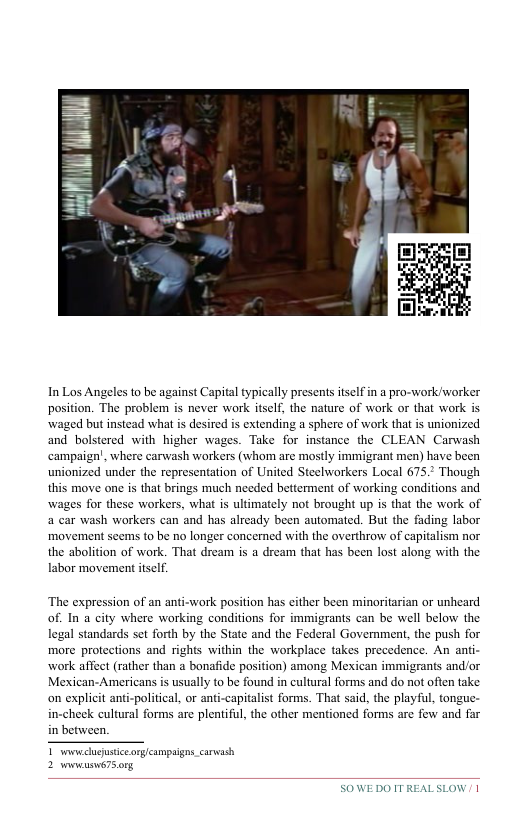
comedic song from “Up In Smoke” (1978), where the character Pedro de Pacas
sings a song trying to upend notions of popular Mexican-American identity and
says, “Mexican-Americans don’t like to get up carly n the morning but they have
1050 they do it real slow”
Here we catch a key moment in the subjectivity of the racialized Mexican-
American worker caught up in a warld where labor is managed and controlled
by borders. There is an understanding that work and the preparation for work
is drudgery but also that the refusal of work might be impossible; this refusal
acknowledged but it gives way 1o a sabotage on social reproductivity, a slow-
down.
The spectacular production of the Mexican as a worker in the USA (or as a
Mexican-American) is often tied up in a binary of cither being hard-working;
job-stealing or lazy and welfare-scheming. As scen by the words used by Donald
Trump during his presidential campaign, there is also the perception of the
Mexican as a dangerous criminal, forming a trinity of prejudice that returns when
it suits the need of nativist, racist politicians. This type of characterization was.
fist seen when the U.S. forcefully annexed the so-called American SouthWest
from México and bandits like Tiburcio Vasquez haunted the minds of the waves.
of Westward-bound Anglo-Americans. In 1954, this showed up as Operation
Wetback where the INS (which later becomes ICE) enacted indiscriminate round-
ups of Mexican laborers to put a chilling effect on undocumented migration of
Iaborers into the USA. Laborers need only “look Mexican” to be deported and
many of those deported were in fact U.S. citizens.
5 DEFINTTION: al he lsbo tht necds o b done sotht workess are prspared 0 work the nest
day. this work is oftn ua-pid though t s necssary for ny ok to be done under apialsm,exan
pls: doin the aundry child-care sex dish-washing, food reparation, comming.
SOWE DO ITREALSLOW /3
To posit an anti-work position and to take into account the racialization of
workers in the USA looms as an impossible task. Ofien immigrants internalize
a work cthic that can be as entrenched as that of right-wing Anglo-Americans
that erroncously describe the USA as a meritoeracy. This is more necessity than
reaction by Mexican immigrants under racialized capitalism since they are often
forced into the most grueling of work that most native-born, or Anglo-Americans,
will simply not take on: picking of fuits & vegetables, construction, food service.
child care, landscaping, etc. We work hard because we have to and we make a self-
serving mythology around it where we are the hard-working ones but everyone
else is the not-harding-working ones, where notably elements of anti-blackness
come to the fore.
To further the myth of the hard-working immigrant, that does not threaten the
colonial-capitalist social order of the USA, i to strip immigrants of the agency to
express refusal, resistance and revolt. In a time where nativist racism is peaking
once again, we must realize that this myth proliferation is no safety net against
ICE sweeps or other racist violence. There is no pride in presenting ourselves as
hard-working, since under capitalism working hard merely means we are putting
in more labor for the same amount of pay. In effect, we are lowering our wages.
by putting in more work than is expected and making ourselves hyper-exploited.
If we were to collectively express our reluctance or refusal to work beyond the.
bare minimum we could begin to flex the capacity of our labor power across
industries. (An inspiring moment of this kind of flexing was the general strike
on May Ist, 2006 where immigrants largely self-organized a strike to show how
much their labor is integral to the functioning of U.S. capitalism; in Los Angeles.
110 2 million people took to the streets & over 90% of LA Port traffic was shut
down)
And as it has been noted, more and more Mexicans are returning to Mexico than
coming into the USA, the payoff for this hard-work is in decline’. I've heard
amongst friends and family that many recent Mexican immigrants find that the
work they encounter in the USA s either too dangerous, too difficult or t0o hard
to find.
AWAY OUT?
But this desire to be the most hardworking Mexican in the world wasn't always.
the norm. In British historian E.P. Thompson's 1967 text “Time, Work-Discipline,
and Industrial Capitalism” he mentioned how cconomic-growth theorists viewed
Mexican mineworkers as “indolent and childlike people” because they lacked
discipline. For instance, he notes from a book on the “The Mexican Mining
Industry, 1890~ 1950 that Mexican mineworkers had:
pm—
1511119/ msicans eavingthan-coming-to-the-u-+
SUBUTWEHAVETO
3
d
“[a] lack of initiative, [an] inability to save, absences while
celebrating too many holidays, [a] willingness to work for only
three or four days a week if that paid for necessities, [and] an
insatiable desire for alcohol...” (Bernsiein)
It seems that time changes little. OF course, in
‘many ways we always knew that we don't re-
ally want to go to work and that we only have
disdain for those who don’t have to because we.
are not them. That we enjoy the winter break
where we fillup on tamales, cervezas and spend
the evenings talking about what we'd really like
to be doing and dreams for the future. Even the
Left’s obsession with the mythologized collec-
tive worker that is socially-responsible, punctu-
alland whom identifies with their work i largely
a fabrication of the dead workers movement.*
“the supposed identity that the worker's movement constructed
tumed out to be a particular one. It subsumed workers only
insofar as they were stamped, or were willing to be stamped.
with & very particular character. That is to say. it included
workers not as they were in themselves, but only to the extent
that they conformed to a certain image of respectability, dignity
hard work, family, organisation, sobriety, atheism, and so on."
Too often we are given the lie that the way to progress is to submit to the
rationalization of the capitalist system; that we simply need to awaken the
sleeping giant which represents the possible Latino voting bloc; that the rich are
rich because they really know how to handle their money; that if only we could
sway Congress to push immigration reform; if only we could get universities 1o
tell us back our histories or to enroll us at all...but really the way out s to abolish
the social relation that is capitalism....that protects itself by way of the State; that
protects itself with borders, police and a standing army; that controls the way we
envision our lives with carcers, time management and gender roles; that makes
into a commodity even the way we choose to spend our not-working hours, which
‘et are still spent preparing or recovering from those working hours.
5t The iealworke / Darmn! it scan the company it msking the profts tht it should be...vell,
Say o more! tomorzow vl qui without ny ki of compensation oranything... how would 1
dare protet 14 athe cal th ant it polce nd have them split my hesd open!
6 A Hisoryof Scparation” by Endcs
SOWE DO ITREALSLOW/ 5
<PERO COMO RESISTEREMOS POR MIENTRA!
/HOW CAN WE RESIST RIGHT NOW?
Or we've been resisting this whole time /
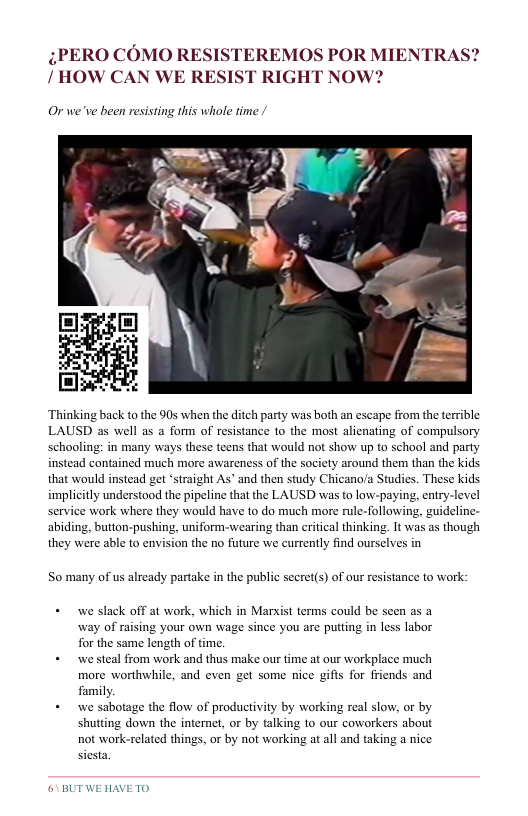
Thinking back to the 90s when the ditch party was both an escape from the terrible
LAUSD as well as a form of resistance 1o the most alienating of compulsory
schooling: in many ways these teens that would not show up to school and party
instead contained much more awareness of the society around them than the kids.
that would instead get straight As’ and then study Chicano/a Studics. These kids
implicitly understood the pipeline that the LAUSD was to low-paying, eniry-level
service work where they would have to do much more rule-following, guideline-
abiding, button-pushing, uniform-wearing than critical thinking. It was as though
they were able to envision the no future we currently find ourselves in
So many of us already partake in the public secret(s) of our resistance to work:
+ we slack off at work, which in Marxist terms could be scen as a
way of raising your own wage since you are putting in less labor
for the same length of time.
+ westeal from work and thus make our time at our workplace much
more worthwhile, and cven get some nice gifts for friends and
family
+ we sabotage the flow of productivity by working real slow, or by
shutting down the internet, or by talking to our coworkers about
not work-related things, or by not working at all and taking a nice
siesta.
BUT WE HAVETO
+ we call in sick when we're really not sick atall or really we're just
too hungover from the rager the night before.
A world without work seems like an impossibiliy, a utopia, an unlikely dream
especially when most of our waking time is spent thinking about how we're gonna
pay the rent, the power b, car insurance, possible student loans, more probable
eredit card debt or the bar tab...but a world without work is also a world without
capitalism....a world of communis,
That world is a world without wage labor, without patriarchy, without race,
without class, without astate, without police; where we would decide our lives on
our own terms without the limitations of value production, without the control of
borders, without Monday mornings, without social death, without artficial crises,
where we won't have o suffer the indignities of being harassed by the boss,
world beyond accounting, a world where what we do will not define who we are
to cach other. For a world without measure!
SUUGGESTED FURTHER READIN
“IWork Sucks by Kassandra Vee:
htps://thenewinguiry. comAwork-sucks
“Capitalism & Communism” by Gilles Dauvé:
hitps:/Aibeom.org/library/capitalism-communism-gilles-dauve
“A Ballad Against Work " by Kamunist Kranti
htips:/fibeom.org/bookexport/himi/ 16893
4 Few Clarifcations on Ani-Work” by Bruno Astarian
itp: s hicsalta-communisation.comtextes!_trashed
SOWE DO ITREALSLOW /7
Originally published on ONDA.LA
Written in 2016 and re-edited/published in 2018
ONDA.LA brings a vicious, non-moralistic anti-capitalist
perspective to Los Angeles. ONDA knows the cops cannot
be reformed; that cducation is never a way out of a pit dug
by racist capitalism. LA ONDA knows how to recognize the
racist, sexist, heteronormative, homophobic, transphobic, and
anti working-class aspects of the city. We know that politicians
will always cut us short whenever they can; that the question
of violence is not a question at all; that decolonization is not
a metaphor but a threat backed by material violence; that the
legal system offers nothing compared to revenge; that none
of us are pure nor that we should be; that knows work is a
drudgery imposed; that knows that the bad days will end.
Republished on Ediciones Inéditas
Both projects are defunct
Noche writes at puraacracia.club
All Live from Occupied Tongva-Gabrielino territory.